Cambridge IGCSE History 0470 — 2016 Oct/Nov Paper 2 · Variant 1
0470/21/O/N/16 · 50 marks · ≈56 min
The question paper and its mark scheme, free to read here and free to download. This is Cambridge’s own paper, exactly as it was sat.
Question paper16 pages




Mark scheme8 pages
Answers below. Sit the paper first if you are practising.
Paper as text
Question paper, page 1
This document consists of 11 printed pages, 5 blank pages and 1 insert. DC (NF/FD) 118155/3 © UCLES 2016 [Turn over Cambridge International Examinations Cambridge International General Certificate of Secondary Education * 8 4 5 3 9 9 6 0 2 8 * HISTORY 0470/21 Paper 2 October/November 2016 2 hours No Additional Materials are required. READ THESE INSTRUCTIONS FIRST An answer booklet is provided inside this question paper. You should follow the instructions on the front cover of the answer booklet. If you need additional answer paper ask the invigilator for a continuation booklet. This paper has two options. Choose one option, and answer all of the questions on that topic. Option A: 19th Century topic [p2–p6] Option B: 20th Century topic [p8–p12] The number of marks is given in brackets [ ] at the end of each question or part question. The syllabus is approved for use in England, Wales and Northern Ireland as a Cambridge International Level 1/Level 2 Certificate.
Question paper, page 2
2 0470/21/O/N/16 © UCLES 2016 Option A: 19th Century topic WHY DID THE 1848–49 REVOLUTIONS IN I TALY FAIL? Study the Background Information and the sources carefully, and then answer all the questions. Background Information The 1848 revolutions in Italy were a peculiar mixture. In Sicily and Naples there were popular risings for constitutional reform. In Rome Pope Pius IX appeared to put himself forward as leader of an Italian federation, but when he rejected this idea he was swept aside by a republican revolt. Popular risings in Milan and Venice were aimed at driving the Austrians out, while Charles Albert of Piedmont, although no friend of revolutionaries, declared war on Austria in support of Lombardy. By the end of 1849 the revolutions had failed. Was this because of poor leadership, disunity, failure to win over the peasants or the strength of the French and Austrians? SOURCE A Charles Albert was afraid to use the peasantry in the war against the Austrians because he feared social revolution. He declared war on Austria only after the successful insurrections of Milan and Venice. The war therefore became a war led by a man who feared revolution. He saw the war as a dynastic one, in which the regular armies of the two sides would fight it out. His contempt for popular militias was a mistake. The value of volunteer troops was undoubted and regular soldiers and volunteers had to be combined if the full potential of the Italian revolution was to be realised. After Charles Albert’s incompetent leadership of the army, his defeat at Custoza and his hasty abandonment of Milan, the liberal monarchists were greatly discredited. The ‘war of the kings’ had only led to defeat and the democrats and republicans took over the national movement, but in circumstances that were far less favourable than in March. Then the Austrians had been in disarray and the chances for striking a decisive blow for Italian nationalism had been very strong. But by the autumn the Austrians had survived and come out on top, and the counter-revolution was making steady progress all over Europe. The decree on land reform and the other social reforms carried out by Mazzini in the Roman Republic were the most concrete attempts by the Italian radicals to build a firm alliance with the urban and rural poor. The land reforms were particularly important because the peasantry formed the vast majority of the population, and if the revolutionaries were to succeed they had to have the peasants on their side. Unfortunately the measure at Rome came far too late to make any great difference to the war effort against Austria. Time had run out for Mazzini and Garibaldi, and the French and Austrians closed in from different directions. The key to success in 1848–49 was to expel the Austrians and Charles Albert had wasted the opportunity to achieve this. From a history book published in 1971.
Question paper, page 3
3 0470/21/O/N/16 © UCLES 2016 [Turn over SOURCE B Charles Albert entered the war against Austria with enthusiasm for an independent and united Italy. However, his army, larger than the Austrian forces, was incompetently led and ill-prepared for war. Not all the blame for the eventual Austrian victories can be attributed to Charles Albert. The Austrians had been struggling in Venetia. Here, the peasants had shown themselves to be in favour of revolution, hoping that it would lessen the harshness of their lives. Manin, the leader of the revolutionaries in Venice, did abolish the hated personal tax but he failed to use the peasants to strengthen the Venetian army. This was not because of fear of the peasantry but his failure to understand what was needed in military terms. The peasants were left without leadership or arms. The revolutionaries were divided. They might be agreed over expelling Austria but that was as far as agreement went. There was no acceptable leader who could coordinate policy. Mazzini, Pope Pius IX and Charles Albert all had different ideas. Local revolutionary leaders had no central leadership and the provisional governments they set up could be moderate, extremist, liberal, radical, republican, democratic or monarchist. The liberals, fearing social revolution, did not encourage popular support or involve the peasants. Mazzini failed to win the support of the peasants through his ideas. He failed to propose solutions to the deep poverty of many peasants. The issue that mattered to them was land ownership and he failed to understand that practical measures like land reform were needed. The military supremacy of Austria was the single most important factor in the failure of the revolutions. The Roman Republic stood no chance against the French and Austrians, especially because of Mazzini’s incompetent leadership. Even if the revolutionary forces had been able to unite, the Austrian forces were better equipped and led and were bound to win in the end. From a history book published in 1968. SOURCE C The destinies of Italy are maturing, and a happier future is opening up for those who bravely stand up for their rights against the oppressor. We, out of love for our common race, hasten to associate ourselves with the admiration which Italy confers on you. People of Lombardy and Venetia, our arms, which were concentrating on your frontier when you liberated Milan, are now coming to offer you help which a brother expects from a brother. We will support your just desires, confident as we are in the help of the God which has given Pius IX to Italy and who has enabled Italy to rely on its own strength. In order to show our feelings of Italian brotherhood, we have ordered our troops as they move into Lombardy to carry the cross of Savoy imposed on the tricolour flag of Italy. Charles Albert’s proclamation to Lombardy and Venice, March 1848.
Question paper, page 4
4 0470/21/O/N/16 © UCLES 2016 SOURCE D I beg you, because of our joint faith in Italian independence, not to forget what a real crisis this is, and how the opportunity we now have to create a strong state may never recur. Today the King told me that his generals are extremely annoyed with the state of opinion in Lombardy. Tell me my friend, what has Piedmont got to gain by joining with Lombardy? It may lose its primacy just to become a secondary planet in a different universe. The Piedmontese nation is sacrificing its blood, its money, and almost its position of primacy to support its brothers, but it is received like a dangerous enemy! I watched the King going through one Lombard village after another unhonoured, as though in a foreign land. The only talk at Milan is of a republic. If after proclaiming ourselves a nation we then divide into many tiny states and republics, and if we are then swallowed up by the foreigner, we shall miss our opportunity. From a letter by Count Di Castagneto, one of Charles Albert’s advisers, to Count Casati of Milan, April 1848. SOURCE E My army was almost alone in the struggle. The lack of provisions forced us to abandon the positions we had conquered for even the strength of the brave soldier has its limits. But the throbs of my heart were ever for Italian independence. People of the kingdom show yourselves strong in a first misfortune, have confidence in your king. The cause of Italian independence is not yet lost. From a declaration to his people by Charles Albert in July 1848, after the defeat by the Austrians at Custoza.
Question paper, page 5
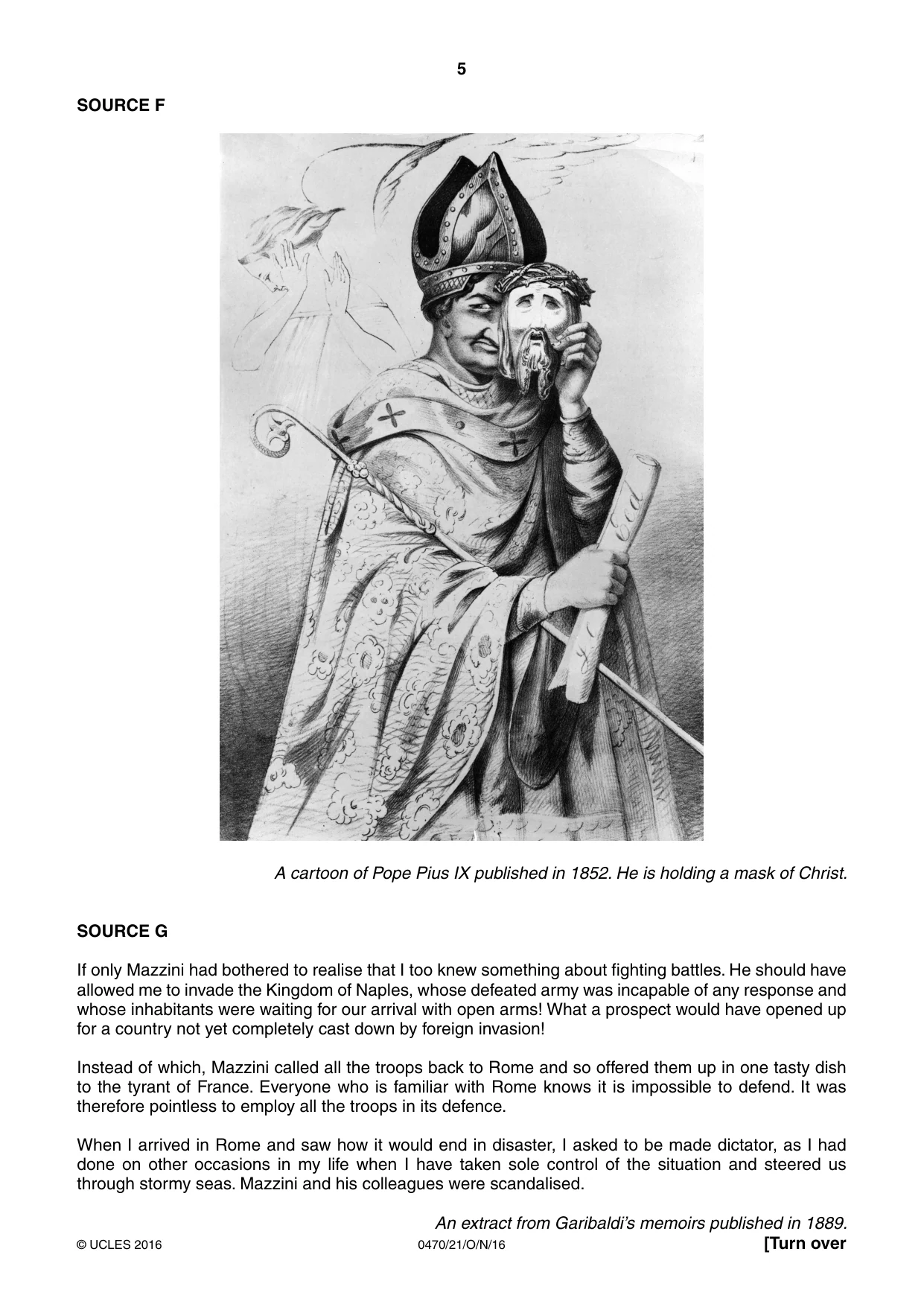
5 0470/21/O/N/16 © UCLES 2016 [Turn over SOURCE F A cartoon of Pope Pius IX published in 1852. He is holding a mask of Christ. SOURCE G If only Mazzini had bothered to realise that I too knew something about fighting battles. He should have allowed me to invade the Kingdom of Naples, whose defeated army was incapable of any response and whose inhabitants were waiting for our arrival with open arms! What a prospect would have opened up for a country not yet completely cast down by foreign invasion! Instead of which, Mazzini called all the troops back to Rome and so offered them up in one tasty dish to the tyrant of France. Everyone who is familiar with Rome knows it is impossible to defend. It was therefore pointless to employ all the troops in its defence. When I arrived in Rome and saw how it would end in disaster, I asked to be made dictator, as I had done on other occasions in my life when I have taken sole control of the situation and steered us through stormy seas. Mazzini and his colleagues were scandalised. An extract from Garibaldi’s memoirs published in 1889.
Question paper, page 6
6 0470/21/O/N/16 © UCLES 2016 Now answer all the following questions. You may use any of the sources to help you answer the questions, in addition to those sources which you are told to use. In answering the questions you should use your knowledge of the topic to help you interpret and evaluate the sources. 1 Study Sources A and B. How far do these two sources agree? Explain your answer using details of the sources. [7] 2 Study Source C. Why did Charles Albert issue this proclamation? Explain your answer using details of the source and your knowledge. [8] 3 Study Sources D and E. How far does Source D make Source E surprising? Explain your answer using details of the sources and your knowledge. [8] 4 Study Source F. What is the cartoonist’s message? Explain your answer using details of the source and your knowledge. [8] 5 Study Source G. Do you believe Garibaldi? Explain your answer using details of the source and your knowledge. [7] 6 Study all the sources. How far do these sources provide convincing evidence that the revolutions of 1848–49 in Italy failed because of Charles Albert? Use the sources to explain your answer. [12]
Question paper, page 7
7 0470/21/O/N/16 © UCLES 2016 [Turn over BLANK PAGE
Question paper, page 8
8 0470/21/O/N/16 © UCLES 2016 Option B: 20th Century topic WAS THE ITALIAN TAKEOVER OF ABYSSINIA JUSTIFIED? Study the Background Information and the sources carefully, and then answer all the questions. Background Information In December 1934 skirmishes occurred between Italian and Abyssinian forces at Wal Wal in the disputed border area between Italian Somaliland and Abyssinia. Mussolini claimed the Abyssinians fired first but in September 1935 the League of Nations declared neither side was to blame. In October, Italy invaded Abyssinia. Despite protests and sanctions by the League, Abyssinia had fallen to the Italians by the end of 1936. To some, this was a clear example of unjustified aggression that went against everything the League stood for but Mussolini claimed the occupation was justified – he was bringing civilisation to a country where slavery, poverty and illiteracy existed. In any case, Italy was suffering from economic problems and needed to produce more food. How far were the Italian invasion and occupation of Abyssinia justified? SOURCE A We do not know when Mussolini first contemplated an occupation of Abyssinia. He does not seem to have thought of it before the Wal Wal incident. If the Abyssinian government had allowed Italian economic activities to develop, Italian influence might have developed peacefully and with beneficial results for all concerned. Yet even when Abyssinia appointed large numbers of European advisers, only one of them was an Italian. It should be remembered that the idea of occupying Abyssinia was very popular in Italy. The compelling need for more land was not mere greed for colonies, but an urgent necessity. There was room for many Italian families in Abyssinia, without encroaching on the small area farmed by the Abyssinians. The Wal Wal incident and other subsequent acts of violence by Abyssinians had brought relations between the two countries to a state of acute tension, which was made worse by the intervention of the British government. There can be no doubt that it was these events that brought Mussolini around to the idea of an Italian colony. The responsibility of British action for the events that followed is well established. Had not Haile Selassie been encouraged by Britain, he might well have come to terms with Italy. The Hoare-Laval plan might have served as a basis for discussion, as the Italians admitted. It completely upset the League’s authority by admitting Italy’s right even to a square mile of Abyssinian territory and it wiped out the charge of Italian aggression. However, Britain wrongly withdrew the plan because the British government feared its supporters would desert it. The British even accused Italy of using poison gas when Italy had called the attention of the League to many atrocities committed by the Abyssinians, such as the use of expanding bullets. On 15 June 1936 the League Council voted to lift sanctions against Italy. This ended one of the most deplorable episodes in the history of the League of Nations; the unsuccessful attempt to starve Italy, a civilised nation of 40 000 000 people, into surrender. An Italian historian writing in 1956.
Question paper, page 9
9 0470/21/O/N/16 © UCLES 2016 [Turn over SOURCE B To Mussolini, Abyssinia marked an attempt at a renewal of the glory of the Roman Empire. The defeat at Adowa some forty years before had not been forgotten and Mussolini had been waiting for an excuse. Possession of colonies was regarded as the symbol of power and it was thirst for status and glory that set Mussolini on his course, rather than hunger for bread. However, such a colonial adventure would also be welcomed in Italy as a distraction from its economic problems. The border incident at Wal Wal in 1934 gave Italy an excuse for its ‘colonial operation’. The Hoare-Laval plan was typical of the moral decay of the era by trying to back out of the inevitable conflict by bargaining. In fact, the plan simply gave Mussolini the green light for his aggression. Italian forces opened a full- scale campaign in October 1935 and while there was great enthusiasm among the smaller nations and Britain for economic sanctions, the great powers did not dare apply oil sanctions which alone would have stopped Italy. The United States’ limitation of oil exports was a sham because it hit Abyssinia more than Italy. The policies of the great powers revealed a futile escape from world responsibilities. The leaders of the great powers were afraid of taking risks. On 10 June 1936 a member of the British government called for ‘the withdrawal of sanctions which were the very midsummer of madness’. This was a declaration of the League’s defeat and an irreparable blow to the Western democracies. The whole episode revealed the world’s moral sickness. Haile Selassie was easily the most distinguished figure in the tragedy and dignified even in defeat. Abyssinia’s fall was a dark chapter in international affairs of the inter-war period. From a history book published in 1946. SOURCE C I felt the Italian invasion was in fact no less and no more wrong than the series of unprovoked aggressions and land grabs by which England, France, Belgium, Spain, Portugal and Germany had gobbled up the entire continent of Africa, excepting Abyssinia and Liberia, before the First World War. I had seen how the other Allies after the World War cheated Italy out of her share. I found Abyssinia savage, uncivilised and unknown. Not one person in ten thousand could read or write; punishments involved cruel mutilations; unchecked disease was rapidly killing off the population, and the vast majority lived in filth, poverty and degradation. From a book by an American journalist, published in 1936. The journalist had reported on the Italian invasion in 1935. SOURCE D I am bored by this Italian-Abyssinian dispute, and really I fail to see why we should interfere. Though, of course, the League of Nations will stand or fall by it. Why should England fight Italy over Abyssinia, when most of our far-flung Empire has been won by conquest? From the diary of Henry Channon, July 1935. Channon was later a Conservative MP and a supporter of Chamberlain and his policy of appeasement.
Question paper, page 10
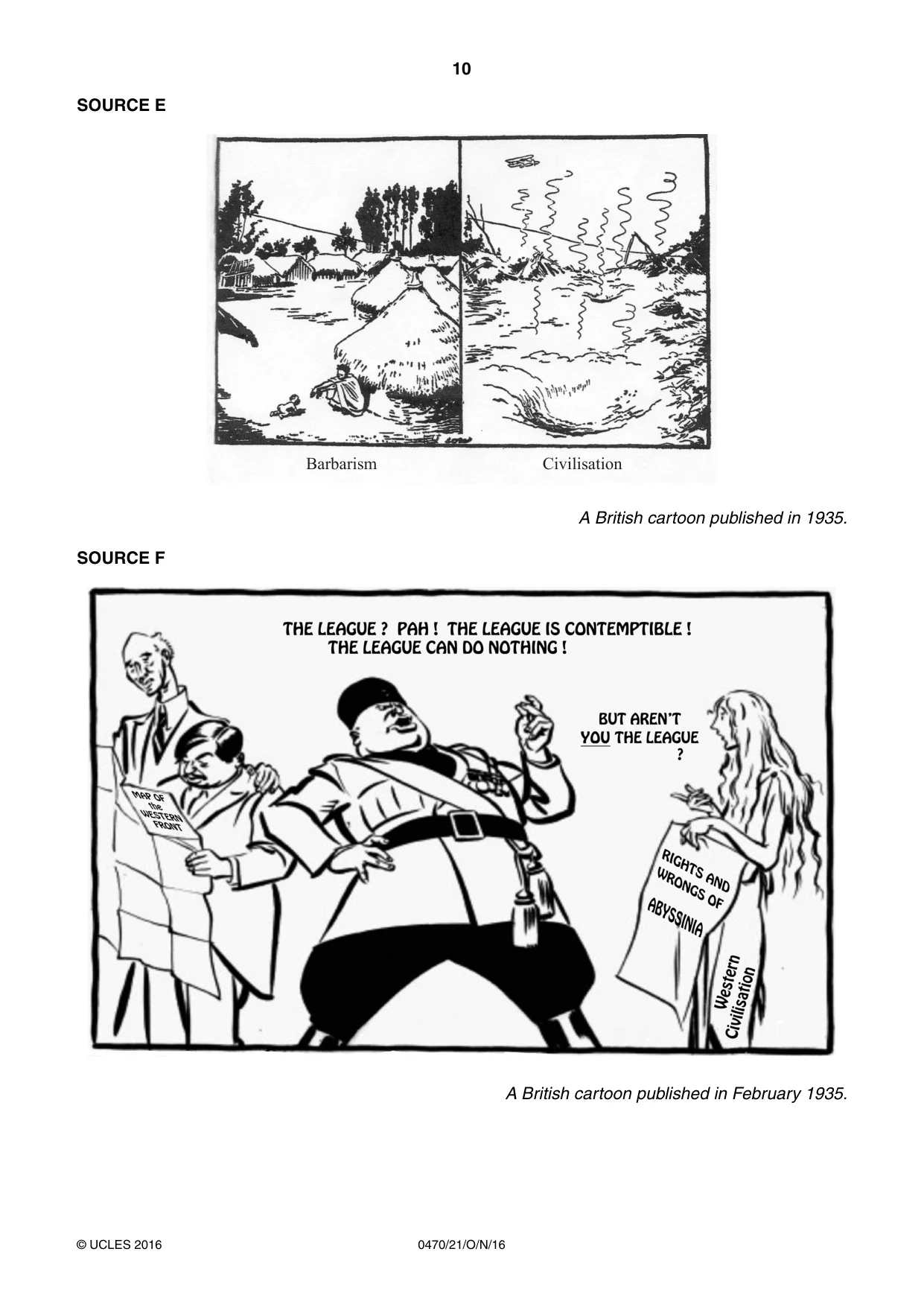
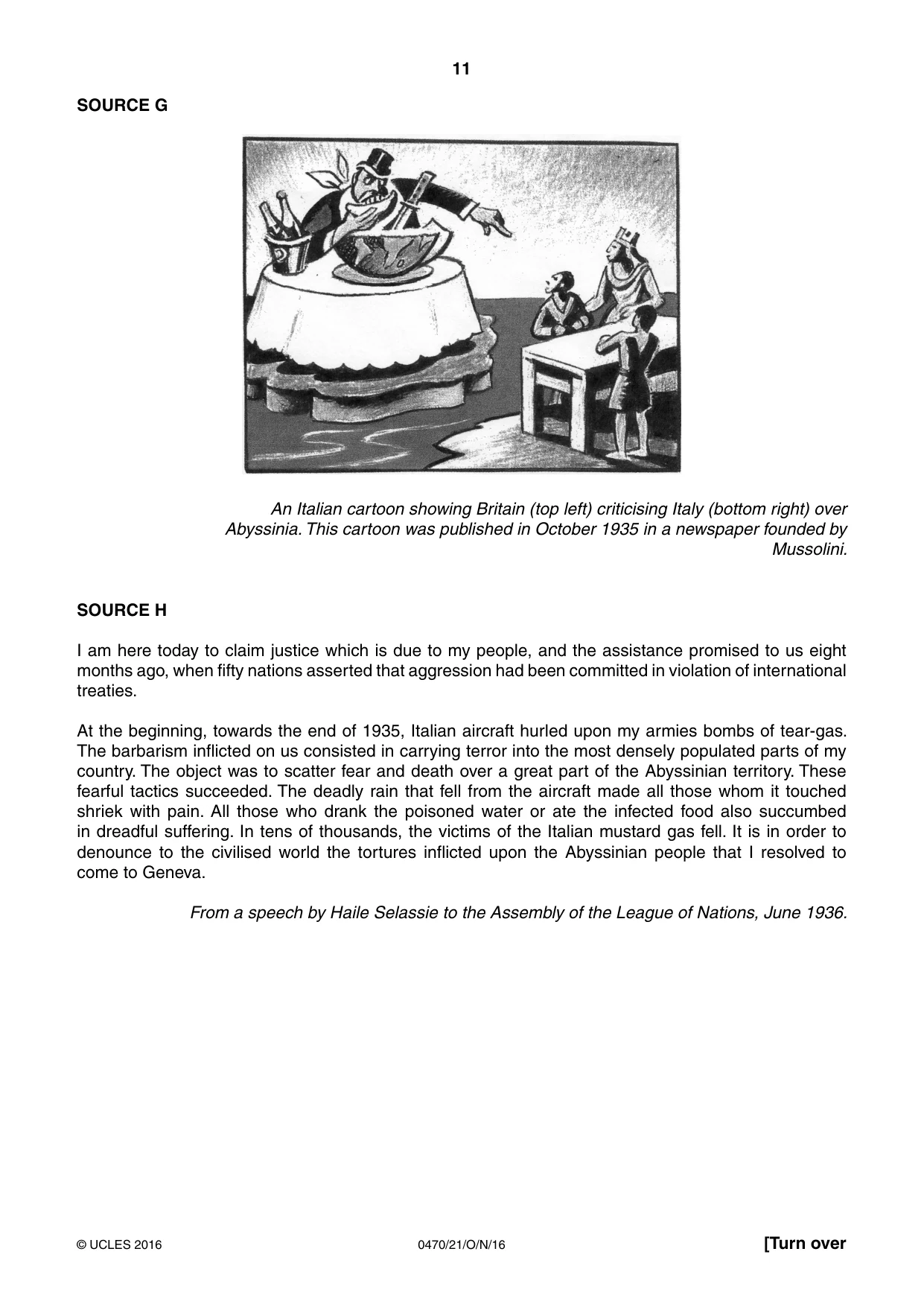
10 0470/21/O/N/16 © UCLES 2016 SOURCE E Barbarism Civilisation A British cartoon published in 1935. SOURCE F A British cartoon published in February 1935.
Question paper, page 11
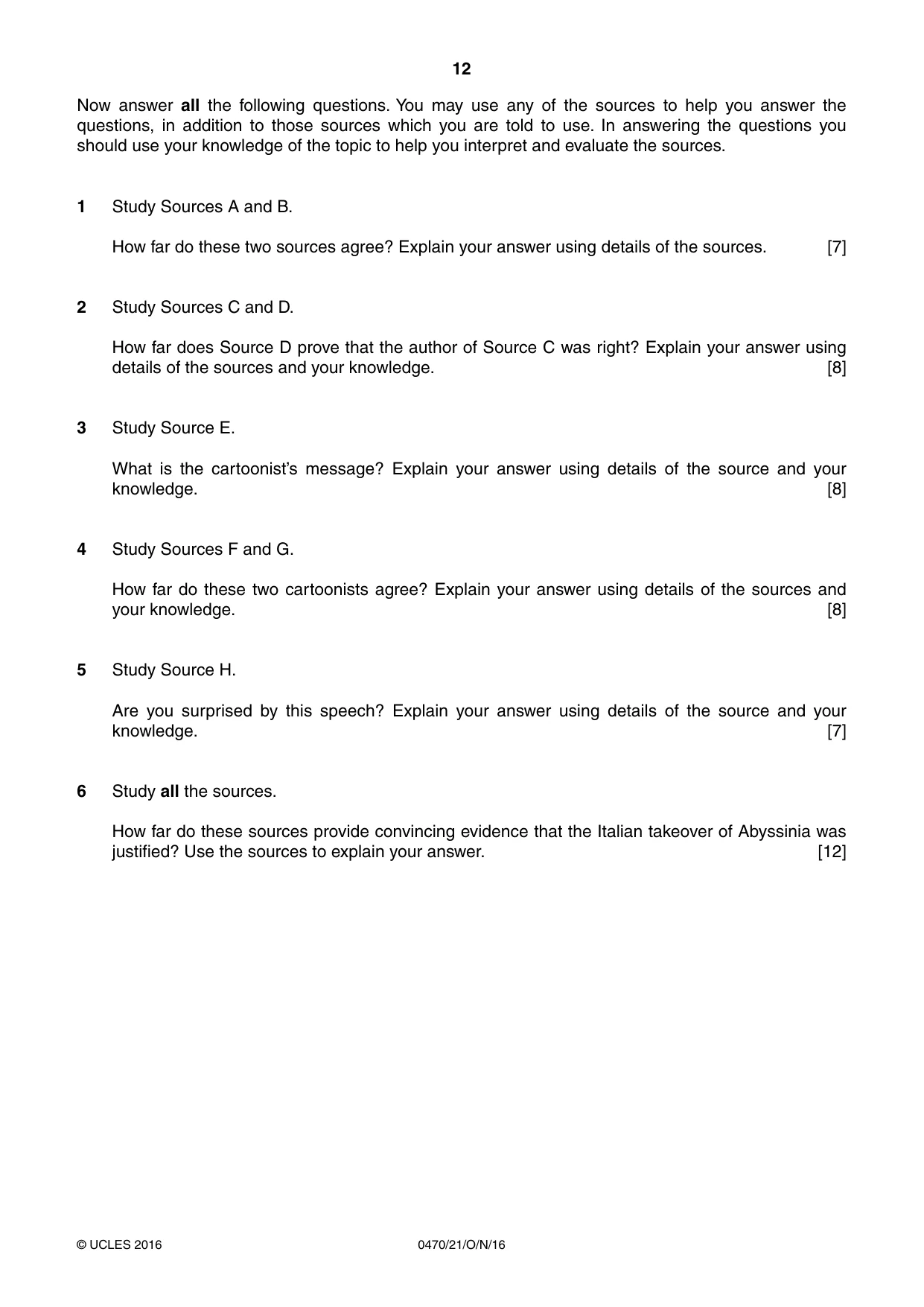
11 0470/21/O/N/16 © UCLES 2016 [Turn over SOURCE G An Italian cartoon showing Britain (top left) criticising Italy (bottom right) over Abyssinia. This cartoon was published in October 1935 in a newspaper founded by Mussolini. SOURCE H I am here today to claim justice which is due to my people, and the assistance promised to us eight months ago, when fifty nations asserted that aggression had been committed in violation of international treaties. At the beginning, towards the end of 1935, Italian aircraft hurled upon my armies bombs of tear-gas. The barbarism inflicted on us consisted in carrying terror into the most densely populated parts of my country. The object was to scatter fear and death over a great part of the Abyssinian territory. These fearful tactics succeeded. The deadly rain that fell from the aircraft made all those whom it touched shriek with pain. All those who drank the poisoned water or ate the infected food also succumbed in dreadful suffering. In tens of thousands, the victims of the Italian mustard gas fell. It is in order to denounce to the civilised world the tortures inflicted upon the Abyssinian people that I resolved to come to Geneva. From a speech by Haile Selassie to the Assembly of the League of Nations, June 1936.
Question paper, page 12
12 0470/21/O/N/16 © UCLES 2016 Now answer all the following questions. You may use any of the sources to help you answer the questions, in addition to those sources which you are told to use. In answering the questions you should use your knowledge of the topic to help you interpret and evaluate the sources. 1 Study Sources A and B. How far do these two sources agree? Explain your answer using details of the sources. [7] 2 Study Sources C and D. How far does Source D prove that the author of Source C was right? Explain your answer using details of the sources and your knowledge. [8] 3 Study Source E. What is the cartoonist’s message? Explain your answer using details of the source and your knowledge. [8] 4 Study Sources F and G. How far do these two cartoonists agree? Explain your answer using details of the sources and your knowledge. [8] 5 Study Source H. Are you surprised by this speech? Explain your answer using details of the source and your knowledge. [7] 6 Study all the sources. How far do these sources provide convincing evidence that the Italian takeover of Abyssinia was justified? Use the sources to explain your answer. [12]
Question paper, page 13
13 0470/21/O/N/16 © UCLES 2016 BLANK PAGE
Question paper, page 14
14 0470/21/O/N/16 © UCLES 2016 BLANK PAGE
Question paper, page 15
15 0470/21/O/N/16 © UCLES 2016 BLANK PAGE
Question paper, page 16
16 0470/21/O/N/16 © UCLES 2016 BLANK PAGE Permission to reproduce items where third-party owned material protected by copyright is included has been sought and cleared where possible. Every reasonable effort has been made by the publisher (UCLES) to trace copyright holders, but if any items requiring clearance have unwittingly been included, the publisher will be pleased to make amends at the earliest possible opportunity. To avoid the issue of disclosure of answer-related information to candidates, all copyright acknowledgements are reproduced online in the Cambridge International Examinations Copyright Acknowledgements Booklet. This is produced for each series of examinations and is freely available to download at www.cie.org.uk after the live examination series. Cambridge International Examinations is part of the Cambridge Assessment Group. Cambridge Assessment is the brand name of University of Cambridge Local Examinations Syndicate (UCLES), which is itself a department of the University of Cambridge.
Mark scheme, page 1
® IGCSE is the registered trademark of Cambridge International Examinations. This syllabus is approved for use in England, Wales and Northern Ireland as a Cambridge International Level 1/Level 2 Certificate. This document consists of 8 printed pages. © UCLES 2016 [Turn over Cambridge International Examinations Cambridge International General Certificate of Secondary Education HISTORY 0470/21 Paper 2 October/November 2016 MARK SCHEME Maximum Mark: 50 Published This mark scheme is published as an aid to teachers and candidates, to indicate the requirements of the examination. It shows the basis on which Examiners were instructed to award marks. It does not indicate the details of the discussions that took place at an Examiners’ meeting before marking began, which would have considered the acceptability of alternative answers. Mark schemes should be read in conjunction with the question paper and the Principal Examiner Report for Teachers. Cambridge will not enter into discussions about these mark schemes. Cambridge is publishing the mark schemes for the October/November 2016 series for most Cambridge IGCSE®, Cambridge International A and AS Level components and some Cambridge O Level components.
Mark scheme, page 2
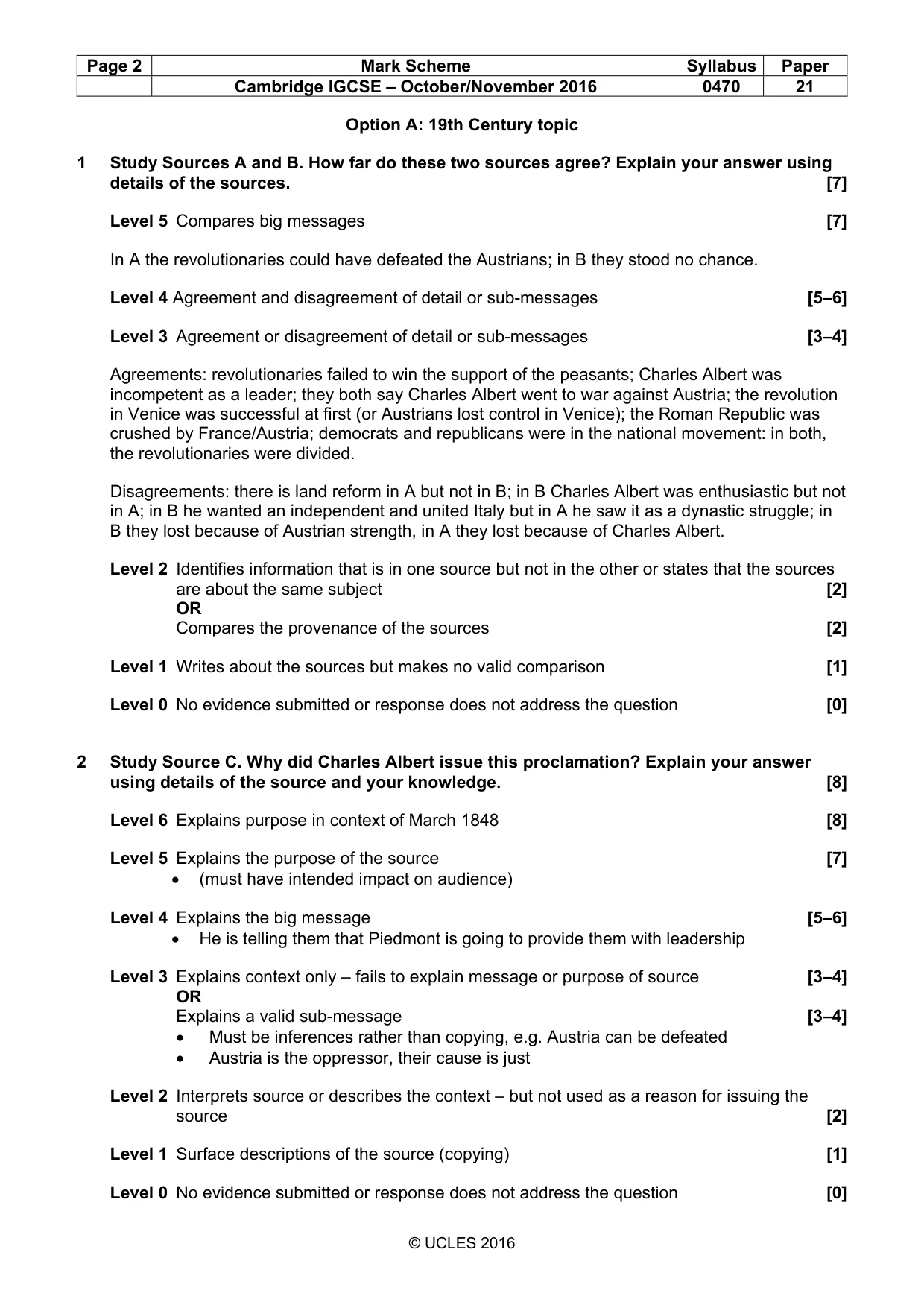
Page 2 Mark Scheme Syllabus Paper Cambridge IGCSE – October/November 2016 0470 21 © UCLES 2016 Option A: 19th Century topic 1 Study Sources A and B. How far do these two sources agree? Explain your answer using details of the sources. [7] Level 5 Compares big messages [7] In A the revolutionaries could have defeated the Austrians; in B they stood no chance. Level 4 Agreement and disagreement of detail or sub-messages [5–6] Level 3 Agreement or disagreement of detail or sub-messages [3–4] Agreements: revolutionaries failed to win the support of the peasants; Charles Albert was incompetent as a leader; they both say Charles Albert went to war against Austria; the revolution in Venice was successful at first (or Austrians lost control in Venice); the Roman Republic was crushed by France/Austria; democrats and republicans were in the national movement: in both, the revolutionaries were divided. Disagreements: there is land reform in A but not in B; in B Charles Albert was enthusiastic but not in A; in B he wanted an independent and united Italy but in A he saw it as a dynastic struggle; in B they lost because of Austrian strength, in A they lost because of Charles Albert. Level 2 Identifies information that is in one source but not in the other or states that the sources are about the same subject [2] OR Compares the provenance of the sources [2] Level 1 Writes about the sources but makes no valid comparison [1] Level 0 No evidence submitted or response does not address the question [0] 2 Study Source C. Why did Charles Albert issue this proclamation? Explain your answer using details of the source and your knowledge. [8] Level 6 Explains purpose in context of March 1848 [8] Level 5 Explains the purpose of the source [7] • (must have intended impact on audience) Level 4 Explains the big message [5–6] • He is telling them that Piedmont is going to provide them with leadership Level 3 Explains context only – fails to explain message or purpose of source [3–4] OR Explains a valid sub-message [3–4] • Must be inferences rather than copying, e.g. Austria can be defeated • Austria is the oppressor, their cause is just Level 2 Interprets source or describes the context – but not used as a reason for issuing the source [2] Level 1 Surface descriptions of the source (copying) [1] Level 0 No evidence submitted or response does not address the question [0]
Mark scheme, page 3
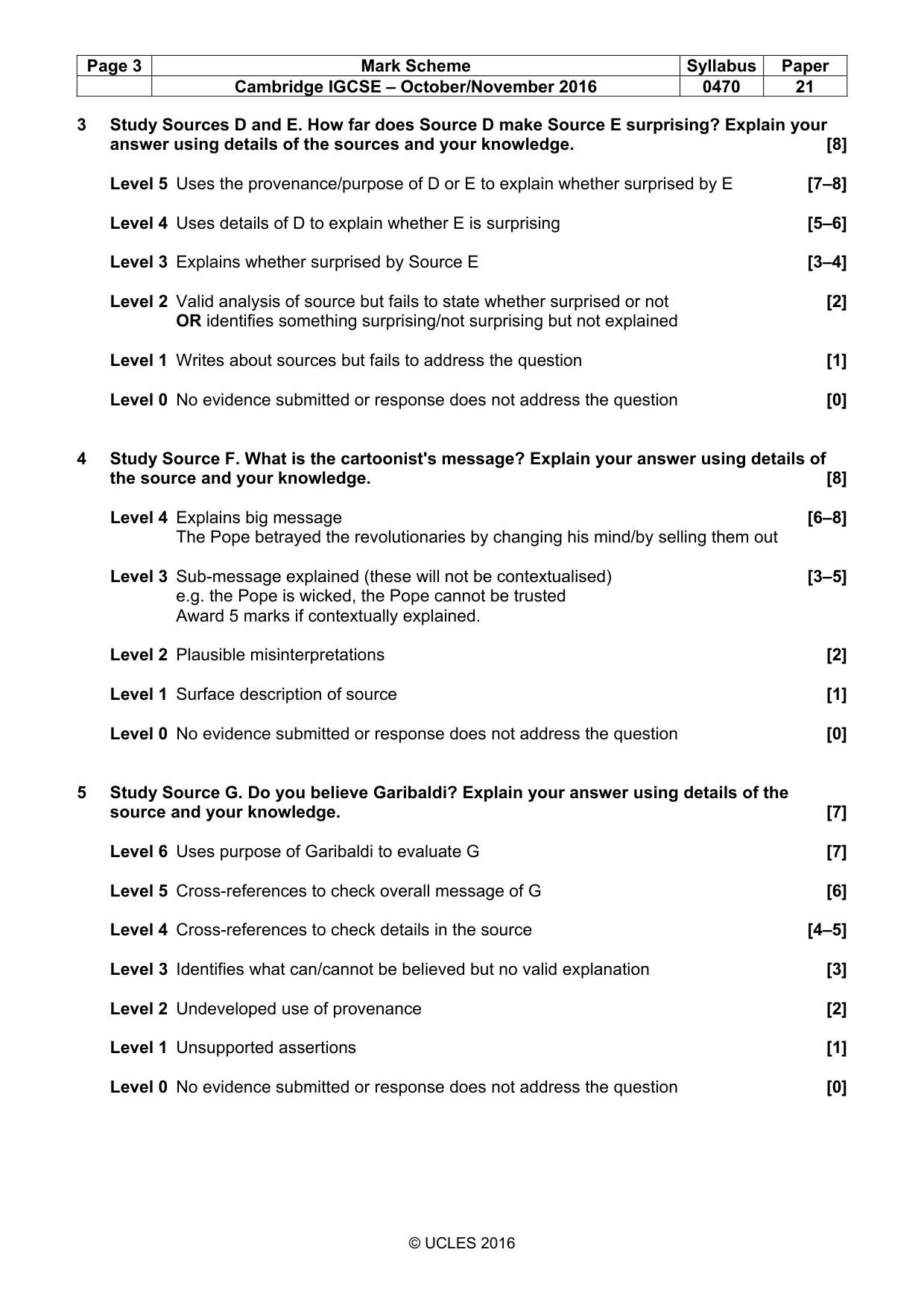
Page 3 Mark Scheme Syllabus Paper Cambridge IGCSE – October/November 2016 0470 21 © UCLES 2016 3 Study Sources D and E. How far does Source D make Source E surprising? Explain your answer using details of the sources and your knowledge. [8] Level 5 Uses the provenance/purpose of D or E to explain whether surprised by E [7–8] Level 4 Uses details of D to explain whether E is surprising [5–6] Level 3 Explains whether surprised by Source E [3–4] Level 2 Valid analysis of source but fails to state whether surprised or not [2] OR identifies something surprising/not surprising but not explained Level 1 Writes about sources but fails to address the question [1] Level 0 No evidence submitted or response does not address the question [0] 4 Study Source F. What is the cartoonist's message? Explain your answer using details of the source and your knowledge. [8] Level 4 Explains big message [6–8] The Pope betrayed the revolutionaries by changing his mind/by selling them out Level 3 Sub-message explained (these will not be contextualised) [3–5] e.g. the Pope is wicked, the Pope cannot be trusted Award 5 marks if contextually explained. Level 2 Plausible misinterpretations [2] Level 1 Surface description of source [1] Level 0 No evidence submitted or response does not address the question [0] 5 Study Source G. Do you believe Garibaldi? Explain your answer using details of the source and your knowledge. [7] Level 6 Uses purpose of Garibaldi to evaluate G [7] Level 5 Cross-references to check overall message of G [6] Level 4 Cross-references to check details in the source [4–5] Level 3 Identifies what can/cannot be believed but no valid explanation [3] Level 2 Undeveloped use of provenance [2] Level 1 Unsupported assertions [1] Level 0 No evidence submitted or response does not address the question [0]
Mark scheme, page 4
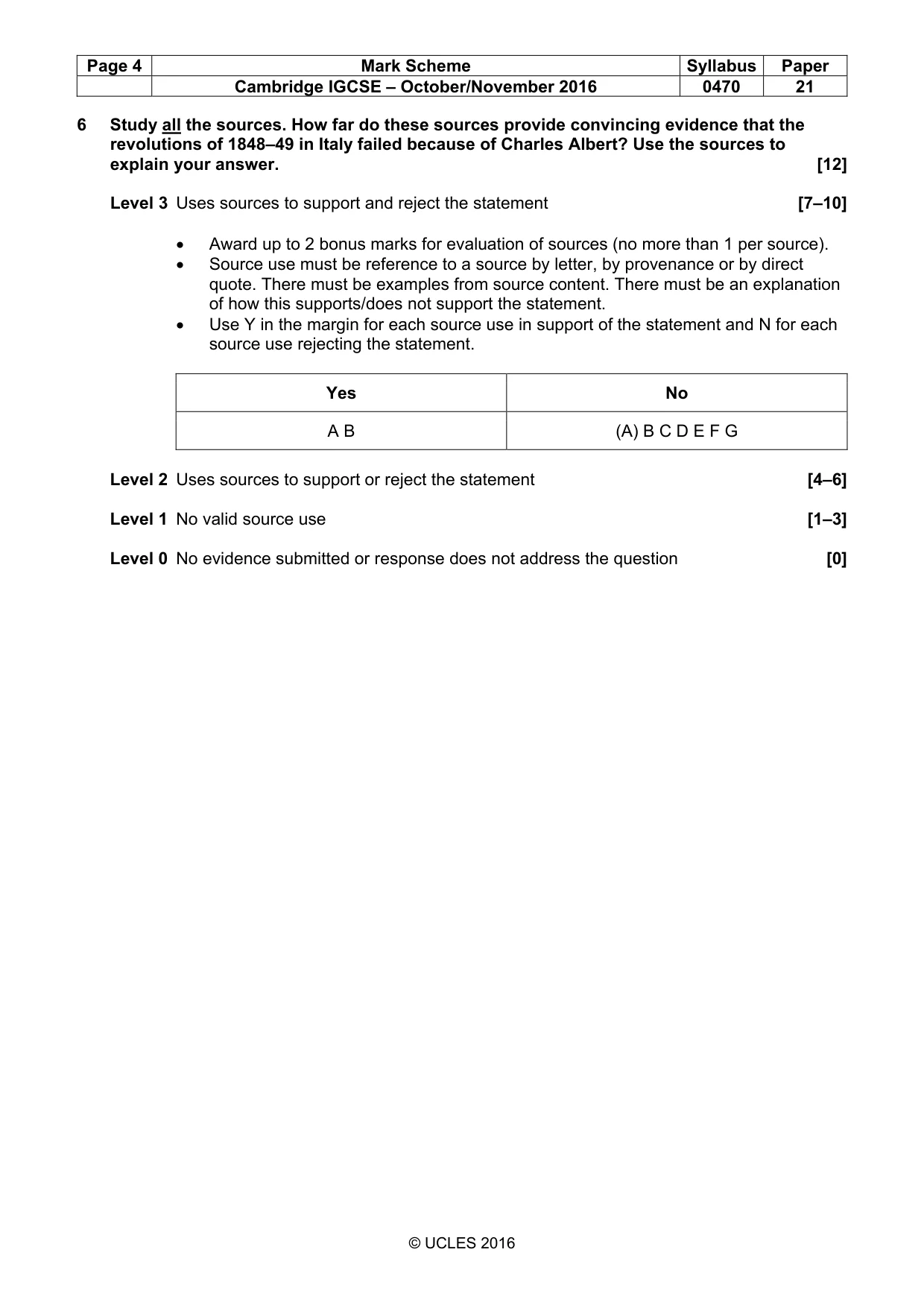
Page 4 Mark Scheme Syllabus Paper Cambridge IGCSE – October/November 2016 0470 21 © UCLES 2016 6 Study all the sources. How far do these sources provide convincing evidence that the revolutions of 1848–49 in Italy failed because of Charles Albert? Use the sources to explain your answer. [12] Level 3 Uses sources to support and reject the statement [7–10] • Award up to 2 bonus marks for evaluation of sources (no more than 1 per source). • Source use must be reference to a source by letter, by provenance or by direct quote. There must be examples from source content. There must be an explanation of how this supports/does not support the statement. • Use Y in the margin for each source use in support of the statement and N for each source use rejecting the statement. Yes No A B (A) B C D E F G Level 2 Uses sources to support or reject the statement [4–6] Level 1 No valid source use [1–3] Level 0 No evidence submitted or response does not address the question [0]
Mark scheme, page 5
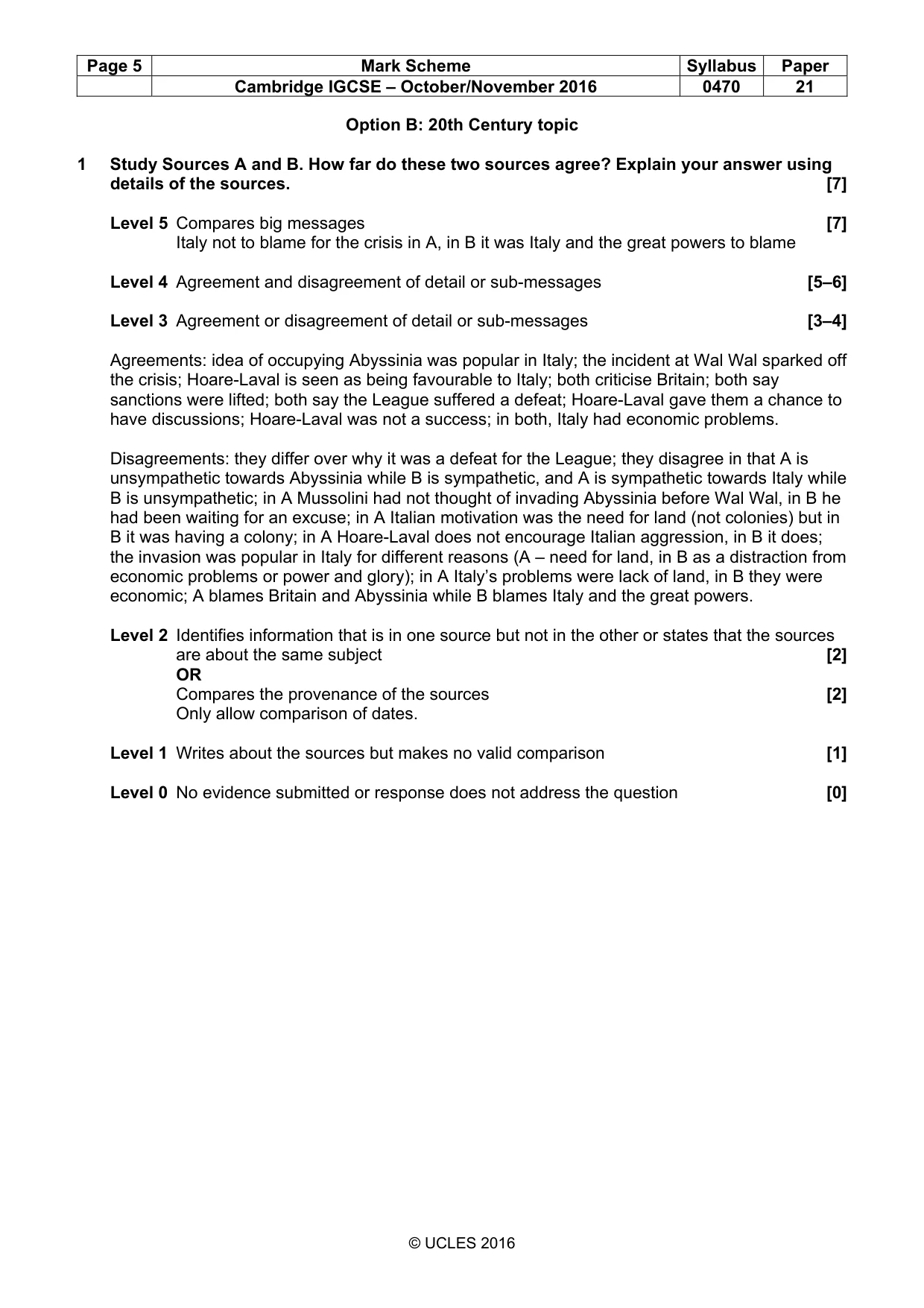
Page 5 Mark Scheme Syllabus Paper Cambridge IGCSE – October/November 2016 0470 21 © UCLES 2016 Option B: 20th Century topic 1 Study Sources A and B. How far do these two sources agree? Explain your answer using details of the sources. [7] Level 5 Compares big messages [7] Italy not to blame for the crisis in A, in B it was Italy and the great powers to blame Level 4 Agreement and disagreement of detail or sub-messages [5–6] Level 3 Agreement or disagreement of detail or sub-messages [3–4] Agreements: idea of occupying Abyssinia was popular in Italy; the incident at Wal Wal sparked off the crisis; Hoare-Laval is seen as being favourable to Italy; both criticise Britain; both say sanctions were lifted; both say the League suffered a defeat; Hoare-Laval gave them a chance to have discussions; Hoare-Laval was not a success; in both, Italy had economic problems. Disagreements: they differ over why it was a defeat for the League; they disagree in that A is unsympathetic towards Abyssinia while B is sympathetic, and A is sympathetic towards Italy while B is unsympathetic; in A Mussolini had not thought of invading Abyssinia before Wal Wal, in B he had been waiting for an excuse; in A Italian motivation was the need for land (not colonies) but in B it was having a colony; in A Hoare-Laval does not encourage Italian aggression, in B it does; the invasion was popular in Italy for different reasons (A – need for land, in B as a distraction from economic problems or power and glory); in A Italy’s problems were lack of land, in B they were economic; A blames Britain and Abyssinia while B blames Italy and the great powers. Level 2 Identifies information that is in one source but not in the other or states that the sources are about the same subject [2] OR Compares the provenance of the sources [2] Only allow comparison of dates. Level 1 Writes about the sources but makes no valid comparison [1] Level 0 No evidence submitted or response does not address the question [0]
Mark scheme, page 6
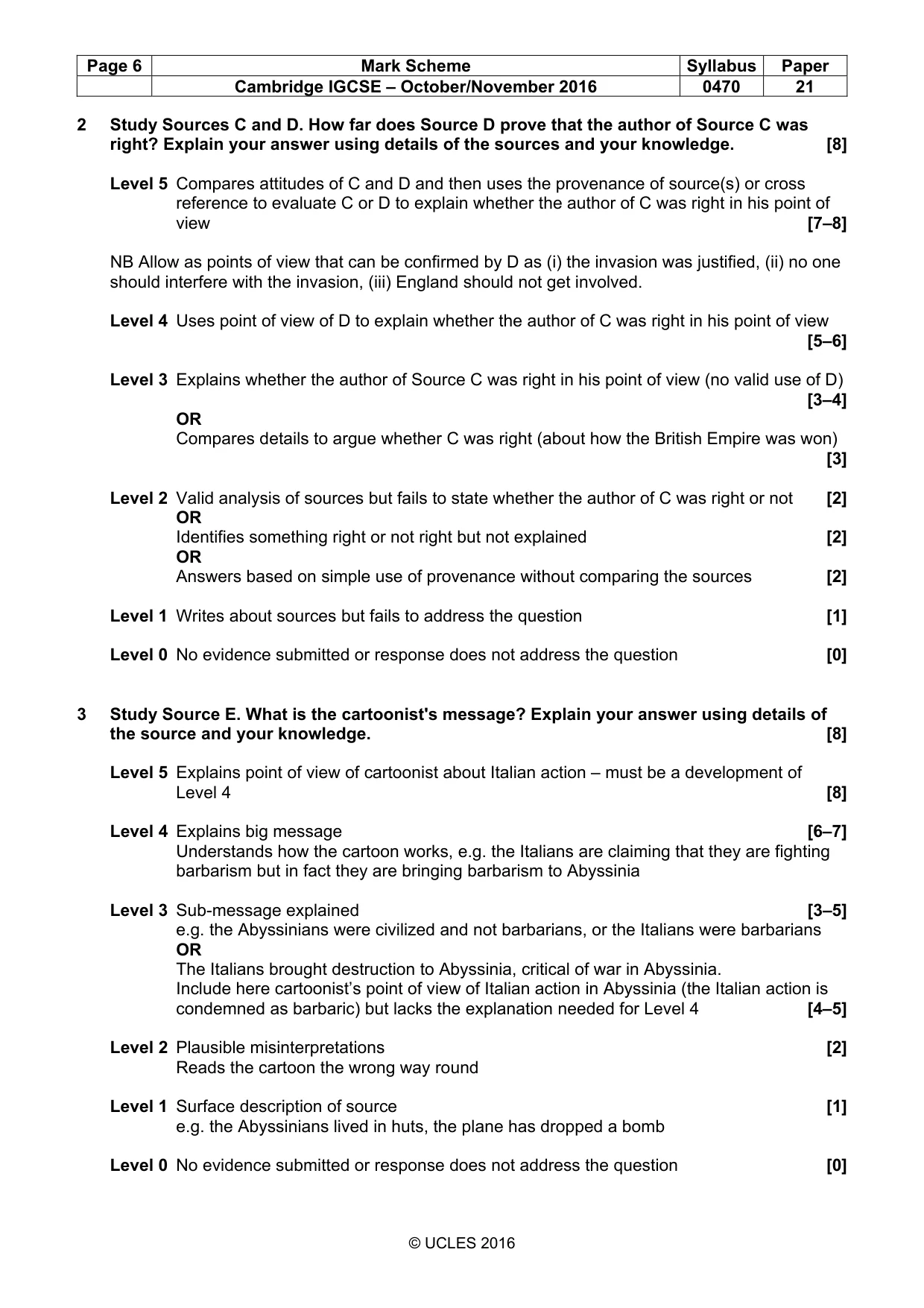
Page 6 Mark Scheme Syllabus Paper Cambridge IGCSE – October/November 2016 0470 21 © UCLES 2016 2 Study Sources C and D. How far does Source D prove that the author of Source C was right? Explain your answer using details of the sources and your knowledge. [8] Level 5 Compares attitudes of C and D and then uses the provenance of source(s) or cross reference to evaluate C or D to explain whether the author of C was right in his point of view [7–8] NB Allow as points of view that can be confirmed by D as (i) the invasion was justified, (ii) no one should interfere with the invasion, (iii) England should not get involved. Level 4 Uses point of view of D to explain whether the author of C was right in his point of view [5–6] Level 3 Explains whether the author of Source C was right in his point of view (no valid use of D) [3–4] OR Compares details to argue whether C was right (about how the British Empire was won) [3] Level 2 Valid analysis of sources but fails to state whether the author of C was right or not [2] OR Identifies something right or not right but not explained [2] OR Answers based on simple use of provenance without comparing the sources [2] Level 1 Writes about sources but fails to address the question [1] Level 0 No evidence submitted or response does not address the question [0] 3 Study Source E. What is the cartoonist's message? Explain your answer using details of the source and your knowledge. [8] Level 5 Explains point of view of cartoonist about Italian action – must be a development of Level 4 [8] Level 4 Explains big message [6–7] Understands how the cartoon works, e.g. the Italians are claiming that they are fighting barbarism but in fact they are bringing barbarism to Abyssinia Level 3 Sub-message explained [3–5] e.g. the Abyssinians were civilized and not barbarians, or the Italians were barbarians OR The Italians brought destruction to Abyssinia, critical of war in Abyssinia. Include here cartoonist’s point of view of Italian action in Abyssinia (the Italian action is condemned as barbaric) but lacks the explanation needed for Level 4 [4–5] Level 2 Plausible misinterpretations [2] Reads the cartoon the wrong way round Level 1 Surface description of source [1] e.g. the Abyssinians lived in huts, the plane has dropped a bomb Level 0 No evidence submitted or response does not address the question [0]
Mark scheme, page 7
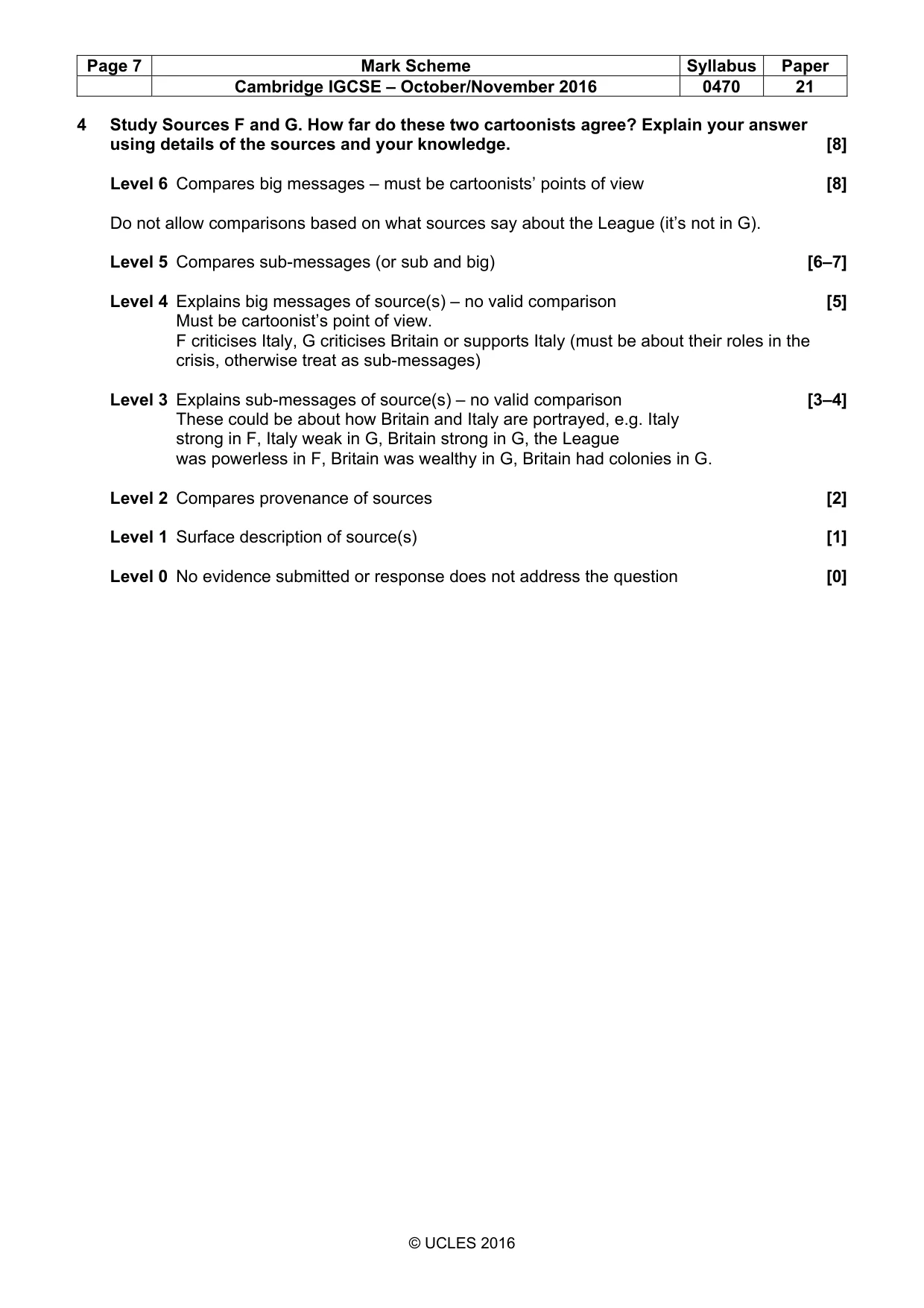
Page 7 Mark Scheme Syllabus Paper Cambridge IGCSE – October/November 2016 0470 21 © UCLES 2016 4 Study Sources F and G. How far do these two cartoonists agree? Explain your answer using details of the sources and your knowledge. [8] Level 6 Compares big messages – must be cartoonists’ points of view [8] Do not allow comparisons based on what sources say about the League (it’s not in G). Level 5 Compares sub-messages (or sub and big) [6–7] Level 4 Explains big messages of source(s) – no valid comparison [5] Must be cartoonist’s point of view. F criticises Italy, G criticises Britain or supports Italy (must be about their roles in the crisis, otherwise treat as sub-messages) Level 3 Explains sub-messages of source(s) – no valid comparison [3–4] These could be about how Britain and Italy are portrayed, e.g. Italy strong in F, Italy weak in G, Britain strong in G, the League was powerless in F, Britain was wealthy in G, Britain had colonies in G. Level 2 Compares provenance of sources [2] Level 1 Surface description of source(s) [1] Level 0 No evidence submitted or response does not address the question [0]
Mark scheme, page 8
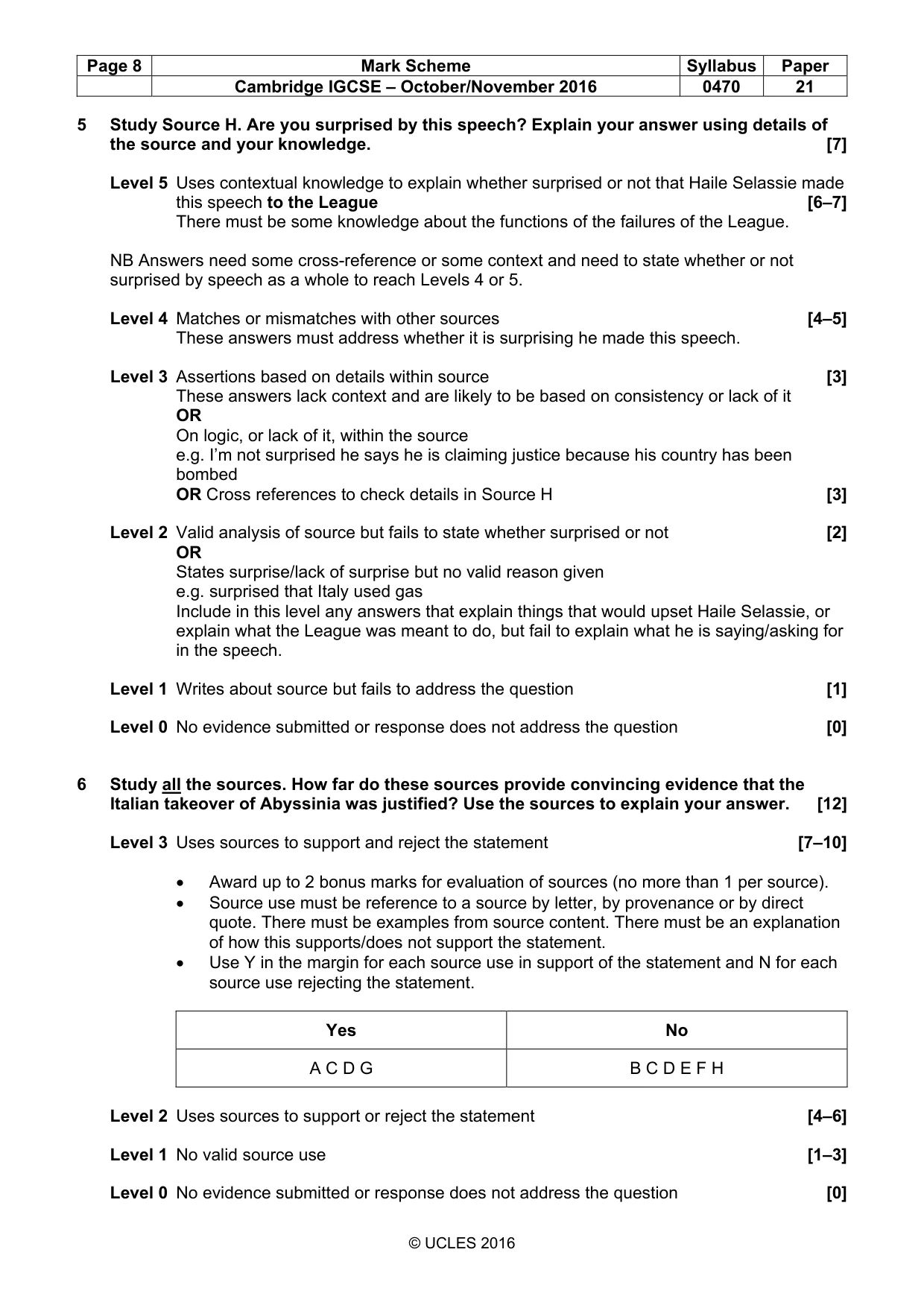
Page 8 Mark Scheme Syllabus Paper Cambridge IGCSE – October/November 2016 0470 21 © UCLES 2016 5 Study Source H. Are you surprised by this speech? Explain your answer using details of the source and your knowledge. [7] Level 5 Uses contextual knowledge to explain whether surprised or not that Haile Selassie made this speech to the League [6–7] There must be some knowledge about the functions of the failures of the League. NB Answers need some cross-reference or some context and need to state whether or not surprised by speech as a whole to reach Levels 4 or 5. Level 4 Matches or mismatches with other sources [4–5] These answers must address whether it is surprising he made this speech. Level 3 Assertions based on details within source [3] These answers lack context and are likely to be based on consistency or lack of it OR On logic, or lack of it, within the source e.g. I’m not surprised he says he is claiming justice because his country has been bombed OR Cross references to check details in Source H [3] Level 2 Valid analysis of source but fails to state whether surprised or not [2] OR States surprise/lack of surprise but no valid reason given e.g. surprised that Italy used gas Include in this level any answers that explain things that would upset Haile Selassie, or explain what the League was meant to do, but fail to explain what he is saying/asking for in the speech. Level 1 Writes about source but fails to address the question [1] Level 0 No evidence submitted or response does not address the question [0] 6 Study all the sources. How far do these sources provide convincing evidence that the Italian takeover of Abyssinia was justified? Use the sources to explain your answer. [12] Level 3 Uses sources to support and reject the statement [7–10] • Award up to 2 bonus marks for evaluation of sources (no more than 1 per source). • Source use must be reference to a source by letter, by provenance or by direct quote. There must be examples from source content. There must be an explanation of how this supports/does not support the statement. • Use Y in the margin for each source use in support of the statement and N for each source use rejecting the statement. Yes No A C D G B C D E F H Level 2 Uses sources to support or reject the statement [4–6] Level 1 No valid source use [1–3] Level 0 No evidence submitted or response does not address the question [0]
What you needed in this session
Cambridge’s own grade thresholds for 2016 Oct/Nov, Paper 2 · Variant 1. A higher threshold means an easier paper — the bar moves with how the cohort did.