Cambridge IGCSE History 0470 — 2016 Oct/Nov Paper 1 · Variant 1
0470/11/O/N/16 · 60 marks · ≈68 min
The question paper and its mark scheme, free to read here and free to download. This is Cambridge’s own paper, exactly as it was sat.
Question paper12 pages

Mark scheme69 pages
Answers below. Sit the paper first if you are practising.
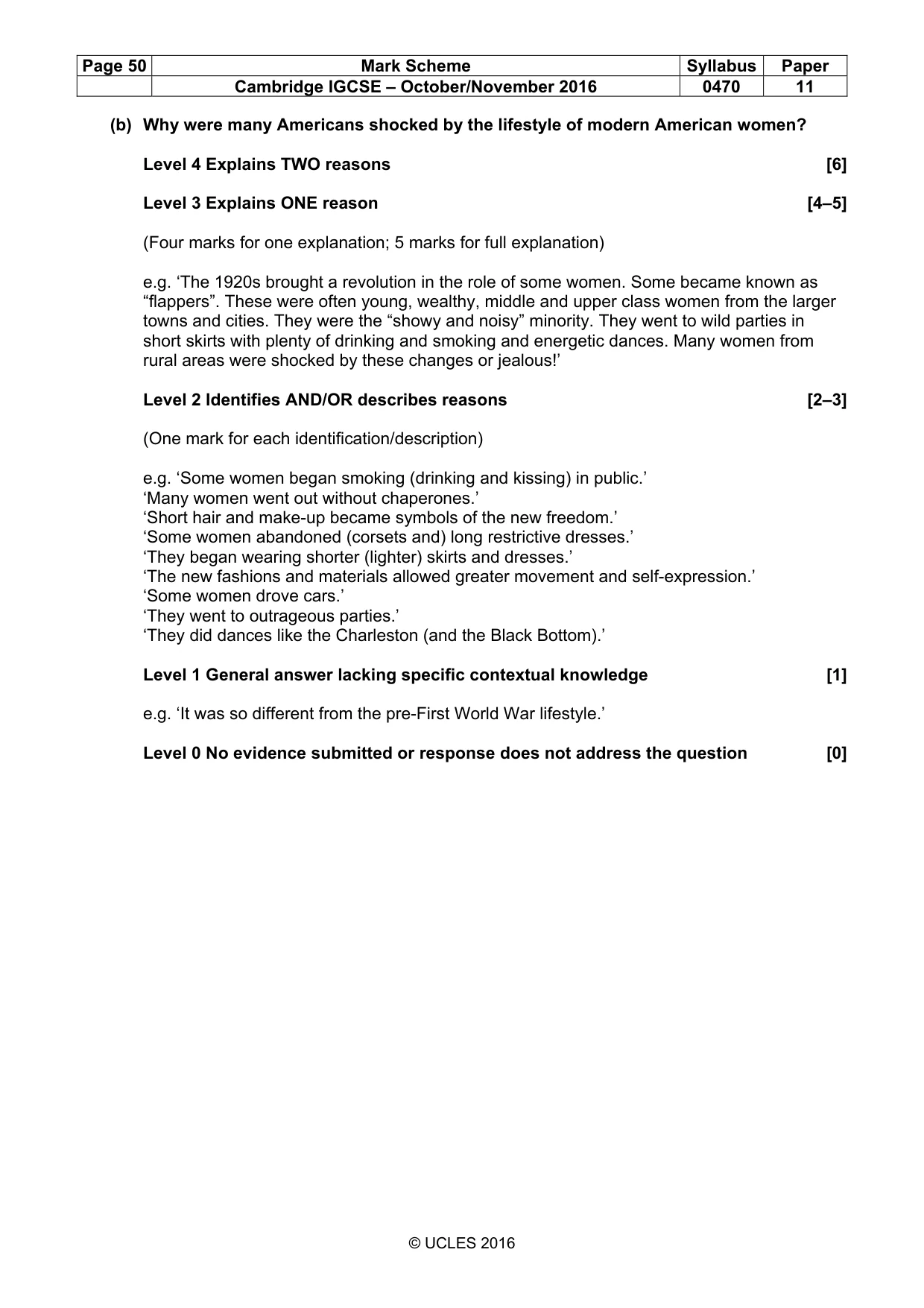
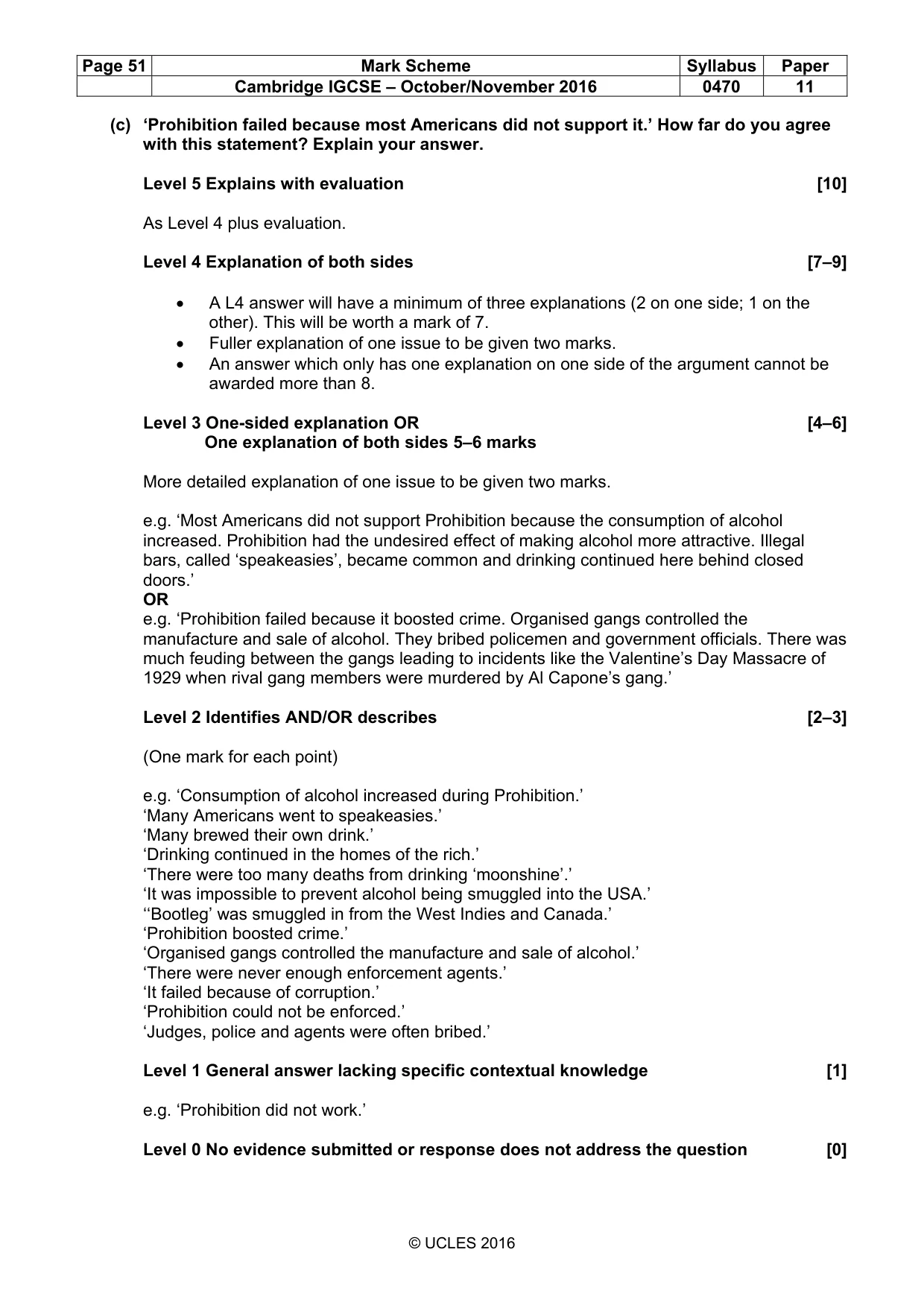
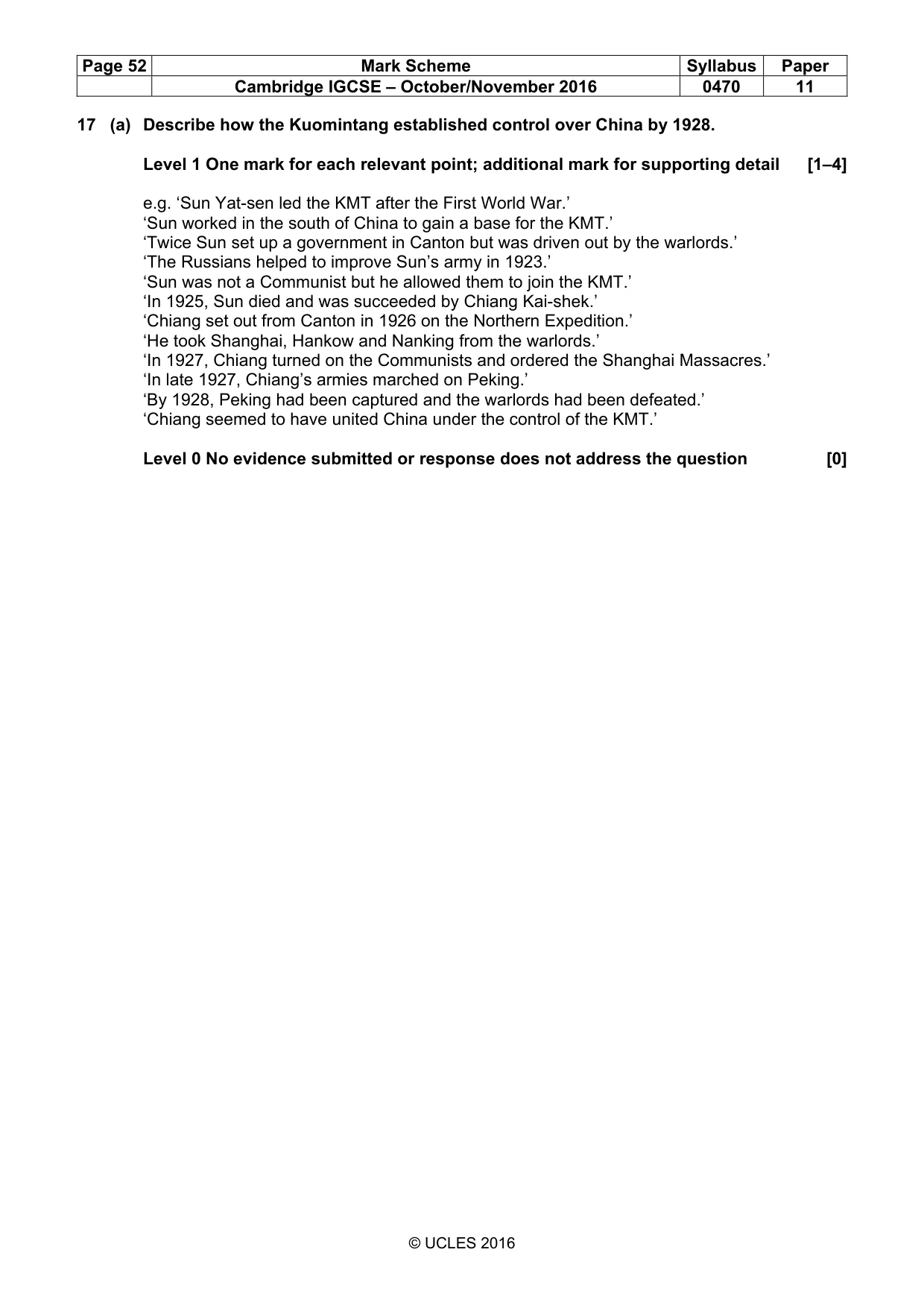
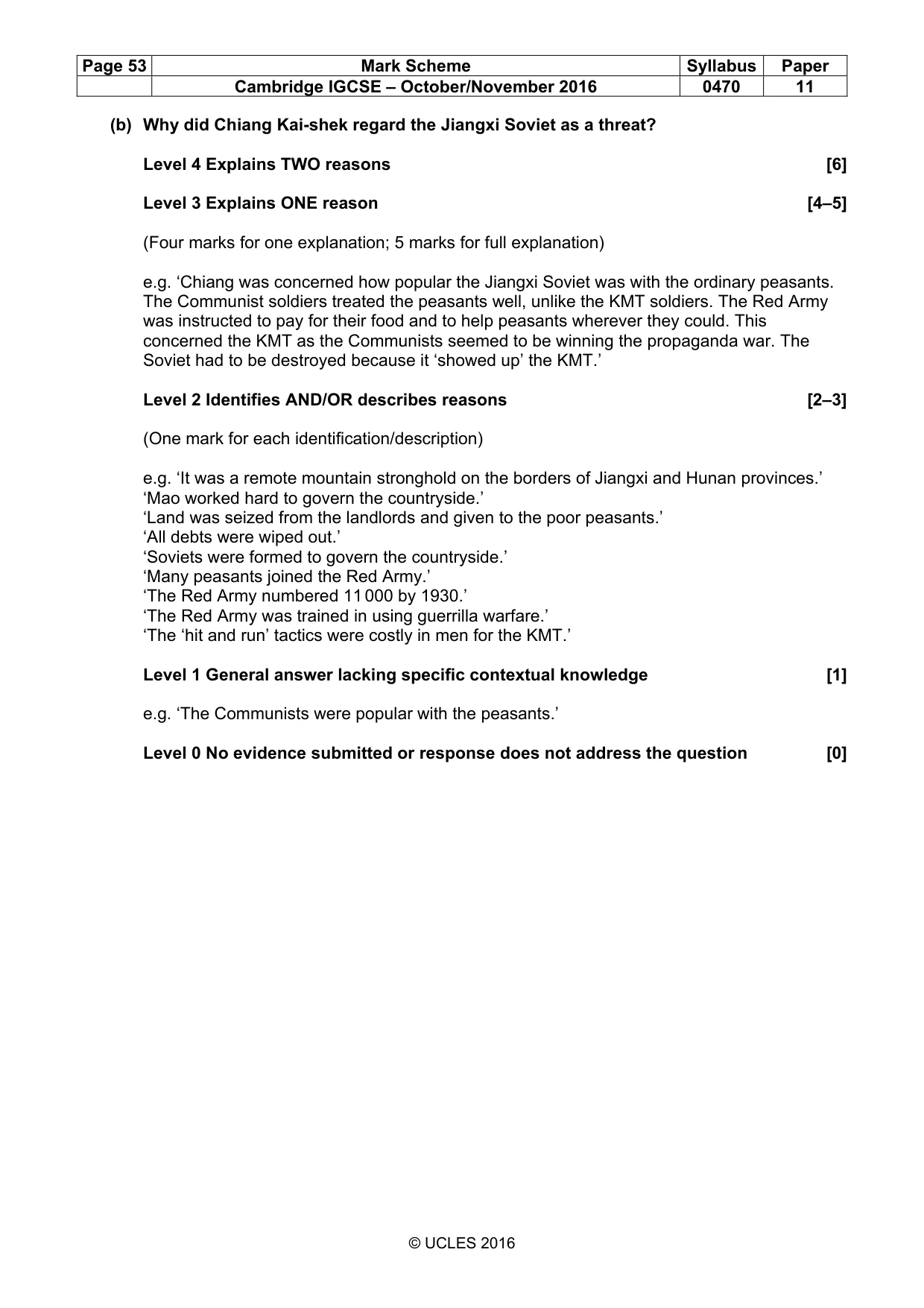
Paper as text
Question paper, page 1
This document consists of 10 printed pages, 2 blank pages and 1 insert. DC (RCL (JDA)) 115062/4 © UCLES 2016 [Turn over Cambridge International Examinations Cambridge International General Certificate of Secondary Education * 0 2 8 6 0 9 6 6 4 7 * HISTORY 0470/11 Paper 1 October/November 2016 2 hours No Additional Materials are required. READ THESE INSTRUCTIONS FIRST An answer booklet is provided inside this question paper. You should follow the instructions on the front cover of the answer booklet. If you need additional answer paper ask the invigilator for a continuation booklet. Answer three questions. Section A (Core Content) Answer any two questions. Section B (Depth Studies) Answer any one question. The number of marks is given in brackets [ ] at the end of each question or part question. The syllabus is approved for use in England, Wales and Northern Ireland as a Cambridge International Level 1/Level 2 Certificate.
Question paper, page 2
2 0470/11/O/N/16 © UCLES 2016 SECTION A: CORE CONTENT Answer any two questions from this Section. 1 In 1848–49 there were revolutions across Europe. (a) Describe the part played by Kossuth in events leading to the March Laws of 1848. [4] (b) Why did Frederick William IV of Prussia reject the offer of the Imperial German Crown? [6] (c) How successful were the European revolutions of 1848–49? Explain your answer. [10] 2 Austrian influence remained strong in Germany after 1848. (a) What issues was the Frankfurt Parliament set up to resolve? [4] (b) Why were the terms of the Agreement of Olmütz important? [6] (c) ‘The Schleswig-Holstein issue ended Austria’s hopes of dominating Germany.’ How far do you agree with this statement? Explain your answer. [10] 3 European influence over overseas empires varied. (a) Describe Faidherbe’s achievements in relation to Senegal. [4] (b) Why did British rule in India change after the Mutiny of 1857? [6] (c) How significant for China in the nineteenth century was the impact of Western intervention? Explain your answer. [10] 4 Europe was becoming increasingly unstable in the early part of the twentieth century. (a) Describe the Kaiser’s actions which contributed to rising European tension by 1908. [4] (b) Why were the Balkans unstable in the years leading to the First World War? [6] (c) ‘The Alliance System was the major cause of war in 1914.’ How far do you agree with this statement? Explain your answer. [10]
Question paper, page 3
3 0470/11/O/N/16 © UCLES 2016 [Turn over 5 The Versailles Settlement dealt with Germany and its allies. (a) Describe the restrictions imposed on the German land forces by the Treaty of Versailles. [4] (b) Why was the Treaty of Sèvres replaced by the Treaty of Lausanne? [6] (c) How satisfied were the French people with the Treaty of Versailles? Explain your answer. [10] 6 Hitler showed his ambitions after 1933. (a) Describe the crisis over Austria in 1934. [4] (b) Why was Hitler able to re-militarise the Rhineland in 1936? [6] (c) ‘Appeasement was a sensible response to Hitler’s aggression.’ How far do you agree with this statement? Explain your answer. [10] 7 The USA maintained a policy of containment. (a) Describe relations between the USA and Cuba between 1959 and the end of March 1961. [4] (b) Why was Kennedy humiliated by the failure of the Bay of Pigs invasion of April 1961? [6] (c) ‘The Cuban Missile Crisis was a success for the USA’s policy of containment.’ How far do you agree with this statement? Explain your answer. [10] 8 Saddam Hussein’s actions increased tension in the Gulf. (a) Describe the events of the ‘July Revolution’ in Iraq in 1968. [4] (b) Why did Saddam Hussein, after becoming President, use force on his own people? [6] (c) ‘The most important reason for the Iran-Iraq War of 1980–88 was Iraq’s desire to dominate the Persian Gulf region.’ How far do you agree with this statement? Explain your answer. [10]
Question paper, page 4
4 0470/11/O/N/16 © UCLES 2016 SECTION B: DEPTH STUDIES Answer any one question from this Section. DEPTH STUDY A: THE FIRST WORLD WAR, 1914–18 9 Responses to the Schlieffen Plan surprised the Germans. (a) When war broke out, how did France respond? [4] (b) Why was the British Expeditionary Force sent to France? [6] (c) ‘The Schlieffen Plan failed because of the actions of the British Expeditionary Force.’ How far do you agree with this statement? Explain your answer. [10] 10 Control of the sea was thought important by both sides. (a) What was unrestricted submarine warfare? [4] (b) Why did safety for British merchant shipping improve? [6] (c) How far was the Battle of Jutland a success for Britain? Explain your answer. [10]
Question paper, page 5
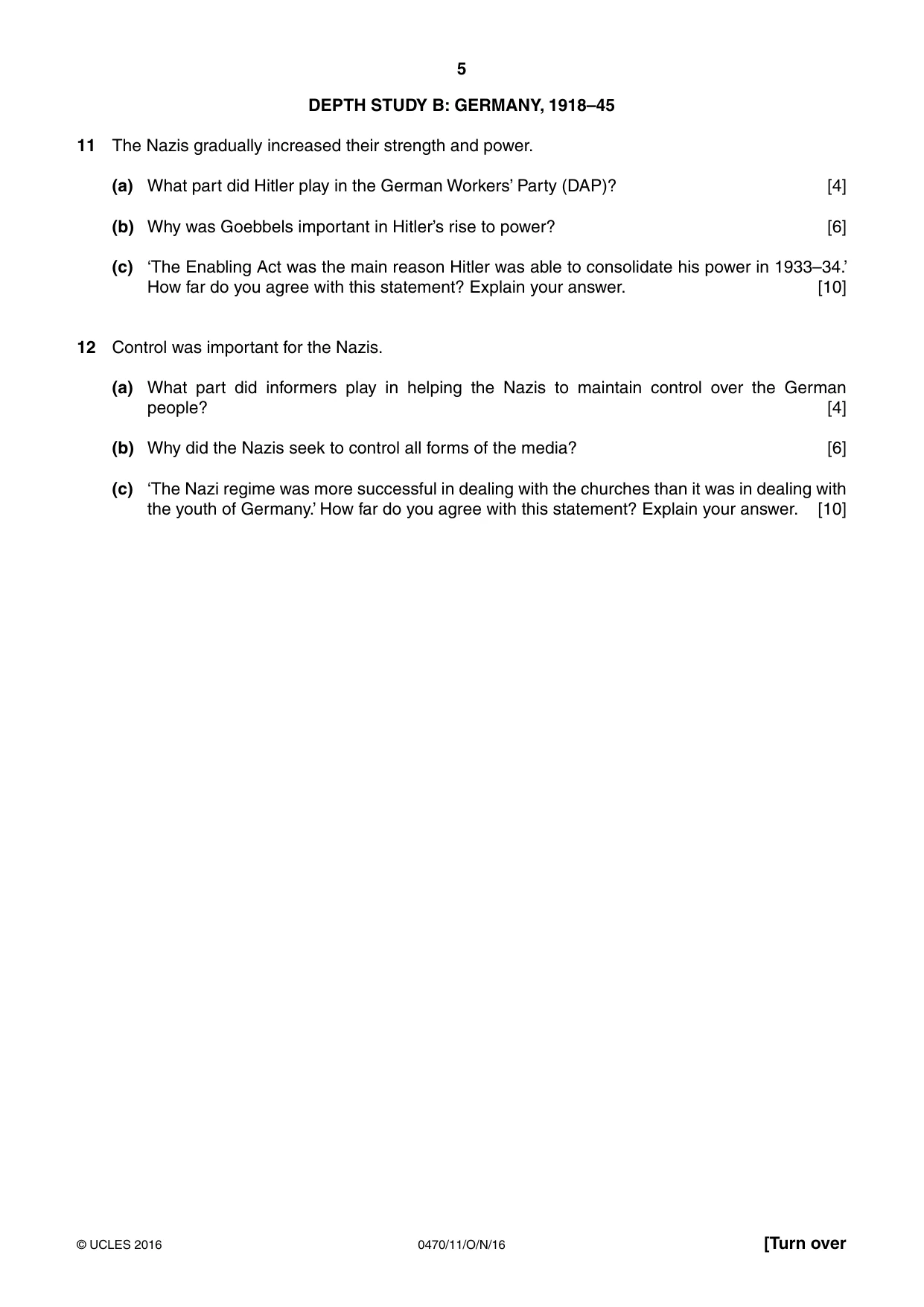
5 0470/11/O/N/16 © UCLES 2016 [Turn over DEPTH STUDY B: GERMANY, 1918–45 11 The Nazis gradually increased their strength and power. (a) What part did Hitler play in the German Workers’ Party (DAP)? [4] (b) Why was Goebbels important in Hitler’s rise to power? [6] (c) ‘The Enabling Act was the main reason Hitler was able to consolidate his power in 1933–34.’ How far do you agree with this statement? Explain your answer. [10] 12 Control was important for the Nazis. (a) What part did informers play in helping the Nazis to maintain control over the German people? [4] (b) Why did the Nazis seek to control all forms of the media? [6] (c) ‘The Nazi regime was more successful in dealing with the churches than it was in dealing with the youth of Germany.’ How far do you agree with this statement? Explain your answer. [10]
Question paper, page 6
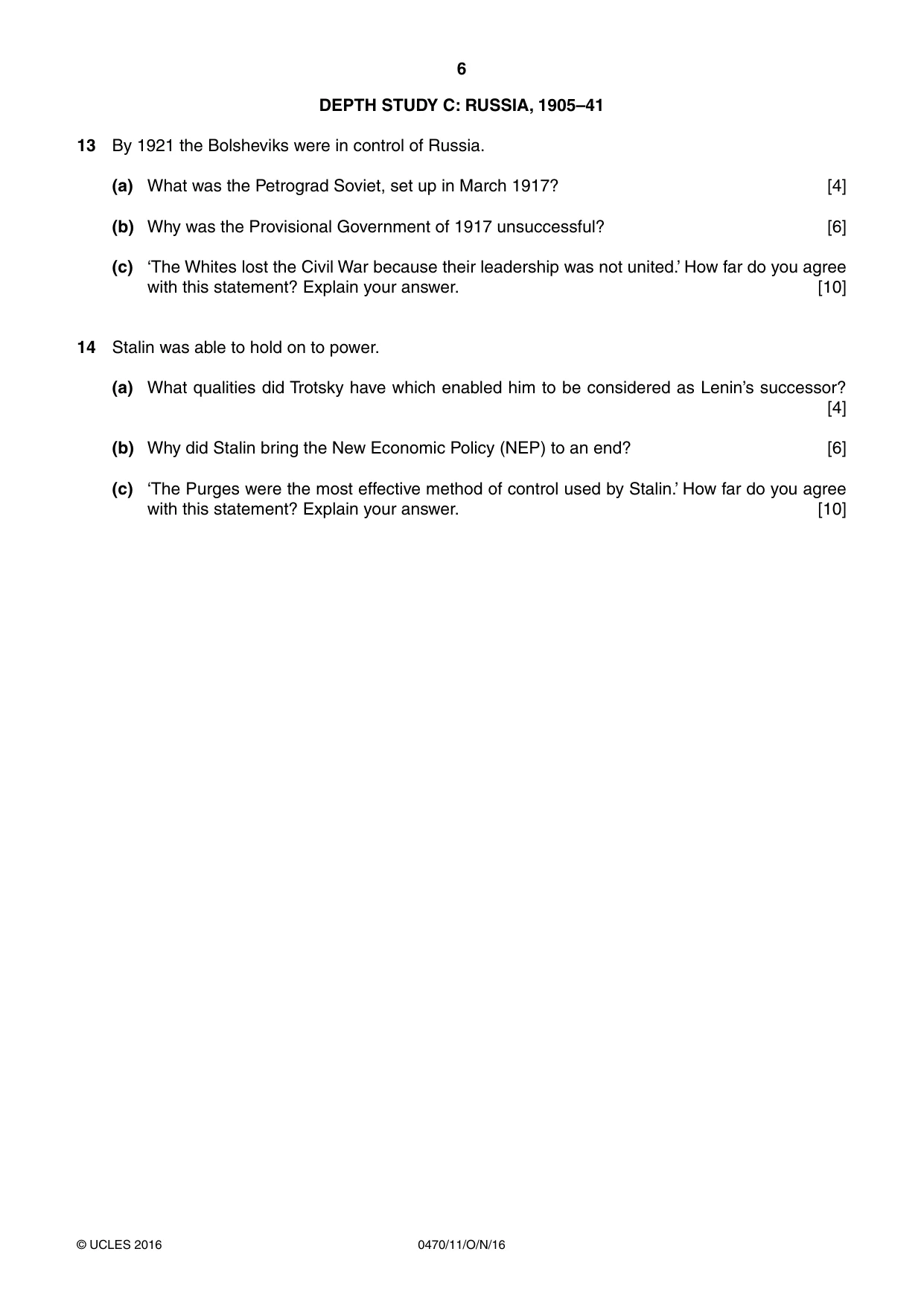
6 0470/11/O/N/16 © UCLES 2016 DEPTH STUDY C: RUSSIA, 1905–41 13 By 1921 the Bolsheviks were in control of Russia. (a) What was the Petrograd Soviet, set up in March 1917? [4] (b) Why was the Provisional Government of 1917 unsuccessful? [6] (c) ‘The Whites lost the Civil War because their leadership was not united.’ How far do you agree with this statement? Explain your answer. [10] 14 Stalin was able to hold on to power. (a) What qualities did Trotsky have which enabled him to be considered as Lenin’s successor? [4] (b) Why did Stalin bring the New Economic Policy (NEP) to an end? [6] (c) ‘The Purges were the most effective method of control used by Stalin.’ How far do you agree with this statement? Explain your answer. [10]
Question paper, page 7
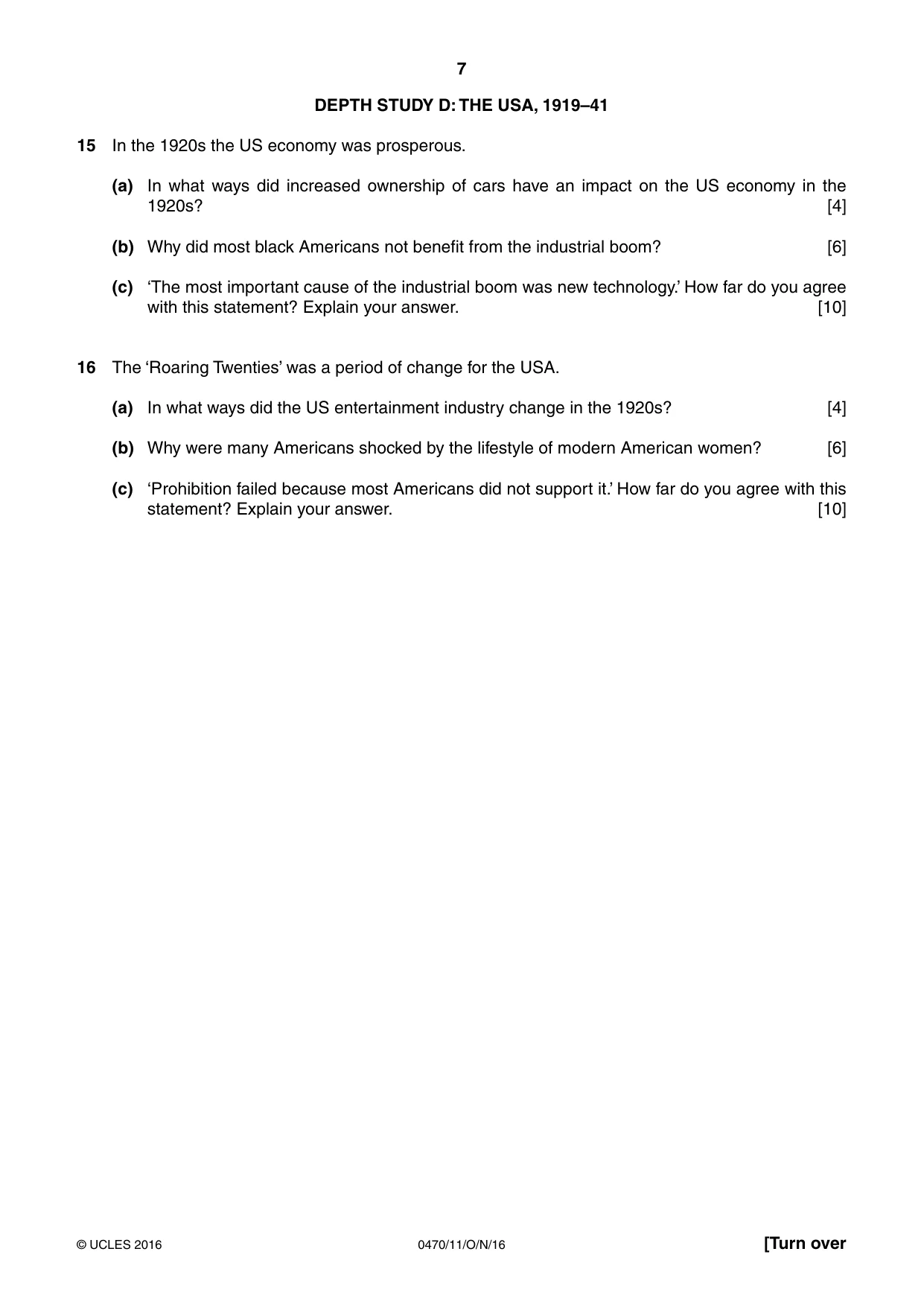
7 0470/11/O/N/16 © UCLES 2016 [Turn over DEPTH STUDY D: THE USA, 1919–41 15 In the 1920s the US economy was prosperous. (a) In what ways did increased ownership of cars have an impact on the US economy in the 1920s? [4] (b) Why did most black Americans not benefit from the industrial boom? [6] (c) ‘The most important cause of the industrial boom was new technology.’ How far do you agree with this statement? Explain your answer. [10] 16 The ‘Roaring Twenties’ was a period of change for the USA. (a) In what ways did the US entertainment industry change in the 1920s? [4] (b) Why were many Americans shocked by the lifestyle of modern American women? [6] (c) ‘Prohibition failed because most Americans did not support it.’ How far do you agree with this statement? Explain your answer. [10]
Question paper, page 8
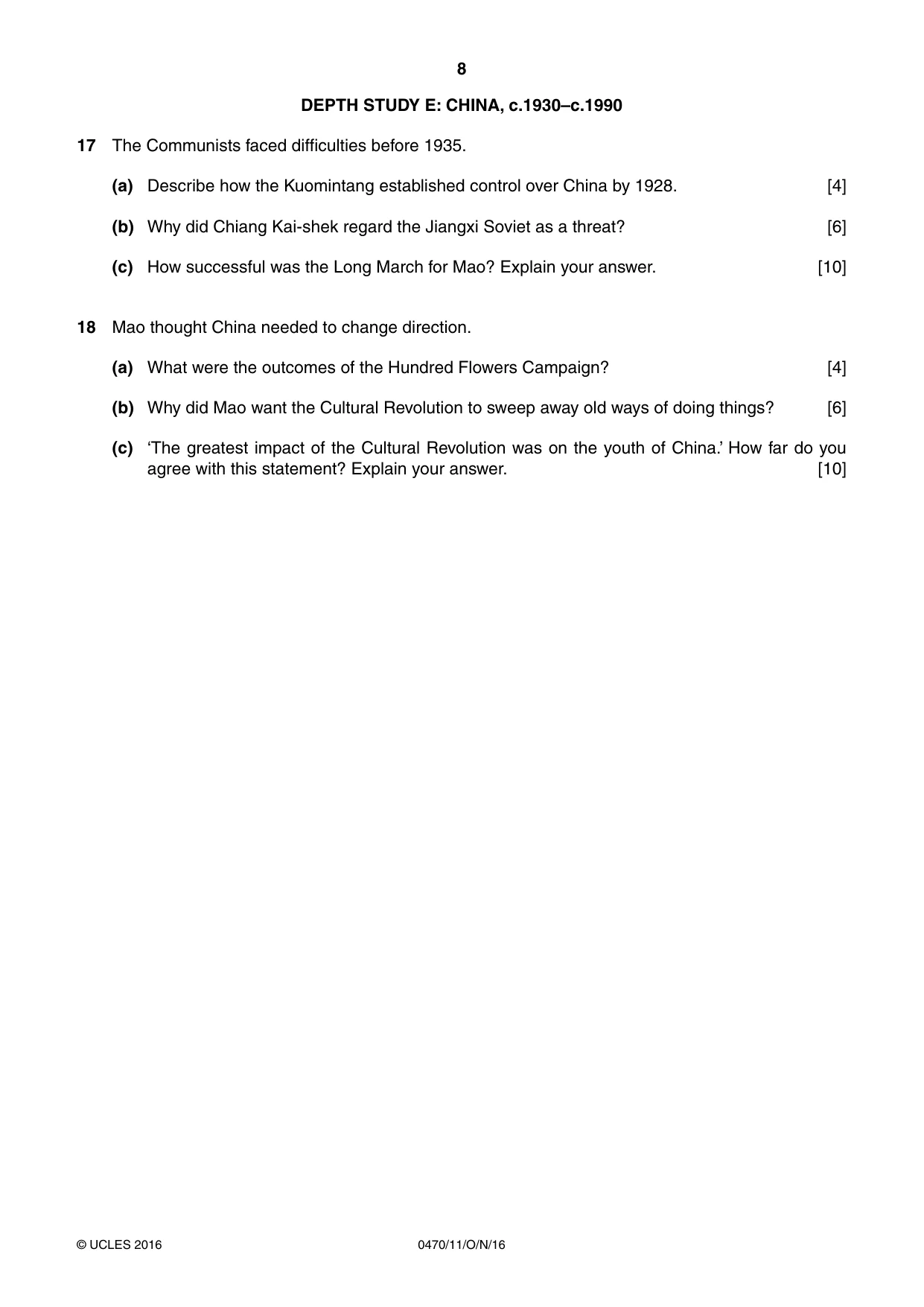
8 0470/11/O/N/16 © UCLES 2016 DEPTH STUDY E: CHINA, c.1930–c.1990 17 The Communists faced difficulties before 1935. (a) Describe how the Kuomintang established control over China by 1928. [4] (b) Why did Chiang Kai-shek regard the Jiangxi Soviet as a threat? [6] (c) How successful was the Long March for Mao? Explain your answer. [10] 18 Mao thought China needed to change direction. (a) What were the outcomes of the Hundred Flowers Campaign? [4] (b) Why did Mao want the Cultural Revolution to sweep away old ways of doing things? [6] (c) ‘The greatest impact of the Cultural Revolution was on the youth of China.’ How far do you agree with this statement? Explain your answer. [10]
Question paper, page 9
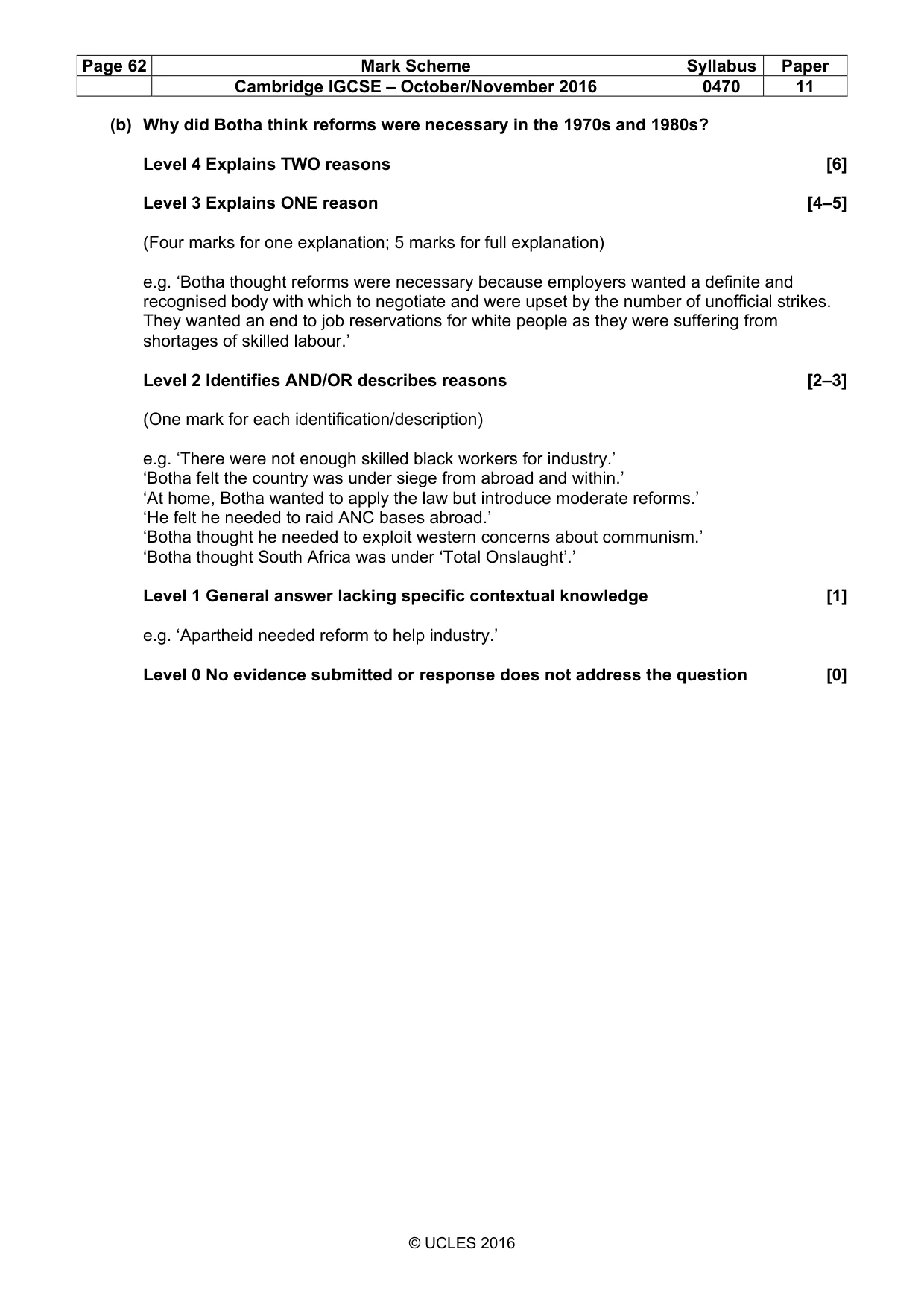
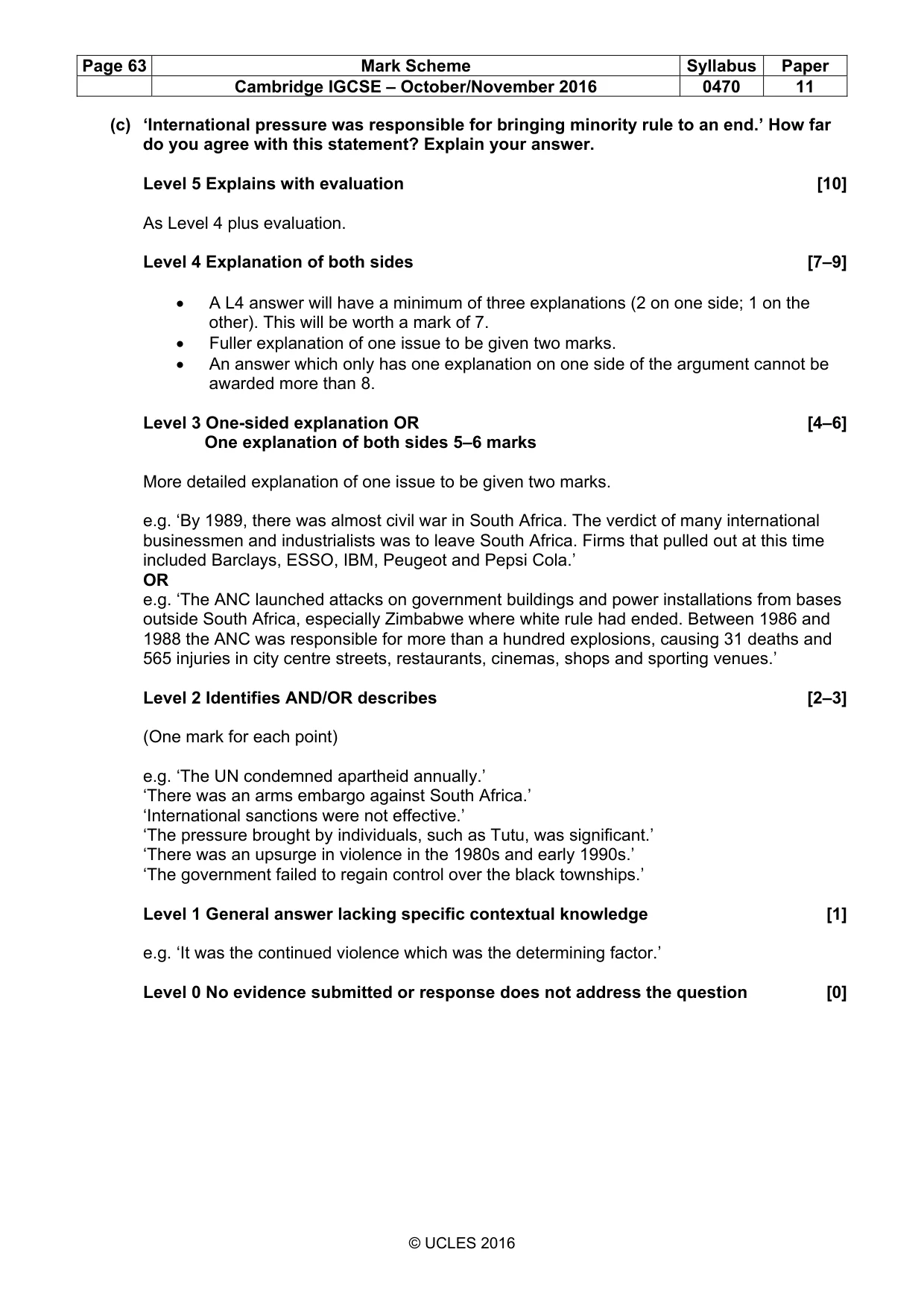
9 0470/11/O/N/16 © UCLES 2016 [Turn over DEPTH STUDY F: SOUTH AFRICA, c.1940–c.1994 19 Government policies were increasingly affecting the non-white population by 1948. (a) By 1940, what restrictions had been placed on the rights of black people by the Land Acts? [4] (b) Why was the pass system hated by black South Africans? [6] (c) ‘The policies of the United Party were the main reason for the success of the National Party in the 1948 election.’ How far do you agree with this statement? Explain your answer. [10] 20 Pressure for reform in South Africa increased from the 1970s. (a) Describe the Soweto Riots of 1976. [4] (b) Why did Botha think reforms were necessary in the 1970s and 1980s? [6] (c) ‘International pressure was responsible for bringing minority rule to an end.’ How far do you agree with this statement? Explain your answer. [10]
Question paper, page 10
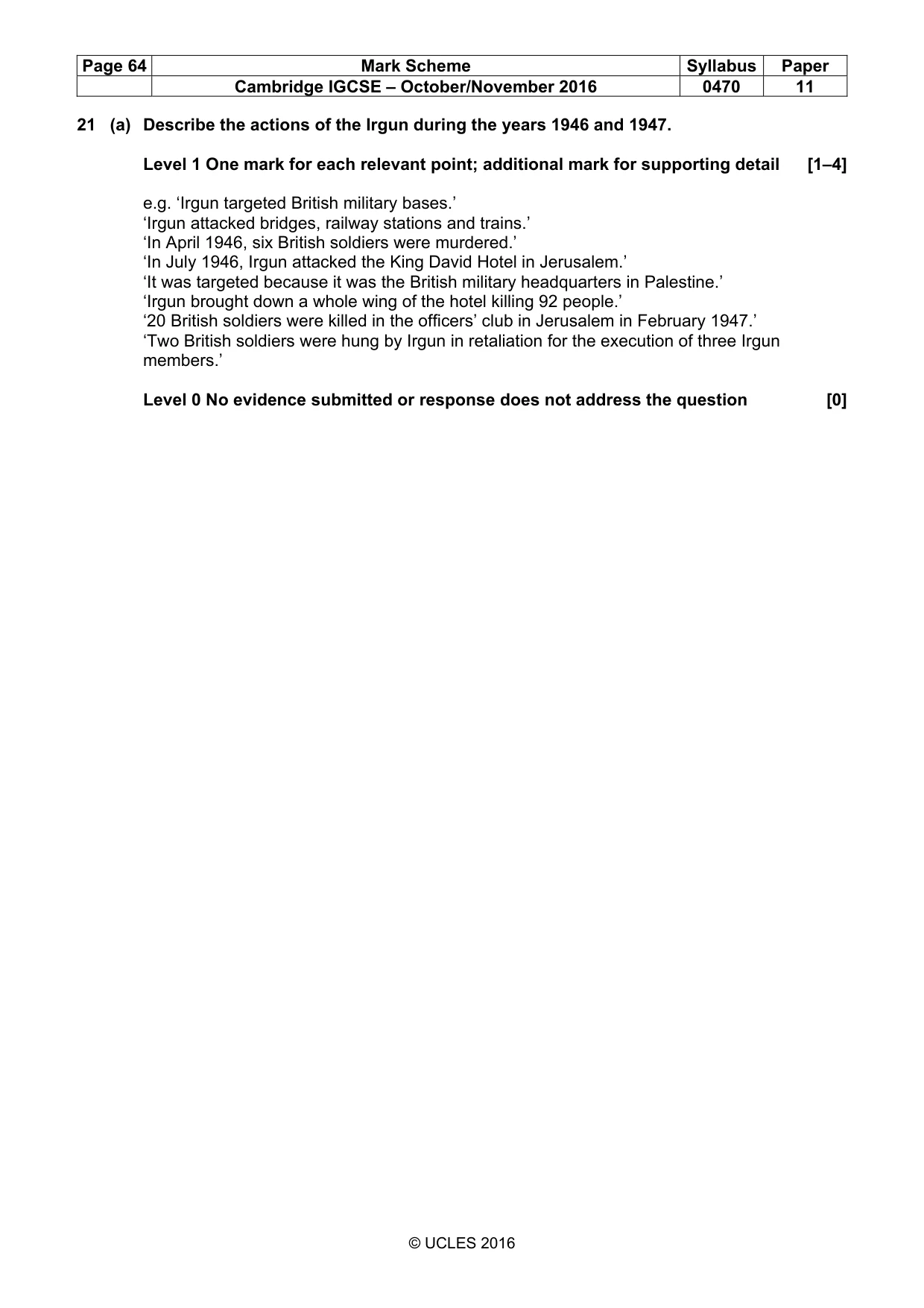
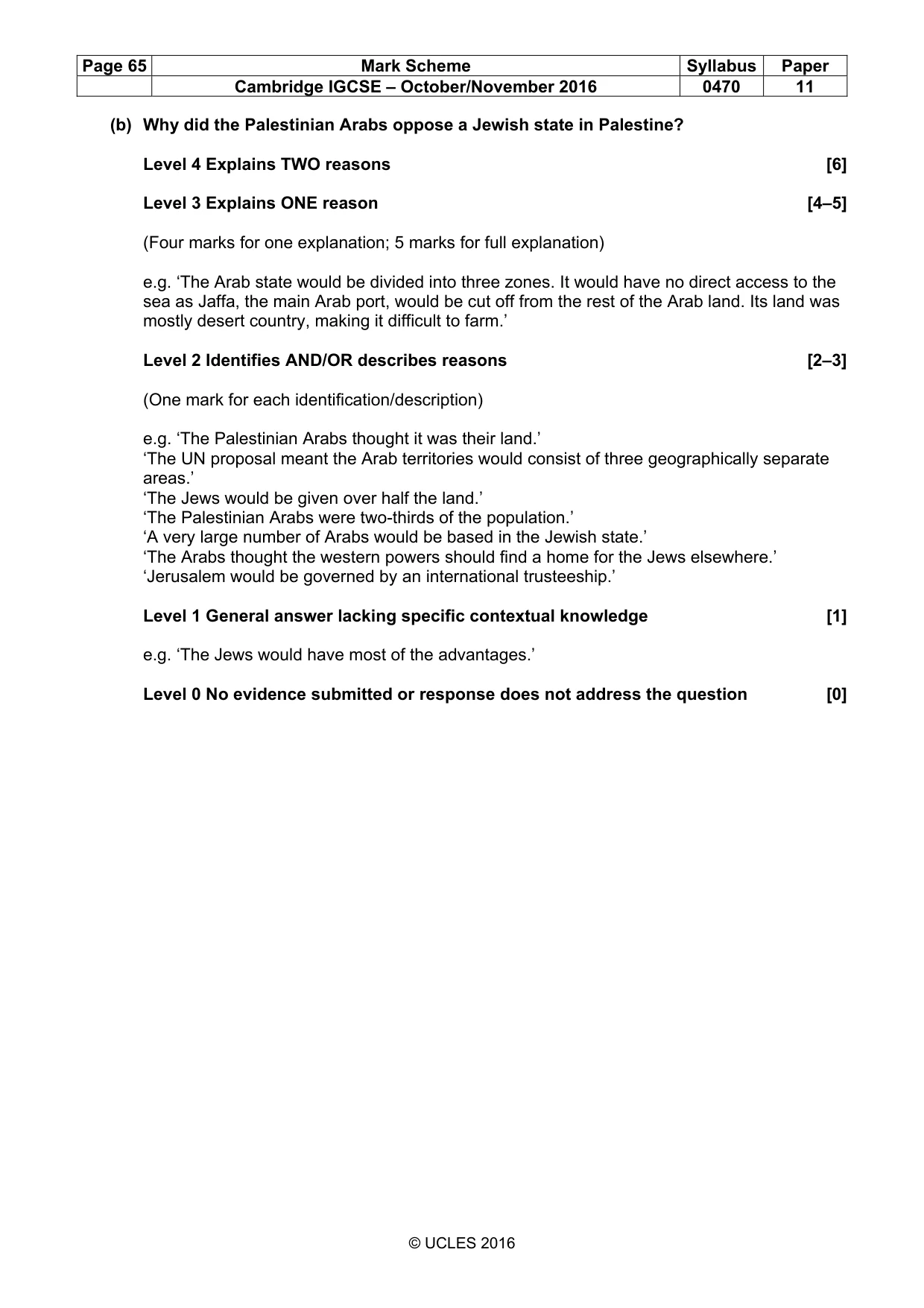
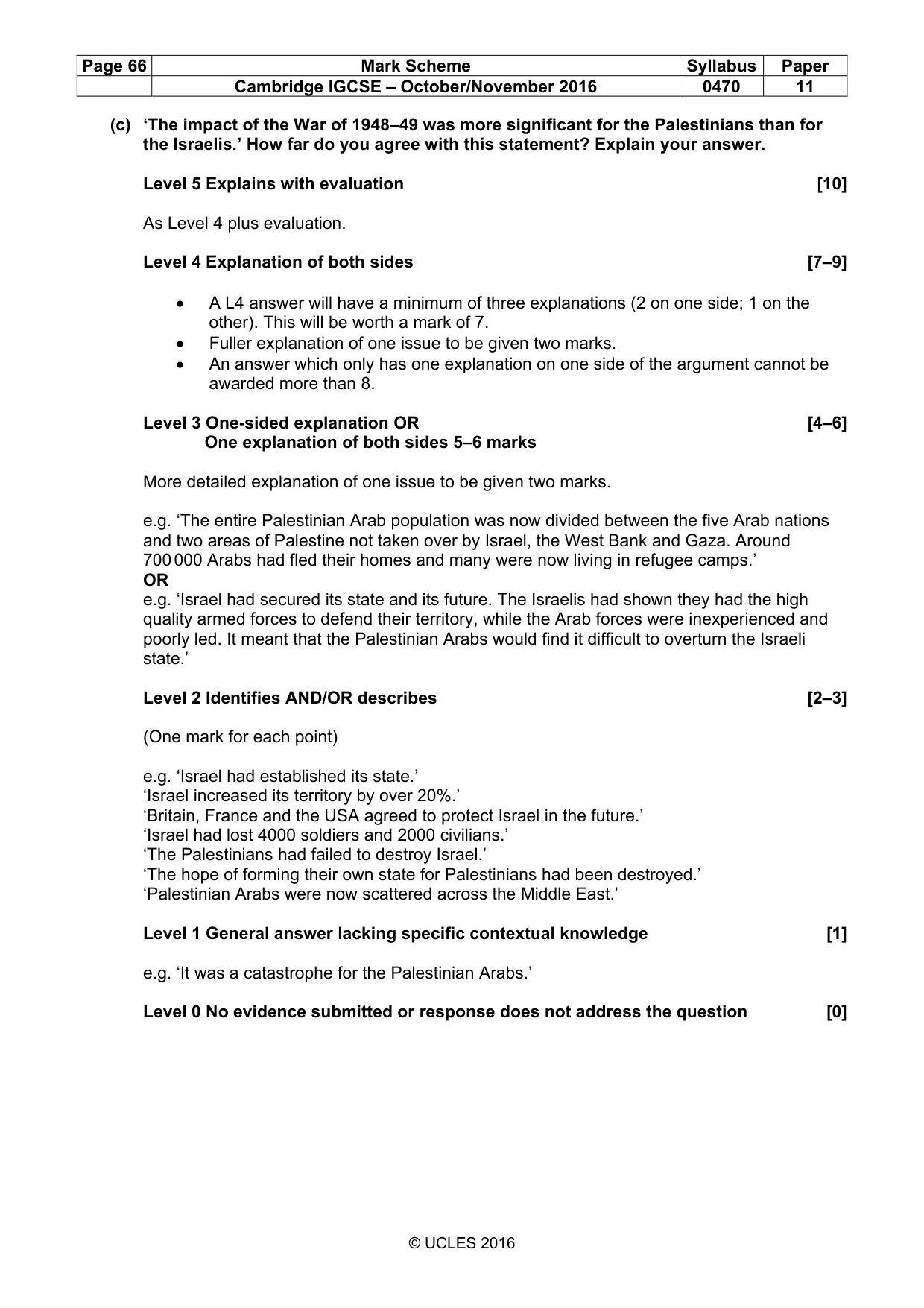
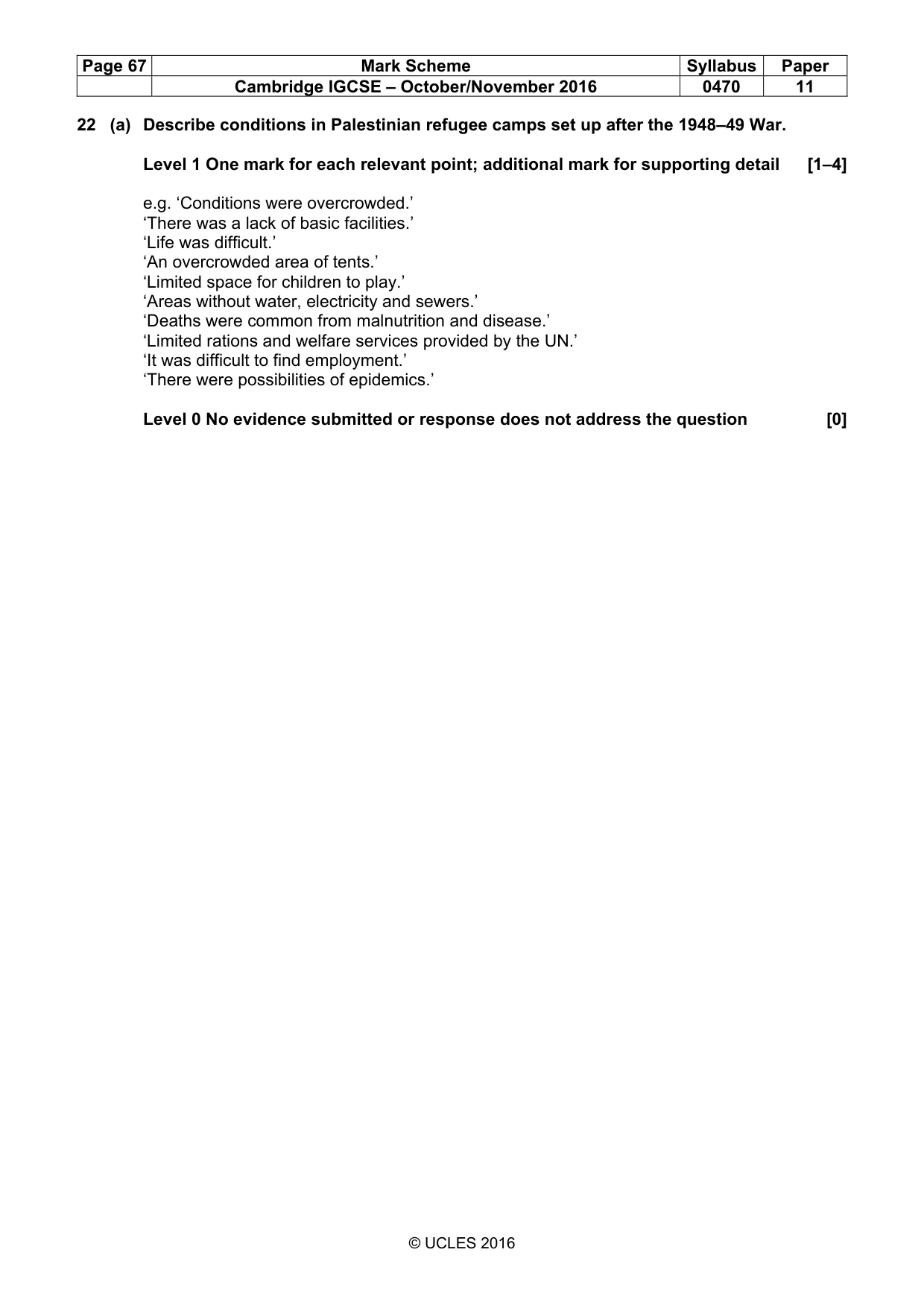
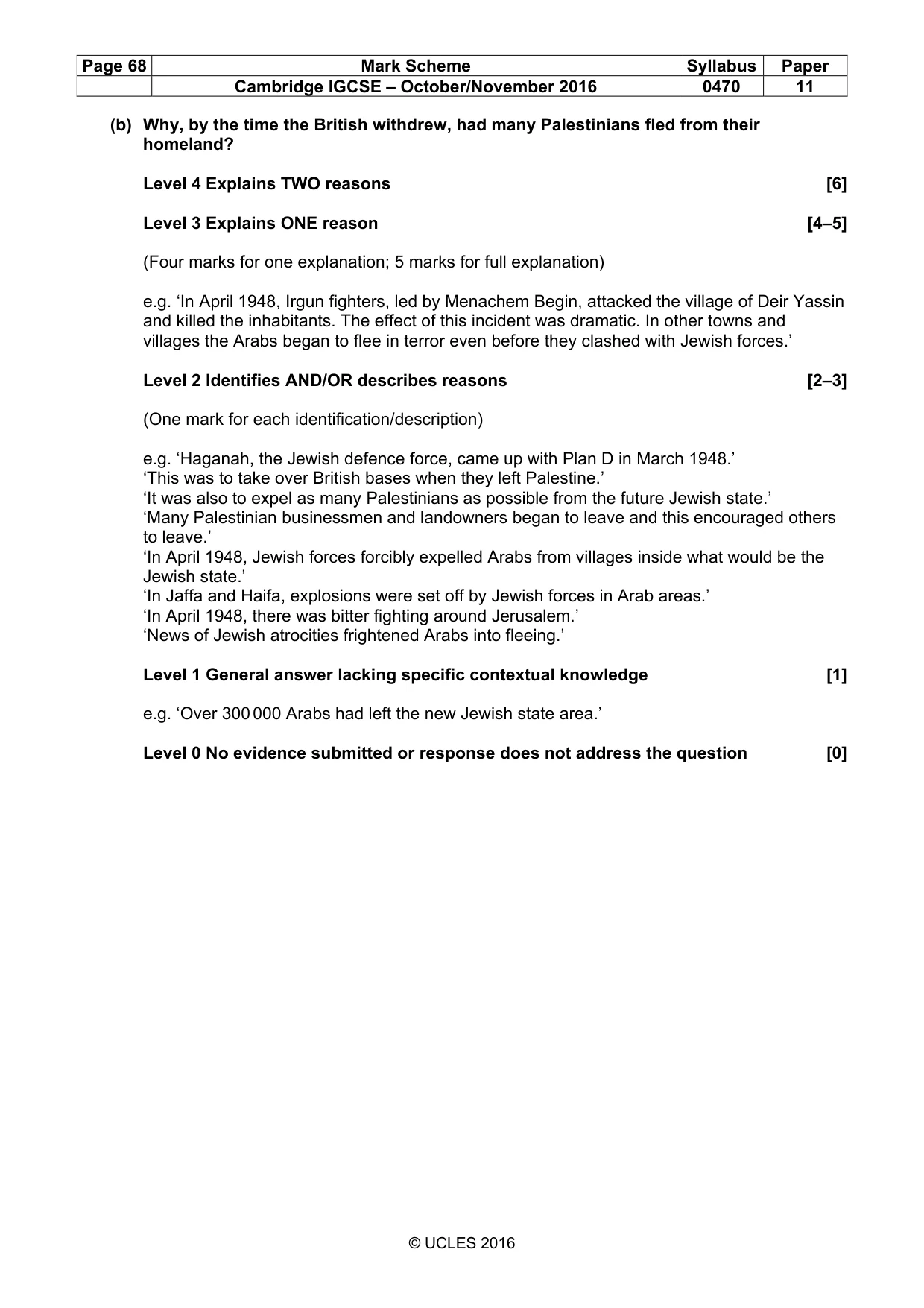
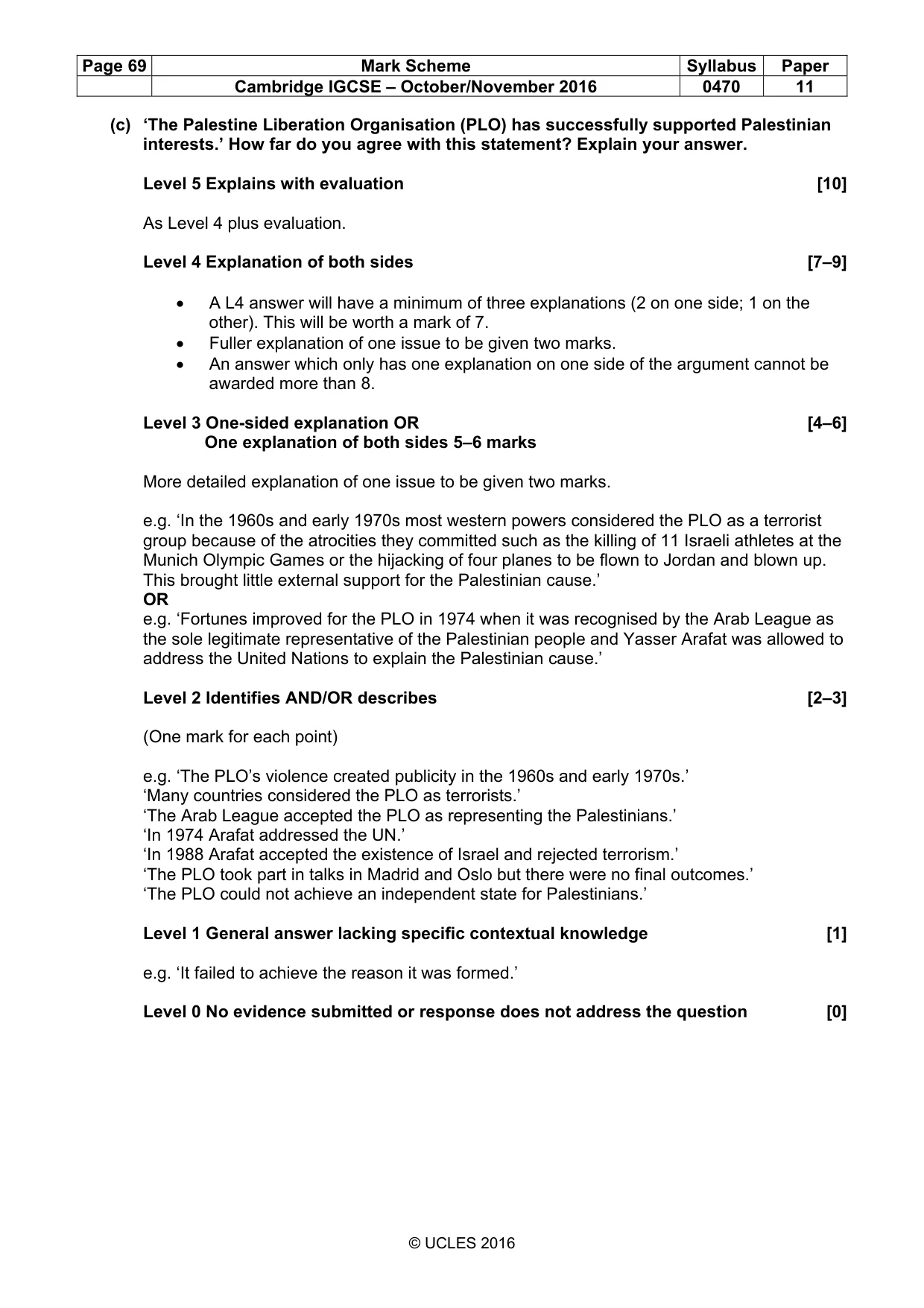
10 0470/11/O/N/16 © UCLES 2016 DEPTH STUDY G: ISRAELIS AND PALESTINIANS SINCE 1945 21 Between 1945 and 1949 unrest in Palestine was inevitable. (a) Describe the actions of the Irgun during the years 1946 and 1947. [4] (b) Why did the Palestinian Arabs oppose a Jewish state in Palestine? [6] (c) ‘The impact of the War of 1948–49 was more significant for the Palestinians than for the Israelis.’ How far do you agree with this statement? Explain your answer. [10] 22 Palestinian refugees faced many difficulties. (a) Describe conditions in Palestinian refugee camps set up after the 1948–49 War. [4] (b) Why, by the time the British withdrew, had many Palestinians fled from their homeland? [6] (c) ‘The Palestine Liberation Organisation (PLO) has successfully supported Palestinian interests.’ How far do you agree with this statement? Explain your answer. [10]
Question paper, page 11
11 0470/11/O/N/16 © UCLES 2016 BLANK PAGE
Question paper, page 12
12 0470/11/O/N/16 © UCLES 2016 Permission to reproduce items where third-party owned material protected by copyright is included has been sought and cleared where possible. Every reasonable effort has been made by the publisher (UCLES) to trace copyright holders, but if any items requiring clearance have unwittingly been included, the publisher will be pleased to make amends at the earliest possible opportunity. To avoid the issue of disclosure of answer-related information to candidates, all copyright acknowledgements are reproduced online in the Cambridge International Examinations Copyright Acknowledgements Booklet. This is produced for each series of examinations and is freely available to download at www.cie.org.uk after the live examination series. Cambridge International Examinations is part of the Cambridge Assessment Group. Cambridge Assessment is the brand name of University of Cambridge Local Examinations Syndicate (UCLES), which is itself a department of the University of Cambridge. BLANK PAGE
Mark scheme, page 1
® IGCSE is the registered trademark of Cambridge International Examinations. This syllabus is approved for use in England, Wales and Northern Ireland as a Cambridge International Level 1/Level 2 Certificate. This document consists of 69 printed pages. © UCLES 2016 [Turn over Cambridge International Examinations Cambridge International General Certificate of Secondary Education HISTORY 0470/11 Paper 1 October/November 2016 MARK SCHEME Maximum Mark: 60 Published This mark scheme is published as an aid to teachers and candidates, to indicate the requirements of the examination. It shows the basis on which Examiners were instructed to award marks. It does not indicate the details of the discussions that took place at an Examiners’ meeting before marking began, which would have considered the acceptability of alternative answers. Mark schemes should be read in conjunction with the question paper and the Principal Examiner Report for Teachers. Cambridge will not enter into discussions about these mark schemes. Cambridge is publishing the mark schemes for the October/November 2016 series for most Cambridge IGCSE®, Cambridge International A and AS Level components and some Cambridge O Level components.
Mark scheme, page 2
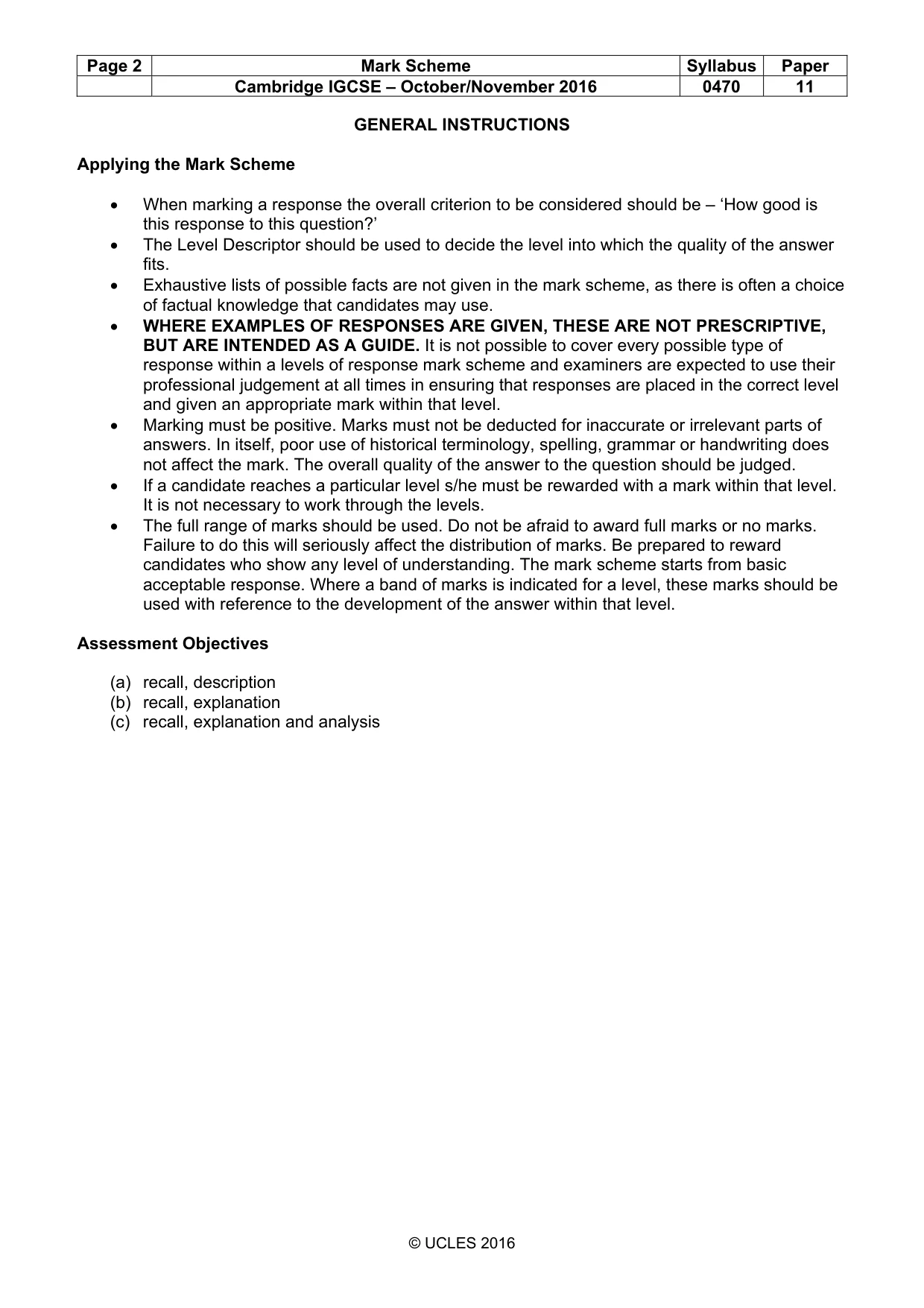
Page 2 Mark Scheme Syllabus Paper Cambridge IGCSE – October/November 2016 0470 11 © UCLES 2016 GENERAL INSTRUCTIONS Applying the Mark Scheme • When marking a response the overall criterion to be considered should be – ‘How good is this response to this question?’ • The Level Descriptor should be used to decide the level into which the quality of the answer fits. • Exhaustive lists of possible facts are not given in the mark scheme, as there is often a choice of factual knowledge that candidates may use. • WHERE EXAMPLES OF RESPONSES ARE GIVEN, THESE ARE NOT PRESCRIPTIVE, BUT ARE INTENDED AS A GUIDE. It is not possible to cover every possible type of response within a levels of response mark scheme and examiners are expected to use their professional judgement at all times in ensuring that responses are placed in the correct level and given an appropriate mark within that level. • Marking must be positive. Marks must not be deducted for inaccurate or irrelevant parts of answers. In itself, poor use of historical terminology, spelling, grammar or handwriting does not affect the mark. The overall quality of the answer to the question should be judged. • If a candidate reaches a particular level s/he must be rewarded with a mark within that level. It is not necessary to work through the levels. • The full range of marks should be used. Do not be afraid to award full marks or no marks. Failure to do this will seriously affect the distribution of marks. Be prepared to reward candidates who show any level of understanding. The mark scheme starts from basic acceptable response. Where a band of marks is indicated for a level, these marks should be used with reference to the development of the answer within that level. Assessment Objectives (a) recall, description (b) recall, explanation (c) recall, explanation and analysis
Mark scheme, page 3
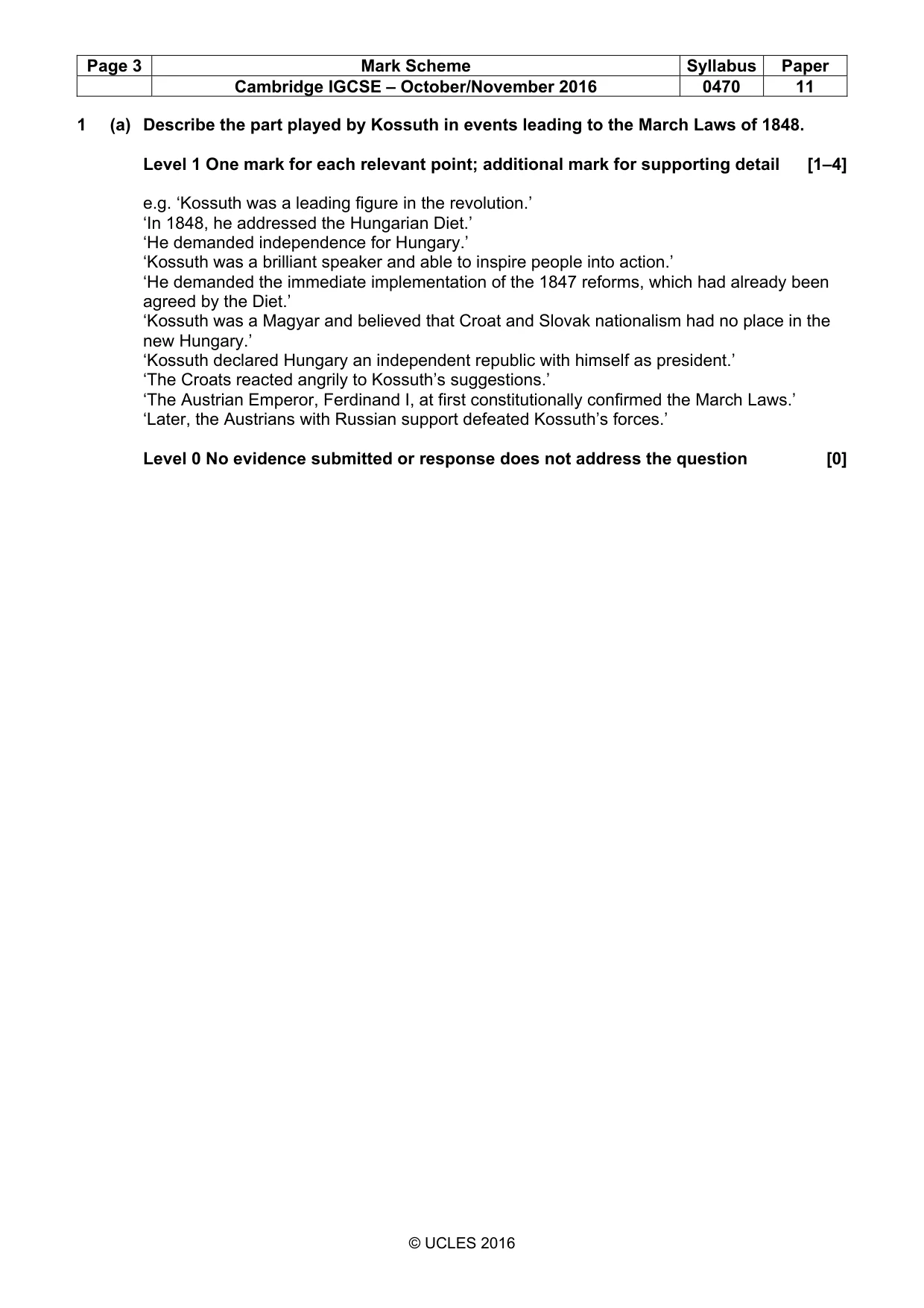
Page 3 Mark Scheme Syllabus Paper Cambridge IGCSE – October/November 2016 0470 11 © UCLES 2016 1 (a) Describe the part played by Kossuth in events leading to the March Laws of 1848. Level 1 One mark for each relevant point; additional mark for supporting detail [1–4] e.g. ‘Kossuth was a leading figure in the revolution.’ ‘In 1848, he addressed the Hungarian Diet.’ ‘He demanded independence for Hungary.’ ‘Kossuth was a brilliant speaker and able to inspire people into action.’ ‘He demanded the immediate implementation of the 1847 reforms, which had already been agreed by the Diet.’ ‘Kossuth was a Magyar and believed that Croat and Slovak nationalism had no place in the new Hungary.’ ‘Kossuth declared Hungary an independent republic with himself as president.’ ‘The Croats reacted angrily to Kossuth’s suggestions.’ ‘The Austrian Emperor, Ferdinand I, at first constitutionally confirmed the March Laws.’ ‘Later, the Austrians with Russian support defeated Kossuth’s forces.’ Level 0 No evidence submitted or response does not address the question [0]
Mark scheme, page 4
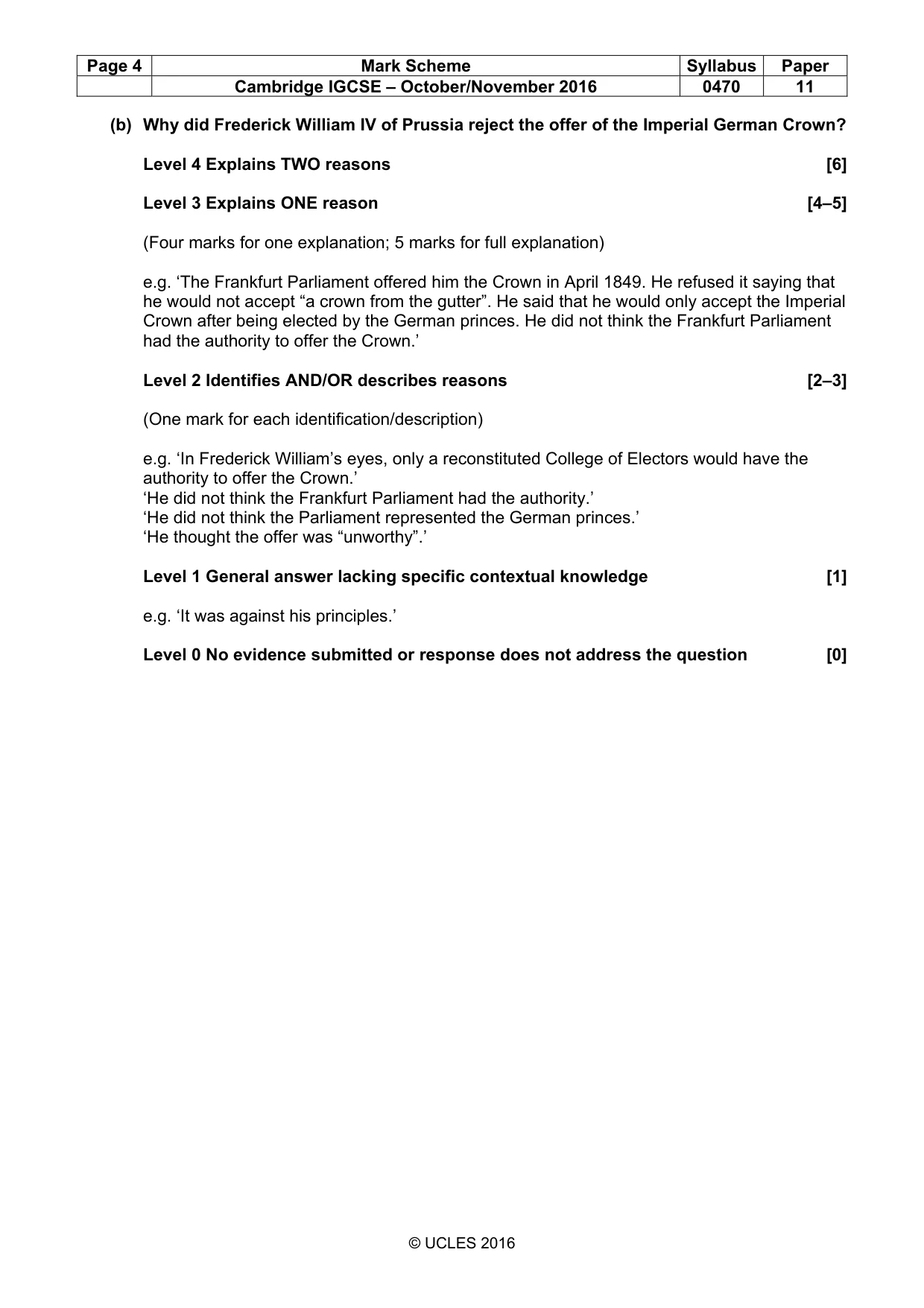
Page 4 Mark Scheme Syllabus Paper Cambridge IGCSE – October/November 2016 0470 11 © UCLES 2016 (b) Why did Frederick William IV of Prussia reject the offer of the Imperial German Crown? Level 4 Explains TWO reasons [6] Level 3 Explains ONE reason [4–5] (Four marks for one explanation; 5 marks for full explanation) e.g. ‘The Frankfurt Parliament offered him the Crown in April 1849. He refused it saying that he would not accept “a crown from the gutter”. He said that he would only accept the Imperial Crown after being elected by the German princes. He did not think the Frankfurt Parliament had the authority to offer the Crown.’ Level 2 Identifies AND/OR describes reasons [2–3] (One mark for each identification/description) e.g. ‘In Frederick William’s eyes, only a reconstituted College of Electors would have the authority to offer the Crown.’ ‘He did not think the Frankfurt Parliament had the authority.’ ‘He did not think the Parliament represented the German princes.’ ‘He thought the offer was “unworthy”.’ Level 1 General answer lacking specific contextual knowledge [1] e.g. ‘It was against his principles.’ Level 0 No evidence submitted or response does not address the question [0]
Mark scheme, page 5
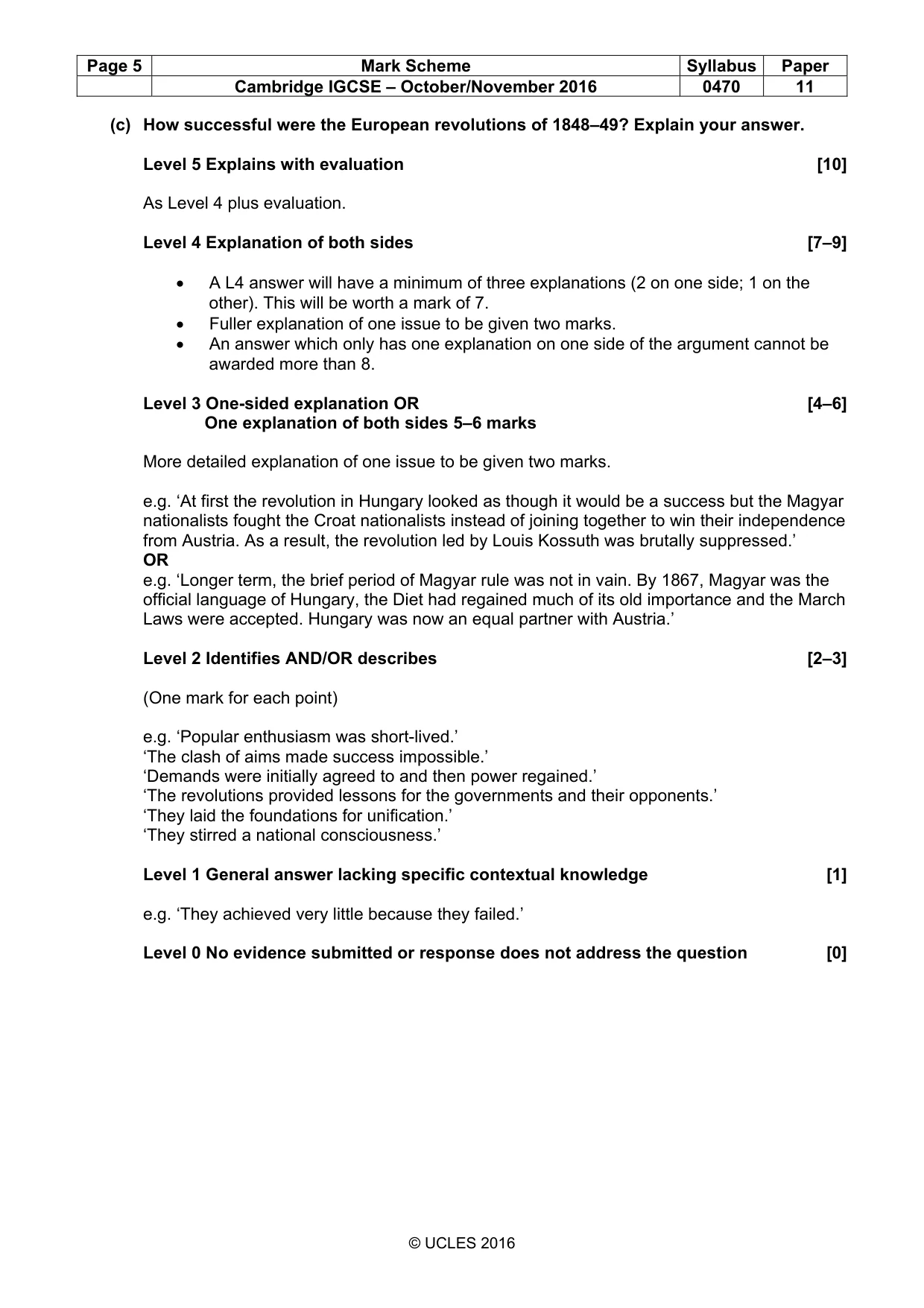
Page 5 Mark Scheme Syllabus Paper Cambridge IGCSE – October/November 2016 0470 11 © UCLES 2016 (c) How successful were the European revolutions of 1848–49? Explain your answer. Level 5 Explains with evaluation [10] As Level 4 plus evaluation. Level 4 Explanation of both sides [7–9] • A L4 answer will have a minimum of three explanations (2 on one side; 1 on the other). This will be worth a mark of 7. • Fuller explanation of one issue to be given two marks. • An answer which only has one explanation on one side of the argument cannot be awarded more than 8. Level 3 One-sided explanation OR [4–6] One explanation of both sides 5–6 marks More detailed explanation of one issue to be given two marks. e.g. ‘At first the revolution in Hungary looked as though it would be a success but the Magyar nationalists fought the Croat nationalists instead of joining together to win their independence from Austria. As a result, the revolution led by Louis Kossuth was brutally suppressed.’ OR e.g. ‘Longer term, the brief period of Magyar rule was not in vain. By 1867, Magyar was the official language of Hungary, the Diet had regained much of its old importance and the March Laws were accepted. Hungary was now an equal partner with Austria.’ Level 2 Identifies AND/OR describes [2–3] (One mark for each point) e.g. ‘Popular enthusiasm was short-lived.’ ‘The clash of aims made success impossible.’ ‘Demands were initially agreed to and then power regained.’ ‘The revolutions provided lessons for the governments and their opponents.’ ‘They laid the foundations for unification.’ ‘They stirred a national consciousness.’ Level 1 General answer lacking specific contextual knowledge [1] e.g. ‘They achieved very little because they failed.’ Level 0 No evidence submitted or response does not address the question [0]
Mark scheme, page 6
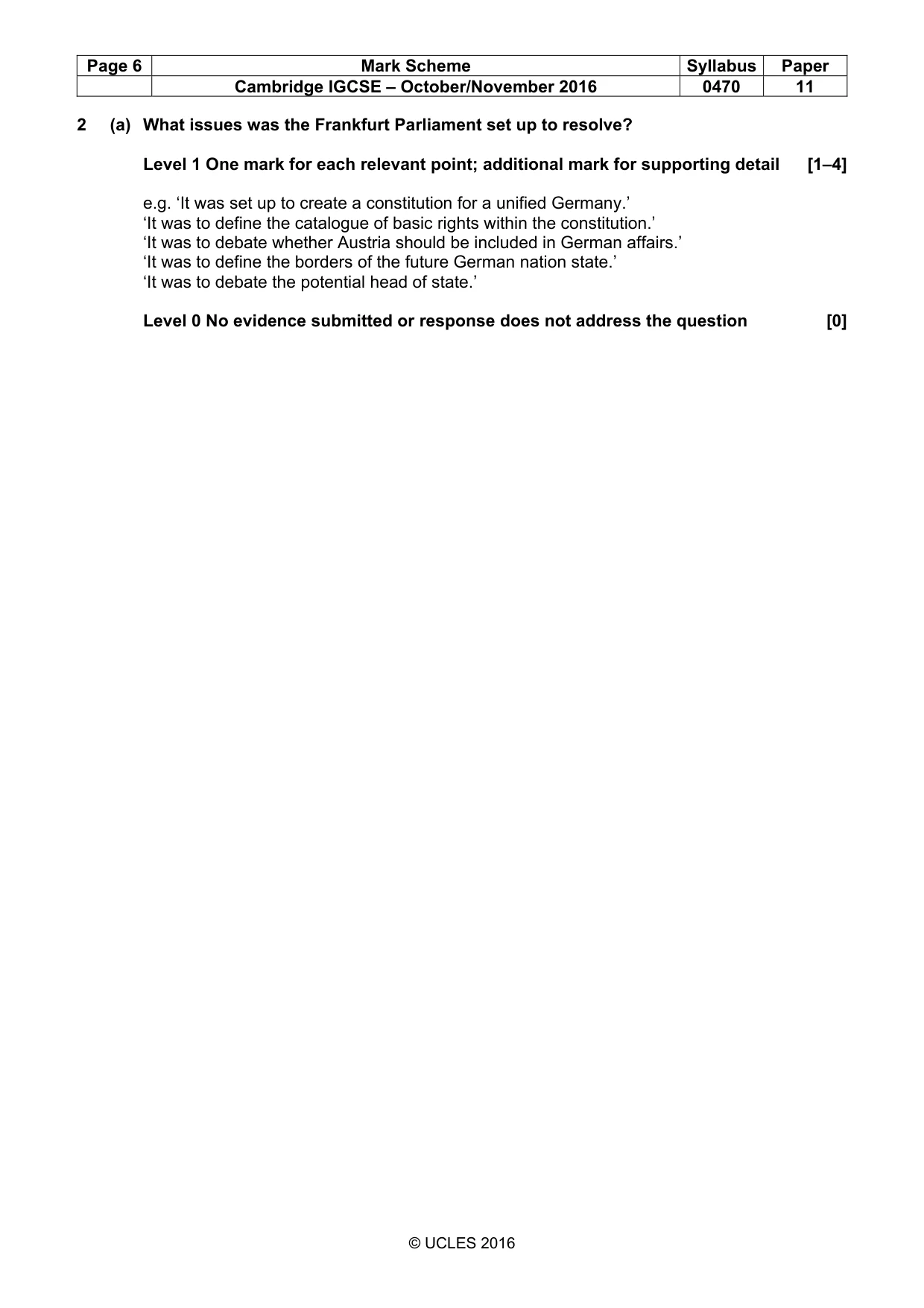
Page 6 Mark Scheme Syllabus Paper Cambridge IGCSE – October/November 2016 0470 11 © UCLES 2016 2 (a) What issues was the Frankfurt Parliament set up to resolve? Level 1 One mark for each relevant point; additional mark for supporting detail [1–4] e.g. ‘It was set up to create a constitution for a unified Germany.’ ‘It was to define the catalogue of basic rights within the constitution.’ ‘It was to debate whether Austria should be included in German affairs.’ ‘It was to define the borders of the future German nation state.’ ‘It was to debate the potential head of state.’ Level 0 No evidence submitted or response does not address the question [0]
Mark scheme, page 7
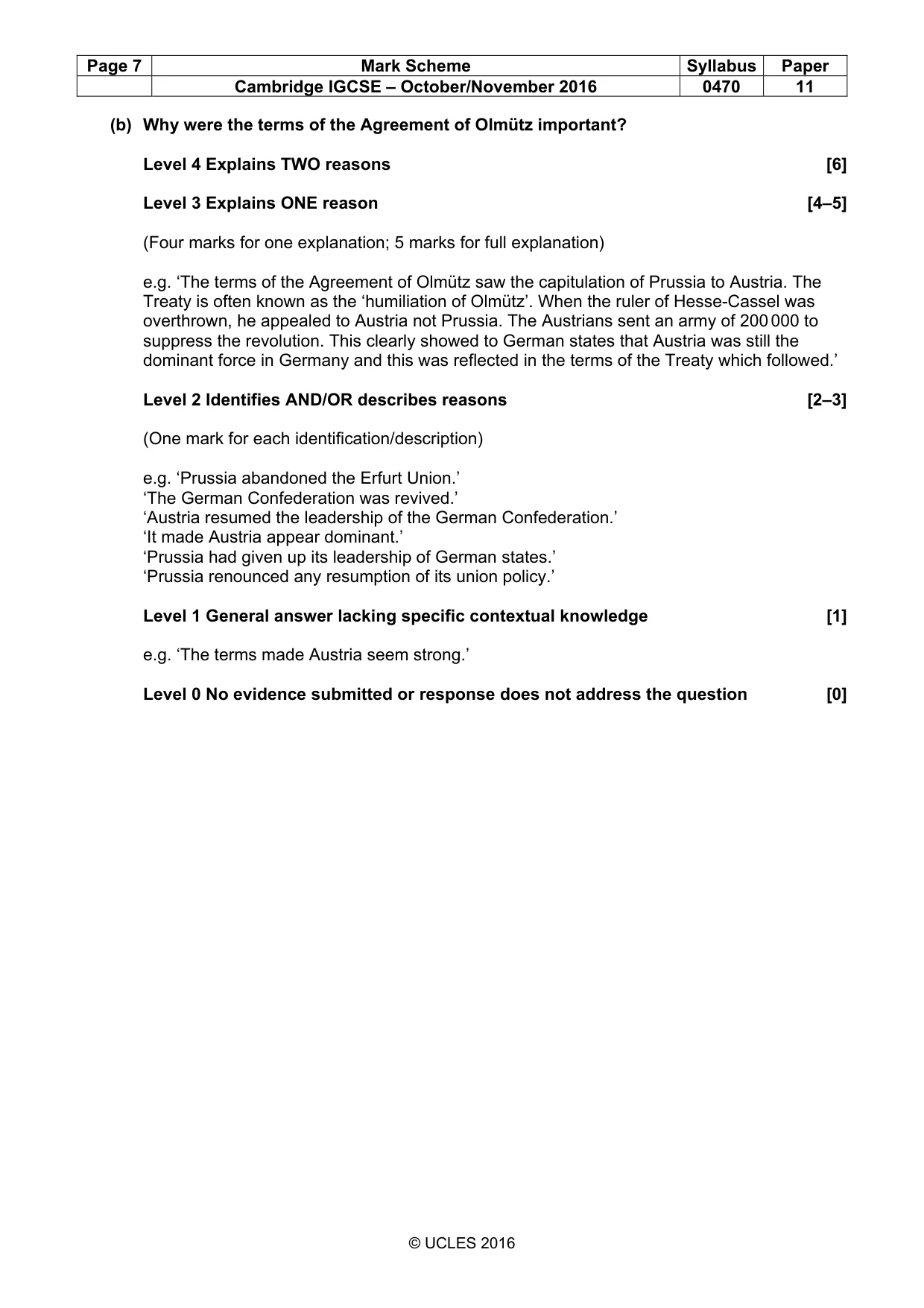
Page 7 Mark Scheme Syllabus Paper Cambridge IGCSE – October/November 2016 0470 11 © UCLES 2016 (b) Why were the terms of the Agreement of Olmütz important? Level 4 Explains TWO reasons [6] Level 3 Explains ONE reason [4–5] (Four marks for one explanation; 5 marks for full explanation) e.g. ‘The terms of the Agreement of Olmütz saw the capitulation of Prussia to Austria. The Treaty is often known as the ‘humiliation of Olmütz’. When the ruler of Hesse-Cassel was overthrown, he appealed to Austria not Prussia. The Austrians sent an army of 200 000 to suppress the revolution. This clearly showed to German states that Austria was still the dominant force in Germany and this was reflected in the terms of the Treaty which followed.’ Level 2 Identifies AND/OR describes reasons [2–3] (One mark for each identification/description) e.g. ‘Prussia abandoned the Erfurt Union.’ ‘The German Confederation was revived.’ ‘Austria resumed the leadership of the German Confederation.’ ‘It made Austria appear dominant.’ ‘Prussia had given up its leadership of German states.’ ‘Prussia renounced any resumption of its union policy.’ Level 1 General answer lacking specific contextual knowledge [1] e.g. ‘The terms made Austria seem strong.’ Level 0 No evidence submitted or response does not address the question [0]
Mark scheme, page 8
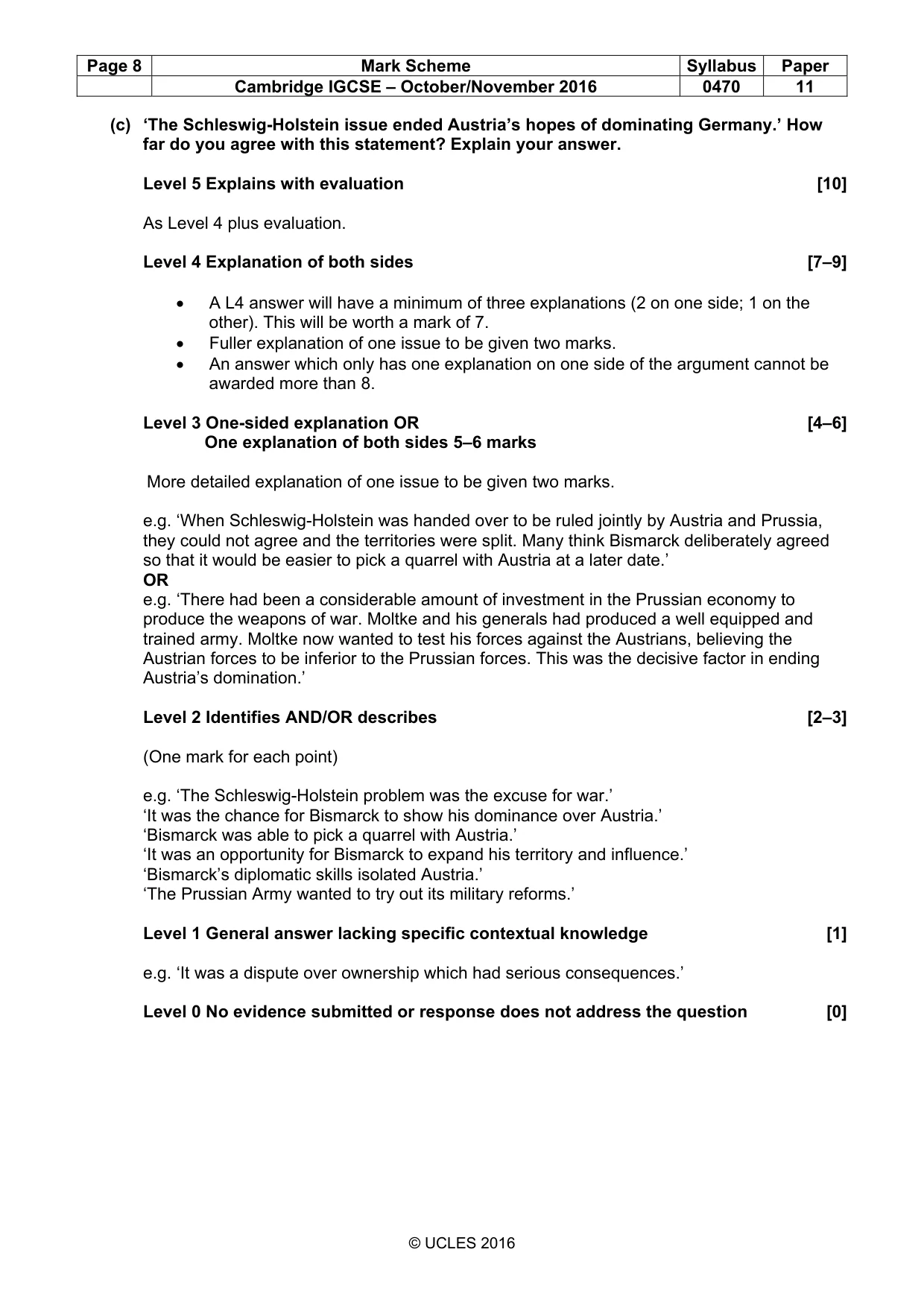
Page 8 Mark Scheme Syllabus Paper Cambridge IGCSE – October/November 2016 0470 11 © UCLES 2016 (c) ‘The Schleswig-Holstein issue ended Austria’s hopes of dominating Germany.’ How far do you agree with this statement? Explain your answer. Level 5 Explains with evaluation [10] As Level 4 plus evaluation. Level 4 Explanation of both sides [7–9] • A L4 answer will have a minimum of three explanations (2 on one side; 1 on the other). This will be worth a mark of 7. • Fuller explanation of one issue to be given two marks. • An answer which only has one explanation on one side of the argument cannot be awarded more than 8. Level 3 One-sided explanation OR [4–6] One explanation of both sides 5–6 marks More detailed explanation of one issue to be given two marks. e.g. ‘When Schleswig-Holstein was handed over to be ruled jointly by Austria and Prussia, they could not agree and the territories were split. Many think Bismarck deliberately agreed so that it would be easier to pick a quarrel with Austria at a later date.’ OR e.g. ‘There had been a considerable amount of investment in the Prussian economy to produce the weapons of war. Moltke and his generals had produced a well equipped and trained army. Moltke now wanted to test his forces against the Austrians, believing the Austrian forces to be inferior to the Prussian forces. This was the decisive factor in ending Austria’s domination.’ Level 2 Identifies AND/OR describes [2–3] (One mark for each point) e.g. ‘The Schleswig-Holstein problem was the excuse for war.’ ‘It was the chance for Bismarck to show his dominance over Austria.’ ‘Bismarck was able to pick a quarrel with Austria.’ ‘It was an opportunity for Bismarck to expand his territory and influence.’ ‘Bismarck’s diplomatic skills isolated Austria.’ ‘The Prussian Army wanted to try out its military reforms.’ Level 1 General answer lacking specific contextual knowledge [1] e.g. ‘It was a dispute over ownership which had serious consequences.’ Level 0 No evidence submitted or response does not address the question [0]
Mark scheme, page 9
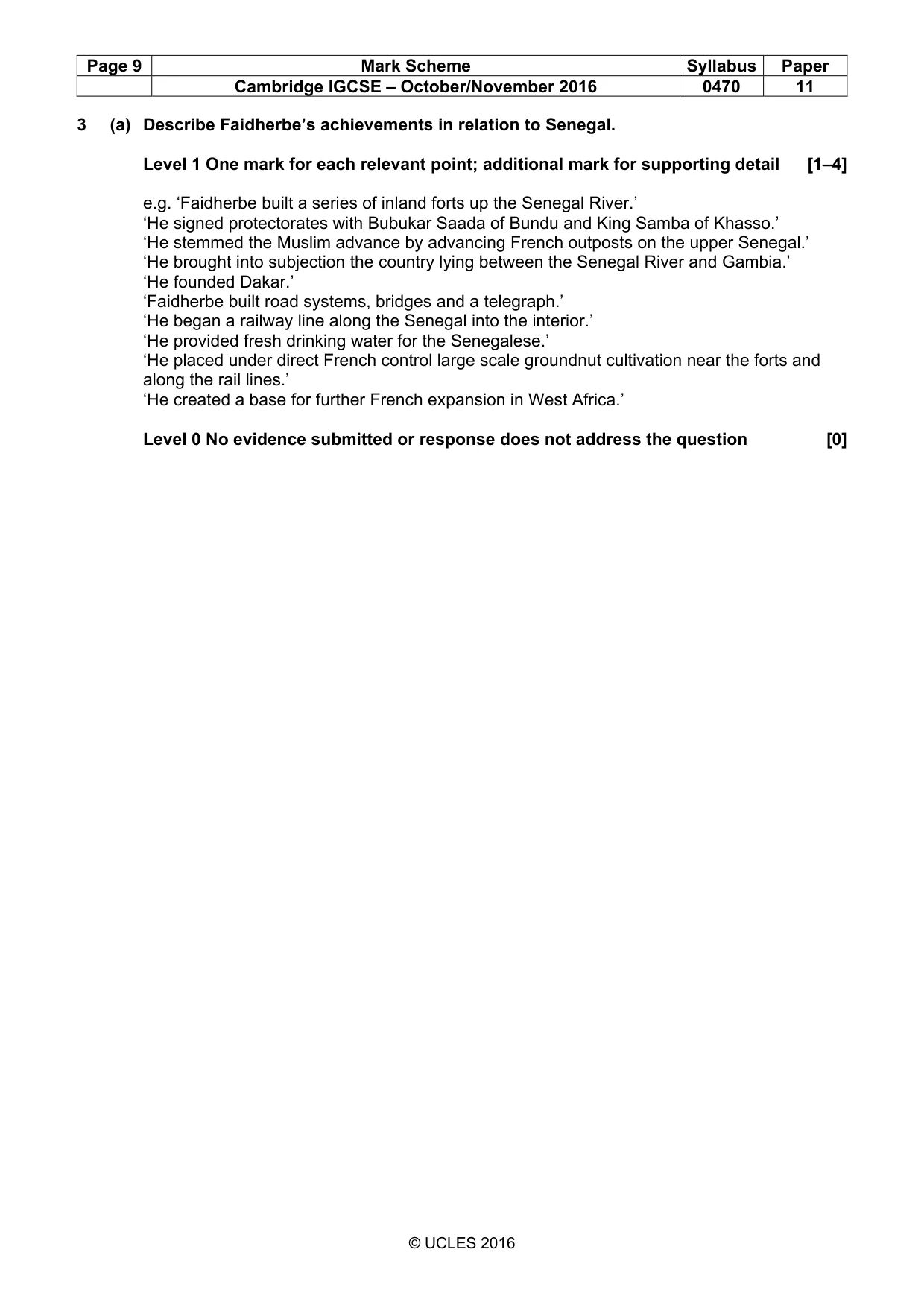
Page 9 Mark Scheme Syllabus Paper Cambridge IGCSE – October/November 2016 0470 11 © UCLES 2016 3 (a) Describe Faidherbe’s achievements in relation to Senegal. Level 1 One mark for each relevant point; additional mark for supporting detail [1–4] e.g. ‘Faidherbe built a series of inland forts up the Senegal River.’ ‘He signed protectorates with Bubukar Saada of Bundu and King Samba of Khasso.’ ‘He stemmed the Muslim advance by advancing French outposts on the upper Senegal.’ ‘He brought into subjection the country lying between the Senegal River and Gambia.’ ‘He founded Dakar.’ ‘Faidherbe built road systems, bridges and a telegraph.’ ‘He began a railway line along the Senegal into the interior.’ ‘He provided fresh drinking water for the Senegalese.’ ‘He placed under direct French control large scale groundnut cultivation near the forts and along the rail lines.’ ‘He created a base for further French expansion in West Africa.’ Level 0 No evidence submitted or response does not address the question [0]
Mark scheme, page 10
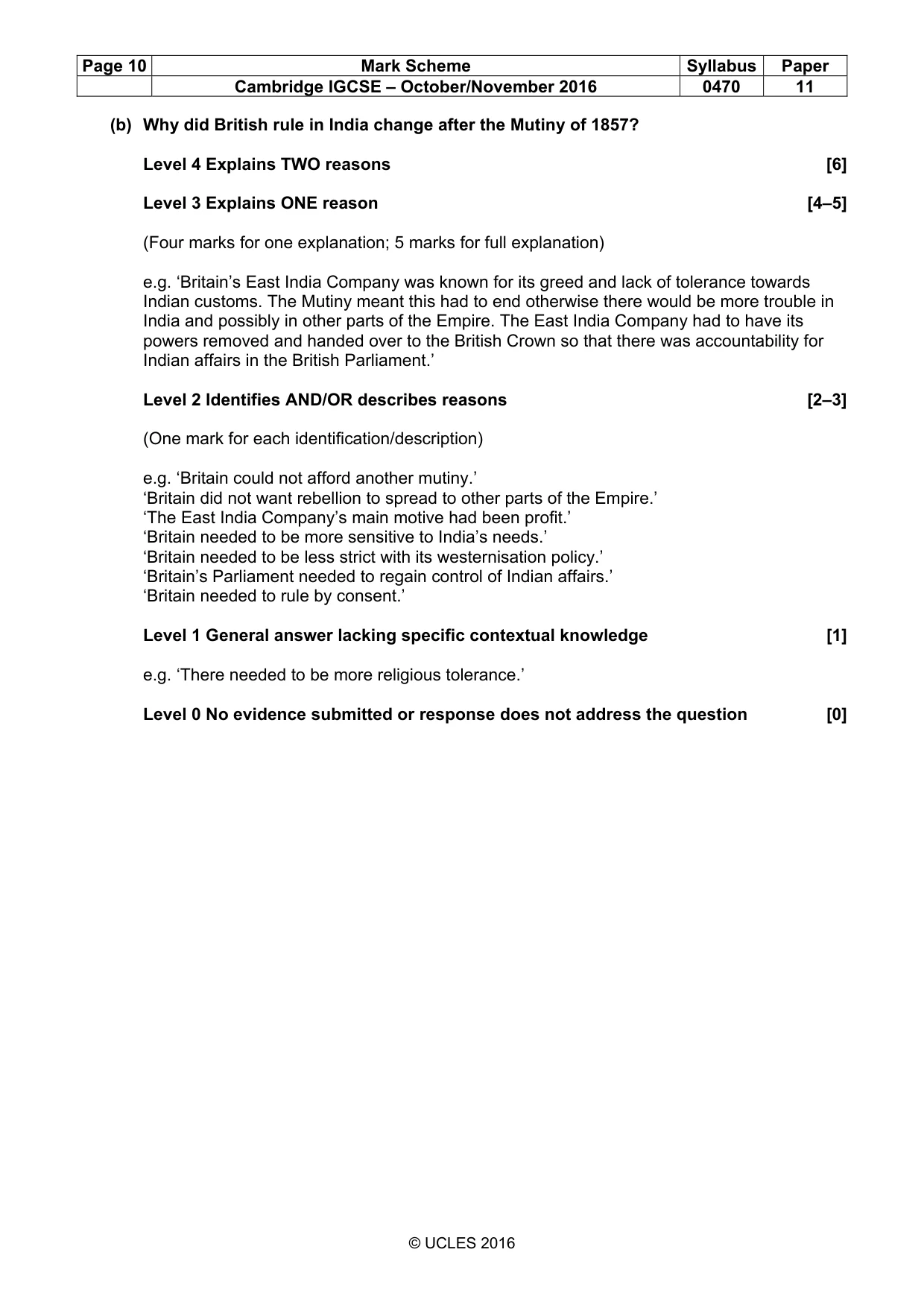
Page 10 Mark Scheme Syllabus Paper Cambridge IGCSE – October/November 2016 0470 11 © UCLES 2016 (b) Why did British rule in India change after the Mutiny of 1857? Level 4 Explains TWO reasons [6] Level 3 Explains ONE reason [4–5] (Four marks for one explanation; 5 marks for full explanation) e.g. ‘Britain’s East India Company was known for its greed and lack of tolerance towards Indian customs. The Mutiny meant this had to end otherwise there would be more trouble in India and possibly in other parts of the Empire. The East India Company had to have its powers removed and handed over to the British Crown so that there was accountability for Indian affairs in the British Parliament.’ Level 2 Identifies AND/OR describes reasons [2–3] (One mark for each identification/description) e.g. ‘Britain could not afford another mutiny.’ ‘Britain did not want rebellion to spread to other parts of the Empire.’ ‘The East India Company’s main motive had been profit.’ ‘Britain needed to be more sensitive to India’s needs.’ ‘Britain needed to be less strict with its westernisation policy.’ ‘Britain’s Parliament needed to regain control of Indian affairs.’ ‘Britain needed to rule by consent.’ Level 1 General answer lacking specific contextual knowledge [1] e.g. ‘There needed to be more religious tolerance.’ Level 0 No evidence submitted or response does not address the question [0]
Mark scheme, page 11
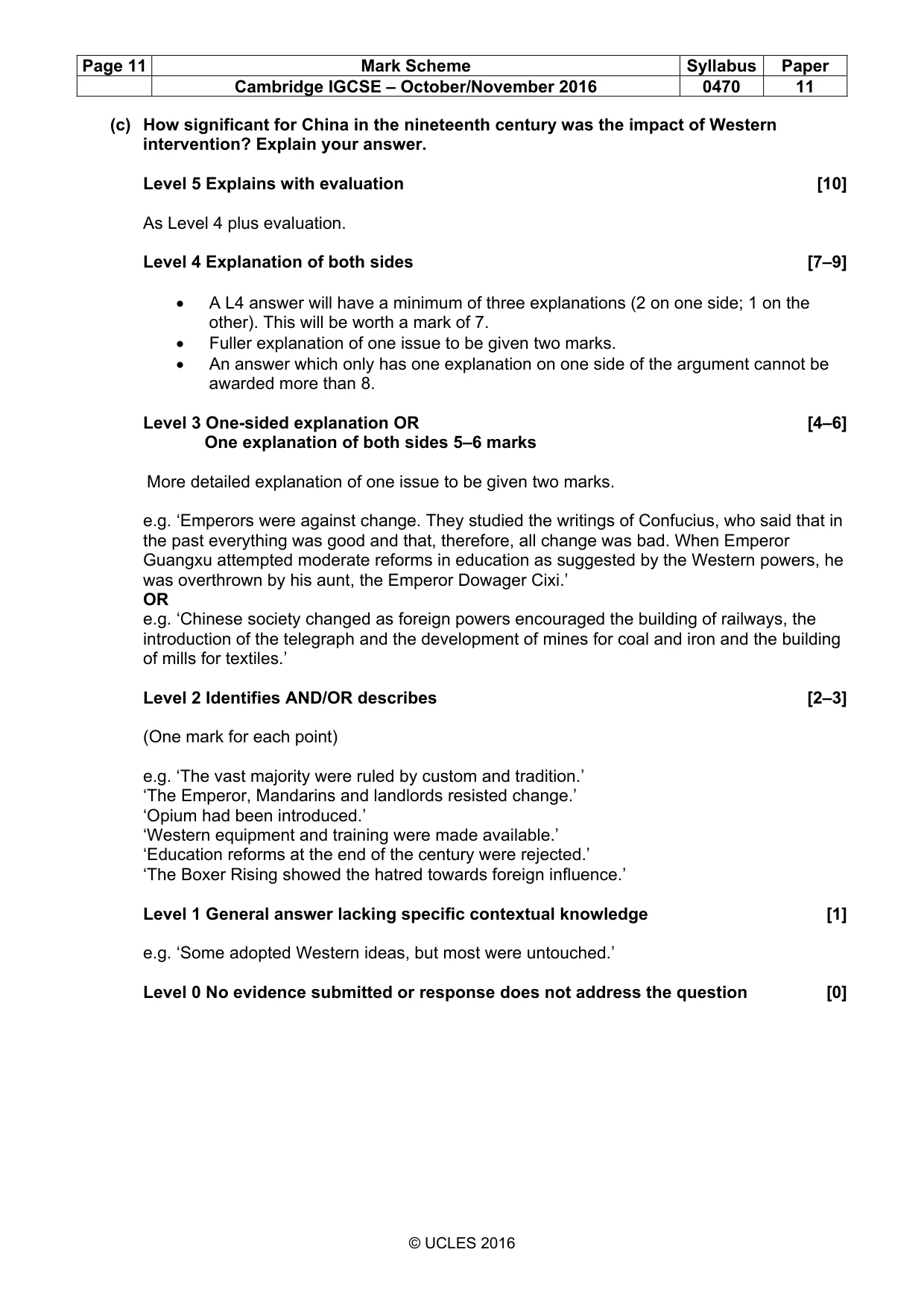
Page 11 Mark Scheme Syllabus Paper Cambridge IGCSE – October/November 2016 0470 11 © UCLES 2016 (c) How significant for China in the nineteenth century was the impact of Western intervention? Explain your answer. Level 5 Explains with evaluation [10] As Level 4 plus evaluation. Level 4 Explanation of both sides [7–9] • A L4 answer will have a minimum of three explanations (2 on one side; 1 on the other). This will be worth a mark of 7. • Fuller explanation of one issue to be given two marks. • An answer which only has one explanation on one side of the argument cannot be awarded more than 8. Level 3 One-sided explanation OR [4–6] One explanation of both sides 5–6 marks More detailed explanation of one issue to be given two marks. e.g. ‘Emperors were against change. They studied the writings of Confucius, who said that in the past everything was good and that, therefore, all change was bad. When Emperor Guangxu attempted moderate reforms in education as suggested by the Western powers, he was overthrown by his aunt, the Emperor Dowager Cixi.’ OR e.g. ‘Chinese society changed as foreign powers encouraged the building of railways, the introduction of the telegraph and the development of mines for coal and iron and the building of mills for textiles.’ Level 2 Identifies AND/OR describes [2–3] (One mark for each point) e.g. ‘The vast majority were ruled by custom and tradition.’ ‘The Emperor, Mandarins and landlords resisted change.’ ‘Opium had been introduced.’ ‘Western equipment and training were made available.’ ‘Education reforms at the end of the century were rejected.’ ‘The Boxer Rising showed the hatred towards foreign influence.’ Level 1 General answer lacking specific contextual knowledge [1] e.g. ‘Some adopted Western ideas, but most were untouched.’ Level 0 No evidence submitted or response does not address the question [0]
Mark scheme, page 12
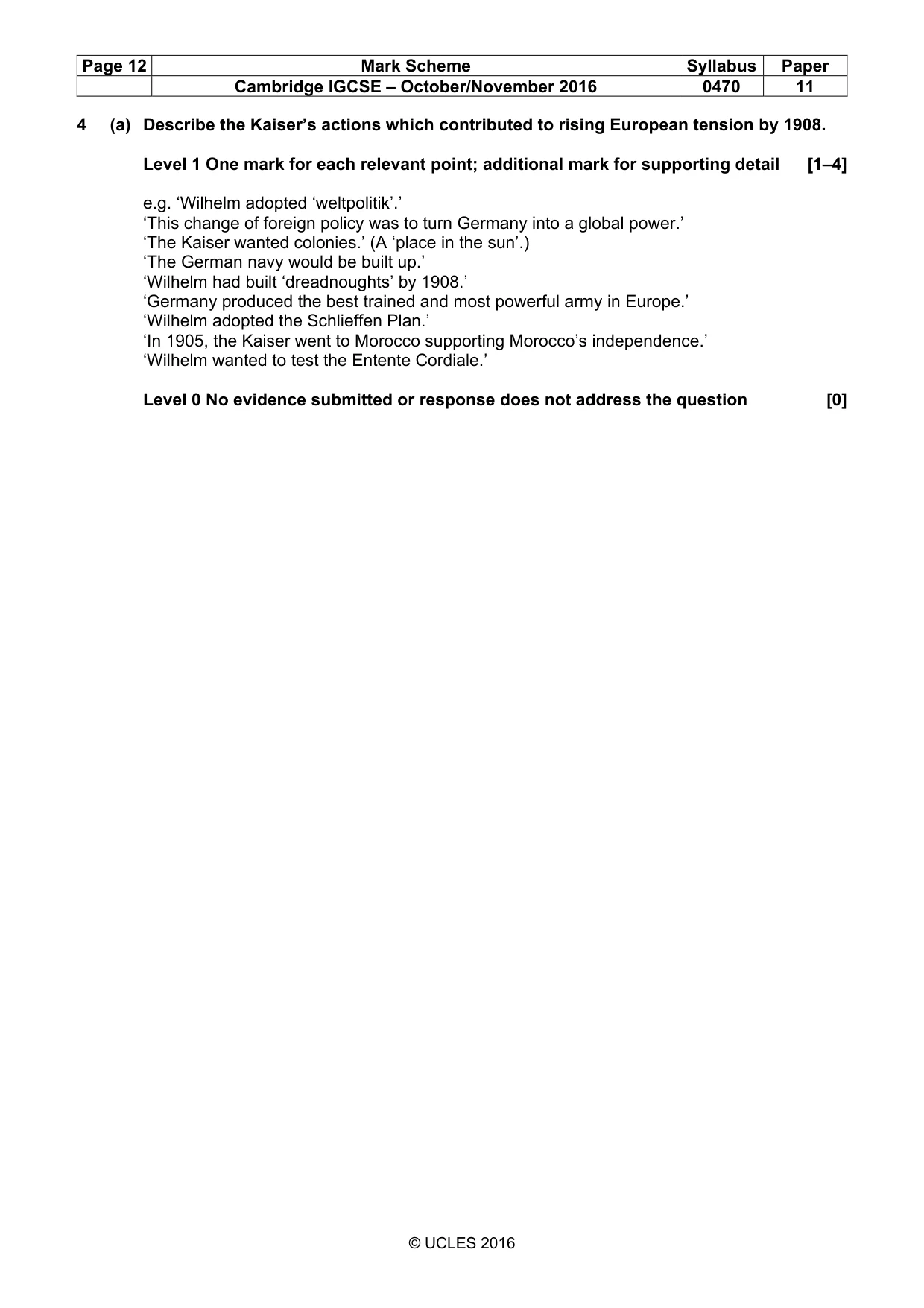
Page 12 Mark Scheme Syllabus Paper Cambridge IGCSE – October/November 2016 0470 11 © UCLES 2016 4 (a) Describe the Kaiser’s actions which contributed to rising European tension by 1908. Level 1 One mark for each relevant point; additional mark for supporting detail [1–4] e.g. ‘Wilhelm adopted ‘weltpolitik’.’ ‘This change of foreign policy was to turn Germany into a global power.’ ‘The Kaiser wanted colonies.’ (A ‘place in the sun’.) ‘The German navy would be built up.’ ‘Wilhelm had built ‘dreadnoughts’ by 1908.’ ‘Germany produced the best trained and most powerful army in Europe.’ ‘Wilhelm adopted the Schlieffen Plan.’ ‘In 1905, the Kaiser went to Morocco supporting Morocco’s independence.’ ‘Wilhelm wanted to test the Entente Cordiale.’ Level 0 No evidence submitted or response does not address the question [0]
Mark scheme, page 13
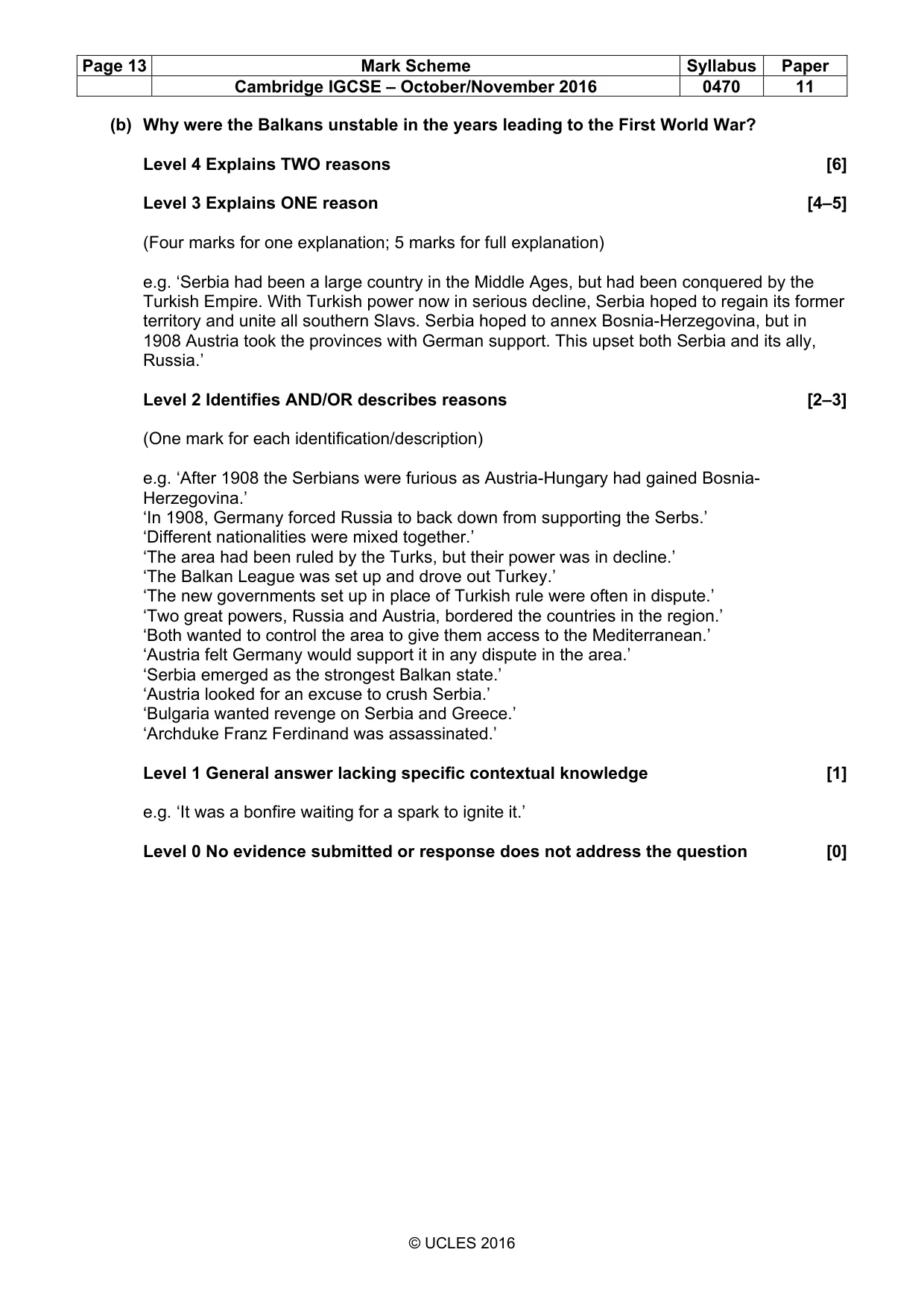
Page 13 Mark Scheme Syllabus Paper Cambridge IGCSE – October/November 2016 0470 11 © UCLES 2016 (b) Why were the Balkans unstable in the years leading to the First World War? Level 4 Explains TWO reasons [6] Level 3 Explains ONE reason [4–5] (Four marks for one explanation; 5 marks for full explanation) e.g. ‘Serbia had been a large country in the Middle Ages, but had been conquered by the Turkish Empire. With Turkish power now in serious decline, Serbia hoped to regain its former territory and unite all southern Slavs. Serbia hoped to annex Bosnia-Herzegovina, but in 1908 Austria took the provinces with German support. This upset both Serbia and its ally, Russia.’ Level 2 Identifies AND/OR describes reasons [2–3] (One mark for each identification/description) e.g. ‘After 1908 the Serbians were furious as Austria-Hungary had gained Bosnia- Herzegovina.’ ‘In 1908, Germany forced Russia to back down from supporting the Serbs.’ ‘Different nationalities were mixed together.’ ‘The area had been ruled by the Turks, but their power was in decline.’ ‘The Balkan League was set up and drove out Turkey.’ ‘The new governments set up in place of Turkish rule were often in dispute.’ ‘Two great powers, Russia and Austria, bordered the countries in the region.’ ‘Both wanted to control the area to give them access to the Mediterranean.’ ‘Austria felt Germany would support it in any dispute in the area.’ ‘Serbia emerged as the strongest Balkan state.’ ‘Austria looked for an excuse to crush Serbia.’ ‘Bulgaria wanted revenge on Serbia and Greece.’ ‘Archduke Franz Ferdinand was assassinated.’ Level 1 General answer lacking specific contextual knowledge [1] e.g. ‘It was a bonfire waiting for a spark to ignite it.’ Level 0 No evidence submitted or response does not address the question [0]
Mark scheme, page 14
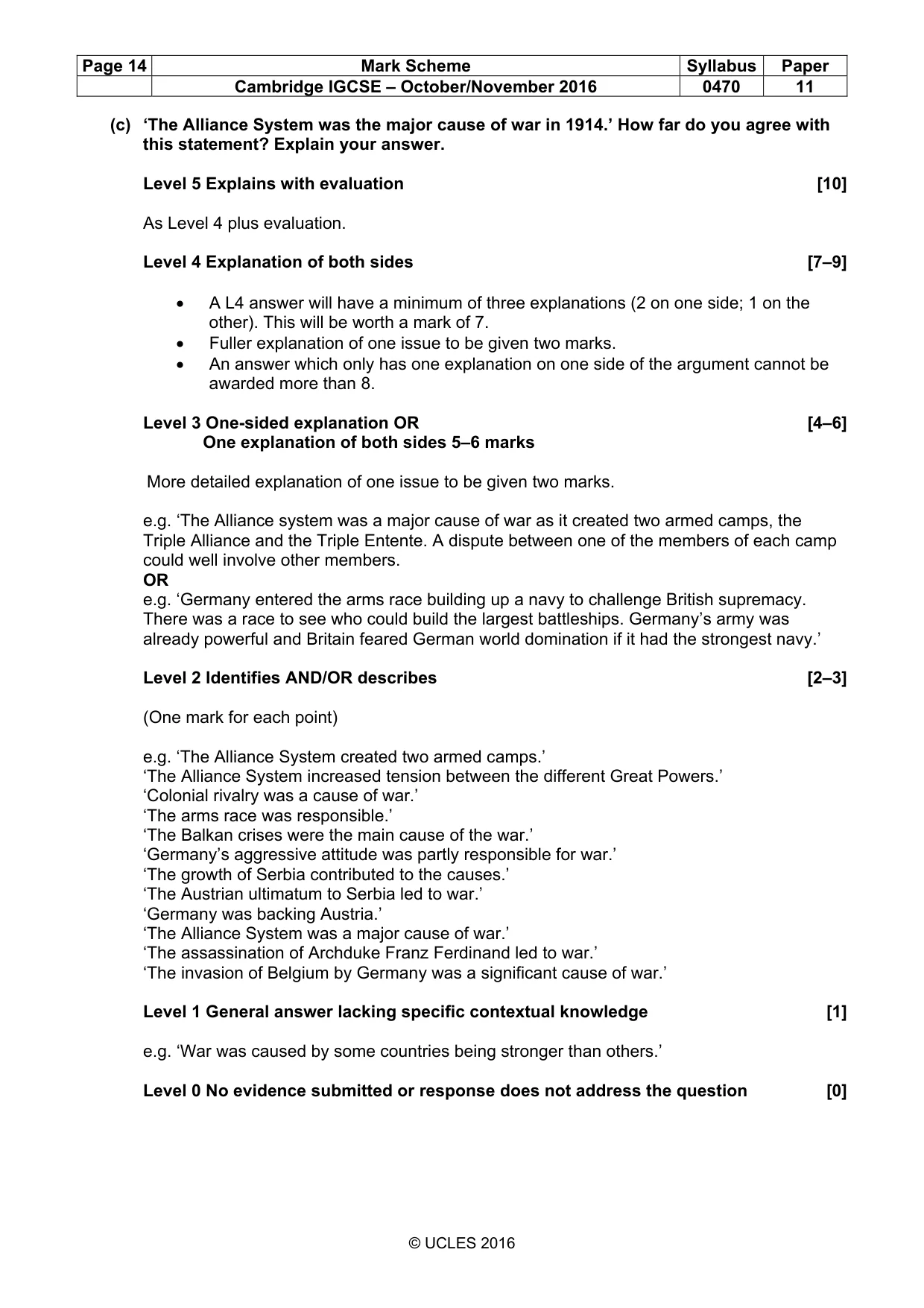
Page 14 Mark Scheme Syllabus Paper Cambridge IGCSE – October/November 2016 0470 11 © UCLES 2016 (c) ‘The Alliance System was the major cause of war in 1914.’ How far do you agree with this statement? Explain your answer. Level 5 Explains with evaluation [10] As Level 4 plus evaluation. Level 4 Explanation of both sides [7–9] • A L4 answer will have a minimum of three explanations (2 on one side; 1 on the other). This will be worth a mark of 7. • Fuller explanation of one issue to be given two marks. • An answer which only has one explanation on one side of the argument cannot be awarded more than 8. Level 3 One-sided explanation OR [4–6] One explanation of both sides 5–6 marks More detailed explanation of one issue to be given two marks. e.g. ‘The Alliance system was a major cause of war as it created two armed camps, the Triple Alliance and the Triple Entente. A dispute between one of the members of each camp could well involve other members. OR e.g. ‘Germany entered the arms race building up a navy to challenge British supremacy. There was a race to see who could build the largest battleships. Germany’s army was already powerful and Britain feared German world domination if it had the strongest navy.’ Level 2 Identifies AND/OR describes [2–3] (One mark for each point) e.g. ‘The Alliance System created two armed camps.’ ‘The Alliance System increased tension between the different Great Powers.’ ‘Colonial rivalry was a cause of war.’ ‘The arms race was responsible.’ ‘The Balkan crises were the main cause of the war.’ ‘Germany’s aggressive attitude was partly responsible for war.’ ‘The growth of Serbia contributed to the causes.’ ‘The Austrian ultimatum to Serbia led to war.’ ‘Germany was backing Austria.’ ‘The Alliance System was a major cause of war.’ ‘The assassination of Archduke Franz Ferdinand led to war.’ ‘The invasion of Belgium by Germany was a significant cause of war.’ Level 1 General answer lacking specific contextual knowledge [1] e.g. ‘War was caused by some countries being stronger than others.’ Level 0 No evidence submitted or response does not address the question [0]
Mark scheme, page 15
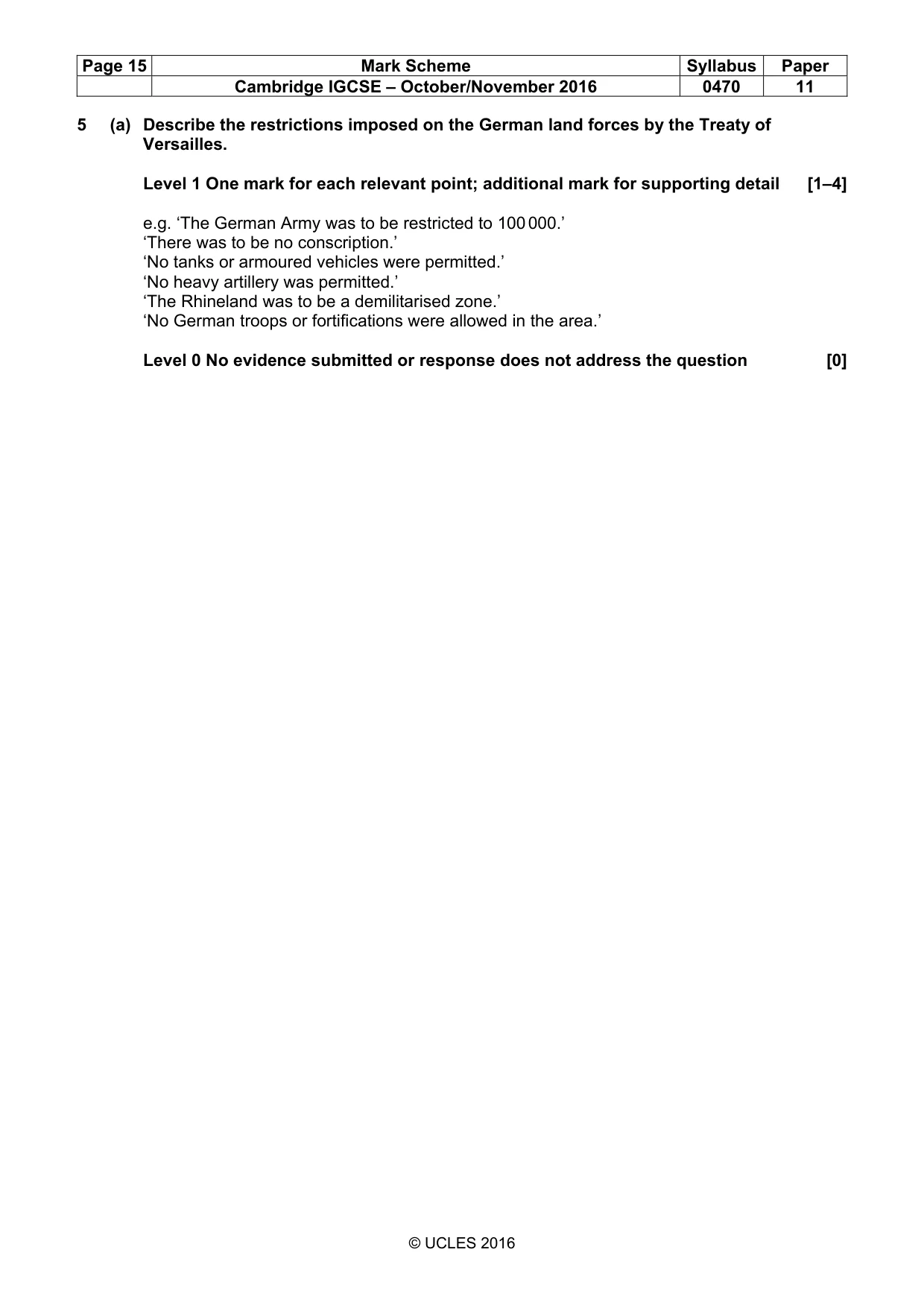
Page 15 Mark Scheme Syllabus Paper Cambridge IGCSE – October/November 2016 0470 11 © UCLES 2016 5 (a) Describe the restrictions imposed on the German land forces by the Treaty of Versailles. Level 1 One mark for each relevant point; additional mark for supporting detail [1–4] e.g. ‘The German Army was to be restricted to 100 000.’ ‘There was to be no conscription.’ ‘No tanks or armoured vehicles were permitted.’ ‘No heavy artillery was permitted.’ ‘The Rhineland was to be a demilitarised zone.’ ‘No German troops or fortifications were allowed in the area.’ Level 0 No evidence submitted or response does not address the question [0]
Mark scheme, page 16
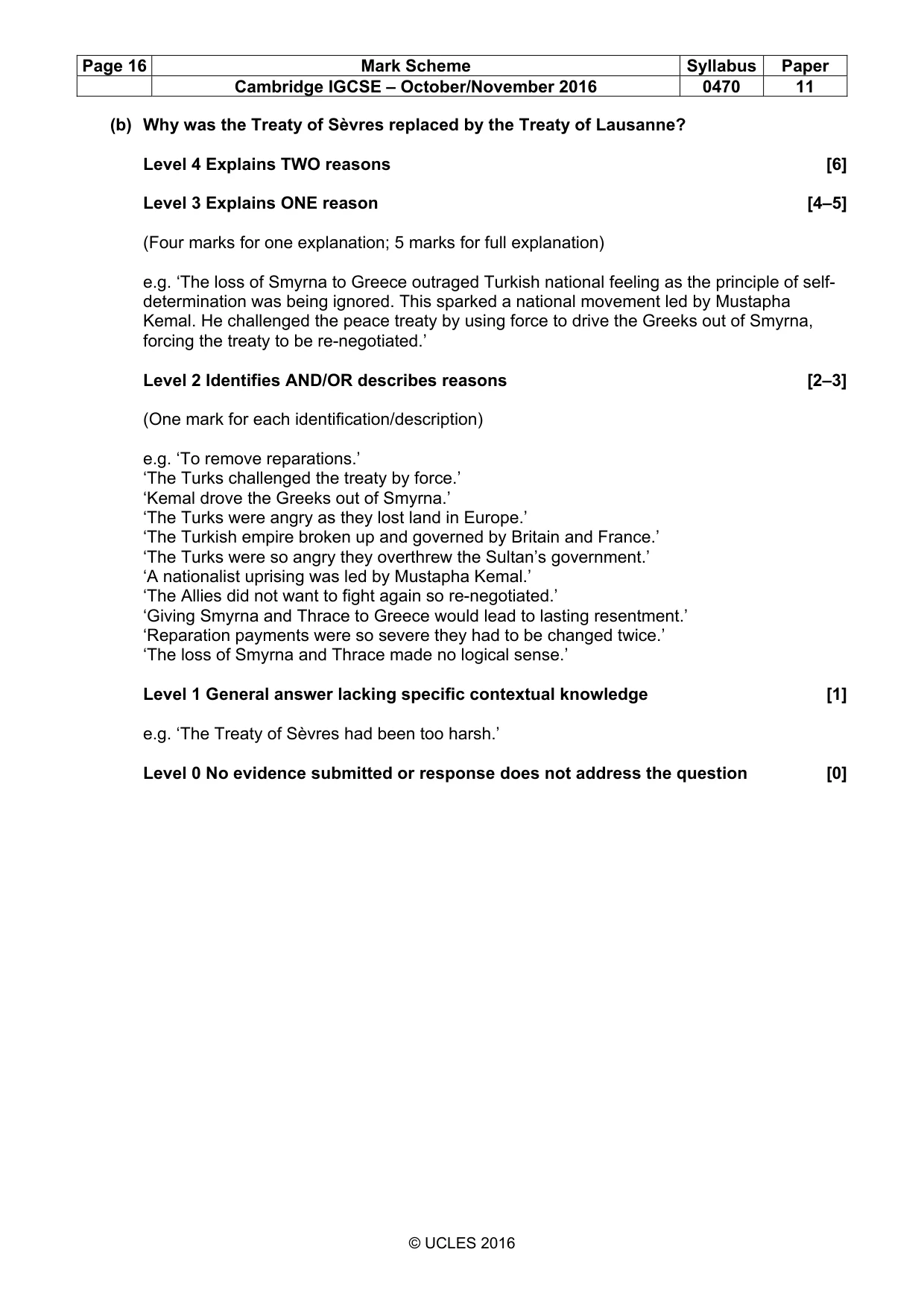
Page 16 Mark Scheme Syllabus Paper Cambridge IGCSE – October/November 2016 0470 11 © UCLES 2016 (b) Why was the Treaty of Sèvres replaced by the Treaty of Lausanne? Level 4 Explains TWO reasons [6] Level 3 Explains ONE reason [4–5] (Four marks for one explanation; 5 marks for full explanation) e.g. ‘The loss of Smyrna to Greece outraged Turkish national feeling as the principle of self- determination was being ignored. This sparked a national movement led by Mustapha Kemal. He challenged the peace treaty by using force to drive the Greeks out of Smyrna, forcing the treaty to be re-negotiated.’ Level 2 Identifies AND/OR describes reasons [2–3] (One mark for each identification/description) e.g. ‘To remove reparations.’ ‘The Turks challenged the treaty by force.’ ‘Kemal drove the Greeks out of Smyrna.’ ‘The Turks were angry as they lost land in Europe.’ ‘The Turkish empire broken up and governed by Britain and France.’ ‘The Turks were so angry they overthrew the Sultan’s government.’ ‘A nationalist uprising was led by Mustapha Kemal.’ ‘The Allies did not want to fight again so re-negotiated.’ ‘Giving Smyrna and Thrace to Greece would lead to lasting resentment.’ ‘Reparation payments were so severe they had to be changed twice.’ ‘The loss of Smyrna and Thrace made no logical sense.’ Level 1 General answer lacking specific contextual knowledge [1] e.g. ‘The Treaty of Sèvres had been too harsh.’ Level 0 No evidence submitted or response does not address the question [0]
Mark scheme, page 17
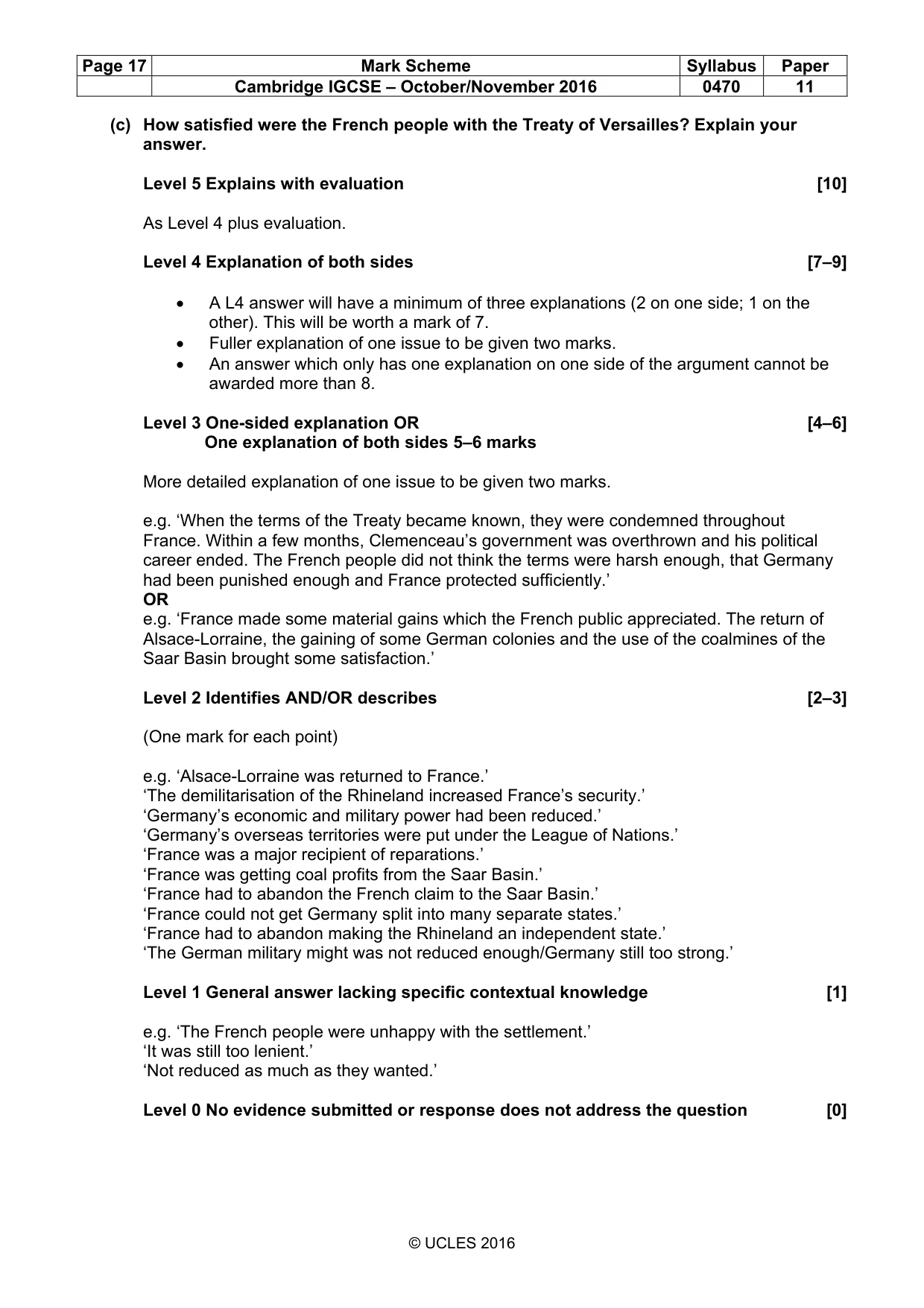
Page 17 Mark Scheme Syllabus Paper Cambridge IGCSE – October/November 2016 0470 11 © UCLES 2016 (c) How satisfied were the French people with the Treaty of Versailles? Explain your answer. Level 5 Explains with evaluation [10] As Level 4 plus evaluation. Level 4 Explanation of both sides [7–9] • A L4 answer will have a minimum of three explanations (2 on one side; 1 on the other). This will be worth a mark of 7. • Fuller explanation of one issue to be given two marks. • An answer which only has one explanation on one side of the argument cannot be awarded more than 8. Level 3 One-sided explanation OR [4–6] One explanation of both sides 5–6 marks More detailed explanation of one issue to be given two marks. e.g. ‘When the terms of the Treaty became known, they were condemned throughout France. Within a few months, Clemenceau’s government was overthrown and his political career ended. The French people did not think the terms were harsh enough, that Germany had been punished enough and France protected sufficiently.’ OR e.g. ‘France made some material gains which the French public appreciated. The return of Alsace-Lorraine, the gaining of some German colonies and the use of the coalmines of the Saar Basin brought some satisfaction.’ Level 2 Identifies AND/OR describes [2–3] (One mark for each point) e.g. ‘Alsace-Lorraine was returned to France.’ ‘The demilitarisation of the Rhineland increased France’s security.’ ‘Germany’s economic and military power had been reduced.’ ‘Germany’s overseas territories were put under the League of Nations.’ ‘France was a major recipient of reparations.’ ‘France was getting coal profits from the Saar Basin.’ ‘France had to abandon the French claim to the Saar Basin.’ ‘France could not get Germany split into many separate states.’ ‘France had to abandon making the Rhineland an independent state.’ ‘The German military might was not reduced enough/Germany still too strong.’ Level 1 General answer lacking specific contextual knowledge [1] e.g. ‘The French people were unhappy with the settlement.’ ‘It was still too lenient.’ ‘Not reduced as much as they wanted.’ Level 0 No evidence submitted or response does not address the question [0]
Mark scheme, page 18
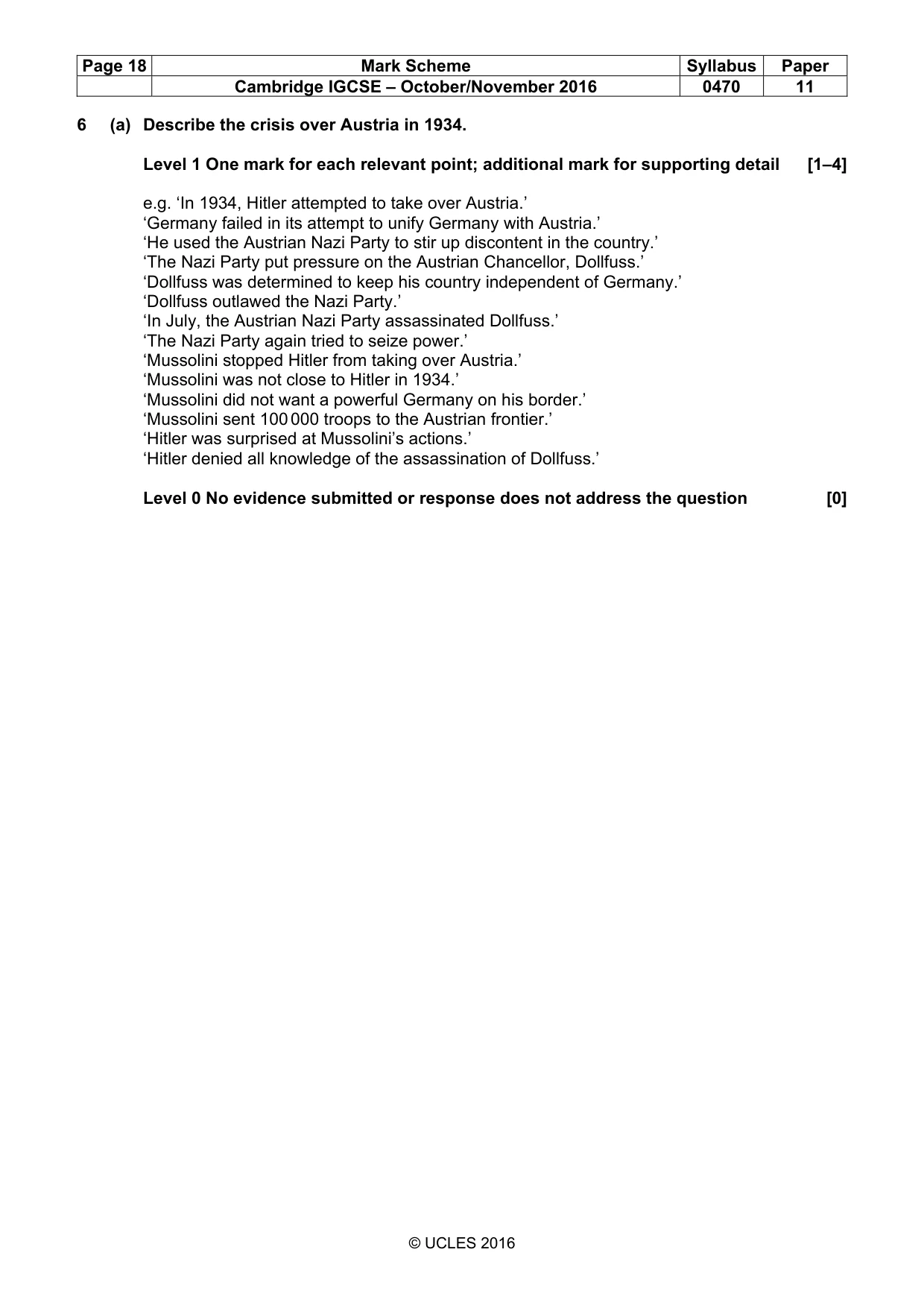
Page 18 Mark Scheme Syllabus Paper Cambridge IGCSE – October/November 2016 0470 11 © UCLES 2016 6 (a) Describe the crisis over Austria in 1934. Level 1 One mark for each relevant point; additional mark for supporting detail [1–4] e.g. ‘In 1934, Hitler attempted to take over Austria.’ ‘Germany failed in its attempt to unify Germany with Austria.’ ‘He used the Austrian Nazi Party to stir up discontent in the country.’ ‘The Nazi Party put pressure on the Austrian Chancellor, Dollfuss.’ ‘Dollfuss was determined to keep his country independent of Germany.’ ‘Dollfuss outlawed the Nazi Party.’ ‘In July, the Austrian Nazi Party assassinated Dollfuss.’ ‘The Nazi Party again tried to seize power.’ ‘Mussolini stopped Hitler from taking over Austria.’ ‘Mussolini was not close to Hitler in 1934.’ ‘Mussolini did not want a powerful Germany on his border.’ ‘Mussolini sent 100 000 troops to the Austrian frontier.’ ‘Hitler was surprised at Mussolini’s actions.’ ‘Hitler denied all knowledge of the assassination of Dollfuss.’ Level 0 No evidence submitted or response does not address the question [0]
Mark scheme, page 19
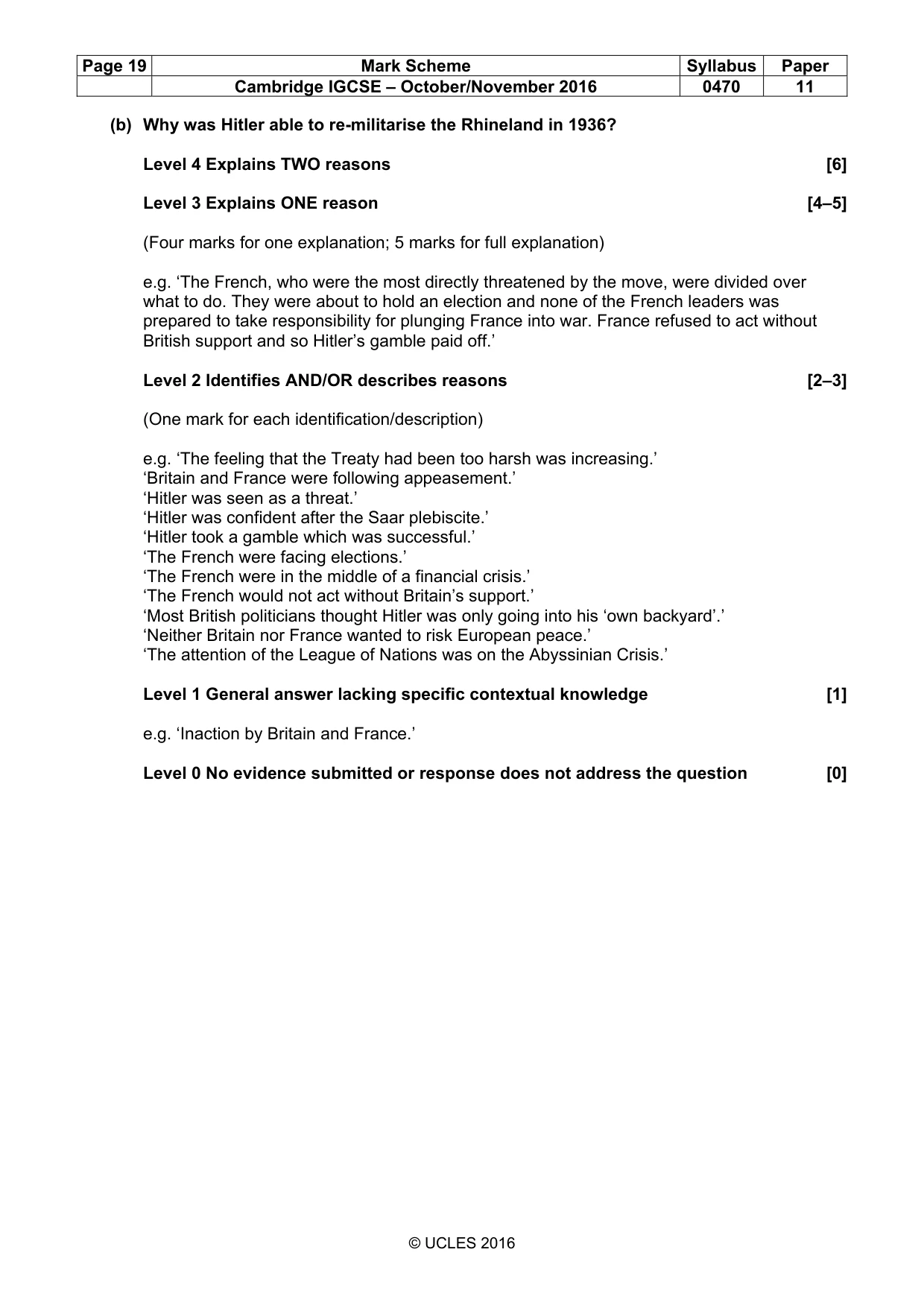
Page 19 Mark Scheme Syllabus Paper Cambridge IGCSE – October/November 2016 0470 11 © UCLES 2016 (b) Why was Hitler able to re-militarise the Rhineland in 1936? Level 4 Explains TWO reasons [6] Level 3 Explains ONE reason [4–5] (Four marks for one explanation; 5 marks for full explanation) e.g. ‘The French, who were the most directly threatened by the move, were divided over what to do. They were about to hold an election and none of the French leaders was prepared to take responsibility for plunging France into war. France refused to act without British support and so Hitler’s gamble paid off.’ Level 2 Identifies AND/OR describes reasons [2–3] (One mark for each identification/description) e.g. ‘The feeling that the Treaty had been too harsh was increasing.’ ‘Britain and France were following appeasement.’ ‘Hitler was seen as a threat.’ ‘Hitler was confident after the Saar plebiscite.’ ‘Hitler took a gamble which was successful.’ ‘The French were facing elections.’ ‘The French were in the middle of a financial crisis.’ ‘The French would not act without Britain’s support.’ ‘Most British politicians thought Hitler was only going into his ‘own backyard’.’ ‘Neither Britain nor France wanted to risk European peace.’ ‘The attention of the League of Nations was on the Abyssinian Crisis.’ Level 1 General answer lacking specific contextual knowledge [1] e.g. ‘Inaction by Britain and France.’ Level 0 No evidence submitted or response does not address the question [0]
Mark scheme, page 20
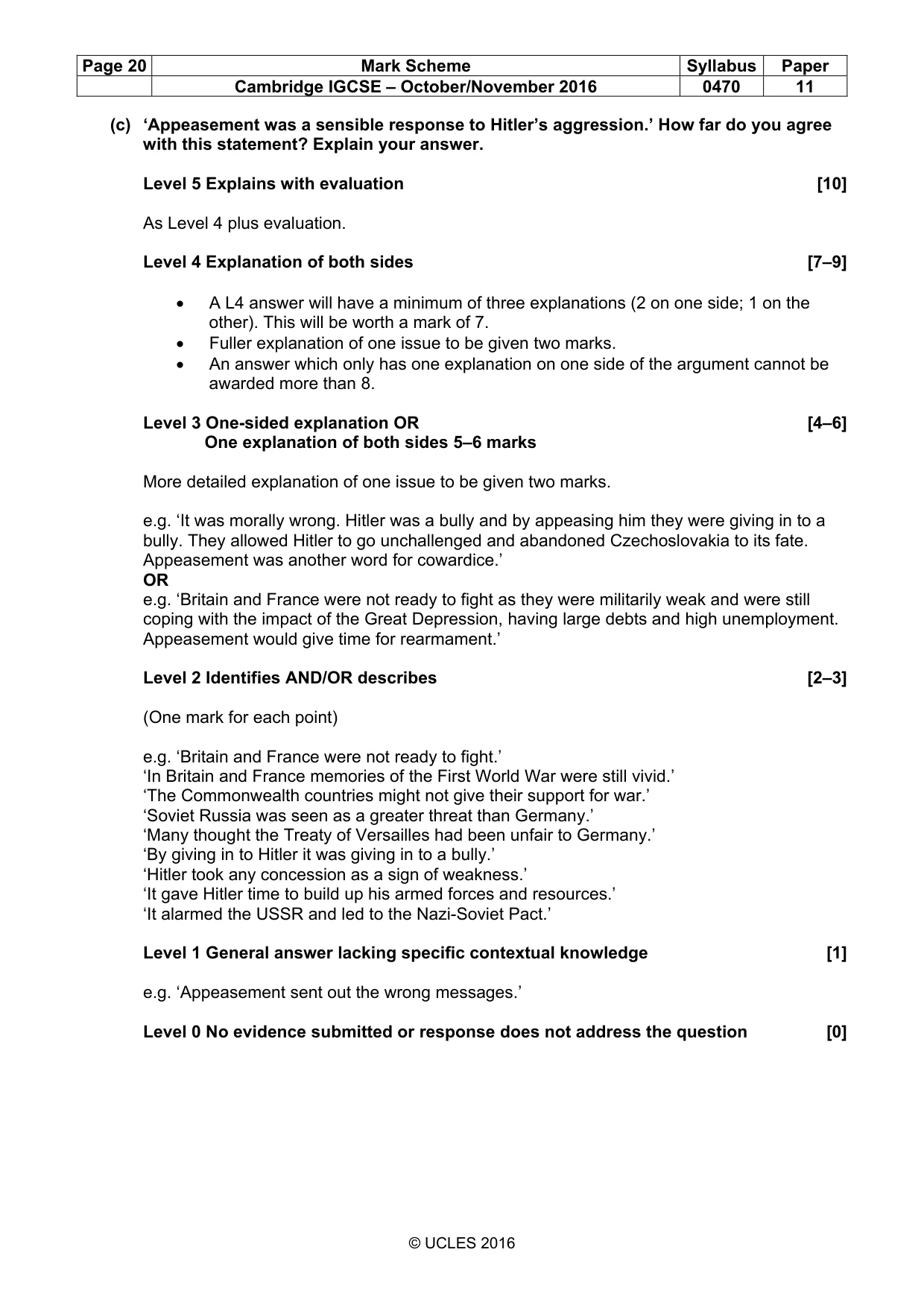
Page 20 Mark Scheme Syllabus Paper Cambridge IGCSE – October/November 2016 0470 11 © UCLES 2016 (c) ‘Appeasement was a sensible response to Hitler’s aggression.’ How far do you agree with this statement? Explain your answer. Level 5 Explains with evaluation [10] As Level 4 plus evaluation. Level 4 Explanation of both sides [7–9] • A L4 answer will have a minimum of three explanations (2 on one side; 1 on the other). This will be worth a mark of 7. • Fuller explanation of one issue to be given two marks. • An answer which only has one explanation on one side of the argument cannot be awarded more than 8. Level 3 One-sided explanation OR [4–6] One explanation of both sides 5–6 marks More detailed explanation of one issue to be given two marks. e.g. ‘It was morally wrong. Hitler was a bully and by appeasing him they were giving in to a bully. They allowed Hitler to go unchallenged and abandoned Czechoslovakia to its fate. Appeasement was another word for cowardice.’ OR e.g. ‘Britain and France were not ready to fight as they were militarily weak and were still coping with the impact of the Great Depression, having large debts and high unemployment. Appeasement would give time for rearmament.’ Level 2 Identifies AND/OR describes [2–3] (One mark for each point) e.g. ‘Britain and France were not ready to fight.’ ‘In Britain and France memories of the First World War were still vivid.’ ‘The Commonwealth countries might not give their support for war.’ ‘Soviet Russia was seen as a greater threat than Germany.’ ‘Many thought the Treaty of Versailles had been unfair to Germany.’ ‘By giving in to Hitler it was giving in to a bully.’ ‘Hitler took any concession as a sign of weakness.’ ‘It gave Hitler time to build up his armed forces and resources.’ ‘It alarmed the USSR and led to the Nazi-Soviet Pact.’ Level 1 General answer lacking specific contextual knowledge [1] e.g. ‘Appeasement sent out the wrong messages.’ Level 0 No evidence submitted or response does not address the question [0]
Mark scheme, page 21
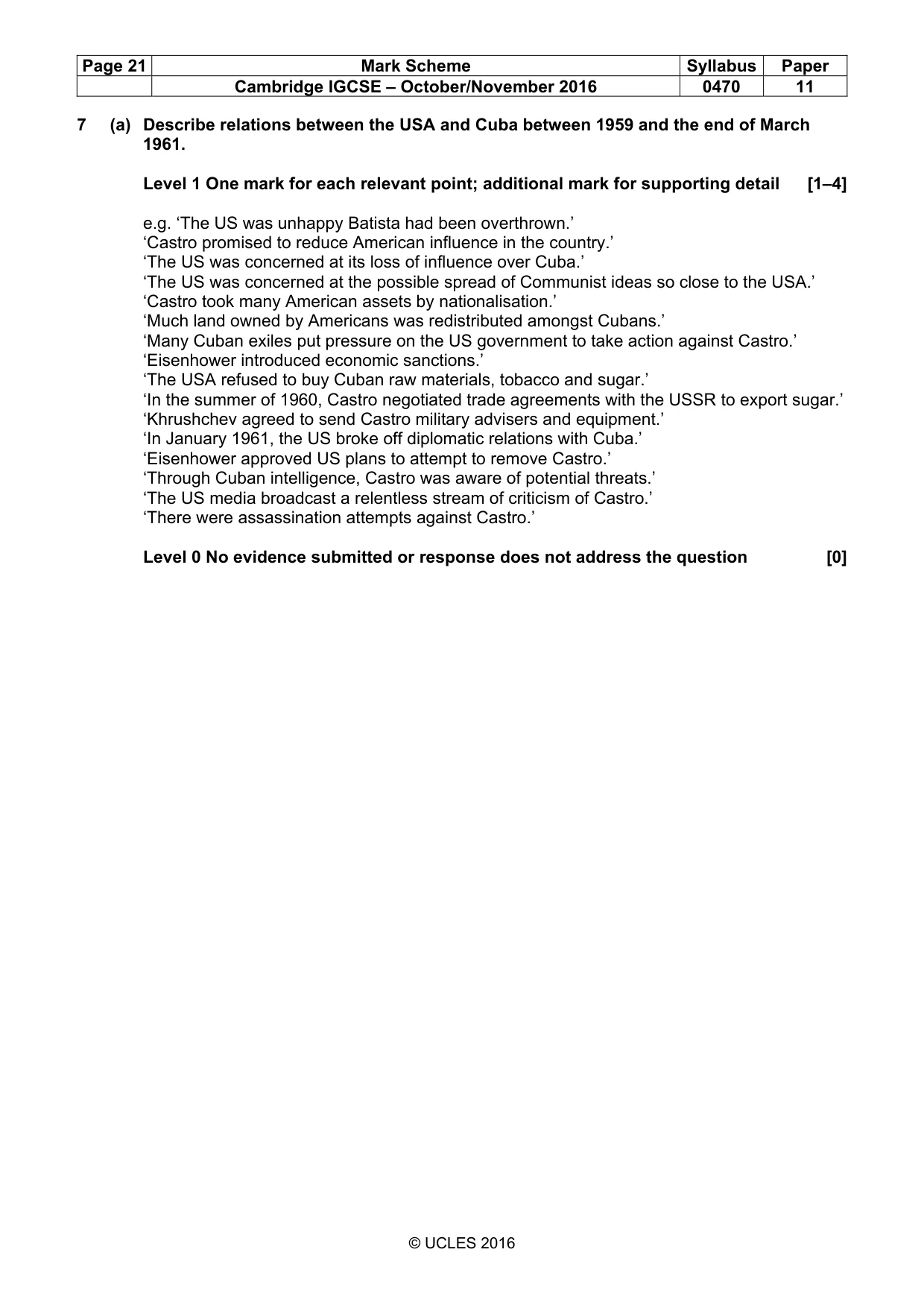
Page 21 Mark Scheme Syllabus Paper Cambridge IGCSE – October/November 2016 0470 11 © UCLES 2016 7 (a) Describe relations between the USA and Cuba between 1959 and the end of March 1961. Level 1 One mark for each relevant point; additional mark for supporting detail [1–4] e.g. ‘The US was unhappy Batista had been overthrown.’ ‘Castro promised to reduce American influence in the country.’ ‘The US was concerned at its loss of influence over Cuba.’ ‘The US was concerned at the possible spread of Communist ideas so close to the USA.’ ‘Castro took many American assets by nationalisation.’ ‘Much land owned by Americans was redistributed amongst Cubans.’ ‘Many Cuban exiles put pressure on the US government to take action against Castro.’ ‘Eisenhower introduced economic sanctions.’ ‘The USA refused to buy Cuban raw materials, tobacco and sugar.’ ‘In the summer of 1960, Castro negotiated trade agreements with the USSR to export sugar.’ ‘Khrushchev agreed to send Castro military advisers and equipment.’ ‘In January 1961, the US broke off diplomatic relations with Cuba.’ ‘Eisenhower approved US plans to attempt to remove Castro.’ ‘Through Cuban intelligence, Castro was aware of potential threats.’ ‘The US media broadcast a relentless stream of criticism of Castro.’ ‘There were assassination attempts against Castro.’ Level 0 No evidence submitted or response does not address the question [0]
Mark scheme, page 22
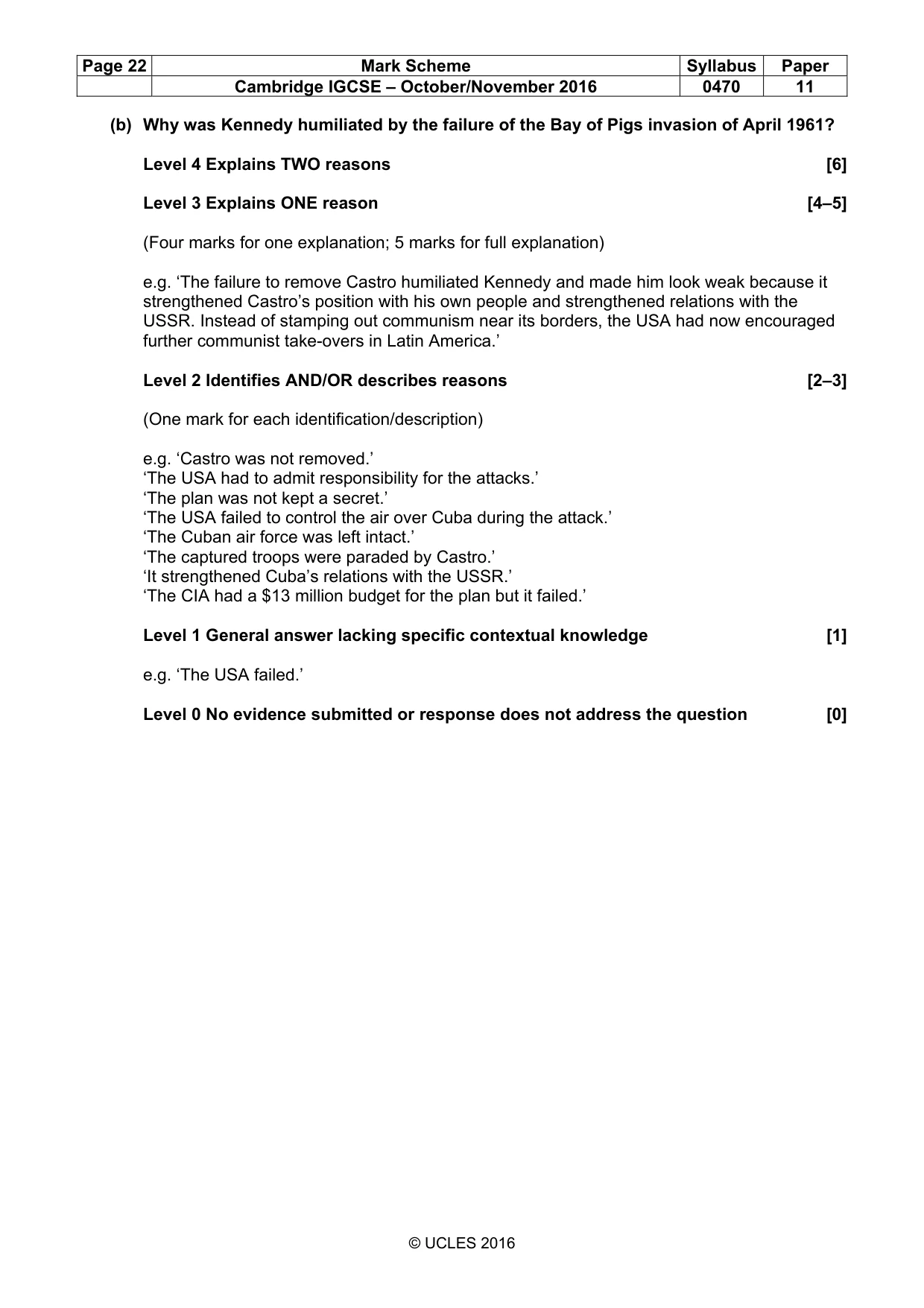
Page 22 Mark Scheme Syllabus Paper Cambridge IGCSE – October/November 2016 0470 11 © UCLES 2016 (b) Why was Kennedy humiliated by the failure of the Bay of Pigs invasion of April 1961? Level 4 Explains TWO reasons [6] Level 3 Explains ONE reason [4–5] (Four marks for one explanation; 5 marks for full explanation) e.g. ‘The failure to remove Castro humiliated Kennedy and made him look weak because it strengthened Castro’s position with his own people and strengthened relations with the USSR. Instead of stamping out communism near its borders, the USA had now encouraged further communist take-overs in Latin America.’ Level 2 Identifies AND/OR describes reasons [2–3] (One mark for each identification/description) e.g. ‘Castro was not removed.’ ‘The USA had to admit responsibility for the attacks.’ ‘The plan was not kept a secret.’ ‘The USA failed to control the air over Cuba during the attack.’ ‘The Cuban air force was left intact.’ ‘The captured troops were paraded by Castro.’ ‘It strengthened Cuba’s relations with the USSR.’ ‘The CIA had a $13 million budget for the plan but it failed.’ Level 1 General answer lacking specific contextual knowledge [1] e.g. ‘The USA failed.’ Level 0 No evidence submitted or response does not address the question [0]
Mark scheme, page 23
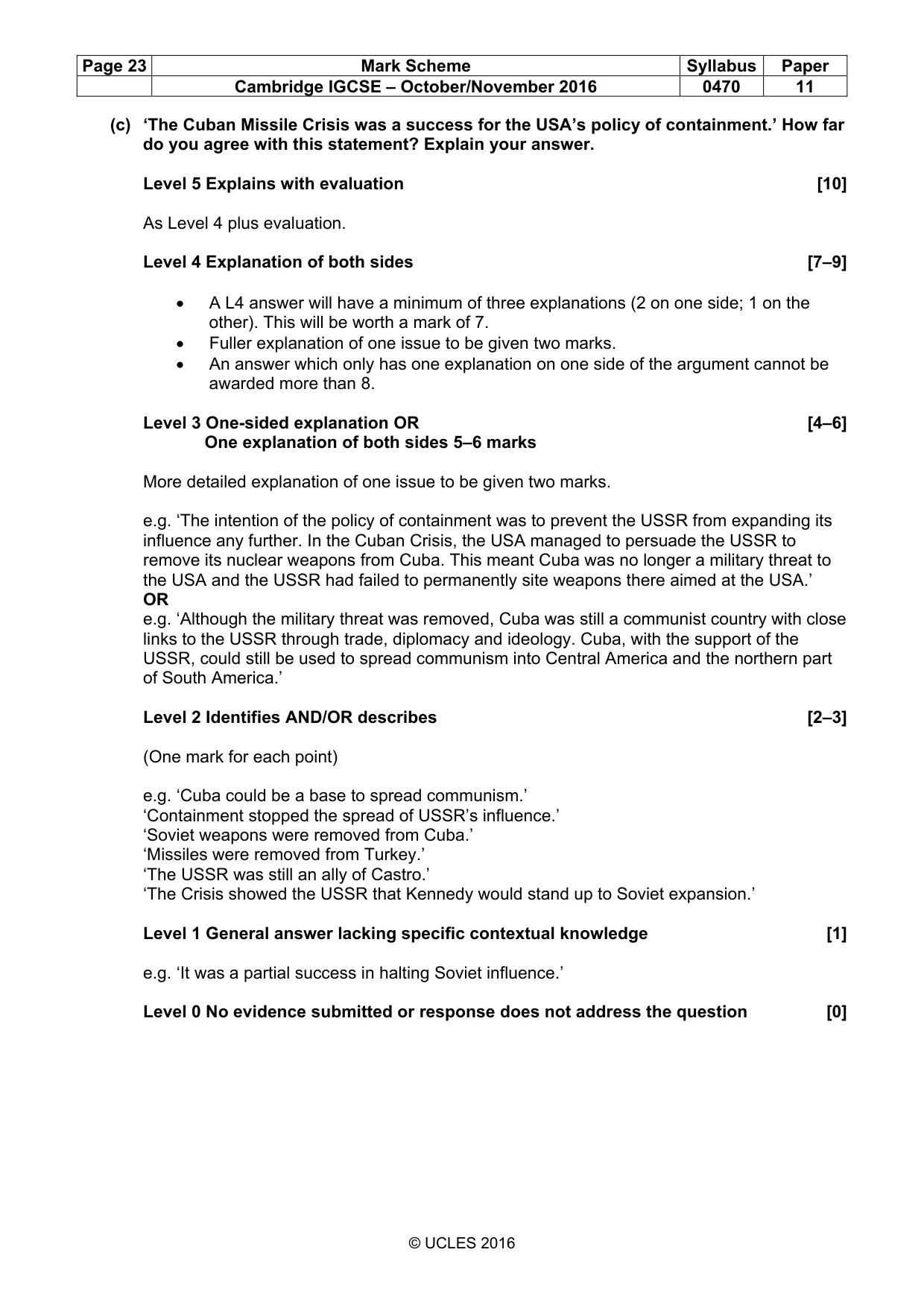
Page 23 Mark Scheme Syllabus Paper Cambridge IGCSE – October/November 2016 0470 11 © UCLES 2016 (c) ‘The Cuban Missile Crisis was a success for the USA’s policy of containment.’ How far do you agree with this statement? Explain your answer. Level 5 Explains with evaluation [10] As Level 4 plus evaluation. Level 4 Explanation of both sides [7–9] • A L4 answer will have a minimum of three explanations (2 on one side; 1 on the other). This will be worth a mark of 7. • Fuller explanation of one issue to be given two marks. • An answer which only has one explanation on one side of the argument cannot be awarded more than 8. Level 3 One-sided explanation OR [4–6] One explanation of both sides 5–6 marks More detailed explanation of one issue to be given two marks. e.g. ‘The intention of the policy of containment was to prevent the USSR from expanding its influence any further. In the Cuban Crisis, the USA managed to persuade the USSR to remove its nuclear weapons from Cuba. This meant Cuba was no longer a military threat to the USA and the USSR had failed to permanently site weapons there aimed at the USA.’ OR e.g. ‘Although the military threat was removed, Cuba was still a communist country with close links to the USSR through trade, diplomacy and ideology. Cuba, with the support of the USSR, could still be used to spread communism into Central America and the northern part of South America.’ Level 2 Identifies AND/OR describes [2–3] (One mark for each point) e.g. ‘Cuba could be a base to spread communism.’ ‘Containment stopped the spread of USSR’s influence.’ ‘Soviet weapons were removed from Cuba.’ ‘Missiles were removed from Turkey.’ ‘The USSR was still an ally of Castro.’ ‘The Crisis showed the USSR that Kennedy would stand up to Soviet expansion.’ Level 1 General answer lacking specific contextual knowledge [1] e.g. ‘It was a partial success in halting Soviet influence.’ Level 0 No evidence submitted or response does not address the question [0]
Mark scheme, page 24
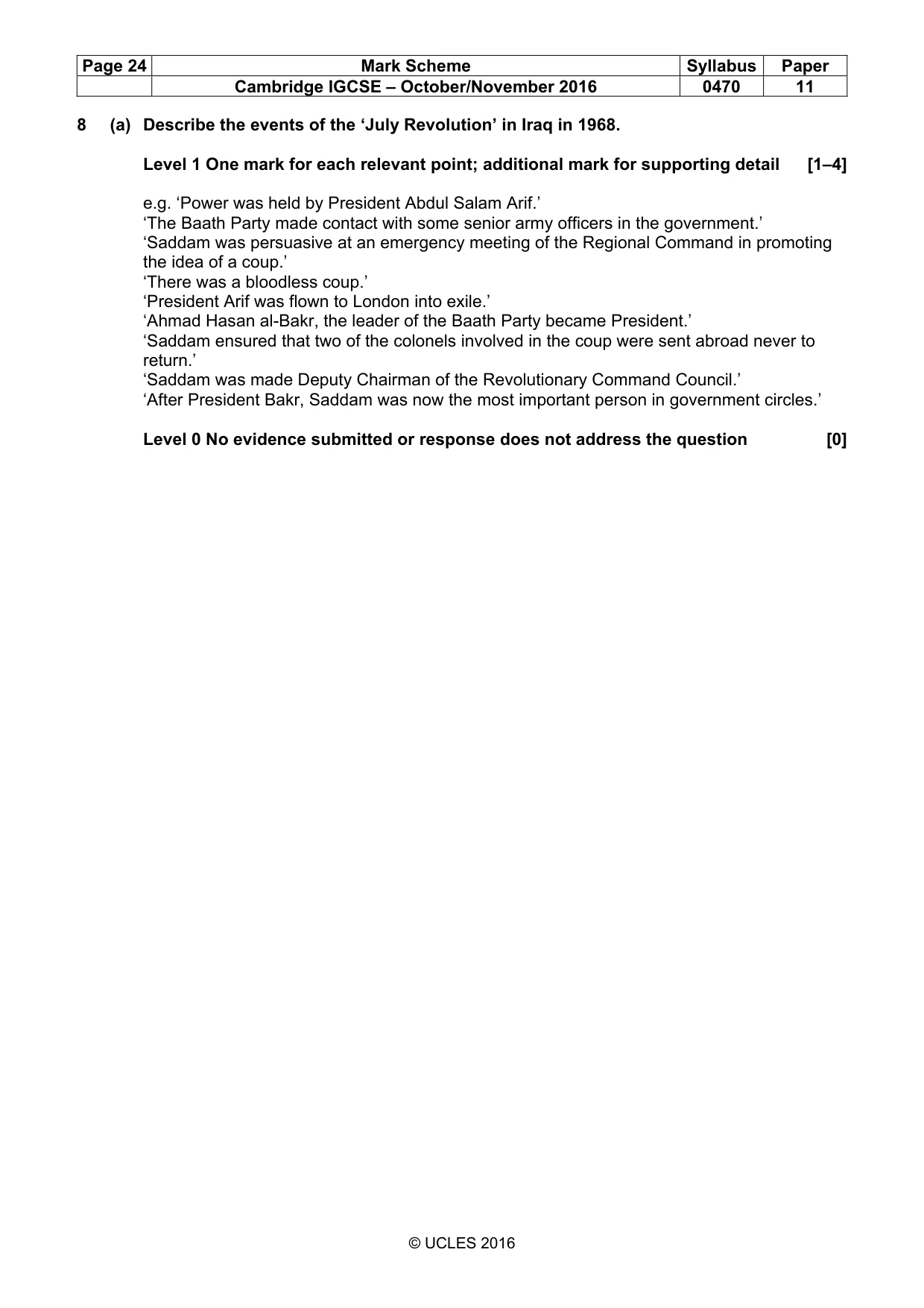
Page 24 Mark Scheme Syllabus Paper Cambridge IGCSE – October/November 2016 0470 11 © UCLES 2016 8 (a) Describe the events of the ‘July Revolution’ in Iraq in 1968. Level 1 One mark for each relevant point; additional mark for supporting detail [1–4] e.g. ‘Power was held by President Abdul Salam Arif.’ ‘The Baath Party made contact with some senior army officers in the government.’ ‘Saddam was persuasive at an emergency meeting of the Regional Command in promoting the idea of a coup.’ ‘There was a bloodless coup.’ ‘President Arif was flown to London into exile.’ ‘Ahmad Hasan al-Bakr, the leader of the Baath Party became President.’ ‘Saddam ensured that two of the colonels involved in the coup were sent abroad never to return.’ ‘Saddam was made Deputy Chairman of the Revolutionary Command Council.’ ‘After President Bakr, Saddam was now the most important person in government circles.’ Level 0 No evidence submitted or response does not address the question [0]
Mark scheme, page 25
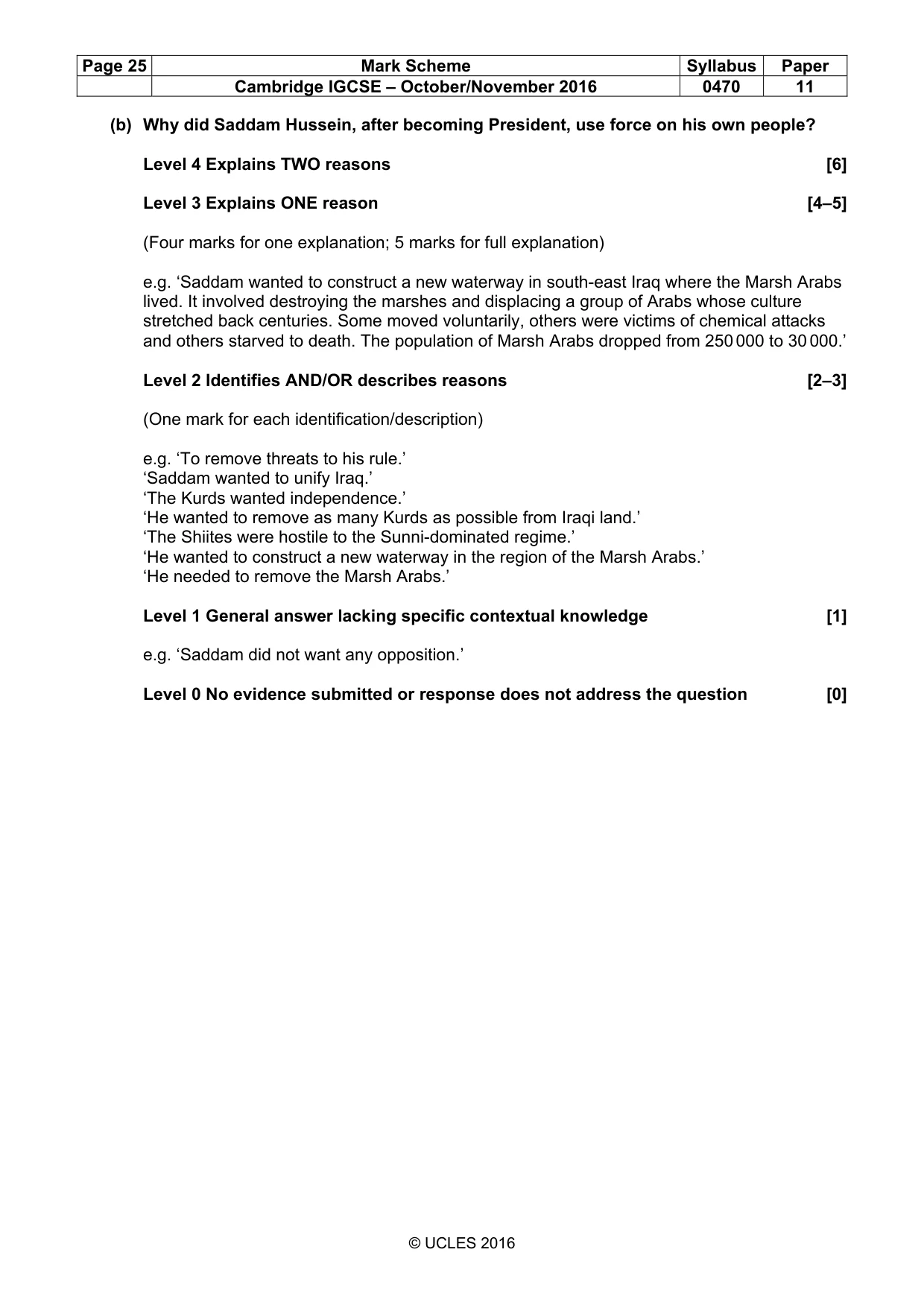
Page 25 Mark Scheme Syllabus Paper Cambridge IGCSE – October/November 2016 0470 11 © UCLES 2016 (b) Why did Saddam Hussein, after becoming President, use force on his own people? Level 4 Explains TWO reasons [6] Level 3 Explains ONE reason [4–5] (Four marks for one explanation; 5 marks for full explanation) e.g. ‘Saddam wanted to construct a new waterway in south-east Iraq where the Marsh Arabs lived. It involved destroying the marshes and displacing a group of Arabs whose culture stretched back centuries. Some moved voluntarily, others were victims of chemical attacks and others starved to death. The population of Marsh Arabs dropped from 250 000 to 30 000.’ Level 2 Identifies AND/OR describes reasons [2–3] (One mark for each identification/description) e.g. ‘To remove threats to his rule.’ ‘Saddam wanted to unify Iraq.’ ‘The Kurds wanted independence.’ ‘He wanted to remove as many Kurds as possible from Iraqi land.’ ‘The Shiites were hostile to the Sunni-dominated regime.’ ‘He wanted to construct a new waterway in the region of the Marsh Arabs.’ ‘He needed to remove the Marsh Arabs.’ Level 1 General answer lacking specific contextual knowledge [1] e.g. ‘Saddam did not want any opposition.’ Level 0 No evidence submitted or response does not address the question [0]
Mark scheme, page 26
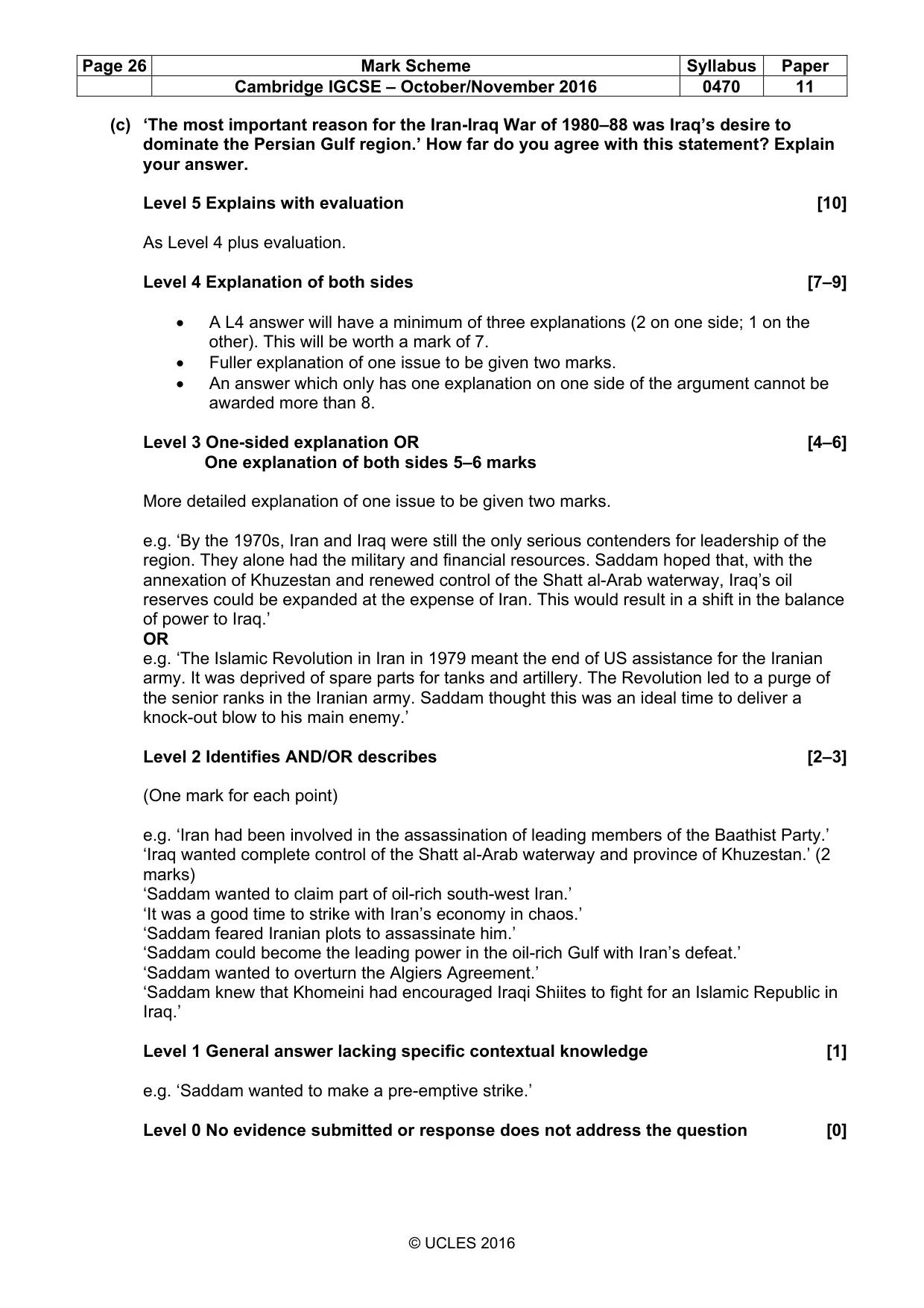
Page 26 Mark Scheme Syllabus Paper Cambridge IGCSE – October/November 2016 0470 11 © UCLES 2016 (c) ‘The most important reason for the Iran-Iraq War of 1980–88 was Iraq’s desire to dominate the Persian Gulf region.’ How far do you agree with this statement? Explain your answer. Level 5 Explains with evaluation [10] As Level 4 plus evaluation. Level 4 Explanation of both sides [7–9] • A L4 answer will have a minimum of three explanations (2 on one side; 1 on the other). This will be worth a mark of 7. • Fuller explanation of one issue to be given two marks. • An answer which only has one explanation on one side of the argument cannot be awarded more than 8. Level 3 One-sided explanation OR [4–6] One explanation of both sides 5–6 marks More detailed explanation of one issue to be given two marks. e.g. ‘By the 1970s, Iran and Iraq were still the only serious contenders for leadership of the region. They alone had the military and financial resources. Saddam hoped that, with the annexation of Khuzestan and renewed control of the Shatt al-Arab waterway, Iraq’s oil reserves could be expanded at the expense of Iran. This would result in a shift in the balance of power to Iraq.’ OR e.g. ‘The Islamic Revolution in Iran in 1979 meant the end of US assistance for the Iranian army. It was deprived of spare parts for tanks and artillery. The Revolution led to a purge of the senior ranks in the Iranian army. Saddam thought this was an ideal time to deliver a knock-out blow to his main enemy.’ Level 2 Identifies AND/OR describes [2–3] (One mark for each point) e.g. ‘Iran had been involved in the assassination of leading members of the Baathist Party.’ ‘Iraq wanted complete control of the Shatt al-Arab waterway and province of Khuzestan.’ (2 marks) ‘Saddam wanted to claim part of oil-rich south-west Iran.’ ‘It was a good time to strike with Iran’s economy in chaos.’ ‘Saddam feared Iranian plots to assassinate him.’ ‘Saddam could become the leading power in the oil-rich Gulf with Iran’s defeat.’ ‘Saddam wanted to overturn the Algiers Agreement.’ ‘Saddam knew that Khomeini had encouraged Iraqi Shiites to fight for an Islamic Republic in Iraq.’ Level 1 General answer lacking specific contextual knowledge [1] e.g. ‘Saddam wanted to make a pre-emptive strike.’ Level 0 No evidence submitted or response does not address the question [0]
Mark scheme, page 27
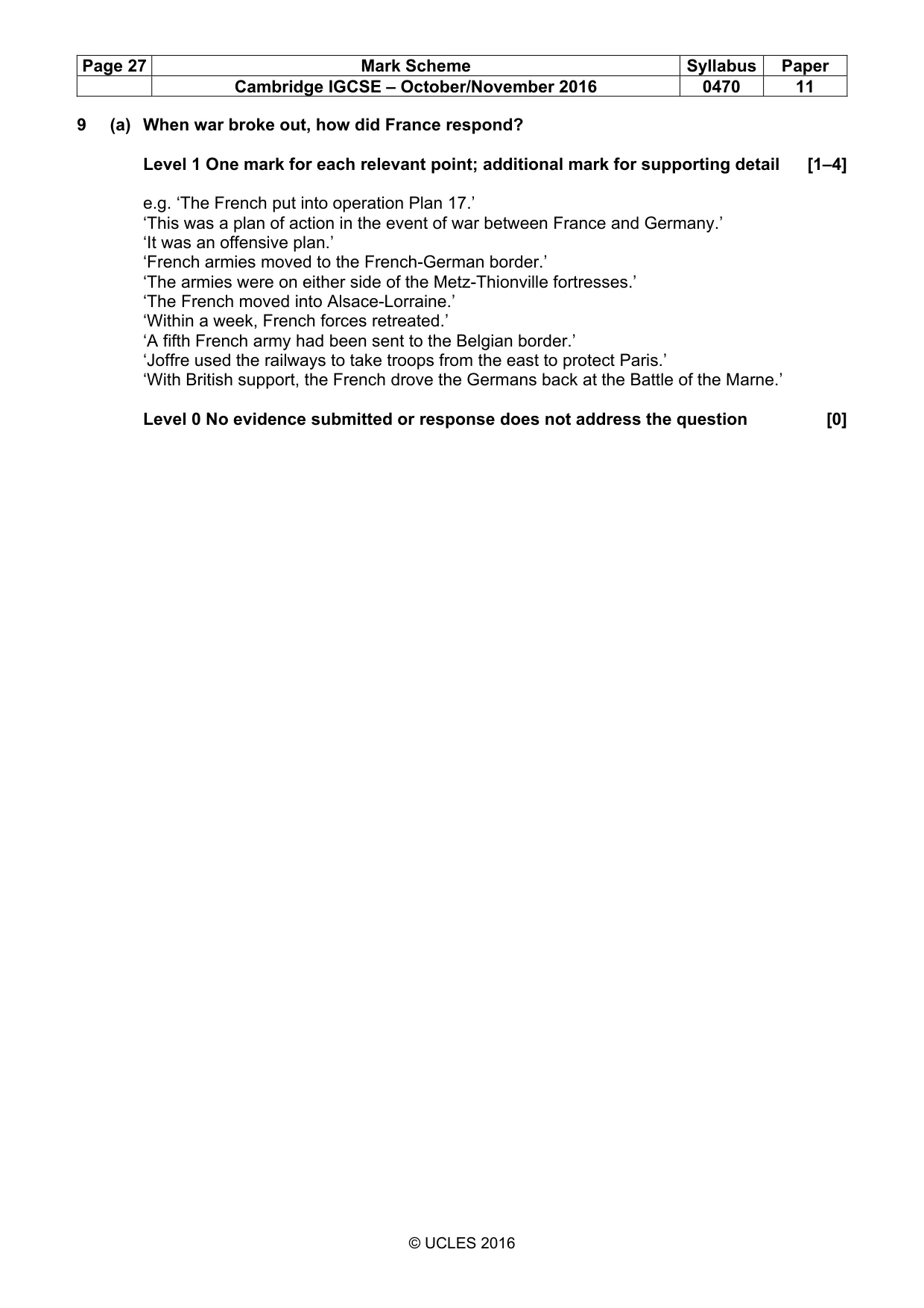
Page 27 Mark Scheme Syllabus Paper Cambridge IGCSE – October/November 2016 0470 11 © UCLES 2016 9 (a) When war broke out, how did France respond? Level 1 One mark for each relevant point; additional mark for supporting detail [1–4] e.g. ‘The French put into operation Plan 17.’ ‘This was a plan of action in the event of war between France and Germany.’ ‘It was an offensive plan.’ ‘French armies moved to the French-German border.’ ‘The armies were on either side of the Metz-Thionville fortresses.’ ‘The French moved into Alsace-Lorraine.’ ‘Within a week, French forces retreated.’ ‘A fifth French army had been sent to the Belgian border.’ ‘Joffre used the railways to take troops from the east to protect Paris.’ ‘With British support, the French drove the Germans back at the Battle of the Marne.’ Level 0 No evidence submitted or response does not address the question [0]
Mark scheme, page 28
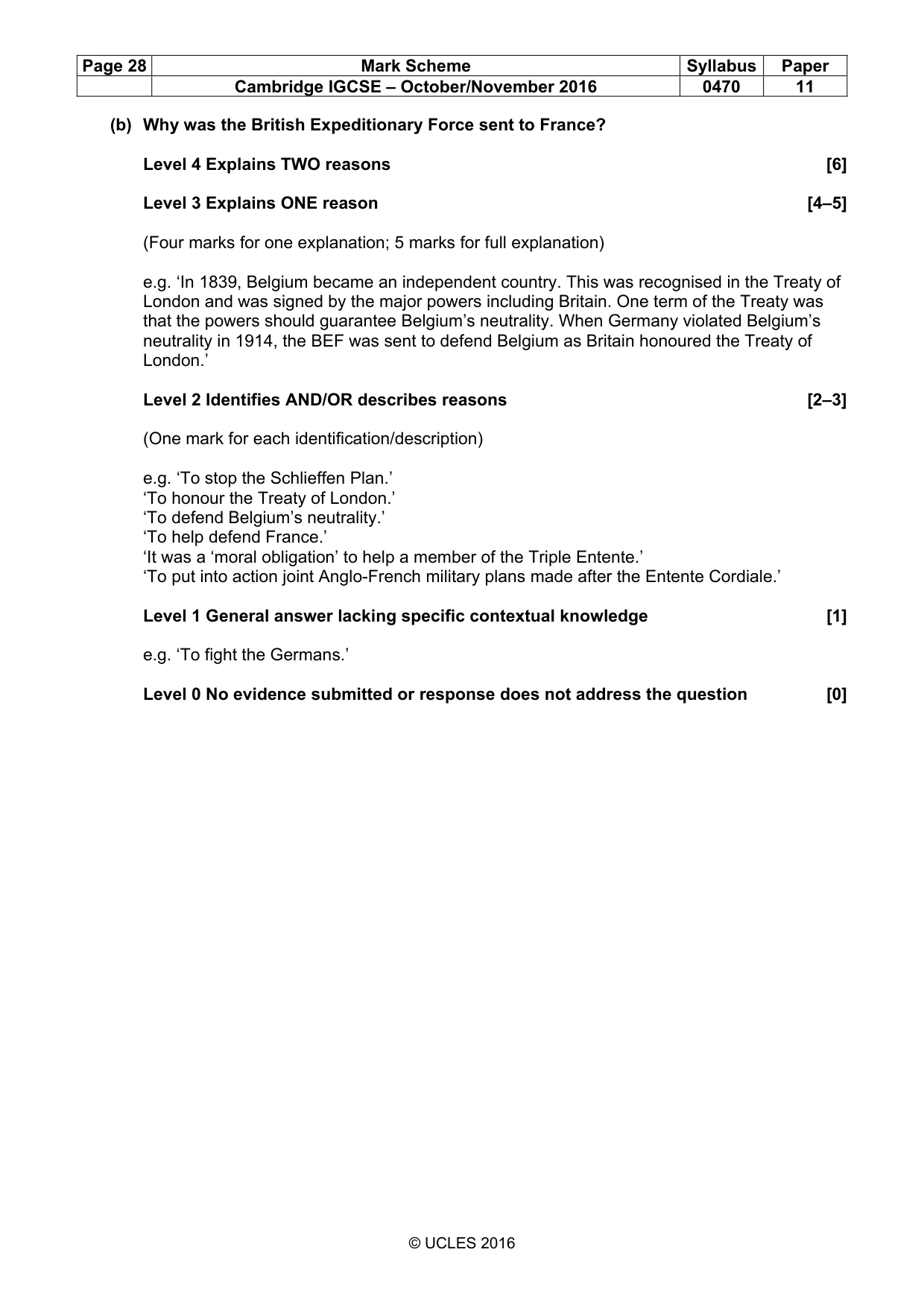
Page 28 Mark Scheme Syllabus Paper Cambridge IGCSE – October/November 2016 0470 11 © UCLES 2016 (b) Why was the British Expeditionary Force sent to France? Level 4 Explains TWO reasons [6] Level 3 Explains ONE reason [4–5] (Four marks for one explanation; 5 marks for full explanation) e.g. ‘In 1839, Belgium became an independent country. This was recognised in the Treaty of London and was signed by the major powers including Britain. One term of the Treaty was that the powers should guarantee Belgium’s neutrality. When Germany violated Belgium’s neutrality in 1914, the BEF was sent to defend Belgium as Britain honoured the Treaty of London.’ Level 2 Identifies AND/OR describes reasons [2–3] (One mark for each identification/description) e.g. ‘To stop the Schlieffen Plan.’ ‘To honour the Treaty of London.’ ‘To defend Belgium’s neutrality.’ ‘To help defend France.’ ‘It was a ‘moral obligation’ to help a member of the Triple Entente.’ ‘To put into action joint Anglo-French military plans made after the Entente Cordiale.’ Level 1 General answer lacking specific contextual knowledge [1] e.g. ‘To fight the Germans.’ Level 0 No evidence submitted or response does not address the question [0]
Mark scheme, page 29
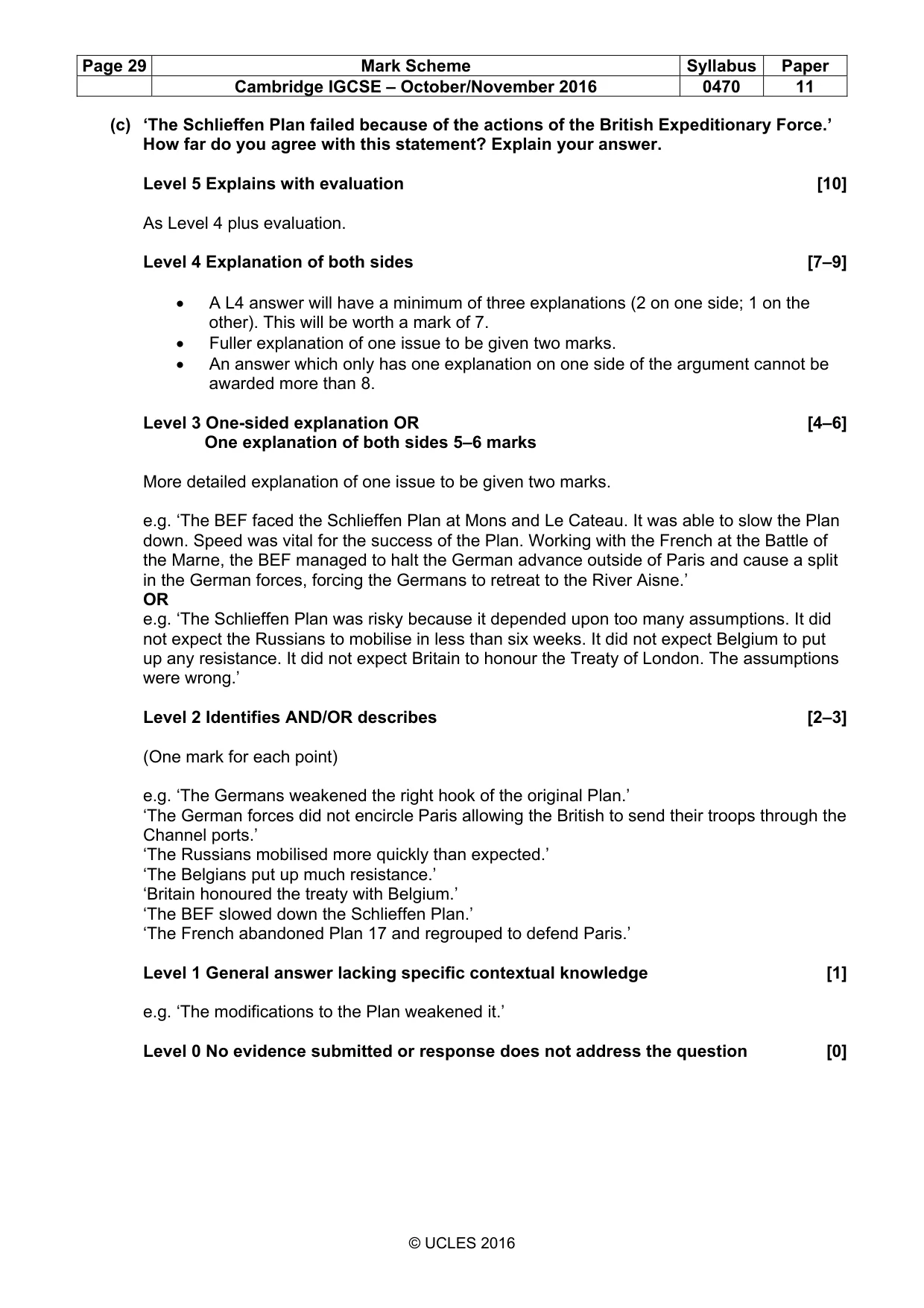
Page 29 Mark Scheme Syllabus Paper Cambridge IGCSE – October/November 2016 0470 11 © UCLES 2016 (c) ‘The Schlieffen Plan failed because of the actions of the British Expeditionary Force.’ How far do you agree with this statement? Explain your answer. Level 5 Explains with evaluation [10] As Level 4 plus evaluation. Level 4 Explanation of both sides [7–9] • A L4 answer will have a minimum of three explanations (2 on one side; 1 on the other). This will be worth a mark of 7. • Fuller explanation of one issue to be given two marks. • An answer which only has one explanation on one side of the argument cannot be awarded more than 8. Level 3 One-sided explanation OR [4–6] One explanation of both sides 5–6 marks More detailed explanation of one issue to be given two marks. e.g. ‘The BEF faced the Schlieffen Plan at Mons and Le Cateau. It was able to slow the Plan down. Speed was vital for the success of the Plan. Working with the French at the Battle of the Marne, the BEF managed to halt the German advance outside of Paris and cause a split in the German forces, forcing the Germans to retreat to the River Aisne.’ OR e.g. ‘The Schlieffen Plan was risky because it depended upon too many assumptions. It did not expect the Russians to mobilise in less than six weeks. It did not expect Belgium to put up any resistance. It did not expect Britain to honour the Treaty of London. The assumptions were wrong.’ Level 2 Identifies AND/OR describes [2–3] (One mark for each point) e.g. ‘The Germans weakened the right hook of the original Plan.’ ‘The German forces did not encircle Paris allowing the British to send their troops through the Channel ports.’ ‘The Russians mobilised more quickly than expected.’ ‘The Belgians put up much resistance.’ ‘Britain honoured the treaty with Belgium.’ ‘The BEF slowed down the Schlieffen Plan.’ ‘The French abandoned Plan 17 and regrouped to defend Paris.’ Level 1 General answer lacking specific contextual knowledge [1] e.g. ‘The modifications to the Plan weakened it.’ Level 0 No evidence submitted or response does not address the question [0]
Mark scheme, page 30
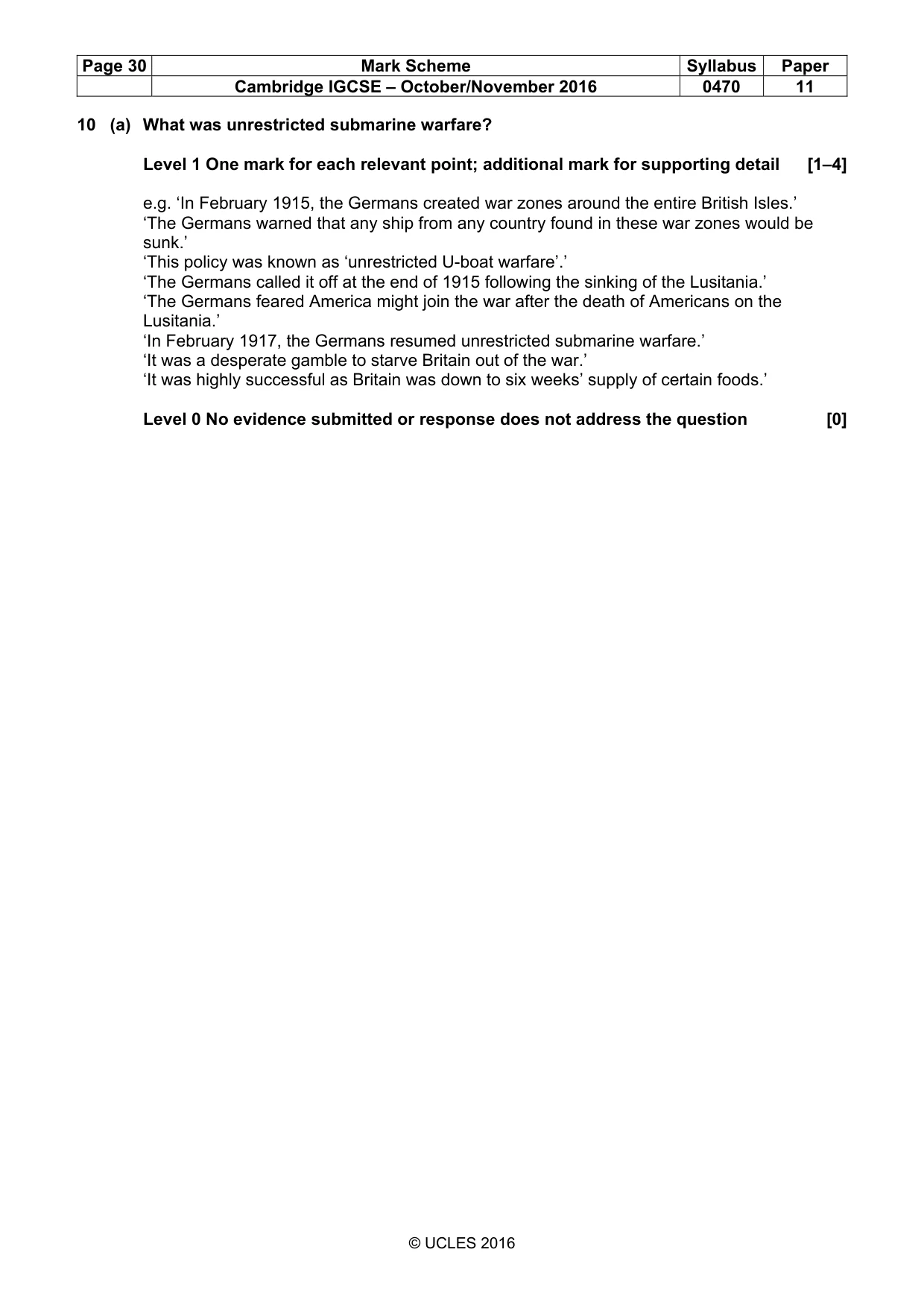
Page 30 Mark Scheme Syllabus Paper Cambridge IGCSE – October/November 2016 0470 11 © UCLES 2016 10 (a) What was unrestricted submarine warfare? Level 1 One mark for each relevant point; additional mark for supporting detail [1–4] e.g. ‘In February 1915, the Germans created war zones around the entire British Isles.’ ‘The Germans warned that any ship from any country found in these war zones would be sunk.’ ‘This policy was known as ‘unrestricted U-boat warfare’.’ ‘The Germans called it off at the end of 1915 following the sinking of the Lusitania.’ ‘The Germans feared America might join the war after the death of Americans on the Lusitania.’ ‘In February 1917, the Germans resumed unrestricted submarine warfare.’ ‘It was a desperate gamble to starve Britain out of the war.’ ‘It was highly successful as Britain was down to six weeks’ supply of certain foods.’ Level 0 No evidence submitted or response does not address the question [0]
Mark scheme, page 31
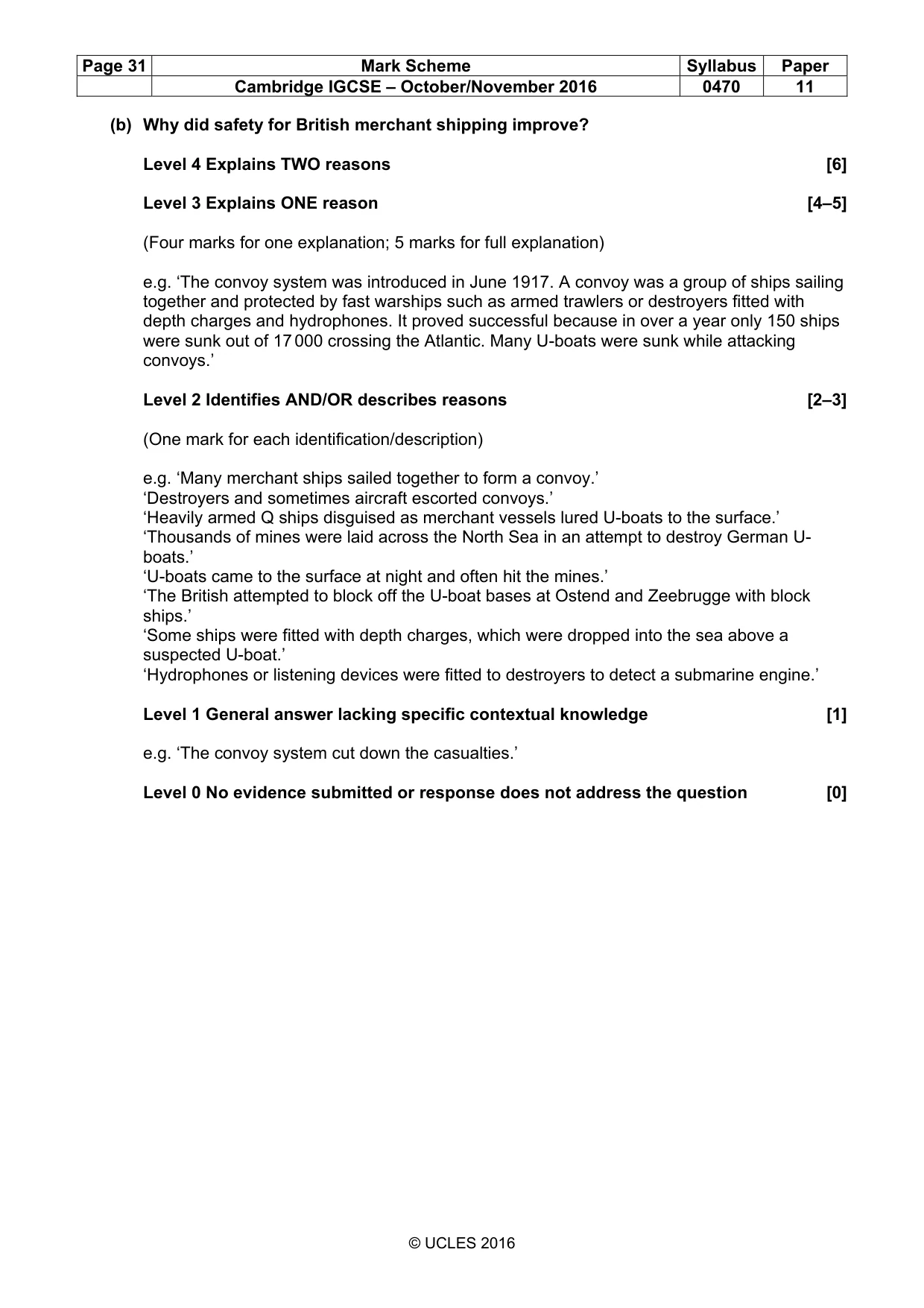
Page 31 Mark Scheme Syllabus Paper Cambridge IGCSE – October/November 2016 0470 11 © UCLES 2016 (b) Why did safety for British merchant shipping improve? Level 4 Explains TWO reasons [6] Level 3 Explains ONE reason [4–5] (Four marks for one explanation; 5 marks for full explanation) e.g. ‘The convoy system was introduced in June 1917. A convoy was a group of ships sailing together and protected by fast warships such as armed trawlers or destroyers fitted with depth charges and hydrophones. It proved successful because in over a year only 150 ships were sunk out of 17 000 crossing the Atlantic. Many U-boats were sunk while attacking convoys.’ Level 2 Identifies AND/OR describes reasons [2–3] (One mark for each identification/description) e.g. ‘Many merchant ships sailed together to form a convoy.’ ‘Destroyers and sometimes aircraft escorted convoys.’ ‘Heavily armed Q ships disguised as merchant vessels lured U-boats to the surface.’ ‘Thousands of mines were laid across the North Sea in an attempt to destroy German U- boats.’ ‘U-boats came to the surface at night and often hit the mines.’ ‘The British attempted to block off the U-boat bases at Ostend and Zeebrugge with block ships.’ ‘Some ships were fitted with depth charges, which were dropped into the sea above a suspected U-boat.’ ‘Hydrophones or listening devices were fitted to destroyers to detect a submarine engine.’ Level 1 General answer lacking specific contextual knowledge [1] e.g. ‘The convoy system cut down the casualties.’ Level 0 No evidence submitted or response does not address the question [0]
Mark scheme, page 32
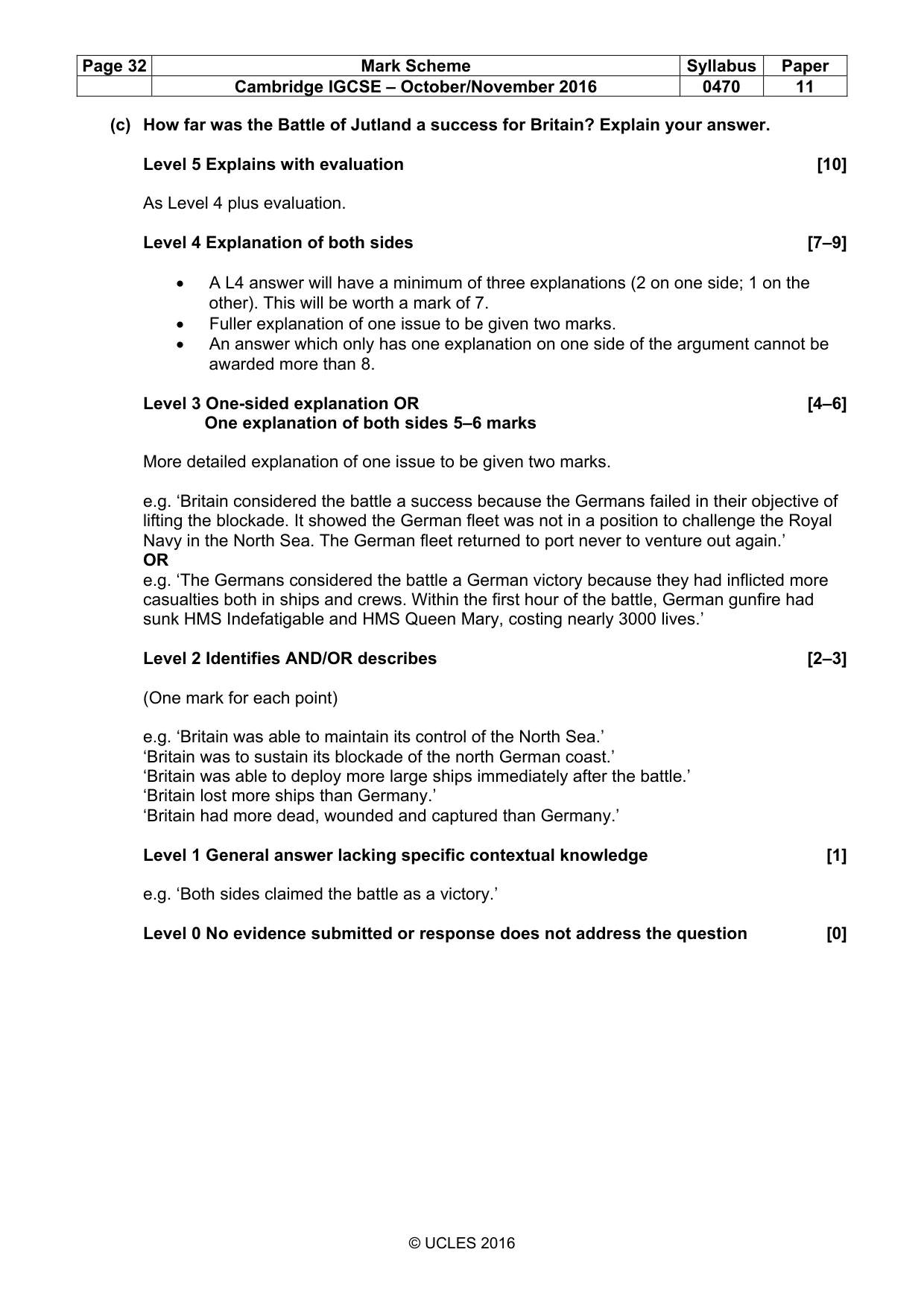
Page 32 Mark Scheme Syllabus Paper Cambridge IGCSE – October/November 2016 0470 11 © UCLES 2016 (c) How far was the Battle of Jutland a success for Britain? Explain your answer. Level 5 Explains with evaluation [10] As Level 4 plus evaluation. Level 4 Explanation of both sides [7–9] • A L4 answer will have a minimum of three explanations (2 on one side; 1 on the other). This will be worth a mark of 7. • Fuller explanation of one issue to be given two marks. • An answer which only has one explanation on one side of the argument cannot be awarded more than 8. Level 3 One-sided explanation OR [4–6] One explanation of both sides 5–6 marks More detailed explanation of one issue to be given two marks. e.g. ‘Britain considered the battle a success because the Germans failed in their objective of lifting the blockade. It showed the German fleet was not in a position to challenge the Royal Navy in the North Sea. The German fleet returned to port never to venture out again.’ OR e.g. ‘The Germans considered the battle a German victory because they had inflicted more casualties both in ships and crews. Within the first hour of the battle, German gunfire had sunk HMS Indefatigable and HMS Queen Mary, costing nearly 3000 lives.’ Level 2 Identifies AND/OR describes [2–3] (One mark for each point) e.g. ‘Britain was able to maintain its control of the North Sea.’ ‘Britain was to sustain its blockade of the north German coast.’ ‘Britain was able to deploy more large ships immediately after the battle.’ ‘Britain lost more ships than Germany.’ ‘Britain had more dead, wounded and captured than Germany.’ Level 1 General answer lacking specific contextual knowledge [1] e.g. ‘Both sides claimed the battle as a victory.’ Level 0 No evidence submitted or response does not address the question [0]
Mark scheme, page 33
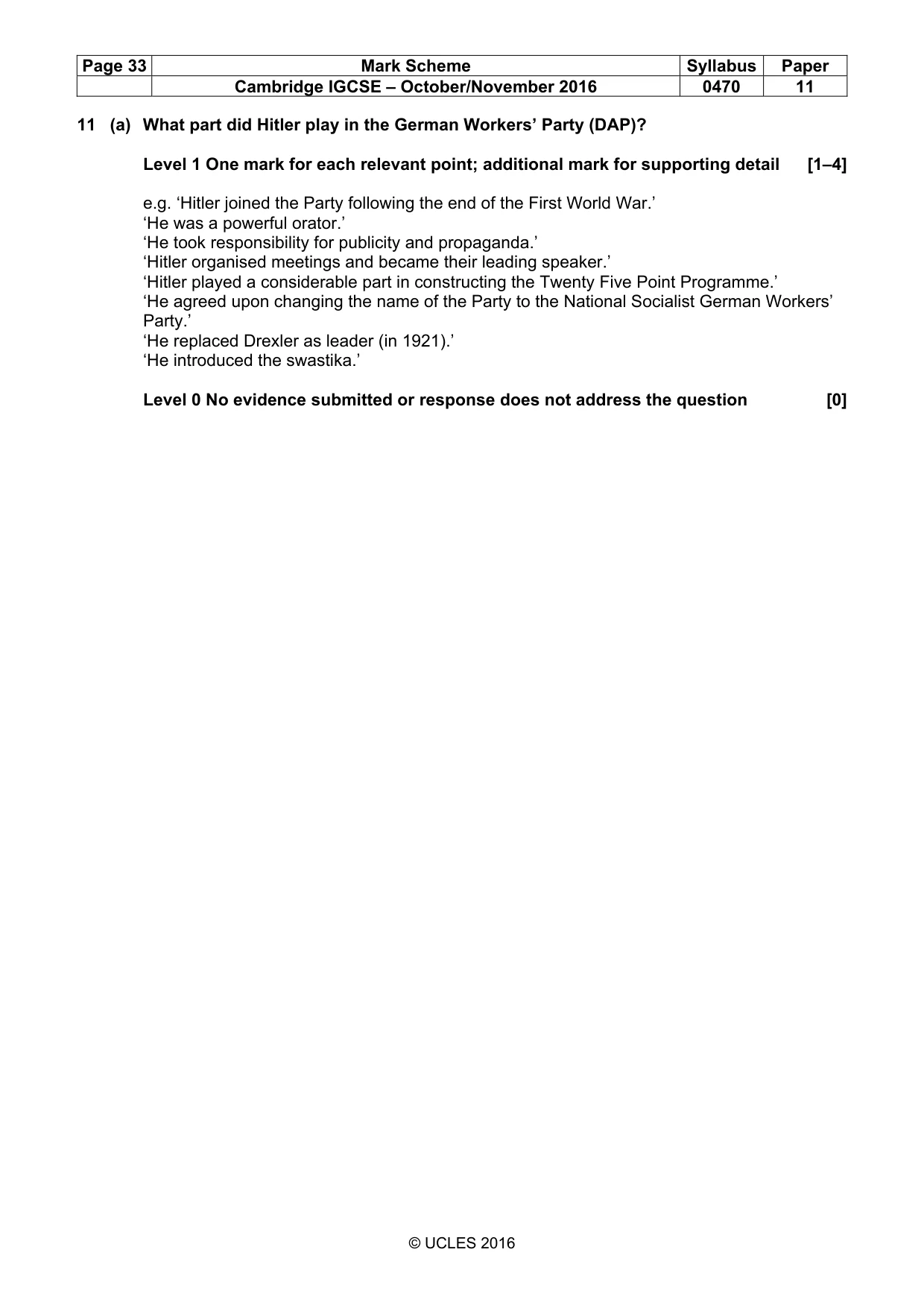
Page 33 Mark Scheme Syllabus Paper Cambridge IGCSE – October/November 2016 0470 11 © UCLES 2016 11 (a) What part did Hitler play in the German Workers’ Party (DAP)? Level 1 One mark for each relevant point; additional mark for supporting detail [1–4] e.g. ‘Hitler joined the Party following the end of the First World War.’ ‘He was a powerful orator.’ ‘He took responsibility for publicity and propaganda.’ ‘Hitler organised meetings and became their leading speaker.’ ‘Hitler played a considerable part in constructing the Twenty Five Point Programme.’ ‘He agreed upon changing the name of the Party to the National Socialist German Workers’ Party.’ ‘He replaced Drexler as leader (in 1921).’ ‘He introduced the swastika.’ Level 0 No evidence submitted or response does not address the question [0]
Mark scheme, page 34
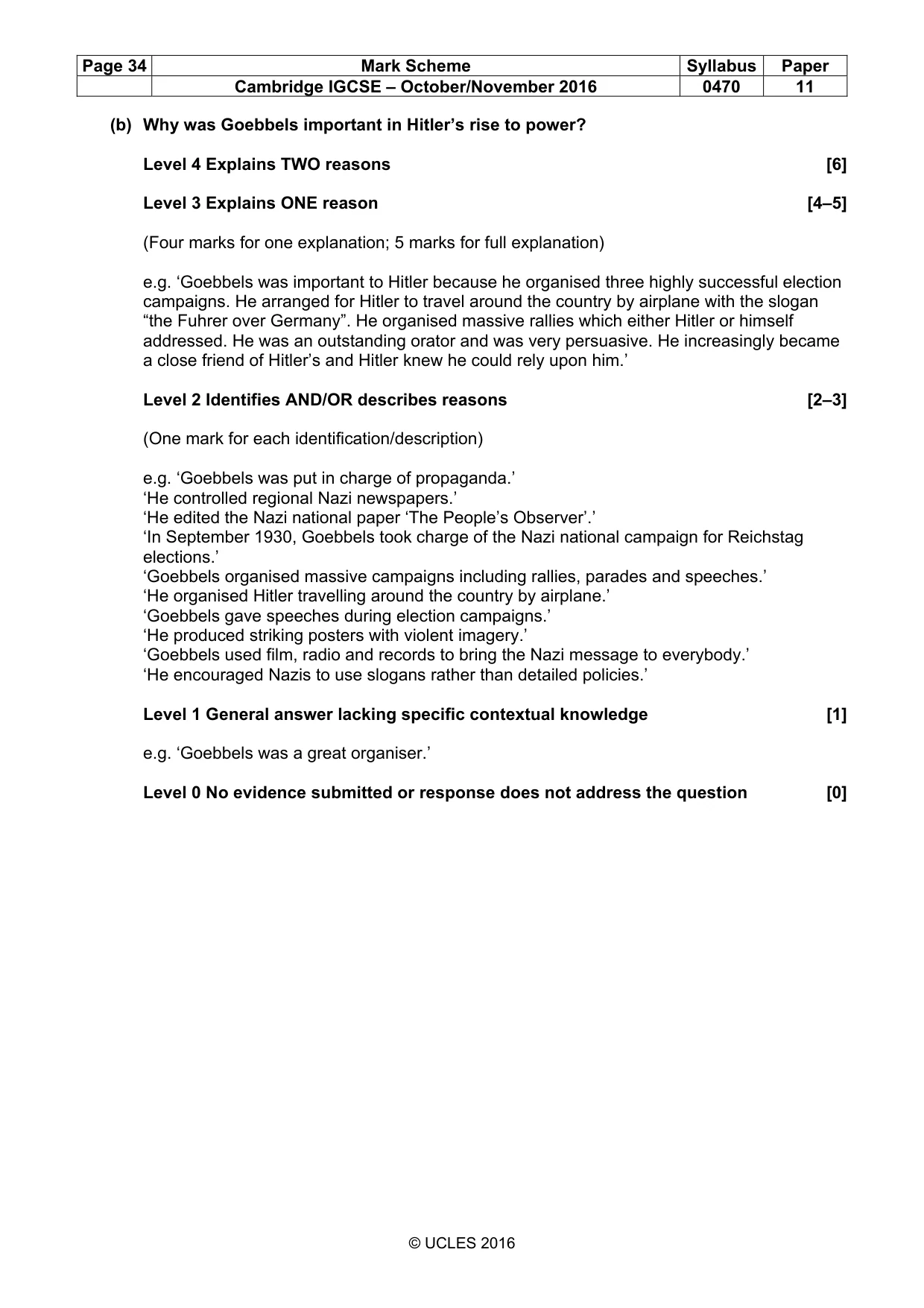
Page 34 Mark Scheme Syllabus Paper Cambridge IGCSE – October/November 2016 0470 11 © UCLES 2016 (b) Why was Goebbels important in Hitler’s rise to power? Level 4 Explains TWO reasons [6] Level 3 Explains ONE reason [4–5] (Four marks for one explanation; 5 marks for full explanation) e.g. ‘Goebbels was important to Hitler because he organised three highly successful election campaigns. He arranged for Hitler to travel around the country by airplane with the slogan “the Fuhrer over Germany”. He organised massive rallies which either Hitler or himself addressed. He was an outstanding orator and was very persuasive. He increasingly became a close friend of Hitler’s and Hitler knew he could rely upon him.’ Level 2 Identifies AND/OR describes reasons [2–3] (One mark for each identification/description) e.g. ‘Goebbels was put in charge of propaganda.’ ‘He controlled regional Nazi newspapers.’ ‘He edited the Nazi national paper ‘The People’s Observer’.’ ‘In September 1930, Goebbels took charge of the Nazi national campaign for Reichstag elections.’ ‘Goebbels organised massive campaigns including rallies, parades and speeches.’ ‘He organised Hitler travelling around the country by airplane.’ ‘Goebbels gave speeches during election campaigns.’ ‘He produced striking posters with violent imagery.’ ‘Goebbels used film, radio and records to bring the Nazi message to everybody.’ ‘He encouraged Nazis to use slogans rather than detailed policies.’ Level 1 General answer lacking specific contextual knowledge [1] e.g. ‘Goebbels was a great organiser.’ Level 0 No evidence submitted or response does not address the question [0]
Mark scheme, page 35
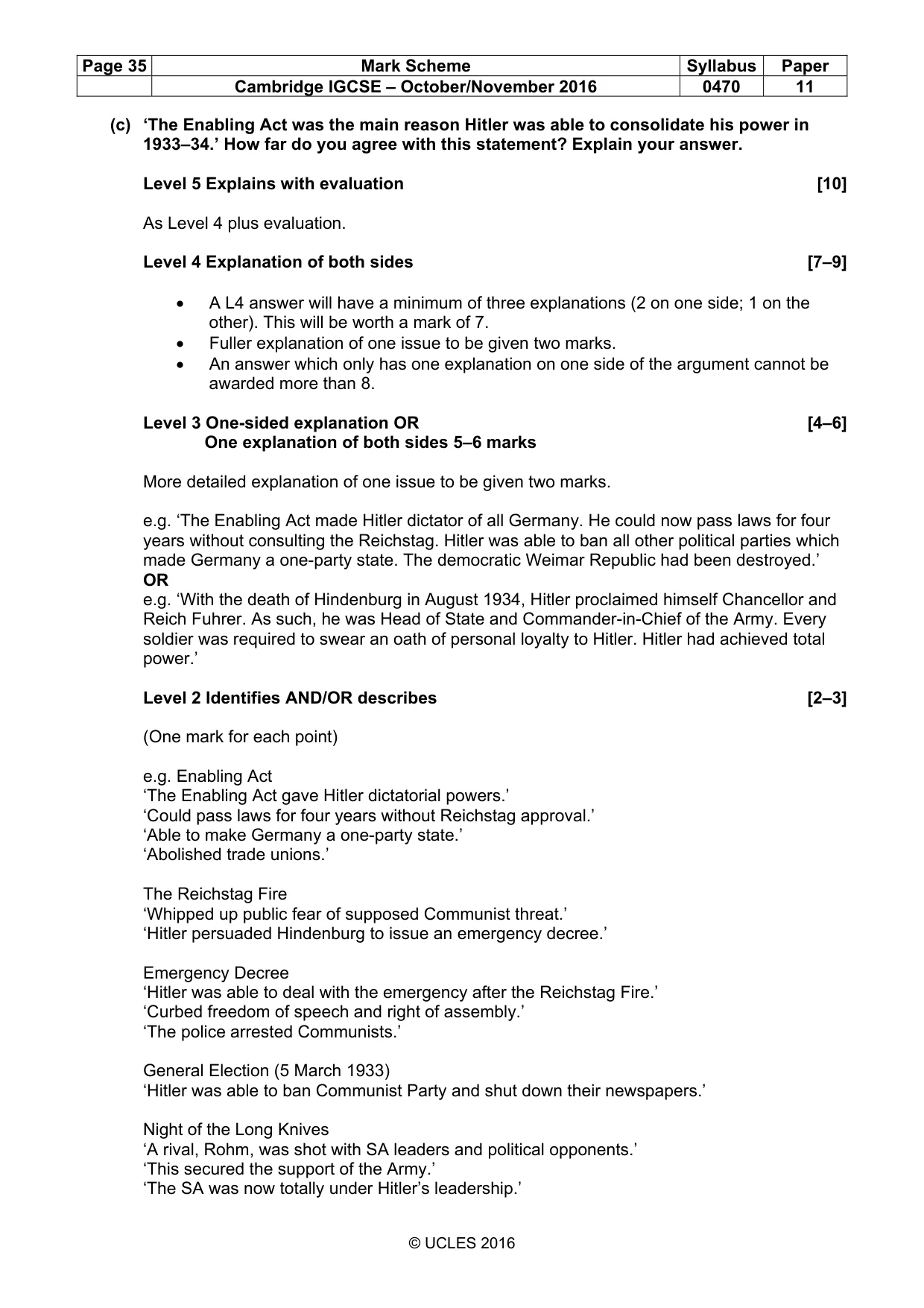
Page 35 Mark Scheme Syllabus Paper Cambridge IGCSE – October/November 2016 0470 11 © UCLES 2016 (c) ‘The Enabling Act was the main reason Hitler was able to consolidate his power in 1933–34.’ How far do you agree with this statement? Explain your answer. Level 5 Explains with evaluation [10] As Level 4 plus evaluation. Level 4 Explanation of both sides [7–9] • A L4 answer will have a minimum of three explanations (2 on one side; 1 on the other). This will be worth a mark of 7. • Fuller explanation of one issue to be given two marks. • An answer which only has one explanation on one side of the argument cannot be awarded more than 8. Level 3 One-sided explanation OR [4–6] One explanation of both sides 5–6 marks More detailed explanation of one issue to be given two marks. e.g. ‘The Enabling Act made Hitler dictator of all Germany. He could now pass laws for four years without consulting the Reichstag. Hitler was able to ban all other political parties which made Germany a one-party state. The democratic Weimar Republic had been destroyed.’ OR e.g. ‘With the death of Hindenburg in August 1934, Hitler proclaimed himself Chancellor and Reich Fuhrer. As such, he was Head of State and Commander-in-Chief of the Army. Every soldier was required to swear an oath of personal loyalty to Hitler. Hitler had achieved total power.’ Level 2 Identifies AND/OR describes [2–3] (One mark for each point) e.g. Enabling Act ‘The Enabling Act gave Hitler dictatorial powers.’ ‘Could pass laws for four years without Reichstag approval.’ ‘Able to make Germany a one-party state.’ ‘Abolished trade unions.’ The Reichstag Fire ‘Whipped up public fear of supposed Communist threat.’ ‘Hitler persuaded Hindenburg to issue an emergency decree.’ Emergency Decree ‘Hitler was able to deal with the emergency after the Reichstag Fire.’ ‘Curbed freedom of speech and right of assembly.’ ‘The police arrested Communists.’ General Election (5 March 1933) ‘Hitler was able to ban Communist Party and shut down their newspapers.’ Night of the Long Knives ‘A rival, Rohm, was shot with SA leaders and political opponents.’ ‘This secured the support of the Army.’ ‘The SA was now totally under Hitler’s leadership.’
Mark scheme, page 36
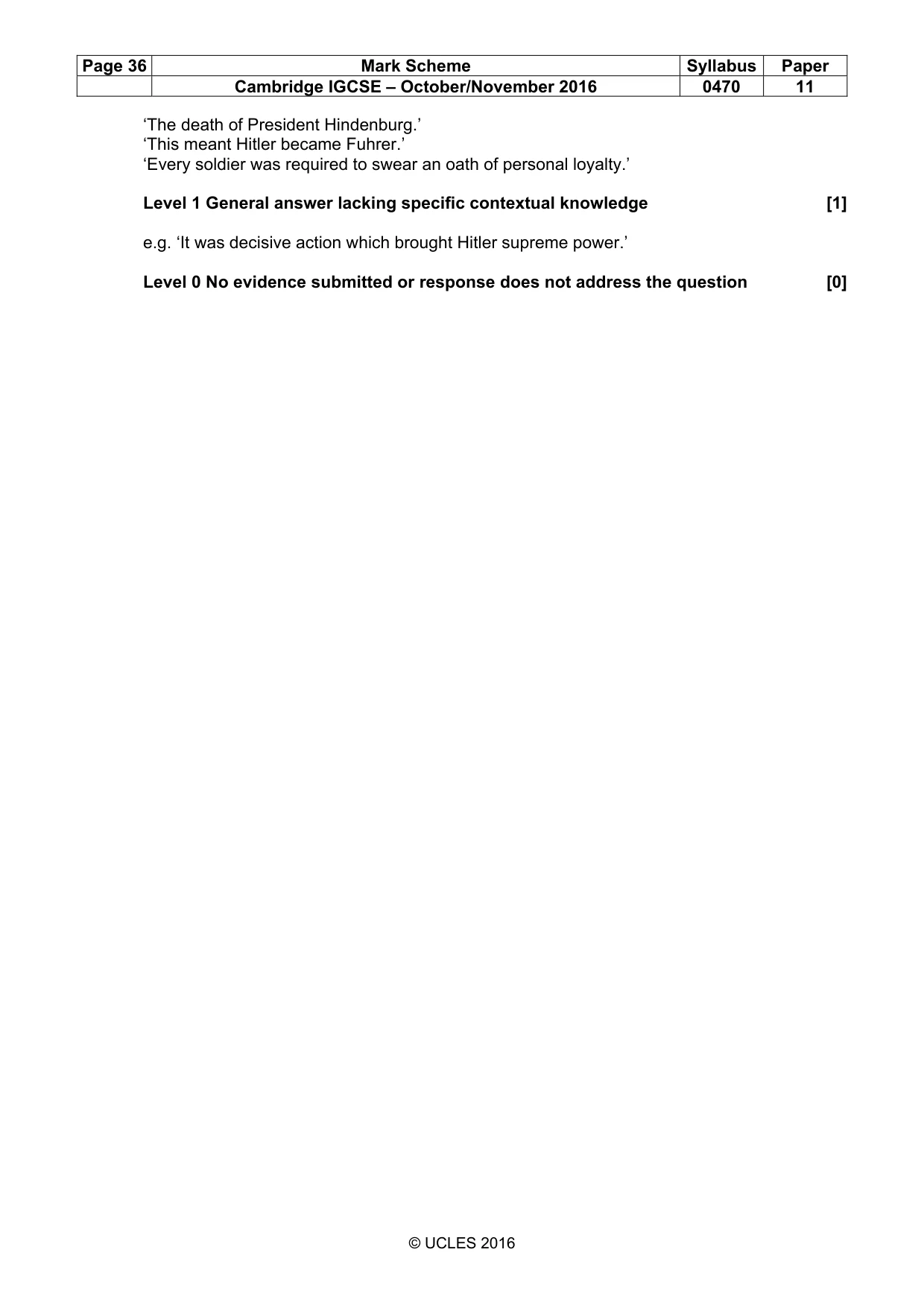
Page 36 Mark Scheme Syllabus Paper Cambridge IGCSE – October/November 2016 0470 11 © UCLES 2016 ‘The death of President Hindenburg.’ ‘This meant Hitler became Fuhrer.’ ‘Every soldier was required to swear an oath of personal loyalty.’ Level 1 General answer lacking specific contextual knowledge [1] e.g. ‘It was decisive action which brought Hitler supreme power.’ Level 0 No evidence submitted or response does not address the question [0]
Mark scheme, page 37
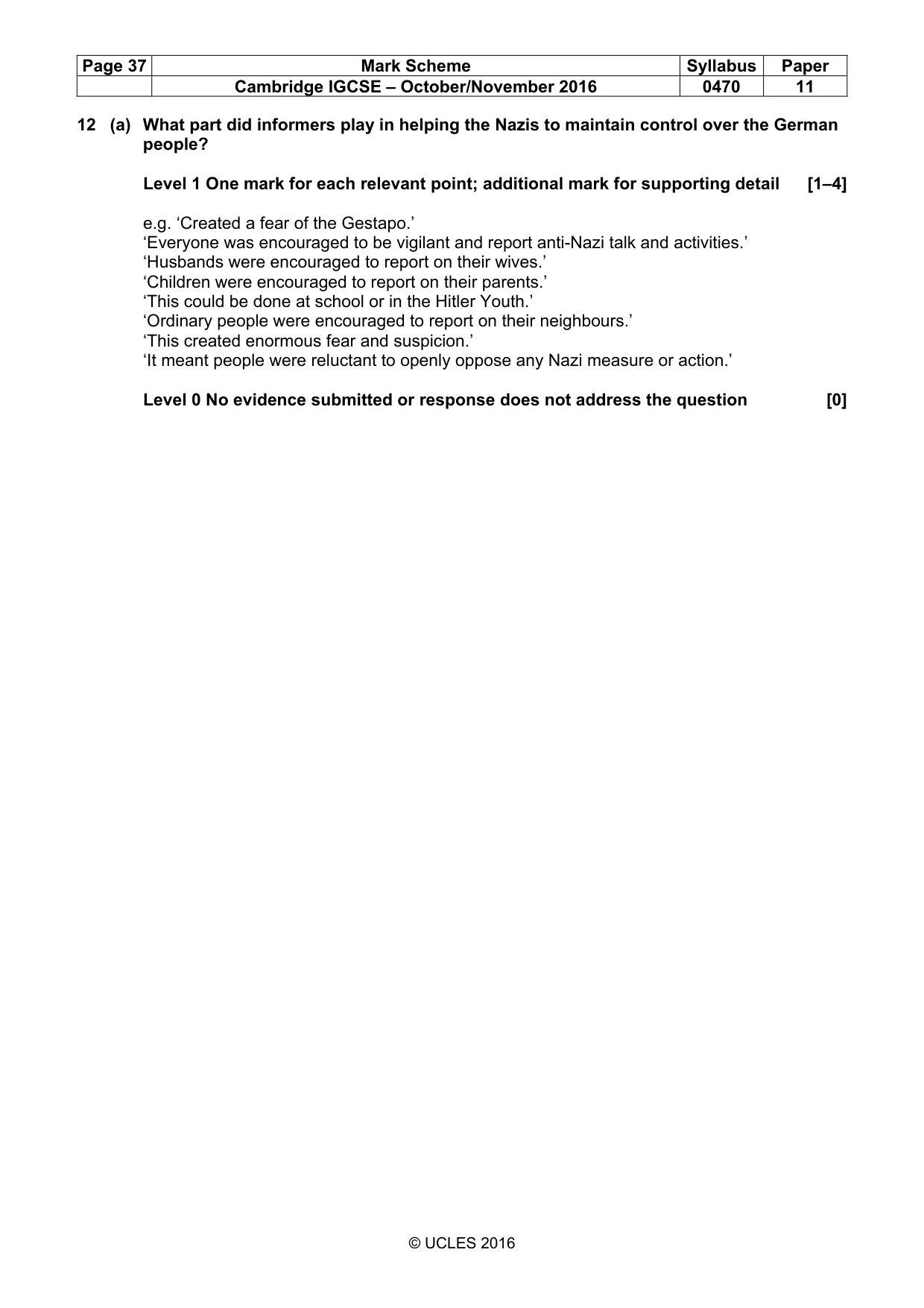
Page 37 Mark Scheme Syllabus Paper Cambridge IGCSE – October/November 2016 0470 11 © UCLES 2016 12 (a) What part did informers play in helping the Nazis to maintain control over the German people? Level 1 One mark for each relevant point; additional mark for supporting detail [1–4] e.g. ‘Created a fear of the Gestapo.’ ‘Everyone was encouraged to be vigilant and report anti-Nazi talk and activities.’ ‘Husbands were encouraged to report on their wives.’ ‘Children were encouraged to report on their parents.’ ‘This could be done at school or in the Hitler Youth.’ ‘Ordinary people were encouraged to report on their neighbours.’ ‘This created enormous fear and suspicion.’ ‘It meant people were reluctant to openly oppose any Nazi measure or action.’ Level 0 No evidence submitted or response does not address the question [0]
Mark scheme, page 38
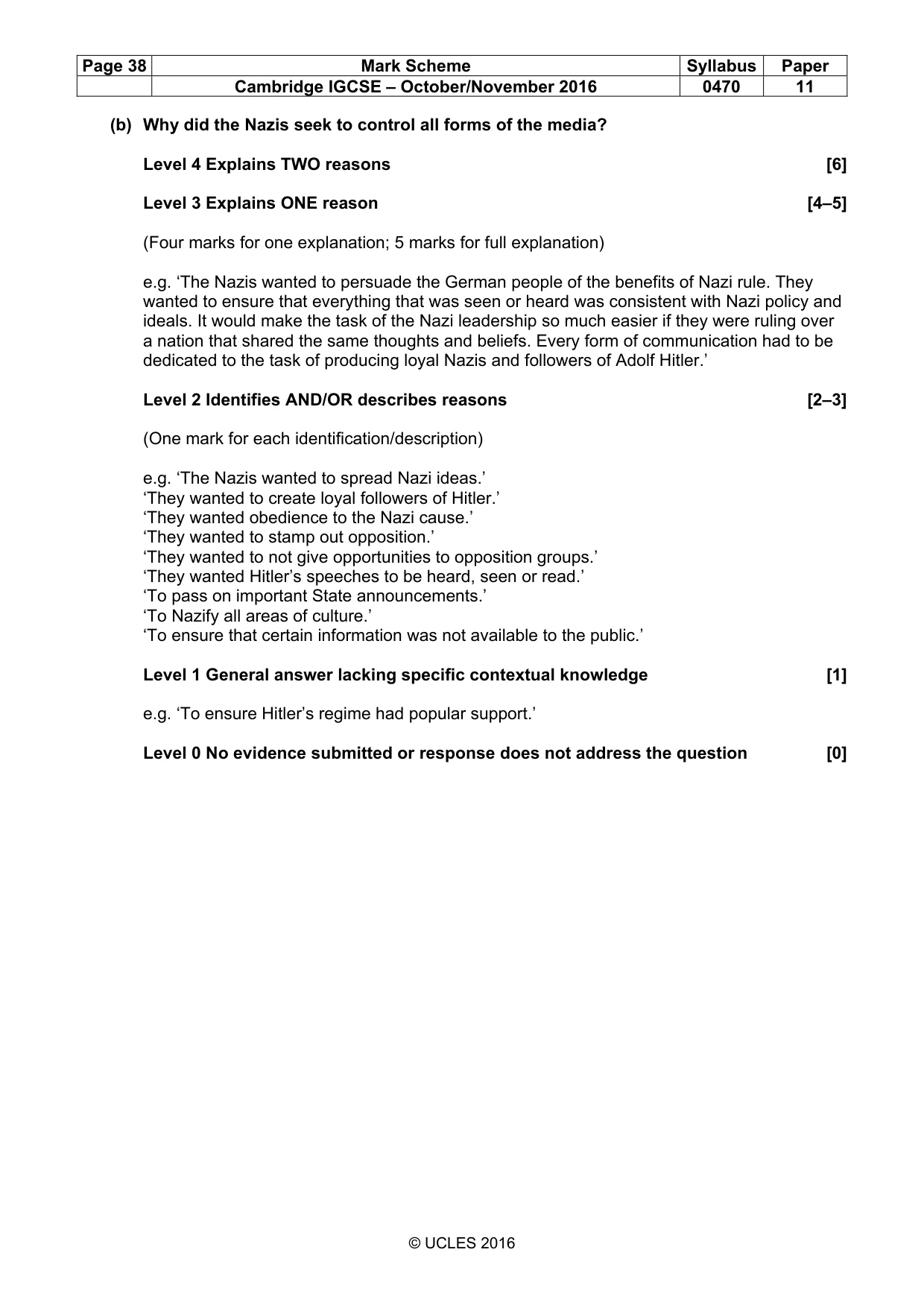
Page 38 Mark Scheme Syllabus Paper Cambridge IGCSE – October/November 2016 0470 11 © UCLES 2016 (b) Why did the Nazis seek to control all forms of the media? Level 4 Explains TWO reasons [6] Level 3 Explains ONE reason [4–5] (Four marks for one explanation; 5 marks for full explanation) e.g. ‘The Nazis wanted to persuade the German people of the benefits of Nazi rule. They wanted to ensure that everything that was seen or heard was consistent with Nazi policy and ideals. It would make the task of the Nazi leadership so much easier if they were ruling over a nation that shared the same thoughts and beliefs. Every form of communication had to be dedicated to the task of producing loyal Nazis and followers of Adolf Hitler.’ Level 2 Identifies AND/OR describes reasons [2–3] (One mark for each identification/description) e.g. ‘The Nazis wanted to spread Nazi ideas.’ ‘They wanted to create loyal followers of Hitler.’ ‘They wanted obedience to the Nazi cause.’ ‘They wanted to stamp out opposition.’ ‘They wanted to not give opportunities to opposition groups.’ ‘They wanted Hitler’s speeches to be heard, seen or read.’ ‘To pass on important State announcements.’ ‘To Nazify all areas of culture.’ ‘To ensure that certain information was not available to the public.’ Level 1 General answer lacking specific contextual knowledge [1] e.g. ‘To ensure Hitler’s regime had popular support.’ Level 0 No evidence submitted or response does not address the question [0]
Mark scheme, page 39
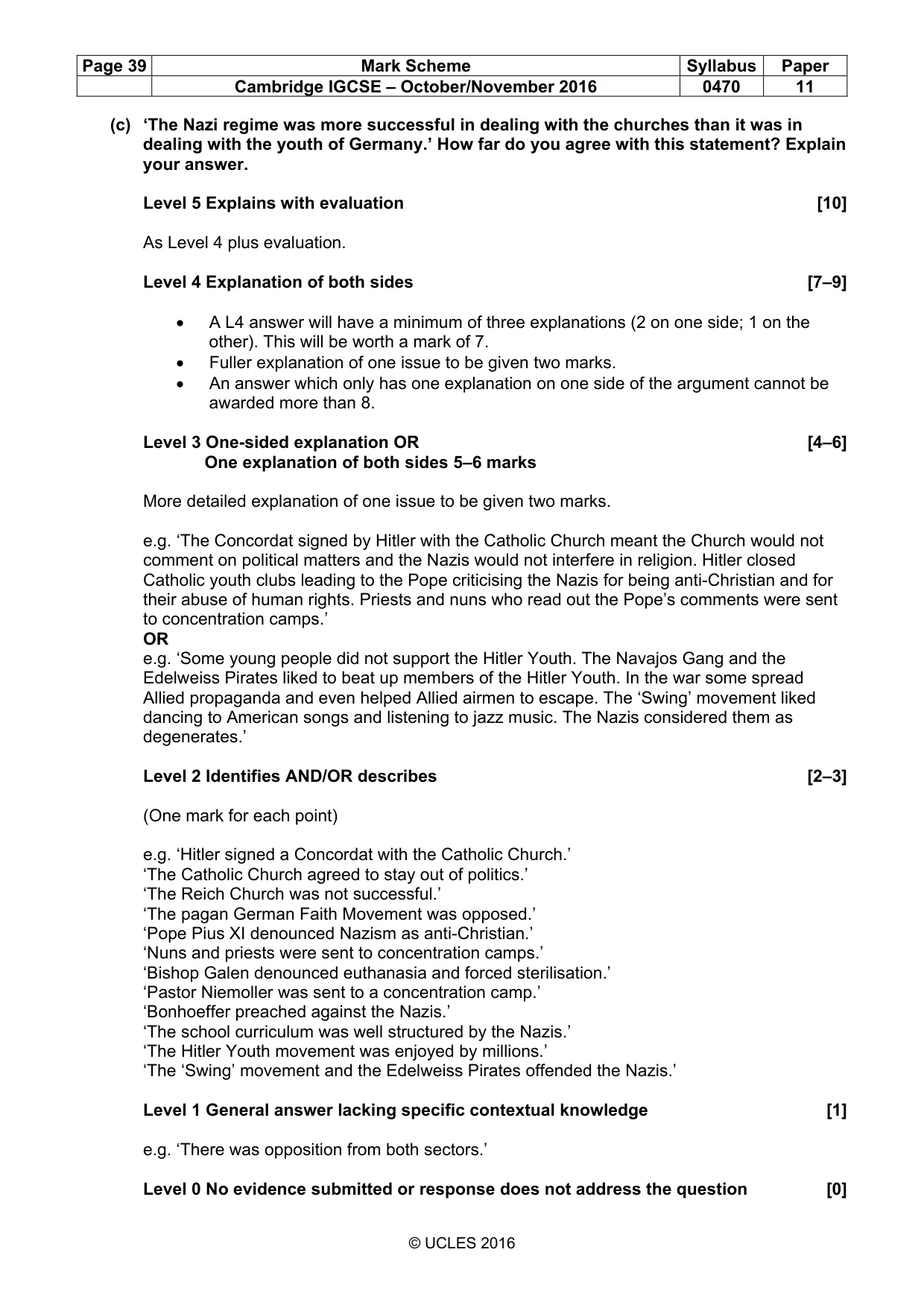
Page 39 Mark Scheme Syllabus Paper Cambridge IGCSE – October/November 2016 0470 11 © UCLES 2016 (c) ‘The Nazi regime was more successful in dealing with the churches than it was in dealing with the youth of Germany.’ How far do you agree with this statement? Explain your answer. Level 5 Explains with evaluation [10] As Level 4 plus evaluation. Level 4 Explanation of both sides [7–9] • A L4 answer will have a minimum of three explanations (2 on one side; 1 on the other). This will be worth a mark of 7. • Fuller explanation of one issue to be given two marks. • An answer which only has one explanation on one side of the argument cannot be awarded more than 8. Level 3 One-sided explanation OR [4–6] One explanation of both sides 5–6 marks More detailed explanation of one issue to be given two marks. e.g. ‘The Concordat signed by Hitler with the Catholic Church meant the Church would not comment on political matters and the Nazis would not interfere in religion. Hitler closed Catholic youth clubs leading to the Pope criticising the Nazis for being anti-Christian and for their abuse of human rights. Priests and nuns who read out the Pope’s comments were sent to concentration camps.’ OR e.g. ‘Some young people did not support the Hitler Youth. The Navajos Gang and the Edelweiss Pirates liked to beat up members of the Hitler Youth. In the war some spread Allied propaganda and even helped Allied airmen to escape. The ‘Swing’ movement liked dancing to American songs and listening to jazz music. The Nazis considered them as degenerates.’ Level 2 Identifies AND/OR describes [2–3] (One mark for each point) e.g. ‘Hitler signed a Concordat with the Catholic Church.’ ‘The Catholic Church agreed to stay out of politics.’ ‘The Reich Church was not successful.’ ‘The pagan German Faith Movement was opposed.’ ‘Pope Pius XI denounced Nazism as anti-Christian.’ ‘Nuns and priests were sent to concentration camps.’ ‘Bishop Galen denounced euthanasia and forced sterilisation.’ ‘Pastor Niemoller was sent to a concentration camp.’ ‘Bonhoeffer preached against the Nazis.’ ‘The school curriculum was well structured by the Nazis.’ ‘The Hitler Youth movement was enjoyed by millions.’ ‘The ‘Swing’ movement and the Edelweiss Pirates offended the Nazis.’ Level 1 General answer lacking specific contextual knowledge [1] e.g. ‘There was opposition from both sectors.’ Level 0 No evidence submitted or response does not address the question [0]
Mark scheme, page 40
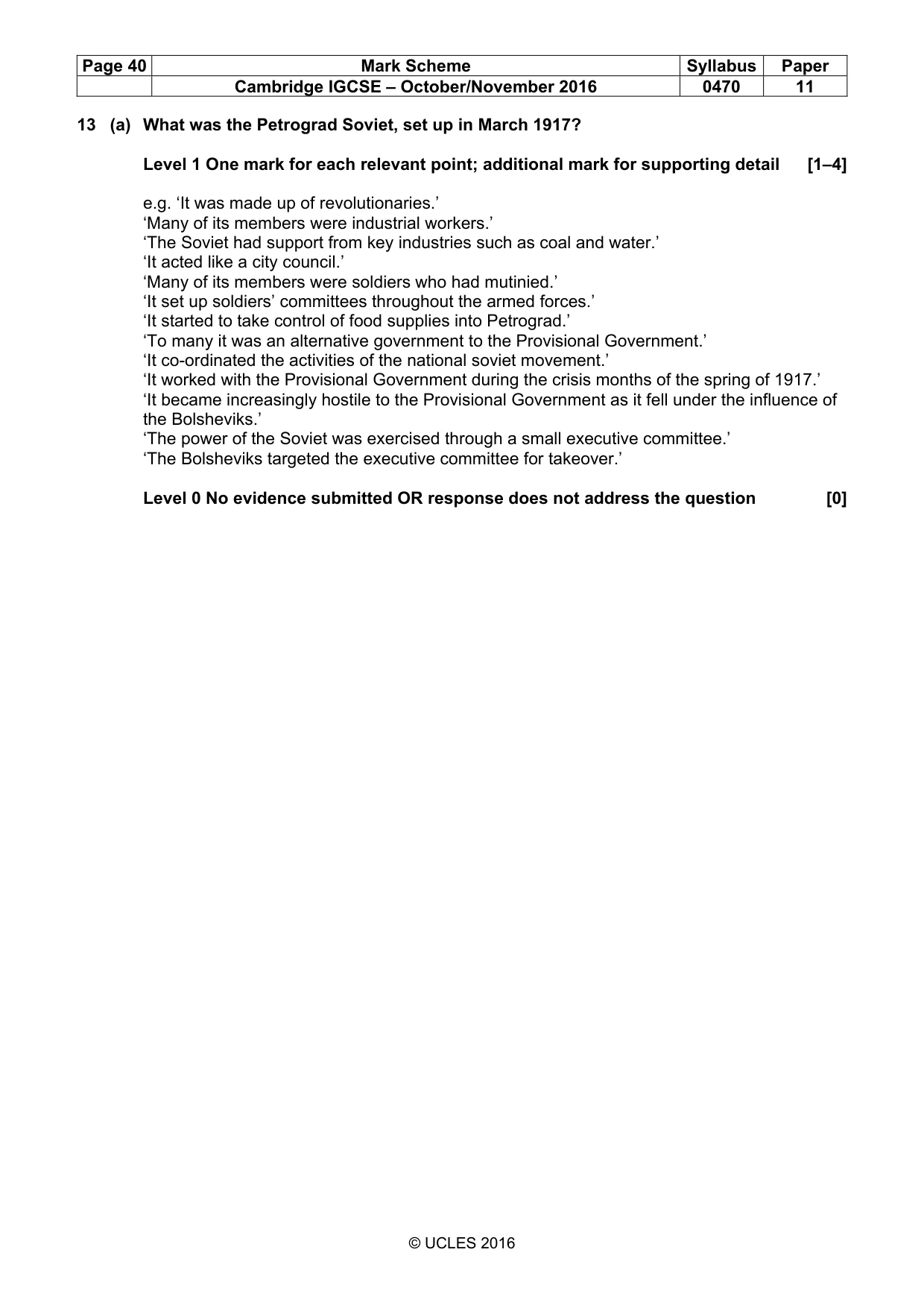
Page 40 Mark Scheme Syllabus Paper Cambridge IGCSE – October/November 2016 0470 11 © UCLES 2016 13 (a) What was the Petrograd Soviet, set up in March 1917? Level 1 One mark for each relevant point; additional mark for supporting detail [1–4] e.g. ‘It was made up of revolutionaries.’ ‘Many of its members were industrial workers.’ ‘The Soviet had support from key industries such as coal and water.’ ‘It acted like a city council.’ ‘Many of its members were soldiers who had mutinied.’ ‘It set up soldiers’ committees throughout the armed forces.’ ‘It started to take control of food supplies into Petrograd.’ ‘To many it was an alternative government to the Provisional Government.’ ‘It co-ordinated the activities of the national soviet movement.’ ‘It worked with the Provisional Government during the crisis months of the spring of 1917.’ ‘It became increasingly hostile to the Provisional Government as it fell under the influence of the Bolsheviks.’ ‘The power of the Soviet was exercised through a small executive committee.’ ‘The Bolsheviks targeted the executive committee for takeover.’ Level 0 No evidence submitted OR response does not address the question [0]
Mark scheme, page 41
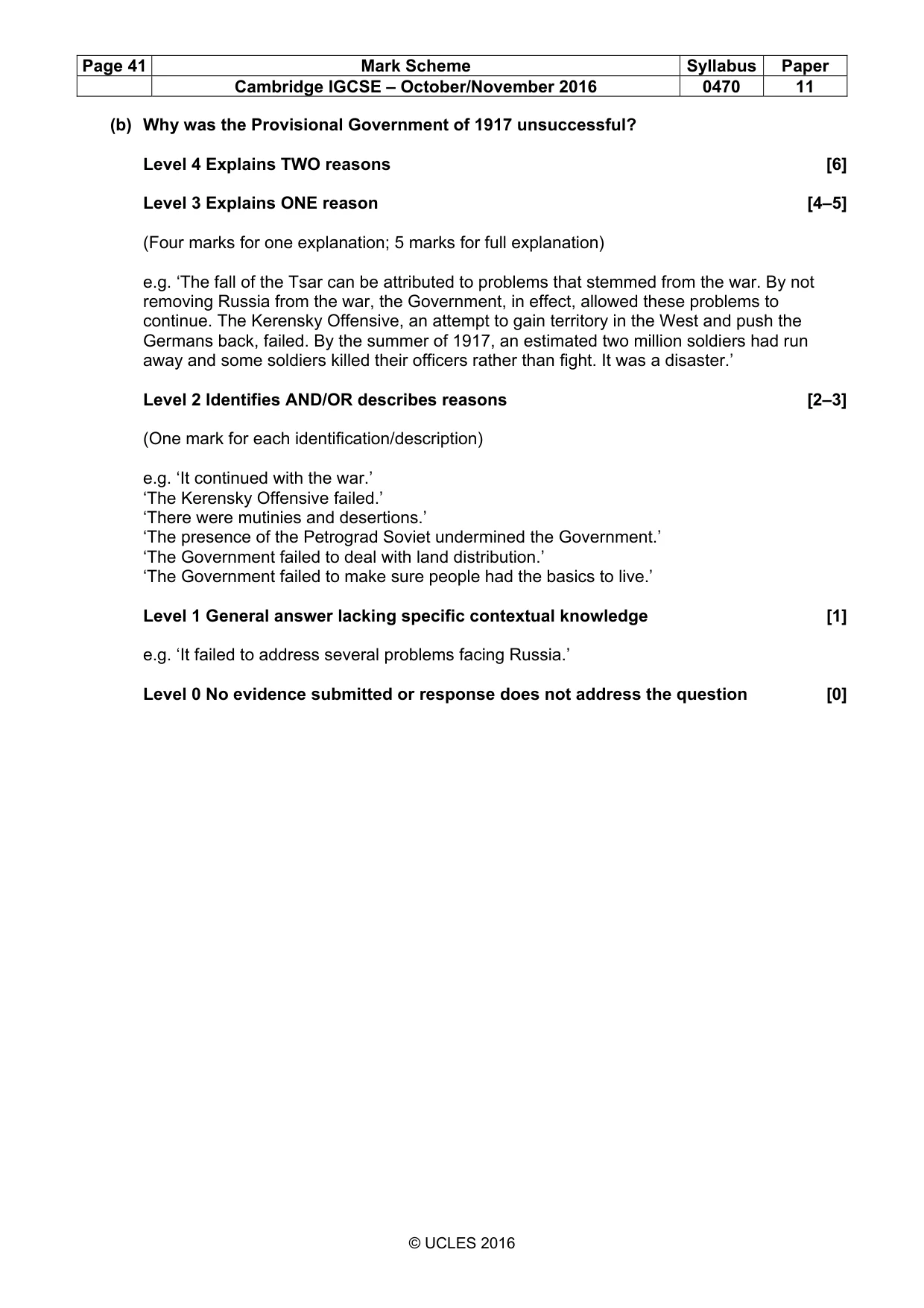
Page 41 Mark Scheme Syllabus Paper Cambridge IGCSE – October/November 2016 0470 11 © UCLES 2016 (b) Why was the Provisional Government of 1917 unsuccessful? Level 4 Explains TWO reasons [6] Level 3 Explains ONE reason [4–5] (Four marks for one explanation; 5 marks for full explanation) e.g. ‘The fall of the Tsar can be attributed to problems that stemmed from the war. By not removing Russia from the war, the Government, in effect, allowed these problems to continue. The Kerensky Offensive, an attempt to gain territory in the West and push the Germans back, failed. By the summer of 1917, an estimated two million soldiers had run away and some soldiers killed their officers rather than fight. It was a disaster.’ Level 2 Identifies AND/OR describes reasons [2–3] (One mark for each identification/description) e.g. ‘It continued with the war.’ ‘The Kerensky Offensive failed.’ ‘There were mutinies and desertions.’ ‘The presence of the Petrograd Soviet undermined the Government.’ ‘The Government failed to deal with land distribution.’ ‘The Government failed to make sure people had the basics to live.’ Level 1 General answer lacking specific contextual knowledge [1] e.g. ‘It failed to address several problems facing Russia.’ Level 0 No evidence submitted or response does not address the question [0]
Mark scheme, page 42
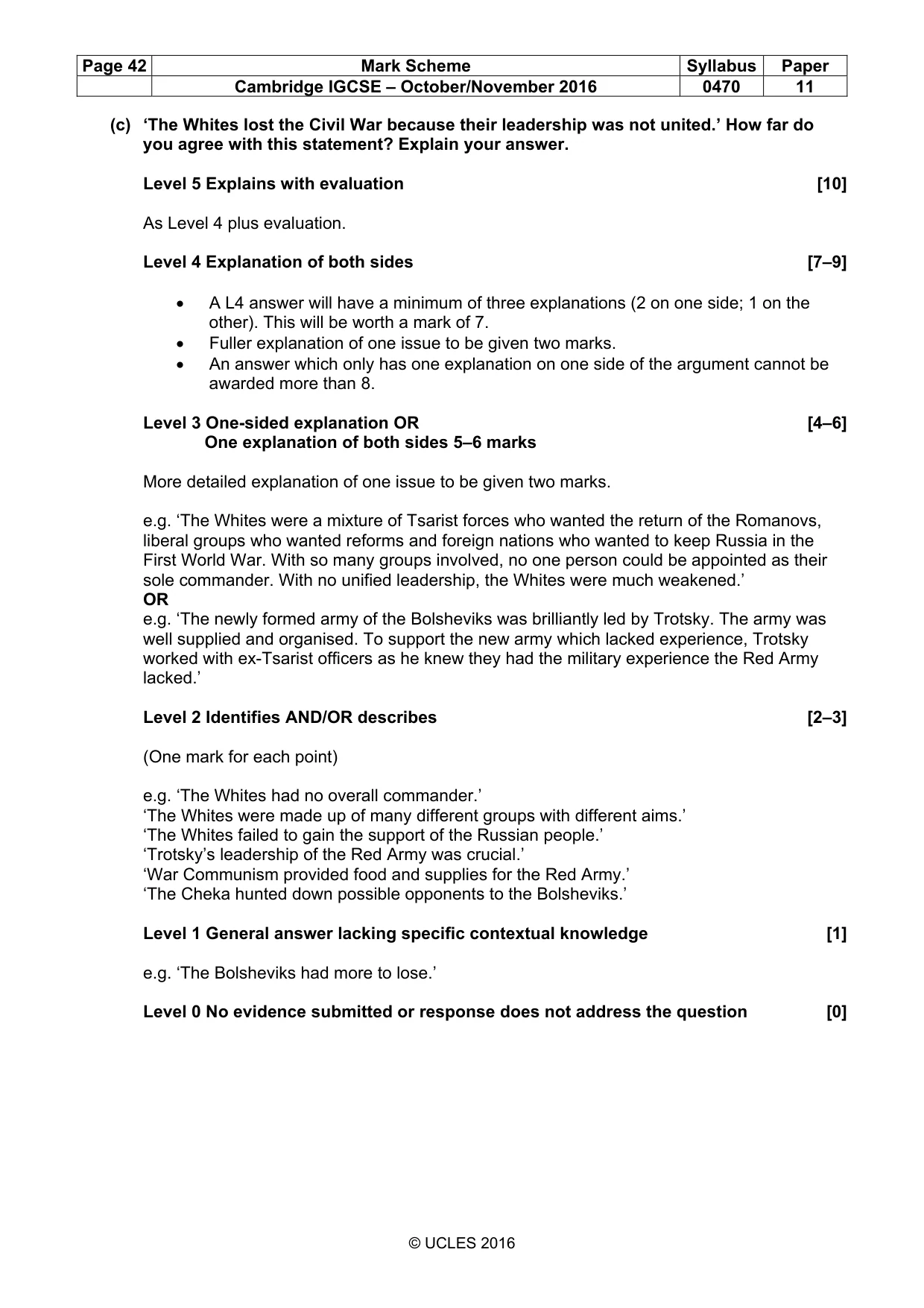
Page 42 Mark Scheme Syllabus Paper Cambridge IGCSE – October/November 2016 0470 11 © UCLES 2016 (c) ‘The Whites lost the Civil War because their leadership was not united.’ How far do you agree with this statement? Explain your answer. Level 5 Explains with evaluation [10] As Level 4 plus evaluation. Level 4 Explanation of both sides [7–9] • A L4 answer will have a minimum of three explanations (2 on one side; 1 on the other). This will be worth a mark of 7. • Fuller explanation of one issue to be given two marks. • An answer which only has one explanation on one side of the argument cannot be awarded more than 8. Level 3 One-sided explanation OR [4–6] One explanation of both sides 5–6 marks More detailed explanation of one issue to be given two marks. e.g. ‘The Whites were a mixture of Tsarist forces who wanted the return of the Romanovs, liberal groups who wanted reforms and foreign nations who wanted to keep Russia in the First World War. With so many groups involved, no one person could be appointed as their sole commander. With no unified leadership, the Whites were much weakened.’ OR e.g. ‘The newly formed army of the Bolsheviks was brilliantly led by Trotsky. The army was well supplied and organised. To support the new army which lacked experience, Trotsky worked with ex-Tsarist officers as he knew they had the military experience the Red Army lacked.’ Level 2 Identifies AND/OR describes [2–3] (One mark for each point) e.g. ‘The Whites had no overall commander.’ ‘The Whites were made up of many different groups with different aims.’ ‘The Whites failed to gain the support of the Russian people.’ ‘Trotsky’s leadership of the Red Army was crucial.’ ‘War Communism provided food and supplies for the Red Army.’ ‘The Cheka hunted down possible opponents to the Bolsheviks.’ Level 1 General answer lacking specific contextual knowledge [1] e.g. ‘The Bolsheviks had more to lose.’ Level 0 No evidence submitted or response does not address the question [0]
Mark scheme, page 43
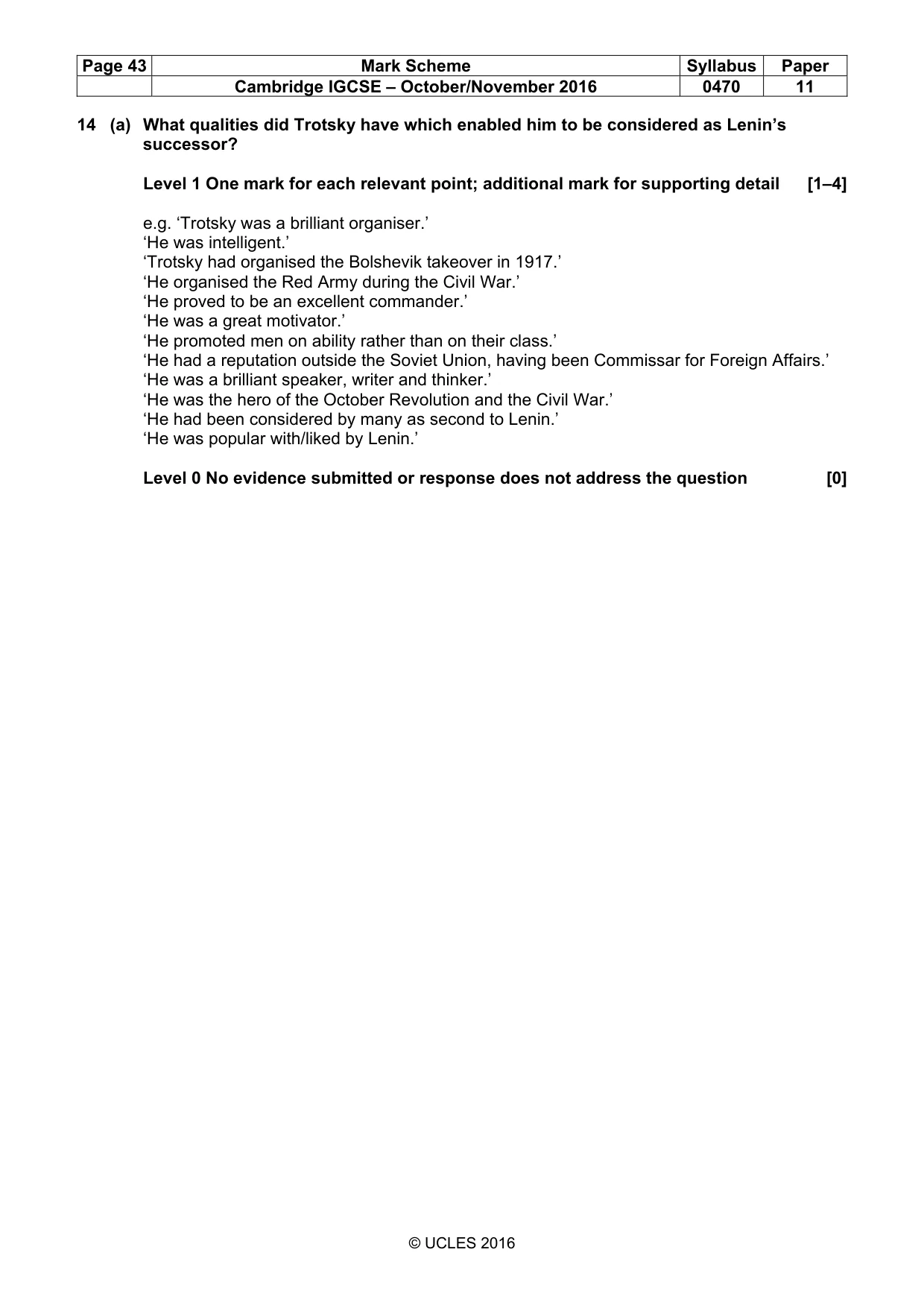
Page 43 Mark Scheme Syllabus Paper Cambridge IGCSE – October/November 2016 0470 11 © UCLES 2016 14 (a) What qualities did Trotsky have which enabled him to be considered as Lenin’s successor? Level 1 One mark for each relevant point; additional mark for supporting detail [1–4] e.g. ‘Trotsky was a brilliant organiser.’ ‘He was intelligent.’ ‘Trotsky had organised the Bolshevik takeover in 1917.’ ‘He organised the Red Army during the Civil War.’ ‘He proved to be an excellent commander.’ ‘He was a great motivator.’ ‘He promoted men on ability rather than on their class.’ ‘He had a reputation outside the Soviet Union, having been Commissar for Foreign Affairs.’ ‘He was a brilliant speaker, writer and thinker.’ ‘He was the hero of the October Revolution and the Civil War.’ ‘He had been considered by many as second to Lenin.’ ‘He was popular with/liked by Lenin.’ Level 0 No evidence submitted or response does not address the question [0]
Mark scheme, page 44
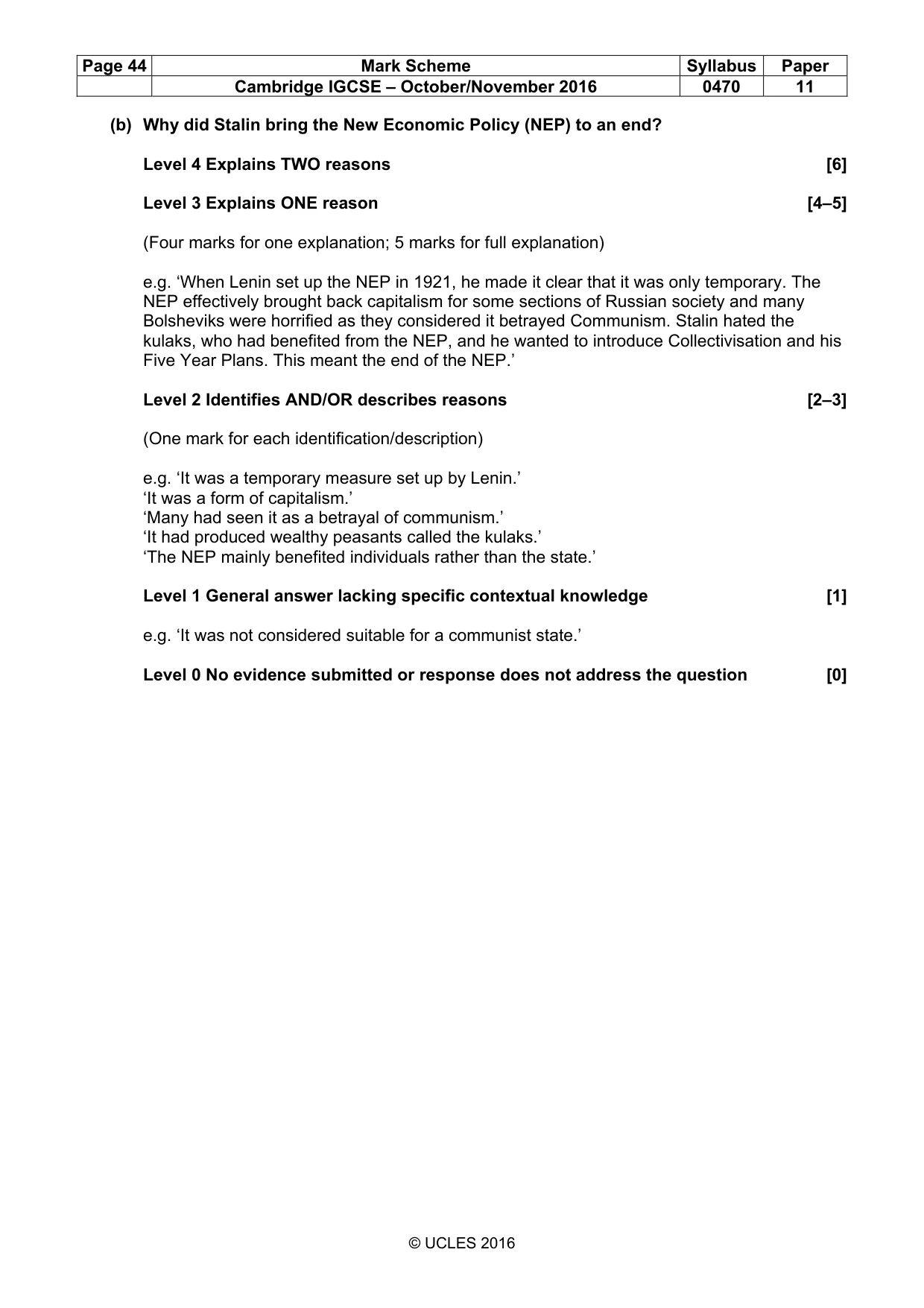
Page 44 Mark Scheme Syllabus Paper Cambridge IGCSE – October/November 2016 0470 11 © UCLES 2016 (b) Why did Stalin bring the New Economic Policy (NEP) to an end? Level 4 Explains TWO reasons [6] Level 3 Explains ONE reason [4–5] (Four marks for one explanation; 5 marks for full explanation) e.g. ‘When Lenin set up the NEP in 1921, he made it clear that it was only temporary. The NEP effectively brought back capitalism for some sections of Russian society and many Bolsheviks were horrified as they considered it betrayed Communism. Stalin hated the kulaks, who had benefited from the NEP, and he wanted to introduce Collectivisation and his Five Year Plans. This meant the end of the NEP.’ Level 2 Identifies AND/OR describes reasons [2–3] (One mark for each identification/description) e.g. ‘It was a temporary measure set up by Lenin.’ ‘It was a form of capitalism.’ ‘Many had seen it as a betrayal of communism.’ ‘It had produced wealthy peasants called the kulaks.’ ‘The NEP mainly benefited individuals rather than the state.’ Level 1 General answer lacking specific contextual knowledge [1] e.g. ‘It was not considered suitable for a communist state.’ Level 0 No evidence submitted or response does not address the question [0]
Mark scheme, page 45
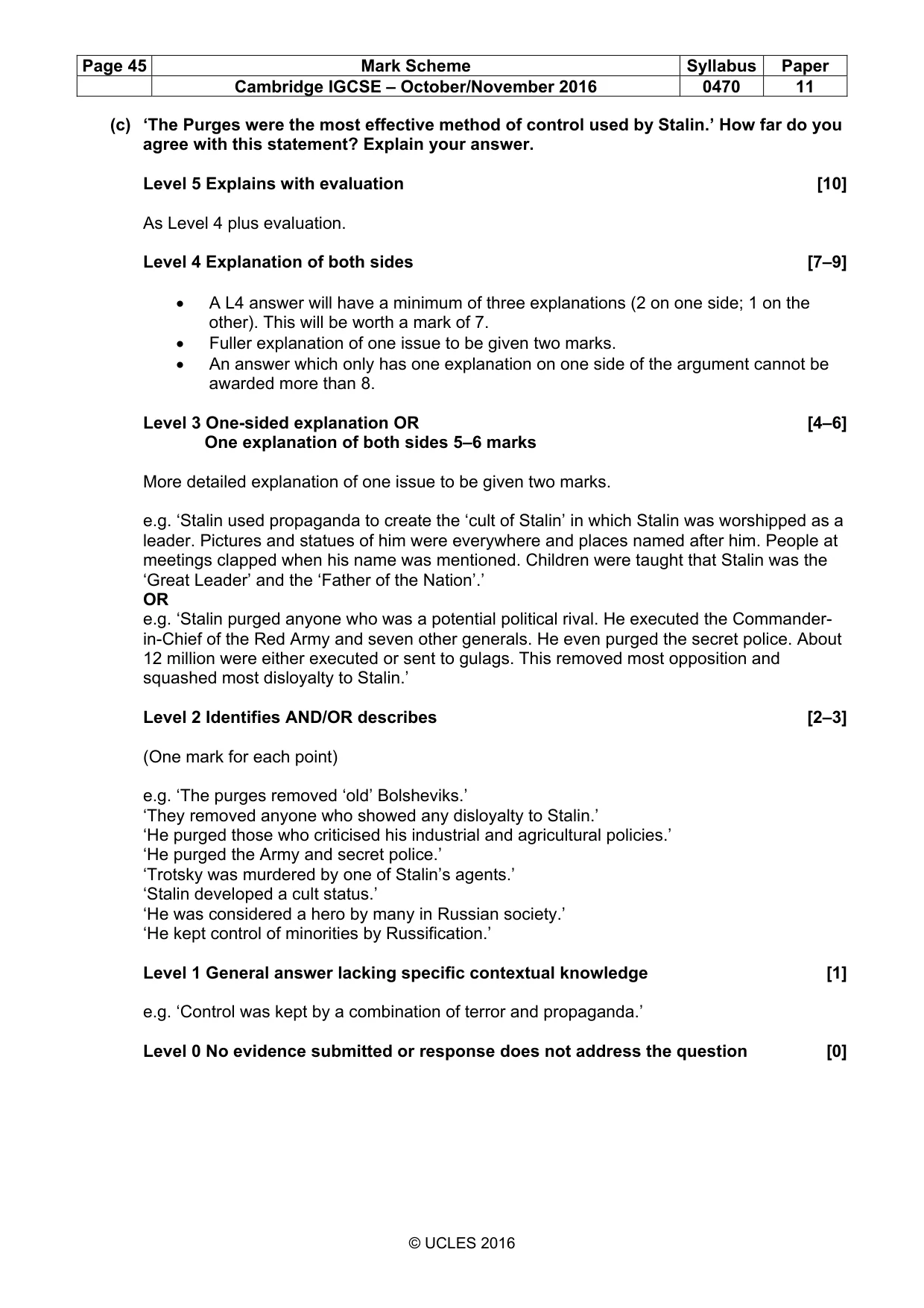
Page 45 Mark Scheme Syllabus Paper Cambridge IGCSE – October/November 2016 0470 11 © UCLES 2016 (c) ‘The Purges were the most effective method of control used by Stalin.’ How far do you agree with this statement? Explain your answer. Level 5 Explains with evaluation [10] As Level 4 plus evaluation. Level 4 Explanation of both sides [7–9] • A L4 answer will have a minimum of three explanations (2 on one side; 1 on the other). This will be worth a mark of 7. • Fuller explanation of one issue to be given two marks. • An answer which only has one explanation on one side of the argument cannot be awarded more than 8. Level 3 One-sided explanation OR [4–6] One explanation of both sides 5–6 marks More detailed explanation of one issue to be given two marks. e.g. ‘Stalin used propaganda to create the ‘cult of Stalin’ in which Stalin was worshipped as a leader. Pictures and statues of him were everywhere and places named after him. People at meetings clapped when his name was mentioned. Children were taught that Stalin was the ‘Great Leader’ and the ‘Father of the Nation’.’ OR e.g. ‘Stalin purged anyone who was a potential political rival. He executed the Commander- in-Chief of the Red Army and seven other generals. He even purged the secret police. About 12 million were either executed or sent to gulags. This removed most opposition and squashed most disloyalty to Stalin.’ Level 2 Identifies AND/OR describes [2–3] (One mark for each point) e.g. ‘The purges removed ‘old’ Bolsheviks.’ ‘They removed anyone who showed any disloyalty to Stalin.’ ‘He purged those who criticised his industrial and agricultural policies.’ ‘He purged the Army and secret police.’ ‘Trotsky was murdered by one of Stalin’s agents.’ ‘Stalin developed a cult status.’ ‘He was considered a hero by many in Russian society.’ ‘He kept control of minorities by Russification.’ Level 1 General answer lacking specific contextual knowledge [1] e.g. ‘Control was kept by a combination of terror and propaganda.’ Level 0 No evidence submitted or response does not address the question [0]
Mark scheme, page 46
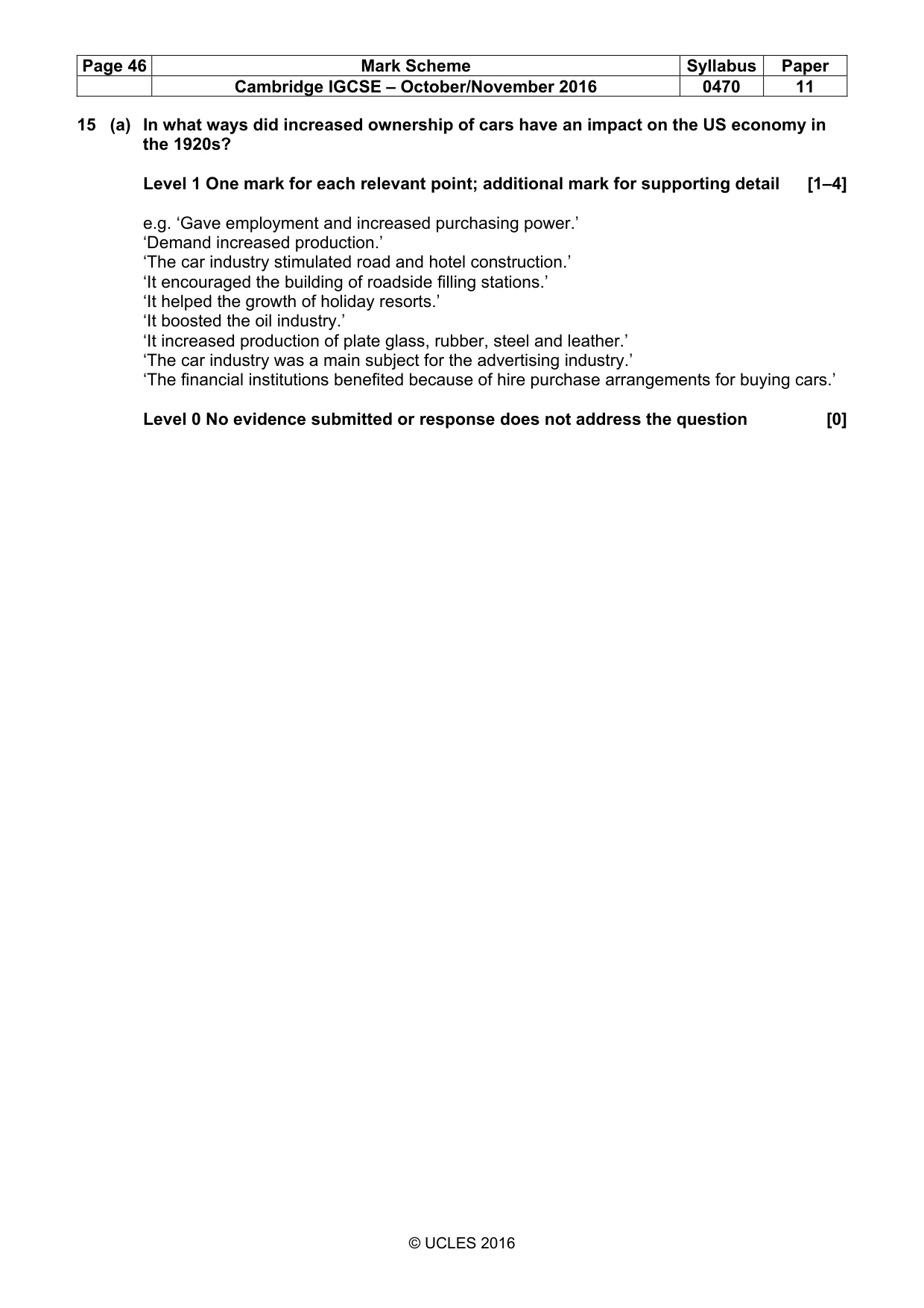
Page 46 Mark Scheme Syllabus Paper Cambridge IGCSE – October/November 2016 0470 11 © UCLES 2016 15 (a) In what ways did increased ownership of cars have an impact on the US economy in the 1920s? Level 1 One mark for each relevant point; additional mark for supporting detail [1–4] e.g. ‘Gave employment and increased purchasing power.’ ‘Demand increased production.’ ‘The car industry stimulated road and hotel construction.’ ‘It encouraged the building of roadside filling stations.’ ‘It helped the growth of holiday resorts.’ ‘It boosted the oil industry.’ ‘It increased production of plate glass, rubber, steel and leather.’ ‘The car industry was a main subject for the advertising industry.’ ‘The financial institutions benefited because of hire purchase arrangements for buying cars.’ Level 0 No evidence submitted or response does not address the question [0]
Mark scheme, page 47
Page 47 Mark Scheme Syllabus Paper Cambridge IGCSE – October/November 2016 0470 11 © UCLES 2016 (b) Why did most black Americans not benefit from the industrial boom? Level 4 Explains TWO reasons [6] Level 3 Explains ONE reason [4–5] (Four marks for one explanation; 5 marks for full explanation) e.g. ‘Most black Americans lived in the states of the South, such as Texas and Louisiana. They worked as sharecroppers or agricultural labourers. With the agricultural slump during the 1920s, many lost their jobs. Some stayed in the South in poverty and experienced racial discrimination. Others moved to the North to find employment. Most were employed in poorly paid jobs and they lived in slum areas. There was discrimination against black Americans in jobs, education and housing.’ Level 2 Identifies AND/OR describes reasons [2–3] (One mark for each identification/description) e.g. ‘They were not employed in industry.’ ‘Many were sharecroppers or labourers in farming.’ ‘There was an agricultural slump in the 1920s.’ ‘Most jobs were in the low pay sector such as domestic service or casual labouring.’ ‘High wage industries often operated a whites-only employment policy.’ ‘Black Americans met with considerable discrimination.’ ‘Lacked money for the new technologies/good housing.’ Level 1 General answer lacking specific contextual knowledge [1] e.g. ‘All vulnerable groups in society found it difficult to find work.’ Level 0 No evidence submitted or response does not address the question [0]
Mark scheme, page 48
Page 48 Mark Scheme Syllabus Paper Cambridge IGCSE – October/November 2016 0470 11 © UCLES 2016 (c) ‘The most important cause of the industrial boom was new technology.’ How far do you agree with this statement? Explain your answer. Level 5 Explains with evaluation [10] As Level 4 plus evaluation. Level 4 Explanation of both sides [7–9] • A L4 answer will have a minimum of three explanations (2 on one side; 1 on the other). This will be worth a mark of 7. • Fuller explanation of one issue to be given two marks. • An answer which only has one explanation on one side of the argument cannot be awarded more than 8. Level 3 One-sided explanation OR [4–6] One explanation of both sides 5–6 marks More detailed explanation of one issue to be given two marks. e.g. ‘After the war, there were important breakthroughs involving new products and means of production. The building industry benefited from new machines such as concrete mixers, pneumatic tools and power shovels. Communications were speeded up by automatic switchboards, dialphones and teletype machines. The start of radio broadcasting in 1921 created a demand for radios.’ OR e.g. ‘The Republican governments of the 1920s followed financial policies that were considered favourable to business with low taxes, high tariffs and an absence of regulation or government intervention.’ Level 2 Identifies AND/OR describes [2–3] (One mark for each point) e.g. ‘Advances in chemicals and synthetics brought rayon, Bakelite and cellophane.’ ‘The widespread availability of electricity meant homes and businesses had an efficient power source.’ ‘Mass production techniques increased productivity and reduced prices.’ ‘The Republican governments favoured policies supporting business.’ ‘Mass-marketing through adverts promoted the sale of goods.’ ‘The use of hire purchase meant payments could be made in instalments to buy a product.’ ‘The car industry employed large numbers and stimulated other industries.’ ‘The American economy emerged from the First World War strong and reinvigorated.’ ‘By 1900, the USA had a ready supply of oil, coal, iron and steel.’ ‘Stock market activity aided the boom.’ Level 1 General answer lacking specific contextual knowledge [1] e.g. ‘The USA had thriving industries before the 1920s.’ Level 0 No evidence submitted or response does not address the question [0]
Mark scheme, page 49
Page 49 Mark Scheme Syllabus Paper Cambridge IGCSE – October/November 2016 0470 11 © UCLES 2016 16 (a) In what ways did the US entertainment industry change in the 1920s? Level 1 One mark for each relevant point; additional mark for supporting detail [1–4] e.g. ‘Cinema increased significantly in popularity.’ ‘Hollywood produced a large number of films or ‘movies’.’ ‘Many new stars were created including Charlie Chaplin, Mary Pickford and Rudolph Valentino.’ ‘The cinema quickly discovered the selling power of sex.’ ‘In 1927 the first ‘talkie’ was made.’ ‘As variety theatres declined, radio provided a fresh start for many artists.’ ‘The choice of radio programmes rapidly grew in the ’20s.’ ‘The 1920s became known as the ‘Jazz Age’.’ ‘Jazz was linked to dance music and led to the opening of many night clubs.’ ‘Sport boomed during the 1920s, especially baseball.’ ‘Stars like Babe Ruth were created.’ ‘Baseball became a big money sport with legendary teams like the New York Yankees and the Boston Red Sox.’ ‘Boxing became increasingly popular with heroes like Jack Dempsey.’ Level 0 No evidence submitted OR response does not address the question [0]
Mark scheme, page 50
Page 50 Mark Scheme Syllabus Paper Cambridge IGCSE – October/November 2016 0470 11 © UCLES 2016 (b) Why were many Americans shocked by the lifestyle of modern American women? Level 4 Explains TWO reasons [6] Level 3 Explains ONE reason [4–5] (Four marks for one explanation; 5 marks for full explanation) e.g. ‘The 1920s brought a revolution in the role of some women. Some became known as “flappers”. These were often young, wealthy, middle and upper class women from the larger towns and cities. They were the “showy and noisy” minority. They went to wild parties in short skirts with plenty of drinking and smoking and energetic dances. Many women from rural areas were shocked by these changes or jealous!’ Level 2 Identifies AND/OR describes reasons [2–3] (One mark for each identification/description) e.g. ‘Some women began smoking (drinking and kissing) in public.’ ‘Many women went out without chaperones.’ ‘Short hair and make-up became symbols of the new freedom.’ ‘Some women abandoned (corsets and) long restrictive dresses.’ ‘They began wearing shorter (lighter) skirts and dresses.’ ‘The new fashions and materials allowed greater movement and self-expression.’ ‘Some women drove cars.’ ‘They went to outrageous parties.’ ‘They did dances like the Charleston (and the Black Bottom).’ Level 1 General answer lacking specific contextual knowledge [1] e.g. ‘It was so different from the pre-First World War lifestyle.’ Level 0 No evidence submitted or response does not address the question [0]
Mark scheme, page 51
Page 51 Mark Scheme Syllabus Paper Cambridge IGCSE – October/November 2016 0470 11 © UCLES 2016 (c) ‘Prohibition failed because most Americans did not support it.’ How far do you agree with this statement? Explain your answer. Level 5 Explains with evaluation [10] As Level 4 plus evaluation. Level 4 Explanation of both sides [7–9] • A L4 answer will have a minimum of three explanations (2 on one side; 1 on the other). This will be worth a mark of 7. • Fuller explanation of one issue to be given two marks. • An answer which only has one explanation on one side of the argument cannot be awarded more than 8. Level 3 One-sided explanation OR [4–6] One explanation of both sides 5–6 marks More detailed explanation of one issue to be given two marks. e.g. ‘Most Americans did not support Prohibition because the consumption of alcohol increased. Prohibition had the undesired effect of making alcohol more attractive. Illegal bars, called ‘speakeasies’, became common and drinking continued here behind closed doors.’ OR e.g. ‘Prohibition failed because it boosted crime. Organised gangs controlled the manufacture and sale of alcohol. They bribed policemen and government officials. There was much feuding between the gangs leading to incidents like the Valentine’s Day Massacre of 1929 when rival gang members were murdered by Al Capone’s gang.’ Level 2 Identifies AND/OR describes [2–3] (One mark for each point) e.g. ‘Consumption of alcohol increased during Prohibition.’ ‘Many Americans went to speakeasies.’ ‘Many brewed their own drink.’ ‘Drinking continued in the homes of the rich.’ ‘There were too many deaths from drinking ‘moonshine’.’ ‘It was impossible to prevent alcohol being smuggled into the USA.’ ‘‘Bootleg’ was smuggled in from the West Indies and Canada.’ ‘Prohibition boosted crime.’ ‘Organised gangs controlled the manufacture and sale of alcohol.’ ‘There were never enough enforcement agents.’ ‘It failed because of corruption.’ ‘Prohibition could not be enforced.’ ‘Judges, police and agents were often bribed.’ Level 1 General answer lacking specific contextual knowledge [1] e.g. ‘Prohibition did not work.’ Level 0 No evidence submitted or response does not address the question [0]
Mark scheme, page 52
Page 52 Mark Scheme Syllabus Paper Cambridge IGCSE – October/November 2016 0470 11 © UCLES 2016 17 (a) Describe how the Kuomintang established control over China by 1928. Level 1 One mark for each relevant point; additional mark for supporting detail [1–4] e.g. ‘Sun Yat-sen led the KMT after the First World War.’ ‘Sun worked in the south of China to gain a base for the KMT.’ ‘Twice Sun set up a government in Canton but was driven out by the warlords.’ ‘The Russians helped to improve Sun’s army in 1923.’ ‘Sun was not a Communist but he allowed them to join the KMT.’ ‘In 1925, Sun died and was succeeded by Chiang Kai-shek.’ ‘Chiang set out from Canton in 1926 on the Northern Expedition.’ ‘He took Shanghai, Hankow and Nanking from the warlords.’ ‘In 1927, Chiang turned on the Communists and ordered the Shanghai Massacres.’ ‘In late 1927, Chiang’s armies marched on Peking.’ ‘By 1928, Peking had been captured and the warlords had been defeated.’ ‘Chiang seemed to have united China under the control of the KMT.’ Level 0 No evidence submitted or response does not address the question [0]
Mark scheme, page 53
Page 53 Mark Scheme Syllabus Paper Cambridge IGCSE – October/November 2016 0470 11 © UCLES 2016 (b) Why did Chiang Kai-shek regard the Jiangxi Soviet as a threat? Level 4 Explains TWO reasons [6] Level 3 Explains ONE reason [4–5] (Four marks for one explanation; 5 marks for full explanation) e.g. ‘Chiang was concerned how popular the Jiangxi Soviet was with the ordinary peasants. The Communist soldiers treated the peasants well, unlike the KMT soldiers. The Red Army was instructed to pay for their food and to help peasants wherever they could. This concerned the KMT as the Communists seemed to be winning the propaganda war. The Soviet had to be destroyed because it ‘showed up’ the KMT.’ Level 2 Identifies AND/OR describes reasons [2–3] (One mark for each identification/description) e.g. ‘It was a remote mountain stronghold on the borders of Jiangxi and Hunan provinces.’ ‘Mao worked hard to govern the countryside.’ ‘Land was seized from the landlords and given to the poor peasants.’ ‘All debts were wiped out.’ ‘Soviets were formed to govern the countryside.’ ‘Many peasants joined the Red Army.’ ‘The Red Army numbered 11 000 by 1930.’ ‘The Red Army was trained in using guerrilla warfare.’ ‘The ‘hit and run’ tactics were costly in men for the KMT.’ Level 1 General answer lacking specific contextual knowledge [1] e.g. ‘The Communists were popular with the peasants.’ Level 0 No evidence submitted or response does not address the question [0]
Mark scheme, page 54
Page 54 Mark Scheme Syllabus Paper Cambridge IGCSE – October/November 2016 0470 11 © UCLES 2016 (c) How successful was the Long March for Mao? Explain your answer. Level 5 Explains with evaluation [10] As Level 4 plus evaluation. Level 4 Explanation of both sides [7–9] • A L4 answer will have a minimum of three explanations (2 on one side; 1 on the other). This will be worth a mark of 7. • Fuller explanation of one issue to be given two marks. • An answer which only has one explanation on one side of the argument cannot be awarded more than 8. Level 3 One-sided explanation OR [4–6] One explanation of both sides 5–6 marks More detailed explanation of one issue to be given two marks. e.g. ‘The Long March was about 6000 miles long through mountain ranges and across rivers. Of the 86 000 Communists who started the journey, only 8000 survived. So, losing nine tenths of your supporters cannot be called a success.’ OR e.g. ‘The Long March gained the Communists support. By travelling to rural China, the CCP was able to live and work alongside the Chinese peasantry. The peasants grew to support the Communists due to their work and co-operation with them. The Communists re- distributed land to the peasants.’ Level 2 Identifies AND/OR describes [2–3] (One mark for each point) e.g. ‘Mao lost 100 000 of his followers.’ ‘The Communists escaped from the KMT.’ ‘It meant the Communists survived and had a new base.’ ‘It gave the Party time to rebuild in a remote part of China.’ ‘It made Mao the new, unchallenged leader of the Communists.’ ‘Many Chinese saw the Communists as heroes and began supporting them.’ Level 1 General answer lacking specific contextual knowledge [1] e.g. ‘The Communist Party still existed in China.’ Level 0 No evidence submitted or response does not address the question [0]
Mark scheme, page 55
Page 55 Mark Scheme Syllabus Paper Cambridge IGCSE – October/November 2016 0470 11 © UCLES 2016 18 (a) What were the outcomes of the Hundred Flowers Campaign? Level 1 One mark for each relevant point; additional mark for supporting detail [1–4] e.g. ‘Mao wanted people to analyse the direction the country was heading in.’ ‘He invited criticism because it was good and healthy.’ ‘He encouraged people to speak out against the excesses they saw in China.’ ‘This led to thousands of opinions being raised.’ ‘Most criticisms were directed at Mao, leading politicians and the revolution itself.’ ‘The campaign was quickly suspended.’ ‘Mao may have used this campaign to flush out those who were willing to criticise his government.’ ‘Persecution of intellectuals, students, artists and professors quickly followed.’ ‘They were sent for ‘re-education’.’ Level 0 No evidence submitted or response does not address the question [0]
Mark scheme, page 56
Page 56 Mark Scheme Syllabus Paper Cambridge IGCSE – October/November 2016 0470 11 © UCLES 2016 (b) Why did Mao want the Cultural Revolution to sweep away old ways of doing things? Level 4 Explains TWO reasons [6] Level 3 Explains ONE reason [4–5] (Four marks for one explanation; 5 marks for full explanation) e.g. ‘Mao was concerned that the revolution in China was heading towards a Soviet model, where certain groups became more powerful and privileged. He wanted to stop this. Mao wanted peasants, workers and educated people to work together and create a classless society where everybody was equal.’ Level 2 Identifies AND/OR describes reasons [2–3] (One mark for each identification/description) e.g. ‘Mao had lost his power since the failure of the Great Leap Forward.’ ‘A new movement would re-establish Mao’s influence.’ ‘Mao saw Liu Shaoqi, the State Chairman of China, as a threat to what Mao had achieved.’ ‘Mao was concerned that elements of capitalism, such as private trade, had made some people richer than others.’ ‘The young did not seem to have the enthusiasm for the communist model.’ ‘Too many poorly educated and less well off were turning against the spirit of the revolution.’ ‘Mao wanted to refresh the revolution.’ ‘Mao wanted a more equal society.’ Level 1 General answer lacking specific contextual knowledge [1] e.g. ‘Mao wanted to re-impose his authority.’ Level 0 No evidence submitted or response does not address the question [0]
Mark scheme, page 57
Page 57 Mark Scheme Syllabus Paper Cambridge IGCSE – October/November 2016 0470 11 © UCLES 2016 (c) ‘The greatest impact of the Cultural Revolution was on the youth of China.’ How far do you agree with this statement? Explain your answer. Level 5 Explains with evaluation [10] As Level 4 plus evaluation. Level 4 Explanation of both sides [7–9] • A L4 answer will have a minimum of three explanations (2 on one side; 1 on the other). This will be worth a mark of 7. • Fuller explanation of one issue to be given two marks. • An answer which only has one explanation on one side of the argument cannot be awarded more than 8. Level 3 One-sided explanation OR [4–6] One explanation of both sides 5–6 marks More detailed explanation of one issue to be given two marks. e.g. ‘The closure of schools and colleges led to a lowering of academic standards. Some counties had illiteracy rates as high as 40% twenty years after the revolution. The elimination of qualified teachers meant many areas were forced to rely upon chosen students to re- educate the next generation.’ OR e.g. ‘Millions of young people joined the Red Guards. Youngsters were expected to question their parents and teachers, although this had been forbidden in traditional Chinese culture. Slogans such as ‘Parents may love me, but not as much as Chairman Mao’ were common. Unfortunately, millions of young people had no formal education during the Cultural Revolution.’ Level 2 Identifies AND/OR describes [2–3] (One mark for each point) e.g. ‘Millions of people were persecuted during the Cultural Revolution.’ ‘Schools and colleges were closed, lowering educational standards.’ ‘Millions of students formed the Red Guards.’ ‘Historic sites, artefacts and museum pieces were destroyed.’ ‘People were encouraged to question their parents and teachers.’ ‘Traditional Chinese traditions and classical Chinese literature were discouraged.’ ‘Red Guards attacks on foreigners were common.’ Level 1 General answer lacking specific contextual knowledge [1] e.g. ‘All sections of society were affected.’ Level 0 No evidence submitted or response does not address the question [0]
Mark scheme, page 58
Page 58 Mark Scheme Syllabus Paper Cambridge IGCSE – October/November 2016 0470 11 © UCLES 2016 19 (a) By 1940, what restrictions had been placed on the rights of black people by the Land Acts? Level 1 One mark for each relevant point; additional mark for supporting detail [1–4] e.g. ‘90% of black people were forced to live in rural areas.’ ‘By 1936, black people were allocated 13% of the land in South Africa.’ ‘The reservations for black people had the least productive land.’ ‘Black people were not allowed to buy or rent land outside their reservations.’ ‘As a result of the Natives Land Act, African farming gradually collapsed.’ ‘The reserves were so over-populated that water-holes dried up and there was soil erosion.’ ‘As a result of the Land Acts, the reserves became a source of cheap, unskilled labour for white farmers and industrialists.’ Level 0 No evidence submitted or response does not address the question [0]
Mark scheme, page 59
Page 59 Mark Scheme Syllabus Paper Cambridge IGCSE – October/November 2016 0470 11 © UCLES 2016 (b) Why was the pass system hated by black South Africans? Level 4 Explains TWO reasons [6] Level 3 Explains ONE reason [4–5] (Four marks for one explanation; 5 marks for full explanation) e.g. ‘The system was used by the authorities to control and monitor the movement of black Africans. White farmers used passes to ensure their African labourers completed their work contracts as it was illegal for them to leave the farms without a pass. Passes were also used to ensure that black people moved out of the towns as soon as their work was completed.’ Level 2 Identifies AND/OR describes reasons [2–3] (One mark for each identification/description) e.g. ‘The pass system did not apply to white people.’ ‘It restricted freedom around the country.’ ‘It carried personal and work details.’ ‘The pass book had to be presented to the police on demand.’ ‘Failure to produce a pass book could lead to jail.’ ‘The system controlled the movement of black people.’ Level 1 General answer lacking specific contextual knowledge [1] e.g. ‘It did not seem fair.’ Level 0 No evidence submitted or response does not address the question [0]
Mark scheme, page 60
Page 60 Mark Scheme Syllabus Paper Cambridge IGCSE – October/November 2016 0470 11 © UCLES 2016 (c) ‘The policies of the United Party were the main reason for the success of the National Party in the 1948 election.’ How far do you agree with this statement? Explain your answer. Level 5 Explains with evaluation [10] As Level 4 plus evaluation. Level 4 Explanation of both sides [7–9] • A L4 answer will have a minimum of three explanations (2 on one side; 1 on the other). This will be worth a mark of 7. • Fuller explanation of one issue to be given two marks. • An answer which only has one explanation on one side of the argument cannot be awarded more than 8. Level 3 One-sided explanation OR [4–6] One explanation of both sides 5–6 marks More detailed explanation of one issue to be given two marks. e.g. ‘During the Second World War, many white people were called away to fight and many black people moved to the cities to take up skilled and semi-skilled jobs. The approach of the United Party to the racial question was that black people were in the cities to stay and that complete segregation was impracticable. This was not reassuring for most Afrikaners.’ OR e.g. ‘The Nationalist Party’s policy towards the position of non-whites was the continuation and extension of segregation or apartheid across all areas of social and economic activity. This is what the Afrikaners wanted.’ Level 2 Identifies AND/OR describes [2–3] (One mark for each point) e.g. ‘The United Party wanted to relax segregation.’ ‘Jan Smuts of the United Party was 78 and regarded as out of touch.’ ‘Smuts supported equal rights and liberty.’ ‘The Nationalist Party believed in segregation in all areas.’ ‘Daniel Malan supported the Sauer Report which favoured apartheid.’ Level 1 General answer lacking specific contextual knowledge [1] e.g. ‘The United Party won the popular vote but not the number of seats.’ Level 0 No evidence submitted or response does not address the question [0]
Mark scheme, page 61
Page 61 Mark Scheme Syllabus Paper Cambridge IGCSE – October/November 2016 0470 11 © UCLES 2016 20 (a) Describe the Soweto Riots of 1976. Level 1 One mark for each relevant point; additional mark for supporting detail [1–4] e.g. ‘Black high school students protested because all black schools were forced to use Afrikaans for half their subjects.’ ‘In April 1976, the children at Orlando West School went on strike.’ ‘Their rebellion spread to many other schools in Soweto.’ ‘On 16th of June, thousands of black students marched to attend a rally at Orlando Stadium.’ ‘They were protesting against having to learn through Afrikaans in school.’ ‘Teachers in Soweto supported the march.’ ‘The police had barricaded the road along their intended route.’ ‘The marchers took a different route to Orlando School.’ ‘The police set their dog on the protesters who killed it.’ ‘The police fired directly at the children.’ ‘Officially, 23 were killed but unofficial figures range from 176 to 700.’ ‘Soweto was swamped with police on the 17th of June and the South African Army was put on standby.’ Level 0 No evidence submitted or response does not address the question [0]
Mark scheme, page 62
Page 62 Mark Scheme Syllabus Paper Cambridge IGCSE – October/November 2016 0470 11 © UCLES 2016 (b) Why did Botha think reforms were necessary in the 1970s and 1980s? Level 4 Explains TWO reasons [6] Level 3 Explains ONE reason [4–5] (Four marks for one explanation; 5 marks for full explanation) e.g. ‘Botha thought reforms were necessary because employers wanted a definite and recognised body with which to negotiate and were upset by the number of unofficial strikes. They wanted an end to job reservations for white people as they were suffering from shortages of skilled labour.’ Level 2 Identifies AND/OR describes reasons [2–3] (One mark for each identification/description) e.g. ‘There were not enough skilled black workers for industry.’ ‘Botha felt the country was under siege from abroad and within.’ ‘At home, Botha wanted to apply the law but introduce moderate reforms.’ ‘He felt he needed to raid ANC bases abroad.’ ‘Botha thought he needed to exploit western concerns about communism.’ ‘Botha thought South Africa was under ‘Total Onslaught’.’ Level 1 General answer lacking specific contextual knowledge [1] e.g. ‘Apartheid needed reform to help industry.’ Level 0 No evidence submitted or response does not address the question [0]
Mark scheme, page 63
Page 63 Mark Scheme Syllabus Paper Cambridge IGCSE – October/November 2016 0470 11 © UCLES 2016 (c) ‘International pressure was responsible for bringing minority rule to an end.’ How far do you agree with this statement? Explain your answer. Level 5 Explains with evaluation [10] As Level 4 plus evaluation. Level 4 Explanation of both sides [7–9] • A L4 answer will have a minimum of three explanations (2 on one side; 1 on the other). This will be worth a mark of 7. • Fuller explanation of one issue to be given two marks. • An answer which only has one explanation on one side of the argument cannot be awarded more than 8. Level 3 One-sided explanation OR [4–6] One explanation of both sides 5–6 marks More detailed explanation of one issue to be given two marks. e.g. ‘By 1989, there was almost civil war in South Africa. The verdict of many international businessmen and industrialists was to leave South Africa. Firms that pulled out at this time included Barclays, ESSO, IBM, Peugeot and Pepsi Cola.’ OR e.g. ‘The ANC launched attacks on government buildings and power installations from bases outside South Africa, especially Zimbabwe where white rule had ended. Between 1986 and 1988 the ANC was responsible for more than a hundred explosions, causing 31 deaths and 565 injuries in city centre streets, restaurants, cinemas, shops and sporting venues.’ Level 2 Identifies AND/OR describes [2–3] (One mark for each point) e.g. ‘The UN condemned apartheid annually.’ ‘There was an arms embargo against South Africa.’ ‘International sanctions were not effective.’ ‘The pressure brought by individuals, such as Tutu, was significant.’ ‘There was an upsurge in violence in the 1980s and early 1990s.’ ‘The government failed to regain control over the black townships.’ Level 1 General answer lacking specific contextual knowledge [1] e.g. ‘It was the continued violence which was the determining factor.’ Level 0 No evidence submitted or response does not address the question [0]
Mark scheme, page 64
Page 64 Mark Scheme Syllabus Paper Cambridge IGCSE – October/November 2016 0470 11 © UCLES 2016 21 (a) Describe the actions of the Irgun during the years 1946 and 1947. Level 1 One mark for each relevant point; additional mark for supporting detail [1–4] e.g. ‘Irgun targeted British military bases.’ ‘Irgun attacked bridges, railway stations and trains.’ ‘In April 1946, six British soldiers were murdered.’ ‘In July 1946, Irgun attacked the King David Hotel in Jerusalem.’ ‘It was targeted because it was the British military headquarters in Palestine.’ ‘Irgun brought down a whole wing of the hotel killing 92 people.’ ‘20 British soldiers were killed in the officers’ club in Jerusalem in February 1947.’ ‘Two British soldiers were hung by Irgun in retaliation for the execution of three Irgun members.’ Level 0 No evidence submitted or response does not address the question [0]
Mark scheme, page 65
Page 65 Mark Scheme Syllabus Paper Cambridge IGCSE – October/November 2016 0470 11 © UCLES 2016 (b) Why did the Palestinian Arabs oppose a Jewish state in Palestine? Level 4 Explains TWO reasons [6] Level 3 Explains ONE reason [4–5] (Four marks for one explanation; 5 marks for full explanation) e.g. ‘The Arab state would be divided into three zones. It would have no direct access to the sea as Jaffa, the main Arab port, would be cut off from the rest of the Arab land. Its land was mostly desert country, making it difficult to farm.’ Level 2 Identifies AND/OR describes reasons [2–3] (One mark for each identification/description) e.g. ‘The Palestinian Arabs thought it was their land.’ ‘The UN proposal meant the Arab territories would consist of three geographically separate areas.’ ‘The Jews would be given over half the land.’ ‘The Palestinian Arabs were two-thirds of the population.’ ‘A very large number of Arabs would be based in the Jewish state.’ ‘The Arabs thought the western powers should find a home for the Jews elsewhere.’ ‘Jerusalem would be governed by an international trusteeship.’ Level 1 General answer lacking specific contextual knowledge [1] e.g. ‘The Jews would have most of the advantages.’ Level 0 No evidence submitted or response does not address the question [0]
Mark scheme, page 66
Page 66 Mark Scheme Syllabus Paper Cambridge IGCSE – October/November 2016 0470 11 © UCLES 2016 (c) ‘The impact of the War of 1948–49 was more significant for the Palestinians than for the Israelis.’ How far do you agree with this statement? Explain your answer. Level 5 Explains with evaluation [10] As Level 4 plus evaluation. Level 4 Explanation of both sides [7–9] • A L4 answer will have a minimum of three explanations (2 on one side; 1 on the other). This will be worth a mark of 7. • Fuller explanation of one issue to be given two marks. • An answer which only has one explanation on one side of the argument cannot be awarded more than 8. Level 3 One-sided explanation OR [4–6] One explanation of both sides 5–6 marks More detailed explanation of one issue to be given two marks. e.g. ‘The entire Palestinian Arab population was now divided between the five Arab nations and two areas of Palestine not taken over by Israel, the West Bank and Gaza. Around 700 000 Arabs had fled their homes and many were now living in refugee camps.’ OR e.g. ‘Israel had secured its state and its future. The Israelis had shown they had the high quality armed forces to defend their territory, while the Arab forces were inexperienced and poorly led. It meant that the Palestinian Arabs would find it difficult to overturn the Israeli state.’ Level 2 Identifies AND/OR describes [2–3] (One mark for each point) e.g. ‘Israel had established its state.’ ‘Israel increased its territory by over 20%.’ ‘Britain, France and the USA agreed to protect Israel in the future.’ ‘Israel had lost 4000 soldiers and 2000 civilians.’ ‘The Palestinians had failed to destroy Israel.’ ‘The hope of forming their own state for Palestinians had been destroyed.’ ‘Palestinian Arabs were now scattered across the Middle East.’ Level 1 General answer lacking specific contextual knowledge [1] e.g. ‘It was a catastrophe for the Palestinian Arabs.’ Level 0 No evidence submitted or response does not address the question [0]
Mark scheme, page 67
Page 67 Mark Scheme Syllabus Paper Cambridge IGCSE – October/November 2016 0470 11 © UCLES 2016 22 (a) Describe conditions in Palestinian refugee camps set up after the 1948–49 War. Level 1 One mark for each relevant point; additional mark for supporting detail [1–4] e.g. ‘Conditions were overcrowded.’ ‘There was a lack of basic facilities.’ ‘Life was difficult.’ ‘An overcrowded area of tents.’ ‘Limited space for children to play.’ ‘Areas without water, electricity and sewers.’ ‘Deaths were common from malnutrition and disease.’ ‘Limited rations and welfare services provided by the UN.’ ‘It was difficult to find employment.’ ‘There were possibilities of epidemics.’ Level 0 No evidence submitted or response does not address the question [0]
Mark scheme, page 68
Page 68 Mark Scheme Syllabus Paper Cambridge IGCSE – October/November 2016 0470 11 © UCLES 2016 (b) Why, by the time the British withdrew, had many Palestinians fled from their homeland? Level 4 Explains TWO reasons [6] Level 3 Explains ONE reason [4–5] (Four marks for one explanation; 5 marks for full explanation) e.g. ‘In April 1948, Irgun fighters, led by Menachem Begin, attacked the village of Deir Yassin and killed the inhabitants. The effect of this incident was dramatic. In other towns and villages the Arabs began to flee in terror even before they clashed with Jewish forces.’ Level 2 Identifies AND/OR describes reasons [2–3] (One mark for each identification/description) e.g. ‘Haganah, the Jewish defence force, came up with Plan D in March 1948.’ ‘This was to take over British bases when they left Palestine.’ ‘It was also to expel as many Palestinians as possible from the future Jewish state.’ ‘Many Palestinian businessmen and landowners began to leave and this encouraged others to leave.’ ‘In April 1948, Jewish forces forcibly expelled Arabs from villages inside what would be the Jewish state.’ ‘In Jaffa and Haifa, explosions were set off by Jewish forces in Arab areas.’ ‘In April 1948, there was bitter fighting around Jerusalem.’ ‘News of Jewish atrocities frightened Arabs into fleeing.’ Level 1 General answer lacking specific contextual knowledge [1] e.g. ‘Over 300 000 Arabs had left the new Jewish state area.’ Level 0 No evidence submitted or response does not address the question [0]
Mark scheme, page 69
Page 69 Mark Scheme Syllabus Paper Cambridge IGCSE – October/November 2016 0470 11 © UCLES 2016 (c) ‘The Palestine Liberation Organisation (PLO) has successfully supported Palestinian interests.’ How far do you agree with this statement? Explain your answer. Level 5 Explains with evaluation [10] As Level 4 plus evaluation. Level 4 Explanation of both sides [7–9] • A L4 answer will have a minimum of three explanations (2 on one side; 1 on the other). This will be worth a mark of 7. • Fuller explanation of one issue to be given two marks. • An answer which only has one explanation on one side of the argument cannot be awarded more than 8. Level 3 One-sided explanation OR [4–6] One explanation of both sides 5–6 marks More detailed explanation of one issue to be given two marks. e.g. ‘In the 1960s and early 1970s most western powers considered the PLO as a terrorist group because of the atrocities they committed such as the killing of 11 Israeli athletes at the Munich Olympic Games or the hijacking of four planes to be flown to Jordan and blown up. This brought little external support for the Palestinian cause.’ OR e.g. ‘Fortunes improved for the PLO in 1974 when it was recognised by the Arab League as the sole legitimate representative of the Palestinian people and Yasser Arafat was allowed to address the United Nations to explain the Palestinian cause.’ Level 2 Identifies AND/OR describes [2–3] (One mark for each point) e.g. ‘The PLO’s violence created publicity in the 1960s and early 1970s.’ ‘Many countries considered the PLO as terrorists.’ ‘The Arab League accepted the PLO as representing the Palestinians.’ ‘In 1974 Arafat addressed the UN.’ ‘In 1988 Arafat accepted the existence of Israel and rejected terrorism.’ ‘The PLO took part in talks in Madrid and Oslo but there were no final outcomes.’ ‘The PLO could not achieve an independent state for Palestinians.’ Level 1 General answer lacking specific contextual knowledge [1] e.g. ‘It failed to achieve the reason it was formed.’ Level 0 No evidence submitted or response does not address the question [0]
What you needed in this session
Cambridge’s own grade thresholds for 2016 Oct/Nov, Paper 1 · Variant 1. A higher threshold means an easier paper — the bar moves with how the cohort did.