Cambridge IGCSE History 0470 — 2016 Oct/Nov Paper 1 · Variant 2
0470/12/O/N/16 · 60 marks · ≈68 min
The question paper and its mark scheme, free to read here and free to download. This is Cambridge’s own paper, exactly as it was sat.
Question paper12 pages

Mark scheme68 pages
Answers below. Sit the paper first if you are practising.
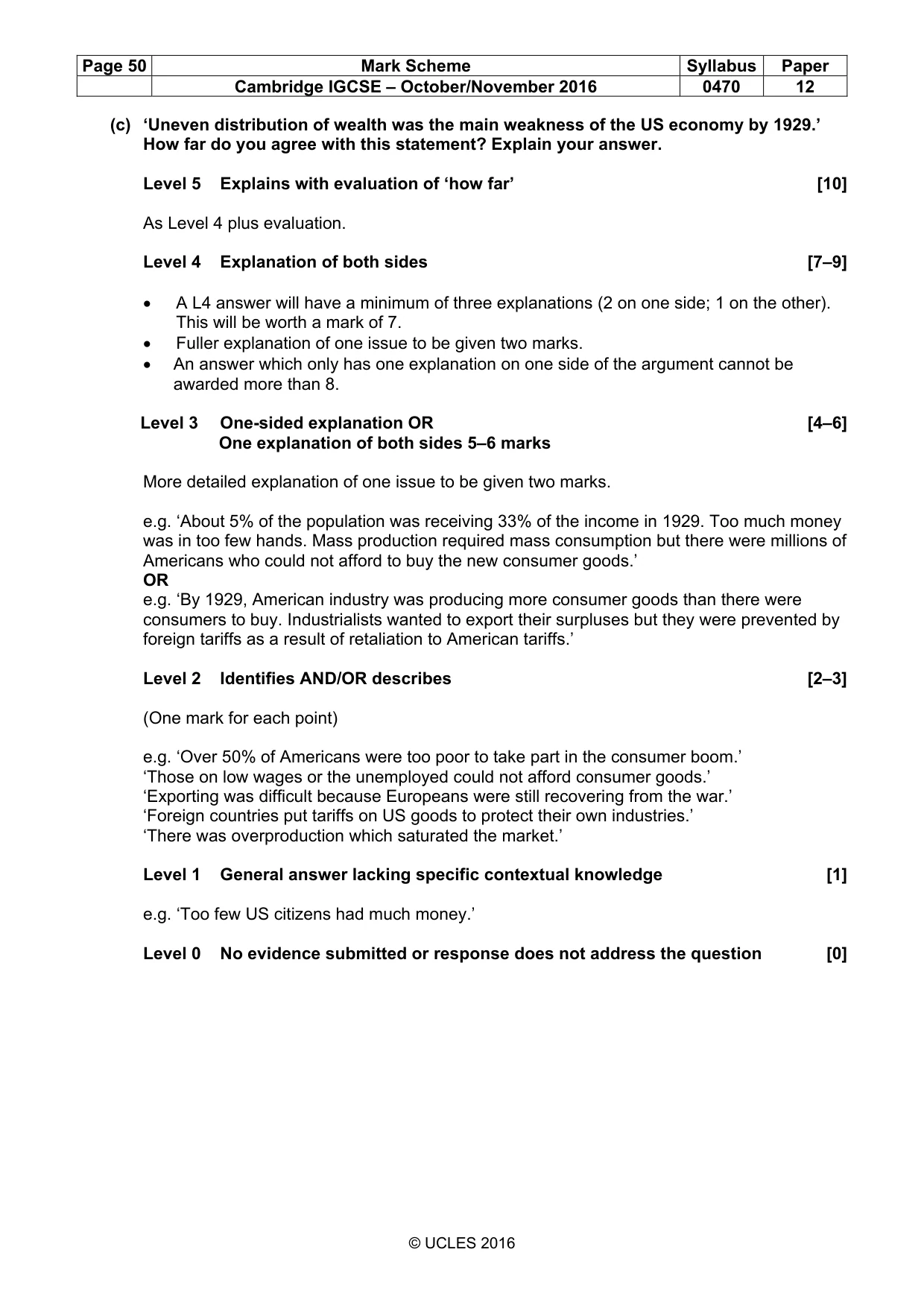
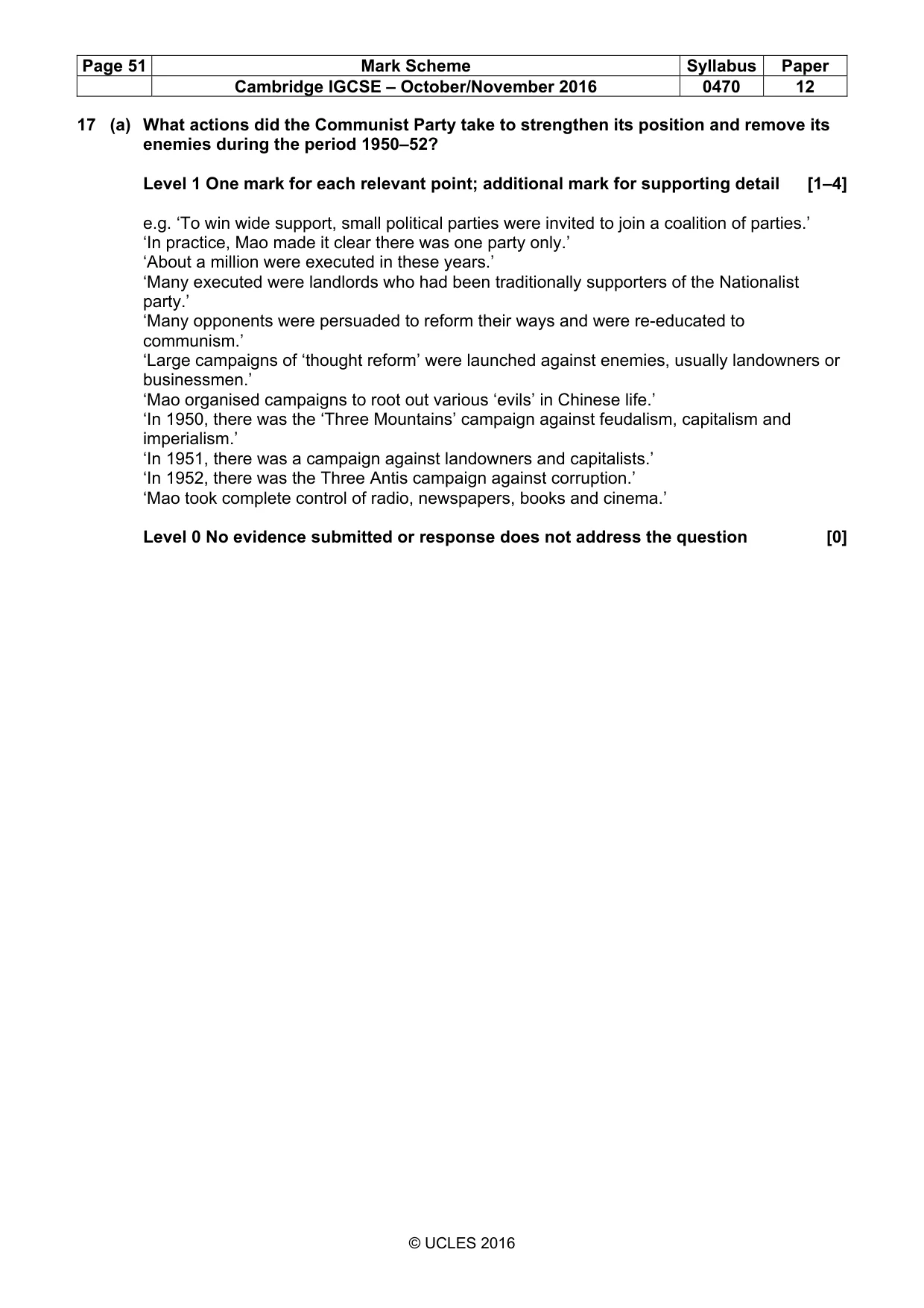
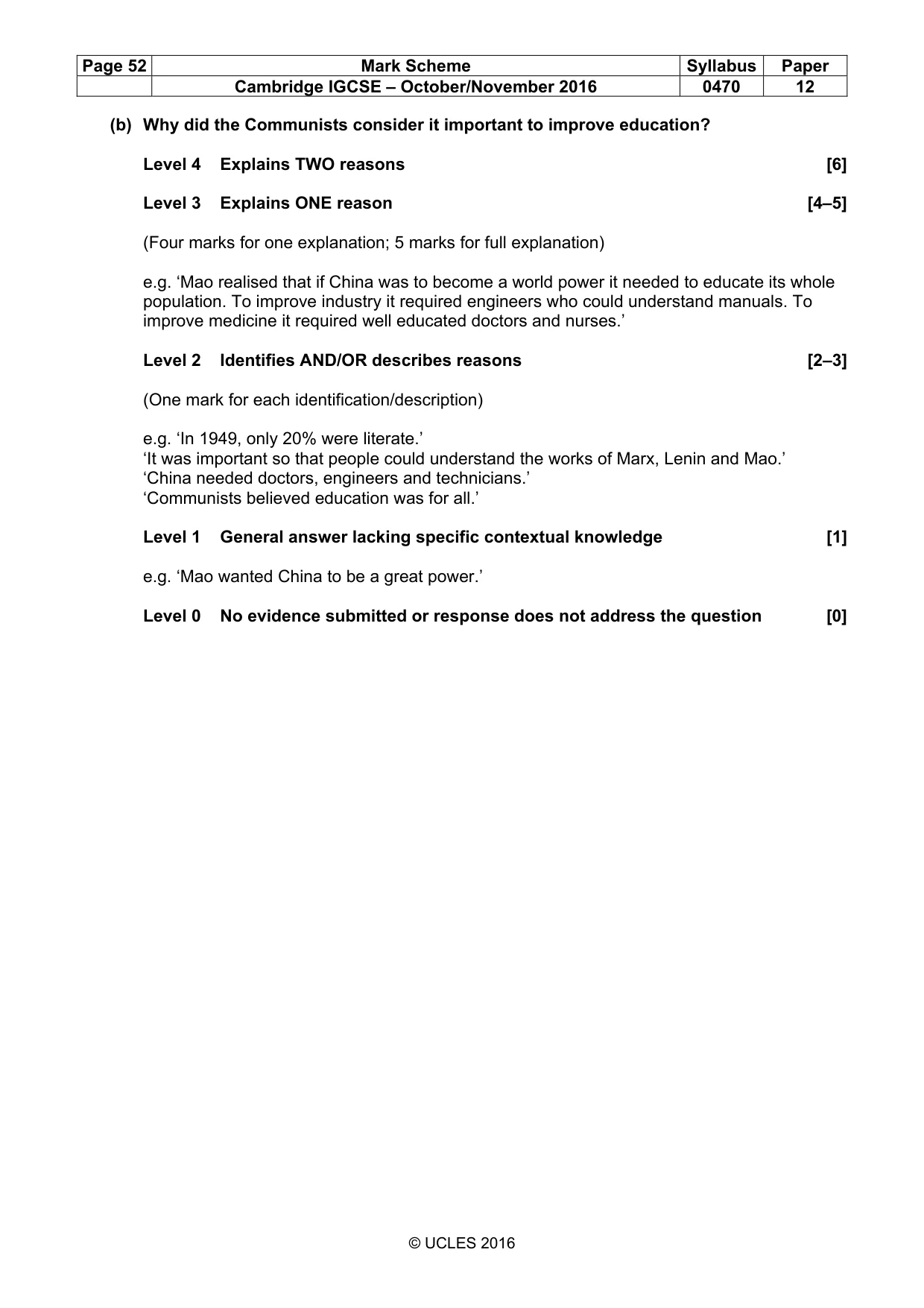
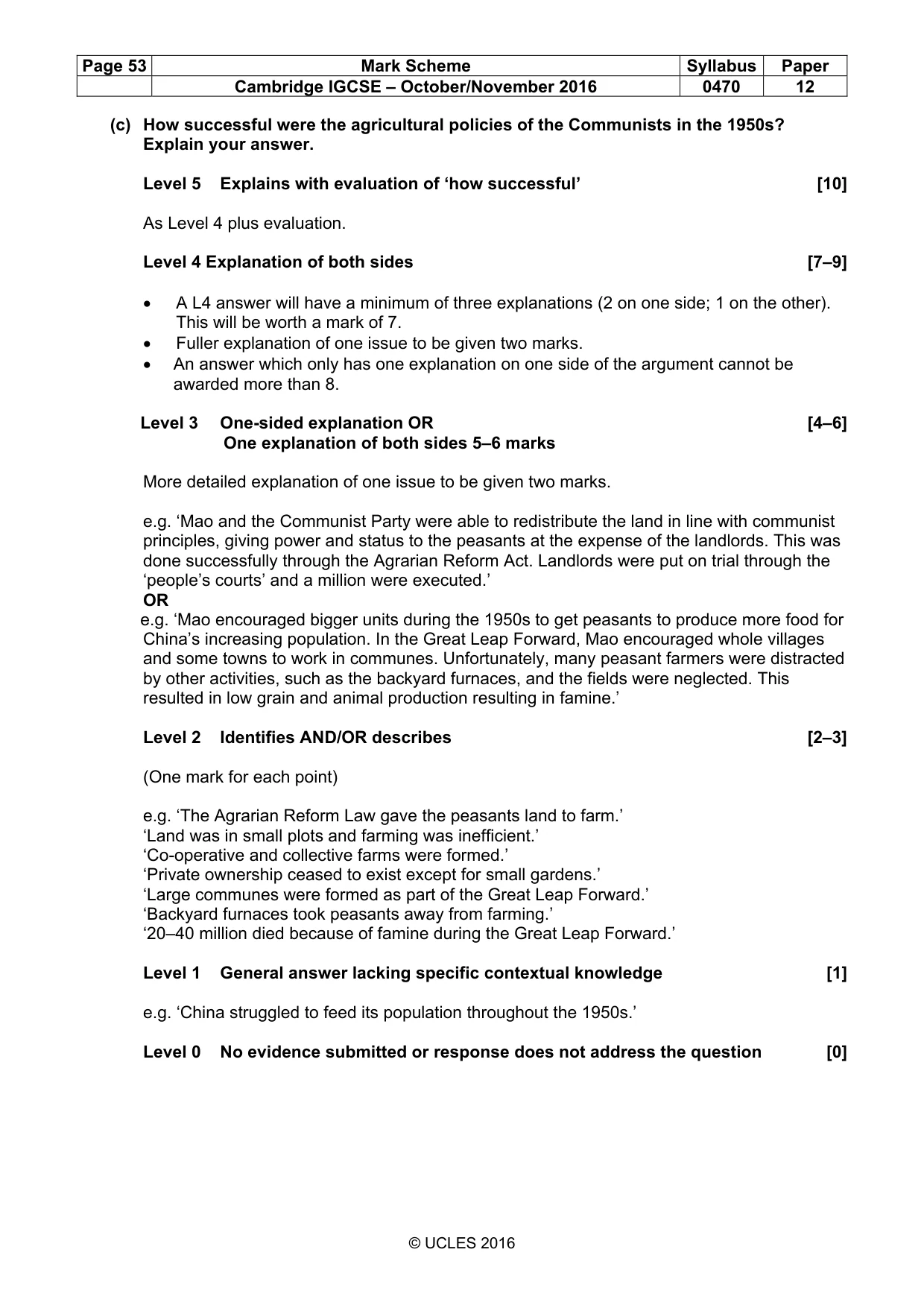
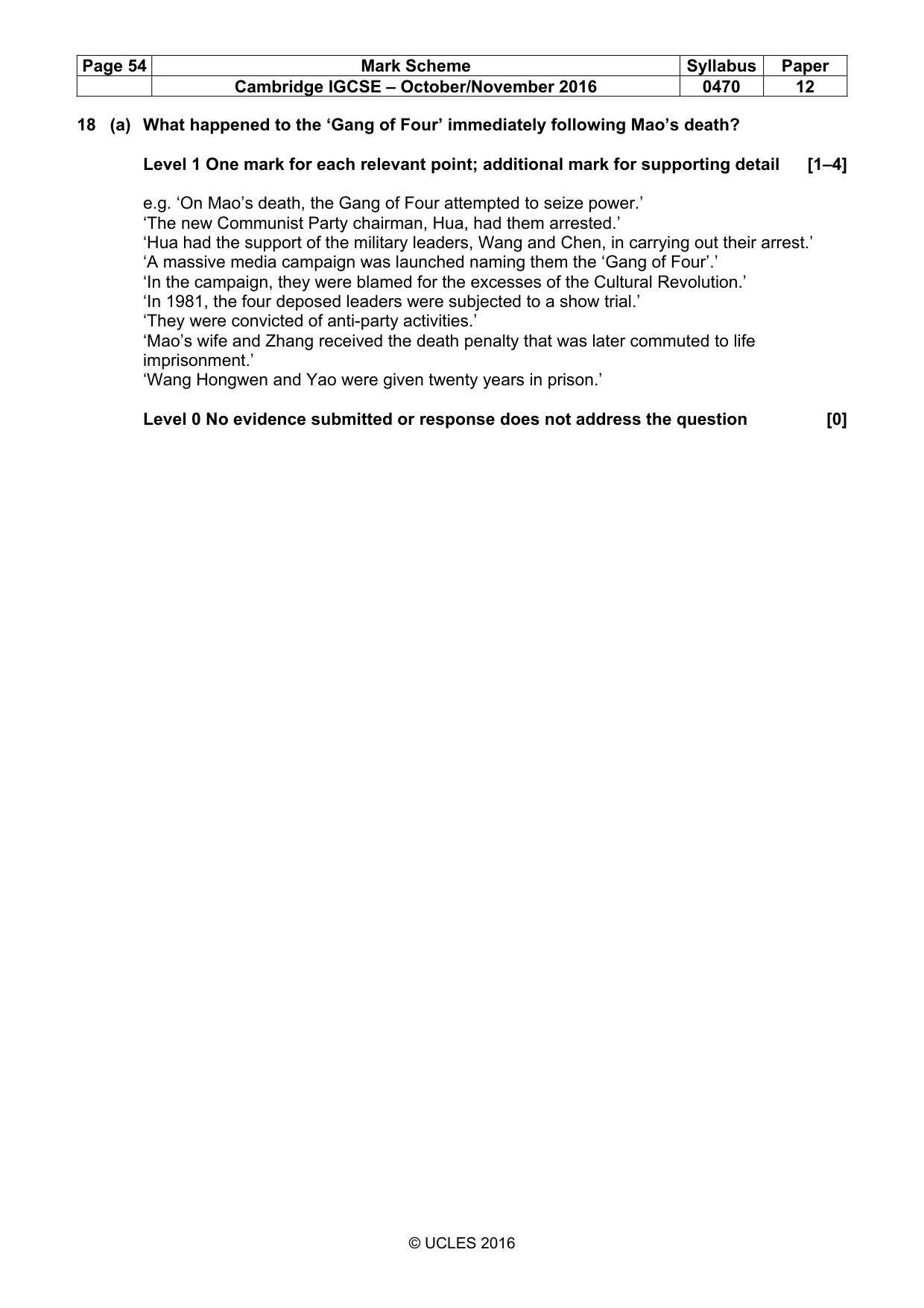
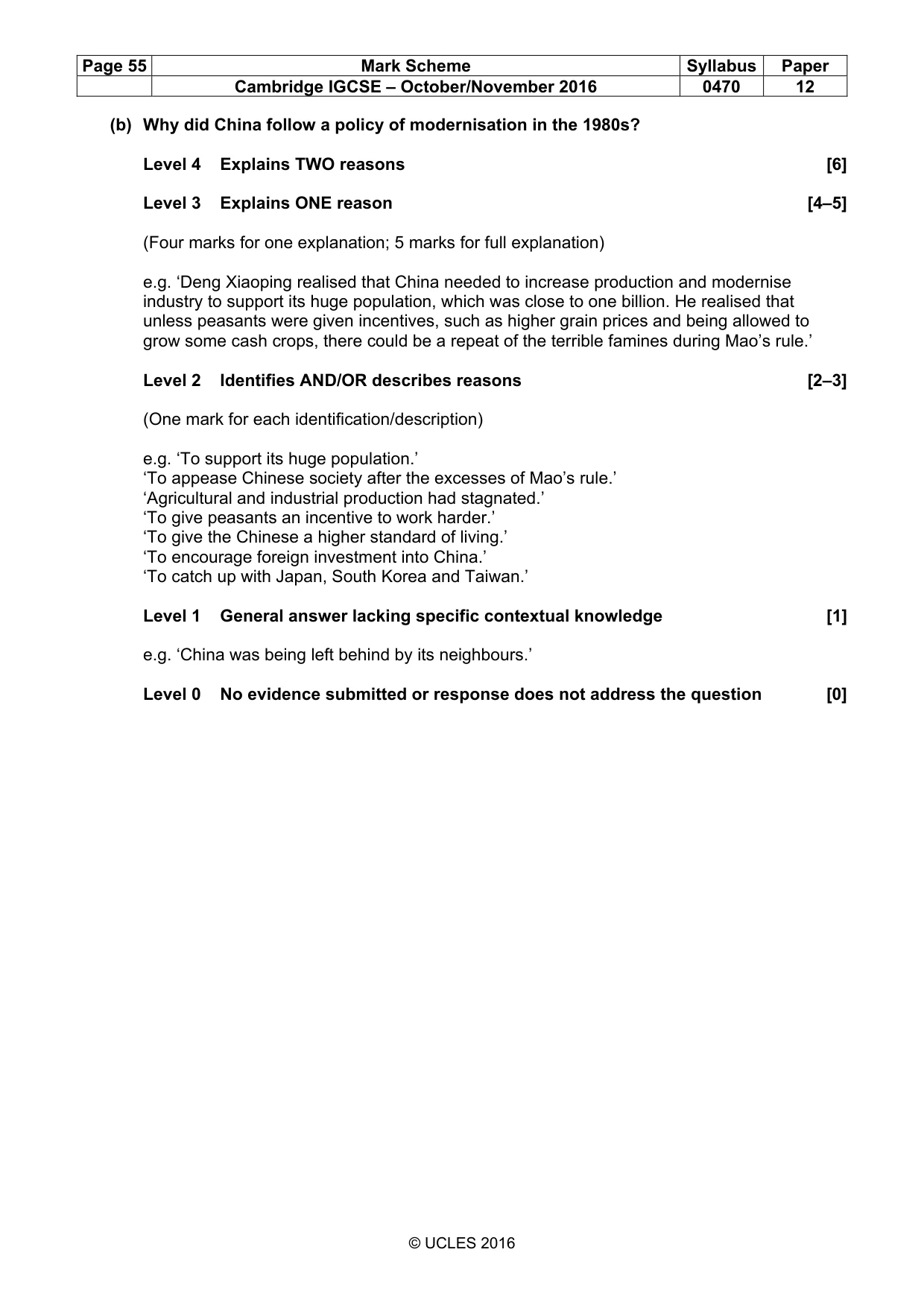
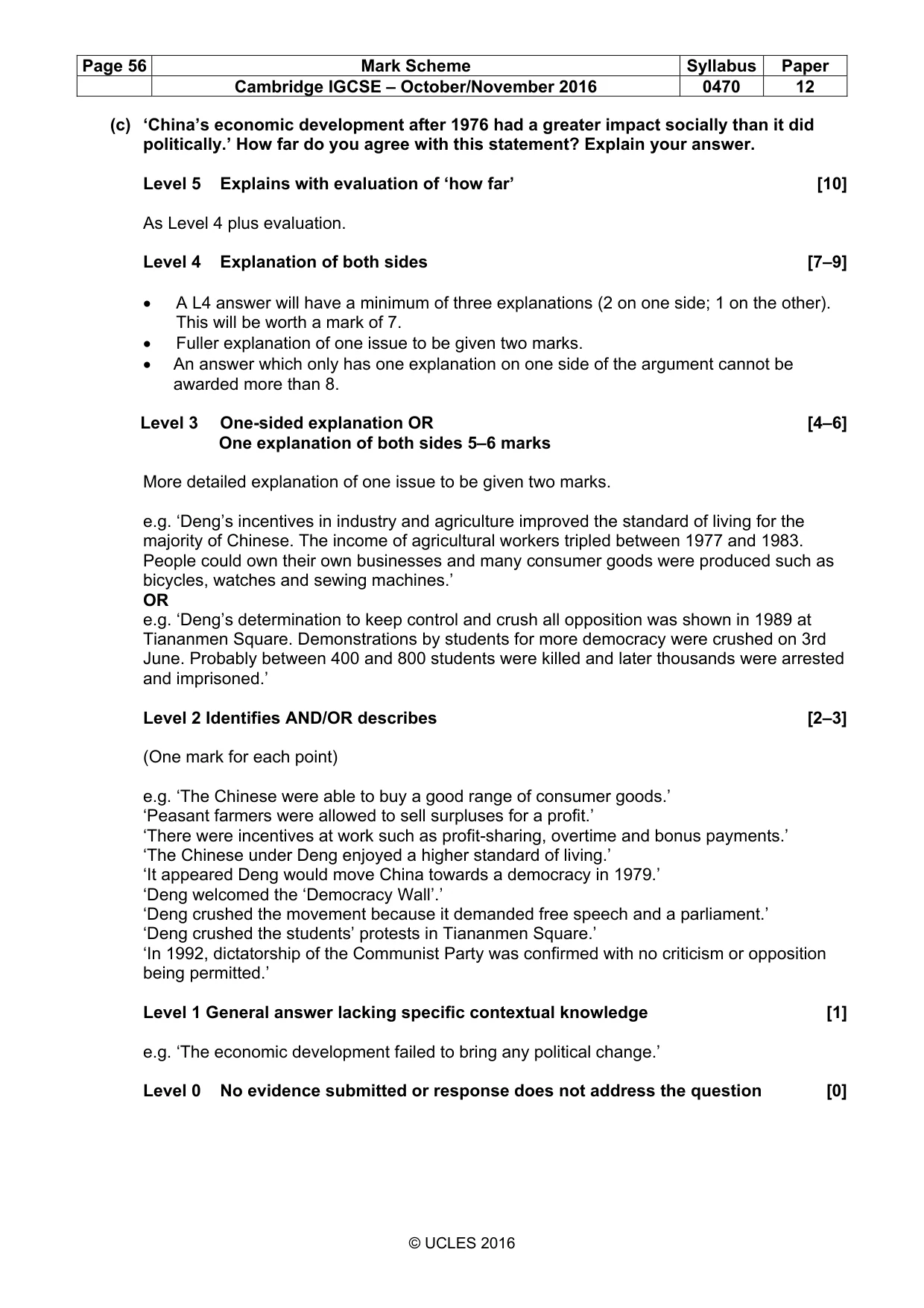
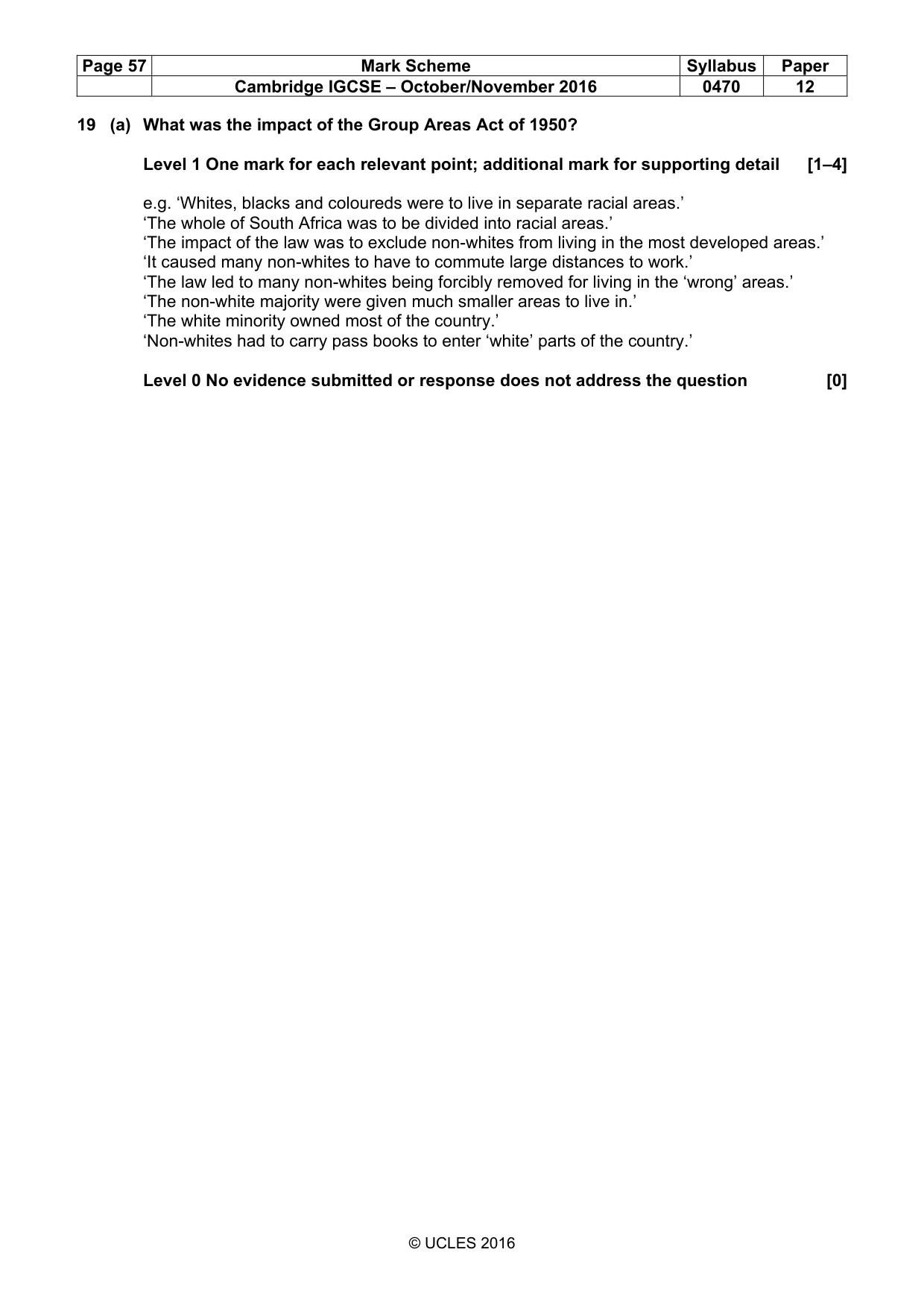
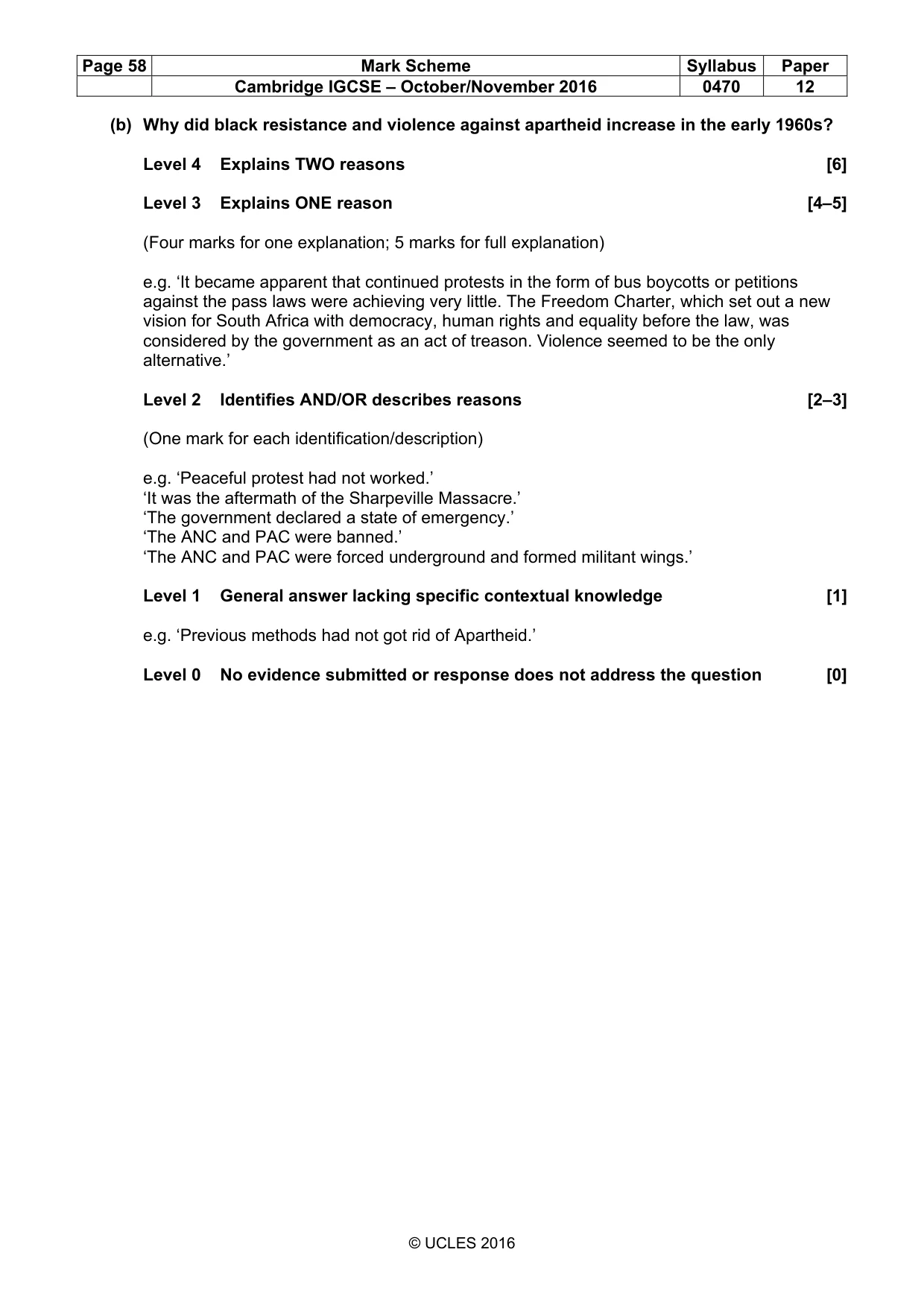
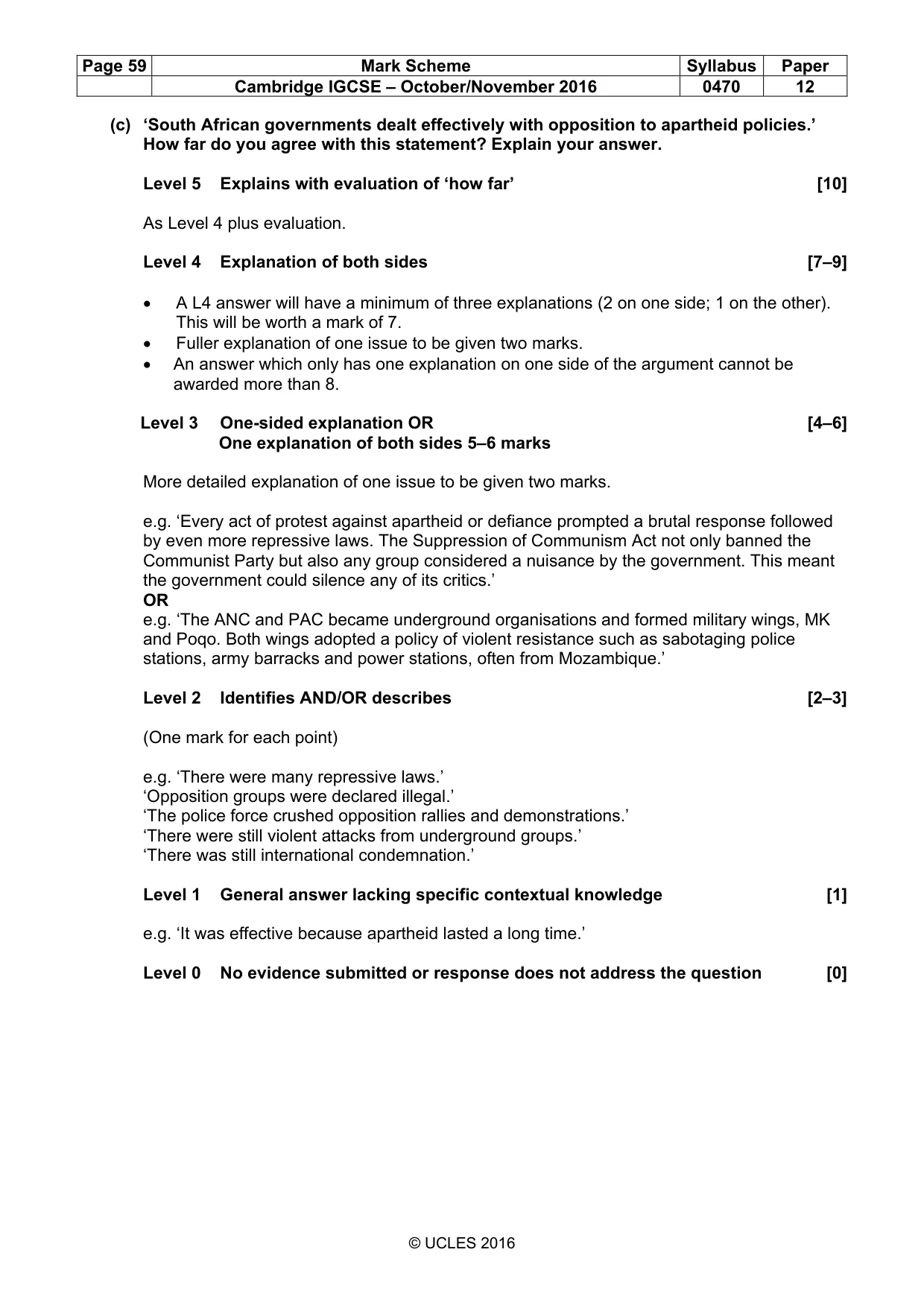
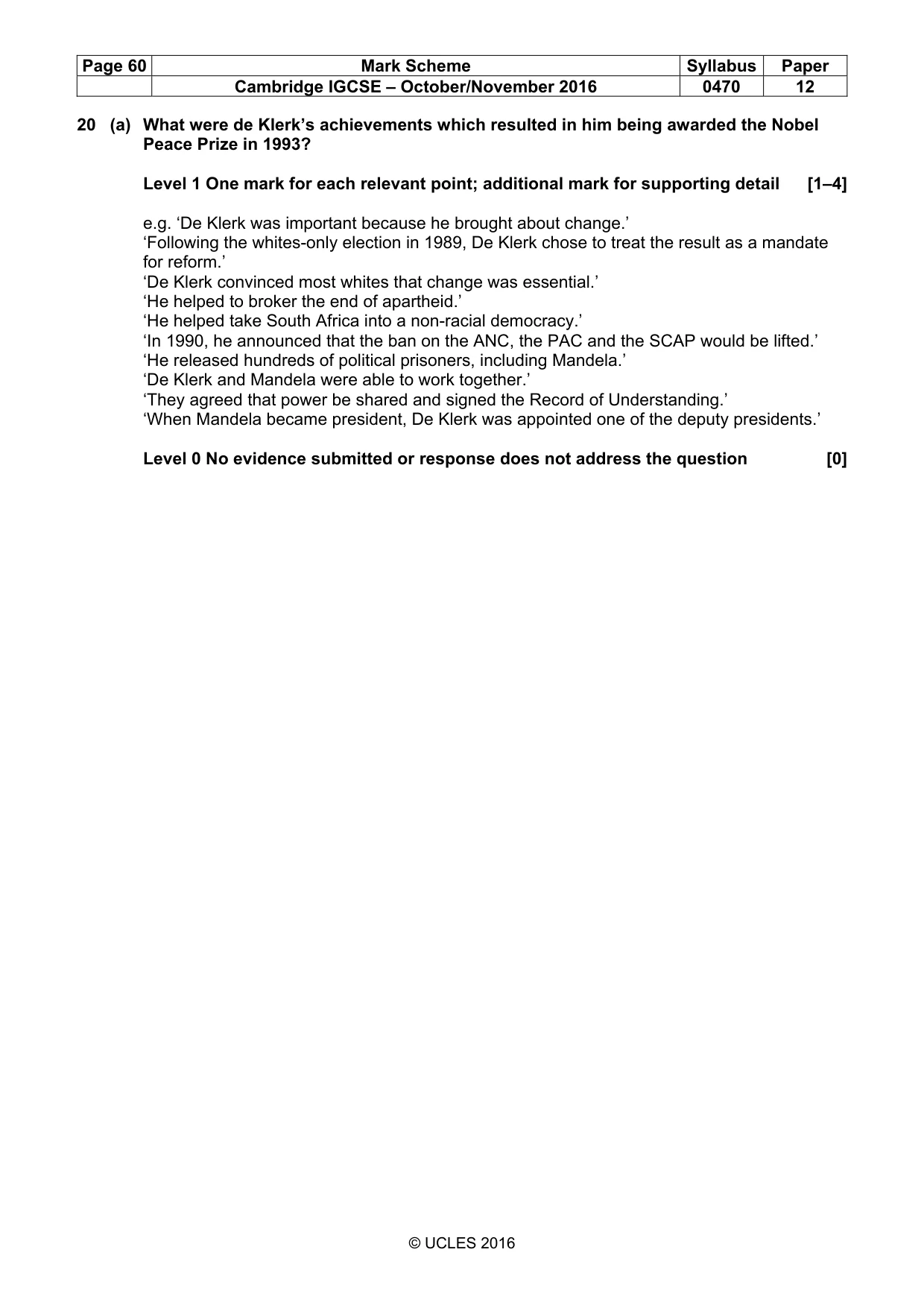
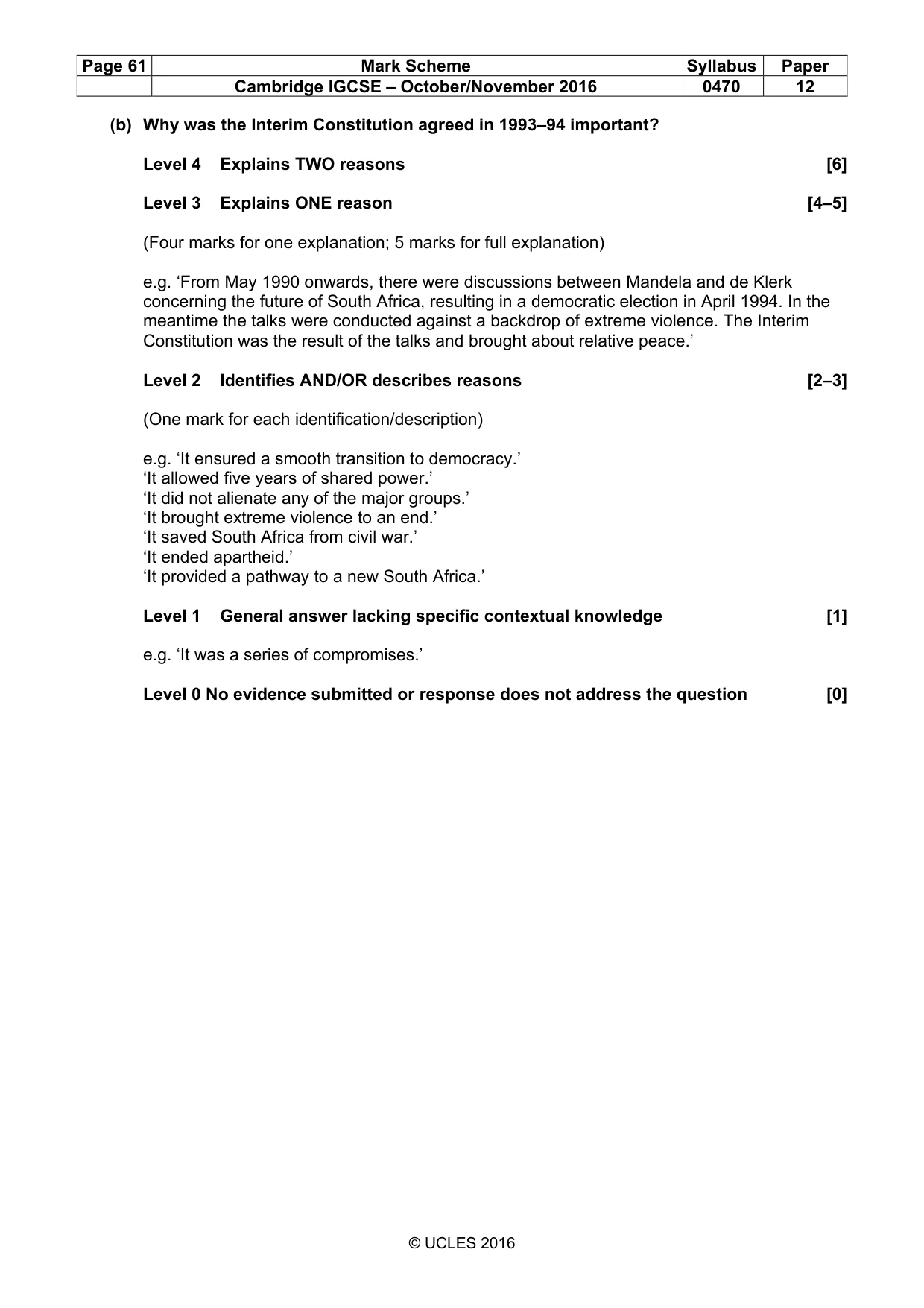
Paper as text
Question paper, page 1
This document consists of 10 printed pages, 2 blank pages and 1 insert. DC (RCL (JDA)) 115063/3 © UCLES 2016 [Turn over Cambridge International Examinations Cambridge International General Certificate of Secondary Education * 0 5 3 8 1 3 9 7 2 3 * HISTORY 0470/12 Paper 1 October/November 2016 2 hours No Additional Materials are required. READ THESE INSTRUCTIONS FIRST An answer booklet is provided inside this question paper. You should follow the instructions on the front cover of the answer booklet. If you need additional answer paper ask the invigilator for a continuation booklet. Answer three questions. Section A (Core Content) Answer any two questions. Section B (Depth Studies) Answer any one question. The number of marks is given in brackets [ ] at the end of each question or part question. The syllabus is approved for use in England, Wales and Northern Ireland as a Cambridge International Level 1/Level 2 Certificate.
Question paper, page 2
2 0470/12/O/N/16 © UCLES 2016 SECTION A: CORE CONTENT Answer any two questions from this Section. 1 Bismarck’s contribution to German unification was significant. (a) Describe the events which led to the appointment of Bismarck as Prussian Minister-President in 1862. [4] (b) Why was the Treaty of Prague (1866) an important step towards German unification? [6] (c) ‘It was Bismarck’s diplomatic skills that ensured Germany achieved unification.’ How far do you agree with this statement? Explain your answer. [10] 2 Significant differences existed between the Northern and Southern states of the USA. (a) Describe the main features of the economy of the Southern states prior to the Civil War. [4] (b) Why was the application by Missouri in 1820 to be admitted to the Union significant? [6] (c) ‘Reconstruction was favourable for black people in the South.’ How far do you agree with this statement? Explain your answer. [10] 3 European imperialism had different effects in different places. (a) Describe how Lugard believed the British should rule their colonies in tropical Africa. [4] (b) Why were the results of the Opium Wars important? [6] (c) ‘The Indian Mutiny benefited India rather than harmed it.’ How far do you agree with this statement? Explain your answer. [10] 4 Actions of the Great Powers before 1914 contributed to rising tensions. (a) What part did Germany play in naval rivalry with the British? [4] (b) Why were events in Morocco responsible for increasing tension between Germany, Britain and France? [6] (c) ‘The actions of Serbia brought war in 1914.’ How far do you agree with this statement? Explain your answer. [10]
Question paper, page 3
3 0470/12/O/N/16 © UCLES 2016 [Turn over 5 At the Paris Peace Conference, the victorious allies decided the outcomes. (a) What were the territorial terms of the Treaty of Saint Germain? [4] (b) Why was the work of the peacemakers at the Paris Peace Conference difficult? [6] (c) ‘German hatred of the Treaty of Versailles was justified.’ How far do you agree with this statement? Explain your answer. [10] 6 The causes of the outbreak of war in 1939 were both long term and short term. (a) What happened in relation to the Sudetenland during 1938 which raised tensions in Europe? [4] (b) Why was Hitler’s invasion of Czechoslovakia in March 1939 significant? [6] (c) How far was the outbreak of war in 1939 Hitler’s fault? Explain your answer. [10] 7 Relations between the USSR and the USA changed after 1945. (a) What actions had Stalin taken, by the end of 1945, to extend Soviet power across Eastern Europe? [4] (b) Why was it difficult to reach agreement over the future of Germany after World War Two? [6] (c) ‘The USA was responsible for starting the Cold War.’ How far do you agree with this statement? Explain your answer. [10] 8 On 2 August 1990, Saddam Hussein ordered the invasion of Kuwait. (a) What was Operation Desert Shield? [4] (b) Why did the Iraqi people suffer greatly from the First Gulf War? [6] (c) ‘The main reason for Operation Desert Storm (1991) was to reduce the power of Saddam Hussein.’ How far do you agree with this statement? Explain your answer. [10]
Question paper, page 4
4 0470/12/O/N/16 © UCLES 2016 SECTION B: DEPTH STUDIES Answer any one question from this Section. DEPTH STUDY A: THE FIRST WORLD WAR, 1914–18 9 It was soon realised that the war would last longer than expected. (a) Describe the actions of the British and French at the Battle of the Marne, September 1914. [4] (b) Why was fighting around Ypres in October–November 1914 important? [6] (c) Which was the more important battle: the Somme or Verdun? Explain your answer. [10] 10 In 1918, Ludendorff launched a major offensive. (a) What events brought the USA into the war? [4] (b) Why were the German offensives of March to April 1918 successful? [6] (c) ‘Weaknesses within the Home Front were the main reason the German governme nt requested an armistice.’ How far do you agree with this statement? Explain your answer. [10]
Question paper, page 5
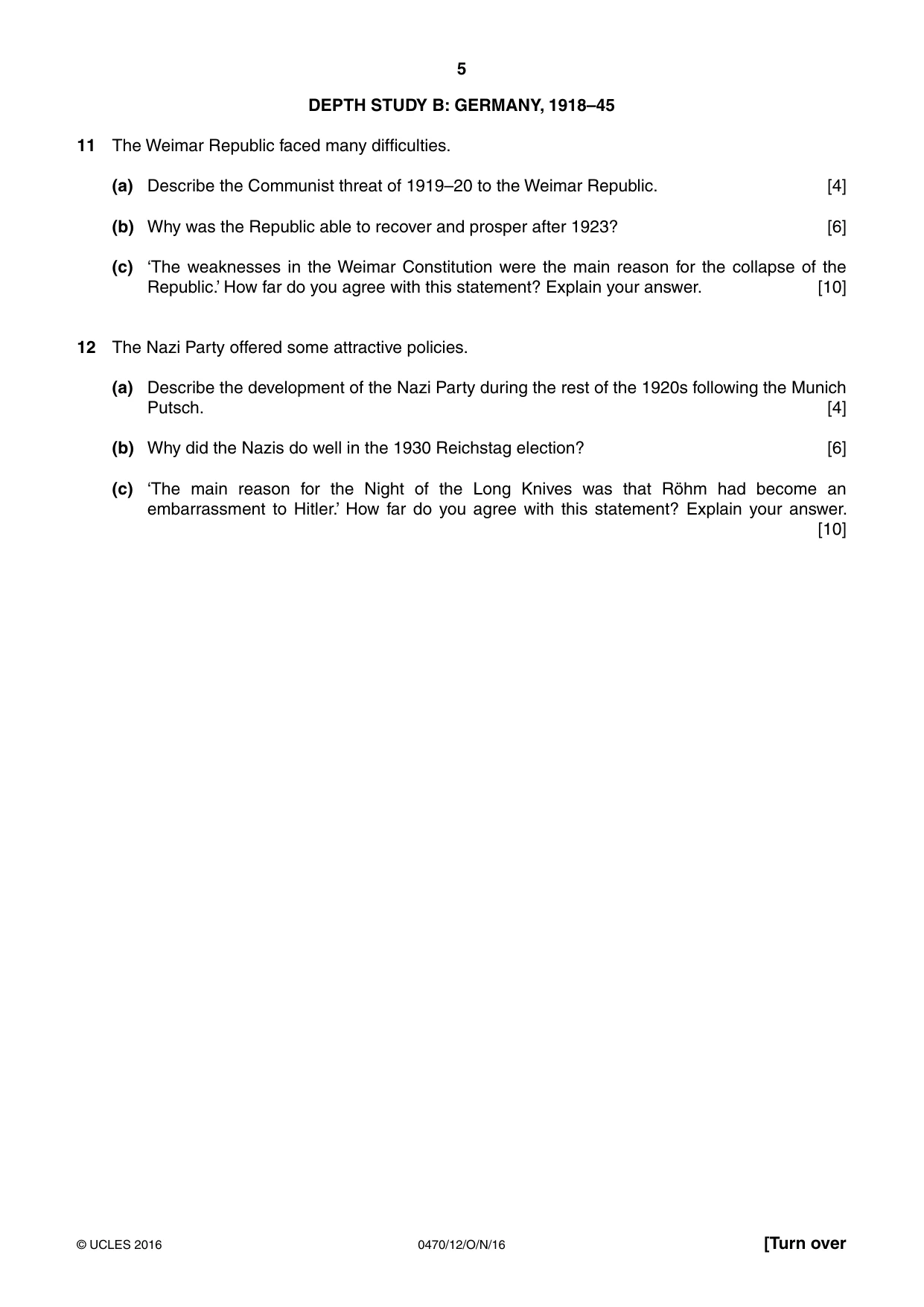
5 0470/12/O/N/16 © UCLES 2016 [Turn over DEPTH STUDY B: GERMANY, 1918–45 11 The Weimar Republic faced many difficulties. (a) Describe the Communist threat of 1919–20 to the Weimar Republic. [4] (b) Why was the Republic able to recover and prosper after 1923? [6] (c) ‘The weaknesses in the Weimar Constitution were the main reason for the collapse of the Republic.’ How far do you agree with this statement? Explain your answer. [10] 12 The Nazi Party offered some attractive policies. (a) Describe the development of the Nazi Party during the rest of the 1920s following the Munich Putsch. [4] (b) Why did the Nazis do well in the 1930 Reichstag election? [6] (c) ‘The main reason for the Night of the Long Knives was that Röhm had become an embarrassment to Hitler.’ How far do you agree with this statement? Explain your answer. [10]
Question paper, page 6
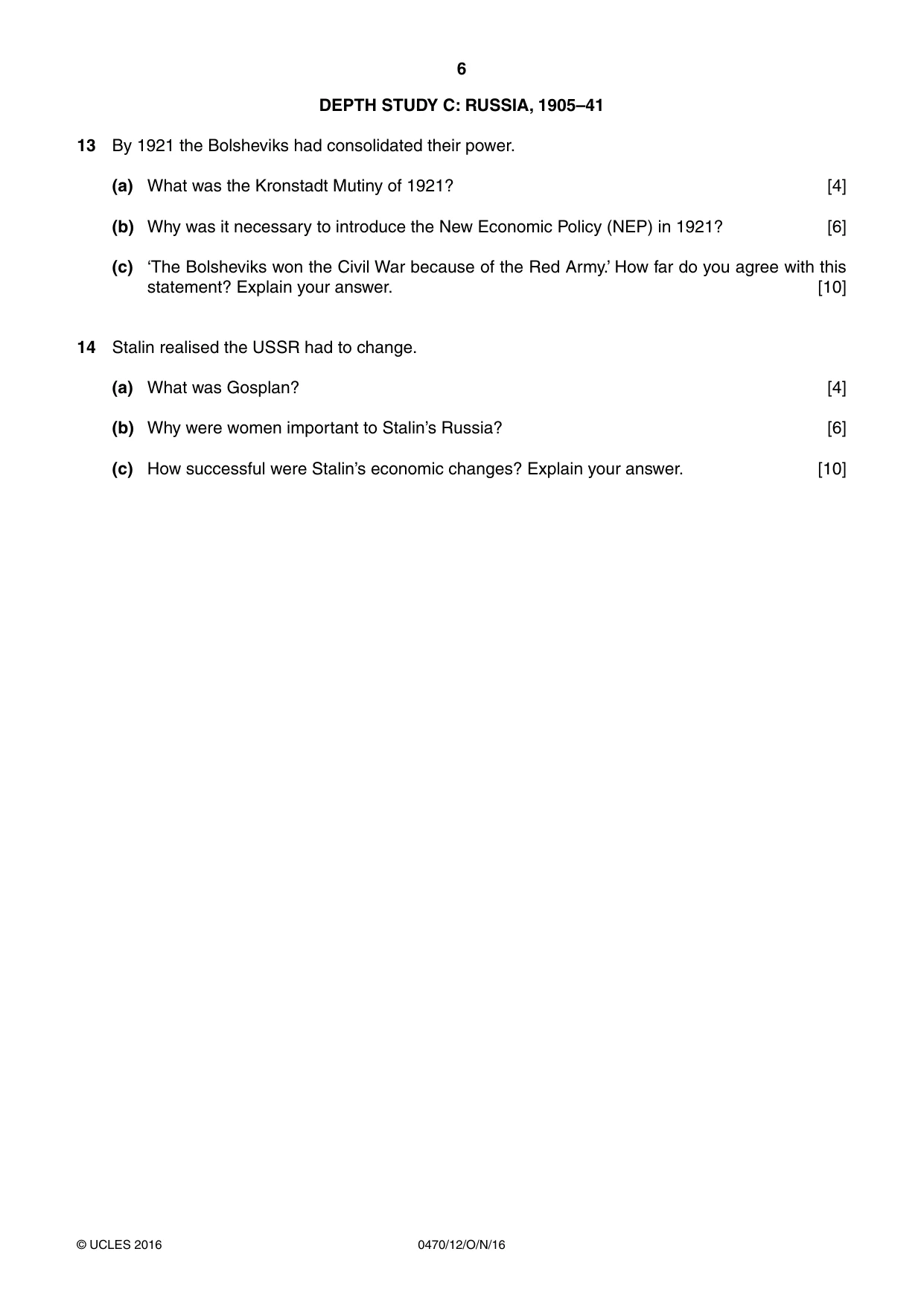
6 0470/12/O/N/16 © UCLES 2016 DEPTH STUDY C: RUSSIA, 1905–41 13 By 1921 the Bolsheviks had consolidated their power. (a) What was the Kronstadt Mutiny of 1921? [4] (b) Why was it necessary to introduce the New Economic Policy (NEP) in 1921? [6] (c) ‘The Bolsheviks won the Civil War because of the Red Army.’ How far do you agree with this statement? Explain your answer. [10] 14 Stalin realised the USSR had to change. (a) What was Gosplan? [4] (b) Why were women important to Stalin’s Russia? [6] (c) How successful were Stalin’s economic changes? Explain your answer. [10]
Question paper, page 7
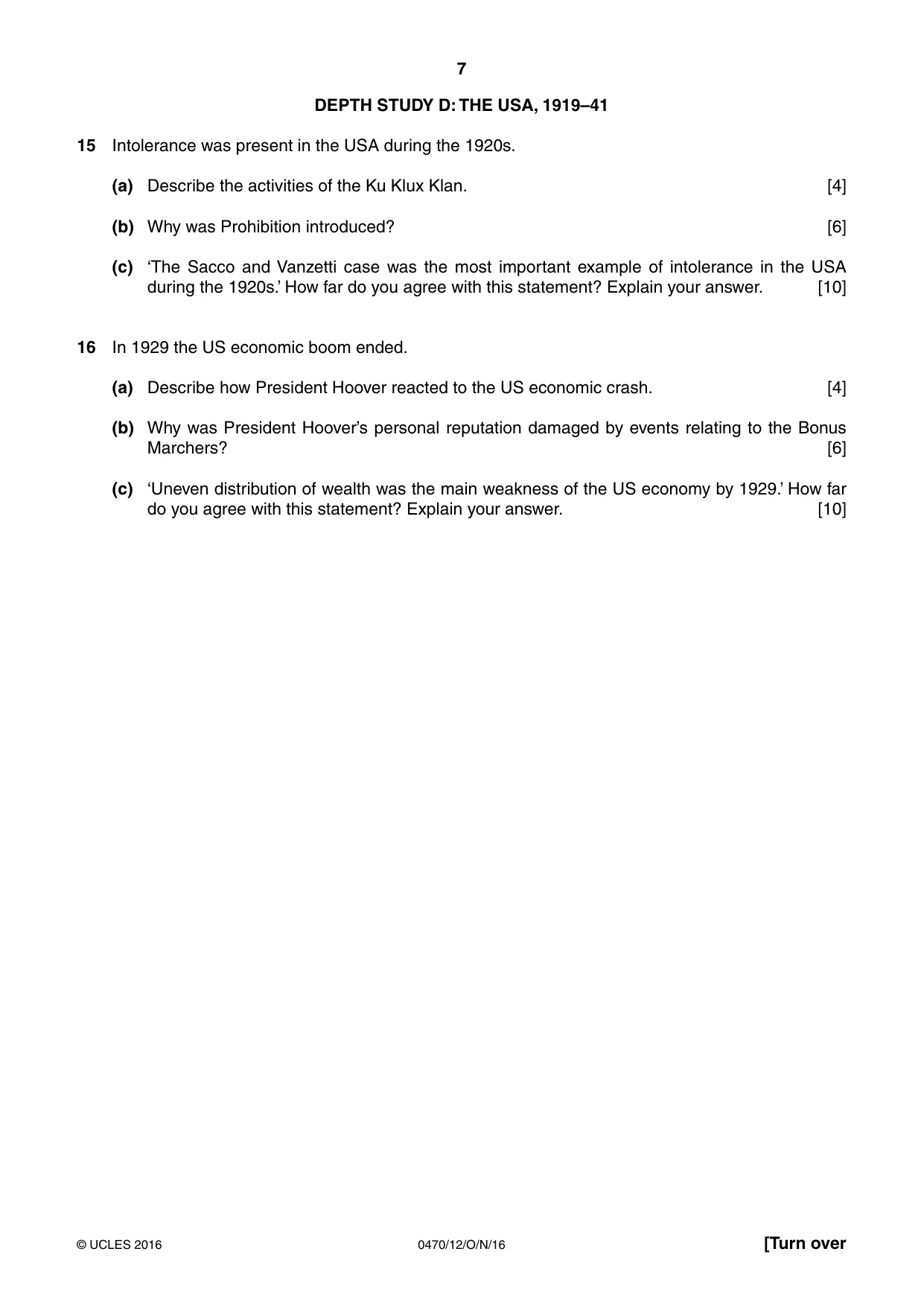
7 0470/12/O/N/16 © UCLES 2016 [Turn over DEPTH STUDY D: THE USA, 1919–41 15 Intolerance was present in the USA during the 1920s. (a) Describe the activities of the Ku Klux Klan. [4] (b) Why was Prohibition introduced? [6] (c) ‘The Sacco and Vanzetti case was the most important example of intolerance in the USA during the 1920s.’ How far do you agree with this statement? Explain your answer. [10] 16 In 1929 the US economic boom ended. (a) Describe how President Hoover reacted to the US economic crash. [4] (b) Why was President Hoover’s personal reputation damaged by events relating to the Bonus Marchers? [6] (c) ‘Uneven distribution of wealth was the main weakness of the US economy by 1929.’ How far do you agree with this statement? Explain your answer. [10]
Question paper, page 8
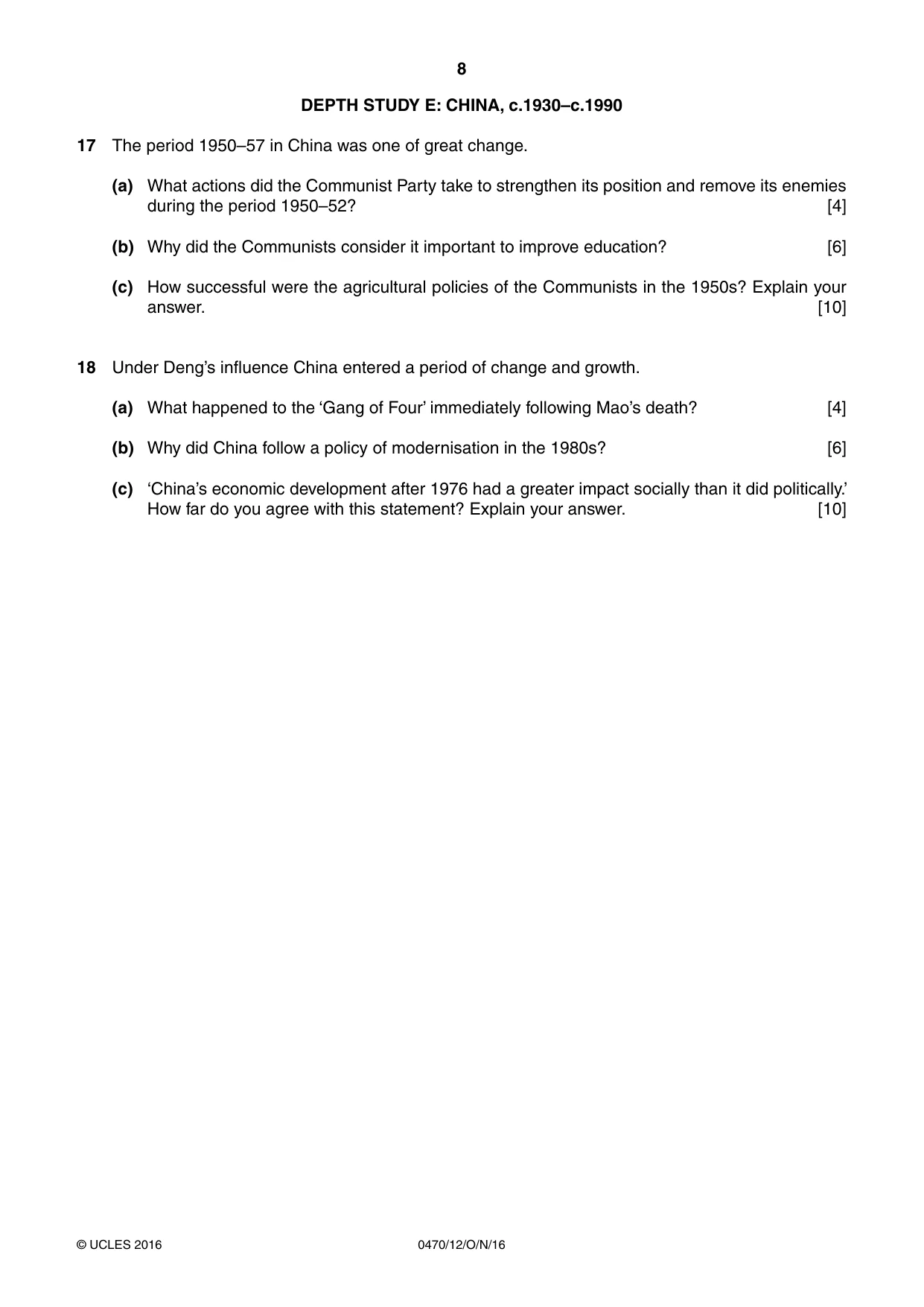
8 0470/12/O/N/16 © UCLES 2016 DEPTH STUDY E: CHINA, c.1930–c.1990 17 The period 1950–57 in China was one of great change. (a) What actions did the Communist Party take to strengthen its position and remove its enemies during the period 1950–52? [4] (b) Why did the Communists consider it important to improve education? [6] (c) How successful were the agricultural policies of the Communists in the 1950s? Explain your answer. [10] 18 Under Deng’s influence China entered a period of change and growth. (a) What happened to the ‘Gang of Four’ immediately following Mao’s death? [4] (b) Why did China follow a policy of modernisation in the 1980s? [6] (c) ‘China’s economic development after 1976 had a greater impact socially than it did politically.’ How far do you agree with this statement? Explain your answer. [10]
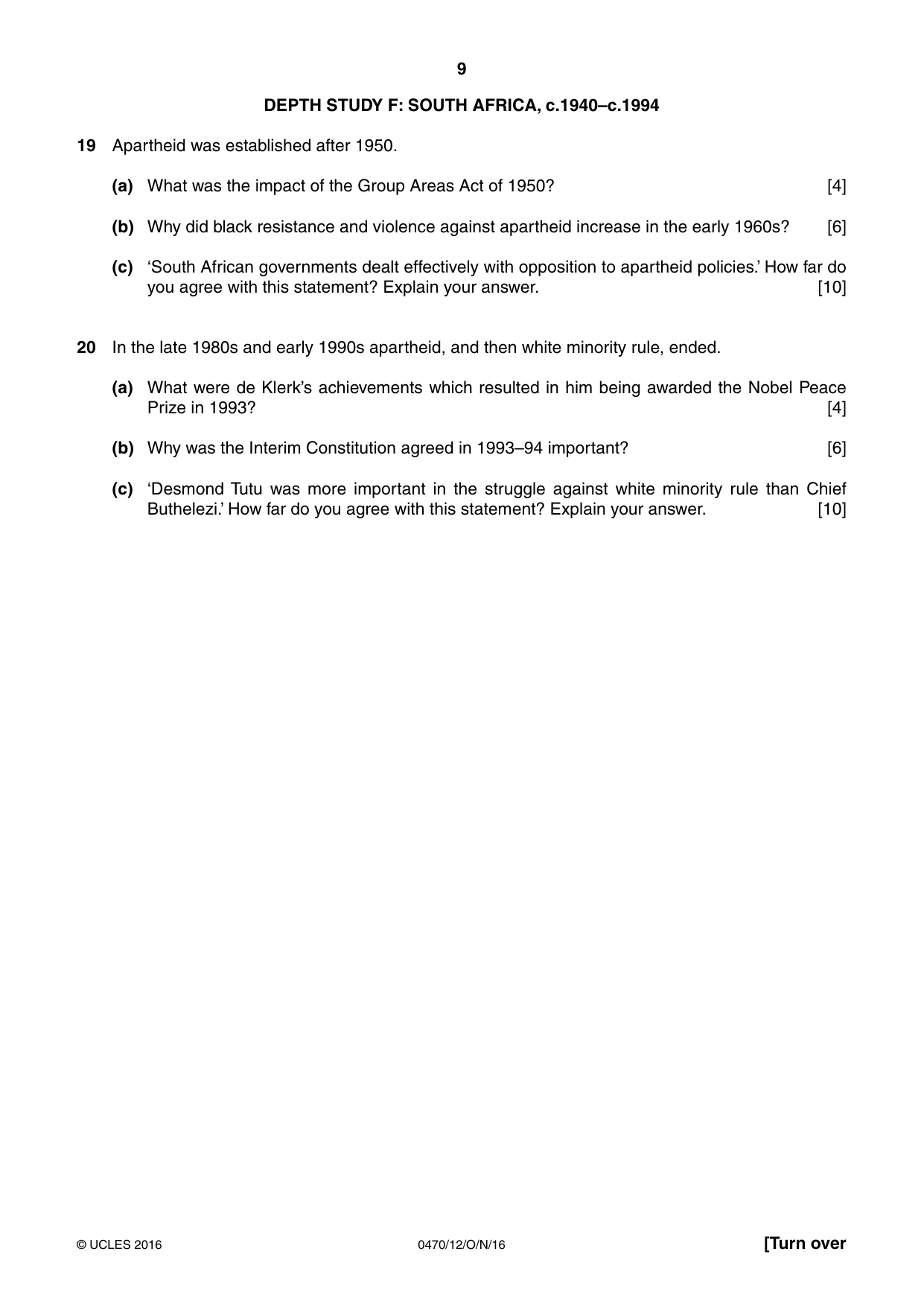
Question paper, page 9
9 0470/12/O/N/16 © UCLES 2016 [Turn over DEPTH STUDY F: SOUTH AFRICA, c.1940–c.1994 19 Apartheid was established after 1950. (a) What was the impact of the Group Areas Act of 1950? [4] (b) Why did black resistance and violence against apartheid increase in the early 1960s? [6] (c) ‘South African governments dealt effectively with opposition to apartheid policies.’ How far do you agree with this statement? Explain your answer. [10] 20 In the late 1980s and early 1990s apartheid, and then white minority rule, ended. (a) What were de Klerk’s achievements which resulted in him being awarded the Nobel Peace Prize in 1993? [4] (b) Why was the Interim Constitution agreed in 1993–94 important? [6] (c) ‘Desmond Tutu was more important in the struggle against white minority rule than Chief Buthelezi.’ How far do you agree with this statement? Explain your answer. [10]
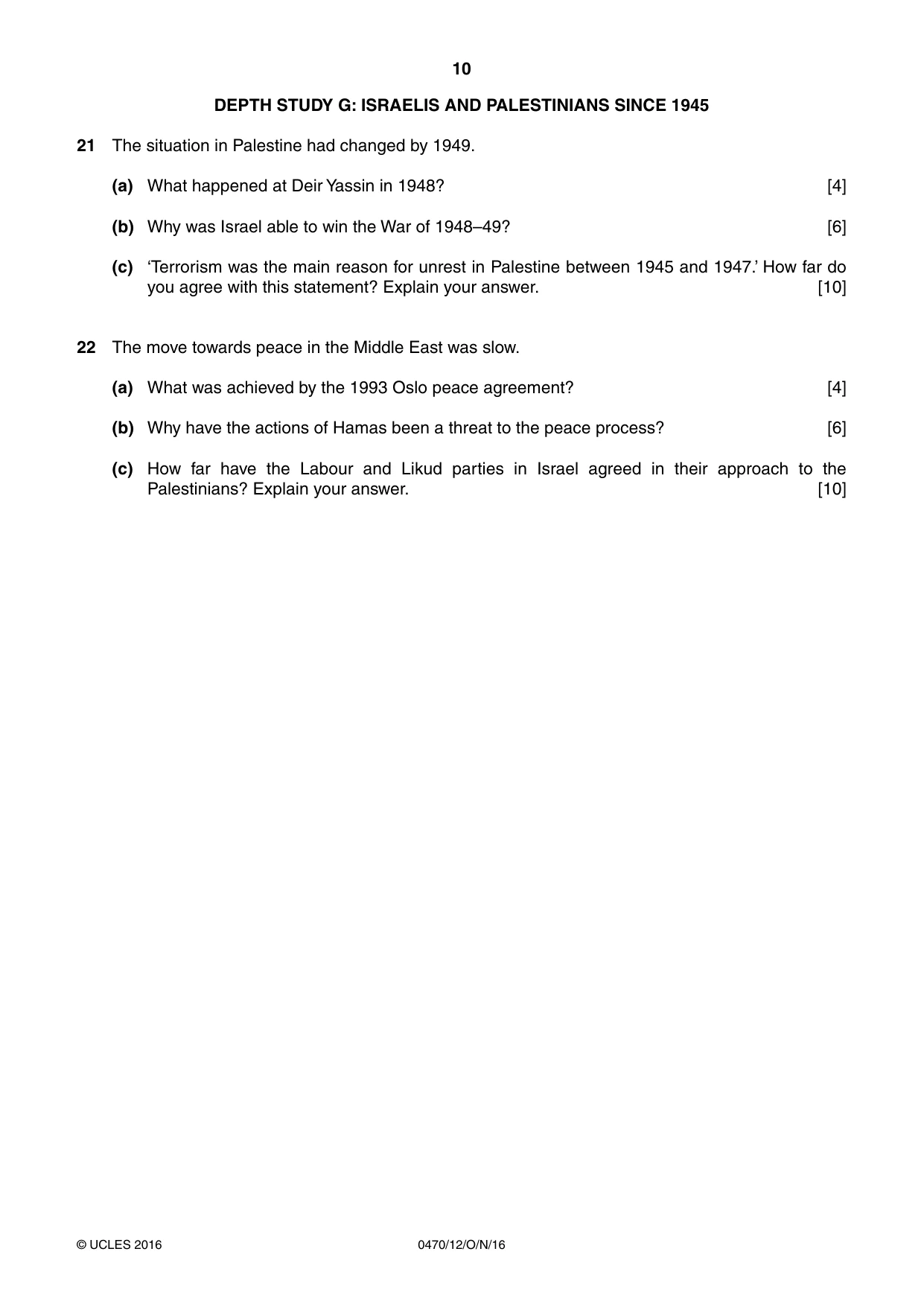
Question paper, page 10
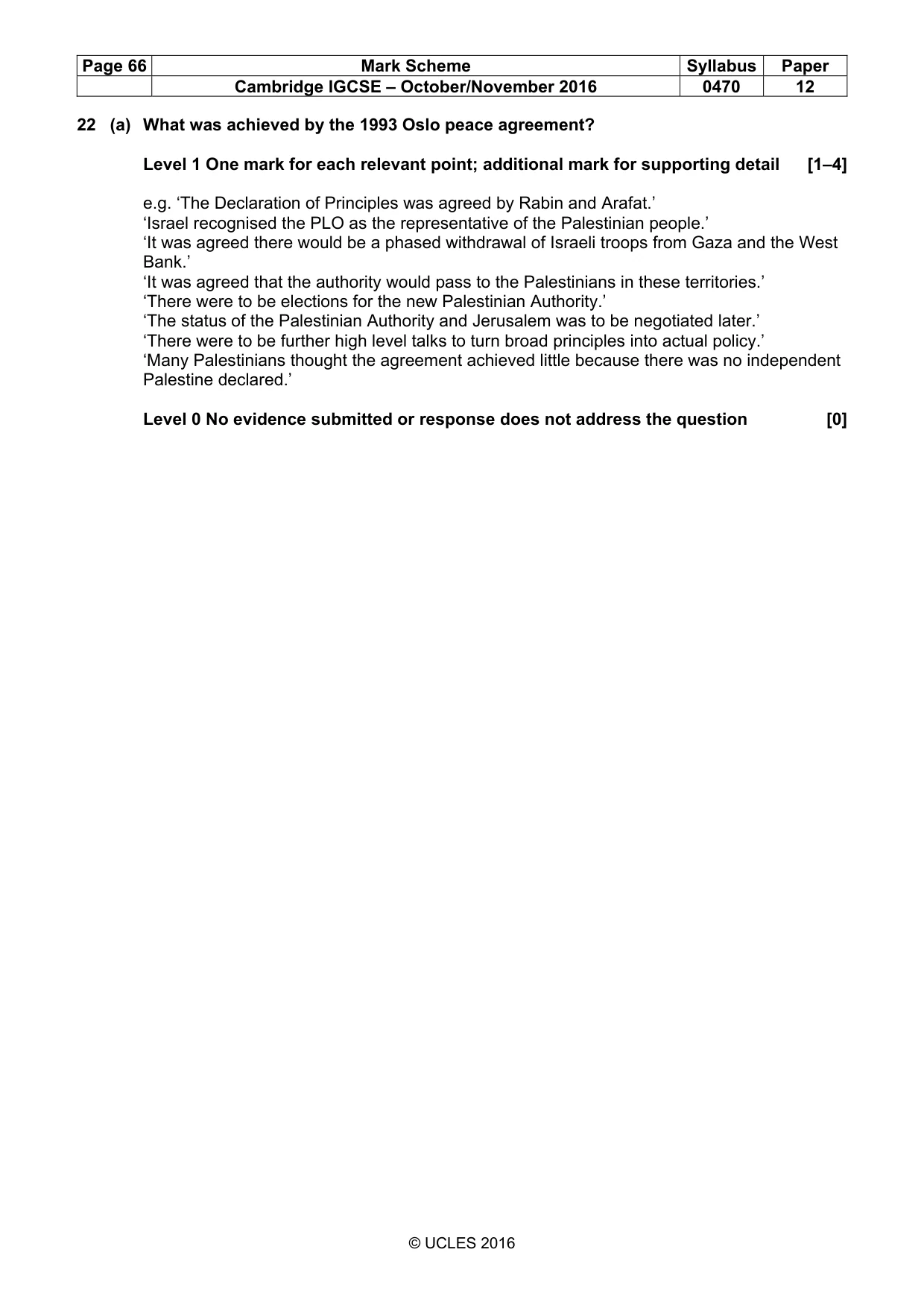
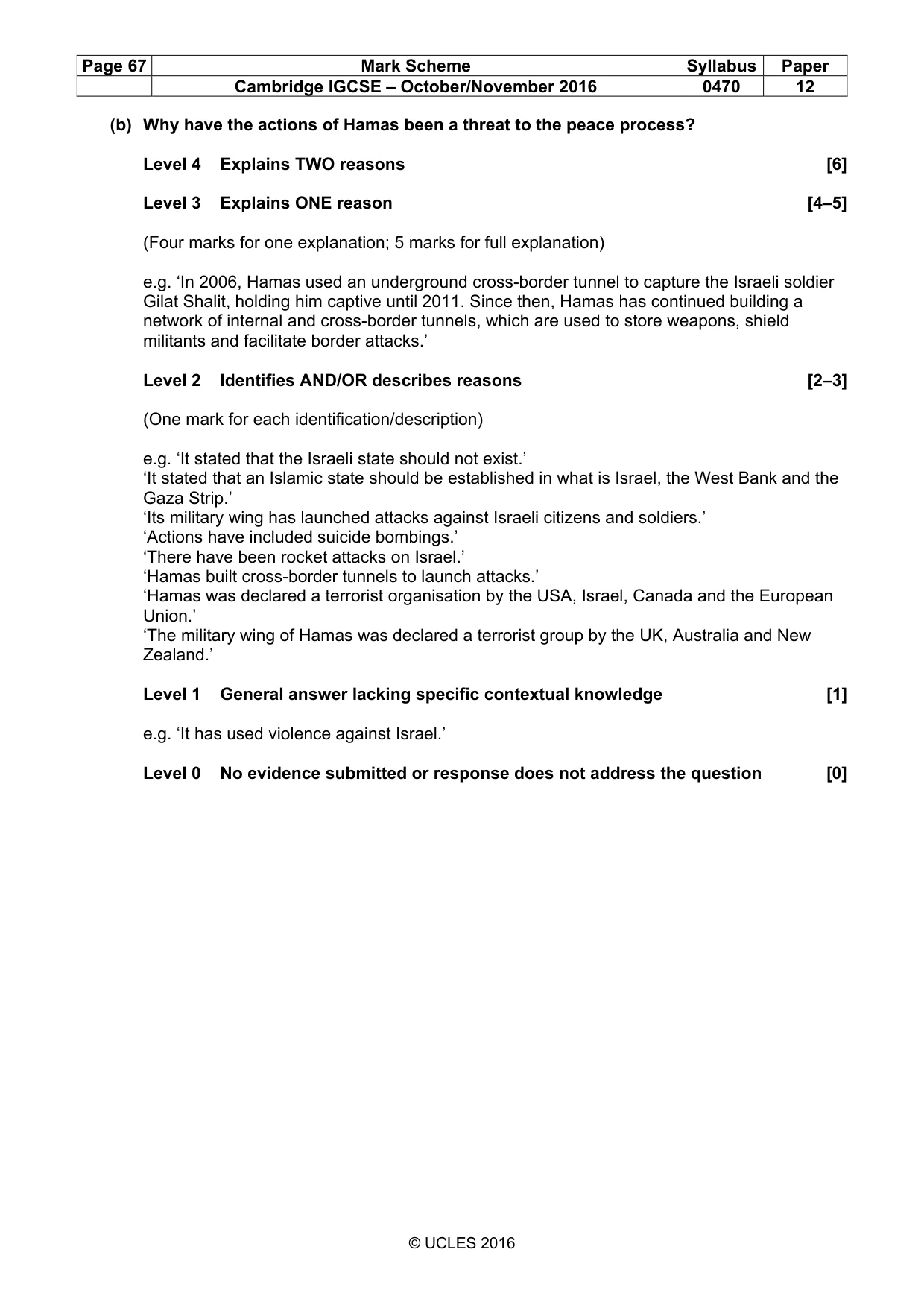
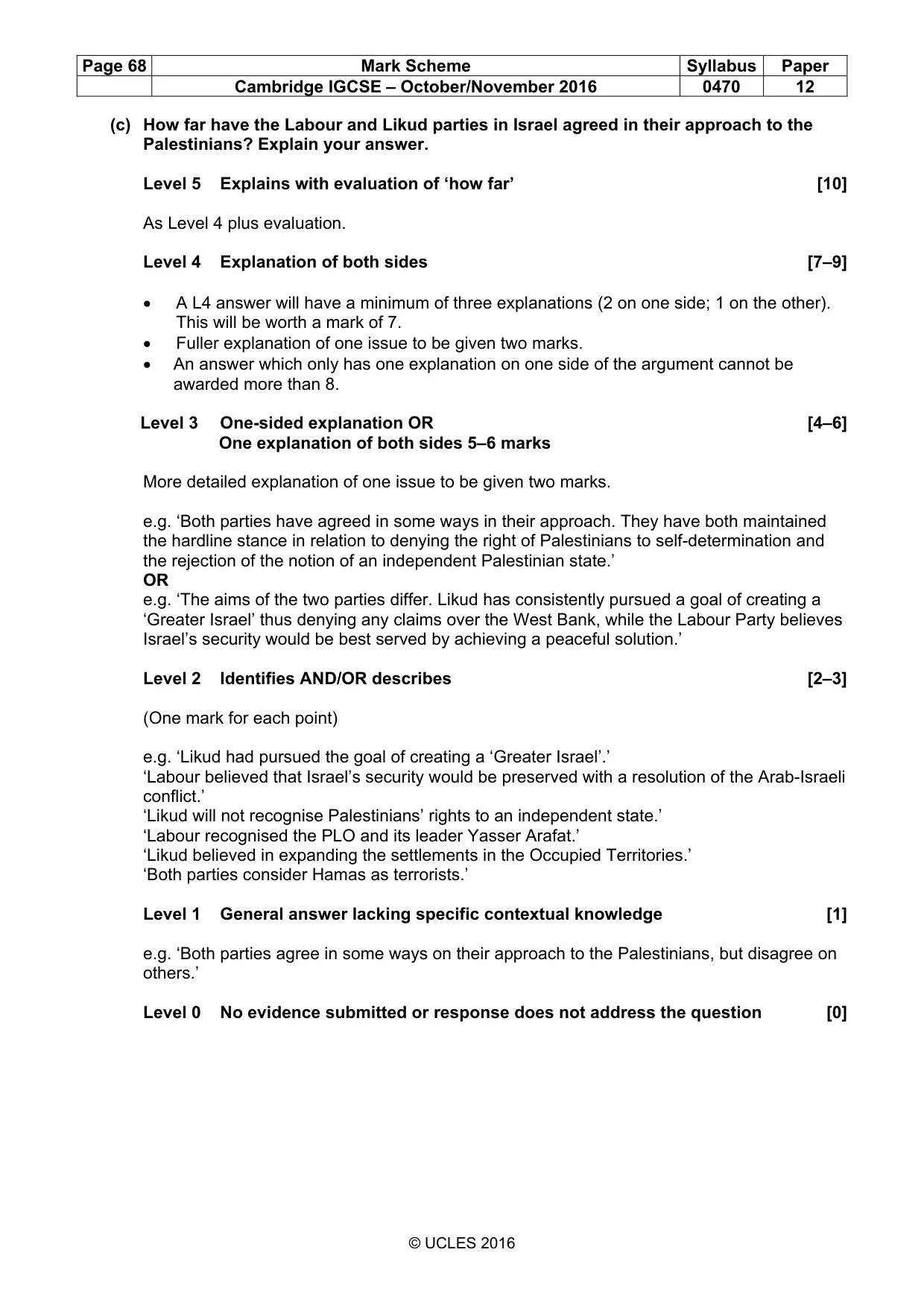
10 0470/12/O/N/16 © UCLES 2016 DEPTH STUDY G: ISRAELIS AND PALESTINIANS SINCE 1945 21 The situation in Palestine had changed by 1949. (a) What happened at Deir Yassin in 1948? [4] (b) Why was Israel able to win the War of 1948–49? [6] (c) ‘Terrorism was the main reason for unrest in Palestine between 1945 and 1947.’ How far do you agree with this statement? Explain your answer. [10] 22 The move towards peace in the Middle East was slow. (a) What was achieved by the 1993 Oslo peace agreement? [4] (b) Why have the actions of Hamas been a threat to the peace process? [6] (c) How far have the Labour and Likud parties in Israel agreed in their approach to the Palestinians? Explain your answer. [10]
Question paper, page 11
11 0470/12/O/N/16 © UCLES 2016 BLANK PAGE
Question paper, page 12
12 0470/12/O/N/16 © UCLES 2016 Permission to reproduce items where third-party owned material protected by copyright is included has been sought and cleared where possible. Every reasonable effort has been made by the publisher (UCLES) to trace copyright holders, but if any items requiring clearance have unwittingly been included, the publisher will be pleased to make amends at the earliest possible opportunity. To avoid the issue of disclosure of answer-related information to candidates, all copyright acknowledgements are reproduced online in the Cambridge International Examinations Copyright Acknowledgements Booklet. This is produced for each series of examinations and is freely available to download at www.cie.org.uk after the live examination series. Cambridge International Examinations is part of the Cambridge Assessment Group. Cambridge Assessment is the brand name of University of Cambridge Local Examinations Syndicate (UCLES), which is itself a department of the University of Cambridge. BLANK PAGE
Mark scheme, page 1
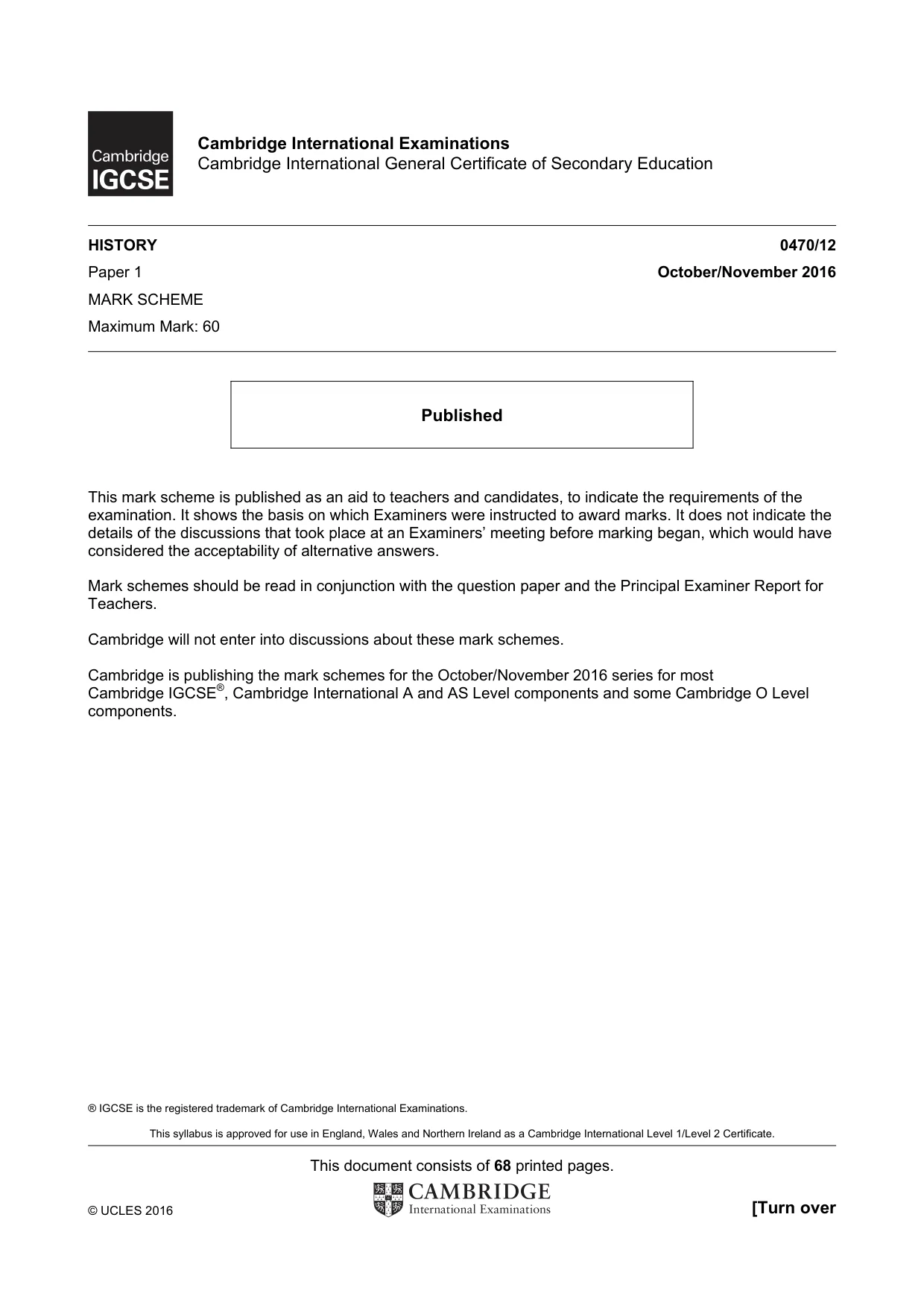
® IGCSE is the registered trademark of Cambridge International Examinations. This syllabus is approved for use in England, Wales and Northern Ireland as a Cambridge International Level 1/Level 2 Certificate. This document consists of 68 printed pages. © UCLES 2016 [Turn over Cambridge International Examinations Cambridge International General Certificate of Secondary Education HISTORY 0470/12 Paper 1 October/November 2016 MARK SCHEME Maximum Mark: 60 Published This mark scheme is published as an aid to teachers and candidates, to indicate the requirements of the examination. It shows the basis on which Examiners were instructed to award marks. It does not indicate the details of the discussions that took place at an Examiners’ meeting before marking began, which would have considered the acceptability of alternative answers. Mark schemes should be read in conjunction with the question paper and the Principal Examiner Report for Teachers. Cambridge will not enter into discussions about these mark schemes. Cambridge is publishing the mark schemes for the October/November 2016 series for most Cambridge IGCSE®, Cambridge International A and AS Level components and some Cambridge O Level components.
Mark scheme, page 2
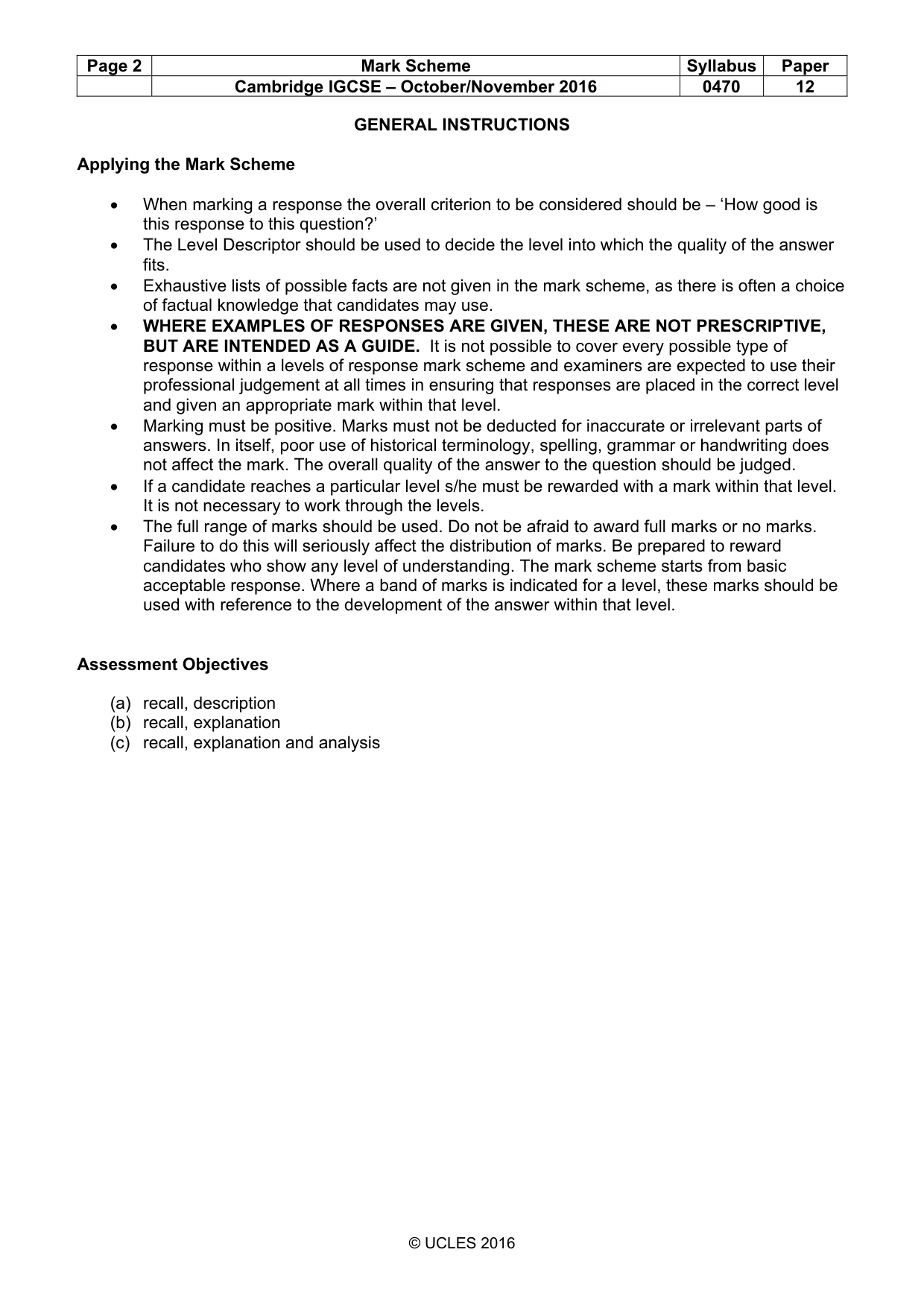
Page 2 Mark Scheme Syllabus Paper Cambridge IGCSE – October/November 2016 0470 12 © UCLES 2016 GENERAL INSTRUCTIONS Applying the Mark Scheme • When marking a response the overall criterion to be considered should be – ‘How good is this response to this question?’ • The Level Descriptor should be used to decide the level into which the quality of the answer fits. • Exhaustive lists of possible facts are not given in the mark scheme, as there is often a choice of factual knowledge that candidates may use. • WHERE EXAMPLES OF RESPONSES ARE GIVEN, THESE ARE NOT PRESCRIPTIVE, BUT ARE INTENDED AS A GUIDE. It is not possible to cover every possible type of response within a levels of response mark scheme and examiners are expected to use their professional judgement at all times in ensuring that responses are placed in the correct level and given an appropriate mark within that level. • Marking must be positive. Marks must not be deducted for inaccurate or irrelevant parts of answers. In itself, poor use of historical terminology, spelling, grammar or handwriting does not affect the mark. The overall quality of the answer to the question should be judged. • If a candidate reaches a particular level s/he must be rewarded with a mark within that level. It is not necessary to work through the levels. • The full range of marks should be used. Do not be afraid to award full marks or no marks. Failure to do this will seriously affect the distribution of marks. Be prepared to reward candidates who show any level of understanding. The mark scheme starts from basic acceptable response. Where a band of marks is indicated for a level, these marks should be used with reference to the development of the answer within that level. Assessment Objectives (a) recall, description (b) recall, explanation (c) recall, explanation and analysis
Mark scheme, page 3
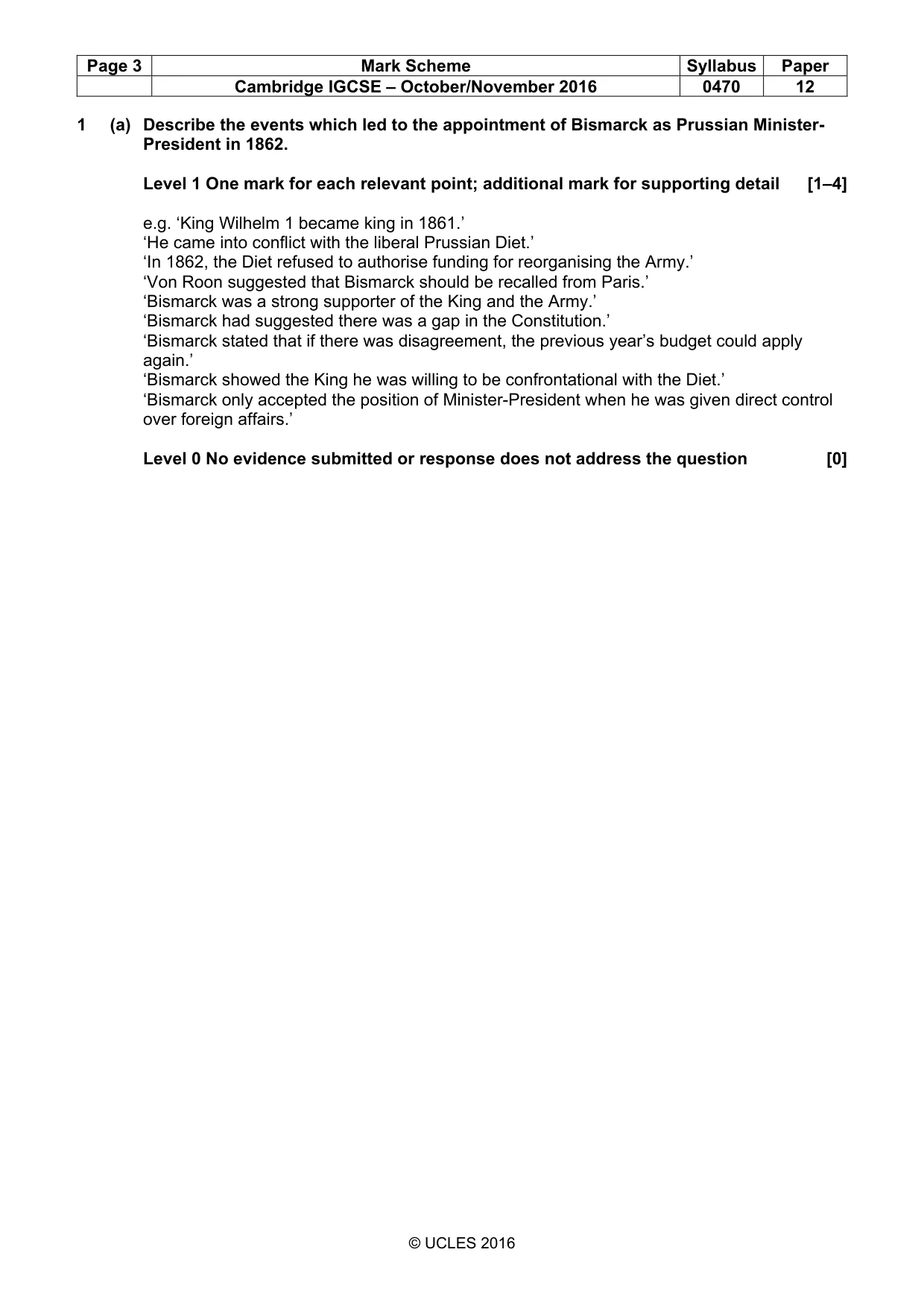
Page 3 Mark Scheme Syllabus Paper Cambridge IGCSE – October/November 2016 0470 12 © UCLES 2016 1 (a) Describe the events which led to the appointment of Bismarck as Prussian Minister- President in 1862. Level 1 One mark for each relevant point; additional mark for supporting detail [1–4] e.g. ‘King Wilhelm 1 became king in 1861.’ ‘He came into conflict with the liberal Prussian Diet.’ ‘In 1862, the Diet refused to authorise funding for reorganising the Army.’ ‘Von Roon suggested that Bismarck should be recalled from Paris.’ ‘Bismarck was a strong supporter of the King and the Army.’ ‘Bismarck had suggested there was a gap in the Constitution.’ ‘Bismarck stated that if there was disagreement, the previous year’s budget could apply again.’ ‘Bismarck showed the King he was willing to be confrontational with the Diet.’ ‘Bismarck only accepted the position of Minister-President when he was given direct control over foreign affairs.’ Level 0 No evidence submitted or response does not address the question [0]
Mark scheme, page 4
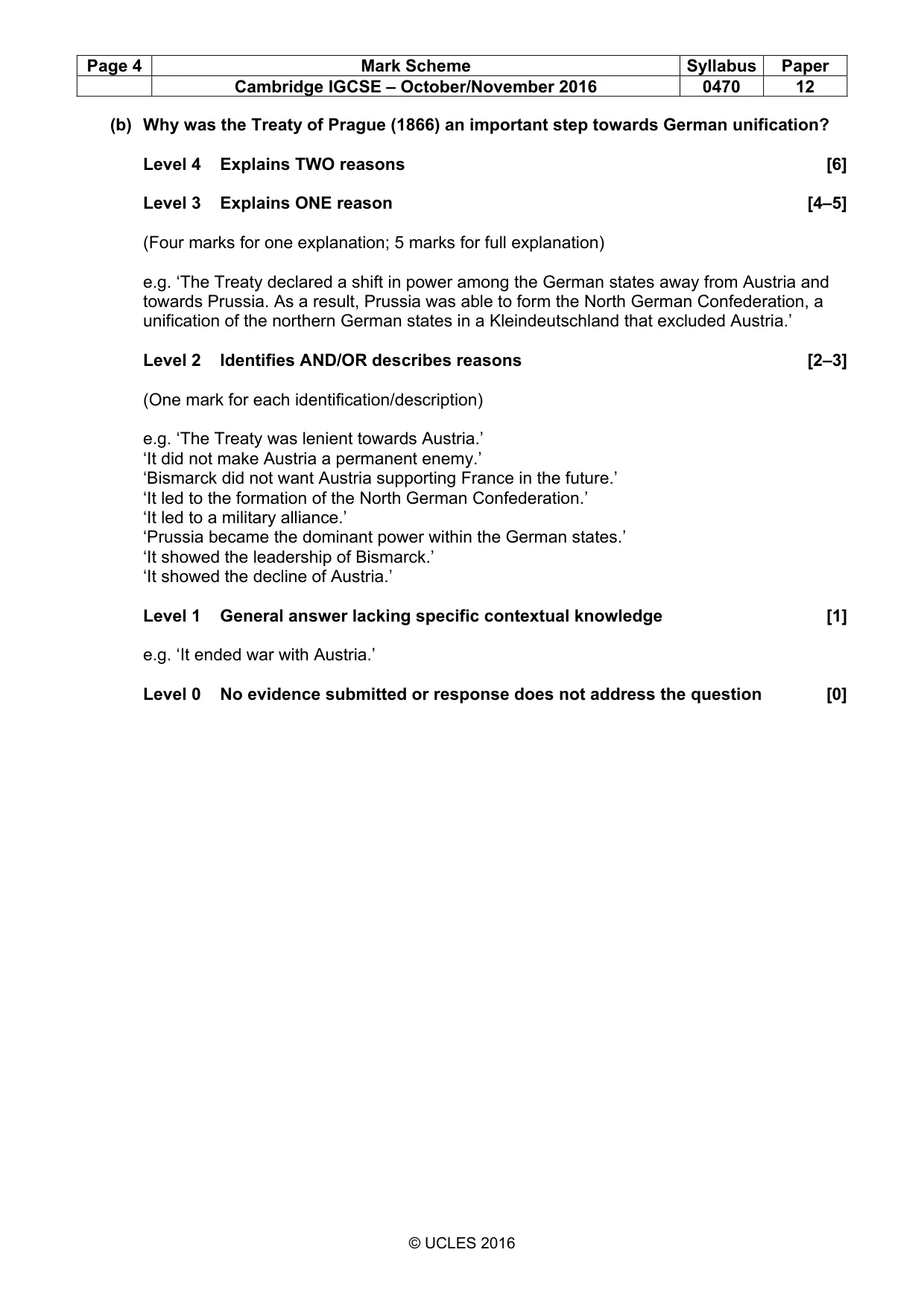
Page 4 Mark Scheme Syllabus Paper Cambridge IGCSE – October/November 2016 0470 12 © UCLES 2016 (b) Why was the Treaty of Prague (1866) an important step towards German unification? Level 4 Explains TWO reasons [6] Level 3 Explains ONE reason [4–5] (Four marks for one explanation; 5 marks for full explanation) e.g. ‘The Treaty declared a shift in power among the German states away from Austria and towards Prussia. As a result, Prussia was able to form the North German Confederation, a unification of the northern German states in a Kleindeutschland that excluded Austria.’ Level 2 Identifies AND/OR describes reasons [2–3] (One mark for each identification/description) e.g. ‘The Treaty was lenient towards Austria.’ ‘It did not make Austria a permanent enemy.’ ‘Bismarck did not want Austria supporting France in the future.’ ‘It led to the formation of the North German Confederation.’ ‘It led to a military alliance.’ ‘Prussia became the dominant power within the German states.’ ‘It showed the leadership of Bismarck.’ ‘It showed the decline of Austria.’ Level 1 General answer lacking specific contextual knowledge [1] e.g. ‘It ended war with Austria.’ Level 0 No evidence submitted or response does not address the question [0]
Mark scheme, page 5
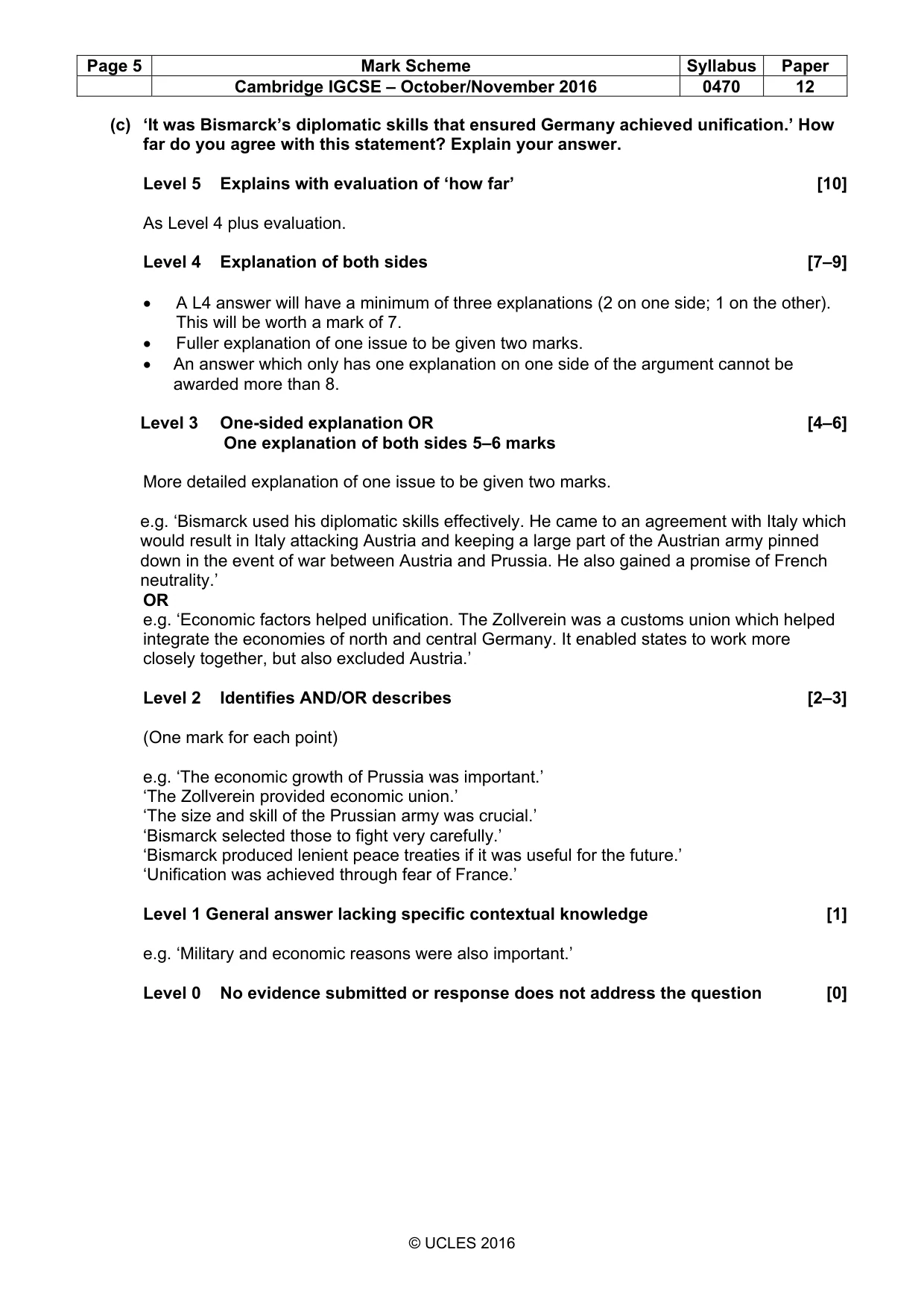
Page 5 Mark Scheme Syllabus Paper Cambridge IGCSE – October/November 2016 0470 12 © UCLES 2016 (c) ‘It was Bismarck’s diplomatic skills that ensured Germany achieved unification.’ How far do you agree with this statement? Explain your answer. Level 5 Explains with evaluation of ‘how far’ [10] As Level 4 plus evaluation. Level 4 Explanation of both sides [7–9] • A L4 answer will have a minimum of three explanations (2 on one side; 1 on the other). This will be worth a mark of 7. • Fuller explanation of one issue to be given two marks. • An answer which only has one explanation on one side of the argument cannot be awarded more than 8. Level 3 One-sided explanation OR [4–6] One explanation of both sides 5–6 marks More detailed explanation of one issue to be given two marks. e.g. ‘Bismarck used his diplomatic skills effectively. He came to an agreement with Italy which would result in Italy attacking Austria and keeping a large part of the Austrian army pinned down in the event of war between Austria and Prussia. He also gained a promise of French neutrality.’ OR e.g. ‘Economic factors helped unification. The Zollverein was a customs union which helped integrate the economies of north and central Germany. It enabled states to work more closely together, but also excluded Austria.’ Level 2 Identifies AND/OR describes [2–3] (One mark for each point) e.g. ‘The economic growth of Prussia was important.’ ‘The Zollverein provided economic union.’ ‘The size and skill of the Prussian army was crucial.’ ‘Bismarck selected those to fight very carefully.’ ‘Bismarck produced lenient peace treaties if it was useful for the future.’ ‘Unification was achieved through fear of France.’ Level 1 General answer lacking specific contextual knowledge [1] e.g. ‘Military and economic reasons were also important.’ Level 0 No evidence submitted or response does not address the question [0]
Mark scheme, page 6
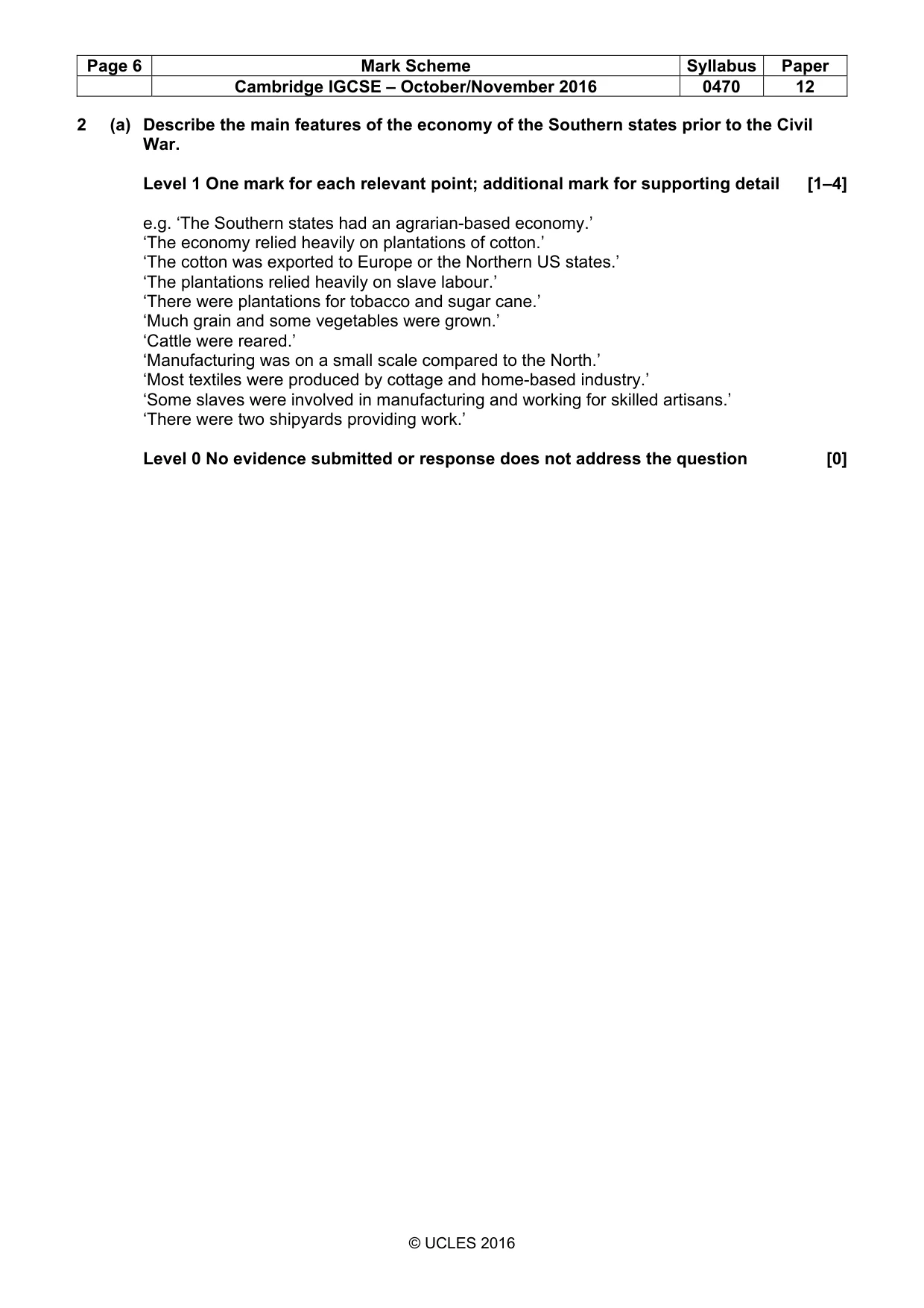
Page 6 Mark Scheme Syllabus Paper Cambridge IGCSE – October/November 2016 0470 12 © UCLES 2016 2 (a) Describe the main features of the economy of the Southern states prior to the Civil War. Level 1 One mark for each relevant point; additional mark for supporting detail [1–4] e.g. ‘The Southern states had an agrarian-based economy.’ ‘The economy relied heavily on plantations of cotton.’ ‘The cotton was exported to Europe or the Northern US states.’ ‘The plantations relied heavily on slave labour.’ ‘There were plantations for tobacco and sugar cane.’ ‘Much grain and some vegetables were grown.’ ‘Cattle were reared.’ ‘Manufacturing was on a small scale compared to the North.’ ‘Most textiles were produced by cottage and home-based industry.’ ‘Some slaves were involved in manufacturing and working for skilled artisans.’ ‘There were two shipyards providing work.’ Level 0 No evidence submitted or response does not address the question [0]
Mark scheme, page 7
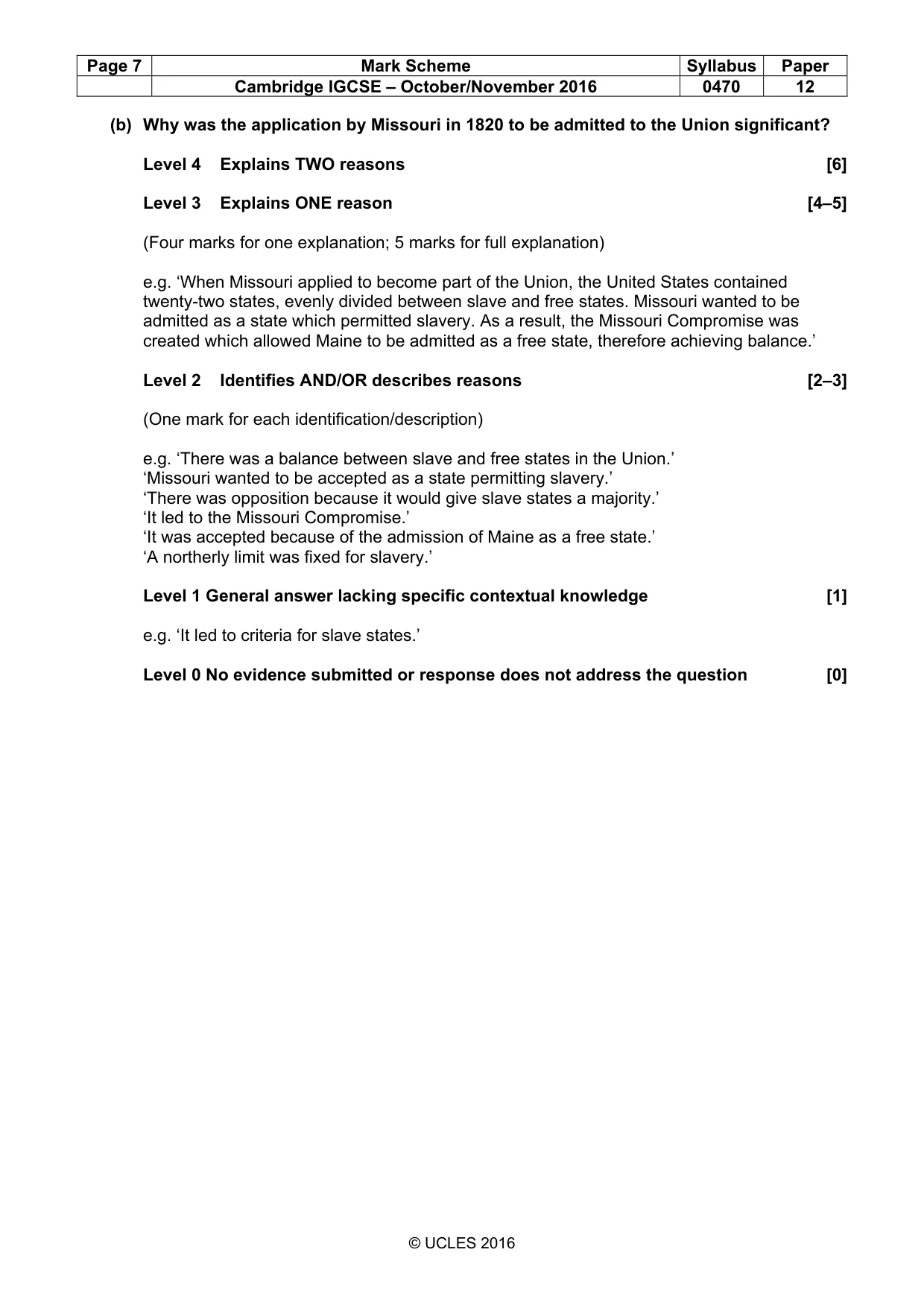
Page 7 Mark Scheme Syllabus Paper Cambridge IGCSE – October/November 2016 0470 12 © UCLES 2016 (b) Why was the application by Missouri in 1820 to be admitted to the Union significant? Level 4 Explains TWO reasons [6] Level 3 Explains ONE reason [4–5] (Four marks for one explanation; 5 marks for full explanation) e.g. ‘When Missouri applied to become part of the Union, the United States contained twenty-two states, evenly divided between slave and free states. Missouri wanted to be admitted as a state which permitted slavery. As a result, the Missouri Compromise was created which allowed Maine to be admitted as a free state, therefore achieving balance.’ Level 2 Identifies AND/OR describes reasons [2–3] (One mark for each identification/description) e.g. ‘There was a balance between slave and free states in the Union.’ ‘Missouri wanted to be accepted as a state permitting slavery.’ ‘There was opposition because it would give slave states a majority.’ ‘It led to the Missouri Compromise.’ ‘It was accepted because of the admission of Maine as a free state.’ ‘A northerly limit was fixed for slavery.’ Level 1 General answer lacking specific contextual knowledge [1] e.g. ‘It led to criteria for slave states.’ Level 0 No evidence submitted or response does not address the question [0]
Mark scheme, page 8
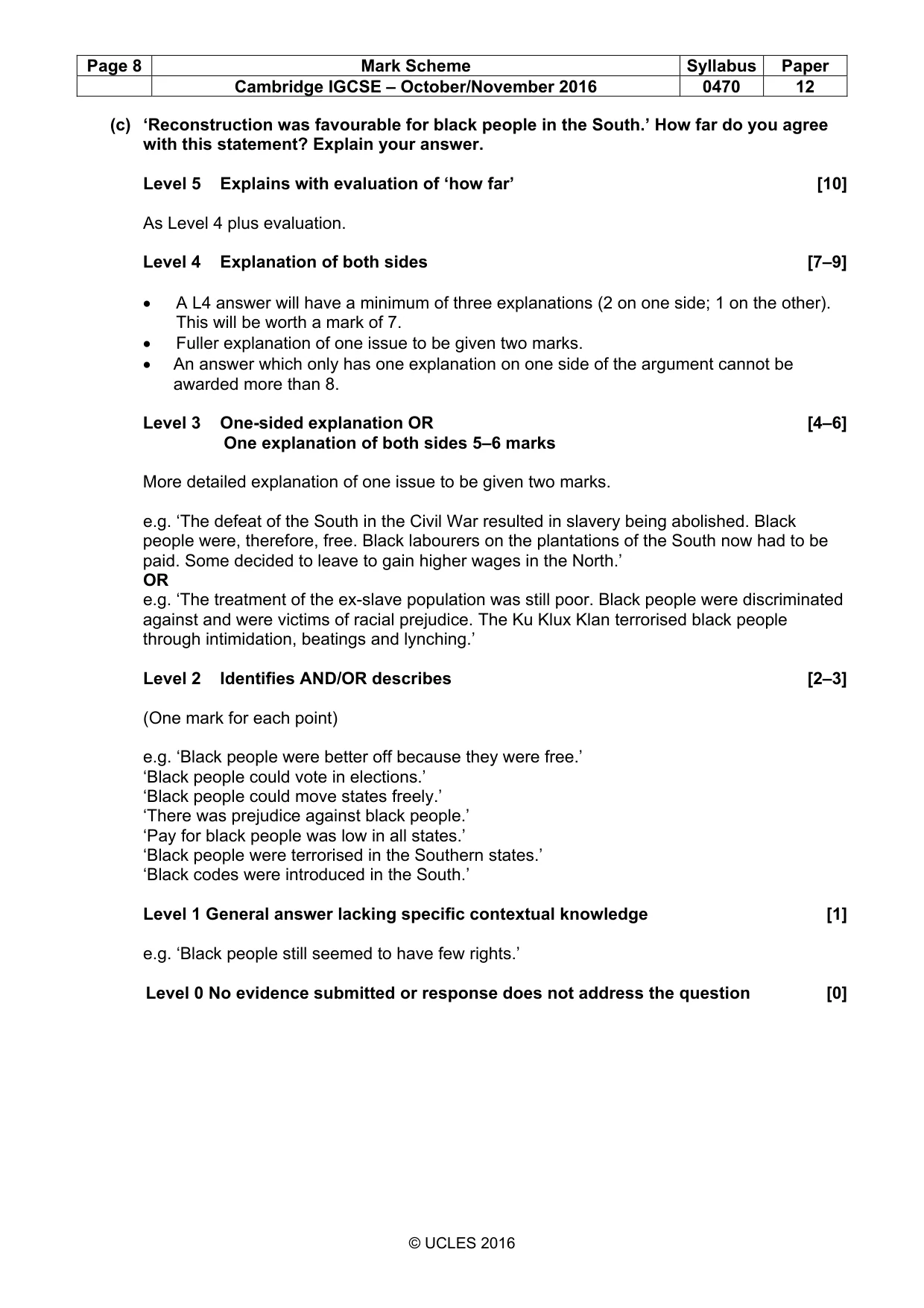
Page 8 Mark Scheme Syllabus Paper Cambridge IGCSE – October/November 2016 0470 12 © UCLES 2016 (c) ‘Reconstruction was favourable for black people in the South.’ How far do you agree with this statement? Explain your answer. Level 5 Explains with evaluation of ‘how far’ [10] As Level 4 plus evaluation. Level 4 Explanation of both sides [7–9] • A L4 answer will have a minimum of three explanations (2 on one side; 1 on the other). This will be worth a mark of 7. • Fuller explanation of one issue to be given two marks. • An answer which only has one explanation on one side of the argument cannot be awarded more than 8. Level 3 One-sided explanation OR [4–6] One explanation of both sides 5–6 marks More detailed explanation of one issue to be given two marks. e.g. ‘The defeat of the South in the Civil War resulted in slavery being abolished. Black people were, therefore, free. Black labourers on the plantations of the South now had to be paid. Some decided to leave to gain higher wages in the North.’ OR e.g. ‘The treatment of the ex-slave population was still poor. Black people were discriminated against and were victims of racial prejudice. The Ku Klux Klan terrorised black people through intimidation, beatings and lynching.’ Level 2 Identifies AND/OR describes [2–3] (One mark for each point) e.g. ‘Black people were better off because they were free.’ ‘Black people could vote in elections.’ ‘Black people could move states freely.’ ‘There was prejudice against black people.’ ‘Pay for black people was low in all states.’ ‘Black people were terrorised in the Southern states.’ ‘Black codes were introduced in the South.’ Level 1 General answer lacking specific contextual knowledge [1] e.g. ‘Black people still seemed to have few rights.’ Level 0 No evidence submitted or response does not address the question [0]
Mark scheme, page 9
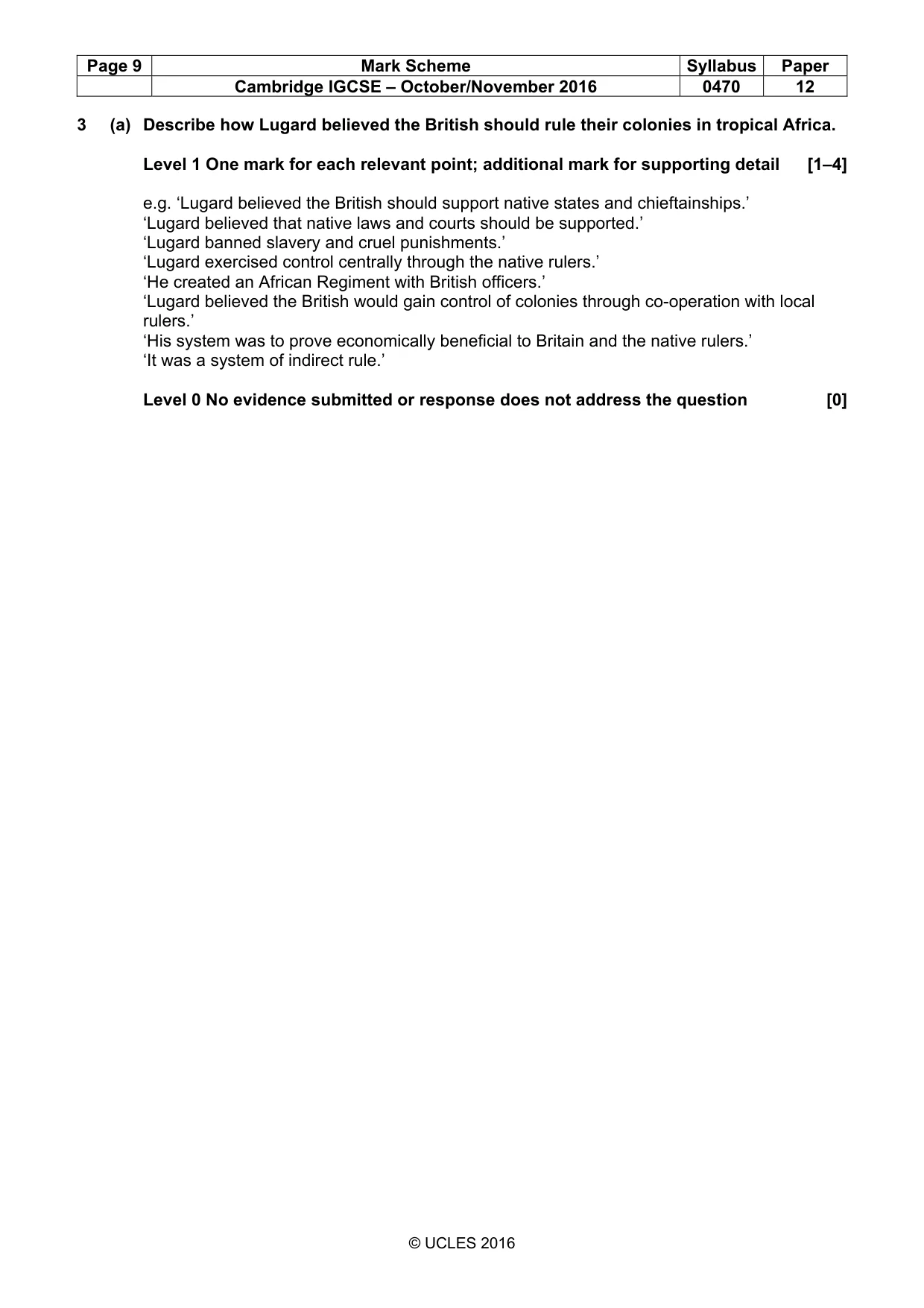
Page 9 Mark Scheme Syllabus Paper Cambridge IGCSE – October/November 2016 0470 12 © UCLES 2016 3 (a) Describe how Lugard believed the British should rule their colonies in tropical Africa. Level 1 One mark for each relevant point; additional mark for supporting detail [1–4] e.g. ‘Lugard believed the British should support native states and chieftainships.’ ‘Lugard believed that native laws and courts should be supported.’ ‘Lugard banned slavery and cruel punishments.’ ‘Lugard exercised control centrally through the native rulers.’ ‘He created an African Regiment with British officers.’ ‘Lugard believed the British would gain control of colonies through co-operation with local rulers.’ ‘His system was to prove economically beneficial to Britain and the native rulers.’ ‘It was a system of indirect rule.’ Level 0 No evidence submitted or response does not address the question [0]
Mark scheme, page 10
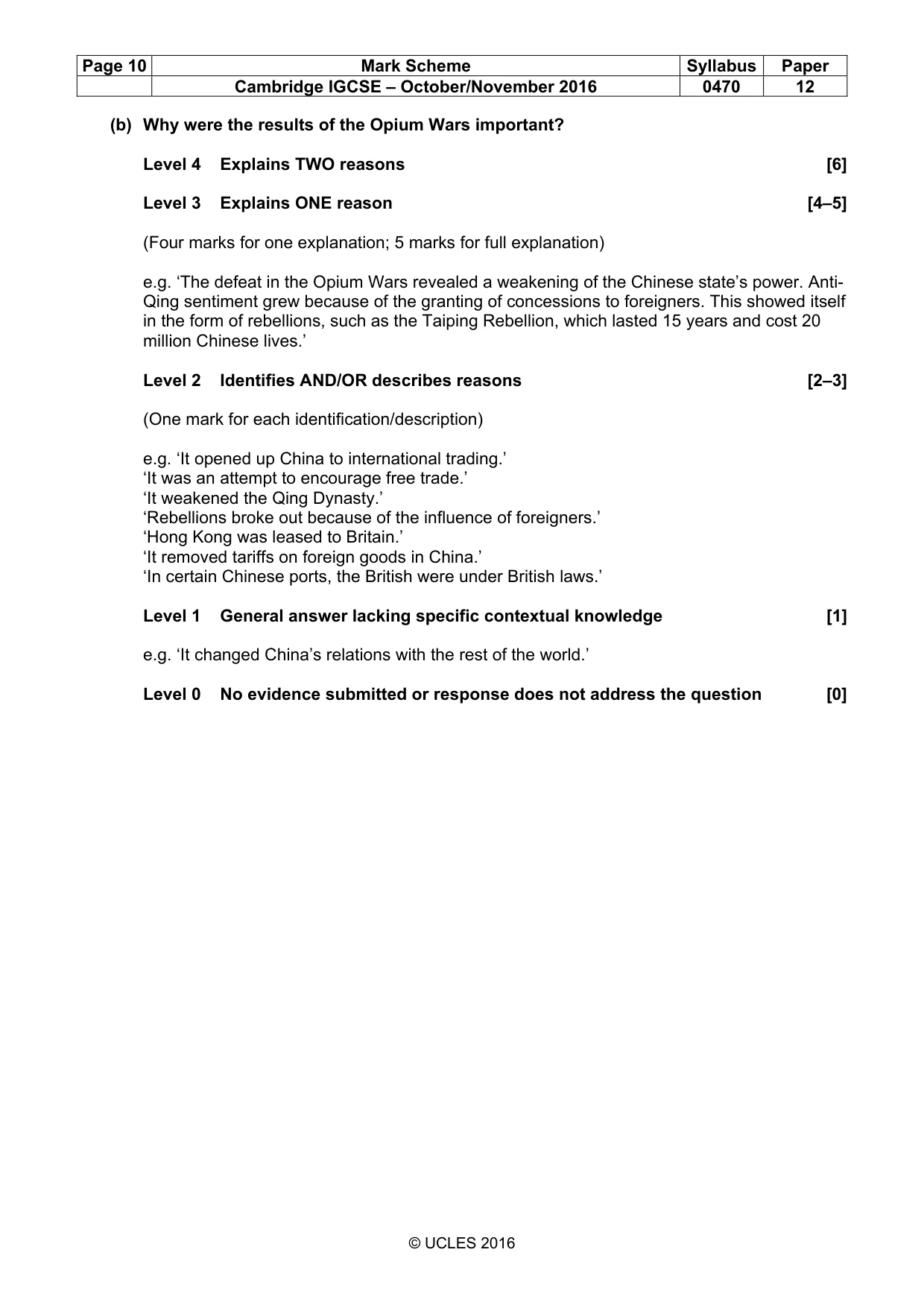
Page 10 Mark Scheme Syllabus Paper Cambridge IGCSE – October/November 2016 0470 12 © UCLES 2016 (b) Why were the results of the Opium Wars important? Level 4 Explains TWO reasons [6] Level 3 Explains ONE reason [4–5] (Four marks for one explanation; 5 marks for full explanation) e.g. ‘The defeat in the Opium Wars revealed a weakening of the Chinese state’s power. Anti- Qing sentiment grew because of the granting of concessions to foreigners. This showed itself in the form of rebellions, such as the Taiping Rebellion, which lasted 15 years and cost 20 million Chinese lives.’ Level 2 Identifies AND/OR describes reasons [2–3] (One mark for each identification/description) e.g. ‘It opened up China to international trading.’ ‘It was an attempt to encourage free trade.’ ‘It weakened the Qing Dynasty.’ ‘Rebellions broke out because of the influence of foreigners.’ ‘Hong Kong was leased to Britain.’ ‘It removed tariffs on foreign goods in China.’ ‘In certain Chinese ports, the British were under British laws.’ Level 1 General answer lacking specific contextual knowledge [1] e.g. ‘It changed China’s relations with the rest of the world.’ Level 0 No evidence submitted or response does not address the question [0]
Mark scheme, page 11
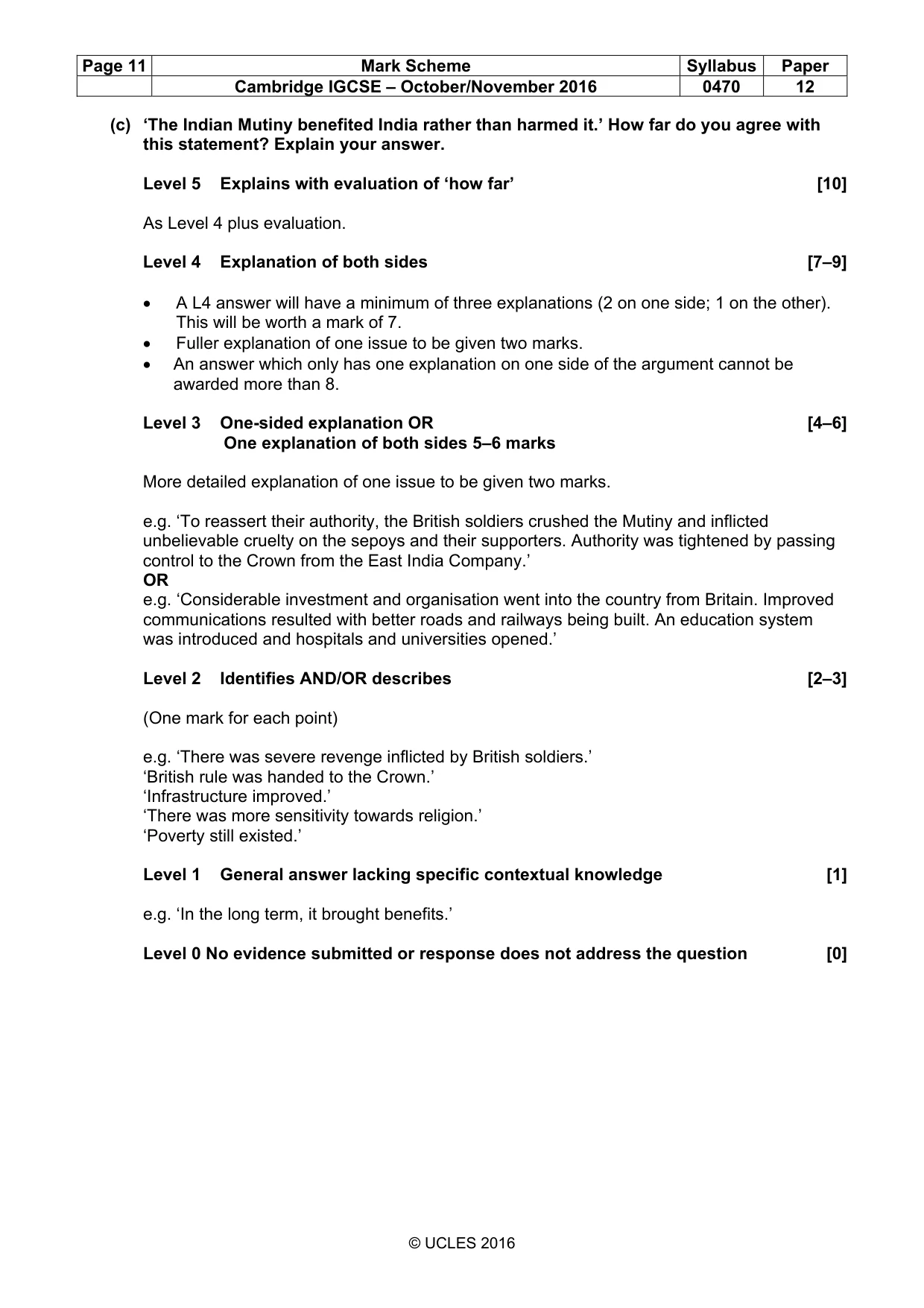
Page 11 Mark Scheme Syllabus Paper Cambridge IGCSE – October/November 2016 0470 12 © UCLES 2016 (c) ‘The Indian Mutiny benefited India rather than harmed it.’ How far do you agree with this statement? Explain your answer. Level 5 Explains with evaluation of ‘how far’ [10] As Level 4 plus evaluation. Level 4 Explanation of both sides [7–9] • A L4 answer will have a minimum of three explanations (2 on one side; 1 on the other). This will be worth a mark of 7. • Fuller explanation of one issue to be given two marks. • An answer which only has one explanation on one side of the argument cannot be awarded more than 8. Level 3 One-sided explanation OR [4–6] One explanation of both sides 5–6 marks More detailed explanation of one issue to be given two marks. e.g. ‘To reassert their authority, the British soldiers crushed the Mutiny and inflicted unbelievable cruelty on the sepoys and their supporters. Authority was tightened by passing control to the Crown from the East India Company.’ OR e.g. ‘Considerable investment and organisation went into the country from Britain. Improved communications resulted with better roads and railways being built. An education system was introduced and hospitals and universities opened.’ Level 2 Identifies AND/OR describes [2–3] (One mark for each point) e.g. ‘There was severe revenge inflicted by British soldiers.’ ‘British rule was handed to the Crown.’ ‘Infrastructure improved.’ ‘There was more sensitivity towards religion.’ ‘Poverty still existed.’ Level 1 General answer lacking specific contextual knowledge [1] e.g. ‘In the long term, it brought benefits.’ Level 0 No evidence submitted or response does not address the question [0]
Mark scheme, page 12
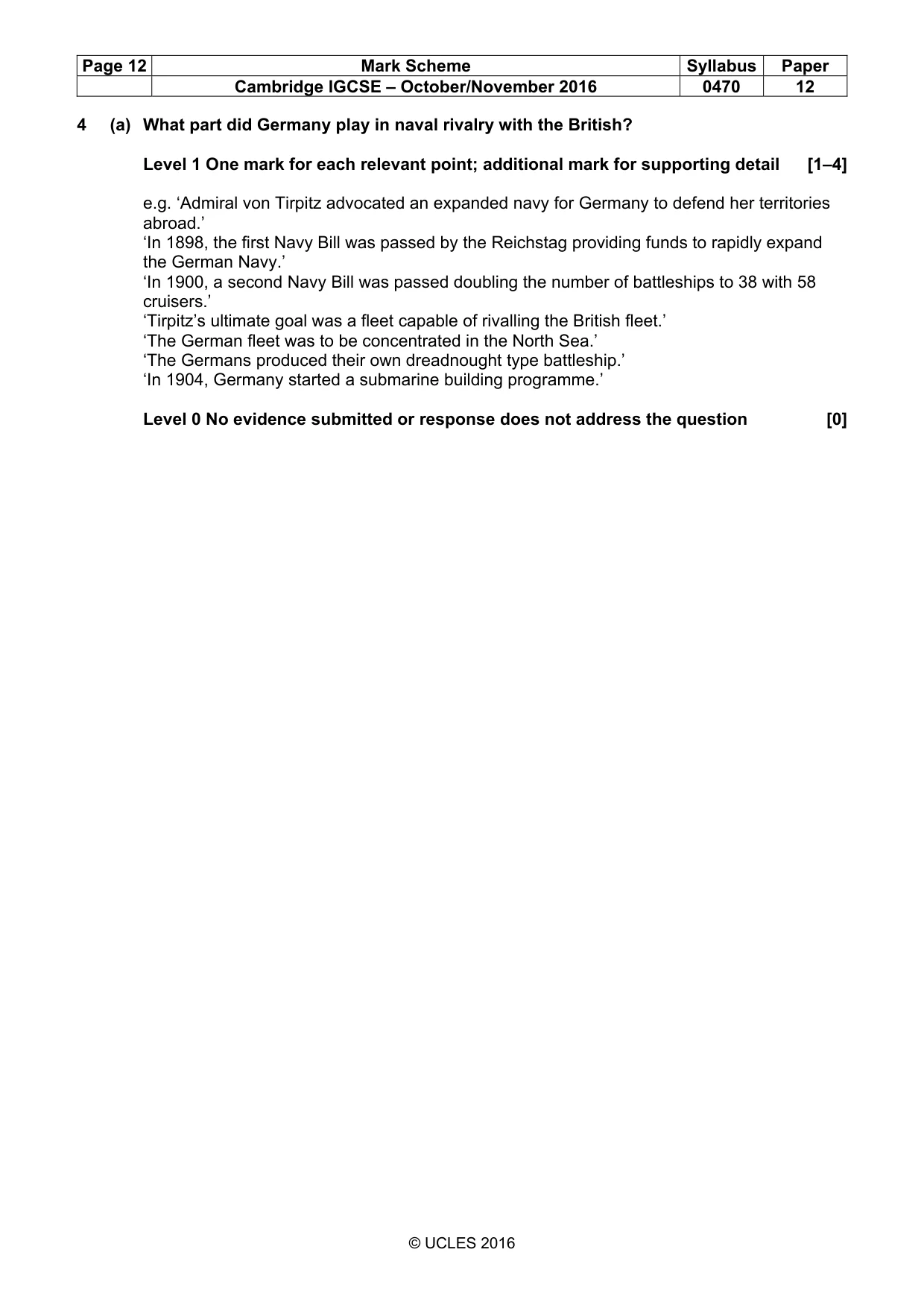
Page 12 Mark Scheme Syllabus Paper Cambridge IGCSE – October/November 2016 0470 12 © UCLES 2016 4 (a) What part did Germany play in naval rivalry with the British? Level 1 One mark for each relevant point; additional mark for supporting detail [1–4] e.g. ‘Admiral von Tirpitz advocated an expanded navy for Germany to defend her territories abroad.’ ‘In 1898, the first Navy Bill was passed by the Reichstag providing funds to rapidly expand the German Navy.’ ‘In 1900, a second Navy Bill was passed doubling the number of battleships to 38 with 58 cruisers.’ ‘Tirpitz’s ultimate goal was a fleet capable of rivalling the British fleet.’ ‘The German fleet was to be concentrated in the North Sea.’ ‘The Germans produced their own dreadnought type battleship.’ ‘In 1904, Germany started a submarine building programme.’ Level 0 No evidence submitted or response does not address the question [0]
Mark scheme, page 13
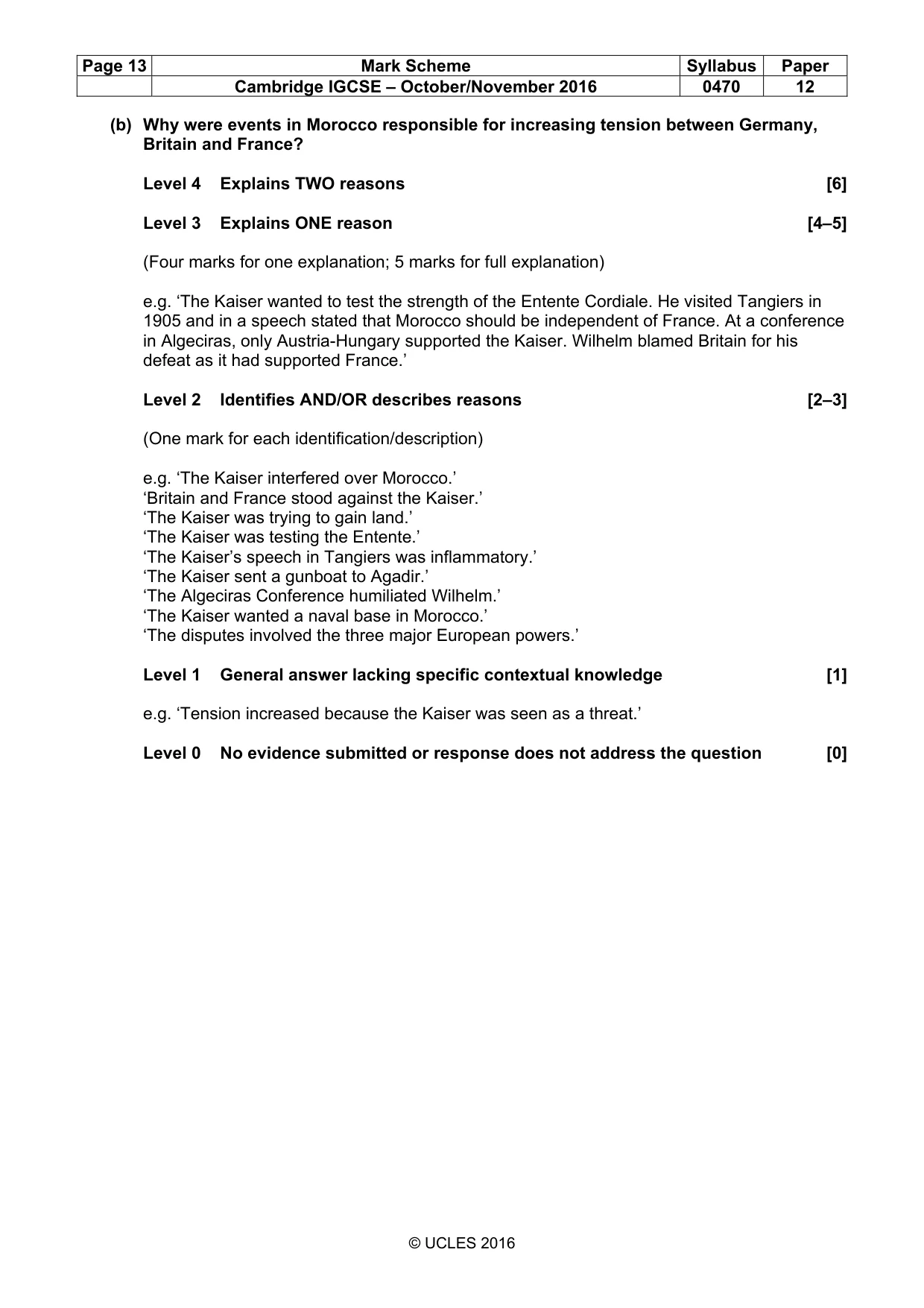
Page 13 Mark Scheme Syllabus Paper Cambridge IGCSE – October/November 2016 0470 12 © UCLES 2016 (b) Why were events in Morocco responsible for increasing tension between Germany, Britain and France? Level 4 Explains TWO reasons [6] Level 3 Explains ONE reason [4–5] (Four marks for one explanation; 5 marks for full explanation) e.g. ‘The Kaiser wanted to test the strength of the Entente Cordiale. He visited Tangiers in 1905 and in a speech stated that Morocco should be independent of France. At a conference in Algeciras, only Austria-Hungary supported the Kaiser. Wilhelm blamed Britain for his defeat as it had supported France.’ Level 2 Identifies AND/OR describes reasons [2–3] (One mark for each identification/description) e.g. ‘The Kaiser interfered over Morocco.’ ‘Britain and France stood against the Kaiser.’ ‘The Kaiser was trying to gain land.’ ‘The Kaiser was testing the Entente.’ ‘The Kaiser’s speech in Tangiers was inflammatory.’ ‘The Kaiser sent a gunboat to Agadir.’ ‘The Algeciras Conference humiliated Wilhelm.’ ‘The Kaiser wanted a naval base in Morocco.’ ‘The disputes involved the three major European powers.’ Level 1 General answer lacking specific contextual knowledge [1] e.g. ‘Tension increased because the Kaiser was seen as a threat.’ Level 0 No evidence submitted or response does not address the question [0]
Mark scheme, page 14
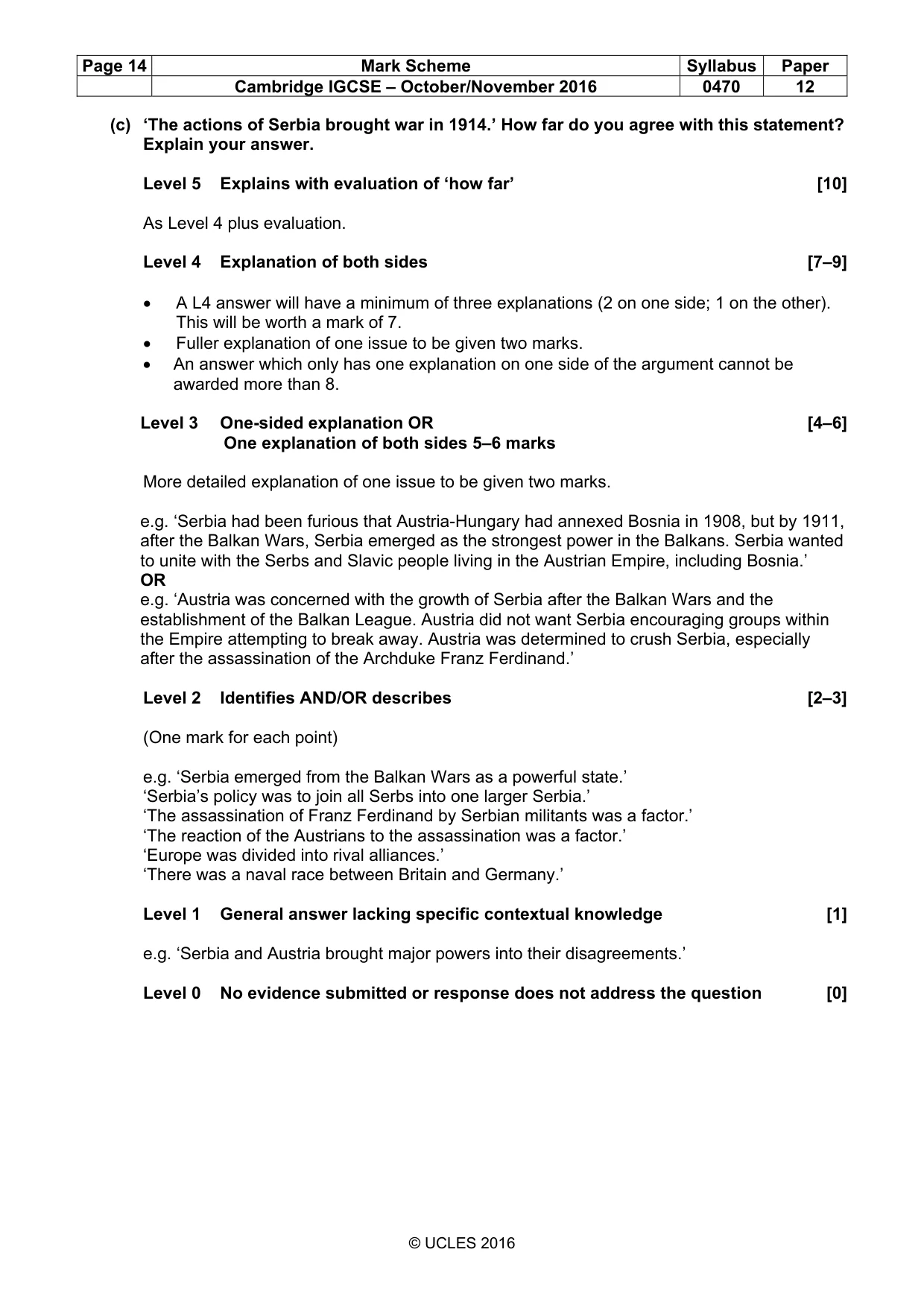
Page 14 Mark Scheme Syllabus Paper Cambridge IGCSE – October/November 2016 0470 12 © UCLES 2016 (c) ‘The actions of Serbia brought war in 1914.’ How far do you agree with this statement? Explain your answer. Level 5 Explains with evaluation of ‘how far’ [10] As Level 4 plus evaluation. Level 4 Explanation of both sides [7–9] • A L4 answer will have a minimum of three explanations (2 on one side; 1 on the other). This will be worth a mark of 7. • Fuller explanation of one issue to be given two marks. • An answer which only has one explanation on one side of the argument cannot be awarded more than 8. Level 3 One-sided explanation OR [4–6] One explanation of both sides 5–6 marks More detailed explanation of one issue to be given two marks. e.g. ‘Serbia had been furious that Austria-Hungary had annexed Bosnia in 1908, but by 1911, after the Balkan Wars, Serbia emerged as the strongest power in the Balkans. Serbia wanted to unite with the Serbs and Slavic people living in the Austrian Empire, including Bosnia.’ OR e.g. ‘Austria was concerned with the growth of Serbia after the Balkan Wars and the establishment of the Balkan League. Austria did not want Serbia encouraging groups within the Empire attempting to break away. Austria was determined to crush Serbia, especially after the assassination of the Archduke Franz Ferdinand.’ Level 2 Identifies AND/OR describes [2–3] (One mark for each point) e.g. ‘Serbia emerged from the Balkan Wars as a powerful state.’ ‘Serbia’s policy was to join all Serbs into one larger Serbia.’ ‘The assassination of Franz Ferdinand by Serbian militants was a factor.’ ‘The reaction of the Austrians to the assassination was a factor.’ ‘Europe was divided into rival alliances.’ ‘There was a naval race between Britain and Germany.’ Level 1 General answer lacking specific contextual knowledge [1] e.g. ‘Serbia and Austria brought major powers into their disagreements.’ Level 0 No evidence submitted or response does not address the question [0]
Mark scheme, page 15
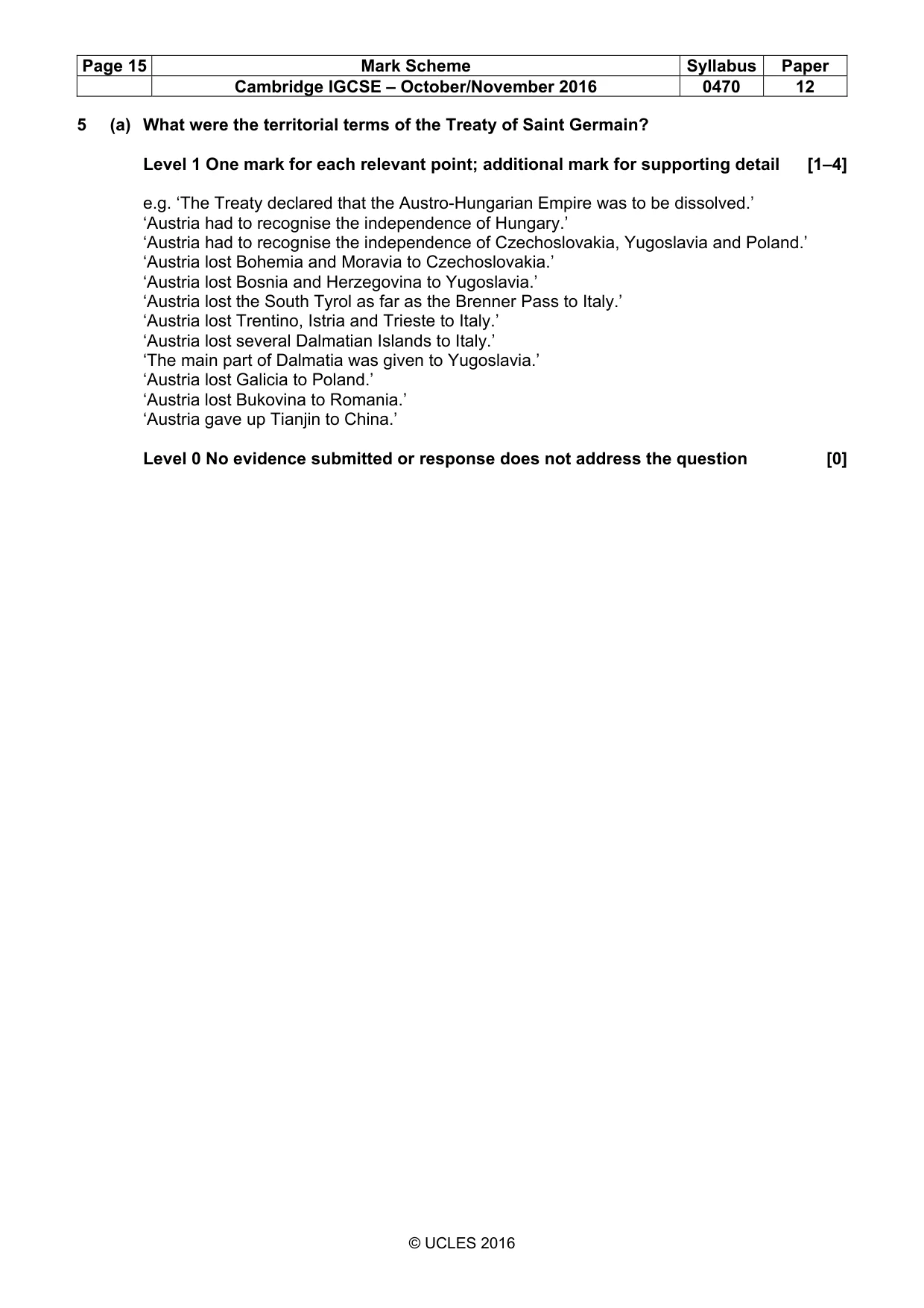
Page 15 Mark Scheme Syllabus Paper Cambridge IGCSE – October/November 2016 0470 12 © UCLES 2016 5 (a) What were the territorial terms of the Treaty of Saint Germain? Level 1 One mark for each relevant point; additional mark for supporting detail [1–4] e.g. ‘The Treaty declared that the Austro-Hungarian Empire was to be dissolved.’ ‘Austria had to recognise the independence of Hungary.’ ‘Austria had to recognise the independence of Czechoslovakia, Yugoslavia and Poland.’ ‘Austria lost Bohemia and Moravia to Czechoslovakia.’ ‘Austria lost Bosnia and Herzegovina to Yugoslavia.’ ‘Austria lost the South Tyrol as far as the Brenner Pass to Italy.’ ‘Austria lost Trentino, Istria and Trieste to Italy.’ ‘Austria lost several Dalmatian Islands to Italy.’ ‘The main part of Dalmatia was given to Yugoslavia.’ ‘Austria lost Galicia to Poland.’ ‘Austria lost Bukovina to Romania.’ ‘Austria gave up Tianjin to China.’ Level 0 No evidence submitted or response does not address the question [0]
Mark scheme, page 16
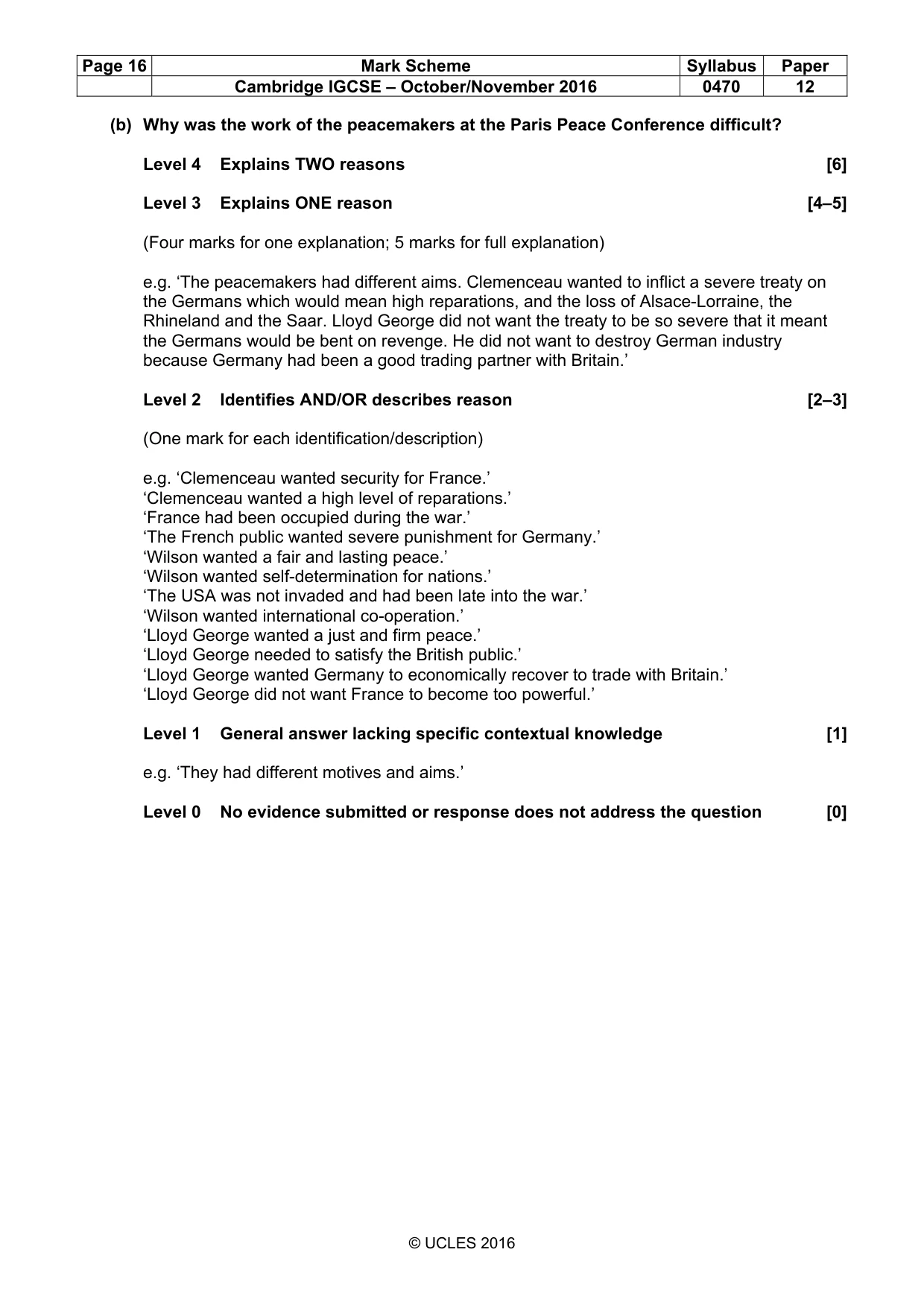
Page 16 Mark Scheme Syllabus Paper Cambridge IGCSE – October/November 2016 0470 12 © UCLES 2016 (b) Why was the work of the peacemakers at the Paris Peace Conference difficult? Level 4 Explains TWO reasons [6] Level 3 Explains ONE reason [4–5] (Four marks for one explanation; 5 marks for full explanation) e.g. ‘The peacemakers had different aims. Clemenceau wanted to inflict a severe treaty on the Germans which would mean high reparations, and the loss of Alsace-Lorraine, the Rhineland and the Saar. Lloyd George did not want the treaty to be so severe that it meant the Germans would be bent on revenge. He did not want to destroy German industry because Germany had been a good trading partner with Britain.’ Level 2 Identifies AND/OR describes reason [2–3] (One mark for each identification/description) e.g. ‘Clemenceau wanted security for France.’ ‘Clemenceau wanted a high level of reparations.’ ‘France had been occupied during the war.’ ‘The French public wanted severe punishment for Germany.’ ‘Wilson wanted a fair and lasting peace.’ ‘Wilson wanted self-determination for nations.’ ‘The USA was not invaded and had been late into the war.’ ‘Wilson wanted international co-operation.’ ‘Lloyd George wanted a just and firm peace.’ ‘Lloyd George needed to satisfy the British public.’ ‘Lloyd George wanted Germany to economically recover to trade with Britain.’ ‘Lloyd George did not want France to become too powerful.’ Level 1 General answer lacking specific contextual knowledge [1] e.g. ‘They had different motives and aims.’ Level 0 No evidence submitted or response does not address the question [0]
Mark scheme, page 17
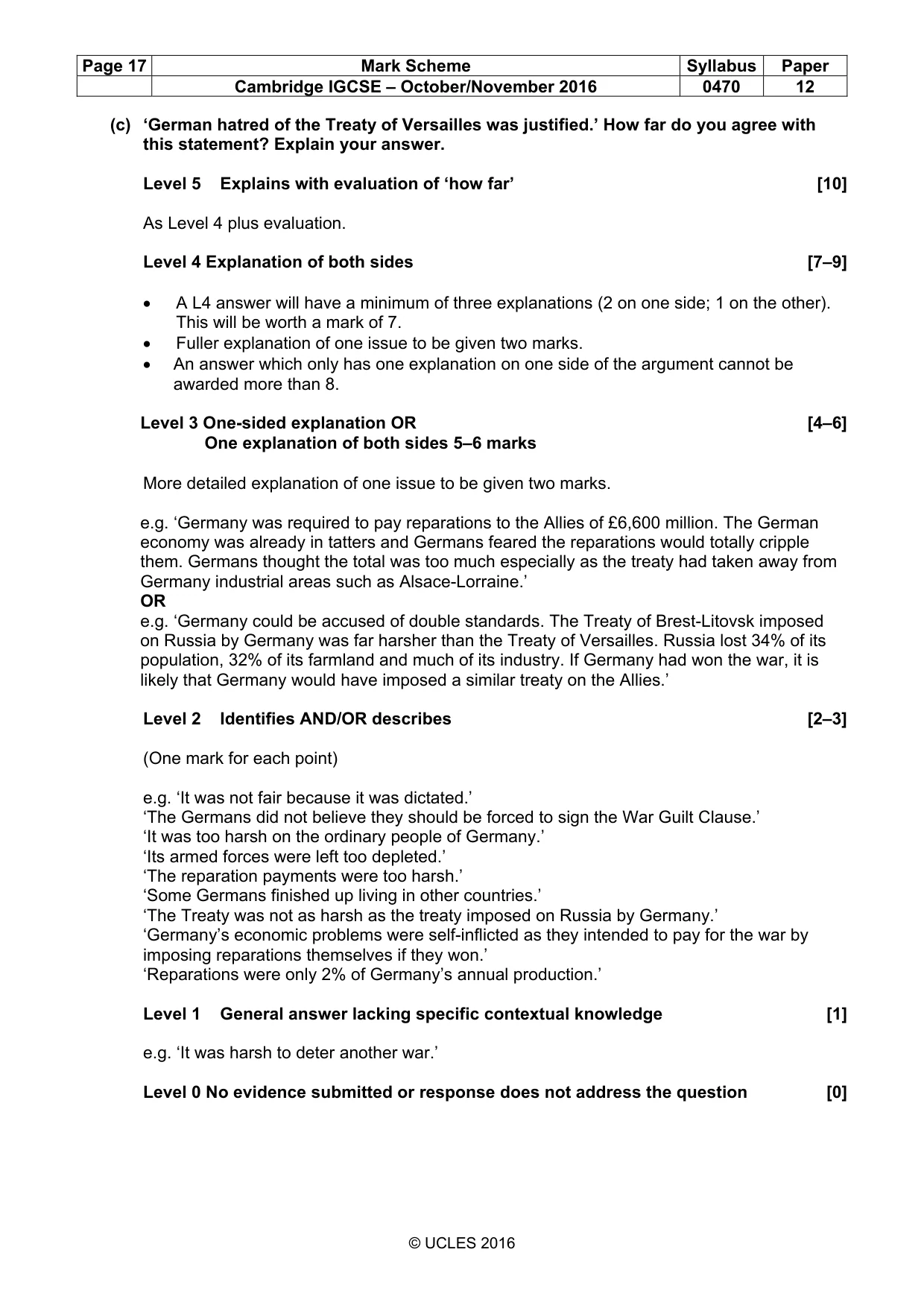
Page 17 Mark Scheme Syllabus Paper Cambridge IGCSE – October/November 2016 0470 12 © UCLES 2016 (c) ‘German hatred of the Treaty of Versailles was justified.’ How far do you agree with this statement? Explain your answer. Level 5 Explains with evaluation of ‘how far’ [10] As Level 4 plus evaluation. Level 4 Explanation of both sides [7–9] • A L4 answer will have a minimum of three explanations (2 on one side; 1 on the other). This will be worth a mark of 7. • Fuller explanation of one issue to be given two marks. • An answer which only has one explanation on one side of the argument cannot be awarded more than 8. Level 3 One-sided explanation OR [4–6] One explanation of both sides 5–6 marks More detailed explanation of one issue to be given two marks. e.g. ‘Germany was required to pay reparations to the Allies of £6,600 million. The German economy was already in tatters and Germans feared the reparations would totally cripple them. Germans thought the total was too much especially as the treaty had taken away from Germany industrial areas such as Alsace-Lorraine.’ OR e.g. ‘Germany could be accused of double standards. The Treaty of Brest-Litovsk imposed on Russia by Germany was far harsher than the Treaty of Versailles. Russia lost 34% of its population, 32% of its farmland and much of its industry. If Germany had won the war, it is likely that Germany would have imposed a similar treaty on the Allies.’ Level 2 Identifies AND/OR describes [2–3] (One mark for each point) e.g. ‘It was not fair because it was dictated.’ ‘The Germans did not believe they should be forced to sign the War Guilt Clause.’ ‘It was too harsh on the ordinary people of Germany.’ ‘Its armed forces were left too depleted.’ ‘The reparation payments were too harsh.’ ‘Some Germans finished up living in other countries.’ ‘The Treaty was not as harsh as the treaty imposed on Russia by Germany.’ ‘Germany’s economic problems were self-inflicted as they intended to pay for the war by imposing reparations themselves if they won.’ ‘Reparations were only 2% of Germany’s annual production.’ Level 1 General answer lacking specific contextual knowledge [1] e.g. ‘It was harsh to deter another war.’ Level 0 No evidence submitted or response does not address the question [0]
Mark scheme, page 18
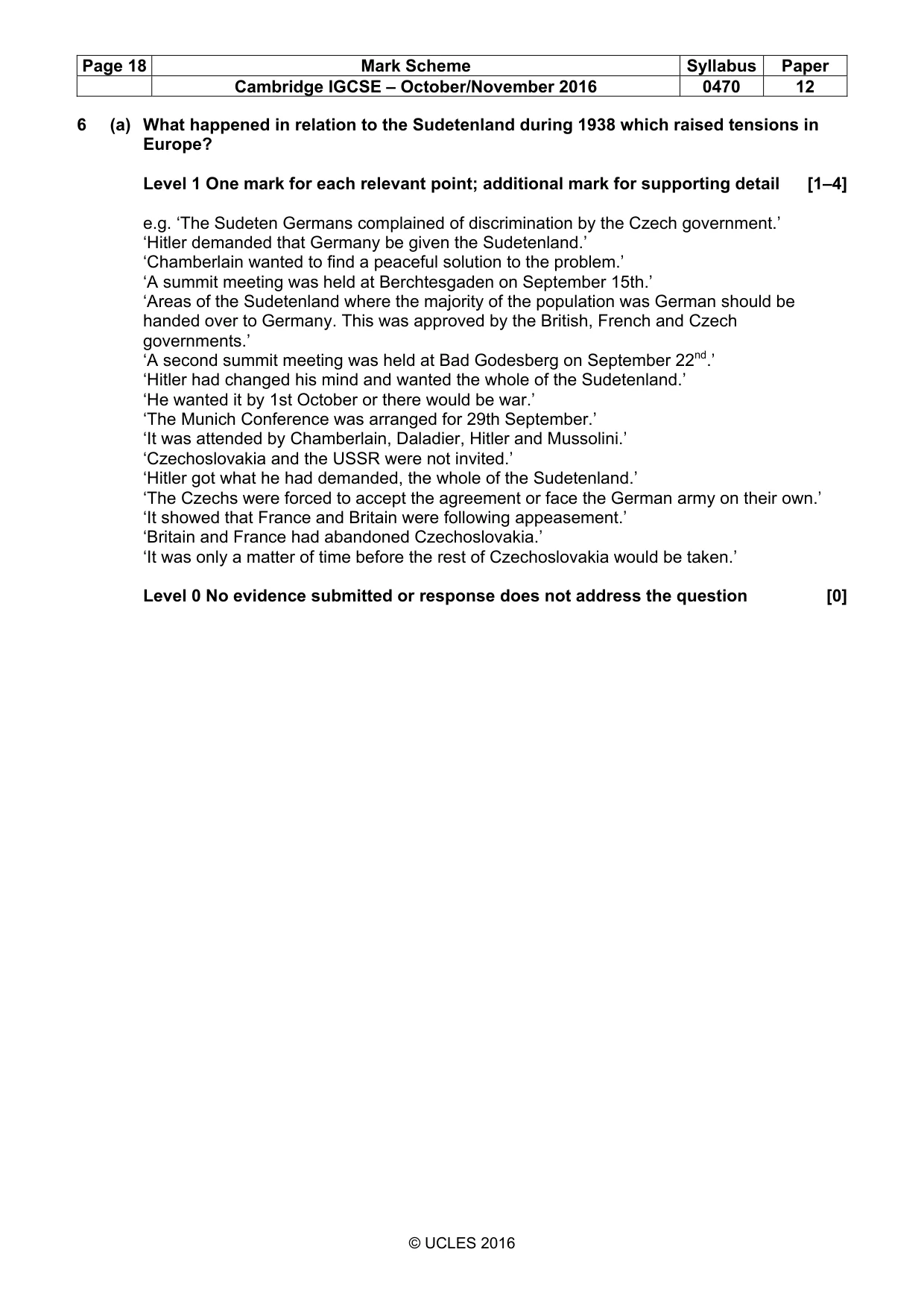
Page 18 Mark Scheme Syllabus Paper Cambridge IGCSE – October/November 2016 0470 12 © UCLES 2016 6 (a) What happened in relation to the Sudetenland during 1938 which raised tensions in Europe? Level 1 One mark for each relevant point; additional mark for supporting detail [1–4] e.g. ‘The Sudeten Germans complained of discrimination by the Czech government.’ ‘Hitler demanded that Germany be given the Sudetenland.’ ‘Chamberlain wanted to find a peaceful solution to the problem.’ ‘A summit meeting was held at Berchtesgaden on September 15th.’ ‘Areas of the Sudetenland where the majority of the population was German should be handed over to Germany. This was approved by the British, French and Czech governments.’ ‘A second summit meeting was held at Bad Godesberg on September 22nd.’ ‘Hitler had changed his mind and wanted the whole of the Sudetenland.’ ‘He wanted it by 1st October or there would be war.’ ‘The Munich Conference was arranged for 29th September.’ ‘It was attended by Chamberlain, Daladier, Hitler and Mussolini.’ ‘Czechoslovakia and the USSR were not invited.’ ‘Hitler got what he had demanded, the whole of the Sudetenland.’ ‘The Czechs were forced to accept the agreement or face the German army on their own.’ ‘It showed that France and Britain were following appeasement.’ ‘Britain and France had abandoned Czechoslovakia.’ ‘It was only a matter of time before the rest of Czechoslovakia would be taken.’ Level 0 No evidence submitted or response does not address the question [0]
Mark scheme, page 19
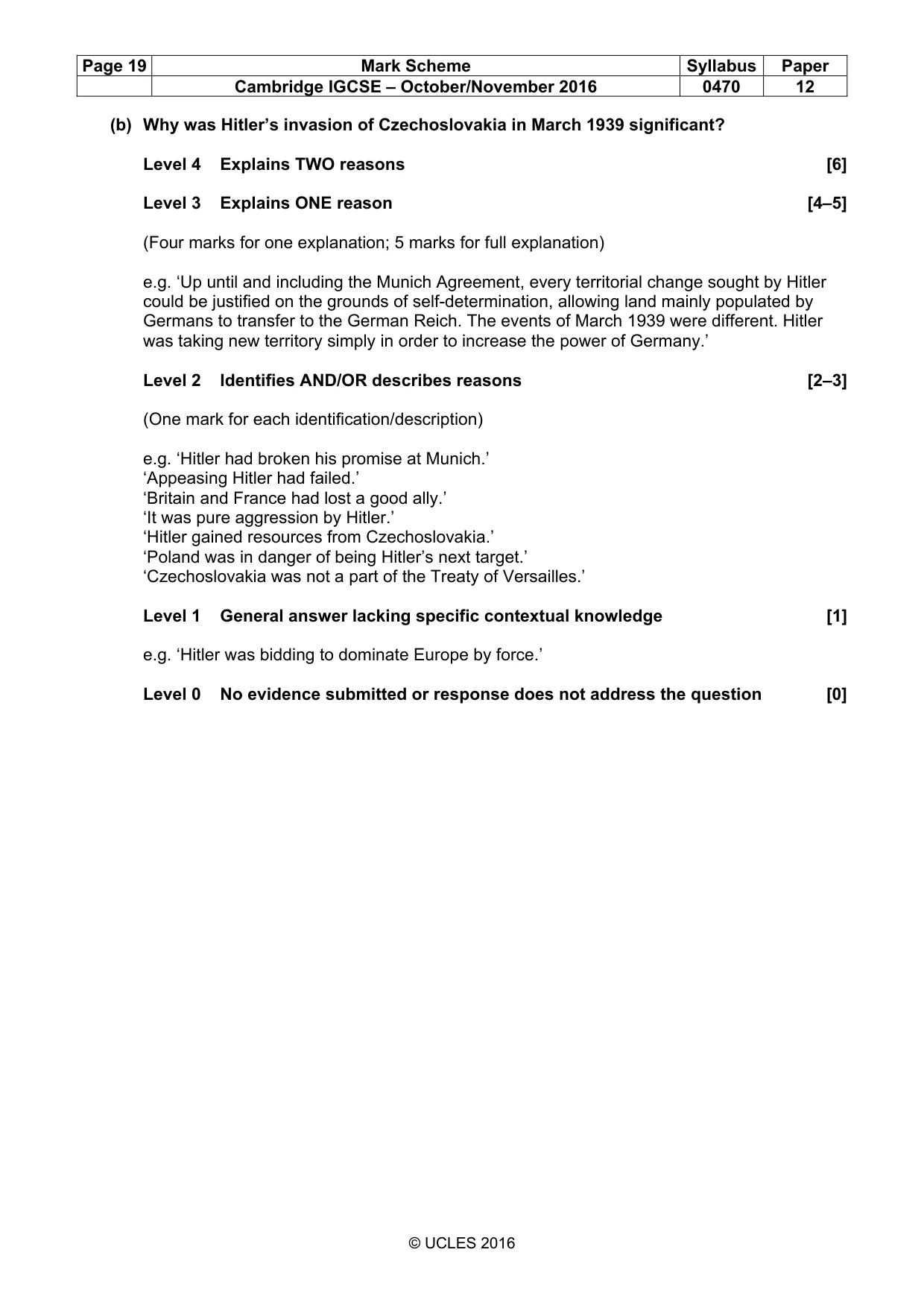
Page 19 Mark Scheme Syllabus Paper Cambridge IGCSE – October/November 2016 0470 12 © UCLES 2016 (b) Why was Hitler’s invasion of Czechoslovakia in March 1939 significant? Level 4 Explains TWO reasons [6] Level 3 Explains ONE reason [4–5] (Four marks for one explanation; 5 marks for full explanation) e.g. ‘Up until and including the Munich Agreement, every territorial change sought by Hitler could be justified on the grounds of self-determination, allowing land mainly populated by Germans to transfer to the German Reich. The events of March 1939 were different. Hitler was taking new territory simply in order to increase the power of Germany.’ Level 2 Identifies AND/OR describes reasons [2–3] (One mark for each identification/description) e.g. ‘Hitler had broken his promise at Munich.’ ‘Appeasing Hitler had failed.’ ‘Britain and France had lost a good ally.’ ‘It was pure aggression by Hitler.’ ‘Hitler gained resources from Czechoslovakia.’ ‘Poland was in danger of being Hitler’s next target.’ ‘Czechoslovakia was not a part of the Treaty of Versailles.’ Level 1 General answer lacking specific contextual knowledge [1] e.g. ‘Hitler was bidding to dominate Europe by force.’ Level 0 No evidence submitted or response does not address the question [0]
Mark scheme, page 20
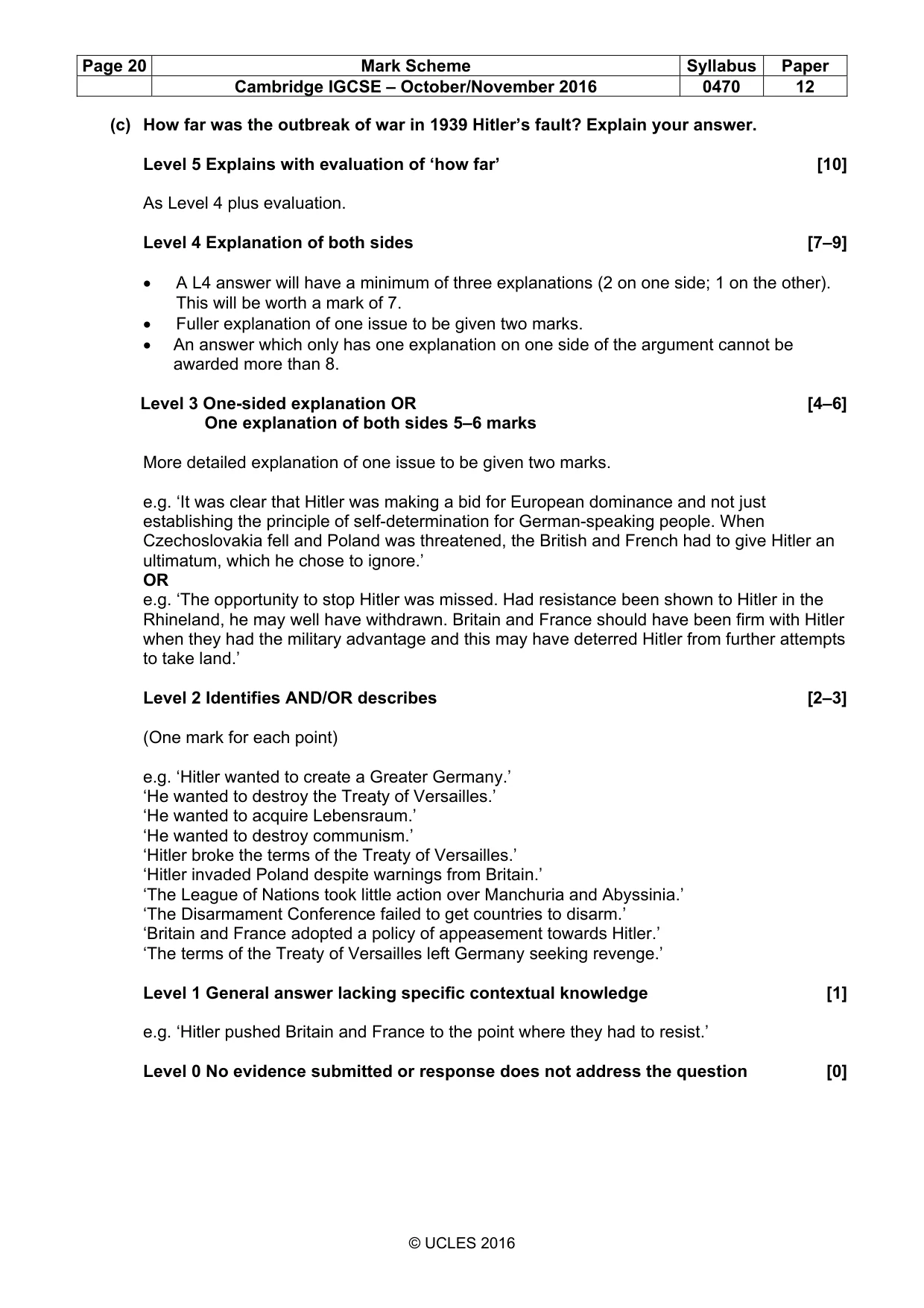
Page 20 Mark Scheme Syllabus Paper Cambridge IGCSE – October/November 2016 0470 12 © UCLES 2016 (c) How far was the outbreak of war in 1939 Hitler’s fault? Explain your answer. Level 5 Explains with evaluation of ‘how far’ [10] As Level 4 plus evaluation. Level 4 Explanation of both sides [7–9] • A L4 answer will have a minimum of three explanations (2 on one side; 1 on the other). This will be worth a mark of 7. • Fuller explanation of one issue to be given two marks. • An answer which only has one explanation on one side of the argument cannot be awarded more than 8. Level 3 One-sided explanation OR [4–6] One explanation of both sides 5–6 marks More detailed explanation of one issue to be given two marks. e.g. ‘It was clear that Hitler was making a bid for European dominance and not just establishing the principle of self-determination for German-speaking people. When Czechoslovakia fell and Poland was threatened, the British and French had to give Hitler an ultimatum, which he chose to ignore.’ OR e.g. ‘The opportunity to stop Hitler was missed. Had resistance been shown to Hitler in the Rhineland, he may well have withdrawn. Britain and France should have been firm with Hitler when they had the military advantage and this may have deterred Hitler from further attempts to take land.’ Level 2 Identifies AND/OR describes [2–3] (One mark for each point) e.g. ‘Hitler wanted to create a Greater Germany.’ ‘He wanted to destroy the Treaty of Versailles.’ ‘He wanted to acquire Lebensraum.’ ‘He wanted to destroy communism.’ ‘Hitler broke the terms of the Treaty of Versailles.’ ‘Hitler invaded Poland despite warnings from Britain.’ ‘The League of Nations took little action over Manchuria and Abyssinia.’ ‘The Disarmament Conference failed to get countries to disarm.’ ‘Britain and France adopted a policy of appeasement towards Hitler.’ ‘The terms of the Treaty of Versailles left Germany seeking revenge.’ Level 1 General answer lacking specific contextual knowledge [1] e.g. ‘Hitler pushed Britain and France to the point where they had to resist.’ Level 0 No evidence submitted or response does not address the question [0]
Mark scheme, page 21
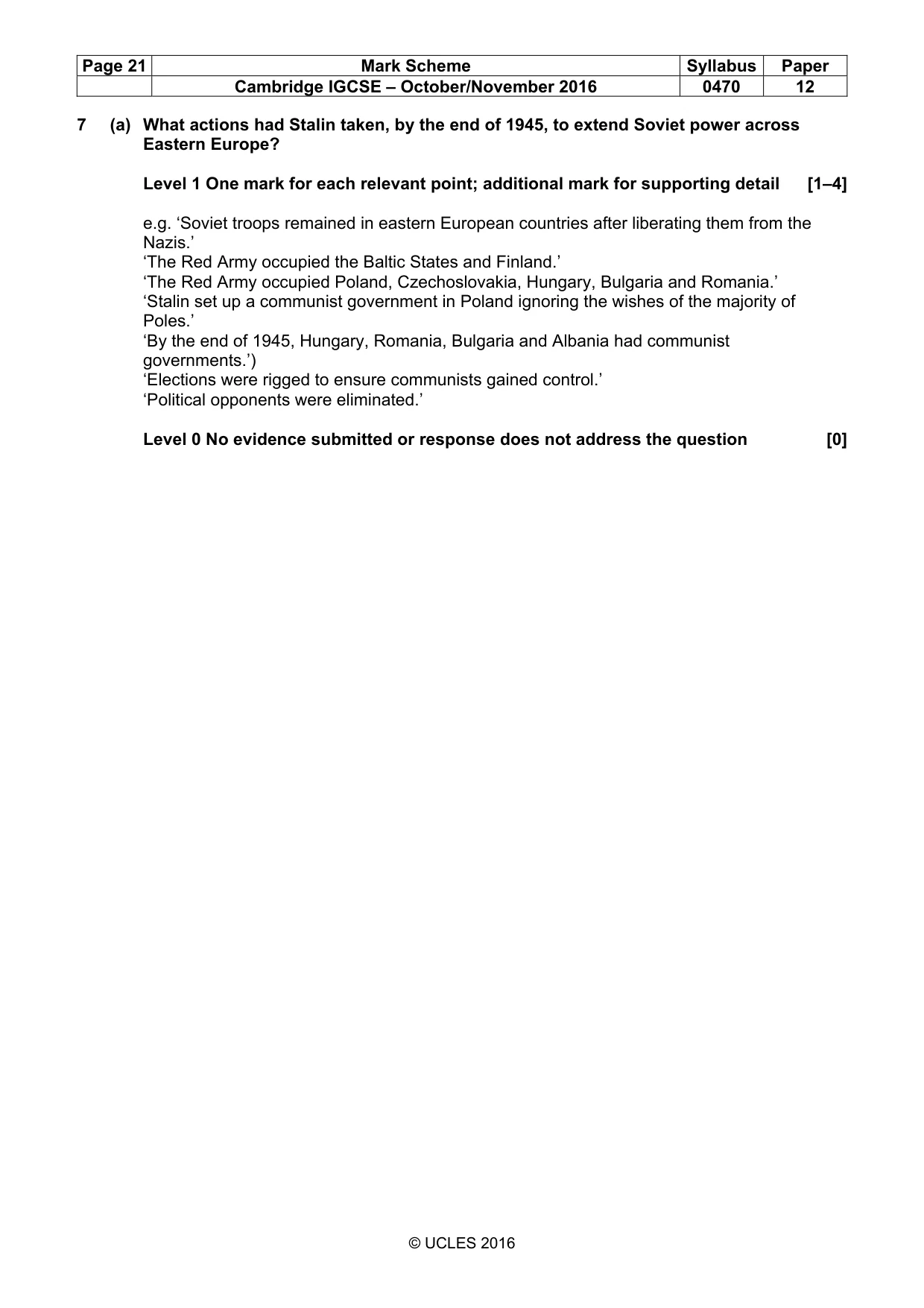
Page 21 Mark Scheme Syllabus Paper Cambridge IGCSE – October/November 2016 0470 12 © UCLES 2016 7 (a) What actions had Stalin taken, by the end of 1945, to extend Soviet power across Eastern Europe? Level 1 One mark for each relevant point; additional mark for supporting detail [1–4] e.g. ‘Soviet troops remained in eastern European countries after liberating them from the Nazis.’ ‘The Red Army occupied the Baltic States and Finland.’ ‘The Red Army occupied Poland, Czechoslovakia, Hungary, Bulgaria and Romania.’ ‘Stalin set up a communist government in Poland ignoring the wishes of the majority of Poles.’ ‘By the end of 1945, Hungary, Romania, Bulgaria and Albania had communist governments.’) ‘Elections were rigged to ensure communists gained control.’ ‘Political opponents were eliminated.’ Level 0 No evidence submitted or response does not address the question [0]
Mark scheme, page 22
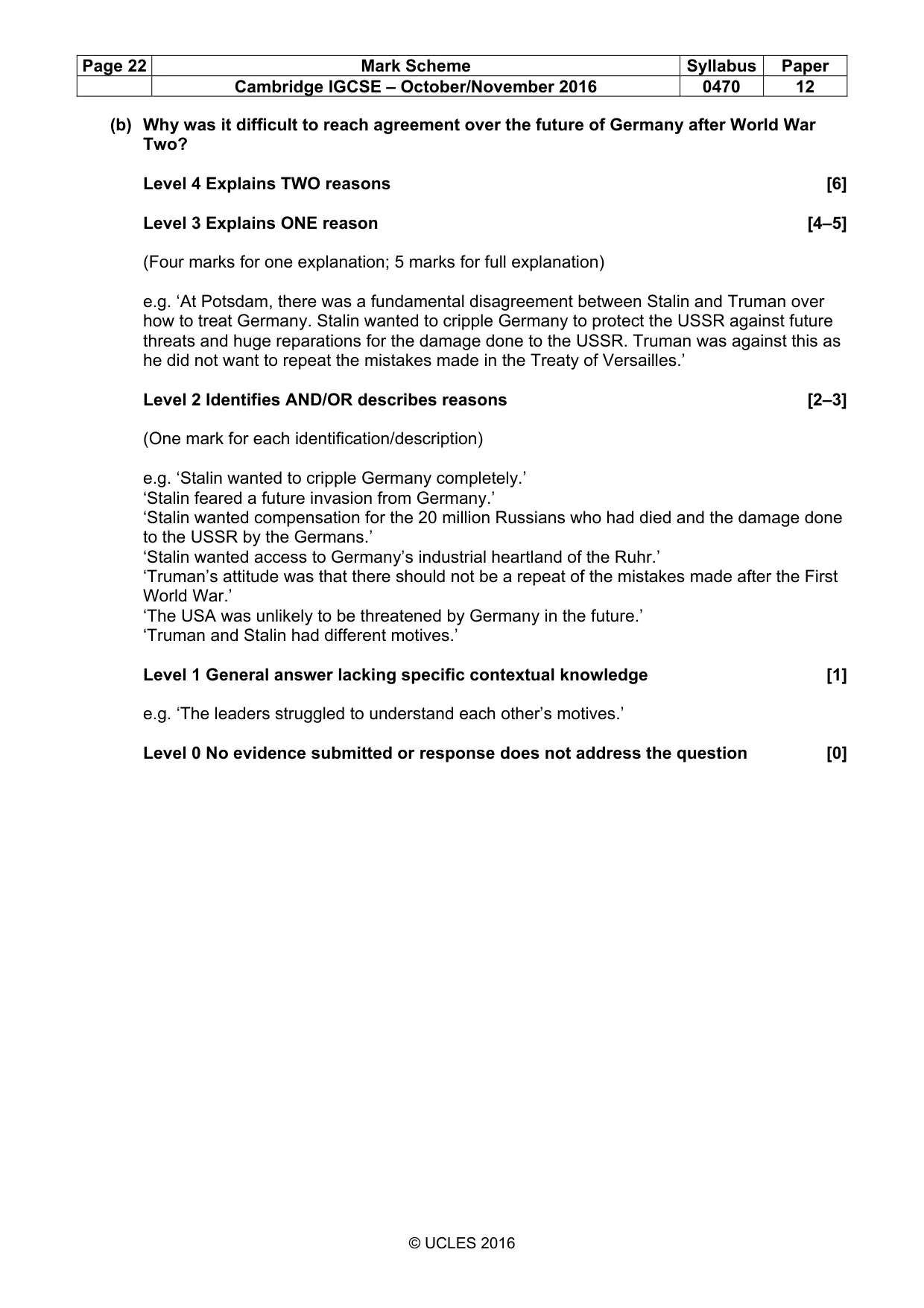
Page 22 Mark Scheme Syllabus Paper Cambridge IGCSE – October/November 2016 0470 12 © UCLES 2016 (b) Why was it difficult to reach agreement over the future of Germany after World War Two? Level 4 Explains TWO reasons [6] Level 3 Explains ONE reason [4–5] (Four marks for one explanation; 5 marks for full explanation) e.g. ‘At Potsdam, there was a fundamental disagreement between Stalin and Truman over how to treat Germany. Stalin wanted to cripple Germany to protect the USSR against future threats and huge reparations for the damage done to the USSR. Truman was against this as he did not want to repeat the mistakes made in the Treaty of Versailles.’ Level 2 Identifies AND/OR describes reasons [2–3] (One mark for each identification/description) e.g. ‘Stalin wanted to cripple Germany completely.’ ‘Stalin feared a future invasion from Germany.’ ‘Stalin wanted compensation for the 20 million Russians who had died and the damage done to the USSR by the Germans.’ ‘Stalin wanted access to Germany’s industrial heartland of the Ruhr.’ ‘Truman’s attitude was that there should not be a repeat of the mistakes made after the First World War.’ ‘The USA was unlikely to be threatened by Germany in the future.’ ‘Truman and Stalin had different motives.’ Level 1 General answer lacking specific contextual knowledge [1] e.g. ‘The leaders struggled to understand each other’s motives.’ Level 0 No evidence submitted or response does not address the question [0]
Mark scheme, page 23
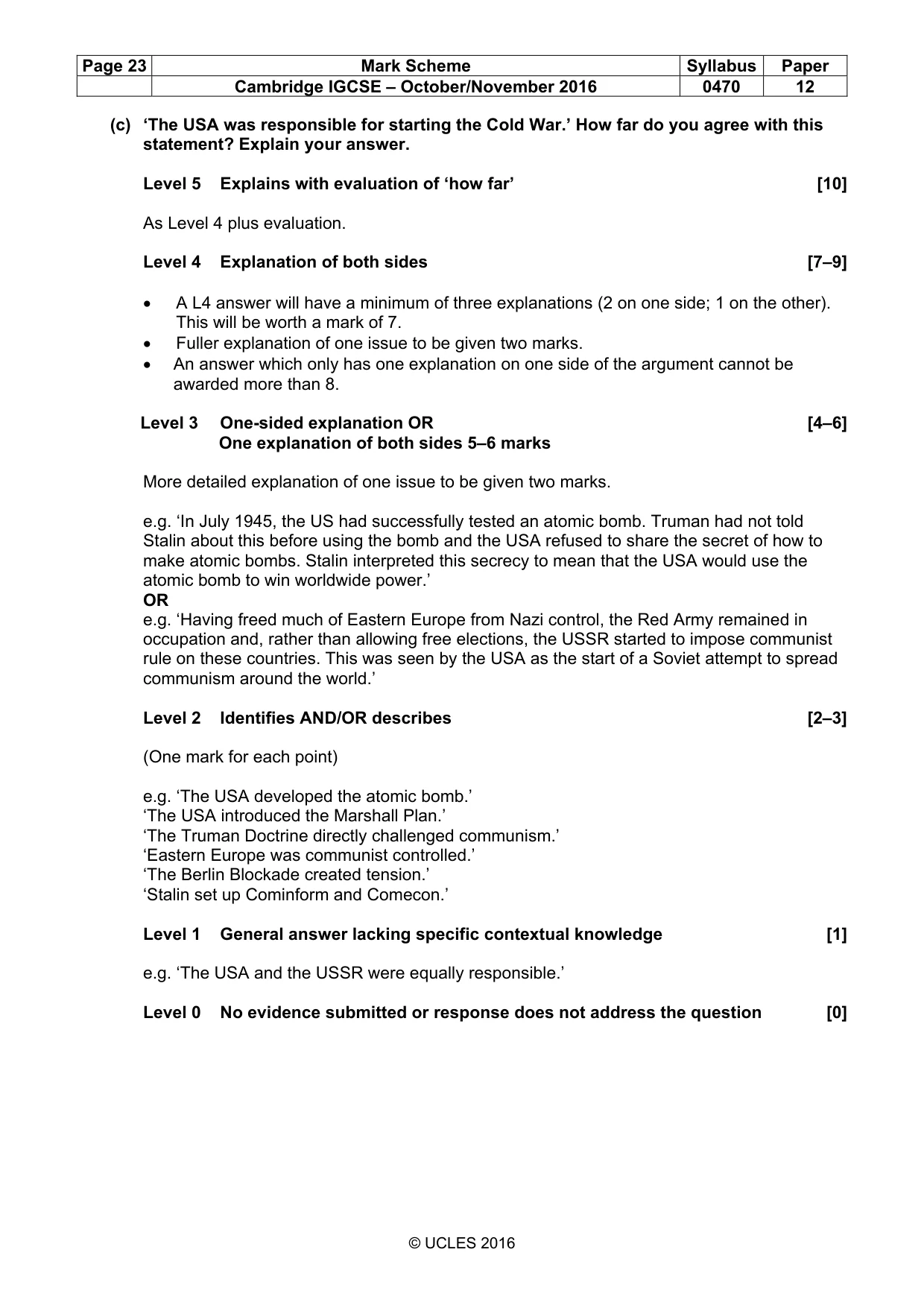
Page 23 Mark Scheme Syllabus Paper Cambridge IGCSE – October/November 2016 0470 12 © UCLES 2016 (c) ‘The USA was responsible for starting the Cold War.’ How far do you agree with this statement? Explain your answer. Level 5 Explains with evaluation of ‘how far’ [10] As Level 4 plus evaluation. Level 4 Explanation of both sides [7–9] • A L4 answer will have a minimum of three explanations (2 on one side; 1 on the other). This will be worth a mark of 7. • Fuller explanation of one issue to be given two marks. • An answer which only has one explanation on one side of the argument cannot be awarded more than 8. Level 3 One-sided explanation OR [4–6] One explanation of both sides 5–6 marks More detailed explanation of one issue to be given two marks. e.g. ‘In July 1945, the US had successfully tested an atomic bomb. Truman had not told Stalin about this before using the bomb and the USA refused to share the secret of how to make atomic bombs. Stalin interpreted this secrecy to mean that the USA would use the atomic bomb to win worldwide power.’ OR e.g. ‘Having freed much of Eastern Europe from Nazi control, the Red Army remained in occupation and, rather than allowing free elections, the USSR started to impose communist rule on these countries. This was seen by the USA as the start of a Soviet attempt to spread communism around the world.’ Level 2 Identifies AND/OR describes [2–3] (One mark for each point) e.g. ‘The USA developed the atomic bomb.’ ‘The USA introduced the Marshall Plan.’ ‘The Truman Doctrine directly challenged communism.’ ‘Eastern Europe was communist controlled.’ ‘The Berlin Blockade created tension.’ ‘Stalin set up Cominform and Comecon.’ Level 1 General answer lacking specific contextual knowledge [1] e.g. ‘The USA and the USSR were equally responsible.’ Level 0 No evidence submitted or response does not address the question [0]
Mark scheme, page 24
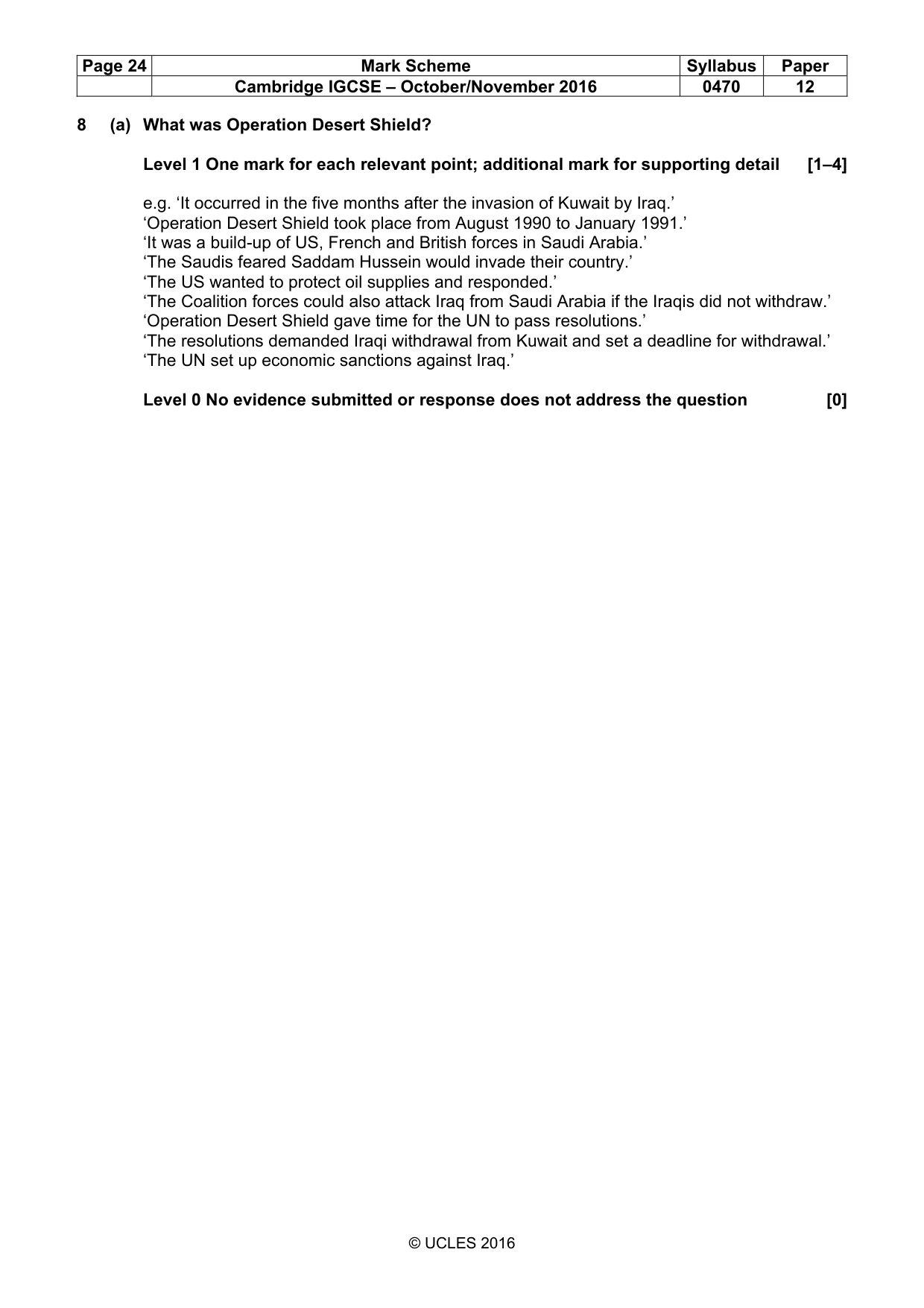
Page 24 Mark Scheme Syllabus Paper Cambridge IGCSE – October/November 2016 0470 12 © UCLES 2016 8 (a) What was Operation Desert Shield? Level 1 One mark for each relevant point; additional mark for supporting detail [1–4] e.g. ‘It occurred in the five months after the invasion of Kuwait by Iraq.’ ‘Operation Desert Shield took place from August 1990 to January 1991.’ ‘It was a build-up of US, French and British forces in Saudi Arabia.’ ‘The Saudis feared Saddam Hussein would invade their country.’ ‘The US wanted to protect oil supplies and responded.’ ‘The Coalition forces could also attack Iraq from Saudi Arabia if the Iraqis did not withdraw.’ ‘Operation Desert Shield gave time for the UN to pass resolutions.’ ‘The resolutions demanded Iraqi withdrawal from Kuwait and set a deadline for withdrawal.’ ‘The UN set up economic sanctions against Iraq.’ Level 0 No evidence submitted or response does not address the question [0]
Mark scheme, page 25
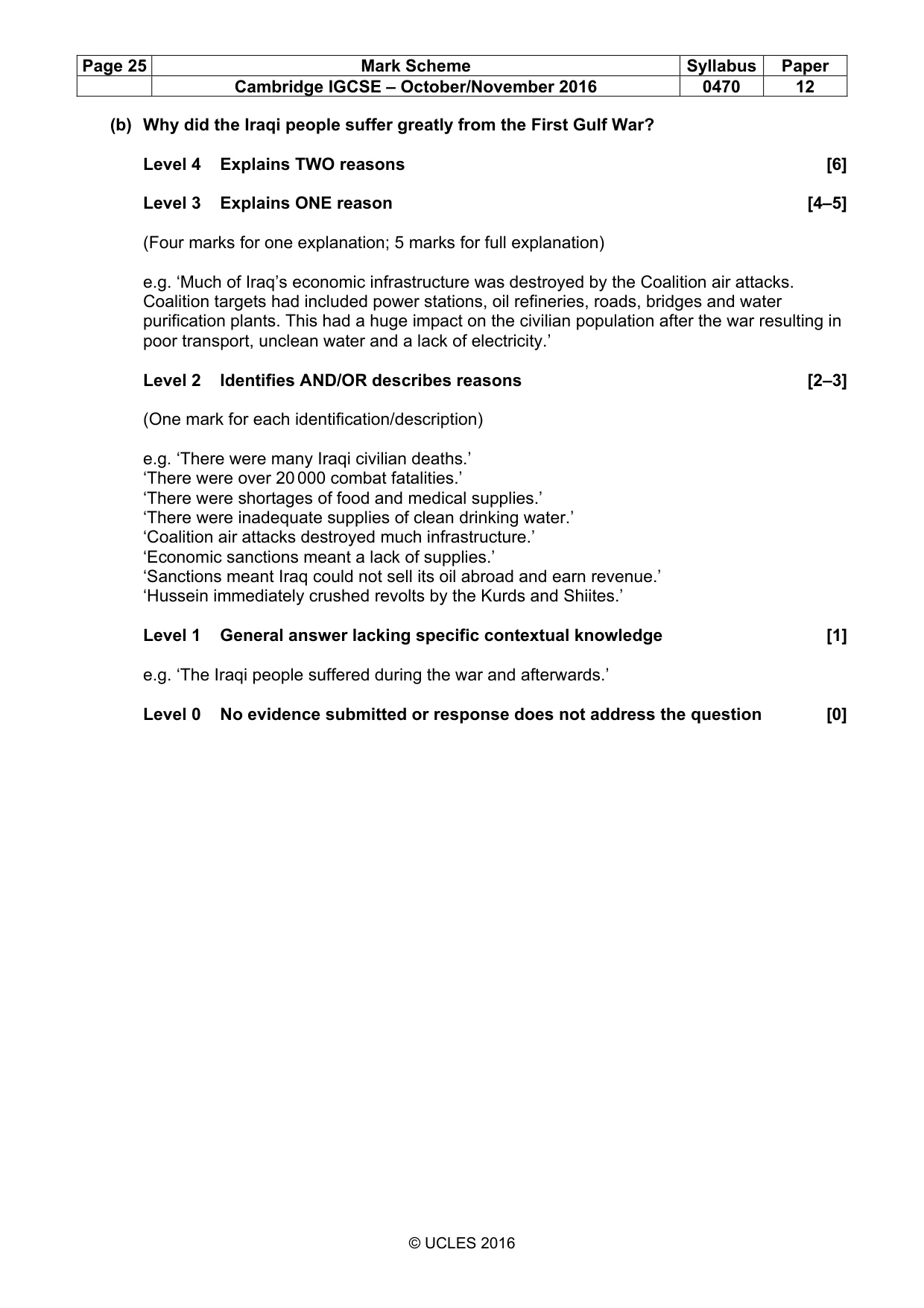
Page 25 Mark Scheme Syllabus Paper Cambridge IGCSE – October/November 2016 0470 12 © UCLES 2016 (b) Why did the Iraqi people suffer greatly from the First Gulf War? Level 4 Explains TWO reasons [6] Level 3 Explains ONE reason [4–5] (Four marks for one explanation; 5 marks for full explanation) e.g. ‘Much of Iraq’s economic infrastructure was destroyed by the Coalition air attacks. Coalition targets had included power stations, oil refineries, roads, bridges and water purification plants. This had a huge impact on the civilian population after the war resulting in poor transport, unclean water and a lack of electricity.’ Level 2 Identifies AND/OR describes reasons [2–3] (One mark for each identification/description) e.g. ‘There were many Iraqi civilian deaths.’ ‘There were over 20 000 combat fatalities.’ ‘There were shortages of food and medical supplies.’ ‘There were inadequate supplies of clean drinking water.’ ‘Coalition air attacks destroyed much infrastructure.’ ‘Economic sanctions meant a lack of supplies.’ ‘Sanctions meant Iraq could not sell its oil abroad and earn revenue.’ ‘Hussein immediately crushed revolts by the Kurds and Shiites.’ Level 1 General answer lacking specific contextual knowledge [1] e.g. ‘The Iraqi people suffered during the war and afterwards.’ Level 0 No evidence submitted or response does not address the question [0]
Mark scheme, page 26
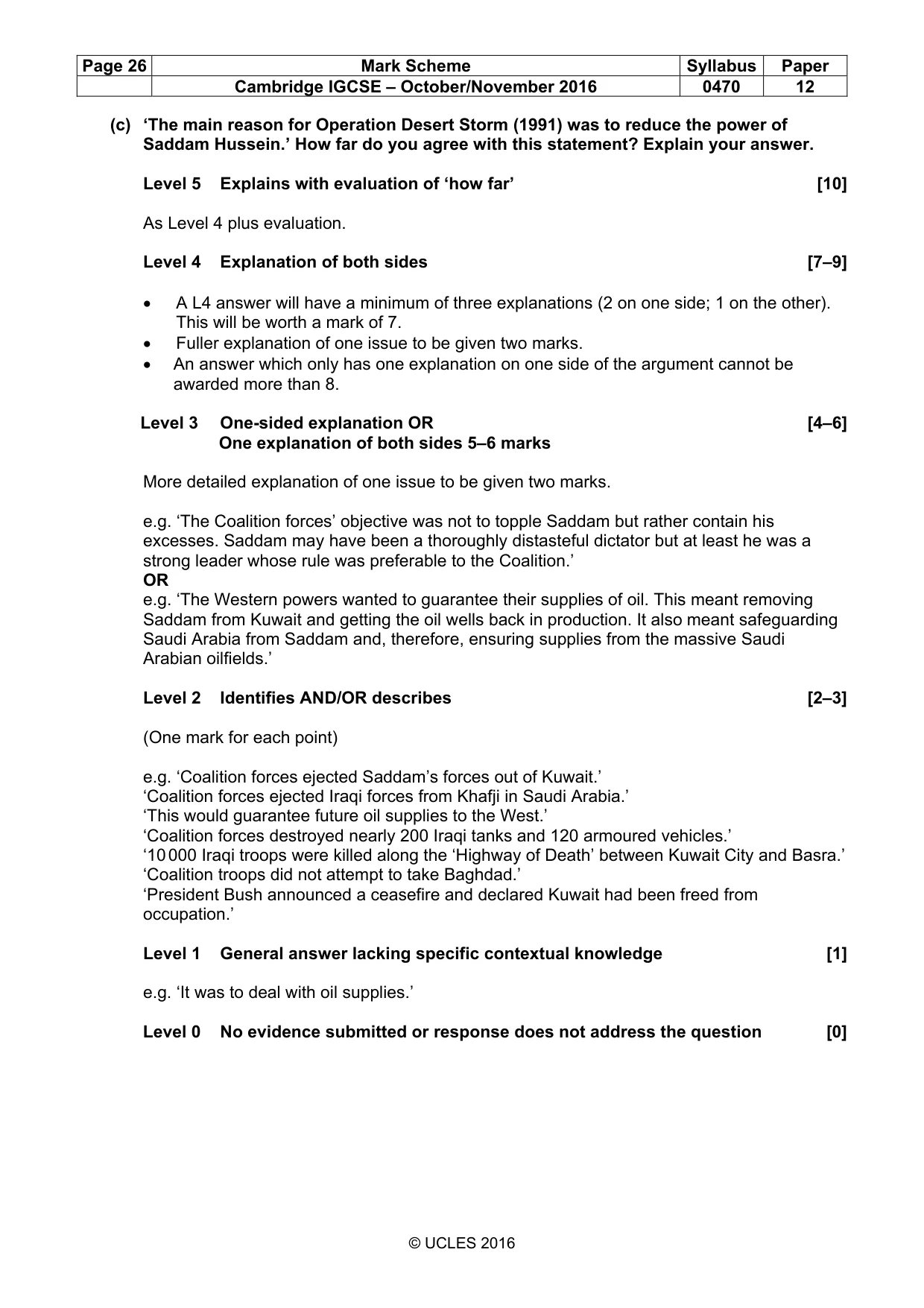
Page 26 Mark Scheme Syllabus Paper Cambridge IGCSE – October/November 2016 0470 12 © UCLES 2016 (c) ‘The main reason for Operation Desert Storm (1991) was to reduce the power of Saddam Hussein.’ How far do you agree with this statement? Explain your answer. Level 5 Explains with evaluation of ‘how far’ [10] As Level 4 plus evaluation. Level 4 Explanation of both sides [7–9] • A L4 answer will have a minimum of three explanations (2 on one side; 1 on the other). This will be worth a mark of 7. • Fuller explanation of one issue to be given two marks. • An answer which only has one explanation on one side of the argument cannot be awarded more than 8. Level 3 One-sided explanation OR [4–6] One explanation of both sides 5–6 marks More detailed explanation of one issue to be given two marks. e.g. ‘The Coalition forces’ objective was not to topple Saddam but rather contain his excesses. Saddam may have been a thoroughly distasteful dictator but at least he was a strong leader whose rule was preferable to the Coalition.’ OR e.g. ‘The Western powers wanted to guarantee their supplies of oil. This meant removing Saddam from Kuwait and getting the oil wells back in production. It also meant safeguarding Saudi Arabia from Saddam and, therefore, ensuring supplies from the massive Saudi Arabian oilfields.’ Level 2 Identifies AND/OR describes [2–3] (One mark for each point) e.g. ‘Coalition forces ejected Saddam’s forces out of Kuwait.’ ‘Coalition forces ejected Iraqi forces from Khafji in Saudi Arabia.’ ‘This would guarantee future oil supplies to the West.’ ‘Coalition forces destroyed nearly 200 Iraqi tanks and 120 armoured vehicles.’ ‘10 000 Iraqi troops were killed along the ‘Highway of Death’ between Kuwait City and Basra.’ ‘Coalition troops did not attempt to take Baghdad.’ ‘President Bush announced a ceasefire and declared Kuwait had been freed from occupation.’ Level 1 General answer lacking specific contextual knowledge [1] e.g. ‘It was to deal with oil supplies.’ Level 0 No evidence submitted or response does not address the question [0]
Mark scheme, page 27
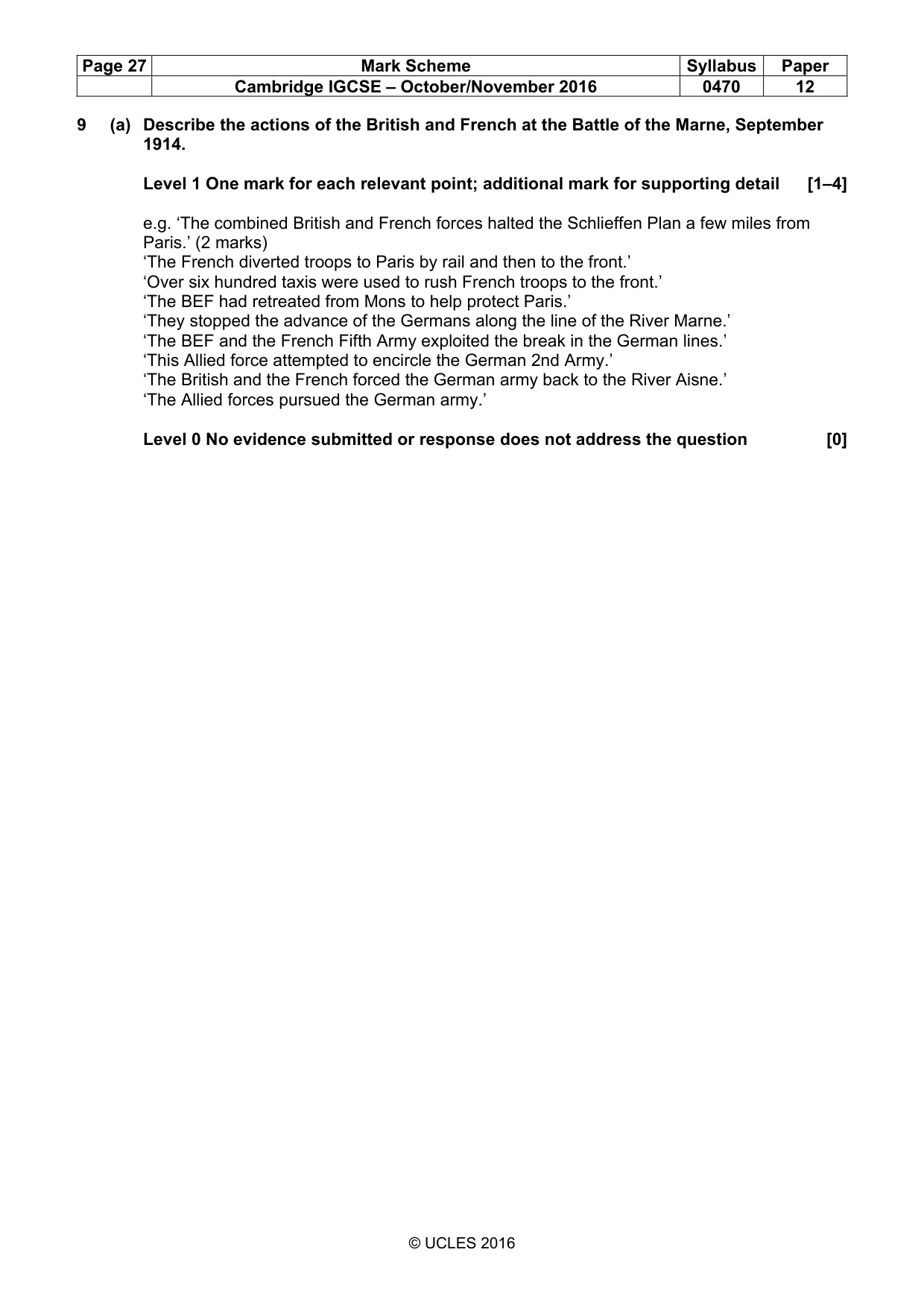
Page 27 Mark Scheme Syllabus Paper Cambridge IGCSE – October/November 2016 0470 12 © UCLES 2016 9 (a) Describe the actions of the British and French at the Battle of the Marne, September 1914. Level 1 One mark for each relevant point; additional mark for supporting detail [1–4] e.g. ‘The combined British and French forces halted the Schlieffen Plan a few miles from Paris.’ (2 marks) ‘The French diverted troops to Paris by rail and then to the front.’ ‘Over six hundred taxis were used to rush French troops to the front.’ ‘The BEF had retreated from Mons to help protect Paris.’ ‘They stopped the advance of the Germans along the line of the River Marne.’ ‘The BEF and the French Fifth Army exploited the break in the German lines.’ ‘This Allied force attempted to encircle the German 2nd Army.’ ‘The British and the French forced the German army back to the River Aisne.’ ‘The Allied forces pursued the German army.’ Level 0 No evidence submitted or response does not address the question [0]
Mark scheme, page 28
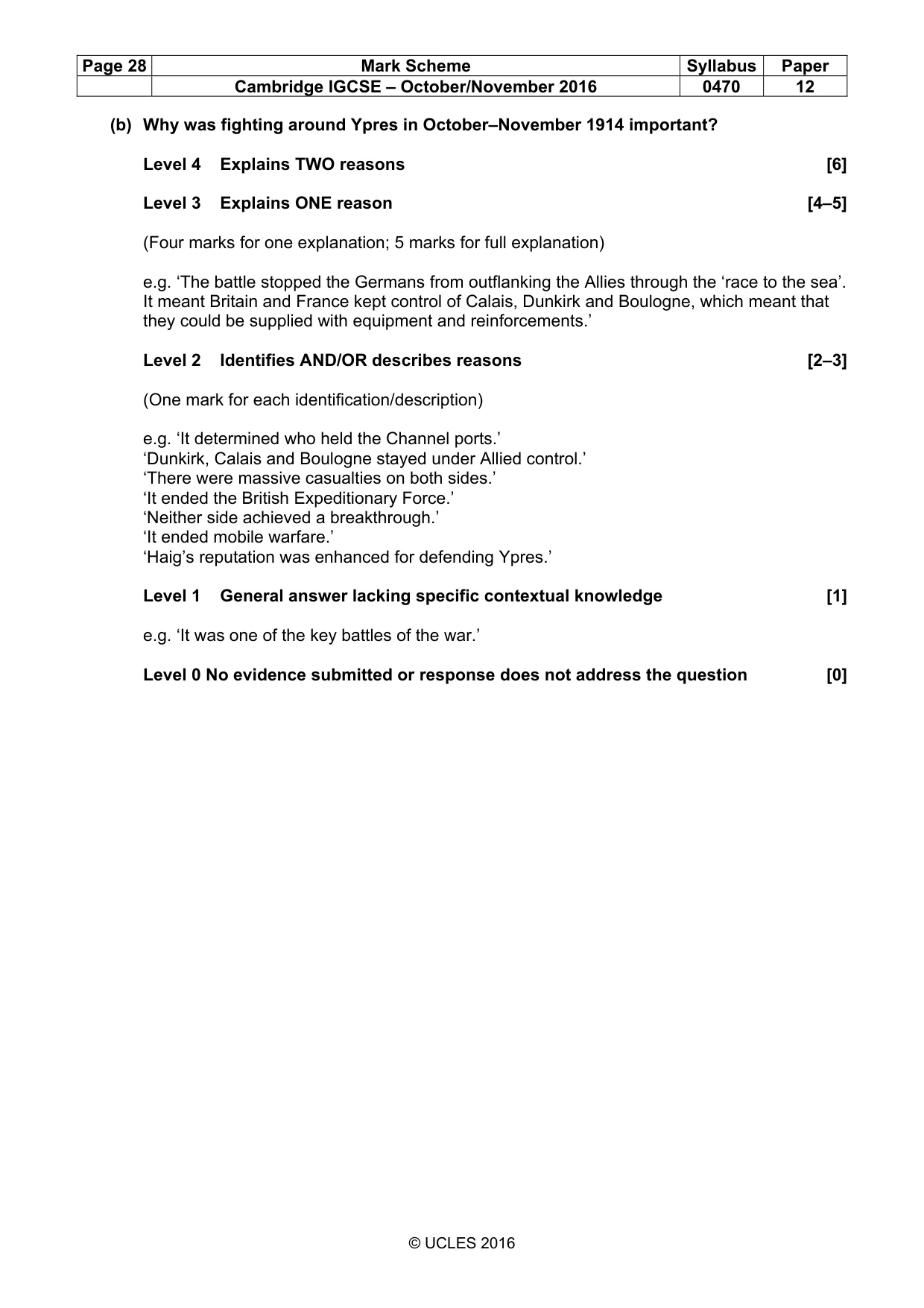
Page 28 Mark Scheme Syllabus Paper Cambridge IGCSE – October/November 2016 0470 12 © UCLES 2016 (b) Why was fighting around Ypres in October–November 1914 important? Level 4 Explains TWO reasons [6] Level 3 Explains ONE reason [4–5] (Four marks for one explanation; 5 marks for full explanation) e.g. ‘The battle stopped the Germans from outflanking the Allies through the ‘race to the sea’. It meant Britain and France kept control of Calais, Dunkirk and Boulogne, which meant that they could be supplied with equipment and reinforcements.’ Level 2 Identifies AND/OR describes reasons [2–3] (One mark for each identification/description) e.g. ‘It determined who held the Channel ports.’ ‘Dunkirk, Calais and Boulogne stayed under Allied control.’ ‘There were massive casualties on both sides.’ ‘It ended the British Expeditionary Force.’ ‘Neither side achieved a breakthrough.’ ‘It ended mobile warfare.’ ‘Haig’s reputation was enhanced for defending Ypres.’ Level 1 General answer lacking specific contextual knowledge [1] e.g. ‘It was one of the key battles of the war.’ Level 0 No evidence submitted or response does not address the question [0]
Mark scheme, page 29
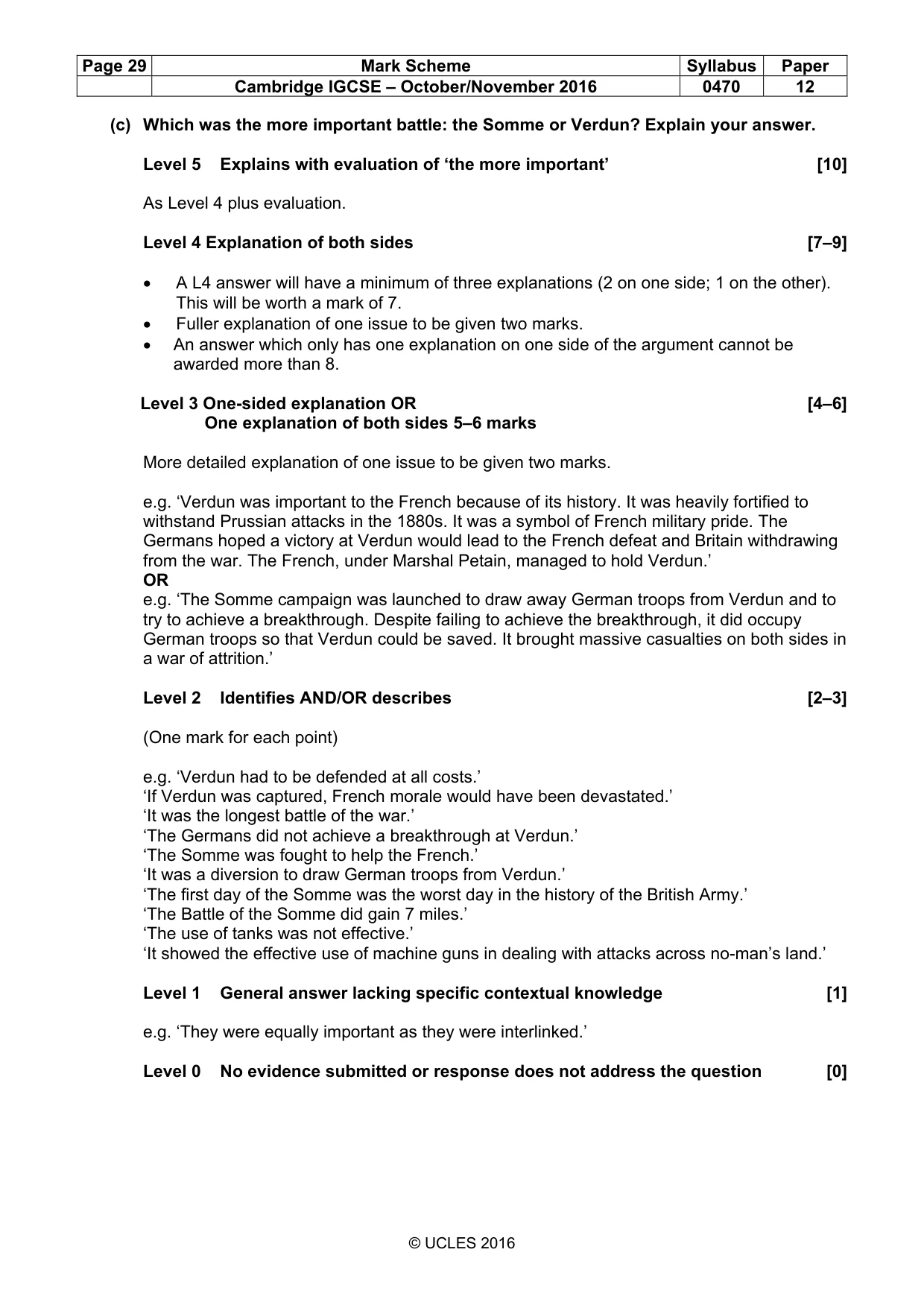
Page 29 Mark Scheme Syllabus Paper Cambridge IGCSE – October/November 2016 0470 12 © UCLES 2016 (c) Which was the more important battle: the Somme or Verdun? Explain your answer. Level 5 Explains with evaluation of ‘the more important’ [10] As Level 4 plus evaluation. Level 4 Explanation of both sides [7–9] • A L4 answer will have a minimum of three explanations (2 on one side; 1 on the other). This will be worth a mark of 7. • Fuller explanation of one issue to be given two marks. • An answer which only has one explanation on one side of the argument cannot be awarded more than 8. Level 3 One-sided explanation OR [4–6] One explanation of both sides 5–6 marks More detailed explanation of one issue to be given two marks. e.g. ‘Verdun was important to the French because of its history. It was heavily fortified to withstand Prussian attacks in the 1880s. It was a symbol of French military pride. The Germans hoped a victory at Verdun would lead to the French defeat and Britain withdrawing from the war. The French, under Marshal Petain, managed to hold Verdun.’ OR e.g. ‘The Somme campaign was launched to draw away German troops from Verdun and to try to achieve a breakthrough. Despite failing to achieve the breakthrough, it did occupy German troops so that Verdun could be saved. It brought massive casualties on both sides in a war of attrition.’ Level 2 Identifies AND/OR describes [2–3] (One mark for each point) e.g. ‘Verdun had to be defended at all costs.’ ‘If Verdun was captured, French morale would have been devastated.’ ‘It was the longest battle of the war.’ ‘The Germans did not achieve a breakthrough at Verdun.’ ‘The Somme was fought to help the French.’ ‘It was a diversion to draw German troops from Verdun.’ ‘The first day of the Somme was the worst day in the history of the British Army.’ ‘The Battle of the Somme did gain 7 miles.’ ‘The use of tanks was not effective.’ ‘It showed the effective use of machine guns in dealing with attacks across no-man’s land.’ Level 1 General answer lacking specific contextual knowledge [1] e.g. ‘They were equally important as they were interlinked.’ Level 0 No evidence submitted or response does not address the question [0]
Mark scheme, page 30
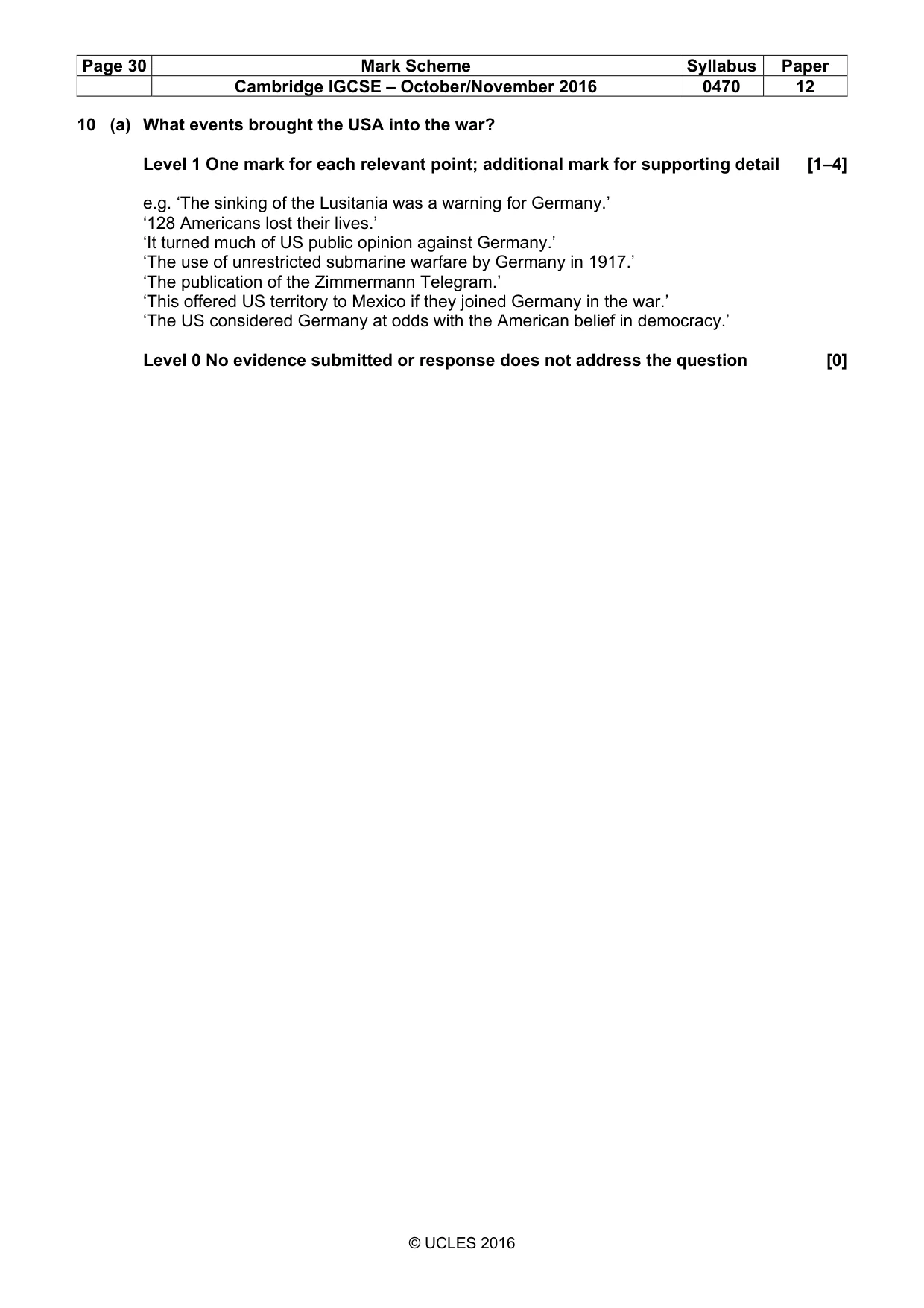
Page 30 Mark Scheme Syllabus Paper Cambridge IGCSE – October/November 2016 0470 12 © UCLES 2016 10 (a) What events brought the USA into the war? Level 1 One mark for each relevant point; additional mark for supporting detail [1–4] e.g. ‘The sinking of the Lusitania was a warning for Germany.’ ‘128 Americans lost their lives.’ ‘It turned much of US public opinion against Germany.’ ‘The use of unrestricted submarine warfare by Germany in 1917.’ ‘The publication of the Zimmermann Telegram.’ ‘This offered US territory to Mexico if they joined Germany in the war.’ ‘The US considered Germany at odds with the American belief in democracy.’ Level 0 No evidence submitted or response does not address the question [0]
Mark scheme, page 31
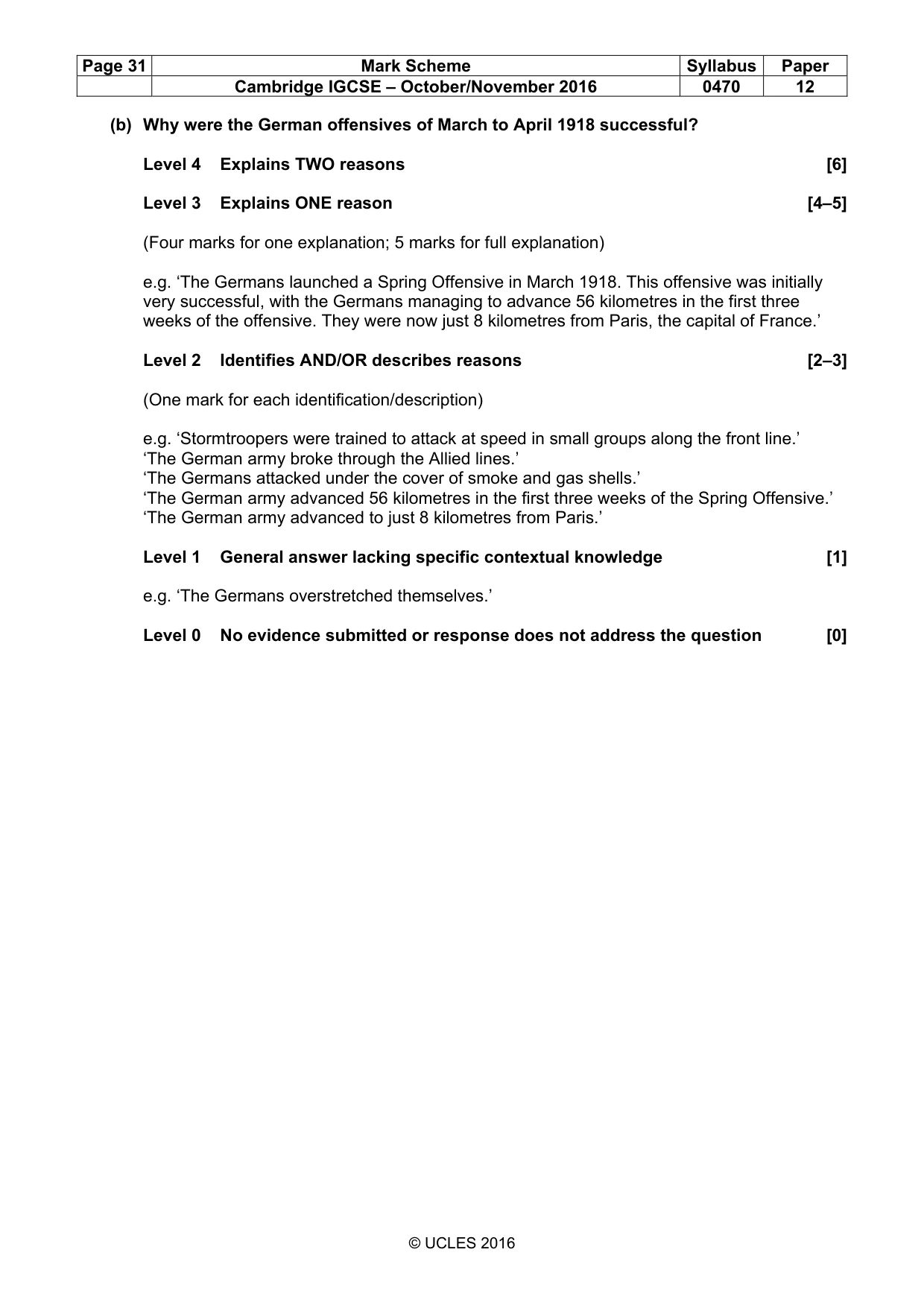
Page 31 Mark Scheme Syllabus Paper Cambridge IGCSE – October/November 2016 0470 12 © UCLES 2016 (b) Why were the German offensives of March to April 1918 successful? Level 4 Explains TWO reasons [6] Level 3 Explains ONE reason [4–5] (Four marks for one explanation; 5 marks for full explanation) e.g. ‘The Germans launched a Spring Offensive in March 1918. This offensive was initially very successful, with the Germans managing to advance 56 kilometres in the first three weeks of the offensive. They were now just 8 kilometres from Paris, the capital of France.’ Level 2 Identifies AND/OR describes reasons [2–3] (One mark for each identification/description) e.g. ‘Stormtroopers were trained to attack at speed in small groups along the front line.’ ‘The German army broke through the Allied lines.’ ‘The Germans attacked under the cover of smoke and gas shells.’ ‘The German army advanced 56 kilometres in the first three weeks of the Spring Offensive.’ ‘The German army advanced to just 8 kilometres from Paris.’ Level 1 General answer lacking specific contextual knowledge [1] e.g. ‘The Germans overstretched themselves.’ Level 0 No evidence submitted or response does not address the question [0]
Mark scheme, page 32
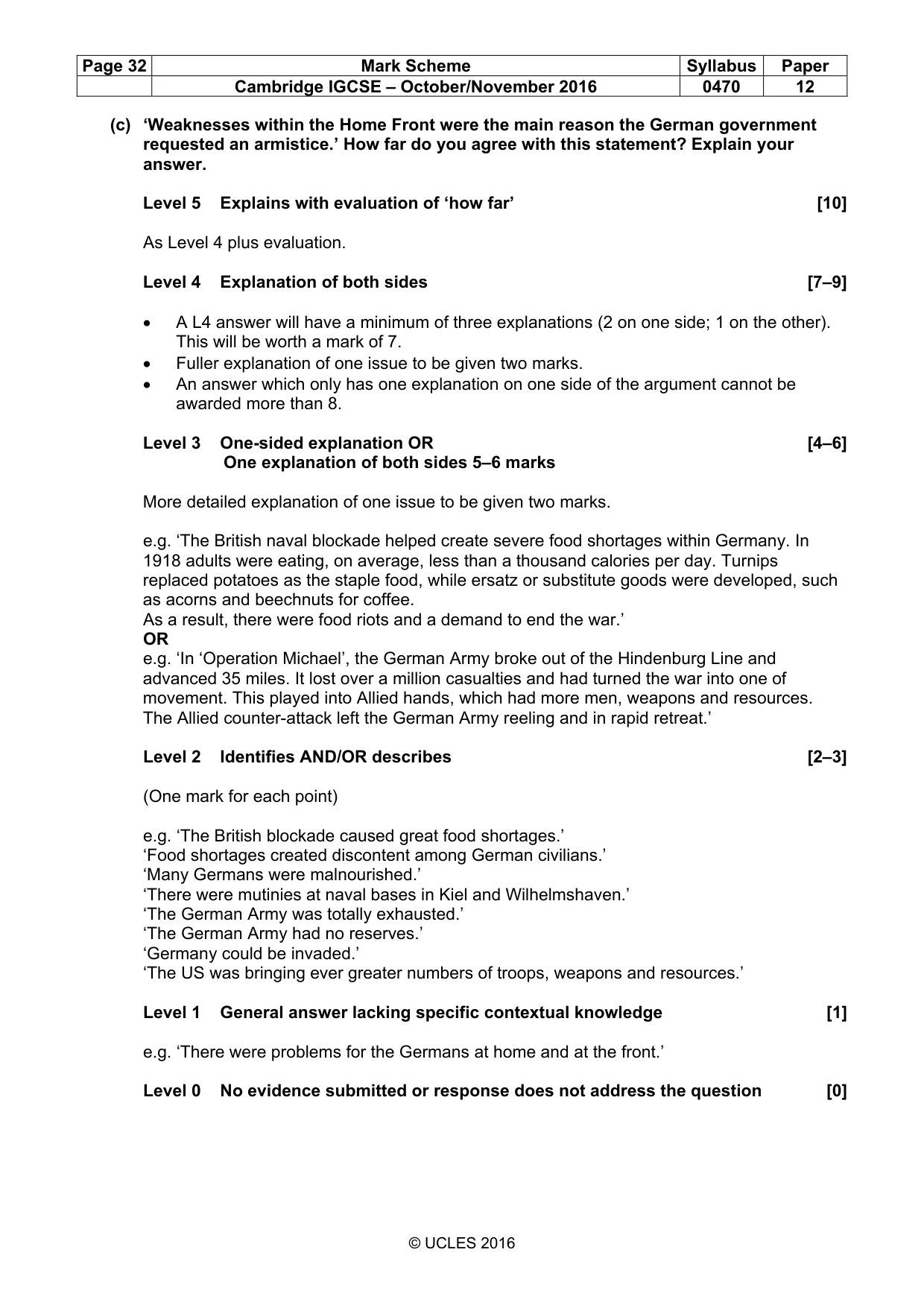
Page 32 Mark Scheme Syllabus Paper Cambridge IGCSE – October/November 2016 0470 12 © UCLES 2016 (c) ‘Weaknesses within the Home Front were the main reason the German government requested an armistice.’ How far do you agree with this statement? Explain your answer. Level 5 Explains with evaluation of ‘how far’ [10] As Level 4 plus evaluation. Level 4 Explanation of both sides [7–9] • A L4 answer will have a minimum of three explanations (2 on one side; 1 on the other). This will be worth a mark of 7. • Fuller explanation of one issue to be given two marks. • An answer which only has one explanation on one side of the argument cannot be awarded more than 8. Level 3 One-sided explanation OR [4–6] One explanation of both sides 5–6 marks More detailed explanation of one issue to be given two marks. e.g. ‘The British naval blockade helped create severe food shortages within Germany. In 1918 adults were eating, on average, less than a thousand calories per day. Turnips replaced potatoes as the staple food, while ersatz or substitute goods were developed, such as acorns and beechnuts for coffee. As a result, there were food riots and a demand to end the war.’ OR e.g. ‘In ‘Operation Michael’, the German Army broke out of the Hindenburg Line and advanced 35 miles. It lost over a million casualties and had turned the war into one of movement. This played into Allied hands, which had more men, weapons and resources. The Allied counter-attack left the German Army reeling and in rapid retreat.’ Level 2 Identifies AND/OR describes [2–3] (One mark for each point) e.g. ‘The British blockade caused great food shortages.’ ‘Food shortages created discontent among German civilians.’ ‘Many Germans were malnourished.’ ‘There were mutinies at naval bases in Kiel and Wilhelmshaven.’ ‘The German Army was totally exhausted.’ ‘The German Army had no reserves.’ ‘Germany could be invaded.’ ‘The US was bringing ever greater numbers of troops, weapons and resources.’ Level 1 General answer lacking specific contextual knowledge [1] e.g. ‘There were problems for the Germans at home and at the front.’ Level 0 No evidence submitted or response does not address the question [0]
Mark scheme, page 33
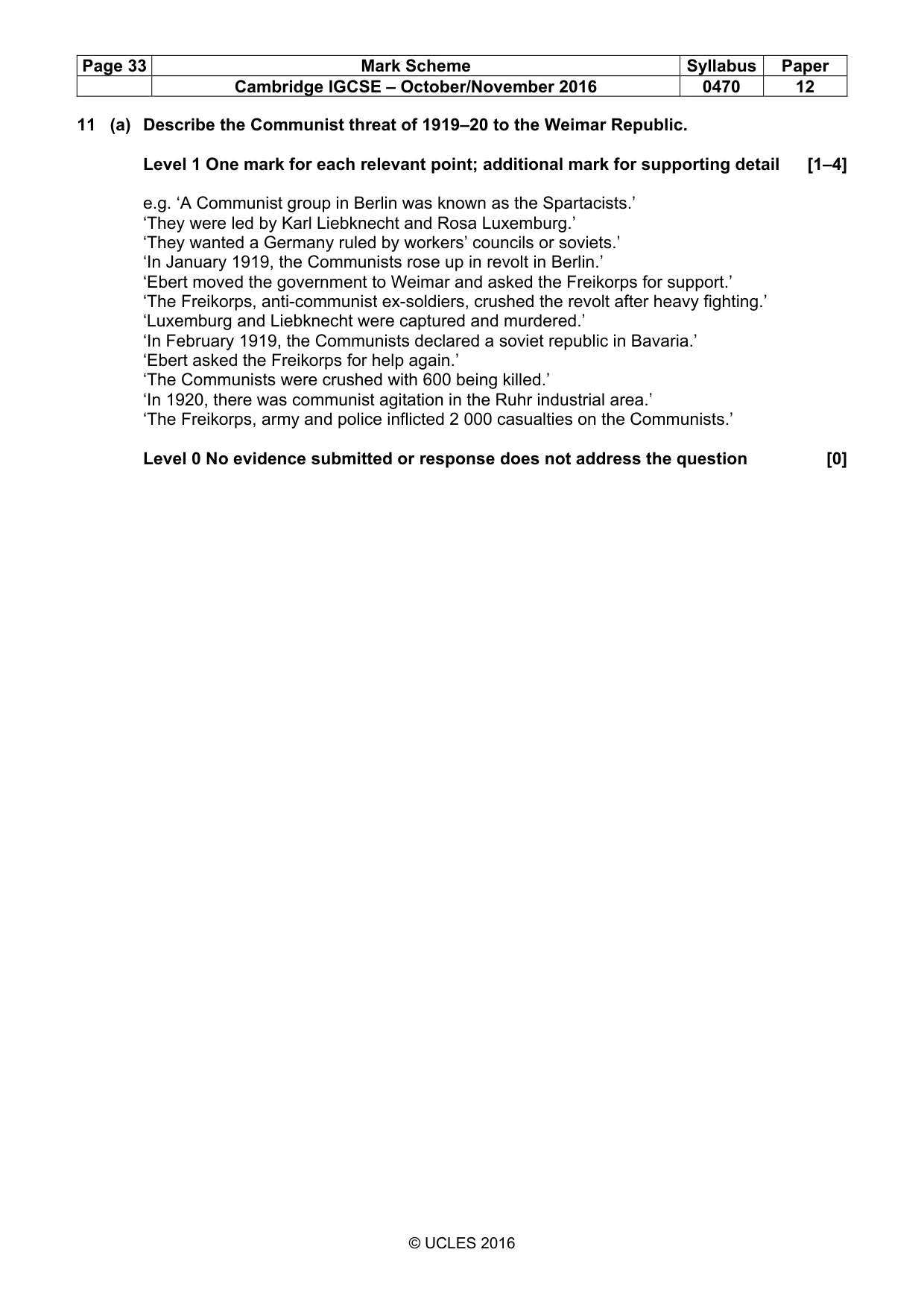
Page 33 Mark Scheme Syllabus Paper Cambridge IGCSE – October/November 2016 0470 12 © UCLES 2016 11 (a) Describe the Communist threat of 1919–20 to the Weimar Republic. Level 1 One mark for each relevant point; additional mark for supporting detail [1–4] e.g. ‘A Communist group in Berlin was known as the Spartacists.’ ‘They were led by Karl Liebknecht and Rosa Luxemburg.’ ‘They wanted a Germany ruled by workers’ councils or soviets.’ ‘In January 1919, the Communists rose up in revolt in Berlin.’ ‘Ebert moved the government to Weimar and asked the Freikorps for support.’ ‘The Freikorps, anti-communist ex-soldiers, crushed the revolt after heavy fighting.’ ‘Luxemburg and Liebknecht were captured and murdered.’ ‘In February 1919, the Communists declared a soviet republic in Bavaria.’ ‘Ebert asked the Freikorps for help again.’ ‘The Communists were crushed with 600 being killed.’ ‘In 1920, there was communist agitation in the Ruhr industrial area.’ ‘The Freikorps, army and police inflicted 2 000 casualties on the Communists.’ Level 0 No evidence submitted or response does not address the question [0]
Mark scheme, page 34
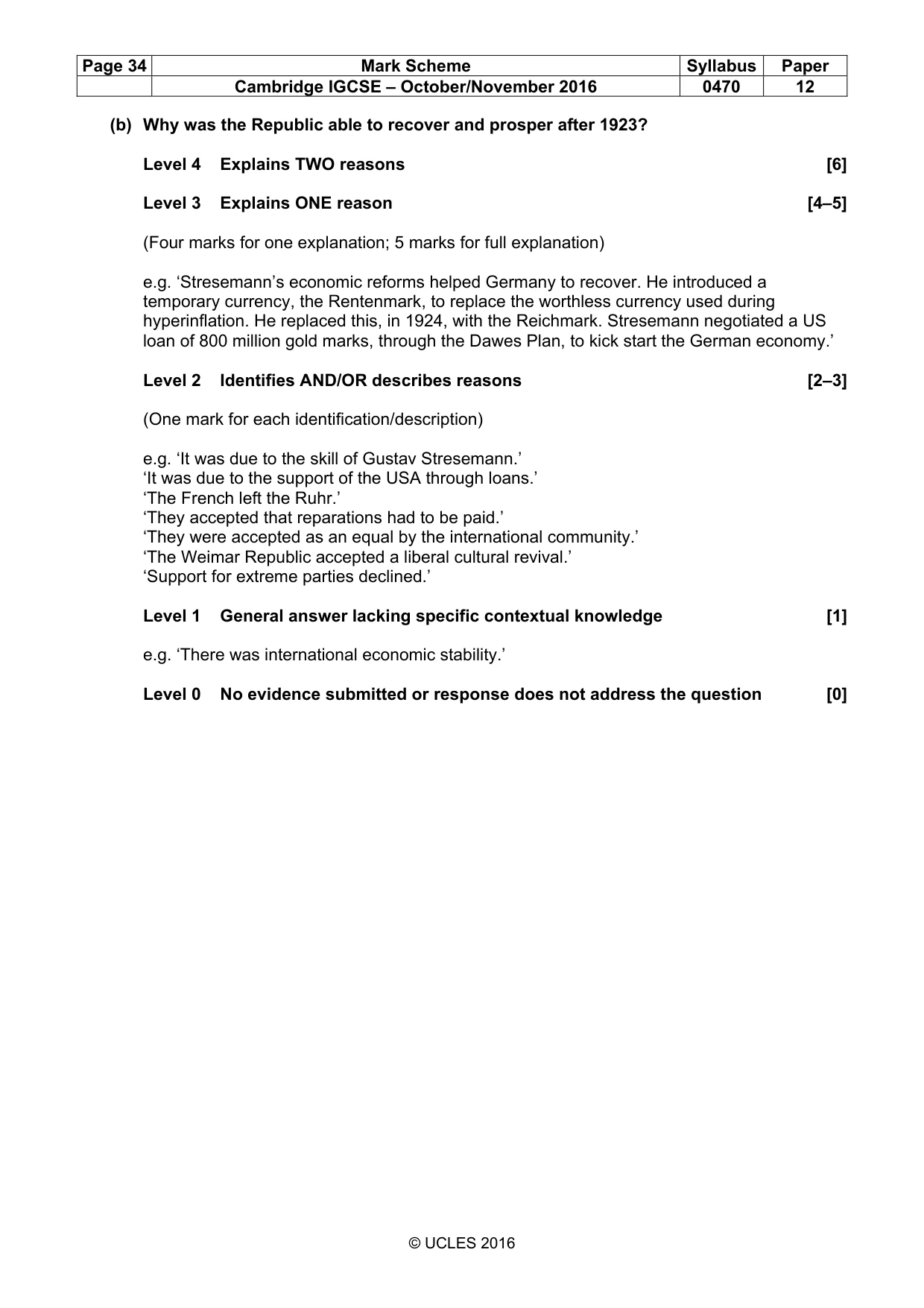
Page 34 Mark Scheme Syllabus Paper Cambridge IGCSE – October/November 2016 0470 12 © UCLES 2016 (b) Why was the Republic able to recover and prosper after 1923? Level 4 Explains TWO reasons [6] Level 3 Explains ONE reason [4–5] (Four marks for one explanation; 5 marks for full explanation) e.g. ‘Stresemann’s economic reforms helped Germany to recover. He introduced a temporary currency, the Rentenmark, to replace the worthless currency used during hyperinflation. He replaced this, in 1924, with the Reichmark. Stresemann negotiated a US loan of 800 million gold marks, through the Dawes Plan, to kick start the German economy.’ Level 2 Identifies AND/OR describes reasons [2–3] (One mark for each identification/description) e.g. ‘It was due to the skill of Gustav Stresemann.’ ‘It was due to the support of the USA through loans.’ ‘The French left the Ruhr.’ ‘They accepted that reparations had to be paid.’ ‘They were accepted as an equal by the international community.’ ‘The Weimar Republic accepted a liberal cultural revival.’ ‘Support for extreme parties declined.’ Level 1 General answer lacking specific contextual knowledge [1] e.g. ‘There was international economic stability.’ Level 0 No evidence submitted or response does not address the question [0]
Mark scheme, page 35
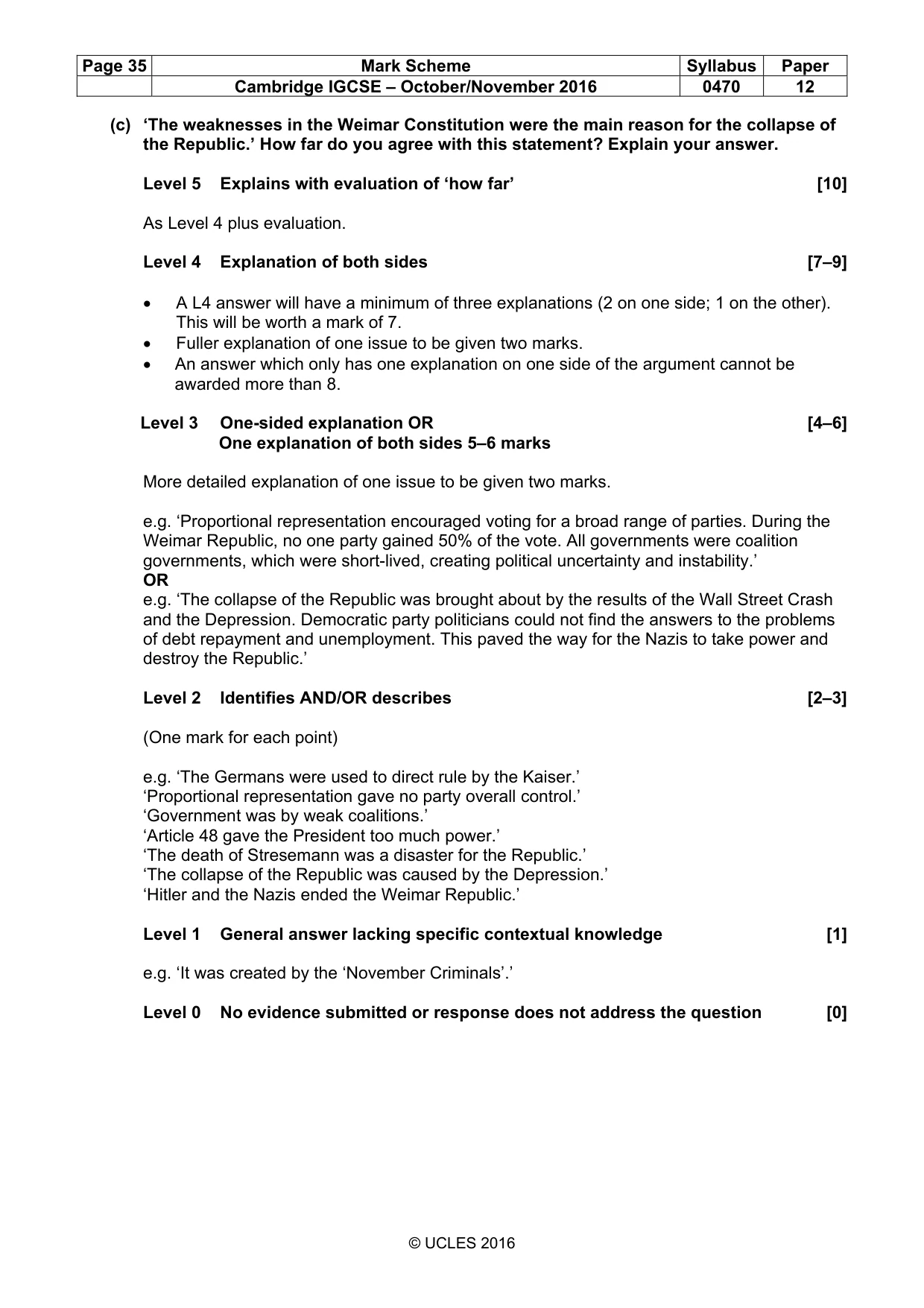
Page 35 Mark Scheme Syllabus Paper Cambridge IGCSE – October/November 2016 0470 12 © UCLES 2016 (c) ‘The weaknesses in the Weimar Constitution were the main reason for the collapse of the Republic.’ How far do you agree with this statement? Explain your answer. Level 5 Explains with evaluation of ‘how far’ [10] As Level 4 plus evaluation. Level 4 Explanation of both sides [7–9] • A L4 answer will have a minimum of three explanations (2 on one side; 1 on the other). This will be worth a mark of 7. • Fuller explanation of one issue to be given two marks. • An answer which only has one explanation on one side of the argument cannot be awarded more than 8. Level 3 One-sided explanation OR [4–6] One explanation of both sides 5–6 marks More detailed explanation of one issue to be given two marks. e.g. ‘Proportional representation encouraged voting for a broad range of parties. During the Weimar Republic, no one party gained 50% of the vote. All governments were coalition governments, which were short-lived, creating political uncertainty and instability.’ OR e.g. ‘The collapse of the Republic was brought about by the results of the Wall Street Crash and the Depression. Democratic party politicians could not find the answers to the problems of debt repayment and unemployment. This paved the way for the Nazis to take power and destroy the Republic.’ Level 2 Identifies AND/OR describes [2–3] (One mark for each point) e.g. ‘The Germans were used to direct rule by the Kaiser.’ ‘Proportional representation gave no party overall control.’ ‘Government was by weak coalitions.’ ‘Article 48 gave the President too much power.’ ‘The death of Stresemann was a disaster for the Republic.’ ‘The collapse of the Republic was caused by the Depression.’ ‘Hitler and the Nazis ended the Weimar Republic.’ Level 1 General answer lacking specific contextual knowledge [1] e.g. ‘It was created by the ‘November Criminals’.’ Level 0 No evidence submitted or response does not address the question [0]
Mark scheme, page 36
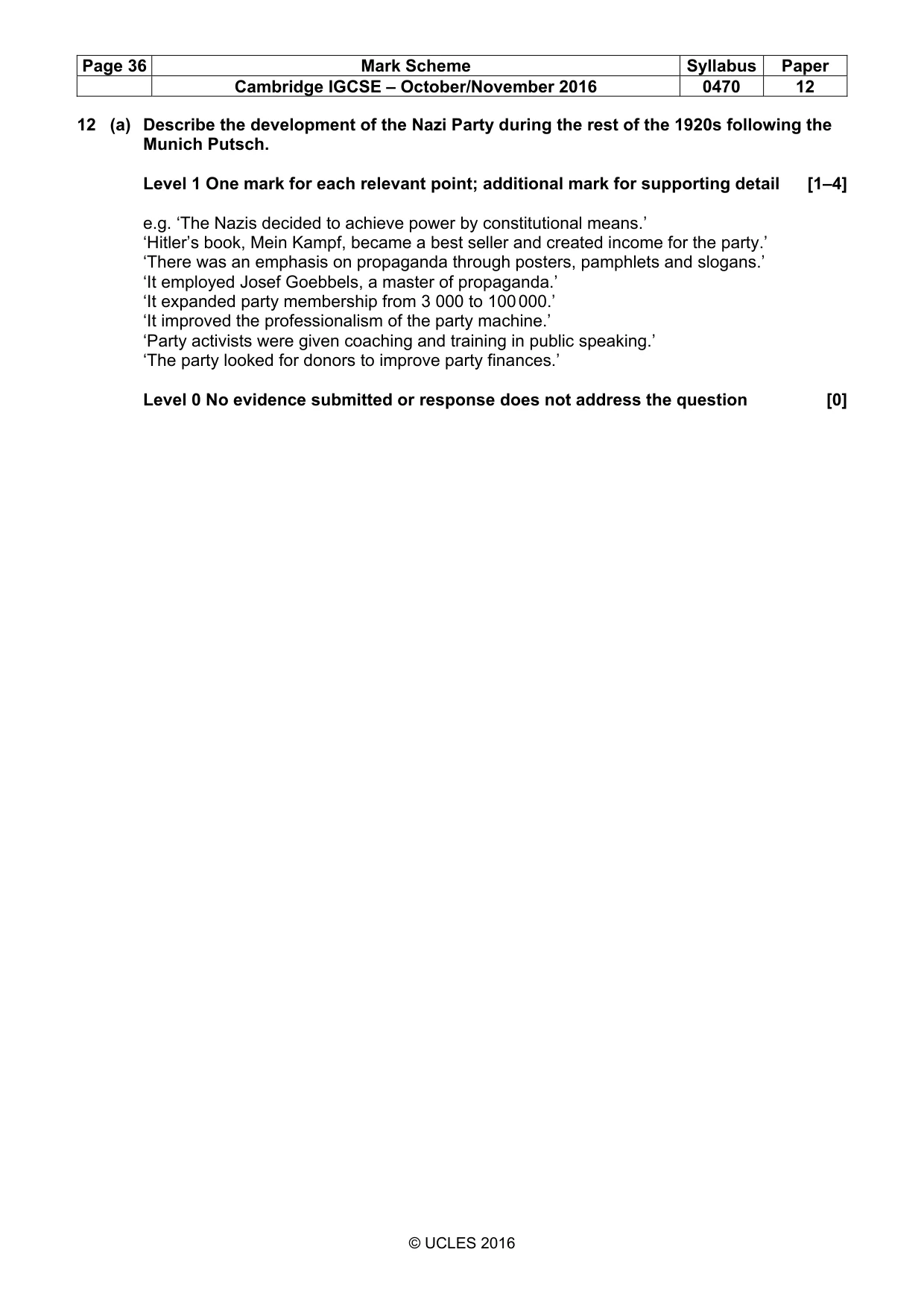
Page 36 Mark Scheme Syllabus Paper Cambridge IGCSE – October/November 2016 0470 12 © UCLES 2016 12 (a) Describe the development of the Nazi Party during the rest of the 1920s following the Munich Putsch. Level 1 One mark for each relevant point; additional mark for supporting detail [1–4] e.g. ‘The Nazis decided to achieve power by constitutional means.’ ‘Hitler’s book, Mein Kampf, became a best seller and created income for the party.’ ‘There was an emphasis on propaganda through posters, pamphlets and slogans.’ ‘It employed Josef Goebbels, a master of propaganda.’ ‘It expanded party membership from 3 000 to 100 000.’ ‘It improved the professionalism of the party machine.’ ‘Party activists were given coaching and training in public speaking.’ ‘The party looked for donors to improve party finances.’ Level 0 No evidence submitted or response does not address the question [0]
Mark scheme, page 37
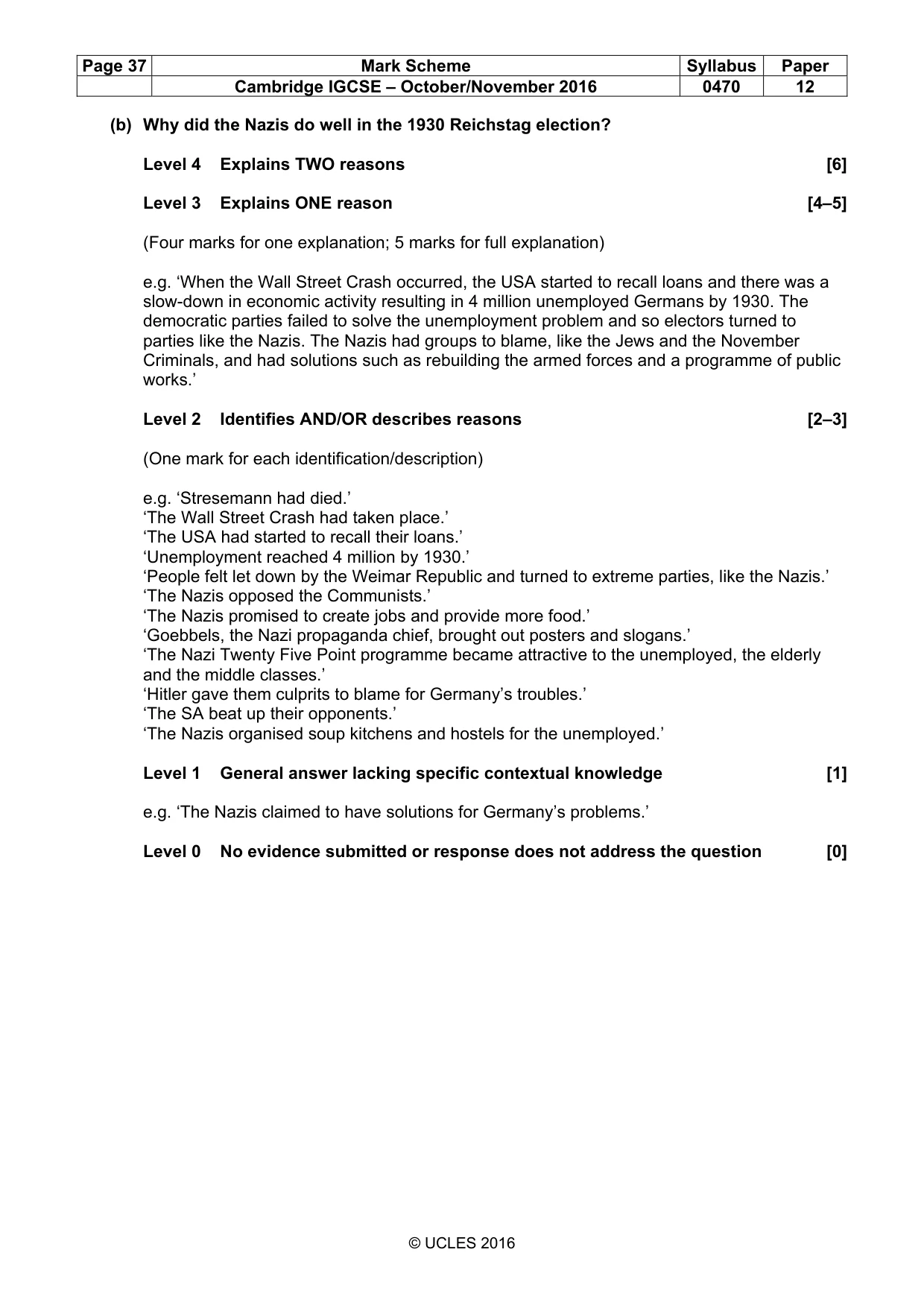
Page 37 Mark Scheme Syllabus Paper Cambridge IGCSE – October/November 2016 0470 12 © UCLES 2016 (b) Why did the Nazis do well in the 1930 Reichstag election? Level 4 Explains TWO reasons [6] Level 3 Explains ONE reason [4–5] (Four marks for one explanation; 5 marks for full explanation) e.g. ‘When the Wall Street Crash occurred, the USA started to recall loans and there was a slow-down in economic activity resulting in 4 million unemployed Germans by 1930. The democratic parties failed to solve the unemployment problem and so electors turned to parties like the Nazis. The Nazis had groups to blame, like the Jews and the November Criminals, and had solutions such as rebuilding the armed forces and a programme of public works.’ Level 2 Identifies AND/OR describes reasons [2–3] (One mark for each identification/description) e.g. ‘Stresemann had died.’ ‘The Wall Street Crash had taken place.’ ‘The USA had started to recall their loans.’ ‘Unemployment reached 4 million by 1930.’ ‘People felt let down by the Weimar Republic and turned to extreme parties, like the Nazis.’ ‘The Nazis opposed the Communists.’ ‘The Nazis promised to create jobs and provide more food.’ ‘Goebbels, the Nazi propaganda chief, brought out posters and slogans.’ ‘The Nazi Twenty Five Point programme became attractive to the unemployed, the elderly and the middle classes.’ ‘Hitler gave them culprits to blame for Germany’s troubles.’ ‘The SA beat up their opponents.’ ‘The Nazis organised soup kitchens and hostels for the unemployed.’ Level 1 General answer lacking specific contextual knowledge [1] e.g. ‘The Nazis claimed to have solutions for Germany’s problems.’ Level 0 No evidence submitted or response does not address the question [0]
Mark scheme, page 38
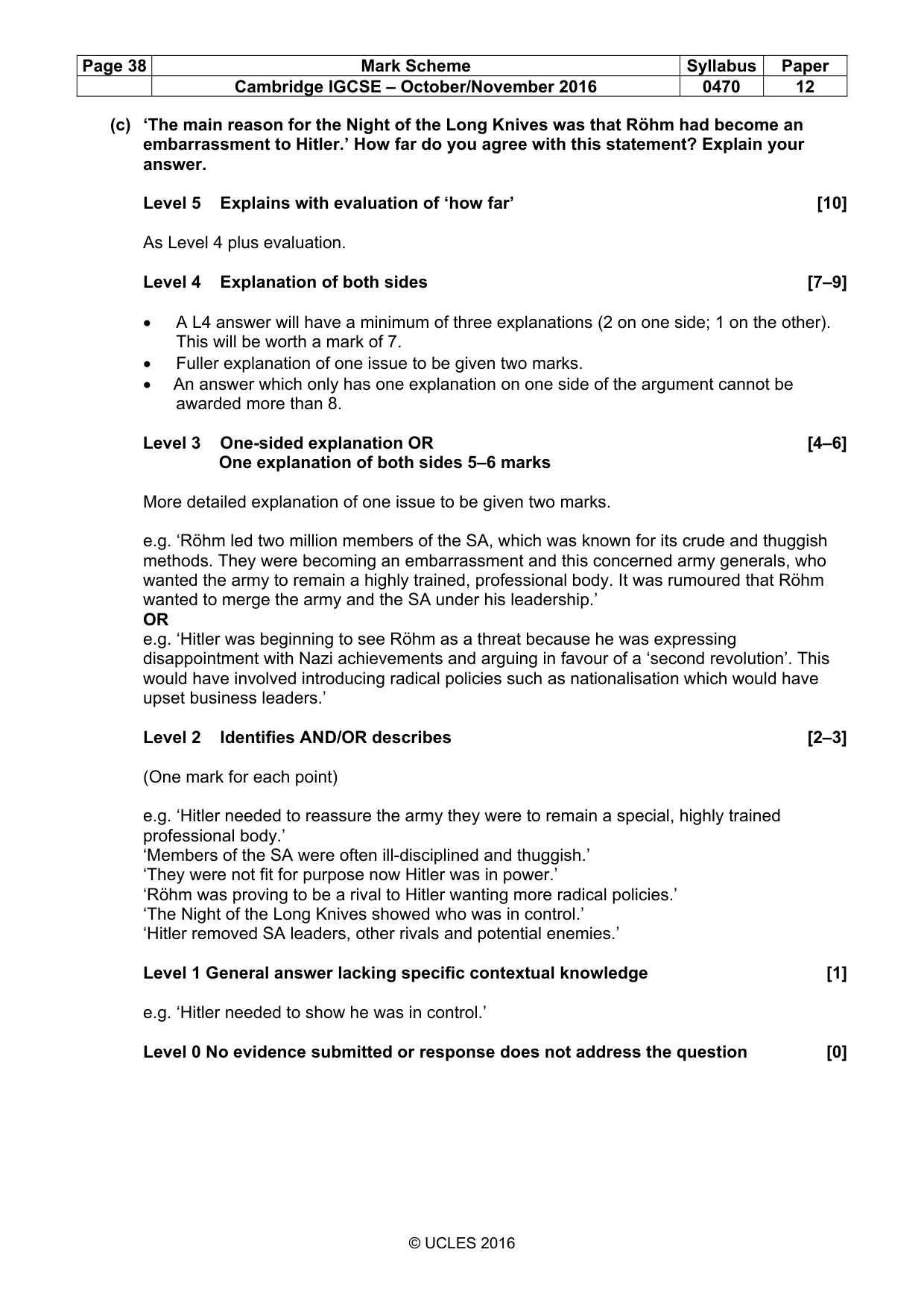
Page 38 Mark Scheme Syllabus Paper Cambridge IGCSE – October/November 2016 0470 12 © UCLES 2016 (c) ‘The main reason for the Night of the Long Knives was that Röhm had become an embarrassment to Hitler.’ How far do you agree with this statement? Explain your answer. Level 5 Explains with evaluation of ‘how far’ [10] As Level 4 plus evaluation. Level 4 Explanation of both sides [7–9] • A L4 answer will have a minimum of three explanations (2 on one side; 1 on the other). This will be worth a mark of 7. • Fuller explanation of one issue to be given two marks. • An answer which only has one explanation on one side of the argument cannot be awarded more than 8. Level 3 One-sided explanation OR [4–6] One explanation of both sides 5–6 marks More detailed explanation of one issue to be given two marks. e.g. ‘Röhm led two million members of the SA, which was known for its crude and thuggish methods. They were becoming an embarrassment and this concerned army generals, who wanted the army to remain a highly trained, professional body. It was rumoured that Röhm wanted to merge the army and the SA under his leadership.’ OR e.g. ‘Hitler was beginning to see Röhm as a threat because he was expressing disappointment with Nazi achievements and arguing in favour of a ‘second revolution’. This would have involved introducing radical policies such as nationalisation which would have upset business leaders.’ Level 2 Identifies AND/OR describes [2–3] (One mark for each point) e.g. ‘Hitler needed to reassure the army they were to remain a special, highly trained professional body.’ ‘Members of the SA were often ill-disciplined and thuggish.’ ‘They were not fit for purpose now Hitler was in power.’ ‘Röhm was proving to be a rival to Hitler wanting more radical policies.’ ‘The Night of the Long Knives showed who was in control.’ ‘Hitler removed SA leaders, other rivals and potential enemies.’ Level 1 General answer lacking specific contextual knowledge [1] e.g. ‘Hitler needed to show he was in control.’ Level 0 No evidence submitted or response does not address the question [0]
Mark scheme, page 39
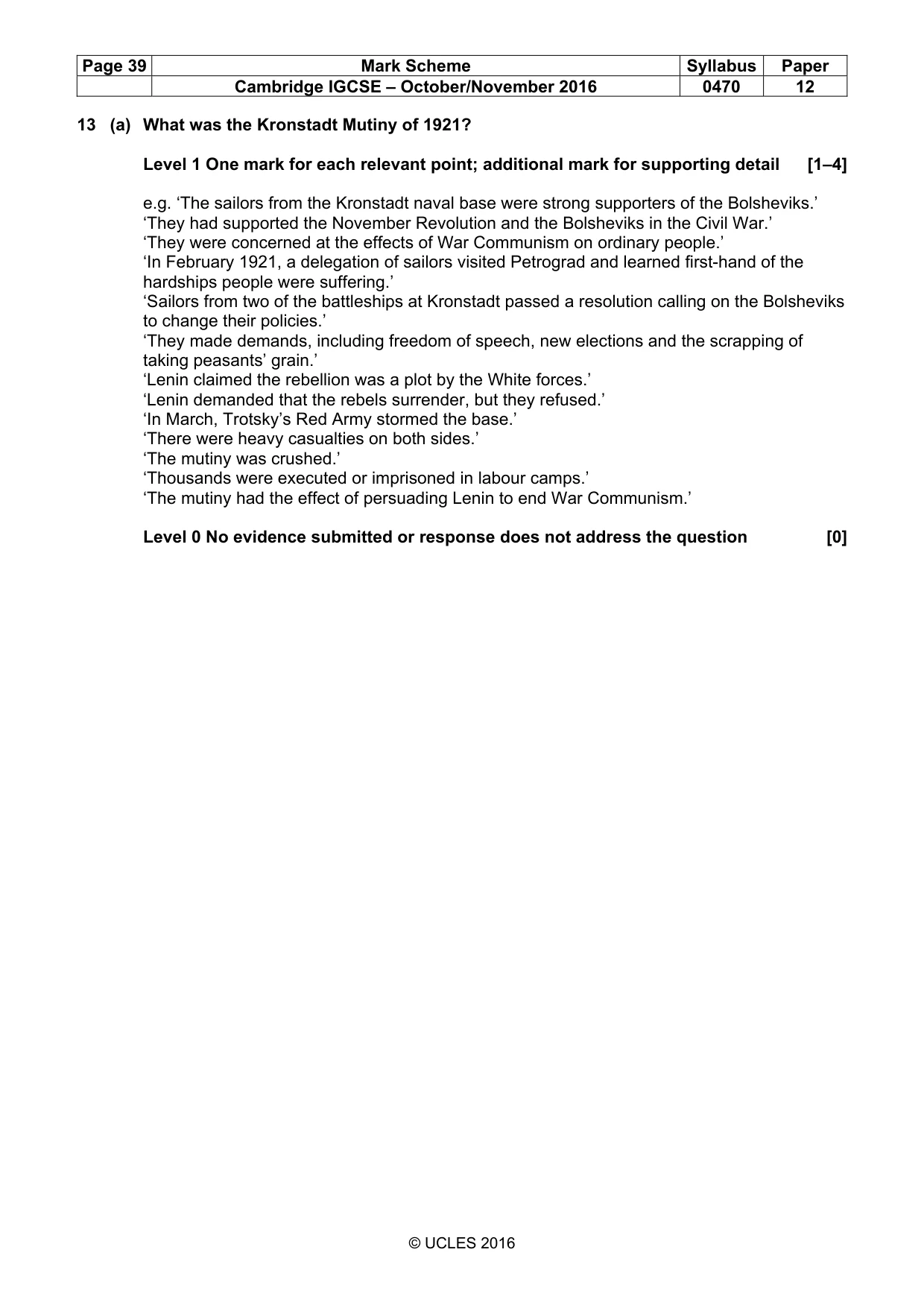
Page 39 Mark Scheme Syllabus Paper Cambridge IGCSE – October/November 2016 0470 12 © UCLES 2016 13 (a) What was the Kronstadt Mutiny of 1921? Level 1 One mark for each relevant point; additional mark for supporting detail [1–4] e.g. ‘The sailors from the Kronstadt naval base were strong supporters of the Bolsheviks.’ ‘They had supported the November Revolution and the Bolsheviks in the Civil War.’ ‘They were concerned at the effects of War Communism on ordinary people.’ ‘In February 1921, a delegation of sailors visited Petrograd and learned first-hand of the hardships people were suffering.’ ‘Sailors from two of the battleships at Kronstadt passed a resolution calling on the Bolsheviks to change their policies.’ ‘They made demands, including freedom of speech, new elections and the scrapping of taking peasants’ grain.’ ‘Lenin claimed the rebellion was a plot by the White forces.’ ‘Lenin demanded that the rebels surrender, but they refused.’ ‘In March, Trotsky’s Red Army stormed the base.’ ‘There were heavy casualties on both sides.’ ‘The mutiny was crushed.’ ‘Thousands were executed or imprisoned in labour camps.’ ‘The mutiny had the effect of persuading Lenin to end War Communism.’ Level 0 No evidence submitted or response does not address the question [0]
Mark scheme, page 40
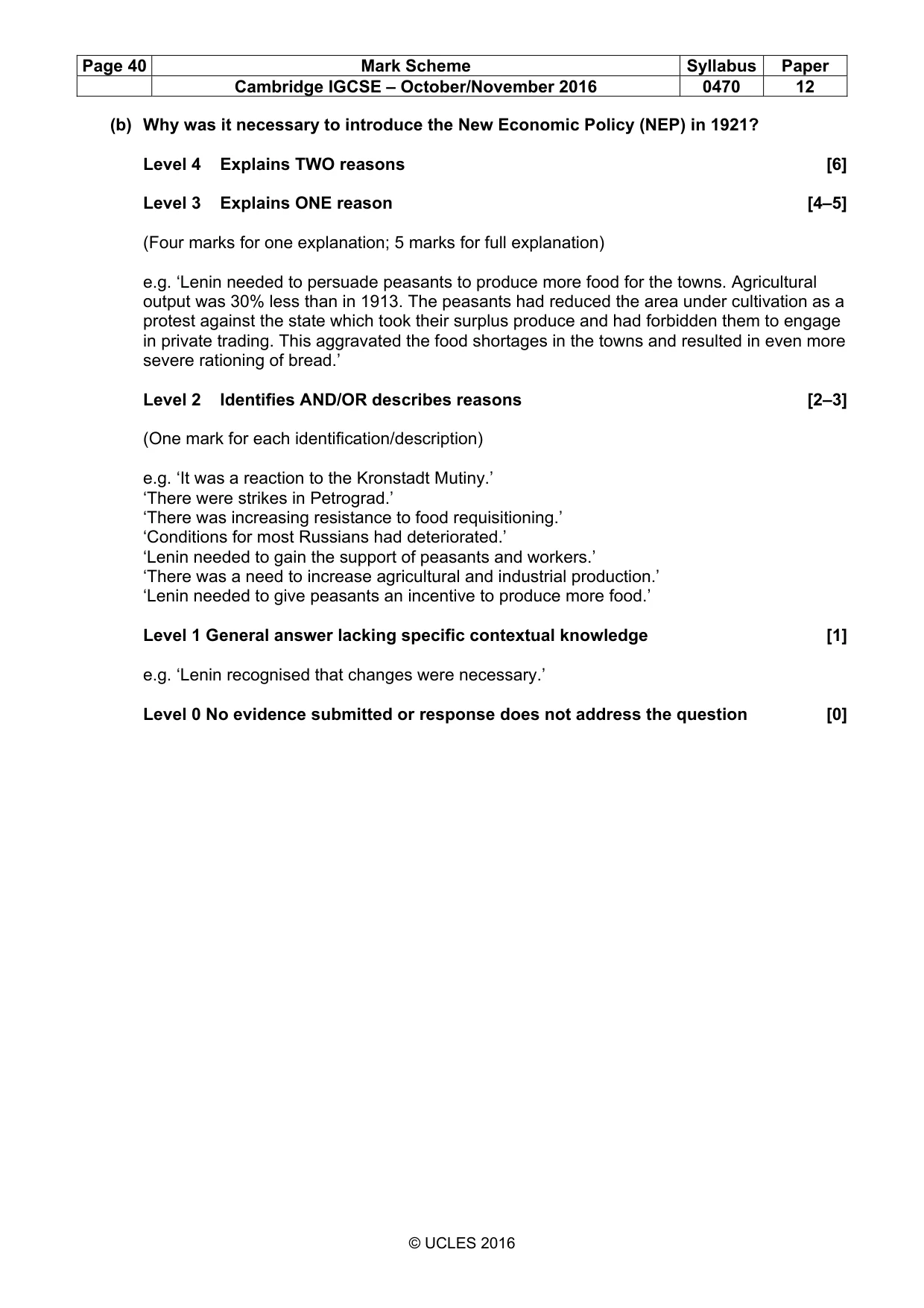
Page 40 Mark Scheme Syllabus Paper Cambridge IGCSE – October/November 2016 0470 12 © UCLES 2016 (b) Why was it necessary to introduce the New Economic Policy (NEP) in 1921? Level 4 Explains TWO reasons [6] Level 3 Explains ONE reason [4–5] (Four marks for one explanation; 5 marks for full explanation) e.g. ‘Lenin needed to persuade peasants to produce more food for the towns. Agricultural output was 30% less than in 1913. The peasants had reduced the area under cultivation as a protest against the state which took their surplus produce and had forbidden them to engage in private trading. This aggravated the food shortages in the towns and resulted in even more severe rationing of bread.’ Level 2 Identifies AND/OR describes reasons [2–3] (One mark for each identification/description) e.g. ‘It was a reaction to the Kronstadt Mutiny.’ ‘There were strikes in Petrograd.’ ‘There was increasing resistance to food requisitioning.’ ‘Conditions for most Russians had deteriorated.’ ‘Lenin needed to gain the support of peasants and workers.’ ‘There was a need to increase agricultural and industrial production.’ ‘Lenin needed to give peasants an incentive to produce more food.’ Level 1 General answer lacking specific contextual knowledge [1] e.g. ‘Lenin recognised that changes were necessary.’ Level 0 No evidence submitted or response does not address the question [0]
Mark scheme, page 41
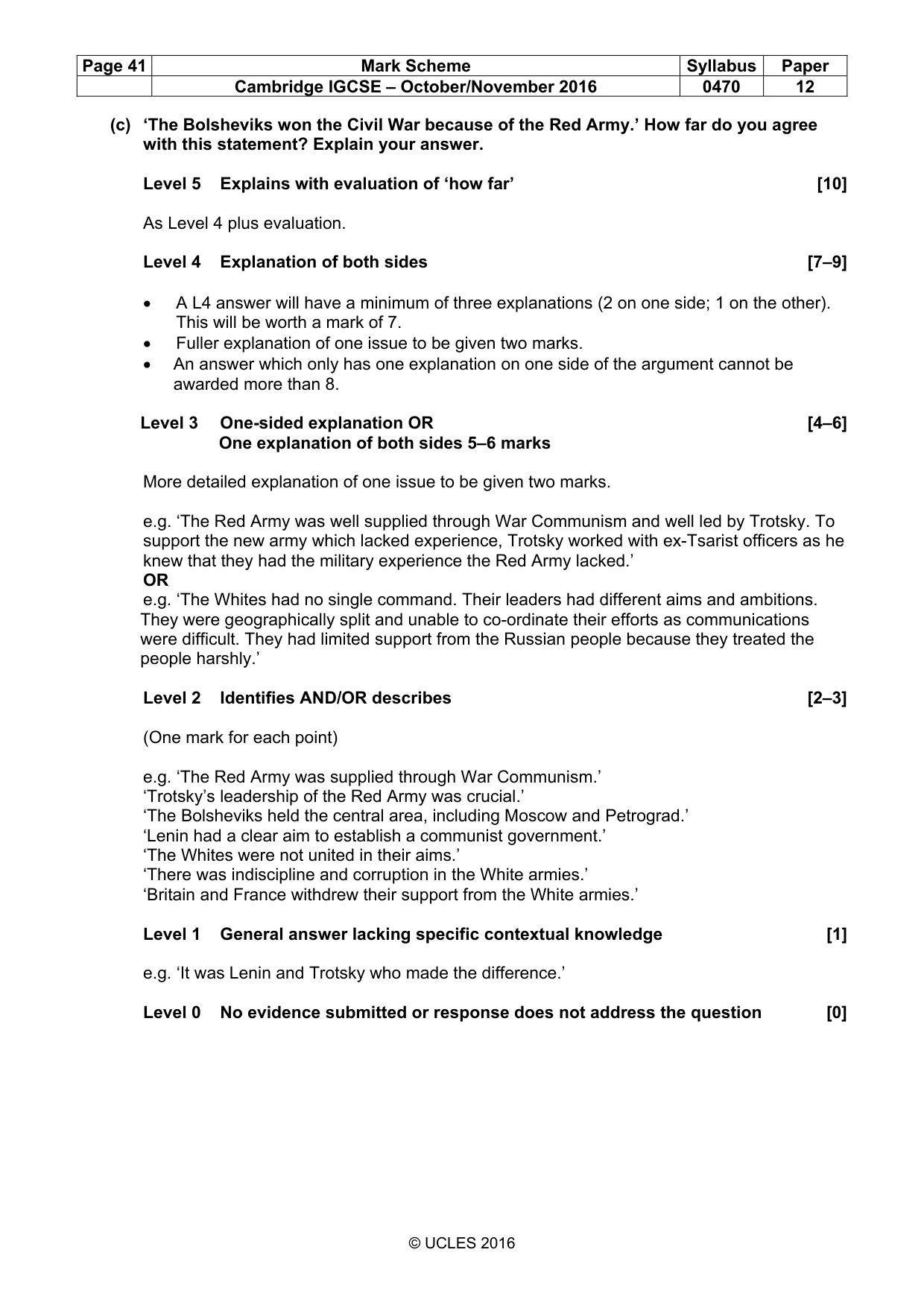
Page 41 Mark Scheme Syllabus Paper Cambridge IGCSE – October/November 2016 0470 12 © UCLES 2016 (c) ‘The Bolsheviks won the Civil War because of the Red Army.’ How far do you agree with this statement? Explain your answer. Level 5 Explains with evaluation of ‘how far’ [10] As Level 4 plus evaluation. Level 4 Explanation of both sides [7–9] • A L4 answer will have a minimum of three explanations (2 on one side; 1 on the other). This will be worth a mark of 7. • Fuller explanation of one issue to be given two marks. • An answer which only has one explanation on one side of the argument cannot be awarded more than 8. Level 3 One-sided explanation OR [4–6] One explanation of both sides 5–6 marks More detailed explanation of one issue to be given two marks. e.g. ‘The Red Army was well supplied through War Communism and well led by Trotsky. To support the new army which lacked experience, Trotsky worked with ex-Tsarist officers as he knew that they had the military experience the Red Army lacked.’ OR e.g. ‘The Whites had no single command. Their leaders had different aims and ambitions. They were geographically split and unable to co-ordinate their efforts as communications were difficult. They had limited support from the Russian people because they treated the people harshly.’ Level 2 Identifies AND/OR describes [2–3] (One mark for each point) e.g. ‘The Red Army was supplied through War Communism.’ ‘Trotsky’s leadership of the Red Army was crucial.’ ‘The Bolsheviks held the central area, including Moscow and Petrograd.’ ‘Lenin had a clear aim to establish a communist government.’ ‘The Whites were not united in their aims.’ ‘There was indiscipline and corruption in the White armies.’ ‘Britain and France withdrew their support from the White armies.’ Level 1 General answer lacking specific contextual knowledge [1] e.g. ‘It was Lenin and Trotsky who made the difference.’ Level 0 No evidence submitted or response does not address the question [0]
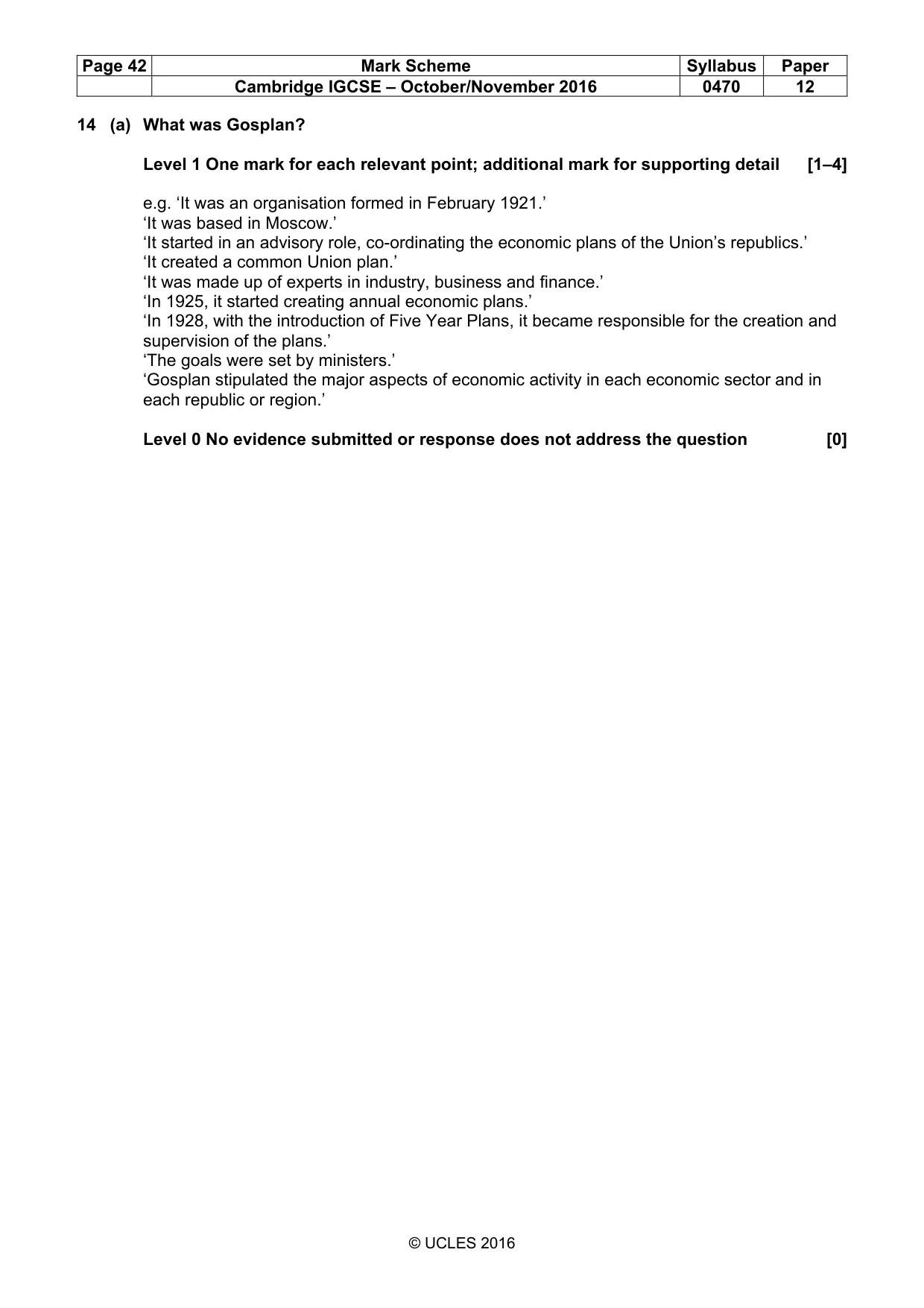
Mark scheme, page 42
Page 42 Mark Scheme Syllabus Paper Cambridge IGCSE – October/November 2016 0470 12 © UCLES 2016 14 (a) What was Gosplan? Level 1 One mark for each relevant point; additional mark for supporting detail [1–4] e.g. ‘It was an organisation formed in February 1921.’ ‘It was based in Moscow.’ ‘It started in an advisory role, co-ordinating the economic plans of the Union’s republics.’ ‘It created a common Union plan.’ ‘It was made up of experts in industry, business and finance.’ ‘In 1925, it started creating annual economic plans.’ ‘In 1928, with the introduction of Five Year Plans, it became responsible for the creation and supervision of the plans.’ ‘The goals were set by ministers.’ ‘Gosplan stipulated the major aspects of economic activity in each economic sector and in each republic or region.’ Level 0 No evidence submitted or response does not address the question [0]
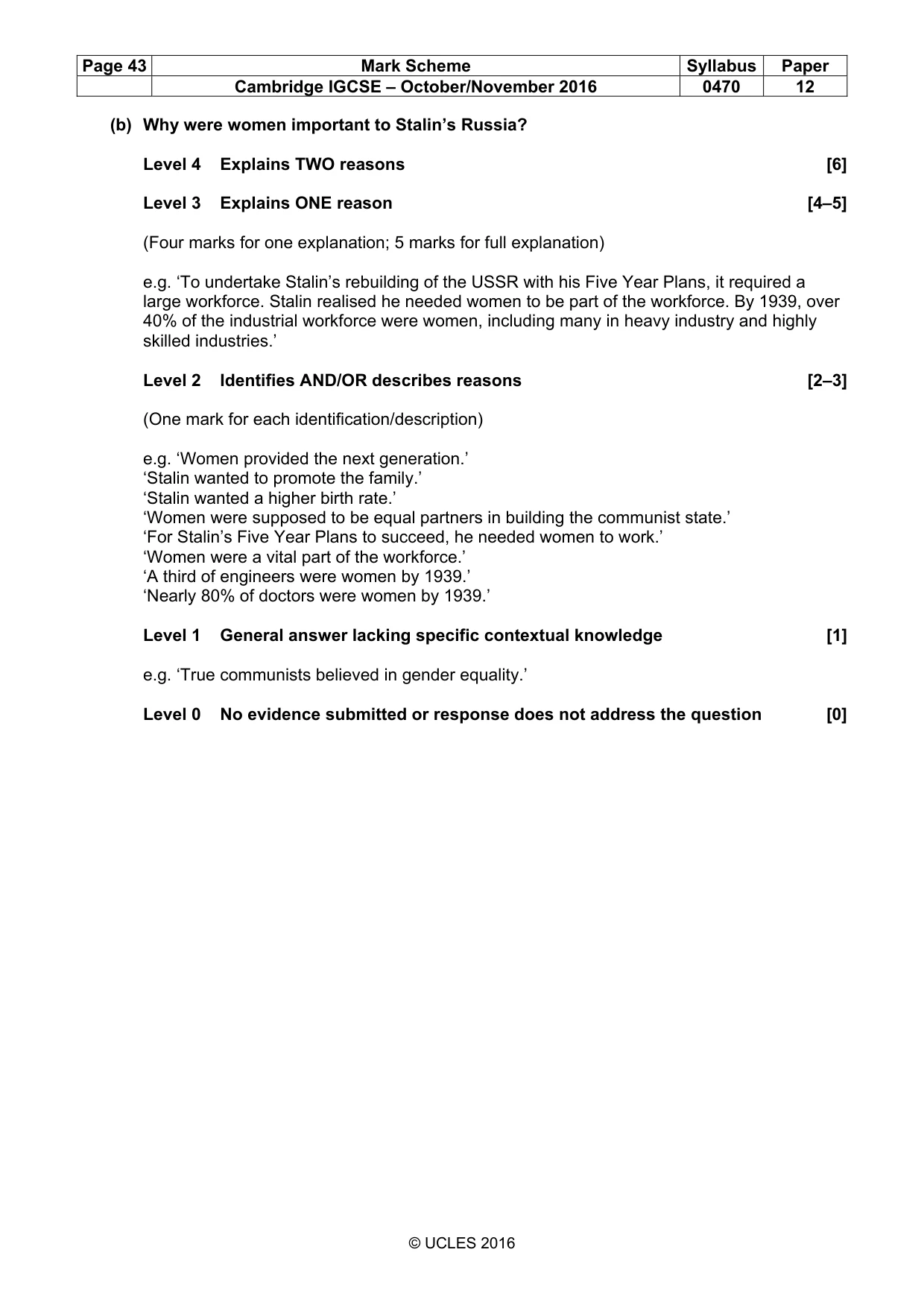
Mark scheme, page 43
Page 43 Mark Scheme Syllabus Paper Cambridge IGCSE – October/November 2016 0470 12 © UCLES 2016 (b) Why were women important to Stalin’s Russia? Level 4 Explains TWO reasons [6] Level 3 Explains ONE reason [4–5] (Four marks for one explanation; 5 marks for full explanation) e.g. ‘To undertake Stalin’s rebuilding of the USSR with his Five Year Plans, it required a large workforce. Stalin realised he needed women to be part of the workforce. By 1939, over 40% of the industrial workforce were women, including many in heavy industry and highly skilled industries.’ Level 2 Identifies AND/OR describes reasons [2–3] (One mark for each identification/description) e.g. ‘Women provided the next generation.’ ‘Stalin wanted to promote the family.’ ‘Stalin wanted a higher birth rate.’ ‘Women were supposed to be equal partners in building the communist state.’ ‘For Stalin’s Five Year Plans to succeed, he needed women to work.’ ‘Women were a vital part of the workforce.’ ‘A third of engineers were women by 1939.’ ‘Nearly 80% of doctors were women by 1939.’ Level 1 General answer lacking specific contextual knowledge [1] e.g. ‘True communists believed in gender equality.’ Level 0 No evidence submitted or response does not address the question [0]
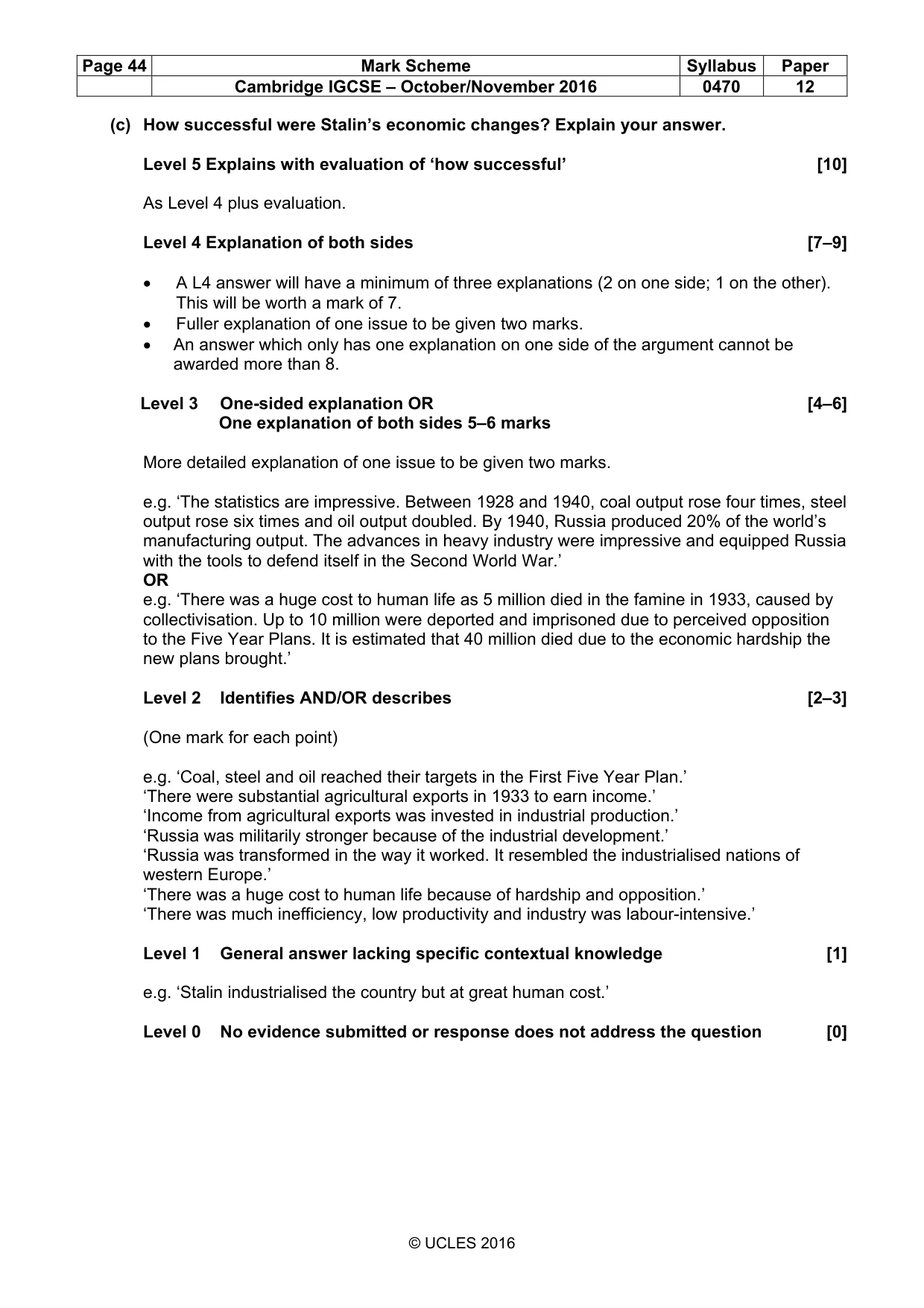
Mark scheme, page 44
Page 44 Mark Scheme Syllabus Paper Cambridge IGCSE – October/November 2016 0470 12 © UCLES 2016 (c) How successful were Stalin’s economic changes? Explain your answer. Level 5 Explains with evaluation of ‘how successful’ [10] As Level 4 plus evaluation. Level 4 Explanation of both sides [7–9] • A L4 answer will have a minimum of three explanations (2 on one side; 1 on the other). This will be worth a mark of 7. • Fuller explanation of one issue to be given two marks. • An answer which only has one explanation on one side of the argument cannot be awarded more than 8. Level 3 One-sided explanation OR [4–6] One explanation of both sides 5–6 marks More detailed explanation of one issue to be given two marks. e.g. ‘The statistics are impressive. Between 1928 and 1940, coal output rose four times, steel output rose six times and oil output doubled. By 1940, Russia produced 20% of the world’s manufacturing output. The advances in heavy industry were impressive and equipped Russia with the tools to defend itself in the Second World War.’ OR e.g. ‘There was a huge cost to human life as 5 million died in the famine in 1933, caused by collectivisation. Up to 10 million were deported and imprisoned due to perceived opposition to the Five Year Plans. It is estimated that 40 million died due to the economic hardship the new plans brought.’ Level 2 Identifies AND/OR describes [2–3] (One mark for each point) e.g. ‘Coal, steel and oil reached their targets in the First Five Year Plan.’ ‘There were substantial agricultural exports in 1933 to earn income.’ ‘Income from agricultural exports was invested in industrial production.’ ‘Russia was militarily stronger because of the industrial development.’ ‘Russia was transformed in the way it worked. It resembled the industrialised nations of western Europe.’ ‘There was a huge cost to human life because of hardship and opposition.’ ‘There was much inefficiency, low productivity and industry was labour-intensive.’ Level 1 General answer lacking specific contextual knowledge [1] e.g. ‘Stalin industrialised the country but at great human cost.’ Level 0 No evidence submitted or response does not address the question [0]
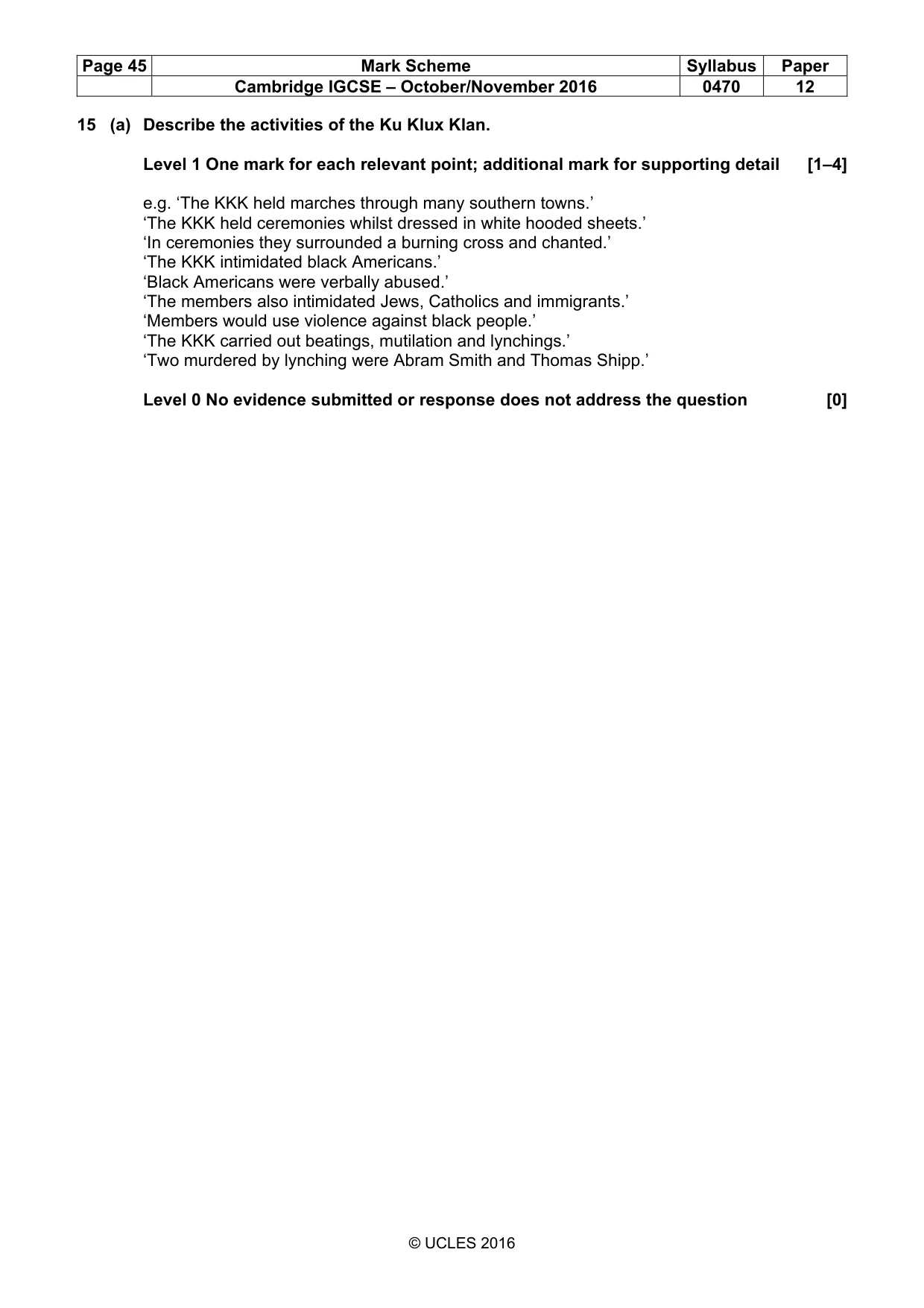
Mark scheme, page 45
Page 45 Mark Scheme Syllabus Paper Cambridge IGCSE – October/November 2016 0470 12 © UCLES 2016 15 (a) Describe the activities of the Ku Klux Klan. Level 1 One mark for each relevant point; additional mark for supporting detail [1–4] e.g. ‘The KKK held marches through many southern towns.’ ‘The KKK held ceremonies whilst dressed in white hooded sheets.’ ‘In ceremonies they surrounded a burning cross and chanted.’ ‘The KKK intimidated black Americans.’ ‘Black Americans were verbally abused.’ ‘The members also intimidated Jews, Catholics and immigrants.’ ‘Members would use violence against black people.’ ‘The KKK carried out beatings, mutilation and lynchings.’ ‘Two murdered by lynching were Abram Smith and Thomas Shipp.’ Level 0 No evidence submitted or response does not address the question [0]
Mark scheme, page 46
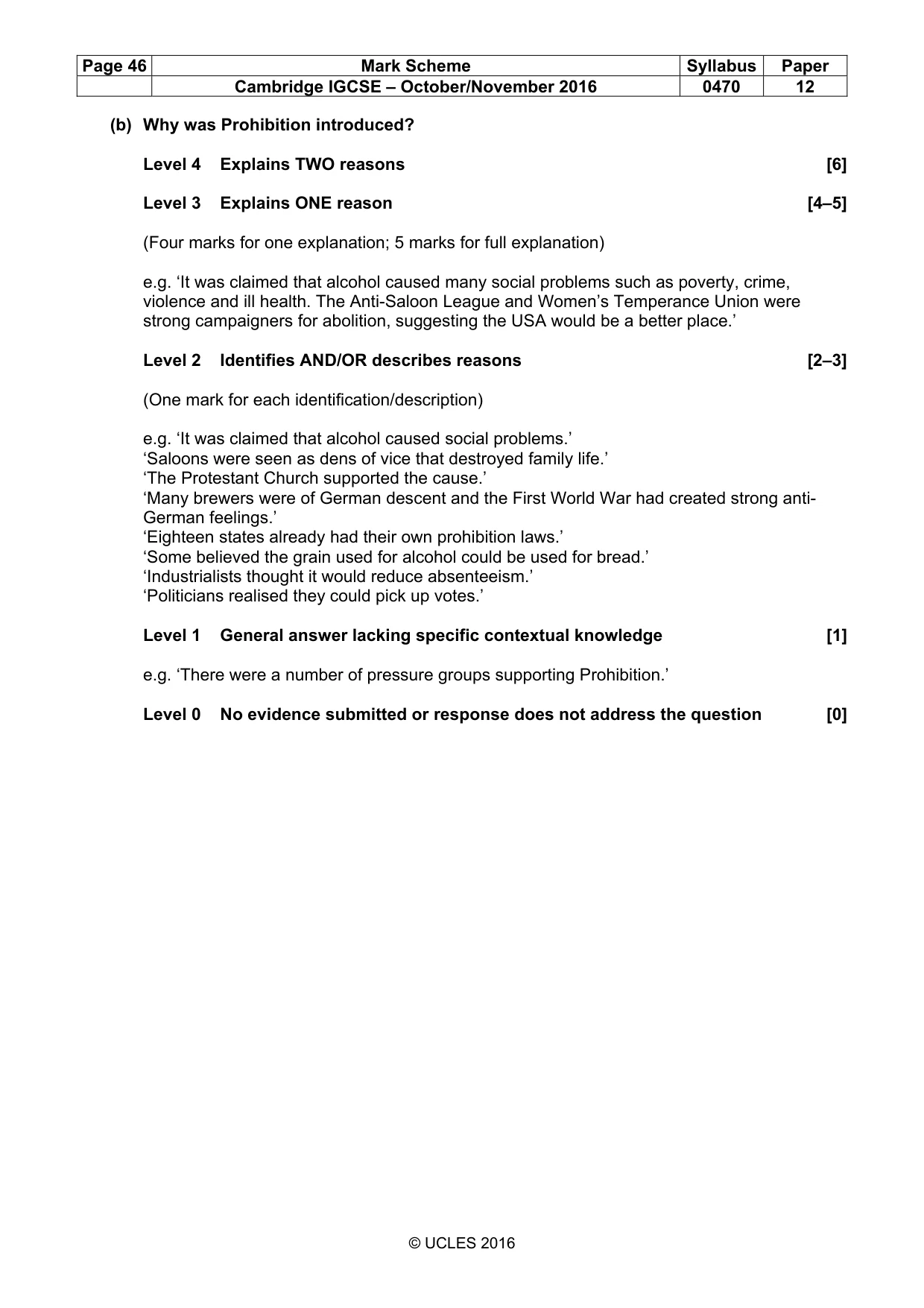
Page 46 Mark Scheme Syllabus Paper Cambridge IGCSE – October/November 2016 0470 12 © UCLES 2016 (b) Why was Prohibition introduced? Level 4 Explains TWO reasons [6] Level 3 Explains ONE reason [4–5] (Four marks for one explanation; 5 marks for full explanation) e.g. ‘It was claimed that alcohol caused many social problems such as poverty, crime, violence and ill health. The Anti-Saloon League and Women’s Temperance Union were strong campaigners for abolition, suggesting the USA would be a better place.’ Level 2 Identifies AND/OR describes reasons [2–3] (One mark for each identification/description) e.g. ‘It was claimed that alcohol caused social problems.’ ‘Saloons were seen as dens of vice that destroyed family life.’ ‘The Protestant Church supported the cause.’ ‘Many brewers were of German descent and the First World War had created strong anti- German feelings.’ ‘Eighteen states already had their own prohibition laws.’ ‘Some believed the grain used for alcohol could be used for bread.’ ‘Industrialists thought it would reduce absenteeism.’ ‘Politicians realised they could pick up votes.’ Level 1 General answer lacking specific contextual knowledge [1] e.g. ‘There were a number of pressure groups supporting Prohibition.’ Level 0 No evidence submitted or response does not address the question [0]
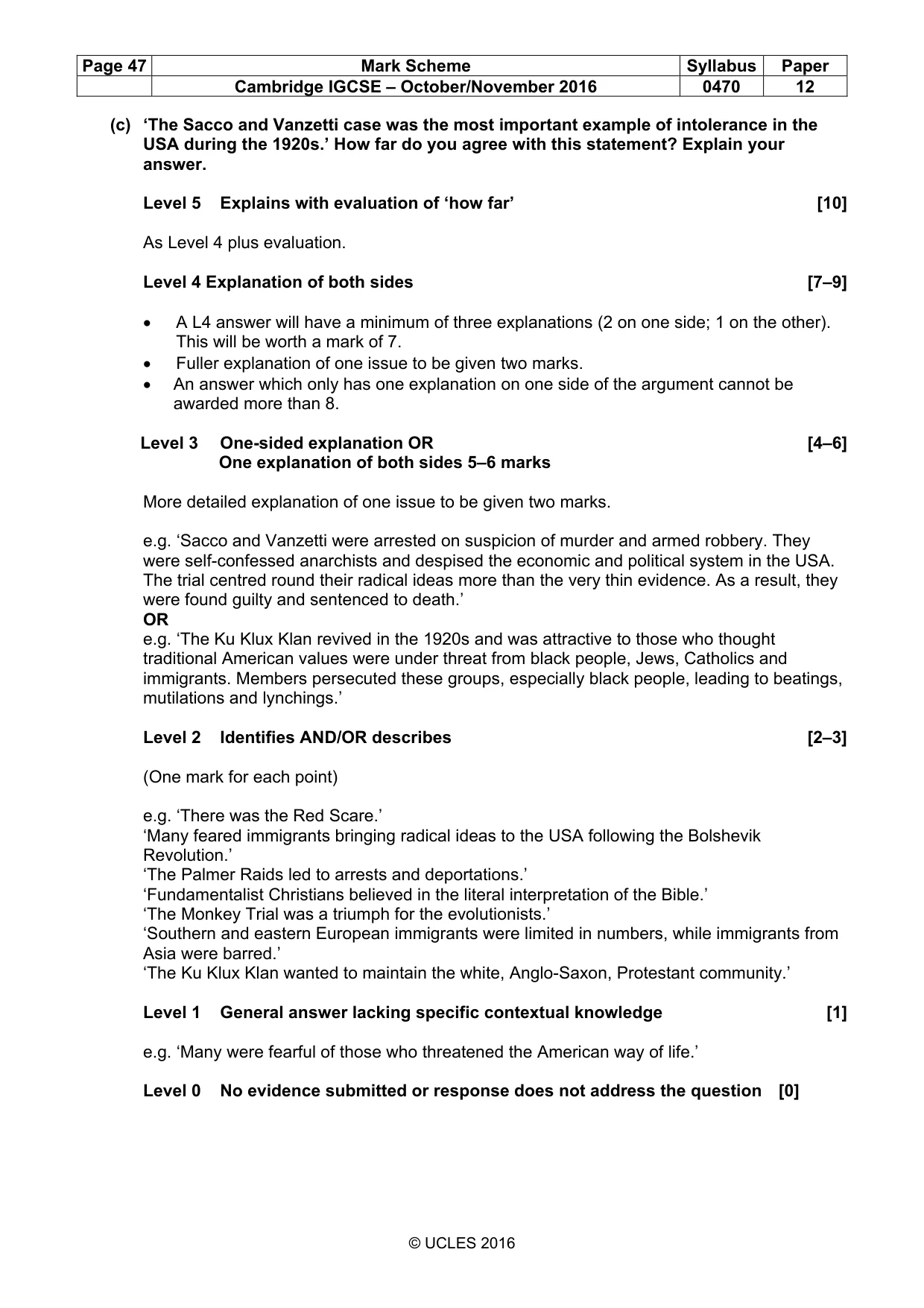
Mark scheme, page 47
Page 47 Mark Scheme Syllabus Paper Cambridge IGCSE – October/November 2016 0470 12 © UCLES 2016 (c) ‘The Sacco and Vanzetti case was the most important example of intolerance in the USA during the 1920s.’ How far do you agree with this statement? Explain your answer. Level 5 Explains with evaluation of ‘how far’ [10] As Level 4 plus evaluation. Level 4 Explanation of both sides [7–9] • A L4 answer will have a minimum of three explanations (2 on one side; 1 on the other). This will be worth a mark of 7. • Fuller explanation of one issue to be given two marks. • An answer which only has one explanation on one side of the argument cannot be awarded more than 8. Level 3 One-sided explanation OR [4–6] One explanation of both sides 5–6 marks More detailed explanation of one issue to be given two marks. e.g. ‘Sacco and Vanzetti were arrested on suspicion of murder and armed robbery. They were self-confessed anarchists and despised the economic and political system in the USA. The trial centred round their radical ideas more than the very thin evidence. As a result, they were found guilty and sentenced to death.’ OR e.g. ‘The Ku Klux Klan revived in the 1920s and was attractive to those who thought traditional American values were under threat from black people, Jews, Catholics and immigrants. Members persecuted these groups, especially black people, leading to beatings, mutilations and lynchings.’ Level 2 Identifies AND/OR describes [2–3] (One mark for each point) e.g. ‘There was the Red Scare.’ ‘Many feared immigrants bringing radical ideas to the USA following the Bolshevik Revolution.’ ‘The Palmer Raids led to arrests and deportations.’ ‘Fundamentalist Christians believed in the literal interpretation of the Bible.’ ‘The Monkey Trial was a triumph for the evolutionists.’ ‘Southern and eastern European immigrants were limited in numbers, while immigrants from Asia were barred.’ ‘The Ku Klux Klan wanted to maintain the white, Anglo-Saxon, Protestant community.’ Level 1 General answer lacking specific contextual knowledge [1] e.g. ‘Many were fearful of those who threatened the American way of life.’ Level 0 No evidence submitted or response does not address the question [0]
Mark scheme, page 48
Page 48 Mark Scheme Syllabus Paper Cambridge IGCSE – October/November 2016 0470 12 © UCLES 2016 16 (a) Describe how President Hoover reacted to the US economic crash. Level 1 One mark for each relevant point; additional mark for supporting detail [1–4] e.g. ‘Hoover considered it a normal business downturn.’ ‘His strategy was to sit it out until prosperity returned.’ ‘Hoover was against the federal government providing welfare support.’ ‘He believed in self-help and rugged individualism.’ ‘Hoover’s policies were considered too little and too late.’ ‘He cut taxes in 1930 to increase purchasing power.’ ‘He increased tariffs to protect American produced food and goods.’ ‘Hoover provided finance for a building programme.’ ‘Hoover’s most famous project was the Hoover Dam on the Colorado River.’ ‘Employers were encouraged to maintain wages.’ ‘Hoover set up the Reconstruction Finance Corporation to provide loans to businesses.’ ‘The Federal Farm Board was set up to buy surplus produce to stabilise prices.’ Level 0 No evidence submitted or response does not address the question [0]
Mark scheme, page 49
Page 49 Mark Scheme Syllabus Paper Cambridge IGCSE – October/November 2016 0470 12 © UCLES 2016 (b) Why was President Hoover’s personal reputation damaged by events relating to the Bonus Marchers? Level 4 Explains TWO reasons [6] Level 3 Explains ONE reason [4–5] (Four marks for one explanation; 5 marks for full explanation) e.g. ‘Hoover decided to use considerable force against many elderly, destitute army veterans who had fought for their country in the First World War. Hoover was portrayed as heartless in not only refusing their demands for their war bonus being paid early but also the use of ruthless violence against them.’ Level 2 Identifies AND/OR describes reasons [2–3] (One mark for each identification/description) e.g. ‘It was a peaceful protest opposite the White House.’ ‘Hoover considered it a threat to government institutions.’ ‘Hoover called on the army to clear the site.’ ‘The camp was destroyed with the use of tanks, machine guns and tear gas.’ ‘Two veterans were killed.’ ‘A thousand veterans were injured.’ ‘It made Hoover seem heartless and ruthless.’ ‘Hoover had set the army on army veterans.’ Level 1 General answer lacking specific contextual knowledge [1] e.g. ‘Hoover’s actions seemed disproportionate.’ Level 0 No evidence submitted or response does not address the question [0]
Mark scheme, page 50
Page 50 Mark Scheme Syllabus Paper Cambridge IGCSE – October/November 2016 0470 12 © UCLES 2016 (c) ‘Uneven distribution of wealth was the main weakness of the US economy by 1929.’ How far do you agree with this statement? Explain your answer. Level 5 Explains with evaluation of ‘how far’ [10] As Level 4 plus evaluation. Level 4 Explanation of both sides [7–9] • A L4 answer will have a minimum of three explanations (2 on one side; 1 on the other). This will be worth a mark of 7. • Fuller explanation of one issue to be given two marks. • An answer which only has one explanation on one side of the argument cannot be awarded more than 8. Level 3 One-sided explanation OR [4–6] One explanation of both sides 5–6 marks More detailed explanation of one issue to be given two marks. e.g. ‘About 5% of the population was receiving 33% of the income in 1929. Too much money was in too few hands. Mass production required mass consumption but there were millions of Americans who could not afford to buy the new consumer goods.’ OR e.g. ‘By 1929, American industry was producing more consumer goods than there were consumers to buy. Industrialists wanted to export their surpluses but they were prevented by foreign tariffs as a result of retaliation to American tariffs.’ Level 2 Identifies AND/OR describes [2–3] (One mark for each point) e.g. ‘Over 50% of Americans were too poor to take part in the consumer boom.’ ‘Those on low wages or the unemployed could not afford consumer goods.’ ‘Exporting was difficult because Europeans were still recovering from the war.’ ‘Foreign countries put tariffs on US goods to protect their own industries.’ ‘There was overproduction which saturated the market.’ Level 1 General answer lacking specific contextual knowledge [1] e.g. ‘Too few US citizens had much money.’ Level 0 No evidence submitted or response does not address the question [0]
Mark scheme, page 51
Page 51 Mark Scheme Syllabus Paper Cambridge IGCSE – October/November 2016 0470 12 © UCLES 2016 17 (a) What actions did the Communist Party take to strengthen its position and remove its enemies during the period 1950–52? Level 1 One mark for each relevant point; additional mark for supporting detail [1–4] e.g. ‘To win wide support, small political parties were invited to join a coalition of parties.’ ‘In practice, Mao made it clear there was one party only.’ ‘About a million were executed in these years.’ ‘Many executed were landlords who had been traditionally supporters of the Nationalist party.’ ‘Many opponents were persuaded to reform their ways and were re-educated to communism.’ ‘Large campaigns of ‘thought reform’ were launched against enemies, usually landowners or businessmen.’ ‘Mao organised campaigns to root out various ‘evils’ in Chinese life.’ ‘In 1950, there was the ‘Three Mountains’ campaign against feudalism, capitalism and imperialism.’ ‘In 1951, there was a campaign against landowners and capitalists.’ ‘In 1952, there was the Three Antis campaign against corruption.’ ‘Mao took complete control of radio, newspapers, books and cinema.’ Level 0 No evidence submitted or response does not address the question [0]
Mark scheme, page 52
Page 52 Mark Scheme Syllabus Paper Cambridge IGCSE – October/November 2016 0470 12 © UCLES 2016 (b) Why did the Communists consider it important to improve education? Level 4 Explains TWO reasons [6] Level 3 Explains ONE reason [4–5] (Four marks for one explanation; 5 marks for full explanation) e.g. ‘Mao realised that if China was to become a world power it needed to educate its whole population. To improve industry it required engineers who could understand manuals. To improve medicine it required well educated doctors and nurses.’ Level 2 Identifies AND/OR describes reasons [2–3] (One mark for each identification/description) e.g. ‘In 1949, only 20% were literate.’ ‘It was important so that people could understand the works of Marx, Lenin and Mao.’ ‘China needed doctors, engineers and technicians.’ ‘Communists believed education was for all.’ Level 1 General answer lacking specific contextual knowledge [1] e.g. ‘Mao wanted China to be a great power.’ Level 0 No evidence submitted or response does not address the question [0]
Mark scheme, page 53
Page 53 Mark Scheme Syllabus Paper Cambridge IGCSE – October/November 2016 0470 12 © UCLES 2016 (c) How successful were the agricultural policies of the Communists in the 1950s? Explain your answer. Level 5 Explains with evaluation of ‘how successful’ [10] As Level 4 plus evaluation. Level 4 Explanation of both sides [7–9] • A L4 answer will have a minimum of three explanations (2 on one side; 1 on the other). This will be worth a mark of 7. • Fuller explanation of one issue to be given two marks. • An answer which only has one explanation on one side of the argument cannot be awarded more than 8. Level 3 One-sided explanation OR [4–6] One explanation of both sides 5–6 marks More detailed explanation of one issue to be given two marks. e.g. ‘Mao and the Communist Party were able to redistribute the land in line with communist principles, giving power and status to the peasants at the expense of the landlords. This was done successfully through the Agrarian Reform Act. Landlords were put on trial through the ‘people’s courts’ and a million were executed.’ OR e.g. ‘Mao encouraged bigger units during the 1950s to get peasants to produce more food for China’s increasing population. In the Great Leap Forward, Mao encouraged whole villages and some towns to work in communes. Unfortunately, many peasant farmers were distracted by other activities, such as the backyard furnaces, and the fields were neglected. This resulted in low grain and animal production resulting in famine.’ Level 2 Identifies AND/OR describes [2–3] (One mark for each point) e.g. ‘The Agrarian Reform Law gave the peasants land to farm.’ ‘Land was in small plots and farming was inefficient.’ ‘Co-operative and collective farms were formed.’ ‘Private ownership ceased to exist except for small gardens.’ ‘Large communes were formed as part of the Great Leap Forward.’ ‘Backyard furnaces took peasants away from farming.’ ‘20–40 million died because of famine during the Great Leap Forward.’ Level 1 General answer lacking specific contextual knowledge [1] e.g. ‘China struggled to feed its population throughout the 1950s.’ Level 0 No evidence submitted or response does not address the question [0]
Mark scheme, page 54
Page 54 Mark Scheme Syllabus Paper Cambridge IGCSE – October/November 2016 0470 12 © UCLES 2016 18 (a) What happened to the ‘Gang of Four’ immediately following Mao’s death? Level 1 One mark for each relevant point; additional mark for supporting detail [1–4] e.g. ‘On Mao’s death, the Gang of Four attempted to seize power.’ ‘The new Communist Party chairman, Hua, had them arrested.’ ‘Hua had the support of the military leaders, Wang and Chen, in carrying out their arrest.’ ‘A massive media campaign was launched naming them the ‘Gang of Four’.’ ‘In the campaign, they were blamed for the excesses of the Cultural Revolution.’ ‘In 1981, the four deposed leaders were subjected to a show trial.’ ‘They were convicted of anti-party activities.’ ‘Mao’s wife and Zhang received the death penalty that was later commuted to life imprisonment.’ ‘Wang Hongwen and Yao were given twenty years in prison.’ Level 0 No evidence submitted or response does not address the question [0]
Mark scheme, page 55
Page 55 Mark Scheme Syllabus Paper Cambridge IGCSE – October/November 2016 0470 12 © UCLES 2016 (b) Why did China follow a policy of modernisation in the 1980s? Level 4 Explains TWO reasons [6] Level 3 Explains ONE reason [4–5] (Four marks for one explanation; 5 marks for full explanation) e.g. ‘Deng Xiaoping realised that China needed to increase production and modernise industry to support its huge population, which was close to one billion. He realised that unless peasants were given incentives, such as higher grain prices and being allowed to grow some cash crops, there could be a repeat of the terrible famines during Mao’s rule.’ Level 2 Identifies AND/OR describes reasons [2–3] (One mark for each identification/description) e.g. ‘To support its huge population.’ ‘To appease Chinese society after the excesses of Mao’s rule.’ ‘Agricultural and industrial production had stagnated.’ ‘To give peasants an incentive to work harder.’ ‘To give the Chinese a higher standard of living.’ ‘To encourage foreign investment into China.’ ‘To catch up with Japan, South Korea and Taiwan.’ Level 1 General answer lacking specific contextual knowledge [1] e.g. ‘China was being left behind by its neighbours.’ Level 0 No evidence submitted or response does not address the question [0]
Mark scheme, page 56
Page 56 Mark Scheme Syllabus Paper Cambridge IGCSE – October/November 2016 0470 12 © UCLES 2016 (c) ‘China’s economic development after 1976 had a greater impact socially than it did politically.’ How far do you agree with this statement? Explain your answer. Level 5 Explains with evaluation of ‘how far’ [10] As Level 4 plus evaluation. Level 4 Explanation of both sides [7–9] • A L4 answer will have a minimum of three explanations (2 on one side; 1 on the other). This will be worth a mark of 7. • Fuller explanation of one issue to be given two marks. • An answer which only has one explanation on one side of the argument cannot be awarded more than 8. Level 3 One-sided explanation OR [4–6] One explanation of both sides 5–6 marks More detailed explanation of one issue to be given two marks. e.g. ‘Deng’s incentives in industry and agriculture improved the standard of living for the majority of Chinese. The income of agricultural workers tripled between 1977 and 1983. People could own their own businesses and many consumer goods were produced such as bicycles, watches and sewing machines.’ OR e.g. ‘Deng’s determination to keep control and crush all opposition was shown in 1989 at Tiananmen Square. Demonstrations by students for more democracy were crushed on 3rd June. Probably between 400 and 800 students were killed and later thousands were arrested and imprisoned.’ Level 2 Identifies AND/OR describes [2–3] (One mark for each point) e.g. ‘The Chinese were able to buy a good range of consumer goods.’ ‘Peasant farmers were allowed to sell surpluses for a profit.’ ‘There were incentives at work such as profit-sharing, overtime and bonus payments.’ ‘The Chinese under Deng enjoyed a higher standard of living.’ ‘It appeared Deng would move China towards a democracy in 1979.’ ‘Deng welcomed the ‘Democracy Wall’.’ ‘Deng crushed the movement because it demanded free speech and a parliament.’ ‘Deng crushed the students’ protests in Tiananmen Square.’ ‘In 1992, dictatorship of the Communist Party was confirmed with no criticism or opposition being permitted.’ Level 1 General answer lacking specific contextual knowledge [1] e.g. ‘The economic development failed to bring any political change.’ Level 0 No evidence submitted or response does not address the question [0]
Mark scheme, page 57
Page 57 Mark Scheme Syllabus Paper Cambridge IGCSE – October/November 2016 0470 12 © UCLES 2016 19 (a) What was the impact of the Group Areas Act of 1950? Level 1 One mark for each relevant point; additional mark for supporting detail [1–4] e.g. ‘Whites, blacks and coloureds were to live in separate racial areas.’ ‘The whole of South Africa was to be divided into racial areas.’ ‘The impact of the law was to exclude non-whites from living in the most developed areas.’ ‘It caused many non-whites to have to commute large distances to work.’ ‘The law led to many non-whites being forcibly removed for living in the ‘wrong’ areas.’ ‘The non-white majority were given much smaller areas to live in.’ ‘The white minority owned most of the country.’ ‘Non-whites had to carry pass books to enter ‘white’ parts of the country.’ Level 0 No evidence submitted or response does not address the question [0]
Mark scheme, page 58
Page 58 Mark Scheme Syllabus Paper Cambridge IGCSE – October/November 2016 0470 12 © UCLES 2016 (b) Why did black resistance and violence against apartheid increase in the early 1960s? Level 4 Explains TWO reasons [6] Level 3 Explains ONE reason [4–5] (Four marks for one explanation; 5 marks for full explanation) e.g. ‘It became apparent that continued protests in the form of bus boycotts or petitions against the pass laws were achieving very little. The Freedom Charter, which set out a new vision for South Africa with democracy, human rights and equality before the law, was considered by the government as an act of treason. Violence seemed to be the only alternative.’ Level 2 Identifies AND/OR describes reasons [2–3] (One mark for each identification/description) e.g. ‘Peaceful protest had not worked.’ ‘It was the aftermath of the Sharpeville Massacre.’ ‘The government declared a state of emergency.’ ‘The ANC and PAC were banned.’ ‘The ANC and PAC were forced underground and formed militant wings.’ Level 1 General answer lacking specific contextual knowledge [1] e.g. ‘Previous methods had not got rid of Apartheid.’ Level 0 No evidence submitted or response does not address the question [0]
Mark scheme, page 59
Page 59 Mark Scheme Syllabus Paper Cambridge IGCSE – October/November 2016 0470 12 © UCLES 2016 (c) ‘South African governments dealt effectively with opposition to apartheid policies.’ How far do you agree with this statement? Explain your answer. Level 5 Explains with evaluation of ‘how far’ [10] As Level 4 plus evaluation. Level 4 Explanation of both sides [7–9] • A L4 answer will have a minimum of three explanations (2 on one side; 1 on the other). This will be worth a mark of 7. • Fuller explanation of one issue to be given two marks. • An answer which only has one explanation on one side of the argument cannot be awarded more than 8. Level 3 One-sided explanation OR [4–6] One explanation of both sides 5–6 marks More detailed explanation of one issue to be given two marks. e.g. ‘Every act of protest against apartheid or defiance prompted a brutal response followed by even more repressive laws. The Suppression of Communism Act not only banned the Communist Party but also any group considered a nuisance by the government. This meant the government could silence any of its critics.’ OR e.g. ‘The ANC and PAC became underground organisations and formed military wings, MK and Poqo. Both wings adopted a policy of violent resistance such as sabotaging police stations, army barracks and power stations, often from Mozambique.’ Level 2 Identifies AND/OR describes [2–3] (One mark for each point) e.g. ‘There were many repressive laws.’ ‘Opposition groups were declared illegal.’ ‘The police force crushed opposition rallies and demonstrations.’ ‘There were still violent attacks from underground groups.’ ‘There was still international condemnation.’ Level 1 General answer lacking specific contextual knowledge [1] e.g. ‘It was effective because apartheid lasted a long time.’ Level 0 No evidence submitted or response does not address the question [0]
Mark scheme, page 60
Page 60 Mark Scheme Syllabus Paper Cambridge IGCSE – October/November 2016 0470 12 © UCLES 2016 20 (a) What were de Klerk’s achievements which resulted in him being awarded the Nobel Peace Prize in 1993? Level 1 One mark for each relevant point; additional mark for supporting detail [1–4] e.g. ‘De Klerk was important because he brought about change.’ ‘Following the whites-only election in 1989, De Klerk chose to treat the result as a mandate for reform.’ ‘De Klerk convinced most whites that change was essential.’ ‘He helped to broker the end of apartheid.’ ‘He helped take South Africa into a non-racial democracy.’ ‘In 1990, he announced that the ban on the ANC, the PAC and the SCAP would be lifted.’ ‘He released hundreds of political prisoners, including Mandela.’ ‘De Klerk and Mandela were able to work together.’ ‘They agreed that power be shared and signed the Record of Understanding.’ ‘When Mandela became president, De Klerk was appointed one of the deputy presidents.’ Level 0 No evidence submitted or response does not address the question [0]
Mark scheme, page 61
Page 61 Mark Scheme Syllabus Paper Cambridge IGCSE – October/November 2016 0470 12 © UCLES 2016 (b) Why was the Interim Constitution agreed in 1993–94 important? Level 4 Explains TWO reasons [6] Level 3 Explains ONE reason [4–5] (Four marks for one explanation; 5 marks for full explanation) e.g. ‘From May 1990 onwards, there were discussions between Mandela and de Klerk concerning the future of South Africa, resulting in a democratic election in April 1994. In the meantime the talks were conducted against a backdrop of extreme violence. The Interim Constitution was the result of the talks and brought about relative peace.’ Level 2 Identifies AND/OR describes reasons [2–3] (One mark for each identification/description) e.g. ‘It ensured a smooth transition to democracy.’ ‘It allowed five years of shared power.’ ‘It did not alienate any of the major groups.’ ‘It brought extreme violence to an end.’ ‘It saved South Africa from civil war.’ ‘It ended apartheid.’ ‘It provided a pathway to a new South Africa.’ Level 1 General answer lacking specific contextual knowledge [1] e.g. ‘It was a series of compromises.’ Level 0 No evidence submitted or response does not address the question [0]
Mark scheme, page 62
Page 62 Mark Scheme Syllabus Paper Cambridge IGCSE – October/November 2016 0470 12 © UCLES 2016 (c) ‘Desmond Tutu was more important in the struggle against white minority rule than Chief Buthelezi.’ How far do you agree with this statement? Explain your answer. Level 5 Explains with evaluation of ‘how far’ [10] As Level 4 plus evaluation. Level 4 Explanation of both sides [7–9] • A L4 answer will have a minimum of three explanations (2 on one side; 1 on the other). This will be worth a mark of 7. • Fuller explanation of one issue to be given two marks. • An answer which only has one explanation on one side of the argument cannot be awarded more than 8. Level 3 One-sided explanation OR [4–6] One explanation of both sides 5–6 marks More detailed explanation of one issue to be given two marks. e.g. ‘Tutu used his positions as Bishop of Johannesburg, Archbishop of Cape Town and Secretary-General of the South African Council of Churches to condemn apartheid. He gained a worldwide audience for favouring peaceful reconciliation between all parties involved in apartheid.’ OR e.g. ‘Buthelezi was a divisive member of the anti-apartheid movement. He wanted an independent Zulu nation. He did call for the peaceful pursuit of political change together with a Bill of Rights. He refused to take part in the negotiations building up to the 1994 elections, causing much violence, but he eventually took part in the elections.’ Level 2 Identifies AND/OR describes [2–3] (One mark for each point) e.g. ‘Tutu persuaded whites that they would not be victims of revenge.’ ‘Tutu gained an international audience by winning the Nobel Prize for Peace.’ ‘Buthelezi wanted an independent Zulu state.’ ‘Buthelezi eventually supported the democratic elections.’ ‘Buthelezi became a vice-president of the new South Africa.’ Level 1 General answer lacking specific contextual knowledge [1] e.g. ‘One used peaceful methods and the other more aggressive methods.’ Level 0 No evidence submitted or response does not address the question [0]
Mark scheme, page 63
Page 63 Mark Scheme Syllabus Paper Cambridge IGCSE – October/November 2016 0470 12 © UCLES 2016 21 (a) What happened at Deir Yassin in 1948? Level 1 One mark for each relevant point; additional mark for supporting detail [1–4] e.g. ‘120 fighters from the Zionist paramilitary groups, Irgun and Lehi, attacked the village.’ ‘An assault occurred as Jewish militia sought to relieve the blockade of Jerusalem by Palestinian Arab forces.’ ‘The residents resisted the attack.’ ‘The village fell only after fierce house-to-house fighting.’ ‘107 villagers were killed including women and children.’ ‘Hand grenades were thrown into houses.’ ‘Some prisoners were shot after being paraded through the streets of West Jerusalem.’ ‘Four attackers were killed and 35 injured.’ Level 0 No evidence submitted or response does not address the question [0]
Mark scheme, page 64
Page 64 Mark Scheme Syllabus Paper Cambridge IGCSE – October/November 2016 0470 12 © UCLES 2016 (b) Why was Israel able to win the War of 1948–49? Level 4 Explains TWO reasons [6] Level 3 Explains ONE reason [4–5] (Four marks for one explanation; 5 marks for full explanation) e.g. ‘The Israeli forces were superior in numbers and quality compared to the Arab forces. The Israelis had strong military leadership, total air superiority and better equipped forces. The Israelis had gained experience from fighting in the Second World War and in the guerrilla campaign against the British.’ Level 2 Identifies AND/OR describes reasons [2–3] (One mark for each identification/description) e.g. ‘The Israelis were fighting for survival.’ ‘They were helped by morale-boosting support from the USA.’ ‘They were helped by finance from Jews in the USA and Europe.’ ‘The Israeli forces used their experience gained from the Second World War.’ ‘The Israeli forces were better equipped than the Arab forces.’ ‘The Arab forces were inexperienced and had weak leadership.’ Level 1 General answer lacking specific contextual knowledge [1] e.g. ‘The Israelis were too strong for the Arab forces.’ Level 0 No evidence submitted or response does not address the question [0]
Mark scheme, page 65
Page 65 Mark Scheme Syllabus Paper Cambridge IGCSE – October/November 2016 0470 12 © UCLES 2016 (c) ‘Terrorism was the main reason for unrest in Palestine between 1945 and 1947.’ How far do you agree with this statement? Explain your answer. Level 5 Explains with evaluation of ‘how far’ [10] As Level 4 plus evaluation. Level 4 Explanation of both sides [7–9] • A L4 answer will have a minimum of three explanations (2 on one side; 1 on the other). This will be worth a mark of 7. • Fuller explanation of one issue to be given two marks. • An answer which only has one explanation on one side of the argument cannot be awarded more than 8. Level 3 One-sided explanation OR [4–6] One explanation of both sides 5–6 marks More detailed explanation of one issue to be given two marks. e.g. ‘The main reason for the unrest was the violent campaign of terror waged by armed Jewish militants against British forces. During this period, 220 British soldiers were killed by Jewish terrorists. The attacks included attacking patrol boats, the railway network, planes and the attack on military headquarters in the King David Hotel in Jerusalem.’ OR e.g. ‘The unrest was caused by Britain’s reluctance to withdraw swiftly from the Middle East. Britain wanted to preserve a British trusteeship over a new Palestinian state, which would maintain British control over the eastern Mediterranean.’ Level 2 Identifies AND/OR describes [2–3] (One mark for each point) e.g. ‘Britain wanted to keep control with a one-state solution.’ ‘The Jews wanted their own state on Palestinian land.’ ‘Two British soldiers were hung by Irgun.’ ‘The British military headquarters was bombed in Jerusalem.’ ‘Britain refused to accept mass Jewish immigration into Palestine.’ ‘Britain refused entry for ‘The Exodus’ carrying Jewish refugees from Europe.’ ‘Palestinian Arabs opposed the creation of a Jewish state in Palestine.’ ‘Neither Jews nor Arabs liked the UN solution.’ Level 1 General answer lacking specific contextual knowledge [1] e.g. ‘There were many acts of terrorism.’ Level 0 No evidence submitted or response does not address the question [0]
Mark scheme, page 66
Page 66 Mark Scheme Syllabus Paper Cambridge IGCSE – October/November 2016 0470 12 © UCLES 2016 22 (a) What was achieved by the 1993 Oslo peace agreement? Level 1 One mark for each relevant point; additional mark for supporting detail [1–4] e.g. ‘The Declaration of Principles was agreed by Rabin and Arafat.’ ‘Israel recognised the PLO as the representative of the Palestinian people.’ ‘It was agreed there would be a phased withdrawal of Israeli troops from Gaza and the West Bank.’ ‘It was agreed that the authority would pass to the Palestinians in these territories.’ ‘There were to be elections for the new Palestinian Authority.’ ‘The status of the Palestinian Authority and Jerusalem was to be negotiated later.’ ‘There were to be further high level talks to turn broad principles into actual policy.’ ‘Many Palestinians thought the agreement achieved little because there was no independent Palestine declared.’ Level 0 No evidence submitted or response does not address the question [0]
Mark scheme, page 67
Page 67 Mark Scheme Syllabus Paper Cambridge IGCSE – October/November 2016 0470 12 © UCLES 2016 (b) Why have the actions of Hamas been a threat to the peace process? Level 4 Explains TWO reasons [6] Level 3 Explains ONE reason [4–5] (Four marks for one explanation; 5 marks for full explanation) e.g. ‘In 2006, Hamas used an underground cross-border tunnel to capture the Israeli soldier Gilat Shalit, holding him captive until 2011. Since then, Hamas has continued building a network of internal and cross-border tunnels, which are used to store weapons, shield militants and facilitate border attacks.’ Level 2 Identifies AND/OR describes reasons [2–3] (One mark for each identification/description) e.g. ‘It stated that the Israeli state should not exist.’ ‘It stated that an Islamic state should be established in what is Israel, the West Bank and the Gaza Strip.’ ‘Its military wing has launched attacks against Israeli citizens and soldiers.’ ‘Actions have included suicide bombings.’ ‘There have been rocket attacks on Israel.’ ‘Hamas built cross-border tunnels to launch attacks.’ ‘Hamas was declared a terrorist organisation by the USA, Israel, Canada and the European Union.’ ‘The military wing of Hamas was declared a terrorist group by the UK, Australia and New Zealand.’ Level 1 General answer lacking specific contextual knowledge [1] e.g. ‘It has used violence against Israel.’ Level 0 No evidence submitted or response does not address the question [0]
Mark scheme, page 68
Page 68 Mark Scheme Syllabus Paper Cambridge IGCSE – October/November 2016 0470 12 © UCLES 2016 (c) How far have the Labour and Likud parties in Israel agreed in their approach to the Palestinians? Explain your answer. Level 5 Explains with evaluation of ‘how far’ [10] As Level 4 plus evaluation. Level 4 Explanation of both sides [7–9] • A L4 answer will have a minimum of three explanations (2 on one side; 1 on the other). This will be worth a mark of 7. • Fuller explanation of one issue to be given two marks. • An answer which only has one explanation on one side of the argument cannot be awarded more than 8. Level 3 One-sided explanation OR [4–6] One explanation of both sides 5–6 marks More detailed explanation of one issue to be given two marks. e.g. ‘Both parties have agreed in some ways in their approach. They have both maintained the hardline stance in relation to denying the right of Palestinians to self-determination and the rejection of the notion of an independent Palestinian state.’ OR e.g. ‘The aims of the two parties differ. Likud has consistently pursued a goal of creating a ‘Greater Israel’ thus denying any claims over the West Bank, while the Labour Party believes Israel’s security would be best served by achieving a peaceful solution.’ Level 2 Identifies AND/OR describes [2–3] (One mark for each point) e.g. ‘Likud had pursued the goal of creating a ‘Greater Israel’.’ ‘Labour believed that Israel’s security would be preserved with a resolution of the Arab-Israeli conflict.’ ‘Likud will not recognise Palestinians’ rights to an independent state.’ ‘Labour recognised the PLO and its leader Yasser Arafat.’ ‘Likud believed in expanding the settlements in the Occupied Territories.’ ‘Both parties consider Hamas as terrorists.’ Level 1 General answer lacking specific contextual knowledge [1] e.g. ‘Both parties agree in some ways on their approach to the Palestinians, but disagree on others.’ Level 0 No evidence submitted or response does not address the question [0]
What you needed in this session
Cambridge’s own grade thresholds for 2016 Oct/Nov, Paper 1 · Variant 2. A higher threshold means an easier paper — the bar moves with how the cohort did.