Cambridge IGCSE History 0470 — 2015 Oct/Nov Paper 2 · Variant 2
0470/22/O/N/15 · 50 marks · ≈56 min
The question paper and its mark scheme, free to read here and free to download. This is Cambridge’s own paper, exactly as it was sat.
Question paper12 pages
Mark scheme8 pages
Answers below. Sit the paper first if you are practising.
Paper as text
Question paper, page 1
This document consists of 11 printed pages, 1 blank page and 1 insert. DC (ST/SW) 128460 © UCLES 2015 [Turn over Cambridge International Examinations Cambridge International General Certificate of Secondary Education * 9 9 3 6 5 5 1 6 9 0 * HISTORY 0470/22 Paper 2 October/November 2015 2 hours No Additional Materials are required. READ THESE INSTRUCTIONS FIRST An answer booklet is provided inside this question paper. You should follow the instructions on the front cover of the answer booklet. If you need additional answer paper ask the invigilator for a continuation booklet. This paper has two options. Choose one option, and answer all of the questions on that topic. Option A: 19th Century topic [p2–p5] Option B: 20th Century topic [p6–p11] The number of marks is given in brackets [ ] at the end of each question or part question. The syllabus is approved for use in England, Wales and Northern Ireland as a Cambridge International Level 1/Level 2 Certificate.
Question paper, page 2
2 0470/22/O/N/15 © UCLES 2015 Option A: 19th Century topic IN THE PERIOD UP TO 1866, WAS BISMARCK PLANNING GERMAN UNIFICATION? Study the Background Information and the sources carefully, and then answer all the questions. Background Information Some historians argue that Bismarck planned the unification of Germany as soon as he became Minister-President in 1862. They claim that every move he made in foreign policy was designed to bring this about. This version of events is supported by Bismarck in the memoirs he wrote in the 1890s where he showed himself as a master planner plotting German unification from the beginning and claiming that in both of the wars of 1864 and 1866 German unification was at stake. Other historians argue that he had no master plan for German unification. They claim that his main interest was to increase the power of Prussia which he achieved by exploiting the mistakes of his enemies. In the period up to 1866, was Bismarck planning German unification or simply planning Prussian dominance? SOURCE A After Denmark was defeated in 1864, Bismarck said, ‘We do not desire a European war. But if it comes we shall not be among the losers.’ Whoever heard this might have understood that Austria, Bismarck’s ally at that moment, was to become his enemy, to be fought fearlessly and recklessly. If Germany was to be unified, it would be under Prussian, not Austrian leadership. In a meeting of Prussian ministers and generals in May 1865 Bismarck argued that they should still try and reach a settlement with Austria. He was not trying to avoid a war with Austria. He only wanted to avoid a war at that very moment, because he was not sure of the attitude of France and Italy. Bismarck never made the mistake of underrating the strength of an enemy. He knew Austria was still a great military power. He therefore had to consider the international situation very carefully before he committed himself irrevocably. By February 1866, in a meeting of the Prussian Crown Council, Bismarck called the war with Austria inevitable and asked for permission to conclude an alliance with Italy and to obtain guarantees from Napoleon. The King gave his permission and Bismarck’s way was clear. Now war was indeed inevitable. Bismarck did not allow even a single day to pass after the conclusion of the Italian alliance before commencing the political campaign which could only end in war with Austria. Was it Bismarck’s intention at the time of the war with Denmark in 1864 to eventually make war against Austria? He certainly never had any moral objections about a war of this kind. However, he would have been willing to do without the war if he had been able to achieve his aims by normal diplomacy. Some have argued that he could not have known beforehand what concessions Austria was prepared to make in order to avoid war. But it is unlikely that Austria would have been able to save her alliance with Prussia by renouncing her claims in the Duchies. Although Bismarck was not from the beginning bent on war with Austria, he was engaged in a policy which included the eventual unification of Germany, which made war unavoidable. The mistake of the Austrian statesmen was that they did not see in time that war was indeed inevitable and that military preparations were necessary; but they cannot be criticised for having failed to avoid a war which was unavoidable. After the war Bismarck did not seek the annexation of any Austrian territory by Prussia. He saw that it was not in Prussia’s interests to make Austria an enemy in the future when he would move against France in his policy to unify Germany. He said to General Stosch, ‘We shall need Austria’s strength in the future for ourselves.’ From a history book published in 1950.
Question paper, page 3
3 0470/22/O/N/15 © UCLES 2015 [Turn over SOURCE B The idea, that when Bismarck persuaded the Austrians to join Prussia in the war against Denmark in 1864 he was already looking forward to 1866 and a way of tricking Austria into declaring war on Prussia, is far fetched. If this was the aim, why not have a war right away? Because, say supporters of the legend, Bismarck needed to make sure of France. Another view seems more likely – that he hoped to persuade Austria to give up north Germany to Prussia without a fight. This is why, as late as May 1866, he was still exploring possible compromises. There was no master plan, only a clever exploitation of every lucky incident which arose on the way. By the summer of 1865 neither Austria nor Bismarck wanted a war. Austria was almost financially bankrupt and Bismarck was not sure William I would fight a fellow German state. Over the winter of 1865–66 Prussian-Austrian relations deteriorated. In February, at a meeting of the Prussian Crown Council, Bismarck made a clear statement that if Prussia was to increase her power, war with Austria was only a matter of time. A secret alliance was made with Italy, and in April the Austrians took the aggressive step of mobilising their army. Bismarck then presented to the Diet proposals for a reform of the Confederation which would exclude Austria and increase Prussia’s power. Austria persuaded the Diet to reject the proposals and to mobilise. The fighting began soon after this. After the Prussian victory at Sadowa, Austria was at the mercy of Prussia. However, Bismarck brought the war to a speedy end. His real reason for ending the war quickly and offering the Austrians reasonable terms was that, on 4 July 1866, France had written to William I proposing an armistice. If Bismarck had refused, the consequence for Prussia would have been serious – the mobilisation of a French army on the Rhine. From a history book published in 2001. SOURCE C As soon as the army shall have been brought into such a condition to command respect, then I will take the first opportunity to declare war with Austria, to split apart the German Confederation, bring the middle and smaller states into subjection and give Germany a national union under the leadership of Prussia. From the memoirs of Count von Eckstadt published in 1886. Eckstadt is recalling what Disraeli, a British politician, stated that Bismarck said to him at a meeting in 1862. Eckstadt was the Saxon Ambassador in Britain at the time. SOURCE D We owe it to public opinion in the army and among the people to assert our power and influence in Germany, and not to yield to any direct attacks from the Lesser States. The notion of Austria and Prussia together must be accepted by the Confederation. The Lesser States must learn that if they attempt to subject the European policy of Austria and Prussia to the control of the Confederation they will make the continuance of friendly relations impossible for these two Powers. From Bismarck’s message to the Austrian government, 1863.
Question paper, page 4
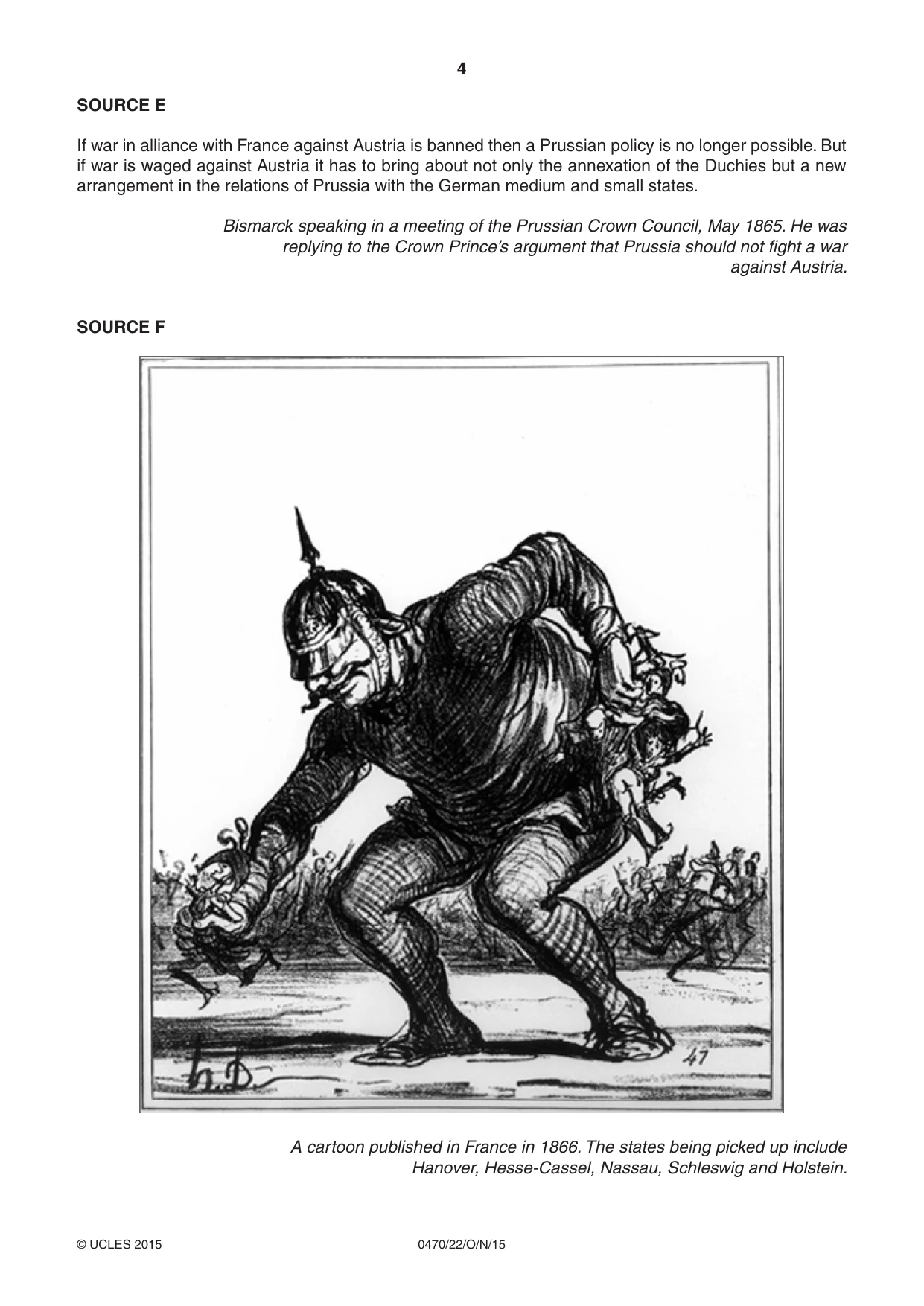
4 0470/22/O/N/15 © UCLES 2015 SOURCE E If war in alliance with France against Austria is banned then a Prussian policy is no longer possible. But if war is waged against Austria it has to bring about not only the annexation of the Duchies but a new arrangement in the relations of Prussia with the German medium and small states. Bismarck speaking in a meeting of the Prussian Crown Council, May 1865. He was replying to the Crown Prince’s argument that Prussia should not fight a war against Austria. SOURCE F A cartoon published in France in 1866. The states being picked up include Hanover, Hesse-Cassel, Nassau, Schleswig and Holstein.
Question paper, page 5
5 0470/22/O/N/15 © UCLES 2015 [Turn over SOURCE G For years I have wished for a German Cavour or Garibaldi. And overnight he has appeared in the person of the much-abused Bismarck. I bow before the genius of Bismarck, who has achieved a masterpiece of political planning and action. How marvellously the man spun all the threads of the great web. How precisely he knew how to use his king, Napoleon, his army, the government, Austria and its forces. I leave it to my stubborn colleagues from Swabia and Bavaria to abuse him. For years they have yelled for German unity, and when someone achieves the impossible by transferring German unity from a book of student songs into reality they shout ‘crucify him’. A letter by a German liberal to a fellow liberal, 19 August 1866. Now answer all the following questions. You may use any of the sources to help you answer the questions, in addition to those sources which you are told to use. In answering the questions you should use your knowledge of the topic to help you interpret and evaluate the sources. 1 Study Sources A and B. How far do these two sources agree? Explain your answer using details of the sources. [7] 2 Study Source C. How useful is this source as evidence about Bismarck? Explain your answer using details of the source and your knowledge. [8] 3 Study Sources D and E. Does Source E prove that Bismarck was deceiving the Austrians in Source D? Explain your answer using details of the sources and your knowledge. [8] 4 Study Source F. Why was this source published in 1866? Explain your answer using details of the source and your knowledge. [8] 5 Study Source G. Are you surprised by this source? Explain your answer using details of the source and your knowledge. [7] 6 Study all the sources. How far do these sources provide convincing evidence that in the period up to 1866 Bismarck was only planning to increase Prussia’s strength rather than to achieve German unification? Use the sources to explain your answer. [12]
Question paper, page 6
6 0470/22/O/N/15 © UCLES 2015 Option B: 20th Century topic HOW FAR WERE SOVIET ACTIONS OVER BERLIN JUSTIFIED? Study the Background Information and the sources carefully, and then answer all the questions. Background Information One of the biggest problems facing the victorious allies after the Second World War was what to do about Germany. It was agreed at Yalta that Germany should be divided into four zones (American, French, British and Soviet). Berlin was divided in the same way. The Soviet Union wanted to keep Germany weak and wanted reparations. The Western allies wanted Germany to recover. In 1947 the British and American zones were combined to help economic development and the French zone was added later. In response the Soviets began to disrupt and restrict travel between Berlin and the allied zones in Germany. In March 1948 the allies agreed to establish a federal system of government for the western parts of Germany and in June introduced a new German currency – the Deutsche Mark. On 24 June the Soviets blockaded all methods of surface transport between West Berlin and non-Soviet zones. They stopped supplying food to non-Soviet Berlin and cut off the electricity. Was Soviet action over Berlin justified? SOURCE A From a history book published in 1998. Content removed due to copyright restrictions.
Question paper, page 7
7 0470/22/O/N/15 © UCLES 2015 [Turn over SOURCE B Although the Soviets favoured a united Germany, Stalin’s main objective was the security of the Soviet Union. The first priority was to neutralise the German menace. Hence Stalin’s policy of destroying Germany’s economic power through reparations, which were a divisive issue from the start. The Anglo-American strategy was driven by the fear that if Germans in the Western zone remained impoverished they would turn back to Nazism – or else to Communism. The emphasis was on reconstructing political institutions and giving Germans responsibility for their domestic affairs. Fortunately for the Western allies, Communist occupation policies in Berlin and the Soviet parts of Eastern Germany did not win over the Germans. If Stalin wanted Germany to remain united then Soviet tactics were not very sensible. From the beginning the Soviets established a Communist-led government without allied consent and set about breaking agreements made at Potsdam by extracting and dismantling whatever fell within their grasp. And yet even by early 1947 a division of Germany was not certain – Marshall was still optimistic that whatever arrangements were made about Germany, a divided Germany would not be necessary. The real break came in the spring of 1947 at the Moscow meeting of the US, Britain, France and the Soviet Union. It was clear that the British and Americans were determined to build up the West German economy while the Russians still wanted a united Germany as envisaged at Potsdam. One American official said, ‘It was the Moscow Conference of 1947 which really brought down the Iron Curtain.’ In 1948 the Western Allies held their own conference on Germany. They announced they had agreed ‘that close co-operation should be established among themselves in all matters arising out of Marshall Aid in relation to Western Germany. Such co-operation is essential if Western Germany is to make its full contribution to European recovery.’ In June plans to form a West German government were announced. On 20 June a new currency was introduced into the Western zones. The Soviets replied by cutting communications between West Berlin and the Western zones. It is sometimes suggested that American decisions like the Truman Doctrine and the Marshall Plan pushed Stalin from compromise to rigidity, and that European divisions were caused by America’s insensitivity. But this was not so. The immediate cause of the division of Germany and Europe lies in Stalin’s own errors. He squandered his advantage by uncompromising tactics. If he hoped to let Germany rot until a resentful Germany fell into his lap, he miscalculated. But Germany was at his feet. All the Soviet Union had to do was accept the Marshall Plan and convince the Germans of Moscow’s good faith in seeking a neutral, independent Germany. This would have shifted the balance of advantage. From a history book published in 1960. SOURCE C Meeting at White House about the Berlin Situation. When the question was discussed – do we stay in Berlin or not? – President Truman interrupted to say that there was no discussion on that point, we were going to stay. We were in Berlin by terms of an agreement and the Russians had no right to get us out by either direct or indirect pressure. From the diary of a US official, 28 June 1948.
Question paper, page 8
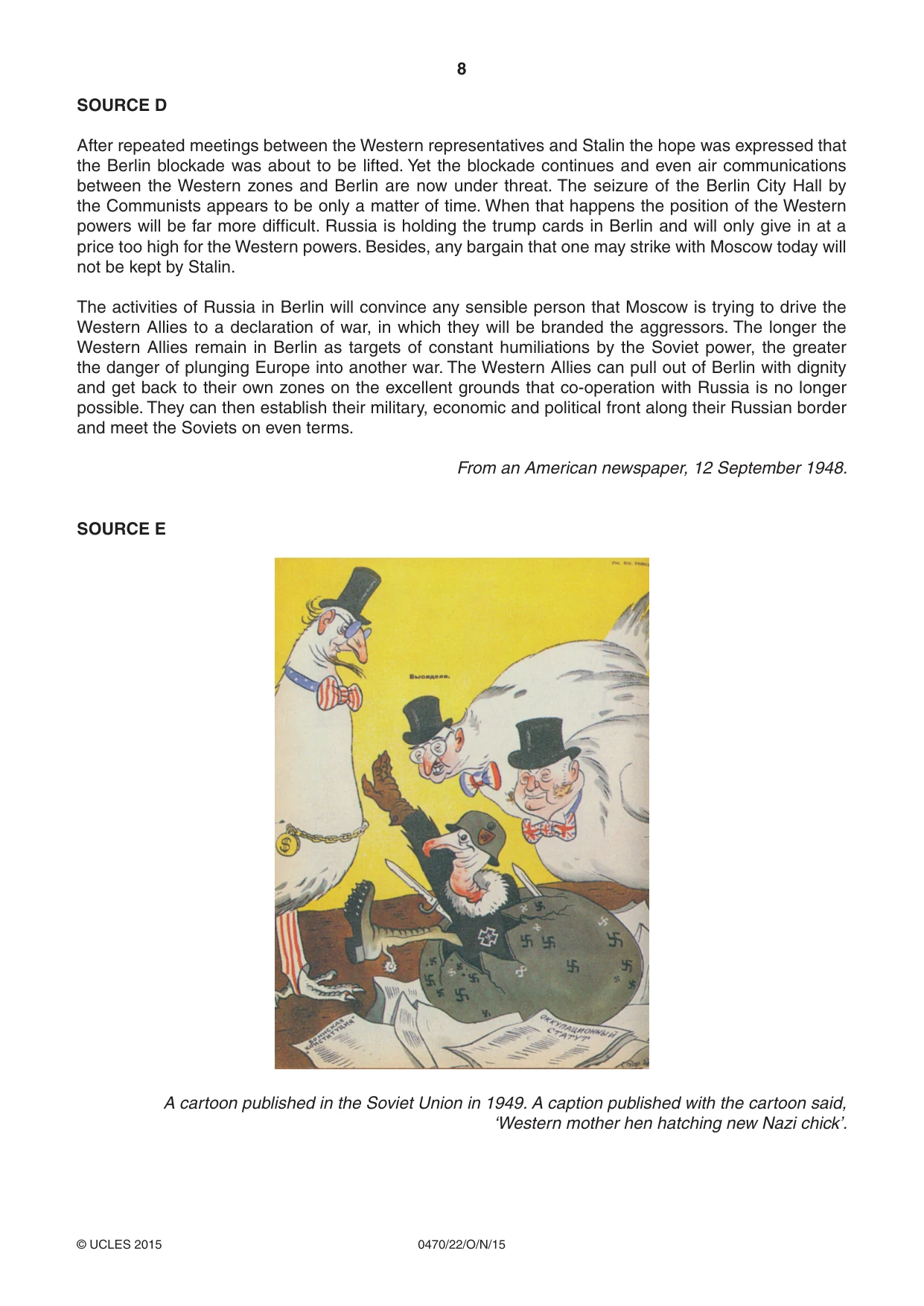
8 0470/22/O/N/15 © UCLES 2015 SOURCE D After repeated meetings between the Western representatives and Stalin the hope was expressed that the Berlin blockade was about to be lifted. Yet the blockade continues and even air communications between the Western zones and Berlin are now under threat. The seizure of the Berlin City Hall by the Communists appears to be only a matter of time. When that happens the position of the Western powers will be far more difficult. Russia is holding the trump cards in Berlin and will only give in at a price too high for the Western powers. Besides, any bargain that one may strike with Moscow today will not be kept by Stalin. The activities of Russia in Berlin will convince any sensible person that Moscow is trying to drive the Western Allies to a declaration of war, in which they will be branded the aggressors. The longer the Western Allies remain in Berlin as targets of constant humiliations by the Soviet power, the greater the danger of plunging Europe into another war. The Western Allies can pull out of Berlin with dignity and get back to their own zones on the excellent grounds that co-operation with Russia is no longer possible. They can then establish their military, economic and political front along their Russian border and meet the Soviets on even terms. From an American newspaper, 12 September 1948. SOURCE E A cartoon published in the Soviet Union in 1949. A caption published with the cartoon said, ‘Western mother hen hatching new Nazi chick’.
Question paper, page 9
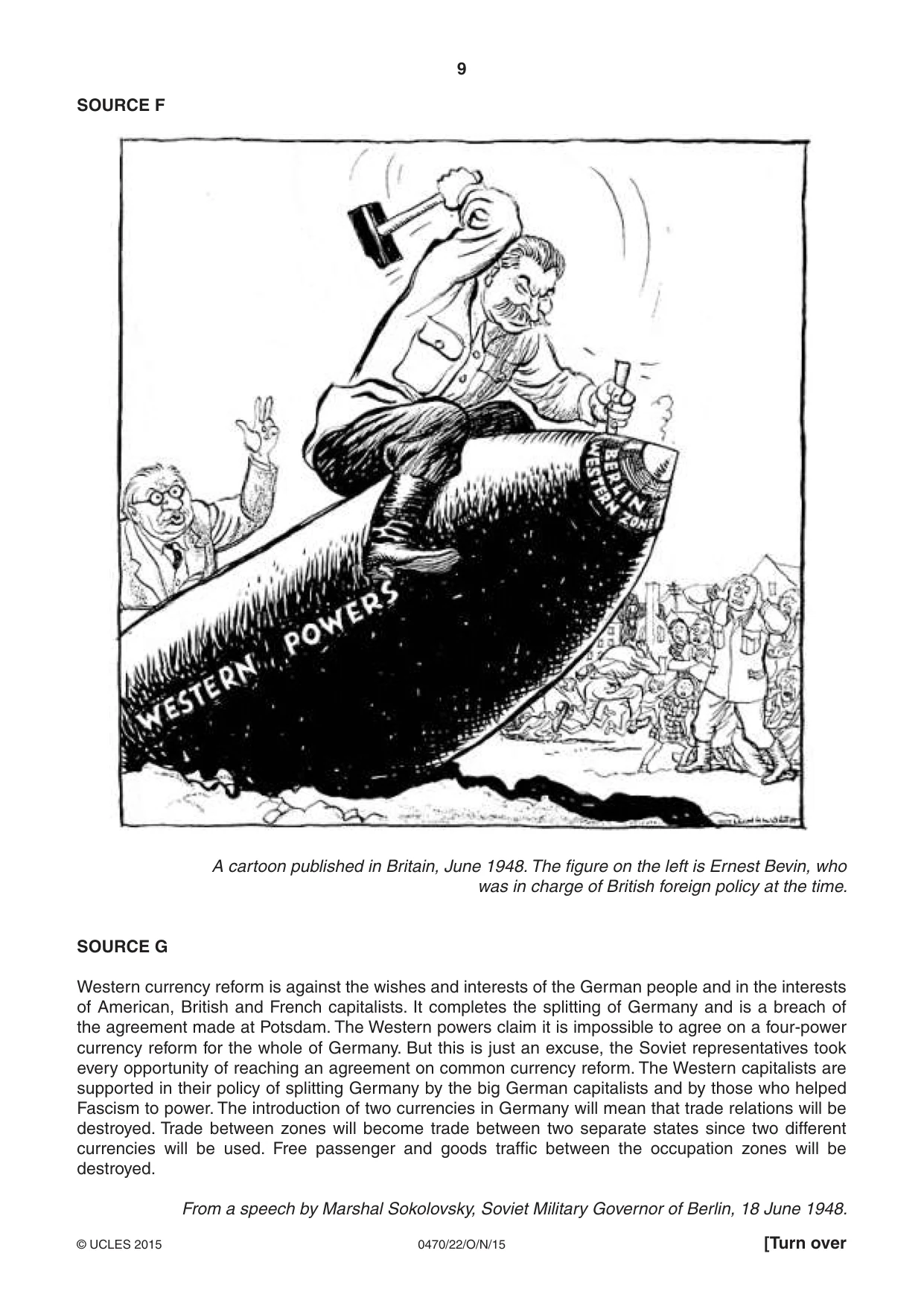
9 0470/22/O/N/15 © UCLES 2015 [Turn over SOURCE F A cartoon published in Britain, June 1948. The figure on the left is Ernest Bevin, who was in charge of British foreign policy at the time. SOURCE G Western currency reform is against the wishes and interests of the German people and in the interests of American, British and French capitalists. It completes the splitting of Germany and is a breach of the agreement made at Potsdam. The Western powers claim it is impossible to agree on a four-power currency reform for the whole of Germany. But this is just an excuse, the Soviet representatives took every opportunity of reaching an agreement on common currency reform. The Western capitalists are supported in their policy of splitting Germany by the big German capitalists and by those who helped Fascism to power. The introduction of two currencies in Germany will mean that trade relations will be destroyed. Trade between zones will become trade between two separate states since two different currencies will be used. Free passenger and goods traffic between the occupation zones will be destroyed. From a speech by Marshal Sokolovsky, Soviet Military Governor of Berlin, 18 June 1948.
Question paper, page 10
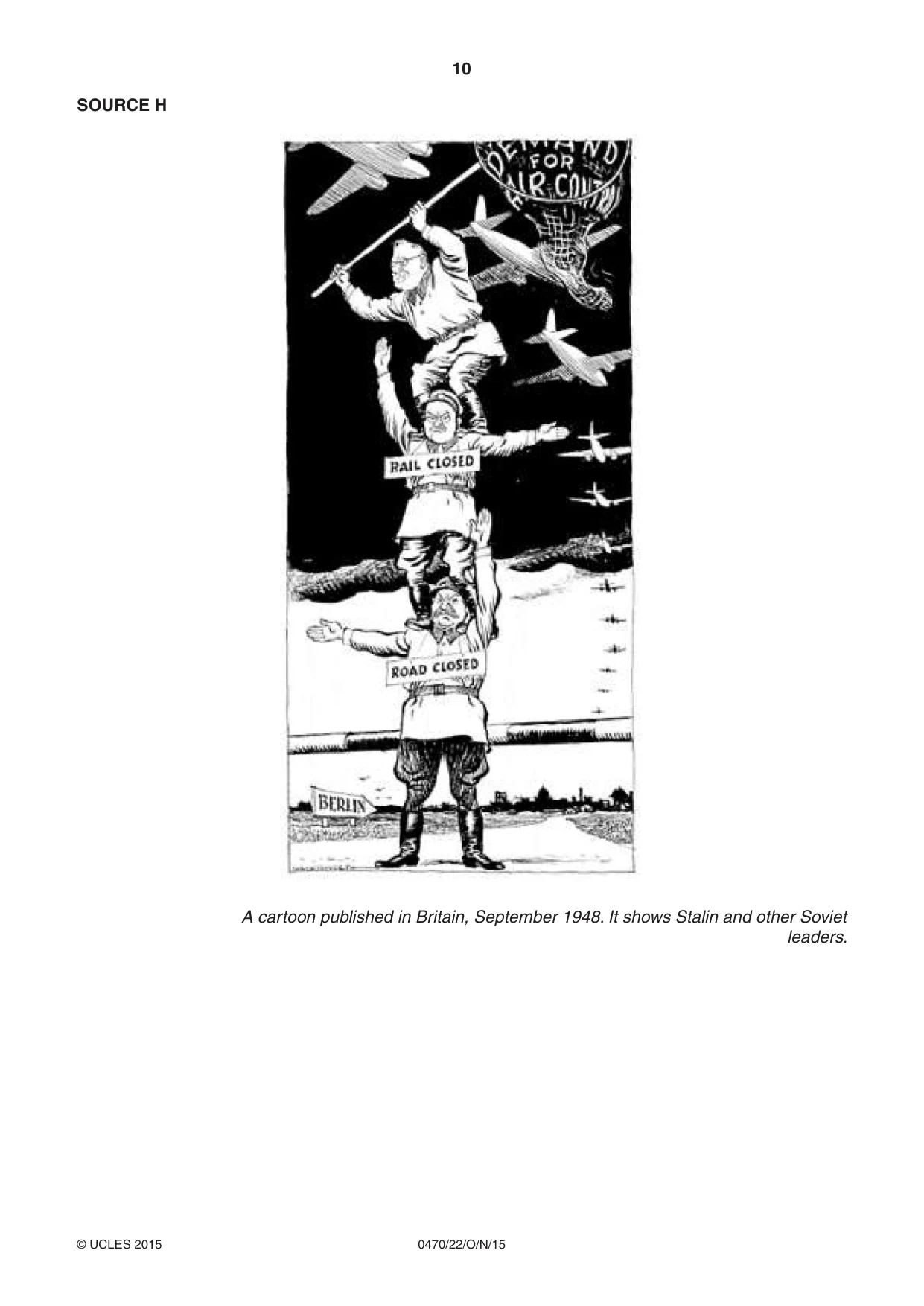
10 0470/22/O/N/15 © UCLES 2015 SOURCE H A cartoon published in Britain, September 1948. It shows Stalin and other Soviet leaders.
Question paper, page 11
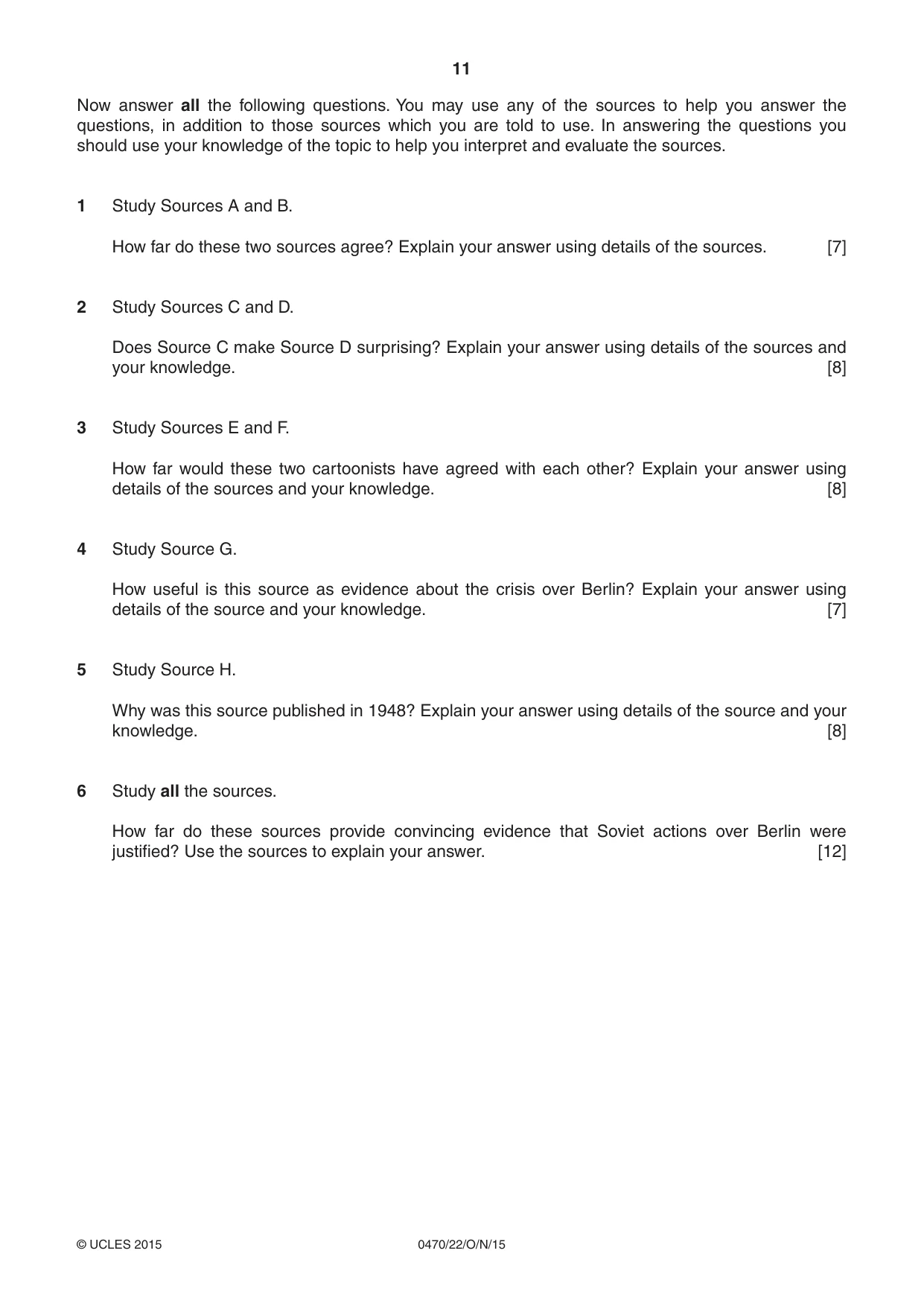
11 0470/22/O/N/15 © UCLES 2015 Now answer all the following questions. You may use any of the sources to help you answer the questions, in addition to those sources which you are told to use. In answering the questions you should use your knowledge of the topic to help you interpret and evaluate the sources. 1 Study Sources A and B. How far do these two sources agree? Explain your answer using details of the sources. [7] 2 Study Sources C and D. Does Source C make Source D surprising? Explain your answer using details of the sources and your knowledge. [8] 3 Study Sources E and F. How far would these two cartoonists have agreed with each other? Explain your answer using details of the sources and your knowledge. [8] 4 Study Source G. How useful is this source as evidence about the crisis over Berlin? Explain your answer using details of the source and your knowledge. [7] 5 Study Source H. Why was this source published in 1948? Explain your answer using details of the source and your knowledge. [8] 6 Study all the sources. How far do these sources provide convincing evidence that Soviet actions over Berlin were justified? Use the sources to explain your answer. [12]
Question paper, page 12
12 0470/22/O/N/15 © UCLES 2015 BLANK PAGE Permission to reproduce items where third-party owned material protected by copyright is included has been sought and cleared where possible. Every reasonable effort has been made by the publisher (UCLES) to trace copyright holders, but if any items requiring clearance have unwittingly been included, the publisher will be pleased to make amends at the earliest possible opportunity. To avoid the issue of disclosure of answer-related information to candidates, all copyright acknowledgements are reproduced online in the Cambridge International Examinations Copyright Acknowledgements Booklet. This is produced for each series of examinations and is freely available to download at www.cie.org.uk after the live examination series. Cambridge International Examinations is part of the Cambridge Assessment Group. Cambridge Assessment is the brand name of University of Cambridge Local Examinations Syndicate (UCLES), which is itself a department of the University of Cambridge.
Mark scheme, page 1
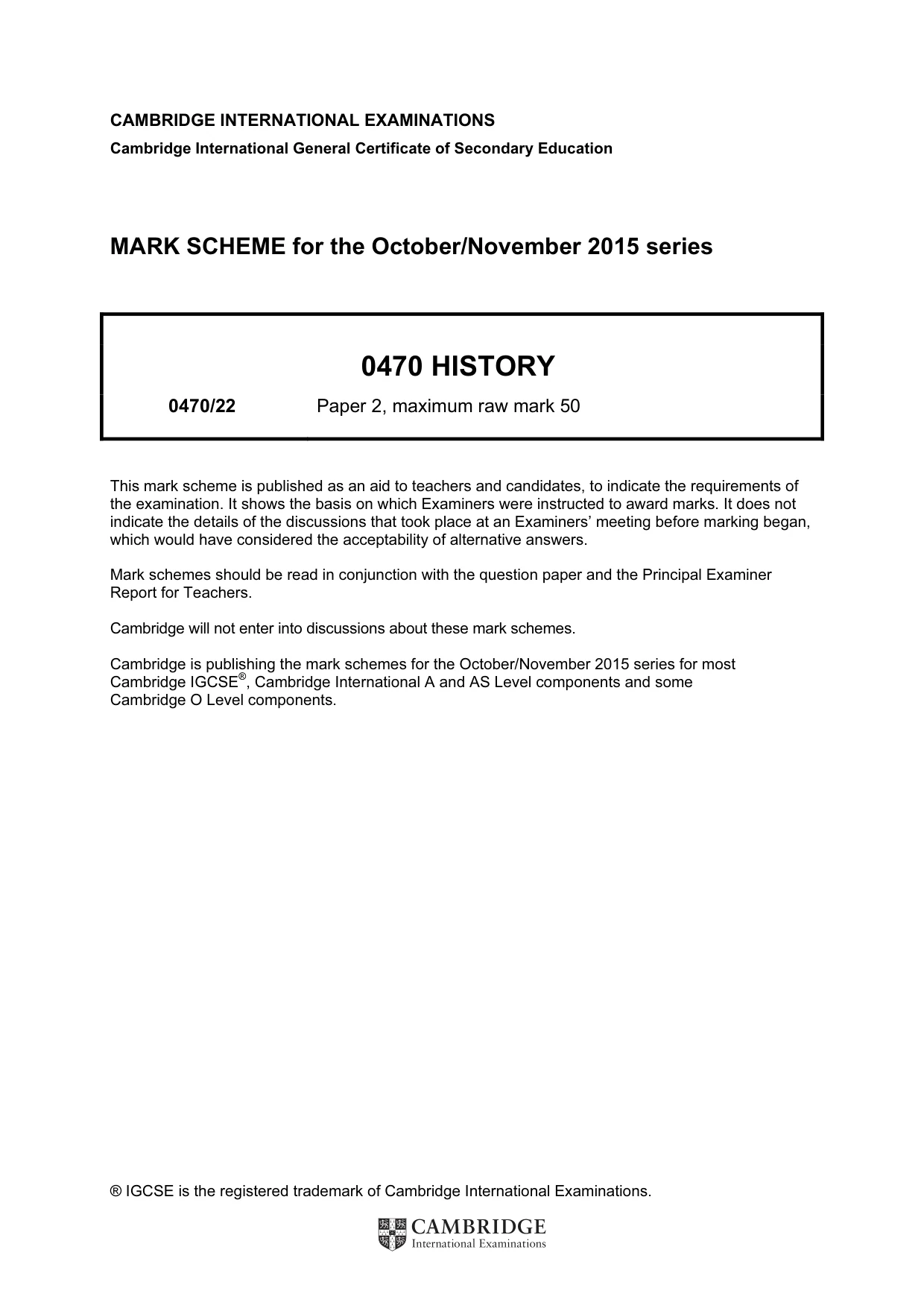
® IGCSE is the registered trademark of Cambridge International Examinations. CAMBRIDGE INTERNATIONAL EXAMINATIONS Cambridge International General Certificate of Secondary Education MARK SCHEME for the October/November 2015 series 0470 HISTORY 0470/22 Paper 2, maximum raw mark 50 This mark scheme is published as an aid to teachers and candidates, to indicate the requirements of the examination. It shows the basis on which Examiners were instructed to award marks. It does not indicate the details of the discussions that took place at an Examiners’ meeting before marking began, which would have considered the acceptability of alternative answers. Mark schemes should be read in conjunction with the question paper and the Principal Examiner Report for Teachers. Cambridge will not enter into discussions about these mark schemes. Cambridge is publishing the mark schemes for the October/November 2015 series for most Cambridge IGCSE®, Cambridge International A and AS Level components and some Cambridge O Level components.
Mark scheme, page 2
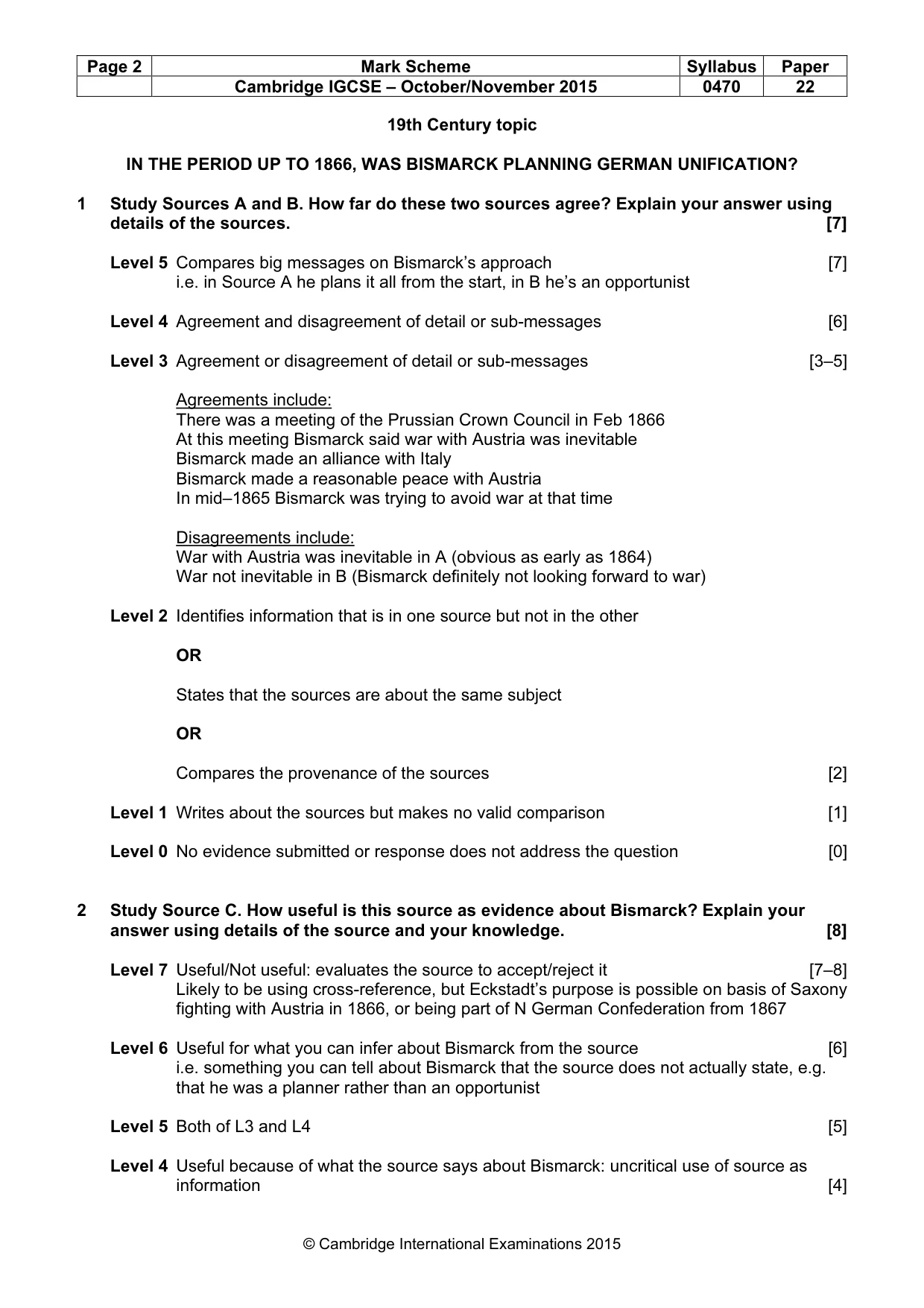
Page 2 Mark Scheme Syllabus Paper Cambridge IGCSE – October/November 2015 0470 22 © Cambridge International Examinations 2015 19th Century topic IN THE PERIOD UP TO 1866, WAS BISMARCK PLANNING GERMAN UNIFICATION? 1 Study Sources A and B. How far do these two sources agree? Explain your answer using details of the sources. [7] Level 5 Compares big messages on Bismarck’s approach [7] i.e. in Source A he plans it all from the start, in B he’s an opportunist Level 4 Agreement and disagreement of detail or sub-messages [6] Level 3 Agreement or disagreement of detail or sub-messages [3–5] Agreements include: There was a meeting of the Prussian Crown Council in Feb 1866 At this meeting Bismarck said war with Austria was inevitable Bismarck made an alliance with Italy Bismarck made a reasonable peace with Austria In mid–1865 Bismarck was trying to avoid war at that time Disagreements include: War with Austria was inevitable in A (obvious as early as 1864) War not inevitable in B (Bismarck definitely not looking forward to war) Level 2 Identifies information that is in one source but not in the other OR States that the sources are about the same subject OR Compares the provenance of the sources [2] Level 1 Writes about the sources but makes no valid comparison [1] Level 0 No evidence submitted or response does not address the question [0] 2 Study Source C. How useful is this source as evidence about Bismarck? Explain your answer using details of the source and your knowledge. [8] Level 7 Useful/Not useful: evaluates the source to accept/reject it [7–8] Likely to be using cross-reference, but Eckstadt’s purpose is possible on basis of Saxony fighting with Austria in 1866, or being part of N German Confederation from 1867 Level 6 Useful for what you can infer about Bismarck from the source [6] i.e. something you can tell about Bismarck that the source does not actually state, e.g. that he was a planner rather than an opportunist Level 5 Both of L3 and L4 [5] Level 4 Useful because of what the source says about Bismarck: uncritical use of source as information [4]
Mark scheme, page 3
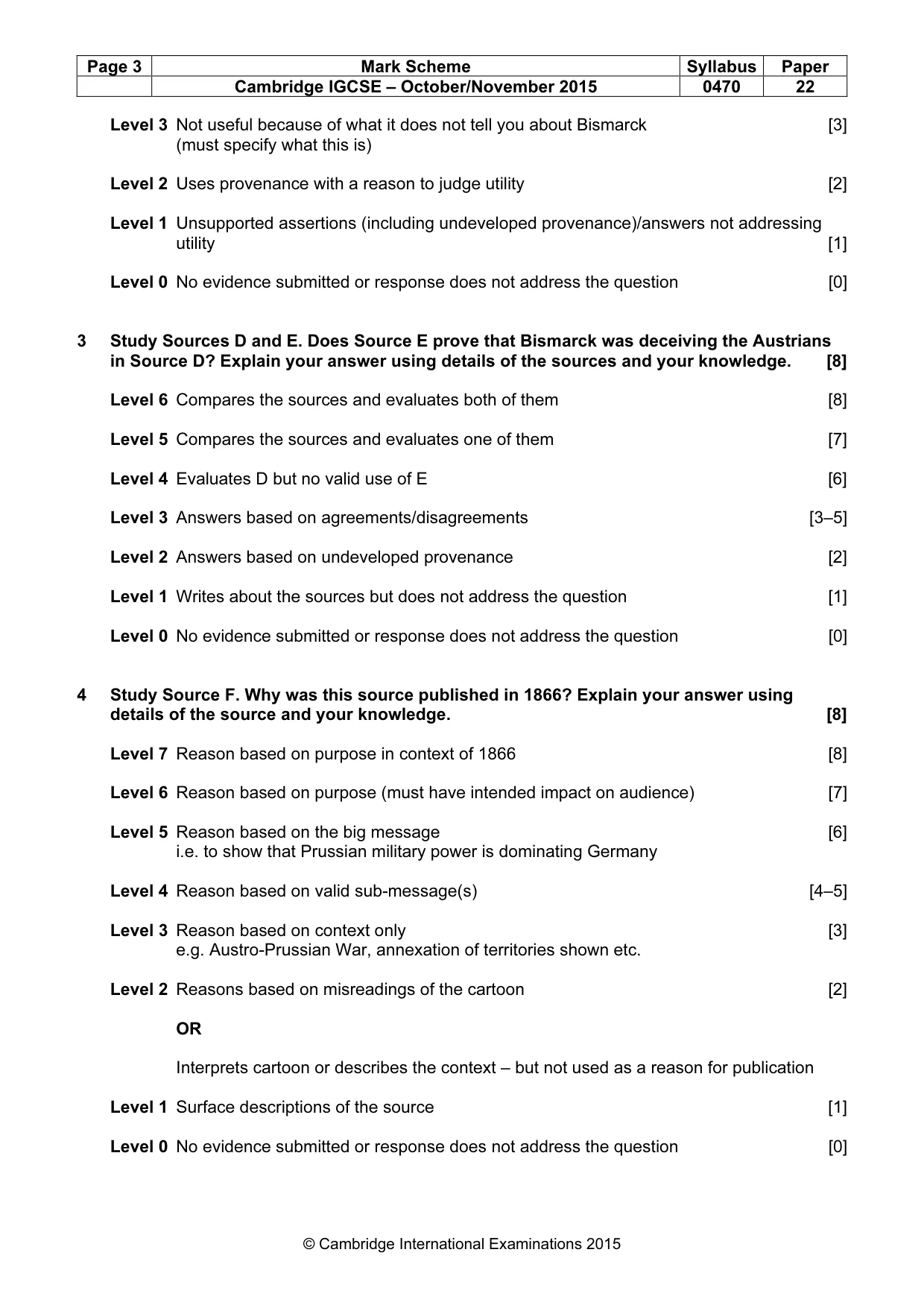
Page 3 Mark Scheme Syllabus Paper Cambridge IGCSE – October/November 2015 0470 22 © Cambridge International Examinations 2015 Level 3 Not useful because of what it does not tell you about Bismarck [3] (must specify what this is) Level 2 Uses provenance with a reason to judge utility [2] Level 1 Unsupported assertions (including undeveloped provenance)/answers not addressing utility [1] Level 0 No evidence submitted or response does not address the question [0] 3 Study Sources D and E. Does Source E prove that Bismarck was deceiving the Austrians in Source D? Explain your answer using details of the sources and your knowledge. [8] Level 6 Compares the sources and evaluates both of them [8] Level 5 Compares the sources and evaluates one of them [7] Level 4 Evaluates D but no valid use of E [6] Level 3 Answers based on agreements/disagreements [3–5] Level 2 Answers based on undeveloped provenance [2] Level 1 Writes about the sources but does not address the question [1] Level 0 No evidence submitted or response does not address the question [0] 4 Study Source F. Why was this source published in 1866? Explain your answer using details of the source and your knowledge. [8] Level 7 Reason based on purpose in context of 1866 [8] Level 6 Reason based on purpose (must have intended impact on audience) [7] Level 5 Reason based on the big message [6] i.e. to show that Prussian military power is dominating Germany Level 4 Reason based on valid sub-message(s) [4–5] Level 3 Reason based on context only [3] e.g. Austro-Prussian War, annexation of territories shown etc. Level 2 Reasons based on misreadings of the cartoon [2] OR Interprets cartoon or describes the context – but not used as a reason for publication Level 1 Surface descriptions of the source [1] Level 0 No evidence submitted or response does not address the question [0]
Mark scheme, page 4
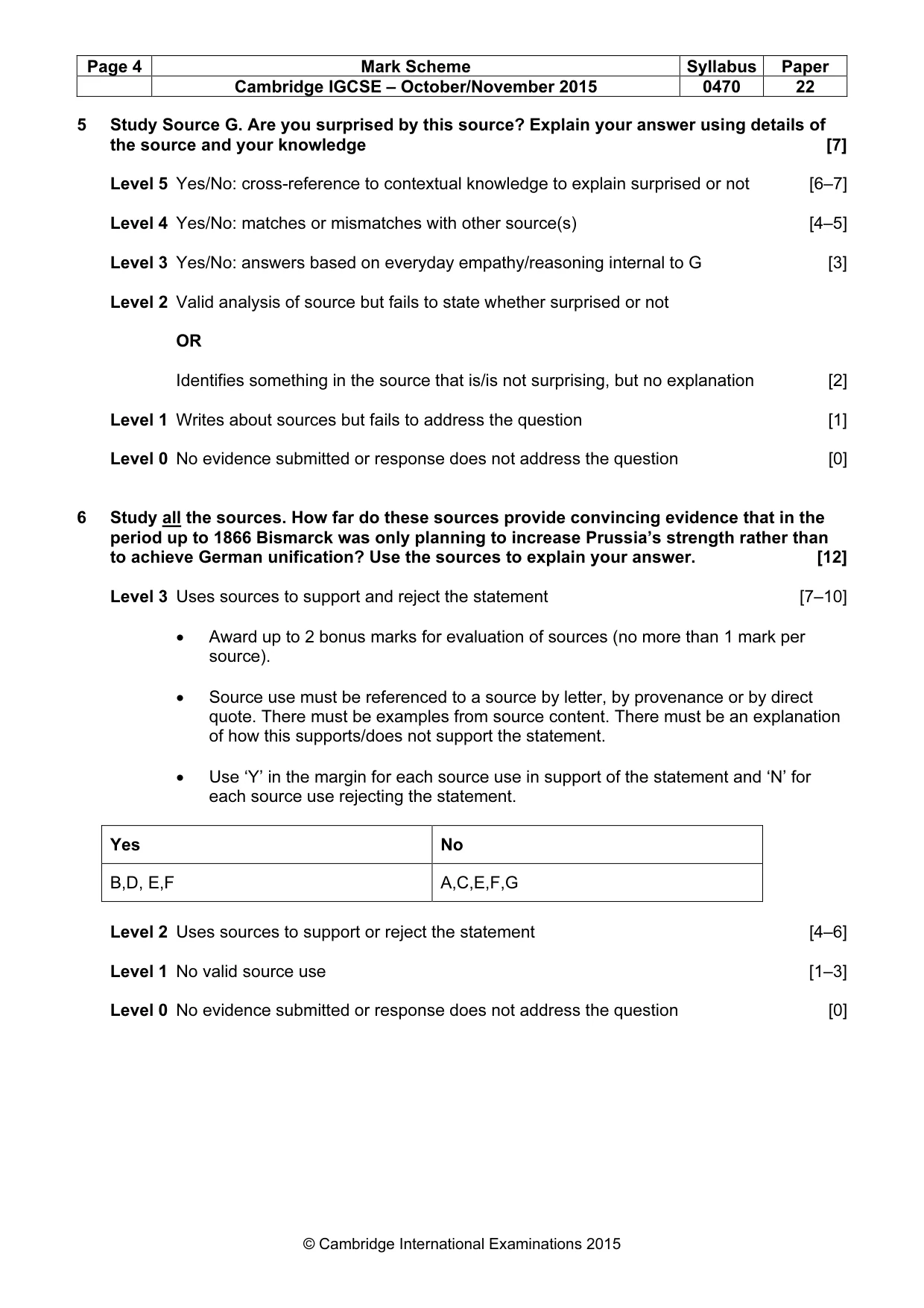
Page 4 Mark Scheme Syllabus Paper Cambridge IGCSE – October/November 2015 0470 22 © Cambridge International Examinations 2015 5 Study Source G. Are you surprised by this source? Explain your answer using details of the source and your knowledge [7] Level 5 Yes/No: cross-reference to contextual knowledge to explain surprised or not [6–7] Level 4 Yes/No: matches or mismatches with other source(s) [4–5] Level 3 Yes/No: answers based on everyday empathy/reasoning internal to G [3] Level 2 Valid analysis of source but fails to state whether surprised or not OR Identifies something in the source that is/is not surprising, but no explanation [2] Level 1 Writes about sources but fails to address the question [1] Level 0 No evidence submitted or response does not address the question [0] 6 Study all the sources. How far do these sources provide convincing evidence that in the period up to 1866 Bismarck was only planning to increase Prussia’s strength rather than to achieve German unification? Use the sources to explain your answer. [12] Level 3 Uses sources to support and reject the statement [7–10] • Award up to 2 bonus marks for evaluation of sources (no more than 1 mark per source). • Source use must be referenced to a source by letter, by provenance or by direct quote. There must be examples from source content. There must be an explanation of how this supports/does not support the statement. • Use ‘Y’ in the margin for each source use in support of the statement and ‘N’ for each source use rejecting the statement. Yes No B,D, E,F A,C,E,F,G Level 2 Uses sources to support or reject the statement [4–6] Level 1 No valid source use [1–3] Level 0 No evidence submitted or response does not address the question [0]
Mark scheme, page 5
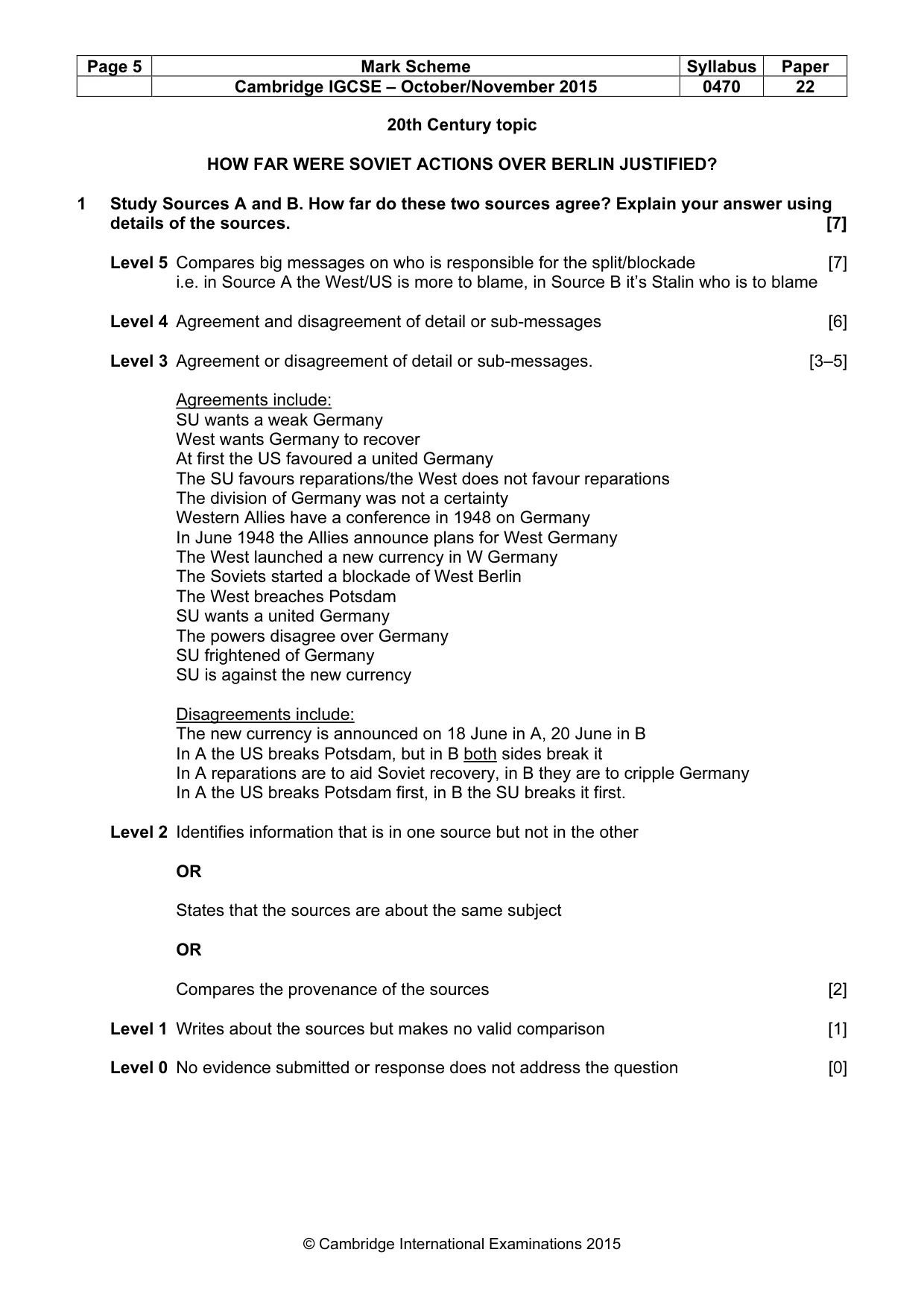
Page 5 Mark Scheme Syllabus Paper Cambridge IGCSE – October/November 2015 0470 22 © Cambridge International Examinations 2015 20th Century topic HOW FAR WERE SOVIET ACTIONS OVER BERLIN JUSTIFIED? 1 Study Sources A and B. How far do these two sources agree? Explain your answer using details of the sources. [7] Level 5 Compares big messages on who is responsible for the split/blockade [7] i.e. in Source A the West/US is more to blame, in Source B it’s Stalin who is to blame Level 4 Agreement and disagreement of detail or sub-messages [6] Level 3 Agreement or disagreement of detail or sub-messages. [3–5] Agreements include: SU wants a weak Germany West wants Germany to recover At first the US favoured a united Germany The SU favours reparations/the West does not favour reparations The division of Germany was not a certainty Western Allies have a conference in 1948 on Germany In June 1948 the Allies announce plans for West Germany The West launched a new currency in W Germany The Soviets started a blockade of West Berlin The West breaches Potsdam SU wants a united Germany The powers disagree over Germany SU frightened of Germany SU is against the new currency Disagreements include: The new currency is announced on 18 June in A, 20 June in B In A the US breaks Potsdam, but in B both sides break it In A reparations are to aid Soviet recovery, in B they are to cripple Germany In A the US breaks Potsdam first, in B the SU breaks it first. Level 2 Identifies information that is in one source but not in the other OR States that the sources are about the same subject OR Compares the provenance of the sources [2] Level 1 Writes about the sources but makes no valid comparison [1] Level 0 No evidence submitted or response does not address the question [0]
Mark scheme, page 6
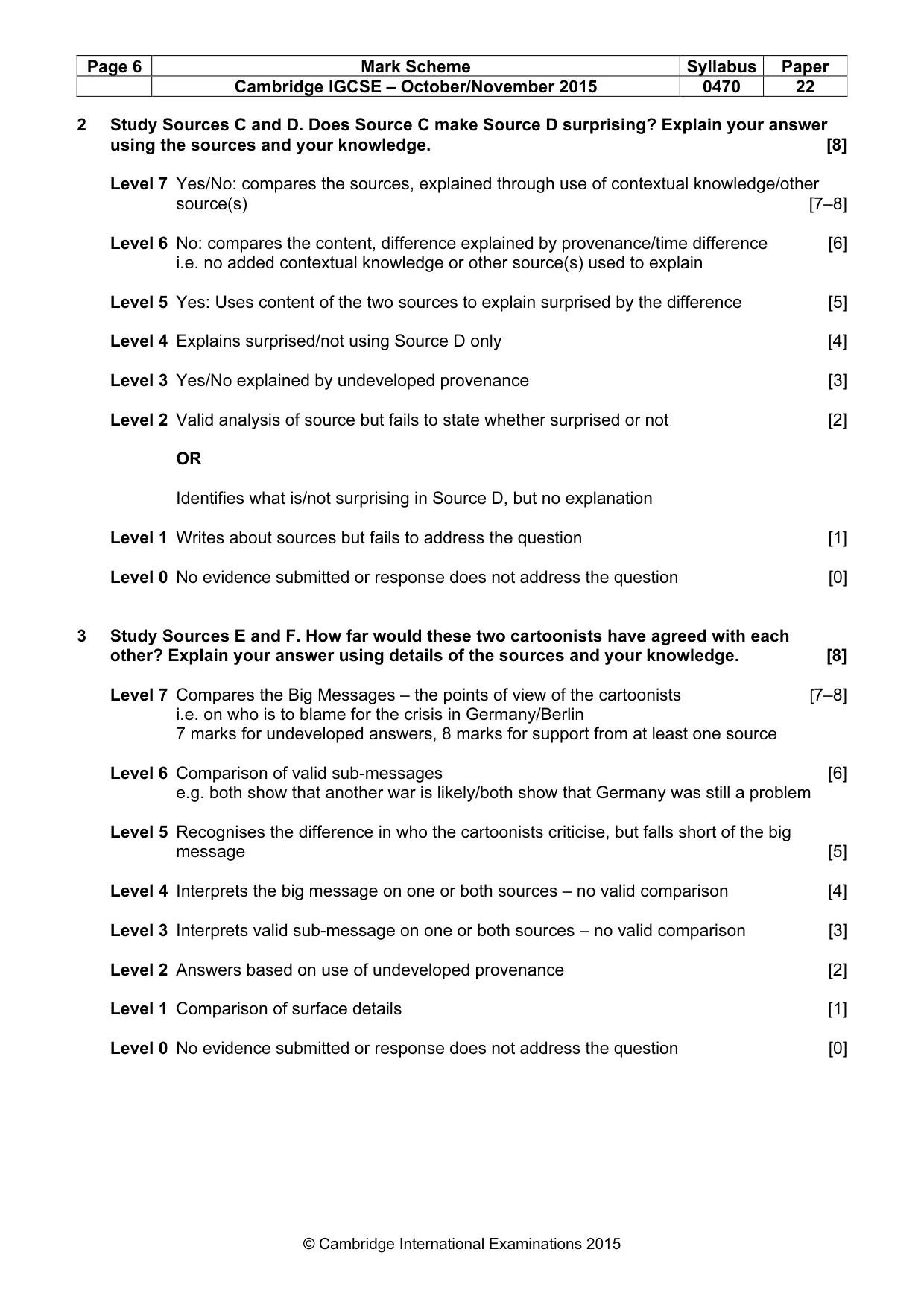
Page 6 Mark Scheme Syllabus Paper Cambridge IGCSE – October/November 2015 0470 22 © Cambridge International Examinations 2015 2 Study Sources C and D. Does Source C make Source D surprising? Explain your answer using the sources and your knowledge. [8] Level 7 Yes/No: compares the sources, explained through use of contextual knowledge/other source(s) [7–8] Level 6 No: compares the content, difference explained by provenance/time difference [6] i.e. no added contextual knowledge or other source(s) used to explain Level 5 Yes: Uses content of the two sources to explain surprised by the difference [5] Level 4 Explains surprised/not using Source D only [4] Level 3 Yes/No explained by undeveloped provenance [3] Level 2 Valid analysis of source but fails to state whether surprised or not [2] OR Identifies what is/not surprising in Source D, but no explanation Level 1 Writes about sources but fails to address the question [1] Level 0 No evidence submitted or response does not address the question [0] 3 Study Sources E and F. How far would these two cartoonists have agreed with each other? Explain your answer using details of the sources and your knowledge. [8] Level 7 Compares the Big Messages – the points of view of the cartoonists [7–8] i.e. on who is to blame for the crisis in Germany/Berlin 7 marks for undeveloped answers, 8 marks for support from at least one source Level 6 Comparison of valid sub-messages [6] e.g. both show that another war is likely/both show that Germany was still a problem Level 5 Recognises the difference in who the cartoonists criticise, but falls short of the big message [5] Level 4 Interprets the big message on one or both sources – no valid comparison [4] Level 3 Interprets valid sub-message on one or both sources – no valid comparison [3] Level 2 Answers based on use of undeveloped provenance [2] Level 1 Comparison of surface details [1] Level 0 No evidence submitted or response does not address the question [0]
Mark scheme, page 7
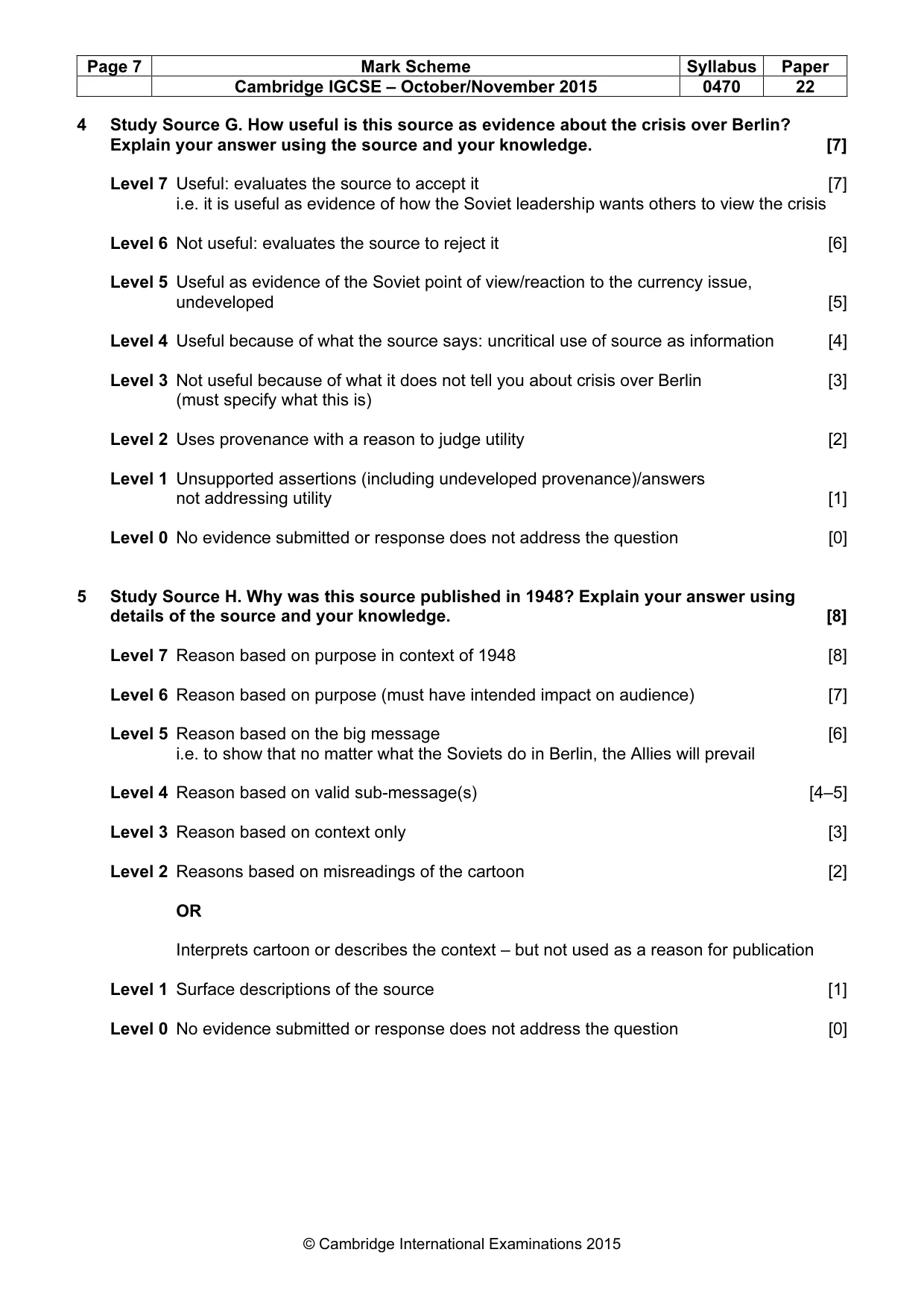
Page 7 Mark Scheme Syllabus Paper Cambridge IGCSE – October/November 2015 0470 22 © Cambridge International Examinations 2015 4 Study Source G. How useful is this source as evidence about the crisis over Berlin? Explain your answer using the source and your knowledge. [7] Level 7 Useful: evaluates the source to accept it [7] i.e. it is useful as evidence of how the Soviet leadership wants others to view the crisis Level 6 Not useful: evaluates the source to reject it [6] Level 5 Useful as evidence of the Soviet point of view/reaction to the currency issue, undeveloped [5] Level 4 Useful because of what the source says: uncritical use of source as information [4] Level 3 Not useful because of what it does not tell you about crisis over Berlin [3] (must specify what this is) Level 2 Uses provenance with a reason to judge utility [2] Level 1 Unsupported assertions (including undeveloped provenance)/answers not addressing utility [1] Level 0 No evidence submitted or response does not address the question [0] 5 Study Source H. Why was this source published in 1948? Explain your answer using details of the source and your knowledge. [8] Level 7 Reason based on purpose in context of 1948 [8] Level 6 Reason based on purpose (must have intended impact on audience) [7] Level 5 Reason based on the big message [6] i.e. to show that no matter what the Soviets do in Berlin, the Allies will prevail Level 4 Reason based on valid sub-message(s) [4–5] Level 3 Reason based on context only [3] Level 2 Reasons based on misreadings of the cartoon [2] OR Interprets cartoon or describes the context – but not used as a reason for publication Level 1 Surface descriptions of the source [1] Level 0 No evidence submitted or response does not address the question [0]
Mark scheme, page 8
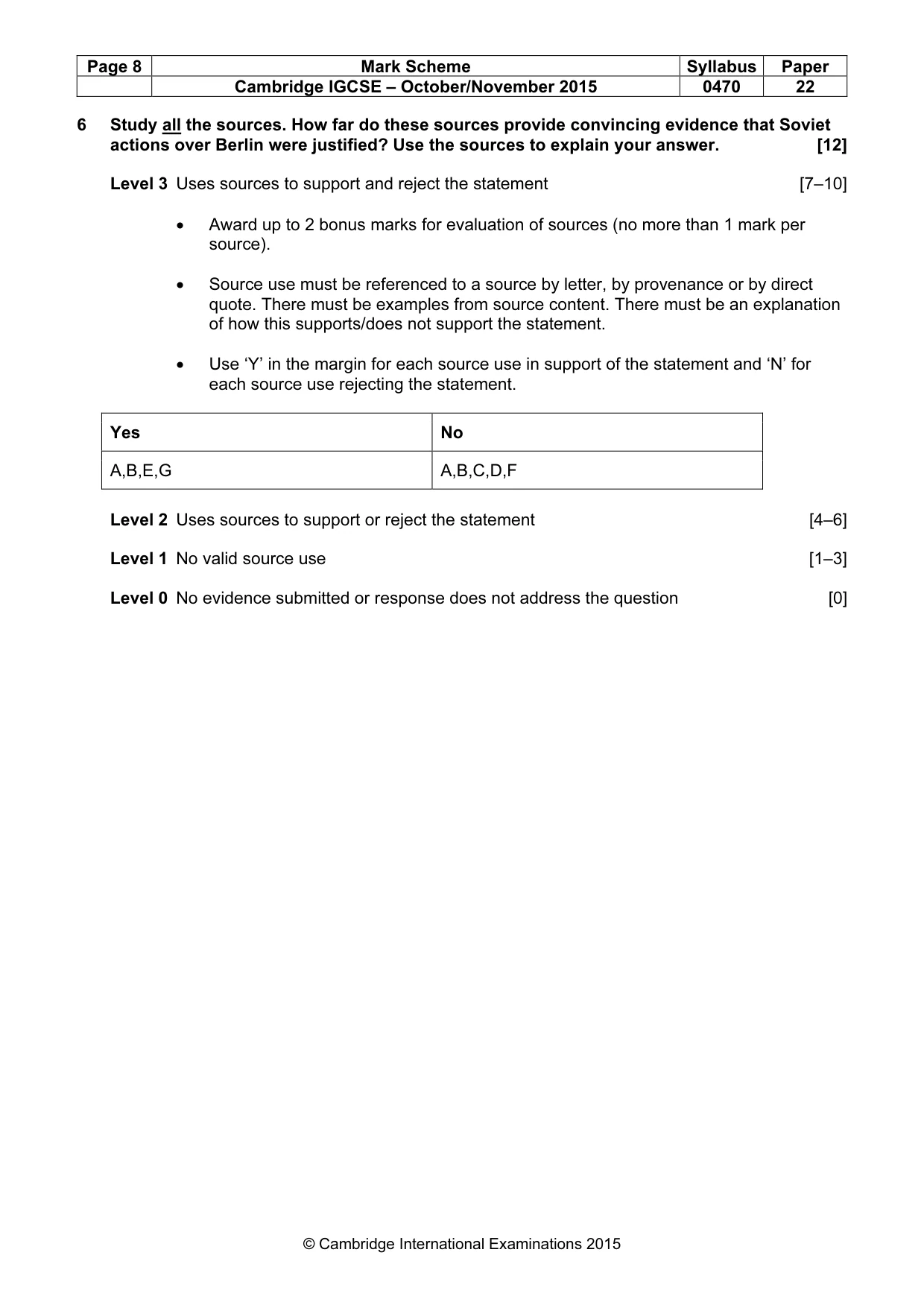
Page 8 Mark Scheme Syllabus Paper Cambridge IGCSE – October/November 2015 0470 22 © Cambridge International Examinations 2015 6 Study all the sources. How far do these sources provide convincing evidence that Soviet actions over Berlin were justified? Use the sources to explain your answer. [12] Level 3 Uses sources to support and reject the statement [7–10] • Award up to 2 bonus marks for evaluation of sources (no more than 1 mark per source). • Source use must be referenced to a source by letter, by provenance or by direct quote. There must be examples from source content. There must be an explanation of how this supports/does not support the statement. • Use ‘Y’ in the margin for each source use in support of the statement and ‘N’ for each source use rejecting the statement. Yes No A,B,E,G A,B,C,D,F Level 2 Uses sources to support or reject the statement [4–6] Level 1 No valid source use [1–3] Level 0 No evidence submitted or response does not address the question [0]
What you needed in this session
Cambridge’s own grade thresholds for 2015 Oct/Nov, Paper 2 · Variant 2. A higher threshold means an easier paper — the bar moves with how the cohort did.