Cambridge IGCSE History 0470 — 2015 Oct/Nov Paper 2 · Variant 1
0470/21/O/N/15 · 50 marks · ≈56 min
The question paper and its mark scheme, free to read here and free to download. This is Cambridge’s own paper, exactly as it was sat.
Question paper16 pages

Mark scheme8 pages
Answers below. Sit the paper first if you are practising.
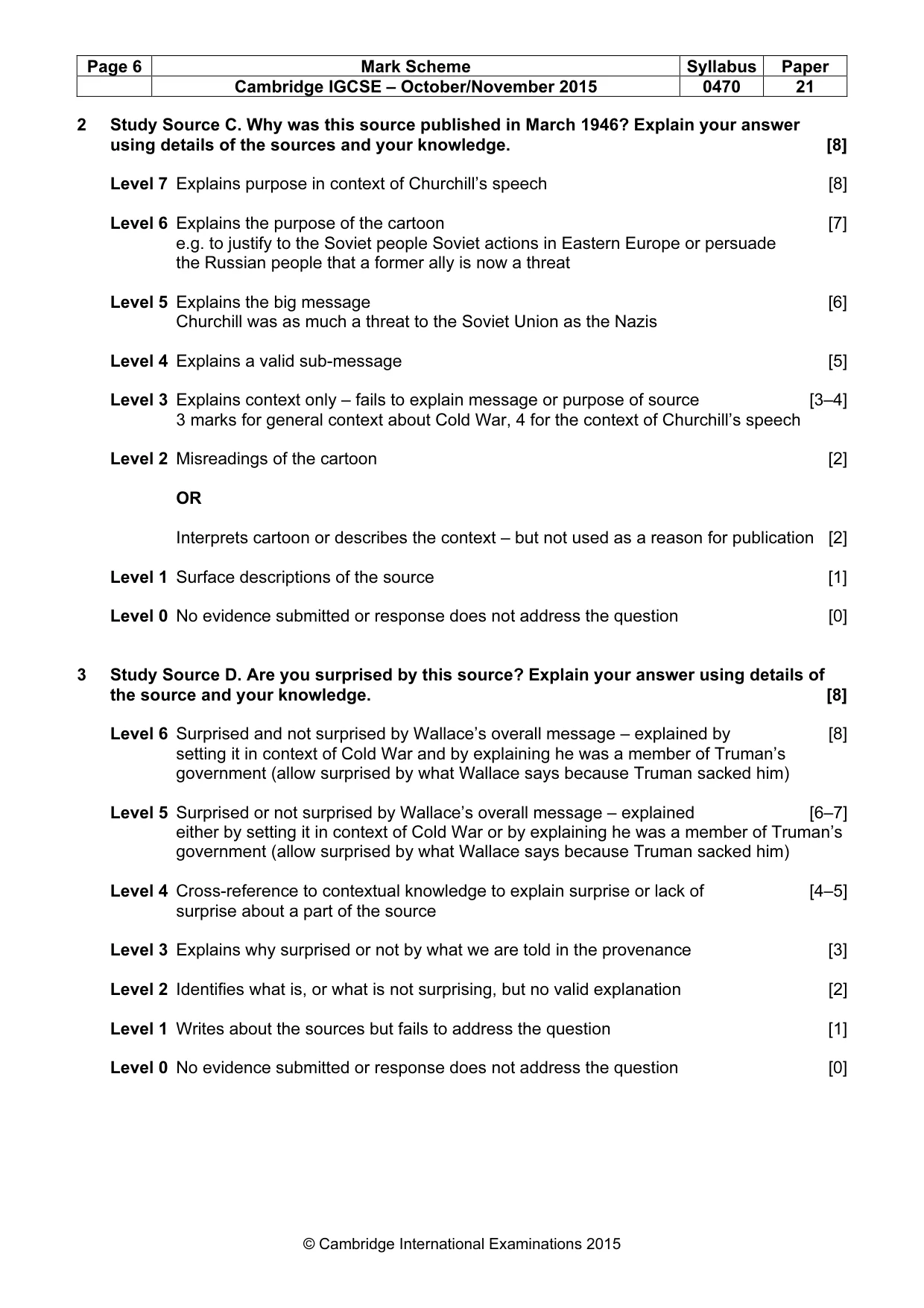
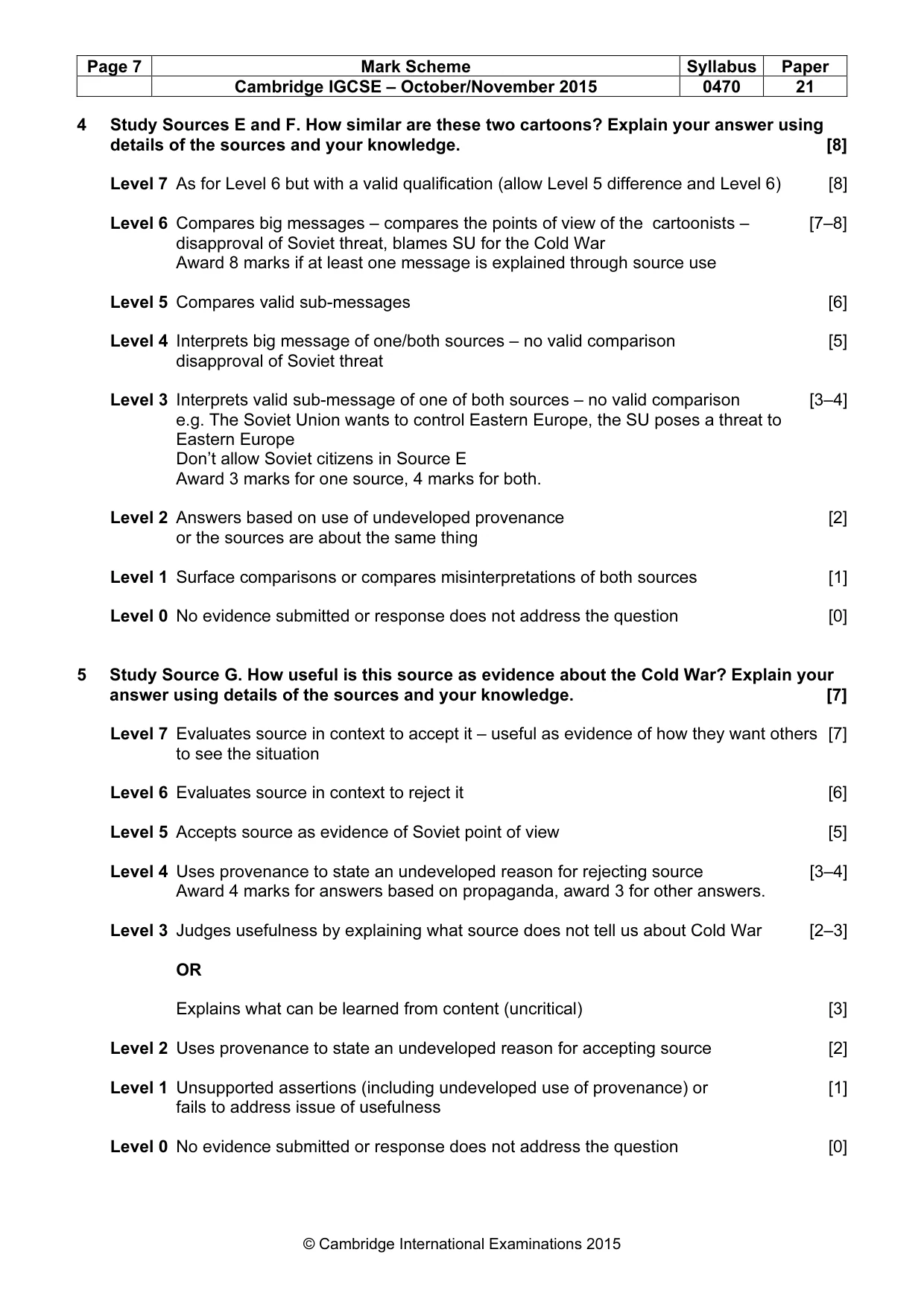
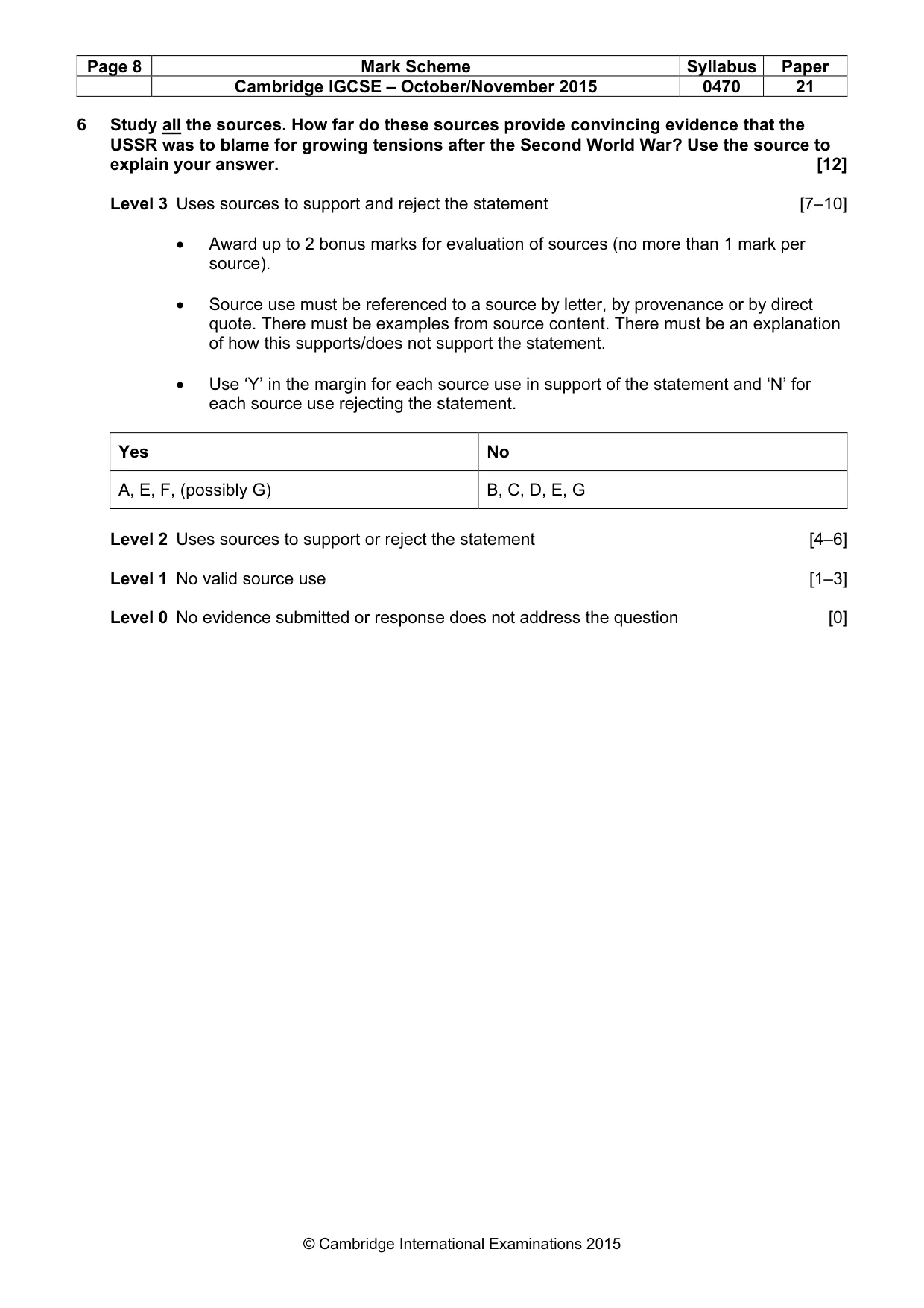
Paper as text
Question paper, page 1
This document consists of 14 printed pages, 2 blank pages and 1 insert. DC (ST/SW) 128461 © UCLES 2015 [Turn over Cambridge International Examinations Cambridge International General Certificate of Secondary Education * 8 3 5 2 4 3 8 7 8 1 * HISTORY 0470/21 Paper 2 October/November 2015 2 hours No Additional Materials are required. READ THESE INSTRUCTIONS FIRST An answer booklet is provided inside this question paper. You should follow the instructions on the front cover of the answer booklet. If you need additional answer paper ask the invigilator for a continuation booklet. This paper has two options. Choose one option, and answer all of the questions on that topic. Option A: 19th Century topic [p2–p7] Option B: 20th Century topic [p8–p14] The number of marks is given in brackets [ ] at the end of each question or part question. The syllabus is approved for use in England, Wales and Northern Ireland as a Cambridge International Level 1/Level 2 Certificate.
Question paper, page 2
2 0470/21/O/N/15 © UCLES 2015 Option A: 19th Century topic HOW FAR WAS BISMARCK RESPONSIBLE FOR THE FRANCO-PRUSSIAN WAR? Study the Background Information and the sources carefully, and then answer all the questions. Background Information As a result of the Prussian defeat of Austria in 1866 the balance of power between Austria and Prussia in Germany went firmly in Prussia’s favour. Prussia gained a lot of territory and German states north of the River Main were formed into a North German Confederation under Prussian leadership. France had agreed with Bismarck to stay neutral during the war between Austria and Prussia. However, relations between France and Prussia became strained over the Luxembourg Crisis in 1867 and Napoleon III needed something to raise his prestige at home. Many saw a future war between the two countries as inevitable. The two countries fell out over the Hohenzollern candidature for the Spanish throne and by July 1870 they were at war. Was this war brought about by Napoleon, or by Bismarck? SOURCE A From a history book published in 1965. Content removed due to copyright restrictions.
Question paper, page 3
3 0470/21/O/N/15 © UCLES 2015 [Turn over SOURCE B Soon after the victory over Austria, Bismarck stirred up, and used, German national feelings over the Luxembourg crisis in 1867 quite cynically as a means to increase Prussian influence over the rest of Germany, as well as a weapon against France. He was aware that without some external intervention the unification of Germany under Prussia was unlikely to happen overnight. Bismarck had come to the conclusion that a full-scale foreign war was needed to raise national consciousness. Bismarck saw his chance when in 1868 Queen Isabella was driven out of Spain by a revolution. The Spanish government made efforts to find a new monarch. An approach was eventually made to Prince Leopold of Hohenzollern. Bismarck always claimed he had nothing to do with the matter until the crisis broke in July 1870. The news of Leopold’s acceptance reached Paris on 3 July. After protests to William by the French that Leopold’s candidacy was a danger to France, Leopold withdrew. Bismarck threatened resignation. The French then overplayed their hand. They demanded an official renunciation of Leopold’s candidacy by William. William refused to do this because he had already given his word, but his reply was conciliatory. Bismarck received a telegram from William explaining all this. He deliberately brought war closer by striking out some words in the telegram but without altering anything. The shortening of the text made the message to the French uncompromising. When William saw this version published in the newspapers he said with a shudder, ‘This is war’. It seems probable that Bismarck had had in mind since 1866 an eventual war against France, as long as it could appear to be a defensive war, brought about by French aggression. Such a war would bring the south German states into the Prussian fold. He did not control the whole Hohenzollern affair but he did manipulate and take advantage of the situation. But it was not just his opportunism which led to war. Equally important were the French blunders. If Bismarck set a trap for France, it was largely one of France’s own making. From a history book published in 2001.
Question paper, page 4
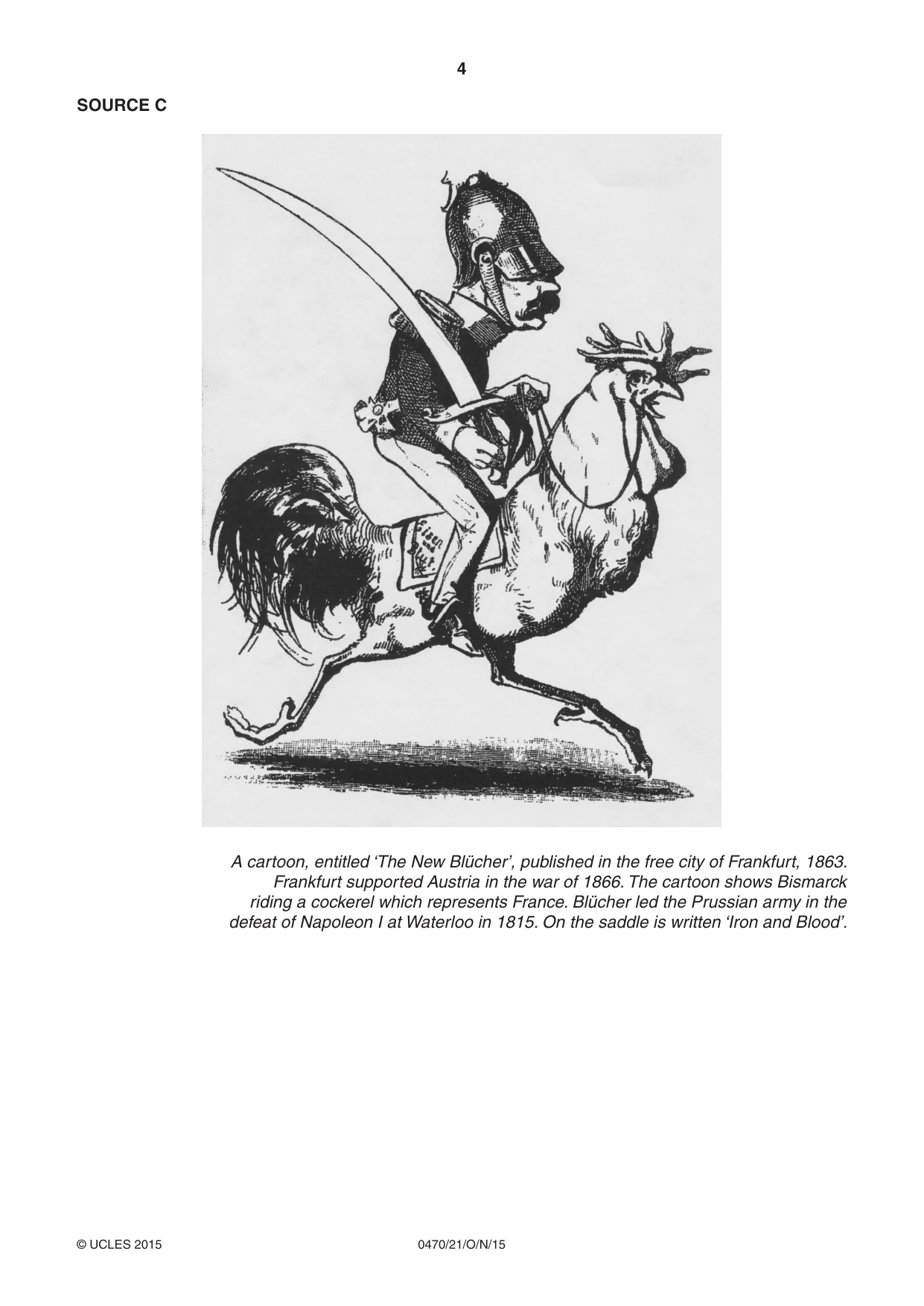
4 0470/21/O/N/15 © UCLES 2015 SOURCE C A cartoon, entitled ‘The New Blücher’, published in the free city of Frankfurt, 1863. Frankfurt supported Austria in the war of 1866. The cartoon shows Bismarck riding a cockerel which represents France. Blücher led the Prussian army in the defeat of Napoleon I at Waterloo in 1815. On the saddle is written ‘Iron and Blood’.
Question paper, page 5
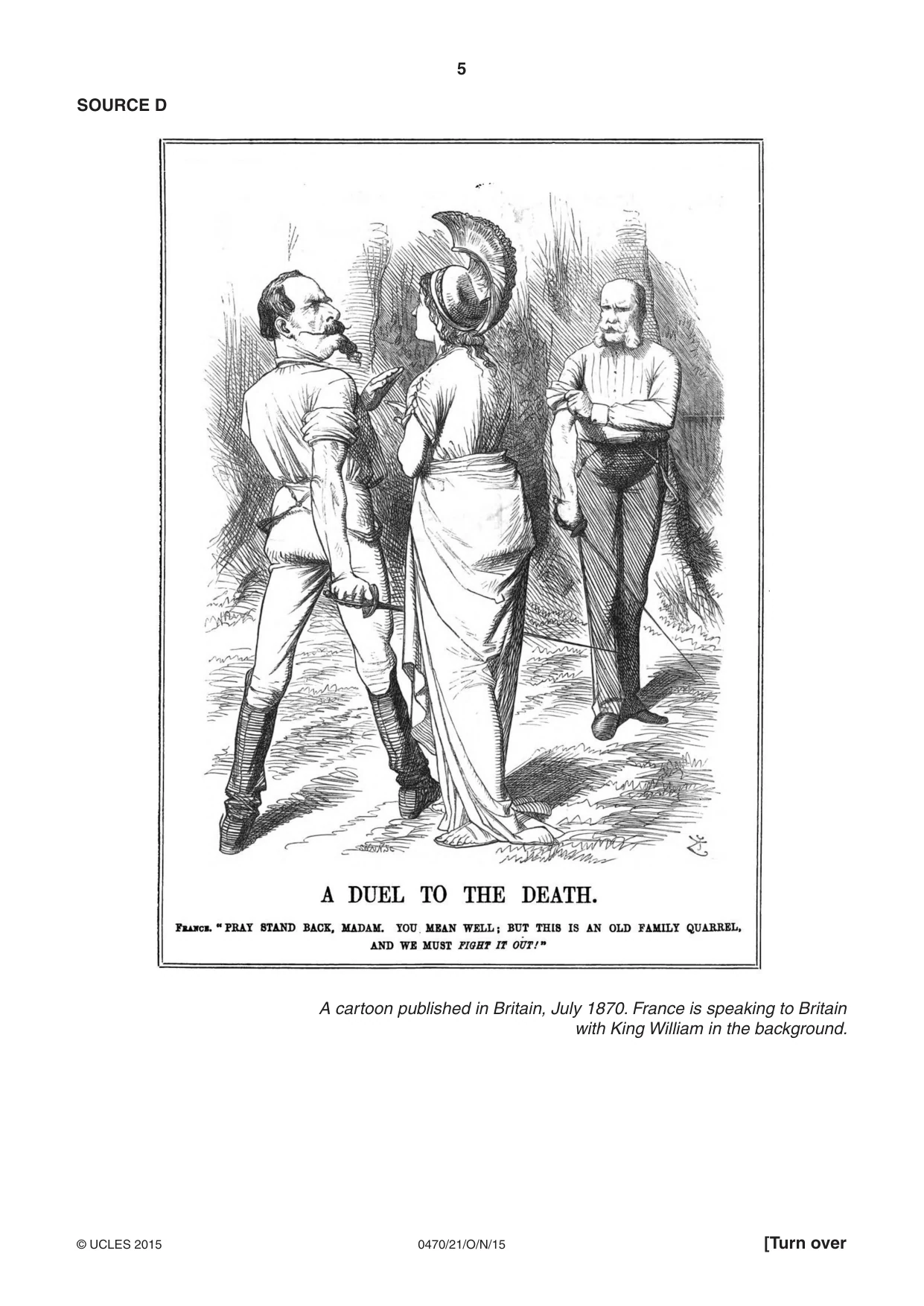
5 0470/21/O/N/15 © UCLES 2015 [Turn over SOURCE D A cartoon published in Britain, July 1870. France is speaking to Britain with King William in the background.
Question paper, page 6
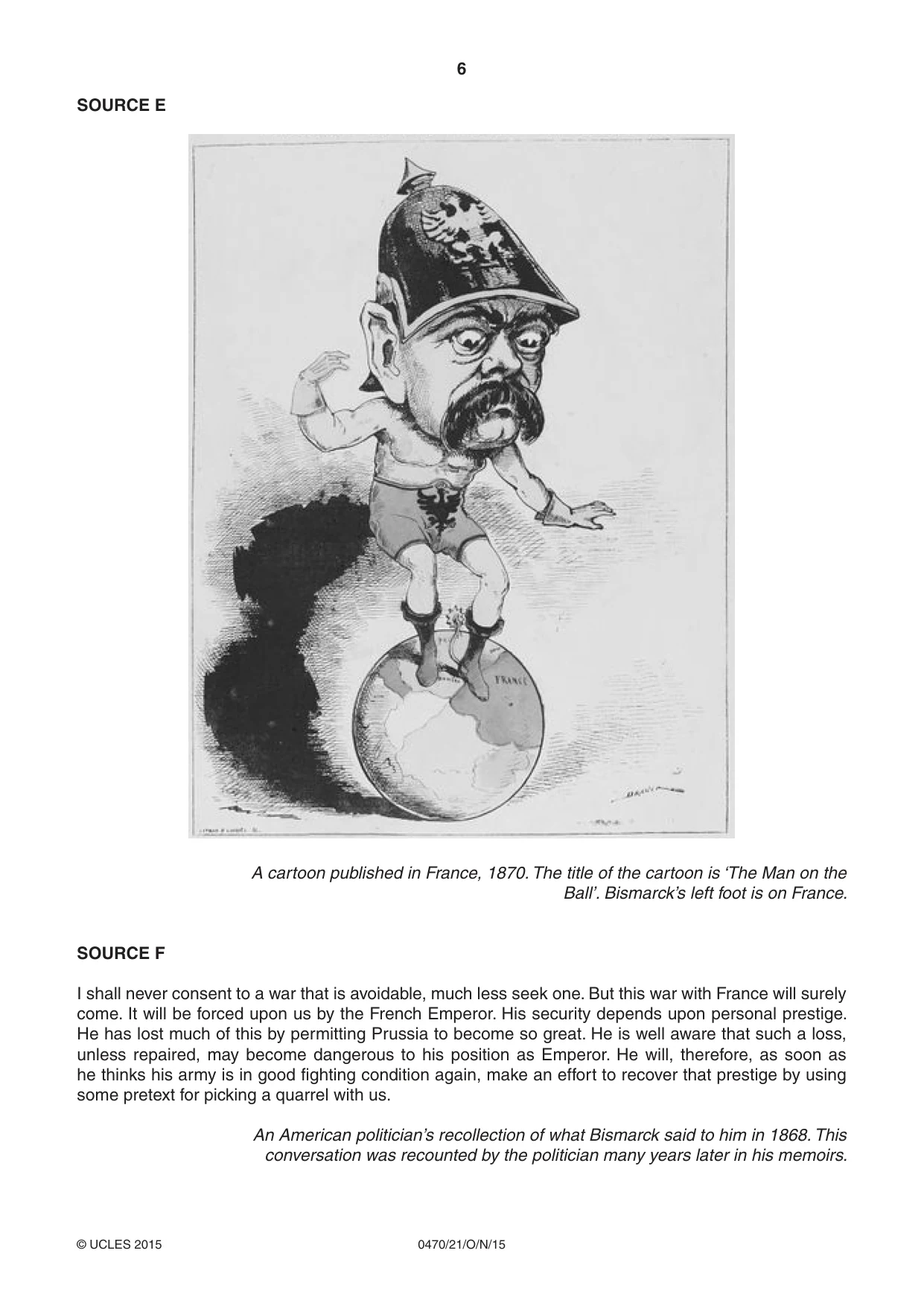
6 0470/21/O/N/15 © UCLES 2015 SOURCE E A cartoon published in France, 1870. The title of the cartoon is ‘The Man on the Ball’. Bismarck’s left foot is on France. SOURCE F I shall never consent to a war that is avoidable, much less seek one. But this war with France will surely come. It will be forced upon us by the French Emperor. His security depends upon personal prestige. He has lost much of this by permitting Prussia to become so great. He is well aware that such a loss, unless repaired, may become dangerous to his position as Emperor. He will, therefore, as soon as he thinks his army is in good fighting condition again, make an effort to recover that prestige by using some pretext for picking a quarrel with us. An American politician’s recollection of what Bismarck said to him in 1868. This conversation was recounted by the politician many years later in his memoirs.
Question paper, page 7
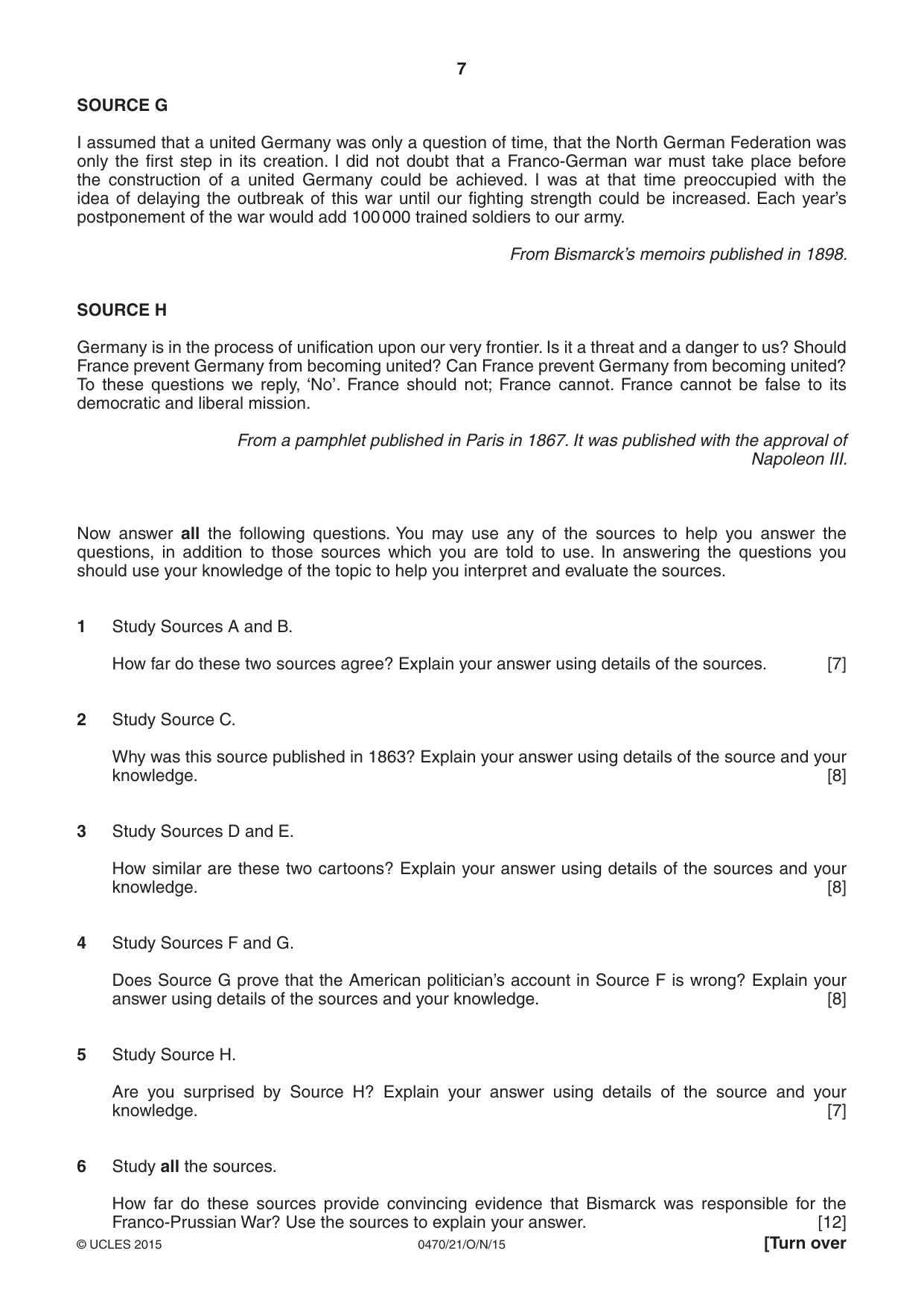
7 0470/21/O/N/15 © UCLES 2015 [Turn over SOURCE G I assumed that a united Germany was only a question of time, that the North German Federation was only the first step in its creation. I did not doubt that a Franco-German war must take place before the construction of a united Germany could be achieved. I was at that time preoccupied with the idea of delaying the outbreak of this war until our fighting strength could be increased. Each year’s postponement of the war would add 100 000 trained soldiers to our army. From Bismarck’s memoirs published in 1898. SOURCE H Germany is in the process of unification upon our very frontier. Is it a threat and a danger to us? Should France prevent Germany from becoming united? Can France prevent Germany from becoming united? To these questions we reply, ‘No’. France should not; France cannot. France cannot be false to its democratic and liberal mission. From a pamphlet published in Paris in 1867. It was published with the approval of Napoleon III. Now answer all the following questions. You may use any of the sources to help you answer the questions, in addition to those sources which you are told to use. In answering the questions you should use your knowledge of the topic to help you interpret and evaluate the sources. 1 Study Sources A and B. How far do these two sources agree? Explain your answer using details of the sources. [7] 2 Study Source C. Why was this source published in 1863? Explain your answer using details of the source and your knowledge. [8] 3 Study Sources D and E. How similar are these two cartoons? Explain your answer using details of the sources and your knowledge. [8] 4 Study Sources F and G. Does Source G prove that the American politician’s account in Source F is wrong? Explain your answer using details of the sources and your knowledge. [8] 5 Study Source H. Are you surprised by Source H? Explain your answer using details of the source and your knowledge. [7] 6 Study all the sources. How far do these sources provide convincing evidence that Bismarck was responsible for the Franco-Prussian War? Use the sources to explain your answer. [12]
Question paper, page 8
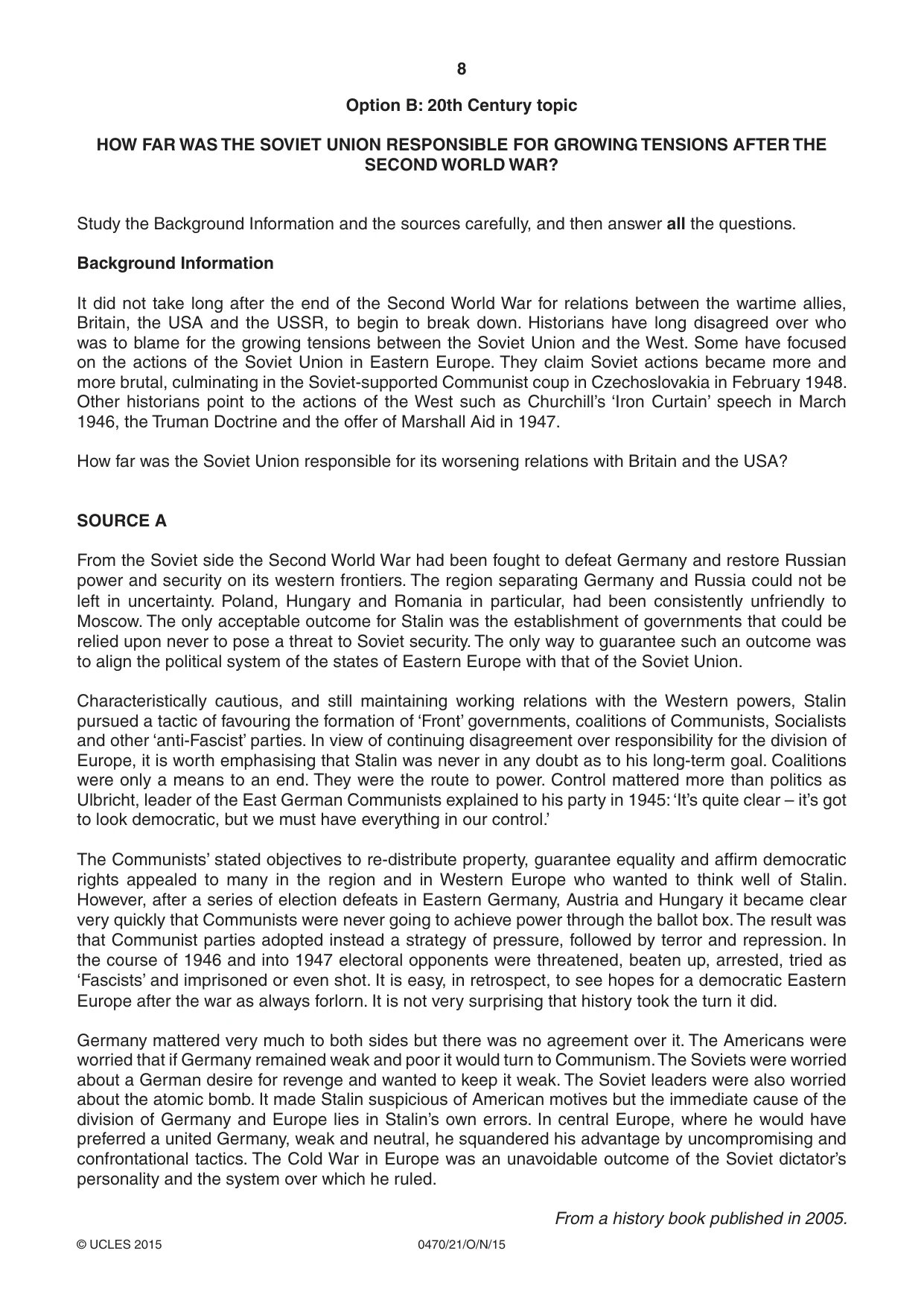
8 0470/21/O/N/15 © UCLES 2015 Option B: 20th Century topic HOW FAR WAS THE SOVIET UNION RESPONSIBLE FOR GROWING TENSIONS AFTER THE SECOND WORLD WAR? Study the Background Information and the sources carefully, and then answer all the questions. Background Information It did not take long after the end of the Second World War for relations between the wartime allies, Britain, the USA and the USSR, to begin to break down. Historians have long disagreed over who was to blame for the growing tensions between the Soviet Union and the West. Some have focused on the actions of the Soviet Union in Eastern Europe. They claim Soviet actions became more and more brutal, culminating in the Soviet-supported Communist coup in Czechoslovakia in February 1948. Other historians point to the actions of the West such as Churchill’s ‘Iron Curtain’ speech in March 1946, the Truman Doctrine and the offer of Marshall Aid in 1947. How far was the Soviet Union responsible for its worsening relations with Britain and the USA? SOURCE A From the Soviet side the Second World War had been fought to defeat Germany and restore Russian power and security on its western frontiers. The region separating Germany and Russia could not be left in uncertainty. Poland, Hungary and Romania in particular, had been consistently unfriendly to Moscow. The only acceptable outcome for Stalin was the establishment of governments that could be relied upon never to pose a threat to Soviet security. The only way to guarantee such an outcome was to align the political system of the states of Eastern Europe with that of the Soviet Union. Characteristically cautious, and still maintaining working relations with the Western powers, Stalin pursued a tactic of favouring the formation of ‘Front’ governments, coalitions of Communists, Socialists and other ‘anti-Fascist’ parties. In view of continuing disagreement over responsibility for the division of Europe, it is worth emphasising that Stalin was never in any doubt as to his long-term goal. Coalitions were only a means to an end. They were the route to power. Control mattered more than politics as Ulbricht, leader of the East German Communists explained to his party in 1945: ‘It’s quite clear – it’s got to look democratic, but we must have everything in our control.’ The Communists’ stated objectives to re-distribute property, guarantee equality and affirm democratic rights appealed to many in the region and in Western Europe who wanted to think well of Stalin. However, after a series of election defeats in Eastern Germany, Austria and Hungary it became clear very quickly that Communists were never going to achieve power through the ballot box. The result was that Communist parties adopted instead a strategy of pressure, followed by terror and repression. In the course of 1946 and into 1947 electoral opponents were threatened, beaten up, arrested, tried as ‘Fascists’ and imprisoned or even shot. It is easy, in retrospect, to see hopes for a democratic Eastern Europe after the war as always forlorn. It is not very surprising that history took the turn it did. Germany mattered very much to both sides but there was no agreement over it. The Americans were worried that if Germany remained weak and poor it would turn to Communism. The Soviets were worried about a German desire for revenge and wanted to keep it weak. The Soviet leaders were also worried about the atomic bomb. It made Stalin suspicious of American motives but the immediate cause of the division of Germany and Europe lies in Stalin’s own errors. In central Europe, where he would have preferred a united Germany, weak and neutral, he squandered his advantage by uncompromising and confrontational tactics. The Cold War in Europe was an unavoidable outcome of the Soviet dictator’s personality and the system over which he ruled. From a history book published in 2005.
Question paper, page 9
9 0470/21/O/N/15 © UCLES 2015 [Turn over SOURCE B Most historians argue that the Cold War was not inevitable and was brought about by the inability of the victorious powers to come to an arrangement among themselves. Soviet leaders seem to have cherished a hope of continued co-operation with the West. They also wished never again to be vulnerable to attack from the West. They planned for a westward movement of Soviet borders and for friendly regimes beyond them. The Poles, Czechs, Hungarians, Finns, Romanians and Bulgarians would have to be prepared to work out compromises that limited their control over foreign affairs; in return they would be allowed control of their internal affairs. Instructions from Moscow to Czechoslovakian Communists ordered, ‘Do not put the Sovietisation of Czechoslovakia on the immediate agenda. We must proceed step by step.’ A great stumbling block to co-operation was the future of Germany. Everyone wanted a peaceful, friendly, denazified Germany with reduced war-making potential, but there were very different ideas about how to achieve this. The Soviet Union worried that the US approach would be markedly different. The Russians wanted Germany to be kept united and weak for decades but US policy wanted democratisation through education to prevent communism gathering support. The Anglo-American stance can be seen as provocative and insufficiently sensitive to Stalin’s security needs. Truman introduced other potential sources of friction when he terminated lend-lease and with his efforts at atomic diplomacy at Potsdam. In both cases Stalin became less inclined to compromise as he perceived these to be US tactics to pressure him for concessions. Then Churchill weighed in with his speech at Fulton, Missouri. This agreed with George Kennan’s Long Telegram of 1946 in which he advocated policies of firm and persistent containment of Soviet power. From a history book published in 2002.
Question paper, page 10
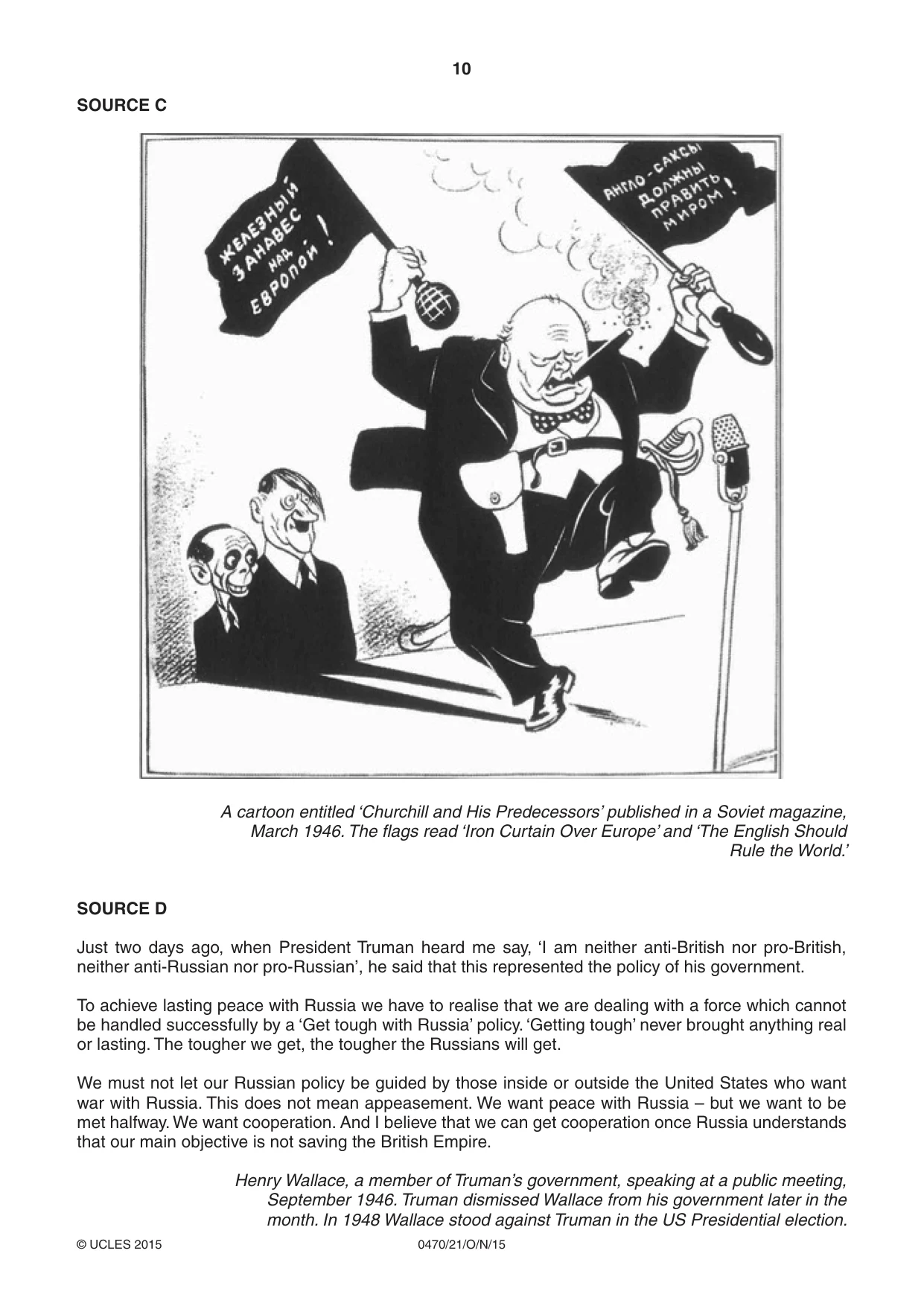
10 0470/21/O/N/15 © UCLES 2015 SOURCE C A cartoon entitled ‘Churchill and His Predecessors’ published in a Soviet magazine, March 1946. The flags read ‘Iron Curtain Over Europe’ and ‘The English Should Rule the World.’ SOURCE D Just two days ago, when President Truman heard me say, ‘I am neither anti-British nor pro-British, neither anti-Russian nor pro-Russian’, he said that this represented the policy of his government. To achieve lasting peace with Russia we have to realise that we are dealing with a force which cannot be handled successfully by a ‘Get tough with Russia’ policy. ‘Getting tough’ never brought anything real or lasting. The tougher we get, the tougher the Russians will get. We must not let our Russian policy be guided by those inside or outside the United States who want war with Russia. This does not mean appeasement. We want peace with Russia – but we want to be met halfway. We want cooperation. And I believe that we can get cooperation once Russia understands that our main objective is not saving the British Empire. Henry Wallace, a member of Truman’s government, speaking at a public meeting, September 1946. Truman dismissed Wallace from his government later in the month. In 1948 Wallace stood against Truman in the US Presidential election.
Question paper, page 11
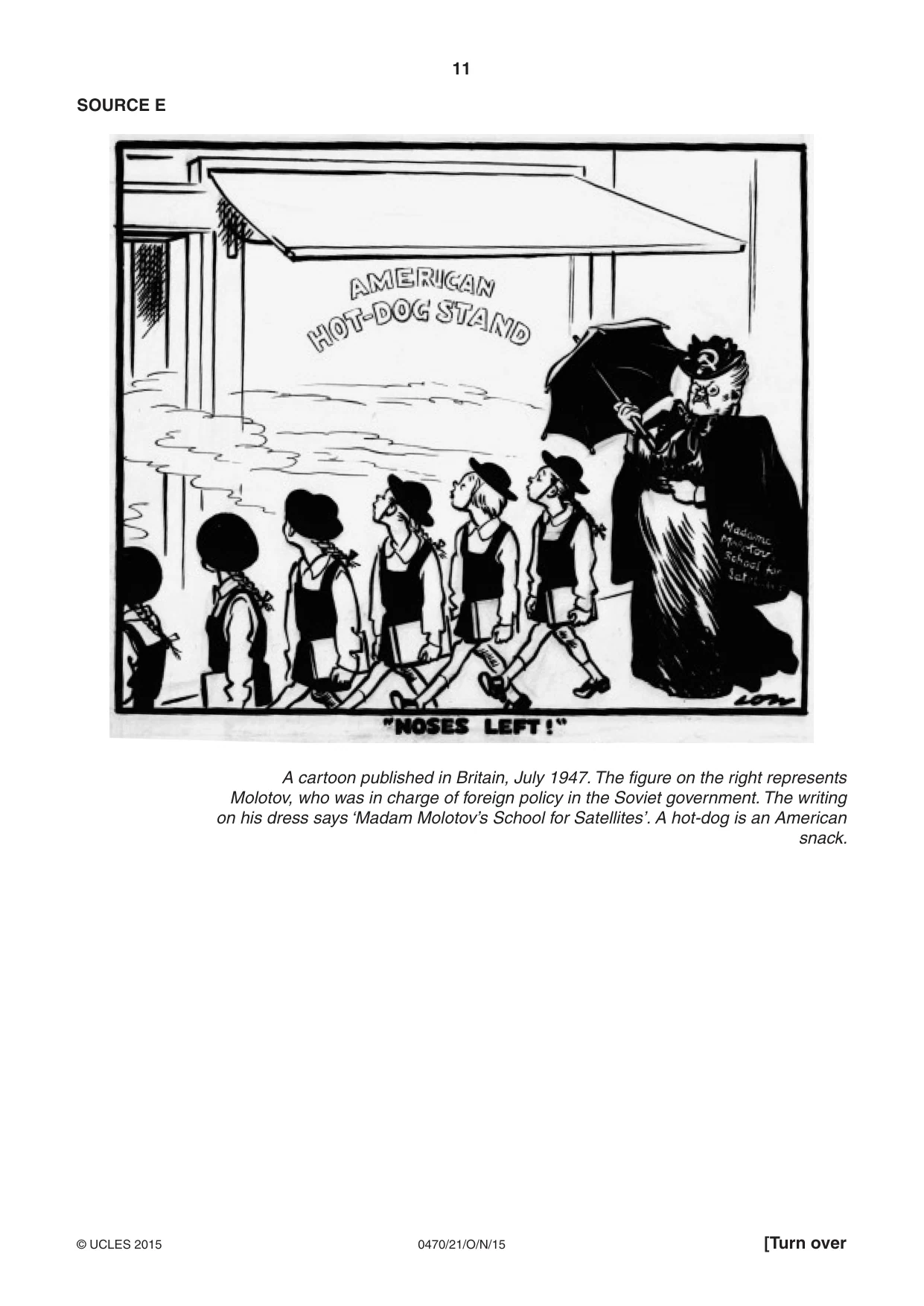
11 0470/21/O/N/15 © UCLES 2015 [Turn over SOURCE E A cartoon published in Britain, July 1947. The figure on the right represents Molotov, who was in charge of foreign policy in the Soviet government. The writing on his dress says ‘Madam Molotov’s School for Satellites’. A hot-dog is an American snack.
Question paper, page 12
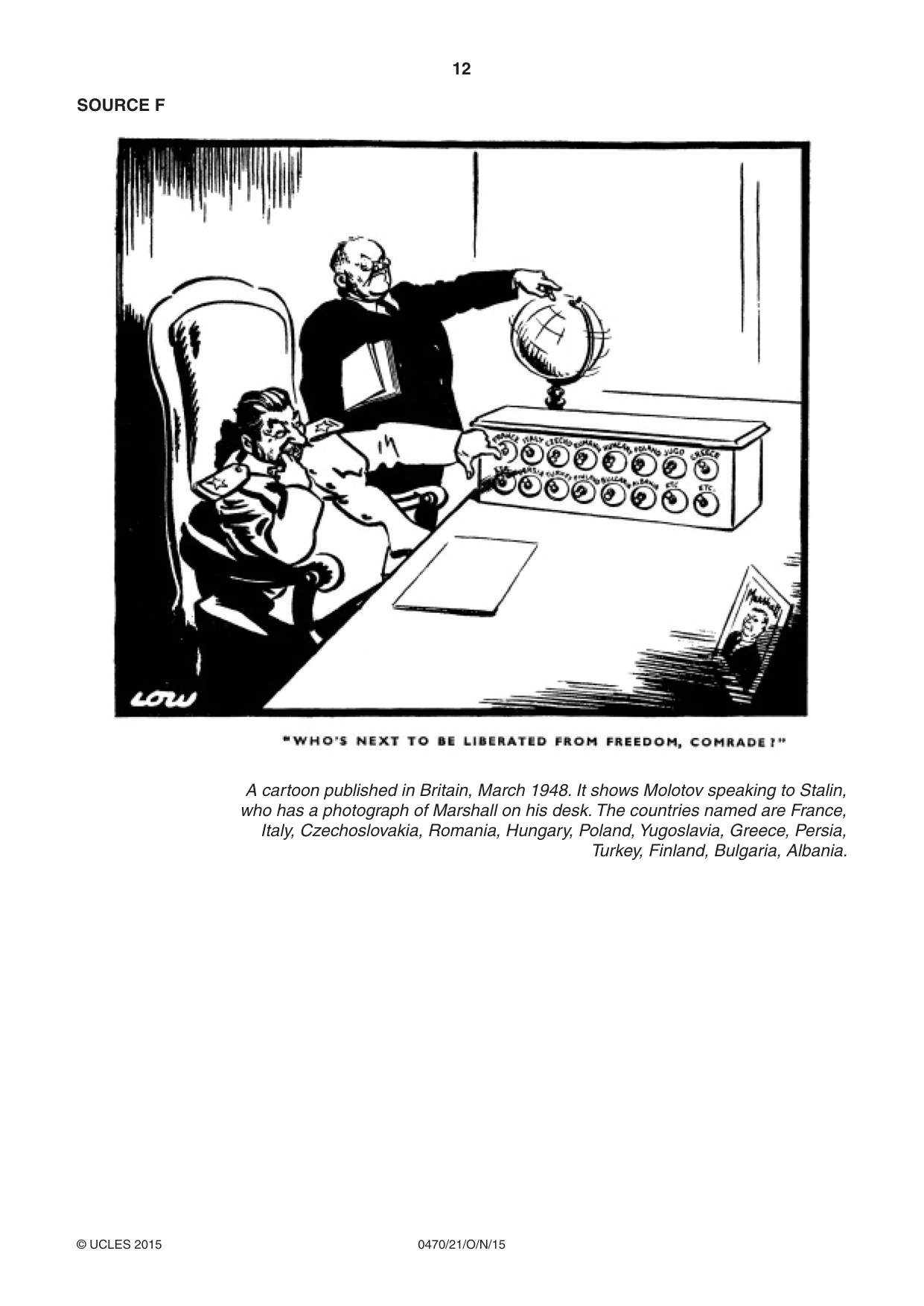
12 0470/21/O/N/15 © UCLES 2015 SOURCE F A cartoon published in Britain, March 1948. It shows Molotov speaking to Stalin, who has a photograph of Marshall on his desk. The countries named are France, Italy, Czechoslovakia, Romania, Hungary, Poland, Yugoslavia, Greece, Persia, Turkey, Finland, Bulgaria, Albania.
Question paper, page 13
13 0470/21/O/N/15 © UCLES 2015 [Turn over SOURCE G Every now and again the USA and Britain accuse Hungary, Romania and Bulgaria of violating the peace treaties which bound them to safeguard the human rights of their citizens. These accusations are absolutely groundless. All these countries are strictly observing the terms of the peace treaties and are not violating human rights. Political freedom is secured for all citizens. These rights are embodied in the new constitutions. Racial discrimination is a crime punishable by law. Women enjoy the same rights as men. There is full freedom of conscience. Freedom of assembly, organisation and the press is secured. The overwhelming majority of the working people of these countries is organised in political trade unions on a democratic basis. There is no censorship. When the US and Britain speak of these countries violating the peace treaties, they are obviously not thinking of honest citizens of these countries who enjoy full political freedom, but of their own spies such as reactionary Fascist groups who have been convicted of terrorist activities designed to overthrow the people’s democratic governments of these countries. But the governments of Romania, Hungary and Bulgaria in no way violated the peace treaties when they adopted measures to frustrate those anti-democratic reactionaries. These governments acted in full accordance with the treaties, which bind them not to suffer the existence of Fascist organisations. From a broadcast by Moscow Radio, 1949.
Question paper, page 14
14 0470/21/O/N/15 © UCLES 2015 Now answer all the following questions. You may use any of the sources to help you answer the questions, in addition to those sources which you are told to use. In answering the questions you should use your knowledge of the topic to help you interpret and evaluate the sources. 1 Study Sources A and B. How far do these two sources agree? Explain your answer using details of the sources. [7] 2 Study Source C. Why was this source published in March 1946? Explain your answer using details of the source and your knowledge. [8] 3 Study Source D. Are you surprised by this source? Explain your answer using details of the source and your knowledge. [8] 4 Study Sources E and F. How similar are these two cartoons? Explain your answer using details of the sources and your knowledge. [8] 5 Study Source G. How useful is this source as evidence about the Cold War? Explain your answer using details of the source and your knowledge. [7] 6 Study all the sources. How far do these sources provide convincing evidence that the USSR was to blame for growing tensions after the Second World War? Use the sources to explain your answer. [12]
Question paper, page 15
15 0470/21/O/N/15 © UCLES 2015 BLANK PAGE
Question paper, page 16
16 0470/21/O/N/15 © UCLES 2015 BLANK PAGE Permission to reproduce items where third-party owned material protected by copyright is included has been sought and cleared where possible. Every reasonable effort has been made by the publisher (UCLES) to trace copyright holders, but if any items requiring clearance have unwittingly been included, the publisher will be pleased to make amends at the earliest possible opportunity. To avoid the issue of disclosure of answer-related information to candidates, all copyright acknowledgements are reproduced online in the Cambridge International Examinations Copyright Acknowledgements Booklet. This is produced for each series of examinations and is freely available to download at www.cie.org.uk after the live examination series. Cambridge International Examinations is part of the Cambridge Assessment Group. Cambridge Assessment is the brand name of University of Cambridge Local Examinations Syndicate (UCLES), which is itself a department of the University of Cambridge.
Mark scheme, page 1
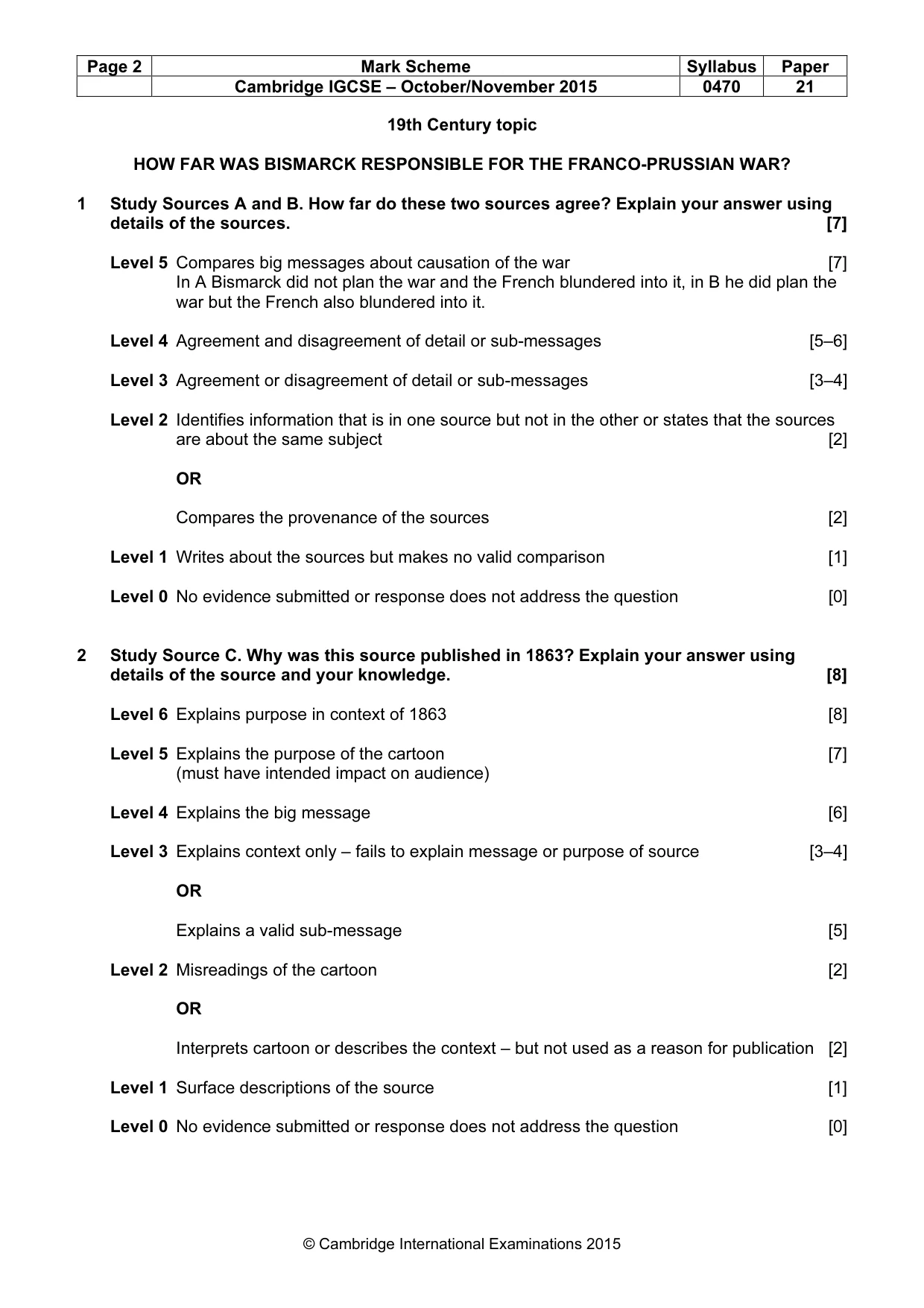
® IGCSE is the registered trademark of Cambridge International Examinations. CAMBRIDGE INTERNATIONAL EXAMINATIONS Cambridge International General Certificate of Secondary Education MARK SCHEME for the October/November 2015 series 0470 HISTORY 0470/21 Paper 2, maximum raw mark 50 This mark scheme is published as an aid to teachers and candidates, to indicate the requirements of the examination. It shows the basis on which Examiners were instructed to award marks. It does not indicate the details of the discussions that took place at an Examiners’ meeting before marking began, which would have considered the acceptability of alternative answers. Mark schemes should be read in conjunction with the question paper and the Principal Examiner Report for Teachers. Cambridge will not enter into discussions about these mark schemes. Cambridge is publishing the mark schemes for the October/November 2015 series for most Cambridge IGCSE®, Cambridge International A and AS Level components and some Cambridge O Level components.
Mark scheme, page 2
Page 2 Mark Scheme Syllabus Paper Cambridge IGCSE – October/November 2015 0470 21 © Cambridge International Examinations 2015 19th Century topic HOW FAR WAS BISMARCK RESPONSIBLE FOR THE FRANCO-PRUSSIAN WAR? 1 Study Sources A and B. How far do these two sources agree? Explain your answer using details of the sources. [7] Level 5 Compares big messages about causation of the war [7] In A Bismarck did not plan the war and the French blundered into it, in B he did plan the war but the French also blundered into it. Level 4 Agreement and disagreement of detail or sub-messages [5–6] Level 3 Agreement or disagreement of detail or sub-messages [3–4] Level 2 Identifies information that is in one source but not in the other or states that the sources are about the same subject [2] OR Compares the provenance of the sources [2] Level 1 Writes about the sources but makes no valid comparison [1] Level 0 No evidence submitted or response does not address the question [0] 2 Study Source C. Why was this source published in 1863? Explain your answer using details of the source and your knowledge. [8] Level 6 Explains purpose in context of 1863 [8] Level 5 Explains the purpose of the cartoon [7] (must have intended impact on audience) Level 4 Explains the big message [6] Level 3 Explains context only – fails to explain message or purpose of source [3–4] OR Explains a valid sub-message [5] Level 2 Misreadings of the cartoon [2] OR Interprets cartoon or describes the context – but not used as a reason for publication [2] Level 1 Surface descriptions of the source [1] Level 0 No evidence submitted or response does not address the question [0]
Mark scheme, page 3
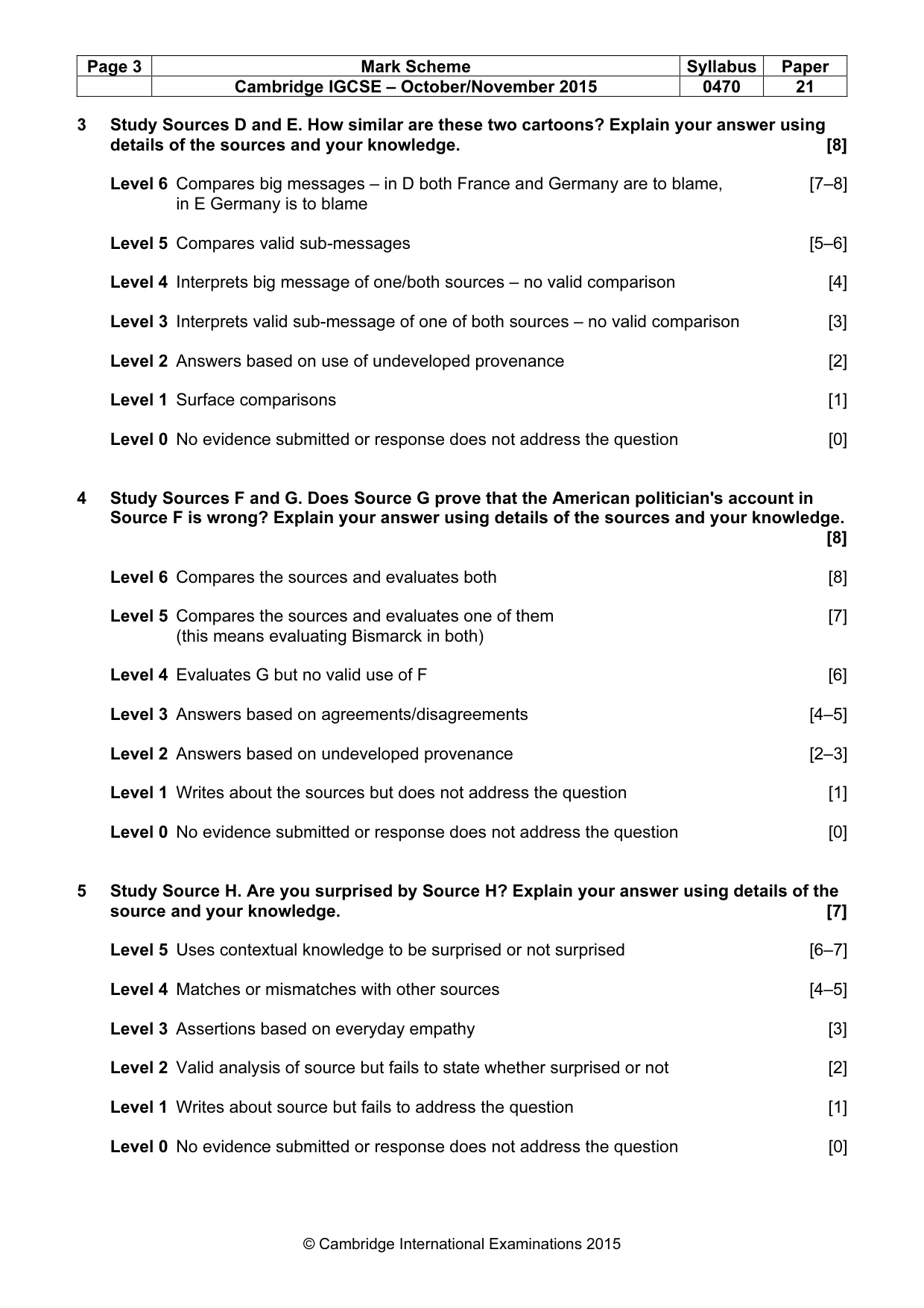
Page 3 Mark Scheme Syllabus Paper Cambridge IGCSE – October/November 2015 0470 21 © Cambridge International Examinations 2015 3 Study Sources D and E. How similar are these two cartoons? Explain your answer using details of the sources and your knowledge. [8] Level 6 Compares big messages – in D both France and Germany are to blame, [7–8] in E Germany is to blame Level 5 Compares valid sub-messages [5–6] Level 4 Interprets big message of one/both sources – no valid comparison [4] Level 3 Interprets valid sub-message of one of both sources – no valid comparison [3] Level 2 Answers based on use of undeveloped provenance [2] Level 1 Surface comparisons [1] Level 0 No evidence submitted or response does not address the question [0] 4 Study Sources F and G. Does Source G prove that the American politician's account in Source F is wrong? Explain your answer using details of the sources and your knowledge. [8] Level 6 Compares the sources and evaluates both [8] Level 5 Compares the sources and evaluates one of them [7] (this means evaluating Bismarck in both) Level 4 Evaluates G but no valid use of F [6] Level 3 Answers based on agreements/disagreements [4–5] Level 2 Answers based on undeveloped provenance [2–3] Level 1 Writes about the sources but does not address the question [1] Level 0 No evidence submitted or response does not address the question [0] 5 Study Source H. Are you surprised by Source H? Explain your answer using details of the source and your knowledge. [7] Level 5 Uses contextual knowledge to be surprised or not surprised [6–7] Level 4 Matches or mismatches with other sources [4–5] Level 3 Assertions based on everyday empathy [3] Level 2 Valid analysis of source but fails to state whether surprised or not [2] Level 1 Writes about source but fails to address the question [1] Level 0 No evidence submitted or response does not address the question [0]
Mark scheme, page 4
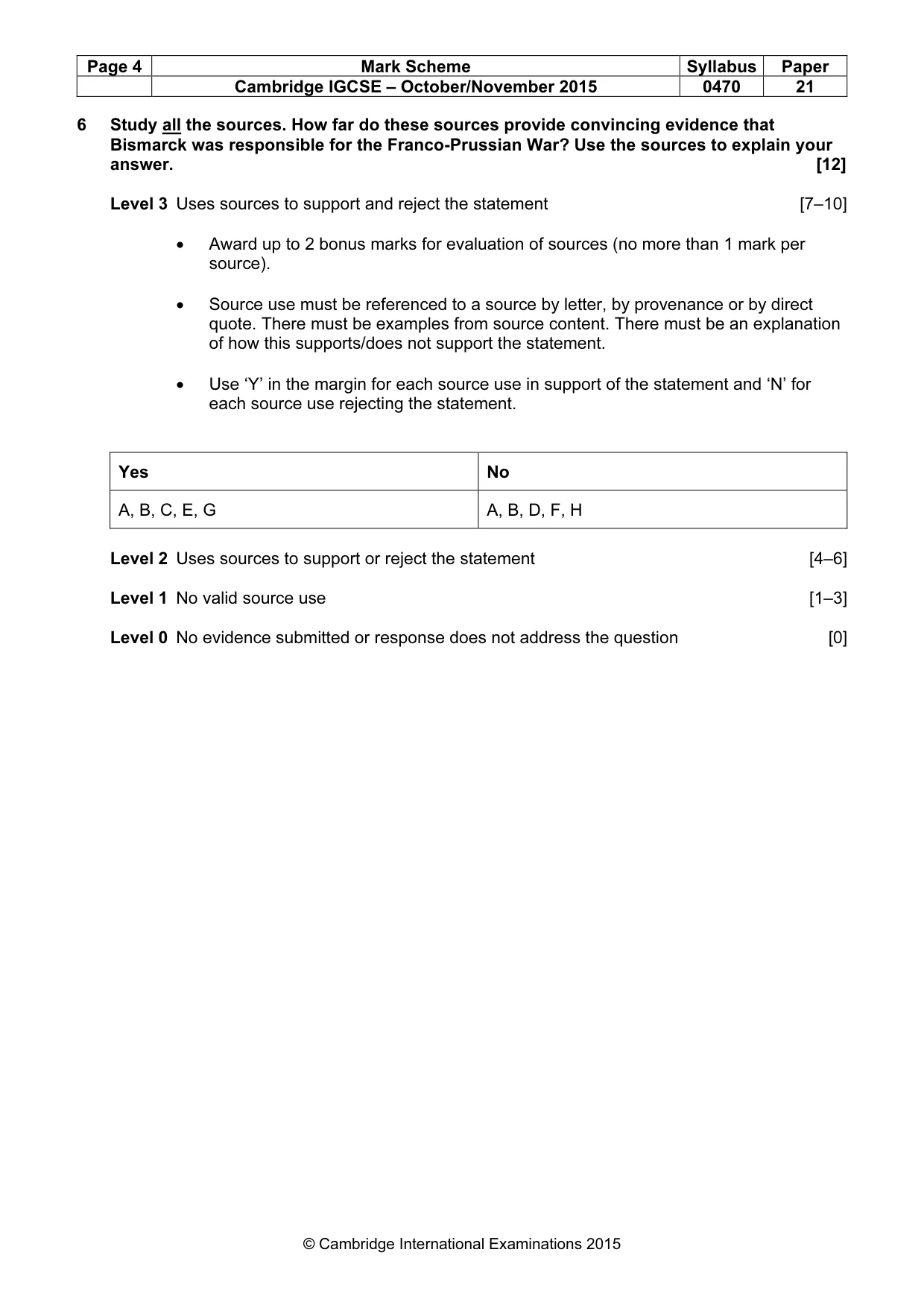
Page 4 Mark Scheme Syllabus Paper Cambridge IGCSE – October/November 2015 0470 21 © Cambridge International Examinations 2015 6 Study all the sources. How far do these sources provide convincing evidence that Bismarck was responsible for the Franco-Prussian War? Use the sources to explain your answer. [12] Level 3 Uses sources to support and reject the statement [7–10] • Award up to 2 bonus marks for evaluation of sources (no more than 1 mark per source). • Source use must be referenced to a source by letter, by provenance or by direct quote. There must be examples from source content. There must be an explanation of how this supports/does not support the statement. • Use ‘Y’ in the margin for each source use in support of the statement and ‘N’ for each source use rejecting the statement. Yes No A, B, C, E, G A, B, D, F, H Level 2 Uses sources to support or reject the statement [4–6] Level 1 No valid source use [1–3] Level 0 No evidence submitted or response does not address the question [0]
Mark scheme, page 5
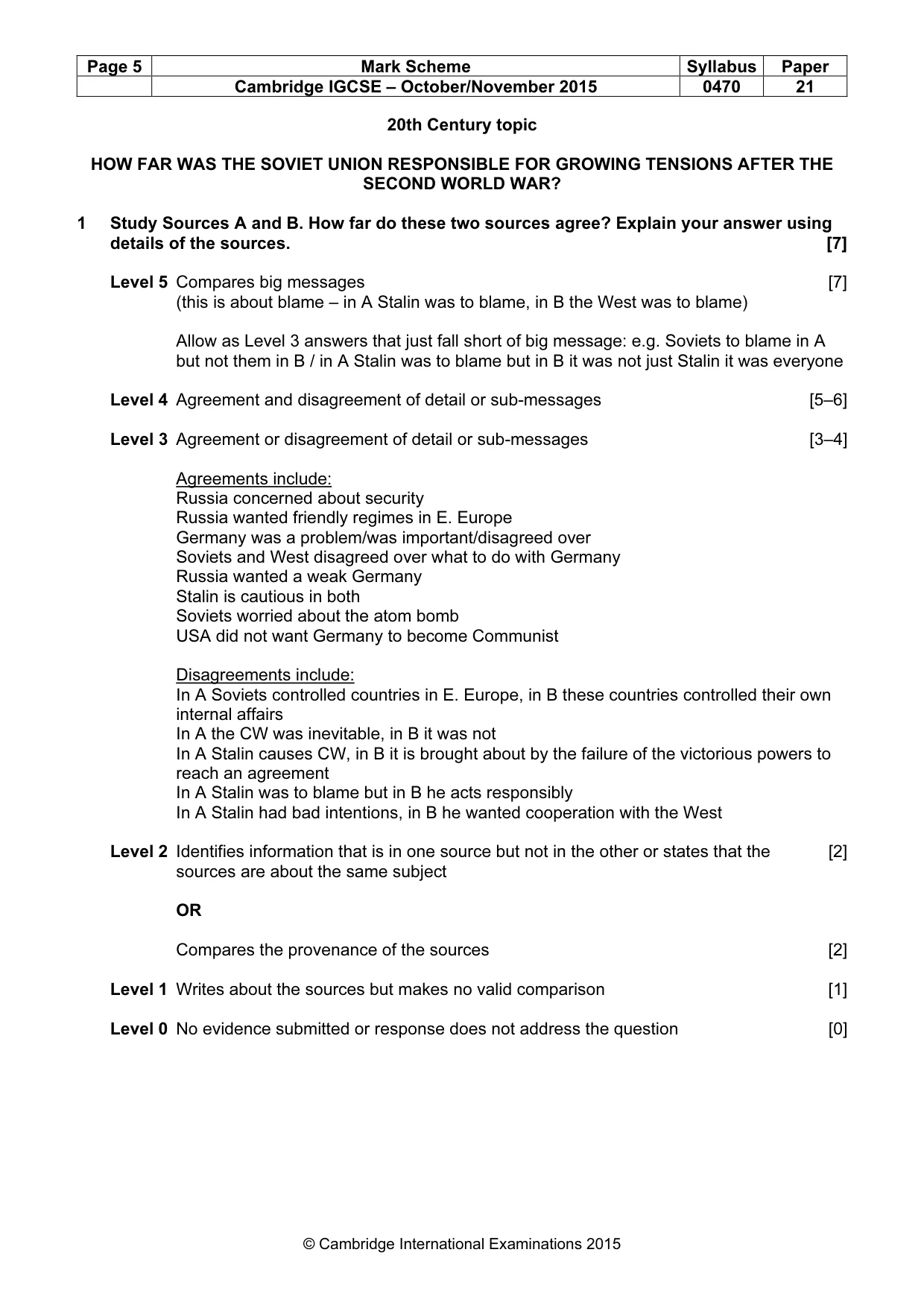
Page 5 Mark Scheme Syllabus Paper Cambridge IGCSE – October/November 2015 0470 21 © Cambridge International Examinations 2015 20th Century topic HOW FAR WAS THE SOVIET UNION RESPONSIBLE FOR GROWING TENSIONS AFTER THE SECOND WORLD WAR? 1 Study Sources A and B. How far do these two sources agree? Explain your answer using details of the sources. [7] Level 5 Compares big messages [7] (this is about blame – in A Stalin was to blame, in B the West was to blame) Allow as Level 3 answers that just fall short of big message: e.g. Soviets to blame in A but not them in B / in A Stalin was to blame but in B it was not just Stalin it was everyone Level 4 Agreement and disagreement of detail or sub-messages [5–6] Level 3 Agreement or disagreement of detail or sub-messages [3–4] Agreements include: Russia concerned about security Russia wanted friendly regimes in E. Europe Germany was a problem/was important/disagreed over Soviets and West disagreed over what to do with Germany Russia wanted a weak Germany Stalin is cautious in both Soviets worried about the atom bomb USA did not want Germany to become Communist Disagreements include: In A Soviets controlled countries in E. Europe, in B these countries controlled their own internal affairs In A the CW was inevitable, in B it was not In A Stalin causes CW, in B it is brought about by the failure of the victorious powers to reach an agreement In A Stalin was to blame but in B he acts responsibly In A Stalin had bad intentions, in B he wanted cooperation with the West Level 2 Identifies information that is in one source but not in the other or states that the [2] sources are about the same subject OR Compares the provenance of the sources [2] Level 1 Writes about the sources but makes no valid comparison [1] Level 0 No evidence submitted or response does not address the question [0]
Mark scheme, page 6
Page 6 Mark Scheme Syllabus Paper Cambridge IGCSE – October/November 2015 0470 21 © Cambridge International Examinations 2015 2 Study Source C. Why was this source published in March 1946? Explain your answer using details of the sources and your knowledge. [8] Level 7 Explains purpose in context of Churchill’s speech [8] Level 6 Explains the purpose of the cartoon [7] e.g. to justify to the Soviet people Soviet actions in Eastern Europe or persuade the Russian people that a former ally is now a threat Level 5 Explains the big message [6] Churchill was as much a threat to the Soviet Union as the Nazis Level 4 Explains a valid sub-message [5] Level 3 Explains context only – fails to explain message or purpose of source [3–4] 3 marks for general context about Cold War, 4 for the context of Churchill’s speech Level 2 Misreadings of the cartoon [2] OR Interprets cartoon or describes the context – but not used as a reason for publication [2] Level 1 Surface descriptions of the source [1] Level 0 No evidence submitted or response does not address the question [0] 3 Study Source D. Are you surprised by this source? Explain your answer using details of the source and your knowledge. [8] Level 6 Surprised and not surprised by Wallace’s overall message – explained by [8] setting it in context of Cold War and by explaining he was a member of Truman’s government (allow surprised by what Wallace says because Truman sacked him) Level 5 Surprised or not surprised by Wallace’s overall message – explained [6–7] either by setting it in context of Cold War or by explaining he was a member of Truman’s government (allow surprised by what Wallace says because Truman sacked him) Level 4 Cross-reference to contextual knowledge to explain surprise or lack of [4–5] surprise about a part of the source Level 3 Explains why surprised or not by what we are told in the provenance [3] Level 2 Identifies what is, or what is not surprising, but no valid explanation [2] Level 1 Writes about the sources but fails to address the question [1] Level 0 No evidence submitted or response does not address the question [0]
Mark scheme, page 7
Page 7 Mark Scheme Syllabus Paper Cambridge IGCSE – October/November 2015 0470 21 © Cambridge International Examinations 2015 4 Study Sources E and F. How similar are these two cartoons? Explain your answer using details of the sources and your knowledge. [8] Level 7 As for Level 6 but with a valid qualification (allow Level 5 difference and Level 6) [8] Level 6 Compares big messages – compares the points of view of the cartoonists – [7–8] disapproval of Soviet threat, blames SU for the Cold War Award 8 marks if at least one message is explained through source use Level 5 Compares valid sub-messages [6] Level 4 Interprets big message of one/both sources – no valid comparison [5] disapproval of Soviet threat Level 3 Interprets valid sub-message of one of both sources – no valid comparison [3–4] e.g. The Soviet Union wants to control Eastern Europe, the SU poses a threat to Eastern Europe Don’t allow Soviet citizens in Source E Award 3 marks for one source, 4 marks for both. Level 2 Answers based on use of undeveloped provenance [2] or the sources are about the same thing Level 1 Surface comparisons or compares misinterpretations of both sources [1] Level 0 No evidence submitted or response does not address the question [0] 5 Study Source G. How useful is this source as evidence about the Cold War? Explain your answer using details of the sources and your knowledge. [7] Level 7 Evaluates source in context to accept it – useful as evidence of how they want others [7] to see the situation Level 6 Evaluates source in context to reject it [6] Level 5 Accepts source as evidence of Soviet point of view [5] Level 4 Uses provenance to state an undeveloped reason for rejecting source [3–4] Award 4 marks for answers based on propaganda, award 3 for other answers. Level 3 Judges usefulness by explaining what source does not tell us about Cold War [2–3] OR Explains what can be learned from content (uncritical) [3] Level 2 Uses provenance to state an undeveloped reason for accepting source [2] Level 1 Unsupported assertions (including undeveloped use of provenance) or [1] fails to address issue of usefulness Level 0 No evidence submitted or response does not address the question [0]
Mark scheme, page 8
Page 8 Mark Scheme Syllabus Paper Cambridge IGCSE – October/November 2015 0470 21 © Cambridge International Examinations 2015 6 Study all the sources. How far do these sources provide convincing evidence that the USSR was to blame for growing tensions after the Second World War? Use the source to explain your answer. [12] Level 3 Uses sources to support and reject the statement [7–10] • Award up to 2 bonus marks for evaluation of sources (no more than 1 mark per source). • Source use must be referenced to a source by letter, by provenance or by direct quote. There must be examples from source content. There must be an explanation of how this supports/does not support the statement. • Use ‘Y’ in the margin for each source use in support of the statement and ‘N’ for each source use rejecting the statement. Yes No A, E, F, (possibly G) B, C, D, E, G Level 2 Uses sources to support or reject the statement [4–6] Level 1 No valid source use [1–3] Level 0 No evidence submitted or response does not address the question [0]
What you needed in this session
Cambridge’s own grade thresholds for 2015 Oct/Nov, Paper 2 · Variant 1. A higher threshold means an easier paper — the bar moves with how the cohort did.