Cambridge IGCSE History 0470 — 2015 May/June Paper 2 · Variant 3
0470/23/M/J/15 · 50 marks · ≈56 min
The question paper and its mark scheme, free to read here and free to download. This is Cambridge’s own paper, exactly as it was sat.
Question paper12 pages
Mark scheme7 pages
Answers below. Sit the paper first if you are practising.
Paper as text
Question paper, page 1
This document consists of 11 printed pages, 1 blank page and 1 insert. DC (CW/SW) 96940/4 © UCLES 2015 [Turn over Cambridge International Examinations Cambridge International General Certificate of Secondary Education * 7 4 9 1 7 8 6 6 9 6 * HISTORY 0470/23 Paper 2 May/June 2015 2 hours No Additional Materials are required. READ THESE INSTRUCTIONS FIRST An answer booklet is provided inside this question paper. You should follow the instructions on the front cover of the answer booklet. If you need additional answer paper ask the invigilator for a continuation booklet. This paper has two options. Choose one option, and then answer all of the questions on that topic. Option A: 19th Century topic [p2–p6] Option B: 20th Century topic [p7–p11] The number of marks is given in brackets [ ] at the end of each question or part question. The syllabus is approved for use in England, Wales and Northern Ireland as a Cambridge International Level 1/Level 2 Certificate.
Question paper, page 2
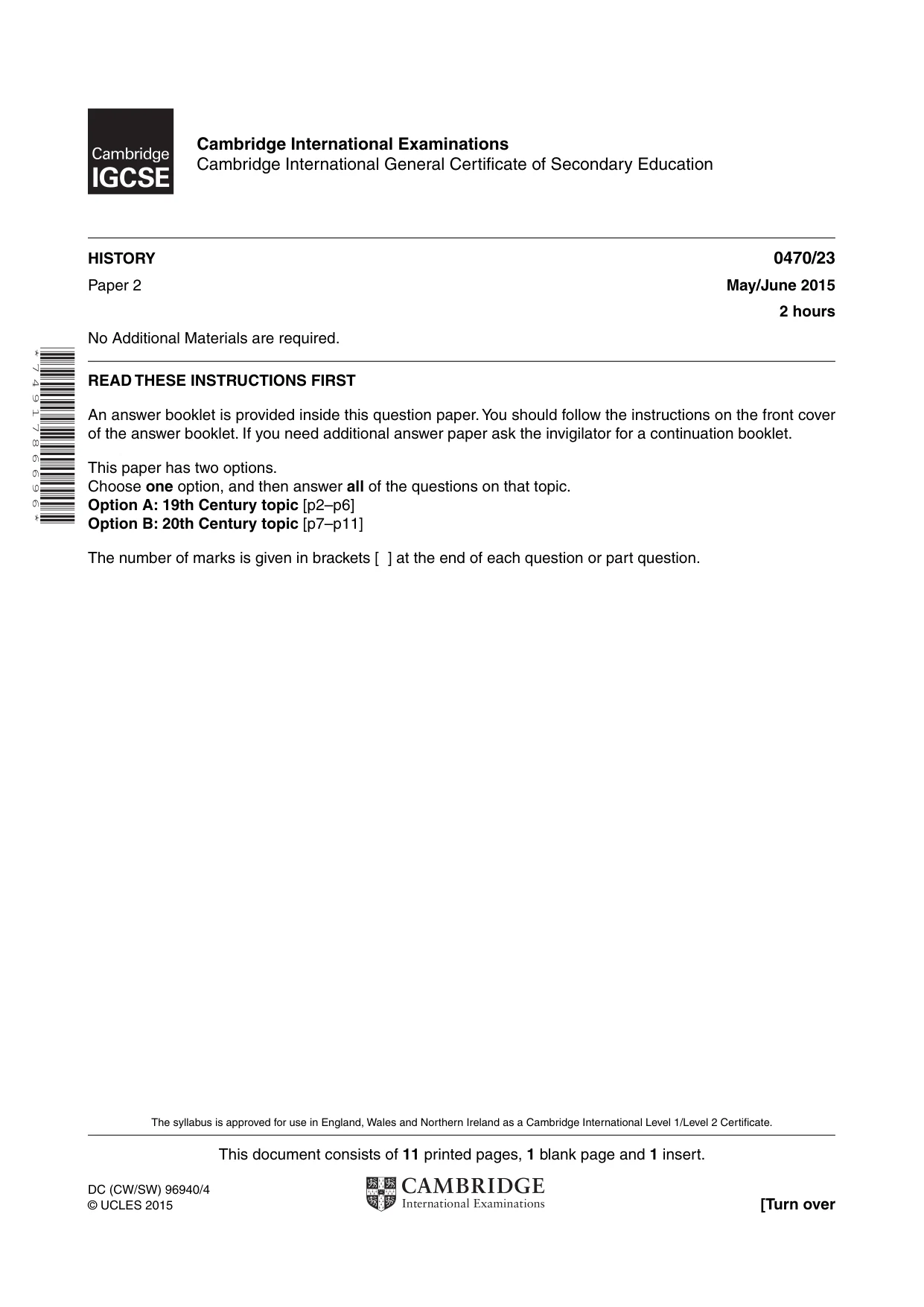
2 0470/23/M/J/15 © UCLES 2015 Option A: 19th Century topic HOW IMPORTANT WAS THE ANGLO-FRENCH ENTENTE OF 1904? Study the Background Information and the sources carefully, and then answer all the questions. Background Information In 1904 Britain and France signed the Entente Cordiale. This consisted of a series of agreements over colonial matters. Although it was a friendly understanding and symbolised improving relations between the two countries, it was not an alliance. Nor did it commit Britain to any involvement on the continent. However, it did end Britain’s ‘splendid isolation’ and was seen by Germany as an anti-German alliance. But was the Entente Cordiale really a threat to Germany? SOURCE A A cartoon published in Britain in 1904. Britain is shown with France.
Question paper, page 3
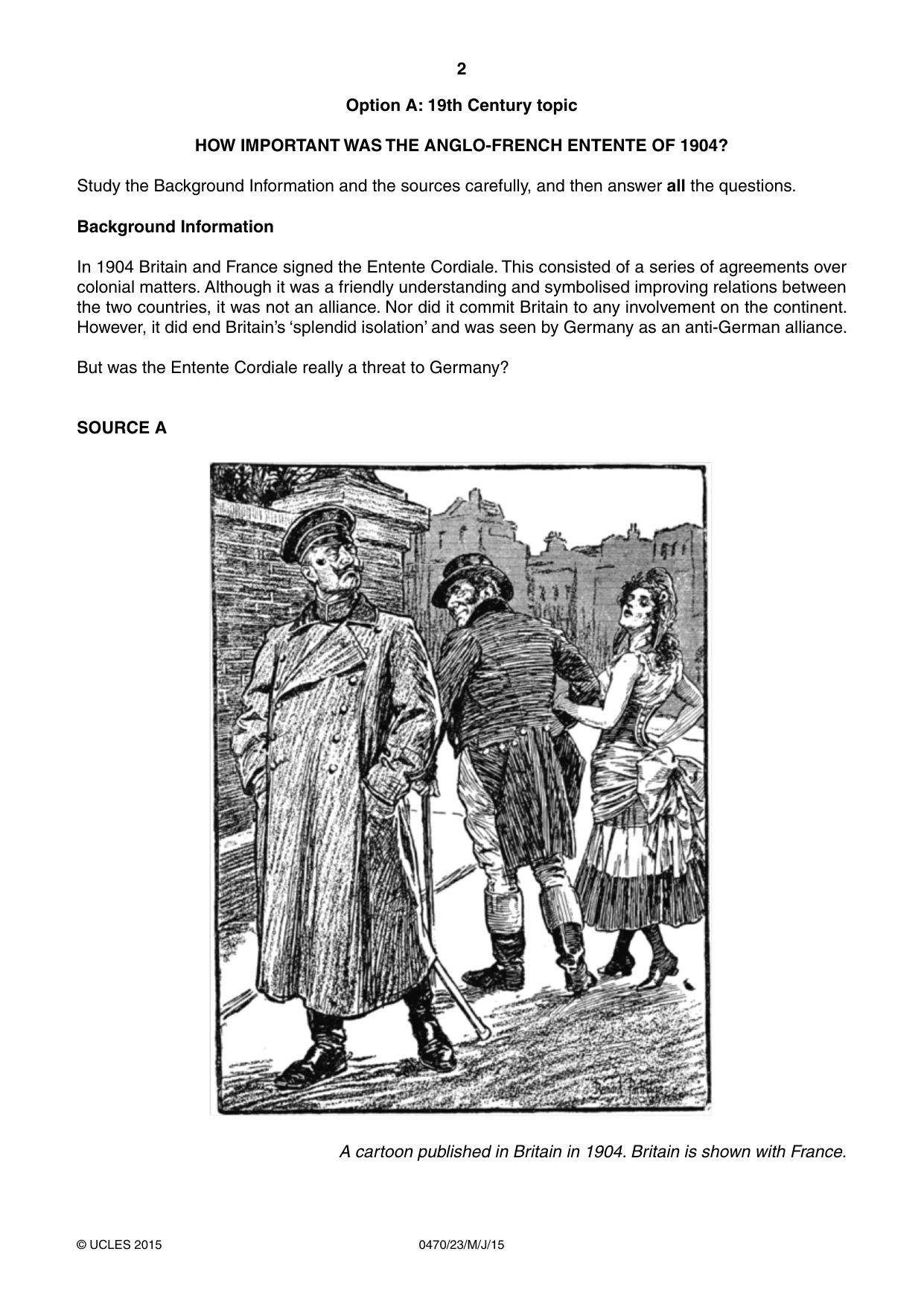
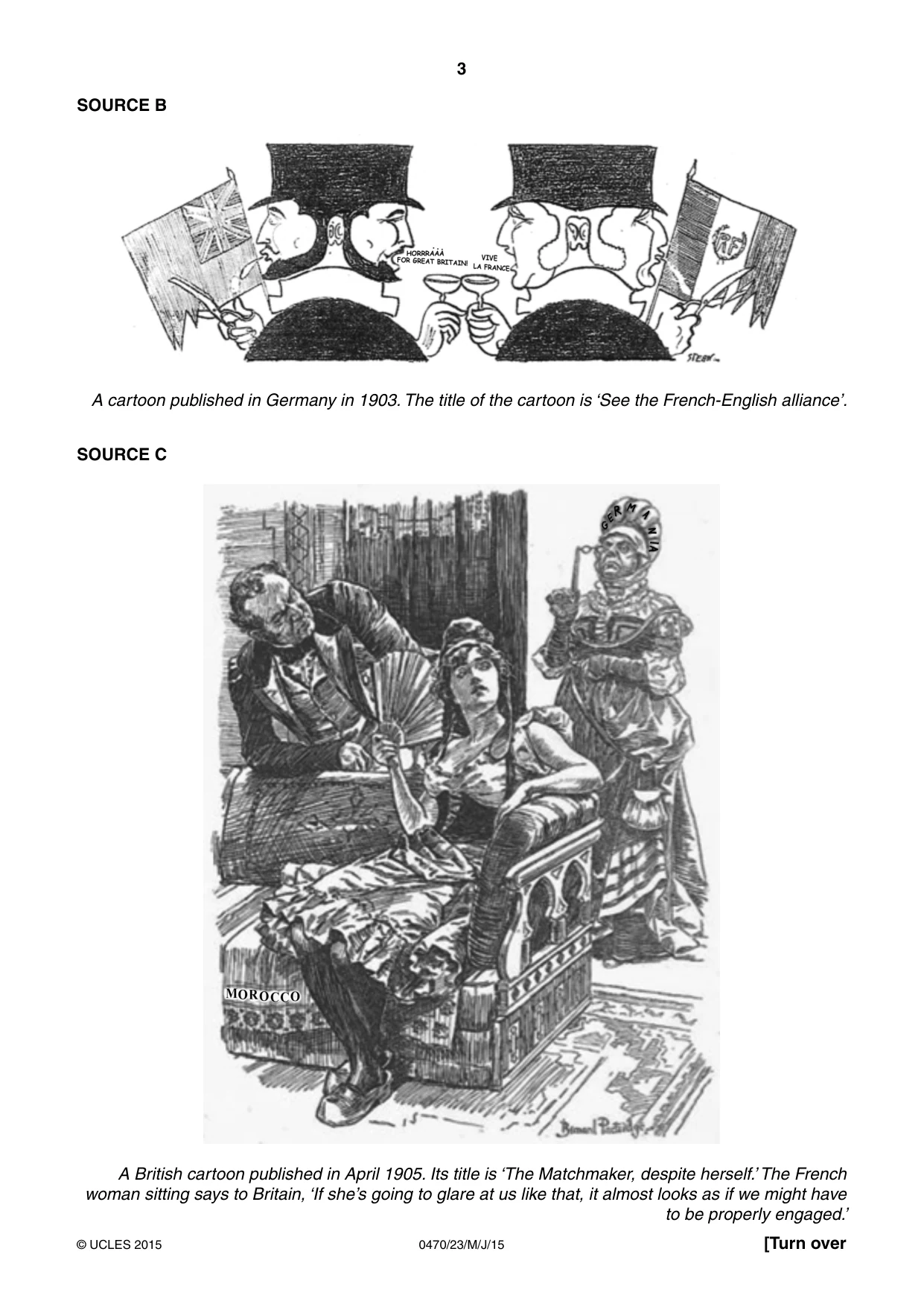
3 0470/23/M/J/15 © UCLES 2015 [Turn over SOURCE B A cartoon published in Germany in 1903. The title of the cartoon is ‘See the French-English alliance’. SOURCE C A British cartoon published in April 1905. Its title is ‘The Matchmaker, despite herself.’ The French woman sitting says to Britain, ‘If she’s going to glare at us like that, it almost looks as if we might have to be properly engaged.’
Question paper, page 4
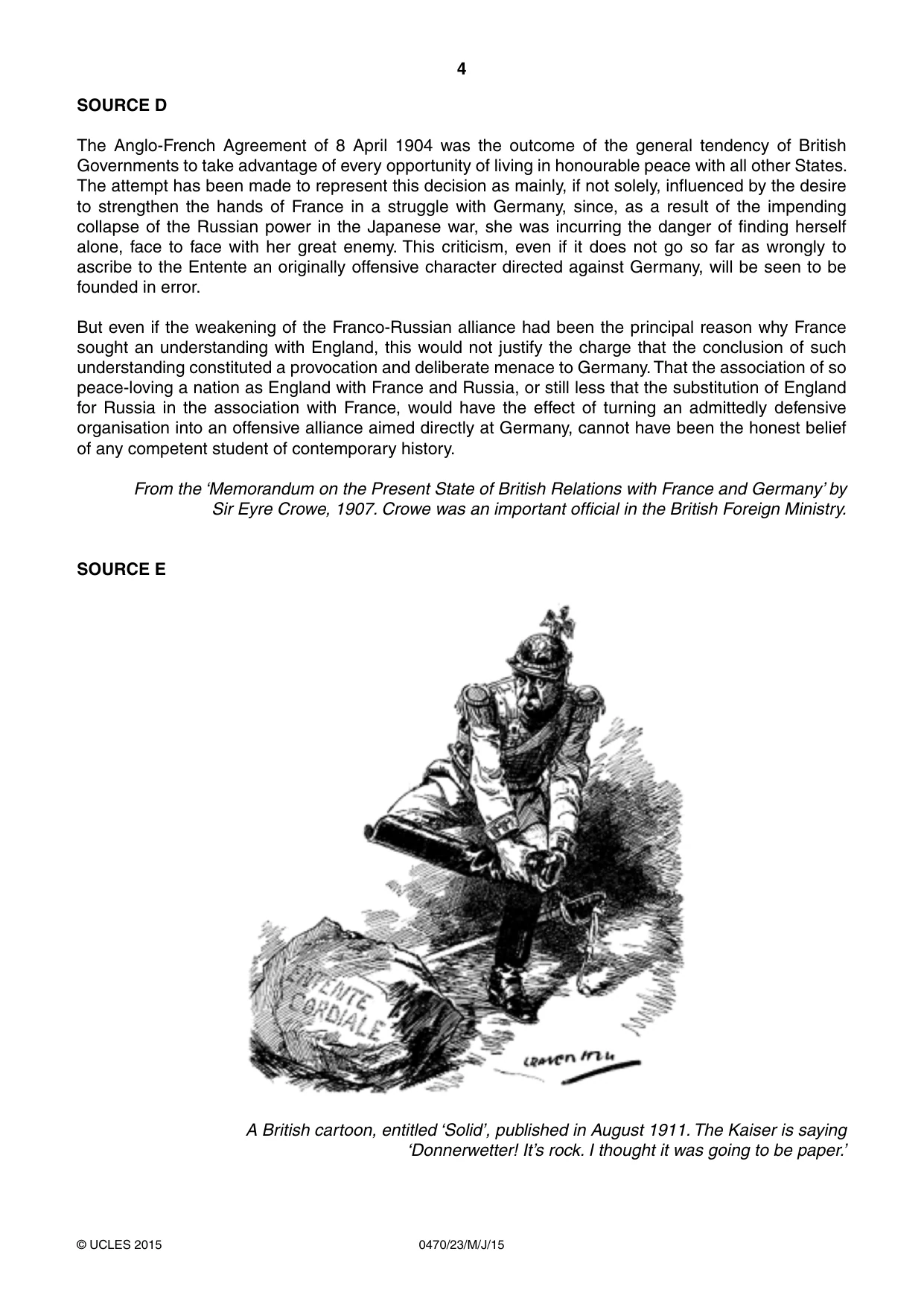
4 0470/23/M/J/15 © UCLES 2015 SOURCE D The Anglo-French Agreement of 8 April 1904 was the outcome of the general tendency of British Governments to take advantage of every opportunity of living in honourable peace with all other States. The attempt has been made to represent this decision as mainly, if not solely, influenced by the desire to strengthen the hands of France in a struggle with Germany, since, as a result of the impending collapse of the Russian power in the Japanese war, she was incurring the danger of finding herself alone, face to face with her great enemy. This criticism, even if it does not go so far as wrongly to ascribe to the Entente an originally offensive character directed against Germany, will be seen to be founded in error. But even if the weakening of the Franco-Russian alliance had been the principal reason why France sought an understanding with England, this would not justify the charge that the conclusion of such understanding constituted a provocation and deliberate menace to Germany. That the association of so peace-loving a nation as England with France and Russia, or still less that the substitution of England for Russia in the association with France, would have the effect of turning an admittedly defensive organisation into an offensive alliance aimed directly at Germany, cannot have been the honest belief of any competent student of contemporary history. From the ‘Memorandum on the Present State of British Relations with France and Germany’ by Sir Eyre Crowe, 1907. Crowe was an important official in the British Foreign Ministry. SOURCE E A British cartoon, entitled ‘Solid’, published in August 1911. The Kaiser is saying ‘Donnerwetter! It’s rock. I thought it was going to be paper.’
Question paper, page 5
5 0470/23/M/J/15 © UCLES 2015 [Turn over SOURCE F It was impossible as ever to give any pledge to France that Britain would take part in a continental war. The fact that we remained unpledged must be made quite clear. Neither these nor other consultations between British and French authorities ever amounted to anything like a political agreement involving any obligation on the Governments; and later attempts to make them appear so are wrong. From Sir Edward Grey’s memoirs published in 1925. This is his account of what he said in a meeting with members of the French government, April 1914. Grey was in charge of British foreign policy. SOURCE G Whatever we may think of the merits of the Austrian charges against Serbia, France and Russia consider that these are mere excuses, and that the bigger cause of Triple Alliance versus Triple Entente has definitely begun. I think it would be dangerous for England to attempt to contradict this opinion, or to try and hide the real issue. Our interests are tied up with those of France and Russia in this struggle, which is not for the possession of Serbia. It is a struggle between Germany, aiming at a political dictatorship in Europe, and the Powers who desire to retain individual freedom. A note written for ministers in the British government by an official in the British Foreign Ministry, 25 July 1914.
Question paper, page 6
6 0470/23/M/J/15 © UCLES 2015 Now answer all the following questions. You may use any of the sources to help you answer the questions, in addition to those sources which you are told to use. In answering the questions you should use your knowledge of the topic to help you interpret and evaluate the sources. 1 Study Sources A and B. How far do these two sources agree? Explain your answer using details of the sources. [8] 2 Study Source C. What is the message of this source? Explain your answer using details of the source and your knowledge. [7] 3 Study Source D. Why was this source written in 1907? Explain your answer using details of the source and your knowledge. [7] 4 Study Source E. Are you surprised by this source? Explain your answer using details of the source and your knowledge. [8] 5 Study Sources F and G. Must one of these sources be wrong? Explain your answer using details of the sources and your knowledge. [8] 6 Study all the sources. How far do these sources provide convincing evidence the Anglo-French Entente was a threat to Germany? Use the sources to explain your answer. [12]
Question paper, page 7
7 0470/23/M/J/15 © UCLES 2015 [Turn over Option B: 20th Century topic WHY WAS HITLER ABLE TO ACHIEVE ANSCHLUSS WITH AUSTRIA IN 1938? Study the Background Information and the sources carefully, and then answer all the questions. Background Information One of the Nazis’ most treasured ambitions was Anschluss – the unification of Germany and Austria. In 1934 the Austrian Chancellor was assassinated by Austrian Nazis in an attempted coup. Mussolini opposed the attempted Anschluss and even threatened war. Hitler backed down. There followed a campaign of terrorism by the Austrian Nazis while Hitler maintained pressure for the union. As a desperate attempt to preserve Austria’s independence, in 1938 the Austrian Chancellor Schuschnigg planned to hold a plebiscite on the issue of Anschluss but on 11 March Hitler demanded that it be postponed and that Seyss-Inquart replaced Schuschnigg as Chancellor. The new Chancellor then claimed there was disorder in Austria and asked for German troops to restore order. On 12 March Hitler sent in German troops. This time Mussolini did not object to Anschluss. Was Hitler able to achieve what he wanted because of Mussolini’s change of attitude? SOURCE A Everyone knew that Hitler intended to move and that Austria would be one of his first victims. Hitler had made diplomatic preparations including the winning over of Italy. Mussolini’s journey to Berlin in September 1937 sealed Austria’s fate. Hitler could be confident that Mussolini would not object to Anschluss. Italy’s heavy involvement in Spain could have only encouraged his optimism. France and Britain were already adjusting to the prospect of a German move into Austria. As early as February 1937, the French Foreign Minister told the American Ambassador that France would not fight for Austrian independence and in late April admitted that Germany could take Austria any time. By early 1937, the British too had accepted the idea of German expansion, although they hoped that Hitler would refrain from armed aggression and any resort to force. On 12 March 1938 German troops marched into Austria to cheering crowds. Steps were taken to reassure Mussolini, who had been promised that he would be consulted before any action was taken over Austria. In fact, the decision to march was taken before Mussolini’s reply was received. Nonetheless, Hitler was relieved and grateful to receive Mussolini’s positive response. Hitler had taken only the most modest of gambles when he sent his army into Austria, though the army was ill-prepared even for this limited action. Though Schuschnigg’s later critics have argued that even a brief struggle might have cast doubts on the story of a ‘festive entry’, the welcome given to Hitler suggests otherwise. The Austrian National Socialists had done their job well; those who opposed Anschluss were scattered and powerless. The ‘Anschluss from inside’ worked better than the invasion of the German army. From a history book published in 2011.
Question paper, page 8
8 0470/23/M/J/15 © UCLES 2015 SOURCE B Hitler’s decision to force a resolution of the Austrian problem took shape in November 1937. By that time he was relatively certain that Mussolini would not lift a finger to save Austria, and he strongly suspected the other major powers would not come to its defence either. On 6 November Mussolini told the Germans that he had told the French that Italy would not move against Germany if a crisis should arise in Austria. On 19 November, Lord Halifax met Hitler. Germany’s intentions, Hitler suggested, were entirely peaceful. Moved by Hitler’s solemn promises to preserve peace, Halifax made the extraordinary admission that Britain saw no reason why Germany’s grievances in Austria, Czechoslovakia and Danzig could not be appeased. Also in November, the French said that they had no objection to a further assimilation of certain of Austria’s domestic institutions with Germany’s. Why was Hitler able to achieve this act of aggression without a single determined protest from the Western powers? Schuschnigg had laboured under the illusion that Mussolini was still the protector of Austrian independence when, in reality, he had long shifted his focus from Austria to the Mediterranean. As a result of this shift, Mussolini had drawn closer to Germany and initiated the Rome-Berlin axis. Thus, when Austria’s day of reckoning came, Italy had deserted it. Yet Hitler seems to have had considerable doubts on the day of the Austrian Anschluss, dispatching a personal letter to Mussolini in which he tried to justify his action. When Hitler was told that Mussolini had accepted the whole thing, he was overcome with gratitude, pledging his support for Mussolini through thick and thin. From a history book published in 1995. SOURCE C Please tell Mussolini I will never forget him for this. Listen, I shall make any agreement. I am no longer in fear of the terrible position which would have existed militarily in case we had got into a conflict. You may tell him that I thank him ever so much. Never, never shall I forget. Hitler speaking on the telephone to the official whom he had sent with a message to Mussolini on the day of the Anschluss. Hitler’s message to Mussolini had given a justification for his action. SOURCE D The Government of the German Reich presented us with an ultimatum with a time limit according to which we had to appoint as Chancellor a candidate named by the German Reich. Otherwise it was intended that German troops should march into Austria at the hour named. I declare before the world that the reports which have been spread in Austria that there have been troubles and that the Government was not in control and could not maintain order are lies. We yield to force. Because we do not want to shed German blood, we have ordered our armed forces, in case invasion is carried out, to withdraw without resistance. So I take my leave in this hour of the Austrian people. God protect Austria. Schuschnigg’s final radio broadcast, on 11 March 1938.
Question paper, page 9
9 0470/23/M/J/15 © UCLES 2015 [Turn over SOURCE E Certain foreign newspapers have said that we fell on Austria with brutal methods. I can only say that even now they cannot stop lying. I have in the course of my political struggle won much love from my people, but when I crossed the former frontier into Austria there met me such a stream of love as I have never experienced. Not as tyrants have we come, but as liberators. From a speech by Hitler on 25 March 1938. SOURCE F His Majesty’s government cannot take responsibility for advising the Chancellor to take any course of action which might expose his country to dangers against which it is unable to guarantee protection. The reply of the British government to a request from Schuschnigg for advice, 11 March 1938. SOURCE G His Majesty’s Government have throughout been in the closest touch with the situation. The Foreign Secretary saw the German Foreign Minister on 10 March and addressed to him a grave warning on the Austrian situation. Late on 11 March our Ambassador in Berlin registered a protest in strong terms with the German Government against such use of coercion, backed by force, against an independent state. The events which are in our minds today will be the cause of regret and of sorrow. They cannot be ignored by His Majesty’s Government. They are bound to have effects which cannot yet be measured. The immediate result must be to intensify the sense of uncertainty and insecurity in Europe. This is not a moment for hasty decisions or for careless words. We must consider the new situation quickly, but with cool judgement. The hard fact is that nothing could have stopped what has actually happened in Austria unless this country and other countries had been prepared to use force. From a speech in the House of Commons by Neville Chamberlain, the British Prime Minister, 14 March 1938.
Question paper, page 10
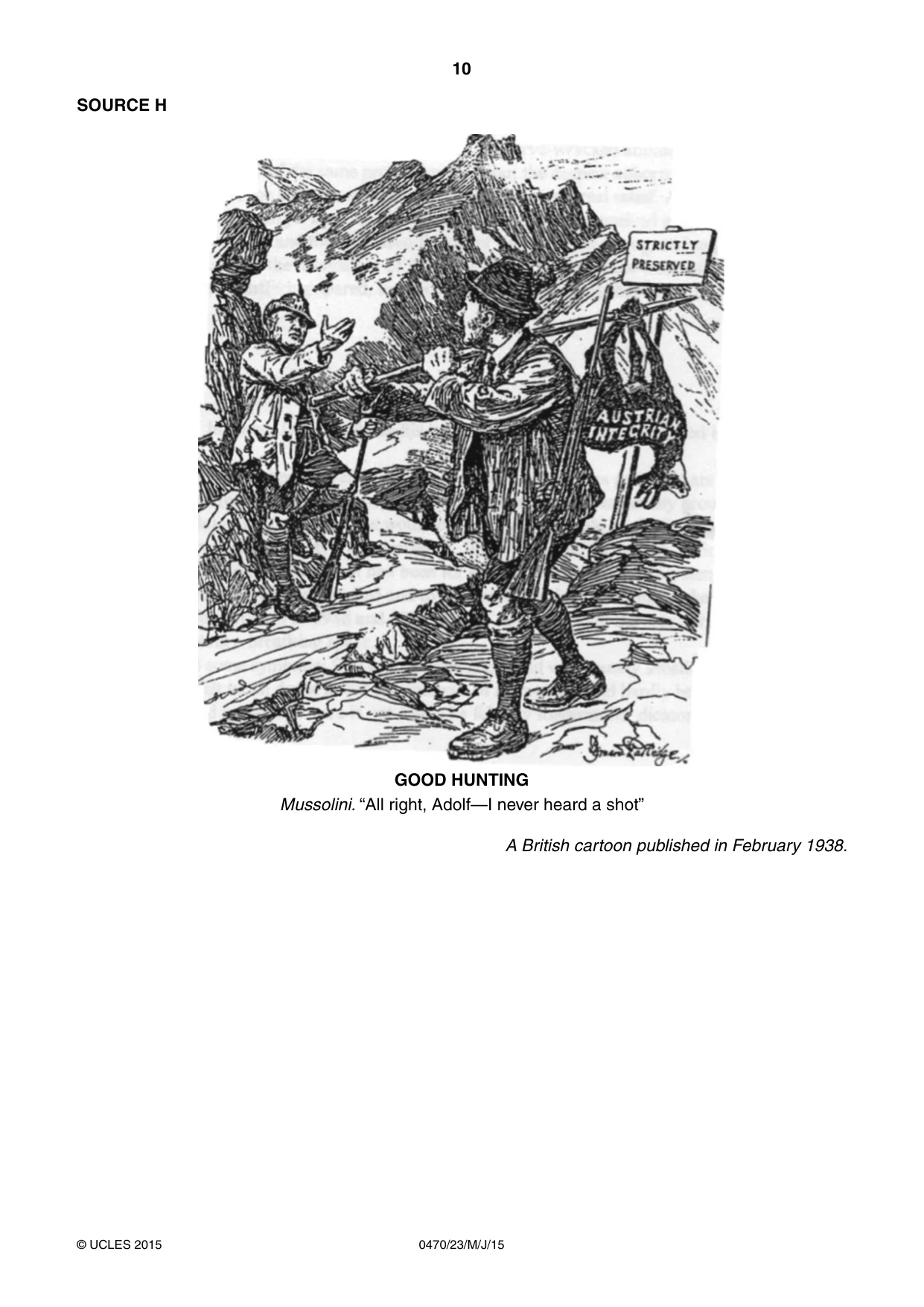
10 0470/23/M/J/15 © UCLES 2015 SOURCE H GOOD HUNTING Mussolini. “All right, Adolf—I never heard a shot” A British cartoon published in February 1938.
Question paper, page 11
11 0470/23/M/J/15 © UCLES 2015 Now answer all the following questions. You may use any of the sources to help you answer the questions, in addition to those sources which you are told to use. In answering the questions you should use your knowledge of the topic to help you interpret and evaluate the sources. 1 Study Sources A and B. How far do these two sources agree? Explain your answer using details of the sources. [7] 2 Study Source C. How far do you trust what Hitler is saying in this source? Explain your answer using details of the source and your knowledge. [8] 3 Study Sources D and E. Does Source D prove that Hitler is lying in Source E? Explain your answer using details of the sources and your knowledge. [8] 4 Study Sources F and G. Does Source F make you surprised by Source G? Explain your answer using details of the sources and your knowledge. [7] 5 Study Source H. Why was this cartoon published at this time? Explain your answer using details of the source and your knowledge. [8] 6 Study all the sources. How far do these sources provide convincing evidence that Hitler achieved the Anschluss because of the attitude of Mussolini? Use the sources to explain your answer. [12]
Question paper, page 12
12 0470/23/M/J/15 © UCLES 2015 BLANK PAGE Permission to reproduce items where third-party owned material protected by copyright is included has been sought and cleared where possible. Every reasonable effort has been made by the publisher (UCLES) to trace copyright holders, but if any items requiring clearance have unwittingly been included, the publisher will be pleased to make amends at the earliest possible opportunity. To avoid the issue of disclosure of answer-related information to candidates, all copyright acknowledgements are reproduced online in the Cambridge International Examinations Copyright Acknowledgements Booklet. This is produced for each series of examinations and is freely available to download at www.cie.org.uk after the live examination series. Cambridge International Examinations is part of the Cambridge Assessment Group. Cambridge Assessment is the brand name of University of Cambridge Local Examinations Syndicate (UCLES), which is itself a department of the University of Cambridge.
Mark scheme, page 1
® IGCSE is the registered trademark of Cambridge International Examinations. CAMBRIDGE INTERNATIONAL EXAMINATIONS Cambridge International General Certificate of Secondary Education MARK SCHEME for the May/June 2015 series 0470 HISTORY 0470/23 Paper 2, maximum raw mark 50 This mark scheme is published as an aid to teachers and candidates, to indicate the requirements of the examination. It shows the basis on which Examiners were instructed to award marks. It does not indicate the details of the discussions that took place at an Examiners’ meeting before marking began, which would have considered the acceptability of alternative answers. Mark schemes should be read in conjunction with the question paper and the Principal Examiner Report for Teachers. Cambridge will not enter into discussions about these mark schemes. Cambridge is publishing the mark schemes for the May/June 2015 series for most Cambridge IGCSE®, Cambridge International A and AS Level components and some Cambridge O Level components.
Mark scheme, page 2
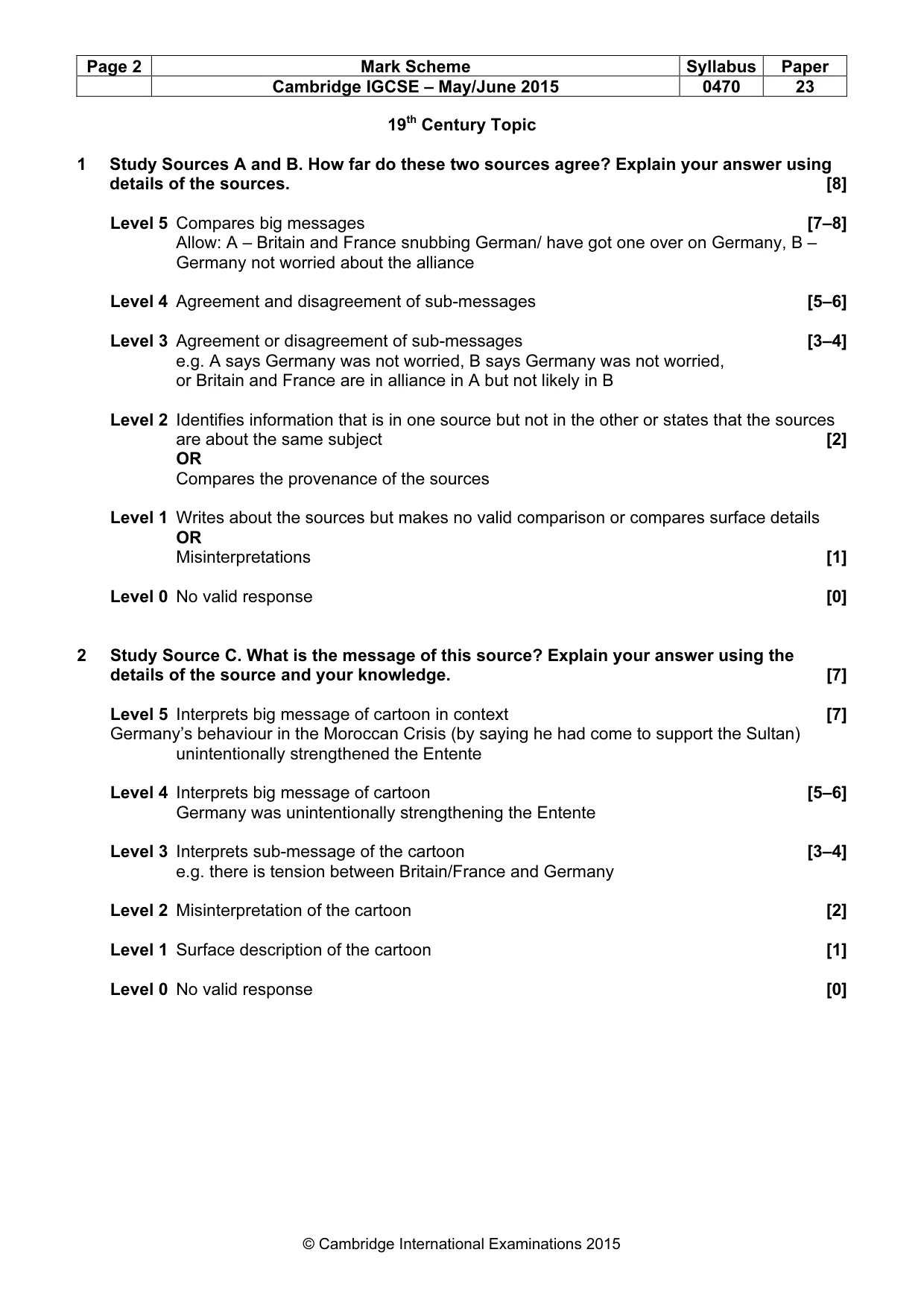
Page 2 Mark Scheme Syllabus Paper Cambridge IGCSE – May/June 2015 0470 23 © Cambridge International Examinations 2015 19th Century Topic 1 Study Sources A and B. How far do these two sources agree? Explain your answer using details of the sources. [8] Level 5 Compares big messages [7–8] Allow: A – Britain and France snubbing German/ have got one over on Germany, B – Germany not worried about the alliance Level 4 Agreement and disagreement of sub-messages [5–6] Level 3 Agreement or disagreement of sub-messages [3–4] e.g. A says Germany was not worried, B says Germany was not worried, or Britain and France are in alliance in A but not likely in B Level 2 Identifies information that is in one source but not in the other or states that the sources are about the same subject [2] OR Compares the provenance of the sources Level 1 Writes about the sources but makes no valid comparison or compares surface details OR Misinterpretations [1] Level 0 No valid response [0] 2 Study Source C. What is the message of this source? Explain your answer using the details of the source and your knowledge. [7] Level 5 Interprets big message of cartoon in context [7] Germany’s behaviour in the Moroccan Crisis (by saying he had come to support the Sultan) unintentionally strengthened the Entente Level 4 Interprets big message of cartoon [5–6] Germany was unintentionally strengthening the Entente Level 3 Interprets sub-message of the cartoon [3–4] e.g. there is tension between Britain/France and Germany Level 2 Misinterpretation of the cartoon [2] Level 1 Surface description of the cartoon [1] Level 0 No valid response [0]
Mark scheme, page 3
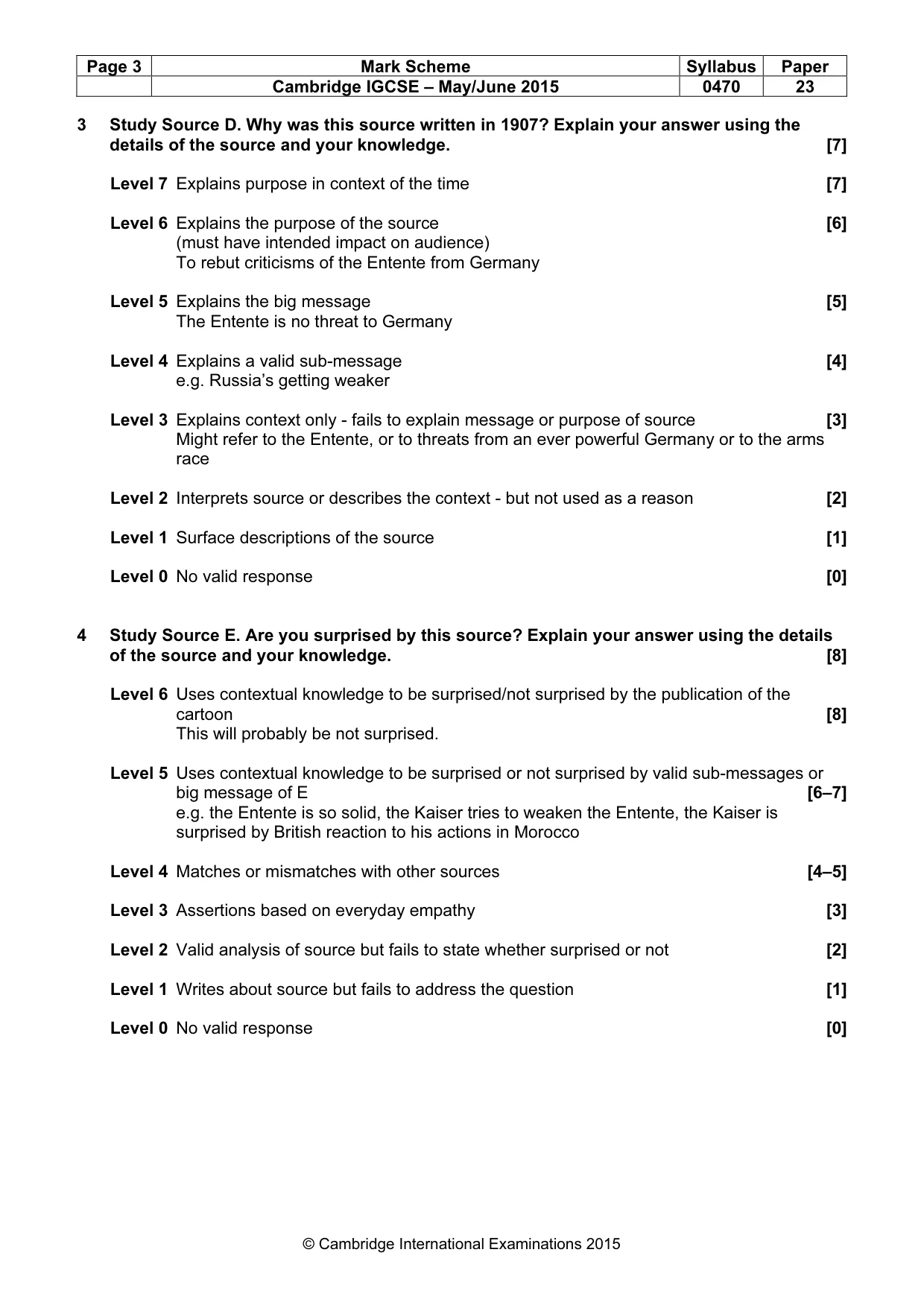
Page 3 Mark Scheme Syllabus Paper Cambridge IGCSE – May/June 2015 0470 23 © Cambridge International Examinations 2015 3 Study Source D. Why was this source written in 1907? Explain your answer using the details of the source and your knowledge. [7] Level 7 Explains purpose in context of the time [7] Level 6 Explains the purpose of the source [6] (must have intended impact on audience) To rebut criticisms of the Entente from Germany Level 5 Explains the big message [5] The Entente is no threat to Germany Level 4 Explains a valid sub-message [4] e.g. Russia’s getting weaker Level 3 Explains context only - fails to explain message or purpose of source [3] Might refer to the Entente, or to threats from an ever powerful Germany or to the arms race Level 2 Interprets source or describes the context - but not used as a reason [2] Level 1 Surface descriptions of the source [1] Level 0 No valid response [0] 4 Study Source E. Are you surprised by this source? Explain your answer using the details of the source and your knowledge. [8] Level 6 Uses contextual knowledge to be surprised/not surprised by the publication of the cartoon [8] This will probably be not surprised. Level 5 Uses contextual knowledge to be surprised or not surprised by valid sub-messages or big message of E [6–7] e.g. the Entente is so solid, the Kaiser tries to weaken the Entente, the Kaiser is surprised by British reaction to his actions in Morocco Level 4 Matches or mismatches with other sources [4–5] Level 3 Assertions based on everyday empathy [3] Level 2 Valid analysis of source but fails to state whether surprised or not [2] Level 1 Writes about source but fails to address the question [1] Level 0 No valid response [0]
Mark scheme, page 4
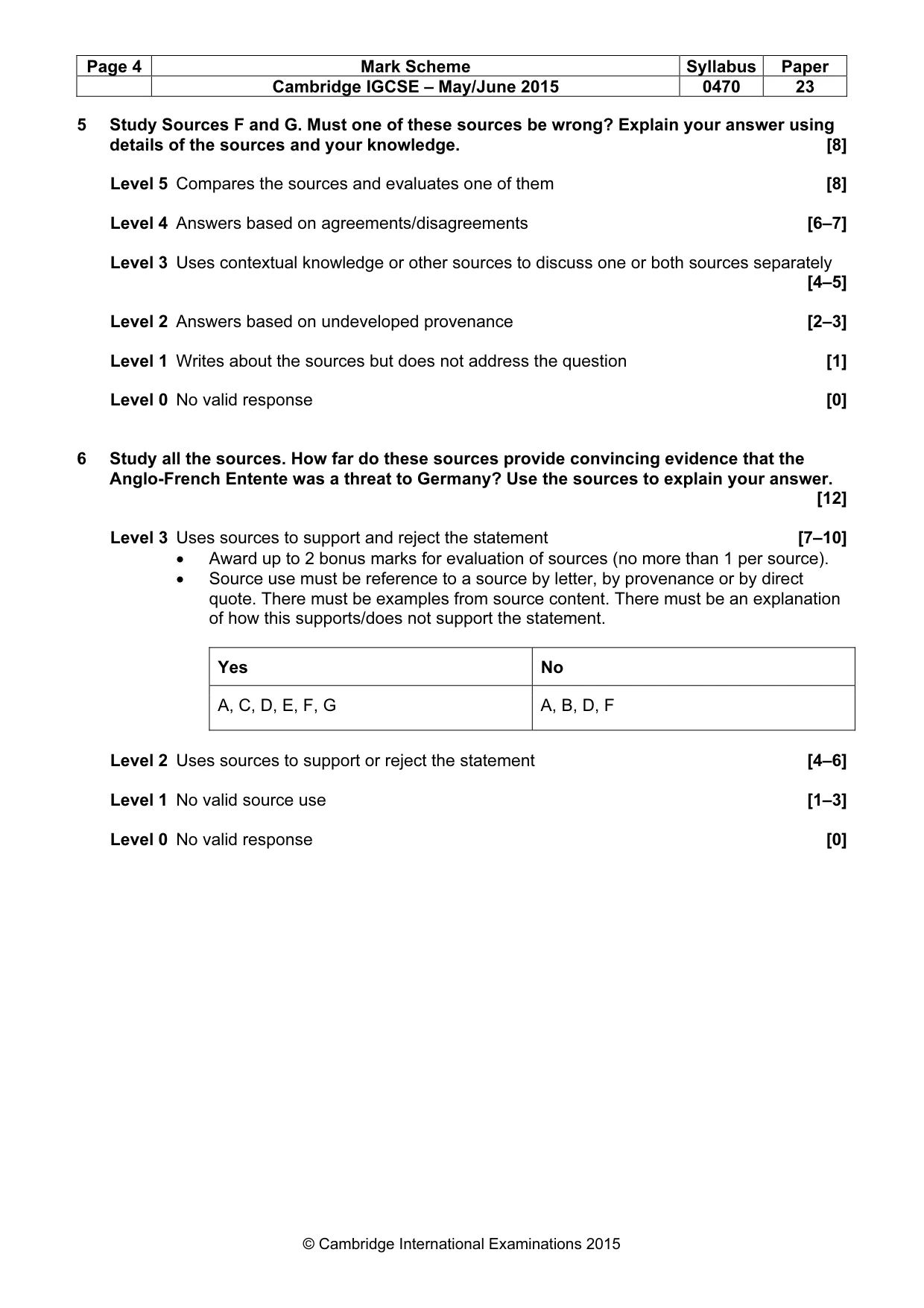
Page 4 Mark Scheme Syllabus Paper Cambridge IGCSE – May/June 2015 0470 23 © Cambridge International Examinations 2015 5 Study Sources F and G. Must one of these sources be wrong? Explain your answer using details of the sources and your knowledge. [8] Level 5 Compares the sources and evaluates one of them [8] Level 4 Answers based on agreements/disagreements [6–7] Level 3 Uses contextual knowledge or other sources to discuss one or both sources separately [4–5] Level 2 Answers based on undeveloped provenance [2–3] Level 1 Writes about the sources but does not address the question [1] Level 0 No valid response [0] 6 Study all the sources. How far do these sources provide convincing evidence that the Anglo-French Entente was a threat to Germany? Use the sources to explain your answer. [12] Level 3 Uses sources to support and reject the statement [7–10] • Award up to 2 bonus marks for evaluation of sources (no more than 1 per source). • Source use must be reference to a source by letter, by provenance or by direct quote. There must be examples from source content. There must be an explanation of how this supports/does not support the statement. Yes No A, C, D, E, F, G A, B, D, F Level 2 Uses sources to support or reject the statement [4–6] Level 1 No valid source use [1–3] Level 0 No valid response [0]
Mark scheme, page 5
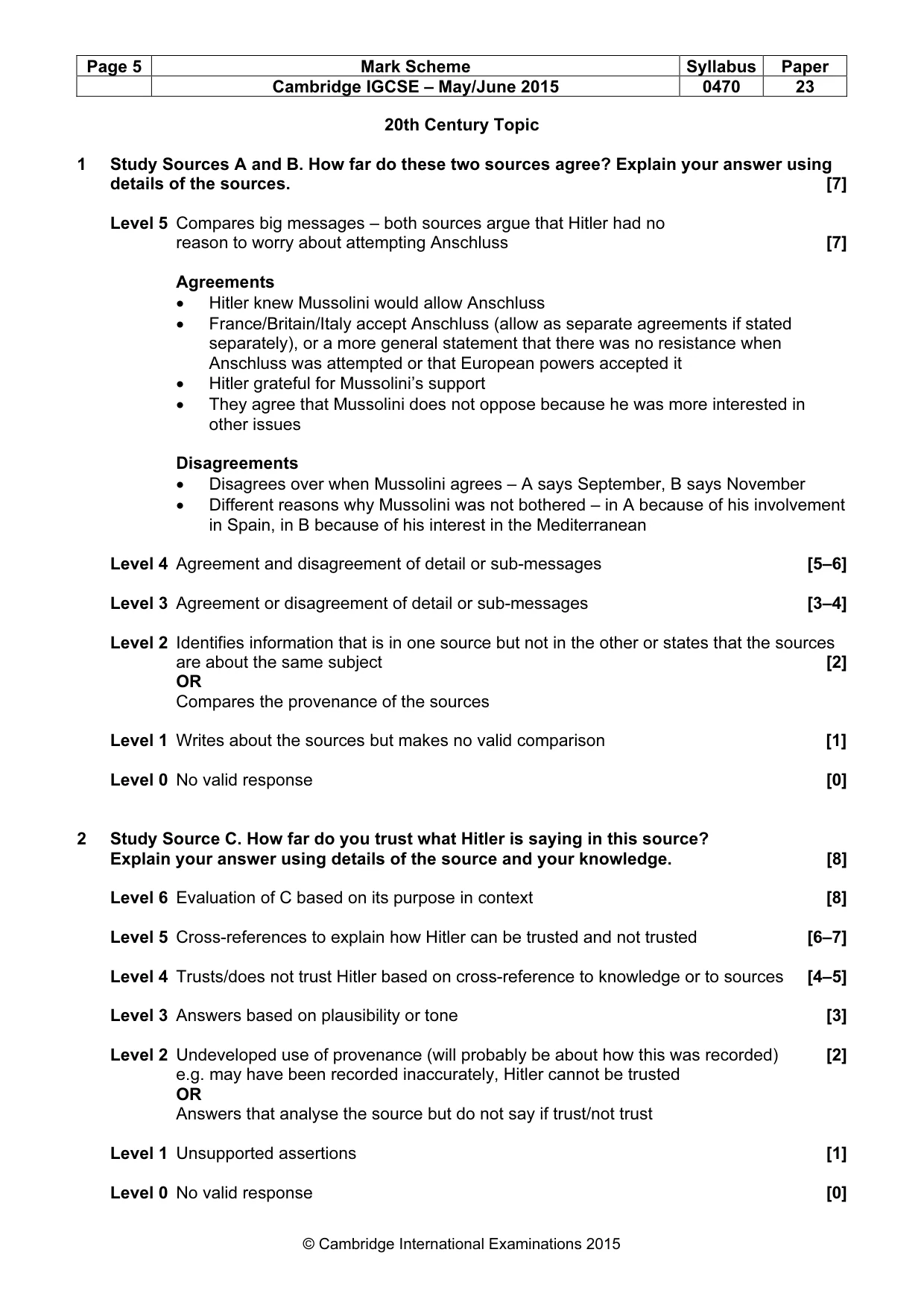
Page 5 Mark Scheme Syllabus Paper Cambridge IGCSE – May/June 2015 0470 23 © Cambridge International Examinations 2015 20th Century Topic 1 Study Sources A and B. How far do these two sources agree? Explain your answer using details of the sources. [7] Level 5 Compares big messages – both sources argue that Hitler had no reason to worry about attempting Anschluss [7] Agreements • Hitler knew Mussolini would allow Anschluss • France/Britain/Italy accept Anschluss (allow as separate agreements if stated separately), or a more general statement that there was no resistance when Anschluss was attempted or that European powers accepted it • Hitler grateful for Mussolini’s support • They agree that Mussolini does not oppose because he was more interested in other issues Disagreements • Disagrees over when Mussolini agrees – A says September, B says November • Different reasons why Mussolini was not bothered – in A because of his involvement in Spain, in B because of his interest in the Mediterranean Level 4 Agreement and disagreement of detail or sub-messages [5–6] Level 3 Agreement or disagreement of detail or sub-messages [3–4] Level 2 Identifies information that is in one source but not in the other or states that the sources are about the same subject [2] OR Compares the provenance of the sources Level 1 Writes about the sources but makes no valid comparison [1] Level 0 No valid response [0] 2 Study Source C. How far do you trust what Hitler is saying in this source? Explain your answer using details of the source and your knowledge. [8] Level 6 Evaluation of C based on its purpose in context [8] Level 5 Cross-references to explain how Hitler can be trusted and not trusted [6–7] Level 4 Trusts/does not trust Hitler based on cross-reference to knowledge or to sources [4–5] Level 3 Answers based on plausibility or tone [3] Level 2 Undeveloped use of provenance (will probably be about how this was recorded) [2] e.g. may have been recorded inaccurately, Hitler cannot be trusted OR Answers that analyse the source but do not say if trust/not trust Level 1 Unsupported assertions [1] Level 0 No valid response [0]
Mark scheme, page 6
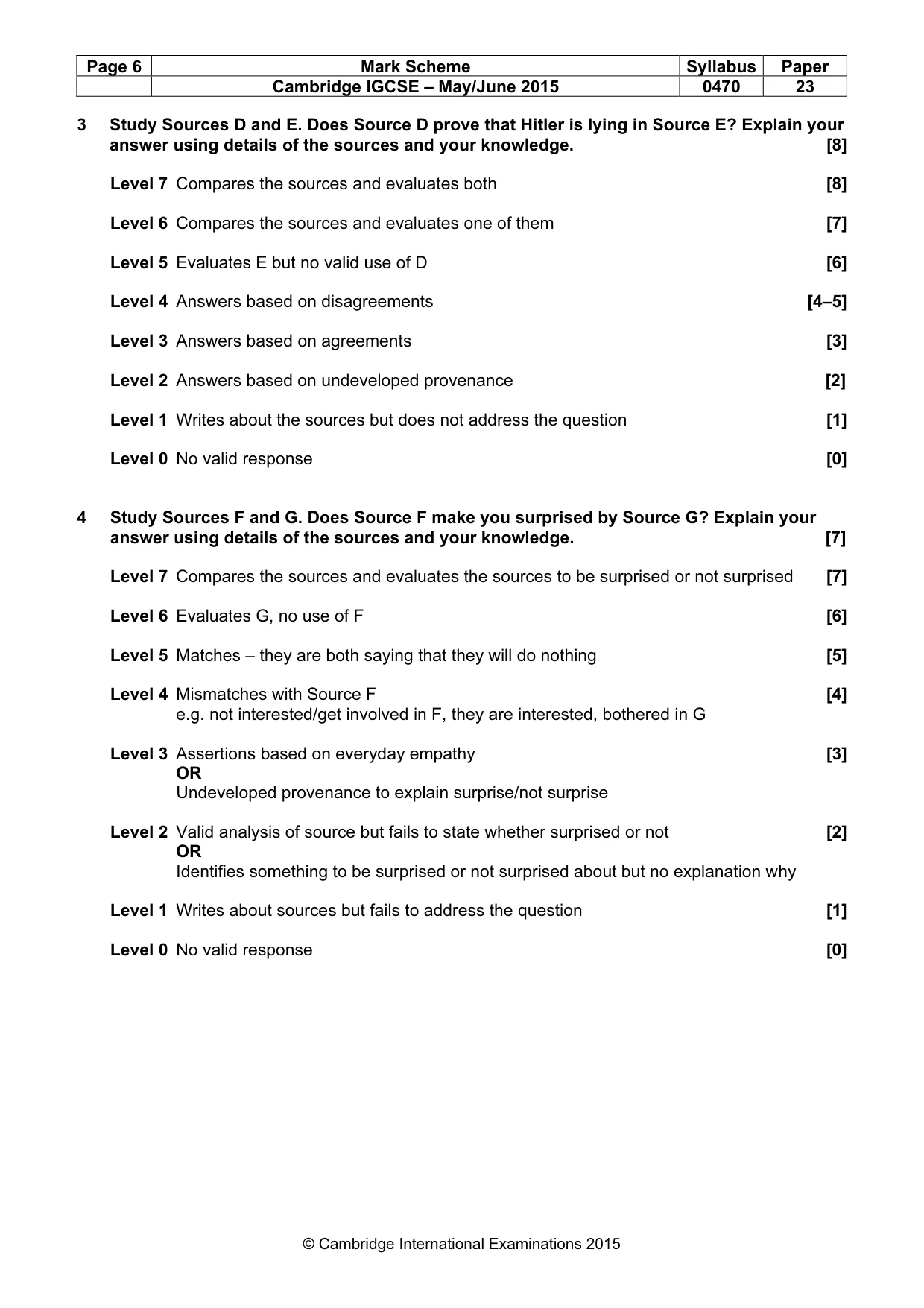
Page 6 Mark Scheme Syllabus Paper Cambridge IGCSE – May/June 2015 0470 23 © Cambridge International Examinations 2015 3 Study Sources D and E. Does Source D prove that Hitler is lying in Source E? Explain your answer using details of the sources and your knowledge. [8] Level 7 Compares the sources and evaluates both [8] Level 6 Compares the sources and evaluates one of them [7] Level 5 Evaluates E but no valid use of D [6] Level 4 Answers based on disagreements [4–5] Level 3 Answers based on agreements [3] Level 2 Answers based on undeveloped provenance [2] Level 1 Writes about the sources but does not address the question [1] Level 0 No valid response [0] 4 Study Sources F and G. Does Source F make you surprised by Source G? Explain your answer using details of the sources and your knowledge. [7] Level 7 Compares the sources and evaluates the sources to be surprised or not surprised [7] Level 6 Evaluates G, no use of F [6] Level 5 Matches – they are both saying that they will do nothing [5] Level 4 Mismatches with Source F [4] e.g. not interested/get involved in F, they are interested, bothered in G Level 3 Assertions based on everyday empathy [3] OR Undeveloped provenance to explain surprise/not surprise Level 2 Valid analysis of source but fails to state whether surprised or not [2] OR Identifies something to be surprised or not surprised about but no explanation why Level 1 Writes about sources but fails to address the question [1] Level 0 No valid response [0]
Mark scheme, page 7
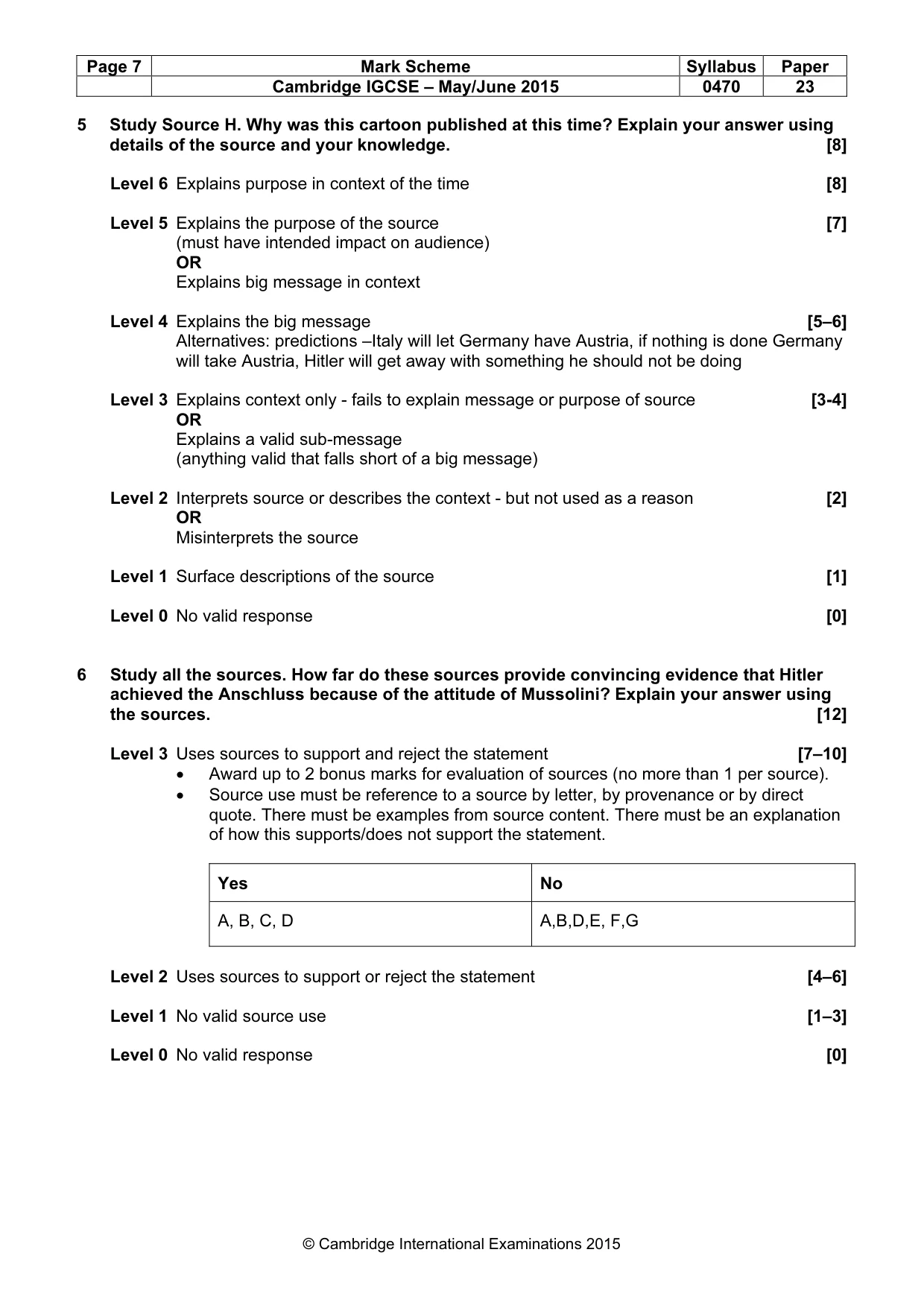
Page 7 Mark Scheme Syllabus Paper Cambridge IGCSE – May/June 2015 0470 23 © Cambridge International Examinations 2015 5 Study Source H. Why was this cartoon published at this time? Explain your answer using details of the source and your knowledge. [8] Level 6 Explains purpose in context of the time [8] Level 5 Explains the purpose of the source [7] (must have intended impact on audience) OR Explains big message in context Level 4 Explains the big message [5–6] Alternatives: predictions –Italy will let Germany have Austria, if nothing is done Germany will take Austria, Hitler will get away with something he should not be doing Level 3 Explains context only - fails to explain message or purpose of source [3-4] OR Explains a valid sub-message (anything valid that falls short of a big message) Level 2 Interprets source or describes the context - but not used as a reason [2] OR Misinterprets the source Level 1 Surface descriptions of the source [1] Level 0 No valid response [0] 6 Study all the sources. How far do these sources provide convincing evidence that Hitler achieved the Anschluss because of the attitude of Mussolini? Explain your answer using the sources. [12] Level 3 Uses sources to support and reject the statement [7–10] • Award up to 2 bonus marks for evaluation of sources (no more than 1 per source). • Source use must be reference to a source by letter, by provenance or by direct quote. There must be examples from source content. There must be an explanation of how this supports/does not support the statement. Yes No A, B, C, D A,B,D,E, F,G Level 2 Uses sources to support or reject the statement [4–6] Level 1 No valid source use [1–3] Level 0 No valid response [0]
What you needed in this session
Cambridge’s own grade thresholds for 2015 May/June, Paper 2 · Variant 3. A higher threshold means an easier paper — the bar moves with how the cohort did.