Cambridge IGCSE History 0470 — 2015 May/June Paper 2 · Variant 2
0470/22/M/J/15 · 50 marks · ≈56 min
The question paper and its mark scheme, free to read here and free to download. This is Cambridge’s own paper, exactly as it was sat.
Question paper16 pages


Mark scheme8 pages
Answers below. Sit the paper first if you are practising.
Paper as text
Question paper, page 1
This document consists of 13 printed pages, 3 blank pages and 1 insert. DC (CW/SW) 96942/4 © UCLES 2015 [Turn over Cambridge International Examinations Cambridge International General Certificate of Secondary Education * 8 8 1 5 2 8 3 1 0 4 * HISTORY 0470/22 Paper 2 May/June 2015 2 hours No Additional Materials are required. READ THESE INSTRUCTIONS FIRST An answer booklet is provided inside this question paper. You should follow the instructions on the front cover of the answer booklet. If you need additional answer paper ask the invigilator for a continuation booklet. This paper has two options. Choose one option, and then answer all of the questions on that topic. Option A: 19th Century topic [p2–p6] Option B: 20th Century topic [p7–p13] The number of marks is given in brackets [ ] at the end of each question or part question. The syllabus is approved for use in England, Wales and Northern Ireland as a Cambridge International Level 1/Level 2 Certificate.
Question paper, page 2
2 0470/22/M/J/15 © UCLES 2015 Option A: 19th Century topic COULD THE FIRST WORLD WAR HAVE BEEN AVOIDED? Study the Background Information and the sources carefully, and then answer all the questions. Background Information Tensions between the major powers in Europe grew in the early years of the twentieth century. There were rivalries over colonies and armaments and a series of crises. Gradually, the Triple Alliance and the Triple Entente emerged, splitting Europe into two. The spark for war was provided by the assassination of Archduke Franz Ferdinand in 1914 and the July crisis that followed. By early August all the major European powers were at war. Did the long-term tensions between the great powers make war inevitable or could war have been avoided? SOURCE A Given the horrors of the First World War, it is tempting to ask what, if anything, could have been done to avert war in 1914. While the desire for war was clearly present, it would be wrong to see the period before the First World War as one in which only belligerence and militarism existed. Pacifism was a term that was coined in 1901 and the existence of a pacifist movement is important to remember. There were important voices who advocated limitations to arms races. The two international peace conferences at The Hague in 1899 and 1907 demonstrate that there was a real desire to try and limit the excesses of the arms race. Recent research has shown that the apparent enthusiasm with which ordinary people greeted the declarations of war has been exaggerated. There were rallies and demonstrations of patriotic fervour but many people were rather frightened and reluctant to fight in a war whose purpose they failed to see. However, if the people of Europe were not belligerent, their governments certainly were. War could only have been avoided if Berlin and Vienna had been willing to accept mediation of a problem that could have been solved at the conference table. Those mediation proposals by the government in London were turned down because it was deemed high time to ‘deal energetically with the Slavs’. Once this decision was made, the opposing alliances made an escalation of the war almost unavoidable. The government in Berlin was willing to risk an escalation of a localised war into a European war because it felt able to win and improve its position. War could have only been avoided in 1914 if all governments had had an honest desire for peace. Underestimating the war that they would unleash, and overestimating their own abilities, German and Austrian decision-makers did not have such a desire for peace. From a book published in 2000.
Question paper, page 3
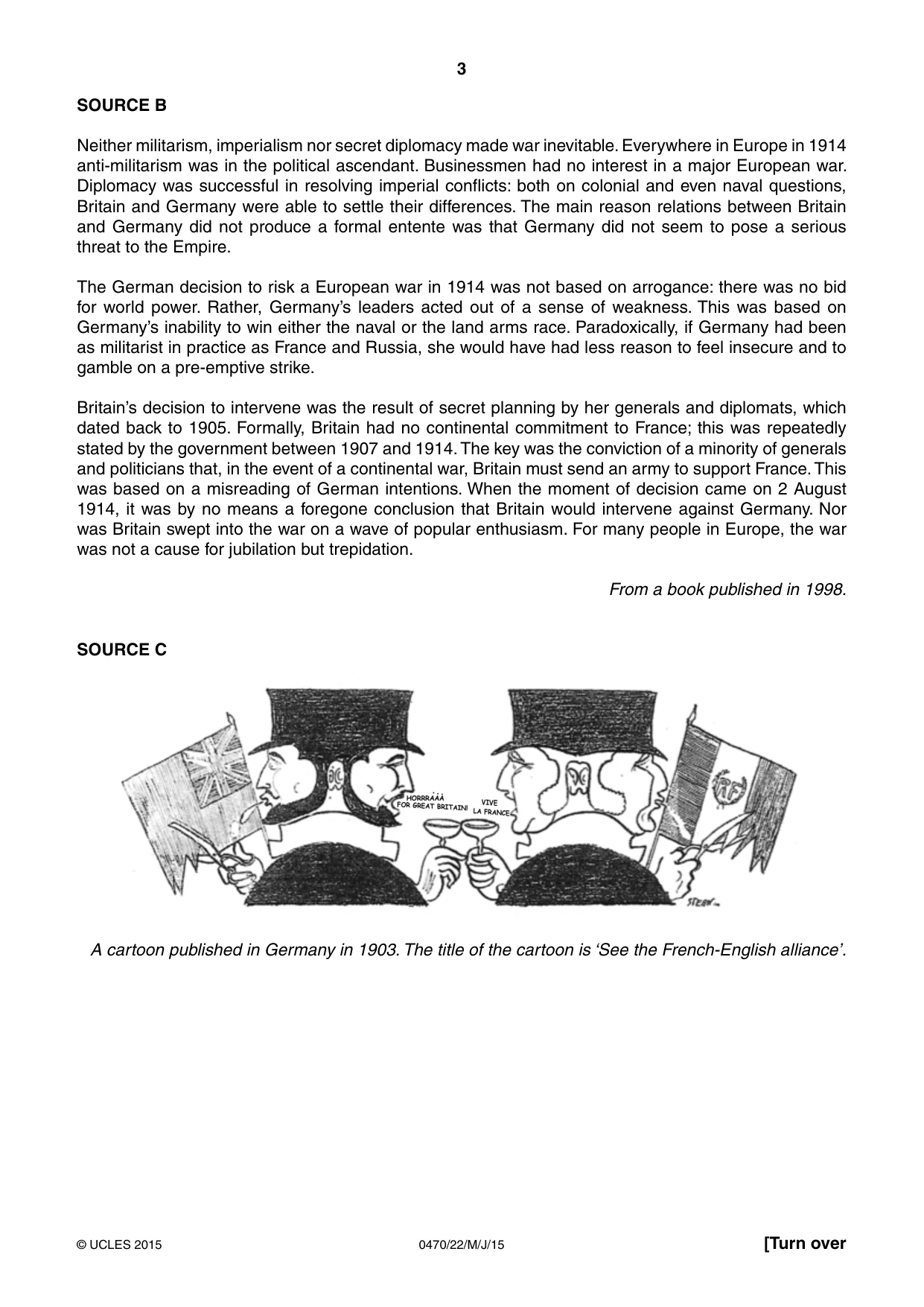
3 0470/22/M/J/15 © UCLES 2015 [Turn over SOURCE B Neither militarism, imperialism nor secret diplomacy made war inevitable. Everywhere in Europe in 1914 anti-militarism was in the political ascendant. Businessmen had no interest in a major European war. Diplomacy was successful in resolving imperial conflicts: both on colonial and even naval questions, Britain and Germany were able to settle their differences. The main reason relations between Britain and Germany did not produce a formal entente was that Germany did not seem to pose a serious threat to the Empire. The German decision to risk a European war in 1914 was not based on arrogance: there was no bid for world power. Rather, Germany’s leaders acted out of a sense of weakness. This was based on Germany’s inability to win either the naval or the land arms race. Paradoxically, if Germany had been as militarist in practice as France and Russia, she would have had less reason to feel insecure and to gamble on a pre-emptive strike. Britain’s decision to intervene was the result of secret planning by her generals and diplomats, which dated back to 1905. Formally, Britain had no continental commitment to France; this was repeatedly stated by the government between 1907 and 1914. The key was the conviction of a minority of generals and politicians that, in the event of a continental war, Britain must send an army to support France. This was based on a misreading of German intentions. When the moment of decision came on 2 August 1914, it was by no means a foregone conclusion that Britain would intervene against Germany. Nor was Britain swept into the war on a wave of popular enthusiasm. For many people in Europe, the war was not a cause for jubilation but trepidation. From a book published in 1998. SOURCE C A cartoon published in Germany in 1903. The title of the cartoon is ‘See the French-English alliance’.
Question paper, page 4
4 0470/22/M/J/15 © UCLES 2015 SOURCE D When I first heard of the murder of Archduke Ferdinand I felt it was a very serious matter but my fears were soon calmed. The Kaiser had left on his yachting holiday and, still more reassuring, the head of the German army had gone to a health resort. I remember that some time in July, an influential Hungarian lady told me that we were taking the assassination of the Archduke much too quietly; that it had provoked such a storm throughout the Austrian empire as she had never witnessed – and that unless something was done immediately, it would certainly result in war with Serbia, with the terrible consequences which such an operation might precipitate in Europe. However, official reports at the time did not seem to justify the alarmist view she took. From the War Memoirs of David Lloyd George, published in the 1930s. Lloyd George was a member of the British government in 1914. SOURCE E Whatever we may think of the merits of the Austrian charges against Serbia, France and Russia consider that these are mere excuses, and that the bigger cause of Triple Alliance versus Triple Entente has definitely begun. I think it would be dangerous for England to attempt to contradict this opinion, or to try and hide the real issue. Our interests are tied up with those of France and Russia in this struggle, which is not for the possession of Serbia. It is a struggle between Germany, aiming at a political dictatorship in Europe, and the Powers who desire to retain individual freedom. A note written for ministers in the British government by an official in the British Foreign Ministry, 25 July 1914. SOURCE F An unjust war has been declared on the weak country of Serbia. The anger among the Russian people about this declaration, which is fully shared by me, is enormous. I anticipate that very soon I shall be overwhelmed by the pressure forced upon me to take extreme measures which will lead to war. To try to avoid such a calamity as a European war I beg you, in the name of our friendship, to do what you can to stop your ally, Austria-Hungary, from going too far. From a communication sent by Tsar Nicholas of Russia to Kaiser Wilhelm of Germany, 29 July 1914. Nicholas and Wilhelm were cousins. The Tsar had ordered partial mobilisation of his armed forces the day before.
Question paper, page 5
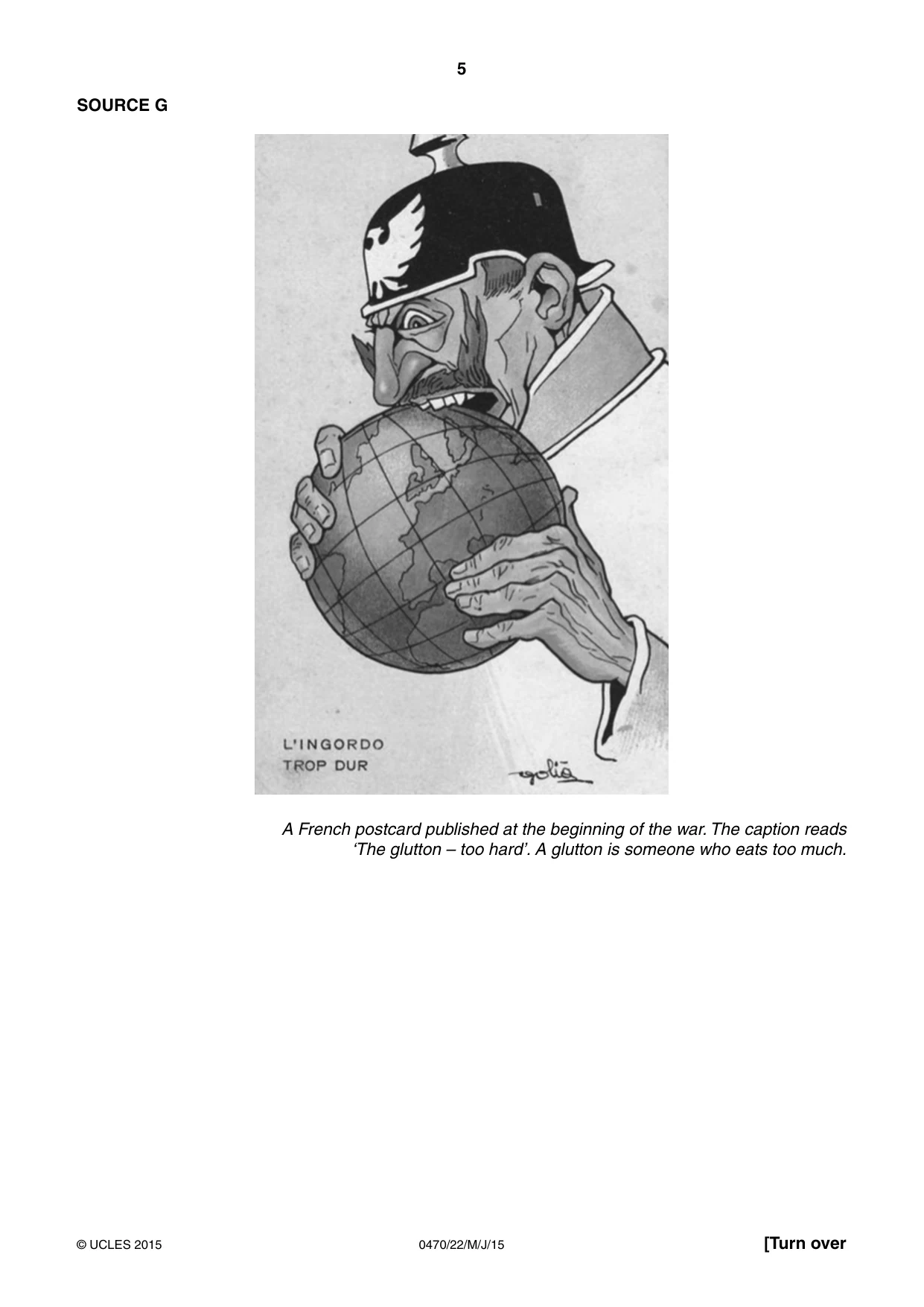
5 0470/22/M/J/15 © UCLES 2015 [Turn over SOURCE G A French postcard published at the beginning of the war. The caption reads ‘The glutton – too hard’. A glutton is someone who eats too much.
Question paper, page 6
6 0470/22/M/J/15 © UCLES 2015 Now answer all the following questions. You may use any of the sources to help you answer the questions, in addition to those sources which you are told to use. In answering the questions you should use your knowledge of the topic to help you interpret and evaluate the sources. 1 Study Sources A and B. How far do these two sources agree? Explain your answer using details of the sources. [7] 2 Study Source C. What is the message of this source? Explain your answer using details of the source and your knowledge. [8] 3 Study Sources D and E. How far does Source E suggest that Source D is reliable? Explain your answer using details of the sources and your knowledge. [8] 4 Study Source F. Are you surprised by this source? Explain your answer using details of the source and your knowledge. [8] 5 Study Source G. Why was this source published at this time? Explain your answer using details of the source and your knowledge. [7] 6 Study all the sources. How far do these sources provide convincing evidence that the First World War could have been avoided? Use the sources to explain your answer. [12]
Question paper, page 7
7 0470/22/M/J/15 © UCLES 2015 [Turn over Option B: 20th Century topic WHY DID HITLER GET AWAY WITH THE MILITARISATION OF THE RHINELAND IN 1936? Study the Background Information and the sources carefully, and then answer all the questions. Background Information The Treaty of Versailles stated that although the Rhineland remained part of Germany, no German troops or any German fortifications were to be allowed there. Since coming to power in 1933, Hitler had been determined to reverse this situation. In 1935 France and the USSR signed a treaty of mutual support. Hitler claimed this treaty was hostile to Germany and hastened the development of secret plans for remilitarising the Rhineland. In 1936 Britain developed plans to offer Germany remilitarisation in exchange for arms limitations. However, on 7 March German troops marched into the Rhineland. There has been much disagreement about why Hitler was able to get away with this. Was it because he knew that Britain was sympathetic and would do nothing to stop him? SOURCE A Using as his excuse the French-Soviet Pact, Hitler sent a token force of 22 000 troops into the Rhineland. As they marched the inhabitants of German cities were at first stupefied and then jubilant. Laughing girls showered the soldiers with flowers. Many Rhinelanders expected the French to retaliate and the German Defence Minister was ashen-faced with anxiety. Hitler offered a 25-year non-aggression pact with France but that evening 15 000 stormtroopers paraded in Berlin singing ‘For today we own Germany and tomorrow the entire world’. This was exactly what the French feared. The French Prime Minister broadcast a reply. If acts like this were permitted, he said, there could be no peace; France would neither negotiate under menace nor let ‘Strasbourg once again come again under the fire of German guns’. However, at this time concession was almost inevitable. Germany’s occupation of the Rhineland was one of the most heavily telegraphed moves in Europe since 1918, yet French governments had made no plans to react and the government at the time was surprised. The French army was organised for defence and did not possess a single unit ready for combat. Most of the government ministers were equally passive and France’s British ally could not accept the risk of war. However, what ultimately paralysed France was the state of public opinion. The vast bulk of the population were revolted at the prospect of another war. This was the most frequent comment heard on the streets of Paris, and seen in newspapers that the French rushed out to buy. ‘Above all, no war,’ announced ‘L’Action Française’. From a history book published in 2000.
Question paper, page 8
8 0470/22/M/J/15 © UCLES 2015 SOURCE B During February the British were considering the dangerous question of the demilitarised zone, though no immediate German move was expected. As it became clear that Hitler would soon grab his prize, the British government began to think about using the Rhineland as a bargaining chip. The British government would abandon its commitments with regard to the Rhineland, in an agreement with Germany negotiated behind France’s back. Hitler achieved the full measure of surprise that he intended when the invasion took place on 7 March. 22 000 German soldiers entered the demilitarised zone. They were joined by paramilitary forces numbering some 14 000 who had been infiltrated earlier. There does not seem to have been any real anxiety in the German High Command about the situation, despite Hitler’s momentary loss of nerve on 5 March. The successful military coup was accompanied by a peace offer intended to emphasise the peaceful nature of the Rhineland occupation. The French Prime Minister, in a broadcast to the French people, asserted that Strasbourg would not be left under German guns. His resolute words fell flat. The reaction of French newspapers was remarkably calm, reflecting the mood of most of the French public. The French government agreed that France would not engage in isolated action but there were differences between France and Britain about the best policy to follow. In the belief that the French wanted firm action, the British government favoured quick condemnation of the German move and the early opening of talks (that is, strong words but no retaliation). When the French appealed to the League, Goebbels wrote in his diary on 7 March, ‘France will involve the League. Fine! It will not act. Nothing else matters.’ It soon became clear that there would be little pressure from League members for retribution. There was no promise of any participation in collective action. Hitler had every reason for confidence. Nor did the response of the League’s members suggest that he would be challenged in the future. From a history book published in 2011.
Question paper, page 9
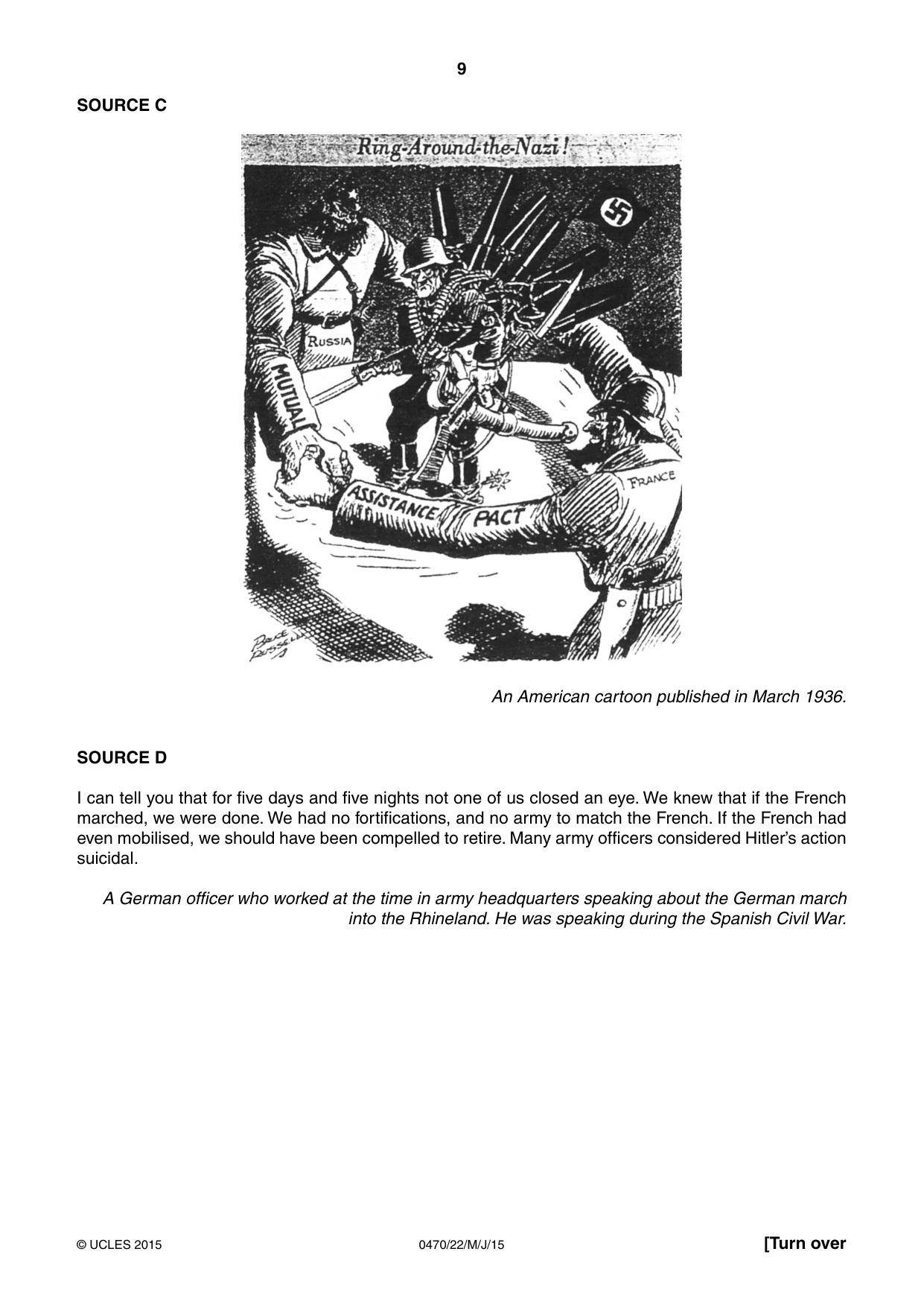
9 0470/22/M/J/15 © UCLES 2015 [Turn over SOURCE C An American cartoon published in March 1936. SOURCE D I can tell you that for five days and five nights not one of us closed an eye. We knew that if the French marched, we were done. We had no fortifications, and no army to match the French. If the French had even mobilised, we should have been compelled to retire. Many army officers considered Hitler’s action suicidal. A German officer who worked at the time in army headquarters speaking about the German march into the Rhineland. He was speaking during the Spanish Civil War.
Question paper, page 10
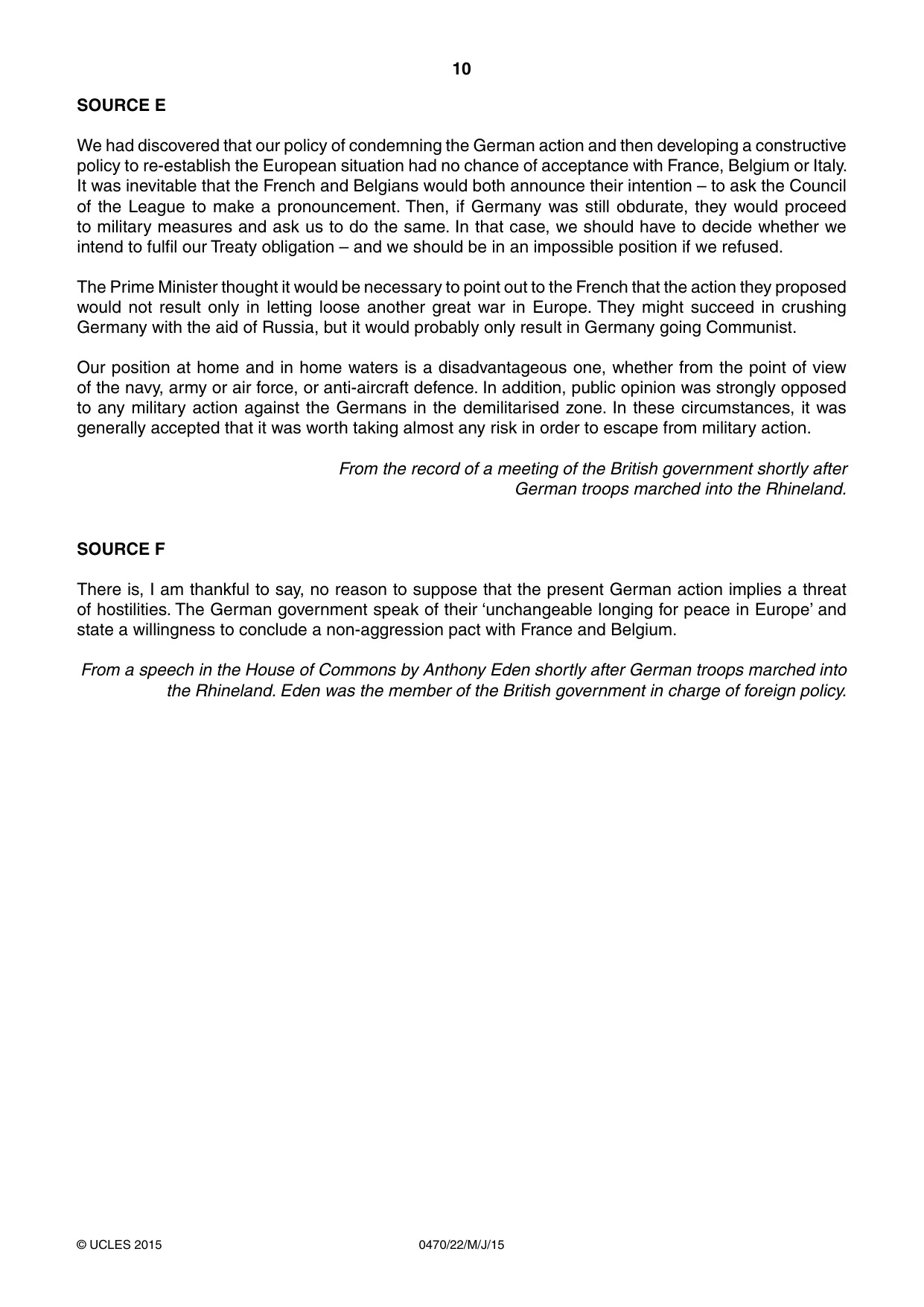
10 0470/22/M/J/15 © UCLES 2015 SOURCE E We had discovered that our policy of condemning the German action and then developing a constructive policy to re-establish the European situation had no chance of acceptance with France, Belgium or Italy. It was inevitable that the French and Belgians would both announce their intention – to ask the Council of the League to make a pronouncement. Then, if Germany was still obdurate, they would proceed to military measures and ask us to do the same. In that case, we should have to decide whether we intend to fulfil our Treaty obligation – and we should be in an impossible position if we refused. The Prime Minister thought it would be necessary to point out to the French that the action they proposed would not result only in letting loose another great war in Europe. They might succeed in crushing Germany with the aid of Russia, but it would probably only result in Germany going Communist. Our position at home and in home waters is a disadvantageous one, whether from the point of view of the navy, army or air force, or anti-aircraft defence. In addition, public opinion was strongly opposed to any military action against the Germans in the demilitarised zone. In these circumstances, it was generally accepted that it was worth taking almost any risk in order to escape from military action. From the record of a meeting of the British government shortly after German troops marched into the Rhineland. SOURCE F There is, I am thankful to say, no reason to suppose that the present German action implies a threat of hostilities. The German government speak of their ‘unchangeable longing for peace in Europe’ and state a willingness to conclude a non-aggression pact with France and Belgium. From a speech in the House of Commons by Anthony Eden shortly after German troops marched into the Rhineland. Eden was the member of the British government in charge of foreign policy.
Question paper, page 11
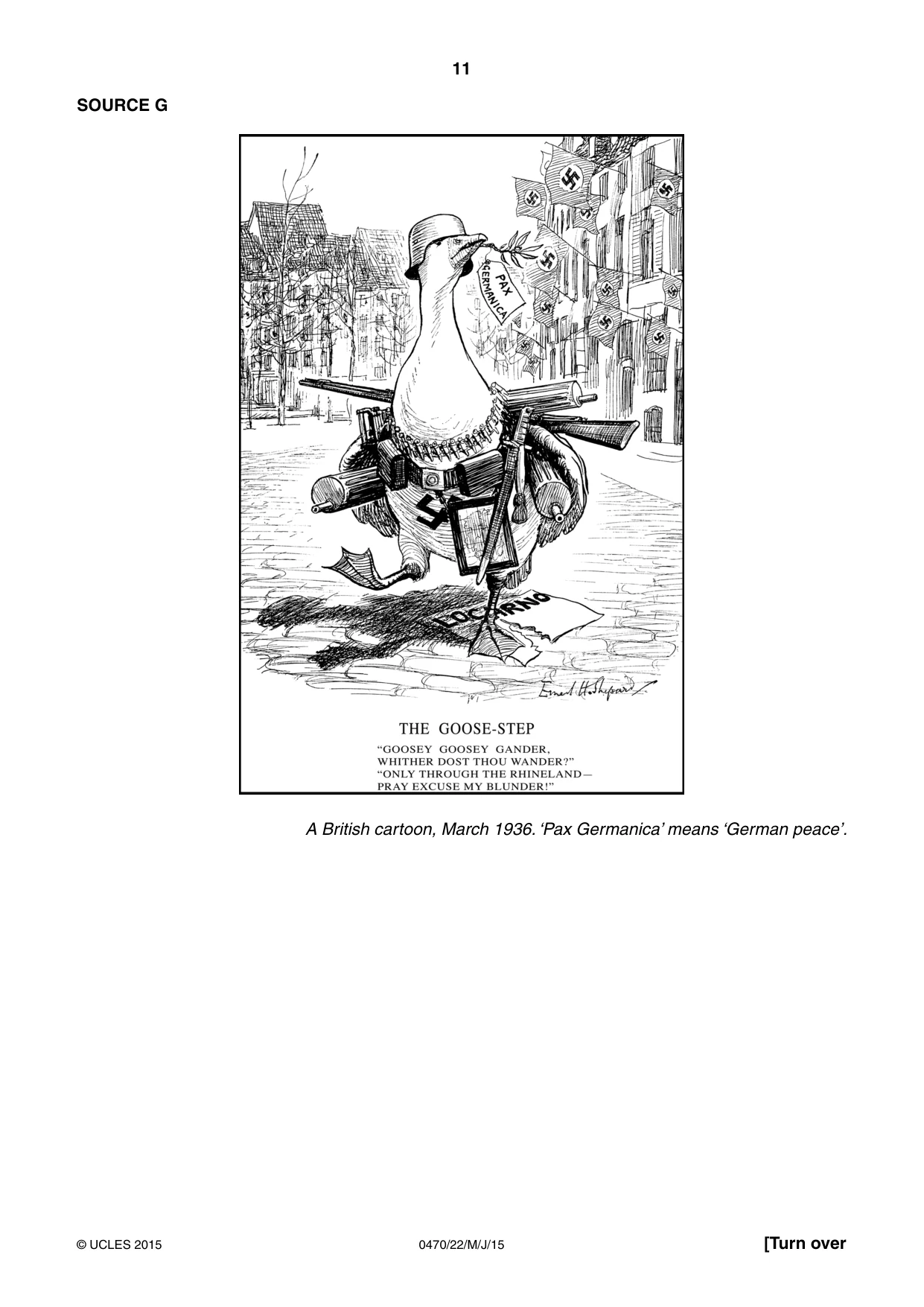
11 0470/22/M/J/15 © UCLES 2015 [Turn over SOURCE G A British cartoon, March 1936. ‘Pax Germanica’ means ‘German peace’.
Question paper, page 12
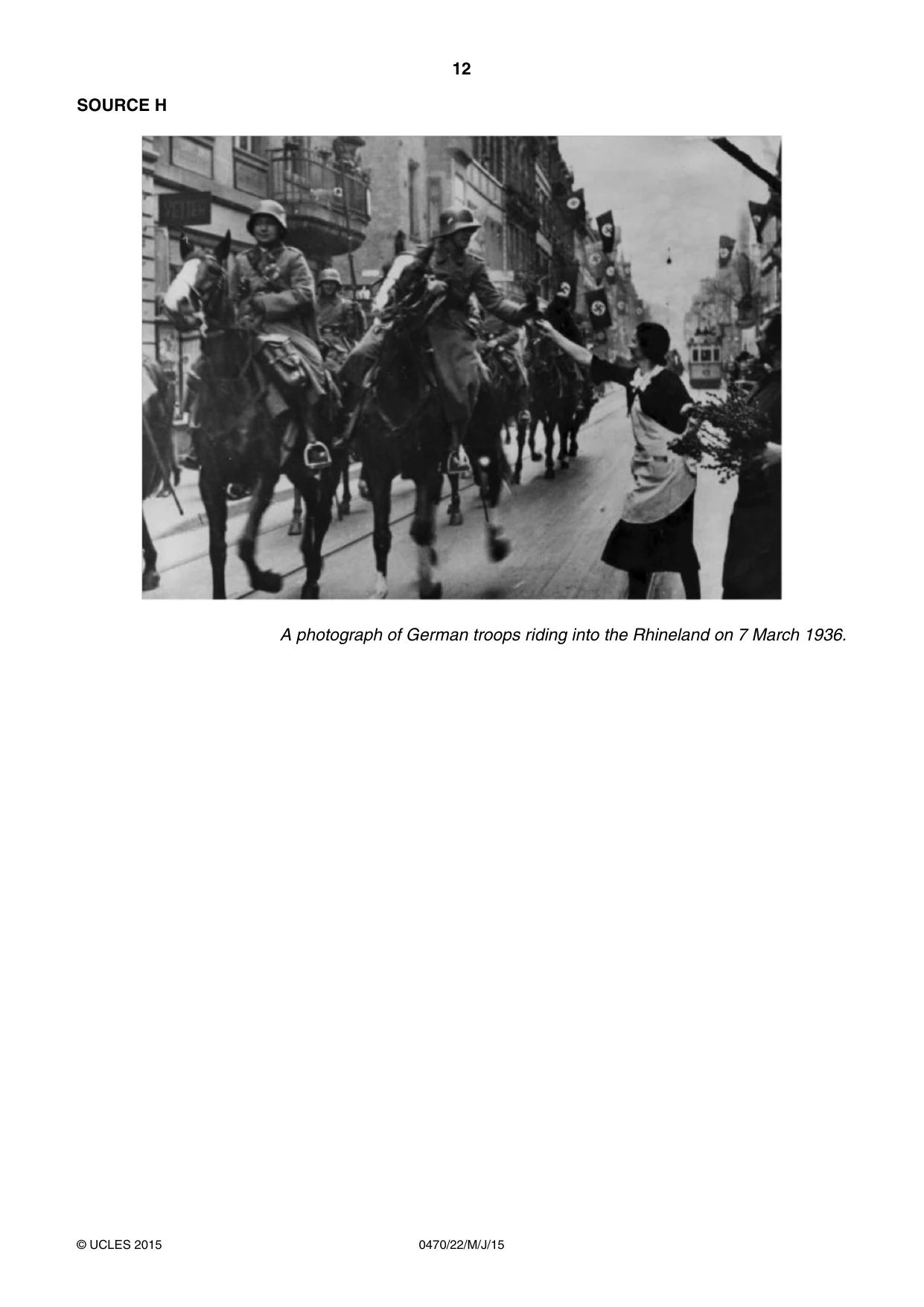
12 0470/22/M/J/15 © UCLES 2015 SOURCE H A photograph of German troops riding into the Rhineland on 7 March 1936.
Question paper, page 13
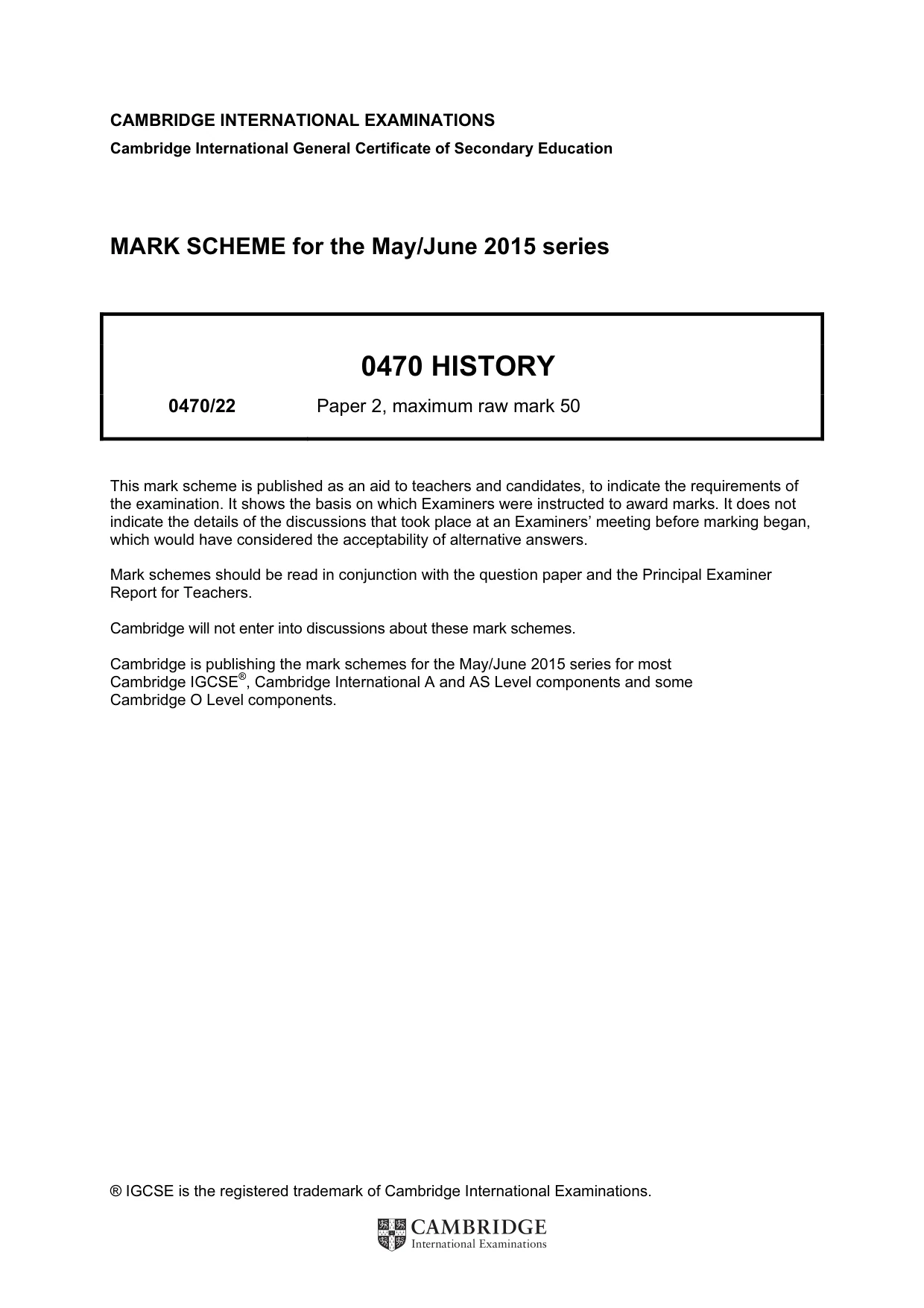
13 0470/22/M/J/15 © UCLES 2015 Now answer all the following questions. You may use any of the sources to help you answer the questions, in addition to those sources which you are told to use. In answering the questions you should use your knowledge of the topic to help you interpret and evaluate the sources. 1 Study Sources A and B. How far do these two sources agree? Explain your answer using details of the sources. [7] 2 Study Source C. What is the cartoonist’s message? Explain your answer using details of the source and your knowledge. [8] 3 Study Source D. Do you believe this source? Explain your answer using details of the source and your knowledge. [8] 4 Study Sources E and F. How far does Source E make you surprised by Source F? Explain your answer using details of the sources and your knowledge. [8] 5 Study Sources G and H. Does Source H prove that Source G is wrong? Explain your answer using details of the sources and your knowledge. [7] 6 Study all the sources. How far do these sources provide convincing evidence that Hitler got away with the remilitarisation of the Rhineland because Britain did nothing? Use the sources to explain your answer. [12]
Question paper, page 14
14 0470/22/M/J/15 © UCLES 2015 BLANK PAGE
Question paper, page 15
15 0470/22/M/J/15 © UCLES 2015 BLANK PAGE
Question paper, page 16
16 0470/22/M/J/15 © UCLES 2015 BLANK PAGE Permission to reproduce items where third-party owned material protected by copyright is included has been sought and cleared where possible. Every reasonable effort has been made by the publisher (UCLES) to trace copyright holders, but if any items requiring clearance have unwittingly been included, the publisher will be pleased to make amends at the earliest possible opportunity. To avoid the issue of disclosure of answer-related information to candidates, all copyright acknowledgements are reproduced online in the Cambridge International Examinations Copyright Acknowledgements Booklet. This is produced for each series of examinations and is freely available to download at www.cie.org.uk after the live examination series. Cambridge International Examinations is part of the Cambridge Assessment Group. Cambridge Assessment is the brand name of University of Cambridge Local Examinations Syndicate (UCLES), which is itself a department of the University of Cambridge.
Mark scheme, page 1
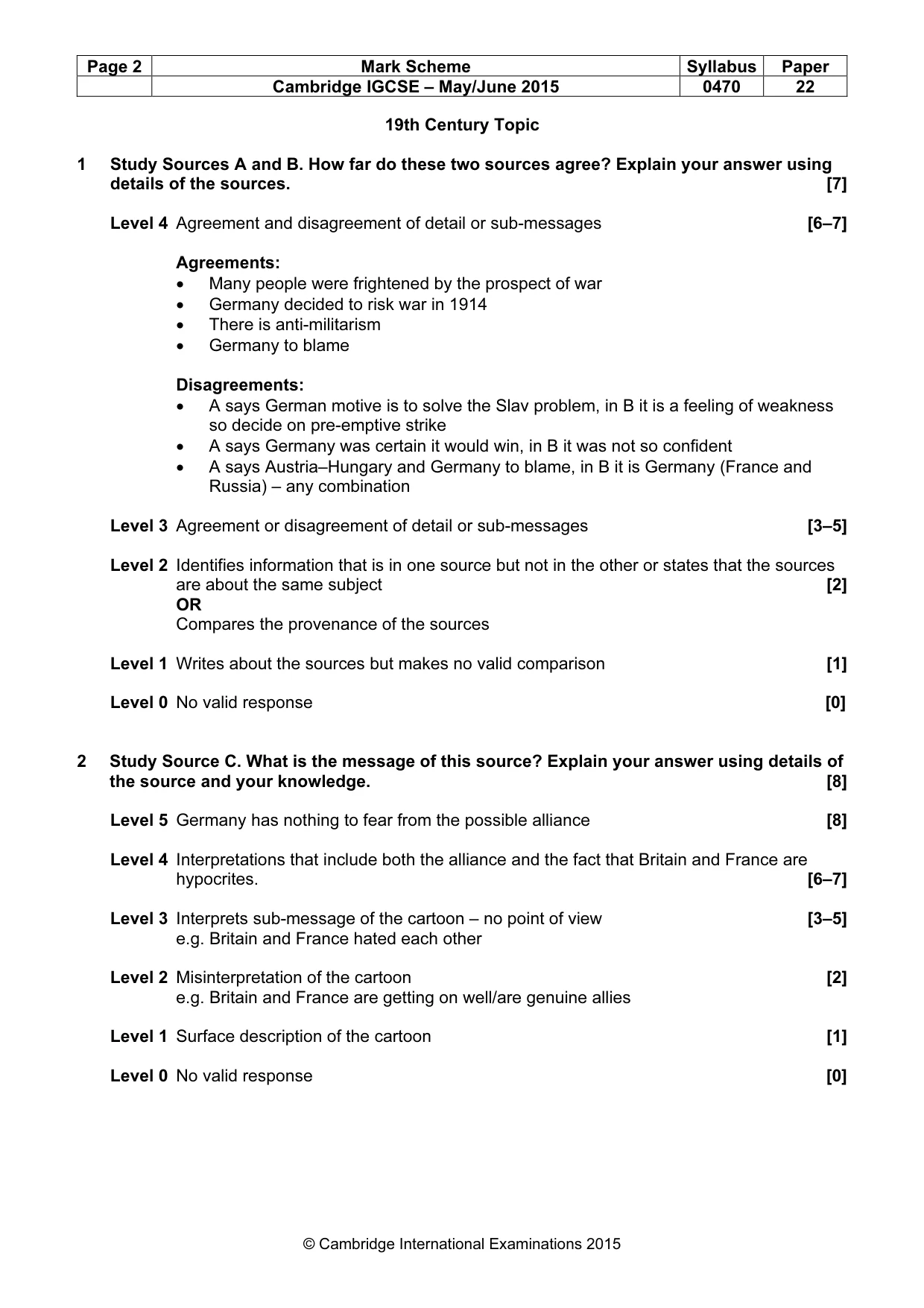
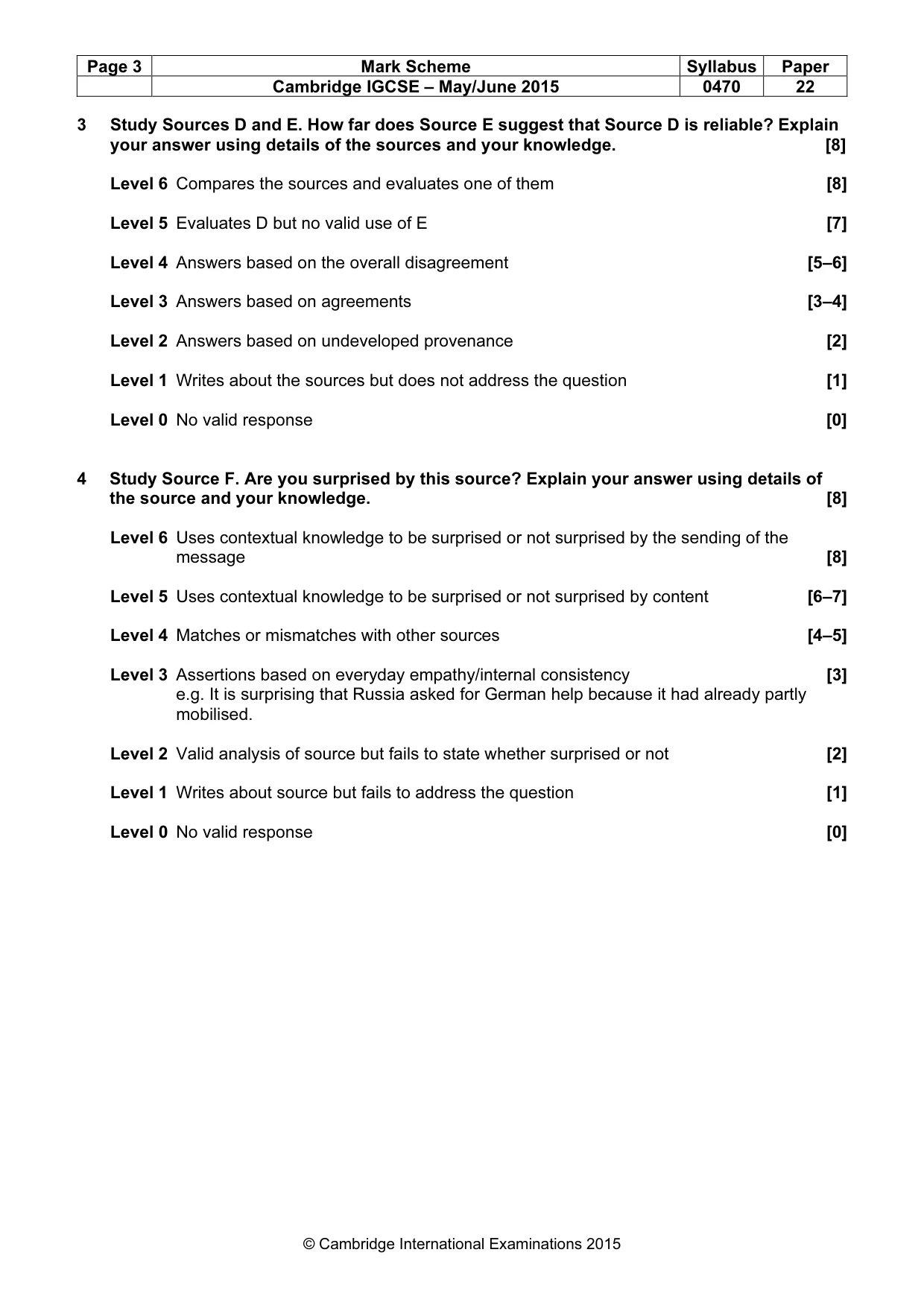
® IGCSE is the registered trademark of Cambridge International Examinations. CAMBRIDGE INTERNATIONAL EXAMINATIONS Cambridge International General Certificate of Secondary Education MARK SCHEME for the May/June 2015 series 0470 HISTORY 0470/22 Paper 2, maximum raw mark 50 This mark scheme is published as an aid to teachers and candidates, to indicate the requirements of the examination. It shows the basis on which Examiners were instructed to award marks. It does not indicate the details of the discussions that took place at an Examiners’ meeting before marking began, which would have considered the acceptability of alternative answers. Mark schemes should be read in conjunction with the question paper and the Principal Examiner Report for Teachers. Cambridge will not enter into discussions about these mark schemes. Cambridge is publishing the mark schemes for the May/June 2015 series for most Cambridge IGCSE®, Cambridge International A and AS Level components and some Cambridge O Level components.
Mark scheme, page 2
Page 2 Mark Scheme Syllabus Paper Cambridge IGCSE – May/June 2015 0470 22 © Cambridge International Examinations 2015 19th Century Topic 1 Study Sources A and B. How far do these two sources agree? Explain your answer using details of the sources. [7] Level 4 Agreement and disagreement of detail or sub-messages [6–7] Agreements: • Many people were frightened by the prospect of war • Germany decided to risk war in 1914 • There is anti-militarism • Germany to blame Disagreements: • A says German motive is to solve the Slav problem, in B it is a feeling of weakness so decide on pre-emptive strike • A says Germany was certain it would win, in B it was not so confident • A says Austria–Hungary and Germany to blame, in B it is Germany (France and Russia) – any combination Level 3 Agreement or disagreement of detail or sub-messages [3–5] Level 2 Identifies information that is in one source but not in the other or states that the sources are about the same subject [2] OR Compares the provenance of the sources Level 1 Writes about the sources but makes no valid comparison [1] Level 0 No valid response [0] 2 Study Source C. What is the message of this source? Explain your answer using details of the source and your knowledge. [8] Level 5 Germany has nothing to fear from the possible alliance [8] Level 4 Interpretations that include both the alliance and the fact that Britain and France are hypocrites. [6–7] Level 3 Interprets sub-message of the cartoon – no point of view [3–5] e.g. Britain and France hated each other Level 2 Misinterpretation of the cartoon [2] e.g. Britain and France are getting on well/are genuine allies Level 1 Surface description of the cartoon [1] Level 0 No valid response [0]
Mark scheme, page 3
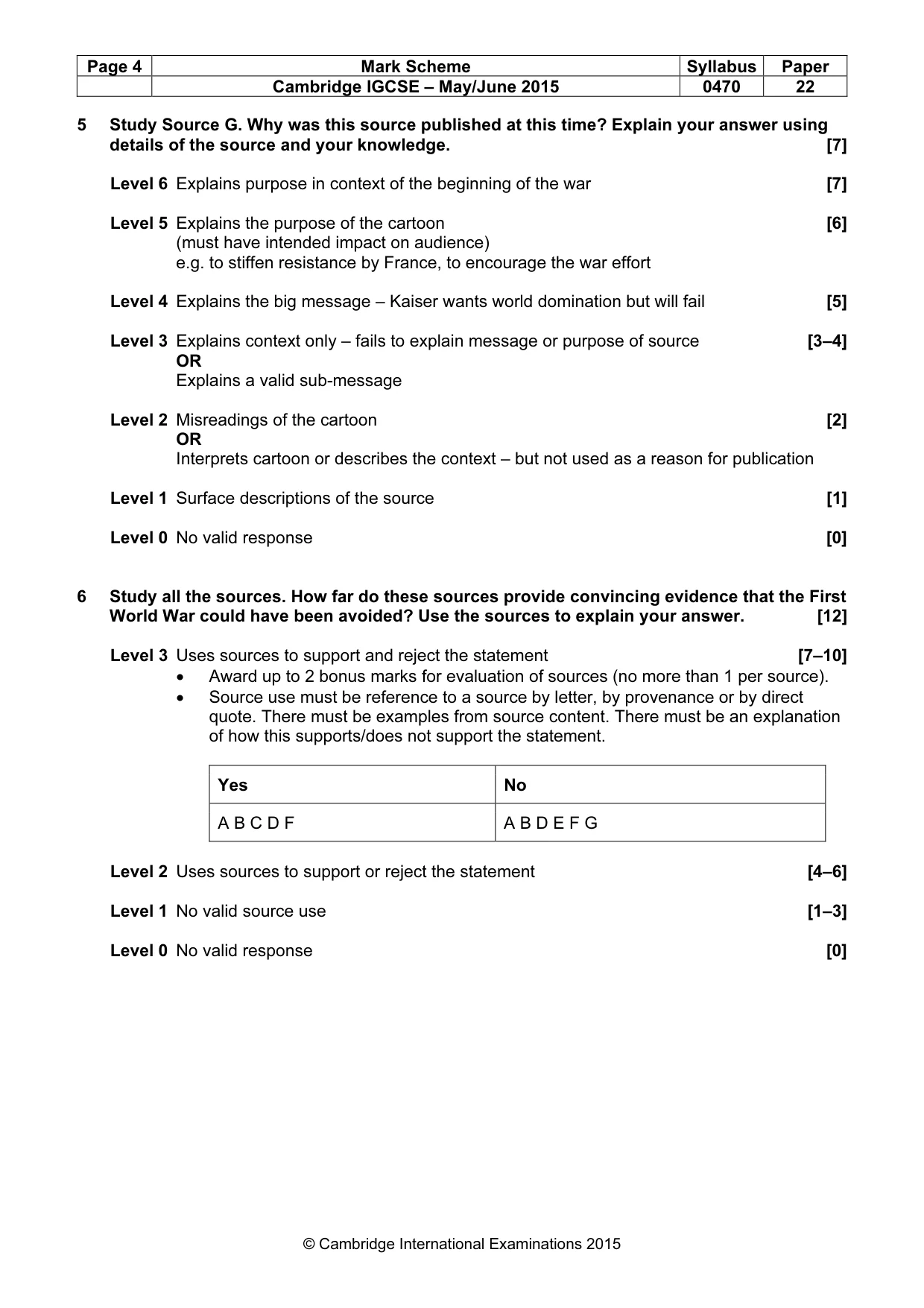
Page 3 Mark Scheme Syllabus Paper Cambridge IGCSE – May/June 2015 0470 22 © Cambridge International Examinations 2015 3 Study Sources D and E. How far does Source E suggest that Source D is reliable? Explain your answer using details of the sources and your knowledge. [8] Level 6 Compares the sources and evaluates one of them [8] Level 5 Evaluates D but no valid use of E [7] Level 4 Answers based on the overall disagreement [5–6] Level 3 Answers based on agreements [3–4] Level 2 Answers based on undeveloped provenance [2] Level 1 Writes about the sources but does not address the question [1] Level 0 No valid response [0] 4 Study Source F. Are you surprised by this source? Explain your answer using details of the source and your knowledge. [8] Level 6 Uses contextual knowledge to be surprised or not surprised by the sending of the message [8] Level 5 Uses contextual knowledge to be surprised or not surprised by content [6–7] Level 4 Matches or mismatches with other sources [4–5] Level 3 Assertions based on everyday empathy/internal consistency [3] e.g. It is surprising that Russia asked for German help because it had already partly mobilised. Level 2 Valid analysis of source but fails to state whether surprised or not [2] Level 1 Writes about source but fails to address the question [1] Level 0 No valid response [0]
Mark scheme, page 4
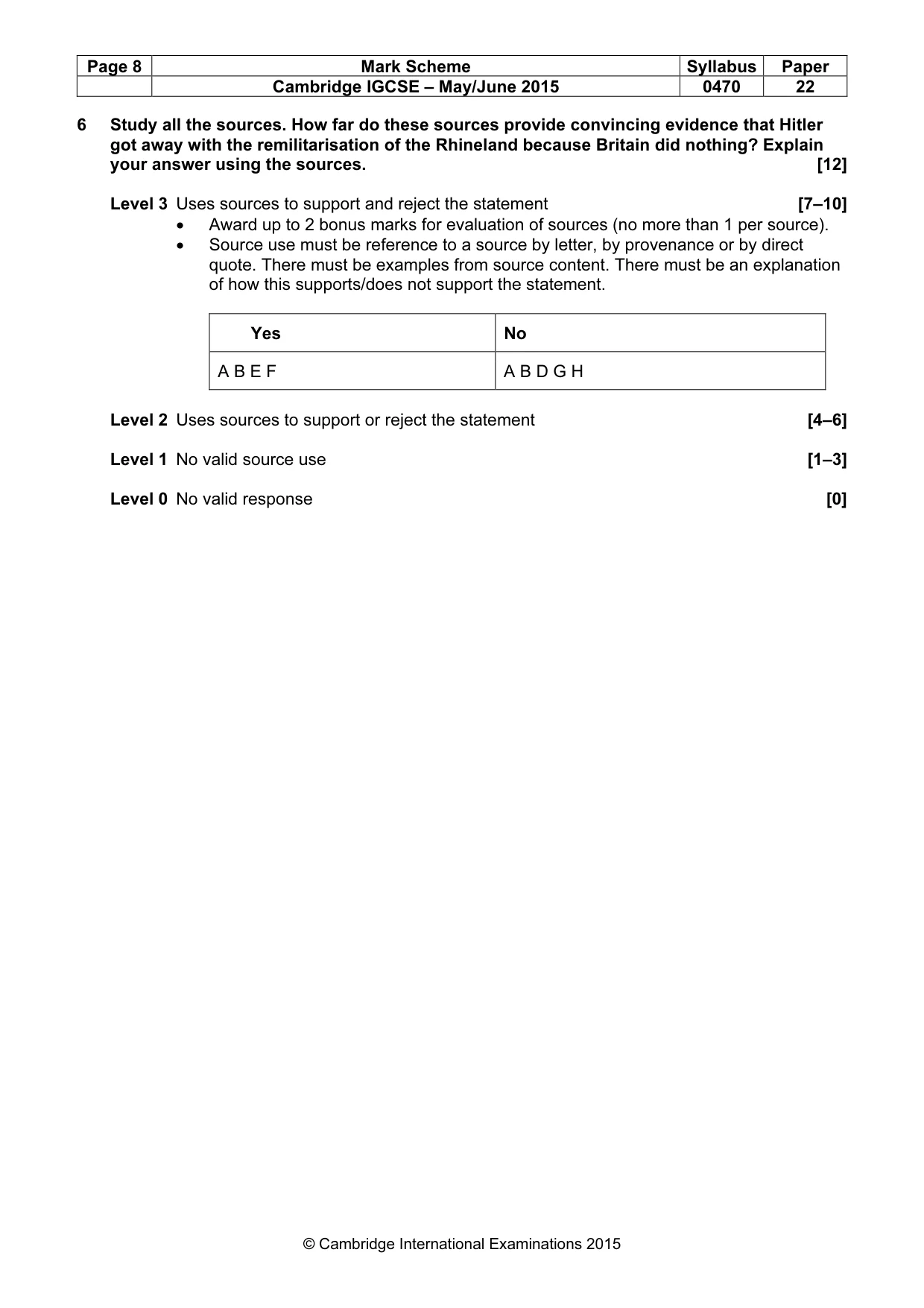
Page 4 Mark Scheme Syllabus Paper Cambridge IGCSE – May/June 2015 0470 22 © Cambridge International Examinations 2015 5 Study Source G. Why was this source published at this time? Explain your answer using details of the source and your knowledge. [7] Level 6 Explains purpose in context of the beginning of the war [7] Level 5 Explains the purpose of the cartoon [6] (must have intended impact on audience) e.g. to stiffen resistance by France, to encourage the war effort Level 4 Explains the big message – Kaiser wants world domination but will fail [5] Level 3 Explains context only – fails to explain message or purpose of source [3–4] OR Explains a valid sub-message Level 2 Misreadings of the cartoon [2] OR Interprets cartoon or describes the context – but not used as a reason for publication Level 1 Surface descriptions of the source [1] Level 0 No valid response [0] 6 Study all the sources. How far do these sources provide convincing evidence that the First World War could have been avoided? Use the sources to explain your answer. [12] Level 3 Uses sources to support and reject the statement [7–10] • Award up to 2 bonus marks for evaluation of sources (no more than 1 per source). • Source use must be reference to a source by letter, by provenance or by direct quote. There must be examples from source content. There must be an explanation of how this supports/does not support the statement. Yes No A B C D F A B D E F G Level 2 Uses sources to support or reject the statement [4–6] Level 1 No valid source use [1–3] Level 0 No valid response [0]
Mark scheme, page 5
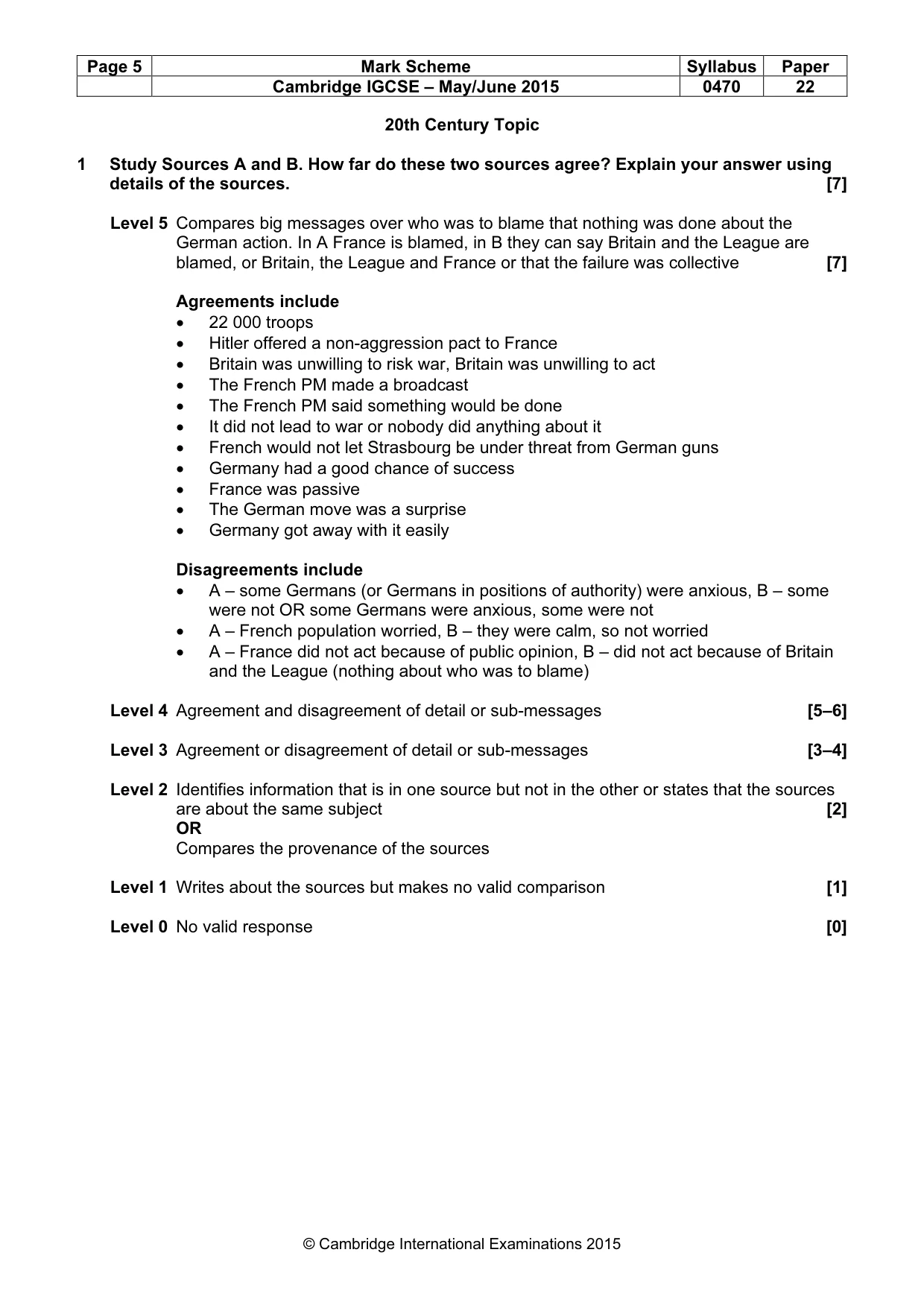
Page 5 Mark Scheme Syllabus Paper Cambridge IGCSE – May/June 2015 0470 22 © Cambridge International Examinations 2015 20th Century Topic 1 Study Sources A and B. How far do these two sources agree? Explain your answer using details of the sources. [7] Level 5 Compares big messages over who was to blame that nothing was done about the German action. In A France is blamed, in B they can say Britain and the League are blamed, or Britain, the League and France or that the failure was collective [7] Agreements include • 22 000 troops • Hitler offered a non-aggression pact to France • Britain was unwilling to risk war, Britain was unwilling to act • The French PM made a broadcast • The French PM said something would be done • It did not lead to war or nobody did anything about it • French would not let Strasbourg be under threat from German guns • Germany had a good chance of success • France was passive • The German move was a surprise • Germany got away with it easily Disagreements include • A – some Germans (or Germans in positions of authority) were anxious, B – some were not OR some Germans were anxious, some were not • A – French population worried, B – they were calm, so not worried • A – France did not act because of public opinion, B – did not act because of Britain and the League (nothing about who was to blame) Level 4 Agreement and disagreement of detail or sub-messages [5–6] Level 3 Agreement or disagreement of detail or sub-messages [3–4] Level 2 Identifies information that is in one source but not in the other or states that the sources are about the same subject [2] OR Compares the provenance of the sources Level 1 Writes about the sources but makes no valid comparison [1] Level 0 No valid response [0]
Mark scheme, page 6
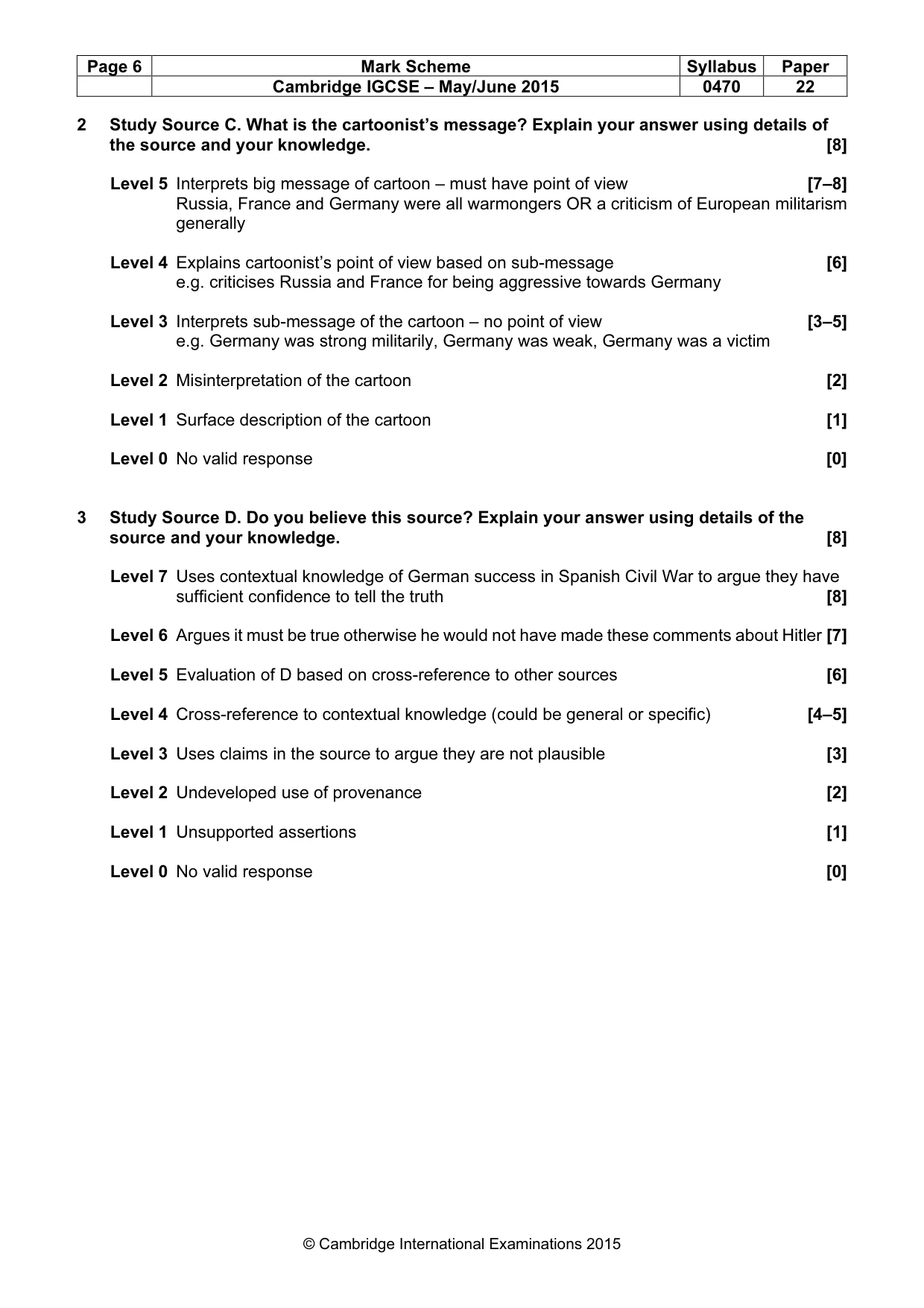
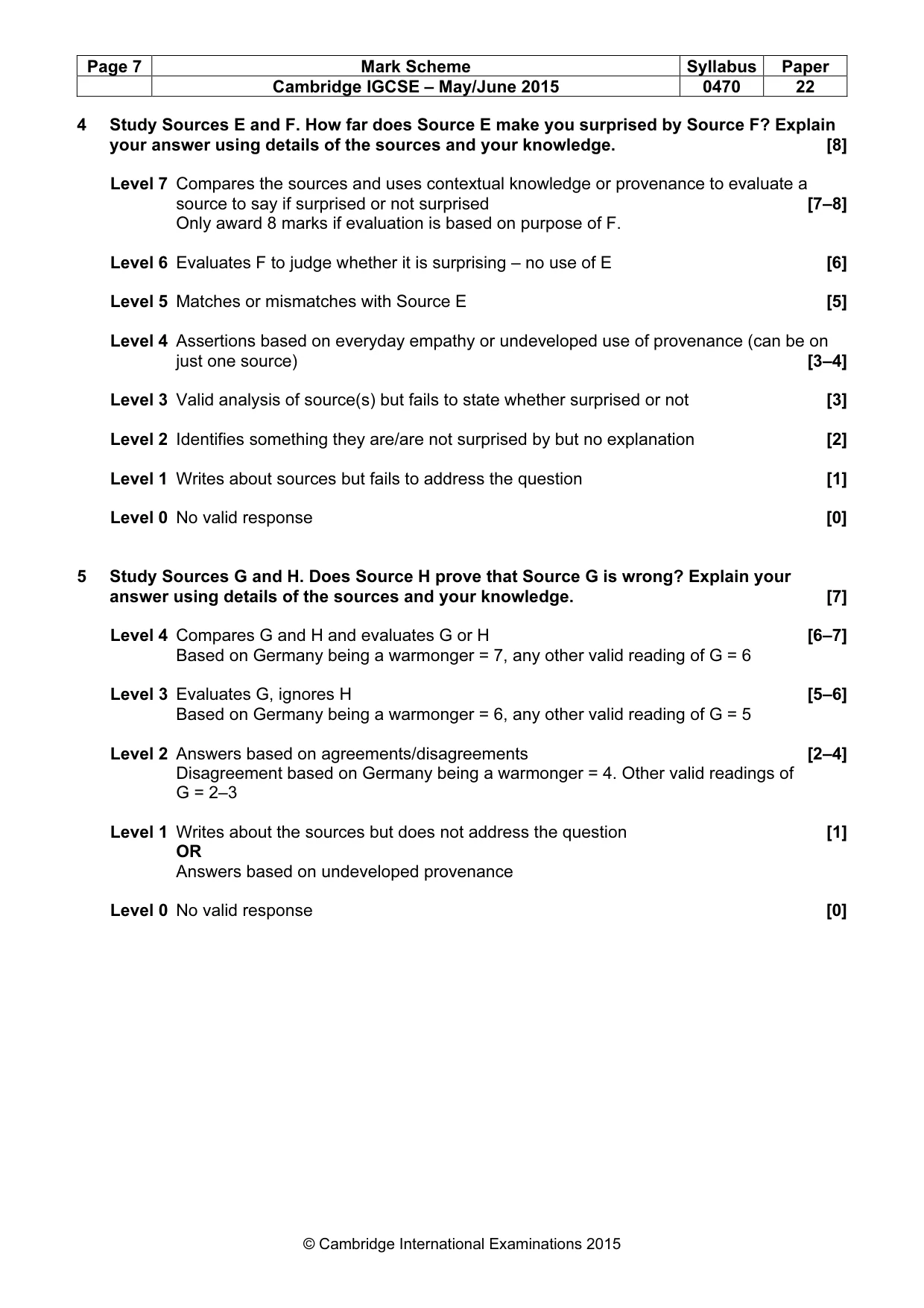
Page 6 Mark Scheme Syllabus Paper Cambridge IGCSE – May/June 2015 0470 22 © Cambridge International Examinations 2015 2 Study Source C. What is the cartoonist’s message? Explain your answer using details of the source and your knowledge. [8] Level 5 Interprets big message of cartoon – must have point of view [7–8] Russia, France and Germany were all warmongers OR a criticism of European militarism generally Level 4 Explains cartoonist’s point of view based on sub-message [6] e.g. criticises Russia and France for being aggressive towards Germany Level 3 Interprets sub-message of the cartoon – no point of view [3–5] e.g. Germany was strong militarily, Germany was weak, Germany was a victim Level 2 Misinterpretation of the cartoon [2] Level 1 Surface description of the cartoon [1] Level 0 No valid response [0] 3 Study Source D. Do you believe this source? Explain your answer using details of the source and your knowledge. [8] Level 7 Uses contextual knowledge of German success in Spanish Civil War to argue they have sufficient confidence to tell the truth [8] Level 6 Argues it must be true otherwise he would not have made these comments about Hitler [7] Level 5 Evaluation of D based on cross-reference to other sources [6] Level 4 Cross-reference to contextual knowledge (could be general or specific) [4–5] Level 3 Uses claims in the source to argue they are not plausible [3] Level 2 Undeveloped use of provenance [2] Level 1 Unsupported assertions [1] Level 0 No valid response [0]
Mark scheme, page 7
Page 7 Mark Scheme Syllabus Paper Cambridge IGCSE – May/June 2015 0470 22 © Cambridge International Examinations 2015 4 Study Sources E and F. How far does Source E make you surprised by Source F? Explain your answer using details of the sources and your knowledge. [8] Level 7 Compares the sources and uses contextual knowledge or provenance to evaluate a source to say if surprised or not surprised [7–8] Only award 8 marks if evaluation is based on purpose of F. Level 6 Evaluates F to judge whether it is surprising – no use of E [6] Level 5 Matches or mismatches with Source E [5] Level 4 Assertions based on everyday empathy or undeveloped use of provenance (can be on just one source) [3–4] Level 3 Valid analysis of source(s) but fails to state whether surprised or not [3] Level 2 Identifies something they are/are not surprised by but no explanation [2] Level 1 Writes about sources but fails to address the question [1] Level 0 No valid response [0] 5 Study Sources G and H. Does Source H prove that Source G is wrong? Explain your answer using details of the sources and your knowledge. [7] Level 4 Compares G and H and evaluates G or H [6–7] Based on Germany being a warmonger = 7, any other valid reading of G = 6 Level 3 Evaluates G, ignores H [5–6] Based on Germany being a warmonger = 6, any other valid reading of G = 5 Level 2 Answers based on agreements/disagreements [2–4] Disagreement based on Germany being a warmonger = 4. Other valid readings of G = 2–3 Level 1 Writes about the sources but does not address the question [1] OR Answers based on undeveloped provenance Level 0 No valid response [0]
Mark scheme, page 8
Page 8 Mark Scheme Syllabus Paper Cambridge IGCSE – May/June 2015 0470 22 © Cambridge International Examinations 2015 6 Study all the sources. How far do these sources provide convincing evidence that Hitler got away with the remilitarisation of the Rhineland because Britain did nothing? Explain your answer using the sources. [12] Level 3 Uses sources to support and reject the statement [7–10] • Award up to 2 bonus marks for evaluation of sources (no more than 1 per source). • Source use must be reference to a source by letter, by provenance or by direct quote. There must be examples from source content. There must be an explanation of how this supports/does not support the statement. Yes No A B E F A B D G H Level 2 Uses sources to support or reject the statement [4–6] Level 1 No valid source use [1–3] Level 0 No valid response [0]
What you needed in this session
Cambridge’s own grade thresholds for 2015 May/June, Paper 2 · Variant 2. A higher threshold means an easier paper — the bar moves with how the cohort did.