Cambridge IGCSE History 0470 — 2013 May/June Paper 2 · Variant 2
0470/22/M/J/13 · 50 marks · ≈56 min
The question paper and its mark scheme, free to read here and free to download. This is Cambridge’s own paper, exactly as it was sat.
Question paper12 pages
Mark scheme7 pages
Answers below. Sit the paper first if you are practising.
Paper as text
Question paper, page 1
This document consists of 12 printed pages. DC (SJF/CGW) 66910/5 © UCLES 2013 [Turn over UNIVERSITY OF CAMBRIDGE INTERNATIONAL EXAMINATIONS International General Certificate of Secondary Education * 7 3 1 4 3 9 5 0 1 0 * HISTORY 0470/22 Paper 2 May/June 2013 2 hours Additional Materials: Answer Booklet/Paper READ THESE INSTRUCTIONS FIRST If you have been given an Answer Booklet, follow the instructions on the front cover of the Booklet. Write your Centre number, candidate number and name on all the work you hand in. Write in dark blue or black pen. You may use a soft pencil for any diagrams, graphs or rough working. Do not use staples, paper clips, highlighters, glue or correction fluid. This paper has two options. Choose one option, and then answer all of the questions on that topic. Option A: 19th Century topic [p2–p7] Option B: 20th Century topic [p8–p12] At the end of the examination, fasten all your work securely together. The number of marks is given in brackets [ ] at the end of each question or part question.
Question paper, page 2
2 0470/22/M/J/13 © UCLES 2013 Option A: 19th Century topic WAS RECONSTRUCTION A FAILURE? Study the Background Information and the sources carefully, and then answer all the questions. Background Information Reconstruction is one of the most confusing and controversial periods of American history. By the time the Civil War ended in 1865, America’s slaves had already been freed by the Thirteenth Amendment, and Reconstruction had begun. Lincoln saw Reconstruction as a process of reconciliation, while others saw it as an idealistic effort to construct a democratic, interracial political system from the ashes of slavery. Southern Democrats saw it as dictatorship over the South by the North. During the time of Reconstruction there existed corruption and carpetbaggers, and organisations such as the Ku Klux Klan were founded. However, the period also saw black Americans voting and being involved in government. By the time Reconstruction ended in 1877, had it achieved anything? SOURCE A In the words of W. E. B. Du Bois, ‘The slave went free; stood a brief moment in the sun; then moved back again toward slavery.’ To be sure, the era of Reconstruction did not lack enduring achievements. The tide of change rose and then receded, but it left behind an altered landscape. The freedmen’s political and civil equality proved temporary, but the autonomous black family and a network of religious and social institutions survived the end of Reconstruction. Nor could the seeds of educational progress planted be entirely uprooted. Schooling under the Redeemers represented a distinct advance over the days when blacks were excluded. If blacks failed to achieve the economic independence hoped for in the aftermath of the Civil War, Reconstruction closed off even more oppressive alternatives than the Redeemers’ New South. The post-Reconstruction labour system was neither a return to the closely supervised gang labour of pre-civil war days, nor the complete dispossession and immobilisation of the black labour force envisioned by white Southerners. As illustrated by the small but growing number of black landowners and businessmen, the doors of economic opportunity that had opened could never be completely closed. Without Reconstruction it is difficult to imagine the establishment of a framework of legal rights enshrined in the Constitution that created a vehicle for future federal intervention in Southern affairs. Nonetheless, Reconstruction, whether measured by the dreams inspired by emancipation or the more limited goals of securing blacks’ rights as citizens and free labourers, can only be judged a failure. The decisive factors were the campaign of violence that turned the electoral tide in many parts of the South, and the weakening of Northern resolve that undermined the free labour and egalitarian ideas at the heart of Reconstruction. From a history book published in 1988.
Question paper, page 3
3 0470/22/M/J/13 © UCLES 2013 [Turn over SOURCE B Despite their determined attempts at political and economic advancement, black Americans struggled terribly during Reconstruction. They ultimately made limited gains but fell far short of true equality. In 1876 the ex-slave and black abolitionist Frederick Douglass addressed the Republican party’s national convention. He thanked the whites for freeing his people but complained that because the freedpeople received no land, they suffered. ‘You turned us loose to the storm, and worst of all, you turned us loose to the wrath of our infuriated masters.’ Two years earlier, Lewis H. Douglass, son of the famous abolitionist, regretted that the spirit of slavery remained very much alive in the South. Lacking education, money, and land, blacks confronted white racism everywhere. In addition to denying blacks the means to help themselves, whites used violent methods to maintain racial control. The Ku Klux Klan murdered and tortured the freedpeople. Whites intimidated the freedmen in order to keep them from voting. Matters got worse when, in the 1870s, Republican politicians in the North lost interest in their plight and virtually abandoned them. Reconstruction brought little change in the day-to-day conditions of the South’s poor blacks. They were ‘free’. But their freedom was more limited than they had supposed it would become at the moment of emancipation. Their hopes failed to take root. They were blocked again and again by whites who never could accept blacks as equals. Though they gained little during Reconstruction, blacks nonetheless exhibited a sense of community, a group experience. From a history book published in 1997. SOURCE C We have decided to test your sincerity by asking you to send us our wages for the time we served you. I served you faithfully for thirty-two years. Our earnings would amount to $11 680. Add to this the interest for the time our wages have been kept back. We trust the good Maker has opened your eyes to the wrongs which you and your fathers have done to me in making me work for you without payment. Here, I draw wages every Saturday; but in Tennessee there never was any pay-day for the Negroes. My girls go to school. Please state if there would be safety for my Milly and Jane, both good-looking girls. I would rather stay here and starve than have my girls brought to shame by the violence of their young masters. From a letter by Jourdan Anderson in 1865 to his former master who wanted him to return to work for him.
Question paper, page 4
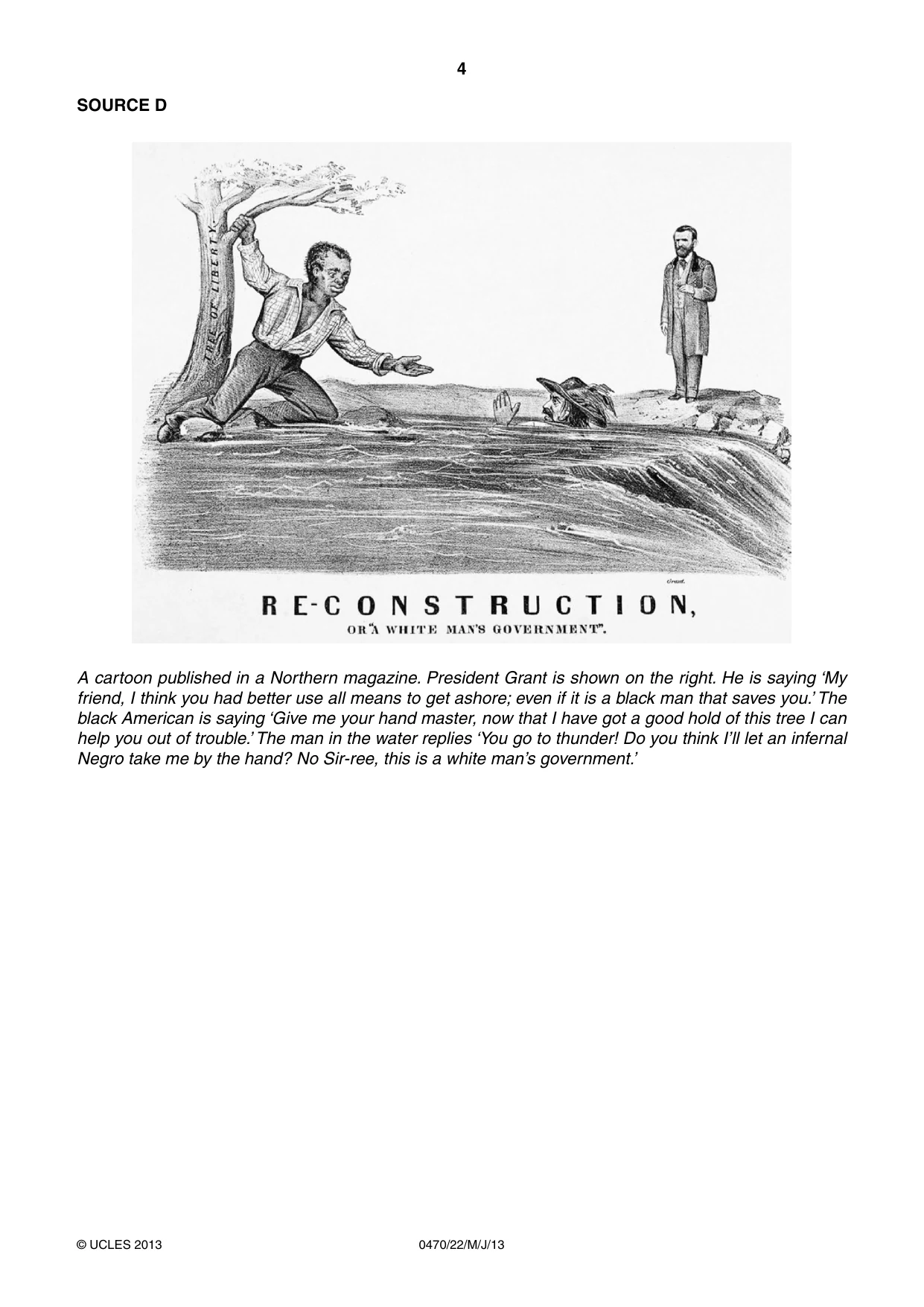
4 0470/22/M/J/13 © UCLES 2013 SOURCE D A cartoon published in a Northern magazine. President Grant is shown on the right. He is saying ‘My friend, I think you had better use all means to get ashore; even if it is a black man that saves you.’ The black American is saying ‘Give me your hand master, now that I have got a good hold of this tree I can help you out of trouble.’ The man in the water replies ‘You go to thunder! Do you think I’ll let an infernal Negro take me by the hand? No Sir-ree, this is a white man’s government.’
Question paper, page 5
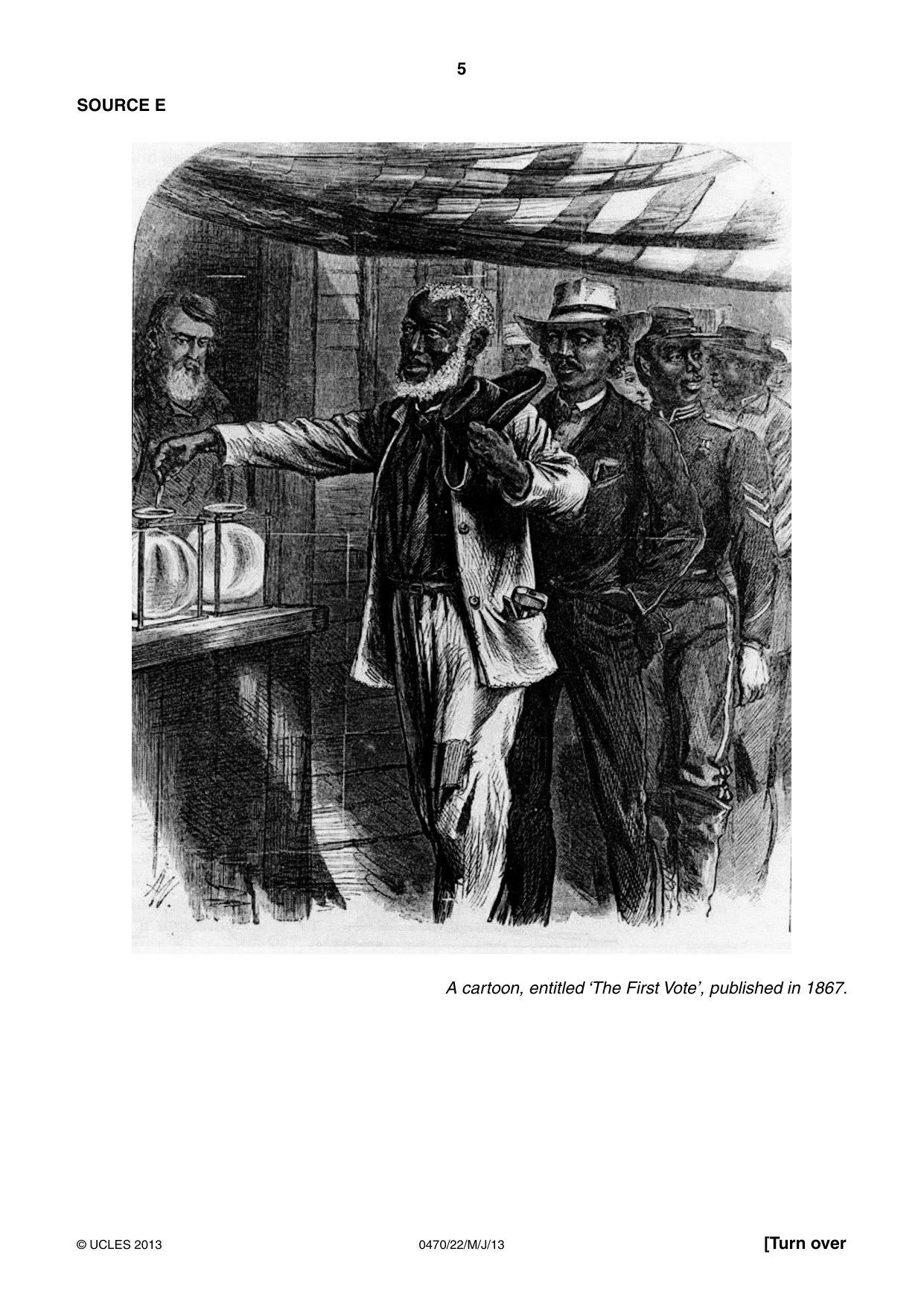
5 0470/22/M/J/13 © UCLES 2013 [Turn over SOURCE E A cartoon, entitled ‘The First Vote’, published in 1867.
Question paper, page 6
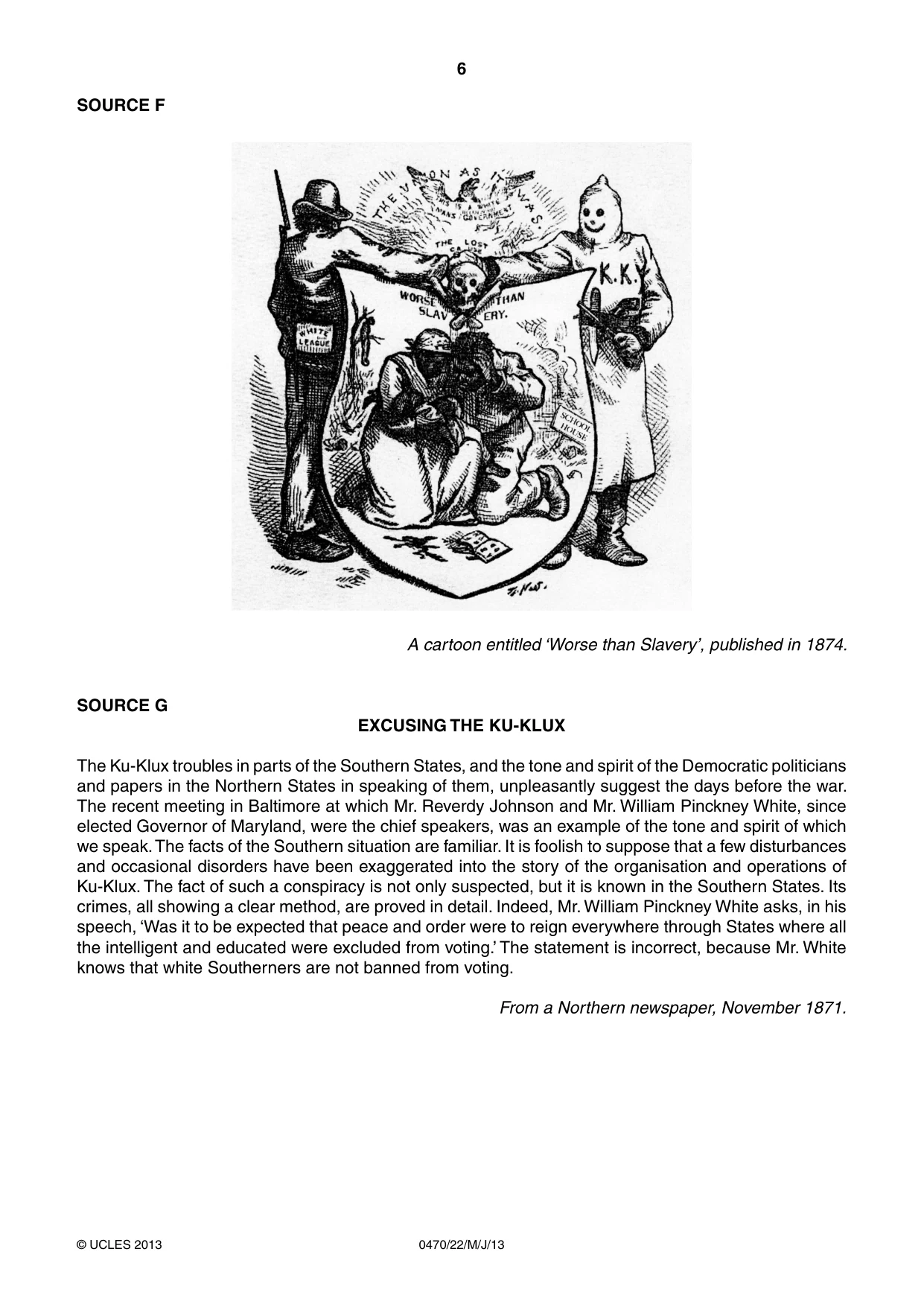
6 0470/22/M/J/13 © UCLES 2013 SOURCE F A cartoon entitled ‘Worse than Slavery’, published in 1874. SOURCE G EXCUSING THE KU-KLUX The Ku-Klux troubles in parts of the Southern States, and the tone and spirit of the Democratic politicians and papers in the Northern States in speaking of them, unpleasantly suggest the days before the war. The recent meeting in Baltimore at which Mr. Reverdy Johnson and Mr. William Pinckney White, since elected Governor of Maryland, were the chief speakers, was an example of the tone and spirit of which we speak. The facts of the Southern situation are familiar. It is foolish to suppose that a few disturbances and occasional disorders have been exaggerated into the story of the organisation and operations of Ku-Klux. The fact of such a conspiracy is not only suspected, but it is known in the Southern States. Its crimes, all showing a clear method, are proved in detail. Indeed, Mr. William Pinckney White asks, in his speech, ‘Was it to be expected that peace and order were to reign everywhere through States where all the intelligent and educated were excluded from voting.’ The statement is incorrect, because Mr. White knows that white Southerners are not banned from voting. From a Northern newspaper, November 1871.
Question paper, page 7
7 0470/22/M/J/13 © UCLES 2013 [Turn over Now answer all the following questions. You may use any of the sources to help you answer the questions, in addition to those sources which you are told to use. In answering the questions you should use your knowledge of the topic to help you interpret and evaluate the sources. 1 Study Sources A and B. How similar are these two sources? Explain your answer using details of the sources. [7] 2 Study Source C. How surprised are you by this source? Explain your answer using details of the source and your knowledge. [8] 3 Study Source D. What is the cartoonist’s message? Explain your answer using details of the source and your knowledge. [7] 4 Study Sources E and F. How far would these two cartoonists have agreed with each other? Explain your answer using details of the sources and your knowledge. [8] 5 Study Source G. Why was this source published at that time? Explain your answer using details of the source and your knowledge. [8] 6 Study all the sources. How far do these sources provide convincing evidence that Reconstruction was a failure? Use the sources to explain your answer. [12]
Question paper, page 8
8 0470/22/M/J/13 © UCLES 2013 Option B: 20th Century topic HOW JUSTIFIABLE WAS THE GERMAN REACTION TO THE TREATY OF VERSAILLES? Study the Background Information and the sources carefully, and then answer all the questions. Background Information When, in June 1919, the German delegation in Paris finally accepted the peace treaty there was an immediate outcry from Germany. Although the Germans already knew that Clemenceau wanted revenge and that Lloyd George had won an election in 1918 by promising to punish Germany harshly, they were angry and horrified. Many Germans refused to accept that their army had been defeated, claiming that it had been ‘stabbed in the back’ by civilians in Germany. This led to the claim that they should not be treated in the peace negotiations as a defeated country. They also saw the treaty as a Diktat, breaking the Fourteen Points, and they found it impossible to accept the idea of war guilt which underpinned the payment of reparations. Could German criticism of the Treaty of Versailles be justified? SOURCE A The Versailles Treaty was severe, but it is amazing that it was not more so. The disagreements between the Allied negotiators through the spring of 1919 amounted to a struggle between Anglo-American complacency, reinforced by the seas separating them from Germany, and French fear, reinforced by a long frontier. In Wilson’s mind there lingered some residue of the ‘peace without victory’ sentiment and he was determined to see what he considered a just peace. The British wanted German ships and colonies but they still distrusted France and were reverting to their traditional balance-of-power policy. Clemenceau, on the other hand, had seen two German invasions of France in his lifetime and knew well that France alone had not won this war. Like most Frenchmen, he craved security against what he saw as a continuing menace. The Treaty has been sharply criticised and some of the criticisms are valid, although, given the circumstances in which it was hastily patched together, it is remarkable that it was not much more unsatisfactory. It has often been said, and with reason, that the Treaty was too much of a compromise, too soft to restrain Germany and yet too severe to be acceptable to most Germans. Either a fully Wilsonian treaty or a fully French treaty might have been better. The real difficulty was not that the Treaty was exceptionally unfair but that the Germans thought it was, and in time persuaded others that it was. Germany complained that the Treaty violated the Fourteen Points, but reserved her sharpest complaints, for example over Poland, for clauses most securely anchored on the Fourteen Points. German territorial losses were perhaps greater than they might have been but the Treaty was not exceptionally harsh. However, the German people convinced themselves that they had not lost the war. If they had not lost the war, any loss of territory and any restriction was unfair. The German people expected, without reason, that Wilson would ensure them a ‘just peace’, which in their eyes meant Germany’s 1914 frontiers and no penalties at all. From a book published in 1976.
Question paper, page 9
9 0470/22/M/J/13 © UCLES 2013 [Turn over SOURCE B For Clemenceau, who as a young man had watched the Prussian army besieging Paris and whose country had been ravaged by four years of war, the sole aim of victory was to ensure that Germany might never again invade France. Both the refusal to negotiate and the nature of the terms themselves were profoundly disagreeable to the Germans. Alsace and Lorraine were to be ceded to France. In the east the new state of Poland was granted the provinces of Posen and West Prussia, thus giving her access to the sea. The German colonies were simply shared out among the Allies. There were also stern measures to ensure against the revival of German military power. The economic clauses rested almost entirely on an assumption of Germany’s war guilt. For the next two decades the Treaty was to be a source of deep anger for the Germans. They spoke of it as a Diktat through which they had been deprived of any chance of negotiation, and they resented the heaviness of its terms, which they claimed went far beyond the Fourteen Points. They could certainly argue that the partition of the German colonies was inconsistent with ‘a free open-minded and absolutely impartial adjustment of colonial claims’. The principle of national self-determination had deprived them of seven million inhabitants; yet the Treaty had forbidden the inclusion of German Austria within Germany. The general disarmament which had been proposed seemed to apply only to Germany and the admission of war guilt would lay them open to absurdly heavy reparations. From a book published in 1964. SOURCE C We came to Versailles in the expectation of receiving a peace proposal based on the agreed principles. We had hoped for the peace of justice which had been promised to us. We were horrified when we read the demands made on us, the victorious violence of our enemies. The demands of this treaty are more than the German people can bear. Germany, cut in pieces and weakened, must declare herself ready in principle to bear all the war expenses of her enemies, which would exceed many times over the total amount of German wealth. Meanwhile her enemies demand, in excess of the agreed conditions, reparation for damage suffered. No limit is fixed except for the capacity of the German people to meet the demands of their enemies by their labour. The German people would thus be condemned to perpetual slave labour. From a letter by Count von Brockdorff-Rantzau, leader of the German peace delegation, to the peacemakers, May 1919. SOURCE D The terms are in many respects terrible terms to impose upon a country. Terrible were the deeds which it repays. Germany not merely provoked, but planned the most devastating war the earth has ever seen. She deliberately embarked upon it, not to defend herself against assailants, but to aggrandise herself at the expense of her neighbours. I cannot think of a worse crime. The aim of the Treaty is to force Germany, in so far as it is in her power, to restore, to repair and to redress. Yes, and to take every possible precaution of every kind that is in our power against the recurrence of another such crime – to make such an example as will discourage ambitious peoples from ever attempting to repeat the infamy. Lloyd George speaking to the British parliament in July 1919.
Question paper, page 10
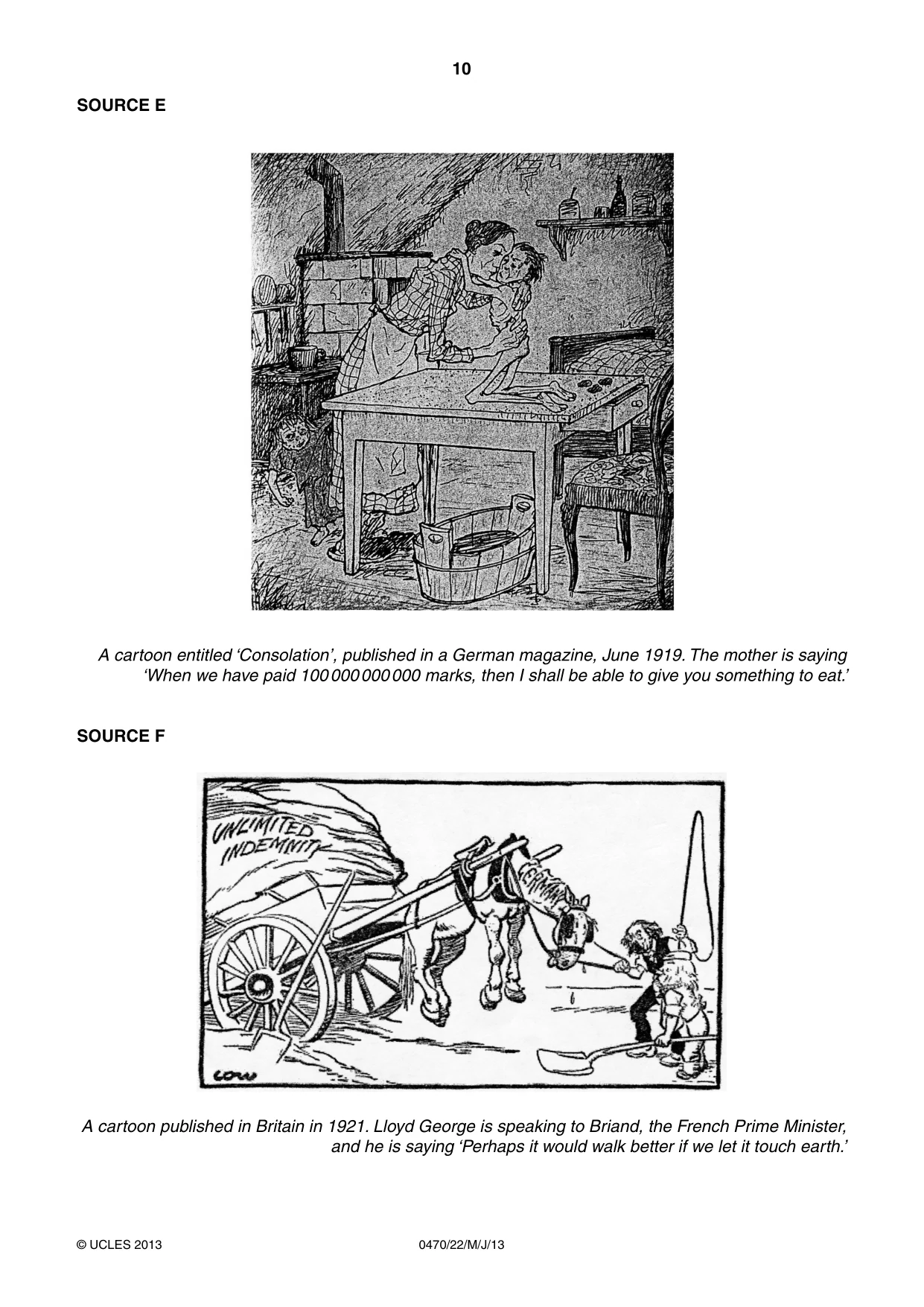
10 0470/22/M/J/13 © UCLES 2013 SOURCE E A cartoon entitled ‘Consolation’, published in a German magazine, June 1919. The mother is saying ‘When we have paid 100 000 000 000 marks, then I shall be able to give you something to eat.’ SOURCE F A cartoon published in Britain in 1921. Lloyd George is speaking to Briand, the French Prime Minister, and he is saying ‘Perhaps it would walk better if we let it touch earth.’
Question paper, page 11
11 0470/22/M/J/13 © UCLES 2013 [Turn over SOURCE G A cartoon published in Britain in 1921. Briand was the French Prime Minister. SOURCE H SECRET Some considerations for the Peace Conference It is easy to patch up a peace which will last for thirty years. What is difficult is to draw up a peace which will not provoke a fresh struggle when those who took part in the war have passed away. You may strip Germany of her colonies, reduce her armaments to a mere police force and her navy to that of a fifth- rate power but if she feels that she has been unjustly treated, she will find ways of getting revenge. Our terms can be so just that Germany will feel in its heart that it has no right to complain. But injustice or arrogance displayed in the hour of triumph will never be forgiven or forgotten. For these reasons I am strongly opposed to transferring more Germans to the rule of another nation than can possibly be helped. If we are wise we will do everything possible to enable the German people to get upon their legs again. From a document written by Lloyd George in March 1919 during the peace negotiations.
Question paper, page 12
12 0470/22/M/J/13 © UCLES 2013 Now answe r all the following questions. You may use any of the sources to help you answer the questions, in addition to those sources which you are told to use. In answering the questions you should use your knowledge of the topic to help you interpret and evaluate the sources. 1 Study Sources A and B. How far do these two sources agree? Explain your answer using details of the sources. [7] 2 Study Sources C and D. How far does Source C prove Source D to be wrong? Explain your answer using details of the sources and your knowledge. [8] 3 Study Sources E and F. How far would the two cartoonists have agreed with each other? Explain your answer using details of the sources and your knowledge. [8] 4 Study Source G. Why was this source published in 1921? Explain your answer using details of the source and your knowledge. [8] 5 Study Source H. Are you surprised by this source? Explain your answer using details of the source and your knowledge. [7] 6 Study all the sources. How far do these sources provide convincing evidence that the German reaction to the Treaty of Versailles could be justified? Use the sources to explain your answer. [12] Copyright Acknowledgements: Option A Source A Option A Source B Option A Source C Option A Source D Option A Source E Option A Source F Option A Source G Option B Source A Option B Source B Option B Source C Option B Source D Option B Source E Option B Source F Option B Source G Option B Source H © Eric Foner; Reconstruction, America’s Unfinished Revolution 1867 – 1877; Harper Collins; 1988. © John David Smith; Black Voices from Reconstruction 1865 – 1877; University Press of Florida; 1997. © Joanne de Pennington; Modern America The USA, 1865 to the Present; Hodder Murray; 2005. © http://digitalgallery.nypl.org. © A cartoon entitled The First Vote, published in 1867. © A cartoon published in 1874. © From a northern newspaper, November 1871. © Sally Marks; The Illusion of Peace 1918 – 1933; Macmillan Press; 2003. © Anthony Wood; Europe 1815 – 1945; Longman; 1964. © From a letter by Count von Brockdorff-Rantzau, leader of the German peace delegation, to the peacemakers, May 1919. © Lloyd George speaking to the British parliament in July 1919. © Roy Douglas; The Cartoonist’s Vision 1919 – 1939; Routledge; 1992. © A cartoon published in Britain in 1921. © Ben Walsh; Modern World History; John Murray / Punch; 1996. © From a document written by Lloyd George in March 1919 during the peace negotiations. Permission to reproduce items where third-party owned material protected by copyright is included has been sought and cleared where possible. Every reasonable effort has been made by the publisher (UCLES) to trace copyright holders, but if any items requiring clearance have unwittingly been included, the publisher will be pleased to make amends at the earliest possible opportunity. University of Cambridge International Examinations is part of the Cambridge Assessment Group. Cambridge Assessment is the brand name of University of Cambridge Local Examinations Syndicate (UCLES), which is itself a department of the University of Cambridge.
Mark scheme, page 1
CAMBRIDGE INTERNATIONAL EXAMINATIONS International General Certificate of Secondary Education MARK SCHEME for the May/June 2013 series 0470 HISTORY 0470/22 Paper 2, maximum raw mark 50 This mark scheme is published as an aid to teachers and candidates, to indicate the requirements of the examination. It shows the basis on which Examiners were instructed to award marks. It does not indicate the details of the discussions that took place at an Examiners’ meeting before marking began, which would have considered the acceptability of alternative answers. Mark schemes should be read in conjunction with the question paper and the Principal Examiner Report for Teachers. Cambridge will not enter into discussions about these mark schemes. Cambridge is publishing the mark schemes for the May/June 2013 series for most IGCSE, GCE Advanced Level and Advanced Subsidiary Level components and some Ordinary Level components.
Mark scheme, page 2
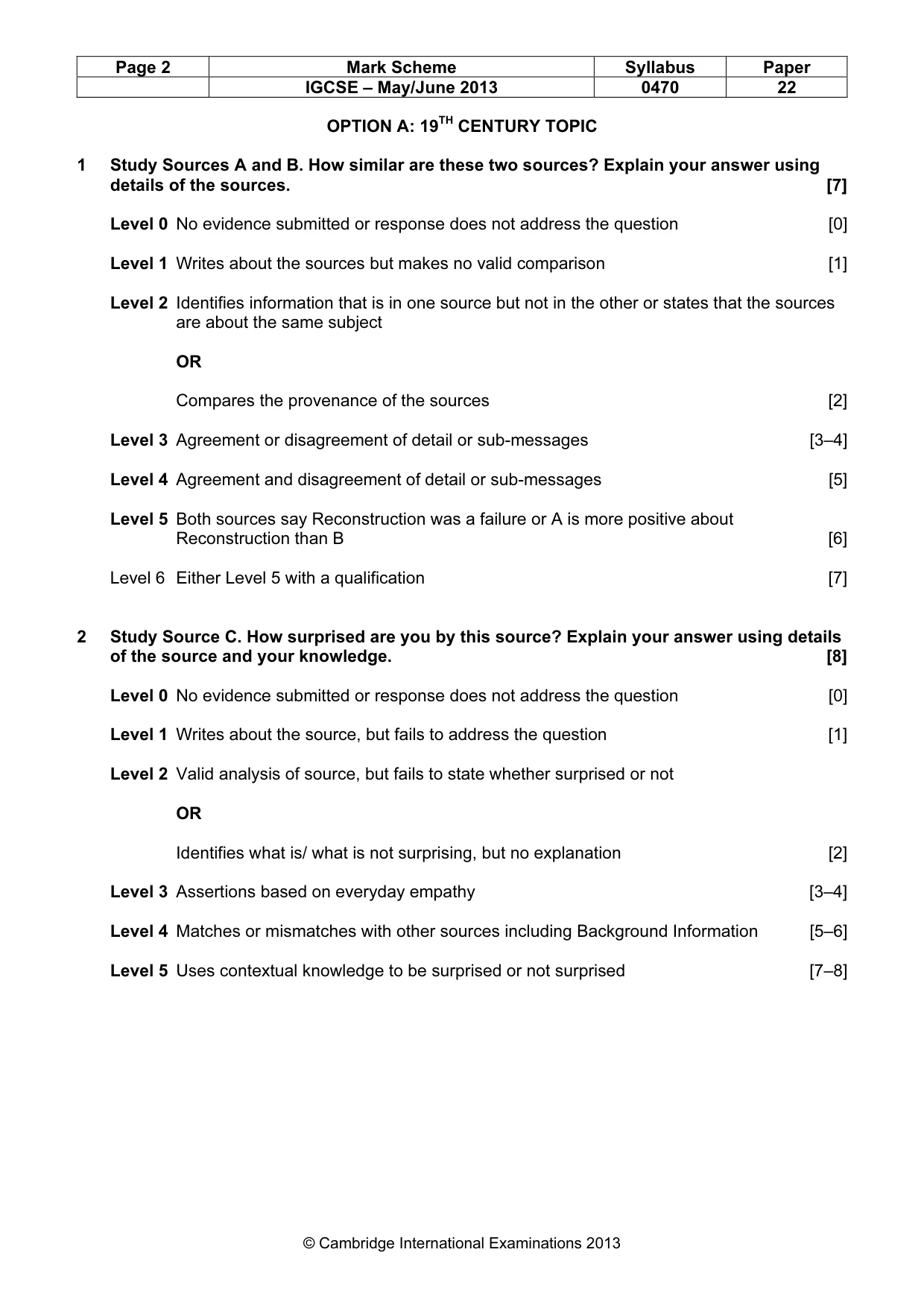
Page 2 Mark Scheme Syllabus Paper IGCSE – May/June 2013 0470 22 © Cambridge International Examinations 2013 OPTION A: 19TH CENTURY TOPIC 1 Study Sources A and B. How similar are these two sources? Explain your answer using details of the sources. [7] Level 0 No evidence submitted or response does not address the question [0] Level 1 Writes about the sources but makes no valid comparison [1] Level 2 Identifies information that is in one source but not in the other or states that the sources are about the same subject OR Compares the provenance of the sources [2] Level 3 Agreement or disagreement of detail or sub-messages [3–4] Level 4 Agreement and disagreement of detail or sub-messages [5] Level 5 Both sources say Reconstruction was a failure or A is more positive about Reconstruction than B [6] Level 6 Either Level 5 with a qualification [7] 2 Study Source C. How surprised are you by this source? Explain your answer using details of the source and your knowledge. [8] Level 0 No evidence submitted or response does not address the question [0] Level 1 Writes about the source, but fails to address the question [1] Level 2 Valid analysis of source, but fails to state whether surprised or not OR Identifies what is/ what is not surprising, but no explanation [2] Level 3 Assertions based on everyday empathy [3–4] Level 4 Matches or mismatches with other sources including Background Information [5–6] Level 5 Uses contextual knowledge to be surprised or not surprised [7–8]
Mark scheme, page 3
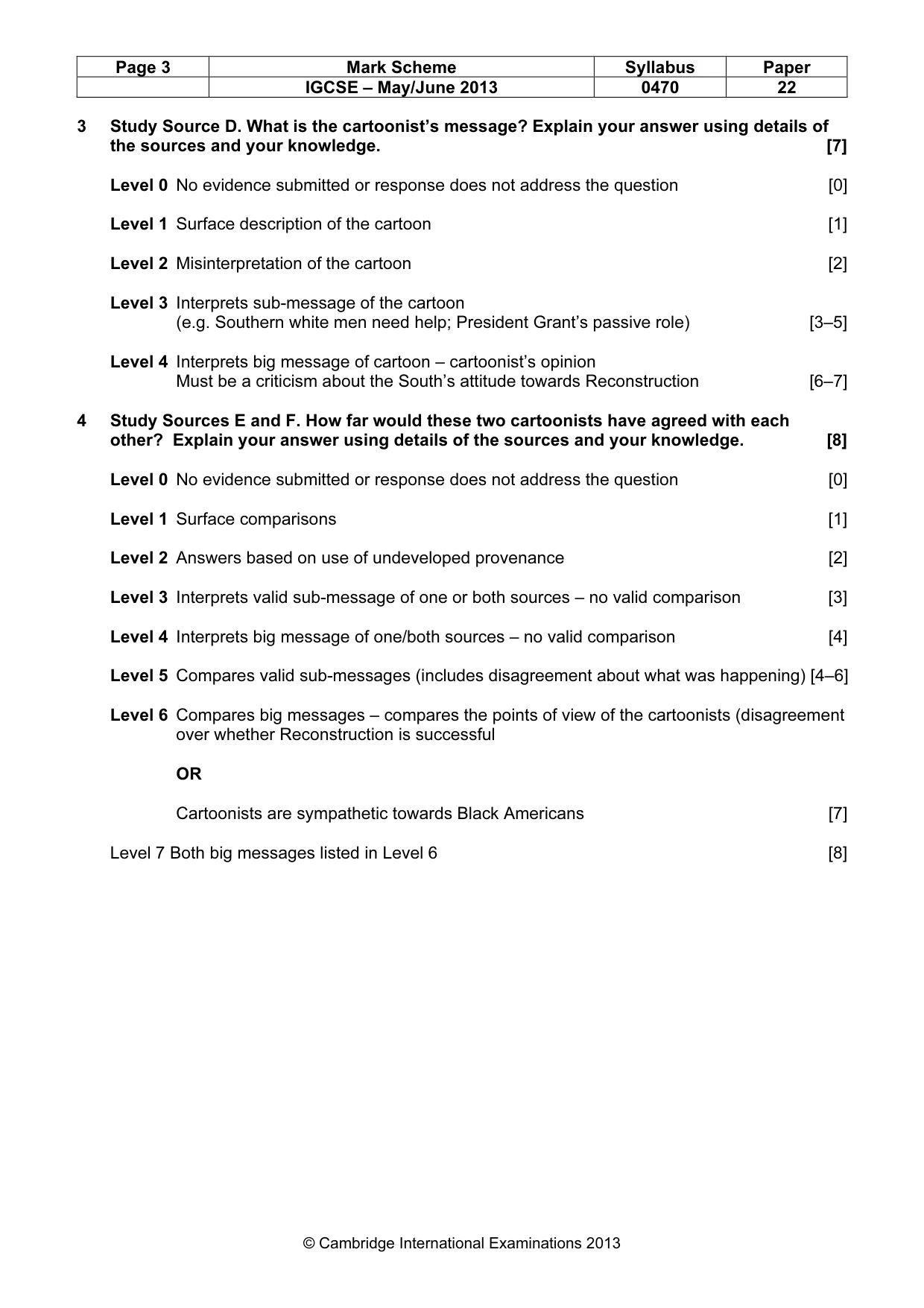
Page 3 Mark Scheme Syllabus Paper IGCSE – May/June 2013 0470 22 © Cambridge International Examinations 2013 3 Study Source D. What is the cartoonist’s message? Explain your answer using details of the sources and your knowledge. [7] Level 0 No evidence submitted or response does not address the question [0] Level 1 Surface description of the cartoon [1] Level 2 Misinterpretation of the cartoon [2] Level 3 Interprets sub-message of the cartoon (e.g. Southern white men need help; President Grant’s passive role) [3–5] Level 4 Interprets big message of cartoon – cartoonist’s opinion Must be a criticism about the South’s attitude towards Reconstruction [6–7] 4 Study Sources E and F. How far would these two cartoonists have agreed with each other? Explain your answer using details of the sources and your knowledge. [8] Level 0 No evidence submitted or response does not address the question [0] Level 1 Surface comparisons [1] Level 2 Answers based on use of undeveloped provenance [2] Level 3 Interprets valid sub-message of one or both sources – no valid comparison [3] Level 4 Interprets big message of one/both sources – no valid comparison [4] Level 5 Compares valid sub-messages (includes disagreement about what was happening) [4–6] Level 6 Compares big messages – compares the points of view of the cartoonists (disagreement over whether Reconstruction is successful OR Cartoonists are sympathetic towards Black Americans [7] Level 7 Both big messages listed in Level 6 [8]
Mark scheme, page 4
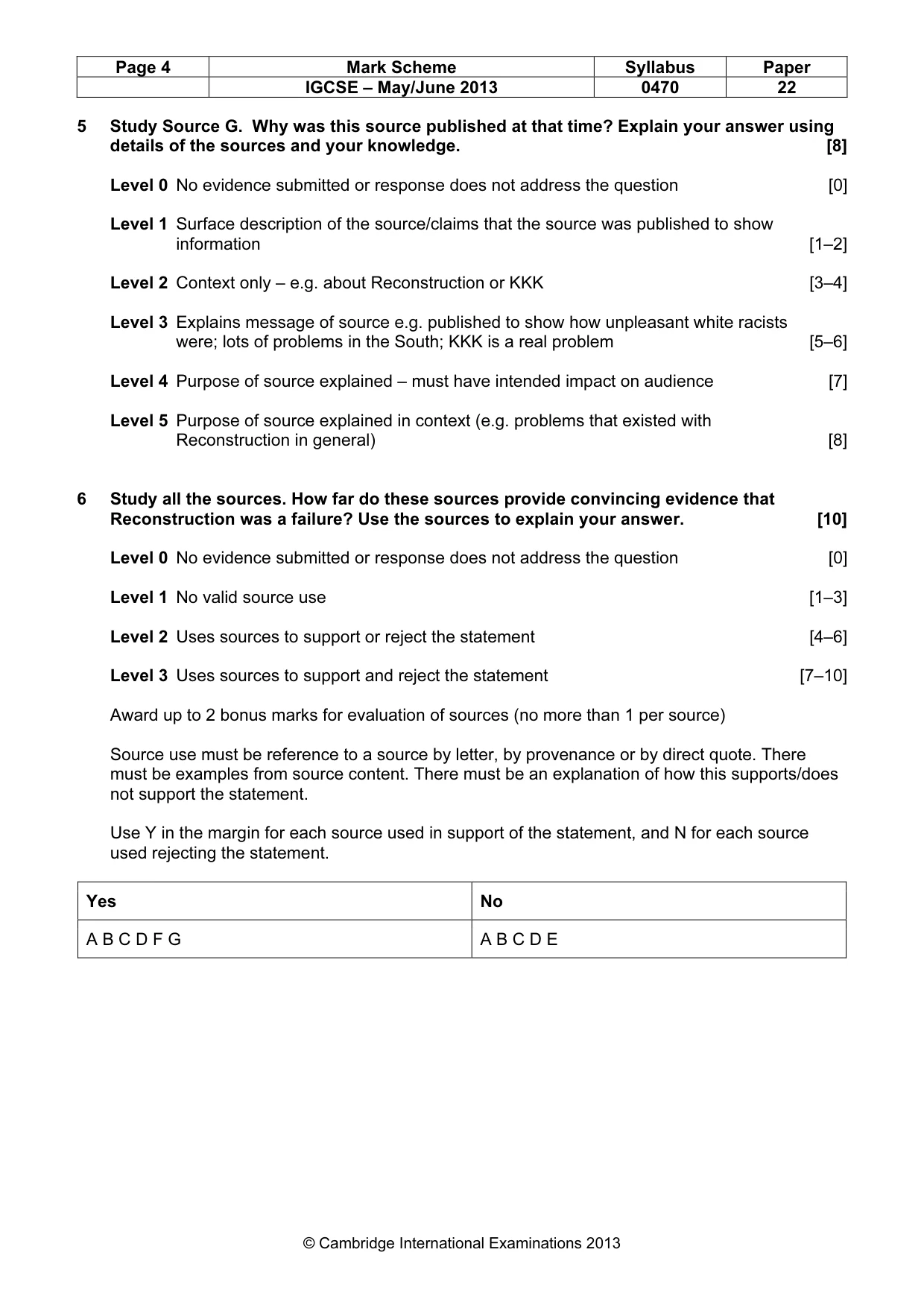
Page 4 Mark Scheme Syllabus Paper IGCSE – May/June 2013 0470 22 © Cambridge International Examinations 2013 5 Study Source G. Why was this source published at that time? Explain your answer using details of the sources and your knowledge. [8] Level 0 No evidence submitted or response does not address the question [0] Level 1 Surface description of the source/claims that the source was published to show information [1–2] Level 2 Context only – e.g. about Reconstruction or KKK [3–4] Level 3 Explains message of source e.g. published to show how unpleasant white racists were; lots of problems in the South; KKK is a real problem [5–6] Level 4 Purpose of source explained – must have intended impact on audience [7] Level 5 Purpose of source explained in context (e.g. problems that existed with Reconstruction in general) [8] 6 Study all the sources. How far do these sources provide convincing evidence that Reconstruction was a failure? Use the sources to explain your answer. [10] Level 0 No evidence submitted or response does not address the question [0] Level 1 No valid source use [1–3] Level 2 Uses sources to support or reject the statement [4–6] Level 3 Uses sources to support and reject the statement [7–10] Award up to 2 bonus marks for evaluation of sources (no more than 1 per source) Source use must be reference to a source by letter, by provenance or by direct quote. There must be examples from source content. There must be an explanation of how this supports/does not support the statement. Use Y in the margin for each source used in support of the statement, and N for each source used rejecting the statement. Yes No A B C D F G A B C D E
Mark scheme, page 5
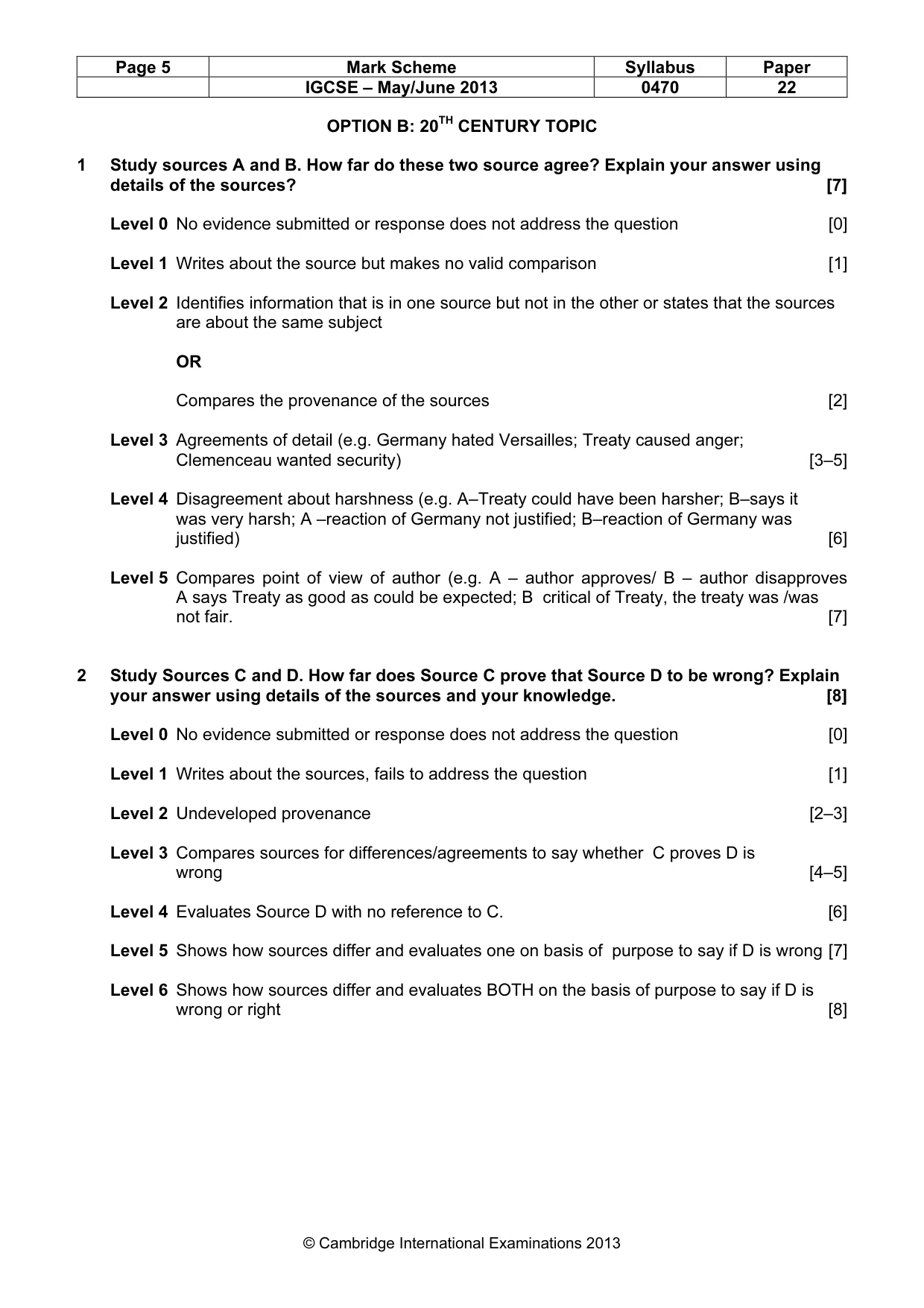
Page 5 Mark Scheme Syllabus Paper IGCSE – May/June 2013 0470 22 © Cambridge International Examinations 2013 OPTION B: 20TH CENTURY TOPIC 1 Study sources A and B. How far do these two source agree? Explain your answer using details of the sources? [7] Level 0 No evidence submitted or response does not address the question [0] Level 1 Writes about the source but makes no valid comparison [1] Level 2 Identifies information that is in one source but not in the other or states that the sources are about the same subject OR Compares the provenance of the sources [2] Level 3 Agreements of detail (e.g. Germany hated Versailles; Treaty caused anger; Clemenceau wanted security) [3–5] Level 4 Disagreement about harshness (e.g. A–Treaty could have been harsher; B–says it was very harsh; A –reaction of Germany not justified; B–reaction of Germany was justified) [6] Level 5 Compares point of view of author (e.g. A – author approves/ B – author disapproves A says Treaty as good as could be expected; B critical of Treaty, the treaty was /was not fair. [7] 2 Study Sources C and D. How far does Source C prove that Source D to be wrong? Explain your answer using details of the sources and your knowledge. [8] Level 0 No evidence submitted or response does not address the question [0] Level 1 Writes about the sources, fails to address the question [1] Level 2 Undeveloped provenance [2–3] Level 3 Compares sources for differences/agreements to say whether C proves D is wrong [4–5] Level 4 Evaluates Source D with no reference to C. [6] Level 5 Shows how sources differ and evaluates one on basis of purpose to say if D is wrong [7] Level 6 Shows how sources differ and evaluates BOTH on the basis of purpose to say if D is wrong or right [8]
Mark scheme, page 6
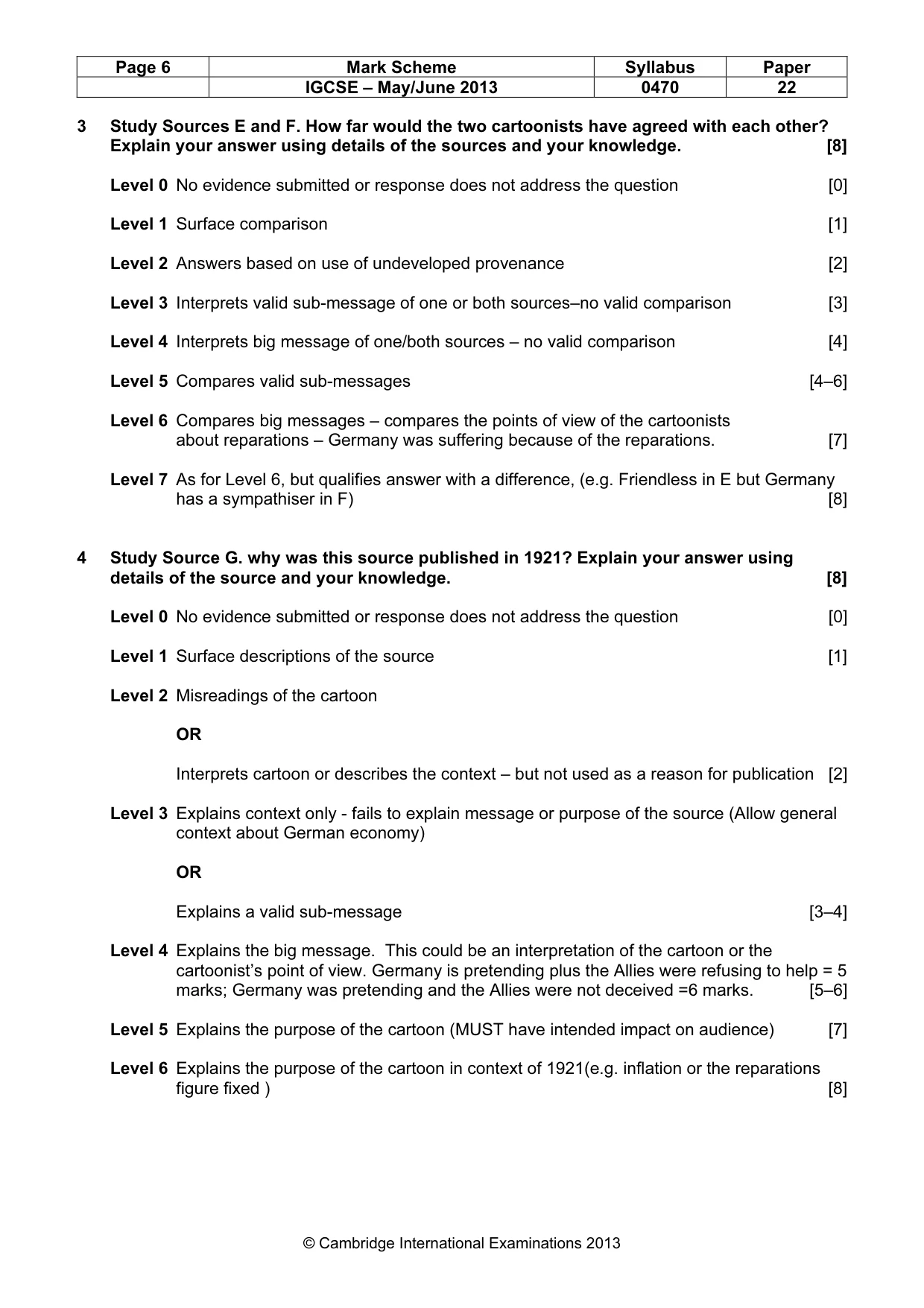
Page 6 Mark Scheme Syllabus Paper IGCSE – May/June 2013 0470 22 © Cambridge International Examinations 2013 3 Study Sources E and F. How far would the two cartoonists have agreed with each other? Explain your answer using details of the sources and your knowledge. [8] Level 0 No evidence submitted or response does not address the question [0] Level 1 Surface comparison [1] Level 2 Answers based on use of undeveloped provenance [2] Level 3 Interprets valid sub-message of one or both sources–no valid comparison [3] Level 4 Interprets big message of one/both sources – no valid comparison [4] Level 5 Compares valid sub-messages [4–6] Level 6 Compares big messages – compares the points of view of the cartoonists about reparations – Germany was suffering because of the reparations. [7] Level 7 As for Level 6, but qualifies answer with a difference, (e.g. Friendless in E but Germany has a sympathiser in F) [8] 4 Study Source G. why was this source published in 1921? Explain your answer using details of the source and your knowledge. [8] Level 0 No evidence submitted or response does not address the question [0] Level 1 Surface descriptions of the source [1] Level 2 Misreadings of the cartoon OR Interprets cartoon or describes the context – but not used as a reason for publication [2] Level 3 Explains context only - fails to explain message or purpose of the source (Allow general context about German economy) OR Explains a valid sub-message [3–4] Level 4 Explains the big message. This could be an interpretation of the cartoon or the cartoonist’s point of view. Germany is pretending plus the Allies were refusing to help = 5 marks; Germany was pretending and the Allies were not deceived =6 marks. [5–6] Level 5 Explains the purpose of the cartoon (MUST have intended impact on audience) [7] Level 6 Explains the purpose of the cartoon in context of 1921(e.g. inflation or the reparations figure fixed ) [8]
Mark scheme, page 7
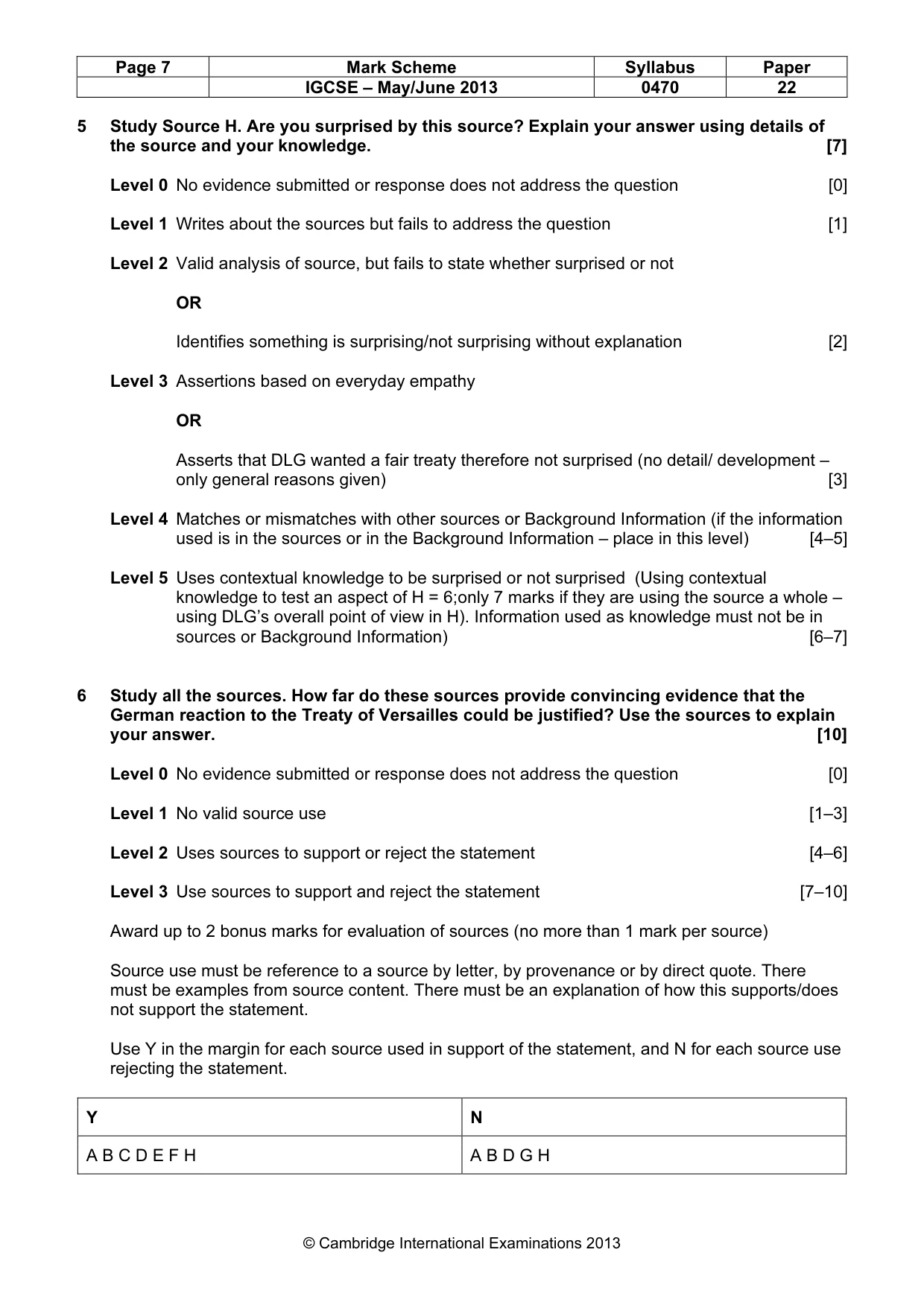
Page 7 Mark Scheme Syllabus Paper IGCSE – May/June 2013 0470 22 © Cambridge International Examinations 2013 5 Study Source H. Are you surprised by this source? Explain your answer using details of the source and your knowledge. [7] Level 0 No evidence submitted or response does not address the question [0] Level 1 Writes about the sources but fails to address the question [1] Level 2 Valid analysis of source, but fails to state whether surprised or not OR Identifies something is surprising/not surprising without explanation [2] Level 3 Assertions based on everyday empathy OR Asserts that DLG wanted a fair treaty therefore not surprised (no detail/ development – only general reasons given) [3] Level 4 Matches or mismatches with other sources or Background Information (if the information used is in the sources or in the Background Information – place in this level) [4–5] Level 5 Uses contextual knowledge to be surprised or not surprised (Using contextual knowledge to test an aspect of H = 6;only 7 marks if they are using the source a whole – using DLG’s overall point of view in H). Information used as knowledge must not be in sources or Background Information) [6–7] 6 Study all the sources. How far do these sources provide convincing evidence that the German reaction to the Treaty of Versailles could be justified? Use the sources to explain your answer. [10] Level 0 No evidence submitted or response does not address the question [0] Level 1 No valid source use [1–3] Level 2 Uses sources to support or reject the statement [4–6] Level 3 Use sources to support and reject the statement [7–10] Award up to 2 bonus marks for evaluation of sources (no more than 1 mark per source) Source use must be reference to a source by letter, by provenance or by direct quote. There must be examples from source content. There must be an explanation of how this supports/does not support the statement. Use Y in the margin for each source used in support of the statement, and N for each source use rejecting the statement. Y N A B C D E F H A B D G H
What you needed in this session
Cambridge’s own grade thresholds for 2013 May/June, Paper 2 · Variant 2. A higher threshold means an easier paper — the bar moves with how the cohort did.