Cambridge IGCSE History 0470 — 2013 May/June Paper 2 · Variant 1
0470/21/M/J/13 · 50 marks · ≈56 min
The question paper and its mark scheme, free to read here and free to download. This is Cambridge’s own paper, exactly as it was sat.
Question paper16 pages

Mark scheme10 pages
Answers below. Sit the paper first if you are practising.
Paper as text
Question paper, page 1
This document consists of 14 printed pages and 2 blank pages. DC (RW/CGW) 66883/4 © UCLES 2013 [Turn over UNIVERSITY OF CAMBRIDGE INTERNATIONAL EXAMINATIONS International General Certificate of Secondary Education * 6 6 0 7 3 2 7 1 5 8 * HISTORY 0470/21 Paper 2 May/June 2013 2 hours Additional Materials: Answer Booklet/Paper READ THESE INSTRUCTIONS FIRST If you have been given an Answer Booklet, follow the instructions on the front cover of the Booklet. Write your Centre number, candidate number and name on all the work you hand in. Write in dark blue or black pen. You may use a soft pencil for any diagrams, graphs or rough working. Do not use staples, paper clips, highlighters, glue or correction fluid. This paper has two options. Choose one option, and answer all of the questions on that topic. Option A: 19th Century topic [p2–p8] Option B: 20th Century topic [p9–p14] At the end of the examination, fasten all your work securely together. The number of marks is given in brackets [ ] at the end of each question or part question.
Question paper, page 2
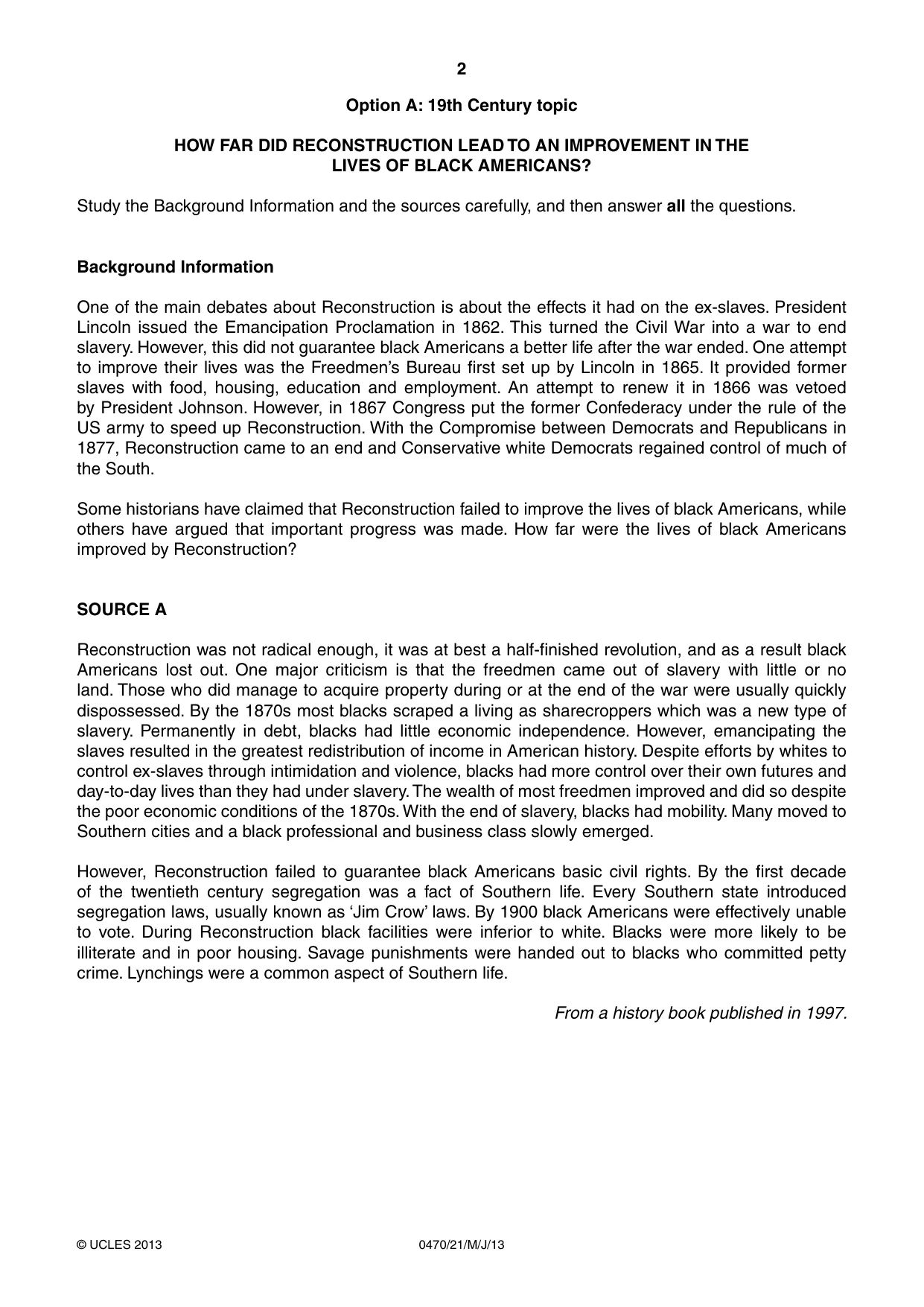
2 0470/21/M/J/13 © UCLES 2013 Option A: 19th Century topic HOW FAR DID RECONSTRUCTION LEAD TO AN IMPROVEMENT IN THE LIVES OF BLACK AMERICANS? Study the Background Information and the sources carefully, and then answer all the questions. Background Information One of the main debates about Reconstruction is about the effects it had on the ex-slaves. President Lincoln issued the Emancipation Proclamation in 1862. This turned the Civil War into a war to end slavery. However, this did not guarantee black Americans a better life after the war ended. One attempt to improve their lives was the Freedmen’s Bureau first set up by Lincoln in 1865. It provided former slaves with food, housing, education and employment. An attempt to renew it in 1866 was vetoed by President Johnson. However, in 1867 Congress put the former Confederacy under the rule of the US army to speed up Reconstruction. With the Compromise between Democrats and Republicans in 1877, Reconstruction came to an end and Conservative white Democrats regained control of much of the South. Some historians have claimed that Reconstruction failed to improve the lives of black Americans, while others have argued that important progress was made. How far were the lives of black Americans improved by Reconstruction? SOURCE A Reconstruction was not radical enough, it was at best a half-finished revolution, and as a result black Americans lost out. One major criticism is that the freedmen came out of slavery with little or no land. Those who did manage to acquire property during or at the end of the war were usually quickly dispossessed. By the 1870s most blacks scraped a living as sharecroppers which was a new type of slavery. Permanently in debt, blacks had little economic independence. However, emancipating the slaves resulted in the greatest redistribution of income in American history. Despite efforts by whites to control ex-slaves through intimidation and violence, blacks had more control over their own futures and day-to-day lives than they had under slavery. The wealth of most freedmen improved and did so despite the poor economic conditions of the 1870s. With the end of slavery, blacks had mobility. Many moved to Southern cities and a black professional and business class slowly emerged. However, Reconstruction failed to guarantee black Americans basic civil rights. By the first decade of the twentieth century segregation was a fact of Southern life. Every Southern state introduced segregation laws, usually known as ‘Jim Crow’ laws. By 1900 black Americans were effectively unable to vote. During Reconstruction black facilities were inferior to white. Blacks were more likely to be illiterate and in poor housing. Savage punishments were handed out to blacks who committed petty crime. Lynchings were a common aspect of Southern life. From a history book published in 1997.
Question paper, page 3
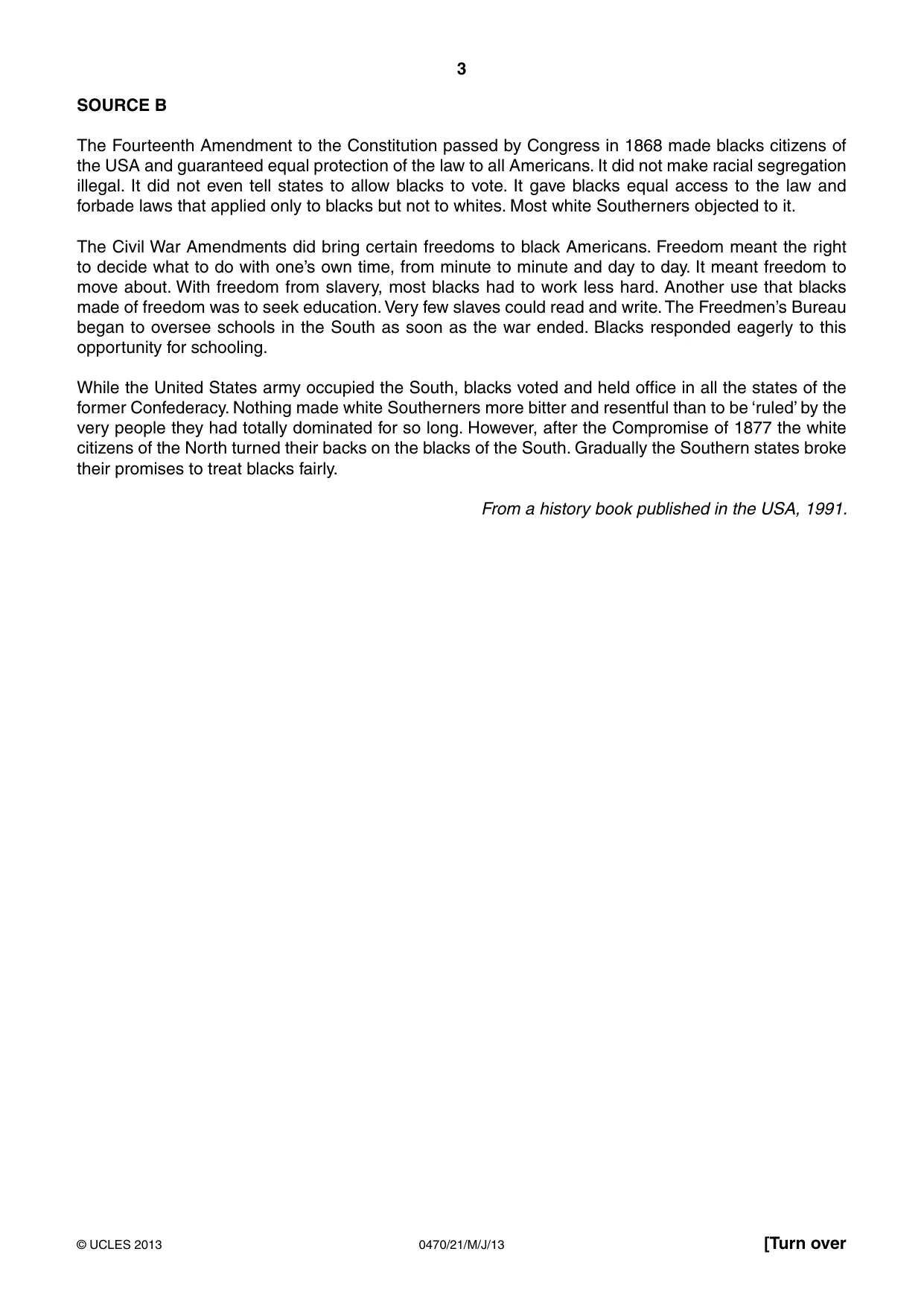
3 0470/21/M/J/13 © UCLES 2013 [Turn over SOURCE B The Fourteenth Amendment to the Constitution passed by Congress in 1868 made blacks citizens of the USA and guaranteed equal protection of the law to all Americans. It did not make racial segregation illegal. It did not even tell states to allow blacks to vote. It gave blacks equal access to the law and forbade laws that applied only to blacks but not to whites. Most white Southerners objected to it. The Civil War Amendments did bring certain freedoms to black Americans. Freedom meant the right to decide what to do with one’s own time, from minute to minute and day to day. It meant freedom to move about. With freedom from slavery, most blacks had to work less hard. Another use that blacks made of freedom was to seek education. Very few slaves could read and write. The Freedmen’s Bureau began to oversee schools in the South as soon as the war ended. Blacks responded eagerly to this opportunity for schooling. While the United States army occupied the South, blacks voted and held office in all the states of the former Confederacy. Nothing made white Southerners more bitter and resentful than to be ‘ruled’ by the very people they had totally dominated for so long. However, after the Compromise of 1877 the white citizens of the North turned their backs on the blacks of the South. Gradually the Southern states broke their promises to treat blacks fairly. From a history book published in the USA, 1991.
Question paper, page 4
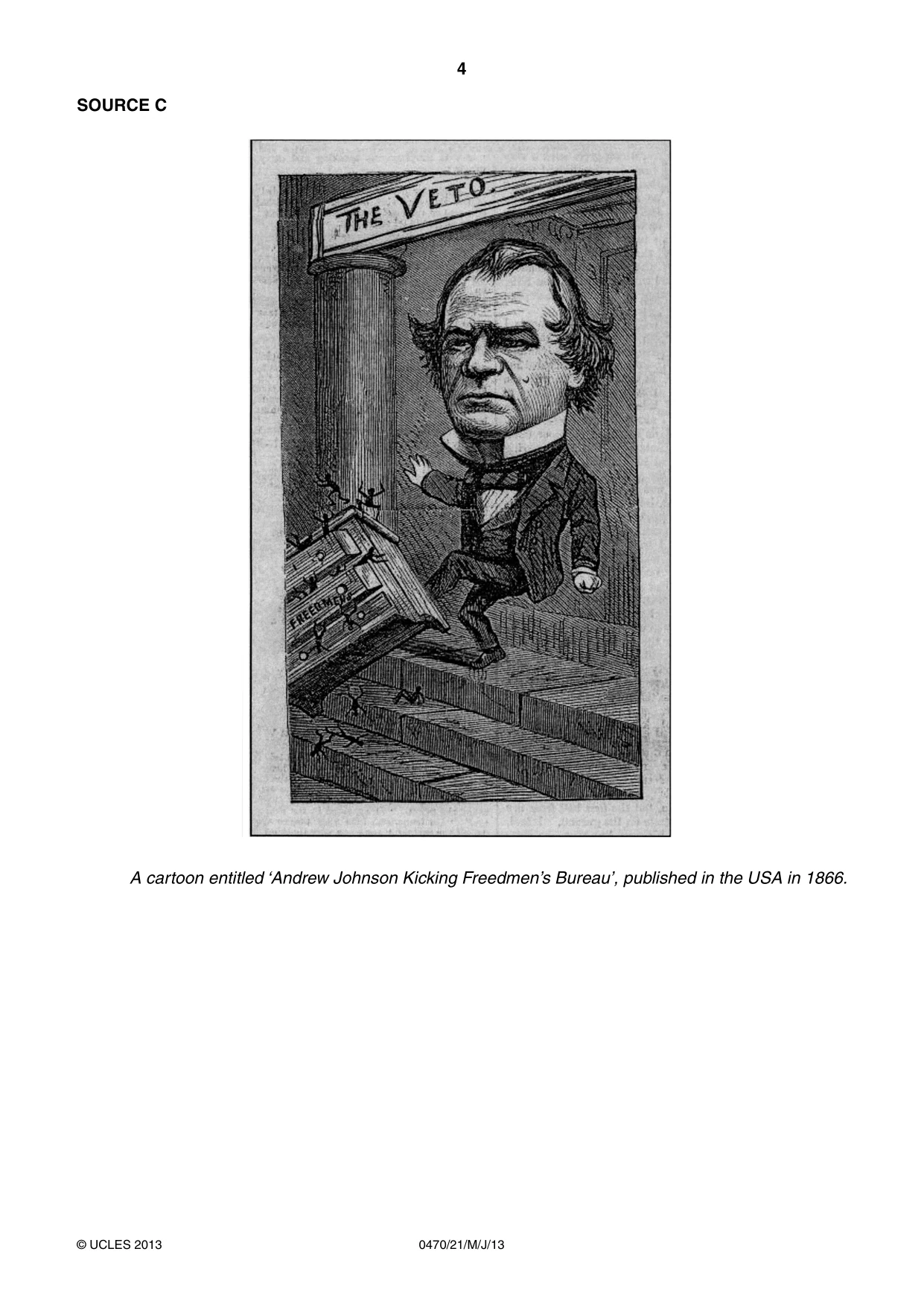
4 0470/21/M/J/13 © UCLES 2013 SOURCE C A cartoon entitled ‘Andrew Johnson Kicking Freedmen’s Bureau’, published in the USA in 1866.
Question paper, page 5
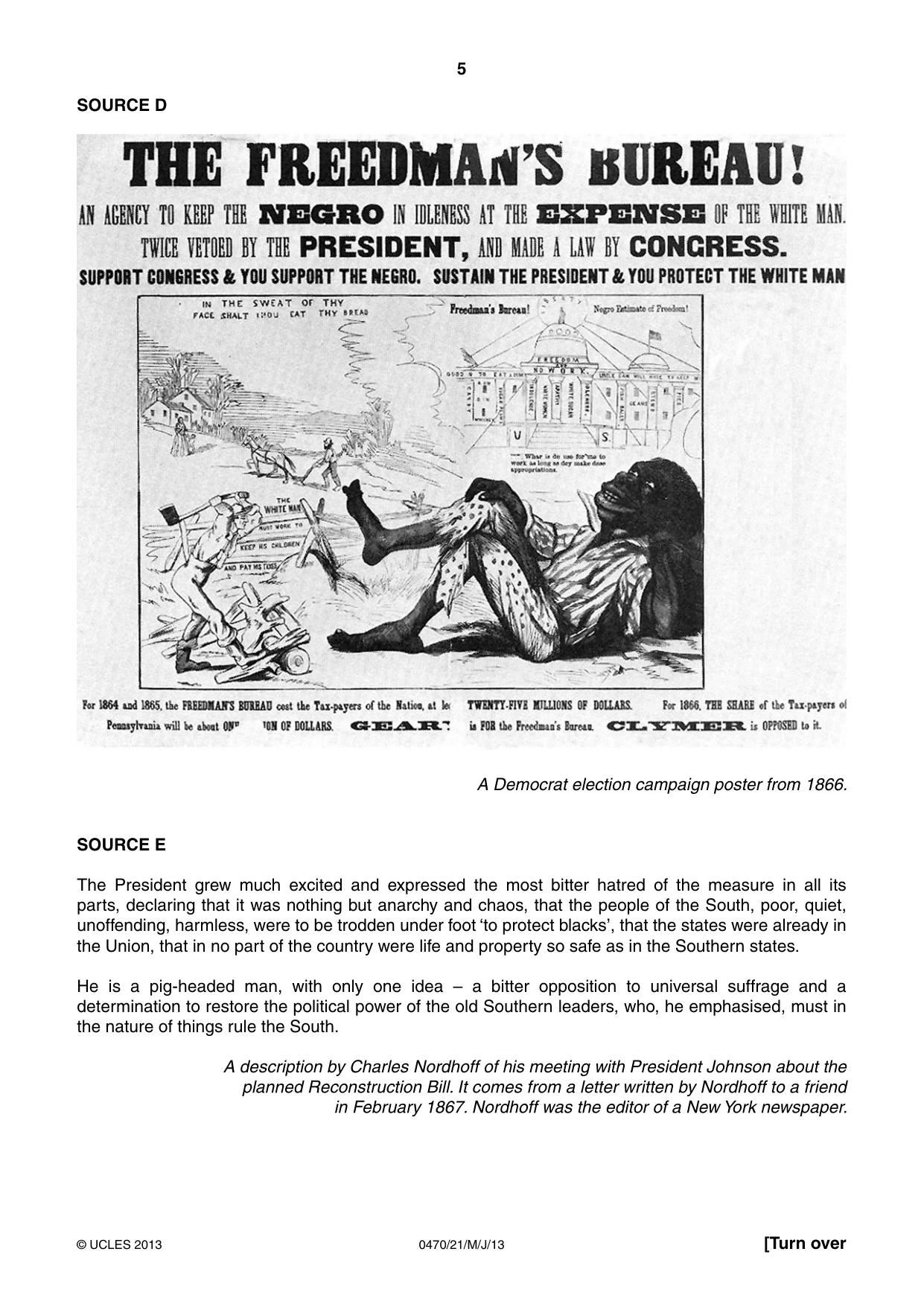
5 0470/21/M/J/13 © UCLES 2013 [Turn over SOURCE D A Democrat election campaign poster from 1866. SOURCE E The President grew much excited and expressed the most bitter hatred of the measure in all its parts, declaring that it was nothing but anarchy and chaos, that the people of the South, poor, quiet, unoffending, harmless, were to be trodden under foot ‘to protect blacks’, that the states were already in the Union, that in no part of the country were life and property so safe as in the Southern states. He is a pig-headed man, with only one idea – a bitter opposition to universal suffrage and a determination to restore the political power of the old Southern leaders, who, he emphasised, must in the nature of things rule the South. A description by Charles Nordhoff of his meeting with President Johnson about the planned Reconstruction Bill. It comes from a letter written by Nordhoff to a friend in February 1867. Nordhoff was the editor of a New York newspaper.
Question paper, page 6
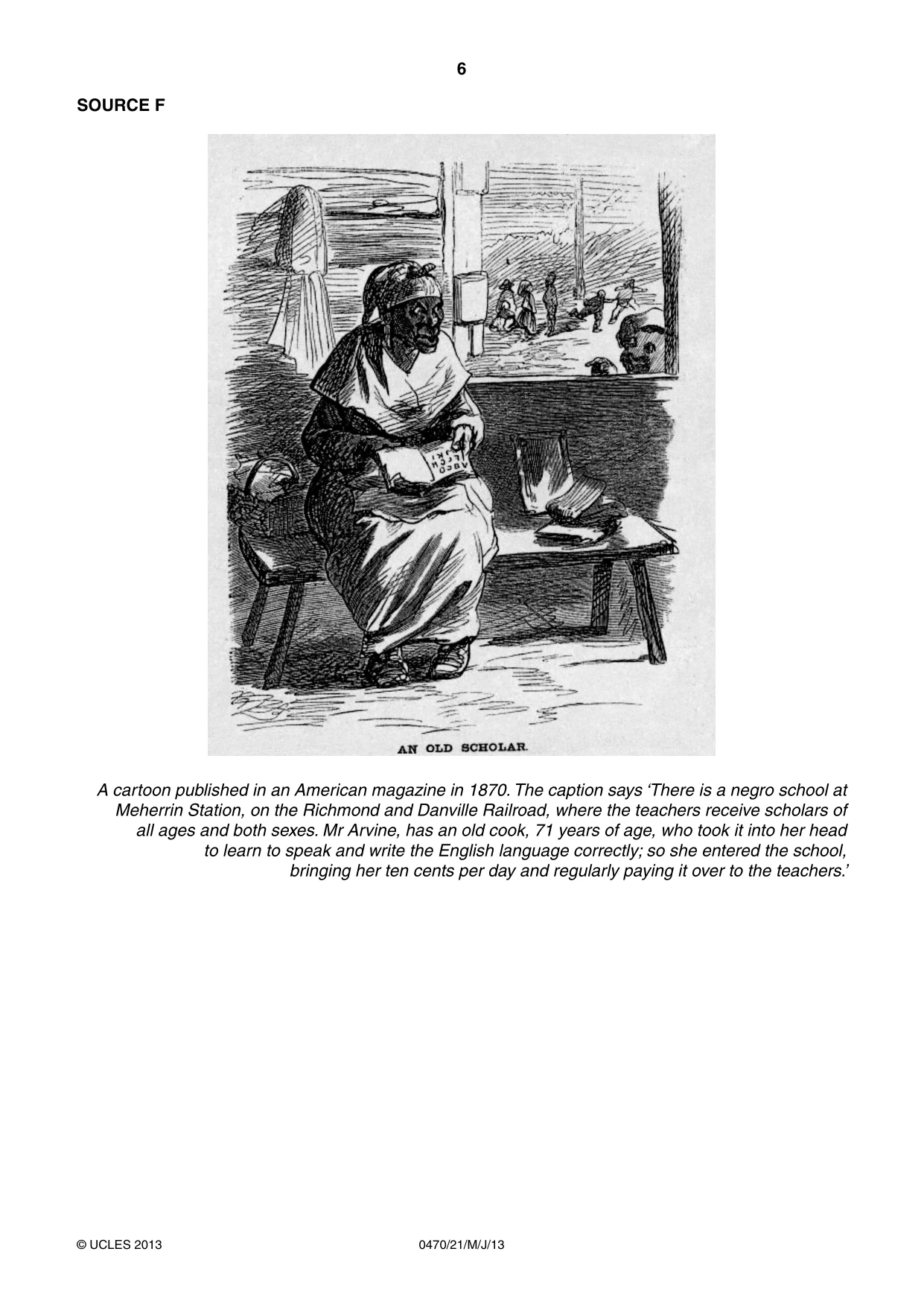
6 0470/21/M/J/13 © UCLES 2013 SOURCE F A cartoon published in an American magazine in 1870. The caption says ‘There is a negro school at Meherrin Station, on the Richmond and Danville Railroad, where the teachers receive scholars of all ages and both sexes. Mr Arvine, has an old cook, 71 years of age, who took it into her head to learn to speak and write the English language correctly; so she entered the school, bringing her ten cents per day and regularly paying it over to the teachers.’
Question paper, page 7
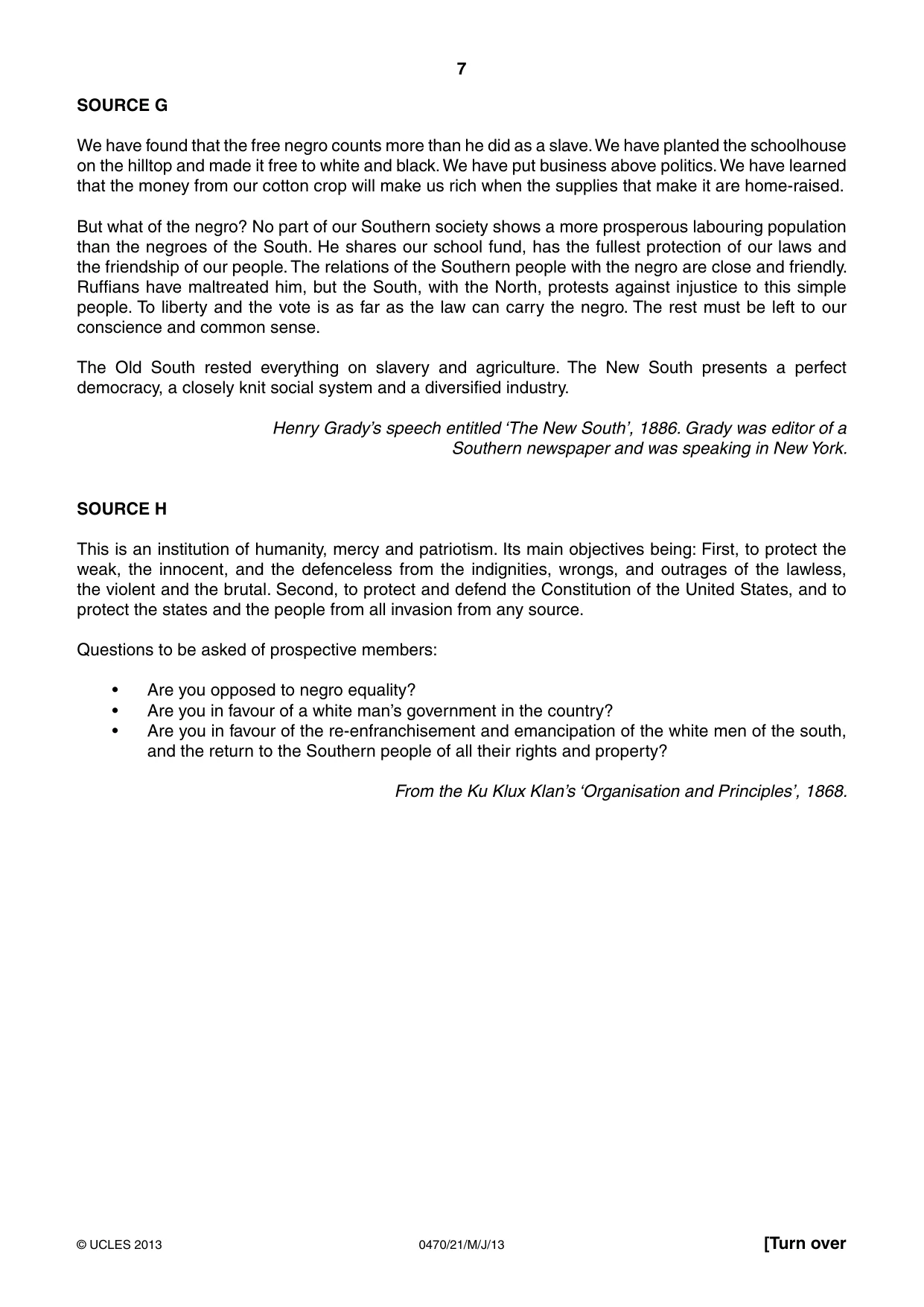
7 0470/21/M/J/13 © UCLES 2013 [Turn over SOURCE G We have found that the free negro counts more than he did as a slave. We have planted the schoolhouse on the hilltop and made it free to white and black. We have put business above politics. We have learned that the money from our cotton crop will make us rich when the supplies that make it are home-raised. But what of the negro? No part of our Southern society shows a more prosperous labouring population than the negroes of the South. He shares our school fund, has the fullest protection of our laws and the friendship of our people. The relations of the Southern people with the negro are close and friendly. Ruffians have maltreated him, but the South, with the North, protests against injustice to this simple people. To liberty and the vote is as far as the law can carry the negro. The rest must be left to our conscience and common sense. The Old South rested everything on slavery and agriculture. The New South presents a perfect democracy, a closely knit social system and a diversified industry. Henry Grady’s speech entitled ‘The New South’, 1886. Grady was editor of a Southern newspaper and was speaking in New York. SOURCE H This is an institution of humanity, mercy and patriotism. Its main objectives being: First, to protect the weak, the innocent, and the defenceless from the indignities, wrongs, and outrages of the lawless, the violent and the brutal. Second, to protect and defend the Constitution of the United States, and to protect the states and the people from all invasion from any source. Questions to be asked of prospective members: • Are you opposed to negro equality? • Are you in favour of a white man’s government in the country? • Are you in favour of the re-enfranchisement and emancipation of the white men of the south, and the return to the Southern people of all their rights and property? From the Ku Klux Klan’s ‘Organisation and Principles’, 1868.
Question paper, page 8
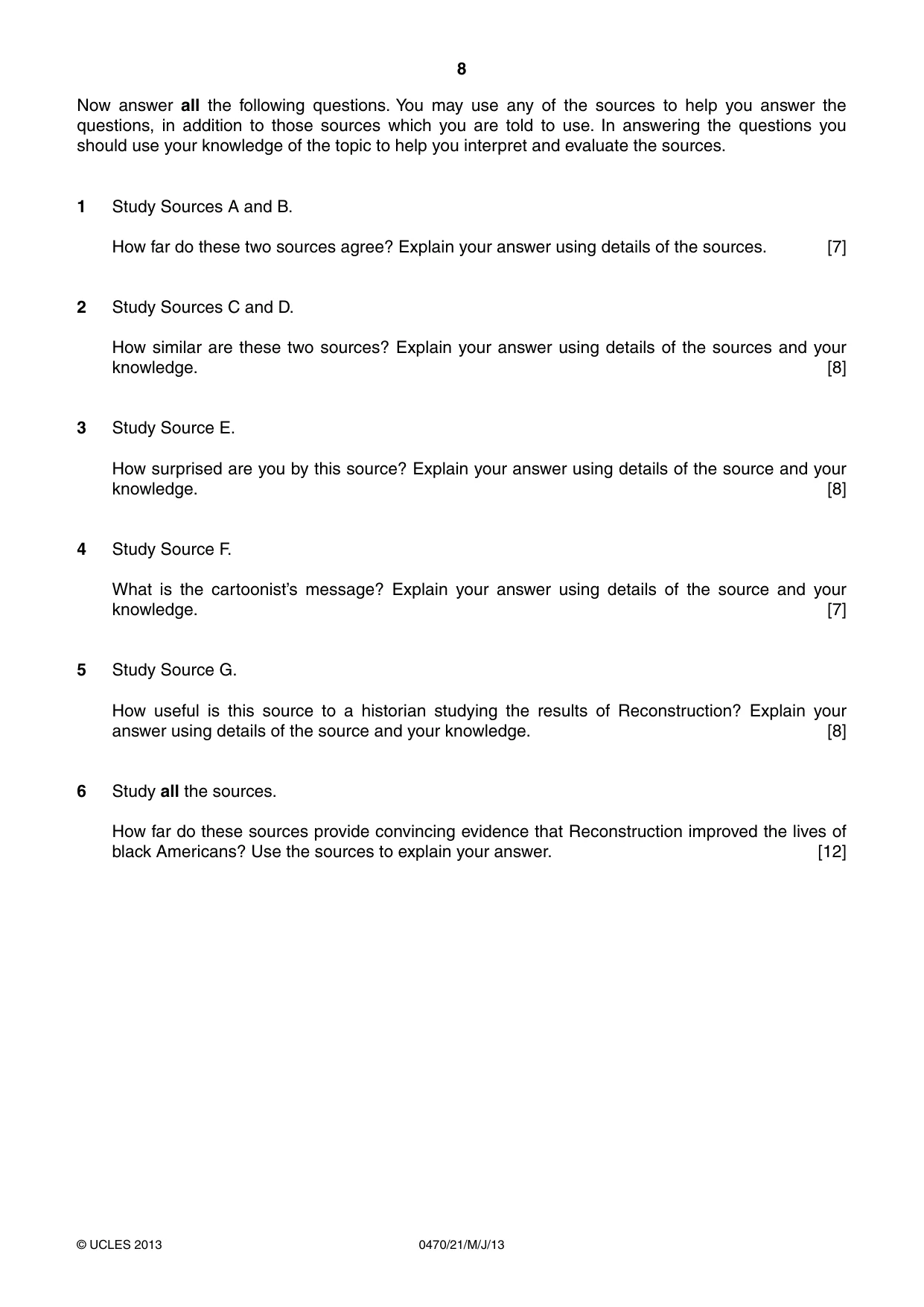
8 0470/21/M/J/13 © UCLES 2013 Now answer all the following questions. You may use any of the sources to help you answer the questions, in addition to those sources which you are told to use. In answering the questions you should use your knowledge of the topic to help you interpret and evaluate the sources. 1 Study Sources A and B. How far do these two sources agree? Explain your answer using details of the sources. [7] 2 Study Sources C and D. How similar are these two sources? Explain your answer using details of the sources and your knowledge. [8] 3 Study Source E. How surprised are you by this source? Explain your answer using details of the source and your knowledge. [8] 4 Study Source F. What is the cartoonist’s message? Explain your answer using details of the source and your knowledge. [7] 5 Study Source G. How useful is this source to a historian studying the results of Reconstruction? Explain your answer using details of the source and your knowledge. [8] 6 Study all the sources. How far do these sources provide convincing evidence that Reconstruction improved the lives of black Americans? Use the sources to explain your answer. [12]
Question paper, page 9
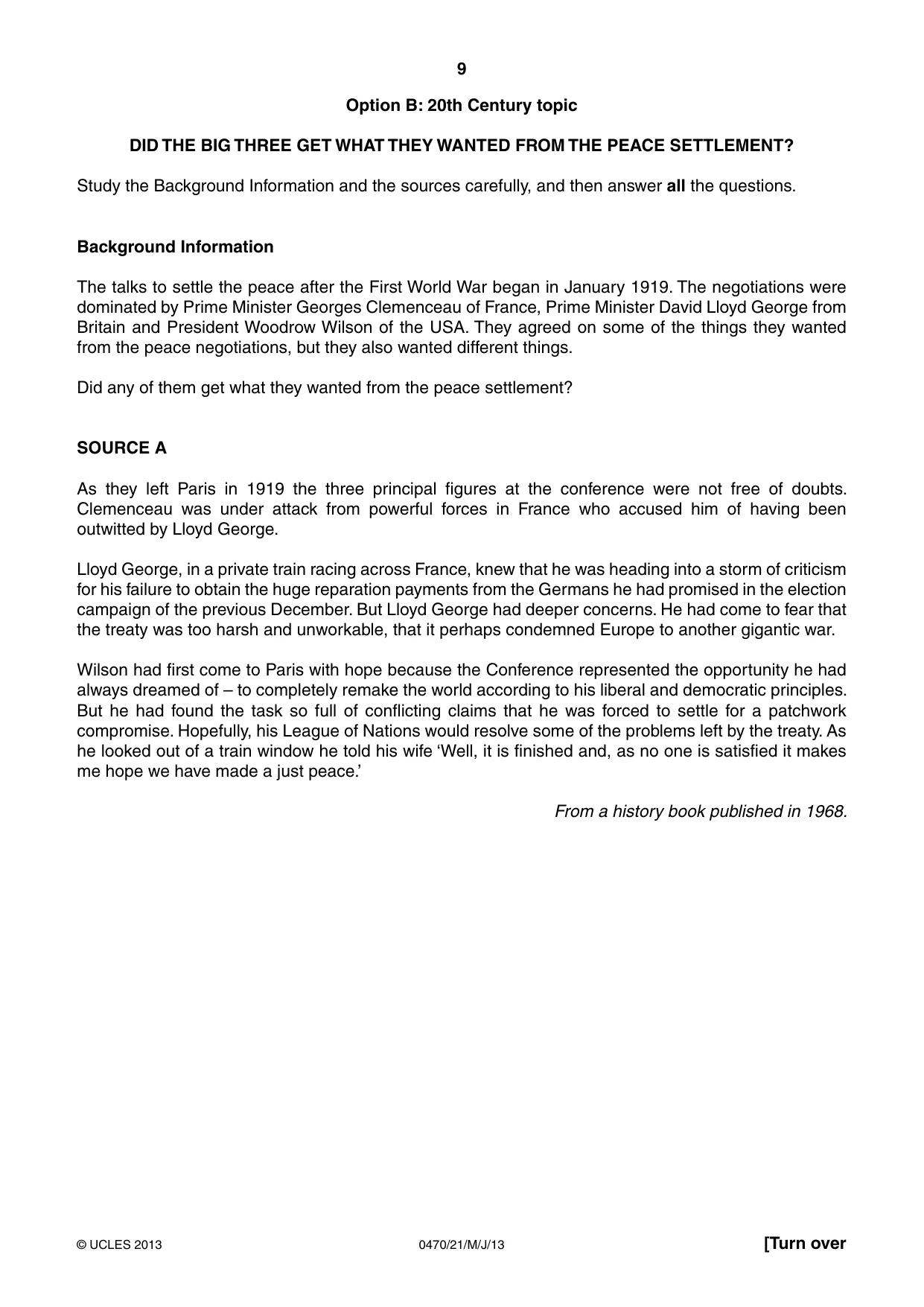
9 0470/21/M/J/13 © UCLES 2013 [Turn over Option B: 20th Century topic DID THE BIG THREE GET WHAT THEY WANTED FROM THE PEACE SETTLEMENT? Study the Background Information and the sources carefully, and then answer all the questions. Background Information The talks to settle the peace after the First World War began in January 1919. The negotiations were dominated by Prime Minister Georges Clemenceau of France, Prime Minister David Lloyd George from Britain and President Woodrow Wilson of the USA. They agreed on some of the things they wanted from the peace negotiations, but they also wanted different things. Did any of them get what they wanted from the peace settlement? SOURCE A As they left Paris in 1919 the three principal figures at the conference were not free of doubts. Clemenceau was under attack from powerful forces in France who accused him of having been outwitted by Lloyd George. Lloyd George, in a private train racing across France, knew that he was heading into a storm of criticism for his failure to obtain the huge reparation payments from the Germans he had promised in the election campaign of the previous December. But Lloyd George had deeper concerns. He had come to fear that the treaty was too harsh and unworkable, that it perhaps condemned Europe to another gigantic war. Wilson had first come to Paris with hope because the Conference represented the opportunity he had always dreamed of – to completely remake the world according to his liberal and democratic principles. But he had found the task so full of conflicting claims that he was forced to settle for a patchwork compromise. Hopefully, his League of Nations would resolve some of the problems left by the treaty. As he looked out of a train window he told his wife ‘Well, it is finished and, as no one is satisfied it makes me hope we have made a just peace.’ From a history book published in 1968.
Question paper, page 10
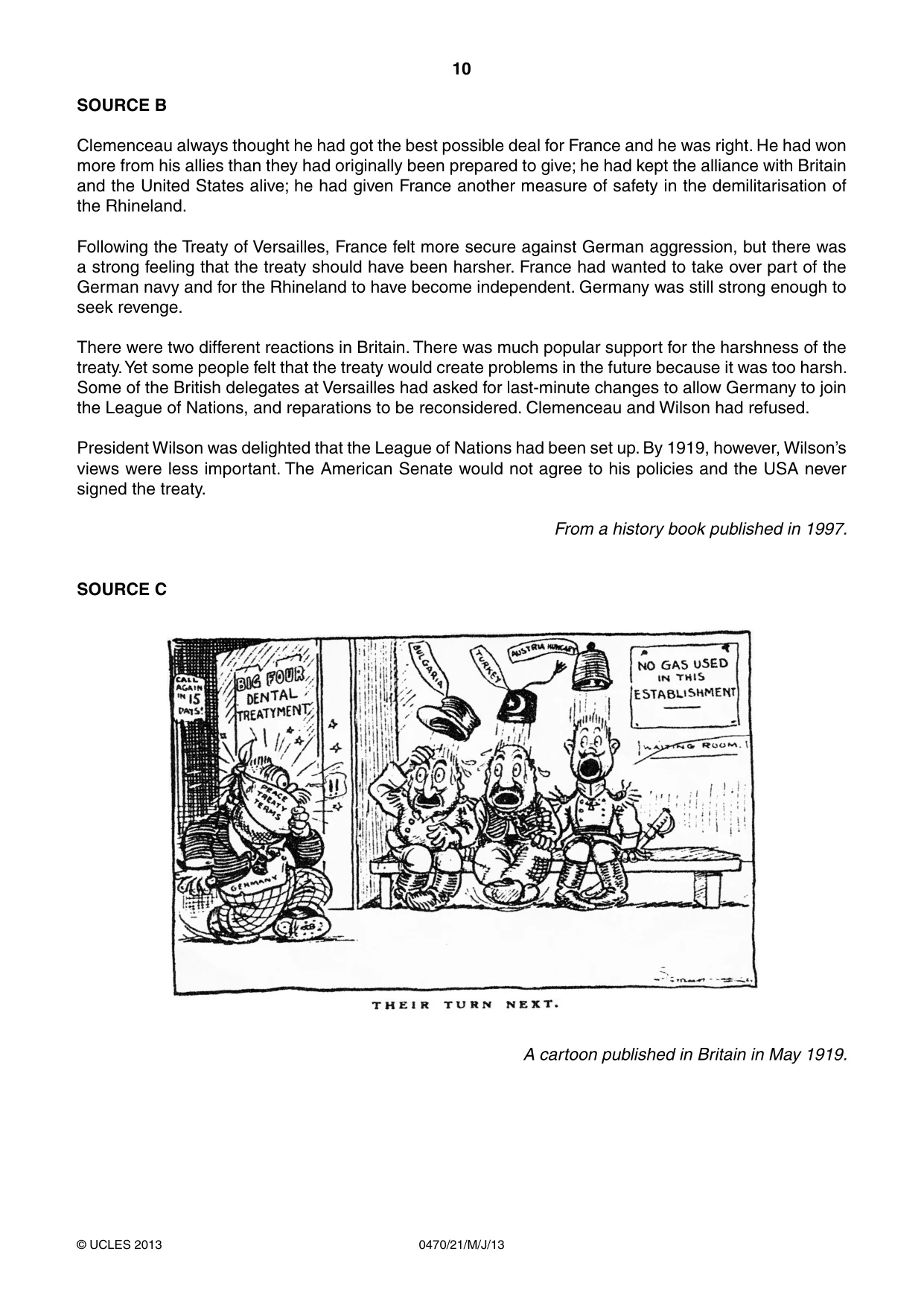
10 0470/21/M/J/13 © UCLES 2013 SOURCE B Clemenceau always thought he had got the best possible deal for France and he was right. He had won more from his allies than they had originally been prepared to give; he had kept the alliance with Britain and the United States alive; he had given France another measure of safety in the demilitarisation of the Rhineland. Following the Treaty of Versailles, France felt more secure against German aggression, but there was a strong feeling that the treaty should have been harsher. France had wanted to take over part of the German navy and for the Rhineland to have become independent. Germany was still strong enough to seek revenge. There were two different reactions in Britain. There was much popular support for the harshness of the treaty. Yet some people felt that the treaty would create problems in the future because it was too harsh. Some of the British delegates at Versailles had asked for last-minute changes to allow Germany to join the League of Nations, and reparations to be reconsidered. Clemenceau and Wilson had refused. President Wilson was delighted that the League of Nations had been set up. By 1919, however, Wilson’s views were less important. The American Senate would not agree to his policies and the USA never signed the treaty. From a history book published in 1997. SOURCE C A cartoon published in Britain in May 1919.
Question paper, page 11
11 0470/21/M/J/13 © UCLES 2013 [Turn over SOURCE D Justice is the only possible basis for the settlement of the accounts of this terrible war. Justice is what the German delegation asks for and says that Germany had been promised. Justice is what Germany shall have. But it must be justice for all. There must be justice for the dead and wounded and for those who have been orphaned and bereaved so that Europe might be freed from German despotism. That is why the Allied powers have insisted as a central feature of the Treaty that Germany must undertake to make reparation to the very limits of its ability. Reparation for wrongs inflicted is of the essence of justice. That, too, is why Germany must submit for a few years to certain special disabilities and arrangements. Germany has ruined the industries, the mines and the machinery of neighbouring countries. It is only justice that reparation should be made. Clemenceau speaking at the peace conference in June 1919. SOURCE E 29 June 1919: I am leaving Paris, after eight fateful months, with conflicting emotions. Looking back at the conference there is much to approve and much to regret. How splendid it would have been had we followed a new and better direction! However, it is to be doubted whether this could have been done, even if those in authority had so ordered, for the people back home had to be reckoned with. To those who are saying that the Treaty is bad and should never have been made and that it will involve Europe in enormous difficulties in its enforcement, I feel like admitting it. We have had to deal with a situation full of difficulties and one which could be met only by an unselfish spirit, which was almost wholly absent and which was too much to expect of men who came together at such a time and for such a purpose. And yet I wish we had taken the other road. An extract from the diary of Edward M. House. House was President Wilson’s main advisor during the peace negotiations.
Question paper, page 12
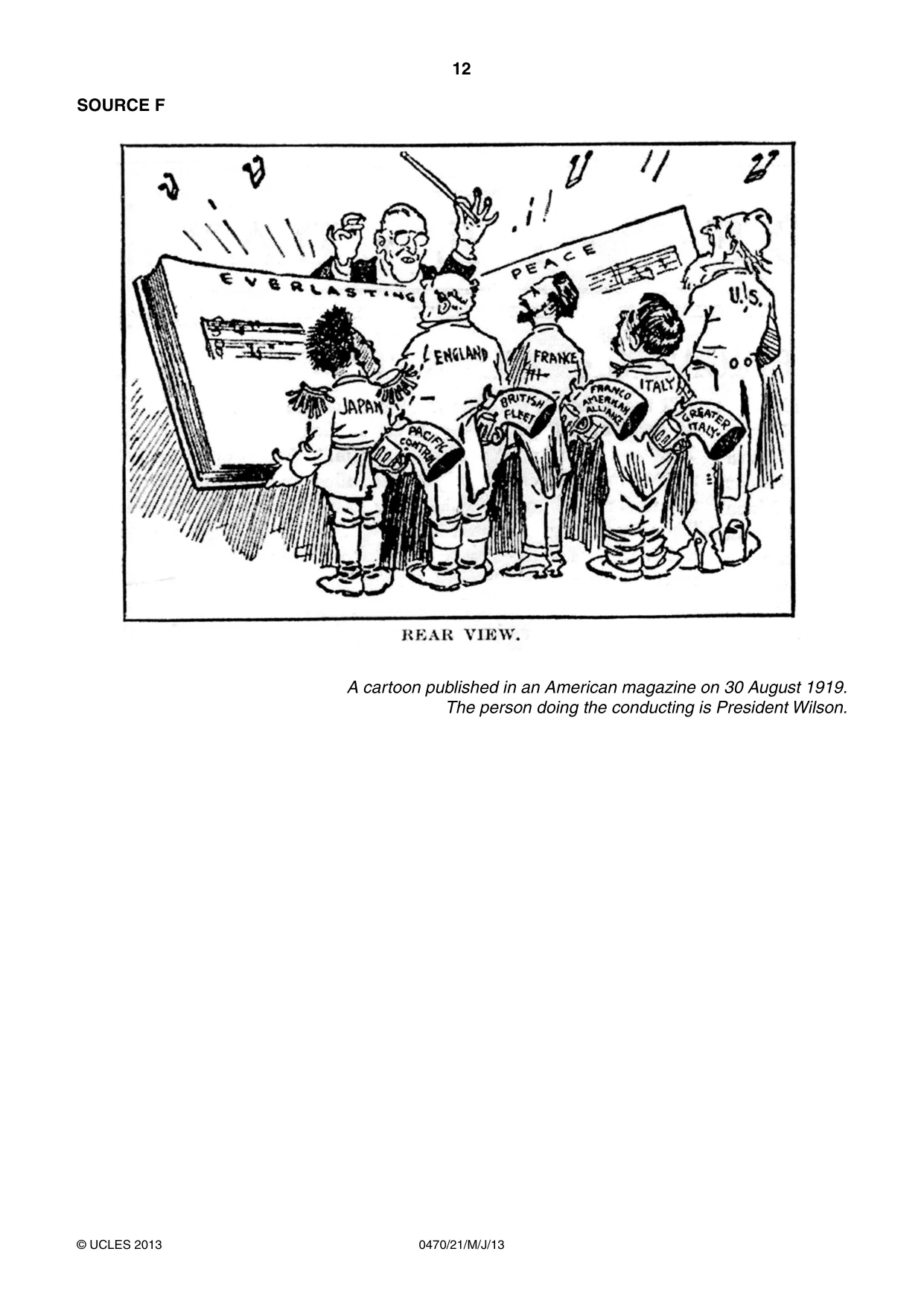
12 0470/21/M/J/13 © UCLES 2013 SOURCE F A cartoon published in an American magazine on 30 August 1919. The person doing the conducting is President Wilson.
Question paper, page 13
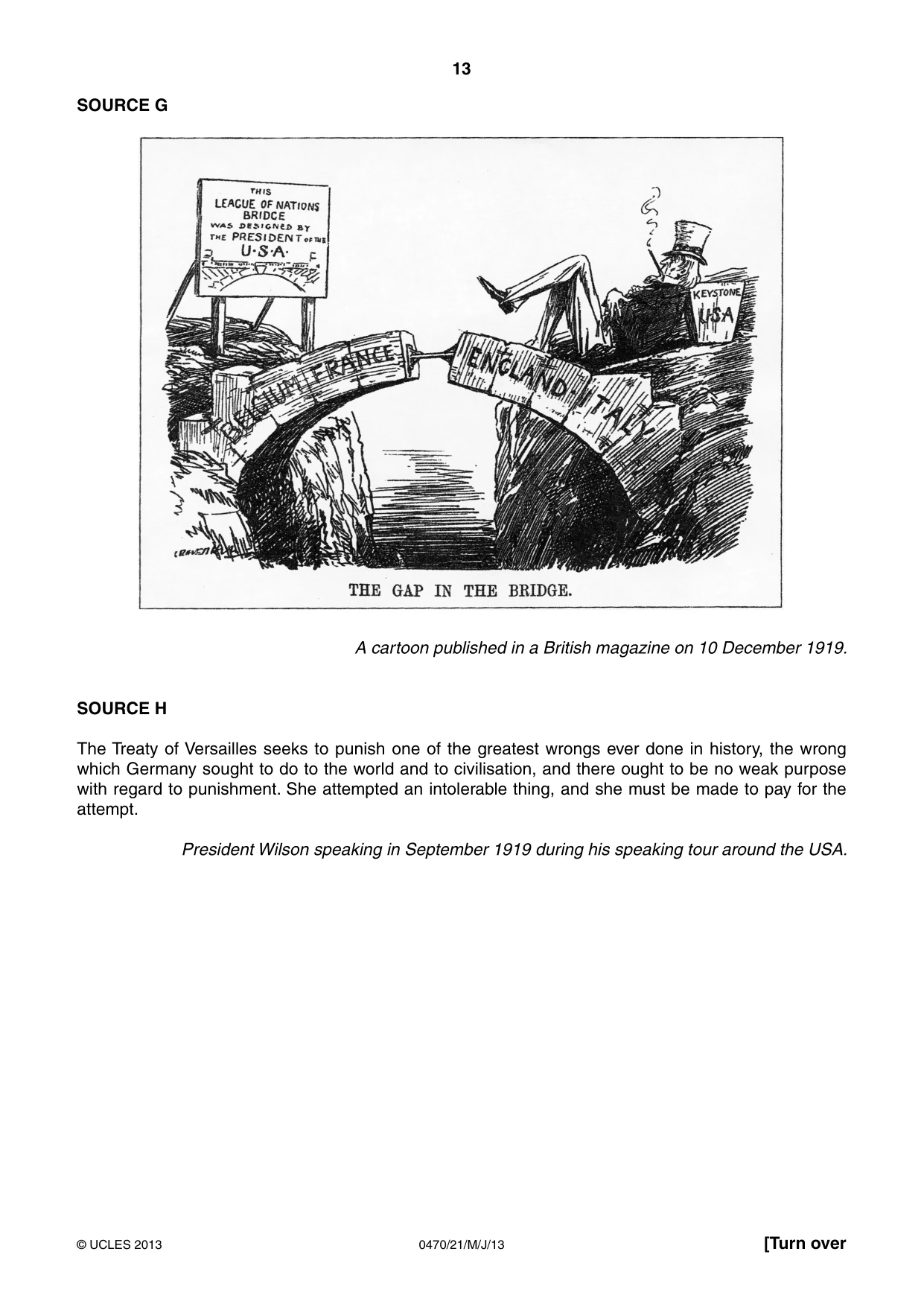
13 0470/21/M/J/13 © UCLES 2013 [Turn over SOURCE G A cartoon published in a British magazine on 10 December 1919. SOURCE H The Treaty of Versailles seeks to punish one of the greatest wrongs ever done in history, the wrong which Germany sought to do to the world and to civilisation, and there ought to be no weak purpose with regard to punishment. She attempted an intolerable thing, and she must be made to pay for the attempt. President Wilson speaking in September 1919 during his speaking tour around the USA.
Question paper, page 14
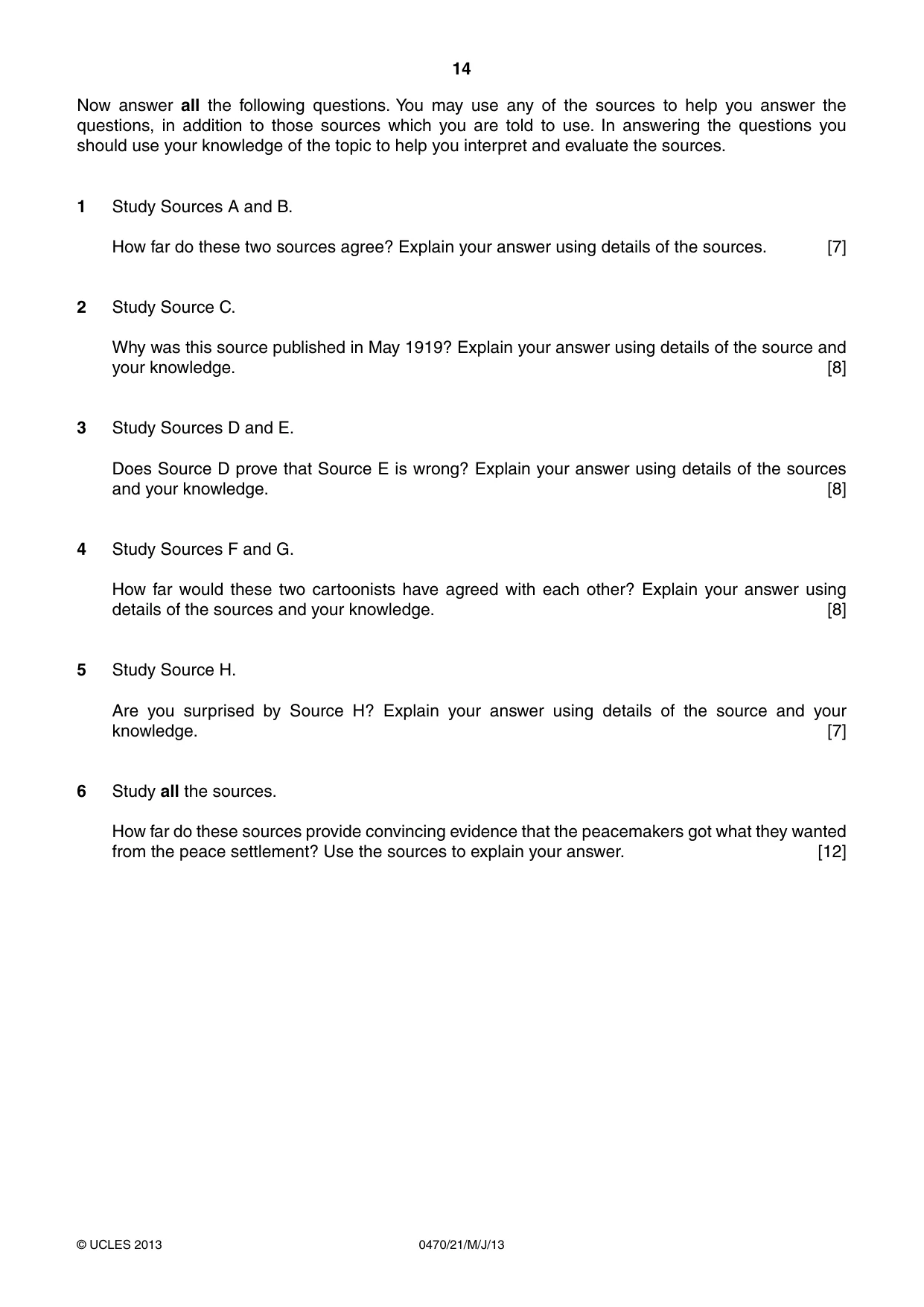
14 0470/21/M/J/13 © UCLES 2013 Now answer all the following questions. You may use any of the sources to help you answer the questions, in addition to those sources which you are told to use. In answering the questions you should use your knowledge of the topic to help you interpret and evaluate the sources. 1 Study Sources A and B. How far do these two sources agree? Explain your answer using details of the sources. [7] 2 Study Source C. Why was this source published in May 1919? Explain your answer using details of the source and your knowledge. [8] 3 Study Sources D and E. Does Source D prove that Source E is wrong? Explain your answer using details of the sources and your knowledge. [8] 4 Study Sources F and G. How far would these two cartoonists have agreed with each other? Explain your answer using details of the sources and your knowledge. [8] 5 Study Source H. Are you surprised by Source H? Explain your answer using details of the source and your knowledge. [7] 6 Study all the sources. How far do these sources provide convincing evidence that the peacemakers got what they wanted from the peace settlement? Use the sources to explain your answer. [12]
Question paper, page 15
15 0470/21/M/J/13 © UCLES 2013 BLANK PAGE
Question paper, page 16
16 0470/21/M/J/13 © UCLES 2013 Copyright Acknowledgements: Option A Source A Option A Source B Option A Source C Option A Source D Option A Source E Option A Source F Option A Source G Option A Source H Option B Source A Option B Source B Option B Source C Option B Source D Option B Source E Option B Source F Option B Source G Option B Source H © Alan Farmer; Reconstruction and the Results of the American Civil War 1865-77; Hodder & Stoughton; 1997. © John A Garraty; The Story of America; Harcourt, Brace Jovanovich Inc.; 1991. © A cartoon entitled, Andrew Johnson Kicking Freedmen’s Bureau; published in the USA in 1866. © A Democrat election campaign poster from 1866. © A description by Charles Nordhoff of his meeting with President Johnson about the planned Reconstruction Bill; February 1867. © A cartoon published in an American magazine in 1870. © Henry Grady’s speech entitled, The New South; 1886. © From the Ku Klux Klan’s, Organisation and Principles; 1868. © Richard M Watt; The Kings Depart; Weidenfield & Nicholson; 1968. © Colin E. Shephard. © Roy Douglas; The Cartoonist’s Vision; Routledge / The Daily Express; 1992. © Clemenceau speaking at the peace conference in June 1919. © An extract from the diary of Edward M. House. © A cartoon published in an American magazine on 30 August 1919. © A cartoon published in a British magazine on 10 December 1919. © President Wilson speaking in September 1919 during his speaking tour around the USA. Permission to reproduce items where third-party owned material protected by copyright is included has been sought and cleared where possible. Every reasonable effort has been made by the publisher (UCLES) to trace copyright holders, but if any items requiring clearance have unwittingly been included, the publisher will be pleased to make amends at the earliest possible opportunity. University of Cambridge International Examinations is part of the Cambridge Assessment Group. Cambridge Assessment is the brand name of University of Cambridge Local Examinations Syndicate (UCLES), which is itself a department of the University of Cambridge. BLANK PAGE
Mark scheme, page 1
CAMBRIDGE INTERNATIONAL EXAMINATIONS International General Certificate of Secondary Education MARK SCHEME for the May/June 2013 series 0470 HISTORY 0470/21 Paper 2, maximum raw mark 50 This mark scheme is published as an aid to teachers and candidates, to indicate the requirements of the examination. It shows the basis on which Examiners were instructed to award marks. It does not indicate the details of the discussions that took place at an Examiners’ meeting before marking began, which would have considered the acceptability of alternative answers. Mark schemes should be read in conjunction with the question paper and the Principal Examiner Report for Teachers. Cambridge will not enter into discussions about these mark schemes. Cambridge is publishing the mark schemes for the May/June 2013 series for most IGCSE, GCE Advanced Level and Advanced Subsidiary Level components and some Ordinary Level components.
Mark scheme, page 2
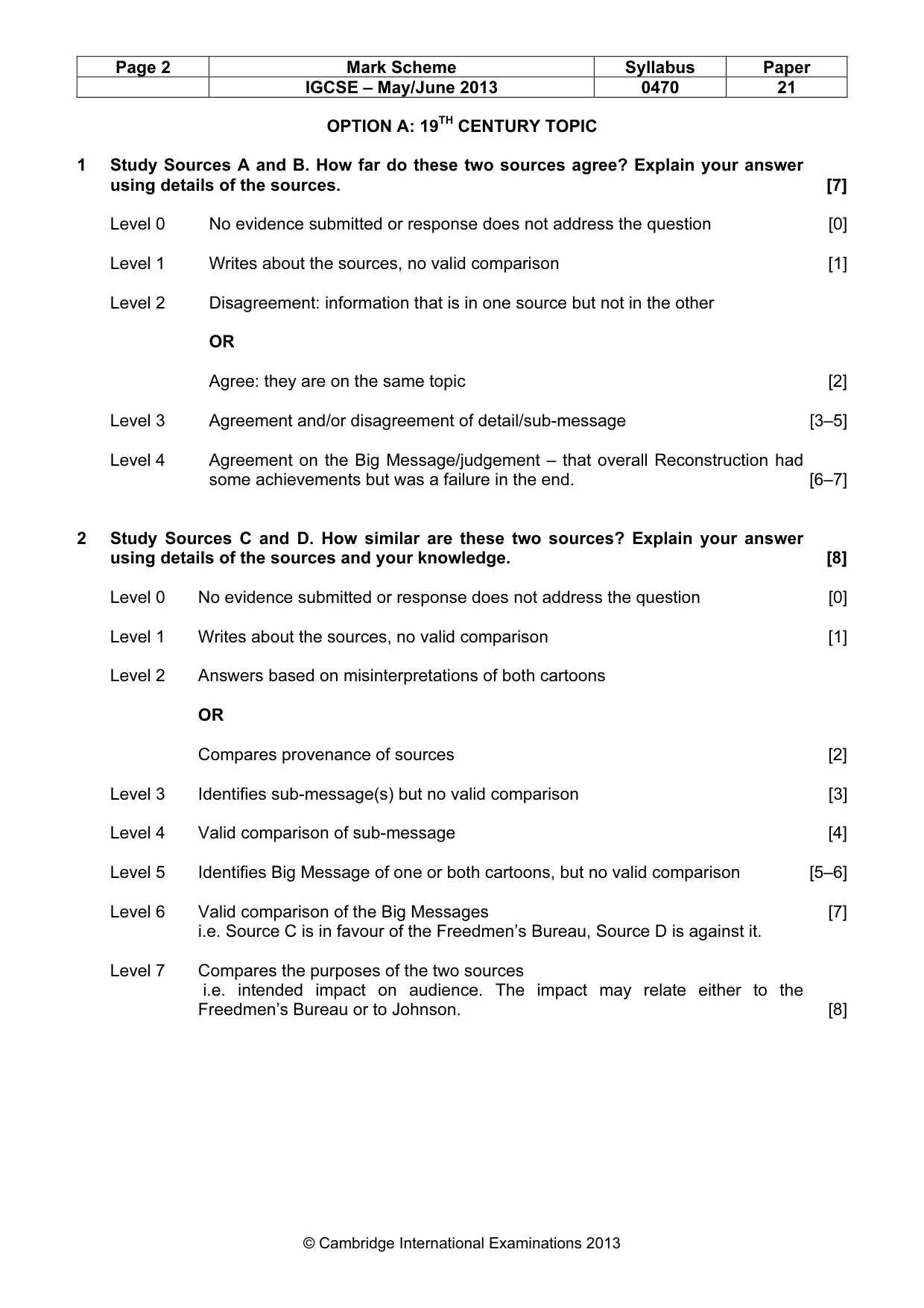
Page 2 Mark Scheme Syllabus Paper IGCSE – May/June 2013 0470 21 © Cambridge International Examinations 2013 OPTION A: 19TH CENTURY TOPIC 1 Study Sources A and B. How far do these two sources agree? Explain your answer using details of the sources. [7] Level 0 No evidence submitted or response does not address the question [0] Level 1 Writes about the sources, no valid comparison [1] Level 2 Disagreement: information that is in one source but not in the other OR Agree: they are on the same topic [2] Level 3 Agreement and/or disagreement of detail/sub-message [3–5] Level 4 Agreement on the Big Message/judgement – that overall Reconstruction had some achievements but was a failure in the end. [6–7] 2 Study Sources C and D. How similar are these two sources? Explain your answer using details of the sources and your knowledge. [8] Level 0 No evidence submitted or response does not address the question [0] Level 1 Writes about the sources, no valid comparison [1] Level 2 Answers based on misinterpretations of both cartoons OR Compares provenance of sources [2] Level 3 Identifies sub-message(s) but no valid comparison [3] Level 4 Valid comparison of sub-message [4] Level 5 Identifies Big Message of one or both cartoons, but no valid comparison [5–6] Level 6 Valid comparison of the Big Messages [7] i.e. Source C is in favour of the Freedmen’s Bureau, Source D is against it. Level 7 Compares the purposes of the two sources i.e. intended impact on audience. The impact may relate either to the Freedmen’s Bureau or to Johnson. [8]
Mark scheme, page 3
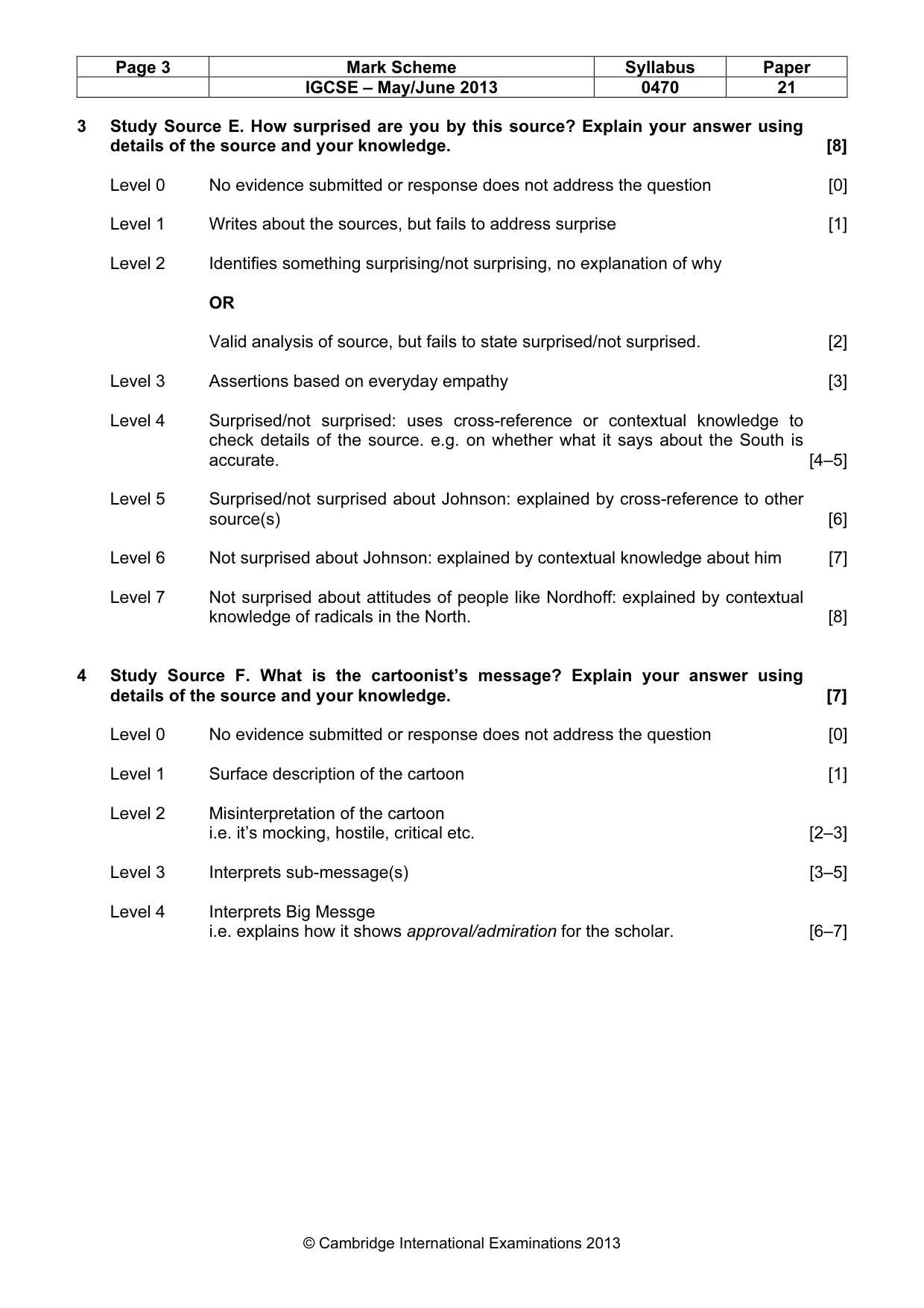
Page 3 Mark Scheme Syllabus Paper IGCSE – May/June 2013 0470 21 © Cambridge International Examinations 2013 3 Study Source E. How surprised are you by this source? Explain your answer using details of the source and your knowledge. [8] Level 0 No evidence submitted or response does not address the question [0] Level 1 Writes about the sources, but fails to address surprise [1] Level 2 Identifies something surprising/not surprising, no explanation of why OR Valid analysis of source, but fails to state surprised/not surprised. [2] Level 3 Assertions based on everyday empathy [3] Level 4 Surprised/not surprised: uses cross-reference or contextual knowledge to check details of the source. e.g. on whether what it says about the South is accurate. [4–5] Level 5 Surprised/not surprised about Johnson: explained by cross-reference to other source(s) [6] Level 6 Not surprised about Johnson: explained by contextual knowledge about him [7] Level 7 Not surprised about attitudes of people like Nordhoff: explained by contextual knowledge of radicals in the North. [8] 4 Study Source F. What is the cartoonist’s message? Explain your answer using details of the source and your knowledge. [7] Level 0 No evidence submitted or response does not address the question [0] Level 1 Surface description of the cartoon [1] Level 2 Misinterpretation of the cartoon i.e. it’s mocking, hostile, critical etc. [2–3] Level 3 Interprets sub-message(s) [3–5] Level 4 Interprets Big Messge i.e. explains how it shows approval/admiration for the scholar. [6–7]
Mark scheme, page 4
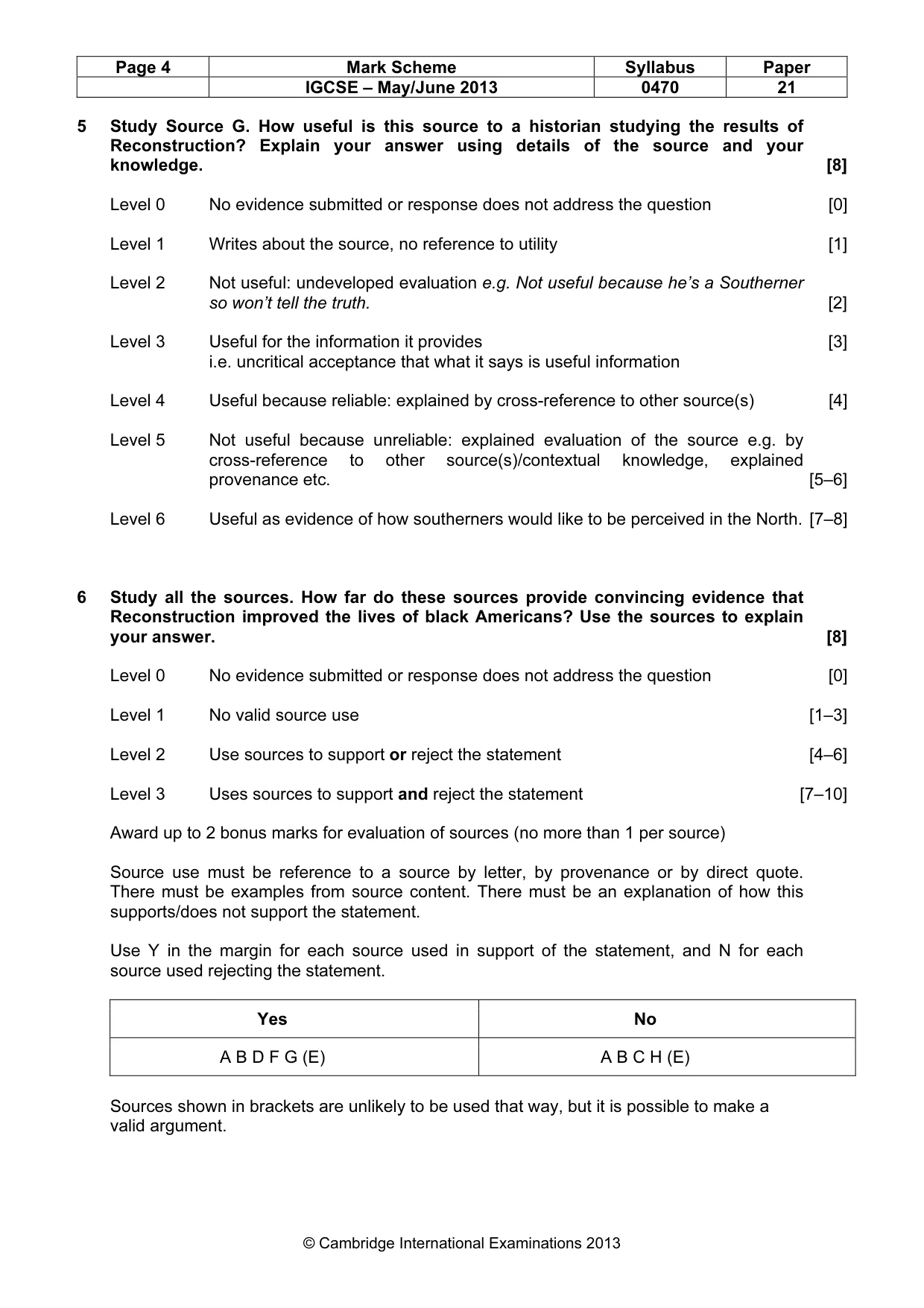
Page 4 Mark Scheme Syllabus Paper IGCSE – May/June 2013 0470 21 © Cambridge International Examinations 2013 5 Study Source G. How useful is this source to a historian studying the results of Reconstruction? Explain your answer using details of the source and your knowledge. [8] Level 0 No evidence submitted or response does not address the question [0] Level 1 Writes about the source, no reference to utility [1] Level 2 Not useful: undeveloped evaluation e.g. Not useful because he’s a Southerner so won’t tell the truth. [2] Level 3 Useful for the information it provides [3] i.e. uncritical acceptance that what it says is useful information Level 4 Useful because reliable: explained by cross-reference to other source(s) [4] Level 5 Not useful because unreliable: explained evaluation of the source e.g. by cross-reference to other source(s)/contextual knowledge, explained provenance etc. [5–6] Level 6 Useful as evidence of how southerners would like to be perceived in the North. [7–8] 6 Study all the sources. How far do these sources provide convincing evidence that Reconstruction improved the lives of black Americans? Use the sources to explain your answer. [8] Level 0 No evidence submitted or response does not address the question [0] Level 1 No valid source use [1–3] Level 2 Use sources to support or reject the statement [4–6] Level 3 Uses sources to support and reject the statement [7–10] Award up to 2 bonus marks for evaluation of sources (no more than 1 per source) Source use must be reference to a source by letter, by provenance or by direct quote. There must be examples from source content. There must be an explanation of how this supports/does not support the statement. Use Y in the margin for each source used in support of the statement, and N for each source used rejecting the statement. Yes No A B D F G (E) A B C H (E) Sources shown in brackets are unlikely to be used that way, but it is possible to make a valid argument.
Mark scheme, page 5
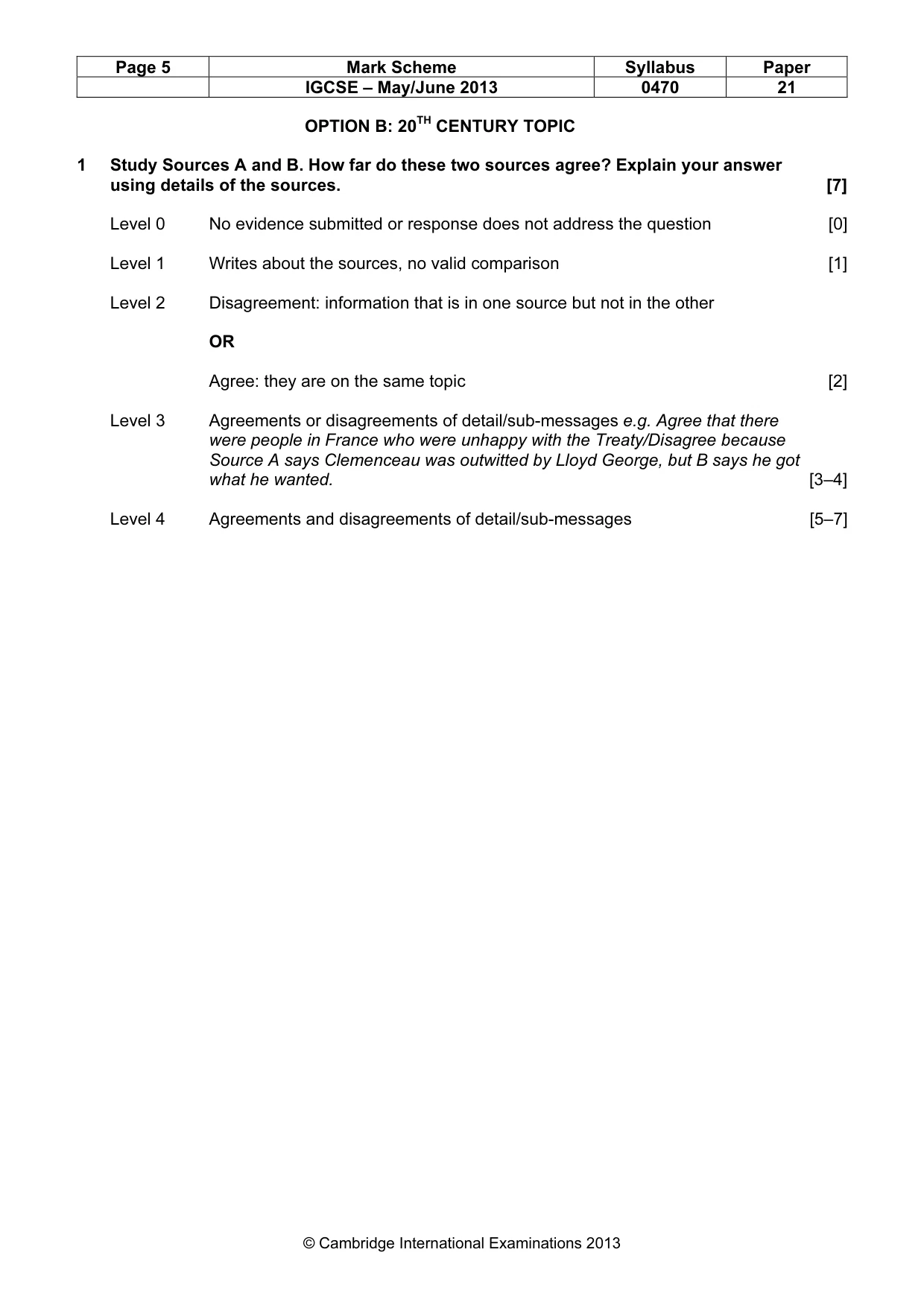
Page 5 Mark Scheme Syllabus Paper IGCSE – May/June 2013 0470 21 © Cambridge International Examinations 2013 OPTION B: 20TH CENTURY TOPIC 1 Study Sources A and B. How far do these two sources agree? Explain your answer using details of the sources. [7] Level 0 No evidence submitted or response does not address the question [0] Level 1 Writes about the sources, no valid comparison [1] Level 2 Disagreement: information that is in one source but not in the other OR Agree: they are on the same topic [2] Level 3 Agreements or disagreements of detail/sub-messages e.g. Agree that there were people in France who were unhappy with the Treaty/Disagree because Source A says Clemenceau was outwitted by Lloyd George, but B says he got what he wanted. [3–4] Level 4 Agreements and disagreements of detail/sub-messages [5–7]
Mark scheme, page 6
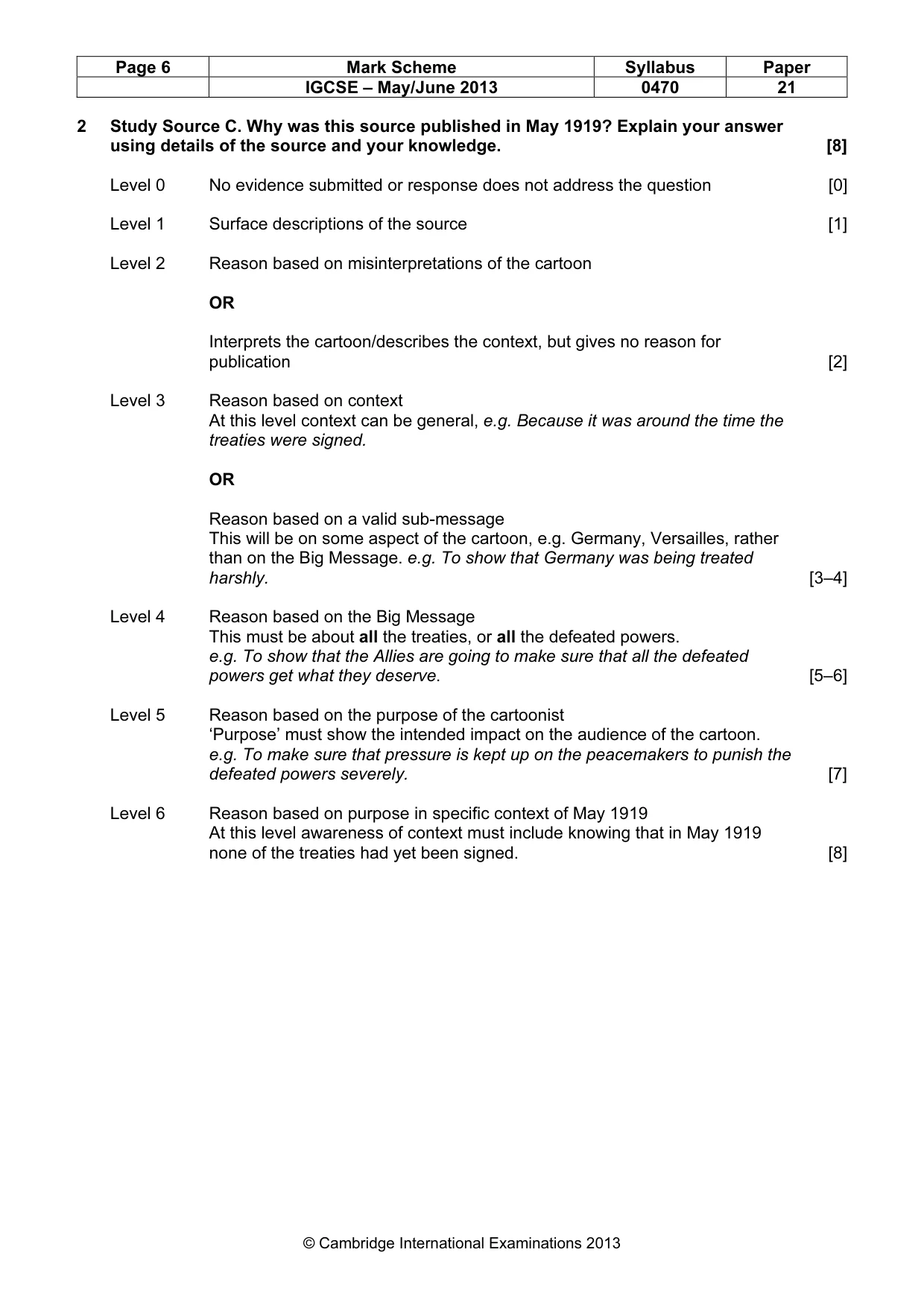
Page 6 Mark Scheme Syllabus Paper IGCSE – May/June 2013 0470 21 © Cambridge International Examinations 2013 2 Study Source C. Why was this source published in May 1919? Explain your answer using details of the source and your knowledge. [8] Level 0 No evidence submitted or response does not address the question [0] Level 1 Surface descriptions of the source [1] Level 2 Reason based on misinterpretations of the cartoon OR Interprets the cartoon/describes the context, but gives no reason for publication [2] Level 3 Reason based on context At this level context can be general, e.g. Because it was around the time the treaties were signed. OR Reason based on a valid sub-message This will be on some aspect of the cartoon, e.g. Germany, Versailles, rather than on the Big Message. e.g. To show that Germany was being treated harshly. [3–4] Level 4 Reason based on the Big Message This must be about all the treaties, or all the defeated powers. e.g. To show that the Allies are going to make sure that all the defeated powers get what they deserve. [5–6] Level 5 Reason based on the purpose of the cartoonist ‘Purpose’ must show the intended impact on the audience of the cartoon. e.g. To make sure that pressure is kept up on the peacemakers to punish the defeated powers severely. [7] Level 6 Reason based on purpose in specific context of May 1919 At this level awareness of context must include knowing that in May 1919 none of the treaties had yet been signed. [8]
Mark scheme, page 7
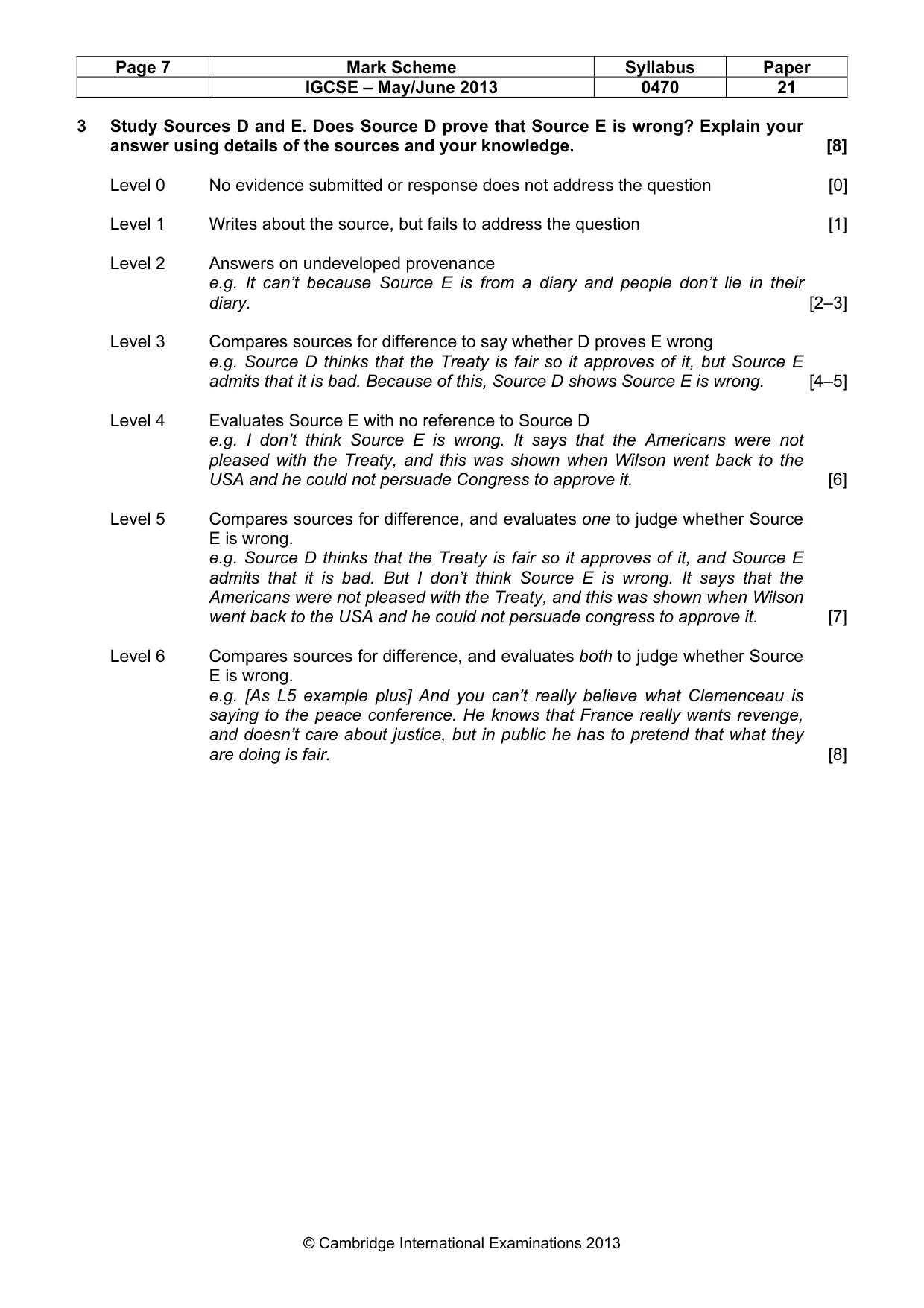
Page 7 Mark Scheme Syllabus Paper IGCSE – May/June 2013 0470 21 © Cambridge International Examinations 2013 3 Study Sources D and E. Does Source D prove that Source E is wrong? Explain your answer using details of the sources and your knowledge. [8] Level 0 No evidence submitted or response does not address the question [0] Level 1 Writes about the source, but fails to address the question [1] Level 2 Answers on undeveloped provenance e.g. It can’t because Source E is from a diary and people don’t lie in their diary. [2–3] Level 3 Compares sources for difference to say whether D proves E wrong e.g. Source D thinks that the Treaty is fair so it approves of it, but Source E admits that it is bad. Because of this, Source D shows Source E is wrong. [4–5] Level 4 Evaluates Source E with no reference to Source D e.g. I don’t think Source E is wrong. It says that the Americans were not pleased with the Treaty, and this was shown when Wilson went back to the USA and he could not persuade Congress to approve it. [6] Level 5 Compares sources for difference, and evaluates one to judge whether Source E is wrong. e.g. Source D thinks that the Treaty is fair so it approves of it, and Source E admits that it is bad. But I don’t think Source E is wrong. It says that the Americans were not pleased with the Treaty, and this was shown when Wilson went back to the USA and he could not persuade congress to approve it. [7] Level 6 Compares sources for difference, and evaluates both to judge whether Source E is wrong. e.g. [As L5 example plus] And you can’t really believe what Clemenceau is saying to the peace conference. He knows that France really wants revenge, and doesn’t care about justice, but in public he has to pretend that what they are doing is fair. [8]
Mark scheme, page 8
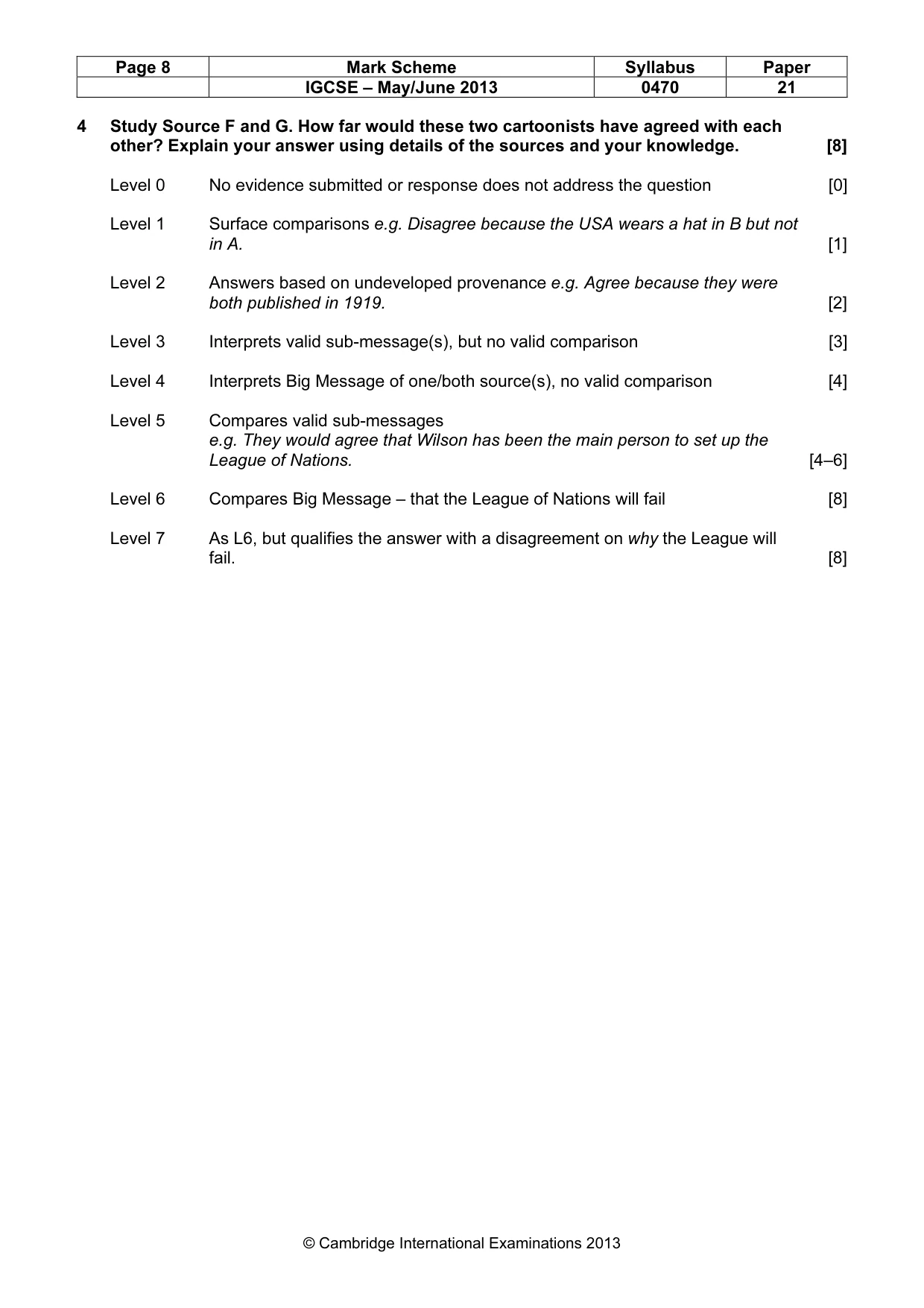
Page 8 Mark Scheme Syllabus Paper IGCSE – May/June 2013 0470 21 © Cambridge International Examinations 2013 4 Study Source F and G. How far would these two cartoonists have agreed with each other? Explain your answer using details of the sources and your knowledge. [8] Level 0 No evidence submitted or response does not address the question [0] Level 1 Surface comparisons e.g. Disagree because the USA wears a hat in B but not in A. [1] Level 2 Answers based on undeveloped provenance e.g. Agree because they were both published in 1919. [2] Level 3 Interprets valid sub-message(s), but no valid comparison [3] Level 4 Interprets Big Message of one/both source(s), no valid comparison [4] Level 5 Compares valid sub-messages e.g. They would agree that Wilson has been the main person to set up the League of Nations. [4–6] Level 6 Compares Big Message – that the League of Nations will fail [8] Level 7 As L6, but qualifies the answer with a disagreement on why the League will fail. [8]
Mark scheme, page 9
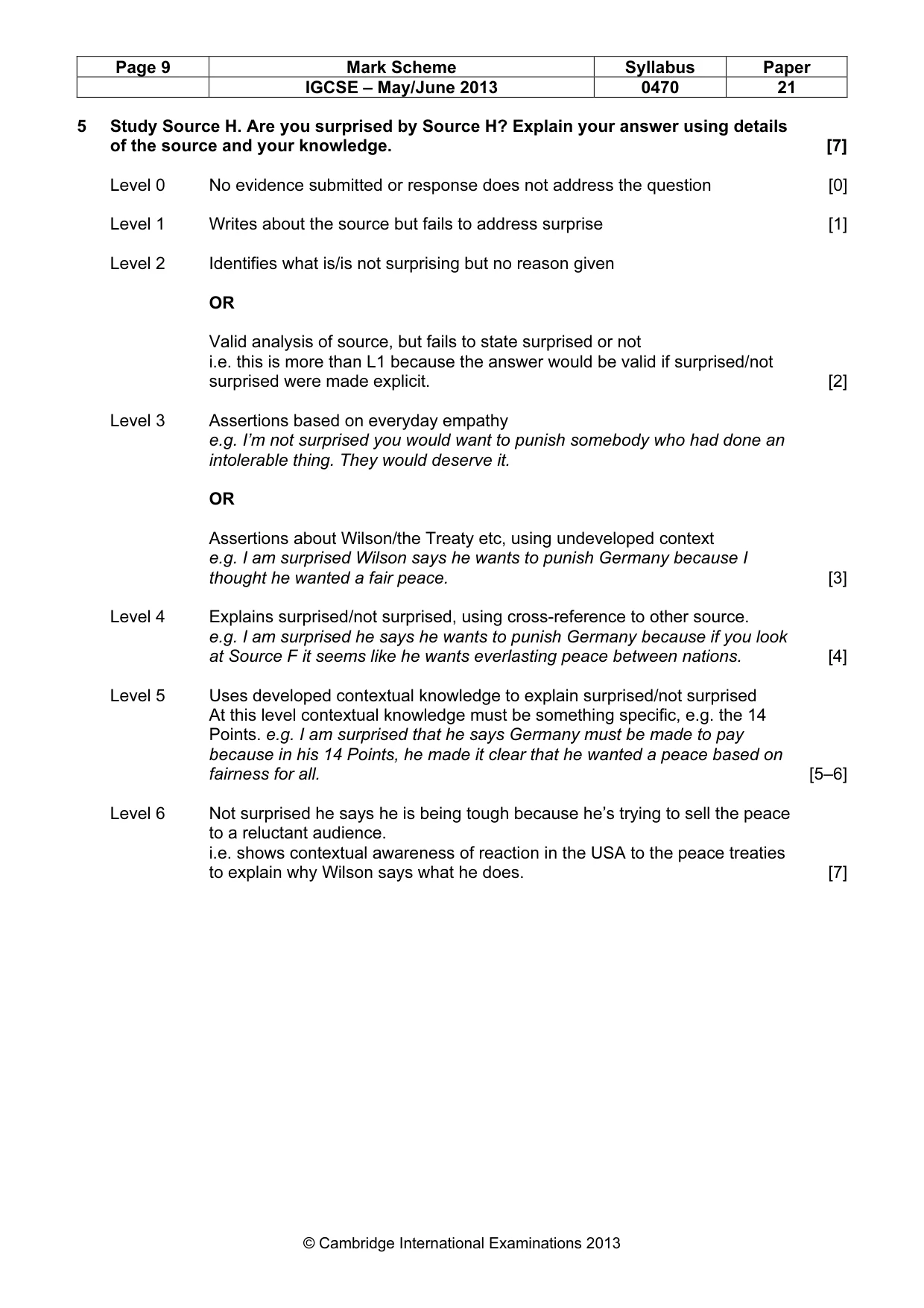
Page 9 Mark Scheme Syllabus Paper IGCSE – May/June 2013 0470 21 © Cambridge International Examinations 2013 5 Study Source H. Are you surprised by Source H? Explain your answer using details of the source and your knowledge. [7] Level 0 No evidence submitted or response does not address the question [0] Level 1 Writes about the source but fails to address surprise [1] Level 2 Identifies what is/is not surprising but no reason given OR Valid analysis of source, but fails to state surprised or not i.e. this is more than L1 because the answer would be valid if surprised/not surprised were made explicit. [2] Level 3 Assertions based on everyday empathy e.g. I’m not surprised you would want to punish somebody who had done an intolerable thing. They would deserve it. OR Assertions about Wilson/the Treaty etc, using undeveloped context e.g. I am surprised Wilson says he wants to punish Germany because I thought he wanted a fair peace. [3] Level 4 Explains surprised/not surprised, using cross-reference to other source. e.g. I am surprised he says he wants to punish Germany because if you look at Source F it seems like he wants everlasting peace between nations. [4] Level 5 Uses developed contextual knowledge to explain surprised/not surprised At this level contextual knowledge must be something specific, e.g. the 14 Points. e.g. I am surprised that he says Germany must be made to pay because in his 14 Points, he made it clear that he wanted a peace based on fairness for all. [5–6] Level 6 Not surprised he says he is being tough because he’s trying to sell the peace to a reluctant audience. i.e. shows contextual awareness of reaction in the USA to the peace treaties to explain why Wilson says what he does. [7]
Mark scheme, page 10
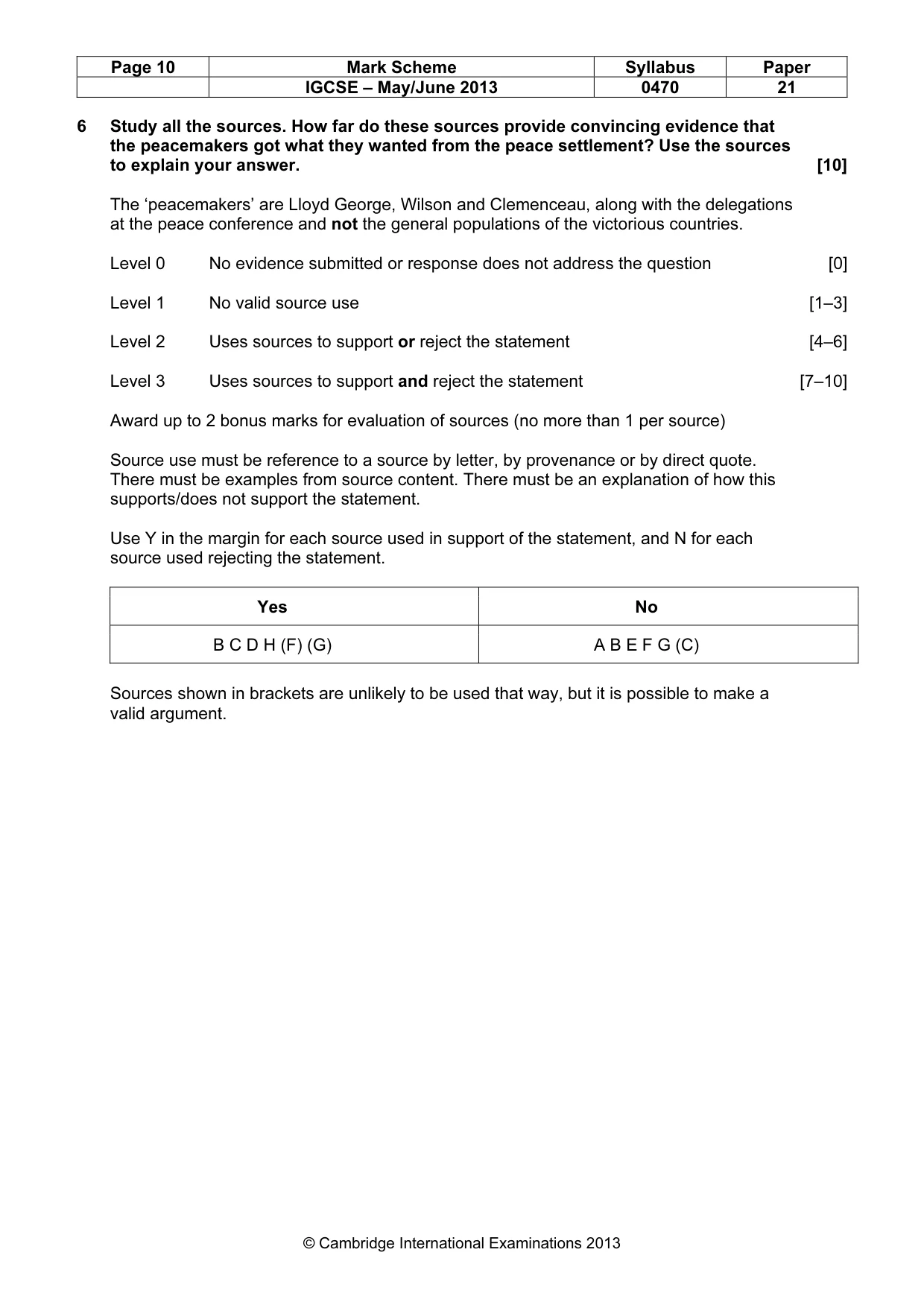
Page 10 Mark Scheme Syllabus Paper IGCSE – May/June 2013 0470 21 © Cambridge International Examinations 2013 6 Study all the sources. How far do these sources provide convincing evidence that the peacemakers got what they wanted from the peace settlement? Use the sources to explain your answer. [10] The ‘peacemakers’ are Lloyd George, Wilson and Clemenceau, along with the delegations at the peace conference and not the general populations of the victorious countries. Level 0 No evidence submitted or response does not address the question [0] Level 1 No valid source use [1–3] Level 2 Uses sources to support or reject the statement [4–6] Level 3 Uses sources to support and reject the statement [7–10] Award up to 2 bonus marks for evaluation of sources (no more than 1 per source) Source use must be reference to a source by letter, by provenance or by direct quote. There must be examples from source content. There must be an explanation of how this supports/does not support the statement. Use Y in the margin for each source used in support of the statement, and N for each source used rejecting the statement. Yes No B C D H (F) (G) A B E F G (C) Sources shown in brackets are unlikely to be used that way, but it is possible to make a valid argument.
What you needed in this session
Cambridge’s own grade thresholds for 2013 May/June, Paper 2 · Variant 1. A higher threshold means an easier paper — the bar moves with how the cohort did.