Cambridge IGCSE History 0470 — 2011 Oct/Nov Paper 2 · Variant 3
0470/23/O/N/11 · 50 marks · ≈56 min
The question paper and its mark scheme, free to read here and free to download. This is Cambridge’s own paper, exactly as it was sat.
Question paper16 pages


Mark scheme7 pages
Answers below. Sit the paper first if you are practising.
Paper as text
Question paper, page 1
This document consists of 13 printed pages and 3 blank pages. DC (RCL (PL/DJ)) 35065/4 © UCLES 2011 [Turn over UNIVERSITY OF CAMBRIDGE INTERNATIONAL EXAMINATIONS International General Certificate of Secondary Education * 7 2 6 4 4 5 4 8 9 3 * HISTORY 0470/23 Paper 2 October/November 2011 2 hours Additional Materials: Answer Booklet/Paper READ THESE INSTRUCTIONS FIRST If you have been given an Answer Booklet, follow the instructions on the front cover of the Booklet. Write your Centre number, candidate number and name on all the work you hand in. Write in dark blue or black pen. You may use a soft pencil for any diagrams, graphs or rough working. Do not use staples, paper clips, highlighters, glue or correction fluid. This paper has two options. Choose one option, and answer all of the questions on that topic. Option A: 19th Century topic [p2–p7] Option B: 20th Century topic [p8–p13] At the end of the examination, fasten all your work securely together. The number of marks is given in brackets [ ] at the end of each question or part question. www.XtremePapers.com
Question paper, page 2
2 0470/23/O/N/11 © UCLES 2011 Option A: 19th Century topic HOW FAR WAS THE UNIFICATION OF GERMANY BROUGHT ABOUT BY BISMARCK? Study the Background Information and the sources carefully, and then answer all the questions. Background Information Historians have long disagreed over what were the most important factors that led to the unification of Germany. Some have argued that impersonal factors such as the changing situation in Europe and economic developments made unification likely, and even inevitable. Others have argued that little had been achieved before Bismarck came to power in Prussia in 1862 and that unification was planned and brought about by him. Was Bismarck the crucial factor in the unification of Germany? SOURCE A Is it a mistake to begin with Bismarck? So much is written these days about the primary importance of economic and social forces in history that one runs the risk of being considered old-fashioned if one gives too much prominence to personality. Yet it is certainly unnecessary to apologise for introducing Bismarck’s name at the outset. If he had never risen to the top in Prussian politics, the unification of Germany would probably have taken place anyway, but surely not at the same time or in quite the same way as it did. The decision concerning the form unification would take was made, not in the area of economic and commercial policy, but on the battlefield of Koniggratz (Sadowa) on 3 July 1866. This victory registered the triumph of Bismarck’s policy. He had the courage to break with the traditions of Prussian diplomacy and to choose an anti-Austrian policy. He had planned the strategy that had led the Austrian Government into a position where it felt compelled to assume the responsibility for beginning the war despite the fact that its political and military resources made its chances of winning doubtful. In the weeks leading up to the outbreak of the war, Bismarck had identified the Prussian cause with that of German unity, and he made it clear that he defined this as meaning the union of all Germany except Austria. Bismarck would now have to remove the remaining obstacles to German unification, the chief of which were South German particularism and the not unnatural opposition of France. From a history book published in 1978.
Question paper, page 3
3 0470/23/O/N/11 © UCLES 2011 [Turn over SOURCE B When Bismarck came to power he inherited a very favourable situation in a number of ways. The first was that the diplomatic situation in 1862 was exceptionally favourable for German unification. The major obstacles to German unification were the Holy Alliance between Austria and Russia and the hostility of France. Yet by 1862 these had both been removed. By the 1860s Prussia’s economic strength was formidable. In the 1850s economic development created an entirely new political and social situation: the industrial revolution was beginning in mid-Europe. Areas of heavy industrial development grew up in the Ruhr and the Saarland. Germany was on its way to becoming a modern industrial country. With the onset of industrialisation, the social landscape underwent basic changes. A prosperous and self-confident middle class developed, as did an industrial proletariat. The heartland of industrial development was Prussia which, as the strongest power in Germany in the customs union, gained increasing economic influence within Germany. In this way its political position in relation to Austria was strengthened. The rapid growth of its population, the expansion of the Zollverein, the railway network and banking facilities had brought about an industrial revolution. This economic growth had important consequences for Bismarck’s position in 1863. Prussia had already gone a long way towards gaining economic control over Germany. Prussia could rely on an excellent iron and steel industry for its weapons and on its railways for mobilising the very strong Prussian army. This meant he did not have to go to the Landtag for extra taxes. When Bismarck came to power he had an enormous advantage – he had the blood, iron, coal and gold needed to unify Germany. The economic, diplomatic and military foundations for German unity had already been laid. Far from being wasted, the years before 1862 had played an important part in the final achievement of German unification. From a history book published in 1984. SOURCE C As things are now we must face the possibility that all of South Germany will be drawn into the Austrian camp. Hatred of Prussia is growing hourly. The governments, driven by fear of Bismarck and now also by the hope of being able to defeat Prussia once and for all, are pushing forward energetically. This sorry situation is due partly to the attitudes of the Prussian liberals. I can understand that the men who for three years have fought in the front line against Bismarck’s ruinous system should have as their principal purpose the breaking of the system. However, if Prussian liberalism achieves its victory at the price of the elevation of Austria and the humiliation of Prussia, the future will pronounce a grave verdict on it. The conflict would not be removed merely by Bismarck’s dismissal. Would a Liberal government begin by giving up Schleswig-Holstein and by submitting to the Diet of the Confederation led by Austria against Prussia? If Prussian liberalism had any prospect of providing the solution to the German question, we should all support it. But all that we can see now as the probable result is a weakening of Prussia and the strengthening of Austria. A letter from Hermann Baumgarten to a fellow Prussian liberal, May 1866. Baumgarten was a leading Prussian liberal. After the Austro-Prussian War he persuaded many liberals in Prussia to support Bismarck.
Question paper, page 4
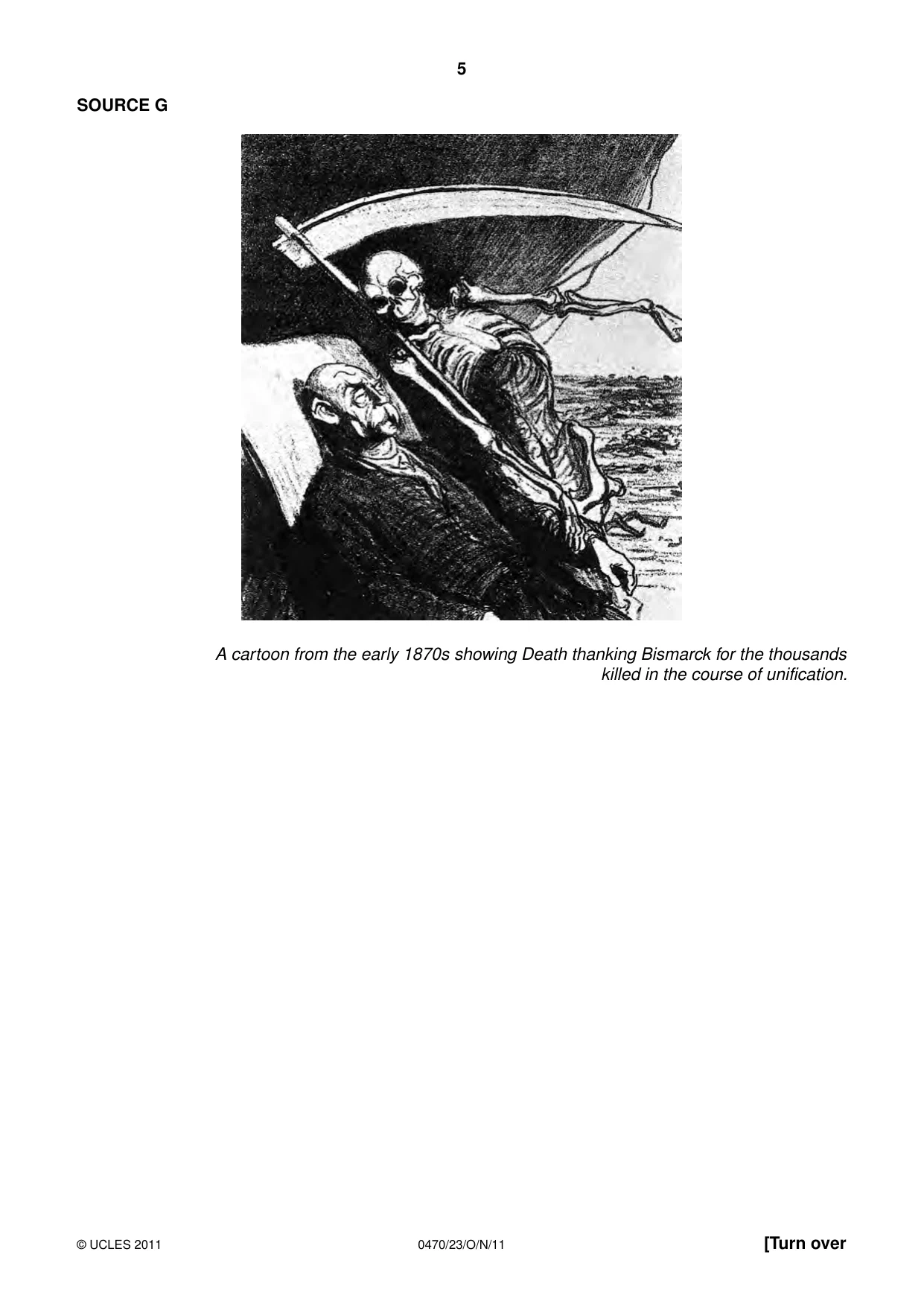
4 0470/23/O/N/11 © UCLES 2011 SOURCE D The longing for a united fatherland had a very economic background. It was the demand of the merchant and industrialist, arising out of direct business need, for the clearing away of all the historic rubbish of the petty states which stood in the way of the free development of trade. It was the desire for the removal of all the difficulties the German businessman had to overcome at home if he wanted to enter the world market. German unity had become an economic necessity. From a book by Friedrich Engels published in 1895. Engels was a communist and worked closely with Karl Marx. SOURCE E Should the Zollverein continue, the natural development of institutions by which South Germany can participate in legislating on tariff questions is unavoidable. I do not wish to underrate the importance of its being possible for a common legislative institution for tariffs (I do not wish to underrate it by simply calling it a Customs Parliament) to create an economic community for the whole of Germany. It is difficult to believe that such an institution could avoid gradually taking on most of the things that come under the headings of economic welfare and commerce, or could avoid bringing into use regulations in these affairs common to the whole of Germany. From a speech by Bismarck to the North German Confederation, March 1867. SOURCE F During the time I was in office I advised that Germany should be involved in three wars, the Danish, the Austrian, and the French; but every time I first made myself clear whether the war, if it was successful, would bring a prize of victory worth the sacrifices which every war requires and which are now so much greater than in the last century. From Bismarck’s memoirs ‘Reflections and Reminiscences’. Bismarck wrote his memoirs after his resignation as Chancellor of Germany in 1890. They were published in 1898.
Question paper, page 5
5 0470/23/O/N/11 © UCLES 2011 [Turn over SOURCE G A cartoon from the early 1870s showing Death thanking Bismarck for the thousands killed in the course of unification.
Question paper, page 6
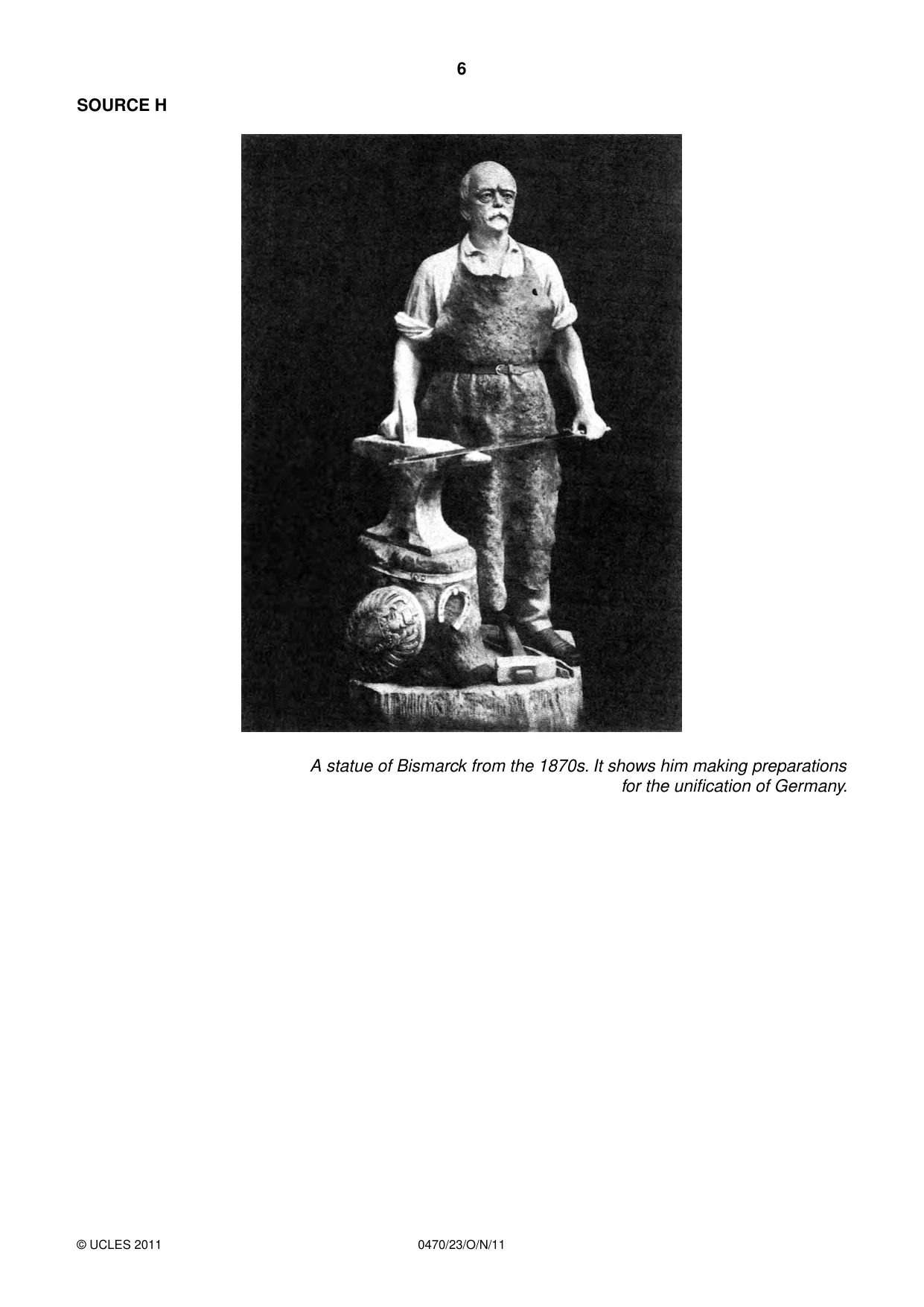
6 0470/23/O/N/11 © UCLES 2011 SOURCE H A statue of Bismarck from the 1870s. It shows him making preparations for the unification of Germany.
Question paper, page 7
7 0470/23/O/N/11 © UCLES 2011 [Turn over Now answer all the following questions. You may use any of the sources to help you answer the questions, in addition to those sources which you are told to use. In answering the questions you should use your knowledge of the topic to help you interpret and evaluate the sources. 1 Study Sources A and B. How far do these two sources disagree? Explain your answer using details of the sources. [7] 2 Study Source C. Are you surprised by this source? Explain your answer using details of the source and your knowledge. [8] 3 Study Sources D and E. Would Bismarck (Source E) have agreed with Engels (Source D)? Explain your answer using details of the sources and your knowledge. [8] 4 Study Sources F and G. How far does Source F prove that the cartoonist (Source G) was right about Bismarck? Explain your answer using details of the sources and your knowledge. [8] 5 Study Source H. How useful is this source to a historian studying German unification? Explain your answer using details of the source and your knowledge. [7] 6 Study all the sources. How far do these sources provide convincing evidence that Bismarck was the most important factor in German unification? Use the sources to explain your answer. [12]
Question paper, page 8
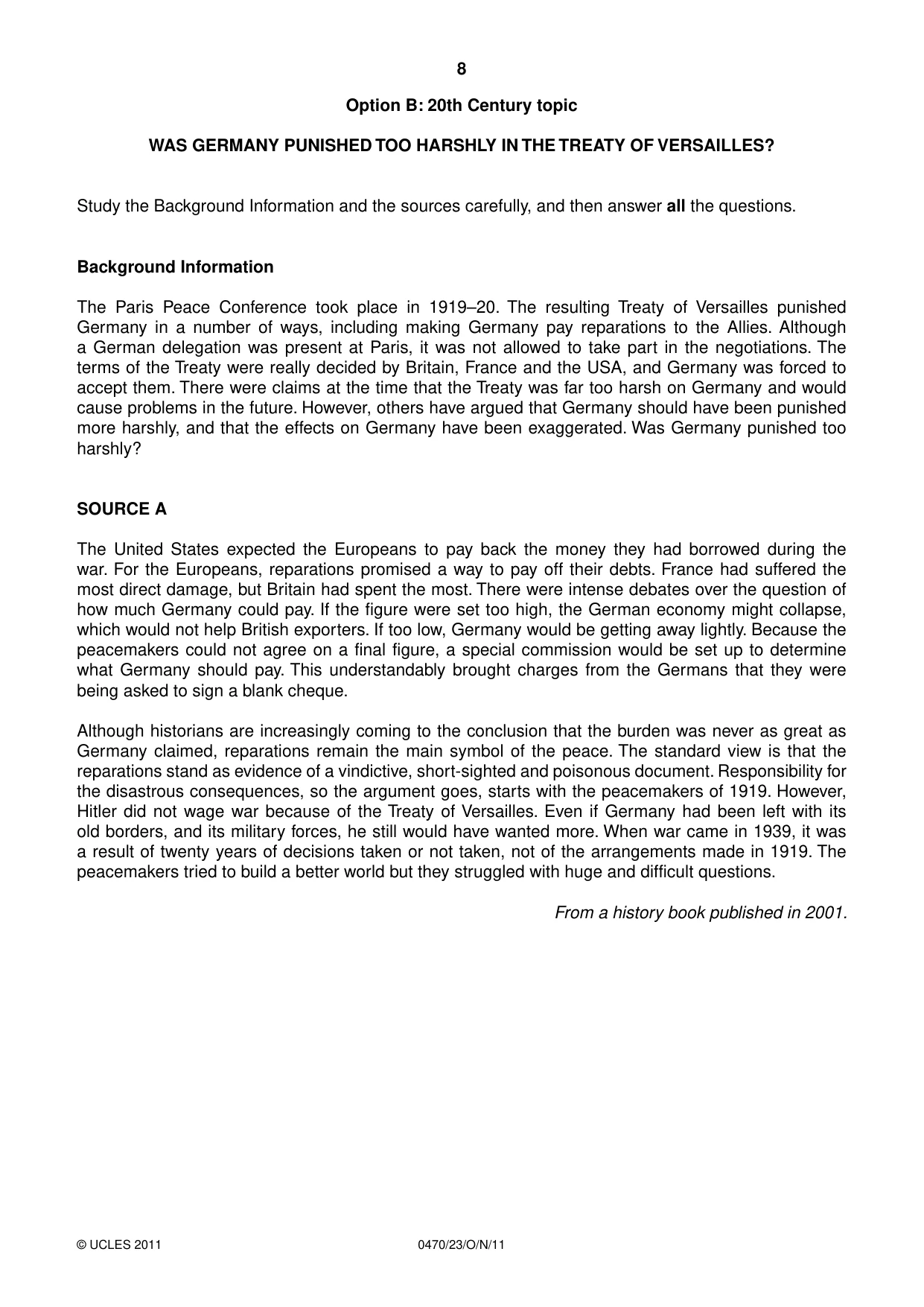
8 0470/23/O/N/11 © UCLES 2011 Option B: 20th Century topic WAS GERMANY PUNISHED TOO HARSHLY IN THE TREATY OF VERSAILLES? Study the Background Information and the sources carefully, and then answer all the questions. Background Information The Paris Peace Conference took place in 1919–20. The resulting Treaty of Versailles punished Germany in a number of ways, including making Germany pay reparations to the Allies. Although a German delegation was present at Paris, it was not allowed to take part in the negotiations. The terms of the Treaty were really decided by Britain, France and the USA, and Germany was forced to accept them. There were claims at the time that the Treaty was far too harsh on Germany and would cause problems in the future. However, others have argued that Germany should have been punished more harshly, and that the effects on Germany have been exaggerated. Was Germany punished too harshly? SOURCE A The United States expected the Europeans to pay back the money they had borrowed during the war. For the Europeans, reparations promised a way to pay off their debts. France had suffered the most direct damage, but Britain had spent the most. There were intense debates over the question of how much Germany could pay. If the figure were set too high, the German economy might collapse, which would not help British exporters. If too low, Germany would be getting away lightly. Because the peacemakers could not agree on a final figure, a special commission would be set up to determine what Germany should pay. This understandably brought charges from the Germans that they were being asked to sign a blank cheque. Although historians are increasingly coming to the conclusion that the burden was never as great as Germany claimed, reparations remain the main symbol of the peace. The standard view is that the reparations stand as evidence of a vindictive, short-sighted and poisonous document. Responsibility for the disastrous consequences, so the argument goes, starts with the peacemakers of 1919. However, Hitler did not wage war because of the Treaty of Versailles. Even if Germany had been left with its old borders, and its military forces, he still would have wanted more. When war came in 1939, it was a result of twenty years of decisions taken or not taken, not of the arrangements made in 1919. The peacemakers tried to build a better world but they struggled with huge and difficult questions. From a history book published in 2001.
Question paper, page 9
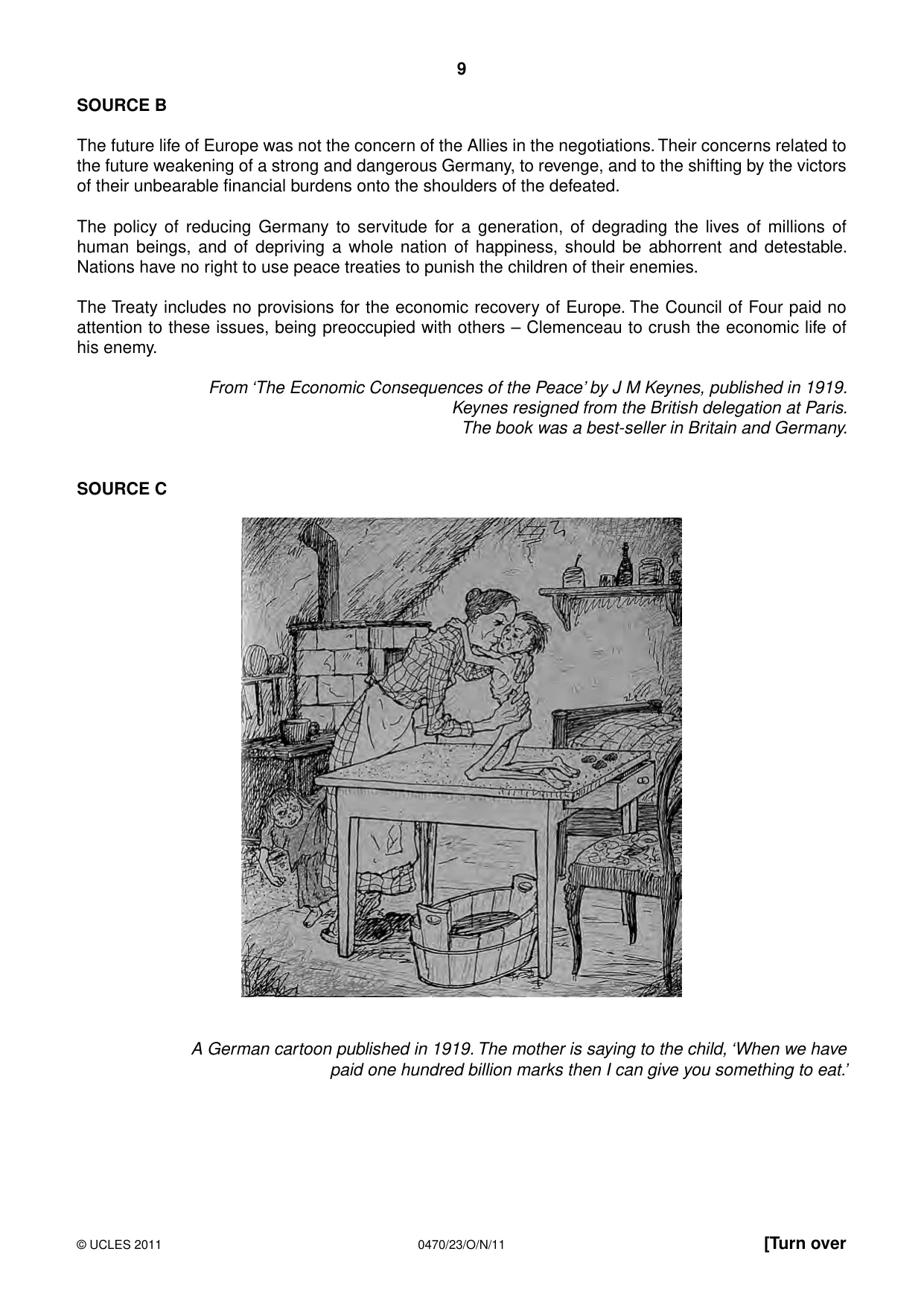
9 0470/23/O/N/11 © UCLES 2011 [Turn over SOURCE B The future life of Europe was not the concern of the Allies in the negotiations. Their concerns related to the future weakening of a strong and dangerous Germany, to revenge, and to the shifting by the victors of their unbearable financial burdens onto the shoulders of the defeated. The policy of reducing Germany to servitude for a generation, of degrading the lives of millions of human beings, and of depriving a whole nation of happiness, should be abhorrent and detestable. Nations have no right to use peace treaties to punish the children of their enemies. The Treaty includes no provisions for the economic recovery of Europe. The Council of Four paid no attention to these issues, being preoccupied with others – Clemenceau to crush the economic life of his enemy. From ‘The Economic Consequences of the Peace’ by J M Keynes, published in 1919. Keynes resigned from the British delegation at Paris. The book was a best-seller in Britain and Germany. SOURCE C A German cartoon published in 1919. The mother is saying to the child, ‘When we have paid one hundred billion marks then I can give you something to eat.’
Question paper, page 10
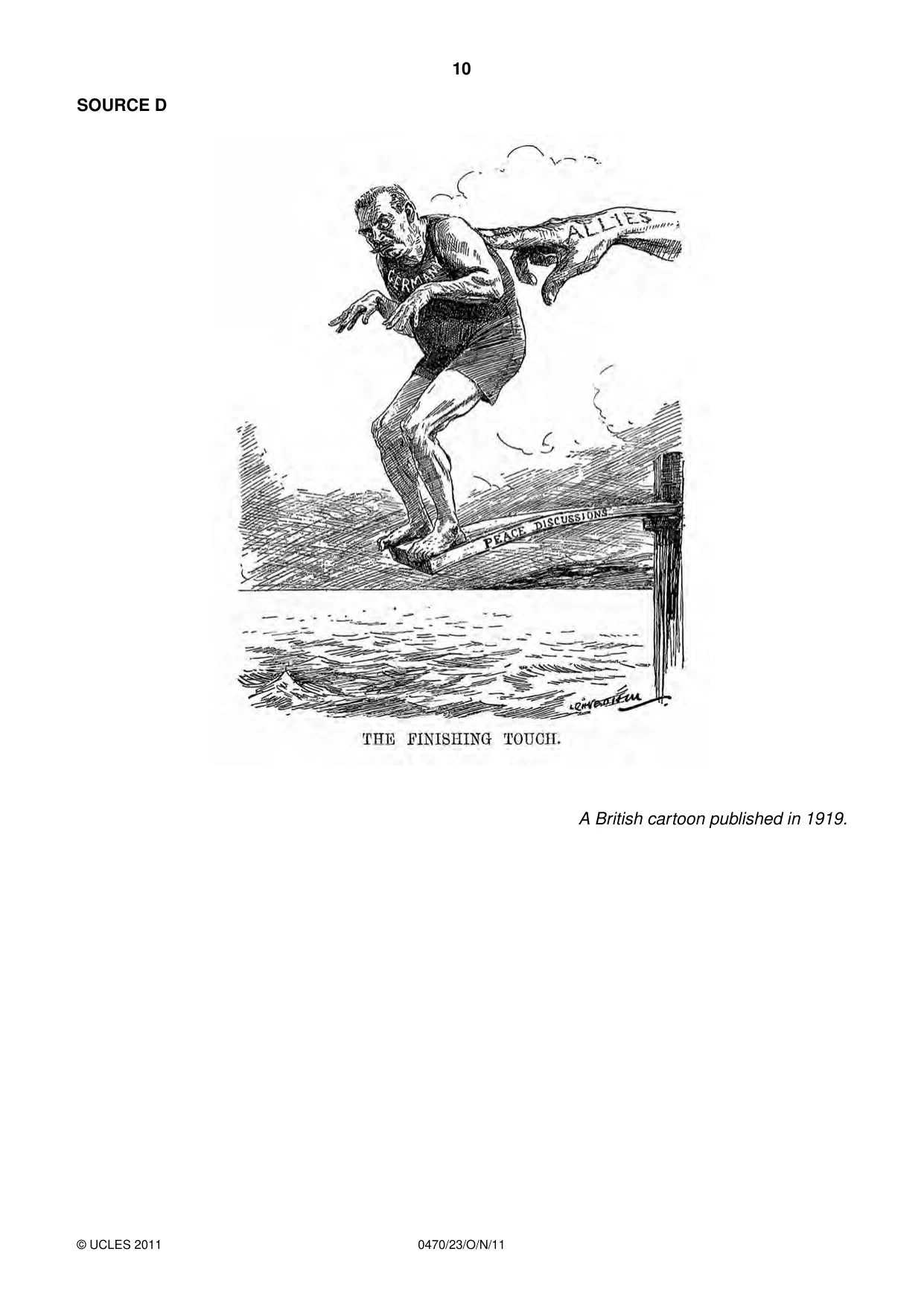
10 0470/23/O/N/11 © UCLES 2011 SOURCE D A British cartoon published in 1919.
Question paper, page 11
11 0470/23/O/N/11 © UCLES 2011 [Turn over SOURCE E I have the honour to present to your Excellency the report on the effect of the Peace Terms on the situation of the German population. When the territorial clauses of the Peace Treaty go into effect Germany will lose in the East the most important regions for the production of wheat and potatoes. The Peace Treaty provides for the loss of almost a third of the production of our coal fields; in addition to that loss, enormous deliveries of coal to various Allied countries are imposed on us for ten years. After the economic repression caused by the loss of her Merchant Fleet and her foreign possessions, Germany will no longer be in a position to import raw materials in sufficient quantities from abroad. As a matter of course an enormous part of German industry would thus be condemned to extinction. After a very short time Germany would therefore no longer be in a position to provide bread and work to its many millions of persons forced to earn their daily bread by trade and commerce. The Peace would impose upon Germany many times the number of human lives cost it by this war of four years and a half. Those who sign this treaty, will sign the death sentence of many millions of German men, women and children. I believe that my duty, before beginning the discussion of other details of the treaty, is to bring to the attention of the Allied Delegations this summary of the problems facing the German people. From a report submitted to Clemenceau on 13 May 1919 by the German Delegation during the negotiations at Versailles. SOURCE F The greatest fraud in the history of the world is now being carried out in Germany, with the full support of its population. This fraud is being carried out under the very noses of the Allies. Germany is full of wealth. It is humming like a beehive. The comfort and prosperity of its people amazed me when I was there. Poverty is almost non-existent. Yet this is the country that is determined it will not pay its debts. It is a nation of actors. If it was not for the fact that the German has no humour, one might imagine the whole nation was carrying out a great practical joke! From a letter published in a British newspaper from a businessman who had just returned from Germany, April 1922. SOURCE G The terms are in many respects terrible terms to impose upon a country. Terrible were the deeds which it has to pay for. Germany not merely provoked, but planned the most devastating war the earth has ever seen. It deliberately embarked upon it, not to defend itself against assailants, but to expand itself at the expense of its neighbours. I cannot think of a worse crime. The aim of the Treaty is to compel Germany, in so far as it is in its power, to restore, to repair and to redress. Yes, and to take every possible precaution of every kind that is in our power against the repetition of another such crime – to make such an example as will discourage ambitious peoples from ever attempting to repeat the infamy. Lloyd George, speaking in Parliament, July 1919.
Question paper, page 12
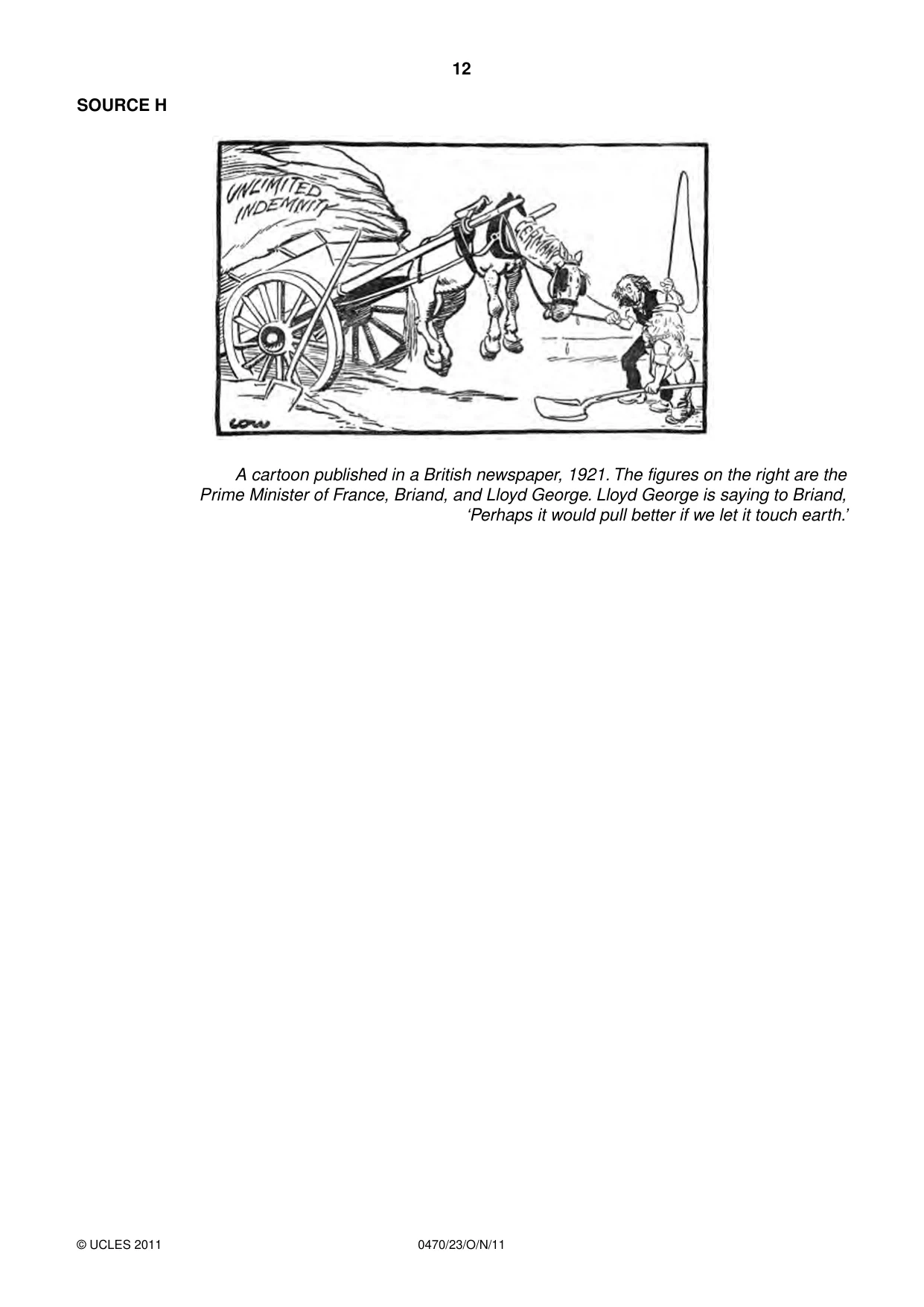
12 0470/23/O/N/11 © UCLES 2011 SOURCE H A cartoon published in a British newspaper, 1921. The figures on the right are the Prime Minister of France, Briand, and Lloyd George. Lloyd George is saying to Briand, ‘Perhaps it would pull better if we let it touch earth.’
Question paper, page 13
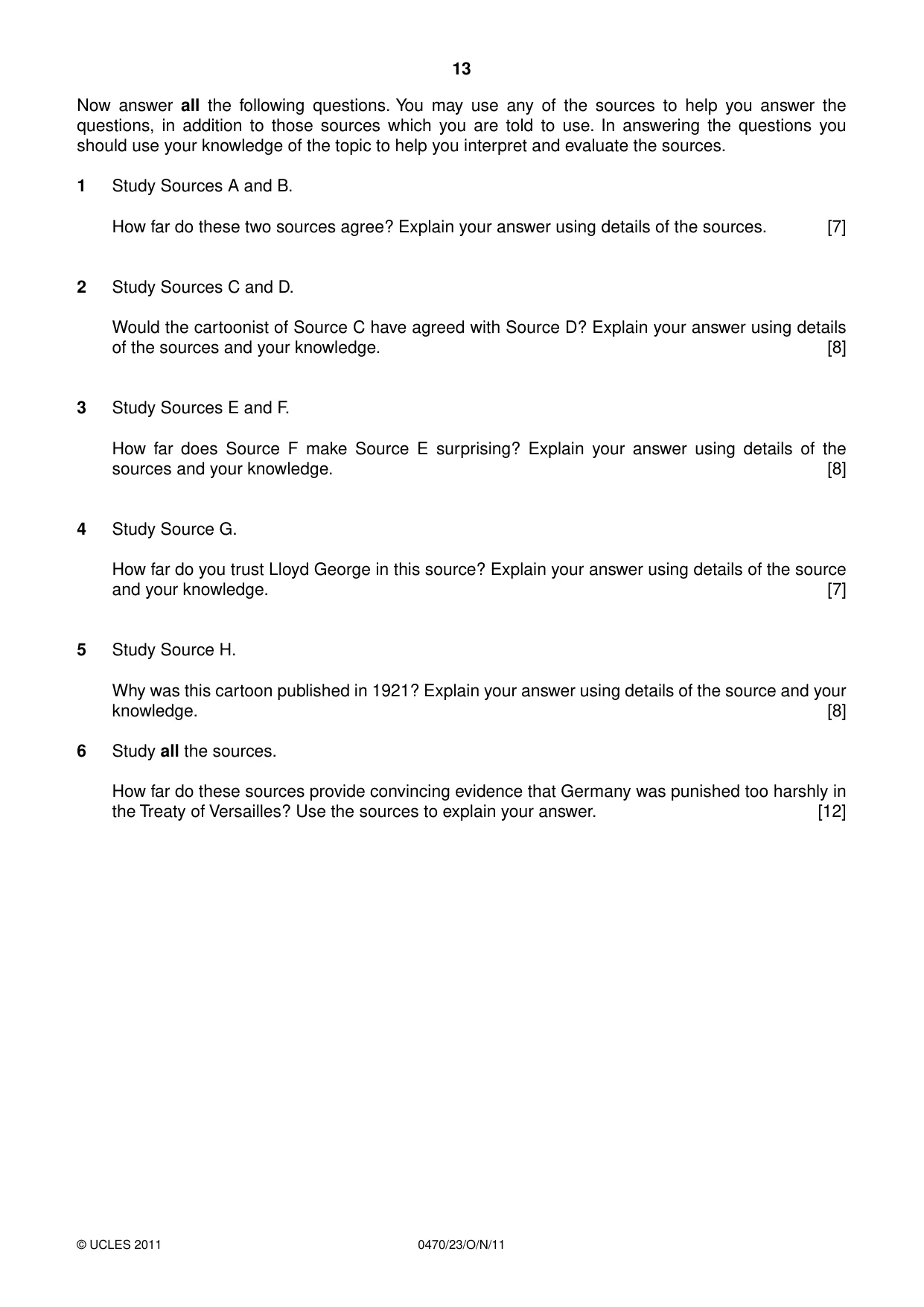
13 0470/23/O/N/11 © UCLES 2011 Now answer all the following questions. You may use any of the sources to help you answer the questions, in addition to those sources which you are told to use. In answering the questions you should use your knowledge of the topic to help you interpret and evaluate the sources. 1 Study Sources A and B. How far do these two sources agree? Explain your answer using details of the sources. [7] 2 Study Sources C and D. Would the cartoonist of Source C have agreed with Source D? Explain your answer using details of the sources and your knowledge. [8] 3 Study Sources E and F. How far does Source F make Source E surprising? Explain your answer using details of the sources and your knowledge. [8] 4 Study Source G. How far do you trust Lloyd George in this source? Explain your answer using details of the source and your knowledge. [7] 5 Study Source H. Why was this cartoon published in 1921? Explain your answer using details of the source and your knowledge. [8] 6 Study all the sources. How far do these sources provide convincing evidence that Germany was punished too harshly in the Treaty of Versailles? Use the sources to explain your answer. [12]
Question paper, page 14
14 0470/23/O/N/11 © UCLES 2011 BLANK PAGE
Question paper, page 15
15 0470/23/O/N/11 © UCLES 2011 BLANK PAGE
Question paper, page 16
16 0470/23/O/N/11 © UCLES 2011 Copyright Acknowledgements: 19th Century Option Source A © Gordon A Craig; Germany 1866-1945; Oxford University Press; 1978. 19th Century Option Source B © Fragen an die Deutsche Geschichte; German Bundestag Press; 1984. 19th Century Option Source H © ed. Roger Morgan; Germany 1870-1970; 1970. 20th Century Option Source A © Margaret Macmillan; Peacemakers; John Murray; 2001. 20th Century Option Source B © J M Keynes; The Economic Consequences of the Peace; Macmillan; 1919. 20th Century Option Source C © Roy Douglas; The Cartoonists’ Vision 1919-1939; Routledge; 1992. 20th Century Option Source D © Ben Walsh; Modern World History; John Murray; 1996. 20th Century Option Source H © British Cartoon Archive Ref. No. LSE6501. Permission to reproduce items where third-party owned material protected by copyright is included has been sought and cleared where possible. Every reasonable effort has been made by the publisher (UCLES) to trace copyright holders, but if any items requiring clearance have unwittingly been included, the publisher will be pleased to make amends at the earliest possible opportunity. University of Cambridge International Examinations is part of the Cambridge Assessment Group. Cambridge Assessment is the brand name of University of Cambridge Local Examinations Syndicate (UCLES), which is itself a department of the University of Cambridge. BLANK PAGE
Mark scheme, page 1
UNIVERSITY OF CAMBRIDGE INTERNATIONAL EXAMINATIONS International General Certificate of Secondary Education MARK SCHEME for the October/November 2011 question paper for the guidance of teachers 0470 HISTORY 0470/23 Paper 2, maximum raw mark 50 This mark scheme is published as an aid to teachers and candidates, to indicate the requirements of the examination. It shows the basis on which Examiners were instructed to award marks. It does not indicate the details of the discussions that took place at an Examiners’ meeting before marking began, which would have considered the acceptability of alternative answers. Mark schemes must be read in conjunction with the question papers and the report on the examination. • Cambridge will not enter into discussions or correspondence in connection with these mark schemes. Cambridge is publishing the mark schemes for the October/November 2011 question papers for most IGCSE, GCE Advanced Level and Advanced Subsidiary Level syllabuses and some Ordinary Level syllabuses. www.XtremePapers.com
Mark scheme, page 2
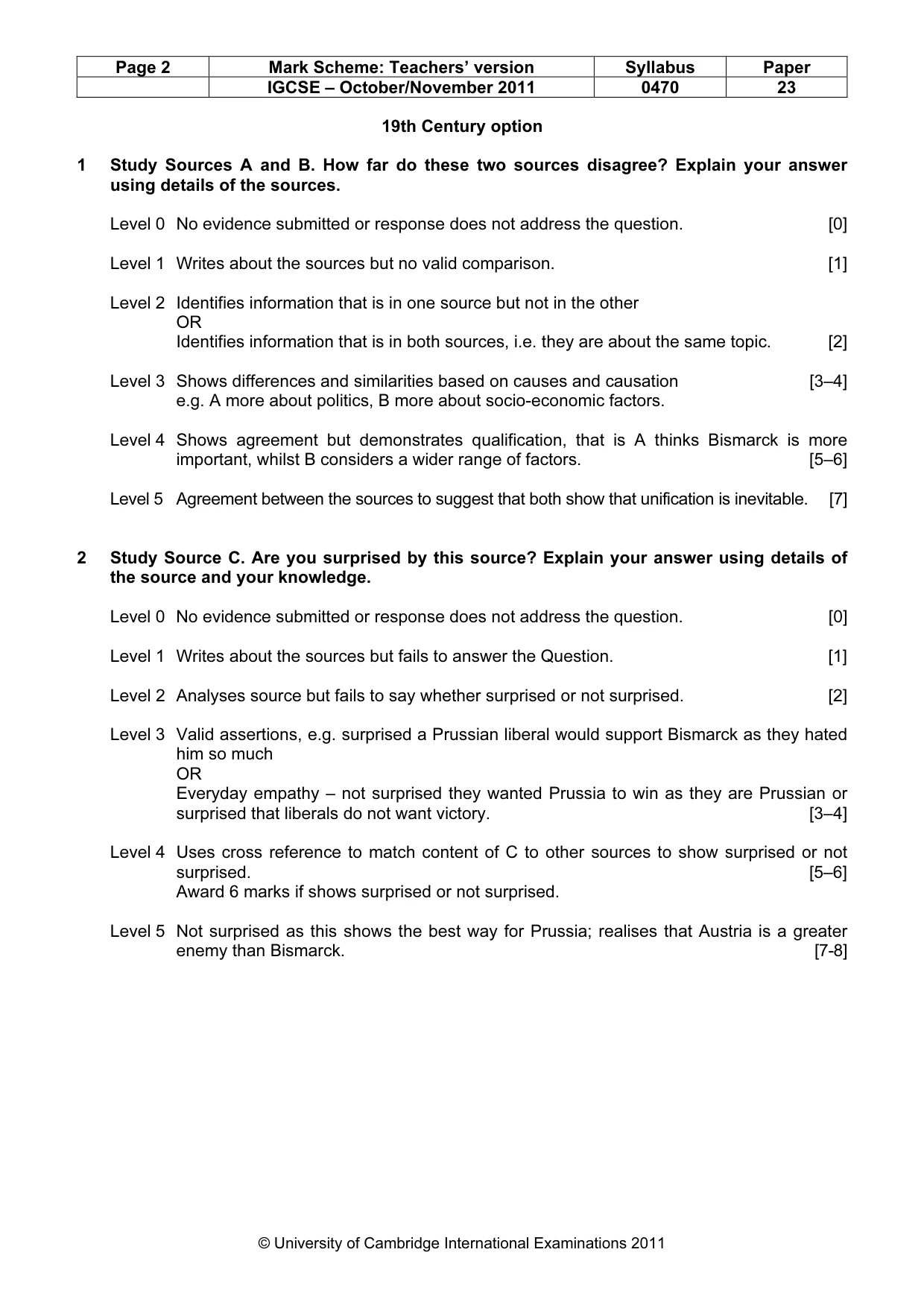
Page 2 Mark Scheme: Teachers’ version Syllabus Paper IGCSE – October/November 2011 0470 23 © University of Cambridge International Examinations 2011 19th Century option 1 Study Sources A and B. How far do these two sources disagree? Explain your answer using details of the sources. Level 0 No evidence submitted or response does not address the question. [0] Level 1 Writes about the sources but no valid comparison. [1] Level 2 Identifies information that is in one source but not in the other OR Identifies information that is in both sources, i.e. they are about the same topic. [2] Level 3 Shows differences and similarities based on causes and causation [3–4] e.g. A more about politics, B more about socio-economic factors. Level 4 Shows agreement but demonstrates qualification, that is A thinks Bismarck is more important, whilst B considers a wider range of factors. [5–6] Level 5 Agreement between the sources to suggest that both show that unification is inevitable. [7] 2 Study Source C. Are you surprised by this source? Explain your answer using details of the source and your knowledge. Level 0 No evidence submitted or response does not address the question. [0] Level 1 Writes about the sources but fails to answer the Question. [1] Level 2 Analyses source but fails to say whether surprised or not surprised. [2] Level 3 Valid assertions, e.g. surprised a Prussian liberal would support Bismarck as they hated him so much OR Everyday empathy – not surprised they wanted Prussia to win as they are Prussian or surprised that liberals do not want victory. [3–4] Level 4 Uses cross reference to match content of C to other sources to show surprised or not surprised. [5–6] Award 6 marks if shows surprised or not surprised. Level 5 Not surprised as this shows the best way for Prussia; realises that Austria is a greater enemy than Bismarck. [7-8]
Mark scheme, page 3
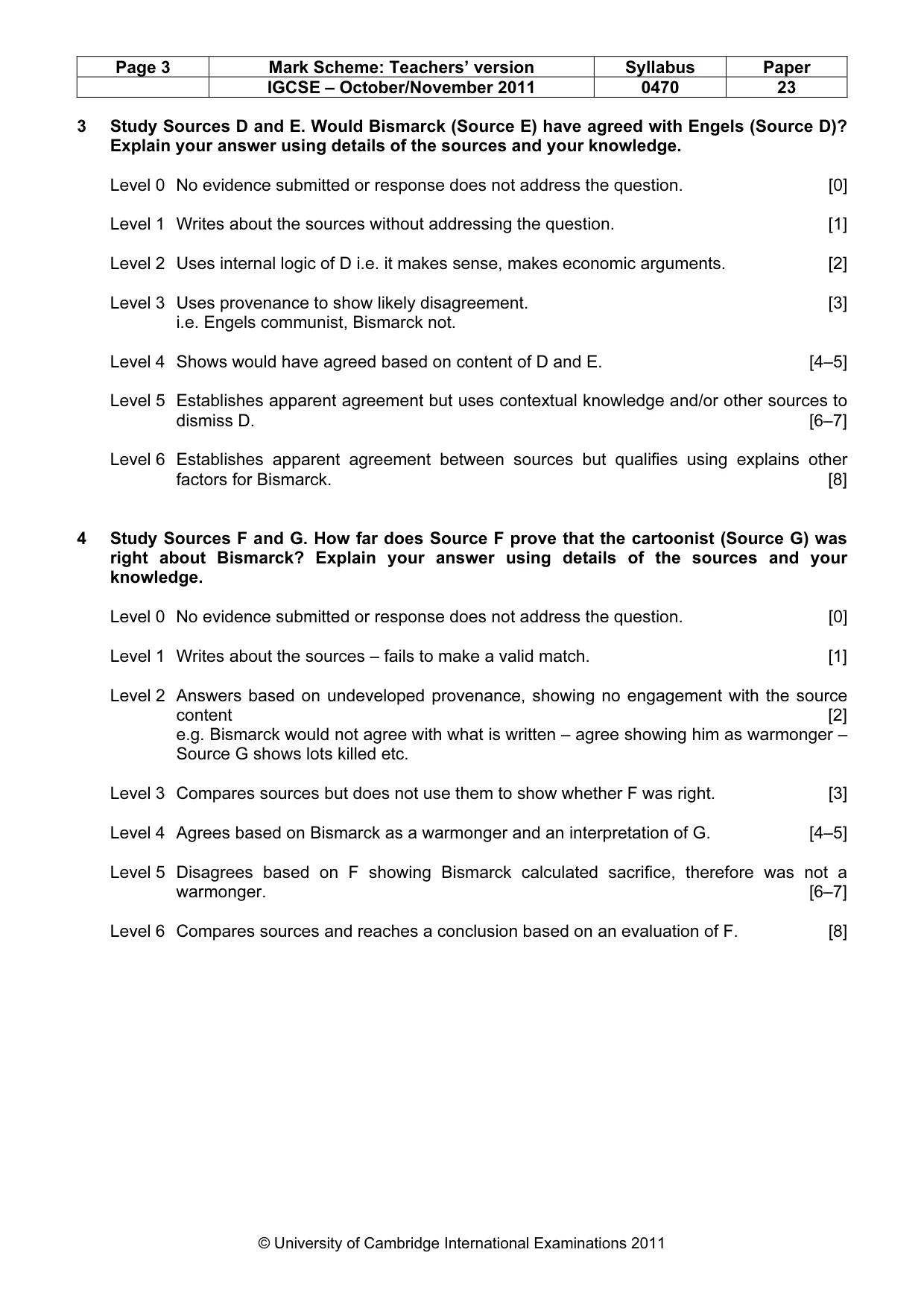
Page 3 Mark Scheme: Teachers’ version Syllabus Paper IGCSE – October/November 2011 0470 23 © University of Cambridge International Examinations 2011 3 Study Sources D and E. Would Bismarck (Source E) have agreed with Engels (Source D)? Explain your answer using details of the sources and your knowledge. Level 0 No evidence submitted or response does not address the question. [0] Level 1 Writes about the sources without addressing the question. [1] Level 2 Uses internal logic of D i.e. it makes sense, makes economic arguments. [2] Level 3 Uses provenance to show likely disagreement. [3] i.e. Engels communist, Bismarck not. Level 4 Shows would have agreed based on content of D and E. [4–5] Level 5 Establishes apparent agreement but uses contextual knowledge and/or other sources to dismiss D. [6–7] Level 6 Establishes apparent agreement between sources but qualifies using explains other factors for Bismarck. [8] 4 Study Sources F and G. How far does Source F prove that the cartoonist (Source G) was right about Bismarck? Explain your answer using details of the sources and your knowledge. Level 0 No evidence submitted or response does not address the question. [0] Level 1 Writes about the sources – fails to make a valid match. [1] Level 2 Answers based on undeveloped provenance, showing no engagement with the source content [2] e.g. Bismarck would not agree with what is written – agree showing him as warmonger – Source G shows lots killed etc. Level 3 Compares sources but does not use them to show whether F was right. [3] Level 4 Agrees based on Bismarck as a warmonger and an interpretation of G. [4–5] Level 5 Disagrees based on F showing Bismarck calculated sacrifice, therefore was not a warmonger. [6–7] Level 6 Compares sources and reaches a conclusion based on an evaluation of F. [8]
Mark scheme, page 4
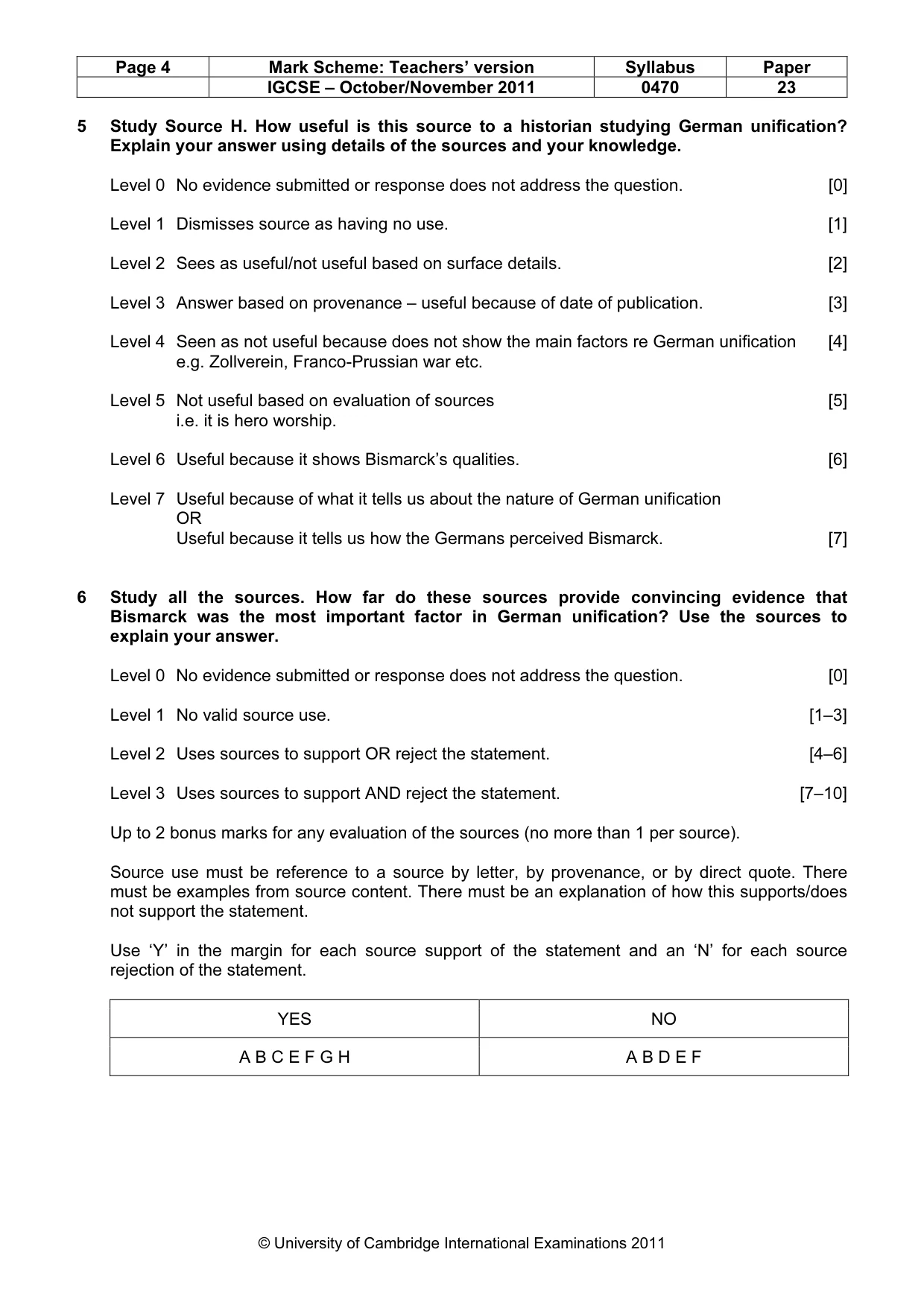
Page 4 Mark Scheme: Teachers’ version Syllabus Paper IGCSE – October/November 2011 0470 23 © University of Cambridge International Examinations 2011 5 Study Source H. How useful is this source to a historian studying German unification? Explain your answer using details of the sources and your knowledge. Level 0 No evidence submitted or response does not address the question. [0] Level 1 Dismisses source as having no use. [1] Level 2 Sees as useful/not useful based on surface details. [2] Level 3 Answer based on provenance – useful because of date of publication. [3] Level 4 Seen as not useful because does not show the main factors re German unification [4] e.g. Zollverein, Franco-Prussian war etc. Level 5 Not useful based on evaluation of sources [5] i.e. it is hero worship. Level 6 Useful because it shows Bismarck’s qualities. [6] Level 7 Useful because of what it tells us about the nature of German unification OR Useful because it tells us how the Germans perceived Bismarck. [7] 6 Study all the sources. How far do these sources provide convincing evidence that Bismarck was the most important factor in German unification? Use the sources to explain your answer. Level 0 No evidence submitted or response does not address the question. [0] Level 1 No valid source use. [1–3] Level 2 Uses sources to support OR reject the statement. [4–6] Level 3 Uses sources to support AND reject the statement. [7–10] Up to 2 bonus marks for any evaluation of the sources (no more than 1 per source). Source use must be reference to a source by letter, by provenance, or by direct quote. There must be examples from source content. There must be an explanation of how this supports/does not support the statement. Use ‘Y’ in the margin for each source support of the statement and an ‘N’ for each source rejection of the statement. YES NO A B C E F G H A B D E F
Mark scheme, page 5
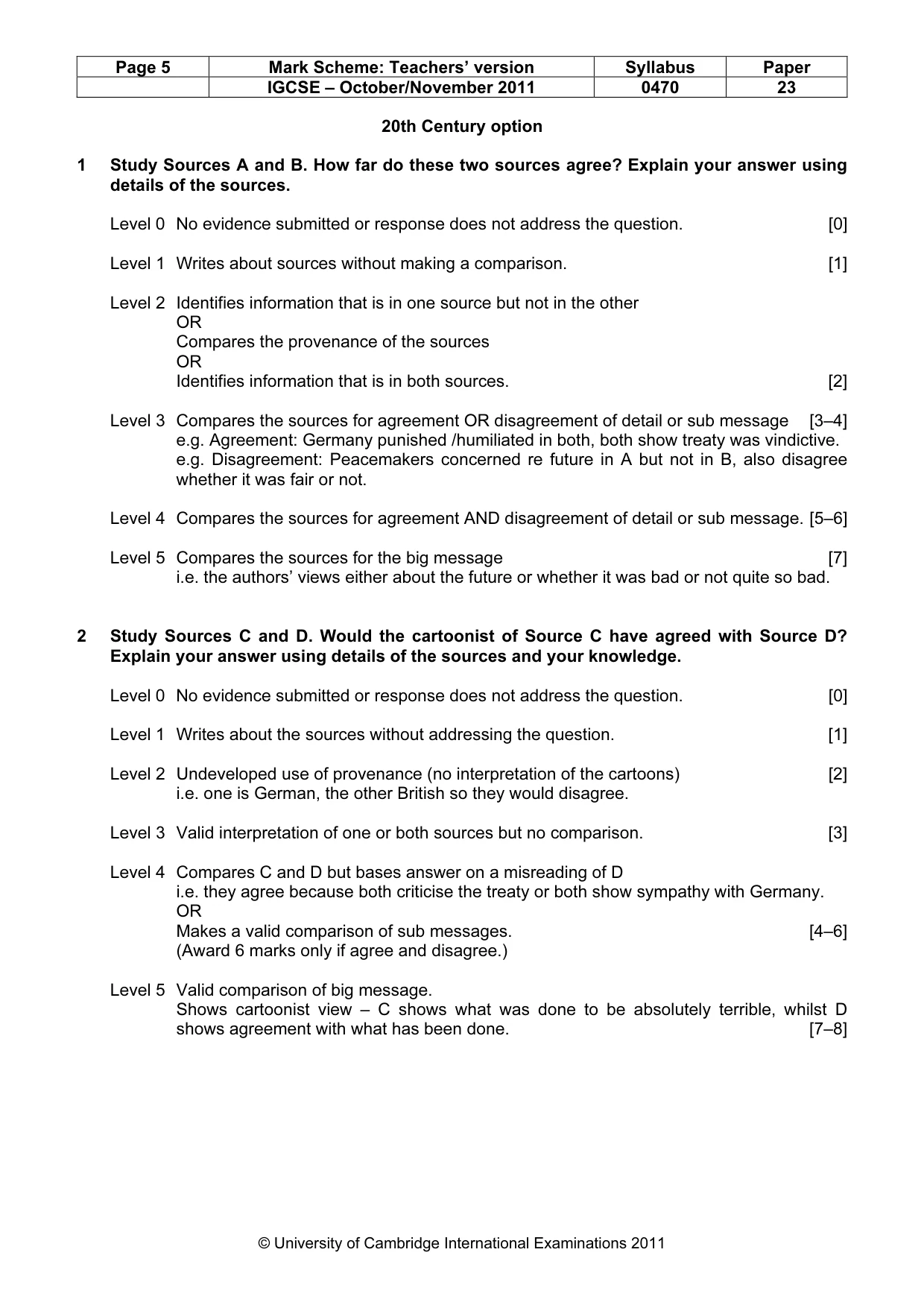
Page 5 Mark Scheme: Teachers’ version Syllabus Paper IGCSE – October/November 2011 0470 23 © University of Cambridge International Examinations 2011 20th Century option 1 Study Sources A and B. How far do these two sources agree? Explain your answer using details of the sources. Level 0 No evidence submitted or response does not address the question. [0] Level 1 Writes about sources without making a comparison. [1] Level 2 Identifies information that is in one source but not in the other OR Compares the provenance of the sources OR Identifies information that is in both sources. [2] Level 3 Compares the sources for agreement OR disagreement of detail or sub message [3–4] e.g. Agreement: Germany punished /humiliated in both, both show treaty was vindictive. e.g. Disagreement: Peacemakers concerned re future in A but not in B, also disagree whether it was fair or not. Level 4 Compares the sources for agreement AND disagreement of detail or sub message. [5–6] Level 5 Compares the sources for the big message [7] i.e. the authors’ views either about the future or whether it was bad or not quite so bad. 2 Study Sources C and D. Would the cartoonist of Source C have agreed with Source D? Explain your answer using details of the sources and your knowledge. Level 0 No evidence submitted or response does not address the question. [0] Level 1 Writes about the sources without addressing the question. [1] Level 2 Undeveloped use of provenance (no interpretation of the cartoons) [2] i.e. one is German, the other British so they would disagree. Level 3 Valid interpretation of one or both sources but no comparison. [3] Level 4 Compares C and D but bases answer on a misreading of D i.e. they agree because both criticise the treaty or both show sympathy with Germany. OR Makes a valid comparison of sub messages. [4–6] (Award 6 marks only if agree and disagree.) Level 5 Valid comparison of big message. Shows cartoonist view – C shows what was done to be absolutely terrible, whilst D shows agreement with what has been done. [7–8]
Mark scheme, page 6
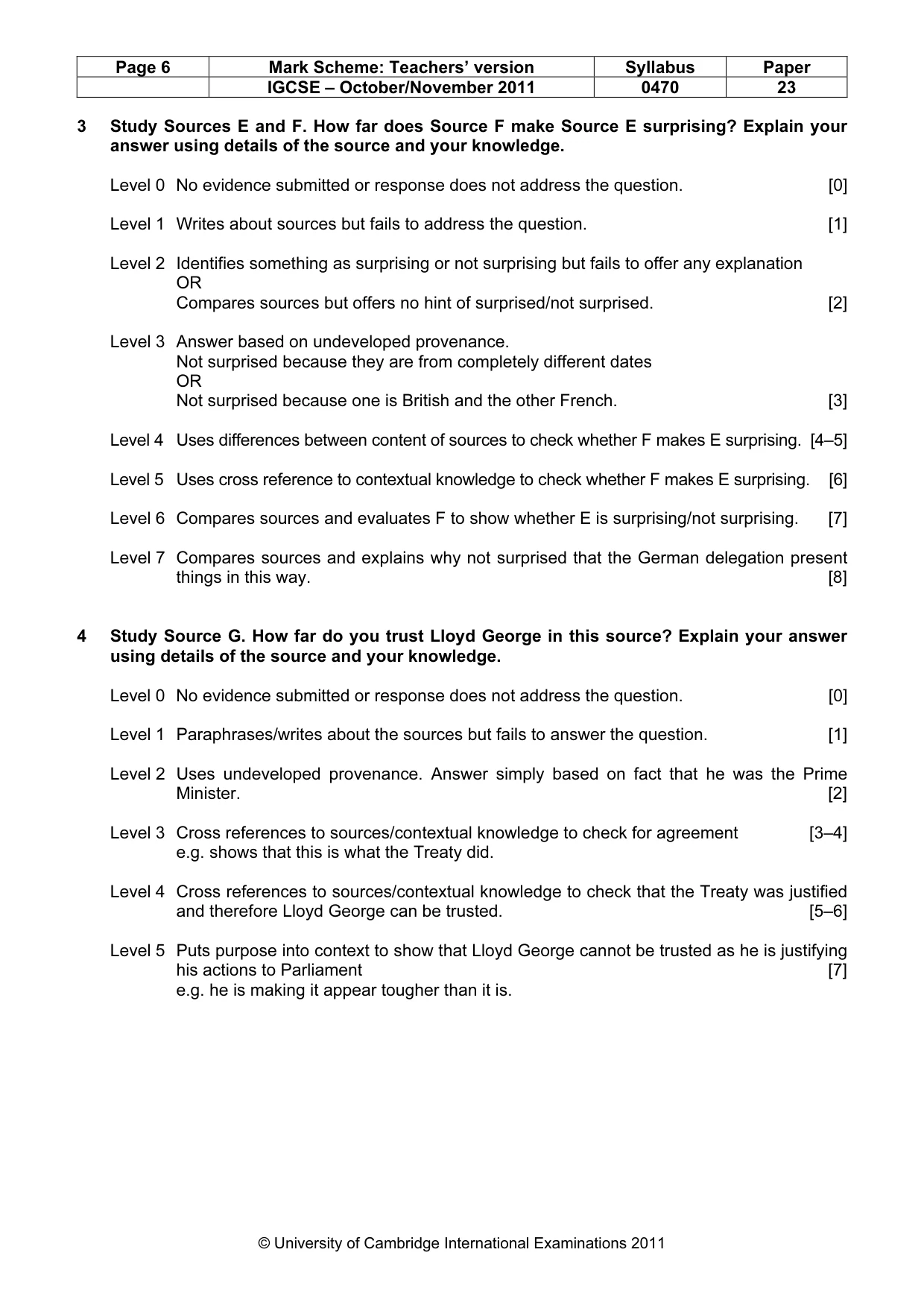
Page 6 Mark Scheme: Teachers’ version Syllabus Paper IGCSE – October/November 2011 0470 23 © University of Cambridge International Examinations 2011 3 Study Sources E and F. How far does Source F make Source E surprising? Explain your answer using details of the source and your knowledge. Level 0 No evidence submitted or response does not address the question. [0] Level 1 Writes about sources but fails to address the question. [1] Level 2 Identifies something as surprising or not surprising but fails to offer any explanation OR Compares sources but offers no hint of surprised/not surprised. [2] Level 3 Answer based on undeveloped provenance. Not surprised because they are from completely different dates OR Not surprised because one is British and the other French. [3] Level 4 Uses differences between content of sources to check whether F makes E surprising. [4–5] Level 5 Uses cross reference to contextual knowledge to check whether F makes E surprising. [6] Level 6 Compares sources and evaluates F to show whether E is surprising/not surprising. [7] Level 7 Compares sources and explains why not surprised that the German delegation present things in this way. [8] 4 Study Source G. How far do you trust Lloyd George in this source? Explain your answer using details of the source and your knowledge. Level 0 No evidence submitted or response does not address the question. [0] Level 1 Paraphrases/writes about the sources but fails to answer the question. [1] Level 2 Uses undeveloped provenance. Answer simply based on fact that he was the Prime Minister. [2] Level 3 Cross references to sources/contextual knowledge to check for agreement [3–4] e.g. shows that this is what the Treaty did. Level 4 Cross references to sources/contextual knowledge to check that the Treaty was justified and therefore Lloyd George can be trusted. [5–6] Level 5 Puts purpose into context to show that Lloyd George cannot be trusted as he is justifying his actions to Parliament [7] e.g. he is making it appear tougher than it is.
Mark scheme, page 7
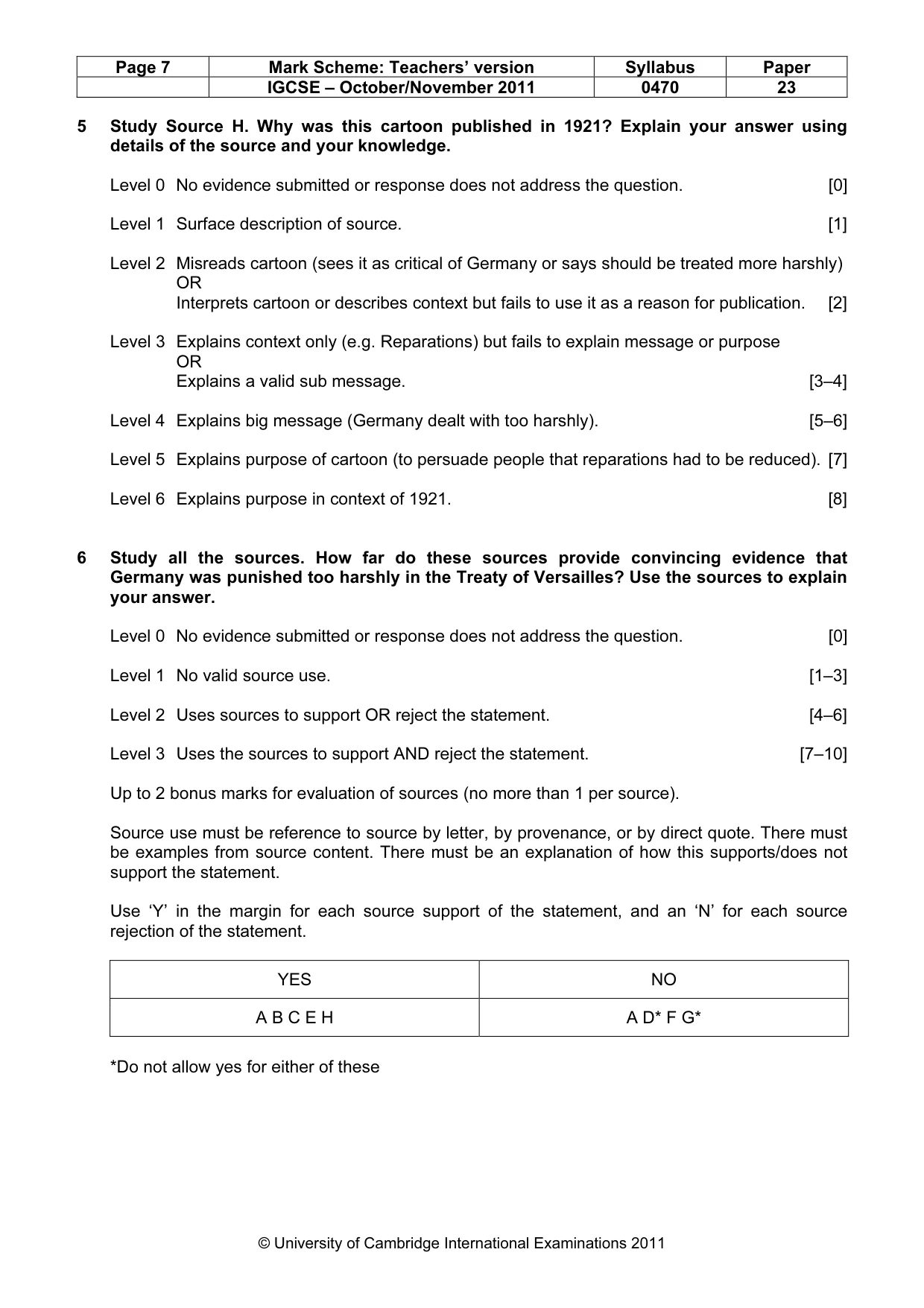
Page 7 Mark Scheme: Teachers’ version Syllabus Paper IGCSE – October/November 2011 0470 23 © University of Cambridge International Examinations 2011 5 Study Source H. Why was this cartoon published in 1921? Explain your answer using details of the source and your knowledge. Level 0 No evidence submitted or response does not address the question. [0] Level 1 Surface description of source. [1] Level 2 Misreads cartoon (sees it as critical of Germany or says should be treated more harshly) OR Interprets cartoon or describes context but fails to use it as a reason for publication. [2] Level 3 Explains context only (e.g. Reparations) but fails to explain message or purpose OR Explains a valid sub message. [3–4] Level 4 Explains big message (Germany dealt with too harshly). [5–6] Level 5 Explains purpose of cartoon (to persuade people that reparations had to be reduced). [7] Level 6 Explains purpose in context of 1921. [8] 6 Study all the sources. How far do these sources provide convincing evidence that Germany was punished too harshly in the Treaty of Versailles? Use the sources to explain your answer. Level 0 No evidence submitted or response does not address the question. [0] Level 1 No valid source use. [1–3] Level 2 Uses sources to support OR reject the statement. [4–6] Level 3 Uses the sources to support AND reject the statement. [7–10] Up to 2 bonus marks for evaluation of sources (no more than 1 per source). Source use must be reference to source by letter, by provenance, or by direct quote. There must be examples from source content. There must be an explanation of how this supports/does not support the statement. Use ‘Y’ in the margin for each source support of the statement, and an ‘N’ for each source rejection of the statement. YES NO A B C E H A D* F G* *Do not allow yes for either of these
What you needed in this session
Cambridge’s own grade thresholds for 2011 Oct/Nov, Paper 2 · Variant 3. A higher threshold means an easier paper — the bar moves with how the cohort did.