Cambridge IGCSE History 0470 — 2011 Oct/Nov Paper 2 · Variant 1
0470/21/O/N/11 · 50 marks · ≈56 min
The question paper and its mark scheme, free to read here and free to download. This is Cambridge’s own paper, exactly as it was sat.
Question paper16 pages

Mark scheme8 pages
Answers below. Sit the paper first if you are practising.
Paper as text
Question paper, page 1
This document consists of 14 printed pages and 2 blank pages. DC (RCL (PL/DJ)) 35062/4 © UCLES 2011 [Turn over UNIVERSITY OF CAMBRIDGE INTERNATIONAL EXAMINATIONS International General Certificate of Secondary Education * 7 2 8 9 8 1 3 5 0 0 * HISTORY 0470/21 Paper 2 October/November 2011 2 hours Additional Materials: Answer Booklet/Paper READ THESE INSTRUCTIONS FIRST If you have been given an Answer Booklet, follow the instructions on the front cover of the Booklet. Write your Centre number, candidate number and name on all the work you hand in. Write in dark blue or black pen. You may use a soft pencil for any diagrams, graphs or rough working. Do not use staples, paper clips, highlighters, glue or correction fluid. This paper has two options. Choose one option, and answer all of the questions on that topic. Option A: 19th Century topic [p2–p7] Option B: 20th Century topic [p8–p14] At the end of the examination, fasten all your work securely together. The number of marks is given in brackets [ ] at the end of each question or part question. www.XtremePapers.com
Question paper, page 2
2 0470/21/O/N/11 © UCLES 2011 Option A: 19th Century topic HOW FAR WAS BISMARCK THE CAUSE OF THE WAR WITH AUSTRIA IN 1866? Study the Background Information and the sources carefully, and then answer all the questions. Background Information By May 1866 Austria and Prussia had failed to settle their differences over Schleswig and Holstein. Austria took the matter to the Diet at Frankfurt and began to mobilise its army. The Prussian army retaliated by invading Holstein on 7 June. On 14 June the German Confederation voted to mobilise against Prussia. The Austro-Prussian War had begun. Some historians have argued that Bismarck planned the war and deliberately provoked Austria. Others have claimed that Bismarck simply reacted to opportunities, while others think that war between Austria and Prussia was inevitable. Did Bismarck cause the Austro-Prussian War? SOURCE A There is little historical debate about who was responsible for causing the Austro-Prussian War: it was the Prussian government, or, to be more precise, Bismarck. The problem of Schleswig-Holstein provided Bismarck with a perfect opportunity. Bismarck’s aims in 1864 were to gain control of Schleswig-Holstein and for Prussia to become the political leader of northern Germany, either with Austrian consent or without it. William I was very uneasy about challenging Austria, a fellow German power. Having eventually persuaded the king that his aims were right, Bismarck then proceeded to put continuous pressure on Austria. In August 1865 Bismarck succeeded in persuading Austria to accept the division of Schleswig-Holstein, Austria receiving Holstein and Prussia Schleswig. This gave Bismarck an excuse to complain about Austrian rule in Holstein and thus threaten the end of the Austro-Prussian partnership. In February 1866 the Prussian government agreed to prepare for a war with Austria, signing a treaty with Italy that agreed that Italy would go to war against Austria if Prussia attacked Austria within three months. Austria was thus faced with the probability of a two-front war within twelve weeks. Because it took Austria eight weeks to mobilise her armies, and Prussia only four, Austria had to move first. From a history book published in 2000.
Question paper, page 3
3 0470/21/O/N/11 © UCLES 2011 [Turn over SOURCE B Bismarck’s aim was to gain the upper hand in Germany from Austria. In November 1863 Frederick of Denmark died. The question of Schleswig-Holstein was opened; and Bismarck stumbled, without knowing it, through the door that led to victory. The affair of the Danish duchies led by logical steps to the defeat of Austria in July 1866. This is far from saying that Bismarck knew at the outset where he was going, whatever he might claim later on. The future is a land with no maps; and historians are wrong when they describe even the most purposeful statesman as though he were marching down a road with his objective already in sight. When Frederick VII died Bismarck had to do something in the duchies. But if Prussia took the lead against Denmark, the Great Powers would unite against her, as they had done in 1848. Bismarck found a way of escape. He would co-operate with Austria. The alliance with Austria was not designed as a trap for Austria. There was no reason to suppose that joint control of the duchies would necessarily lead to a quarrel. Bismarck, along with others, had been posing the choice for the last ten years: either a revolutionary alliance with France and Russia or a conservative partnership with Austria. The first was no longer on offer, therefore only the partnership with Austria remained. No one, not even Bismarck, foresaw a third course – that Prussia should defeat Austria. The breach over the Zollverein ruined the Austro-Prussian alliance. The treaties on which the Zollverein were based expired at the end of 1865. Austria demanded that Austria be included. The breach was not welcomed by Bismarck. He would have preferred to let things drift. However, the division of the duchies between Austria and Prussia in the Treaty of Gastein in 1865 gave Austria another opportunity to accept Prussia as an equal. The Austrians did not do so; it was they, not Bismarck, who refused to treat Gastein as a step on the road towards agreement. Bismarck disliked war. It was a clumsy way of settling disputes and it gave control to the generals. He would go to war only if all other methods were exhausted. Gastein gave Bismarck some hope that he might succeed without war. From a history book published in 1955.
Question paper, page 4
4 0470/21/O/N/11 © UCLES 2011 SOURCE C A cartoon from a German magazine published in 1852. The man on the left represents Prussia while the man on the right represents Austria. The animals represent those German states that did not belong to the Zollverein. SOURCE D The Russian ambassador gave a large dinner in 1862 at which I was present. Among the guests was the Prussian minister in Paris, Bismarck, who had a long conversation with Disraeli after dinner. The following is part of what Bismarck said to Disraeli, which he repeated to me on the same evening. ‘As soon as the army shall have been brought into such a condition to command respect, then I shall take the first opportunity to declare war with Austria, to split apart the German Confederation, bring the middle and smaller states under our control and give Germany a national union under the leadership of Prussia. I have come to say this to the British Government.’ Disraeli said to me, ‘Be careful of that man! He means what he says.’ From the memoirs of Count von Eckstadt, published in 1886. Disraeli was a British politician. Eckstadt was the Saxon ambassador in Britain.
Question paper, page 5
5 0470/21/O/N/11 © UCLES 2011 [Turn over SOURCE E A true German policy is only possible when Austria and Prussia are united and take the lead. We consider working together is the best way to consolidate the successes we have won. We consider combination (such as the joint action in waging war which is our immediate political purpose) as the foundation of a lasting unity. If Prussia and Austria are not united, politically Germany does not exist. Quarrelling has left some of the smaller states unsure, and made others troublesome. If we hesitate or weaken, the collapse of Germany will be brought about by allowing the policies of our two countries to be decided by a few, unarmed small states. If, on the contrary, we come forward firmly, they will conform as soon as they see the firm will of Austria and Prussia. Bismarck writing to the Prussian Ambassador in Austria, August 1864. SOURCE F Every future historian of the German nation will proclaim the events of the year 1866 as a tremendous step forward. He will at the same time acknowledge the year of Prussia’s independent action in its German policy as the year of the most magnificent upheaval that German history has ever known. In this year Count Bismarck entered upon his next phase of activity directed towards the further united development of Germany. The most urgent need is for us all to cease our grumbling at the catastrophe of ‘blood and iron’. We have all been saying to each other, over and over again, especially since 1849, that things would never get better or move forward in Germany except by way of ‘force’ or ‘revolution’ or ‘war and civil war’. Now that this prediction has been fulfilled, have we any reason to be morally upset at the reality of what has been regarded as inevitable by so many people? I would not hesitate to sacrifice even the last spark of freedom temporarily for the sake of the completion of unity. As a former member of the Frankfurt Parliament I should have liked to see the constitution of 1849 form the basis of the new German order. But action itself is more important than fulfilment of that desire. The nation will be served not by fruitless party arguments, but only by action which will bring the work of unity and freedom to completion as soon as possible. From a book entitled ‘Prussia’s German Policy’, by a Prussian liberal, published in 1867. SOURCE G Never has a war been provoked so shamelessly as the one that Bismarck is currently trying to start against Austria. My innermost feelings are revolted by this violation of every moral principle. I am no friend of Austria and I am devoted to the idea of Prussian influence in north Germany, even though I have little sympathy for the present political system in Prussia. But I would rather cut off my hand than use it in such a disgusting operation as Prussian policy is now launching against Austria. Austria is supposed to be mobilising against Prussia! Any child knows that the opposite is the case. The saddest thing about it all is that once the struggle is under way principles of right and wrong must conflict with interests. Whom should we wish victorious, Austria or Prussia? We have no choice, we must come down on the side of the unjust cause, because we cannot tolerate the possibility of Austria gaining the upper hand in Germany. Nobody here is comfortable with the idea that the war will have the result we desire – the dominance of Prussia. A letter from one Prussian liberal to another, May 1866.
Question paper, page 6
6 0470/21/O/N/11 © UCLES 2011 SOURCE H We have to avoid wounding Austria too severely; we have to avoid leaving Austria unnecessarily bitter or desiring revenge. We ought to keep the possibility of becoming friends again. If Austria were severely injured she would become the ally of France and of every opponent of ours. German Austria we could neither wholly nor partly make use of. The acquisition of provinces like Austrian Silesia and part of Bohemia could not strengthen the Prussian state; it would not lead to an amalgamation of German Austria with Prussia, and Vienna could not be governed by Berlin as a mere dependency. A letter from Bismarck to King William I, July 1866.
Question paper, page 7
7 0470/21/O/N/11 © UCLES 2011 [Turn over Now answer all the following questions. You may use any of the sources to help you answer the questions, in addition to those sources which you are told to use. In answering the questions you should use your knowledge of the topic to help you interpret and evaluate the sources. 1 Study Sources A and B. How far do these two sources agree? Explain your answer using details of the sources. [7] 2 Study Source C. What is the message of this cartoon? Explain your answer using details of the source and your knowledge. [7] 3 Study Sources D and E. Does Source E prove that Bismarck was lying in Source D? Explain your answer using details of the sources and your knowledge. [8] 4 Study Sources F and G. How similar are the opinions of the authors of these two sources? Explain your answer using details of the sources and your knowledge. [8] 5 Study Source H. Are you surprised by this source? Explain your answer using details of the source and your knowledge. [8] 6 Study all the sources. How far do these sources provide convincing evidence that Bismarck caused the Austro-Prussian War in 1866? Use the sources to explain your answer. [12]
Question paper, page 8
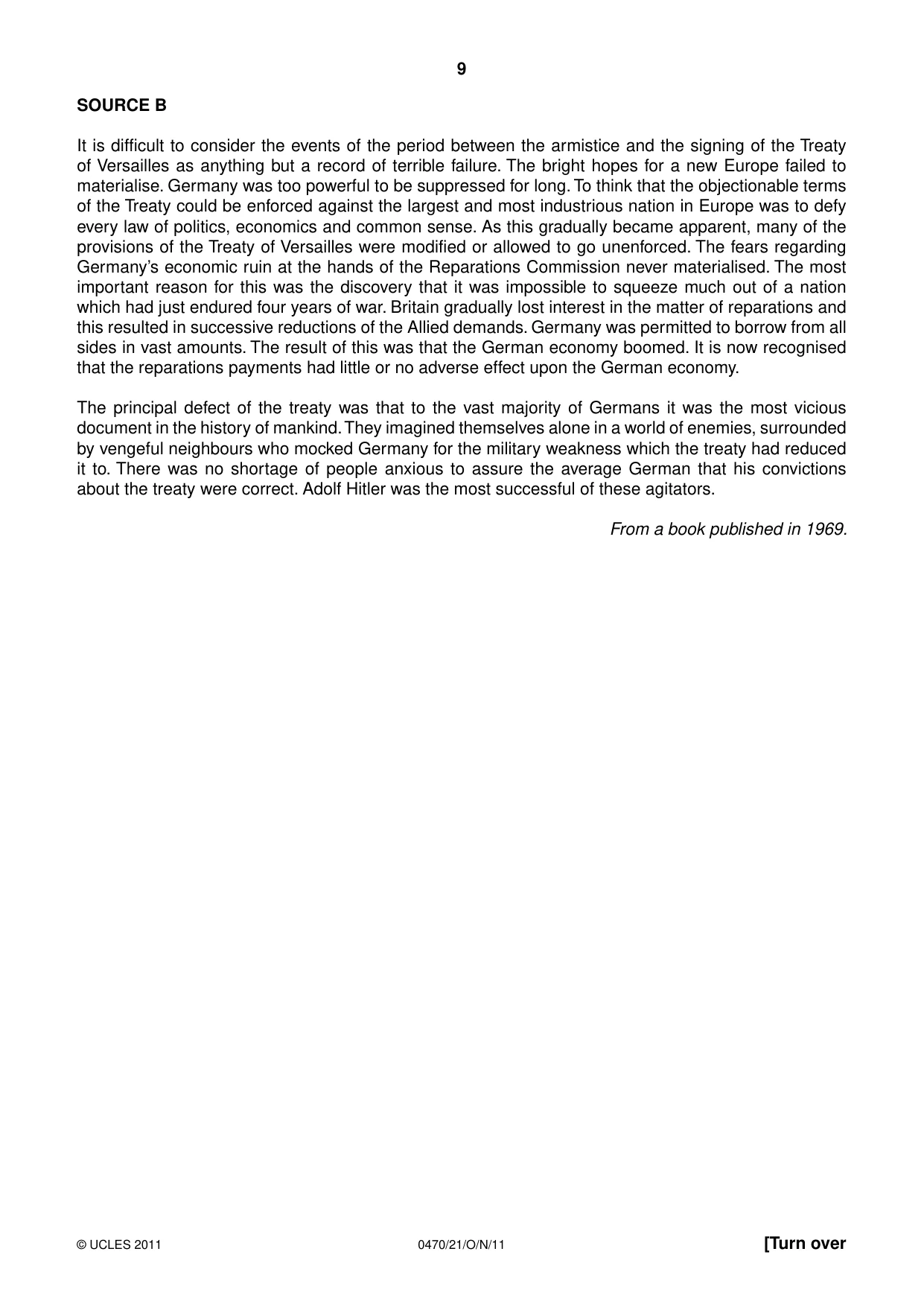
8 0470/21/O/N/11 © UCLES 2011 Option B: 20th Century topic WAS THE VERSAILLES PEACE SETTLEMENT UNFAIR? Study the Background Information and the sources carefully, and then answer all the questions. Background Information In January 1919 representatives from the victorious nations met in Paris to agree a peace settlement. The tasks facing these politicians were huge. Millions of people had been killed during the war, and large areas had been devastated with homes and industries destroyed. The public in countries like Britain and France wanted revenge. The problem of what to do with Germany posed many difficulties. How far should it be punished and how far should it be helped to recover? Empires had collapsed, leaving many peoples demanding their own states. How far should, or could, these demands for self-determination be met? Did the peacemakers manage to produce a peace settlement that was fair? SOURCE A Between January and June 1919 the peacemakers had accomplished an enormous amount: a League of Nations and an International Labour Organisation, mandates handed out, the Germany treaty finished, the treaties with Austria, Hungary, Bulgaria and Ottoman Turkey nearly done. However, some of the great problems that had faced the peacemakers had only been shelved. The German question was still there to trouble Europe. The Allied victory had not been decisive enough and Germany remained too strong. Nationalism, far from burning itself out, was still gathering momentum. In many cases the peacemakers found there was little they could do. Yugoslavia, Poland and Czechoslovakia all existed before the Peace Conference started. The best the peacemakers could do was to prevent Europe collapsing into further subdivisions and to draw as rational borders as possible. The demand for nation-states was not itself rational in the world of 1919. It was not possible to put all the Poles into Poland or all the Germans into Germany. The peacemakers did their best to impose obligations on governments to treat minorities well. The peacemakers in 1919 felt they had done their best, but they had no illusions that they had solved the world’s problems. Later it became commonplace to blame everything that went wrong in the 1920s and 1930s on the peacemakers. Eighty years later the old charges about the Paris Peace Conference still have a wide circulation. ‘The final crime’, declared a magazine recently, was ‘the Treaty of Versailles, whose harsh terms would ensure a second war’. That is to ignore the actions of everyone for twenty years between 1919 and 1939. From a book published in 2001.
Question paper, page 9
9 0470/21/O/N/11 © UCLES 2011 [Turn over SOURCE B It is difficult to consider the events of the period between the armistice and the signing of the Treaty of Versailles as anything but a record of terrible failure. The bright hopes for a new Europe failed to materialise. Germany was too powerful to be suppressed for long. To think that the objectionable terms of the Treaty could be enforced against the largest and most industrious nation in Europe was to defy every law of politics, economics and common sense. As this gradually became apparent, many of the provisions of the Treaty of Versailles were modified or allowed to go unenforced. The fears regarding Germany’s economic ruin at the hands of the Reparations Commission never materialised. The most important reason for this was the discovery that it was impossible to squeeze much out of a nation which had just endured four years of war. Britain gradually lost interest in the matter of reparations and this resulted in successive reductions of the Allied demands. Germany was permitted to borrow from all sides in vast amounts. The result of this was that the German economy boomed. It is now recognised that the reparations payments had little or no adverse effect upon the German economy. The principal defect of the treaty was that to the vast majority of Germans it was the most vicious document in the history of mankind. They imagined themselves alone in a world of enemies, surrounded by vengeful neighbours who mocked Germany for the military weakness which the treaty had reduced it to. There was no shortage of people anxious to assure the average German that his convictions about the treaty were correct. Adolf Hitler was the most successful of these agitators. From a book published in 1969.
Question paper, page 10
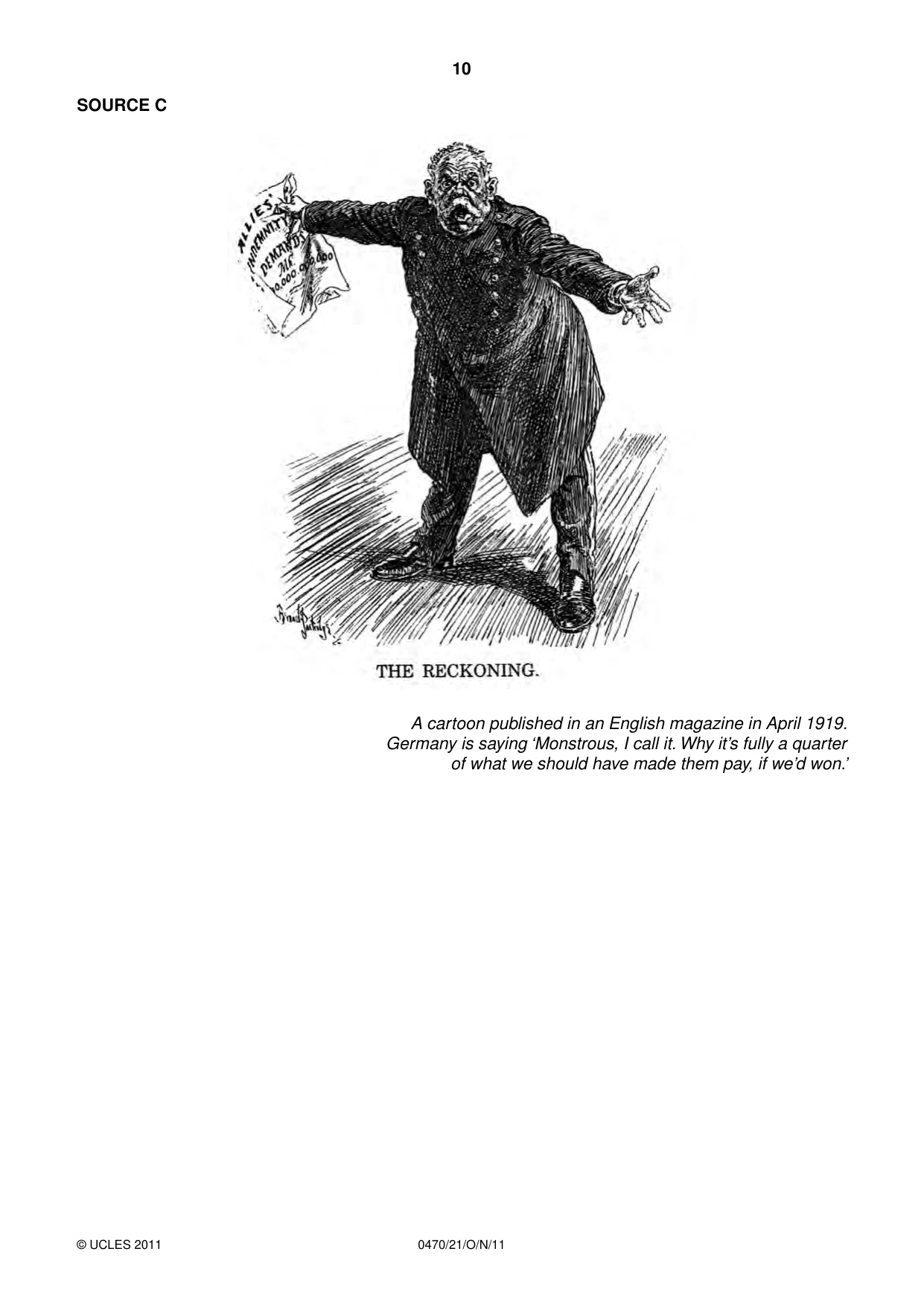
10 0470/21/O/N/11 © UCLES 2011 SOURCE C A cartoon published in an English magazine in April 1919. Germany is saying ‘Monstrous, I call it. Why it’s fully a quarter of what we should have made them pay, if we’d won.’
Question paper, page 11
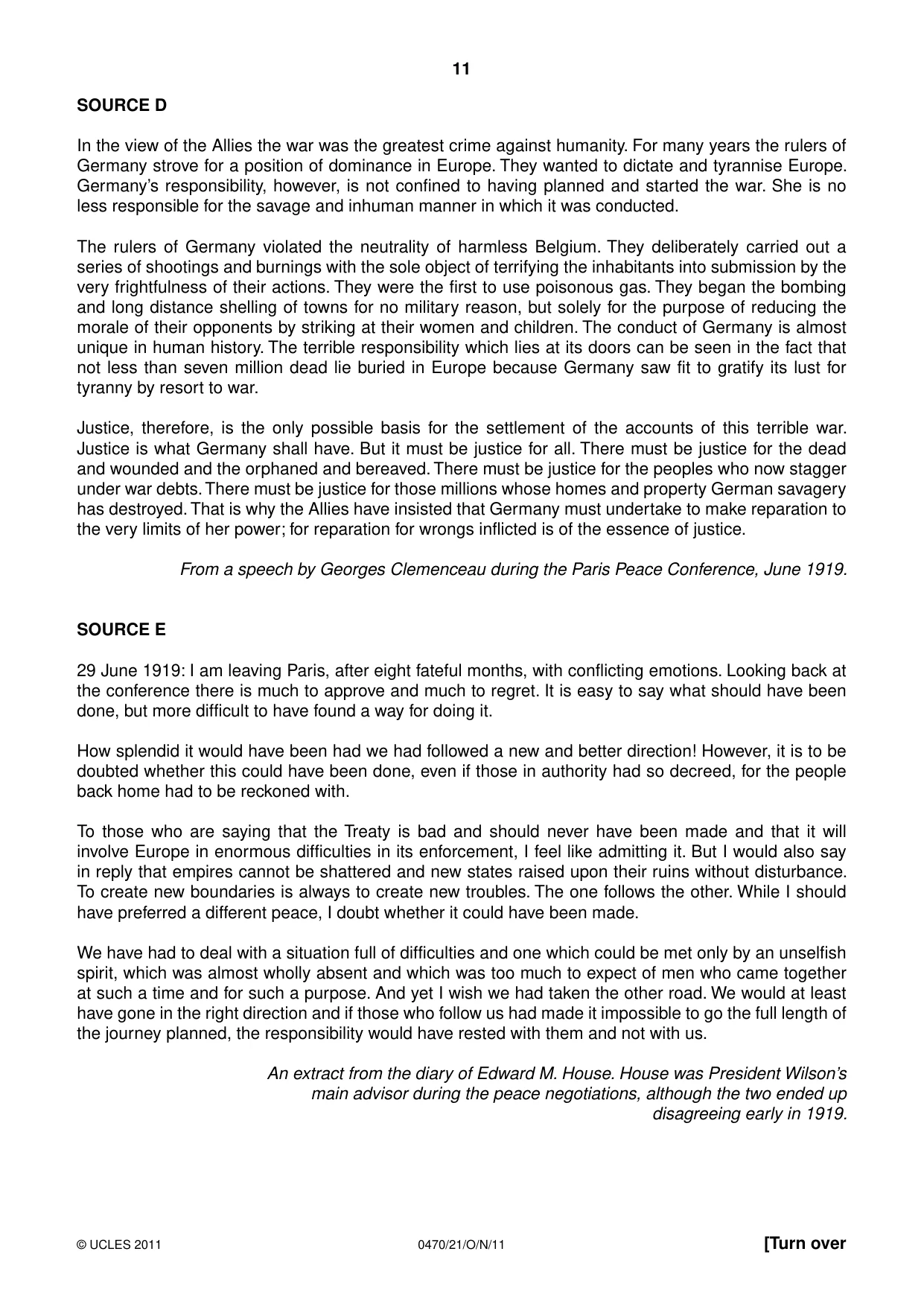
11 0470/21/O/N/11 © UCLES 2011 [Turn over SOURCE D In the view of the Allies the war was the greatest crime against humanity. For many years the rulers of Germany strove for a position of dominance in Europe. They wanted to dictate and tyrannise Europe. Germany’s responsibility, however, is not confined to having planned and started the war. She is no less responsible for the savage and inhuman manner in which it was conducted. The rulers of Germany violated the neutrality of harmless Belgium. They deliberately carried out a series of shootings and burnings with the sole object of terrifying the inhabitants into submission by the very frightfulness of their actions. They were the first to use poisonous gas. They began the bombing and long distance shelling of towns for no military reason, but solely for the purpose of reducing the morale of their opponents by striking at their women and children. The conduct of Germany is almost unique in human history. The terrible responsibility which lies at its doors can be seen in the fact that not less than seven million dead lie buried in Europe because Germany saw fit to gratify its lust for tyranny by resort to war. Justice, therefore, is the only possible basis for the settlement of the accounts of this terrible war. Justice is what Germany shall have. But it must be justice for all. There must be justice for the dead and wounded and the orphaned and bereaved. There must be justice for the peoples who now stagger under war debts. There must be justice for those millions whose homes and property German savagery has destroyed. That is why the Allies have insisted that Germany must undertake to make reparation to the very limits of her power; for reparation for wrongs inflicted is of the essence of justice. From a speech by Georges Clemenceau during the Paris Peace Conference, June 1919. SOURCE E 29 June 1919: I am leaving Paris, after eight fateful months, with conflicting emotions. Looking back at the conference there is much to approve and much to regret. It is easy to say what should have been done, but more difficult to have found a way for doing it. How splendid it would have been had we had followed a new and better direction! However, it is to be doubted whether this could have been done, even if those in authority had so decreed, for the people back home had to be reckoned with. To those who are saying that the Treaty is bad and should never have been made and that it will involve Europe in enormous difficulties in its enforcement, I feel like admitting it. But I would also say in reply that empires cannot be shattered and new states raised upon their ruins without disturbance. To create new boundaries is always to create new troubles. The one follows the other. While I should have preferred a different peace, I doubt whether it could have been made. We have had to deal with a situation full of difficulties and one which could be met only by an unselfish spirit, which was almost wholly absent and which was too much to expect of men who came together at such a time and for such a purpose. And yet I wish we had taken the other road. We would at least have gone in the right direction and if those who follow us had made it impossible to go the full length of the journey planned, the responsibility would have rested with them and not with us. An extract from the diary of Edward M. House. House was President Wilson’s main advisor during the peace negotiations, although the two ended up disagreeing early in 1919.
Question paper, page 12
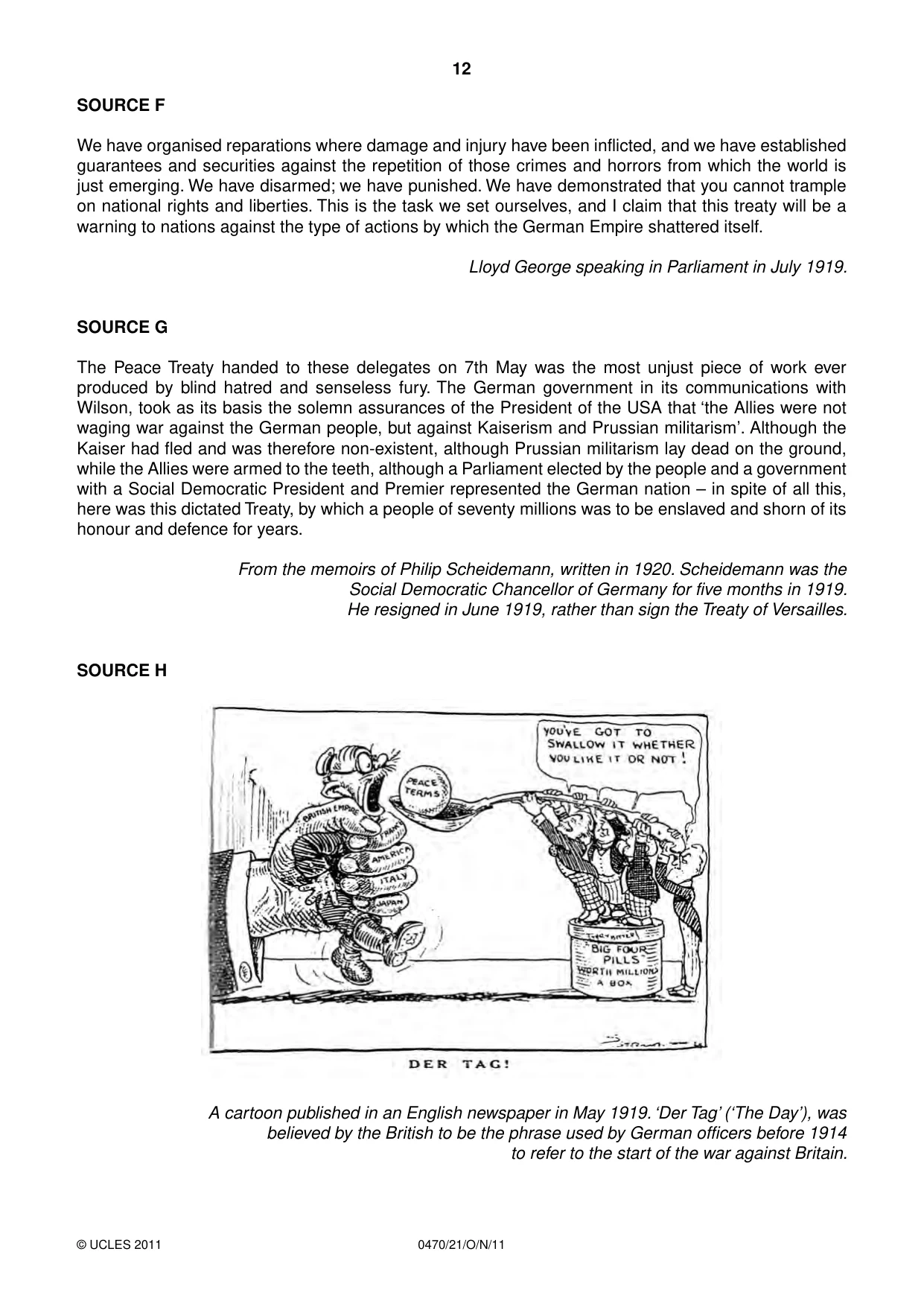
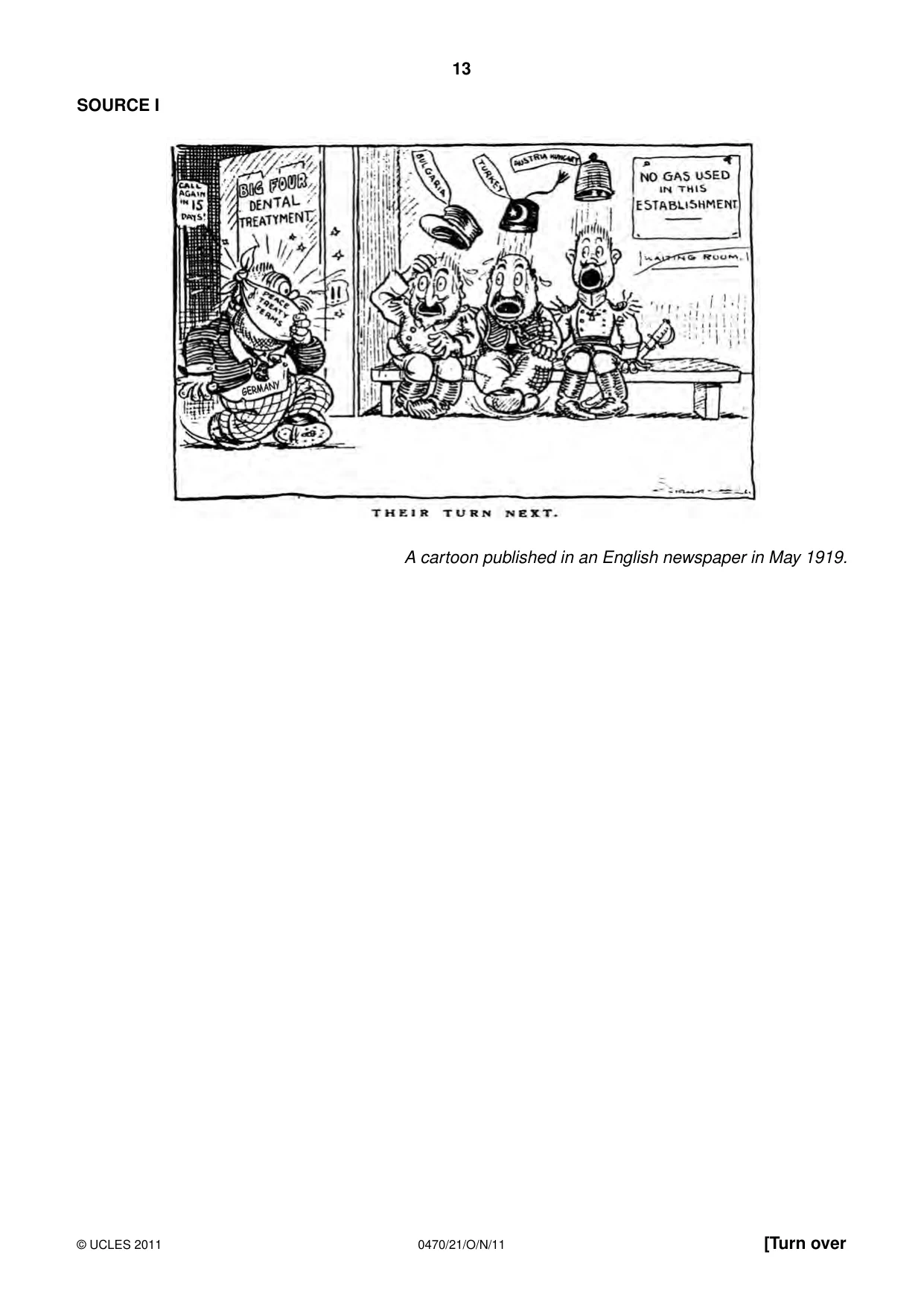
12 0470/21/O/N/11 © UCLES 2011 SOURCE F We have organised reparations where damage and injury have been inflicted, and we have established guarantees and securities against the repetition of those crimes and horrors from which the world is just emerging. We have disarmed; we have punished. We have demonstrated that you cannot trample on national rights and liberties. This is the task we set ourselves, and I claim that this treaty will be a warning to nations against the type of actions by which the German Empire shattered itself. Lloyd George speaking in Parliament in July 1919. SOURCE G The Peace Treaty handed to these delegates on 7th May was the most unjust piece of work ever produced by blind hatred and senseless fury. The German government in its communications with Wilson, took as its basis the solemn assurances of the President of the USA that ‘the Allies were not waging war against the German people, but against Kaiserism and Prussian militarism’. Although the Kaiser had fled and was therefore non-existent, although Prussian militarism lay dead on the ground, while the Allies were armed to the teeth, although a Parliament elected by the people and a government with a Social Democratic President and Premier represented the German nation – in spite of all this, here was this dictated Treaty, by which a people of seventy millions was to be enslaved and shorn of its honour and defence for years. From the memoirs of Philip Scheidemann, written in 1920. Scheidemann was the Social Democratic Chancellor of Germany for five months in 1919. He resigned in June 1919, rather than sign the Treaty of Versailles. SOURCE H A cartoon published in an English newspaper in May 1919. ‘Der Tag’ (‘The Day’), was believed by the British to be the phrase used by German officers before 1914 to refer to the start of the war against Britain.
Question paper, page 13
13 0470/21/O/N/11 © UCLES 2011 [Turn over SOURCE I A cartoon published in an English newspaper in May 1919.
Question paper, page 14
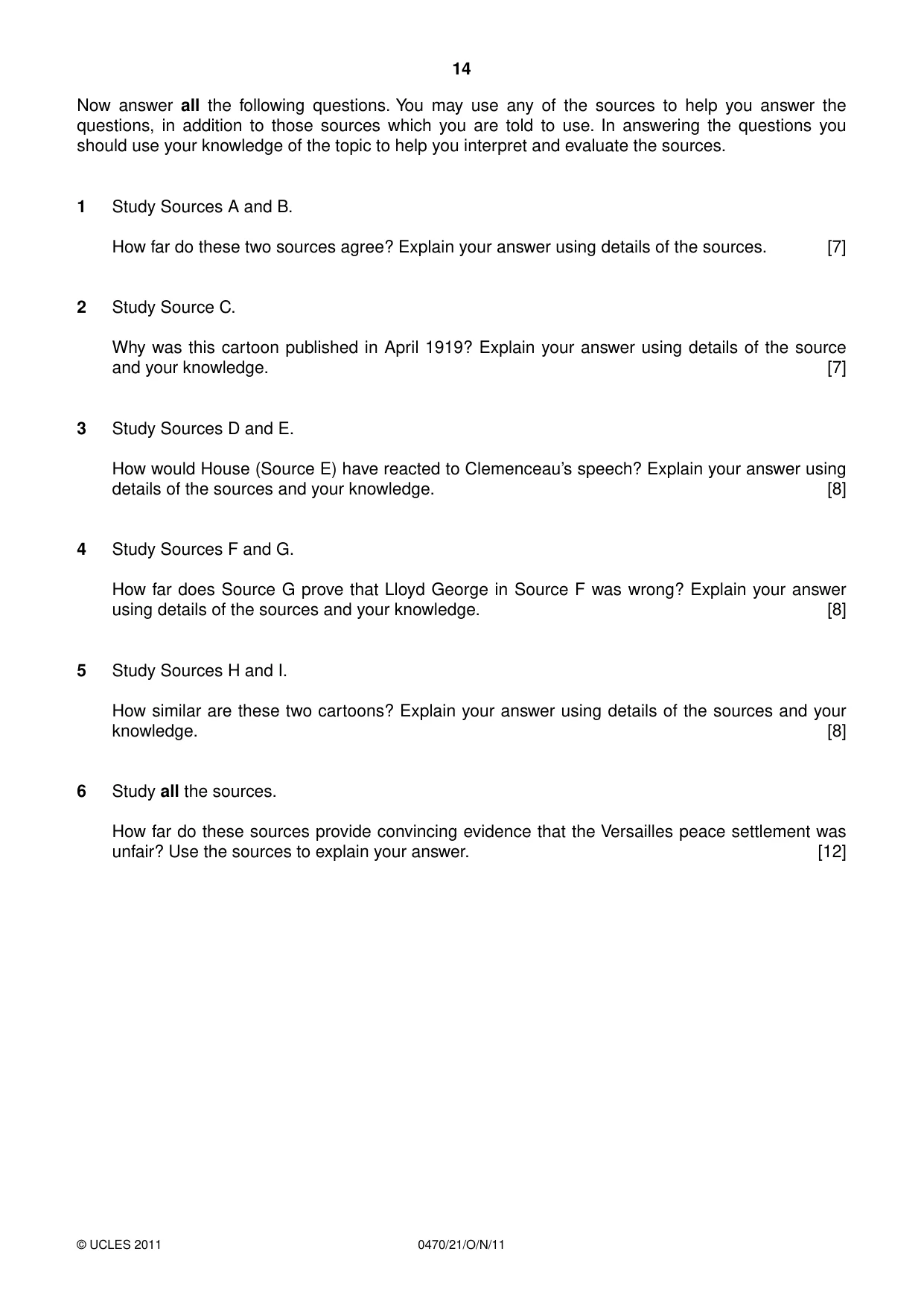
14 0470/21/O/N/11 © UCLES 2011 Now answer all the following questions. You may use any of the sources to help you answer the questions, in addition to those sources which you are told to use. In answering the questions you should use your knowledge of the topic to help you interpret and evaluate the sources. 1 Study Sources A and B. How far do these two sources agree? Explain your answer using details of the sources. [7] 2 Study Source C. Why was this cartoon published in April 1919? Explain your answer using details of the source and your knowledge. [7] 3 Study Sources D and E. How would House (Source E) have reacted to Clemenceau’s speech? Explain your answer using details of the sources and your knowledge. [8] 4 Study Sources F and G. How far does Source G prove that Lloyd George in Source F was wrong? Explain your answer using details of the sources and your knowledge. [8] 5 Study Sources H and I. How similar are these two cartoons? Explain your answer using details of the sources and your knowledge. [8] 6 Study all the sources. How far do these sources provide convincing evidence that the Versailles peace settlement was unfair? Use the sources to explain your answer. [12]
Question paper, page 15
15 0470/21/O/N/11 © UCLES 2011 BLANK PAGE
Question paper, page 16
16 0470/21/O/N/11 © UCLES 2011 BLANK PAGE Copyright Acknowledgements: 19th Century Option Source A © Peter Browning; Revolutions and Nationalities; Cambridge University Press; 2000. 19th Century Option Source B © A J P Taylor; Bismarck; Hamish Hamilton; 1955. 19th Century Option Source H © Andrina Stiles & Alan Farmer; The Unification of Germany 1815-90; Hodder & Stoughton; 2001. 20th Century Option Source A © Margaret Macmillan; Peacemakers; The Paris Conference of 1919 and it’s attempt to end war; John Murray; 2001. 20th Century Option Source B © Richard M Watt; The King’s Depart; Weidenfeld & Nicholson; 1969. 20th Century Option Source C © Roy Douglas; The Cartoonists’ Vision 1919-1939; Routledge; 1992. 20th Century Option Source H © Daily Express. 20th Century Option Source I © Daily Express. Permission to reproduce items where third-party owned material protected by copyright is included has been sought and cleared where possible. Every reasonable effort has been made by the publisher (UCLES) to trace copyright holders, but if any items requiring clearance have unwittingly been included, the publisher will be pleased to make amends at the earliest possible opportunity. University of Cambridge International Examinations is part of the Cambridge Assessment Group. Cambridge Assessment is the brand name of University of Cambridge Local Examinations Syndicate (UCLES), which is itself a department of the University of Cambridge.
Mark scheme, page 1
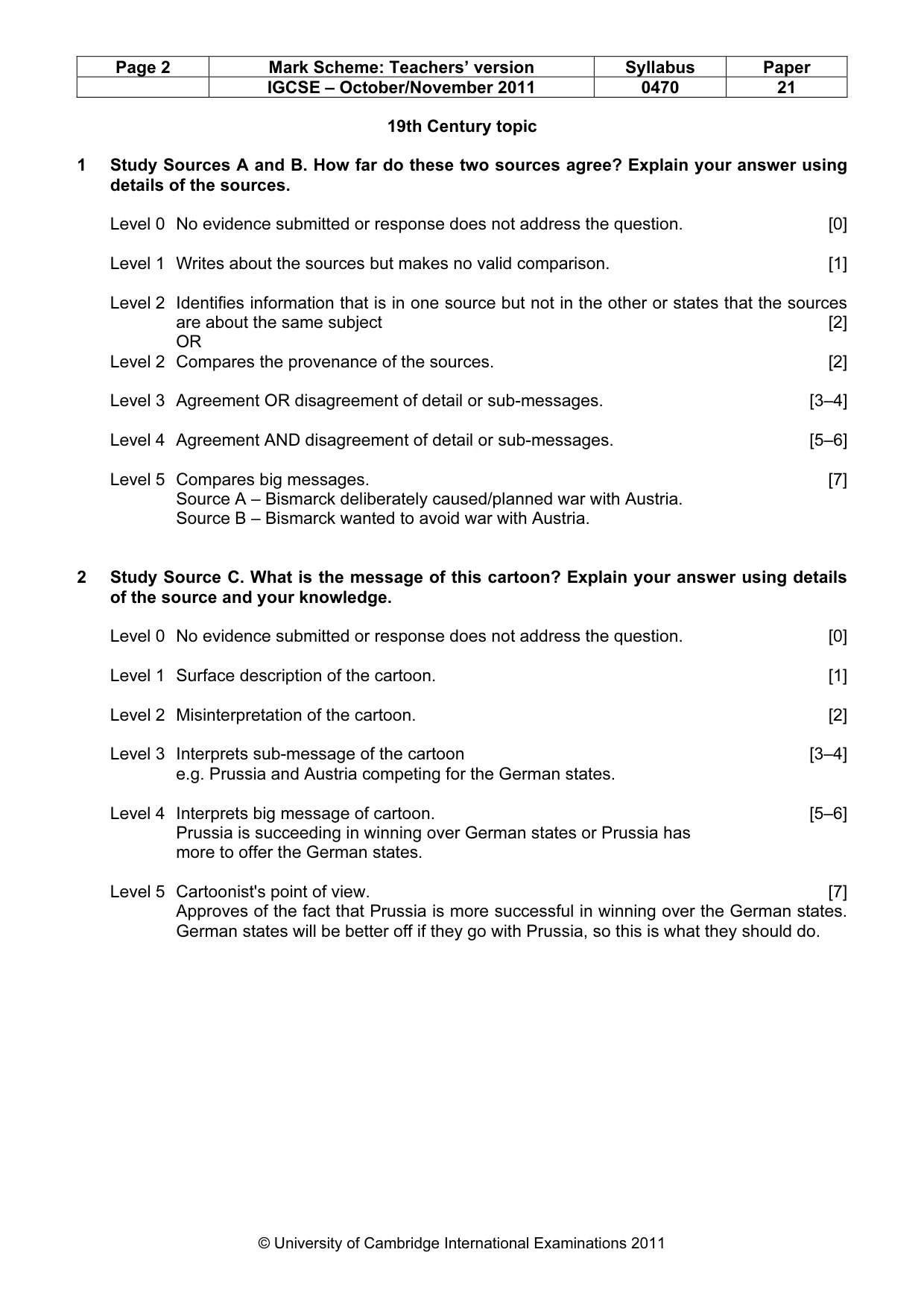
UNIVERSITY OF CAMBRIDGE INTERNATIONAL EXAMINATIONS International General Certificate of Secondary Education MARK SCHEME for the October/November 2011 question paper for the guidance of teachers 0470 HISTORY 0470/21 Paper 2, maximum raw mark 50 This mark scheme is published as an aid to teachers and candidates, to indicate the requirements of the examination. It shows the basis on which Examiners were instructed to award marks. It does not indicate the details of the discussions that took place at an Examiners’ meeting before marking began, which would have considered the acceptability of alternative answers. Mark schemes must be read in conjunction with the question papers and the report on the examination. • Cambridge will not enter into discussions or correspondence in connection with these mark schemes. Cambridge is publishing the mark schemes for the October/November 2011 question papers for most IGCSE, GCE Advanced Level and Advanced Subsidiary Level syllabuses and some Ordinary Level syllabuses. www.XtremePapers.com
Mark scheme, page 2
Page 2 Mark Scheme: Teachers’ version Syllabus Paper IGCSE – October/November 2011 0470 21 © University of Cambridge International Examinations 2011 19th Century topic 1 Study Sources A and B. How far do these two sources agree? Explain your answer using details of the sources. Level 0 No evidence submitted or response does not address the question. [0] Level 1 Writes about the sources but makes no valid comparison. [1] Level 2 Identifies information that is in one source but not in the other or states that the sources are about the same subject [2] OR Level 2 Compares the provenance of the sources. [2] Level 3 Agreement OR disagreement of detail or sub-messages. [3–4] Level 4 Agreement AND disagreement of detail or sub-messages. [5–6] Level 5 Compares big messages. [7] Source A – Bismarck deliberately caused/planned war with Austria. Source B – Bismarck wanted to avoid war with Austria. 2 Study Source C. What is the message of this cartoon? Explain your answer using details of the source and your knowledge. Level 0 No evidence submitted or response does not address the question. [0] Level 1 Surface description of the cartoon. [1] Level 2 Misinterpretation of the cartoon. [2] Level 3 Interprets sub-message of the cartoon [3–4] e.g. Prussia and Austria competing for the German states. Level 4 Interprets big message of cartoon. [5–6] Prussia is succeeding in winning over German states or Prussia has more to offer the German states. Level 5 Cartoonist's point of view. [7] Approves of the fact that Prussia is more successful in winning over the German states. German states will be better off if they go with Prussia, so this is what they should do.
Mark scheme, page 3
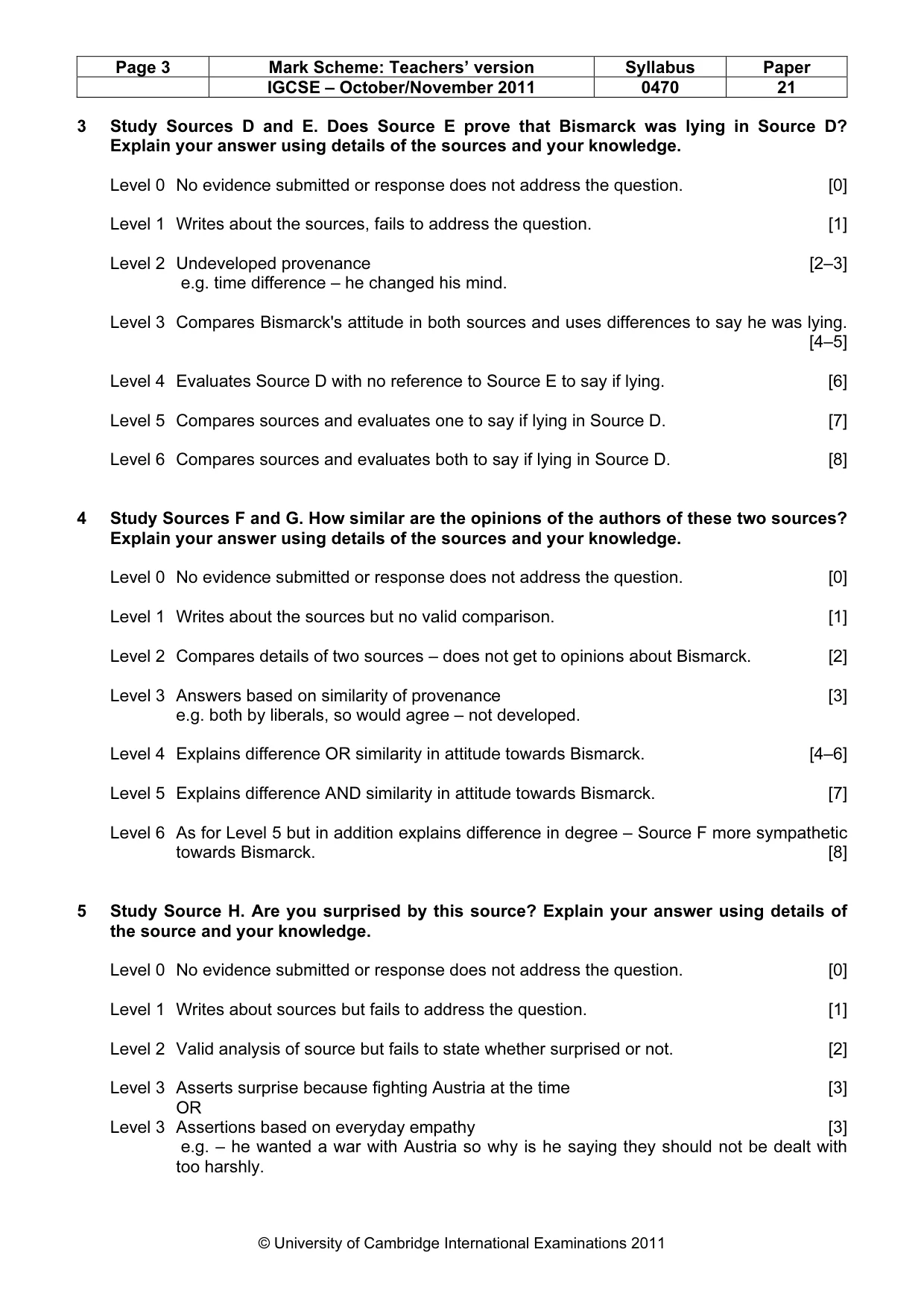
Page 3 Mark Scheme: Teachers’ version Syllabus Paper IGCSE – October/November 2011 0470 21 © University of Cambridge International Examinations 2011 3 Study Sources D and E. Does Source E prove that Bismarck was lying in Source D? Explain your answer using details of the sources and your knowledge. Level 0 No evidence submitted or response does not address the question. [0] Level 1 Writes about the sources, fails to address the question. [1] Level 2 Undeveloped provenance [2–3] e.g. time difference – he changed his mind. Level 3 Compares Bismarck's attitude in both sources and uses differences to say he was lying. [4–5] Level 4 Evaluates Source D with no reference to Source E to say if lying. [6] Level 5 Compares sources and evaluates one to say if lying in Source D. [7] Level 6 Compares sources and evaluates both to say if lying in Source D. [8] 4 Study Sources F and G. How similar are the opinions of the authors of these two sources? Explain your answer using details of the sources and your knowledge. Level 0 No evidence submitted or response does not address the question. [0] Level 1 Writes about the sources but no valid comparison. [1] Level 2 Compares details of two sources – does not get to opinions about Bismarck. [2] Level 3 Answers based on similarity of provenance [3] e.g. both by liberals, so would agree – not developed. Level 4 Explains difference OR similarity in attitude towards Bismarck. [4–6] Level 5 Explains difference AND similarity in attitude towards Bismarck. [7] Level 6 As for Level 5 but in addition explains difference in degree – Source F more sympathetic towards Bismarck. [8] 5 Study Source H. Are you surprised by this source? Explain your answer using details of the source and your knowledge. Level 0 No evidence submitted or response does not address the question. [0] Level 1 Writes about sources but fails to address the question. [1] Level 2 Valid analysis of source but fails to state whether surprised or not. [2] Level 3 Asserts surprise because fighting Austria at the time [3] OR Level 3 Assertions based on everyday empathy [3] e.g. – he wanted a war with Austria so why is he saying they should not be dealt with too harshly.
Mark scheme, page 4
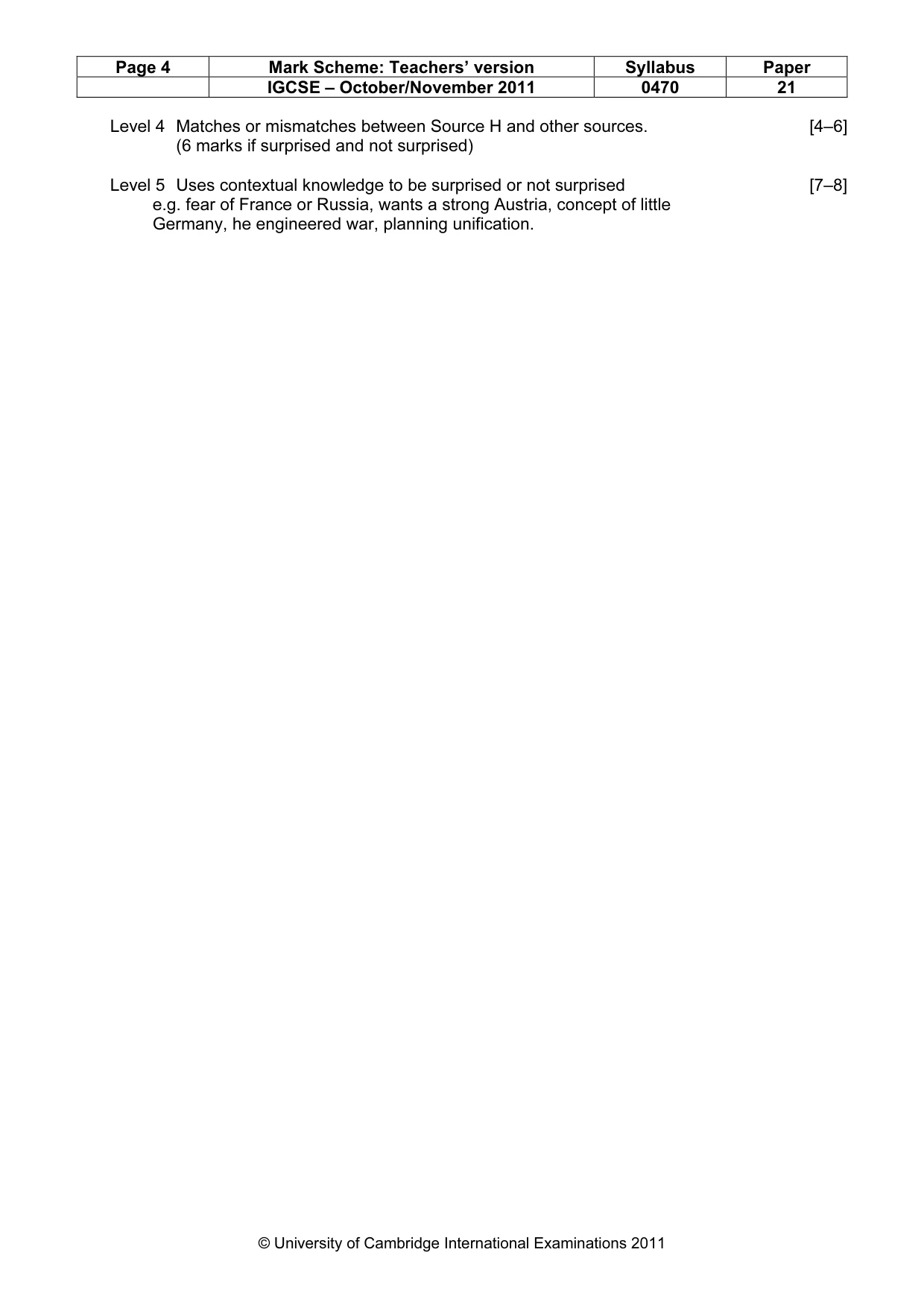
Page 4 Mark Scheme: Teachers’ version Syllabus Paper IGCSE – October/November 2011 0470 21 © University of Cambridge International Examinations 2011 Level 4 Matches or mismatches between Source H and other sources. [4–6] (6 marks if surprised and not surprised) Level 5 Uses contextual knowledge to be surprised or not surprised [7–8] e.g. fear of France or Russia, wants a strong Austria, concept of little Germany, he engineered war, planning unification.
Mark scheme, page 5
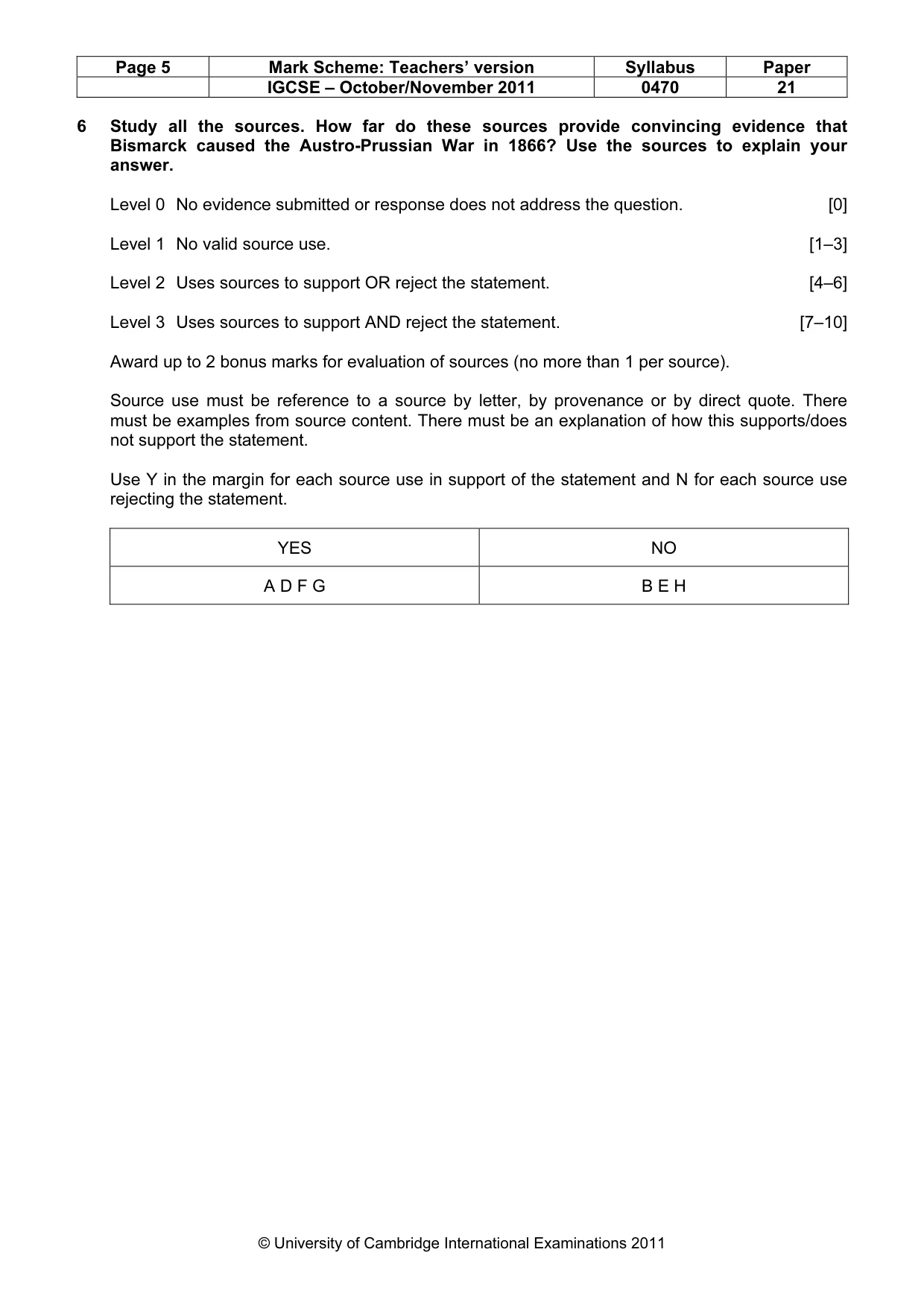
Page 5 Mark Scheme: Teachers’ version Syllabus Paper IGCSE – October/November 2011 0470 21 © University of Cambridge International Examinations 2011 6 Study all the sources. How far do these sources provide convincing evidence that Bismarck caused the Austro-Prussian War in 1866? Use the sources to explain your answer. Level 0 No evidence submitted or response does not address the question. [0] Level 1 No valid source use. [1–3] Level 2 Uses sources to support OR reject the statement. [4–6] Level 3 Uses sources to support AND reject the statement. [7–10] Award up to 2 bonus marks for evaluation of sources (no more than 1 per source). Source use must be reference to a source by letter, by provenance or by direct quote. There must be examples from source content. There must be an explanation of how this supports/does not support the statement. Use Y in the margin for each source use in support of the statement and N for each source use rejecting the statement. YES NO A D F G B E H
Mark scheme, page 6
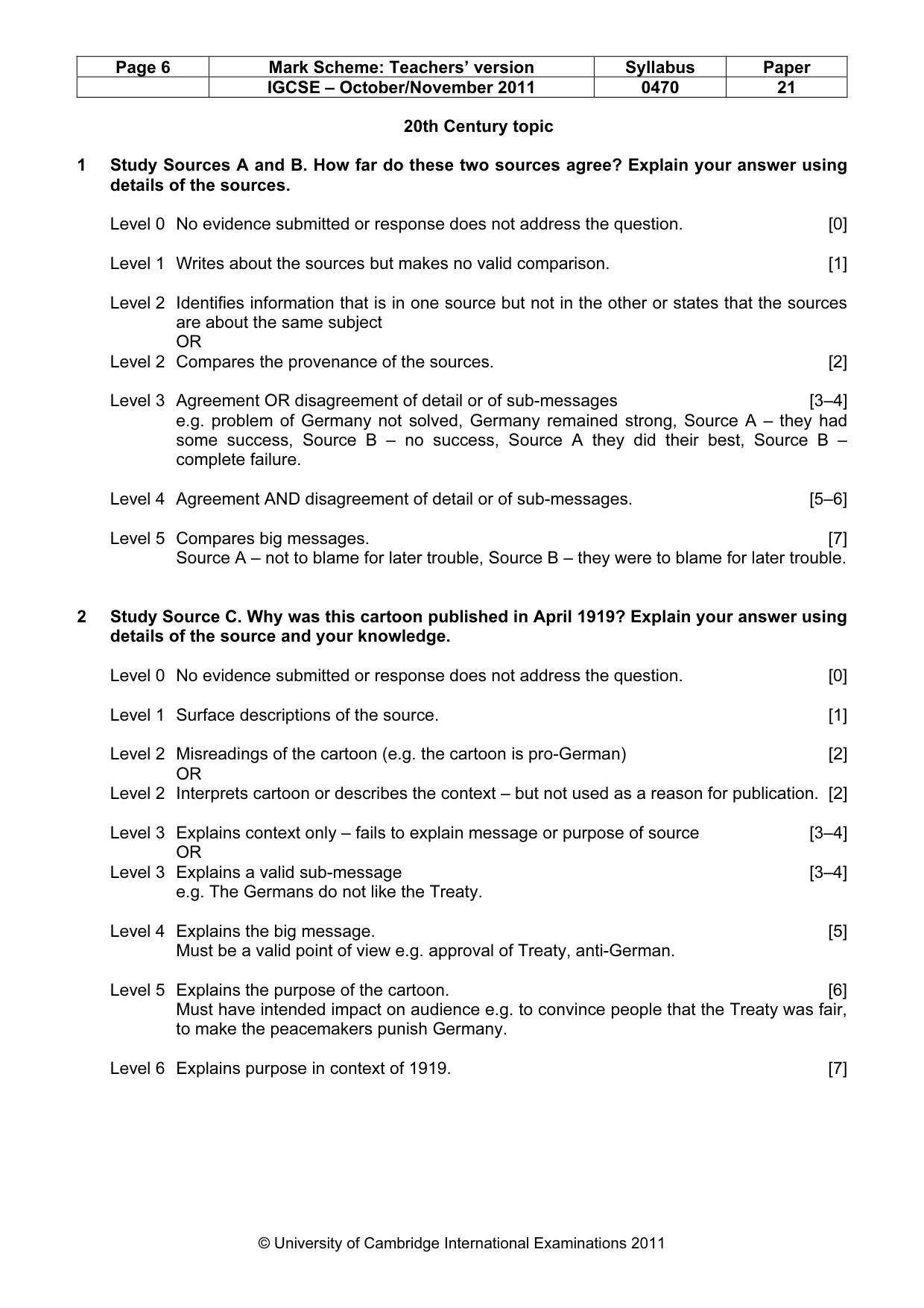
Page 6 Mark Scheme: Teachers’ version Syllabus Paper IGCSE – October/November 2011 0470 21 © University of Cambridge International Examinations 2011 20th Century topic 1 Study Sources A and B. How far do these two sources agree? Explain your answer using details of the sources. Level 0 No evidence submitted or response does not address the question. [0] Level 1 Writes about the sources but makes no valid comparison. [1] Level 2 Identifies information that is in one source but not in the other or states that the sources are about the same subject OR Level 2 Compares the provenance of the sources. [2] Level 3 Agreement OR disagreement of detail or of sub-messages [3–4] e.g. problem of Germany not solved, Germany remained strong, Source A – they had some success, Source B – no success, Source A they did their best, Source B – complete failure. Level 4 Agreement AND disagreement of detail or of sub-messages. [5–6] Level 5 Compares big messages. [7] Source A – not to blame for later trouble, Source B – they were to blame for later trouble. 2 Study Source C. Why was this cartoon published in April 1919? Explain your answer using details of the source and your knowledge. Level 0 No evidence submitted or response does not address the question. [0] Level 1 Surface descriptions of the source. [1] Level 2 Misreadings of the cartoon (e.g. the cartoon is pro-German) [2] OR Level 2 Interprets cartoon or describes the context – but not used as a reason for publication. [2] Level 3 Explains context only – fails to explain message or purpose of source [3–4] OR Level 3 Explains a valid sub-message [3–4] e.g. The Germans do not like the Treaty. Level 4 Explains the big message. [5] Must be a valid point of view e.g. approval of Treaty, anti-German. Level 5 Explains the purpose of the cartoon. [6] Must have intended impact on audience e.g. to convince people that the Treaty was fair, to make the peacemakers punish Germany. Level 6 Explains purpose in context of 1919. [7]
Mark scheme, page 7
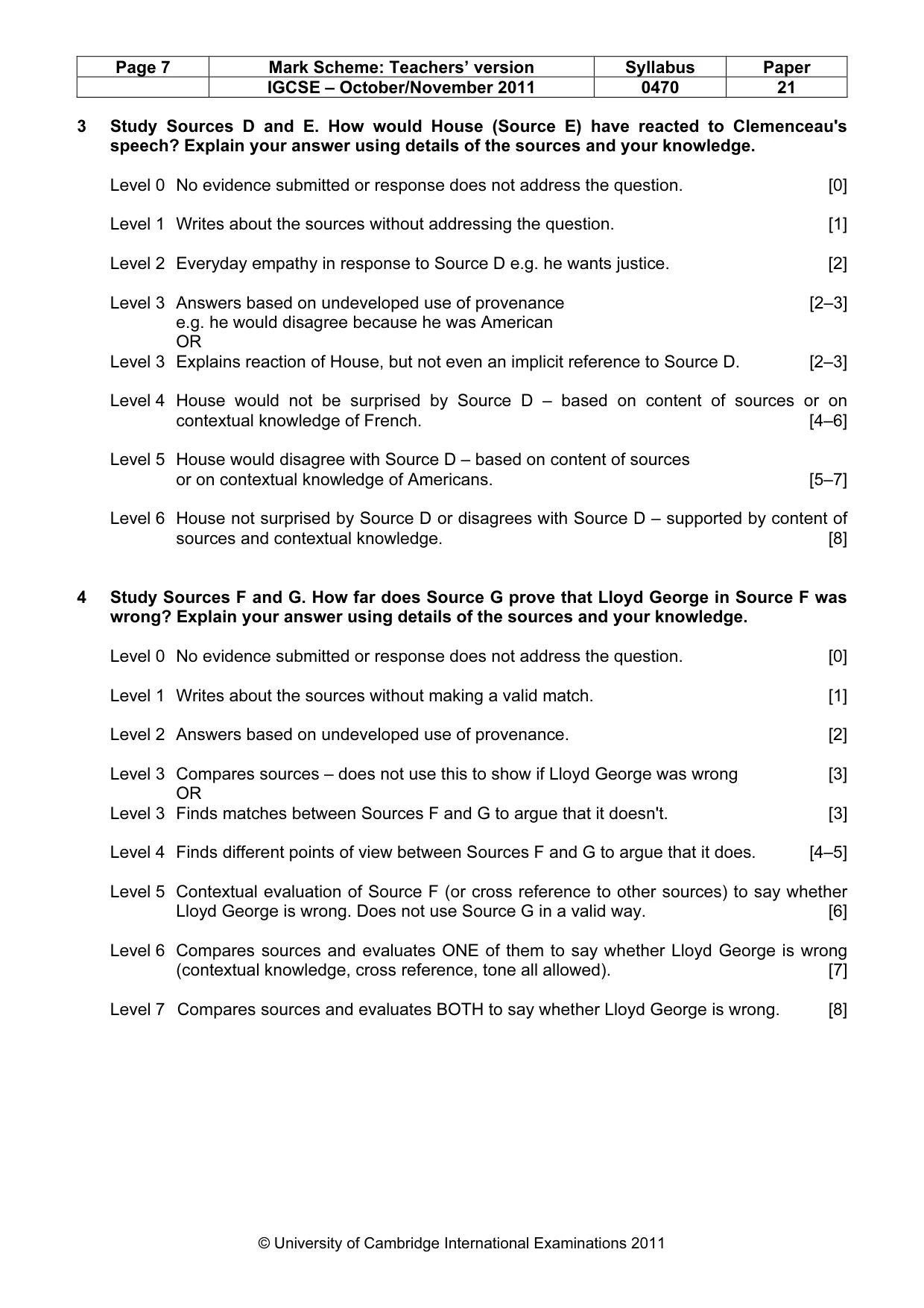
Page 7 Mark Scheme: Teachers’ version Syllabus Paper IGCSE – October/November 2011 0470 21 © University of Cambridge International Examinations 2011 3 Study Sources D and E. How would House (Source E) have reacted to Clemenceau's speech? Explain your answer using details of the sources and your knowledge. Level 0 No evidence submitted or response does not address the question. [0] Level 1 Writes about the sources without addressing the question. [1] Level 2 Everyday empathy in response to Source D e.g. he wants justice. [2] Level 3 Answers based on undeveloped use of provenance [2–3] e.g. he would disagree because he was American OR Level 3 Explains reaction of House, but not even an implicit reference to Source D. [2–3] Level 4 House would not be surprised by Source D – based on content of sources or on contextual knowledge of French. [4–6] Level 5 House would disagree with Source D – based on content of sources or on contextual knowledge of Americans. [5–7] Level 6 House not surprised by Source D or disagrees with Source D – supported by content of sources and contextual knowledge. [8] 4 Study Sources F and G. How far does Source G prove that Lloyd George in Source F was wrong? Explain your answer using details of the sources and your knowledge. Level 0 No evidence submitted or response does not address the question. [0] Level 1 Writes about the sources without making a valid match. [1] Level 2 Answers based on undeveloped use of provenance. [2] Level 3 Compares sources – does not use this to show if Lloyd George was wrong [3] OR Level 3 Finds matches between Sources F and G to argue that it doesn't. [3] Level 4 Finds different points of view between Sources F and G to argue that it does. [4–5] Level 5 Contextual evaluation of Source F (or cross reference to other sources) to say whether Lloyd George is wrong. Does not use Source G in a valid way. [6] Level 6 Compares sources and evaluates ONE of them to say whether Lloyd George is wrong (contextual knowledge, cross reference, tone all allowed). [7] Level 7 Compares sources and evaluates BOTH to say whether Lloyd George is wrong. [8]
Mark scheme, page 8
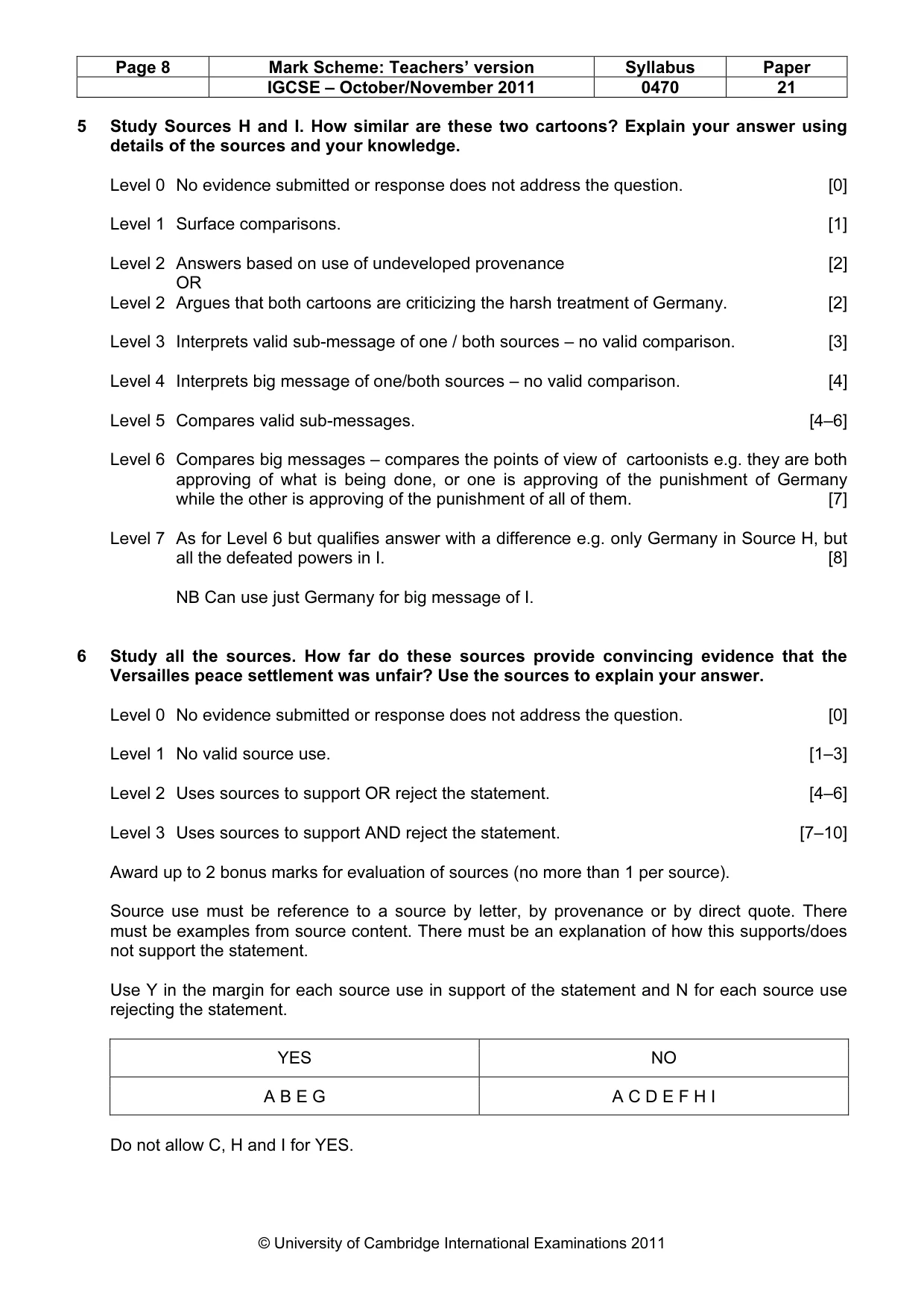
Page 8 Mark Scheme: Teachers’ version Syllabus Paper IGCSE – October/November 2011 0470 21 © University of Cambridge International Examinations 2011 5 Study Sources H and I. How similar are these two cartoons? Explain your answer using details of the sources and your knowledge. Level 0 No evidence submitted or response does not address the question. [0] Level 1 Surface comparisons. [1] Level 2 Answers based on use of undeveloped provenance [2] OR Level 2 Argues that both cartoons are criticizing the harsh treatment of Germany. [2] Level 3 Interprets valid sub-message of one / both sources – no valid comparison. [3] Level 4 Interprets big message of one/both sources – no valid comparison. [4] Level 5 Compares valid sub-messages. [4–6] Level 6 Compares big messages – compares the points of view of cartoonists e.g. they are both approving of what is being done, or one is approving of the punishment of Germany while the other is approving of the punishment of all of them. [7] Level 7 As for Level 6 but qualifies answer with a difference e.g. only Germany in Source H, but all the defeated powers in I. [8] NB Can use just Germany for big message of I. 6 Study all the sources. How far do these sources provide convincing evidence that the Versailles peace settlement was unfair? Use the sources to explain your answer. Level 0 No evidence submitted or response does not address the question. [0] Level 1 No valid source use. [1–3] Level 2 Uses sources to support OR reject the statement. [4–6] Level 3 Uses sources to support AND reject the statement. [7–10] Award up to 2 bonus marks for evaluation of sources (no more than 1 per source). Source use must be reference to a source by letter, by provenance or by direct quote. There must be examples from source content. There must be an explanation of how this supports/does not support the statement. Use Y in the margin for each source use in support of the statement and N for each source use rejecting the statement. YES NO A B E G A C D E F H I Do not allow C, H and I for YES.
What you needed in this session
Cambridge’s own grade thresholds for 2011 Oct/Nov, Paper 2 · Variant 1. A higher threshold means an easier paper — the bar moves with how the cohort did.