Cambridge IGCSE German - Foreign Language 0525 — 2023 May/June Paper 2 · Variant 2
0525/22/M/J/23 · 45 marks · ≈51 min
The question paper and its mark scheme, free to read here and free to download. This is Cambridge’s own paper, exactly as it was sat.
Question paper12 pages

Mark scheme14 pages
Answers below. Sit the paper first if you are practising.
Paper as text
Question paper, page 1
This document has 12 pages. Any blank pages are indicated. [Turn over Cambridge IGCSE™ * 6 0 6 1 3 8 6 4 7 3 * DC (LK/FC) 316832/1 © UCLES 2023 GERMAN 0525/22 Paper 2 Reading May/June 2023 1 hour You must answer on the question paper. No additional materials are needed. INSTRUCTIONS ● Answer all questions. ● Use a black or dark blue pen. ● Write your name, centre number and candidate number in the boxes at the top of the page. ● Write your answer to each question in the space provided. ● Do not use an erasable pen or correction fluid. ● Do not write on any bar codes. ● Dictionaries are not allowed. INFORMATION ● The total mark for this paper is 45. ● The number of marks for each question or part question is shown in brackets [ ].
Question paper, page 2
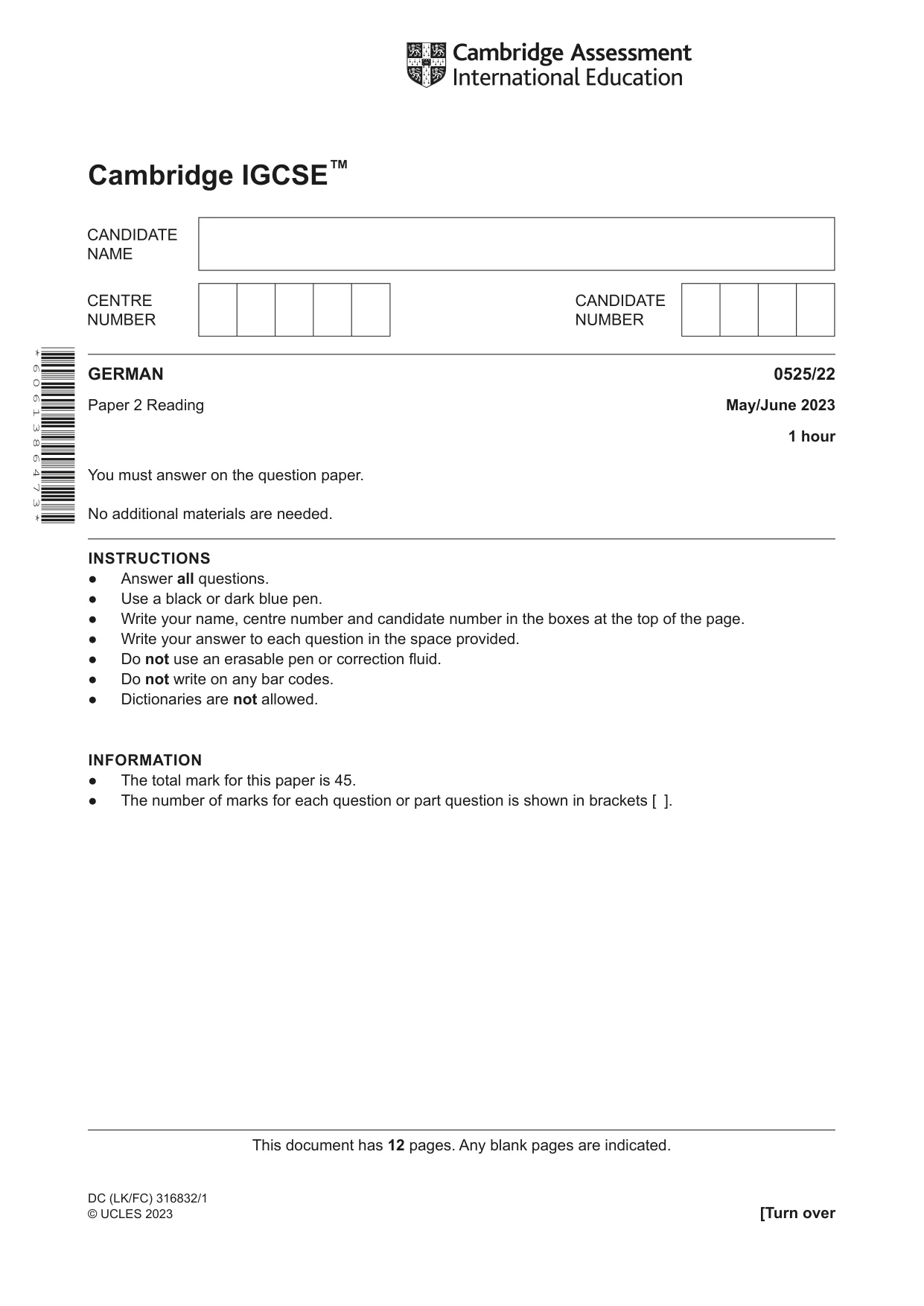
2 0525/22/ M / J /23 © UCLES 2023 1 Sehen Sie sich die Bilder an. A B C D E F Für jede Aussage tragen Sie die richtigen Buchstaben (A–F) in die Kästchen ein. (a) Das Kaninchen ist süß. [1] (b) Schlangen sind sehr interessant. [1] (c) Ich sehe gerne die Löwen. [1] (d) Ich habe Angst vor Mäusen. [1] (e) Mein Vogel fliegt gerne in meinem Zimmer. [1] [Gesamtpunktzahl: 5]
Question paper, page 3
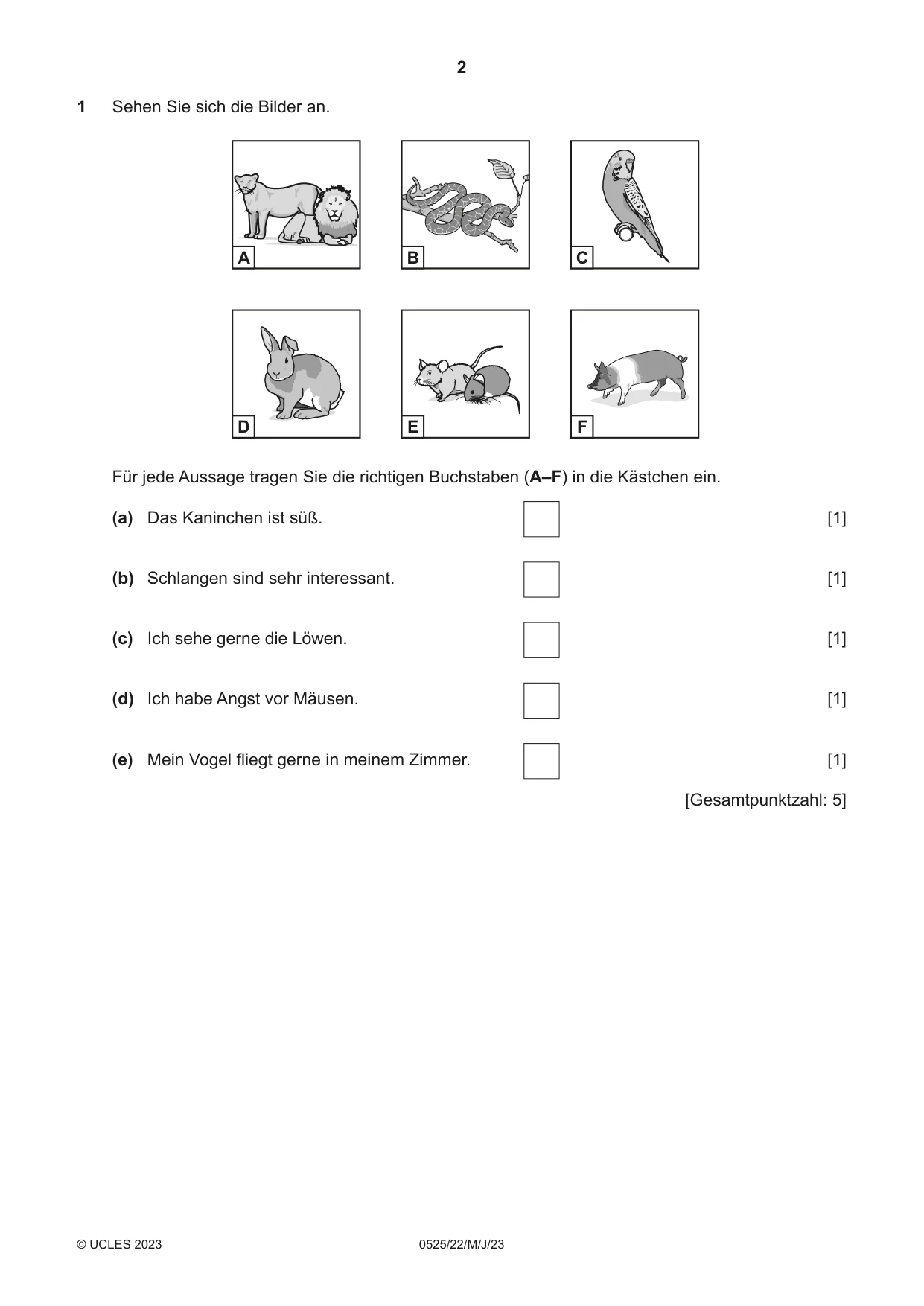
3 0525/22/M/J/23 © UCLES 2023 [Turn over 2 Sehen Sie sich die Schilder an. In der Stadt Büro Hartung Arztpraxis Schröder Jugendclub Hagen-Ost Frisör Weber Buchhandlung Schmitz Trinkhalle König Zoohandlung Meyer Freibad Lüden-West A B C D E F G H Für jede Aussage tragen Sie die richtigen Buchstaben (A–H) in die Kästchen ein. (a) Mein Hund braucht Futter. [1] (b) Mein Haar ist zu lang! [1] (c) Er ist krank. [1] (d) Ich gehe heute schwimmen. [1] (e) Ich kaufe Limonade für meinen Opa. [1] [Gesamtpunktzahl: 5]
Question paper, page 4
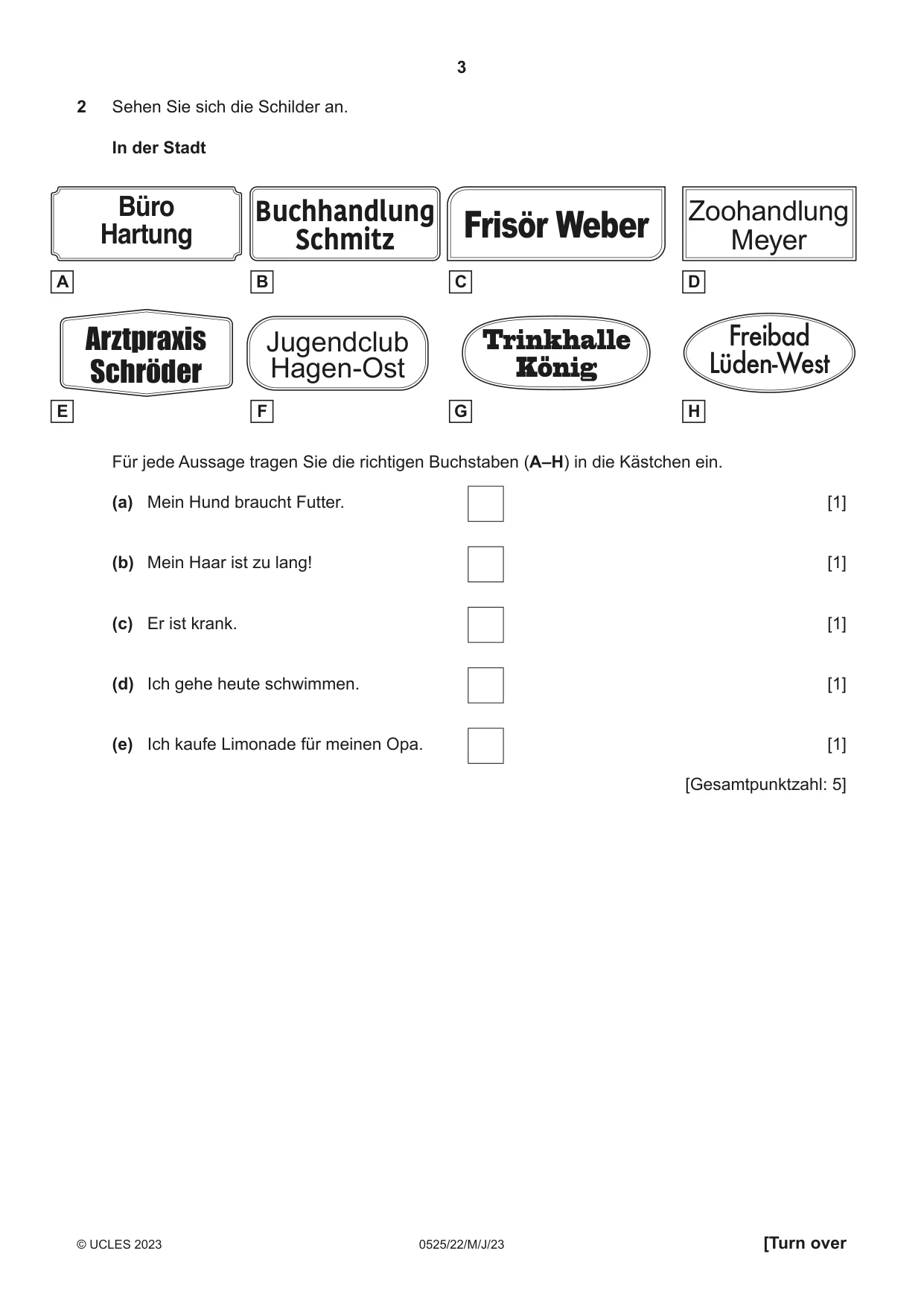
4 0525/22/M/J/23 © UCLES 2023 3 Lesen Sie den Text. Für jede Frage kennzeichnen (3) Sie die richtige Antwort (A–C). Ich heiße Saga. Ich habe eine ältere Schwester und einen jüngeren Bruder. Ich gehe in die 12. Klasse der Gesamtschule. Meine Eltern sind geschieden, und ich wohne bei meinem Vater. Meine Mutter wohnt in der nächsten Stadt. Wenn ich meine Mutter besuche, gehen wir zusammen einkaufen. Mein Vater ist arbeitslos, und meine Mutter arbeitet als Journalistin bei einer Zeitung. Ein- oder zweimal im Monat mache ich am Wochenende kurze Videos mit meiner Freundin Suki. Mein Vater hilft uns oft mit den Videos. Suki und ich können nicht tanzen, aber wir schreiben kurze Lieder. Wir lernen die Zahlen oder das Alphabet, auf Japanisch oder Koreanisch zum Beispiel, und wir machen dann einen Song daraus. Das macht viel Spaß! Wir haben schon Fans weltweit, und unsere Schule ist auch an unseren Videos interessiert. (a) Saga hat … A zwei Schwestern. B zwei Geschwister. C zwei Brüder. [1] (b) Sagas Vater und Mutter wohnen … A zusammen. B getrennt. C in derselben Stadt. [1] (c) Sagas Vater … A hat keinen Job. B schreibt für eine Zeitung. C arbeitet in der Stadt. [1]
Question paper, page 5
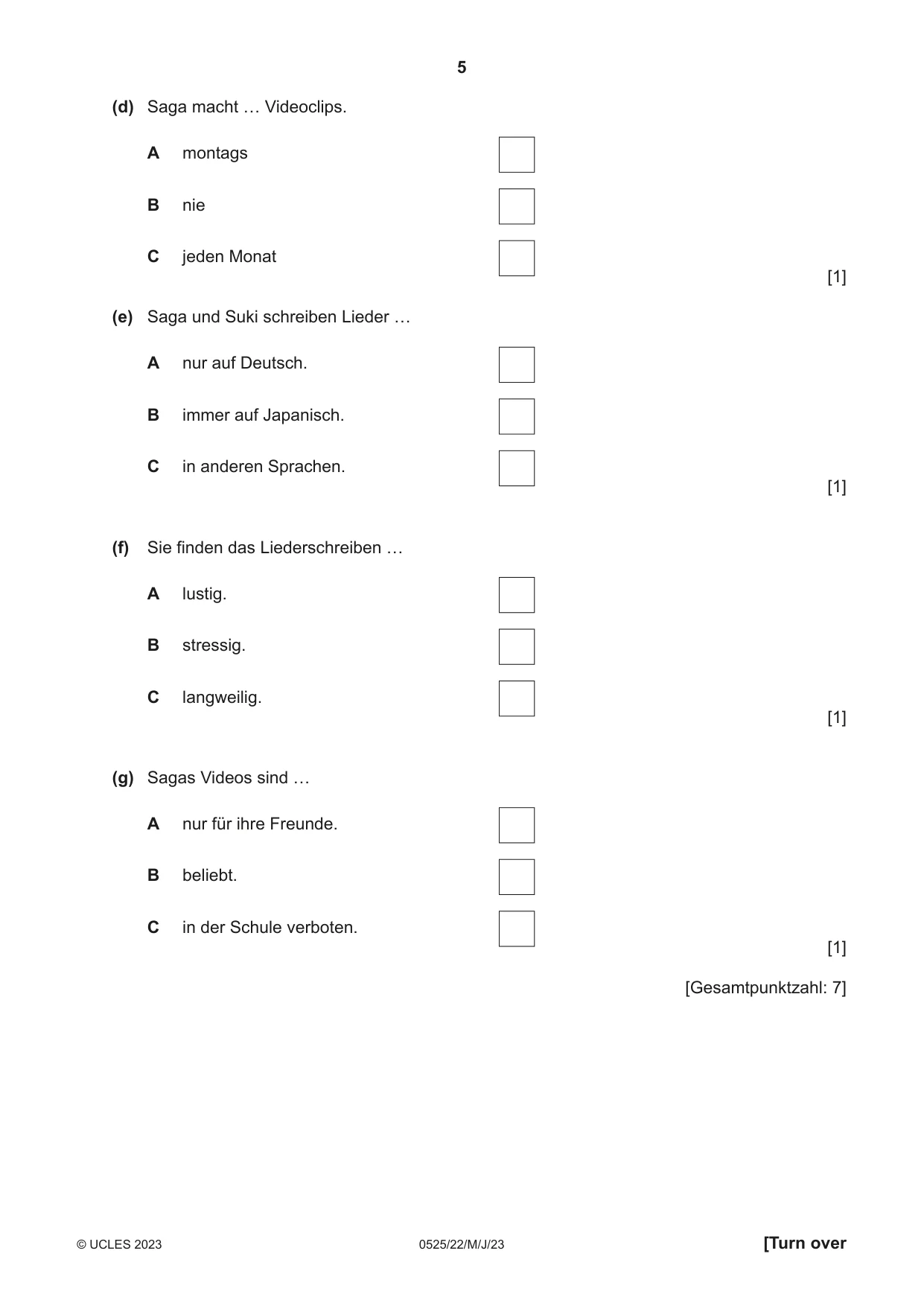
5 0525/22/M/J/23 © UCLES 2023 [Turn over (d) Saga macht … Videoclips. A montags B nie C jeden Monat [1] (e) Saga und Suki schreiben Lieder … A nur auf Deutsch. B immer auf Japanisch. C in anderen Sprachen. [1] (f) Sie finden das Liederschreiben … A lustig. B stressig. C langweilig. [1] (g) Sagas Videos sind … A nur für ihre Freunde. B beliebt. C in der Schule verboten. [1] [Gesamtpunktzahl: 7]
Question paper, page 6
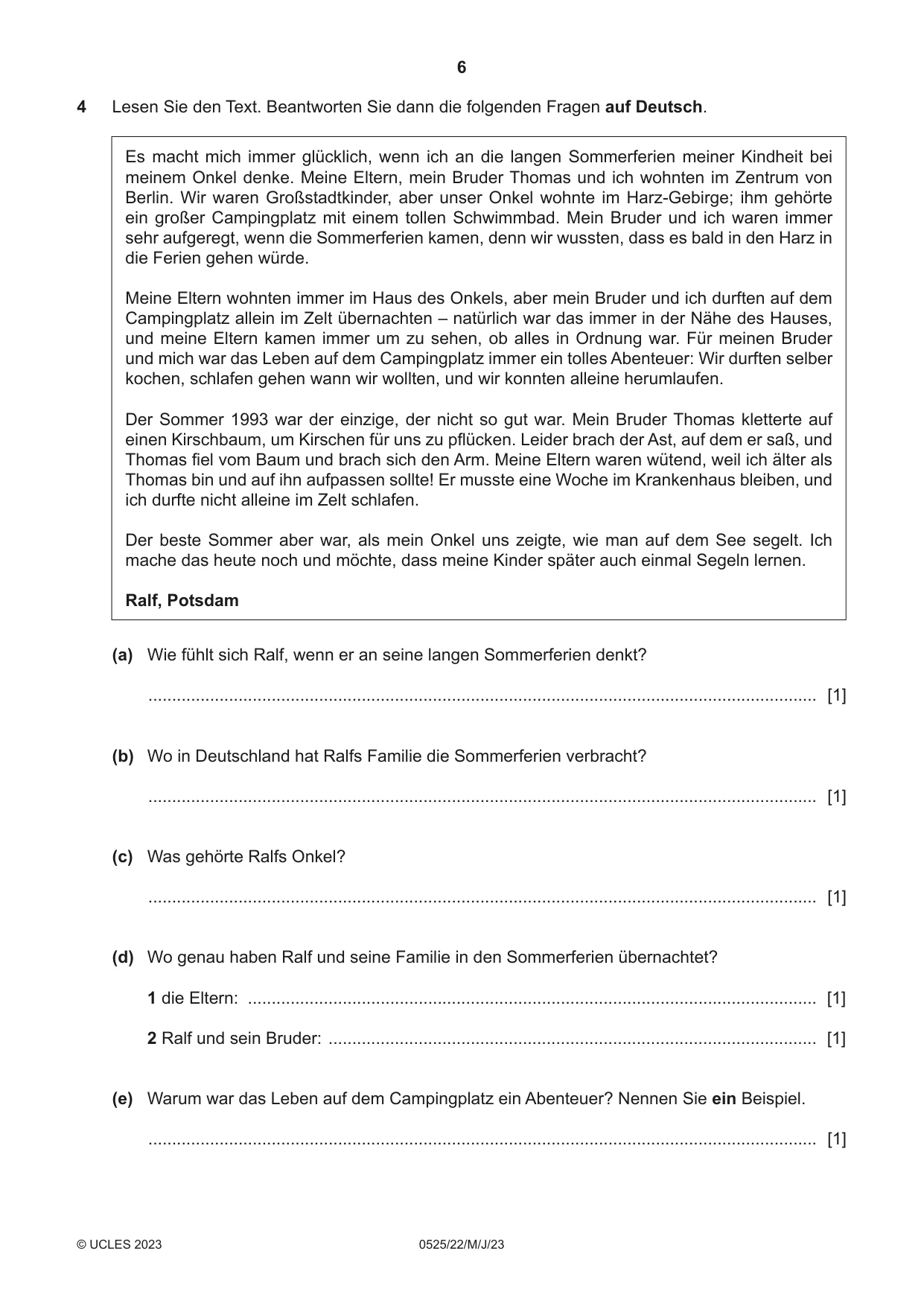
6 0525/22/M/J/23 © UCLES 2023 4 Lesen Sie den Text. Beantworten Sie dann die folgenden Fragen auf Deutsch. Es macht mich immer glücklich, wenn ich an die langen Sommerferien meiner Kindheit bei meinem Onkel denke. Meine Eltern, mein Bruder Thomas und ich wohnten im Zentrum von Berlin. Wir waren Großstadtkinder, aber unser Onkel wohnte im Harz-Gebirge; ihm gehörte ein großer Campingplatz mit einem tollen Schwimmbad. Mein Bruder und ich waren immer sehr aufgeregt, wenn die Sommerferien kamen, denn wir wussten, dass es bald in den Harz in die Ferien gehen würde. Meine Eltern wohnten immer im Haus des Onkels, aber mein Bruder und ich durften auf dem Campingplatz allein im Zelt übernachten – natürlich war das immer in der Nähe des Hauses, und meine Eltern kamen immer um zu sehen, ob alles in Ordnung war. Für meinen Bruder und mich war das Leben auf dem Campingplatz immer ein tolles Abenteuer: Wir durften selber kochen, schlafen gehen wann wir wollten, und wir konnten alleine herumlaufen. Der Sommer 1993 war der einzige, der nicht so gut war. Mein Bruder Thomas kletterte auf einen Kirschbaum, um Kirschen für uns zu pflücken. Leider brach der Ast, auf dem er saß, und Thomas fiel vom Baum und brach sich den Arm. Meine Eltern waren wütend, weil ich älter als Thomas bin und auf ihn aufpassen sollte! Er musste eine Woche im Krankenhaus bleiben, und ich durfte nicht alleine im Zelt schlafen. Der beste Sommer aber war, als mein Onkel uns zeigte, wie man auf dem See segelt. Ich mache das heute noch und möchte, dass meine Kinder später auch einmal Segeln lernen. Ralf, Potsdam (a) Wie fühlt sich Ralf, wenn er an seine langen Sommerferien denkt? … [1] (b) Wo in Deutschland hat Ralfs Familie die Sommerferien verbracht? … [1] (c) Was gehörte Ralfs Onkel? … [1] (d) Wo genau haben Ralf und seine Familie in den Sommerferien übernachtet? 1 die Eltern: … [1] 2 Ralf und sein Bruder: … [1] (e) Warum war das Leben auf dem Campingplatz ein Abenteuer? Nennen Sie ein Beispiel. … [1]
Question paper, page 7
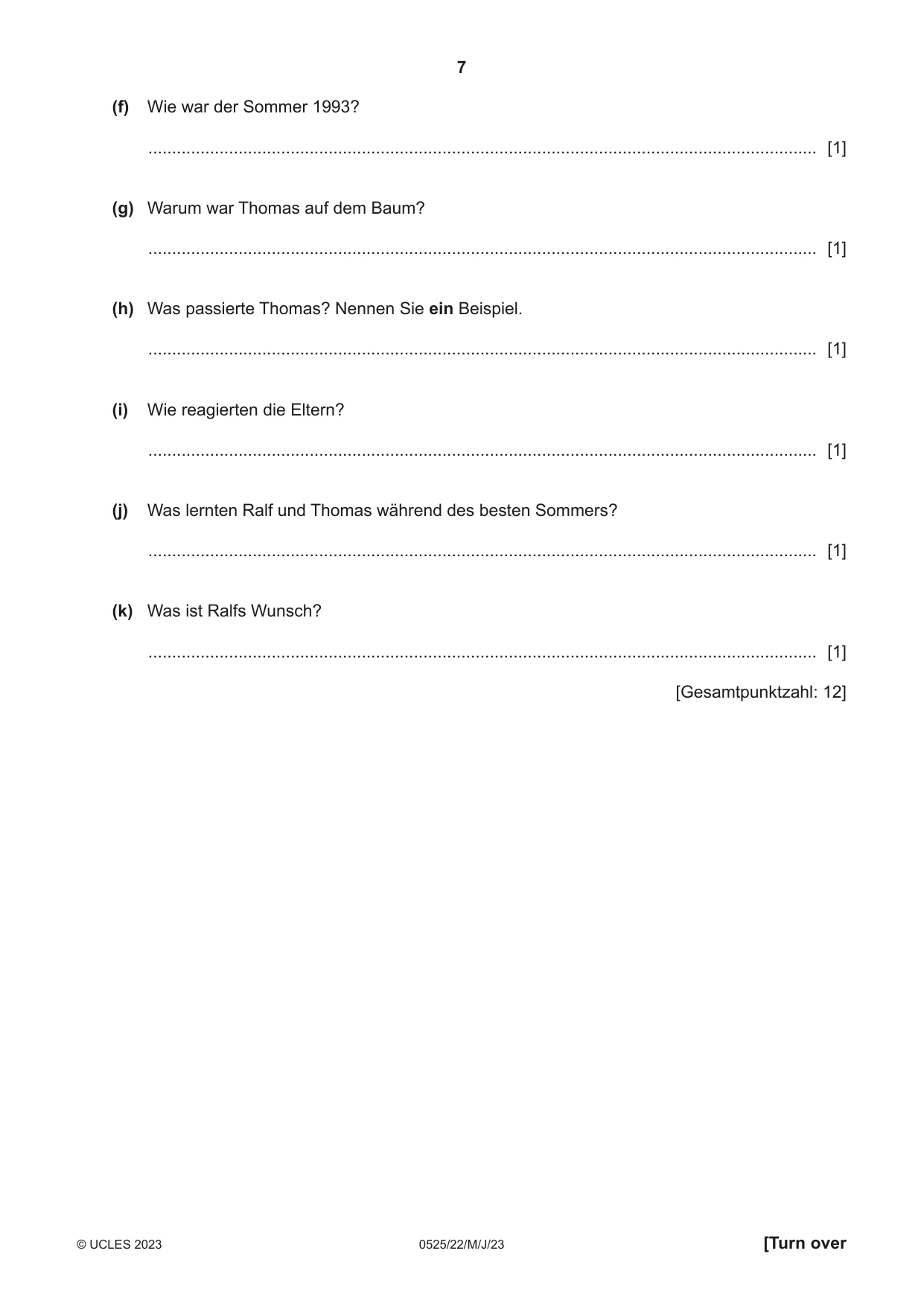
7 0525/22/M/J/23 © UCLES 2023 [Turn over (f) Wie war der Sommer 1993? … [1] (g) Warum war Thomas auf dem Baum? … [1] (h) Was passierte Thomas? Nennen Sie ein Beispiel. … [1] (i) Wie reagierten die Eltern? … [1] (j) Was lernten Ralf und Thomas während des besten Sommers? … [1] (k) Was ist Ralfs Wunsch? … [1] [Gesamtpunktzahl: 12]
Question paper, page 8
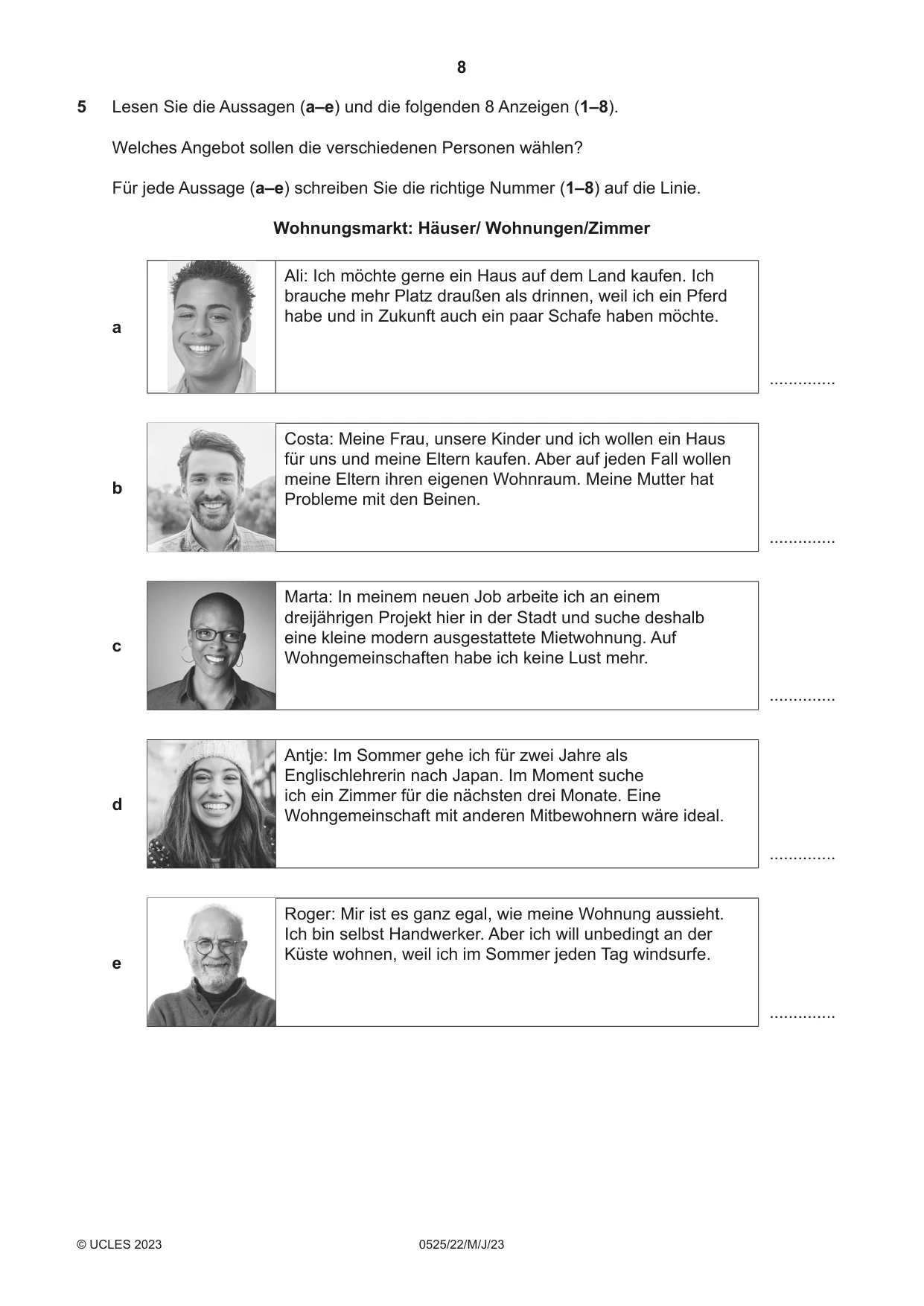
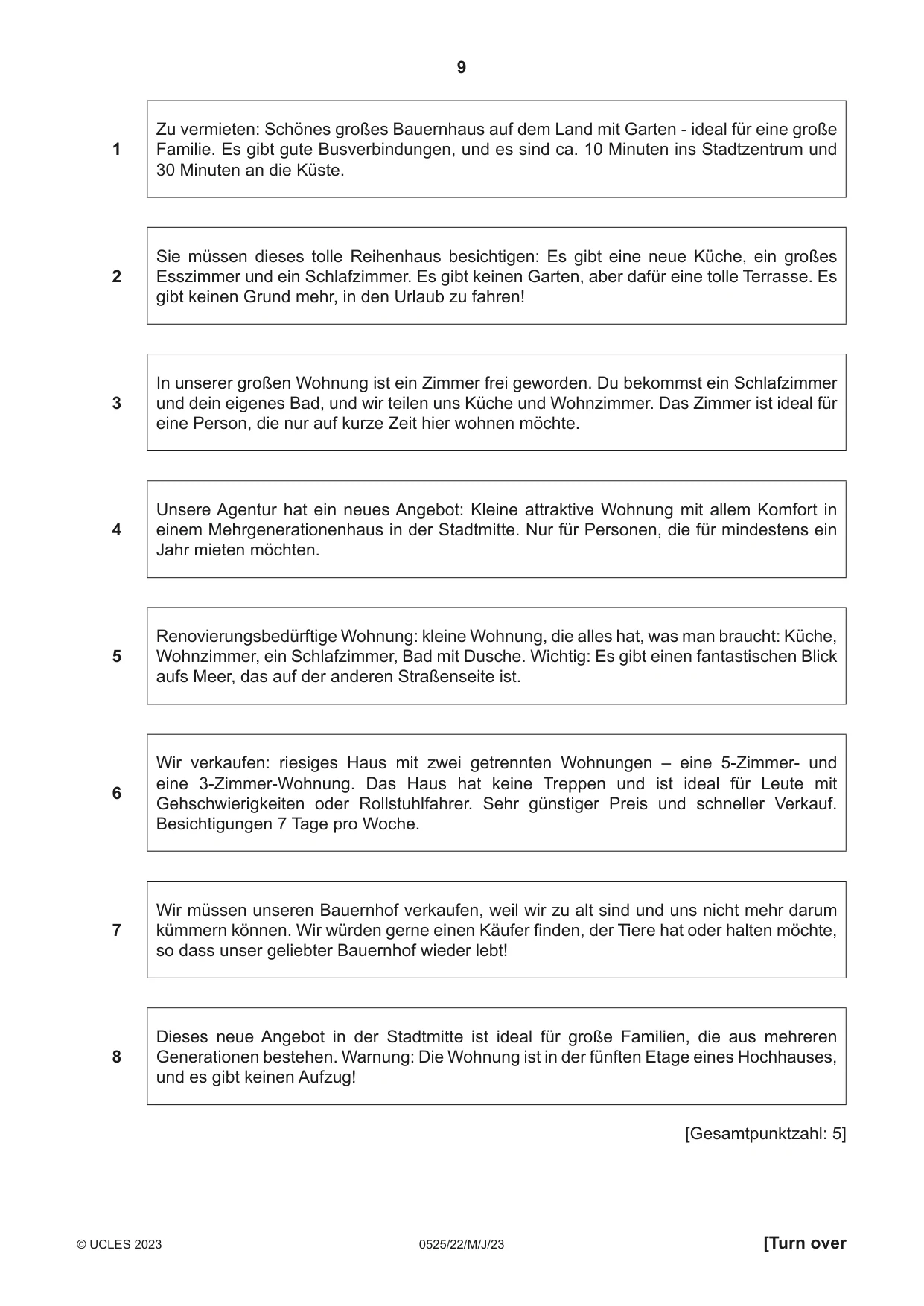
8 0525/22/M/J/23 © UCLES 2023 5 Lesen Sie die Aussagen (a–e) und die folgenden 8 Anzeigen (1–8). Welches Angebot sollen die verschiedenen Personen wählen? Für jede Aussage (a–e) schreiben Sie die richtige Nummer (1–8) auf die Linie. Wohnungsmarkt: Häuser/ Wohnungen/Zimmer a Ali: Ich möchte gerne ein Haus auf dem Land kaufen. Ich brauche mehr Platz draußen als drinnen, weil ich ein Pferd habe und in Zukunft auch ein paar Schafe haben möchte. … b Costa: Meine Frau, unsere Kinder und ich wollen ein Haus für uns und meine Eltern kaufen. Aber auf jeden Fall wollen meine Eltern ihren eigenen Wohnraum. Meine Mutter hat Probleme mit den Beinen. … c Marta: In meinem neuen Job arbeite ich an einem dreijährigen Projekt hier in der Stadt und suche deshalb eine kleine modern ausgestattete Mietwohnung. Auf Wohngemeinschaften habe ich keine Lust mehr. … d Antje: Im Sommer gehe ich für zwei Jahre als Englischlehrerin nach Japan. Im Moment suche ich ein Zimmer für die nächsten drei Monate. Eine Wohngemeinschaft mit anderen Mitbewohnern wäre ideal. … e Roger: Mir ist es ganz egal, wie meine Wohnung aussieht. Ich bin selbst Handwerker. Aber ich will unbedingt an der Küste wohnen, weil ich im Sommer jeden Tag windsurfe. …
Question paper, page 9
9 0525/22/M/J/23 © UCLES 2023 [Turn over 1 Zu vermieten: Schönes großes Bauernhaus auf dem Land mit Garten - ideal für eine große Familie. Es gibt gute Busverbindungen, und es sind ca. 10 Minuten ins Stadtzentrum und 30 Minuten an die Küste. 2 Sie müssen dieses tolle Reihenhaus besichtigen: Es gibt eine neue Küche, ein großes Esszimmer und ein Schlafzimmer. Es gibt keinen Garten, aber dafür eine tolle Terrasse. Es gibt keinen Grund mehr, in den Urlaub zu fahren! 3 In unserer großen Wohnung ist ein Zimmer frei geworden. Du bekommst ein Schlafzimmer und dein eigenes Bad, und wir teilen uns Küche und Wohnzimmer. Das Zimmer ist ideal für eine Person, die nur auf kurze Zeit hier wohnen möchte. 4 Unsere Agentur hat ein neues Angebot: Kleine attraktive Wohnung mit allem Komfort in einem Mehrgenerationenhaus in der Stadtmitte. Nur für Personen, die für mindestens ein Jahr mieten möchten. 5 Renovierungsbedürftige Wohnung: kleine Wohnung, die alles hat, was man braucht: Küche, Wohnzimmer, ein Schlafzimmer, Bad mit Dusche. Wichtig: Es gibt einen fantastischen Blick aufs Meer, das auf der anderen Straßenseite ist. 6 Wir verkaufen: riesiges Haus mit zwei getrennten Wohnungen – eine 5-Zimmer- und eine 3-Zimmer-Wohnung. Das Haus hat keine Treppen und ist ideal für Leute mit Gehschwierigkeiten oder Rollstuhlfahrer. Sehr günstiger Preis und schneller Verkauf. Besichtigungen 7 Tage pro Woche. 7 Wir müssen unseren Bauernhof verkaufen, weil wir zu alt sind und uns nicht mehr darum kümmern können. Wir würden gerne einen Käufer finden, der Tiere hat oder halten möchte, so dass unser geliebter Bauernhof wieder lebt! 8 Dieses neue Angebot in der Stadtmitte ist ideal für große Familien, die aus mehreren Generationen bestehen. Warnung: Die Wohnung ist in der fünften Etage eines Hochhauses, und es gibt keinen Aufzug! [Gesamtpunktzahl: 5]
Question paper, page 10
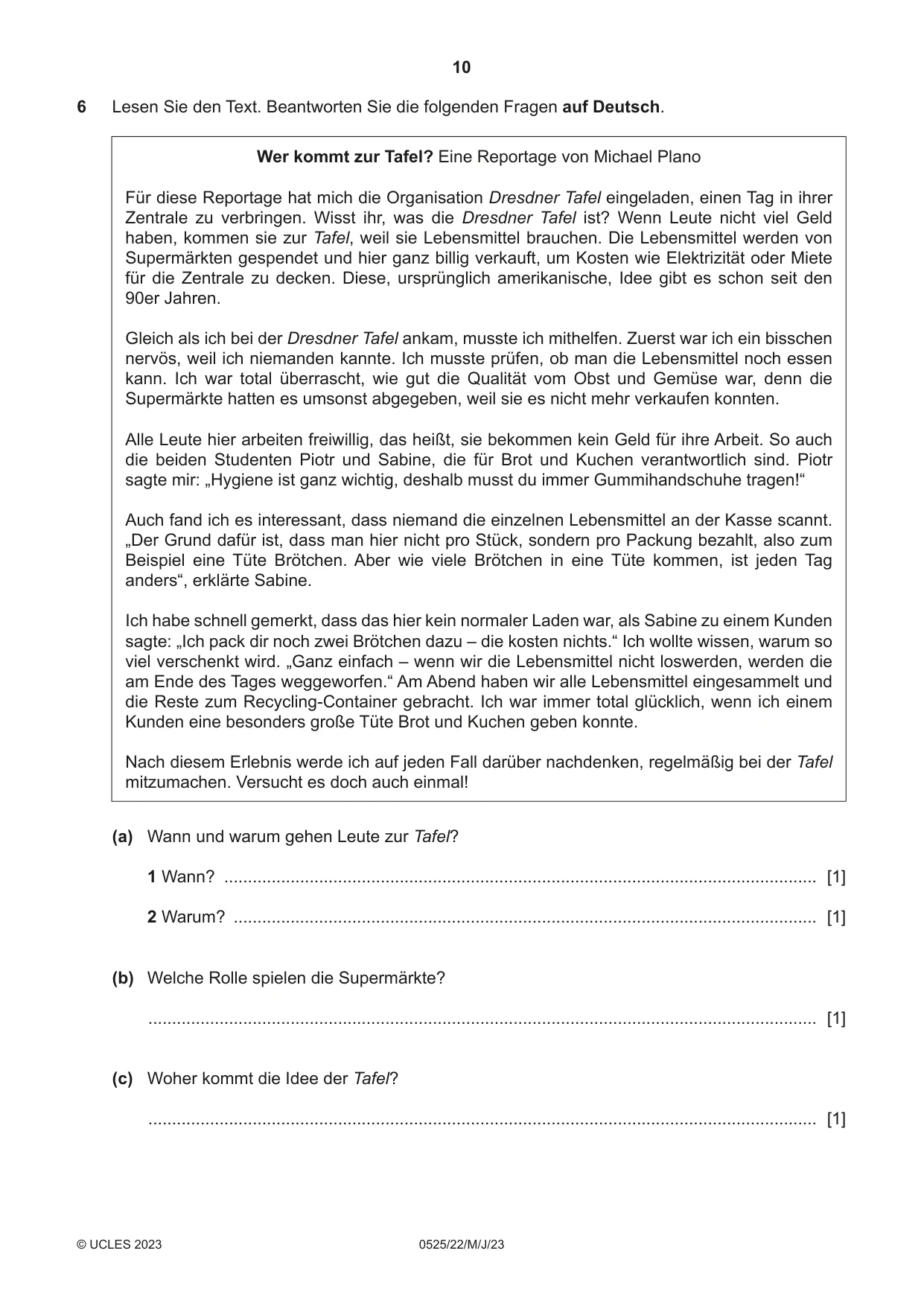
10 0525/22/M/J/23 © UCLES 2023 6 Lesen Sie den Text. Beantworten Sie die folgenden Fragen auf Deutsch. Wer kommt zur Tafel? Eine Reportage von Michael Plano Für diese Reportage hat mich die Organisation Dresdner Tafel eingeladen, einen Tag in ihrer Zentrale zu verbringen. Wisst ihr, was die Dresdner Tafel ist? Wenn Leute nicht viel Geld haben, kommen sie zur Tafel, weil sie Lebensmittel brauchen. Die Lebensmittel werden von Supermärkten gespendet und hier ganz billig verkauft, um Kosten wie Elektrizität oder Miete für die Zentrale zu decken. Diese, ursprünglich amerikanische, Idee gibt es schon seit den 90er Jahren. Gleich als ich bei der Dresdner Tafel ankam, musste ich mithelfen. Zuerst war ich ein bisschen nervös, weil ich niemanden kannte. Ich musste prüfen, ob man die Lebensmittel noch essen kann. Ich war total überrascht, wie gut die Qualität vom Obst und Gemüse war, denn die Supermärkte hatten es umsonst abgegeben, weil sie es nicht mehr verkaufen konnten. Alle Leute hier arbeiten freiwillig, das heißt, sie bekommen kein Geld für ihre Arbeit. So auch die beiden Studenten Piotr und Sabine, die für Brot und Kuchen verantwortlich sind. Piotr sagte mir: „Hygiene ist ganz wichtig, deshalb musst du immer Gummihandschuhe tragen!“ Auch fand ich es interessant, dass niemand die einzelnen Lebensmittel an der Kasse scannt. „Der Grund dafür ist, dass man hier nicht pro Stück, sondern pro Packung bezahlt, also zum Beispiel eine Tüte Brötchen. Aber wie viele Brötchen in eine Tüte kommen, ist jeden Tag anders“, erklärte Sabine. Ich habe schnell gemerkt, dass das hier kein normaler Laden war, als Sabine zu einem Kunden sagte: „Ich pack dir noch zwei Brötchen dazu – die kosten nichts.“ Ich wollte wissen, warum so viel verschenkt wird. „Ganz einfach – wenn wir die Lebensmittel nicht loswerden, werden die am Ende des Tages weggeworfen.“ Am Abend haben wir alle Lebensmittel eingesammelt und die Reste zum Recycling-Container gebracht. Ich war immer total glücklich, wenn ich einem Kunden eine besonders große Tüte Brot und Kuchen geben konnte. Nach diesem Erlebnis werde ich auf jeden Fall darüber nachdenken, regelmäßig bei der Tafel mitzumachen. Versucht es doch auch einmal! (a) Wann und warum gehen Leute zur Tafel? 1 Wann? … [1] 2 Warum? … [1] (b) Welche Rolle spielen die Supermärkte? … [1] (c) Woher kommt die Idee der Tafel? … [1]
Question paper, page 11
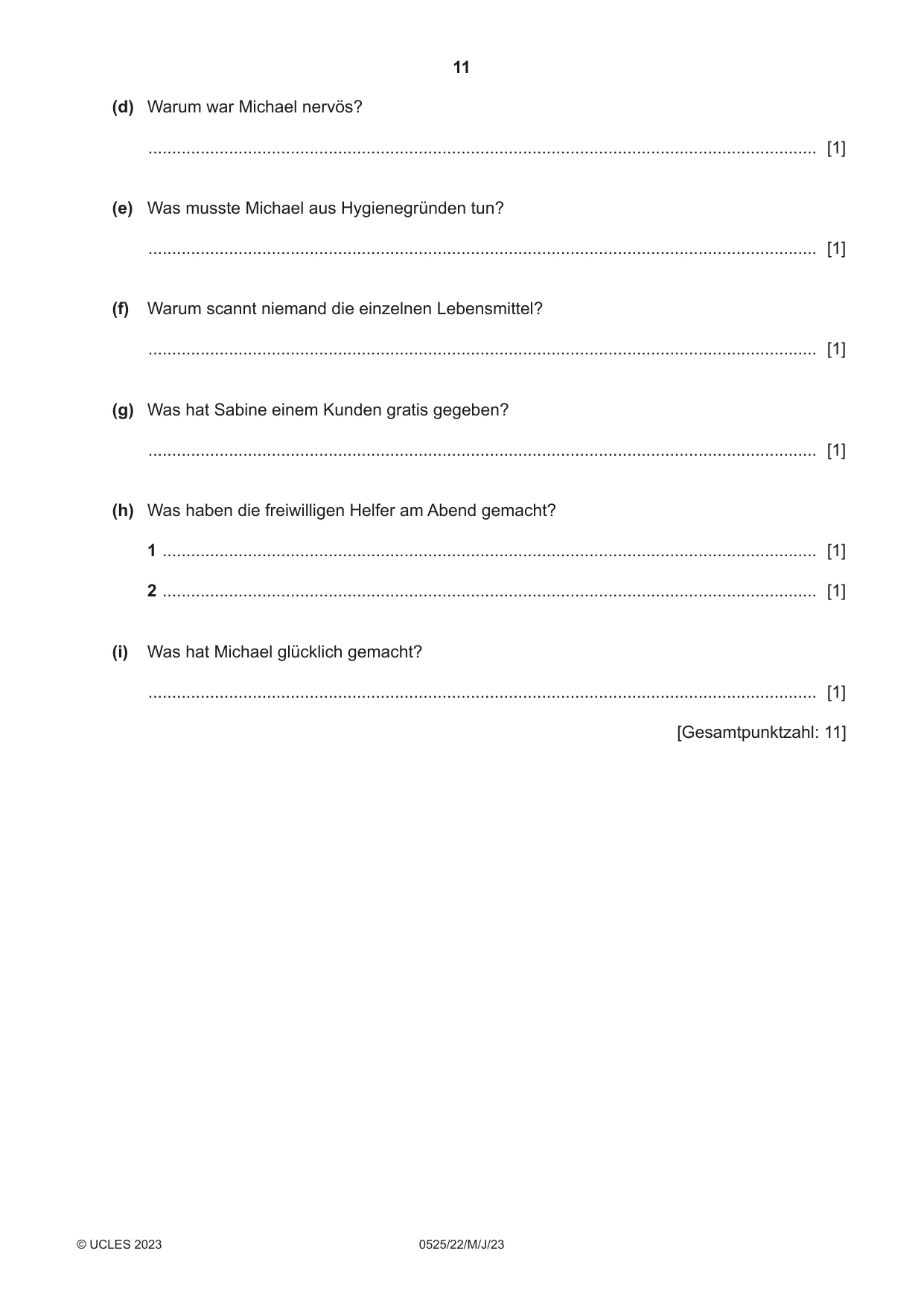
11 0525/22/M/J/23 © UCLES 2023 (d) Warum war Michael nervös? … [1] (e) Was musste Michael aus Hygienegründen tun? … [1] (f) Warum scannt niemand die einzelnen Lebensmittel? … [1] (g) Was hat Sabine einem Kunden gratis gegeben? … [1] (h) Was haben die freiwilligen Helfer am Abend gemacht? 1 … [1] 2 … [1] (i) Was hat Michael glücklich gemacht? … [1] [Gesamtpunktzahl: 11]
Question paper, page 12
12 0525/22/M/J/23 © UCLES 2023 Permission to reproduce items where third-party owned material protected by copyright is included has been sought and cleared where possible. Every reasonable effort has been made by the publisher (UCLES) to trace copyright holders, but if any items requiring clearance have unwittingly been included, the publisher will be pleased to make amends at the earliest possible opportunity. To avoid the issue of disclosure of answer-related information to candidates, all copyright acknowledgements are reproduced online in the Cambridge Assessment International Education Copyright Acknowledgements Booklet. This is produced for each series of examinations and is freely available to download at www.cambridgeinternational.org after the live examination series. Cambridge Assessment International Education is part of Cambridge Assessment. Cambridge Assessment is the brand name of the University of Cambridge Local Examinations Syndicate (UCLES), which is a department of the University of Cambridge. BLANK PAGE
Mark scheme, page 1
This document consists of 14 printed pages. © UCLES 2023 [Turn over Cambridge IGCSE™ GERMAN 0525/22 Paper 2 Reading May/June 2023 MARK SCHEME Maximum Mark: 45 Published This mark scheme is published as an aid to teachers and candidates, to indicate the requirements of the examination. It shows the basis on which Examiners were instructed to award marks. It does not indicate the details of the discussions that took place at an Examiners’ meeting before marking began, which would have considered the acceptability of alternative answers. Mark schemes should be read in conjunction with the question paper and the Principal Examiner Report for Teachers. Cambridge International will not enter into discussions about these mark schemes. Cambridge International is publishing the mark schemes for the May/June 2023 series for most Cambridge IGCSE, Cambridge International A and AS Level and Cambridge Pre-U components, and some Cambridge O Level components.
Mark scheme, page 2
0525/22 Cambridge IGCSE – Mark Scheme PUBLISHED May/June 2023 © UCLES 2023 Page 2 of 14 Generic Marking Principles These general marking principles must be applied by all examiners when marking candidate answers. They should be applied alongside the specific content of the mark scheme or generic level descriptors for a question. Each question paper and mark scheme will also comply with these marking principles. GENERIC MARKING PRINCIPLE 1: Marks must be awarded in line with: the specific content of the mark scheme or the generic level descriptors for the question the specific skills defined in the mark scheme or in the generic level descriptors for the question the standard of response required by a candidate as exemplified by the standardisation scripts. GENERIC MARKING PRINCIPLE 2: Marks awarded are always whole marks (not half marks, or other fractions). GENERIC MARKING PRINCIPLE 3: Marks must be awarded positively: marks are awarded for correct/valid answers, as defined in the mark scheme. However, credit is given for valid answers which go beyond the scope of the syllabus and mark scheme, referring to your Team Leader as appropriate marks are awarded when candidates clearly demonstrate what they know and can do marks are not deducted for errors marks are not deducted for omissions answers should only be judged on the quality of spelling, punctuation and grammar when these features are specifically assessed by the question as indicated by the mark scheme. The meaning, however, should be unambiguous. GENERIC MARKING PRINCIPLE 4: Rules must be applied consistently, e.g. in situations where candidates have not followed instructions or in the application of generic level descriptors.
Mark scheme, page 3
0525/22 Cambridge IGCSE – Mark Scheme PUBLISHED May/June 2023 © UCLES 2023 Page 3 of 14 GENERIC MARKING PRINCIPLE 5: Marks should be awarded using the full range of marks defined in the mark scheme for the question (however; the use of the full mark range may be limited according to the quality of the candidate responses seen). GENERIC MARKING PRINCIPLE 6: Marks awarded are based solely on the requirements as defined in the mark scheme. Marks should not be awarded with grade thresholds or grade descriptors in mind.
Mark scheme, page 4
0525/22 Cambridge IGCSE – Mark Scheme PUBLISHED May/June 2023 © UCLES 2023 Page 4 of 14 Additional Guidance The following guidance underpins the detailed instructions provided in the mark scheme. Where a decision is taken to deviate from this guidance for a particular question, this will be specified in the mark scheme. Often the additional guidance points will have to be weighed up against each other, e.g., the answer might look or sound like the intended word/phrase in German, but if what the candidate has written means something different in German from what is expected, the mark cannot be awarded. It is not possible to list all acceptable alternatives in the mark scheme. If you encounter an answer which is not covered by the mark scheme, you will need to make a decision about whether it communicates the required elements (in consultation with your Team Leader if necessary, or with your Product Manager if you are a single examiner), and award marks accordingly. Crossing out: (a) If a candidate changes his/her mind about an answer and crosses out an attempt, award a mark if the final attempt is correct. (b) If a candidate crosses out an answer to a whole question but makes no second attempt at it, mark the crossed-out work. More than the stipulated number of boxes ticked/crossed by the candidate: (a) If more than one attempt is visible but the candidate has clearly indicated which attempt is his/her final answer (e.g., by crossing out other attempts or by annotating the script in some way), mark in the usual way. (b) If two attempts are visible (e.g., two boxes ticked instead of the one box stipulated), and neither has been crossed out/discounted by the candidate, no mark can be awarded. For questions requiring more than one element for the answer, 1 and 2, where the answers are interchangeable: (a) Both correct answers are on line 1 and line 2 blank (or vice versa) = 2 marks (b) Both correct answers on line 1 and line 2 contains a wrong answer (or vice versa) = 1 mark
Mark scheme, page 5
0525/22 Cambridge IGCSE – Mark Scheme PUBLISHED May/June 2023 © UCLES 2023 Page 5 of 14 Mark for communication: Answers requiring the use of German (rather than a non-verbal response) should be marked for communication. Tolerate inaccuracies provided that the message is clear. However, do not accept incorrect German if the word written by the candidate means something else in German (unless the mark scheme specifies otherwise). (a) If you read aloud what the candidate has written, does it sound like the correct answer? Would a native speaker of German understand it? (b) Does what the candidate has written look like the correct answer, e.g., one letter missing or added but no other word created? Would a native speaker of German understand it? (c) The subject needs to be unambiguous. Possessives and personal pronouns need to be used in such a way as to make the answer unambiguous. Unless indicated otherwise in relation to a specific question do not accept sein for ihr or vice versa. Incorrect German which constitutes a word in any language other than German is marked (i) based on whether it is accepted or rejected in the mark scheme and (ii) if it is not mentioned in the mark scheme, based on points (a) to (d) above. Annotations used in the mark scheme: (a) INV = invalidation. This is used when the additional material included by the candidate is judged to invalidate an otherwise correct answer and therefore prevents him/her from scoring the mark. (INV = 0) (b) Refuse: …. tc = ‘tout court’. This means that, on its own, the material is not sufficient to score the mark. Accept: …. tc = ’tout court’. In this context, it means that this material alone is a valid answer. (c) HA = harmless addition. This means that the candidate has included additional material which, in conjunction with the correct answer, does not prevent him/her from scoring the mark.
Mark scheme, page 6
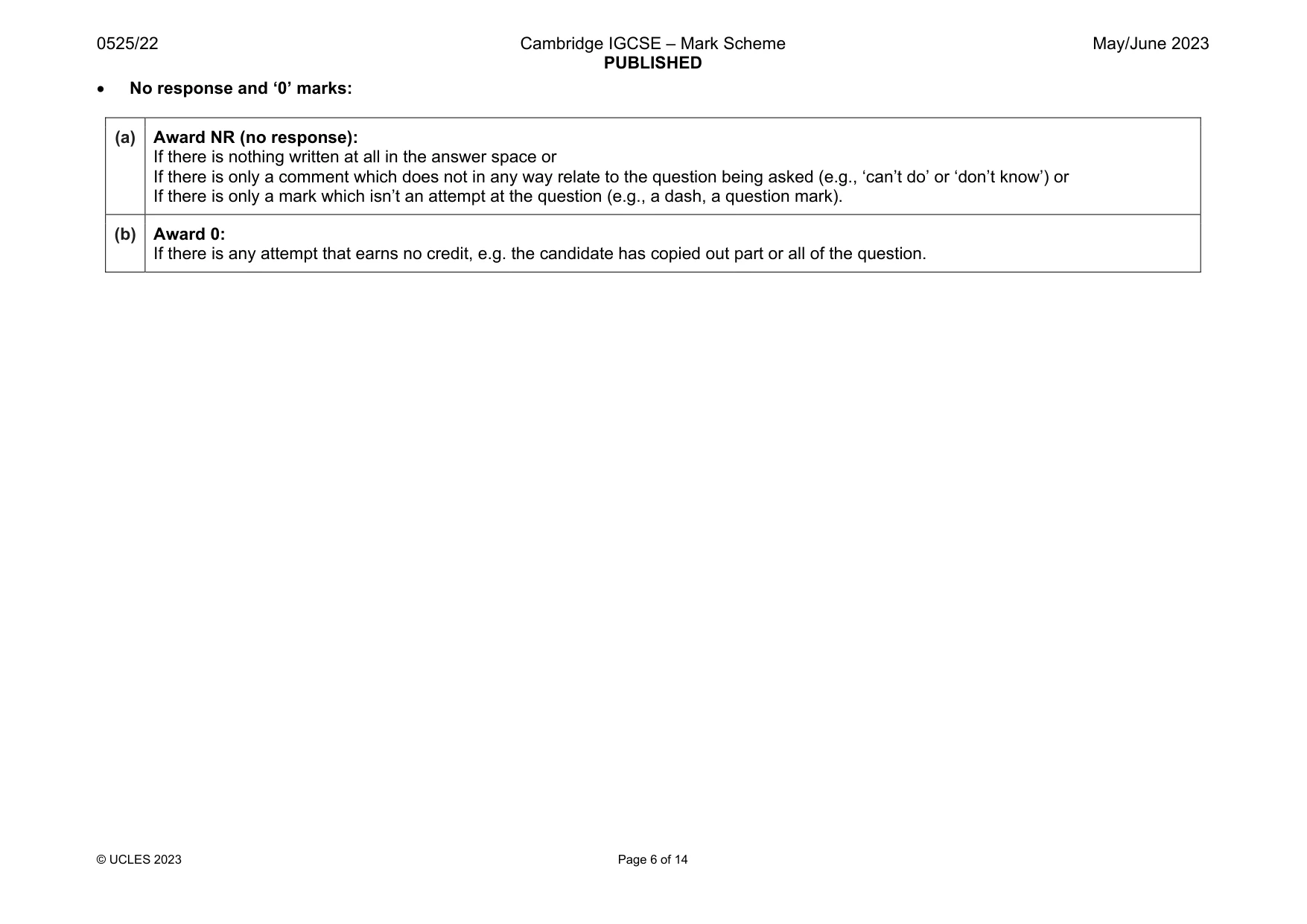
0525/22 Cambridge IGCSE – Mark Scheme PUBLISHED May/June 2023 © UCLES 2023 Page 6 of 14 No response and ‘0’ marks: (a) Award NR (no response): If there is nothing written at all in the answer space or If there is only a comment which does not in any way relate to the question being asked (e.g., ‘can’t do’ or ‘don’t know’) or If there is only a mark which isn’t an attempt at the question (e.g., a dash, a question mark). (b) Award 0: If there is any attempt that earns no credit, e.g. the candidate has copied out part or all of the question.
Mark scheme, page 7
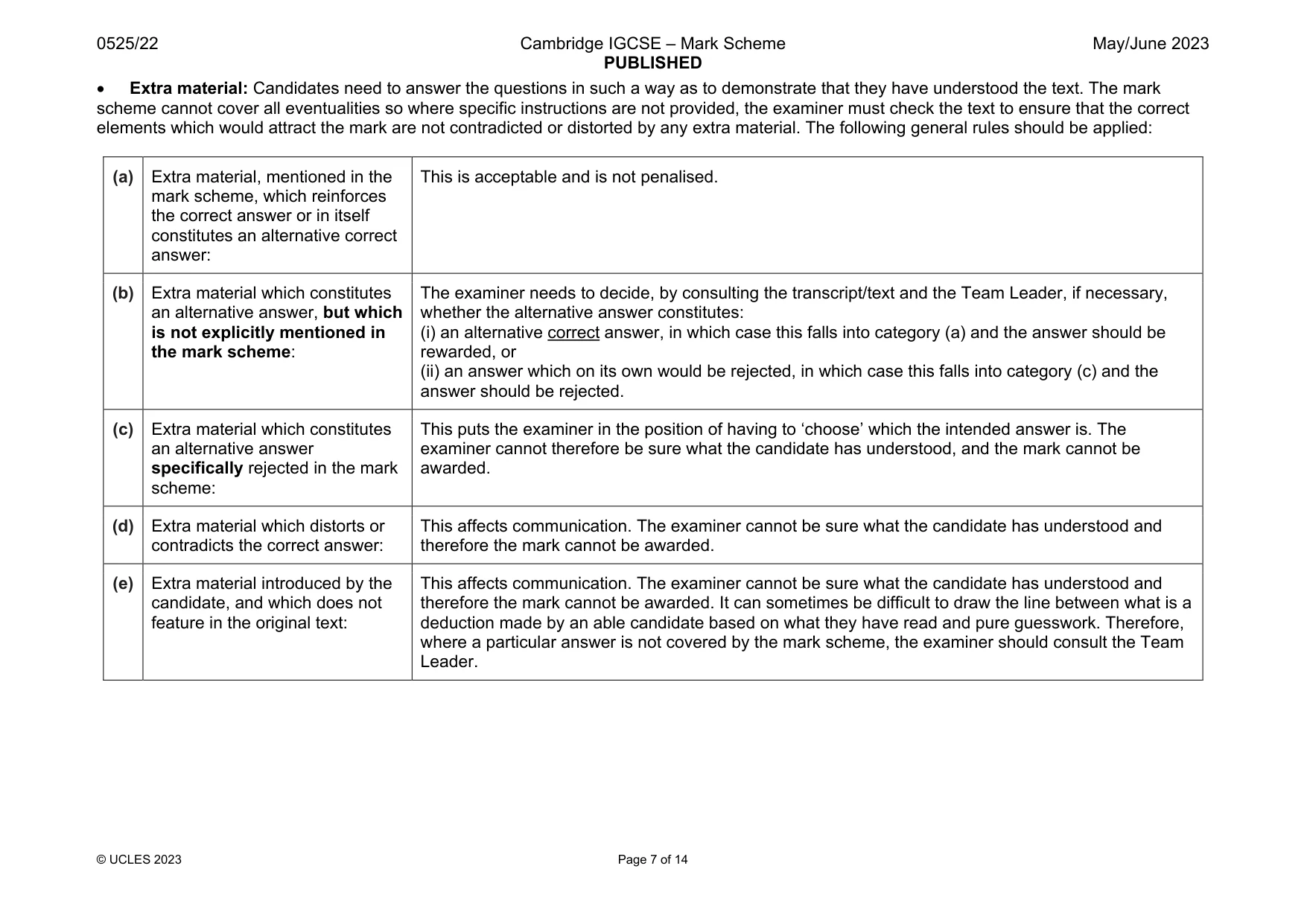
0525/22 Cambridge IGCSE – Mark Scheme PUBLISHED May/June 2023 © UCLES 2023 Page 7 of 14 Extra material: Candidates need to answer the questions in such a way as to demonstrate that they have understood the text. The mark scheme cannot cover all eventualities so where specific instructions are not provided, the examiner must check the text to ensure that the correct elements which would attract the mark are not contradicted or distorted by any extra material. The following general rules should be applied: (a) Extra material, mentioned in the mark scheme, which reinforces the correct answer or in itself constitutes an alternative correct answer: This is acceptable and is not penalised. (b) Extra material which constitutes an alternative answer, but which is not explicitly mentioned in the mark scheme: The examiner needs to decide, by consulting the transcript/text and the Team Leader, if necessary, whether the alternative answer constitutes: (i) an alternative correct answer, in which case this falls into category (a) and the answer should be rewarded, or (ii) an answer which on its own would be rejected, in which case this falls into category (c) and the answer should be rejected. (c) Extra material which constitutes an alternative answer specifically rejected in the mark scheme: This puts the examiner in the position of having to ‘choose’ which the intended answer is. The examiner cannot therefore be sure what the candidate has understood, and the mark cannot be awarded. (d) Extra material which distorts or contradicts the correct answer: This affects communication. The examiner cannot be sure what the candidate has understood and therefore the mark cannot be awarded. (e) Extra material introduced by the candidate, and which does not feature in the original text: This affects communication. The examiner cannot be sure what the candidate has understood and therefore the mark cannot be awarded. It can sometimes be difficult to draw the line between what is a deduction made by an able candidate based on what they have read and pure guesswork. Therefore, where a particular answer is not covered by the mark scheme, the examiner should consult the Team Leader.
Mark scheme, page 8
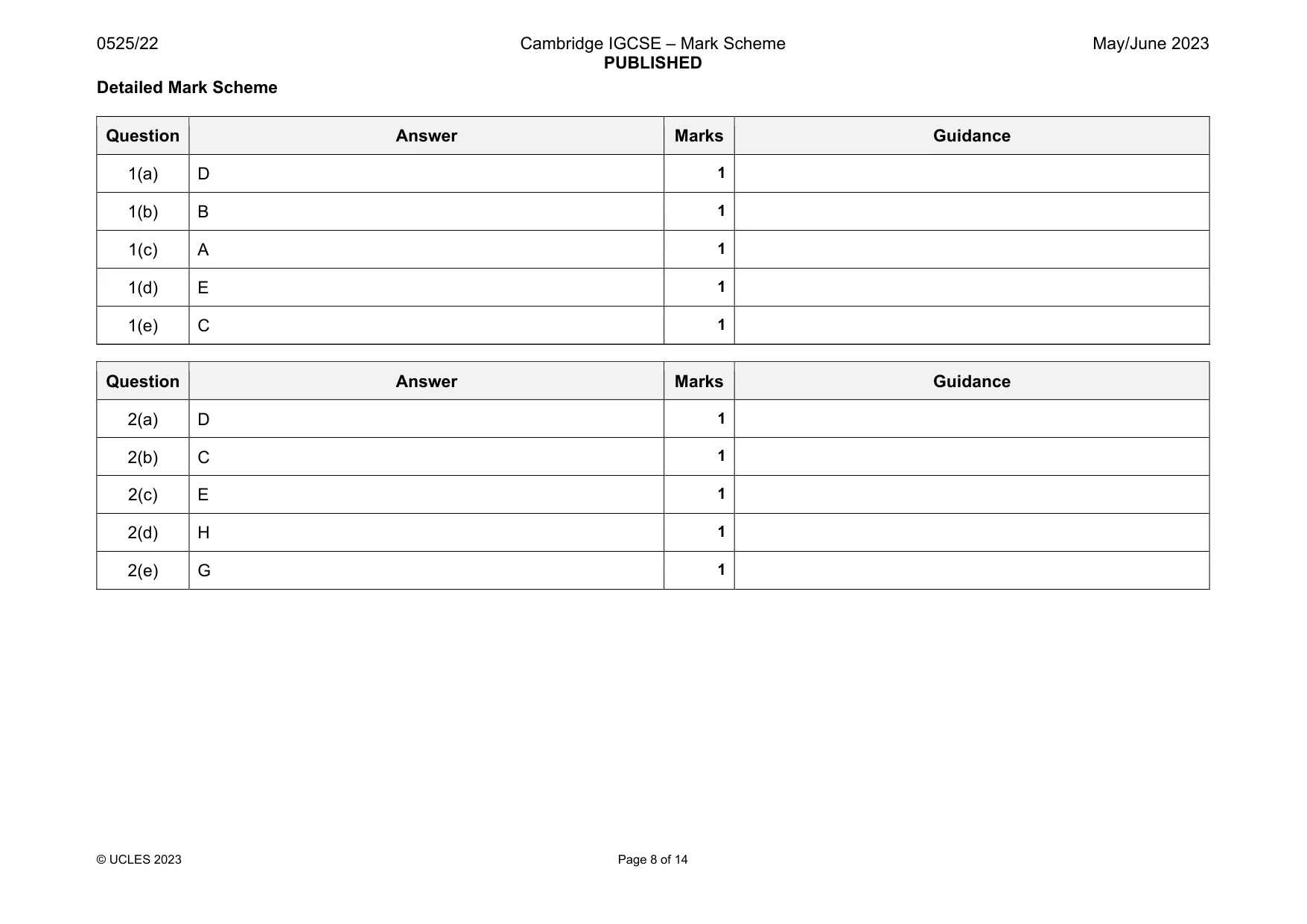
0525/22 Cambridge IGCSE – Mark Scheme PUBLISHED May/June 2023 © UCLES 2023 Page 8 of 14 Detailed Mark Scheme Question Answer Marks Guidance 1(a) D 1 1(b) B 1 1(c) A 1 1(d) E 1 1(e) C 1 Question Answer Marks Guidance 2(a) D 1 2(b) C 1 2(c) E 1 2(d) H 1 2(e) G 1
Mark scheme, page 9
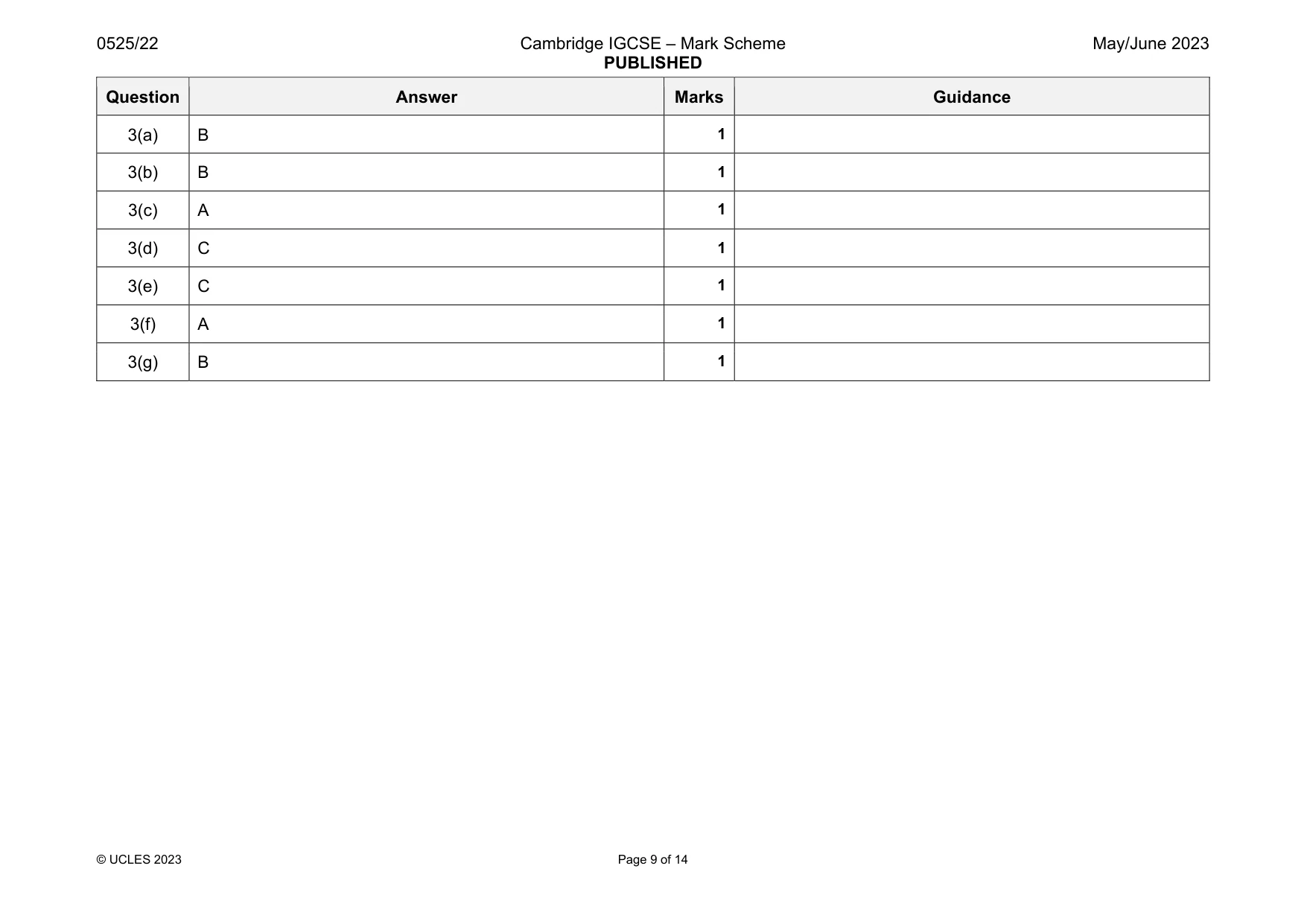
0525/22 Cambridge IGCSE – Mark Scheme PUBLISHED May/June 2023 © UCLES 2023 Page 9 of 14 Question Answer Marks Guidance 3(a) B 1 3(b) B 1 3(c) A 1 3(d) C 1 3(e) C 1 3(f) A 1 3(g) B 1
Mark scheme, page 10
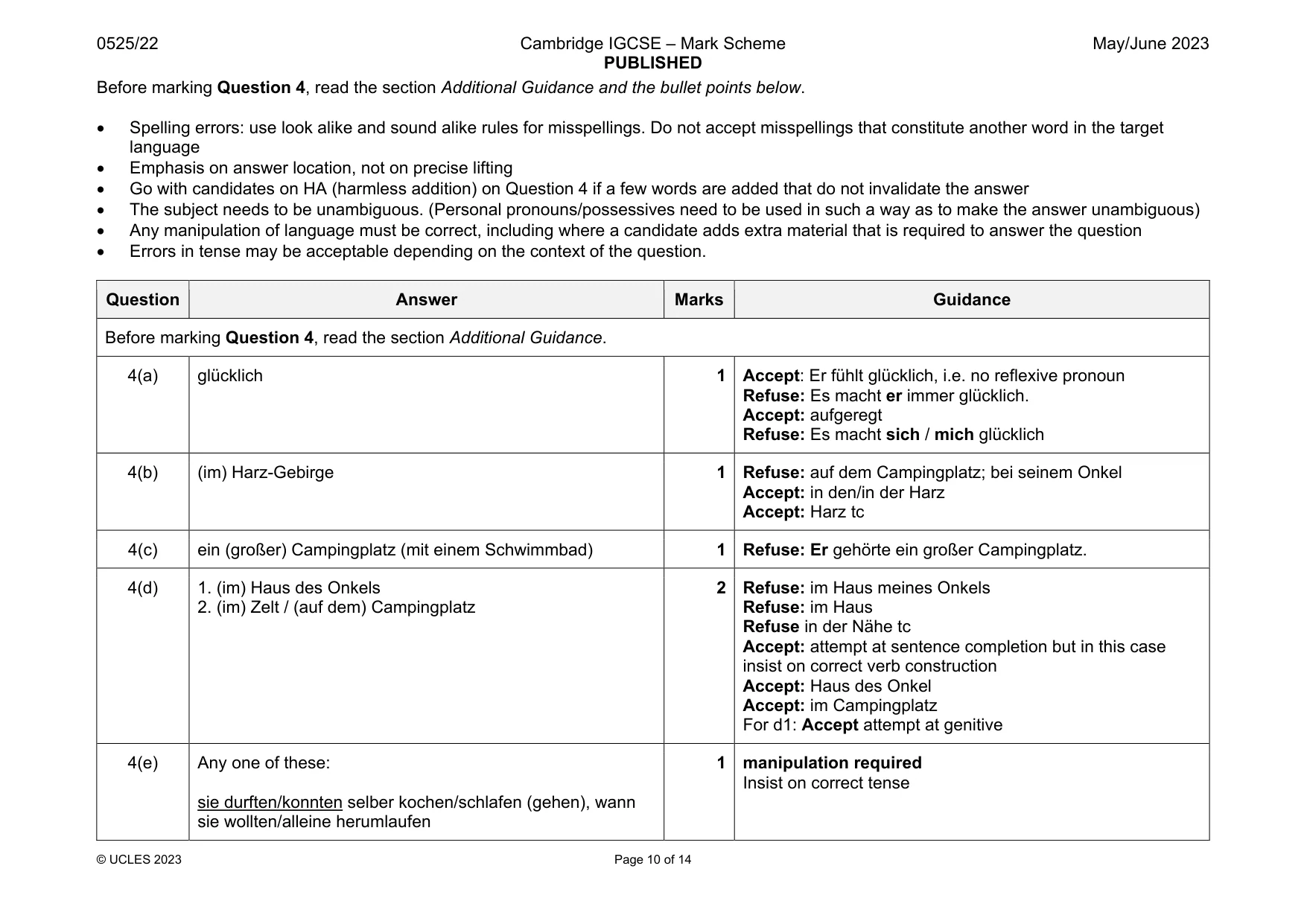
0525/22 Cambridge IGCSE – Mark Scheme PUBLISHED May/June 2023 © UCLES 2023 Page 10 of 14 Before marking Question 4, read the section Additional Guidance and the bullet points below. Spelling errors: use look alike and sound alike rules for misspellings. Do not accept misspellings that constitute another word in the target language Emphasis on answer location, not on precise lifting Go with candidates on HA (harmless addition) on Question 4 if a few words are added that do not invalidate the answer The subject needs to be unambiguous. (Personal pronouns/possessives need to be used in such a way as to make the answer unambiguous) Any manipulation of language must be correct, including where a candidate adds extra material that is required to answer the question Errors in tense may be acceptable depending on the context of the question. Question Answer Marks Guidance Before marking Question 4, read the section Additional Guidance. 4(a) glücklich 1 Accept: Er fühlt glücklich, i.e. no reflexive pronoun Refuse: Es macht er immer glücklich. Accept: aufgeregt Refuse: Es macht sich / mich glücklich 4(b) (im) Harz-Gebirge 1 Refuse: auf dem Campingplatz; bei seinem Onkel Accept: in den/in der Harz Accept: Harz tc 4(c) ein (großer) Campingplatz (mit einem Schwimmbad) 1 Refuse: Er gehörte ein großer Campingplatz. 4(d) 1. (im) Haus des Onkels 2. (im) Zelt / (auf dem) Campingplatz 2 Refuse: im Haus meines Onkels Refuse: im Haus Refuse in der Nähe tc Accept: attempt at sentence completion but in this case insist on correct verb construction Accept: Haus des Onkel Accept: im Campingplatz For d1: Accept attempt at genitive 4(e) Any one of these: sie durften/konnten selber kochen/schlafen (gehen), wann sie wollten/alleine herumlaufen 1 manipulation required Insist on correct tense
Mark scheme, page 11
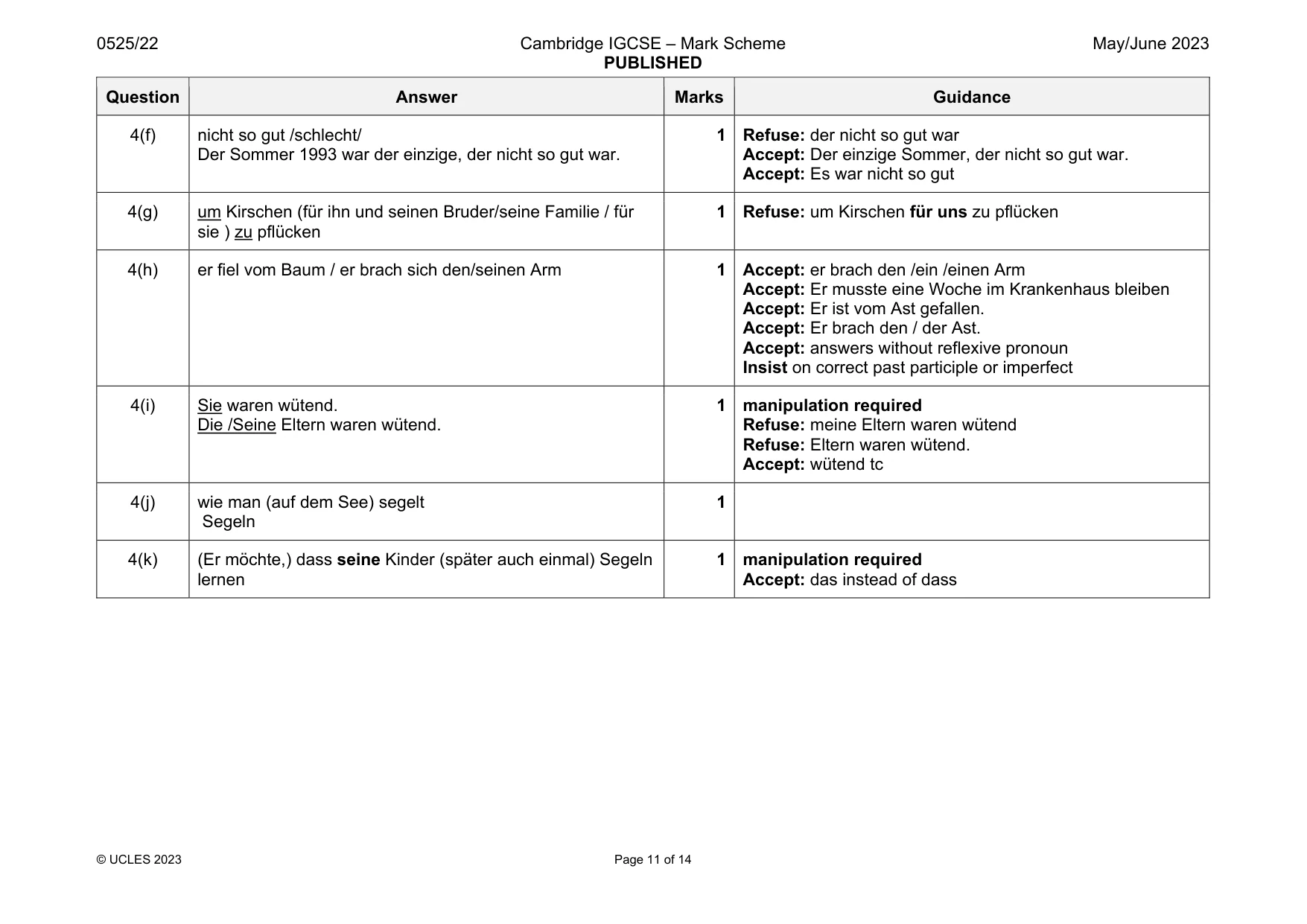
0525/22 Cambridge IGCSE – Mark Scheme PUBLISHED May/June 2023 © UCLES 2023 Page 11 of 14 Question Answer Marks Guidance 4(f) nicht so gut /schlecht/ Der Sommer 1993 war der einzige, der nicht so gut war. 1 Refuse: der nicht so gut war Accept: Der einzige Sommer, der nicht so gut war. Accept: Es war nicht so gut 4(g) um Kirschen (für ihn und seinen Bruder/seine Familie / für sie ) zu pflücken 1 Refuse: um Kirschen für uns zu pflücken 4(h) er fiel vom Baum / er brach sich den/seinen Arm 1 Accept: er brach den /ein /einen Arm Accept: Er musste eine Woche im Krankenhaus bleiben Accept: Er ist vom Ast gefallen. Accept: Er brach den / der Ast. Accept: answers without reflexive pronoun Insist on correct past participle or imperfect 4(i) Sie waren wütend. Die /Seine Eltern waren wütend. 1 manipulation required Refuse: meine Eltern waren wütend Refuse: Eltern waren wütend. Accept: wütend tc 4(j) wie man (auf dem See) segelt Segeln 1 4(k) (Er möchte,) dass seine Kinder (später auch einmal) Segeln lernen 1 manipulation required Accept: das instead of dass
Mark scheme, page 12
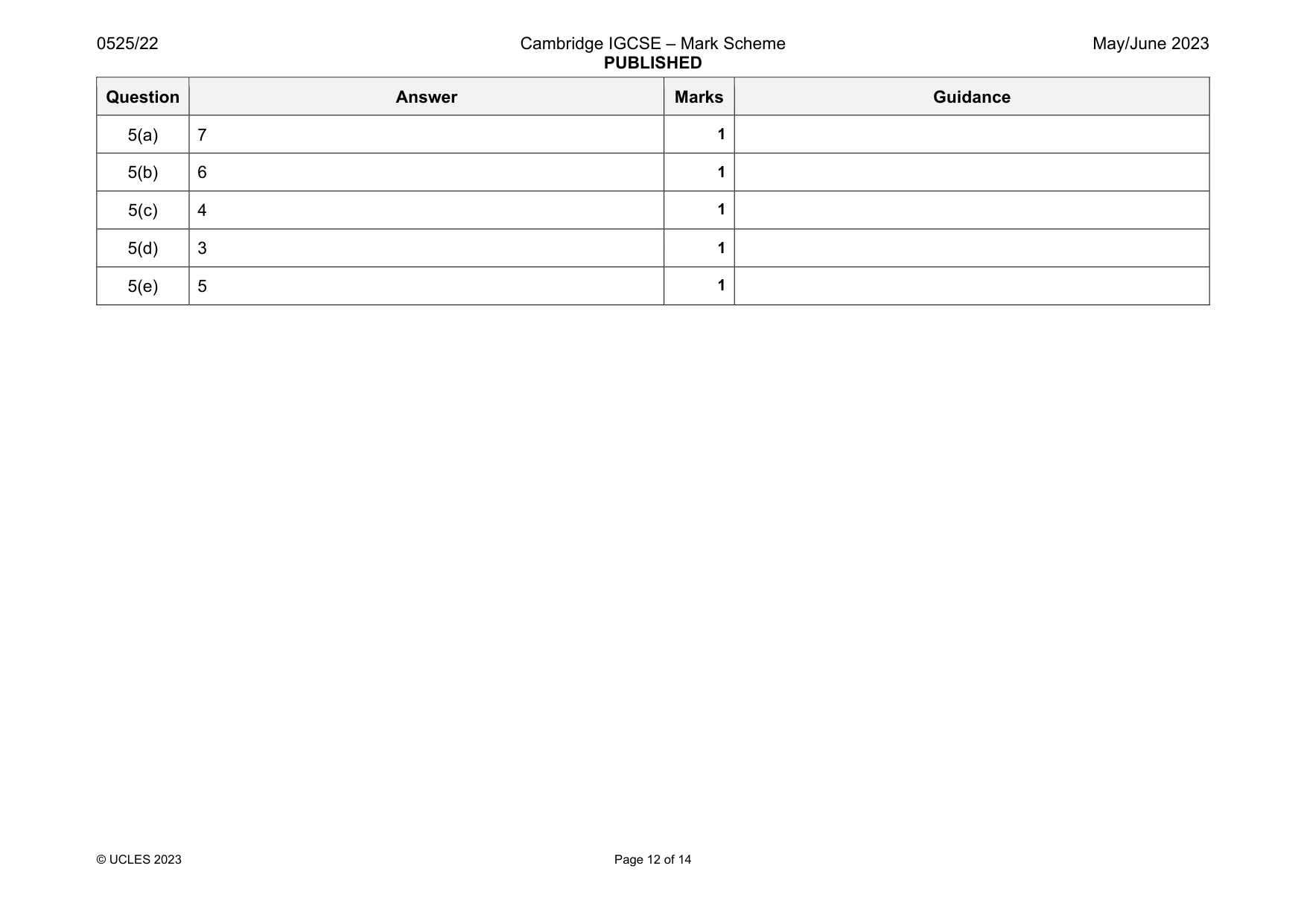
0525/22 Cambridge IGCSE – Mark Scheme PUBLISHED May/June 2023 © UCLES 2023 Page 12 of 14 Question Answer Marks Guidance 5(a) 7 1 5(b) 6 1 5(c) 4 1 5(d) 3 1 5(e) 5 1
Mark scheme, page 13
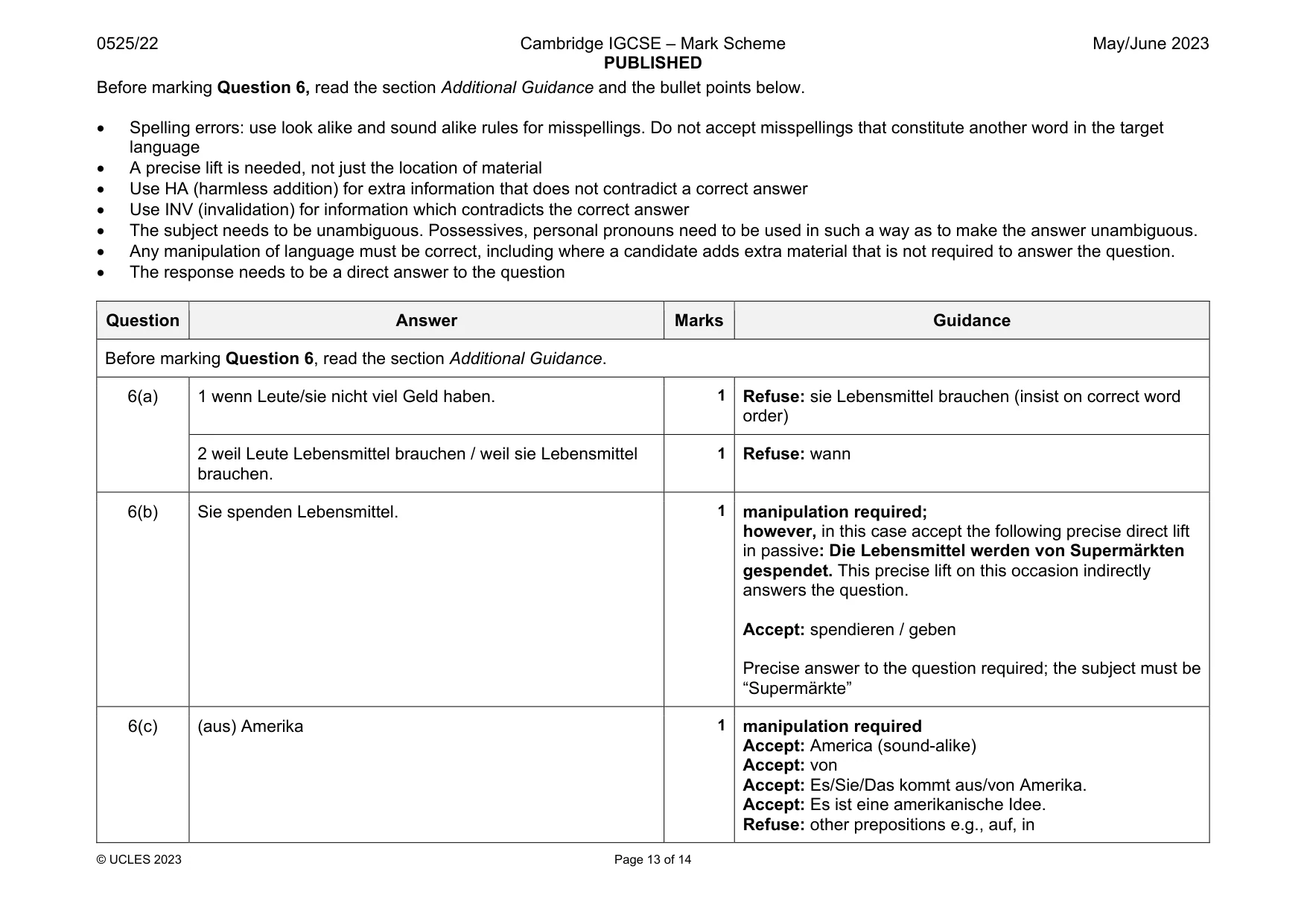
0525/22 Cambridge IGCSE – Mark Scheme PUBLISHED May/June 2023 © UCLES 2023 Page 13 of 14 Before marking Question 6, read the section Additional Guidance and the bullet points below. Spelling errors: use look alike and sound alike rules for misspellings. Do not accept misspellings that constitute another word in the target language A precise lift is needed, not just the location of material Use HA (harmless addition) for extra information that does not contradict a correct answer Use INV (invalidation) for information which contradicts the correct answer The subject needs to be unambiguous. Possessives, personal pronouns need to be used in such a way as to make the answer unambiguous. Any manipulation of language must be correct, including where a candidate adds extra material that is not required to answer the question. The response needs to be a direct answer to the question Question Answer Marks Guidance Before marking Question 6, read the section Additional Guidance. 6(a) 1 wenn Leute/sie nicht viel Geld haben. 1 Refuse: sie Lebensmittel brauchen (insist on correct word order) 2 weil Leute Lebensmittel brauchen / weil sie Lebensmittel brauchen. 1 Refuse: wann 6(b) Sie spenden Lebensmittel. 1 manipulation required; however, in this case accept the following precise direct lift in passive: Die Lebensmittel werden von Supermärkten gespendet. This precise lift on this occasion indirectly answers the question. Accept: spendieren / geben Precise answer to the question required; the subject must be “Supermärkte” 6(c) (aus) Amerika 1 manipulation required Accept: America (sound-alike) Accept: von Accept: Es/Sie/Das kommt aus/von Amerika. Accept: Es ist eine amerikanische Idee. Refuse: other prepositions e.g., auf, in
Mark scheme, page 14
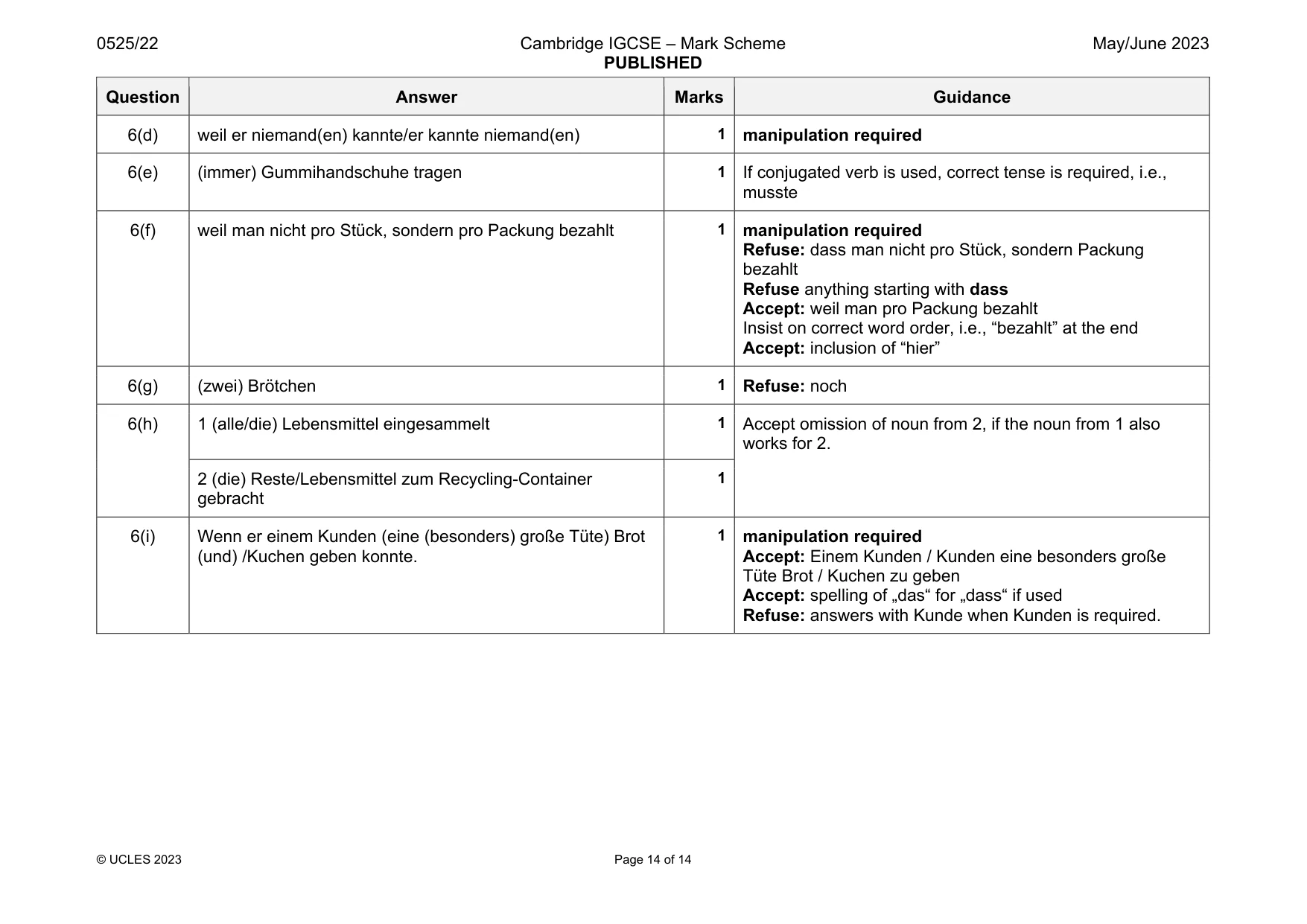
0525/22 Cambridge IGCSE – Mark Scheme PUBLISHED May/June 2023 © UCLES 2023 Page 14 of 14 Question Answer Marks Guidance 6(d) weil er niemand(en) kannte/er kannte niemand(en) 1 manipulation required 6(e) (immer) Gummihandschuhe tragen 1 If conjugated verb is used, correct tense is required, i.e., musste 6(f) weil man nicht pro Stück, sondern pro Packung bezahlt 1 manipulation required Refuse: dass man nicht pro Stück, sondern Packung bezahlt Refuse anything starting with dass Accept: weil man pro Packung bezahlt Insist on correct word order, i.e., “bezahlt” at the end Accept: inclusion of “hier” 6(g) (zwei) Brötchen 1 Refuse: noch 6(h) 1 (alle/die) Lebensmittel eingesammelt 1 Accept omission of noun from 2, if the noun from 1 also works for 2. 2 (die) Reste/Lebensmittel zum Recycling-Container gebracht 1 6(i) Wenn er einem Kunden (eine (besonders) große Tüte) Brot (und) /Kuchen geben konnte. 1 manipulation required Accept: Einem Kunden / Kunden eine besonders große Tüte Brot / Kuchen zu geben Accept: spelling of „das“ for „dass“ if used Refuse: answers with Kunde when Kunden is required.
What you needed in this session
Cambridge’s own grade thresholds for 2023 May/June, Paper 2 · Variant 2. A higher threshold means an easier paper — the bar moves with how the cohort did.