Cambridge IGCSE German - Foreign Language 0525 — 2023 Oct/Nov Paper 2 · Variant 2
0525/22/O/N/23 · 45 marks · ≈51 min
The question paper and its mark scheme, free to read here and free to download. This is Cambridge’s own paper, exactly as it was sat.
Question paper12 pages

Mark scheme13 pages
Answers below. Sit the paper first if you are practising.
Paper as text
Question paper, page 1
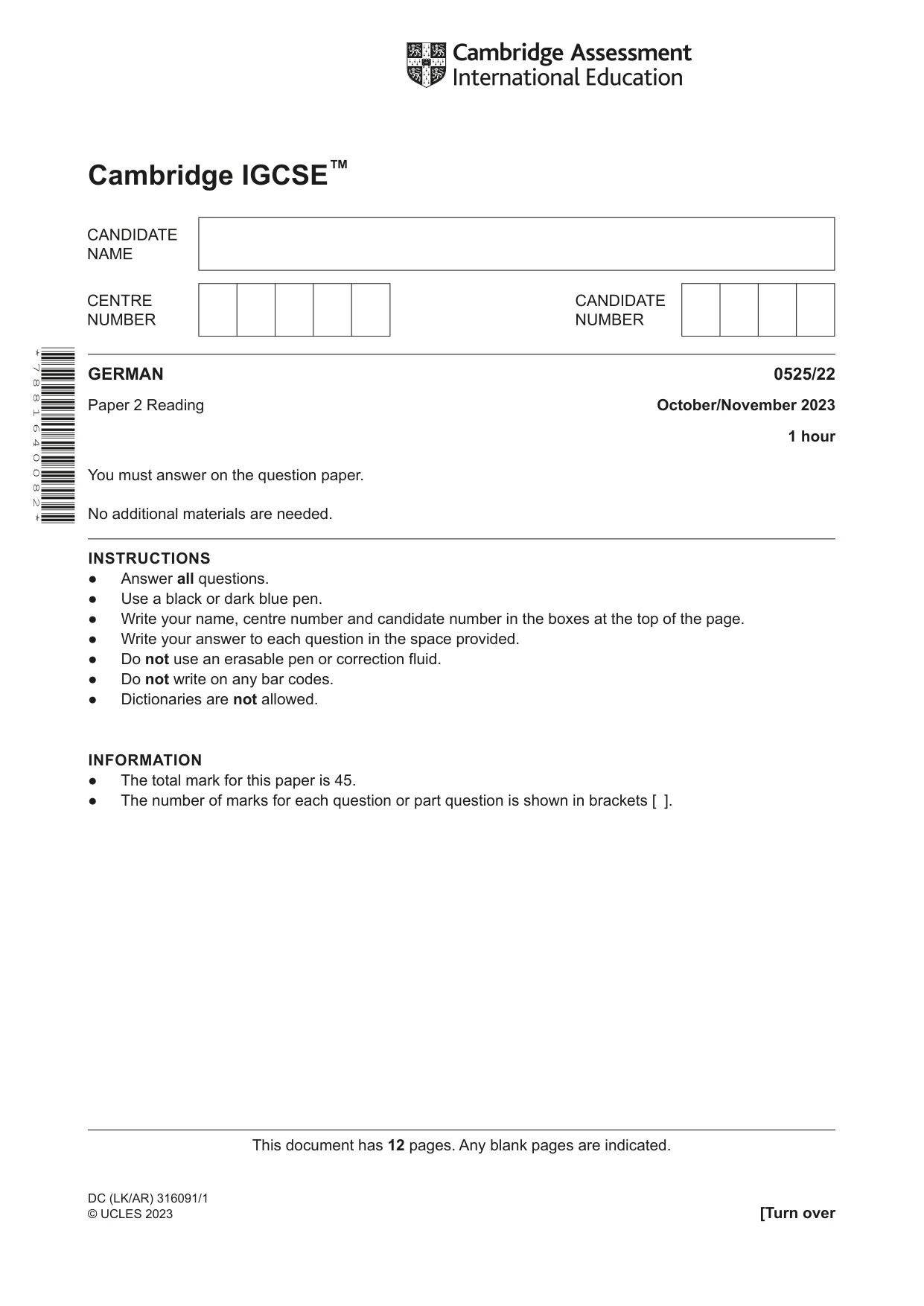
This document has 12 pages. Any blank pages are indicated. [Turn over Cambridge IGCSE™ * 7 8 8 1 6 4 0 0 8 2 * DC (LK/AR) 316091/1 © UCLES 2023 GERMAN 0525/22 Paper 2 Reading October/November 2023 1 hour You must answer on the question paper. No additional materials are needed. INSTRUCTIONS ● Answer all questions. ● Use a black or dark blue pen. ● Write your name, centre number and candidate number in the boxes at the top of the page. ● Write your answer to each question in the space provided. ● Do not use an erasable pen or correction fluid. ● Do not write on any bar codes. ● Dictionaries are not allowed. INFORMATION ● The total mark for this paper is 45. ● The number of marks for each question or part question is shown in brackets [ ].
Question paper, page 2
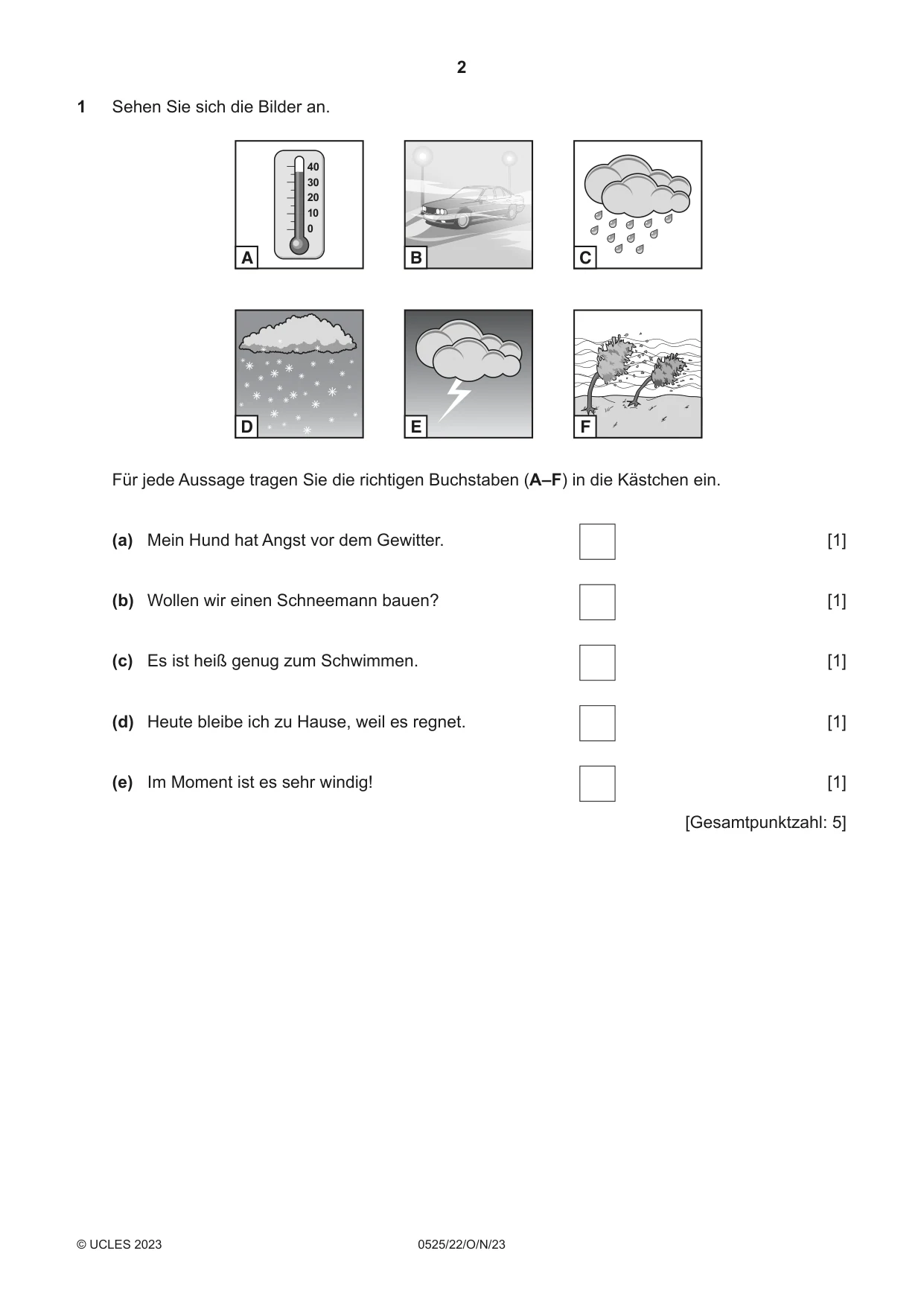
2 0525/22/ O/ N/23 © UCLES 2023 1 Sehen Sie sich die Bilder an. 0 10 20 30 40 A B C D E F Für jede Aussage tragen Sie die richtigen Buchstaben (A–F) in die Kästchen ein. (a) Mein Hund hat Angst vor dem Gewitter. [1] (b) Wollen wir einen Schneemann bauen? [1] (c) Es ist heiß genug zum Schwimmen. [1] (d) Heute bleibe ich zu Hause, weil es regnet. [1] (e) Im Moment ist es sehr windig! [1] [Gesamtpunktzahl: 5]
Question paper, page 3
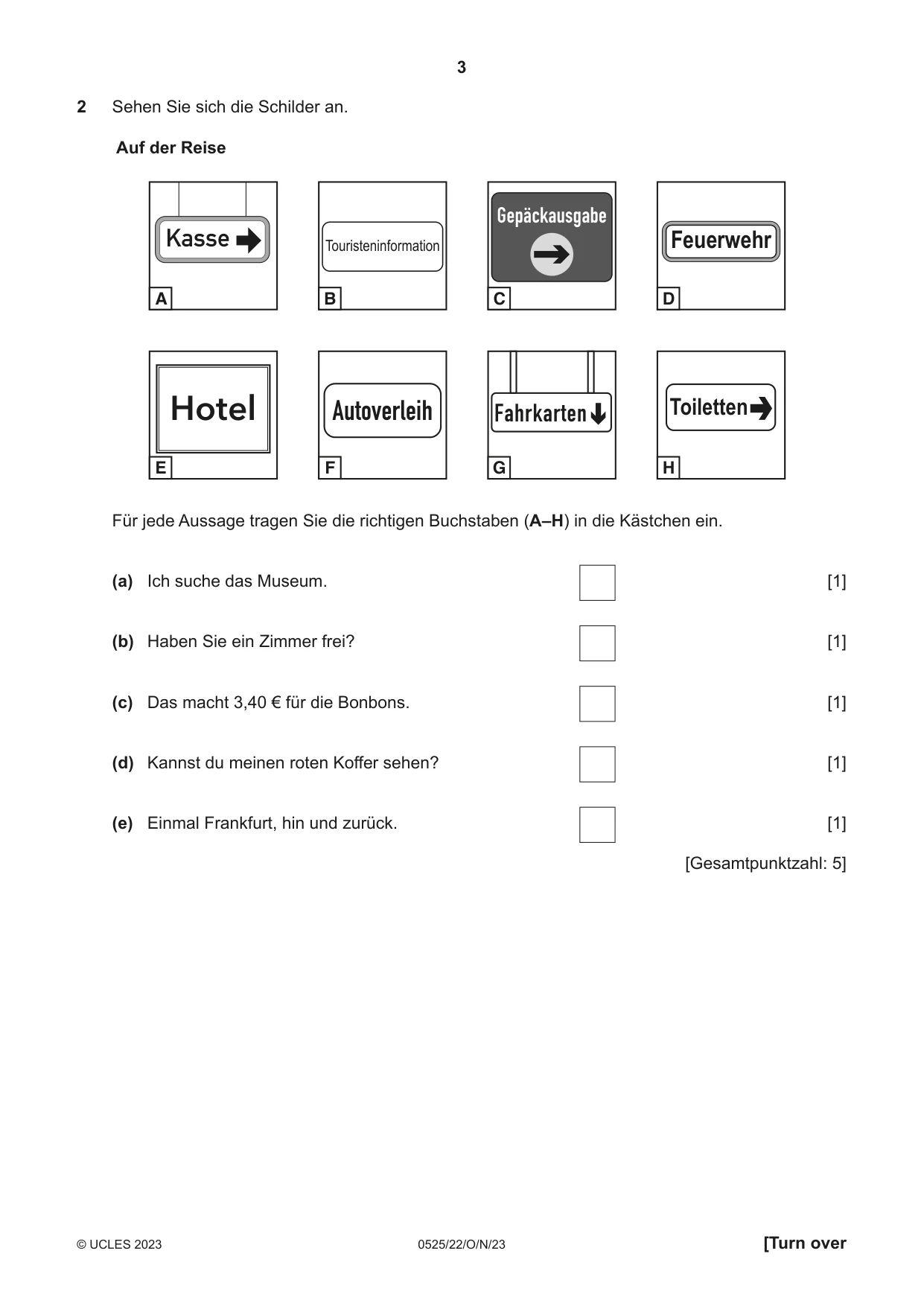
3 0525/22/O/N/23 © UCLES 2023 [Turn over 2 Sehen Sie sich die Schilder an. Auf der Reise Kasse Touristeninformation Gepäckausgabe Feuerwehr Hotel Fahrkarten Toiletten Autoverleih A B C E F G D H Für jede Aussage tragen Sie die richtigen Buchstaben (A–H) in die Kästchen ein. (a) Ich suche das Museum. [1] (b) Haben Sie ein Zimmer frei? [1] (c) Das macht 3,40 € für die Bonbons. [1] (d) Kannst du meinen roten Koffer sehen? [1] (e) Einmal Frankfurt, hin und zurück. [1] [Gesamtpunktzahl: 5]
Question paper, page 4
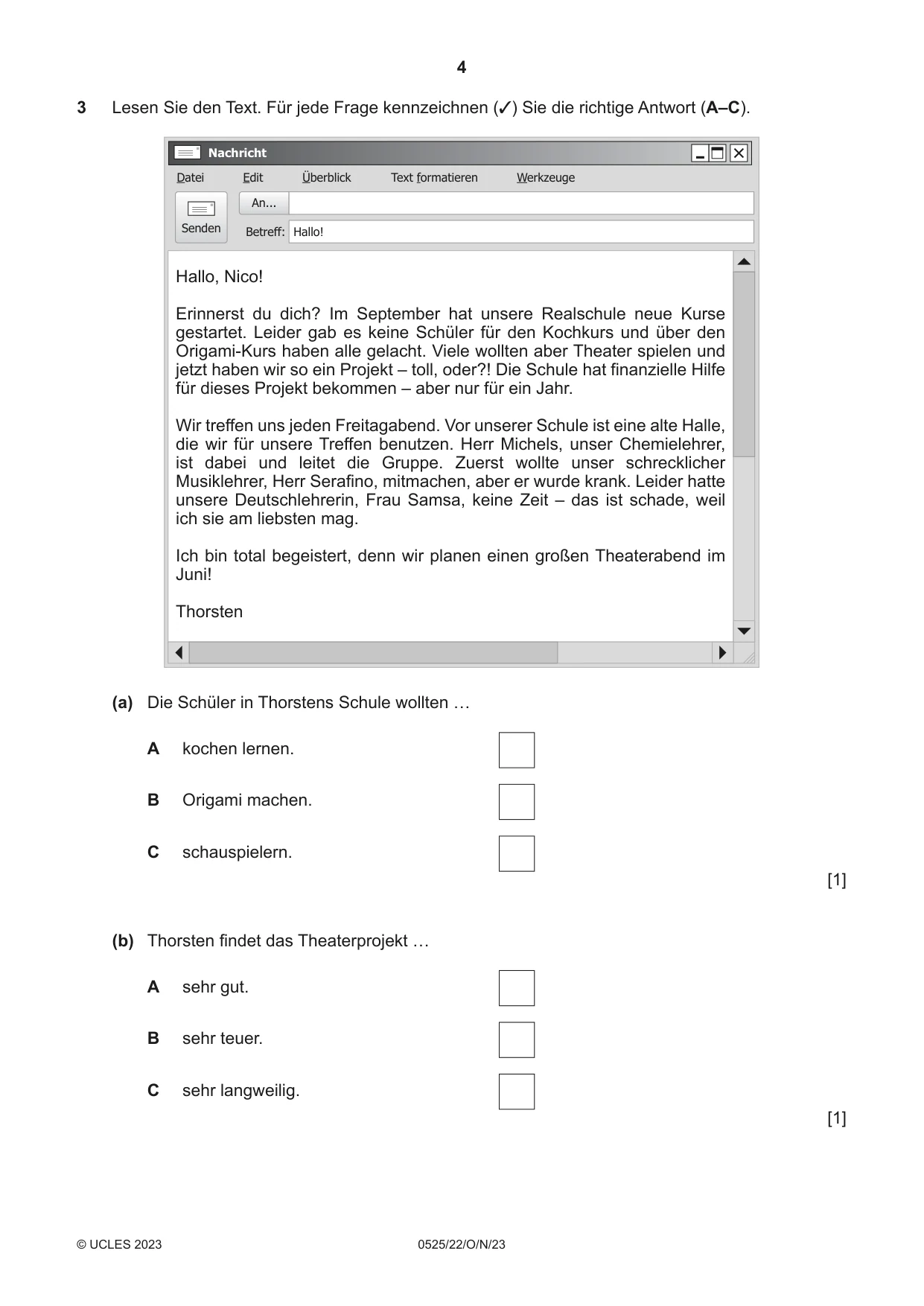
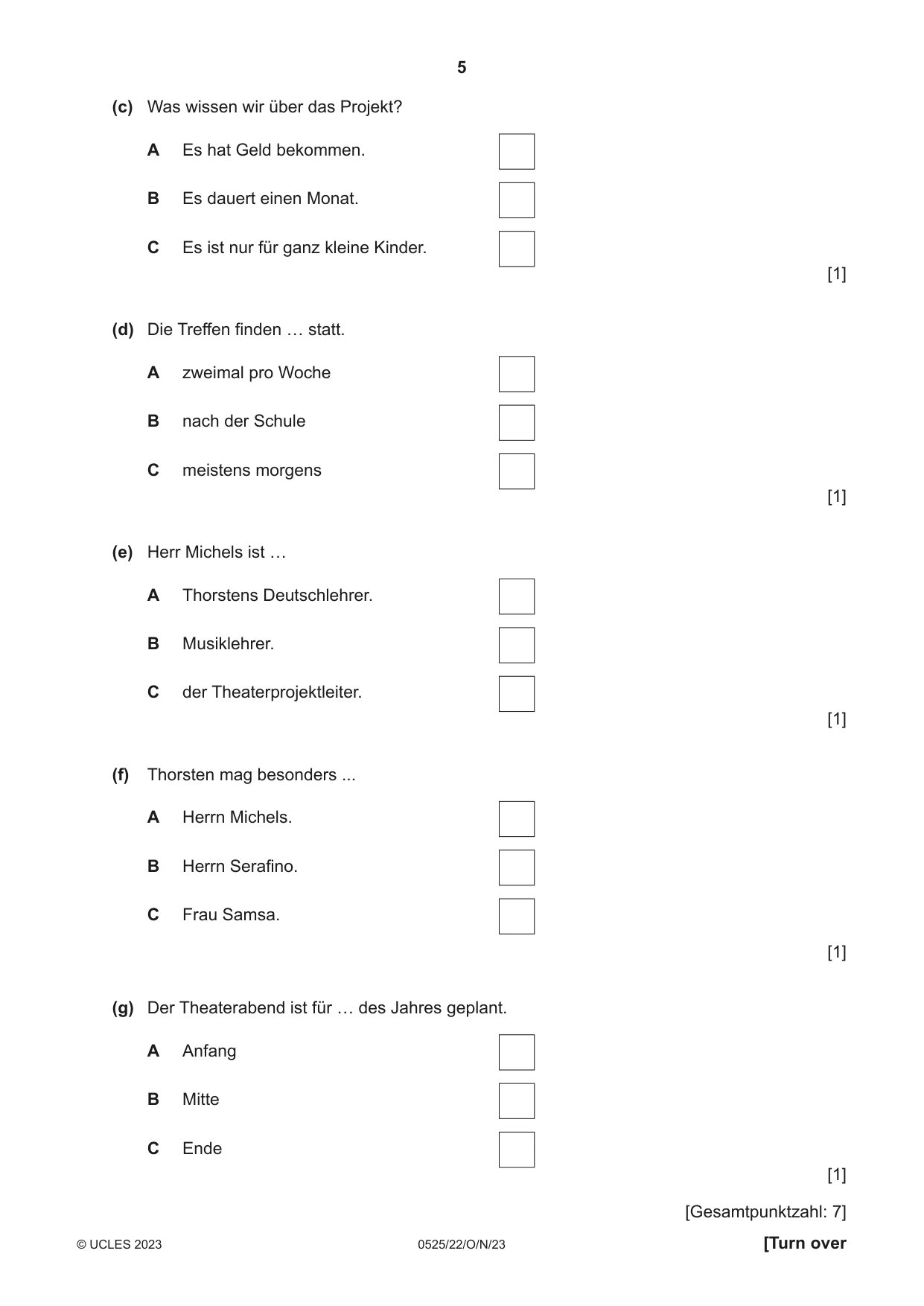
4 0525/22/O/N/23 © UCLES 2023 3 Lesen Sie den Text. Für jede Frage kennzeichnen (3) Sie die richtige Antwort (A–C). Betreff: Hallo! An... Senden Datei Edit Überblick Text formatieren Werkzeuge Nachricht (a) Die Schüler in Thorstens Schule wollten … A kochen lernen. B Origami machen. C schauspielern. [1] (b) Thorsten findet das Theaterprojekt … A sehr gut. B sehr teuer. C sehr langweilig. [1] Hallo, Nico! Erinnerst du dich? Im September hat unsere Realschule neue Kurse gestartet. Leider gab es keine Schüler für den Kochkurs und über den Origami-Kurs haben alle gelacht. Viele wollten aber Theater spielen und jetzt haben wir so ein Projekt – toll, oder?! Die Schule hat finanzielle Hilfe für dieses Projekt bekommen – aber nur für ein Jahr. Wir treffen uns jeden Freitagabend. Vor unserer Schule ist eine alte Halle, die wir für unsere Treffen benutzen. Herr Michels, unser Chemielehrer, ist dabei und leitet die Gruppe. Zuerst wollte unser schrecklicher Musiklehrer, Herr Serafino, mitmachen, aber er wurde krank. Leider hatte unsere Deutschlehrerin, Frau Samsa, keine Zeit – das ist schade, weil ich sie am liebsten mag. Ich bin total begeistert, denn wir planen einen großen Theaterabend im Juni! Thorsten
Question paper, page 5
5 0525/22/O/N/23 © UCLES 2023 [Turn over (c) Was wissen wir über das Projekt? A Es hat Geld bekommen. B Es dauert einen Monat. C Es ist nur für ganz kleine Kinder. [1] (d) Die Treffen finden … statt. A zweimal pro Woche B nach der Schule C meistens morgens [1] (e) Herr Michels ist … A Thorstens Deutschlehrer. B Musiklehrer. C der Theaterprojektleiter. [1] (f) Thorsten mag besonders ... A Herrn Michels. B Herrn Serafino. C Frau Samsa. [1] (g) Der Theaterabend ist für … des Jahres geplant. A Anfang B Mitte C Ende [1] [Gesamtpunktzahl: 7]
Question paper, page 6
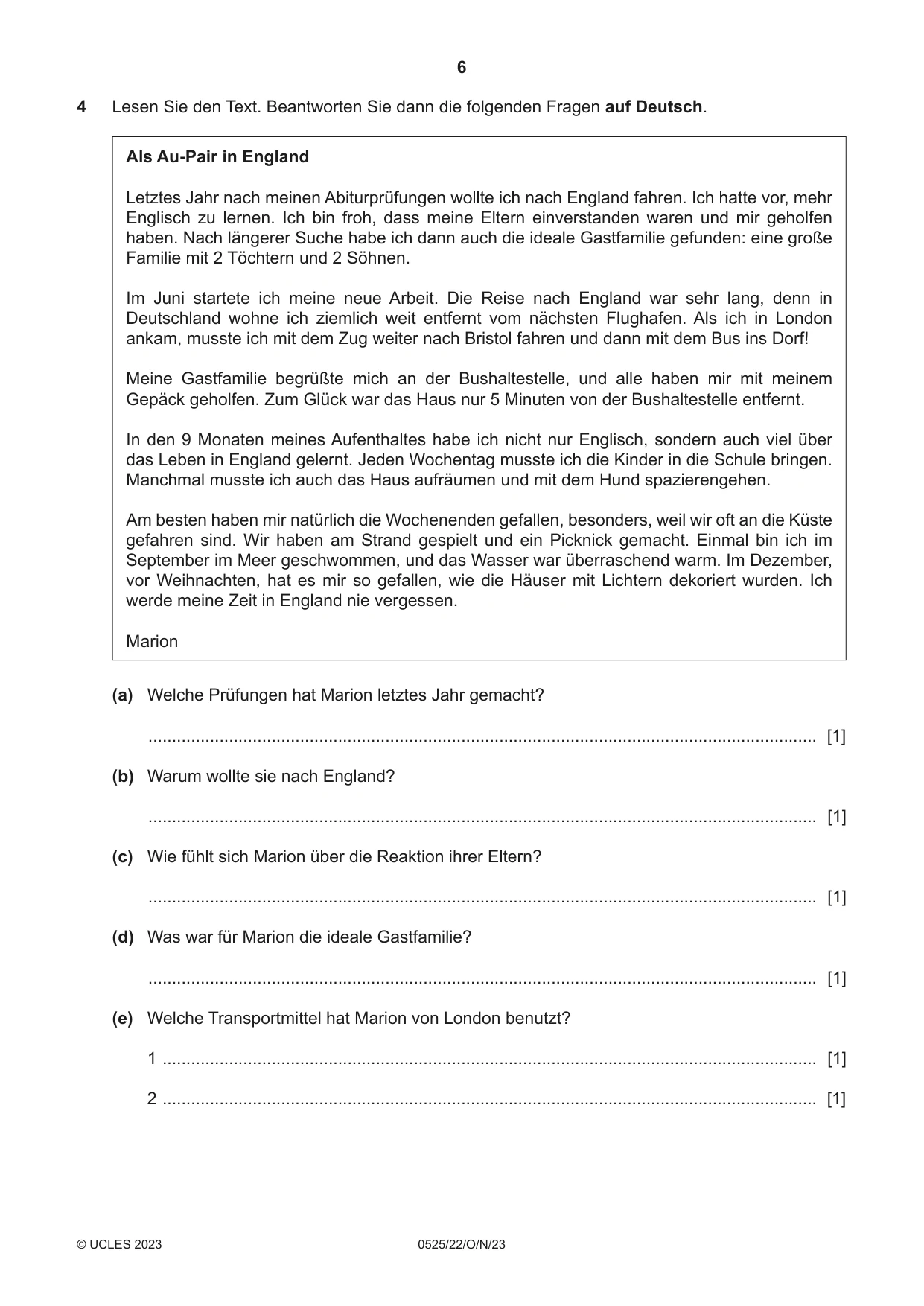
6 0525/22/O/N/23 © UCLES 2023 4 Lesen Sie den Text. Beantworten Sie dann die folgenden Fragen auf Deutsch. Als Au-Pair in England Letztes Jahr nach meinen Abiturprüfungen wollte ich nach England fahren. Ich hatte vor, mehr Englisch zu lernen. Ich bin froh, dass meine Eltern einverstanden waren und mir geholfen haben. Nach längerer Suche habe ich dann auch die ideale Gastfamilie gefunden: eine große Familie mit 2 Töchtern und 2 Söhnen. Im Juni startete ich meine neue Arbeit. Die Reise nach England war sehr lang, denn in Deutschland wohne ich ziemlich weit entfernt vom nächsten Flughafen. Als ich in London ankam, musste ich mit dem Zug weiter nach Bristol fahren und dann mit dem Bus ins Dorf! Meine Gastfamilie begrüßte mich an der Bushaltestelle, und alle haben mir mit meinem Gepäck geholfen. Zum Glück war das Haus nur 5 Minuten von der Bushaltestelle entfernt. In den 9 Monaten meines Aufenthaltes habe ich nicht nur Englisch, sondern auch viel über das Leben in England gelernt. Jeden Wochentag musste ich die Kinder in die Schule bringen. Manchmal musste ich auch das Haus aufräumen und mit dem Hund spazierengehen. Am besten haben mir natürlich die Wochenenden gefallen, besonders, weil wir oft an die Küste gefahren sind. Wir haben am Strand gespielt und ein Picknick gemacht. Einmal bin ich im September im Meer geschwommen, und das Wasser war überraschend warm. Im Dezember, vor Weihnachten, hat es mir so gefallen, wie die Häuser mit Lichtern dekoriert wurden. Ich werde meine Zeit in England nie vergessen. Marion (a) Welche Prüfungen hat Marion letztes Jahr gemacht? … [1] (b) Warum wollte sie nach England? … [1] (c) Wie fühlt sich Marion über die Reaktion ihrer Eltern? … [1] (d) Was war für Marion die ideale Gastfamilie? … [1] (e) Welche Transportmittel hat Marion von London benutzt? 1 … [1] 2 … [1]
Question paper, page 7
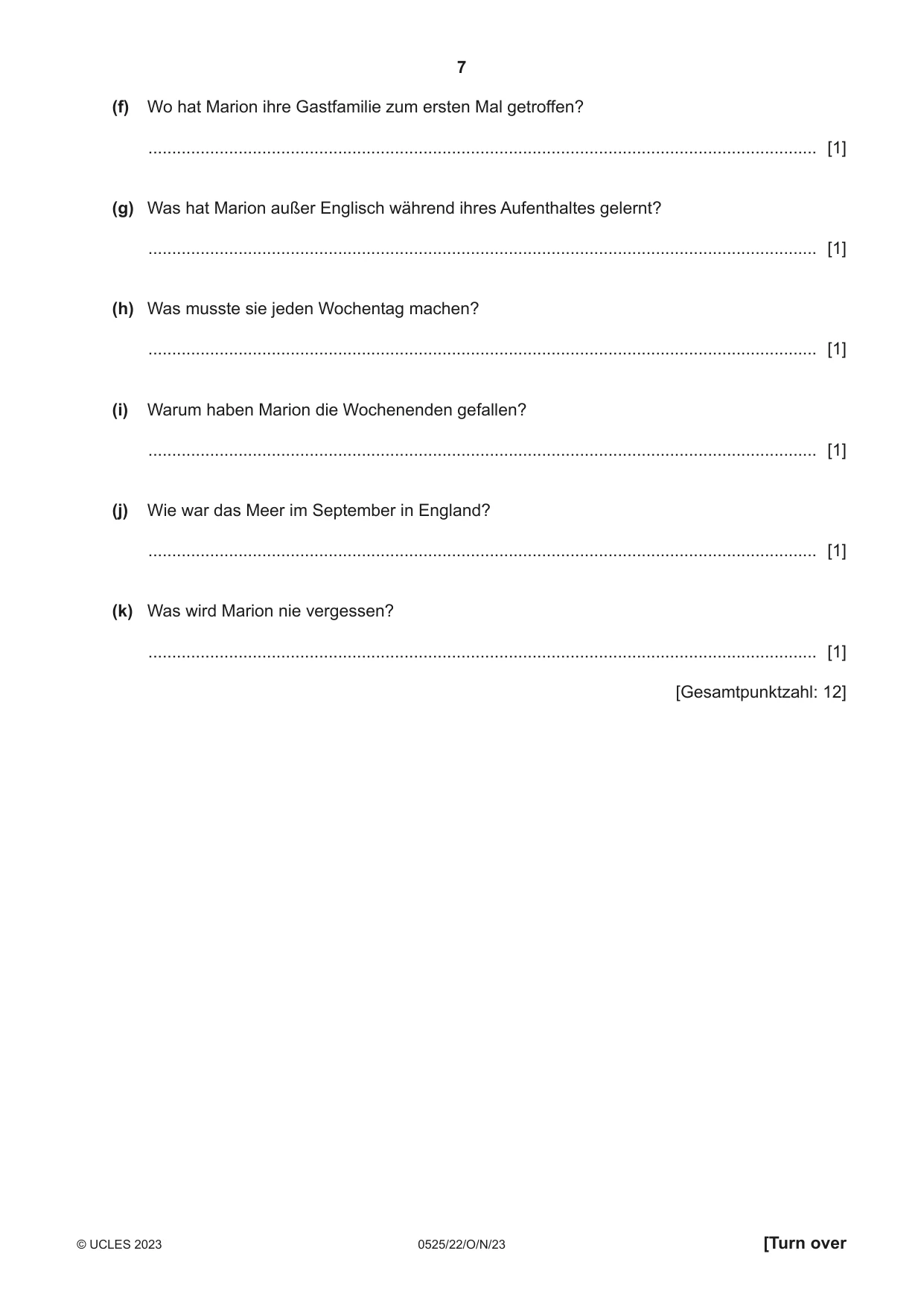
7 0525/22/O/N/23 © UCLES 2023 [Turn over (f) Wo hat Marion ihre Gastfamilie zum ersten Mal getroffen? … [1] (g) Was hat Marion außer Englisch während ihres Aufenthaltes gelernt? … [1] (h) Was musste sie jeden Wochentag machen? … [1] (i) Warum haben Marion die Wochenenden gefallen? … [1] (j) Wie war das Meer im September in England? … [1] (k) Was wird Marion nie vergessen? … [1] [Gesamtpunktzahl: 12]
Question paper, page 8
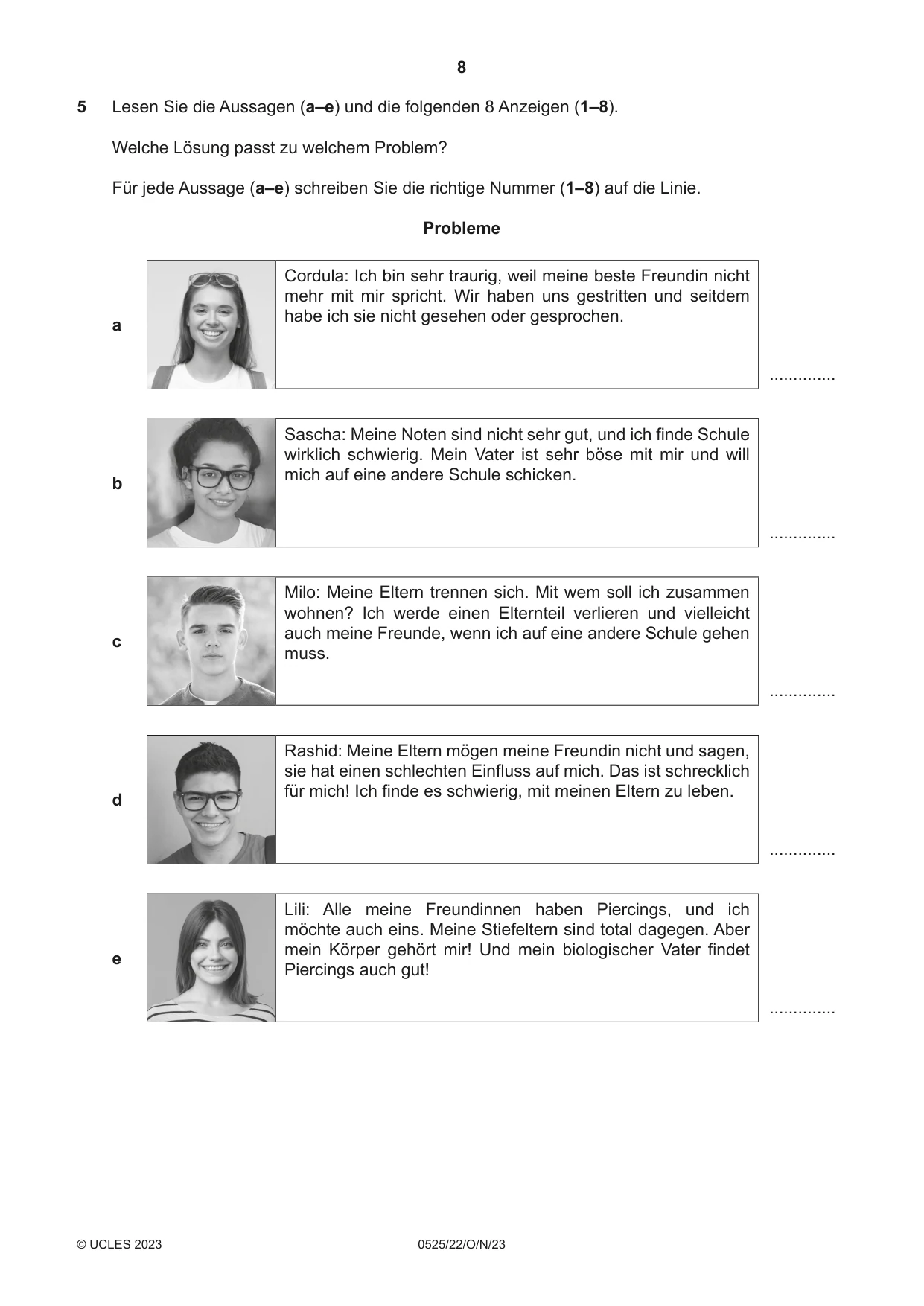
8 0525/22/O/N/23 © UCLES 2023 5 Lesen Sie die Aussagen (a–e) und die folgenden 8 Anzeigen (1–8). Welche Lösung passt zu welchem Problem? Für jede Aussage (a–e) schreiben Sie die richtige Nummer (1–8) auf die Linie. Probleme a Cordula: Ich bin sehr traurig, weil meine beste Freundin nicht mehr mit mir spricht. Wir haben uns gestritten und seitdem habe ich sie nicht gesehen oder gesprochen. … b Sascha: Meine Noten sind nicht sehr gut, und ich finde Schule wirklich schwierig. Mein Vater ist sehr böse mit mir und will mich auf eine andere Schule schicken. … c Milo: Meine Eltern trennen sich. Mit wem soll ich zusammen wohnen? Ich werde einen Elternteil verlieren und vielleicht auch meine Freunde, wenn ich auf eine andere Schule gehen muss. … d Rashid: Meine Eltern mögen meine Freundin nicht und sagen, sie hat einen schlechten Einfluss auf mich. Das ist schrecklich für mich! Ich finde es schwierig, mit meinen Eltern zu leben. … e Lili: Alle meine Freundinnen haben Piercings, und ich möchte auch eins. Meine Stiefeltern sind total dagegen. Aber mein Körper gehört mir! Und mein biologischer Vater findet Piercings auch gut! …
Question paper, page 9
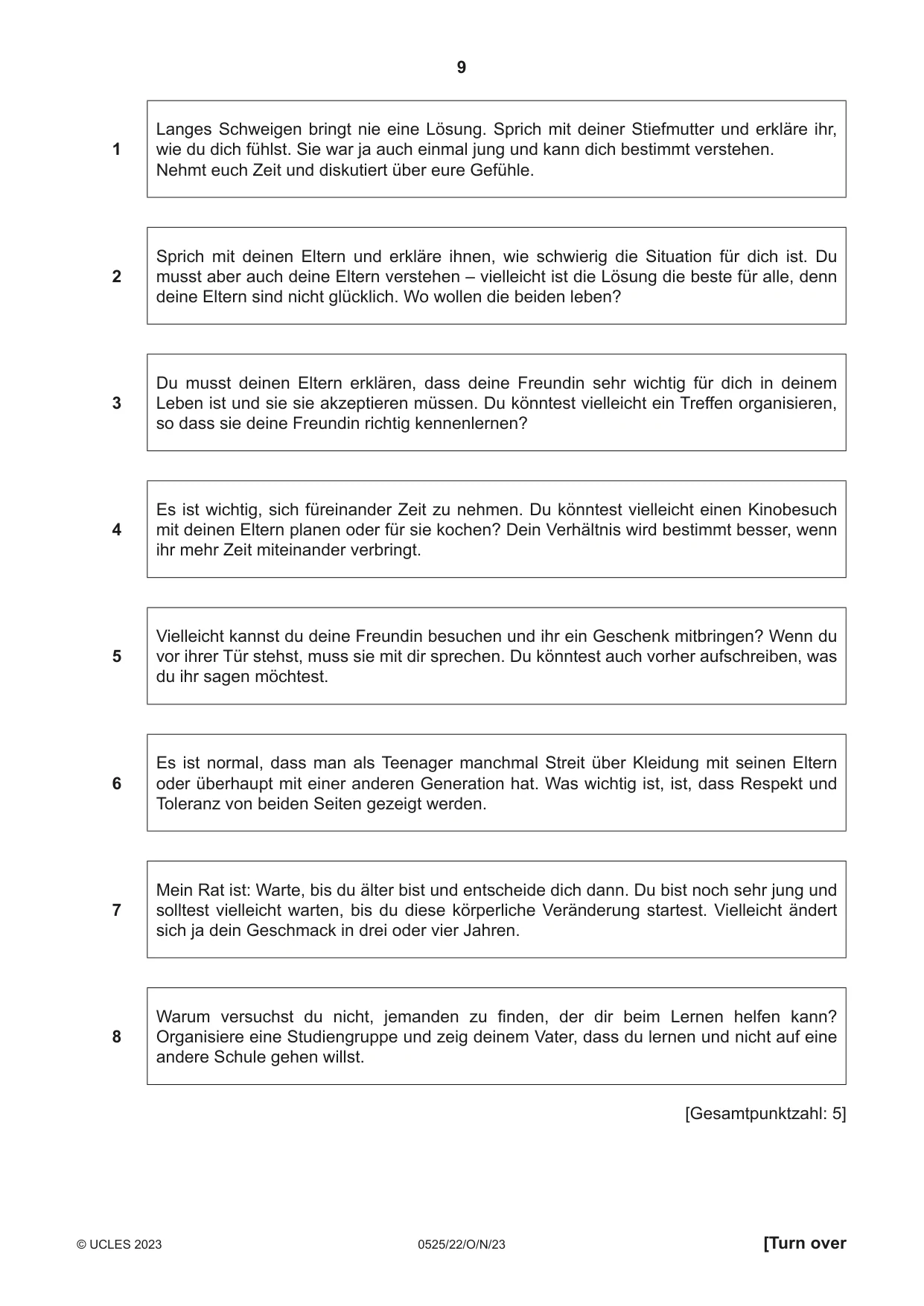
9 0525/22/O/N/23 © UCLES 2023 [Turn over 1 Langes Schweigen bringt nie eine Lösung. Sprich mit deiner Stiefmutter und erkläre ihr, wie du dich fühlst. Sie war ja auch einmal jung und kann dich bestimmt verstehen. Nehmt euch Zeit und diskutiert über eure Gefühle. 2 Sprich mit deinen Eltern und erkläre ihnen, wie schwierig die Situation für dich ist. Du musst aber auch deine Eltern verstehen – vielleicht ist die Lösung die beste für alle, denn deine Eltern sind nicht glücklich. Wo wollen die beiden leben? 3 Du musst deinen Eltern erklären, dass deine Freundin sehr wichtig für dich in deinem Leben ist und sie sie akzeptieren müssen. Du könntest vielleicht ein Treffen organisieren, so dass sie deine Freundin richtig kennenlernen? 4 Es ist wichtig, sich füreinander Zeit zu nehmen. Du könntest vielleicht einen Kinobesuch mit deinen Eltern planen oder für sie kochen? Dein Verhältnis wird bestimmt besser, wenn ihr mehr Zeit miteinander verbringt. 5 Vielleicht kannst du deine Freundin besuchen und ihr ein Geschenk mitbringen? Wenn du vor ihrer Tür stehst, muss sie mit dir sprechen. Du könntest auch vorher aufschreiben, was du ihr sagen möchtest. 6 Es ist normal, dass man als Teenager manchmal Streit über Kleidung mit seinen Eltern oder überhaupt mit einer anderen Generation hat. Was wichtig ist, ist, dass Respekt und Toleranz von beiden Seiten gezeigt werden. 7 Mein Rat ist: Warte, bis du älter bist und entscheide dich dann. Du bist noch sehr jung und solltest vielleicht warten, bis du diese körperliche Veränderung startest. Vielleicht ändert sich ja dein Geschmack in drei oder vier Jahren. 8 Warum versuchst du nicht, jemanden zu finden, der dir beim Lernen helfen kann? Organisiere eine Studiengruppe und zeig deinem Vater, dass du lernen und nicht auf eine andere Schule gehen willst. [Gesamtpunktzahl: 5]
Question paper, page 10
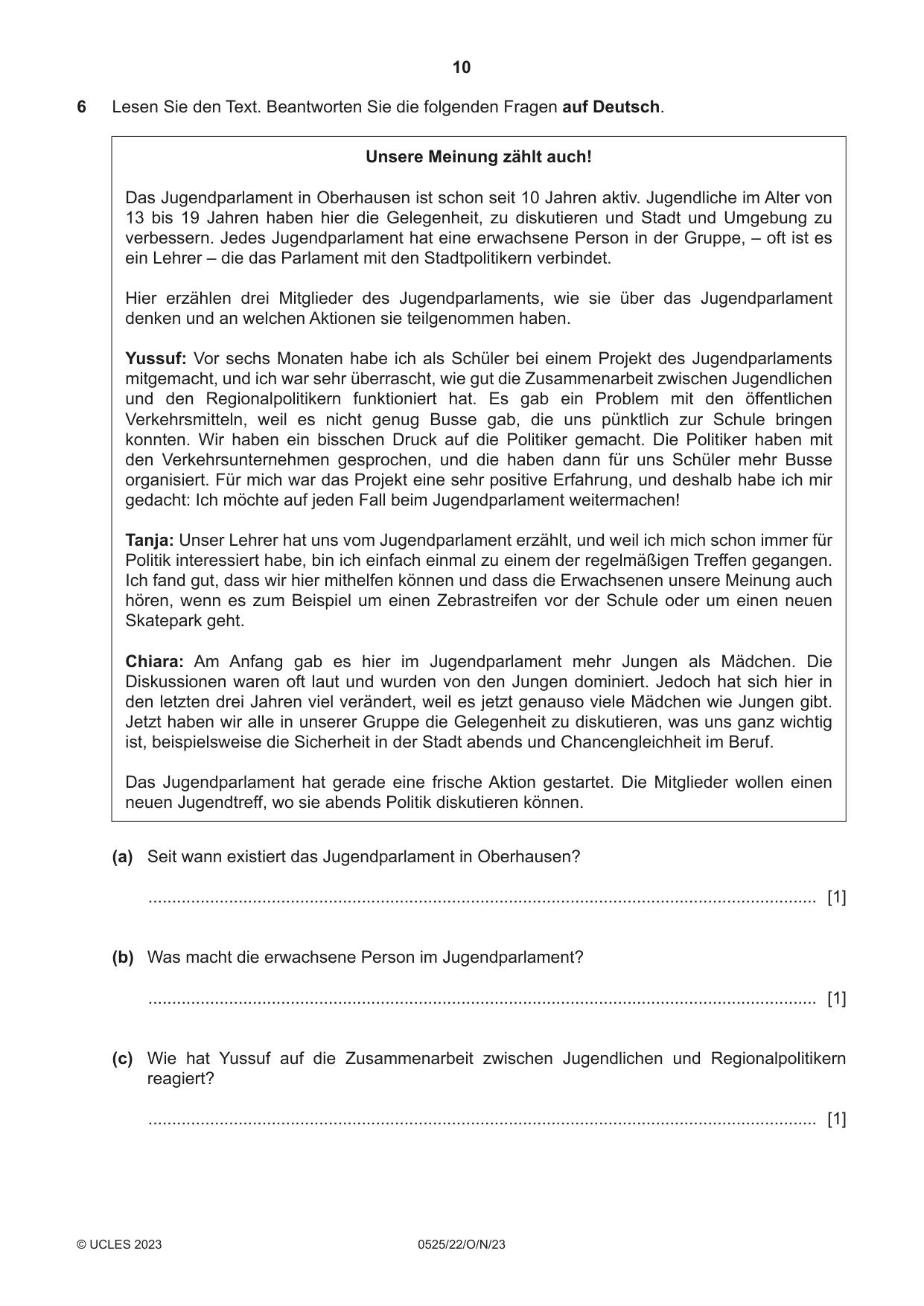
10 0525/22/O/N/23 © UCLES 2023 6 Lesen Sie den Text. Beantworten Sie die folgenden Fragen auf Deutsch. Unsere Meinung zählt auch! Das Jugendparlament in Oberhausen ist schon seit 10 Jahren aktiv. Jugendliche im Alter von 13 bis 19 Jahren haben hier die Gelegenheit, zu diskutieren und Stadt und Umgebung zu verbessern. Jedes Jugendparlament hat eine erwachsene Person in der Gruppe, – oft ist es ein Lehrer – die das Parlament mit den Stadtpolitikern verbindet. Hier erzählen drei Mitglieder des Jugendparlaments, wie sie über das Jugendparlament denken und an welchen Aktionen sie teilgenommen haben. Yussuf: Vor sechs Monaten habe ich als Schüler bei einem Projekt des Jugendparlaments mitgemacht, und ich war sehr überrascht, wie gut die Zusammenarbeit zwischen Jugendlichen und den Regionalpolitikern funktioniert hat. Es gab ein Problem mit den öffentlichen Verkehrsmitteln, weil es nicht genug Busse gab, die uns pünktlich zur Schule bringen konnten. Wir haben ein bisschen Druck auf die Politiker gemacht. Die Politiker haben mit den Verkehrsunternehmen gesprochen, und die haben dann für uns Schüler mehr Busse organisiert. Für mich war das Projekt eine sehr positive Erfahrung, und deshalb habe ich mir gedacht: Ich möchte auf jeden Fall beim Jugendparlament weitermachen! Tanja: Unser Lehrer hat uns vom Jugendparlament erzählt, und weil ich mich schon immer für Politik interessiert habe, bin ich einfach einmal zu einem der regelmäßigen Treffen gegangen. Ich fand gut, dass wir hier mithelfen können und dass die Erwachsenen unsere Meinung auch hören, wenn es zum Beispiel um einen Zebrastreifen vor der Schule oder um einen neuen Skatepark geht. Chiara: Am Anfang gab es hier im Jugendparlament mehr Jungen als Mädchen. Die Diskussionen waren oft laut und wurden von den Jungen dominiert. Jedoch hat sich hier in den letzten drei Jahren viel verändert, weil es jetzt genauso viele Mädchen wie Jungen gibt. Jetzt haben wir alle in unserer Gruppe die Gelegenheit zu diskutieren, was uns ganz wichtig ist, beispielsweise die Sicherheit in der Stadt abends und Chancengleichheit im Beruf. Das Jugendparlament hat gerade eine frische Aktion gestartet. Die Mitglieder wollen einen neuen Jugendtreff, wo sie abends Politik diskutieren können. (a) Seit wann existiert das Jugendparlament in Oberhausen? … [1] (b) Was macht die erwachsene Person im Jugendparlament? … [1] (c) Wie hat Yussuf auf die Zusammenarbeit zwischen Jugendlichen und Regionalpolitikern reagiert? … [1]
Question paper, page 11
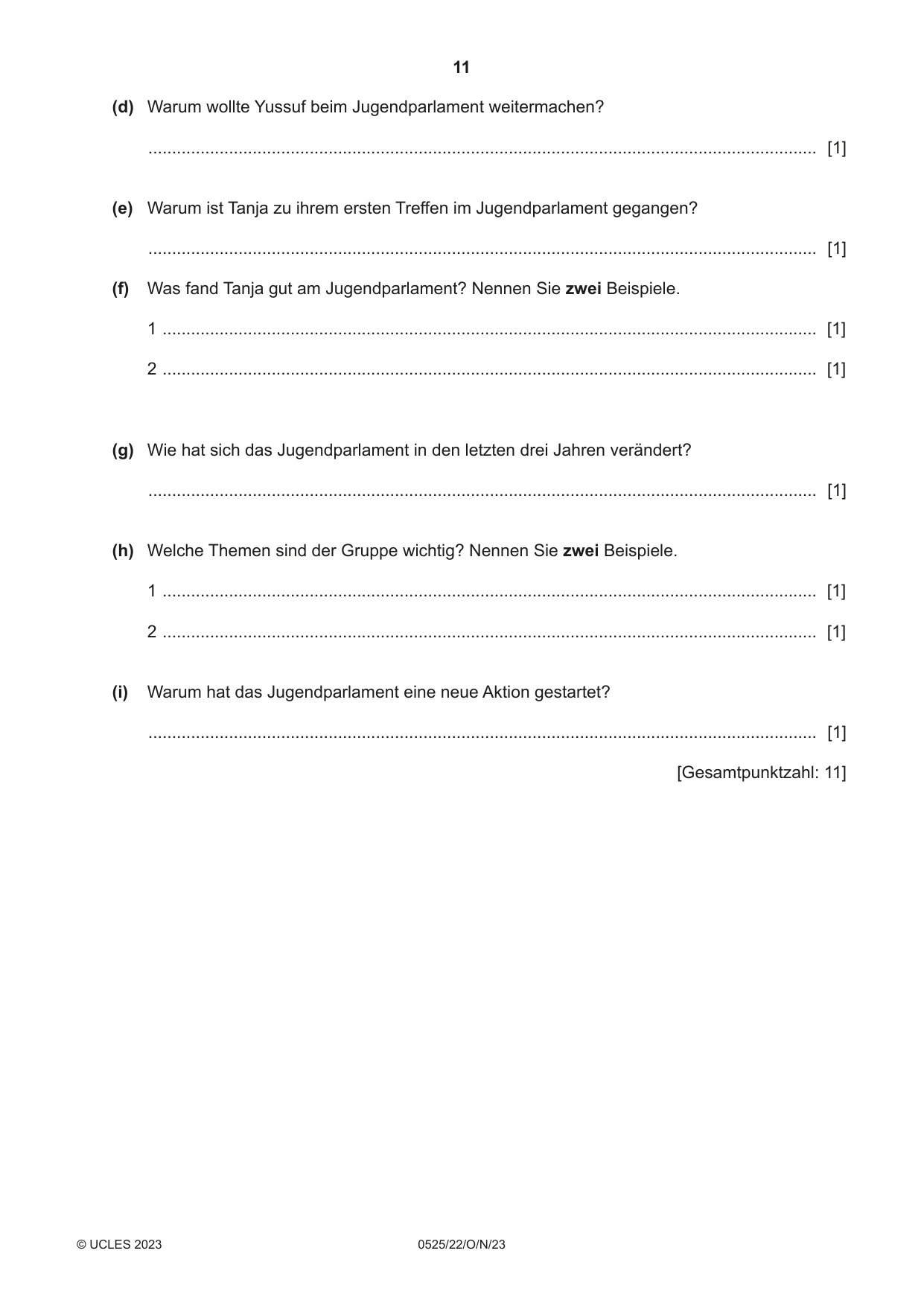
11 0525/22/O/N/23 © UCLES 2023 (d) Warum wollte Yussuf beim Jugendparlament weitermachen? … [1] (e) Warum ist Tanja zu ihrem ersten Treffen im Jugendparlament gegangen? … [1] (f) Was fand Tanja gut am Jugendparlament? Nennen Sie zwei Beispiele. 1 … [1] 2 … [1] (g) Wie hat sich das Jugendparlament in den letzten drei Jahren verändert? … [1] (h) Welche Themen sind der Gruppe wichtig? Nennen Sie zwei Beispiele. 1 … [1] 2 … [1] (i) Warum hat das Jugendparlament eine neue Aktion gestartet? … [1] [Gesamtpunktzahl: 11]
Question paper, page 12
12 0525/22/O/N/23 © UCLES 2023 Permission to reproduce items where third-party owned material protected by copyright is included has been sought and cleared where possible. Every reasonable effort has been made by the publisher (UCLES) to trace copyright holders, but if any items requiring clearance have unwittingly been included, the publisher will be pleased to make amends at the earliest possible opportunity. To avoid the issue of disclosure of answer-related information to candidates, all copyright acknowledgements are reproduced online in the Cambridge Assessment International Education Copyright Acknowledgements Booklet. This is produced for each series of examinations and is freely available to download at www.cambridgeinternational.org after the live examination series. Cambridge Assessment International Education is part of Cambridge Assessment. Cambridge Assessment is the brand name of the University of Cambridge Local Examinations Syndicate (UCLES), which is a department of the University of Cambridge. BLANK PAGE
Mark scheme, page 1
This document consists of 13 printed pages. © UCLES 2023 [Turn over Cambridge IGCSE™ GERMAN 0525/22 Paper 2 Reading October/November 2023 MARK SCHEME Maximum Mark: 45 Published This mark scheme is published as an aid to teachers and candidates, to indicate the requirements of the examination. It shows the basis on which Examiners were instructed to award marks. It does not indicate the details of the discussions that took place at an Examiners’ meeting before marking began, which would have considered the acceptability of alternative answers. Mark schemes should be read in conjunction with the question paper and the Principal Examiner Report for Teachers. Cambridge International will not enter into discussions about these mark schemes. Cambridge International is publishing the mark schemes for the October/November 2023 series for most Cambridge IGCSE, Cambridge International A and AS Level components, and some Cambridge O Level components.
Mark scheme, page 2
0525/22 Cambridge IGCSE – Mark Scheme PUBLISHED October/November 2023 © UCLES 2023 Page 2 of 13 Generic Marking Principles These general marking principles must be applied by all examiners when marking candidate answers. They should be applied alongside the specific content of the mark scheme or generic level descriptors for a question. Each question paper and mark scheme will also comply with these marking principles. GENERIC MARKING PRINCIPLE 1: Marks must be awarded in line with: • the specific content of the mark scheme or the generic level descriptors for the question • the specific skills defined in the mark scheme or in the generic level descriptors for the question • the standard of response required by a candidate as exemplified by the standardisation scripts. GENERIC MARKING PRINCIPLE 2: Marks awarded are always whole marks (not half marks, or other fractions). GENERIC MARKING PRINCIPLE 3: Marks must be awarded positively: • marks are awarded for correct/valid answers, as defined in the mark scheme. However, credit is given for valid answers which go beyond the scope of the syllabus and mark scheme, referring to your Team Leader as appropriate • marks are awarded when candidates clearly demonstrate what they know and can do • marks are not deducted for errors • marks are not deducted for omissions • answers should only be judged on the quality of spelling, punctuation and grammar when these features are specifically assessed by the question as indicated by the mark scheme. The meaning, however, should be unambiguous. GENERIC MARKING PRINCIPLE 4: Rules must be applied consistently, e.g. in situations where candidates have not followed instructions or in the application of generic level descriptors.
Mark scheme, page 3
0525/22 Cambridge IGCSE – Mark Scheme PUBLISHED October/November 2023 © UCLES 2023 Page 3 of 13 GENERIC MARKING PRINCIPLE 5: Marks should be awarded using the full range of marks defined in the mark scheme for the question (however; the use of the full mark range may be limited according to the quality of the candidate responses seen). GENERIC MARKING PRINCIPLE 6: Marks awarded are based solely on the requirements as defined in the mark scheme. Marks should not be awarded with grade thresholds or grade descriptors in mind.
Mark scheme, page 4
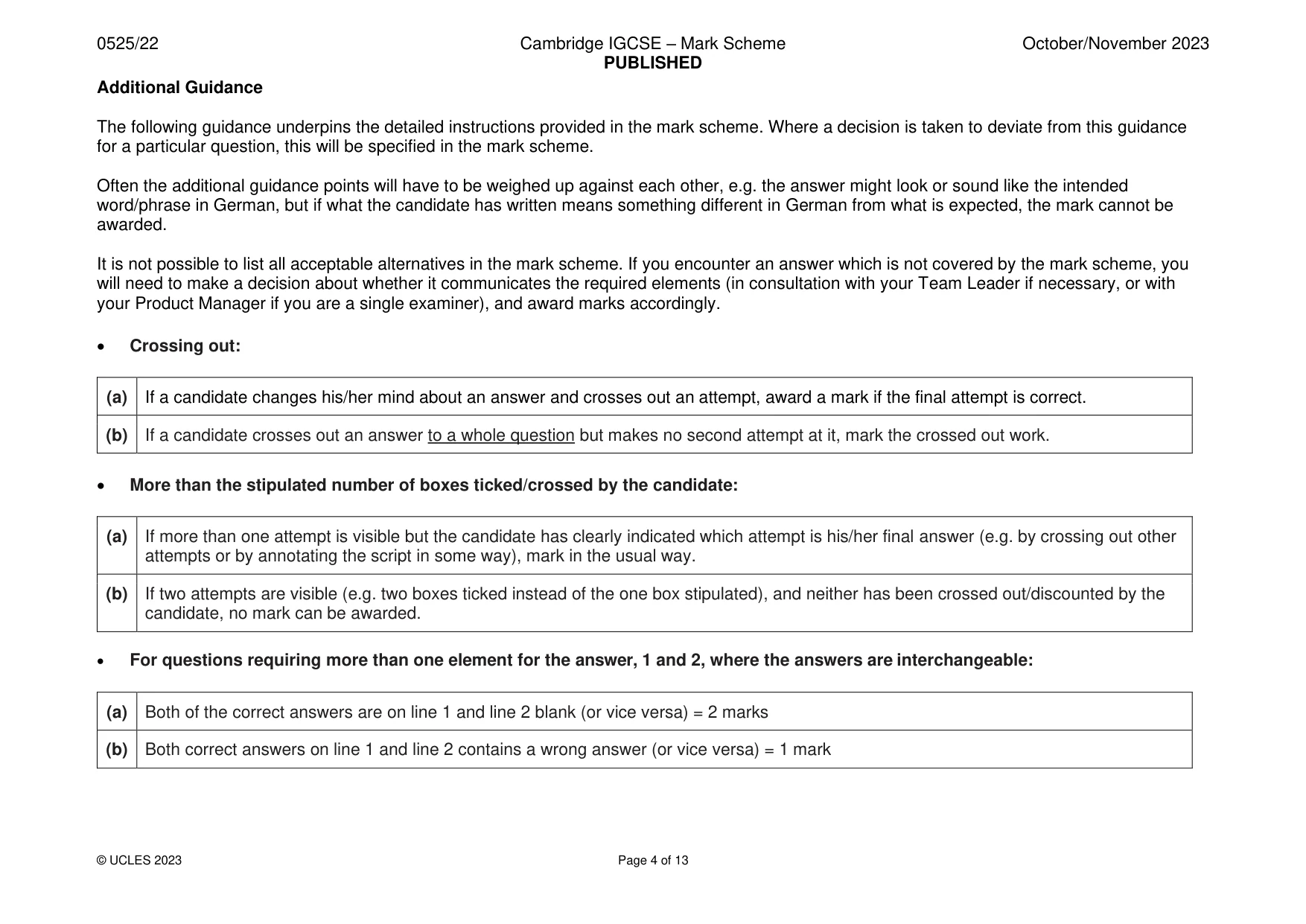
0525/22 Cambridge IGCSE – Mark Scheme PUBLISHED October/November 2023 © UCLES 2023 Page 4 of 13 Additional Guidance The following guidance underpins the detailed instructions provided in the mark scheme. Where a decision is taken to deviate from this guidance for a particular question, this will be specified in the mark scheme. Often the additional guidance points will have to be weighed up against each other, e.g. the answer might look or sound like the intended word/phrase in German, but if what the candidate has written means something different in German from what is expected, the mark cannot be awarded. It is not possible to list all acceptable alternatives in the mark scheme. If you encounter an answer which is not covered by the mark scheme, you will need to make a decision about whether it communicates the required elements (in consultation with your Team Leader if necessary, or with your Product Manager if you are a single examiner), and award marks accordingly. • Crossing out: (a) If a candidate changes his/her mind about an answer and crosses out an attempt, award a mark if the final attempt is correct. (b) If a candidate crosses out an answer to a whole question but makes no second attempt at it, mark the crossed out work. • More than the stipulated number of boxes ticked/crossed by the candidate: (a) If more than one attempt is visible but the candidate has clearly indicated which attempt is his/her final answer (e.g. by crossing out other attempts or by annotating the script in some way), mark in the usual way. (b) If two attempts are visible (e.g. two boxes ticked instead of the one box stipulated), and neither has been crossed out/discounted by the candidate, no mark can be awarded. • For questions requiring more than one element for the answer, 1 and 2, where the answers are interchangeable: (a) Both of the correct answers are on line 1 and line 2 blank (or vice versa) = 2 marks (b) Both correct answers on line 1 and line 2 contains a wrong answer (or vice versa) = 1 mark
Mark scheme, page 5
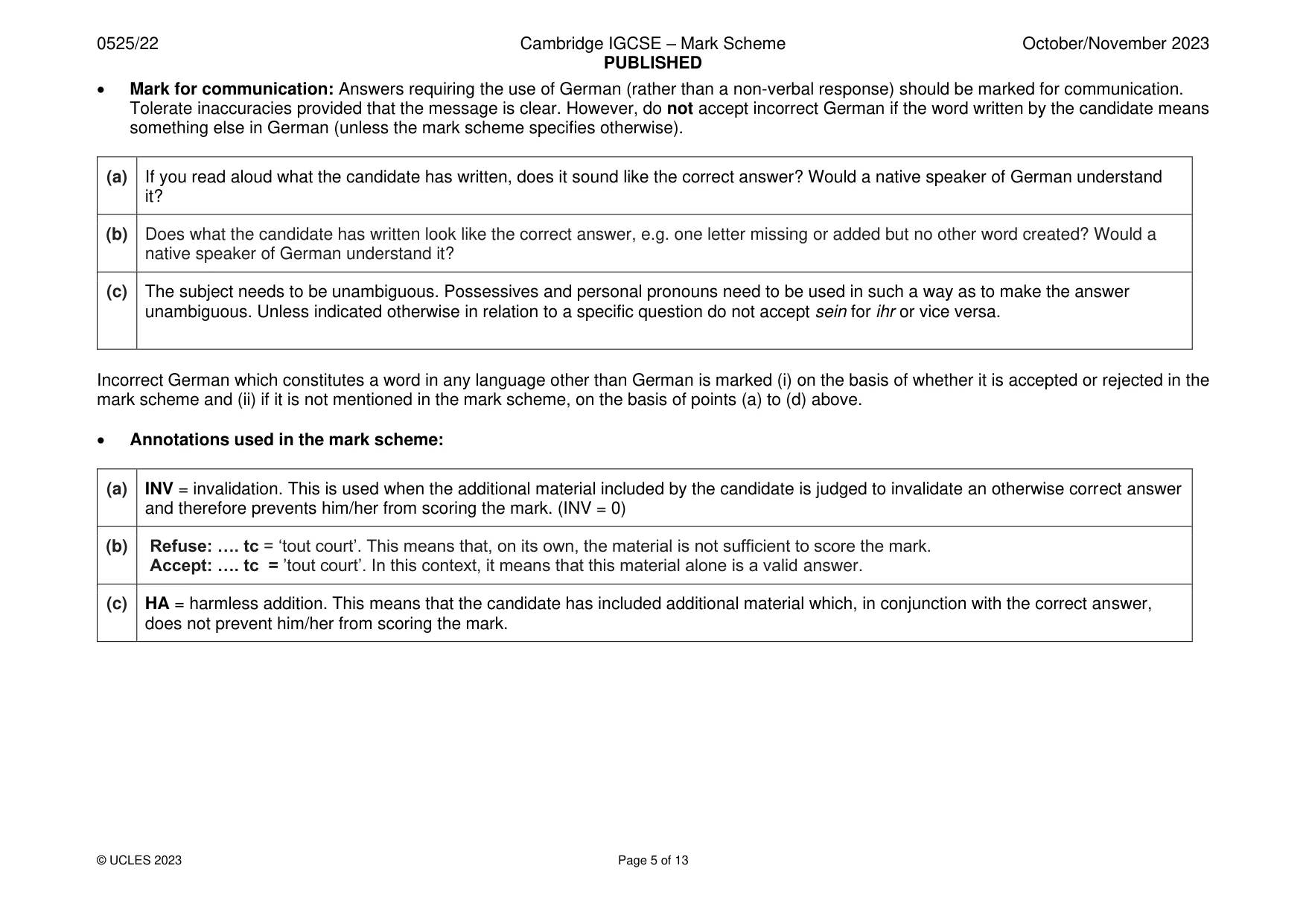
0525/22 Cambridge IGCSE – Mark Scheme PUBLISHED October/November 2023 © UCLES 2023 Page 5 of 13 • Mark for communication: Answers requiring the use of German (rather than a non-verbal response) should be marked for communication. Tolerate inaccuracies provided that the message is clear. However, do not accept incorrect German if the word written by the candidate means something else in German (unless the mark scheme specifies otherwise). (a) If you read aloud what the candidate has written, does it sound like the correct answer? Would a native speaker of German understand it? (b) Does what the candidate has written look like the correct answer, e.g. one letter missing or added but no other word created? Would a native speaker of German understand it? (c) The subject needs to be unambiguous. Possessives and personal pronouns need to be used in such a way as to make the answer unambiguous. Unless indicated otherwise in relation to a specific question do not accept sein for ihr or vice versa. Incorrect German which constitutes a word in any language other than German is marked (i) on the basis of whether it is accepted or rejected in the mark scheme and (ii) if it is not mentioned in the mark scheme, on the basis of points (a) to (d) above. • Annotations used in the mark scheme: (a) INV = invalidation. This is used when the additional material included by the candidate is judged to invalidate an otherwise correct answer and therefore prevents him/her from scoring the mark. (INV = 0) (b) Refuse: …. tc = ‘tout court’. This means that, on its own, the material is not sufficient to score the mark. Accept: …. tc = ’tout court’. In this context, it means that this material alone is a valid answer. (c) HA = harmless addition. This means that the candidate has included additional material which, in conjunction with the correct answer, does not prevent him/her from scoring the mark.
Mark scheme, page 6
0525/22 Cambridge IGCSE – Mark Scheme PUBLISHED October/November 2023 © UCLES 2023 Page 6 of 13 • No response and ‘0’ marks: (a) Award NR (no response): If there is nothing written at all in the answer space or If there is only a comment which does not in any way relate to the question being asked (e.g. ‘can’t do’ or ‘don’t know’) or If there is only a mark which isn’t an attempt at the question (e.g. a dash, a question mark). (b) Award 0: If there is any attempt that earns no credit, e.g. the candidate has copied out part or all of the question. • Extra material: Candidates need to answer the questions in such a way as to demonstrate that they have understood the text. The mark scheme cannot cover all eventualities so where specific instructions are not provided, the examiner must check the text to ensure that the correct elements which would attract the mark are not contradicted or distorted by any extra material. The following general rules should be applied: (a) Extra material, mentioned in the mark scheme, which reinforces the correct answer or in itself constitutes an alternative correct answer: This is acceptable and is not penalised. (b) Extra material which constitutes an alternative answer, but which is not explicitly mentioned in the mark scheme: The examiner needs to decide, by consulting the transcript/text and the Team Leader if necessary, whether the alternative answer constitutes: (i) an alternative correct answer, in which case this falls into category (a) and the answer should be rewarded, or (ii) an answer which on its own would be rejected, in which case this falls into category (c) and the answer should be rejected. (c) Extra material which constitutes an alternative answer specifically rejected in the mark scheme: This puts the examiner in the position of having to ‘choose’ which the intended answer is. The examiner cannot therefore be sure what the candidate has understood and the mark cannot be awarded. (d) Extra material which distorts or contradicts the correct answer: This affects communication. The examiner cannot be sure what the candidate has understood and therefore the mark cannot be awarded.
Mark scheme, page 7
0525/22 Cambridge IGCSE – Mark Scheme PUBLISHED October/November 2023 © UCLES 2023 Page 7 of 13 (e) Extra material introduced by the candidate and which does not feature in the original text: This affects communication. The examiner cannot be sure what the candidate has understood and therefore the mark cannot be awarded. It can sometimes be difficult to draw the line between what is a deduction made by an able candidate on the basis of what they have read and pure guesswork. Therefore, where a particular answer is not covered by the mark scheme, the examiner should consult the Team Leader.
Mark scheme, page 8
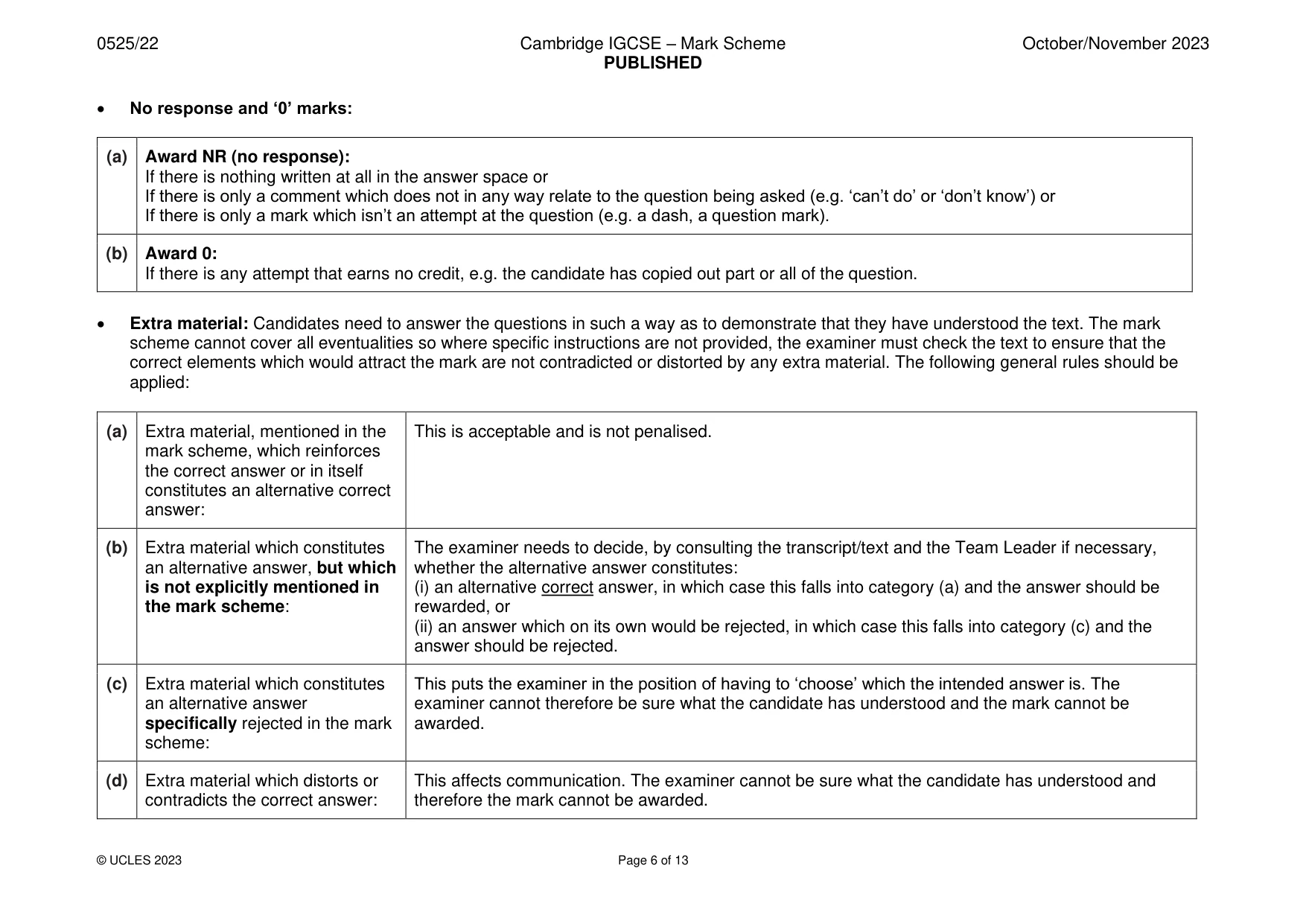
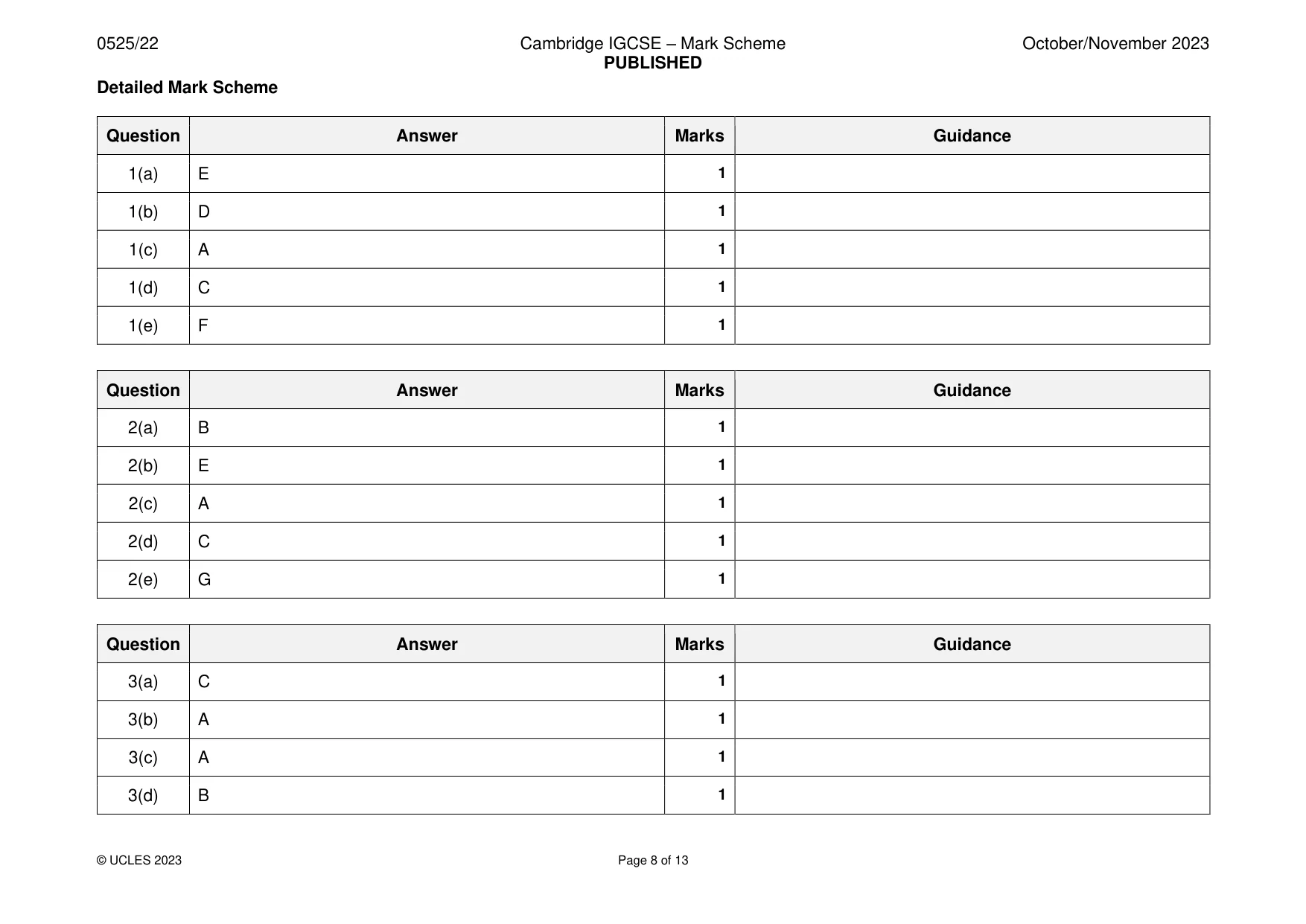
0525/22 Cambridge IGCSE – Mark Scheme PUBLISHED October/November 2023 © UCLES 2023 Page 8 of 13 Detailed Mark Scheme Question Answer Marks Guidance 1(a) E 1 1(b) D 1 1(c) A 1 1(d) C 1 1(e) F 1 Question Answer Marks Guidance 2(a) B 1 2(b) E 1 2(c) A 1 2(d) C 1 2(e) G 1 Question Answer Marks Guidance 3(a) C 1 3(b) A 1 3(c) A 1 3(d) B 1
Mark scheme, page 9
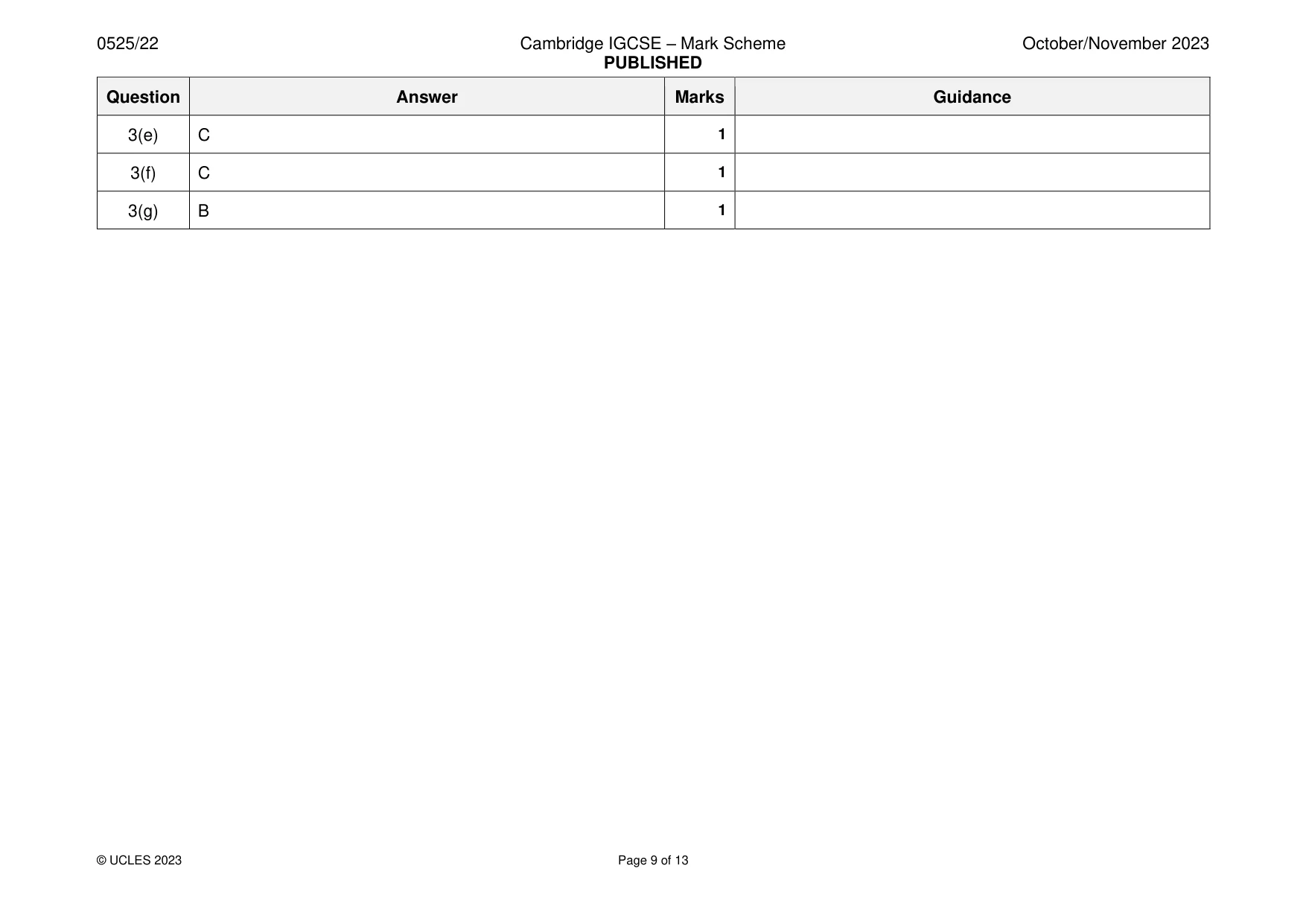
0525/22 Cambridge IGCSE – Mark Scheme PUBLISHED October/November 2023 © UCLES 2023 Page 9 of 13 Question Answer Marks Guidance 3(e) C 1 3(f) C 1 3(g) B 1
Mark scheme, page 10
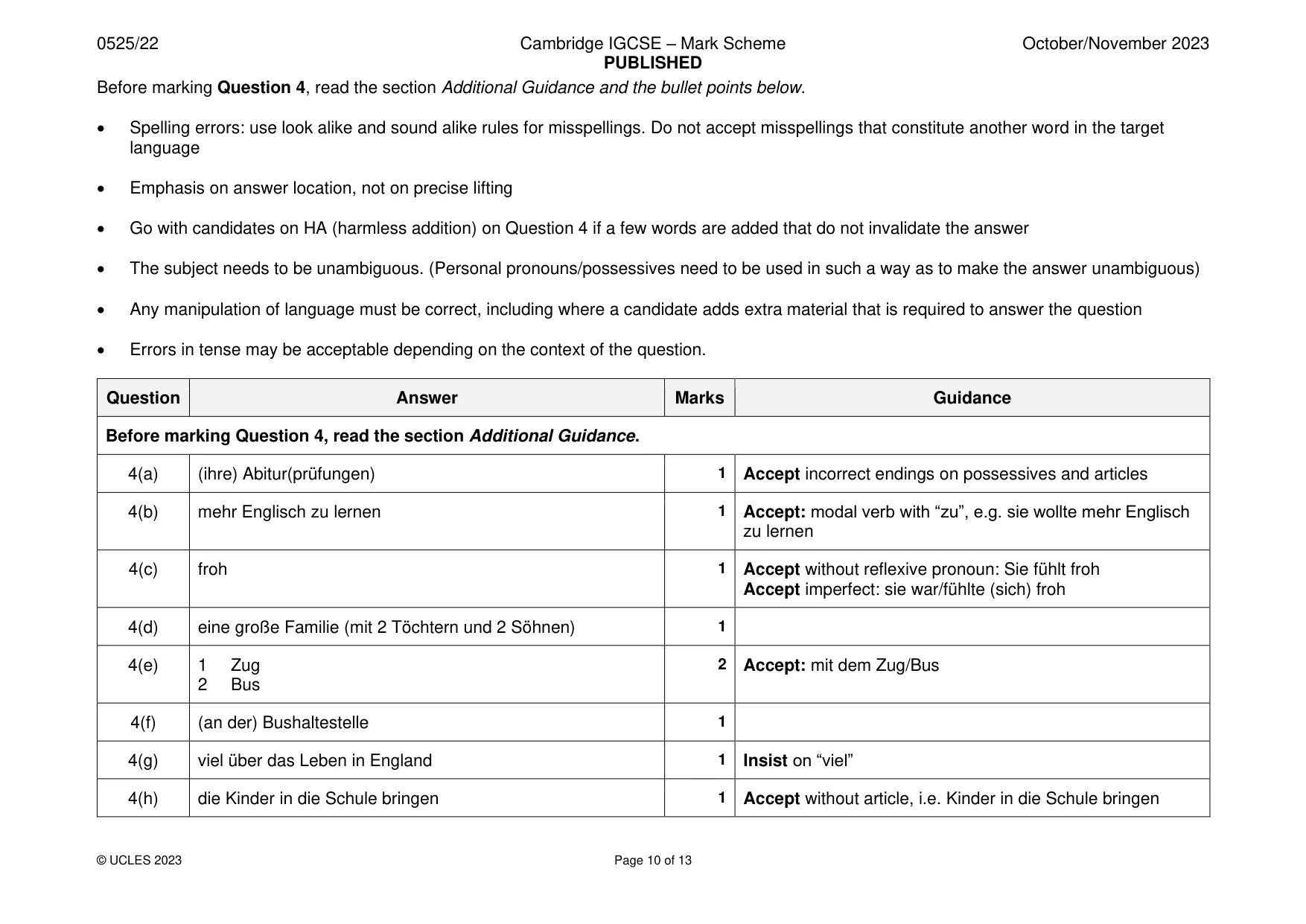
0525/22 Cambridge IGCSE – Mark Scheme PUBLISHED October/November 2023 © UCLES 2023 Page 10 of 13 Before marking Question 4, read the section Additional Guidance and the bullet points below. • Spelling errors: use look alike and sound alike rules for misspellings. Do not accept misspellings that constitute another word in the target language • Emphasis on answer location, not on precise lifting • Go with candidates on HA (harmless addition) on Question 4 if a few words are added that do not invalidate the answer • The subject needs to be unambiguous. (Personal pronouns/possessives need to be used in such a way as to make the answer unambiguous) • Any manipulation of language must be correct, including where a candidate adds extra material that is required to answer the question • Errors in tense may be acceptable depending on the context of the question. Question Answer Marks Guidance Before marking Question 4, read the section Additional Guidance. 4(a) (ihre) Abitur(prüfungen) 1 Accept incorrect endings on possessives and articles 4(b) mehr Englisch zu lernen 1 Accept: modal verb with “zu”, e.g. sie wollte mehr Englisch zu lernen 4(c) froh 1 Accept without reflexive pronoun: Sie fühlt froh Accept imperfect: sie war/fühlte (sich) froh 4(d) eine große Familie (mit 2 Töchtern und 2 Söhnen) 1 4(e) 1 Zug 2 Bus 2 Accept: mit dem Zug/Bus 4(f) (an der) Bushaltestelle 1 4(g) viel über das Leben in England 1 Insist on “viel” 4(h) die Kinder in die Schule bringen 1 Accept without article, i.e. Kinder in die Schule bringen
Mark scheme, page 11
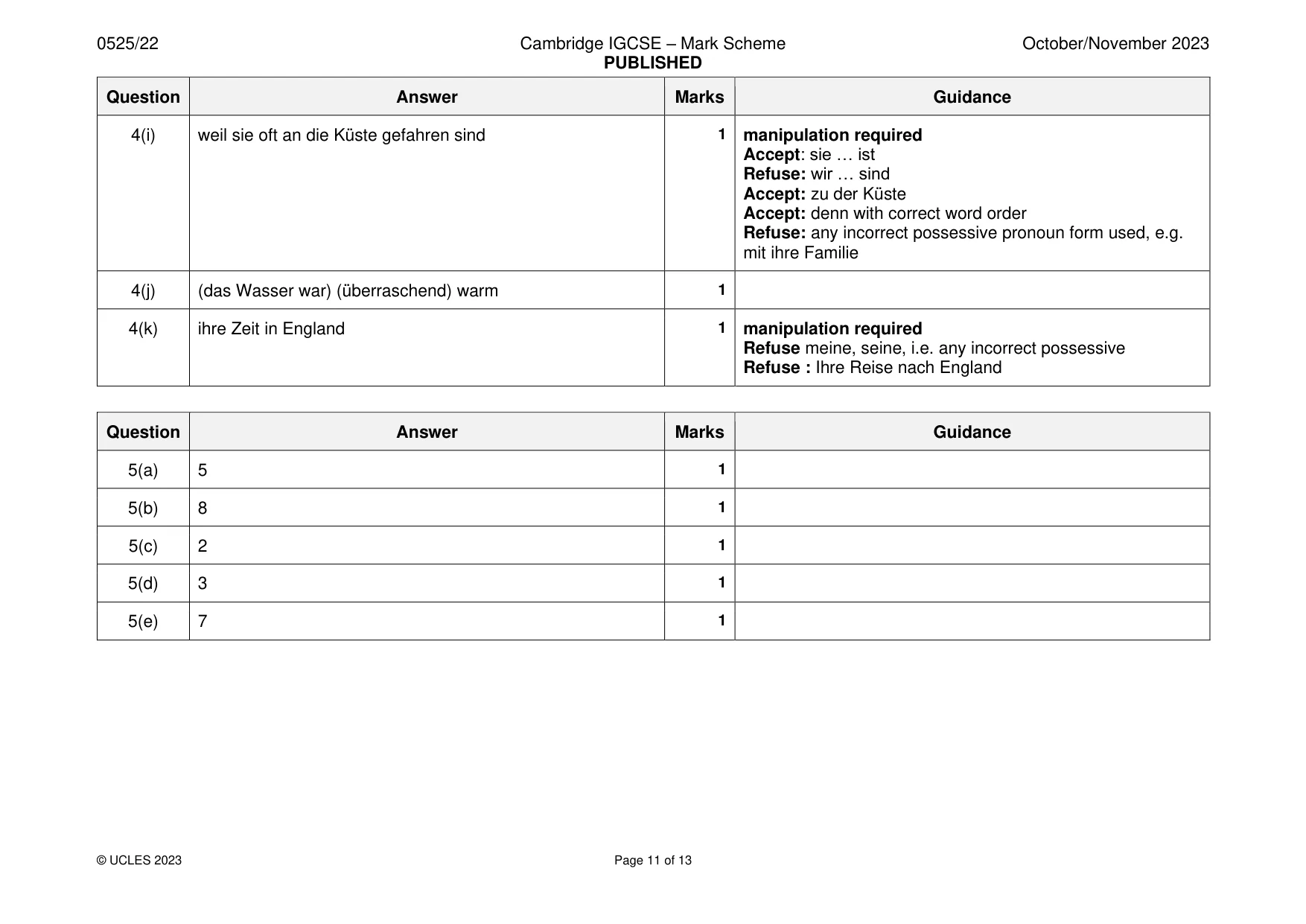
0525/22 Cambridge IGCSE – Mark Scheme PUBLISHED October/November 2023 © UCLES 2023 Page 11 of 13 Question Answer Marks Guidance 4(i) weil sie oft an die Küste gefahren sind 1 manipulation required Accept: sie … ist Refuse: wir … sind Accept: zu der Küste Accept: denn with correct word order Refuse: any incorrect possessive pronoun form used, e.g. mit ihre Familie 4(j) (das Wasser war) (überraschend) warm 1 4(k) ihre Zeit in England 1 manipulation required Refuse meine, seine, i.e. any incorrect possessive Refuse : Ihre Reise nach England Question Answer Marks Guidance 5(a) 5 1 5(b) 8 1 5(c) 2 1 5(d) 3 1 5(e) 7 1
Mark scheme, page 12
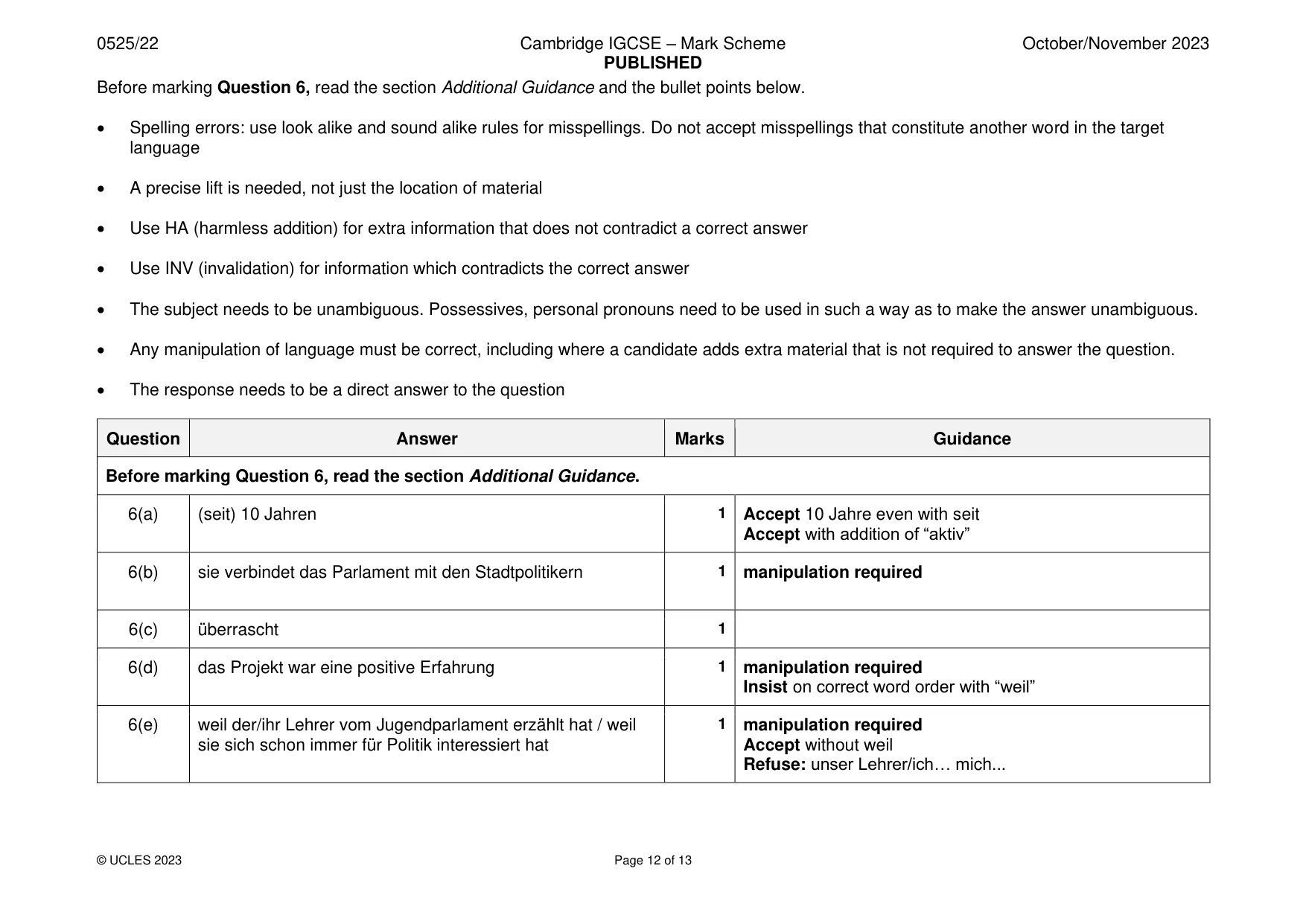
0525/22 Cambridge IGCSE – Mark Scheme PUBLISHED October/November 2023 © UCLES 2023 Page 12 of 13 Before marking Question 6, read the section Additional Guidance and the bullet points below. • Spelling errors: use look alike and sound alike rules for misspellings. Do not accept misspellings that constitute another word in the target language • A precise lift is needed, not just the location of material • Use HA (harmless addition) for extra information that does not contradict a correct answer • Use INV (invalidation) for information which contradicts the correct answer • The subject needs to be unambiguous. Possessives, personal pronouns need to be used in such a way as to make the answer unambiguous. • Any manipulation of language must be correct, including where a candidate adds extra material that is not required to answer the question. • The response needs to be a direct answer to the question Question Answer Marks Guidance Before marking Question 6, read the section Additional Guidance. 6(a) (seit) 10 Jahren 1 Accept 10 Jahre even with seit Accept with addition of “aktiv” 6(b) sie verbindet das Parlament mit den Stadtpolitikern 1 manipulation required 6(c) überrascht 1 6(d) das Projekt war eine positive Erfahrung 1 manipulation required Insist on correct word order with “weil” 6(e) weil der/ihr Lehrer vom Jugendparlament erzählt hat / weil sie sich schon immer für Politik interessiert hat 1 manipulation required Accept without weil Refuse: unser Lehrer/ich… mich...
Mark scheme, page 13
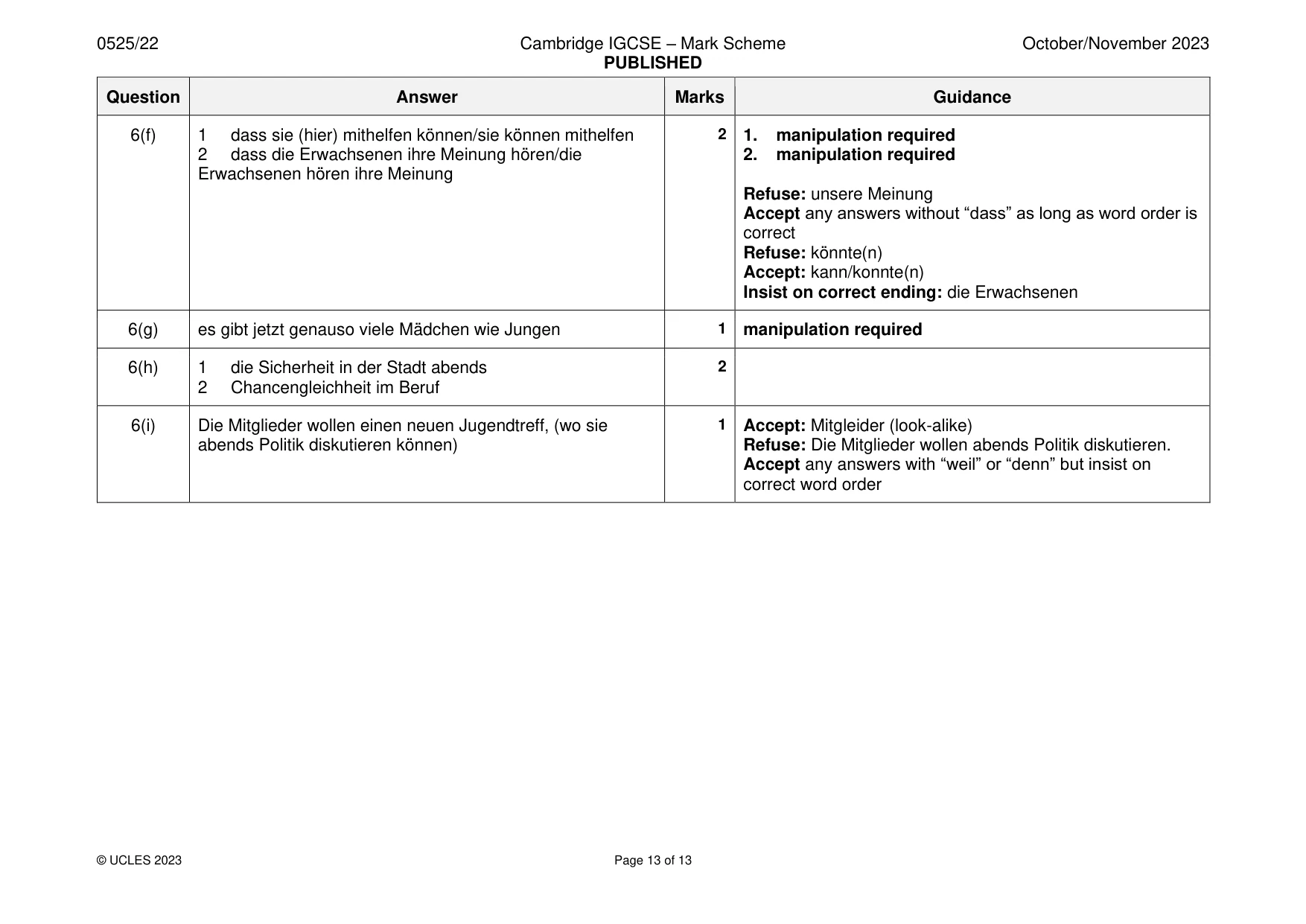
0525/22 Cambridge IGCSE – Mark Scheme PUBLISHED October/November 2023 © UCLES 2023 Page 13 of 13 Question Answer Marks Guidance 6(f) 1 dass sie (hier) mithelfen können/sie können mithelfen 2 dass die Erwachsenen ihre Meinung hören/die Erwachsenen hören ihre Meinung 2 1. manipulation required 2. manipulation required Refuse: unsere Meinung Accept any answers without “dass” as long as word order is correct Refuse: könnte(n) Accept: kann/konnte(n) Insist on correct ending: die Erwachsenen 6(g) es gibt jetzt genauso viele Mädchen wie Jungen 1 manipulation required 6(h) 1 die Sicherheit in der Stadt abends 2 Chancengleichheit im Beruf 2 6(i) Die Mitglieder wollen einen neuen Jugendtreff, (wo sie abends Politik diskutieren können) 1 Accept: Mitgleider (look-alike) Refuse: Die Mitglieder wollen abends Politik diskutieren. Accept any answers with “weil” or “denn” but insist on correct word order
What you needed in this session
Cambridge’s own grade thresholds for 2023 Oct/Nov, Paper 2 · Variant 2. A higher threshold means an easier paper — the bar moves with how the cohort did.