Cambridge IGCSE German - Foreign Language 0525 — 2024 May/June Paper 2 · Variant 2
0525/22/M/J/24 · 45 marks · ≈51 min
The question paper and its mark scheme, free to read here and free to download. This is Cambridge’s own paper, exactly as it was sat.
Question paper12 pages

Mark scheme12 pages
Answers below. Sit the paper first if you are practising.
Paper as text
Question paper, page 1
This document has 12 pages. Any blank pages are indicated. [Turn over Cambridge IGCSE™ GERMAN 0525/22 Paper 2 Reading May/June 2024 1 hour You must answer on the question paper. No additional materials are needed. INSTRUCTIONS ● Answer all questions. ● Use a black or dark blue pen. ● Write your name, centre number and candidate number in the boxes at the top of the page. ● Write your answer to each question in the space provided. ● Do not use an erasable pen or correction fluid. ● Do not write on any bar codes. ● Dictionaries are not allowed. INFORMATION ● The total mark for this paper is 45. ● The number of marks for each question or part question is shown in brackets [ ]. * 1 0 9 8 6 3 2 4 1 1 * DC (SL/CB) 331049/1 © UCLES 2024
Question paper, page 2
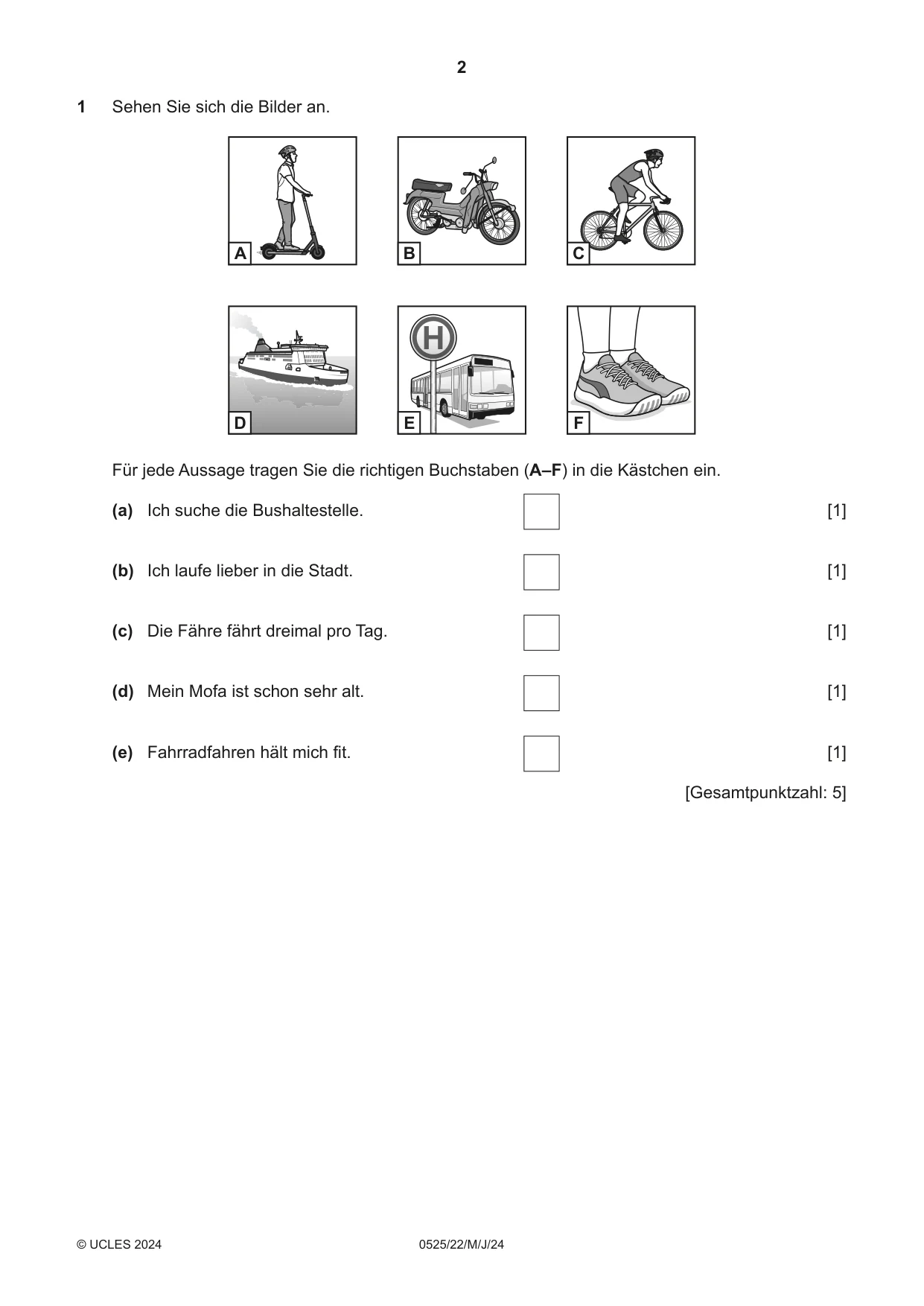
2 0525/22/ M / J /24 © UCLES 2024 1 Sehen Sie sich die Bilder an. A B C D E F Für jede Aussage tragen Sie die richtigen Buchstaben (A–F) in die Kästchen ein. (a) Ich suche die Bushaltestelle. [1] (b) Ich laufe lieber in die Stadt. [1] (c) Die Fähre fährt dreimal pro Tag. [1] (d) Mein Mofa ist schon sehr alt. [1] (e) Fahrradfahren hält mich fit. [1] [Gesamtpunktzahl: 5]
Question paper, page 3
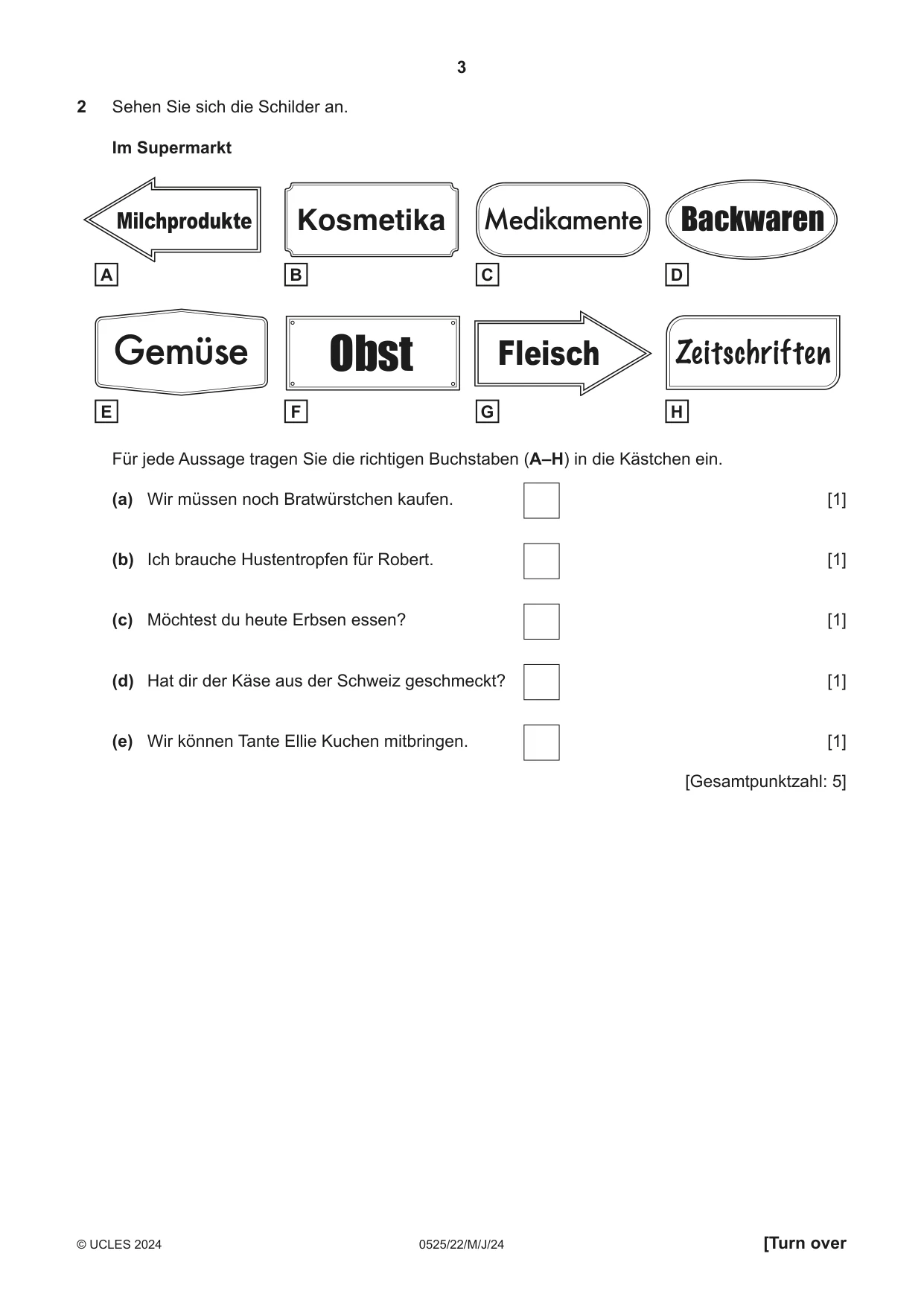
3 0525/22/M/J/24 © UCLES 2024 [Turn over 2 Sehen Sie sich die Schilder an. Im Supermarkt Gemüse Obst Fleisch Milchprodukte Kosmetika Medikamente Backwaren Zeitschriften A B C D E F G H Für jede Aussage tragen Sie die richtigen Buchstaben (A–H) in die Kästchen ein. (a) Wir müssen noch Bratwürstchen kaufen. [1] (b) Ich brauche Hustentropfen für Robert. [1] (c) Möchtest du heute Erbsen essen? [1] (d) Hat dir der Käse aus der Schweiz geschmeckt? [1] (e) Wir können Tante Ellie Kuchen mitbringen. [1] [Gesamtpunktzahl: 5]
Question paper, page 4
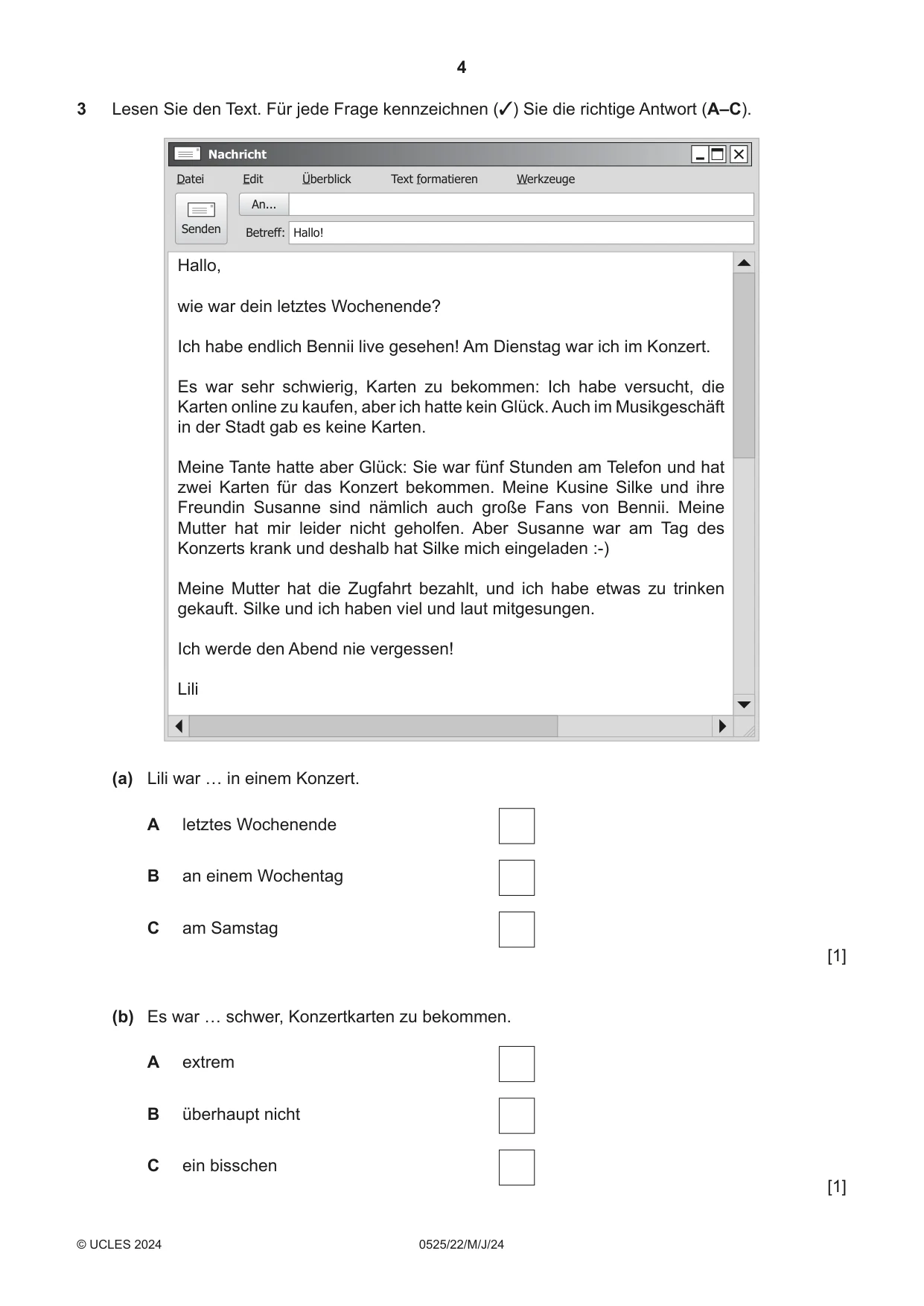
4 0525/22/M/J/24 © UCLES 2024 3 Lesen Sie den Text. Für jede Frage kennzeichnen (3) Sie die richtige Antwort (A–C). Betreff: Hallo! An... Senden Datei Edit Überblick Text formatieren Werkzeuge Nachricht Betreff: Hallo! An... Senden Datei Edit Überblick Text formatieren Werkzeuge Nachricht Hallo, wie war dein letztes Wochenende? Ich habe endlich Bennii live gesehen! Am Dienstag war ich im Konzert. Es war sehr schwierig, Karten zu bekommen: Ich habe versucht, die Karten online zu kaufen, aber ich hatte kein Glück. Auch im Musikgeschäft in der Stadt gab es keine Karten. Meine Tante hatte aber Glück: Sie war fünf Stunden am Telefon und hat zwei Karten für das Konzert bekommen. Meine Kusine Silke und ihre Freundin Susanne sind nämlich auch große Fans von Bennii. Meine Mutter hat mir leider nicht geholfen. Aber Susanne war am Tag des Konzerts krank und deshalb hat Silke mich eingeladen :-) Meine Mutter hat die Zugfahrt bezahlt, und ich habe etwas zu trinken gekauft. Silke und ich haben viel und laut mitgesungen. Ich werde den Abend nie vergessen! Lili (a) Lili war … in einem Konzert. A letztes Wochenende B an einem Wochentag C am Samstag [1] (b) Es war … schwer, Konzertkarten zu bekommen. A extrem B überhaupt nicht C ein bisschen [1]
Question paper, page 5
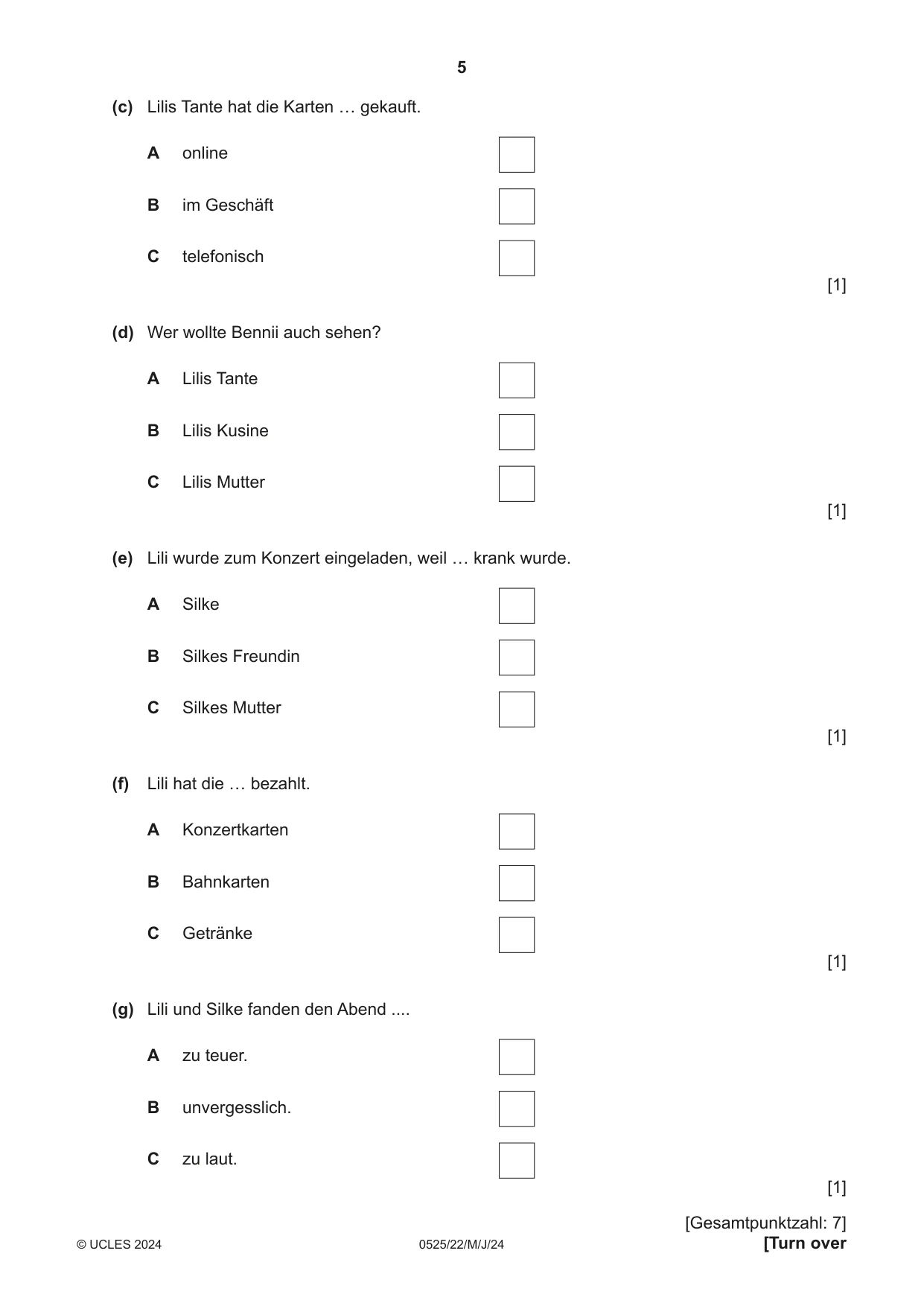
5 0525/22/M/J/24 © UCLES 2024 [Turn over (c) Lilis Tante hat die Karten … gekauft. A online B im Geschäft C telefonisch [1] (d) Wer wollte Bennii auch sehen? A Lilis Tante B Lilis Kusine C Lilis Mutter [1] (e) Lili wurde zum Konzert eingeladen, weil … krank wurde. A Silke B Silkes Freundin C Silkes Mutter [1] (f) Lili hat die … bezahlt. A Konzertkarten B Bahnkarten C Getränke [1] (g) Lili und Silke fanden den Abend … A zu teuer. B unvergesslich. C zu laut. [1] [Gesamtpunktzahl: 7]
Question paper, page 6
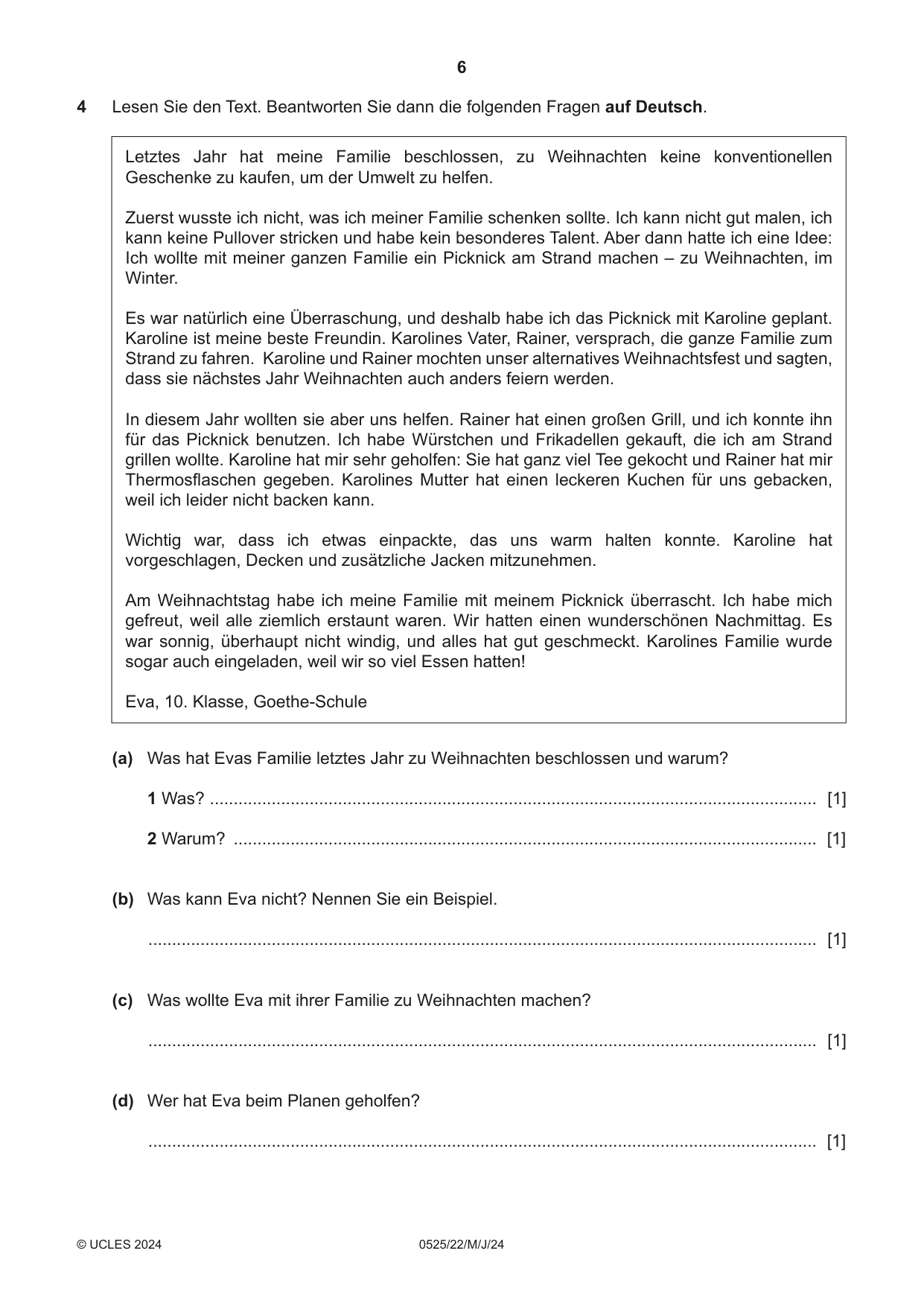
6 0525/22/M/J/24 © UCLES 2024 4 Lesen Sie den Text. Beantworten Sie dann die folgenden Fragen auf Deutsch. Letztes Jahr hat meine Familie beschlossen, zu Weihnachten keine konventionellen Geschenke zu kaufen, um der Umwelt zu helfen. Zuerst wusste ich nicht, was ich meiner Familie schenken sollte. Ich kann nicht gut malen, ich kann keine Pullover stricken und habe kein besonderes Talent. Aber dann hatte ich eine Idee: Ich wollte mit meiner ganzen Familie ein Picknick am Strand machen – zu Weihnachten, im Winter. Es war natürlich eine Überraschung, und deshalb habe ich das Picknick mit Karoline geplant. Karoline ist meine beste Freundin. Karolines Vater, Rainer, versprach, die ganze Familie zum Strand zu fahren. Karoline und Rainer mochten unser alternatives Weihnachtsfest und sagten, dass sie nächstes Jahr Weihnachten auch anders feiern werden. In diesem Jahr wollten sie aber uns helfen. Rainer hat einen großen Grill, und ich konnte ihn für das Picknick benutzen. Ich habe Würstchen und Frikadellen gekauft, die ich am Strand grillen wollte. Karoline hat mir sehr geholfen: Sie hat ganz viel Tee gekocht und Rainer hat mir Thermosflaschen gegeben. Karolines Mutter hat einen leckeren Kuchen für uns gebacken, weil ich leider nicht backen kann. Wichtig war, dass ich etwas einpackte, das uns warm halten konnte. Karoline hat vorgeschlagen, Decken und zusätzliche Jacken mitzunehmen. Am Weihnachtstag habe ich meine Familie mit meinem Picknick überrascht. Ich habe mich gefreut, weil alle ziemlich erstaunt waren. Wir hatten einen wunderschönen Nachmittag. Es war sonnig, überhaupt nicht windig, und alles hat gut geschmeckt. Karolines Familie wurde sogar auch eingeladen, weil wir so viel Essen hatten! Eva, 10. Klasse, Goethe-Schule (a) Was hat Evas Familie letztes Jahr zu Weihnachten beschlossen und warum? 1 Was? … [1] 2 Warum? … [1] (b) Was kann Eva nicht? Nennen Sie ein Beispiel. … [1] (c) Was wollte Eva mit ihrer Familie zu Weihnachten machen? … [1] (d) Wer hat Eva beim Planen geholfen? … [1]
Question paper, page 7
7 0525/22/M/J/24 © UCLES 2024 [Turn over (e) Was versprach Karolines Vater? … [1] (f) Was werden Karoline und ihr Vater im nächsten Jahr machen? … [1] (g) Was hat Eva zum Grillen gekauft? Nennen Sie ein Beispiel. … [1] (h) Was gab es zu trinken? … [1] (i) Warum hat Karolines Mutter einen Kuchen gebacken? … [1] (j) Was hat Eva eingepackt, um alle warm zu halten? Nennen Sie ein Beispiel. … [1] (k) Warum wurde Karolines Familie auch eingeladen? … [1] [Gesamtpunktzahl: 12]
Question paper, page 8
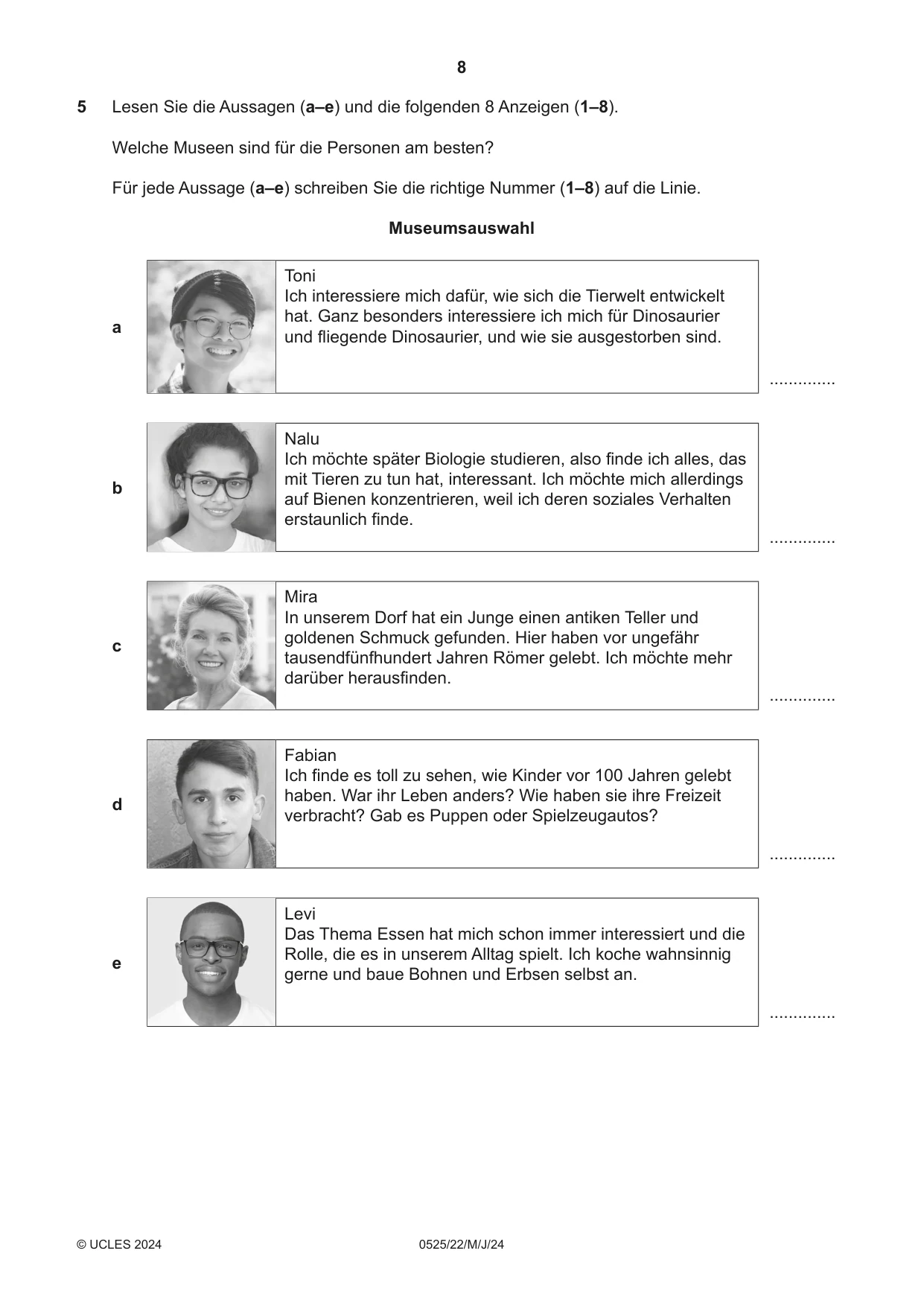
8 0525/22/M/J/24 © UCLES 2024 5 Lesen Sie die Aussagen (a–e) und die folgenden 8 Anzeigen (1–8). Welche Museen sind für die Personen am besten? Für jede Aussage (a–e) schreiben Sie die richtige Nummer (1–8) auf die Linie. Museumsauswahl a Toni Ich interessiere mich dafür, wie sich die Tierwelt entwickelt hat. Ganz besonders interessiere ich mich für Dinosaurier und fliegende Dinosaurier, und wie sie ausgestorben sind. … b Nalu Ich möchte später Biologie studieren, also finde ich alles, das mit Tieren zu tun hat, interessant. Ich möchte mich allerdings auf Bienen konzentrieren, weil ich deren soziales Verhalten erstaunlich finde. … c Mira In unserem Dorf hat ein Junge einen antiken Teller und goldenen Schmuck gefunden. Hier haben vor ungefähr tausendfünfhundert Jahren Römer gelebt. Ich möchte mehr darüber herausfinden. … d Fabian Ich finde es toll zu sehen, wie Kinder vor 100 Jahren gelebt haben. War ihr Leben anders? Wie haben sie ihre Freizeit verbracht? Gab es Puppen oder Spielzeugautos? … e Levi Das Thema Essen hat mich schon immer interessiert und die Rolle, die es in unserem Alltag spielt. Ich koche wahnsinnig gerne und baue Bohnen und Erbsen selbst an. …
Question paper, page 9
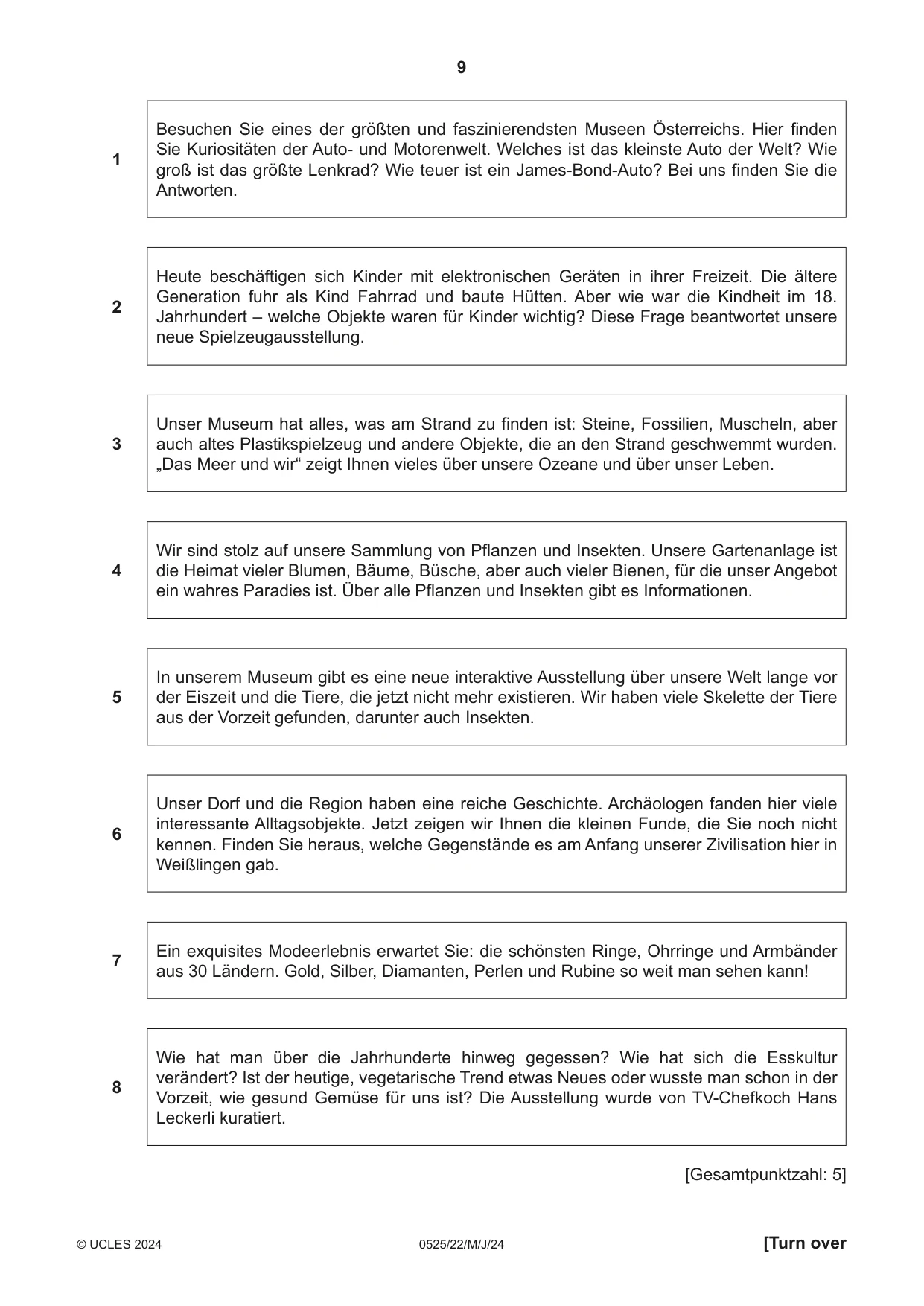
9 0525/22/M/J/24 © UCLES 2024 [Turn over 1 Besuchen Sie eines der größten und faszinierendsten Museen Österreichs. Hier finden Sie Kuriositäten der Auto- und Motorenwelt. Welches ist das kleinste Auto der Welt? Wie groß ist das größte Lenkrad? Wie teuer ist ein James-Bond-Auto? Bei uns finden Sie die Antworten. 2 Heute beschäftigen sich Kinder mit elektronischen Geräten in ihrer Freizeit. Die ältere Generation fuhr als Kind Fahrrad und baute Hütten. Aber wie war die Kindheit im 18. Jahrhundert – welche Objekte waren für Kinder wichtig? Diese Frage beantwortet unsere neue Spielzeugausstellung. 3 Unser Museum hat alles, was am Strand zu finden ist: Steine, Fossilien, Muscheln, aber auch altes Plastikspielzeug und andere Objekte, die an den Strand geschwemmt wurden. „Das Meer und wir“ zeigt Ihnen vieles über unsere Ozeane und über unser Leben. 4 Wir sind stolz auf unsere Sammlung von Pflanzen und Insekten. Unsere Gartenanlage ist die Heimat vieler Blumen, Bäume, Büsche, aber auch vieler Bienen, für die unser Angebot ein wahres Paradies ist. Über alle Pflanzen und Insekten gibt es Informationen. 5 In unserem Museum gibt es eine neue interaktive Ausstellung über unsere Welt lange vor der Eiszeit und die Tiere, die jetzt nicht mehr existieren. Wir haben viele Skelette der Tiere aus der Vorzeit gefunden, darunter auch Insekten. 6 Unser Dorf und die Region haben eine reiche Geschichte. Archäologen fanden hier viele interessante Alltagsobjekte. Jetzt zeigen wir Ihnen die kleinen Funde, die Sie noch nicht kennen. Finden Sie heraus, welche Gegenstände es am Anfang unserer Zivilisation hier in Weißlingen gab. 7 Ein exquisites Modeerlebnis erwartet Sie: die schönsten Ringe, Ohrringe und Armbänder aus 30 Ländern. Gold, Silber, Diamanten, Perlen und Rubine so weit man sehen kann! 8 Wie hat man über die Jahrhunderte hinweg gegessen? Wie hat sich die Esskultur verändert? Ist der heutige, vegetarische Trend etwas Neues oder wusste man schon in der Vorzeit, wie gesund Gemüse für uns ist? Die Ausstellung wurde von TV-Chefkoch Hans Leckerli kuratiert. [Gesamtpunktzahl: 5]
Question paper, page 10
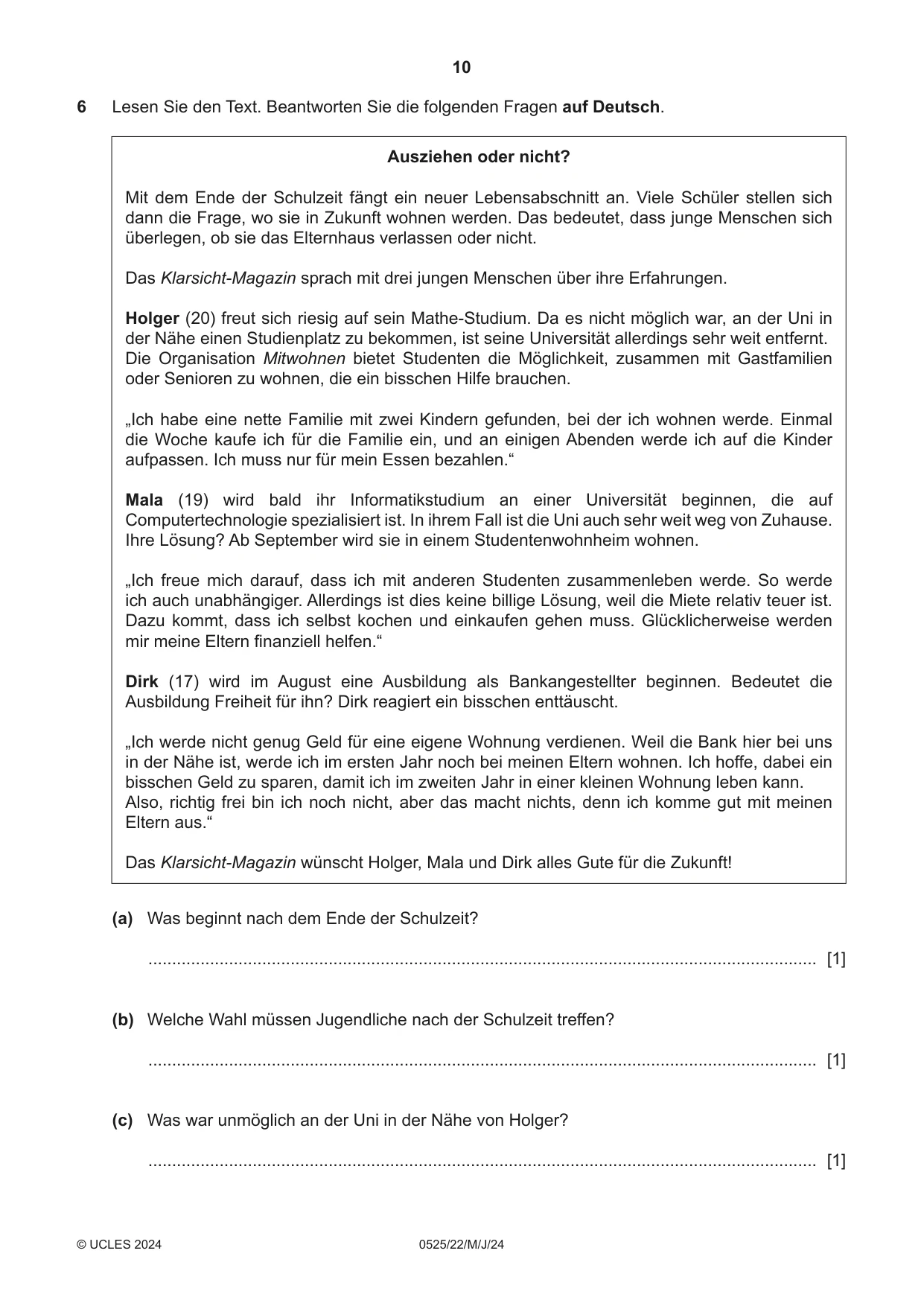
10 0525/22/M/J/24 © UCLES 2024 6 Lesen Sie den Text. Beantworten Sie die folgenden Fragen auf Deutsch. Ausziehen oder nicht? Mit dem Ende der Schulzeit fängt ein neuer Lebensabschnitt an. Viele Schüler stellen sich dann die Frage, wo sie in Zukunft wohnen werden. Das bedeutet, dass junge Menschen sich überlegen, ob sie das Elternhaus verlassen oder nicht. Das Klarsicht-Magazin sprach mit drei jungen Menschen über ihre Erfahrungen. Holger (20) freut sich riesig auf sein Mathe-Studium. Da es nicht möglich war, an der Uni in der Nähe einen Studienplatz zu bekommen, ist seine Universität allerdings sehr weit entfernt. Die Organisation Mitwohnen bietet Studenten die Möglichkeit, zusammen mit Gastfamilien oder Senioren zu wohnen, die ein bisschen Hilfe brauchen. „Ich habe eine nette Familie mit zwei Kindern gefunden, bei der ich wohnen werde. Einmal die Woche kaufe ich für die Familie ein, und an einigen Abenden werde ich auf die Kinder aufpassen. Ich muss nur für mein Essen bezahlen.“ Mala (19) wird bald ihr Informatikstudium an einer Universität beginnen, die auf Computertechnologie spezialisiert ist. In ihrem Fall ist die Uni auch sehr weit weg von Zuhause. Ihre Lösung? Ab September wird sie in einem Studentenwohnheim wohnen. „Ich freue mich darauf, dass ich mit anderen Studenten zusammenleben werde. So werde ich auch unabhängiger. Allerdings ist dies keine billige Lösung, weil die Miete relativ teuer ist. Dazu kommt, dass ich selbst kochen und einkaufen gehen muss. Glücklicherweise werden mir meine Eltern finanziell helfen.“ Dirk (17) wird im August eine Ausbildung als Bankangestellter beginnen. Bedeutet die Ausbildung Freiheit für ihn? Dirk reagiert ein bisschen enttäuscht. „Ich werde nicht genug Geld für eine eigene Wohnung verdienen. Weil die Bank hier bei uns in der Nähe ist, werde ich im ersten Jahr noch bei meinen Eltern wohnen. Ich hoffe, dabei ein bisschen Geld zu sparen, damit ich im zweiten Jahr in einer kleinen Wohnung leben kann. Also, richtig frei bin ich noch nicht, aber das macht nichts, denn ich komme gut mit meinen Eltern aus.“ Das Klarsicht-Magazin wünscht Holger, Mala und Dirk alles Gute für die Zukunft! (a) Was beginnt nach dem Ende der Schulzeit? … [1] (b) Welche Wahl müssen Jugendliche nach der Schulzeit treffen? … [1] (c) Was war unmöglich an der Uni in der Nähe von Holger? … [1]
Question paper, page 11
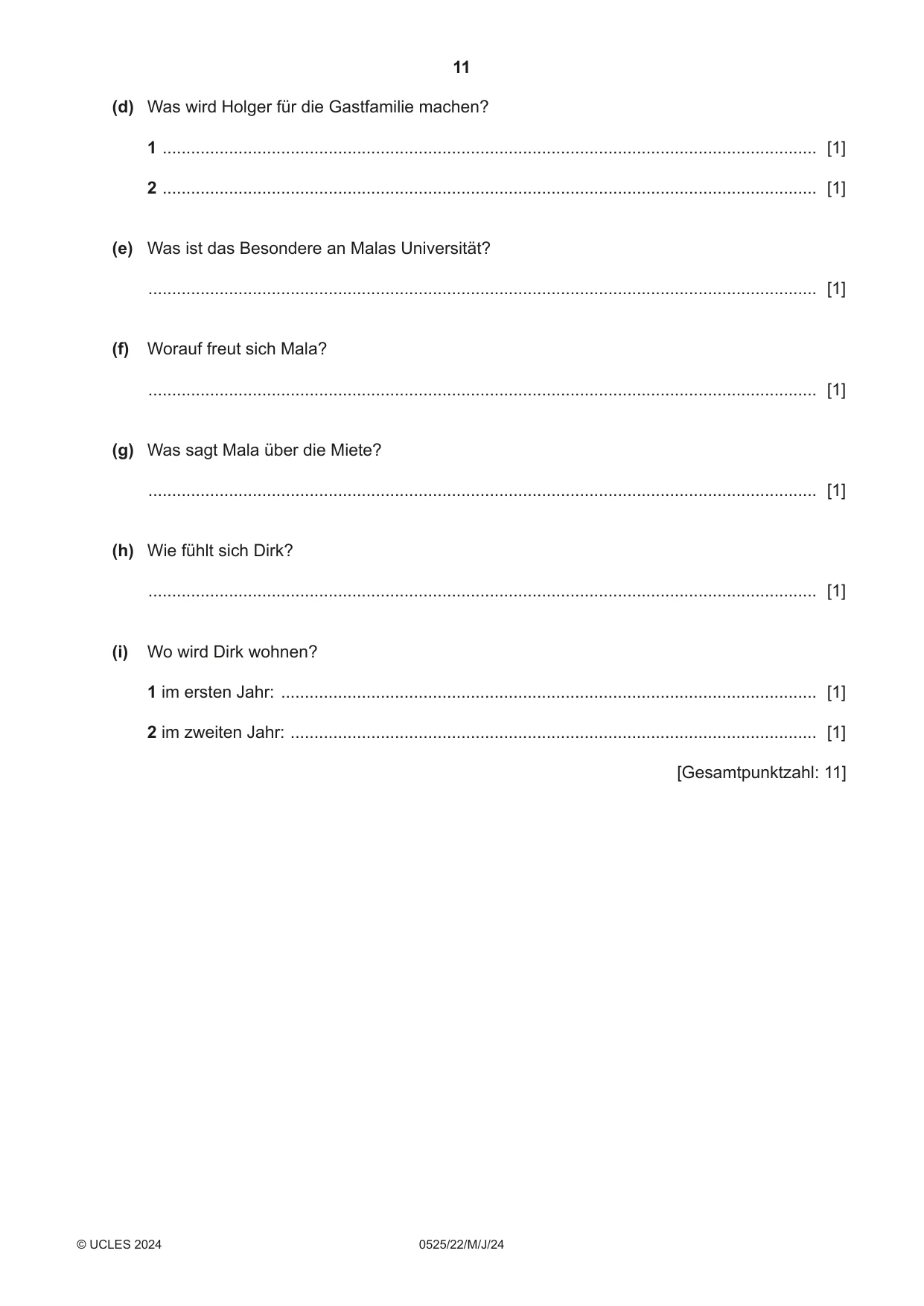
11 0525/22/M/J/24 © UCLES 2024 (d) Was wird Holger für die Gastfamilie machen? 1 … [1] 2 … [1] (e) Was ist das Besondere an Malas Universität? … [1] (f) Worauf freut sich Mala? … [1] (g) Was sagt Mala über die Miete? … [1] (h) Wie fühlt sich Dirk? … [1] (i) Wo wird Dirk wohnen? 1 im ersten Jahr: … [1] 2 im zweiten Jahr: … [1] [Gesamtpunktzahl: 11]
Question paper, page 12
12 0525/22/M/J/24 © UCLES 2024 Permission to reproduce items where third-party owned material protected by copyright is included has been sought and cleared where possible. Every reasonable effort has been made by the publisher (UCLES) to trace copyright holders, but if any items requiring clearance have unwittingly been included, the publisher will be pleased to make amends at the earliest possible opportunity. To avoid the issue of disclosure of answer-related information to candidates, all copyright acknowledgements are reproduced online in the Cambridge Assessment International Education Copyright Acknowledgements Booklet. This is produced for each series of examinations and is freely available to download at www.cambridgeinternational.org after the live examination series. Cambridge Assessment International Education is part of Cambridge Assessment. Cambridge Assessment is the brand name of the University of Cambridge Local Examinations Syndicate (UCLES), which is a department of the University of Cambridge. BLANK PAGE
Mark scheme, page 1
This document consists of 12 printed pages. © Cambridge University Press & Assessment 2024 [Turn over Cambridge IGCSE™ GERMAN 0525/22 Paper 2 Reading May/June 2024 MARK SCHEME Maximum Mark: 45 Published This mark scheme is published as an aid to teachers and candidates, to indicate the requirements of the examination. It shows the basis on which Examiners were instructed to award marks. It does not indicate the details of the discussions that took place at an Examiners’ meeting before marking began, which would have considered the acceptability of alternative answers. Mark schemes should be read in conjunction with the question paper and the Principal Examiner Report for Teachers. Cambridge International will not enter into discussions about these mark schemes. Cambridge International is publishing the mark schemes for the May/June 2024 series for most Cambridge IGCSE, Cambridge International A and AS Level and Cambridge Pre-U components, and some Cambridge O Level components.
Mark scheme, page 2
0525/22 Cambridge IGCSE – Mark Scheme PUBLISHED May/June 2024 © Cambridge University Press & Assessment 2024 Page 2 of 12 Generic Marking Principles These general marking principles must be applied by all examiners when marking candidate answers. They should be applied alongside the specific content of the mark scheme or generic level descriptions for a question. Each question paper and mark scheme will also comply with these marking principles. GENERIC MARKING PRINCIPLE 1: Marks must be awarded in line with: the specific content of the mark scheme or the generic level descriptors for the question the specific skills defined in the mark scheme or in the generic level descriptors for the question the standard of response required by a candidate as exemplified by the standardisation scripts. GENERIC MARKING PRINCIPLE 2: Marks awarded are always whole marks (not half marks, or other fractions). GENERIC MARKING PRINCIPLE 3: Marks must be awarded positively: marks are awarded for correct/valid answers, as defined in the mark scheme. However, credit is given for valid answers which go beyond the scope of the syllabus and mark scheme, referring to your Team Leader as appropriate marks are awarded when candidates clearly demonstrate what they know and can do marks are not deducted for errors marks are not deducted for omissions answers should only be judged on the quality of spelling, punctuation and grammar when these features are specifically assessed by the question as indicated by the mark scheme. The meaning, however, should be unambiguous. GENERIC MARKING PRINCIPLE 4: Rules must be applied consistently, e.g. in situations where candidates have not followed instructions or in the application of generic level descriptors.
Mark scheme, page 3
0525/22 Cambridge IGCSE – Mark Scheme PUBLISHED May/June 2024 © Cambridge University Press & Assessment 2024 Page 3 of 12 GENERIC MARKING PRINCIPLE 5: Marks should be awarded using the full range of marks defined in the mark scheme for the question (however; the use of the full mark range may be limited according to the quality of the candidate responses seen). GENERIC MARKING PRINCIPLE 6: Marks awarded are based solely on the requirements as defined in the mark scheme. Marks should not be awarded with grade thresholds or grade descriptors in mind.
Mark scheme, page 4
0525/22 Cambridge IGCSE – Mark Scheme PUBLISHED May/June 2024 © Cambridge University Press & Assessment 2024 Page 4 of 12 Additional Guidance The following guidance underpins the detailed instructions provided in the mark scheme. Where a decision is taken to deviate from this guidance for a particular question, this will be specified in the mark scheme. Often the additional guidance points will have to be weighed up against each other, e.g. the answer might look or sound like the intended word / phrase in German, but if what the candidate has written means something different in German from what is expected, the mark cannot be awarded. It is not possible to list all acceptable alternatives in the mark scheme. If you encounter an answer which is not covered by the mark scheme, you will need to make a decision about whether it communicates the required elements (in consultation with your Team Leader if necessary, or with your Product Manager if you are a single examiner), and award marks accordingly. Crossing out: (a) If a candidate changes his/her mind about an answer and crosses out an attempt, award a mark if the final attempt is correct. (b) If a candidate crosses out an answer to a whole question but makes no second attempt at it, mark the crossed-out work. More than the stipulated number of boxes ticked/crossed by the candidate: (a) If more than one attempt is visible but the candidate has clearly indicated which attempt is his/her final answer (e.g. by crossing out other attempts or by annotating the script in some way), mark in the usual way. (b) If two attempts are visible (e.g. two boxes ticked instead of the one box stipulated), and neither has been crossed out/discounted by the candidate, no mark can be awarded. For questions requiring more than one element for the answer, 1 and 2, where the answers are interchangeable: (a) Both of the correct answers are on line 1 and line 2 blank (or vice versa) = 2 marks (b) Both correct answers on line 1 and line 2 contains a wrong answer (or vice versa) = 1 mark
Mark scheme, page 5
0525/22 Cambridge IGCSE – Mark Scheme PUBLISHED May/June 2024 © Cambridge University Press & Assessment 2024 Page 5 of 12 Mark for communication: Answers requiring the use of German (rather than a non-verbal response) should be marked for communication. Tolerate inaccuracies provided that the message is clear. However, do not accept incorrect German if the word written by the candidate means something else in German (unless the mark scheme specifies otherwise). (a) If you read aloud what the candidate has written, does it sound like the correct answer? Would a native speaker of German understand it? (b) Does what the candidate has written look like the correct answer, e.g. one letter missing or added but no other word created? Would a native speaker of German understand it? (c) The subject needs to be unambiguous. Possessives and personal pronouns need to be used in such a way as to make the answer unambiguous. Unless indicated otherwise in relation to a specific question do not accept sein for ihr or vice versa. Incorrect German which constitutes a word in any language other than German is marked (i) on the basis of whether it is accepted or rejected in the mark scheme and (ii) if it is not mentioned in the mark scheme, on the basis of points (a) to (d) above. Annotations used in the mark scheme: (a) INV = invalidation. This is used when the additional material included by the candidate is judged to invalidate an otherwise correct answer and therefore prevents him/her from scoring the mark. (INV = 0) (b) Refuse: …. tc = ‘tout court’. This means that, on its own, the material is not sufficient to score the mark. Accept: …. tc = ’tout court’. In this context, it means that this material alone is a valid answer. (c) HA = harmless addition. This means that the candidate has included additional material which, in conjunction with the correct answer, does not prevent him/her from scoring the mark. No response and ‘0’ marks: (a) Award NR (no response): If there is nothing written at all in the answer space or If there is only a comment which does not in any way relate to the question being asked (e.g. ‘can’t do’ or ‘don’t know’) or If there is only a mark which isn’t an attempt at the question (e.g. a dash, a question mark). (b) Award 0: If there is any attempt that earns no credit, e.g. the candidate has copied out part or all of the question.
Mark scheme, page 6
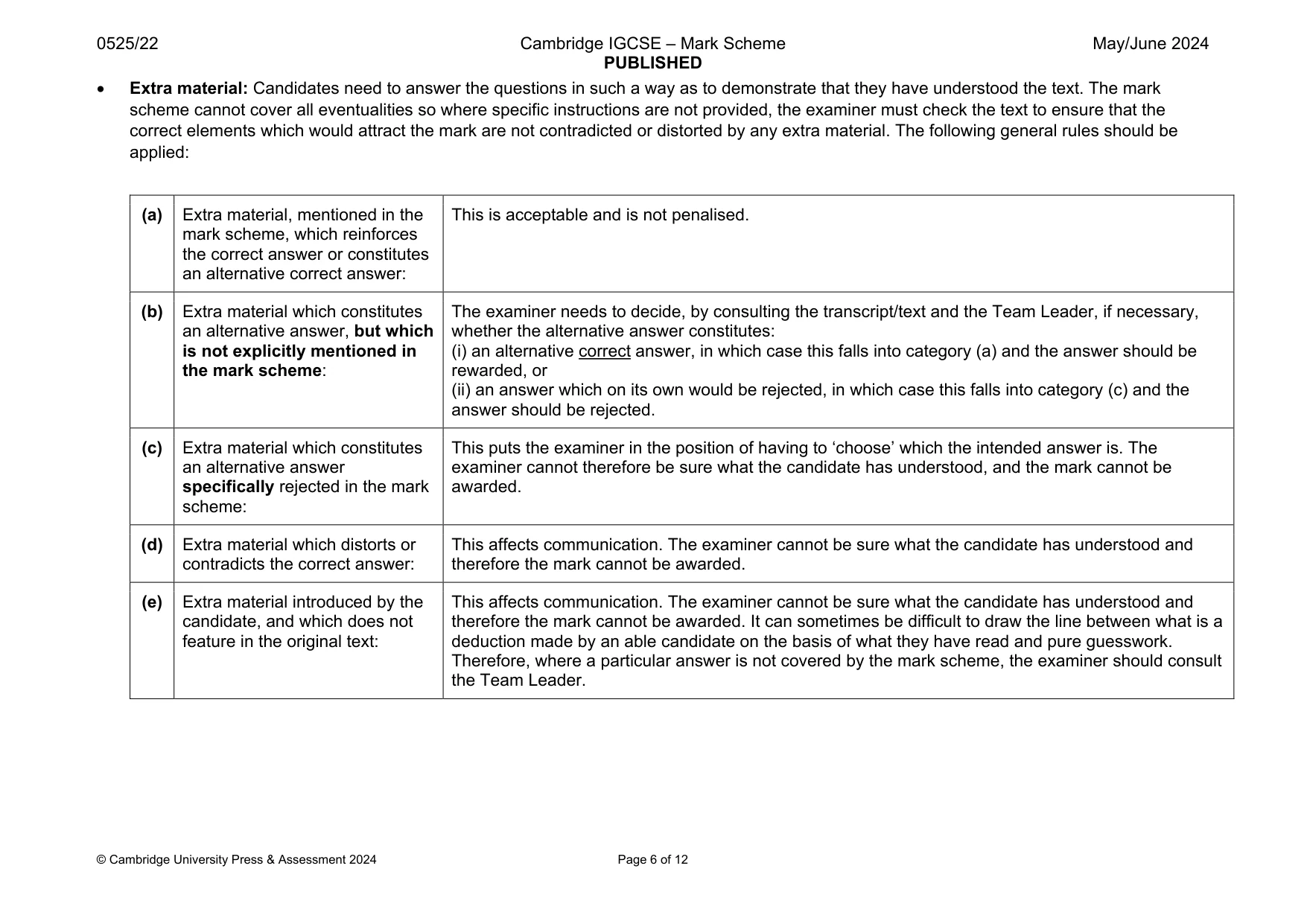
0525/22 Cambridge IGCSE – Mark Scheme PUBLISHED May/June 2024 © Cambridge University Press & Assessment 2024 Page 6 of 12 Extra material: Candidates need to answer the questions in such a way as to demonstrate that they have understood the text. The mark scheme cannot cover all eventualities so where specific instructions are not provided, the examiner must check the text to ensure that the correct elements which would attract the mark are not contradicted or distorted by any extra material. The following general rules should be applied: (a) Extra material, mentioned in the mark scheme, which reinforces the correct answer or constitutes an alternative correct answer: This is acceptable and is not penalised. (b) Extra material which constitutes an alternative answer, but which is not explicitly mentioned in the mark scheme: The examiner needs to decide, by consulting the transcript/text and the Team Leader, if necessary, whether the alternative answer constitutes: (i) an alternative correct answer, in which case this falls into category (a) and the answer should be rewarded, or (ii) an answer which on its own would be rejected, in which case this falls into category (c) and the answer should be rejected. (c) Extra material which constitutes an alternative answer specifically rejected in the mark scheme: This puts the examiner in the position of having to ‘choose’ which the intended answer is. The examiner cannot therefore be sure what the candidate has understood, and the mark cannot be awarded. (d) Extra material which distorts or contradicts the correct answer: This affects communication. The examiner cannot be sure what the candidate has understood and therefore the mark cannot be awarded. (e) Extra material introduced by the candidate, and which does not feature in the original text: This affects communication. The examiner cannot be sure what the candidate has understood and therefore the mark cannot be awarded. It can sometimes be difficult to draw the line between what is a deduction made by an able candidate on the basis of what they have read and pure guesswork. Therefore, where a particular answer is not covered by the mark scheme, the examiner should consult the Team Leader.
Mark scheme, page 7
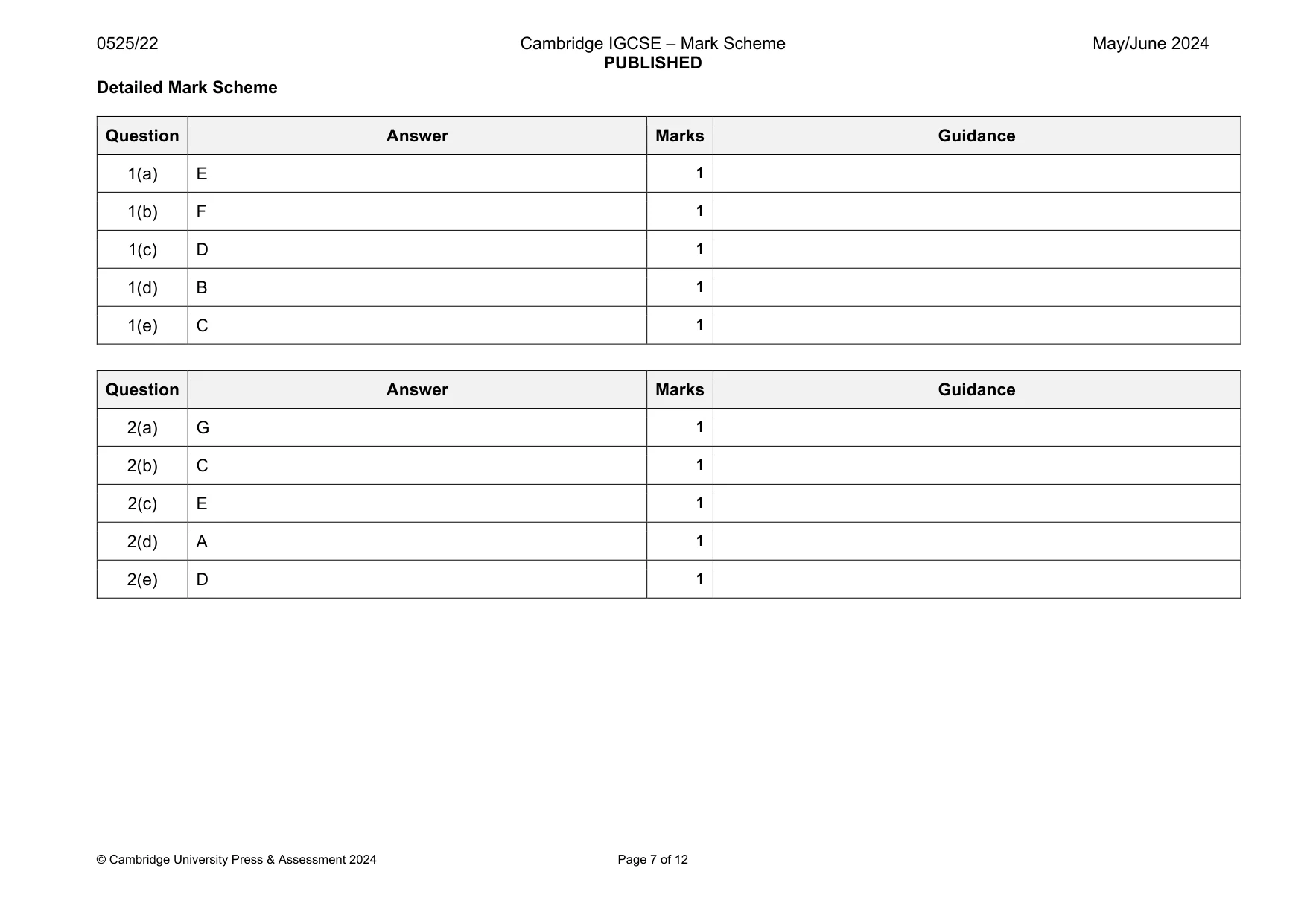
0525/22 Cambridge IGCSE – Mark Scheme PUBLISHED May/June 2024 © Cambridge University Press & Assessment 2024 Page 7 of 12 Detailed Mark Scheme Question Answer Marks Guidance 1(a) E 1 1(b) F 1 1(c) D 1 1(d) B 1 1(e) C 1 Question Answer Marks Guidance 2(a) G 1 2(b) C 1 2(c) E 1 2(d) A 1 2(e) D 1
Mark scheme, page 8
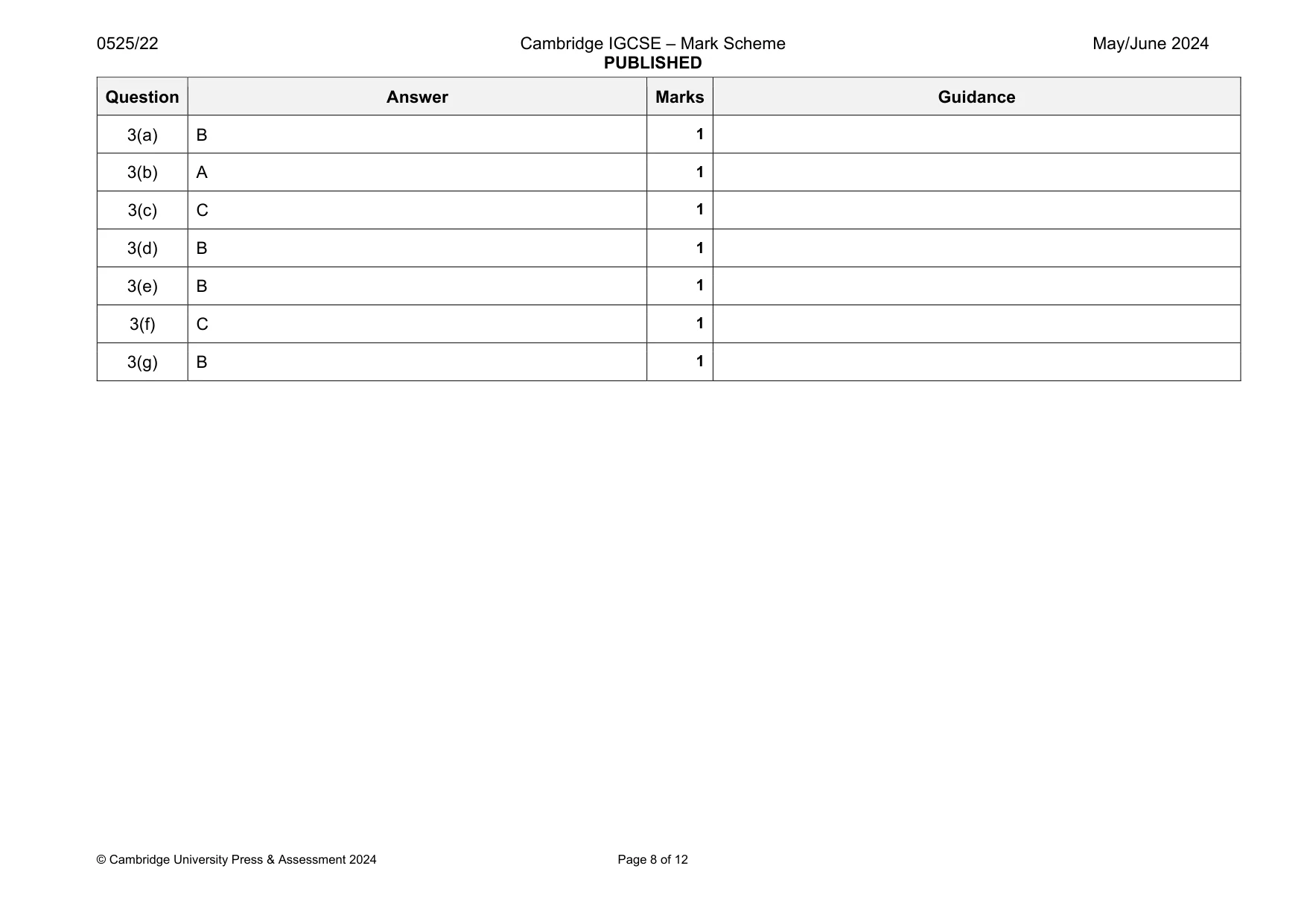
0525/22 Cambridge IGCSE – Mark Scheme PUBLISHED May/June 2024 © Cambridge University Press & Assessment 2024 Page 8 of 12 Question Answer Marks Guidance 3(a) B 1 3(b) A 1 3(c) C 1 3(d) B 1 3(e) B 1 3(f) C 1 3(g) B 1
Mark scheme, page 9
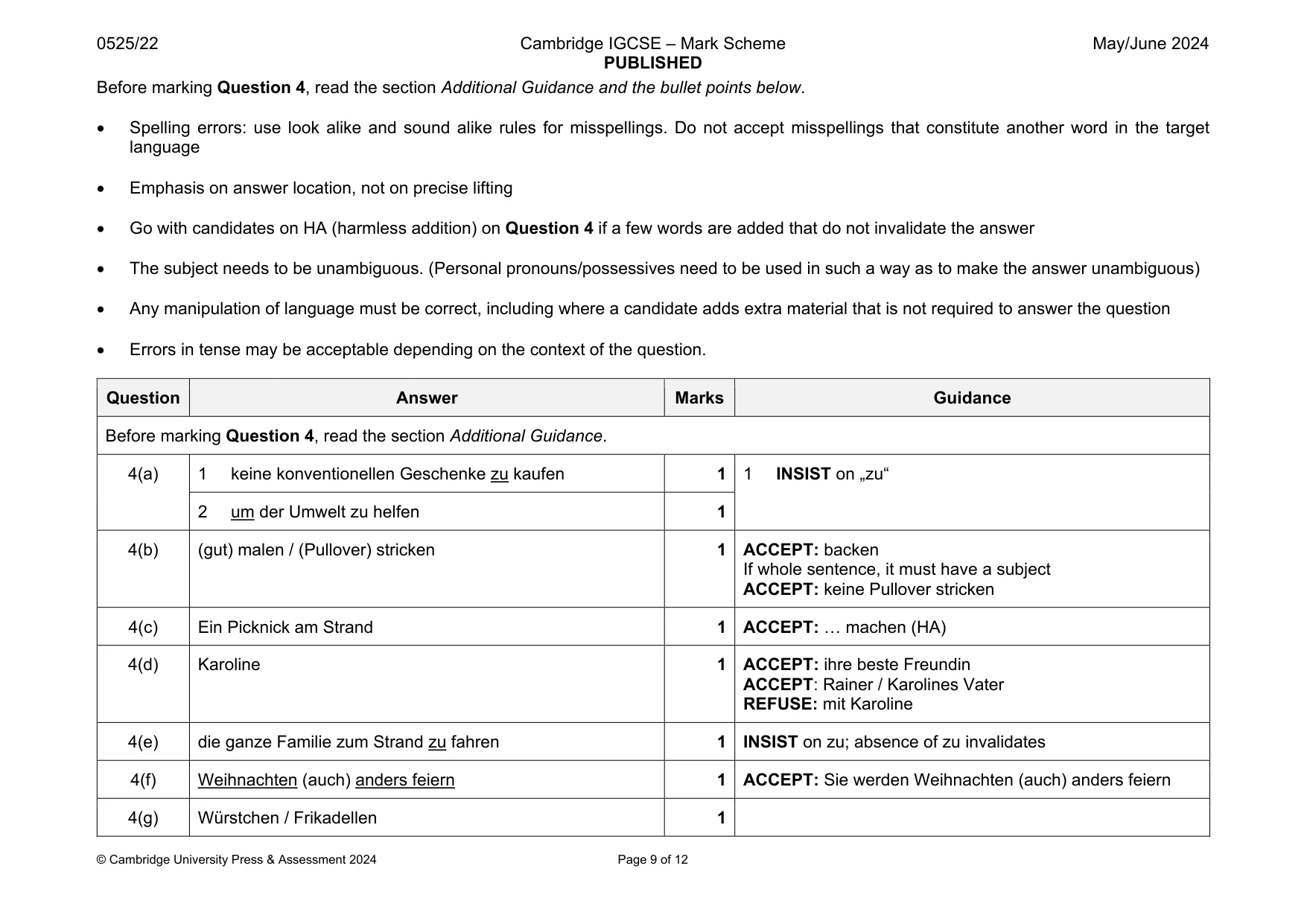
0525/22 Cambridge IGCSE – Mark Scheme PUBLISHED May/June 2024 © Cambridge University Press & Assessment 2024 Page 9 of 12 Before marking Question 4, read the section Additional Guidance and the bullet points below. Spelling errors: use look alike and sound alike rules for misspellings. Do not accept misspellings that constitute another word in the target language Emphasis on answer location, not on precise lifting Go with candidates on HA (harmless addition) on Question 4 if a few words are added that do not invalidate the answer The subject needs to be unambiguous. (Personal pronouns/possessives need to be used in such a way as to make the answer unambiguous) Any manipulation of language must be correct, including where a candidate adds extra material that is not required to answer the question Errors in tense may be acceptable depending on the context of the question. Question Answer Marks Guidance Before marking Question 4, read the section Additional Guidance. 4(a) 1 keine konventionellen Geschenke zu kaufen 1 1 INSIST on „zu“ 2 um der Umwelt zu helfen 1 4(b) (gut) malen / (Pullover) stricken 1 ACCEPT: backen If whole sentence, it must have a subject ACCEPT: keine Pullover stricken 4(c) Ein Picknick am Strand 1 ACCEPT: … machen (HA) 4(d) Karoline 1 ACCEPT: ihre beste Freundin ACCEPT: Rainer / Karolines Vater REFUSE: mit Karoline 4(e) die ganze Familie zum Strand zu fahren 1 INSIST on zu; absence of zu invalidates 4(f) Weihnachten (auch) anders feiern 1 ACCEPT: Sie werden Weihnachten (auch) anders feiern 4(g) Würstchen / Frikadellen 1
Mark scheme, page 10
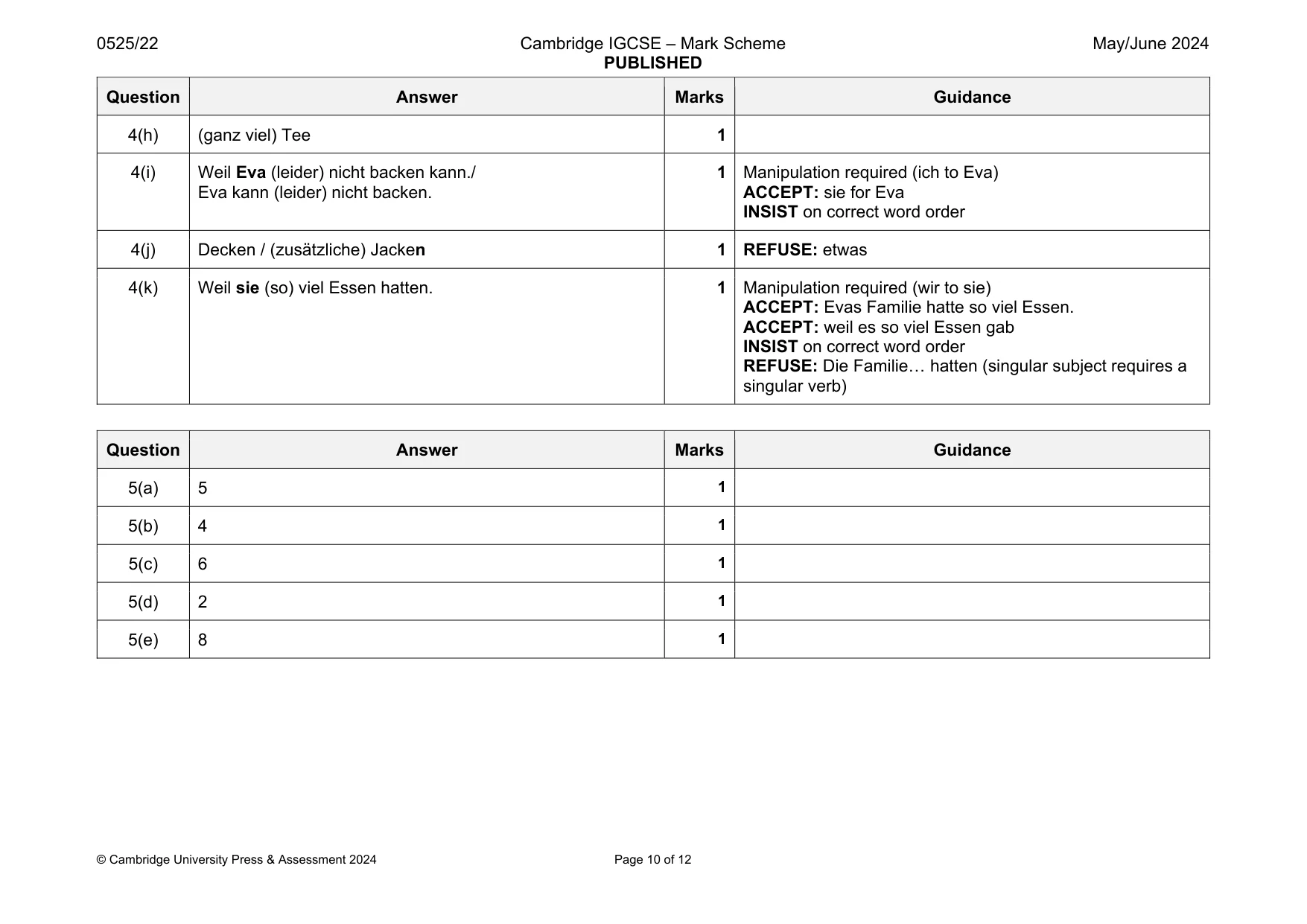
0525/22 Cambridge IGCSE – Mark Scheme PUBLISHED May/June 2024 © Cambridge University Press & Assessment 2024 Page 10 of 12 Question Answer Marks Guidance 4(h) (ganz viel) Tee 1 4(i) Weil Eva (leider) nicht backen kann./ Eva kann (leider) nicht backen. 1 Manipulation required (ich to Eva) ACCEPT: sie for Eva INSIST on correct word order 4(j) Decken / (zusätzliche) Jacken 1 REFUSE: etwas 4(k) Weil sie (so) viel Essen hatten. 1 Manipulation required (wir to sie) ACCEPT: Evas Familie hatte so viel Essen. ACCEPT: weil es so viel Essen gab INSIST on correct word order REFUSE: Die Familie… hatten (singular subject requires a singular verb) Question Answer Marks Guidance 5(a) 5 1 5(b) 4 1 5(c) 6 1 5(d) 2 1 5(e) 8 1
Mark scheme, page 11
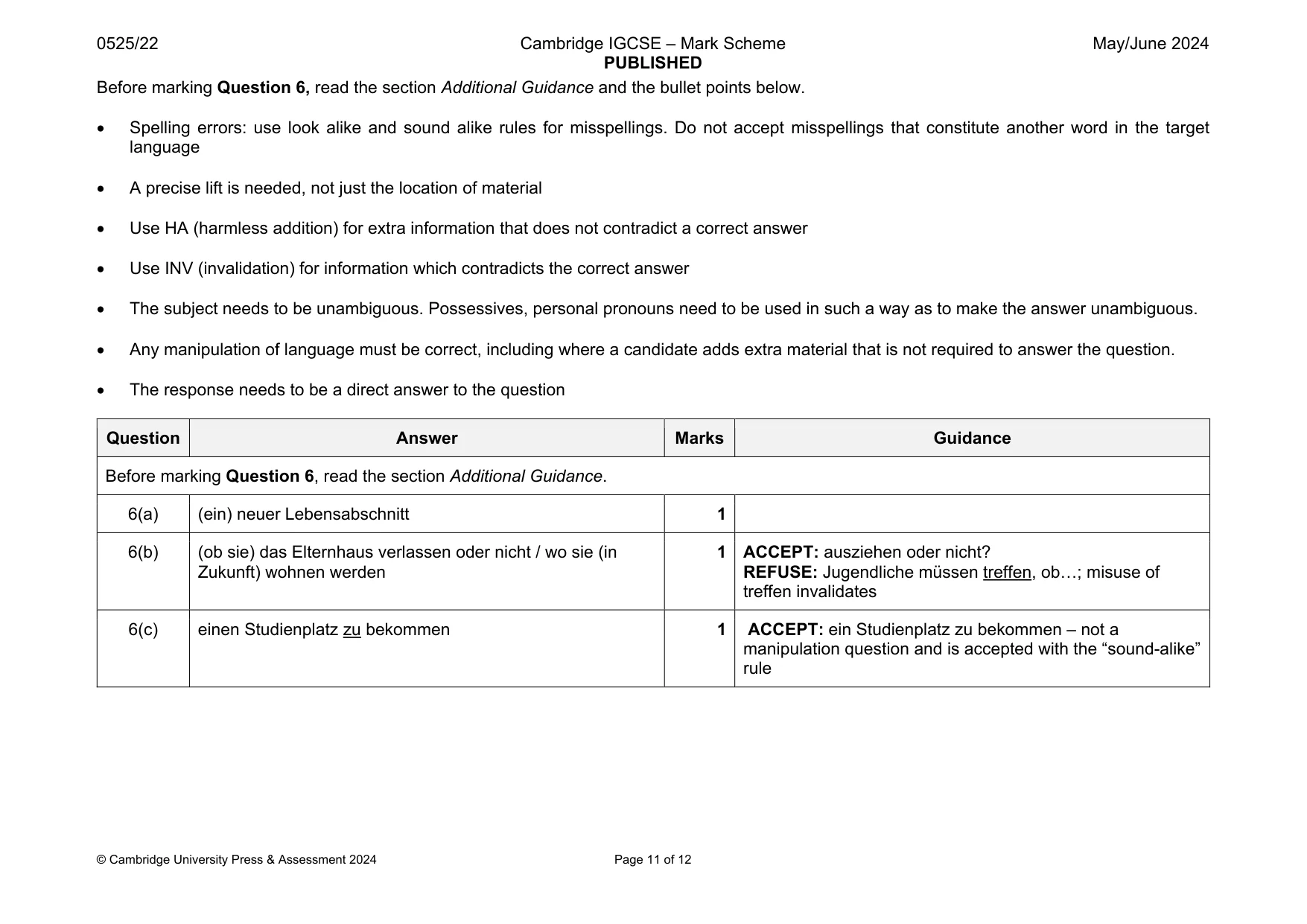
0525/22 Cambridge IGCSE – Mark Scheme PUBLISHED May/June 2024 © Cambridge University Press & Assessment 2024 Page 11 of 12 Before marking Question 6, read the section Additional Guidance and the bullet points below. Spelling errors: use look alike and sound alike rules for misspellings. Do not accept misspellings that constitute another word in the target language A precise lift is needed, not just the location of material Use HA (harmless addition) for extra information that does not contradict a correct answer Use INV (invalidation) for information which contradicts the correct answer The subject needs to be unambiguous. Possessives, personal pronouns need to be used in such a way as to make the answer unambiguous. Any manipulation of language must be correct, including where a candidate adds extra material that is not required to answer the question. The response needs to be a direct answer to the question Question Answer Marks Guidance Before marking Question 6, read the section Additional Guidance. 6(a) (ein) neuer Lebensabschnitt 1 6(b) (ob sie) das Elternhaus verlassen oder nicht / wo sie (in Zukunft) wohnen werden 1 ACCEPT: ausziehen oder nicht? REFUSE: Jugendliche müssen treffen, ob…; misuse of treffen invalidates 6(c) einen Studienplatz zu bekommen 1 ACCEPT: ein Studienplatz zu bekommen – not a manipulation question and is accepted with the “sound-alike” rule
Mark scheme, page 12
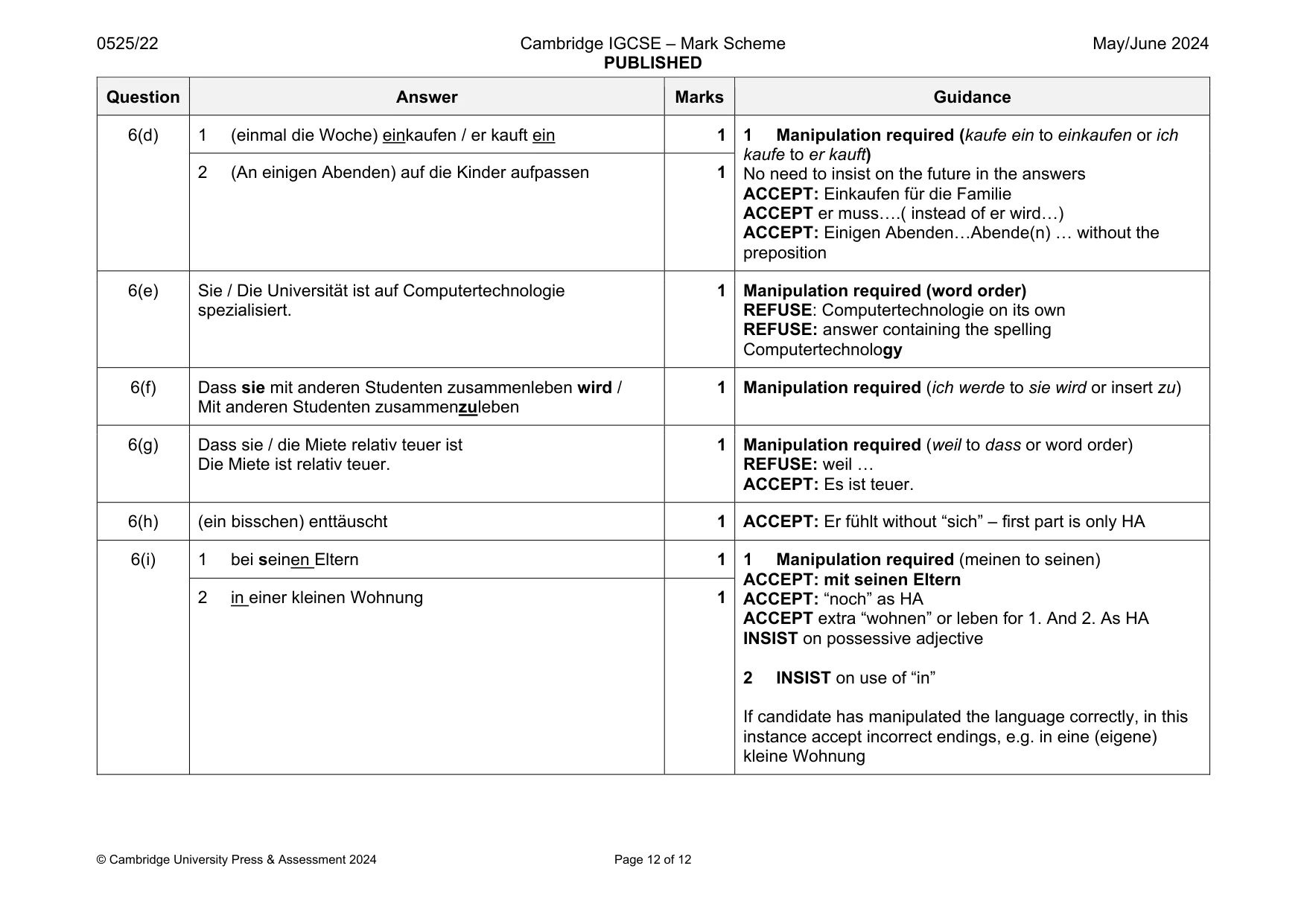
0525/22 Cambridge IGCSE – Mark Scheme PUBLISHED May/June 2024 © Cambridge University Press & Assessment 2024 Page 12 of 12 Question Answer Marks Guidance 6(d) 1 (einmal die Woche) einkaufen / er kauft ein 1 1 Manipulation required (kaufe ein to einkaufen or ich kaufe to er kauft) No need to insist on the future in the answers ACCEPT: Einkaufen für die Familie ACCEPT er muss….( instead of er wird…) ACCEPT: Einigen Abenden…Abende(n) … without the preposition 2 (An einigen Abenden) auf die Kinder aufpassen 1 6(e) Sie / Die Universität ist auf Computertechnologie spezialisiert. 1 Manipulation required (word order) REFUSE: Computertechnologie on its own REFUSE: answer containing the spelling Computertechnology 6(f) Dass sie mit anderen Studenten zusammenleben wird / Mit anderen Studenten zusammenzuleben 1 Manipulation required (ich werde to sie wird or insert zu) 6(g) Dass sie / die Miete relativ teuer ist Die Miete ist relativ teuer. 1 Manipulation required (weil to dass or word order) REFUSE: weil … ACCEPT: Es ist teuer. 6(h) (ein bisschen) enttäuscht 1 ACCEPT: Er fühlt without “sich” – first part is only HA 6(i) 1 bei seinen Eltern 1 1 Manipulation required (meinen to seinen) ACCEPT: mit seinen Eltern ACCEPT: “noch” as HA ACCEPT extra “wohnen” or leben for 1. And 2. As HA INSIST on possessive adjective 2 INSIST on use of “in” If candidate has manipulated the language correctly, in this instance accept incorrect endings, e.g. in eine (eigene) kleine Wohnung 2 in einer kleinen Wohnung 1
What you needed in this session
Cambridge’s own grade thresholds for 2024 May/June, Paper 2 · Variant 2. A higher threshold means an easier paper — the bar moves with how the cohort did.