Cambridge IGCSE German - Foreign Language 0525 — 2022 May/June Paper 2 · Variant 2
0525/22/M/J/22 · 45 marks · ≈51 min
The question paper and its mark scheme, free to read here and free to download. This is Cambridge’s own paper, exactly as it was sat.
Question paper12 pages

Mark scheme14 pages
Answers below. Sit the paper first if you are practising.
Paper as text
Question paper, page 1
This document has 12 pages. Any blank pages are indicated. [Turn over Cambridge IGCSE™ DC (CE/SW) 301840/4 © UCLES 2022 GERMAN 0525/22 Paper 2 Reading May/June 2022 1 hour You must answer on the question paper. No additional materials are needed. INSTRUCTIONS ● Answer all questions. ● Use a black or dark blue pen. ● Write your name, centre number and candidate number in the boxes at the top of the page. ● Write your answer to each question in the space provided. ● Do not use an erasable pen or correction fluid. ● Do not write on any bar codes. ● Dictionaries are not allowed. INFORMATION ● The total mark for this paper is 45. ● The number of marks for each question or part question is shown in brackets [ ]. * 6 9 8 9 1 8 9 7 9 8 *
Question paper, page 2
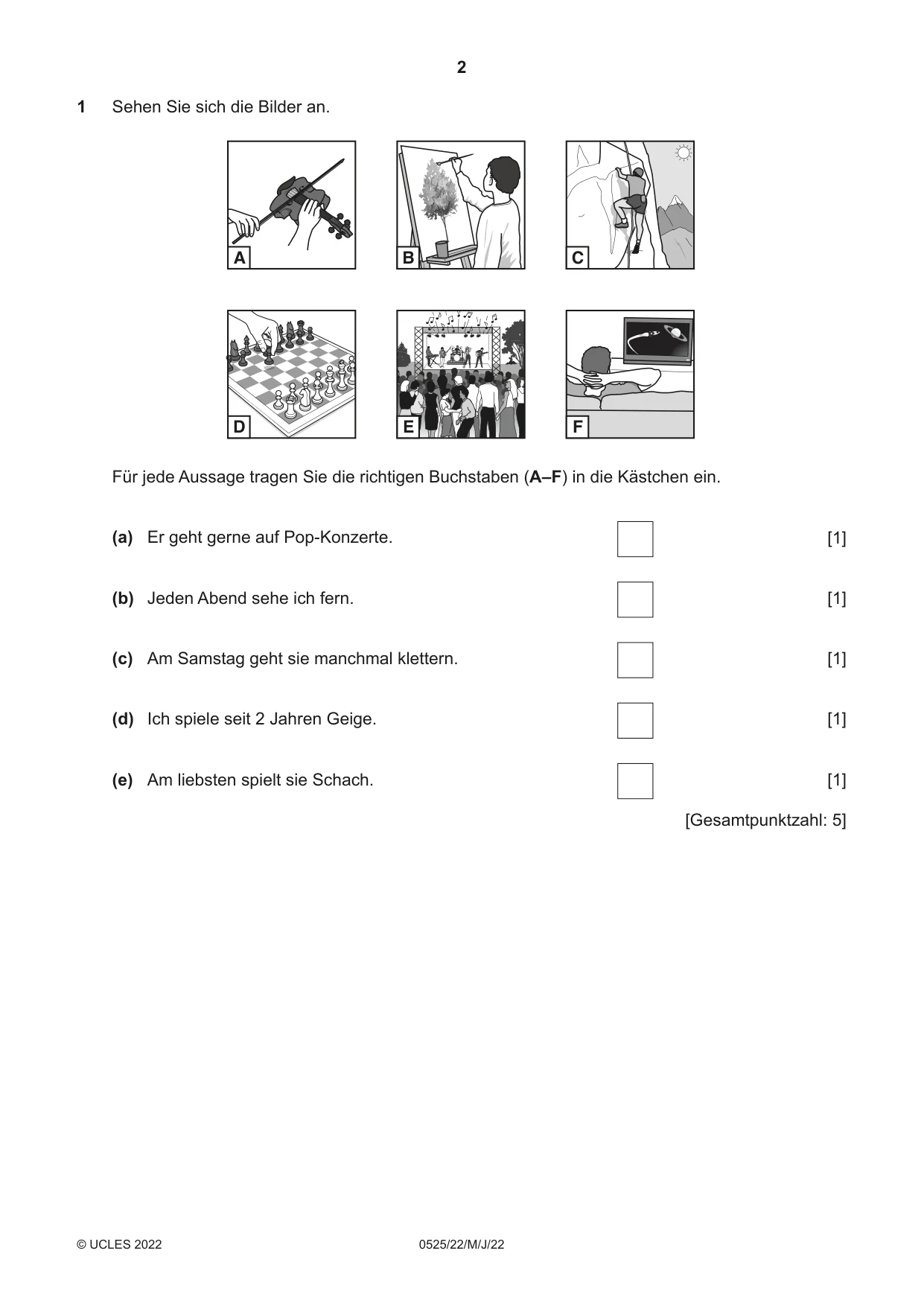
2 0525/22/ M / J /22 © UCLES 2022 1 Sehen Sie sich die Bilder an. A B C D E F Für jede Aussage tragen Sie die richtigen Buchstaben (A–F) in die Kästchen ein. (a) Er geht gerne auf Pop-Konzerte. [1] (b) Jeden Abend sehe ich fern. [1] (c) Am Samstag geht sie manchmal klettern. [1] (d) Ich spiele seit 2 Jahren Geige. [1] (e) Am liebsten spielt sie Schach. [1] [Gesamtpunktzahl: 5]
Question paper, page 3
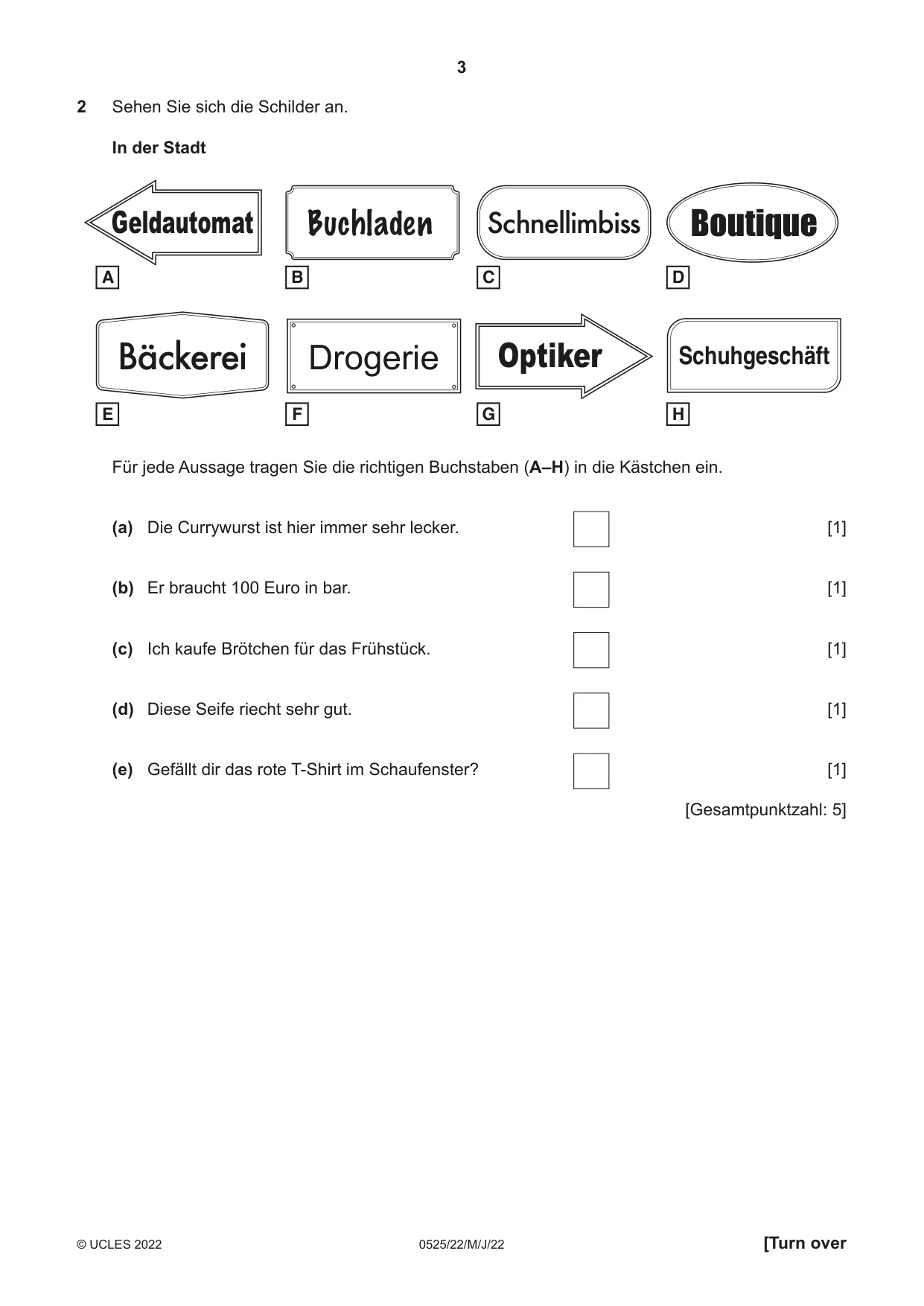
3 0525/22/M/J/22 © UCLES 2022 [Turn over 2 Sehen Sie sich die Schilder an. In der Stadt Bäckerei Drogerie Optiker Geldautomat Buchladen Schnellimbiss Boutique Schuhgeschäft A B C D E F G H Für jede Aussage tragen Sie die richtigen Buchstaben (A–H) in die Kästchen ein. (a) Die Currywurst ist hier immer sehr lecker. [1] (b) Er braucht 100 Euro in bar. [1] (c) Ich kaufe Brötchen für das Frühstück. [1] (d) Diese Seife riecht sehr gut. [1] (e) Gefällt dir das rote T-Shirt im Schaufenster? [1] [Gesamtpunktzahl: 5]
Question paper, page 4
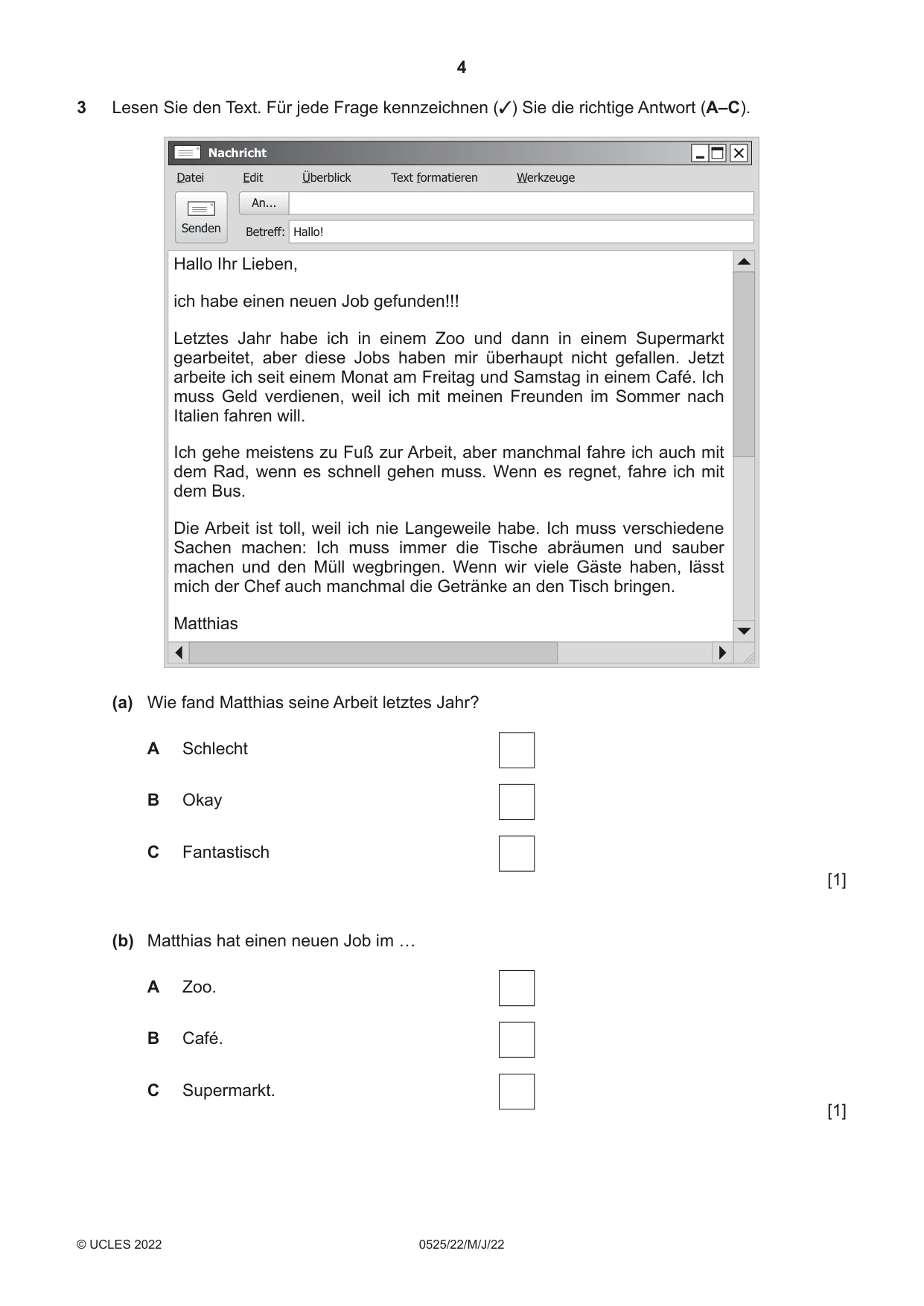
4 0525/22/M/J/22 © UCLES 2022 3 Lesen Sie den Text. Für jede Frage kennzeichnen (3) Sie die richtige Antwort (A–C). Betreff: Hallo! An... Senden Datei Edit Überblick Text formatieren Werkzeuge Nachricht Hallo Ihr Lieben, ich habe einen neuen Job gefunden!!! Letztes Jahr habe ich in einem Zoo und dann in einem Supermarkt gearbeitet, aber diese Jobs haben mir überhaupt nicht gefallen. Jetzt arbeite ich seit einem Monat am Freitag und Samstag in einem Café. Ich muss Geld verdienen, weil ich mit meinen Freunden im Sommer nach Italien fahren will. Ich gehe meistens zu Fuß zur Arbeit, aber manchmal fahre ich auch mit dem Rad, wenn es schnell gehen muss. Wenn es regnet, fahre ich mit dem Bus. Die Arbeit ist toll, weil ich nie Langeweile habe. Ich muss verschiedene Sachen machen: Ich muss immer die Tische abräumen und sauber machen und den Müll wegbringen. Wenn wir viele Gäste haben, lässt mich der Chef auch manchmal die Getränke an den Tisch bringen. Matthias (a) Wie fand Matthias seine Arbeit letztes Jahr? A Schlecht B Okay C Fantastisch [1] (b) Matthias hat einen neuen Job im … A Zoo. B Café. C Supermarkt. [1]
Question paper, page 5
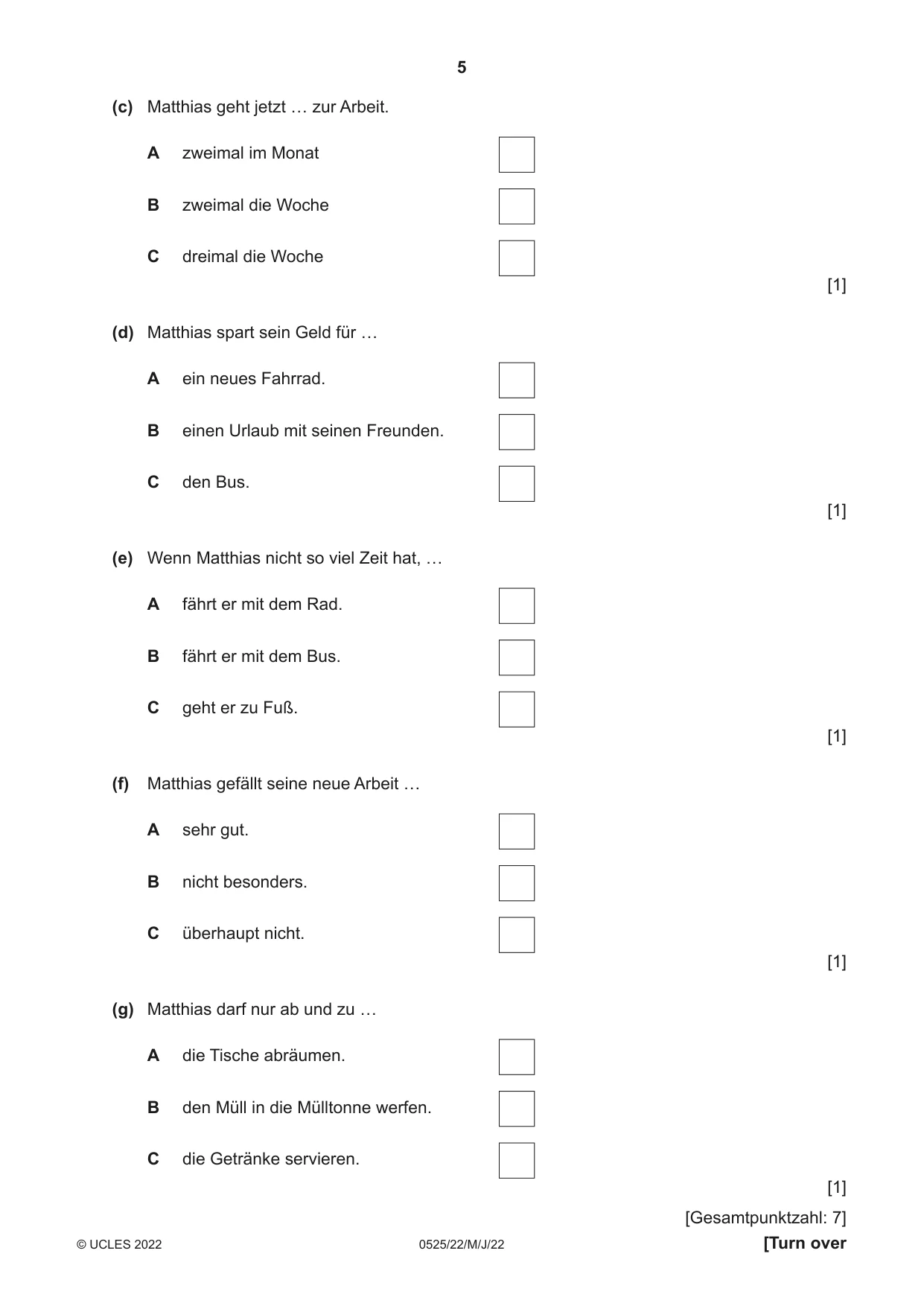
5 0525/22/M/J/22 © UCLES 2022 [Turn over (c) Matthias geht jetzt … zur Arbeit. A zweimal im Monat B zweimal die Woche C dreimal die Woche [1] (d) Matthias spart sein Geld für … A ein neues Fahrrad. B einen Urlaub mit seinen Freunden. C den Bus. [1] (e) Wenn Matthias nicht so viel Zeit hat, … A fährt er mit dem Rad. B fährt er mit dem Bus. C geht er zu Fuß. [1] (f) Matthias gefällt seine neue Arbeit … A sehr gut. B nicht besonders. C überhaupt nicht. [1] (g) Matthias darf nur ab und zu … A die Tische abräumen. B den Müll in die Mülltonne werfen. C die Getränke servieren. [1] [Gesamtpunktzahl: 7]
Question paper, page 6
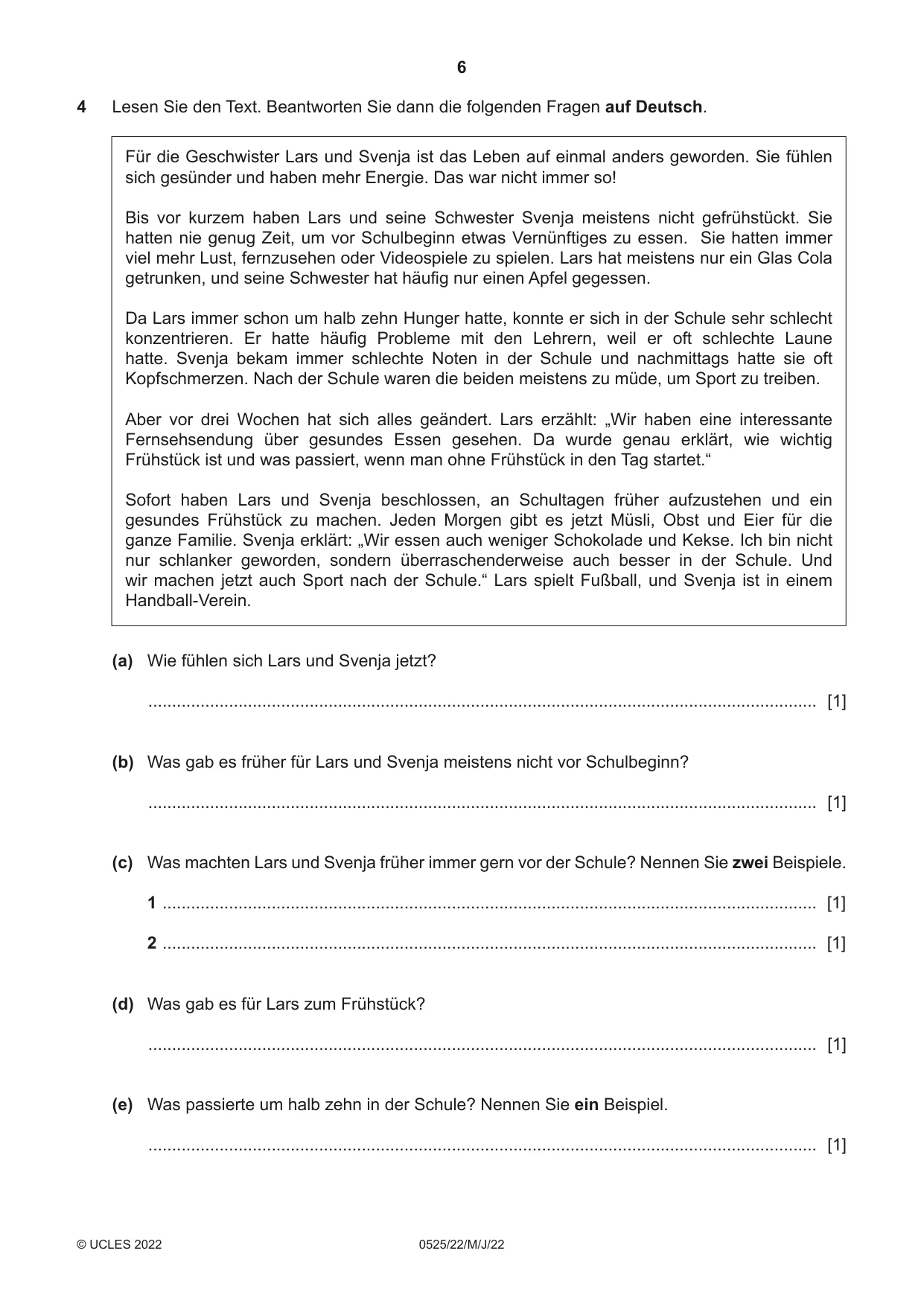
6 0525/22/M/J/22 © UCLES 2022 4 Lesen Sie den Text. Beantworten Sie dann die folgenden Fragen auf Deutsch. Für die Geschwister Lars und Svenja ist das Leben auf einmal anders geworden. Sie fühlen sich gesünder und haben mehr Energie. Das war nicht immer so! Bis vor kurzem haben Lars und seine Schwester Svenja meistens nicht gefrühstückt. Sie hatten nie genug Zeit, um vor Schulbeginn etwas Vernünftiges zu essen. Sie hatten immer viel mehr Lust, fernzusehen oder Videospiele zu spielen. Lars hat meistens nur ein Glas Cola getrunken, und seine Schwester hat häufig nur einen Apfel gegessen. Da Lars immer schon um halb zehn Hunger hatte, konnte er sich in der Schule sehr schlecht konzentrieren. Er hatte häufig Probleme mit den Lehrern, weil er oft schlechte Laune hatte. Svenja bekam immer schlechte Noten in der Schule und nachmittags hatte sie oft Kopfschmerzen. Nach der Schule waren die beiden meistens zu müde, um Sport zu treiben. Aber vor drei Wochen hat sich alles geändert. Lars erzählt: „Wir haben eine interessante Fernsehsendung über gesundes Essen gesehen. Da wurde genau erklärt, wie wichtig Frühstück ist und was passiert, wenn man ohne Frühstück in den Tag startet.“ Sofort haben Lars und Svenja beschlossen, an Schultagen früher aufzustehen und ein gesundes Frühstück zu machen. Jeden Morgen gibt es jetzt Müsli, Obst und Eier für die ganze Familie. Svenja erklärt: „Wir essen auch weniger Schokolade und Kekse. Ich bin nicht nur schlanker geworden, sondern überraschenderweise auch besser in der Schule. Und wir machen jetzt auch Sport nach der Schule.“ Lars spielt Fußball, und Svenja ist in einem Handball-Verein. (a) Wie fühlen sich Lars und Svenja jetzt? … [1] (b) Was gab es früher für Lars und Svenja meistens nicht vor Schulbeginn? … [1] (c) Was machten Lars und Svenja früher immer gern vor der Schule? Nennen Sie zwei Beispiele. 1 … [1] 2 … [1] (d) Was gab es für Lars zum Frühstück? … [1] (e) Was passierte um halb zehn in der Schule? Nennen Sie ein Beispiel. … [1]
Question paper, page 7
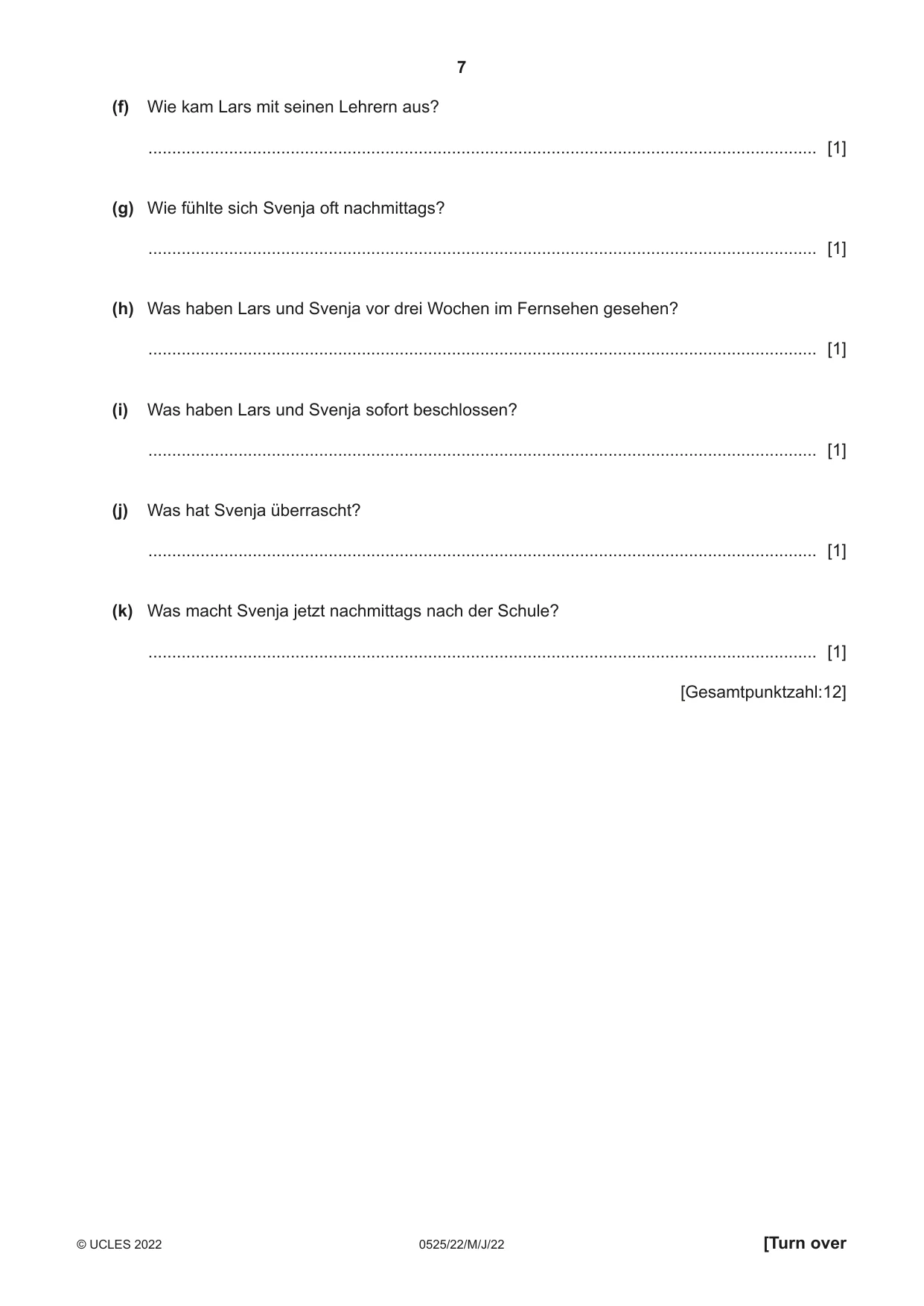
7 0525/22/M/J/22 © UCLES 2022 [Turn over (f) Wie kam Lars mit seinen Lehrern aus? … [1] (g) Wie fühlte sich Svenja oft nachmittags? … [1] (h) Was haben Lars und Svenja vor drei Wochen im Fernsehen gesehen? … [1] (i) Was haben Lars und Svenja sofort beschlossen? … [1] (j) Was hat Svenja überrascht? … [1] (k) Was macht Svenja jetzt nachmittags nach der Schule? … [1] [Gesamtpunktzahl:12]
Question paper, page 8
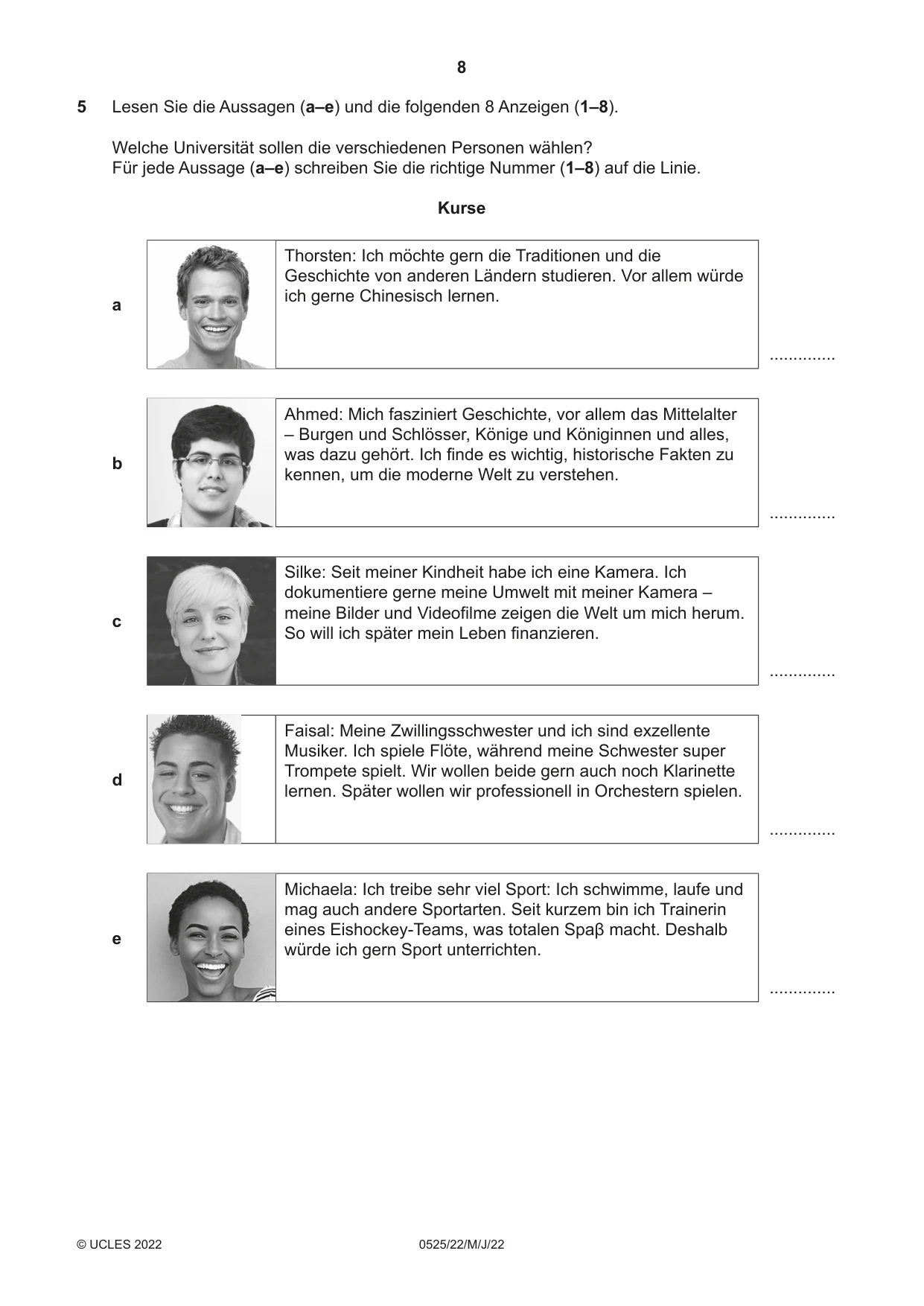
8 0525/22/M/J/22 © UCLES 2022 5 Lesen Sie die Aussagen (a–e) und die folgenden 8 Anzeigen (1–8). Welche Universität sollen die verschiedenen Personen wählen? Für jede Aussage (a–e) schreiben Sie die richtige Nummer (1–8) auf die Linie. Kurse a Thorsten: Ich möchte gern die Traditionen und die Geschichte von anderen Ländern studieren. Vor allem würde ich gerne Chinesisch lernen. … b Ahmed: Mich fasziniert Geschichte, vor allem das Mittelalter – Burgen und Schlösser, Könige und Königinnen und alles, was dazu gehört. Ich finde es wichtig, historische Fakten zu kennen, um die moderne Welt zu verstehen. … c Silke: Seit meiner Kindheit habe ich eine Kamera. Ich dokumentiere gerne meine Umwelt mit meiner Kamera – meine Bilder und Videofilme zeigen die Welt um mich herum. So will ich später mein Leben finanzieren. … d Faisal: Meine Zwillingsschwester und ich sind exzellente Musiker. Ich spiele Flöte, während meine Schwester super Trompete spielt. Wir wollen beide gern auch noch Klarinette lernen. Später wollen wir professionell in Orchestern spielen. … e Michaela: Ich treibe sehr viel Sport: Ich schwimme, laufe und mag auch andere Sportarten. Seit kurzem bin ich Trainerin eines Eishockey-Teams, was totalen Spaβ macht. Deshalb würde ich gern Sport unterrichten. …
Question paper, page 9
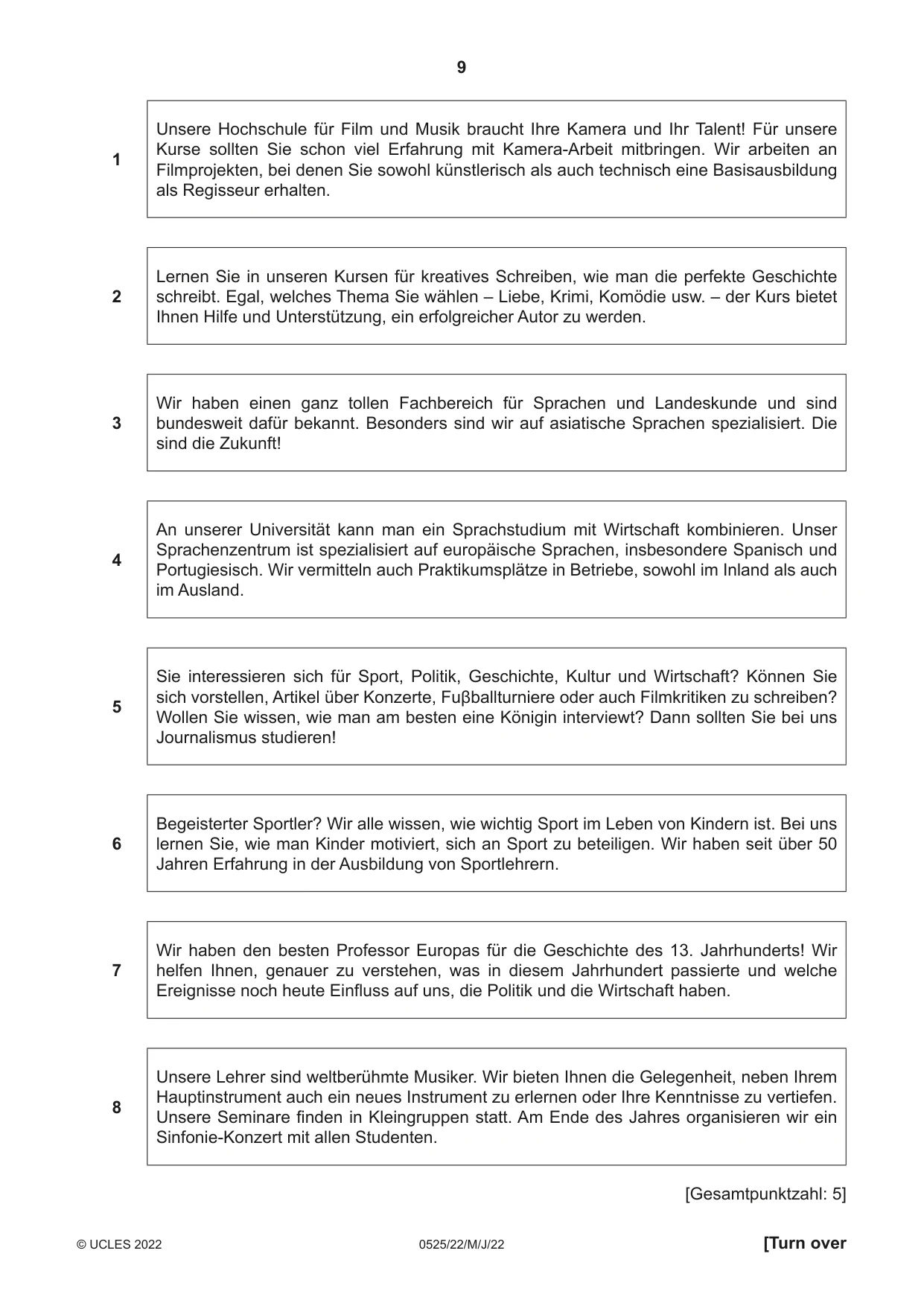
9 0525/22/M/J/22 © UCLES 2022 [Turn over 1 Unsere Hochschule für Film und Musik braucht Ihre Kamera und Ihr Talent! Für unsere Kurse sollten Sie schon viel Erfahrung mit Kamera-Arbeit mitbringen. Wir arbeiten an Filmprojekten, bei denen Sie sowohl künstlerisch als auch technisch eine Basisausbildung als Regisseur erhalten. 2 Lernen Sie in unseren Kursen für kreatives Schreiben, wie man die perfekte Geschichte schreibt. Egal, welches Thema Sie wählen – Liebe, Krimi, Komödie usw. – der Kurs bietet Ihnen Hilfe und Unterstützung, ein erfolgreicher Autor zu werden. 3 Wir haben einen ganz tollen Fachbereich für Sprachen und Landeskunde und sind bundesweit dafür bekannt. Besonders sind wir auf asiatische Sprachen spezialisiert. Die sind die Zukunft! 4 An unserer Universität kann man ein Sprachstudium mit Wirtschaft kombinieren. Unser Sprachenzentrum ist spezialisiert auf europäische Sprachen, insbesondere Spanisch und Portugiesisch. Wir vermitteln auch Praktikumsplätze in Betriebe, sowohl im Inland als auch im Ausland. 5 Sie interessieren sich für Sport, Politik, Geschichte, Kultur und Wirtschaft? Können Sie sich vorstellen, Artikel über Konzerte, Fuβballturniere oder auch Filmkritiken zu schreiben? Wollen Sie wissen, wie man am besten eine Königin interviewt? Dann sollten Sie bei uns Journalismus studieren! 6 Begeisterter Sportler? Wir alle wissen, wie wichtig Sport im Leben von Kindern ist. Bei uns lernen Sie, wie man Kinder motiviert, sich an Sport zu beteiligen. Wir haben seit über 50 Jahren Erfahrung in der Ausbildung von Sportlehrern. 7 Wir haben den besten Professor Europas für die Geschichte des 13. Jahrhunderts! Wir helfen Ihnen, genauer zu verstehen, was in diesem Jahrhundert passierte und welche Ereignisse noch heute Einfluss auf uns, die Politik und die Wirtschaft haben. 8 Unsere Lehrer sind weltberühmte Musiker. Wir bieten Ihnen die Gelegenheit, neben Ihrem Hauptinstrument auch ein neues Instrument zu erlernen oder Ihre Kenntnisse zu vertiefen. Unsere Seminare finden in Kleingruppen statt. Am Ende des Jahres organisieren wir ein Sinfonie-Konzert mit allen Studenten. [Gesamtpunktzahl: 5]
Question paper, page 10
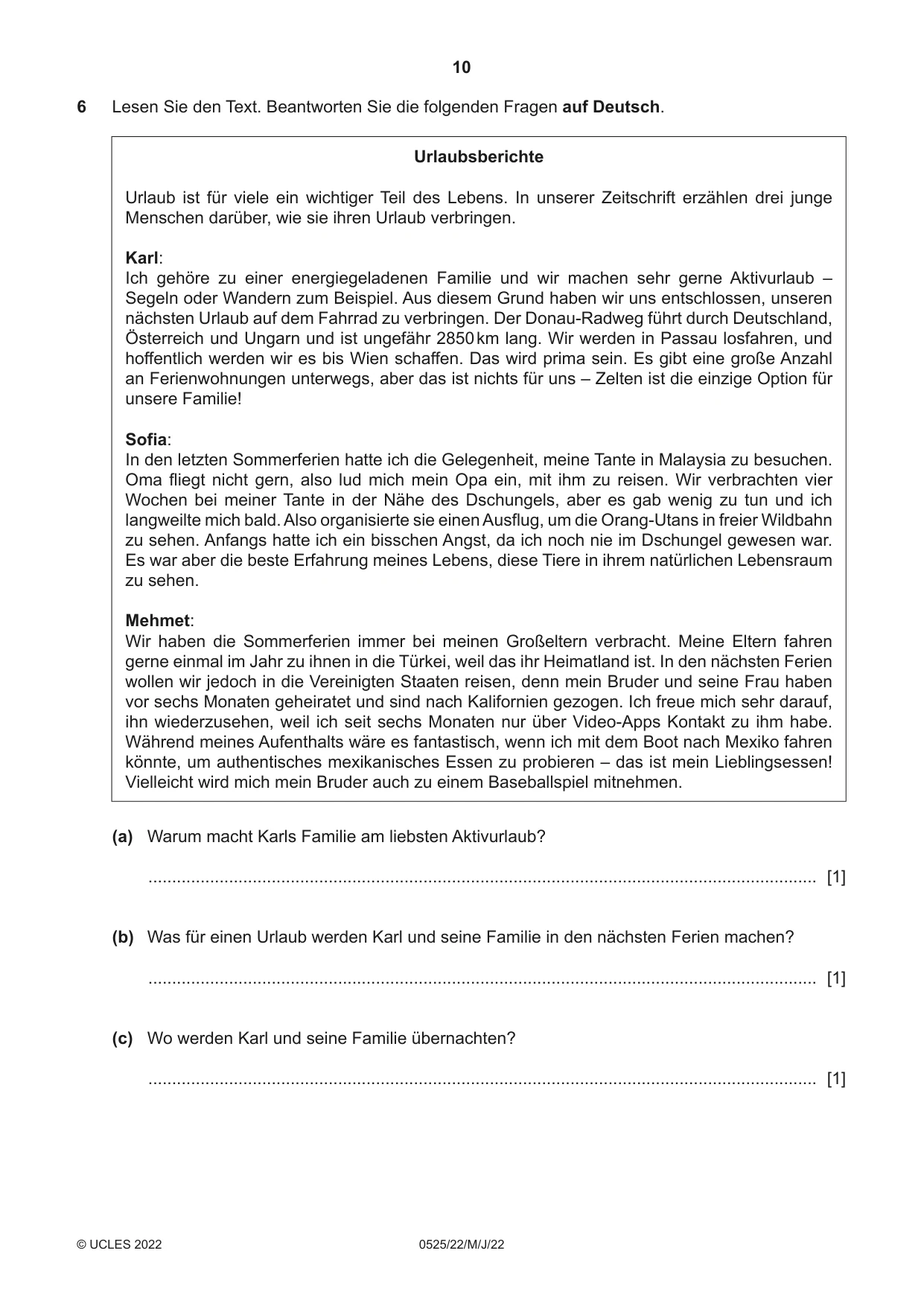
10 0525/22/M/J/22 © UCLES 2022 6 Lesen Sie den Text. Beantworten Sie die folgenden Fragen auf Deutsch. Urlaubsberichte Urlaub ist für viele ein wichtiger Teil des Lebens. In unserer Zeitschrift erzählen drei junge Menschen darüber, wie sie ihren Urlaub verbringen. Karl: Ich gehöre zu einer energiegeladenen Familie und wir machen sehr gerne Aktivurlaub – Segeln oder Wandern zum Beispiel. Aus diesem Grund haben wir uns entschlossen, unseren nächsten Urlaub auf dem Fahrrad zu verbringen. Der Donau-Radweg führt durch Deutschland, Österreich und Ungarn und ist ungefähr 2850 km lang. Wir werden in Passau losfahren, und hoffentlich werden wir es bis Wien schaffen. Das wird prima sein. Es gibt eine große Anzahl an Ferienwohnungen unterwegs, aber das ist nichts für uns – Zelten ist die einzige Option für unsere Familie! Sofia: In den letzten Sommerferien hatte ich die Gelegenheit, meine Tante in Malaysia zu besuchen. Oma fliegt nicht gern, also lud mich mein Opa ein, mit ihm zu reisen. Wir verbrachten vier Wochen bei meiner Tante in der Nähe des Dschungels, aber es gab wenig zu tun und ich langweilte mich bald. Also organisierte sie einen Ausflug, um die Orang-Utans in freier Wildbahn zu sehen. Anfangs hatte ich ein bisschen Angst, da ich noch nie im Dschungel gewesen war. Es war aber die beste Erfahrung meines Lebens, diese Tiere in ihrem natürlichen Lebensraum zu sehen. Mehmet: Wir haben die Sommerferien immer bei meinen Großeltern verbracht. Meine Eltern fahren gerne einmal im Jahr zu ihnen in die Türkei, weil das ihr Heimatland ist. In den nächsten Ferien wollen wir jedoch in die Vereinigten Staaten reisen, denn mein Bruder und seine Frau haben vor sechs Monaten geheiratet und sind nach Kalifornien gezogen. Ich freue mich sehr darauf, ihn wiederzusehen, weil ich seit sechs Monaten nur über Video-Apps Kontakt zu ihm habe. Während meines Aufenthalts wäre es fantastisch, wenn ich mit dem Boot nach Mexiko fahren könnte, um authentisches mexikanisches Essen zu probieren – das ist mein Lieblingsessen! Vielleicht wird mich mein Bruder auch zu einem Baseballspiel mitnehmen. (a) Warum macht Karls Familie am liebsten Aktivurlaub? … [1] (b) Was für einen Urlaub werden Karl und seine Familie in den nächsten Ferien machen? … [1] (c) Wo werden Karl und seine Familie übernachten? … [1]
Question paper, page 11
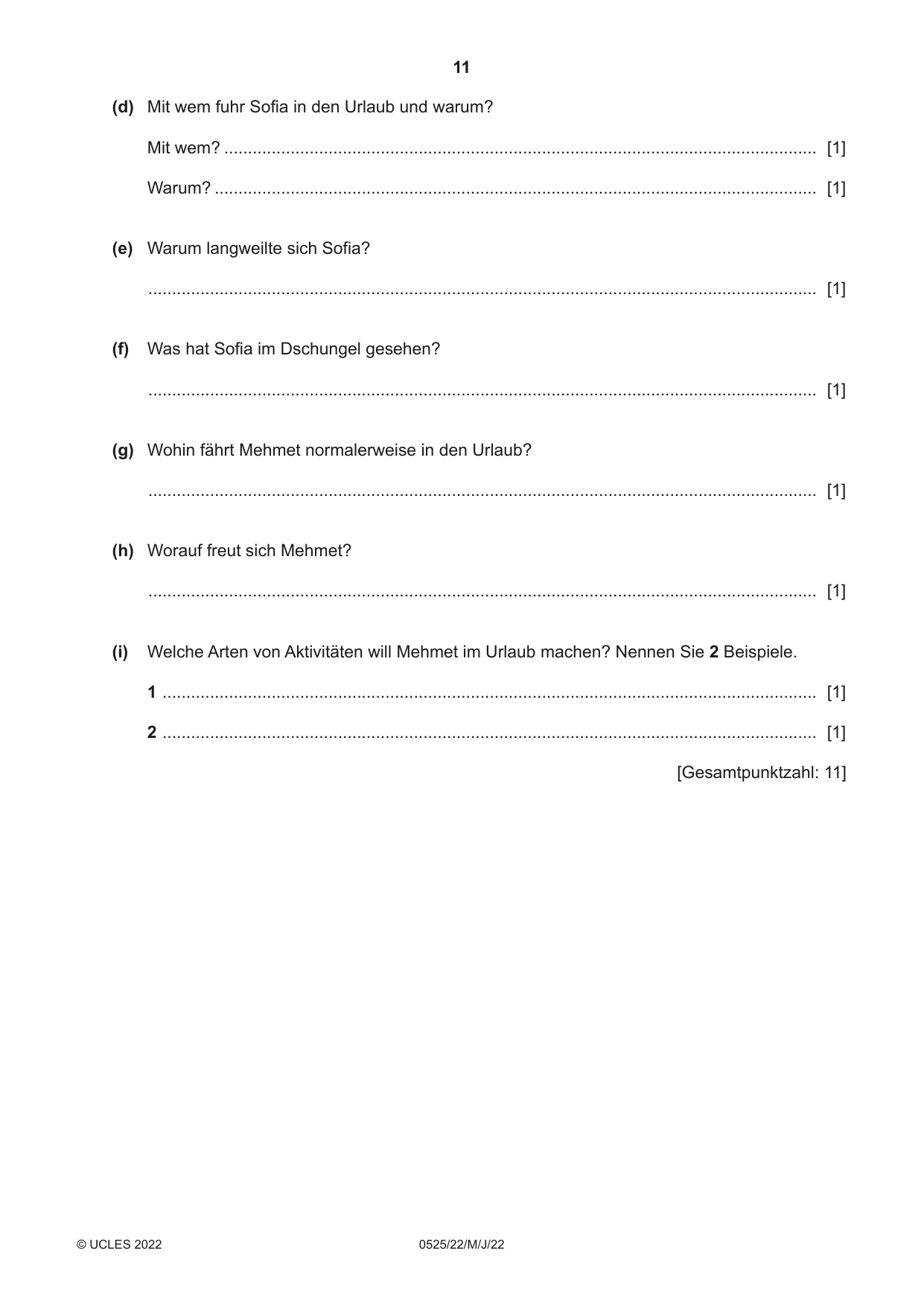
11 0525/22/M/J/22 © UCLES 2022 (d) Mit wem fuhr Sofia in den Urlaub und warum? Mit wem? … [1] Warum? … [1] (e) Warum langweilte sich Sofia? … [1] (f) Was hat Sofia im Dschungel gesehen? … [1] (g) Wohin fährt Mehmet normalerweise in den Urlaub? … [1] (h) Worauf freut sich Mehmet? … [1] (i) Welche Arten von Aktivitäten will Mehmet im Urlaub machen? Nennen Sie 2 Beispiele. 1 … [1] 2 … [1] [Gesamtpunktzahl: 11]
Question paper, page 12
12 0525/22/M/J/22 © UCLES 2022 Permission to reproduce items where third-party owned material protected by copyright is included has been sought and cleared where possible. Every reasonable effort has been made by the publisher (UCLES) to trace copyright holders, but if any items requiring clearance have unwittingly been included, the publisher will be pleased to make amends at the earliest possible opportunity. To avoid the issue of disclosure of answer-related information to candidates, all copyright acknowledgements are reproduced online in the Cambridge Assessment International Education Copyright Acknowledgements Booklet. This is produced for each series of examinations and is freely available to download at www.cambridgeinternational.org after the live examination series. Cambridge Assessment International Education is part of Cambridge Assessment. Cambridge Assessment is the brand name of the University of Cambridge Local Examinations Syndicate (UCLES), which is a department of the University of Cambridge. BLANK PAGE
Mark scheme, page 1
This document consists of 14 printed pages. © UCLES 2022 [Turn over Cambridge IGCSE™ GERMAN 0525/22 Paper 2 Reading May/June 2022 MARK SCHEME Maximum Mark: 45 Published This mark scheme is published as an aid to teachers and candidates, to indicate the requirements of the examination. It shows the basis on which Examiners were instructed to award marks. It does not indicate the details of the discussions that took place at an Examiners’ meeting before marking began, which would have considered the acceptability of alternative answers. Mark schemes should be read in conjunction with the question paper and the Principal Examiner Report for Teachers. Cambridge International will not enter into discussions about these mark schemes. Cambridge International is publishing the mark schemes for the May/June 2022 series for most Cambridge IGCSE, Cambridge International A and AS Level and Cambridge Pre-U components, and some Cambridge O Level components.
Mark scheme, page 2
0525/22 Cambridge IGCSE – Mark Scheme PUBLISHED May/June 2022 © UCLES 2022 Page 2 of 14 Generic Marking Principles These general marking principles must be applied by all examiners when marking candidate answers. They should be applied alongside the specific content of the mark scheme or generic level descriptors for a question. Each question paper and mark scheme will also comply with these marking principles. GENERIC MARKING PRINCIPLE 1: Marks must be awarded in line with: the specific content of the mark scheme or the generic level descriptors for the question the specific skills defined in the mark scheme or in the generic level descriptors for the question the standard of response required by a candidate as exemplified by the standardisation scripts. GENERIC MARKING PRINCIPLE 2: Marks awarded are always whole marks (not half marks, or other fractions). GENERIC MARKING PRINCIPLE 3: Marks must be awarded positively: marks are awarded for correct/valid answers, as defined in the mark scheme. However, credit is given for valid answers which go beyond the scope of the syllabus and mark scheme, referring to your Team Leader as appropriate marks are awarded when candidates clearly demonstrate what they know and can do marks are not deducted for errors marks are not deducted for omissions answers should only be judged on the quality of spelling, punctuation and grammar when these features are specifically assessed by the question as indicated by the mark scheme. The meaning, however, should be unambiguous. GENERIC MARKING PRINCIPLE 4: Rules must be applied consistently, e.g. in situations where candidates have not followed instructions or in the application of generic level descriptors.
Mark scheme, page 3
0525/22 Cambridge IGCSE – Mark Scheme PUBLISHED May/June 2022 © UCLES 2022 Page 3 of 14 GENERIC MARKING PRINCIPLE 5: Marks should be awarded using the full range of marks defined in the mark scheme for the question (however; the use of the full mark range may be limited according to the quality of the candidate responses seen). GENERIC MARKING PRINCIPLE 6: Marks awarded are based solely on the requirements as defined in the mark scheme. Marks should not be awarded with grade thresholds or grade descriptors in mind.
Mark scheme, page 4
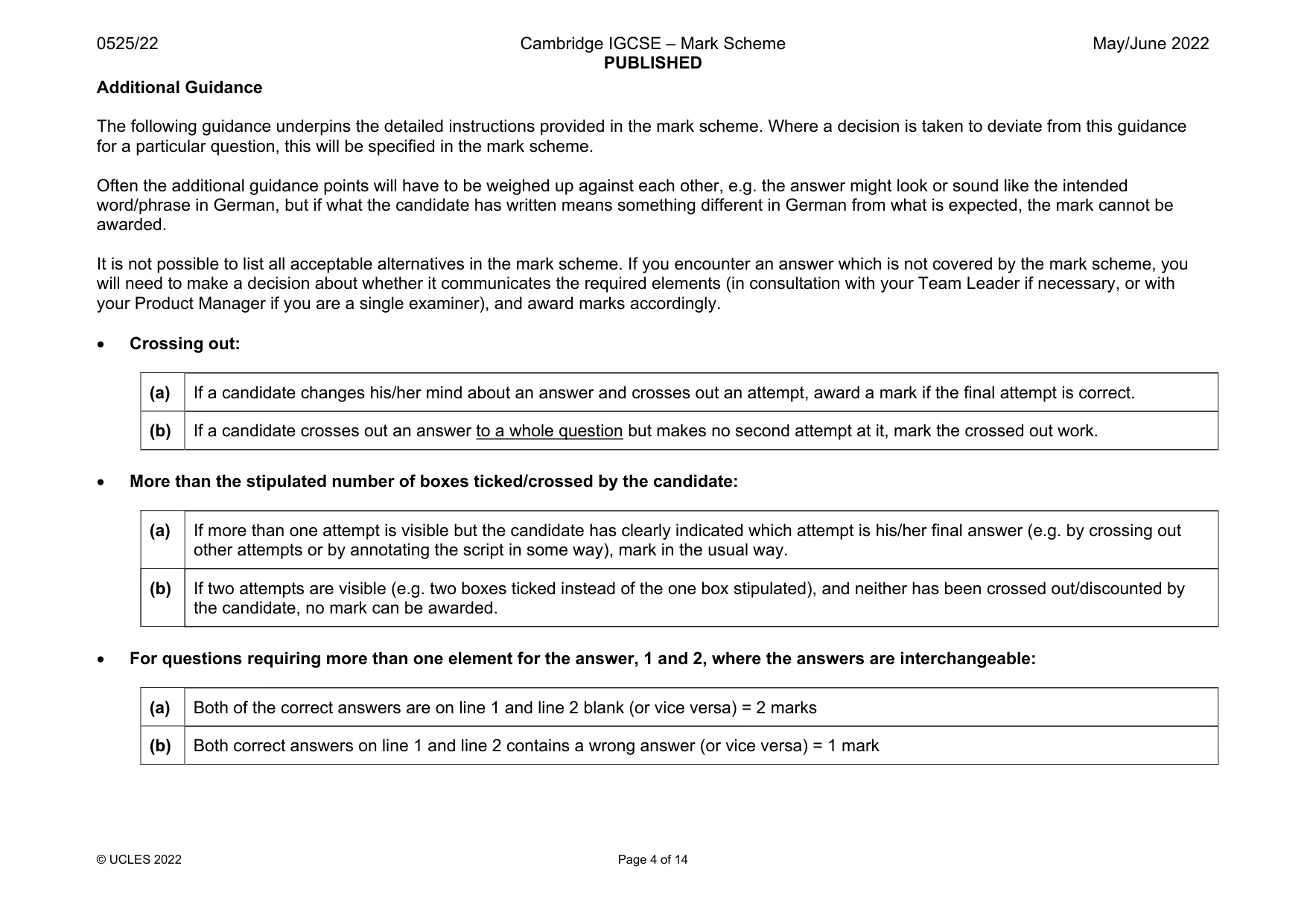
0525/22 Cambridge IGCSE – Mark Scheme PUBLISHED May/June 2022 © UCLES 2022 Page 4 of 14 Additional Guidance The following guidance underpins the detailed instructions provided in the mark scheme. Where a decision is taken to deviate from this guidance for a particular question, this will be specified in the mark scheme. Often the additional guidance points will have to be weighed up against each other, e.g. the answer might look or sound like the intended word/phrase in German, but if what the candidate has written means something different in German from what is expected, the mark cannot be awarded. It is not possible to list all acceptable alternatives in the mark scheme. If you encounter an answer which is not covered by the mark scheme, you will need to make a decision about whether it communicates the required elements (in consultation with your Team Leader if necessary, or with your Product Manager if you are a single examiner), and award marks accordingly. Crossing out: (a) If a candidate changes his/her mind about an answer and crosses out an attempt, award a mark if the final attempt is correct. (b) If a candidate crosses out an answer to a whole question but makes no second attempt at it, mark the crossed out work. More than the stipulated number of boxes ticked/crossed by the candidate: (a) If more than one attempt is visible but the candidate has clearly indicated which attempt is his/her final answer (e.g. by crossing out other attempts or by annotating the script in some way), mark in the usual way. (b) If two attempts are visible (e.g. two boxes ticked instead of the one box stipulated), and neither has been crossed out/discounted by the candidate, no mark can be awarded. For questions requiring more than one element for the answer, 1 and 2, where the answers are interchangeable: (a) Both of the correct answers are on line 1 and line 2 blank (or vice versa) = 2 marks (b) Both correct answers on line 1 and line 2 contains a wrong answer (or vice versa) = 1 mark
Mark scheme, page 5
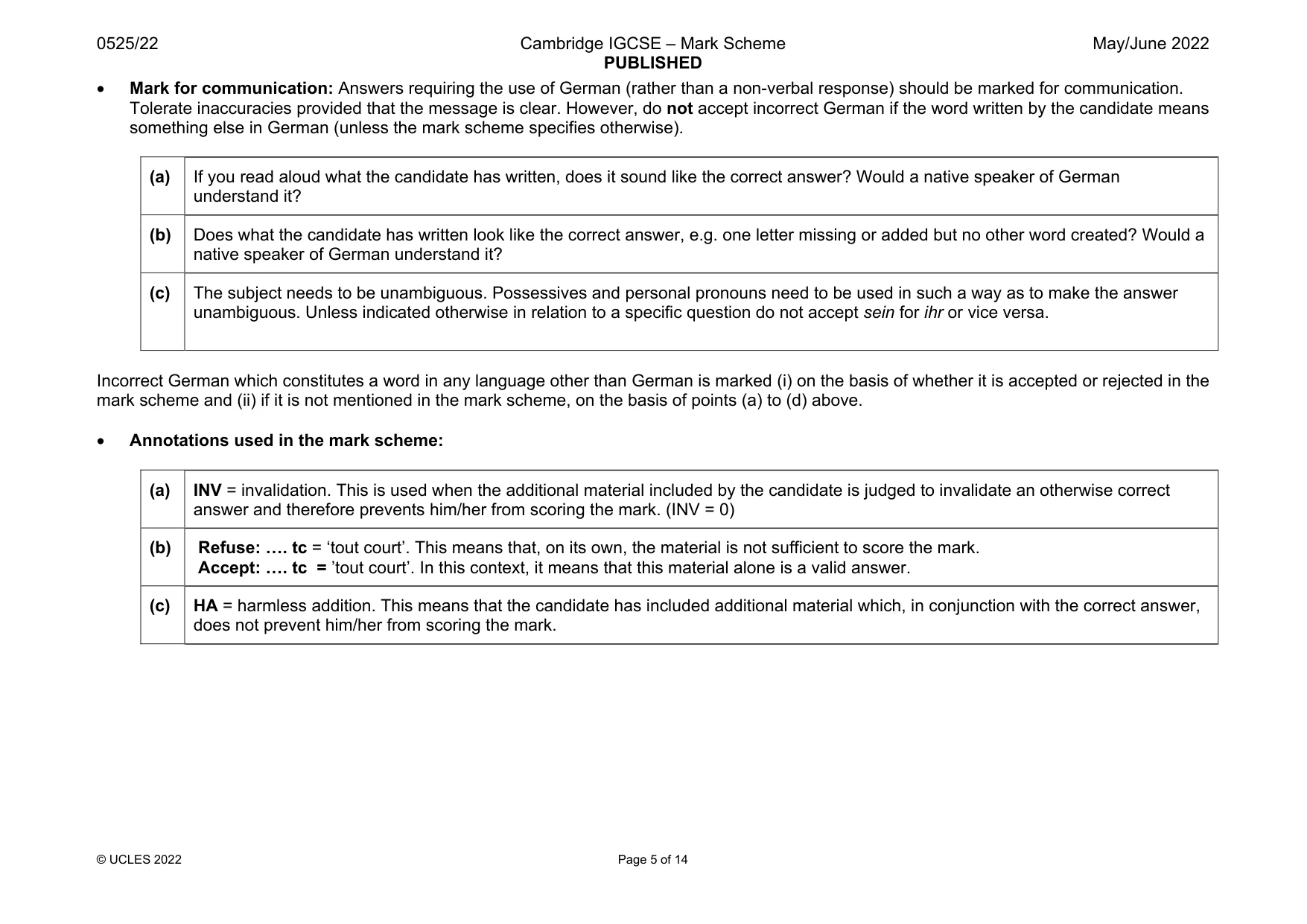
0525/22 Cambridge IGCSE – Mark Scheme PUBLISHED May/June 2022 © UCLES 2022 Page 5 of 14 Mark for communication: Answers requiring the use of German (rather than a non-verbal response) should be marked for communication. Tolerate inaccuracies provided that the message is clear. However, do not accept incorrect German if the word written by the candidate means something else in German (unless the mark scheme specifies otherwise). (a) If you read aloud what the candidate has written, does it sound like the correct answer? Would a native speaker of German understand it? (b) Does what the candidate has written look like the correct answer, e.g. one letter missing or added but no other word created? Would a native speaker of German understand it? (c) The subject needs to be unambiguous. Possessives and personal pronouns need to be used in such a way as to make the answer unambiguous. Unless indicated otherwise in relation to a specific question do not accept sein for ihr or vice versa. Incorrect German which constitutes a word in any language other than German is marked (i) on the basis of whether it is accepted or rejected in the mark scheme and (ii) if it is not mentioned in the mark scheme, on the basis of points (a) to (d) above. Annotations used in the mark scheme: (a) INV = invalidation. This is used when the additional material included by the candidate is judged to invalidate an otherwise correct answer and therefore prevents him/her from scoring the mark. (INV = 0) (b) Refuse: …. tc = ‘tout court’. This means that, on its own, the material is not sufficient to score the mark. Accept: …. tc = ’tout court’. In this context, it means that this material alone is a valid answer. (c) HA = harmless addition. This means that the candidate has included additional material which, in conjunction with the correct answer, does not prevent him/her from scoring the mark.
Mark scheme, page 6
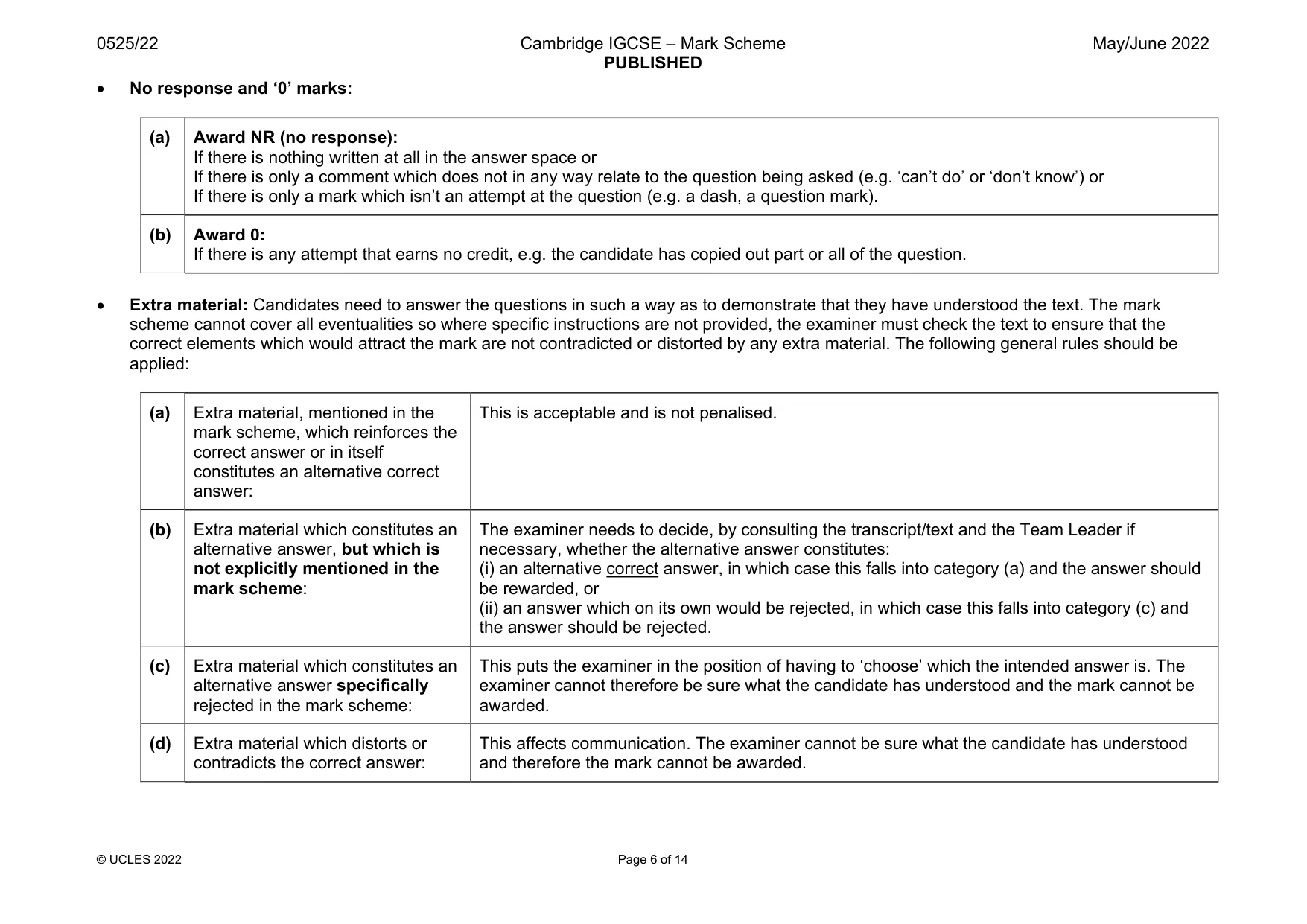
0525/22 Cambridge IGCSE – Mark Scheme PUBLISHED May/June 2022 © UCLES 2022 Page 6 of 14 No response and ‘0’ marks: (a) Award NR (no response): If there is nothing written at all in the answer space or If there is only a comment which does not in any way relate to the question being asked (e.g. ‘can’t do’ or ‘don’t know’) or If there is only a mark which isn’t an attempt at the question (e.g. a dash, a question mark). (b) Award 0: If there is any attempt that earns no credit, e.g. the candidate has copied out part or all of the question. Extra material: Candidates need to answer the questions in such a way as to demonstrate that they have understood the text. The mark scheme cannot cover all eventualities so where specific instructions are not provided, the examiner must check the text to ensure that the correct elements which would attract the mark are not contradicted or distorted by any extra material. The following general rules should be applied: (a) Extra material, mentioned in the mark scheme, which reinforces the correct answer or in itself constitutes an alternative correct answer: This is acceptable and is not penalised. (b) Extra material which constitutes an alternative answer, but which is not explicitly mentioned in the mark scheme: The examiner needs to decide, by consulting the transcript/text and the Team Leader if necessary, whether the alternative answer constitutes: (i) an alternative correct answer, in which case this falls into category (a) and the answer should be rewarded, or (ii) an answer which on its own would be rejected, in which case this falls into category (c) and the answer should be rejected. (c) Extra material which constitutes an alternative answer specifically rejected in the mark scheme: This puts the examiner in the position of having to ‘choose’ which the intended answer is. The examiner cannot therefore be sure what the candidate has understood and the mark cannot be awarded. (d) Extra material which distorts or contradicts the correct answer: This affects communication. The examiner cannot be sure what the candidate has understood and therefore the mark cannot be awarded.
Mark scheme, page 7
0525/22 Cambridge IGCSE – Mark Scheme PUBLISHED May/June 2022 © UCLES 2022 Page 7 of 14 (e) Extra material introduced by the candidate and which does not feature in the original text: This affects communication. The examiner cannot be sure what the candidate has understood and therefore the mark cannot be awarded. It can sometimes be difficult to draw the line between what is a deduction made by an able candidate on the basis of what they have read and pure guesswork. Therefore, where a particular answer is not covered by the mark scheme, the examiner should consult the Team Leader.
Mark scheme, page 8
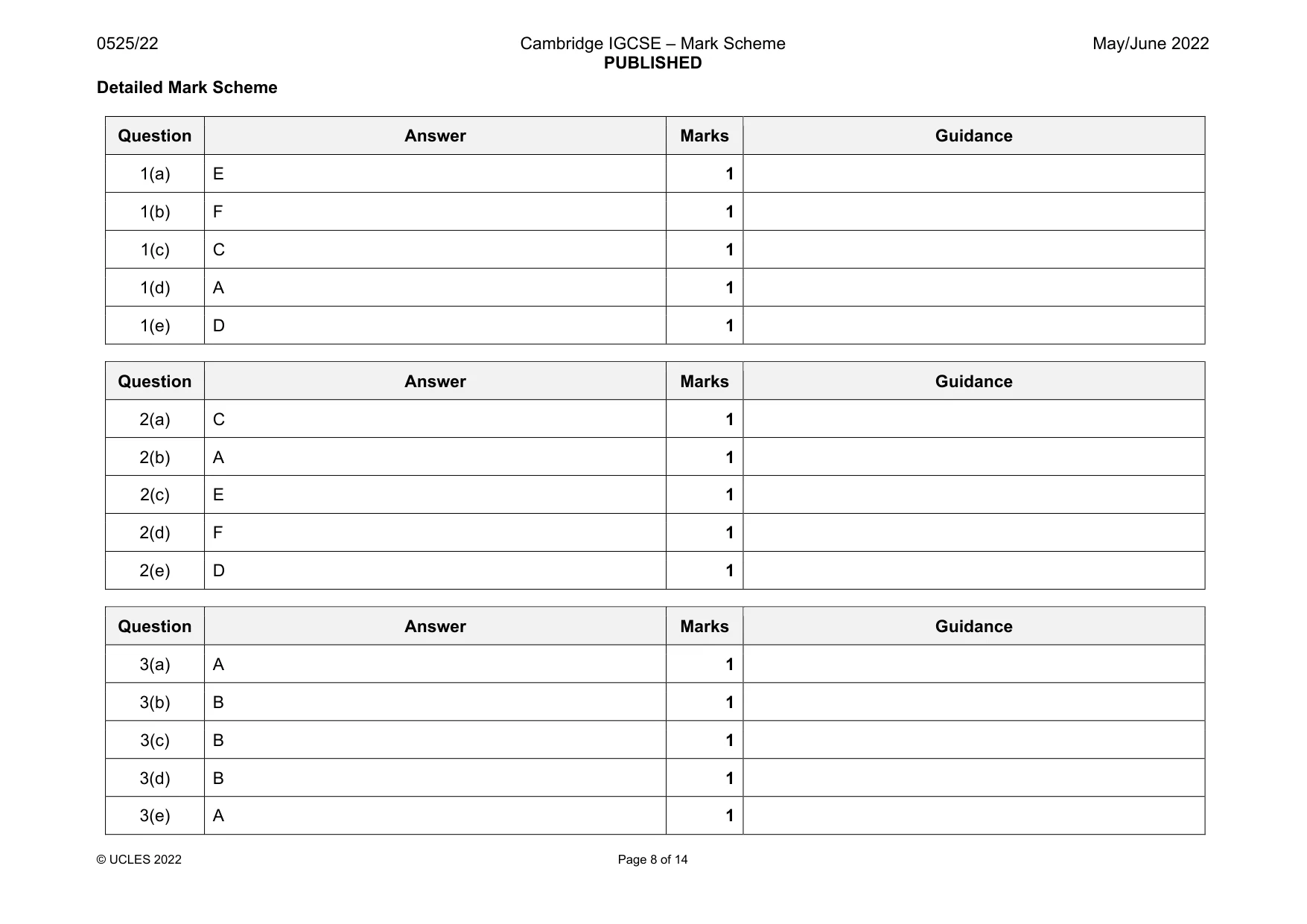
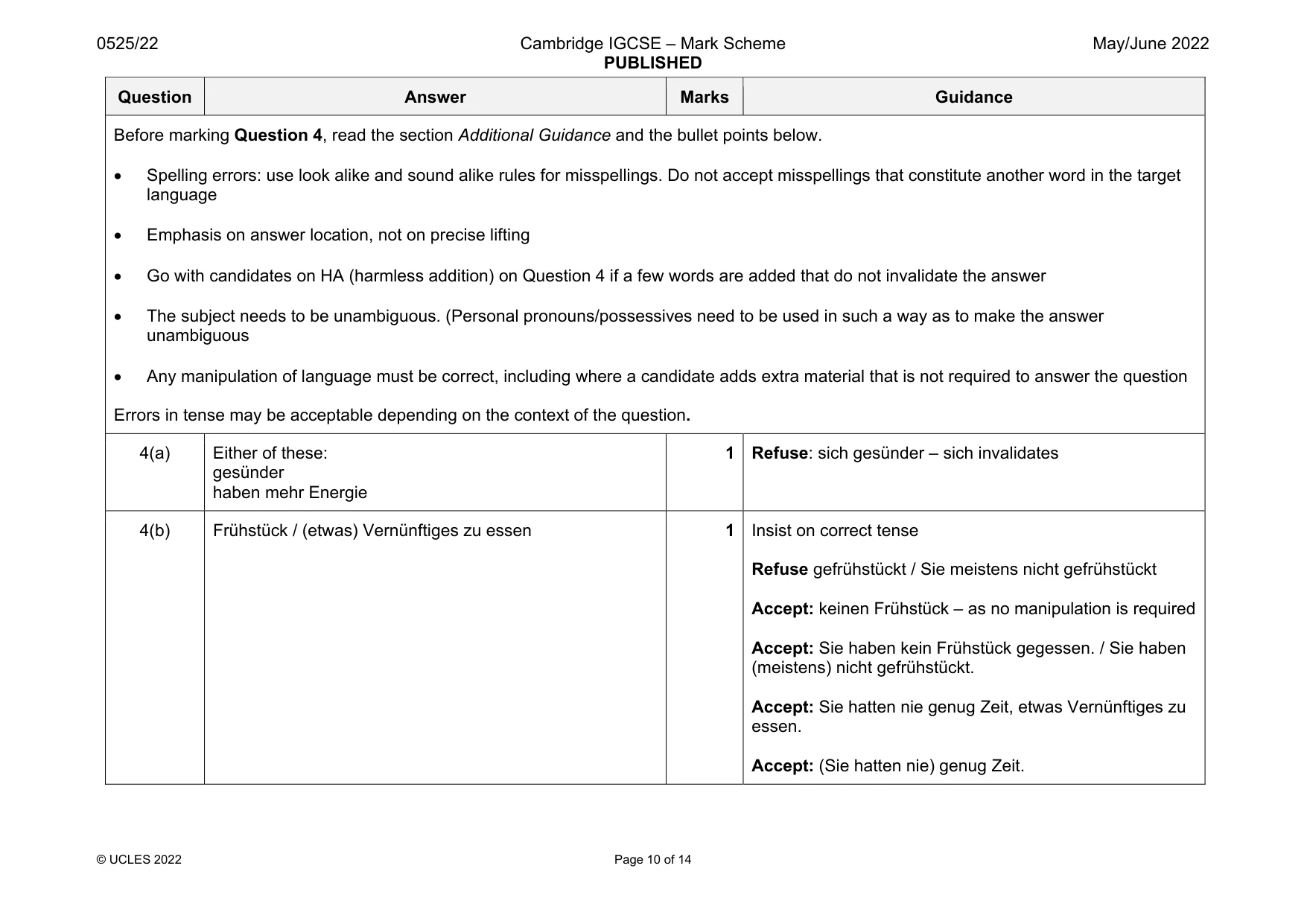
0525/22 Cambridge IGCSE – Mark Scheme PUBLISHED May/June 2022 © UCLES 2022 Page 8 of 14 Detailed Mark Scheme Question Answer Marks Guidance 1(a) E 1 1(b) F 1 1(c) C 1 1(d) A 1 1(e) D 1 Question Answer Marks Guidance 2(a) C 1 2(b) A 1 2(c) E 1 2(d) F 1 2(e) D 1 Question Answer Marks Guidance 3(a) A 1 3(b) B 1 3(c) B 1 3(d) B 1 3(e) A 1
Mark scheme, page 9
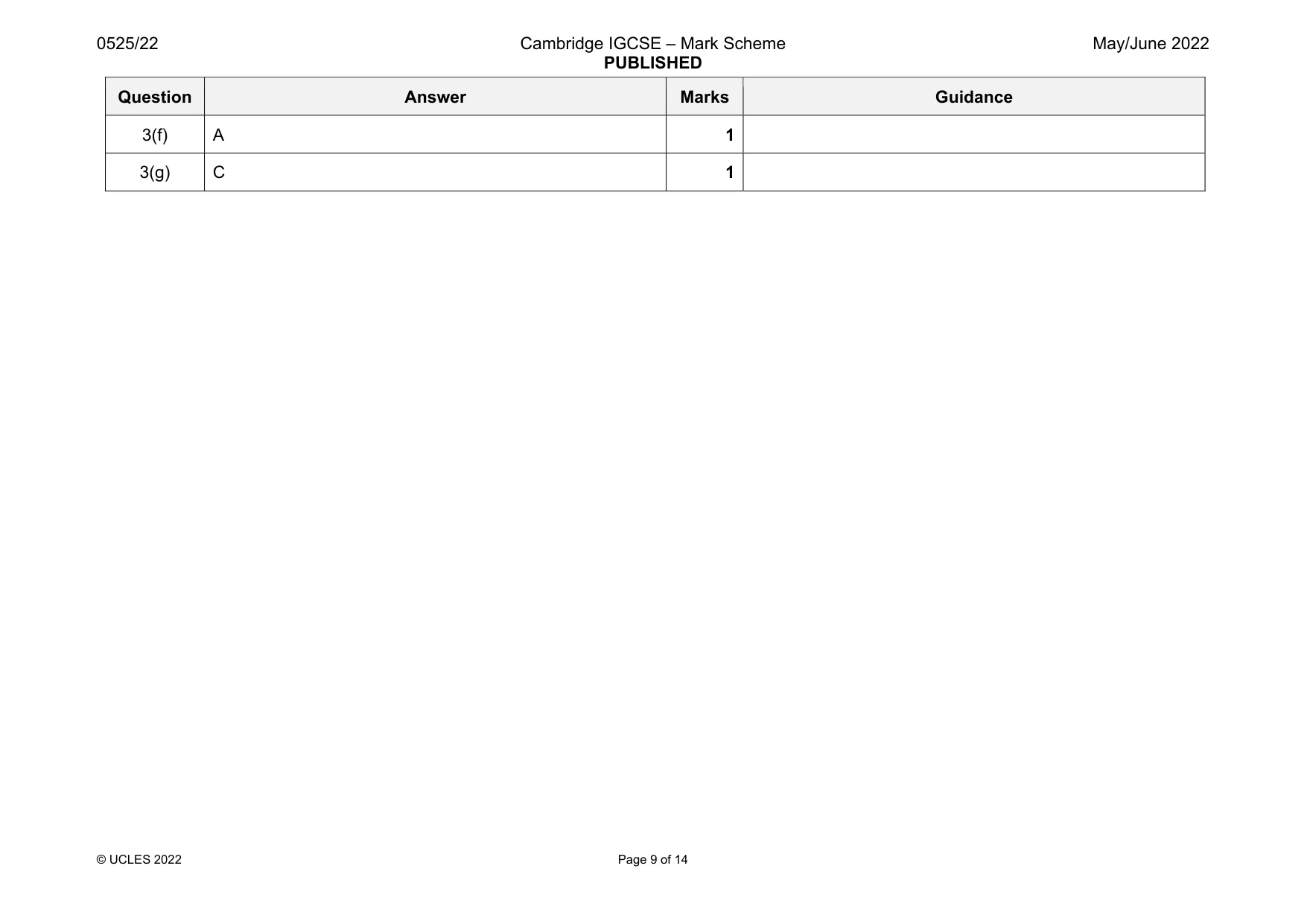
0525/22 Cambridge IGCSE – Mark Scheme PUBLISHED May/June 2022 © UCLES 2022 Page 9 of 14 Question Answer Marks Guidance 3(f) A 1 3(g) C 1
Mark scheme, page 10
0525/22 Cambridge IGCSE – Mark Scheme PUBLISHED May/June 2022 © UCLES 2022 Page 10 of 14 Question Answer Marks Guidance Before marking Question 4, read the section Additional Guidance and the bullet points below. Spelling errors: use look alike and sound alike rules for misspellings. Do not accept misspellings that constitute another word in the target language Emphasis on answer location, not on precise lifting Go with candidates on HA (harmless addition) on Question 4 if a few words are added that do not invalidate the answer The subject needs to be unambiguous. (Personal pronouns/possessives need to be used in such a way as to make the answer unambiguous Any manipulation of language must be correct, including where a candidate adds extra material that is not required to answer the question Errors in tense may be acceptable depending on the context of the question. 4(a) Either of these: gesünder haben mehr Energie 1 Refuse: sich gesünder – sich invalidates 4(b) Frühstück / (etwas) Vernünftiges zu essen 1 Insist on correct tense Refuse gefrühstückt / Sie meistens nicht gefrühstückt Accept: keinen Frühstück – as no manipulation is required Accept: Sie haben kein Frühstück gegessen. / Sie haben (meistens) nicht gefrühstückt. Accept: Sie hatten nie genug Zeit, etwas Vernünftiges zu essen. Accept: (Sie hatten nie) genug Zeit.
Mark scheme, page 11
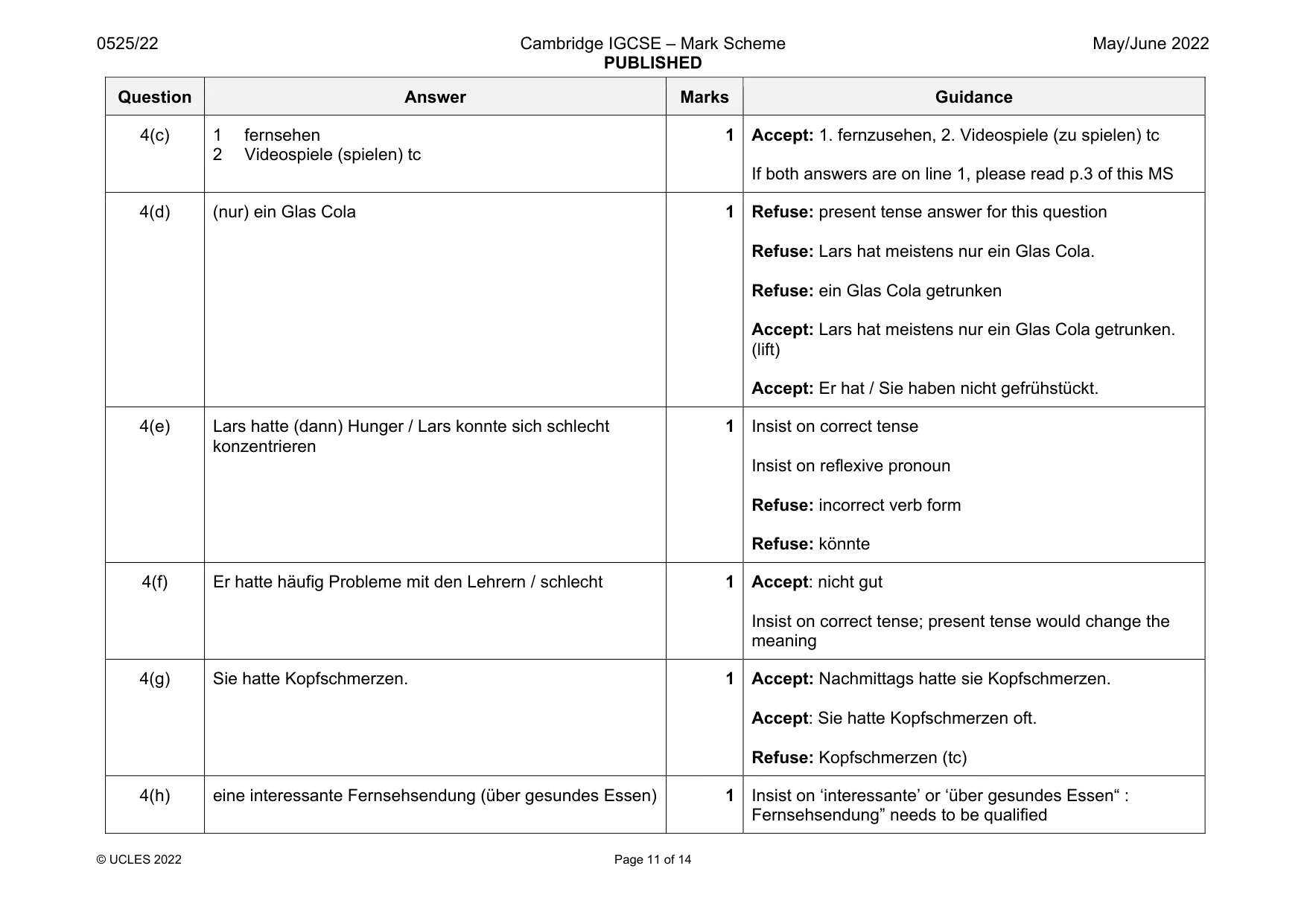
0525/22 Cambridge IGCSE – Mark Scheme PUBLISHED May/June 2022 © UCLES 2022 Page 11 of 14 Question Answer Marks Guidance 4(c) 1 fernsehen 2 Videospiele (spielen) tc 1 Accept: 1. fernzusehen, 2. Videospiele (zu spielen) tc If both answers are on line 1, please read p.3 of this MS 4(d) (nur) ein Glas Cola 1 Refuse: present tense answer for this question Refuse: Lars hat meistens nur ein Glas Cola. Refuse: ein Glas Cola getrunken Accept: Lars hat meistens nur ein Glas Cola getrunken. (lift) Accept: Er hat / Sie haben nicht gefrühstückt. 4(e) Lars hatte (dann) Hunger / Lars konnte sich schlecht konzentrieren 1 Insist on correct tense Insist on reflexive pronoun Refuse: incorrect verb form Refuse: könnte 4(f) Er hatte häufig Probleme mit den Lehrern / schlecht 1 Accept: nicht gut Insist on correct tense; present tense would change the meaning 4(g) Sie hatte Kopfschmerzen. 1 Accept: Nachmittags hatte sie Kopfschmerzen. Accept: Sie hatte Kopfschmerzen oft. Refuse: Kopfschmerzen (tc) 4(h) eine interessante Fernsehsendung (über gesundes Essen) 1 Insist on ‘interessante’ or ‘über gesundes Essen“ : Fernsehsendung” needs to be qualified
Mark scheme, page 12
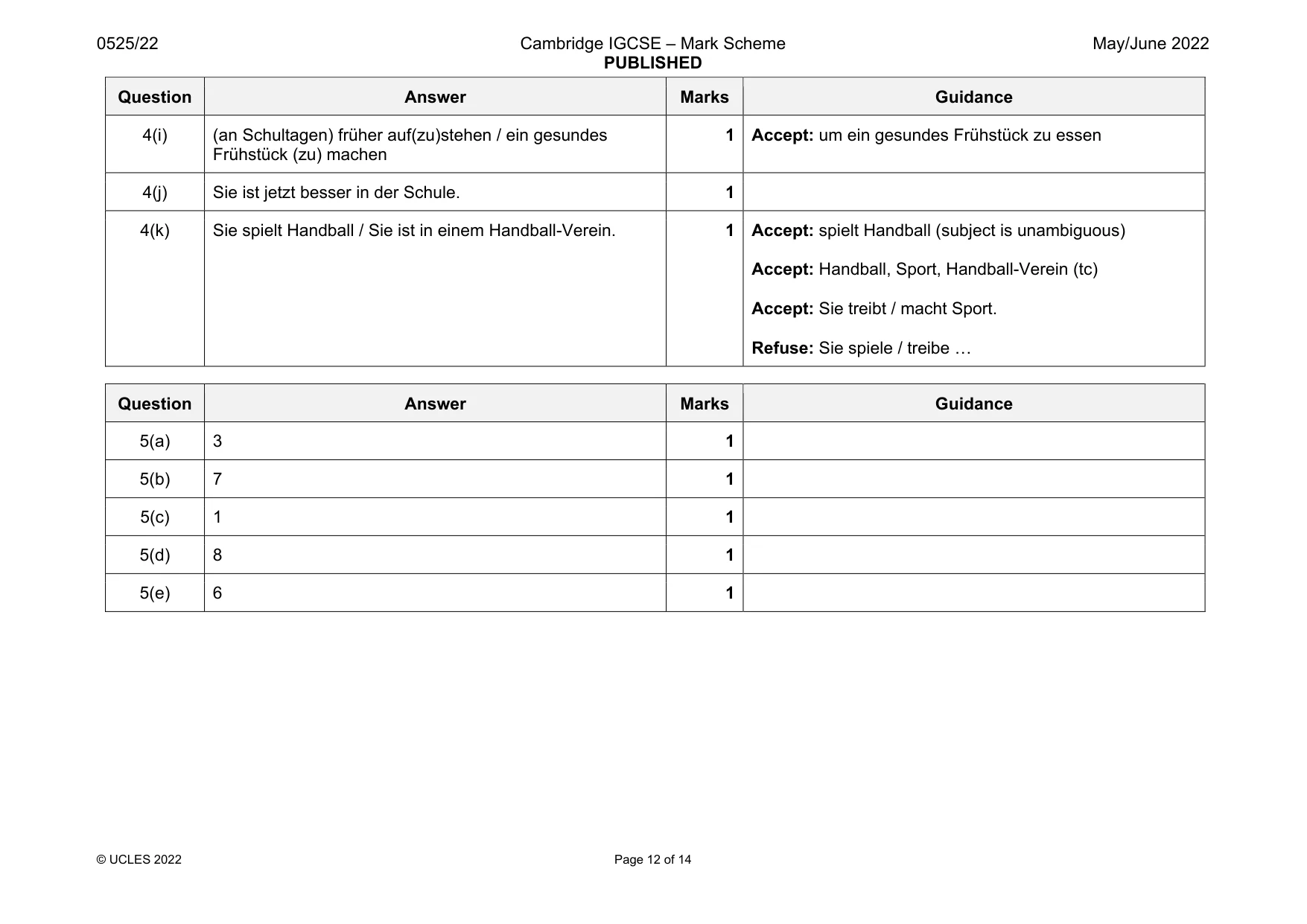
0525/22 Cambridge IGCSE – Mark Scheme PUBLISHED May/June 2022 © UCLES 2022 Page 12 of 14 Question Answer Marks Guidance 4(i) (an Schultagen) früher auf(zu)stehen / ein gesundes Frühstück (zu) machen 1 Accept: um ein gesundes Frühstück zu essen 4(j) Sie ist jetzt besser in der Schule. 1 4(k) Sie spielt Handball / Sie ist in einem Handball-Verein. 1 Accept: spielt Handball (subject is unambiguous) Accept: Handball, Sport, Handball-Verein (tc) Accept: Sie treibt / macht Sport. Refuse: Sie spiele / treibe … Question Answer Marks Guidance 5(a) 3 1 5(b) 7 1 5(c) 1 1 5(d) 8 1 5(e) 6 1
Mark scheme, page 13
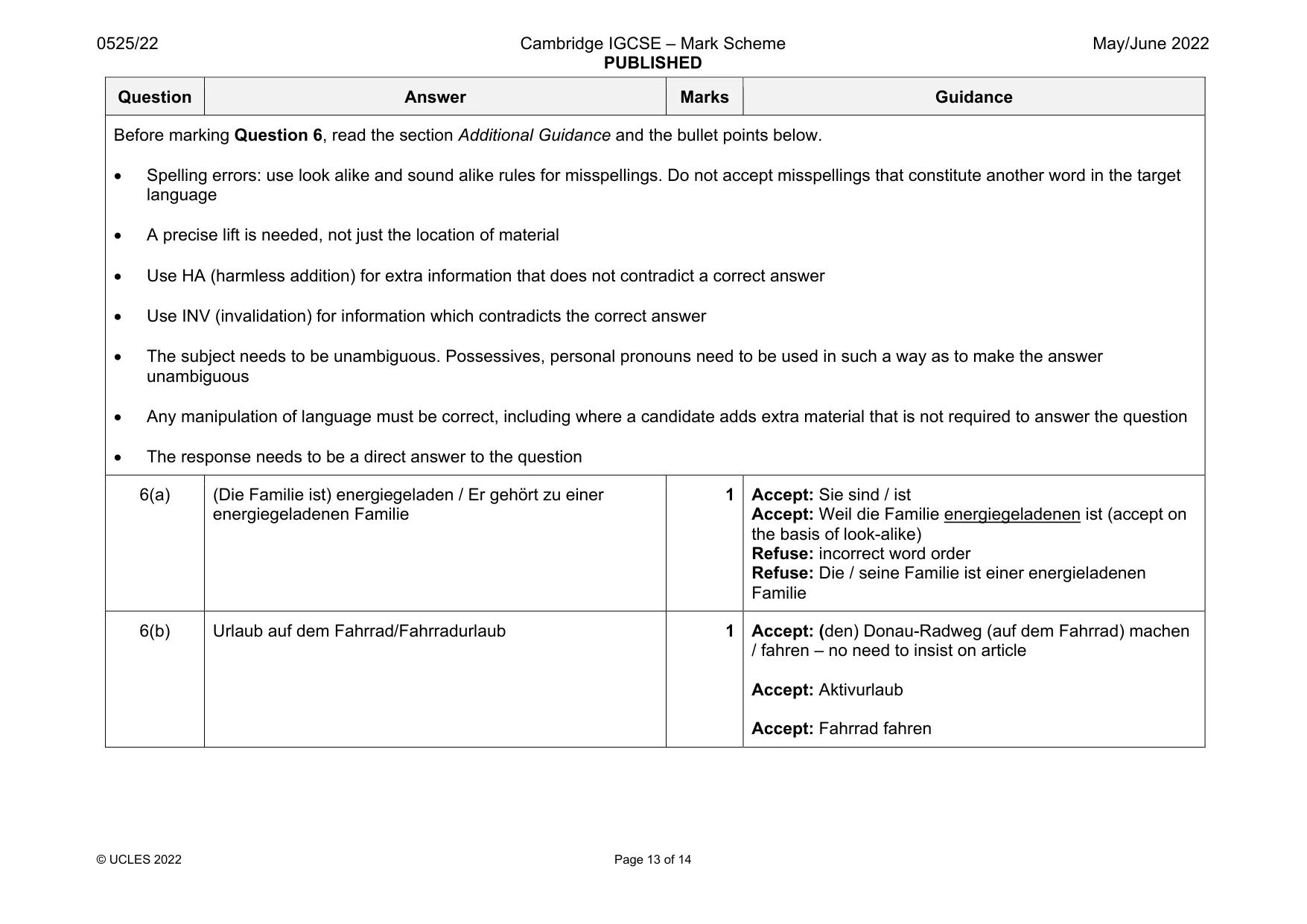
0525/22 Cambridge IGCSE – Mark Scheme PUBLISHED May/June 2022 © UCLES 2022 Page 13 of 14 Question Answer Marks Guidance Before marking Question 6, read the section Additional Guidance and the bullet points below. Spelling errors: use look alike and sound alike rules for misspellings. Do not accept misspellings that constitute another word in the target language A precise lift is needed, not just the location of material Use HA (harmless addition) for extra information that does not contradict a correct answer Use INV (invalidation) for information which contradicts the correct answer The subject needs to be unambiguous. Possessives, personal pronouns need to be used in such a way as to make the answer unambiguous Any manipulation of language must be correct, including where a candidate adds extra material that is not required to answer the question The response needs to be a direct answer to the question 6(a) (Die Familie ist) energiegeladen / Er gehört zu einer energiegeladenen Familie 1 Accept: Sie sind / ist Accept: Weil die Familie energiegeladenen ist (accept on the basis of look-alike) Refuse: incorrect word order Refuse: Die / seine Familie ist einer energieladenen Familie 6(b) Urlaub auf dem Fahrrad/Fahrradurlaub 1 Accept: (den) Donau-Radweg (auf dem Fahrrad) machen / fahren – no need to insist on article Accept: Aktivurlaub Accept: Fahrrad fahren
Mark scheme, page 14
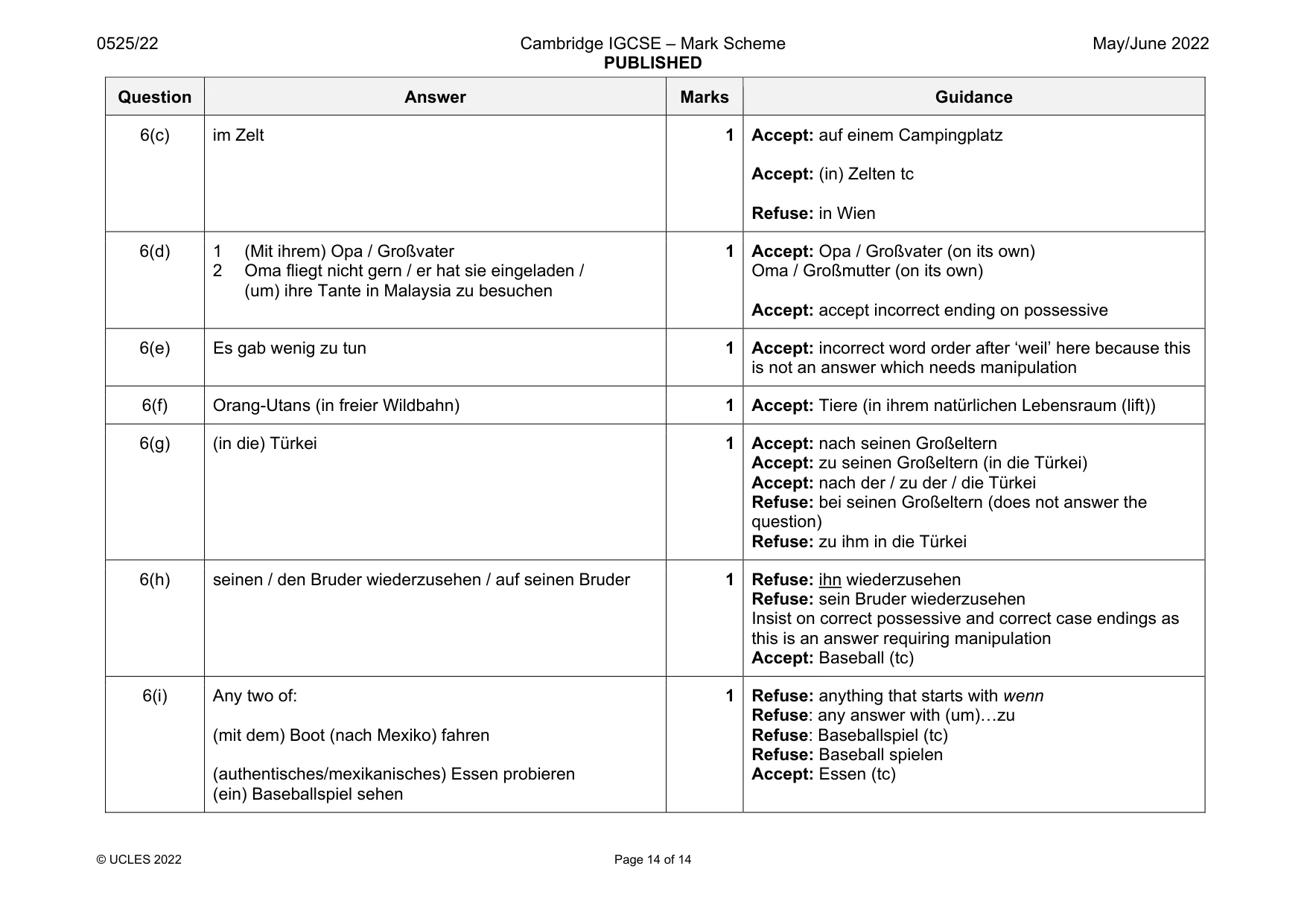
0525/22 Cambridge IGCSE – Mark Scheme PUBLISHED May/June 2022 © UCLES 2022 Page 14 of 14 Question Answer Marks Guidance 6(c) im Zelt 1 Accept: auf einem Campingplatz Accept: (in) Zelten tc Refuse: in Wien 6(d) 1 (Mit ihrem) Opa / Großvater 2 Oma fliegt nicht gern / er hat sie eingeladen / (um) ihre Tante in Malaysia zu besuchen 1 Accept: Opa / Großvater (on its own) Oma / Großmutter (on its own) Accept: accept incorrect ending on possessive 6(e) Es gab wenig zu tun 1 Accept: incorrect word order after ‘weil’ here because this is not an answer which needs manipulation 6(f) Orang-Utans (in freier Wildbahn) 1 Accept: Tiere (in ihrem natürlichen Lebensraum (lift)) 6(g) (in die) Türkei 1 Accept: nach seinen Großeltern Accept: zu seinen Großeltern (in die Türkei) Accept: nach der / zu der / die Türkei Refuse: bei seinen Großeltern (does not answer the question) Refuse: zu ihm in die Türkei 6(h) seinen / den Bruder wiederzusehen / auf seinen Bruder 1 Refuse: ihn wiederzusehen Refuse: sein Bruder wiederzusehen Insist on correct possessive and correct case endings as this is an answer requiring manipulation Accept: Baseball (tc) 6(i) Any two of: (mit dem) Boot (nach Mexiko) fahren (authentisches/mexikanisches) Essen probieren (ein) Baseballspiel sehen 1 Refuse: anything that starts with wenn Refuse: any answer with (um)…zu Refuse: Baseballspiel (tc) Refuse: Baseball spielen Accept: Essen (tc)
What you needed in this session
Cambridge’s own grade thresholds for 2022 May/June, Paper 2 · Variant 2. A higher threshold means an easier paper — the bar moves with how the cohort did.