Cambridge IGCSE German - Foreign Language 0525 — 2020 May/June Paper 2 · Variant 2
0525/22/M/J/20
The question paper and its mark scheme, free to read here and free to download. This is Cambridge’s own paper, exactly as it was sat.
Question paper16 pages


Mark scheme15 pages
Answers below. Sit the paper first if you are practising.
Paper as text
Question paper, page 1
Cambridge IGCSE™ This document has 16 pages. Blank pages are indicated. DC (SC/TP) 182621/4 © UCLES 2020 [Turn over GERMAN 0525/22 Paper 2 Reading May/June 2020 1 hour You must answer on the question paper. No additional materials are needed. INSTRUCTIONS ● Answer all questions. ● Use a black or dark blue pen. ● Write your name, centre number and candidate number in the boxes at the top of the page. ● Write your answer to each question in the space provided. ● Do not use an erasable pen or correction fluid. ● Do not write on any bar codes. INFORMATION ● The total mark for this paper is 45. ● The number of marks for each question or part question is shown in brackets [ ]. * 5 8 4 2 2 0 5 7 1 9 *
Question paper, page 2
2 0525/22/M/J/20 © UCLES 2020 BLANK PAGE
Question paper, page 3
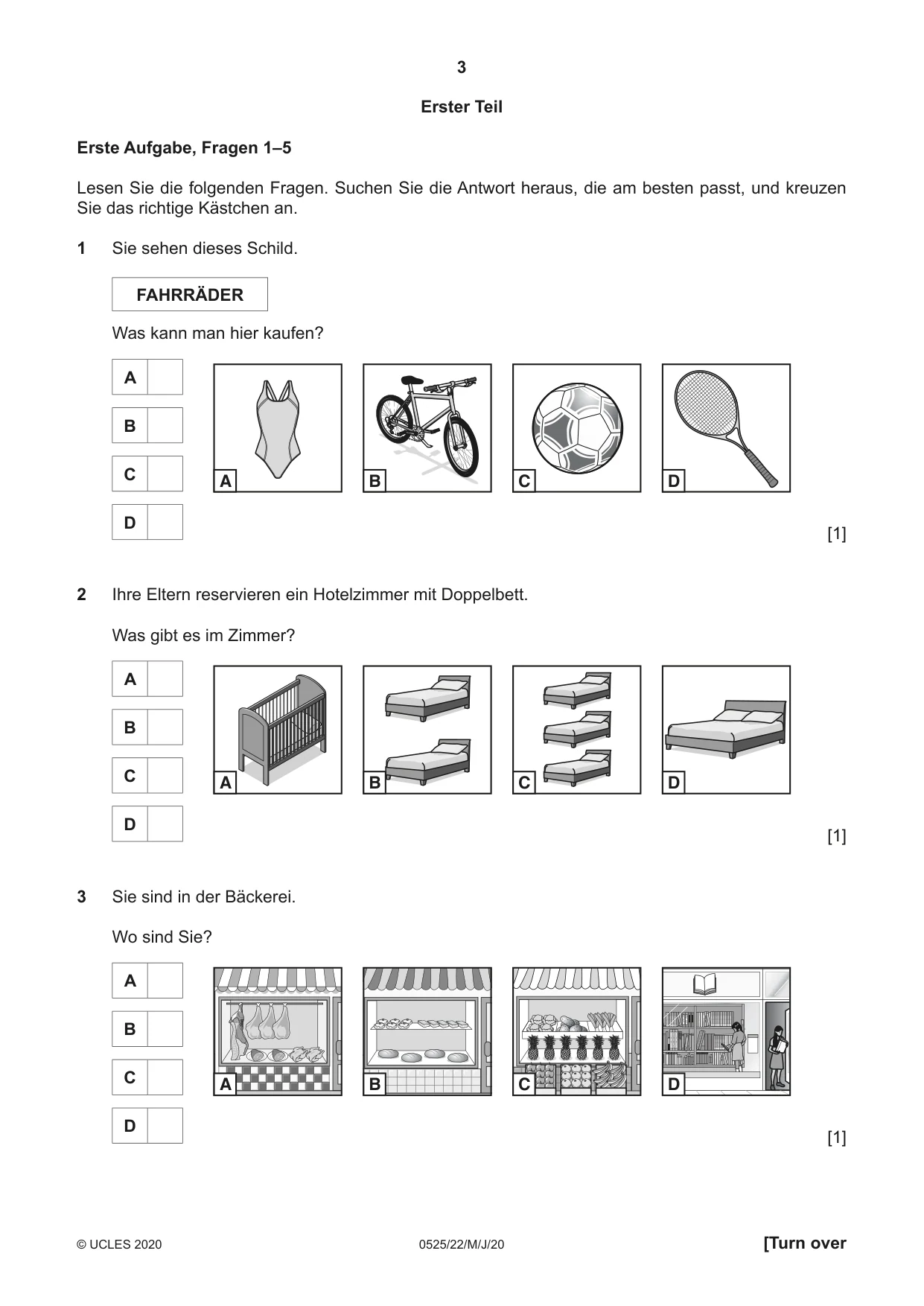
3 0525/22/M/J/20 © UCLES 2020 [Turn over Erster Teil Erste Aufgabe, Fragen 1–5 Lesen Sie die folgenden Fragen. Suchen Sie die Antwort heraus, die am besten passt, und kreuzen Sie das richtige Kästchen an. 1 Sie sehen dieses Schild. FAHRRÄDER Was kann man hier kaufen? A A B C D [1] B C D 2 Ihre Eltern reservieren ein Hotelzimmer mit Doppelbett. Was gibt es im Zimmer? A A B C D [1] B C D 3 Sie sind in der Bäckerei. Wo sind Sie? A A B C D [1] B C D
Question paper, page 4
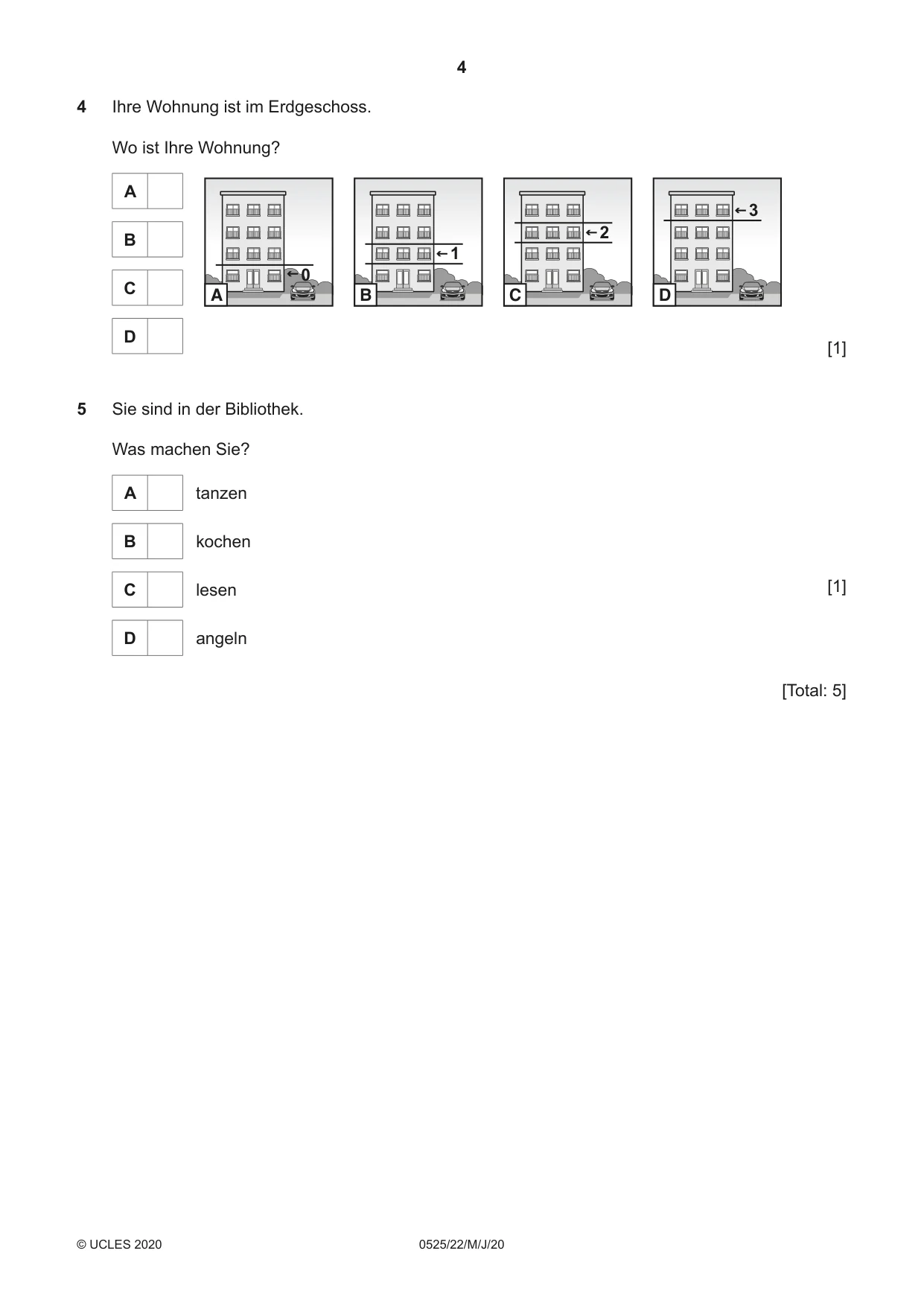
4 0525/22/M/J/20 © UCLES 2020 4 Ihre Wohnung ist im Erdgeschoss. Wo ist Ihre Wohnung? A 0 1 2 3 A B C D [1] B C D 5 Sie sind in der Bibliothek. Was machen Sie? A tanzen [1] B kochen C lesen D angeln [Total: 5]
Question paper, page 5
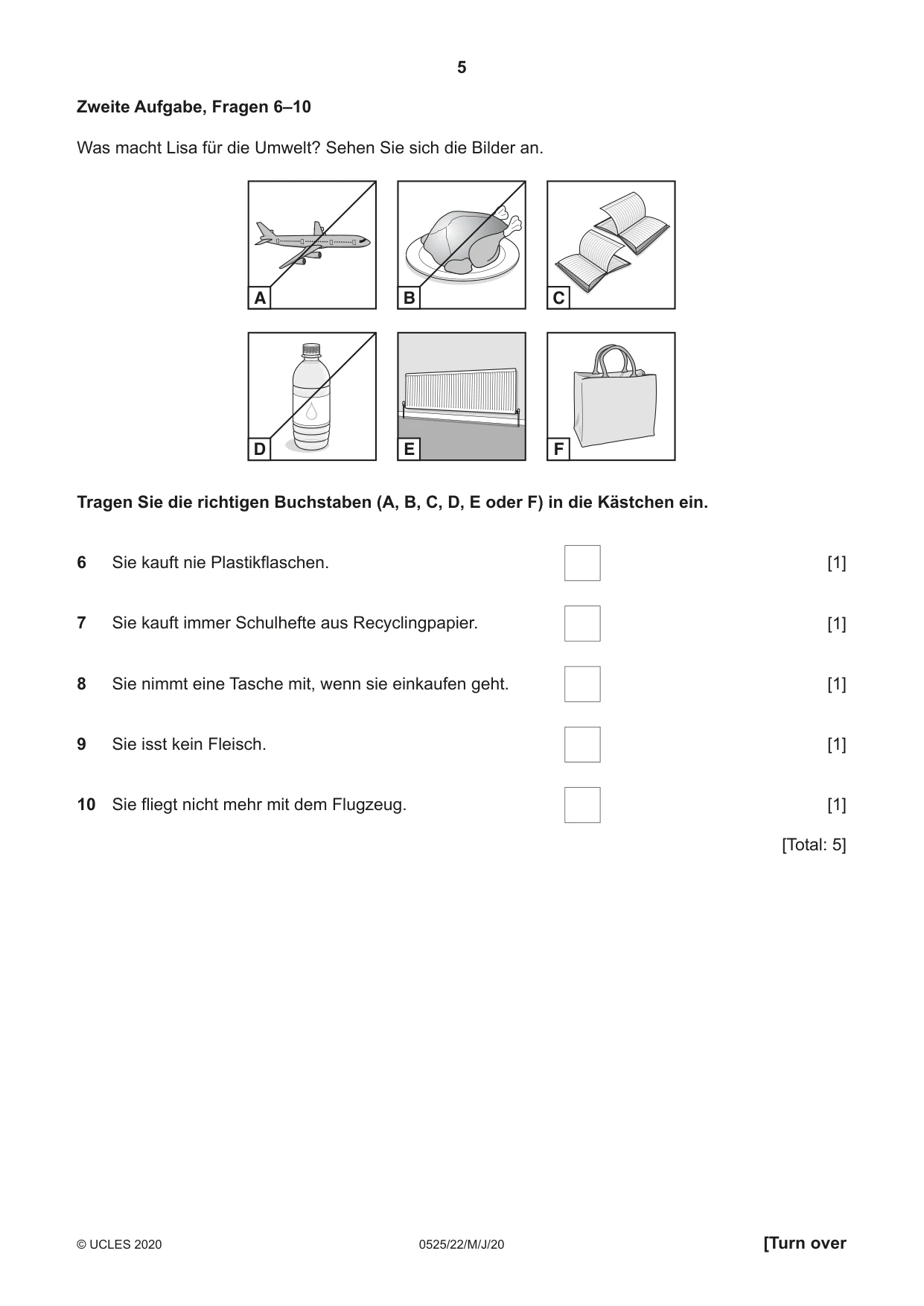
5 0525/22/M/J/20 © UCLES 2020 [Turn over Zweite Aufgabe, Fragen 6–10 Was macht Lisa für die Umwelt? Sehen Sie sich die Bilder an. A B C D E F Tragen Sie die richtigen Buchstaben (A, B, C, D, E oder F) in die Kästchen ein. 6 Sie kauft nie Plastikflaschen. [1] 7 Sie kauft immer Schulhefte aus Recyclingpapier. [1] 8 Sie nimmt eine Tasche mit, wenn sie einkaufen geht. [1] 9 Sie isst kein Fleisch. [1] 10 Sie fliegt nicht mehr mit dem Flugzeug. [1] [Total: 5]
Question paper, page 6
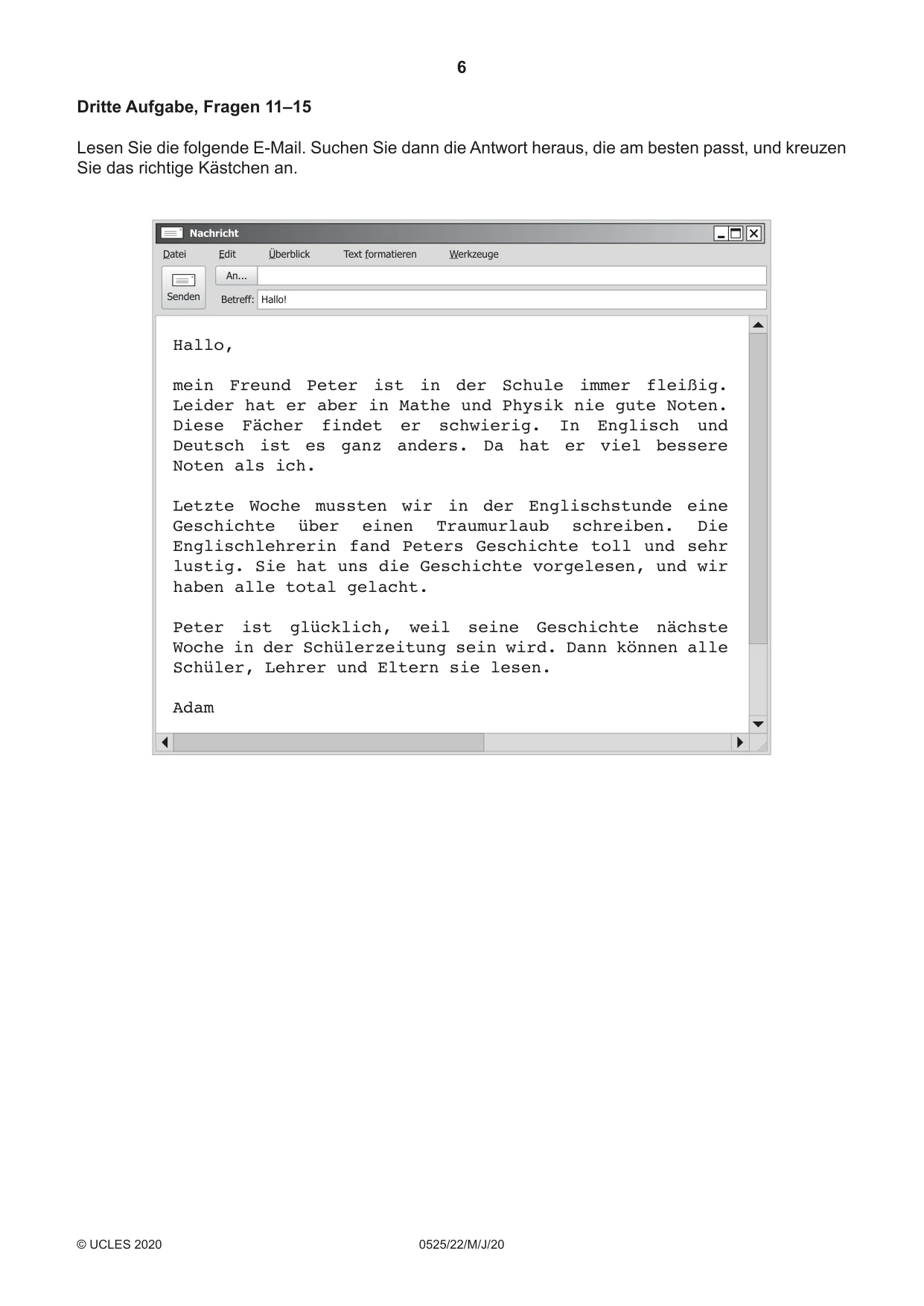
6 0525/22/M/J/20 © UCLES 2020 Dritte Aufgabe, Fragen 11–15 Lesen Sie die folgende E-Mail. Suchen Sie dann die Antwort heraus, die am besten passt, und kreuzen Sie das richtige Kästchen an. Betreff: Hallo! An... Senden Datei Edit Überblick Text formatieren Werkzeuge Nachricht Hallo, mein Freund Peter ist in der Schule immer fleißig. Leider hat er aber in Mathe und Physik nie gute Noten. Diese Fächer findet er schwierig. In Englisch und Deutsch ist es ganz anders. Da hat er viel bessere Noten als ich. Letzte Woche mussten wir in der Englischstunde eine Geschichte über einen Traumurlaub schreiben. Die Englischlehrerin fand Peters Geschichte toll und sehr lustig. Sie hat uns die Geschichte vorgelesen, und wir haben alle total gelacht. Peter ist glücklich, weil seine Geschichte nächste Woche in der Schülerzeitung sein wird. Dann können alle Schüler, Lehrer und Eltern sie lesen. Adam
Question paper, page 7
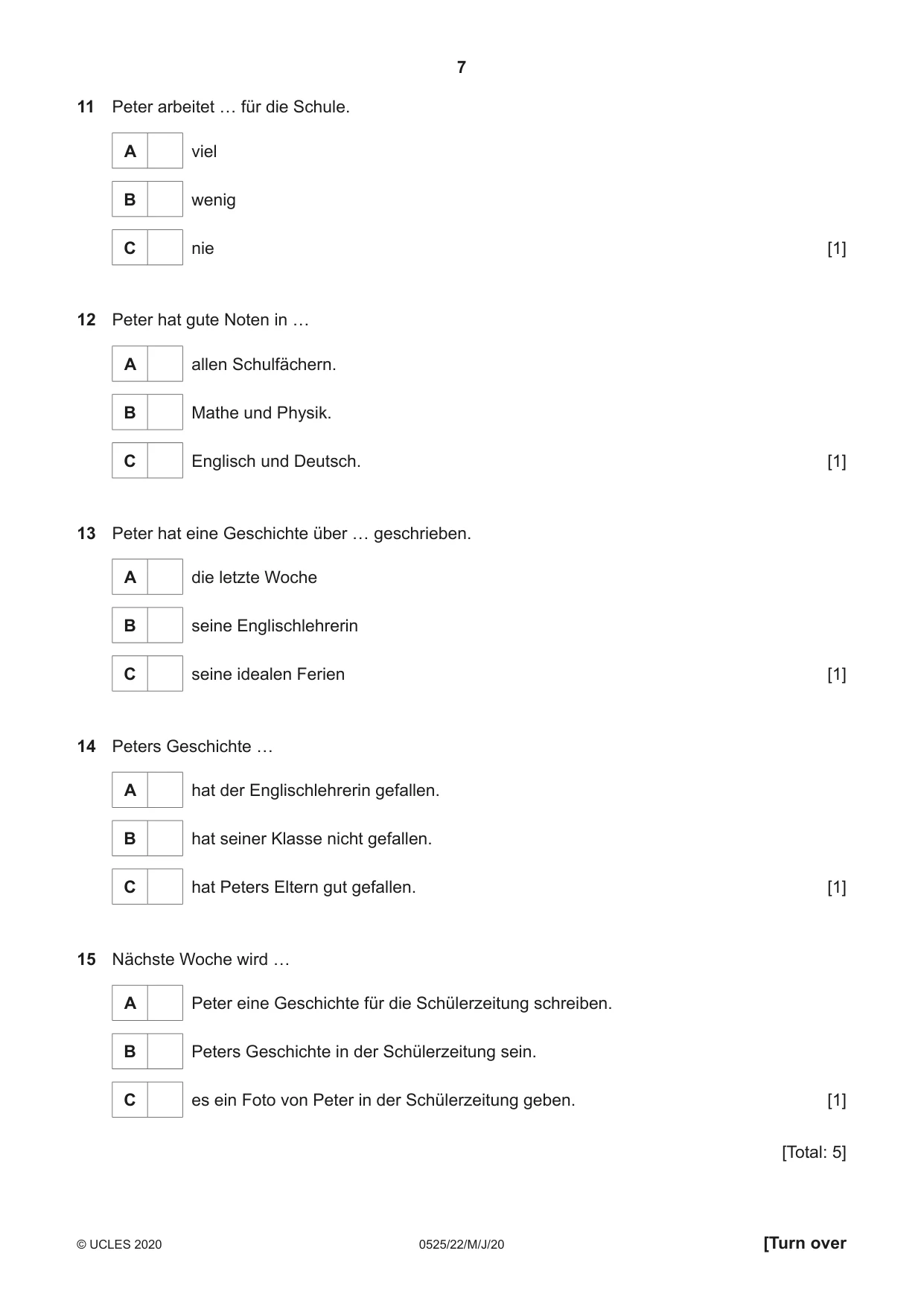
7 0525/22/M/J/20 © UCLES 2020 [Turn over 11 Peter arbeitet … für die Schule. A viel B wenig C nie [1] 12 Peter hat gute Noten in … A allen Schulfächern. B Mathe und Physik. C Englisch und Deutsch. [1] 13 Peter hat eine Geschichte über … geschrieben. A die letzte Woche B seine Englischlehrerin C seine idealen Ferien [1] 14 Peters Geschichte … A hat der Englischlehrerin gefallen. B hat seiner Klasse nicht gefallen. C hat Peters Eltern gut gefallen. [1] 15 Nächste Woche wird … A Peter eine Geschichte für die Schülerzeitung schreiben. B Peters Geschichte in der Schülerzeitung sein. C es ein Foto von Peter in der Schülerzeitung geben. [1] [Total: 5]
Question paper, page 8
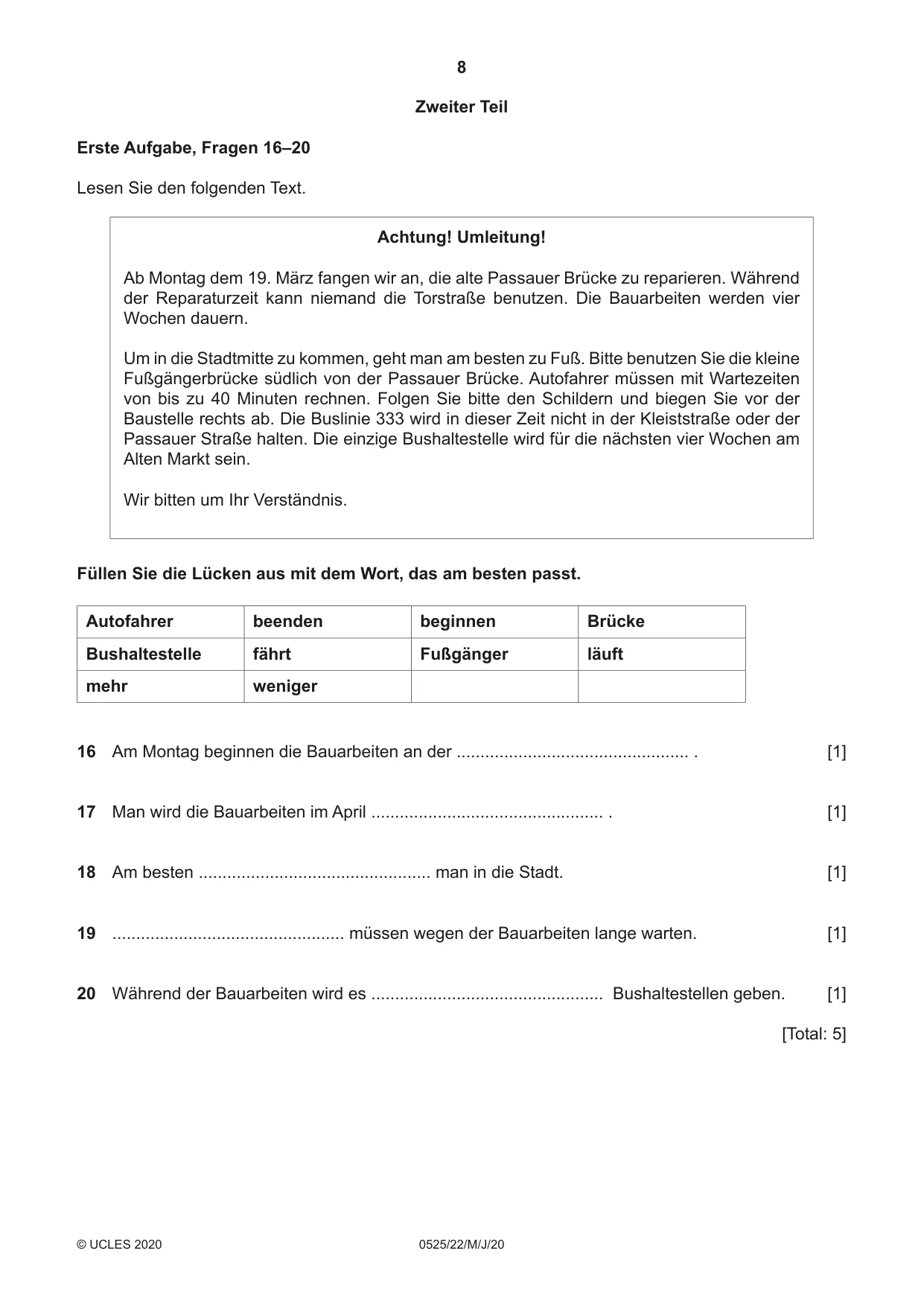
8 0525/22/M/J/20 © UCLES 2020 Zweiter Teil Erste Aufgabe, Fragen 16–20 Lesen Sie den folgenden Text. Achtung! Umleitung! Ab Montag dem 19. März fangen wir an, die alte Passauer Brücke zu reparieren. Während der Reparaturzeit kann niemand die Torstraße benutzen. Die Bauarbeiten werden vier Wochen dauern. Um in die Stadtmitte zu kommen, geht man am besten zu Fuß. Bitte benutzen Sie die kleine Fußgängerbrücke südlich von der Passauer Brücke. Autofahrer müssen mit Wartezeiten von bis zu 40 Minuten rechnen. Folgen Sie bitte den Schildern und biegen Sie vor der Baustelle rechts ab. Die Buslinie 333 wird in dieser Zeit nicht in der Kleiststraße oder der Passauer Straße halten. Die einzige Bushaltestelle wird für die nächsten vier Wochen am Alten Markt sein. Wir bitten um Ihr Verständnis. Füllen Sie die Lücken aus mit dem Wort, das am besten passt. Autofahrer beenden beginnen Brücke Bushaltestelle fährt Fußgänger läuft mehr weniger 16 Am Montag beginnen die Bauarbeiten an der … . [1] 17 Man wird die Bauarbeiten im April … . [1] 18 Am besten … man in die Stadt. [1] 19 … müssen wegen der Bauarbeiten lange warten. [1] 20 Während der Bauarbeiten wird es … Bushaltestellen geben. [1] [Total: 5]
Question paper, page 9
9 0525/22/M/J/20 © UCLES 2020 [Turn over BLANK PAGE
Question paper, page 10
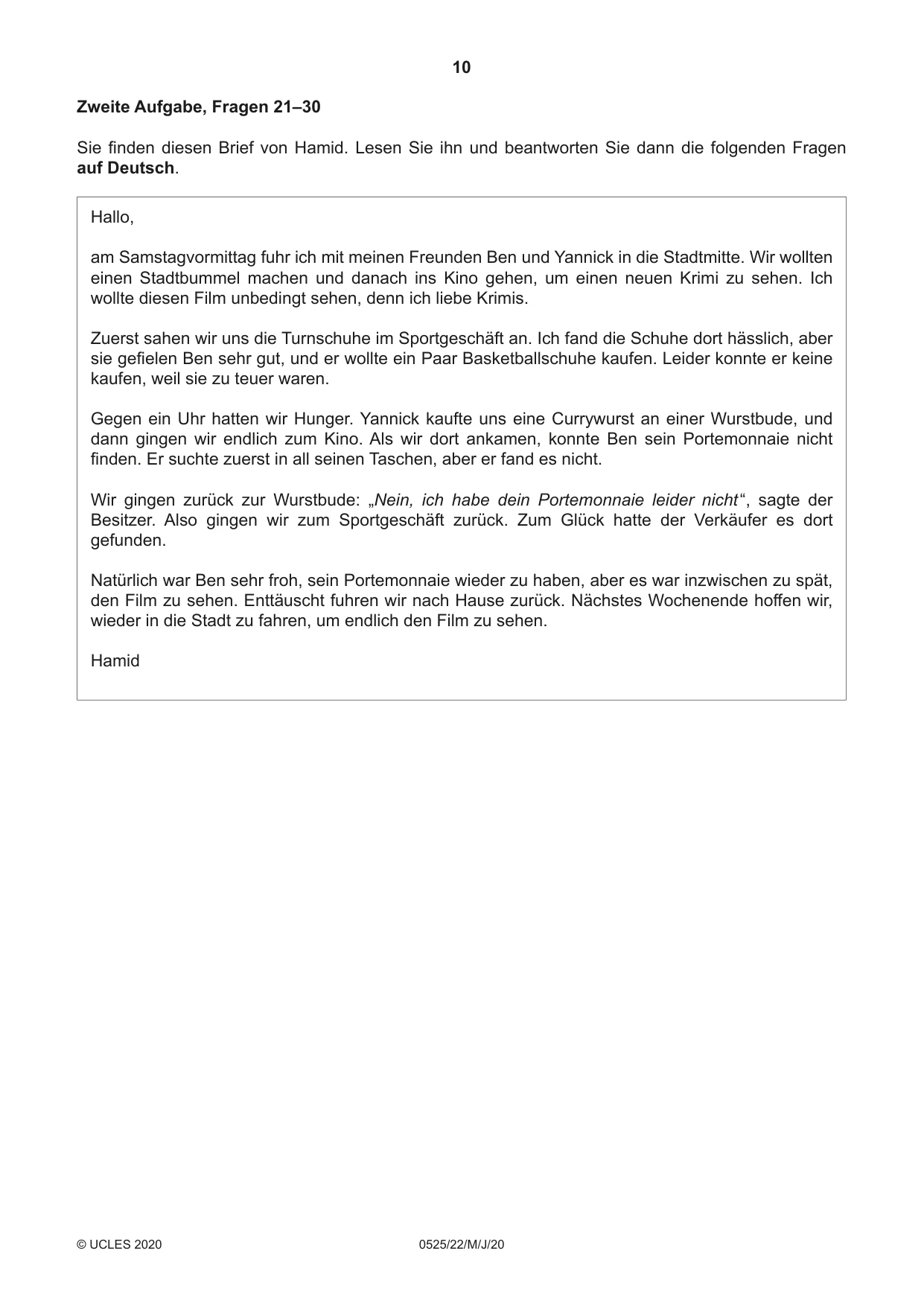
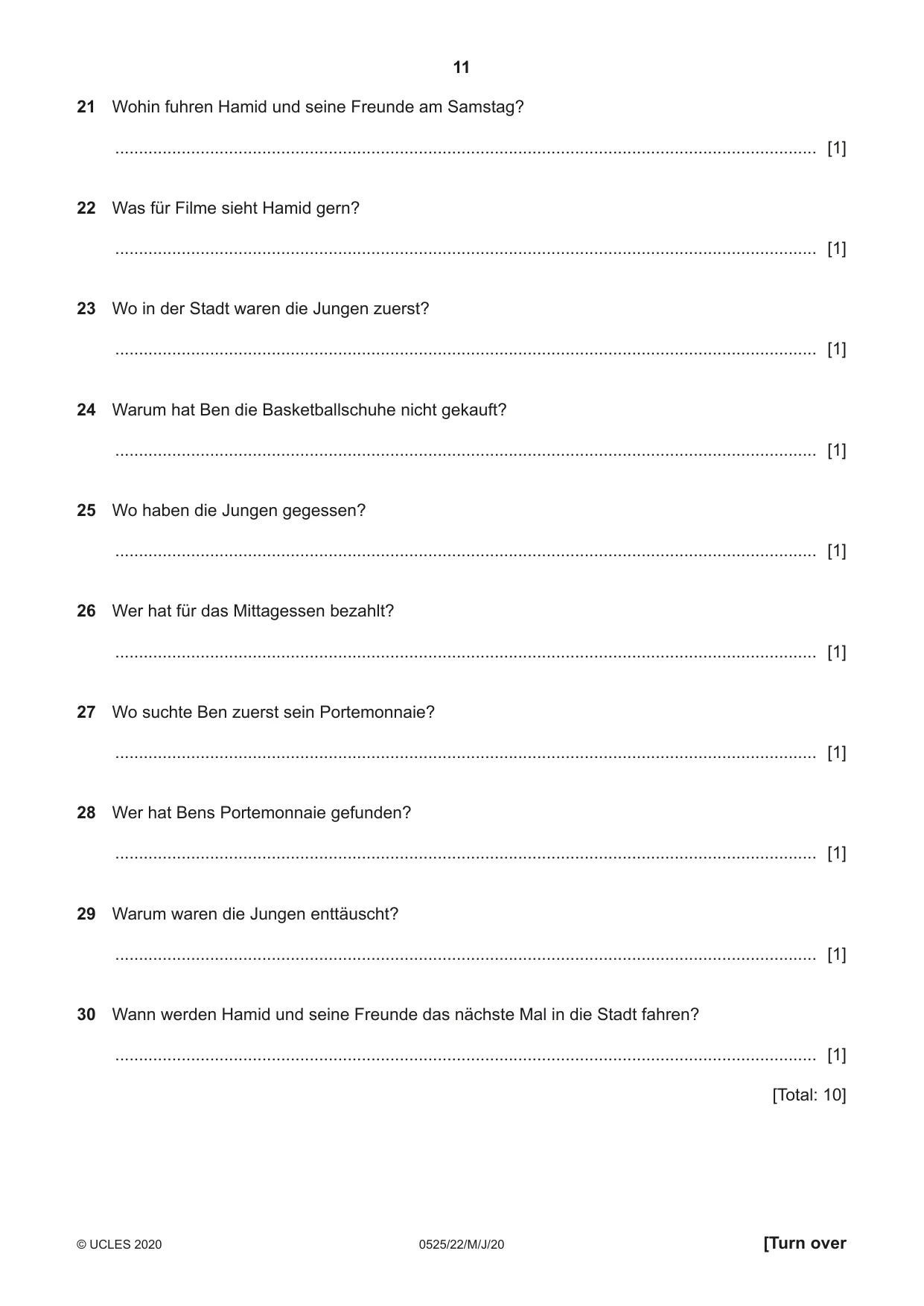
10 0525/22/M/J/20 © UCLES 2020 Zweite Aufgabe, Fragen 21–30 Sie finden diesen Brief von Hamid. Lesen Sie ihn und beantworten Sie dann die folgenden Fragen auf Deutsch. Hallo, am Samstagvormittag fuhr ich mit meinen Freunden Ben und Yannick in die Stadtmitte. Wir wollten einen Stadtbummel machen und danach ins Kino gehen, um einen neuen Krimi zu sehen. Ich wollte diesen Film unbedingt sehen, denn ich liebe Krimis. Zuerst sahen wir uns die Turnschuhe im Sportgeschäft an. Ich fand die Schuhe dort hässlich, aber sie gefielen Ben sehr gut, und er wollte ein Paar Basketballschuhe kaufen. Leider konnte er keine kaufen, weil sie zu teuer waren. Gegen ein Uhr hatten wir Hunger. Yannick kaufte uns eine Currywurst an einer Wurstbude, und dann gingen wir endlich zum Kino. Als wir dort ankamen, konnte Ben sein Portemonnaie nicht finden. Er suchte zuerst in all seinen Taschen, aber er fand es nicht. Wir gingen zurück zur Wurstbude: „Nein, ich habe dein Portemonnaie leider nicht “, sagte der Besitzer. Also gingen wir zum Sportgeschäft zurück. Zum Glück hatte der Verkäufer es dort gefunden. Natürlich war Ben sehr froh, sein Portemonnaie wieder zu haben, aber es war inzwischen zu spät, den Film zu sehen. Enttäuscht fuhren wir nach Hause zurück. Nächstes Wochenende hoffen wir, wieder in die Stadt zu fahren, um endlich den Film zu sehen. Hamid
Question paper, page 11
11 0525/22/M/J/20 © UCLES 2020 [Turn over 21 Wohin fuhren Hamid und seine Freunde am Samstag? … [1] 22 Was für Filme sieht Hamid gern? … [1] 23 Wo in der Stadt waren die Jungen zuerst? … [1] 24 Warum hat Ben die Basketballschuhe nicht gekauft? … [1] 25 Wo haben die Jungen gegessen? … [1] 26 Wer hat für das Mittagessen bezahlt? … [1] 27 Wo suchte Ben zuerst sein Portemonnaie? … [1] 28 Wer hat Bens Portemonnaie gefunden? … [1] 29 Warum waren die Jungen enttäuscht? … [1] 30 Wann werden Hamid und seine Freunde das nächste Mal in die Stadt fahren? … [1] [Total: 10]
Question paper, page 12
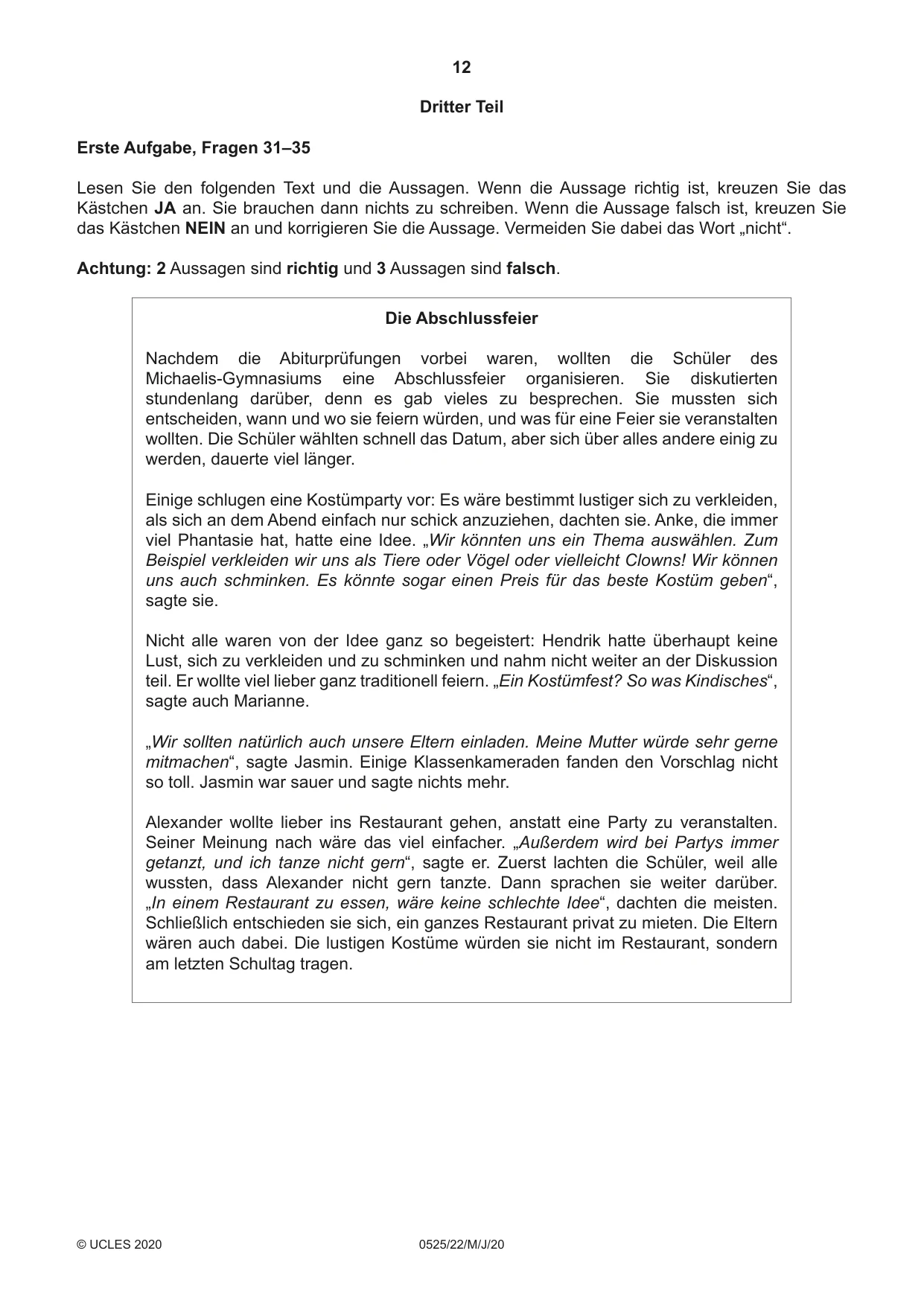
12 0525/22/M/J/20 © UCLES 2020 Dritter Teil Erste Aufgabe, Fragen 31–35 Lesen Sie den folgenden Text und die Aussagen. Wenn die Aussage richtig ist, kreuzen Sie das Kästchen JA an. Sie brauchen dann nichts zu schreiben. Wenn die Aussage falsch ist, kreuzen Sie das Kästchen NEIN an und korrigieren Sie die Aussage. Vermeiden Sie dabei das Wort „nicht“. Achtung: 2 Aussagen sind richtig und 3 Aussagen sind falsch. Die Abschlussfeier Nachdem die Abiturprüfungen vorbei waren, wollten die Schüler des Michaelis-Gymnasiums eine Abschlussfeier organisieren. Sie diskutierten stundenlang darüber, denn es gab vieles zu besprechen. Sie mussten sich entscheiden, wann und wo sie feiern würden, und was für eine Feier sie veranstalten wollten. Die Schüler wählten schnell das Datum, aber sich über alles andere einig zu werden, dauerte viel länger. Einige schlugen eine Kostümparty vor: Es wäre bestimmt lustiger sich zu verkleiden, als sich an dem Abend einfach nur schick anzuziehen, dachten sie. Anke, die immer viel Phantasie hat, hatte eine Idee. „Wir könnten uns ein Thema auswählen. Zum Beispiel verkleiden wir uns als Tiere oder Vögel oder vielleicht Clowns! Wir können uns auch schminken. Es könnte sogar einen Preis für das beste Kostüm geben“, sagte sie. Nicht alle waren von der Idee ganz so begeistert: Hendrik hatte überhaupt keine Lust, sich zu verkleiden und zu schminken und nahm nicht weiter an der Diskussion teil. Er wollte viel lieber ganz traditionell feiern. „Ein Kostümfest? So was Kindisches“, sagte auch Marianne. „Wir sollten natürlich auch unsere Eltern einladen. Meine Mutter würde sehr gerne mitmachen“, sagte Jasmin. Einige Klassenkameraden fanden den Vorschlag nicht so toll. Jasmin war sauer und sagte nichts mehr. Alexander wollte lieber ins Restaurant gehen, anstatt eine Party zu veranstalten. Seiner Meinung nach wäre das viel einfacher. „Außerdem wird bei Partys immer getanzt, und ich tanze nicht gern“, sagte er. Zuerst lachten die Schüler, weil alle wussten, dass Alexander nicht gern tanzte. Dann sprachen sie weiter darüber. „In einem Restaurant zu essen, wäre keine schlechte Idee“, dachten die meisten. Schließlich entschieden sie sich, ein ganzes Restaurant privat zu mieten. Die Eltern wären auch dabei. Die lustigen Kostüme würden sie nicht im Restaurant, sondern am letzten Schultag tragen.
Question paper, page 13
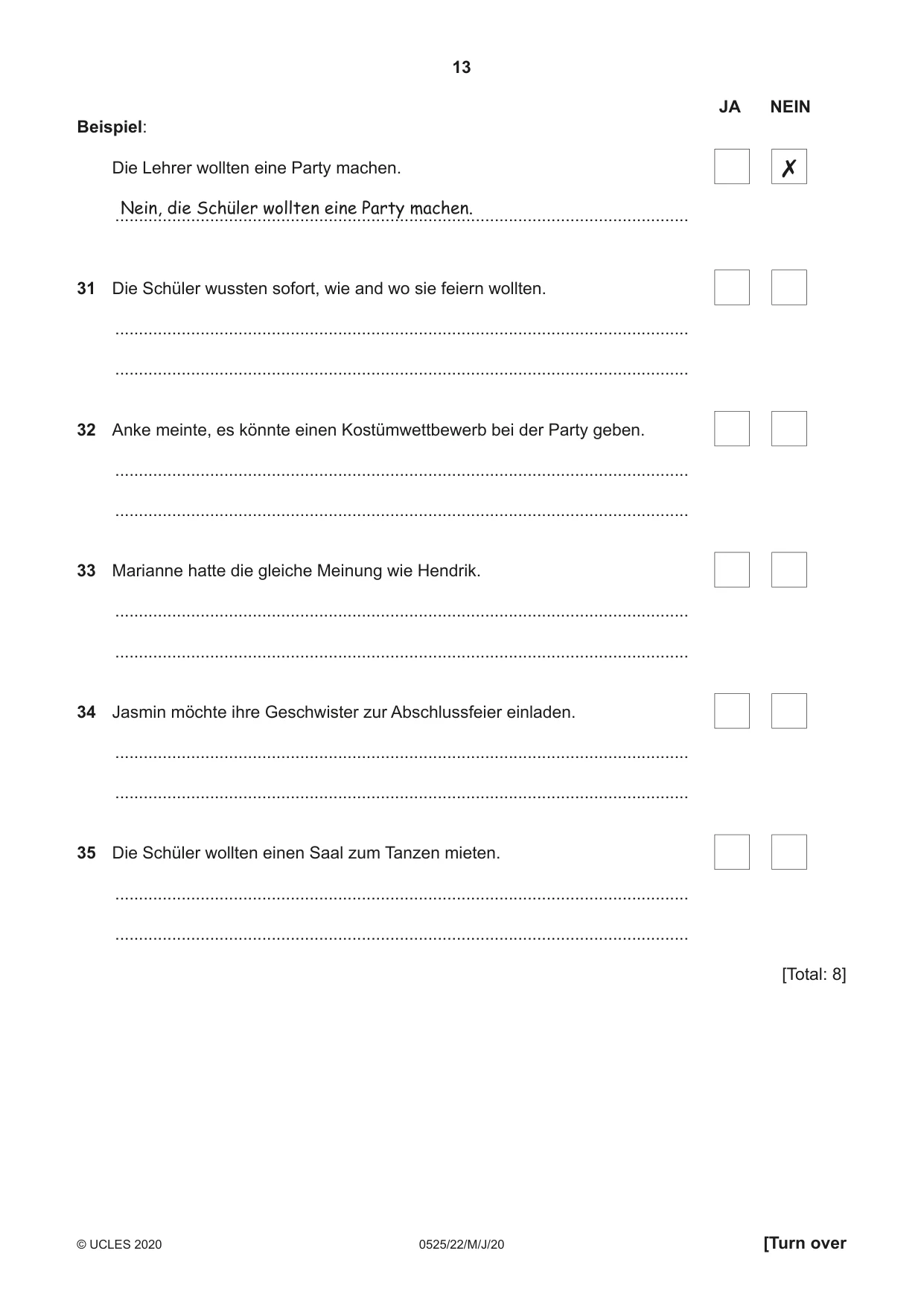
13 0525/22/M/J/20 © UCLES 2020 [Turn over JA NEIN Beispiel: Die Lehrer wollten eine Party machen. 7 Nein, die Schüler wollten eine Party machen. … 31 Die Schüler wussten sofort, wie and wo sie feiern wollten. … … 32 Anke meinte, es könnte einen Kostümwettbewerb bei der Party geben. … … 33 Marianne hatte die gleiche Meinung wie Hendrik. … … 34 Jasmin möchte ihre Geschwister zur Abschlussfeier einladen. … … 35 Die Schüler wollten einen Saal zum Tanzen mieten. … … [Total: 8]
Question paper, page 14
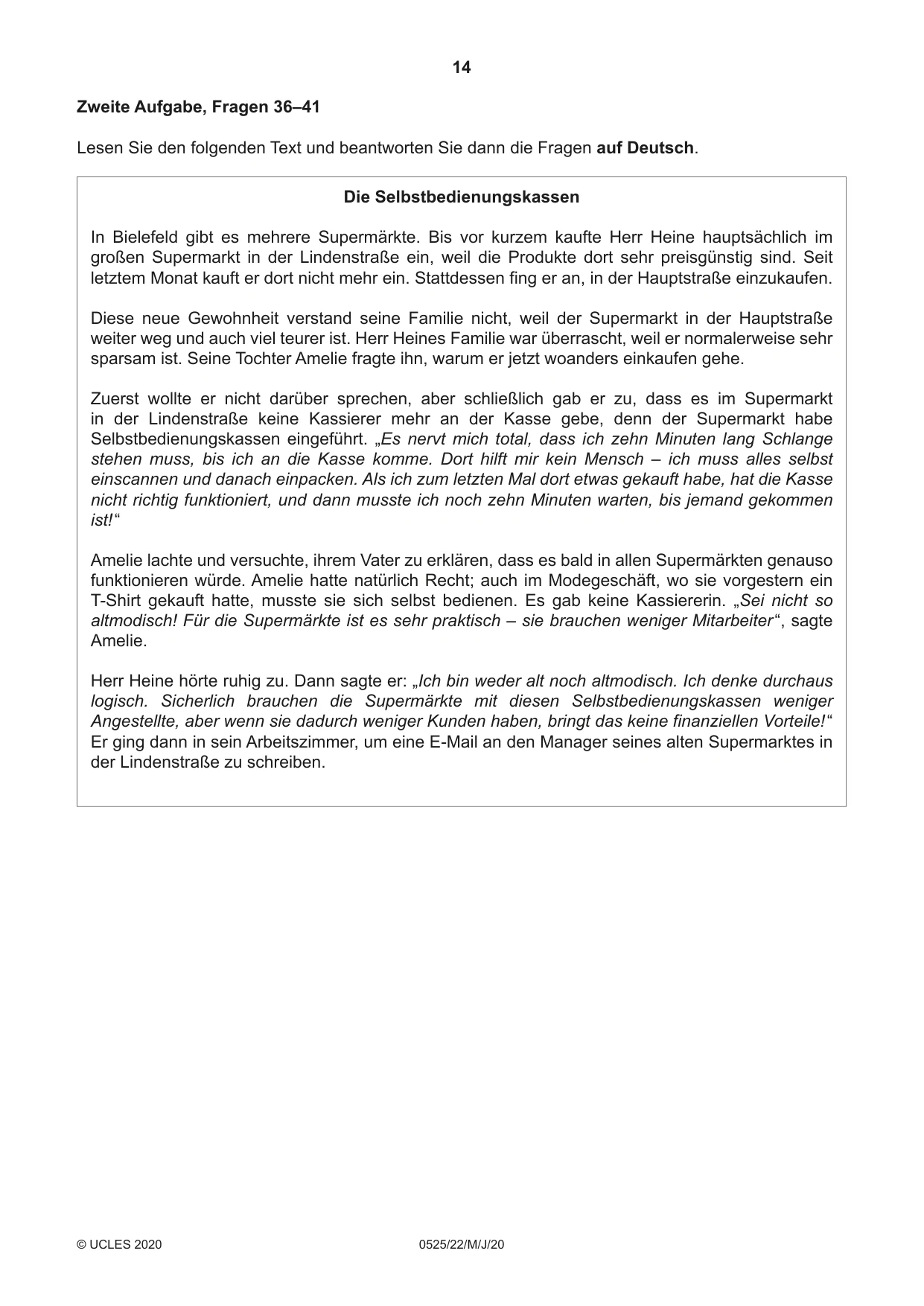
14 0525/22/M/J/20 © UCLES 2020 Zweite Aufgabe, Fragen 36–41 Lesen Sie den folgenden Text und beantworten Sie dann die Fragen auf Deutsch. Die Selbstbedienungskassen In Bielefeld gibt es mehrere Supermärkte. Bis vor kurzem kaufte Herr Heine hauptsächlich im großen Supermarkt in der Lindenstraße ein, weil die Produkte dort sehr preisgünstig sind. Seit letztem Monat kauft er dort nicht mehr ein. Stattdessen fing er an, in der Hauptstraße einzukaufen. Diese neue Gewohnheit verstand seine Familie nicht, weil der Supermarkt in der Hauptstraße weiter weg und auch viel teurer ist. Herr Heines Familie war überrascht, weil er normalerweise sehr sparsam ist. Seine Tochter Amelie fragte ihn, warum er jetzt woanders einkaufen gehe. Zuerst wollte er nicht darüber sprechen, aber schließlich gab er zu, dass es im Supermarkt in der Lindenstraße keine Kassierer mehr an der Kasse gebe, denn der Supermarkt habe Selbstbedienungskassen eingeführt. „Es nervt mich total, dass ich zehn Minuten lang Schlange stehen muss, bis ich an die Kasse komme. Dort hilft mir kein Mensch – ich muss alles selbst einscannen und danach einpacken. Als ich zum letzten Mal dort etwas gekauft habe, hat die Kasse nicht richtig funktioniert, und dann musste ich noch zehn Minuten warten, bis jemand gekommen ist! “ Amelie lachte und versuchte, ihrem Vater zu erklären, dass es bald in allen Supermärkten genauso funktionieren würde. Amelie hatte natürlich Recht; auch im Modegeschäft, wo sie vorgestern ein T-Shirt gekauft hatte, musste sie sich selbst bedienen. Es gab keine Kassiererin. „Sei nicht so altmodisch! Für die Supermärkte ist es sehr praktisch – sie brauchen weniger Mitarbeiter “, sagte Amelie. Herr Heine hörte ruhig zu. Dann sagte er: „Ich bin weder alt noch altmodisch. Ich denke durchaus logisch. Sicherlich brauchen die Supermärkte mit diesen Selbstbedienungskassen weniger Angestellte, aber wenn sie dadurch weniger Kunden haben, bringt das keine finanziellen Vorteile! “ Er ging dann in sein Arbeitszimmer, um eine E-Mail an den Manager seines alten Supermarktes in der Lindenstraße zu schreiben.
Question paper, page 15
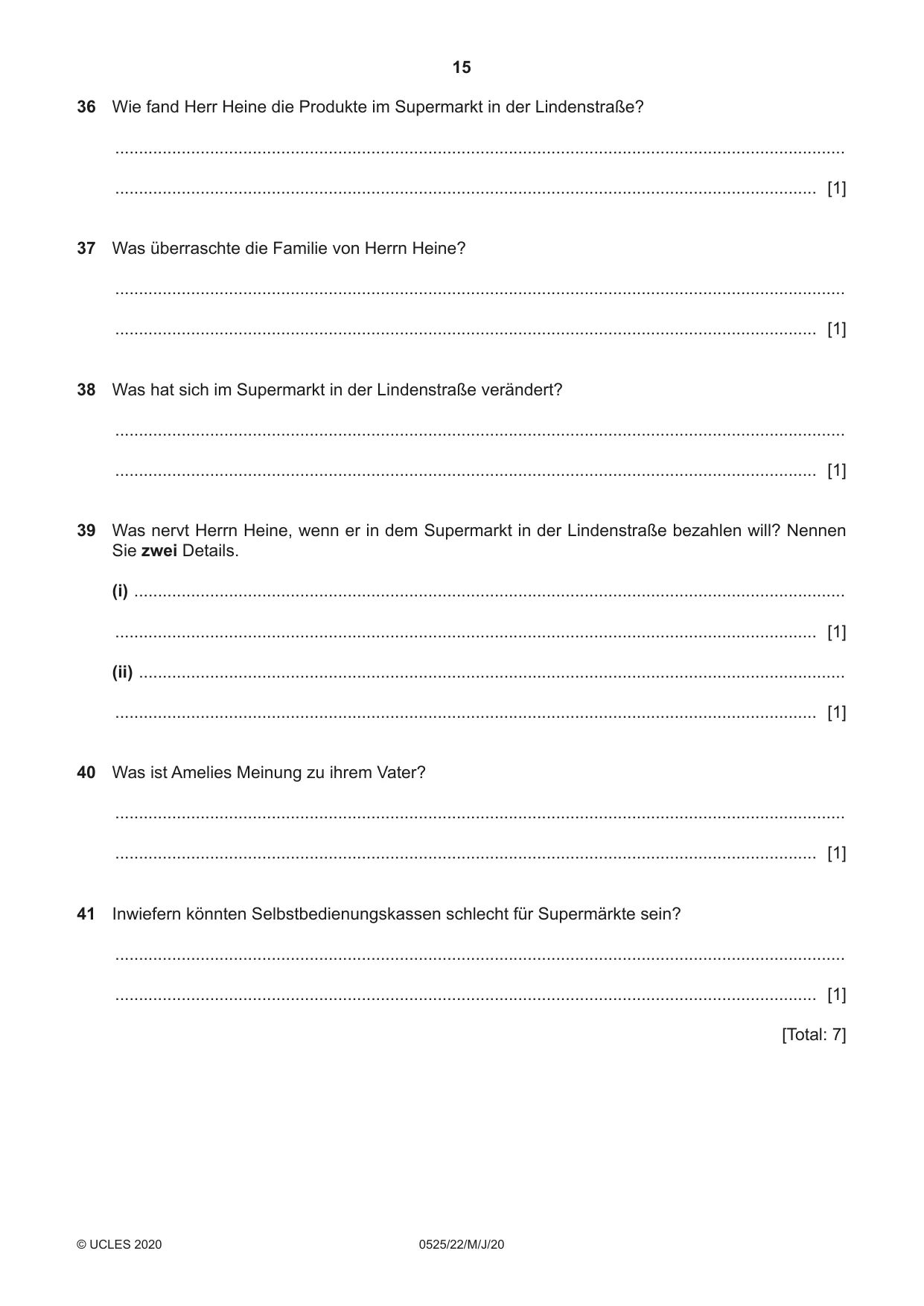
15 0525/22/M/J/20 © UCLES 2020 36 Wie fand Herr Heine die Produkte im Supermarkt in der Lindenstraße? … … [1] 37 Was überraschte die Familie von Herrn Heine? … … [1] 38 Was hat sich im Supermarkt in der Lindenstraße verändert? … … [1] 39 Was nervt Herrn Heine, wenn er in dem Supermarkt in der Lindenstraße bezahlen will? Nennen Sie zwei Details. (i) … … [1] (ii) … … [1] 40 Was ist Amelies Meinung zu ihrem Vater? … … [1] 41 Inwiefern könnten Selbstbedienungskassen schlecht für Supermärkte sein? … … [1] [Total: 7]
Question paper, page 16
16 0525/22/M/J/20 © UCLES 2020 Permission to reproduce items where third-party owned material protected by copyright is included has been sought and cleared where possible. Every reasonable effort has been made by the publisher (UCLES) to trace copyright holders, but if any items requiring clearance have unwittingly been included, the publisher will be pleased to make amends at the earliest possible opportunity. To avoid the issue of disclosure of answer-related information to candidates, all copyright acknowledgements are reproduced online in the Cambridge Assessment International Education Copyright Acknowledgements Booklet. This is produced for each series of examinations and is freely available to download at www.cambridgeinternational.org after the live examination series. Cambridge Assessment International Education is part of the Cambridge Assessment Group. Cambridge Assessment is the brand name of the University of Cambridge Local Examinations Syndicate (UCLES), which itself is a department of the University of Cambridge. BLANK PAGE
Mark scheme, page 1
This document consists of 15 printed pages. © UCLES 2020 [Turn over Cambridge IGCSE™ GERMAN 0525/22 Paper 2 Reading May/June 2020 MARK SCHEME Maximum Mark: 45 Published Students did not sit exam papers in the June 2020 series due to the Covid-19 global pandemic. This mark scheme is published to support teachers and students and should be read together with the question paper. It shows the requirements of the exam. The answer column of the mark scheme shows the proposed basis on which Examiners would award marks for this exam. Where appropriate, this column also provides the most likely acceptable alternative responses expected from students. Examiners usually review the mark scheme after they have seen student responses and update the mark scheme if appropriate. In the June series, Examiners were unable to consider the acceptability of alternative responses, as there were no student responses to consider. Mark schemes should usually be read together with the Principal Examiner Report for Teachers. However, because students did not sit exam papers, there is no Principal Examiner Report for Teachers for the June 2020 series. Cambridge International will not enter into discussions about these mark schemes. Cambridge International is publishing the mark schemes for the June 2020 series for most Cambridge IGCSE™ and Cambridge International A & AS Level components, and some Cambridge O Level components.
Mark scheme, page 2
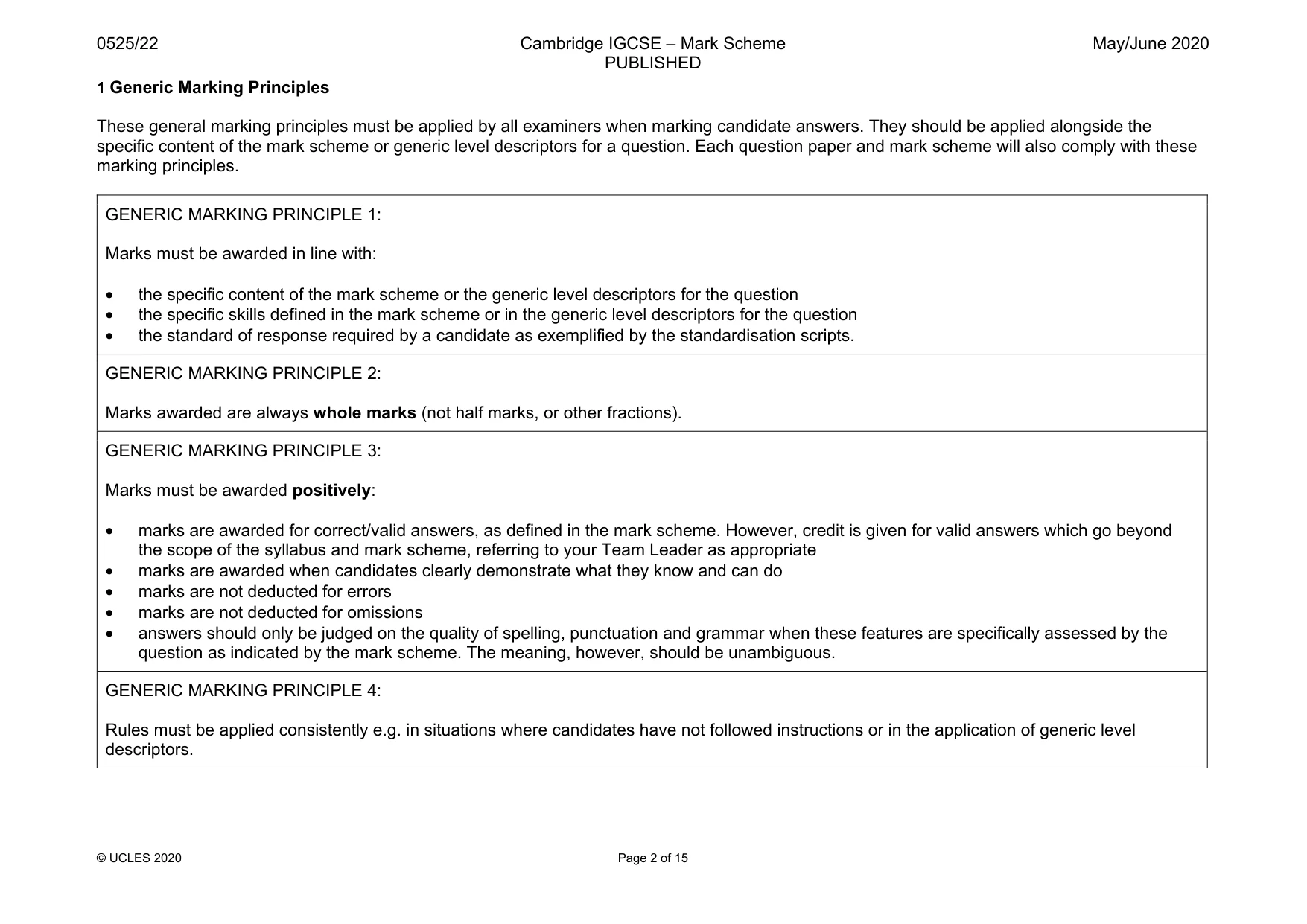
0525/22 Cambridge IGCSE – Mark Scheme PUBLISHED May/June 2020 © UCLES 2020 Page 2 of 15 1 Generic Marking Principles These general marking principles must be applied by all examiners when marking candidate answers. They should be applied alongside the specific content of the mark scheme or generic level descriptors for a question. Each question paper and mark scheme will also comply with these marking principles. GENERIC MARKING PRINCIPLE 1: Marks must be awarded in line with: • the specific content of the mark scheme or the generic level descriptors for the question • the specific skills defined in the mark scheme or in the generic level descriptors for the question • the standard of response required by a candidate as exemplified by the standardisation scripts. GENERIC MARKING PRINCIPLE 2: Marks awarded are always whole marks (not half marks, or other fractions). GENERIC MARKING PRINCIPLE 3: Marks must be awarded positively: • marks are awarded for correct/valid answers, as defined in the mark scheme. However, credit is given for valid answers which go beyond the scope of the syllabus and mark scheme, referring to your Team Leader as appropriate • marks are awarded when candidates clearly demonstrate what they know and can do • marks are not deducted for errors • marks are not deducted for omissions • answers should only be judged on the quality of spelling, punctuation and grammar when these features are specifically assessed by the question as indicated by the mark scheme. The meaning, however, should be unambiguous. GENERIC MARKING PRINCIPLE 4: Rules must be applied consistently e.g. in situations where candidates have not followed instructions or in the application of generic level descriptors.
Mark scheme, page 3
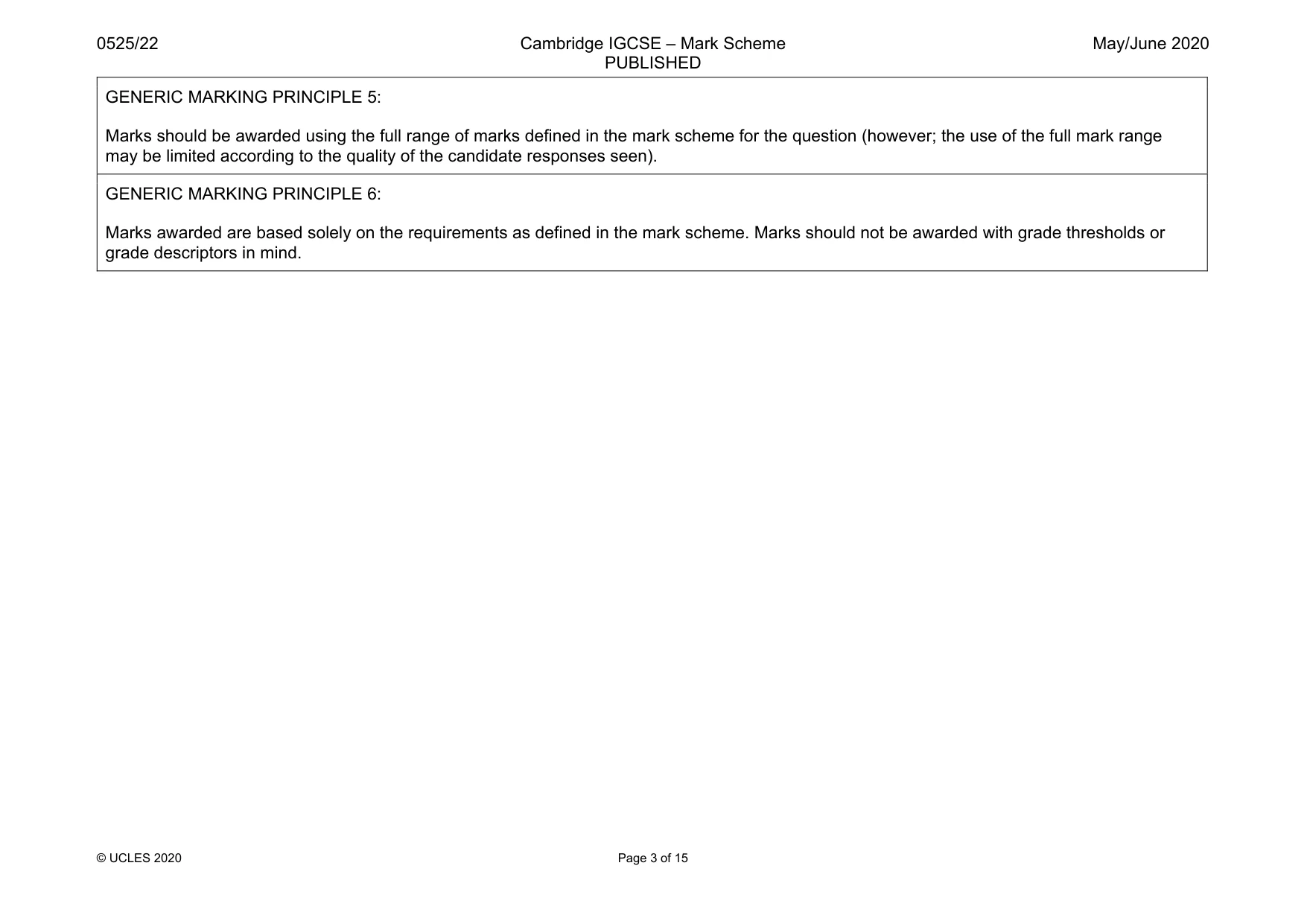
0525/22 Cambridge IGCSE – Mark Scheme PUBLISHED May/June 2020 © UCLES 2020 Page 3 of 15 GENERIC MARKING PRINCIPLE 5: Marks should be awarded using the full range of marks defined in the mark scheme for the question (however; the use of the full mark range may be limited according to the quality of the candidate responses seen). GENERIC MARKING PRINCIPLE 6: Marks awarded are based solely on the requirements as defined in the mark scheme. Marks should not be awarded with grade thresholds or grade descriptors in mind.
Mark scheme, page 4
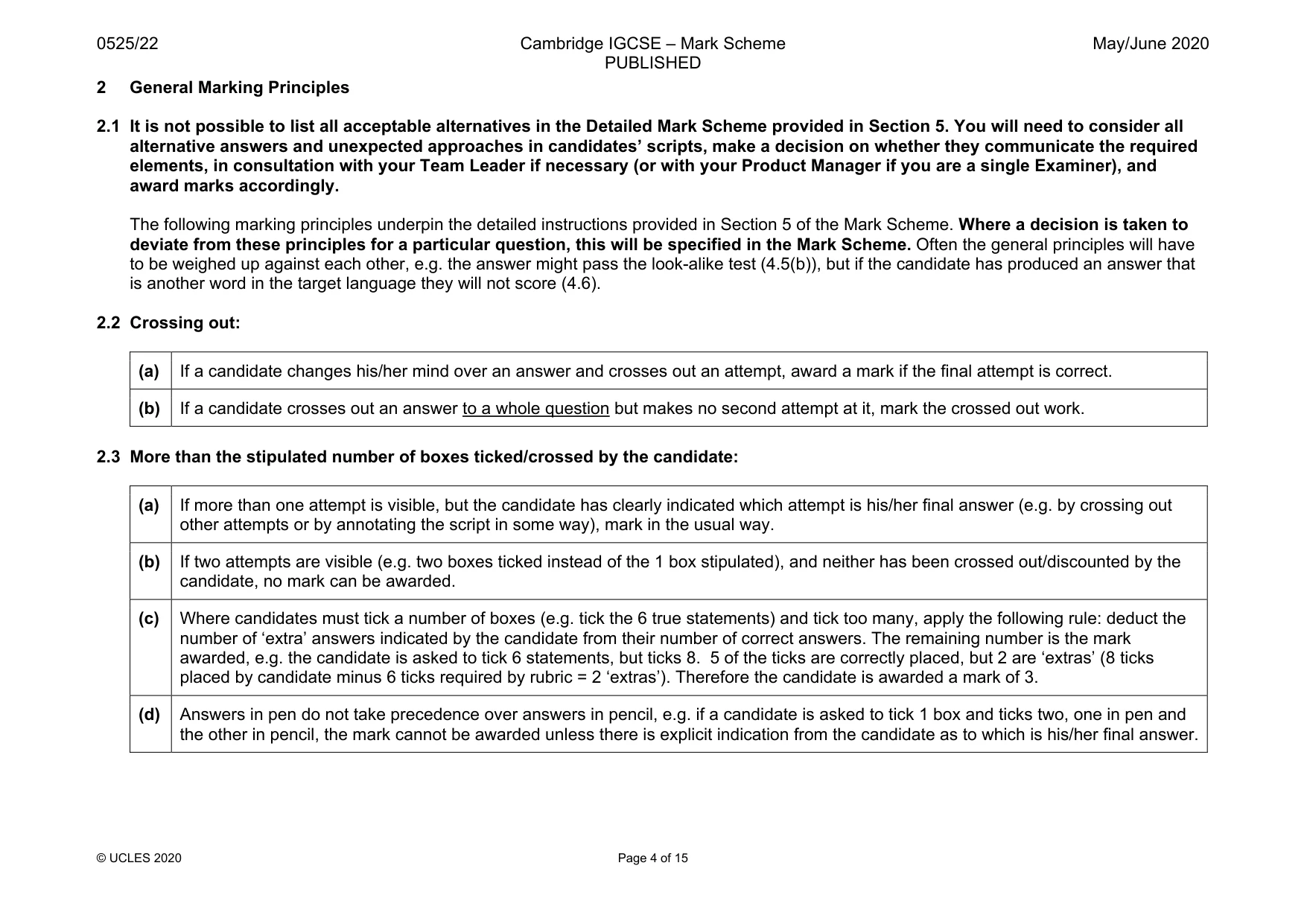
0525/22 Cambridge IGCSE – Mark Scheme PUBLISHED May/June 2020 © UCLES 2020 Page 4 of 15 2 General Marking Principles 2.1 It is not possible to list all acceptable alternatives in the Detailed Mark Scheme provided in Section 5. You will need to consider all alternative answers and unexpected approaches in candidates’ scripts, make a decision on whether they communicate the required elements, in consultation with your Team Leader if necessary (or with your Product Manager if you are a single Examiner), and award marks accordingly. The following marking principles underpin the detailed instructions provided in Section 5 of the Mark Scheme. Where a decision is taken to deviate from these principles for a particular question, this will be specified in the Mark Scheme. Often the general principles will have to be weighed up against each other, e.g. the answer might pass the look-alike test (4.5(b)), but if the candidate has produced an answer that is another word in the target language they will not score (4.6). 2.2 Crossing out: (a) If a candidate changes his/her mind over an answer and crosses out an attempt, award a mark if the final attempt is correct. (b) If a candidate crosses out an answer to a whole question but makes no second attempt at it, mark the crossed out work. 2.3 More than the stipulated number of boxes ticked/crossed by the candidate: (a) If more than one attempt is visible, but the candidate has clearly indicated which attempt is his/her final answer (e.g. by crossing out other attempts or by annotating the script in some way), mark in the usual way. (b) If two attempts are visible (e.g. two boxes ticked instead of the 1 box stipulated), and neither has been crossed out/discounted by the candidate, no mark can be awarded. (c) Where candidates must tick a number of boxes (e.g. tick the 6 true statements) and tick too many, apply the following rule: deduct the number of ‘extra’ answers indicated by the candidate from their number of correct answers. The remaining number is the mark awarded, e.g. the candidate is asked to tick 6 statements, but ticks 8. 5 of the ticks are correctly placed, but 2 are ‘extras’ (8 ticks placed by candidate minus 6 ticks required by rubric = 2 ‘extras’). Therefore the candidate is awarded a mark of 3. (d) Answers in pen do not take precedence over answers in pencil, e.g. if a candidate is asked to tick 1 box and ticks two, one in pen and the other in pencil, the mark cannot be awarded unless there is explicit indication from the candidate as to which is his/her final answer.
Mark scheme, page 5
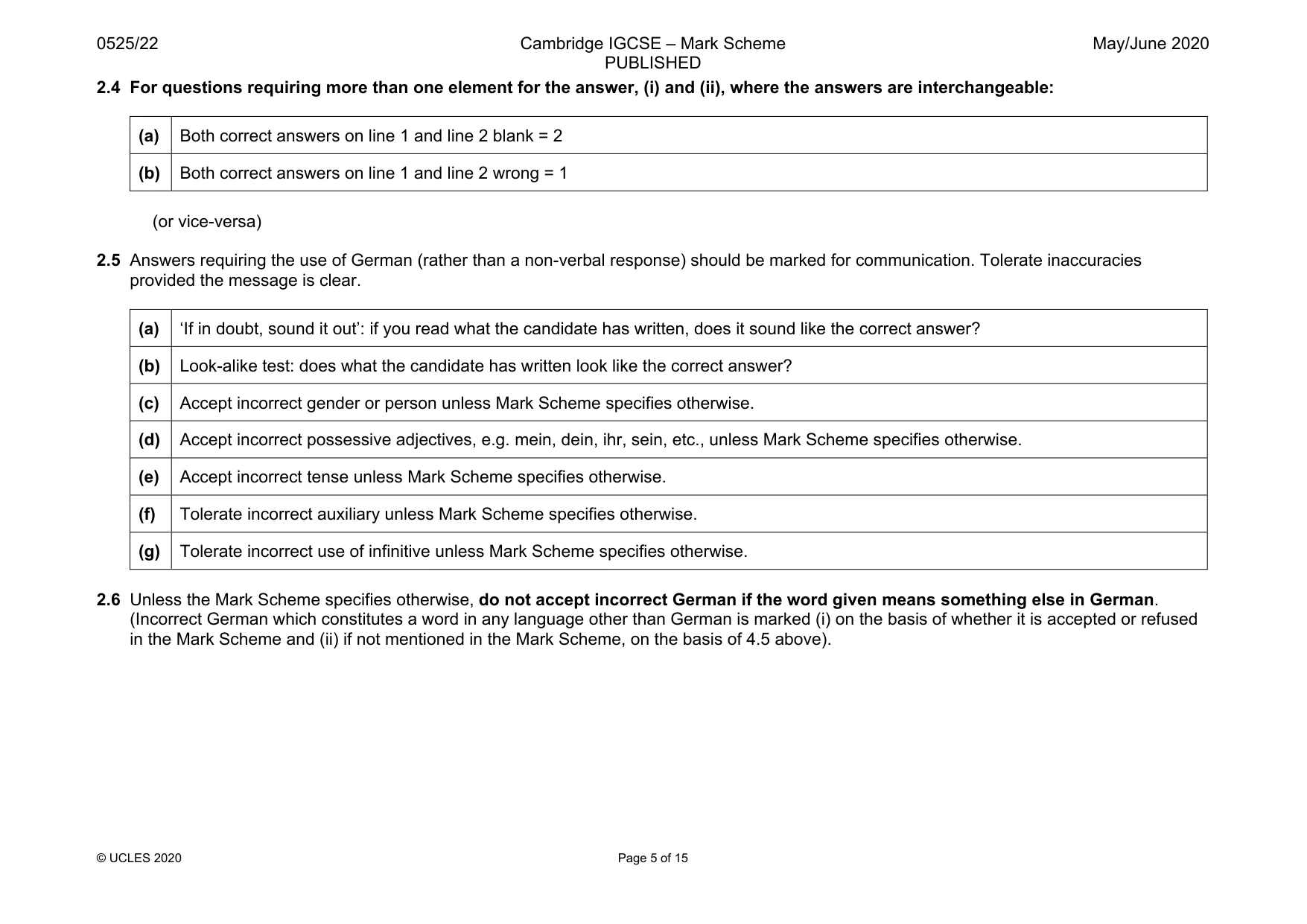
0525/22 Cambridge IGCSE – Mark Scheme PUBLISHED May/June 2020 © UCLES 2020 Page 5 of 15 2.4 For questions requiring more than one element for the answer, (i) and (ii), where the answers are interchangeable: (a) Both correct answers on line 1 and line 2 blank = 2 (b) Both correct answers on line 1 and line 2 wrong = 1 (or vice-versa) 2.5 Answers requiring the use of German (rather than a non-verbal response) should be marked for communication. Tolerate inaccuracies provided the message is clear. (a) ‘If in doubt, sound it out’: if you read what the candidate has written, does it sound like the correct answer? (b) Look-alike test: does what the candidate has written look like the correct answer? (c) Accept incorrect gender or person unless Mark Scheme specifies otherwise. (d) Accept incorrect possessive adjectives, e.g. mein, dein, ihr, sein, etc., unless Mark Scheme specifies otherwise. (e) Accept incorrect tense unless Mark Scheme specifies otherwise. (f) Tolerate incorrect auxiliary unless Mark Scheme specifies otherwise. (g) Tolerate incorrect use of infinitive unless Mark Scheme specifies otherwise. 2.6 Unless the Mark Scheme specifies otherwise, do not accept incorrect German if the word given means something else in German. (Incorrect German which constitutes a word in any language other than German is marked (i) on the basis of whether it is accepted or refused in the Mark Scheme and (ii) if not mentioned in the Mark Scheme, on the basis of 4.5 above).
Mark scheme, page 6
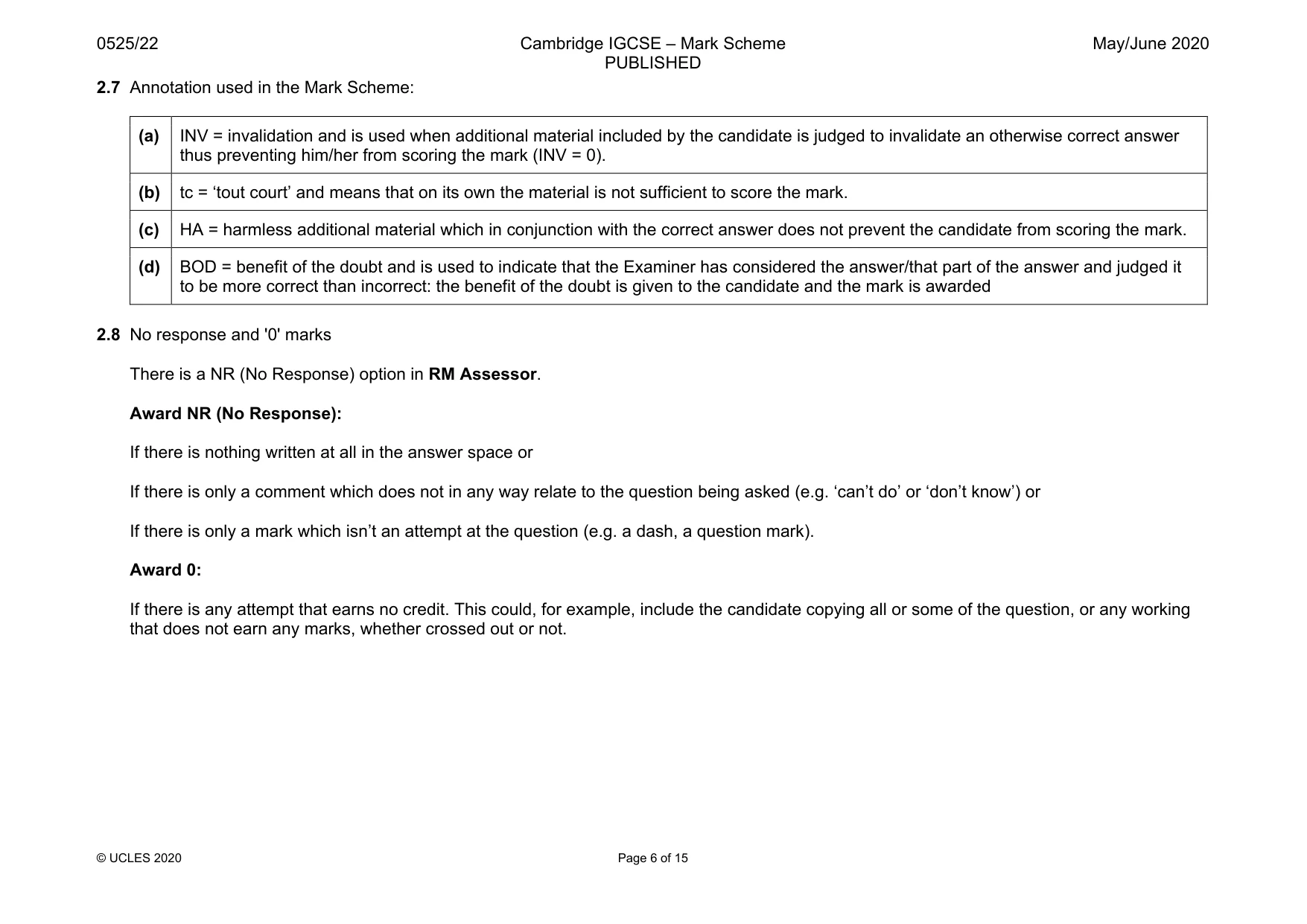
0525/22 Cambridge IGCSE – Mark Scheme PUBLISHED May/June 2020 © UCLES 2020 Page 6 of 15 2.7 Annotation used in the Mark Scheme: (a) INV = invalidation and is used when additional material included by the candidate is judged to invalidate an otherwise correct answer thus preventing him/her from scoring the mark (INV = 0). (b) tc = ‘tout court’ and means that on its own the material is not sufficient to score the mark. (c) HA = harmless additional material which in conjunction with the correct answer does not prevent the candidate from scoring the mark. (d) BOD = benefit of the doubt and is used to indicate that the Examiner has considered the answer/that part of the answer and judged it to be more correct than incorrect: the benefit of the doubt is given to the candidate and the mark is awarded 2.8 No response and '0' marks There is a NR (No Response) option in RM Assessor. Award NR (No Response): If there is nothing written at all in the answer space or If there is only a comment which does not in any way relate to the question being asked (e.g. ‘can’t do’ or ‘don’t know’) or If there is only a mark which isn’t an attempt at the question (e.g. a dash, a question mark). Award 0: If there is any attempt that earns no credit. This could, for example, include the candidate copying all or some of the question, or any working that does not earn any marks, whether crossed out or not.
Mark scheme, page 7
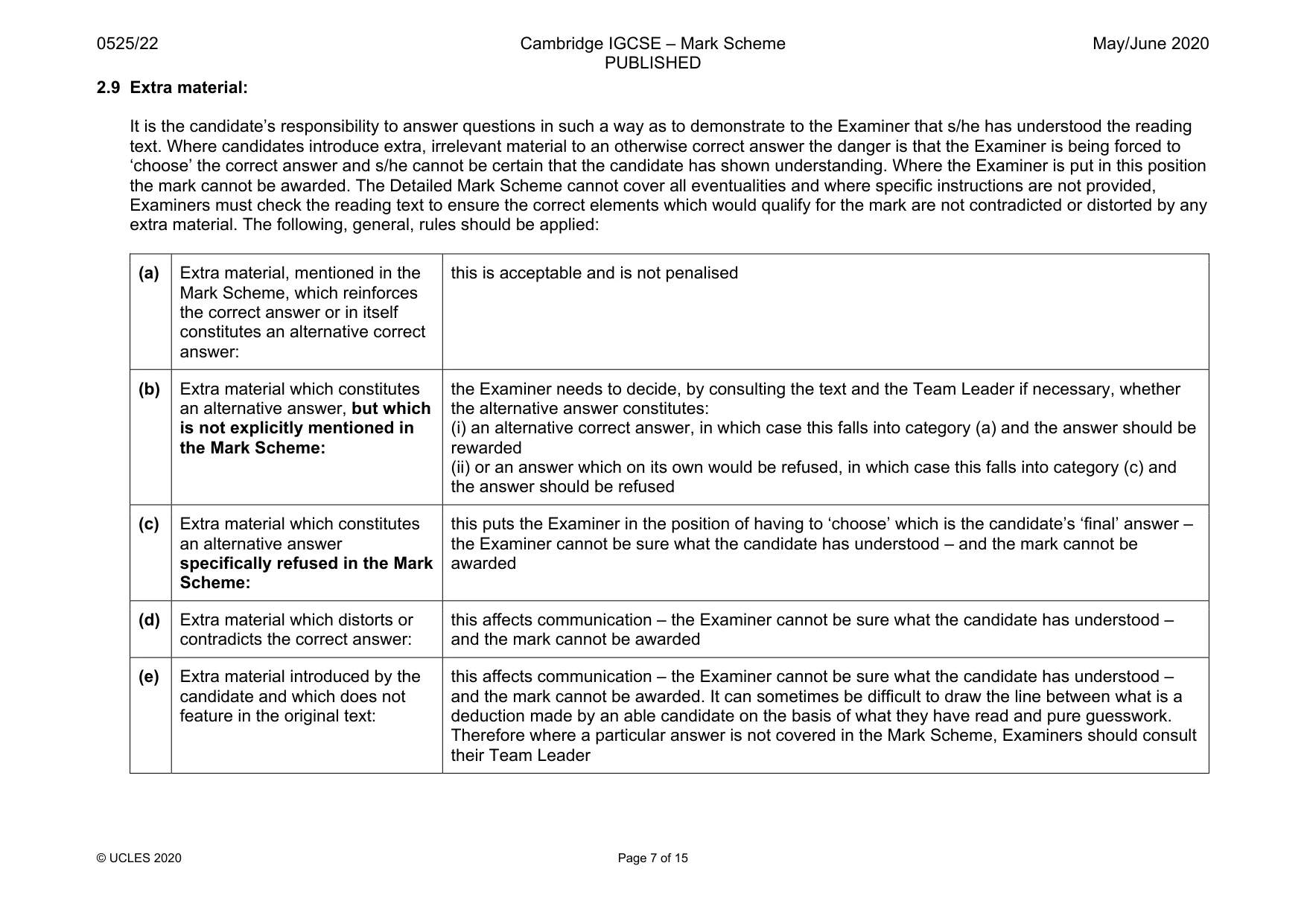
0525/22 Cambridge IGCSE – Mark Scheme PUBLISHED May/June 2020 © UCLES 2020 Page 7 of 15 2.9 Extra material: It is the candidate’s responsibility to answer questions in such a way as to demonstrate to the Examiner that s/he has understood the reading text. Where candidates introduce extra, irrelevant material to an otherwise correct answer the danger is that the Examiner is being forced to ‘choose’ the correct answer and s/he cannot be certain that the candidate has shown understanding. Where the Examiner is put in this position the mark cannot be awarded. The Detailed Mark Scheme cannot cover all eventualities and where specific instructions are not provided, Examiners must check the reading text to ensure the correct elements which would qualify for the mark are not contradicted or distorted by any extra material. The following, general, rules should be applied: (a) Extra material, mentioned in the Mark Scheme, which reinforces the correct answer or in itself constitutes an alternative correct answer: this is acceptable and is not penalised (b) Extra material which constitutes an alternative answer, but which is not explicitly mentioned in the Mark Scheme: the Examiner needs to decide, by consulting the text and the Team Leader if necessary, whether the alternative answer constitutes: (i) an alternative correct answer, in which case this falls into category (a) and the answer should be rewarded (ii) or an answer which on its own would be refused, in which case this falls into category (c) and the answer should be refused (c) Extra material which constitutes an alternative answer specifically refused in the Mark Scheme: this puts the Examiner in the position of having to ‘choose’ which is the candidate’s ‘final’ answer – the Examiner cannot be sure what the candidate has understood – and the mark cannot be awarded (d) Extra material which distorts or contradicts the correct answer: this affects communication – the Examiner cannot be sure what the candidate has understood – and the mark cannot be awarded (e) Extra material introduced by the candidate and which does not feature in the original text: this affects communication – the Examiner cannot be sure what the candidate has understood – and the mark cannot be awarded. It can sometimes be difficult to draw the line between what is a deduction made by an able candidate on the basis of what they have read and pure guesswork. Therefore where a particular answer is not covered in the Mark Scheme, Examiners should consult their Team Leader
Mark scheme, page 8
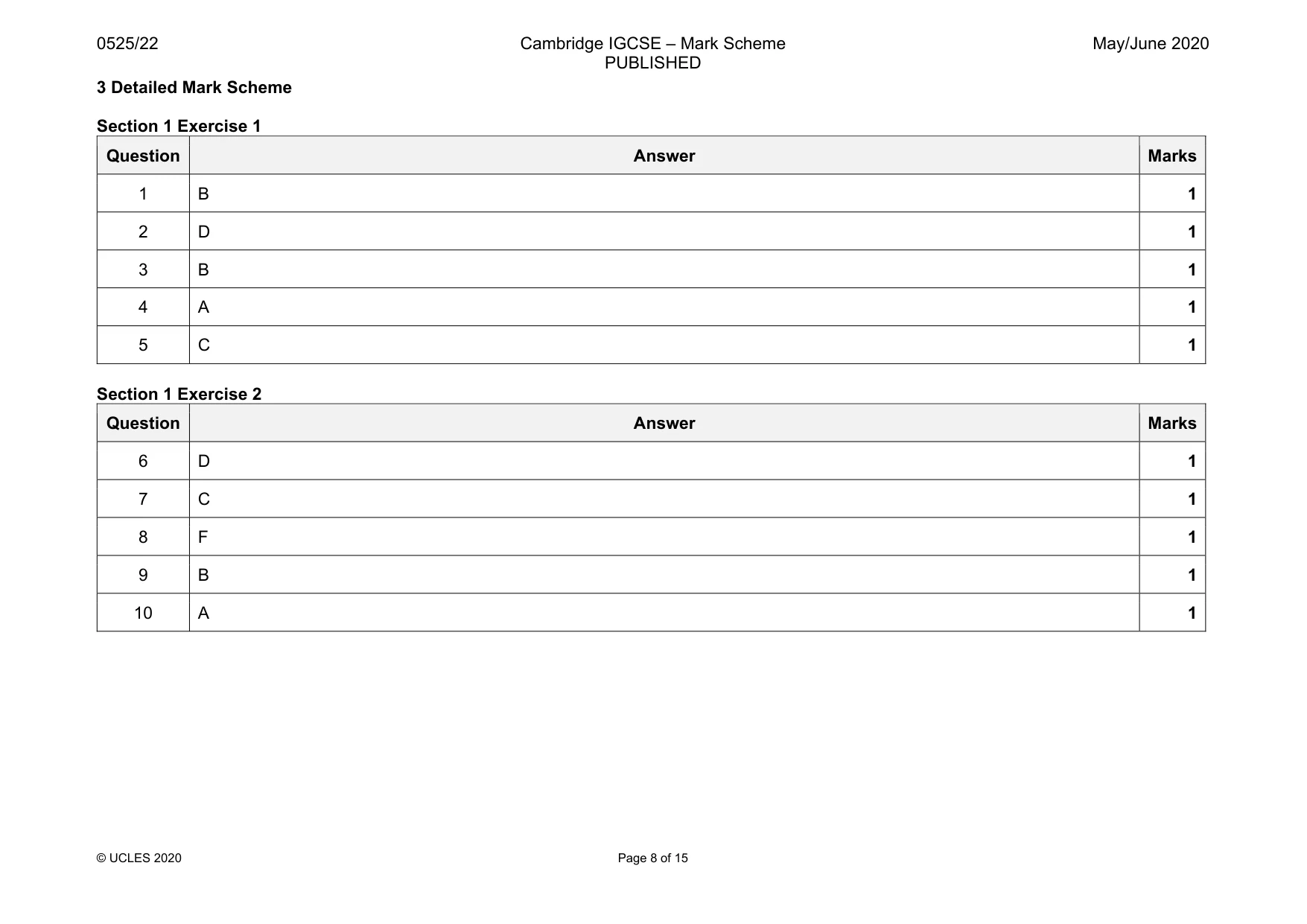
0525/22 Cambridge IGCSE – Mark Scheme PUBLISHED May/June 2020 © UCLES 2020 Page 8 of 15 3 Detailed Mark Scheme Section 1 Exercise 1 Question Answer Marks 1 B 1 2 D 1 3 B 1 4 A 1 5 C 1 Section 1 Exercise 2 Question Answer Marks 6 D 1 7 C 1 8 F 1 9 B 1 10 A 1
Mark scheme, page 9
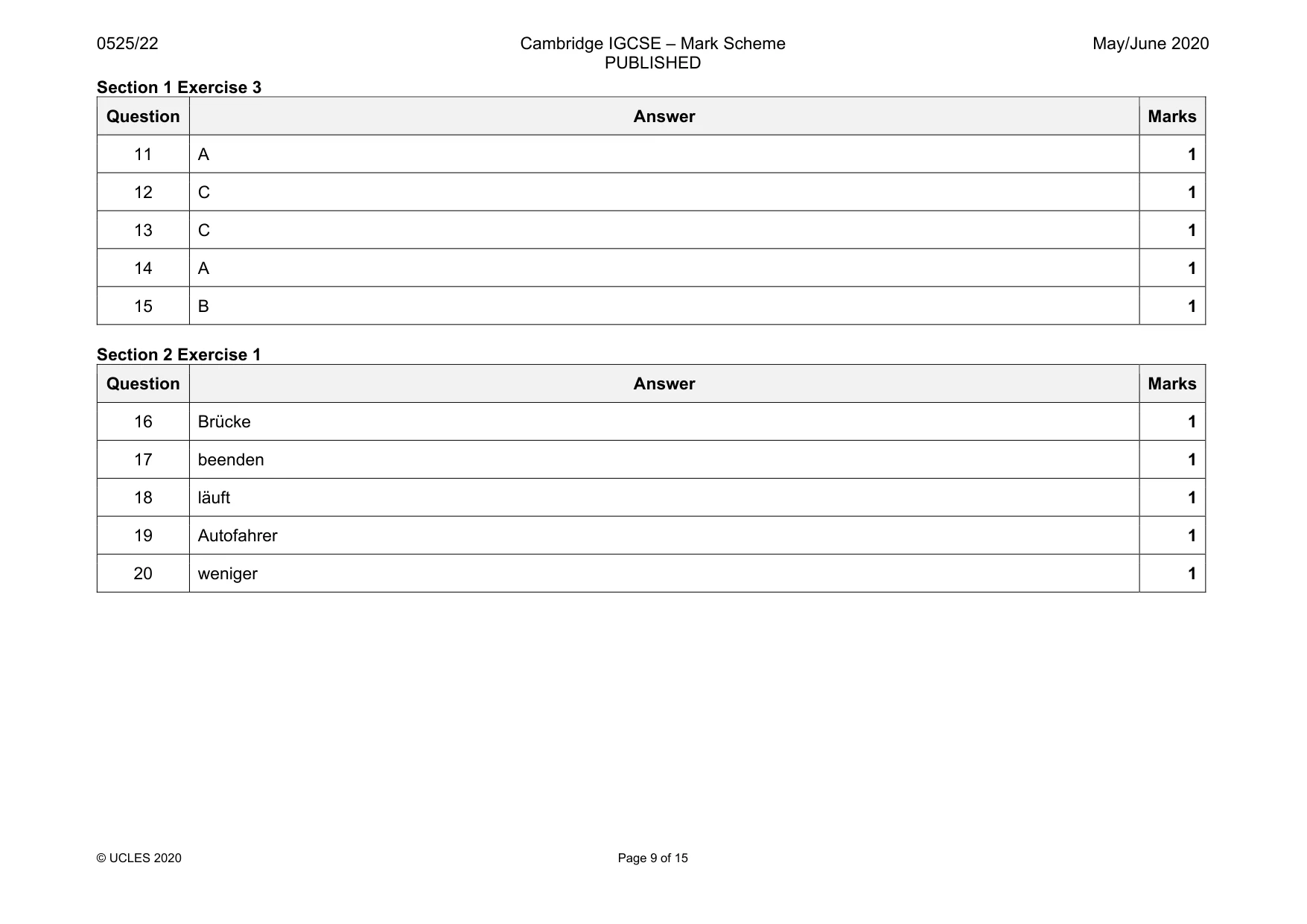
0525/22 Cambridge IGCSE – Mark Scheme PUBLISHED May/June 2020 © UCLES 2020 Page 9 of 15 Section 1 Exercise 3 Question Answer Marks 11 A 1 12 C 1 13 C 1 14 A 1 15 B 1 Section 2 Exercise 1 Question Answer Marks 16 Brücke 1 17 beenden 1 18 läuft 1 19 Autofahrer 1 20 weniger 1
Mark scheme, page 10
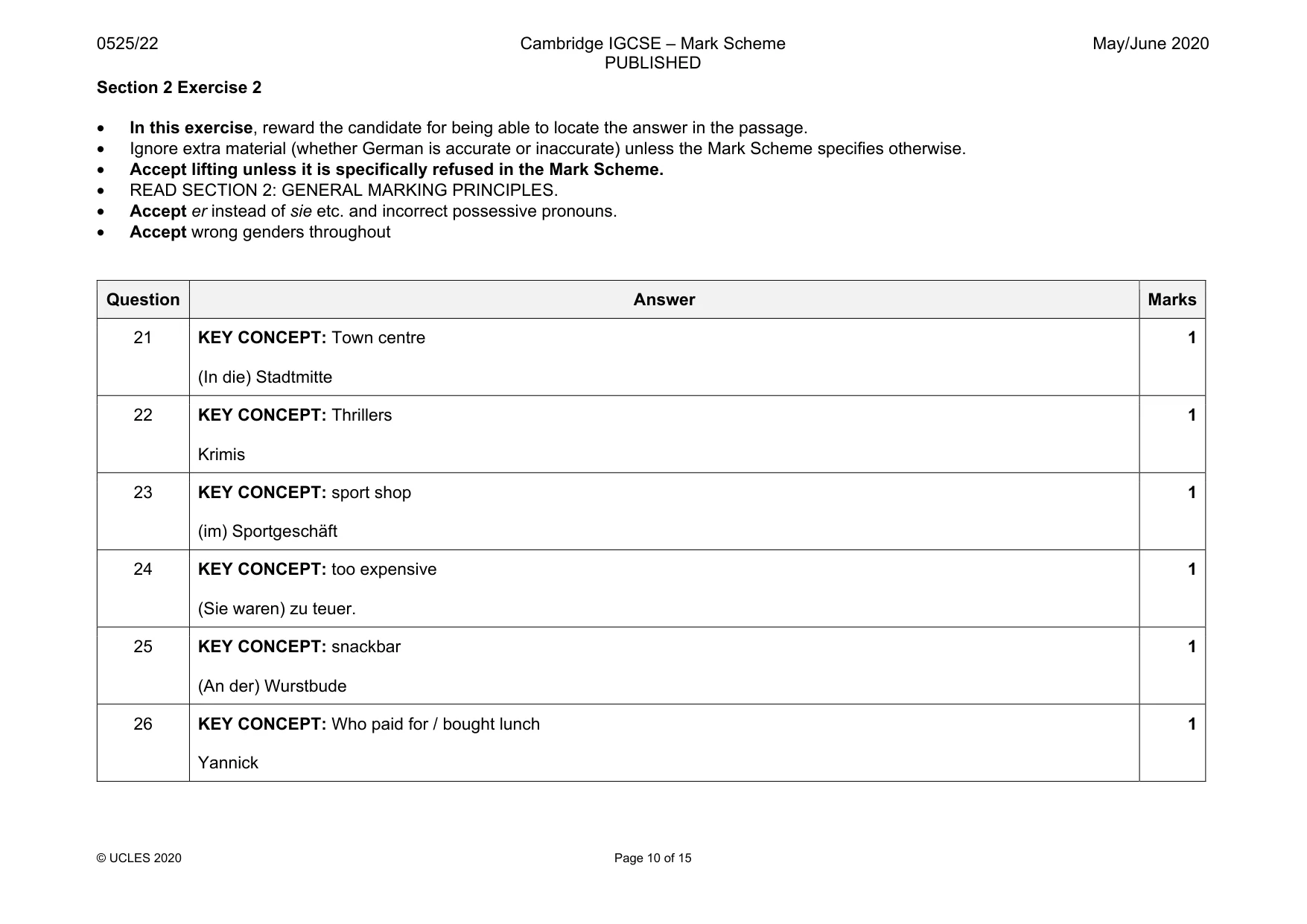
0525/22 Cambridge IGCSE – Mark Scheme PUBLISHED May/June 2020 © UCLES 2020 Page 10 of 15 Section 2 Exercise 2 • In this exercise, reward the candidate for being able to locate the answer in the passage. • Ignore extra material (whether German is accurate or inaccurate) unless the Mark Scheme specifies otherwise. • Accept lifting unless it is specifically refused in the Mark Scheme. • READ SECTION 2: GENERAL MARKING PRINCIPLES. • Accept er instead of sie etc. and incorrect possessive pronouns. • Accept wrong genders throughout Question Answer Marks 21 KEY CONCEPT: Town centre (In die) Stadtmitte 1 22 KEY CONCEPT: Thrillers Krimis 1 23 KEY CONCEPT: sport shop (im) Sportgeschäft 1 24 KEY CONCEPT: too expensive (Sie waren) zu teuer. 1 25 KEY CONCEPT: snackbar (An der) Wurstbude 1 26 KEY CONCEPT: Who paid for / bought lunch Yannick 1
Mark scheme, page 11
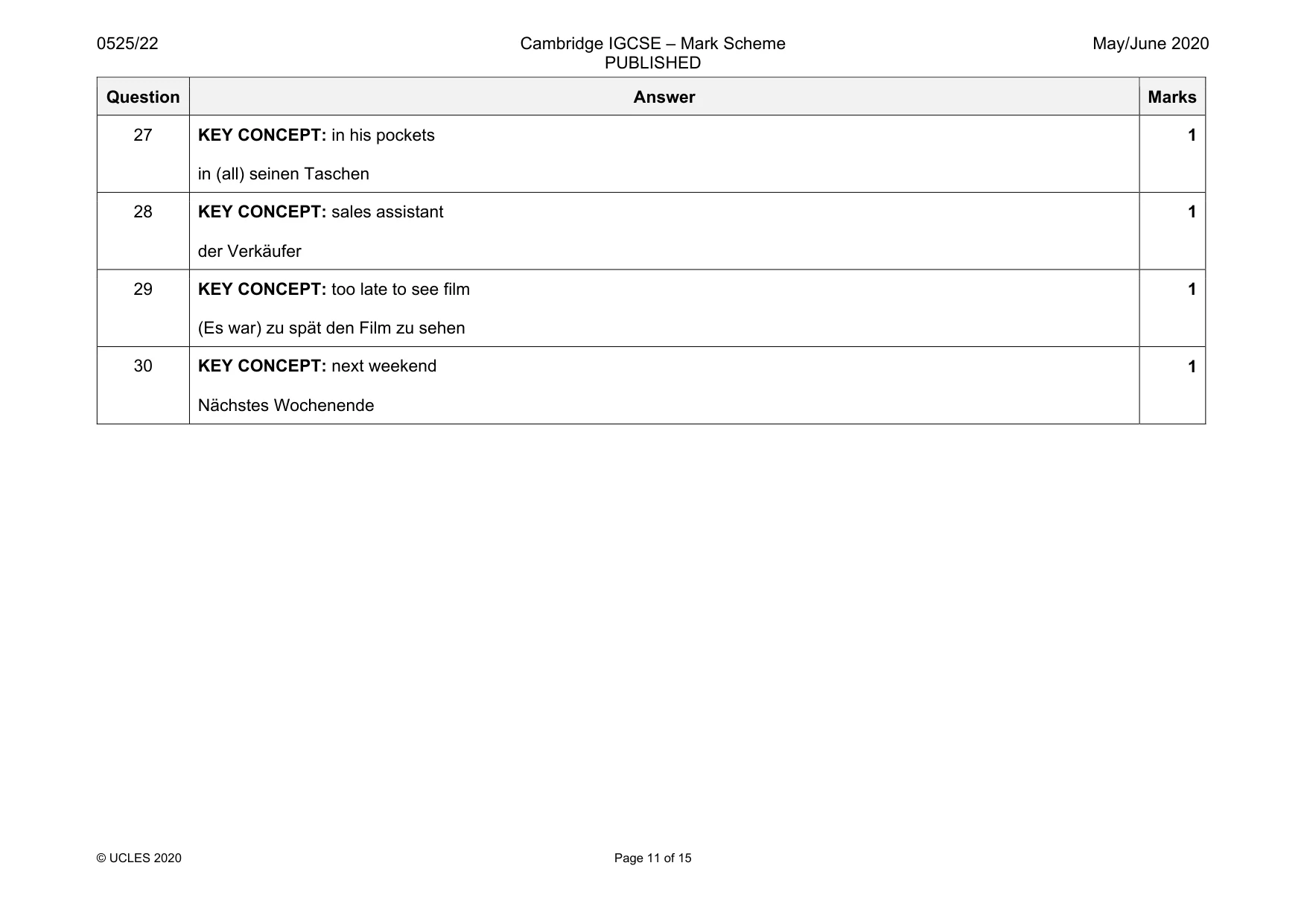
0525/22 Cambridge IGCSE – Mark Scheme PUBLISHED May/June 2020 © UCLES 2020 Page 11 of 15 Question Answer Marks 27 KEY CONCEPT: in his pockets in (all) seinen Taschen 1 28 KEY CONCEPT: sales assistant der Verkäufer 1 29 KEY CONCEPT: too late to see film (Es war) zu spät den Film zu sehen 1 30 KEY CONCEPT: next weekend Nächstes Wochenende 1
Mark scheme, page 12
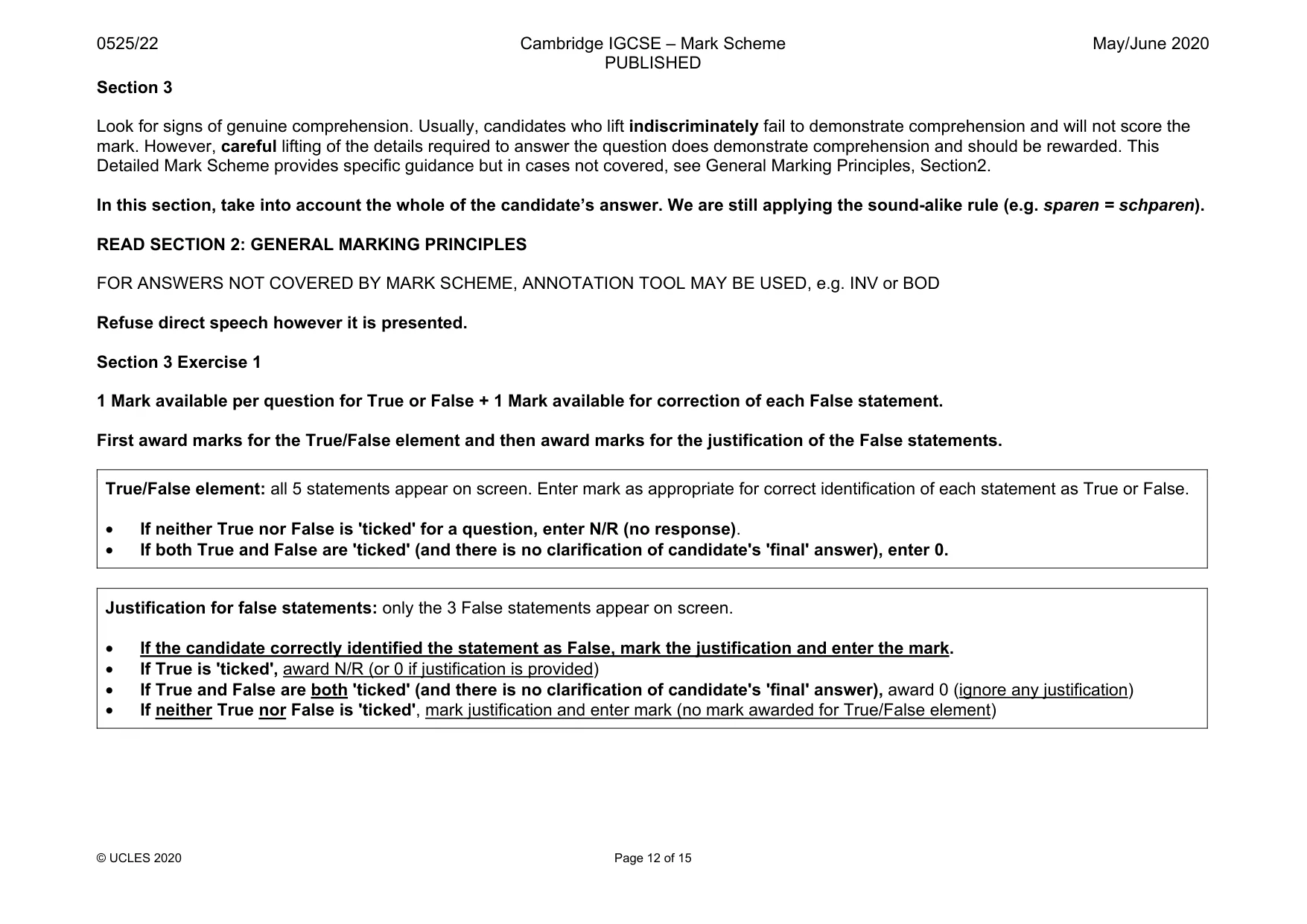
0525/22 Cambridge IGCSE – Mark Scheme PUBLISHED May/June 2020 © UCLES 2020 Page 12 of 15 Section 3 Look for signs of genuine comprehension. Usually, candidates who lift indiscriminately fail to demonstrate comprehension and will not score the mark. However, careful lifting of the details required to answer the question does demonstrate comprehension and should be rewarded. This Detailed Mark Scheme provides specific guidance but in cases not covered, see General Marking Principles, Section2. In this section, take into account the whole of the candidate’s answer. We are still applying the sound-alike rule (e.g. sparen = schparen). READ SECTION 2: GENERAL MARKING PRINCIPLES FOR ANSWERS NOT COVERED BY MARK SCHEME, ANNOTATION TOOL MAY BE USED, e.g. INV or BOD Refuse direct speech however it is presented. Section 3 Exercise 1 1 Mark available per question for True or False + 1 Mark available for correction of each False statement. First award marks for the True/False element and then award marks for the justification of the False statements. True/False element: all 5 statements appear on screen. Enter mark as appropriate for correct identification of each statement as True or False. • If neither True nor False is 'ticked' for a question, enter N/R (no response). • If both True and False are 'ticked' (and there is no clarification of candidate's 'final' answer), enter 0. Justification for false statements: only the 3 False statements appear on screen. • If the candidate correctly identified the statement as False, mark the justification and enter the mark. • If True is 'ticked', award N/R (or 0 if justification is provided) • If True and False are both 'ticked' (and there is no clarification of candidate's 'final' answer), award 0 (ignore any justification) • If neither True nor False is 'ticked', mark justification and enter mark (no mark awarded for True/False element)
Mark scheme, page 13
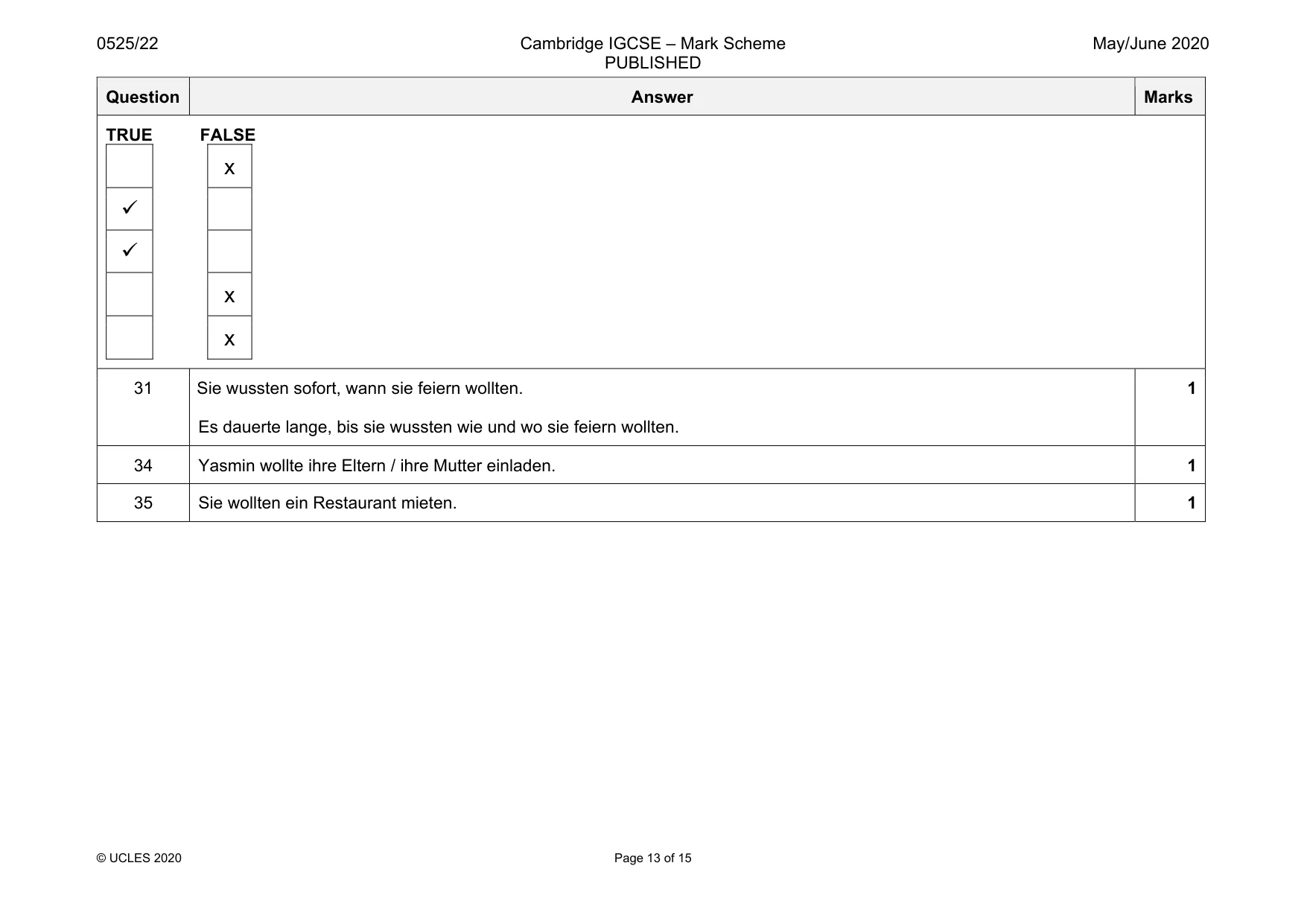
0525/22 Cambridge IGCSE – Mark Scheme PUBLISHED May/June 2020 © UCLES 2020 Page 13 of 15 Question Answer Marks TRUE FALSE x x x 31 Sie wussten sofort, wann sie feiern wollten. Es dauerte lange, bis sie wussten wie und wo sie feiern wollten. 1 34 Yasmin wollte ihre Eltern / ihre Mutter einladen. 1 35 Sie wollten ein Restaurant mieten. 1
Mark scheme, page 14
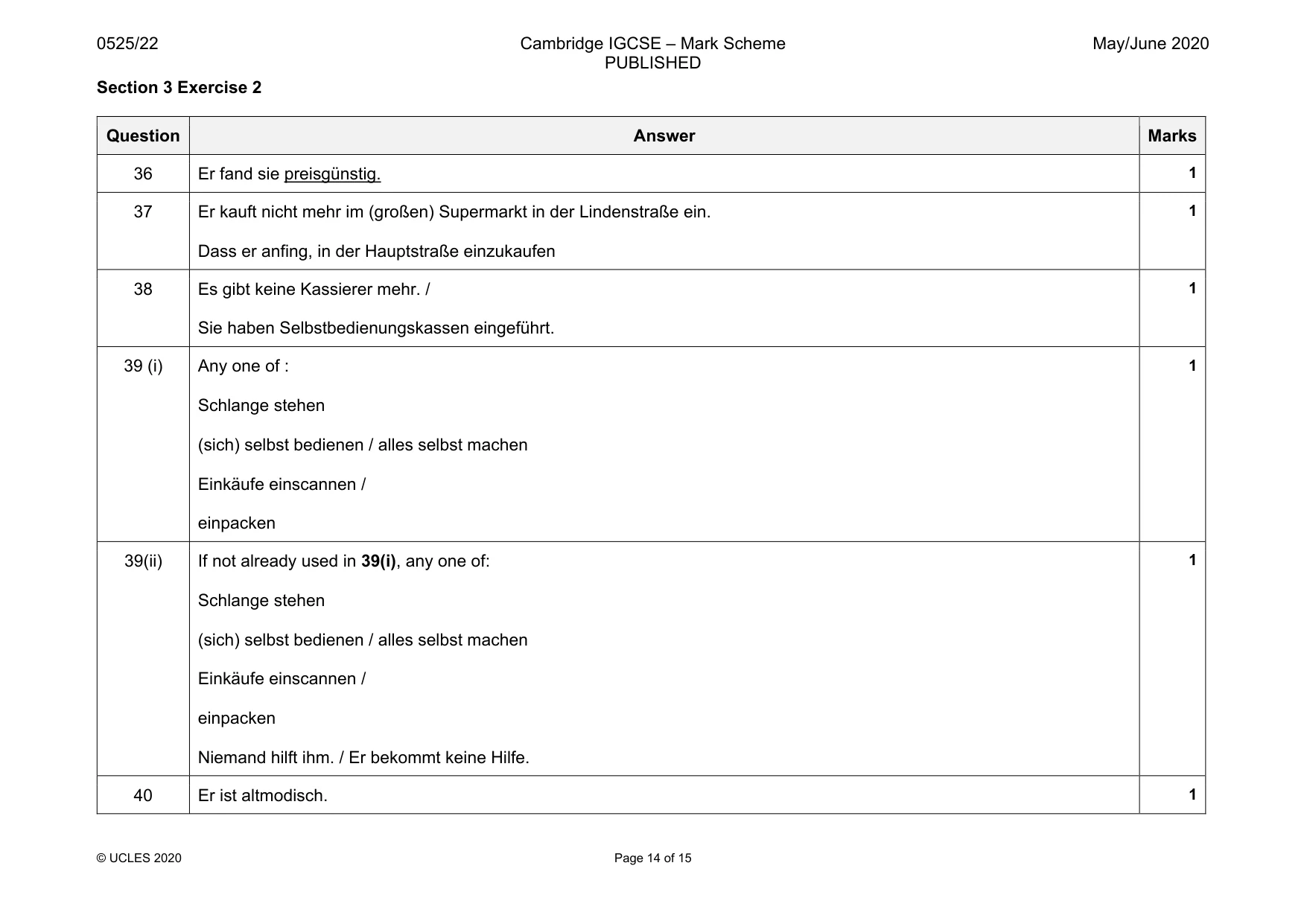
0525/22 Cambridge IGCSE – Mark Scheme PUBLISHED May/June 2020 © UCLES 2020 Page 14 of 15 Section 3 Exercise 2 Question Answer Marks 36 Er fand sie preisgünstig. 1 37 Er kauft nicht mehr im (großen) Supermarkt in der Lindenstraße ein. Dass er anfing, in der Hauptstraße einzukaufen 1 38 Es gibt keine Kassierer mehr. / Sie haben Selbstbedienungskassen eingeführt. 1 39 (i) Any one of : Schlange stehen (sich) selbst bedienen / alles selbst machen Einkäufe einscannen / einpacken 1 39(ii) If not already used in 39(i), any one of: Schlange stehen (sich) selbst bedienen / alles selbst machen Einkäufe einscannen / einpacken Niemand hilft ihm. / Er bekommt keine Hilfe. 1 40 Er ist altmodisch. 1
Mark scheme, page 15
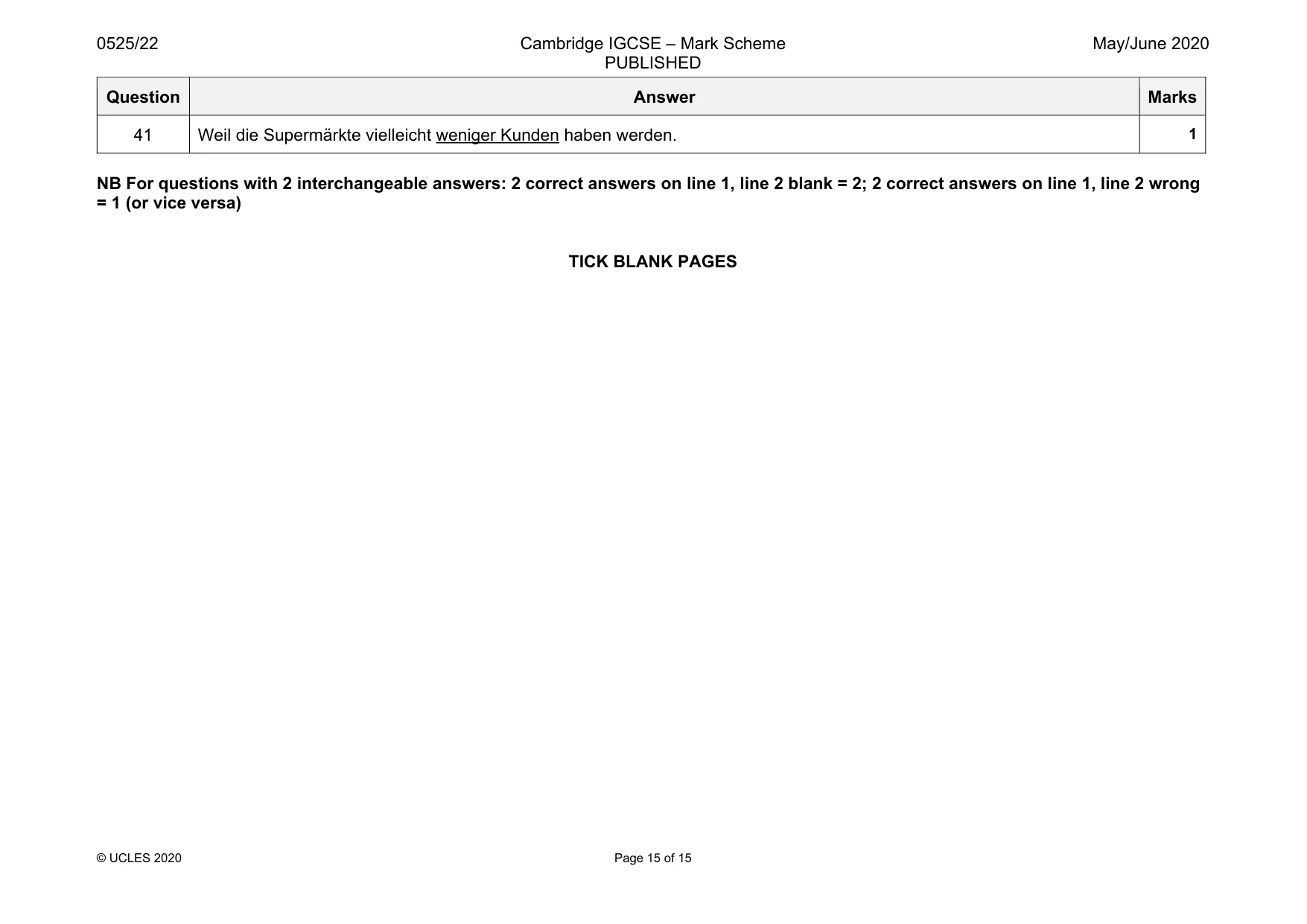
0525/22 Cambridge IGCSE – Mark Scheme PUBLISHED May/June 2020 © UCLES 2020 Page 15 of 15 Question Answer Marks 41 Weil die Supermärkte vielleicht weniger Kunden haben werden. 1 NB For questions with 2 interchangeable answers: 2 correct answers on line 1, line 2 blank = 2; 2 correct answers on line 1, line 2 wrong = 1 (or vice versa) TICK BLANK PAGES