Cambridge IGCSE German - Foreign Language 0525 — 2017 May/June Paper 2 · Variant 2
0525/22/M/J/17 · 45 marks · ≈51 min
The question paper and its mark scheme, free to read here and free to download. This is Cambridge’s own paper, exactly as it was sat.
Question paper16 pages



Mark scheme12 pages
Answers below. Sit the paper first if you are practising.
Paper as text
Question paper, page 1
* 5 4 6 8 9 1 6 6 7 3 * This document consists of 13 printed pages and 3 blank pages. DC (ST/SW) 134250/3 © UCLES 2017 [Turn over Cambridge International Examinations Cambridge International General Certificate of Secondary Education GERMAN 0525/22 Paper 2 Reading May/June 2017 1 hour Candidates answer on the Question Paper. No Additional Materials are required. READ THESE INSTRUCTIONS FIRST Write your Centre number, candidate number and name in the spaces at the top of this page. Write in dark blue or black pen. Do not use staples, paper clips, glue or correction fluid. DO NOT WRITE IN ANY BARCODES. Answer all questions. The number of marks is given in brackets [ ] at the end of each question or part question. The syllabus is approved for use in England, Wales and Northern Ireland as a Cambridge International Level 1/Level 2 Certificate.
Question paper, page 2
2 0525/22/M/J/17 © UCLES 2017 BLANK PAGE
Question paper, page 3
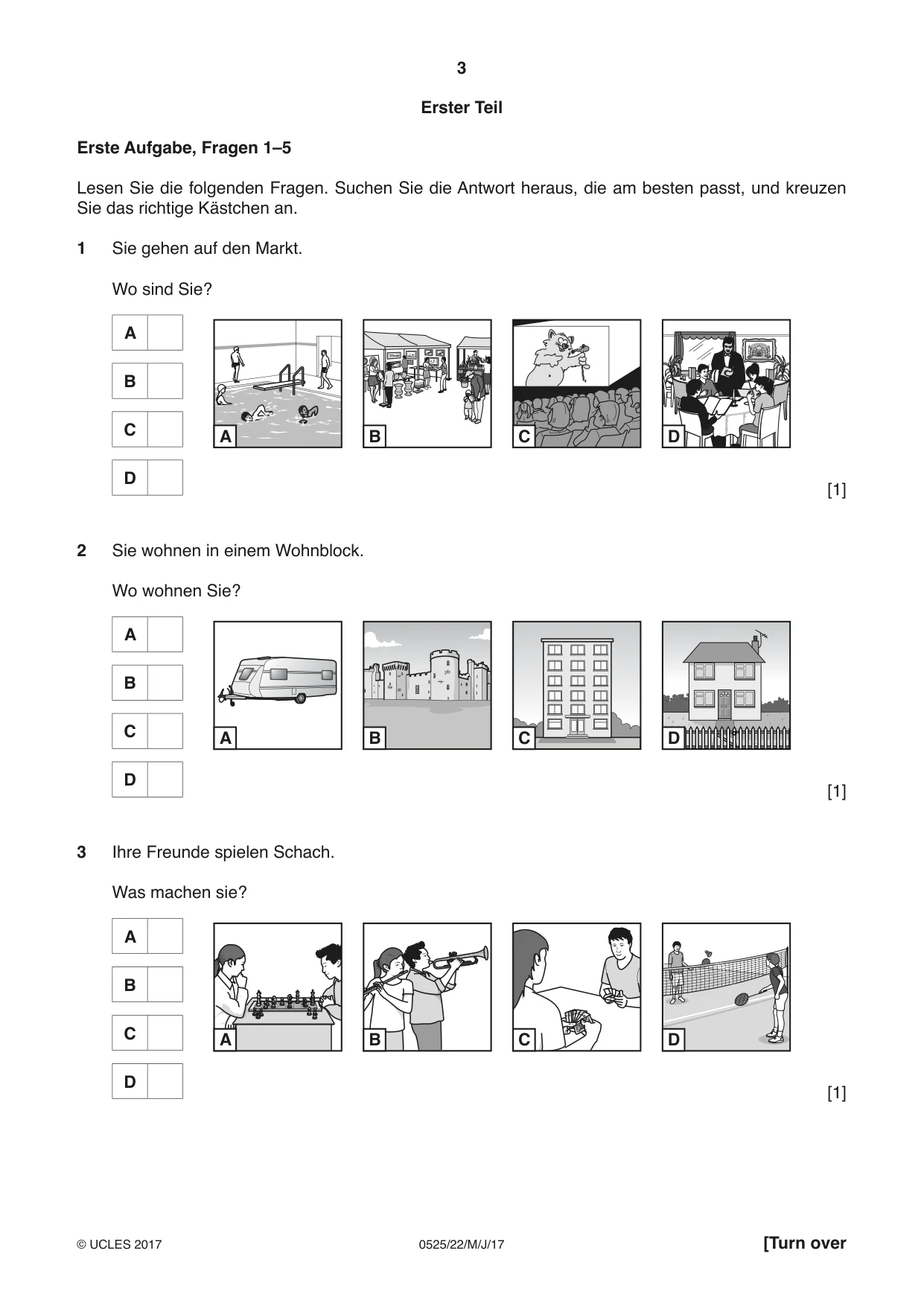
3 0525/22/M/J/17 © UCLES 2017 [Turn over Erster Teil Erste Aufgabe, Fragen 1–5 Lesen Sie die folgenden Fragen. Suchen Sie die Antwort heraus, die am besten passt, und kreuzen Sie das richtige Kästchen an. 1 Sie gehen auf den Markt. Wo sind Sie? A A B C D [1] B C D 2 Sie wohnen in einem Wohnblock. Wo wohnen Sie? A A B C D [1] B C D 3 Ihre Freunde spielen Schach. Was machen sie? A A B C D [1] B C D
Question paper, page 4
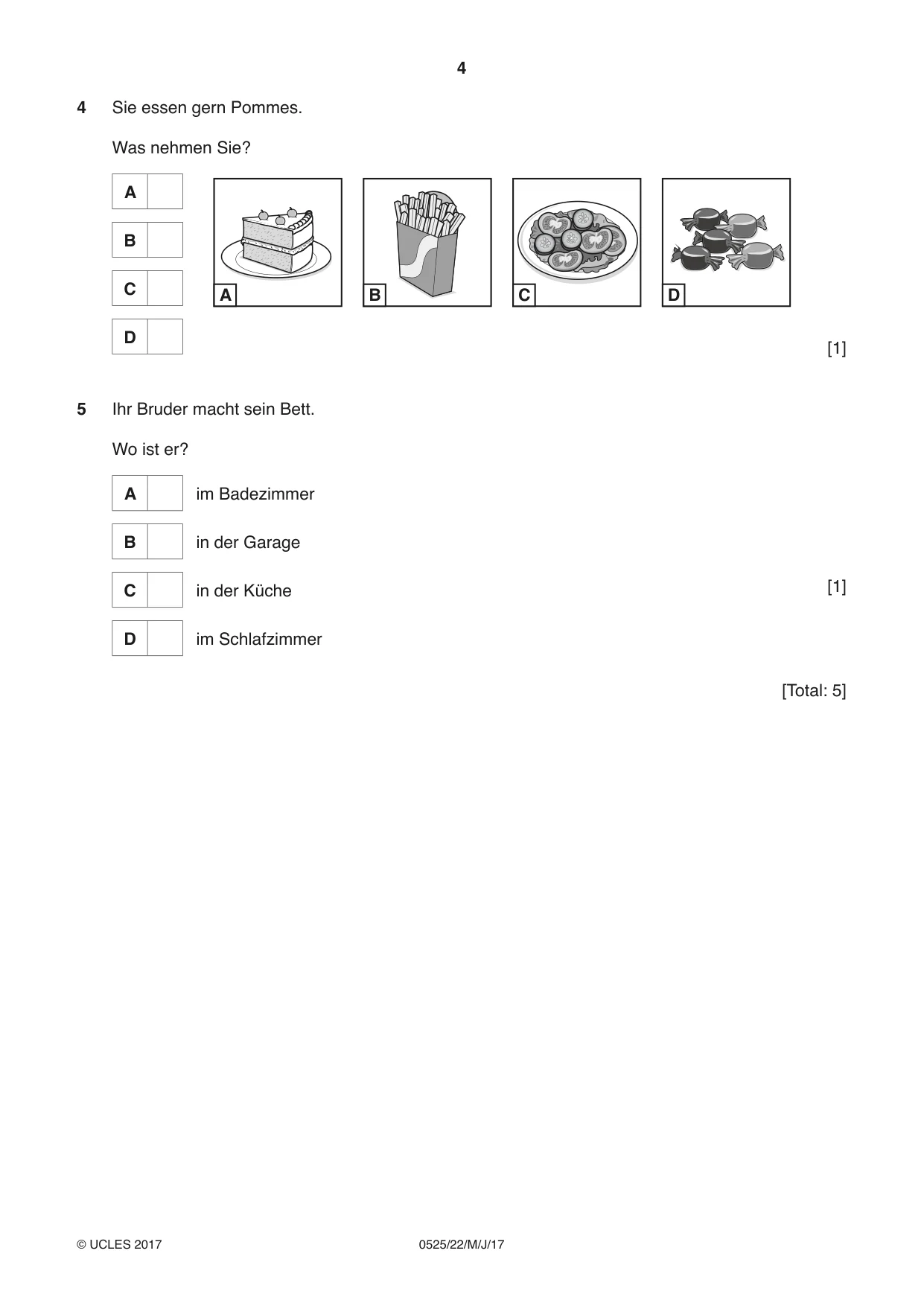
4 0525/22/M/J/17 © UCLES 2017 4 Sie essen gern Pommes. Was nehmen Sie? A A B C D [1] B C D 5 Ihr Bruder macht sein Bett. Wo ist er? A im Badezimmer [1] B in der Garage C in der Küche D im Schlafzimmer [Total: 5]
Question paper, page 5
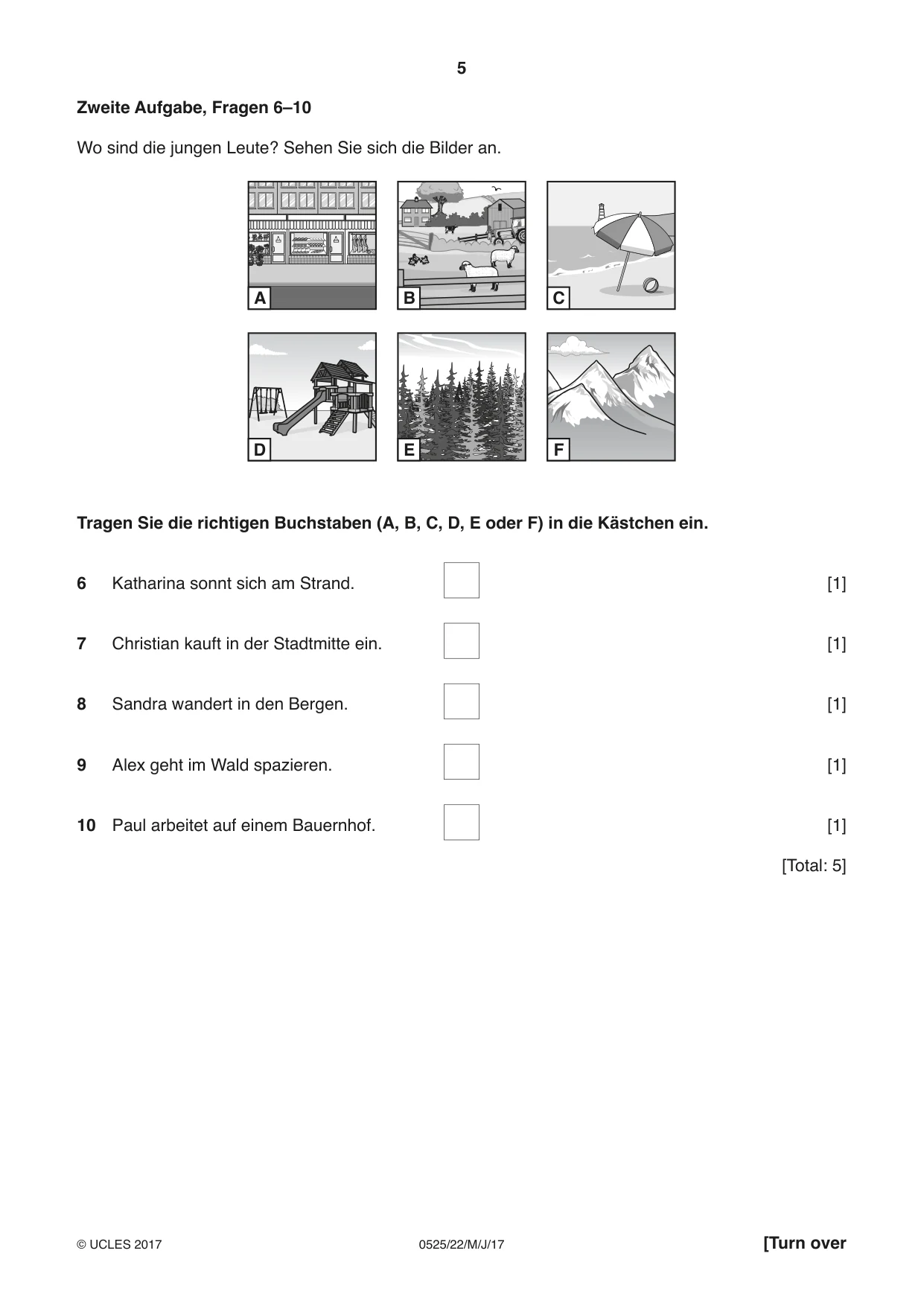
5 0525/22/M/J/17 © UCLES 2017 [Turn over Zweite Aufgabe, Fragen 6–10 Wo sind die jungen Leute? Sehen Sie sich die Bilder an. A B C D E F Tragen Sie die richtigen Buchstaben (A, B, C, D, E oder F) in die Kästchen ein. 6 Katharina sonnt sich am Strand. [1] 7 Christian kauft in der Stadtmitte ein. [1] 8 Sandra wandert in den Bergen. [1] 9 Alex geht im Wald spazieren. [1] 10 Paul arbeitet auf einem Bauernhof. [1] [Total: 5]
Question paper, page 6
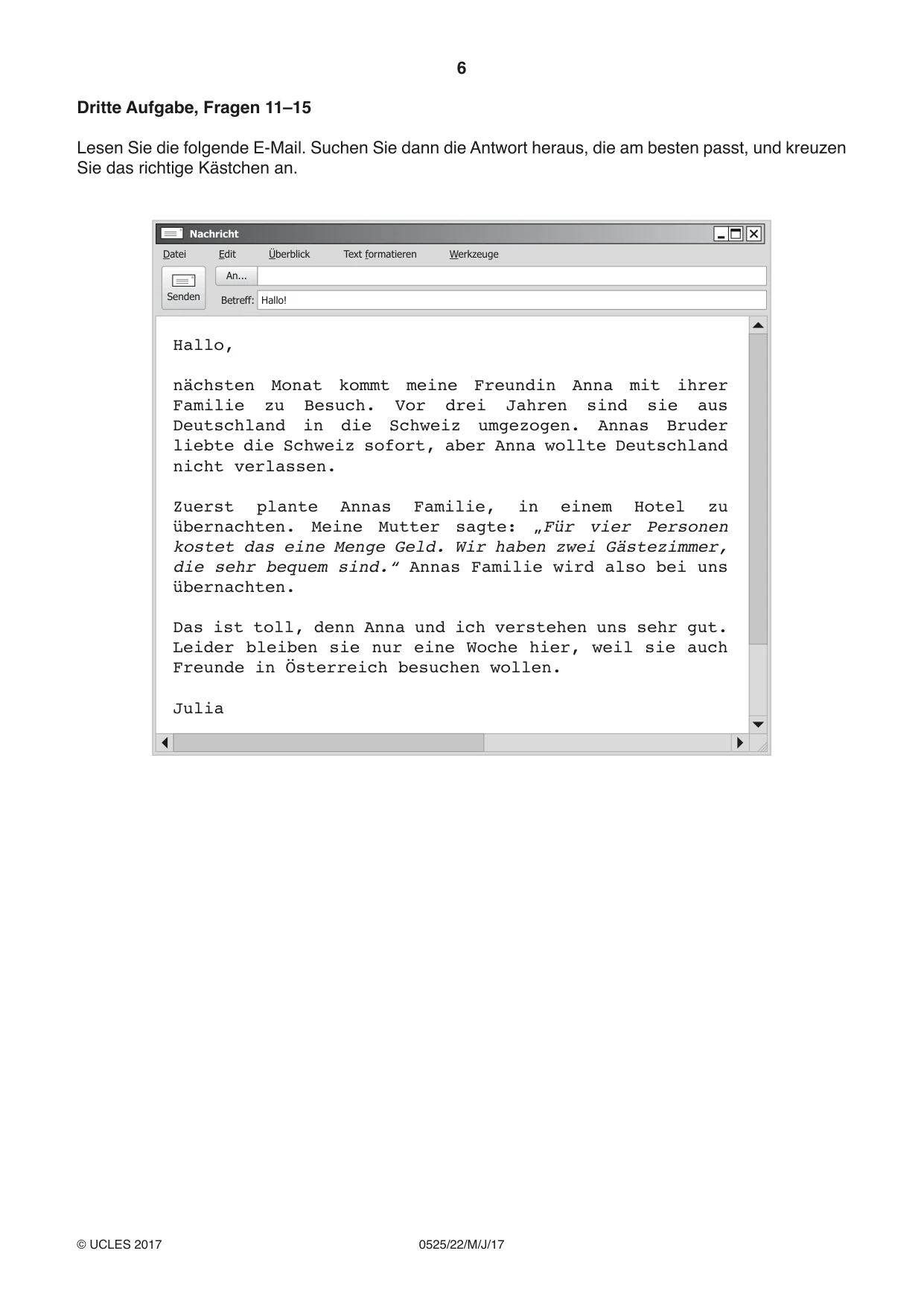
6 0525/22/M/J/17 © UCLES 2017 Dritte Aufgabe, Fragen 11–15 Lesen Sie die folgende E-Mail. Suchen Sie dann die Antwort heraus, die am besten passt, und kreuzen Sie das richtige Kästchen an. Betreff: Hallo! An... Senden Datei Edit Überblick Text formatieren Werkzeuge Nachricht Hallo, nächsten Monat kommt meine Freundin Anna mit ihrer Familie zu Besuch. Vor drei Jahren sind sie aus Deutschland in die Schweiz umgezogen. Annas Bruder liebte die Schweiz sofort, aber Anna wollte Deutschland nicht verlassen. Zuerst plante Annas Familie, in einem Hotel zu übernachten. Meine Mutter sagte: „Für vier Personen kostet das eine Menge Geld. Wir haben zwei Gästezimmer, die sehr bequem sind.“ Annas Familie wird also bei uns übernachten. Das ist toll, denn Anna und ich verstehen uns sehr gut. Leider bleiben sie nur eine Woche hier, weil sie auch Freunde in Österreich besuchen wollen. Julia
Question paper, page 7
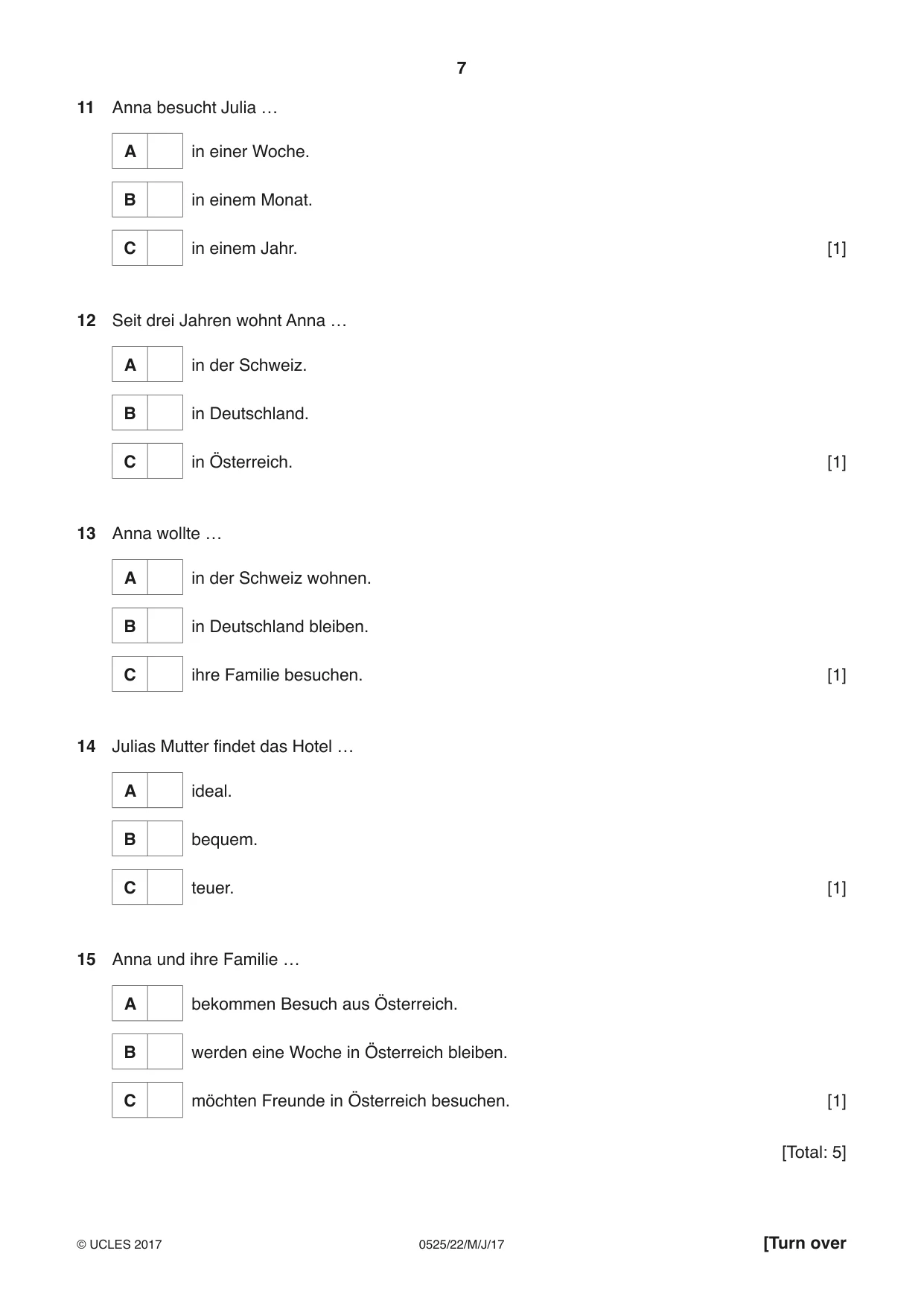
7 0525/22/M/J/17 © UCLES 2017 [Turn over 11 Anna besucht Julia … A in einer Woche. B in einem Monat. C in einem Jahr. [1] 12 Seit drei Jahren wohnt Anna … A in der Schweiz. B in Deutschland. C in Österreich. [1] 13 Anna wollte … A in der Schweiz wohnen. B in Deutschland bleiben. C ihre Familie besuchen. [1] 14 Julias Mutter findet das Hotel … A ideal. B bequem. C teuer. [1] 15 Anna und ihre Familie … A bekommen Besuch aus Österreich. B werden eine Woche in Österreich bleiben. C möchten Freunde in Österreich besuchen. [1] [Total: 5]
Question paper, page 8
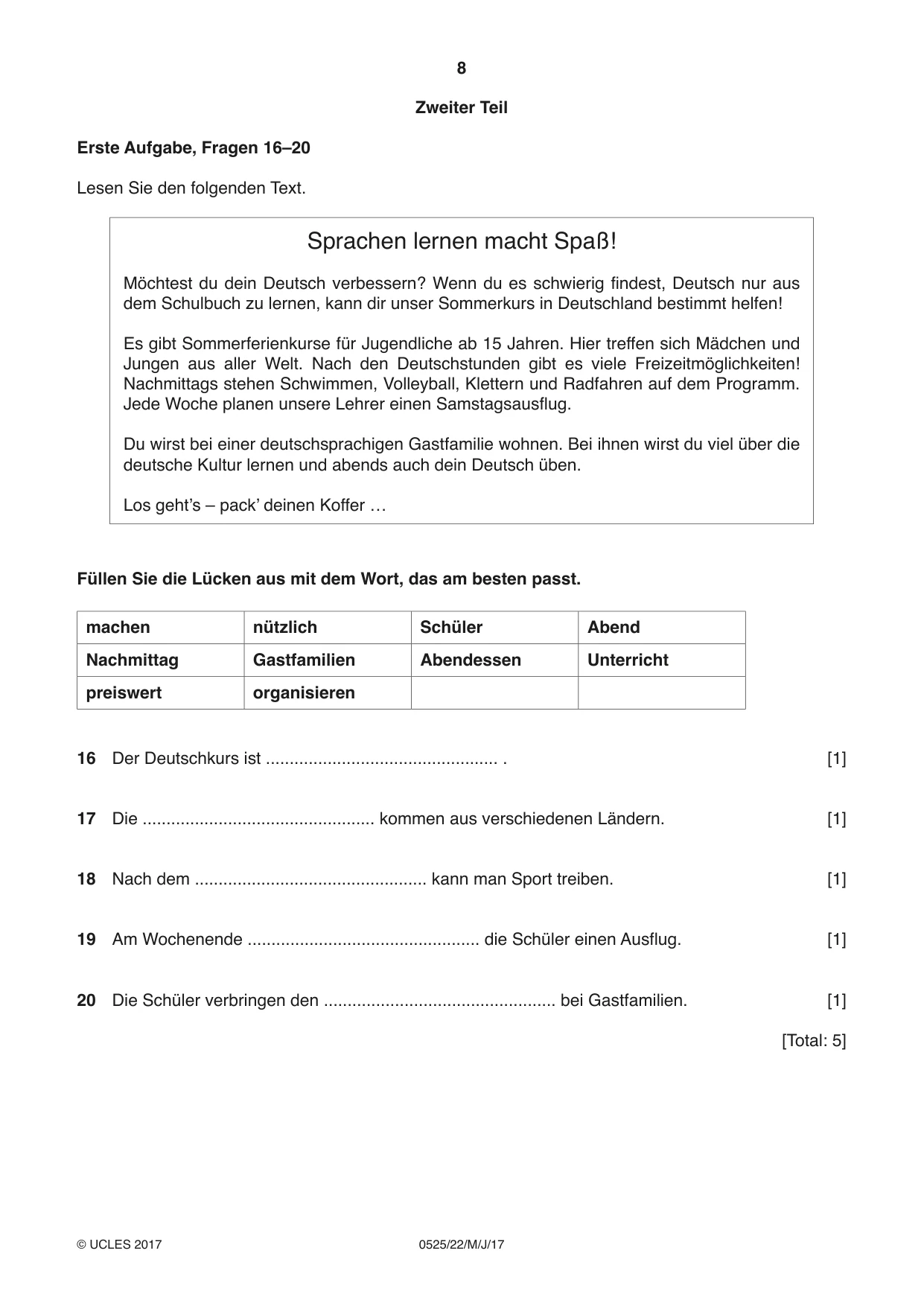
8 0525/22/M/J/17 © UCLES 2017 Zweiter Teil Erste Aufgabe, Fragen 16–20 Lesen Sie den folgenden Text. Sprachen lernen macht Spaß! Möchtest du dein Deutsch verbessern? Wenn du es schwierig findest, Deutsch nur aus dem Schulbuch zu lernen, kann dir unser Sommerkurs in Deutschland bestimmt helfen! Es gibt Sommerferienkurse für Jugendliche ab 15 Jahren. Hier treffen sich Mädchen und Jungen aus aller Welt. Nach den Deutschstunden gibt es viele Freizeitmöglichkeiten! Nachmittags stehen Schwimmen, Volleyball, Klettern und Radfahren auf dem Programm. Jede Woche planen unsere Lehrer einen Samstagsausflug. Du wirst bei einer deutschsprachigen Gastfamilie wohnen. Bei ihnen wirst du viel über die deutsche Kultur lernen und abends auch dein Deutsch üben. Los geht’s – pack’ deinen Koffer … Füllen Sie die Lücken aus mit dem Wort, das am besten passt. machen nützlich Schüler Abend Nachmittag Gastfamilien Abendessen Unterricht preiswert organisieren 16 Der Deutschkurs ist … . [1] 17 Die … kommen aus verschiedenen Ländern. [1] 18 Nach dem … kann man Sport treiben. [1] 19 Am Wochenende … die Schüler einen Ausflug. [1] 20 Die Schüler verbringen den … bei Gastfamilien. [1] [Total: 5]
Question paper, page 9
9 0525/22/M/J/17 © UCLES 2017 [Turn over BLANK PAGE
Question paper, page 10
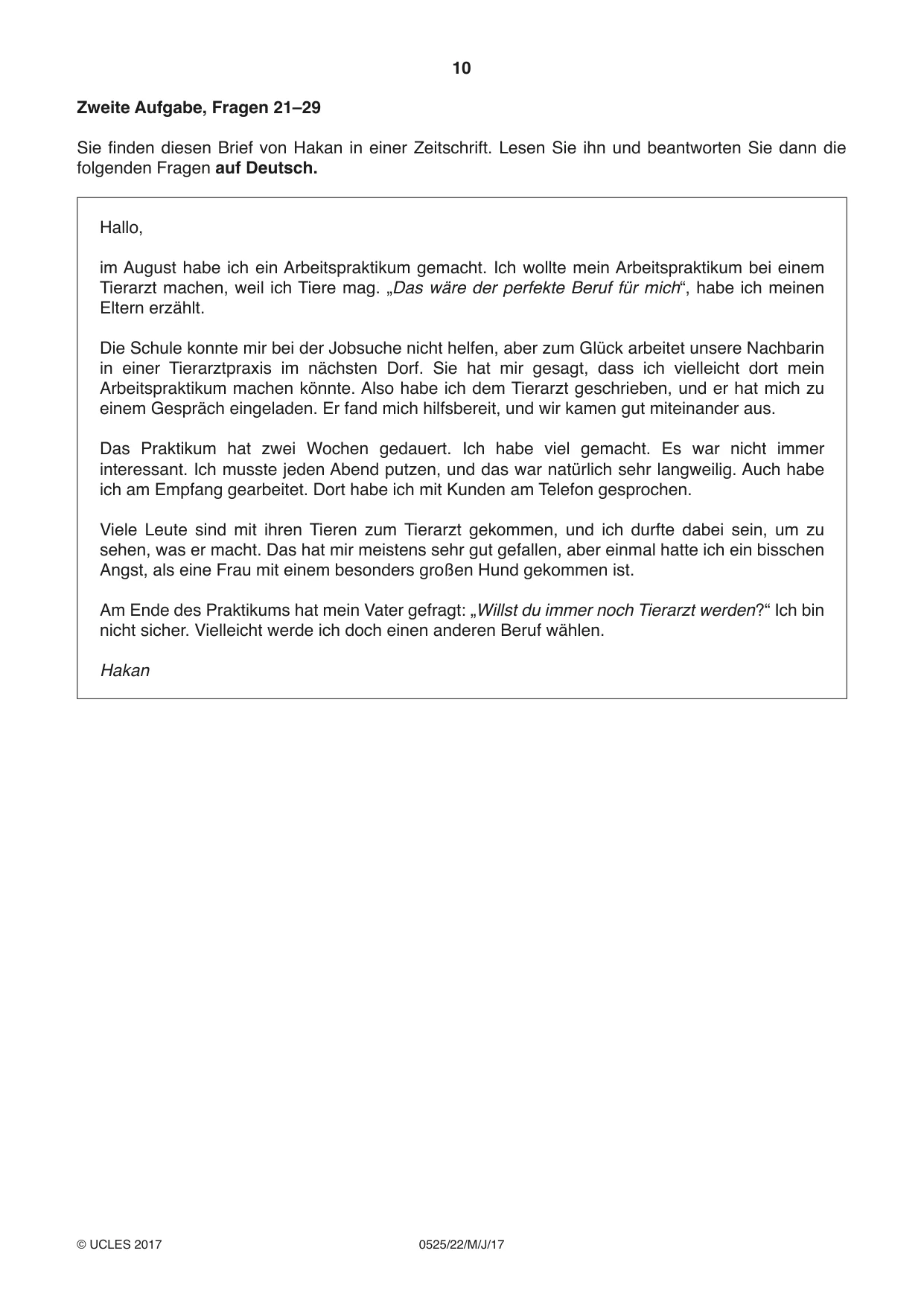
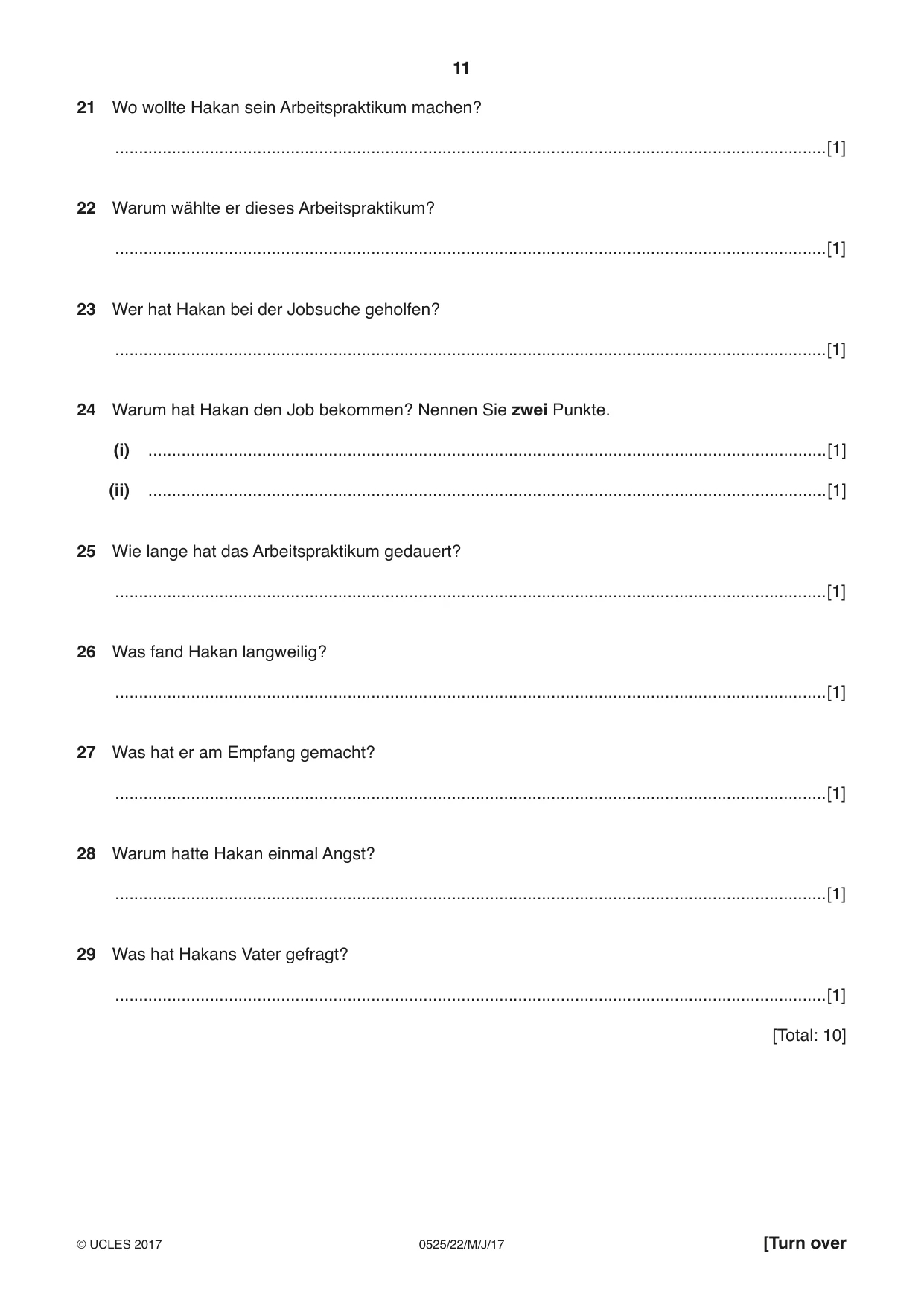
10 0525/22/M/J/17 © UCLES 2017 Zweite Aufgabe, Fragen 21–29 Sie finden diesen Brief von Hakan in einer Zeitschrift. Lesen Sie ihn und beantworten Sie dann die folgenden Fragen auf Deutsch. Hallo, im August habe ich ein Arbeitspraktikum gemacht. Ich wollte mein Arbeitspraktikum bei einem Tierarzt machen, weil ich Tiere mag. „Das wäre der perfekte Beruf für mich“, habe ich meinen Eltern erzählt. Die Schule konnte mir bei der Jobsuche nicht helfen, aber zum Glück arbeitet unsere Nachbarin in einer Tierarztpraxis im nächsten Dorf. Sie hat mir gesagt, dass ich vielleicht dort mein Arbeitspraktikum machen könnte. Also habe ich dem Tierarzt geschrieben, und er hat mich zu einem Gespräch eingeladen. Er fand mich hilfsbereit, und wir kamen gut miteinander aus. Das Praktikum hat zwei Wochen gedauert. Ich habe viel gemacht. Es war nicht immer interessant. Ich musste jeden Abend putzen, und das war natürlich sehr langweilig. Auch habe ich am Empfang gearbeitet. Dort habe ich mit Kunden am Telefon gesprochen. Viele Leute sind mit ihren Tieren zum Tierarzt gekommen, und ich durfte dabei sein, um zu sehen, was er macht. Das hat mir meistens sehr gut gefallen, aber einmal hatte ich ein bisschen Angst, als eine Frau mit einem besonders großen Hund gekommen ist. Am Ende des Praktikums hat mein Vater gefragt: „Willst du immer noch Tierarzt werden?“ Ich bin nicht sicher. Vielleicht werde ich doch einen anderen Beruf wählen. Hakan
Question paper, page 11
11 0525/22/M/J/17 © UCLES 2017 [Turn over 21 Wo wollte Hakan sein Arbeitspraktikum machen? …[1] 22 Warum wählte er dieses Arbeitspraktikum? …[1] 23 Wer hat Hakan bei der Jobsuche geholfen? …[1] 24 Warum hat Hakan den Job bekommen? Nennen Sie zwei Punkte. (i) …[1] (ii) …[1] 25 Wie lange hat das Arbeitspraktikum gedauert? …[1] 26 Was fand Hakan langweilig? …[1] 27 Was hat er am Empfang gemacht? …[1] 28 Warum hatte Hakan einmal Angst? …[1] 29 Was hat Hakans Vater gefragt? …[1] [Total: 10]
Question paper, page 12
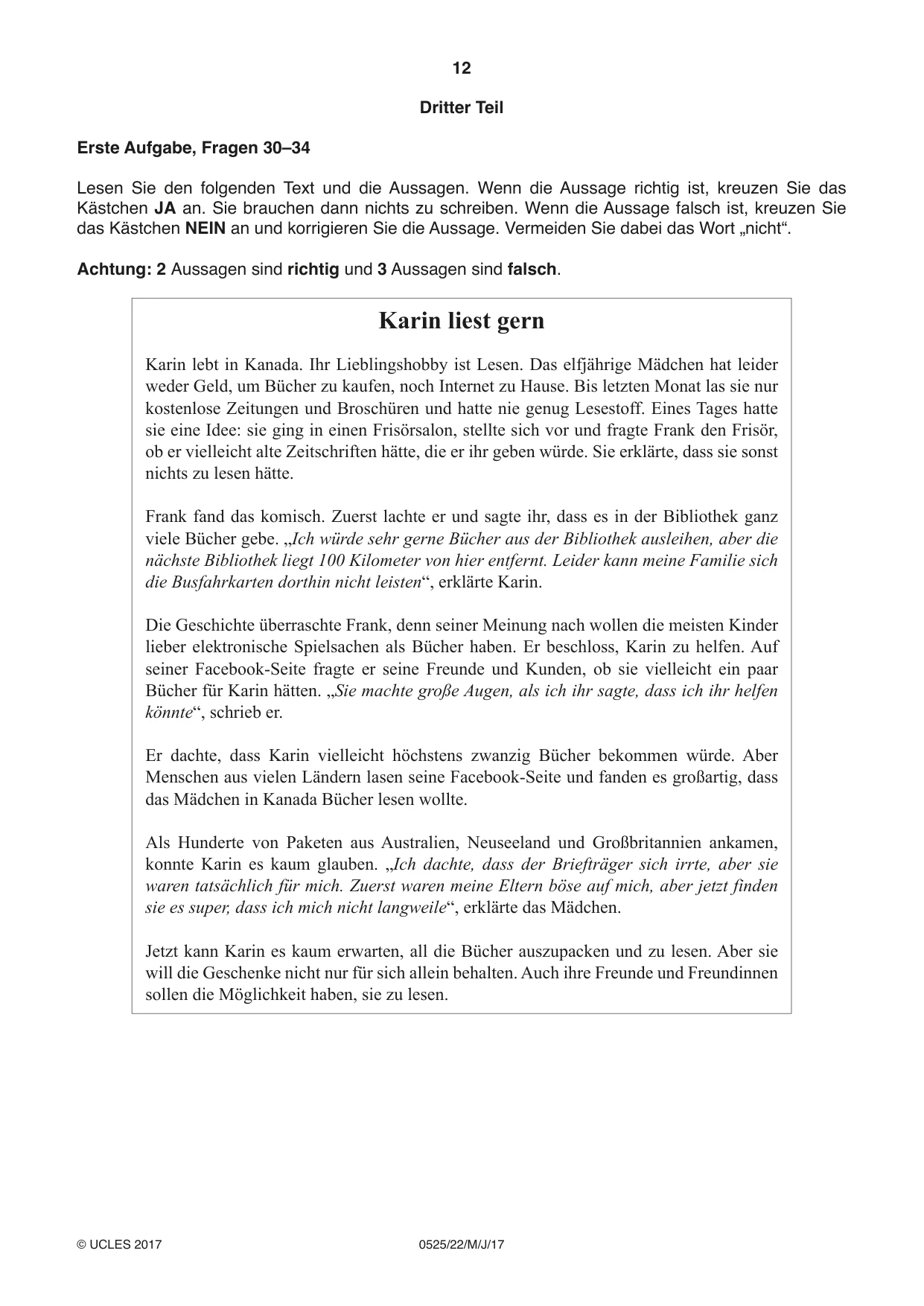
12 0525/22/M/J/17 © UCLES 2017 Dritter Teil Erste Aufgabe, Fragen 30–34 Lesen Sie den folgenden Text und die Aussagen. Wenn die Aussage richtig ist, kreuzen Sie das Kästchen JA an. Sie brauchen dann nichts zu schreiben. Wenn die Aussage falsch ist, kreuzen Sie das Kästchen NEIN an und korrigieren Sie die Aussage. Vermeiden Sie dabei das Wort „nicht“. Achtung: 2 Aussagen sind richtig und 3 Aussagen sind falsch. Karin liest gern Karin lebt in Kanada. Ihr Lieblingshobby ist Lesen. Das elfjährige Mädchen hat leider weder Geld, um Bücher zu kaufen, noch Internet zu Hause. Bis letzten Monat las sie nur kostenlose Zeitungen und Broschüren und hatte nie genug Lesestoff. Eines Tages hatte sie eine Idee: sie ging in einen Frisörsalon, stellte sich vor und fragte Frank den Frisör, ob er vielleicht alte Zeitschriften hätte, die er ihr geben würde. Sie erklärte, dass sie sonst nichts zu lesen hätte. Frank fand das komisch. Zuerst lachte er und sagte ihr, dass es in der Bibliothek ganz viele Bücher gebe. „Ich würde sehr gerne Bücher aus der Bibliothek ausleihen, aber die nächste Bibliothek liegt 100 Kilometer von hier entfernt. Leider kann meine Familie sich die Busfahrkarten dorthin nicht leisten“, erklärte Karin. Die Geschichte überraschte Frank, denn seiner Meinung nach wollen die meisten Kinder lieber elektronische Spielsachen als Bücher haben. Er beschloss, Karin zu helfen. Auf seiner Facebook-Seite fragte er seine Freunde und Kunden, ob sie vielleicht ein paar Bücher für Karin hätten. „Sie machte große Augen, als ich ihr sagte, dass ich ihr helfen könnte“, schrieb er. Er dachte, dass Karin vielleicht höchstens zwanzig Bücher bekommen würde. Aber Menschen aus vielen Ländern lasen seine Facebook-Seite und fanden es großartig, dass das Mädchen in Kanada Bücher lesen wollte. Als Hunderte von Paketen aus Australien, Neuseeland und Großbritannien ankamen, konnte Karin es kaum glauben. „Ich dachte, dass der Briefträger sich irrte, aber sie waren tatsächlich für mich. Zuerst waren meine Eltern böse auf mich, aber jetzt finden sie es super, dass ich mich nicht langweile“, erklärte das Mädchen. Jetzt kann Karin es kaum erwarten, all die Bücher auszupacken und zu lesen. Aber sie will die Geschenke nicht nur für sich allein behalten. Auch ihre Freunde und Freundinnen sollen die Möglichkeit haben, sie zu lesen.
Question paper, page 13
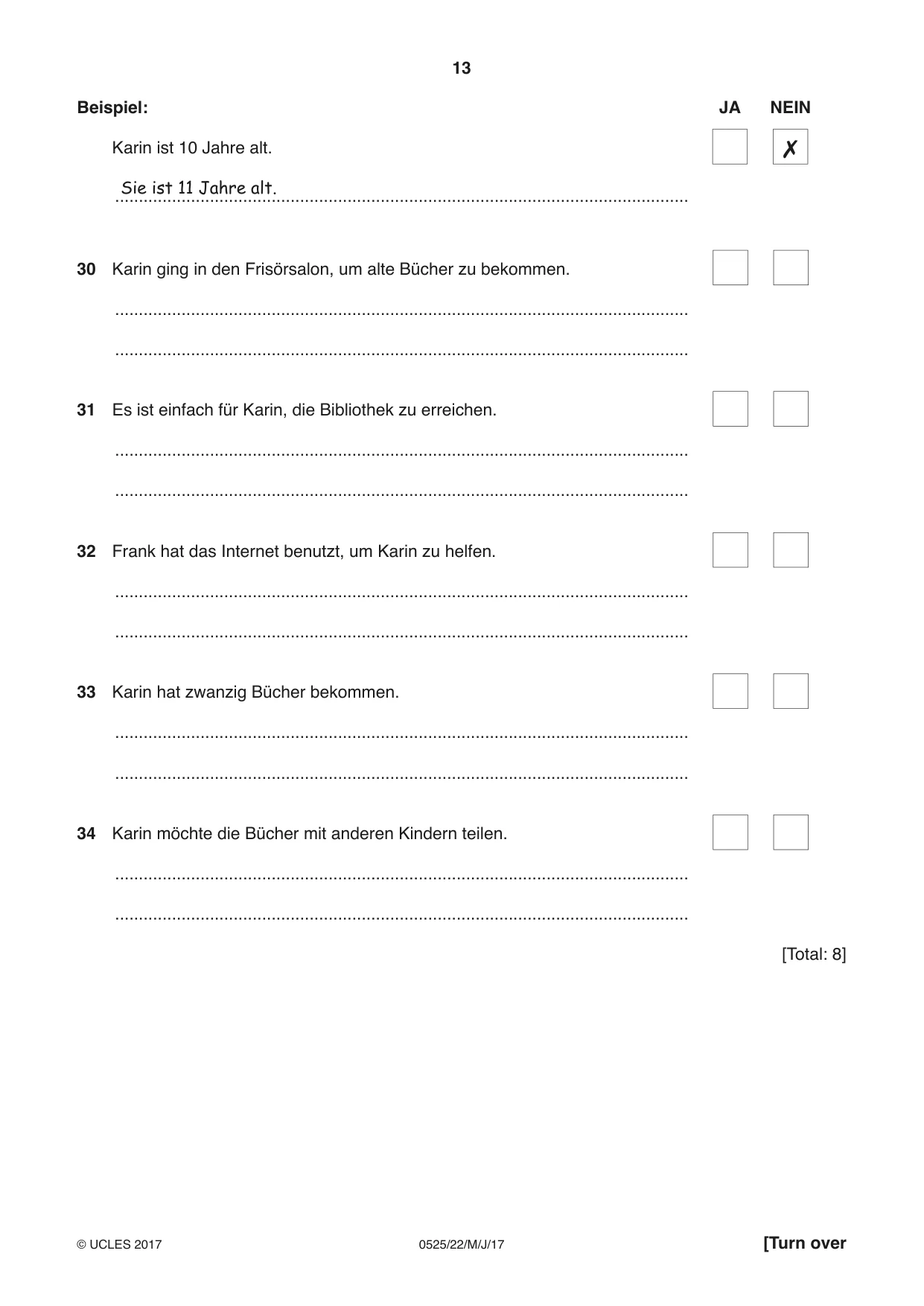
13 0525/22/M/J/17 © UCLES 2017 [Turn over Beispiel: JA NEIN Karin ist 10 Jahre alt. 7 Sie ist 11 Jahre alt. … 30 Karin ging in den Frisörsalon, um alte Bücher zu bekommen. … … 31 Es ist einfach für Karin, die Bibliothek zu erreichen. … … 32 Frank hat das Internet benutzt, um Karin zu helfen. … … 33 Karin hat zwanzig Bücher bekommen. … … 34 Karin möchte die Bücher mit anderen Kindern teilen. … … [Total: 8]
Question paper, page 14
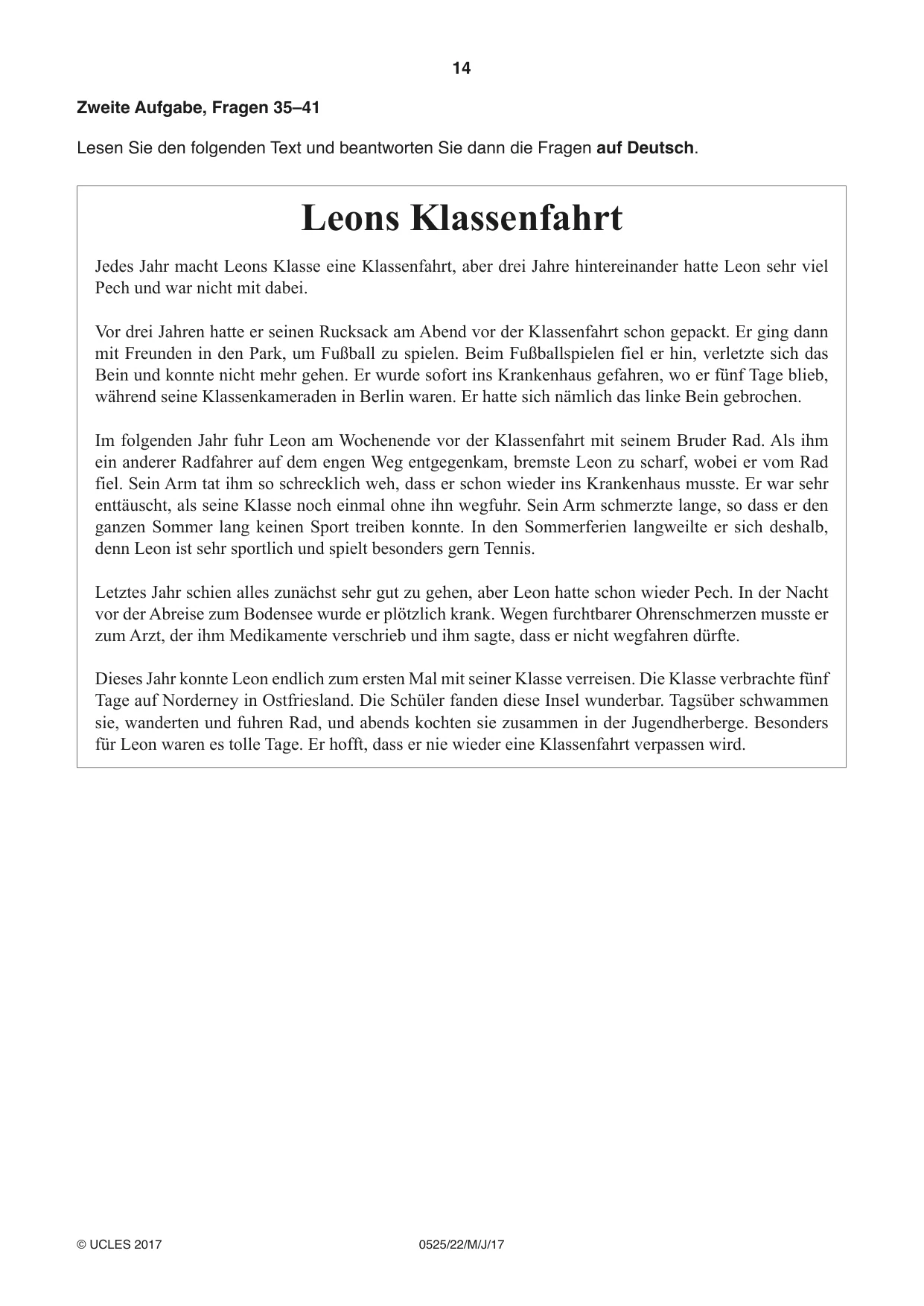
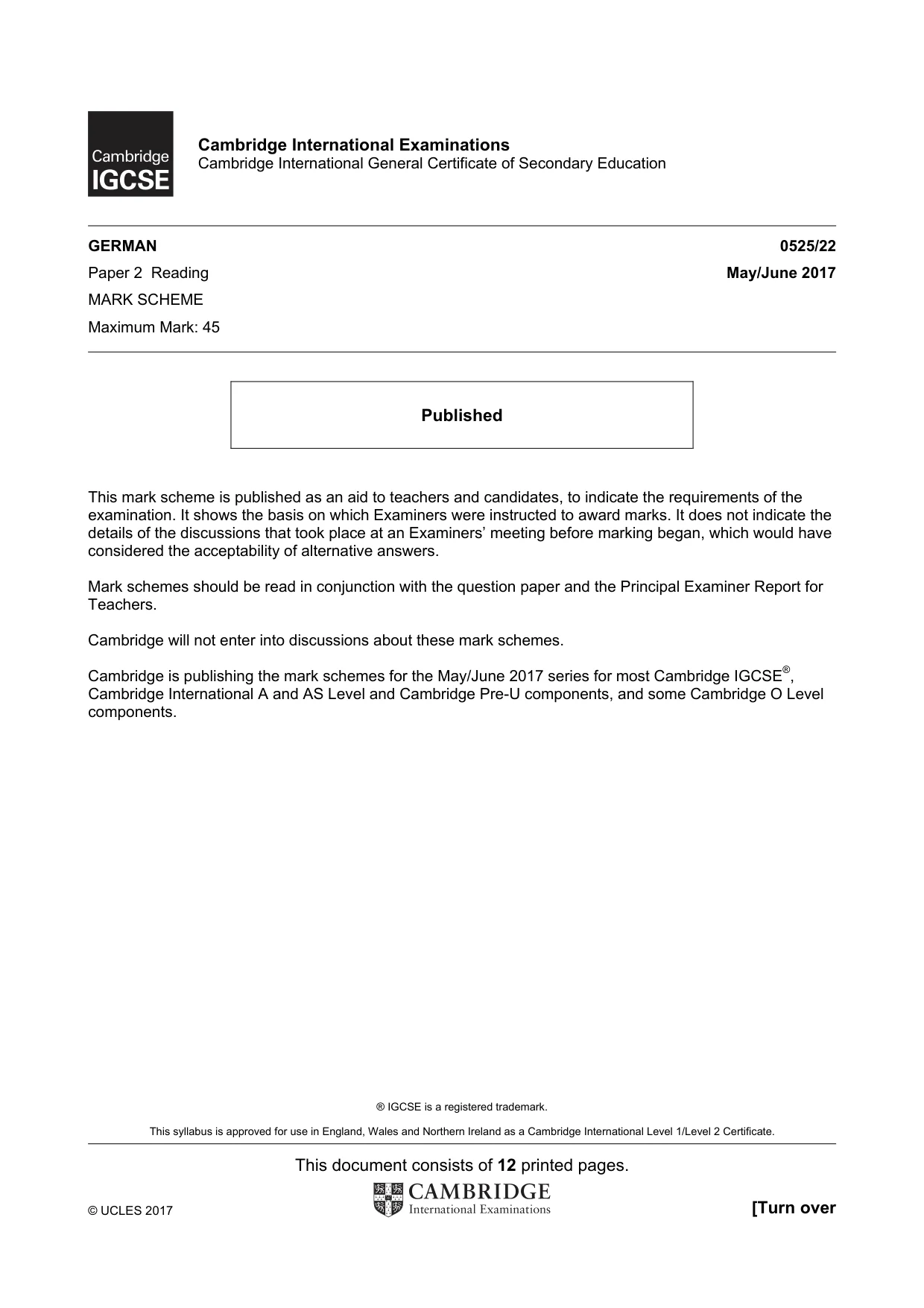
14 0525/22/M/J/17 © UCLES 2017 Zweite Aufgabe, Fragen 35–41 Lesen Sie den folgenden Text und beantworten Sie dann die Fragen auf Deutsch. Leons Klassenfahrt Jedes Jahr macht Leons Klasse eine Klassenfahrt, aber drei Jahre hintereinander hatte Leon sehr viel Pech und war nicht mit dabei. Vor drei Jahren hatte er seinen Rucksack am Abend vor der Klassenfahrt schon gepackt. Er ging dann mit Freunden in den Park, um Fußball zu spielen. Beim Fußballspielen fiel er hin, verletzte sich das Bein und konnte nicht mehr gehen. Er wurde sofort ins Krankenhaus gefahren, wo er fünf Tage blieb, während seine Klassenkameraden in Berlin waren. Er hatte sich nämlich das linke Bein gebrochen. Im folgenden Jahr fuhr Leon am Wochenende vor der Klassenfahrt mit seinem Bruder Rad. Als ihm ein anderer Radfahrer auf dem engen Weg entgegenkam, bremste Leon zu scharf, wobei er vom Rad fiel. Sein Arm tat ihm so schrecklich weh, dass er schon wieder ins Krankenhaus musste. Er war sehr enttäuscht, als seine Klasse noch einmal ohne ihn wegfuhr. Sein Arm schmerzte lange, so dass er den ganzen Sommer lang keinen Sport treiben konnte. In den Sommerferien langweilte er sich deshalb, denn Leon ist sehr sportlich und spielt besonders gern Tennis. Letztes Jahr schien alles zunächst sehr gut zu gehen, aber Leon hatte schon wieder Pech. In der Nacht vor der Abreise zum Bodensee wurde er plötzlich krank. Wegen furchtbarer Ohrenschmerzen musste er zum Arzt, der ihm Medikamente verschrieb und ihm sagte, dass er nicht wegfahren dürfte. Dieses Jahr konnte Leon endlich zum ersten Mal mit seiner Klasse verreisen. Die Klasse verbrachte fünf Tage auf Norderney in Ostfriesland. Die Schüler fanden diese Insel wunderbar. Tagsüber schwammen sie, wanderten und fuhren Rad, und abends kochten sie zusammen in der Jugendherberge. Besonders für Leon waren es tolle Tage. Er hofft, dass er nie wieder eine Klassenfahrt verpassen wird.
Question paper, page 15
15 0525/22/M/J/17 © UCLES 2017 35 Wie oft hat Leon die Klassenfahrt verpasst? … …[1] 36 Was machte Leon im Park, als er einen Unfall hatte? … …[1] 37 Wo war Leon, während seine Klasse in Berlin war? … …[1] 38 Warum musste Leon scharf bremsen? … …[1] 39 Warum langweilte sich Leon in den Sommerferien? … …[1] 40 Was tat Leon weh in der Nacht vor der Abreise zum Bodensee? … …[1] 41 Wie fühlte sich Leon während der Klassenfahrt auf Norderney? … …[1] [Total: 7]
Question paper, page 16
16 0525/22/M/J/17 © UCLES 2017 Permission to reproduce items where third-party owned material protected by copyright is included has been sought and cleared where possible. Every reasonable effort has been made by the publisher (UCLES) to trace copyright holders, but if any items requiring clearance have unwittingly been included, the publisher will be pleased to make amends at the earliest possible opportunity. To avoid the issue of disclosure of answer-related information to candidates, all copyright acknowledgements are reproduced online in the Cambridge International Examinations Copyright Acknowledgements Booklet. This is produced for each series of examinations and is freely available to download at www.cie.org.uk after the live examination series. Cambridge International Examinations is part of the Cambridge Assessment Group. Cambridge Assessment is the brand name of University of Cambridge Local Examinations Syndicate (UCLES), which is itself a department of the University of Cambridge. BLANK PAGE
Mark scheme, page 1
® IGCSE is a registered trademark. This syllabus is approved for use in England, Wales and Northern Ireland as a Cambridge International Level 1/Level 2 Certificate. This document consists of 12 printed pages. © UCLES 2017 [Turn over Cambridge International Examinations Cambridge International General Certificate of Secondary Education GERMAN 0525/22 Paper 2 Reading May/June 2017 MARK SCHEME Maximum Mark: 45 Published This mark scheme is published as an aid to teachers and candidates, to indicate the requirements of the examination. It shows the basis on which Examiners were instructed to award marks. It does not indicate the details of the discussions that took place at an Examiners’ meeting before marking began, which would have considered the acceptability of alternative answers. Mark schemes should be read in conjunction with the question paper and the Principal Examiner Report for Teachers. Cambridge will not enter into discussions about these mark schemes. Cambridge is publishing the mark schemes for the May/June 2017 series for most Cambridge IGCSE®, Cambridge International A and AS Level and Cambridge Pre-U components, and some Cambridge O Level components.
Mark scheme, page 2
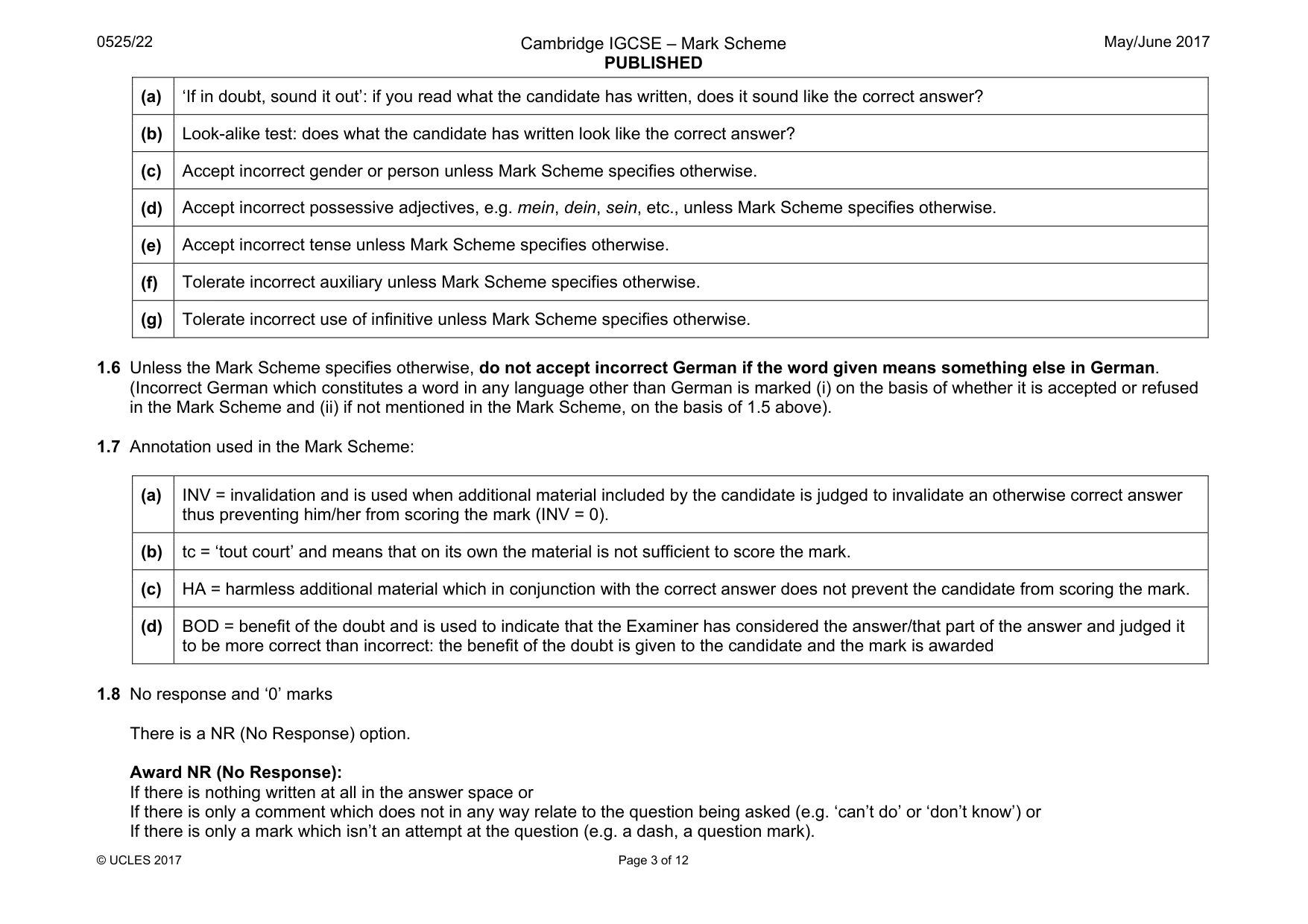
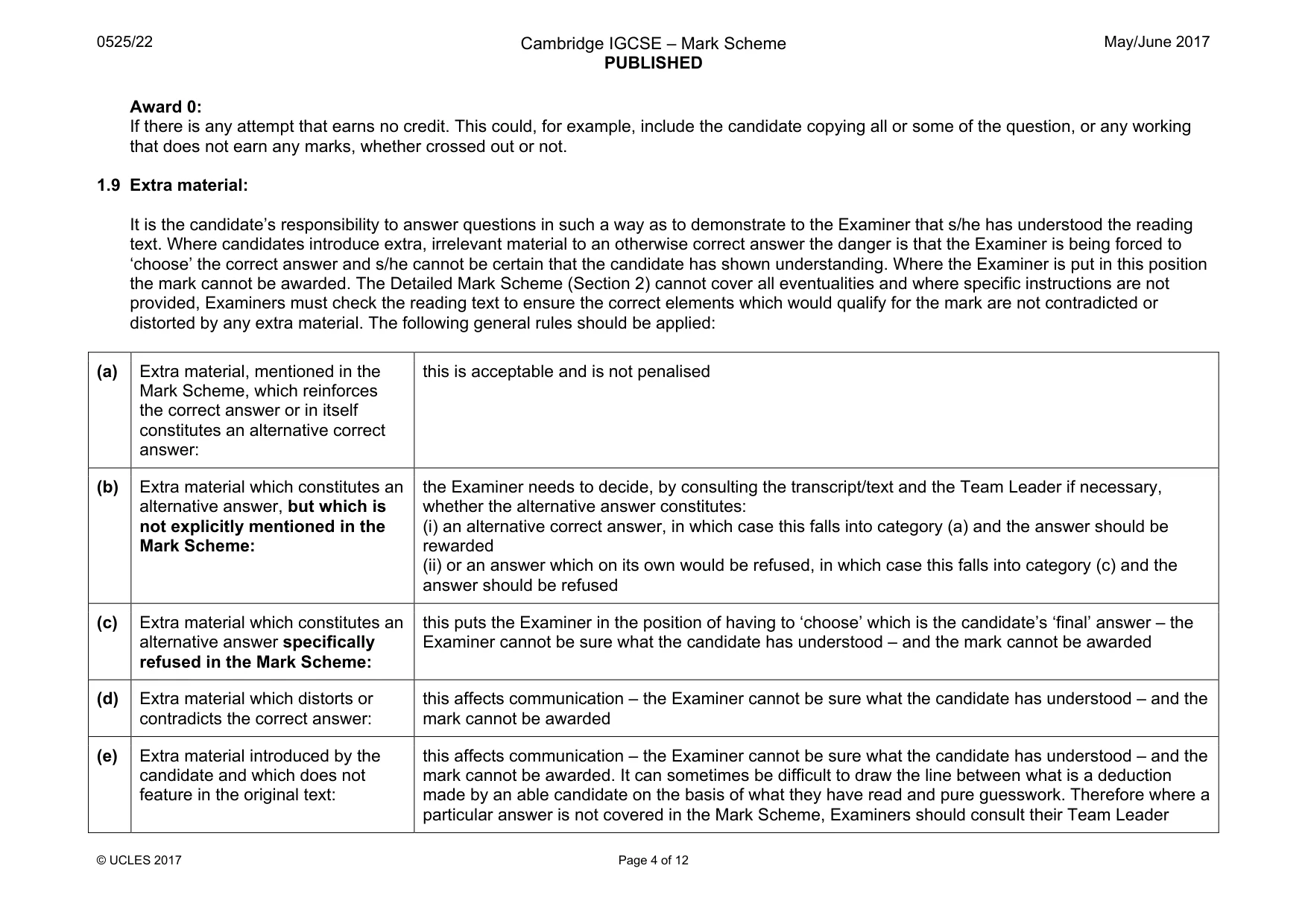
0525/22 Cambridge IGCSE – Mark Scheme PUBLISHED May/June 2017 © UCLES 2017 Page 2 of 12 1 General Marking Principles 1.1 It is not possible to list all acceptable alternatives in the Detailed Mark Scheme provided in Section 2. You will need to consider all alternative answers and unexpected approaches in candidates’ scripts, make a decision on whether they communicate the required elements, in consultation with your Team Leader if necessary (or with your Product Manager if you are a single Examiner), and award marks accordingly. The following marking principles underpin the detailed instructions provided in Section 2 of the Mark Scheme. Where a decision is taken to deviate from these principles for a particular question, this will be specified in the Mark Scheme. Often the general principles will have to be weighed up against each other, e.g. the answer might pass the look-alike test (1.5(b)), but if the candidate has produced an answer that is another word in the target language they will not score (1.6). 1.2 Crossing out: (a) If a candidate changes his/her mind over an answer and crosses out an attempt, award a mark if the final attempt is correct. (b) If a candidate crosses out an answer to a whole question but makes no second attempt at it, mark the crossed out work. 1.3 More than the stipulated number of boxes ticked/crossed by the candidate: (a) If more than one attempt is visible, but the candidate has clearly indicated which attempt is his/her final answer (e.g. by crossing out other attempts or by annotating the script in some way), mark in the usual way. (b) If two attempts are visible (e.g. two boxes ticked instead of the 1 box stipulated), and neither has been crossed out/discounted by the candidate, no mark can be awarded. 1.4 For questions requiring more than one element for the answer, (i) and (ii), where the answers are interchangeable: (a) Both correct answers on line 1 and line 2 blank = 2 (b) Both correct answers on line 1 and line 2 wrong = 1 (or vice-versa) 1.5 Answers requiring the use of German (rather than a non-verbal response) should be marked for communication. Tolerate inaccuracies provided the message is clear.
Mark scheme, page 3
0525/22 Cambridge IGCSE – Mark Scheme PUBLISHED May/June 2017 © UCLES 2017 Page 3 of 12 (a) ‘If in doubt, sound it out’: if you read what the candidate has written, does it sound like the correct answer? (b) Look-alike test: does what the candidate has written look like the correct answer? (c) Accept incorrect gender or person unless Mark Scheme specifies otherwise. (d) Accept incorrect possessive adjectives, e.g. mein, dein, sein, etc., unless Mark Scheme specifies otherwise. (e) Accept incorrect tense unless Mark Scheme specifies otherwise. (f) Tolerate incorrect auxiliary unless Mark Scheme specifies otherwise. (g) Tolerate incorrect use of infinitive unless Mark Scheme specifies otherwise. 1.6 Unless the Mark Scheme specifies otherwise, do not accept incorrect German if the word given means something else in German. (Incorrect German which constitutes a word in any language other than German is marked (i) on the basis of whether it is accepted or refused in the Mark Scheme and (ii) if not mentioned in the Mark Scheme, on the basis of 1.5 above). 1.7 Annotation used in the Mark Scheme: (a) INV = invalidation and is used when additional material included by the candidate is judged to invalidate an otherwise correct answer thus preventing him/her from scoring the mark (INV = 0). (b) tc = ‘tout court’ and means that on its own the material is not sufficient to score the mark. (c) HA = harmless additional material which in conjunction with the correct answer does not prevent the candidate from scoring the mark. (d) BOD = benefit of the doubt and is used to indicate that the Examiner has considered the answer/that part of the answer and judged it to be more correct than incorrect: the benefit of the doubt is given to the candidate and the mark is awarded 1.8 No response and ‘0’ marks There is a NR (No Response) option. Award NR (No Response): If there is nothing written at all in the answer space or If there is only a comment which does not in any way relate to the question being asked (e.g. ‘can’t do’ or ‘don’t know’) or If there is only a mark which isn’t an attempt at the question (e.g. a dash, a question mark).
Mark scheme, page 4
0525/22 Cambridge IGCSE – Mark Scheme PUBLISHED May/June 2017 © UCLES 2017 Page 4 of 12 Award 0: If there is any attempt that earns no credit. This could, for example, include the candidate copying all or some of the question, or any working that does not earn any marks, whether crossed out or not. 1.9 Extra material: It is the candidate’s responsibility to answer questions in such a way as to demonstrate to the Examiner that s/he has understood the reading text. Where candidates introduce extra, irrelevant material to an otherwise correct answer the danger is that the Examiner is being forced to ‘choose’ the correct answer and s/he cannot be certain that the candidate has shown understanding. Where the Examiner is put in this position the mark cannot be awarded. The Detailed Mark Scheme (Section 2) cannot cover all eventualities and where specific instructions are not provided, Examiners must check the reading text to ensure the correct elements which would qualify for the mark are not contradicted or distorted by any extra material. The following general rules should be applied: (a) Extra material, mentioned in the Mark Scheme, which reinforces the correct answer or in itself constitutes an alternative correct answer: this is acceptable and is not penalised (b) Extra material which constitutes an alternative answer, but which is not explicitly mentioned in the Mark Scheme: the Examiner needs to decide, by consulting the transcript/text and the Team Leader if necessary, whether the alternative answer constitutes: (i) an alternative correct answer, in which case this falls into category (a) and the answer should be rewarded (ii) or an answer which on its own would be refused, in which case this falls into category (c) and the answer should be refused (c) Extra material which constitutes an alternative answer specifically refused in the Mark Scheme: this puts the Examiner in the position of having to ‘choose’ which is the candidate’s ‘final’ answer – the Examiner cannot be sure what the candidate has understood – and the mark cannot be awarded (d) Extra material which distorts or contradicts the correct answer: this affects communication – the Examiner cannot be sure what the candidate has understood – and the mark cannot be awarded (e) Extra material introduced by the candidate and which does not feature in the original text: this affects communication – the Examiner cannot be sure what the candidate has understood – and the mark cannot be awarded. It can sometimes be difficult to draw the line between what is a deduction made by an able candidate on the basis of what they have read and pure guesswork. Therefore where a particular answer is not covered in the Mark Scheme, Examiners should consult their Team Leader
Mark scheme, page 5
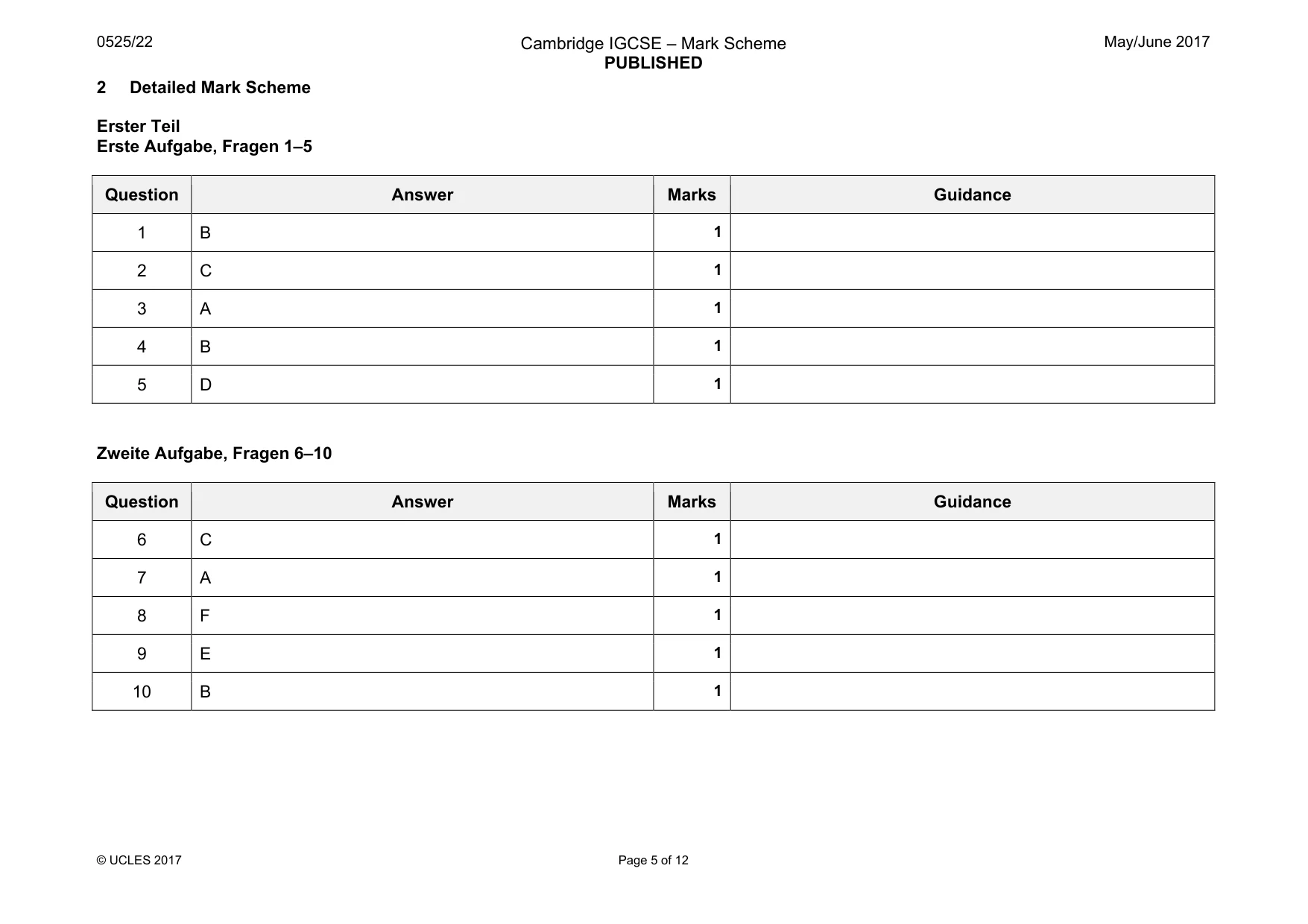
0525/22 Cambridge IGCSE – Mark Scheme PUBLISHED May/June 2017 © UCLES 2017 Page 5 of 12 2 Detailed Mark Scheme Erster Teil Erste Aufgabe, Fragen 1–5 Question Answer Marks Guidance 1 B 1 2 C 1 3 A 1 4 B 1 5 D 1 Zweite Aufgabe, Fragen 6–10 Question Answer Marks Guidance 6 C 1 7 A 1 8 F 1 9 E 1 10 B 1
Mark scheme, page 6
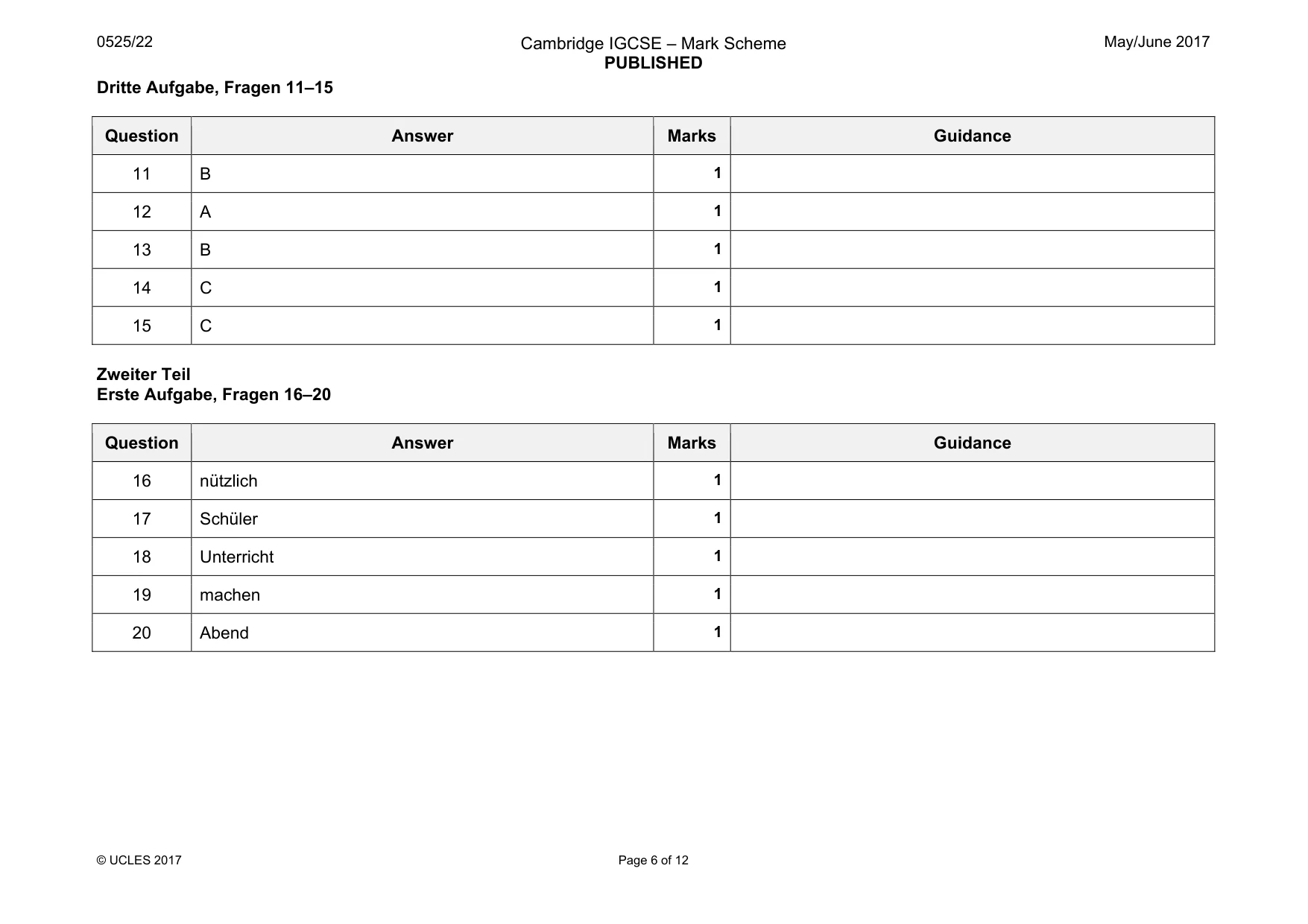
0525/22 Cambridge IGCSE – Mark Scheme PUBLISHED May/June 2017 © UCLES 2017 Page 6 of 12 Dritte Aufgabe, Fragen 11–15 Question Answer Marks Guidance 11 B 1 12 A 1 13 B 1 14 C 1 15 C 1 Zweiter Teil Erste Aufgabe, Fragen 16–20 Question Answer Marks Guidance 16 nützlich 1 17 Schüler 1 18 Unterricht 1 19 machen 1 20 Abend 1
Mark scheme, page 7
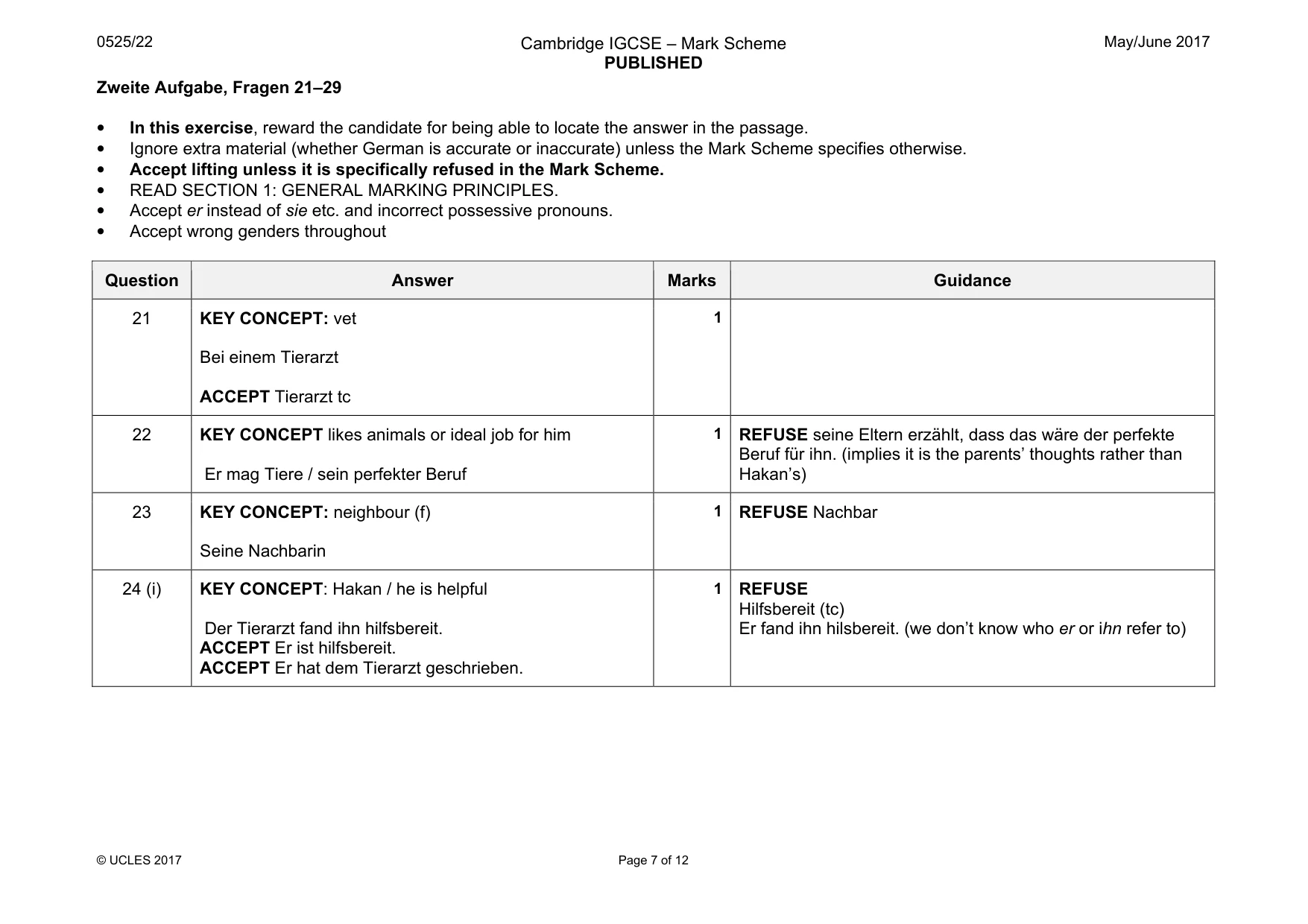
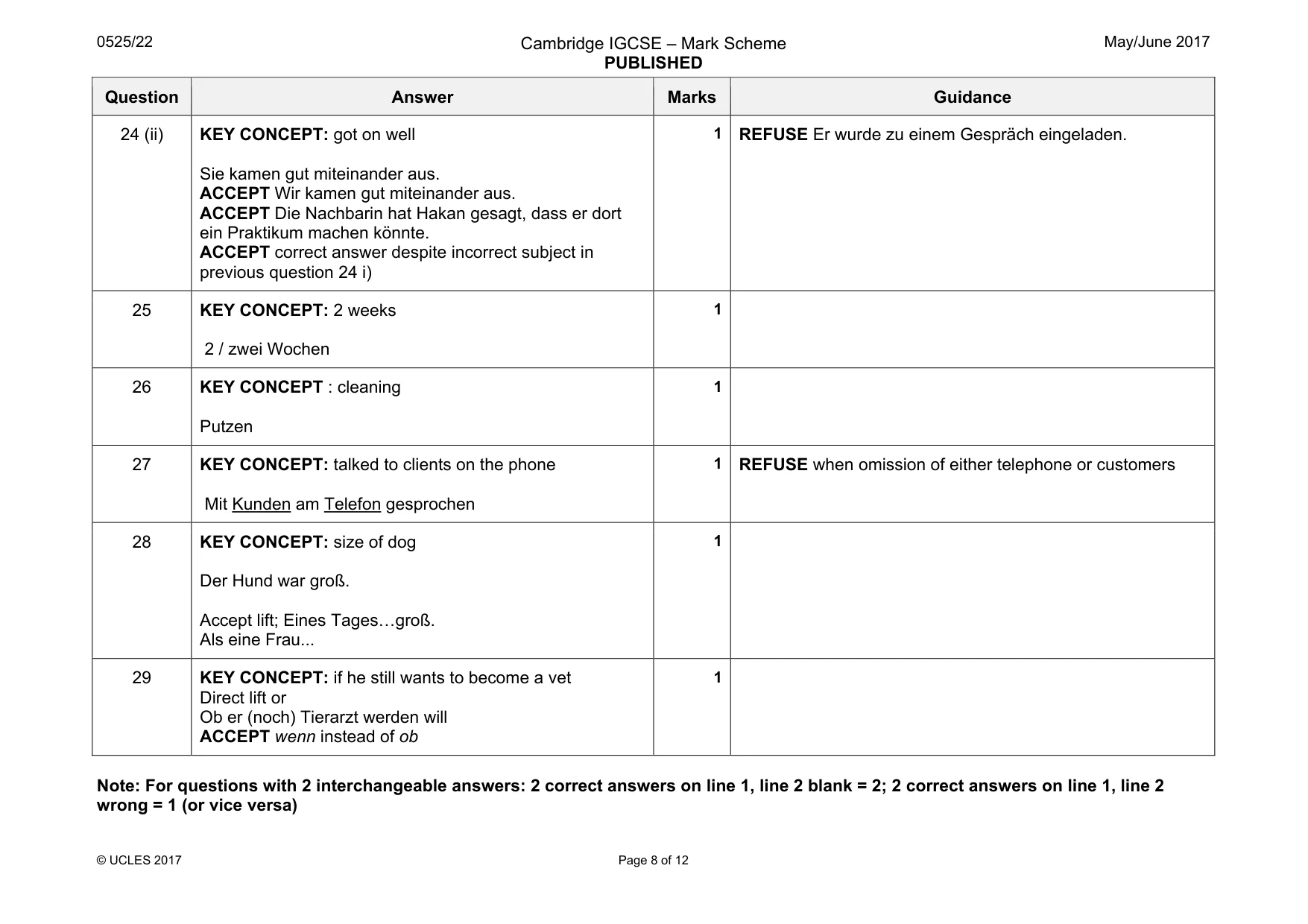
0525/22 Cambridge IGCSE – Mark Scheme PUBLISHED May/June 2017 © UCLES 2017 Page 7 of 12 Zweite Aufgabe, Fragen 21–29 • In this exercise, reward the candidate for being able to locate the answer in the passage. • Ignore extra material (whether German is accurate or inaccurate) unless the Mark Scheme specifies otherwise. • Accept lifting unless it is specifically refused in the Mark Scheme. • READ SECTION 1: GENERAL MARKING PRINCIPLES. • Accept er instead of sie etc. and incorrect possessive pronouns. • Accept wrong genders throughout Question Answer Marks Guidance 21 KEY CONCEPT: vet Bei einem Tierarzt ACCEPT Tierarzt tc 1 22 KEY CONCEPT likes animals or ideal job for him Er mag Tiere / sein perfekter Beruf 1 REFUSE seine Eltern erzählt, dass das wäre der perfekte Beruf für ihn. (implies it is the parents’ thoughts rather than Hakan’s) 23 KEY CONCEPT: neighbour (f) Seine Nachbarin 1 REFUSE Nachbar 24 (i) KEY CONCEPT: Hakan / he is helpful Der Tierarzt fand ihn hilfsbereit. ACCEPT Er ist hilfsbereit. ACCEPT Er hat dem Tierarzt geschrieben. 1 REFUSE Hilfsbereit (tc) Er fand ihn hilsbereit. (we don’t know who er or ihn refer to)
Mark scheme, page 8
0525/22 Cambridge IGCSE – Mark Scheme PUBLISHED May/June 2017 © UCLES 2017 Page 8 of 12 Question Answer Marks Guidance 24 (ii) KEY CONCEPT: got on well Sie kamen gut miteinander aus. ACCEPT Wir kamen gut miteinander aus. ACCEPT Die Nachbarin hat Hakan gesagt, dass er dort ein Praktikum machen könnte. ACCEPT correct answer despite incorrect subject in previous question 24 i) 1 REFUSE Er wurde zu einem Gespräch eingeladen. 25 KEY CONCEPT: 2 weeks 2 / zwei Wochen 1 26 KEY CONCEPT : cleaning Putzen 1 27 KEY CONCEPT: talked to clients on the phone Mit Kunden am Telefon gesprochen 1 REFUSE when omission of either telephone or customers 28 KEY CONCEPT: size of dog Der Hund war groß. Accept lift; Eines Tages«groß. Als eine Frau... 1 29 KEY CONCEPT: if he still wants to become a vet Direct lift or Ob er (noch) Tierarzt werden will ACCEPT wenn instead of ob 1 Note: For questions with 2 interchangeable answers: 2 correct answers on line 1, line 2 blank = 2; 2 correct answers on line 1, line 2 wrong = 1 (or vice versa)
Mark scheme, page 9
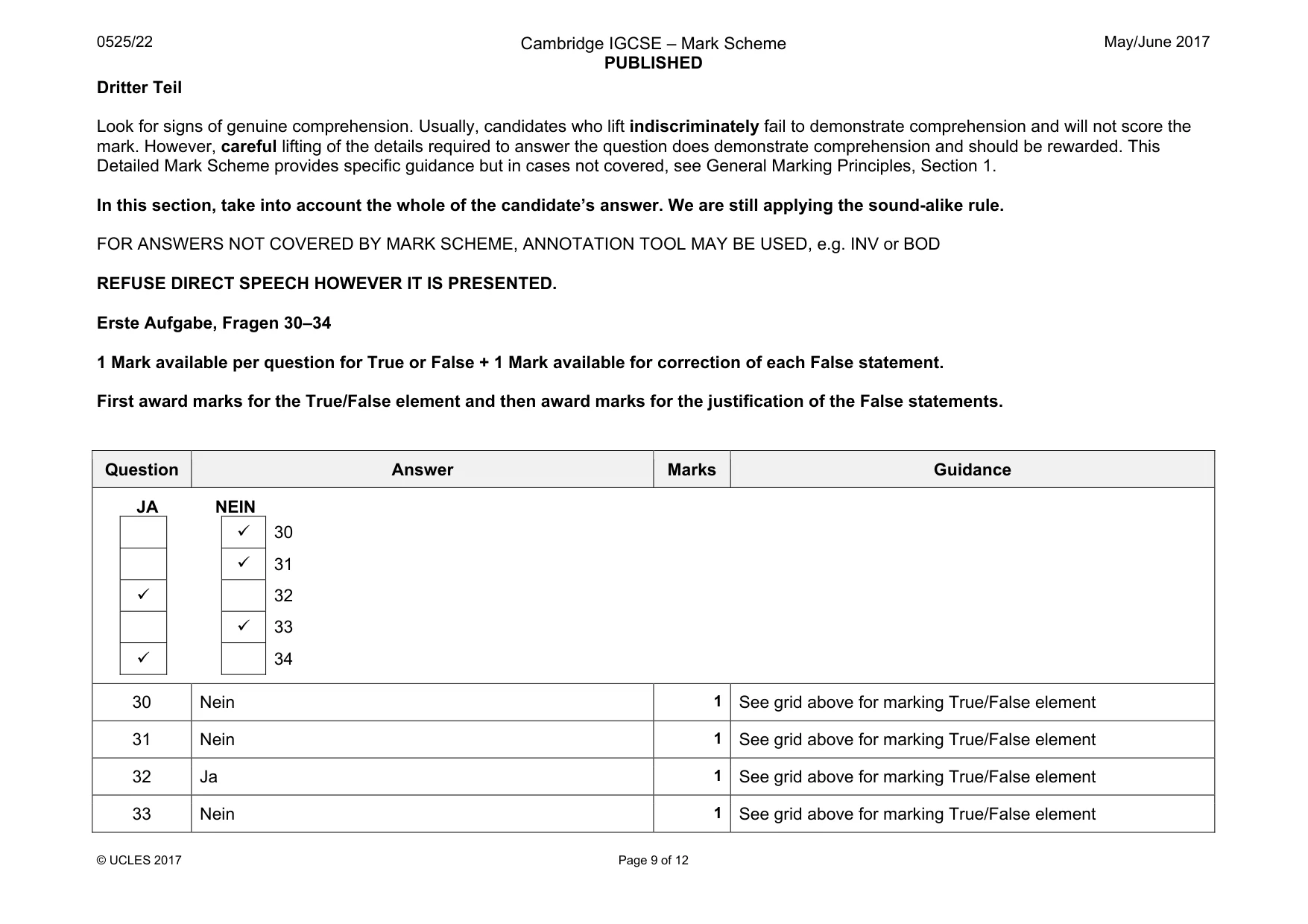
0525/22 Cambridge IGCSE – Mark Scheme PUBLISHED May/June 2017 © UCLES 2017 Page 9 of 12 Dritter Teil Look for signs of genuine comprehension. Usually, candidates who lift indiscriminately fail to demonstrate comprehension and will not score the mark. However, careful lifting of the details required to answer the question does demonstrate comprehension and should be rewarded. This Detailed Mark Scheme provides specific guidance but in cases not covered, see General Marking Principles, Section 1. In this section, take into account the whole of the candidate’s answer. We are still applying the sound-alike rule. FOR ANSWERS NOT COVERED BY MARK SCHEME, ANNOTATION TOOL MAY BE USED, e.g. INV or BOD REFUSE DIRECT SPEECH HOWEVER IT IS PRESENTED. Erste Aufgabe, Fragen 30–34 1 Mark available per question for True or False + 1 Mark available for correction of each False statement. First award marks for the True/False element and then award marks for the justification of the False statements. Question Answer Marks Guidance JA NEIN 9 30 9 31 9 32 9 33 9 34 30 Nein 1 See grid above for marking True/False element 31 Nein 1 See grid above for marking True/False element 32 Ja 1 See grid above for marking True/False element 33 Nein 1 See grid above for marking True/False element
Mark scheme, page 10
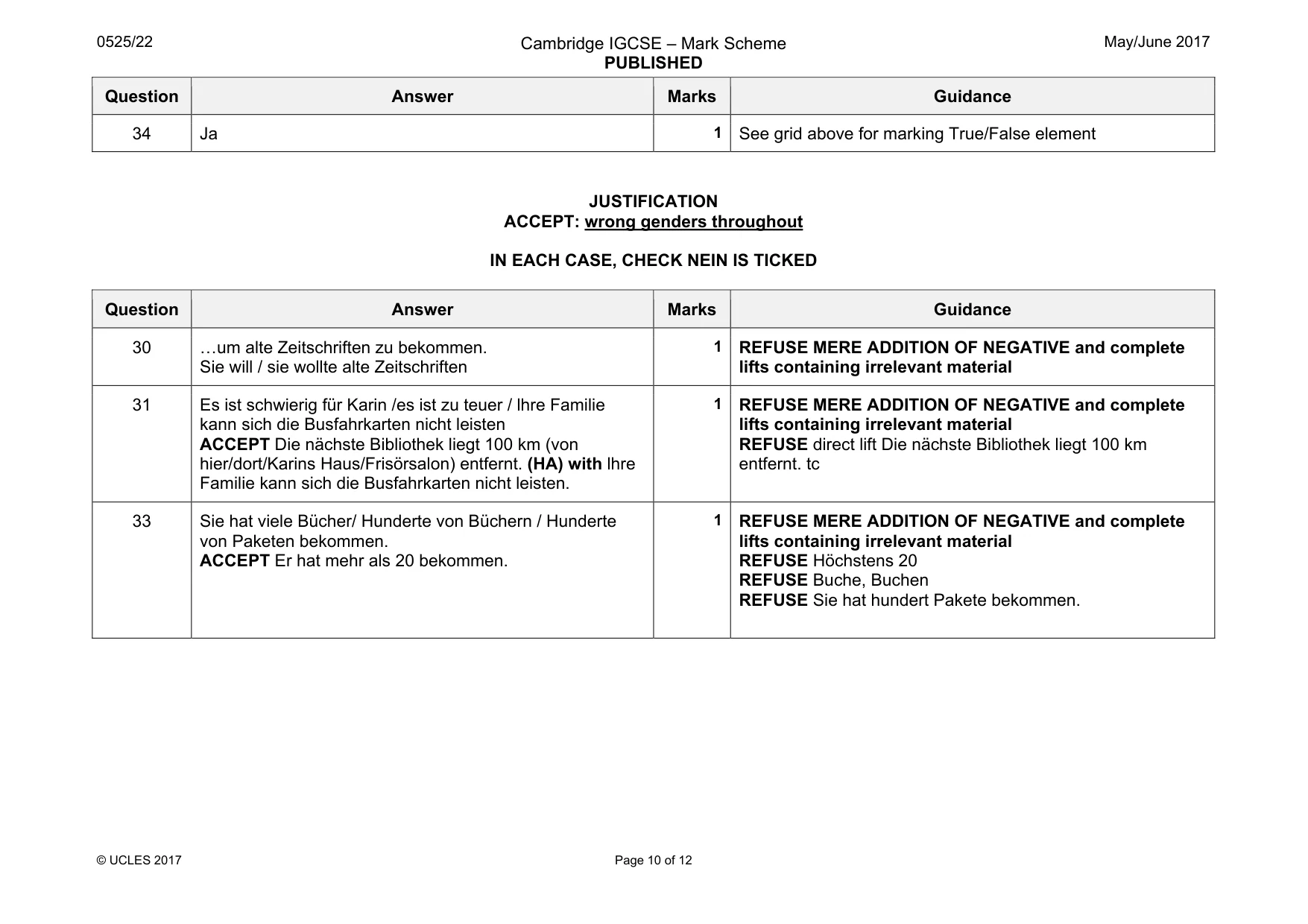
0525/22 Cambridge IGCSE – Mark Scheme PUBLISHED May/June 2017 © UCLES 2017 Page 10 of 12 Question Answer Marks Guidance 34 Ja 1 See grid above for marking True/False element JUSTIFICATION ACCEPT: wrong genders throughout IN EACH CASE, CHECK NEIN IS TICKED Question Answer Marks Guidance 30 «um alte Zeitschriften zu bekommen. Sie will / sie wollte alte Zeitschriften 1 REFUSE MERE ADDITION OF NEGATIVE and complete lifts containing irrelevant material 31 Es ist schwierig für Karin /es ist zu teuer / lhre Familie kann sich die Busfahrkarten nicht leisten ACCEPT Die nächste Bibliothek liegt 100 km (von hier/dort/Karins Haus/Frisörsalon) entfernt. (HA) with lhre Familie kann sich die Busfahrkarten nicht leisten. 1 REFUSE MERE ADDITION OF NEGATIVE and complete lifts containing irrelevant material REFUSE direct lift Die nächste Bibliothek liegt 100 km entfernt. tc 33 Sie hat viele Bücher/ Hunderte von Büchern / Hunderte von Paketen bekommen. ACCEPT Er hat mehr als 20 bekommen. 1 REFUSE MERE ADDITION OF NEGATIVE and complete lifts containing irrelevant material REFUSE Höchstens 20 REFUSE Buche, Buchen REFUSE Sie hat hundert Pakete bekommen.
Mark scheme, page 11
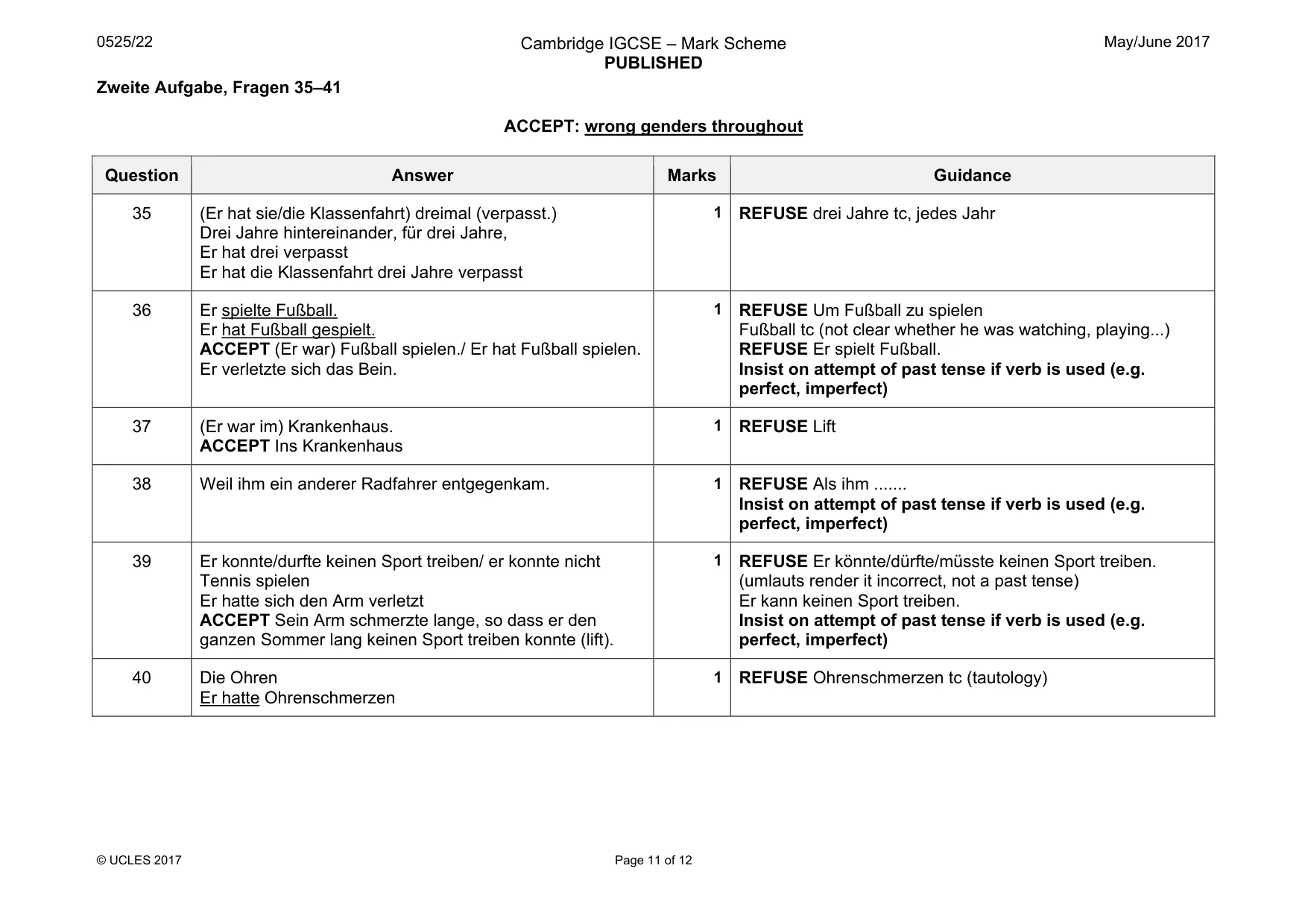
0525/22 Cambridge IGCSE – Mark Scheme PUBLISHED May/June 2017 © UCLES 2017 Page 11 of 12 Zweite Aufgabe, Fragen 35–41 ACCEPT: wrong genders throughout Question Answer Marks Guidance 35 (Er hat sie/die Klassenfahrt) dreimal (verpasst.) Drei Jahre hintereinander, für drei Jahre, Er hat drei verpasst Er hat die Klassenfahrt drei Jahre verpasst 1 REFUSE drei Jahre tc, jedes Jahr 36 Er spielte Fußball. Er hat Fußball gespielt. ACCEPT (Er war) Fußball spielen./ Er hat Fußball spielen. Er verletzte sich das Bein. 1 REFUSE Um Fußball zu spielen Fußball tc (not clear whether he was watching, playing...) REFUSE Er spielt Fußball. Insist on attempt of past tense if verb is used (e.g. perfect, imperfect) 37 (Er war im) Krankenhaus. ACCEPT Ins Krankenhaus 1 REFUSE Lift 38 Weil ihm ein anderer Radfahrer entgegenkam. 1 REFUSE Als ihm … Insist on attempt of past tense if verb is used (e.g. perfect, imperfect) 39 Er konnte/durfte keinen Sport treiben/ er konnte nicht Tennis spielen Er hatte sich den Arm verletzt ACCEPT Sein Arm schmerzte lange, so dass er den ganzen Sommer lang keinen Sport treiben konnte (lift). 1 REFUSE Er könnte/dürfte/müsste keinen Sport treiben. (umlauts render it incorrect, not a past tense) Er kann keinen Sport treiben. Insist on attempt of past tense if verb is used (e.g. perfect, imperfect) 40 Die Ohren Er hatte Ohrenschmerzen 1 REFUSE Ohrenschmerzen tc (tautology)
Mark scheme, page 12
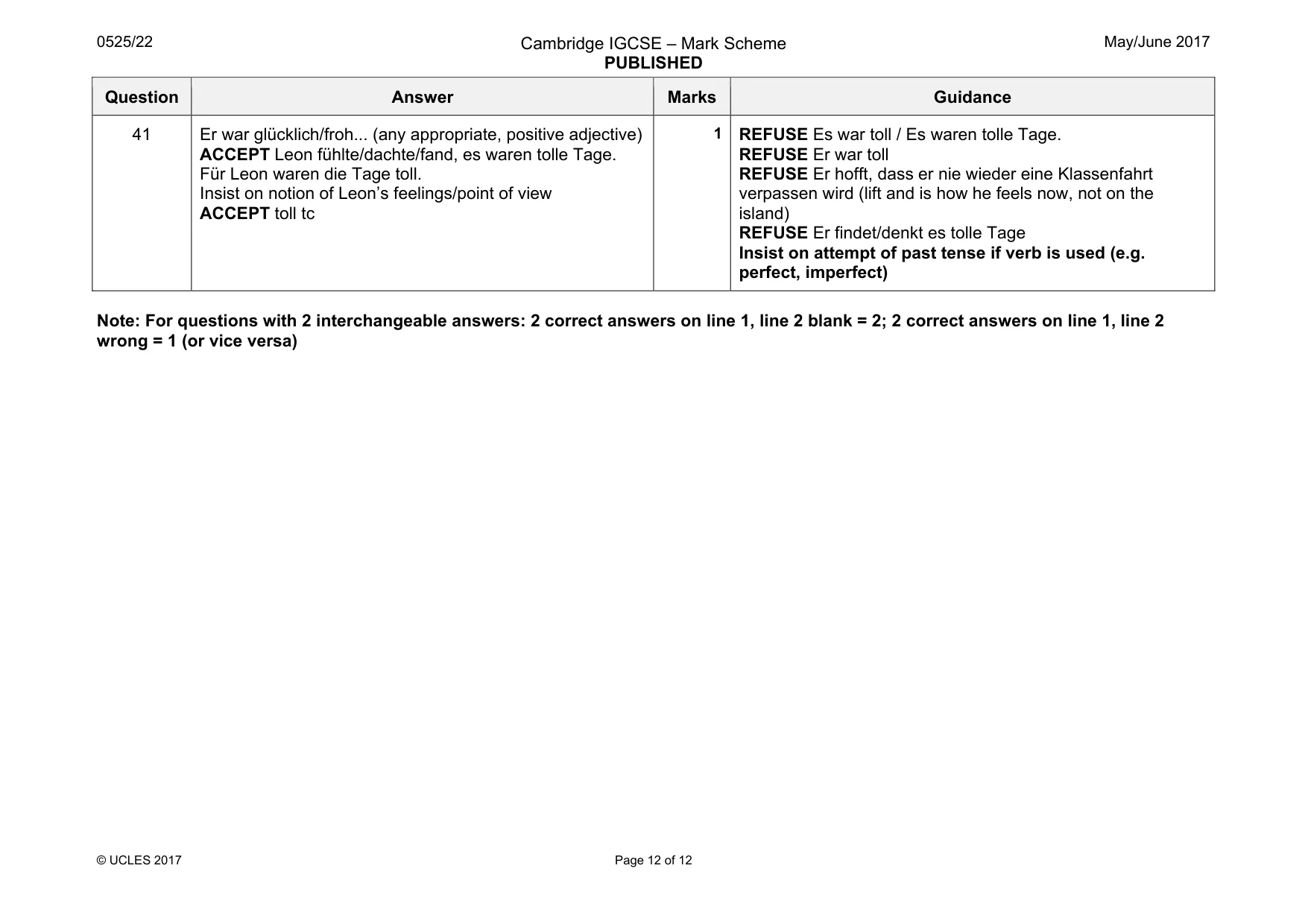
0525/22 Cambridge IGCSE – Mark Scheme PUBLISHED May/June 2017 © UCLES 2017 Page 12 of 12 Question Answer Marks Guidance 41 Er war glücklich/froh... (any appropriate, positive adjective) ACCEPT Leon fühlte/dachte/fand, es waren tolle Tage. Für Leon waren die Tage toll. Insist on notion of Leon’s feelings/point of view ACCEPT toll tc 1 REFUSE Es war toll / Es waren tolle Tage. REFUSE Er war toll REFUSE Er hofft, dass er nie wieder eine Klassenfahrt verpassen wird (lift and is how he feels now, not on the island) REFUSE Er findet/denkt es tolle Tage Insist on attempt of past tense if verb is used (e.g. perfect, imperfect) Note: For questions with 2 interchangeable answers: 2 correct answers on line 1, line 2 blank = 2; 2 correct answers on line 1, line 2 wrong = 1 (or vice versa)
What you needed in this session
Cambridge’s own grade thresholds for 2017 May/June, Paper 2 · Variant 2. A higher threshold means an easier paper — the bar moves with how the cohort did.