Cambridge IGCSE German - Foreign Language 0525 — 2017 May/June Paper 2 · Variant 3
0525/23/M/J/17 · 45 marks · ≈51 min
The question paper and its mark scheme, free to read here and free to download. This is Cambridge’s own paper, exactly as it was sat.
Question paper16 pages



Mark scheme10 pages
Answers below. Sit the paper first if you are practising.
Paper as text
Question paper, page 1
This document consists of 13 printed pages and 3 blank pages. DC (KN/SG) 134251/3 © UCLES 2017 [Turn over Cambridge International Examinations Cambridge International General Certificate of Secondary Education * 2 9 6 0 9 0 5 1 7 2 * GERMAN 0525/23 Paper 2 Reading May/June 2017 1 hour Candidates answer on the Question Paper. No Additional Materials are required. READ THESE INSTRUCTIONS FIRST Write your Centre number, candidate number and name in the spaces at the top of this page. Write in dark blue or black pen. Do not use staples, paper clips, glue or correction fluid. DO NOT WRITE IN ANY BARCODES. Answer all questions. The number of marks is given in brackets [ ] at the end of each question or part question. The syllabus is approved for use in England, Wales and Northern Ireland as a Cambridge International Level 1/Level 2 Certificate.
Question paper, page 2
2 0525/23/M/J/17 © UCLES 2017 BLANK PAGE
Question paper, page 3
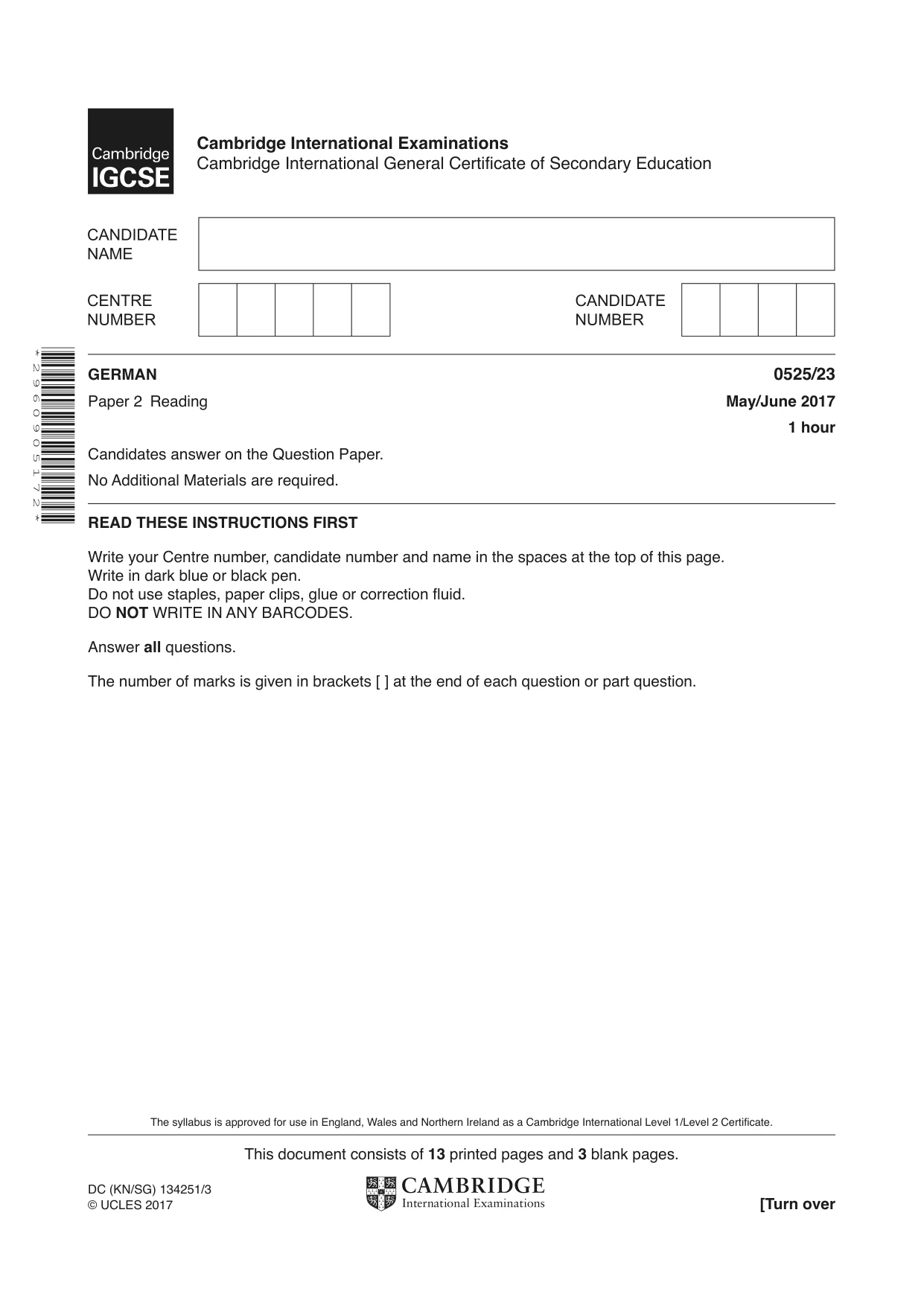
3 0525/23/M/J/17 © UCLES 2017 [Turn over Erster Teil Erste Aufgabe, Fragen 1–5 Lesen Sie die folgenden Fragen. Suchen Sie die Antwort heraus, die am besten passt, und kreuzen Sie das richtige Kästchen an. 1 Sie sehen dieses Schild. ANANAS Was kaufen Sie? A A B C D [1] B C D 2 Sie tanzen gern. Was machen Sie? A A B C D [1] B C D 3 Es ist halb zwei. Wie spät ist es? A A B C D [1] B C D
Question paper, page 4
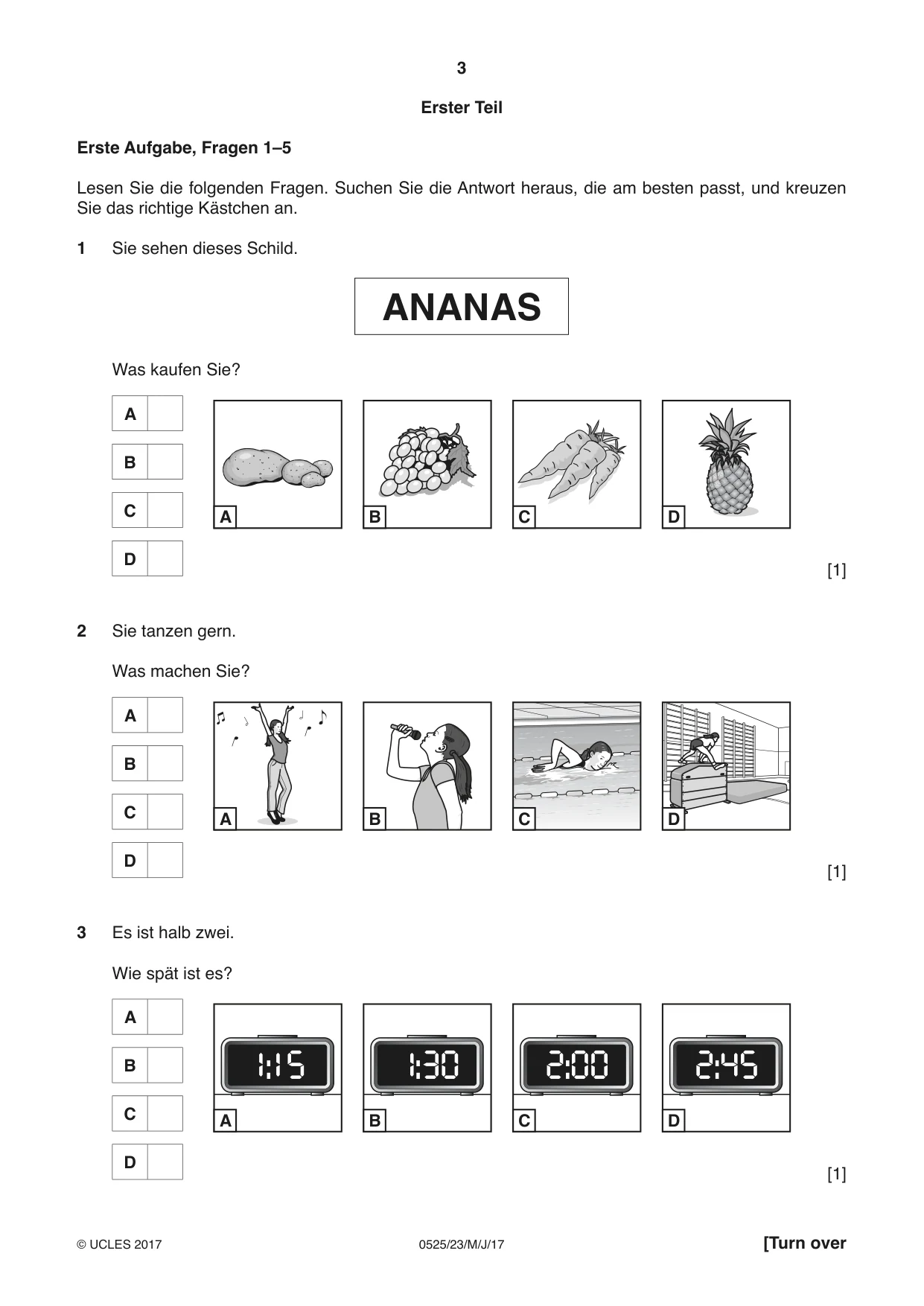
4 0525/23/M/J/17 © UCLES 2017 4 Sie sind in einem Schloss. Wo sind Sie? A A B C D [1] B C D 5 Ihr Bruder möchte sein Fahrrad reparieren. Wohin geht er? A ins Schlafzimmer B ins Esszimmer C in die Garage D in die Küche [1] [Total: 5]
Question paper, page 5
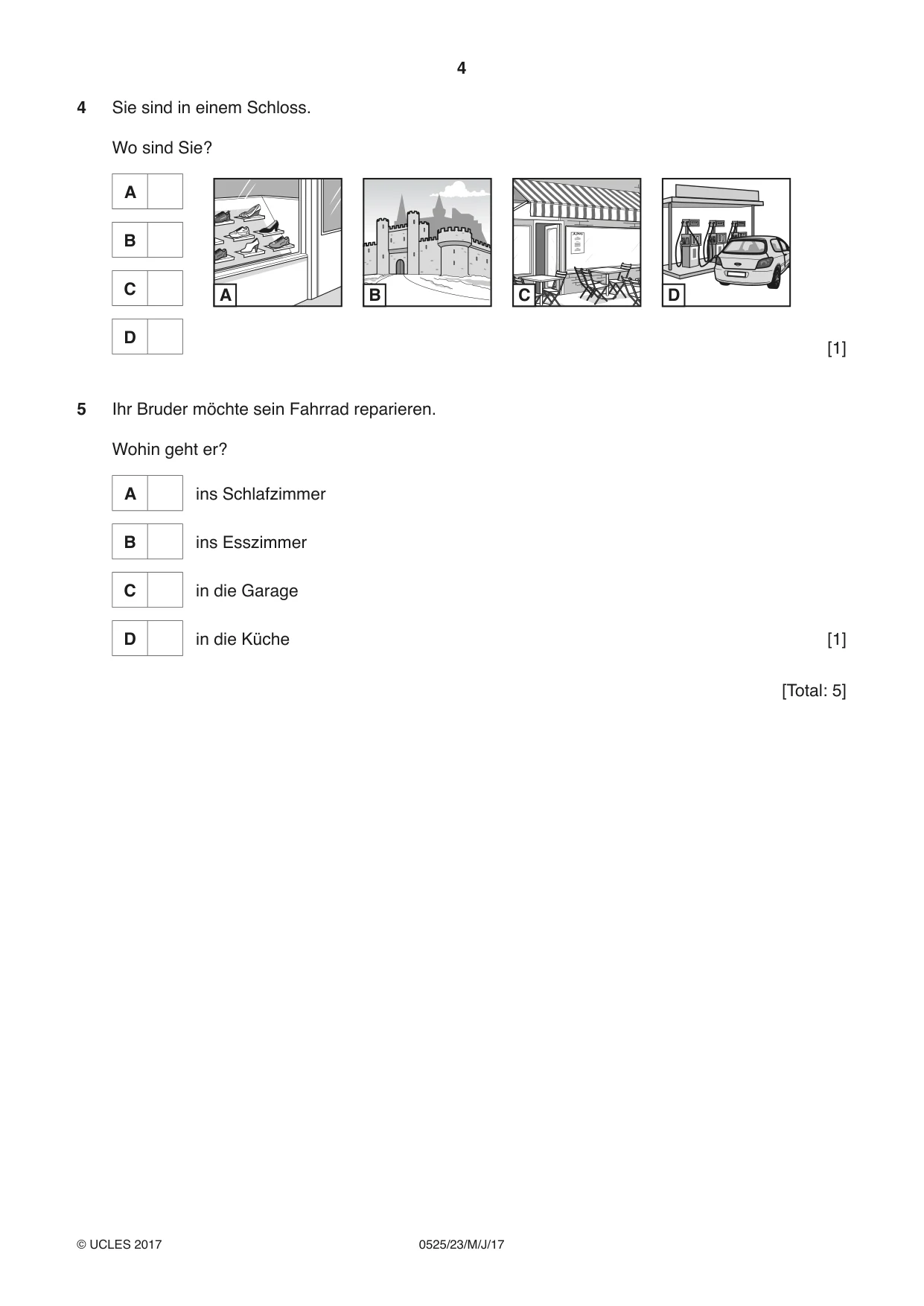
5 0525/23/M/J/17 © UCLES 2017 [Turn over Zweite Aufgabe, Fragen 6–10 Was machen die jungen Leute nach der Schule? Sehen Sie sich die Bilder an. A B C D E F Tragen Sie die richtigen Buchstaben (A, B, C, D, E oder F) in die Kästchen ein. 6 Katharina trinkt eine Tasse Kaffee. [1] 7 Sandra telefoniert mit einem Freund. [1] 8 Paul liest eine Zeitschrift. [1] 9 Axel kauft eine Fahrkarte. [1] 10 Patrick macht seine Hausaufgaben. [1] [Total: 5]
Question paper, page 6
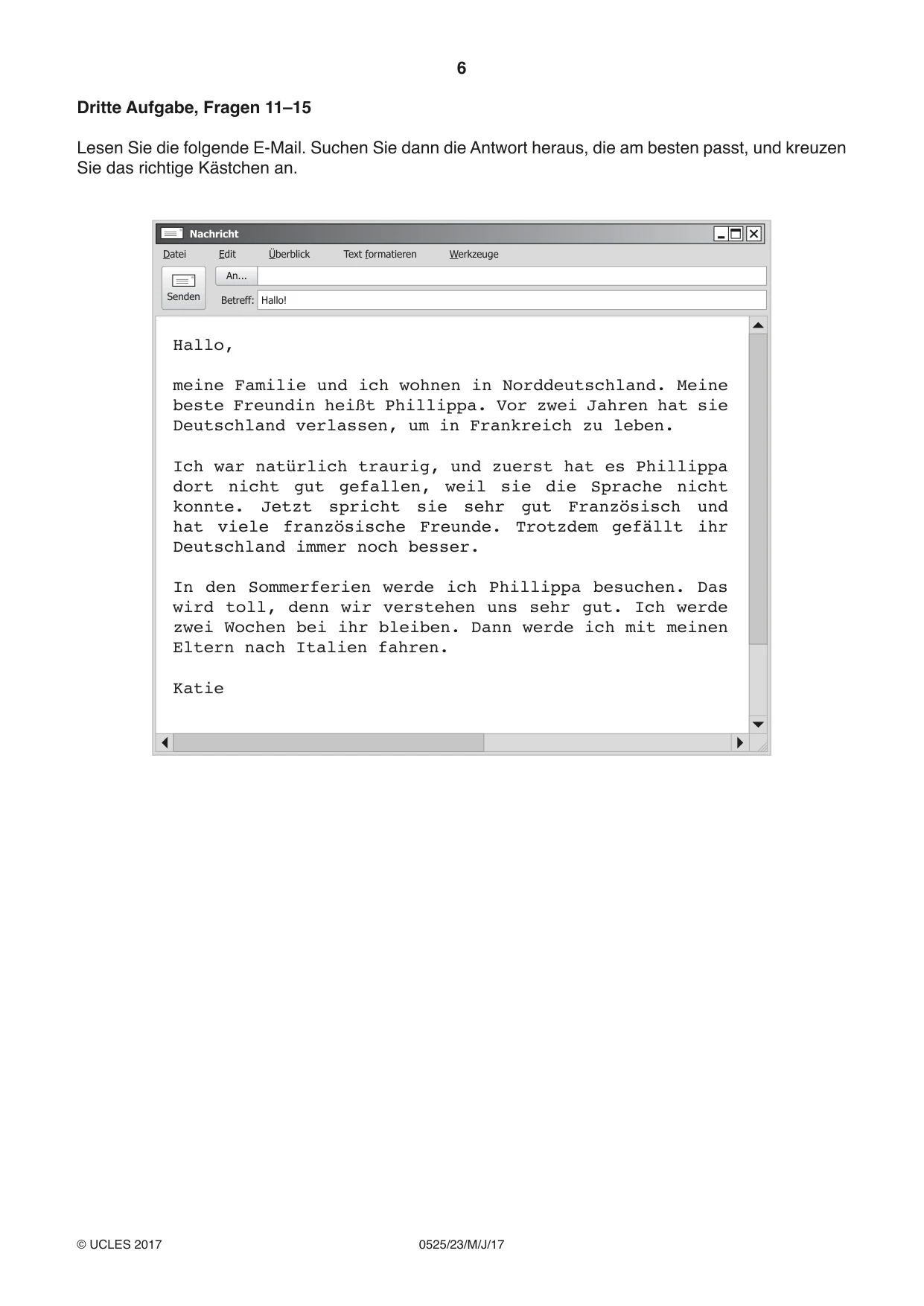
6 0525/23/M/J/17 © UCLES 2017 Dritte Aufgabe, Fragen 11–15 Lesen Sie die folgende E-Mail. Suchen Sie dann die Antwort heraus, die am besten passt, und kreuzen Sie das richtige Kästchen an. Betreff: Hallo! An... Senden Datei Edit Überblick Text formatieren Werkzeuge Nachricht Hallo, meine Familie und ich wohnen in Norddeutschland. Meine beste Freundin heißt Phillippa. Vor zwei Jahren hat sie Deutschland verlassen, um in Frankreich zu leben. Ich war natürlich traurig, und zuerst hat es Phillippa dort nicht gut gefallen, weil sie die Sprache nicht konnte. Jetzt spricht sie sehr gut Französisch und hat viele französische Freunde. Trotzdem gefällt ihr Deutschland immer noch besser. In den Sommerferien werde ich Phillippa besuchen. Das wird toll, denn wir verstehen uns sehr gut. Ich werde zwei Wochen bei ihr bleiben. Dann werde ich mit meinen Eltern nach Italien fahren. Katie
Question paper, page 7
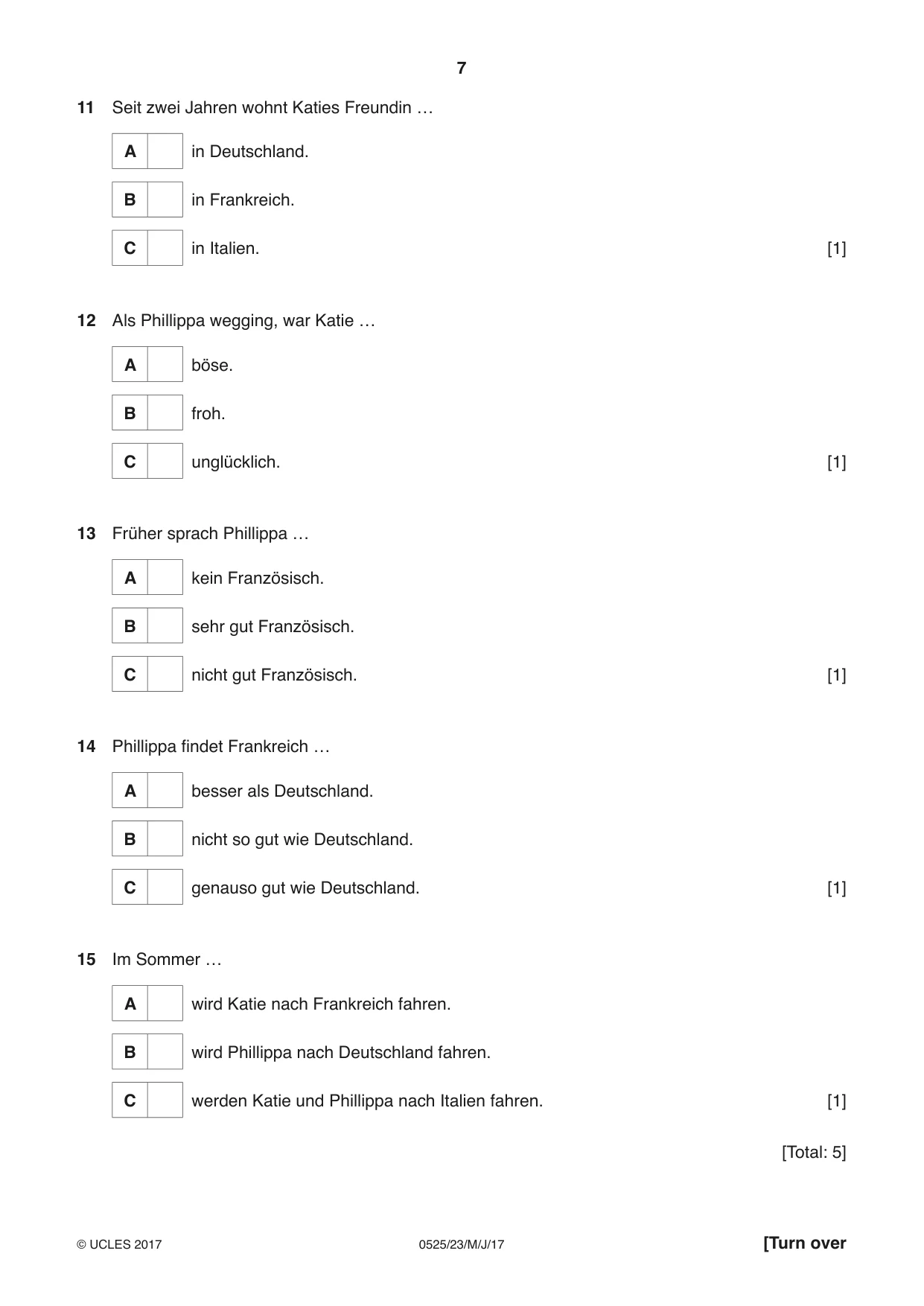
7 0525/23/M/J/17 © UCLES 2017 [Turn over 11 Seit zwei Jahren wohnt Katies Freundin … A in Deutschland. B in Frankreich. C in Italien. [1] 12 Als Phillippa wegging, war Katie … A böse. B froh. C unglücklich. [1] 13 Früher sprach Phillippa … A kein Französisch. B sehr gut Französisch. C nicht gut Französisch. [1] 14 Phillippa findet Frankreich … A besser als Deutschland. B nicht so gut wie Deutschland. C genauso gut wie Deutschland. [1] 15 Im Sommer … A wird Katie nach Frankreich fahren. B wird Phillippa nach Deutschland fahren. C werden Katie und Phillippa nach Italien fahren. [1] [Total: 5]
Question paper, page 8
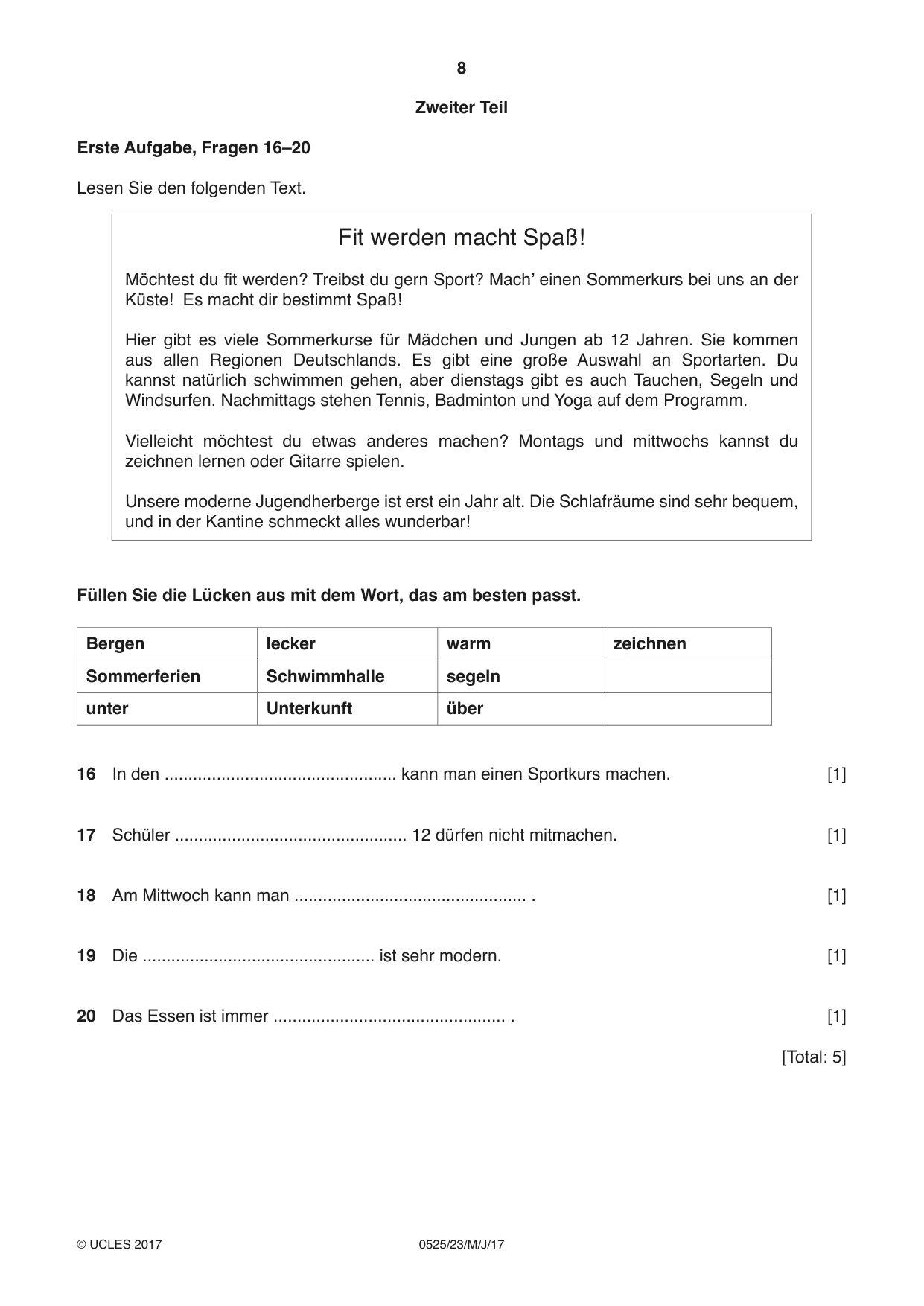
8 0525/23/M/J/17 © UCLES 2017 Zweiter Teil Erste Aufgabe, Fragen 16–20 Lesen Sie den folgenden Text. Fit werden macht Spaß! Möchtest du fit werden? Treibst du gern Sport? Mach’ einen Sommerkurs bei uns an der Küste! Es macht dir bestimmt Spaß! Hier gibt es viele Sommerkurse für Mädchen und Jungen ab 12 Jahren. Sie kommen aus allen Regionen Deutschlands. Es gibt eine große Auswahl an Sportarten. Du kannst natürlich schwimmen gehen, aber dienstags gibt es auch Tauchen, Segeln und Windsurfen. Nachmittags stehen Tennis, Badminton und Yoga auf dem Programm. Vielleicht möchtest du etwas anderes machen? Montags und mittwochs kannst du zeichnen lernen oder Gitarre spielen. Unsere moderne Jugendherberge ist erst ein Jahr alt. Die Schlafräume sind sehr bequem, und in der Kantine schmeckt alles wunderbar! Füllen Sie die Lücken aus mit dem Wort, das am besten passt. Bergen lecker warm zeichnen Sommerferien Schwimmhalle segeln unter Unterkunft über 16 In den … kann man einen Sportkurs machen. [1] 17 Schüler … 12 dürfen nicht mitmachen. [1] 18 Am Mittwoch kann man … . [1] 19 Die … ist sehr modern. [1] 20 Das Essen ist immer … . [1] [Total: 5]
Question paper, page 9
9 0525/23/M/J/17 © UCLES 2017 [Turn over BLANK PAGE
Question paper, page 10
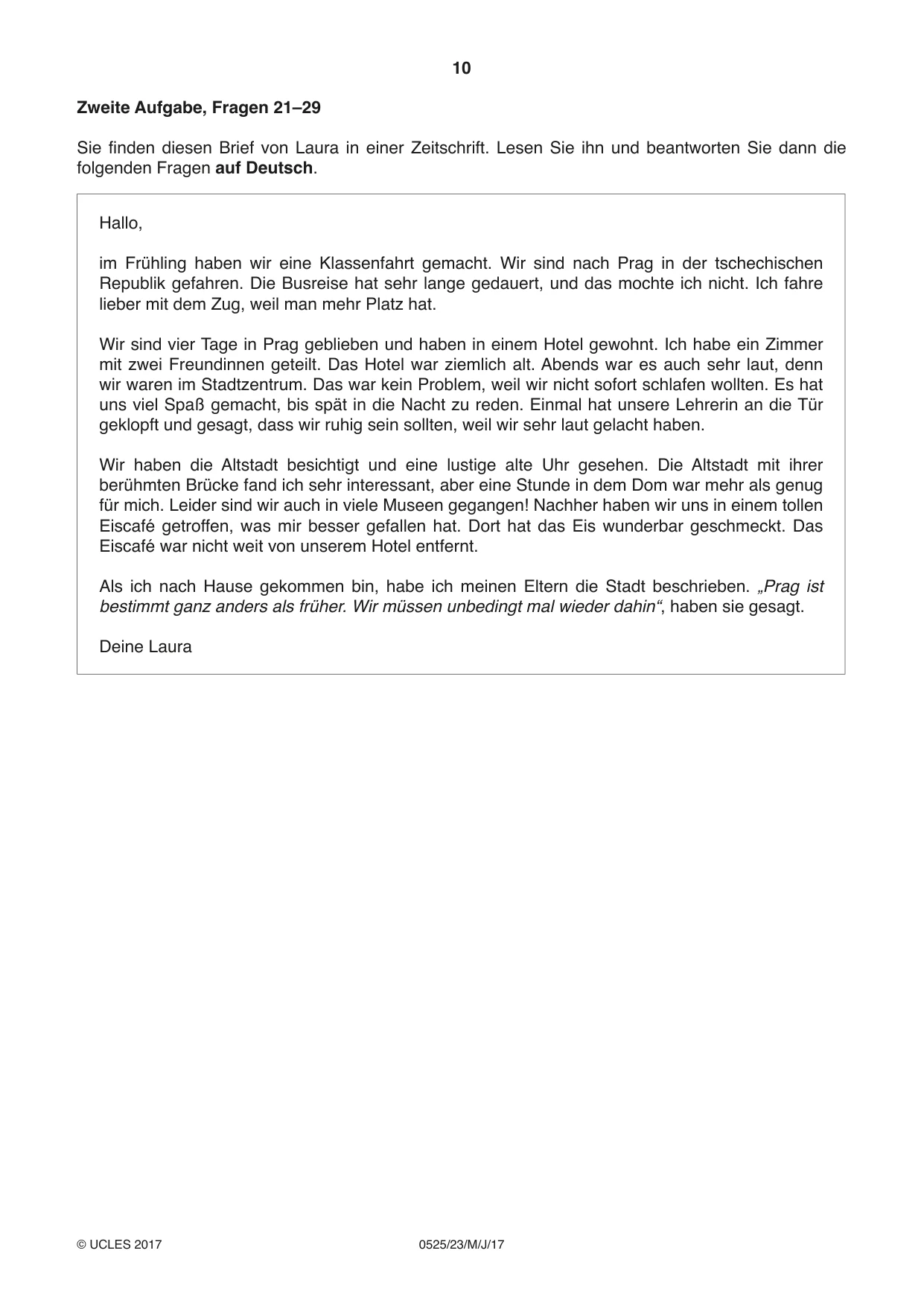
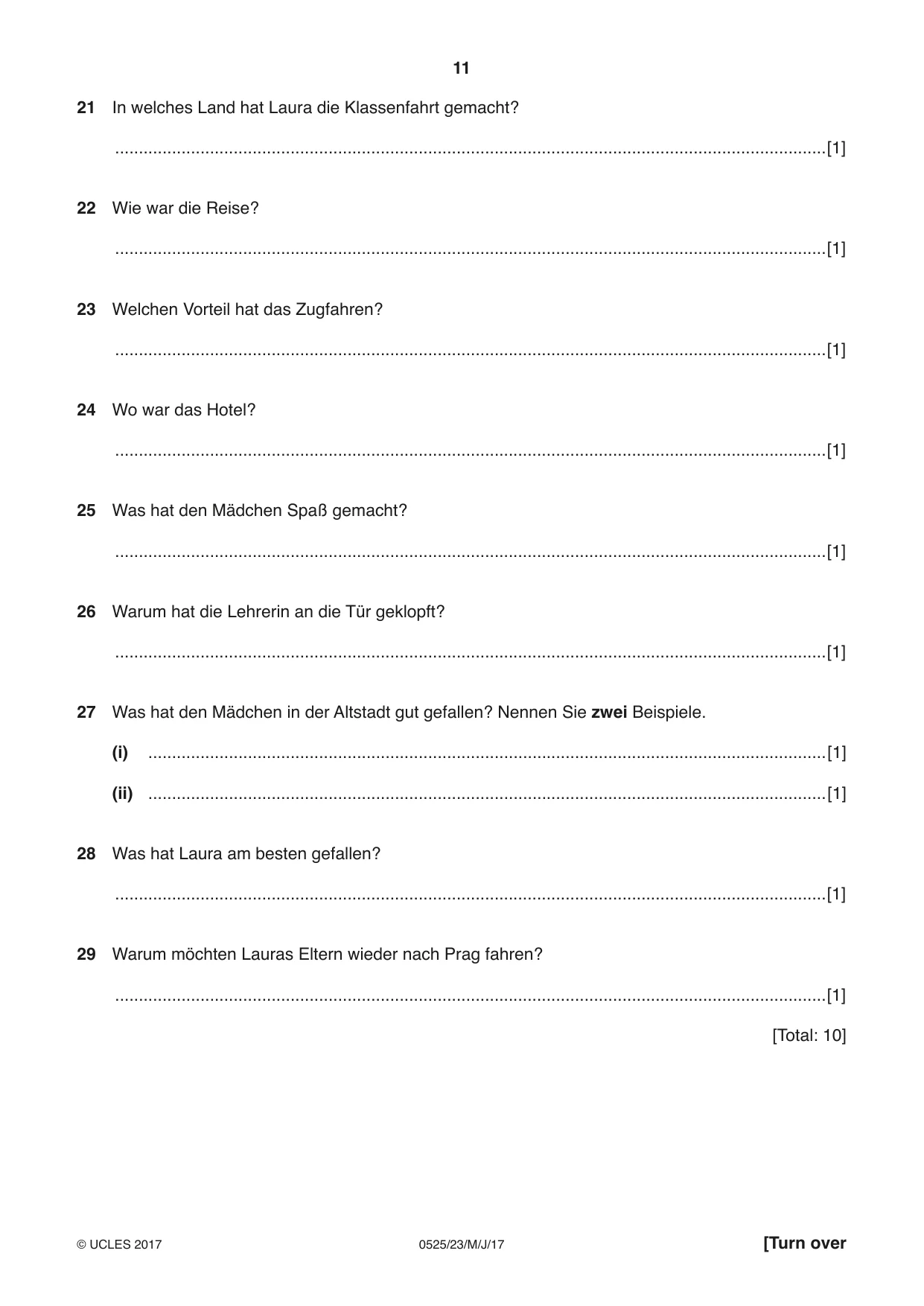
10 0525/23/M/J/17 © UCLES 2017 Zweite Aufgabe, Fragen 21–29 Sie finden diesen Brief von Laura in einer Zeitschrift. Lesen Sie ihn und beantworten Sie dann die folgenden Fragen auf Deutsch. Hallo, im Frühling haben wir eine Klassenfahrt gemacht. Wir sind nach Prag in der tschechischen Republik gefahren. Die Busreise hat sehr lange gedauert, und das mochte ich nicht. Ich fahre lieber mit dem Zug, weil man mehr Platz hat. Wir sind vier Tage in Prag geblieben und haben in einem Hotel gewohnt. Ich habe ein Zimmer mit zwei Freundinnen geteilt. Das Hotel war ziemlich alt. Abends war es auch sehr laut, denn wir waren im Stadtzentrum. Das war kein Problem, weil wir nicht sofort schlafen wollten. Es hat uns viel Spaß gemacht, bis spät in die Nacht zu reden. Einmal hat unsere Lehrerin an die Tür geklopft und gesagt, dass wir ruhig sein sollten, weil wir sehr laut gelacht haben. Wir haben die Altstadt besichtigt und eine lustige alte Uhr gesehen. Die Altstadt mit ihrer berühmten Brücke fand ich sehr interessant, aber eine Stunde in dem Dom war mehr als genug für mich. Leider sind wir auch in viele Museen gegangen! Nachher haben wir uns in einem tollen Eiscafé getroffen, was mir besser gefallen hat. Dort hat das Eis wunderbar geschmeckt. Das Eiscafé war nicht weit von unserem Hotel entfernt. Als ich nach Hause gekommen bin, habe ich meinen Eltern die Stadt beschrieben. „Prag ist bestimmt ganz anders als früher. Wir müssen unbedingt mal wieder dahin“, haben sie gesagt. Deine Laura
Question paper, page 11
11 0525/23/M/J/17 © UCLES 2017 [Turn over 21 In welches Land hat Laura die Klassenfahrt gemacht? …[1] 22 Wie war die Reise? …[1] 23 Welchen Vorteil hat das Zugfahren? …[1] 24 Wo war das Hotel? …[1] 25 Was hat den Mädchen Spaß gemacht? …[1] 26 Warum hat die Lehrerin an die Tür geklopft? …[1] 27 Was hat den Mädchen in der Altstadt gut gefallen? Nennen Sie zwei Beispiele. (i) …[1] (ii) …[1] 28 Was hat Laura am besten gefallen? …[1] 29 Warum möchten Lauras Eltern wieder nach Prag fahren? …[1] [Total: 10]
Question paper, page 12
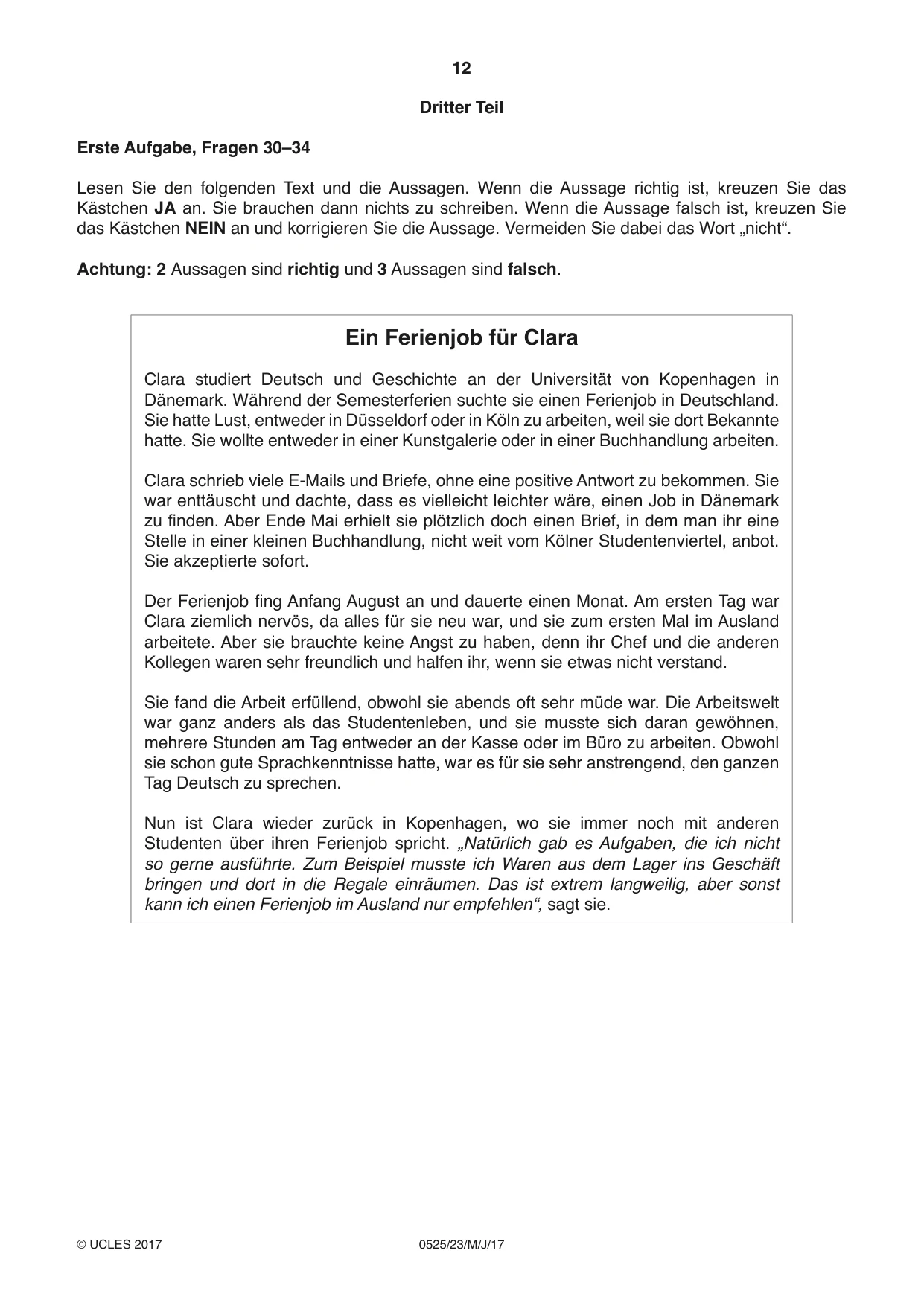
12 0525/23/M/J/17 © UCLES 2017 Dritter Teil Erste Aufgabe, Fragen 30–34 Lesen Sie den folgenden Text und die Aussagen. Wenn die Aussage richtig ist, kreuzen Sie das Kästchen JA an. Sie brauchen dann nichts zu schreiben. Wenn die Aussage falsch ist, kreuzen Sie das Kästchen NEIN an und korrigieren Sie die Aussage. Vermeiden Sie dabei das Wort „nicht“. Achtung: 2 Aussagen sind richtig und 3 Aussagen sind falsch. Ein Ferienjob für Clara Clara studiert Deutsch und Geschichte an der Universität von Kopenhagen in Dänemark. Während der Semesterferien suchte sie einen Ferienjob in Deutschland. Sie hatte Lust, entweder in Düsseldorf oder in Köln zu arbeiten, weil sie dort Bekannte hatte. Sie wollte entweder in einer Kunstgalerie oder in einer Buchhandlung arbeiten. Clara schrieb viele E-Mails und Briefe, ohne eine positive Antwort zu bekommen. Sie war enttäuscht und dachte, dass es vielleicht leichter wäre, einen Job in Dänemark zu finden. Aber Ende Mai erhielt sie plötzlich doch einen Brief, in dem man ihr eine Stelle in einer kleinen Buchhandlung, nicht weit vom Kölner Studentenviertel, anbot. Sie akzeptierte sofort. Der Ferienjob fing Anfang August an und dauerte einen Monat. Am ersten Tag war Clara ziemlich nervös, da alles für sie neu war, und sie zum ersten Mal im Ausland arbeitete. Aber sie brauchte keine Angst zu haben, denn ihr Chef und die anderen Kollegen waren sehr freundlich und halfen ihr, wenn sie etwas nicht verstand. Sie fand die Arbeit erfüllend, obwohl sie abends oft sehr müde war. Die Arbeitswelt war ganz anders als das Studentenleben, und sie musste sich daran gewöhnen, mehrere Stunden am Tag entweder an der Kasse oder im Büro zu arbeiten. Obwohl sie schon gute Sprachkenntnisse hatte, war es für sie sehr anstrengend, den ganzen Tag Deutsch zu sprechen. Nun ist Clara wieder zurück in Kopenhagen, wo sie immer noch mit anderen Studenten über ihren Ferienjob spricht. „Natürlich gab es Aufgaben, die ich nicht so gerne ausführte. Zum Beispiel musste ich Waren aus dem Lager ins Geschäft bringen und dort in die Regale einräumen. Das ist extrem langweilig, aber sonst kann ich einen Ferienjob im Ausland nur empfehlen“, sagt sie.
Question paper, page 13
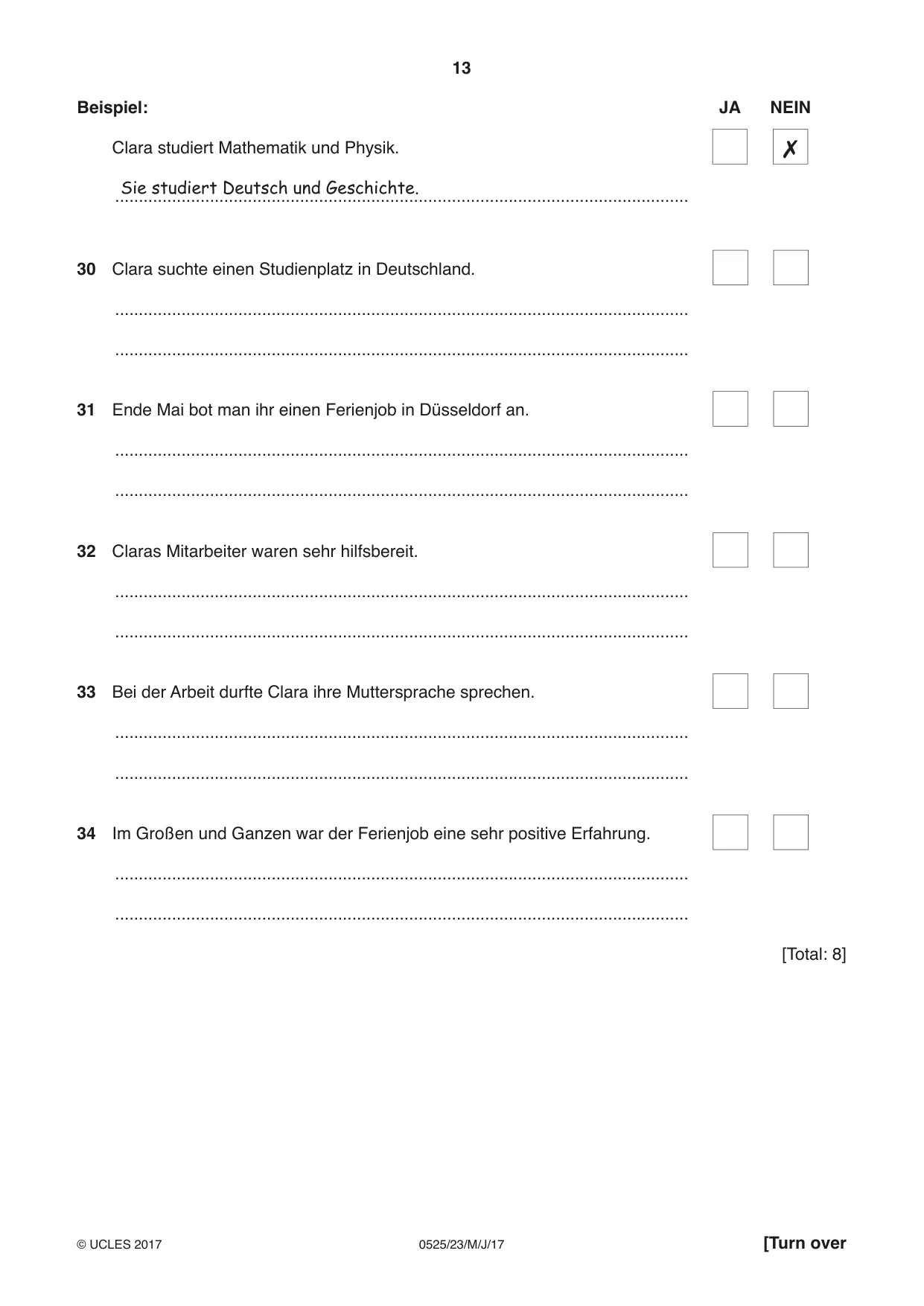
13 0525/23/M/J/17 © UCLES 2017 [Turn over Beispiel: JA NEIN Clara studiert Mathematik und Physik. 7 Sie studiert Deutsch und Geschichte. … 30 Clara suchte einen Studienplatz in Deutschland. … … 31 Ende Mai bot man ihr einen Ferienjob in Düsseldorf an. … … 32 Claras Mitarbeiter waren sehr hilfsbereit. … … 33 Bei der Arbeit durfte Clara ihre Muttersprache sprechen. … … 34 Im Großen und Ganzen war der Ferienjob eine sehr positive Erfahrung. … … [Total: 8]
Question paper, page 14
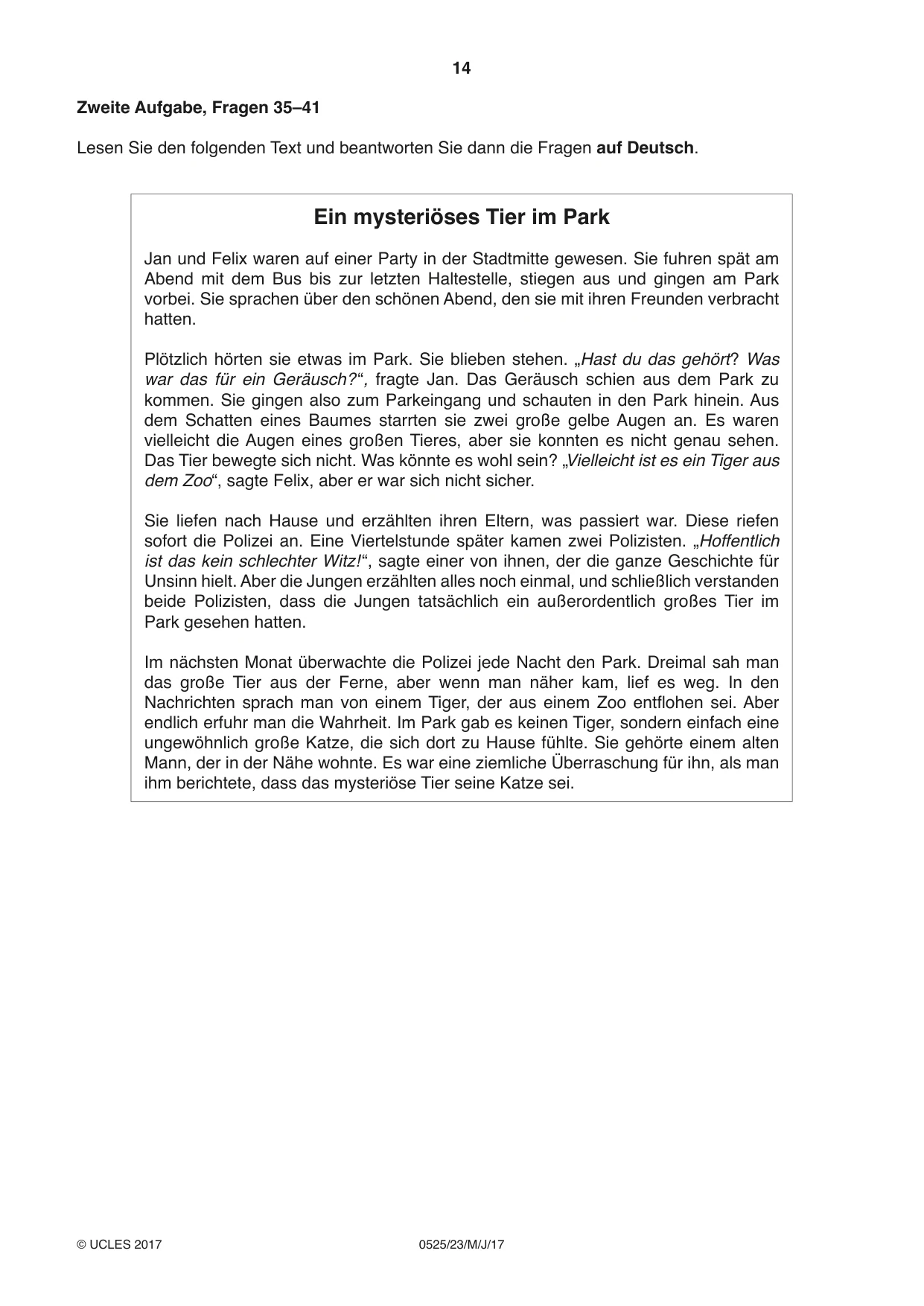
14 0525/23/M/J/17 © UCLES 2017 Zweite Aufgabe, Fragen 35–41 Lesen Sie den folgenden Text und beantworten Sie dann die Fragen auf Deutsch. Ein mysteriöses Tier im Park Jan und Felix waren auf einer Party in der Stadtmitte gewesen. Sie fuhren spät am Abend mit dem Bus bis zur letzten Haltestelle, stiegen aus und gingen am Park vorbei. Sie sprachen über den schönen Abend, den sie mit ihren Freunden verbracht hatten. Plötzlich hörten sie etwas im Park. Sie blieben stehen. „Hast du das gehört? Was war das für ein Geräusch? “, fragte Jan. Das Geräusch schien aus dem Park zu kommen. Sie gingen also zum Parkeingang und schauten in den Park hinein. Aus dem Schatten eines Baumes starrten sie zwei große gelbe Augen an. Es waren vielleicht die Augen eines großen Tieres, aber sie konnten es nicht genau sehen. Das Tier bewegte sich nicht. Was könnte es wohl sein? „Vielleicht ist es ein Tiger aus dem Zoo“, sagte Felix, aber er war sich nicht sicher. Sie liefen nach Hause und erzählten ihren Eltern, was passiert war. Diese riefen sofort die Polizei an. Eine Viertelstunde später kamen zwei Polizisten. „Hoffentlich ist das kein schlechter Witz! “, sagte einer von ihnen, der die ganze Geschichte für Unsinn hielt. Aber die Jungen erzählten alles noch einmal, und schließlich verstanden beide Polizisten, dass die Jungen tatsächlich ein außerordentlich großes Tier im Park gesehen hatten. Im nächsten Monat überwachte die Polizei jede Nacht den Park. Dreimal sah man das große Tier aus der Ferne, aber wenn man näher kam, lief es weg. In den Nachrichten sprach man von einem Tiger, der aus einem Zoo entflohen sei. Aber endlich erfuhr man die Wahrheit. Im Park gab es keinen Tiger, sondern einfach eine ungewöhnlich große Katze, die sich dort zu Hause fühlte. Sie gehörte einem alten Mann, der in der Nähe wohnte. Es war eine ziemliche Überraschung für ihn, als man ihm berichtete, dass das mysteriöse Tier seine Katze sei.
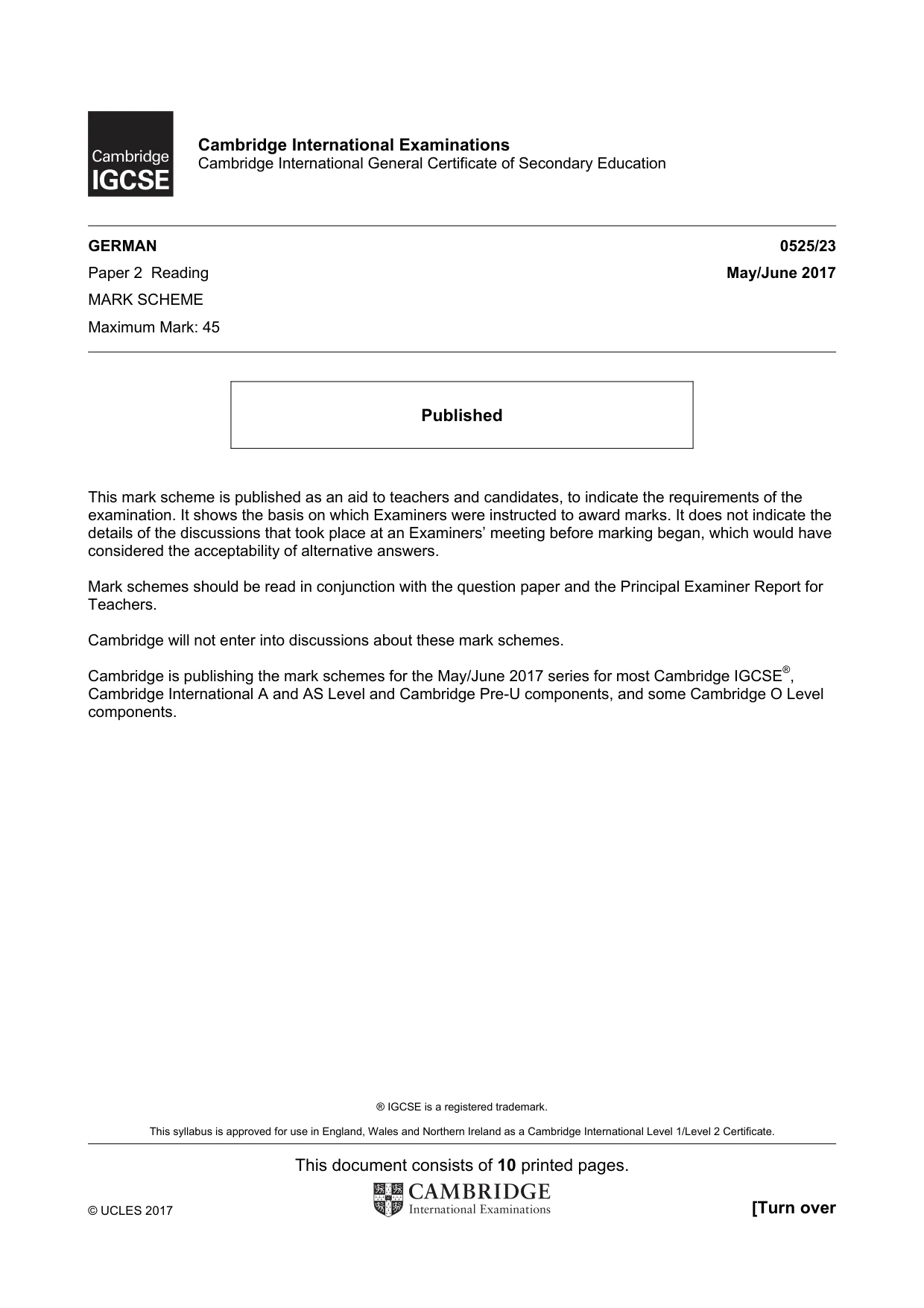
Question paper, page 15
15 0525/23/M/J/17 © UCLES 2017 35 Wo stiegen die Jungen aus dem Bus aus? … …[1] 36 Warum schauten die Jungen in den Park hinein? … …[1] 37 Warum konnten sie das Tier nicht genau sehen? … …[1] 38 Wer hat die Polizei angerufen? … …[1] 39 Was glaubte einer der Polizisten? … …[1] 40 Was für ein Tier war es in Wirklichkeit? … …[1] 41 Wie fühlte sich der alte Mann, als er die Wahrheit erfuhr? … …[1] [Total: 7]
Question paper, page 16
16 0525/23/M/J/17 © UCLES 2017 Permission to reproduce items where third-party owned material protected by copyright is included has been sought and cleared where possible. Every reasonable effort has been made by the publisher (UCLES) to trace copyright holders, but if any items requiring clearance have unwittingly been included, the publisher will be pleased to make amends at the earliest possible opportunity. To avoid the issue of disclosure of answer-related information to candidates, all copyright acknowledgements are reproduced online in the Cambridge International Examinations Copyright Acknowledgements Booklet. This is produced for each series of examinations and is freely available to download at www.cie.org.uk after the live examination series. Cambridge International Examinations is part of the Cambridge Assessment Group. Cambridge Assessment is the brand name of University of Cambridge Local Examinations Syndicate (UCLES), which is itself a department of the University of Cambridge. BLANK PAGE
Mark scheme, page 1
® IGCSE is a registered trademark. This syllabus is approved for use in England, Wales and Northern Ireland as a Cambridge International Level 1/Level 2 Certificate. This document consists of 10 printed pages. © UCLES 2017 [Turn over Cambridge International Examinations Cambridge International General Certificate of Secondary Education GERMAN 0525/23 Paper 2 Reading May/June 2017 MARK SCHEME Maximum Mark: 45 Published This mark scheme is published as an aid to teachers and candidates, to indicate the requirements of the examination. It shows the basis on which Examiners were instructed to award marks. It does not indicate the details of the discussions that took place at an Examiners’ meeting before marking began, which would have considered the acceptability of alternative answers. Mark schemes should be read in conjunction with the question paper and the Principal Examiner Report for Teachers. Cambridge will not enter into discussions about these mark schemes. Cambridge is publishing the mark schemes for the May/June 2017 series for most Cambridge IGCSE®, Cambridge International A and AS Level and Cambridge Pre-U components, and some Cambridge O Level components.
Mark scheme, page 2
0525/23 Cambridge IGCSE – Mark Scheme PUBLISHED May/June 2017 © UCLES 2017 Page 2 of 10 1 General Marking Principles 1.1 It is not possible to list all acceptable alternatives in the Detailed Mark Scheme provided in Section 2. You will need to consider all alternative answers and unexpected approaches in candidates’ scripts, make a decision on whether they communicate the required elements, in consultation with your Team Leader if necessary (or with your Product Manager if you are a single Examiner), and award marks accordingly. The following marking principles underpin the detailed instructions provided in Section 2 of the Mark Scheme. Where a decision is taken to deviate from these principles for a particular question, this will be specified in the Mark Scheme. Often the general principles will have to be weighed up against each other, e.g. the answer might pass the look-alike test (1.5(b)), but if the candidate has produced an answer that is another word in the target language they will not score (1.6). 1.2 Crossing out: (a) If a candidate changes his/her mind over an answer and crosses out an attempt, award a mark if the final attempt is correct. (b) If a candidate crosses out an answer to a whole question but makes no second attempt at it, mark the crossed out work. 1.3 More than the stipulated number of boxes ticked/crossed by the candidate: (a) If more than one attempt is visible, but the candidate has clearly indicated which attempt is his/her final answer (e.g. by crossing out other attempts or by annotating the script in some way), mark in the usual way. (b) If two attempts are visible (e.g. two boxes ticked instead of the 1 box stipulated), and neither has been crossed out/discounted by the candidate, no mark can be awarded. 1.4 For questions requiring more than one element for the answer, (i) and (ii), where the answers are interchangeable: (a) Both correct answers on line 1 and line 2 blank = 2 (b) Both correct answers on line 1 and line 2 wrong = 1 (or vice-versa) 1.5 Answers requiring the use of German (rather than a non-verbal response) should be marked for communication. Tolerate inaccuracies provided the message is clear.
Mark scheme, page 3
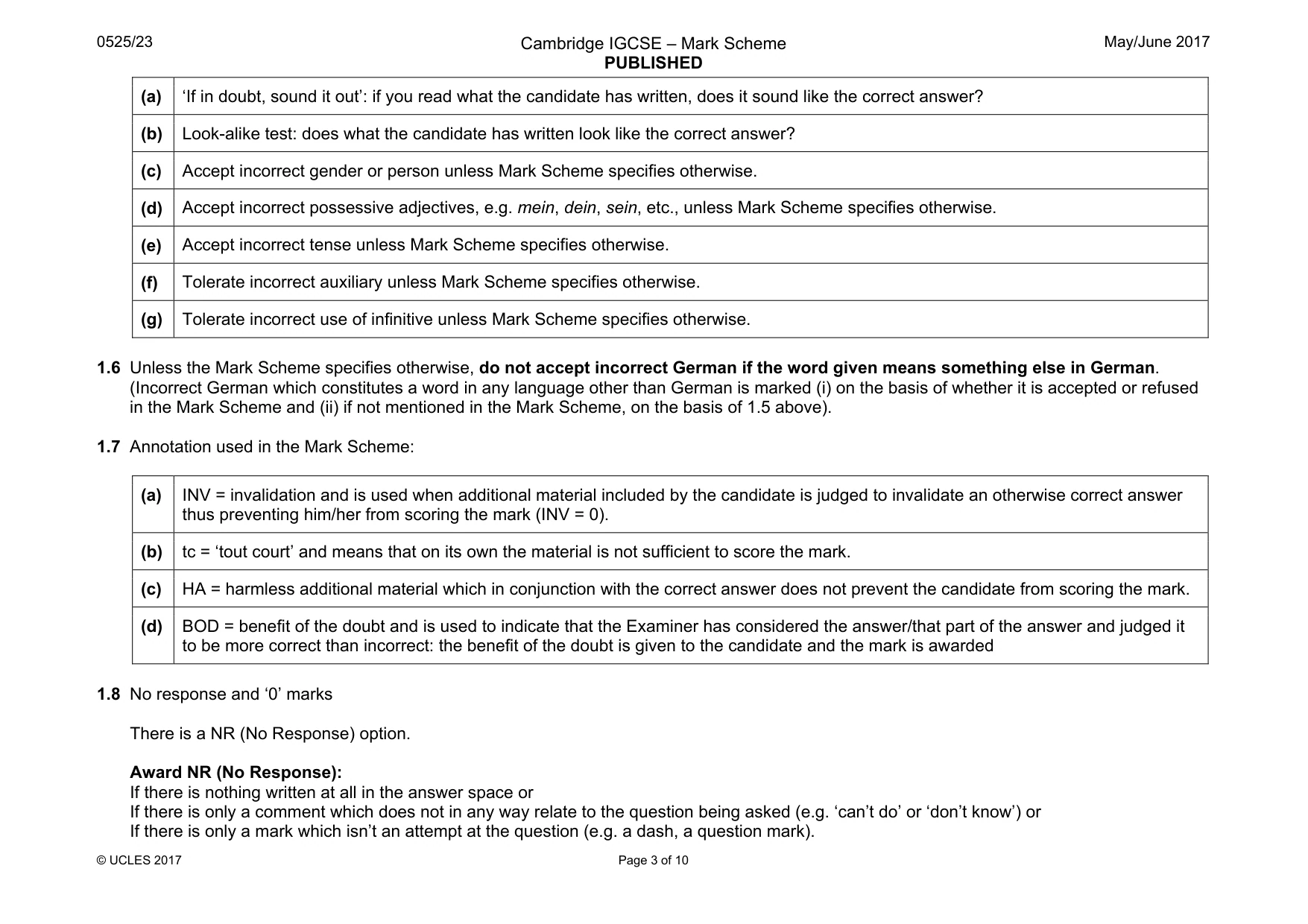
0525/23 Cambridge IGCSE – Mark Scheme PUBLISHED May/June 2017 © UCLES 2017 Page 3 of 10 (a) ‘If in doubt, sound it out’: if you read what the candidate has written, does it sound like the correct answer? (b) Look-alike test: does what the candidate has written look like the correct answer? (c) Accept incorrect gender or person unless Mark Scheme specifies otherwise. (d) Accept incorrect possessive adjectives, e.g. mein, dein, sein, etc., unless Mark Scheme specifies otherwise. (e) Accept incorrect tense unless Mark Scheme specifies otherwise. (f) Tolerate incorrect auxiliary unless Mark Scheme specifies otherwise. (g) Tolerate incorrect use of infinitive unless Mark Scheme specifies otherwise. 1.6 Unless the Mark Scheme specifies otherwise, do not accept incorrect German if the word given means something else in German. (Incorrect German which constitutes a word in any language other than German is marked (i) on the basis of whether it is accepted or refused in the Mark Scheme and (ii) if not mentioned in the Mark Scheme, on the basis of 1.5 above). 1.7 Annotation used in the Mark Scheme: (a) INV = invalidation and is used when additional material included by the candidate is judged to invalidate an otherwise correct answer thus preventing him/her from scoring the mark (INV = 0). (b) tc = ‘tout court’ and means that on its own the material is not sufficient to score the mark. (c) HA = harmless additional material which in conjunction with the correct answer does not prevent the candidate from scoring the mark. (d) BOD = benefit of the doubt and is used to indicate that the Examiner has considered the answer/that part of the answer and judged it to be more correct than incorrect: the benefit of the doubt is given to the candidate and the mark is awarded 1.8 No response and ‘0’ marks There is a NR (No Response) option. Award NR (No Response): If there is nothing written at all in the answer space or If there is only a comment which does not in any way relate to the question being asked (e.g. ‘can’t do’ or ‘don’t know’) or If there is only a mark which isn’t an attempt at the question (e.g. a dash, a question mark).
Mark scheme, page 4
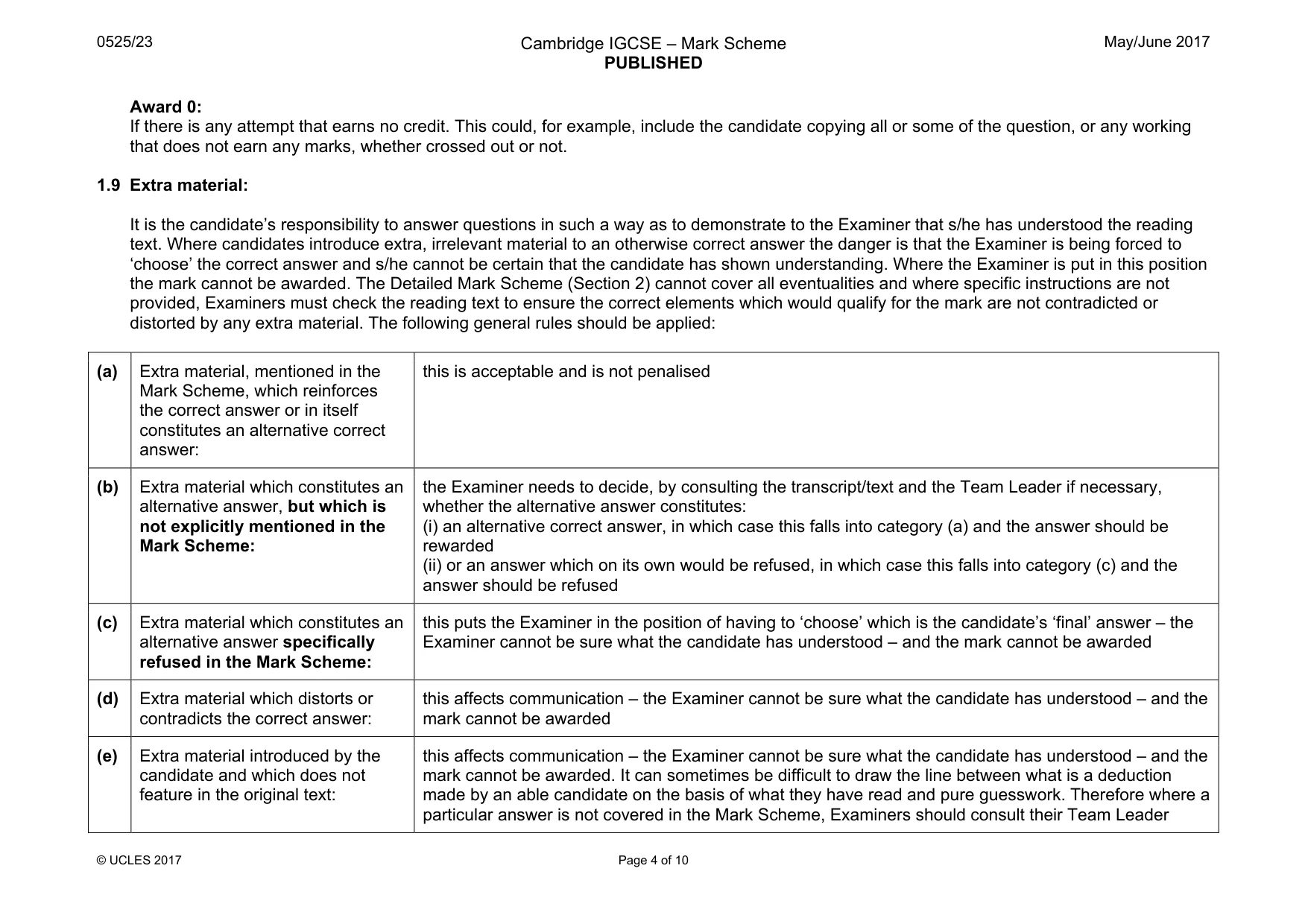
0525/23 Cambridge IGCSE – Mark Scheme PUBLISHED May/June 2017 © UCLES 2017 Page 4 of 10 Award 0: If there is any attempt that earns no credit. This could, for example, include the candidate copying all or some of the question, or any working that does not earn any marks, whether crossed out or not. 1.9 Extra material: It is the candidate’s responsibility to answer questions in such a way as to demonstrate to the Examiner that s/he has understood the reading text. Where candidates introduce extra, irrelevant material to an otherwise correct answer the danger is that the Examiner is being forced to ‘choose’ the correct answer and s/he cannot be certain that the candidate has shown understanding. Where the Examiner is put in this position the mark cannot be awarded. The Detailed Mark Scheme (Section 2) cannot cover all eventualities and where specific instructions are not provided, Examiners must check the reading text to ensure the correct elements which would qualify for the mark are not contradicted or distorted by any extra material. The following general rules should be applied: (a) Extra material, mentioned in the Mark Scheme, which reinforces the correct answer or in itself constitutes an alternative correct answer: this is acceptable and is not penalised (b) Extra material which constitutes an alternative answer, but which is not explicitly mentioned in the Mark Scheme: the Examiner needs to decide, by consulting the transcript/text and the Team Leader if necessary, whether the alternative answer constitutes: (i) an alternative correct answer, in which case this falls into category (a) and the answer should be rewarded (ii) or an answer which on its own would be refused, in which case this falls into category (c) and the answer should be refused (c) Extra material which constitutes an alternative answer specifically refused in the Mark Scheme: this puts the Examiner in the position of having to ‘choose’ which is the candidate’s ‘final’ answer – the Examiner cannot be sure what the candidate has understood – and the mark cannot be awarded (d) Extra material which distorts or contradicts the correct answer: this affects communication – the Examiner cannot be sure what the candidate has understood – and the mark cannot be awarded (e) Extra material introduced by the candidate and which does not feature in the original text: this affects communication – the Examiner cannot be sure what the candidate has understood – and the mark cannot be awarded. It can sometimes be difficult to draw the line between what is a deduction made by an able candidate on the basis of what they have read and pure guesswork. Therefore where a particular answer is not covered in the Mark Scheme, Examiners should consult their Team Leader
Mark scheme, page 5
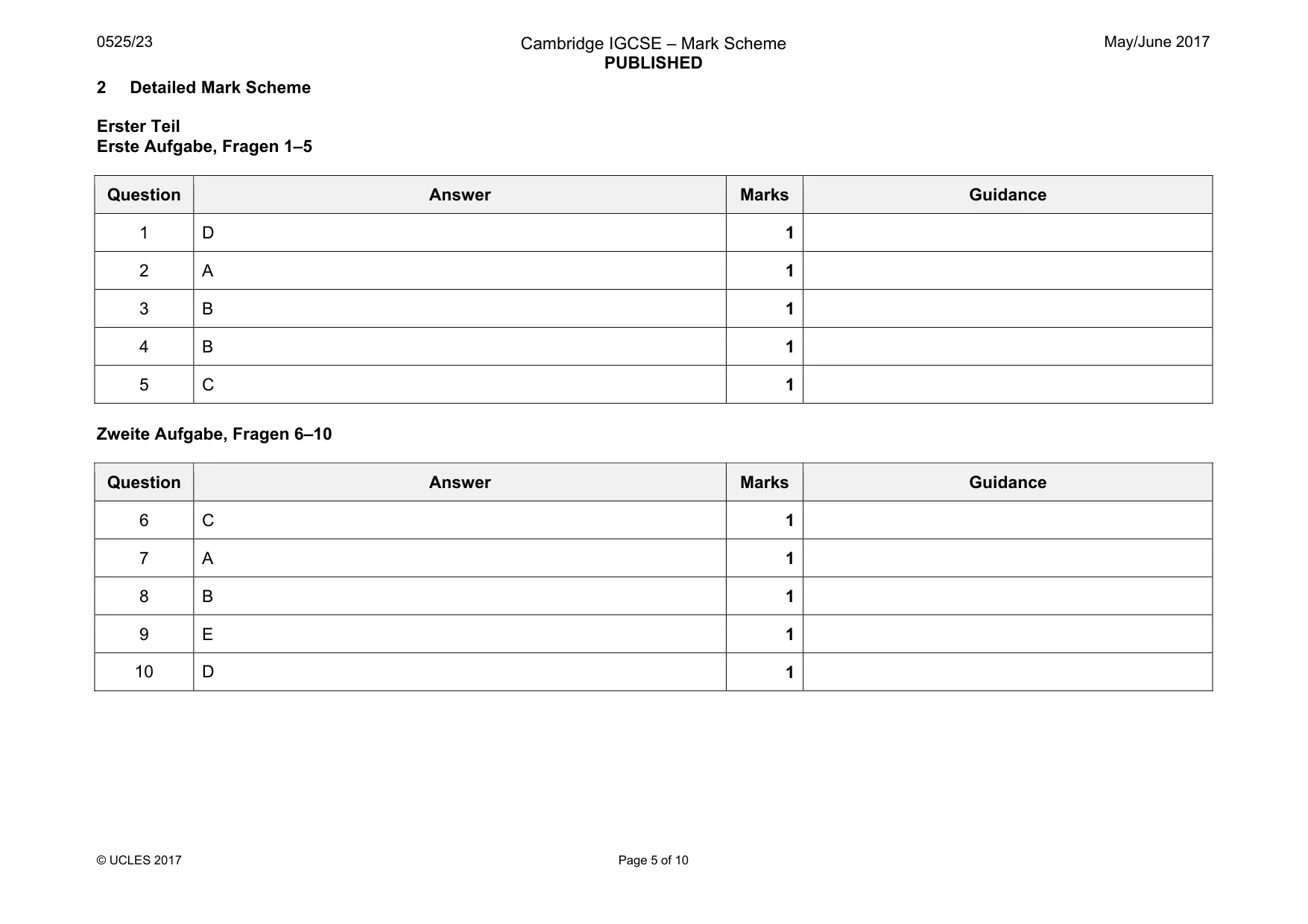
0525/23 Cambridge IGCSE – Mark Scheme PUBLISHED May/June 2017 © UCLES 2017 Page 5 of 10 2 Detailed Mark Scheme Erster Teil Erste Aufgabe, Fragen 1–5 Question Answer Marks Guidance 1 D 1 2 A 1 3 B 1 4 B 1 5 C 1 Zweite Aufgabe, Fragen 6–10 Question Answer Marks Guidance 6 C 1 7 A 1 8 B 1 9 E 1 10 D 1
Mark scheme, page 6
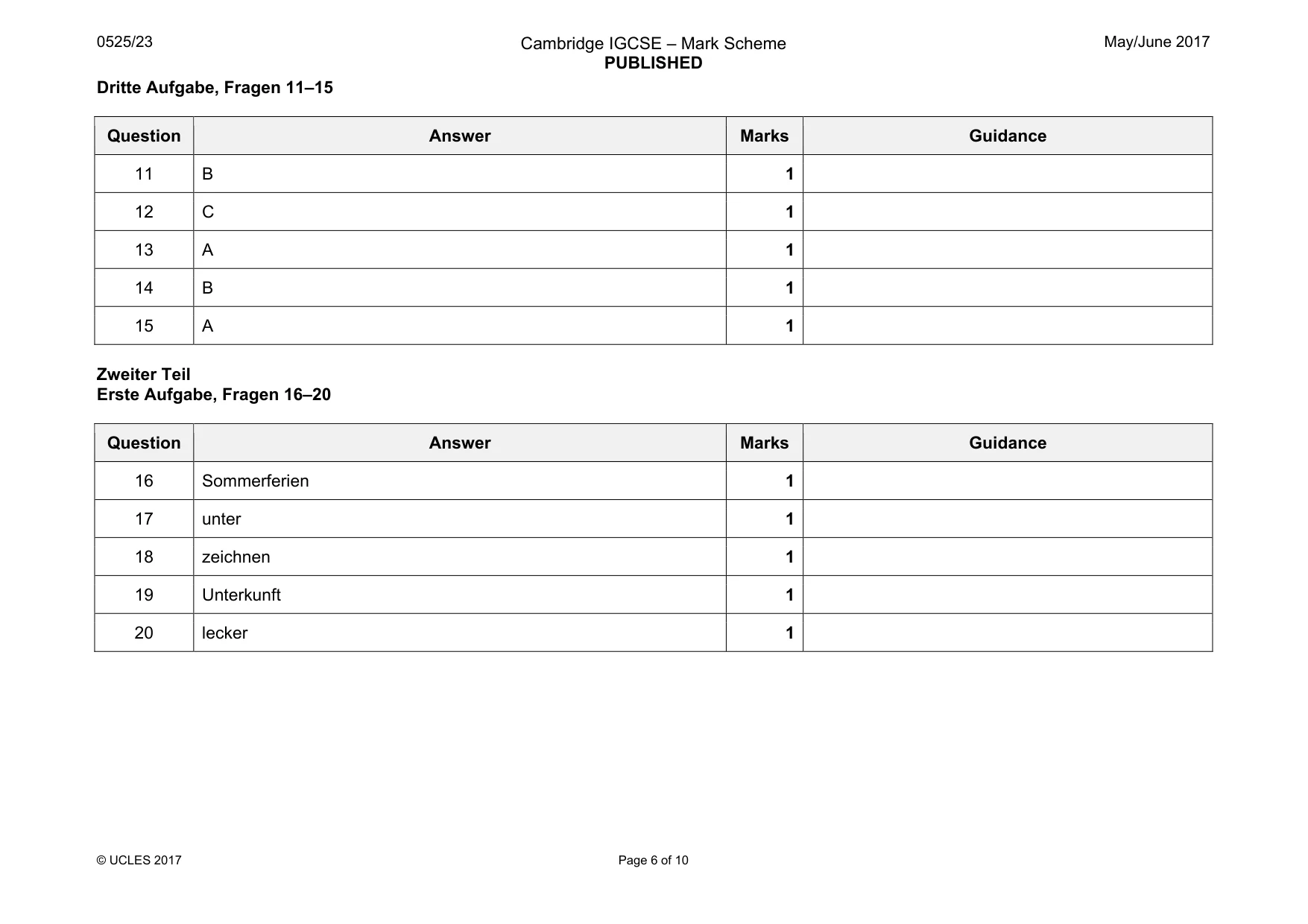
0525/23 Cambridge IGCSE – Mark Scheme PUBLISHED May/June 2017 © UCLES 2017 Page 6 of 10 Dritte Aufgabe, Fragen 11–15 Question Answer Marks Guidance 11 B 1 12 C 1 13 A 1 14 B 1 15 A 1 Zweiter Teil Erste Aufgabe, Fragen 16–20 Question Answer Marks Guidance 16 Sommerferien 1 17 unter 1 18 zeichnen 1 19 Unterkunft 1 20 lecker 1
Mark scheme, page 7
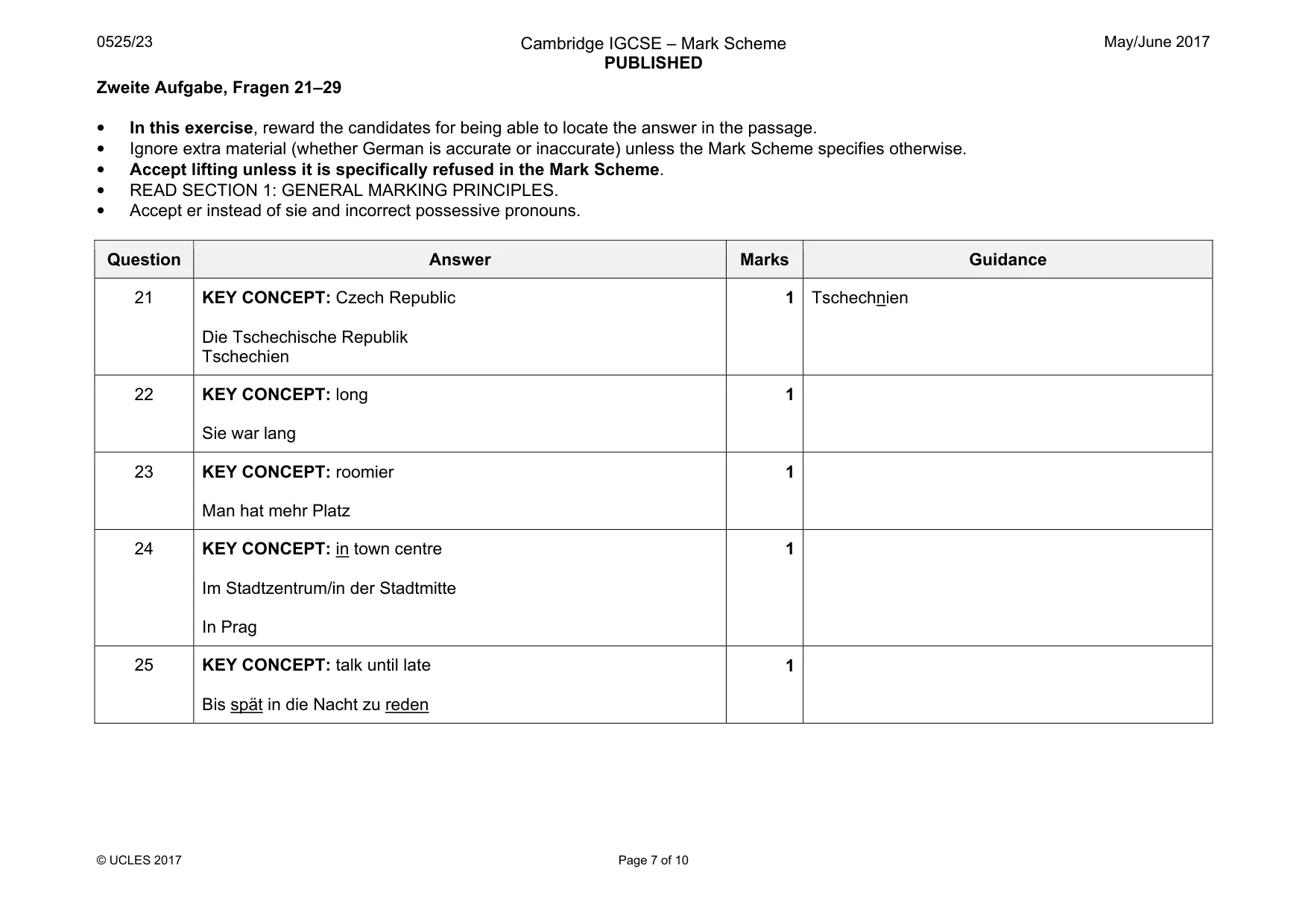
0525/23 Cambridge IGCSE – Mark Scheme PUBLISHED May/June 2017 © UCLES 2017 Page 7 of 10 Zweite Aufgabe, Fragen 21–29 • In this exercise, reward the candidates for being able to locate the answer in the passage. • Ignore extra material (whether German is accurate or inaccurate) unless the Mark Scheme specifies otherwise. • Accept lifting unless it is specifically refused in the Mark Scheme. • READ SECTION 1: GENERAL MARKING PRINCIPLES. • Accept er instead of sie and incorrect possessive pronouns. Question Answer Marks Guidance 21 KEY CONCEPT: Czech Republic Die Tschechische Republik Tschechien 1 Tschechnien 22 KEY CONCEPT: long Sie war lang 1 23 KEY CONCEPT: roomier Man hat mehr Platz 1 24 KEY CONCEPT: in town centre Im Stadtzentrum/in der Stadtmitte In Prag 1 25 KEY CONCEPT: talk until late Bis spät in die Nacht zu reden 1
Mark scheme, page 8
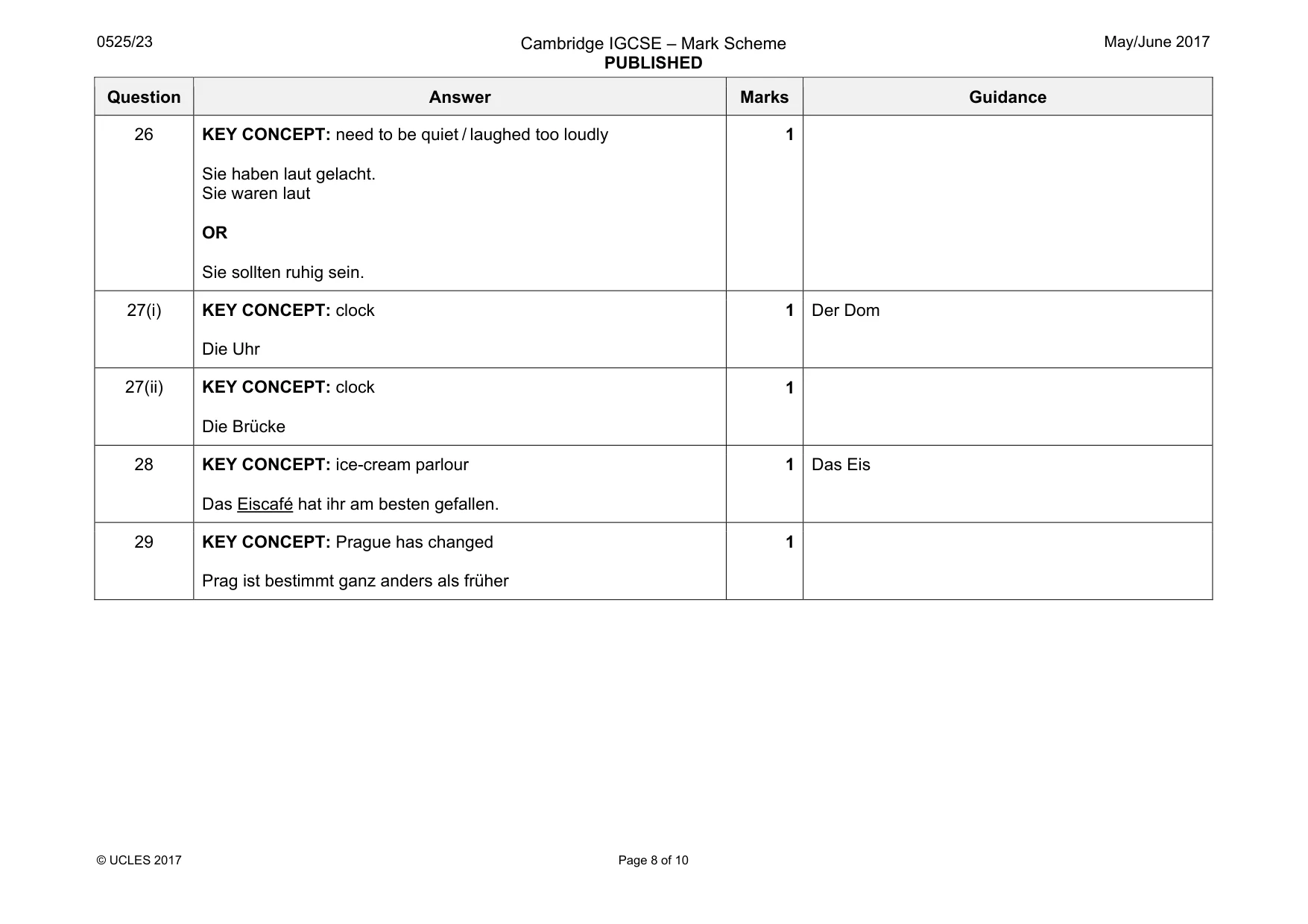
0525/23 Cambridge IGCSE – Mark Scheme PUBLISHED May/June 2017 © UCLES 2017 Page 8 of 10 Question Answer Marks Guidance 26 KEY CONCEPT: need to be quiet / laughed too loudly Sie haben laut gelacht. Sie waren laut OR Sie sollten ruhig sein. 1 27(i) KEY CONCEPT: clock Die Uhr 1 Der Dom 27(ii) KEY CONCEPT: clock Die Brücke 1 28 KEY CONCEPT: ice-cream parlour Das Eiscafé hat ihr am besten gefallen. 1 Das Eis 29 KEY CONCEPT: Prague has changed Prag ist bestimmt ganz anders als früher 1
Mark scheme, page 9
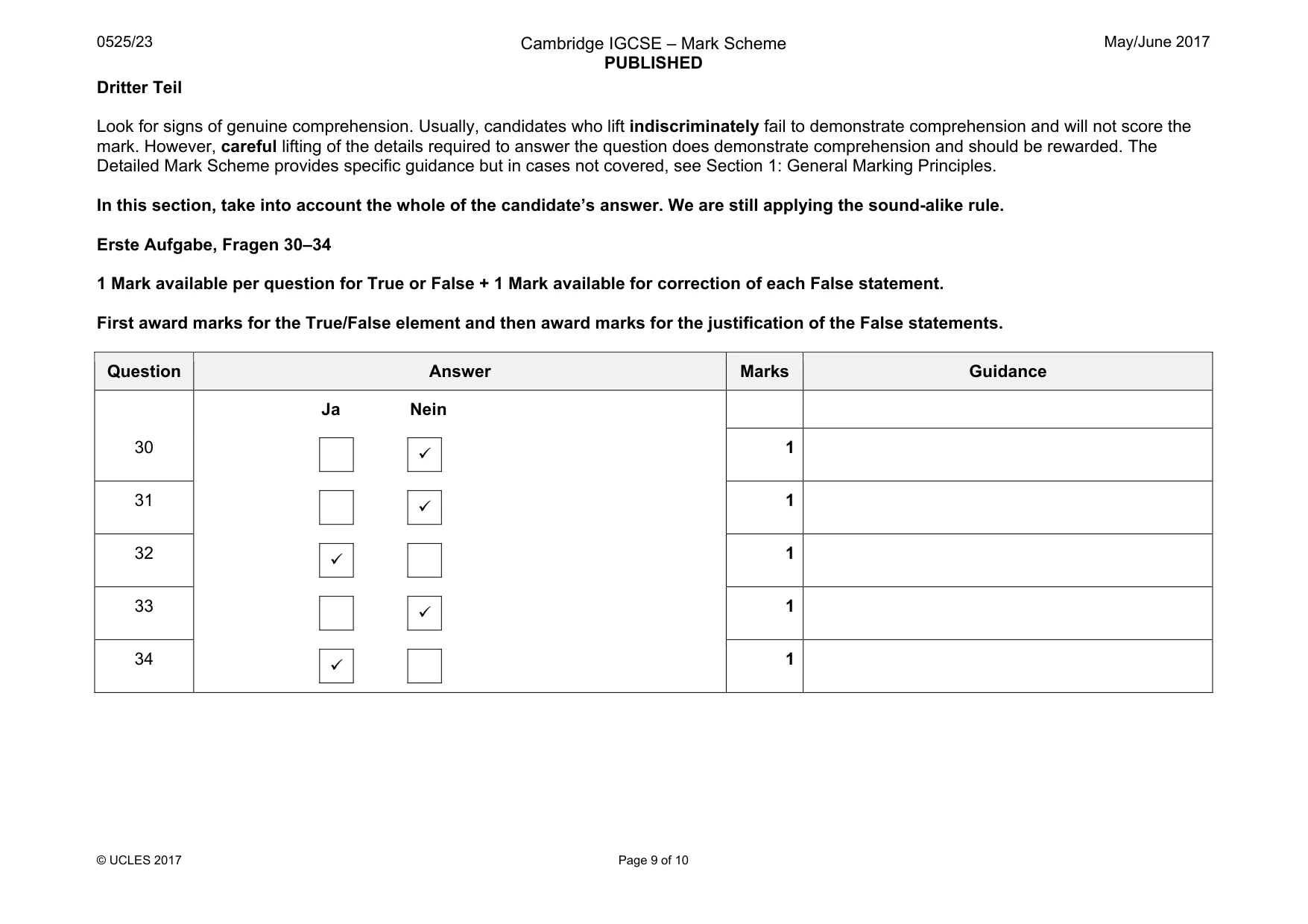
0525/23 Cambridge IGCSE – Mark Scheme PUBLISHED May/June 2017 © UCLES 2017 Page 9 of 10 Dritter Teil Look for signs of genuine comprehension. Usually, candidates who lift indiscriminately fail to demonstrate comprehension and will not score the mark. However, careful lifting of the details required to answer the question does demonstrate comprehension and should be rewarded. The Detailed Mark Scheme provides specific guidance but in cases not covered, see Section 1: General Marking Principles. In this section, take into account the whole of the candidate’s answer. We are still applying the sound-alike rule. Erste Aufgabe, Fragen 30–34 1 Mark available per question for True or False + 1 Mark available for correction of each False statement. First award marks for the True/False element and then award marks for the justification of the False statements. Question Answer Marks Guidance Ja Nein 30 9 1 31 9 1 32 9 1 33 9 1 34 9 1
Mark scheme, page 10
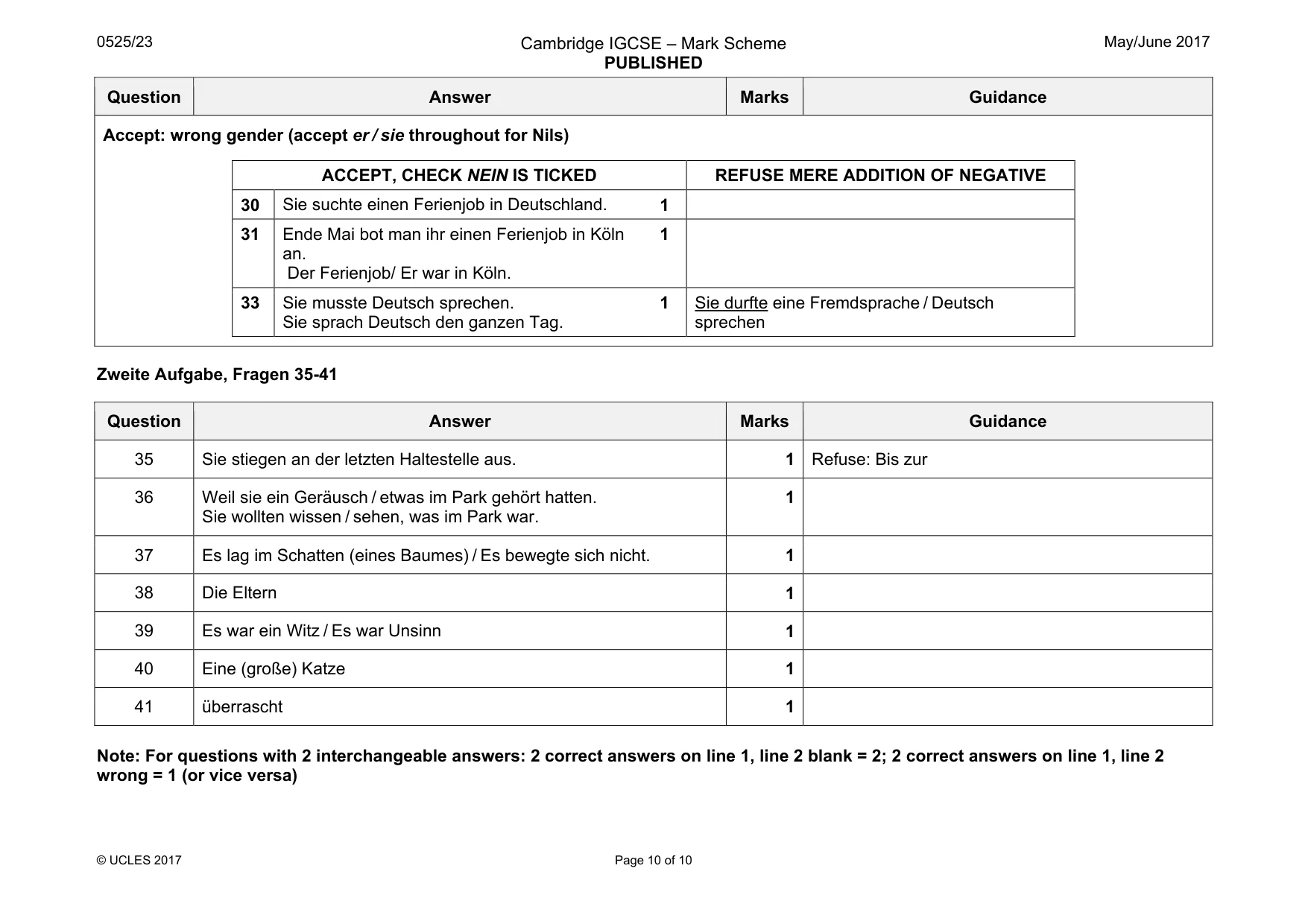
0525/23 Cambridge IGCSE – Mark Scheme PUBLISHED May/June 2017 © UCLES 2017 Page 10 of 10 Question Answer Marks Guidance Accept: wrong gender (accept er / sie throughout for Nils) ACCEPT, CHECK NEIN IS TICKED REFUSE MERE ADDITION OF NEGATIVE 30 Sie suchte einen Ferienjob in Deutschland. 1 31 Ende Mai bot man ihr einen Ferienjob in Köln an. Der Ferienjob/ Er war in Köln. 1 33 Sie musste Deutsch sprechen. Sie sprach Deutsch den ganzen Tag. 1 Sie durfte eine Fremdsprache / Deutsch sprechen Zweite Aufgabe, Fragen 35-41 Question Answer Marks Guidance 35 Sie stiegen an der letzten Haltestelle aus. 1 Refuse: Bis zur 36 Weil sie ein Geräusch / etwas im Park gehört hatten. Sie wollten wissen / sehen, was im Park war. 1 37 Es lag im Schatten (eines Baumes) / Es bewegte sich nicht. 1 38 Die Eltern 1 39 Es war ein Witz / Es war Unsinn 1 40 Eine (große) Katze 1 41 überrascht 1 Note: For questions with 2 interchangeable answers: 2 correct answers on line 1, line 2 blank = 2; 2 correct answers on line 1, line 2 wrong = 1 (or vice versa)
What you needed in this session
Cambridge’s own grade thresholds for 2017 May/June, Paper 2 · Variant 3. A higher threshold means an easier paper — the bar moves with how the cohort did.