Cambridge IGCSE German - Foreign Language 0525 — 2014 May/June Paper 2 · Variant 2
0525/22/M/J/14 · 65 marks · ≈73 min
The question paper and its mark scheme, free to read here and free to download. This is Cambridge’s own paper, exactly as it was sat.
Question paper20 pages






Mark scheme14 pages
Answers below. Sit the paper first if you are practising.
Paper as text
Question paper, page 1
This document consists of 16 printed pages and 4 blank pages. IB14 06_0525_22/6RP © UCLES 2014 [Turn over *3845325642* Cambridge International Examinations Cambridge International General Certificate of Secondary Education GERMAN 0525/22 Paper 2 Reading and Directed Writing May/June 2014 1 hour 30 minutes Candidates answer on the Question Paper. No Additional Materials are required. READ THESE INSTRUCTIONS FIRST Write your Centre number, candidate number and name on all the work you hand in. Write in dark blue or black pen. Do not use staples, paper clips, glue or correction fluid. DO NOT WRITE IN ANY BARCODES. Answer all questions in Section 1 and Section 2 and Section 3. At the end of the examination, fasten all your work securely together. The number of marks is given in brackets [ ] at the end of each question or part question.
Question paper, page 2
2 © UCLES 2014 0525/22/M/J/14 BLANK PAGE
Question paper, page 3
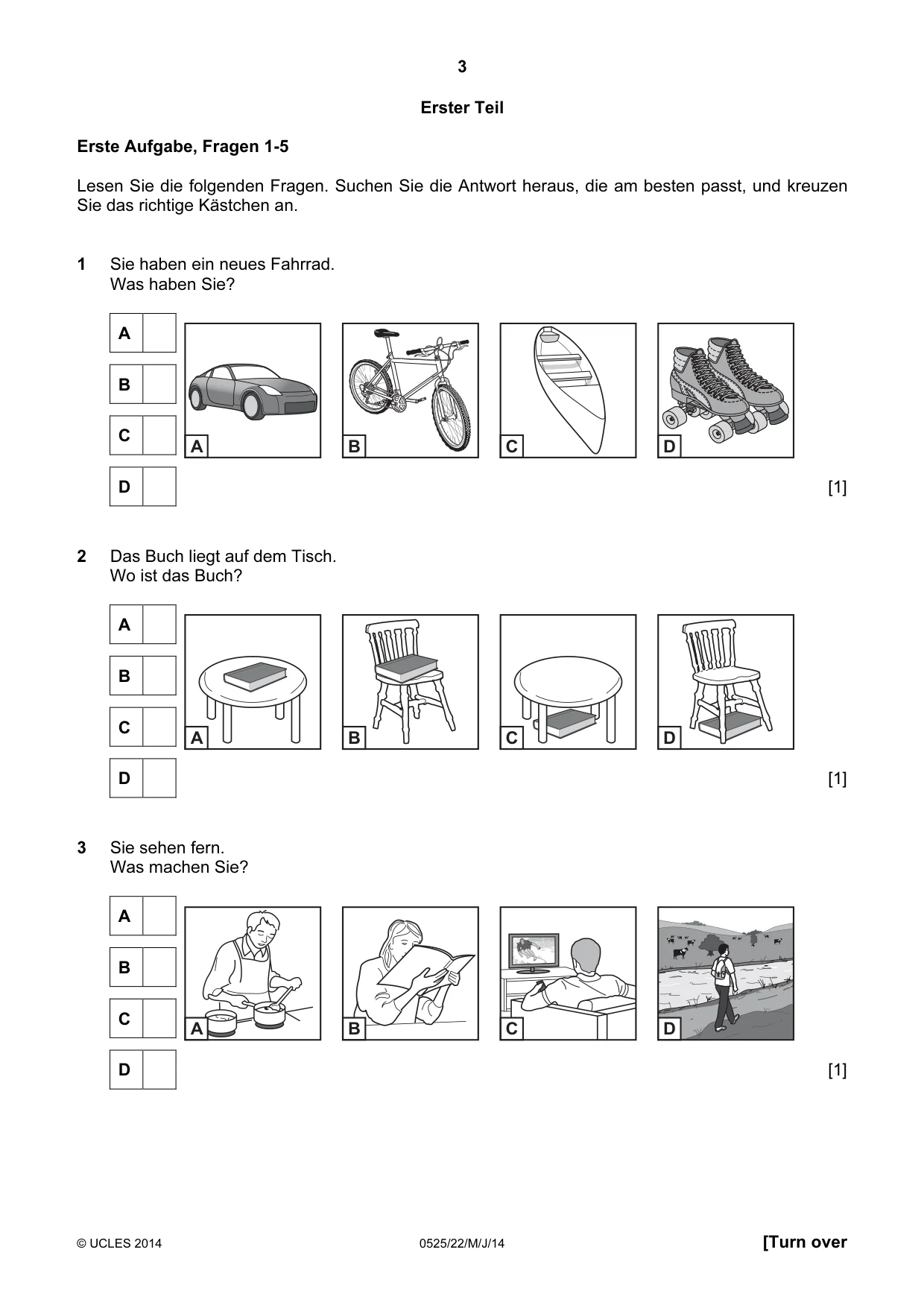
3 © UCLES 2014 0525/22/M/J/14 [Turn over Erster Teil Erste Aufgabe, Fragen 1-5 Lesen Sie die folgenden Fragen. Suchen Sie die Antwort heraus, die am besten passt, und kreuzen Sie das richtige Kästchen an. 1 Sie haben ein neues Fahrrad. Was haben Sie? A A B C D B C D [1] 2 Das Buch liegt auf dem Tisch. Wo ist das Buch? A A B C D B C D [1] 3 Sie sehen fern. Was machen Sie? A A B C D B C D [1]
Question paper, page 4
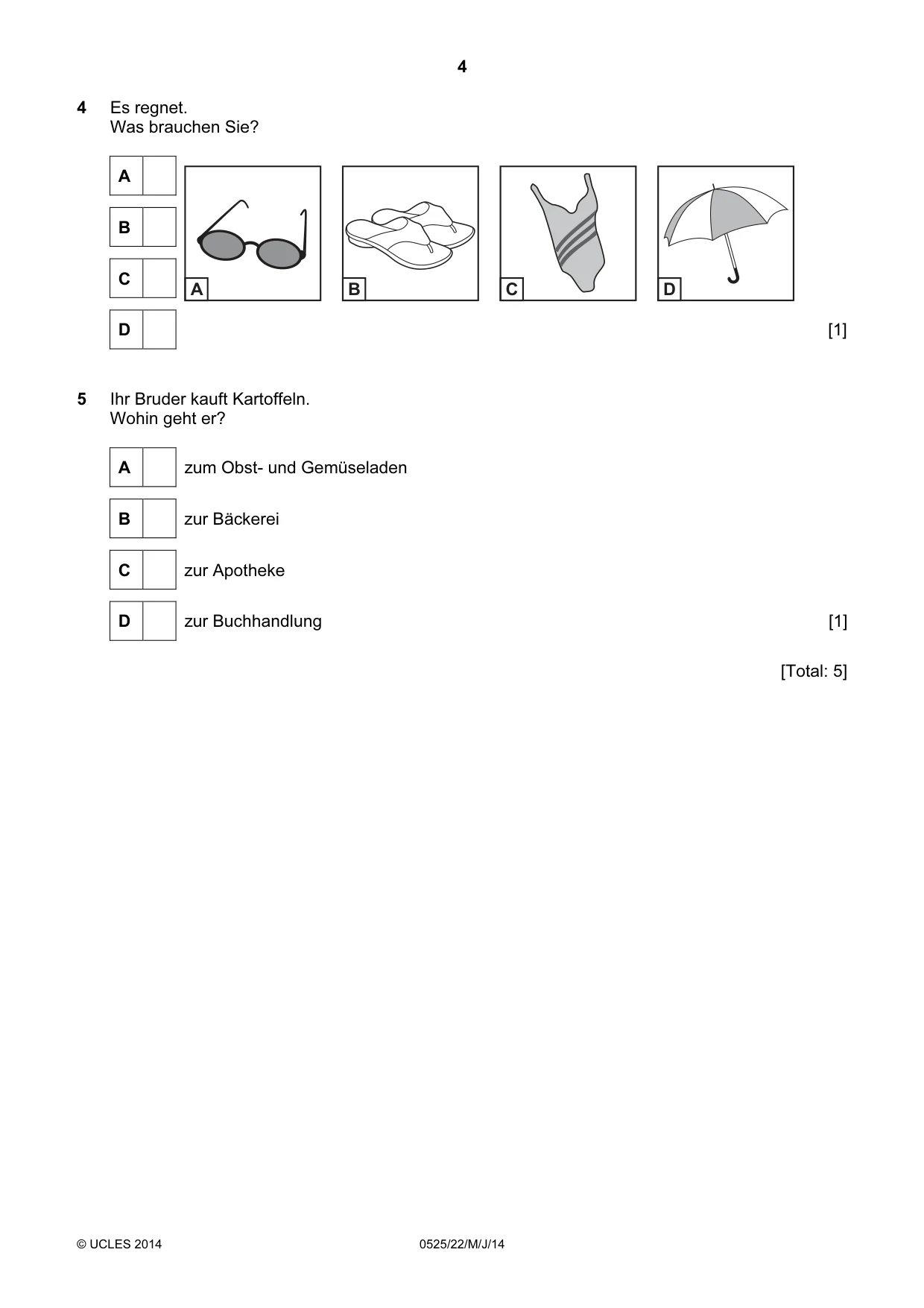
4 © UCLES 2014 0525/22/M/J/14 4 Es regnet. Was brauchen Sie? A A B C D B C D [1] 5 Ihr Bruder kauft Kartoffeln. Wohin geht er? A zum Obst- und Gemüseladen B zur Bäckerei C zur Apotheke D zur Buchhandlung [1] [Total: 5]
Question paper, page 5
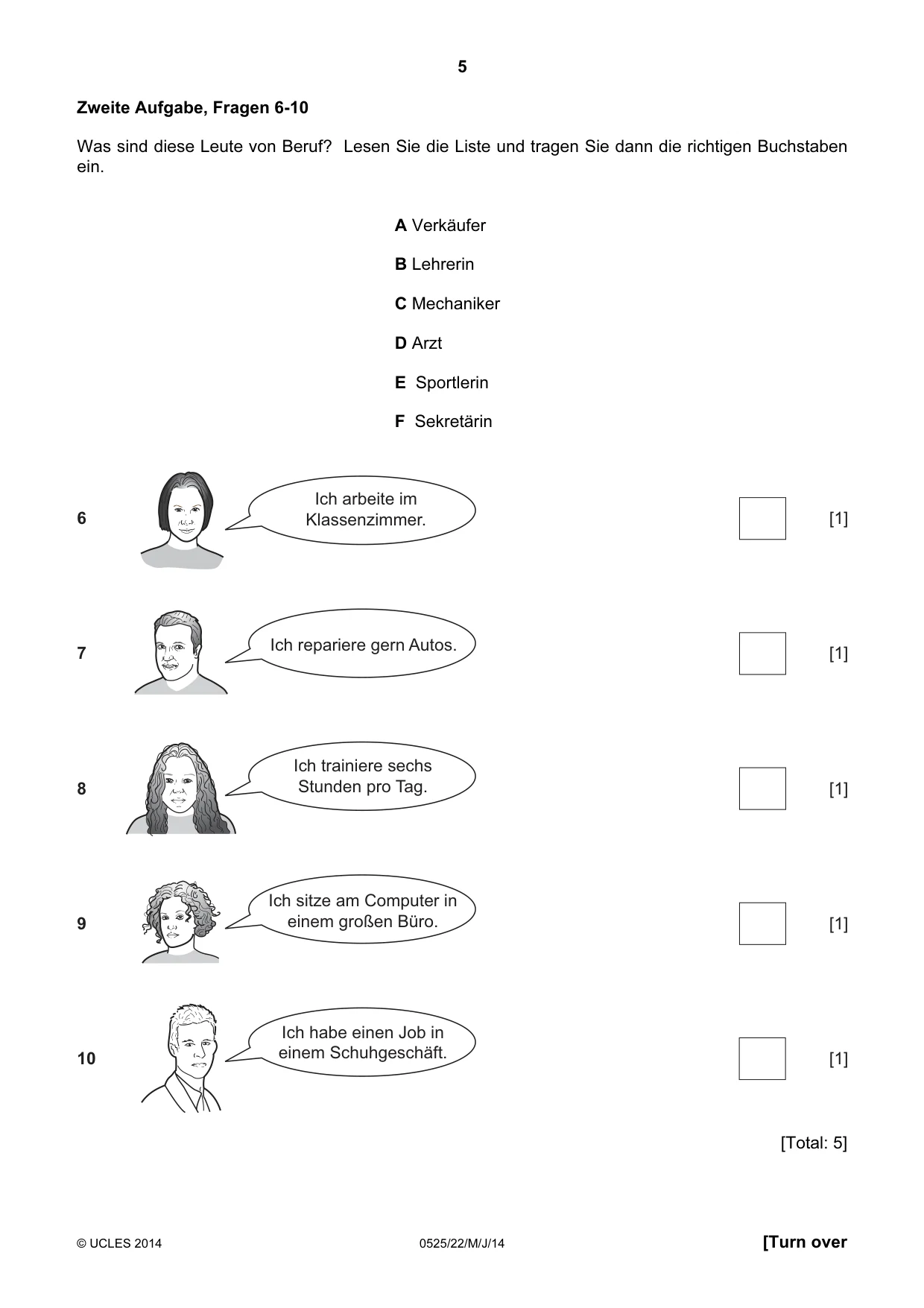
5 © UCLES 2014 0525/22/M/J/14 [Turn over Zweite Aufgabe, Fragen 6-10 Was sind diese Leute von Beruf? Lesen Sie die Liste und tragen Sie dann die richtigen Buchstaben ein. A Verkäufer B Lehrerin C Mechaniker D Arzt E Sportlerin F Sekretärin 6 7 8 9 10 [1] [1] [1] [1] [1] Ich arbeite im Klassenzimmer. Ich repariere gern Autos. Ich trainiere sechs Stunden pro Tag. Ich sitze am Computer in einem großen Büro. Ich habe einen Job in einem Schuhgeschäft. [Total: 5]
Question paper, page 6
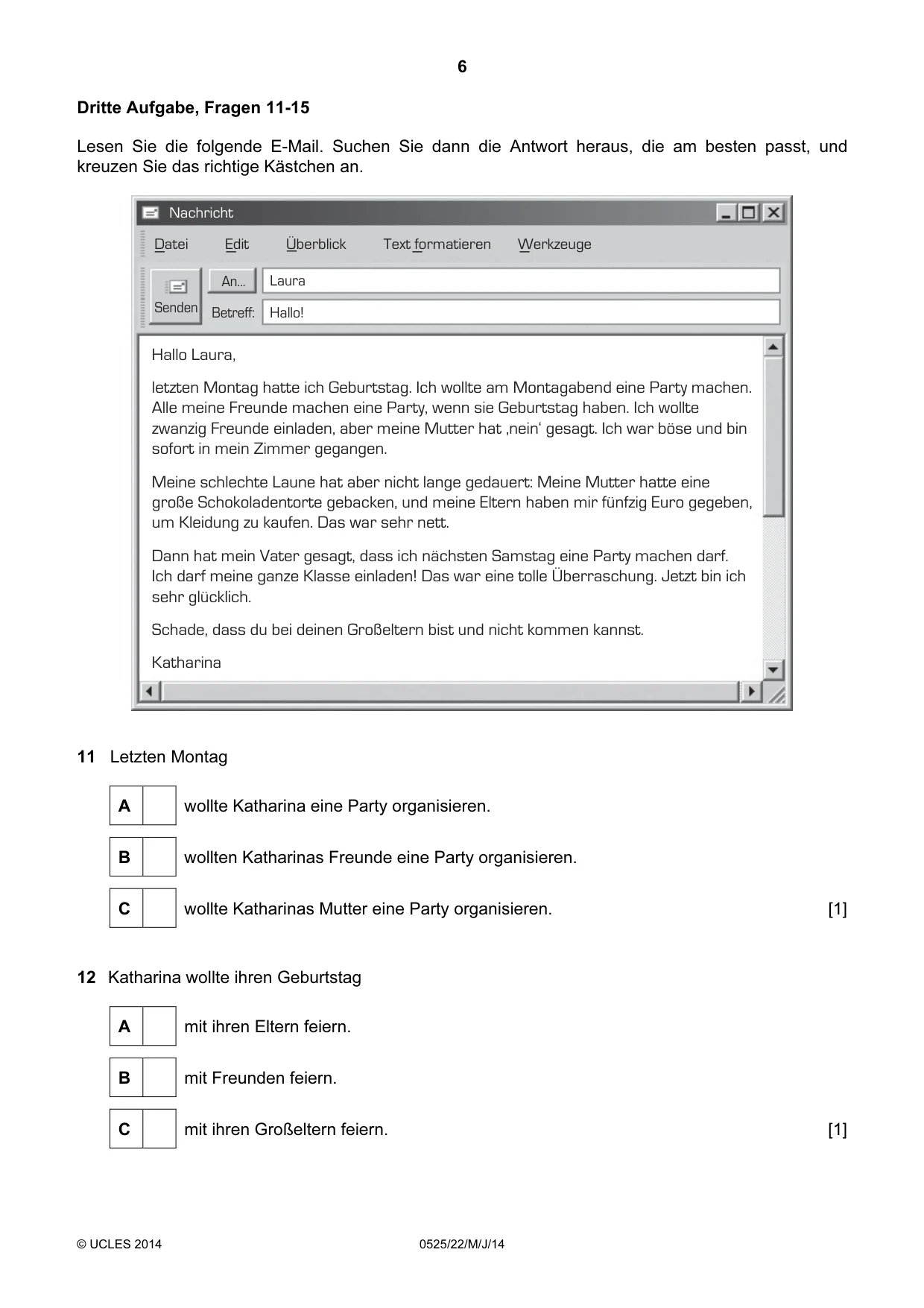
6 © UCLES 2014 0525/22/M/J/14 Dritte Aufgabe, Fragen 11-15 Lesen Sie die folgende E-Mail. Suchen Sie dann die Antwort heraus, die am besten passt, und kreuzen Sie das richtige Kästchen an. Senden An... Betreff: Hallo! Laura Datei Edit Überblick Text formatieren Werkzeuge _ _ _ _ _ Nachricht Hallo Laura, letzten Montag hatte ich Geburtstag. Ich wollte am Montagabend eine Party machen. Alle meine Freunde machen eine Party, wenn sie Geburtstag haben. Ich wollte zwanzig Freunde einladen, aber meine Mutter hat ‚nein‘ gesagt. Ich war böse und bin sofort in mein Zimmer gegangen. Meine schlechte Laune hat aber nicht lange gedauert: Meine Mutter hatte eine große Schokoladentorte gebacken, und meine Eltern haben mir fünfzig Euro gegeben, um Kleidung zu kaufen. Das war sehr nett. Dann hat mein Vater gesagt, dass ich nächsten Samstag eine Party machen darf. Ich darf meine ganze Klasse einladen! Das war eine tolle Überraschung. Jetzt bin ich sehr glücklich. Schade, dass du bei deinen Großeltern bist und nicht kommen kannst. Katharina 11 Letzten Montag A wollte Katharina eine Party organisieren. B wollten Katharinas Freunde eine Party organisieren. C wollte Katharinas Mutter eine Party organisieren. [1] 12 Katharina wollte ihren Geburtstag A mit ihren Eltern feiern. B mit Freunden feiern. C mit ihren Großeltern feiern. [1]
Question paper, page 7
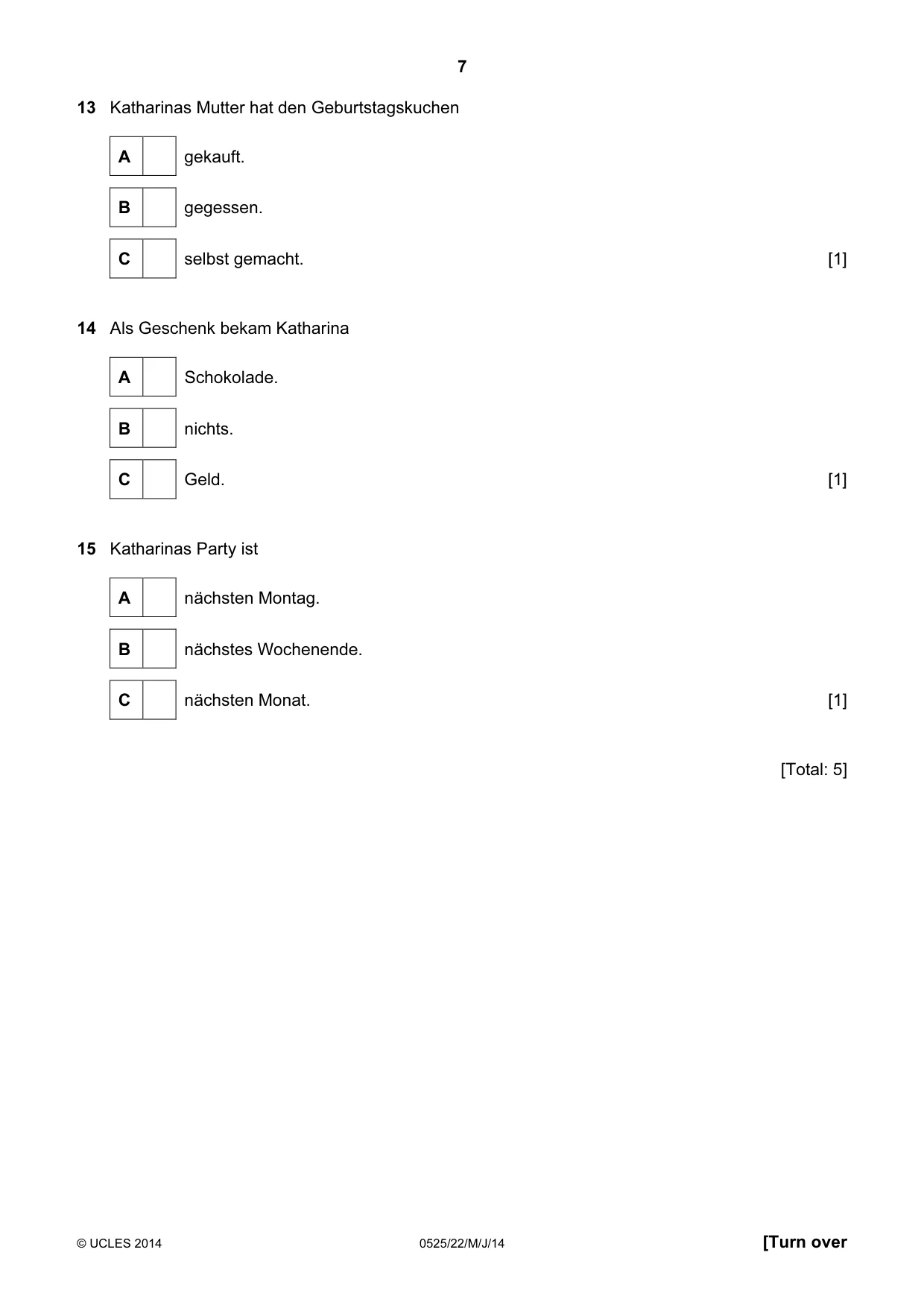
7 © UCLES 2014 0525/22/M/J/14 [Turn over 13 Katharinas Mutter hat den Geburtstagskuchen A gekauft. B gegessen. C selbst gemacht. [1] 14 Als Geschenk bekam Katharina A Schokolade. B nichts. C Geld. [1] 15 Katharinas Party ist A nächsten Montag. B nächstes Wochenende. C nächsten Monat. [1] [Total: 5]
Question paper, page 8
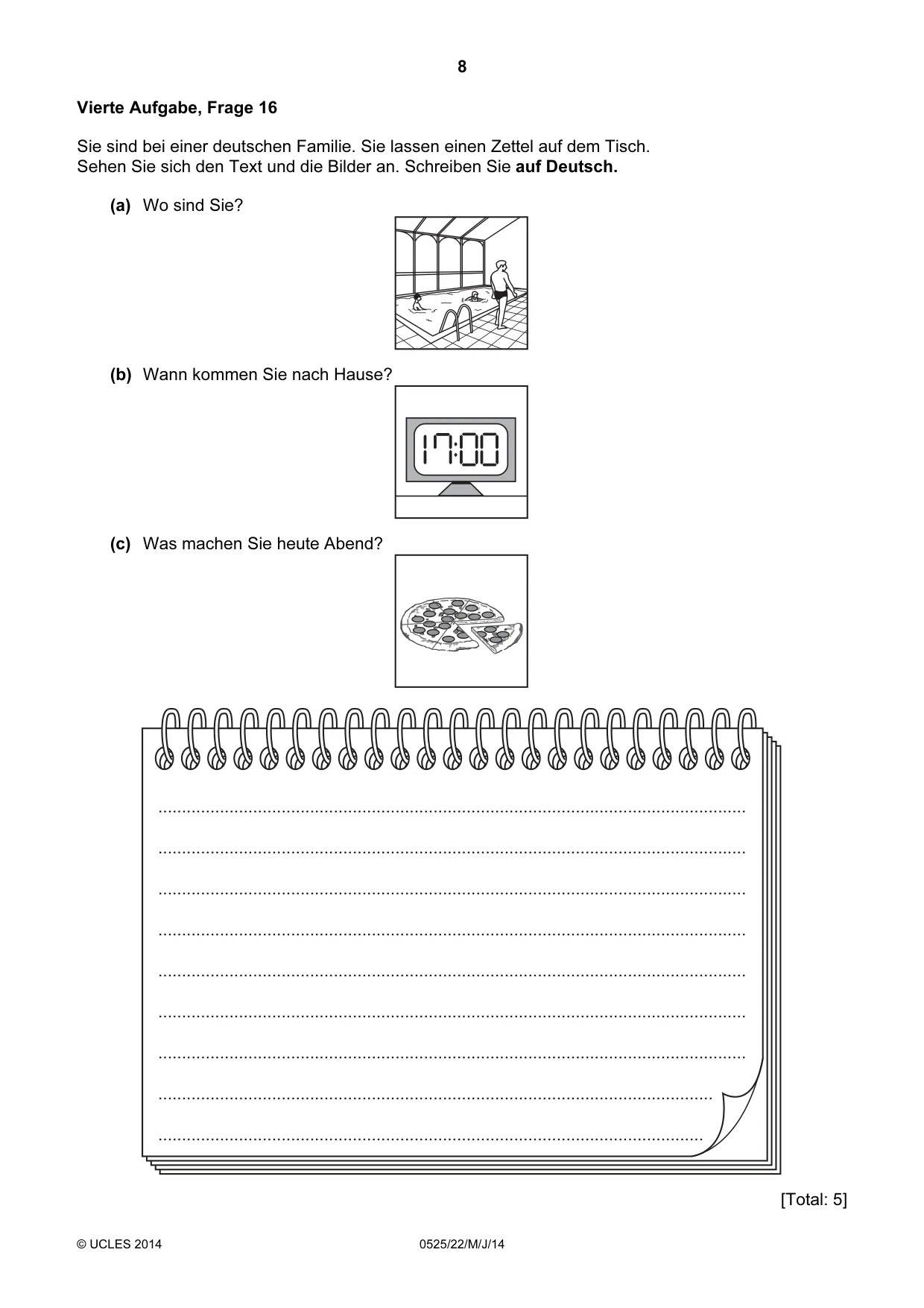
8 © UCLES 2014 0525/22/M/J/14 Vierte Aufgabe, Frage 16 Sie sind bei einer deutschen Familie. Sie lassen einen Zettel auf dem Tisch. Sehen Sie sich den Text und die Bilder an. Schreiben Sie auf Deutsch. (a) Wo sind Sie? (b) Wann kommen Sie nach Hause? (c) Was machen Sie heute Abend? … … … … … … … … … [Total: 5]
Question paper, page 9
9 © UCLES 2014 0525/22/M/J/14 [Turn over [PLEASE TURN OVER FOR SECTION TWO]
Question paper, page 10
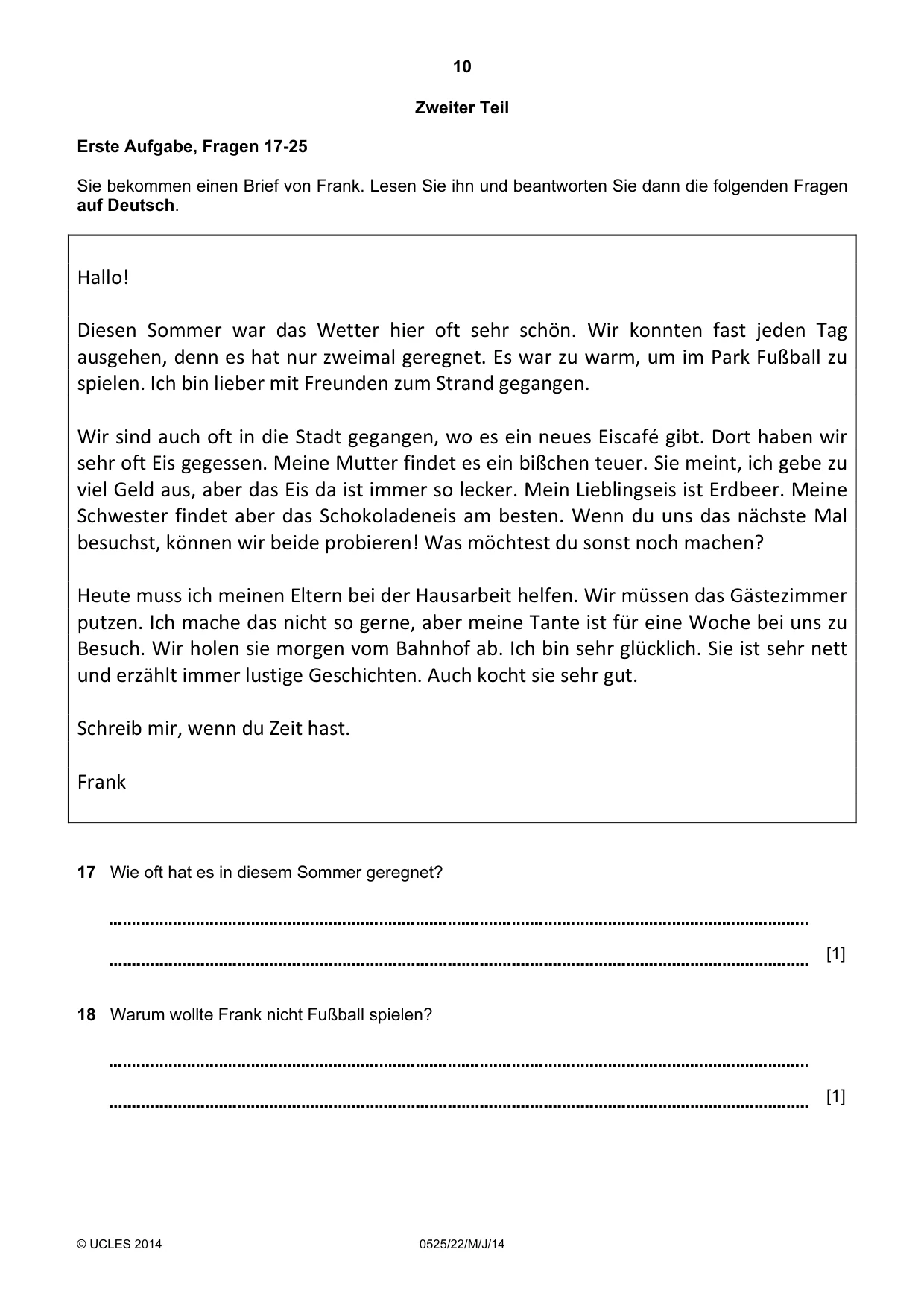
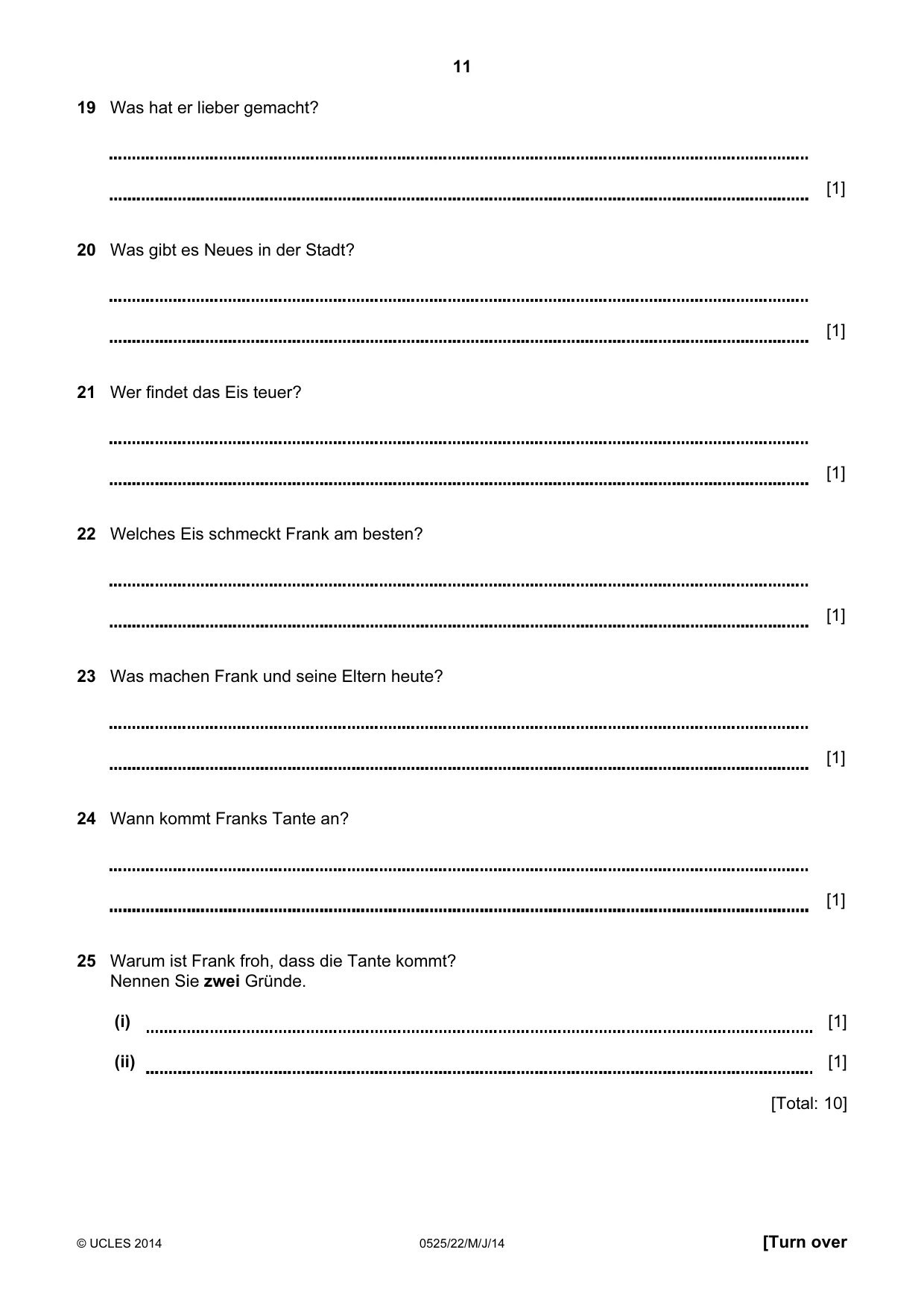
10 © UCLES 2014 0525/22/M/J/14 Zweiter Teil Erste Aufgabe, Fragen 17-25 Sie bekommen einen Brief von Frank. Lesen Sie ihn und beantworten Sie dann die folgenden Fragen auf Deutsch. Hallo! Diesen Sommer war das Wetter hier oft sehr schön. Wir konnten fast jeden Tag ausgehen, denn es hat nur zweimal geregnet. Es war zu warm, um im Park Fußball zu spielen. Ich bin lieber mit Freunden zum Strand gegangen. Wir sind auch oft in die Stadt gegangen, wo es ein neues Eiscafé gibt. Dort haben wir sehr oft Eis gegessen. Meine Mutter findet es ein bißchen teuer. Sie meint, ich gebe zu viel Geld aus, aber das Eis da ist immer so lecker. Mein Lieblingseis ist Erdbeer. Meine Schwester findet aber das Schokoladeneis am besten. Wenn du uns das nächste Mal besuchst, können wir beide probieren! Was möchtest du sonst noch machen? Heute muss ich meinen Eltern bei der Hausarbeit helfen. Wir müssen das Gästezimmer putzen. Ich mache das nicht so gerne, aber meine Tante ist für eine Woche bei uns zu Besuch. Wir holen sie morgen vom Bahnhof ab. Ich bin sehr glücklich. Sie ist sehr nett und erzählt immer lustige Geschichten. Auch kocht sie sehr gut. Schreib mir, wenn du Zeit hast. Frank 17 Wie oft hat es in diesem Sommer geregnet? [1] 18 Warum wollte Frank nicht Fußball spielen? [1]
Question paper, page 11
11 © UCLES 2014 0525/22/M/J/14 [Turn over 19 Was hat er lieber gemacht? [1] 20 Was gibt es Neues in der Stadt? [1] 21 Wer findet das Eis teuer? [1] 22 Welches Eis schmeckt Frank am besten? [1] 23 Was machen Frank und seine Eltern heute? [1] 24 Wann kommt Franks Tante an? [1] 25 Warum ist Frank froh, dass die Tante kommt? Nennen Sie zwei Gründe. (i) [1] (ii) [1] [Total: 10]
Question paper, page 12
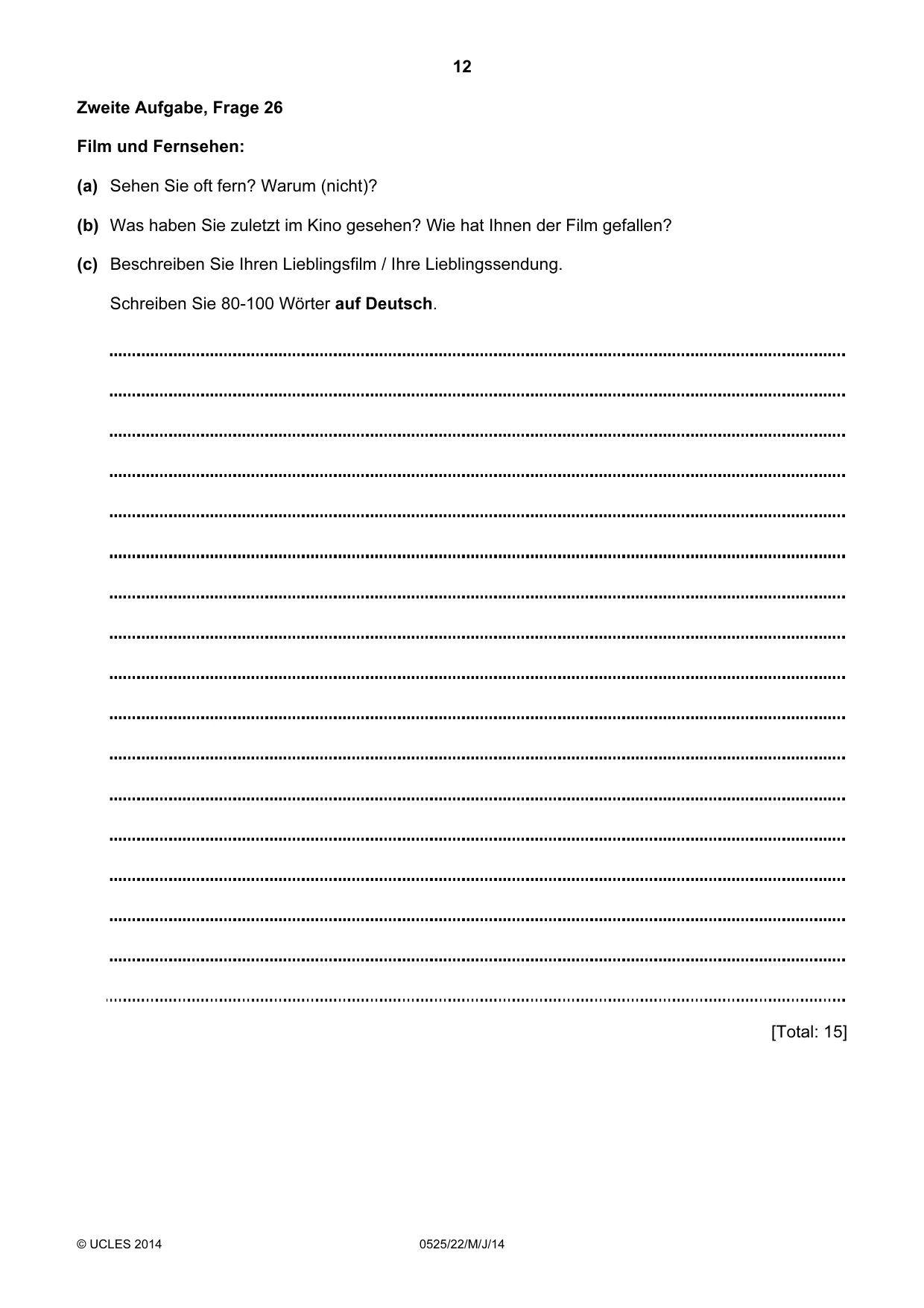
12 © UCLES 2014 0525/22/M/J/14 Zweite Aufgabe, Frage 26 Film und Fernsehen: (a) Sehen Sie oft fern? Warum (nicht)? (b) Was haben Sie zuletzt im Kino gesehen? Wie hat Ihnen der Film gefallen? (c) Beschreiben Sie Ihren Lieblingsfilm / Ihre Lieblingssendung. Schreiben Sie 80-100 Wörter auf Deutsch. [Total: 15]
Question paper, page 13
13 © UCLES 2014 0525/22/M/J/14 [Turn over [PLEASE TURN OVER FOR SECTION THREE]
Question paper, page 14
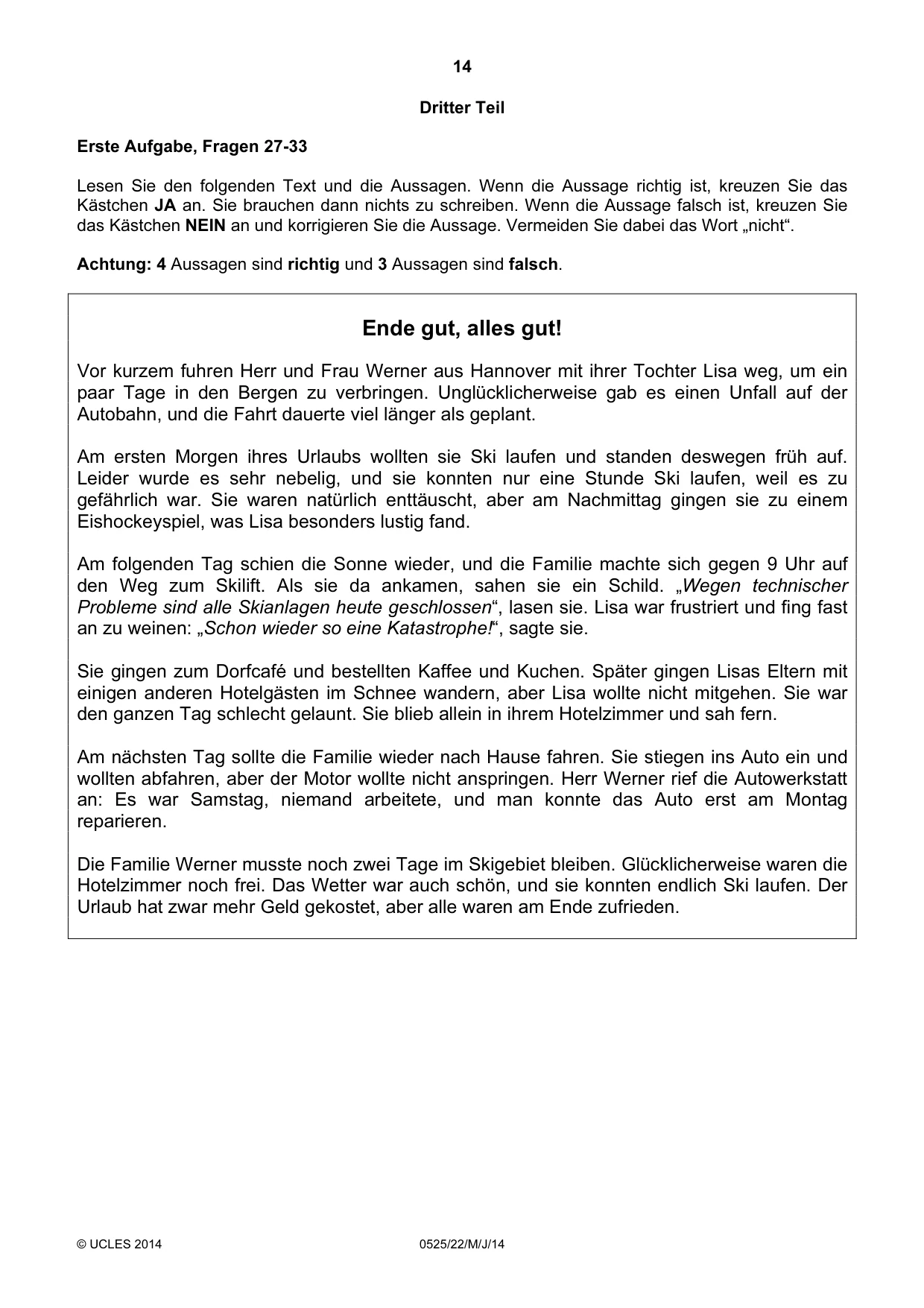
14 © UCLES 2014 0525/22/M/J/14 Dritter Teil Erste Aufgabe, Fragen 27-33 Lesen Sie den folgenden Text und die Aussagen. Wenn die Aussage richtig ist, kreuzen Sie das Kästchen JA an. Sie brauchen dann nichts zu schreiben. Wenn die Aussage falsch ist, kreuzen Sie das Kästchen NEIN an und korrigieren Sie die Aussage. Vermeiden Sie dabei das Wort „nicht“. Achtung: 4 Aussagen sind richtig und 3 Aussagen sind falsch. Ende gut, alles gut! Vor kurzem fuhren Herr und Frau Werner aus Hannover mit ihrer Tochter Lisa weg, um ein paar Tage in den Bergen zu verbringen. Unglücklicherweise gab es einen Unfall auf der Autobahn, und die Fahrt dauerte viel länger als geplant. Am ersten Morgen ihres Urlaubs wollten sie Ski laufen und standen deswegen früh auf. Leider wurde es sehr nebelig, und sie konnten nur eine Stunde Ski laufen, weil es zu gefährlich war. Sie waren natürlich enttäuscht, aber am Nachmittag gingen sie zu einem Eishockeyspiel, was Lisa besonders lustig fand. Am folgenden Tag schien die Sonne wieder, und die Familie machte sich gegen 9 Uhr auf den Weg zum Skilift. Als sie da ankamen, sahen sie ein Schild. „Wegen technischer Probleme sind alle Skianlagen heute geschlossen“, lasen sie. Lisa war frustriert und fing fast an zu weinen: „Schon wieder so eine Katastrophe!“, sagte sie. Sie gingen zum Dorfcafé und bestellten Kaffee und Kuchen. Später gingen Lisas Eltern mit einigen anderen Hotelgästen im Schnee wandern, aber Lisa wollte nicht mitgehen. Sie war den ganzen Tag schlecht gelaunt. Sie blieb allein in ihrem Hotelzimmer und sah fern. Am nächsten Tag sollte die Familie wieder nach Hause fahren. Sie stiegen ins Auto ein und wollten abfahren, aber der Motor wollte nicht anspringen. Herr Werner rief die Autowerkstatt an: Es war Samstag, niemand arbeitete, und man konnte das Auto erst am Montag reparieren. Die Familie Werner musste noch zwei Tage im Skigebiet bleiben. Glücklicherweise waren die Hotelzimmer noch frei. Das Wetter war auch schön, und sie konnten endlich Ski laufen. Der Urlaub hat zwar mehr Geld gekostet, aber alle waren am Ende zufrieden.
Question paper, page 15
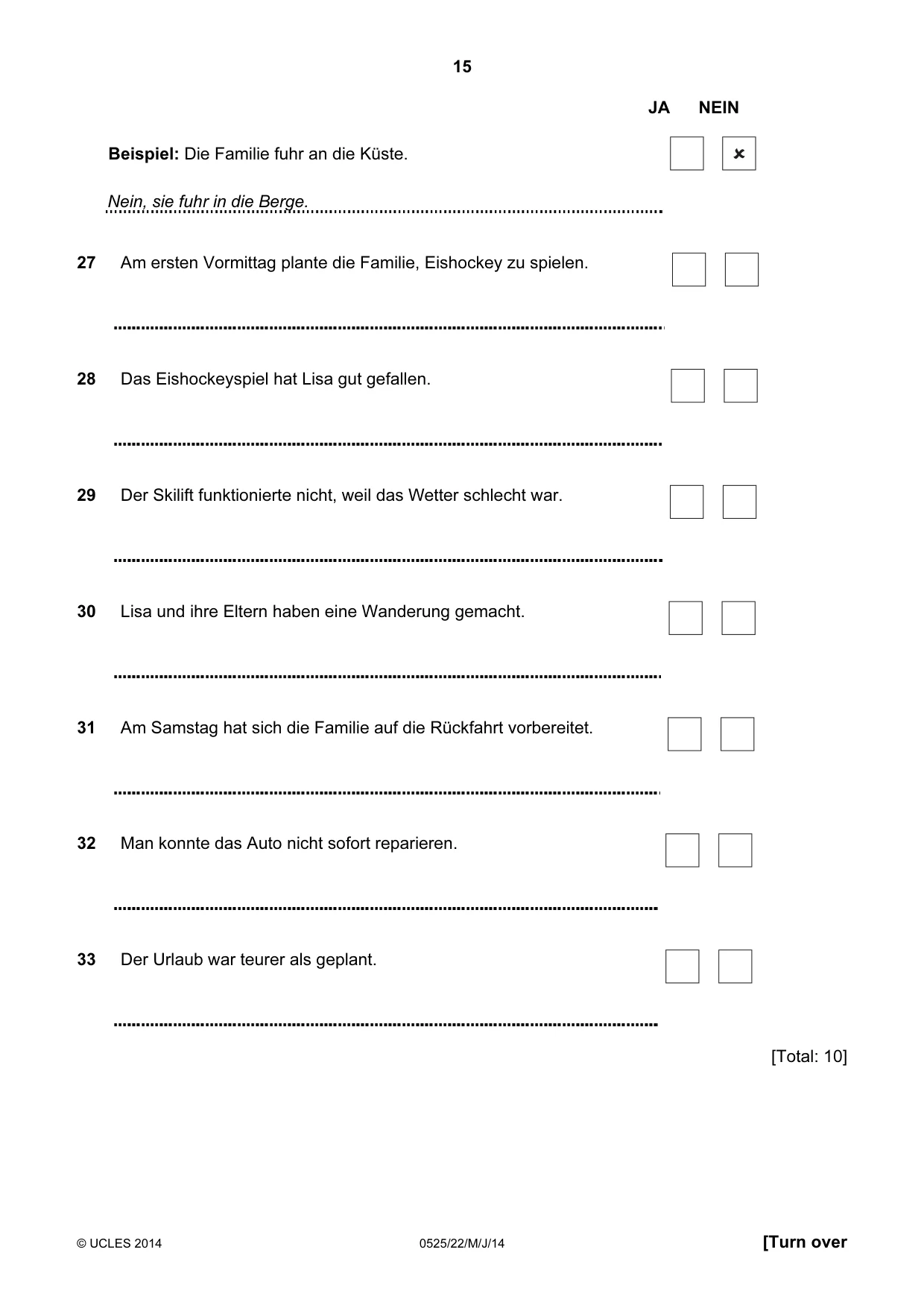
15 © UCLES 2014 0525/22/M/J/14 [Turn over JA NEIN Beispiel: Die Familie fuhr an die Küste. Nein, sie fuhr in die Berge. 27 Am ersten Vormittag plante die Familie, Eishockey zu spielen. 28 Das Eishockeyspiel hat Lisa gut gefallen. 29 Der Skilift funktionierte nicht, weil das Wetter schlecht war. 30 Lisa und ihre Eltern haben eine Wanderung gemacht. 31 Am Samstag hat sich die Familie auf die Rückfahrt vorbereitet. 32 Man konnte das Auto nicht sofort reparieren. 33 Der Urlaub war teurer als geplant. [Total: 10]
Question paper, page 16
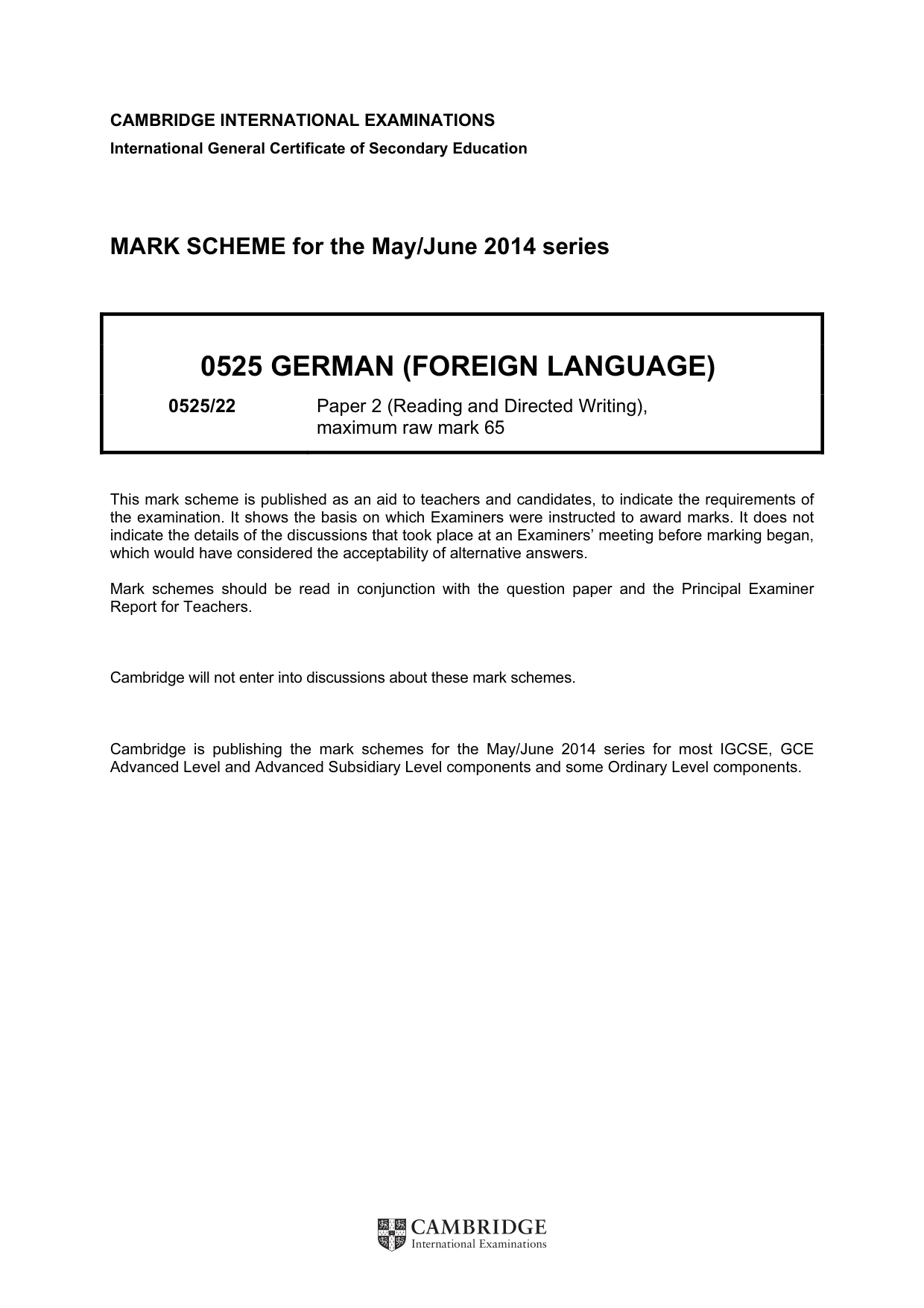
16 © UCLES 2014 0525/22/M/J/14 Zweite Aufgabe, Fragen 34-42 Lesen Sie den folgenden Text und beantworten Sie dann die Fragen auf Deutsch. Peter findet den richtigen Job Als Peter sein Studium erfolgreich beendet hatte, waren seine Eltern sehr stolz auf ihn. Wie sie gewünscht hatten, hatte er Medizin studiert, und sie hofften, dass er bald eine Stelle als Arzt finden würde. Aber Peter hatte ganz andere Ideen. Er wollte etwas von der Welt sehen und das hat er auch gemacht. Er wurde vor kurzem 31 Jahre alt und hat jetzt den Beruf, von dem er jahrelang geträumt hatte: Er ist Reisejournalist. Seine Arbeit ist sehr interessant. Er besucht Länder, die man selten besucht und schreibt Artikel darüber. Leute, die sich für diese Länder interessieren, können seine Artikel in Zeitschriften und Reiseführern lesen. Viele Jugendliche hoffen, Reisejournalist wie Peter zu werden. Die allgemeine Meinung, dass ein Reisejournalist ständig im Urlaub sei, stimmt aber nicht: Seine Arbeit kann manchmal sehr anstrengend sein. Also, wie hat Peter diesen Traumjob bekommen? Warum hat man ihm den Job als Reisejournalist bei der Zeitschrift Unbekannte Orte gegeben? „Man brauchte jemanden, der nach Brasilien fahren konnte, um einen Artikel über eine wenig bekannte Gegend zu schreiben. Ich war sehr überrascht, dass sie mir den Job angeboten haben“, erklärte Peter. „Ich hatte weniger Erfahrung als die anderen Kandidaten, aber man hat mir gesagt, dass ich genommen wurde, weil ich fließend Portugiesisch spreche. Der Journalist sollte im Artikel auch über Gesundheitsprobleme in der Gegend schreiben. Und wie Sie wissen, habe ich Medizin studiert: Ich war genau der Richtige für diesen Job!“ Wenn er nicht unterwegs ist, langweilt sich Peter nie: Seiner Meinung nach ist man nie zu alt, um etwas Neues zu lernen. Er interessiert sich für alles, vor allem für Sprachen und Geschichte. Er geht auch regelmäßig ins Fitness-Studio, um sich für seine härteren Reisen, wie zum Beispiel in den Dschungel, fit zu halten. 34 Warum waren Peters Eltern stolz auf ihn? [1] 35 Was hat Peter nach dem Studium gemacht? [1]
Question paper, page 17
17 © UCLES 2014 0525/22/M/J/14 36 Wovon hatte er lange geträumt? [1] 37 Worüber schreibt er Artikel? [1] 38 Was denken viele Leute über Peters Beruf? [1] 39 Warum hat er gedacht, dass er den Job nicht bekommen würde? [1] 40 Warum hat man Peter den Job bei der Zeitschrift Unbekannte Orte angeboten? Nennen Sie zwei Gründe. (i) [1] (ii) [1] 41 Was sind Peters zwei Hauptinteressen? [1] 42 Warum muss er sich fit halten? [1] [Total: 10]
Question paper, page 18
18 © UCLES 2014 0525/22/M/J/14 BLANK PAGE
Question paper, page 19
19 © UCLES 2014 0525/22/M/J/14 BLANK PAGE
Question paper, page 20
20 Permission to reproduce items where third-party owned material protected by copyright is included has been sought and cleared where possible. Every reasonable effort has been made by the publisher (UCLES) to trace copyright holders, but if any items requiring clearance have unwittingly been included, the publisher will be pleased to make amends at the earliest possible opportunity. Cambridge International Examinations is part of the Cambridge Assessment Group. Cambridge Assessment is the brand name of University of Cambridge Local Examinations Syndicate (UCLES), which is itself a department of the University of Cambridge. © UCLES 2014 0525/22/M/J/14 BLANK PAGE
Mark scheme, page 1
CAMBRIDGE INTERNATIONAL EXAMINATIONS International General Certificate of Secondary Education MARK SCHEME for the May/June 2014 series 0525 GERMAN (FOREIGN LANGUAGE) 0525/22 Paper 2 (Reading and Directed Writing), maximum raw mark 65 This mark scheme is published as an aid to teachers and candidates, to indicate the requirements of the examination. It shows the basis on which Examiners were instructed to award marks. It does not indicate the details of the discussions that took place at an Examiners’ meeting before marking began, which would have considered the acceptability of alternative answers. Mark schemes should be read in conjunction with the question paper and the Principal Examiner Report for Teachers. Cambridge will not enter into discussions about these mark schemes. Cambridge is publishing the mark schemes for the May/June 2014 series for most IGCSE, GCE Advanced Level and Advanced Subsidiary Level components and some Ordinary Level components.
Mark scheme, page 2
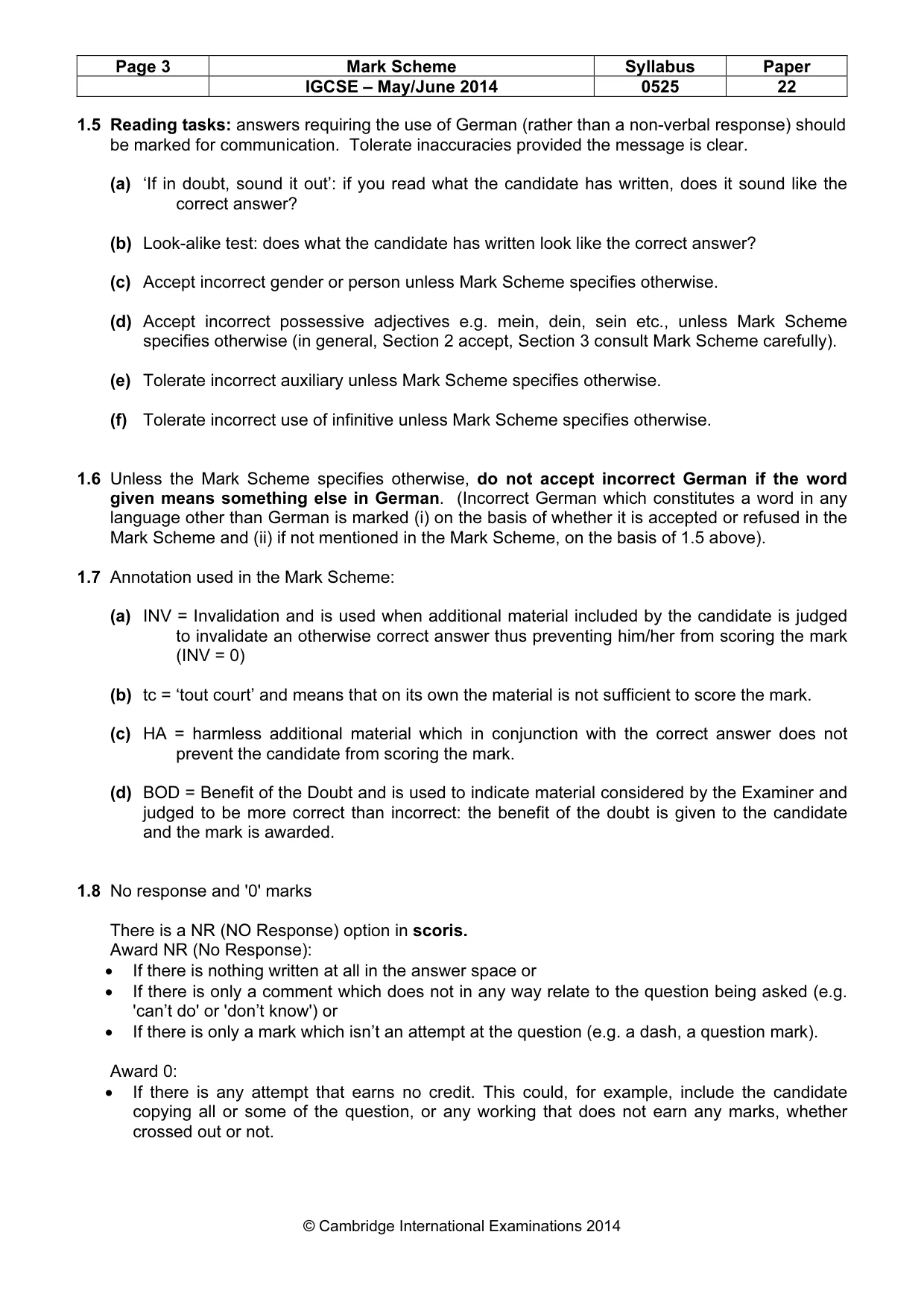
Page 2 Mark Scheme Syllabus Paper IGCSE – May/June 2014 0525 22 © Cambridge International Examinations 2014 1 General Marking Principles 1.1 Please note that it is not possible to list all acceptable alternatives in the Detailed Mark Scheme provided in Section 2. You will need to consider all alternative answers and unexpected approaches in candidates' scripts, make a decision on whether they communicate the required elements, in consultation with your Team Leader if necessary (or with your Product Manager if you are a single Examiner), and award marks accordingly. The following marking principles underpin the detailed instructions provided in Section 2 of the Mark Scheme. Where a decision is taken to deviate from these principles for a particular question, this will be specified in the Mark Scheme. 1.2 Crossing out: (a) If a candidate changes his/her mind over an answer and crosses out an attempt, award a mark if the final attempt is correct. (b) If a candidate crosses out an answer to a whole question but makes no second attempt at it, mark the crossed out work. 1.3 Reading tasks: more than the stipulated number of boxes ticked/crossed by the candidate: (a) If more than one attempt is visible, but the candidate has clearly indicated which attempt is his/her final answer (e.g. by crossing out other attempts or by annotating the script in some way), mark in the usual way. (b) If two attempts are visible (e.g. two boxes ticked instead of the 1 box stipulated), and neither has been crossed out/discounted by the candidate, no mark can be awarded. (c) In questions where candidates are required to tick a number of boxes (e.g. tick the 6 true statements) the general rule to be applied is as follows: the number of 'extra' answers indicated by the candidate is deducted from the number of correct answers and the remaining number is the mark awarded, e.g. the candidate is required to tick 6 true statements, but instead ticks 8 statements. 5 of the 6 ticks are correctly placed, but 2 of the ticks are 'extras' (8 ticks placed by candidate minus 6 ticks required by rubric = 2). Therefore the candidate is awarded a mark of 3. 5 number of correct ticks -2 minus number of extra ticks = 3 (d) Answers in pen do not take precedence over answers in pencil, e.g. if a candidate is asked to tick 1 box and ticks two, one in pen and the other in pencil, the mark cannot be awarded unless there is some explicit indication from the candidate as to which is his/her final answer. 1.4 Reading tasks: for questions requiring more than one element for the answer, (i) and (ii), where the answers are interchangeable: Both correct answers on line 1 and line 2 blank = 2 Both correct answers on line 1, but another answer on line 2 wrong = 1 (or vice-versa)
Mark scheme, page 3
Page 3 Mark Scheme Syllabus Paper IGCSE – May/June 2014 0525 22 © Cambridge International Examinations 2014 1.5 Reading tasks: answers requiring the use of German (rather than a non-verbal response) should be marked for communication. Tolerate inaccuracies provided the message is clear. (a) ‘If in doubt, sound it out’: if you read what the candidate has written, does it sound like the correct answer? (b) Look-alike test: does what the candidate has written look like the correct answer? (c) Accept incorrect gender or person unless Mark Scheme specifies otherwise. (d) Accept incorrect possessive adjectives e.g. mein, dein, sein etc., unless Mark Scheme specifies otherwise (in general, Section 2 accept, Section 3 consult Mark Scheme carefully). (e) Tolerate incorrect auxiliary unless Mark Scheme specifies otherwise. (f) Tolerate incorrect use of infinitive unless Mark Scheme specifies otherwise. 1.6 Unless the Mark Scheme specifies otherwise, do not accept incorrect German if the word given means something else in German. (Incorrect German which constitutes a word in any language other than German is marked (i) on the basis of whether it is accepted or refused in the Mark Scheme and (ii) if not mentioned in the Mark Scheme, on the basis of 1.5 above). 1.7 Annotation used in the Mark Scheme: (a) INV = Invalidation and is used when additional material included by the candidate is judged to invalidate an otherwise correct answer thus preventing him/her from scoring the mark (INV = 0) (b) tc = ‘tout court’ and means that on its own the material is not sufficient to score the mark. (c) HA = harmless additional material which in conjunction with the correct answer does not prevent the candidate from scoring the mark. (d) BOD = Benefit of the Doubt and is used to indicate material considered by the Examiner and judged to be more correct than incorrect: the benefit of the doubt is given to the candidate and the mark is awarded. 1.8 No response and '0' marks There is a NR (NO Response) option in scoris. Award NR (No Response): • If there is nothing written at all in the answer space or • If there is only a comment which does not in any way relate to the question being asked (e.g. 'can’t do' or 'don’t know') or • If there is only a mark which isn’t an attempt at the question (e.g. a dash, a question mark). Award 0: • If there is any attempt that earns no credit. This could, for example, include the candidate copying all or some of the question, or any working that does not earn any marks, whether crossed out or not.
Mark scheme, page 4
Page 4 Mark Scheme Syllabus Paper IGCSE – May/June 2014 0525 22 © Cambridge International Examinations 2014 1.9 Extra material: Section 2, Exercise 1 In Section 2, Exercise 1 reward the candidate for being able to locate the answer in the passage. Do not worry about lifting unless this would cause the message to be seriously distorted (in general, incorrect possessives should not be judged to cause distortion: see 1.5(d)) – in which case a lift will be specifically rejected in the Mark Scheme. Ignore extra material given in an answer providing that it does not invalidate an answer.
Mark scheme, page 5
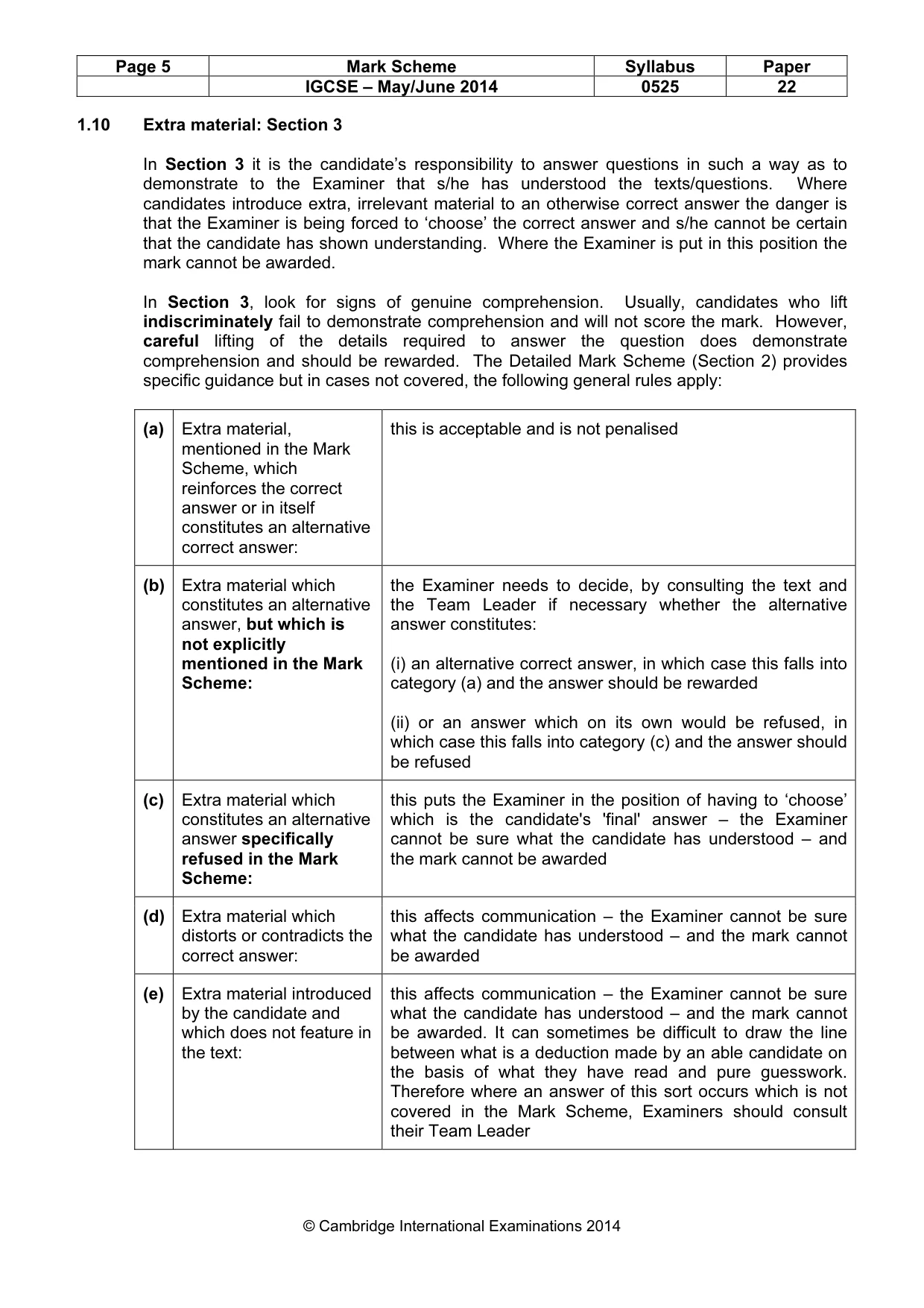
Page 5 Mark Scheme Syllabus Paper IGCSE – May/June 2014 0525 22 © Cambridge International Examinations 2014 1.10 Extra material: Section 3 In Section 3 it is the candidate’s responsibility to answer questions in such a way as to demonstrate to the Examiner that s/he has understood the texts/questions. Where candidates introduce extra, irrelevant material to an otherwise correct answer the danger is that the Examiner is being forced to ‘choose’ the correct answer and s/he cannot be certain that the candidate has shown understanding. Where the Examiner is put in this position the mark cannot be awarded. In Section 3, look for signs of genuine comprehension. Usually, candidates who lift indiscriminately fail to demonstrate comprehension and will not score the mark. However, careful lifting of the details required to answer the question does demonstrate comprehension and should be rewarded. The Detailed Mark Scheme (Section 2) provides specific guidance but in cases not covered, the following general rules apply: (a) Extra material, mentioned in the Mark Scheme, which reinforces the correct answer or in itself constitutes an alternative correct answer: this is acceptable and is not penalised (b) Extra material which constitutes an alternative answer, but which is not explicitly mentioned in the Mark Scheme: the Examiner needs to decide, by consulting the text and the Team Leader if necessary whether the alternative answer constitutes: (i) an alternative correct answer, in which case this falls into category (a) and the answer should be rewarded (ii) or an answer which on its own would be refused, in which case this falls into category (c) and the answer should be refused (c) Extra material which constitutes an alternative answer specifically refused in the Mark Scheme: this puts the Examiner in the position of having to ‘choose’ which is the candidate's 'final' answer – the Examiner cannot be sure what the candidate has understood – and the mark cannot be awarded (d) Extra material which distorts or contradicts the correct answer: this affects communication – the Examiner cannot be sure what the candidate has understood – and the mark cannot be awarded (e) Extra material introduced by the candidate and which does not feature in the text: this affects communication – the Examiner cannot be sure what the candidate has understood – and the mark cannot be awarded. It can sometimes be difficult to draw the line between what is a deduction made by an able candidate on the basis of what they have read and pure guesswork. Therefore where an answer of this sort occurs which is not covered in the Mark Scheme, Examiners should consult their Team Leader
Mark scheme, page 6
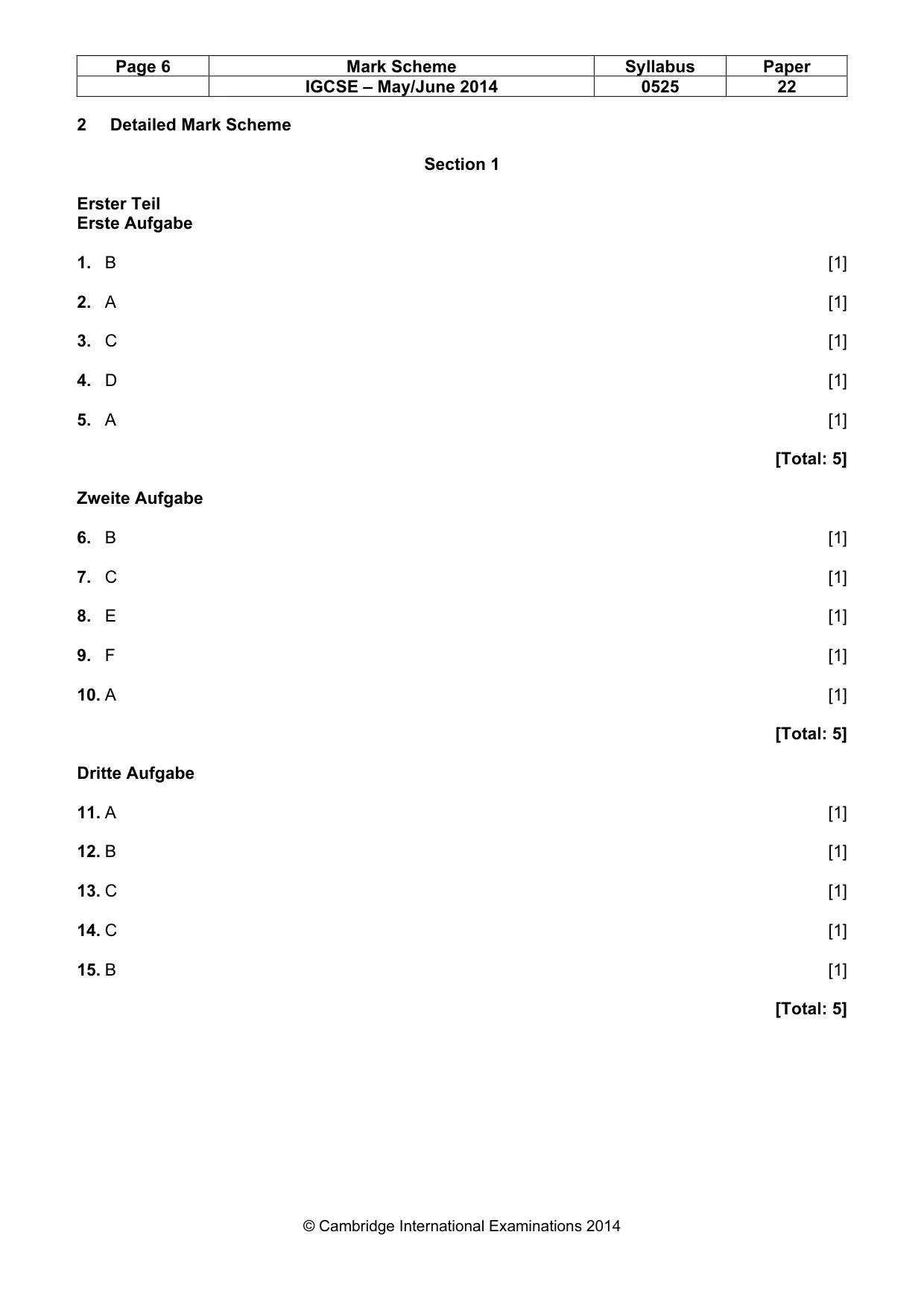
Page 6 Mark Scheme Syllabus Paper IGCSE – May/June 2014 0525 22 © Cambridge International Examinations 2014 2 Detailed Mark Scheme Section 1 Erster Teil Erste Aufgabe 1. B [1] 2. A [1] 3. C [1] 4. D [1] 5. A [1] [Total: 5] Zweite Aufgabe 6. B [1] 7. C [1] 8. E [1] 9. F [1] 10. A [1] [Total: 5] Dritte Aufgabe 11. A [1] 12. B [1] 13. C [1] 14. C [1] 15. B [1] [Total: 5]
Mark scheme, page 7
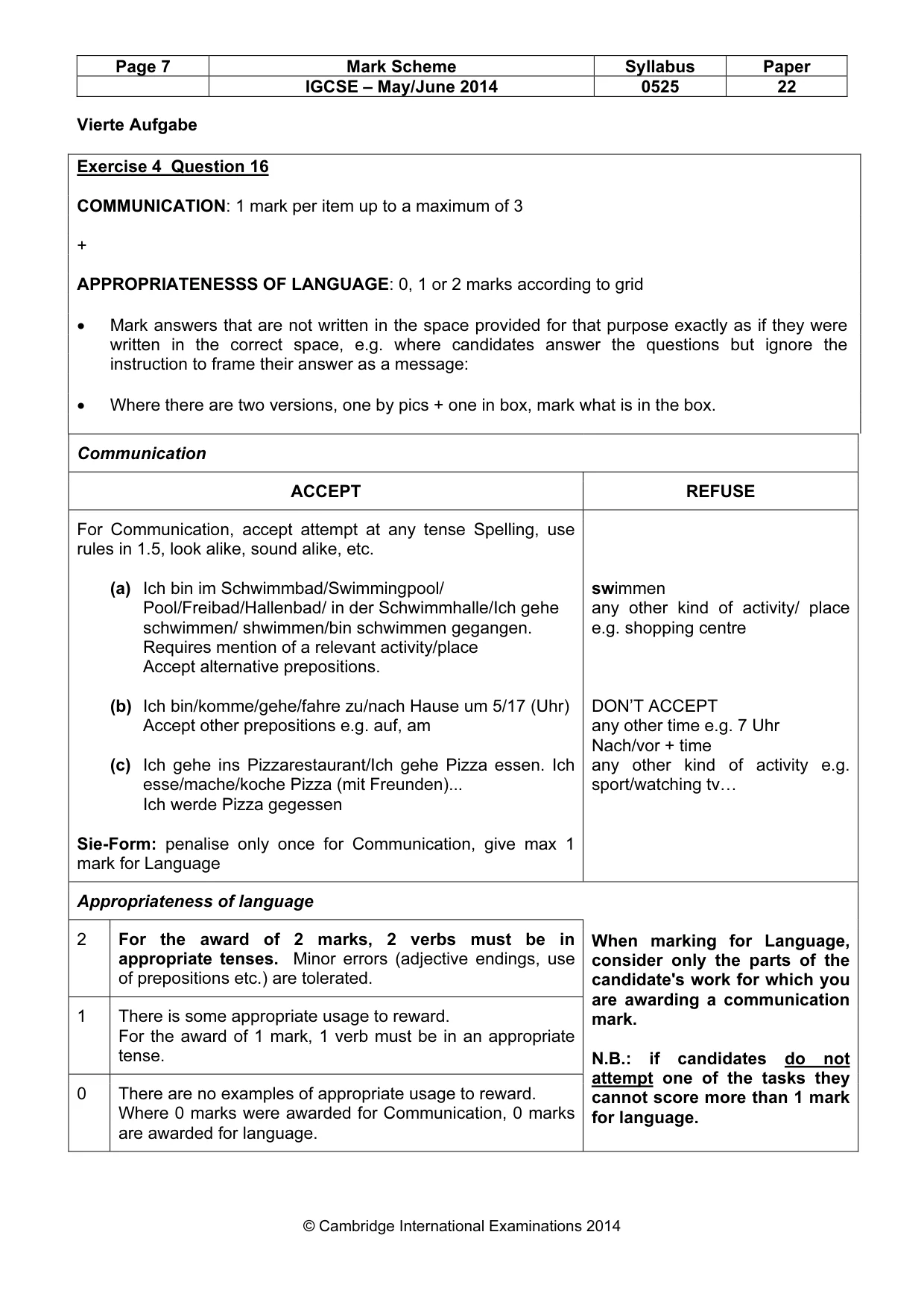
Page 7 Mark Scheme Syllabus Paper IGCSE – May/June 2014 0525 22 © Cambridge International Examinations 2014 Vierte Aufgabe Exercise 4 Question 16 COMMUNICATION: 1 mark per item up to a maximum of 3 + APPROPRIATENESSS OF LANGUAGE: 0, 1 or 2 marks according to grid • Mark answers that are not written in the space provided for that purpose exactly as if they were written in the correct space, e.g. where candidates answer the questions but ignore the instruction to frame their answer as a message: • Where there are two versions, one by pics + one in box, mark what is in the box. Communication ACCEPT REFUSE For Communication, accept attempt at any tense Spelling, use rules in 1.5, look alike, sound alike, etc. (a) Ich bin im Schwimmbad/Swimmingpool/ Pool/Freibad/Hallenbad/ in der Schwimmhalle/Ich gehe schwimmen/ shwimmen/bin schwimmen gegangen. Requires mention of a relevant activity/place Accept alternative prepositions. (b) Ich bin/komme/gehe/fahre zu/nach Hause um 5/17 (Uhr) Accept other prepositions e.g. auf, am (c) Ich gehe ins Pizzarestaurant/Ich gehe Pizza essen. Ich esse/mache/koche Pizza (mit Freunden)... Ich werde Pizza gegessen Sie-Form: penalise only once for Communication, give max 1 mark for Language swimmen any other kind of activity/ place e.g. shopping centre DON’T ACCEPT any other time e.g. 7 Uhr Nach/vor + time any other kind of activity e.g. sport/watching tv… Appropriateness of language When marking for Language, consider only the parts of the candidate's work for which you are awarding a communication mark. N.B.: if candidates do not attempt one of the tasks they cannot score more than 1 mark for language. 2 For the award of 2 marks, 2 verbs must be in appropriate tenses. Minor errors (adjective endings, use of prepositions etc.) are tolerated. 1 There is some appropriate usage to reward. For the award of 1 mark, 1 verb must be in an appropriate tense. 0 There are no examples of appropriate usage to reward. Where 0 marks were awarded for Communication, 0 marks are awarded for language.
Mark scheme, page 8
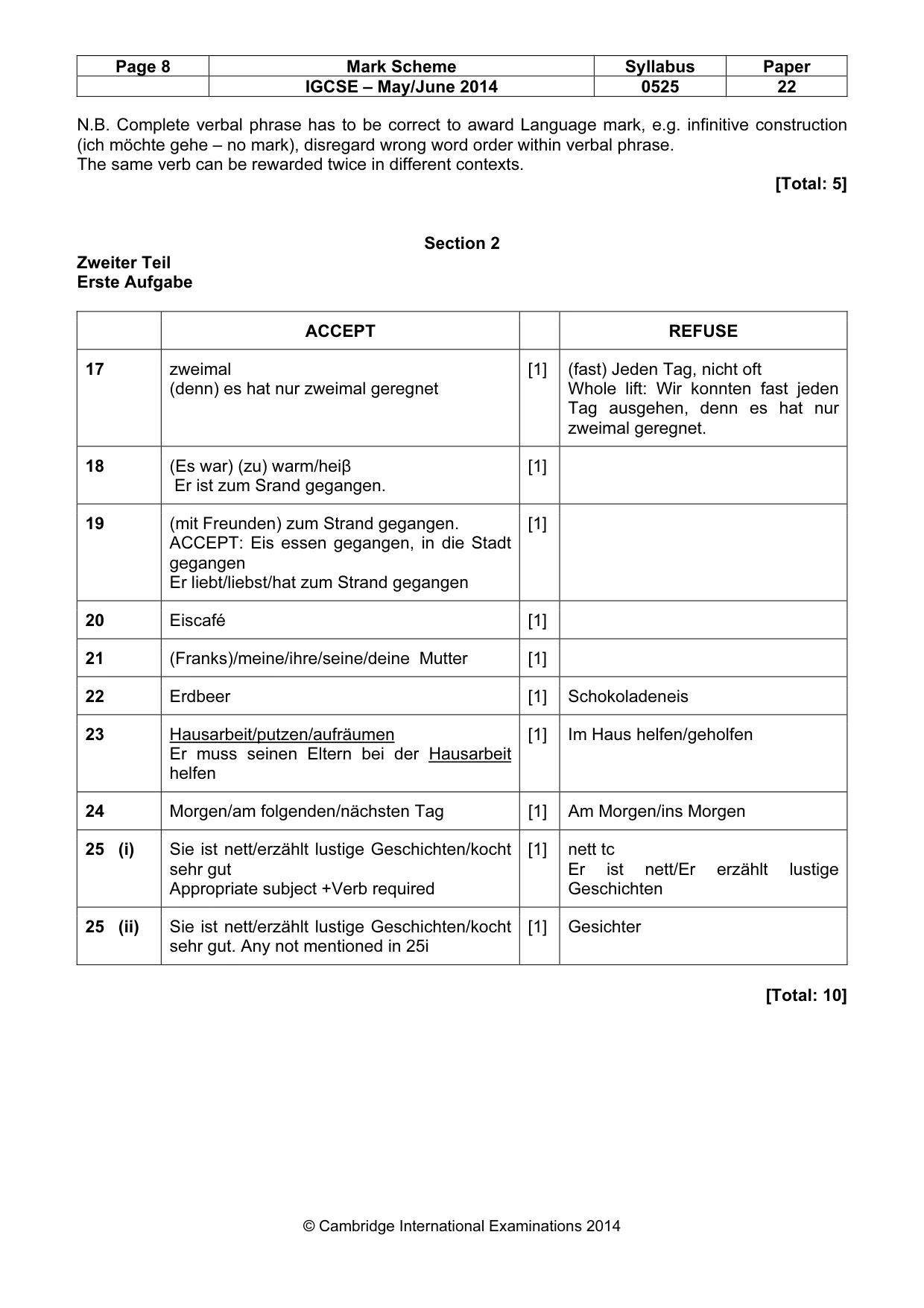
Page 8 Mark Scheme Syllabus Paper IGCSE – May/June 2014 0525 22 © Cambridge International Examinations 2014 N.B. Complete verbal phrase has to be correct to award Language mark, e.g. infinitive construction (ich möchte gehe – no mark), disregard wrong word order within verbal phrase. The same verb can be rewarded twice in different contexts. [Total: 5] Section 2 Zweiter Teil Erste Aufgabe ACCEPT REFUSE 17 zweimal (denn) es hat nur zweimal geregnet [1] (fast) Jeden Tag, nicht oft Whole lift: Wir konnten fast jeden Tag ausgehen, denn es hat nur zweimal geregnet. 18 (Es war) (zu) warm/heiβ Er ist zum Srand gegangen. [1] 19 (mit Freunden) zum Strand gegangen. ACCEPT: Eis essen gegangen, in die Stadt gegangen Er liebt/liebst/hat zum Strand gegangen [1] 20 Eiscafé [1] 21 (Franks)/meine/ihre/seine/deine Mutter [1] 22 Erdbeer [1] Schokoladeneis 23 Hausarbeit/putzen/aufräumen Er muss seinen Eltern bei der Hausarbeit helfen [1] Im Haus helfen/geholfen 24 Morgen/am folgenden/nächsten Tag [1] Am Morgen/ins Morgen 25 (i) Sie ist nett/erzählt lustige Geschichten/kocht sehr gut Appropriate subject +Verb required [1] nett tc Er ist nett/Er erzählt lustige Geschichten 25 (ii) Sie ist nett/erzählt lustige Geschichten/kocht sehr gut. Any not mentioned in 25i [1] Gesichter [Total: 10]
Mark scheme, page 9
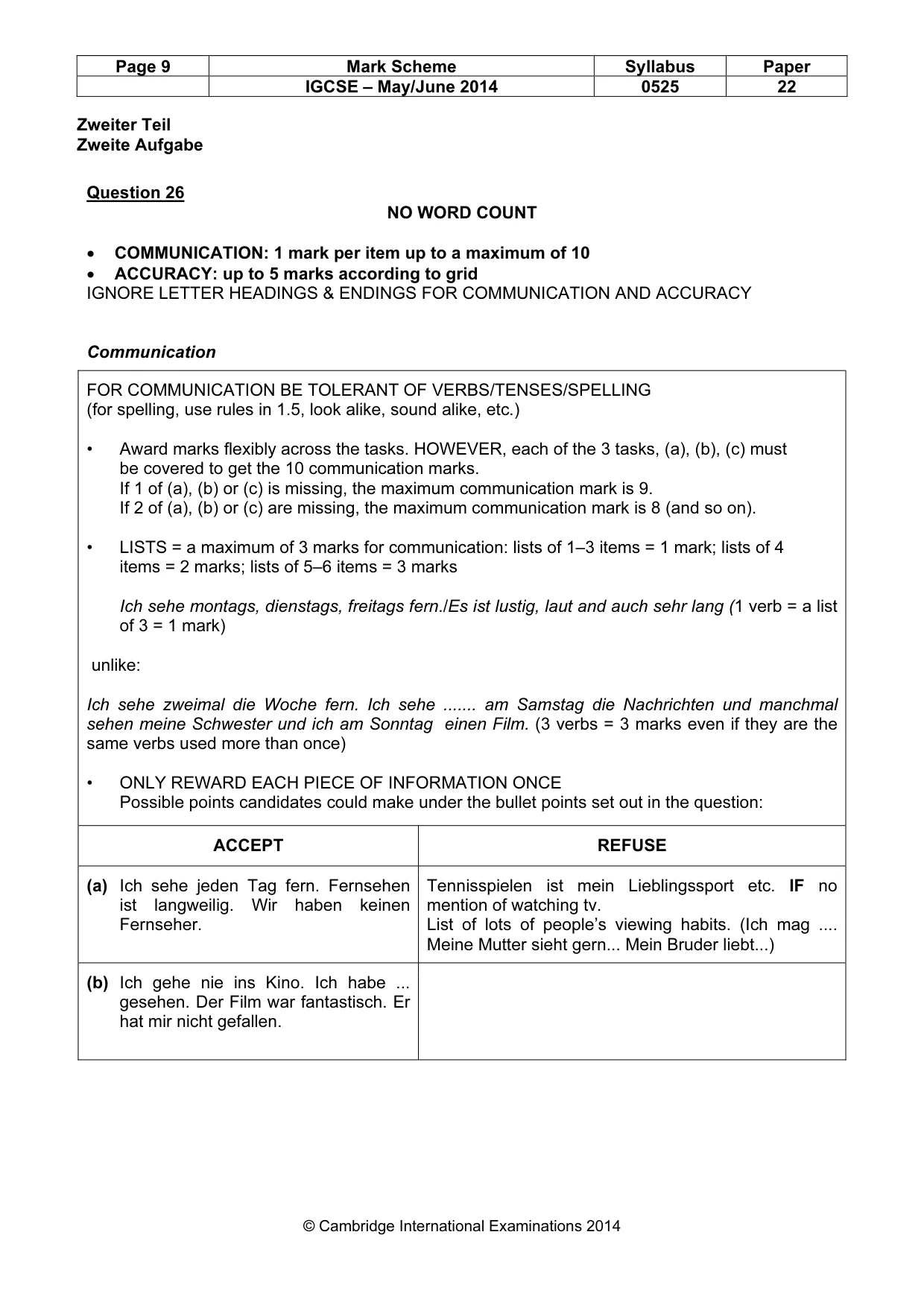
Page 9 Mark Scheme Syllabus Paper IGCSE – May/June 2014 0525 22 © Cambridge International Examinations 2014 Zweiter Teil Zweite Aufgabe Question 26 NO WORD COUNT • COMMUNICATION: 1 mark per item up to a maximum of 10 • ACCURACY: up to 5 marks according to grid IGNORE LETTER HEADINGS & ENDINGS FOR COMMUNICATION AND ACCURACY Communication FOR COMMUNICATION BE TOLERANT OF VERBS/TENSES/SPELLING (for spelling, use rules in 1.5, look alike, sound alike, etc.) • Award marks flexibly across the tasks. HOWEVER, each of the 3 tasks, (a), (b), (c) must be covered to get the 10 communication marks. If 1 of (a), (b) or (c) is missing, the maximum communication mark is 9. If 2 of (a), (b) or (c) are missing, the maximum communication mark is 8 (and so on). • LISTS = a maximum of 3 marks for communication: lists of 1–3 items = 1 mark; lists of 4 items = 2 marks; lists of 5–6 items = 3 marks Ich sehe montags, dienstags, freitags fern./Es ist lustig, laut and auch sehr lang (1 verb = a list of 3 = 1 mark) unlike: Ich sehe zweimal die Woche fern. Ich sehe … am Samstag die Nachrichten und manchmal sehen meine Schwester und ich am Sonntag einen Film. (3 verbs = 3 marks even if they are the same verbs used more than once) • ONLY REWARD EACH PIECE OF INFORMATION ONCE Possible points candidates could make under the bullet points set out in the question: ACCEPT REFUSE (a) Ich sehe jeden Tag fern. Fernsehen ist langweilig. Wir haben keinen Fernseher. Tennisspielen ist mein Lieblingssport etc. IF no mention of watching tv. List of lots of people’s viewing habits. (Ich mag … Meine Mutter sieht gern... Mein Bruder liebt...) (b) Ich gehe nie ins Kino. Ich habe ... gesehen. Der Film war fantastisch. Er hat mir nicht gefallen.
Mark scheme, page 10
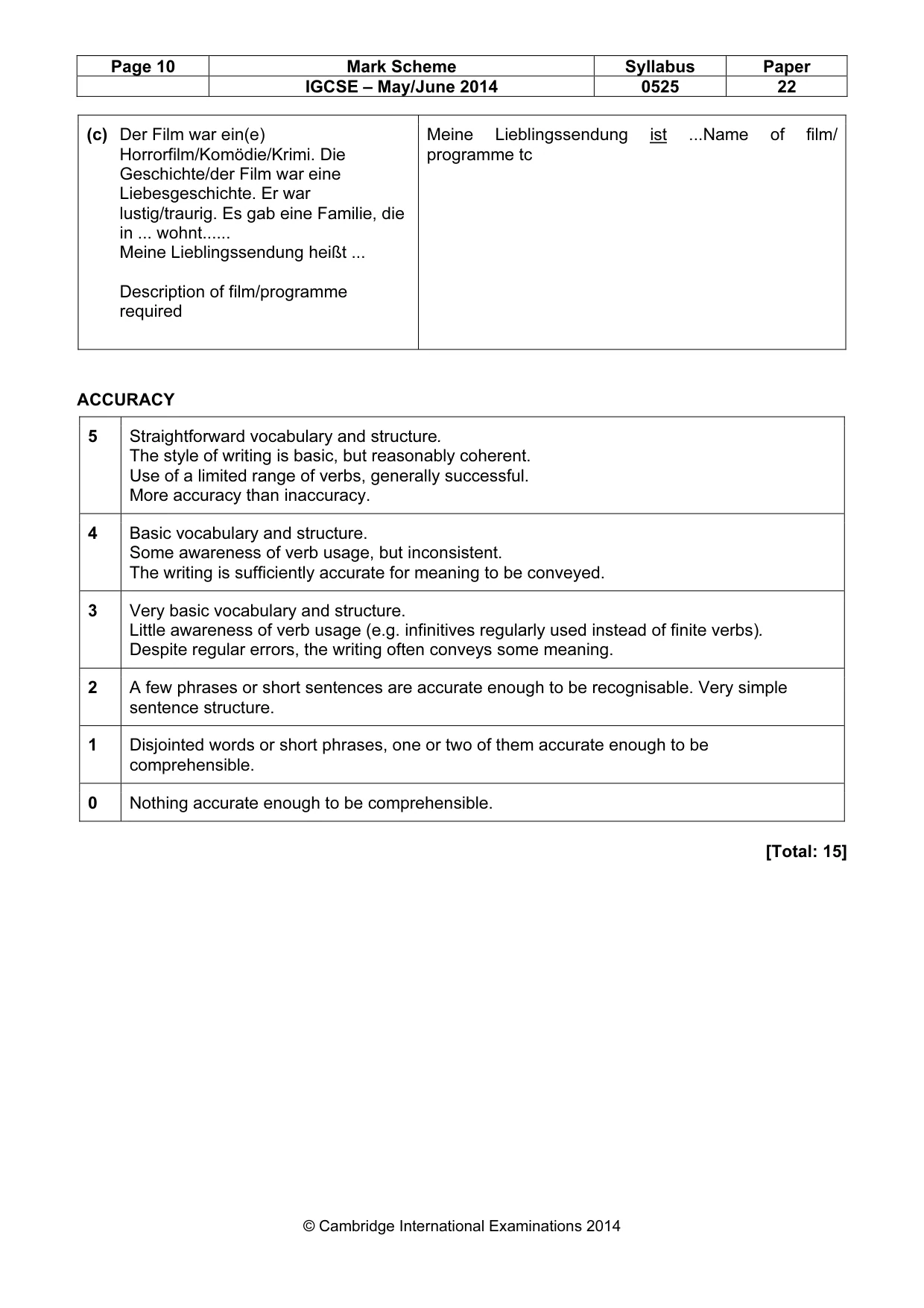
Page 10 Mark Scheme Syllabus Paper IGCSE – May/June 2014 0525 22 © Cambridge International Examinations 2014 (c) Der Film war ein(e) Horrorfilm/Komödie/Krimi. Die Geschichte/der Film war eine Liebesgeschichte. Er war lustig/traurig. Es gab eine Familie, die in ... wohnt… Meine Lieblingssendung heißt ... Description of film/programme required Meine Lieblingssendung ist ...Name of film/ programme tc ACCURACY [Total: 15] 5 Straightforward vocabulary and structure. The style of writing is basic, but reasonably coherent. Use of a limited range of verbs, generally successful. More accuracy than inaccuracy. 4 Basic vocabulary and structure. Some awareness of verb usage, but inconsistent. The writing is sufficiently accurate for meaning to be conveyed. 3 Very basic vocabulary and structure. Little awareness of verb usage (e.g. infinitives regularly used instead of finite verbs). Despite regular errors, the writing often conveys some meaning. 2 A few phrases or short sentences are accurate enough to be recognisable. Very simple sentence structure. 1 Disjointed words or short phrases, one or two of them accurate enough to be comprehensible. 0 Nothing accurate enough to be comprehensible.
Mark scheme, page 11
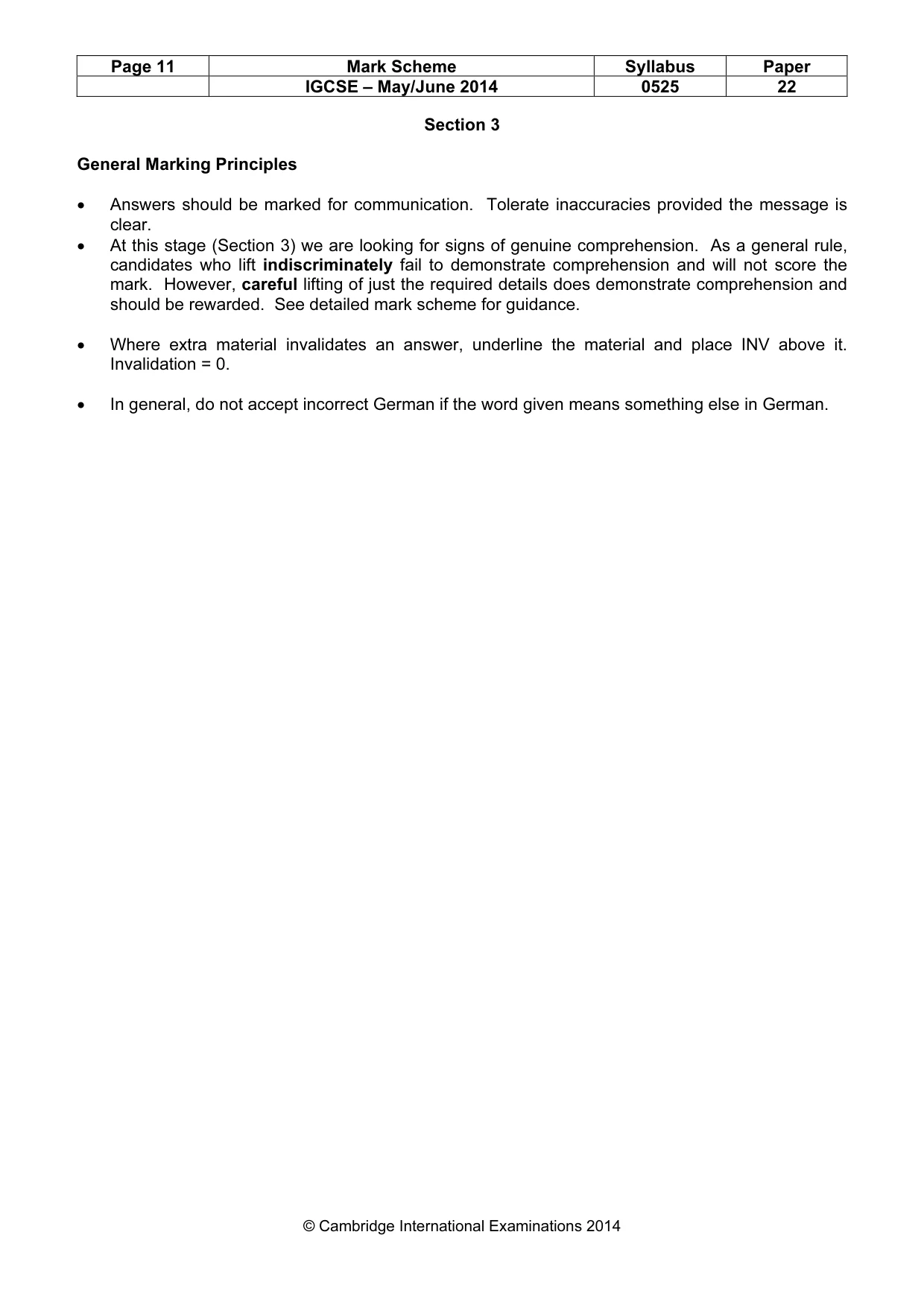
Page 11 Mark Scheme Syllabus Paper IGCSE – May/June 2014 0525 22 © Cambridge International Examinations 2014 Section 3 General Marking Principles • Answers should be marked for communication. Tolerate inaccuracies provided the message is clear. • At this stage (Section 3) we are looking for signs of genuine comprehension. As a general rule, candidates who lift indiscriminately fail to demonstrate comprehension and will not score the mark. However, careful lifting of just the required details does demonstrate comprehension and should be rewarded. See detailed mark scheme for guidance. • Where extra material invalidates an answer, underline the material and place INV above it. Invalidation = 0. • In general, do not accept incorrect German if the word given means something else in German.
Mark scheme, page 12
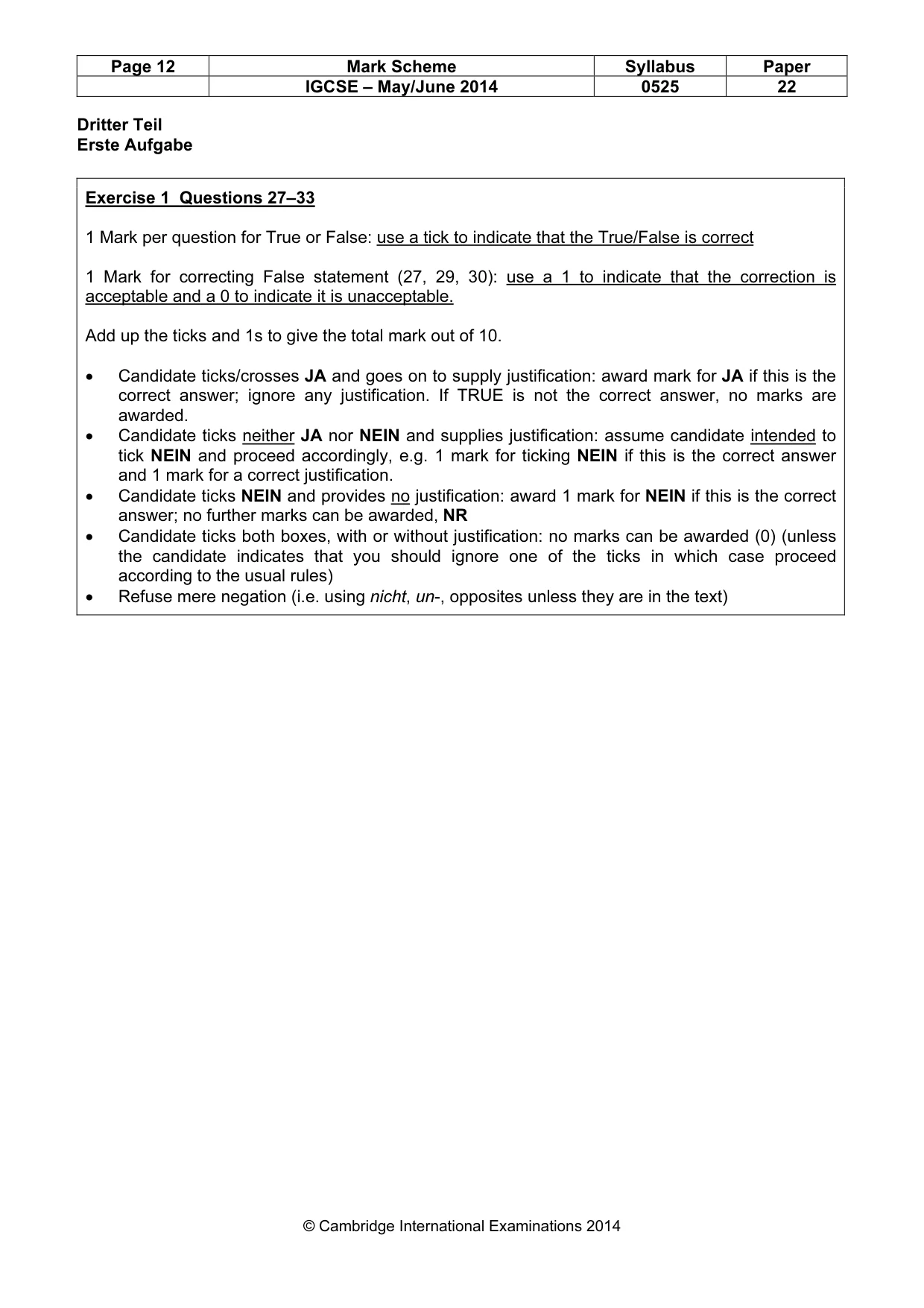
Page 12 Mark Scheme Syllabus Paper IGCSE – May/June 2014 0525 22 © Cambridge International Examinations 2014 Dritter Teil Erste Aufgabe Exercise 1 Questions 27–33 1 Mark per question for True or False: use a tick to indicate that the True/False is correct 1 Mark for correcting False statement (27, 29, 30): use a 1 to indicate that the correction is acceptable and a 0 to indicate it is unacceptable. Add up the ticks and 1s to give the total mark out of 10. • Candidate ticks/crosses JA and goes on to supply justification: award mark for JA if this is the correct answer; ignore any justification. If TRUE is not the correct answer, no marks are awarded. • Candidate ticks neither JA nor NEIN and supplies justification: assume candidate intended to tick NEIN and proceed accordingly, e.g. 1 mark for ticking NEIN if this is the correct answer and 1 mark for a correct justification. • Candidate ticks NEIN and provides no justification: award 1 mark for NEIN if this is the correct answer; no further marks can be awarded, NR • Candidate ticks both boxes, with or without justification: no marks can be awarded (0) (unless the candidate indicates that you should ignore one of the ticks in which case proceed according to the usual rules) • Refuse mere negation (i.e. using nicht, un-, opposites unless they are in the text)
Mark scheme, page 13
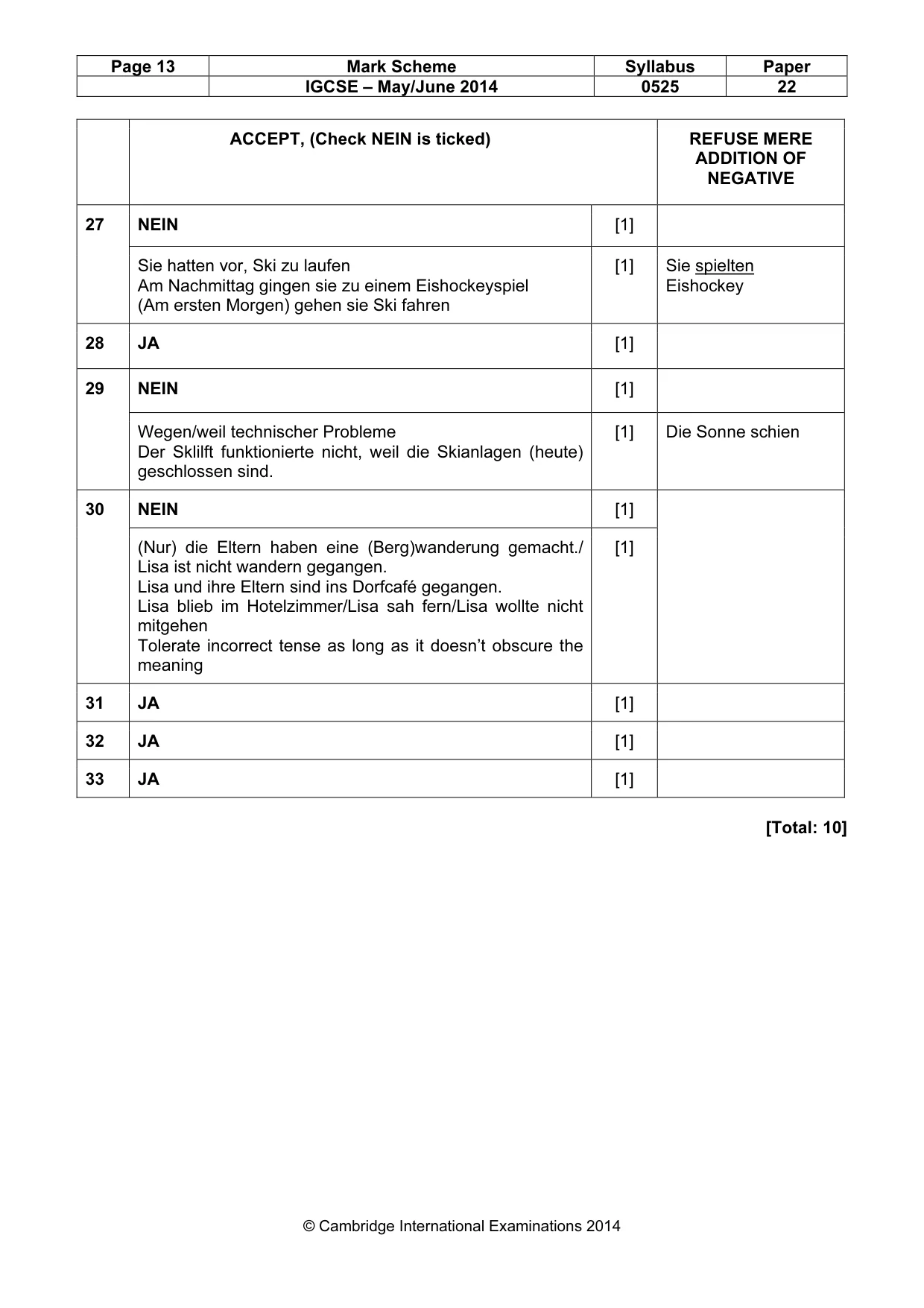
Page 13 Mark Scheme Syllabus Paper IGCSE – May/June 2014 0525 22 © Cambridge International Examinations 2014 [Total: 10] ACCEPT, (Check NEIN is ticked) REFUSE MERE ADDITION OF NEGATIVE 27 NEIN [1] Sie hatten vor, Ski zu laufen Am Nachmittag gingen sie zu einem Eishockeyspiel (Am ersten Morgen) gehen sie Ski fahren [1] Sie spielten Eishockey 28 JA [1] 29 NEIN [1] Wegen/weil technischer Probleme Der Sklilft funktionierte nicht, weil die Skianlagen (heute) geschlossen sind. [1] Die Sonne schien 30 NEIN [1] (Nur) die Eltern haben eine (Berg)wanderung gemacht./ Lisa ist nicht wandern gegangen. Lisa und ihre Eltern sind ins Dorfcafé gegangen. Lisa blieb im Hotelzimmer/Lisa sah fern/Lisa wollte nicht mitgehen Tolerate incorrect tense as long as it doesn’t obscure the meaning [1] 31 JA [1] 32 JA [1] 33 JA [1]
Mark scheme, page 14
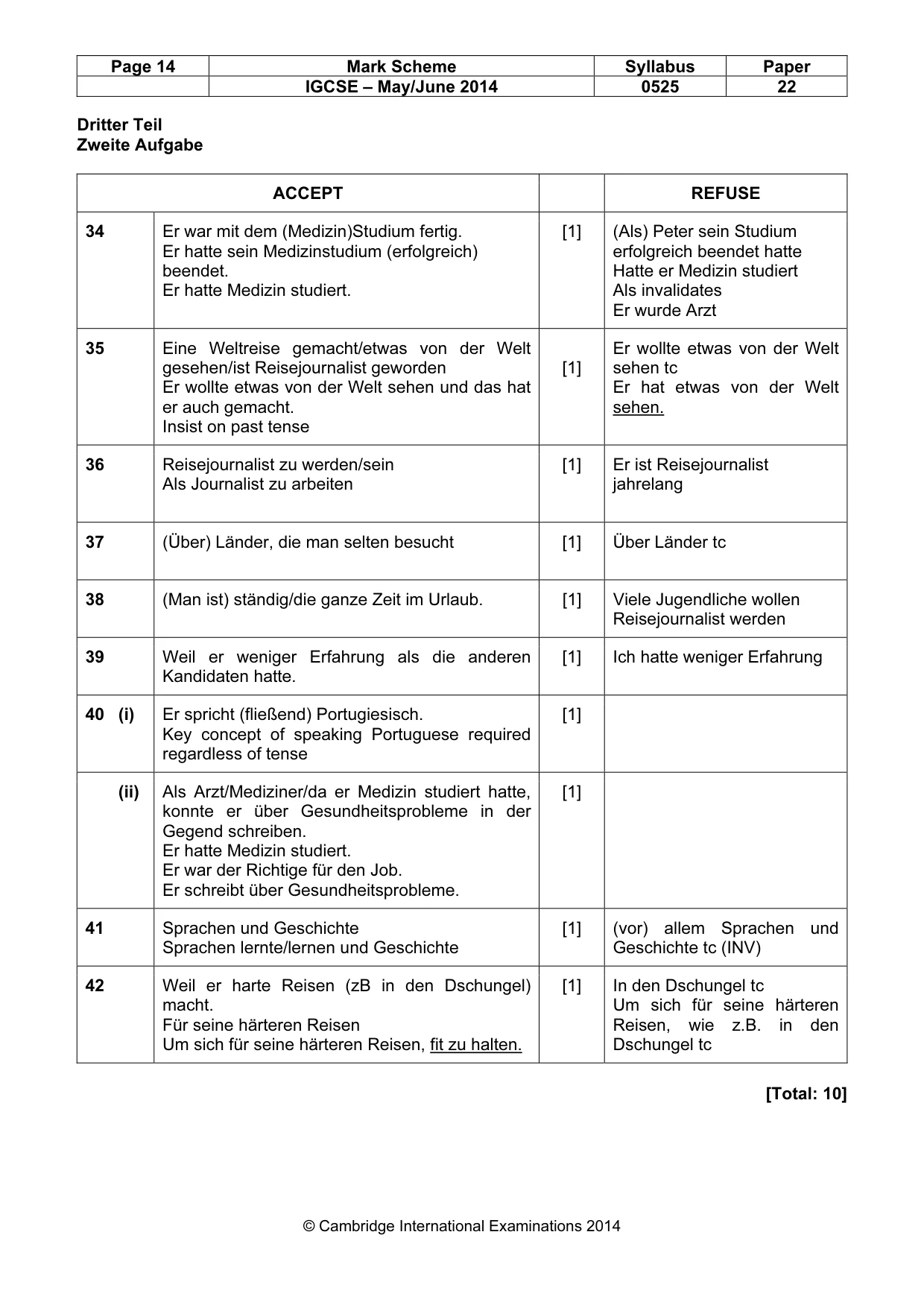
Page 14 Mark Scheme Syllabus Paper IGCSE – May/June 2014 0525 22 © Cambridge International Examinations 2014 Dritter Teil Zweite Aufgabe ACCEPT REFUSE 34 Er war mit dem (Medizin)Studium fertig. Er hatte sein Medizinstudium (erfolgreich) beendet. Er hatte Medizin studiert. [1] (Als) Peter sein Studium erfolgreich beendet hatte Hatte er Medizin studiert Als invalidates Er wurde Arzt 35 Eine Weltreise gemacht/etwas von der Welt gesehen/ist Reisejournalist geworden Er wollte etwas von der Welt sehen und das hat er auch gemacht. Insist on past tense [1] Er wollte etwas von der Welt sehen tc Er hat etwas von der Welt sehen. 36 Reisejournalist zu werden/sein Als Journalist zu arbeiten [1] Er ist Reisejournalist jahrelang 37 (Über) Länder, die man selten besucht [1] Über Länder tc 38 (Man ist) ständig/die ganze Zeit im Urlaub. [1] Viele Jugendliche wollen Reisejournalist werden 39 Weil er weniger Erfahrung als die anderen Kandidaten hatte. [1] Ich hatte weniger Erfahrung 40 (i) Er spricht (fließend) Portugiesisch. Key concept of speaking Portuguese required regardless of tense [1] (ii) Als Arzt/Mediziner/da er Medizin studiert hatte, konnte er über Gesundheitsprobleme in der Gegend schreiben. Er hatte Medizin studiert. Er war der Richtige für den Job. Er schreibt über Gesundheitsprobleme. [1] 41 Sprachen und Geschichte Sprachen lernte/lernen und Geschichte [1] (vor) allem Sprachen und Geschichte tc (INV) 42 Weil er harte Reisen (zB in den Dschungel) macht. Für seine härteren Reisen Um sich für seine härteren Reisen, fit zu halten. [1] In den Dschungel tc Um sich für seine härteren Reisen, wie z.B. in den Dschungel tc [Total: 10]
What you needed in this session
Cambridge’s own grade thresholds for 2014 May/June, Paper 2 · Variant 2. A higher threshold means an easier paper — the bar moves with how the cohort did.