Cambridge IGCSE French - Foreign Language 0520 — 2023 May/June Paper 2 · Variant 3
0520/23/M/J/23 · 45 marks · ≈51 min
The question paper and its mark scheme, free to read here and free to download. This is Cambridge’s own paper, exactly as it was sat.
Question paper12 pages

Mark scheme8 pages
Answers below. Sit the paper first if you are practising.
Paper as text
Question paper, page 1
This document has 12 pages. Any blank pages are indicated. [Turn over Cambridge IGCSE™ FRENCH 0520/23 Paper 2 Reading May/June 2023 1 hour You must answer on the question paper. No additional materials are needed. INSTRUCTIONS ● Answer all questions. ● Use a black or dark blue pen. ● Write your name, centre number and candidate number in the boxes at the top of the page. ● Write your answer to each question in the space provided. ● Do not use an erasable pen or correction fluid. ● Do not write on any bar codes. ● Dictionaries are not allowed. INFORMATION ● The total mark for this paper is 45. ● The number of marks for each question or part question is shown in brackets [ ]. * 5 3 6 2 9 1 2 1 0 8 * DC (CJ/AR) 321518/1 © UCLES 2023
Question paper, page 2
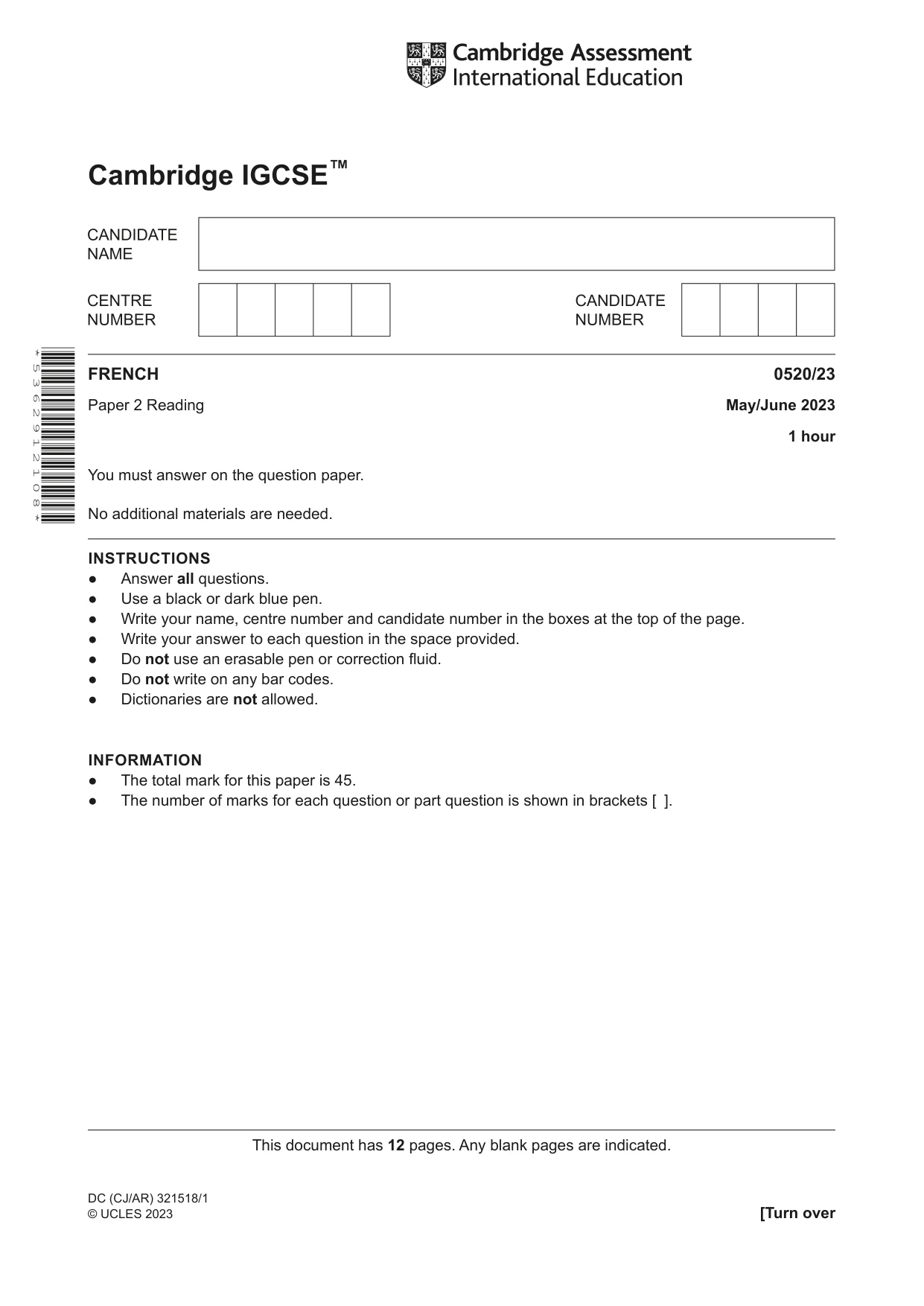
2 0520/23/M/J/23 © UCLES 2023 1 Regardez les images. C B A E D F Pour chaque question, écrivez la bonne lettre (A–F) dans la case appropriée. (a) Il se réveille tôt le matin. [1] (b) Il prépare son sac pour l’école. [1] (c) Il parle avec ses amis devant chez lui. [1] (d) Il fait ses devoirs dans sa chambre. [1] (e) Il joue au foot dans son jardin. [1] [Total : 5]
Question paper, page 3
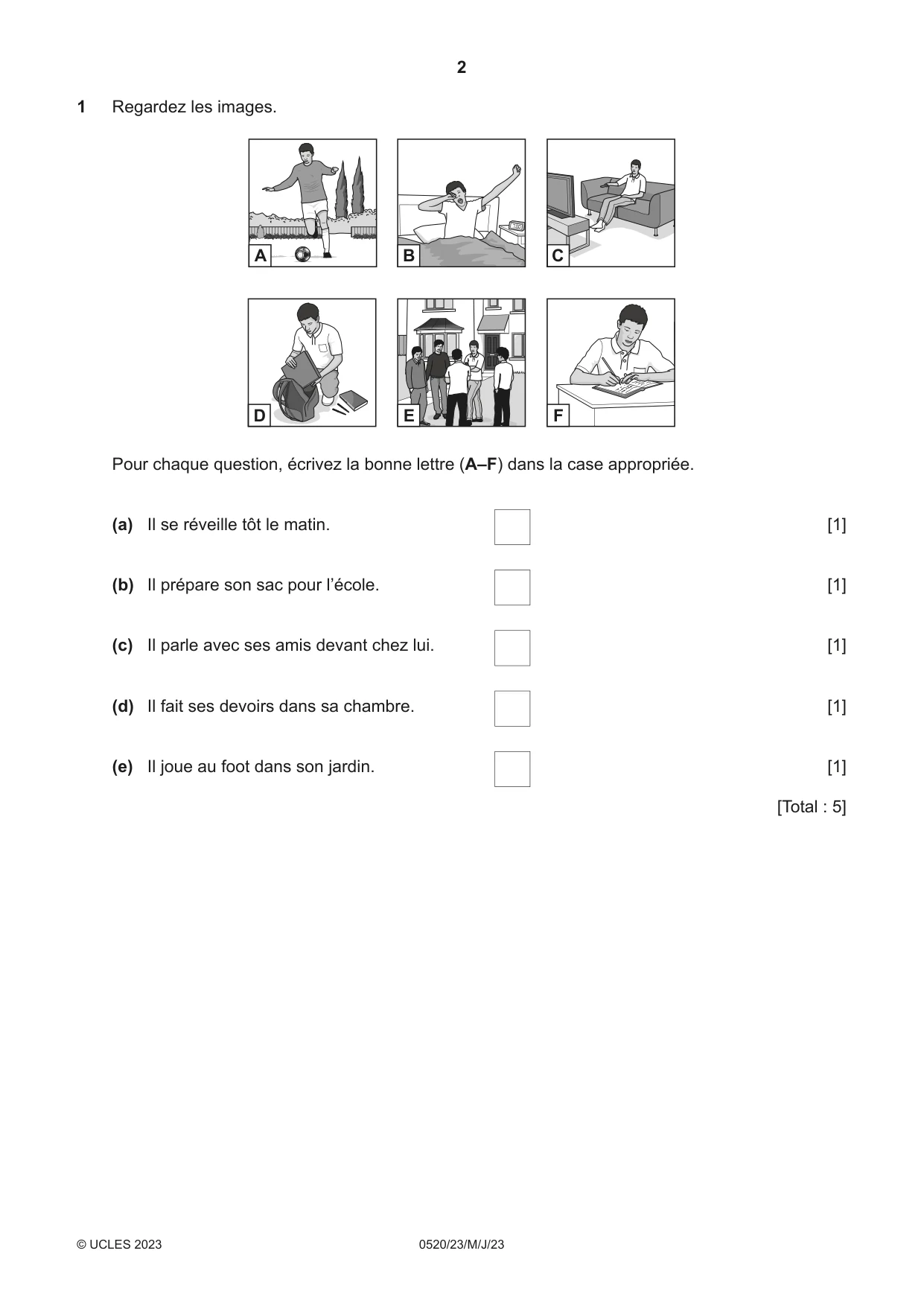
3 0520/23/M/J/23 © UCLES 2023 [Turn over 2 Regardez les panneaux. Au centre de jardinage A B C D E F G H POISSONS CAISSE FLEURS LIBRAIRIE PETITS ANIMAUX POTERIE ARBRES FRUITIERS CAFÉTÉRIA Pour chaque question, écrivez la bonne lettre (A–H) dans la case appropriée. (a) J’adore les pommes. Je vais acheter ce pommier. [1] (b) Quelles jolies roses rouges ! [1] (c) Cela fait 15 euros en tout. [1] (d) J’aimerais bien aller boire un coca. [1] (e) Allons voir les hamsters et les souris. [1] [Total : 5]
Question paper, page 4
4 0520/23/M/J/23 © UCLES 2023 3 Lisez le texte. Pour chaque question, cochez (✓) la case qui correspond à la bonne réponse. L’année dernière, je me suis cassé la jambe. J’ai dû rester chez moi plusieurs semaines. J’ai pris de mauvaises habitudes alors, maintenant, j’essaie de me remettre en forme. Je ne suis pas très sportif. Je fais du sport au collège car je n’ai pas le choix. Maintenant, je fais du jogging tous les dimanches matin. Mais je dois me forcer à sortir quand il pleut. J’essaie toujours de manger une alimentation saine. Bien que je n’aime pas beaucoup les fruits, j’en mange à tous les repas. Je suis souvent stressé à la fin de la journée. Pour me détendre, je joue de la guitare dans ma chambre. D’habitude, je me couche vers 10 heures. Une fois au lit, je bois du lait chaud et je lis un magazine. Max (a) L’année dernière, Max a… A eu un accident. B gagné une compétition. C beaucoup travaillé. [1] (b) À l’école, Max doit… A aider ses copains. B faire du sport. C étudier l’anglais. [1] (c) Max fait du jogging tous les… A après-midi. B week-ends. C soirs. [1]
Question paper, page 5
5 0520/23/M/J/23 © UCLES 2023 [Turn over (d) Max n’aime pas courir quand il fait… A chaud. B froid. C mauvais. [1] (e) Max mange … des fruits. A très rarement B quelquefois C régulièrement [1] (f) Pour se relaxer, Max … de la musique. A écoute B joue C écrit [1] (g) Avant de dormir, Max… A prend une boisson. B mange un biscuit. C joue sur son ipad. [1] [Total : 7]
Question paper, page 6
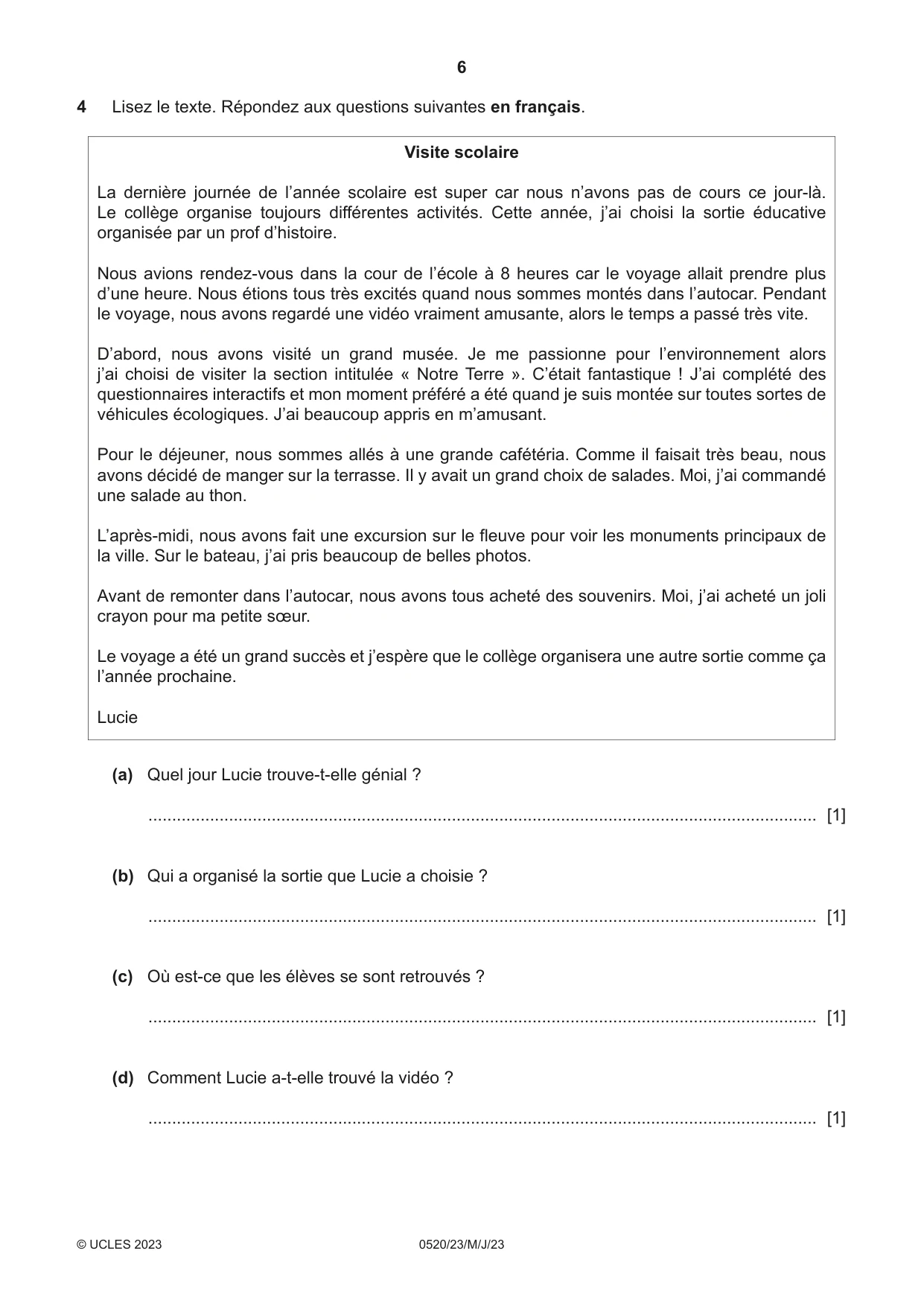
6 0520/23/M/J/23 © UCLES 2023 4 Lisez le texte. Répondez aux questions suivantes en français. Visite scolaire La dernière journée de l’année scolaire est super car nous n’avons pas de cours ce jour-là. Le collège organise toujours différentes activités. Cette année, j’ai choisi la sortie éducative organisée par un prof d’histoire. Nous avions rendez-vous dans la cour de l’école à 8 heures car le voyage allait prendre plus d’une heure. Nous étions tous très excités quand nous sommes montés dans l’autocar. Pendant le voyage, nous avons regardé une vidéo vraiment amusante, alors le temps a passé très vite. D’abord, nous avons visité un grand musée. Je me passionne pour l’environnement alors j’ai choisi de visiter la section intitulée « Notre Terre ». C’était fantastique ! J’ai complété des questionnaires interactifs et mon moment préféré a été quand je suis montée sur toutes sortes de véhicules écologiques. J’ai beaucoup appris en m’amusant. Pour le déjeuner, nous sommes allés à une grande cafétéria. Comme il faisait très beau, nous avons décidé de manger sur la terrasse. Il y avait un grand choix de salades. Moi, j’ai commandé une salade au thon. L’après-midi, nous avons fait une excursion sur le fleuve pour voir les monuments principaux de la ville. Sur le bateau, j’ai pris beaucoup de belles photos. Avant de remonter dans l’autocar, nous avons tous acheté des souvenirs. Moi, j’ai acheté un joli crayon pour ma petite sœur. Le voyage a été un grand succès et j’espère que le collège organisera une autre sortie comme ça l’année prochaine. Lucie (a) Quel jour Lucie trouve-t-elle génial ? … [1] (b) Qui a organisé la sortie que Lucie a choisie ? … [1] (c) Où est-ce que les élèves se sont retrouvés ? … [1] (d) Comment Lucie a-t-elle trouvé la vidéo ? … [1]
Question paper, page 7
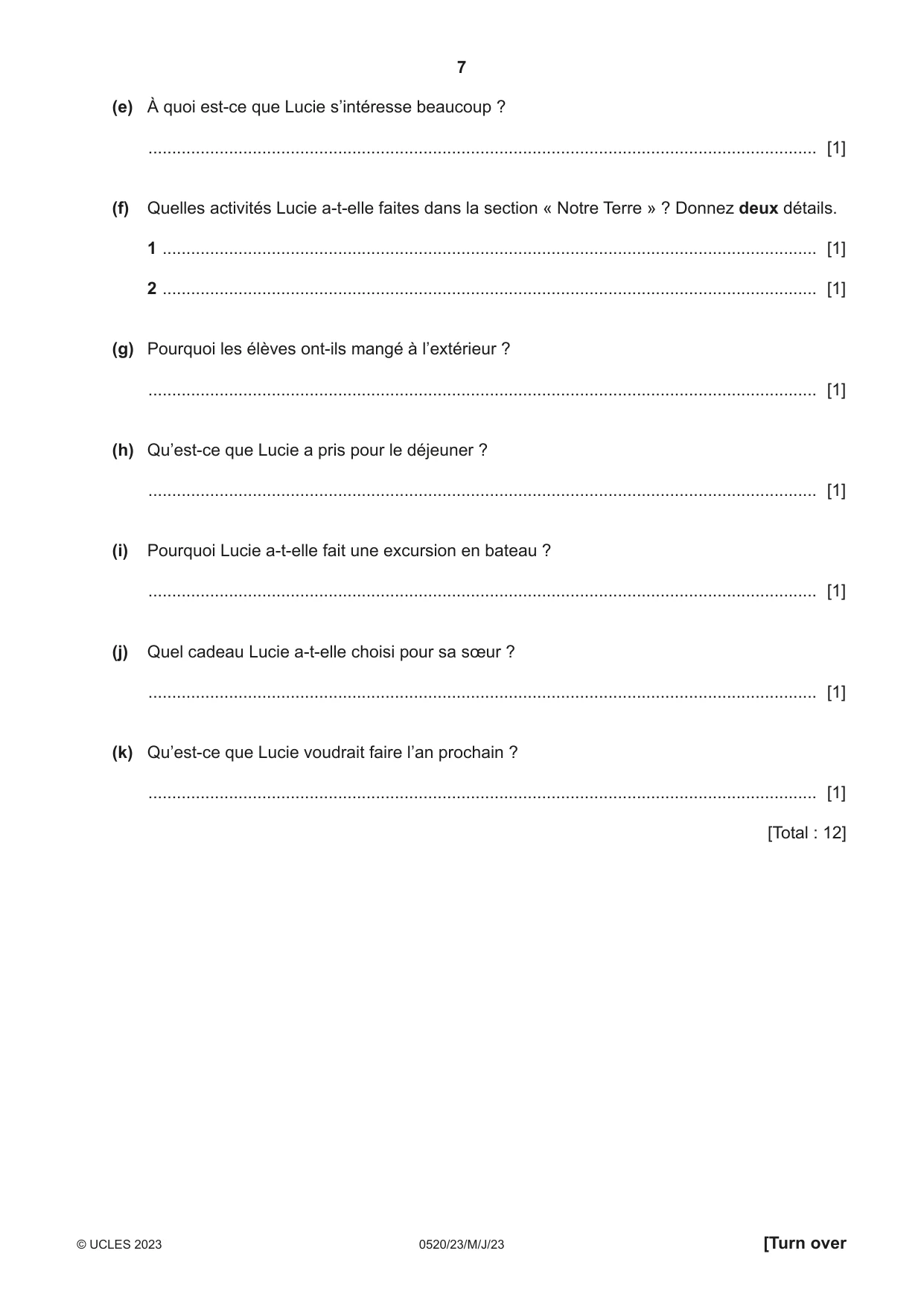
7 0520/23/M/J/23 © UCLES 2023 [Turn over (e) À quoi est-ce que Lucie s’intéresse beaucoup ? … [1] (f) Quelles activités Lucie a-t-elle faites dans la section « Notre Terre » ? Donnez deux détails. 1 … [1] 2 … [1] (g) Pourquoi les élèves ont-ils mangé à l’extérieur ? … [1] (h) Qu’est-ce que Lucie a pris pour le déjeuner ? … [1] (i) Pourquoi Lucie a-t-elle fait une excursion en bateau ? … [1] (j) Quel cadeau Lucie a-t-elle choisi pour sa sœur ? … [1] (k) Qu’est-ce que Lucie voudrait faire l’an prochain ? … [1] [Total : 12]
Question paper, page 8
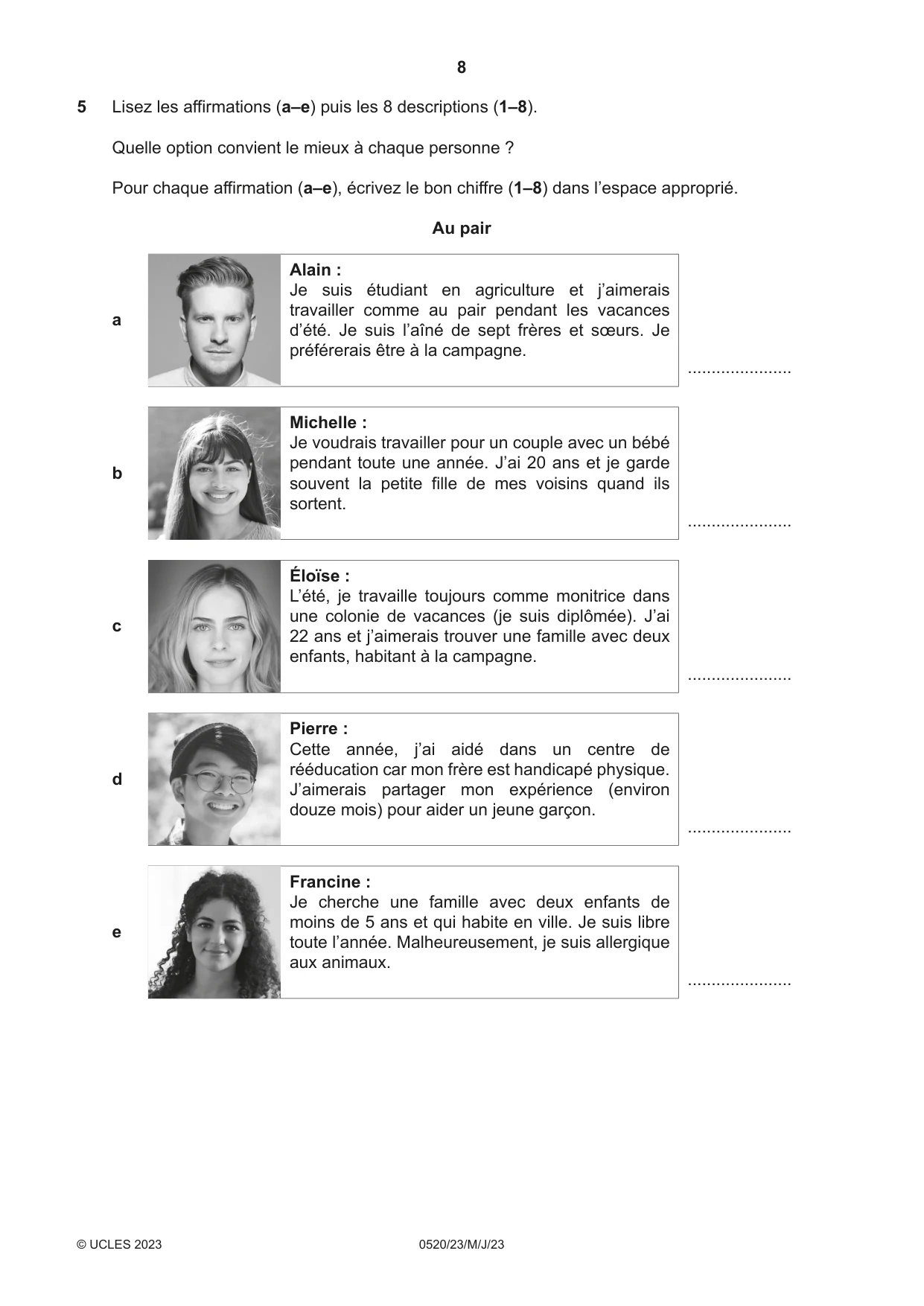
8 0520/23/M/J/23 © UCLES 2023 5 Lisez les affirmations (a–e) puis les 8 descriptions (1–8). Quelle option convient le mieux à chaque personne ? Pour chaque affirmation (a–e), écrivez le bon chiffre (1–8) dans l’espace approprié. Au pair a Alain : Je suis étudiant en agriculture et j’aimerais travailler comme au pair pendant les vacances d’été. Je suis l’aîné de sept frères et sœurs. Je préférerais être à la campagne. … b Michelle : Je voudrais travailler pour un couple avec un bébé pendant toute une année. J’ai 20 ans et je garde souvent la petite fille de mes voisins quand ils sortent. … c Éloïse : L’été, je travaille toujours comme monitrice dans une colonie de vacances (je suis diplômée). J’ai 22 ans et j’aimerais trouver une famille avec deux enfants, habitant à la campagne. … d Pierre : Cette année, j’ai aidé dans un centre de rééducation car mon frère est handicapé physique. J’aimerais partager mon expérience (environ douze mois) pour aider un jeune garçon. … e Francine : Je cherche une famille avec deux enfants de moins de 5 ans et qui habite en ville. Je suis libre toute l’année. Malheureusement, je suis allergique aux animaux. …
Question paper, page 9
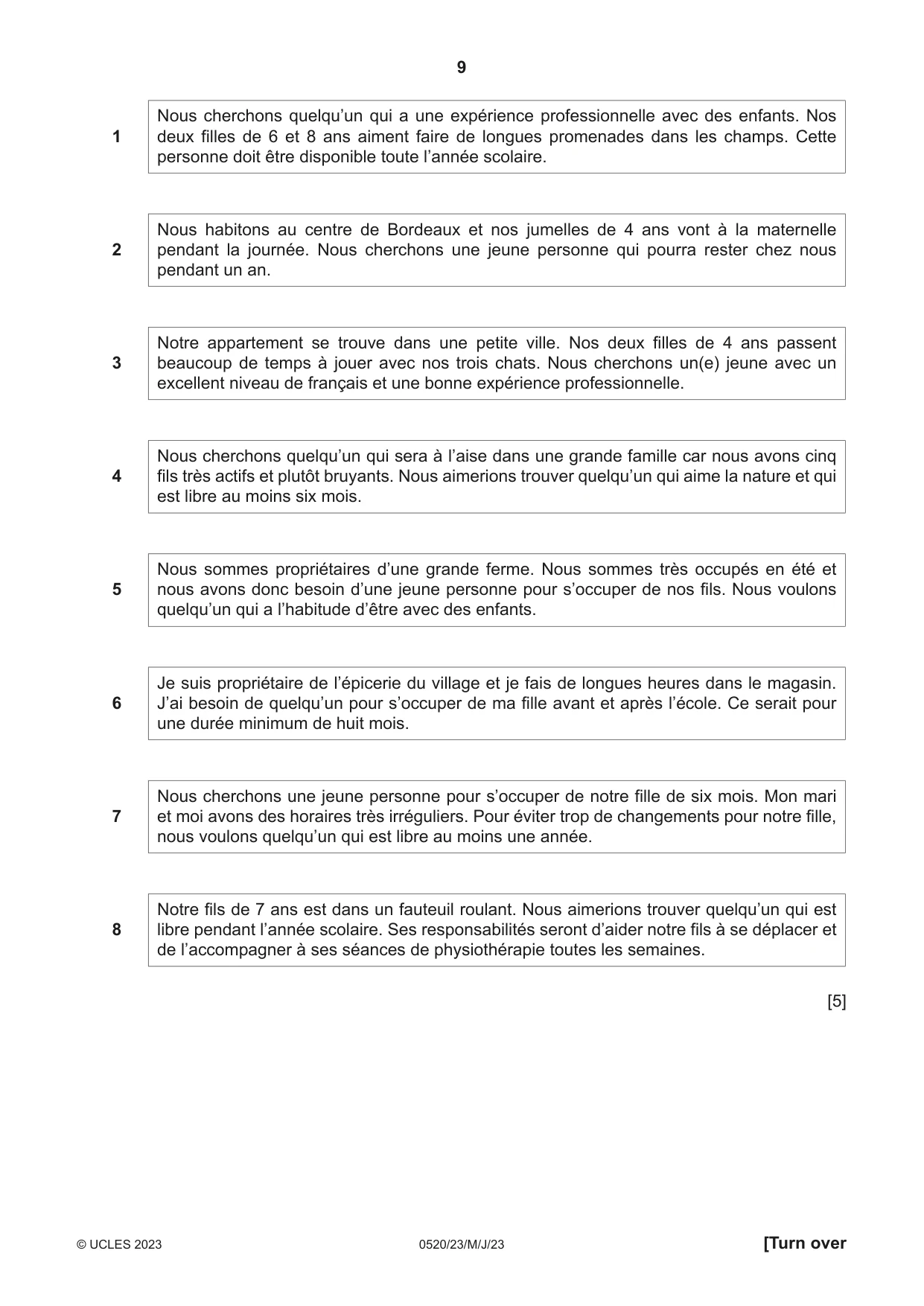
9 0520/23/M/J/23 © UCLES 2023 [Turn over 1 Nous cherchons quelqu’un qui a une expérience professionnelle avec des enfants. Nos deux filles de 6 et 8 ans aiment faire de longues promenades dans les champs. Cette personne doit être disponible toute l’année scolaire. 2 Nous habitons au centre de Bordeaux et nos jumelles de 4 ans vont à la maternelle pendant la journée. Nous cherchons une jeune personne qui pourra rester chez nous pendant un an. 3 Notre appartement se trouve dans une petite ville. Nos deux filles de 4 ans passent beaucoup de temps à jouer avec nos trois chats. Nous cherchons un(e) jeune avec un excellent niveau de français et une bonne expérience professionnelle. 4 Nous cherchons quelqu’un qui sera à l’aise dans une grande famille car nous avons cinq fils très actifs et plutôt bruyants. Nous aimerions trouver quelqu’un qui aime la nature et qui est libre au moins six mois. 5 Nous sommes propriétaires d’une grande ferme. Nous sommes très occupés en été et nous avons donc besoin d’une jeune personne pour s’occuper de nos fils. Nous voulons quelqu’un qui a l’habitude d’être avec des enfants. 6 Je suis propriétaire de l’épicerie du village et je fais de longues heures dans le magasin. J’ai besoin de quelqu’un pour s’occuper de ma fille avant et après l’école. Ce serait pour une durée minimum de huit mois. 7 Nous cherchons une jeune personne pour s’occuper de notre fille de six mois. Mon mari et moi avons des horaires très irréguliers. Pour éviter trop de changements pour notre fille, nous voulons quelqu’un qui est libre au moins une année. 8 Notre fils de 7 ans est dans un fauteuil roulant. Nous aimerions trouver quelqu’un qui est libre pendant l’année scolaire. Ses responsabilités seront d’aider notre fils à se déplacer et de l’accompagner à ses séances de physiothérapie toutes les semaines. [5]
Question paper, page 10
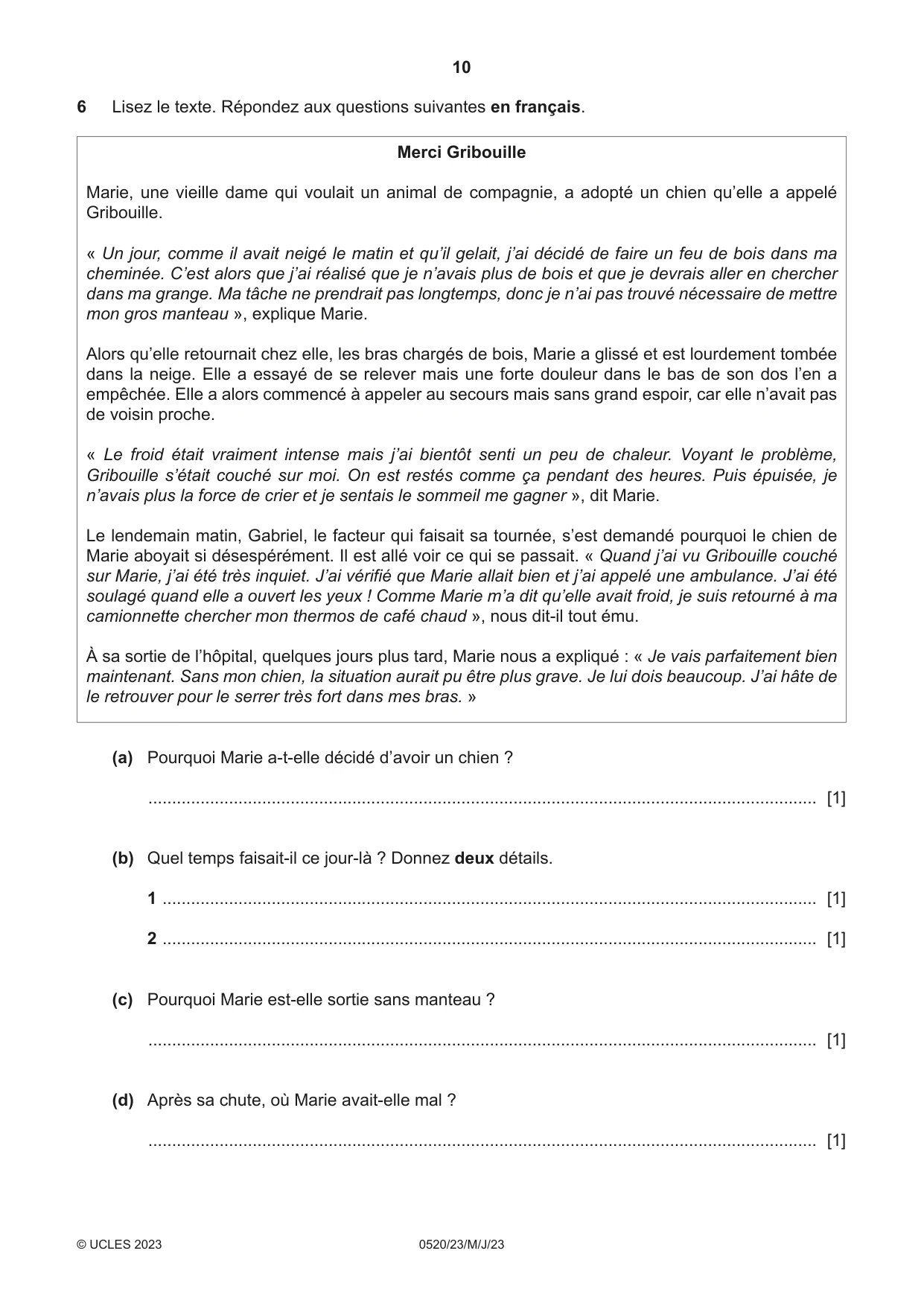
10 0520/23/M/J/23 © UCLES 2023 6 Lisez le texte. Répondez aux questions suivantes en français. Merci Gribouille Marie, une vieille dame qui voulait un animal de compagnie, a adopté un chien qu’elle a appelé Gribouille. « Un jour, comme il avait neigé le matin et qu’il gelait, j’ai décidé de faire un feu de bois dans ma cheminée. C’est alors que j’ai réalisé que je n’avais plus de bois et que je devrais aller en chercher dans ma grange. Ma tâche ne prendrait pas longtemps, donc je n’ai pas trouvé nécessaire de mettre mon gros manteau », explique Marie. Alors qu’elle retournait chez elle, les bras chargés de bois, Marie a glissé et est lourdement tombée dans la neige. Elle a essayé de se relever mais une forte douleur dans le bas de son dos l’en a empêchée. Elle a alors commencé à appeler au secours mais sans grand espoir, car elle n’avait pas de voisin proche. « Le froid était vraiment intense mais j’ai bientôt senti un peu de chaleur. Voyant le problème, Gribouille s’était couché sur moi. On est restés comme ça pendant des heures. Puis épuisée, je n’avais plus la force de crier et je sentais le sommeil me gagner », dit Marie. Le lendemain matin, Gabriel, le facteur qui faisait sa tournée, s’est demandé pourquoi le chien de Marie aboyait si désespérément. Il est allé voir ce qui se passait. « Quand j’ai vu Gribouille couché sur Marie, j’ai été très inquiet. J’ai vérifié que Marie allait bien et j’ai appelé une ambulance. J’ai été soulagé quand elle a ouvert les yeux ! Comme Marie m’a dit qu’elle avait froid, je suis retourné à ma camionnette chercher mon thermos de café chaud », nous dit-il tout ému. À sa sortie de l’hôpital, quelques jours plus tard, Marie nous a expliqué : « Je vais parfaitement bien maintenant. Sans mon chien, la situation aurait pu être plus grave. Je lui dois beaucoup. J’ai hâte de le retrouver pour le serrer très fort dans mes bras. » (a) Pourquoi Marie a-t-elle décidé d’avoir un chien ? … [1] (b) Quel temps faisait-il ce jour-là ? Donnez deux détails. 1 … [1] 2 … [1] (c) Pourquoi Marie est-elle sortie sans manteau ? … [1] (d) Après sa chute, où Marie avait-elle mal ? … [1]
Question paper, page 11
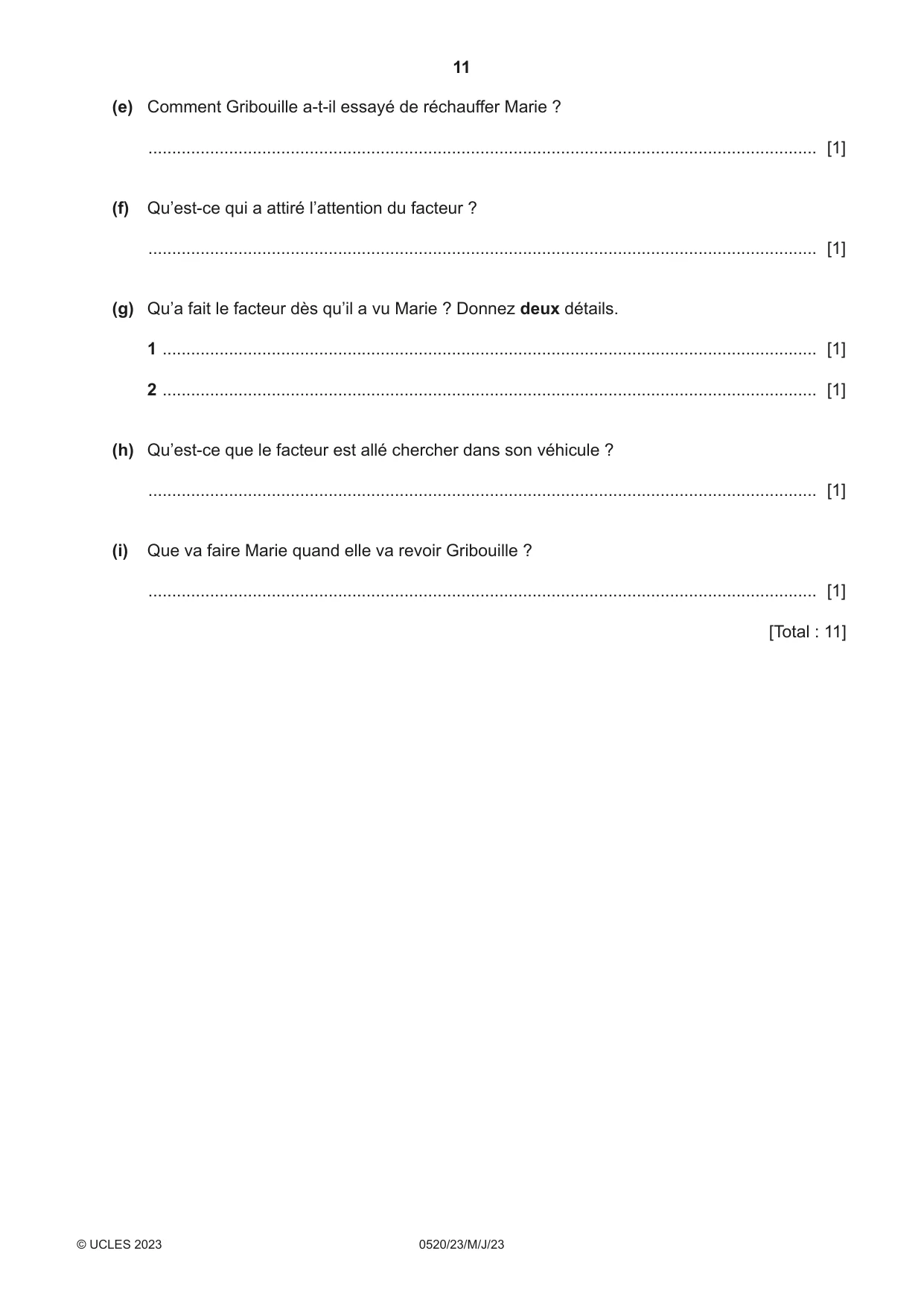
11 0520/23/M/J/23 © UCLES 2023 (e) Comment Gribouille a-t-il essayé de réchauffer Marie ? … [1] (f) Qu’est-ce qui a attiré l’attention du facteur ? … [1] (g) Qu’a fait le facteur dès qu’il a vu Marie ? Donnez deux détails. 1 … [1] 2 … [1] (h) Qu’est-ce que le facteur est allé chercher dans son véhicule ? … [1] (i) Que va faire Marie quand elle va revoir Gribouille ? … [1] [Total : 11]
Question paper, page 12
12 0520/23/M/J/23 © UCLES 2023 Permission to reproduce items where third-party owned material protected by copyright is included has been sought and cleared where possible. Every reasonable effort has been made by the publisher (UCLES) to trace copyright holders, but if any items requiring clearance have unwittingly been included, the publisher will be pleased to make amends at the earliest possible opportunity. To avoid the issue of disclosure of answer-related information to candidates, all copyright acknowledgements are reproduced online in the Cambridge Assessment International Education Copyright Acknowledgements Booklet. This is produced for each series of examinations and is freely available to download at www.cambridgeinternational.org after the live examination series. Cambridge Assessment International Education is part of Cambridge Assessment. Cambridge Assessment is the brand name of the University of Cambridge Local Examinations Syndicate (UCLES), which is a department of the University of Cambridge. BLANK PAGE
Mark scheme, page 1
This document consists of 8 printed pages. © UCLES 2023 [Turn over Cambridge IGCSE™ FRENCH 0520/23 Paper 2 Reading May/June 2023 MARK SCHEME Maximum Mark: 45 Published This mark scheme is published as an aid to teachers and candidates, to indicate the requirements of the examination. It shows the basis on which Examiners were instructed to award marks. It does not indicate the details of the discussions that took place at an Examiners’ meeting before marking began, which would have considered the acceptability of alternative answers. Mark schemes should be read in conjunction with the question paper and the Principal Examiner Report for Teachers. Cambridge International will not enter into discussions about these mark schemes. Cambridge International is publishing the mark schemes for the May/June 2023 series for most Cambridge IGCSE, Cambridge International A and AS Level and Cambridge Pre-U components, and some Cambridge O Level components.
Mark scheme, page 2
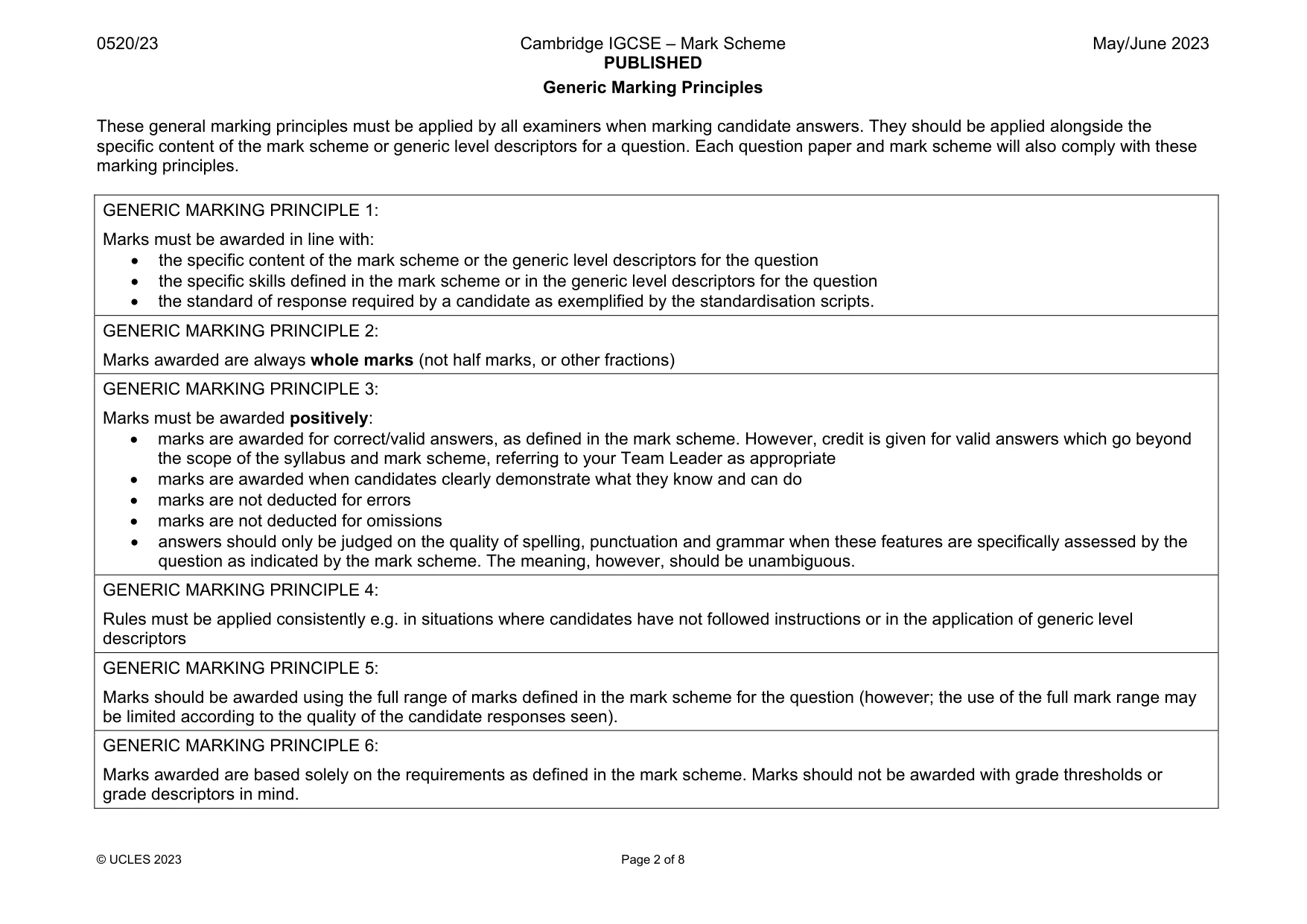
0520/23 Cambridge IGCSE – Mark Scheme PUBLISHED May/June 2023 © UCLES 2023 Page 2 of 8 Generic Marking Principles These general marking principles must be applied by all examiners when marking candidate answers. They should be applied alongside the specific content of the mark scheme or generic level descriptors for a question. Each question paper and mark scheme will also comply with these marking principles. GENERIC MARKING PRINCIPLE 1: Marks must be awarded in line with: the specific content of the mark scheme or the generic level descriptors for the question the specific skills defined in the mark scheme or in the generic level descriptors for the question the standard of response required by a candidate as exemplified by the standardisation scripts. GENERIC MARKING PRINCIPLE 2: Marks awarded are always whole marks (not half marks, or other fractions) GENERIC MARKING PRINCIPLE 3: Marks must be awarded positively: marks are awarded for correct/valid answers, as defined in the mark scheme. However, credit is given for valid answers which go beyond the scope of the syllabus and mark scheme, referring to your Team Leader as appropriate marks are awarded when candidates clearly demonstrate what they know and can do marks are not deducted for errors marks are not deducted for omissions answers should only be judged on the quality of spelling, punctuation and grammar when these features are specifically assessed by the question as indicated by the mark scheme. The meaning, however, should be unambiguous. GENERIC MARKING PRINCIPLE 4: Rules must be applied consistently e.g. in situations where candidates have not followed instructions or in the application of generic level descriptors GENERIC MARKING PRINCIPLE 5: Marks should be awarded using the full range of marks defined in the mark scheme for the question (however; the use of the full mark range may be limited according to the quality of the candidate responses seen). GENERIC MARKING PRINCIPLE 6: Marks awarded are based solely on the requirements as defined in the mark scheme. Marks should not be awarded with grade thresholds or grade descriptors in mind.
Mark scheme, page 3
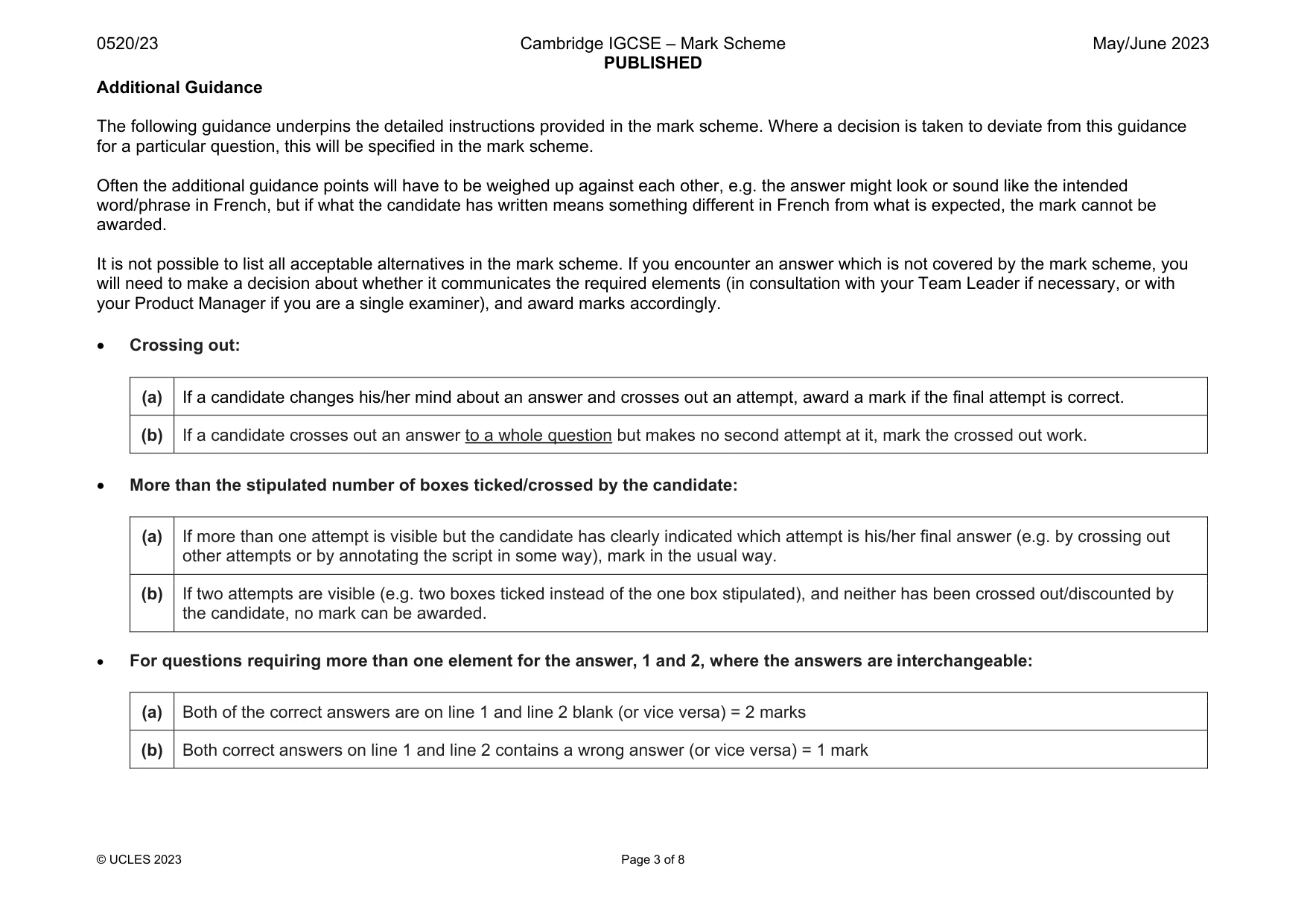
0520/23 Cambridge IGCSE – Mark Scheme PUBLISHED May/June 2023 © UCLES 2023 Page 3 of 8 Additional Guidance The following guidance underpins the detailed instructions provided in the mark scheme. Where a decision is taken to deviate from this guidance for a particular question, this will be specified in the mark scheme. Often the additional guidance points will have to be weighed up against each other, e.g. the answer might look or sound like the intended word/phrase in French, but if what the candidate has written means something different in French from what is expected, the mark cannot be awarded. It is not possible to list all acceptable alternatives in the mark scheme. If you encounter an answer which is not covered by the mark scheme, you will need to make a decision about whether it communicates the required elements (in consultation with your Team Leader if necessary, or with your Product Manager if you are a single examiner), and award marks accordingly. Crossing out: (a) If a candidate changes his/her mind about an answer and crosses out an attempt, award a mark if the final attempt is correct. (b) If a candidate crosses out an answer to a whole question but makes no second attempt at it, mark the crossed out work. More than the stipulated number of boxes ticked/crossed by the candidate: (a) If more than one attempt is visible but the candidate has clearly indicated which attempt is his/her final answer (e.g. by crossing out other attempts or by annotating the script in some way), mark in the usual way. (b) If two attempts are visible (e.g. two boxes ticked instead of the one box stipulated), and neither has been crossed out/discounted by the candidate, no mark can be awarded. For questions requiring more than one element for the answer, 1 and 2, where the answers are interchangeable: (a) Both of the correct answers are on line 1 and line 2 blank (or vice versa) = 2 marks (b) Both correct answers on line 1 and line 2 contains a wrong answer (or vice versa) = 1 mark
Mark scheme, page 4
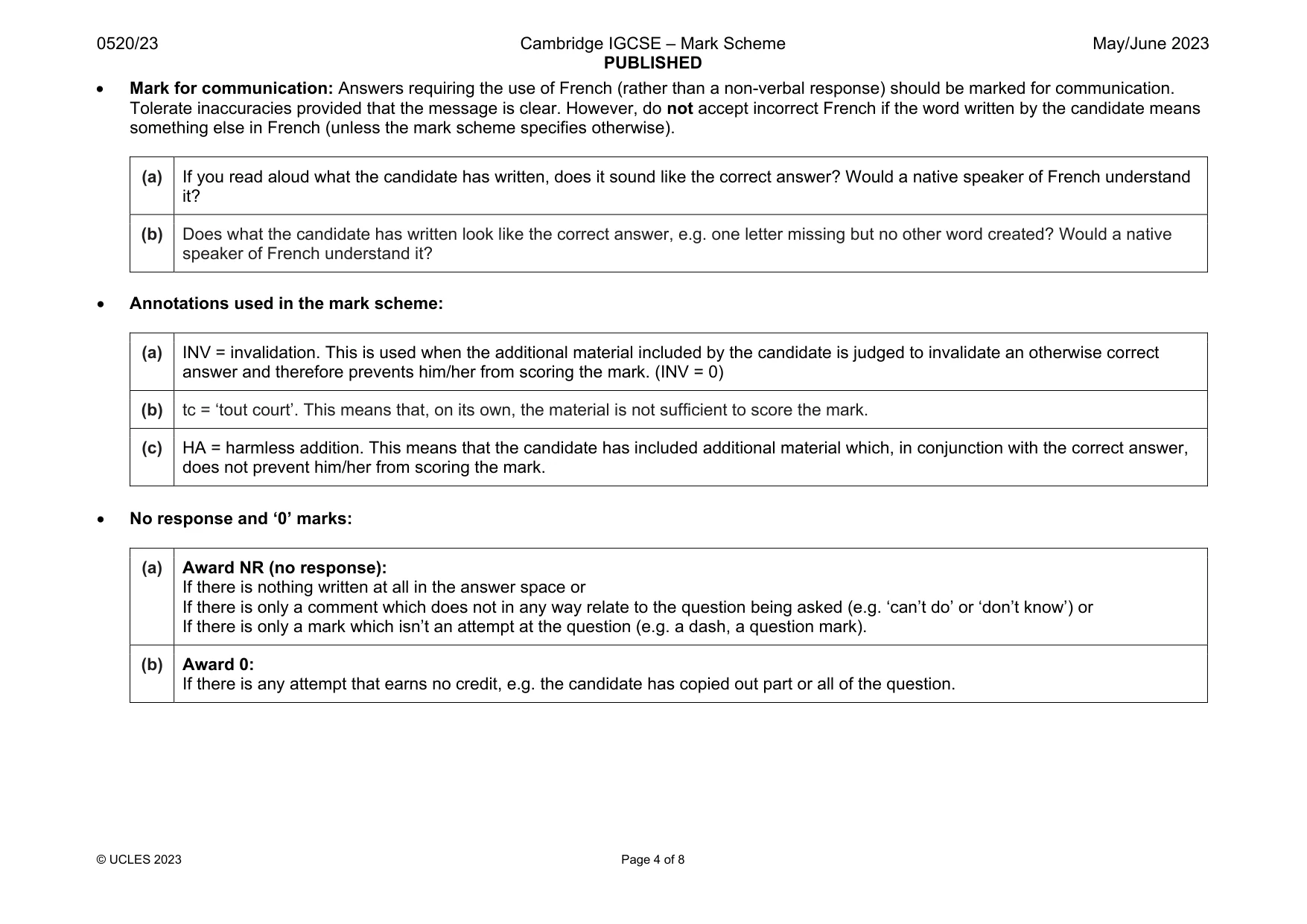
0520/23 Cambridge IGCSE – Mark Scheme PUBLISHED May/June 2023 © UCLES 2023 Page 4 of 8 Mark for communication: Answers requiring the use of French (rather than a non-verbal response) should be marked for communication. Tolerate inaccuracies provided that the message is clear. However, do not accept incorrect French if the word written by the candidate means something else in French (unless the mark scheme specifies otherwise). (a) If you read aloud what the candidate has written, does it sound like the correct answer? Would a native speaker of French understand it? (b) Does what the candidate has written look like the correct answer, e.g. one letter missing but no other word created? Would a native speaker of French understand it? Annotations used in the mark scheme: (a) INV = invalidation. This is used when the additional material included by the candidate is judged to invalidate an otherwise correct answer and therefore prevents him/her from scoring the mark. (INV = 0) (b) tc = ‘tout court’. This means that, on its own, the material is not sufficient to score the mark. (c) HA = harmless addition. This means that the candidate has included additional material which, in conjunction with the correct answer, does not prevent him/her from scoring the mark. No response and ‘0’ marks: (a) Award NR (no response): If there is nothing written at all in the answer space or If there is only a comment which does not in any way relate to the question being asked (e.g. ‘can’t do’ or ‘don’t know’) or If there is only a mark which isn’t an attempt at the question (e.g. a dash, a question mark). (b) Award 0: If there is any attempt that earns no credit, e.g. the candidate has copied out part or all of the question.
Mark scheme, page 5
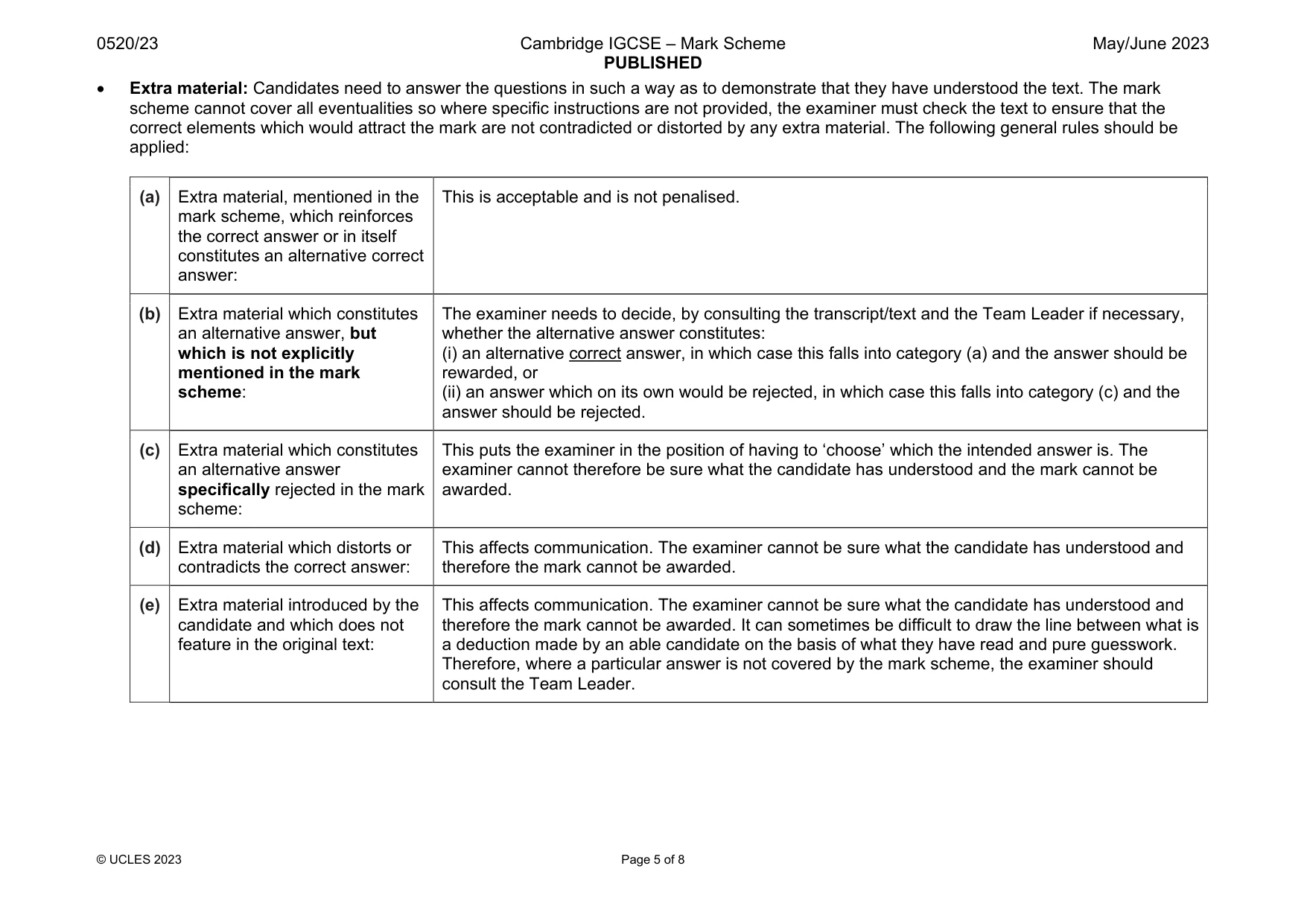
0520/23 Cambridge IGCSE – Mark Scheme PUBLISHED May/June 2023 © UCLES 2023 Page 5 of 8 Extra material: Candidates need to answer the questions in such a way as to demonstrate that they have understood the text. The mark scheme cannot cover all eventualities so where specific instructions are not provided, the examiner must check the text to ensure that the correct elements which would attract the mark are not contradicted or distorted by any extra material. The following general rules should be applied: (a) Extra material, mentioned in the mark scheme, which reinforces the correct answer or in itself constitutes an alternative correct answer: This is acceptable and is not penalised. (b) Extra material which constitutes an alternative answer, but which is not explicitly mentioned in the mark scheme: The examiner needs to decide, by consulting the transcript/text and the Team Leader if necessary, whether the alternative answer constitutes: (i) an alternative correct answer, in which case this falls into category (a) and the answer should be rewarded, or (ii) an answer which on its own would be rejected, in which case this falls into category (c) and the answer should be rejected. (c) Extra material which constitutes an alternative answer specifically rejected in the mark scheme: This puts the examiner in the position of having to ‘choose’ which the intended answer is. The examiner cannot therefore be sure what the candidate has understood and the mark cannot be awarded. (d) Extra material which distorts or contradicts the correct answer: This affects communication. The examiner cannot be sure what the candidate has understood and therefore the mark cannot be awarded. (e) Extra material introduced by the candidate and which does not feature in the original text: This affects communication. The examiner cannot be sure what the candidate has understood and therefore the mark cannot be awarded. It can sometimes be difficult to draw the line between what is a deduction made by an able candidate on the basis of what they have read and pure guesswork. Therefore, where a particular answer is not covered by the mark scheme, the examiner should consult the Team Leader.
Mark scheme, page 6
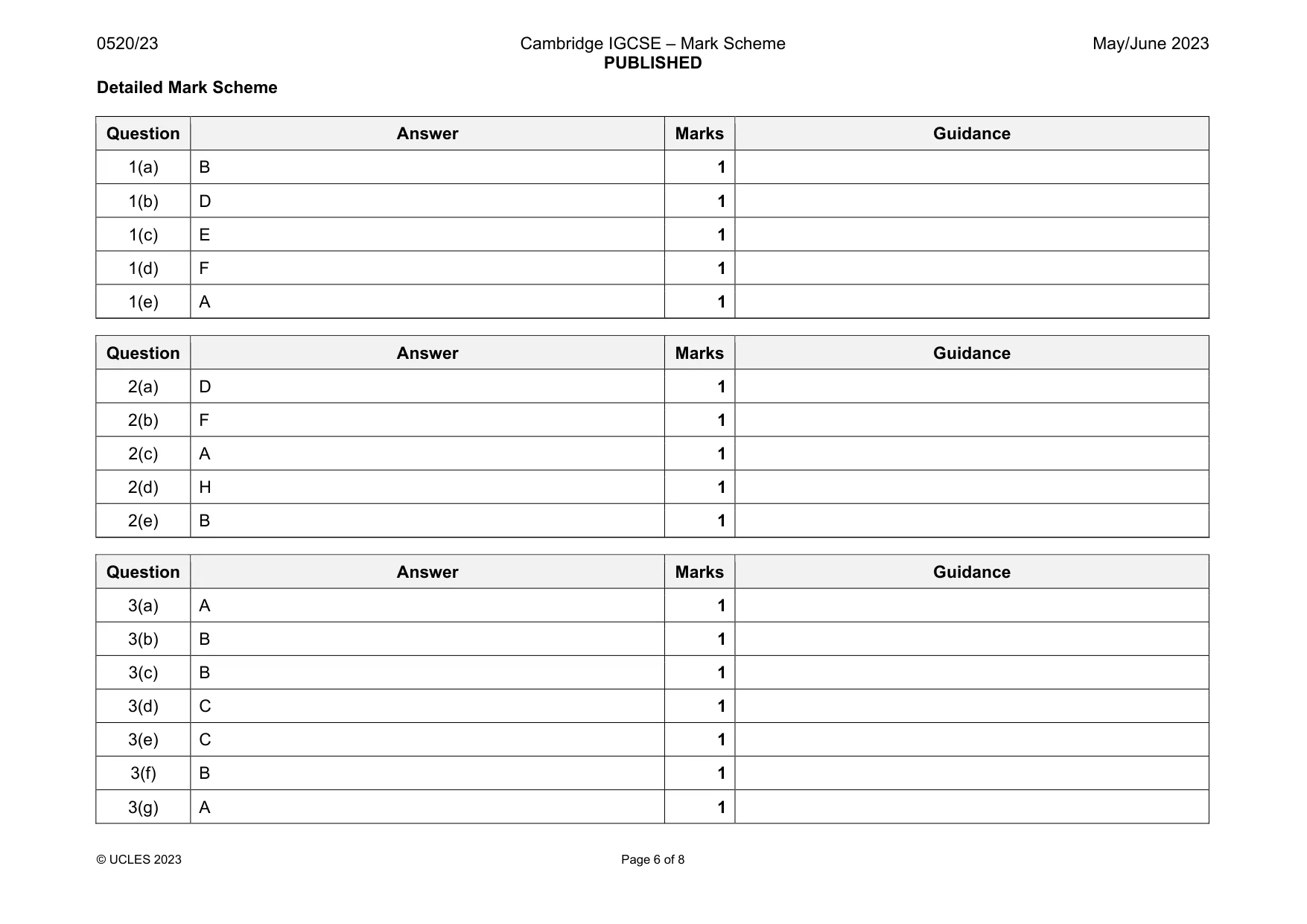
0520/23 Cambridge IGCSE – Mark Scheme PUBLISHED May/June 2023 © UCLES 2023 Page 6 of 8 Detailed Mark Scheme Question Answer Marks Guidance 1(a) B 1 1(b) D 1 1(c) E 1 1(d) F 1 1(e) A 1 Question Answer Marks Guidance 2(a) D 1 2(b) F 1 2(c) A 1 2(d) H 1 2(e) B 1 Question Answer Marks Guidance 3(a) A 1 3(b) B 1 3(c) B 1 3(d) C 1 3(e) C 1 3(f) B 1 3(g) A 1
Mark scheme, page 7
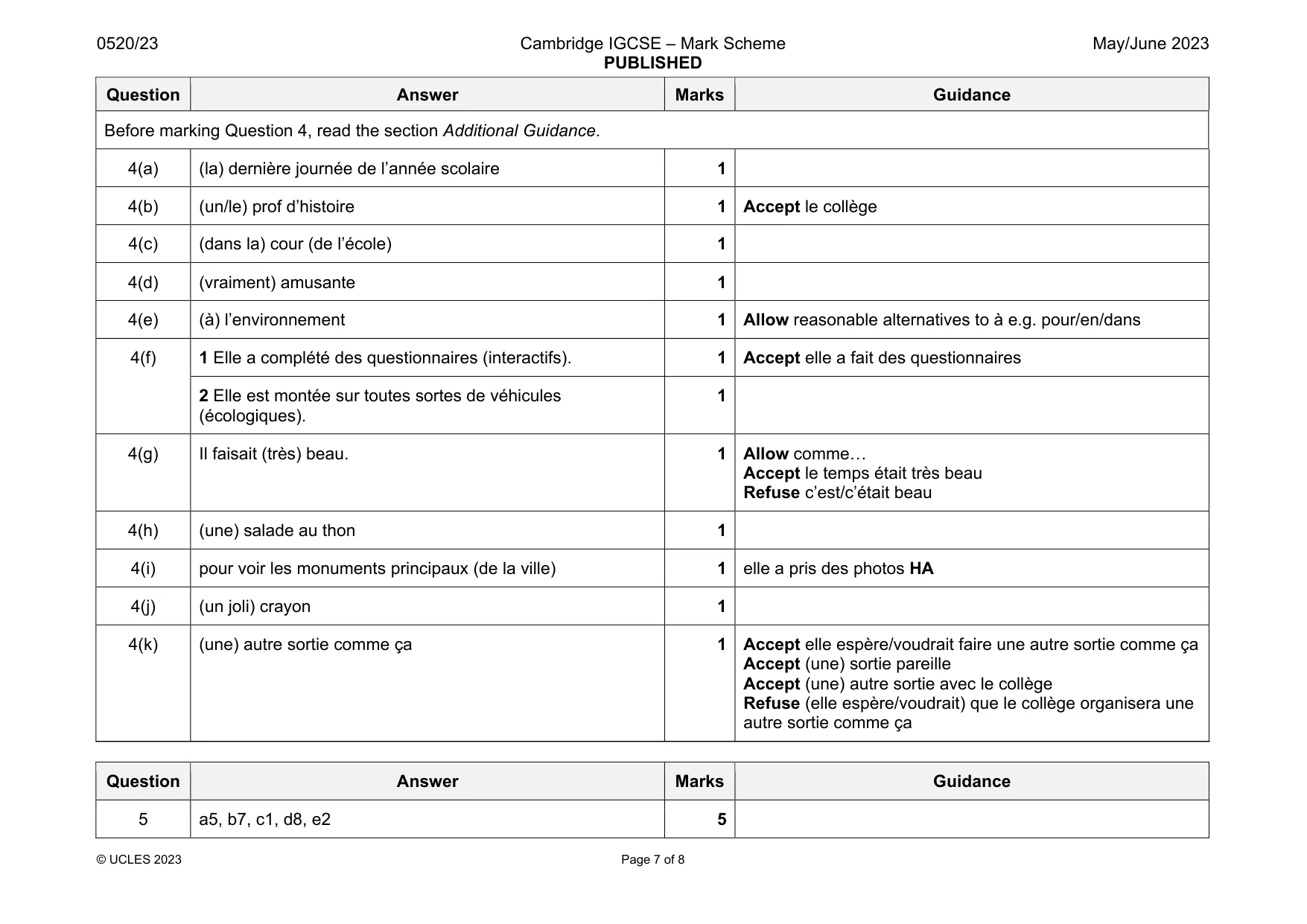
0520/23 Cambridge IGCSE – Mark Scheme PUBLISHED May/June 2023 © UCLES 2023 Page 7 of 8 Question Answer Marks Guidance Before marking Question 4, read the section Additional Guidance. 4(a) (la) dernière journée de l’année scolaire 1 4(b) (un/le) prof d’histoire 1 Accept le collège 4(c) (dans la) cour (de l’école) 1 4(d) (vraiment) amusante 1 4(e) (à) l’environnement 1 Allow reasonable alternatives to à e.g. pour/en/dans 4(f) 1 Elle a complété des questionnaires (interactifs). 1 Accept elle a fait des questionnaires 2 Elle est montée sur toutes sortes de véhicules (écologiques). 1 4(g) Il faisait (très) beau. 1 Allow comme… Accept le temps était très beau Refuse c’est/c’était beau 4(h) (une) salade au thon 1 4(i) pour voir les monuments principaux (de la ville) 1 elle a pris des photos HA 4(j) (un joli) crayon 1 4(k) (une) autre sortie comme ça 1 Accept elle espère/voudrait faire une autre sortie comme ça Accept (une) sortie pareille Accept (une) autre sortie avec le collège Refuse (elle espère/voudrait) que le collège organisera une autre sortie comme ça Question Answer Marks Guidance 5 a5, b7, c1, d8, e2 5
Mark scheme, page 8
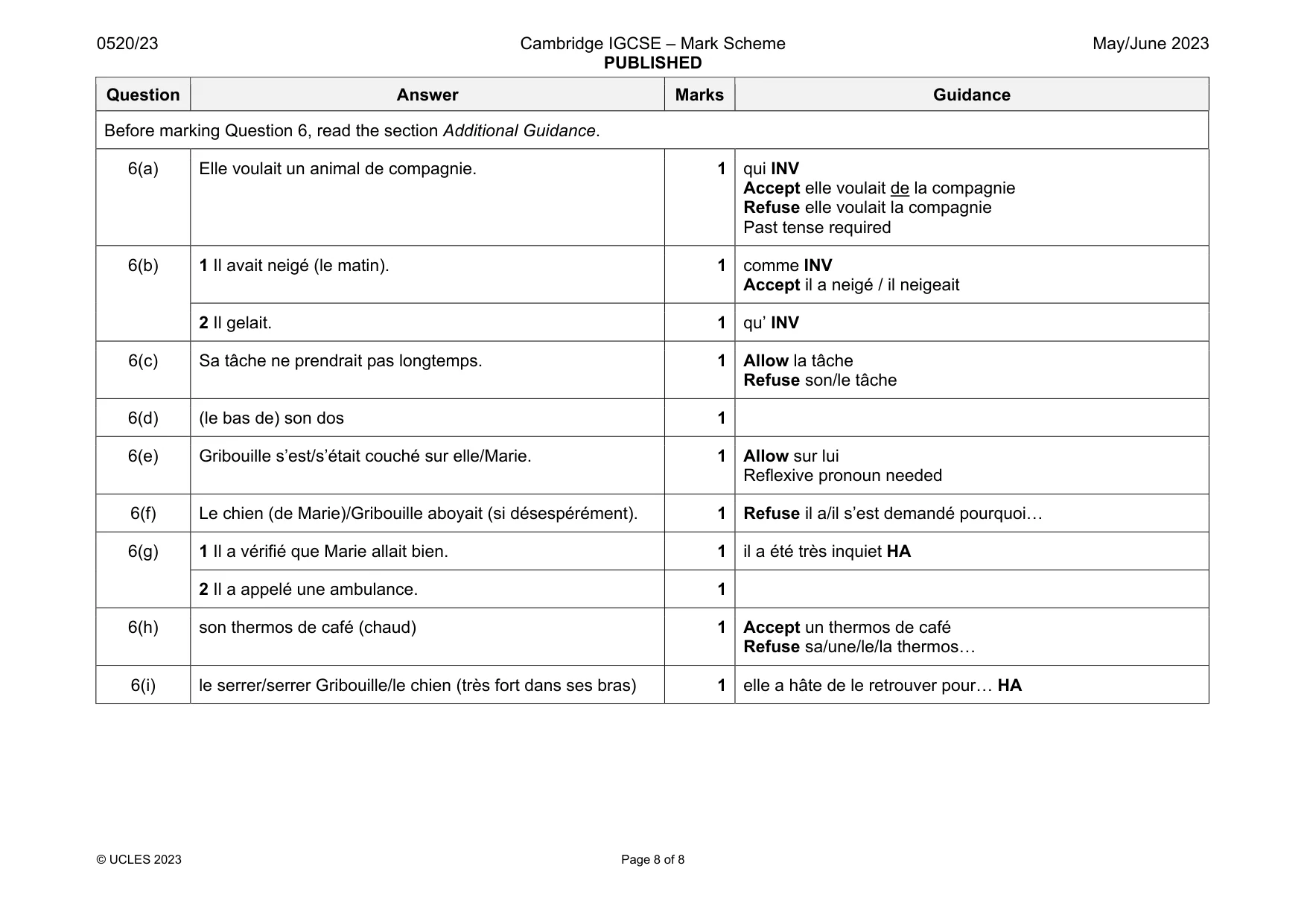
0520/23 Cambridge IGCSE – Mark Scheme PUBLISHED May/June 2023 © UCLES 2023 Page 8 of 8 Question Answer Marks Guidance Before marking Question 6, read the section Additional Guidance. 6(a) Elle voulait un animal de compagnie. 1 qui INV Accept elle voulait de la compagnie Refuse elle voulait la compagnie Past tense required 6(b) 1 Il avait neigé (le matin). 1 comme INV Accept il a neigé / il neigeait 2 Il gelait. 1 qu’ INV 6(c) Sa tâche ne prendrait pas longtemps. 1 Allow la tâche Refuse son/le tâche 6(d) (le bas de) son dos 1 6(e) Gribouille s’est/s’était couché sur elle/Marie. 1 Allow sur lui Reflexive pronoun needed 6(f) Le chien (de Marie)/Gribouille aboyait (si désespérément). 1 Refuse il a/il s’est demandé pourquoi… 6(g) 1 Il a vérifié que Marie allait bien. 1 il a été très inquiet HA 2 Il a appelé une ambulance. 1 6(h) son thermos de café (chaud) 1 Accept un thermos de café Refuse sa/une/le/la thermos… 6(i) le serrer/serrer Gribouille/le chien (très fort dans ses bras) 1 elle a hâte de le retrouver pour… HA
What you needed in this session
Cambridge’s own grade thresholds for 2023 May/June, Paper 2 · Variant 3. A higher threshold means an easier paper — the bar moves with how the cohort did.