Cambridge IGCSE Environmental Management 0680 — 2022 Oct/Nov Paper 2 · Variant 3
0680/23/O/N/22 · 80 marks · ≈90 min
The question paper and its mark scheme, free to read here and free to download. This is Cambridge’s own paper, exactly as it was sat.
Question paper24 pages




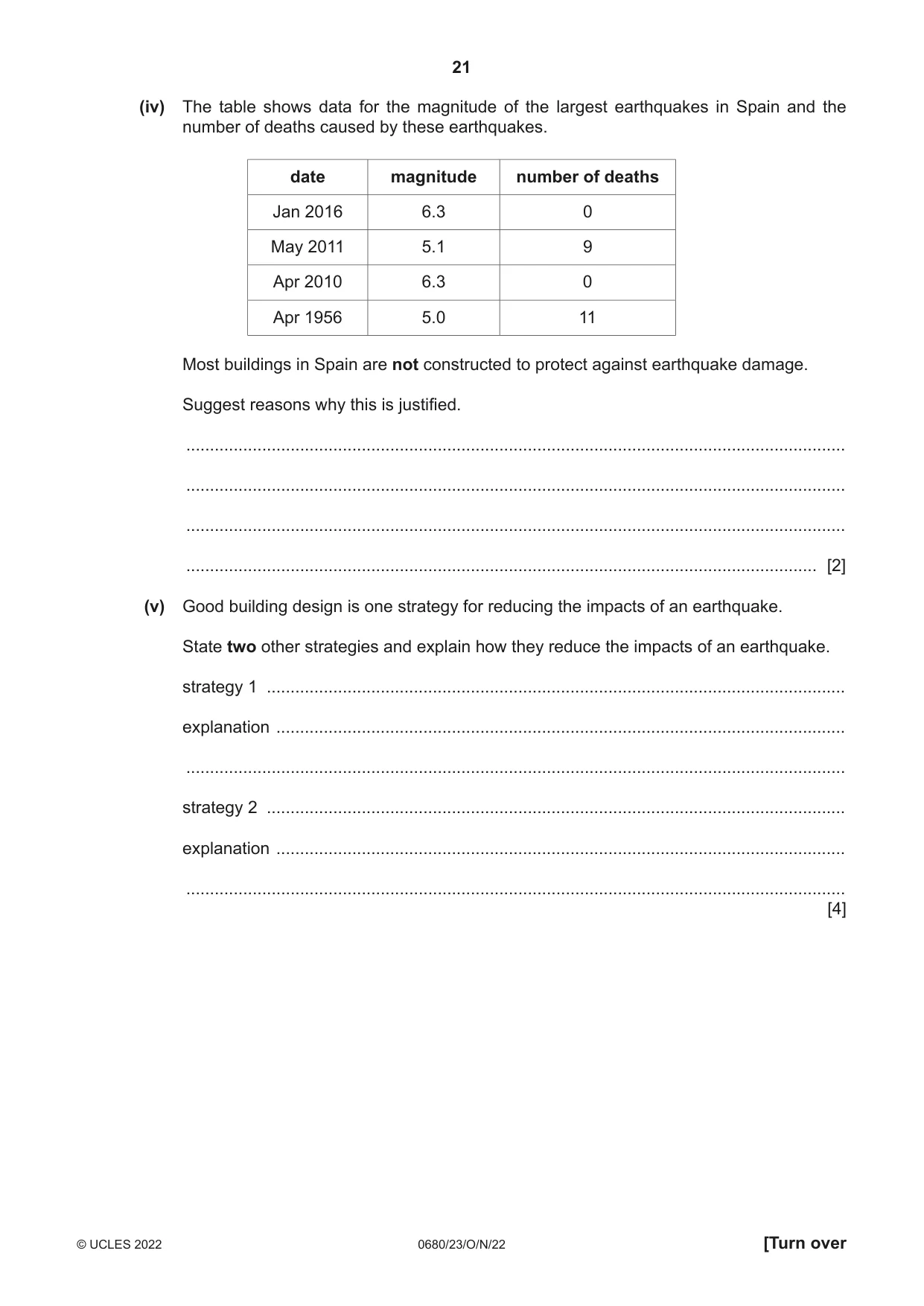
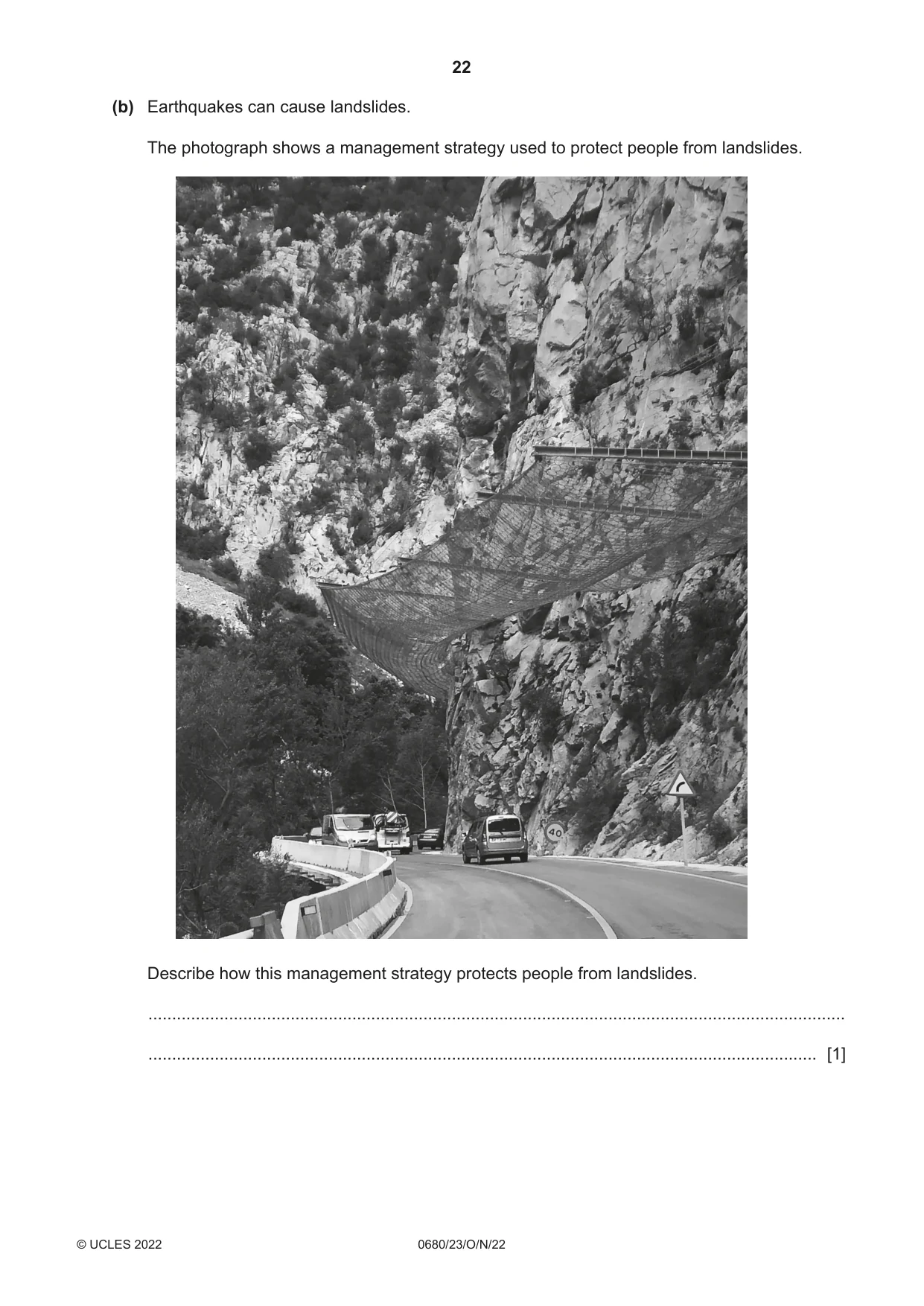

Mark scheme14 pages
Answers below. Sit the paper first if you are practising.
Paper as text
Question paper, page 1
This document has 24 pages. Any blank pages are indicated. [Turn over Cambridge IGCSE™ DC (PQ/JG) 307335/2 © UCLES 2022 ENVIRONMENTAL MANAGEMENT 0680/23 Paper 2 Management in Context October/November 2022 1 hour 45 minutes You must answer on the question paper. No additional materials are needed. INSTRUCTIONS ● Answer all questions. ● Use a black or dark blue pen. You may use an HB pencil for any diagrams or graphs. ● Write your name, centre number and candidate number in the boxes at the top of the page. ● Write your answer to each question in the space provided. ● Do not use an erasable pen or correction fluid. ● Do not write on any bar codes. ● You may use a calculator. ● You should show all your working and use appropriate units. INFORMATION ● The total mark for this paper is 80. ● The number of marks for each question or part question is shown in brackets [ ]. * 2 6 4 9 1 5 8 8 4 3 *
Question paper, page 2
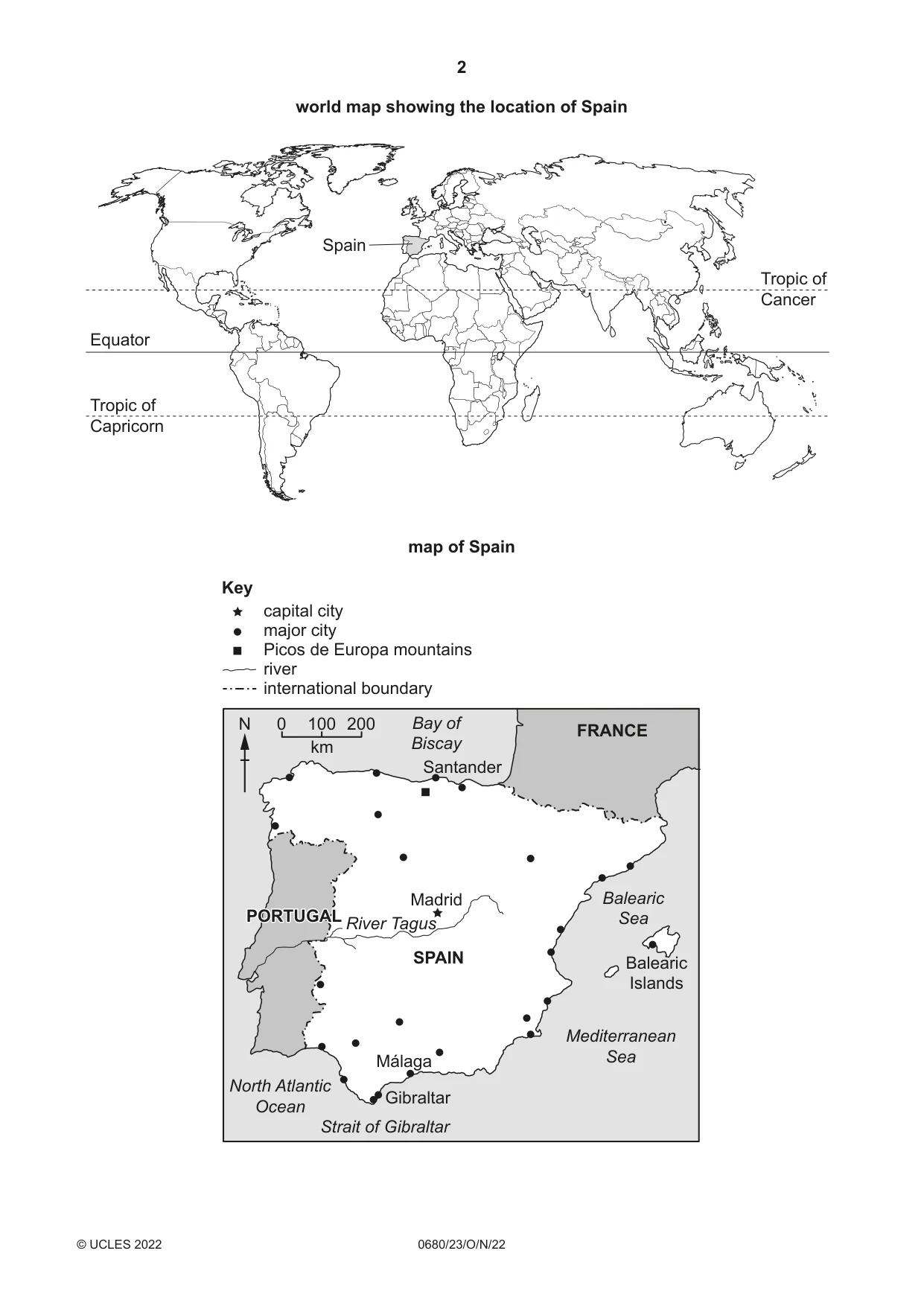
2 0680/23/O/N/22 © UCLES 2022 world map showing the location of Spain Equator Tropic of Capricorn Tropic of Cancer Spain map of Spain km 0 100 200 N FRANCE SPAIN PORTUGAL PORTUGAL Bay of Biscay Mediterranean Sea Balearic Sea Balearic Islands River Tagus Gibraltar Madrid Málaga Santander Key capital city major city Picos de Europa mountains river international boundary Strait of Gibraltar North Atlantic Ocean
Question paper, page 3
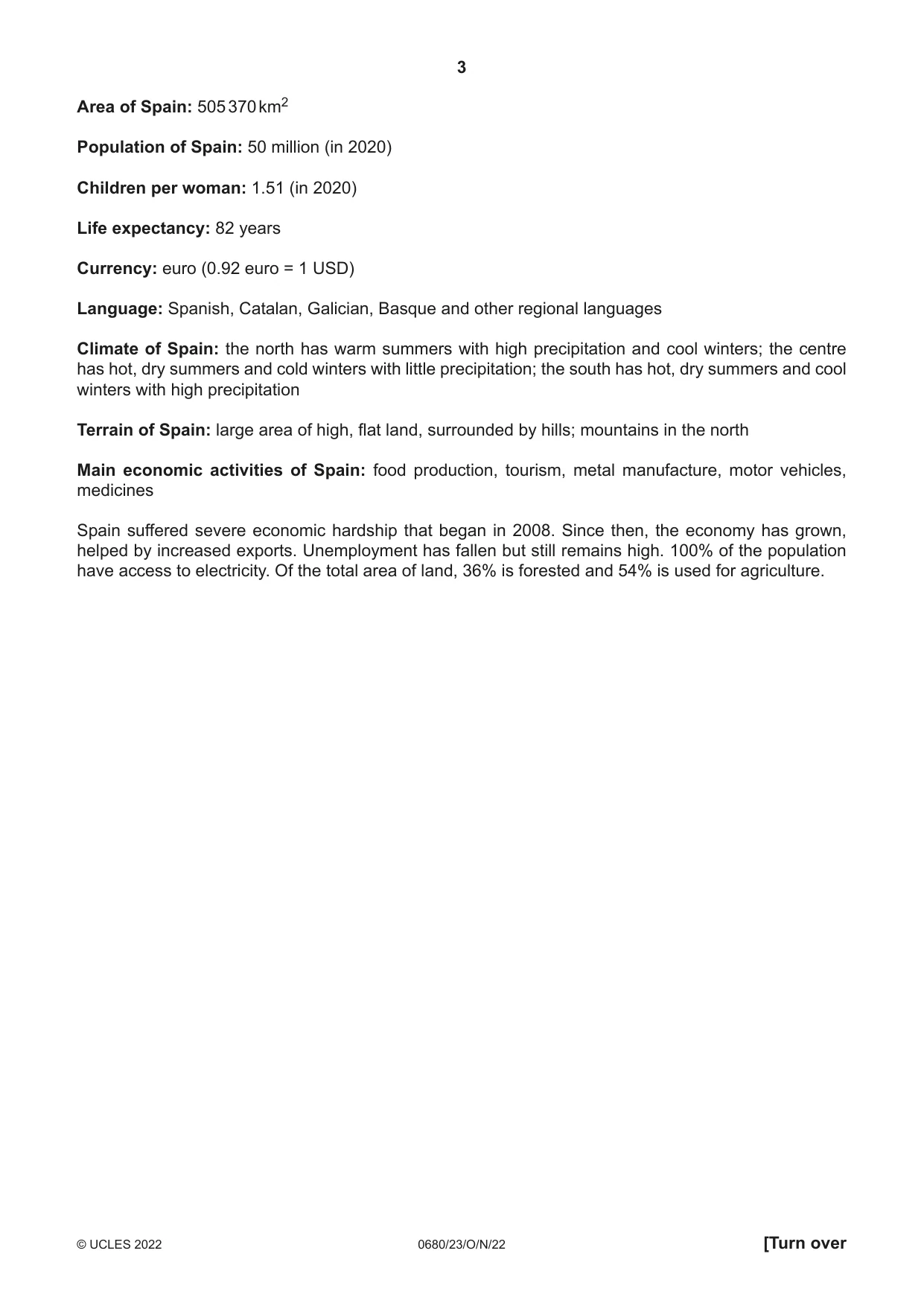
3 0680/23/O/N/22 © UCLES 2022 [Turn over Area of Spain: 505 370 km2 Population of Spain: 50 million (in 2020) Children per woman: 1.51 (in 2020) Life expectancy: 82 years Currency: euro (0.92 euro = 1 USD) Language: Spanish, Catalan, Galician, Basque and other regional languages Climate of Spain: the north has warm summers with high precipitation and cool winters; the centre has hot, dry summers and cold winters with little precipitation; the south has hot, dry summers and cool winters with high precipitation Terrain of Spain: large area of high, flat land, surrounded by hills; mountains in the north Main economic activities of Spain: food production, tourism, metal manufacture, motor vehicles, medicines Spain suffered severe economic hardship that began in 2008. Since then, the economy has grown, helped by increased exports. Unemployment has fallen but still remains high. 100% of the population have access to electricity. Of the total area of land, 36% is forested and 54% is used for agriculture.
Question paper, page 4
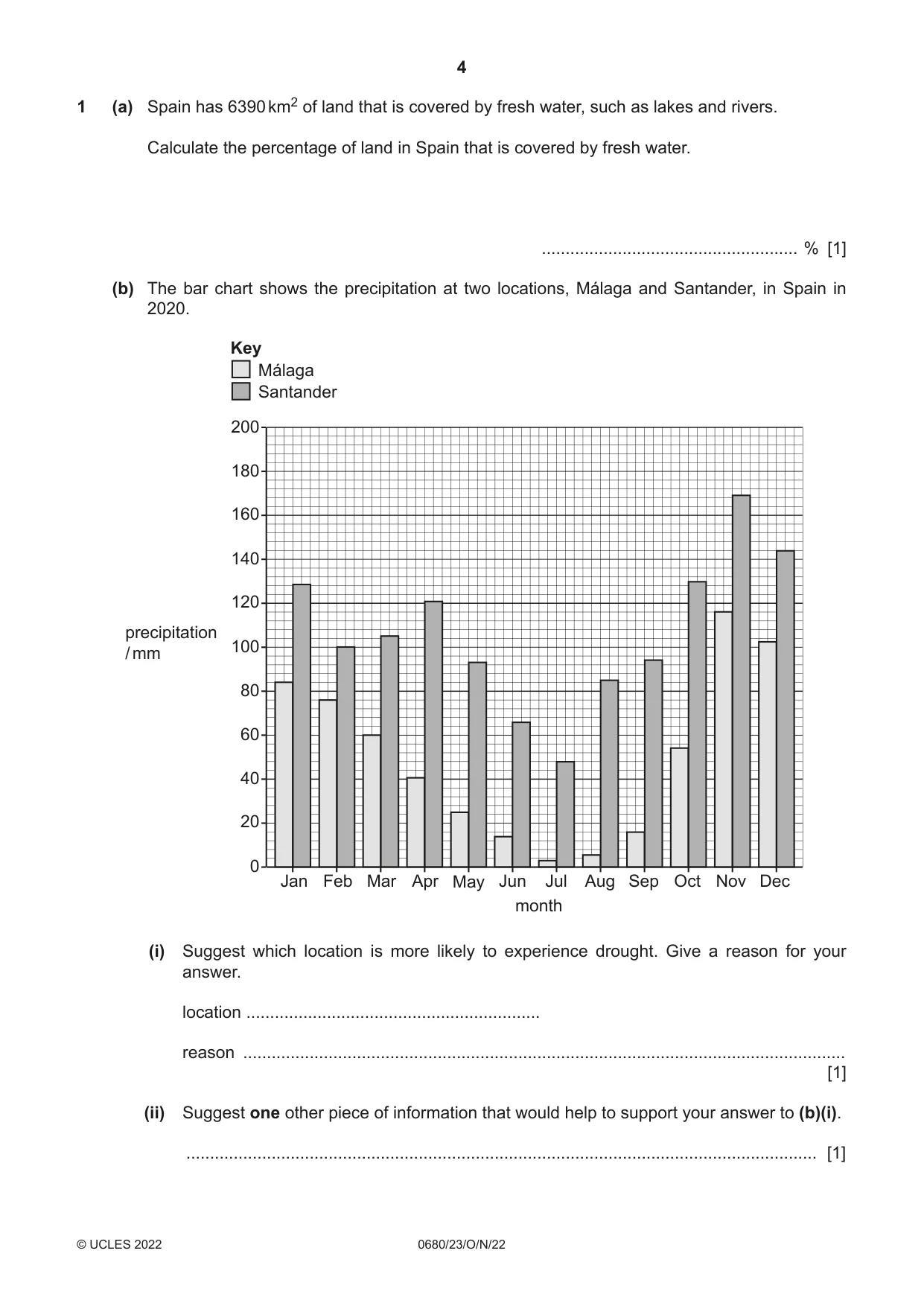
4 0680/23/O/N/22 © UCLES 2022 1 (a) Spain has 6390 km2 of land that is covered by fresh water, such as lakes and rivers. Calculate the percentage of land in Spain that is covered by fresh water. … % [1] (b) The bar chart shows the precipitation at two locations, Málaga and Santander, in Spain in 2020. month Jan Feb Mar Apr May Jun Jul Aug Sep Oct Nov Dec 0 20 40 60 80 100 120 140 160 180 200 Key precipitation / mm Málaga Santander (i) Suggest which location is more likely to experience drought. Give a reason for your answer. location … reason … [1] (ii) Suggest one other piece of information that would help to support your answer to (b)(i). … [1]
Question paper, page 5
5 0680/23/O/N/22 © UCLES 2022 [Turn over (iii) The precipitation data are collected on the first day of each month. Suggest one limitation of this data collection method. … … [1] (iv) Describe the impacts of drought on soil. … … … … … … … … [4]
Question paper, page 6
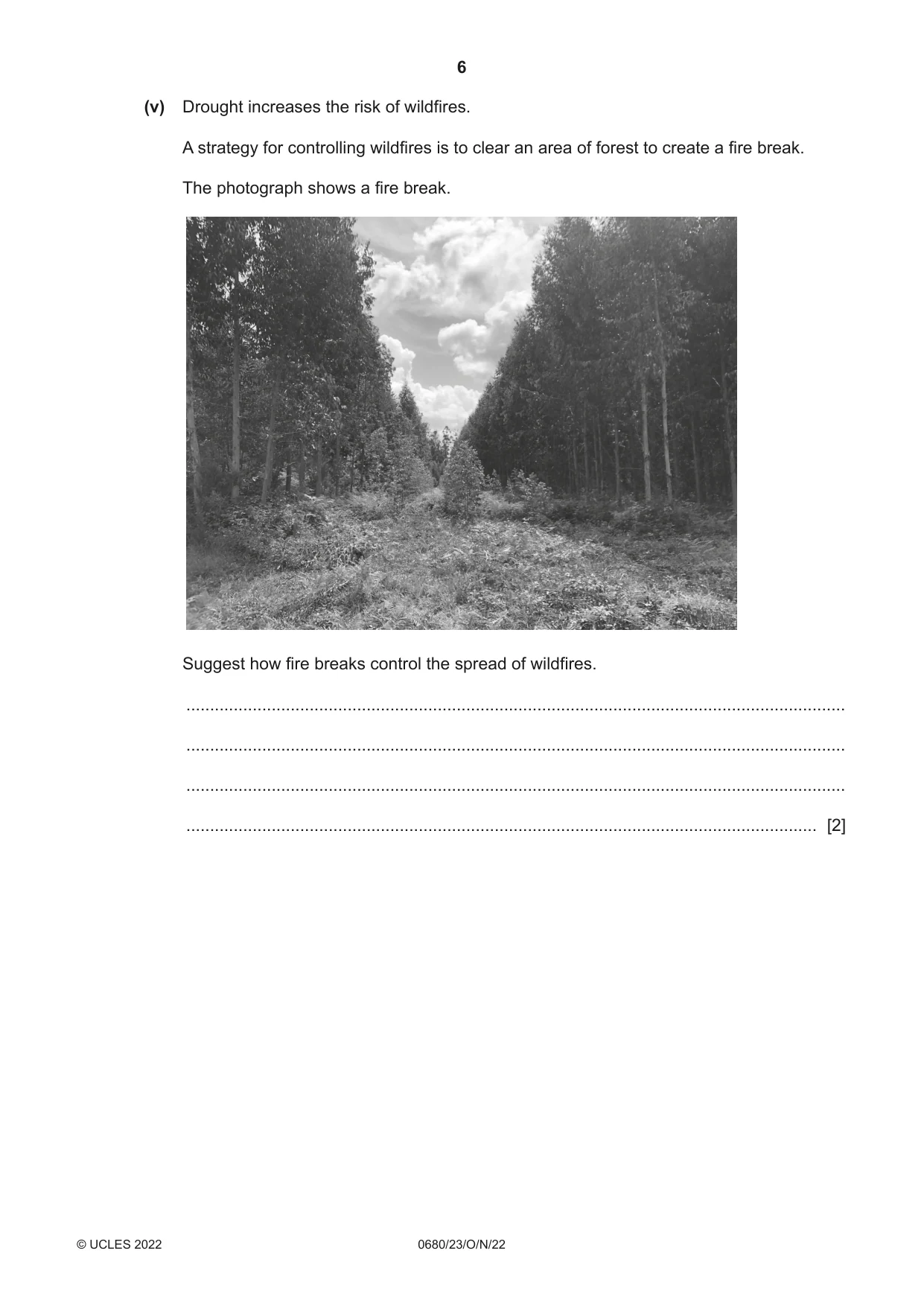
6 0680/23/O/N/22 © UCLES 2022 (v) Drought increases the risk of wildfires. A strategy for controlling wildfires is to clear an area of forest to create a fire break. The photograph shows a fire break. Suggest how fire breaks control the spread of wildfires. … … … … [2]
Question paper, page 7
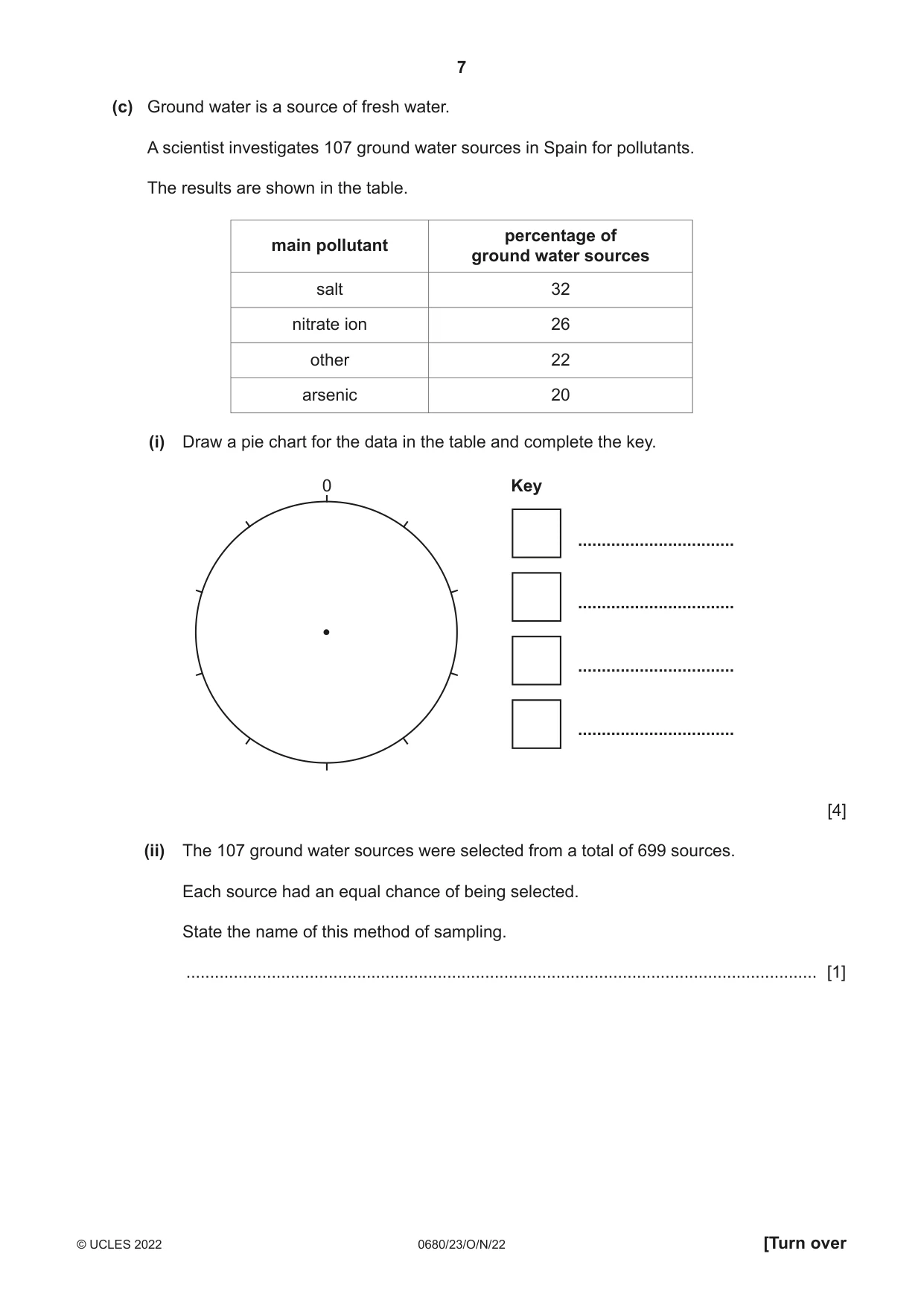
7 0680/23/O/N/22 © UCLES 2022 [Turn over (c) Ground water is a source of fresh water. A scientist investigates 107 ground water sources in Spain for pollutants. The results are shown in the table. main pollutant percentage of ground water sources salt 32 nitrate ion 26 other 22 arsenic 20 (i) Draw a pie chart for the data in the table and complete the key. 0 Key … … … … [4] (ii) The 107 ground water sources were selected from a total of 699 sources. Each source had an equal chance of being selected. State the name of this method of sampling. … [1]
Question paper, page 8
8 0680/23/O/N/22 © UCLES 2022 (iii) Another scientist selects ground water sources from only one area of Spain. Describe a limitation of sampling only one area of Spain. … … [1] (iv) Suggest a source of high levels of salt in ground water. … … [1] (v) Arsenic is a toxic substance. Describe how arsenic can bioaccumulate in organisms. … … … … [2]
Question paper, page 9
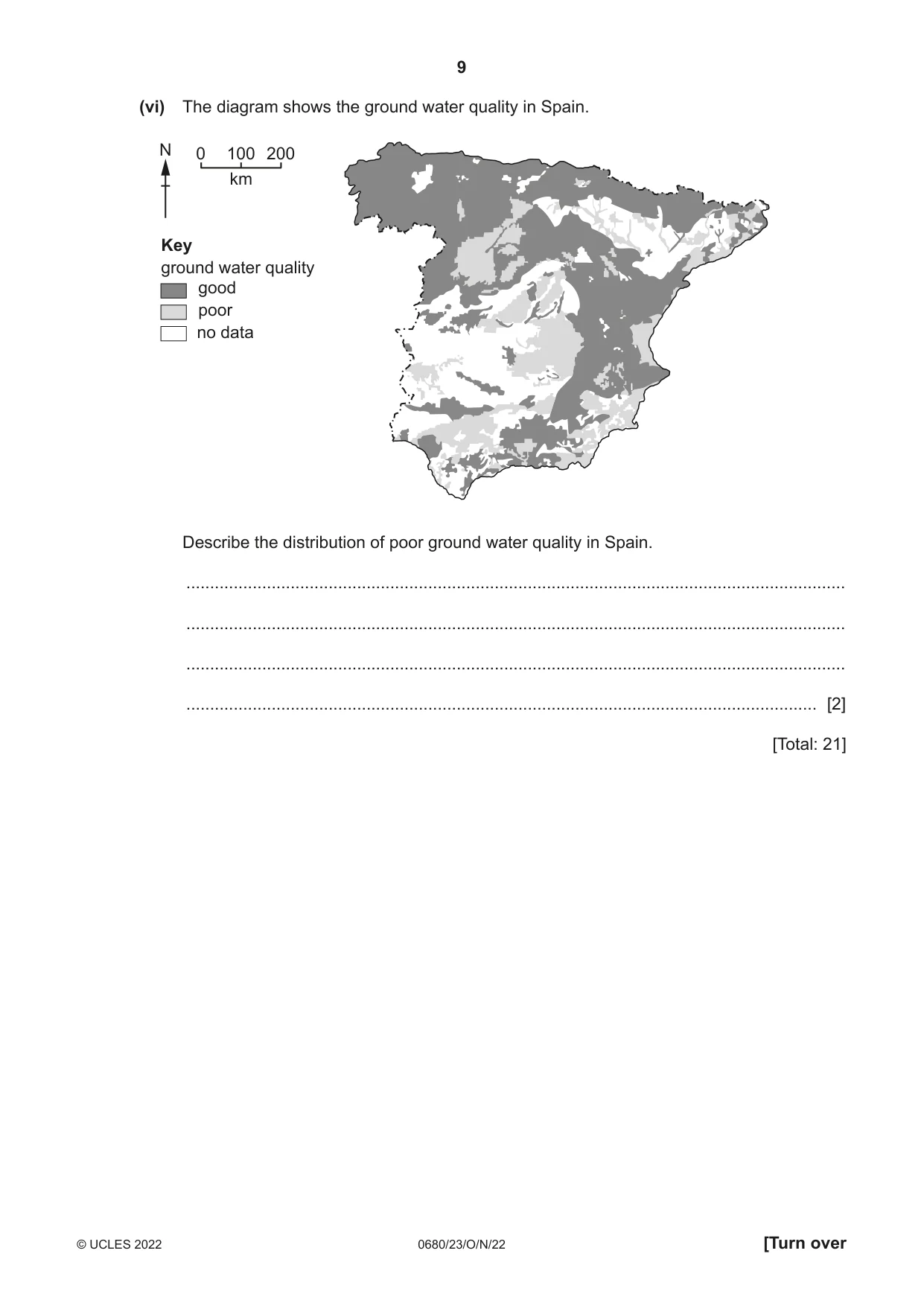
9 0680/23/O/N/22 © UCLES 2022 [Turn over (vi) The diagram shows the ground water quality in Spain. ground water quality good poor no data Key km 0 100 200 N Describe the distribution of poor ground water quality in Spain. … … … … [2] [Total: 21]
Question paper, page 10
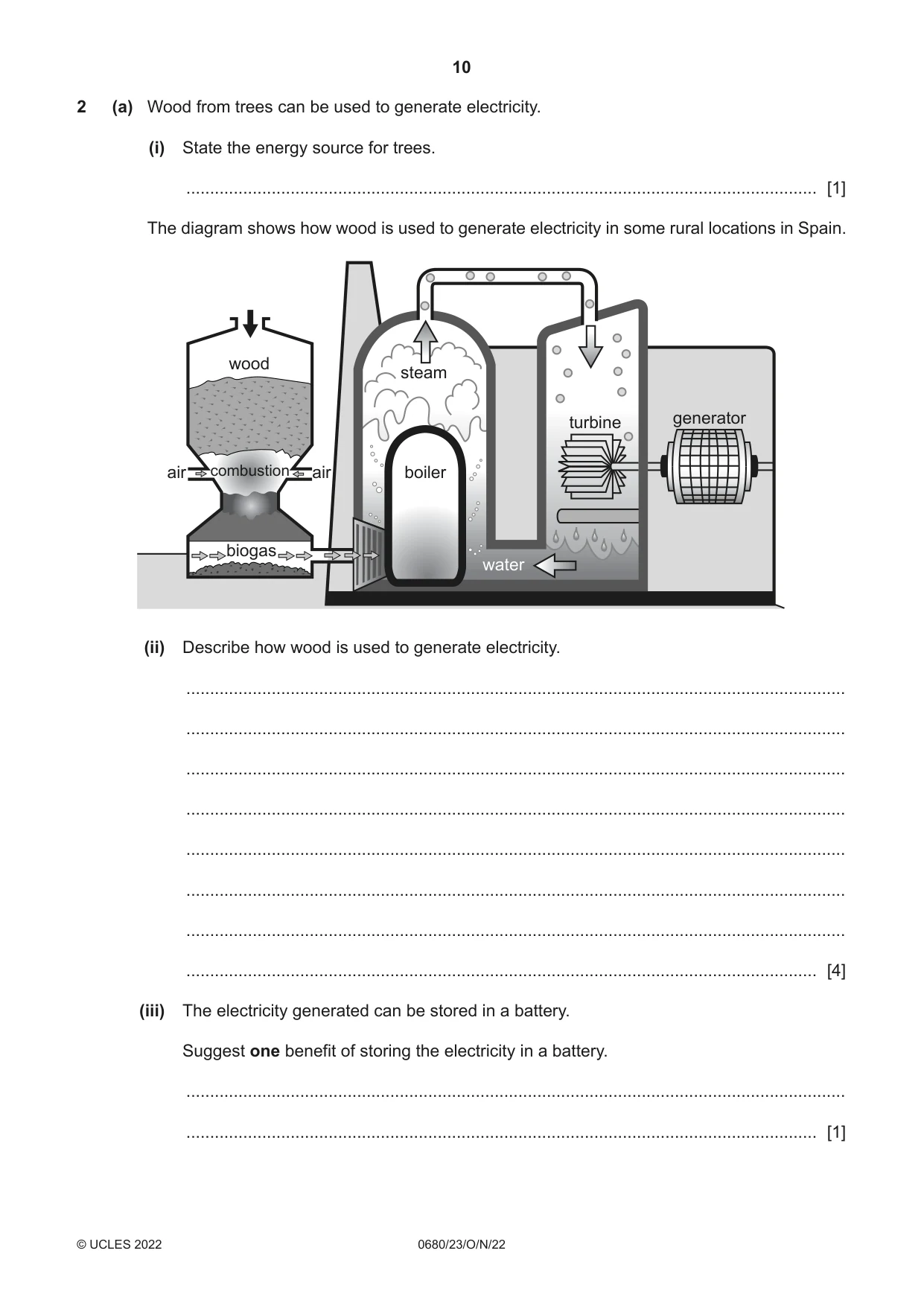
10 0680/23/O/N/22 © UCLES 2022 2 (a) Wood from trees can be used to generate electricity. (i) State the energy source for trees. … [1] The diagram shows how wood is used to generate electricity in some rural locations in Spain. wood air air biogas turbine generator combustion water boiler steam (ii) Describe how wood is used to generate electricity. … … … … … … … … [4] (iii) The electricity generated can be stored in a battery. Suggest one benefit of storing the electricity in a battery. … … [1]
Question paper, page 11
11 0680/23/O/N/22 © UCLES 2022 [Turn over (iv) Wood is a biofuel. Describe one advantage and one disadvantage of using biofuels to generate electricity compared with using fossil fuels. advantage … … … disadvantage … … … [2]
Question paper, page 12
12 0680/23/O/N/22 © UCLES 2022 (b) A new power station for converting wood and plant material into electricity opened in 2020 in Spain. (i) The power station will produce 325 500 MWh per year of electricity and use 238 000 tonnes of wood and plant material. State the electricity produced per day at the power station. Give your answer to the nearest whole MWh. … MWh [2] (ii) Questionnaires and face-to-face interviews were used to find out local people’s views on the power station. Suggest the advantages of using a face-to-face interview compared with a questionnaire to find out people’s views. … … … … [2] (iii) Suggest reasons why people are in favour of having the power station located in their local area. … … … … [2] (iv) Suggest two factors, other than people’s views, that must be considered before a power station can be built. 1 … … 2 … … [2] [Total: 16]
Question paper, page 13
13 0680/23/O/N/22 © UCLES 2022 [Turn over BLANK PAGE
Question paper, page 14
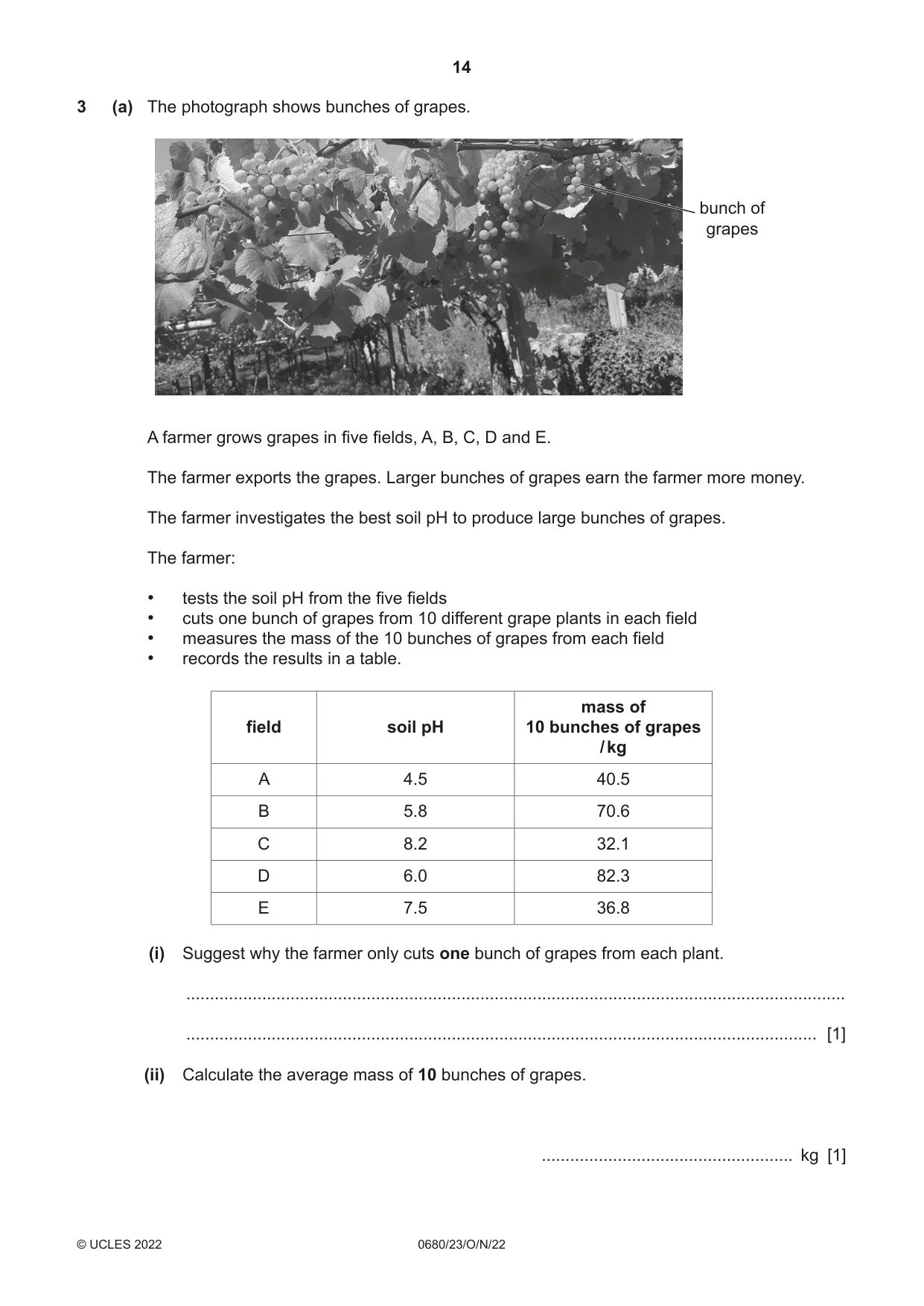
14 0680/23/O/N/22 © UCLES 2022 3 (a) The photograph shows bunches of grapes. bunch of grapes A farmer grows grapes in five fields, A, B, C, D and E. The farmer exports the grapes. Larger bunches of grapes earn the farmer more money. The farmer investigates the best soil pH to produce large bunches of grapes. The farmer: • tests the soil pH from the five fields • cuts one bunch of grapes from 10 different grape plants in each field • measures the mass of the 10 bunches of grapes from each field • records the results in a table. field soil pH mass of 10 bunches of grapes / kg A 4.5 40.5 B 5.8 70.6 C 8.2 32.1 D 6.0 82.3 E 7.5 36.8 (i) Suggest why the farmer only cuts one bunch of grapes from each plant. … … [1] (ii) Calculate the average mass of 10 bunches of grapes. … kg [1]
Question paper, page 15
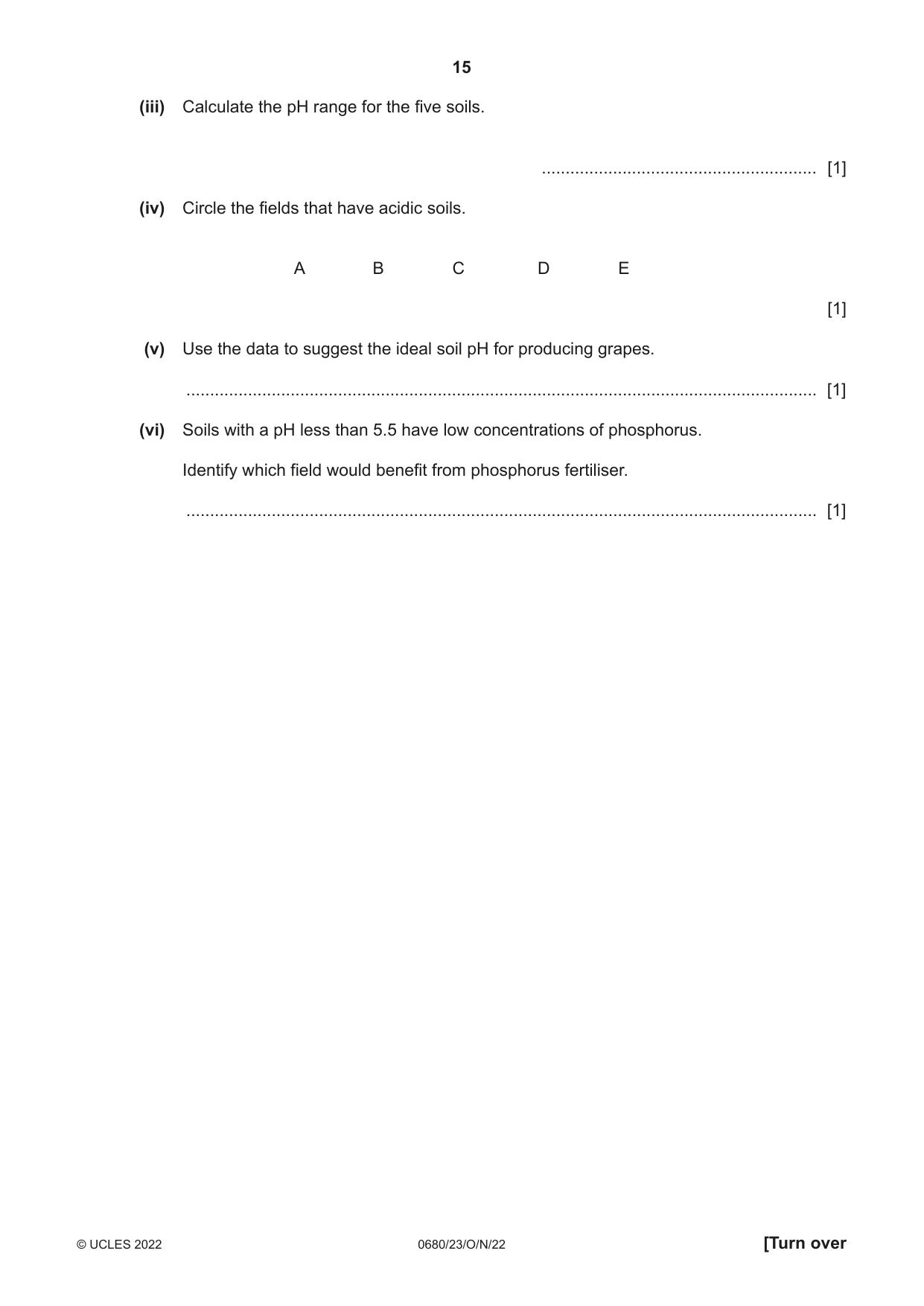
15 0680/23/O/N/22 © UCLES 2022 [Turn over (iii) Calculate the pH range for the five soils. … [1] (iv) Circle the fields that have acidic soils. A B C D E [1] (v) Use the data to suggest the ideal soil pH for producing grapes. … [1] (vi) Soils with a pH less than 5.5 have low concentrations of phosphorus. Identify which field would benefit from phosphorus fertiliser. … [1]
Question paper, page 16
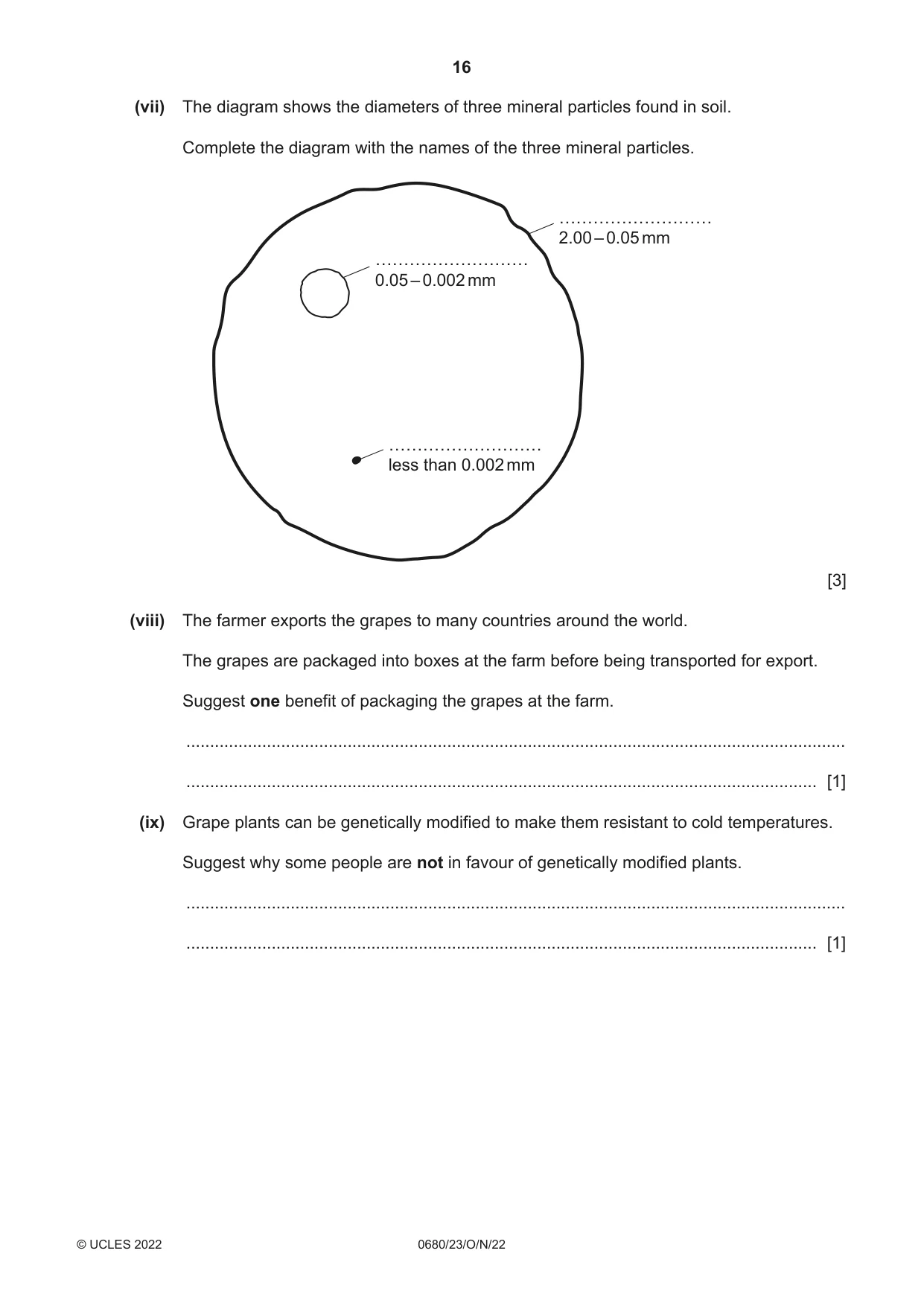
16 0680/23/O/N/22 © UCLES 2022 (vii) The diagram shows the diameters of three mineral particles found in soil. Complete the diagram with the names of the three mineral particles. ……………………… less than 0.002 mm ……………………… 2.00 – 0.05 mm ……………………… 0.05 – 0.002 mm [3] (viii) The farmer exports the grapes to many countries around the world. The grapes are packaged into boxes at the farm before being transported for export. Suggest one benefit of packaging the grapes at the farm. … … [1] (ix) Grape plants can be genetically modified to make them resistant to cold temperatures. Suggest why some people are not in favour of genetically modified plants. … … [1]
Question paper, page 17
17 0680/23/O/N/22 © UCLES 2022 [Turn over (b) Some grape plants can become infected by a disease caused by fungi. Two methods are used to control the disease: method 1: Remove and destroy the infected grapes, leaves and stems of the plant. method 2: Spray the plant with a fungicide. (i) Suggest why farmers often choose method 2 and spray with a fungicide. … … [1] (ii) Suggest why climate change can increase the risk of plant diseases caused by fungi. … … … … [2] (iii) Young grape plants are easily damaged by strong winds. Suggest how young grape plants can be protected from strong winds. … … … … [2]
Question paper, page 18
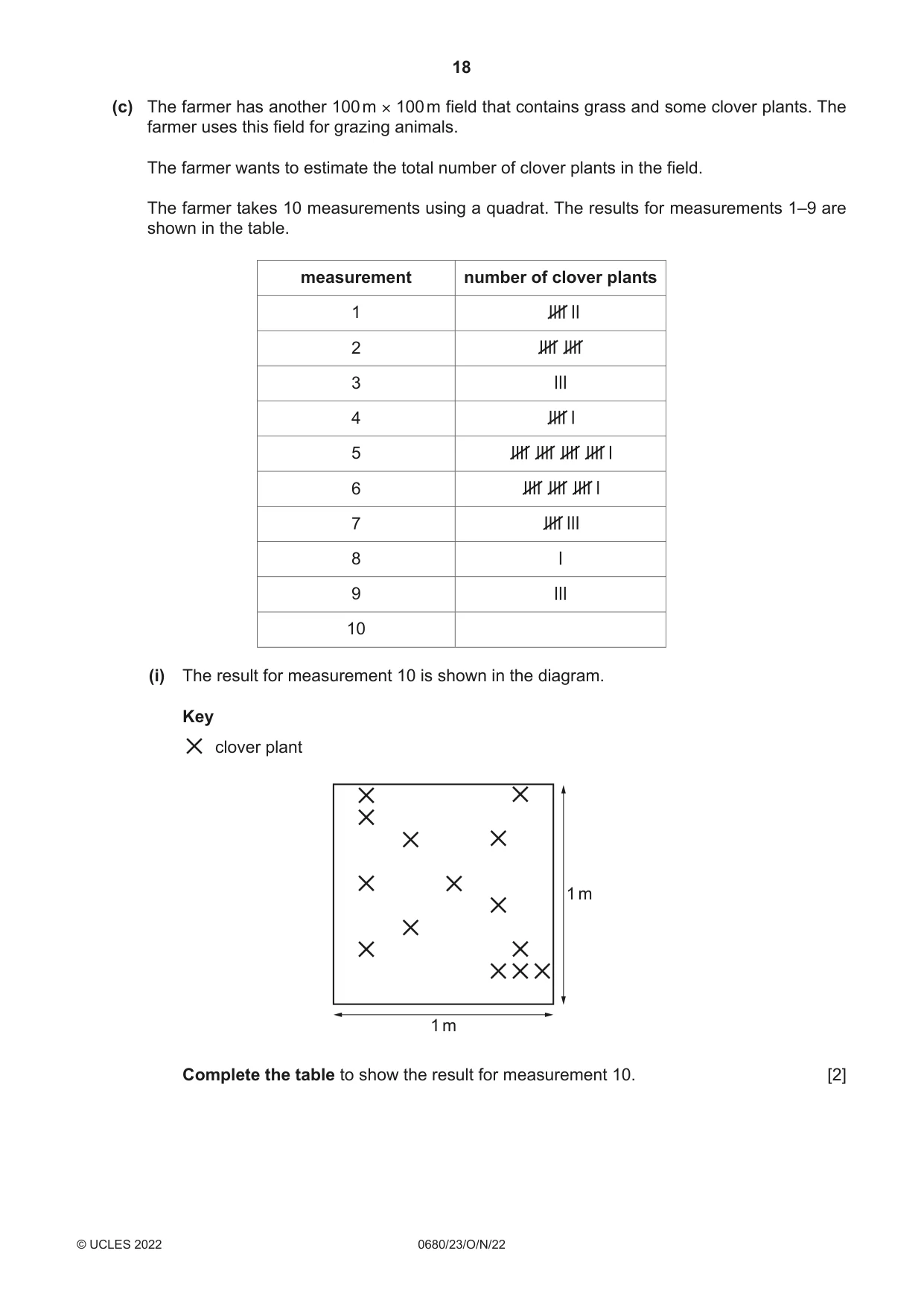
18 0680/23/O/N/22 © UCLES 2022 (c) The farmer has another 100 m × 100 m field that contains grass and some clover plants. The farmer uses this field for grazing animals. The farmer wants to estimate the total number of clover plants in the field. The farmer takes 10 measurements using a quadrat. The results for measurements 1–9 are shown in the table. measurement number of clover plants 1 2 3 4 5 6 7 8 9 10 (i) The result for measurement 10 is shown in the diagram. Key clover plant 1 m 1 m Complete the table to show the result for measurement 10. [2]
Question paper, page 19
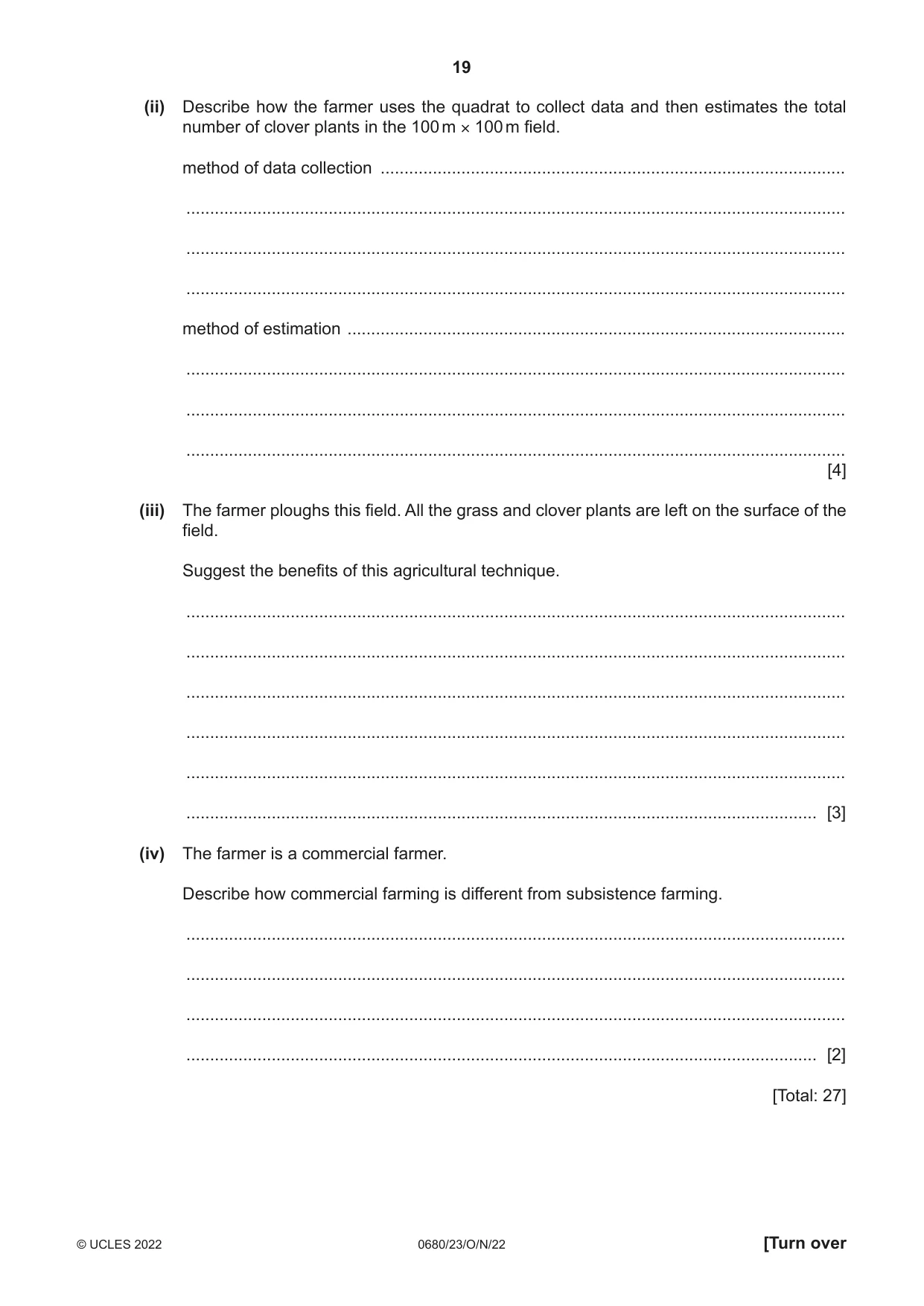
19 0680/23/O/N/22 © UCLES 2022 [Turn over (ii) Describe how the farmer uses the quadrat to collect data and then estimates the total number of clover plants in the 100 m × 100 m field. method of data collection … … … … method of estimation … … … … [4] (iii) The farmer ploughs this field. All the grass and clover plants are left on the surface of the field. Suggest the benefits of this agricultural technique. … … … … … … [3] (iv) The farmer is a commercial farmer. Describe how commercial farming is different from subsistence farming. … … … … [2] [Total: 27]
Question paper, page 20
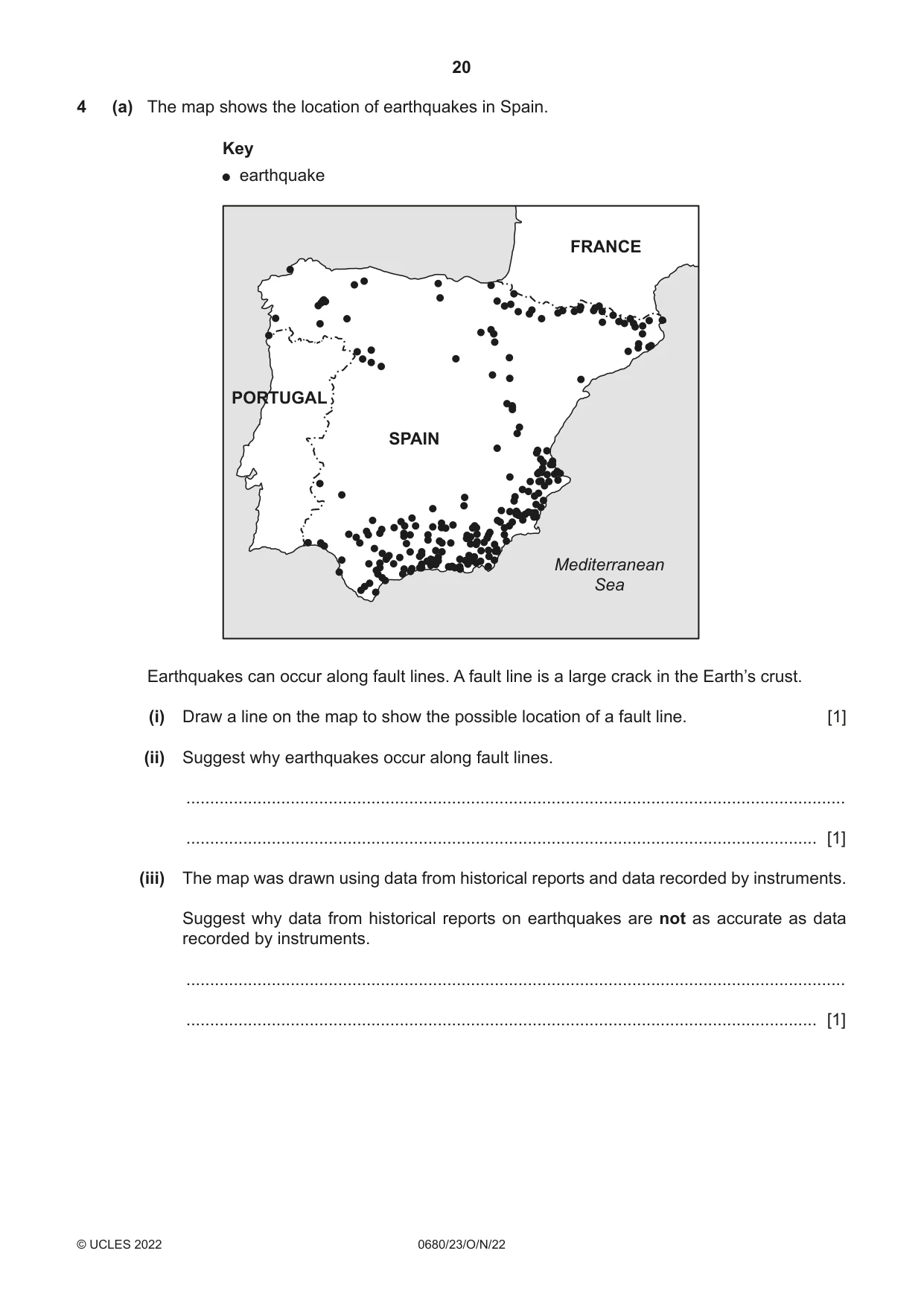
20 0680/23/O/N/22 © UCLES 2022 4 (a) The map shows the location of earthquakes in Spain. earthquake Key FRANCE SPAIN PORTUGAL Mediterranean Sea Earthquakes can occur along fault lines. A fault line is a large crack in the Earth’s crust. (i) Draw a line on the map to show the possible location of a fault line. [1] (ii) Suggest why earthquakes occur along fault lines. … … [1] (iii) The map was drawn using data from historical reports and data recorded by instruments. Suggest why data from historical reports on earthquakes are not as accurate as data recorded by instruments. … … [1]
Question paper, page 21
21 0680/23/O/N/22 © UCLES 2022 [Turn over (iv) The table shows data for the magnitude of the largest earthquakes in Spain and the number of deaths caused by these earthquakes. date magnitude number of deaths Jan 2016 6.3 0 May 2011 5.1 9 Apr 2010 6.3 0 Apr 1956 5.0 11 Most buildings in Spain are not constructed to protect against earthquake damage. Suggest reasons why this is justified. … … … … [2] (v) Good building design is one strategy for reducing the impacts of an earthquake. State two other strategies and explain how they reduce the impacts of an earthquake. strategy 1 … explanation … … strategy 2 … explanation … … [4]
Question paper, page 22
22 0680/23/O/N/22 © UCLES 2022 (b) Earthquakes can cause landslides. The photograph shows a management strategy used to protect people from landslides. Describe how this management strategy protects people from landslides. … … [1]
Question paper, page 23
23 0680/23/O/N/22 © UCLES 2022 (c) The north of Spain has a mountain range known as the Picos de Europa. This range is the largest single mass of limestone mountains in Europe. (i) Describe how limestone rock is formed. … … … … … … [3] (ii) Explain why emissions from car exhausts are a threat to trees and lakes in these mountains. … … … … … … [3] [Total: 16]
Question paper, page 24
24 0680/23/O/N/22 © UCLES 2022 The boundaries and names shown, the designations used and the presentation of material on any maps contained in this question paper/insert do not imply official endorsement or acceptance by Cambridge Assessment International Education concerning the legal status of any country, territory, or area or any of its authorities, or of the delimitation of its frontiers or boundaries. Permission to reproduce items where third-party owned material protected by copyright is included has been sought and cleared where possible. Every reasonable effort has been made by the publisher (UCLES) to trace copyright holders, but if any items requiring clearance have unwittingly been included, the publisher will be pleased to make amends at the earliest possible opportunity. To avoid the issue of disclosure of answer-related information to candidates, all copyright acknowledgements are reproduced online in the Cambridge Assessment International Education Copyright Acknowledgements Booklet. This is produced for each series of examinations and is freely available to download at www.cambridgeinternational.org after the live examination series. Cambridge Assessment International Education is part of Cambridge Assessment. Cambridge Assessment is the brand name of the University of Cambridge Local Examinations Syndicate (UCLES), which is a department of the University of Cambridge. BLANK PAGE
Mark scheme, page 1
This document consists of 14 printed pages. © UCLES 2022 [Turn over Cambridge IGCSE™ ENVIRONMENTAL MANAGEMENT 0680/23 Paper 2 Management in Context October/November 2022 MARK SCHEME Maximum Mark: 80 Published This mark scheme is published as an aid to teachers and candidates, to indicate the requirements of the examination. It shows the basis on which Examiners were instructed to award marks. It does not indicate the details of the discussions that took place at an Examiners’ meeting before marking began, which would have considered the acceptability of alternative answers. Mark schemes should be read in conjunction with the question paper and the Principal Examiner Report for Teachers. Cambridge International will not enter into discussions about these mark schemes. Cambridge International is publishing the mark schemes for the October/November 2022 series for most Cambridge IGCSE™, Cambridge International A and AS Level components and some Cambridge O Level components.
Mark scheme, page 2
0680/23 Cambridge IGCSE – Mark Scheme PUBLISHED October/November 2022 © UCLES 2022 Page 2 of 14 Generic Marking Principles These general marking principles must be applied by all examiners when marking candidate answers. They should be applied alongside the specific content of the mark scheme or generic level descriptors for a question. Each question paper and mark scheme will also comply with these marking principles. GENERIC MARKING PRINCIPLE 1: Marks must be awarded in line with: • the specific content of the mark scheme or the generic level descriptors for the question • the specific skills defined in the mark scheme or in the generic level descriptors for the question • the standard of response required by a candidate as exemplified by the standardisation scripts. GENERIC MARKING PRINCIPLE 2: Marks awarded are always whole marks (not half marks, or other fractions). GENERIC MARKING PRINCIPLE 3: Marks must be awarded positively: • marks are awarded for correct/valid answers, as defined in the mark scheme. However, credit is given for valid answers which go beyond the scope of the syllabus and mark scheme, referring to your Team Leader as appropriate • marks are awarded when candidates clearly demonstrate what they know and can do • marks are not deducted for errors • marks are not deducted for omissions • answers should only be judged on the quality of spelling, punctuation and grammar when these features are specifically assessed by the question as indicated by the mark scheme. The meaning, however, should be unambiguous. GENERIC MARKING PRINCIPLE 4: Rules must be applied consistently, e.g. in situations where candidates have not followed instructions or in the application of generic level descriptors.
Mark scheme, page 3
0680/23 Cambridge IGCSE – Mark Scheme PUBLISHED October/November 2022 © UCLES 2022 Page 3 of 14 GENERIC MARKING PRINCIPLE 5: Marks should be awarded using the full range of marks defined in the mark scheme for the question (however; the use of the full mark range may be limited according to the quality of the candidate responses seen). GENERIC MARKING PRINCIPLE 6: Marks awarded are based solely on the requirements as defined in the mark scheme. Marks should not be awarded with grade thresholds or grade descriptors in mind.
Mark scheme, page 4
0680/23 Cambridge IGCSE – Mark Scheme PUBLISHED October/November 2022 © UCLES 2022 Page 4 of 14 Science-Specific Marking Principles 1 Examiners should consider the context and scientific use of any keywords when awarding marks. Although keywords may be present, marks should not be awarded if the keywords are used incorrectly. 2 The examiner should not choose between contradictory statements given in the same question part, and credit should not be awarded for any correct statement that is contradicted within the same question part. Wrong science that is irrelevant to the question should be ignored. 3 Although spellings do not have to be correct, spellings of syllabus terms must allow for clear and unambiguous separation from other syllabus terms with which they may be confused (e.g. ethane / ethene, glucagon / glycogen, refraction / reflection). 4 The error carried forward (ecf) principle should be applied, where appropriate. If an incorrect answer is subsequently used in a scientifically correct way, the candidate should be awarded these subsequent marking points. Further guidance will be included in the mark scheme where necessary and any exceptions to this general principle will be noted. 5 ‘List rule’ guidance For questions that require n responses (e.g. State two reasons ): • The response should be read as continuous prose, even when numbered answer spaces are provided. • Any response marked ignore in the mark scheme should not count towards n. • Incorrect responses should not be awarded credit but will still count towards n. • Read the entire response to check for any responses that contradict those that would otherwise be credited. Credit should not be awarded for any responses that are contradicted within the rest of the response. Where two responses contradict one another, this should be treated as a single incorrect response. • Non-contradictory responses after the first n responses may be ignored even if they include incorrect science.
Mark scheme, page 5
0680/23 Cambridge IGCSE – Mark Scheme PUBLISHED October/November 2022 © UCLES 2022 Page 5 of 14 6 Calculation specific guidance Correct answers to calculations should be given full credit even if there is no working or incorrect working, unless the question states ‘show your working’. For questions in which the number of significant figures required is not stated, credit should be awarded for correct answers when rounded by the examiner to the number of significant figures given in the mark scheme. This may not apply to measured values. For answers given in standard form (e.g. a 10n) in which the convention of restricting the value of the coefficient (a) to a value between 1 and 10 is not followed, credit may still be awarded if the answer can be converted to the answer given in the mark scheme. Unless a separate mark is given for a unit, a missing or incorrect unit will normally mean that the final calculation mark is not awarded. Exceptions to this general principle will be noted in the mark scheme. 7 Guidance for chemical equations Multiples / fractions of coefficients used in chemical equations are acceptable unless stated otherwise in the mark scheme. State symbols given in an equation should be ignored unless asked for in the question or stated otherwise in the mark scheme.
Mark scheme, page 6
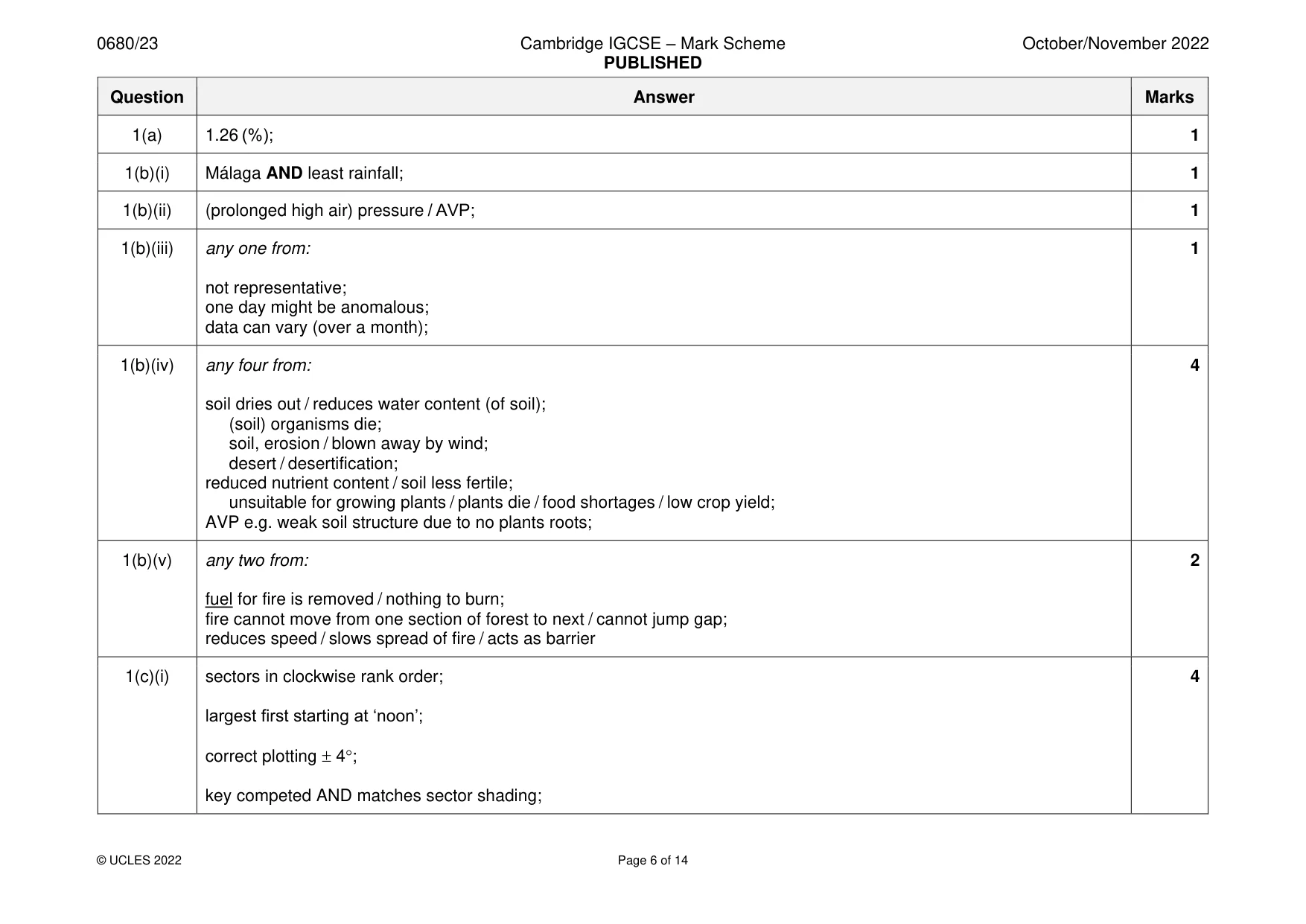
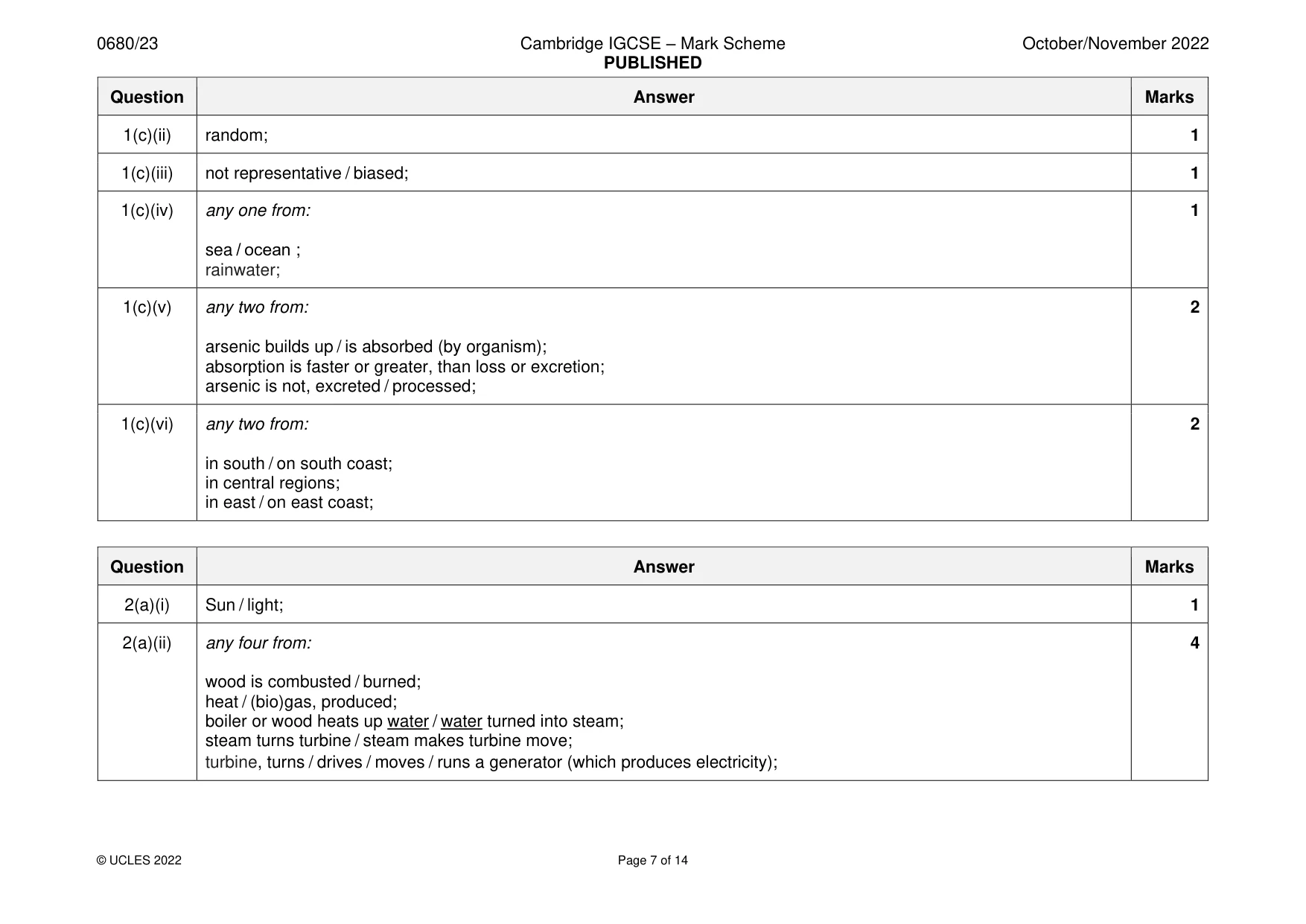
0680/23 Cambridge IGCSE – Mark Scheme PUBLISHED October/November 2022 © UCLES 2022 Page 6 of 14 Question Answer Marks 1(a) 1.26 (%); 1 1(b)(i) Málaga AND least rainfall; 1 1(b)(ii) (prolonged high air) pressure / AVP; 1 1(b)(iii) any one from: not representative; one day might be anomalous; data can vary (over a month); 1 1(b)(iv) any four from: soil dries out / reduces water content (of soil); (soil) organisms die; soil, erosion / blown away by wind; desert / desertification; reduced nutrient content / soil less fertile; unsuitable for growing plants / plants die / food shortages / low crop yield; AVP e.g. weak soil structure due to no plants roots; 4 1(b)(v) any two from: fuel for fire is removed / nothing to burn; fire cannot move from one section of forest to next / cannot jump gap; reduces speed / slows spread of fire / acts as barrier 2 1(c)(i) sectors in clockwise rank order; largest first starting at ‘noon’; correct plotting 4; key competed AND matches sector shading; 4
Mark scheme, page 7
0680/23 Cambridge IGCSE – Mark Scheme PUBLISHED October/November 2022 © UCLES 2022 Page 7 of 14 Question Answer Marks 1(c)(ii) random; 1 1(c)(iii) not representative / biased; 1 1(c)(iv) any one from: sea / ocean ; rainwater; 1 1(c)(v) any two from: arsenic builds up / is absorbed (by organism); absorption is faster or greater, than loss or excretion; arsenic is not, excreted / processed; 2 1(c)(vi) any two from: in south / on south coast; in central regions; in east / on east coast; 2 Question Answer Marks 2(a)(i) Sun / light; 1 2(a)(ii) any four from: wood is combusted / burned; heat / (bio)gas, produced; boiler or wood heats up water / water turned into steam; steam turns turbine / steam makes turbine move; turbine, turns / drives / moves / runs a generator (which produces electricity); 4
Mark scheme, page 8
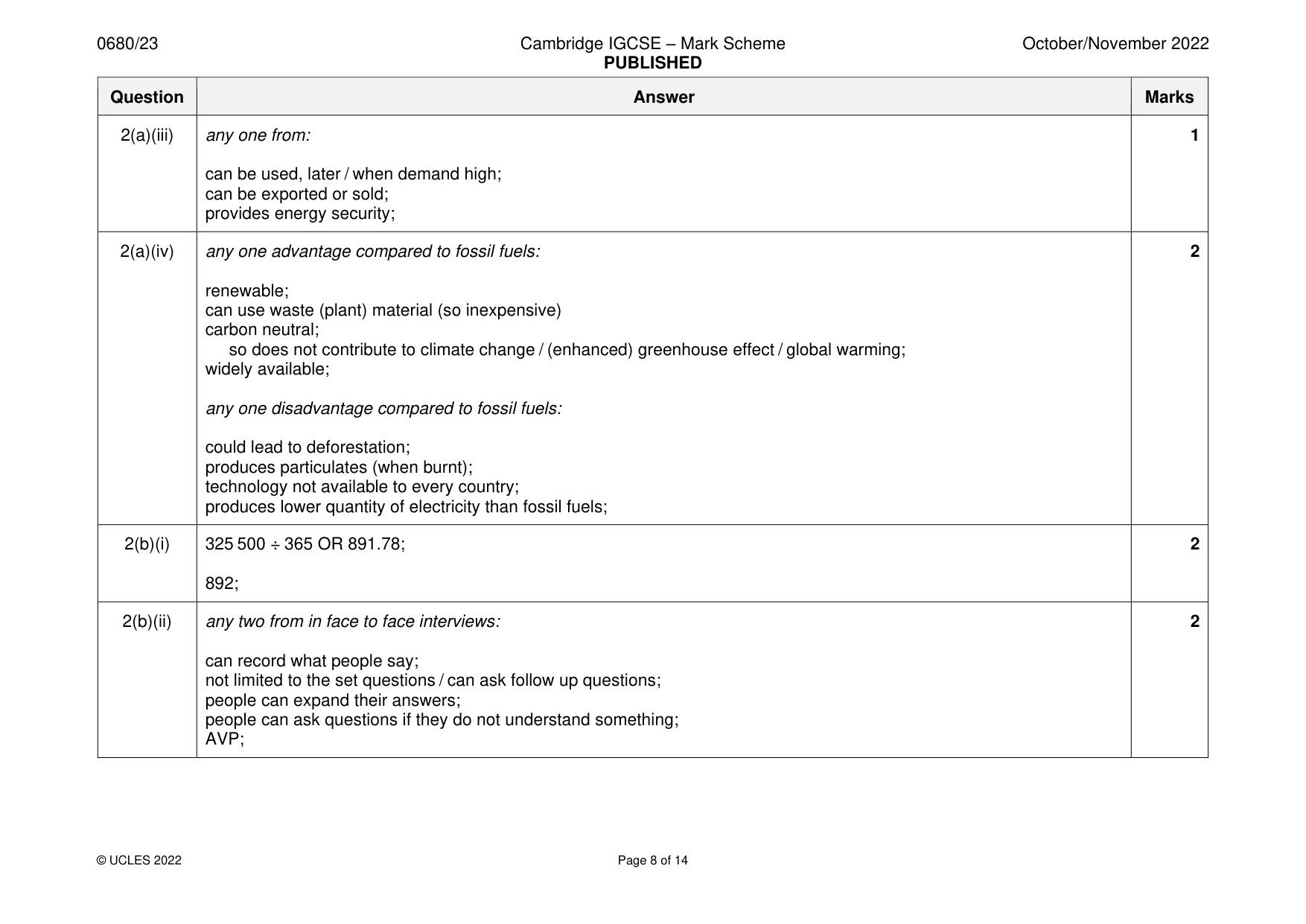
0680/23 Cambridge IGCSE – Mark Scheme PUBLISHED October/November 2022 © UCLES 2022 Page 8 of 14 Question Answer Marks 2(a)(iii) any one from: can be used, later / when demand high; can be exported or sold; provides energy security; 1 2(a)(iv) any one advantage compared to fossil fuels: renewable; can use waste (plant) material (so inexpensive) carbon neutral; so does not contribute to climate change / (enhanced) greenhouse effect / global warming; widely available; any one disadvantage compared to fossil fuels: could lead to deforestation; produces particulates (when burnt); technology not available to every country; produces lower quantity of electricity than fossil fuels; 2 2(b)(i) 325 500 ÷ 365 OR 891.78; 892; 2 2(b)(ii) any two from in face to face interviews: can record what people say; not limited to the set questions / can ask follow up questions; people can expand their answers; people can ask questions if they do not understand something; AVP; 2
Mark scheme, page 9
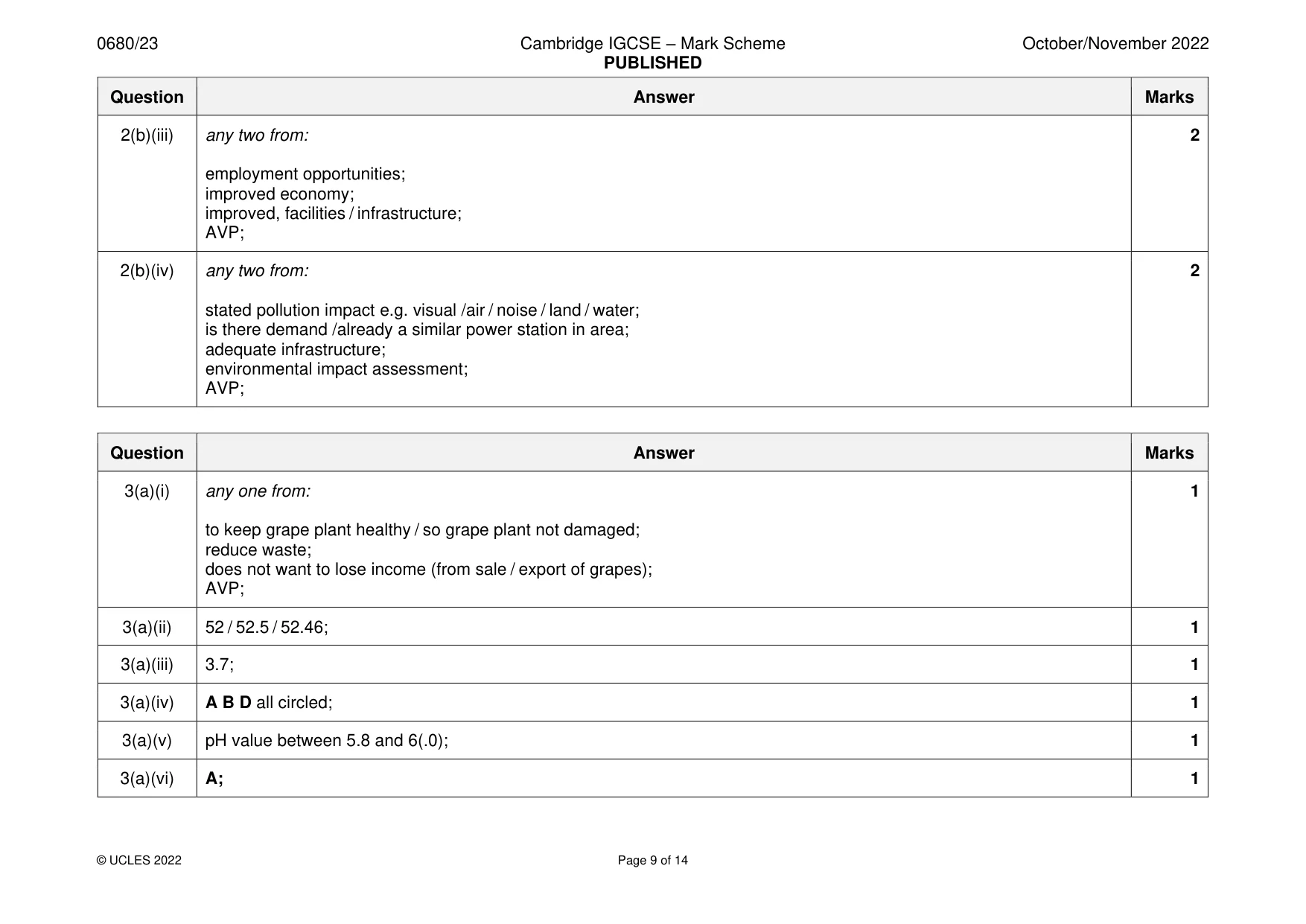
0680/23 Cambridge IGCSE – Mark Scheme PUBLISHED October/November 2022 © UCLES 2022 Page 9 of 14 Question Answer Marks 2(b)(iii) any two from: employment opportunities; improved economy; improved, facilities / infrastructure; AVP; 2 2(b)(iv) any two from: stated pollution impact e.g. visual /air / noise / land / water; is there demand /already a similar power station in area; adequate infrastructure; environmental impact assessment; AVP; 2 Question Answer Marks 3(a)(i) any one from: to keep grape plant healthy / so grape plant not damaged; reduce waste; does not want to lose income (from sale / export of grapes); AVP; 1 3(a)(ii) 52 / 52.5 / 52.46; 1 3(a)(iii) 3.7; 1 3(a)(iv) A B D all circled; 1 3(a)(v) pH value between 5.8 and 6(.0); 1 3(a)(vi) A; 1
Mark scheme, page 10
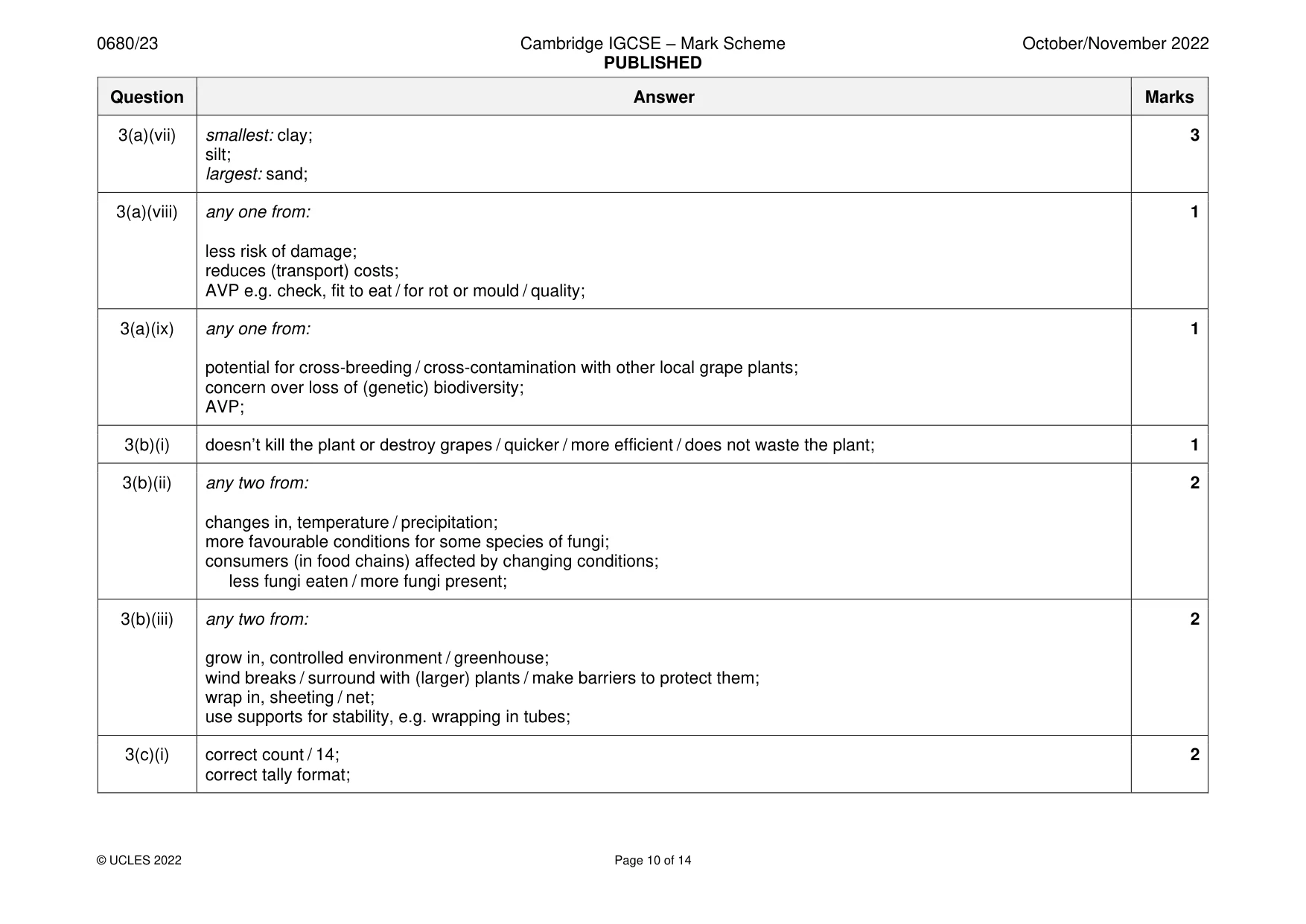
0680/23 Cambridge IGCSE – Mark Scheme PUBLISHED October/November 2022 © UCLES 2022 Page 10 of 14 Question Answer Marks 3(a)(vii) smallest: clay; silt; largest: sand; 3 3(a)(viii) any one from: less risk of damage; reduces (transport) costs; AVP e.g. check, fit to eat / for rot or mould / quality; 1 3(a)(ix) any one from: potential for cross-breeding / cross-contamination with other local grape plants; concern over loss of (genetic) biodiversity; AVP; 1 3(b)(i) doesn’t kill the plant or destroy grapes / quicker / more efficient / does not waste the plant; 1 3(b)(ii) any two from: changes in, temperature / precipitation; more favourable conditions for some species of fungi; consumers (in food chains) affected by changing conditions; less fungi eaten / more fungi present; 2 3(b)(iii) any two from: grow in, controlled environment / greenhouse; wind breaks / surround with (larger) plants / make barriers to protect them; wrap in, sheeting / net; use supports for stability, e.g. wrapping in tubes; 2 3(c)(i) correct count / 14; correct tally format; 2
Mark scheme, page 11
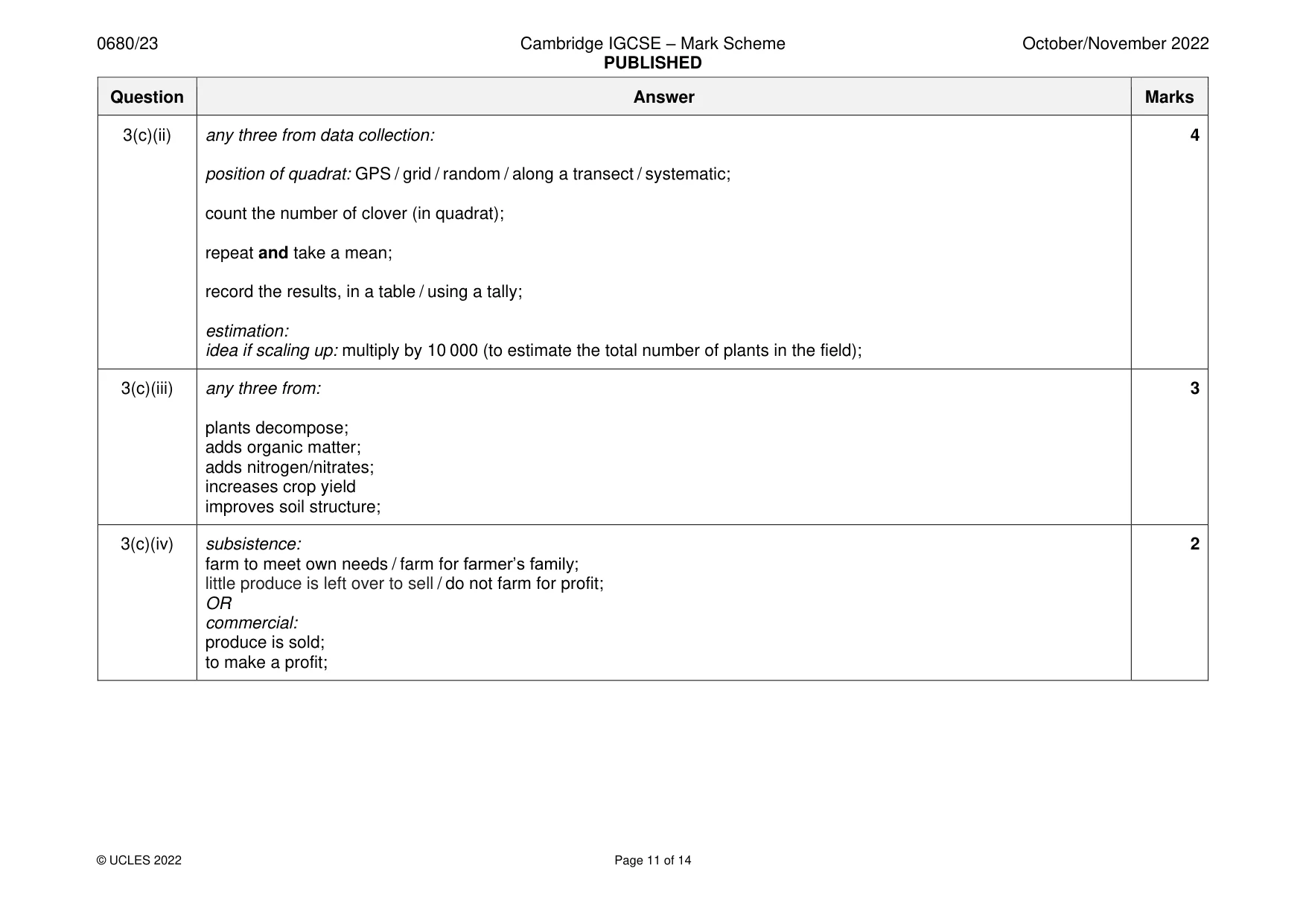
0680/23 Cambridge IGCSE – Mark Scheme PUBLISHED October/November 2022 © UCLES 2022 Page 11 of 14 Question Answer Marks 3(c)(ii) any three from data collection: position of quadrat: GPS / grid / random / along a transect / systematic; count the number of clover (in quadrat); repeat and take a mean; record the results, in a table / using a tally; estimation: idea if scaling up: multiply by 10 000 (to estimate the total number of plants in the field); 4 3(c)(iii) any three from: plants decompose; adds organic matter; adds nitrogen/nitrates; increases crop yield improves soil structure; 3 3(c)(iv) subsistence: farm to meet own needs / farm for farmer’s family; little produce is left over to sell / do not farm for profit; OR commercial: produce is sold; to make a profit; 2
Mark scheme, page 12
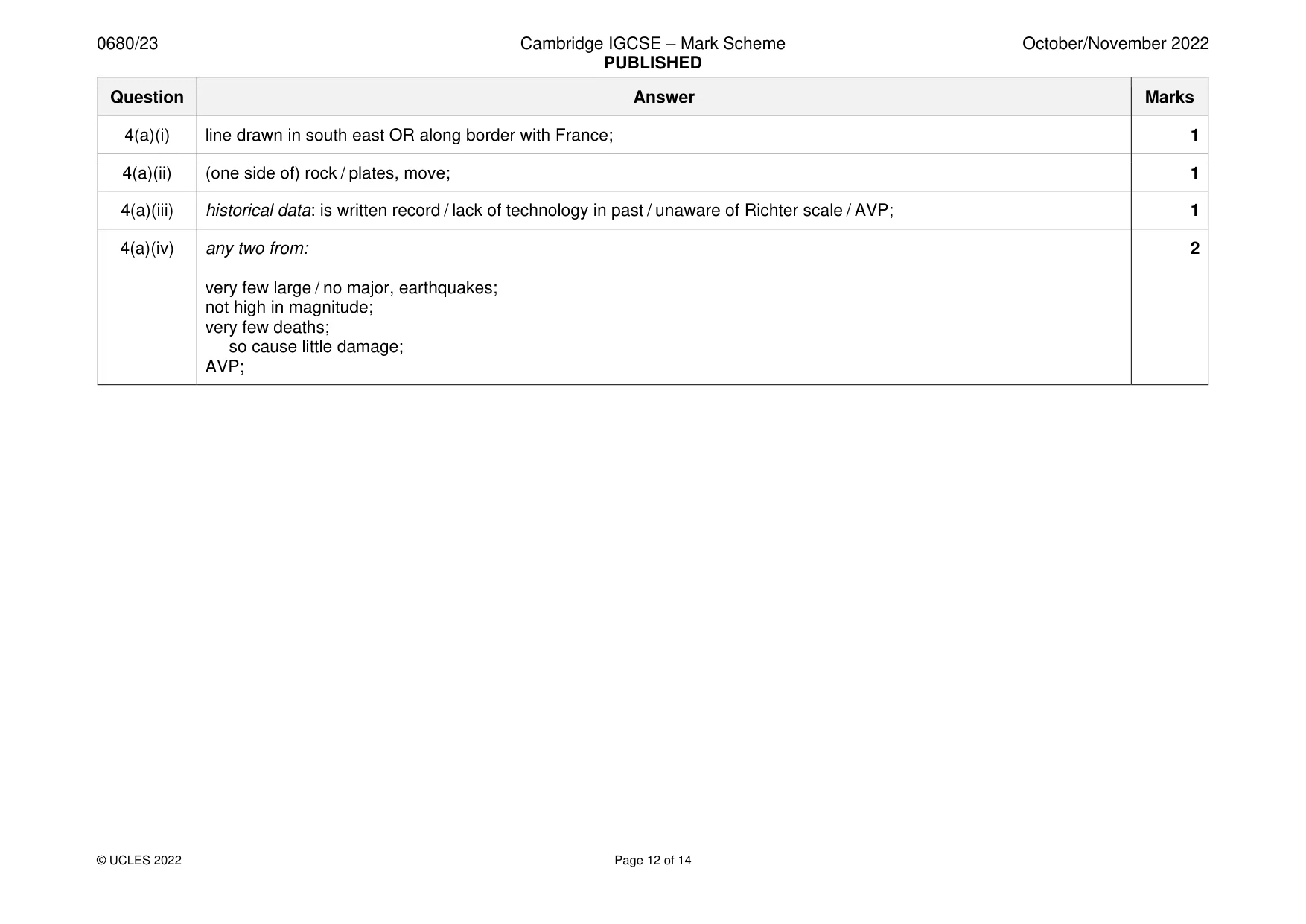
0680/23 Cambridge IGCSE – Mark Scheme PUBLISHED October/November 2022 © UCLES 2022 Page 12 of 14 Question Answer Marks 4(a)(i) line drawn in south east OR along border with France; 1 4(a)(ii) (one side of) rock / plates, move; 1 4(a)(iii) historical data: is written record / lack of technology in past / unaware of Richter scale / AVP; 1 4(a)(iv) any two from: very few large / no major, earthquakes; not high in magnitude; very few deaths; so cause little damage; AVP; 2
Mark scheme, page 13
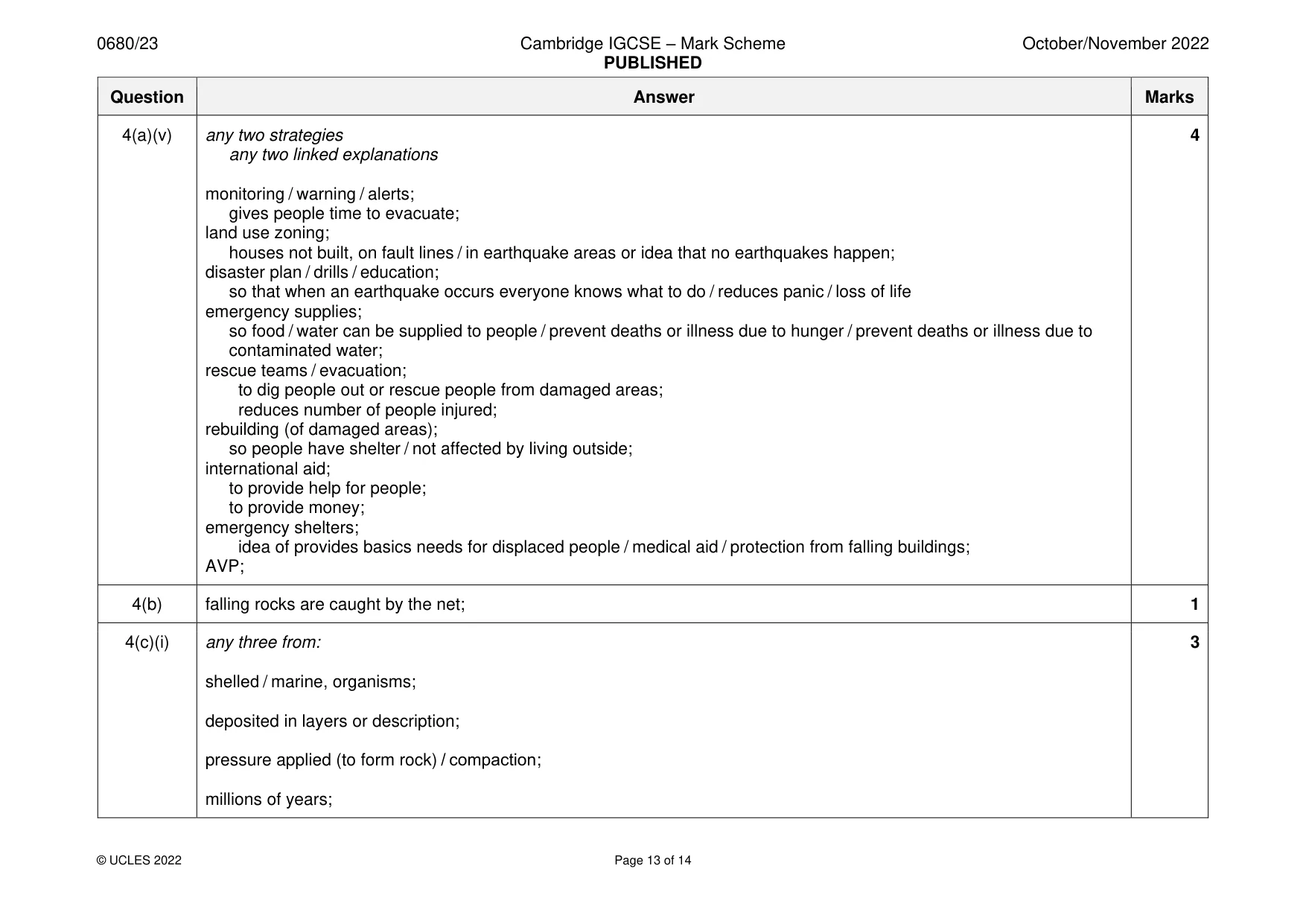
0680/23 Cambridge IGCSE – Mark Scheme PUBLISHED October/November 2022 © UCLES 2022 Page 13 of 14 Question Answer Marks 4(a)(v) any two strategies any two linked explanations monitoring / warning / alerts; gives people time to evacuate; land use zoning; houses not built, on fault lines / in earthquake areas or idea that no earthquakes happen; disaster plan / drills / education; so that when an earthquake occurs everyone knows what to do / reduces panic / loss of life emergency supplies; so food / water can be supplied to people / prevent deaths or illness due to hunger / prevent deaths or illness due to contaminated water; rescue teams / evacuation; to dig people out or rescue people from damaged areas; reduces number of people injured; rebuilding (of damaged areas); so people have shelter / not affected by living outside; international aid; to provide help for people; to provide money; emergency shelters; idea of provides basics needs for displaced people / medical aid / protection from falling buildings; AVP; 4 4(b) falling rocks are caught by the net; 1 4(c)(i) any three from: shelled / marine, organisms; deposited in layers or description; pressure applied (to form rock) / compaction; millions of years; 3
Mark scheme, page 14
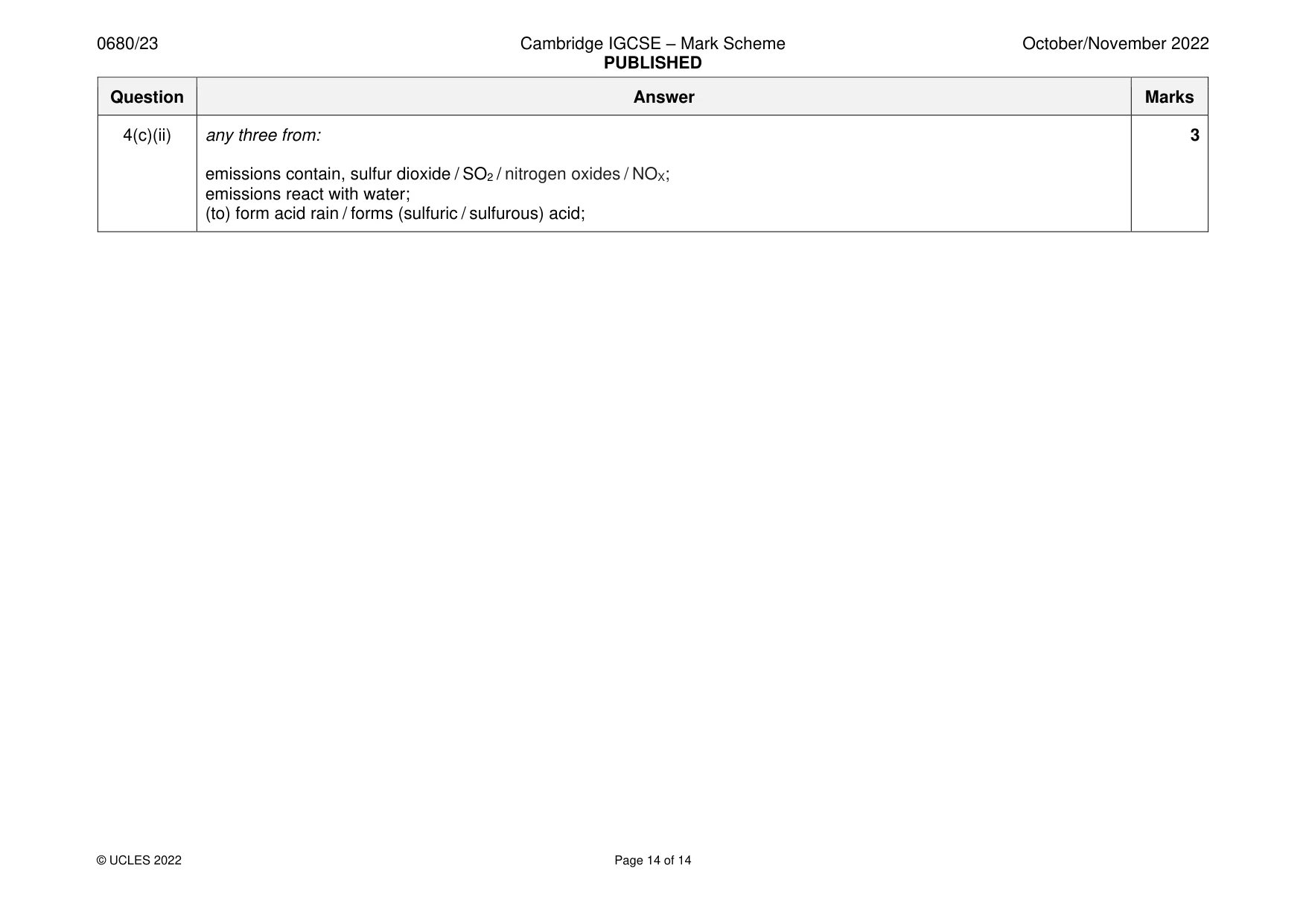
0680/23 Cambridge IGCSE – Mark Scheme PUBLISHED October/November 2022 © UCLES 2022 Page 14 of 14 Question Answer Marks 4(c)(ii) any three from: emissions contain, sulfur dioxide / SO2 / nitrogen oxides / NOX; emissions react with water; (to) form acid rain / forms (sulfuric / sulfurous) acid; 3
What you needed in this session
Cambridge’s own grade thresholds for 2022 Oct/Nov, Paper 2 · Variant 3. A higher threshold means an easier paper — the bar moves with how the cohort did.