Cambridge IGCSE Environmental Management 0680 — 2022 Oct/Nov Paper 2 · Variant 1
0680/21/O/N/22 · 4 questions · 80 marks · ≈90 min
The question paper and its mark scheme, free to read here and free to download. This is Cambridge’s own paper, exactly as it was sat.
Question paper24 pages



Mark scheme12 pages
Answers below. Sit the paper first if you are practising.
Questions as text
Q1 · Spain produces many types of food, including vegetables and citrus fruits
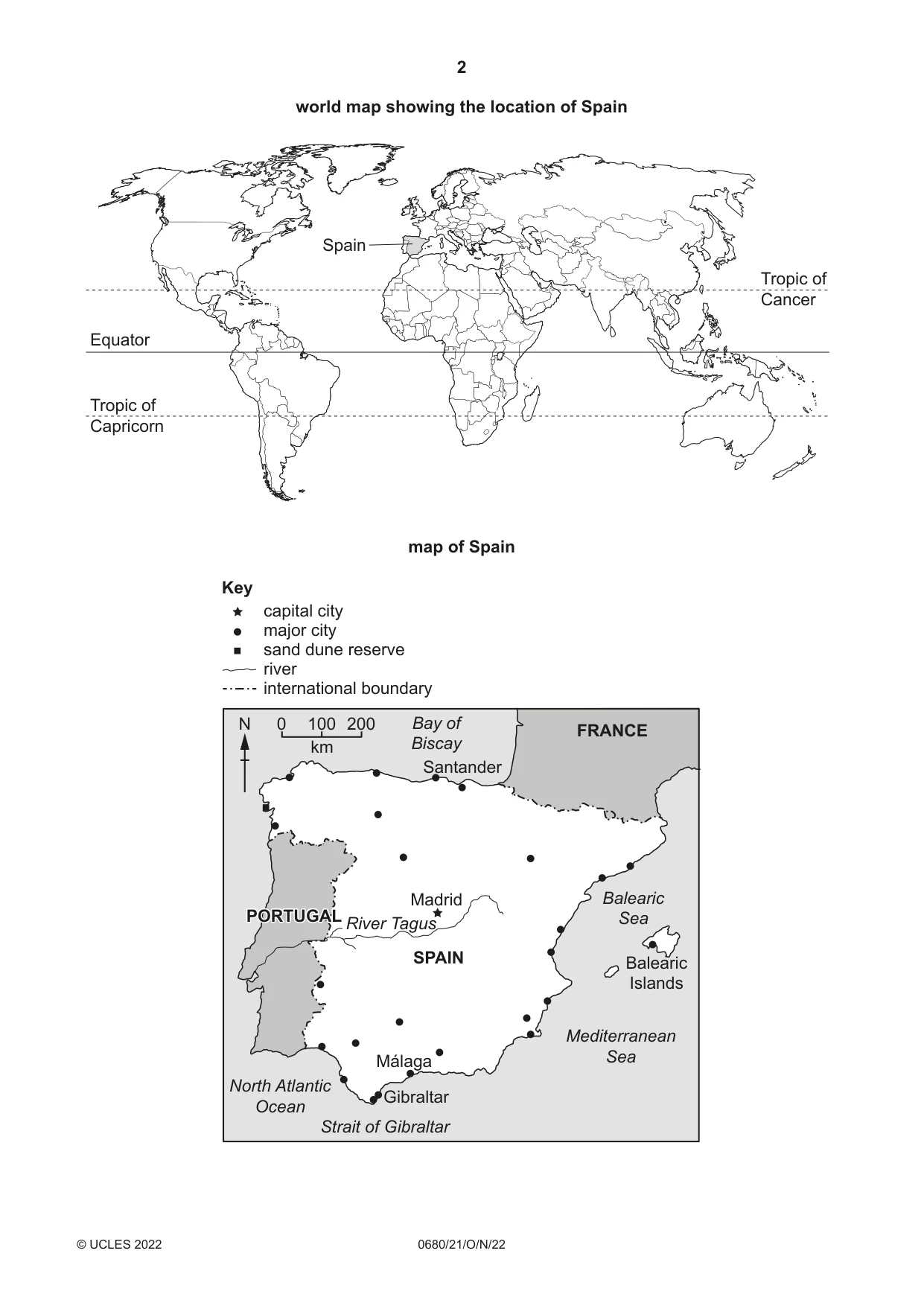
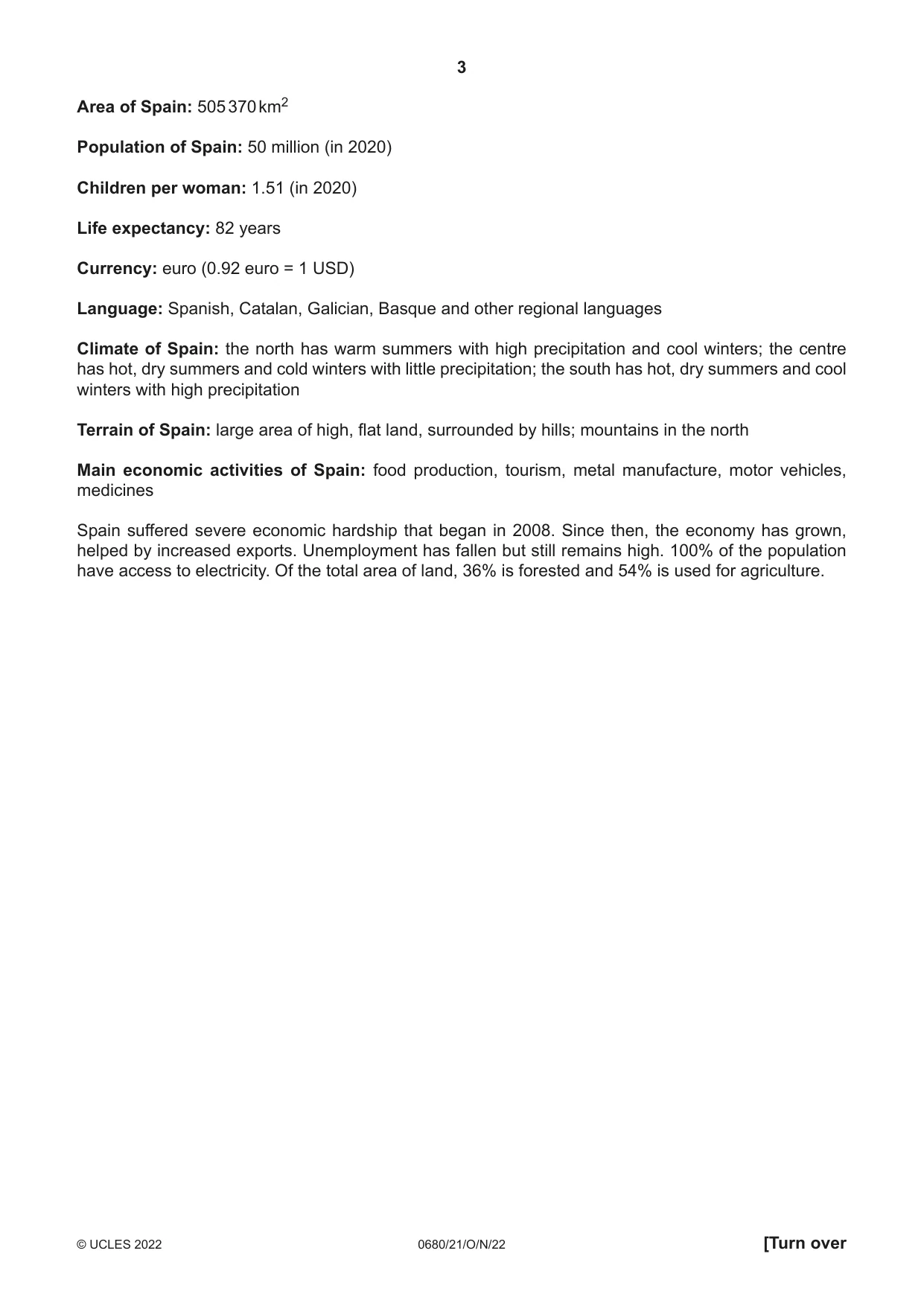
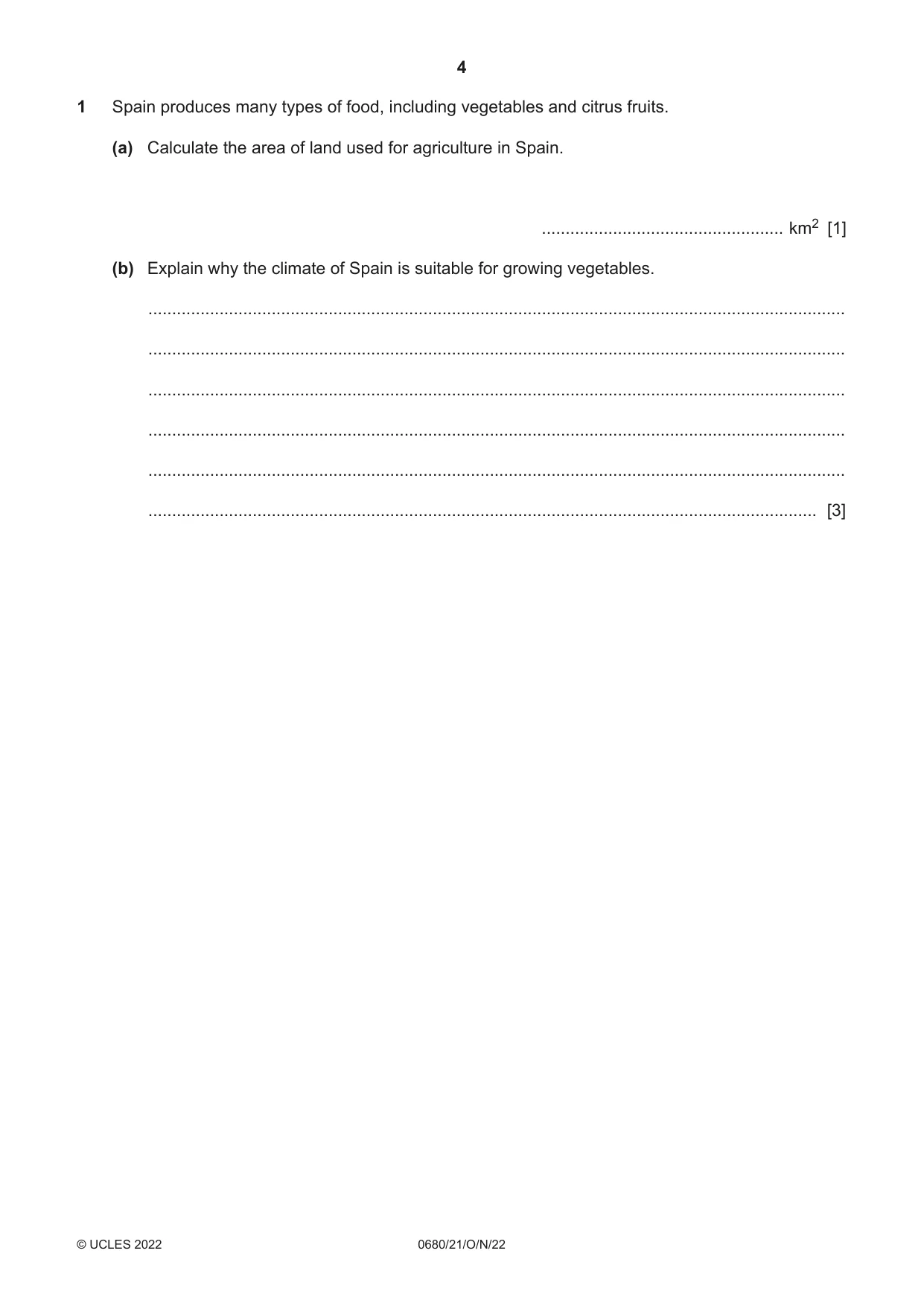
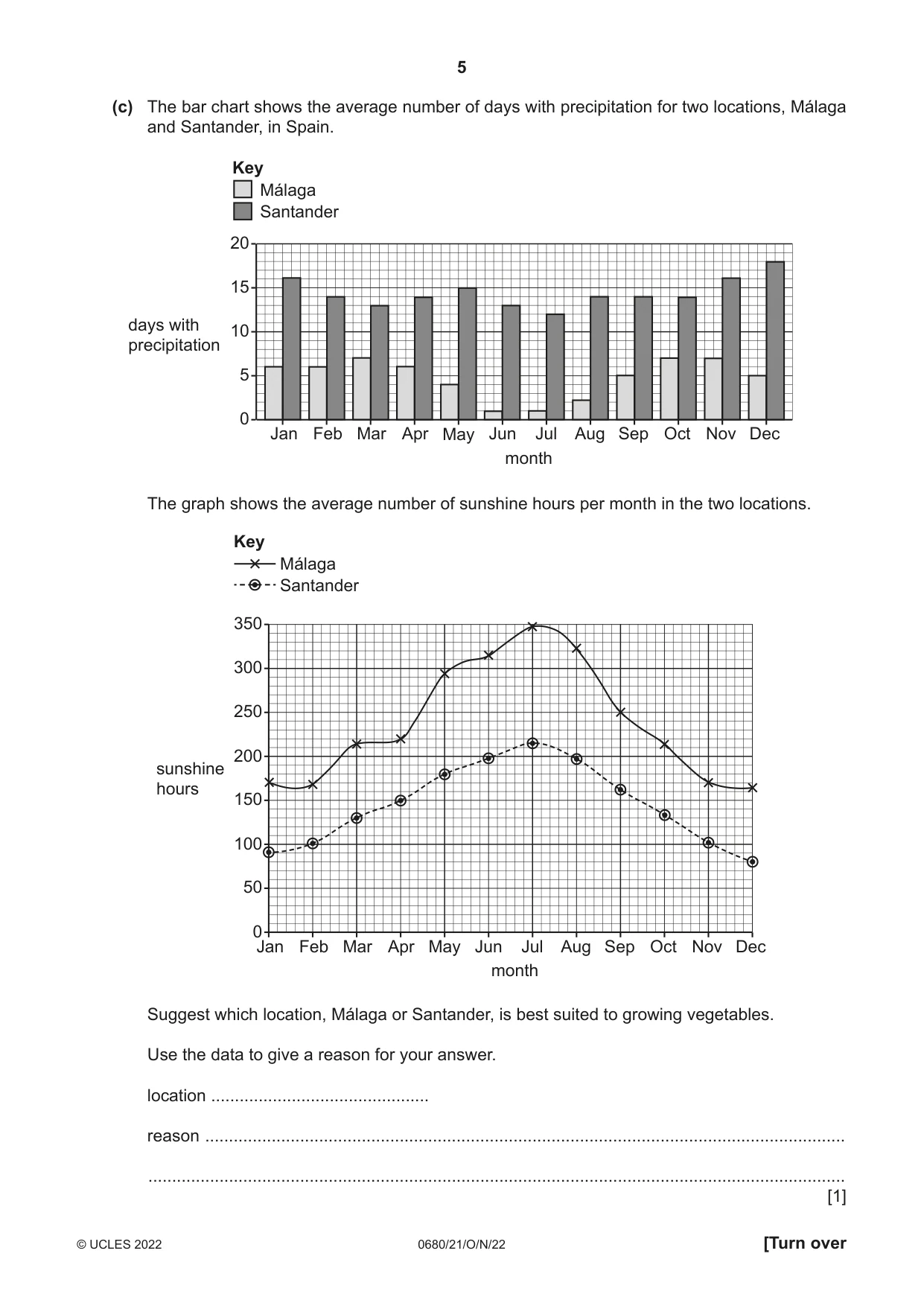
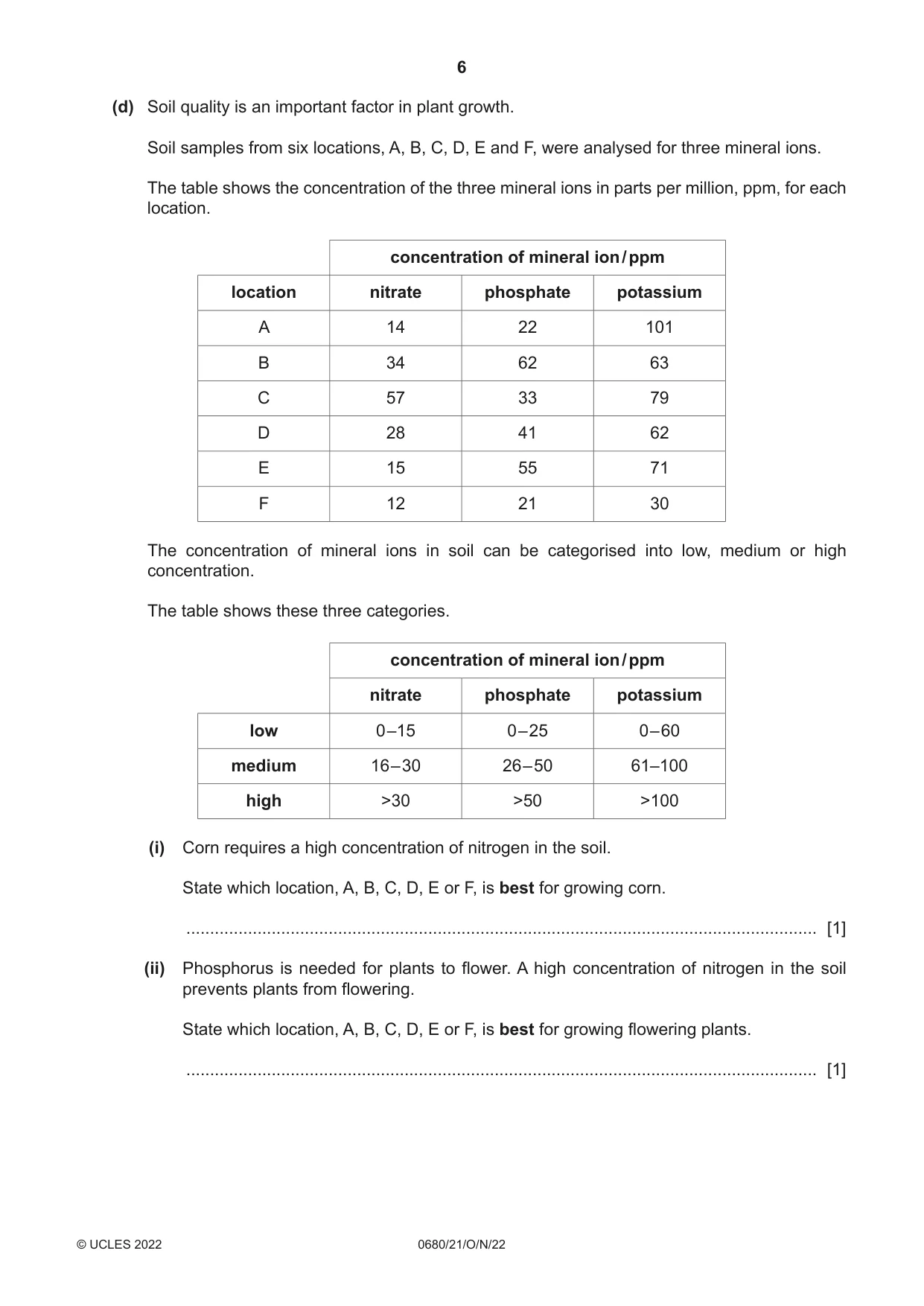
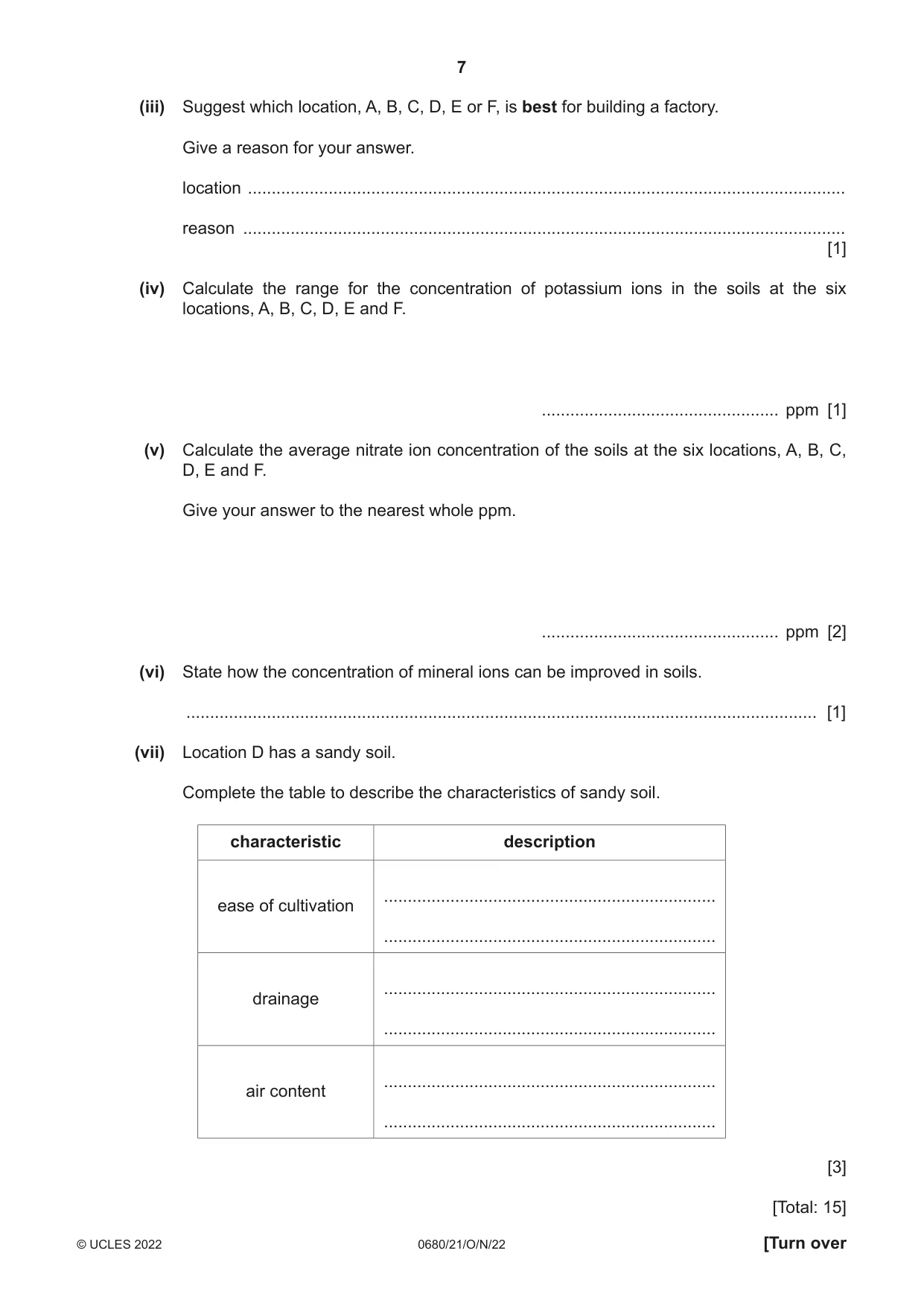
1 Spain produces many types of food, including vegetables and citrus fruits. (a) Calculate the area of land used for agriculture in Spain. ................................................... km2 [1] (b) Explain why the climate of Spain is suitable for growing vegetables. ................................................................................................................................................... ................................................................................................................................................... ................................................................................................................................................... ................................................................................................................................................... ................................................................................................................................................... ............................................................................................................................................. [3] (c) The bar chart shows the average number of days with precipitation for two locations, Málaga and Santander, in Spain. Key Málaga Santander 20 15 days with 10 precipitation 5 0 Jan Feb Mar Apr May Jun Jul Aug Sep Oct Nov Dec month The graph shows the average number of sunshine hours per month in the two locations. Key Málaga Santander 350 300 250 200 sunshine hours 150 100 50 0 Jan Feb Mar Apr May Jun Jul Aug Sep Oct Nov Dec month Suggest which location, Málaga or Santander, is best suited to growing vegetables. Use the data to give a reason for your answer. location .............................................. reason ....................................................................................................................................... ................................................................................................................................................... [1] (d) Soil quality is an important factor in plant growth. Soil samples from six locations, A, B, C, D, E and F, were analysed for three mineral ions. The table shows the concentration of the three mineral ions in parts per million, ppm, for each location. concentration of mineral ion / ppm location nitrate phosphate potassium A 14 22 101 B 34 62 63 C 57 33 79 D 28 41 62 E 15 55 71 F 12 21 30 The concentration of mineral ions in soil can be categorised into low, medium or high concentration. The table shows these three categories. concentration of mineral ion / ppm nitrate phosphate potassium low 0 –15 0 – 25 0 – 60 medium 16 – 30 26 – 50 61–100 high >30 >50 >100 (i) Corn requires a high concentration of nitrogen in the soil. State which location, A, B, C, D, E or F, is best for growing corn. ..................................................................................................................................... [1] (ii) Phosphorus is needed for plants to flower. A high concentration of nitrogen in the soil prevents plants from flowering. State which location, A, B, C, D, E or F, is best for growing flowering plants. ..................................................................................................................................... [1] (iii) Suggest which location, A, B, C, D, E or F, is best for building a factory. Give a reason for your answer. location .............................................................................................................................. reason ............................................................................................................................... [1] (iv) Calculate the range for the concentration of potassium ions in the soils at the six locations, A, B, C, D, E and F. .................................................. ppm [1] (v) Calculate the average nitrate ion concentration of the soils at the six locations, A, B, C, D, E and F. Give your answer to the nearest whole ppm. .................................................. ppm [2] (vi) State how the concentration of mineral ions can be improved in soils. ..................................................................................................................................... [1] (vii) Location D has a sandy soil. Complete the table to describe the characteristics of sandy soil. characteristic description ...................................................................... ease of cultivation ...................................................................... ...................................................................... drainage ...................................................................... ...................................................................... air content ...................................................................... [3] [Total: 15]
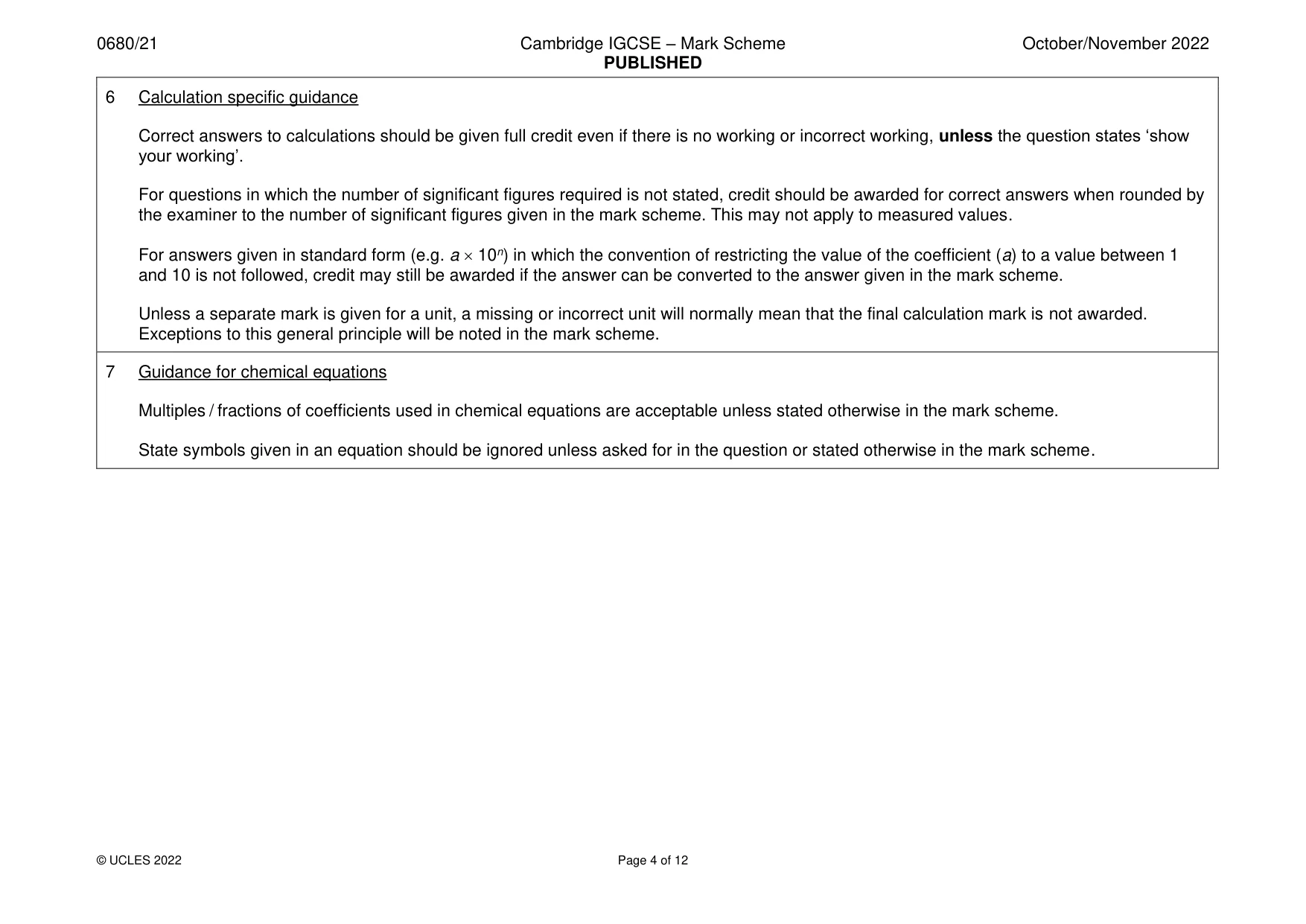
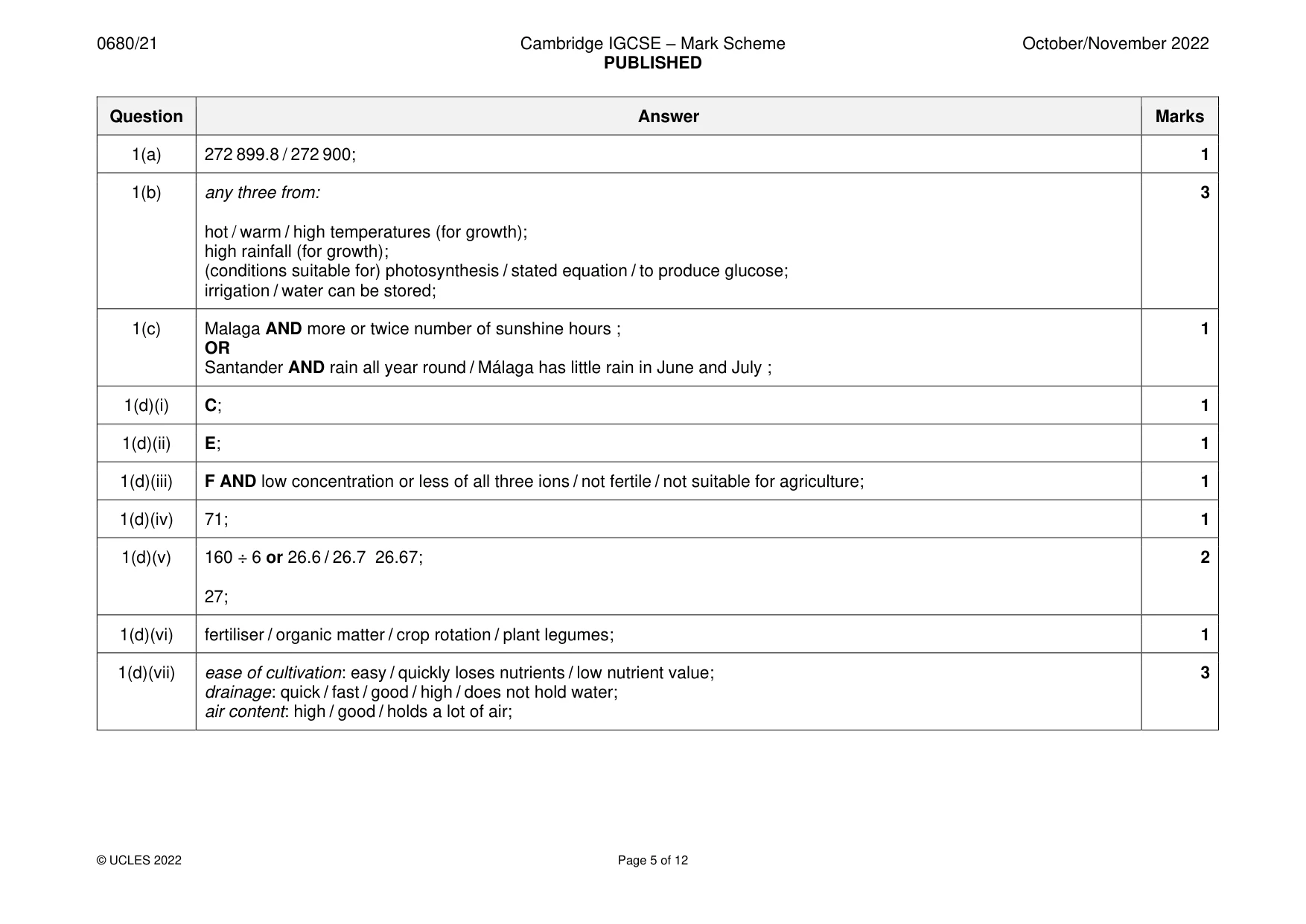
Mark scheme: Question Answer Marks 1(a) 272 899.8 / 272 900; 1 1(b) any three from: 3 hot / warm / high temperatures (for growth); high rainfall (for growth); (conditions suitable for) photosynthesis / stated equation / to produce glucose; irrigation / water can be stored; 1(c) Malaga AND more or twice number of sunshine hours ; 1 OR Santander AND rain all year round / Málaga has little rain in June and July ; 1(d)(i) C; 1 1(d)(ii) E; 1 1(d)(iii) F AND low concentration or less of all three ions / not fertile / not suitable for agriculture; 1 1(d)(iv) 71; 1 1(d)(v) 160 ÷ 6 or 26.6 / 26.7 26.67; 2 27; 1(d)(vi) fertiliser / organic matter / crop rotation / plant legumes; 1 1(d)(vii) ease of cultivation: easy / quickly loses nutrients / low nutrient value; 3 drainage: quick / fast / good / high / does not hold water; air content: high / good / holds a lot of air;
Q2 · The photograph shows a large sand dune
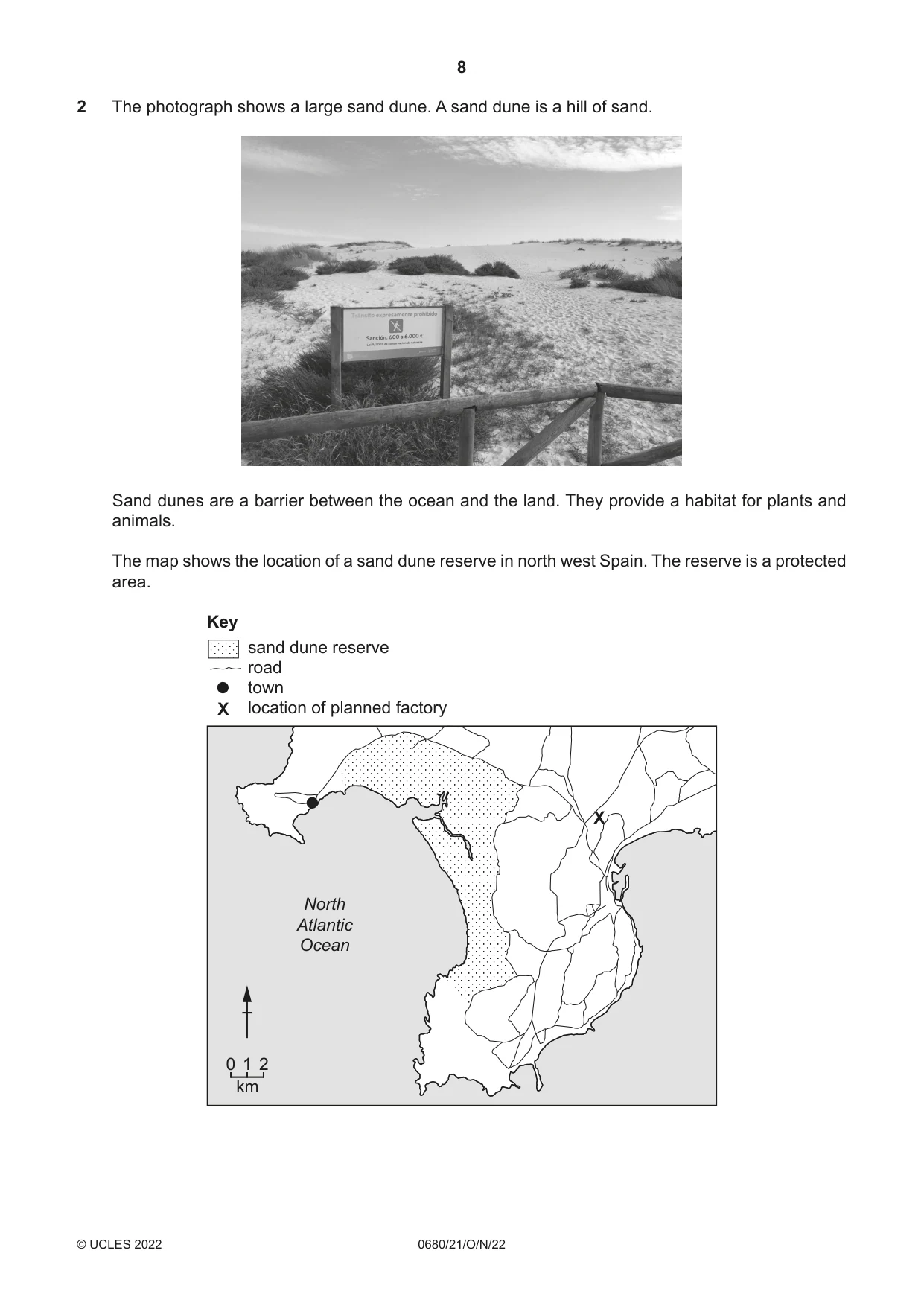
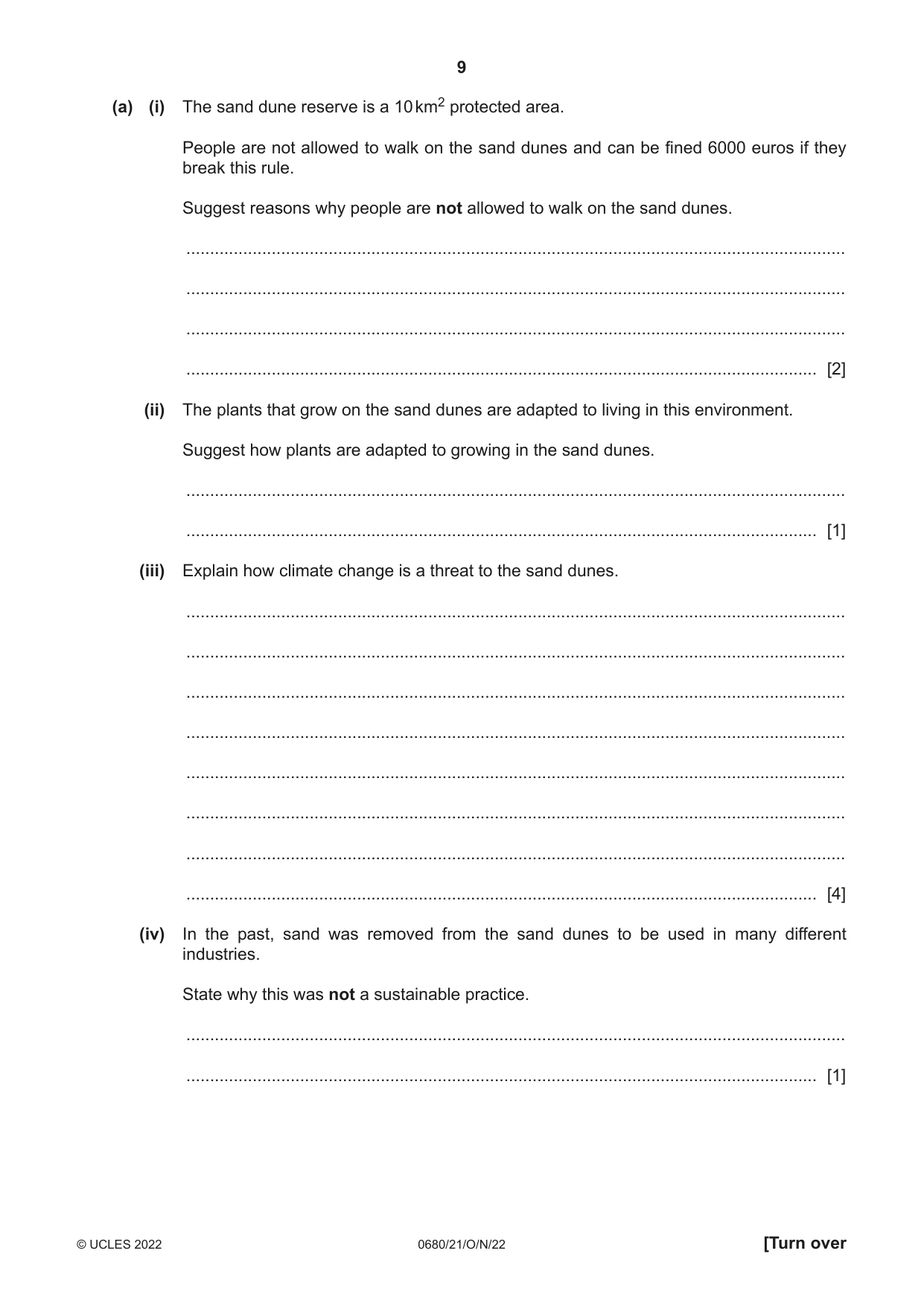
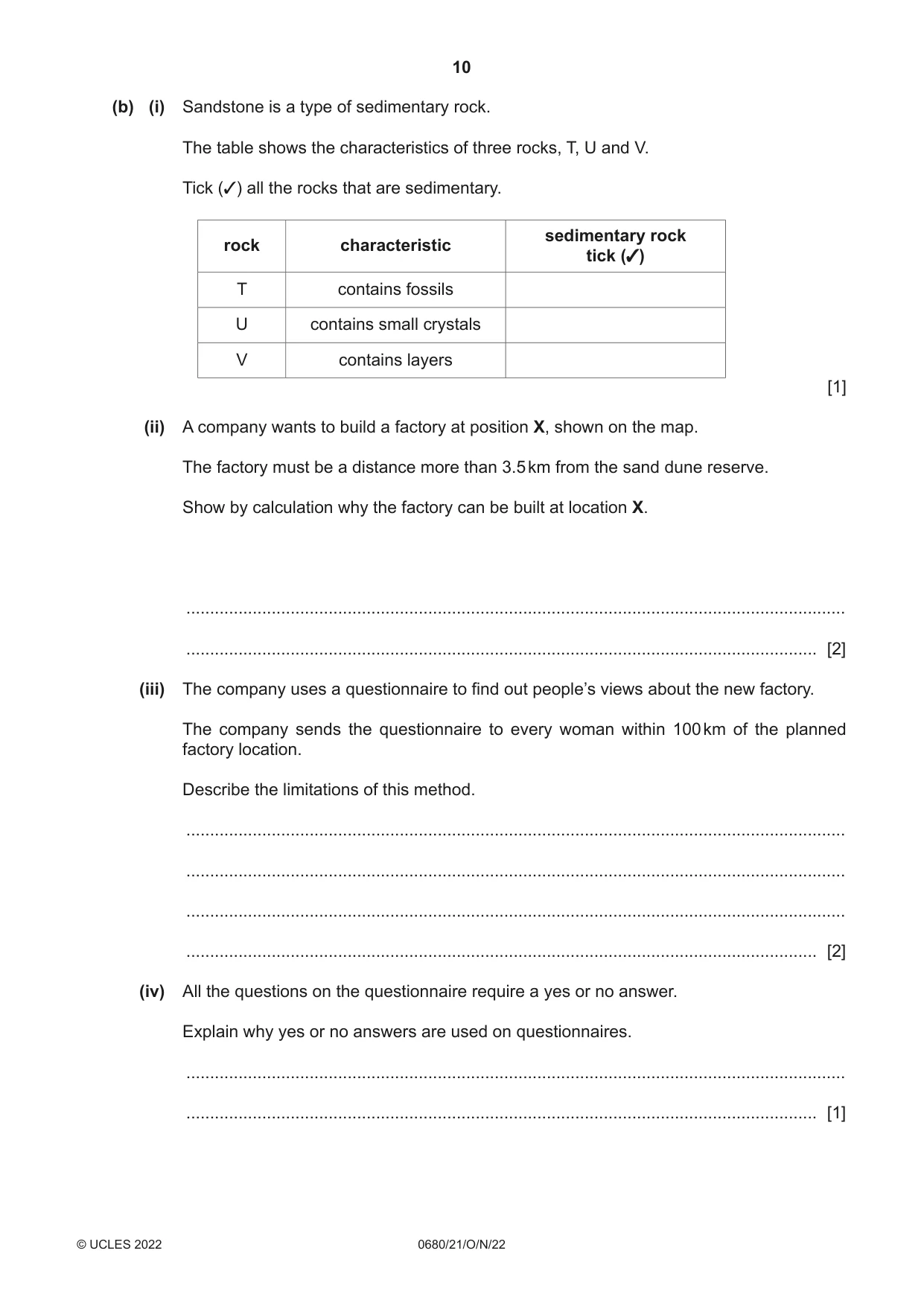
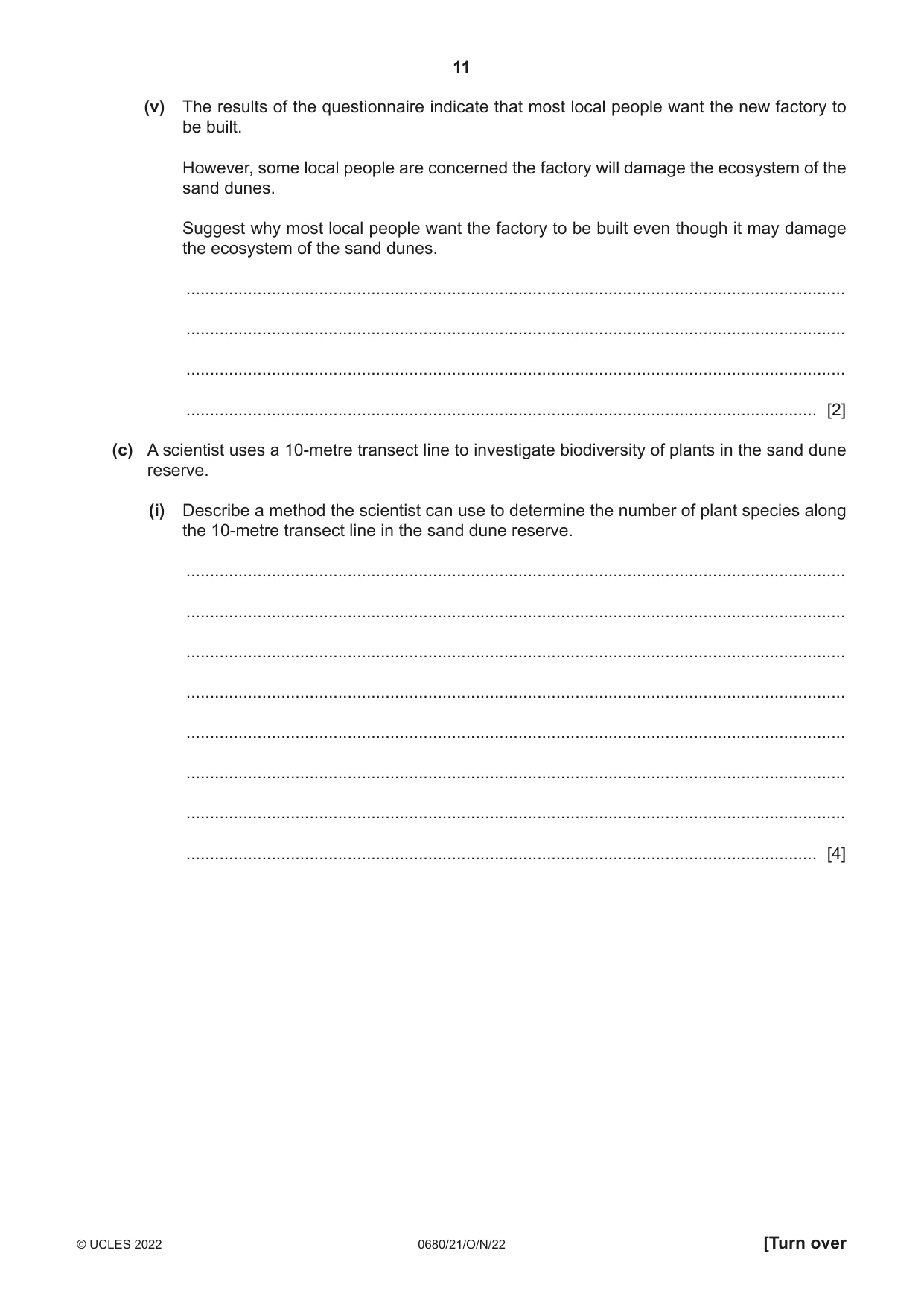
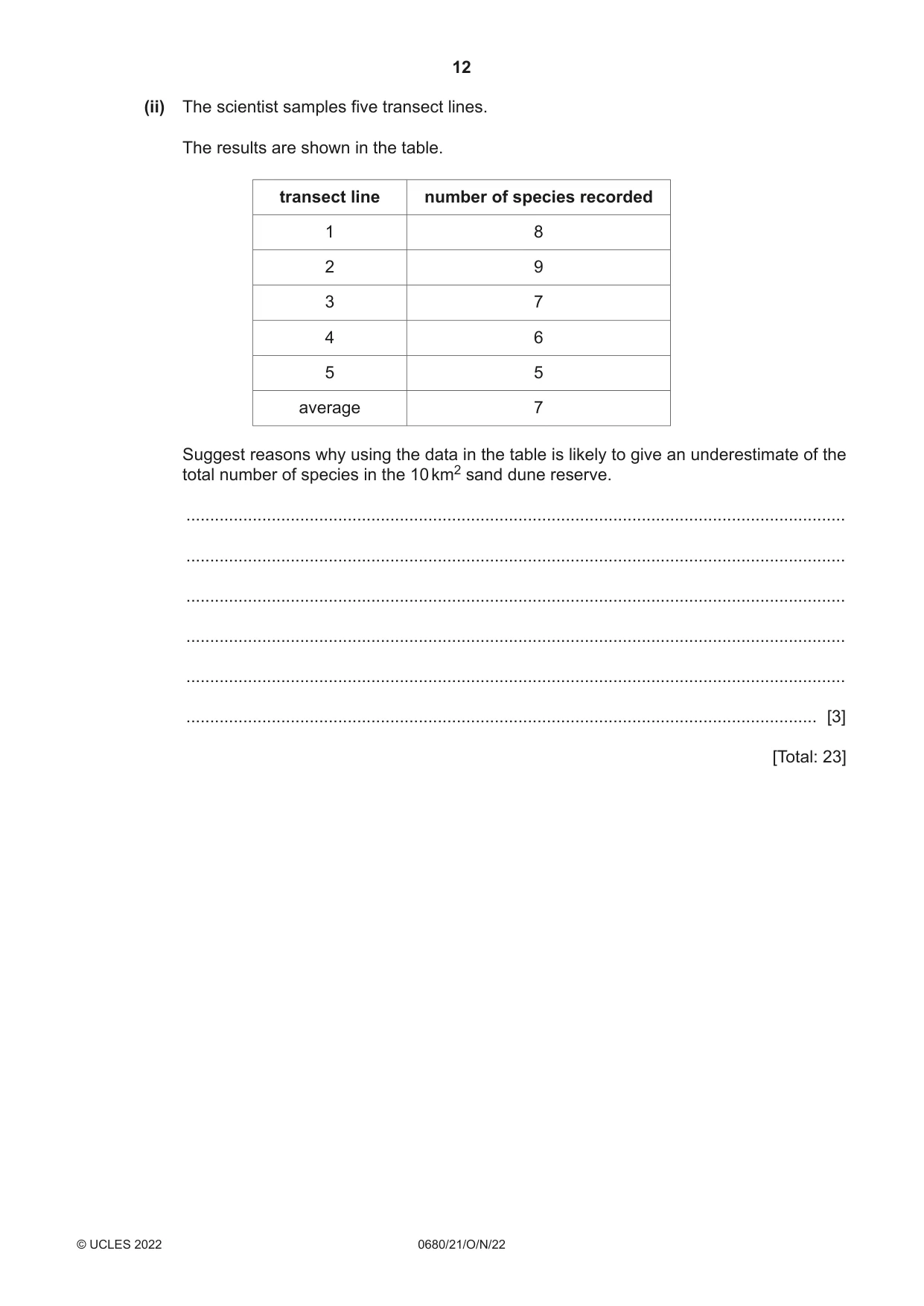
2 The photograph shows a large sand dune. A sand dune is a hill of sand. Sand dunes are a barrier between the ocean and the land. They provide a habitat for plants and animals. The map shows the location of a sand dune reserve in north west Spain. The reserve is a protected area. Key sand dune reserve road town X location of planned factory X North Atlantic Ocean 0 1 2 km (a) (i) The sand dune reserve is a 10 km2 protected area. People are not allowed to walk on the sand dunes and can be fined 6000 euros if they break this rule. Suggest reasons why people are not allowed to walk on the sand dunes. ........................................................................................................................................... ........................................................................................................................................... ........................................................................................................................................... ..................................................................................................................................... [2] (ii) The plants that grow on the sand dunes are adapted to living in this environment. Suggest how plants are adapted to growing in the sand dunes. ........................................................................................................................................... ..................................................................................................................................... [1] (iii) Explain how climate change is a threat to the sand dunes. ........................................................................................................................................... ........................................................................................................................................... ........................................................................................................................................... ........................................................................................................................................... ........................................................................................................................................... ........................................................................................................................................... ........................................................................................................................................... ..................................................................................................................................... [4] (iv) In the past, sand was removed from the sand dunes to be used in many different industries. State why this was not a sustainable practice. ........................................................................................................................................... ..................................................................................................................................... [1] (b) (i) Sandstone is a type of sedimentary rock. The table shows the characteristics of three rocks, T, U and V. Tick (3) all the rocks that are sedimentary. sedimentary rock rock characteristic tick (3) T contains fossils U contains small crystals V contains layers [1] (ii) A company wants to build a factory at position X, shown on the map. The factory must be a distance more than 3.5 km from the sand dune reserve. Show by calculation why the factory can be built at location X. ........................................................................................................................................... ..................................................................................................................................... [2] (iii) The company uses a questionnaire to find out people’s views about the new factory. The company sends the questionnaire to every woman within 100 km of the planned factory location. Describe the limitations of this method. ........................................................................................................................................... ........................................................................................................................................... ........................................................................................................................................... ..................................................................................................................................... [2] (iv) All the questions on the questionnaire require a yes or no answer. Explain why yes or no answers are used on questionnaires. ........................................................................................................................................... ..................................................................................................................................... [1] (v) The results of the questionnaire indicate that most local people want the new factory to be built. However, some local people are concerned the factory will damage the ecosystem of the sand dunes. Suggest why most local people want the factory to be built even though it may damage the ecosystem of the sand dunes. ........................................................................................................................................... ........................................................................................................................................... ........................................................................................................................................... ..................................................................................................................................... [2] (c) A scientist uses a 10-metre transect line to investigate biodiversity of plants in the sand dune reserve. (i) Describe a method the scientist can use to determine the number of plant species along the 10-metre transect line in the sand dune reserve. ........................................................................................................................................... ........................................................................................................................................... ........................................................................................................................................... ........................................................................................................................................... ........................................................................................................................................... ........................................................................................................................................... ........................................................................................................................................... ..................................................................................................................................... [4] (ii) The scientist samples five transect lines. The results are shown in the table. transect line number of species recorded 1 8 2 9 3 7 4 6 5 5 average 7 Suggest reasons why using the data in the table is likely to give an underestimate of the total number of species in the 10 km2 sand dune reserve. ........................................................................................................................................... ........................................................................................................................................... ........................................................................................................................................... ........................................................................................................................................... ........................................................................................................................................... ..................................................................................................................................... [3] [Total: 23]
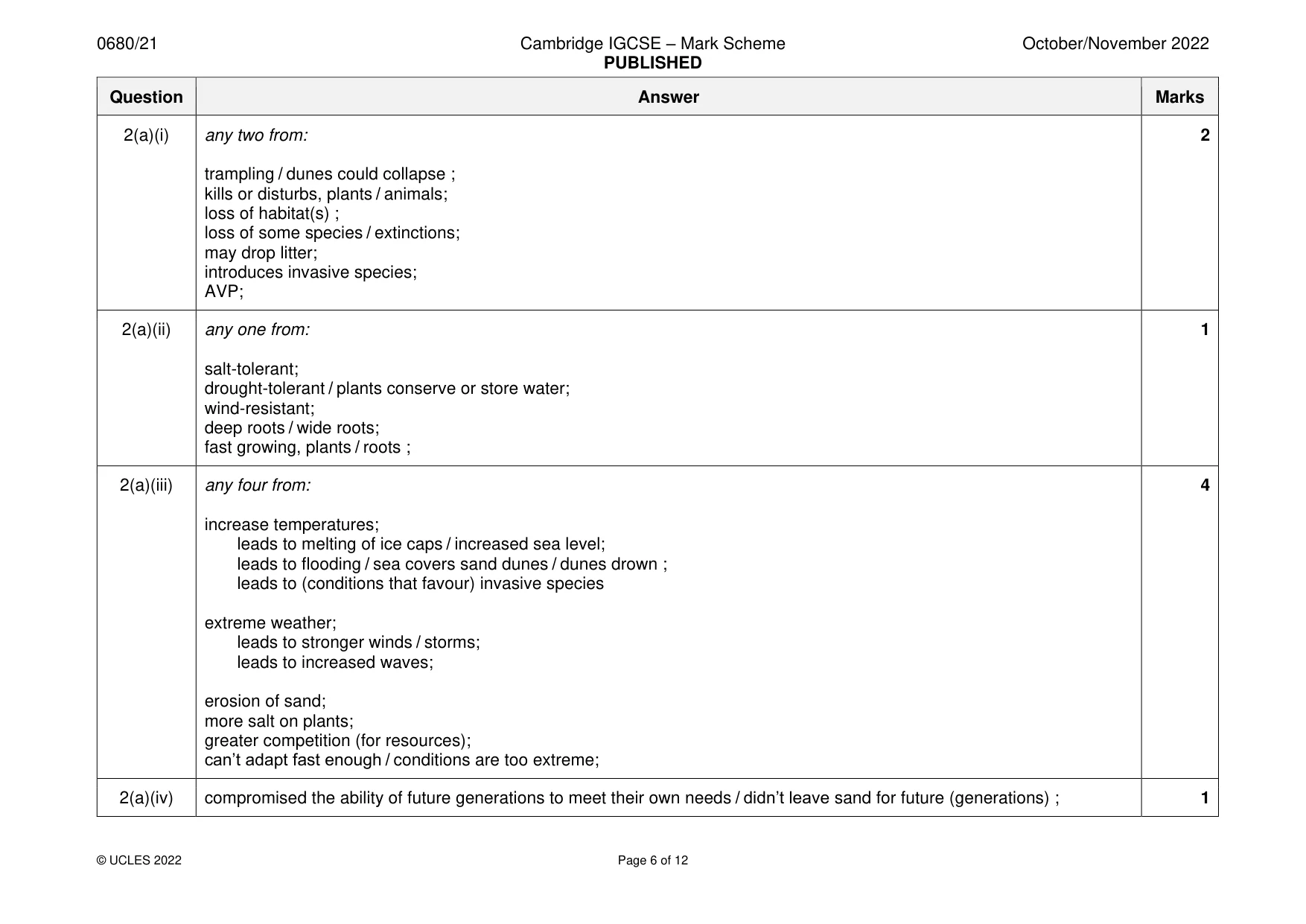
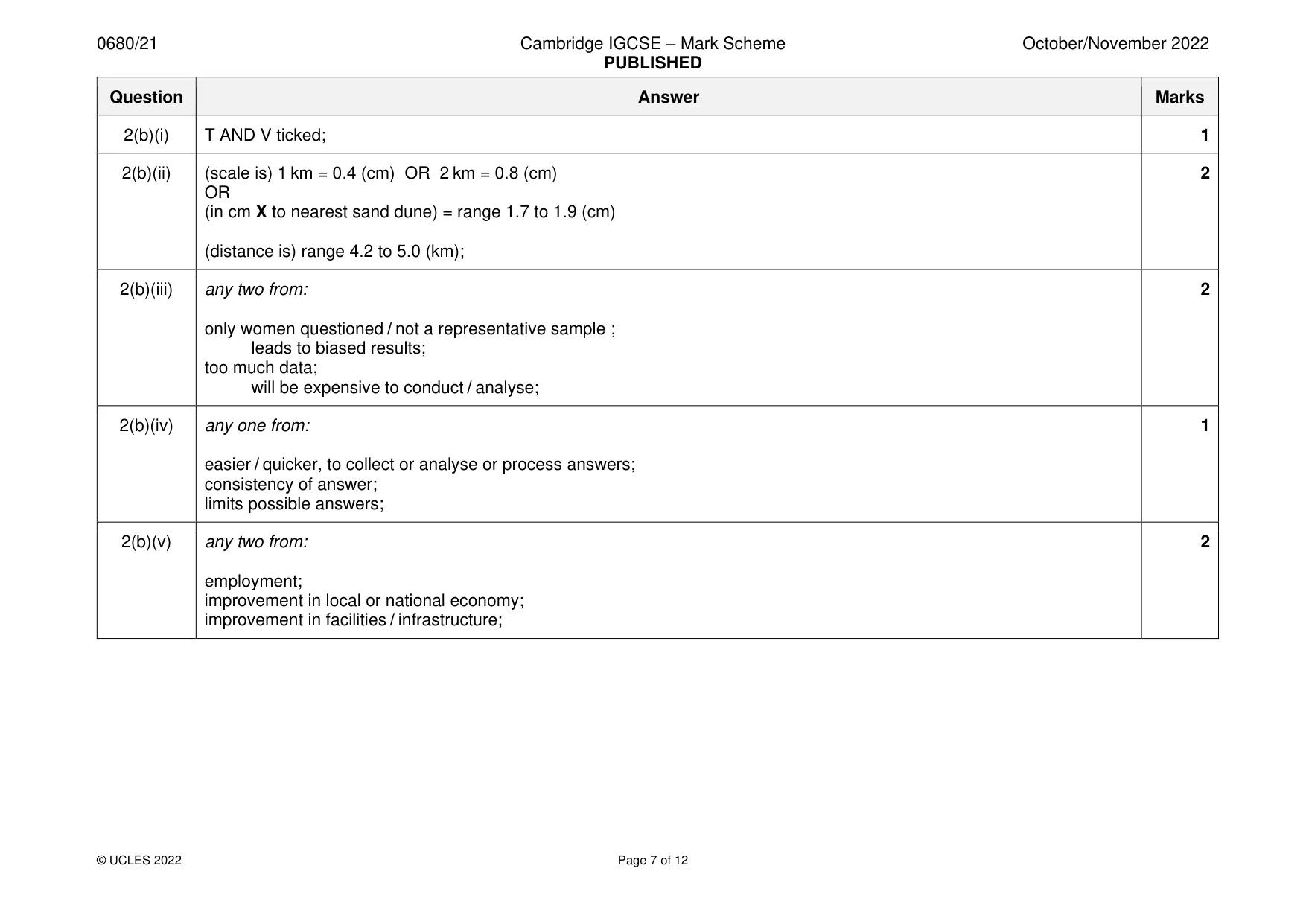
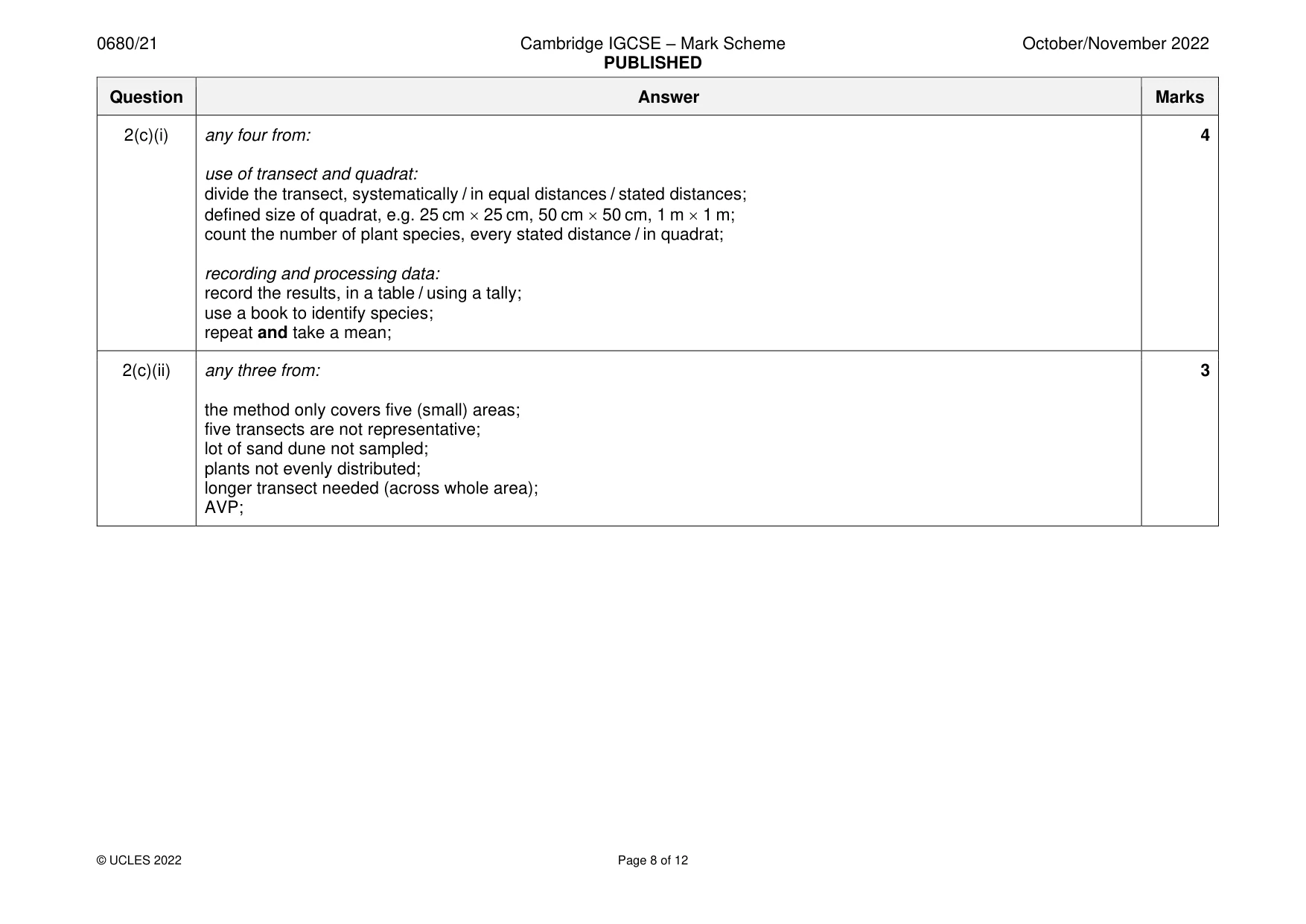
Mark scheme: 2(a)(i) any two from: 2 trampling / dunes could collapse ; kills or disturbs, plants / animals; loss of habitat(s) ; loss of some species / extinctions; may drop litter; introduces invasive species; AVP; 2(a)(ii) any one from: 1 salt-tolerant; drought-tolerant / plants conserve or store water; wind-resistant; deep roots / wide roots; fast growing, plants / roots ; 2(a)(iii) any four from: 4 increase temperatures; leads to melting of ice caps / increased sea level; leads to flooding / sea covers sand dunes / dunes drown ; leads to (conditions that favour) invasive species extreme weather; leads to stronger winds / storms; leads to increased waves; erosion of sand; more salt on plants; greater competition (for resources); can’t adapt fast enough / conditions are too extreme; 2(a)(iv) compromised the ability of future generations to meet their own needs / didn’t leave sand for future (generations) ; 1 2(b)(i) T AND V ticked; 1 2(b)(ii) (scale is) 1 km = 0.4 (cm) OR 2 km = 0.8 (cm) 2 OR (in cm X to nearest sand dune) = range 1.7 to 1.9 (cm) (distance is) range 4.2 to 5.0 (km); 2(b)(iii) any two from: 2 only women questioned / not a representative sample ; leads to biased results; too much data; will be expensive to conduct / analyse; 2(b)(iv) any one from: 1 easier / quicker, to collect or analyse or process answers; consistency of answer; limits possible answers; 2(b)(v) any two from: 2 employment; improvement in local or national economy; improvement in facilities / infrastructure; 2(c)(i) any four from: 4 use of transect and quadrat: divide the transect, systematically / in equal distances / stated distances; defined size of quadrat, e.g. 25 cm 25 cm, 50 cm 50 cm, 1 m 1 m; count the number of plant species, every stated distance / in quadrat; recording and processing data: record the results, in a table / using a tally; use a book to identify species; repeat and take a mean; 2(c)(ii) any three from: 3 the method only covers five (small) areas; five transects are not representative; lot of sand dune not sampled; plants not evenly distributed; longer transect needed (across whole area); AVP;
Q3 · The table shows data about resources used to generate electricity in Spain
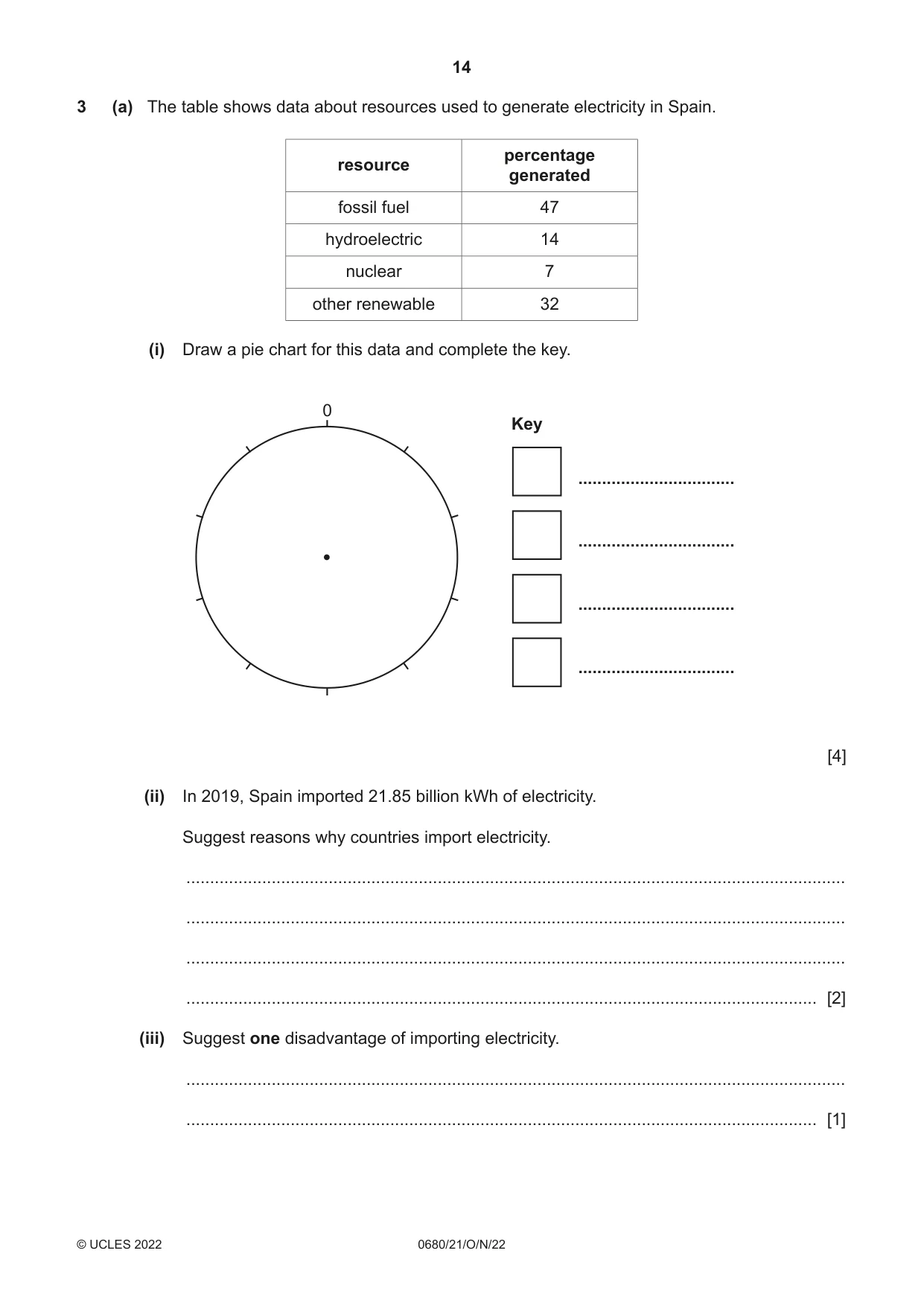
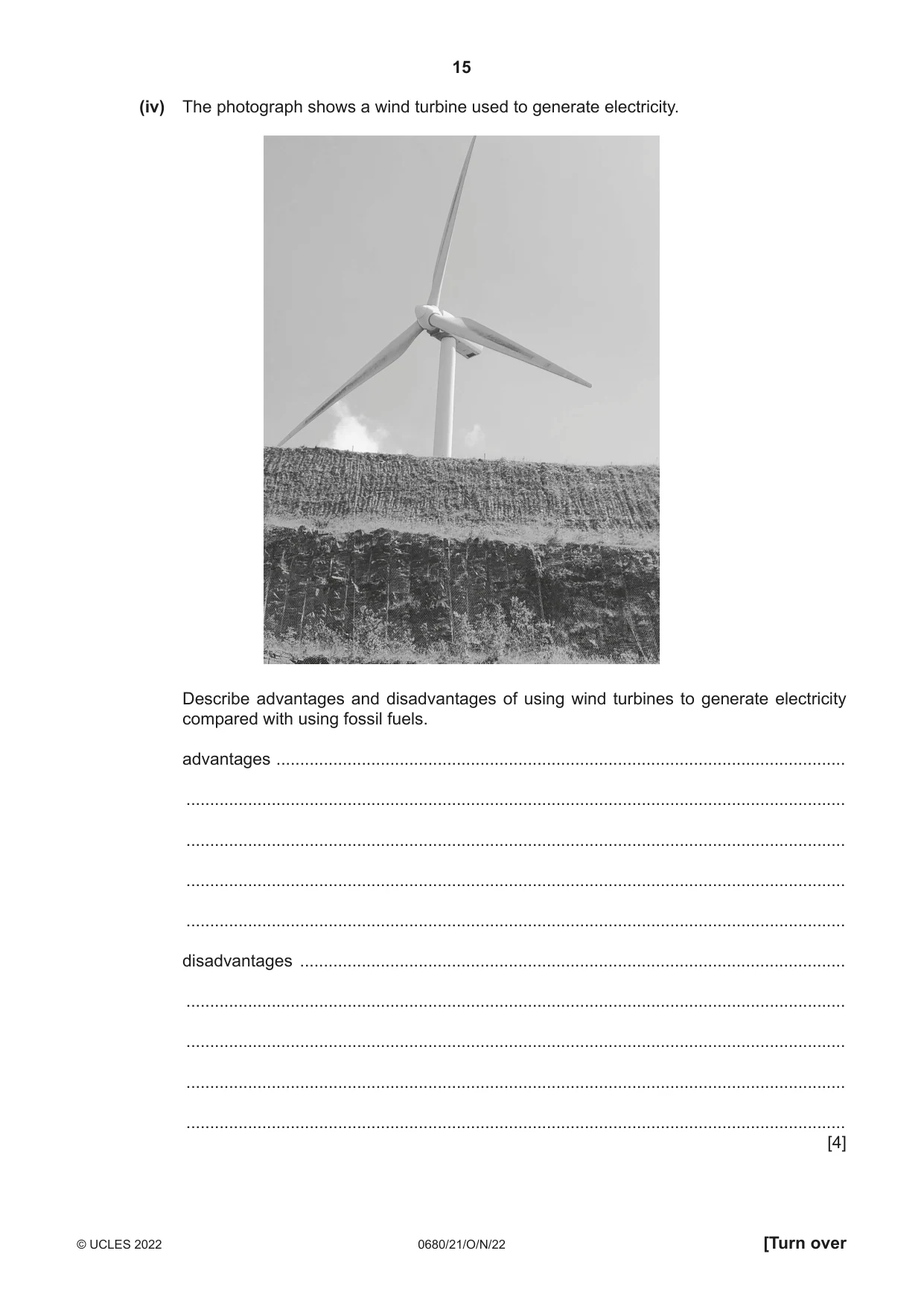
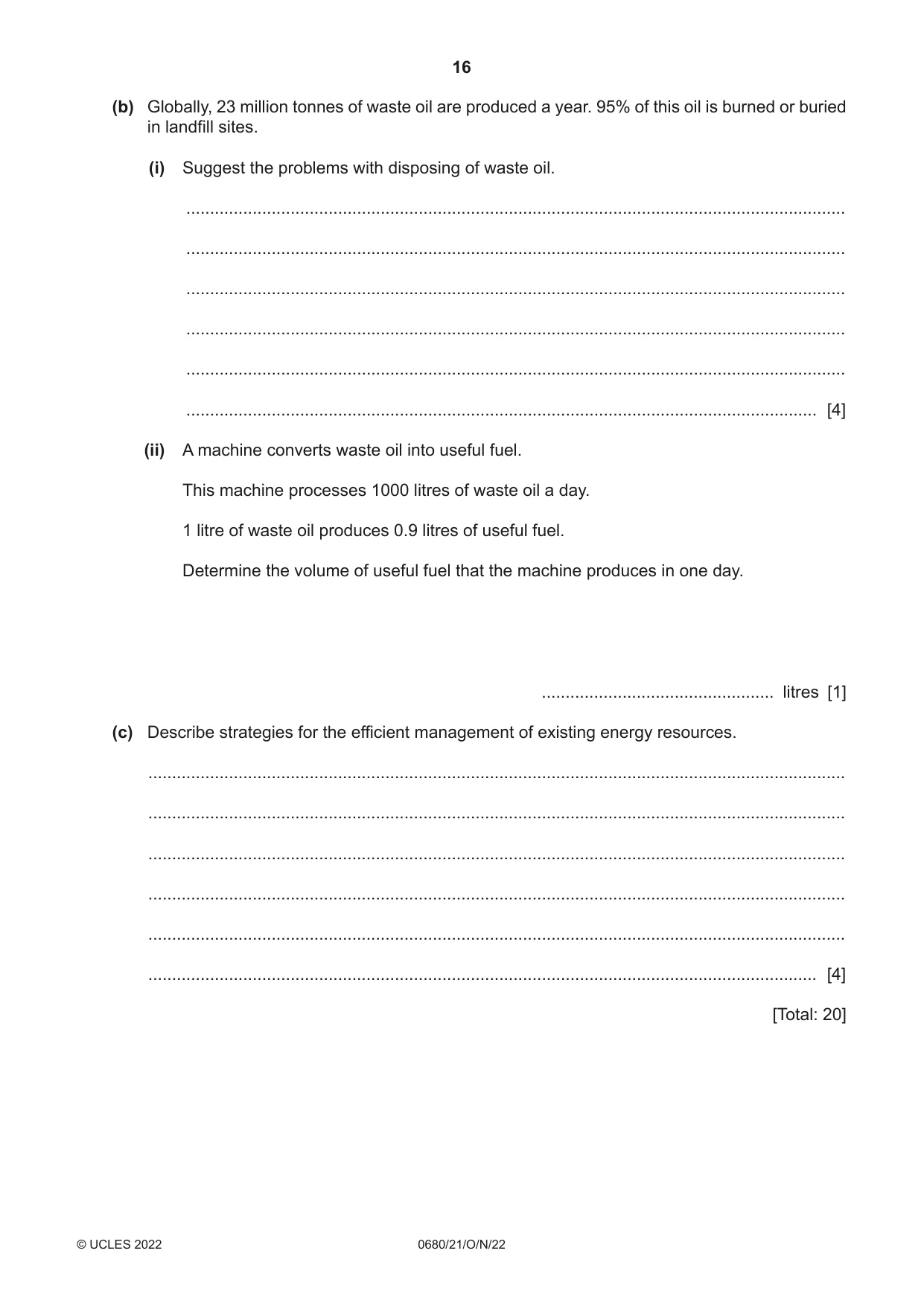
3 (a) The table shows data about resources used to generate electricity in Spain. percentage resource generated fossil fuel 47 hydroelectric 14 nuclear 7 other renewable 32 (i) Draw a pie chart for this data and complete the key. 0 Key ................................. ................................. ................................. ................................. [4] (ii) In 2019, Spain imported 21.85 billion kWh of electricity. Suggest reasons why countries import electricity. ........................................................................................................................................... ........................................................................................................................................... ........................................................................................................................................... ..................................................................................................................................... [2] (iii) Suggest one disadvantage of importing electricity. ........................................................................................................................................... ..................................................................................................................................... [1] (iv) The photograph shows a wind turbine used to generate electricity. Describe advantages and disadvantages of using wind turbines to generate electricity compared with using fossil fuels. advantages ........................................................................................................................ ........................................................................................................................................... ........................................................................................................................................... ........................................................................................................................................... ........................................................................................................................................... disadvantages ................................................................................................................... ........................................................................................................................................... ........................................................................................................................................... ........................................................................................................................................... ........................................................................................................................................... [4] (b) Globally, 23 million tonnes of waste oil are produced a year. 95% of this oil is burned or buried in landfill sites. (i) Suggest the problems with disposing of waste oil. ........................................................................................................................................... ........................................................................................................................................... ........................................................................................................................................... ........................................................................................................................................... ........................................................................................................................................... ..................................................................................................................................... [4] (ii) A machine converts waste oil into useful fuel. This machine processes 1000 litres of waste oil a day. 1 litre of waste oil produces 0.9 litres of useful fuel. Determine the volume of useful fuel that the machine produces in one day. ................................................. litres [1] (c) Describe strategies for the efficient management of existing energy resources. ................................................................................................................................................... ................................................................................................................................................... ................................................................................................................................................... ................................................................................................................................................... ................................................................................................................................................... ............................................................................................................................................. [4] [Total: 20]
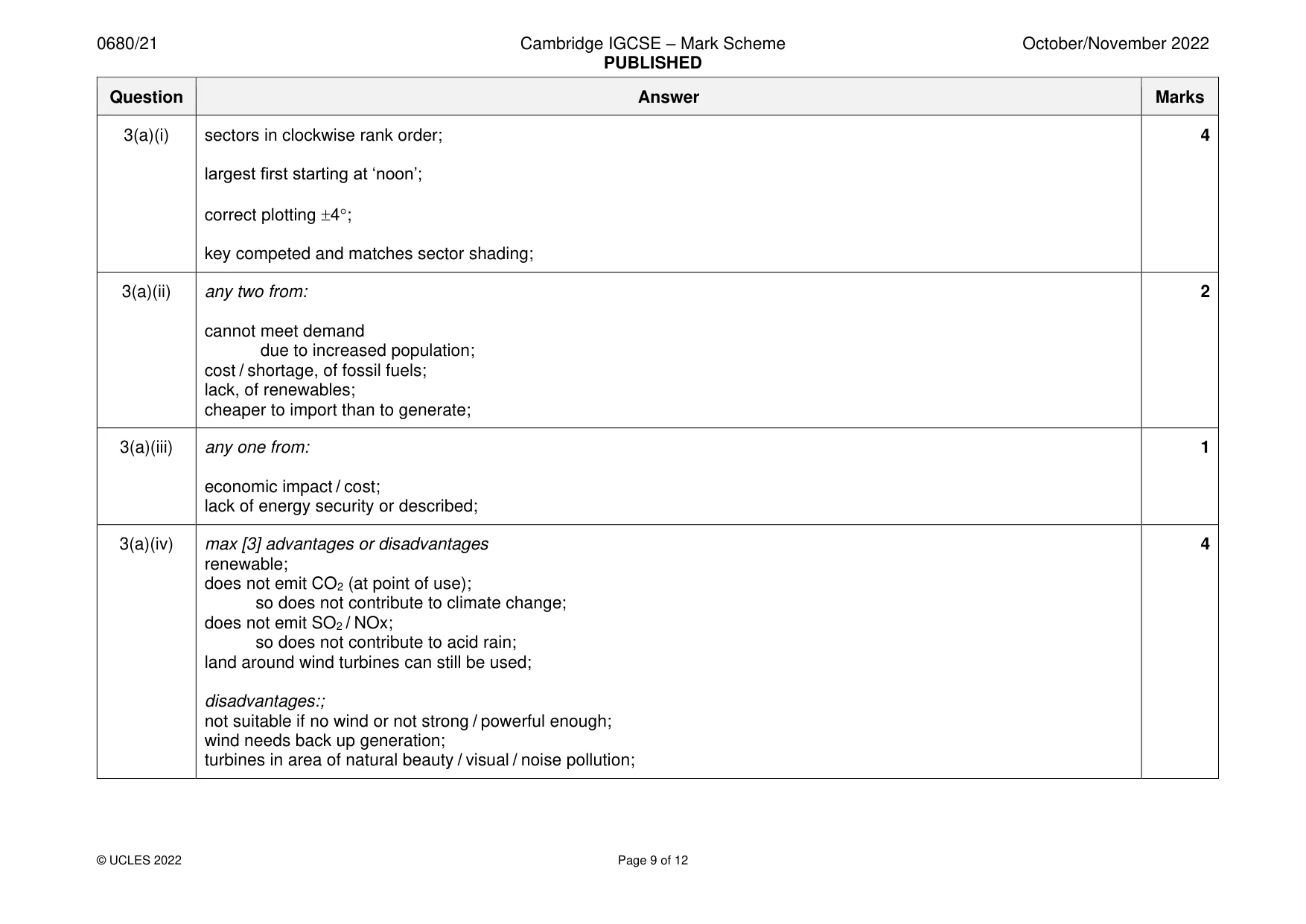
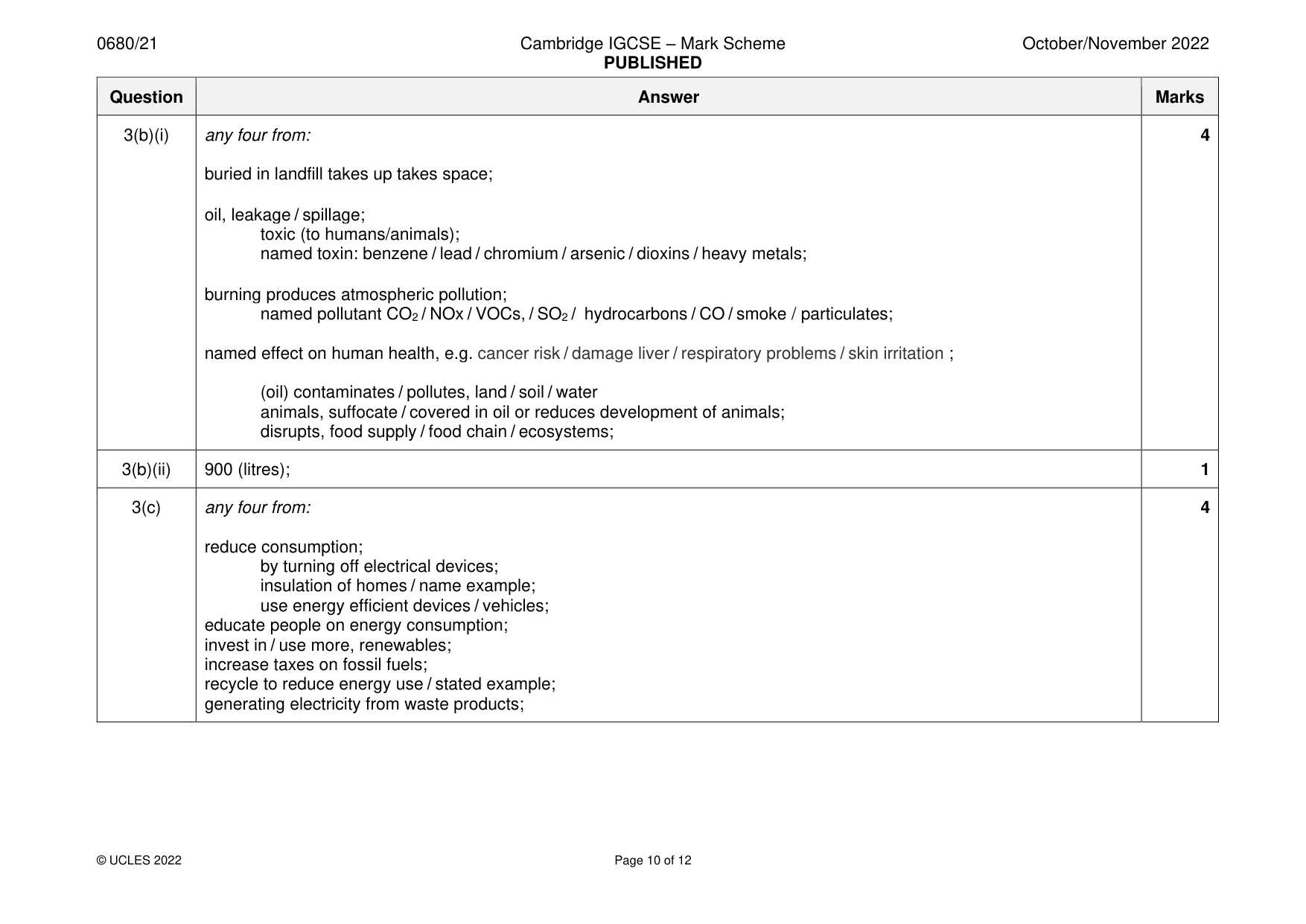
Mark scheme: 3(a)(i) sectors in clockwise rank order; 4 largest first starting at ‘noon’; correct plotting 4; key competed and matches sector shading; 3(a)(ii) any two from: 2 cannot meet demand due to increased population; cost / shortage, of fossil fuels; lack, of renewables; cheaper to import than to generate; 3(a)(iii) any one from: 1 economic impact / cost; lack of energy security or described; 3(a)(iv) max [3] advantages or disadvantages 4 renewable; does not emit CO2 (at point of use); so does not contribute to climate change; does not emit SO2 / NOx; so does not contribute to acid rain; land around wind turbines can still be used; disadvantages:; not suitable if no wind or not strong / powerful enough; wind needs back up generation; turbines in area of natural beauty / visual / noise pollution; 3(b)(i) any four from: 4 buried in landfill takes up takes space; oil, leakage / spillage; toxic (to humans/animals); named toxin: benzene / lead / chromium / arsenic / dioxins / heavy metals; burning produces atmospheric pollution; named pollutant CO2 / NOx / VOCs, / SO2 / hydrocarbons / CO / smoke / particulates; named effect on human health, e.g. cancer risk / damage liver / respiratory problems / skin irritation ; (oil) contaminates / pollutes, land / soil / water animals, suffocate / covered in oil or reduces development of animals; disrupts, food supply / food chain / ecosystems; 3(b)(ii) 900 (litres); 1 3(c) any four from: 4 reduce consumption; by turning off electrical devices; insulation of homes / name example; use energy efficient devices / vehicles; educate people on energy consumption; invest in / use more, renewables; increase taxes on fossil fuels; recycle to reduce energy use / stated example; generating electricity from waste products;
Q4 · Sheep are farmed in Spain
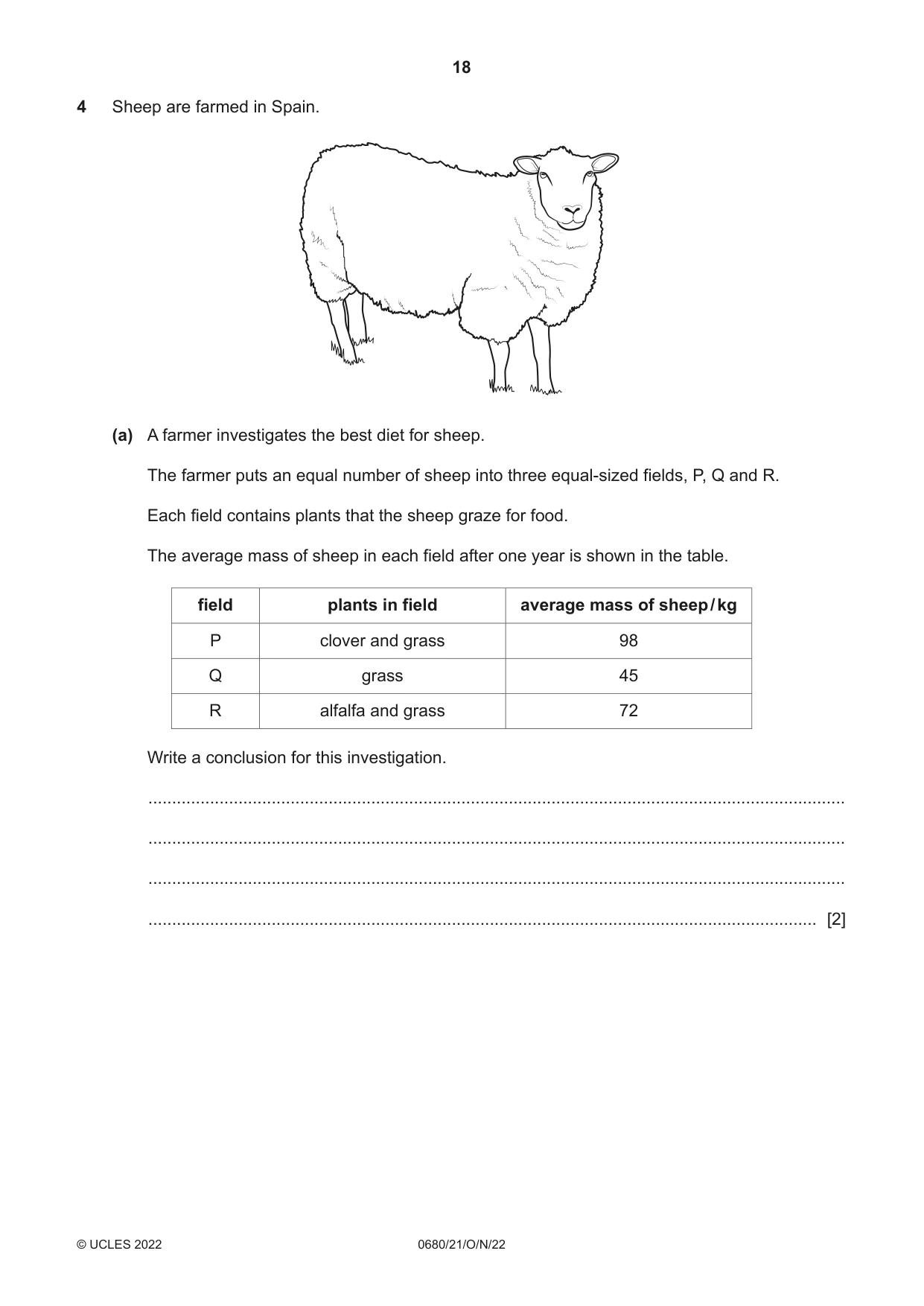
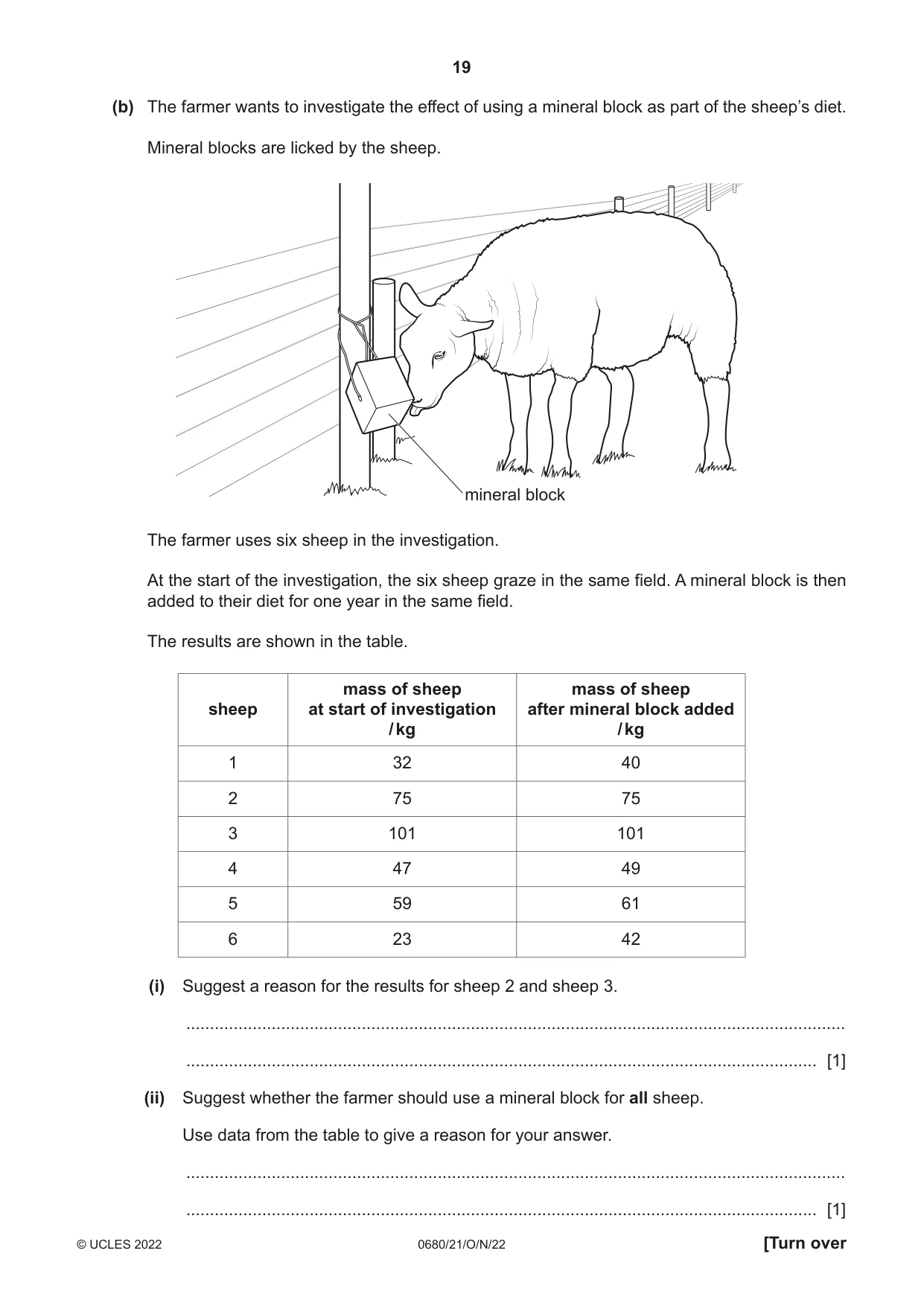
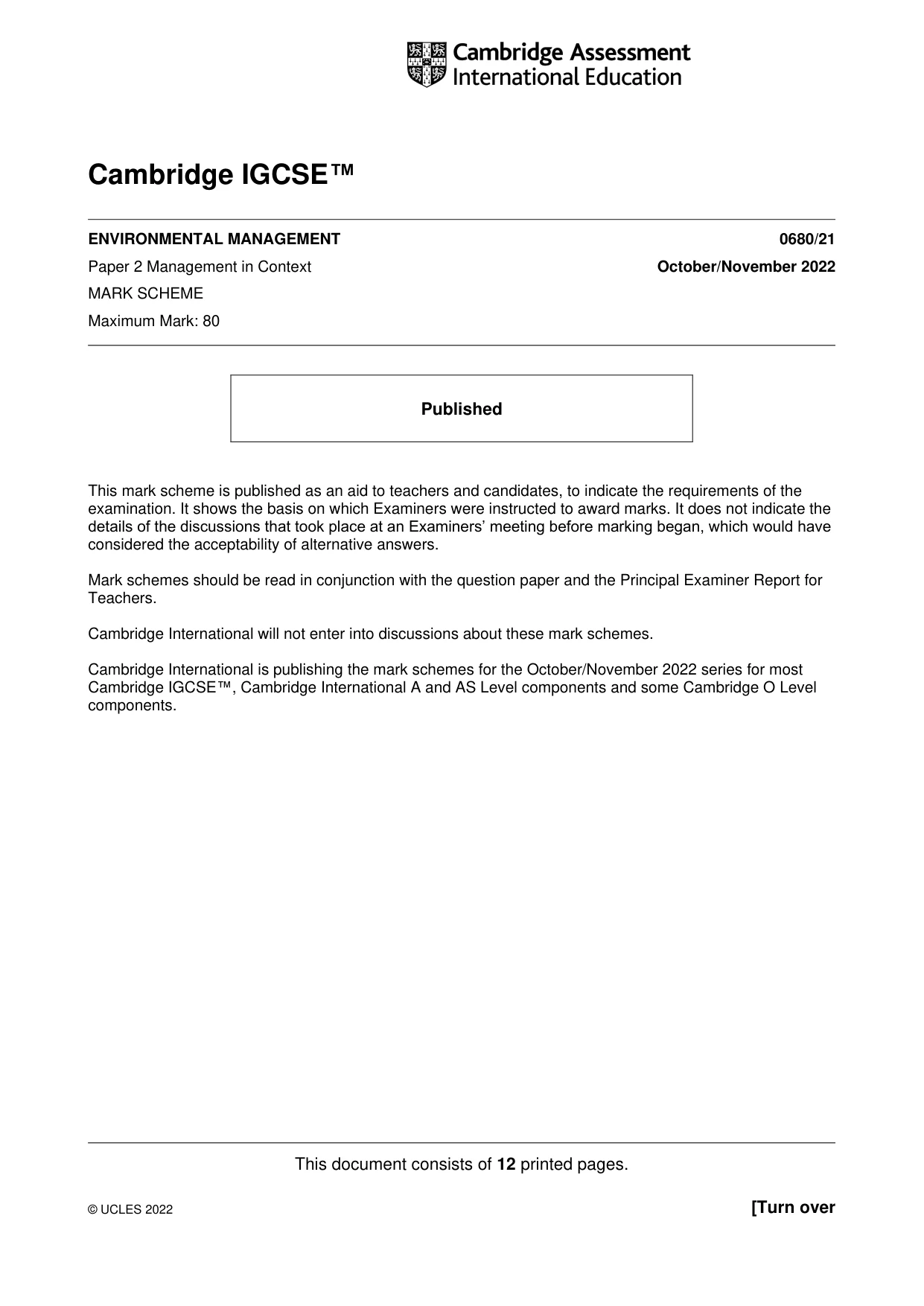
4 Sheep are farmed in Spain. (a) A farmer investigates the best diet for sheep. The farmer puts an equal number of sheep into three equal-sized fields, P, Q and R. Each field contains plants that the sheep graze for food. The average mass of sheep in each field after one year is shown in the table. field plants in field average mass of sheep / kg P clover and grass 98 Q grass 45 R alfalfa and grass 72 Write a conclusion for this investigation. ................................................................................................................................................... ................................................................................................................................................... ................................................................................................................................................... ............................................................................................................................................. [2] (b) The farmer wants to investigate the effect of using a mineral block as part of the sheep’s diet. Mineral blocks are licked by the sheep. mineral block The farmer uses six sheep in the investigation. At the start of the investigation, the six sheep graze in the same field. A mineral block is then added to their diet for one year in the same field. The results are shown in the table. mass of sheep mass of sheep sheep at start of investigation after mineral block added / kg / kg 1 32 40 2 75 75 3 101 101 4 47 49 5 59 61 6 23 42 (i) Suggest a reason for the results for sheep 2 and sheep 3. ........................................................................................................................................... ..................................................................................................................................... [1] (ii) Suggest whether the farmer should use a mineral block for all sheep. Use data from the table to give a reason for your answer. ........................................................................................................................................... ..................................................................................................................................... [1] (iii) Copper is toxic to sheep. Suggest what happens to the sheep if copper is included in the mineral block. ..................................................................................................................................... [1] (iv) Describe a selective breeding method to increase the mass of sheep. ........................................................................................................................................... ........................................................................................................................................... ........................................................................................................................................... ........................................................................................................................................... ........................................................................................................................................... ........................................................................................................................................... ........................................................................................................................................... ..................................................................................................................................... [4]
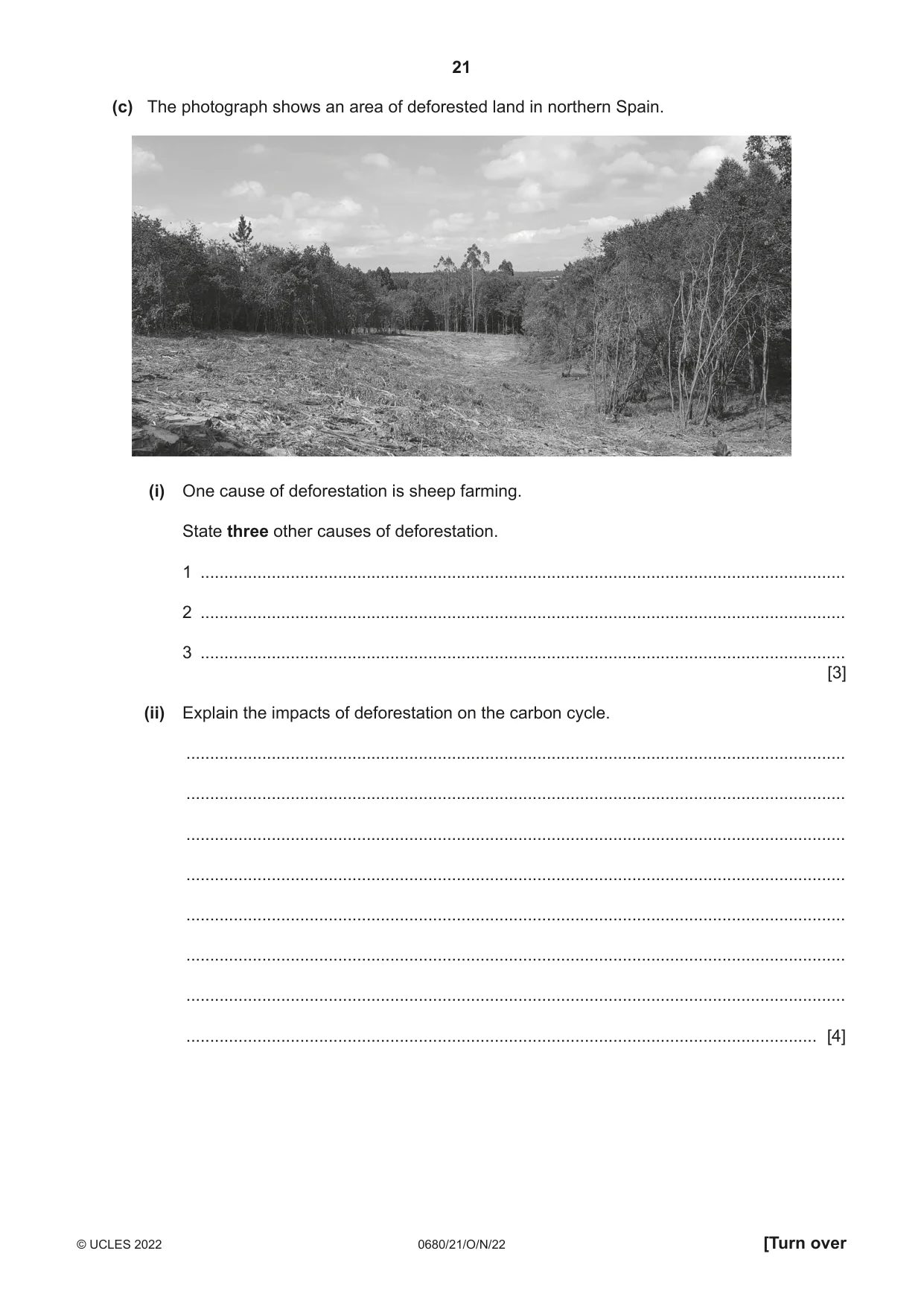
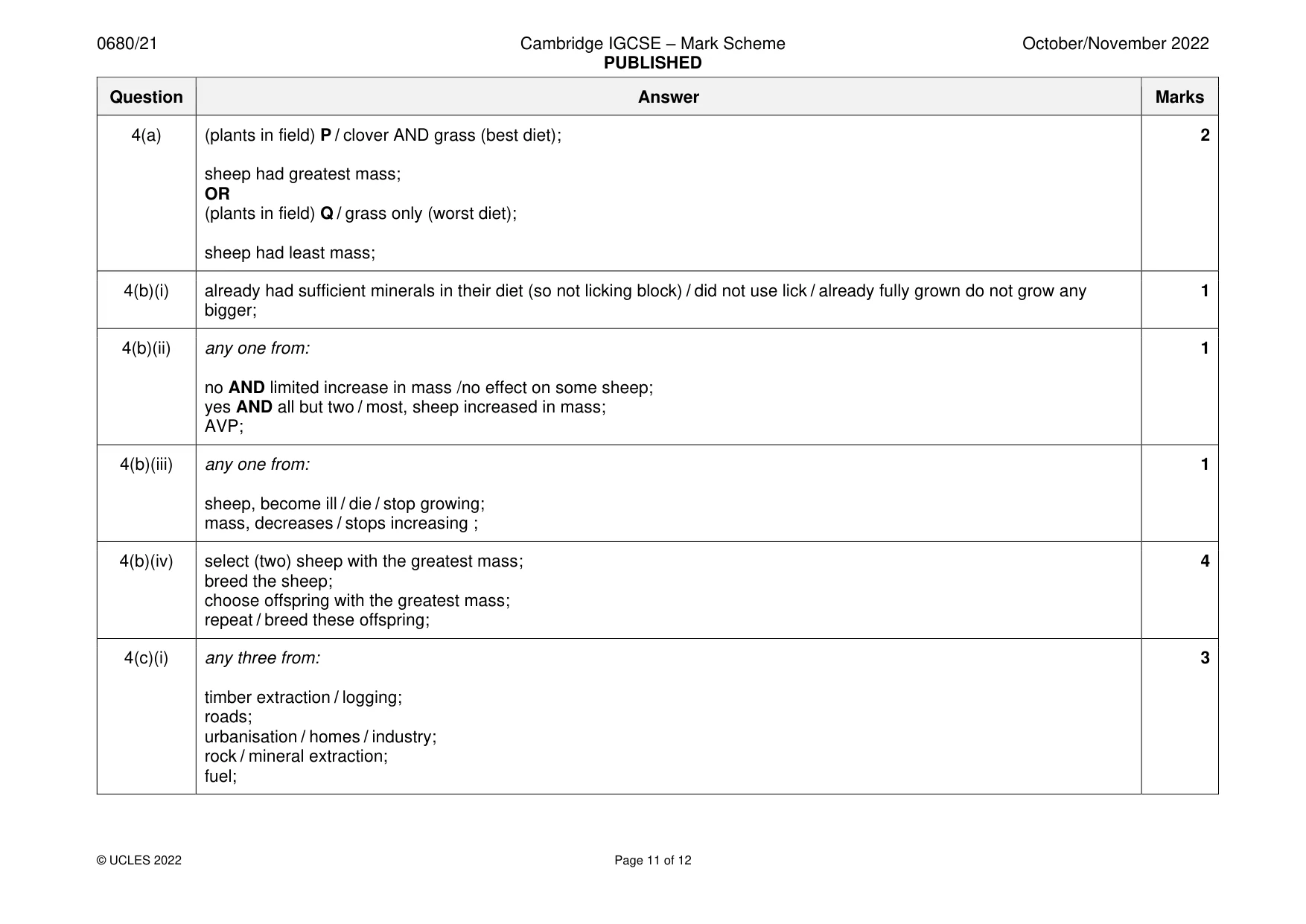
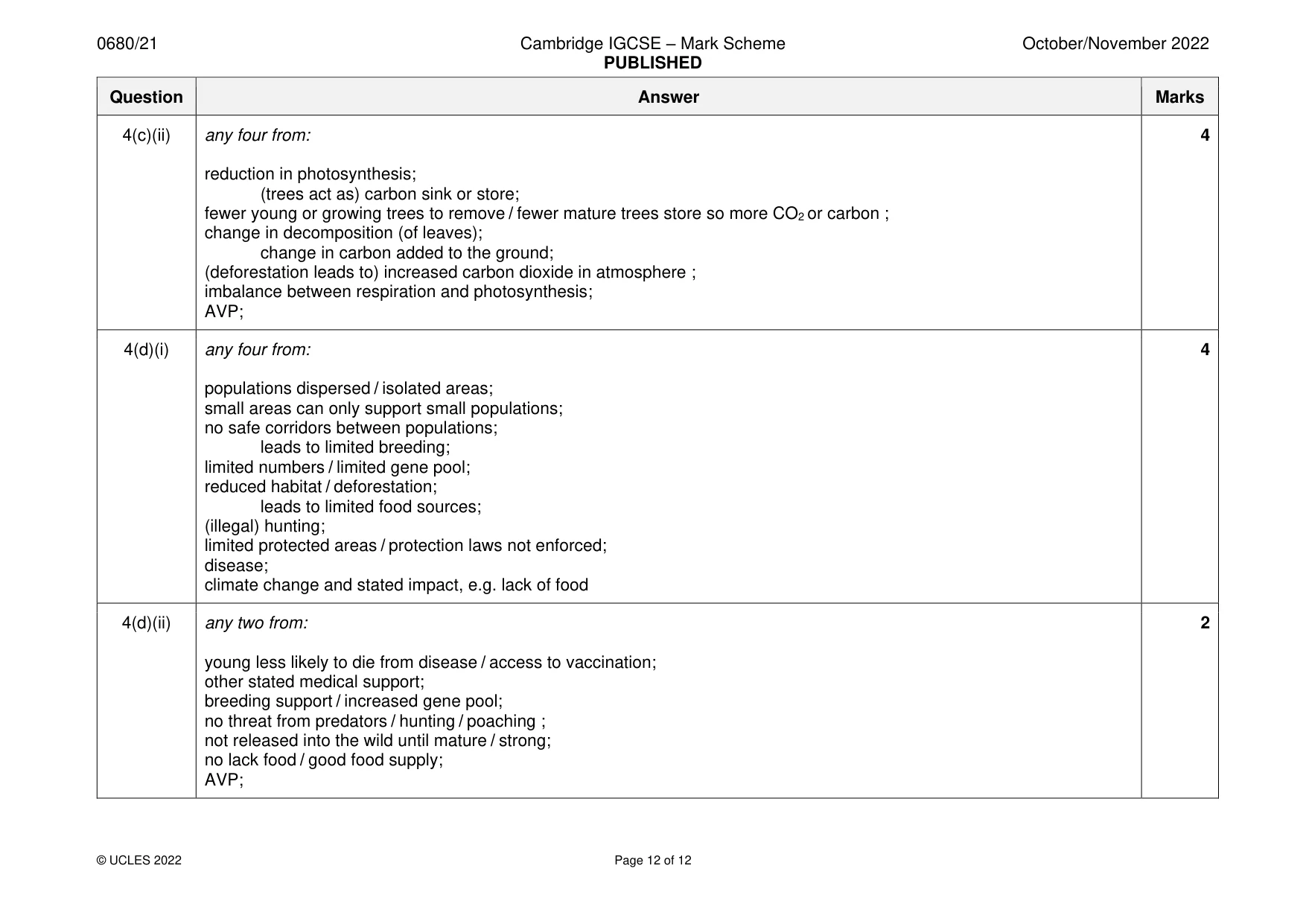
Mark scheme: 4(a) (plants in field) P / clover AND grass (best diet); 2 sheep had greatest mass; OR (plants in field) Q / grass only (worst diet); sheep had least mass; 4(b)(i) already had sufficient minerals in their diet (so not licking block) / did not use lick / already fully grown do not grow any 1 bigger; 4(b)(ii) any one from: 1 no AND limited increase in mass /no effect on some sheep; yes AND all but two / most, sheep increased in mass; AVP; 4(b)(iii) any one from: 1 sheep, become ill / die / stop growing; mass, decreases / stops increasing ; 4(b)(iv) select (two) sheep with the greatest mass; 4 breed the sheep; choose offspring with the greatest mass; repeat / breed these offspring; 4(c)(i) any three from: 3 timber extraction / logging; roads; urbanisation / homes / industry; rock / mineral extraction; fuel; 4(c)(ii) any four from: 4 reduction in photosynthesis; (trees act as) carbon sink or store; fewer young or growing trees to remove / fewer mature trees store so more CO2 or carbon ; change in decomposition (of leaves); change in carbon added to the ground; (deforestation leads to) increased carbon dioxide in atmosphere ; imbalance between respiration and photosynthesis; AVP; 4(d)(i) any four from: 4 populations dispersed / isolated areas; small areas can only support small populations; no safe corridors between populations; leads to limited breeding; limited numbers / limited gene pool; reduced habitat / deforestation; leads to limited food sources; (illegal) hunting; limited protected areas / protection laws not enforced; disease; climate change and stated impact, e.g. lack of food 4(d)(ii) any two from: 2 young less likely to die from disease / access to vaccination; other stated medical support; breeding support / increased gene pool; no threat from predators / hunting / poaching ; not released into the wild until mature / strong; no lack food / good food supply; AVP;
What was in this paper
The subtopics covered by these 4 questions, and how many questions each got. Open one in a new tab to see every Cambridge question on it.
What you needed in this session
Cambridge’s own grade thresholds for 2022 Oct/Nov, Paper 2 · Variant 1. A higher threshold means an easier paper — the bar moves with how the cohort did.