Cambridge IGCSE Environmental Management 0680 — 2021 Oct/Nov Paper 2 · Variant 3
0680/23/O/N/21 · 3 questions · 80 marks · ≈90 min
The question paper and its mark scheme, free to read here and free to download. This is Cambridge’s own paper, exactly as it was sat.
Question paper32 pages



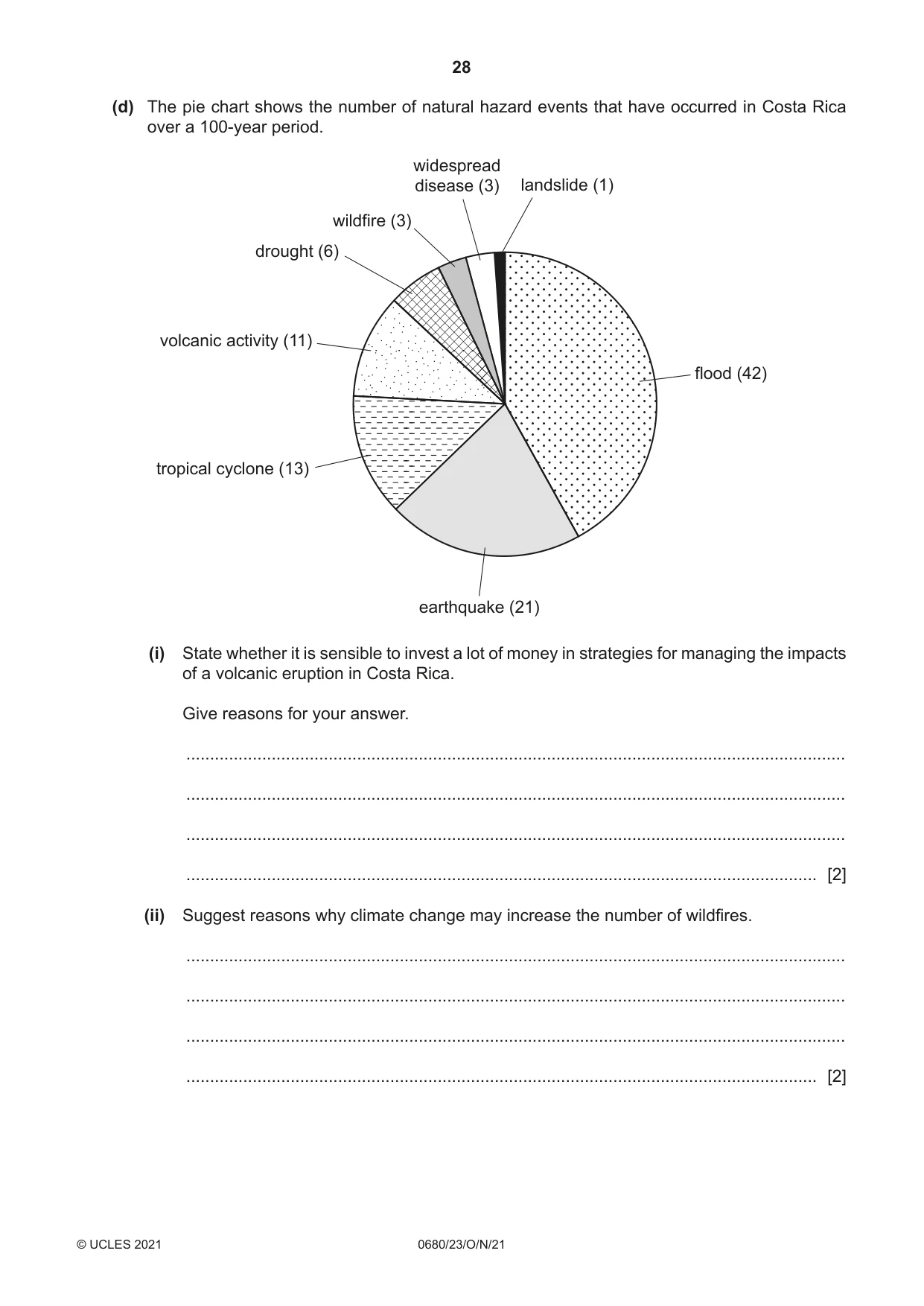



Mark scheme12 pages
Answers below. Sit the paper first if you are practising.
Questions as text
Q1 · A survey found that 24 362 people did not have access to electricity in Costa Rica in 2019
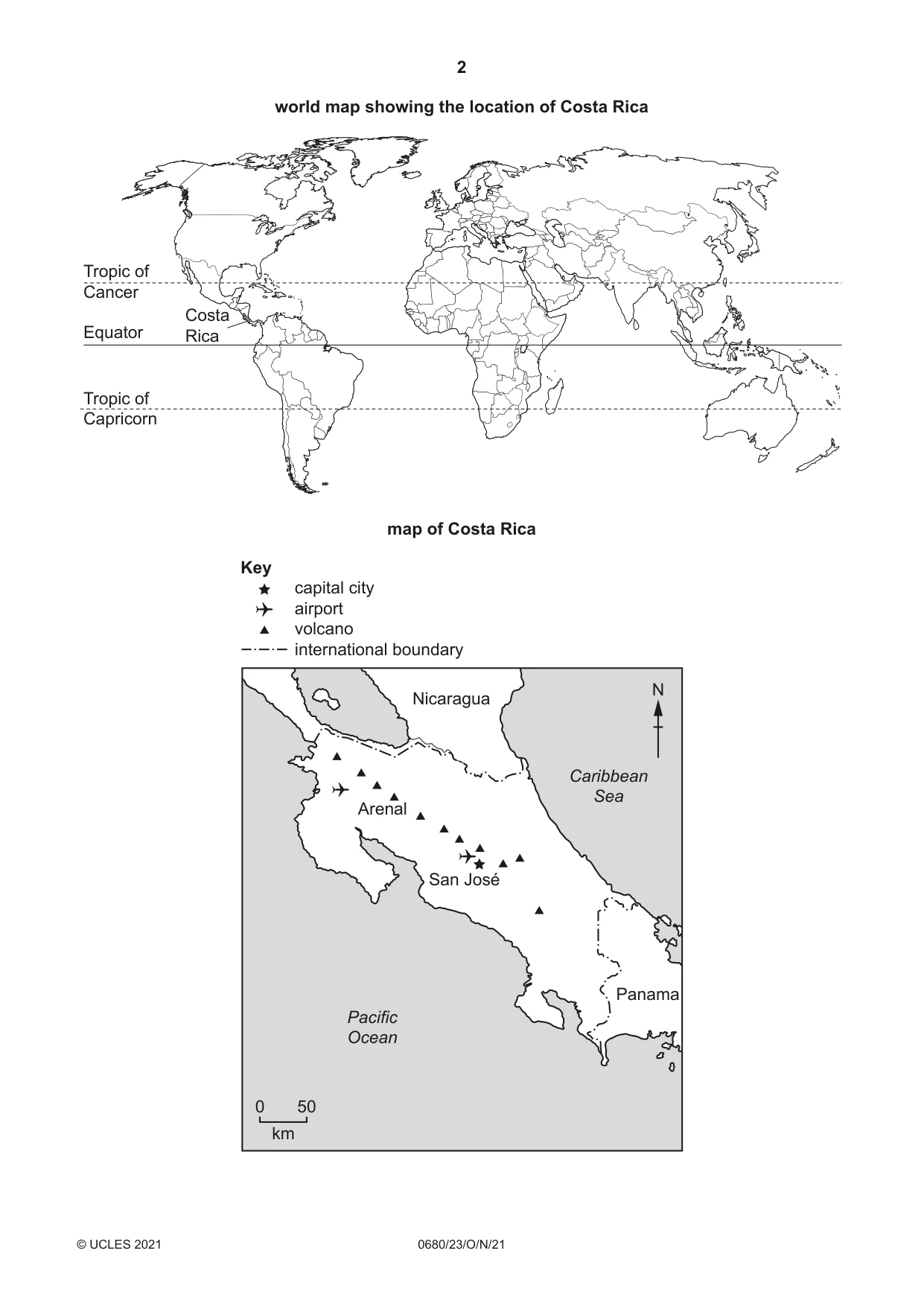
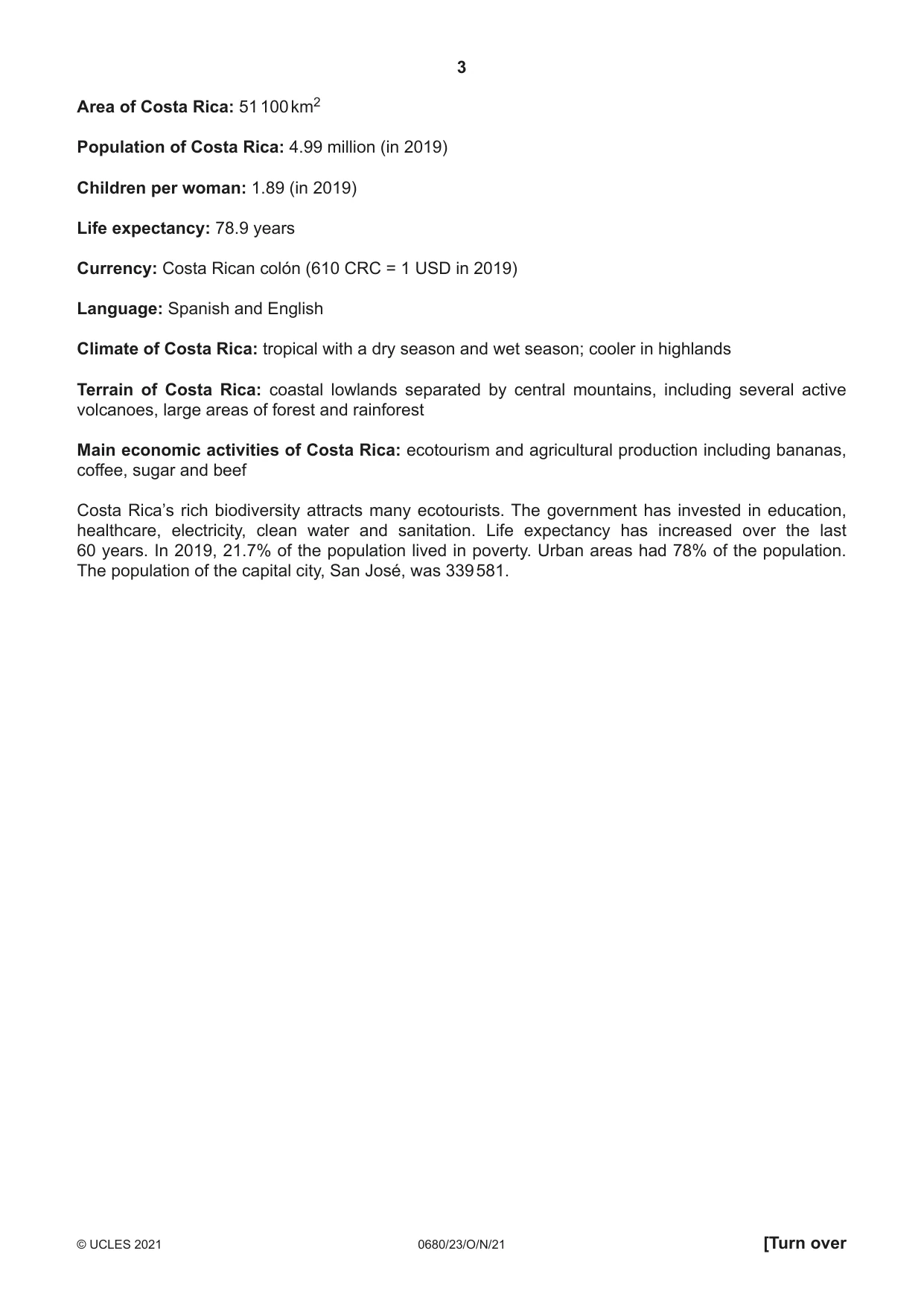
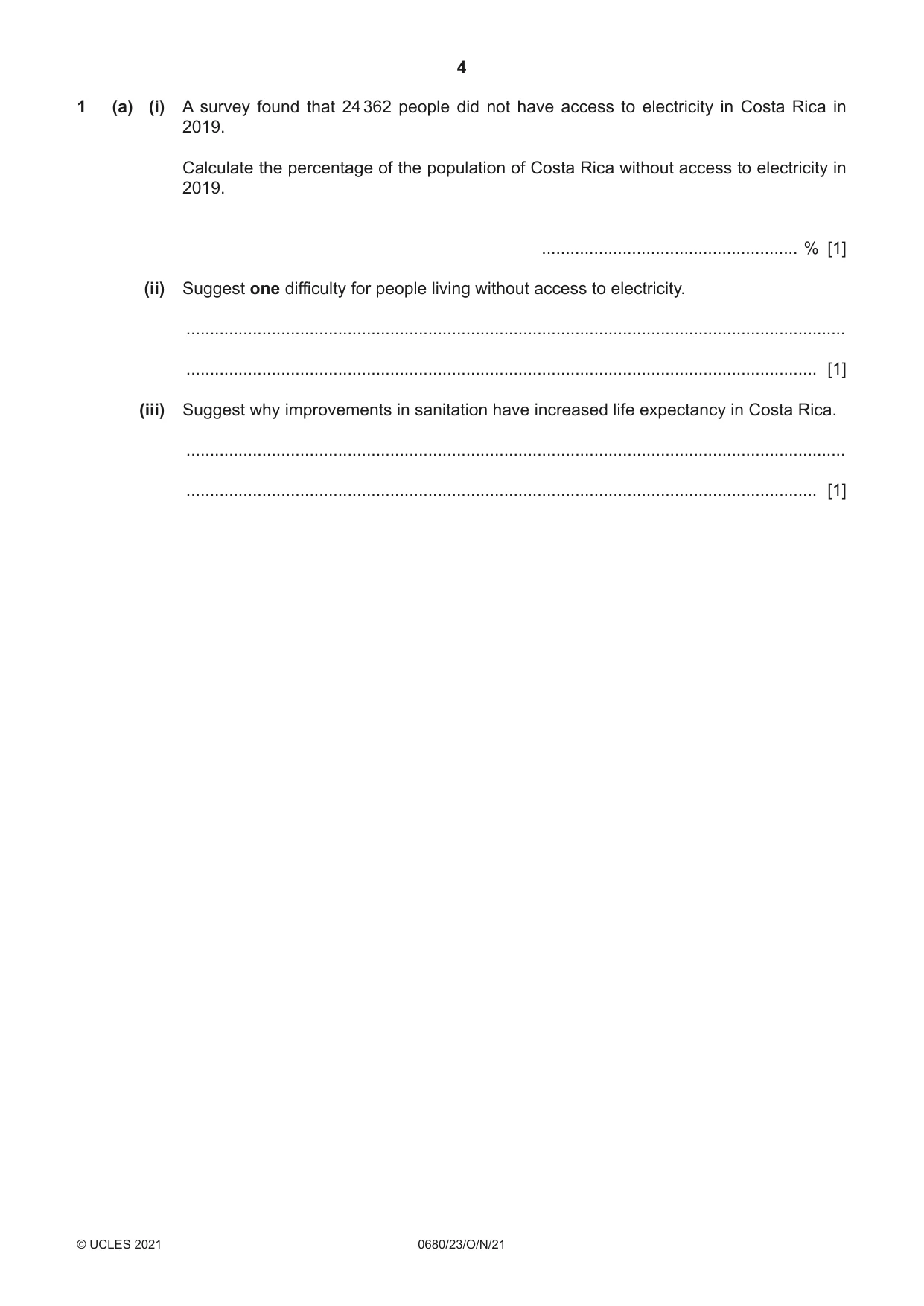
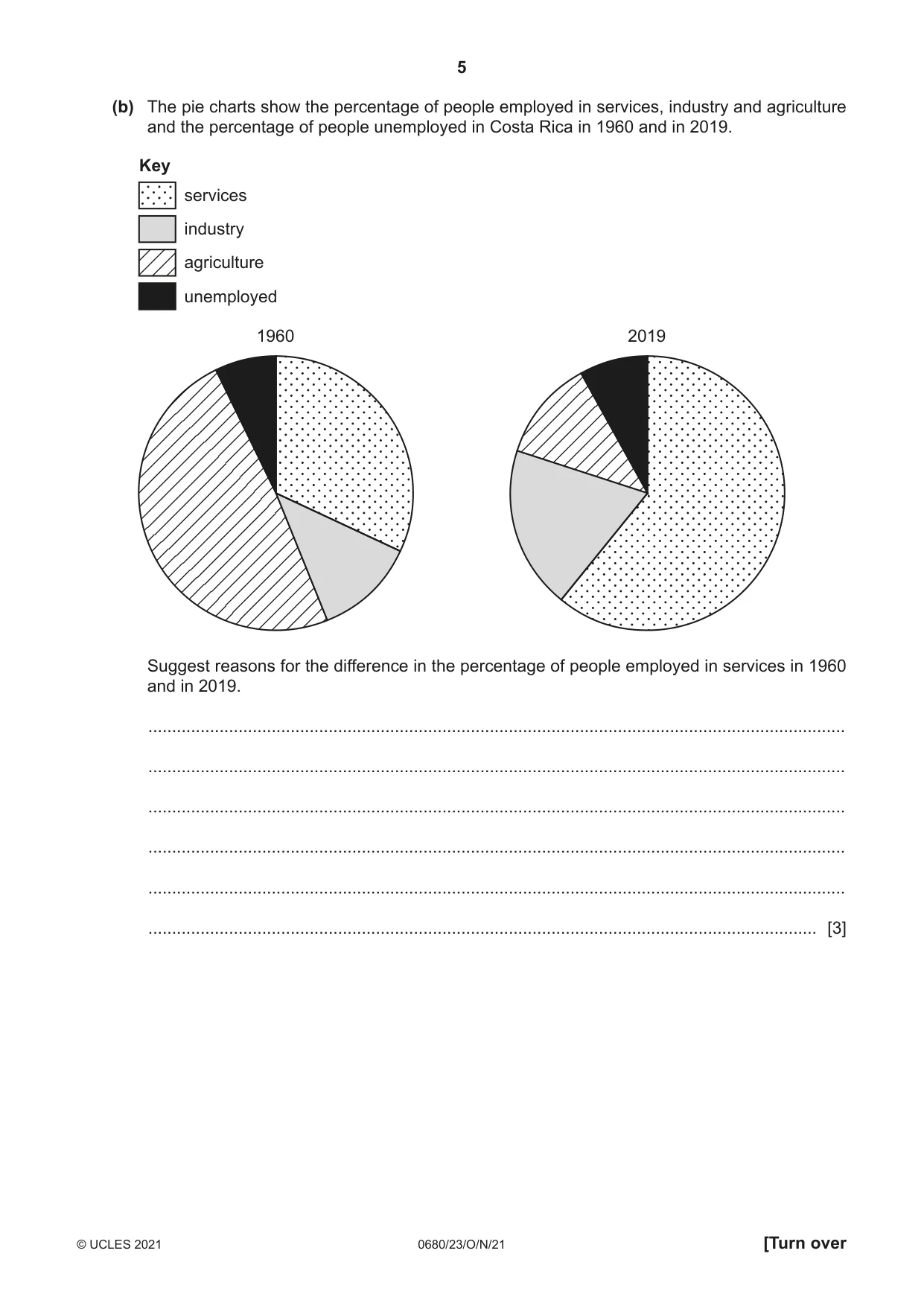
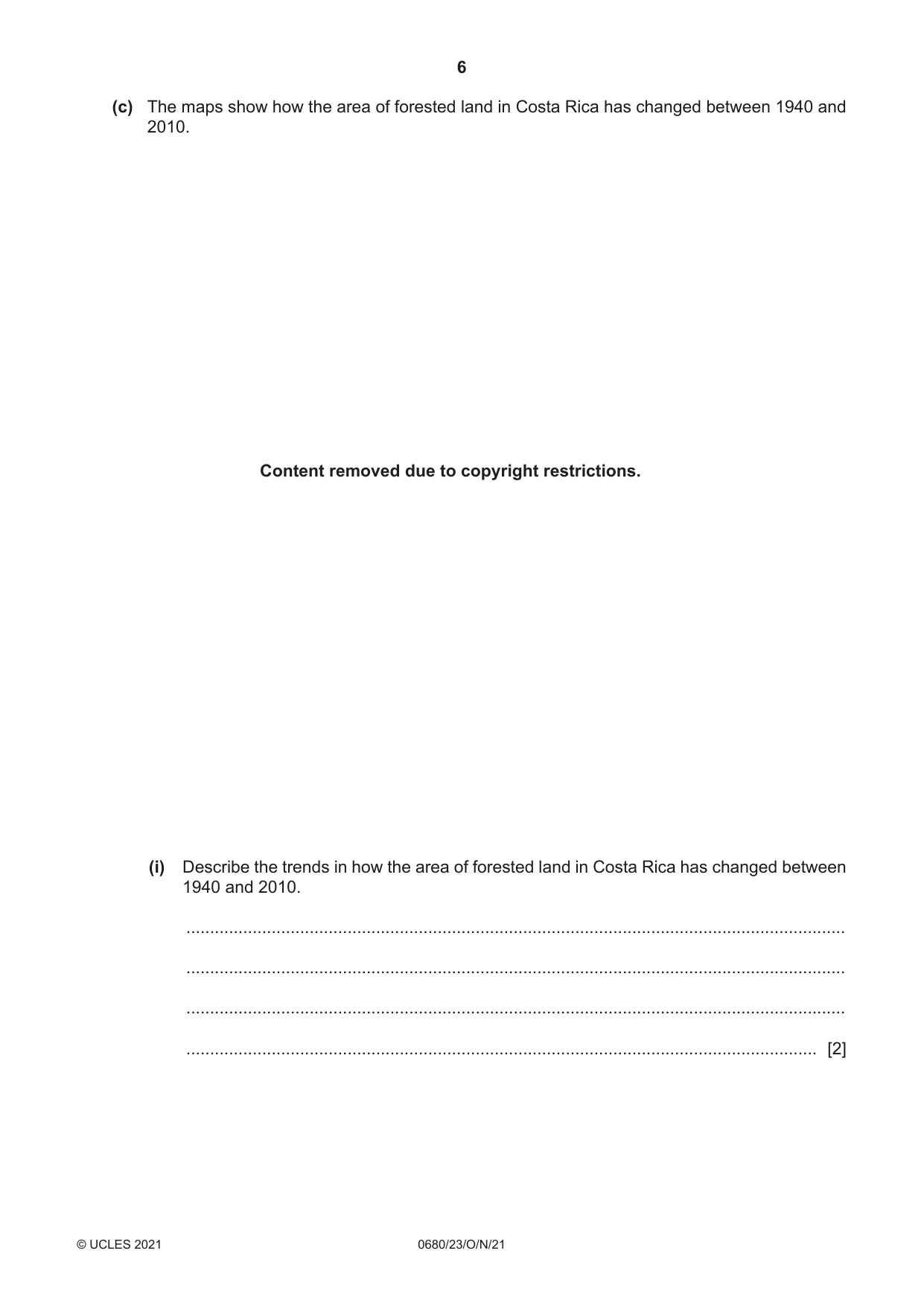
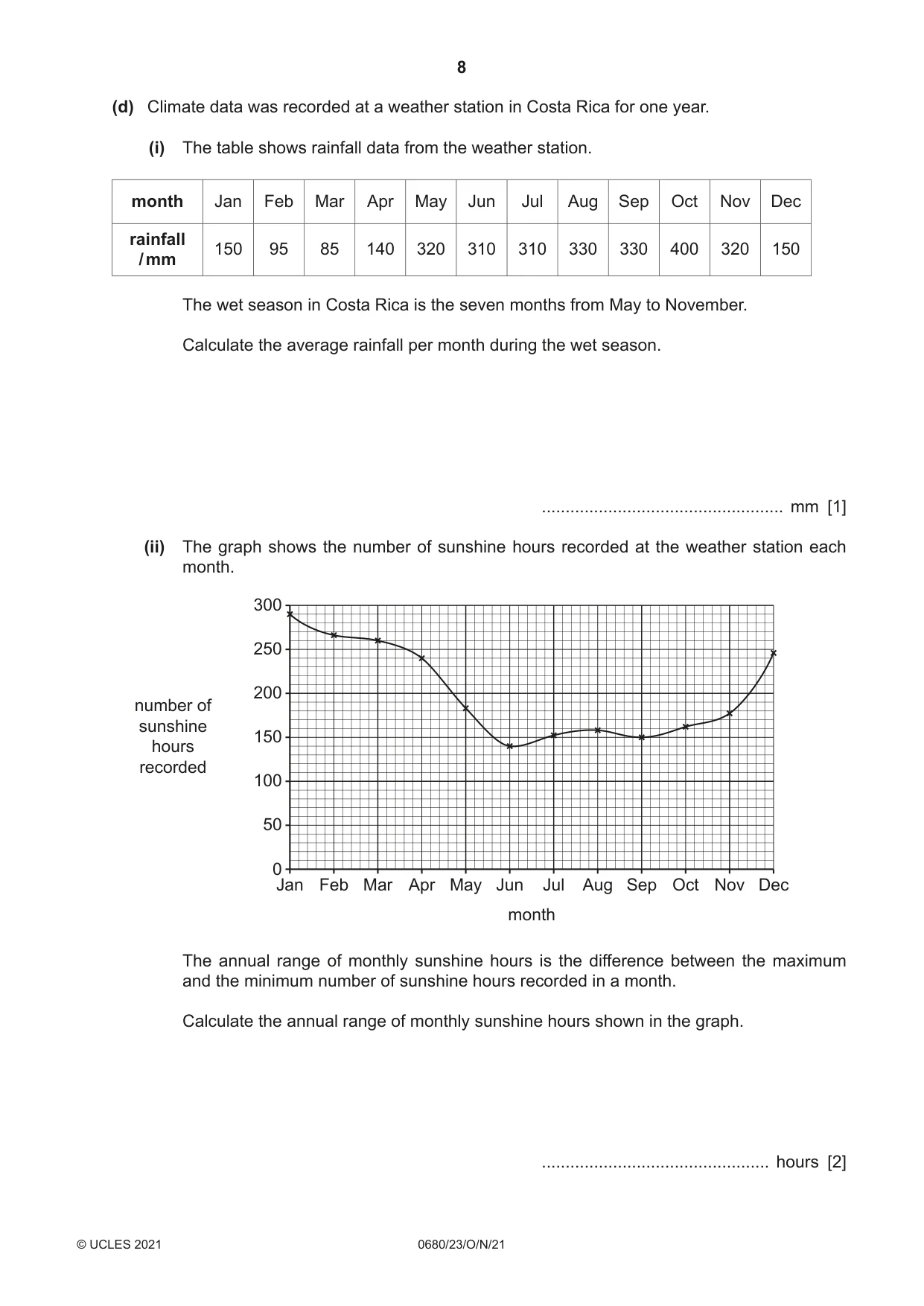
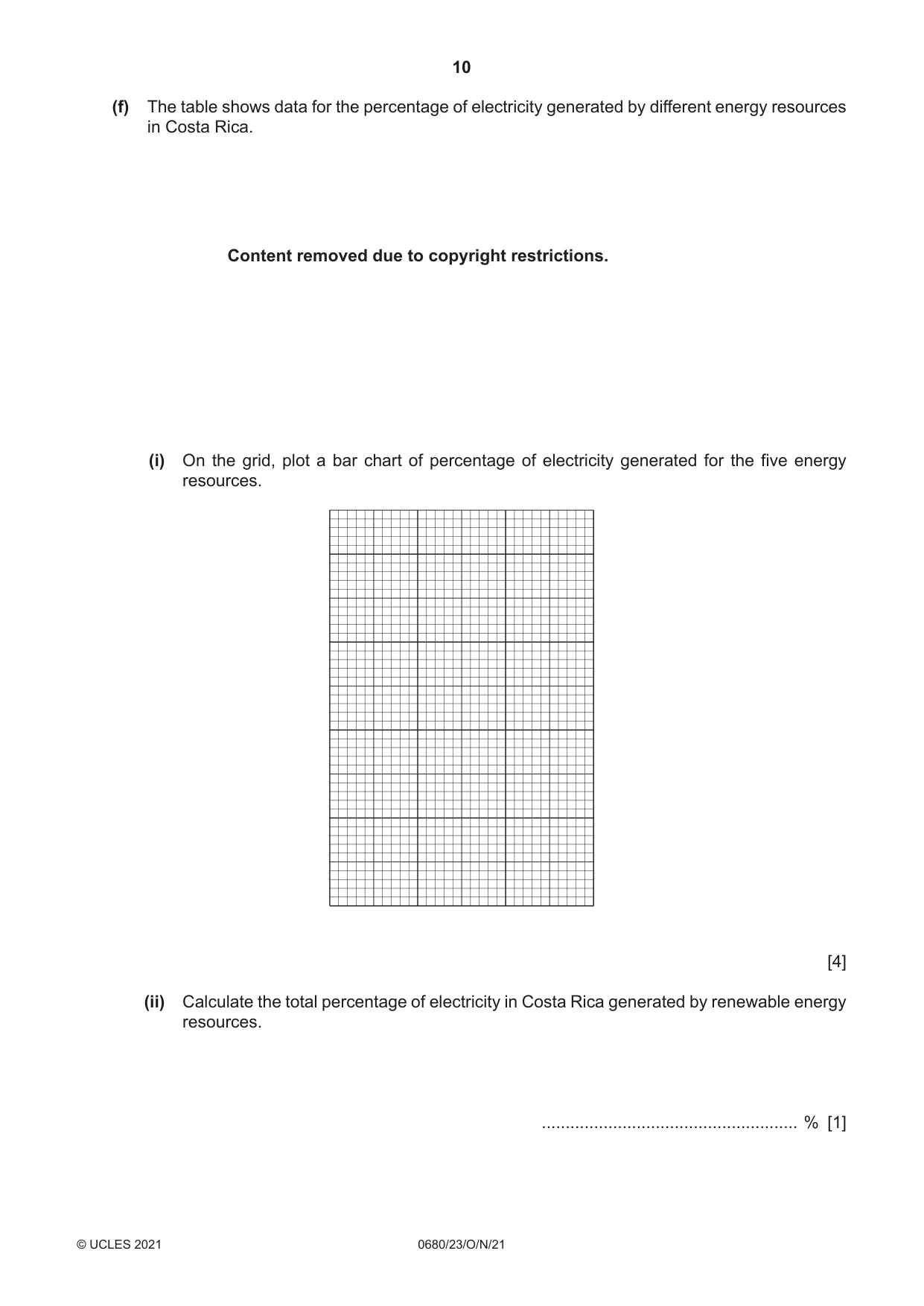
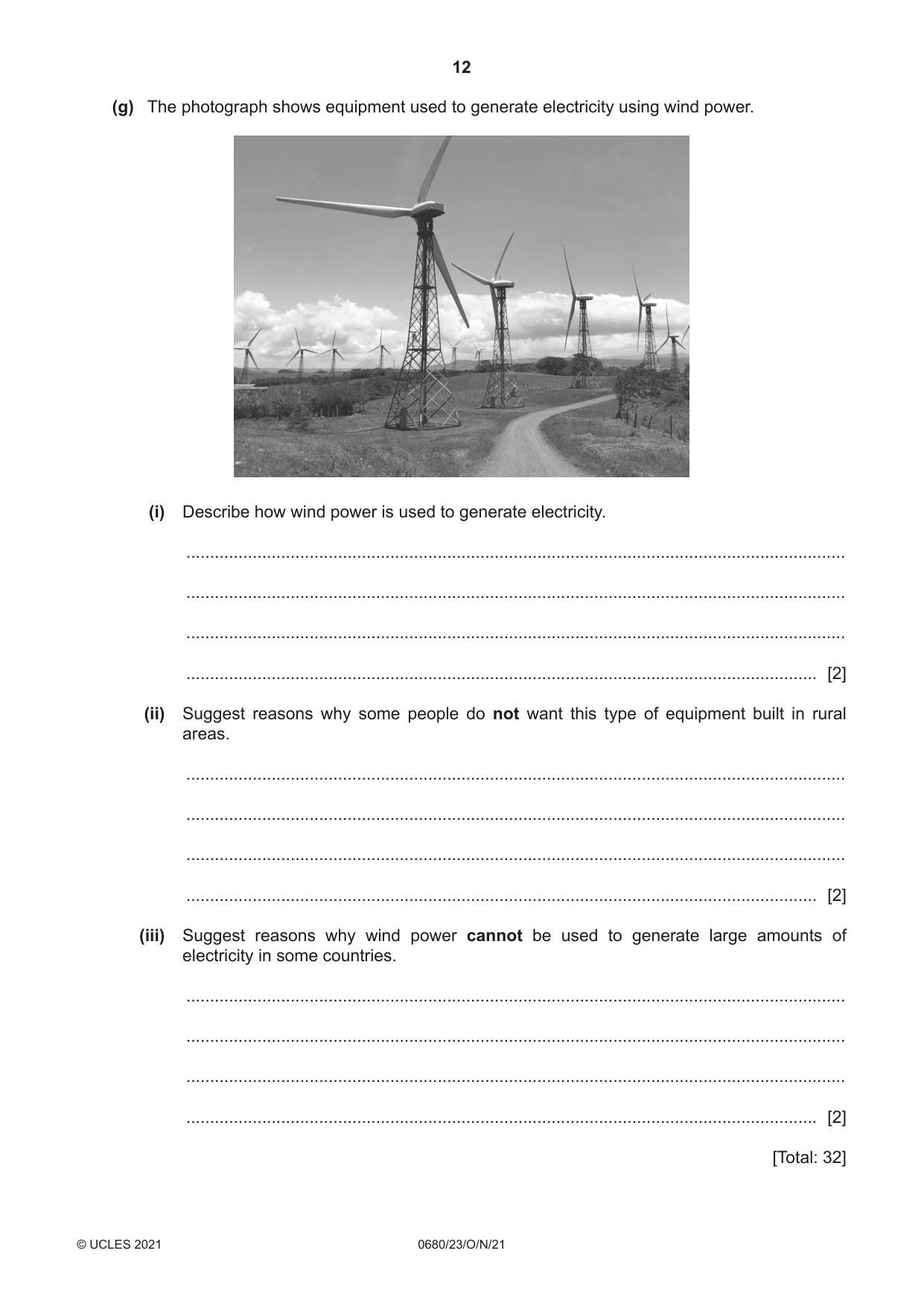
1 (a) (i) A survey found that 24 362 people did not have access to electricity in Costa Rica in 2019. Calculate the percentage of the population of Costa Rica without access to electricity in 2019. ...................................................... % [1] (ii) Suggest one difficulty for people living without access to electricity. ........................................................................................................................................... ..................................................................................................................................... [1] (iii) Suggest why improvements in sanitation have increased life expectancy in Costa Rica. ........................................................................................................................................... ..................................................................................................................................... [1] (b) The pie charts show the percentage of people employed in services, industry and agriculture and the percentage of people unemployed in Costa Rica in 1960 and in 2019. Key services industry agriculture unemployed 1960 2019 Suggest reasons for the difference in the percentage of people employed in services in 1960 and in 2019. ................................................................................................................................................... ................................................................................................................................................... ................................................................................................................................................... ................................................................................................................................................... ................................................................................................................................................... ............................................................................................................................................. [3] (c) The maps show how the area of forested land in Costa Rica has changed between 1940 and 2010. Content removed due to copyright restrictions. (i) Describe the trends in how the area of forested land in Costa Rica has changed between 1940 and 2010. ........................................................................................................................................... ........................................................................................................................................... ........................................................................................................................................... ..................................................................................................................................... [2] (ii) State three impacts of deforestation. 1 ........................................................................................................................................ 2 ........................................................................................................................................ 3 ........................................................................................................................................ [3] (iii) Many people around the world are concerned about deforestation. Suggest reasons why deforestation is a global concern. ........................................................................................................................................... ........................................................................................................................................... ........................................................................................................................................... ..................................................................................................................................... [2] (d) Climate data was recorded at a weather station in Costa Rica for one year. (i) The table shows rainfall data from the weather station. month Jan Feb Mar Apr May Jun Jul Aug Sep Oct Nov Dec rainfall 150 95 85 140 320 310 310 330 330 400 320 150 / mm The wet season in Costa Rica is the seven months from May to November. Calculate the average rainfall per month during the wet season. ................................................... mm [1] (ii) The graph shows the number of sunshine hours recorded at the weather station each month. 300 250 200 number of sunshine 150 hours recorded 100 50 0 Jan Feb Mar Apr May Jun Jul Aug Sep Oct Nov Dec month The annual range of monthly sunshine hours is the difference between the maximum and the minimum number of sunshine hours recorded in a month. Calculate the annual range of monthly sunshine hours shown in the graph. ................................................ hours [2] (e) Bananas and coffee are two cash crops grown in Costa Rica. (i) Banana plants and coffee plants use photosynthesis to produce glucose and oxygen from carbon dioxide and water. Explain the importance of chlorophyll in photosynthesis. ........................................................................................................................................... ........................................................................................................................................... ........................................................................................................................................... ..................................................................................................................................... [2] (ii) State what is meant by a cash crop. ........................................................................................................................................... ..................................................................................................................................... [1] (f) The table shows data for the percentage of electricity generated by different energy resources in Costa Rica. Content removed due to copyright restrictions. (i) On the grid, plot a bar chart of percentage of electricity generated for the five energy resources. [4] (ii) Calculate the total percentage of electricity in Costa Rica generated by renewable energy resources. ...................................................... % [1] (iii) Explain how non-renewable energy resources contribute to climate change. ........................................................................................................................................... ........................................................................................................................................... ........................................................................................................................................... ..................................................................................................................................... [2] (g) The photograph shows equipment used to generate electricity using wind power. (i) Describe how wind power is used to generate electricity. ........................................................................................................................................... ........................................................................................................................................... ........................................................................................................................................... ..................................................................................................................................... [2] (ii) Suggest reasons why some people do not want this type of equipment built in rural areas. ........................................................................................................................................... ........................................................................................................................................... ........................................................................................................................................... ..................................................................................................................................... [2] (iii) Suggest reasons why wind power cannot be used to generate large amounts of electricity in some countries. ........................................................................................................................................... ........................................................................................................................................... ........................................................................................................................................... ..................................................................................................................................... [2] [Total: 32]
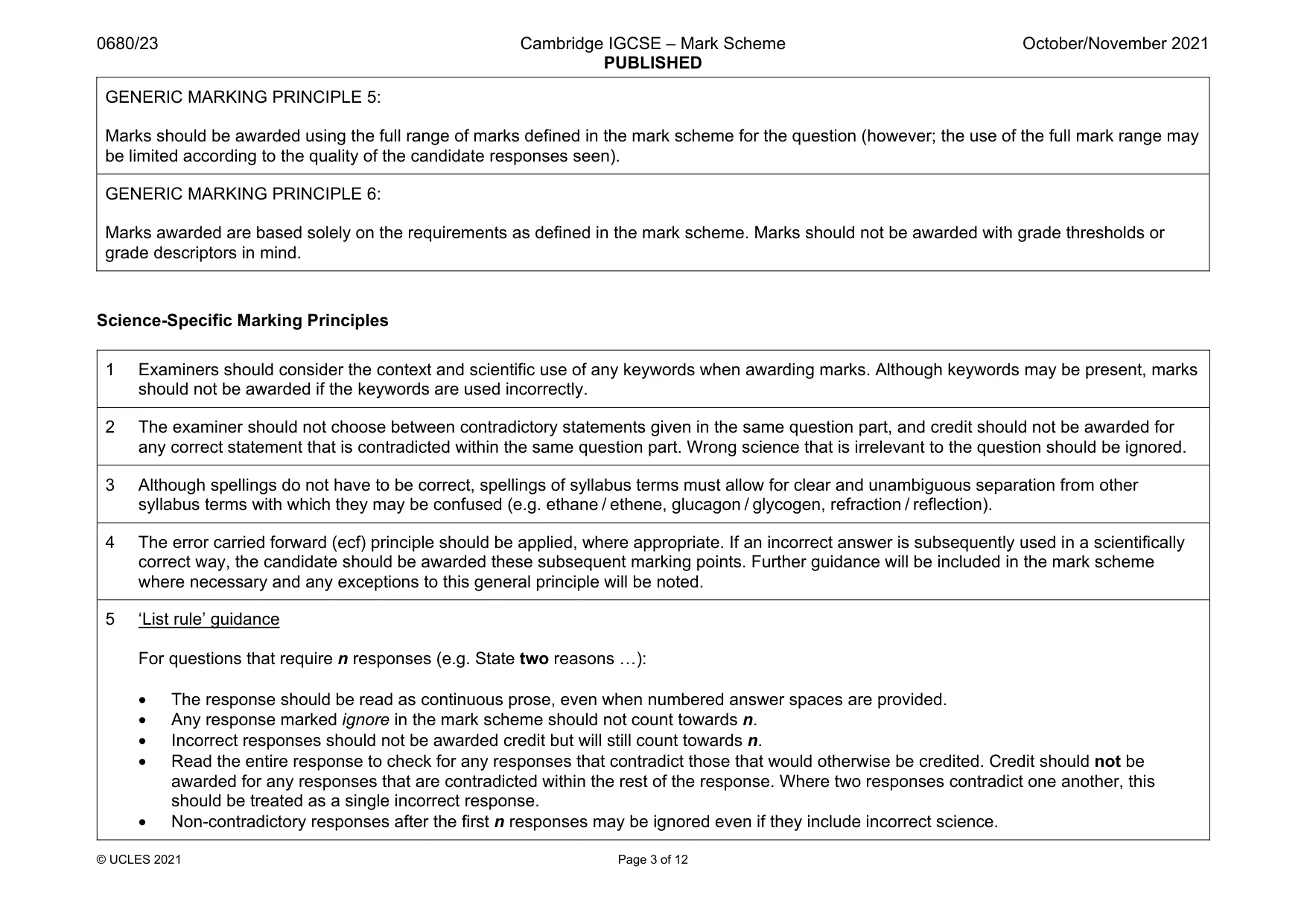
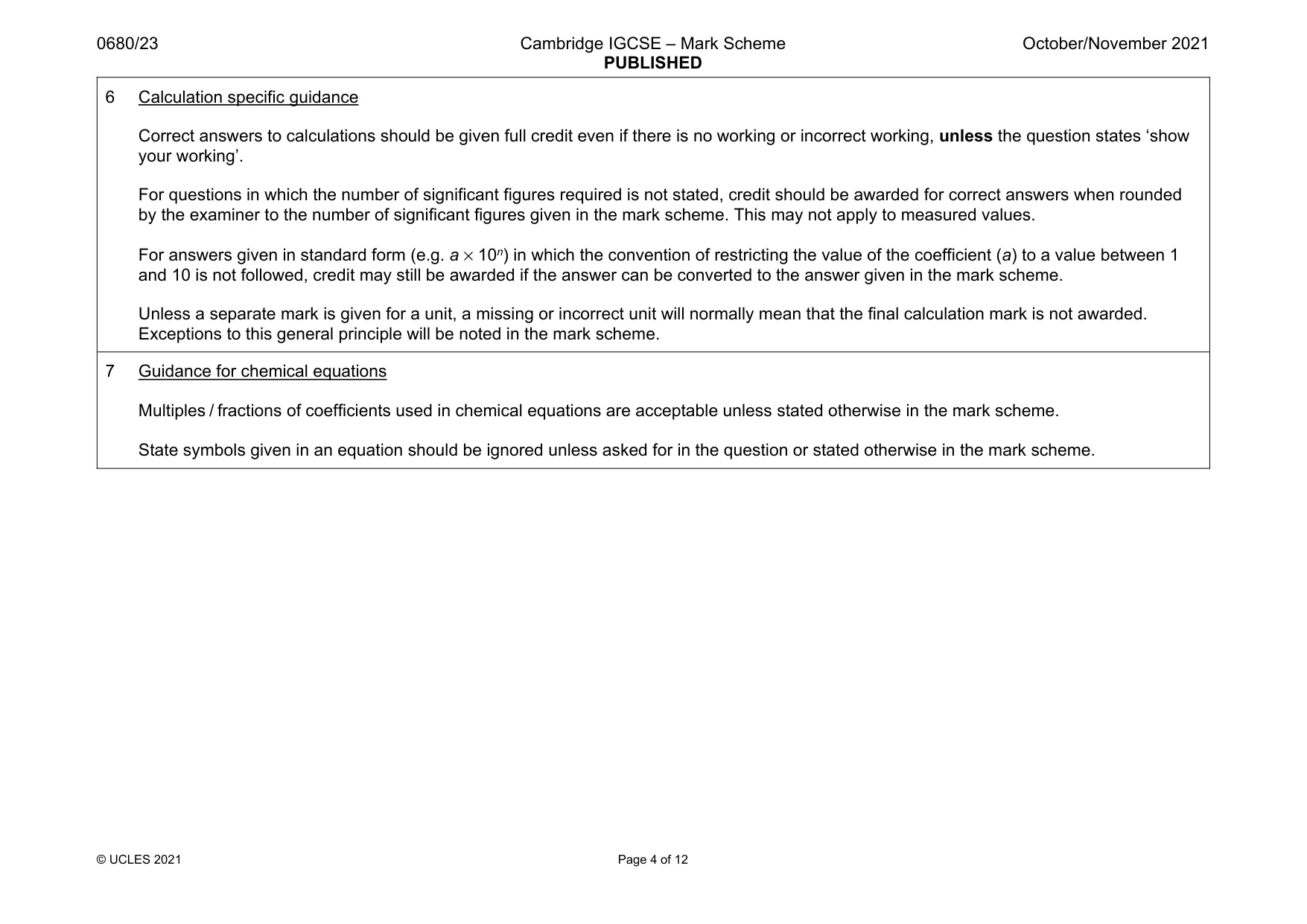
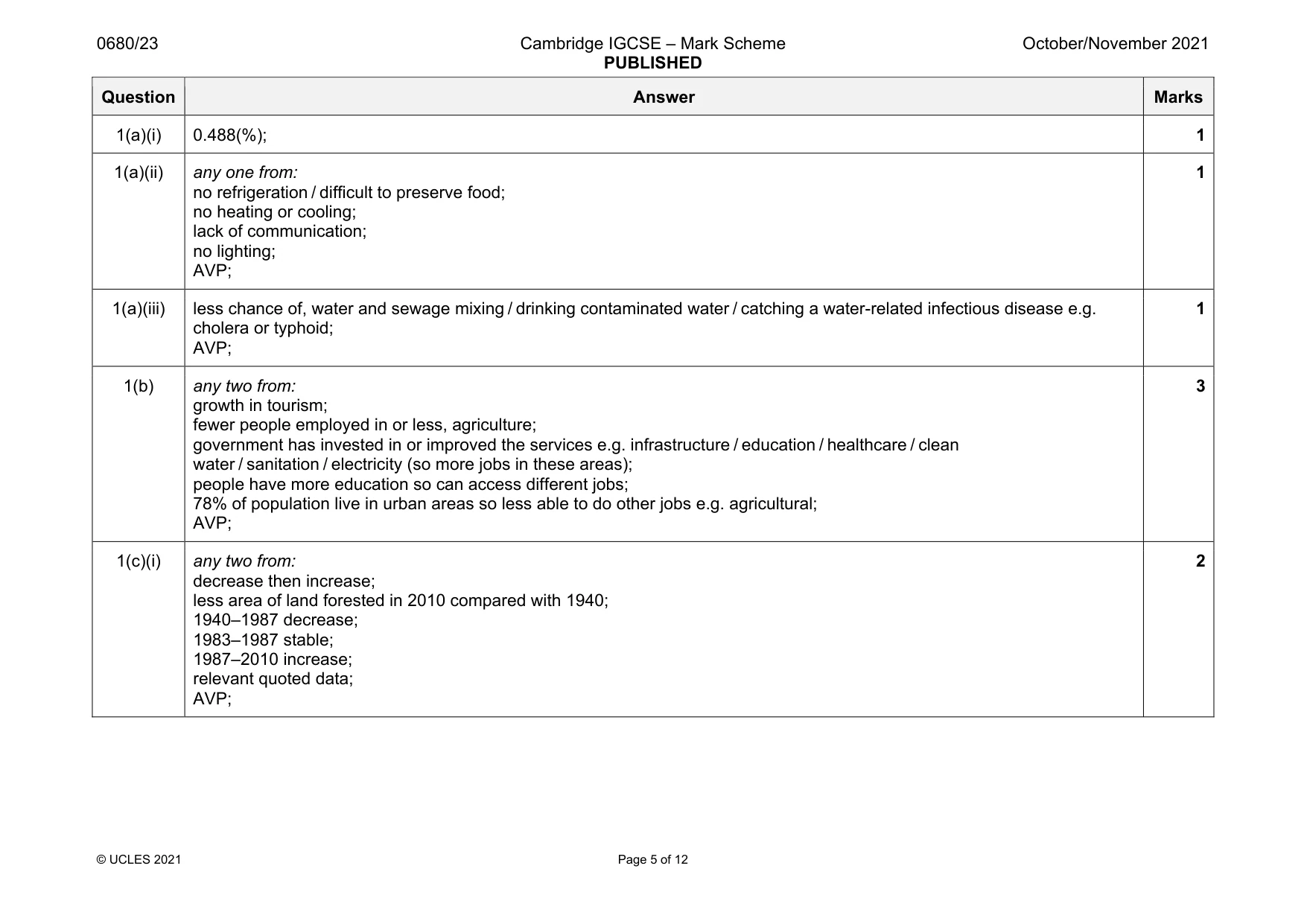
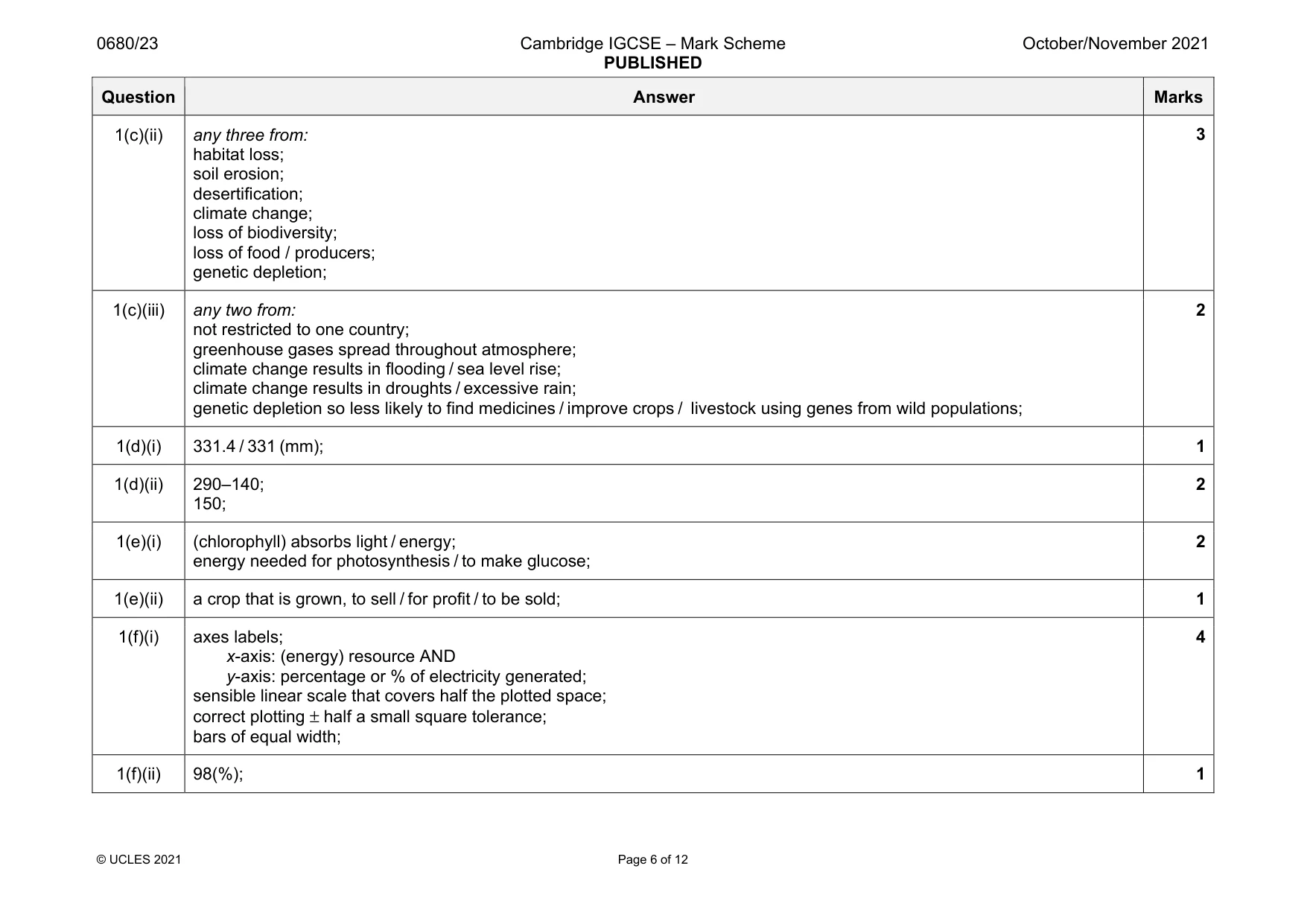
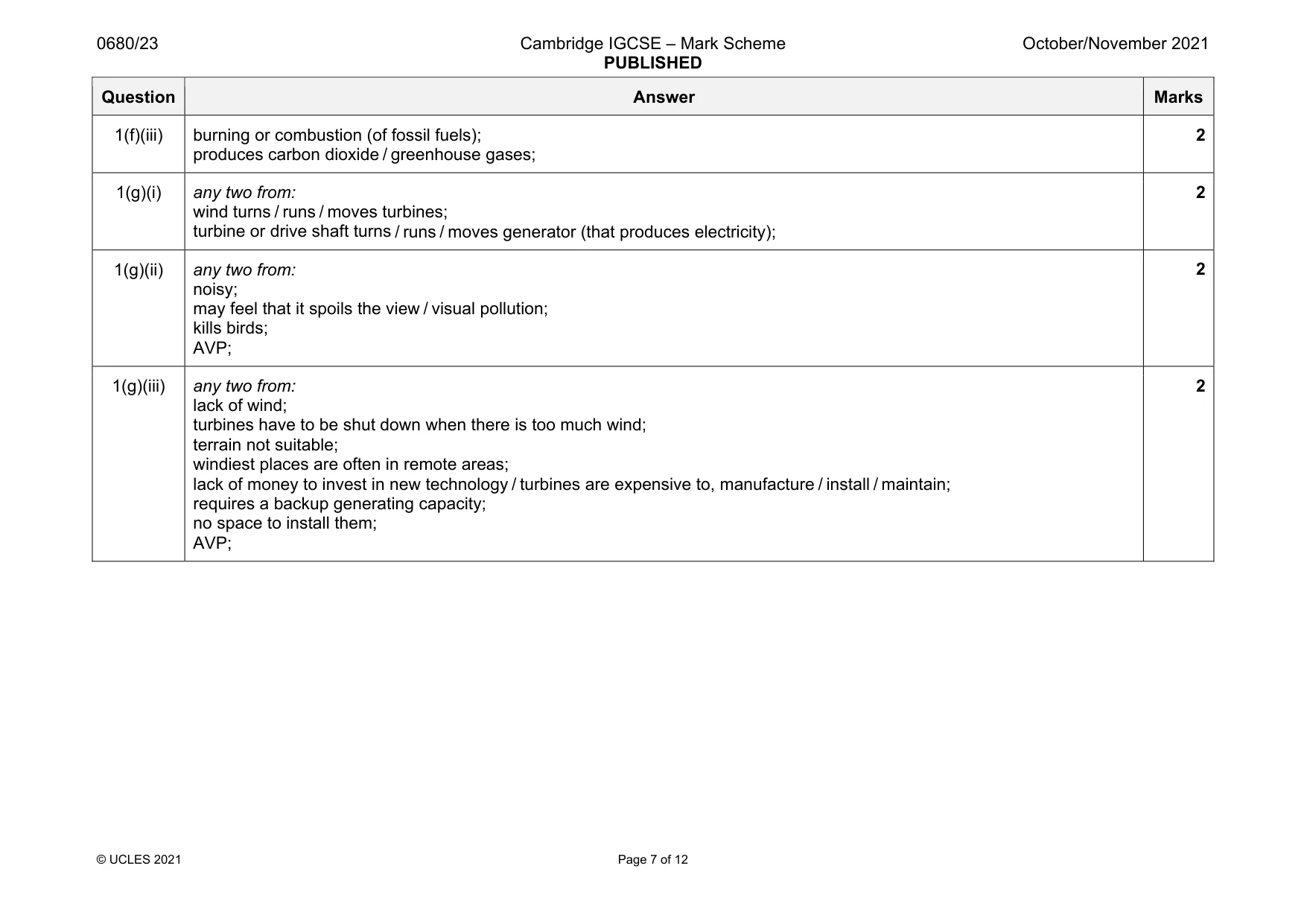
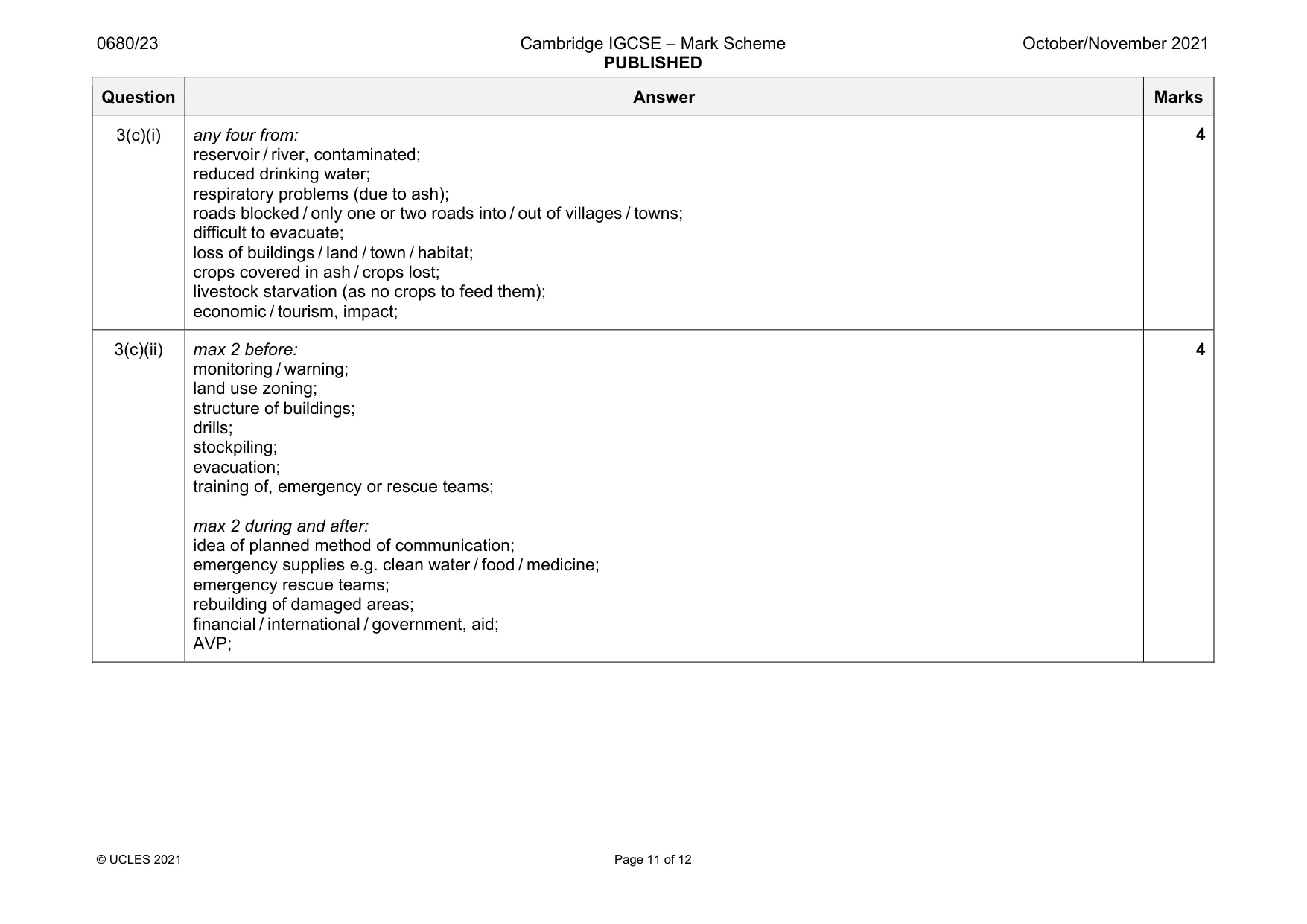
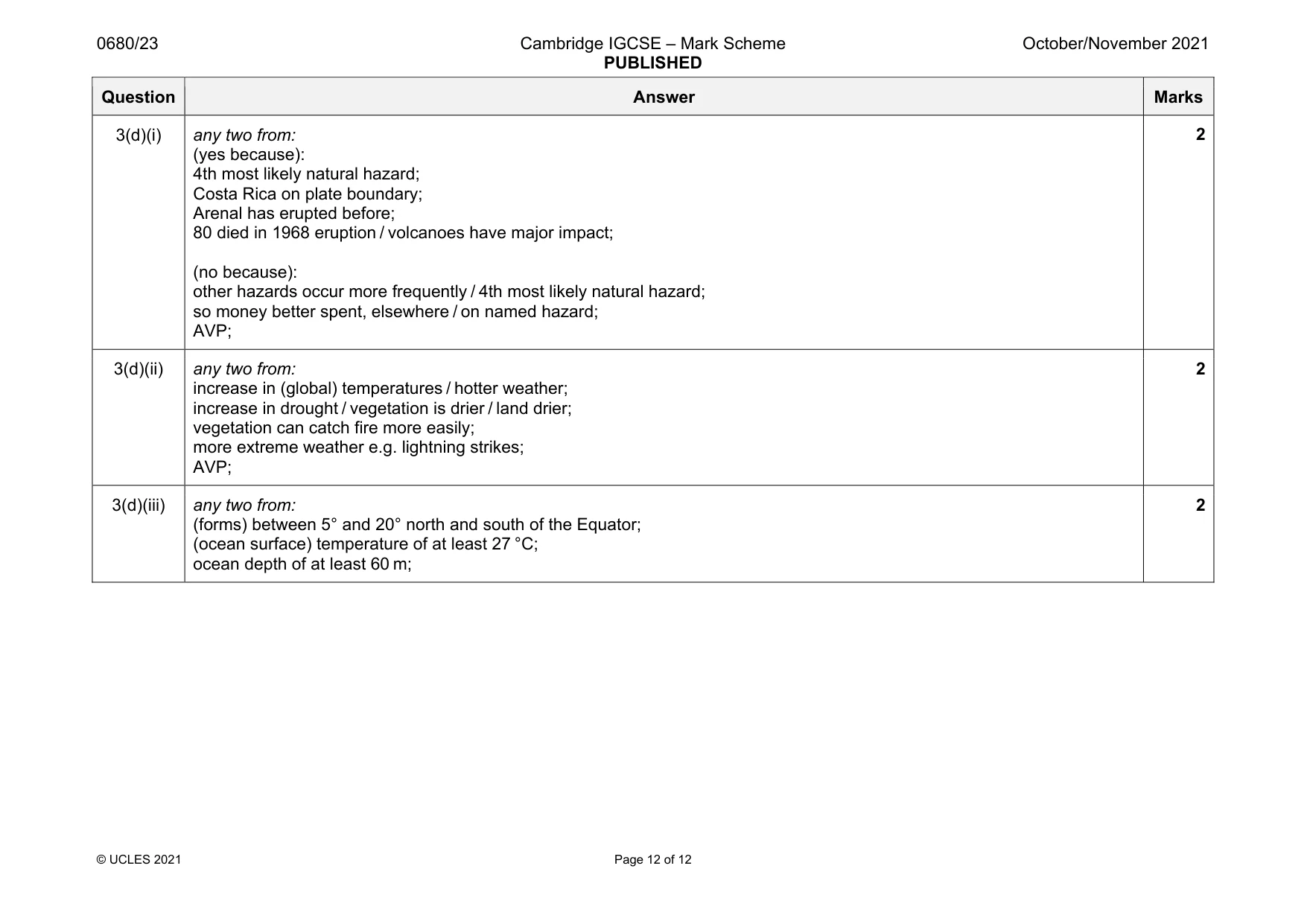
Mark scheme: 1(a)(i) 0.488(%); 1 1(a)(ii) any one from: no refrigeration / difficult to preserve food; no heating or cooling; lack of communication; no lighting; AVP; 1 1(a)(iii) less chance of, water and sewage mixing / drinking contaminated water / catching a water-related infectious disease e.g. cholera or typhoid; AVP; 1 1(b) any two from: growth in tourism; fewer people employed in or less, agriculture; government has invested in or improved the services e.g. infrastructure / education / healthcare / clean water / sanitation / electricity (so more jobs in these areas); people have more education so can access different jobs; 78% of population live in urban areas so less able to do other jobs e.g. agricultural; AVP; 3 1(c)(i) any two from: decrease then increase; less area of land forested in 2010 compared with 1940; 1940–1987 decrease; 1983–1987 stable; 1987–2010 increase; relevant quoted data; AVP; 2 Question Answer Marks 1(c)(ii) any three from: habitat loss; soil erosion; desertification; climate change; loss of biodiversity; loss of food / producers; genetic depletion; 3 1(c)(iii) any two from: not restricted to one country; greenhouse gases spread throughout atmosphere; climate change results in flooding / sea level rise; climate change results in droughts / excessive rain; genetic depletion so less likely to find medicines / improve crops / livestock using genes from wild populations; 2 1(d)(i) 331.4 / 331 (mm); 1 1(d)(ii) 290–140; 150; 2 1(e)(i) (chlorophyll) absorbs light / energy; energy needed for photosynthesis / to make glucose; 2 1(e)(ii) a crop that is grown, to sell / for profit / to be sold; 1 1(f)(i) axes labels; x-axis: (energy) resource AND y-axis: percentage or % of electricity generated; sensible linear scale that covers half the plotted space; correct plotting ± half a small square tolerance; bars of equal width; 4 1(f)(ii) 98(%); 1 Question Answer Marks 1(f)(iii) burning or combustion (of fossil fuels); produces carbon dioxide / greenhouse gases; 2 1(g)(i) any two from: wind turns / runs / moves turbines; turbine or drive shaft turns / runs / moves generator (that produces electricity); 2 1(g)(ii) any two from: noisy; may feel that it spoils the view / visual pollution; kills birds; AVP; 2 1(g)(iii) any two from: lack of wind; turbines have to be shut down when there is too much wind; terrain not suitable; windiest places are often in remote areas; lack of money to invest in new technology / turbines are expensive to, manufacture / install / maintain; requires a backup generating capacity; no space to install them; AVP; 2
Q2 · The fact sheet shows information on the Resplendent Quetzal bird
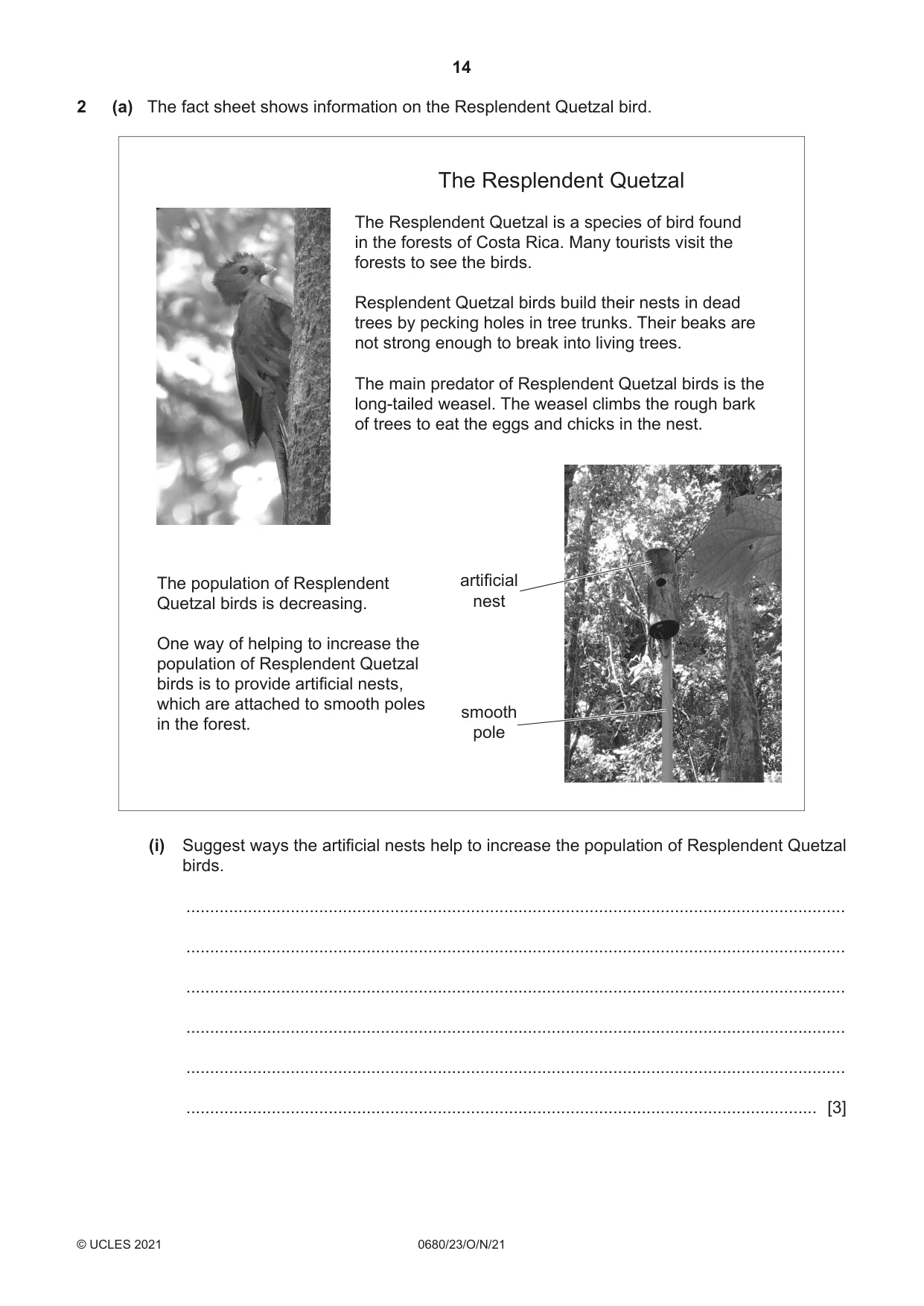
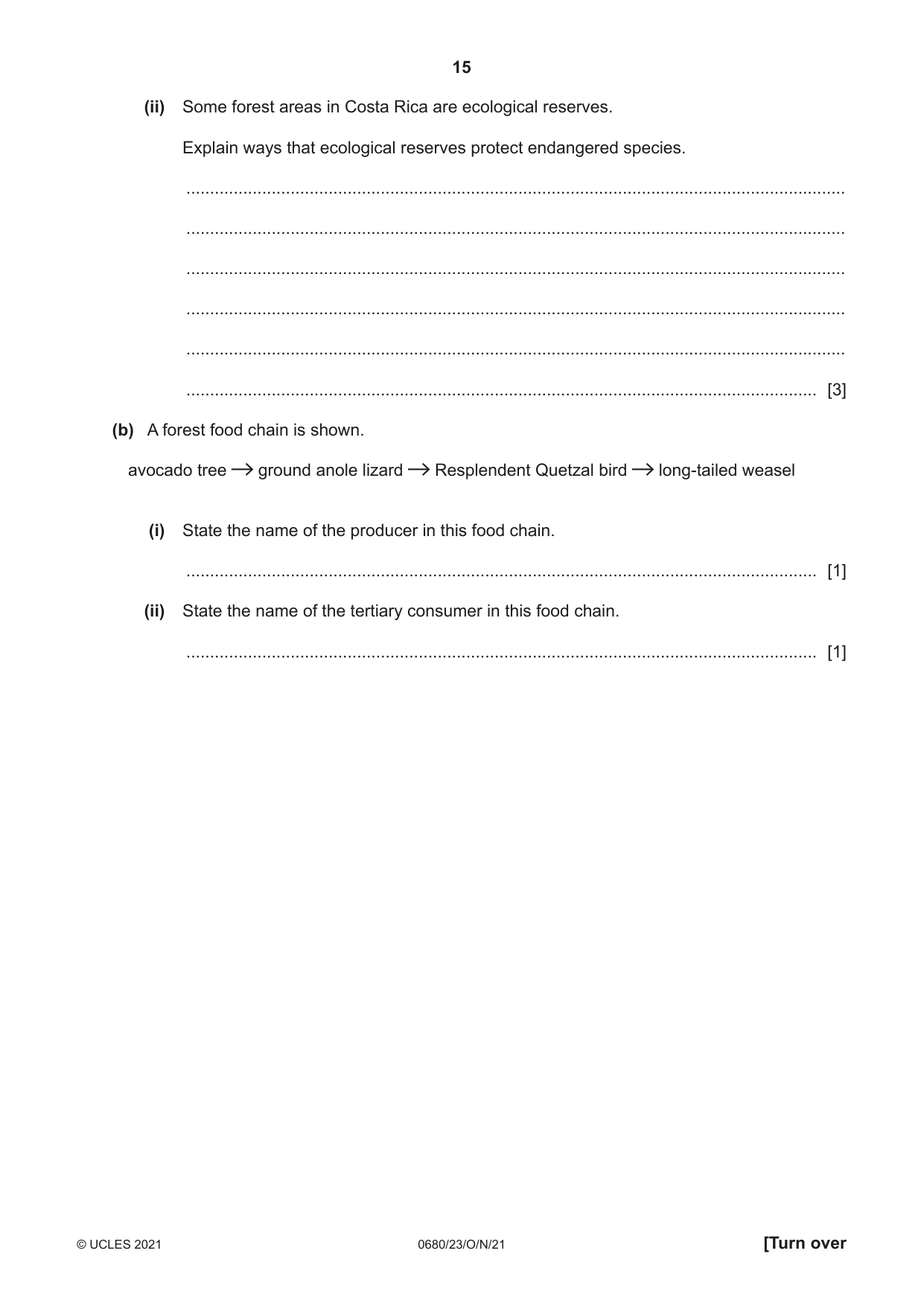
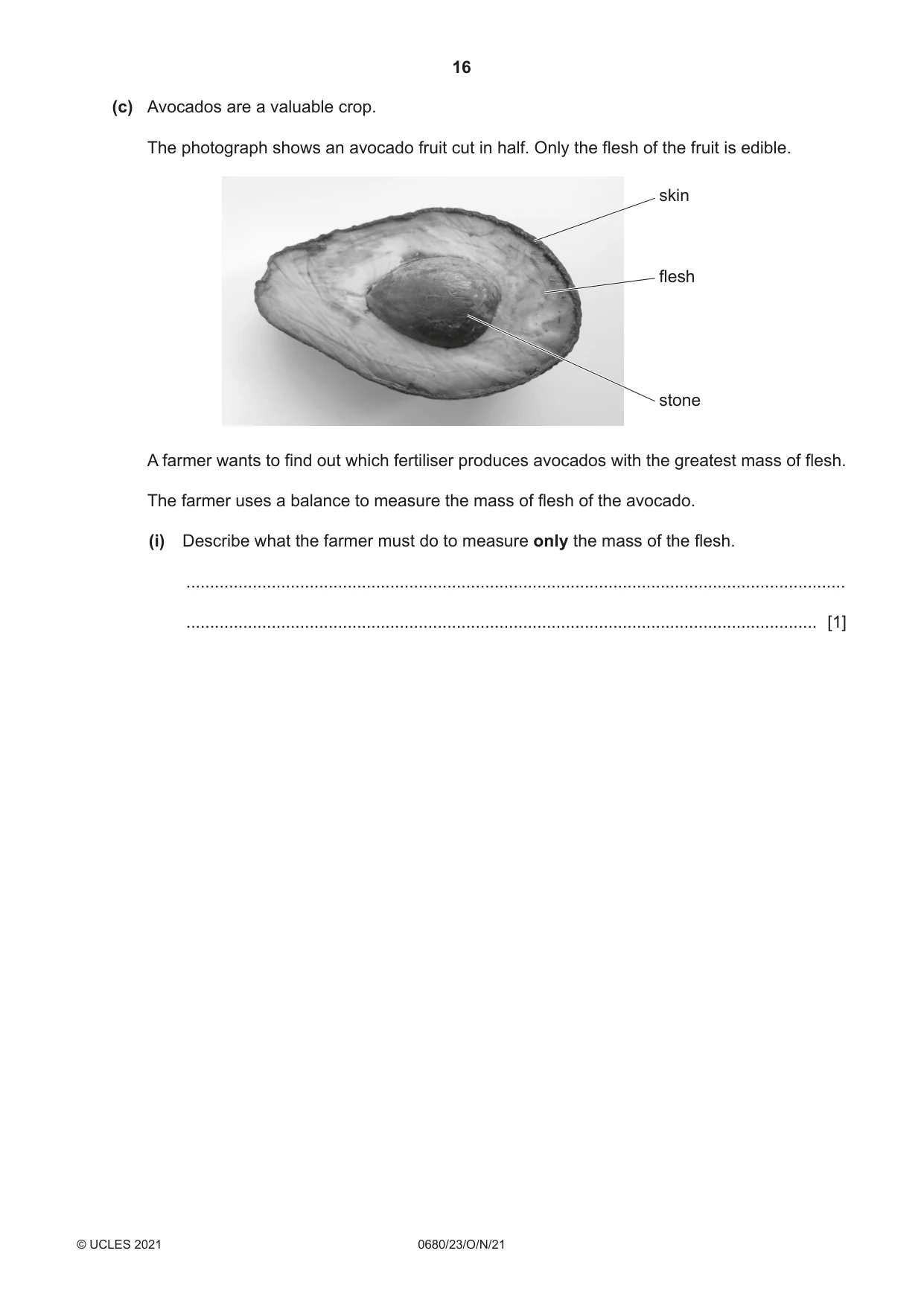
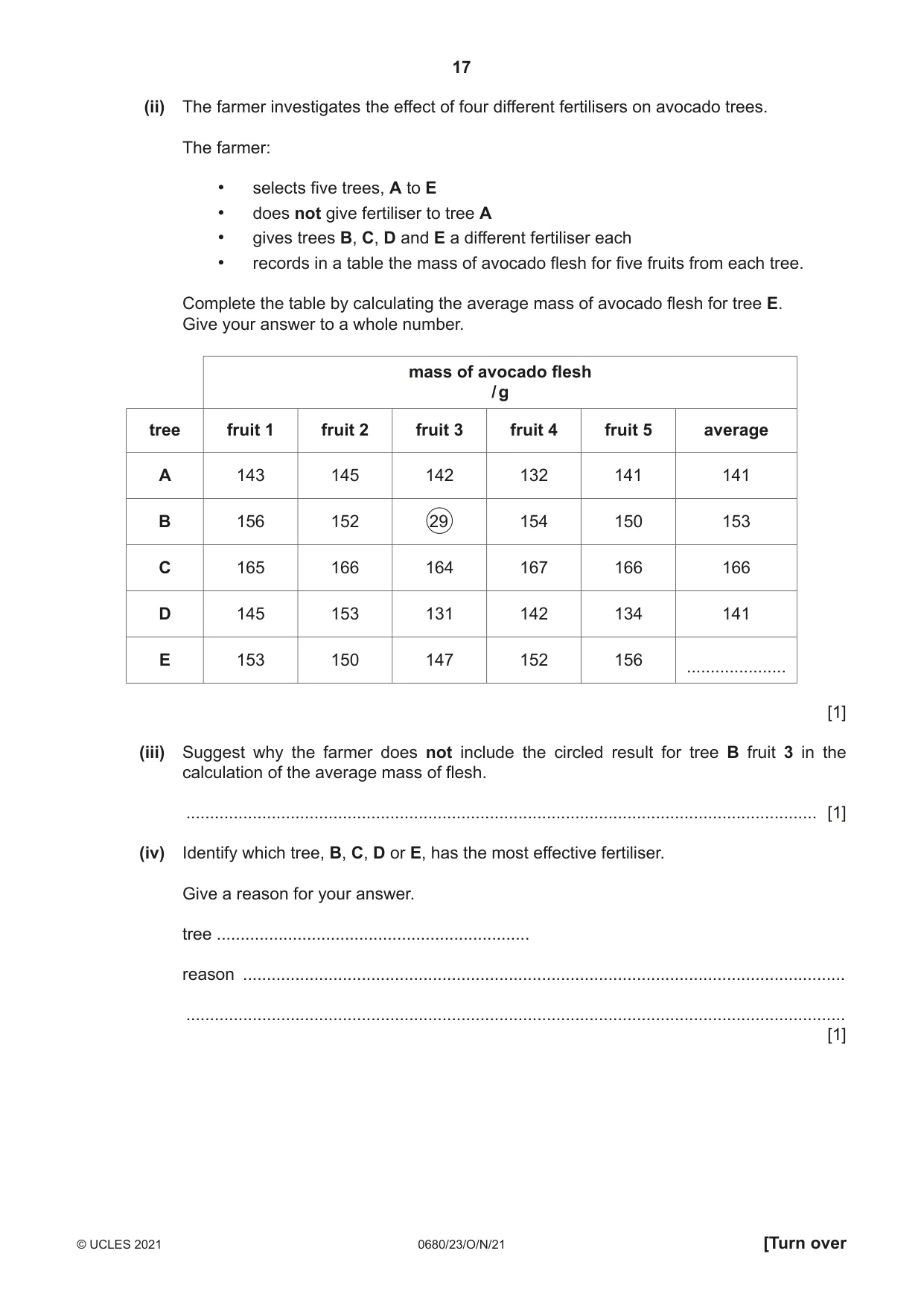
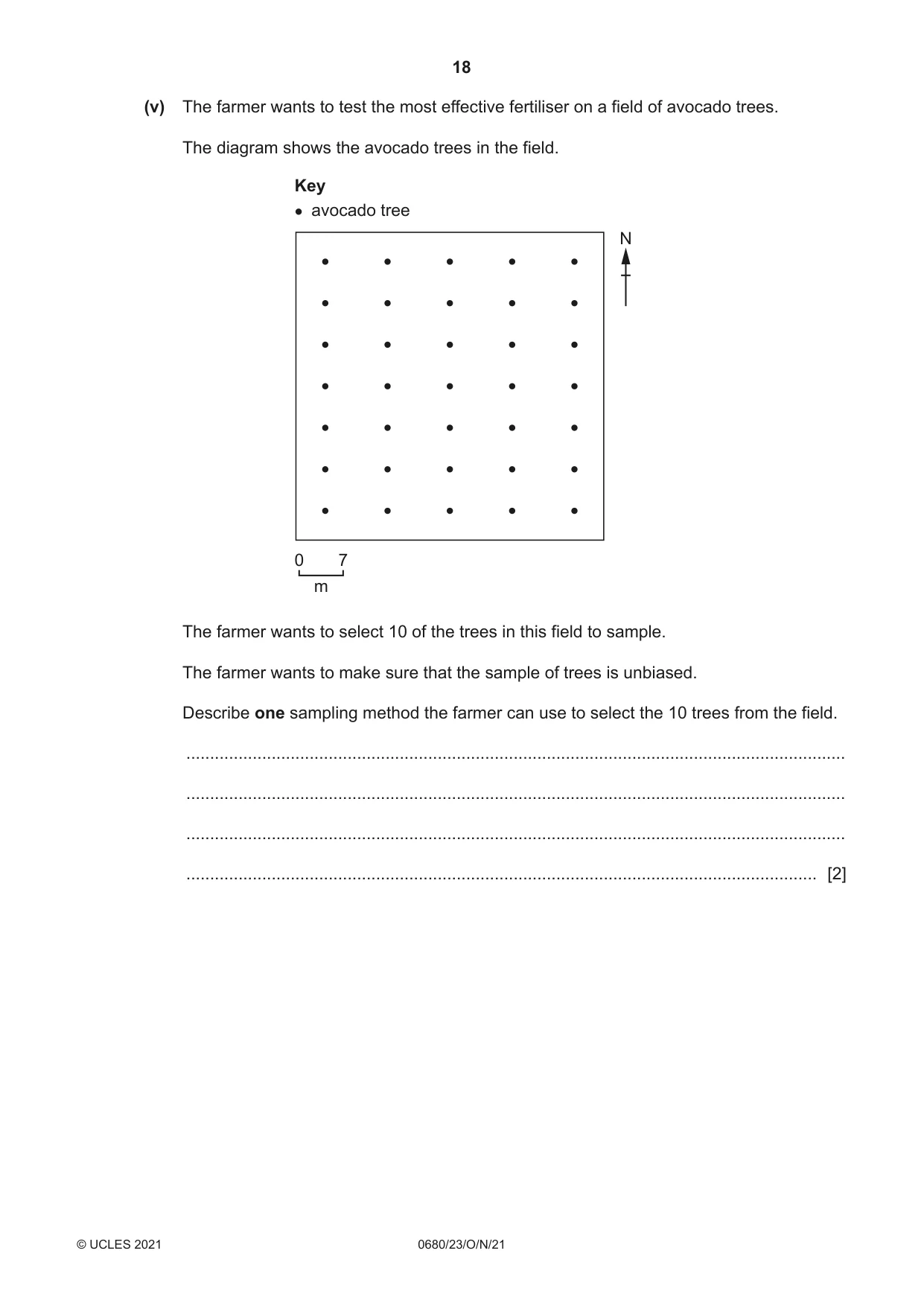
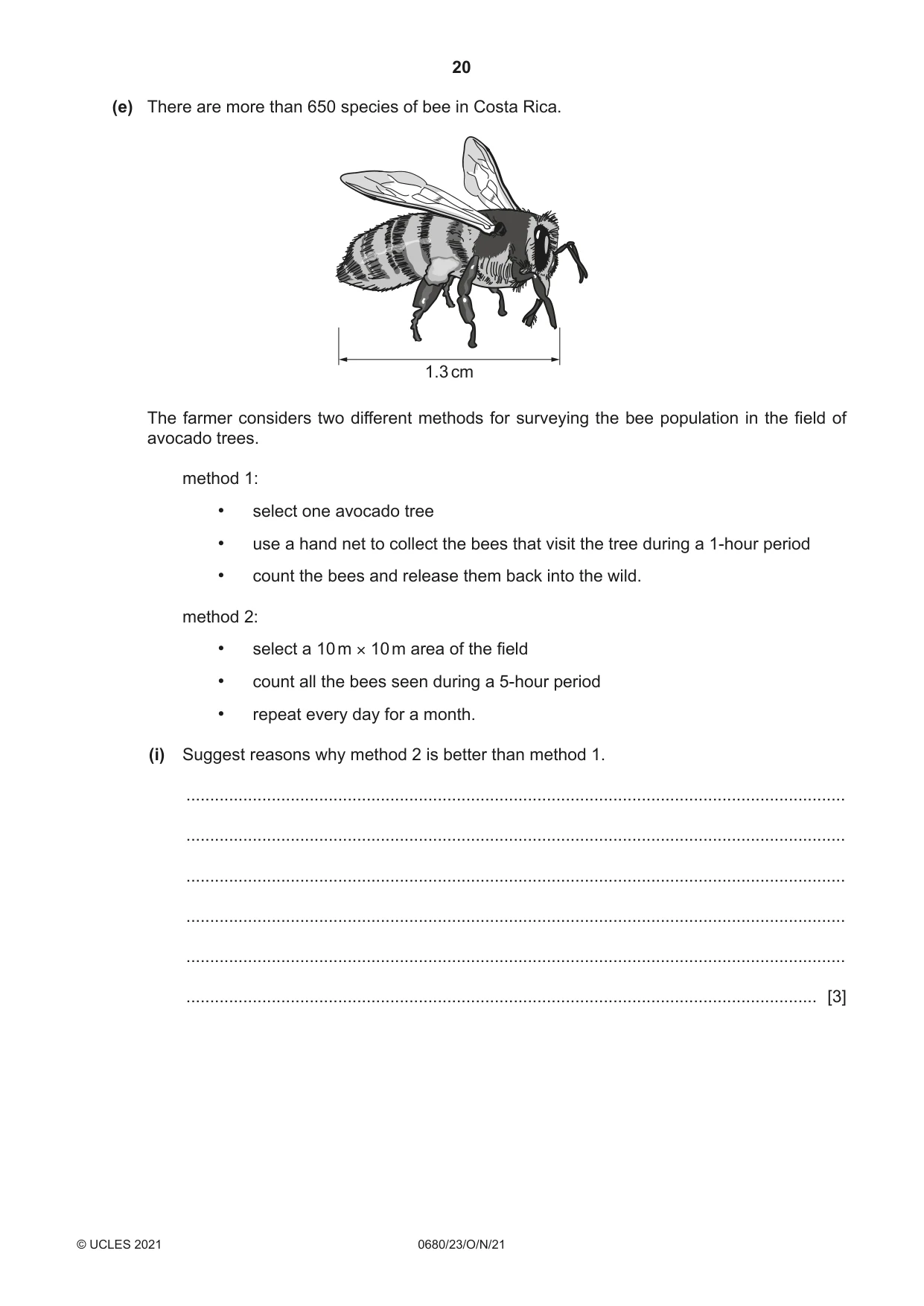
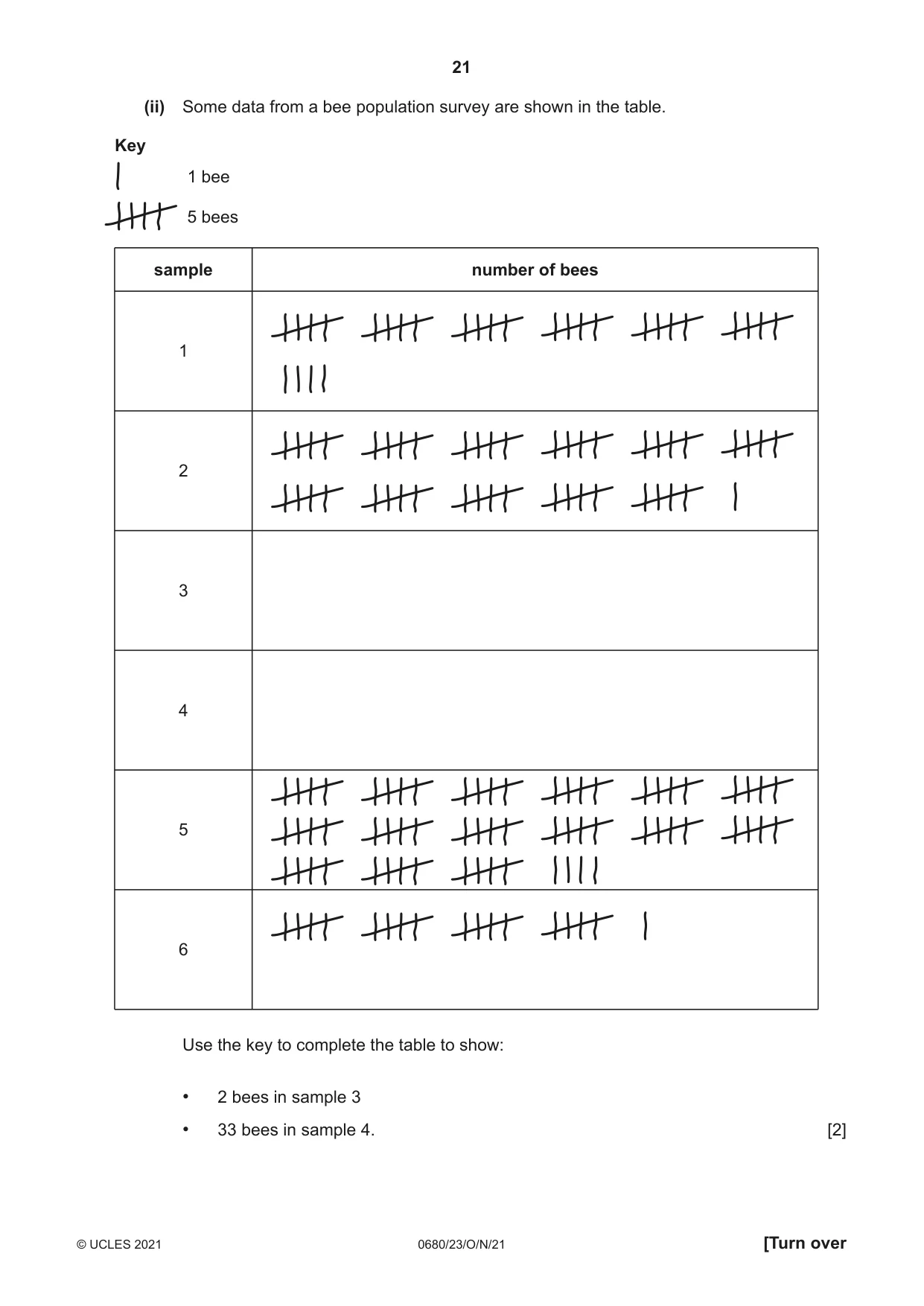
2 (a) The fact sheet shows information on the Resplendent Quetzal bird. The Resplendent Quetzal The Resplendent Quetzal is a species of bird found in the forests of Costa Rica. Many tourists visit the forests to see the birds. Resplendent Quetzal birds build their nests in dead trees by pecking holes in tree trunks. Their beaks are not strong enough to break into living trees. The main predator of Resplendent Quetzal birds is the long-tailed weasel. The weasel climbs the rough bark of trees to eat the eggs and chicks in the nest. The population of Resplendent artificial Quetzal birds is decreasing. nest One way of helping to increase the population of Resplendent Quetzal birds is to provide artificial nests, which are attached to smooth poles smooth in the forest. pole (i) Suggest ways the artificial nests help to increase the population of Resplendent Quetzal birds. ........................................................................................................................................... ........................................................................................................................................... ........................................................................................................................................... ........................................................................................................................................... ........................................................................................................................................... ..................................................................................................................................... [3] (ii) Some forest areas in Costa Rica are ecological reserves. Explain ways that ecological reserves protect endangered species. ........................................................................................................................................... ........................................................................................................................................... ........................................................................................................................................... ........................................................................................................................................... ........................................................................................................................................... ..................................................................................................................................... [3] (b) A forest food chain is shown. avocado tree ground anole lizard Resplendent Quetzal bird long-tailed weasel (i) State the name of the producer in this food chain. ..................................................................................................................................... [1] (ii) State the name of the tertiary consumer in this food chain. ..................................................................................................................................... [1] (c) Avocados are a valuable crop. The photograph shows an avocado fruit cut in half. Only the flesh of the fruit is edible. skin flesh stone A farmer wants to find out which fertiliser produces avocados with the greatest mass of flesh. The farmer uses a balance to measure the mass of flesh of the avocado. (i) Describe what the farmer must do to measure only the mass of the flesh. ........................................................................................................................................... ..................................................................................................................................... [1] (ii) The farmer investigates the effect of four different fertilisers on avocado trees. The farmer: • selects five trees, A to E • does not give fertiliser to tree A • gives trees B, C, D and E a different fertiliser each • records in a table the mass of avocado flesh for five fruits from each tree. Complete the table by calculating the average mass of avocado flesh for tree E. Give your answer to a whole number. mass of avocado flesh / g tree fruit 1 fruit 2 fruit 3 fruit 4 fruit 5 average A 143 145 142 132 141 141 B 156 152 29 154 150 153 C 165 166 164 167 166 166 D 145 153 131 142 134 141 E 153 150 147 152 156 ..................... [1] (iii) Suggest why the farmer does not include the circled result for tree B fruit 3 in the calculation of the average mass of flesh. ..................................................................................................................................... [1] (iv) Identify which tree, B, C, D or E, has the most effective fertiliser. Give a reason for your answer. tree .................................................................. reason ............................................................................................................................... ........................................................................................................................................... [1] (v) The farmer wants to test the most effective fertiliser on a field of avocado trees. The diagram shows the avocado trees in the field. Key avocado tree N 0 7 m The farmer wants to select 10 of the trees in this field to sample. The farmer wants to make sure that the sample of trees is unbiased. Describe one sampling method the farmer can use to select the 10 trees from the field. ........................................................................................................................................... ........................................................................................................................................... ........................................................................................................................................... ..................................................................................................................................... [2] (vi) Fertilisers can kill aquatic life if the nutrients they contain run off into water sources. The nutrients increase the growth of algae. Eventually, the algae die. Explain how the death of algae leads to the death of other aquatic life. ........................................................................................................................................... ........................................................................................................................................... ........................................................................................................................................... ..................................................................................................................................... [2] (d) Avocado trees are pollinated by bees. Explain why pollination is needed. ................................................................................................................................................... ................................................................................................................................................... ................................................................................................................................................... ............................................................................................................................................. [2] (e) There are more than 650 species of bee in Costa Rica. 1.3 cm The farmer considers two different methods for surveying the bee population in the field of avocado trees. method 1: • select one avocado tree • use a hand net to collect the bees that visit the tree during a 1-hour period • count the bees and release them back into the wild. method 2: • select a 10 m × 10 m area of the field • count all the bees seen during a 5-hour period • repeat every day for a month. (i) Suggest reasons why method 2 is better than method 1. ........................................................................................................................................... ........................................................................................................................................... ........................................................................................................................................... ........................................................................................................................................... ........................................................................................................................................... ..................................................................................................................................... [3] (ii) Some data from a bee population survey are shown in the table. Key 1 bee 5 bees sample number of bees 1 2 3 4 5 6 Use the key to complete the table to show: • 2 bees in sample 3 • 33 bees in sample 4. [2] (iii) Global bee populations are decreasing. Scientists think that one reason for this decrease is the use of insecticides. Suggest two other reasons why bee populations are decreasing. 1 ........................................................................................................................................ ........................................................................................................................................... 2 ........................................................................................................................................ ........................................................................................................................................... [2] (iv) Fertilisers and insecticides are used to increase agricultural yields. State two other techniques used to increase agricultural yields. 1 ........................................................................................................................................ 2 ........................................................................................................................................ [2] [Total: 27]
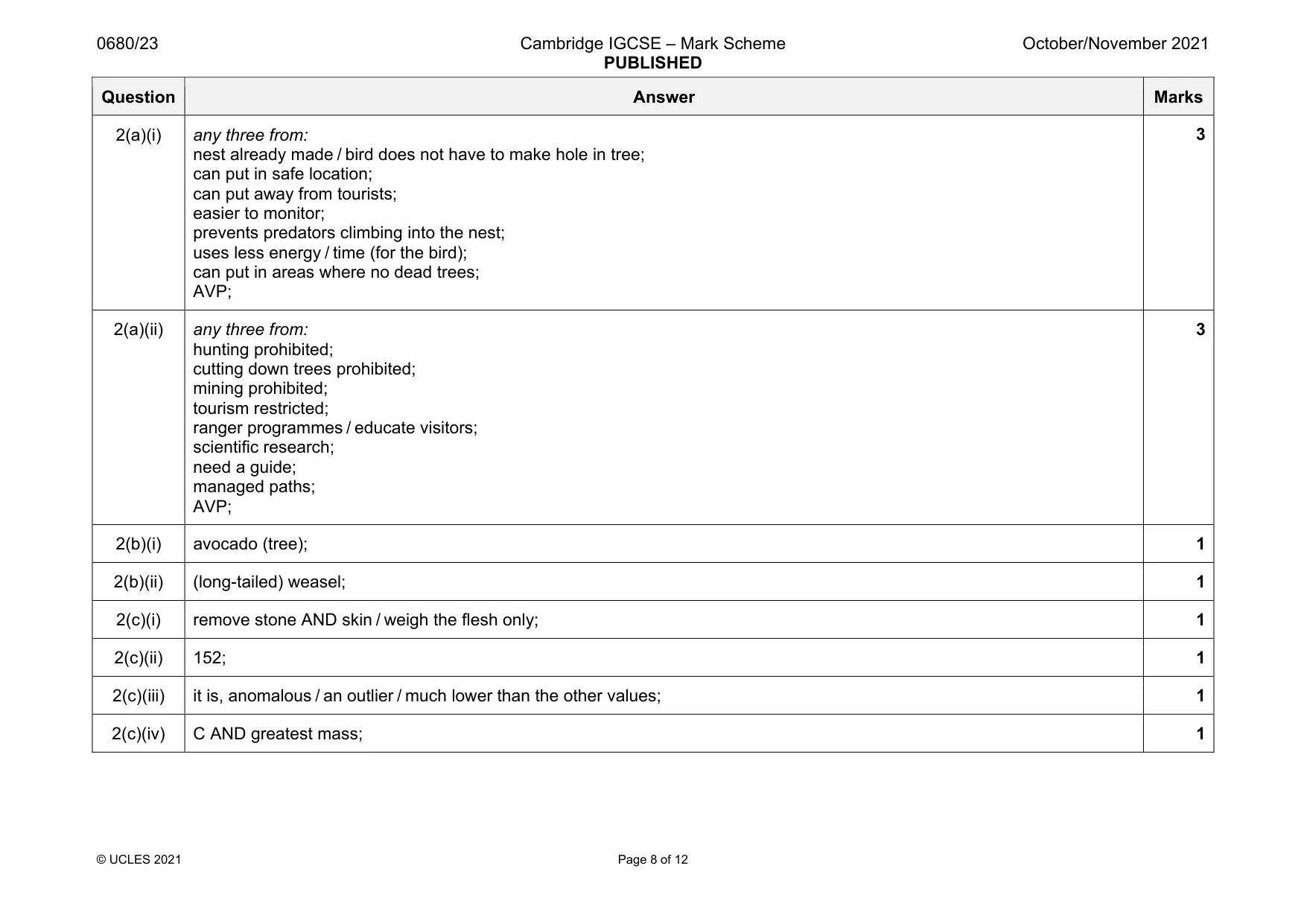
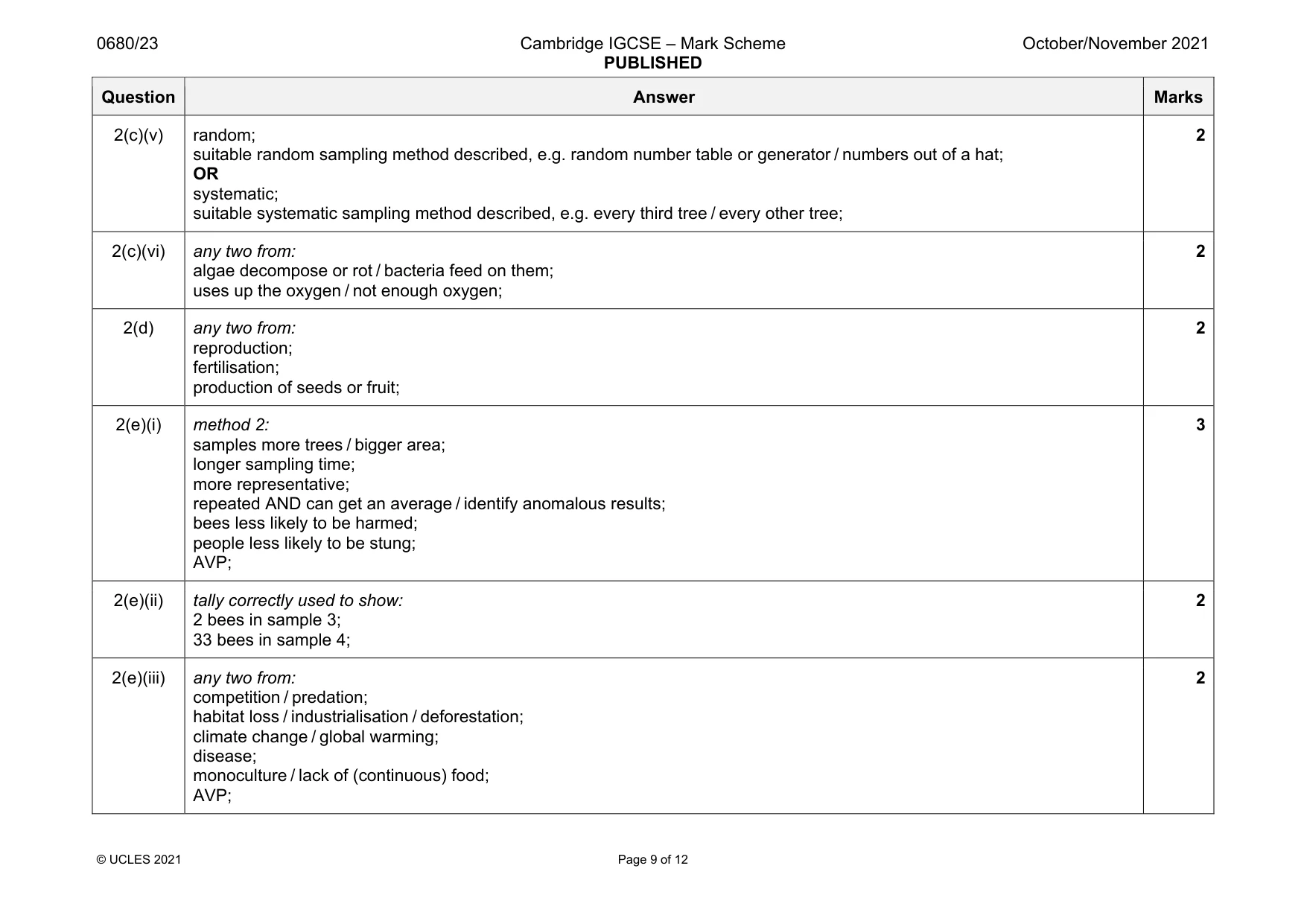
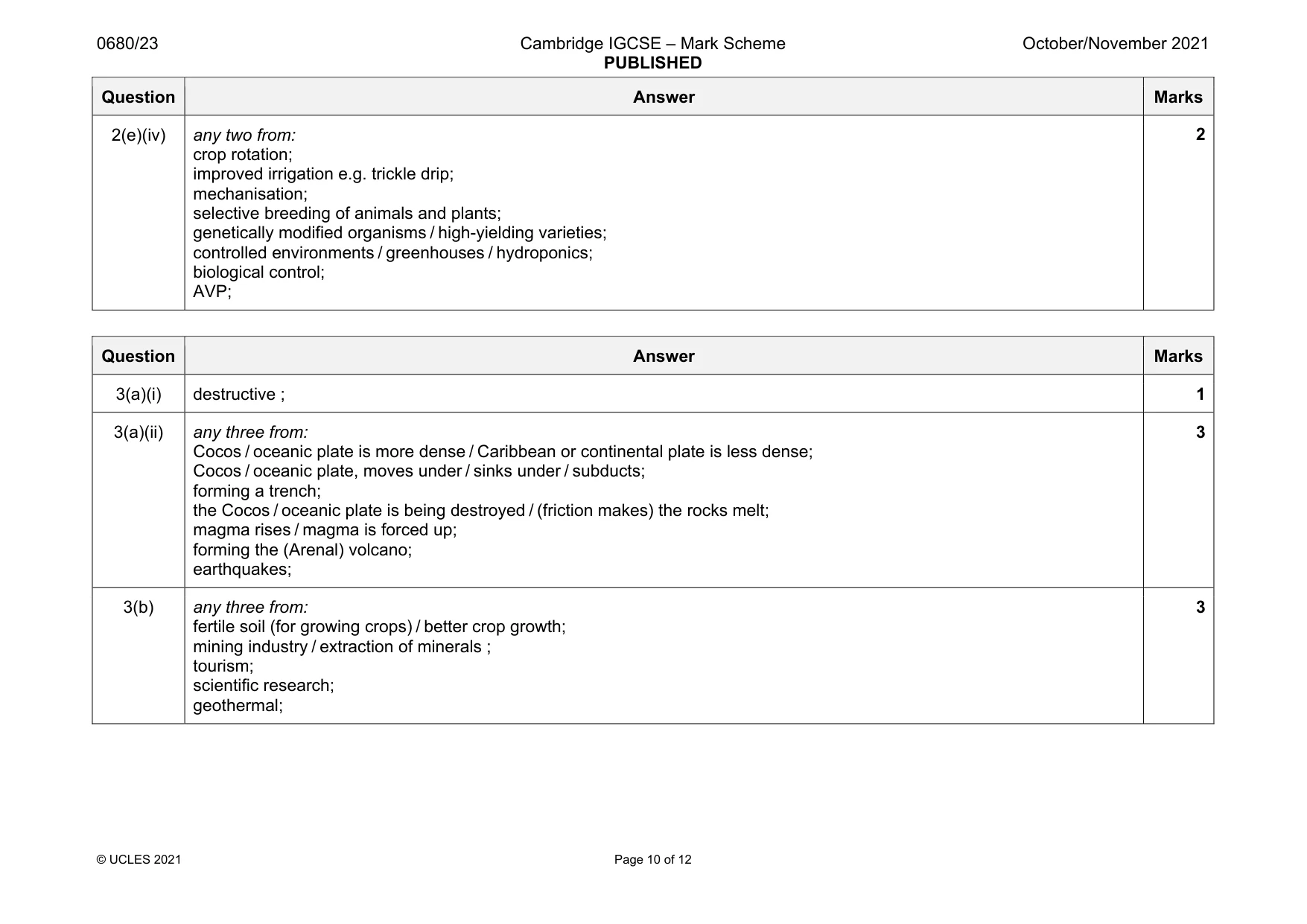
Mark scheme: 2(a)(i) any three from: nest already made / bird does not have to make hole in tree; can put in safe location; can put away from tourists; easier to monitor; prevents predators climbing into the nest; uses less energy / time (for the bird); can put in areas where no dead trees; AVP; 2(a)(ii) any three from: hunting prohibited; cutting down trees prohibited; mining prohibited; tourism restricted; ranger programmes / educate visitors; scientific research; need a guide; managed paths; AVP; 3 2(b)(i) avocado (tree); 1 2(b)(ii) (long-tailed) weasel; 1 2(c)(i) remove stone AND skin / weigh the flesh only; 1 2(c)(ii) 152; 1 2(c)(iii) it is, anomalous / an outlier / much lower than the other values; 1 2(c)(iv) C AND greatest mass; 1 Question Answer Marks 2(c)(v) random; suitable random sampling method described, e.g. random number table or generator / numbers out of a hat; OR systematic; suitable systematic sampling method described, e.g. every third tree / every other tree; 2 2(c)(vi) any two from: algae decompose or rot / bacteria feed on them; uses up the oxygen / not enough oxygen; 2 2(d) any two from: reproduction; fertilisation; production of seeds or fruit; 2 2(e)(i) method 2: samples more trees / bigger area; longer sampling time; more representative; repeated AND can get an average / identify anomalous results; bees less likely to be harmed; people less likely to be stung; AVP; 3 2(e)(ii) tally correctly used to show: 2 bees in sample 3; 33 bees in sample 4; 2 2(e)(iii) any two from: competition / predation; habitat loss / industrialisation / deforestation; climate change / global warming; disease; monoculture / lack of (continuous) food; AVP; 2 Question Answer Marks 2(e)(iv) any two from: crop rotation; improved irrigation e.g. trickle drip; mechanisation; selective breeding of animals and plants; genetically modified organisms / high-yielding varieties; controlled environments / greenhouses / hydroponics; biological control; AVP; 2
Q3 · The diagram shows the plate boundaries near Costa Rica
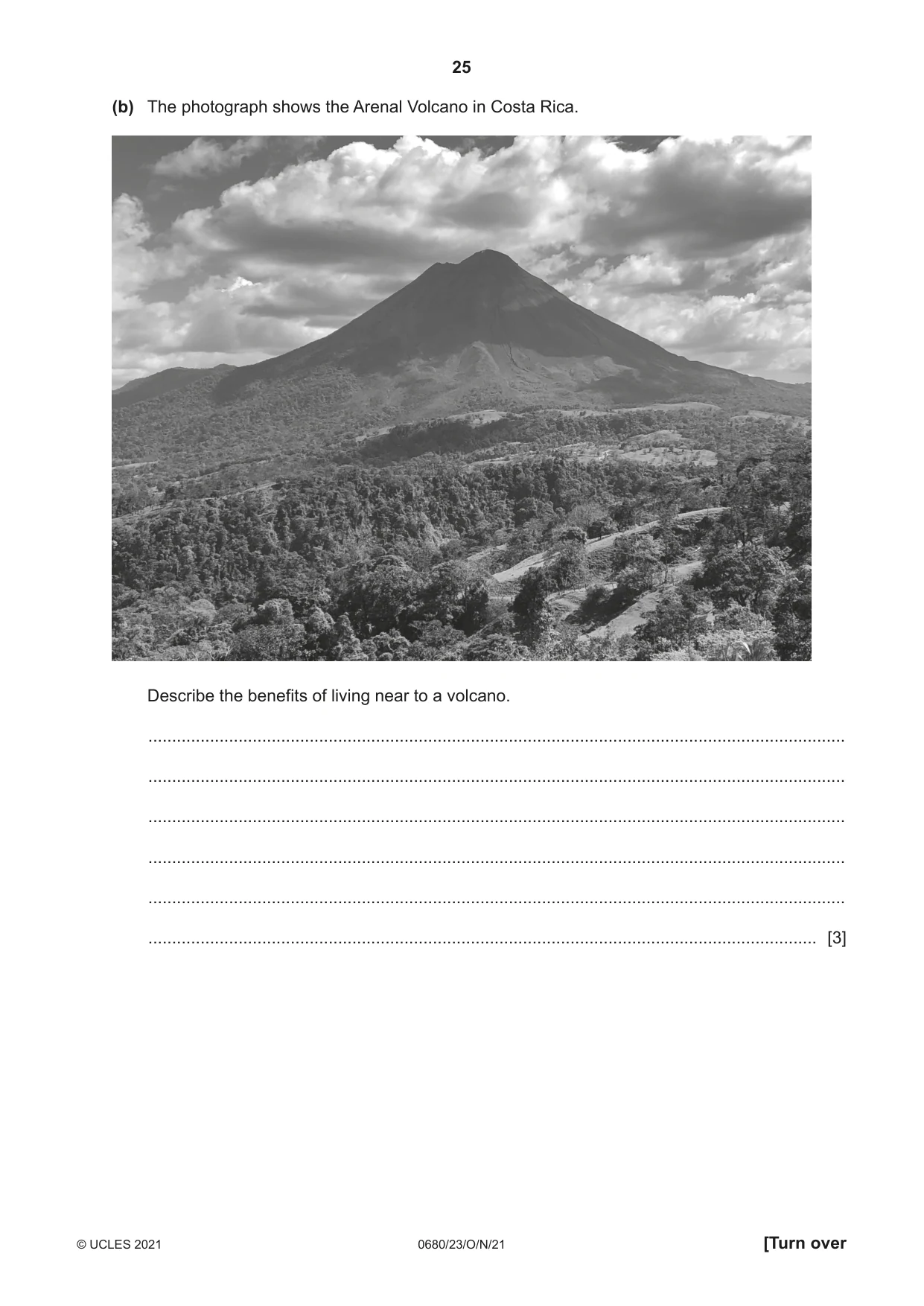
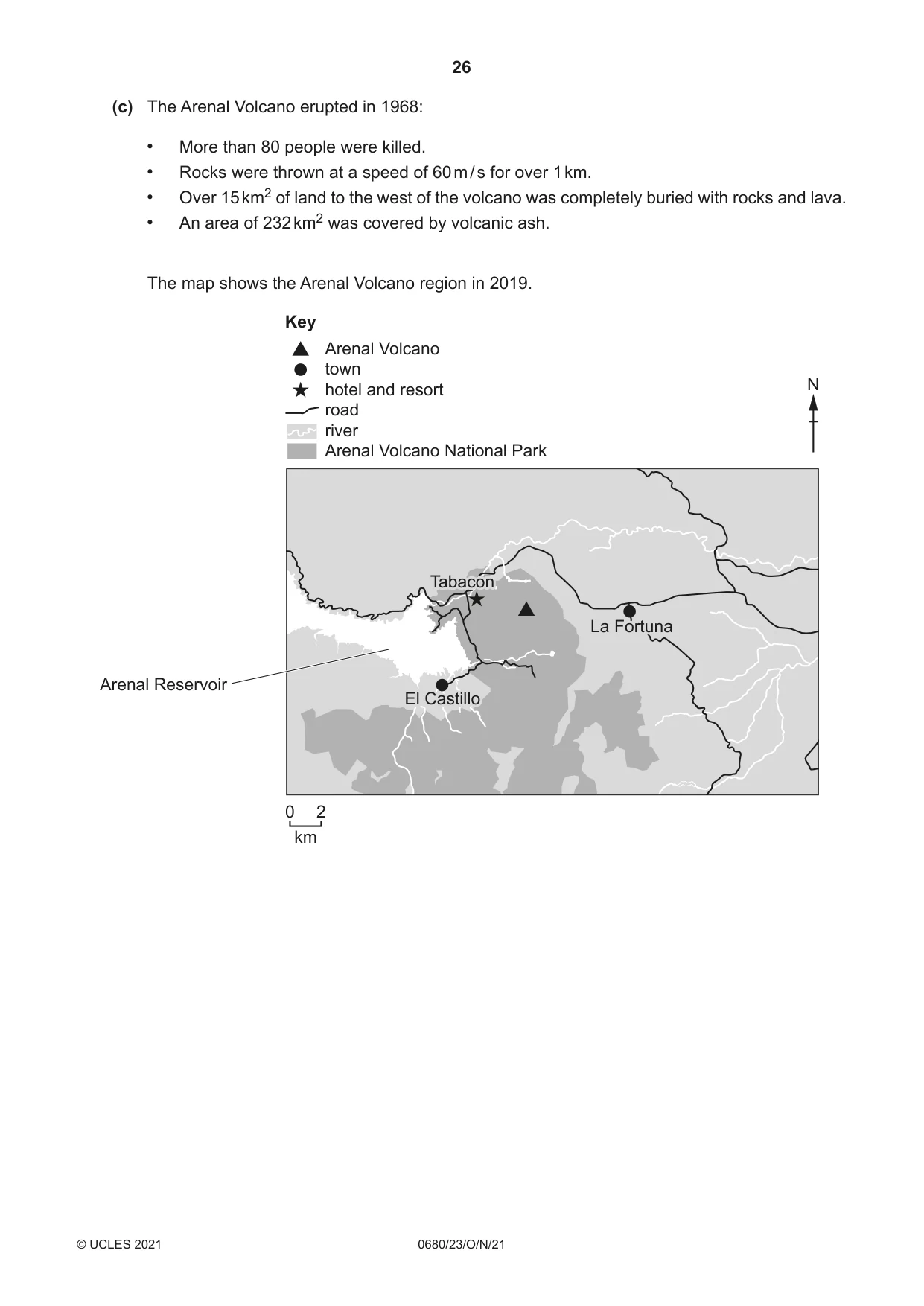
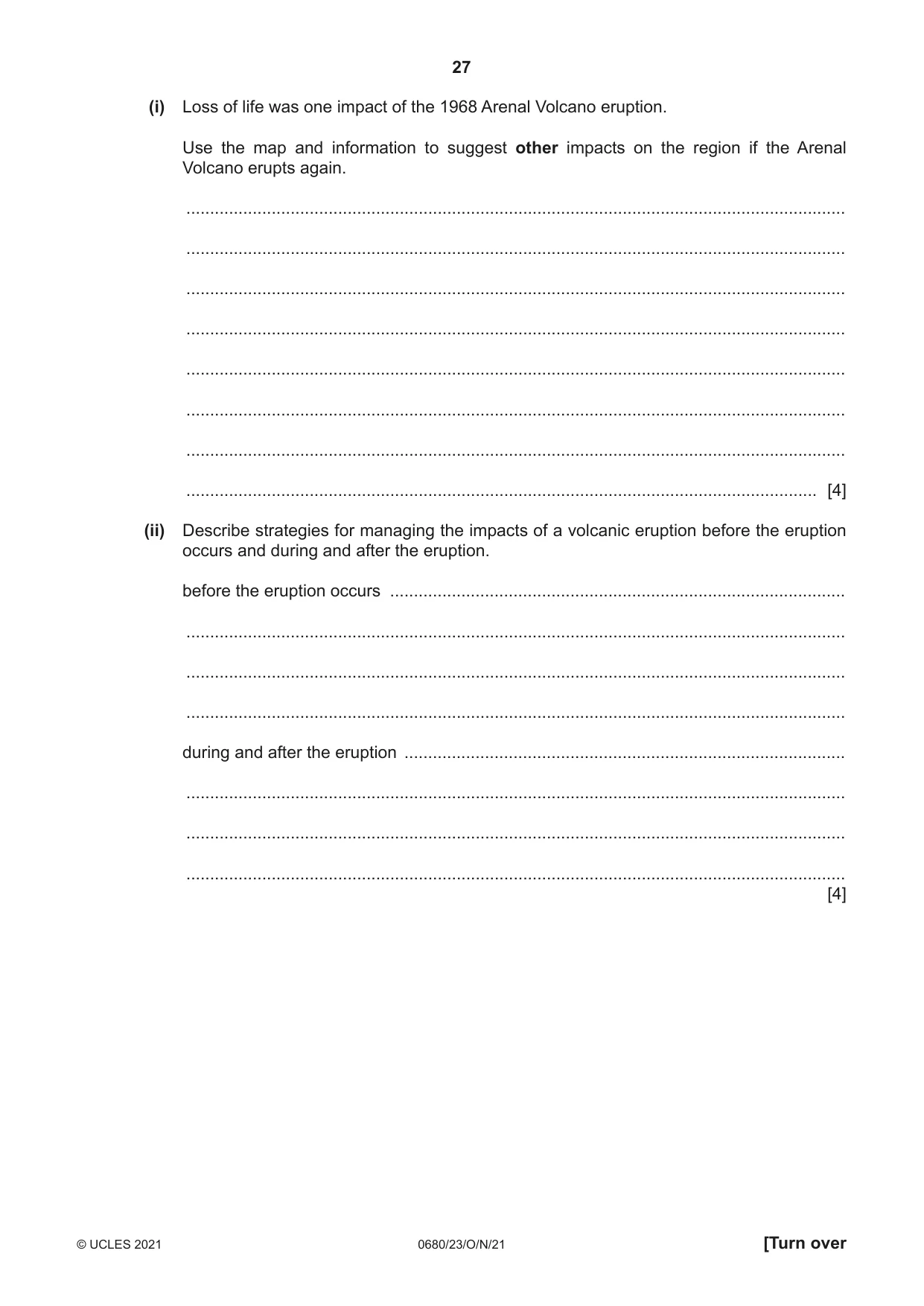
3 (a) The diagram shows the plate boundaries near Costa Rica. The arrows show the direction of plate movement. Content removed due to copyright restrictions. (i) Circle the type of plate boundary shown in the diagram. conservative constructive destructive [1] (ii) Describe what happens at the type of plate boundary shown in the diagram. ........................................................................................................................................... ........................................................................................................................................... ........................................................................................................................................... ........................................................................................................................................... ........................................................................................................................................... ..................................................................................................................................... [3] (b) The photograph shows the Arenal Volcano in Costa Rica. Describe the benefits of living near to a volcano. ................................................................................................................................................... ................................................................................................................................................... ................................................................................................................................................... ................................................................................................................................................... ................................................................................................................................................... ............................................................................................................................................. [3] (c) The Arenal Volcano erupted in 1968: • More than 80 people were killed. • Rocks were thrown at a speed of 60 m / s for over 1 km. • Over 15 km2 of land to the west of the volcano was completely buried with rocks and lava. • An area of 232 km2 was covered by volcanic ash. The map shows the Arenal Volcano region in 2019. Key Arenal Volcano town N hotel and resort road river Arenal Volcano National Park Tabacon La Fortuna Arenal Reservoir El Castillo 0 2 km
Mark scheme: 3(a)(i) destructive ; 1 3(a)(ii) any three from: Cocos / oceanic plate is more dense / Caribbean or continental plate is less dense; Cocos / oceanic plate, moves under / sinks under / subducts; forming a trench; the Cocos / oceanic plate is being destroyed / (friction makes) the rocks melt; magma rises / magma is forced up; forming the (Arenal) volcano; earthquakes; 3 3(b) any three from: fertile soil (for growing crops) / better crop growth; mining industry / extraction of minerals ; tourism; scientific research; geothermal; 3 Question Answer Marks 3(c)(i) any four from: reservoir / river, contaminated; reduced drinking water; respiratory problems (due to ash); roads blocked / only one or two roads into / out of villages / towns; difficult to evacuate; loss of buildings / land / town / habitat; crops covered in ash / crops lost; livestock starvation (as no crops to feed them); economic / tourism, impact; 4 3(c)(ii) max 2 before: monitoring / warning; land use zoning; structure of buildings; drills; stockpiling; evacuation; training of, emergency or rescue teams; max 2 during and after: idea of planned method of communication; emergency supplies e.g. clean water / food / medicine; emergency rescue teams; rebuilding of damaged areas; financial / international / government, aid; AVP; 4 Question Answer Marks 3(d)(i) any two from: (yes because): 4th most likely natural hazard; Costa Rica on plate boundary; Arenal has erupted before; 80 died in 1968 eruption / volcanoes have major impact; (no because): other hazards occur more frequently / 4th most likely natural hazard; so money better spent, elsewhere / on named hazard; AVP; 2 3(d)(ii) any two from: increase in (global) temperatures / hotter weather; increase in drought / vegetation is drier / land drier; vegetation can catch fire more easily; more extreme weather e.g. lightning strikes; AVP; 2 3(d)(iii) any two from: (forms) between 5° and 20° north and south of the Equator; (ocean surface) temperature of at least 27 °C; ocean depth of at least 60 m; 2
What was in this paper
The subtopics covered by these 3 questions, and how many questions each got. Open one in a new tab to see every Cambridge question on it.
What you needed in this session
Cambridge’s own grade thresholds for 2021 Oct/Nov, Paper 2 · Variant 3. A higher threshold means an easier paper — the bar moves with how the cohort did.