Cambridge IGCSE Environmental Management 0680 — 2018 May/June Paper 4 · Variant 1
0680/41/M/J/18 · 2 questions · 60 marks · ≈68 min
The question paper and its mark scheme, free to read here and free to download. This is Cambridge’s own paper, exactly as it was sat.
Question paper16 pages

Mark scheme8 pages
Answers below. Sit the paper first if you are practising.
Questions as text
Q1 · Hawaii is a state of the USA, it is a long chain of volcanic islands
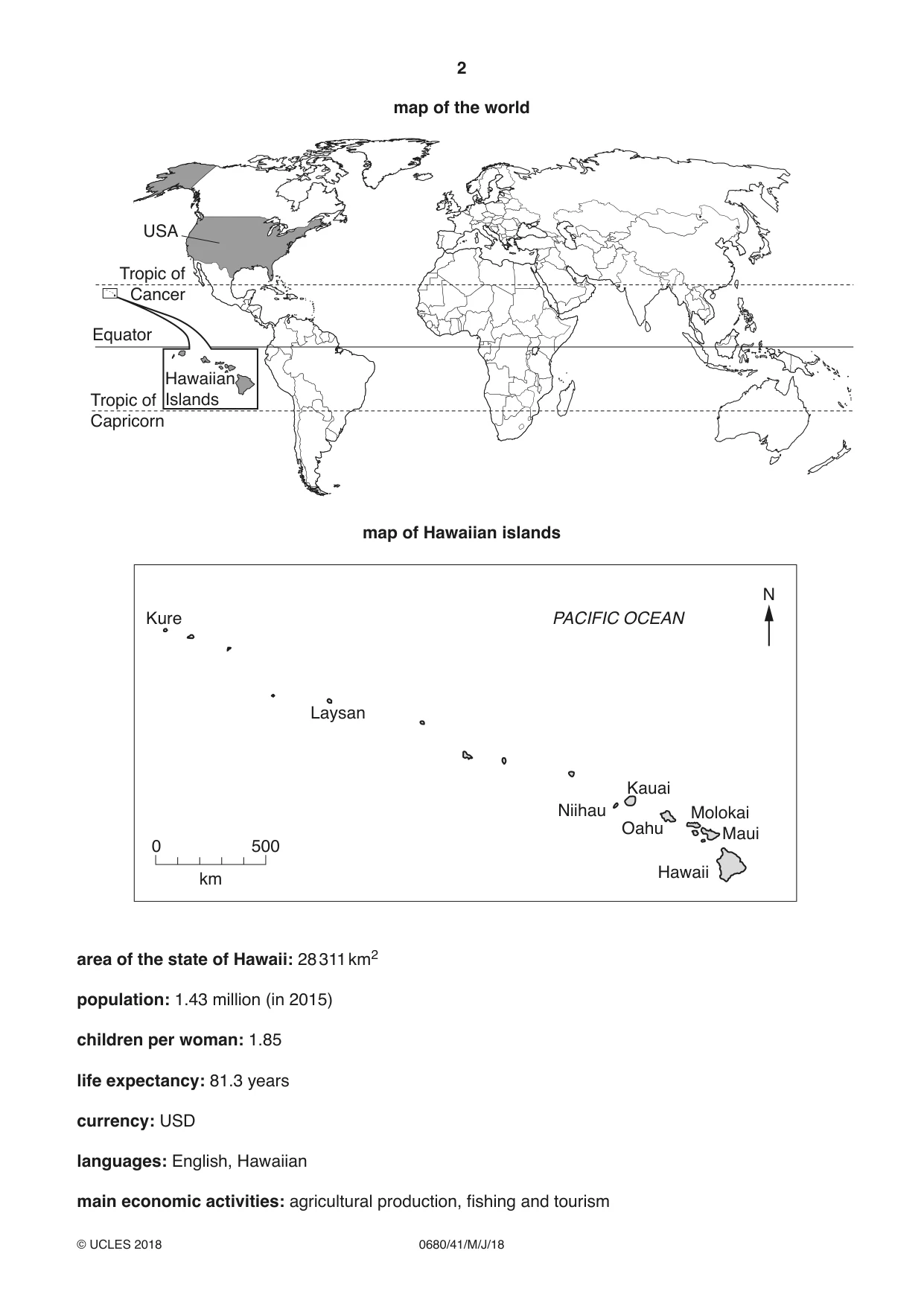
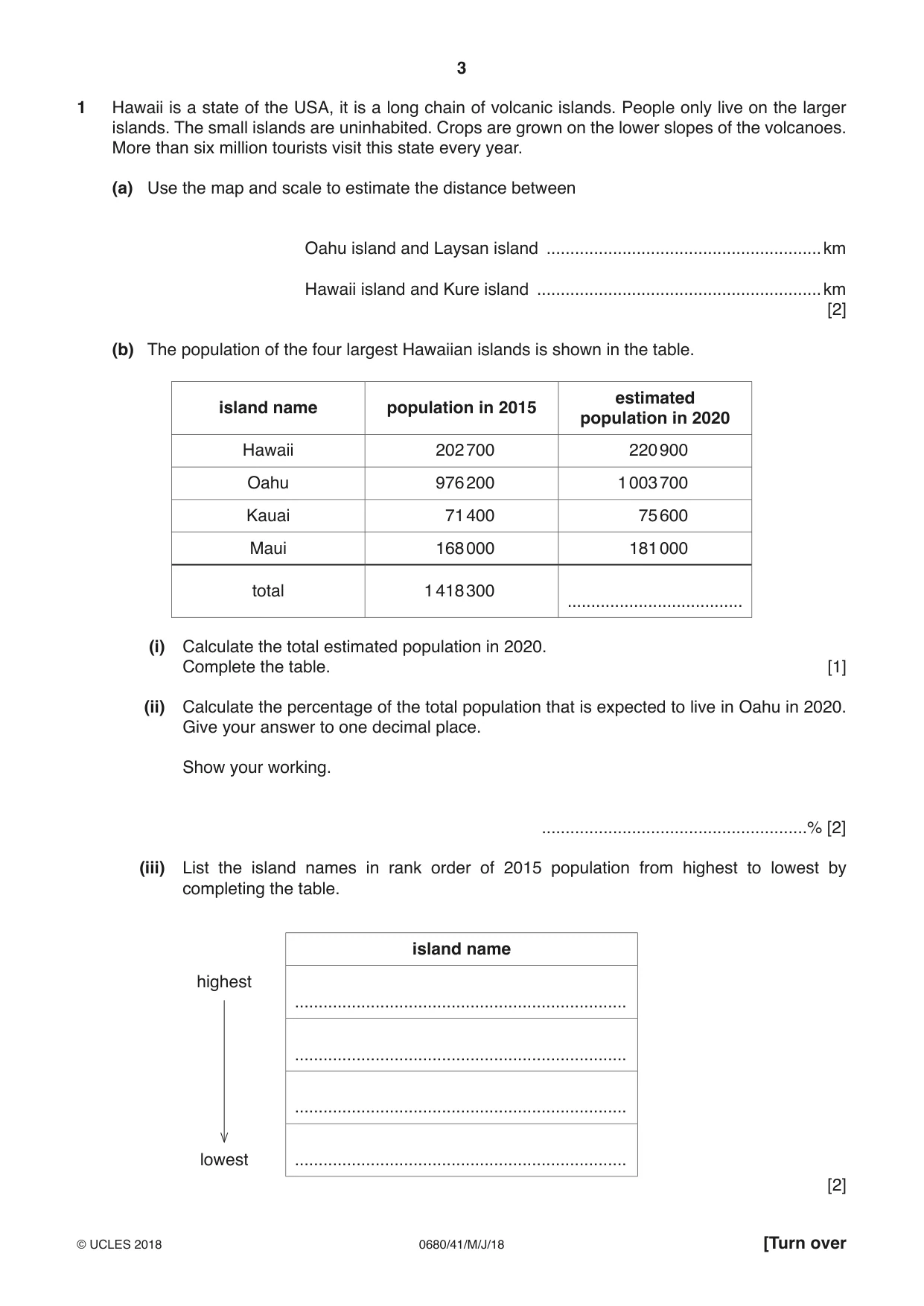
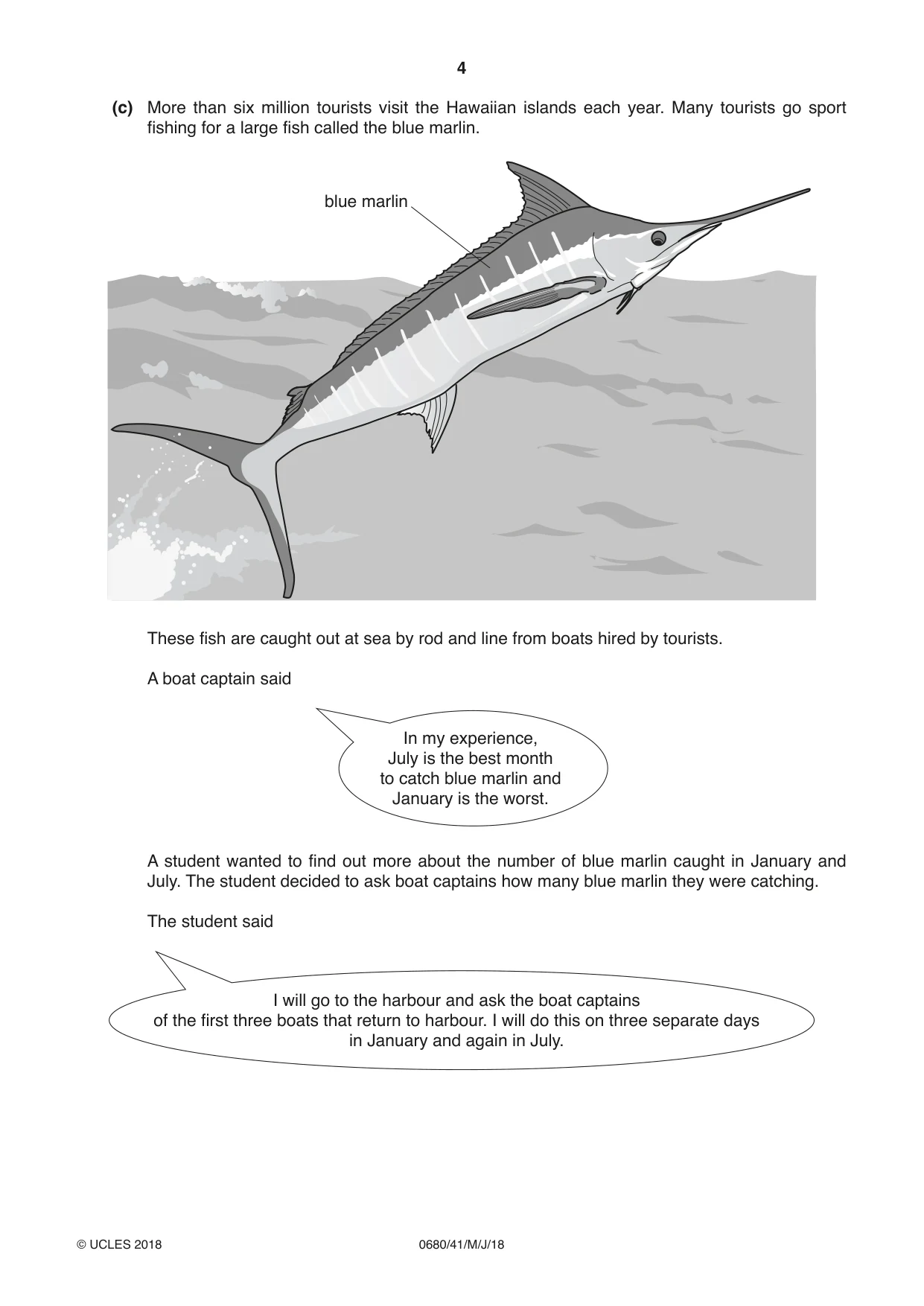
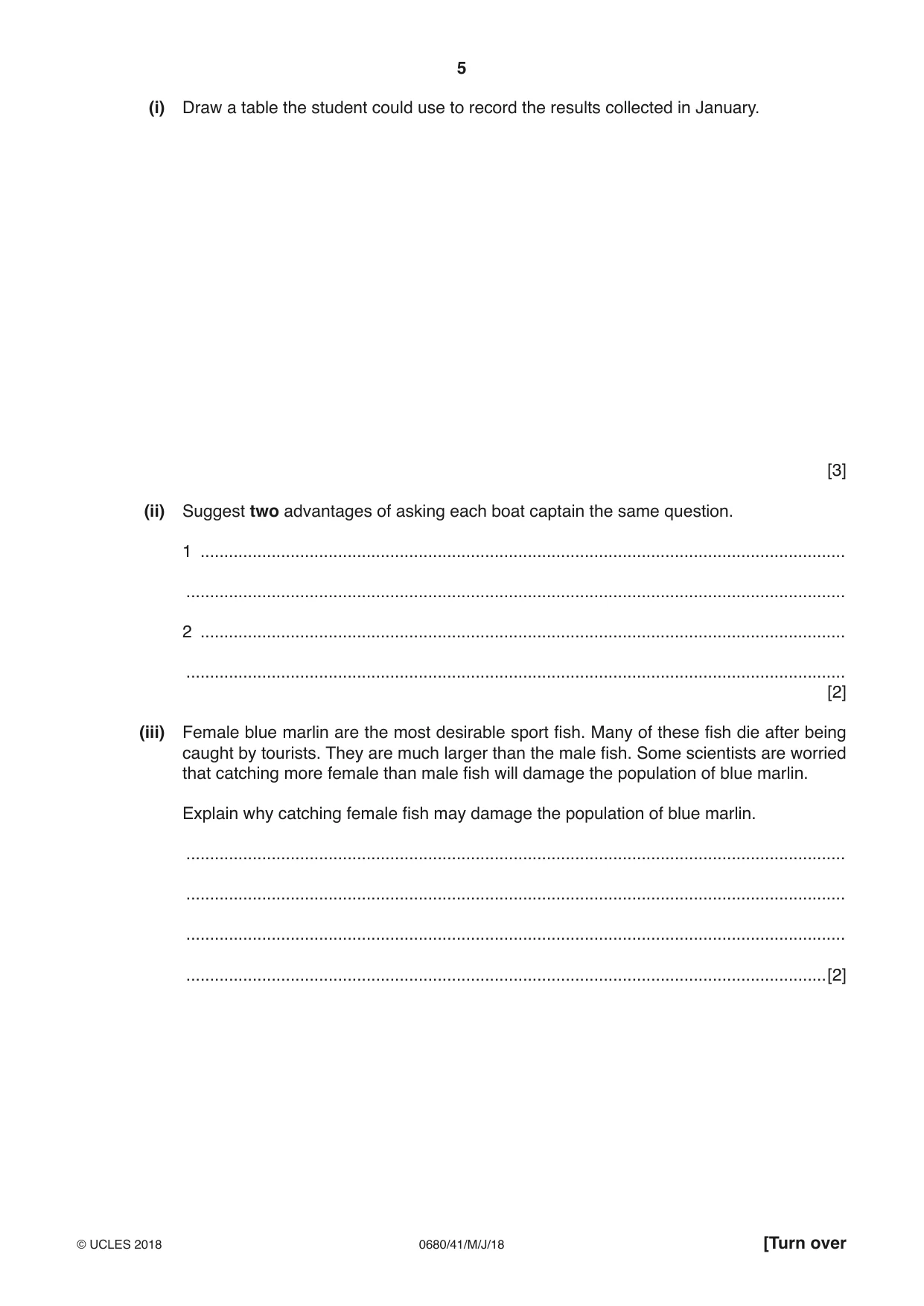
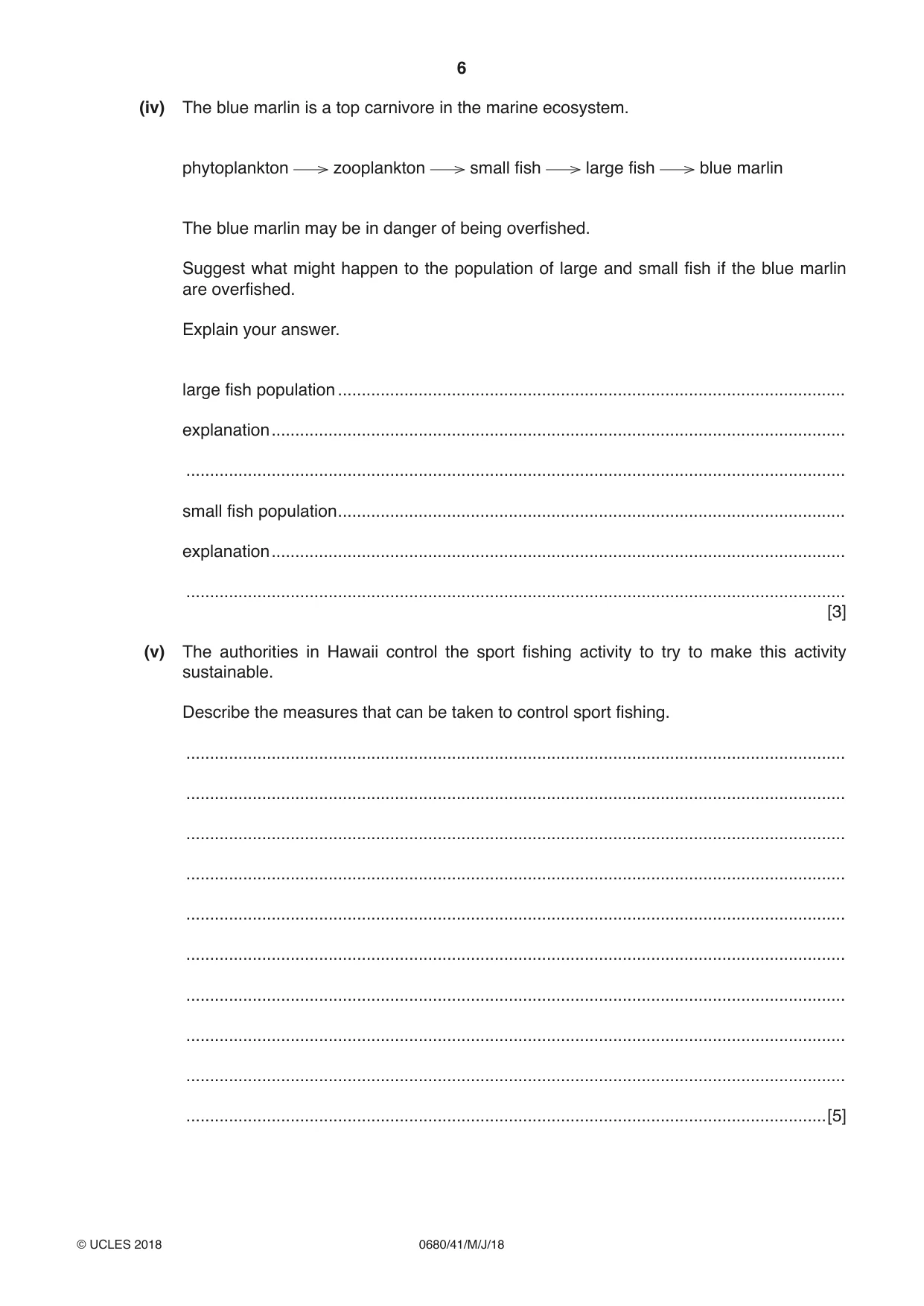
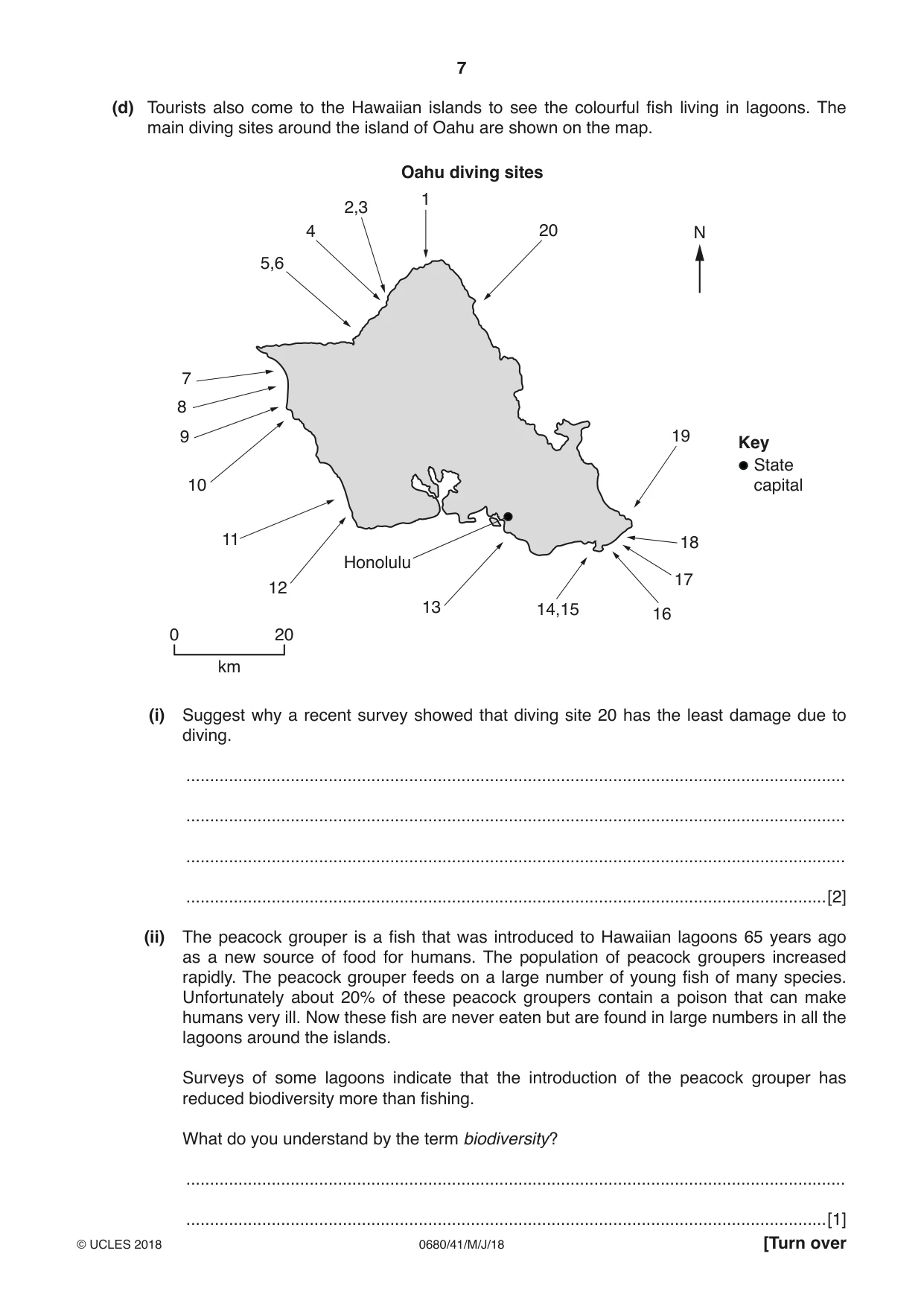
1 Hawaii is a state of the USA, it is a long chain of volcanic islands. People only live on the larger islands. The small islands are uninhabited. Crops are grown on the lower slopes of the volcanoes. More than six million tourists visit this state every year. (a) Use the map and scale to estimate the distance between Oahu island and Laysan island ..........................................................km Hawaii island and Kure island ............................................................km [2] (b) The population of the four largest Hawaiian islands is shown in the table. estimated island name population in 2015 population in 2020 Hawaii 202 700 220 900 Oahu 976 200 1 003 700 Kauai 71 400 75 600 Maui 168 000 181 000 total 1 418 300 ..................................... (i) Calculate the total estimated population in 2020. Complete the table. [1] (ii) Calculate the percentage of the total population that is expected to live in Oahu in 2020. Give your answer to one decimal place. Show your working. ........................................................% [2] (iii) List the island names in rank order of 2015 population from highest to lowest by completing the table. island name highest ...................................................................... ...................................................................... ...................................................................... lowest ...................................................................... [2] (c) More than six million tourists visit the Hawaiian islands each year. Many tourists go sport fishing for a large fish called the blue marlin. blue marlin These fish are caught out at sea by rod and line from boats hired by tourists. A boat captain said In my experience, July is the best month to catch blue marlin and January is the worst. A student wanted to find out more about the number of blue marlin caught in January and July. The student decided to ask boat captains how many blue marlin they were catching. The student said I will go to the harbour and ask the boat captains of the first three boats that return to harbour. I will do this on three separate days in January and again in July. (i) Draw a table the student could use to record the results collected in January. [3] (ii) Suggest two advantages of asking each boat captain the same question. 1 ........................................................................................................................................ ........................................................................................................................................... 2 ........................................................................................................................................ ........................................................................................................................................... [2] (iii) Female blue marlin are the most desirable sport fish. Many of these fish die after being caught by tourists. They are much larger than the male fish. Some scientists are worried that catching more female than male fish will damage the population of blue marlin. Explain why catching female fish may damage the population of blue marlin. ........................................................................................................................................... ........................................................................................................................................... ........................................................................................................................................... .......................................................................................................................................[2] (iv) The blue marlin is a top carnivore in the marine ecosystem. phytoplankton zooplankton small fish large fish blue marlin The blue marlin may be in danger of being overfished. Suggest what might happen to the population of large and small fish if the blue marlin are overfished. Explain your answer. large fish population ........................................................................................................... explanation ......................................................................................................................... ........................................................................................................................................... small fish population ........................................................................................................... explanation ......................................................................................................................... ........................................................................................................................................... [3] (v) The authorities in Hawaii control the sport fishing activity to try to make this activity sustainable. Describe the measures that can be taken to control sport fishing. ........................................................................................................................................... ........................................................................................................................................... ........................................................................................................................................... ........................................................................................................................................... ........................................................................................................................................... ........................................................................................................................................... ........................................................................................................................................... ........................................................................................................................................... ........................................................................................................................................... .......................................................................................................................................[5] (d) Tourists also come to the Hawaiian islands to see the colourful fish living in lagoons. The main diving sites around the island of Oahu are shown on the map. Oahu diving sites 1 2,3 4 20 N 5,6 7 8 9 19 Key State 10 capital 11 18 Honolulu 17 12 13 14,15 16 0 20 km (i) Suggest why a recent survey showed that diving site 20 has the least damage due to diving. ........................................................................................................................................... ........................................................................................................................................... ........................................................................................................................................... .......................................................................................................................................[2] (ii) The peacock grouper is a fish that was introduced to Hawaiian lagoons 65 years ago as a new source of food for humans. The population of peacock groupers increased rapidly. The peacock grouper feeds on a large number of young fish of many species. Unfortunately about 20% of these peacock groupers contain a poison that can make humans very ill. Now these fish are never eaten but are found in large numbers in all the lagoons around the islands. Surveys of some lagoons indicate that the introduction of the peacock grouper has reduced biodiversity more than fishing. What do you understand by the term biodiversity? ........................................................................................................................................... (iii) In an attempt to control the peacock grouper, spear-fishing competitions are held regularly. All the fish caught are given to local farmers. Suggest how the farmers could use the dead fish to increase crop growth. ........................................................................................................................................... ........................................................................................................................................... ........................................................................................................................................... .......................................................................................................................................[2] (iv) Are these spear-fishing competitions a good strategy for environmental management? Explain your point of view. ........................................................................................................................................... ........................................................................................................................................... ........................................................................................................................................... ........................................................................................................................................... ........................................................................................................................................... .......................................................................................................................................[3]
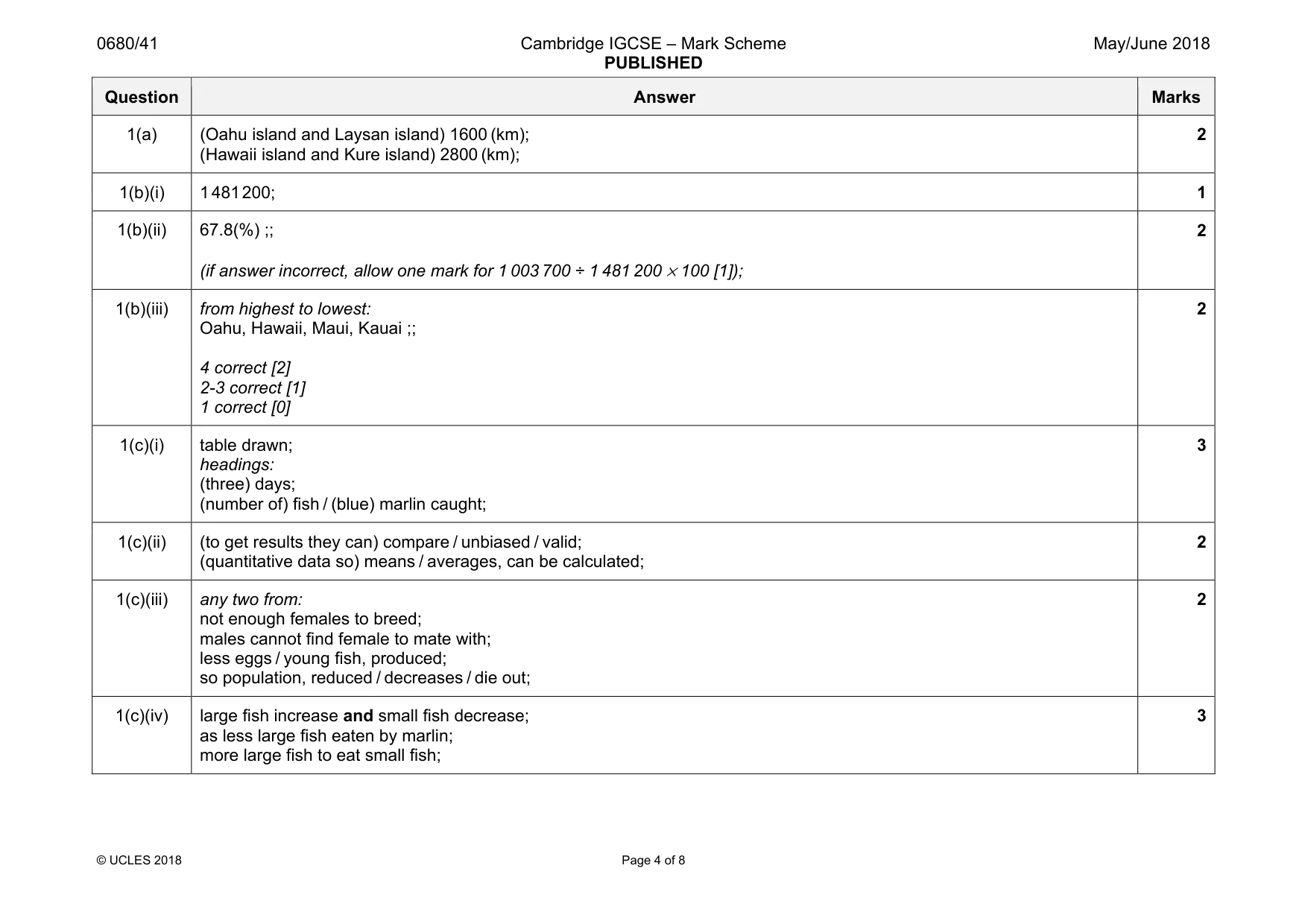
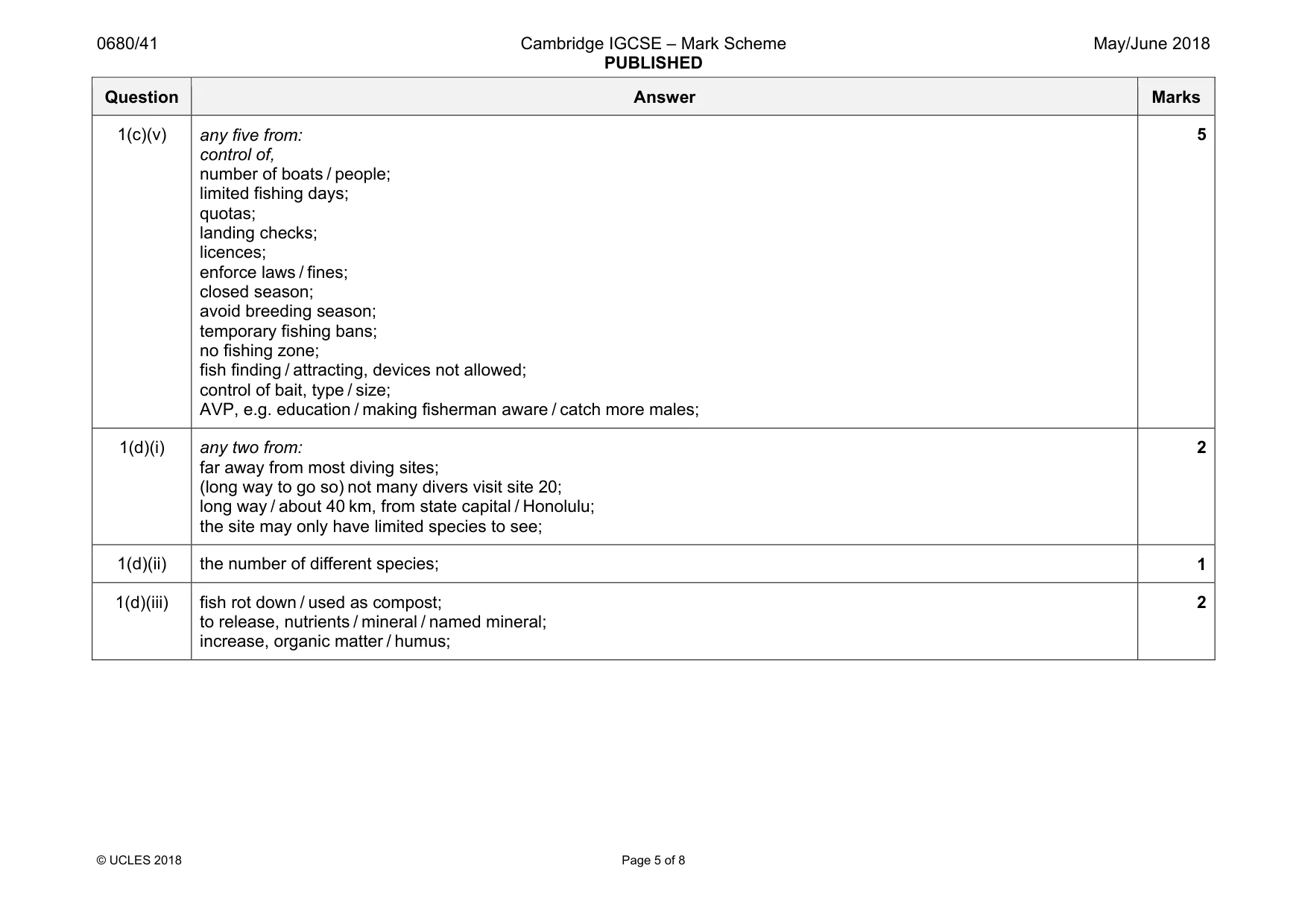
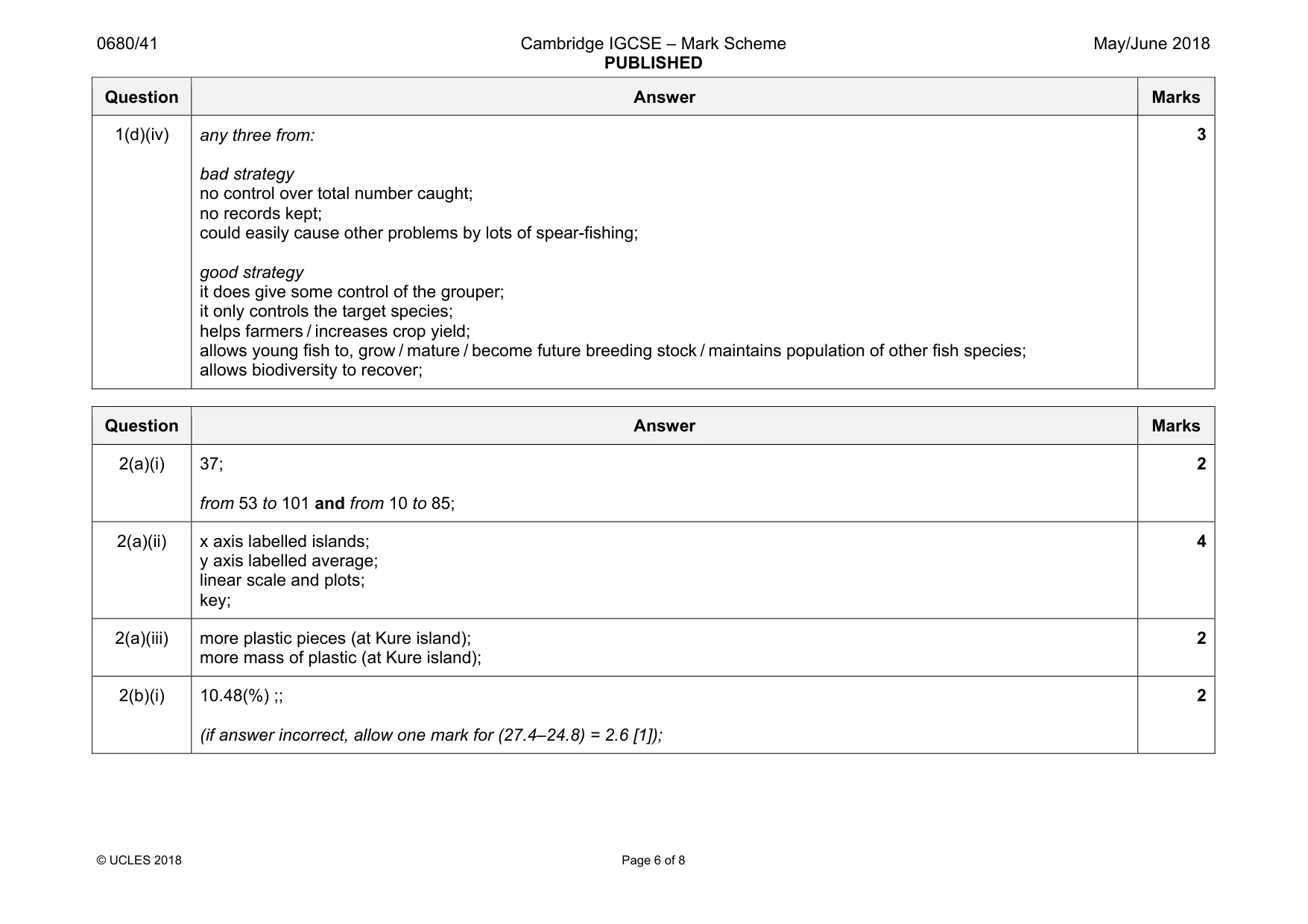
Mark scheme: 1(a) (Oahu island and Laysan island) 1600 (km); (Hawaii island and Kure island) 2800 (km); 2 1(b)(i) 1481200; 1 1(b)(ii) 67.8(%) ;; (if answer incorrect, allow one mark for 1 003 700 ÷ 1 481 200 × 100 [1]); 2 1(b)(iii) from highest to lowest: Oahu, Hawaii, Maui, Kauai ;; 4 correct [2] 2-3 correct [1] 1 correct [0] 2 1(c)(i) table drawn; headings: (three) days; (number of) fish / (blue) marlin caught; 3 1(c)(ii) (to get results they can) compare / unbiased / valid; (quantitative data so) means / averages, can be calculated; 2 1(c)(iii) any two from: not enough females to breed; males cannot find female to mate with; less eggs / young fish, produced; so population, reduced / decreases / die out; 2 1(c)(iv) large fish increase and small fish decrease; as less large fish eaten by marlin; more large fish to eat small fish; 3 Question Answer Marks 1(c)(v) any five from: control of, number of boats / people; limited fishing days; quotas; landing checks; licences; enforce laws / fines; closed season; avoid breeding season; temporary fishing bans; no fishing zone; fish finding / attracting, devices not allowed; control of bait, type / size; AVP, e.g. education / making fisherman aware / catch more males; 5 1(d)(i) any two from: far away from most diving sites; (long way to go so) not many divers visit site 20; long way / about 40 km, from state capital / Honolulu; the site may only have limited species to see; 2 1(d)(ii) the number of different species; 1 1(d)(iii) fish rot down / used as compost; to release, nutrients / mineral / named mineral; increase, organic matter / humus; 2 Question Answer Marks 1(d)(iv) any three from: bad strategy no control over total number caught; no records kept; could easily cause other problems by lots of spear-fishing; good strategy it does give some control of the grouper; it only controls the target species; helps farmers / increases crop yield; allows young fish to, grow / mature / become future breeding stock / maintains population of other fish species; allows biodiversity to recover; 3
Q2 · The photograph shows an albatross and chick
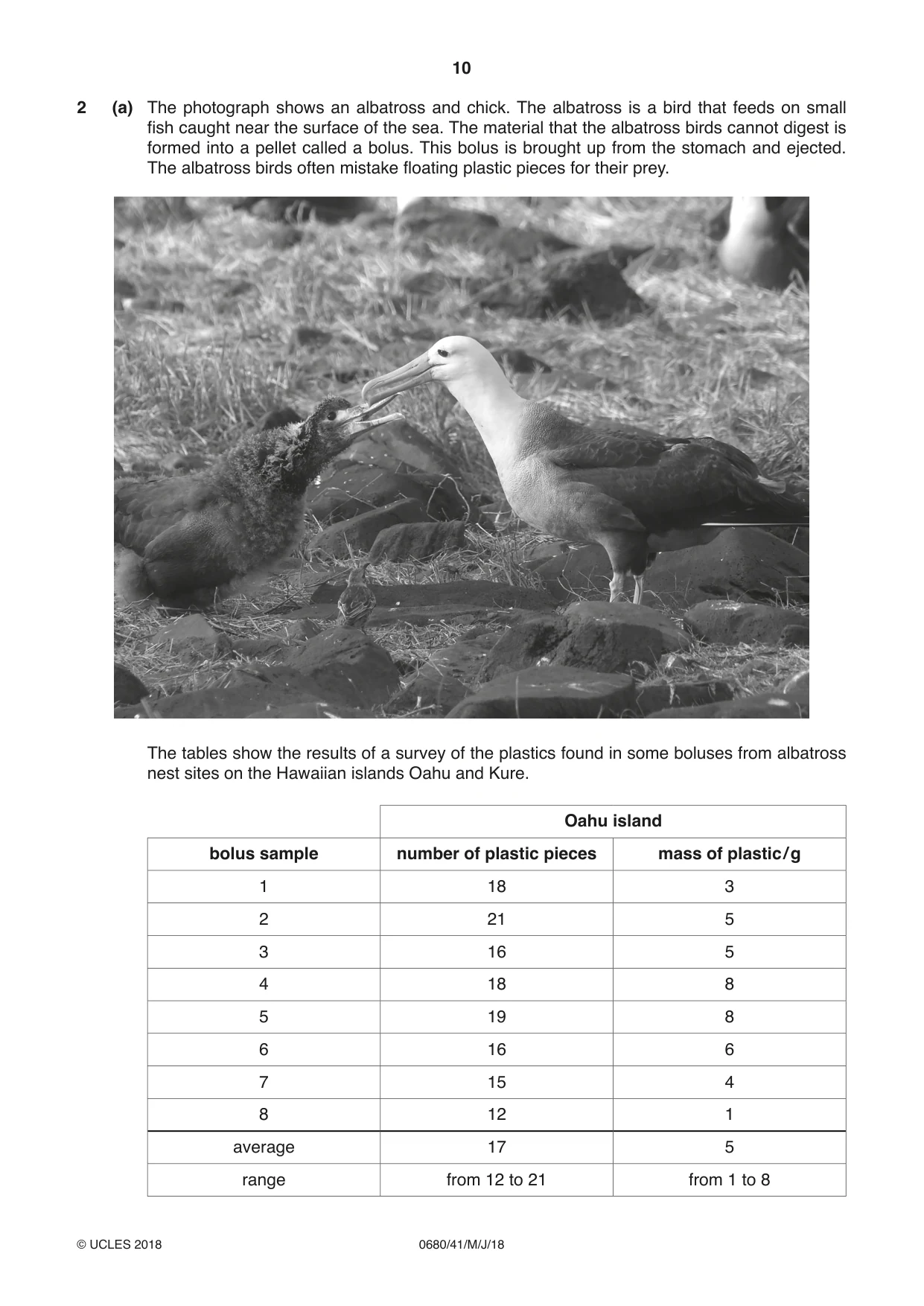
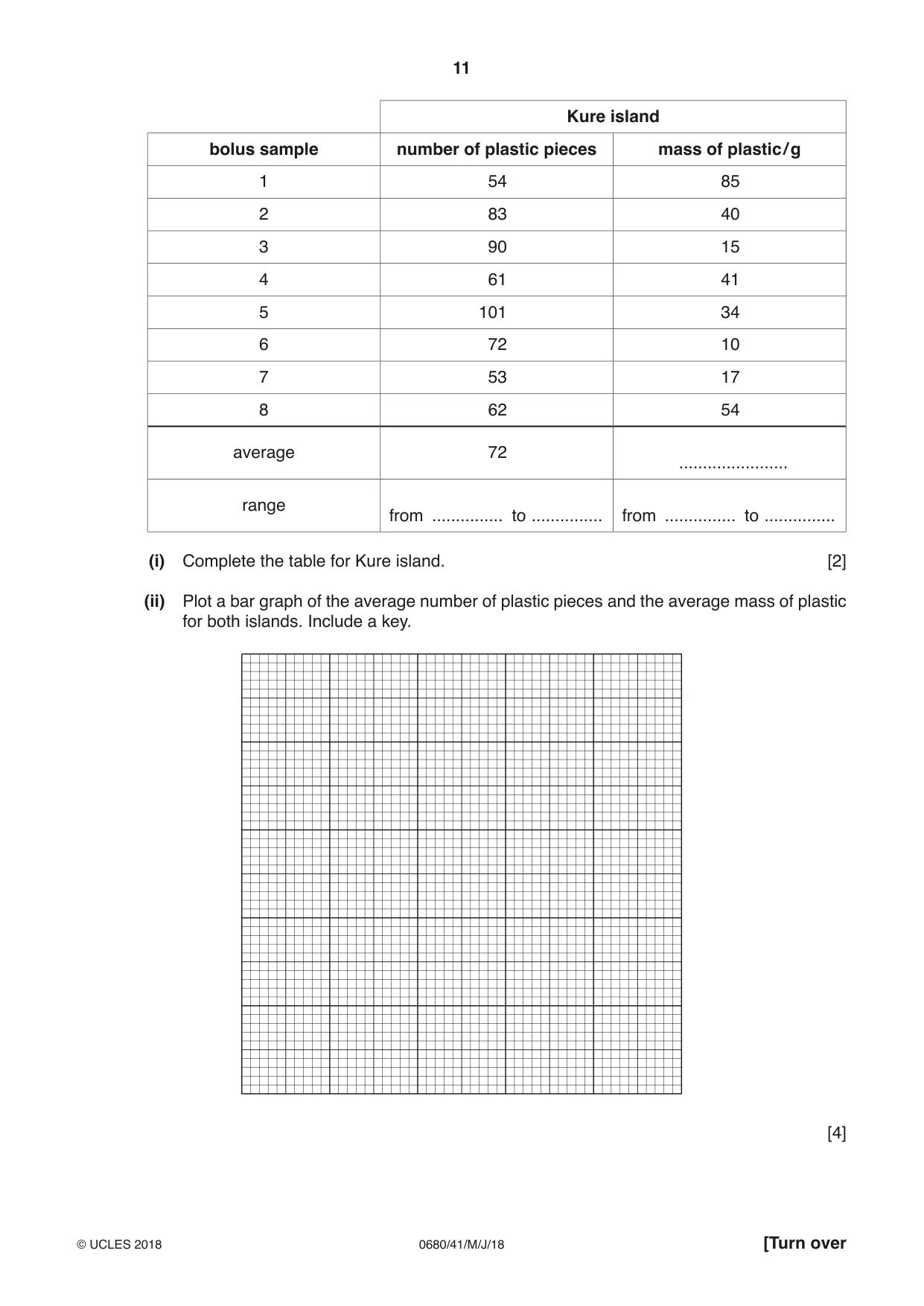
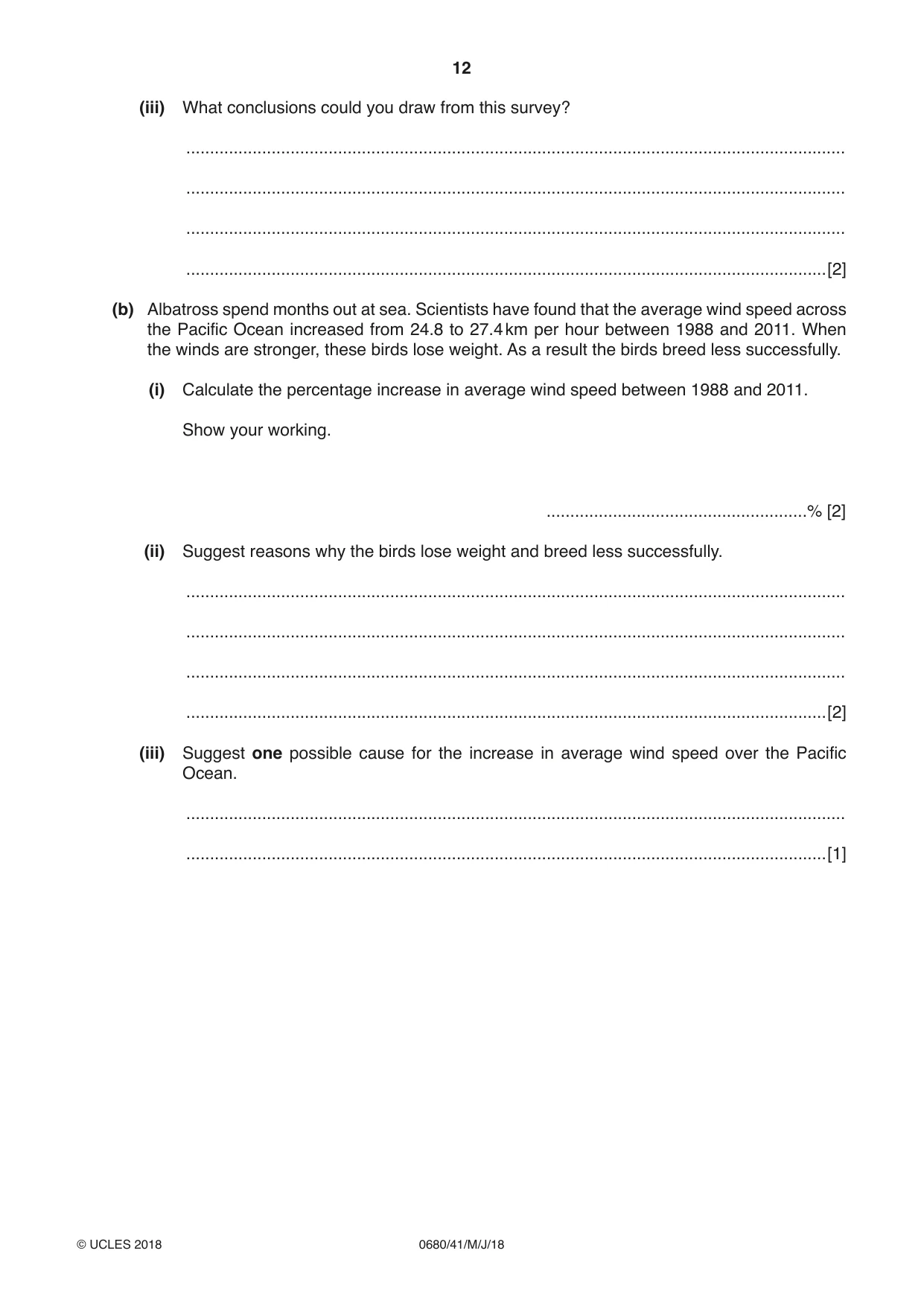
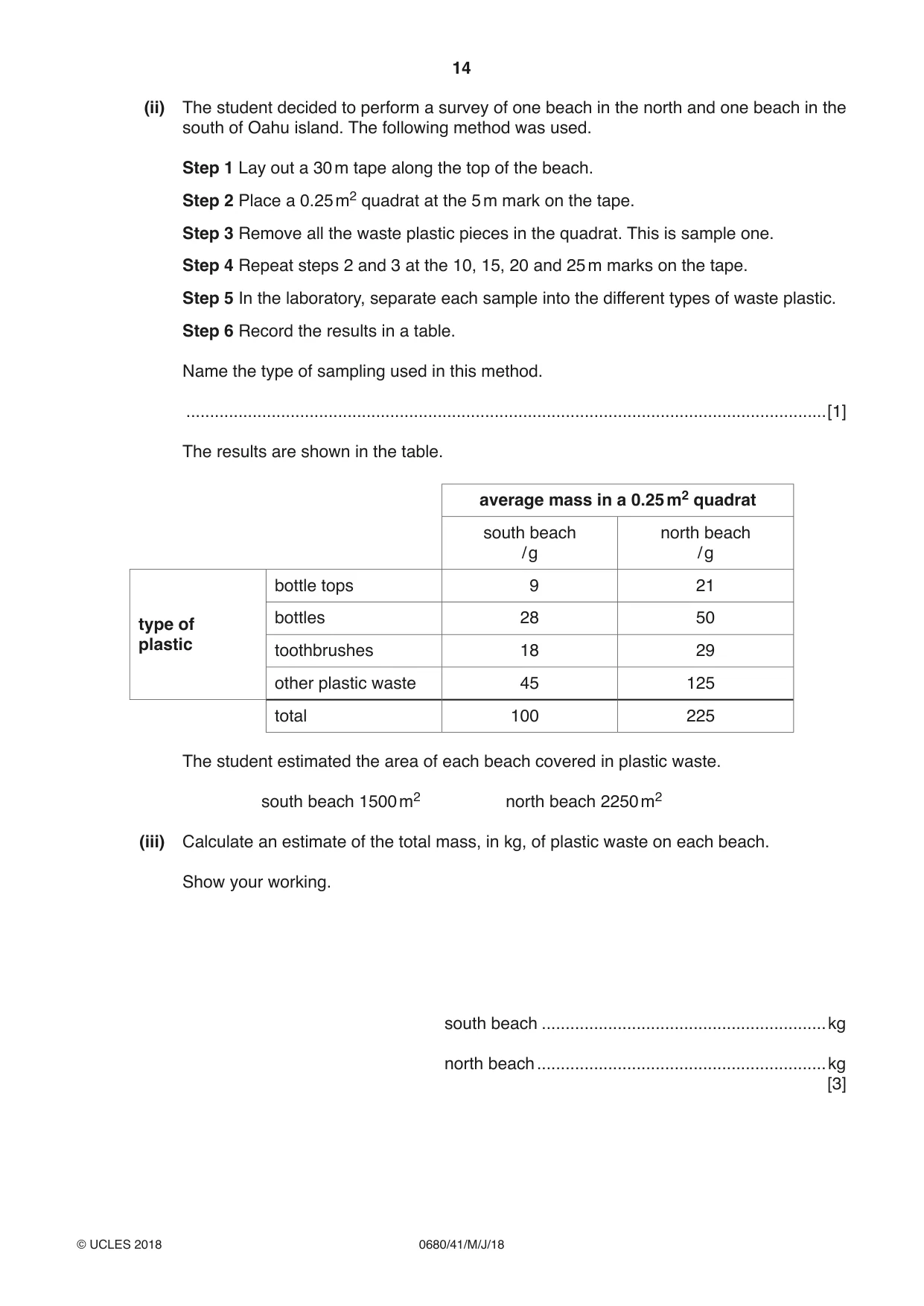
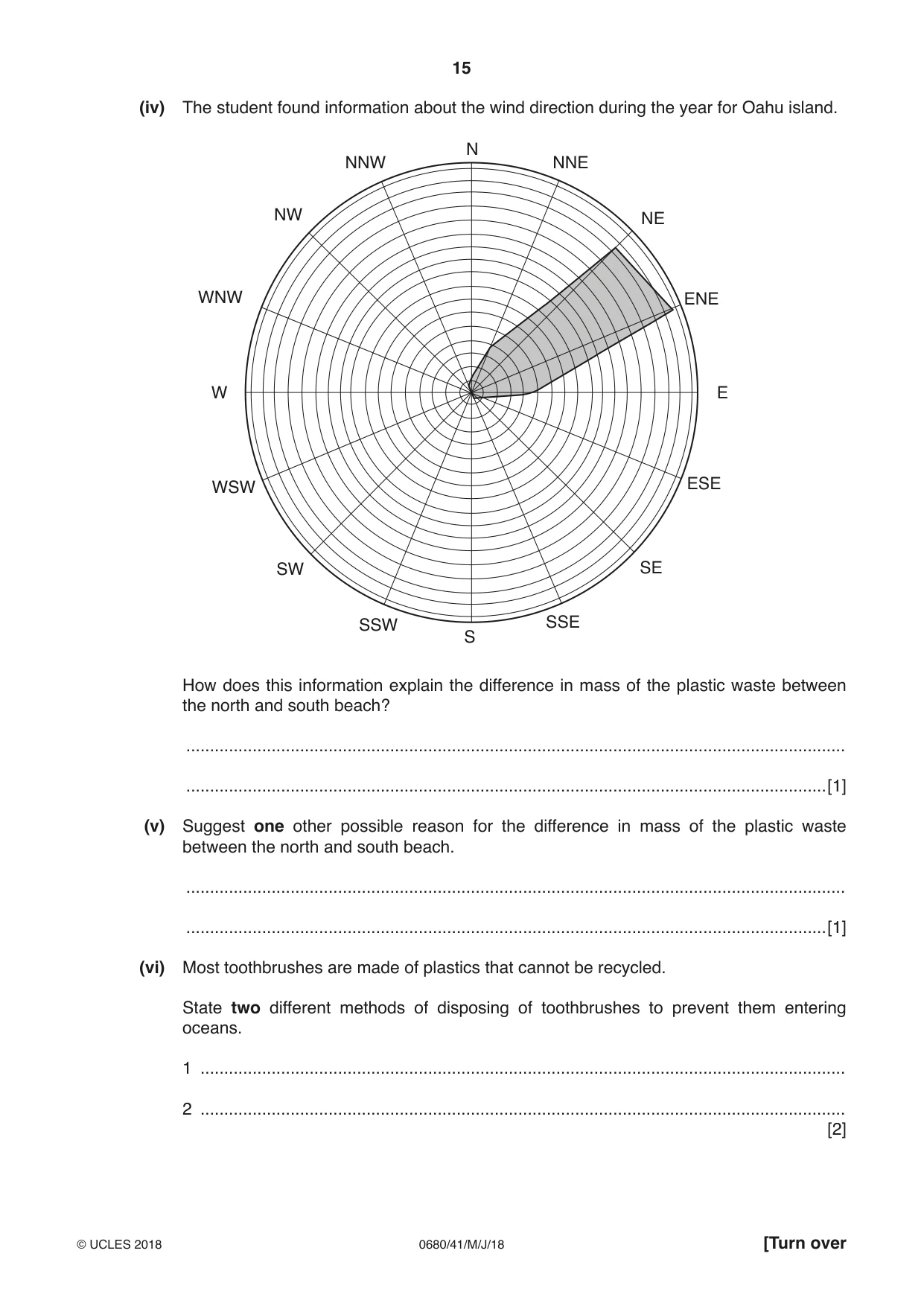
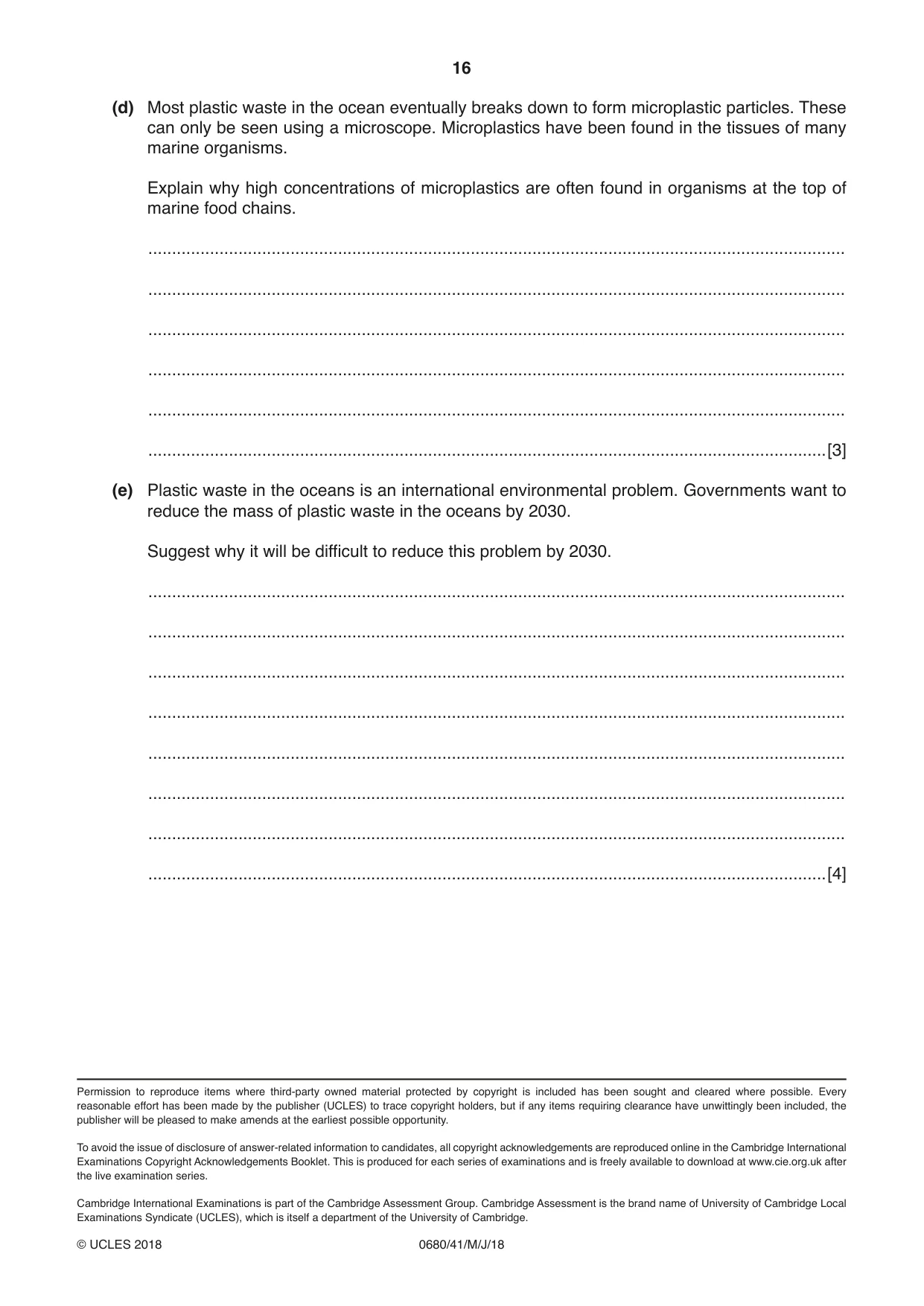
2 (a) The photograph shows an albatross and chick. The albatross is a bird that feeds on small fish caught near the surface of the sea. The material that the albatross birds cannot digest is formed into a pellet called a bolus. This bolus is brought up from the stomach and ejected. The albatross birds often mistake floating plastic pieces for their prey. The tables show the results of a survey of the plastics found in some boluses from albatross nest sites on the Hawaiian islands Oahu and Kure. Oahu island bolus sample number of plastic pieces mass of plastic / g 1 18 3 2 21 5 3 16 5 4 18 8 5 19 8 6 16 6 7 15 4 8 12 1 average 17 5 range from 12 to 21 from 1 to 8 Kure island bolus sample number of plastic pieces mass of plastic / g 1 54 85 2 83 40 3 90 15 4 61 41 5 101 34 6 72 10 7 53 17 8 62 54 average 72 ....................... range from ............... to ............... from ............... to ............... (i) Complete the table for Kure island. [2] (ii) Plot a bar graph of the average number of plastic pieces and the average mass of plastic for both islands. Include a key. [4] (iii) What conclusions could you draw from this survey? ........................................................................................................................................... ........................................................................................................................................... ........................................................................................................................................... .......................................................................................................................................[2] (b) Albatross spend months out at sea. Scientists have found that the average wind speed across the Pacific Ocean increased from 24.8 to 27.4 km per hour between 1988 and 2011. When the winds are stronger, these birds lose weight. As a result the birds breed less successfully. (i) Calculate the percentage increase in average wind speed between 1988 and 2011. Show your working. .......................................................% [2] (ii) Suggest reasons why the birds lose weight and breed less successfully. ........................................................................................................................................... ........................................................................................................................................... ........................................................................................................................................... .......................................................................................................................................[2] (iii) Suggest one possible cause for the increase in average wind speed over the Pacific Ocean. ........................................................................................................................................... .......................................................................................................................................[1]
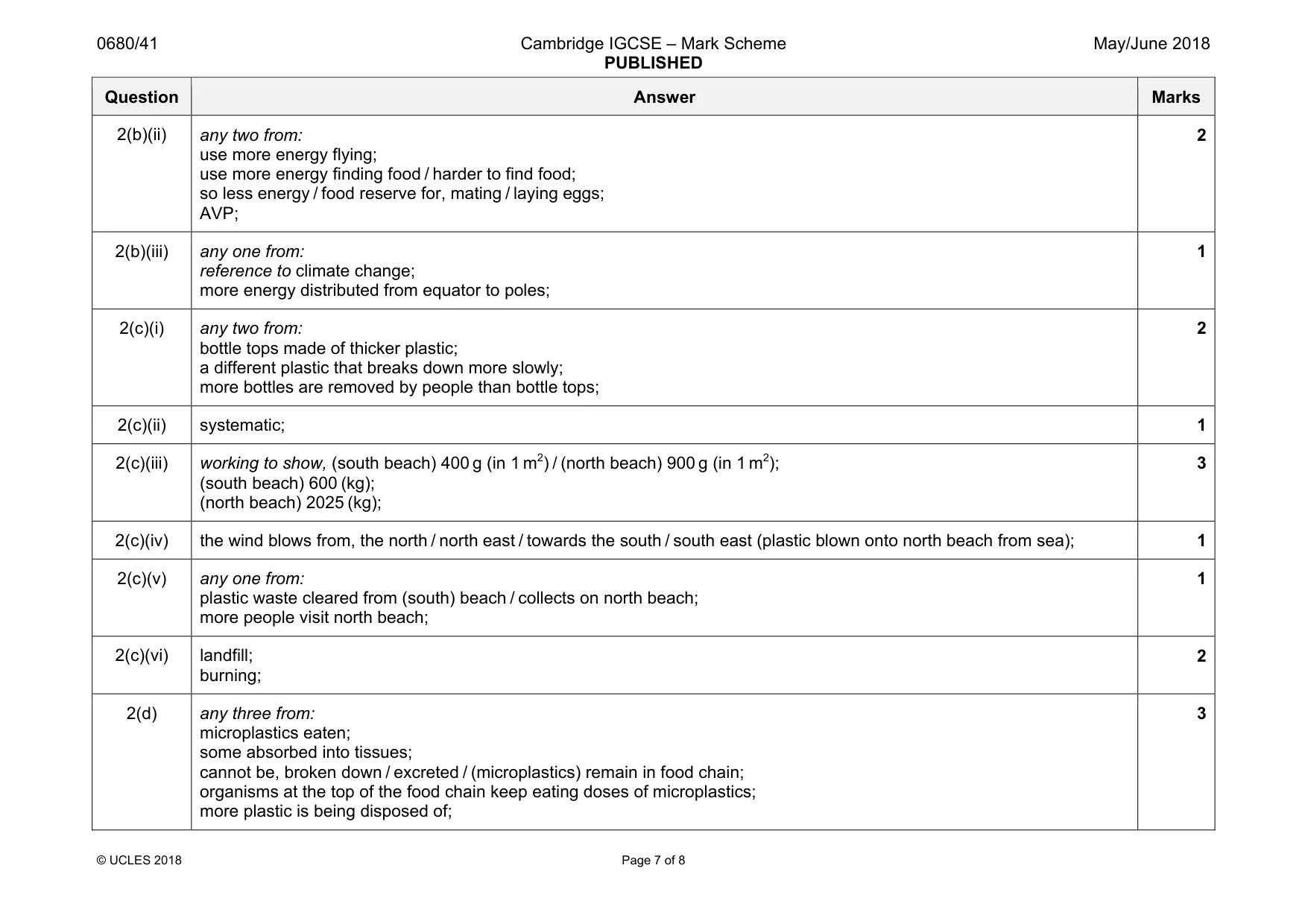
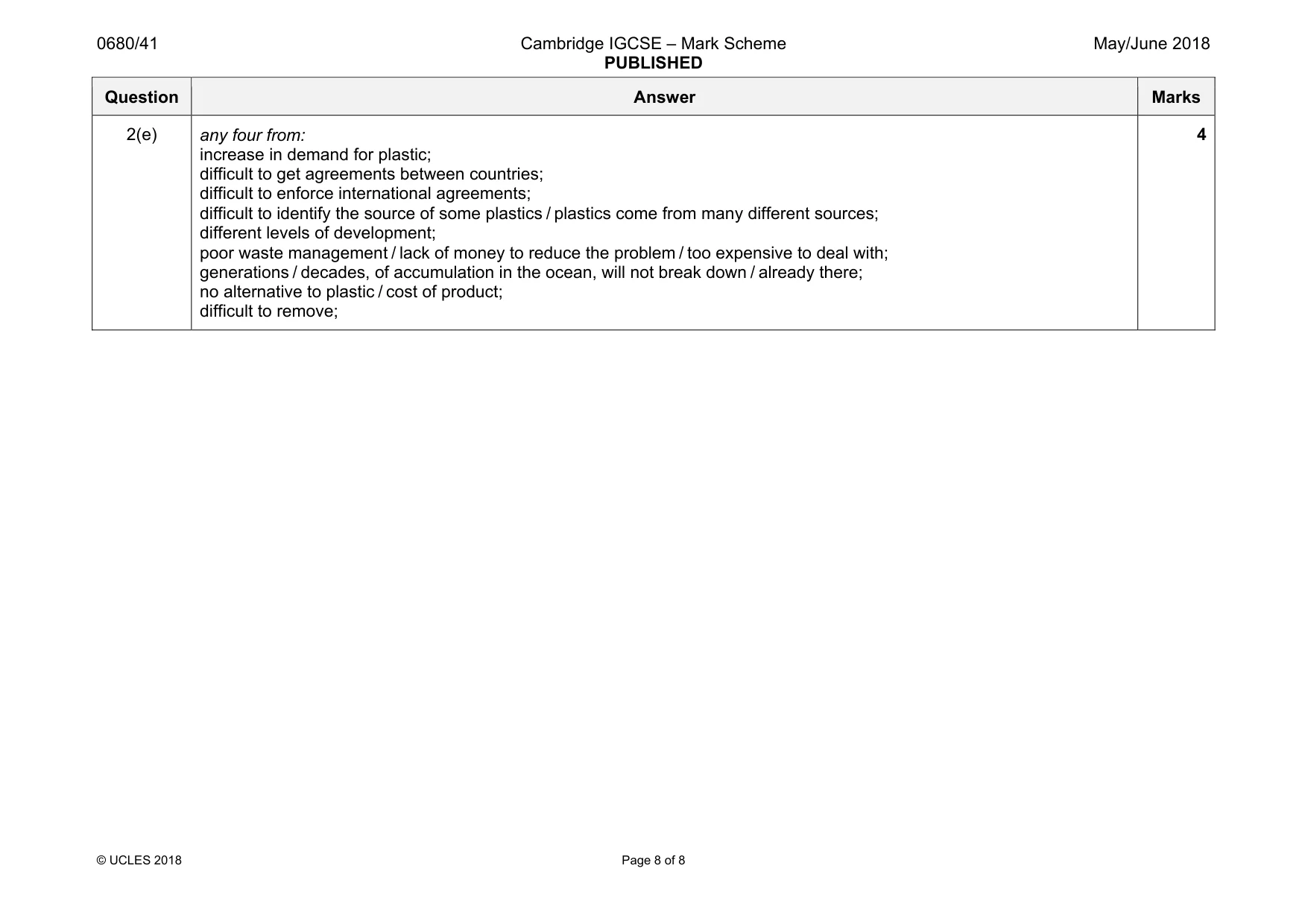
Mark scheme: 2(a)(i) 37; from 53 to 101 and from 10 to 85; 2 2(a)(ii) x axis labelled islands; y axis labelled average; linear scale and plots; key; 4 2(a)(iii) more plastic pieces (at Kure island); more mass of plastic (at Kure island); 2 2(b)(i) 10.48(%) ;; (if answer incorrect, allow one mark for (27.4–24.8) = 2.6 [1]); 2 Question Answer Marks 2(b)(ii) any two from: use more energy flying; use more energy finding food / harder to find food; so less energy / food reserve for, mating / laying eggs; AVP; 2 2(b)(iii) any one from: reference to climate change; more energy distributed from equator to poles; 1 2(c)(i) any two from: bottle tops made of thicker plastic; a different plastic that breaks down more slowly; more bottles are removed by people than bottle tops; 2 2(c)(ii) systematic; 1 2(c)(iii) working to show, (south beach) 400 g (in 1 m2) / (north beach) 900 g (in 1 m2); (south beach) 600 (kg); (north beach) 2025 (kg); 3 2(c)(iv) the wind blows from, the north / north east / towards the south / south east (plastic blown onto north beach from sea); 1 2(c)(v) any one from: plastic waste cleared from (south) beach / collects on north beach; more people visit north beach; 1 2(c)(vi) landfill; burning; 2 2(d) any three from: microplastics eaten; some absorbed into tissues; cannot be, broken down / excreted / (microplastics) remain in food chain; organisms at the top of the food chain keep eating doses of microplastics; more plastic is being disposed of; 3 Question Answer Marks 2(e) any four from: increase in demand for plastic; difficult to get agreements between countries; difficult to enforce international agreements; difficult to identify the source of some plastics / plastics come from many different sources; different levels of development; poor waste management / lack of money to reduce the problem / too expensive to deal with; generations / decades, of accumulation in the ocean, will not break down / already there; no alternative to plastic / cost of product; difficult to remove; 4
What was in this paper
The subtopics covered by these 2 questions, and how many questions each got. Open one in a new tab to see every Cambridge question on it.
What you needed in this session
Cambridge’s own grade thresholds for 2018 May/June, Paper 4 · Variant 1. A higher threshold means an easier paper — the bar moves with how the cohort did.