Cambridge IGCSE Environmental Management 0680 — 2016 May/June Paper 4 · Variant 1
0680/41/M/J/16 · 60 marks · ≈68 min
The question paper and its mark scheme, free to read here and free to download. This is Cambridge’s own paper, exactly as it was sat.
Question paper20 pages



Mark scheme6 pages
Answers below. Sit the paper first if you are practising.
Paper as text
Question paper, page 1
This document consists of 18 printed pages and 2 blank pages. DC (LK/FD) 113537/5 © UCLES 2016 [Turn over Cambridge International Examinations Cambridge International General Certificate of Secondary Education * 1 6 8 0 4 0 7 9 6 0 * ENVIRONMENTAL MANAGEMENT 0680/41 Paper 4 May/June 2016 1 hour 30 minutes Candidates answer on the Question Paper. No Additional Materials are required. READ THESE INSTRUCTIONS FIRST Write your Centre number, candidate number and name on all the work you hand in. Write in dark blue or black pen. You may use an HB pencil for any diagrams or graphs. Do not use staples, paper clips, glue or correction fluid. DO NOT WRITE IN ANY BARCODES. Answer all questions. Electronic calculators may be used. You may lose marks if you do not show your working or if you do not use appropriate units. Study the appropriate source materials before you start to write your answers. Credit will be given for appropriate selection and use of data in your answers and for relevant interpretation of these data. Suggestions for data sources are given in some questions. You may use the source data to draw diagrams and graphs or to do calculations to illustrate your answers. At the end of the examination, fasten all your work securely together. The number of marks is given in brackets [ ] at the end of each question or part question.
Question paper, page 2
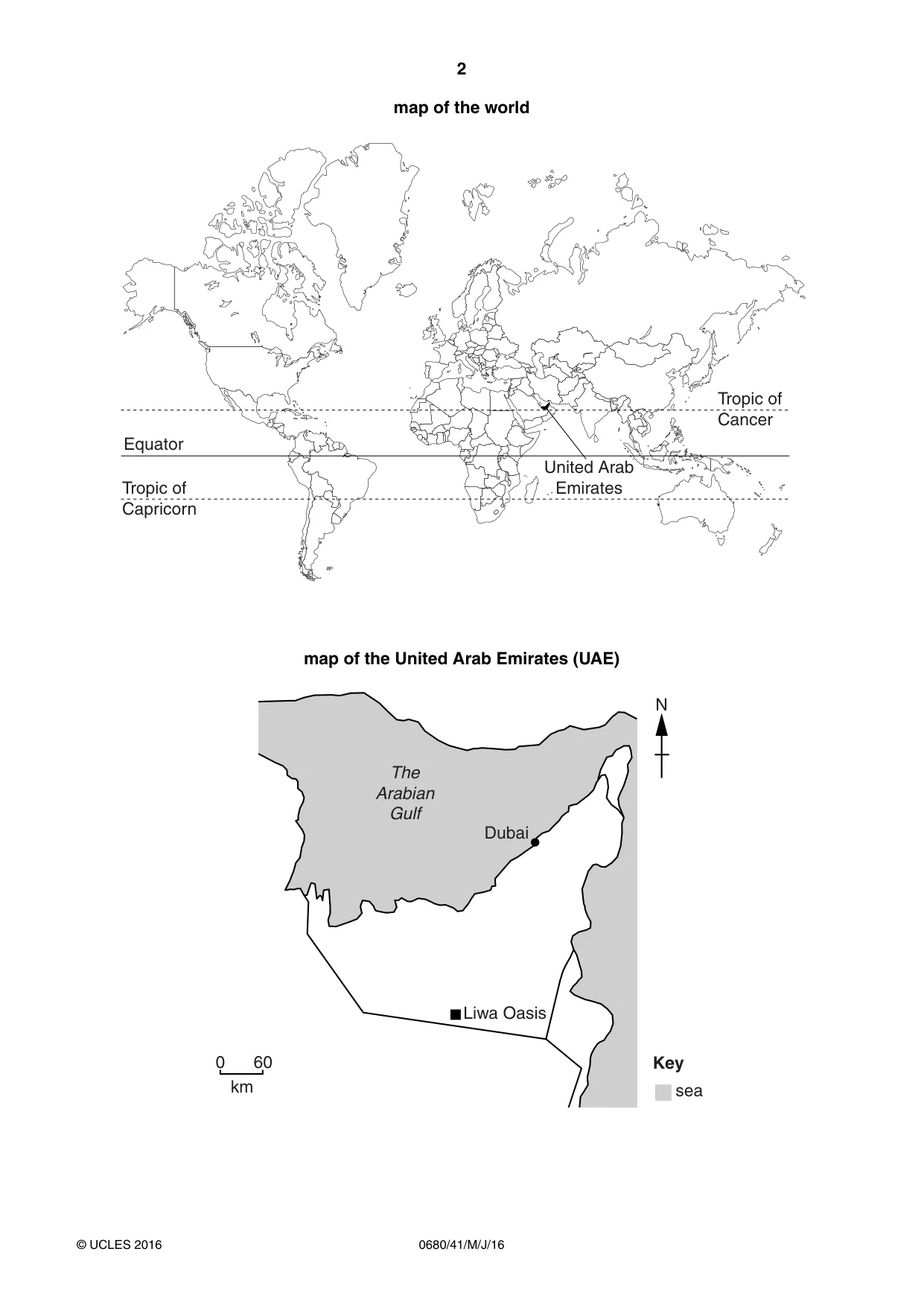
2 0680/41/M/J/16 © UCLES 2016 map of the world Tropic of Cancer Tropic of Capricorn United Arab Emirates Equator map of the United Arab Emirates (UAE) 0 60 km N Dubai 7KH $UDELDQ *XOI Liwa Oasis sea .H\
Question paper, page 3
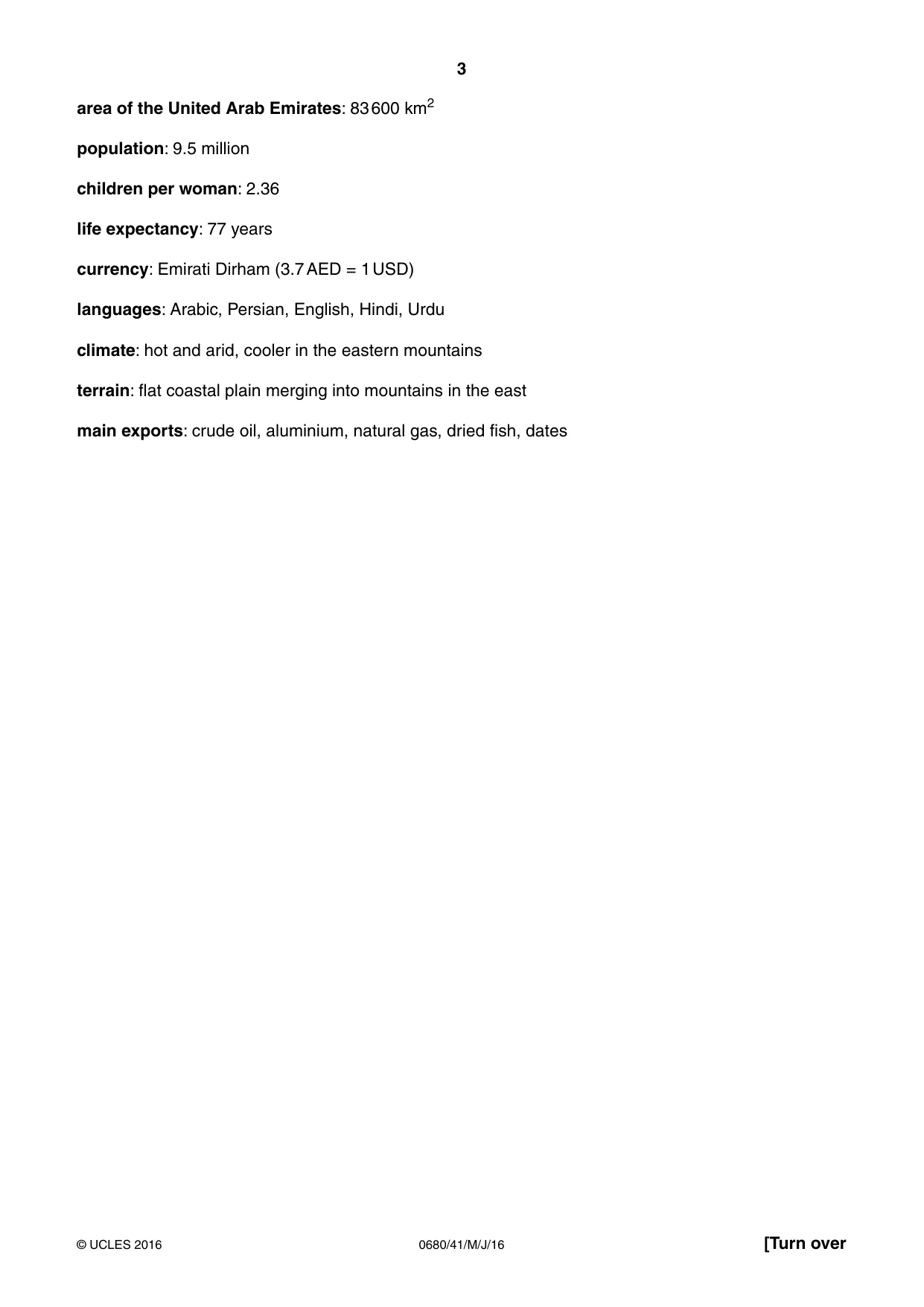
3 0680/41/M/J/16 © UCLES 2016 [Turn over area of the United Arab Emirates: 83 600 km2 population: 9.5 million children per woman: 2.36 life expectancy: 77 years currency: Emirati Dirham (3.7 AED = 1 USD) languages: Arabic, Persian, English, Hindi, Urdu climate: hot and arid, cooler in the eastern mountains terrain: flat coastal plain merging into mountains in the east main exports: crude oil, aluminium, natural gas, dried fish, dates
Question paper, page 4
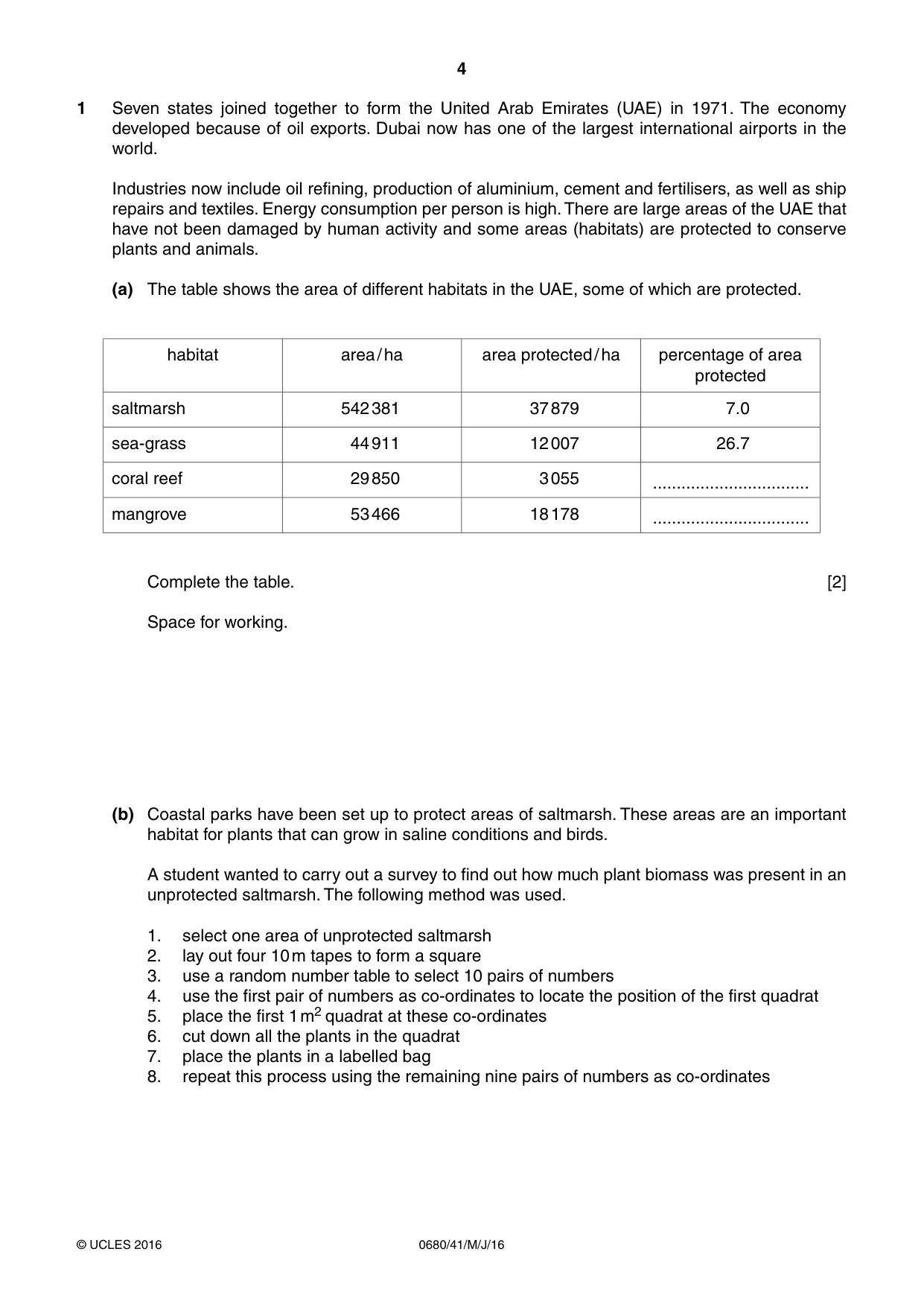
4 0680/41/M/J/16 © UCLES 2016 1 Seven states joined together to form the United Arab Emirates (UAE) in 1971. The economy developed because of oil exports. Dubai now has one of the largest international airports in the world. Industries now include oil refining, production of aluminium, cement and fertilisers, as well as ship repairs and textiles. Energy consumption per person is high. There are large areas of the UAE that have not been damaged by human activity and some areas (habitats) are protected to conserve plants and animals. (a) The table shows the area of different habitats in the UAE, some of which are protected. habitat area / ha area protected / ha percentage of area protected saltmarsh 542 381 37 879 7.0 sea-grass 44 911 12 007 26.7 coral reef 29 850 3 055 … mangrove 53 466 18 178 … Complete the table. [2] Space for working. (b) Coastal parks have been set up to protect areas of saltmarsh. These areas are an important habitat for plants that can grow in saline conditions and birds. A student wanted to carry out a survey to find out how much plant biomass was present in an unprotected saltmarsh. The following method was used. 1. select one area of unprotected saltmarsh 2. lay out four 10 m tapes to form a square 3. use a random number table to select 10 pairs of numbers 4. use the first pair of numbers as co-ordinates to locate the position of the first quadrat 5. place the first 1 m2 quadrat at these co-ordinates 6. cut down all the plants in the quadrat 7. place the plants in a labelled bag 8. repeat this process using the remaining nine pairs of numbers as co-ordinates
Question paper, page 5
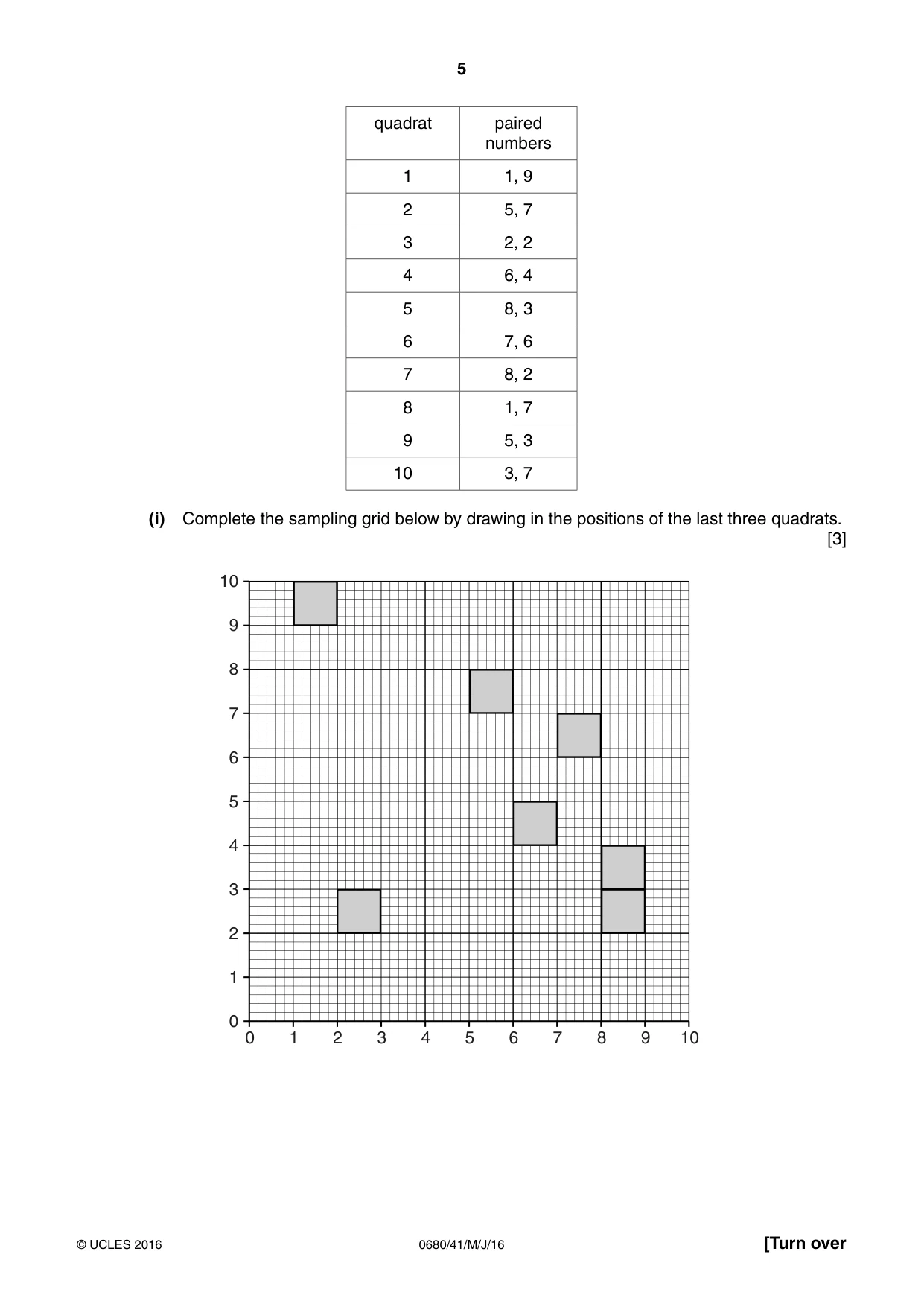
5 0680/41/M/J/16 © UCLES 2016 [Turn over quadrat paired numbers 1 1, 9 2 5, 7 3 2, 2 4 6, 4 5 8, 3 6 7, 6 7 8, 2 8 1, 7 9 5, 3 10 3, 7 (i) Complete the sampling grid below by drawing in the positions of the last three quadrats. [3] 0 0 2 4 6 8 10 1 3 5 7 9 2 4 6 8 10 1 3 5 7 9
Question paper, page 6
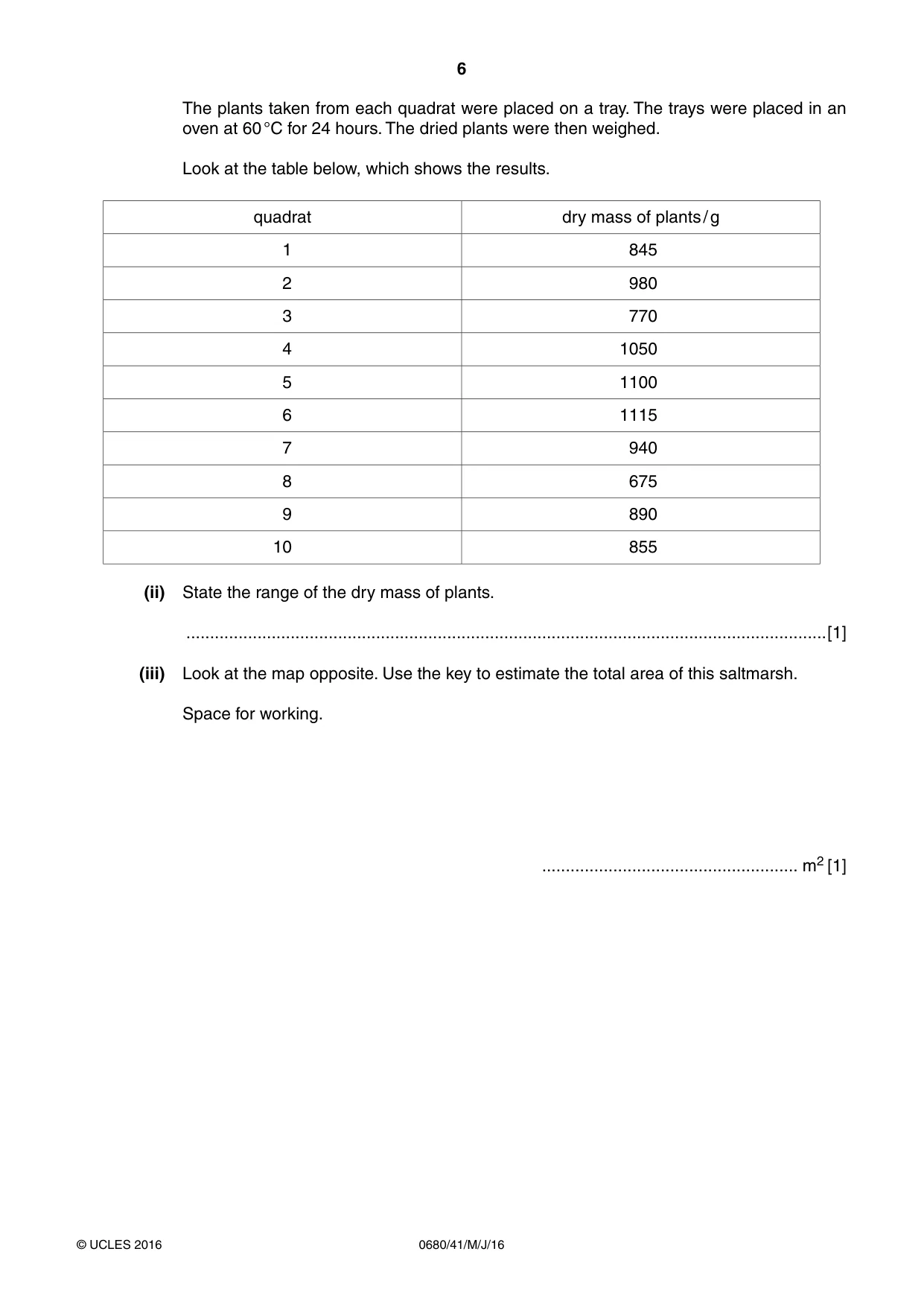
6 0680/41/M/J/16 © UCLES 2016 The plants taken from each quadrat were placed on a tray. The trays were placed in an oven at 60 °C for 24 hours. The dried plants were then weighed. Look at the table below, which shows the results. quadrat dry mass of plants / g 1 845 2 980 3 770 4 1050 5 1100 6 1115 7 940 8 675 9 890 10 855 (ii) State the range of the dry mass of plants. …[1] (iii) Look at the map opposite. Use the key to estimate the total area of this saltmarsh. Space for working. … m2 [1]
Question paper, page 7
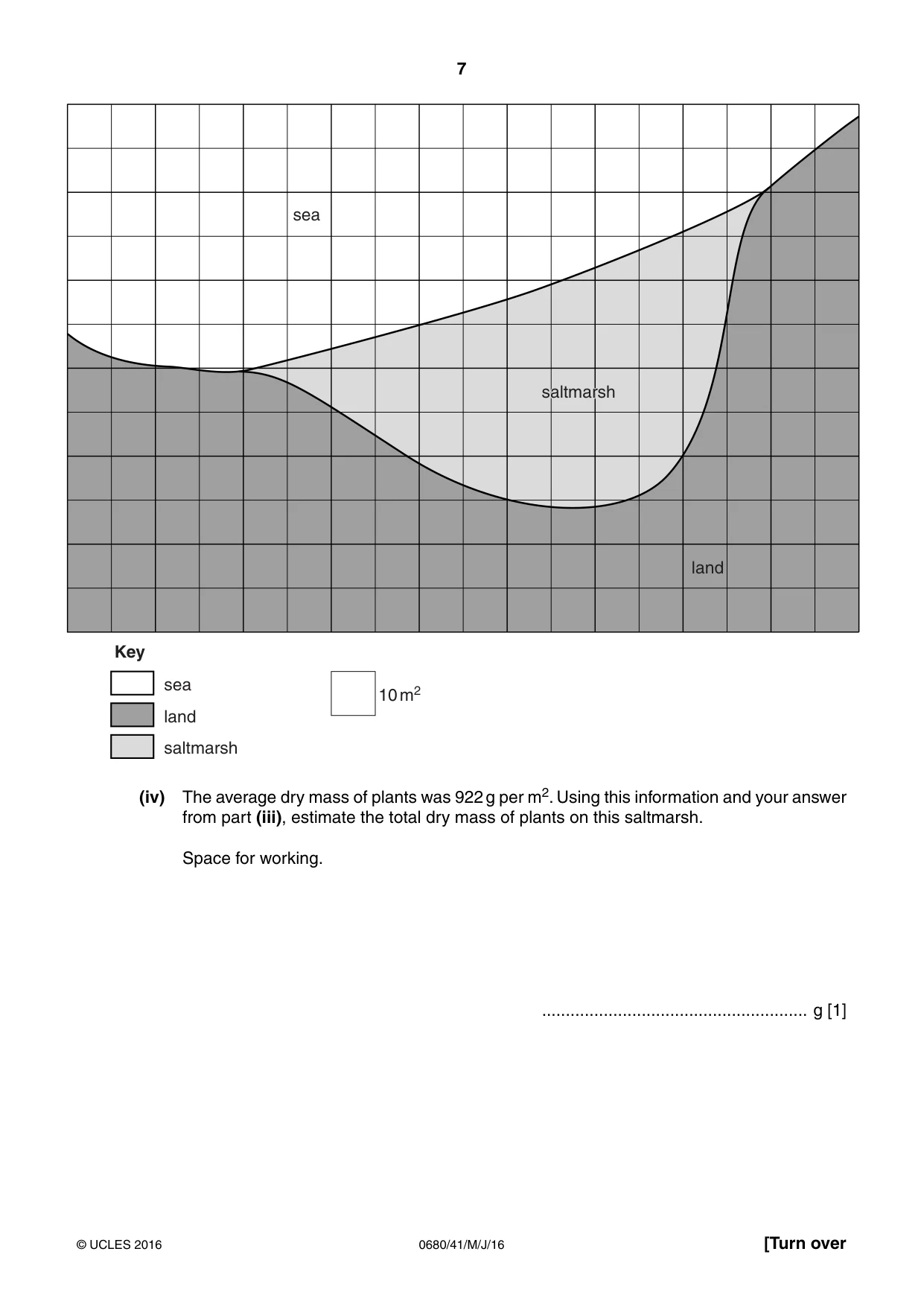
7 0680/41/M/J/16 © UCLES 2016 [Turn over land sea saltmarsh saltmarsh Key sea land saltmarsh 10 m2 (iv) The average dry mass of plants was 922 g per m2. Using this information and your answer from part (iii), estimate the total dry mass of plants on this saltmarsh. Space for working. … g [1]
Question paper, page 8
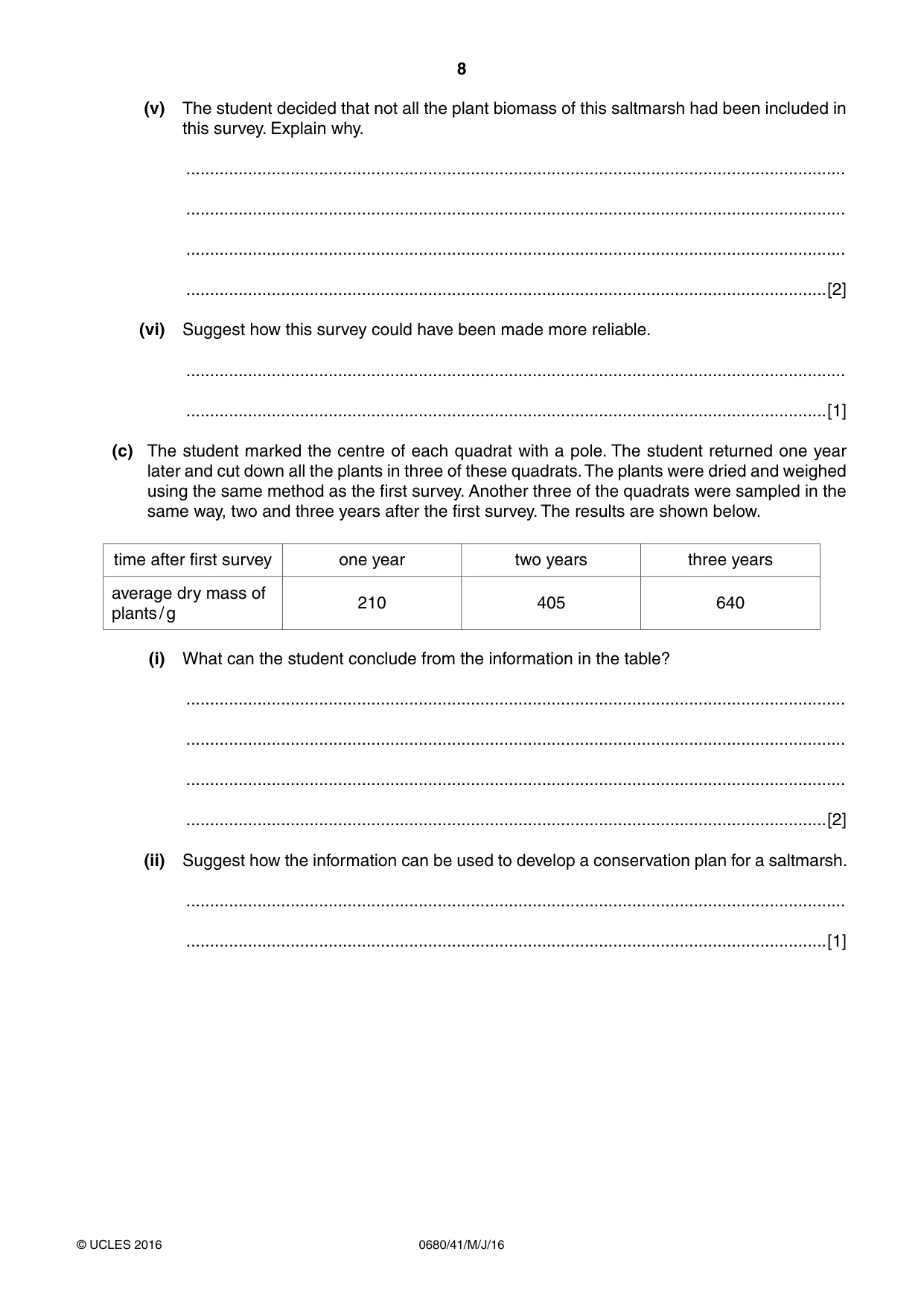
8 0680/41/M/J/16 © UCLES 2016 (v) The student decided that not all the plant biomass of this saltmarsh had been included in this survey. Explain why. … … … …[2] (vi) Suggest how this survey could have been made more reliable. … …[1] (c) The student marked the centre of each quadrat with a pole. The student returned one year later and cut down all the plants in three of these quadrats. The plants were dried and weighed using the same method as the first survey. Another three of the quadrats were sampled in the same way, two and three years after the first survey. The results are shown below. time after first survey one year two years three years average dry mass of plants / g 210 405 640 (i) What can the student conclude from the information in the table? … … … …[2] (ii) Suggest how the information can be used to develop a conservation plan for a saltmarsh. … …[1]
Question paper, page 9
9 0680/41/M/J/16 © UCLES 2016 [Turn over (d) Another student thought that biodiversity could be measured using the same quadrat locations. (i) Suggest how this could have been done. … … … … … …[3] (ii) Draw a suitable table in the space below to record biodiversity in the 10 quadrats. [3]
Question paper, page 10
10 0680/41/M/J/16 © UCLES 2016 (e) To reduce the use of fossil fuels some saltmarsh plants are being used as a source of biomass fuel. The process being used is: 1. collect organic waste from fish farms 2. add the organic waste to a saltmarsh 3. harvest the saltmarsh plants regularly 4. extract oils from the saltmarsh plants to make biomass fuel (i) Explain how adding organic waste from fish farms affects the growth of saltmarsh plants. … … … …[2] (ii) Describe two possible risks of adding organic waste from fish farms to a saltmarsh. … … … …[2]
Question paper, page 11
11 0680/41/M/J/16 © UCLES 2016 [Turn over (f) (i) Suggest why some people living in hot and arid environments, such as the UAE, use large amounts of fuel. … … … …[2] The UAE have started a carbon capture initiative. The aim is to maintain and increase coastal habitats so large amounts of carbon dioxide from the atmosphere can be captured. (ii) State the name of the process that plants use to capture carbon dioxide. …[1] (iii) Suggest three possible advantages of the carbon capture initiative. … … … … … …[3]
Question paper, page 12
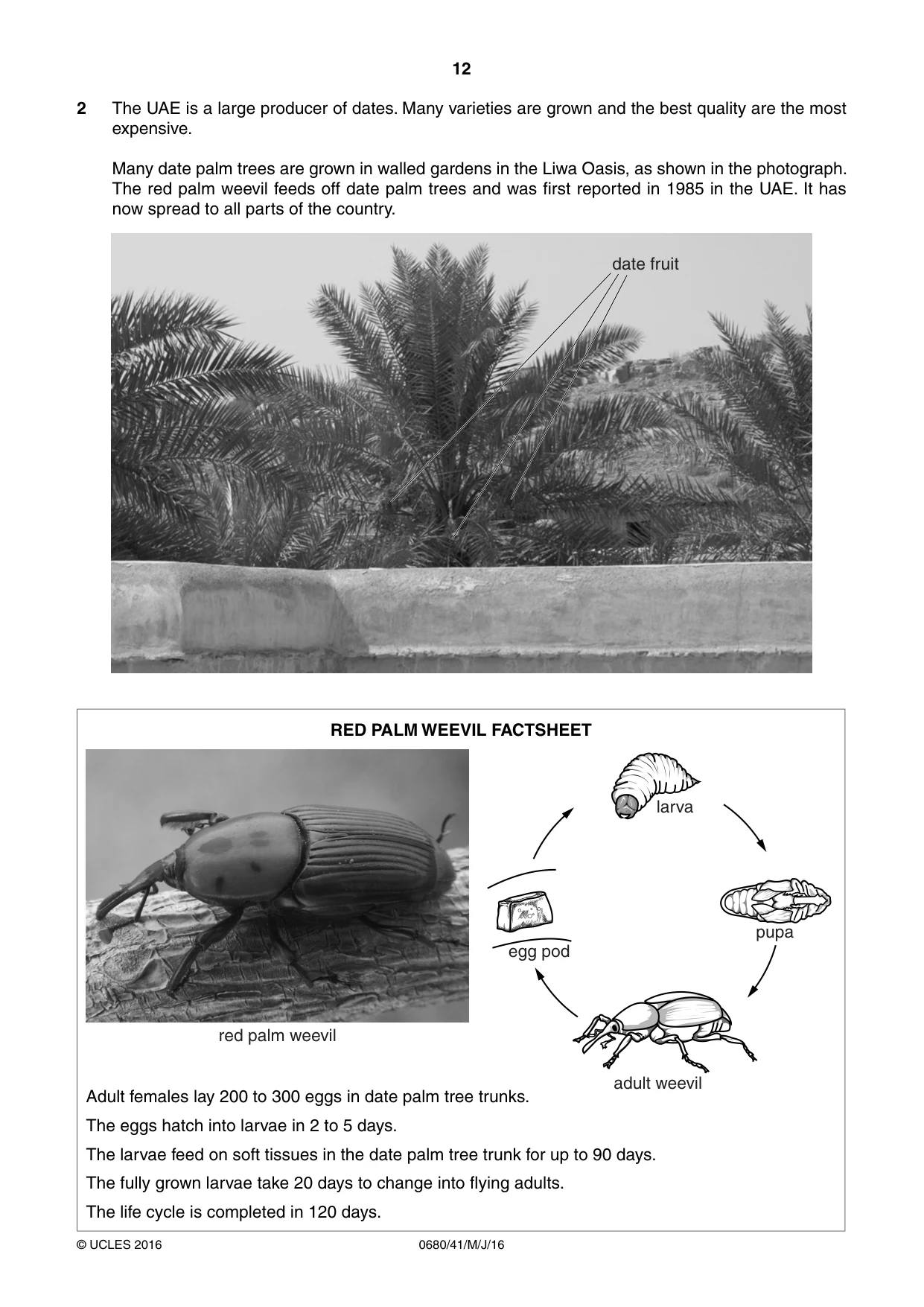
12 0680/41/M/J/16 © UCLES 2016 2 The UAE is a large producer of dates. Many varieties are grown and the best quality are the most expensive. Many date palm trees are grown in walled gardens in the Liwa Oasis, as shown in the photograph. The red palm weevil feeds off date palm trees and was first reported in 1985 in the UAE. It has now spread to all parts of the country. date fruit RED PALM WEEVIL FACTSHEET red palm weevil larva pupa adult weevil egg pod Adult females lay 200 to 300 eggs in date palm tree trunks. The eggs hatch into larvae in 2 to 5 days. The larvae feed on soft tissues in the date palm tree trunk for up to 90 days. The fully grown larvae take 20 days to change into flying adults. The life cycle is completed in 120 days.
Question paper, page 13
13 0680/41/M/J/16 © UCLES 2016 [Turn over (a) Using information from the factsheet and your own knowledge, explain why the red palm weevil has become a severe pest of date palm trees in the UAE. … … … … … … … …[4]
Question paper, page 14
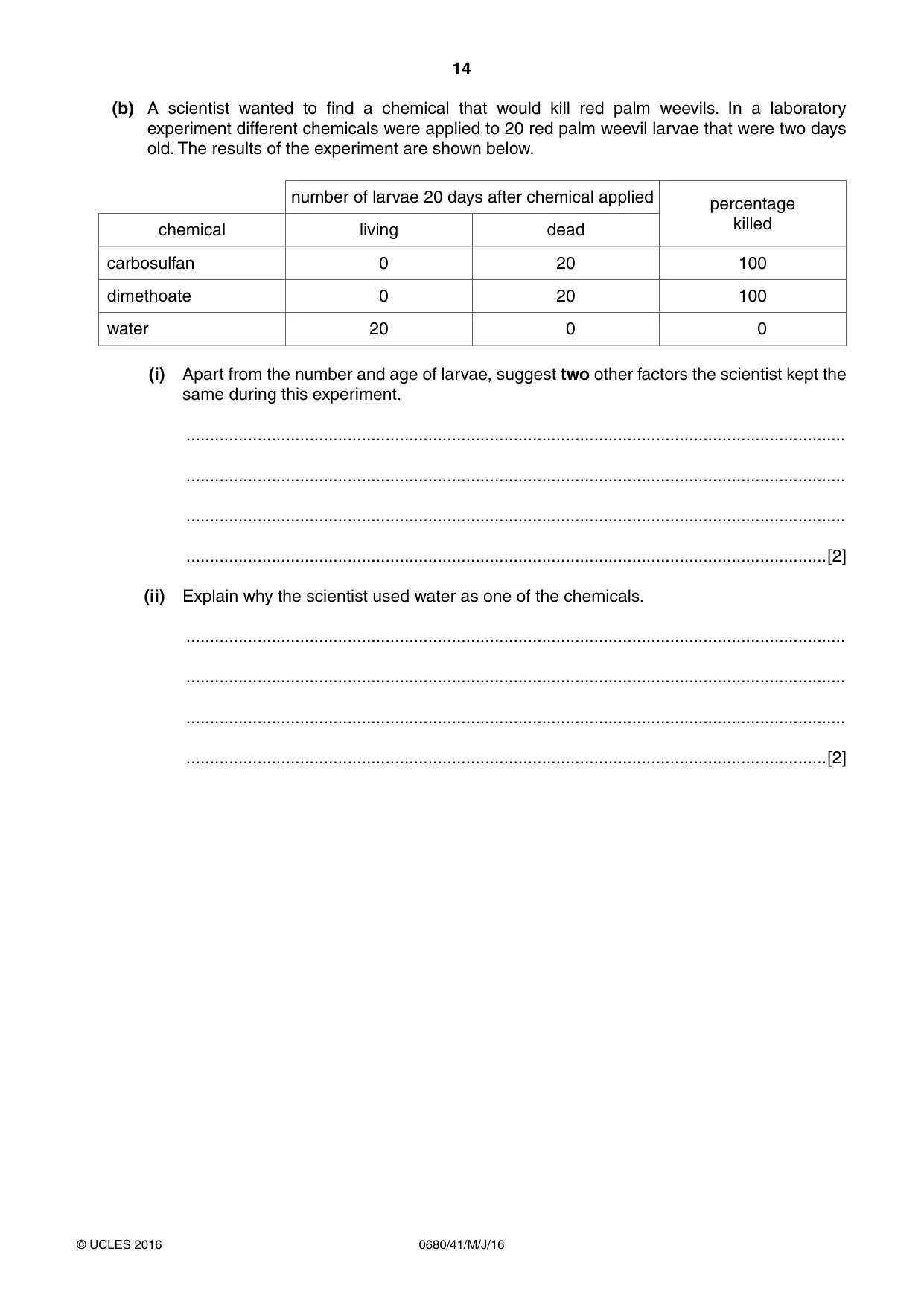
14 0680/41/M/J/16 © UCLES 2016 (b) A scientist wanted to find a chemical that would kill red palm weevils. In a laboratory experiment different chemicals were applied to 20 red palm weevil larvae that were two days old. The results of the experiment are shown below. number of larvae 20 days after chemical applied percentage killed chemical living dead carbosulfan 0 20 100 dimethoate 0 20 100 water 20 0 0 (i) Apart from the number and age of larvae, suggest two other factors the scientist kept the same during this experiment. … … … …[2] (ii) Explain why the scientist used water as one of the chemicals. … … … …[2]
Question paper, page 15
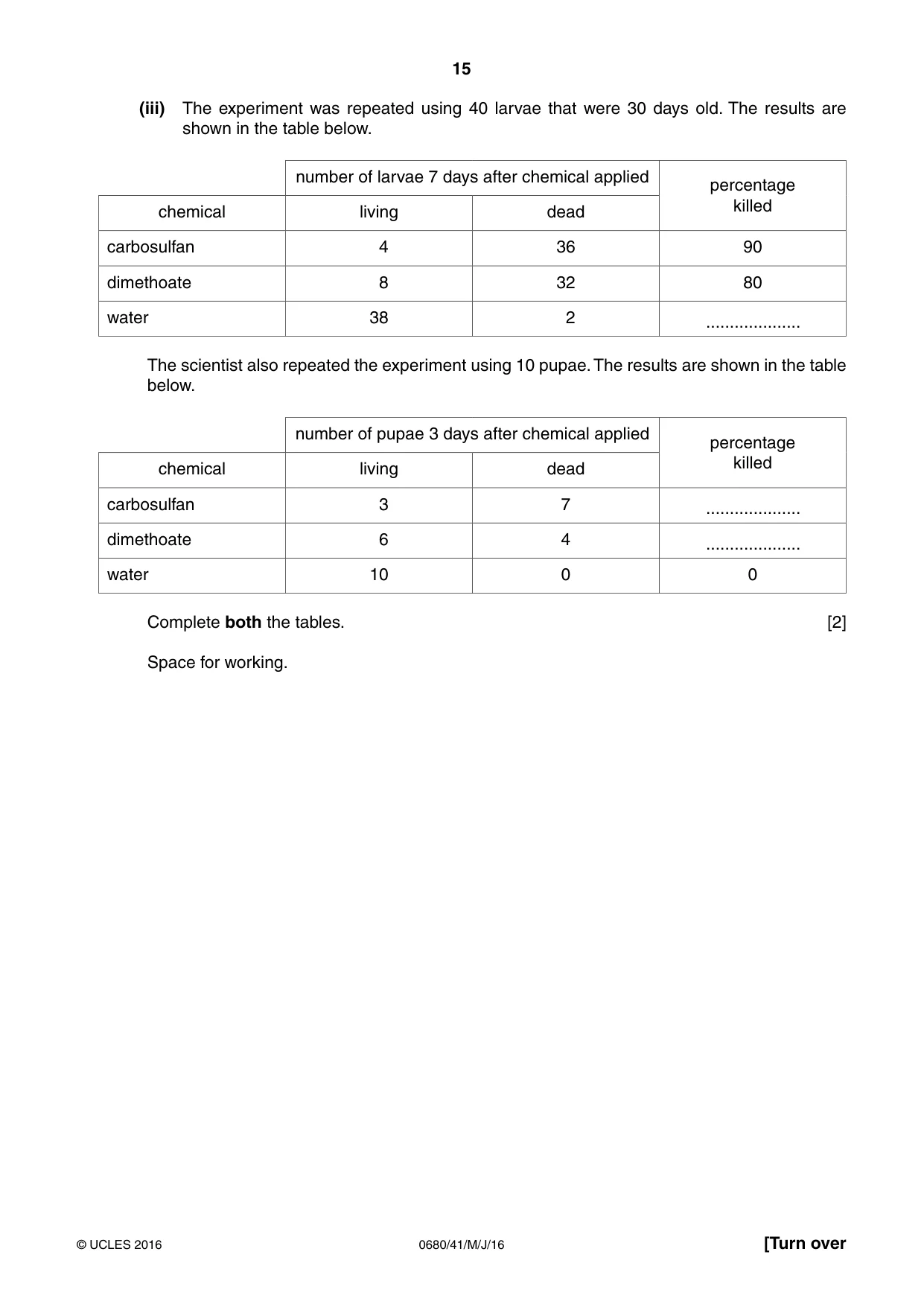
15 0680/41/M/J/16 © UCLES 2016 [Turn over (iii) The experiment was repeated using 40 larvae that were 30 days old. The results are shown in the table below. number of larvae 7 days after chemical applied percentage killed chemical living dead carbosulfan 4 36 90 dimethoate 8 32 80 water 38 2 … The scientist also repeated the experiment using 10 pupae. The results are shown in the table below. number of pupae 3 days after chemical applied percentage killed chemical living dead carbosulfan 3 7 … dimethoate 6 4 … water 10 0 0 Complete both the tables. [2] Space for working.
Question paper, page 16
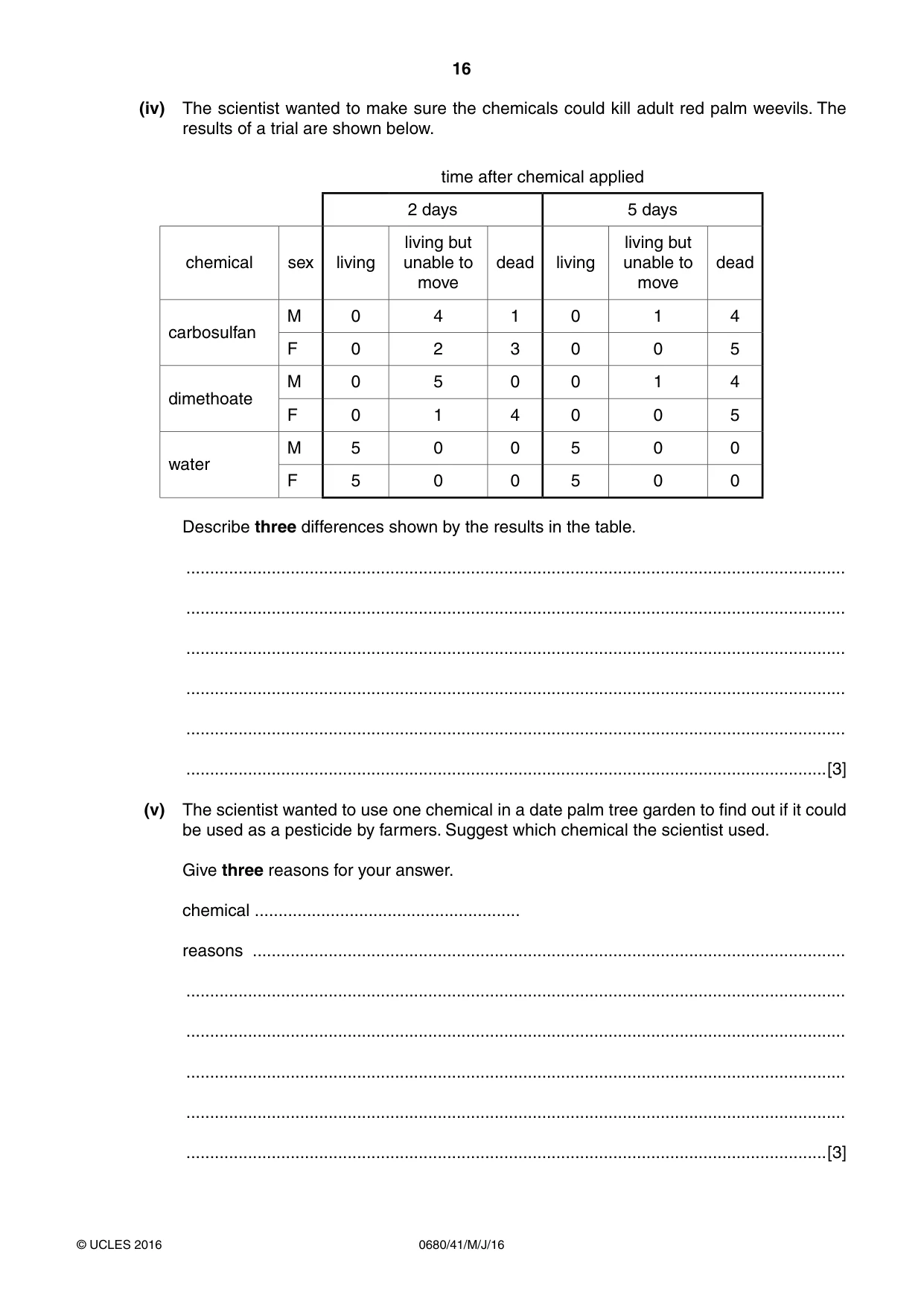
16 0680/41/M/J/16 © UCLES 2016 (iv) The scientist wanted to make sure the chemicals could kill adult red palm weevils. The results of a trial are shown below. time after chemical applied 2 days 5 days chemical sex living living but unable to move dead living living but unable to move dead carbosulfan M 0 4 1 0 1 4 F 0 2 3 0 0 5 dimethoate M 0 5 0 0 1 4 F 0 1 4 0 0 5 water M 5 0 0 5 0 0 F 5 0 0 5 0 0 Describe three differences shown by the results in the table. … … … … … …[3] (v) The scientist wanted to use one chemical in a date palm tree garden to find out if it could be used as a pesticide by farmers. Suggest which chemical the scientist used. Give three reasons for your answer. chemical … reasons … … … … … …[3]
Question paper, page 17
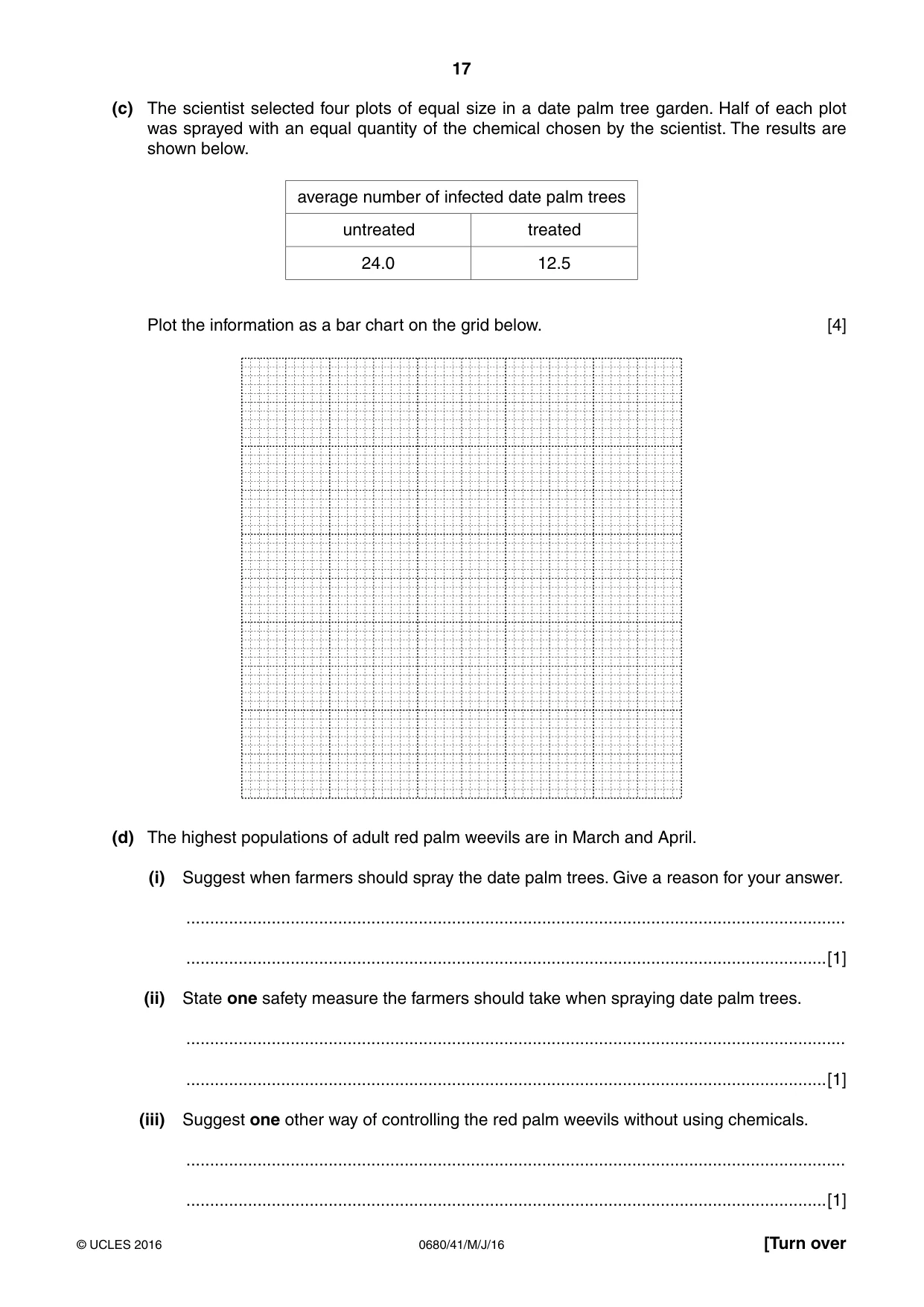
17 0680/41/M/J/16 © UCLES 2016 [Turn over (c) The scientist selected four plots of equal size in a date palm tree garden. Half of each plot was sprayed with an equal quantity of the chemical chosen by the scientist. The results are shown below. average number of infected date palm trees untreated treated 24.0 12.5 Plot the information as a bar chart on the grid below. [4] (d) The highest populations of adult red palm weevils are in March and April. (i) Suggest when farmers should spray the date palm trees. Give a reason for your answer. … …[1] (ii) State one safety measure the farmers should take when spraying date palm trees. … …[1] (iii) Suggest one other way of controlling the red palm weevils without using chemicals. … …[1]
Question paper, page 18
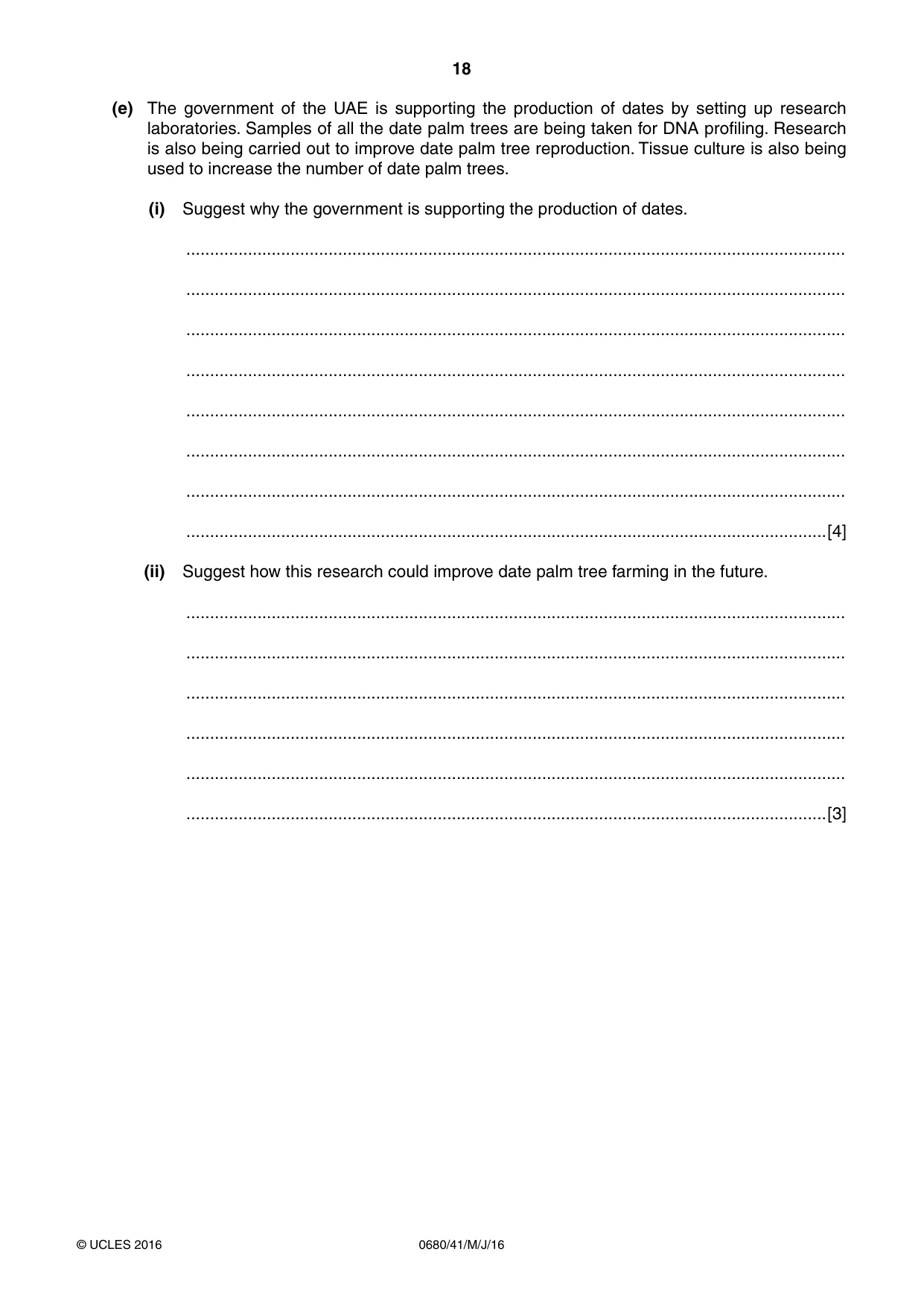
18 0680/41/M/J/16 © UCLES 2016 (e) The government of the UAE is supporting the production of dates by setting up research laboratories. Samples of all the date palm trees are being taken for DNA profiling. Research is also being carried out to improve date palm tree reproduction. Tissue culture is also being used to increase the number of date palm trees. (i) Suggest why the government is supporting the production of dates. … … … … … … … …[4] (ii) Suggest how this research could improve date palm tree farming in the future. … … … … … …[3]
Question paper, page 19
19 0680/41/M/J/16 © UCLES 2016 BLANK PAGE
Question paper, page 20
20 0680/41/M/J/16 © UCLES 2016 BLANK PAGE Permission to reproduce items where third-party owned material protected by copyright is included has been sought and cleared where possible. Every reasonable effort has been made by the publisher (UCLES) to trace copyright holders, but if any items requiring clearance have unwittingly been included, the publisher will be pleased to make amends at the earliest possible opportunity. To avoid the issue of disclosure of answer-related information to candidates, all copyright acknowledgements are reproduced online in the Cambridge International Examinations Copyright Acknowledgements Booklet. This is produced for each series of examinations and is freely available to download at www.cie.org.uk after the live examination series. Cambridge International Examinations is part of the Cambridge Assessment Group. Cambridge Assessment is the brand name of University of Cambridge Local Examinations Syndicate (UCLES), which is itself a department of the University of Cambridge.
Mark scheme, page 1
® IGCSE is the registered trademark of Cambridge International Examinations. This document consists of 6 printed pages. © UCLES 2016 [Turn over Cambridge International Examinations Cambridge International General Certificate of Secondary Education ENVIRONMENTAL MANAGEMENT 0680/41 Paper 4 May/June 2016 MARK SCHEME Maximum Mark: 60 Published This mark scheme is published as an aid to teachers and candidates, to indicate the requirements of the examination. It shows the basis on which Examiners were instructed to award marks. It does not indicate the details of the discussions that took place at an Examiners’ meeting before marking began, which would have considered the acceptability of alternative answers. Mark schemes should be read in conjunction with the question paper and the Principal Examiner Report for Teachers. Cambridge will not enter into discussions about these mark schemes. Cambridge is publishing the mark schemes for the May/June 2016 series for most Cambridge IGCSE®, Cambridge International A and AS Level components and some Cambridge O Level components.
Mark scheme, page 2
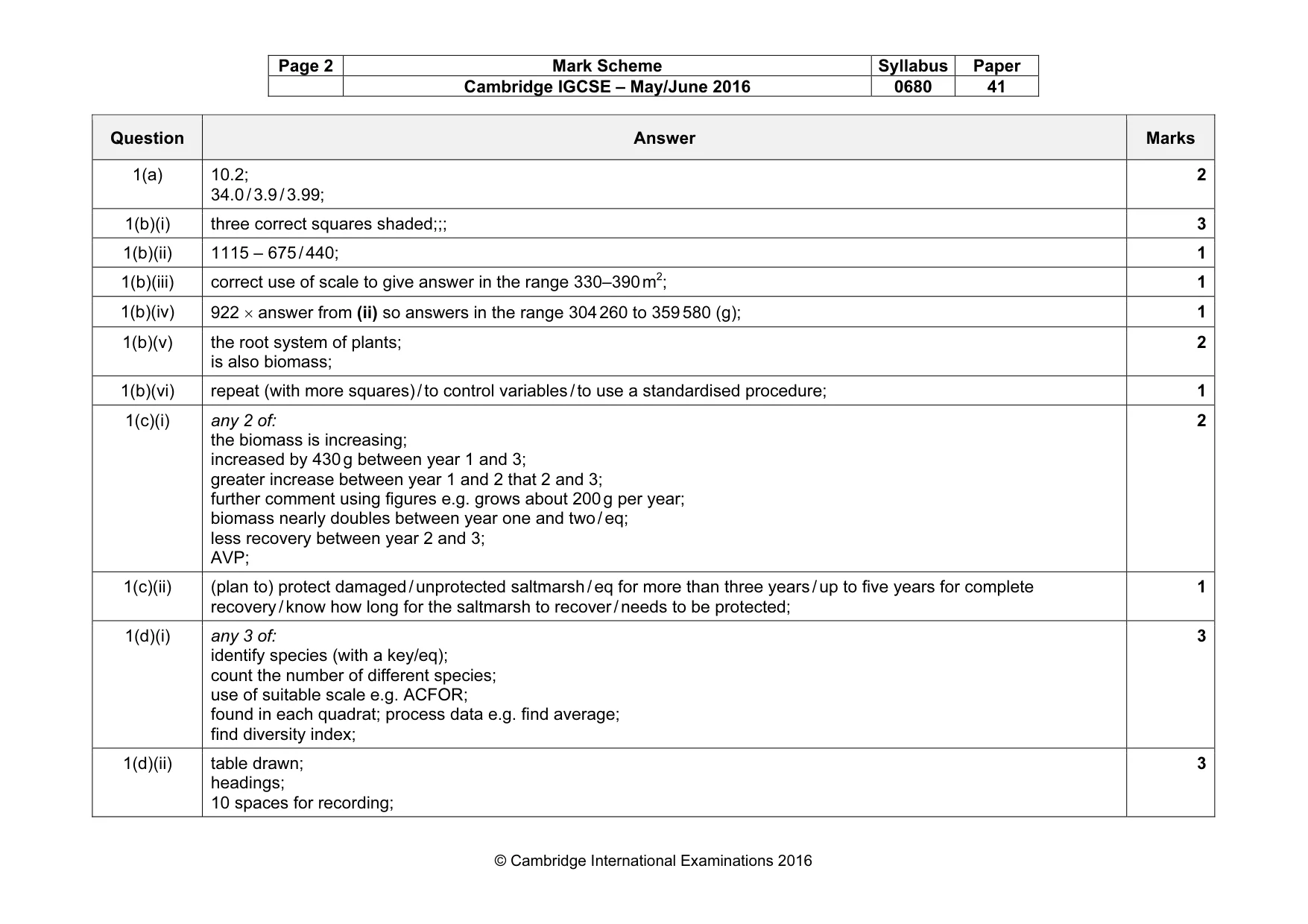
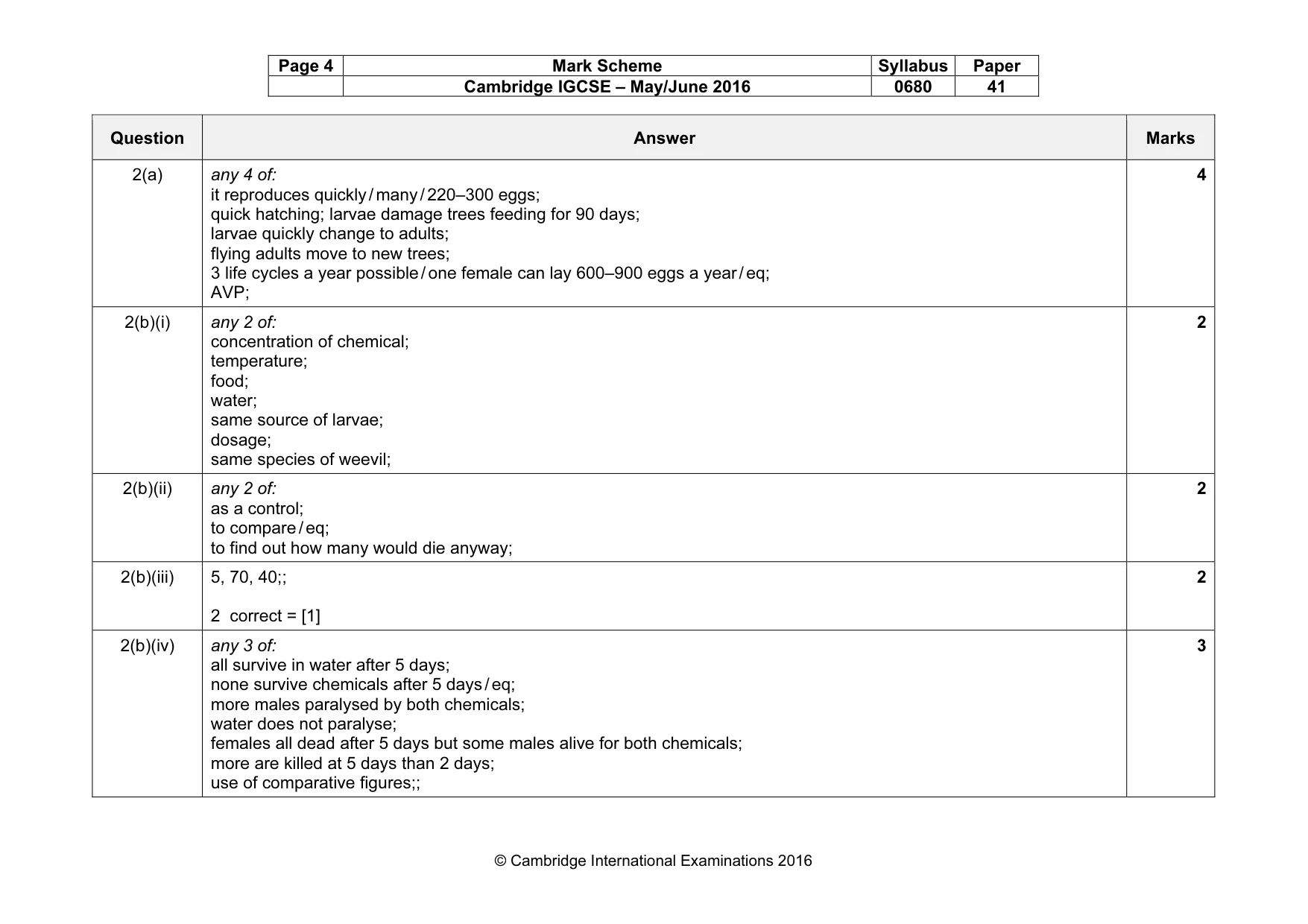
Page 2 Mark Scheme Syllabus Paper Cambridge IGCSE – May/June 2016 0680 41 © Cambridge International Examinations 2016 Question Answer Marks 1(a) 10.2; 34.0 / 3.9 / 3.99; 2 1(b)(i) three correct squares shaded;;; 3 1(b)(ii) 1115 – 675 / 440; 1 1(b)(iii) correct use of scale to give answer in the range 330–390 m2; 1 1(b)(iv) 922 × answer from (ii) so answers in the range 304 260 to 359 580 (g); 1 1(b)(v) the root system of plants; is also biomass; 2 1(b)(vi) repeat (with more squares) / to control variables / to use a standardised procedure; 1 1(c)(i) any 2 of: the biomass is increasing; increased by 430 g between year 1 and 3; greater increase between year 1 and 2 that 2 and 3; further comment using figures e.g. grows about 200 g per year; biomass nearly doubles between year one and two / eq; less recovery between year 2 and 3; AVP; 2 1(c)(ii) (plan to) protect damaged / unprotected saltmarsh / eq for more than three years / up to five years for complete recovery / know how long for the saltmarsh to recover / needs to be protected; 1 1(d)(i) any 3 of: identify species (with a key/eq); count the number of different species; use of suitable scale e.g. ACFOR; found in each quadrat; process data e.g. find average; find diversity index; 3 1(d)(ii) table drawn; headings; 10 spaces for recording; 3
Mark scheme, page 3
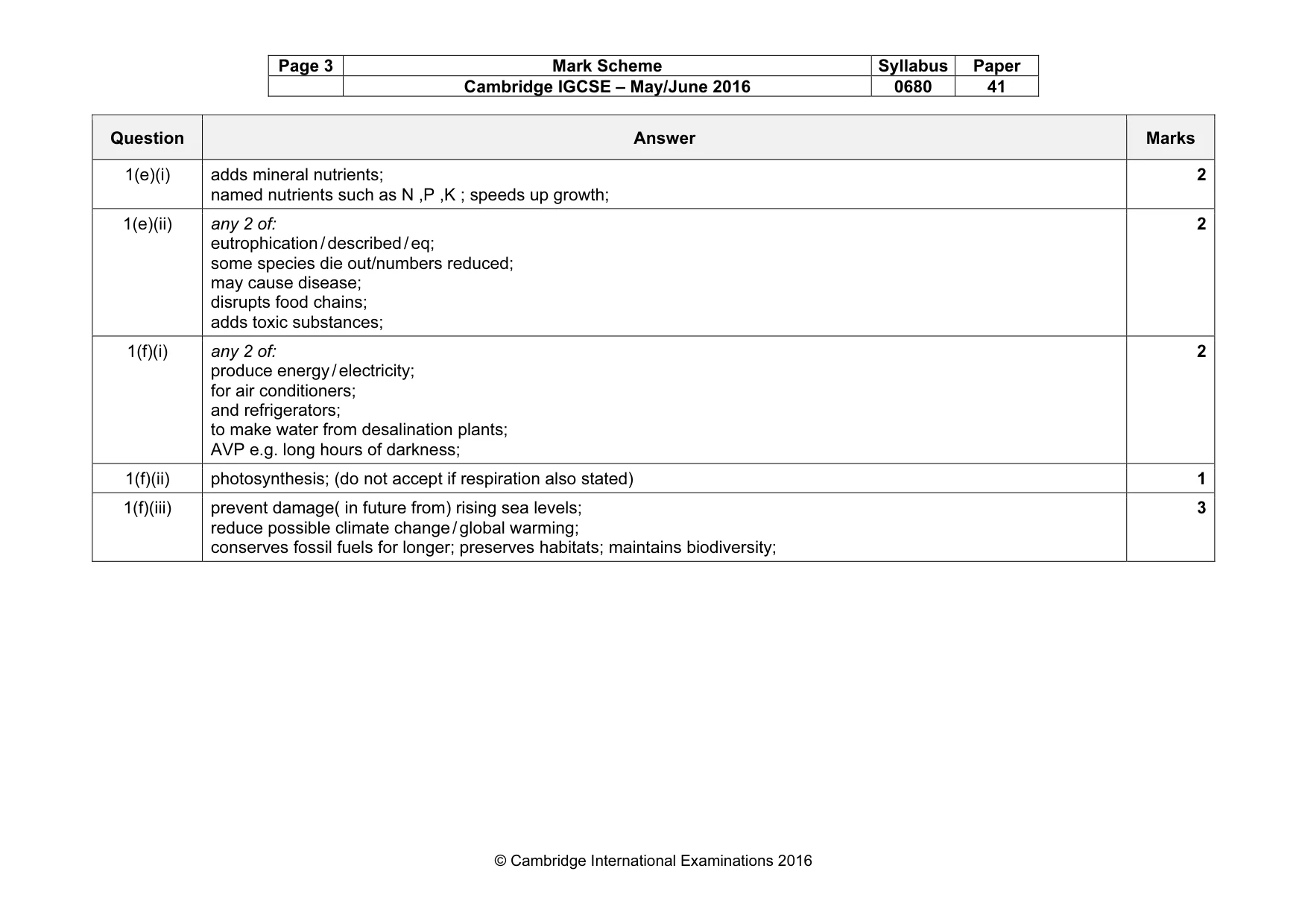
Page 3 Mark Scheme Syllabus Paper Cambridge IGCSE – May/June 2016 0680 41 © Cambridge International Examinations 2016 Question Answer Marks 1(e)(i) adds mineral nutrients; named nutrients such as N ,P ,K ; speeds up growth; 2 1(e)(ii) any 2 of: eutrophication / described / eq; some species die out/numbers reduced; may cause disease; disrupts food chains; adds toxic substances; 2 1(f)(i) any 2 of: produce energy / electricity; for air conditioners; and refrigerators; to make water from desalination plants; AVP e.g. long hours of darkness; 2 1(f)(ii) photosynthesis; (do not accept if respiration also stated) 1 1(f)(iii) prevent damage( in future from) rising sea levels; reduce possible climate change / global warming; conserves fossil fuels for longer; preserves habitats; maintains biodiversity; 3
Mark scheme, page 4
Page 4 Mark Scheme Syllabus Paper Cambridge IGCSE – May/June 2016 0680 41 © Cambridge International Examinations 2016 Question Answer Marks 2(a) any 4 of: it reproduces quickly / many / 220–300 eggs; quick hatching; larvae damage trees feeding for 90 days; larvae quickly change to adults; flying adults move to new trees; 3 life cycles a year possible / one female can lay 600–900 eggs a year / eq; AVP; 4 2(b)(i) any 2 of: concentration of chemical; temperature; food; water; same source of larvae; dosage; same species of weevil; 2 2(b)(ii) any 2 of: as a control; to compare / eq; to find out how many would die anyway; 2 2(b)(iii) 5, 70, 40;; 2 correct = [1] 2 2(b)(iv) any 3 of: all survive in water after 5 days; none survive chemicals after 5 days / eq; more males paralysed by both chemicals; water does not paralyse; females all dead after 5 days but some males alive for both chemicals; more are killed at 5 days than 2 days; use of comparative figures;; 3
Mark scheme, page 5
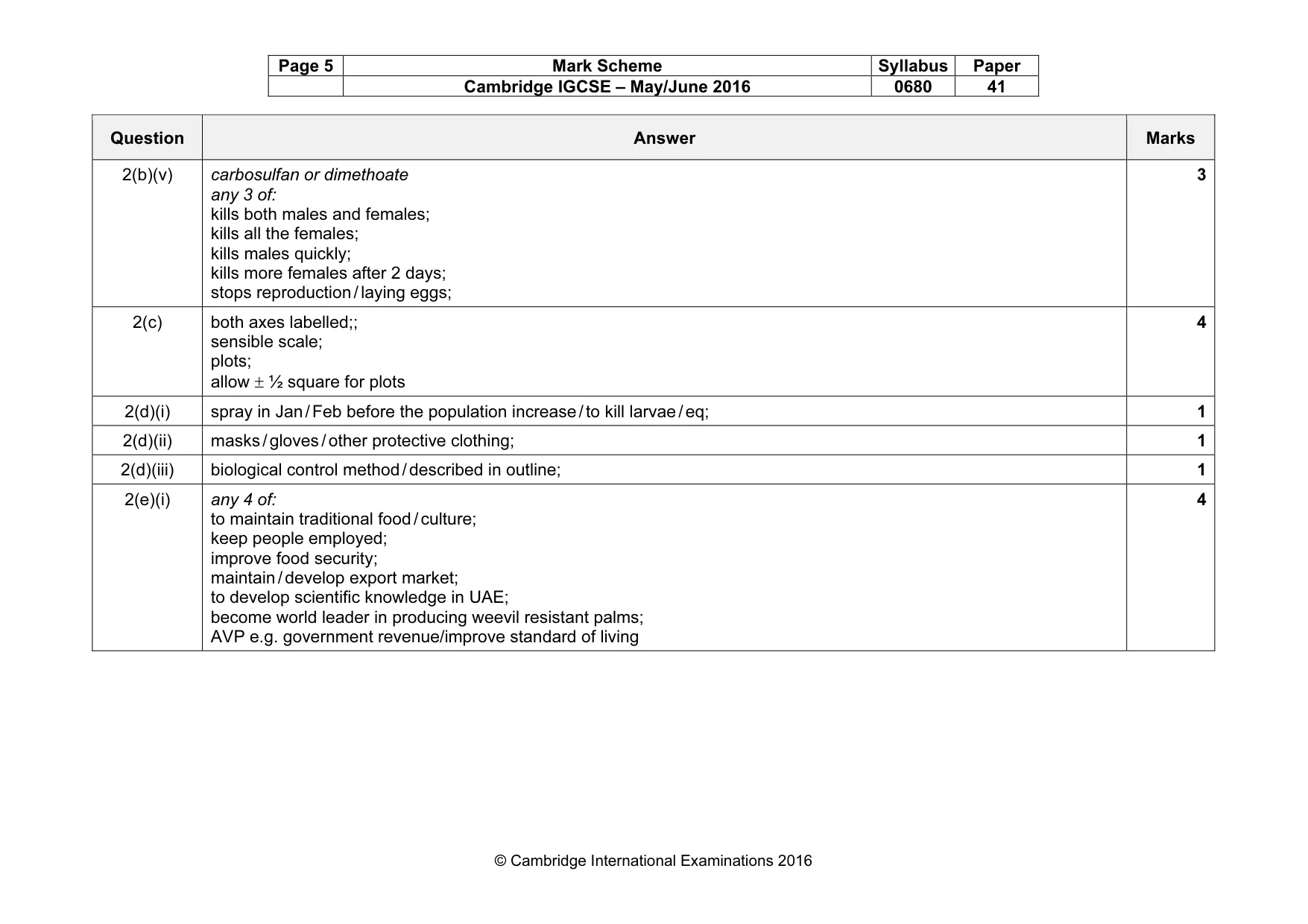
Page 5 Mark Scheme Syllabus Paper Cambridge IGCSE – May/June 2016 0680 41 © Cambridge International Examinations 2016 Question Answer Marks 2(b)(v) carbosulfan or dimethoate any 3 of: kills both males and females; kills all the females; kills males quickly; kills more females after 2 days; stops reproduction / laying eggs; 3 2(c) both axes labelled;; sensible scale; plots; allow ± ½ square for plots 4 2(d)(i) spray in Jan / Feb before the population increase / to kill larvae / eq; 1 2(d)(ii) masks / gloves / other protective clothing; 1 2(d)(iii) biological control method / described in outline; 1 2(e)(i) any 4 of: to maintain traditional food / culture; keep people employed; improve food security; maintain / develop export market; to develop scientific knowledge in UAE; become world leader in producing weevil resistant palms; AVP e.g. government revenue/improve standard of living 4
Mark scheme, page 6
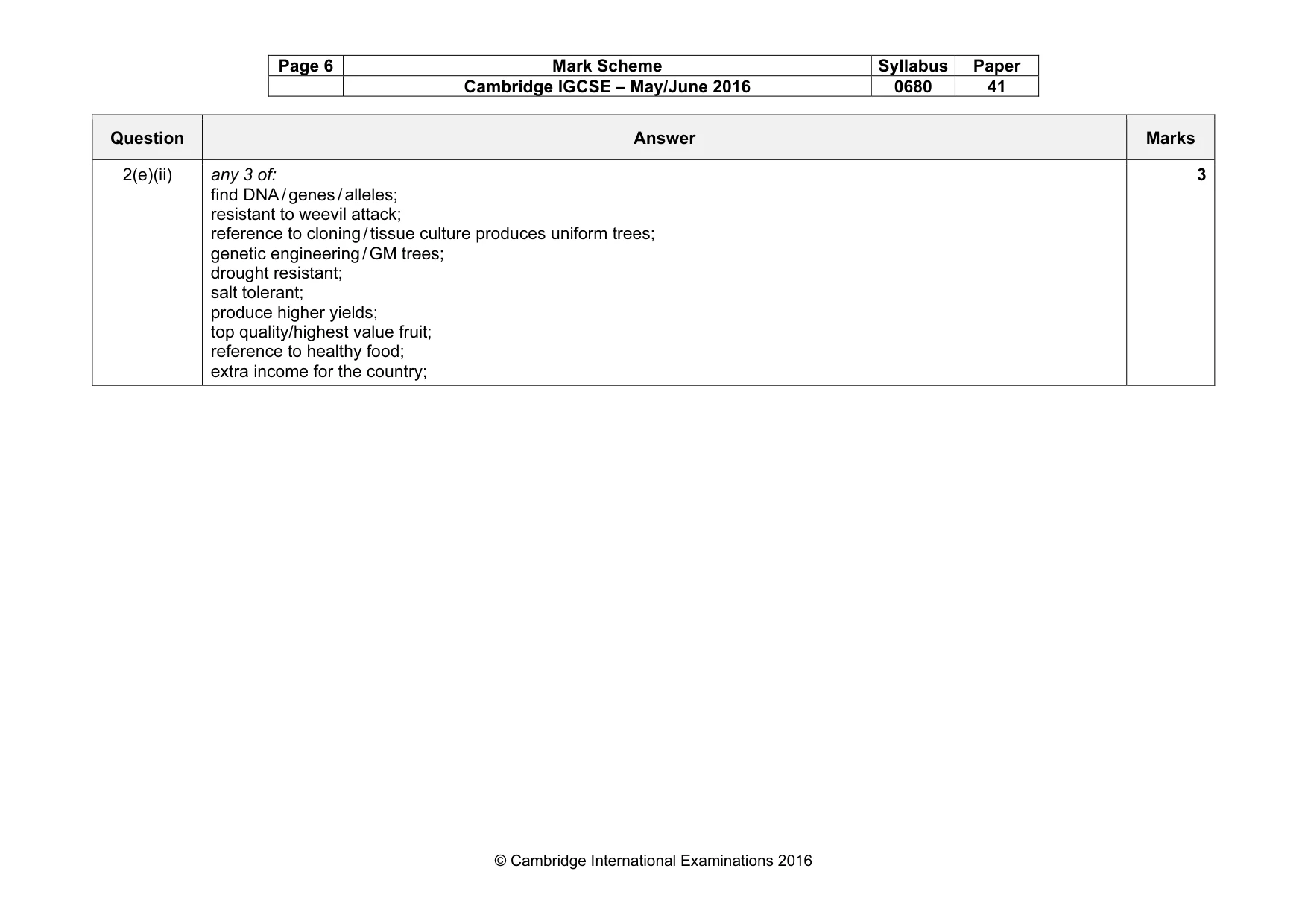
Page 6 Mark Scheme Syllabus Paper Cambridge IGCSE – May/June 2016 0680 41 © Cambridge International Examinations 2016 Question Answer Marks 2(e)(ii) any 3 of: find DNA / genes / alleles; resistant to weevil attack; reference to cloning / tissue culture produces uniform trees; genetic engineering / GM trees; drought resistant; salt tolerant; produce higher yields; top quality/highest value fruit; reference to healthy food; extra income for the country; 3
What you needed in this session
Cambridge’s own grade thresholds for 2016 May/June, Paper 4 · Variant 1. A higher threshold means an easier paper — the bar moves with how the cohort did.