Cambridge IGCSE Environmental Management 0680 — 2017 Oct/Nov Paper 4 · Variant 1
0680/41/O/N/17 · 3 questions · 60 marks · ≈68 min
The question paper and its mark scheme, free to read here and free to download. This is Cambridge’s own paper, exactly as it was sat.
Question paper16 pages






Mark scheme7 pages
Answers below. Sit the paper first if you are practising.
Questions as text
Q1 · The state of Tennessee has large areas of fertile land
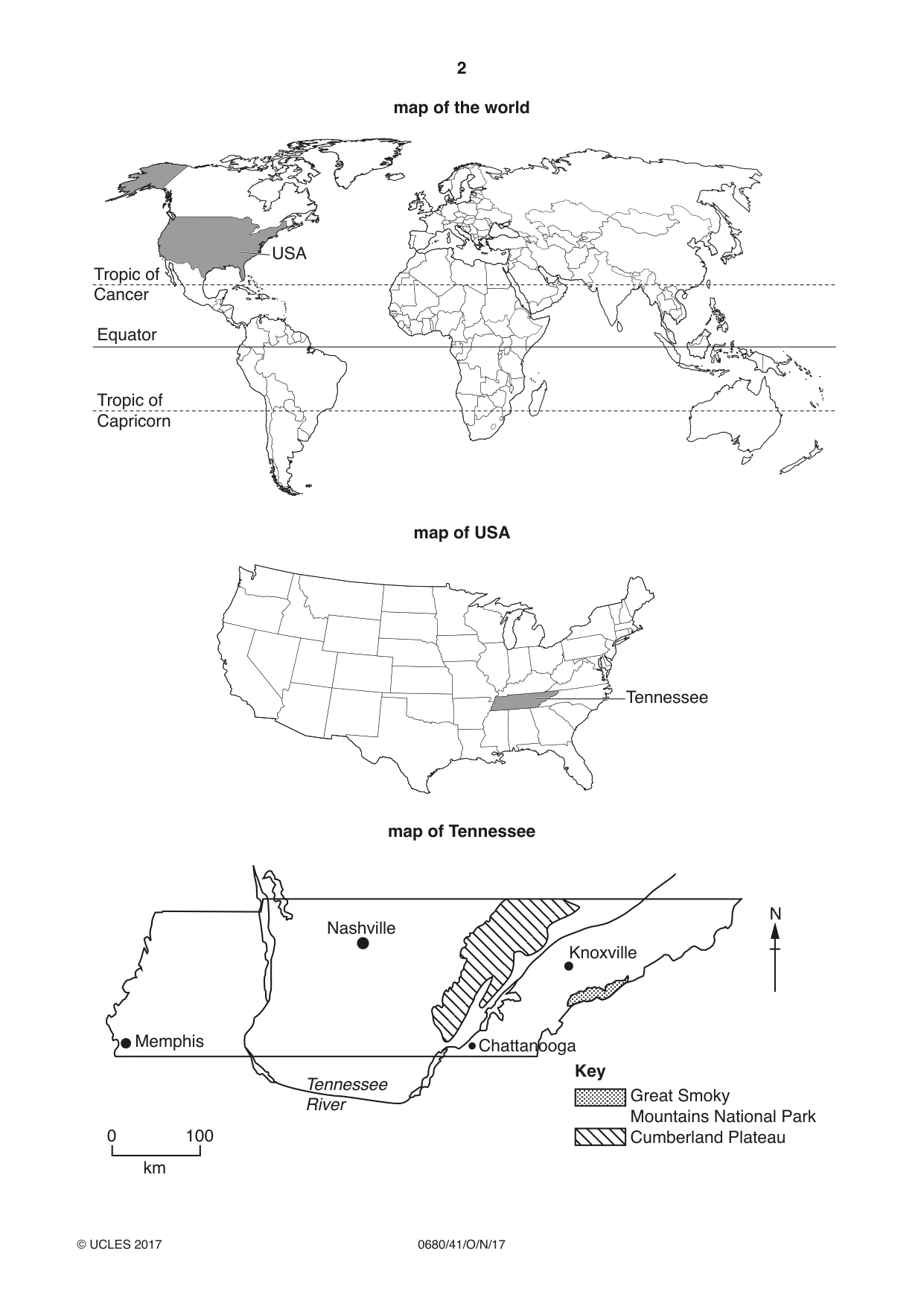
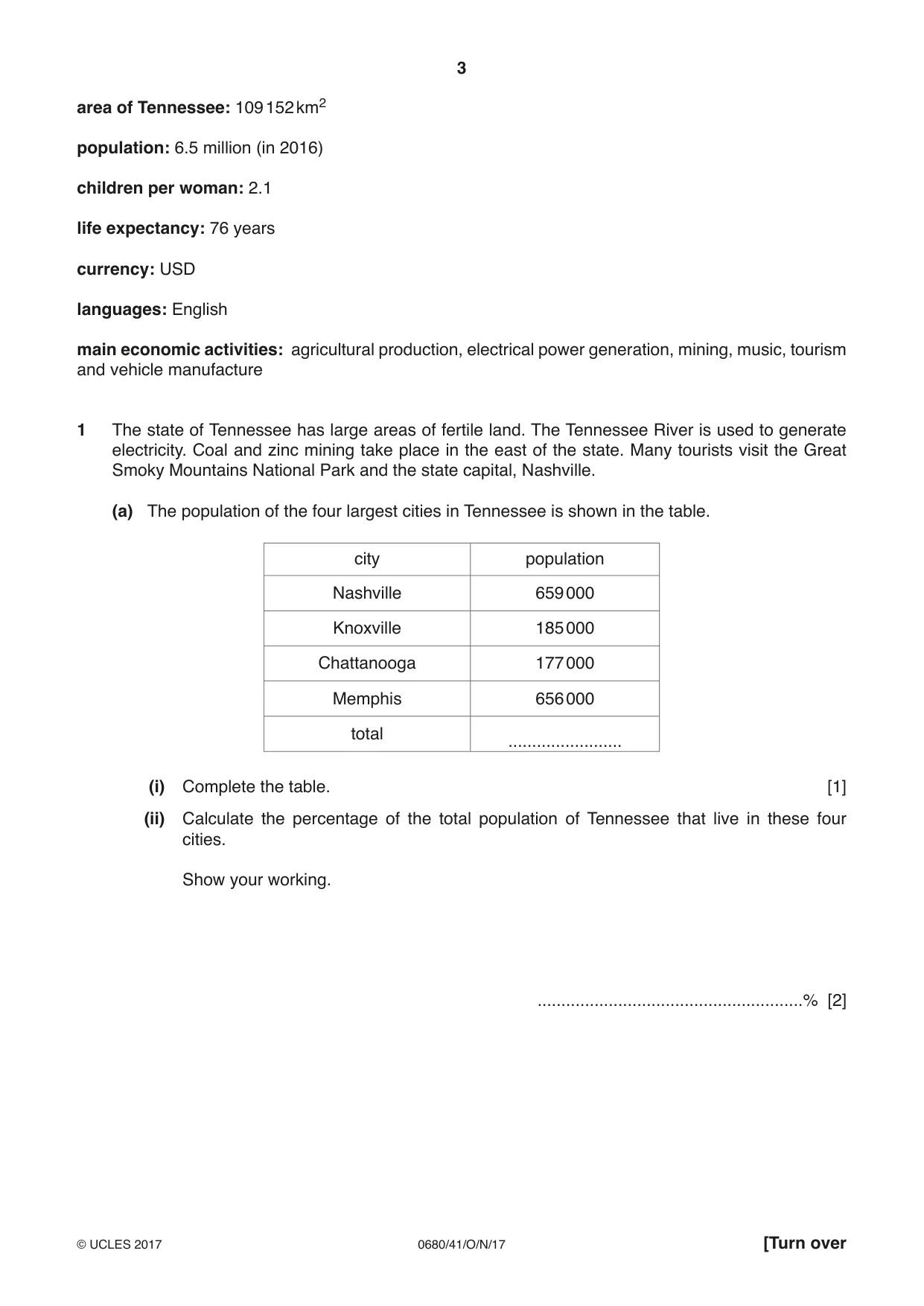
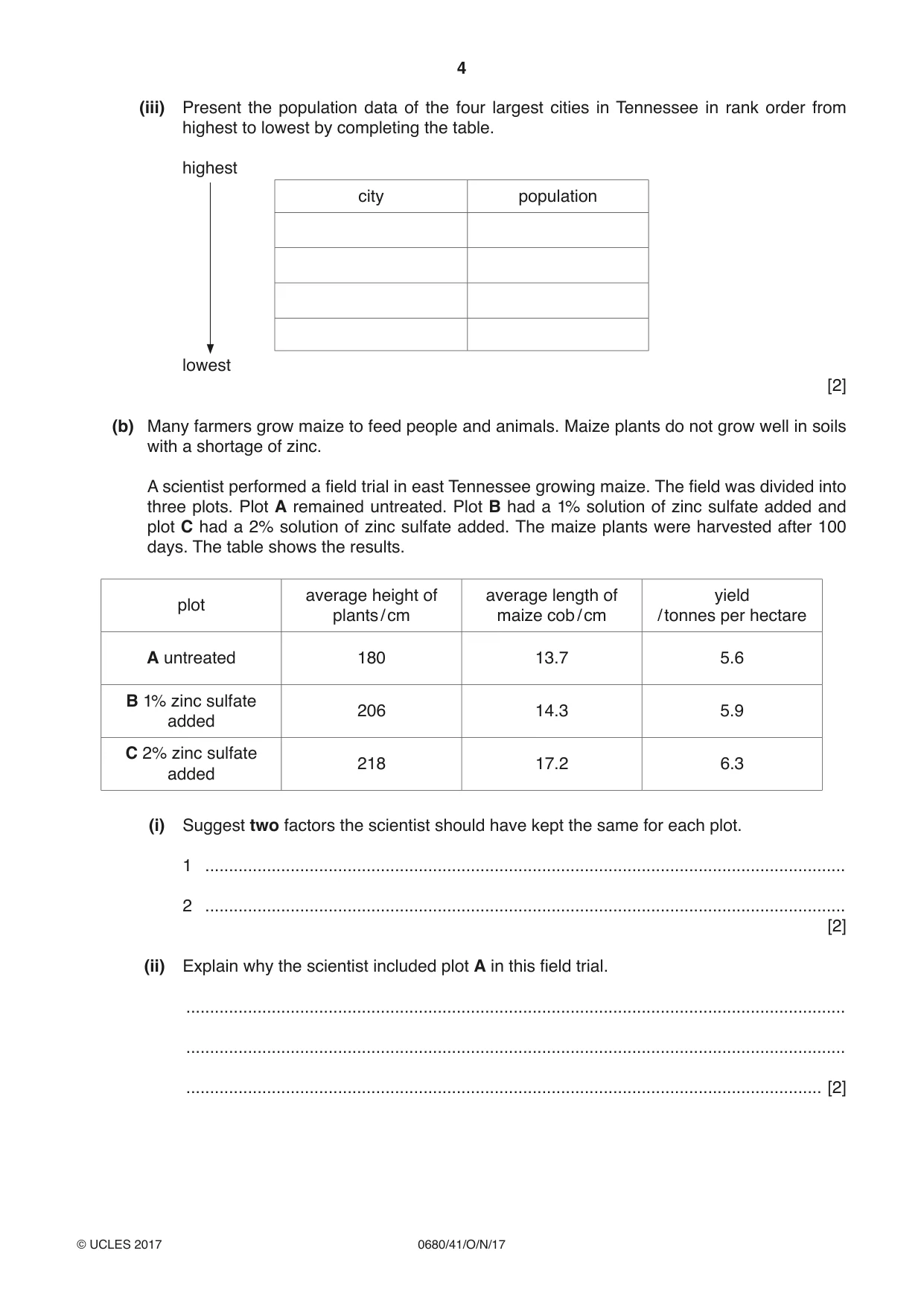
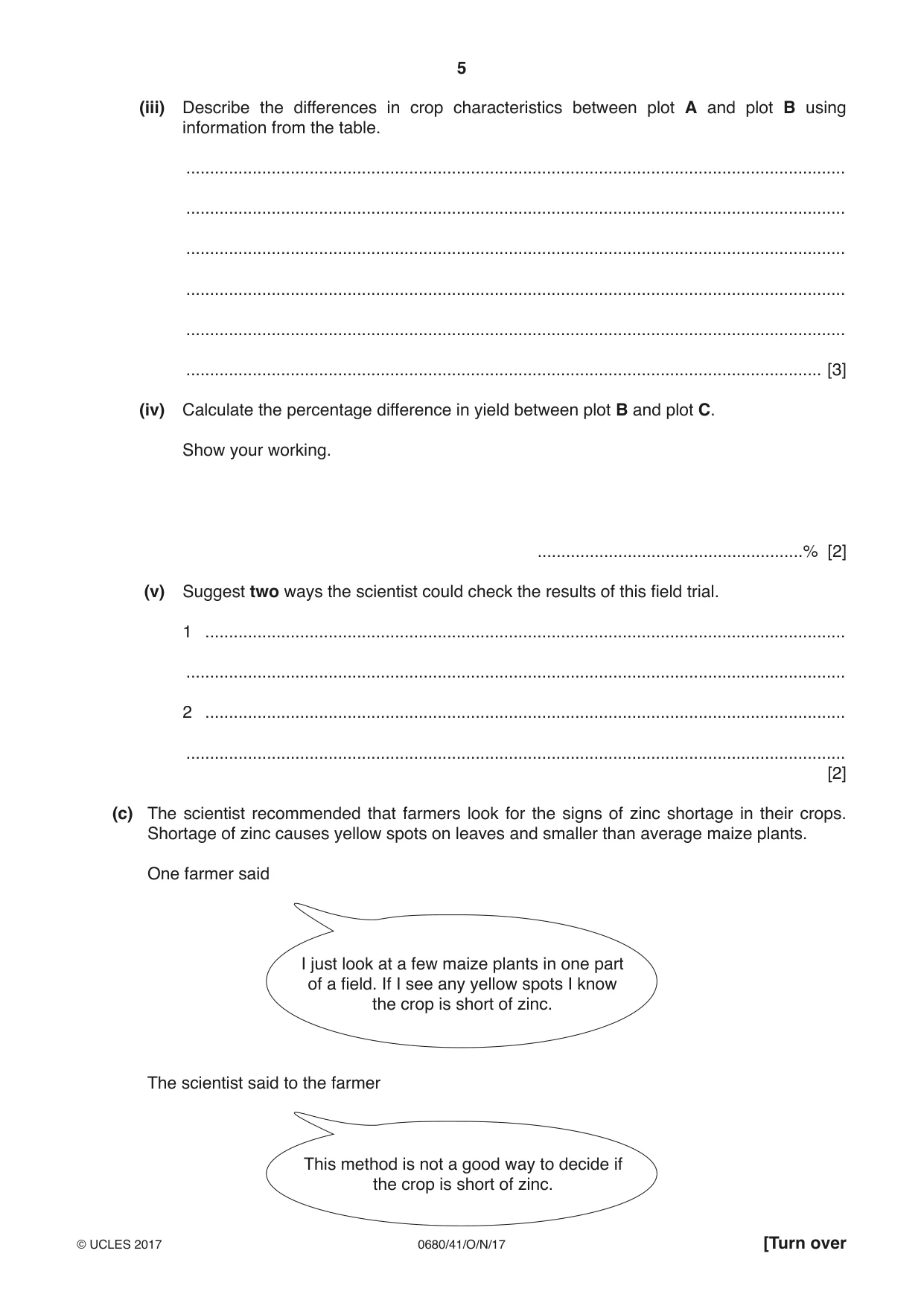
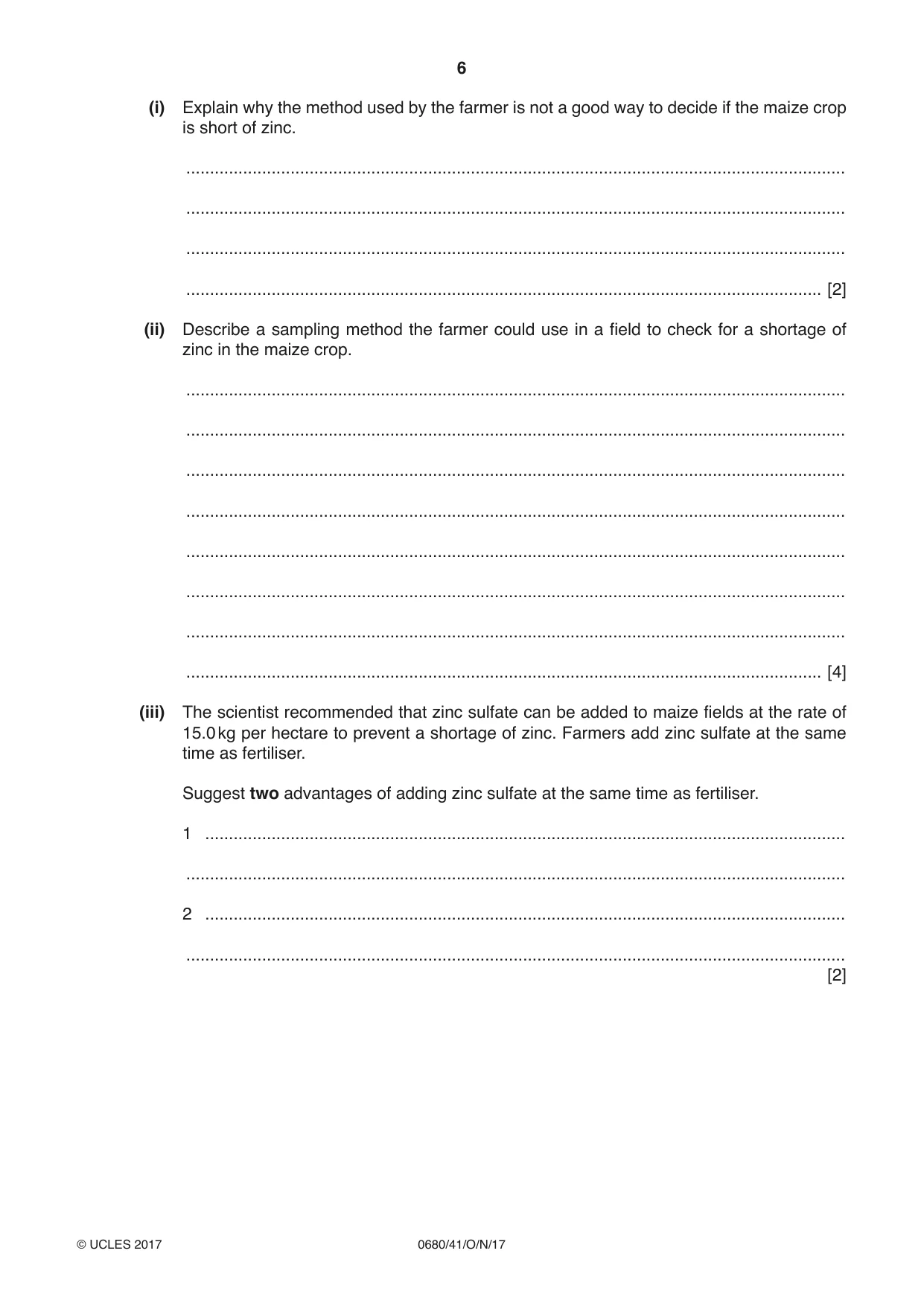
1 The state of Tennessee has large areas of fertile land. The Tennessee River is used to generate electricity. Coal and zinc mining take place in the east of the state. Many tourists visit the Great Smoky Mountains National Park and the state capital, Nashville. (a) The population of the four largest cities in Tennessee is shown in the table. city population Nashville 659 000 Knoxville 185 000 Chattanooga 177 000 Memphis 656 000 total ........................ (i) Complete the table. [1] (ii) Calculate the percentage of the total population of Tennessee that live in these four cities. Show your working. ........................................................% [2] (iii) Present the population data of the four largest cities in Tennessee in rank order from highest to lowest by completing the table. highest city population lowest [2] (b) Many farmers grow maize to feed people and animals. Maize plants do not grow well in soils with a shortage of zinc. A scientist performed a field trial in east Tennessee growing maize. The field was divided into three plots. Plot A remained untreated. Plot B had a 1% solution of zinc sulfate added and plot C had a 2% solution of zinc sulfate added. The maize plants were harvested after 100 days. The table shows the results. average height of average length of yield plot plants / cm maize cob / cm / tonnes per hectare A untreated 180 13.7 5.6 B 1% zinc sulfate 206 14.3 5.9 added C 2% zinc sulfate 218 17.2 6.3 added (i) Suggest two factors the scientist should have kept the same for each plot. 1 ....................................................................................................................................... 2 ....................................................................................................................................... [2] (ii) Explain why the scientist included plot A in this field trial. ........................................................................................................................................... ........................................................................................................................................... ...................................................................................................................................... [2] (iii) Describe the differences in crop characteristics between plot A and plot B using information from the table. ........................................................................................................................................... ........................................................................................................................................... ........................................................................................................................................... ........................................................................................................................................... ........................................................................................................................................... ...................................................................................................................................... [3] (iv) Calculate the percentage difference in yield between plot B and plot C. Show your working. ........................................................% [2] (v) Suggest two ways the scientist could check the results of this field trial. 1 ....................................................................................................................................... ........................................................................................................................................... 2 ....................................................................................................................................... ........................................................................................................................................... [2] (c) The scientist recommended that farmers look for the signs of zinc shortage in their crops. Shortage of zinc causes yellow spots on leaves and smaller than average maize plants. One farmer said I just look at a few maize plants in one part of a field. If I see any yellow spots I know the crop is short of zinc. The scientist said to the farmer This method is not a good way to decide if the crop is short of zinc. (i) Explain why the method used by the farmer is not a good way to decide if the maize crop is short of zinc. ........................................................................................................................................... ........................................................................................................................................... ........................................................................................................................................... ...................................................................................................................................... [2] (ii) Describe a sampling method the farmer could use in a field to check for a shortage of zinc in the maize crop. ........................................................................................................................................... ........................................................................................................................................... ........................................................................................................................................... ........................................................................................................................................... ........................................................................................................................................... ........................................................................................................................................... ........................................................................................................................................... ...................................................................................................................................... [4] (iii) The scientist recommended that zinc sulfate can be added to maize fields at the rate of 15.0 kg per hectare to prevent a shortage of zinc. Farmers add zinc sulfate at the same time as fertiliser. Suggest two advantages of adding zinc sulfate at the same time as fertiliser. 1 ....................................................................................................................................... ........................................................................................................................................... 2 ....................................................................................................................................... ........................................................................................................................................... [2]
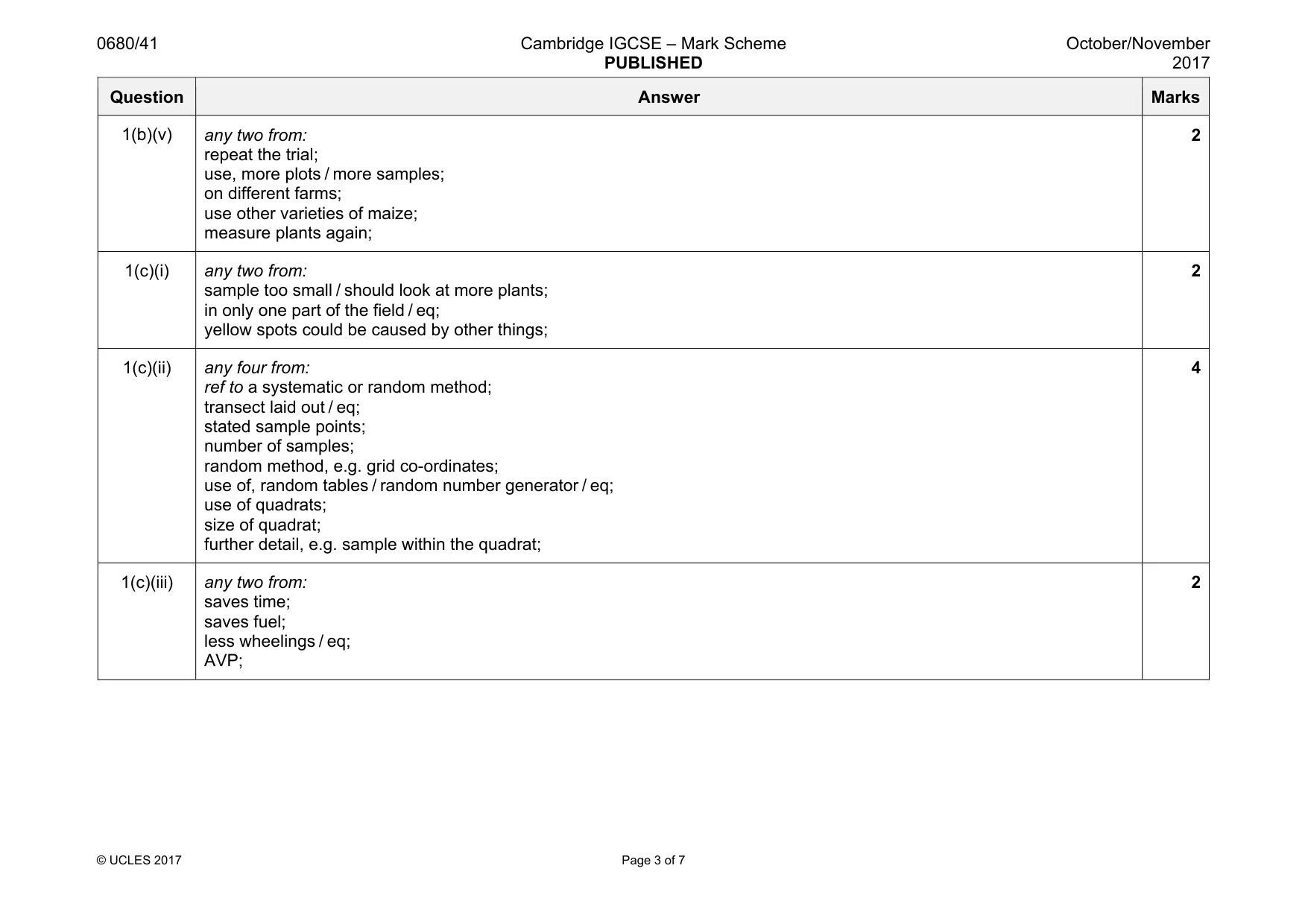
Mark scheme: 1(a)(i) 1 677 000; 1 1(a)(ii) 25.8(%);; (if answer incorrect, allow one mark for 1 677 000 ÷ 6.5 [1]); 2 1(a)(iii) Nashville, Memphis, Knoxville, Chattanooga; cities correctly paired with their population (659 000, 656 000, 185 000, 177 000); 2 1(b)(i) any two from: soil type; pH; planting density / number of plants / eq; size of plots; species / variety / type / strain / breed of maize; fertilizer; pesticide; water (schedule) / eq; AVP; 2 1(b)(ii) as a control experiment; to compare (with the other treatments); 2 1(b)(iii) any three from: plot A: plants / crops are shorter / smaller; shorter / smaller cobs; lower yield; differences calculated: 26 cm difference; 0.6 cm difference; 0.3 tonnes difference; 3 1(b)(iv) 6.8(%);; (if answer incorrect, allow one mark for 6.3 – 5.9 = 0.4 ( / 5.9) [1]); 2 Question Answer Marks 1(b)(v) any two from: repeat the trial; use, more plots / more samples; on different farms; use other varieties of maize; measure plants again; 2 1(c)(i) any two from: sample too small / should look at more plants; in only one part of the field / eq; yellow spots could be caused by other things; 2 1(c)(ii) any four from: ref to a systematic or random method; transect laid out / eq; stated sample points; number of samples; random method, e.g. grid co-ordinates; use of, random tables / random number generator / eq; use of quadrats; size of quadrat; further detail, e.g. sample within the quadrat; 4 1(c)(iii) any two from: saves time; saves fuel; less wheelings / eq; AVP; 2
Q2 · Tennessee has a green energy policy
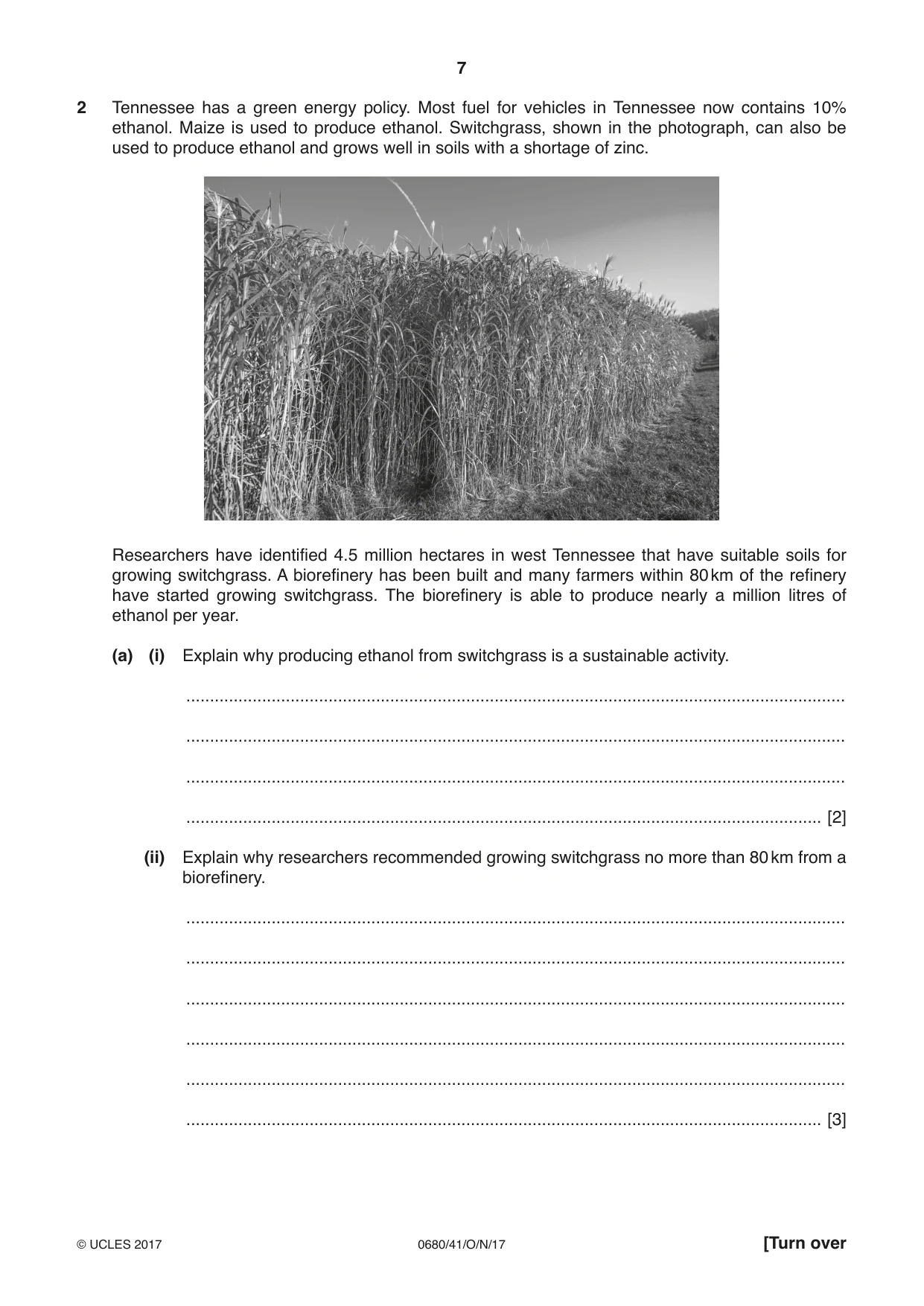
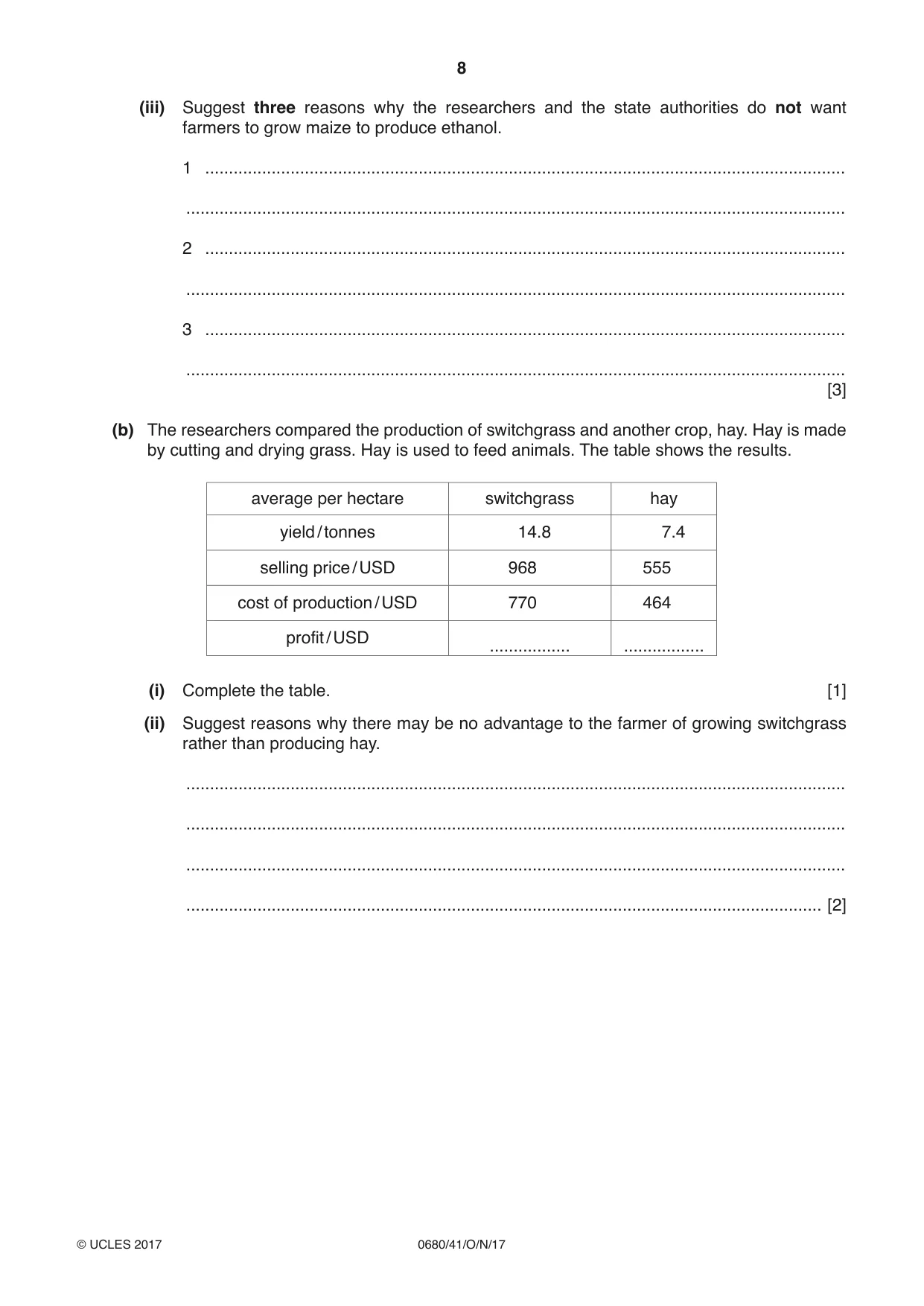
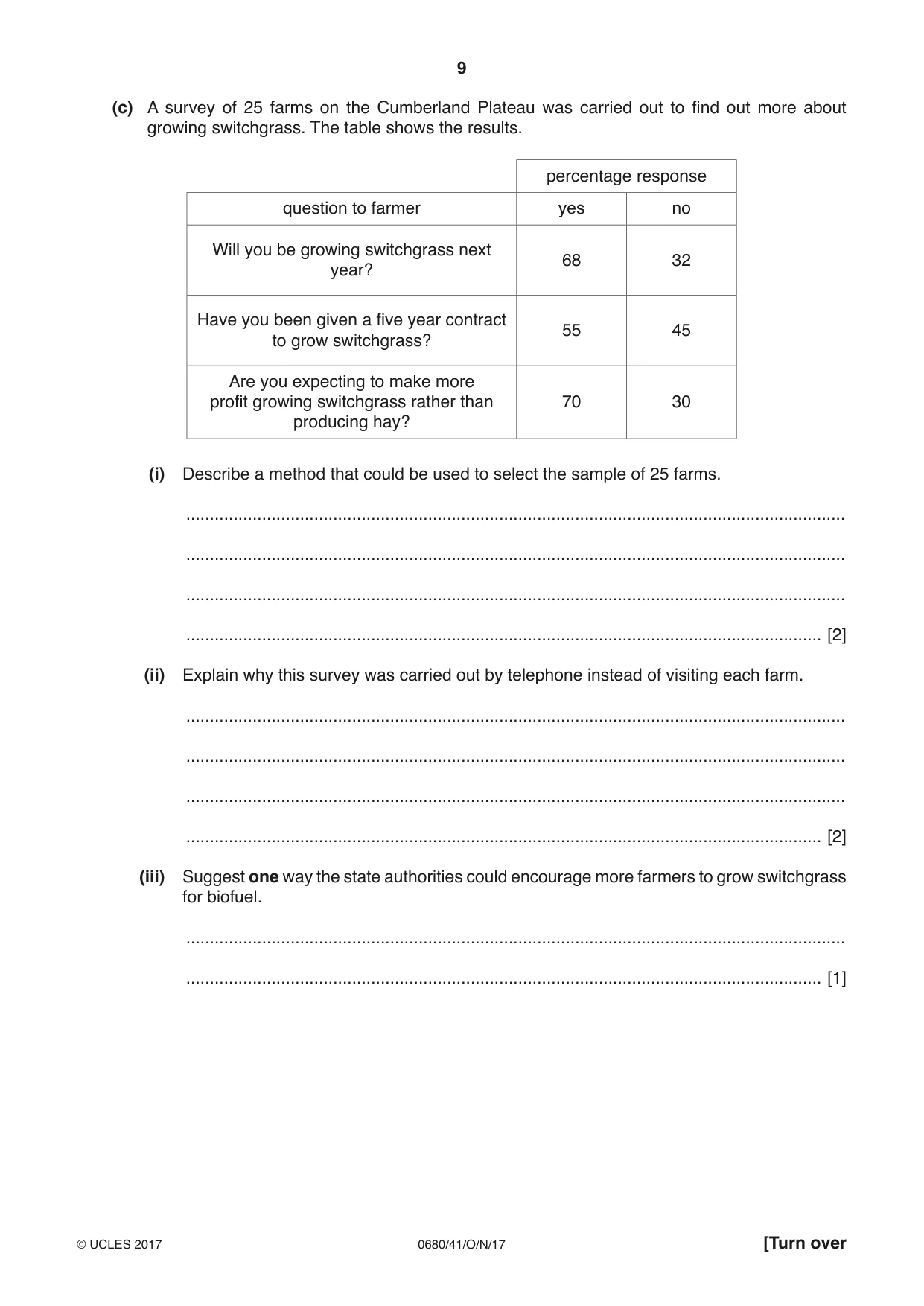
2 Tennessee has a green energy policy. Most fuel for vehicles in Tennessee now contains 10% ethanol. Maize is used to produce ethanol. Switchgrass, shown in the photograph, can also be used to produce ethanol and grows well in soils with a shortage of zinc. Researchers have identified 4.5 million hectares in west Tennessee that have suitable soils for growing switchgrass. A biorefinery has been built and many farmers within 80 km of the refinery have started growing switchgrass. The biorefinery is able to produce nearly a million litres of ethanol per year. (a) (i) Explain why producing ethanol from switchgrass is a sustainable activity. ........................................................................................................................................... ........................................................................................................................................... ........................................................................................................................................... ...................................................................................................................................... [2] (ii) Explain why researchers recommended growing switchgrass no more than 80 km from a biorefinery. ........................................................................................................................................... ........................................................................................................................................... ........................................................................................................................................... ........................................................................................................................................... ........................................................................................................................................... ...................................................................................................................................... [3] (iii) Suggest three reasons why the researchers and the state authorities do not want farmers to grow maize to produce ethanol. 1 ....................................................................................................................................... ........................................................................................................................................... 2 ....................................................................................................................................... ........................................................................................................................................... 3 ....................................................................................................................................... ........................................................................................................................................... [3] (b) The researchers compared the production of switchgrass and another crop, hay. Hay is made by cutting and drying grass. Hay is used to feed animals. The table shows the results. average per hectare switchgrass hay yield / tonnes 14.8 7.4 selling price / USD 968 555 cost of production / USD 770 464 profit / USD ................. ................. (i) Complete the table. [1] (ii) Suggest reasons why there may be no advantage to the farmer of growing switchgrass rather than producing hay. ........................................................................................................................................... ........................................................................................................................................... ........................................................................................................................................... ...................................................................................................................................... [2] (c) A survey of 25 farms on the Cumberland Plateau was carried out to find out more about growing switchgrass. The table shows the results. percentage response question to farmer yes no Will you be growing switchgrass next 68 32 year? Have you been given a five year contract 55 45 to grow switchgrass? Are you expecting to make more profit growing switchgrass rather than 70 30 producing hay? (i) Describe a method that could be used to select the sample of 25 farms. ........................................................................................................................................... ........................................................................................................................................... ........................................................................................................................................... ...................................................................................................................................... [2] (ii) Explain why this survey was carried out by telephone instead of visiting each farm. ........................................................................................................................................... ........................................................................................................................................... ........................................................................................................................................... ...................................................................................................................................... [2] (iii) Suggest one way the state authorities could encourage more farmers to grow switchgrass for biofuel. ........................................................................................................................................... ...................................................................................................................................... [1] (iv) Explain how an increased use of biofuel could help reduce the rise in global temperatures. ........................................................................................................................................... ........................................................................................................................................... ........................................................................................................................................... ........................................................................................................................................... ........................................................................................................................................... ...................................................................................................................................... [3]
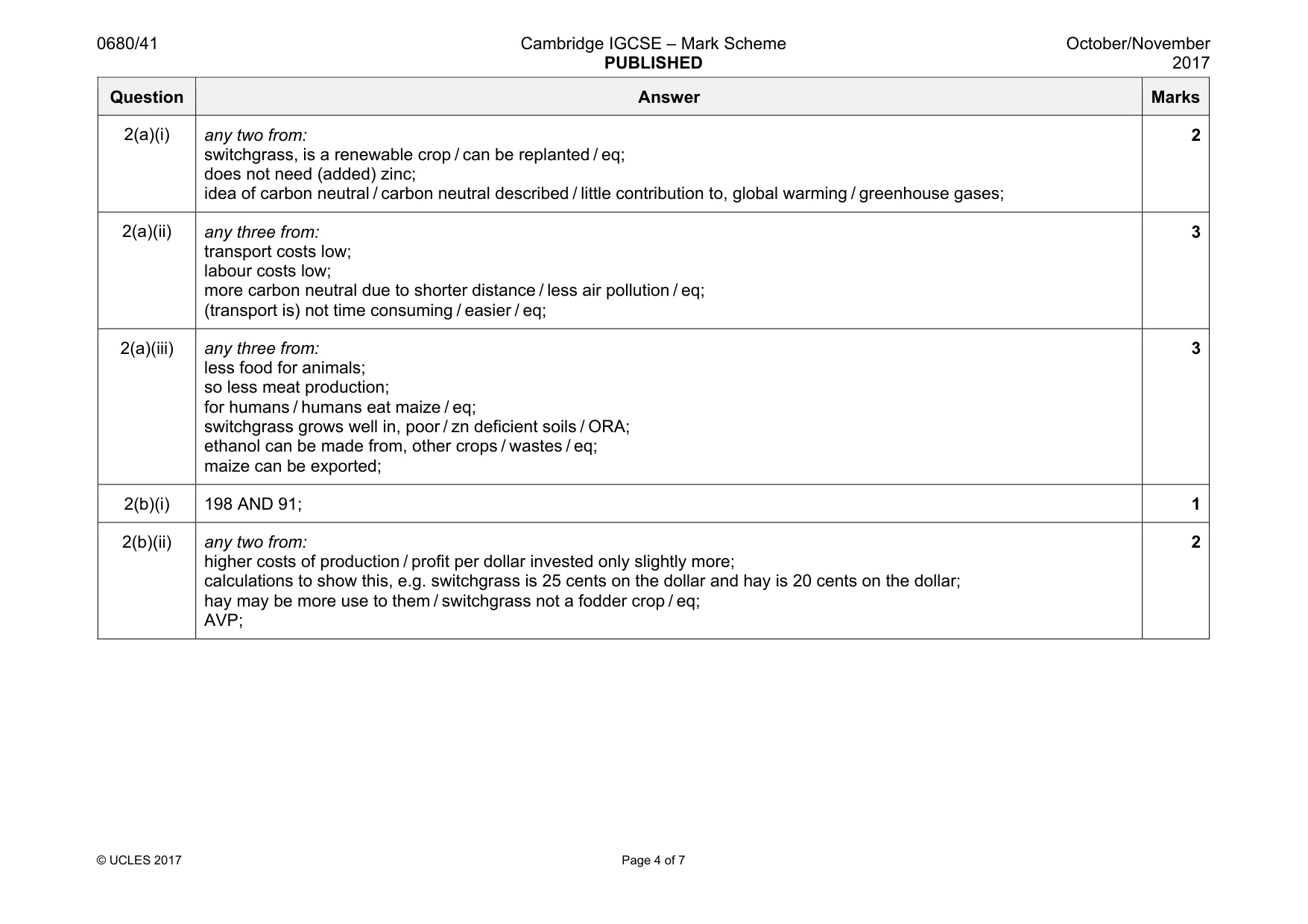
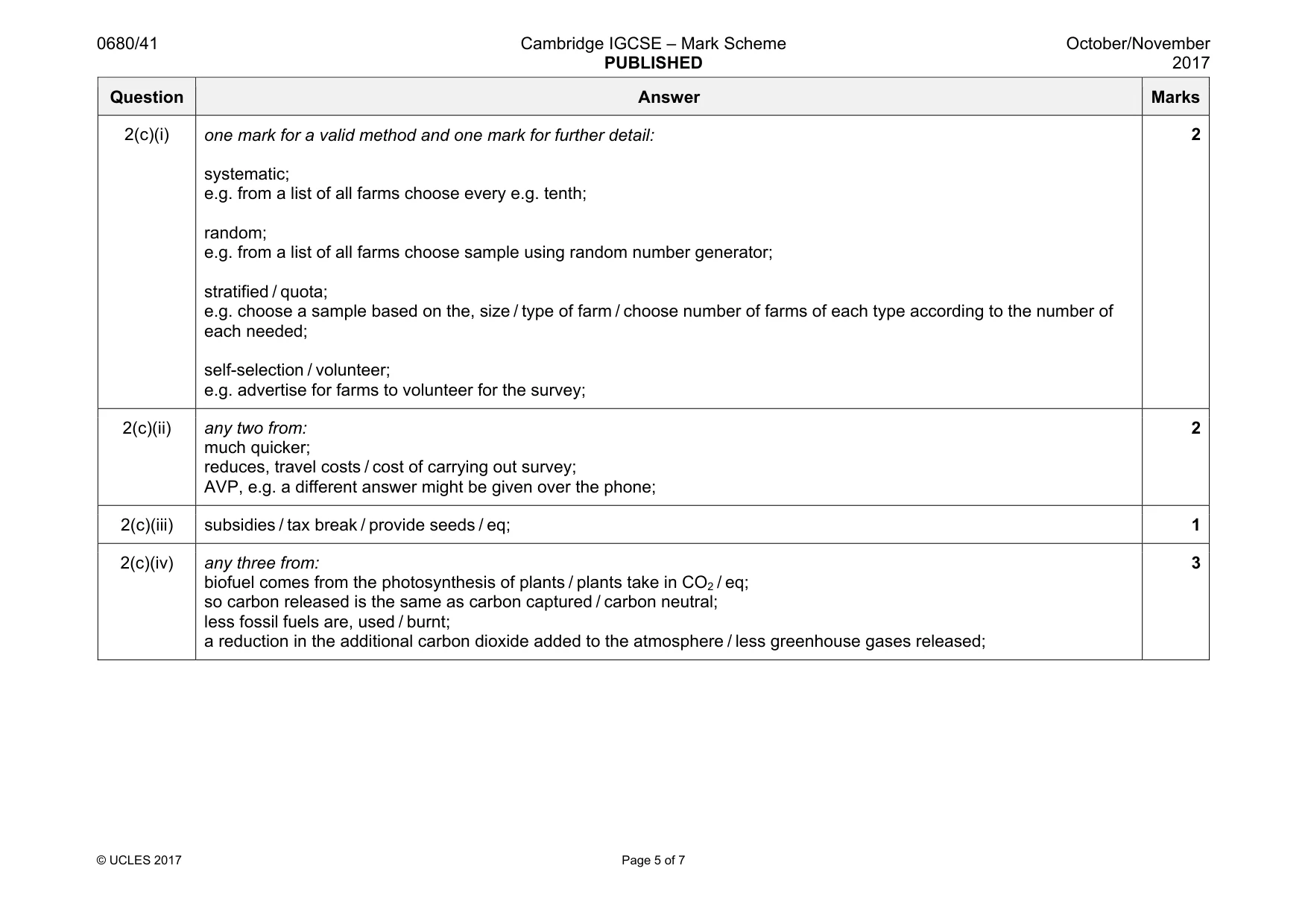
Mark scheme: 2(a)(i) any two from: switchgrass, is a renewable crop / can be replanted / eq; does not need (added) zinc; idea of carbon neutral / carbon neutral described / little contribution to, global warming / greenhouse gases; 2 2(a)(ii) any three from: transport costs low; labour costs low; more carbon neutral due to shorter distance / less air pollution / eq; (transport is) not time consuming / easier / eq; 3 2(a)(iii) any three from: less food for animals; so less meat production; for humans / humans eat maize / eq; switchgrass grows well in, poor / zn deficient soils / ORA; ethanol can be made from, other crops / wastes / eq; maize can be exported; 3 2(b)(i) 198 AND 91; 1 2(b)(ii) any two from: higher costs of production / profit per dollar invested only slightly more; calculations to show this, e.g. switchgrass is 25 cents on the dollar and hay is 20 cents on the dollar; hay may be more use to them / switchgrass not a fodder crop / eq; AVP; 2 Question Answer Marks 2(c)(i) one mark for a valid method and one mark for further detail: systematic; e.g. from a list of all farms choose every e.g. tenth; random; e.g. from a list of all farms choose sample using random number generator; stratified / quota; e.g. choose a sample based on the, size / type of farm / choose number of farms of each type according to the number of each needed; self-selection / volunteer; e.g. advertise for farms to volunteer for the survey; 2 2(c)(ii) any two from: much quicker; reduces, travel costs / cost of carrying out survey; AVP, e.g. a different answer might be given over the phone; 2 2(c)(iii) subsidies / tax break / provide seeds / eq; 1 2(c)(iv) any three from: biofuel comes from the photosynthesis of plants / plants take in CO2 / eq; so carbon released is the same as carbon captured / carbon neutral; less fossil fuels are, used / burnt; a reduction in the additional carbon dioxide added to the atmosphere / less greenhouse gases released; 3
Q3 · Tennessee has deposits of zinc ore that have been extracted by small scale mines for many…
3 Tennessee has deposits of zinc ore that have been extracted by small scale mines for many years. These small mines have now been abandoned, leaving large waste piles that still release toxic chemicals. Some fields near an abandoned mine have low crop yields. A scientist took soil samples from these fields and found high concentrations of zinc. High concentrations of zinc are toxic to most bacteria in the soil. (a) Explain the role of bacteria in maintaining soil fertility. ................................................................................................................................................... ................................................................................................................................................... ................................................................................................................................................... ................................................................................................................................................... ................................................................................................................................................... .............................................................................................................................................. [3] (b) The scientist carried out a laboratory experiment to find out how zinc concentrations affected the growth of maize seedlings. Groups of seedlings were grown for 10 days in nutrient solutions containing different concentrations of zinc. After 10 days the scientist measured the length of all the roots. The table shows the results. zinc concentration average length of maize roots / parts per million, ppm / mm 0 45 20 38 40 31 60 25 80 19 100 11 (i) Plot a line graph of the results on the grid. [4] (ii) Describe the trend shown on your graph. ........................................................................................................................................... ...................................................................................................................................... [1] (iii) Determine the average length of maize roots grown in a nutrient solution containing zinc at a concentration of 50 ppm. Show on your graph how you determined this value. ................................................... mm [2] (iv) Suggest why farmers want crop plants that grow long roots. ........................................................................................................................................... ........................................................................................................................................... ........................................................................................................................................... ........................................................................................................................................... ........................................................................................................................................... ...................................................................................................................................... [3] (c) Describe how the land can be restored after mining has finished. ................................................................................................................................................... ................................................................................................................................................... ................................................................................................................................................... ................................................................................................................................................... ................................................................................................................................................... ................................................................................................................................................... ................................................................................................................................................... .............................................................................................................................................. [4]
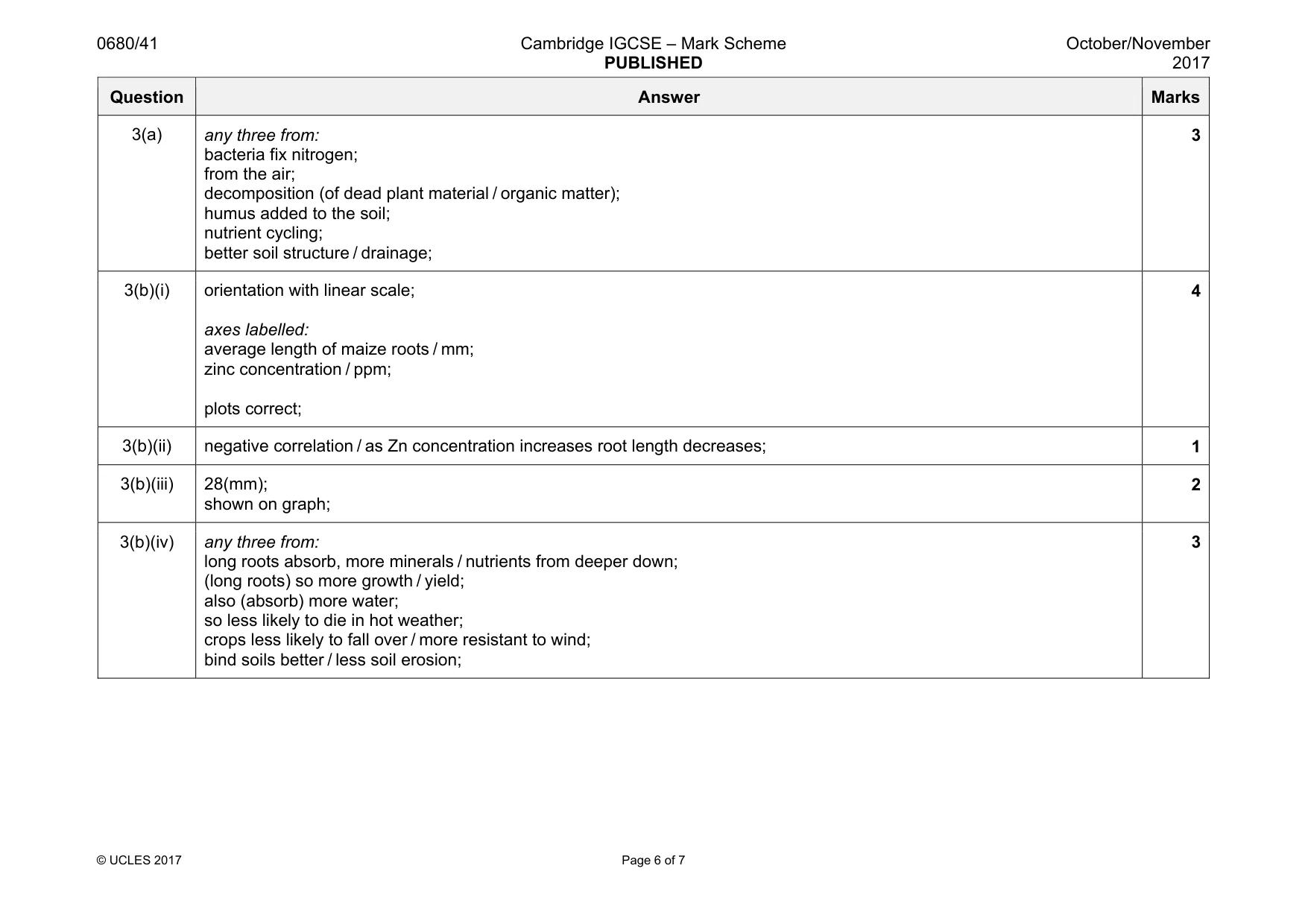
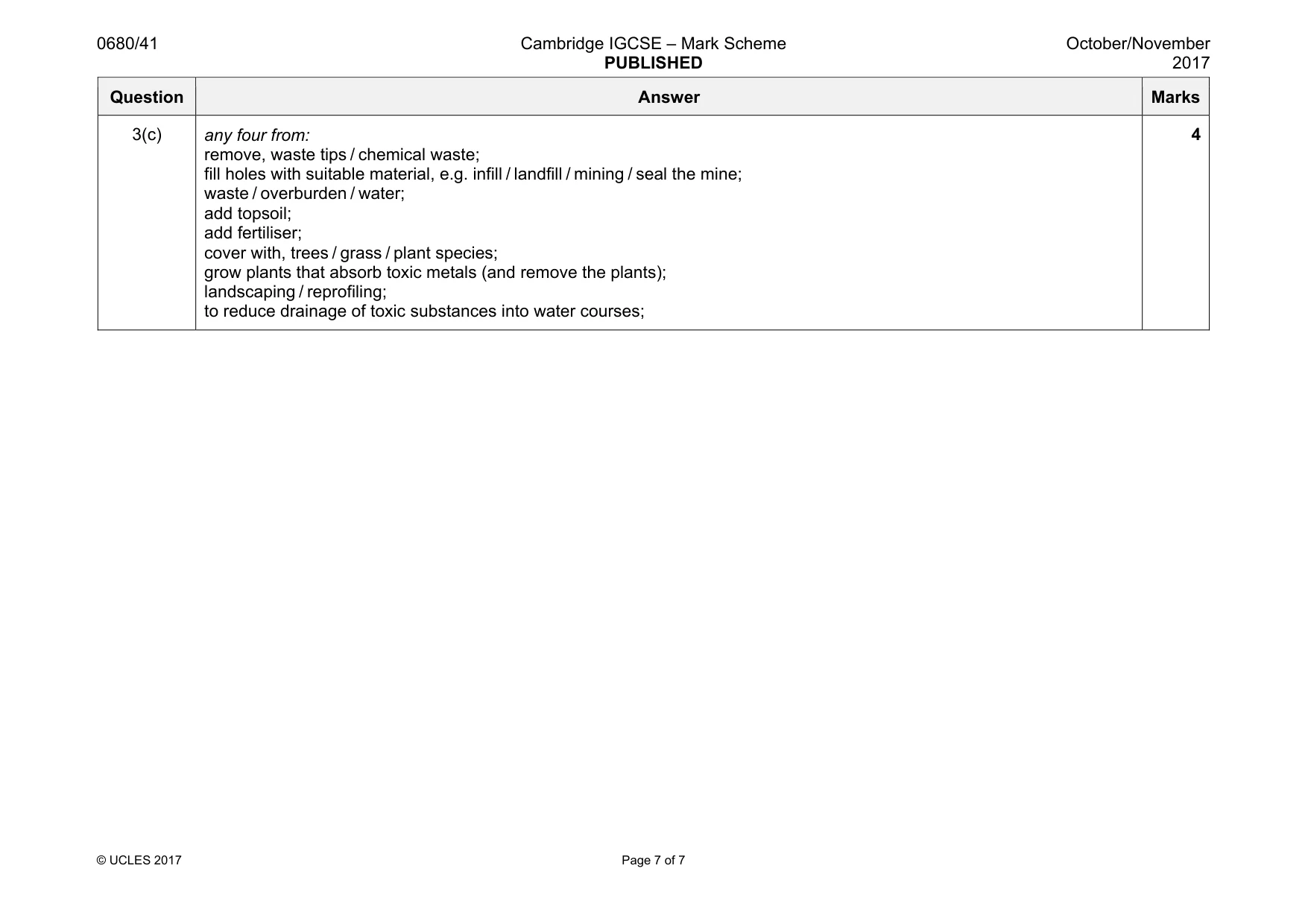
Mark scheme: 3(a) any three from: bacteria fix nitrogen; from the air; decomposition (of dead plant material / organic matter); humus added to the soil; nutrient cycling; better soil structure / drainage; 3 3(b)(i) orientation with linear scale; axes labelled: average length of maize roots / mm; zinc concentration / ppm; plots correct; 4 3(b)(ii) negative correlation / as Zn concentration increases root length decreases; 1 3(b)(iii) 28(mm); shown on graph; 2 3(b)(iv) any three from: long roots absorb, more minerals / nutrients from deeper down; (long roots) so more growth / yield; also (absorb) more water; so less likely to die in hot weather; crops less likely to fall over / more resistant to wind; bind soils better / less soil erosion; 3 Question Answer Marks 3(c) any four from: remove, waste tips / chemical waste; fill holes with suitable material, e.g. infill / landfill / mining / seal the mine; waste / overburden / water; add topsoil; add fertiliser; cover with, trees / grass / plant species; grow plants that absorb toxic metals (and remove the plants); landscaping / reprofiling; to reduce drainage of toxic substances into water courses; 4
What was in this paper
The subtopics covered by these 3 questions, and how many questions each got. Open one in a new tab to see every Cambridge question on it.
What you needed in this session
Cambridge’s own grade thresholds for 2017 Oct/Nov, Paper 4 · Variant 1. A higher threshold means an easier paper — the bar moves with how the cohort did.