Cambridge IGCSE Environmental Management 0680 — 2015 May/June Paper 4 · Variant 1
0680/41/M/J/15 · 60 marks · ≈68 min
The question paper and its mark scheme, free to read here and free to download. This is Cambridge’s own paper, exactly as it was sat.
Question paper20 pages
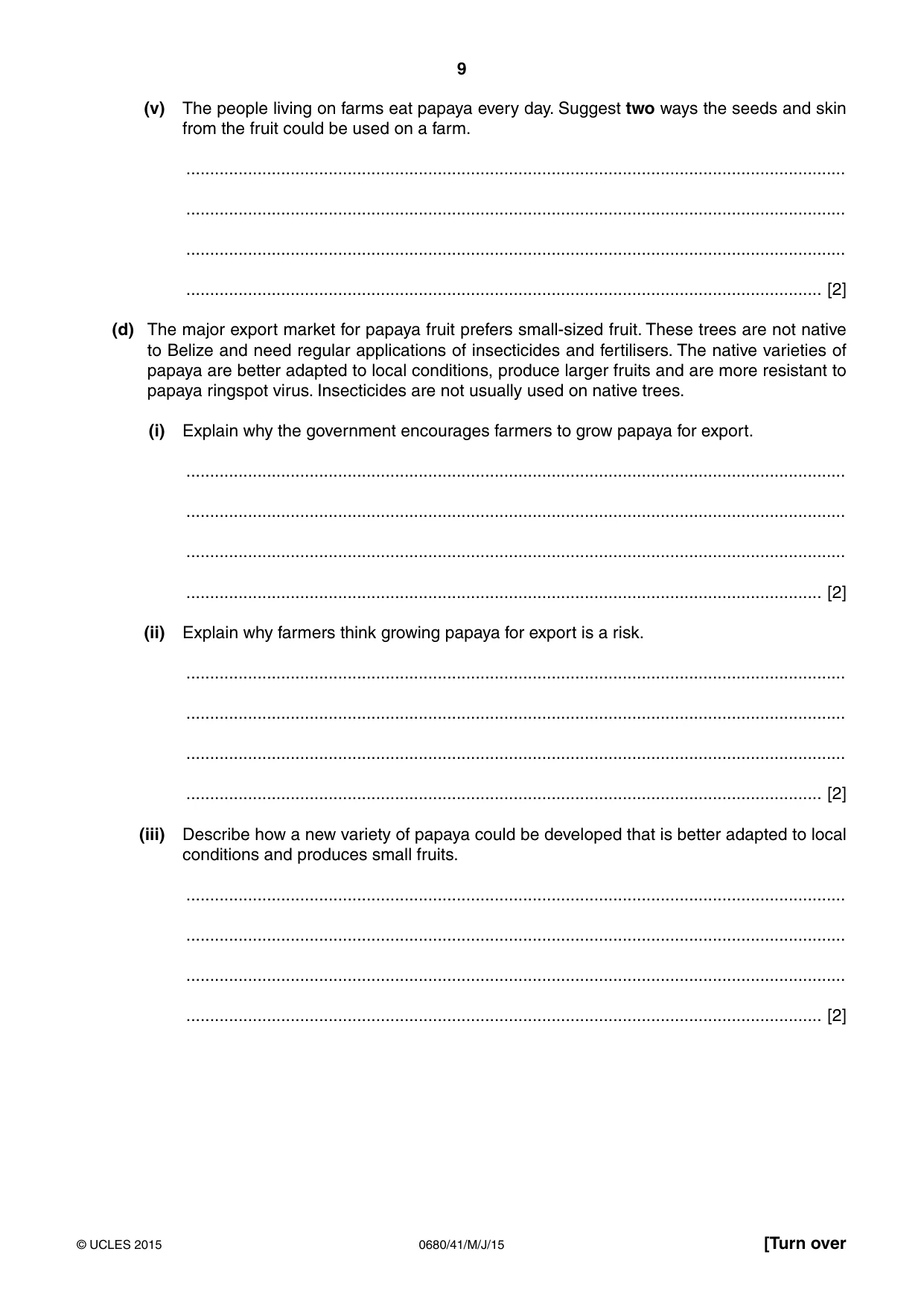
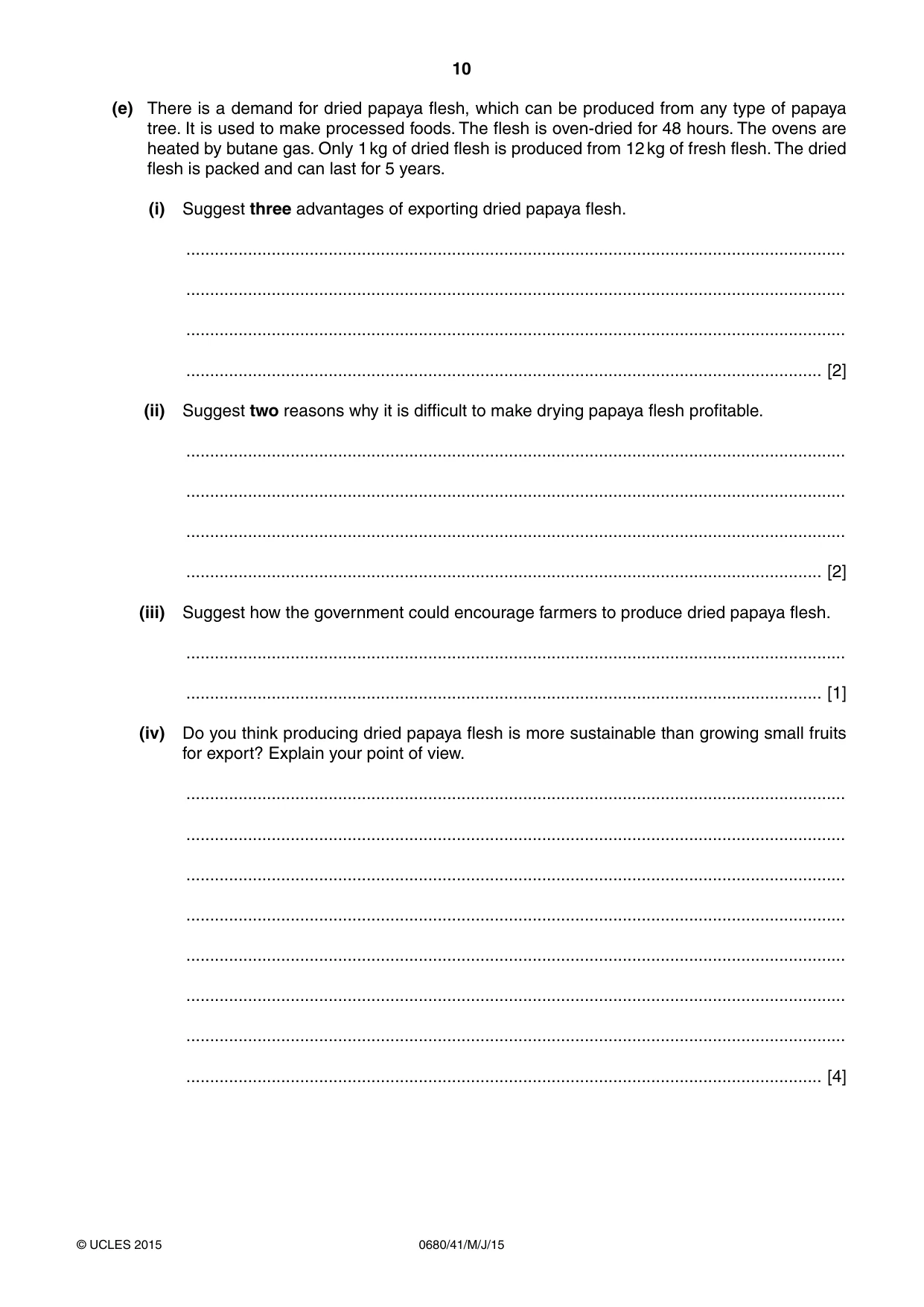

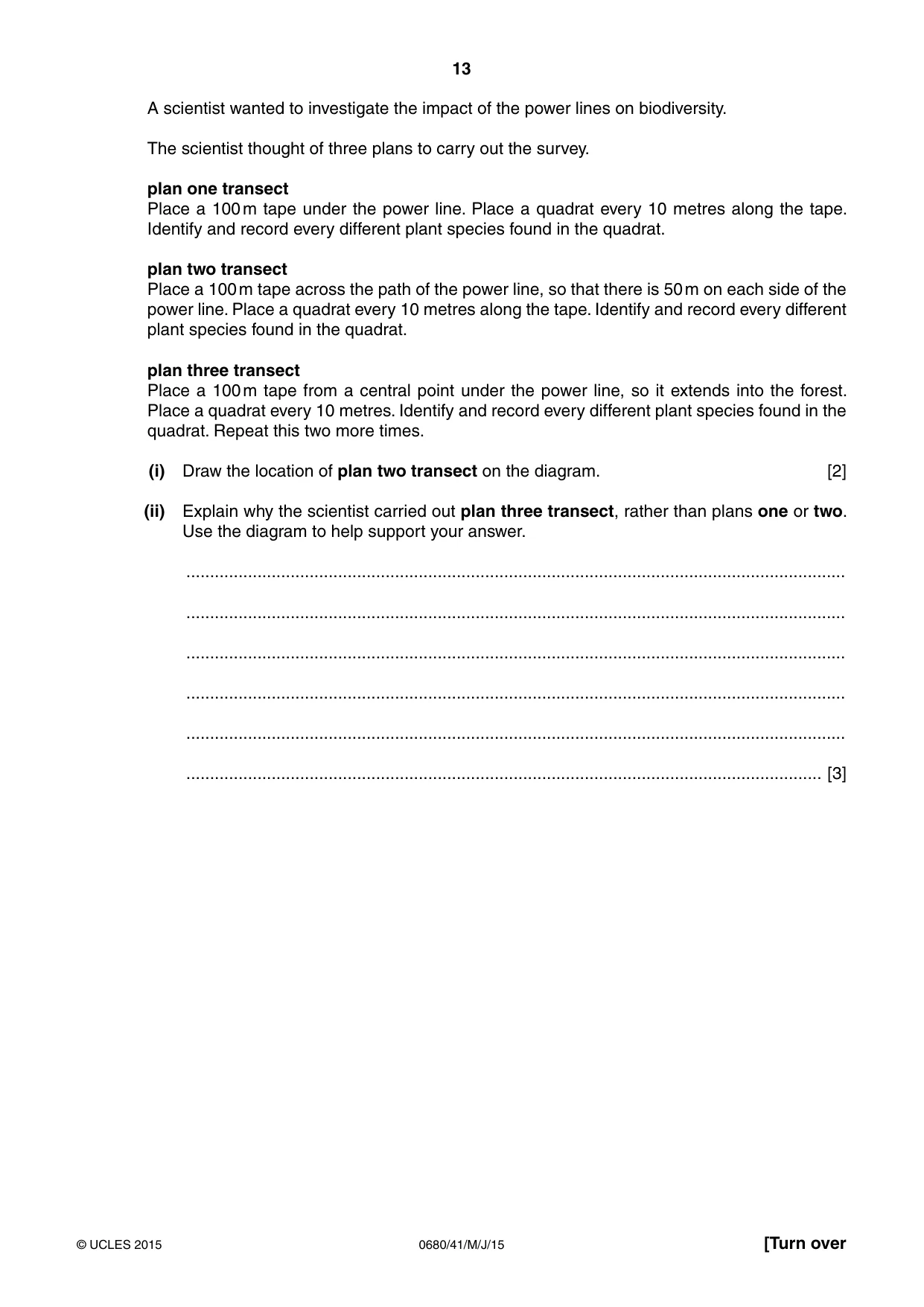





Mark scheme3 pages
Answers below. Sit the paper first if you are practising.
Paper as text
Question paper, page 1
This document consists of 17 printed pages and 3 blank pages. DC (NF/CGW) 92042/4 © UCLES 2015 [Turn over Cambridge International Examinations Cambridge International General Certificate of Secondary Education * 5 4 1 5 3 7 5 9 5 2 * ENVIRONMENTAL MANAGEMENT 0680/41 Alternative to Coursework May/June 2015 1 hour 30 minutes Candidates answer on the Question Paper. No Additional Materials are required. READ THESE INSTRUCTIONS FIRST Write your Centre number, candidate number and name on all the work you hand in. Write in dark blue or black pen. You may use an HB pencil for any diagrams or graphs. Do not use staples, paper clips, glue or correction fluid. DO NOT WRITE IN ANY BARCODES. Answer all questions. Electronic calculators may be used. You may lose marks if you do not show your working or if you do not use appropriate units. Study the appropriate source materials before you start to write your answers. Credit will be given for appropriate selection and use of data in your answers and for relevant interpretation of these data. Suggestions for data sources are given in some questions. You may use the source data to draw diagrams and graphs or to do calculations to illustrate your answers. At the end of the examination, fasten all your work securely together. The number of marks is given in brackets [ ] at the end of each question or part question.
Question paper, page 2
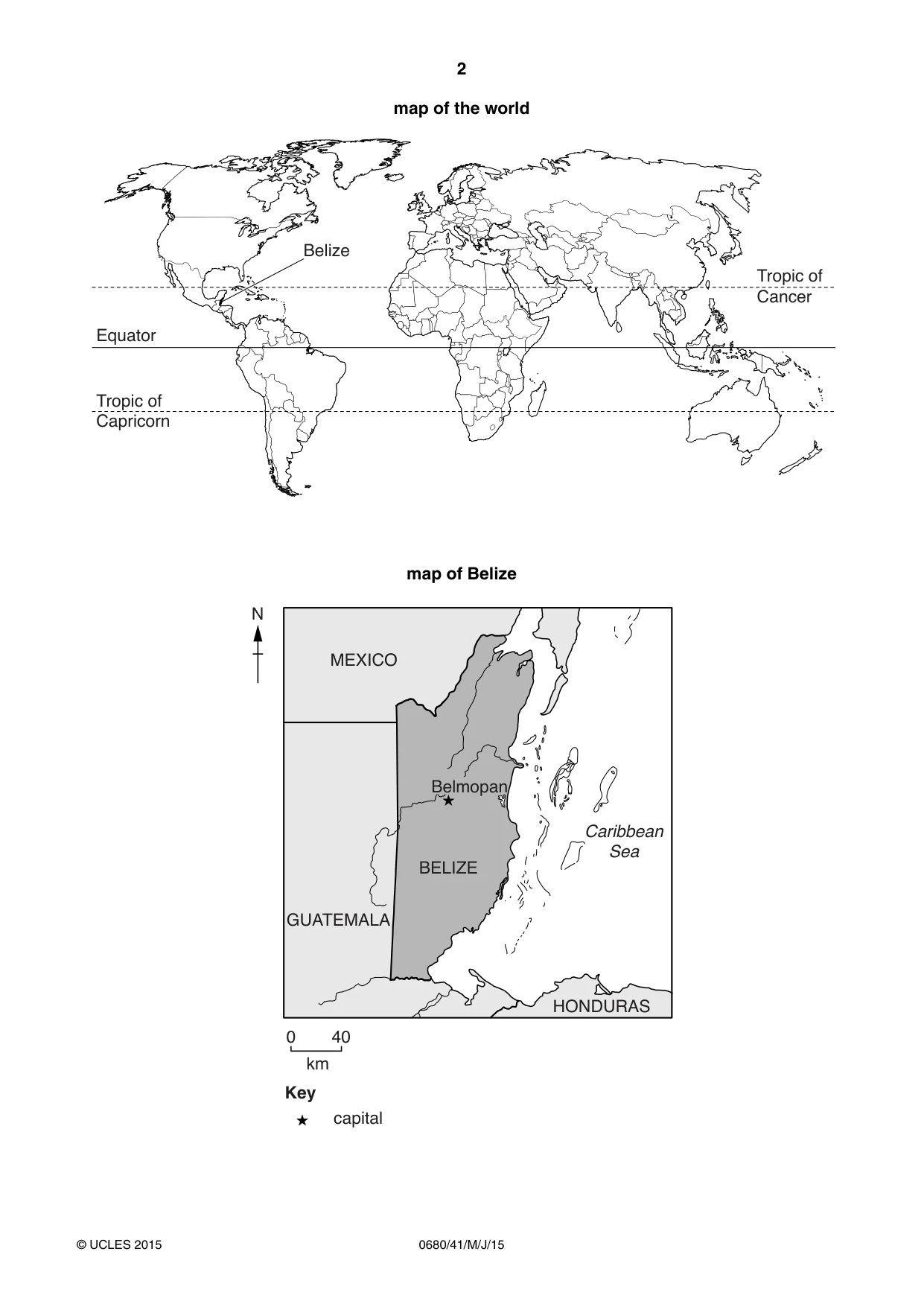
2 0680/41/M/J/15 © UCLES 2015 map of the world Equator Belize Tropic of Capricorn Tropic of Cancer map of Belize 0 km 40 MEXICO GUATEMALA BELIZE HONDURAS Belmopan Caribbean Sea capital Key N
Question paper, page 3
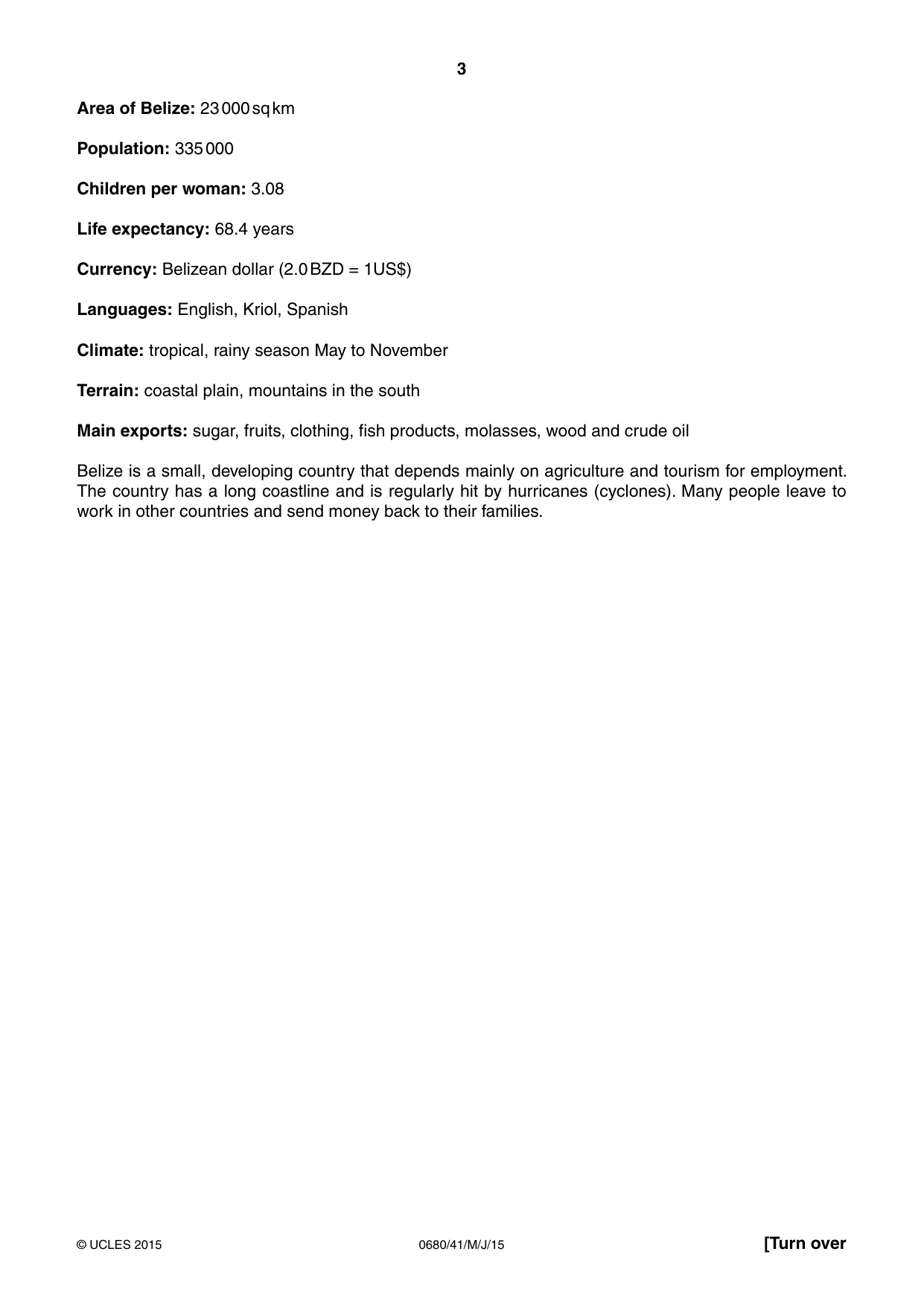
3 0680/41/M/J/15 © UCLES 2015 [Turn over Area of Belize: 23 000 sq km Population: 335 000 Children per woman: 3.08 Life expectancy: 68.4 years Currency: Belizean dollar (2.0 BZD = 1US$) Languages: English, Kriol, Spanish Climate: tropical, rainy season May to November Terrain: coastal plain, mountains in the south Main exports: sugar, fruits, clothing, fish products, molasses, wood and crude oil Belize is a small, developing country that depends mainly on agriculture and tourism for employment. The country has a long coastline and is regularly hit by hurricanes (cyclones). Many people leave to work in other countries and send money back to their families.
Question paper, page 4
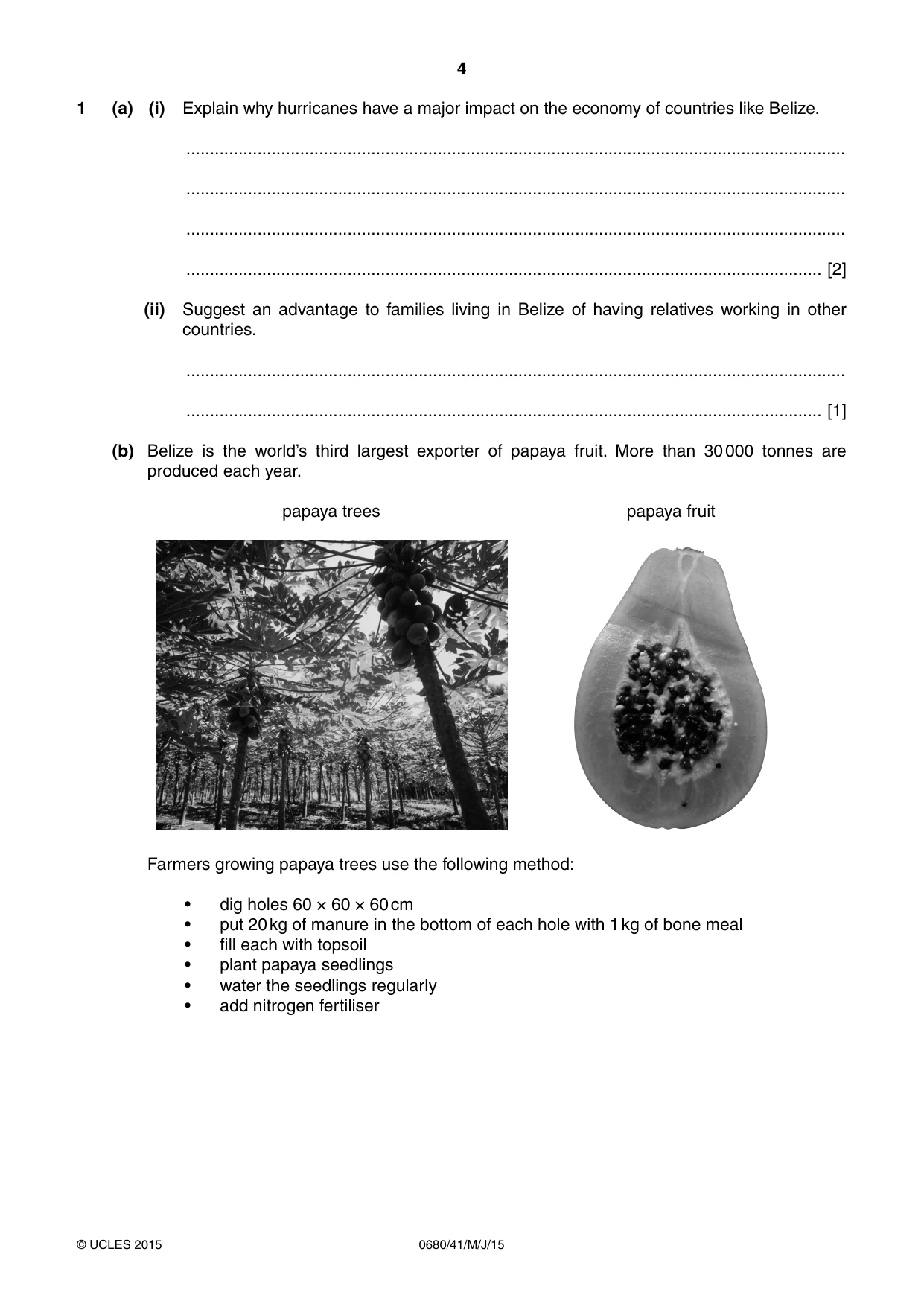
4 0680/41/M/J/15 © UCLES 2015 1 (a) (i) Explain why hurricanes have a major impact on the economy of countries like Belize. … … … … [2] (ii) Suggest an advantage to families living in Belize of having relatives working in other countries. … … [1] (b) Belize is the world’s third largest exporter of papaya fruit. More than 30 000 tonnes are produced each year. papaya trees papaya fruit Farmers growing papaya trees use the following method: • dig holes 60 × 60 × 60 cm • put 20 kg of manure in the bottom of each hole with 1 kg of bone meal • fill each with topsoil • plant papaya seedlings • water the seedlings regularly • add nitrogen fertiliser
Question paper, page 5
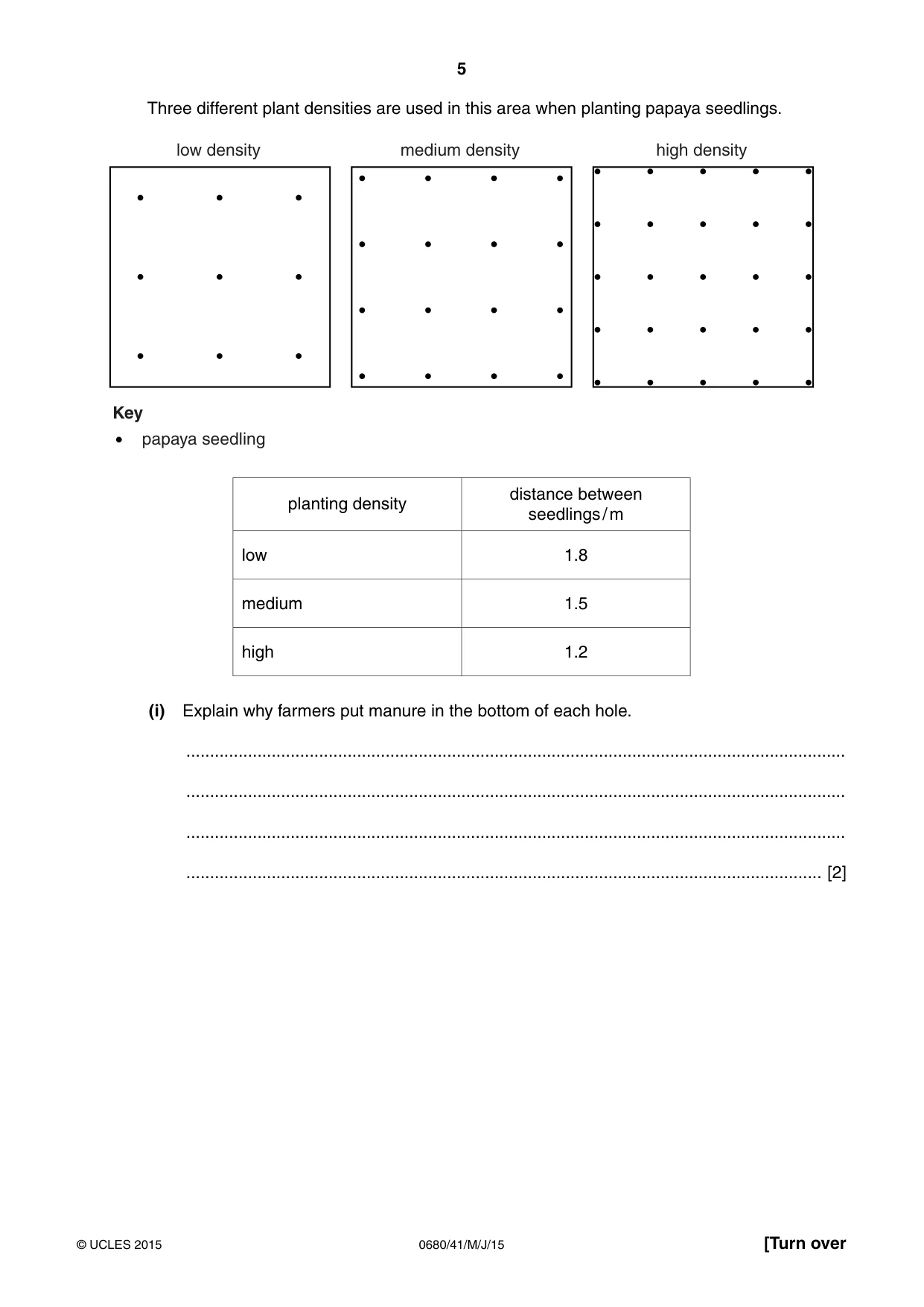
5 0680/41/M/J/15 © UCLES 2015 [Turn over Three different plant densities are used in this area when planting papaya seedlings. low density medium density high density Key papaya seedling planting density distance between seedlings / m low 1.8 medium 1.5 high 1.2 (i) Explain why farmers put manure in the bottom of each hole. … … … … [2]
Question paper, page 6
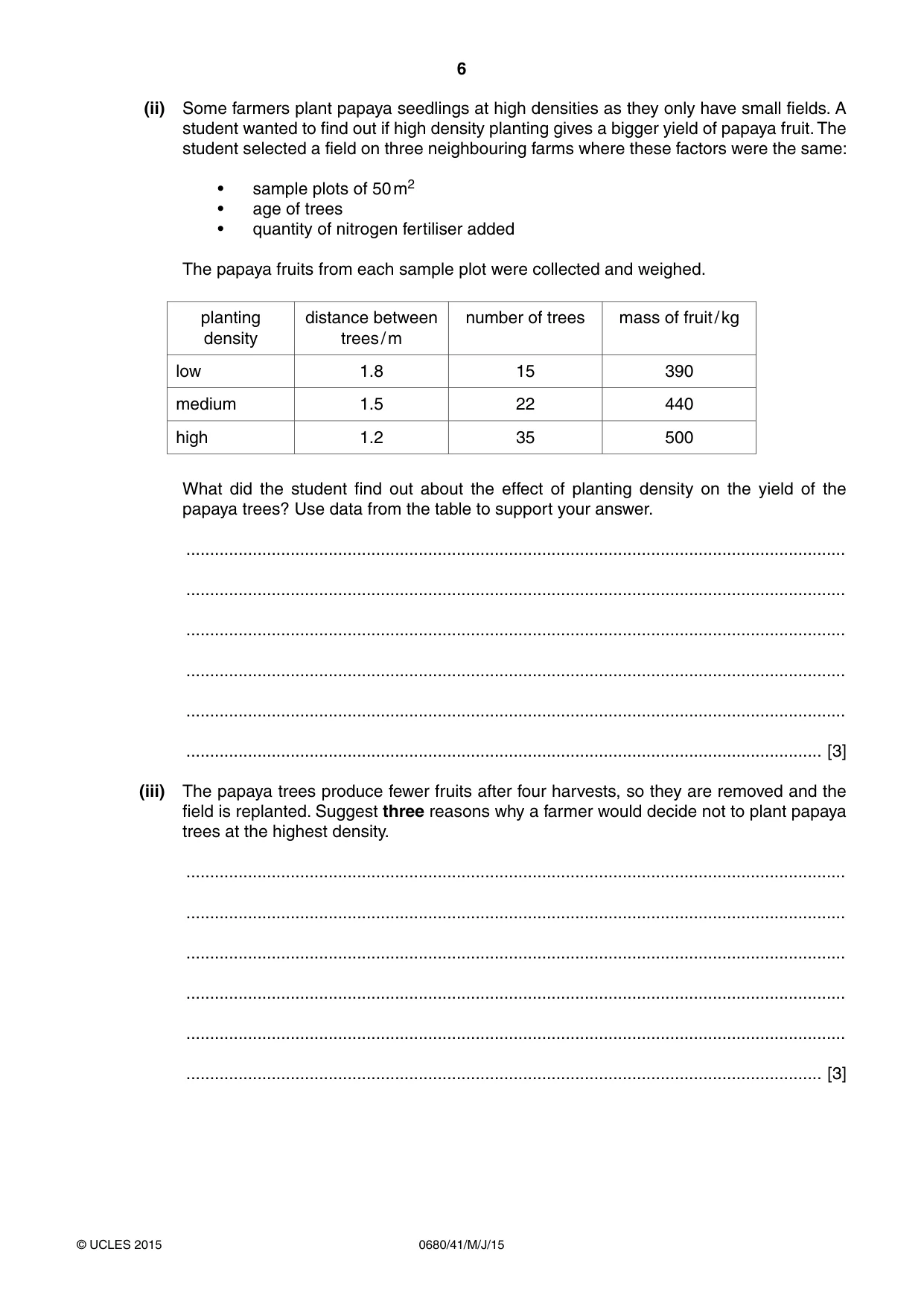
6 0680/41/M/J/15 © UCLES 2015 (ii) Some farmers plant papaya seedlings at high densities as they only have small fields. A student wanted to find out if high density planting gives a bigger yield of papaya fruit. The student selected a field on three neighbouring farms where these factors were the same: • sample plots of 50 m2 • age of trees • quantity of nitrogen fertiliser added The papaya fruits from each sample plot were collected and weighed. planting density distance between trees / m number of trees mass of fruit / kg low 1.8 15 390 medium 1.5 22 440 high 1.2 35 500 What did the student find out about the effect of planting density on the yield of the papaya trees? Use data from the table to support your answer. … … … … … … [3] (iii) The papaya trees produce fewer fruits after four harvests, so they are removed and the field is replanted. Suggest three reasons why a farmer would decide not to plant papaya trees at the highest density. … … … … … … [3]
Question paper, page 7
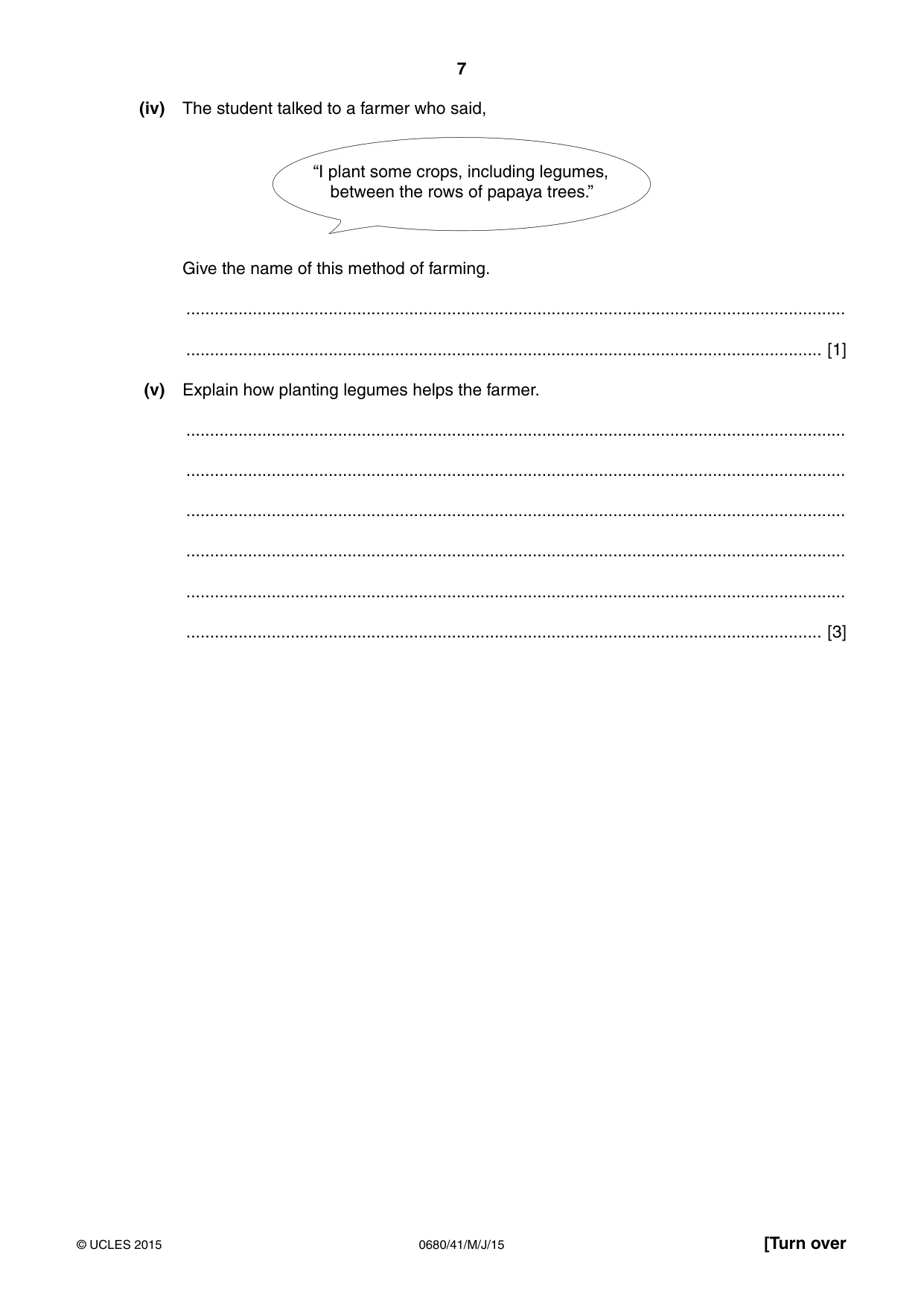
7 0680/41/M/J/15 © UCLES 2015 [Turn over (iv) The student talked to a farmer who said, “I plant some crops, including legumes, between the rows of papaya trees.” Give the name of this method of farming. … … [1] (v) Explain how planting legumes helps the farmer. … … … … … … [3]
Question paper, page 8
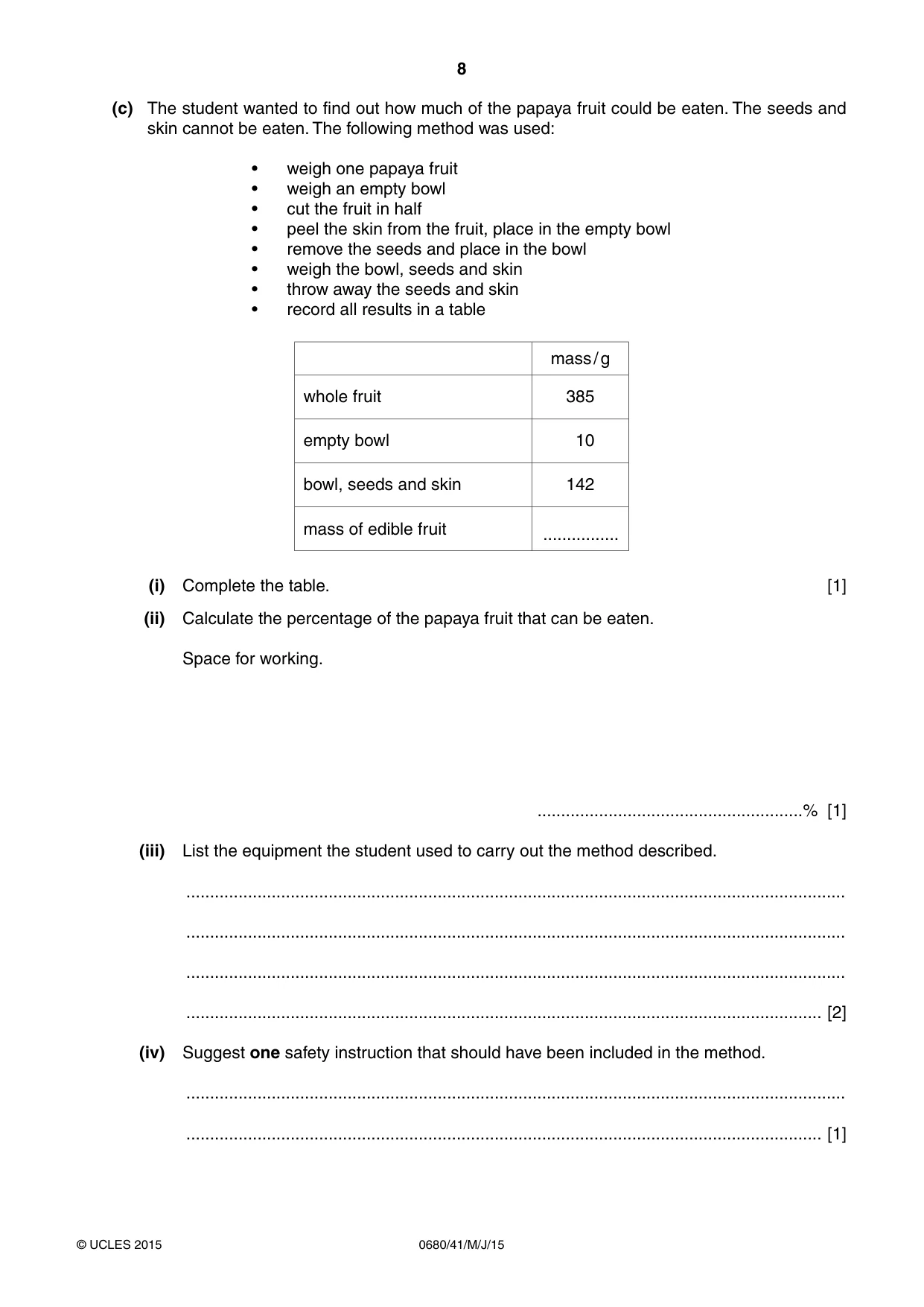
8 0680/41/M/J/15 © UCLES 2015 (c) The student wanted to find out how much of the papaya fruit could be eaten. The seeds and skin cannot be eaten. The following method was used: • weigh one papaya fruit • weigh an empty bowl • cut the fruit in half • peel the skin from the fruit, place in the empty bowl • remove the seeds and place in the bowl • weigh the bowl, seeds and skin • throw away the seeds and skin • record all results in a table mass / g whole fruit 385 empty bowl 10 bowl, seeds and skin 142 mass of edible fruit … (i) Complete the table. [1] (ii) Calculate the percentage of the papaya fruit that can be eaten. Space for working. …% [1] (iii) List the equipment the student used to carry out the method described. … … … … [2] (iv) Suggest one safety instruction that should have been included in the method. … … [1]
Question paper, page 9
9 0680/41/M/J/15 © UCLES 2015 [Turn over (v) The people living on farms eat papaya every day. Suggest two ways the seeds and skin from the fruit could be used on a farm. … … … … [2] (d) The major export market for papaya fruit prefers small-sized fruit. These trees are not native to Belize and need regular applications of insecticides and fertilisers. The native varieties of papaya are better adapted to local conditions, produce larger fruits and are more resistant to papaya ringspot virus. Insecticides are not usually used on native trees. (i) Explain why the government encourages farmers to grow papaya for export. … … … … [2] (ii) Explain why farmers think growing papaya for export is a risk. … … … … [2] (iii) Describe how a new variety of papaya could be developed that is better adapted to local conditions and produces small fruits. … … … … [2]
Question paper, page 10
10 0680/41/M/J/15 © UCLES 2015 (e) There is a demand for dried papaya flesh, which can be produced from any type of papaya tree. It is used to make processed foods. The flesh is oven-dried for 48 hours. The ovens are heated by butane gas. Only 1 kg of dried flesh is produced from 12 kg of fresh flesh. The dried flesh is packed and can last for 5 years. (i) Suggest three advantages of exporting dried papaya flesh. … … … … [2] (ii) Suggest two reasons why it is difficult to make drying papaya flesh profitable. … … … … [2] (iii) Suggest how the government could encourage farmers to produce dried papaya flesh. … … [1] (iv) Do you think producing dried papaya flesh is more sustainable than growing small fruits for export? Explain your point of view. … … … … … … … … [4]
Question paper, page 11
11 0680/41/M/J/15 © UCLES 2015 [Turn over TURN OVER FOR QUESTION 2
Question paper, page 12
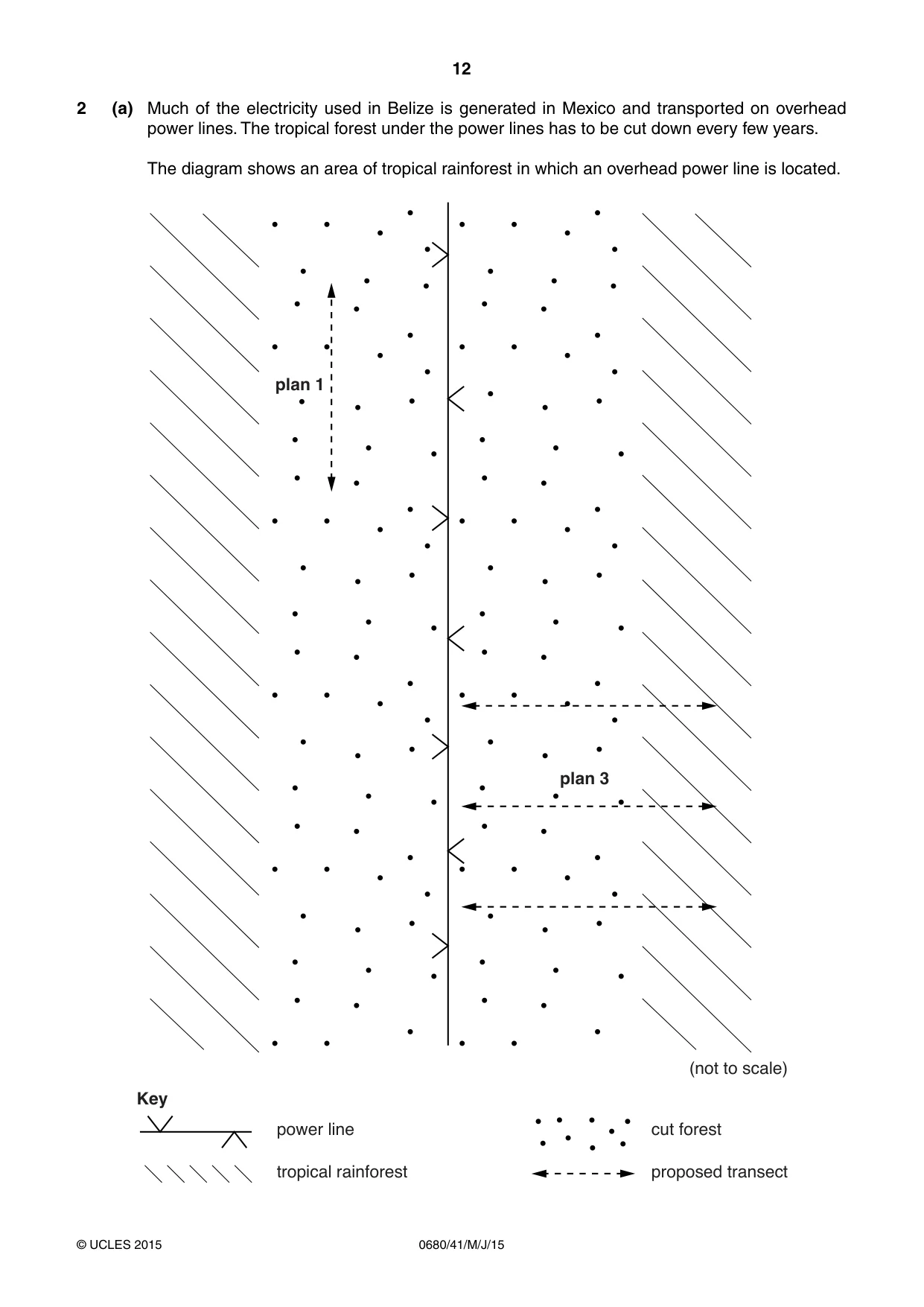
12 0680/41/M/J/15 © UCLES 2015 2 (a) Much of the electricity used in Belize is generated in Mexico and transported on overhead power lines. The tropical forest under the power lines has to be cut down every few years. The diagram shows an area of tropical rainforest in which an overhead power line is located. (not to scale) power line tropical rainforest cut forest plan 1 plan 3 proposed transect Key
Question paper, page 13
13 0680/41/M/J/15 © UCLES 2015 [Turn over A scientist wanted to investigate the impact of the power lines on biodiversity. The scientist thought of three plans to carry out the survey. plan one transect Place a 100 m tape under the power line. Place a quadrat every 10 metres along the tape. Identify and record every different plant species found in the quadrat. plan two transect Place a 100 m tape across the path of the power line, so that there is 50 m on each side of the power line. Place a quadrat every 10 metres along the tape. Identify and record every different plant species found in the quadrat. plan three transect Place a 100 m tape from a central point under the power line, so it extends into the forest. Place a quadrat every 10 metres. Identify and record every different plant species found in the quadrat. Repeat this two more times. (i) Draw the location of plan two transect on the diagram. [2] (ii) Explain why the scientist carried out plan three transect, rather than plans one or two. Use the diagram to help support your answer. … … … … … … [3]
Question paper, page 14
14 0680/41/M/J/15 © UCLES 2015 (iii) The results of plan three are shown in the table. distance from power line / m 0 10 20 30 40 50 60 70 80 90 100 average number of plant species 10 16 15 17 20 19 14 12 11 10 11 Plot the data as a graph on the grid below. [4] (iv) Describe the pattern shown by the data. … … … … [2]
Question paper, page 15
15 0680/41/M/J/15 © UCLES 2015 [Turn over Look at what two people said about biodiversity. Person A said, “Cutting down the forest under power lines is reducing the biodiversity and destroying animal habitats.” Person B said, “Cutting down the forest does not reduce the biodiversity or destroy animal habitats.” (v) Which statement about biodiversity do you agree with? Support your answer using data from the table and graph. … … … … [2] (vi) Suggest three ways in which the scientist could find out more about the biodiversity under power lines. … … … … … … [3]
Question paper, page 16
16 0680/41/M/J/15 © UCLES 2015 (b) The government proposed the Chalillo HEP (hydro-electric power) dam project to generate some of the electricity used in Belize. Although many people did not want the project to go ahead, it was completed in 2005. Chalillo dam (i) The government argued that the project is an example of sustainable development. Describe the arguments the government could have used to support this view. … … … … … … [3] (ii) An objector to the dam project said, “Now the dam is built, our electricity will cost more. Our national symbol, the scarlet macaw, is locally extinct and the Macal river is polluted.” Suggest why the electricity will cost more after the dam is built. … … [1] (iii) Do you think the scarlet macaw should have been saved from local extinction rather than building the dam? Explain your point of view. … … … … [2]
Question paper, page 17
17 0680/41/M/J/15 © UCLES 2015 (iv) Engineers predict that by 2045 the Chalillo dam will generate less electricity than its original output. Explain why this will happen. … … [1]
Question paper, page 18
18 0680/41/M/J/15 © UCLES 2015 BLANK PAGE
Question paper, page 19
19 0680/41/M/J/15 © UCLES 2015 BLANK PAGE
Question paper, page 20
20 0680/41/M/J/15 © UCLES 2015 BLANK PAGE Permission to reproduce items where third-party owned material protected by copyright is included has been sought and cleared where possible. Every reasonable effort has been made by the publisher (UCLES) to trace copyright holders, but if any items requiring clearance have unwittingly been included, the publisher will be pleased to make amends at the earliest possible opportunity. To avoid the issue of disclosure of answer-related information to candidates, all copyright acknowledgements are reproduced online in the Cambridge International Examinations Copyright Acknowledgements Booklet. This is produced for each series of examinations and is freely available to download at www.cie.org.uk after the live examination series. Cambridge International Examinations is part of the Cambridge Assessment Group. Cambridge Assessment is the brand name of University of Cambridge Local Examinations Syndicate (UCLES), which is itself a department of the University of Cambridge.
Mark scheme, page 1
® IGCSE is the registered trademark of Cambridge International Examinations. CAMBRIDGE INTERNATIONAL EXAMINATIONS Cambridge International General Certificate of Secondary Education MARK SCHEME for the May/June 2015 series 0680 ENVIRONMENTAL MANAGEMENT 0680/41 Paper 4 (Alternative to Coursework), maximum raw mark 60 This mark scheme is published as an aid to teachers and candidates, to indicate the requirements of the examination. It shows the basis on which Examiners were instructed to award marks. It does not indicate the details of the discussions that took place at an Examiners’ meeting before marking began, which would have considered the acceptability of alternative answers. Mark schemes should be read in conjunction with the question paper and the Principal Examiner Report for Teachers. Cambridge will not enter into discussions about these mark schemes. Cambridge is publishing the mark schemes for the May/June 2015 series for most Cambridge IGCSE®, Cambridge International A and AS Level components and some Cambridge O Level components.
Mark scheme, page 2
Page 2 Mark Scheme Syllabus Paper Cambridge IGCSE – May/June 2015 0680 41 © Cambridge International Examinations 2015 1 (a) (i) damage to, crops; infrastructure; buildings; roads; communications; loss of products; unemployment; inability to trade e.g. tourism; AVP; such as too sick to work; [2] (ii) money sent back / e.g.; high costs of repair / recovery; [1] (b) (i) provides fertiliser / nutrients / minerals / named mineral; for (plant) growth; rapid root development; manure retains water / eq.; [2] (ii) increased density increases yield; increased yield decreases yield per tree; only by a small amount; doubling the number of trees does not double yield / eq.; use of figures to support any point; [3] (iii) high cost of labour; for digging holes; cost of manure / bone meal; cost of extra seeds / seedlings / trees; loss of soil quality; extra investment only gives small increase in yield; [3] (iv) intercropping / agroforestry / intensive; [1] (v) nitrogen fixed (from the air); so more (nitrogen for crop) growth; more crop to sell / eat; fodder for animals; increased fertility; [3] (c) (i) 253; [1] (ii) 253 / 385 = 65.7–66.0 (%); [1] (iii) knife or spoon / scales / bowl / notebook and pen; Four for two marks. Three or two for one mark. [2] (iv) care with knife / gloves to handle seed / wash hands; [1] (v) use seeds for new planting; composted (to make fertiliser); animal feed; [2] (d) (i) foreign currency helps balance of payments / eq.; more tax revenue; reduces poverty / improves standard of living; creates jobs / eq.; [2] (ii) high cost of fertiliser and / or insecticide; regular hurricanes could destroy crop; drop in world demand; risk of going bankrupt / eq.; [2] (iii) cross-breeding two varieties; selecting the offspring with desired characters; identify the allele / gene for large fruits; genetically engineer (a native variety); further detail of genetic engineering; ref. to grafting; [2] (e) (i) product lasts longer; can be exported all year round; exported when demand / prices high; lower transport costs; native plants need less care / eq.; makes use of native species; AVP; First point for one mark, two or three points for two marks. [2]
Mark scheme, page 3
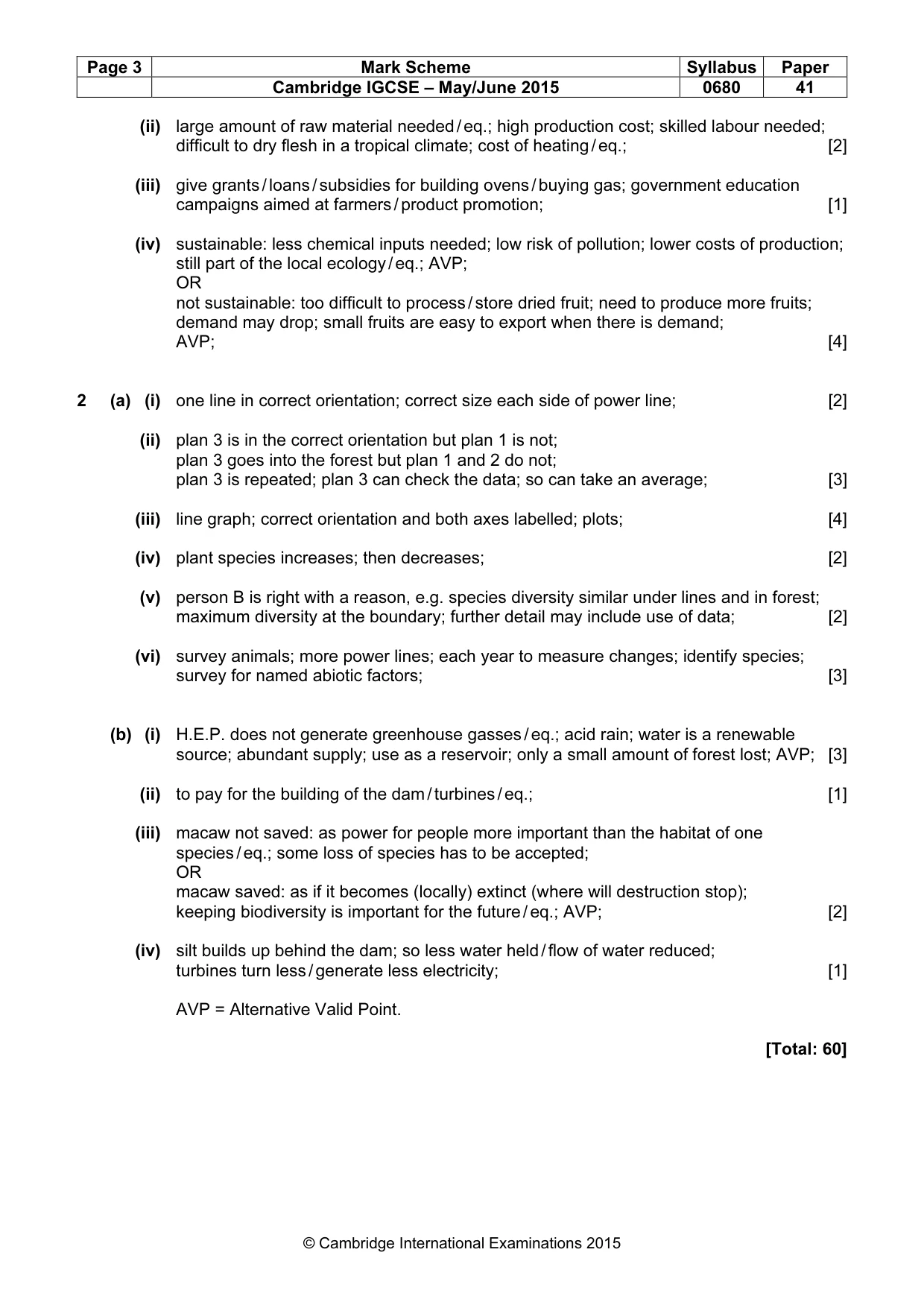
Page 3 Mark Scheme Syllabus Paper Cambridge IGCSE – May/June 2015 0680 41 © Cambridge International Examinations 2015 (ii) large amount of raw material needed / eq.; high production cost; skilled labour needed; difficult to dry flesh in a tropical climate; cost of heating / eq.; [2] (iii) give grants / loans / subsidies for building ovens / buying gas; government education campaigns aimed at farmers / product promotion; [1] (iv) sustainable: less chemical inputs needed; low risk of pollution; lower costs of production; still part of the local ecology / eq.; AVP; OR not sustainable: too difficult to process / store dried fruit; need to produce more fruits; demand may drop; small fruits are easy to export when there is demand; AVP; [4] 2 (a) (i) one line in correct orientation; correct size each side of power line; [2] (ii) plan 3 is in the correct orientation but plan 1 is not; plan 3 goes into the forest but plan 1 and 2 do not; plan 3 is repeated; plan 3 can check the data; so can take an average; [3] (iii) line graph; correct orientation and both axes labelled; plots; [4] (iv) plant species increases; then decreases; [2] (v) person B is right with a reason, e.g. species diversity similar under lines and in forest; maximum diversity at the boundary; further detail may include use of data; [2] (vi) survey animals; more power lines; each year to measure changes; identify species; survey for named abiotic factors; [3] (b) (i) H.E.P. does not generate greenhouse gasses / eq.; acid rain; water is a renewable source; abundant supply; use as a reservoir; only a small amount of forest lost; AVP; [3] (ii) to pay for the building of the dam / turbines / eq.; [1] (iii) macaw not saved: as power for people more important than the habitat of one species / eq.; some loss of species has to be accepted; OR macaw saved: as if it becomes (locally) extinct (where will destruction stop); keeping biodiversity is important for the future / eq.; AVP; [2] (iv) silt builds up behind the dam; so less water held / flow of water reduced; turbines turn less / generate less electricity; [1] AVP = Alternative Valid Point. [Total: 60]
What you needed in this session
Cambridge’s own grade thresholds for 2015 May/June, Paper 4 · Variant 1. A higher threshold means an easier paper — the bar moves with how the cohort did.