Cambridge IGCSE Environmental Management 0680 — 2016 Oct/Nov Paper 4 · Variant 3
0680/43/O/N/16 · 60 marks · ≈68 min
The question paper and its mark scheme, free to read here and free to download. This is Cambridge’s own paper, exactly as it was sat.
Question paper16 pages

Mark scheme5 pages
Answers below. Sit the paper first if you are practising.
Paper as text
Question paper, page 1
This document consists of 16 printed pages. DC (CW/SW) 114933/4 © UCLES 2016 [Turn over Cambridge International Examinations Cambridge International General Certificate of Secondary Education * 7 4 2 9 3 6 9 6 9 5 * ENVIRONMENTAL MANAGEMENT 0680/43 Paper 4 October/November 2016 1 hour 30 minutes Candidates answer on the Question Paper. No Additional Materials are required. READ THESE INSTRUCTIONS FIRST Write your Centre number, candidate number and name on all the work you hand in. Write in dark blue or black pen. You may use an HB pencil for any diagrams or graphs. Do not use staples, paper clips, glue or correction fluid. DO NOT WRITE IN ANY BARCODES. Answer all questions. Electronic calculators may be used. You may lose marks if you do not show your working or if you do not use appropriate units. Study the appropriate source materials before you start to write your answers. Credit will be given for appropriate selection and use of data in your answers and for relevant interpretation of these data. Suggestions for data sources are given in some questions. You may use the source data to draw diagrams and graphs or to do calculations to illustrate your answers. At the end of the examination, fasten all your work securely together. The number of marks is given in brackets [ ] at the end of each question or part question.
Question paper, page 2
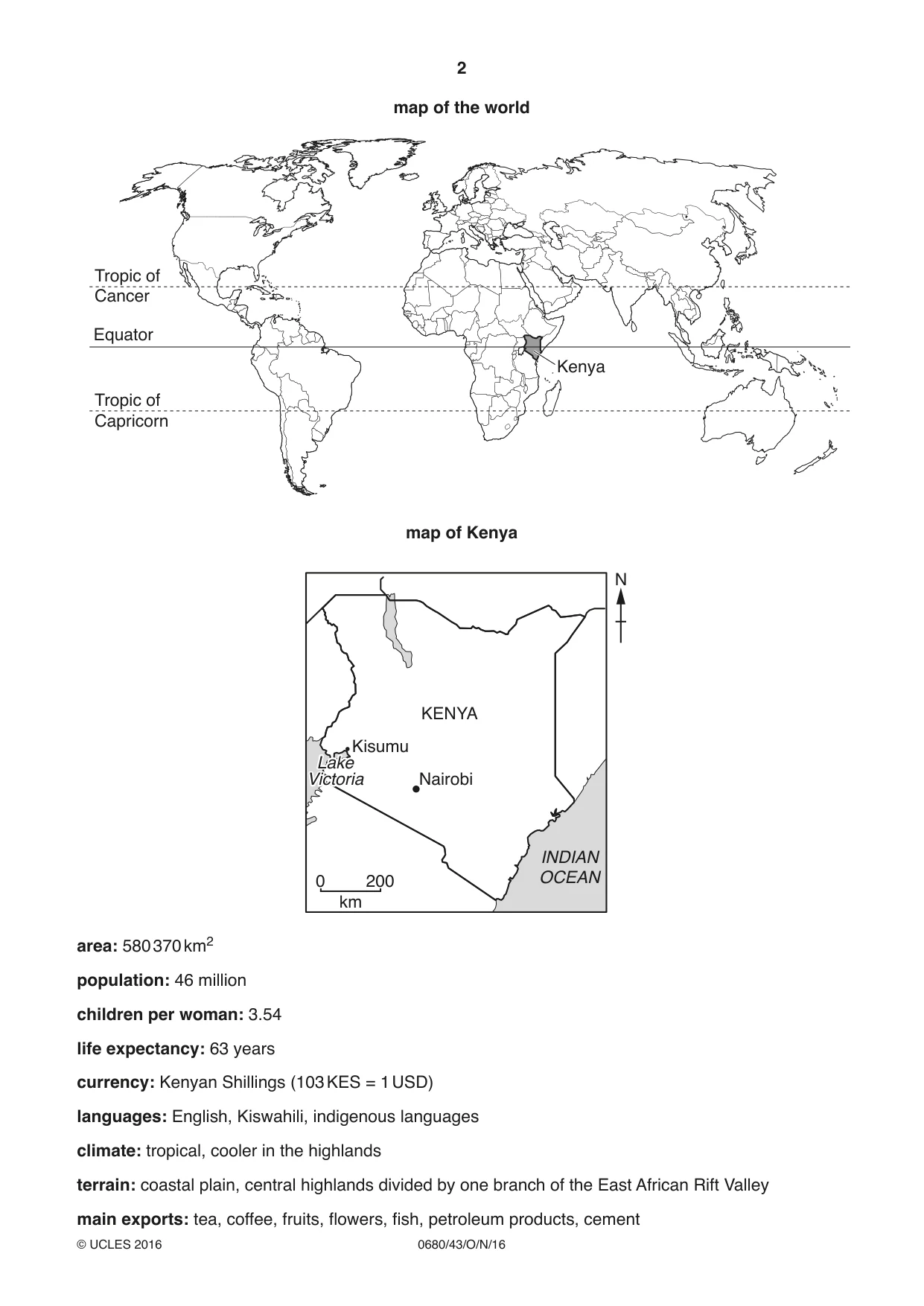
2 0680/43/O/N/16 © UCLES 2016 map of the world Equator Tropic of Capricorn Tropic of Cancer Kenya map of Kenya 0 200 INDIAN OCEAN km Lake Victoria Kisumu Nairobi KENYA N area: 580 370 km2 population: 46 million children per woman: 3.54 life expectancy: 63 years currency: Kenyan Shillings (103 KES = 1 USD) languages: English, Kiswahili, indigenous languages climate: tropical, cooler in the highlands terrain: coastal plain, central highlands divided by one branch of the East African Rift Valley main exports: tea, coffee, fruits, flowers, fish, petroleum products, cement
Question paper, page 3
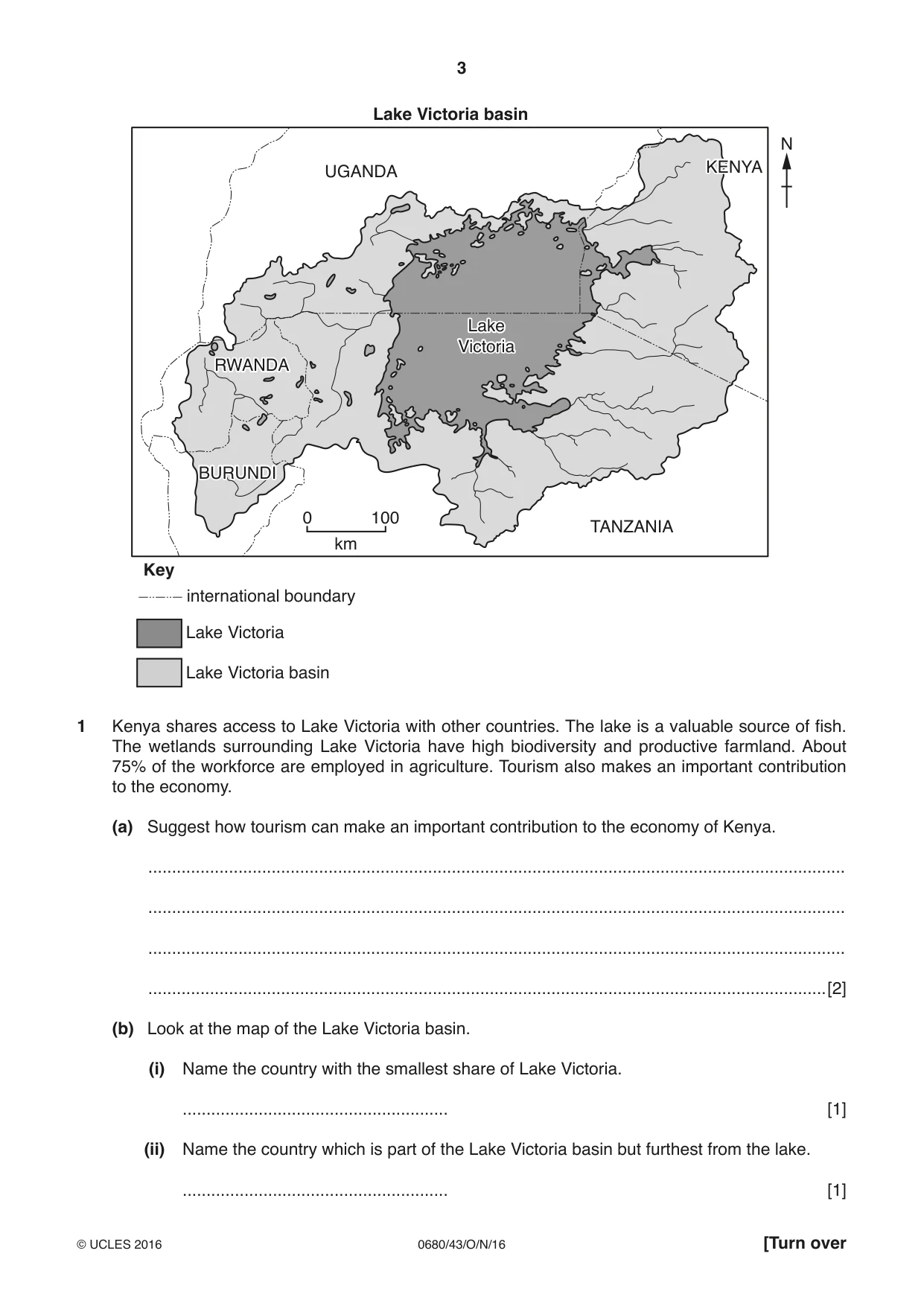
3 0680/43/O/N/16 © UCLES 2016 [Turn over international boundary Key Lake Victoria basin TANZANIA Lake Victoria UGANDA KENYA RWANDA BURUNDI 0 100 km N Lake Victoria Lake Victoria basin 1 Kenya shares access to Lake Victoria with other countries. The lake is a valuable source of fish. The wetlands surrounding Lake Victoria have high biodiversity and productive farmland. About 75% of the workforce are employed in agriculture. Tourism also makes an important contribution to the economy. (a) Suggest how tourism can make an important contribution to the economy of Kenya. … … … …[2] (b) Look at the map of the Lake Victoria basin. (i) Name the country with the smallest share of Lake Victoria. … [1] (ii) Name the country which is part of the Lake Victoria basin but furthest from the lake. … [1]
Question paper, page 4
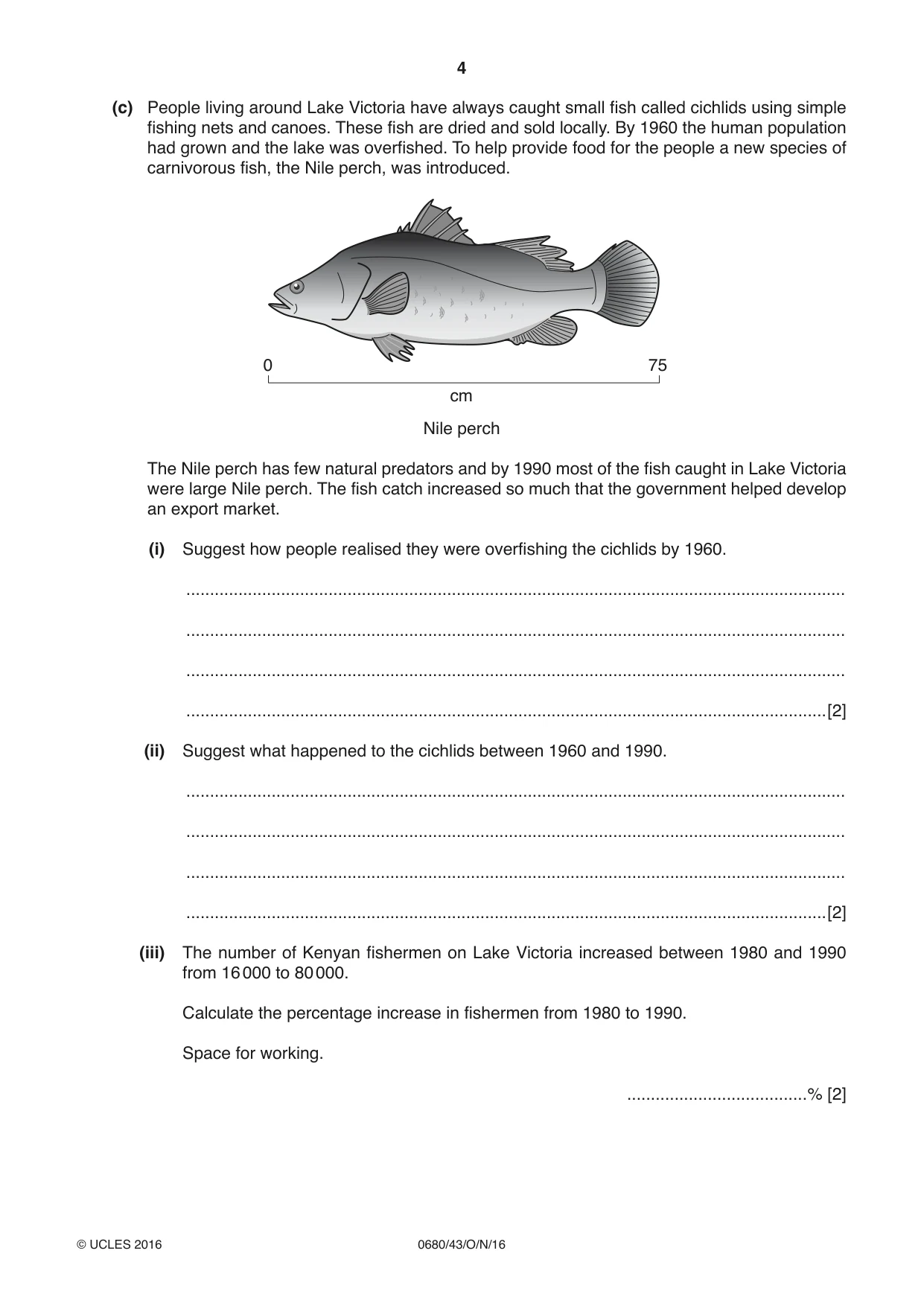
4 0680/43/O/N/16 © UCLES 2016 (c) People living around Lake Victoria have always caught small fish called cichlids using simple fishing nets and canoes. These fish are dried and sold locally. By 1960 the human population had grown and the lake was overfished. To help provide food for the people a new species of carnivorous fish, the Nile perch, was introduced. 0 75 cm Nile perch The Nile perch has few natural predators and by 1990 most of the fish caught in Lake Victoria were large Nile perch. The fish catch increased so much that the government helped develop an export market. (i) Suggest how people realised they were overfishing the cichlids by 1960. … … … …[2] (ii) Suggest what happened to the cichlids between 1960 and 1990. … … … …[2] (iii) The number of Kenyan fishermen on Lake Victoria increased between 1980 and 1990 from 16 000 to 80 000. Calculate the percentage increase in fishermen from 1980 to 1990. Space for working. …% [2]
Question paper, page 5
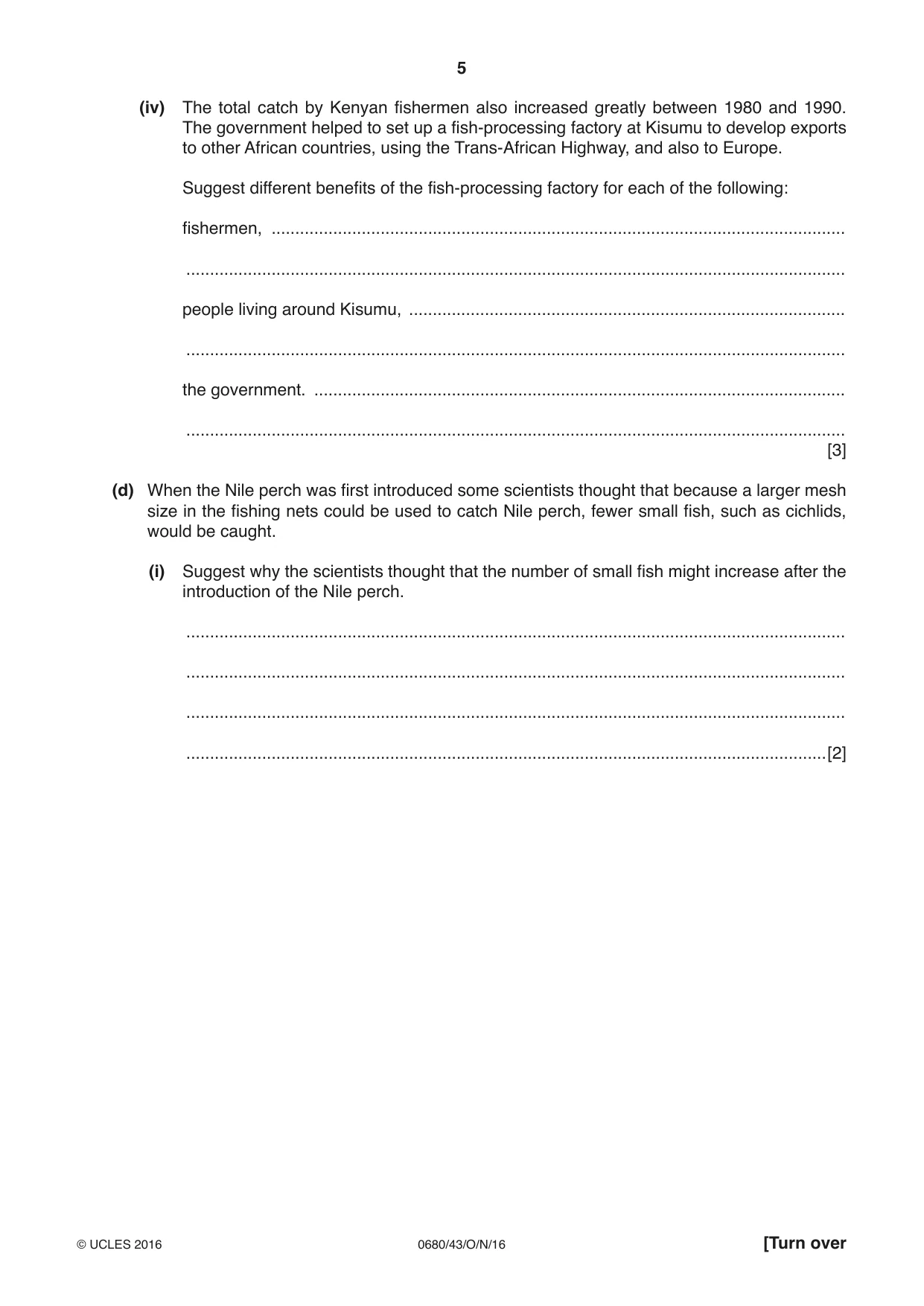
5 0680/43/O/N/16 © UCLES 2016 [Turn over (iv) The total catch by Kenyan fishermen also increased greatly between 1980 and 1990. The government helped to set up a fish-processing factory at Kisumu to develop exports to other African countries, using the Trans-African Highway, and also to Europe. Suggest different benefits of the fish-processing factory for each of the following: fishermen, … … people living around Kisumu, … … the government. … … [3] (d) When the Nile perch was first introduced some scientists thought that because a larger mesh size in the fishing nets could be used to catch Nile perch, fewer small fish, such as cichlids, would be caught. (i) Suggest why the scientists thought that the number of small fish might increase after the introduction of the Nile perch. … … … …[2]
Question paper, page 6
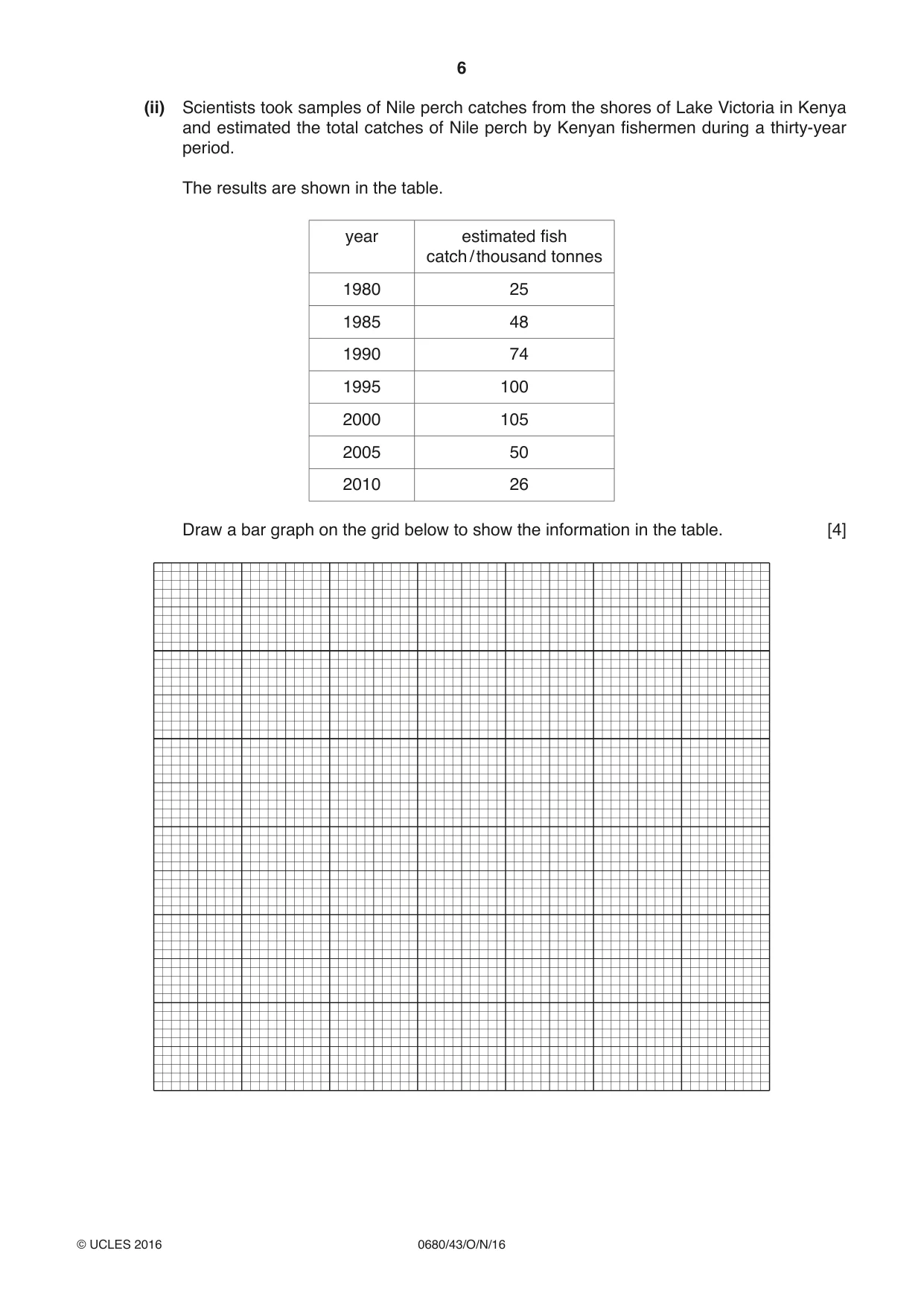
6 0680/43/O/N/16 © UCLES 2016 (ii) Scientists took samples of Nile perch catches from the shores of Lake Victoria in Kenya and estimated the total catches of Nile perch by Kenyan fishermen during a thirty-year period. The results are shown in the table. year estimated fish catch / thousand tonnes 1980 25 1985 48 1990 74 1995 100 2000 105 2005 50 2010 26 Draw a bar graph on the grid below to show the information in the table. [4]
Question paper, page 7
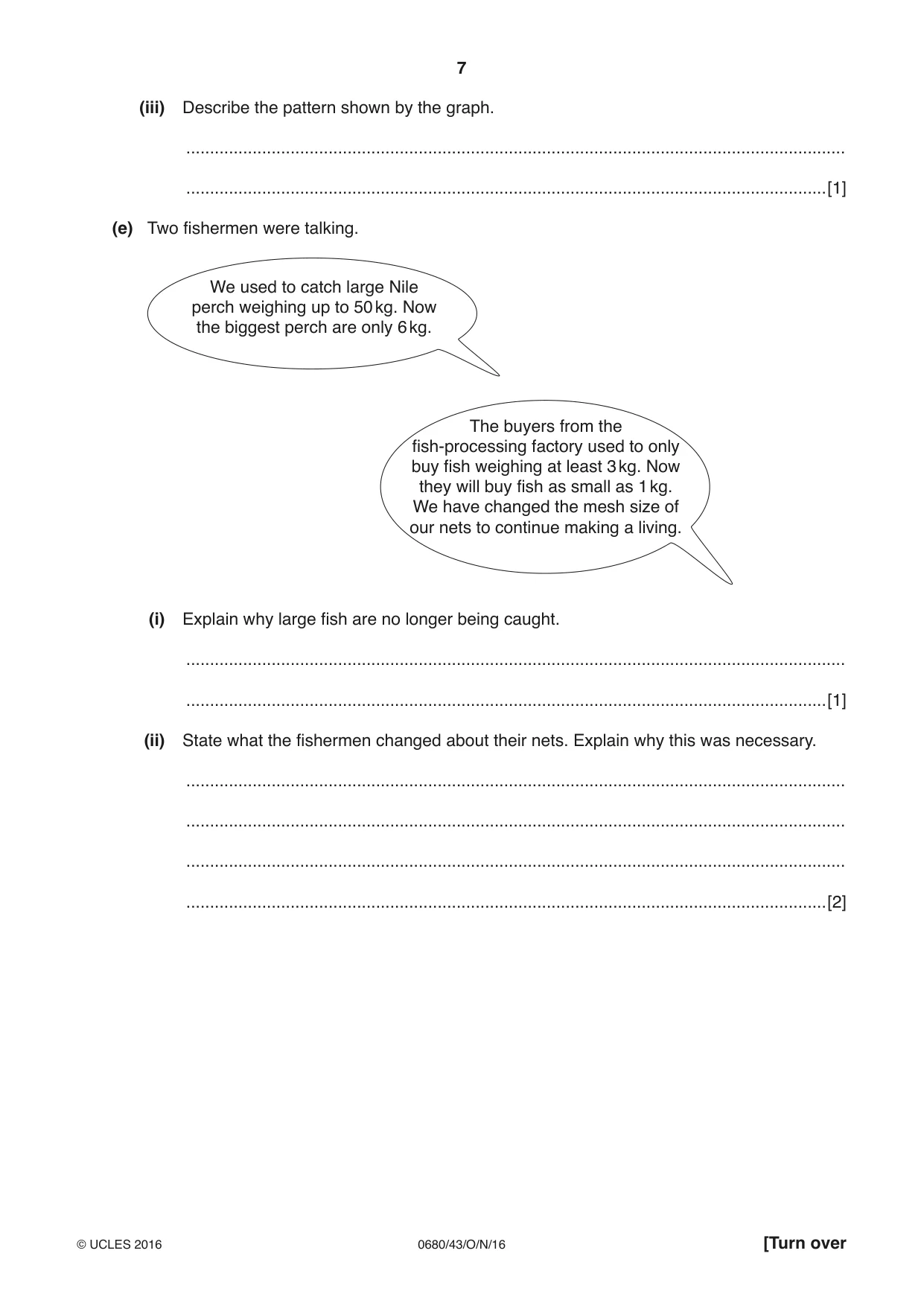
7 0680/43/O/N/16 © UCLES 2016 [Turn over (iii) Describe the pattern shown by the graph. … …[1] (e) Two fishermen were talking. We used to catch large Nile perch weighing up to 50 kg. Now the biggest perch are only 6 kg. The buyers from the fish-processing factory used to only buy fish weighing at least 3 kg. Now they will buy fish as small as 1 kg. We have changed the mesh size of our nets to continue making a living. (i) Explain why large fish are no longer being caught. … …[1] (ii) State what the fishermen changed about their nets. Explain why this was necessary. … … … …[2]
Question paper, page 8
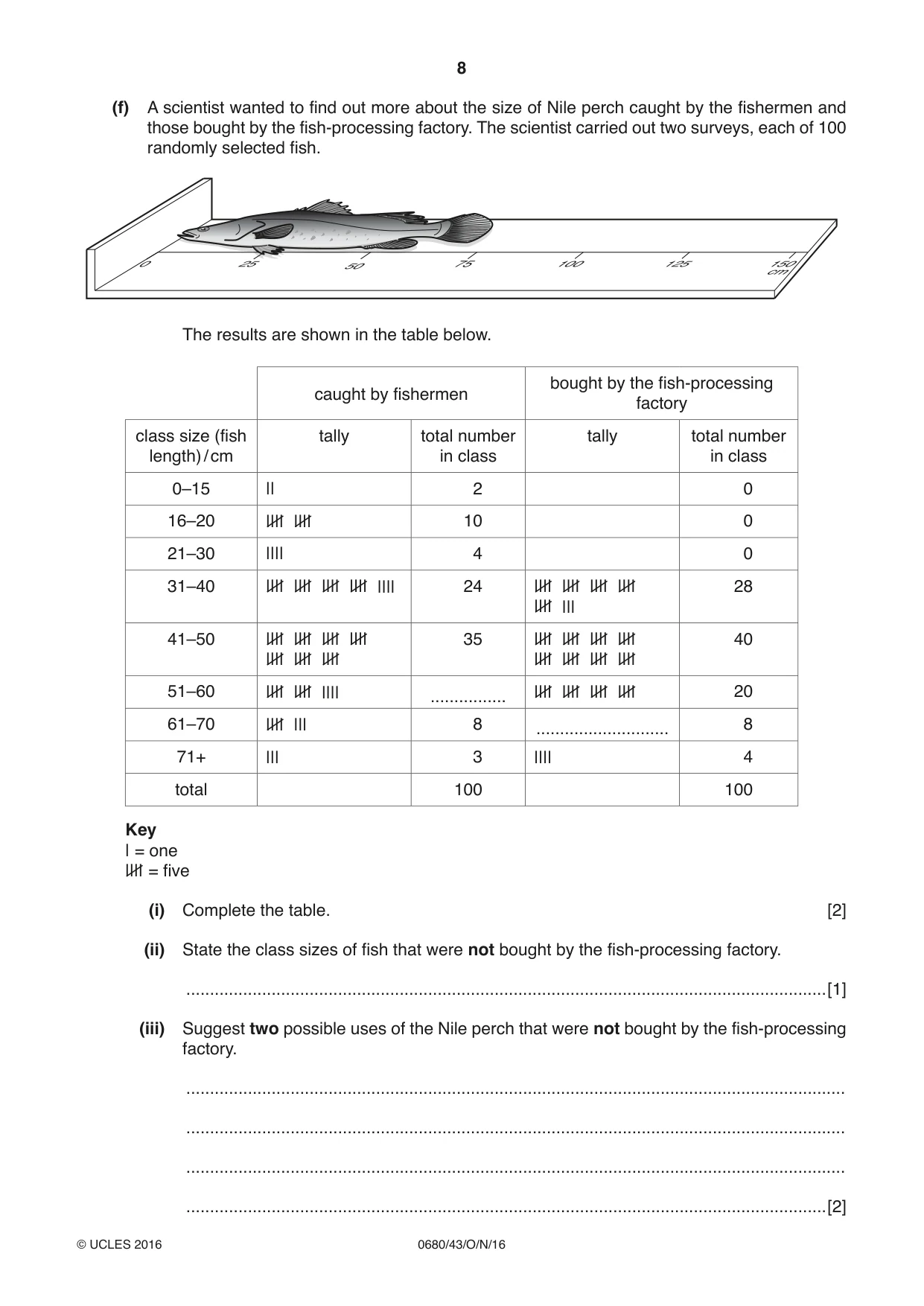
8 0680/43/O/N/16 © UCLES 2016 (f) A scientist wanted to find out more about the size of Nile perch caught by the fishermen and those bought by the fish-processing factory. The scientist carried out two surveys, each of 100 randomly selected fish. 25 0 50 75 100 125 150 cm The results are shown in the table below. caught by fishermen bought by the fish-processing factory class size (fish length) / cm tally total number in class tally total number in class 0–15 || 2 0 16–20 |||| |||| 10 0 21–30 |||| 4 0 31–40 |||| |||| |||| |||| |||| 24 |||| |||| |||| |||| |||| ||| 28 41–50 |||| |||| |||| |||| |||| |||| |||| 35 |||| |||| |||| |||| |||| |||| |||| |||| 40 51–60 |||| |||| |||| … |||| |||| |||| |||| 20 61–70 |||| ||| 8 … 8 71+ ||| 3 |||| 4 total 100 100 Key | = one |||| = five (i) Complete the table. [2] (ii) State the class sizes of fish that were not bought by the fish-processing factory. …[1] (iii) Suggest two possible uses of the Nile perch that were not bought by the fish-processing factory. … … … …[2]
Question paper, page 9
9 0680/43/O/N/16 © UCLES 2016 [Turn over TURN OVER FOR THE REST OF THE QUESTION
Question paper, page 10
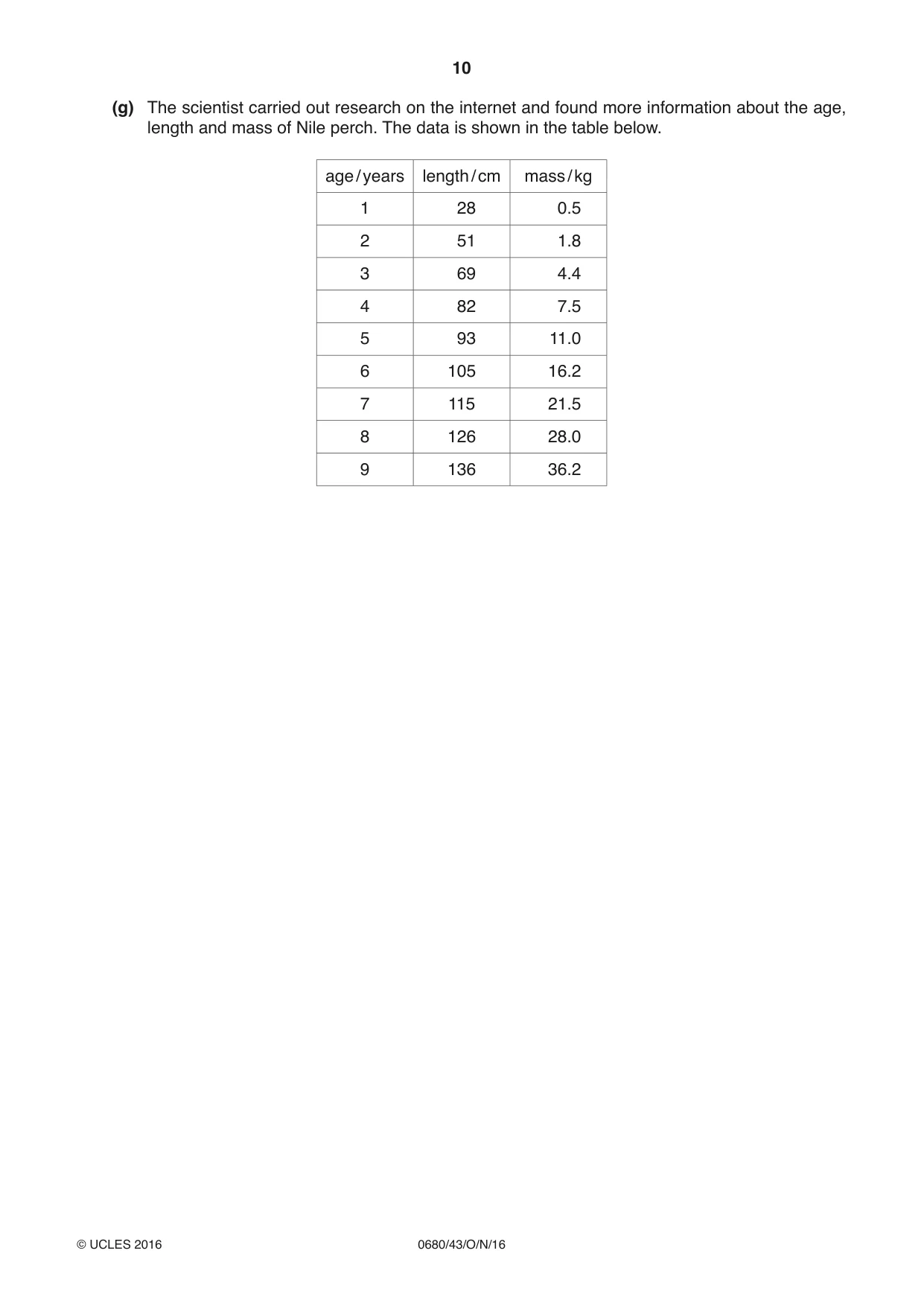
10 0680/43/O/N/16 © UCLES 2016 (g) The scientist carried out research on the internet and found more information about the age, length and mass of Nile perch. The data is shown in the table below. age / years length / cm mass / kg 1 28 0.5 2 51 1.8 3 69 4.4 4 82 7.5 5 93 11.0 6 105 16.2 7 115 21.5 8 126 28.0 9 136 36.2
Question paper, page 11
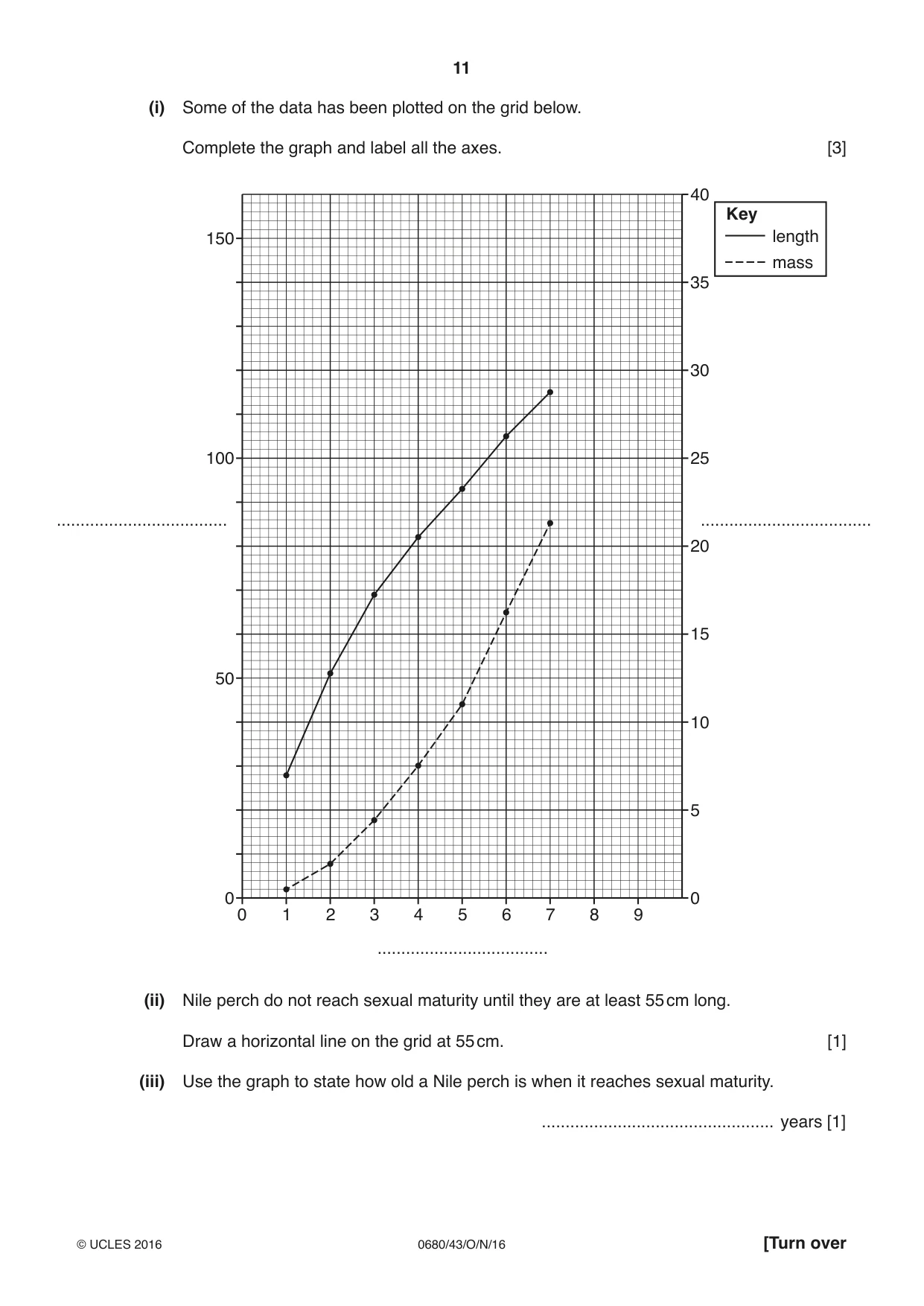
11 0680/43/O/N/16 © UCLES 2016 [Turn over (i) Some of the data has been plotted on the grid below. Complete the graph and label all the axes. [3] 0 0 5 10 15 20 25 30 35 40 1 0 2 3 4 5 … … … 6 7 8 9 50 100 150 Key length mass (ii) Nile perch do not reach sexual maturity until they are at least 55 cm long. Draw a horizontal line on the grid at 55 cm. [1] (iii) Use the graph to state how old a Nile perch is when it reaches sexual maturity. … years [1]
Question paper, page 12
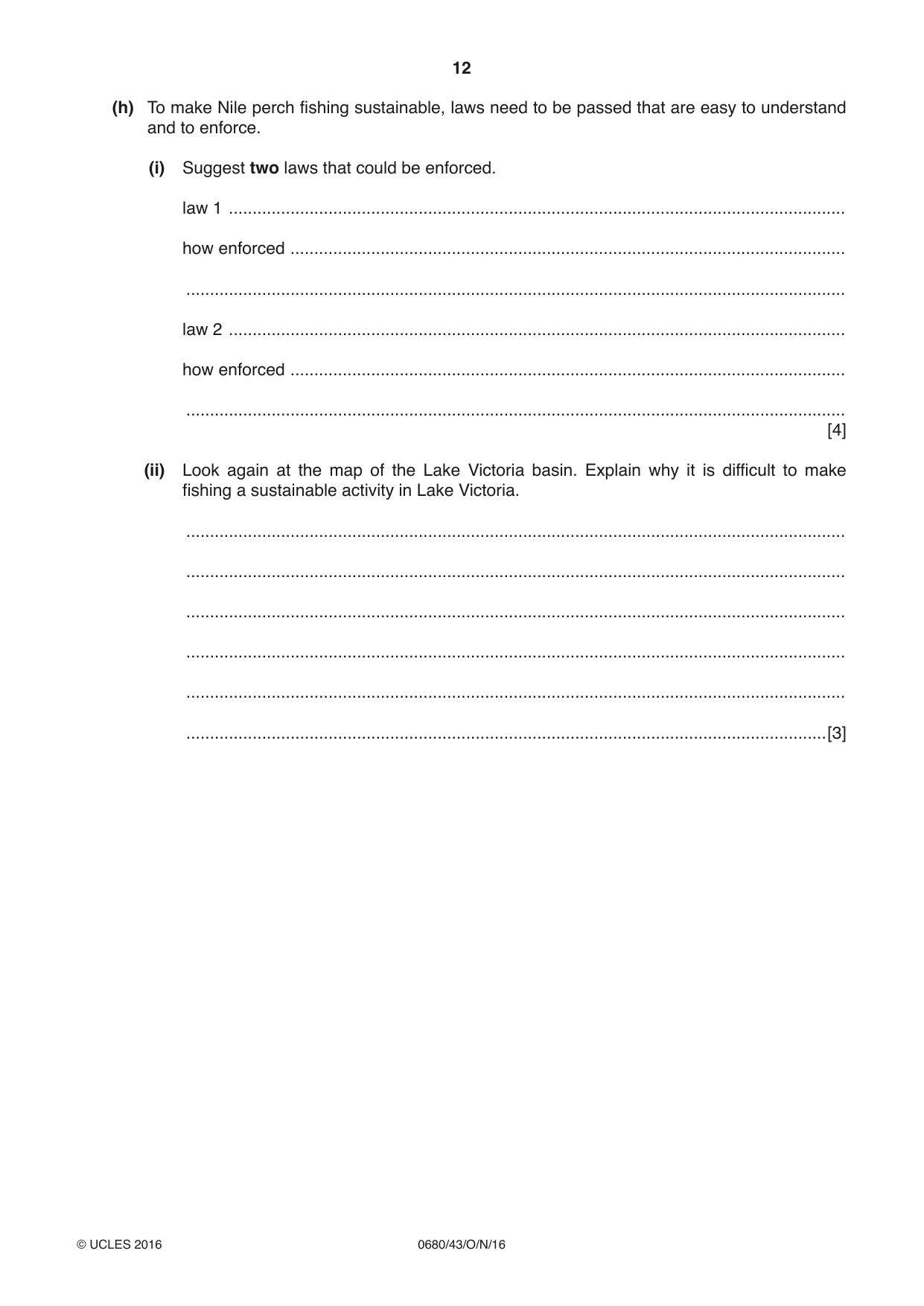
12 0680/43/O/N/16 © UCLES 2016 (h) To make Nile perch fishing sustainable, laws need to be passed that are easy to understand and to enforce. (i) Suggest two laws that could be enforced. law 1 … how enforced … … law 2 … how enforced … … [4] (ii) Look again at the map of the Lake Victoria basin. Explain why it is difficult to make fishing a sustainable activity in Lake Victoria. … … … … … …[3]
Question paper, page 13
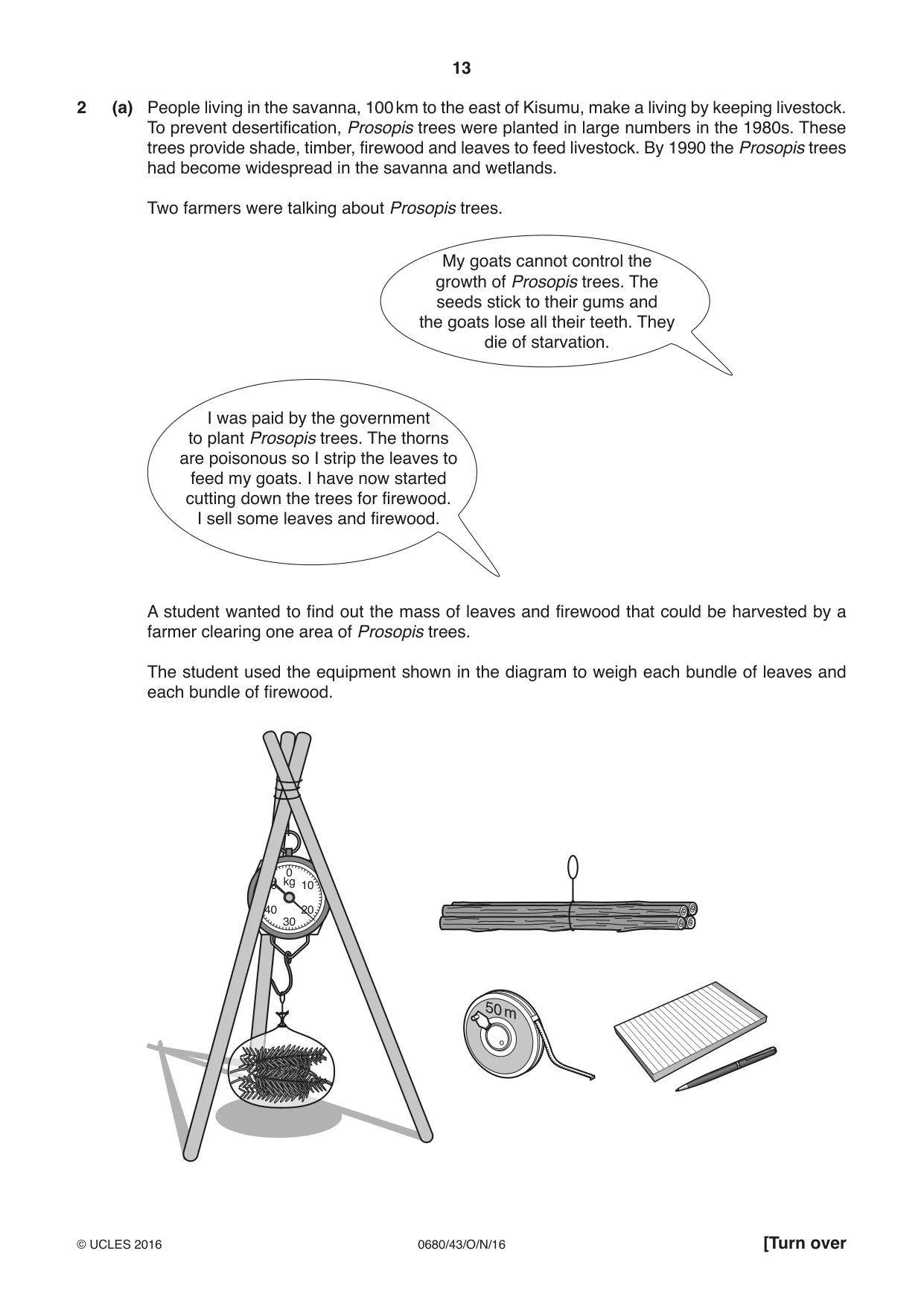
13 0680/43/O/N/16 © UCLES 2016 [Turn over 2 (a) People living in the savanna, 100 km to the east of Kisumu, make a living by keeping livestock. To prevent desertification, Prosopis trees were planted in large numbers in the 1980s. These trees provide shade, timber, firewood and leaves to feed livestock. By 1990 the Prosopis trees had become widespread in the savanna and wetlands. Two farmers were talking about Prosopis trees. My goats cannot control the growth of Prosopis trees. The seeds stick to their gums and the goats lose all their teeth. They die of starvation. I was paid by the government to plant Prosopis trees. The thorns are poisonous so I strip the leaves to feed my goats. I have now started cutting down the trees for firewood. I sell some leaves and firewood. A student wanted to find out the mass of leaves and firewood that could be harvested by a farmer clearing one area of Prosopis trees. The student used the equipment shown in the diagram to weigh each bundle of leaves and each bundle of firewood. 0 kg 30 50 40 10 20
Question paper, page 14
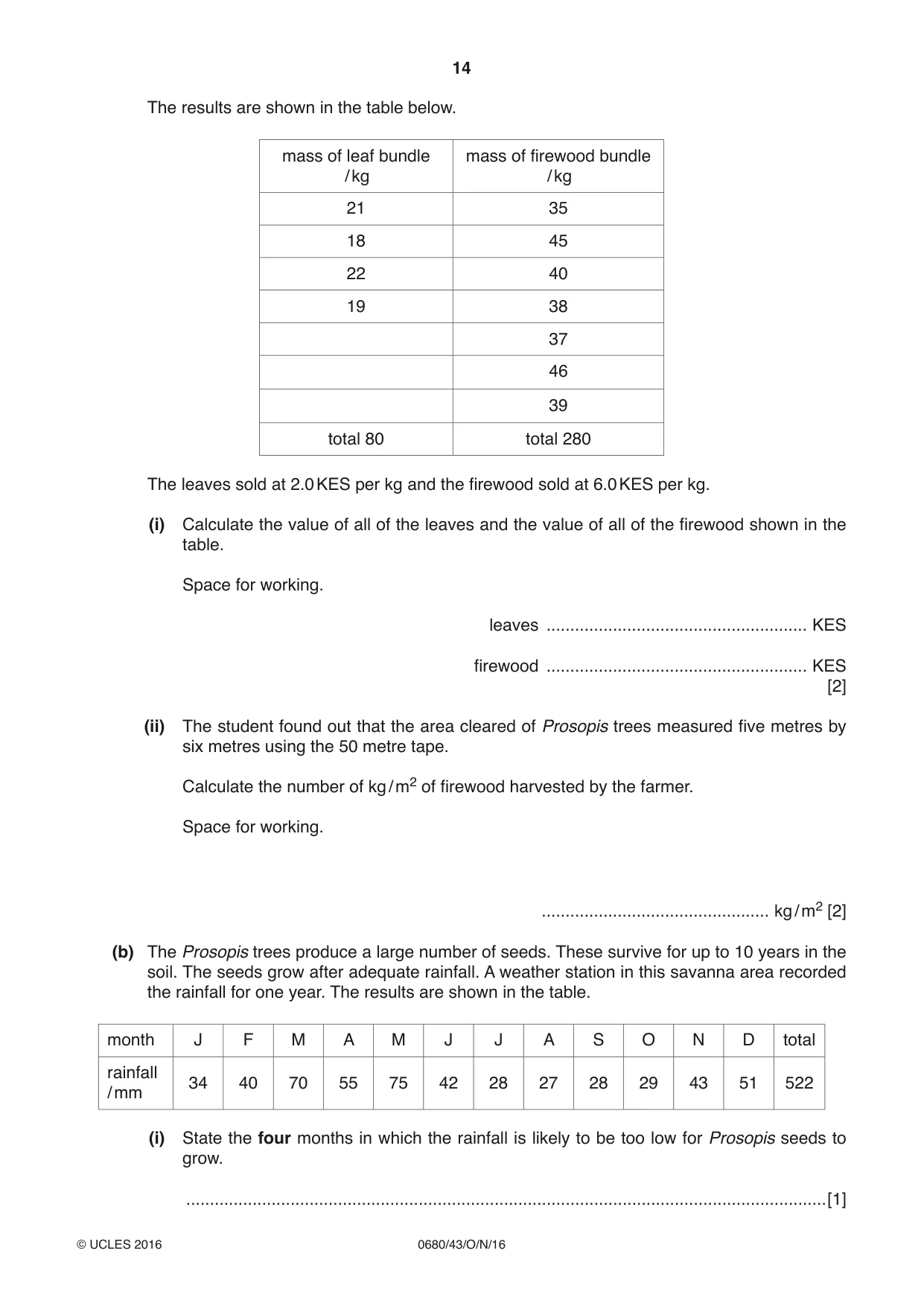
14 0680/43/O/N/16 © UCLES 2016 The results are shown in the table below. mass of leaf bundle / kg mass of firewood bundle / kg 21 35 18 45 22 40 19 38 37 46 39 total 80 total 280 The leaves sold at 2.0 KES per kg and the firewood sold at 6.0 KES per kg. (i) Calculate the value of all of the leaves and the value of all of the firewood shown in the table. Space for working. leaves … KES firewood … KES [2] (ii) The student found out that the area cleared of Prosopis trees measured five metres by six metres using the 50 metre tape. Calculate the number of kg / m2 of firewood harvested by the farmer. Space for working. … kg / m2 [2] (b) The Prosopis trees produce a large number of seeds. These survive for up to 10 years in the soil. The seeds grow after adequate rainfall. A weather station in this savanna area recorded the rainfall for one year. The results are shown in the table. month J F M A M J J A S O N D total rainfall / mm 34 40 70 55 75 42 28 27 28 29 43 51 522 (i) State the four months in which the rainfall is likely to be too low for Prosopis seeds to grow. …[1]
Question paper, page 15
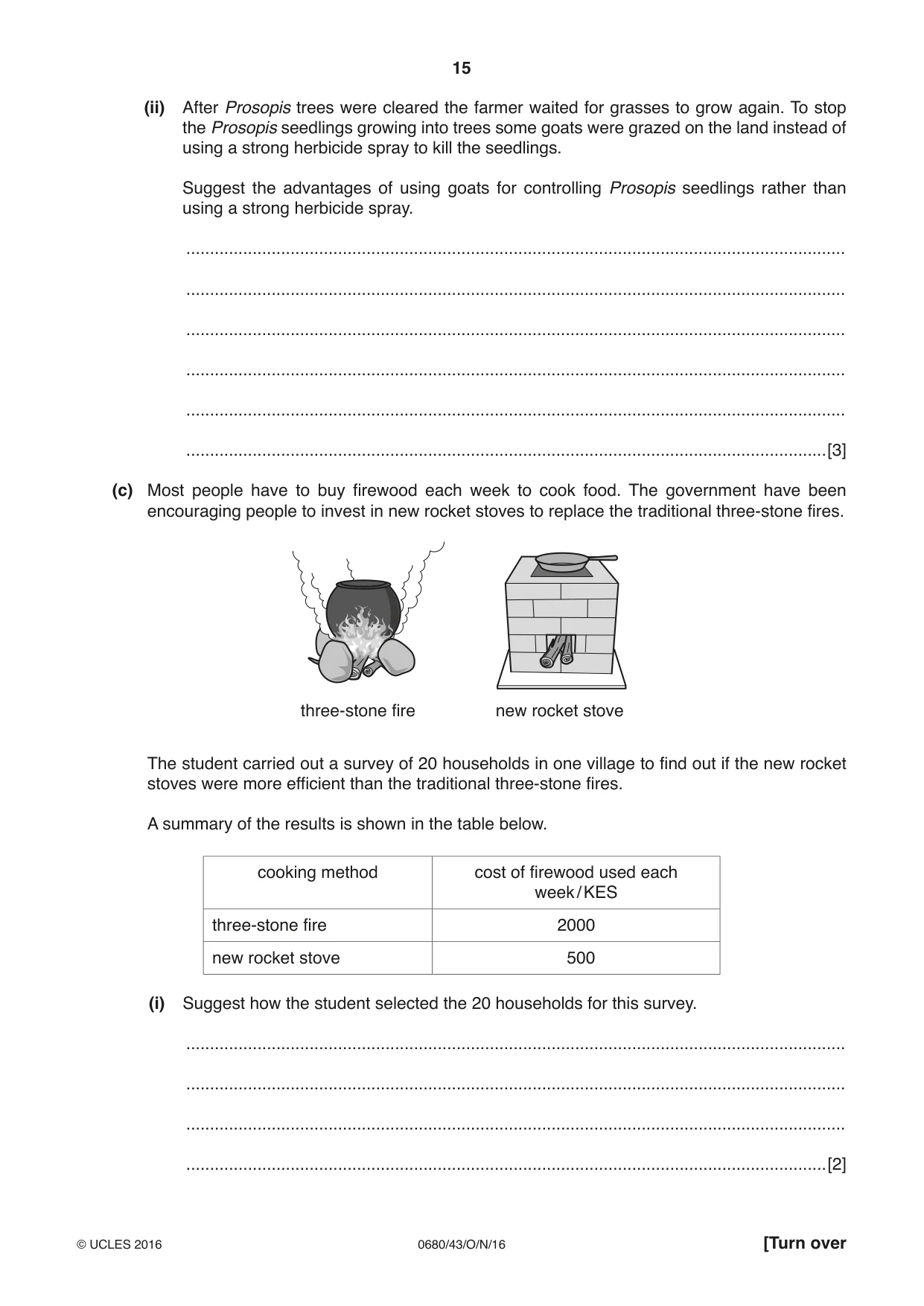
15 0680/43/O/N/16 © UCLES 2016 [Turn over (ii) After Prosopis trees were cleared the farmer waited for grasses to grow again. To stop the Prosopis seedlings growing into trees some goats were grazed on the land instead of using a strong herbicide spray to kill the seedlings. Suggest the advantages of using goats for controlling Prosopis seedlings rather than using a strong herbicide spray. … … … … … …[3] (c) Most people have to buy firewood each week to cook food. The government have been encouraging people to invest in new rocket stoves to replace the traditional three-stone fires. three-stone fire new rocket stove The student carried out a survey of 20 households in one village to find out if the new rocket stoves were more efficient than the traditional three-stone fires. A summary of the results is shown in the table below. cooking method cost of firewood used each week / KES three-stone fire 2000 new rocket stove 500 (i) Suggest how the student selected the 20 households for this survey. … … … …[2]
Question paper, page 16
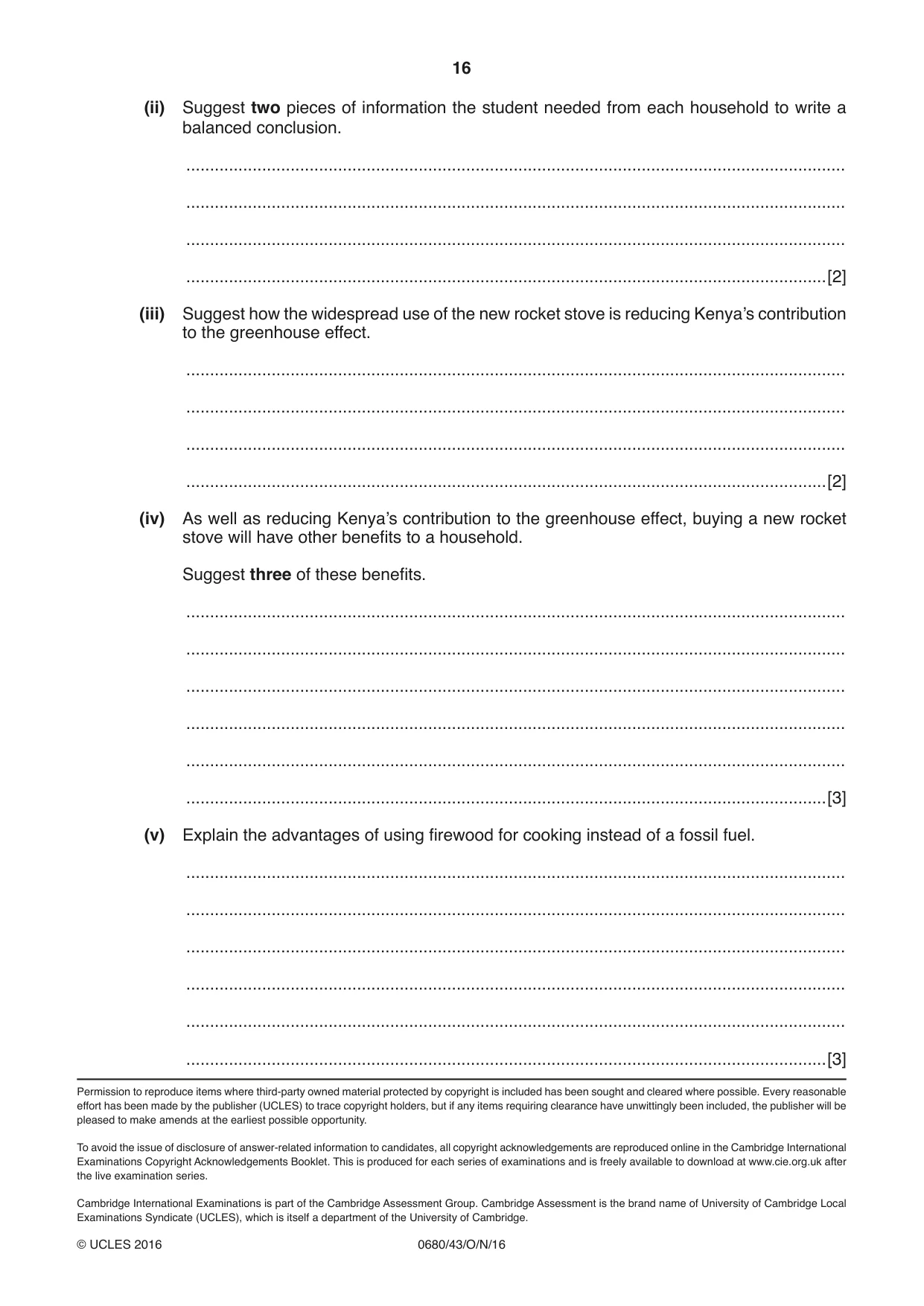
16 0680/43/O/N/16 © UCLES 2016 (ii) Suggest two pieces of information the student needed from each household to write a balanced conclusion. … … … …[2] (iii) Suggest how the widespread use of the new rocket stove is reducing Kenya’s contribution to the greenhouse effect. … … … …[2] (iv) As well as reducing Kenya’s contribution to the greenhouse effect, buying a new rocket stove will have other benefits to a household. Suggest three of these benefits. … … … … … …[3] (v) Explain the advantages of using firewood for cooking instead of a fossil fuel. … … … … … …[3] Permission to reproduce items where third-party owned material protected by copyright is included has been sought and cleared where possible. Every reasonable effort has been made by the publisher (UCLES) to trace copyright holders, but if any items requiring clearance have unwittingly been included, the publisher will be pleased to make amends at the earliest possible opportunity. To avoid the issue of disclosure of answer-related information to candidates, all copyright acknowledgements are reproduced online in the Cambridge International Examinations Copyright Acknowledgements Booklet. This is produced for each series of examinations and is freely available to download at www.cie.org.uk after the live examination series. Cambridge International Examinations is part of the Cambridge Assessment Group. Cambridge Assessment is the brand name of University of Cambridge Local Examinations Syndicate (UCLES), which is itself a department of the University of Cambridge.
Mark scheme, page 1
® IGCSE is the registered trademark of Cambridge International Examinations. This document consists of 5 printed pages. © UCLES 2016 [Turn over Cambridge International Examinations Cambridge International General Certificate of Secondary Education ENVIRONMENTAL MANAGEMENT 0680/43 Paper 4 Alternative to Coursework October/November 2016 MARK SCHEME Maximum Mark: 60 Published This mark scheme is published as an aid to teachers and candidates, to indicate the requirements of the examination. It shows the basis on which Examiners were instructed to award marks. It does not indicate the details of the discussions that took place at an Examiners’ meeting before marking began, which would have considered the acceptability of alternative answers. Mark schemes should be read in conjunction with the question paper and the Principal Examiner Report for Teachers. Cambridge will not enter into discussions about these mark schemes. Cambridge is publishing the mark schemes for the October/November 2016 series for most Cambridge IGCSE®, Cambridge International A and AS Level components and some Cambridge O Level components.
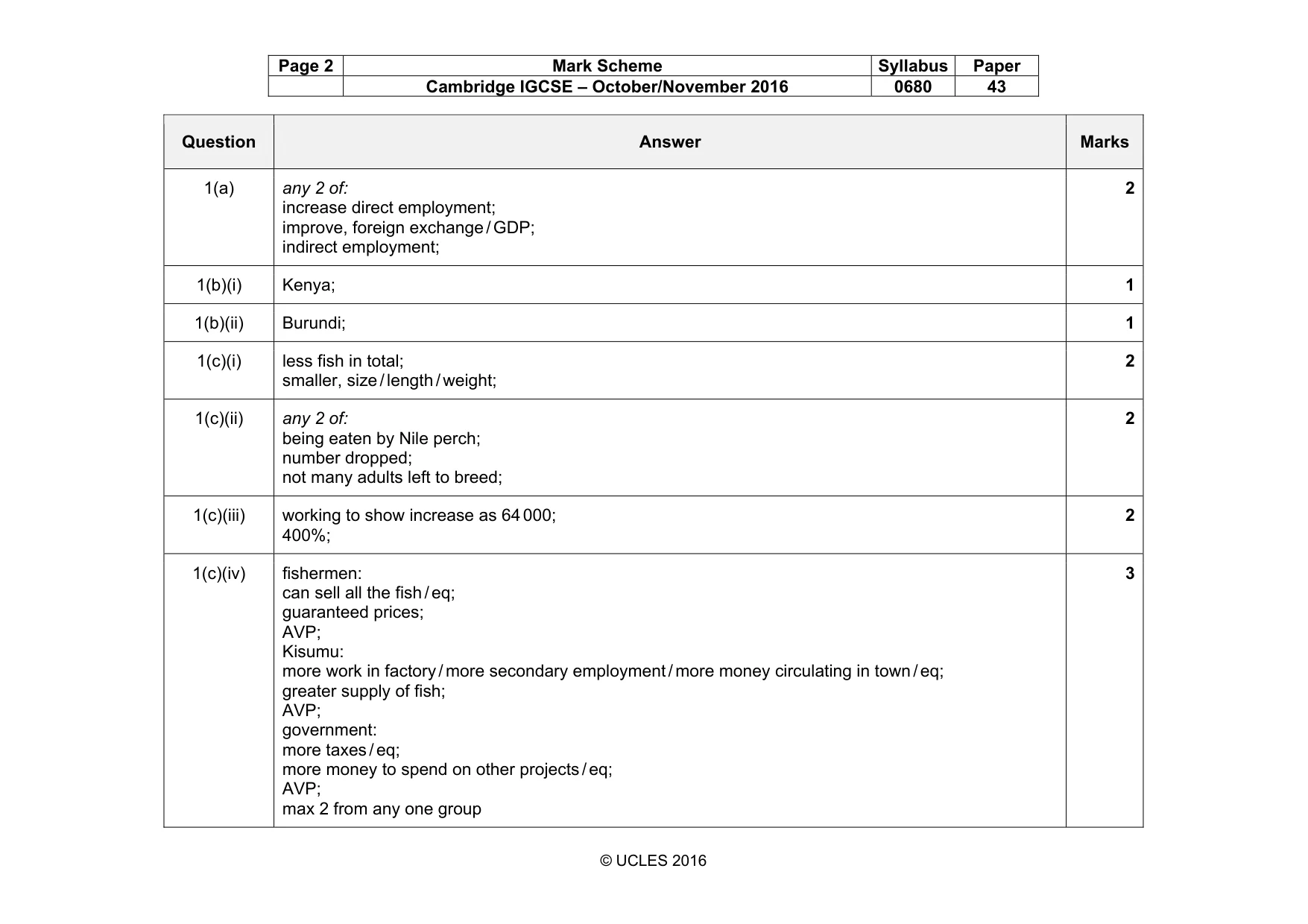
Mark scheme, page 2
Page 2 Mark Scheme Syllabus Paper Cambridge IGCSE – October/November 2016 0680 43 © UCLES 2016 Question Answer Marks 1(a) any 2 of: increase direct employment; improve, foreign exchange / GDP; indirect employment; 2 1(b)(i) Kenya; 1 1(b)(ii) Burundi; 1 1(c)(i) less fish in total; smaller, size / length / weight; 2 1(c)(ii) any 2 of: being eaten by Nile perch; number dropped; not many adults left to breed; 2 1(c)(iii) working to show increase as 64 000; 400%; 2 1(c)(iv) fishermen: can sell all the fish / eq; guaranteed prices; AVP; Kisumu: more work in factory / more secondary employment / more money circulating in town / eq; greater supply of fish; AVP; government: more taxes / eq; more money to spend on other projects / eq; AVP; max 2 from any one group 3
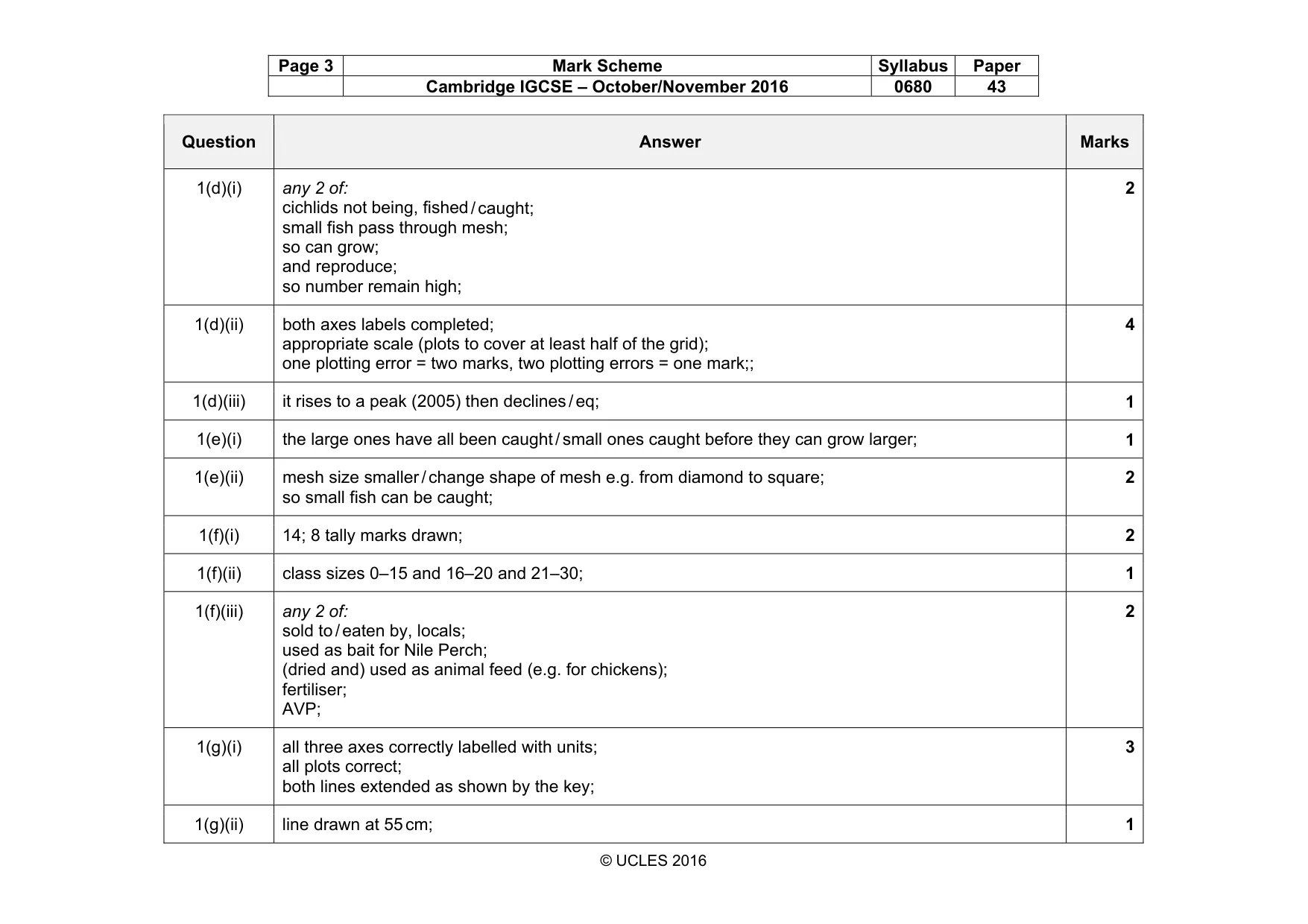
Mark scheme, page 3
Page 3 Mark Scheme Syllabus Paper Cambridge IGCSE – October/November 2016 0680 43 © UCLES 2016 Question Answer Marks 1(d)(i) any 2 of: cichlids not being, fished / caught; small fish pass through mesh; so can grow; and reproduce; so number remain high; 2 1(d)(ii) both axes labels completed; appropriate scale (plots to cover at least half of the grid); one plotting error = two marks, two plotting errors = one mark;; 4 1(d)(iii) it rises to a peak (2005) then declines / eq; 1 1(e)(i) the large ones have all been caught / small ones caught before they can grow larger; 1 1(e)(ii) mesh size smaller / change shape of mesh e.g. from diamond to square; so small fish can be caught; 2 1(f)(i) 14; 8 tally marks drawn; 2 1(f)(ii) class sizes 0–15 and 16–20 and 21–30; 1 1(f)(iii) any 2 of: sold to / eaten by, locals; used as bait for Nile Perch; (dried and) used as animal feed (e.g. for chickens); fertiliser; AVP; 2 1(g)(i) all three axes correctly labelled with units; all plots correct; both lines extended as shown by the key; 3 1(g)(ii) line drawn at 55 cm; 1
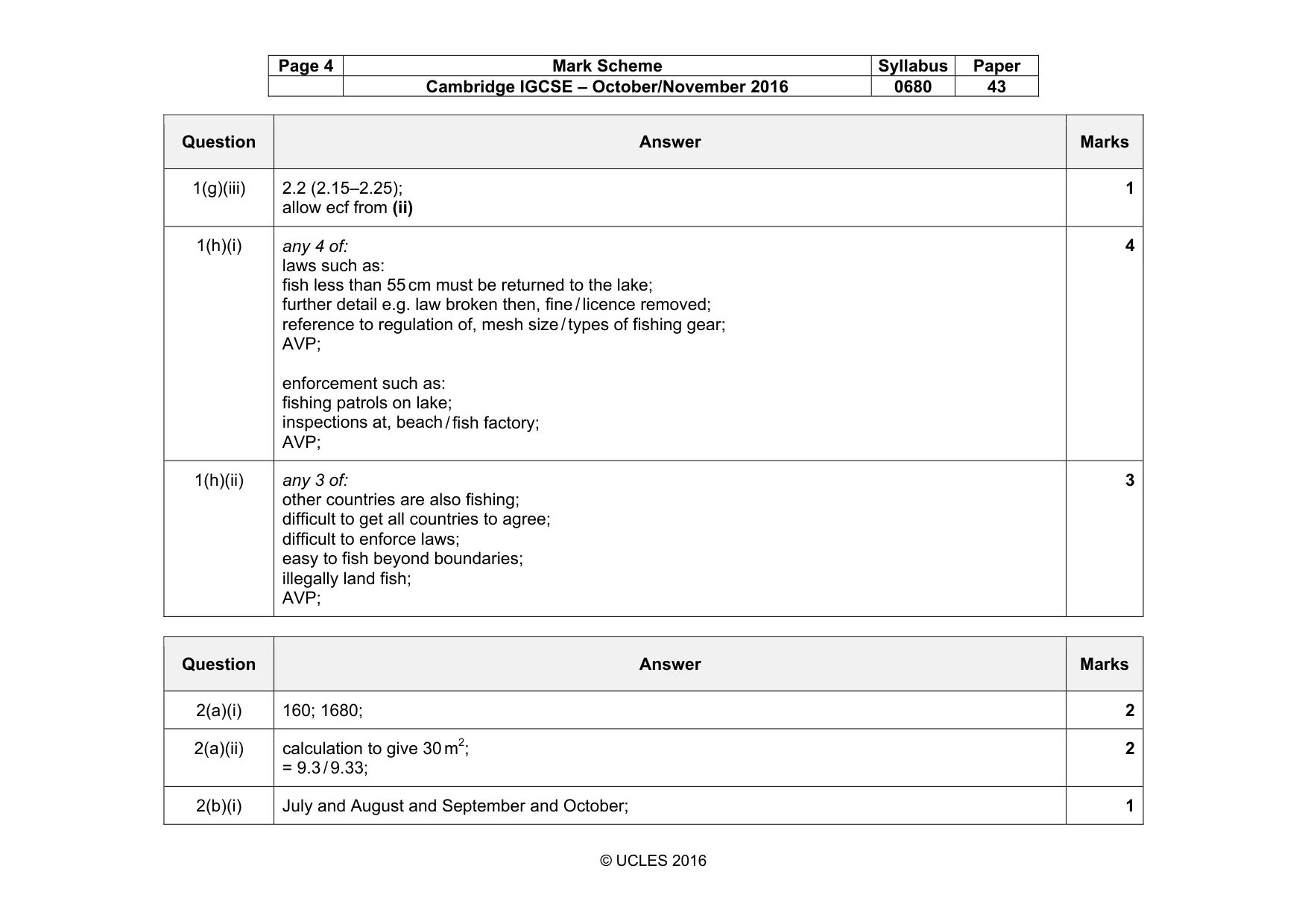
Mark scheme, page 4
Page 4 Mark Scheme Syllabus Paper Cambridge IGCSE – October/November 2016 0680 43 © UCLES 2016 Question Answer Marks 1(g)(iii) 2.2 (2.15–2.25); allow ecf from (ii) 1 1(h)(i) any 4 of: laws such as: fish less than 55 cm must be returned to the lake; further detail e.g. law broken then, fine / licence removed; reference to regulation of, mesh size / types of fishing gear; AVP; enforcement such as: fishing patrols on lake; inspections at, beach / fish factory; AVP; 4 1(h)(ii) any 3 of: other countries are also fishing; difficult to get all countries to agree; difficult to enforce laws; easy to fish beyond boundaries; illegally land fish; AVP; 3 Question Answer Marks 2(a)(i) 160; 1680; 2 2(a)(ii) calculation to give 30 m2; = 9.3 / 9.33; 2 2(b)(i) July and August and September and October; 1
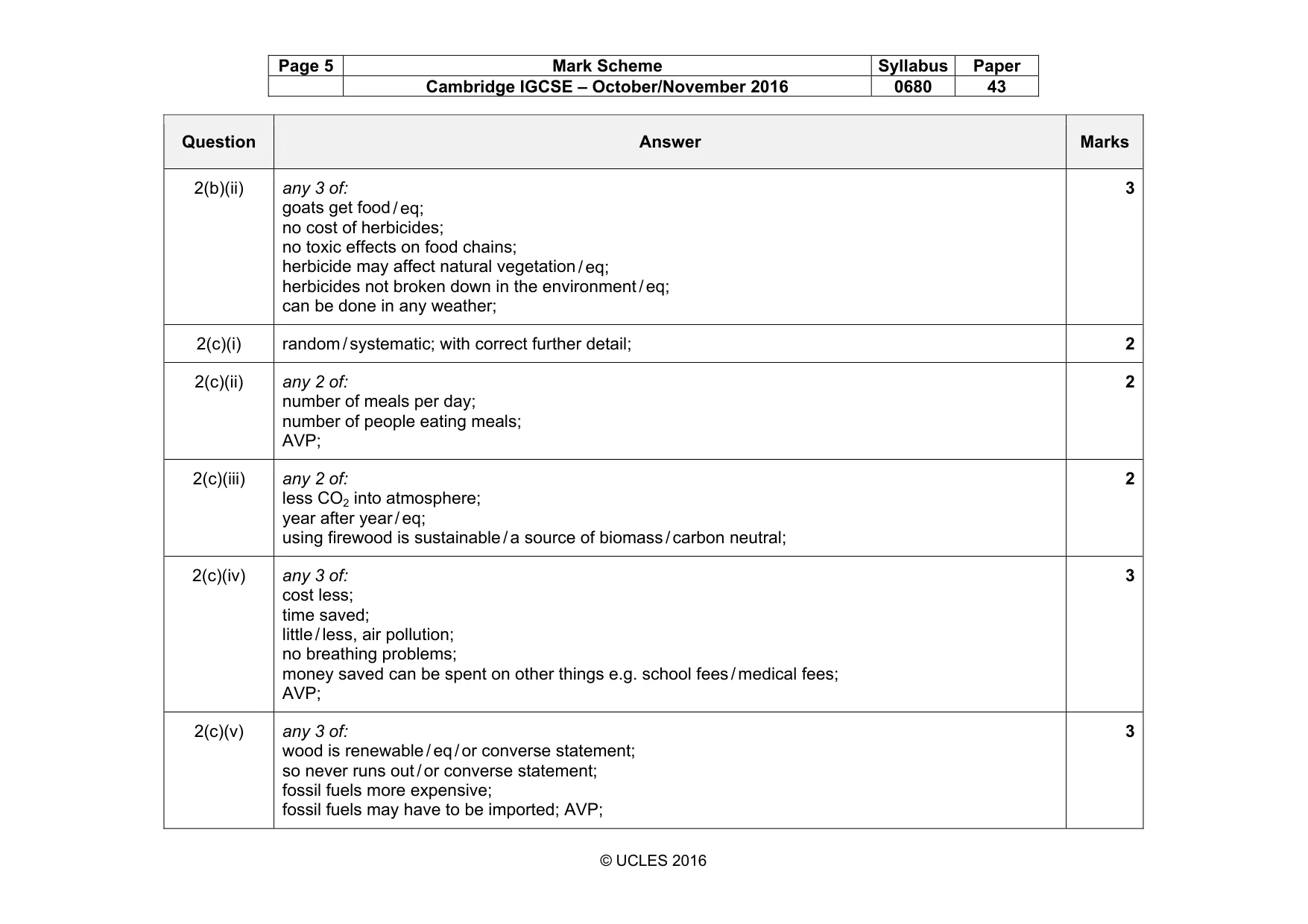
Mark scheme, page 5
Page 5 Mark Scheme Syllabus Paper Cambridge IGCSE – October/November 2016 0680 43 © UCLES 2016 Question Answer Marks 2(b)(ii) any 3 of: goats get food / eq; no cost of herbicides; no toxic effects on food chains; herbicide may affect natural vegetation / eq; herbicides not broken down in the environment / eq; can be done in any weather; 3 2(c)(i) random / systematic; with correct further detail; 2 2(c)(ii) any 2 of: number of meals per day; number of people eating meals; AVP; 2 2(c)(iii) any 2 of: less CO2 into atmosphere; year after year / eq; using firewood is sustainable / a source of biomass / carbon neutral; 2 2(c)(iv) any 3 of: cost less; time saved; little / less, air pollution; no breathing problems; money saved can be spent on other things e.g. school fees / medical fees; AVP; 3 2(c)(v) any 3 of: wood is renewable / eq / or converse statement; so never runs out / or converse statement; fossil fuels more expensive; fossil fuels may have to be imported; AVP; 3
What you needed in this session
Cambridge’s own grade thresholds for 2016 Oct/Nov, Paper 4 · Variant 3. A higher threshold means an easier paper — the bar moves with how the cohort did.