Cambridge IGCSE Environmental Management 0680 — 2015 Oct/Nov Paper 4 · Variant 3
0680/43/O/N/15 · 60 marks · ≈68 min
The question paper and its mark scheme, free to read here and free to download. This is Cambridge’s own paper, exactly as it was sat.
Question paper20 pages




Mark scheme3 pages
Answers below. Sit the paper first if you are practising.
Paper as text
Question paper, page 1
This document consists of 19 printed pages and 1 blank page. DC (CW/SW) 97472/3 © UCLES 2015 [Turn over Cambridge International Examinations Cambridge International General Certificate of Secondary Education * 7 5 0 8 6 0 3 4 9 8 * ENVIRONMENTAL MANAGEMENT 0680/43 Alternative to Coursework October/November 2015 1 hour 30 minutes Candidates answer on the Question Paper. No Additional Materials are required. READ THESE INSTRUCTIONS FIRST Write your Centre number, candidate number and name on all the work you hand in. Write in dark blue or black pen. You may use an HB pencil for any diagrams or graphs. Do not use staples, paper clips, glue or correction fluid. DO NOT WRITE IN ANY BARCODES. Answer all questions. Electronic calculators may be used. You may lose marks if you do not show your working or if you do not use appropriate units. Study the appropriate source materials before you start to write your answers. Credit will be given for appropriate selection and use of data in your answers and for relevant interpretation of these data. Suggestions for data sources are given in some questions. You may use the source data to draw diagrams and graphs or to do calculations to illustrate your answers. At the end of the examination, fasten all your work securely together. The number of marks is given in brackets [ ] at the end of each question or part question.
Question paper, page 2
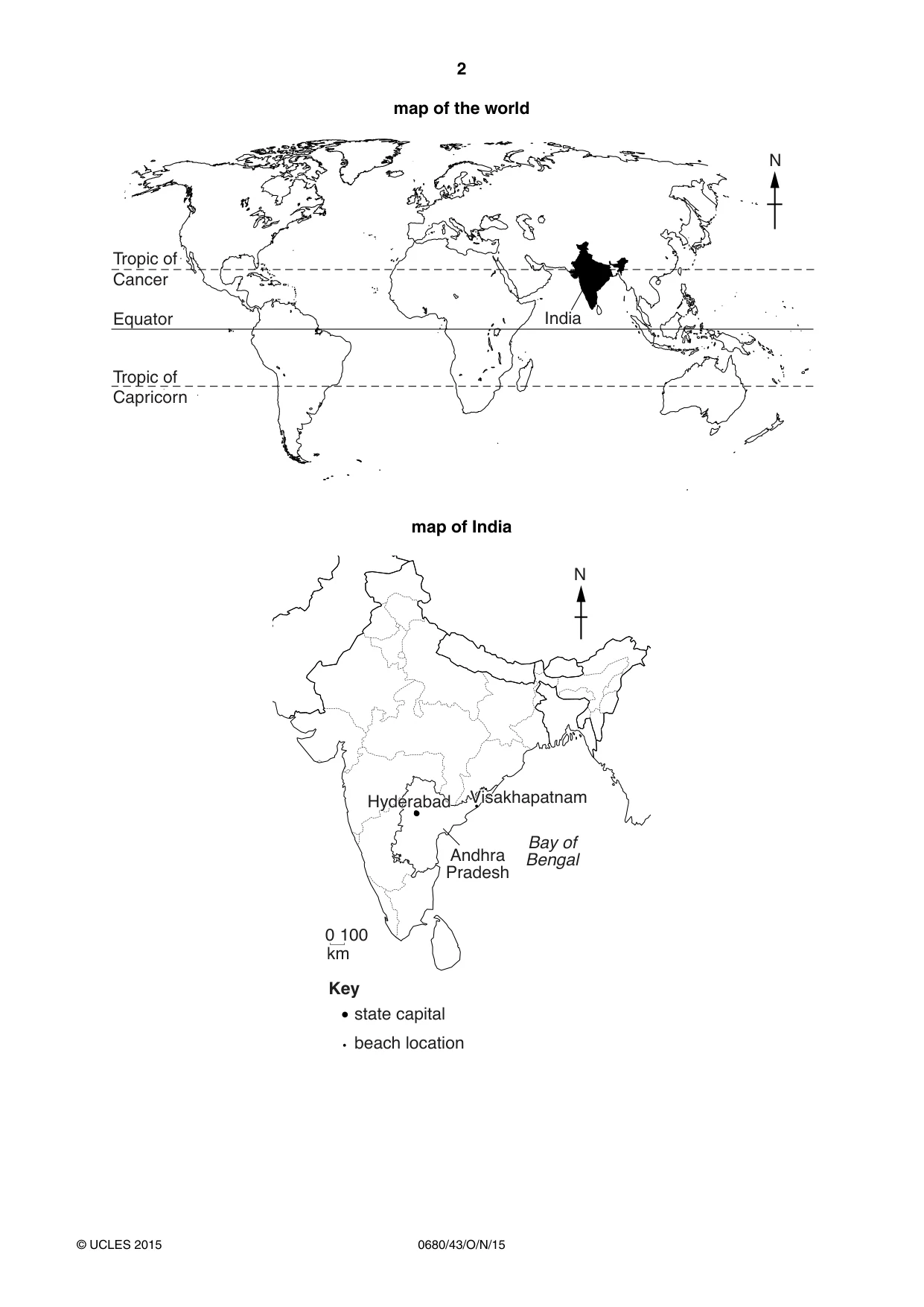
2 0680/43/O/N/15 © UCLES 2015 map of the world Equator Tropic of Capricorn Tropic of Cancer N India map of India Andhra Pradesh Bay of Bengal 0 100 km Hyderabad Visakhapatnam N Key state capital beach location
Question paper, page 3
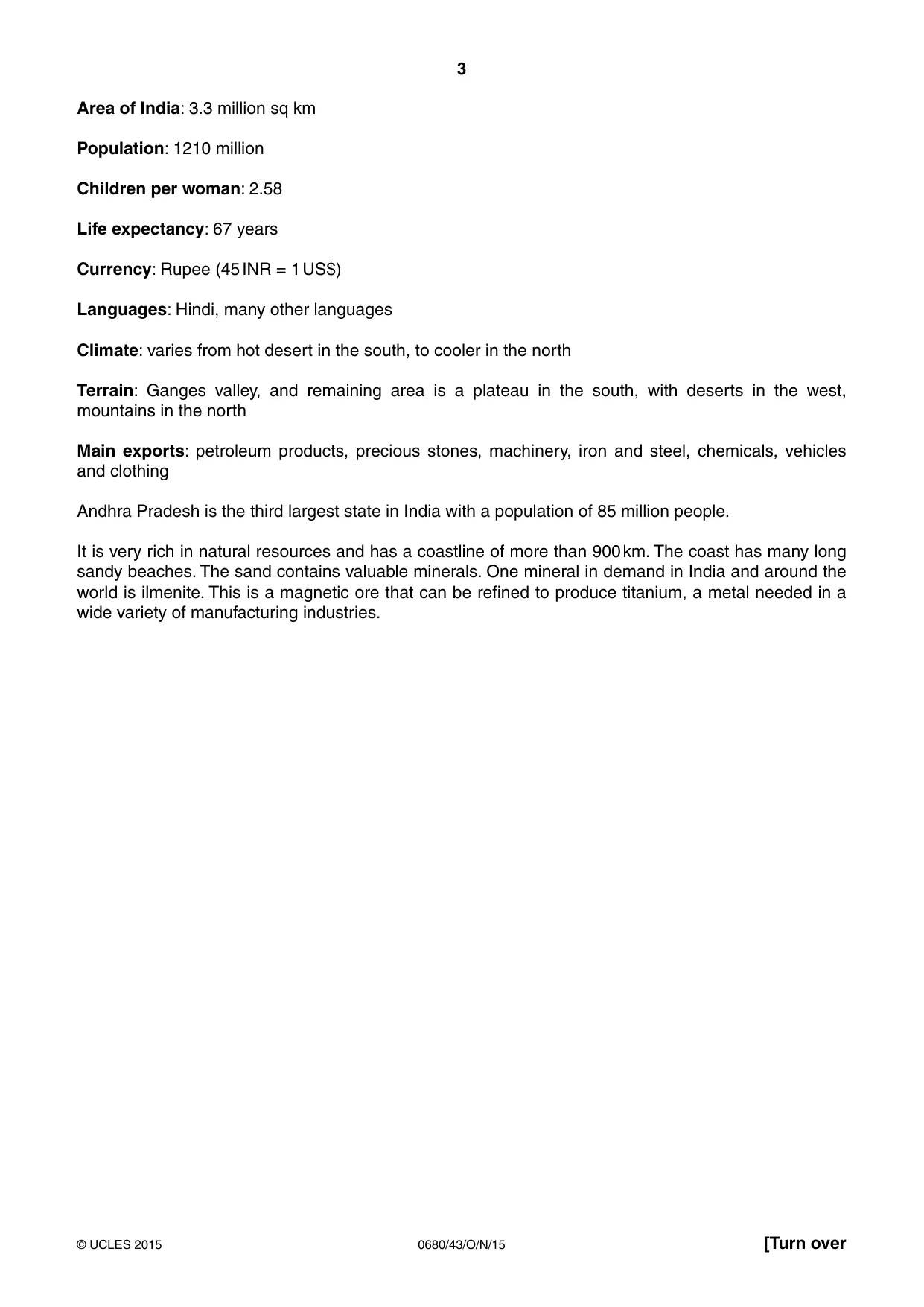
3 0680/43/O/N/15 © UCLES 2015 [Turn over Area of India: 3.3 million sq km Population: 1210 million Children per woman: 2.58 Life expectancy: 67 years Currency: Rupee (45 INR = 1 US$) Languages: Hindi, many other languages Climate: varies from hot desert in the south, to cooler in the north Terrain: Ganges valley, and remaining area is a plateau in the south, with deserts in the west, mountains in the north Main exports: petroleum products, precious stones, machinery, iron and steel, chemicals, vehicles and clothing Andhra Pradesh is the third largest state in India with a population of 85 million people. It is very rich in natural resources and has a coastline of more than 900 km. The coast has many long sandy beaches. The sand contains valuable minerals. One mineral in demand in India and around the world is ilmenite. This is a magnetic ore that can be refined to produce titanium, a metal needed in a wide variety of manufacturing industries.
Question paper, page 4
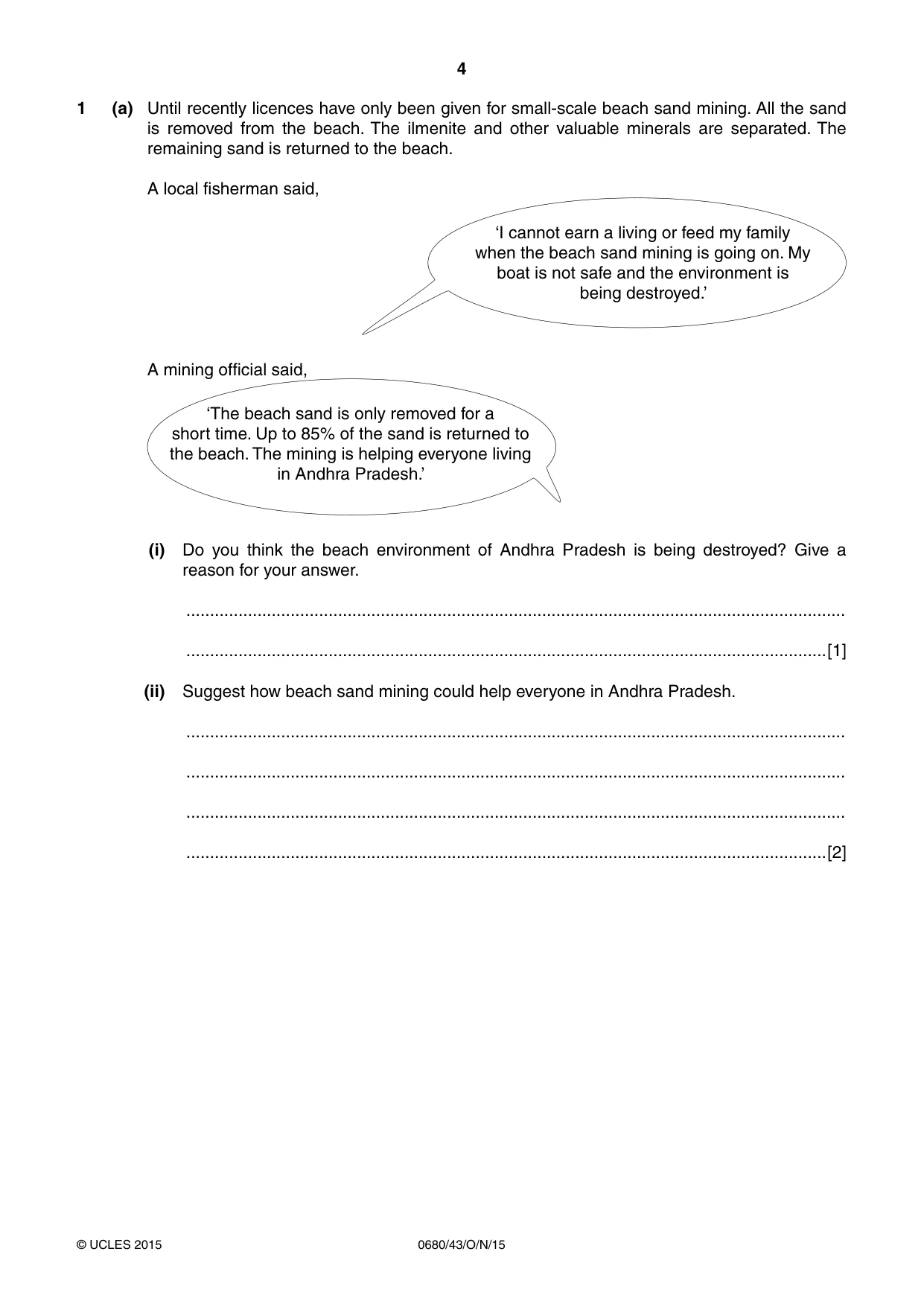
4 0680/43/O/N/15 © UCLES 2015 1 (a) Until recently licences have only been given for small-scale beach sand mining. All the sand is removed from the beach. The ilmenite and other valuable minerals are separated. The remaining sand is returned to the beach. A local fisherman said, ‘I cannot earn a living or feed my family when the beach sand mining is going on. My boat is not safe and the environment is being destroyed.’ A mining official said, ‘The beach sand is only removed for a short time. Up to 85% of the sand is returned to the beach. The mining is helping everyone living in Andhra Pradesh.’ (i) Do you think the beach environment of Andhra Pradesh is being destroyed? Give a reason for your answer. … …[1] (ii) Suggest how beach sand mining could help everyone in Andhra Pradesh. … … … …[2]
Question paper, page 5
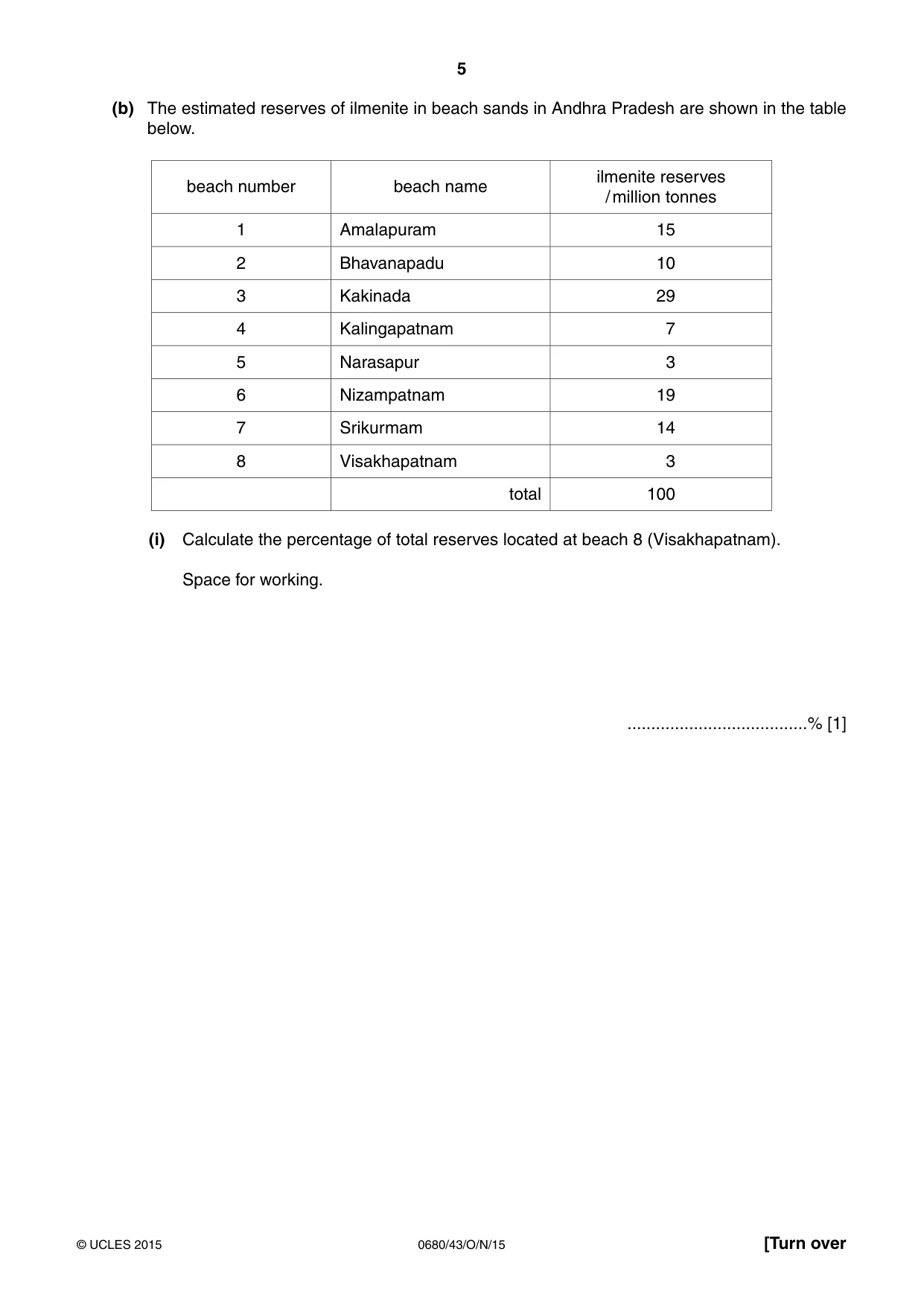
5 0680/43/O/N/15 © UCLES 2015 [Turn over (b) The estimated reserves of ilmenite in beach sands in Andhra Pradesh are shown in the table below. beach number beach name ilmenite reserves / million tonnes 1 Amalapuram 15 2 Bhavanapadu 10 3 Kakinada 29 4 Kalingapatnam 7 5 Narasapur 3 6 Nizampatnam 19 7 Srikurmam 14 8 Visakhapatnam 3 total 100 (i) Calculate the percentage of total reserves located at beach 8 (Visakhapatnam). Space for working. …% [1]
Question paper, page 6
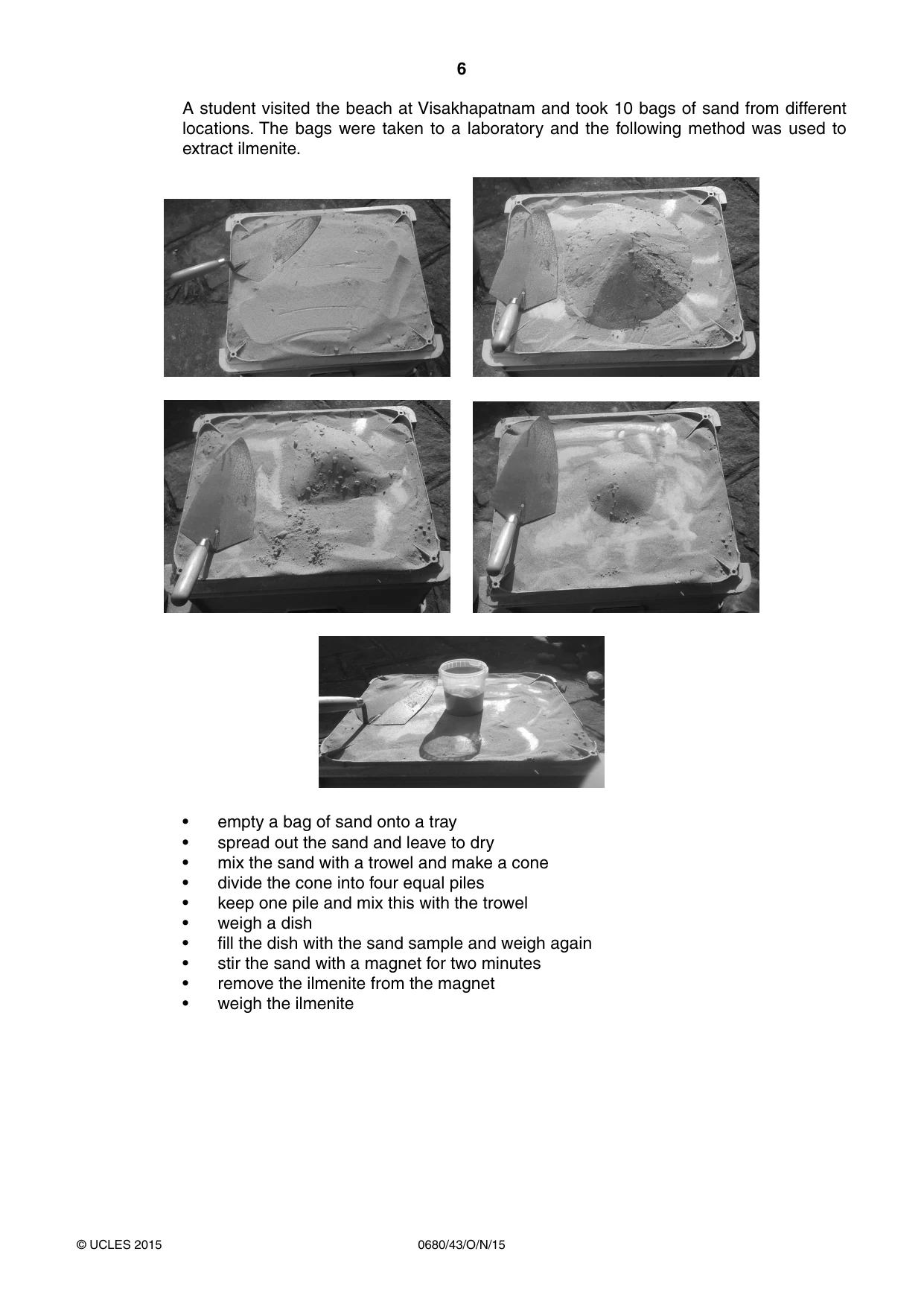
6 0680/43/O/N/15 © UCLES 2015 A student visited the beach at Visakhapatnam and took 10 bags of sand from different locations. The bags were taken to a laboratory and the following method was used to extract ilmenite. • empty a bag of sand onto a tray • spread out the sand and leave to dry • mix the sand with a trowel and make a cone • divide the cone into four equal piles • keep one pile and mix this with the trowel • weigh a dish • fill the dish with the sand sample and weigh again • stir the sand with a magnet for two minutes • remove the ilmenite from the magnet • weigh the ilmenite
Question paper, page 7
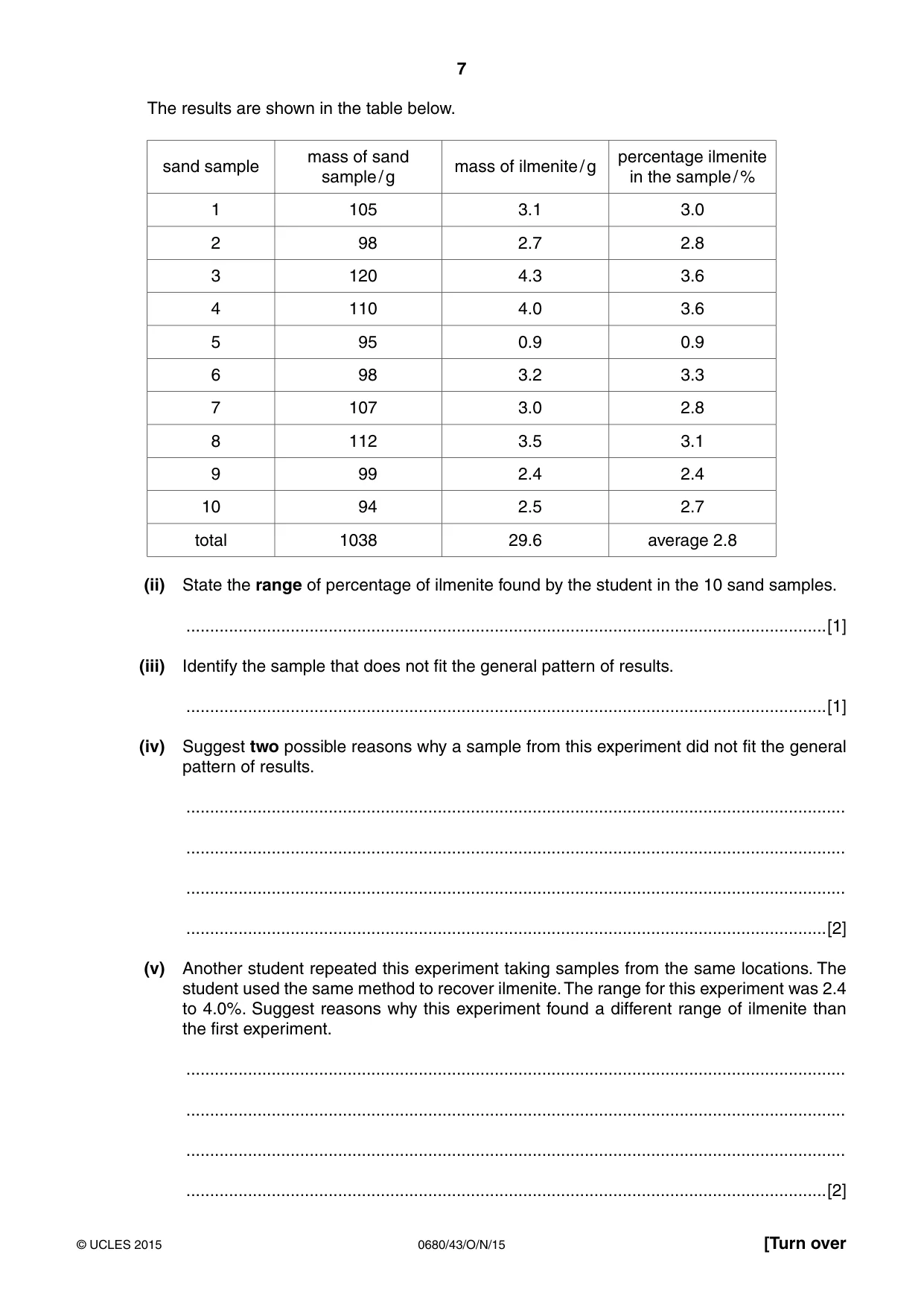
7 0680/43/O/N/15 © UCLES 2015 [Turn over The results are shown in the table below. sand sample mass of sand sample / g mass of ilmenite / g percentage ilmenite in the sample / % 1 105 3.1 3.0 2 98 2.7 2.8 3 120 4.3 3.6 4 110 4.0 3.6 5 95 0.9 0.9 6 98 3.2 3.3 7 107 3.0 2.8 8 112 3.5 3.1 9 99 2.4 2.4 10 94 2.5 2.7 total 1038 29.6 average 2.8 (ii) State the range of percentage of ilmenite found by the student in the 10 sand samples. …[1] (iii) Identify the sample that does not fit the general pattern of results. …[1] (iv) Suggest two possible reasons why a sample from this experiment did not fit the general pattern of results. … … … …[2] (v) Another student repeated this experiment taking samples from the same locations. The student used the same method to recover ilmenite. The range for this experiment was 2.4 to 4.0%. Suggest reasons why this experiment found a different range of ilmenite than the first experiment. … … … …[2]
Question paper, page 8
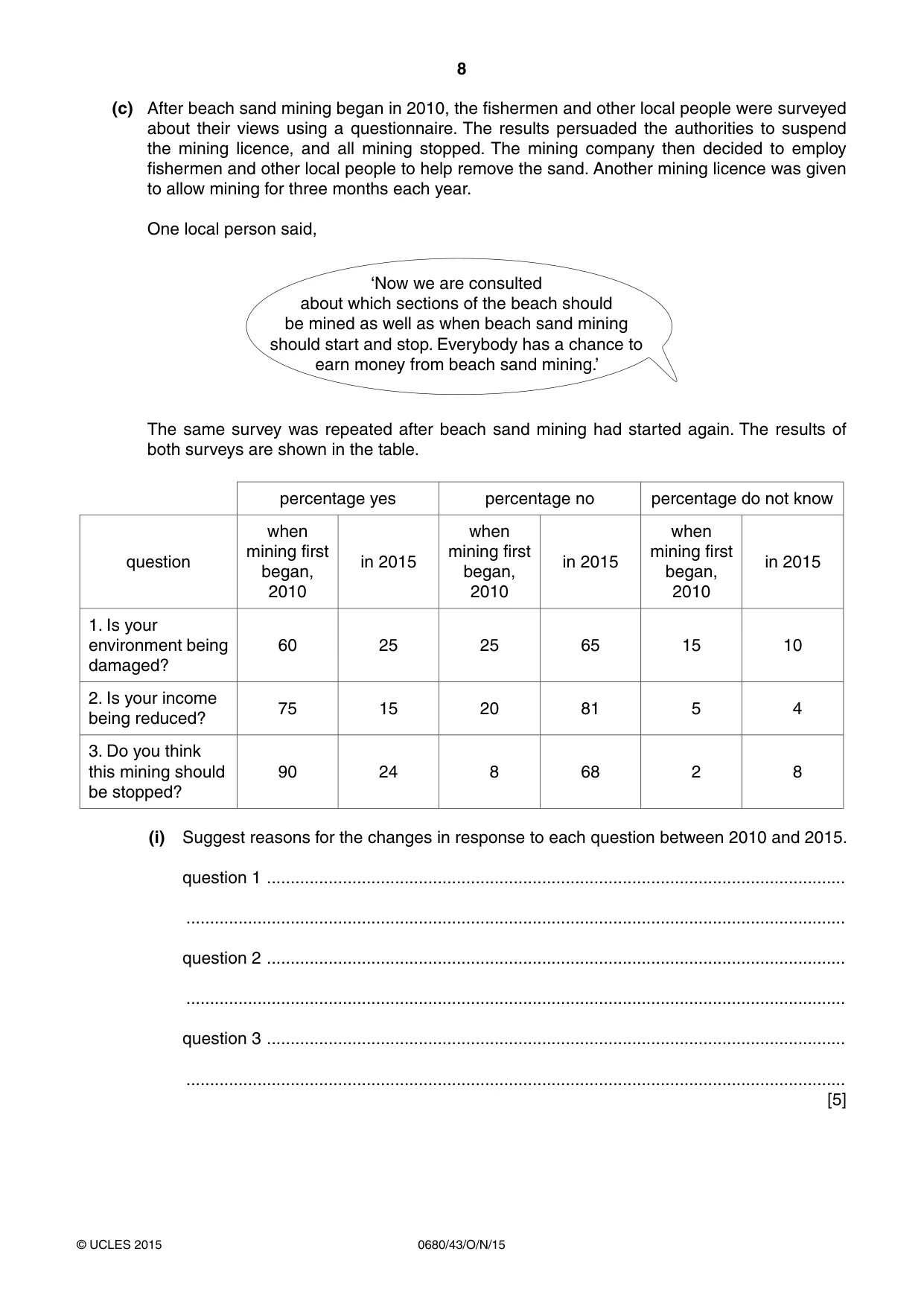
8 0680/43/O/N/15 © UCLES 2015 (c) After beach sand mining began in 2010, the fishermen and other local people were surveyed about their views using a questionnaire. The results persuaded the authorities to suspend the mining licence, and all mining stopped. The mining company then decided to employ fishermen and other local people to help remove the sand. Another mining licence was given to allow mining for three months each year. One local person said, ‘Now we are consulted about which sections of the beach should be mined as well as when beach sand mining should start and stop. Everybody has a chance to earn money from beach sand mining.’ The same survey was repeated after beach sand mining had started again. The results of both surveys are shown in the table. percentage yes percentage no percentage do not know question when mining first began, 2010 in 2015 when mining first began, 2010 in 2015 when mining first began, 2010 in 2015 1. Is your environment being damaged? 60 25 25 65 15 10 2. Is your income being reduced? 75 15 20 81 5 4 3. Do you think this mining should be stopped? 90 24 8 68 2 8 (i) Suggest reasons for the changes in response to each question between 2010 and 2015. question 1 … … question 2 … … question 3 … … [5]
Question paper, page 9
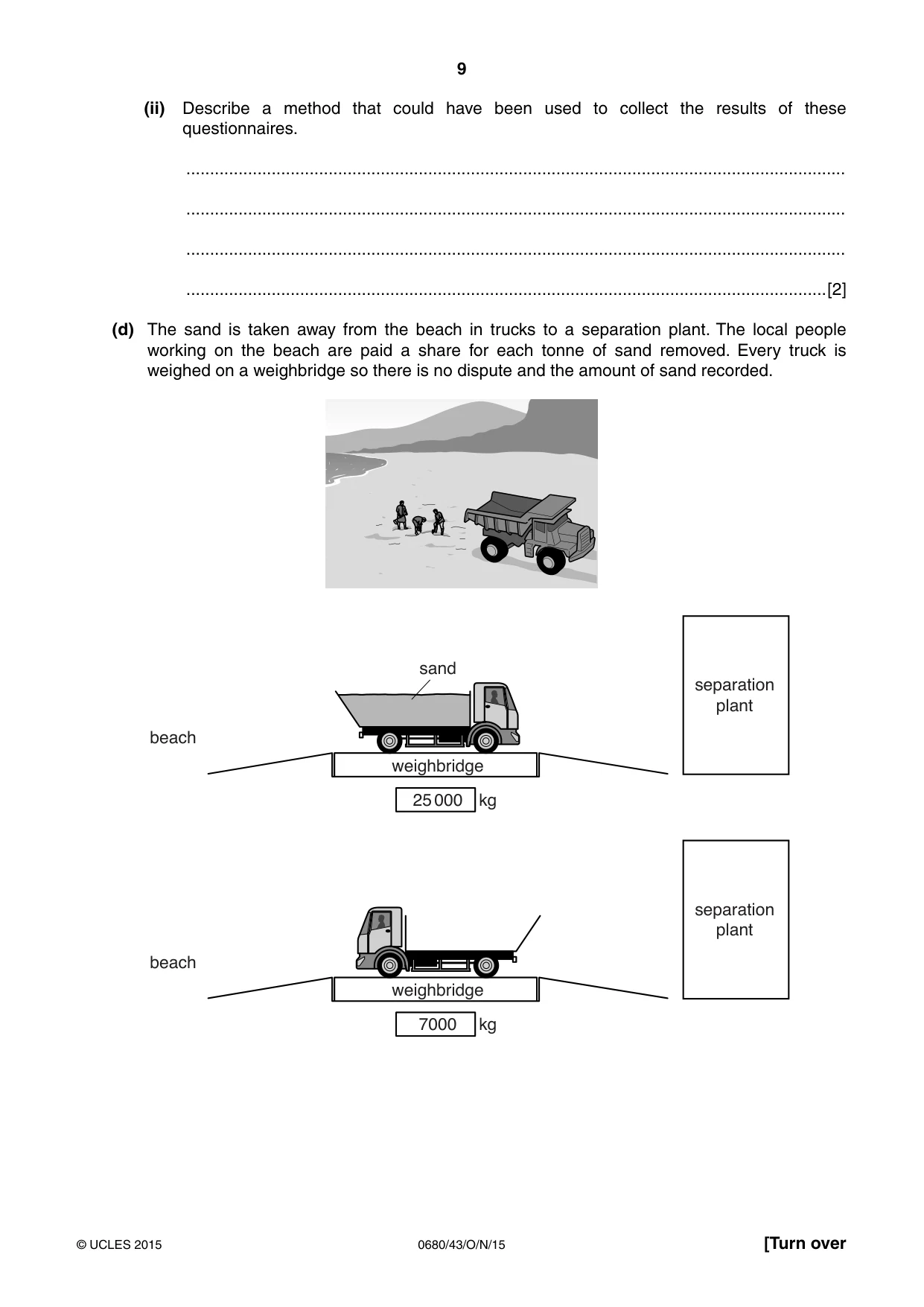
9 0680/43/O/N/15 © UCLES 2015 [Turn over (ii) Describe a method that could have been used to collect the results of these questionnaires. … … … …[2] (d) The sand is taken away from the beach in trucks to a separation plant. The local people working on the beach are paid a share for each tonne of sand removed. Every truck is weighed on a weighbridge so there is no dispute and the amount of sand recorded. weighbridge sand 25 000 kg separation plant beach weighbridge 7000 kg separation plant beach
Question paper, page 10
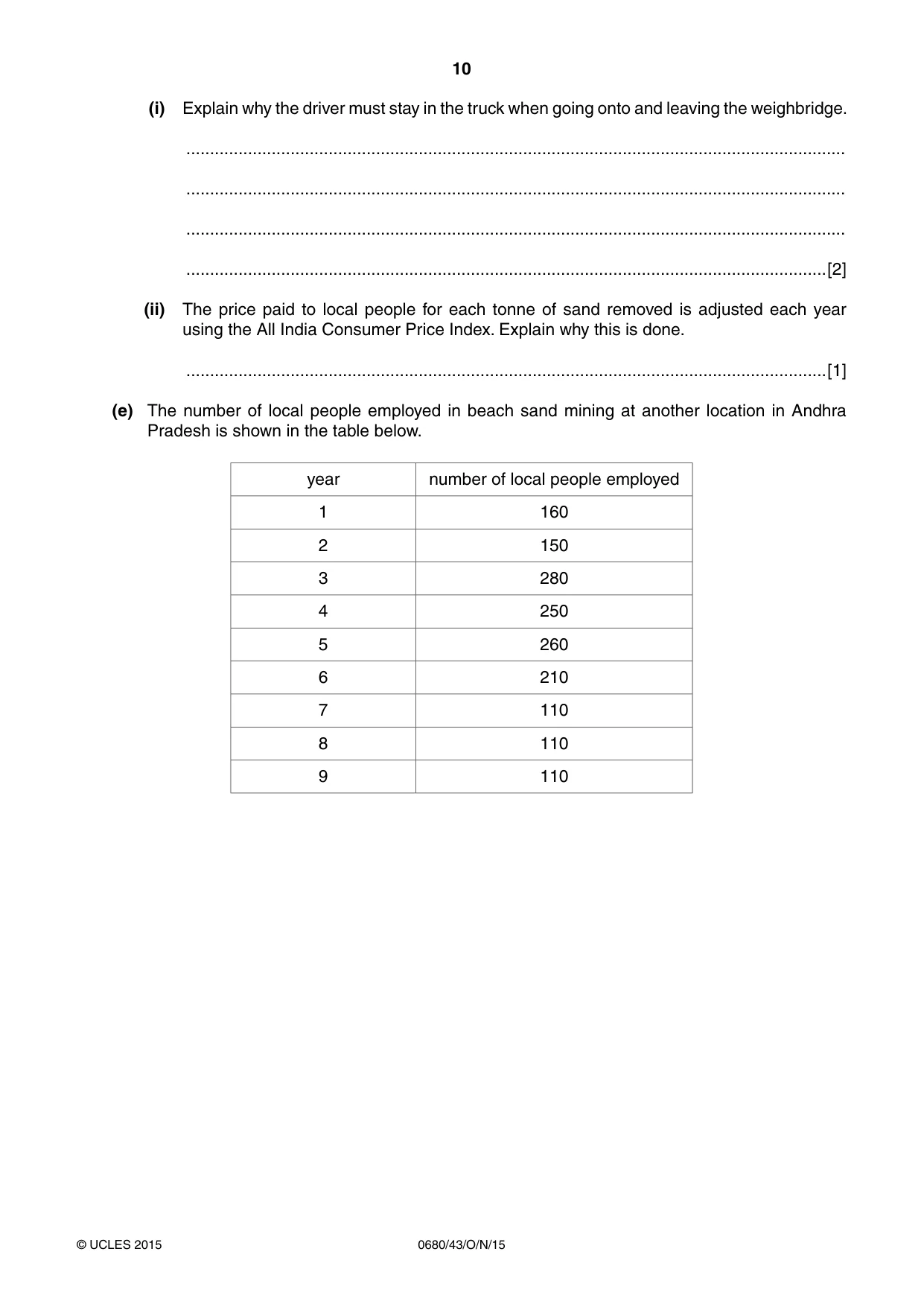
10 0680/43/O/N/15 © UCLES 2015 (i) Explain why the driver must stay in the truck when going onto and leaving the weighbridge. … … … …[2] (ii) The price paid to local people for each tonne of sand removed is adjusted each year using the All India Consumer Price Index. Explain why this is done. …[1] (e) The number of local people employed in beach sand mining at another location in Andhra Pradesh is shown in the table below. year number of local people employed 1 160 2 150 3 280 4 250 5 260 6 210 7 110 8 110 9 110
Question paper, page 11
11 0680/43/O/N/15 © UCLES 2015 [Turn over (i) Plot the data as a graph on the grid below. [4] (ii) Describe the pattern shown by the graph. … … … …[2]
Question paper, page 12
12 0680/43/O/N/15 © UCLES 2015 (iii) Suggest a reason for the change in the number of people employed between years 5 and 9. … …[1] (f) Some ilmenite deposits have been found 1 km inland. Some of these deposits have already been mined. This land has been reclaimed by planting large numbers of ironwood trees, with a few coconut trees and other trees. Explain the advantages of reclaiming mined land in this way. … … … … … …[3]
Question paper, page 13
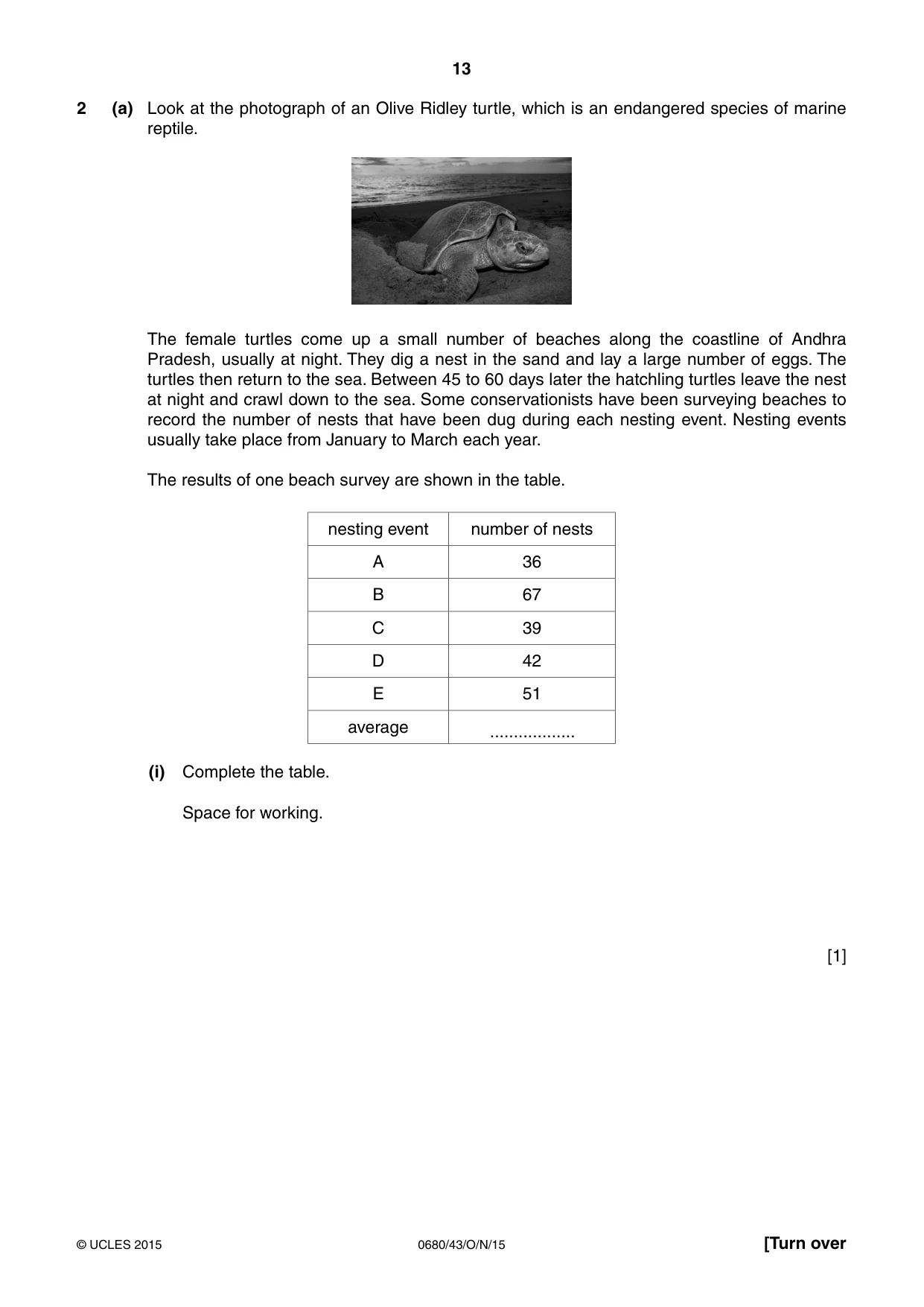
13 0680/43/O/N/15 © UCLES 2015 [Turn over 2 (a) Look at the photograph of an Olive Ridley turtle, which is an endangered species of marine reptile. The female turtles come up a small number of beaches along the coastline of Andhra Pradesh, usually at night. They dig a nest in the sand and lay a large number of eggs. The turtles then return to the sea. Between 45 to 60 days later the hatchling turtles leave the nest at night and crawl down to the sea. Some conservationists have been surveying beaches to record the number of nests that have been dug during each nesting event. Nesting events usually take place from January to March each year. The results of one beach survey are shown in the table. nesting event number of nests A 36 B 67 C 39 D 42 E 51 average … (i) Complete the table. Space for working. [1]
Question paper, page 14
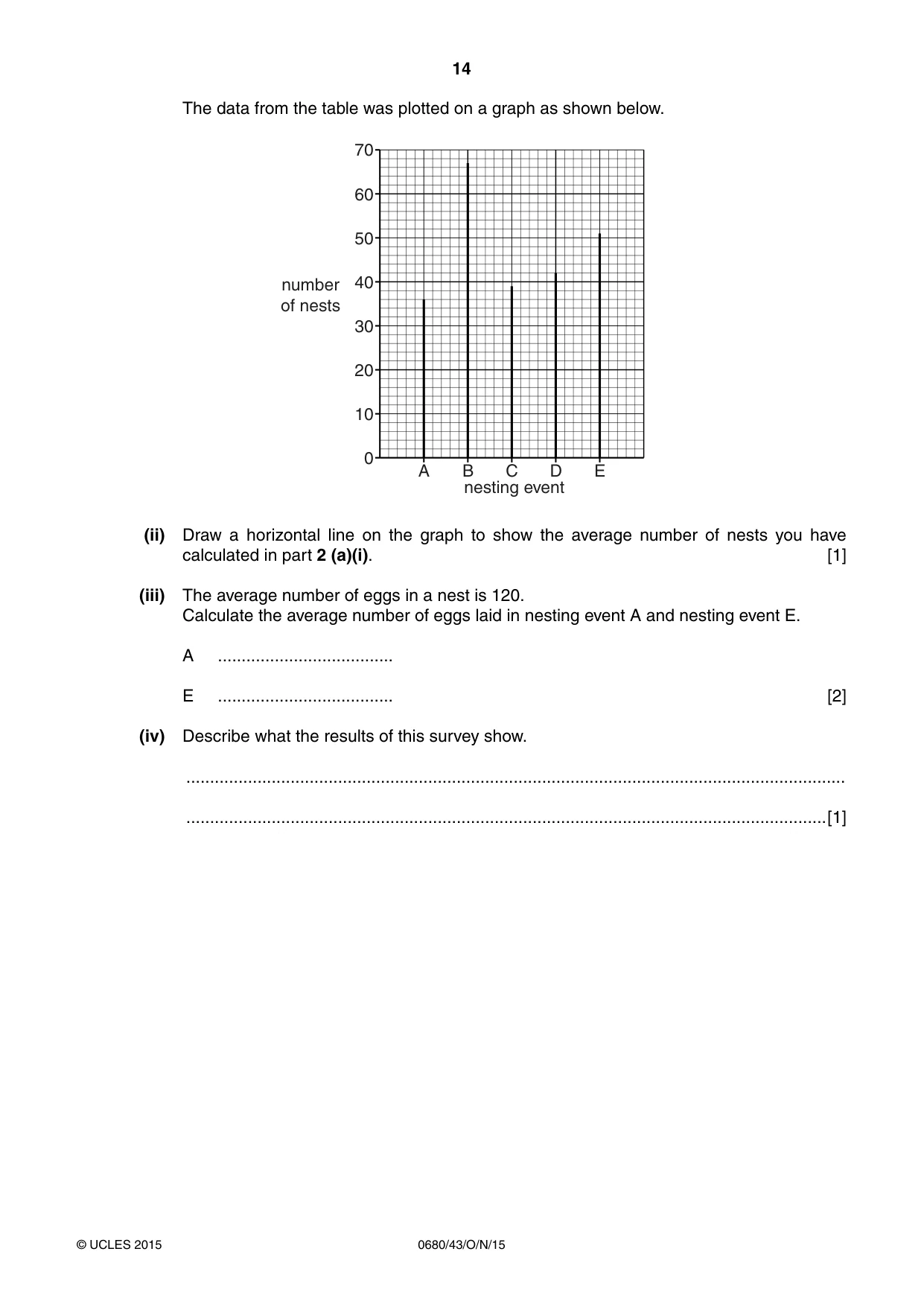
14 0680/43/O/N/15 © UCLES 2015 The data from the table was plotted on a graph as shown below. A 0 10 20 30 40 number of nests nesting event 50 60 70 B C D E (ii) Draw a horizontal line on the graph to show the average number of nests you have calculated in part 2 (a)(i). [1] (iii) The average number of eggs in a nest is 120. Calculate the average number of eggs laid in nesting event A and nesting event E. A … E … [2] (iv) Describe what the results of this survey show. … …[1]
Question paper, page 15
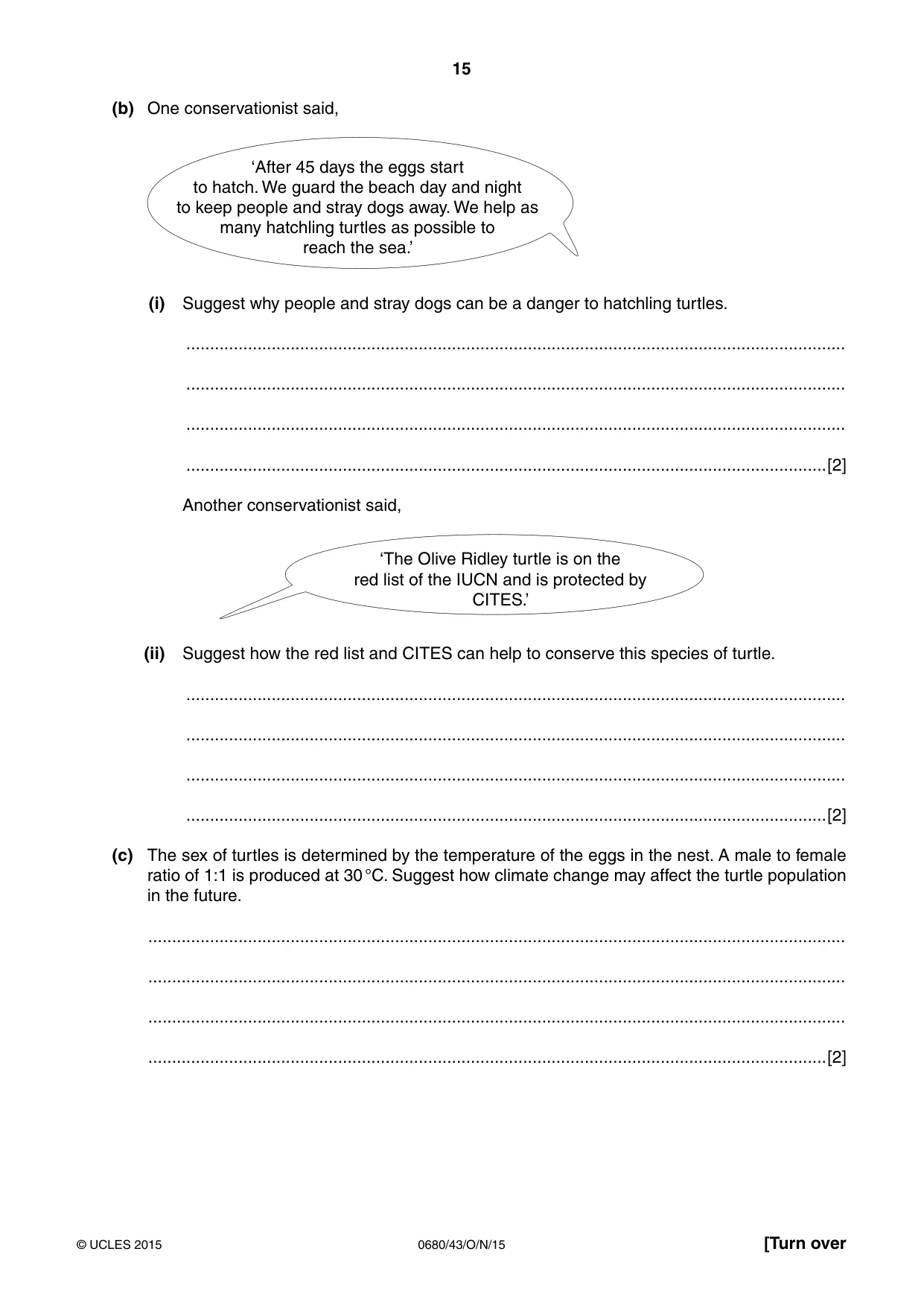
15 0680/43/O/N/15 © UCLES 2015 [Turn over (b) One conservationist said, ‘After 45 days the eggs start to hatch. We guard the beach day and night to keep people and stray dogs away. We help as many hatchling turtles as possible to reach the sea.’ (i) Suggest why people and stray dogs can be a danger to hatchling turtles. … … … …[2] Another conservationist said, ‘The Olive Ridley turtle is on the red list of the IUCN and is protected by CITES.’ (ii) Suggest how the red list and CITES can help to conserve this species of turtle. … … … …[2] (c) The sex of turtles is determined by the temperature of the eggs in the nest. A male to female ratio of 1:1 is produced at 30 °C. Suggest how climate change may affect the turtle population in the future. … … … …[2]
Question paper, page 16
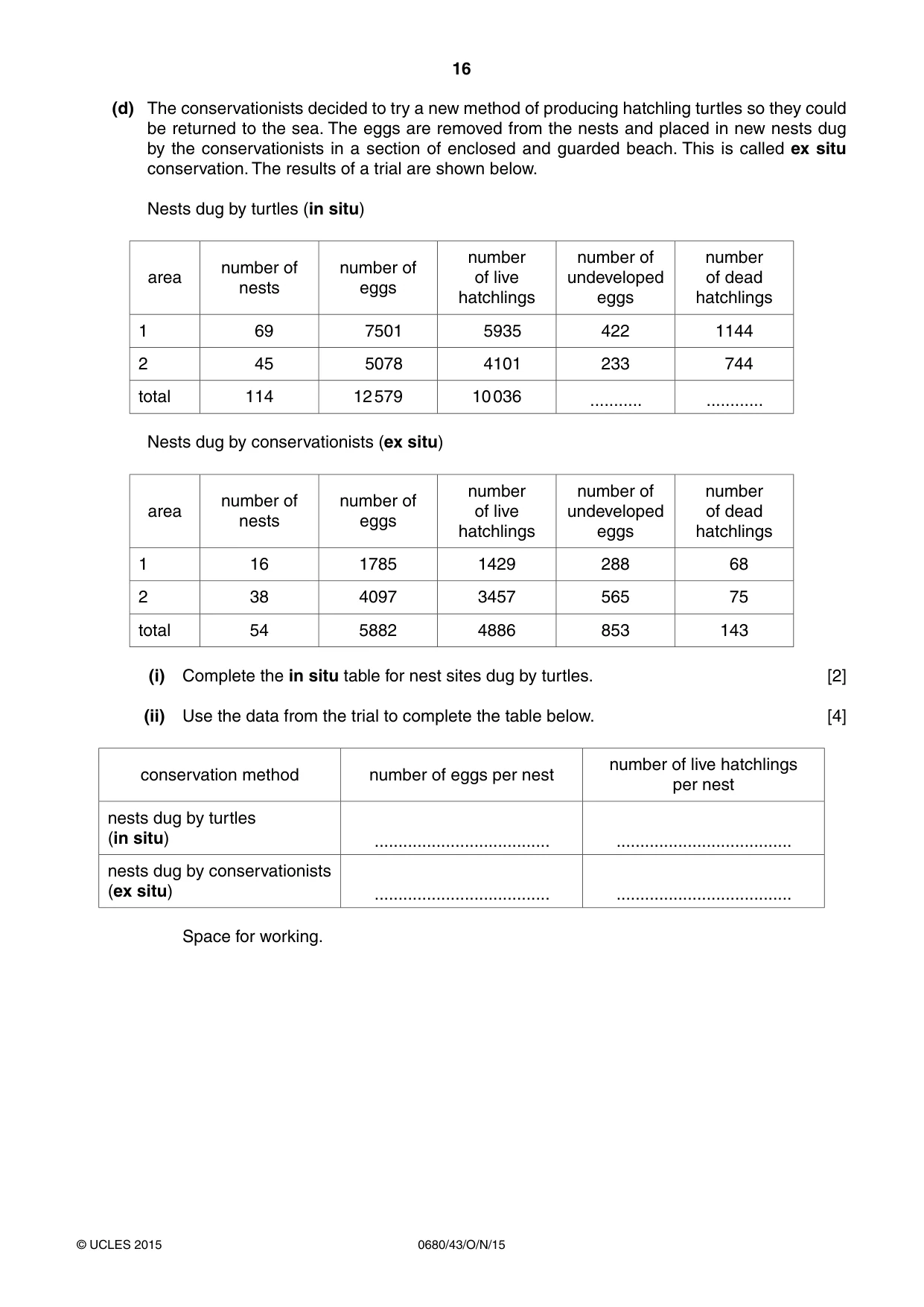
16 0680/43/O/N/15 © UCLES 2015 (d) The conservationists decided to try a new method of producing hatchling turtles so they could be returned to the sea. The eggs are removed from the nests and placed in new nests dug by the conservationists in a section of enclosed and guarded beach. This is called ex situ conservation. The results of a trial are shown below. Nests dug by turtles (in situ) area number of nests number of eggs number of live hatchlings number of undeveloped eggs number of dead hatchlings 1 69 7501 5935 422 1144 2 45 5078 4101 233 744 total 114 12 579 10 036 … … Nests dug by conservationists (ex situ) area number of nests number of eggs number of live hatchlings number of undeveloped eggs number of dead hatchlings 1 16 1785 1429 288 68 2 38 4097 3457 565 75 total 54 5882 4886 853 143 (i) Complete the in situ table for nest sites dug by turtles. [2] (ii) Use the data from the trial to complete the table below. [4] conservation method number of eggs per nest number of live hatchlings per nest nests dug by turtles (in situ) … … nests dug by conservationists (ex situ) … … Space for working.
Question paper, page 17
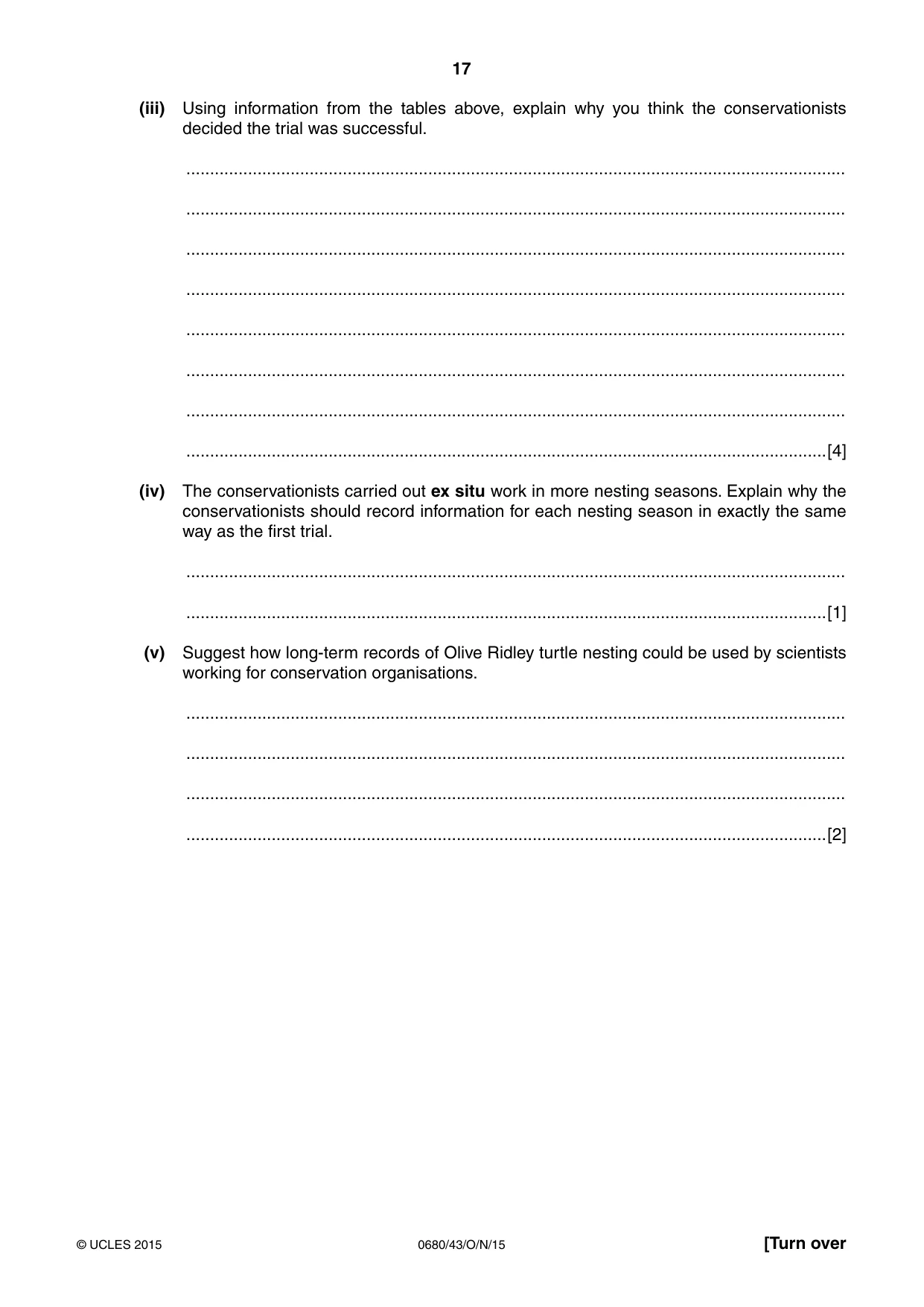
17 0680/43/O/N/15 © UCLES 2015 [Turn over (iii) Using information from the tables above, explain why you think the conservationists decided the trial was successful. … … … … … … … …[4] (iv) The conservationists carried out ex situ work in more nesting seasons. Explain why the conservationists should record information for each nesting season in exactly the same way as the first trial. … …[1] (v) Suggest how long-term records of Olive Ridley turtle nesting could be used by scientists working for conservation organisations. … … … …[2]
Question paper, page 18
18 0680/43/O/N/15 © UCLES 2015 (e) Turtles are often found dead on the beaches of Andhra Pradesh. The turtles are frequently caught in the fishing nets of trawlers, trapped underwater and drown. Turtle saving devices (TSDs) have been added to the fishing nets of trawlers. grill flap turtle fish The fish go into the end of the net but the turtles are held by the bars and pushed up to a flap in the net and released. Some fishermen think that the TSDs allow some of their fish catch to escape. (i) Suggest a way in which the fishermen might make sure they catch as many fish as possible. … …[1] (ii) Suggest how the use of TSDs could be enforced. … … … …[2]
Question paper, page 19
19 0680/43/O/N/15 © UCLES 2015 (f) The port at Visakhapatnam is being enlarged. The conservationists are worried that increased light pollution at night may stop the turtles finding their way to the nesting sites. Suggest how human activity can increase around Visakhapatnam without disturbing Olive Ridley turtle populations. … … … … … …[3]
Question paper, page 20
20 0680/43/O/N/15 © UCLES 2015 BLANK PAGE Permission to reproduce items where third-party owned material protected by copyright is included has been sought and cleared where possible. Every reasonable effort has been made by the publisher (UCLES) to trace copyright holders, but if any items requiring clearance have unwittingly been included, the publisher will be pleased to make amends at the earliest possible opportunity. To avoid the issue of disclosure of answer-related information to candidates, all copyright acknowledgements are reproduced online in the Cambridge International Examinations Copyright Acknowledgements Booklet. This is produced for each series of examinations and is freely available to download at www.cie.org.uk after the live examination series. Cambridge International Examinations is part of the Cambridge Assessment Group. Cambridge Assessment is the brand name of University of Cambridge Local Examinations Syndicate (UCLES), which is itself a department of the University of Cambridge.
Mark scheme, page 1
® IGCSE is the registered trademark of Cambridge International Examinations. CAMBRIDGE INTERNATIONAL EXAMINATIONS Cambridge International General Certificate of Secondary Education MARK SCHEME for the October/November 2015 series 0680 ENVIRONMENTAL MANAGEMENT 0680/43 Paper 4 (Alternative to Coursework), maximum raw mark 60 This mark scheme is published as an aid to teachers and candidates, to indicate the requirements of the examination. It shows the basis on which Examiners were instructed to award marks. It does not indicate the details of the discussions that took place at an Examiners’ meeting before marking began, which would have considered the acceptability of alternative answers. Mark schemes should be read in conjunction with the question paper and the Principal Examiner Report for Teachers. Cambridge will not enter into discussions about these mark schemes. Cambridge is publishing the mark schemes for the October/November 2015 series for most Cambridge IGCSE®, Cambridge International A and AS Level components and some Cambridge O Level components.
Mark scheme, page 2
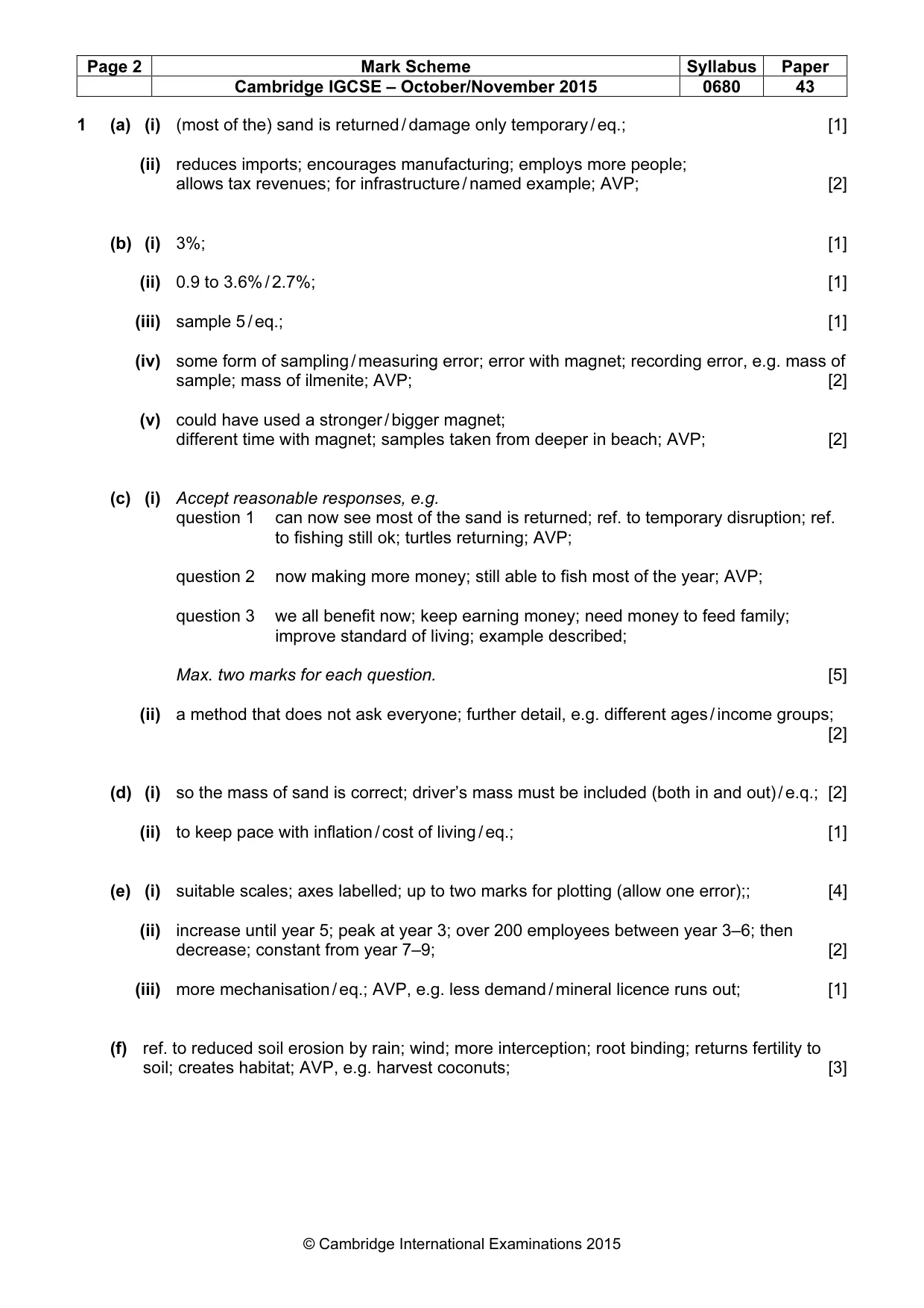
Page 2 Mark Scheme Syllabus Paper Cambridge IGCSE – October/November 2015 0680 43 © Cambridge International Examinations 2015 1 (a) (i) (most of the) sand is returned / damage only temporary / eq.; [1] (ii) reduces imports; encourages manufacturing; employs more people; allows tax revenues; for infrastructure / named example; AVP; [2] (b) (i) 3%; [1] (ii) 0.9 to 3.6% / 2.7%; [1] (iii) sample 5 / eq.; [1] (iv) some form of sampling / measuring error; error with magnet; recording error, e.g. mass of sample; mass of ilmenite; AVP; [2] (v) could have used a stronger / bigger magnet; different time with magnet; samples taken from deeper in beach; AVP; [2] (c) (i) Accept reasonable responses, e.g. question 1 can now see most of the sand is returned; ref. to temporary disruption; ref. to fishing still ok; turtles returning; AVP; question 2 now making more money; still able to fish most of the year; AVP; question 3 we all benefit now; keep earning money; need money to feed family; improve standard of living; example described; Max. two marks for each question. [5] (ii) a method that does not ask everyone; further detail, e.g. different ages / income groups; [2] (d) (i) so the mass of sand is correct; driver’s mass must be included (both in and out) / e.q.; [2] (ii) to keep pace with inflation / cost of living / eq.; [1] (e) (i) suitable scales; axes labelled; up to two marks for plotting (allow one error);; [4] (ii) increase until year 5; peak at year 3; over 200 employees between year 3–6; then decrease; constant from year 7–9; [2] (iii) more mechanisation / eq.; AVP, e.g. less demand / mineral licence runs out; [1] (f) ref. to reduced soil erosion by rain; wind; more interception; root binding; returns fertility to soil; creates habitat; AVP, e.g. harvest coconuts; [3]
Mark scheme, page 3
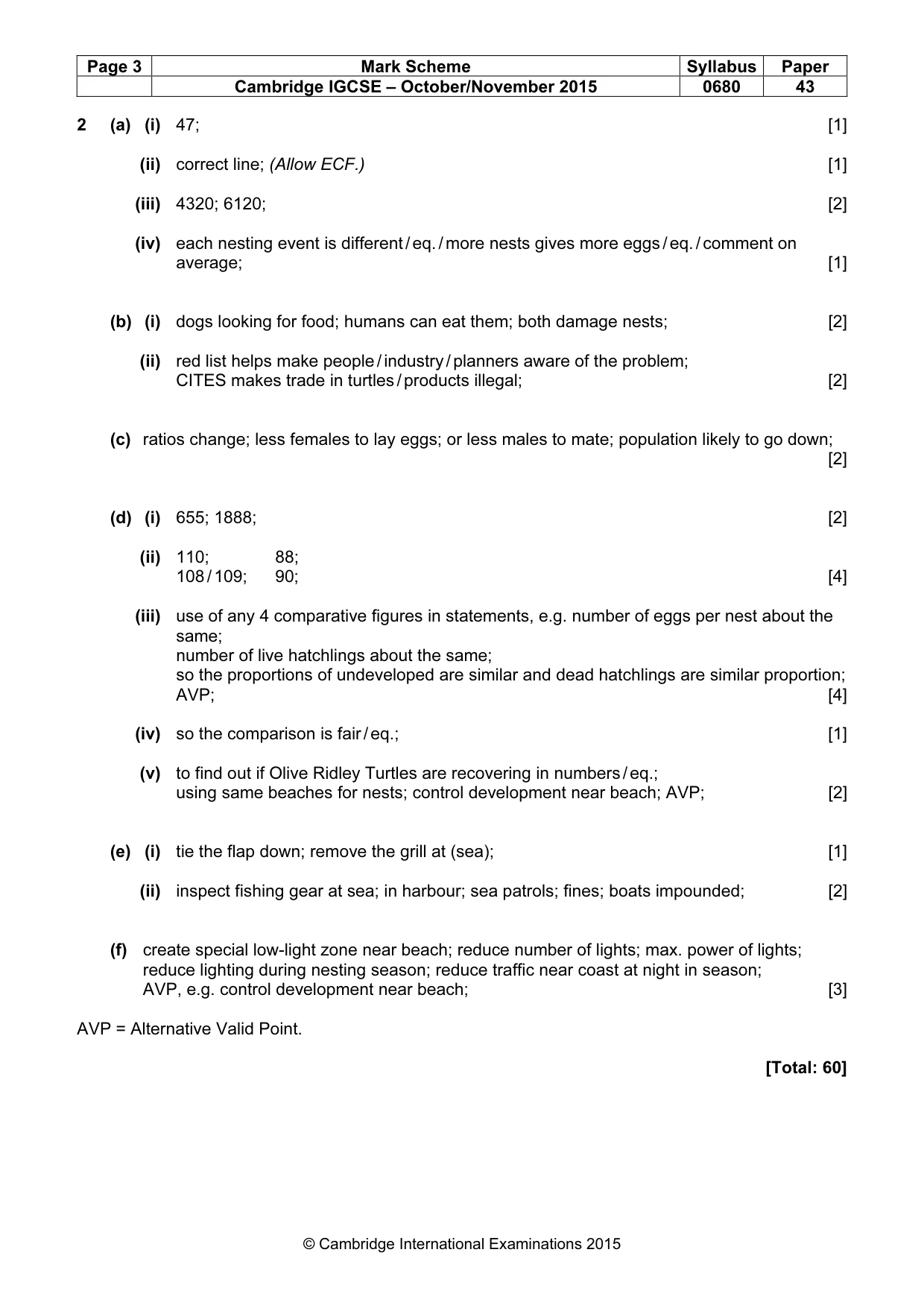
Page 3 Mark Scheme Syllabus Paper Cambridge IGCSE – October/November 2015 0680 43 © Cambridge International Examinations 2015 2 (a) (i) 47; [1] (ii) correct line; (Allow ECF.) [1] (iii) 4320; 6120; [2] (iv) each nesting event is different / eq. / more nests gives more eggs / eq. / comment on average; [1] (b) (i) dogs looking for food; humans can eat them; both damage nests; [2] (ii) red list helps make people / industry / planners aware of the problem; CITES makes trade in turtles / products illegal; [2] (c) ratios change; less females to lay eggs; or less males to mate; population likely to go down; [2] (d) (i) 655; 1888; [2] (ii) 110; 88; 108 / 109; 90; [4] (iii) use of any 4 comparative figures in statements, e.g. number of eggs per nest about the same; number of live hatchlings about the same; so the proportions of undeveloped are similar and dead hatchlings are similar proportion; AVP; [4] (iv) so the comparison is fair / eq.; [1] (v) to find out if Olive Ridley Turtles are recovering in numbers / eq.; using same beaches for nests; control development near beach; AVP; [2] (e) (i) tie the flap down; remove the grill at (sea); [1] (ii) inspect fishing gear at sea; in harbour; sea patrols; fines; boats impounded; [2] (f) create special low-light zone near beach; reduce number of lights; max. power of lights; reduce lighting during nesting season; reduce traffic near coast at night in season; AVP, e.g. control development near beach; [3] AVP = Alternative Valid Point. [Total: 60]
What you needed in this session
Cambridge’s own grade thresholds for 2015 Oct/Nov, Paper 4 · Variant 3. A higher threshold means an easier paper — the bar moves with how the cohort did.