Cambridge IGCSE Environmental Management 0680 — 2015 May/June Paper 4 · Variant 2
0680/42/M/J/15 · 60 marks · ≈68 min
The question paper and its mark scheme, free to read here and free to download. This is Cambridge’s own paper, exactly as it was sat.
Question paper16 pages



Mark scheme4 pages
Answers below. Sit the paper first if you are practising.
Paper as text
Question paper, page 1
This document consists of 15 printed pages and 1 blank page. DC (NF/CGW) 92043/3 © UCLES 2015 [Turn over Cambridge International Examinations Cambridge International General Certificate of Secondary Education * 7 4 3 7 2 9 6 7 3 5 * ENVIRONMENTAL MANAGEMENT 0680/42 Alternative to Coursework May/June 2015 1 hour 30 minutes Candidates answer on the Question Paper. No Additional Materials are required. READ THESE INSTRUCTIONS FIRST Write your Centre number, candidate number and name on all the work you hand in. Write in dark blue or black pen. You may use an HB pencil for any diagrams or graphs. Do not use staples, paper clips, glue or correction fluid. DO NOT WRITE IN ANY BARCODES. Answer all questions. Electronic calculators may be used. You may lose marks if you do not show your working or if you do not use appropriate units. Study the appropriate source materials before you start to write your answers. Credit will be given for appropriate selection and use of data in your answers and for relevant interpretation of these data. Suggestions for data sources are given in some questions. You may use the source data to draw diagrams and graphs or to do calculations to illustrate your answers. At the end of the examination, fasten all your work securely together. The number of marks is given in brackets [ ] at the end of each question or part question.
Question paper, page 2
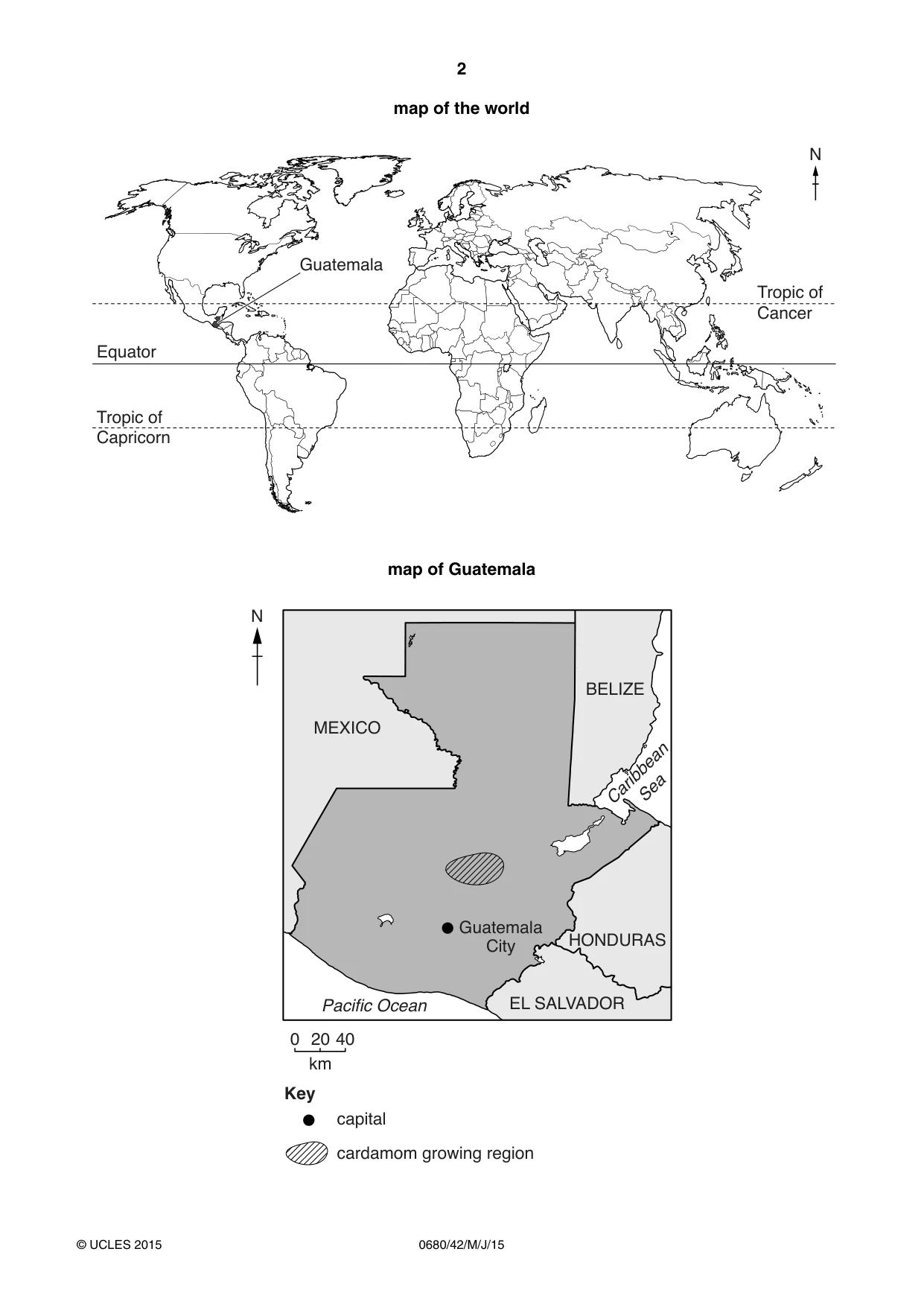
2 0680/42/M/J/15 © UCLES 2015 map of the world Equator Guatemala Tropic of Capricorn Tropic of Cancer N map of Guatemala 0 20 40 km cardamom growing region capital MEXICO Key BELIZE Guatemala City HONDURAS EL SALVADOR Pacific Ocean Caribbean Sea N
Question paper, page 3
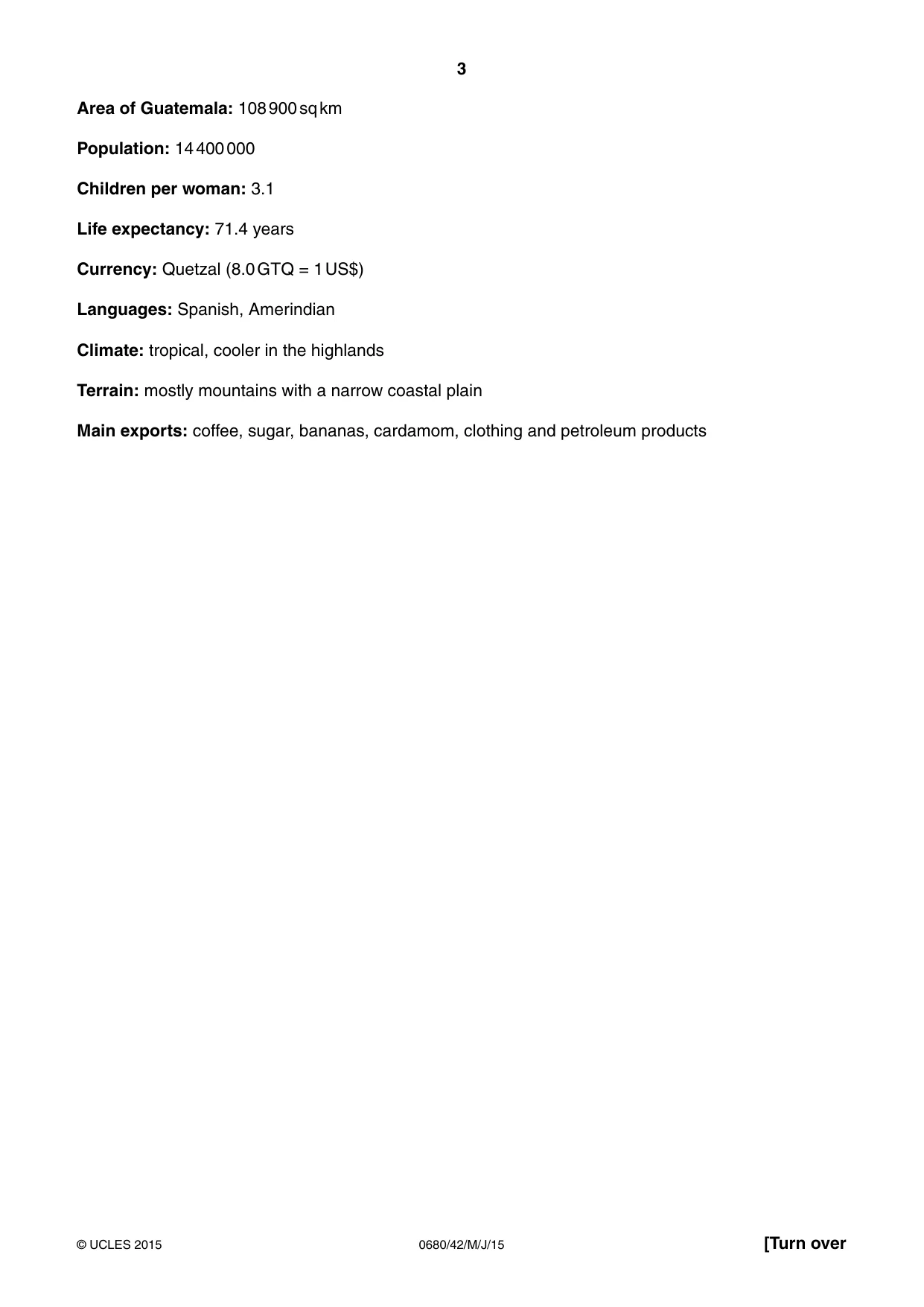
3 0680/42/M/J/15 © UCLES 2015 [Turn over Area of Guatemala: 108 900 sq km Population: 14 400 000 Children per woman: 3.1 Life expectancy: 71.4 years Currency: Quetzal (8.0 GTQ = 1 US$) Languages: Spanish, Amerindian Climate: tropical, cooler in the highlands Terrain: mostly mountains with a narrow coastal plain Main exports: coffee, sugar, bananas, cardamom, clothing and petroleum products
Question paper, page 4
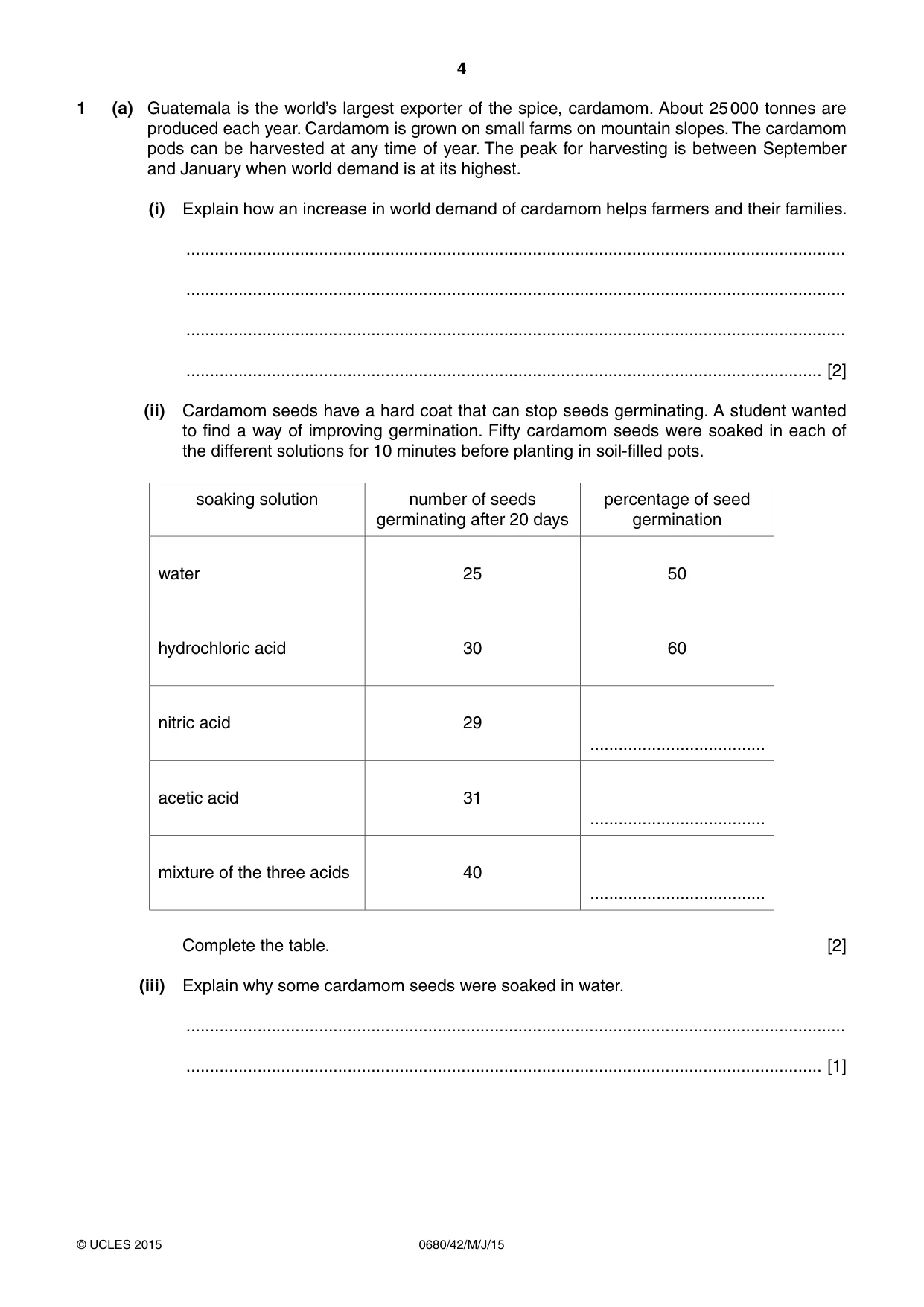
4 0680/42/M/J/15 © UCLES 2015 1 (a) Guatemala is the world’s largest exporter of the spice, cardamom. About 25 000 tonnes are produced each year. Cardamom is grown on small farms on mountain slopes. The cardamom pods can be harvested at any time of year. The peak for harvesting is between September and January when world demand is at its highest. (i) Explain how an increase in world demand of cardamom helps farmers and their families. … … … … [2] (ii) Cardamom seeds have a hard coat that can stop seeds germinating. A student wanted to find a way of improving germination. Fifty cardamom seeds were soaked in each of the different solutions for 10 minutes before planting in soil-filled pots. soaking solution number of seeds germinating after 20 days percentage of seed germination water 25 50 hydrochloric acid 30 60 nitric acid 29 … acetic acid 31 … mixture of the three acids 40 … Complete the table. [2] (iii) Explain why some cardamom seeds were soaked in water. … … [1]
Question paper, page 5
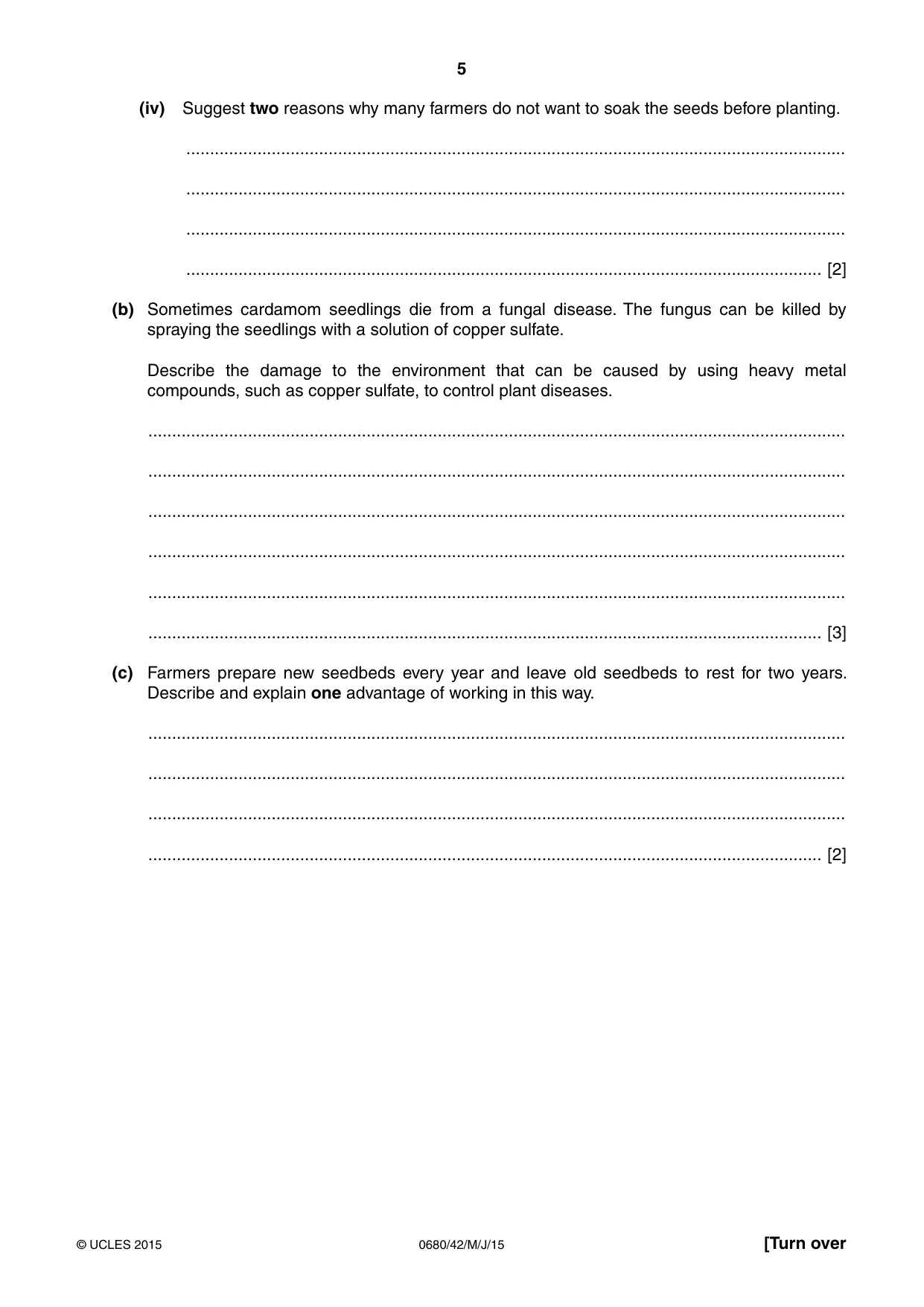
5 0680/42/M/J/15 © UCLES 2015 [Turn over (iv) Suggest two reasons why many farmers do not want to soak the seeds before planting. … … … … [2] (b) Sometimes cardamom seedlings die from a fungal disease. The fungus can be killed by spraying the seedlings with a solution of copper sulfate. Describe the damage to the environment that can be caused by using heavy metal compounds, such as copper sulfate, to control plant diseases. … … … … … … [3] (c) Farmers prepare new seedbeds every year and leave old seedbeds to rest for two years. Describe and explain one advantage of working in this way. … … … … [2]
Question paper, page 6
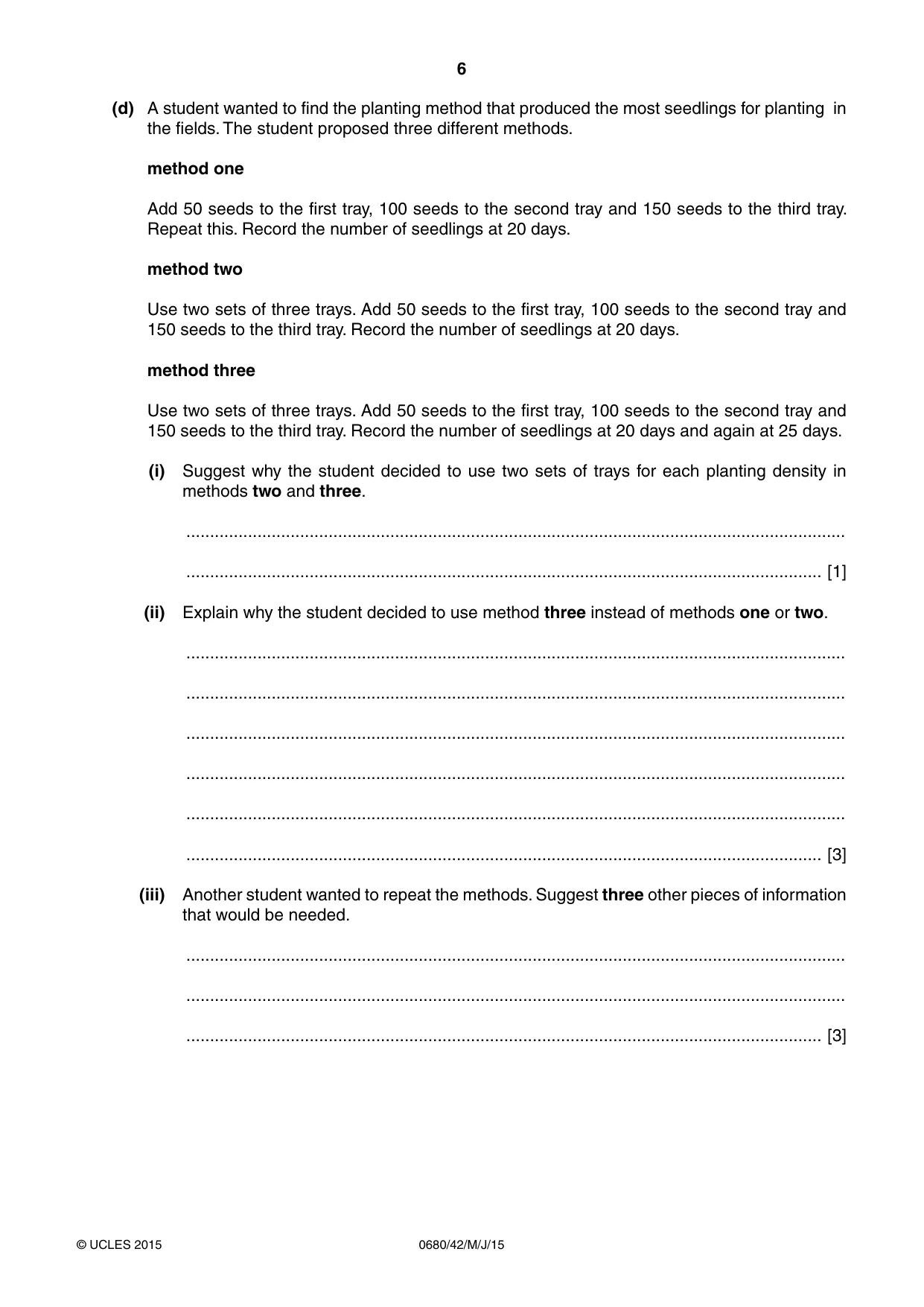
6 0680/42/M/J/15 © UCLES 2015 (d) A student wanted to find the planting method that produced the most seedlings for planting in the fields. The student proposed three different methods. method one Add 50 seeds to the first tray, 100 seeds to the second tray and 150 seeds to the third tray. Repeat this. Record the number of seedlings at 20 days. method two Use two sets of three trays. Add 50 seeds to the first tray, 100 seeds to the second tray and 150 seeds to the third tray. Record the number of seedlings at 20 days. method three Use two sets of three trays. Add 50 seeds to the first tray, 100 seeds to the second tray and 150 seeds to the third tray. Record the number of seedlings at 20 days and again at 25 days. (i) Suggest why the student decided to use two sets of trays for each planting density in methods two and three. … … [1] (ii) Explain why the student decided to use method three instead of methods one or two. … … … … … … [3] (iii) Another student wanted to repeat the methods. Suggest three other pieces of information that would be needed. … … … [3]
Question paper, page 7
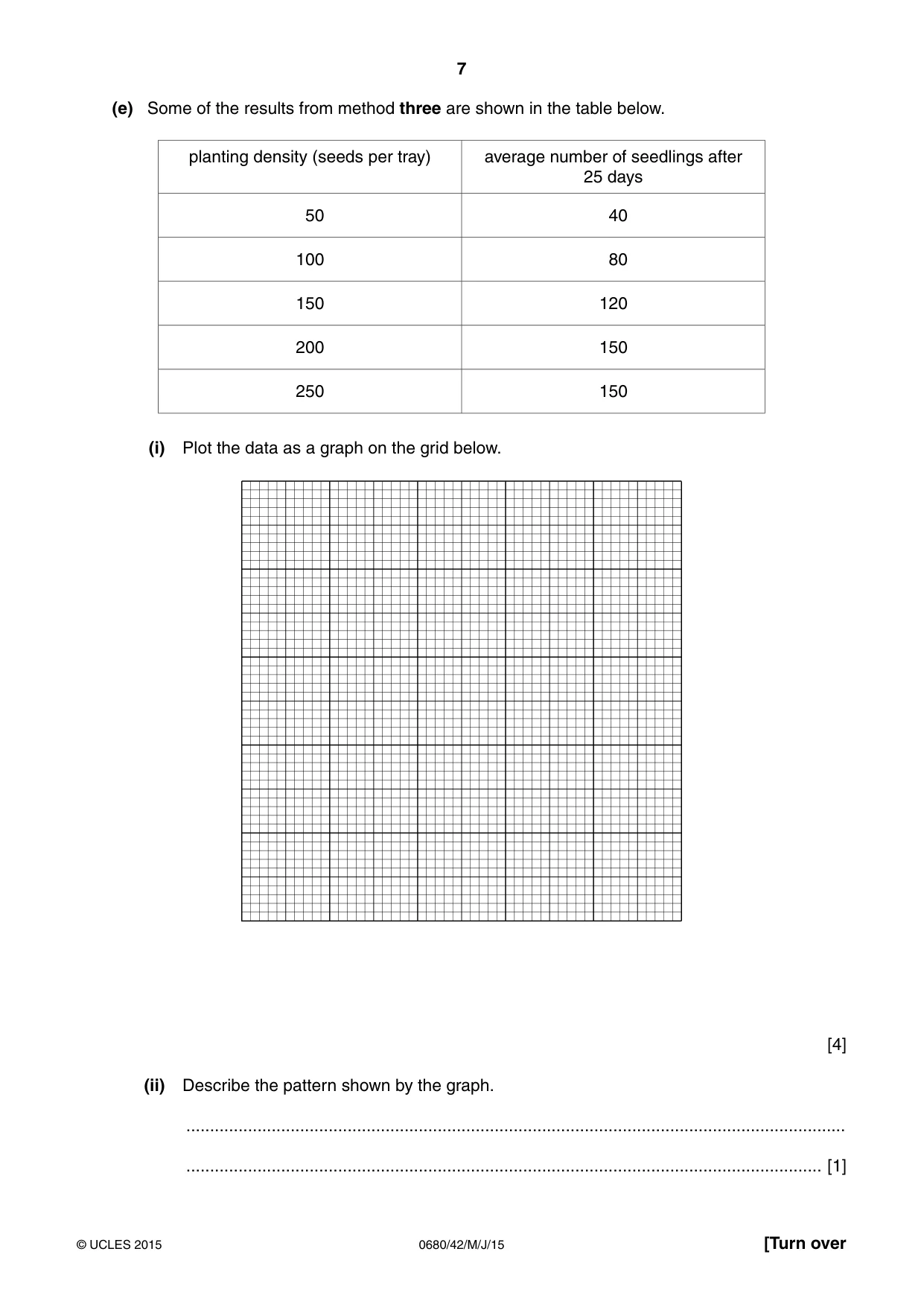
7 0680/42/M/J/15 © UCLES 2015 [Turn over (e) Some of the results from method three are shown in the table below. planting density (seeds per tray) average number of seedlings after 25 days 50 40 100 80 150 120 200 150 250 150 (i) Plot the data as a graph on the grid below. [4] (ii) Describe the pattern shown by the graph. … … [1]
Question paper, page 8
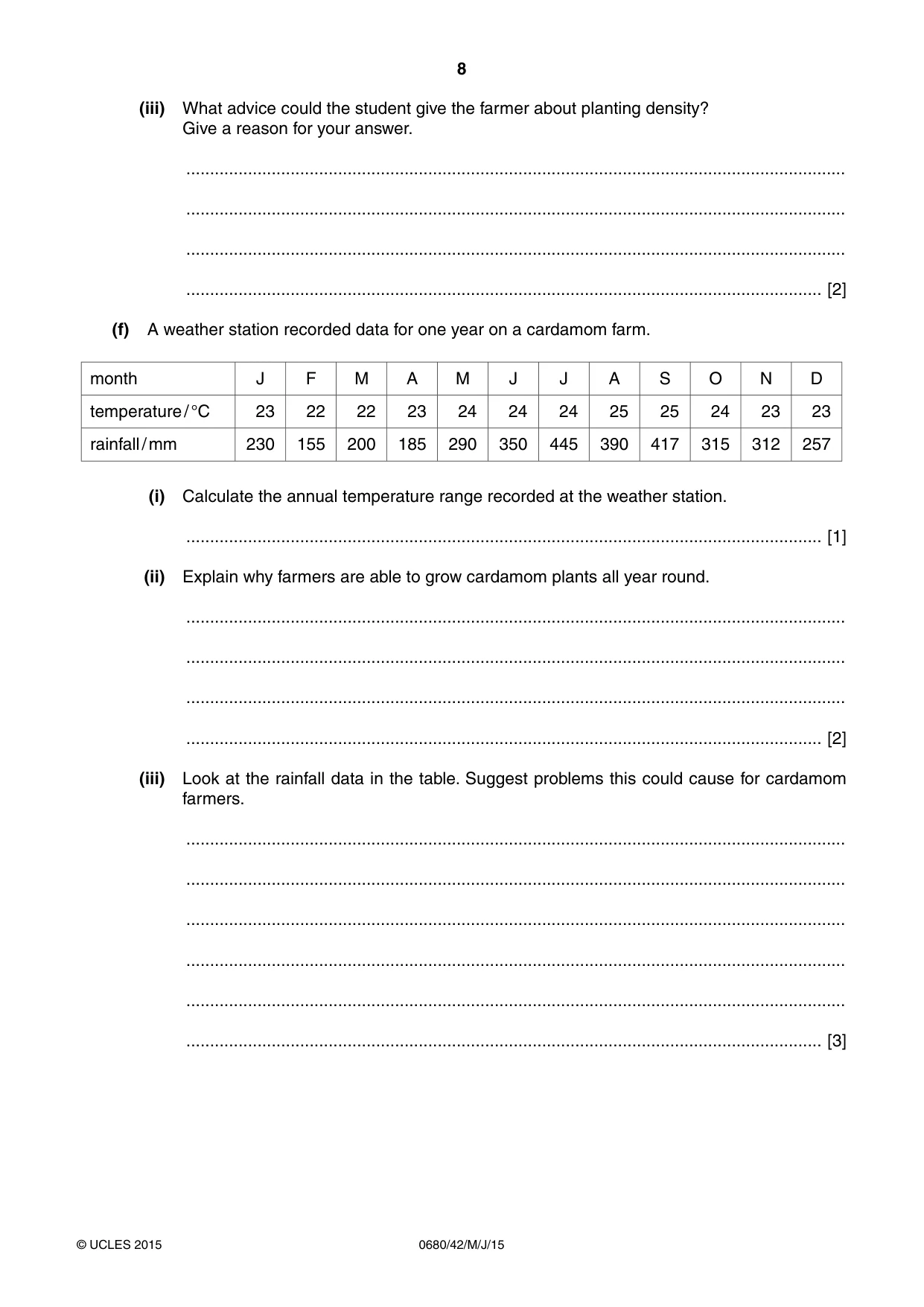
8 0680/42/M/J/15 © UCLES 2015 (iii) What advice could the student give the farmer about planting density? Give a reason for your answer. … … … … [2] (f) A weather station recorded data for one year on a cardamom farm. month J F M A M J J A S O N D temperature / °C 23 22 22 23 24 24 24 25 25 24 23 23 rainfall / mm 230 155 200 185 290 350 445 390 417 315 312 257 (i) Calculate the annual temperature range recorded at the weather station. … [1] (ii) Explain why farmers are able to grow cardamom plants all year round. … … … … [2] (iii) Look at the rainfall data in the table. Suggest problems this could cause for cardamom farmers. … … … … … … [3]
Question paper, page 9
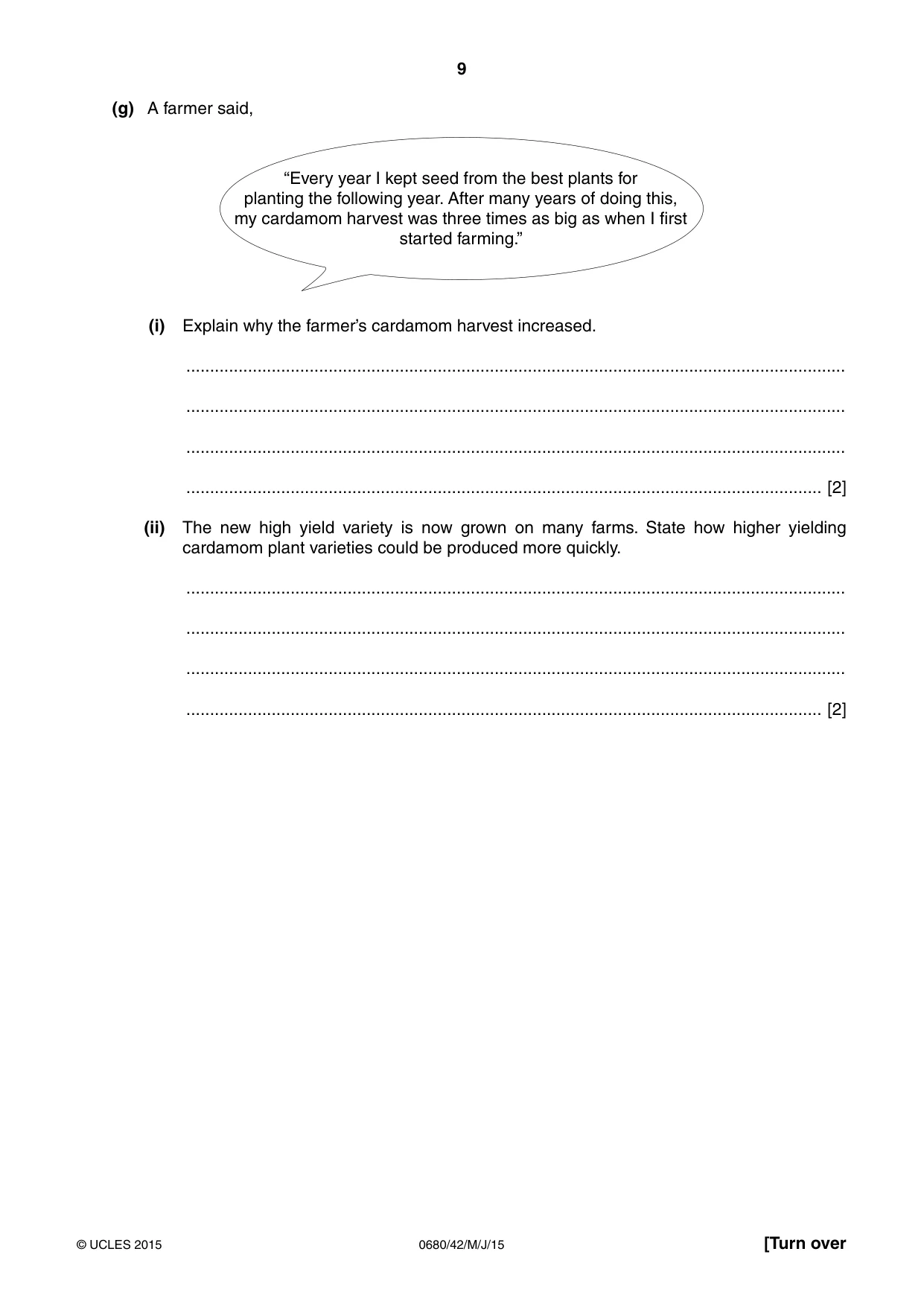
9 0680/42/M/J/15 © UCLES 2015 [Turn over (g) A farmer said, “Every year I kept seed from the best plants for planting the following year. After many years of doing this, my cardamom harvest was three times as big as when I first started farming.” (i) Explain why the farmer’s cardamom harvest increased. … … … … [2] (ii) The new high yield variety is now grown on many farms. State how higher yielding cardamom plant varieties could be produced more quickly. … … … … [2]
Question paper, page 10
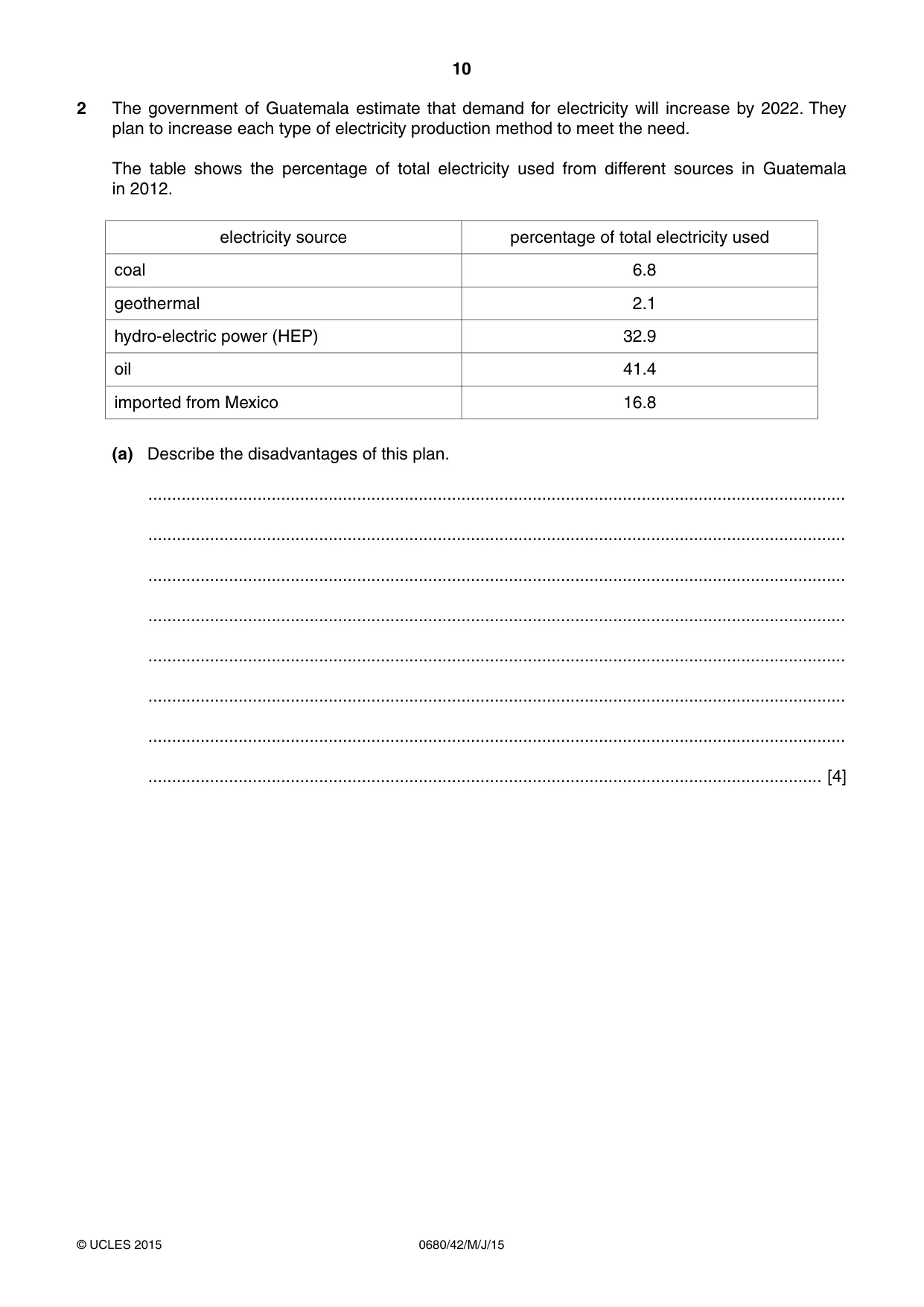
10 0680/42/M/J/15 © UCLES 2015 2 The government of Guatemala estimate that demand for electricity will increase by 2022. They plan to increase each type of electricity production method to meet the need. The table shows the percentage of total electricity used from different sources in Guatemala in 2012. electricity source percentage of total electricity used coal 6.8 geothermal 2.1 hydro-electric power (HEP) 32.9 oil 41.4 imported from Mexico 16.8 (a) Describe the disadvantages of this plan. … … … … … … … … [4]
Question paper, page 11
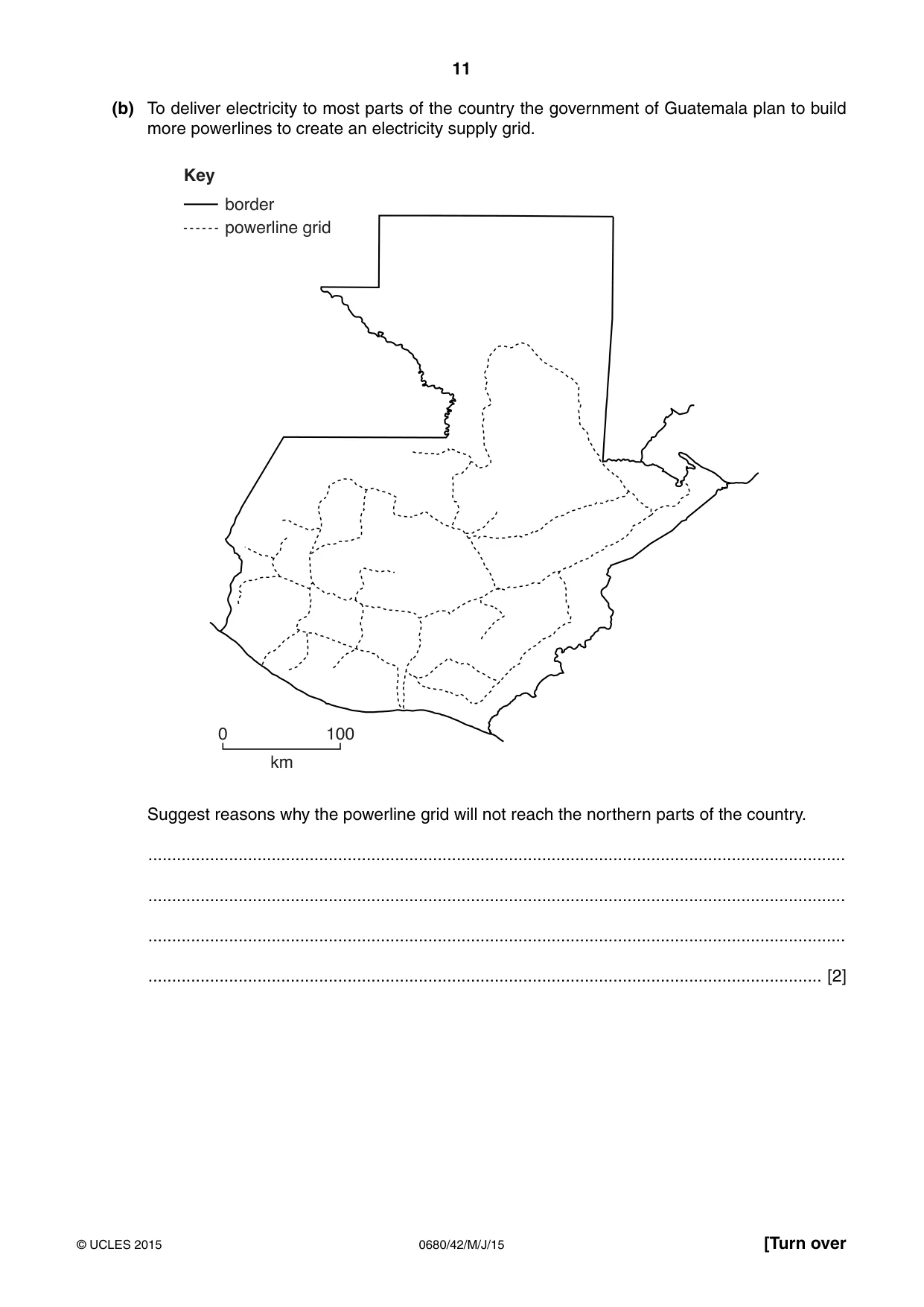
11 0680/42/M/J/15 © UCLES 2015 [Turn over (b) To deliver electricity to most parts of the country the government of Guatemala plan to build more powerlines to create an electricity supply grid. 0 100 km border powerline grid Key Suggest reasons why the powerline grid will not reach the northern parts of the country. … … … … [2]
Question paper, page 12
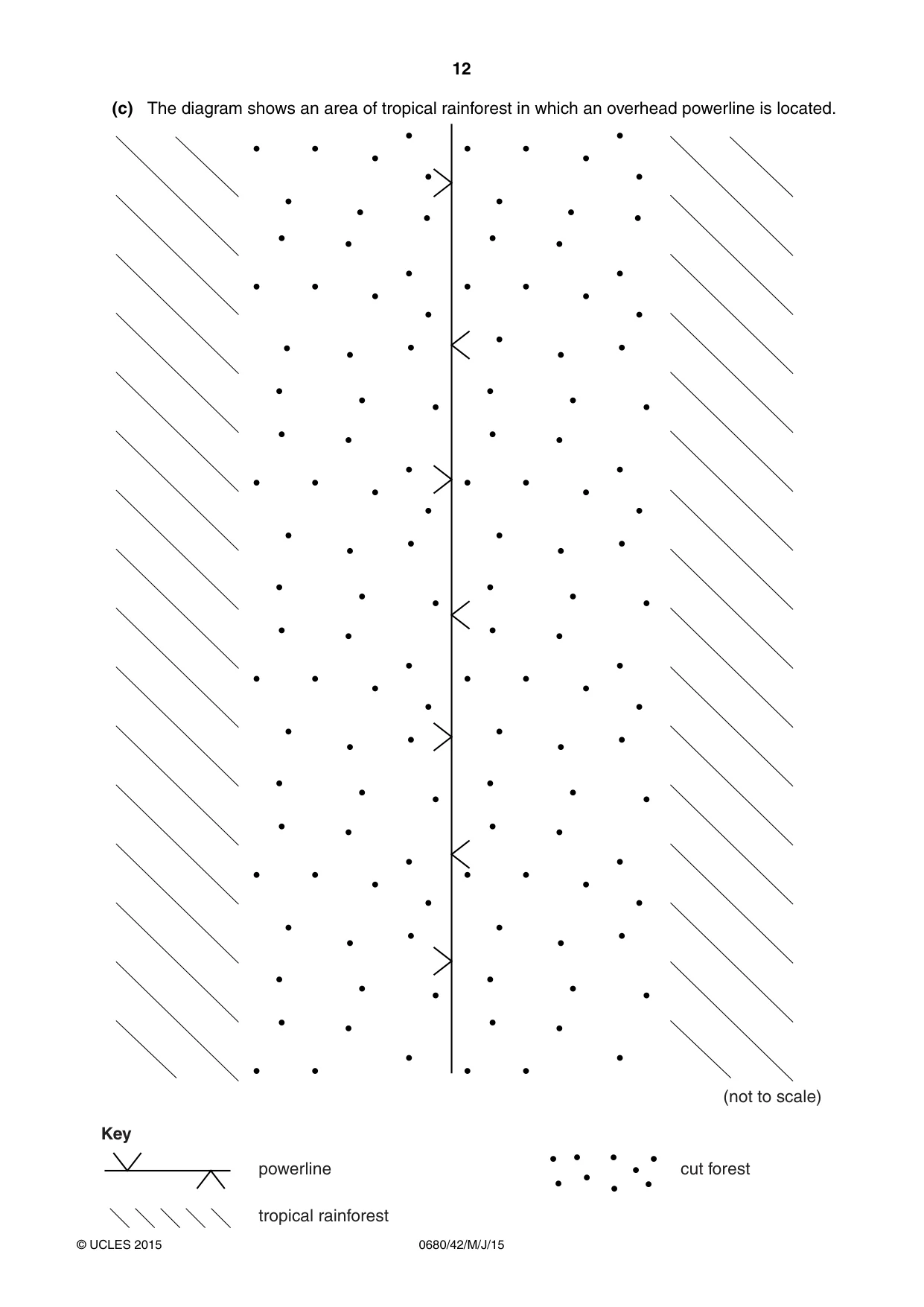
12 0680/42/M/J/15 © UCLES 2015 (c) The diagram shows an area of tropical rainforest in which an overhead powerline is located. (not to scale) powerline tropical rainforest cut forest Key
Question paper, page 13
13 0680/42/M/J/15 © UCLES 2015 [Turn over A survey found that cutting down a strip of tropical rainforest to build the powerlines did not reduce plant biodiversity. The diagram shows the equipment used in the survey. 1 m × 1 m quadrat (i) A student wanted to investigate changes in biodiversity between the edge of the forest and the powerlines. Describe how the equipment above could be used to carry out the survey. … … … … … … … … … … [5] (ii) Suggest how the reliability of the survey could be improved. … … [1]
Question paper, page 14
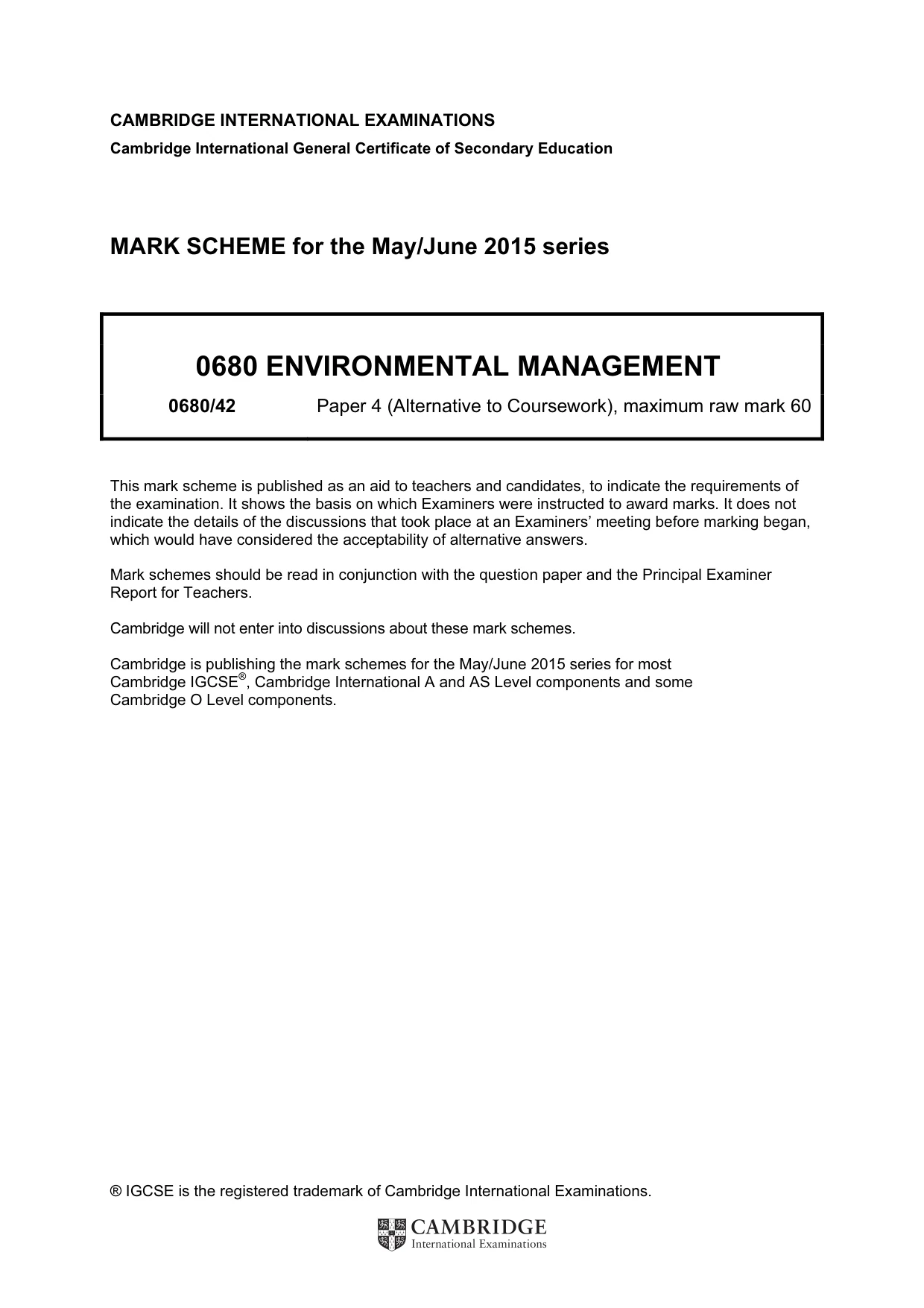
14 0680/42/M/J/15 © UCLES 2015 (d) The changes in electricity demand during one day in Guatemala are shown in the graph. 200 400 600 800 electricity demand / MW 1000 1200 1400 0 2 4 6 8 10 12 hours 14 16 18 20 22 24 1600 (i) State when electricity demand is at its lowest. … hours [1] (ii) Suggest reasons why the highest demand is between 18.00 and 21.00 hours. … … … … [2] (iii) Suggest arguments that could be used to persuade the government of Guatemala to invest in reducing demand for electricity, rather than increasing electricity production. … … … … … … … … [4]
Question paper, page 15
15 0680/42/M/J/15 © UCLES 2015 (e) The northern parts of Guatemala are not going to be connected to the electricity supply grid. They will have to rely on small-scale electrical generation, such as biomass plants. On one small farm, 82 percent of its electricity needs are met by biogas. (i) Suggest how the farm could meet the remaining 18 percent of its electricity needs. … … [1] (ii) A student visited some farms in the northern parts of Guatemala to survey the farmers to find their views on building and running small-scale electrical generating plants. Part of the questionnaire used is shown below. Complete the questionnaire with three further questions. 1. How old are you? under 20 21– 30 31– 40 41– 50 51+ 2. How many children do you have? 0 –1 2–3 4– 5 6+ 3. … … 4. … … 5. … … [4]
Question paper, page 16
16 0680/42/M/J/15 © UCLES 2015 BLANK PAGE Permission to reproduce items where third-party owned material protected by copyright is included has been sought and cleared where possible. Every reasonable effort has been made by the publisher (UCLES) to trace copyright holders, but if any items requiring clearance have unwittingly been included, the publisher will be pleased to make amends at the earliest possible opportunity. To avoid the issue of disclosure of answer-related information to candidates, all copyright acknowledgements are reproduced online in the Cambridge International Examinations Copyright Acknowledgements Booklet. This is produced for each series of examinations and is freely available to download at www.cie.org.uk after the live examination series. Cambridge International Examinations is part of the Cambridge Assessment Group. Cambridge Assessment is the brand name of University of Cambridge Local Examinations Syndicate (UCLES), which is itself a department of the University of Cambridge.
Mark scheme, page 1
® IGCSE is the registered trademark of Cambridge International Examinations. CAMBRIDGE INTERNATIONAL EXAMINATIONS Cambridge International General Certificate of Secondary Education MARK SCHEME for the May/June 2015 series 0680 ENVIRONMENTAL MANAGEMENT 0680/42 Paper 4 (Alternative to Coursework), maximum raw mark 60 This mark scheme is published as an aid to teachers and candidates, to indicate the requirements of the examination. It shows the basis on which Examiners were instructed to award marks. It does not indicate the details of the discussions that took place at an Examiners’ meeting before marking began, which would have considered the acceptability of alternative answers. Mark schemes should be read in conjunction with the question paper and the Principal Examiner Report for Teachers. Cambridge will not enter into discussions about these mark schemes. Cambridge is publishing the mark schemes for the May/June 2015 series for most Cambridge IGCSE®, Cambridge International A and AS Level components and some Cambridge O Level components.
Mark scheme, page 2
Page 2 Mark Scheme Syllabus Paper Cambridge IGCSE – May/June 2015 0680 42 © Cambridge International Examinations 2015 1 (a) (i) peak harvest and demand coincide; so no drop in price / price may increase / more (money / profit); all crop sold / no crop wasted; have money for any household expense / food / hospital / school fees; have money for farm costs; standard of living; [2] (ii) 58, 62, 80%; All three for two marks. Two for one mark. [2] (iii) as a control / idea explained / idea of comparison; [1] (iv) cost (of acids); do not know how to use them / suspicious of using them; extra time / work and not worth extra seedlings; ref. to acid contamination of soil; ref. to contamination of water; ref. harm to humans; low / unavailability of acids; [2] (b) (heavy) metal poisonous / toxic; ref. contamination of (soil) water; absorbed by plants; not broken down / excreted (by animals); so accumulates in (animal / plant / organism) body; builds up / passes) along food chain; kills top predators; bioaccumulation; biomagnification; [3] (c) (this / resting) restores nutrients / minerals / named mineral / ref. clover etc.; crops grow better / less fertiliser needed; allows pests / diseases to die out / fewer pests; crops grow better / yield not decreased; [2] (d) (i) to check for (error / reliability) / can find a mean / backup if one tray fails; [1] (ii) comparing 3 to 1: (more / 2) trays so reliability (can be checked); can find a mean / back up if one tray fails; [3] comparing 3 to 2: because result measured twice / at 20 and 25 days; allows (greater chance) of full germination / more accurate estimation of germination rate; (iii) size of tray; volume (amount) of soil; depth of soil; type soil; pH of soil; temperature; (volume / amount) of water; (amount) of light; type / variety of seed; seed age; [3] (e) (i) orientation of line graph only (not if bar chart); axes labelled; plots; [4] (ii) increase then plateaus / levels off / cuts off / evens out / eq.; [1] (iii) do not plant more than 200 per tray / do plant (between 150 and 200); above this seeds wasted / no further yield of seedlings / no money wasted / eq.; [2]
Mark scheme, page 3
Page 3 Mark Scheme Syllabus Paper Cambridge IGCSE – May/June 2015 0680 42 © Cambridge International Examinations 2015 (f) (i) (25 °C–22 °C =) 3 °C; [1] (ii) (weather / rain / temperature) conditions remain constant / eq.; temperature always warm enough / 15 °C–20 °C; sufficient water; [2] (iii) spread of plant disease / fungal infection; surface run-off; soil erosion; loss of topsoil; nutrient leaching; spread of (water-related / eq.) disease; crop damage / loss; [3] (g) (i) selective breeding; best plants have good alleles (accept genes) / eq.; best plants pass on good alleles (accept genes) to next generation / eq.; further detail; [2] (ii) genetic engineering; transfer of genes (for high yield); further detail; cloning / tissue culture / micropropagation; [2] 2 (a) still rely on imports / depend on Mexico / money going to Mexico; greenhouse gases / named greenhouse gas; leading to global warming / greenhouse effect / eq.; (finite / unsustainable) supply; costs of supplying more electricity increase; acid rain; H.E.P. more land flooded / relocation; AVP; [4] (b) very remote / far away; difficult terrain; too far for effective powerlines; few power plants / power stations far away; ref. to cost of powerlines; not many people live there / (so) low demand; [2] (c) (i) systematic sampling; at noted location, use of compass; layout transect line (with tape); from powerlines into forest; secure with pegs / eq.; placing quadrat at intervals; identify species with book; record number of different species (in quadrat); in notebook; repeat; OR random sampling; detail of quadrat placing (throw quadrat / layout grid); under powerlines and in forest; identify species with book; record different species in quadrat; in table in notebook; repeat; AVP; [5] (ii) repeat on other sites (when repeating keep variables constant) / compare with similar studies; [1]
Mark scheme, page 4
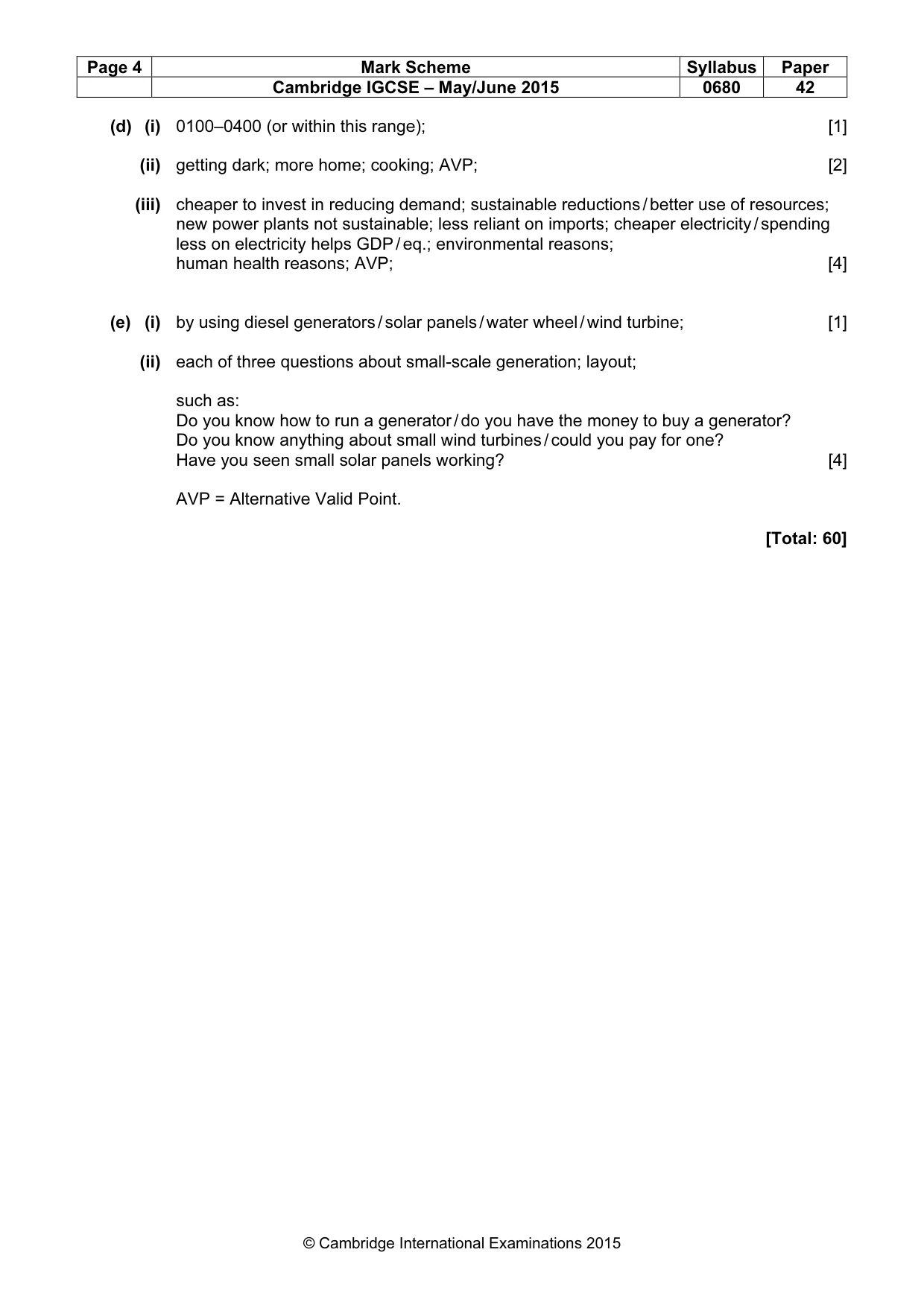
Page 4 Mark Scheme Syllabus Paper Cambridge IGCSE – May/June 2015 0680 42 © Cambridge International Examinations 2015 (d) (i) 0100–0400 (or within this range); [1] (ii) getting dark; more home; cooking; AVP; [2] (iii) cheaper to invest in reducing demand; sustainable reductions / better use of resources; new power plants not sustainable; less reliant on imports; cheaper electricity / spending less on electricity helps GDP / eq.; environmental reasons; human health reasons; AVP; [4] (e) (i) by using diesel generators / solar panels / water wheel / wind turbine; [1] (ii) each of three questions about small-scale generation; layout; such as: Do you know how to run a generator / do you have the money to buy a generator? Do you know anything about small wind turbines / could you pay for one? Have you seen small solar panels working? [4] AVP = Alternative Valid Point. [Total: 60]
What you needed in this session
Cambridge’s own grade thresholds for 2015 May/June, Paper 4 · Variant 2. A higher threshold means an easier paper — the bar moves with how the cohort did.