Cambridge IGCSE Environmental Management 0680 — 2014 May/June Paper 4 · Variant 3
0680/43/M/J/14 · 60 marks · ≈68 min
The question paper and its mark scheme, free to read here and free to download. This is Cambridge’s own paper, exactly as it was sat.
Question paper16 pages
Mark scheme3 pages
Answers below. Sit the paper first if you are practising.
Paper as text
Question paper, page 1
This document consists of 15 printed pages and 1 blank page. DC (SJF/SW) 81922/3 © UCLES 2014 [Turn over Cambridge International Examinations Cambridge International General Certificate of Secondary Education * 8 4 8 5 0 6 7 3 5 5 * ENVIRONMENTAL MANAGEMENT 0680/43 Alternative to Coursework May/June 2014 1 hour 30 minutes Candidates answer on the Question Paper. Additional Materials: Calculator Ruler READ THESE INSTRUCTIONS FIRST Write your Centre number, candidate number and name on all the work you hand in. Write in dark blue or black pen. You may use an HB pencil for any diagrams or graphs. Do not use staples, paper clips, glue or correction fluid. DO NOT WRITE IN ANY BARCODES. Answer all questions. Electronic calculators may be used. You may lose marks if you do not show your working or if you do not use appropriate units. Study the appropriate source materials before you start to write your answers. Credit will be given for appropriate selection and use of data in your answers and for relevant interpretation of these data. Suggestions for data sources are given in some questions. You may use the source data to draw diagrams and graphs or to do calculations to illustrate your answers. At the end of the examination, fasten all your work securely together. The number of marks is given in brackets [ ] at the end of each question or part question.
Question paper, page 2
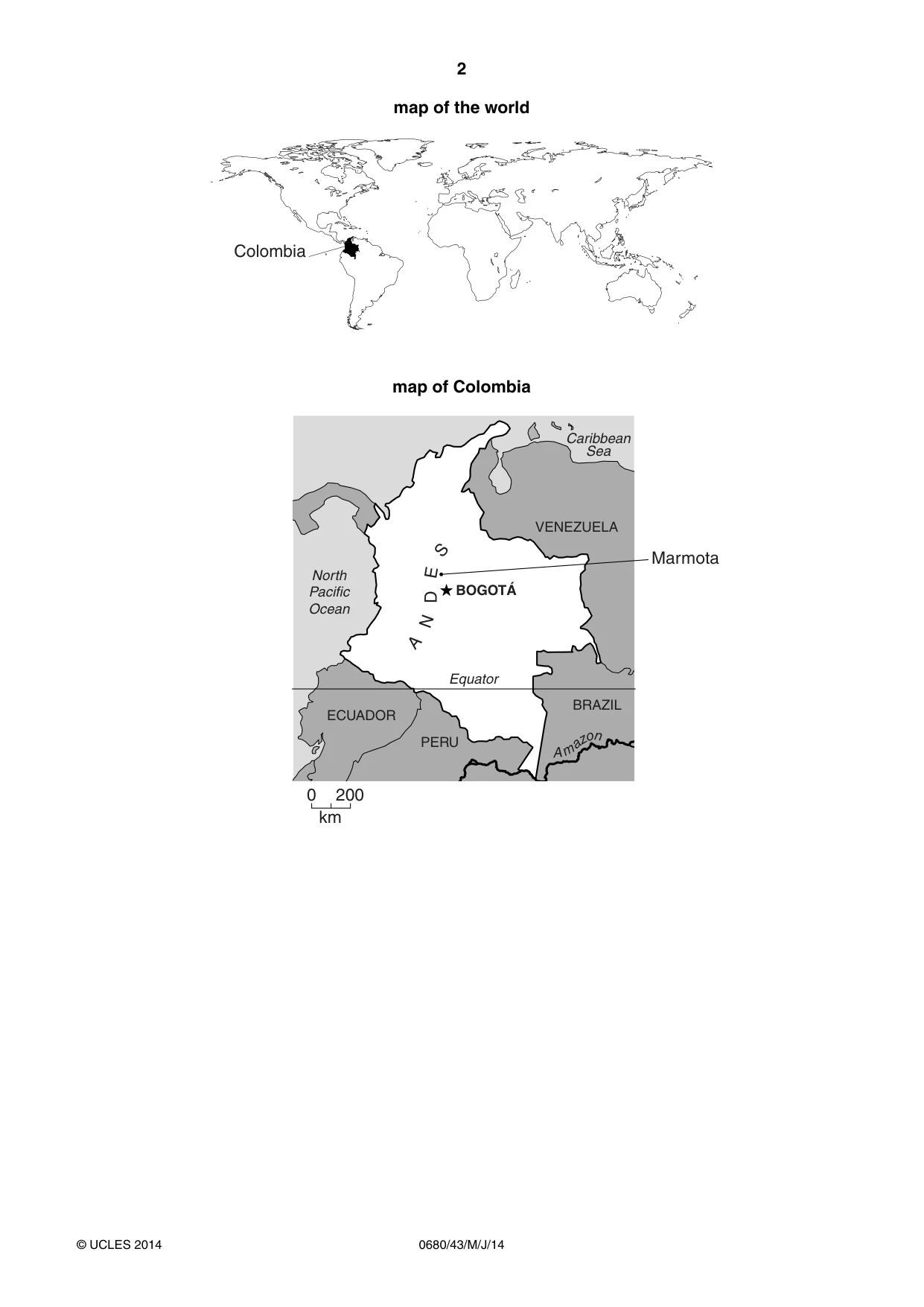
2 0680/43/M/J/14 © UCLES 2014 map of the world Colombia map of Colombia BOGOTÁ ECUADOR PERU BRAZIL VENEZUELA North Pacific Ocean Caribbean Sea Equator A m a z o n 0 200 km Marmota A N D E S
Question paper, page 3
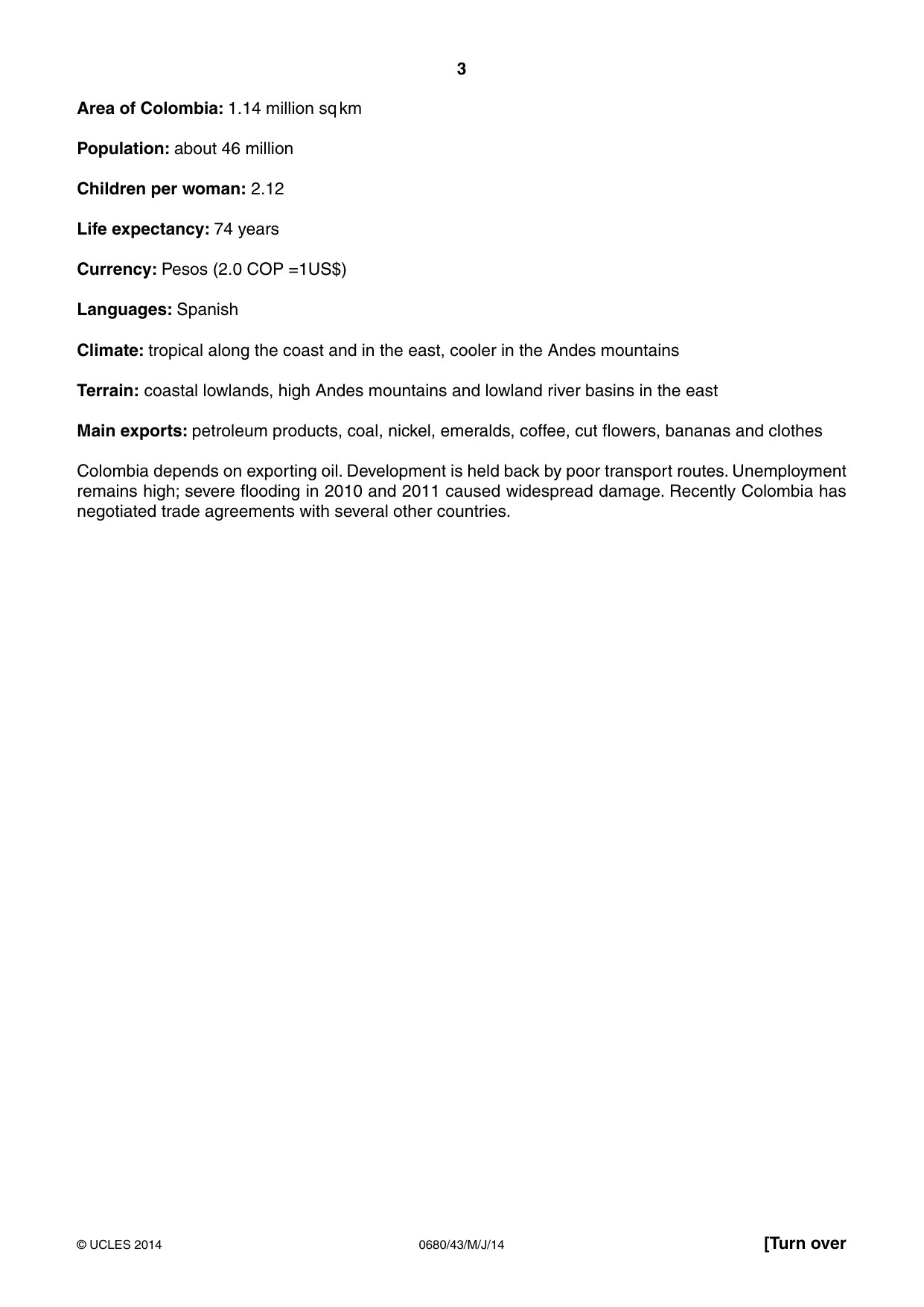
3 0680/43/M/J/14 © UCLES 2014 [Turn over Area of Colombia: 1.14 million sq km Population: about 46 million Children per woman: 2.12 Life expectancy: 74 years Currency: Pesos (2.0 COP =1US$) Languages: Spanish Climate: tropical along the coast and in the east, cooler in the Andes mountains Terrain: coastal lowlands, high Andes mountains and lowland river basins in the east Main exports: petroleum products, coal, nickel, emeralds, coffee, cut flowers, bananas and clothes Colombia depends on exporting oil. Development is held back by poor transport routes. Unemployment remains high; severe flooding in 2010 and 2011 caused widespread damage. Recently Colombia has negotiated trade agreements with several other countries.
Question paper, page 4
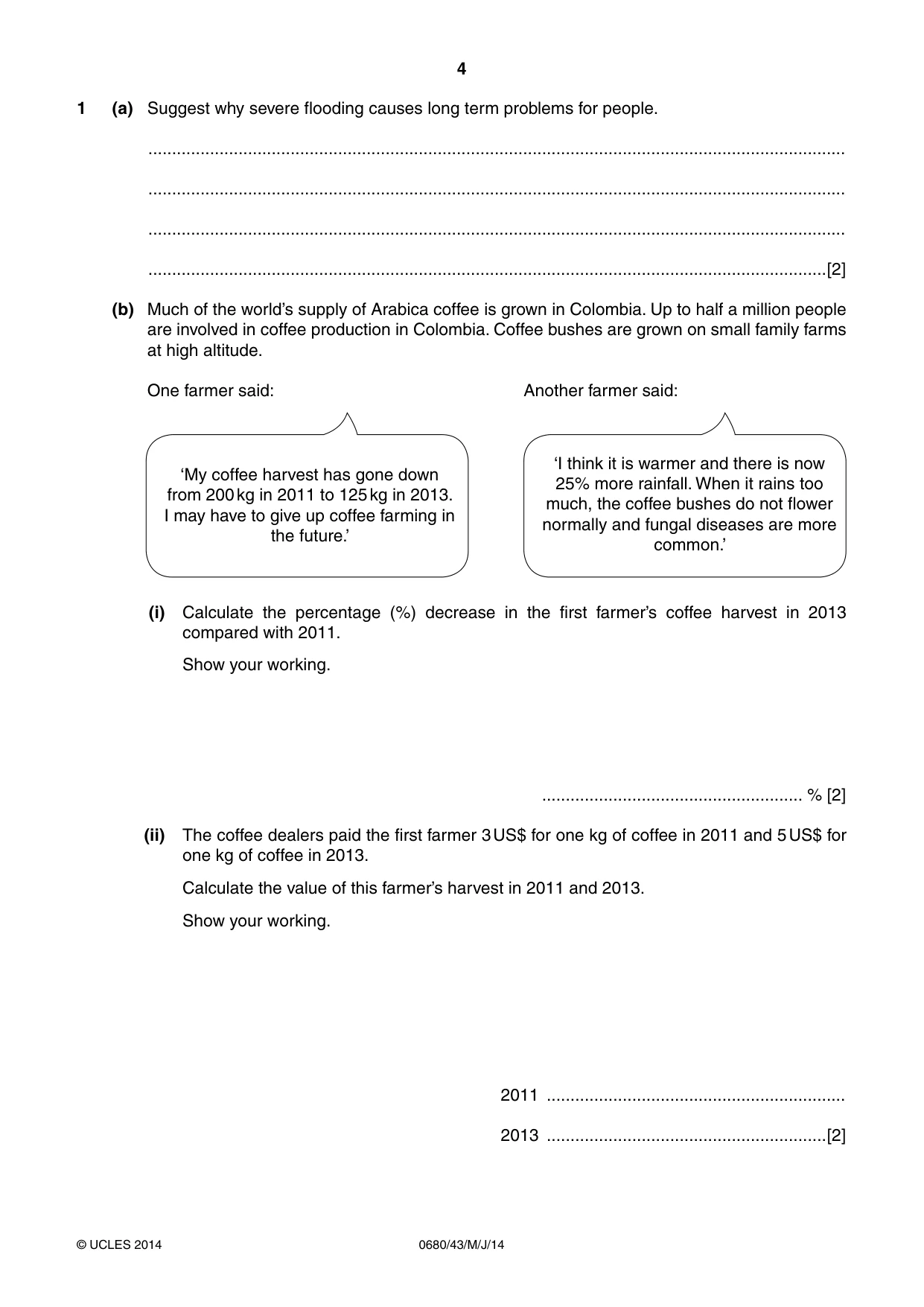
4 0680/43/M/J/14 © UCLES 2014 1 (a) Suggest why severe flooding causes long term problems for people. … … … …[2] (b) Much of the world’s supply of Arabica coffee is grown in Colombia. Up to half a million people are involved in coffee production in Colombia. Coffee bushes are grown on small family farms at high altitude. One farmer said: Another farmer said: ‘My coffee harvest has gone down from 200 kg in 2011 to 125 kg in 2013. I may have to give up coffee farming in the future.’ ‘I think it is warmer and there is now 25% more rainfall. When it rains too much, the coffee bushes do not flower normally and fungal diseases are more common.’ (i) Calculate the percentage (%) decrease in the first farmer’s coffee harvest in 2013 compared with 2011. Show your working. … % [2] (ii) The coffee dealers paid the first farmer 3 US$ for one kg of coffee in 2011 and 5 US$ for one kg of coffee in 2013. Calculate the value of this farmer’s harvest in 2011 and 2013. Show your working. 2011 … 2013 …[2]
Question paper, page 5
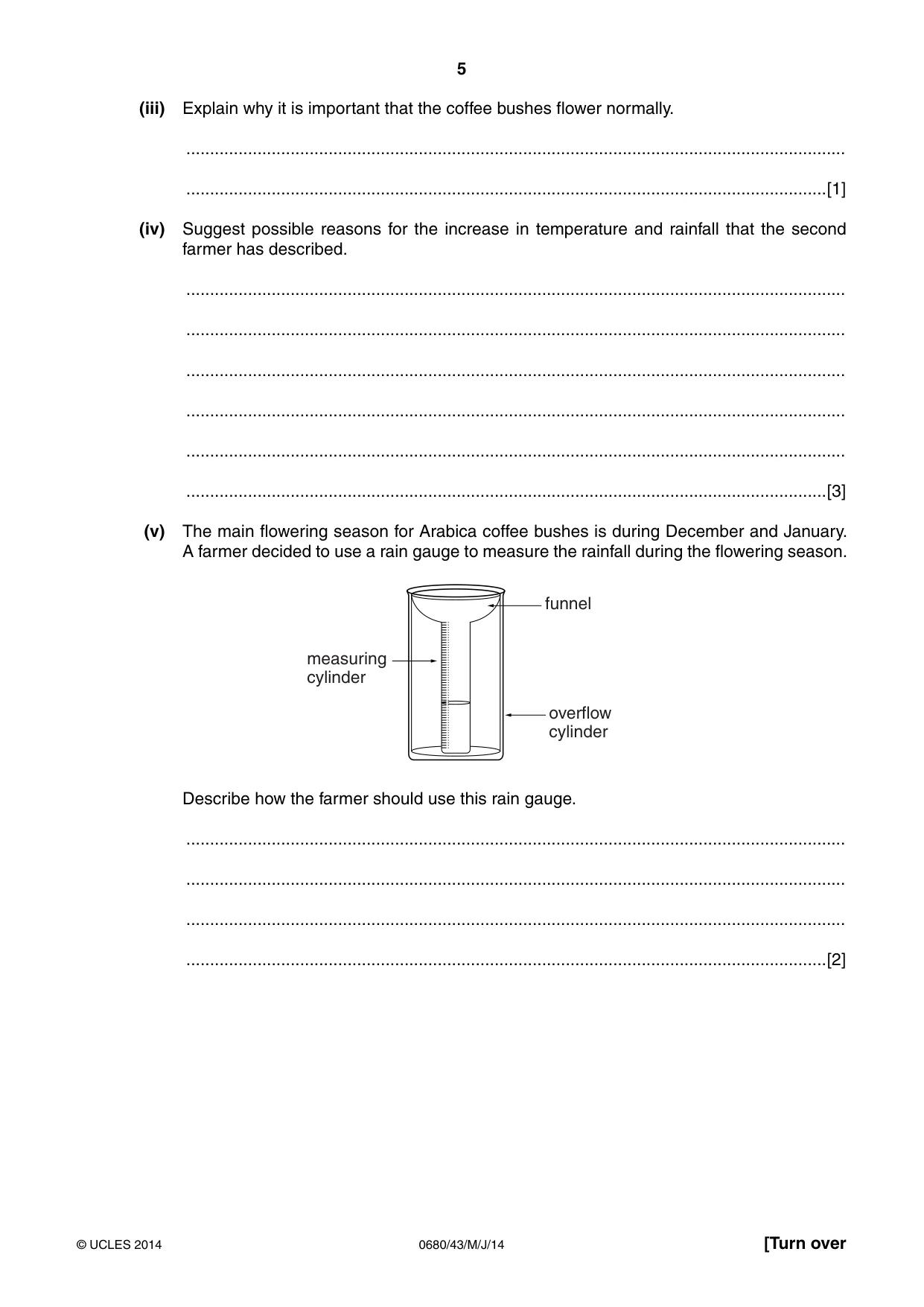
5 0680/43/M/J/14 © UCLES 2014 [Turn over (iii) Explain why it is important that the coffee bushes flower normally. … …[1] (iv) Suggest possible reasons for the increase in temperature and rainfall that the second farmer has described. … … … … … …[3] (v) The main flowering season for Arabica coffee bushes is during December and January. A farmer decided to use a rain gauge to measure the rainfall during the flowering season. funnel overflow cylinder measuring cylinder Describe how the farmer should use this rain gauge. … … … …[2]
Question paper, page 6
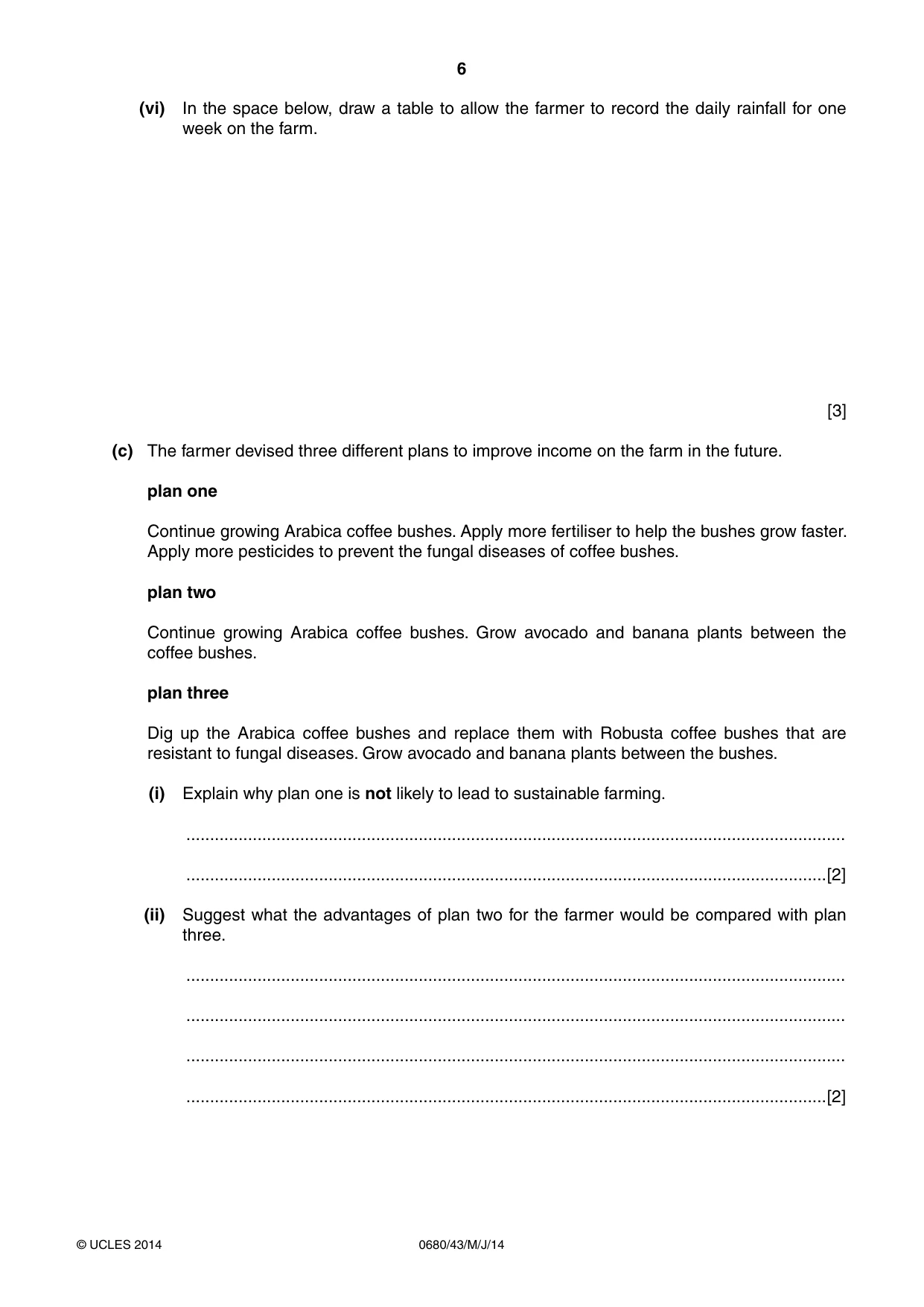
6 0680/43/M/J/14 © UCLES 2014 (vi) In the space below, draw a table to allow the farmer to record the daily rainfall for one week on the farm. [3] (c) The farmer devised three different plans to improve income on the farm in the future. plan one Continue growing Arabica coffee bushes. Apply more fertiliser to help the bushes grow faster. Apply more pesticides to prevent the fungal diseases of coffee bushes. plan two Continue growing Arabica coffee bushes. Grow avocado and banana plants between the coffee bushes. plan three Dig up the Arabica coffee bushes and replace them with Robusta coffee bushes that are resistant to fungal diseases. Grow avocado and banana plants between the bushes. (i) Explain why plan one is not likely to lead to sustainable farming. … …[2] (ii) Suggest what the advantages of plan two for the farmer would be compared with plan three. … … … …[2]
Question paper, page 7
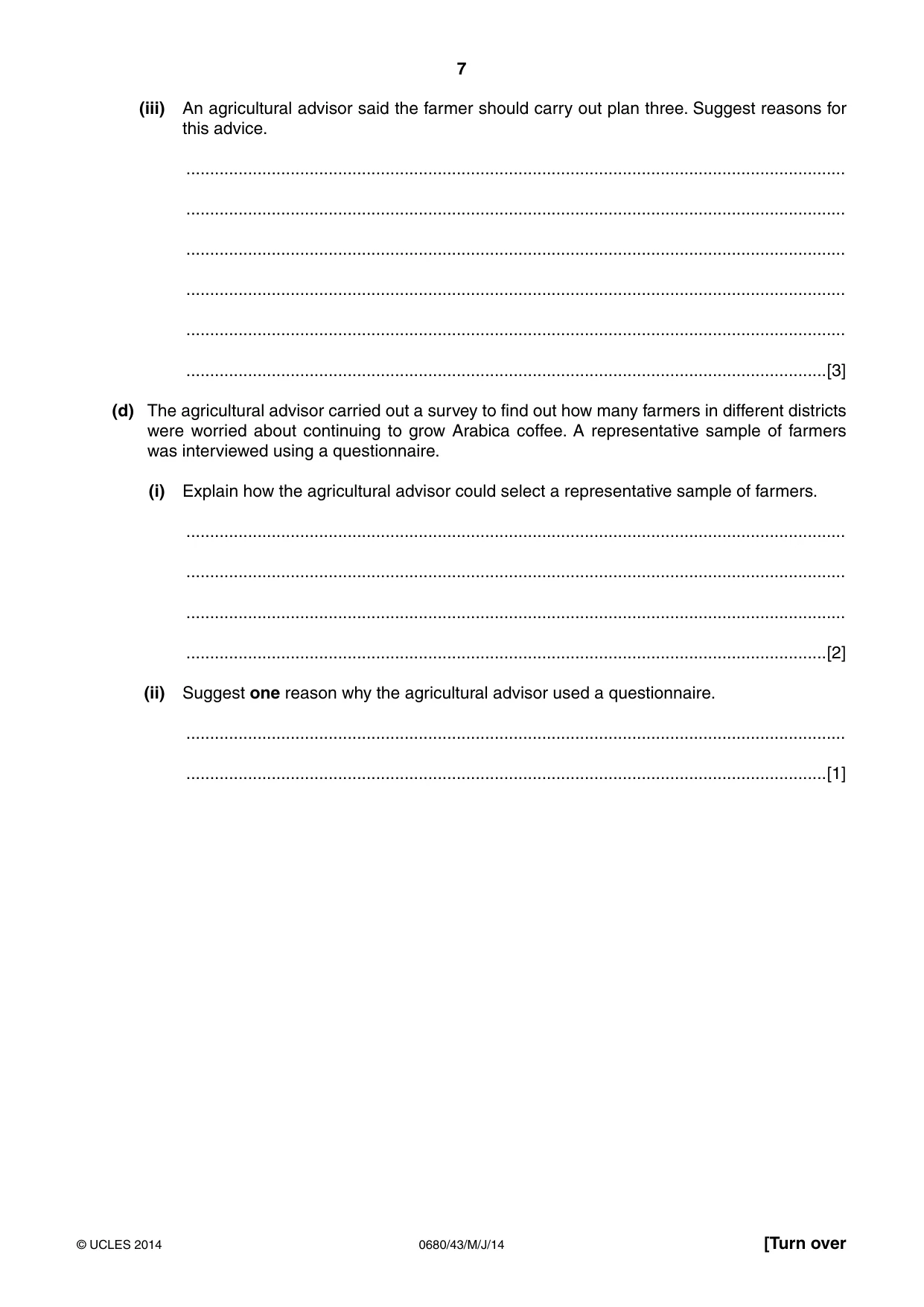
7 0680/43/M/J/14 © UCLES 2014 [Turn over (iii) An agricultural advisor said the farmer should carry out plan three. Suggest reasons for this advice. … … … … … …[3] (d) The agricultural advisor carried out a survey to find out how many farmers in different districts were worried about continuing to grow Arabica coffee. A representative sample of farmers was interviewed using a questionnaire. (i) Explain how the agricultural advisor could select a representative sample of farmers. … … … …[2] (ii) Suggest one reason why the agricultural advisor used a questionnaire. … …[1]
Question paper, page 8
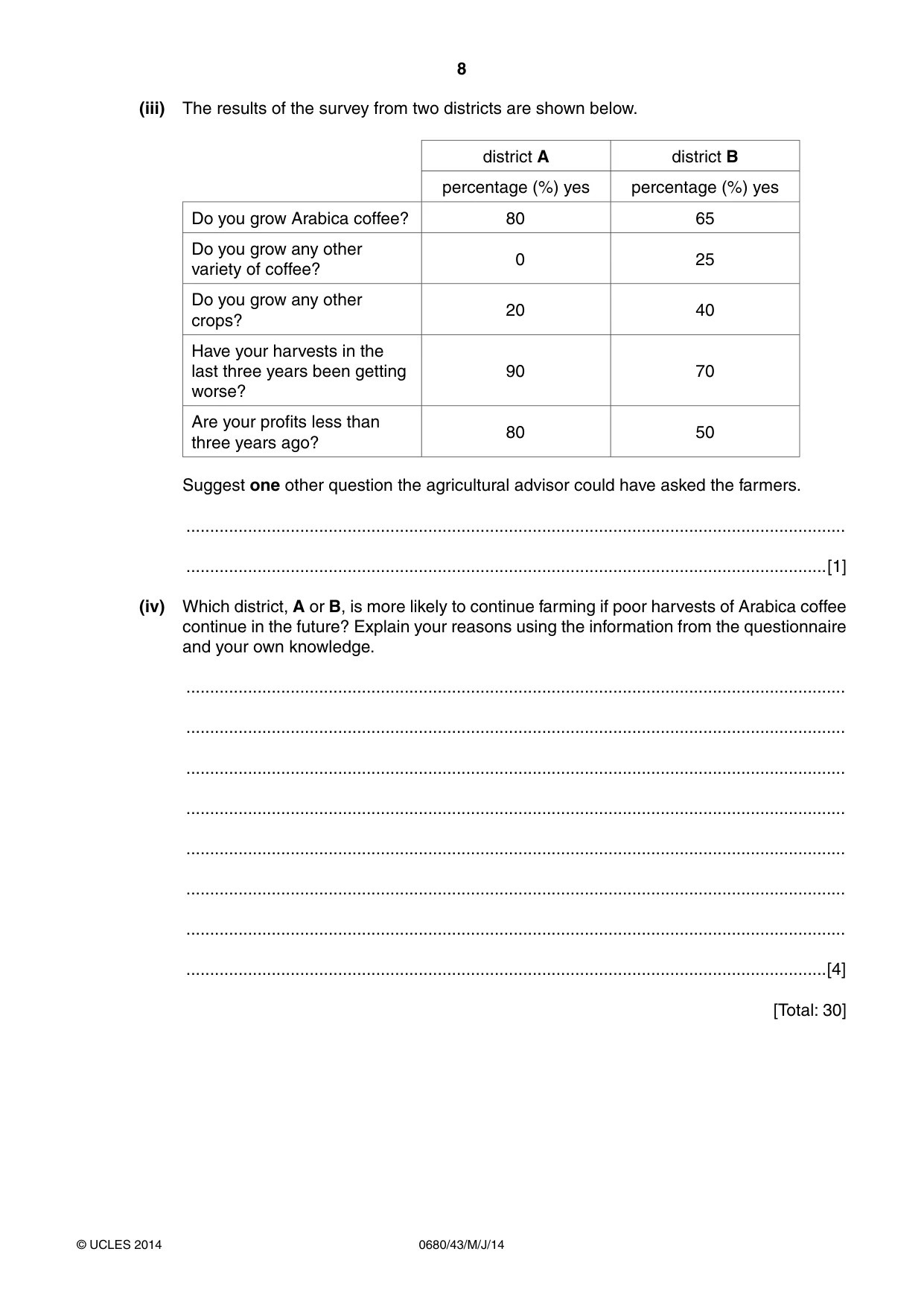
8 0680/43/M/J/14 © UCLES 2014 (iii) The results of the survey from two districts are shown below. district A district B percentage (%) yes percentage (%) yes Do you grow Arabica coffee? 80 65 Do you grow any other variety of coffee? 0 25 Do you grow any other crops? 20 40 Have your harvests in the last three years been getting worse? 90 70 Are your profits less than three years ago? 80 50 Suggest one other question the agricultural advisor could have asked the farmers. … …[1] (iv) Which district, A or B, is more likely to continue farming if poor harvests of Arabica coffee continue in the future? Explain your reasons using the information from the questionnaire and your own knowledge. … … … … … … … …[4] [Total: 30]
Question paper, page 9
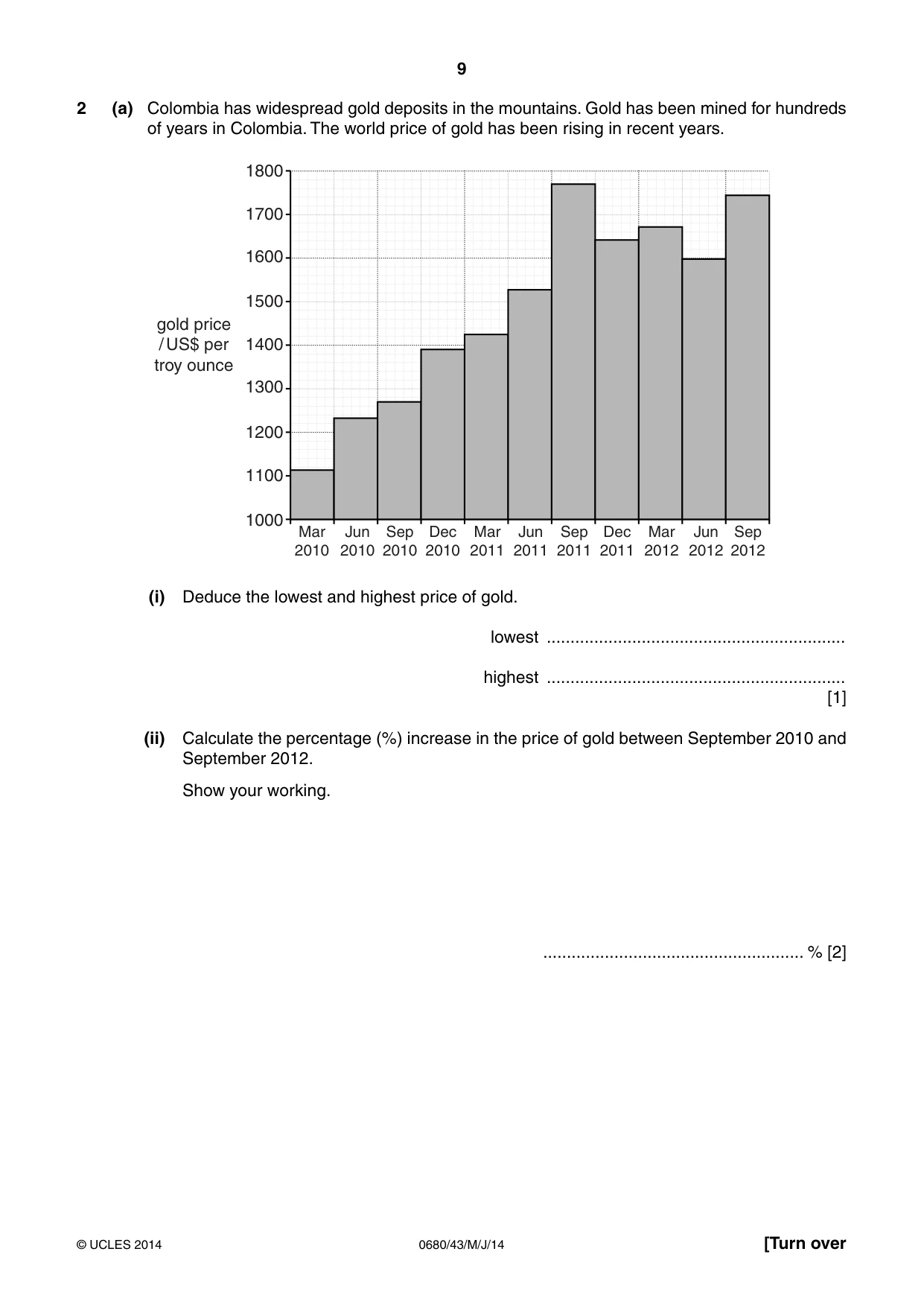
9 0680/43/M/J/14 © UCLES 2014 [Turn over 2 (a) Colombia has widespread gold deposits in the mountains. Gold has been mined for hundreds of years in Colombia. The world price of gold has been rising in recent years. Mar 2010 Jun 2010 Sep 2010 Dec 2010 Mar 2011 Jun 2011 Sep 2011 Dec 2011 Mar 2012 Jun 2012 Sep 2012 1000 1100 1200 1300 1400 gold price / US$ per troy ounce 1500 1600 1700 1800 (i) Deduce the lowest and highest price of gold. lowest … highest … [1] (ii) Calculate the percentage (%) increase in the price of gold between September 2010 and September 2012. Show your working. … % [2]
Question paper, page 10
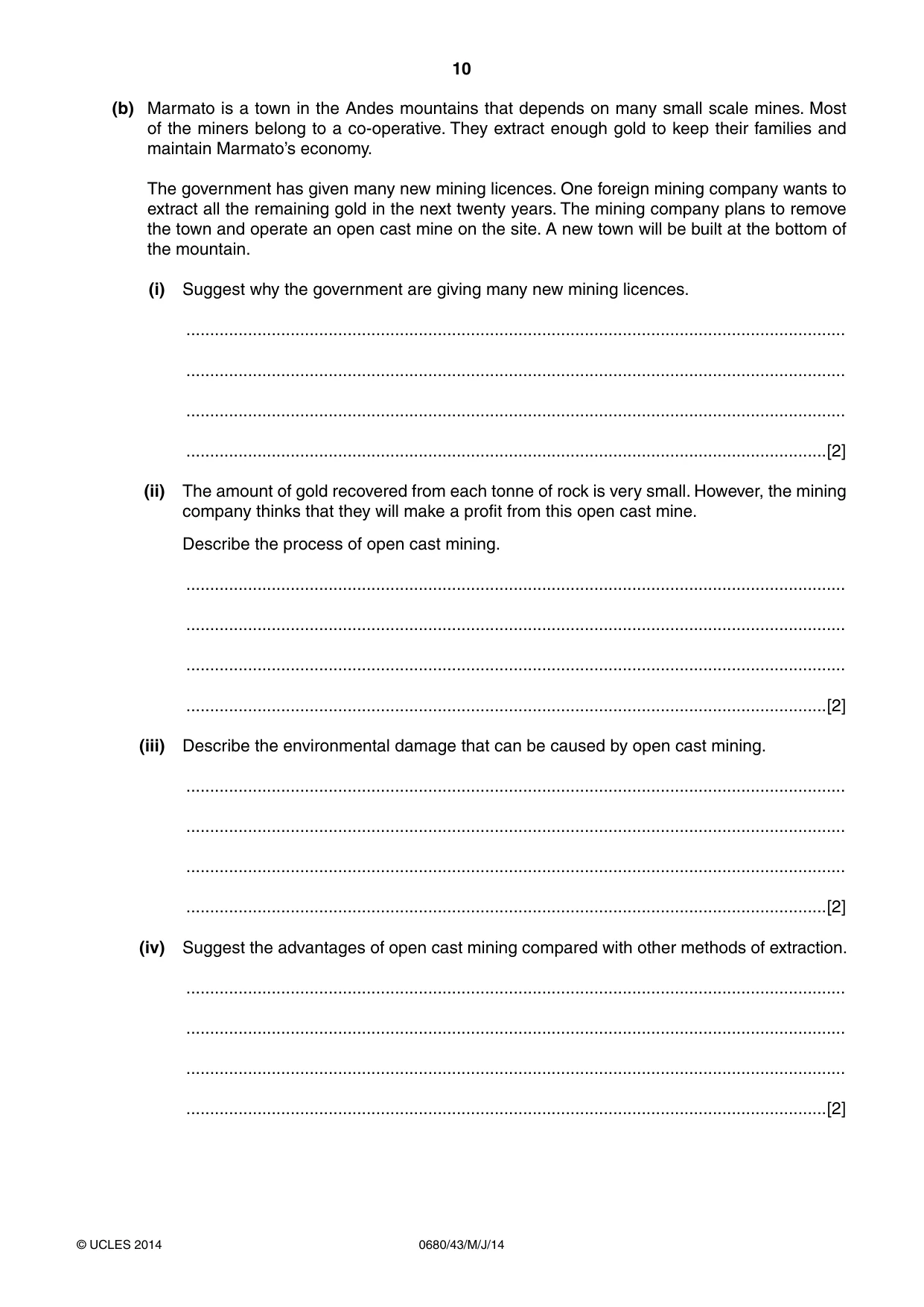
10 0680/43/M/J/14 © UCLES 2014 (b) Marmato is a town in the Andes mountains that depends on many small scale mines. Most of the miners belong to a co-operative. They extract enough gold to keep their families and maintain Marmato’s economy. The government has given many new mining licences. One foreign mining company wants to extract all the remaining gold in the next twenty years. The mining company plans to remove the town and operate an open cast mine on the site. A new town will be built at the bottom of the mountain. (i) Suggest why the government are giving many new mining licences. … … … …[2] (ii) The amount of gold recovered from each tonne of rock is very small. However, the mining company thinks that they will make a profit from this open cast mine. Describe the process of open cast mining. … … … …[2] (iii) Describe the environmental damage that can be caused by open cast mining. … … … …[2] (iv) Suggest the advantages of open cast mining compared with other methods of extraction. … … … …[2]
Question paper, page 11
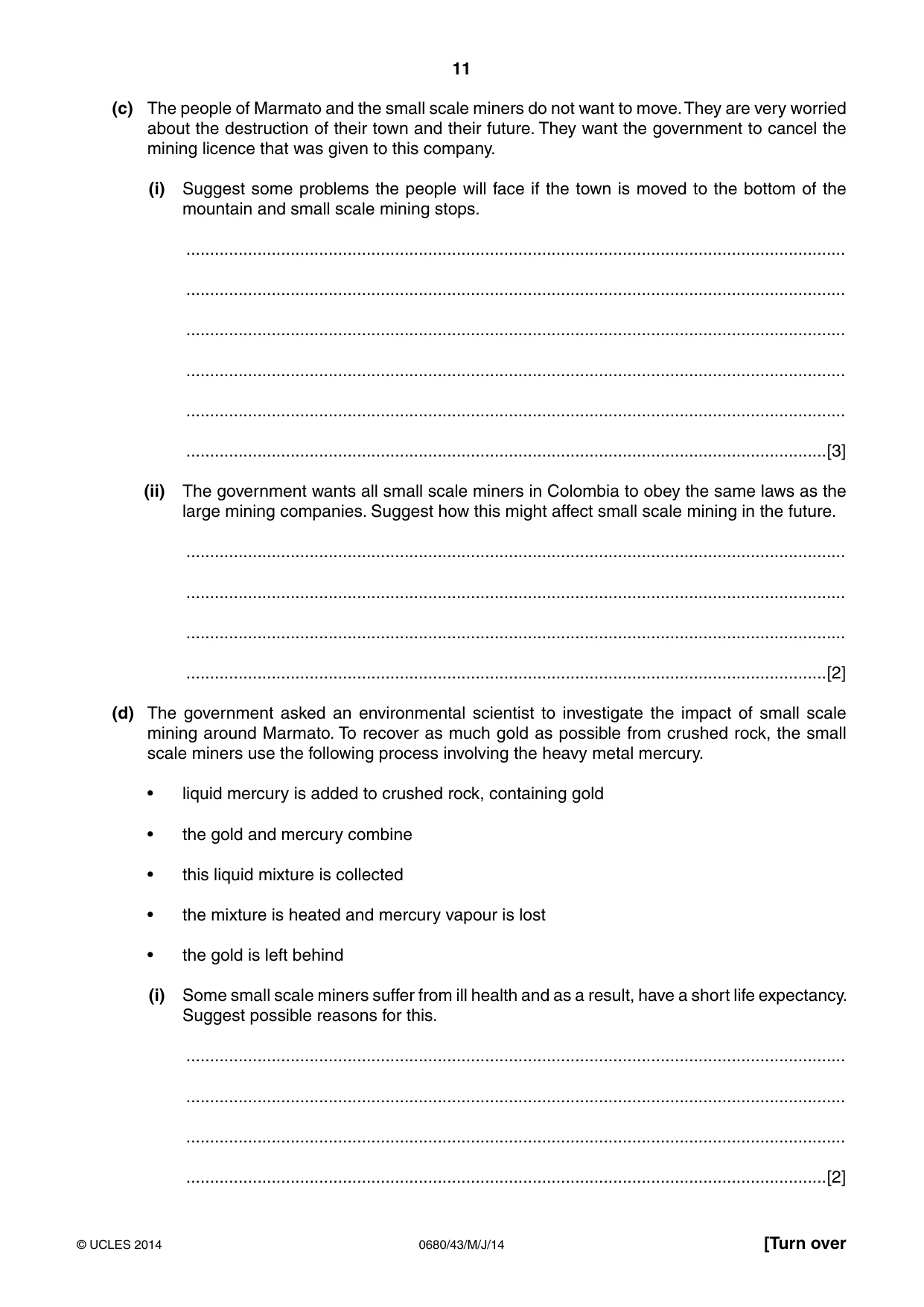
11 0680/43/M/J/14 © UCLES 2014 [Turn over (c) The people of Marmato and the small scale miners do not want to move. They are very worried about the destruction of their town and their future. They want the government to cancel the mining licence that was given to this company. (i) Suggest some problems the people will face if the town is moved to the bottom of the mountain and small scale mining stops. … … … … … …[3] (ii) The government wants all small scale miners in Colombia to obey the same laws as the large mining companies. Suggest how this might affect small scale mining in the future. … … … …[2] (d) The government asked an environmental scientist to investigate the impact of small scale mining around Marmato. To recover as much gold as possible from crushed rock, the small scale miners use the following process involving the heavy metal mercury. • liquid mercury is added to crushed rock, containing gold • the gold and mercury combine • this liquid mixture is collected • the mixture is heated and mercury vapour is lost • the gold is left behind (i) Some small scale miners suffer from ill health and as a result, have a short life expectancy. Suggest possible reasons for this. … … … …[2]
Question paper, page 12
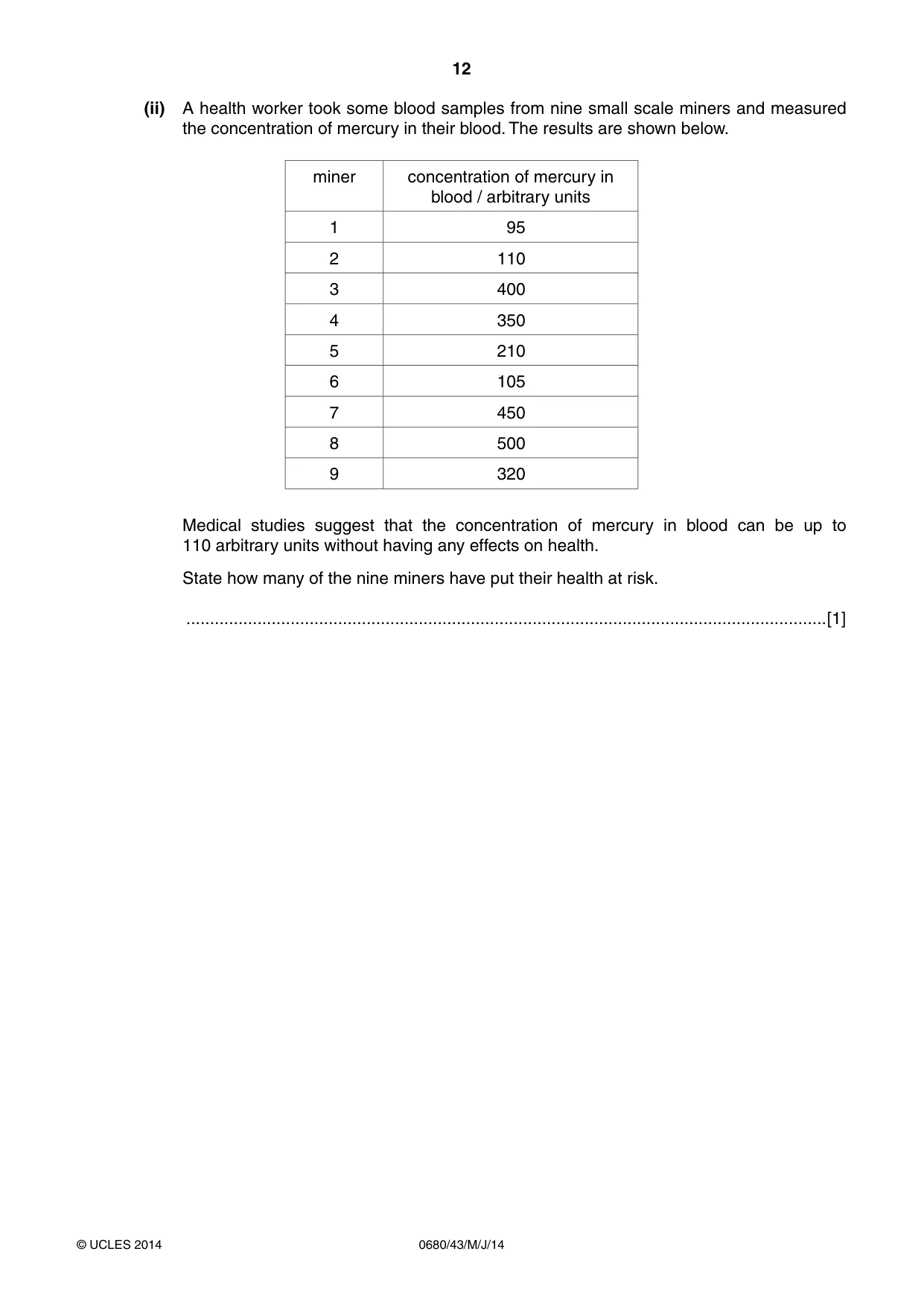
12 0680/43/M/J/14 © UCLES 2014 (ii) A health worker took some blood samples from nine small scale miners and measured the concentration of mercury in their blood. The results are shown below. miner concentration of mercury in blood / arbitrary units 1 95 2 110 3 400 4 350 5 210 6 105 7 450 8 500 9 320 Medical studies suggest that the concentration of mercury in blood can be up to 110 arbitrary units without having any effects on health. State how many of the nine miners have put their health at risk. …[1]
Question paper, page 13
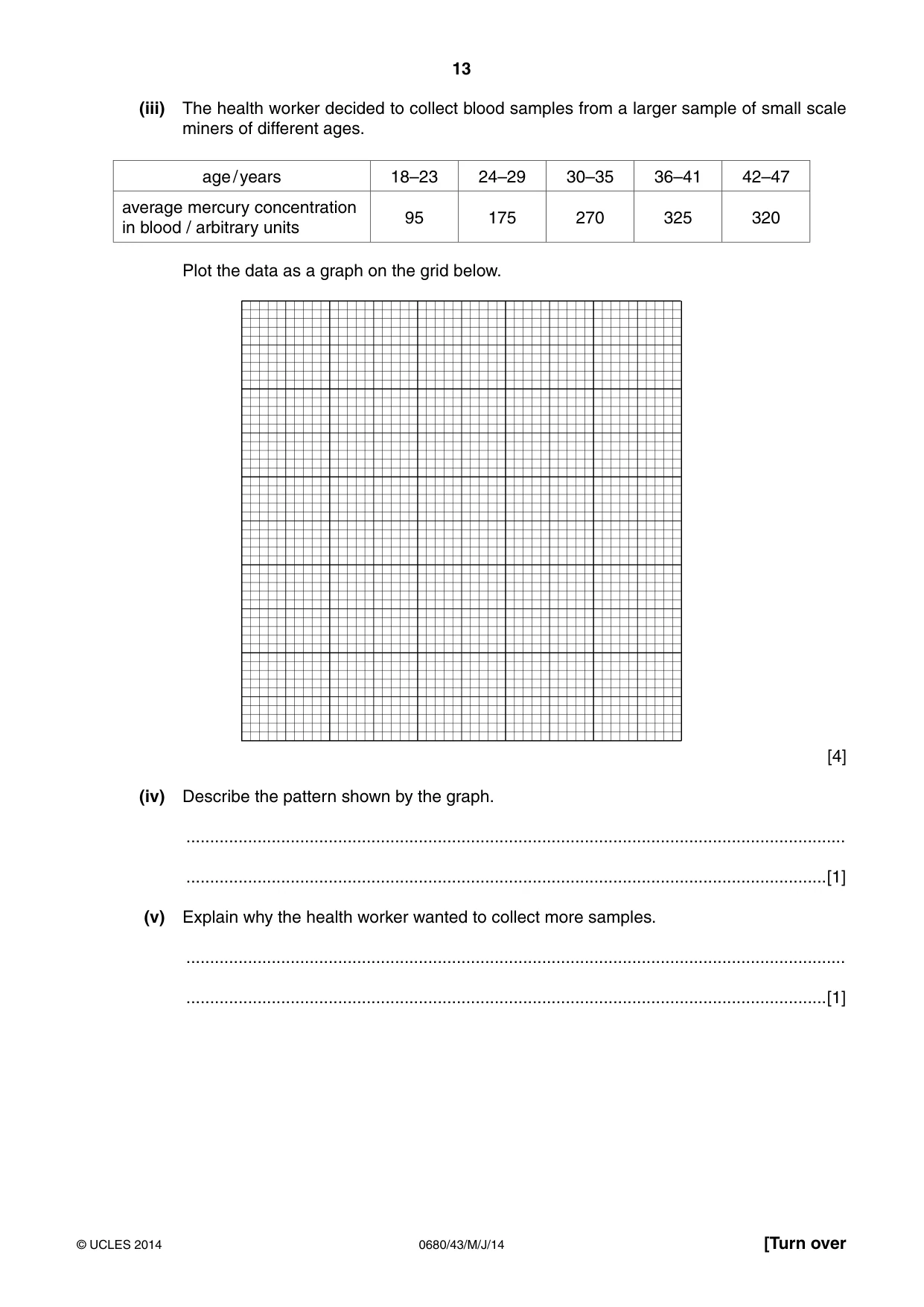
13 0680/43/M/J/14 © UCLES 2014 [Turn over (iii) The health worker decided to collect blood samples from a larger sample of small scale miners of different ages. age / years 18–23 24–29 30–35 36–41 42–47 average mercury concentration in blood / arbitrary units 95 175 270 325 320 Plot the data as a graph on the grid below. [4] (iv) Describe the pattern shown by the graph. … …[1] (v) Explain why the health worker wanted to collect more samples. … …[1]
Question paper, page 14
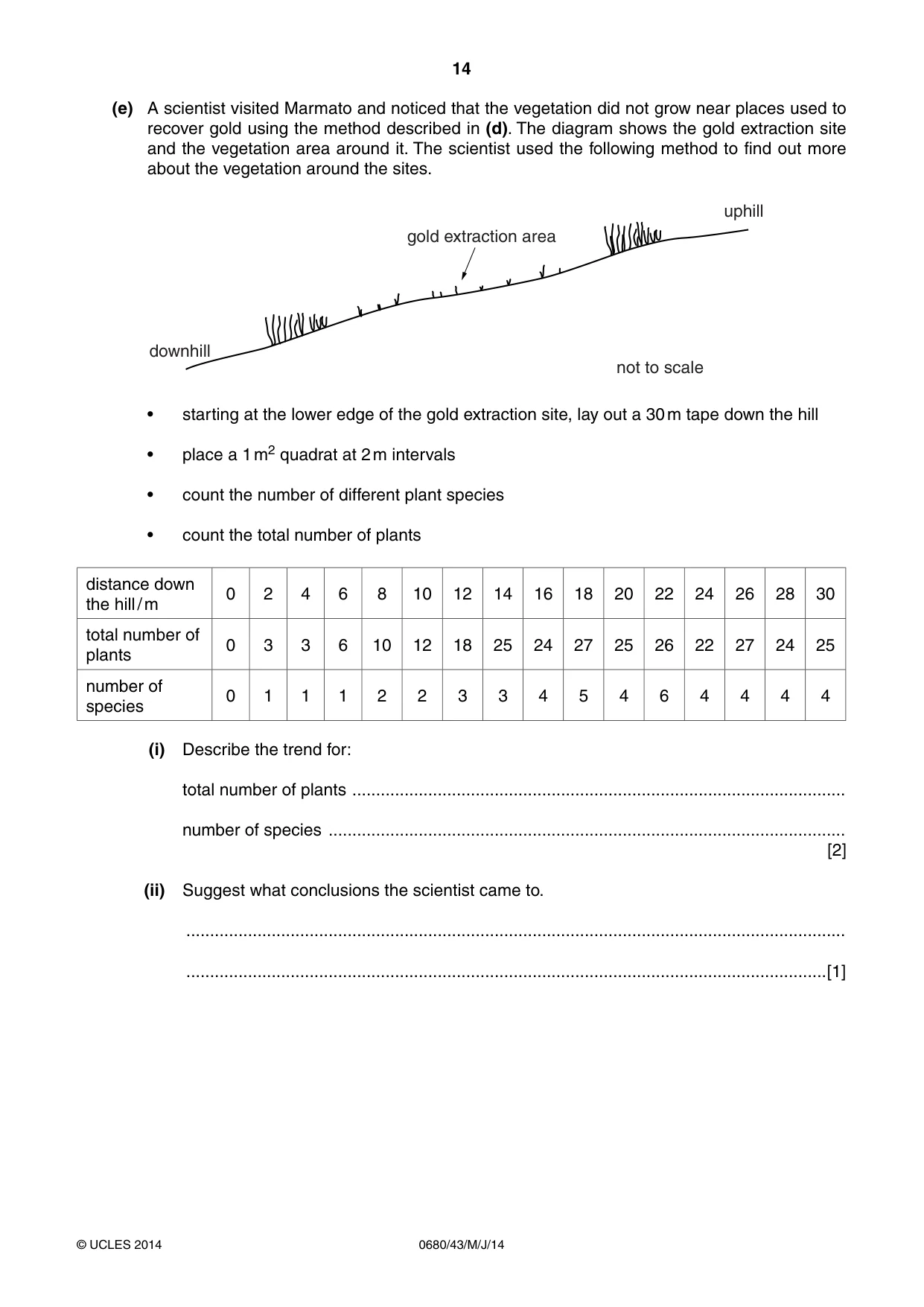
14 0680/43/M/J/14 © UCLES 2014 (e) A scientist visited Marmato and noticed that the vegetation did not grow near places used to recover gold using the method described in (d). The diagram shows the gold extraction site and the vegetation area around it. The scientist used the following method to find out more about the vegetation around the sites. uphill downhill gold extraction area not to scale • starting at the lower edge of the gold extraction site, lay out a 30 m tape down the hill • place a 1 m2 quadrat at 2 m intervals • count the number of different plant species • count the total number of plants distance down the hill / m 0 2 4 6 8 10 12 14 16 18 20 22 24 26 28 30 total number of plants 0 3 3 6 10 12 18 25 24 27 25 26 22 27 24 25 number of species 0 1 1 1 2 2 3 3 4 5 4 6 4 4 4 4 (i) Describe the trend for: total number of plants … number of species … [2] (ii) Suggest what conclusions the scientist came to. … …[1]
Question paper, page 15
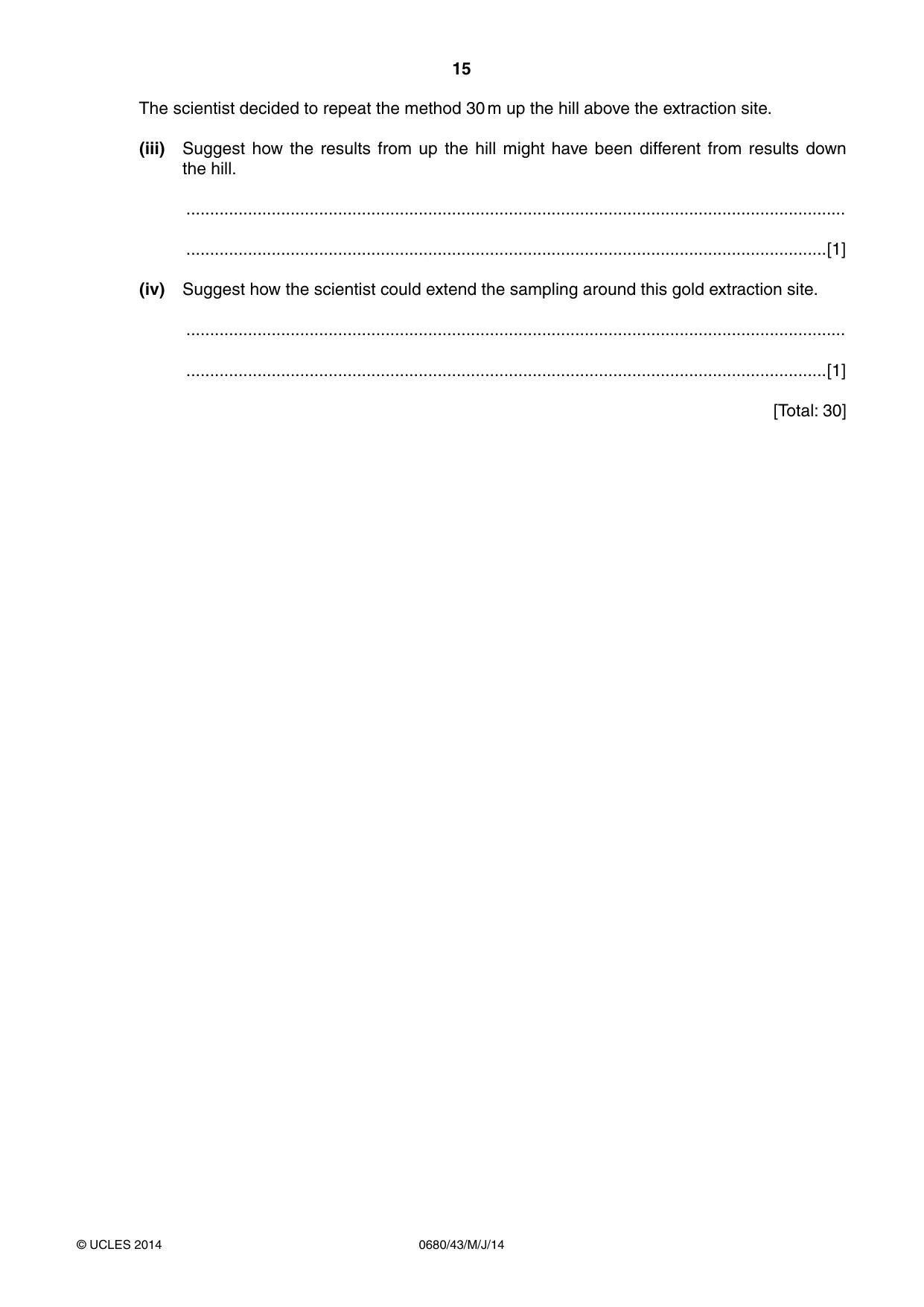
15 0680/43/M/J/14 © UCLES 2014 The scientist decided to repeat the method 30 m up the hill above the extraction site. (iii) Suggest how the results from up the hill might have been different from results down the hill. … …[1] (iv) Suggest how the scientist could extend the sampling around this gold extraction site. … …[1] [Total: 30]
Question paper, page 16
16 0680/43/M/J/14 © UCLES 2014 Permission to reproduce items where third-party owned material protected by copyright is included has been sought and cleared where possible. Every reasonable effort has been made by the publisher (UCLES) to trace copyright holders, but if any items requiring clearance have unwittingly been included, the publisher will be pleased to make amends at the earliest possible opportunity. Cambridge International Examinations is part of the Cambridge Assessment Group. Cambridge Assessment is the brand name of University of Cambridge Local Examinations Syndicate (UCLES), which is itself a department of the University of Cambridge. BLANK PAGE
Mark scheme, page 1
CAMBRIDGE INTERNATIONAL EXAMINATIONS International General Certificate of Secondary Education MARK SCHEME for the May/June 2014 series 0680 ENVIRONMENTAL MANAGEMENT 0680/43 Paper 4 (Alternative to Coursework), maximum raw mark 60 This mark scheme is published as an aid to teachers and candidates, to indicate the requirements of the examination. It shows the basis on which Examiners were instructed to award marks. It does not indicate the details of the discussions that took place at an Examiners’ meeting before marking began, which would have considered the acceptability of alternative answers. Mark schemes should be read in conjunction with the question paper and the Principal Examiner Report for Teachers. Cambridge will not enter into discussions about these mark schemes. Cambridge is publishing the mark schemes for the May/June 2014 series for most IGCSE, GCE Advanced Level and Advanced Subsidiary Level components and some Ordinary Level components.
Mark scheme, page 2
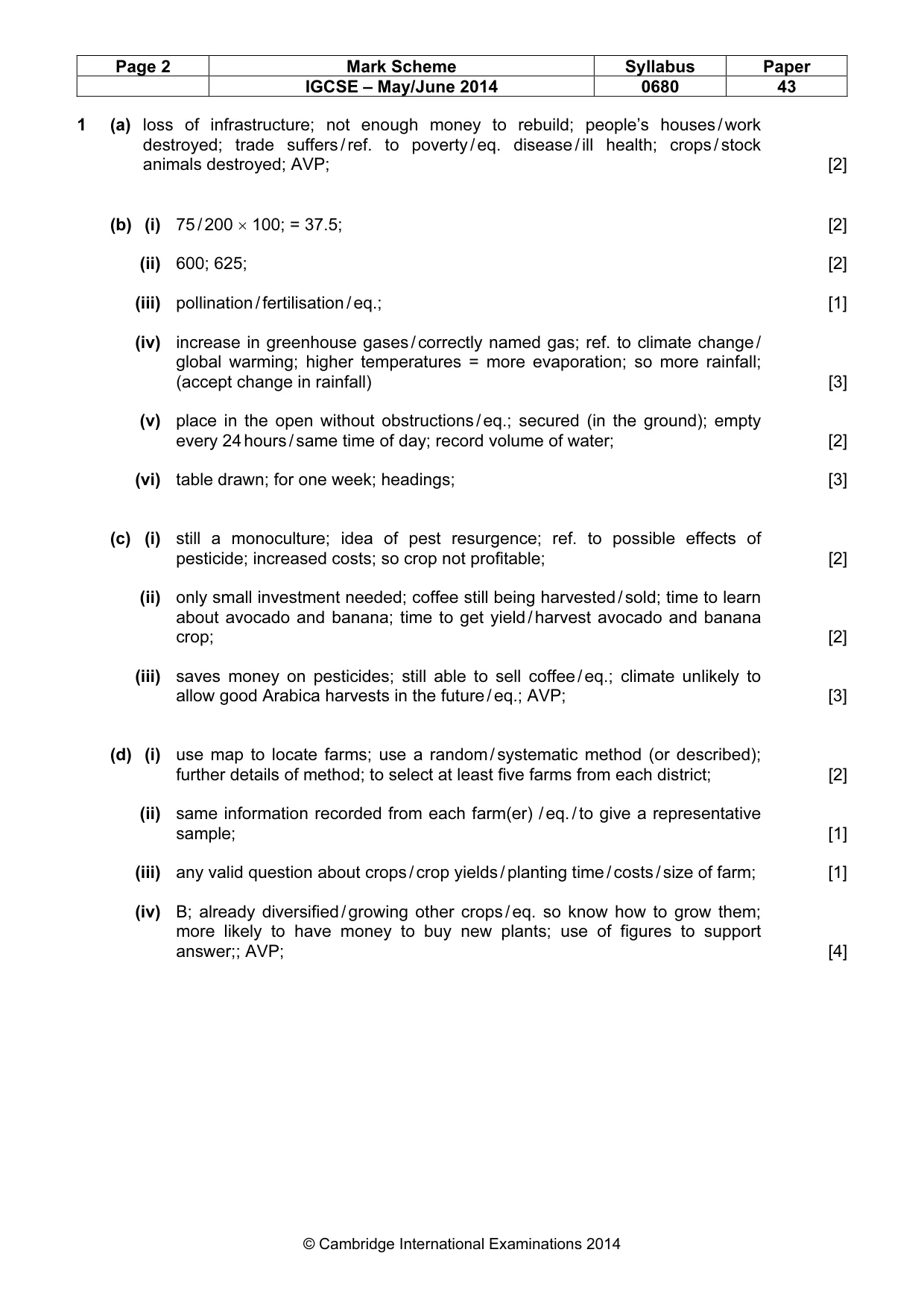
Page 2 Mark Scheme Syllabus Paper IGCSE – May/June 2014 0680 43 © Cambridge International Examinations 2014 1 (a) loss of infrastructure; not enough money to rebuild; people’s houses / work destroyed; trade suffers / ref. to poverty / eq. disease / ill health; crops / stock animals destroyed; AVP; [2] (b) (i) 75 / 200 × 100; = 37.5; [2] (ii) 600; 625; [2] (iii) pollination / fertilisation / eq.; [1] (iv) increase in greenhouse gases / correctly named gas; ref. to climate change / global warming; higher temperatures = more evaporation; so more rainfall; (accept change in rainfall) [3] (v) place in the open without obstructions / eq.; secured (in the ground); empty every 24 hours / same time of day; record volume of water; [2] (vi) table drawn; for one week; headings; [3] (c) (i) still a monoculture; idea of pest resurgence; ref. to possible effects of pesticide; increased costs; so crop not profitable; [2] (ii) only small investment needed; coffee still being harvested / sold; time to learn about avocado and banana; time to get yield / harvest avocado and banana crop; [2] (iii) saves money on pesticides; still able to sell coffee / eq.; climate unlikely to allow good Arabica harvests in the future / eq.; AVP; [3] (d) (i) use map to locate farms; use a random / systematic method (or described); further details of method; to select at least five farms from each district; [2] (ii) same information recorded from each farm(er) / eq. / to give a representative sample; [1] (iii) any valid question about crops / crop yields / planting time / costs / size of farm; [1] (iv) B; already diversified / growing other crops / eq. so know how to grow them; more likely to have money to buy new plants; use of figures to support answer;; AVP; [4]
Mark scheme, page 3
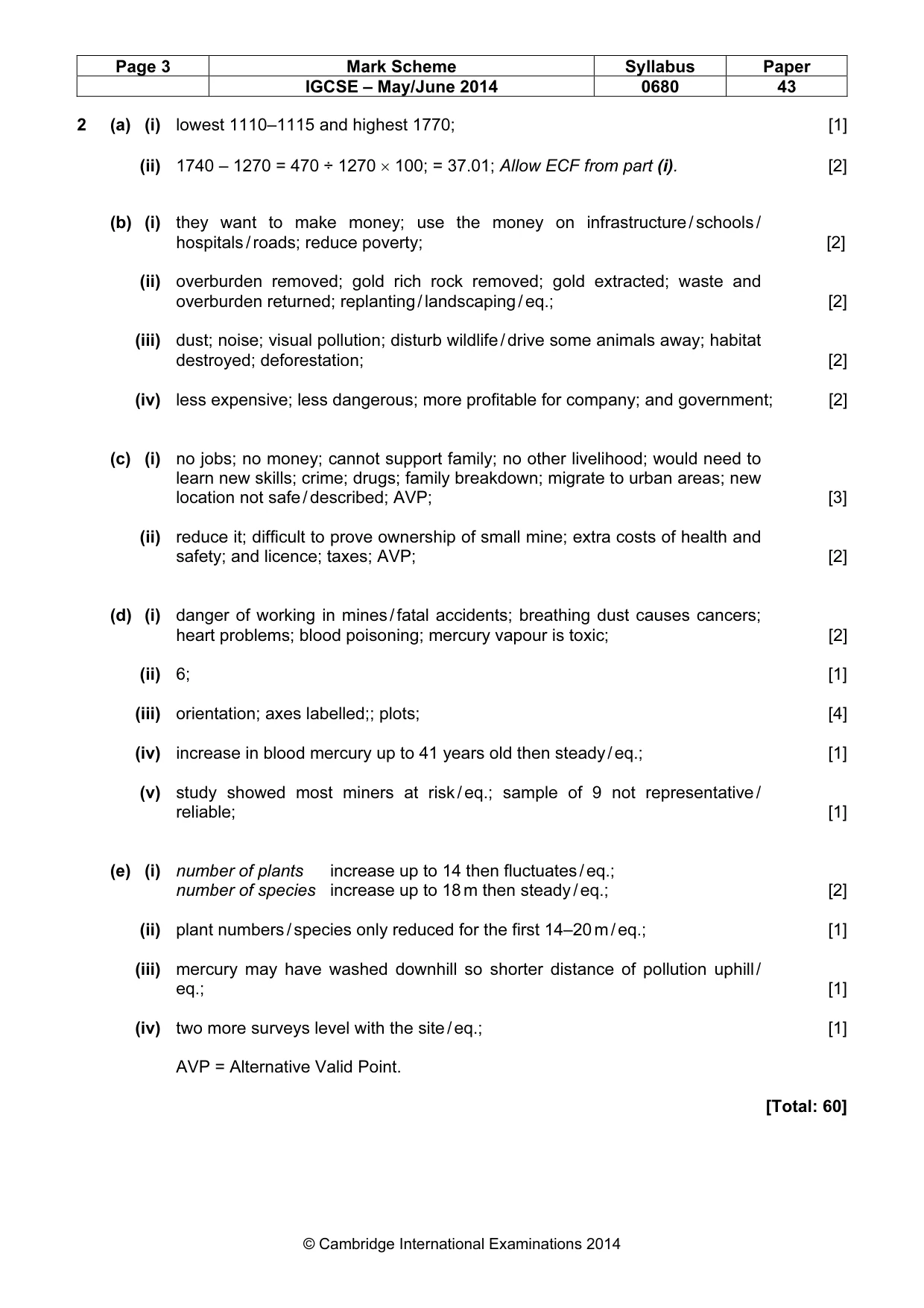
Page 3 Mark Scheme Syllabus Paper IGCSE – May/June 2014 0680 43 © Cambridge International Examinations 2014 2 (a) (i) lowest 1110–1115 and highest 1770; [1] (ii) 1740 – 1270 = 470 ÷ 1270 × 100; = 37.01; Allow ECF from part (i). [2] (b) (i) they want to make money; use the money on infrastructure / schools / hospitals / roads; reduce poverty; [2] (ii) overburden removed; gold rich rock removed; gold extracted; waste and overburden returned; replanting / landscaping / eq.; [2] (iii) dust; noise; visual pollution; disturb wildlife / drive some animals away; habitat destroyed; deforestation; [2] (iv) less expensive; less dangerous; more profitable for company; and government; [2] (c) (i) no jobs; no money; cannot support family; no other livelihood; would need to learn new skills; crime; drugs; family breakdown; migrate to urban areas; new location not safe / described; AVP; [3] (ii) reduce it; difficult to prove ownership of small mine; extra costs of health and safety; and licence; taxes; AVP; [2] (d) (i) danger of working in mines / fatal accidents; breathing dust causes cancers; heart problems; blood poisoning; mercury vapour is toxic; [2] (ii) 6; [1] (iii) orientation; axes labelled;; plots; [4] (iv) increase in blood mercury up to 41 years old then steady / eq.; [1] (v) study showed most miners at risk / eq.; sample of 9 not representative / reliable; [1] (e) (i) number of plants increase up to 14 then fluctuates / eq.; number of species increase up to 18 m then steady / eq.; [2] (ii) plant numbers / species only reduced for the first 14–20 m / eq.; [1] (iii) mercury may have washed downhill so shorter distance of pollution uphill / eq.; [1] (iv) two more surveys level with the site / eq.; [1] AVP = Alternative Valid Point. [Total: 60]
What you needed in this session
Cambridge’s own grade thresholds for 2014 May/June, Paper 4 · Variant 3. A higher threshold means an easier paper — the bar moves with how the cohort did.