Cambridge IGCSE Environmental Management 0680 — 2014 May/June Paper 4 · Variant 2
0680/42/M/J/14 · 60 marks · ≈68 min
The question paper and its mark scheme, free to read here and free to download. This is Cambridge’s own paper, exactly as it was sat.
Question paper16 pages
Mark scheme4 pages
Answers below. Sit the paper first if you are practising.
Paper as text
Question paper, page 1
This document consists of 16 printed pages. DC (AC/JG) 80646/4 © UCLES 2014 [Turn over Cambridge International Examinations Cambridge International General Certificate of Secondary Education * 1 4 4 8 4 1 5 5 0 2 * ENVIRONMENTAL MANAGEMENT 0680/42 Alternative to Coursework May/June 2014 1 hour 30 minutes Candidates answer on the Question Paper. Additional Materials: Ruler READ THESE INSTRUCTIONS FIRST Write your Centre number, candidate number and name on all the work you hand in. Write in dark blue or black pen. You may use an HB pencil for any diagrams or graphs. Do not use staples, paper clips, glue or correction fluid. DO NOT WRITE IN ANY BARCODES. Answer all questions. Electronic calculators may be used. You may lose marks if you do not show your working or if you do not use appropriate units. Study the appropriate source materials before you start to write your answers. Credit will be given for appropriate selection and use of data in your answers and for relevant interpretation of these data. Suggestions for data sources are given in some questions. You may use the source data to draw diagrams and graphs or to do calculations to illustrate your answers. At the end of the examination, fasten all your work securely together. The number of marks is given in brackets [ ] at the end of each question or part question.
Question paper, page 2
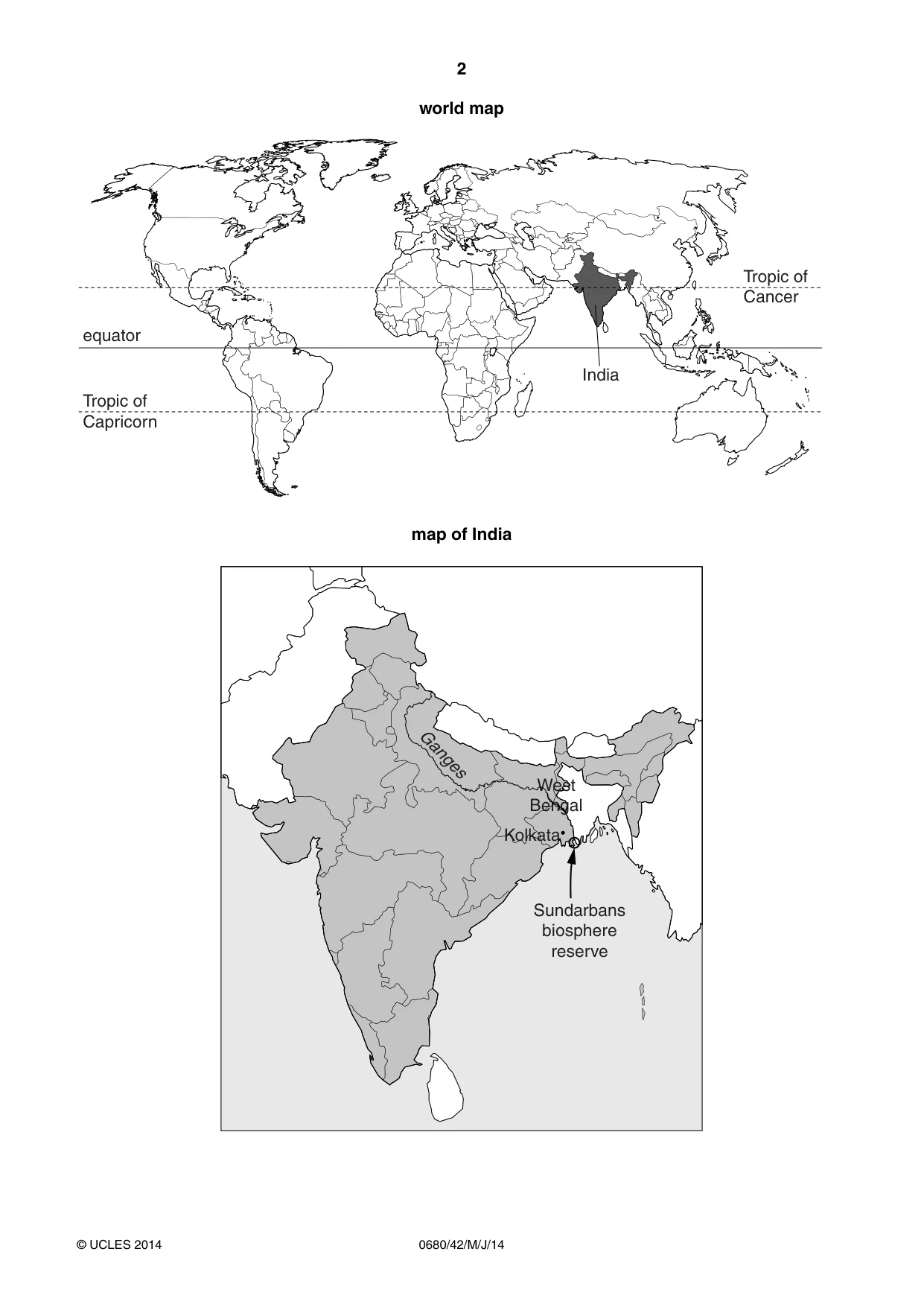
2 0680/42/M/J/14 © UCLES 2014 world map equator Tropic of Capricorn Tropic of Cancer India map of India Sundarbans biosphere reserve Kolkata West Bengal Ganges
Question paper, page 3
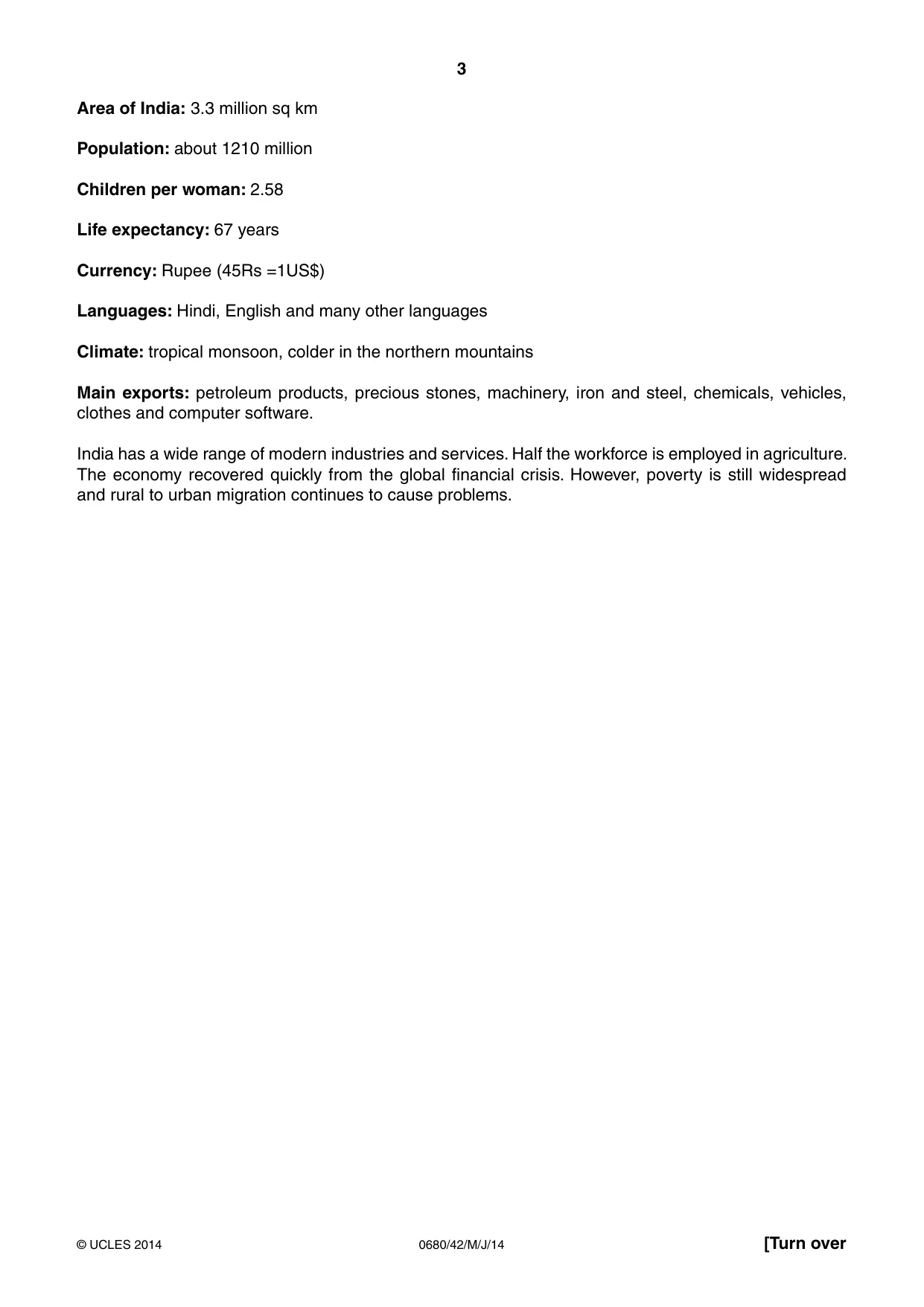
3 0680/42/M/J/14 © UCLES 2014 [Turn over Area of India: 3.3 million sq km Population: about 1210 million Children per woman: 2.58 Life expectancy: 67 years Currency: Rupee (45Rs =1US$) Languages: Hindi, English and many other languages Climate: tropical monsoon, colder in the northern mountains Main exports: petroleum products, precious stones, machinery, iron and steel, chemicals, vehicles, clothes and computer software. India has a wide range of modern industries and services. Half the workforce is employed in agriculture. The economy recovered quickly from the global financial crisis. However, poverty is still widespread and rural to urban migration continues to cause problems.
Question paper, page 4
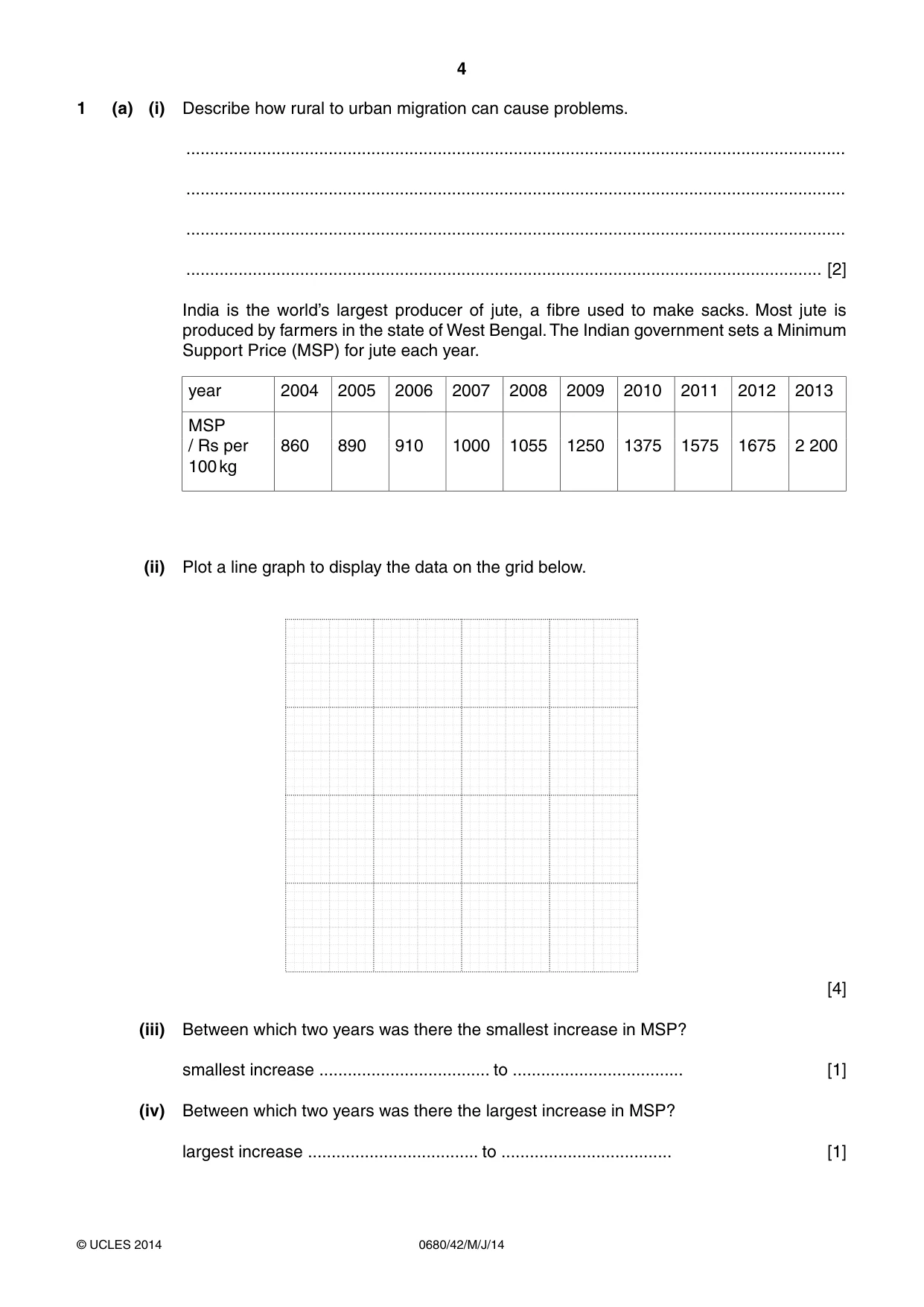
4 0680/42/M/J/14 © UCLES 2014 1 (a) (i) Describe how rural to urban migration can cause problems. … … … … [2] India is the world’s largest producer of jute, a fibre used to make sacks. Most jute is produced by farmers in the state of West Bengal. The Indian government sets a Minimum Support Price (MSP) for jute each year. year 2004 2005 2006 2007 2008 2009 2010 2011 2012 2013 MSP / Rs per 100 kg 860 890 910 1000 1055 1250 1375 1575 1675 2 200 (ii) Plot a line graph to display the data on the grid below. [4] (iii) Between which two years was there the smallest increase in MSP? smallest increase … to … [1] (iv) Between which two years was there the largest increase in MSP? largest increase … to … [1]
Question paper, page 5
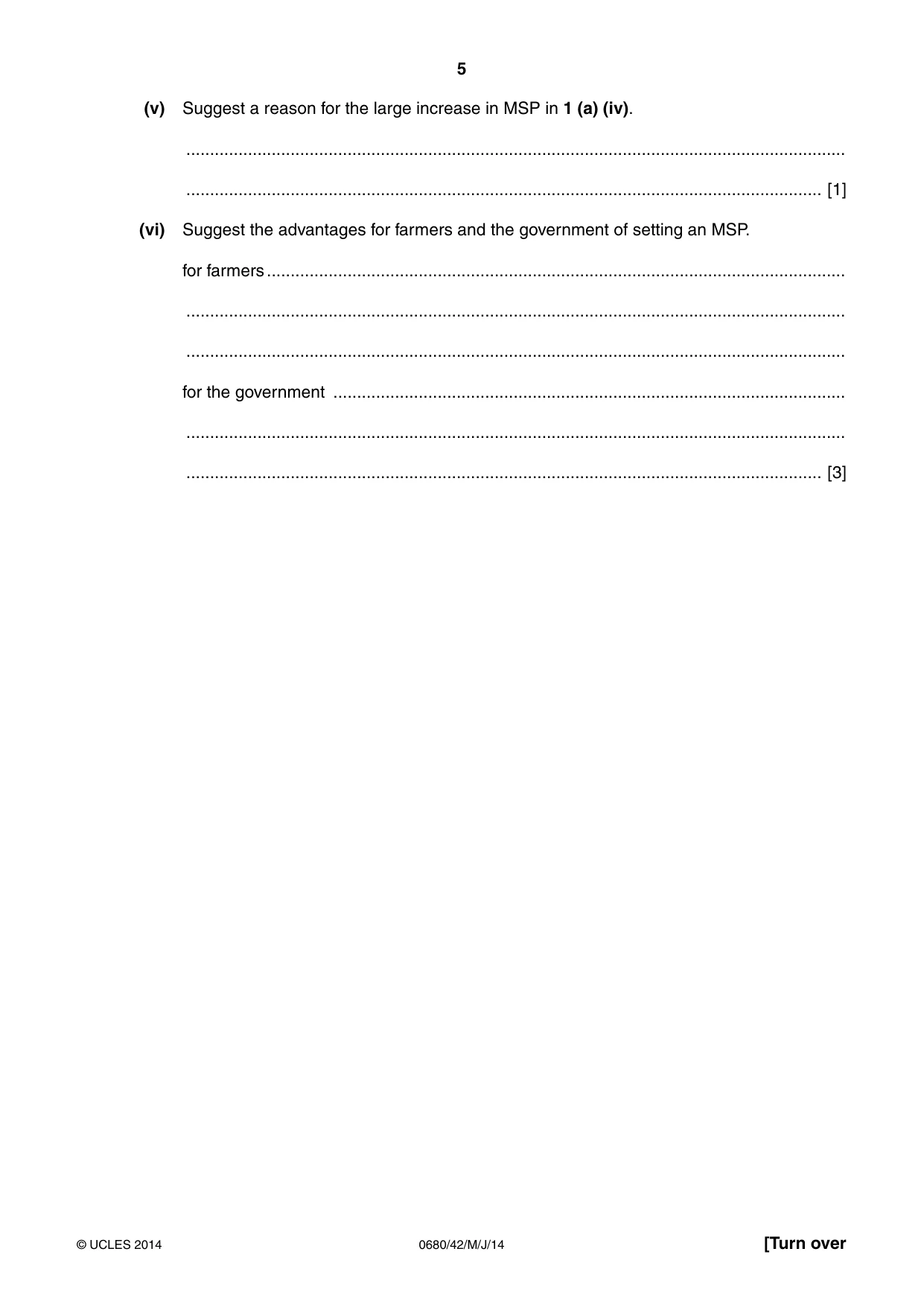
5 0680/42/M/J/14 © UCLES 2014 [Turn over (v) Suggest a reason for the large increase in MSP in 1 (a) (iv). … … [1] (vi) Suggest the advantages for farmers and the government of setting an MSP. for farmers … … … for the government … … … [3]
Question paper, page 6
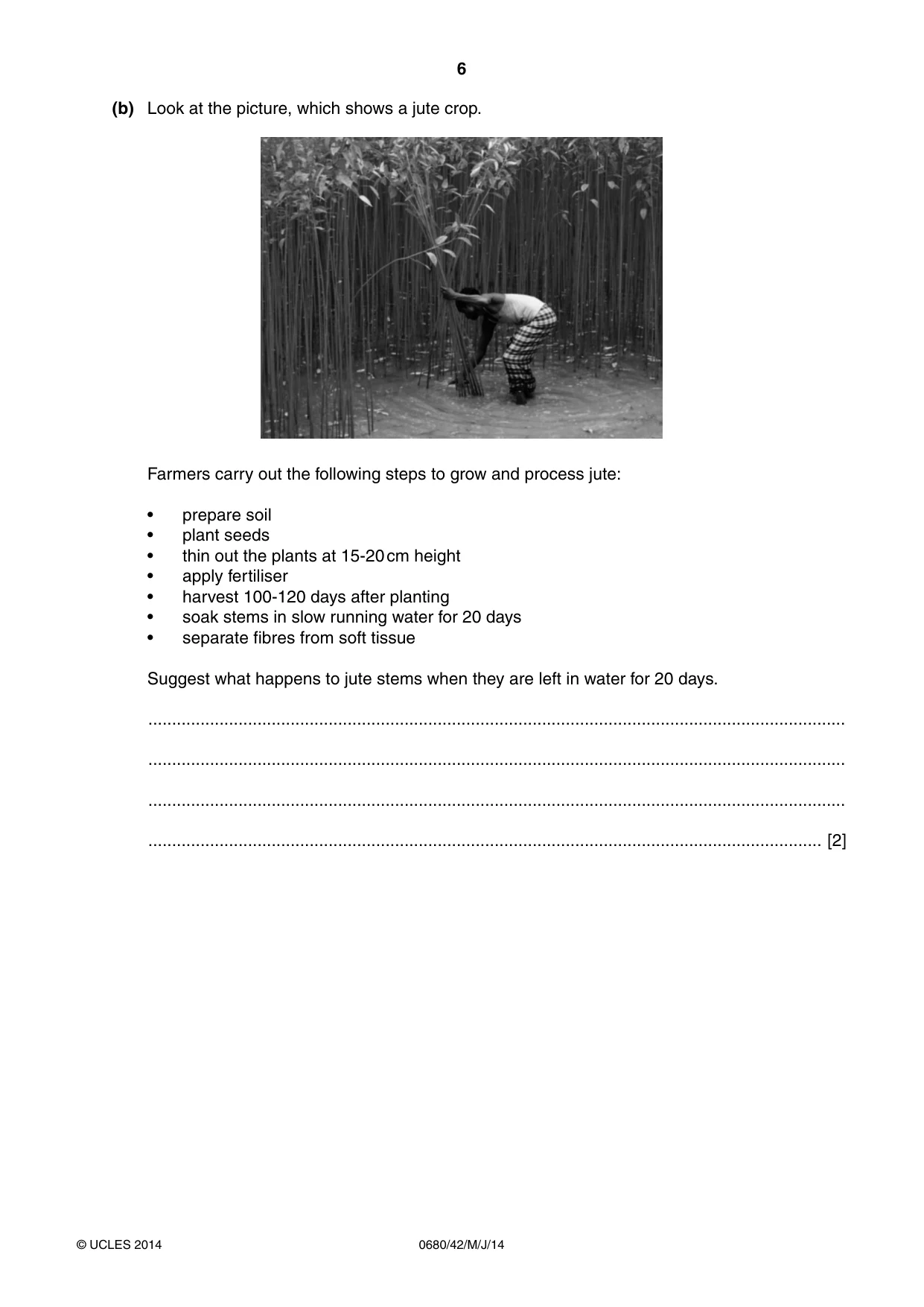
6 0680/42/M/J/14 © UCLES 2014 (b) Look at the picture, which shows a jute crop. Farmers carry out the following steps to grow and process jute: • prepare soil • plant seeds • thin out the plants at 15-20 cm height • apply fertiliser • harvest 100-120 days after planting • soak stems in slow running water for 20 days • separate fibres from soft tissue Suggest what happens to jute stems when they are left in water for 20 days. … … … … [2]
Question paper, page 7
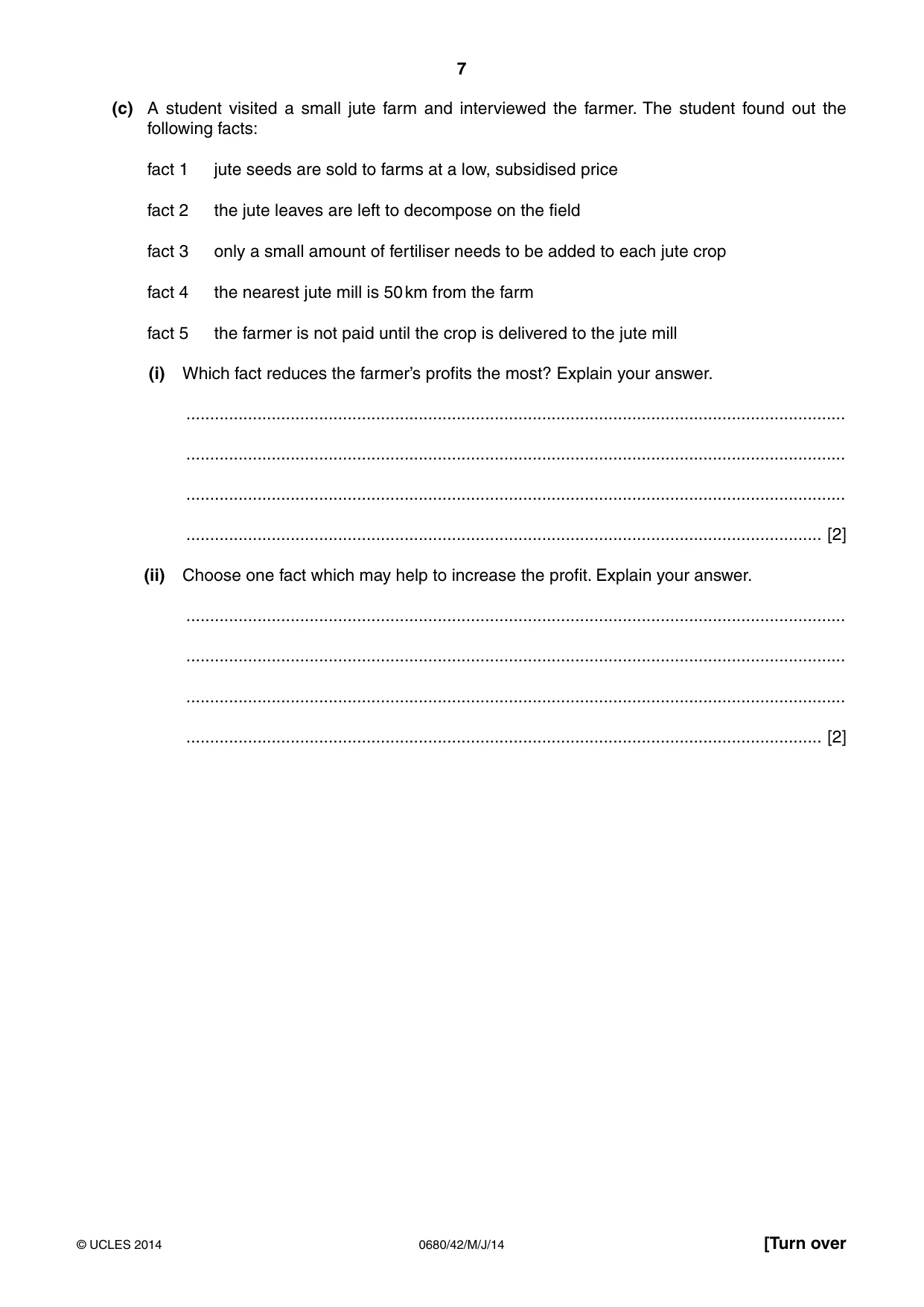
7 0680/42/M/J/14 © UCLES 2014 [Turn over (c) A student visited a small jute farm and interviewed the farmer. The student found out the following facts: fact 1 jute seeds are sold to farms at a low, subsidised price fact 2 the jute leaves are left to decompose on the field fact 3 only a small amount of fertiliser needs to be added to each jute crop fact 4 the nearest jute mill is 50 km from the farm fact 5 the farmer is not paid until the crop is delivered to the jute mill (i) Which fact reduces the farmer’s profits the most? Explain your answer. … … … … [2] (ii) Choose one fact which may help to increase the profit. Explain your answer. … … … … [2]
Question paper, page 8
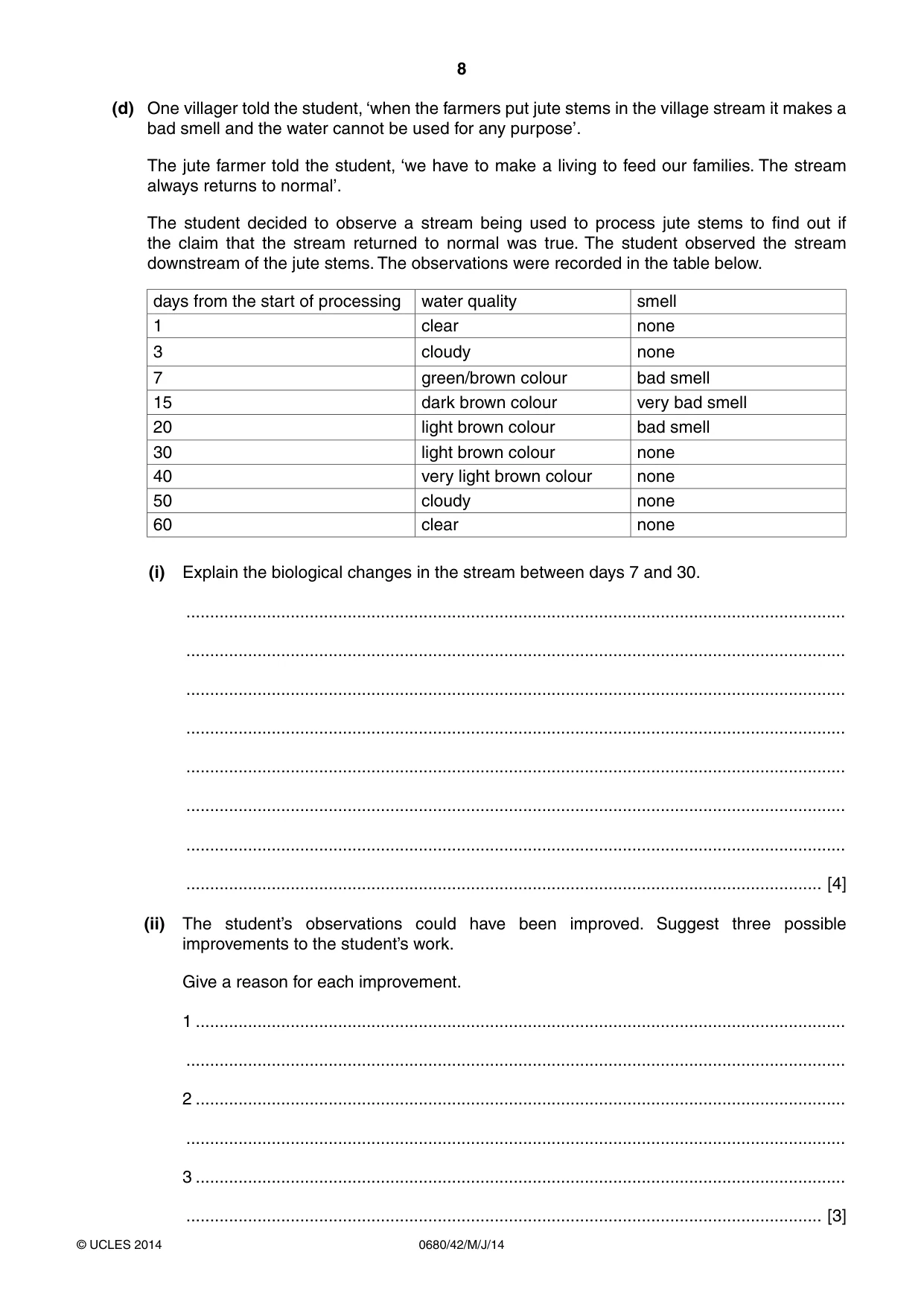
8 0680/42/M/J/14 © UCLES 2014 (d) One villager told the student, ‘when the farmers put jute stems in the village stream it makes a bad smell and the water cannot be used for any purpose’. The jute farmer told the student, ‘we have to make a living to feed our families. The stream always returns to normal’. The student decided to observe a stream being used to process jute stems to find out if the claim that the stream returned to normal was true. The student observed the stream downstream of the jute stems. The observations were recorded in the table below. days from the start of processing water quality smell 1 clear none 3 cloudy none 7 green/brown colour bad smell 15 dark brown colour very bad smell 20 light brown colour bad smell 30 light brown colour none 40 very light brown colour none 50 cloudy none 60 clear none (i) Explain the biological changes in the stream between days 7 and 30. … … … … … … … … [4] (ii) The student’s observations could have been improved. Suggest three possible improvements to the student’s work. Give a reason for each improvement. 1 … … 2 … … 3 … … [3]
Question paper, page 9
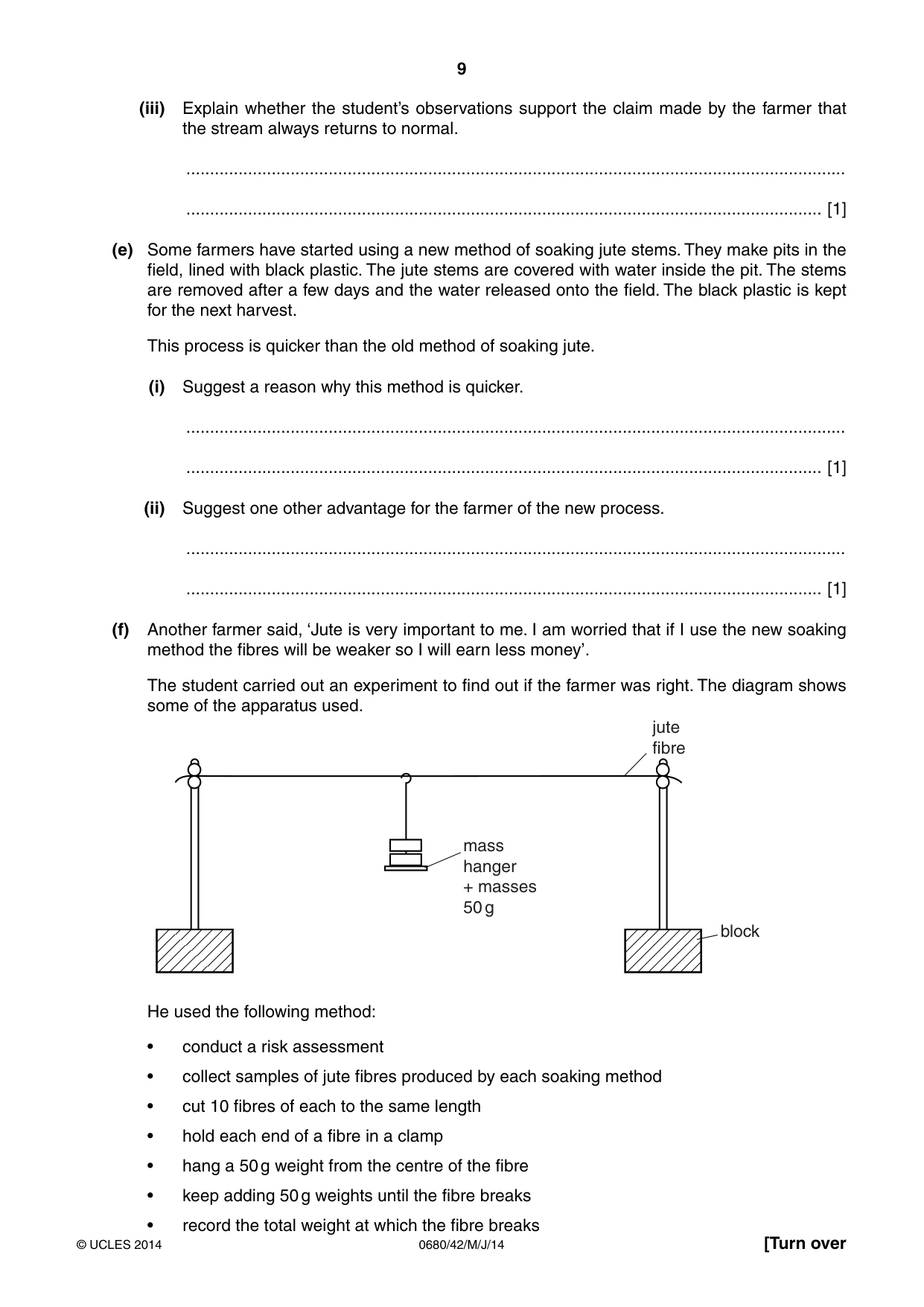
9 0680/42/M/J/14 © UCLES 2014 [Turn over (iii) Explain whether the student’s observations support the claim made by the farmer that the stream always returns to normal. … … [1] (e) Some farmers have started using a new method of soaking jute stems. They make pits in the field, lined with black plastic. The jute stems are covered with water inside the pit. The stems are removed after a few days and the water released onto the field. The black plastic is kept for the next harvest. This process is quicker than the old method of soaking jute. (i) Suggest a reason why this method is quicker. … … [1] (ii) Suggest one other advantage for the farmer of the new process. … … [1] (f) Another farmer said, ‘Jute is very important to me. I am worried that if I use the new soaking method the fibres will be weaker so I will earn less money’. The student carried out an experiment to find out if the farmer was right. The diagram shows some of the apparatus used. mass hanger + masses 50 g jute fibre block He used the following method: • conduct a risk assessment • collect samples of jute fibres produced by each soaking method • cut 10 fibres of each to the same length • hold each end of a fibre in a clamp • hang a 50 g weight from the centre of the fibre • keep adding 50 g weights until the fibre breaks • record the total weight at which the fibre breaks
Question paper, page 10
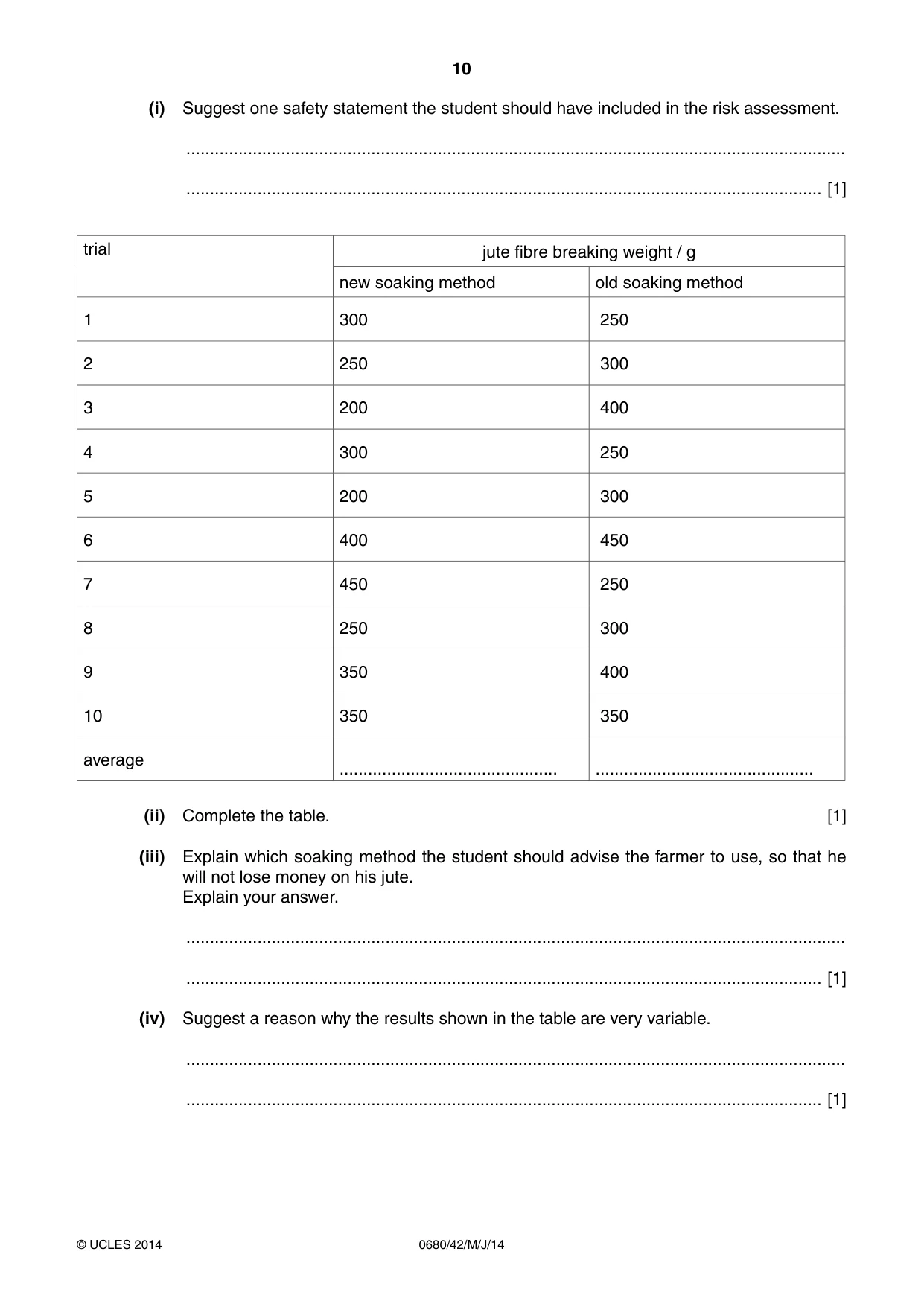
10 0680/42/M/J/14 © UCLES 2014 (i) Suggest one safety statement the student should have included in the risk assessment. … … [1] trial jute fibre breaking weight / g new soaking method old soaking method 1 300 250 2 250 300 3 200 400 4 300 250 5 200 300 6 400 450 7 450 250 8 250 300 9 350 400 10 350 350 average … … (ii) Complete the table. [1] (iii) Explain which soaking method the student should advise the farmer to use, so that he will not lose money on his jute. Explain your answer. … … [1] (iv) Suggest a reason why the results shown in the table are very variable. … … [1]
Question paper, page 11
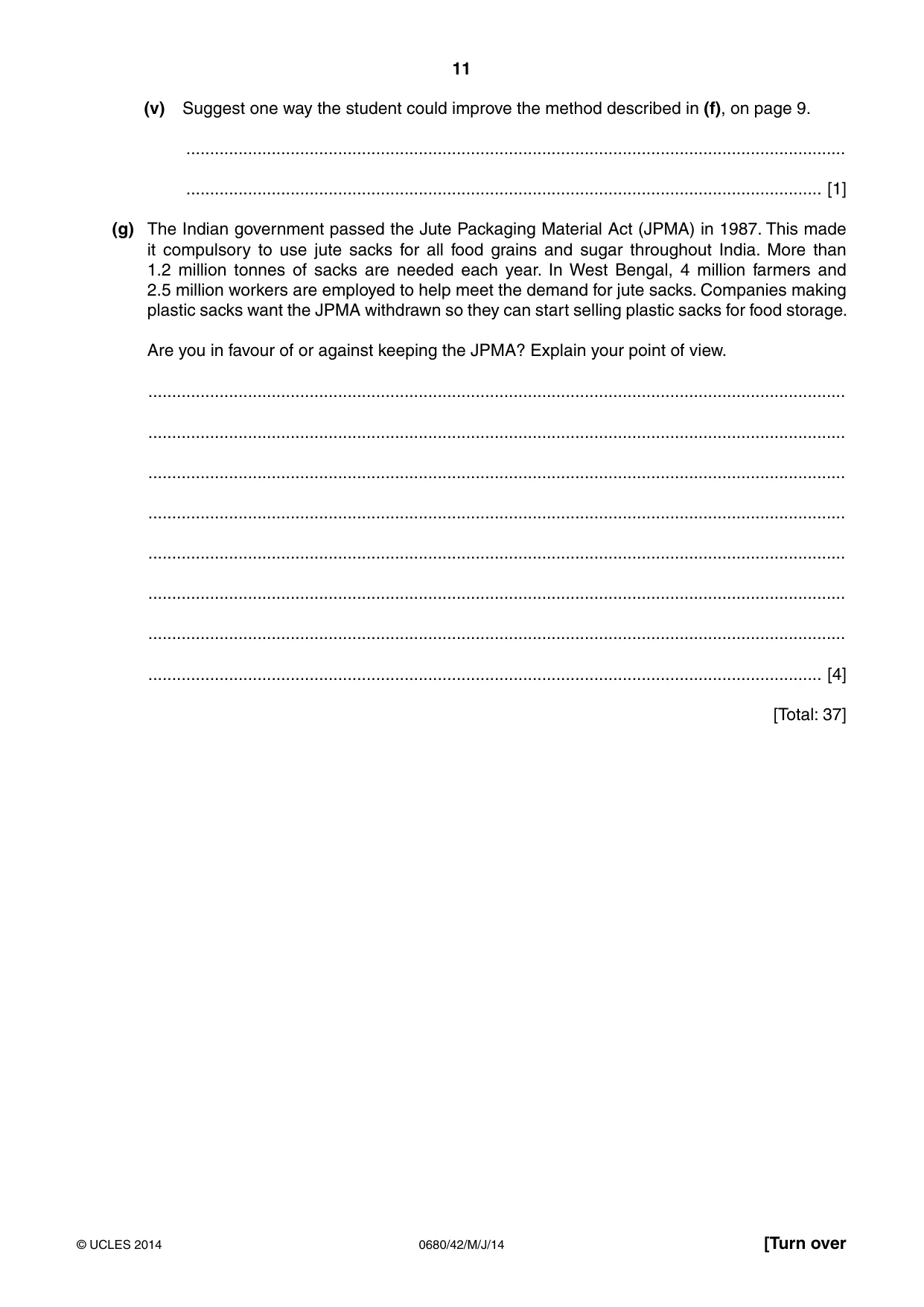
11 0680/42/M/J/14 © UCLES 2014 [Turn over (v) Suggest one way the student could improve the method described in (f), on page 9. … … [1] (g) The Indian government passed the Jute Packaging Material Act (JPMA) in 1987. This made it compulsory to use jute sacks for all food grains and sugar throughout India. More than 1.2 million tonnes of sacks are needed each year. In West Bengal, 4 million farmers and 2.5 million workers are employed to help meet the demand for jute sacks. Companies making plastic sacks want the JPMA withdrawn so they can start selling plastic sacks for food storage. Are you in favour of or against keeping the JPMA? Explain your point of view. … … … … … … … … [4] [Total: 37]
Question paper, page 12
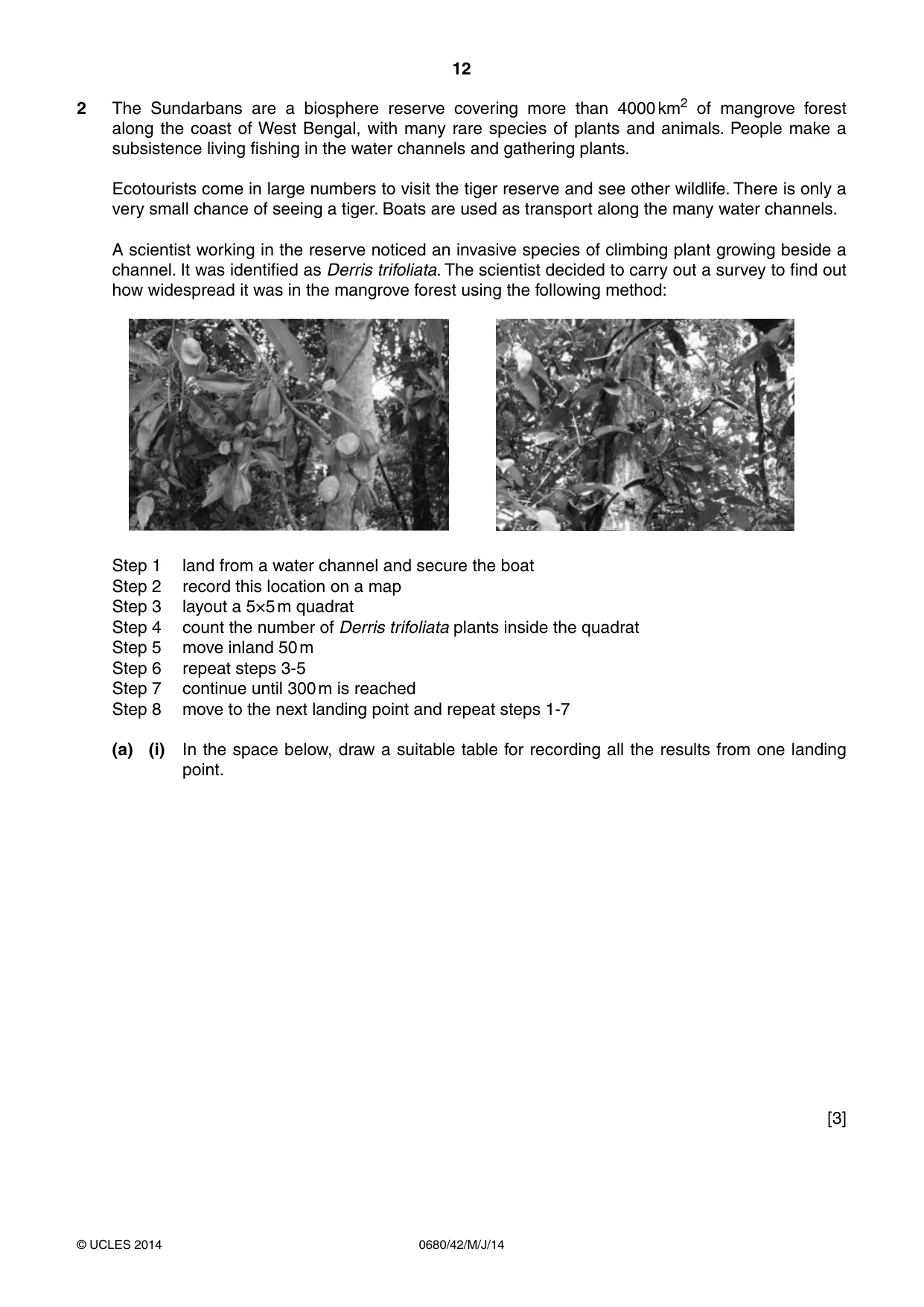
12 0680/42/M/J/14 © UCLES 2014 2 The Sundarbans are a biosphere reserve covering more than 4000 km2 of mangrove forest along the coast of West Bengal, with many rare species of plants and animals. People make a subsistence living fishing in the water channels and gathering plants. Ecotourists come in large numbers to visit the tiger reserve and see other wildlife. There is only a very small chance of seeing a tiger. Boats are used as transport along the many water channels. A scientist working in the reserve noticed an invasive species of climbing plant growing beside a channel. It was identified as Derris trifoliata. The scientist decided to carry out a survey to find out how widespread it was in the mangrove forest using the following method: Step 1 land from a water channel and secure the boat Step 2 record this location on a map Step 3 layout a 5×5 m quadrat Step 4 count the number of Derris trifoliata plants inside the quadrat Step 5 move inland 50 m Step 6 repeat steps 3-5 Step 7 continue until 300 m is reached Step 8 move to the next landing point and repeat steps 1-7 (a) (i) In the space below, draw a suitable table for recording all the results from one landing point. [3]
Question paper, page 13
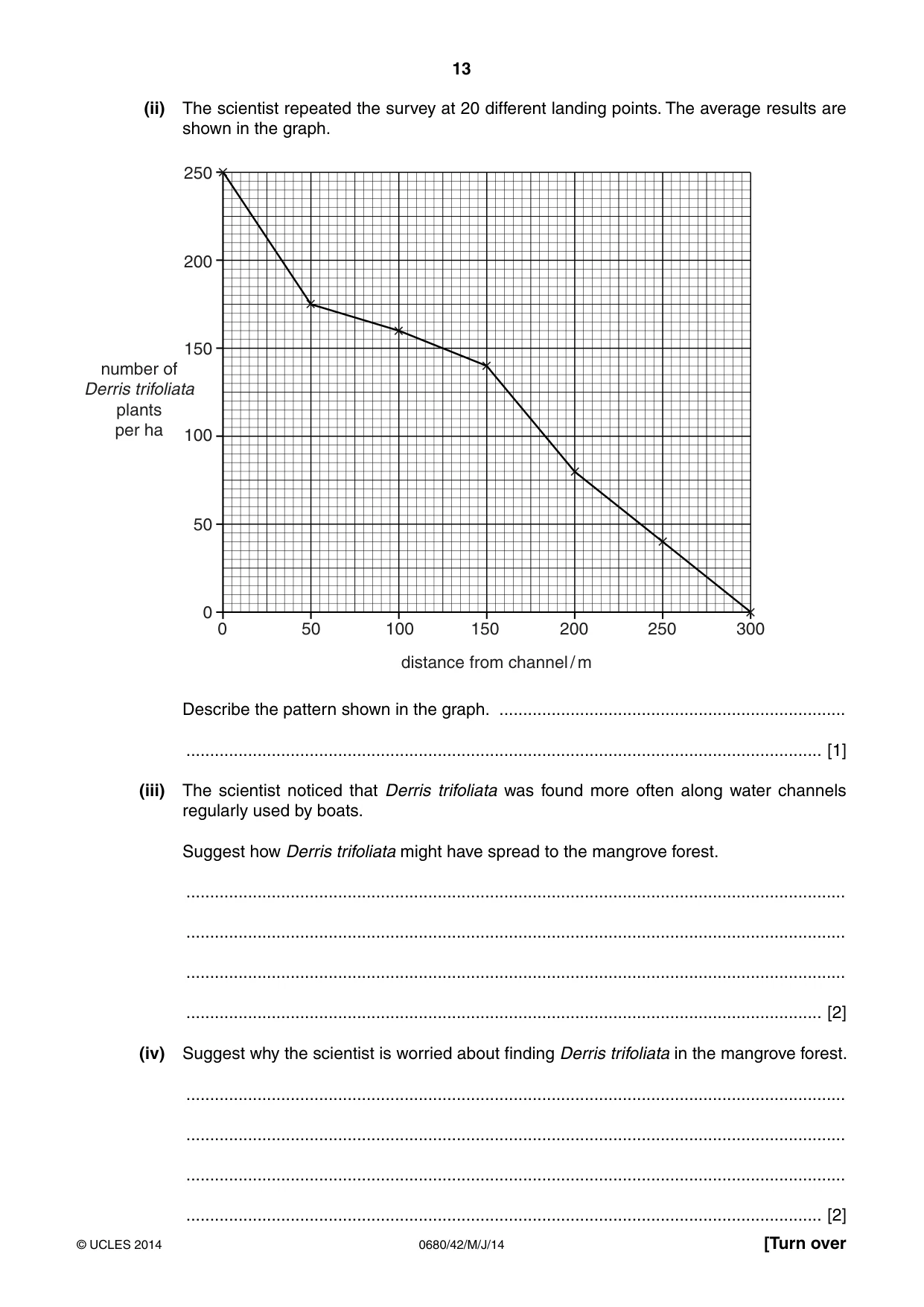
13 0680/42/M/J/14 © UCLES 2014 [Turn over (ii) The scientist repeated the survey at 20 different landing points. The average results are shown in the graph. 0 0 50 100 150 200 250 50 100 150 200 250 300 × × × × × × × number of Derris trifoliata plants per ha distance from channel / m Describe the pattern shown in the graph. … … [1] (iii) The scientist noticed that Derris trifoliata was found more often along water channels regularly used by boats. Suggest how Derris trifoliata might have spread to the mangrove forest. … … … … [2] (iv) Suggest why the scientist is worried about finding Derris trifoliata in the mangrove forest. … … … … [2]
Question paper, page 14
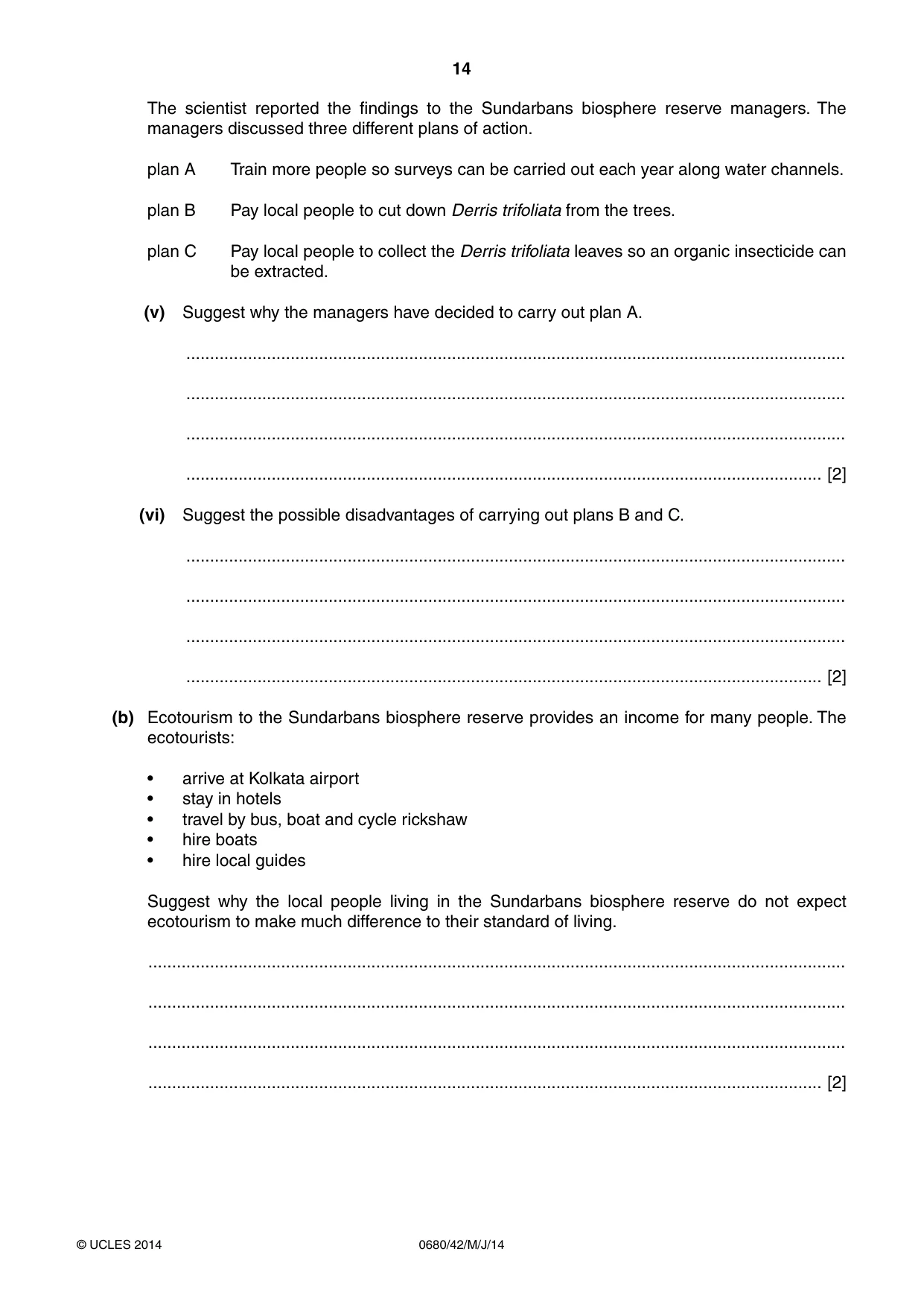
14 0680/42/M/J/14 © UCLES 2014 The scientist reported the findings to the Sundarbans biosphere reserve managers. The managers discussed three different plans of action. plan A Train more people so surveys can be carried out each year along water channels. plan B Pay local people to cut down Derris trifoliata from the trees. plan C Pay local people to collect the Derris trifoliata leaves so an organic insecticide can be extracted. (v) Suggest why the managers have decided to carry out plan A. … … … … [2] (vi) Suggest the possible disadvantages of carrying out plans B and C. … … … … [2] (b) Ecotourism to the Sundarbans biosphere reserve provides an income for many people. The ecotourists: • arrive at Kolkata airport • stay in hotels • travel by bus, boat and cycle rickshaw • hire boats • hire local guides Suggest why the local people living in the Sundarbans biosphere reserve do not expect ecotourism to make much difference to their standard of living. … … … … [2]
Question paper, page 15
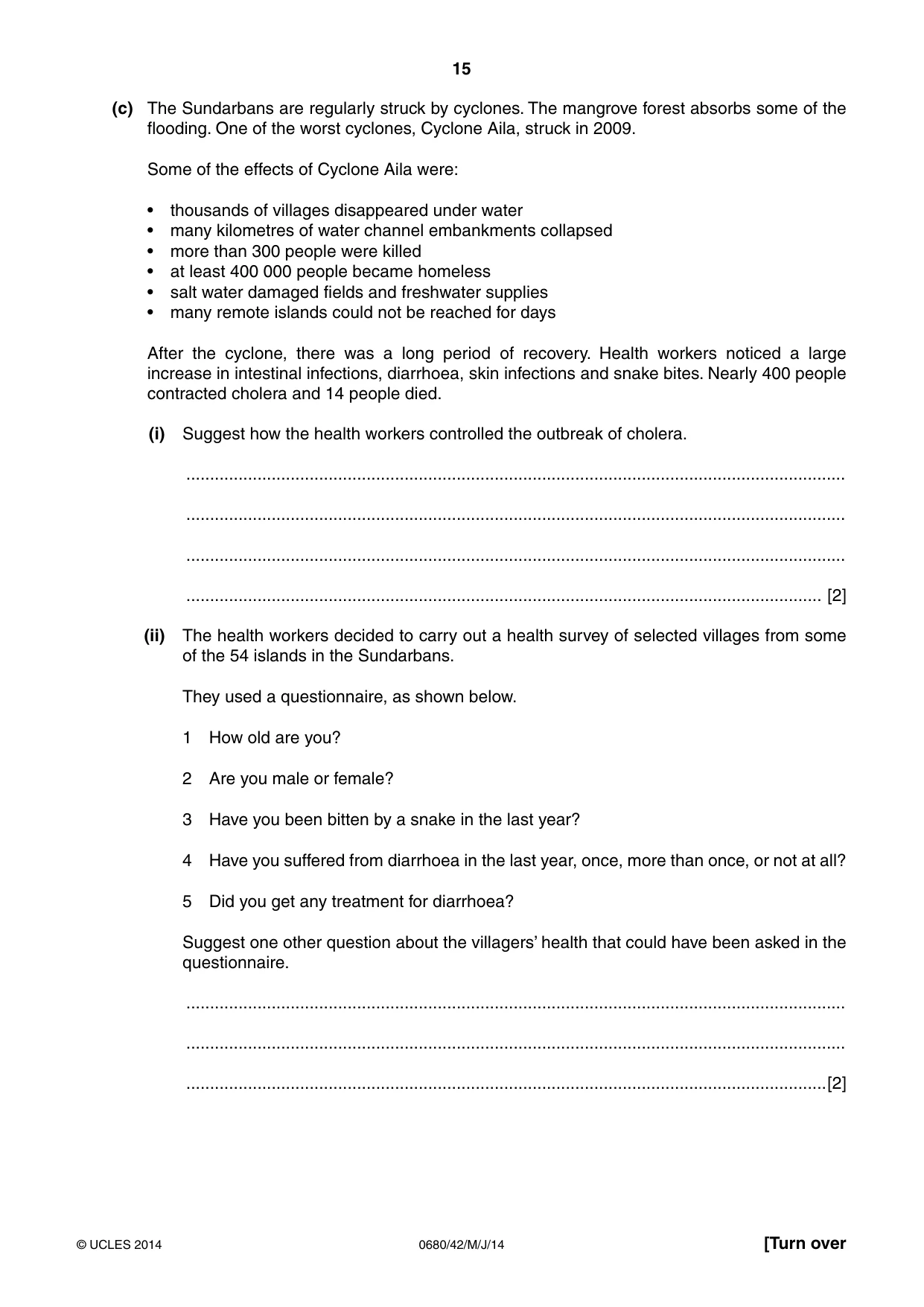
15 0680/42/M/J/14 © UCLES 2014 [Turn over (c) The Sundarbans are regularly struck by cyclones. The mangrove forest absorbs some of the flooding. One of the worst cyclones, Cyclone Aila, struck in 2009. Some of the effects of Cyclone Aila were: • thousands of villages disappeared under water • many kilometres of water channel embankments collapsed • more than 300 people were killed • at least 400 000 people became homeless • salt water damaged fields and freshwater supplies • many remote islands could not be reached for days After the cyclone, there was a long period of recovery. Health workers noticed a large increase in intestinal infections, diarrhoea, skin infections and snake bites. Nearly 400 people contracted cholera and 14 people died. (i) Suggest how the health workers controlled the outbreak of cholera. … … … … [2] (ii) The health workers decided to carry out a health survey of selected villages from some of the 54 islands in the Sundarbans. They used a questionnaire, as shown below. 1 How old are you? 2 Are you male or female? 3 Have you been bitten by a snake in the last year? 4 Have you suffered from diarrhoea in the last year, once, more than once, or not at all? 5 Did you get any treatment for diarrhoea? Suggest one other question about the villagers’ health that could have been asked in the questionnaire. … … …[2]
Question paper, page 16
16 0680/42/M/J/14 © UCLES 2014 (iii) How many islands would you have surveyed? … [1] (iv) Describe how people could be selected to answer the questionnaire. … … … … [2] (d) How can the results of surveys, such as this one, be used to improve health in the future? … … … … [2] [Total: 23] Copyright Acknowledgements: Question 1 John Stacey © UCLES Question 2 John Stacey © UCLES Permission to reproduce items where third-party owned material protected by copyright is included has been sought and cleared where possible. Every reasonable effort has been made by the publisher (UCLES) to trace copyright holders, but if any items requiring clearance have unwittingly been included, the publisher will be pleased to make amends at the earliest possible opportunity. Cambridge International Examinations is part of the Cambridge Assessment Group. Cambridge Assessment is the brand name of University of Cambridge Local Examinations Syndicate (UCLES), which is itself a department of the University of Cambridge.
Mark scheme, page 1
CAMBRIDGE INTERNATIONAL EXAMINATIONS International General Certificate of Secondary Education MARK SCHEME for the May/June 2014 series 0680 ENVIRONMENTAL MANAGEMENT 0680/42 Paper 4 (Alternative to Coursework), maximum raw mark 60 This mark scheme is published as an aid to teachers and candidates, to indicate the requirements of the examination. It shows the basis on which Examiners were instructed to award marks. It does not indicate the details of the discussions that took place at an Examiners’ meeting before marking began, which would have considered the acceptability of alternative answers. Mark schemes should be read in conjunction with the question paper and the Principal Examiner Report for Teachers. Cambridge will not enter into discussions about these mark schemes. Cambridge is publishing the mark schemes for the May/June 2014 series for most IGCSE, GCE Advanced Level and Advanced Subsidiary Level components and some Ordinary Level components.
Mark scheme, page 2
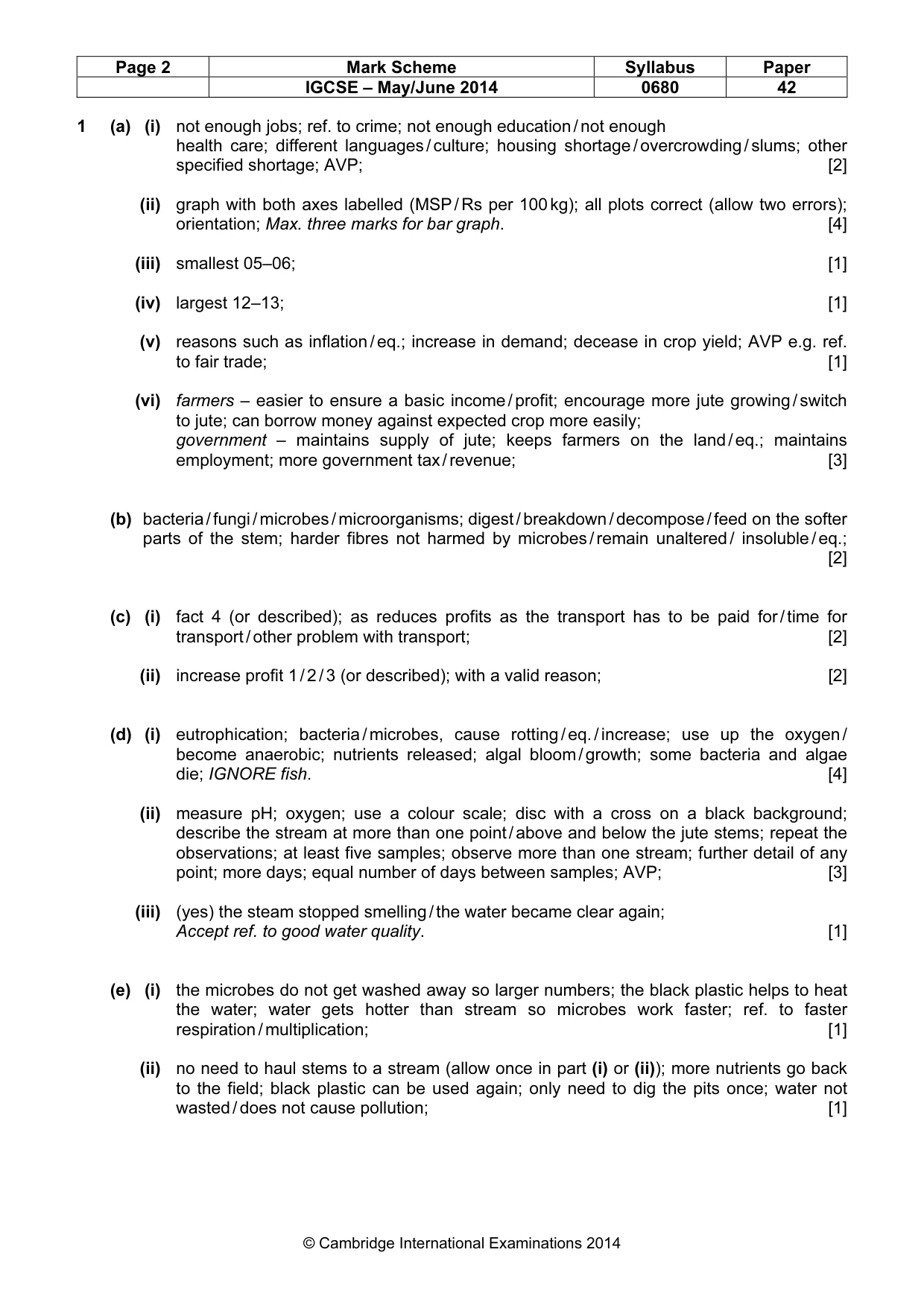
Page 2 Mark Scheme Syllabus Paper IGCSE – May/June 2014 0680 42 © Cambridge International Examinations 2014 1 (a) (i) not enough jobs; ref. to crime; not enough education / not enough health care; different languages / culture; housing shortage / overcrowding / slums; other specified shortage; AVP; [2] (ii) graph with both axes labelled (MSP / Rs per 100 kg); all plots correct (allow two errors); orientation; Max. three marks for bar graph. [4] (iii) smallest 05–06; [1] (iv) largest 12–13; [1] (v) reasons such as inflation / eq.; increase in demand; decease in crop yield; AVP e.g. ref. to fair trade; [1] (vi) farmers – easier to ensure a basic income / profit; encourage more jute growing / switch to jute; can borrow money against expected crop more easily; government – maintains supply of jute; keeps farmers on the land / eq.; maintains employment; more government tax / revenue; [3] (b) bacteria / fungi / microbes / microorganisms; digest / breakdown / decompose / feed on the softer parts of the stem; harder fibres not harmed by microbes / remain unaltered / insoluble / eq.; [2] (c) (i) fact 4 (or described); as reduces profits as the transport has to be paid for / time for transport / other problem with transport; [2] (ii) increase profit 1 / 2 / 3 (or described); with a valid reason; [2] (d) (i) eutrophication; bacteria / microbes, cause rotting / eq. / increase; use up the oxygen / become anaerobic; nutrients released; algal bloom / growth; some bacteria and algae die; IGNORE fish. [4] (ii) measure pH; oxygen; use a colour scale; disc with a cross on a black background; describe the stream at more than one point / above and below the jute stems; repeat the observations; at least five samples; observe more than one stream; further detail of any point; more days; equal number of days between samples; AVP; [3] (iii) (yes) the steam stopped smelling / the water became clear again; Accept ref. to good water quality. [1] (e) (i) the microbes do not get washed away so larger numbers; the black plastic helps to heat the water; water gets hotter than stream so microbes work faster; ref. to faster respiration / multiplication; [1] (ii) no need to haul stems to a stream (allow once in part (i) or (ii)); more nutrients go back to the field; black plastic can be used again; only need to dig the pits once; water not wasted / does not cause pollution; [1]
Mark scheme, page 3
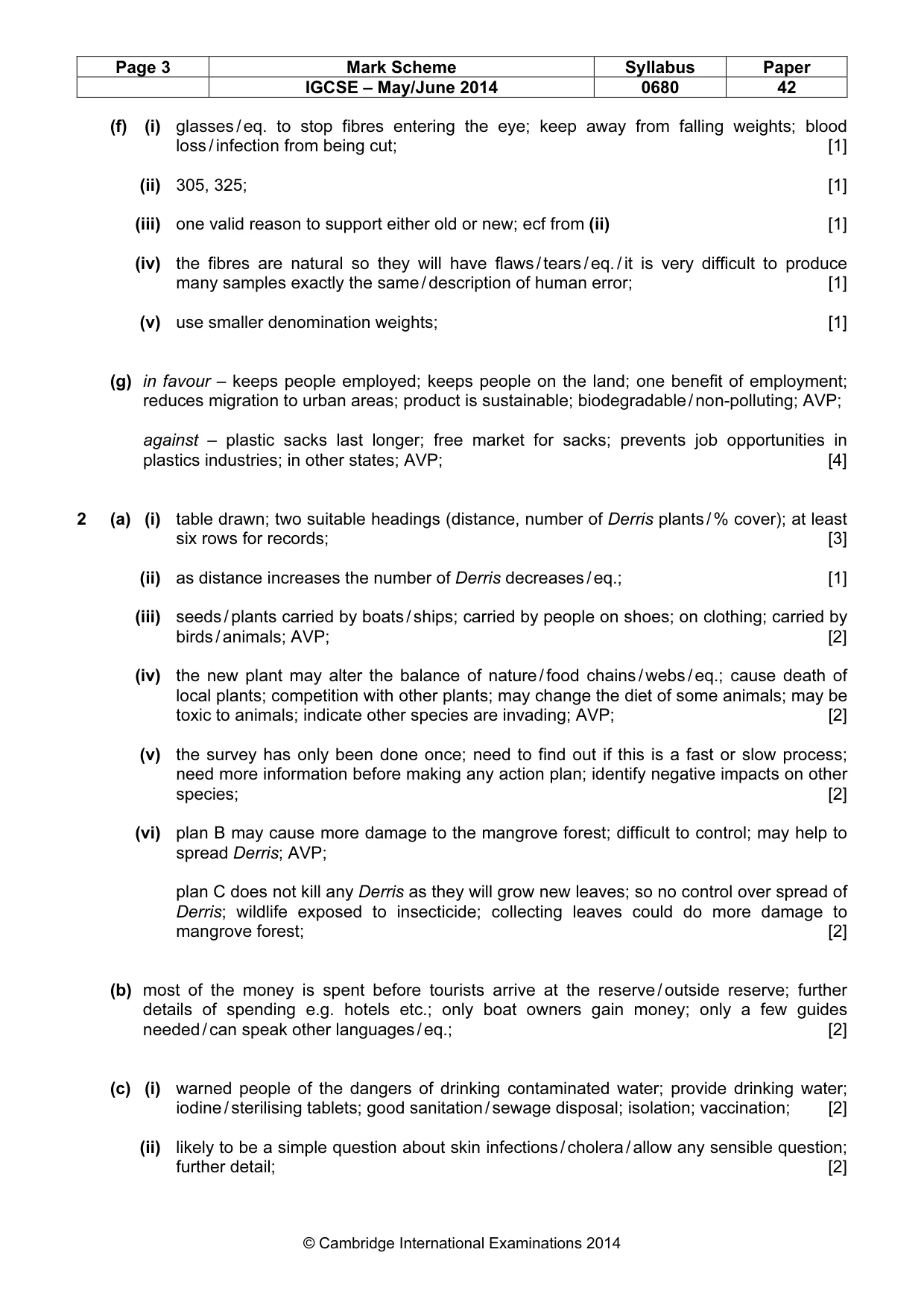
Page 3 Mark Scheme Syllabus Paper IGCSE – May/June 2014 0680 42 © Cambridge International Examinations 2014 (f) (i) glasses / eq. to stop fibres entering the eye; keep away from falling weights; blood loss / infection from being cut; [1] (ii) 305, 325; [1] (iii) one valid reason to support either old or new; ecf from (ii) [1] (iv) the fibres are natural so they will have flaws / tears / eq. / it is very difficult to produce many samples exactly the same / description of human error; [1] (v) use smaller denomination weights; [1] (g) in favour – keeps people employed; keeps people on the land; one benefit of employment; reduces migration to urban areas; product is sustainable; biodegradable / non-polluting; AVP; against – plastic sacks last longer; free market for sacks; prevents job opportunities in plastics industries; in other states; AVP; [4] 2 (a) (i) table drawn; two suitable headings (distance, number of Derris plants / % cover); at least six rows for records; [3] (ii) as distance increases the number of Derris decreases / eq.; [1] (iii) seeds / plants carried by boats / ships; carried by people on shoes; on clothing; carried by birds / animals; AVP; [2] (iv) the new plant may alter the balance of nature / food chains / webs / eq.; cause death of local plants; competition with other plants; may change the diet of some animals; may be toxic to animals; indicate other species are invading; AVP; [2] (v) the survey has only been done once; need to find out if this is a fast or slow process; need more information before making any action plan; identify negative impacts on other species; [2] (vi) plan B may cause more damage to the mangrove forest; difficult to control; may help to spread Derris; AVP; plan C does not kill any Derris as they will grow new leaves; so no control over spread of Derris; wildlife exposed to insecticide; collecting leaves could do more damage to mangrove forest; [2] (b) most of the money is spent before tourists arrive at the reserve / outside reserve; further details of spending e.g. hotels etc.; only boat owners gain money; only a few guides needed / can speak other languages / eq.; [2] (c) (i) warned people of the dangers of drinking contaminated water; provide drinking water; iodine / sterilising tablets; good sanitation / sewage disposal; isolation; vaccination; [2] (ii) likely to be a simple question about skin infections / cholera / allow any sensible question; further detail; [2]
Mark scheme, page 4
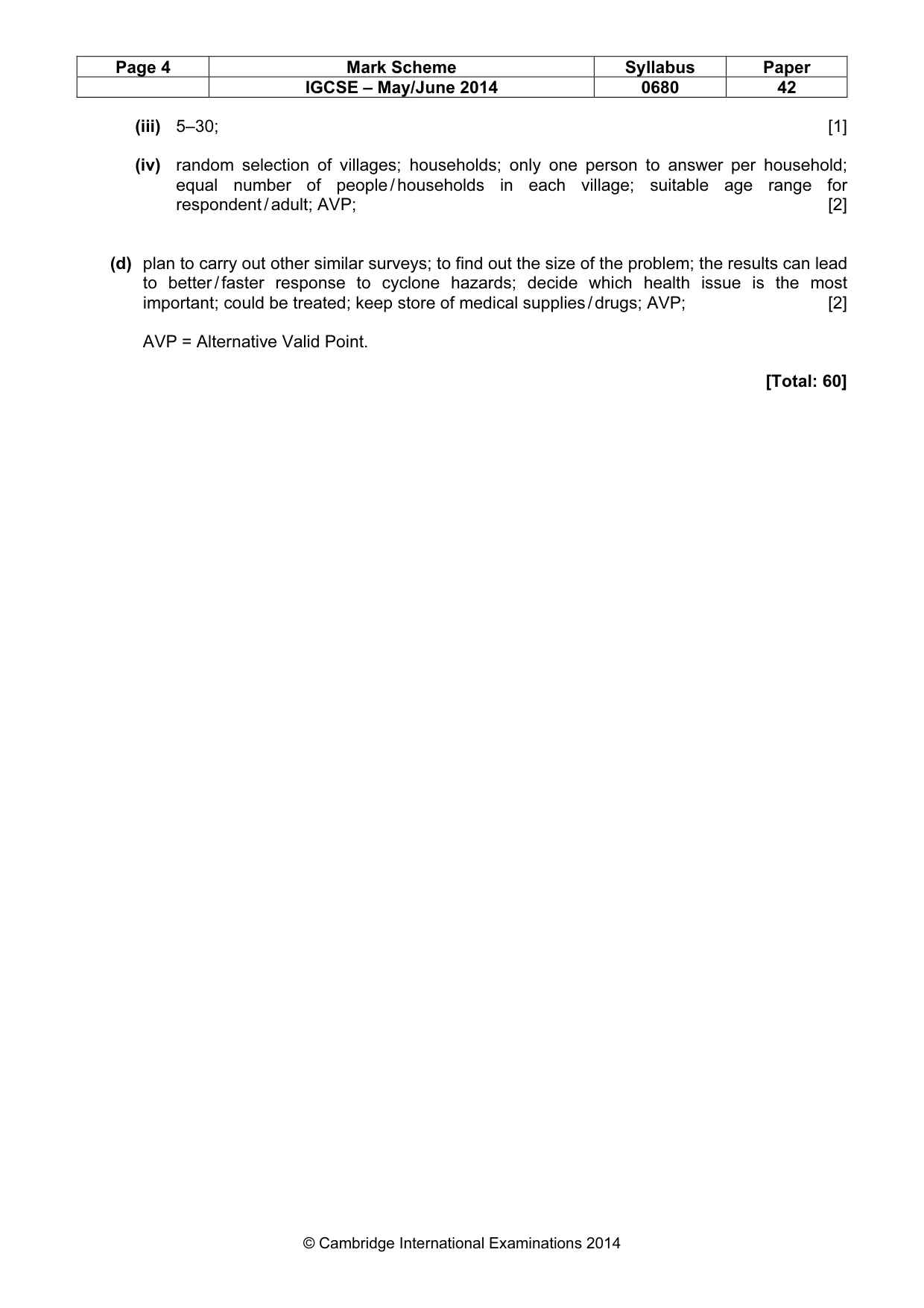
Page 4 Mark Scheme Syllabus Paper IGCSE – May/June 2014 0680 42 © Cambridge International Examinations 2014 (iii) 5–30; [1] (iv) random selection of villages; households; only one person to answer per household; equal number of people / households in each village; suitable age range for respondent / adult; AVP; [2] (d) plan to carry out other similar surveys; to find out the size of the problem; the results can lead to better / faster response to cyclone hazards; decide which health issue is the most important; could be treated; keep store of medical supplies / drugs; AVP; [2] AVP = Alternative Valid Point. [Total: 60]
What you needed in this session
Cambridge’s own grade thresholds for 2014 May/June, Paper 4 · Variant 2. A higher threshold means an easier paper — the bar moves with how the cohort did.