Cambridge IGCSE Environmental Management 0680 — 2014 May/June Paper 4 · Variant 1
0680/41/M/J/14 · 60 marks · ≈68 min
The question paper and its mark scheme, free to read here and free to download. This is Cambridge’s own paper, exactly as it was sat.
Question paper16 pages

Mark scheme3 pages
Answers below. Sit the paper first if you are practising.
Paper as text
Question paper, page 1
This document consists of 15 printed pages and 1 blank page. DC (AC/JG) 80645/4 © UCLES 2014 [Turn over Cambridge International Examinations Cambridge International General Certificate of Secondary Education * 9 8 5 1 3 2 3 1 9 3 * ENVIRONMENTAL MANAGEMENT 0680/41 Alternative to Coursework May/June 2014 1 hour 30 minutes Candidates answer on the Question Paper. Additional Materials: Ruler READ THESE INSTRUCTIONS FIRST Write your Centre number, candidate number and name on all the work you hand in. Write in dark blue or black pen. You may use an HB pencil for any diagrams or graphs. Do not use staples, paper clips, glue or correction fluid. DO NOT WRITE IN ANY BARCODES. Answer all questions. Electronic calculators may be used. You may lose marks if you do not show your working or if you do not use appropriate units. Study the appropriate source materials before you start to write your answers. Credit will be given for appropriate selection and use of data in your answers and for relevant interpretation of these data. Suggestions for data sources are given in some questions. You may use the source data to draw diagrams and graphs or to do calculations to illustrate your answers. At the end of the examination, fasten all your work securely together. The number of marks is given in brackets [ ] at the end of each question or part question.
Question paper, page 2
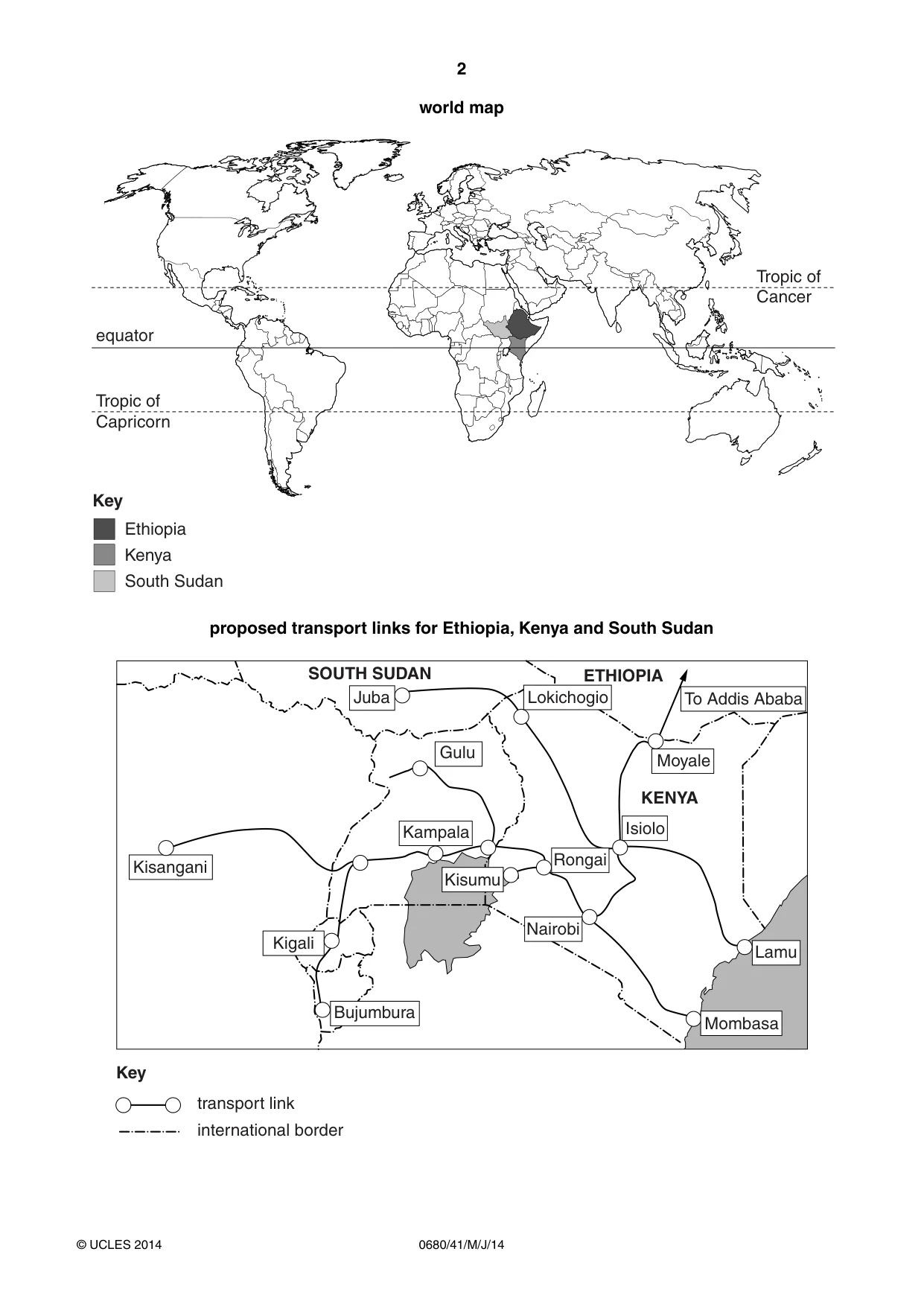
2 0680/41/M/J/14 © UCLES 2014 world map equator Tropic of Capricorn Tropic of Cancer South Sudan Kenya Ethiopia Key proposed transport links for Ethiopia, Kenya and South Sudan Bujumbura transport link international border Mombasa Kigali Kisangani Juba Gulu Rongai Isiolo Moyale Nairobi Kisumu Lokichogio Kampala To Addis Ababa Lamu SOUTH SUDAN Key ETHIOPIA KENYA
Question paper, page 3
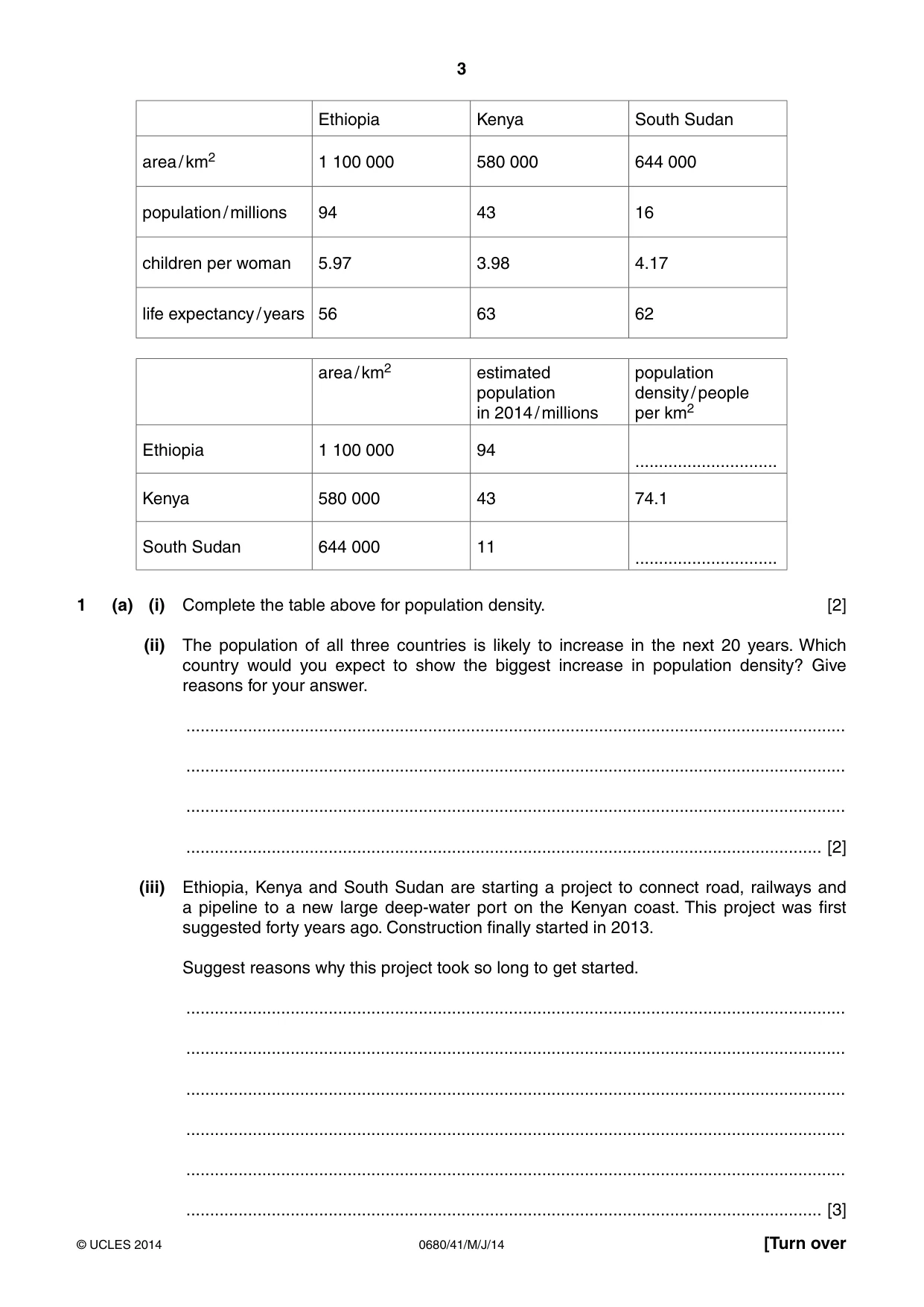
3 0680/41/M/J/14 © UCLES 2014 [Turn over Ethiopia Kenya South Sudan area / km2 1 100 000 580 000 644 000 population / millions 94 43 16 children per woman 5.97 3.98 4.17 life expectancy / years 56 63 62 area / km2 estimated population in 2014 / millions population density / people per km2 Ethiopia 1 100 000 94 … Kenya 580 000 43 74.1 South Sudan 644 000 11 … 1 (a) (i) Complete the table above for population density. [2] (ii) The population of all three countries is likely to increase in the next 20 years. Which country would you expect to show the biggest increase in population density? Give reasons for your answer. … … … … [2] (iii) Ethiopia, Kenya and South Sudan are starting a project to connect road, railways and a pipeline to a new large deep-water port on the Kenyan coast. This project was first suggested forty years ago. Construction finally started in 2013. Suggest reasons why this project took so long to get started. … … … … … … [3]
Question paper, page 4
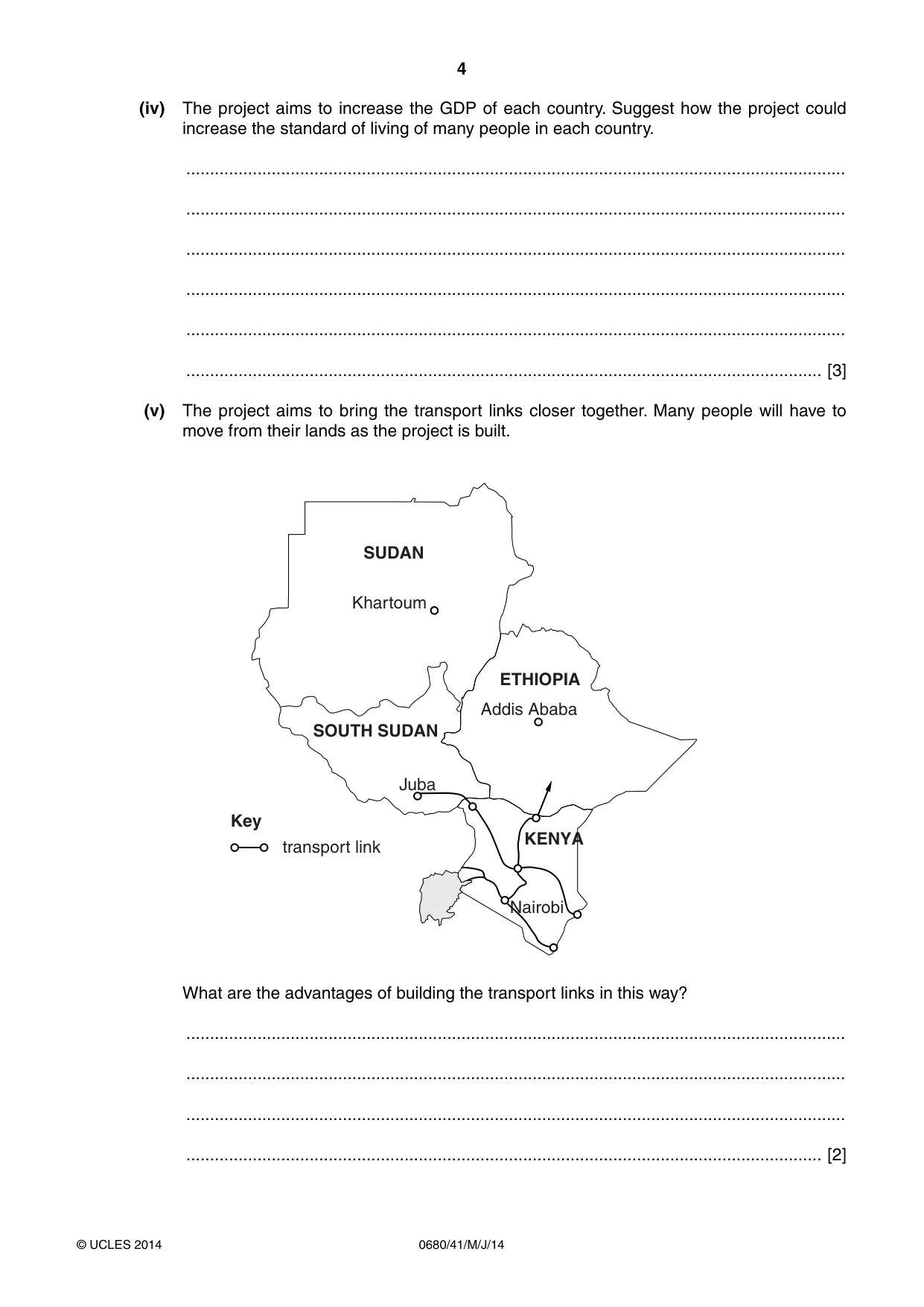
4 0680/41/M/J/14 © UCLES 2014 (iv) The project aims to increase the GDP of each country. Suggest how the project could increase the standard of living of many people in each country. … … … … … … [3] (v) The project aims to bring the transport links closer together. Many people will have to move from their lands as the project is built. KENYA ETHIOPIA SUDAN SOUTH SUDAN Key Addis Ababa Nairobi Khartoum Juba transport link What are the advantages of building the transport links in this way? … … … … [2]
Question paper, page 5
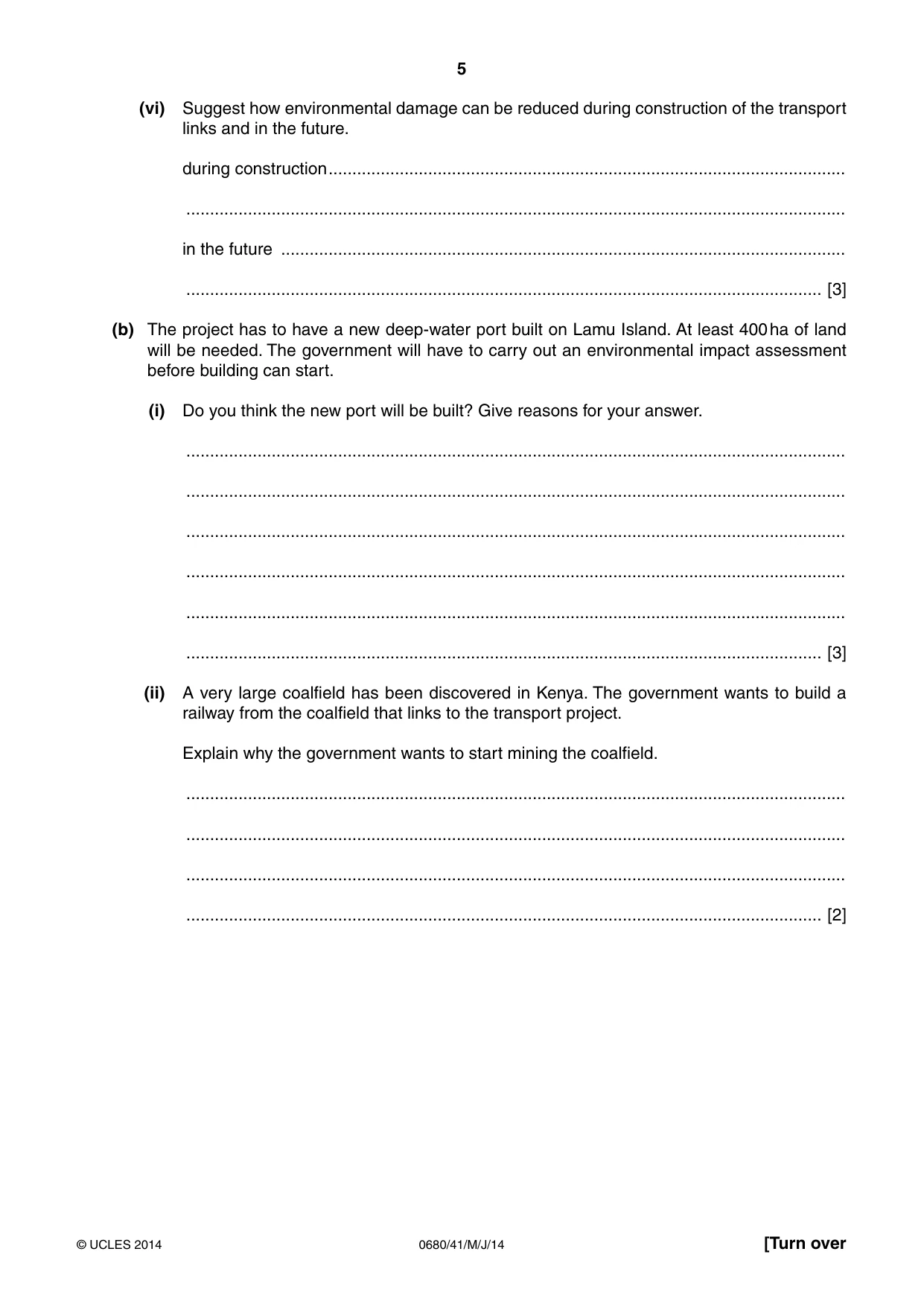
5 0680/41/M/J/14 © UCLES 2014 [Turn over (vi) Suggest how environmental damage can be reduced during construction of the transport links and in the future. during construction … … in the future … … [3] (b) The project has to have a new deep-water port built on Lamu Island. At least 400 ha of land will be needed. The government will have to carry out an environmental impact assessment before building can start. (i) Do you think the new port will be built? Give reasons for your answer. … … … … … … [3] (ii) A very large coalfield has been discovered in Kenya. The government wants to build a railway from the coalfield that links to the transport project. Explain why the government wants to start mining the coalfield. … … … … [2]
Question paper, page 6
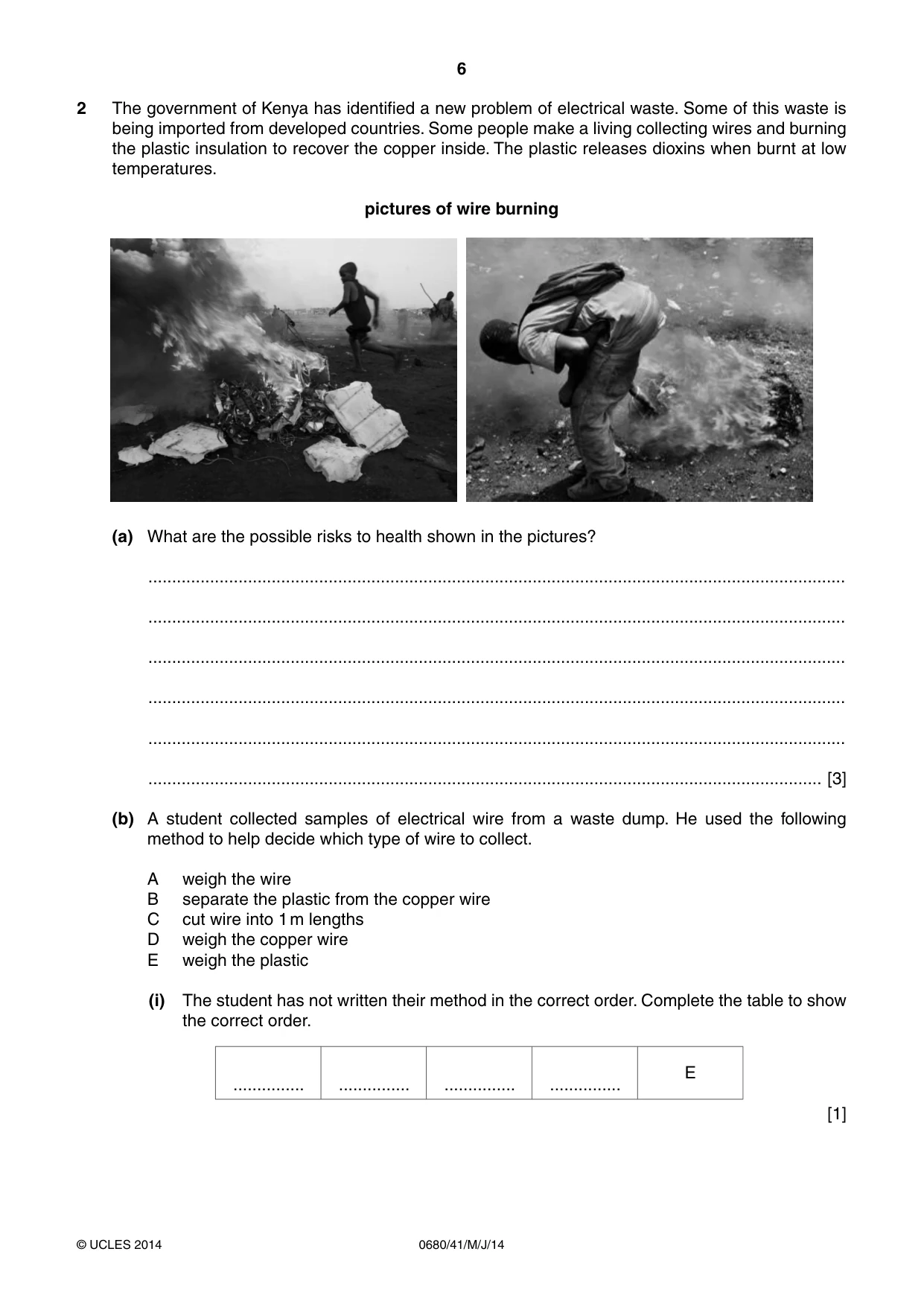
6 0680/41/M/J/14 © UCLES 2014 2 The government of Kenya has identified a new problem of electrical waste. Some of this waste is being imported from developed countries. Some people make a living collecting wires and burning the plastic insulation to recover the copper inside. The plastic releases dioxins when burnt at low temperatures. pictures of wire burning (a) What are the possible risks to health shown in the pictures? … … … … … … [3] (b) A student collected samples of electrical wire from a waste dump. He used the following method to help decide which type of wire to collect. A weigh the wire B separate the plastic from the copper wire C cut wire into 1 m lengths D weigh the copper wire E weigh the plastic (i) The student has not written their method in the correct order. Complete the table to show the correct order. … … … … E [1]
Question paper, page 7
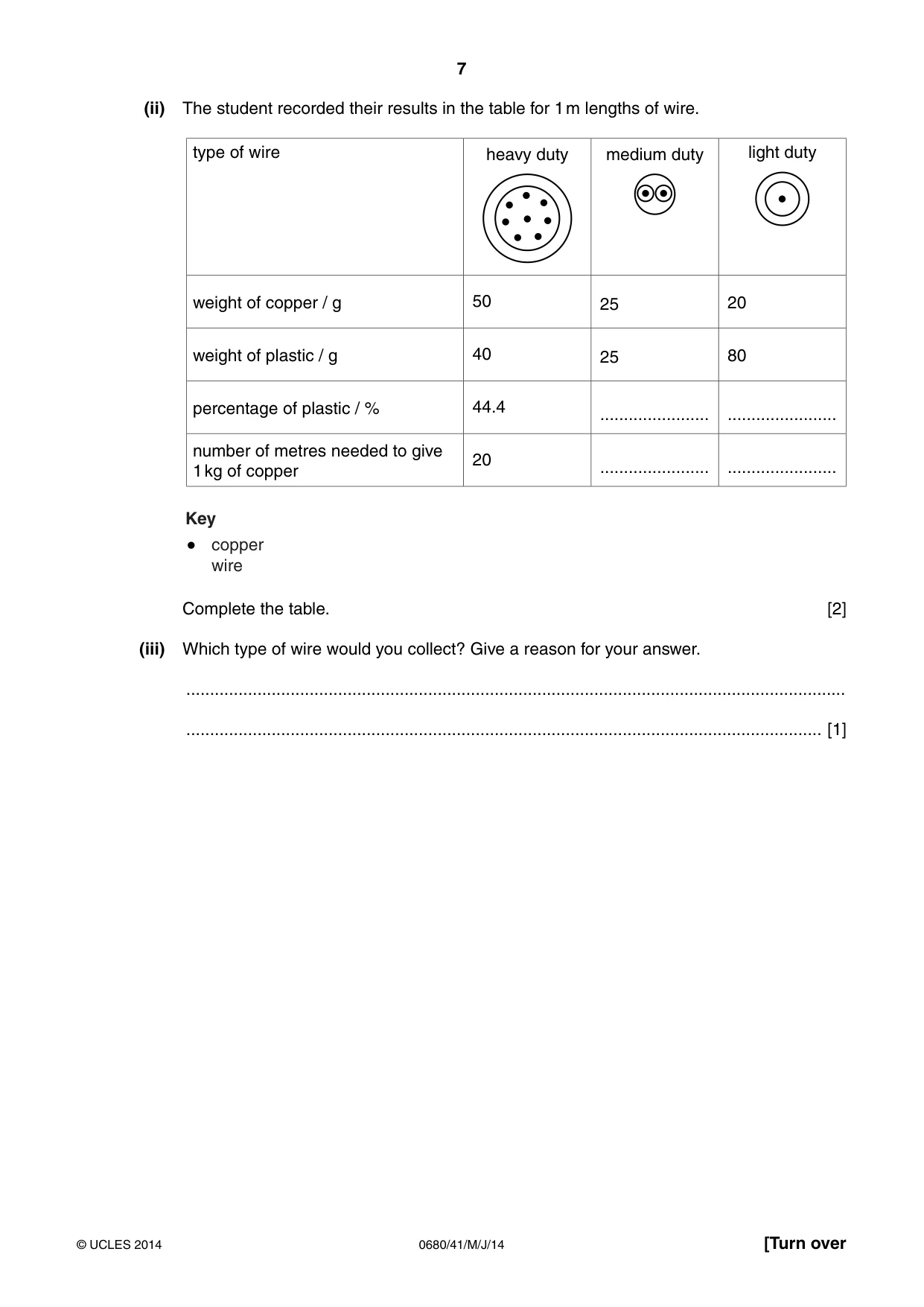
7 0680/41/M/J/14 © UCLES 2014 [Turn over (ii) The student recorded their results in the table for 1 m lengths of wire. type of wire heavy duty medium duty light duty weight of copper / g 50 25 20 weight of plastic / g 40 25 80 percentage of plastic / % 44.4 … … number of metres needed to give 1 kg of copper 20 … … copper wire Key Complete the table. [2] (iii) Which type of wire would you collect? Give a reason for your answer. … … [1]
Question paper, page 8
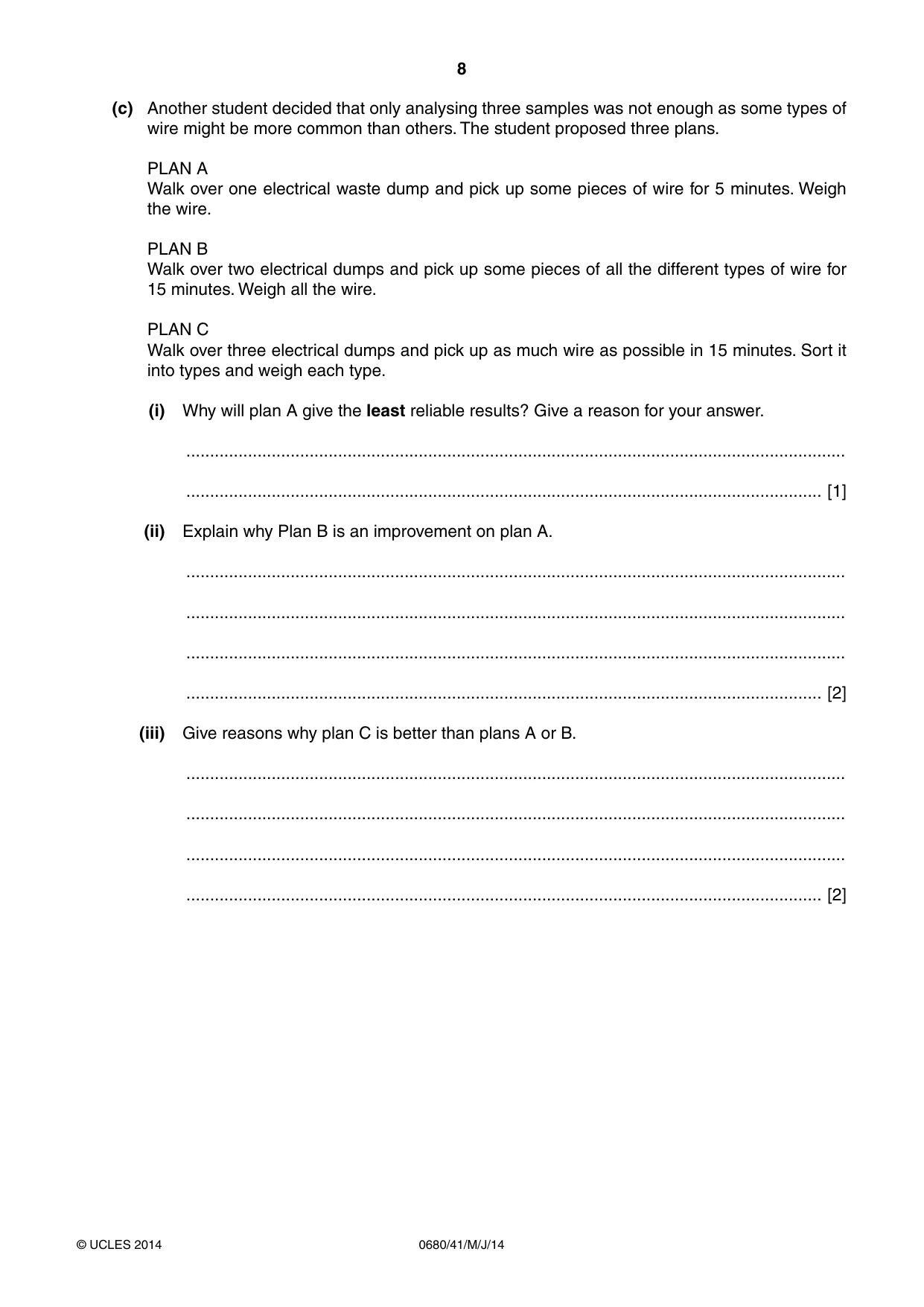
8 0680/41/M/J/14 © UCLES 2014 (c) Another student decided that only analysing three samples was not enough as some types of wire might be more common than others. The student proposed three plans. PLAN A Walk over one electrical waste dump and pick up some pieces of wire for 5 minutes. Weigh the wire. PLAN B Walk over two electrical dumps and pick up some pieces of all the different types of wire for 15 minutes. Weigh all the wire. PLAN C Walk over three electrical dumps and pick up as much wire as possible in 15 minutes. Sort it into types and weigh each type. (i) Why will plan A give the least reliable results? Give a reason for your answer. … … [1] (ii) Explain why Plan B is an improvement on plan A. … … … … [2] (iii) Give reasons why plan C is better than plans A or B. … … … … [2]
Question paper, page 9
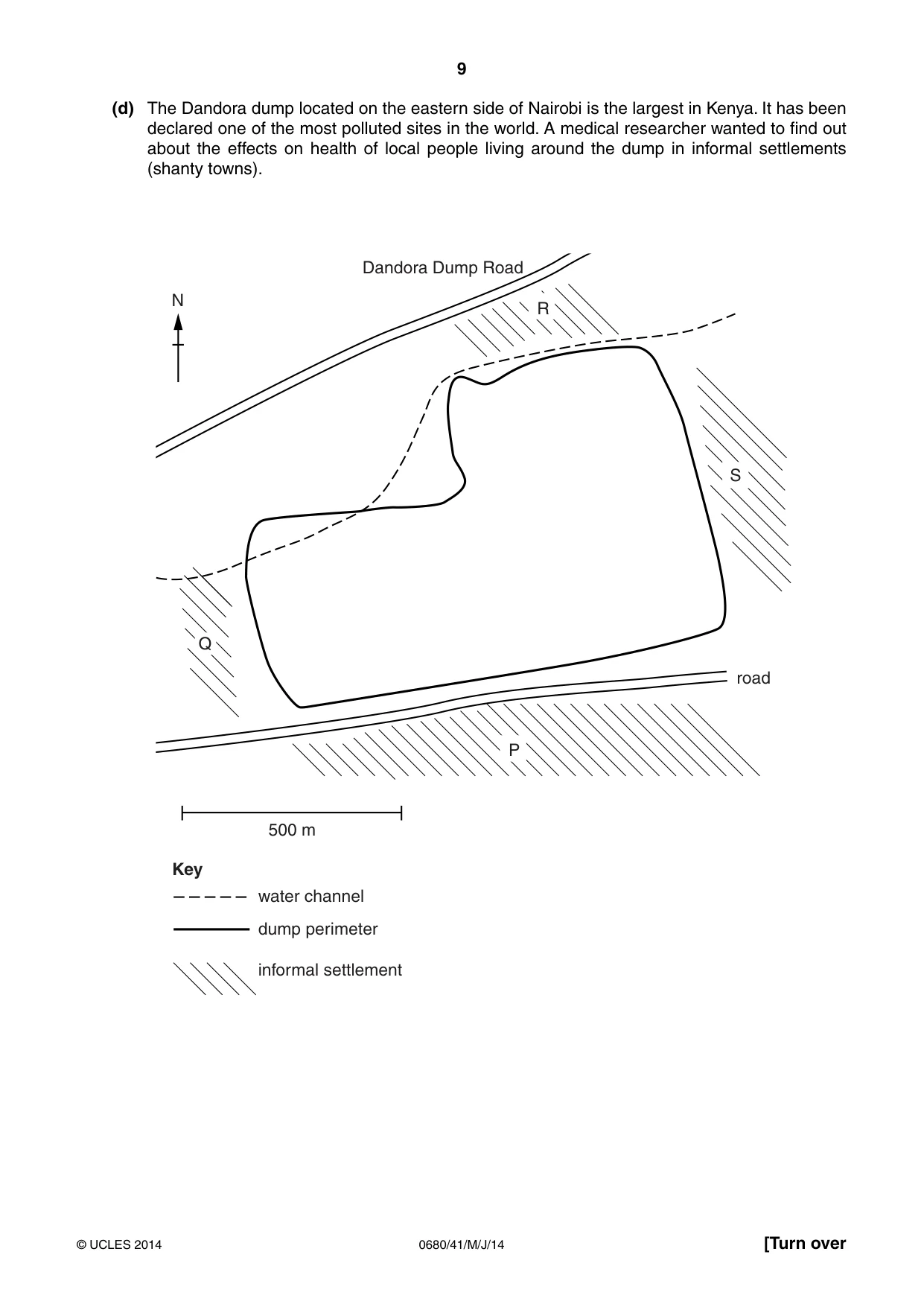
9 0680/41/M/J/14 © UCLES 2014 [Turn over (d) The Dandora dump located on the eastern side of Nairobi is the largest in Kenya. It has been declared one of the most polluted sites in the world. A medical researcher wanted to find out about the effects on health of local people living around the dump in informal settlements (shanty towns). N Dandora Dump Road road P Q S R 500 m water channel dump perimeter informal settlement Key
Question paper, page 10
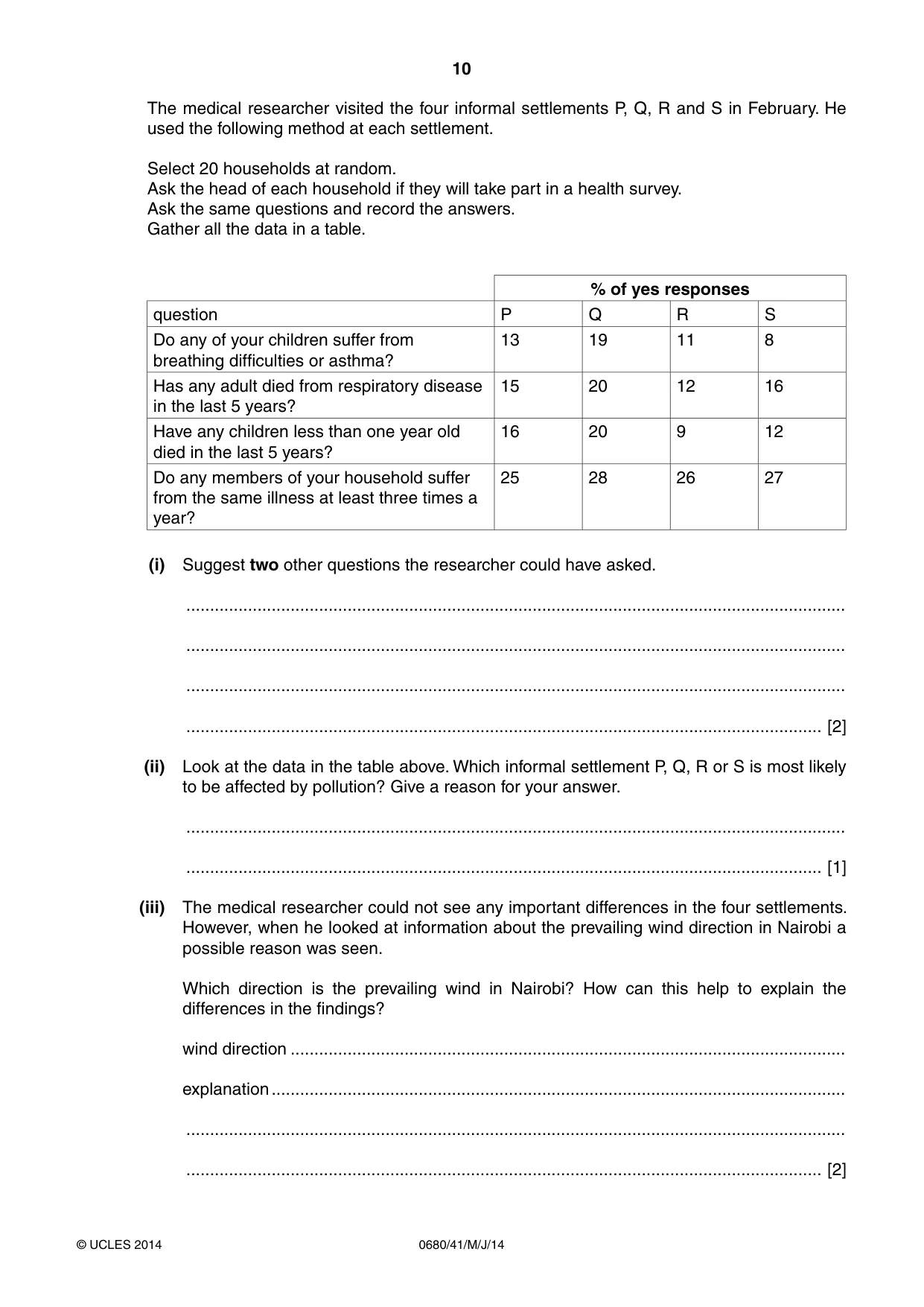
10 0680/41/M/J/14 © UCLES 2014 The medical researcher visited the four informal settlements P, Q, R and S in February. He used the following method at each settlement. Select 20 households at random. Ask the head of each household if they will take part in a health survey. Ask the same questions and record the answers. Gather all the data in a table. % of yes responses question P Q R S Do any of your children suffer from breathing difficulties or asthma? 13 19 11 8 Has any adult died from respiratory disease in the last 5 years? 15 20 12 16 Have any children less than one year old died in the last 5 years? 16 20 9 12 Do any members of your household suffer from the same illness at least three times a year? 25 28 26 27 (i) Suggest two other questions the researcher could have asked. … … … … [2] (ii) Look at the data in the table above. Which informal settlement P, Q, R or S is most likely to be affected by pollution? Give a reason for your answer. … … [1] (iii) The medical researcher could not see any important differences in the four settlements. However, when he looked at information about the prevailing wind direction in Nairobi a possible reason was seen. Which direction is the prevailing wind in Nairobi? How can this help to explain the differences in the findings? wind direction … explanation … … … [2]
Question paper, page 11
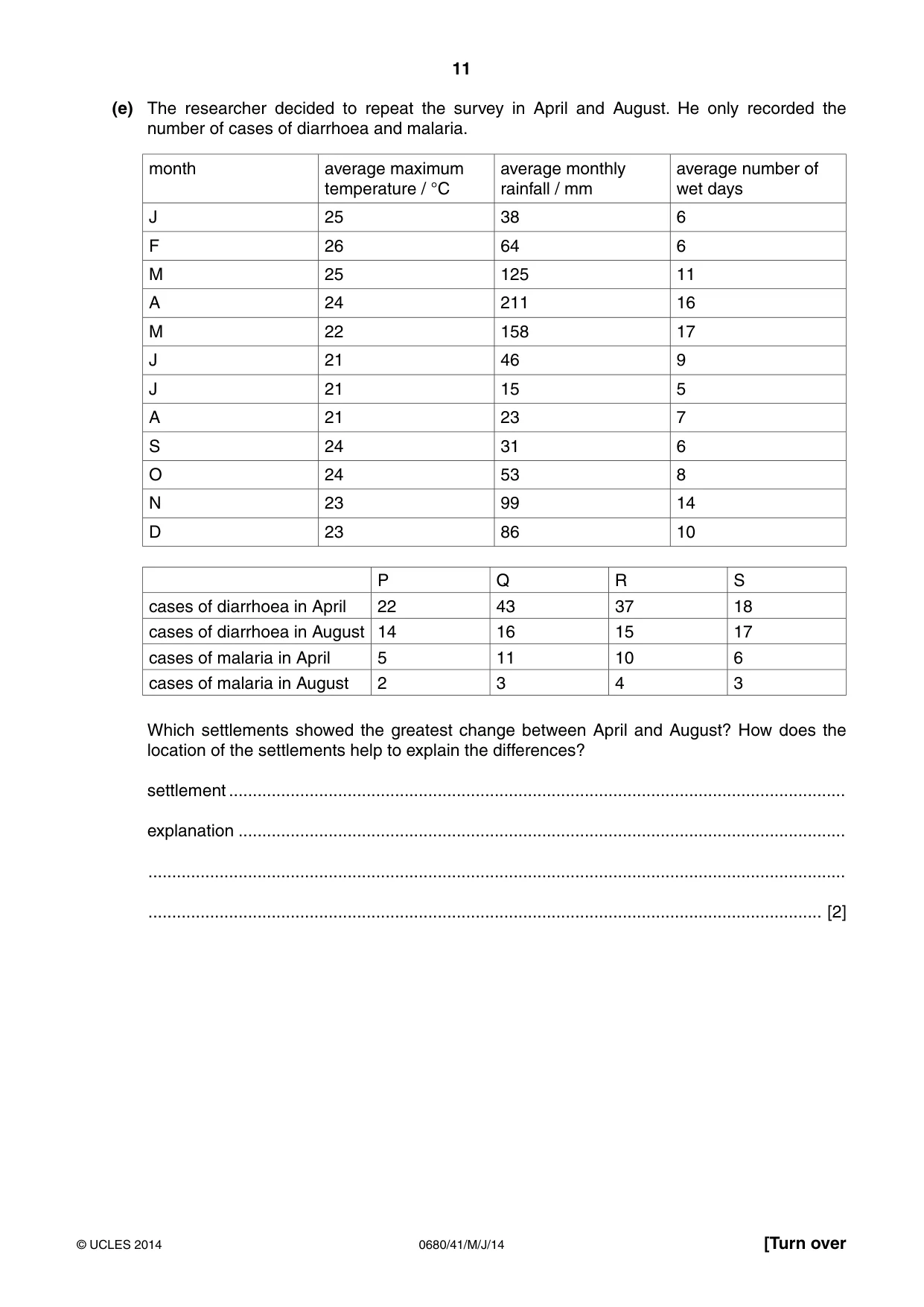
11 0680/41/M/J/14 © UCLES 2014 [Turn over (e) The researcher decided to repeat the survey in April and August. He only recorded the number of cases of diarrhoea and malaria. month average maximum temperature / °C average monthly rainfall / mm average number of wet days J 25 38 6 F 26 64 6 M 25 125 11 A 24 211 16 M 22 158 17 J 21 46 9 J 21 15 5 A 21 23 7 S 24 31 6 O 24 53 8 N 23 99 14 D 23 86 10 P Q R S cases of diarrhoea in April 22 43 37 18 cases of diarrhoea in August 14 16 15 17 cases of malaria in April 5 11 10 6 cases of malaria in August 2 3 4 3 Which settlements showed the greatest change between April and August? How does the location of the settlements help to explain the differences? settlement … explanation … … … [2]
Question paper, page 12
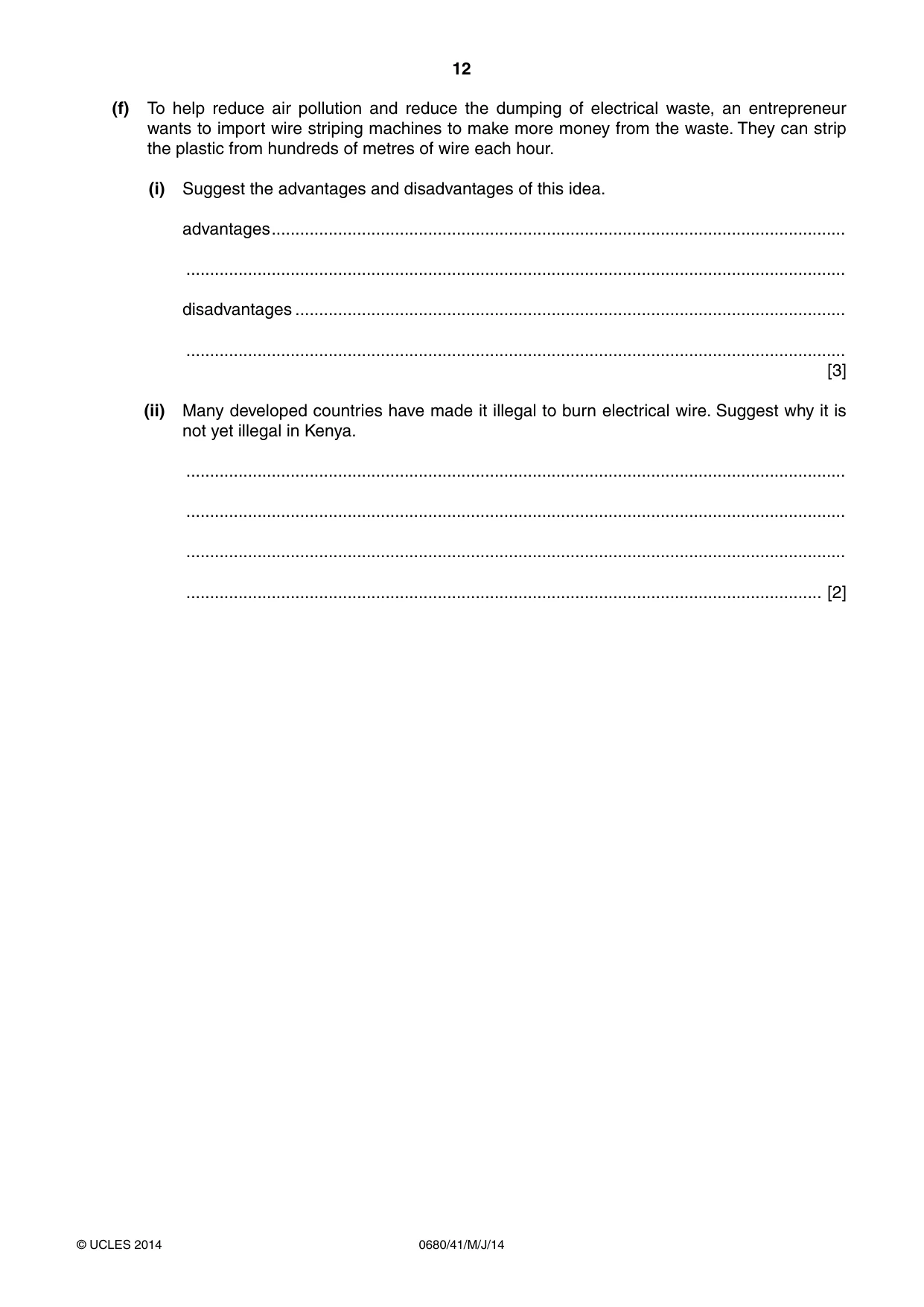
12 0680/41/M/J/14 © UCLES 2014 (f) To help reduce air pollution and reduce the dumping of electrical waste, an entrepreneur wants to import wire striping machines to make more money from the waste. They can strip the plastic from hundreds of metres of wire each hour. (i) Suggest the advantages and disadvantages of this idea. advantages … … disadvantages … … [3] (ii) Many developed countries have made it illegal to burn electrical wire. Suggest why it is not yet illegal in Kenya. … … … … [2]
Question paper, page 13
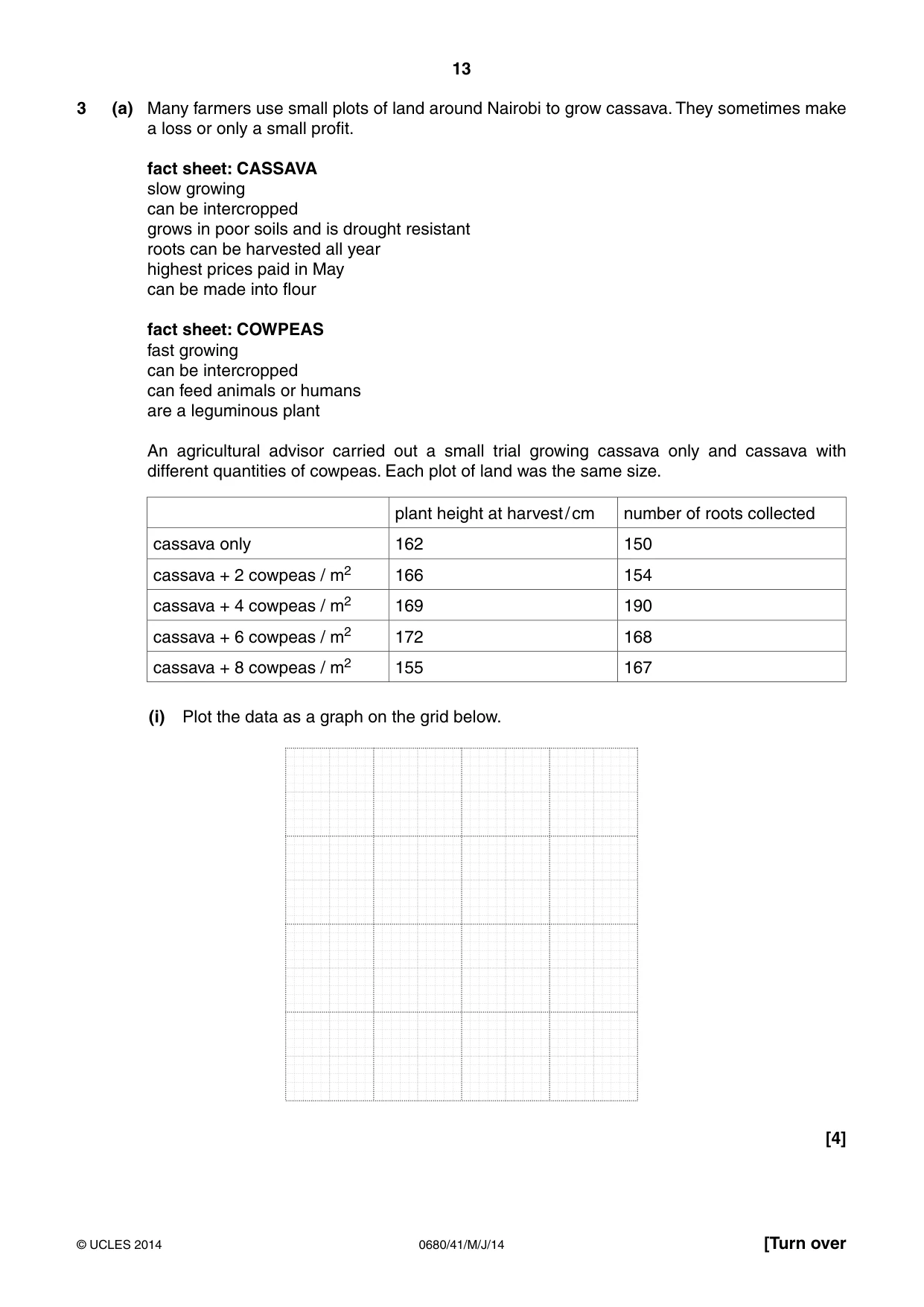
13 0680/41/M/J/14 © UCLES 2014 [Turn over 3 (a) Many farmers use small plots of land around Nairobi to grow cassava. They sometimes make a loss or only a small profit. fact sheet: CASSAVA slow growing can be intercropped grows in poor soils and is drought resistant roots can be harvested all year highest prices paid in May can be made into flour fact sheet: COWPEAS fast growing can be intercropped can feed animals or humans are a leguminous plant An agricultural advisor carried out a small trial growing cassava only and cassava with different quantities of cowpeas. Each plot of land was the same size. plant height at harvest / cm number of roots collected cassava only 162 150 cassava + 2 cowpeas / m2 166 154 cassava + 4 cowpeas / m2 169 190 cassava + 6 cowpeas / m2 172 168 cassava + 8 cowpeas / m2 155 167 (i) Plot the data as a graph on the grid below. [4]
Question paper, page 14
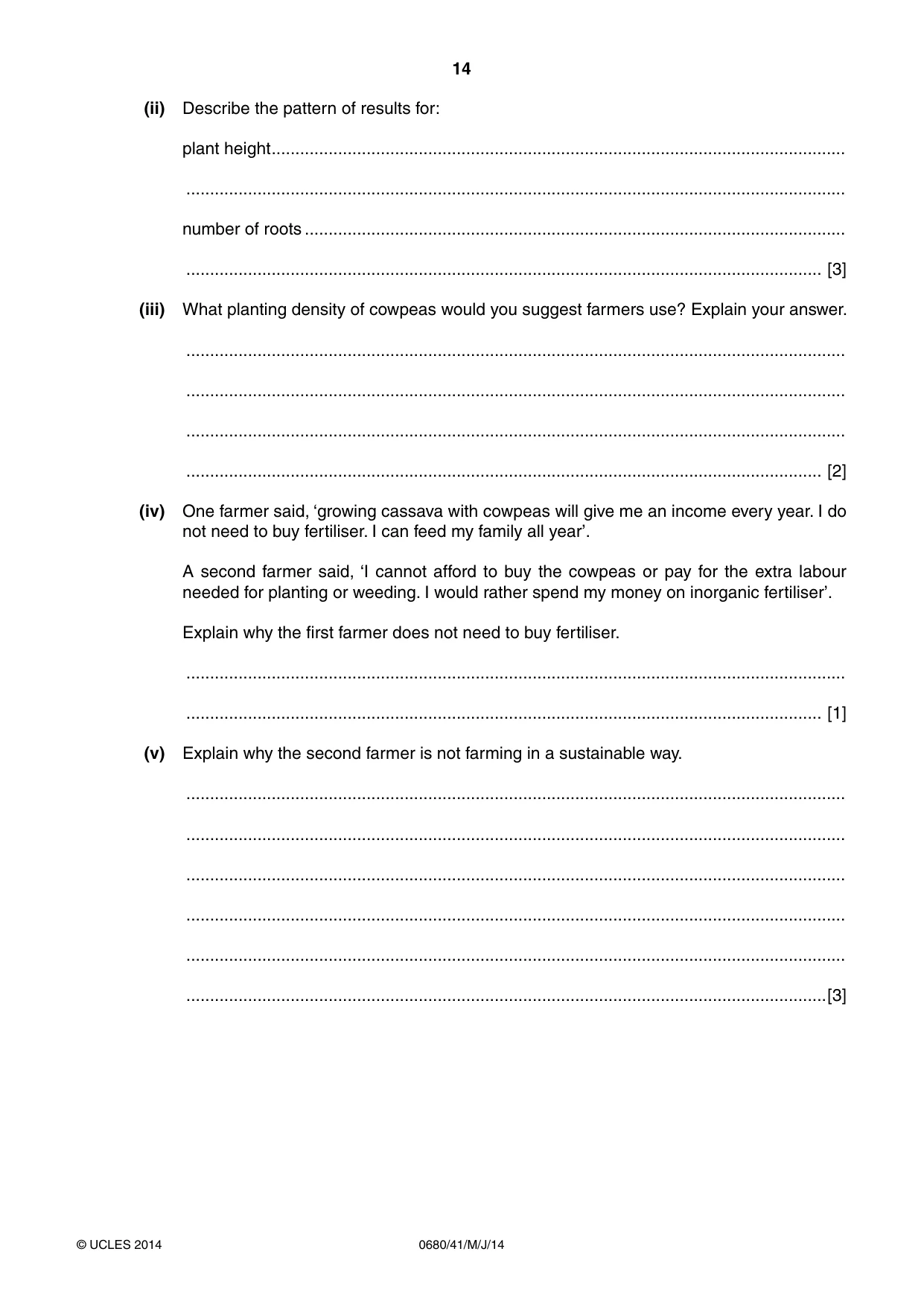
14 0680/41/M/J/14 © UCLES 2014 (ii) Describe the pattern of results for: plant height … … number of roots … … [3] (iii) What planting density of cowpeas would you suggest farmers use? Explain your answer. … … … … [2] (iv) One farmer said, ‘growing cassava with cowpeas will give me an income every year. I do not need to buy fertiliser. I can feed my family all year’. A second farmer said, ‘I cannot afford to buy the cowpeas or pay for the extra labour needed for planting or weeding. I would rather spend my money on inorganic fertiliser’. Explain why the first farmer does not need to buy fertiliser. … … [1] (v) Explain why the second farmer is not farming in a sustainable way. … … … … … …[3]
Question paper, page 15
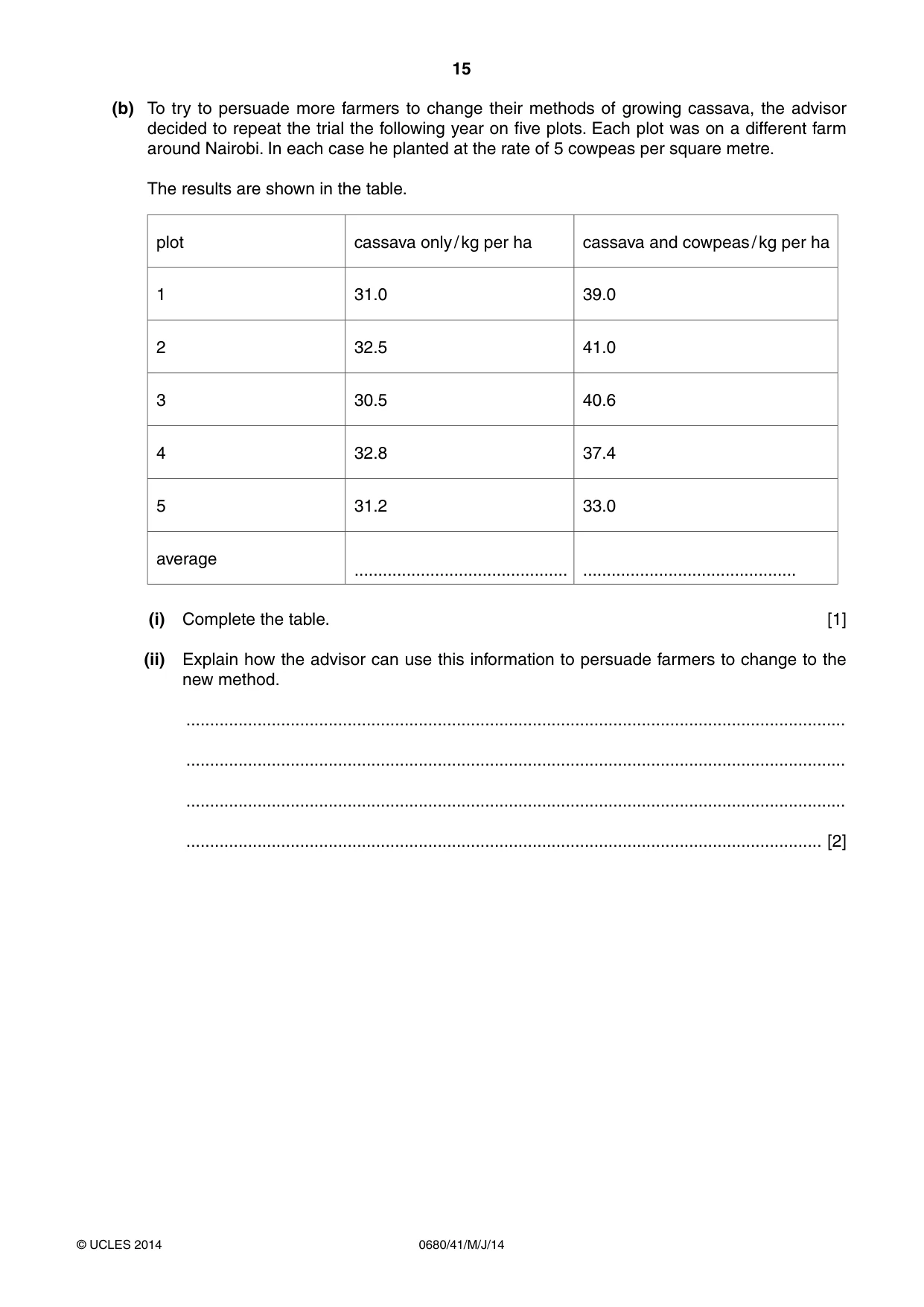
15 0680/41/M/J/14 © UCLES 2014 (b) To try to persuade more farmers to change their methods of growing cassava, the advisor decided to repeat the trial the following year on five plots. Each plot was on a different farm around Nairobi. In each case he planted at the rate of 5 cowpeas per square metre. The results are shown in the table. plot cassava only / kg per ha cassava and cowpeas / kg per ha 1 31.0 39.0 2 32.5 41.0 3 30.5 40.6 4 32.8 37.4 5 31.2 33.0 average … … (i) Complete the table. [1] (ii) Explain how the advisor can use this information to persuade farmers to change to the new method. … … … … [2]
Question paper, page 16
16 0680/41/M/J/14 © UCLES 2014 Copyright Acknowledgements: Question 2 © Greenpeace Permission to reproduce items where third-party owned material protected by copyright is included has been sought and cleared where possible. Every reasonable effort has been made by the publisher (UCLES) to trace copyright holders, but if any items requiring clearance have unwittingly been included, the publisher will be pleased to make amends at the earliest possible opportunity. Cambridge International Examinations is part of the Cambridge Assessment Group. Cambridge Assessment is the brand name of University of Cambridge Local Examinations Syndicate (UCLES), which is itself a department of the University of Cambridge. BLANK PAGE
Mark scheme, page 1
CAMBRIDGE INTERNATIONAL EXAMINATIONS International General Certificate of Secondary Education MARK SCHEME for the May/June 2014 series 0680 ENVIRONMENTAL MANAGEMENT 0680/41 Paper 4 (Alternative to Coursework), maximum raw mark 60 This mark scheme is published as an aid to teachers and candidates, to indicate the requirements of the examination. It shows the basis on which Examiners were instructed to award marks. It does not indicate the details of the discussions that took place at an Examiners’ meeting before marking began, which would have considered the acceptability of alternative answers. Mark schemes should be read in conjunction with the question paper and the Principal Examiner Report for Teachers. Cambridge will not enter into discussions about these mark schemes. Cambridge is publishing the mark schemes for the May/June 2014 series for most IGCSE, GCE Advanced Level and Advanced Subsidiary Level components and some Ordinary Level components.
Mark scheme, page 2
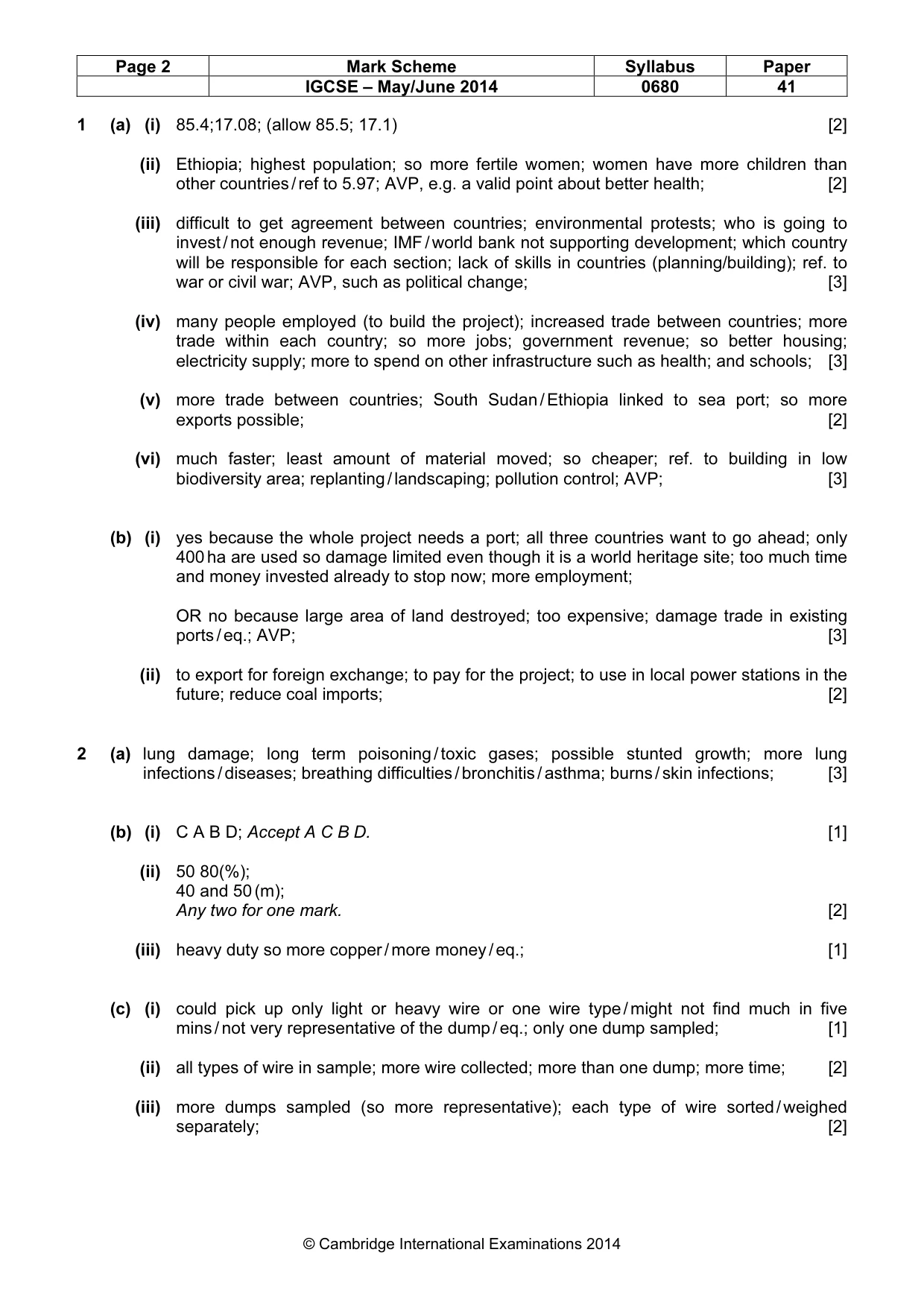
Page 2 Mark Scheme Syllabus Paper IGCSE – May/June 2014 0680 41 © Cambridge International Examinations 2014 1 (a) (i) 85.4;17.08; (allow 85.5; 17.1) [2] (ii) Ethiopia; highest population; so more fertile women; women have more children than other countries / ref to 5.97; AVP, e.g. a valid point about better health; [2] (iii) difficult to get agreement between countries; environmental protests; who is going to invest / not enough revenue; IMF / world bank not supporting development; which country will be responsible for each section; lack of skills in countries (planning/building); ref. to war or civil war; AVP, such as political change; [3] (iv) many people employed (to build the project); increased trade between countries; more trade within each country; so more jobs; government revenue; so better housing; electricity supply; more to spend on other infrastructure such as health; and schools; [3] (v) more trade between countries; South Sudan / Ethiopia linked to sea port; so more exports possible; [2] (vi) much faster; least amount of material moved; so cheaper; ref. to building in low biodiversity area; replanting / landscaping; pollution control; AVP; [3] (b) (i) yes because the whole project needs a port; all three countries want to go ahead; only 400 ha are used so damage limited even though it is a world heritage site; too much time and money invested already to stop now; more employment; OR no because large area of land destroyed; too expensive; damage trade in existing ports / eq.; AVP; [3] (ii) to export for foreign exchange; to pay for the project; to use in local power stations in the future; reduce coal imports; [2] 2 (a) lung damage; long term poisoning / toxic gases; possible stunted growth; more lung infections / diseases; breathing difficulties / bronchitis / asthma; burns / skin infections; [3] (b) (i) C A B D; Accept A C B D. [1] (ii) 50 80(%); 40 and 50 (m); Any two for one mark. [2] (iii) heavy duty so more copper / more money / eq.; [1] (c) (i) could pick up only light or heavy wire or one wire type / might not find much in five mins / not very representative of the dump / eq.; only one dump sampled; [1] (ii) all types of wire in sample; more wire collected; more than one dump; more time; [2] (iii) more dumps sampled (so more representative); each type of wire sorted / weighed separately; [2]
Mark scheme, page 3
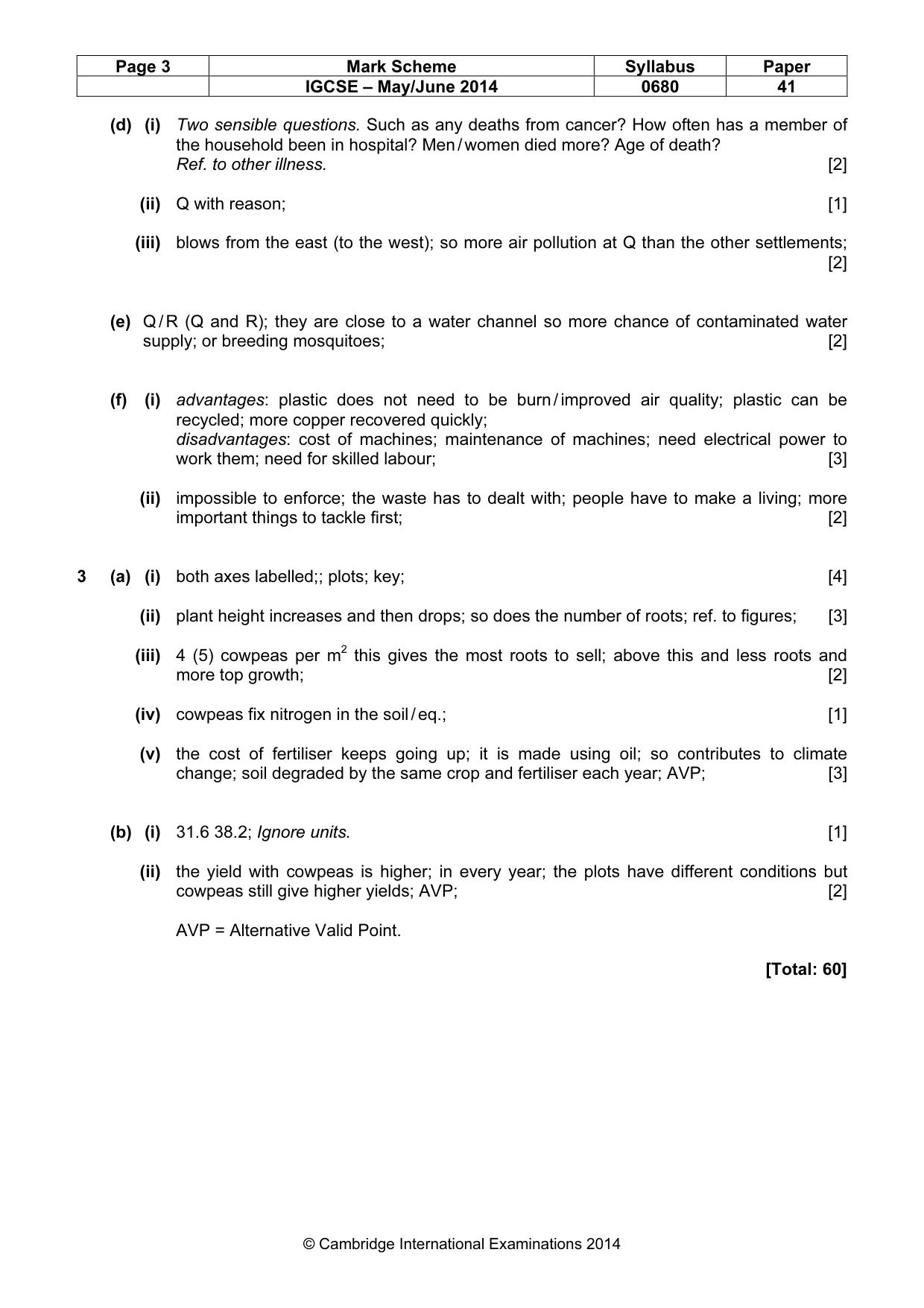
Page 3 Mark Scheme Syllabus Paper IGCSE – May/June 2014 0680 41 © Cambridge International Examinations 2014 (d) (i) Two sensible questions. Such as any deaths from cancer? How often has a member of the household been in hospital? Men / women died more? Age of death? Ref. to other illness. [2] (ii) Q with reason; [1] (iii) blows from the east (to the west); so more air pollution at Q than the other settlements; [2] (e) Q / R (Q and R); they are close to a water channel so more chance of contaminated water supply; or breeding mosquitoes; [2] (f) (i) advantages: plastic does not need to be burn / improved air quality; plastic can be recycled; more copper recovered quickly; disadvantages: cost of machines; maintenance of machines; need electrical power to work them; need for skilled labour; [3] (ii) impossible to enforce; the waste has to dealt with; people have to make a living; more important things to tackle first; [2] 3 (a) (i) both axes labelled;; plots; key; [4] (ii) plant height increases and then drops; so does the number of roots; ref. to figures; [3] (iii) 4 (5) cowpeas per m2 this gives the most roots to sell; above this and less roots and more top growth; [2] (iv) cowpeas fix nitrogen in the soil / eq.; [1] (v) the cost of fertiliser keeps going up; it is made using oil; so contributes to climate change; soil degraded by the same crop and fertiliser each year; AVP; [3] (b) (i) 31.6 38.2; Ignore units. [1] (ii) the yield with cowpeas is higher; in every year; the plots have different conditions but cowpeas still give higher yields; AVP; [2] AVP = Alternative Valid Point. [Total: 60]
What you needed in this session
Cambridge’s own grade thresholds for 2014 May/June, Paper 4 · Variant 1. A higher threshold means an easier paper — the bar moves with how the cohort did.