Cambridge IGCSE English - Literature in English 0475 — 2021 May/June Paper 1 · Variant 3
0475/13/M/J/21 · 50 marks · ≈56 min
The question paper and its mark scheme, free to read here and free to download. This is Cambridge’s own paper, exactly as it was sat.
Question paper28 pages




Mark scheme6 pages
Answers below. Sit the paper first if you are practising.


Paper as text
Question paper, page 1
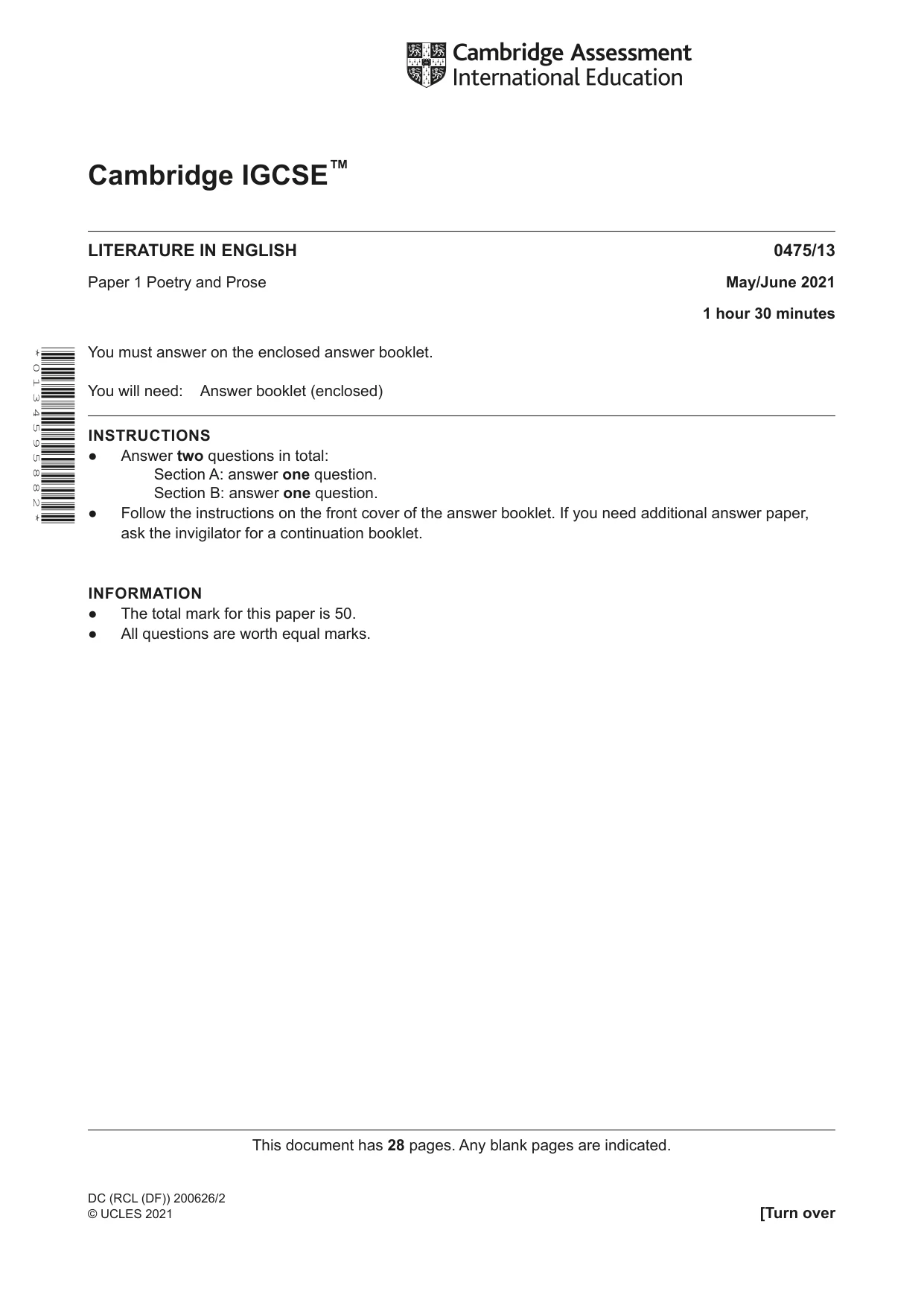
This document has 28 pages. Any blank pages are indicated. Cambridge IGCSE™ LITERATURE IN ENGLISH 0475/13 Paper 1 Poetry and Prose May/June 2021 1 hour 30 minutes You must answer on the enclosed answer booklet. You will need: Answer booklet (enclosed) INSTRUCTIONS ● Answer two questions in total: Section A: answer one question. Section B: answer one question. ● Follow the instructions on the front cover of the answer booklet. If you need additional answer paper, ask the invigilator for a continuation booklet. INFORMATION ● The total mark for this paper is 50. ● All questions are worth equal marks. * 0 1 3 4 5 9 5 8 8 2 * DC (RCL (DF)) 200626/2 © UCLES 2021 [Turn over
Question paper, page 2
2 0475/13/M/J/21 © UCLES 2021 BLANK PAGE
Question paper, page 3
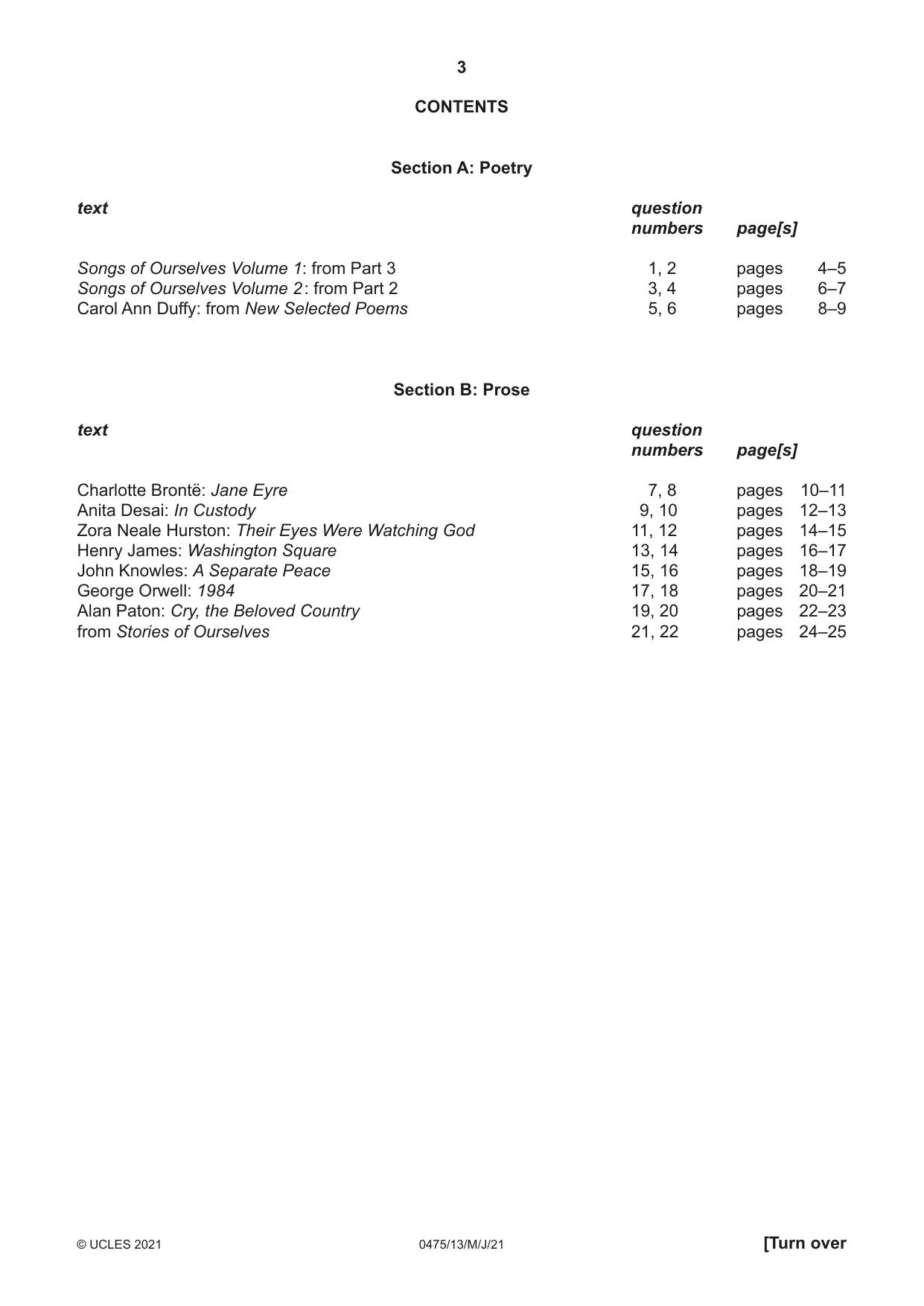
3 0475/13/M/J/21 © UCLES 2021 [Turn over CONTENTS Section A: Poetry text question numbers page[s] Songs of Ourselves Volume 1: from Part 3 1, 2 pages 4–5 Songs of Ourselves Volume 2 : from Part 2 3, 4 pages 6–7 Carol Ann Duffy: from New Selected Poems 5, 6 pages 8–9 Section B: Prose text question numbers page[s] Charlotte Brontë: Jane Eyre 7, 8 pages 10–11 Anita Desai: In Custody 9, 10 pages 12–13 Zora Neale Hurston: Their Eyes Were Watching God 11, 12 pages 14–15 Henry James: Washington Square 13, 14 pages 16–17 John Knowles: A Separate Peace 15, 16 pages 18–19 George Orwell: 1984 17, 18 pages 20–21 Alan Paton: Cry, the Beloved Country 19, 20 pages 22–23 from Stories of Ourselves 21, 22 pages 24–25
Question paper, page 4
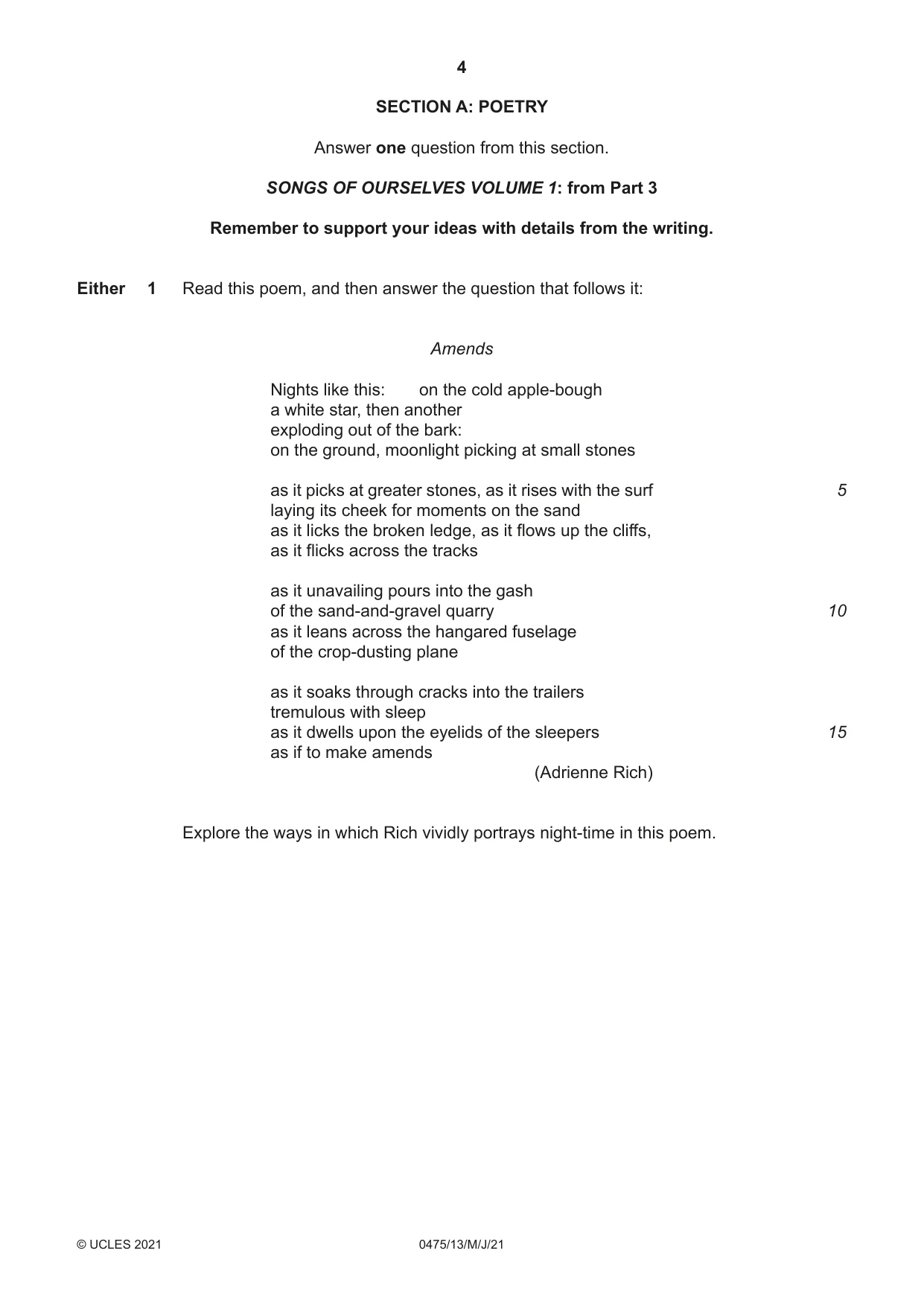
4 0475/13/M/J/21 © UCLES 2021 SECTION A: POETRY Answer one question from this section. SONGS OF OURSELVES VOLUME 1: from Part 3 Remember to support your ideas with details from the writing. Either 1 Read this poem, and then answer the question that follows it: Amends Nights like this: on the cold apple-bough a white star, then another exploding out of the bark: on the ground, moonlight picking at small stones as it picks at greater stones, as it rises with the surf laying its cheek for moments on the sand as it licks the broken ledge, as it flows up the cliffs, as it flicks across the tracks as it unavailing pours into the gash of the sand-and-gravel quarry as it leans across the hangared fuselage of the crop-dusting plane as it soaks through cracks into the trailers tremulous with sleep as it dwells upon the eyelids of the sleepers as if to make amends (Adrienne Rich) Explore the ways in which Rich vividly portrays night-time in this poem. 5 10 15
Question paper, page 5
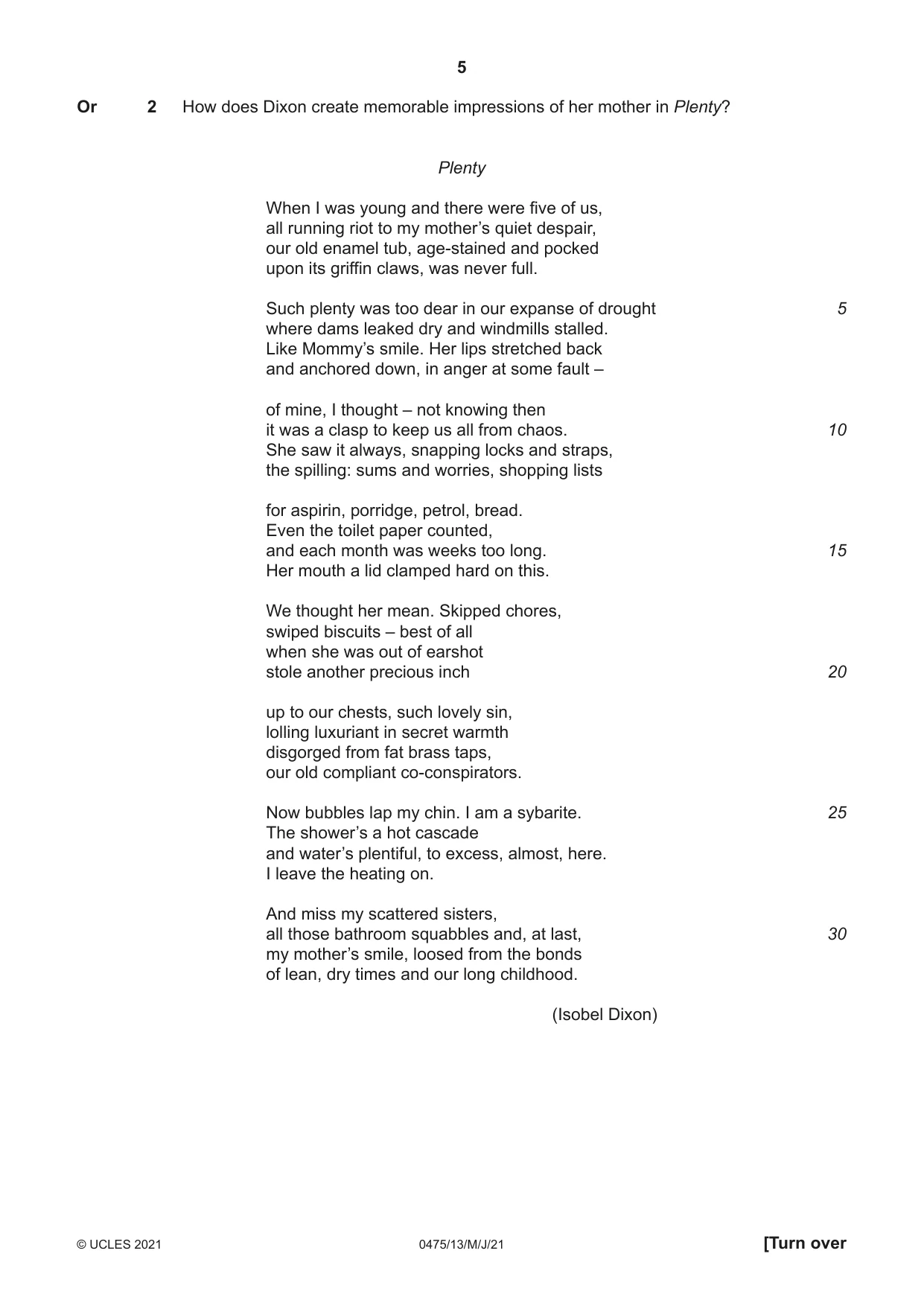
5 0475/13/M/J/21 © UCLES 2021 [Turn over Or 2 How does Dixon create memorable impressions of her mother in Plenty? Plenty When I was young and there were five of us, all running riot to my mother’s quiet despair, our old enamel tub, age-stained and pocked upon its griffin claws, was never full. Such plenty was too dear in our expanse of drought where dams leaked dry and windmills stalled. Like Mommy’s smile. Her lips stretched back and anchored down, in anger at some fault – of mine, I thought – not knowing then it was a clasp to keep us all from chaos. She saw it always, snapping locks and straps, the spilling: sums and worries, shopping lists for aspirin, porridge, petrol, bread. Even the toilet paper counted, and each month was weeks too long. Her mouth a lid clamped hard on this. We thought her mean. Skipped chores, swiped biscuits – best of all when she was out of earshot stole another precious inch up to our chests, such lovely sin, lolling luxuriant in secret warmth disgorged from fat brass taps, our old compliant co-conspirators. Now bubbles lap my chin. I am a sybarite. The shower’s a hot cascade and water’s plentiful, to excess, almost, here. I leave the heating on. And miss my scattered sisters, all those bathroom squabbles and, at last, my mother’s smile, loosed from the bonds of lean, dry times and our long childhood. (Isobel Dixon) 5 10 15 20 25 30
Question paper, page 6
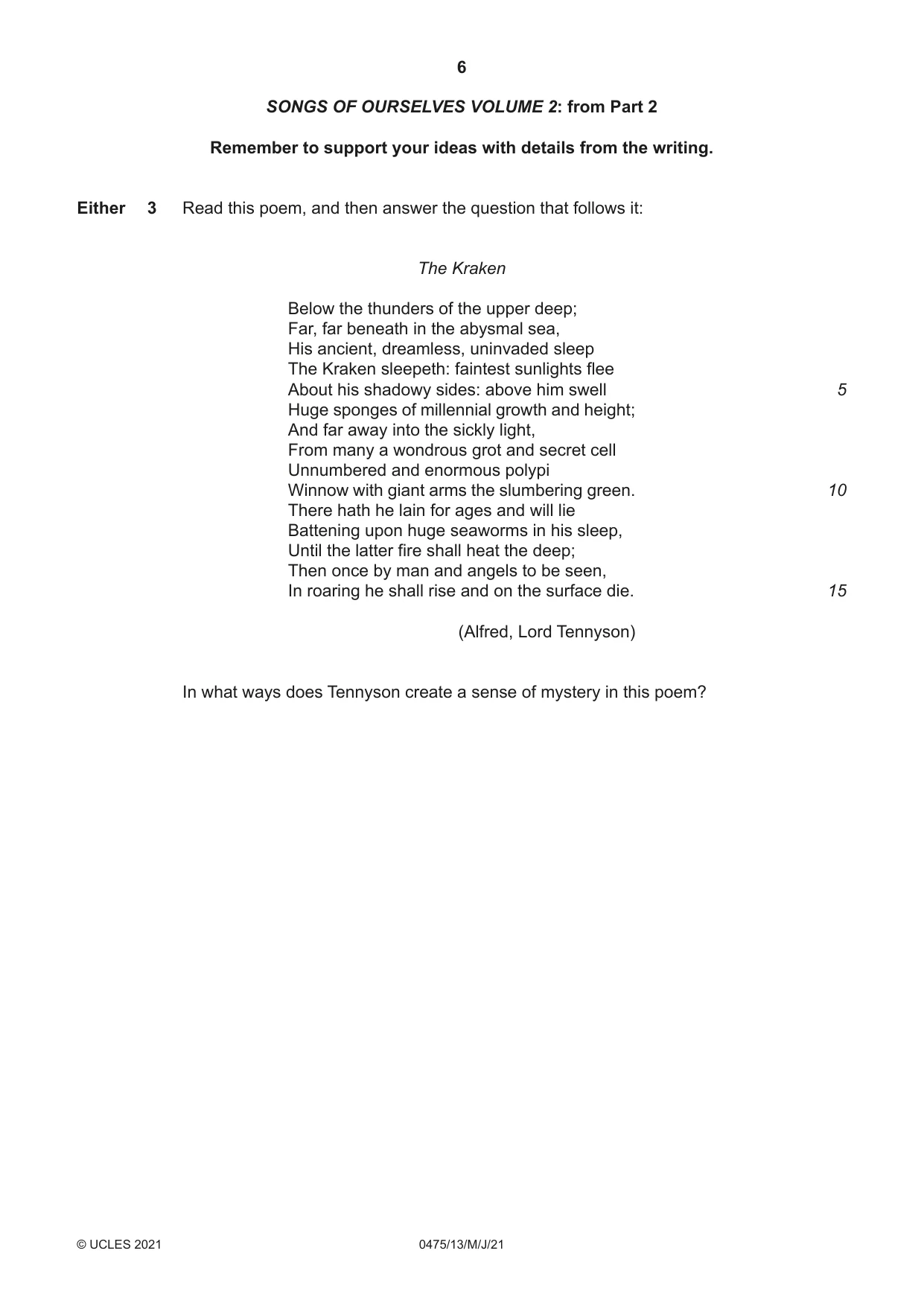
6 0475/13/M/J/21 © UCLES 2021 SONGS OF OURSELVES VOLUME 2: from Part 2 Remember to support your ideas with details from the writing. Either 3 Read this poem, and then answer the question that follows it: The Kraken Below the thunders of the upper deep; Far, far beneath in the abysmal sea, His ancient, dreamless, uninvaded sleep The Kraken sleepeth: faintest sunlights flee About his shadowy sides: above him swell Huge sponges of millennial growth and height; And far away into the sickly light, From many a wondrous grot and secret cell Unnumbered and enormous polypi Winnow with giant arms the slumbering green. There hath he lain for ages and will lie Battening upon huge seaworms in his sleep, Until the latter fire shall heat the deep; Then once by man and angels to be seen, In roaring he shall rise and on the surface die. (Alfred, Lord Tennyson) In what ways does Tennyson create a sense of mystery in this poem? 5 10 15
Question paper, page 7
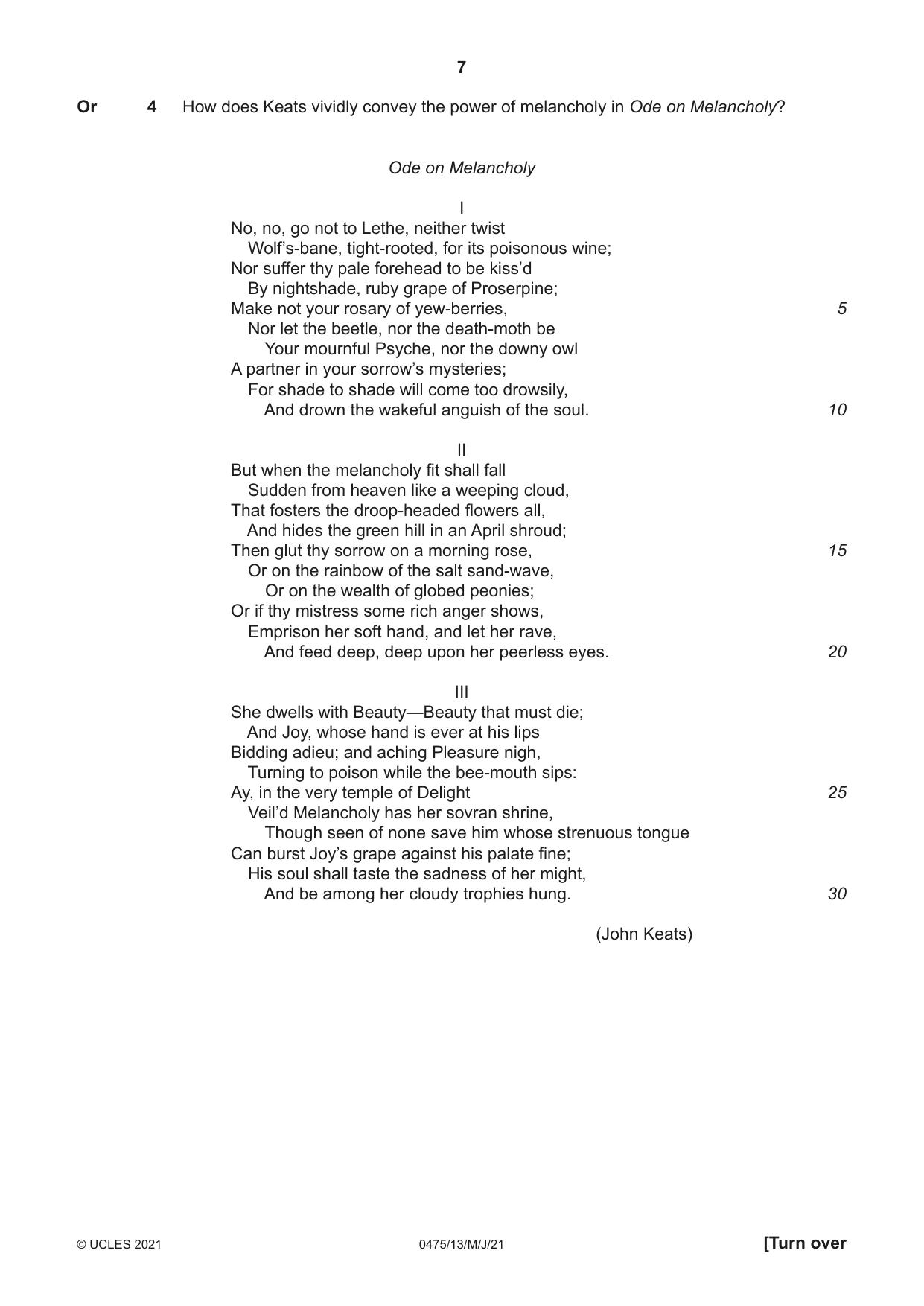
7 0475/13/M/J/21 © UCLES 2021 [Turn over Or 4 How does Keats vividly convey the power of melancholy in Ode on Melancholy? Ode on Melancholy I No, no, go not to Lethe, neither twist Wolf’s-bane, tight-rooted, for its poisonous wine; Nor suffer thy pale forehead to be kiss’d By nightshade, ruby grape of Proserpine; Make not your rosary of yew-berries, Nor let the beetle, nor the death-moth be Your mournful Psyche, nor the downy owl A partner in your sorrow’s mysteries; For shade to shade will come too drowsily, And drown the wakeful anguish of the soul. II But when the melancholy fit shall fall Sudden from heaven like a weeping cloud, That fosters the droop-headed flowers all, And hides the green hill in an April shroud; Then glut thy sorrow on a morning rose, Or on the rainbow of the salt sand-wave, Or on the wealth of globed peonies; Or if thy mistress some rich anger shows, Emprison her soft hand, and let her rave, And feed deep, deep upon her peerless eyes. III She dwells with Beauty—Beauty that must die; And Joy, whose hand is ever at his lips Bidding adieu; and aching Pleasure nigh, Turning to poison while the bee-mouth sips: Ay, in the very temple of Delight Veil’d Melancholy has her sovran shrine, Though seen of none save him whose strenuous tongue Can burst Joy’s grape against his palate fine; His soul shall taste the sadness of her might, And be among her cloudy trophies hung. (John Keats) 5 10 15 20 25 30
Question paper, page 8
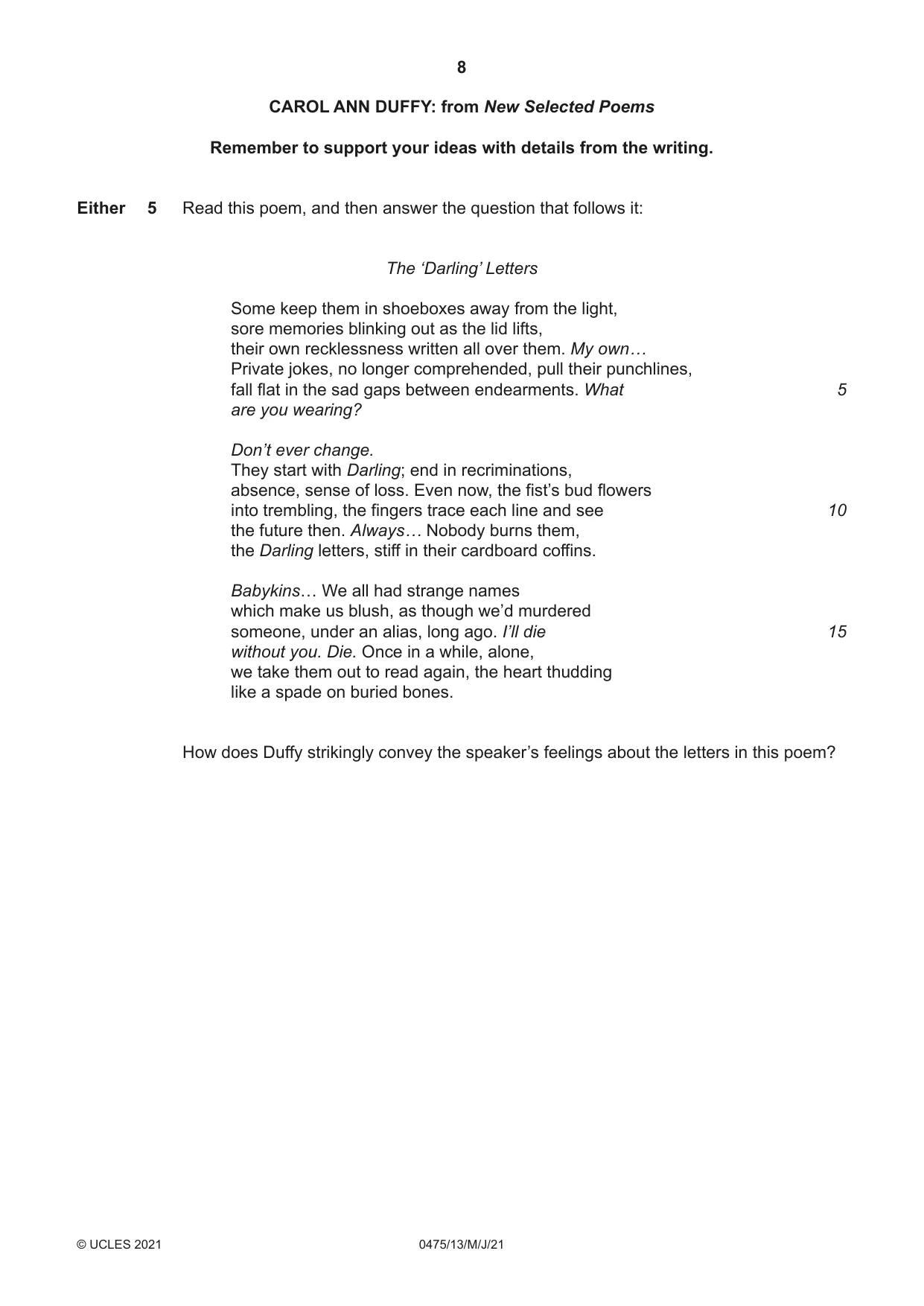
8 0475/13/M/J/21 © UCLES 2021 CAROL ANN DUFFY: from New Selected Poems Remember to support your ideas with details from the writing. Either 5 Read this poem, and then answer the question that follows it: The ‘Darling’ Letters Some keep them in shoeboxes away from the light, sore memories blinking out as the lid lifts, their own recklessness written all over them. My own… Private jokes, no longer comprehended, pull their punchlines, fall flat in the sad gaps between endearments. What are you wearing? Don’t ever change. They start with Darling; end in recriminations, absence, sense of loss. Even now, the fist’s bud flowers into trembling, the fingers trace each line and see the future then. Always… Nobody burns them, the Darling letters, stiff in their cardboard coffins. Babykins… We all had strange names which make us blush, as though we’d murdered someone, under an alias, long ago. I’ll die without you. Die. Once in a while, alone, we take them out to read again, the heart thudding like a spade on buried bones. How does Duffy strikingly convey the speaker’s feelings about the letters in this poem? 5 10 15
Question paper, page 9
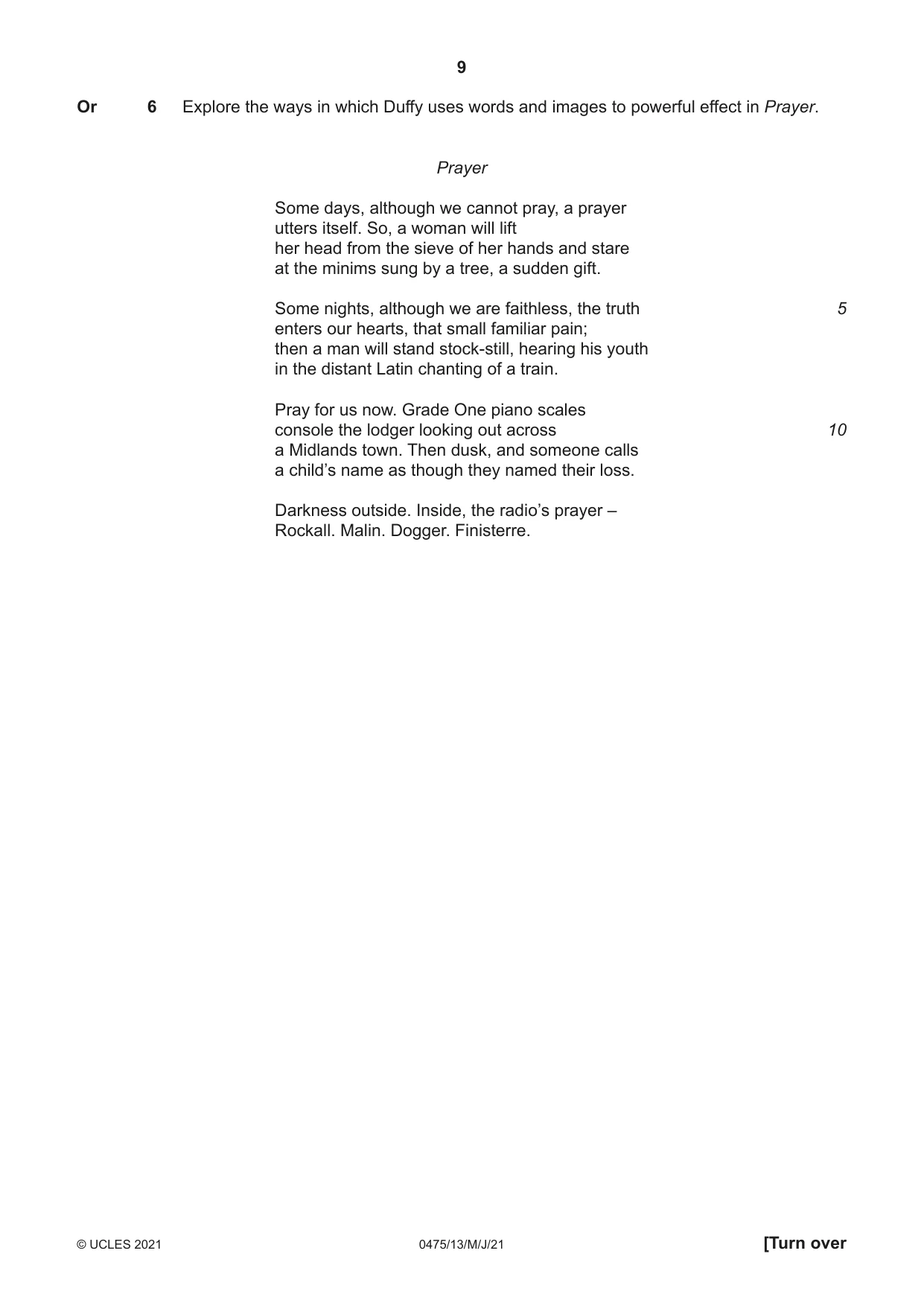
9 0475/13/M/J/21 © UCLES 2021 [Turn over Or 6 Explore the ways in which Duffy uses words and images to powerful effect in Prayer. Prayer Some days, although we cannot pray, a prayer utters itself. So, a woman will lift her head from the sieve of her hands and stare at the minims sung by a tree, a sudden gift. Some nights, although we are faithless, the truth enters our hearts, that small familiar pain; then a man will stand stock-still, hearing his youth in the distant Latin chanting of a train. Pray for us now. Grade One piano scales console the lodger looking out across a Midlands town. Then dusk, and someone calls a child’s name as though they named their loss. Darkness outside. Inside, the radio’s prayer – Rockall. Malin. Dogger. Finisterre. 5 10
Question paper, page 10
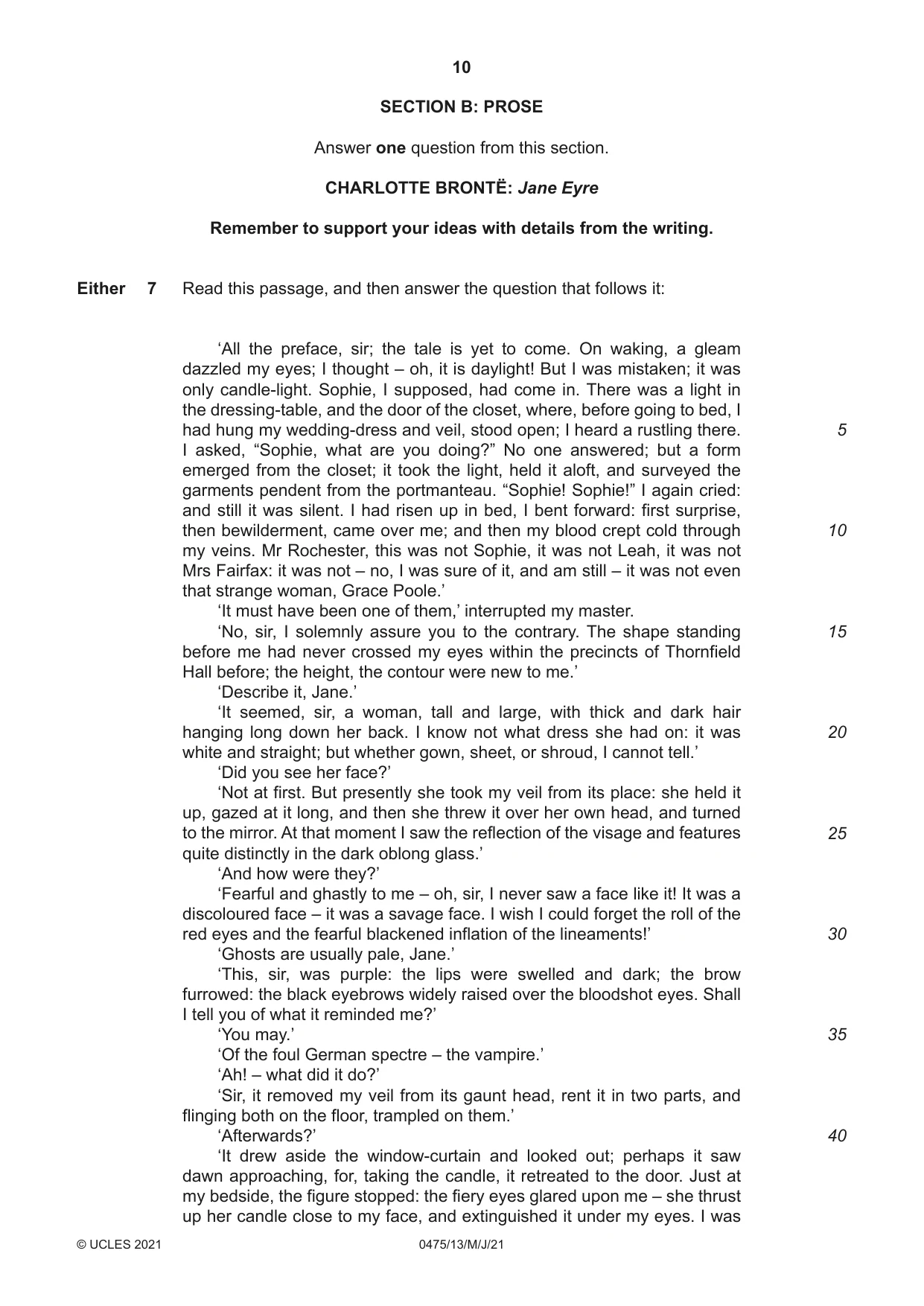
10 0475/13/M/J/21 © UCLES 2021 SECTION B: PROSE Answer one question from this section. CHARLOTTE BRONTË: Jane Eyre Remember to support your ideas with details from the writing. Either 7 Read this passage, and then answer the question that follows it: ‘All the preface, sir; the tale is yet to come. On waking, a gleam dazzled my eyes; I thought – oh, it is daylight! But I was mistaken; it was only candle-light. Sophie, I supposed, had come in. There was a light in the dressing-table, and the door of the closet, where, before going to bed, I had hung my wedding-dress and veil, stood open; I heard a rustling there. I asked, “Sophie, what are you doing?” No one answered; but a form emerged from the closet; it took the light, held it aloft, and surveyed the garments pendent from the portmanteau. “Sophie! Sophie!” I again cried: and still it was silent. I had risen up in bed, I bent forward: first surprise, then bewilderment, came over me; and then my blood crept cold through my veins. Mr Rochester, this was not Sophie, it was not Leah, it was not Mrs Fairfax: it was not – no, I was sure of it, and am still – it was not even that strange woman, Grace Poole.’ ‘It must have been one of them,’ interrupted my master. ‘No, sir, I solemnly assure you to the contrary. The shape standing before me had never crossed my eyes within the precincts of Thornfield Hall before; the height, the contour were new to me.’ ‘Describe it, Jane.’ ‘It seemed, sir, a woman, tall and large, with thick and dark hair hanging long down her back. I know not what dress she had on: it was white and straight; but whether gown, sheet, or shroud, I cannot tell.’ ‘Did you see her face?’ ‘Not at first. But presently she took my veil from its place: she held it up, gazed at it long, and then she threw it over her own head, and turned to the mirror. At that moment I saw the reflection of the visage and features quite distinctly in the dark oblong glass.’ ‘And how were they?’ ‘Fearful and ghastly to me – oh, sir, I never saw a face like it! It was a discoloured face – it was a savage face. I wish I could forget the roll of the red eyes and the fearful blackened inflation of the lineaments!’ ‘Ghosts are usually pale, Jane.’ ‘This, sir, was purple: the lips were swelled and dark; the brow furrowed: the black eyebrows widely raised over the bloodshot eyes. Shall I tell you of what it reminded me?’ ‘You may.’ ‘Of the foul German spectre – the vampire.’ ‘Ah! – what did it do?’ ‘Sir, it removed my veil from its gaunt head, rent it in two parts, and flinging both on the floor, trampled on them.’ ‘Afterwards?’ ‘It drew aside the window-curtain and looked out; perhaps it saw dawn approaching, for, taking the candle, it retreated to the door. Just at my bedside, the figure stopped: the fiery eyes glared upon me – she thrust up her candle close to my face, and extinguished it under my eyes. I was 5 10 15 20 25 30 35 40
Question paper, page 11
11 0475/13/M/J/21 © UCLES 2021 [Turn over aware her lurid visage flamed over mine, and I lost consciousness: for the second time in my life – only the second time – I became insensible from terror.’ (from Chapter 25) How does Brontë make this moment in the novel so disturbing? Or 8 Explore the ways in which Brontë makes Miss Temple such an admirable character. 45
Question paper, page 12
12 0475/13/M/J/21 © UCLES 2021 ANITA DESAI: In Custody Remember to support your ideas with details from the writing. Either 9 Read this passage, and then answer the question that follows it: Then Murad unexpectedly barked at him, ‘So, what about sending me something for my special number on Urdu poetry, hunh?’ Content removed due to copyright restrictions.
Question paper, page 13
13 0475/13/M/J/21 © UCLES 2021 [Turn over I need it for the special issue, see?’ (from Chapter 1) Explore how Desai conveys striking impressions of Deven and Murad at this moment in the novel. Or 10 How does Desai memorably portray two of the following characters? • Abid Siddiqui (Head of the Urdu Department at the college) • Chiku (the tape-recording technician) • Safiya Begum (Nur’s first wife) Content removed due to copyright restrictions.
Question paper, page 14
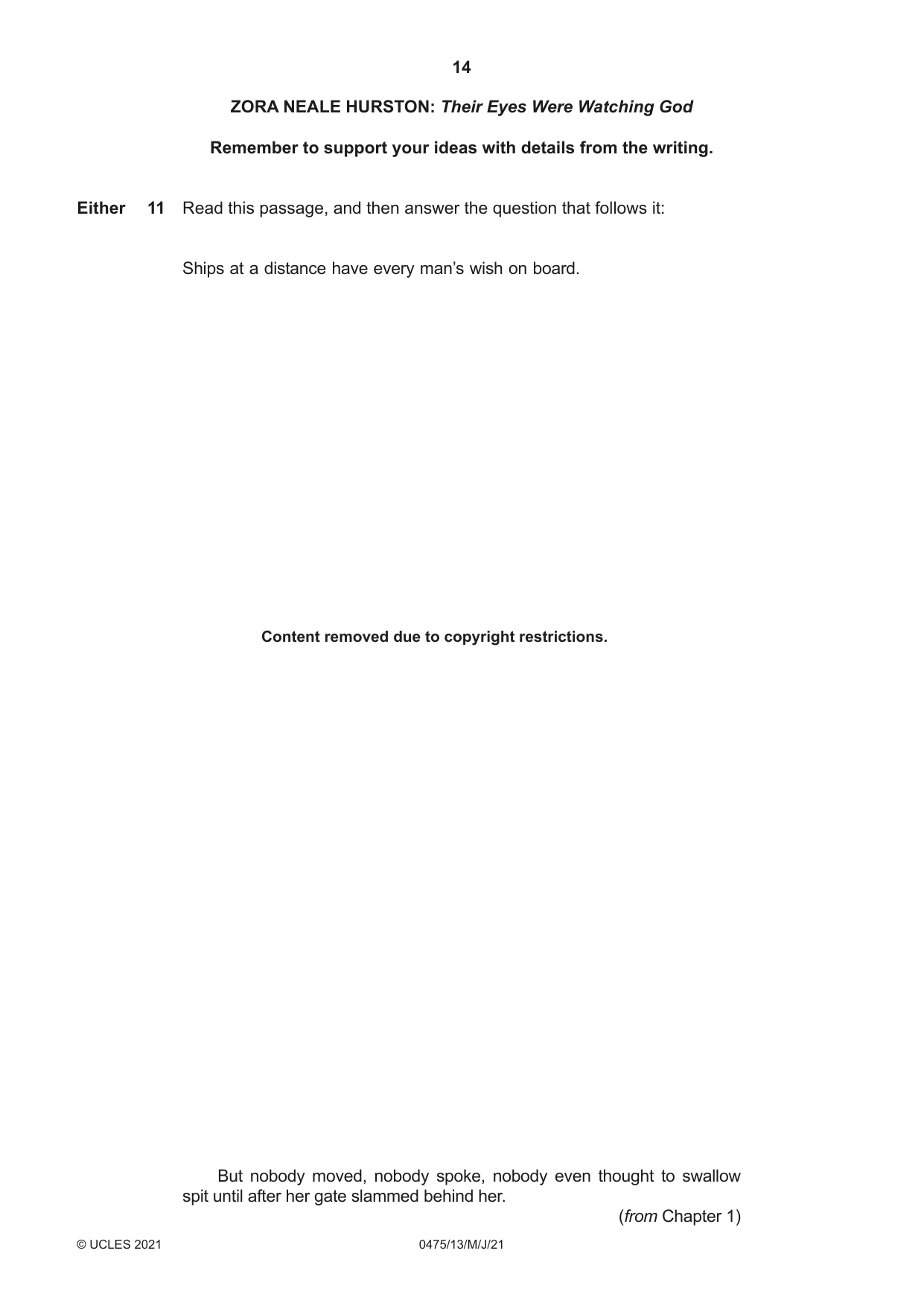
14 0475/13/M/J/21 © UCLES 2021 ZORA NEALE HURSTON: Their Eyes Were Watching God Remember to support your ideas with details from the writing. Either 11 Read this passage, and then answer the question that follows it: Ships at a distance have every man’s wish on board. But nobody moved, nobody spoke, nobody even thought to swallow spit until after her gate slammed behind her. (from Chapter 1) Content removed due to copyright restrictions.
Question paper, page 15
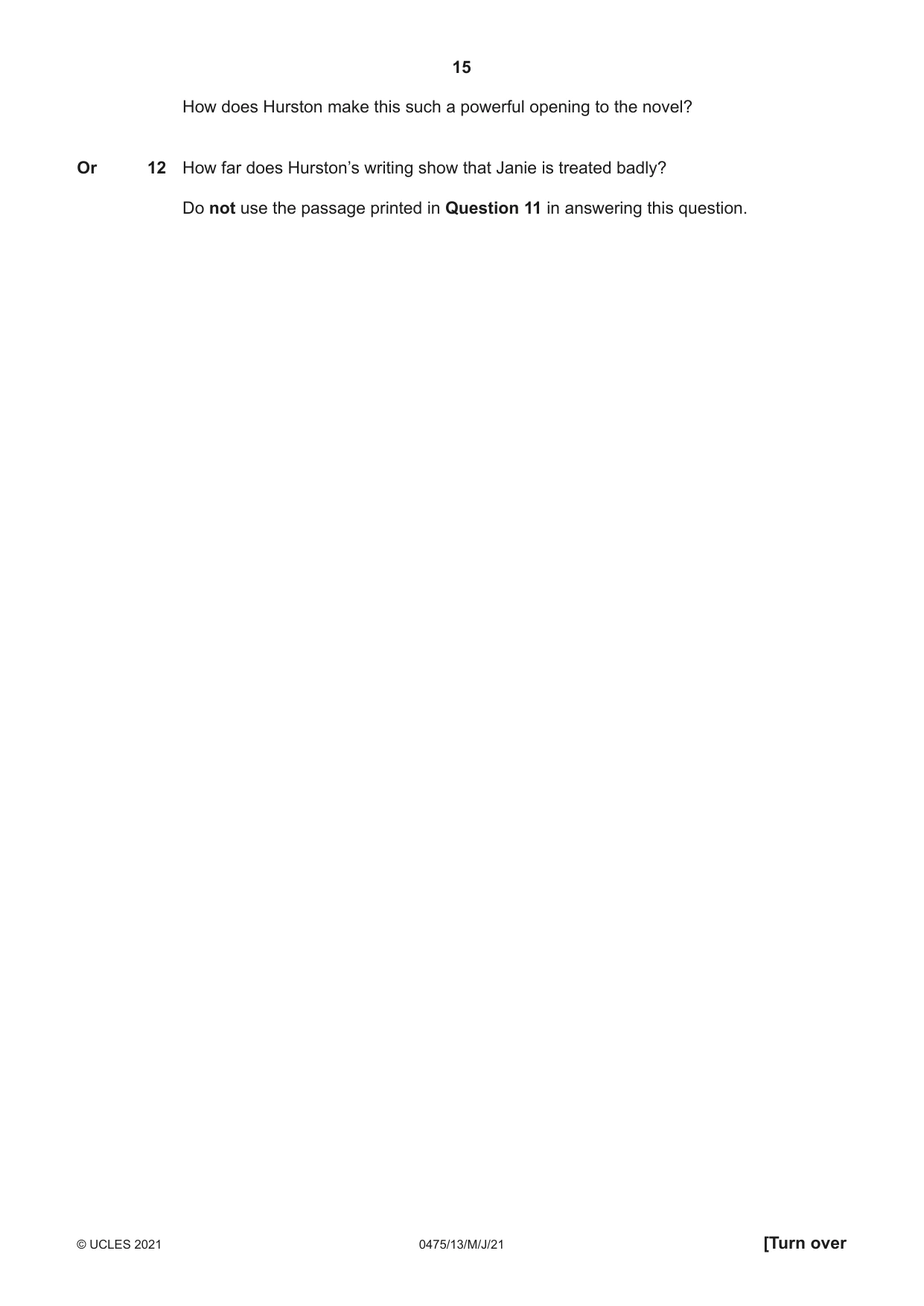
15 0475/13/M/J/21 © UCLES 2021 [Turn over How does Hurston make this such a powerful opening to the novel? Or 12 How far does Hurston’s writing show that Janie is treated badly? Do not use the passage printed in Question 11 in answering this question.
Question paper, page 16
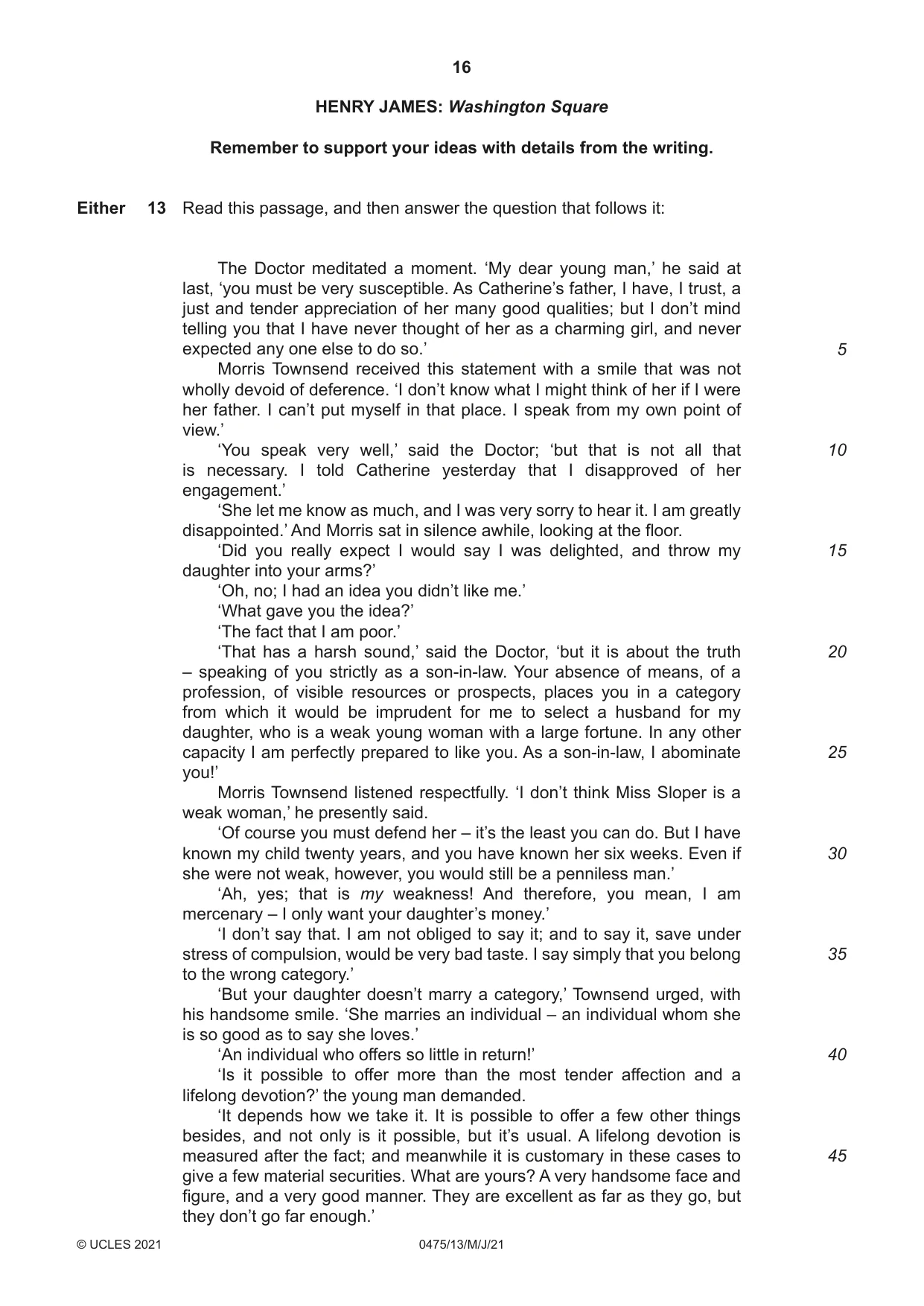
16 0475/13/M/J/21 © UCLES 2021 HENRY JAMES: Washington Square Remember to support your ideas with details from the writing. Either 13 Read this passage, and then answer the question that follows it: The Doctor meditated a moment. ‘My dear young man,’ he said at last, ‘you must be very susceptible. As Catherine’s father, I have, I trust, a just and tender appreciation of her many good qualities; but I don’t mind telling you that I have never thought of her as a charming girl, and never expected any one else to do so.’ Morris Townsend received this statement with a smile that was not wholly devoid of deference. ‘I don’t know what I might think of her if I were her father. I can’t put myself in that place. I speak from my own point of view.’ ‘You speak very well,’ said the Doctor; ‘but that is not all that is necessary. I told Catherine yesterday that I disapproved of her engagement.’ ‘She let me know as much, and I was very sorry to hear it. I am greatly disappointed.’ And Morris sat in silence awhile, looking at the floor. ‘Did you really expect I would say I was delighted, and throw my daughter into your arms?’ ‘Oh, no; I had an idea you didn’t like me.’ ‘What gave you the idea?’ ‘The fact that I am poor.’ ‘That has a harsh sound,’ said the Doctor, ‘but it is about the truth – speaking of you strictly as a son-in-law. Your absence of means, of a profession, of visible resources or prospects, places you in a category from which it would be imprudent for me to select a husband for my daughter, who is a weak young woman with a large fortune. In any other capacity I am perfectly prepared to like you. As a son-in-law, I abominate you!’ Morris Townsend listened respectfully. ‘I don’t think Miss Sloper is a weak woman,’ he presently said. ‘Of course you must defend her – it’s the least you can do. But I have known my child twenty years, and you have known her six weeks. Even if she were not weak, however, you would still be a penniless man.’ ‘Ah, yes; that is my weakness! And therefore, you mean, I am mercenary – I only want your daughter’s money.’ ‘I don’t say that. I am not obliged to say it; and to say it, save under stress of compulsion, would be very bad taste. I say simply that you belong to the wrong category.’ ‘But your daughter doesn’t marry a category,’ Townsend urged, with his handsome smile. ‘She marries an individual – an individual whom she is so good as to say she loves.’ ‘An individual who offers so little in return!’ ‘Is it possible to offer more than the most tender affection and a lifelong devotion?’ the young man demanded. ‘It depends how we take it. It is possible to offer a few other things besides, and not only is it possible, but it’s usual. A lifelong devotion is measured after the fact; and meanwhile it is customary in these cases to give a few material securities. What are yours? A very handsome face and figure, and a very good manner. They are excellent as far as they go, but they don’t go far enough.’ 5 10 15 20 25 30 35 40 45
Question paper, page 17
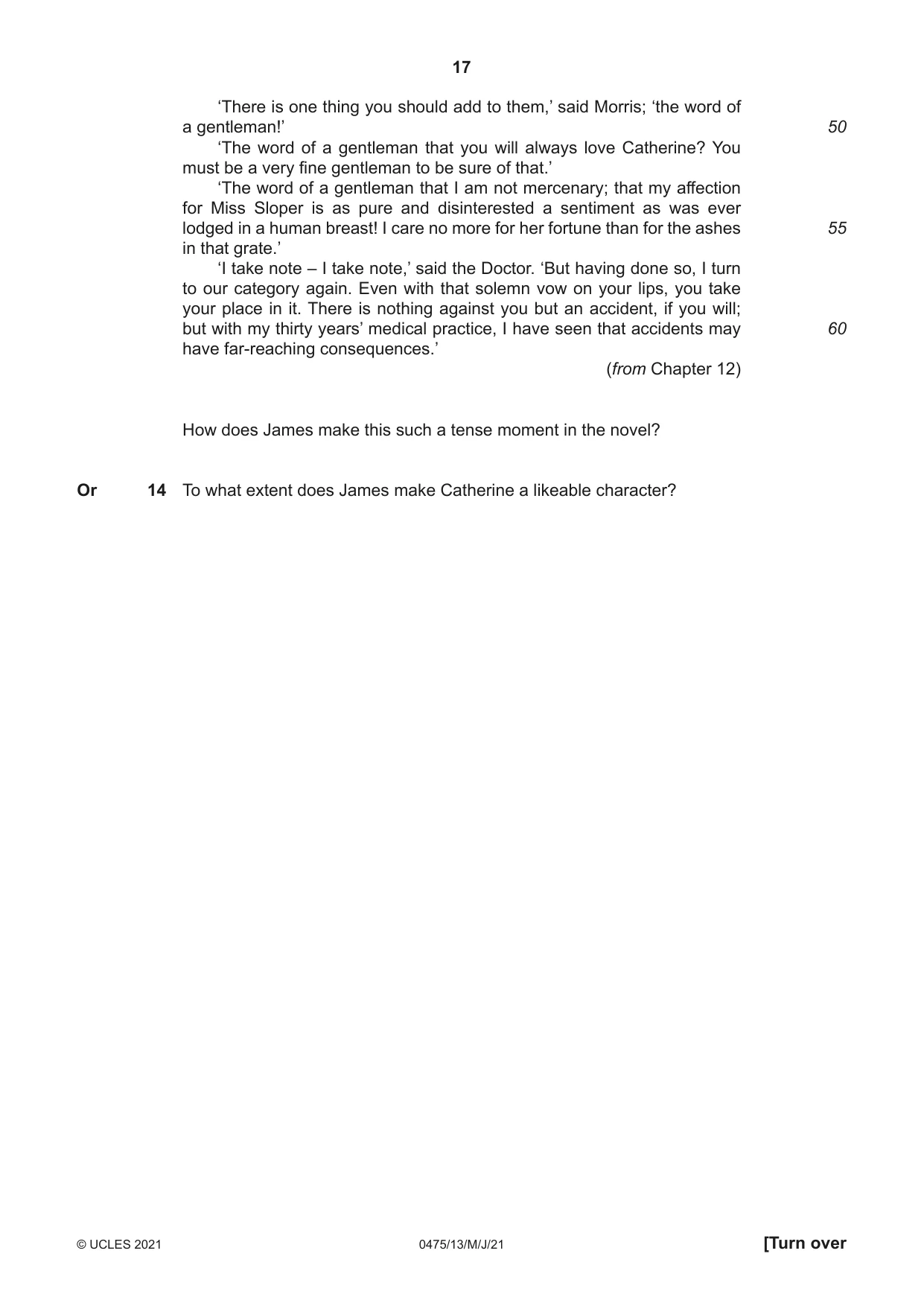
17 0475/13/M/J/21 © UCLES 2021 [Turn over ‘There is one thing you should add to them,’ said Morris; ‘the word of a gentleman!’ ‘The word of a gentleman that you will always love Catherine? You must be a very fine gentleman to be sure of that.’ ‘The word of a gentleman that I am not mercenary; that my affection for Miss Sloper is as pure and disinterested a sentiment as was ever lodged in a human breast! I care no more for her fortune than for the ashes in that grate.’ ‘I take note – I take note,’ said the Doctor. ‘But having done so, I turn to our category again. Even with that solemn vow on your lips, you take your place in it. There is nothing against you but an accident, if you will; but with my thirty years’ medical practice, I have seen that accidents may have far-reaching consequences.’ (from Chapter 12) How does James make this such a tense moment in the novel? Or 14 To what extent does James make Catherine a likeable character? 50 55 60
Question paper, page 18
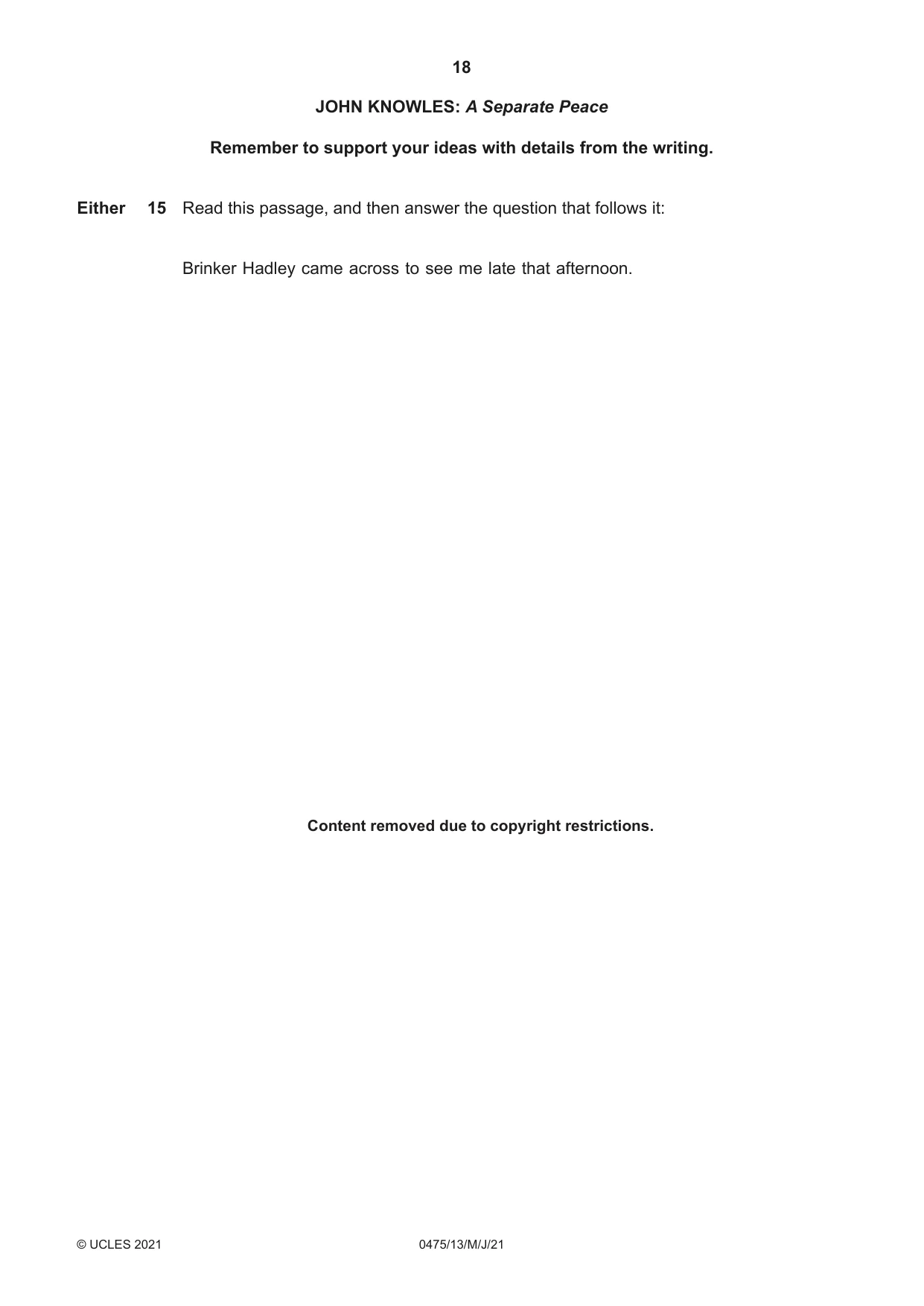
18 0475/13/M/J/21 © UCLES 2021 JOHN KNOWLES: A Separate Peace Remember to support your ideas with details from the writing. Either 15 Read this passage, and then answer the question that follows it: Brinker Hadley came across to see me late that afternoon. Content removed due to copyright restrictions.
Question paper, page 19
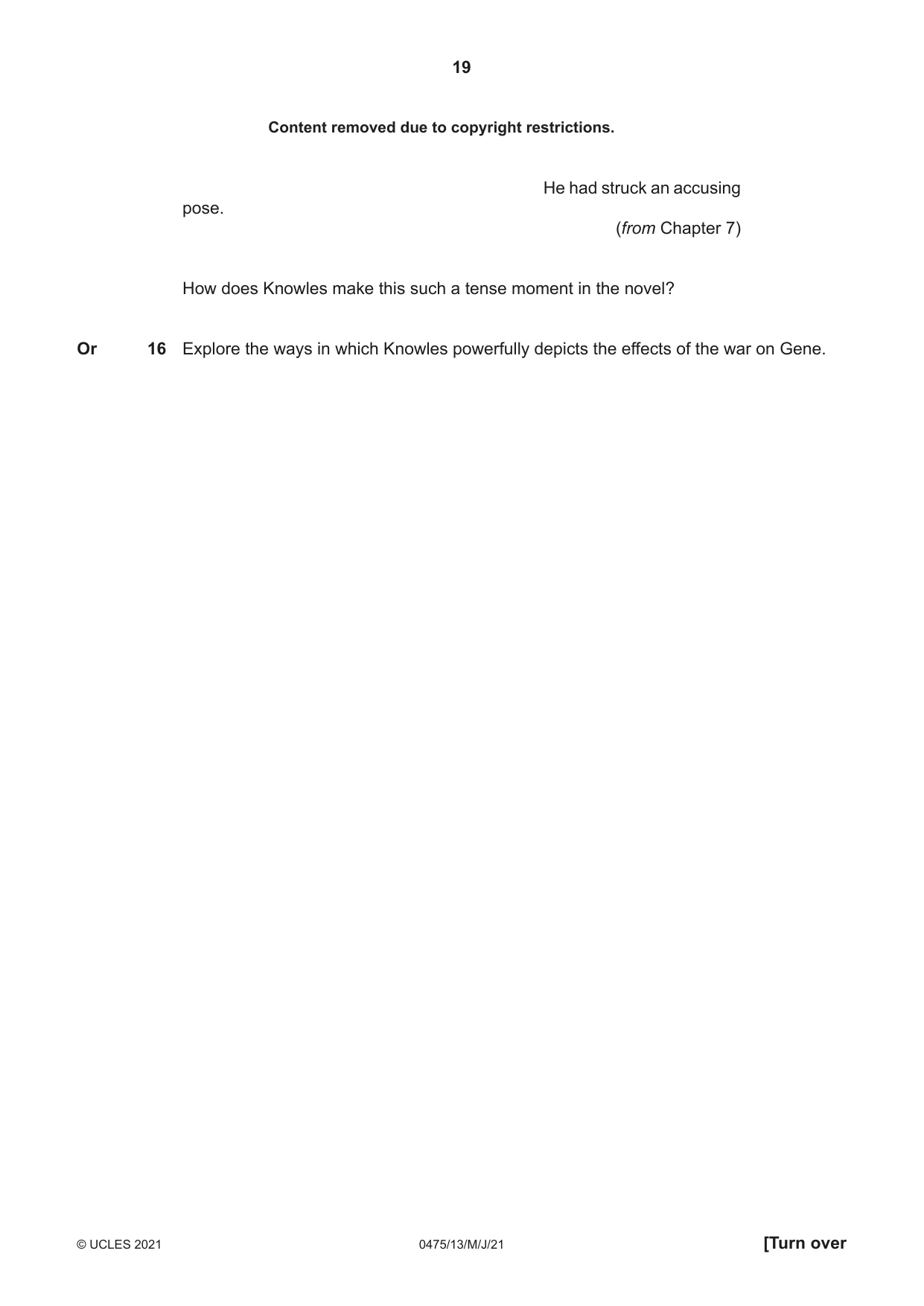
19 0475/13/M/J/21 © UCLES 2021 [Turn over He had struck an accusing pose. (from Chapter 7) How does Knowles make this such a tense moment in the novel? Or 16 Explore the ways in which Knowles powerfully depicts the effects of the war on Gene. Content removed due to copyright restrictions.
Question paper, page 20
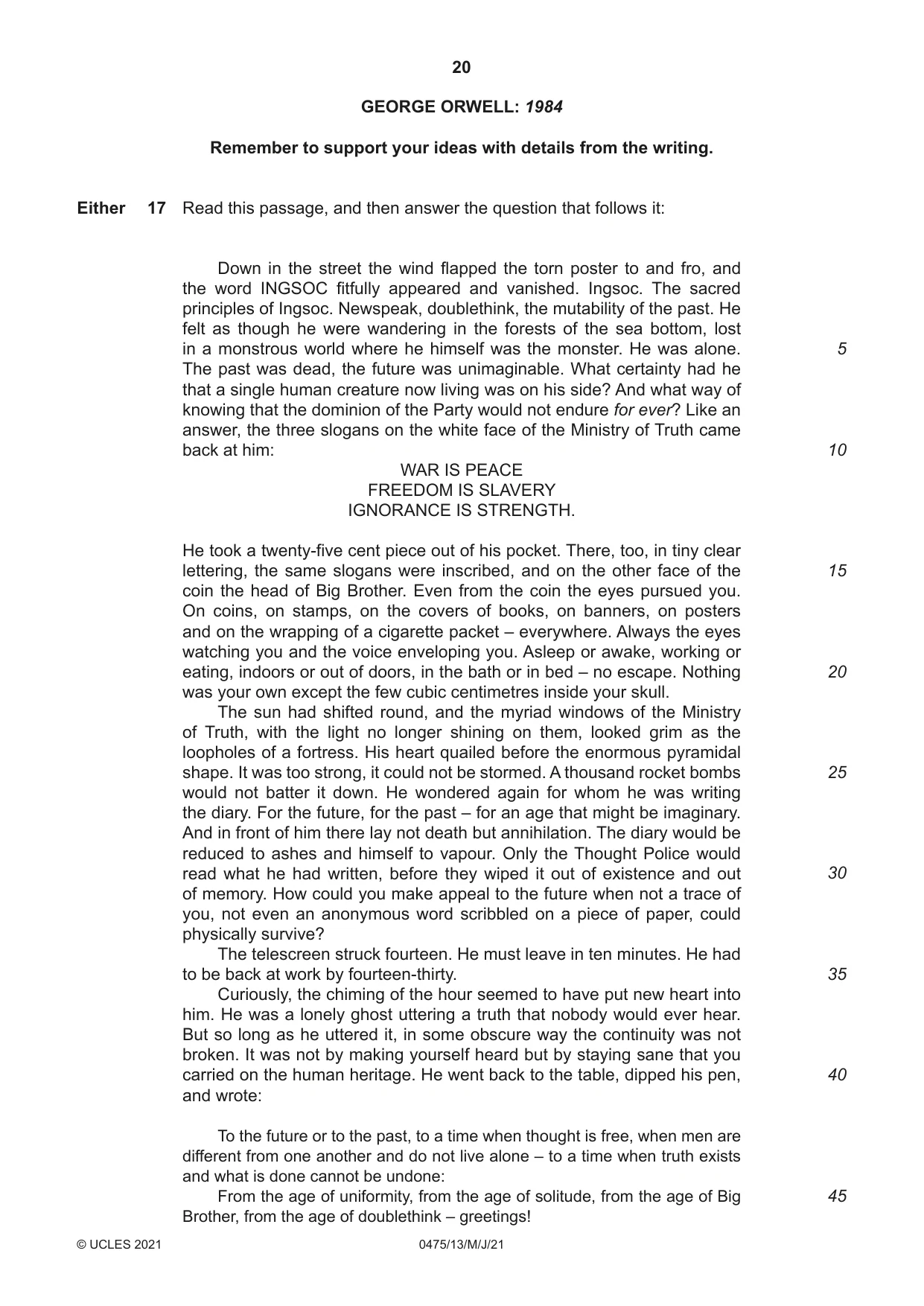
20 0475/13/M/J/21 © UCLES 2021 GEORGE ORWELL: 1984 Remember to support your ideas with details from the writing. Either 17 Read this passage, and then answer the question that follows it: Down in the street the wind flapped the torn poster to and fro, and the word INGSOC fitfully appeared and vanished. Ingsoc. The sacred principles of Ingsoc. Newspeak, doublethink, the mutability of the past. He felt as though he were wandering in the forests of the sea bottom, lost in a monstrous world where he himself was the monster. He was alone. The past was dead, the future was unimaginable. What certainty had he that a single human creature now living was on his side? And what way of knowing that the dominion of the Party would not endure for ever? Like an answer, the three slogans on the white face of the Ministry of Truth came back at him: WAR IS PEACE FREEDOM IS SLAVERY IGNORANCE IS STRENGTH. He took a twenty-five cent piece out of his pocket. There, too, in tiny clear lettering, the same slogans were inscribed, and on the other face of the coin the head of Big Brother. Even from the coin the eyes pursued you. On coins, on stamps, on the covers of books, on banners, on posters and on the wrapping of a cigarette packet – everywhere. Always the eyes watching you and the voice enveloping you. Asleep or awake, working or eating, indoors or out of doors, in the bath or in bed – no escape. Nothing was your own except the few cubic centimetres inside your skull. The sun had shifted round, and the myriad windows of the Ministry of Truth, with the light no longer shining on them, looked grim as the loopholes of a fortress. His heart quailed before the enormous pyramidal shape. It was too strong, it could not be stormed. A thousand rocket bombs would not batter it down. He wondered again for whom he was writing the diary. For the future, for the past – for an age that might be imaginary. And in front of him there lay not death but annihilation. The diary would be reduced to ashes and himself to vapour. Only the Thought Police would read what he had written, before they wiped it out of existence and out of memory. How could you make appeal to the future when not a trace of you, not even an anonymous word scribbled on a piece of paper, could physically survive? The telescreen struck fourteen. He must leave in ten minutes. He had to be back at work by fourteen-thirty. Curiously, the chiming of the hour seemed to have put new heart into him. He was a lonely ghost uttering a truth that nobody would ever hear. But so long as he uttered it, in some obscure way the continuity was not broken. It was not by making yourself heard but by staying sane that you carried on the human heritage. He went back to the table, dipped his pen, and wrote: To the future or to the past, to a time when thought is free, when men are different from one another and do not live alone – to a time when truth exists and what is done cannot be undone: From the age of uniformity, from the age of solitude, from the age of Big Brother, from the age of doublethink – greetings! 5 10 15 20 25 30 35 40 45
Question paper, page 21
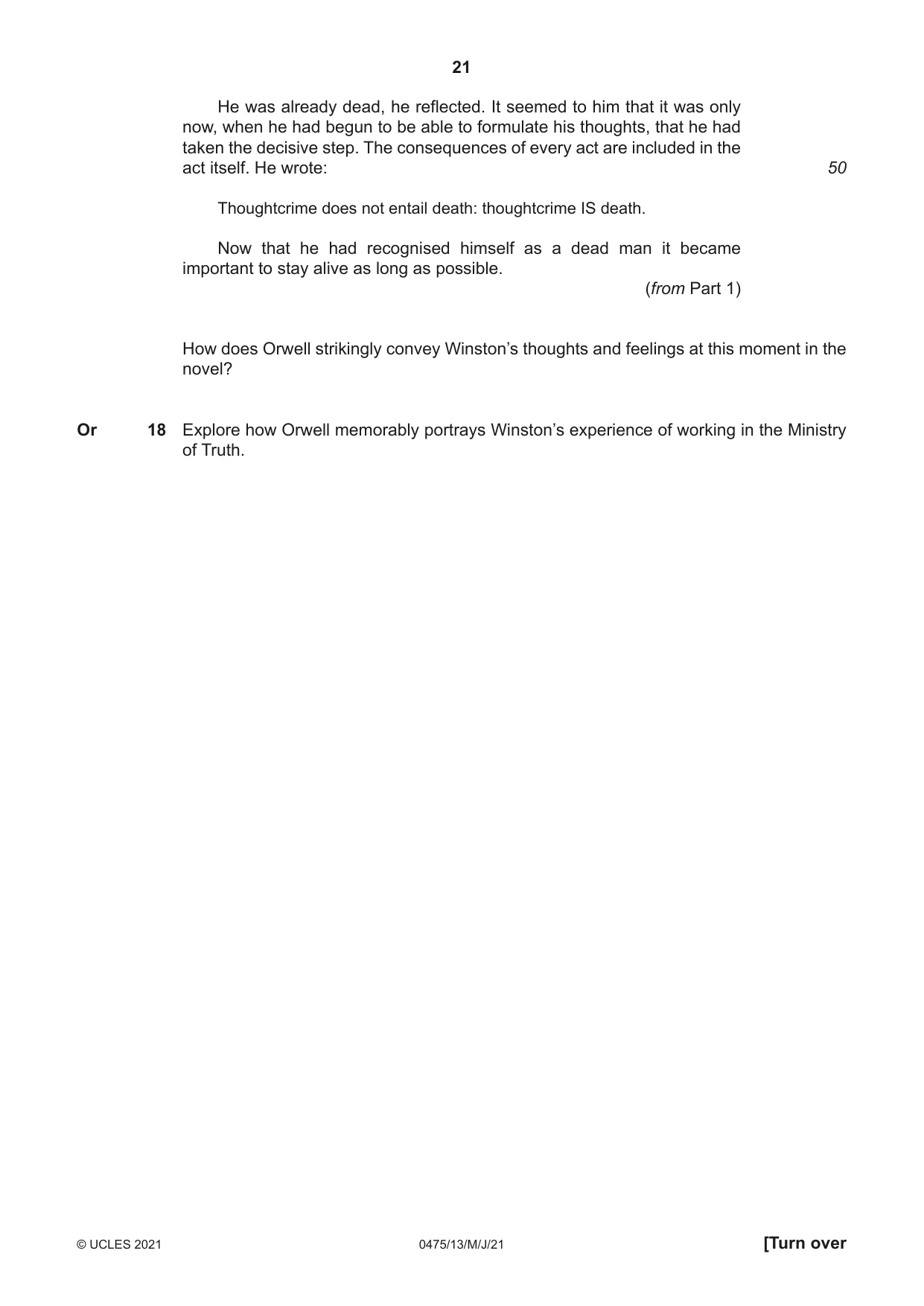
21 0475/13/M/J/21 © UCLES 2021 [Turn over He was already dead, he reflected. It seemed to him that it was only now, when he had begun to be able to formulate his thoughts, that he had taken the decisive step. The consequences of every act are included in the act itself. He wrote: Thoughtcrime does not entail death: thoughtcrime IS death. Now that he had recognised himself as a dead man it became important to stay alive as long as possible. (from Part 1) How does Orwell strikingly convey Winston’s thoughts and feelings at this moment in the novel? Or 18 Explore how Orwell memorably portrays Winston’s experience of working in the Ministry of Truth. 50
Question paper, page 22
22 0475/13/M/J/21 © UCLES 2021 ALAN PATON: Cry, the Beloved Country Remember to support your ideas with details from the writing. Either 19 Read this passage, and then answer the question that follows it: Jarvis dismissed the boy, and waited till he was gone. Content removed due to copyright restrictions.
Question paper, page 23
23 0475/13/M/J/21 © UCLES 2021 [Turn over – Yes, yes, said Jarvis, there was a brightness in him. (from Book 2 Chapter 8) How does Paton make this such a moving moment in the novel? Or 20 Explore the ways in which Paton makes John Kumalo and his son such despicable characters. Content removed due to copyright restrictions.
Question paper, page 24
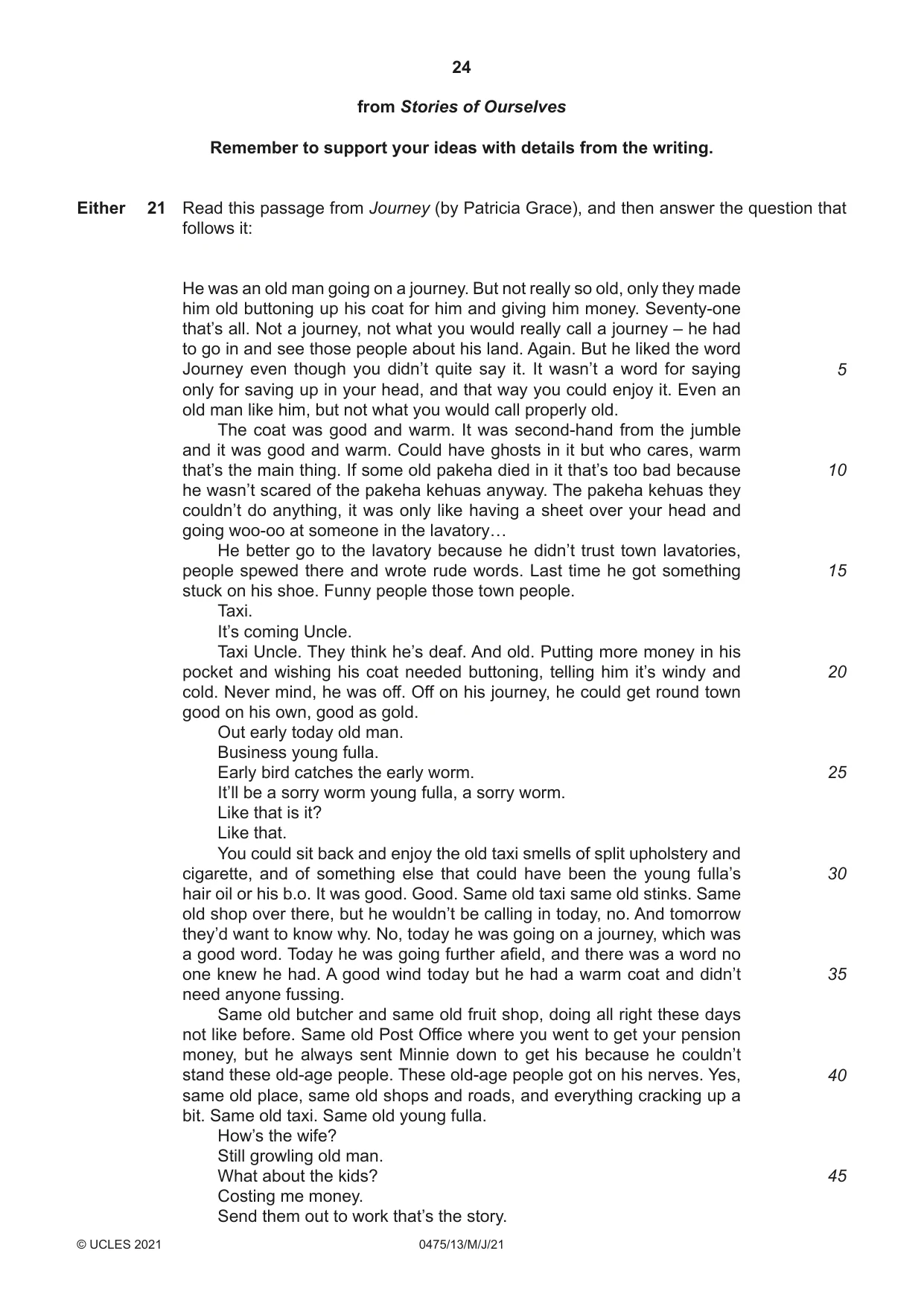
24 0475/13/M/J/21 © UCLES 2021 from Stories of Ourselves Remember to support your ideas with details from the writing. Either 21 Read this passage from Journey (by Patricia Grace), and then answer the question that follows it: He was an old man going on a journey. But not really so old, only they made him old buttoning up his coat for him and giving him money. Seventy-one that’s all. Not a journey, not what you would really call a journey – he had to go in and see those people about his land. Again. But he liked the word Journey even though you didn’t quite say it. It wasn’t a word for saying only for saving up in your head, and that way you could enjoy it. Even an old man like him, but not what you would call properly old. The coat was good and warm. It was second-hand from the jumble and it was good and warm. Could have ghosts in it but who cares, warm that’s the main thing. If some old pakeha died in it that’s too bad because he wasn’t scared of the pakeha kehuas anyway. The pakeha kehuas they couldn’t do anything, it was only like having a sheet over your head and going woo-oo at someone in the lavatory… He better go to the lavatory because he didn’t trust town lavatories, people spewed there and wrote rude words. Last time he got something stuck on his shoe. Funny people those town people. Taxi. It’s coming Uncle. Taxi Uncle. They think he’s deaf. And old. Putting more money in his pocket and wishing his coat needed buttoning, telling him it’s windy and cold. Never mind, he was off. Off on his journey, he could get round town good on his own, good as gold. Out early today old man. Business young fulla. Early bird catches the early worm. It’ll be a sorry worm young fulla, a sorry worm. Like that is it? Like that. You could sit back and enjoy the old taxi smells of split upholstery and cigarette, and of something else that could have been the young fulla’s hair oil or his b.o. It was good. Good. Same old taxi same old stinks. Same old shop over there, but he wouldn’t be calling in today, no. And tomorrow they’d want to know why. No, today he was going on a journey, which was a good word. Today he was going further afield, and there was a word no one knew he had. A good wind today but he had a warm coat and didn’t need anyone fussing. Same old butcher and same old fruit shop, doing all right these days not like before. Same old Post Office where you went to get your pension money, but he always sent Minnie down to get his because he couldn’t stand these old-age people. These old-age people got on his nerves. Yes, same old place, same old shops and roads, and everything cracking up a bit. Same old taxi. Same old young fulla. How’s the wife? Still growling old man. What about the kids? Costing me money. Send them out to work that’s the story. 5 10 15 20 25 30 35 40 45
Question paper, page 25
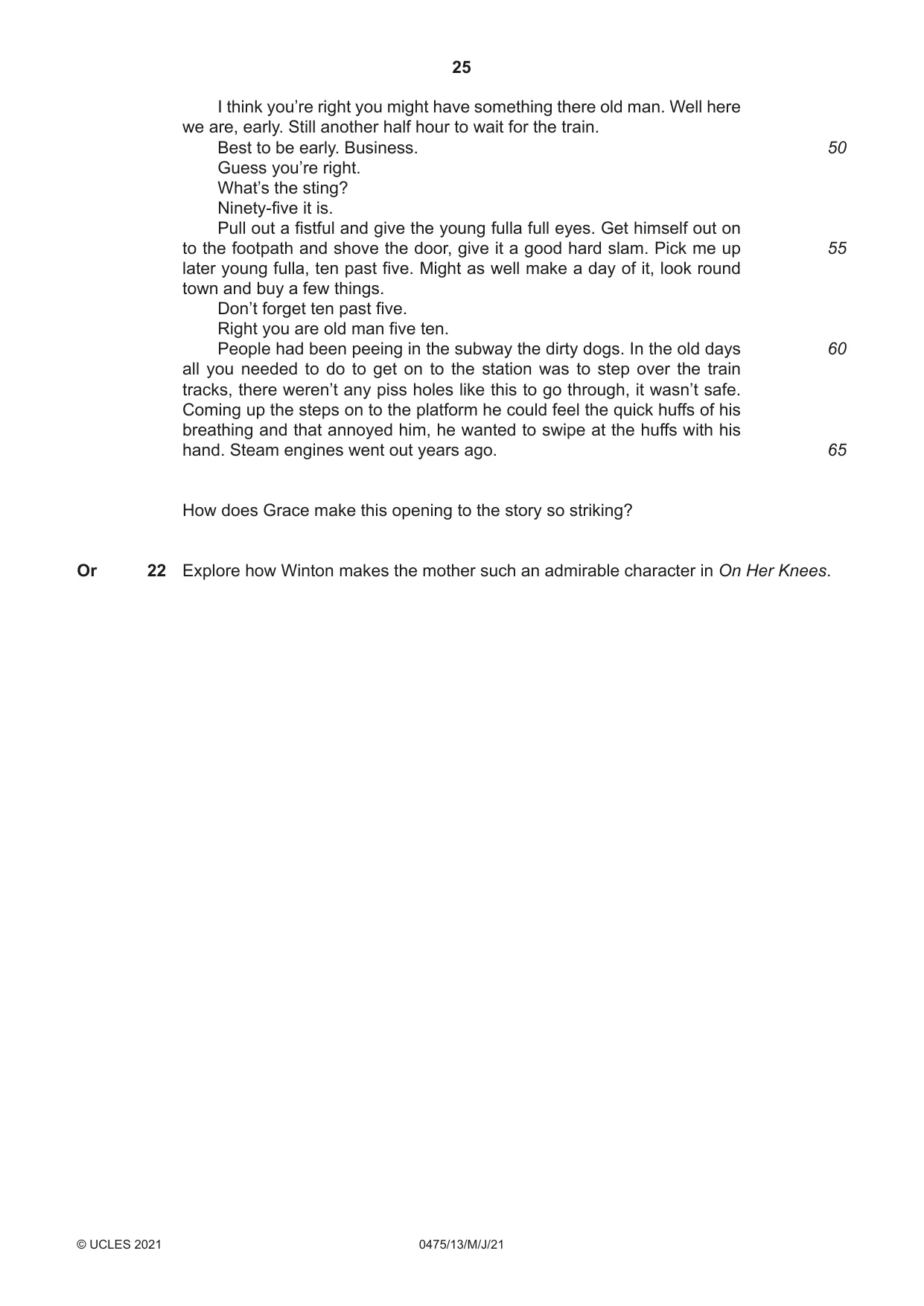
25 0475/13/M/J/21 © UCLES 2021 I think you’re right you might have something there old man. Well here we are, early. Still another half hour to wait for the train. Best to be early. Business. Guess you’re right. What’s the sting? Ninety-five it is. Pull out a fistful and give the young fulla full eyes. Get himself out on to the footpath and shove the door, give it a good hard slam. Pick me up later young fulla, ten past five. Might as well make a day of it, look round town and buy a few things. Don’t forget ten past five. Right you are old man five ten. People had been peeing in the subway the dirty dogs. In the old days all you needed to do to get on to the station was to step over the train tracks, there weren’t any piss holes like this to go through, it wasn’t safe. Coming up the steps on to the platform he could feel the quick huffs of his breathing and that annoyed him, he wanted to swipe at the huffs with his hand. Steam engines went out years ago. How does Grace make this opening to the story so striking? Or 22 Explore how Winton makes the mother such an admirable character in On Her Knees. 50 55 60 65
Question paper, page 26
26 0475/13/M/J/21 © UCLES 2021 BLANK PAGE
Question paper, page 27
27 0475/13/M/J/21 © UCLES 2021 BLANK PAGE
Question paper, page 28
28 0475/13/M/J/21 © UCLES 2021 Permission to reproduce items where third-party owned material protected by copyright is included has been sought and cleared where possible. Every reasonable effort has been made by the publisher (UCLES) to trace copyright holders, but if any items requiring clearance have unwittingly been included, the publisher will be pleased to make amends at the earliest possible opportunity. To avoid the issue of disclosure of answer-related information to candidates, all copyright acknowledgements are reproduced online in the Cambridge Assessment International Education Copyright Acknowledgements Booklet. This is produced for each series of examinations and is freely available to download at www.cambridgeinternational.org after the live examination series. Cambridge Assessment International Education is part of the Cambridge Assessment Group. Cambridge Assessment is the brand name of the University of Cambridge Local Examinations Syndicate (UCLES), which itself is a department of the University of Cambridge. BLANK PAGE
Mark scheme, page 1
This document consists of 6 printed pages. © UCLES 2021 [Turn over Cambridge IGCSE™ LITERATURE IN ENGLISH 0475/13 Paper 1 Poetry and Prose 13 May/June 2021 MARK SCHEME Maximum Mark: 50 Published This mark scheme is published as an aid to teachers and candidates, to indicate the requirements of the examination. It shows the basis on which Examiners were instructed to award marks. It does not indicate the details of the discussions that took place at an Examiners’ meeting before marking began, which would have considered the acceptability of alternative answers. Mark schemes should be read in conjunction with the question paper and the Principal Examiner Report for Teachers. Cambridge International will not enter into discussions about these mark schemes. Cambridge International is publishing the mark schemes for the May/June 2021 series for most Cambridge IGCSE™, Cambridge International A and AS Level components and some Cambridge O Level components.
Mark scheme, page 2
0475/13 Cambridge IGCSE – Mark Scheme PUBLISHED May/June 2021 © UCLES 2021 Page 2 of 6 Generic Marking Principles These general marking principles must be applied by all examiners when marking candidate answers. They should be applied alongside the specific content of the mark scheme or generic level descriptors for a question. Each question paper and mark scheme will also comply with these marking principles. GENERIC MARKING PRINCIPLE 1: Marks must be awarded in line with: • the specific content of the mark scheme or the generic level descriptors for the question • the specific skills defined in the mark scheme or in the generic level descriptors for the question • the standard of response required by a candidate as exemplified by the standardisation scripts. GENERIC MARKING PRINCIPLE 2: Marks awarded are always whole marks (not half marks, or other fractions). GENERIC MARKING PRINCIPLE 3: Marks must be awarded positively: • marks are awarded for correct/valid answers, as defined in the mark scheme. However, credit is given for valid answers which go beyond the scope of the syllabus and mark scheme, referring to your Team Leader as appropriate • marks are awarded when candidates clearly demonstrate what they know and can do • marks are not deducted for errors • marks are not deducted for omissions • answers should only be judged on the quality of spelling, punctuation and grammar when these features are specifically assessed by the question as indicated by the mark scheme. The meaning, however, should be unambiguous. GENERIC MARKING PRINCIPLE 4: Rules must be applied consistently, e.g. in situations where candidates have not followed instructions or in the application of generic level descriptors. GENERIC MARKING PRINCIPLE 5: Marks should be awarded using the full range of marks defined in the mark scheme for the question (however; the use of the full mark range may be limited according to the quality of the candidate responses seen). GENERIC MARKING PRINCIPLE 6: Marks awarded are based solely on the requirements as defined in the mark scheme. Marks should not be awarded with grade thresholds or grade descriptors in mind.
Mark scheme, page 3
0475/13 Cambridge IGCSE – Mark Scheme PUBLISHED May/June 2021 © UCLES 2021 Page 3 of 6 English & Media subject specific general marking principles (To be read in conjunction with the Generic Marking Principles (and requiring further guidance on how to place marks within levels)) Components using level descriptors: • We use level descriptors as a guide to broad understanding of the qualities normally expected of, or typical of, work in a level. • Level descriptors are a means of general guidance, and should not be interpreted as hurdle statements. • Where indicative content notes are supplied for a question, these are not a prescription of required content, and must not be treated as such. Alternative correct points and unexpected answers in candidates’ scripts must be given marks that fairly reflect the knowledge and skills demonstrated. • While we may have legitimate expectations as to the ground most answers may occupy, we must at all times be prepared to meet candidates on their chosen ground, provided it is relevant ground (e.g. clearly related to and derived from a relevant passage/text and meeting the mark scheme requirements for the question). Components using point-based marking: Point marking is often used to reward knowledge, understanding and application of skills. We give credit where the candidate’s answer shows relevant knowledge, understanding and application of skills in answering the question. We do not give credit where the answer shows confusion. From this it follows that we: a DO credit answers which are worded differently from the mark scheme if they clearly convey the same meaning (unless the mark scheme requires a specific term). b DO credit alternative answers/examples which are not written in the mark scheme if they are correct. c DO credit answers where candidates give more than one correct answer in one prompt/numbered/scaffolded space where extended writing is required rather than list-type answers. For example, questions that require n reasons (e.g. State two reasons…). d DO NOT credit answers simply for using a ‘key term’ unless that is all that is required. (Check for evidence it is understood and not used wrongly.). e DO NOT credit answers which are obviously self-contradicting or trying to cover all possibilities. f DO NOT give further credit for what is effectively repetition of a correct point already credited unless the language itself is being tested. This applies equally to ‘mirror statements’ (i.e. polluted/not polluted). g DO NOT require spellings to be correct, unless this is part of the test. However spellings of syllabus terms must allow for clear and unambiguous separation from other syllabus terms with which they may be confused (e.g. Corrasion/Corrosion).
Mark scheme, page 4
0475/13 Cambridge IGCSE – Mark Scheme PUBLISHED May/June 2021 © UCLES 2021 Page 4 of 6 Using the mark bands All Assessment Objectives are equally weighted in this paper. Place the answer in a band first. Look for the best fit of the answer into a band. An answer needs to show evidence of most but not necessarily all of the qualities described in a band in order to be placed in that band. Then award a mark for the relative position of the answer within the band. Candidates sometimes mis-number questions under the pressure of timed conditions. Please check that you are marking against the correct question number.
Mark scheme, page 5
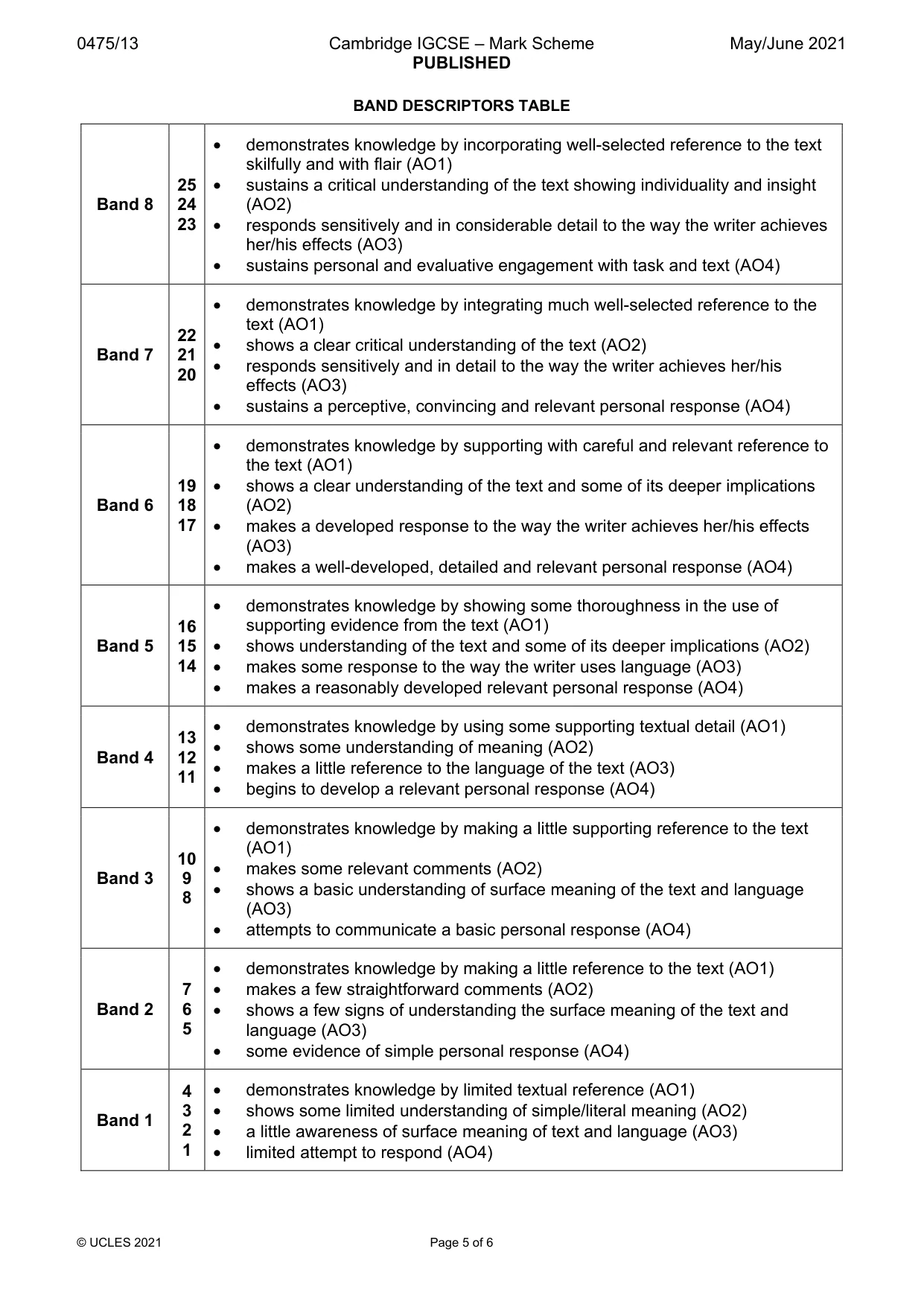
0475/13 Cambridge IGCSE – Mark Scheme PUBLISHED May/June 2021 © UCLES 2021 Page 5 of 6 BAND DESCRIPTORS TABLE Band 8 25 24 23 • demonstrates knowledge by incorporating well-selected reference to the text skilfully and with flair (AO1) • sustains a critical understanding of the text showing individuality and insight (AO2) • responds sensitively and in considerable detail to the way the writer achieves her/his effects (AO3) • sustains personal and evaluative engagement with task and text (AO4) Band 7 22 21 20 • demonstrates knowledge by integrating much well-selected reference to the text (AO1) • shows a clear critical understanding of the text (AO2) • responds sensitively and in detail to the way the writer achieves her/his effects (AO3) • sustains a perceptive, convincing and relevant personal response (AO4) Band 6 19 18 17 • demonstrates knowledge by supporting with careful and relevant reference to the text (AO1) • shows a clear understanding of the text and some of its deeper implications (AO2) • makes a developed response to the way the writer achieves her/his effects (AO3) • makes a well-developed, detailed and relevant personal response (AO4) Band 5 16 15 14 • demonstrates knowledge by showing some thoroughness in the use of supporting evidence from the text (AO1) • shows understanding of the text and some of its deeper implications (AO2) • makes some response to the way the writer uses language (AO3) • makes a reasonably developed relevant personal response (AO4) Band 4 13 12 11 • demonstrates knowledge by using some supporting textual detail (AO1) • shows some understanding of meaning (AO2) • makes a little reference to the language of the text (AO3) • begins to develop a relevant personal response (AO4) Band 3 10 9 8 • demonstrates knowledge by making a little supporting reference to the text (AO1) • makes some relevant comments (AO2) • shows a basic understanding of surface meaning of the text and language (AO3) • attempts to communicate a basic personal response (AO4) Band 2 7 6 5 • demonstrates knowledge by making a little reference to the text (AO1) • makes a few straightforward comments (AO2) • shows a few signs of understanding the surface meaning of the text and language (AO3) • some evidence of simple personal response (AO4) Band 1 4 3 2 1 • demonstrates knowledge by limited textual reference (AO1) • shows some limited understanding of simple/literal meaning (AO2) • a little awareness of surface meaning of text and language (AO3) • limited attempt to respond (AO4)
Mark scheme, page 6
0475/13 Cambridge IGCSE – Mark Scheme PUBLISHED May/June 2021 © UCLES 2021 Page 6 of 6 Band 0 0 • No answer/Insufficient to meet the criteria for Band 1.
What you needed in this session
Cambridge’s own grade thresholds for 2021 May/June, Paper 1 · Variant 3. A higher threshold means an easier paper — the bar moves with how the cohort did.