Cambridge IGCSE English - Literature in English 0475 — 2021 May/June Paper 1 · Variant 1
0475/11/M/J/21 · 50 marks · ≈56 min
The question paper and its mark scheme, free to read here and free to download. This is Cambridge’s own paper, exactly as it was sat.
Question paper28 pages




Mark scheme4 pages
Answers below. Sit the paper first if you are practising.
Paper as text
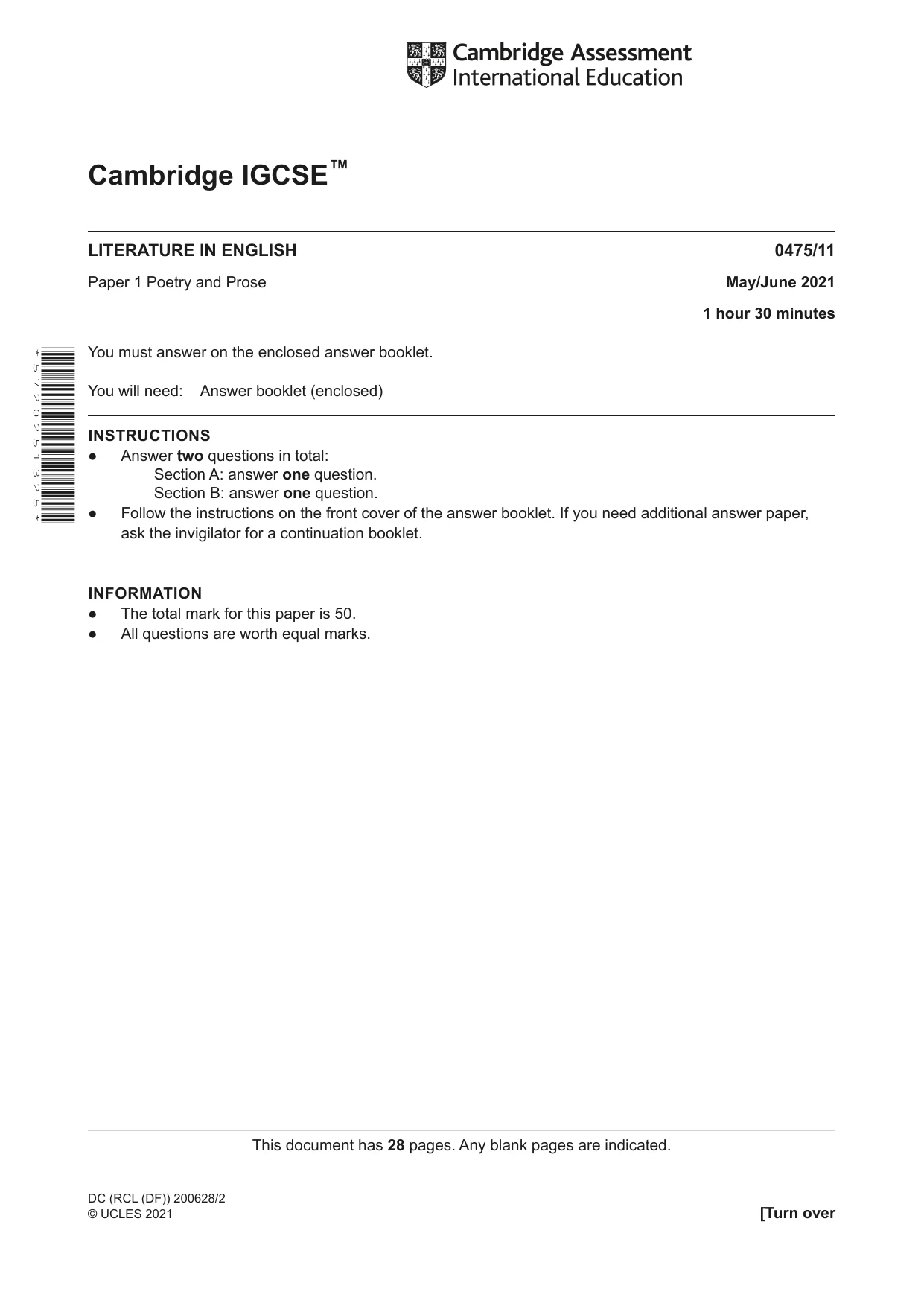
Question paper, page 1
This document has 28 pages. Any blank pages are indicated. Cambridge IGCSE™ LITERATURE IN ENGLISH 0475/11 Paper 1 Poetry and Prose May/June 2021 1 hour 30 minutes You must answer on the enclosed answer booklet. You will need: Answer booklet (enclosed) INSTRUCTIONS ● Answer two questions in total: Section A: answer one question. Section B: answer one question. ● Follow the instructions on the front cover of the answer booklet. If you need additional answer paper, ask the invigilator for a continuation booklet. INFORMATION ● The total mark for this paper is 50. ● All questions are worth equal marks. * 5 7 2 0 2 5 1 3 2 5 * DC (RCL (DF)) 200628/2 © UCLES 2021 [Turn over
Question paper, page 2
2 0475/11/M/J/21 © UCLES 2021 BLANK PAGE
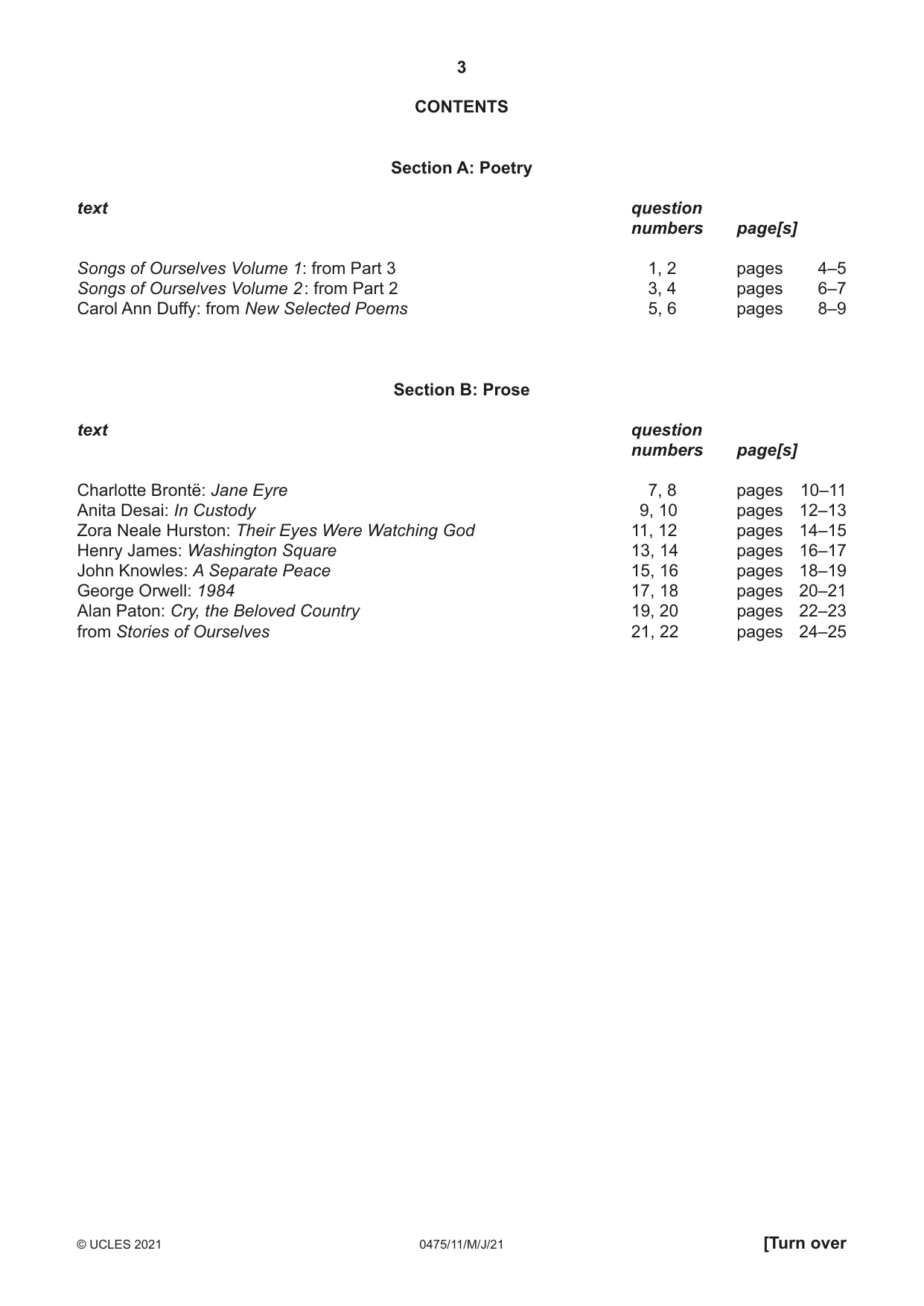
Question paper, page 3
3 0475/11/M/J/21 © UCLES 2021 [Turn over CONTENTS Section A: Poetry text question numbers page[s] Songs of Ourselves Volume 1: from Part 3 1, 2 pages 4–5 Songs of Ourselves Volume 2 : from Part 2 3, 4 pages 6–7 Carol Ann Duffy: from New Selected Poems 5, 6 pages 8–9 Section B: Prose text question numbers page[s] Charlotte Brontë: Jane Eyre 7, 8 pages 10–11 Anita Desai: In Custody 9, 10 pages 12–13 Zora Neale Hurston: Their Eyes Were Watching God 11, 12 pages 14–15 Henry James: Washington Square 13, 14 pages 16–17 John Knowles: A Separate Peace 15, 16 pages 18–19 George Orwell: 1984 17, 18 pages 20–21 Alan Paton: Cry, the Beloved Country 19, 20 pages 22–23 from Stories of Ourselves 21, 22 pages 24–25
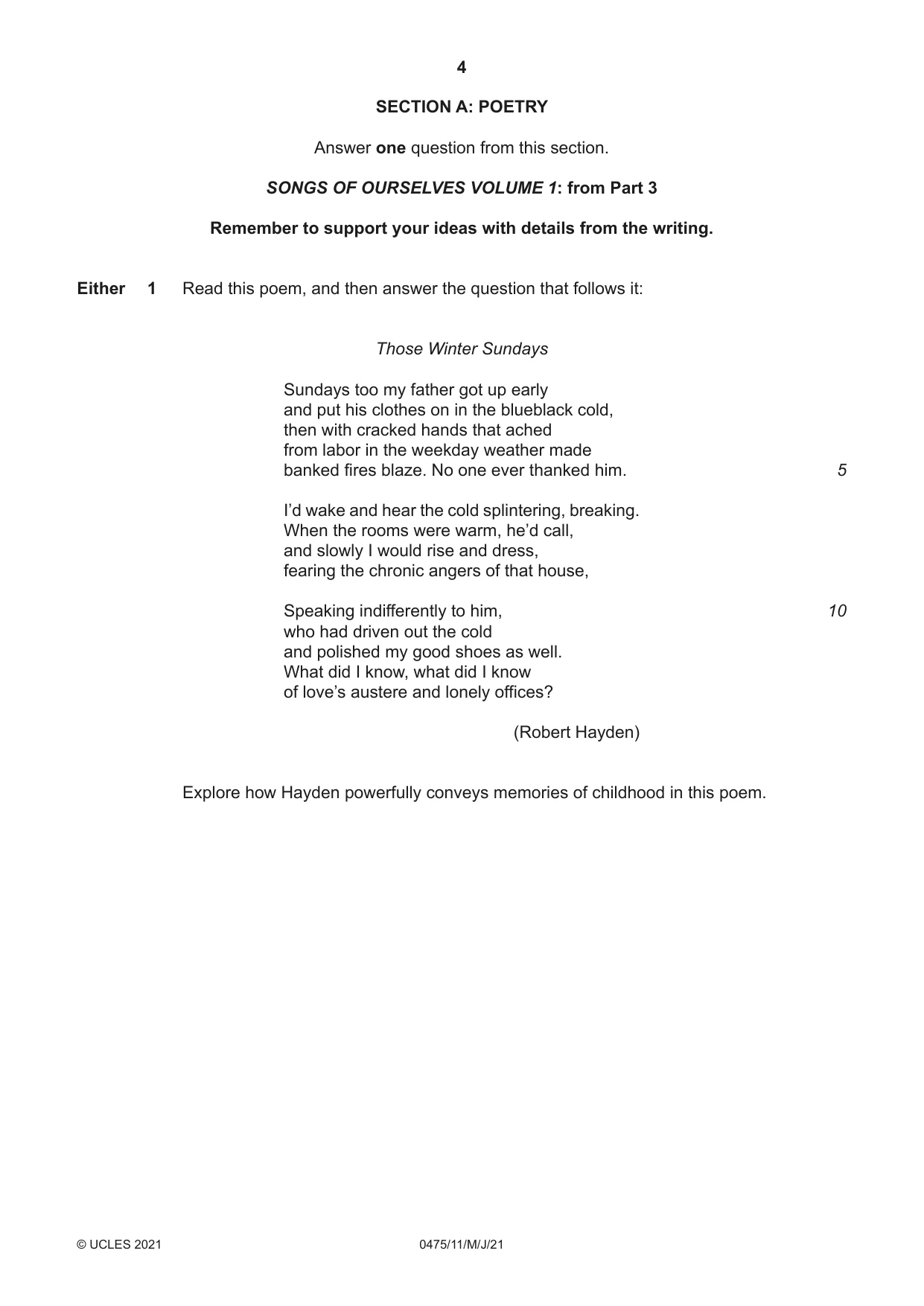
Question paper, page 4
4 0475/11/M/J/21 © UCLES 2021 SECTION A: POETRY Answer one question from this section. SONGS OF OURSELVES VOLUME 1: from Part 3 Remember to support your ideas with details from the writing. Either 1 Read this poem, and then answer the question that follows it: Those Winter Sundays Sundays too my father got up early and put his clothes on in the blueblack cold, then with cracked hands that ached from labor in the weekday weather made banked fires blaze. No one ever thanked him. I’d wake and hear the cold splintering, breaking. When the rooms were warm, he’d call, and slowly I would rise and dress, fearing the chronic angers of that house, Speaking indifferently to him, who had driven out the cold and polished my good shoes as well. What did I know, what did I know of love’s austere and lonely offices? (Robert Hayden) Explore how Hayden powerfully conveys memories of childhood in this poem. 5 10
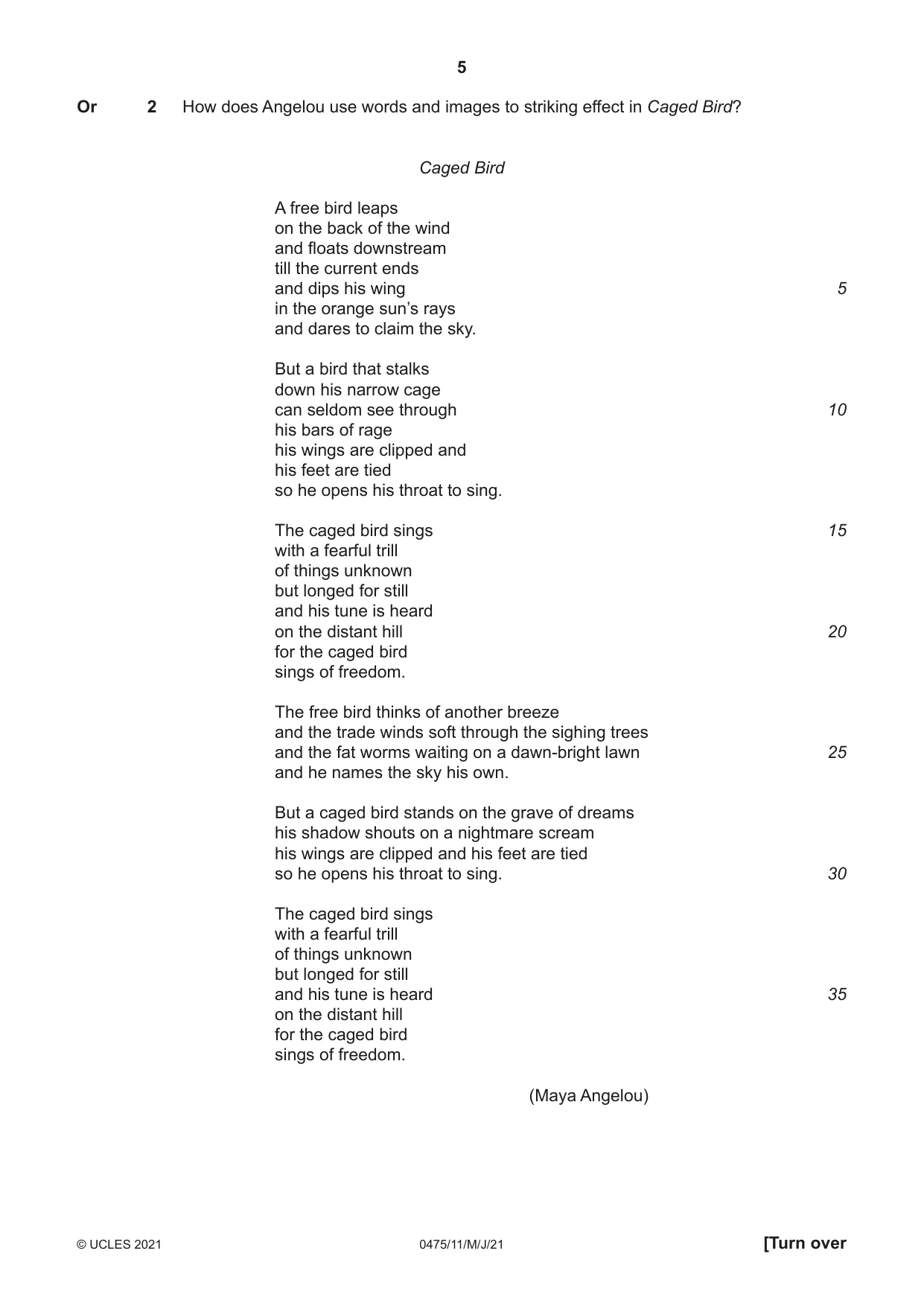
Question paper, page 5
5 0475/11/M/J/21 © UCLES 2021 [Turn over Or 2 How does Angelou use words and images to striking effect in Caged Bird? Caged Bird A free bird leaps on the back of the wind and floats downstream till the current ends and dips his wing in the orange sun’s rays and dares to claim the sky. But a bird that stalks down his narrow cage can seldom see through his bars of rage his wings are clipped and his feet are tied so he opens his throat to sing. The caged bird sings with a fearful trill of things unknown but longed for still and his tune is heard on the distant hill for the caged bird sings of freedom. The free bird thinks of another breeze and the trade winds soft through the sighing trees and the fat worms waiting on a dawn-bright lawn and he names the sky his own. But a caged bird stands on the grave of dreams his shadow shouts on a nightmare scream his wings are clipped and his feet are tied so he opens his throat to sing. The caged bird sings with a fearful trill of things unknown but longed for still and his tune is heard on the distant hill for the caged bird sings of freedom. (Maya Angelou) 5 10 15 20 25 30 35
Question paper, page 6
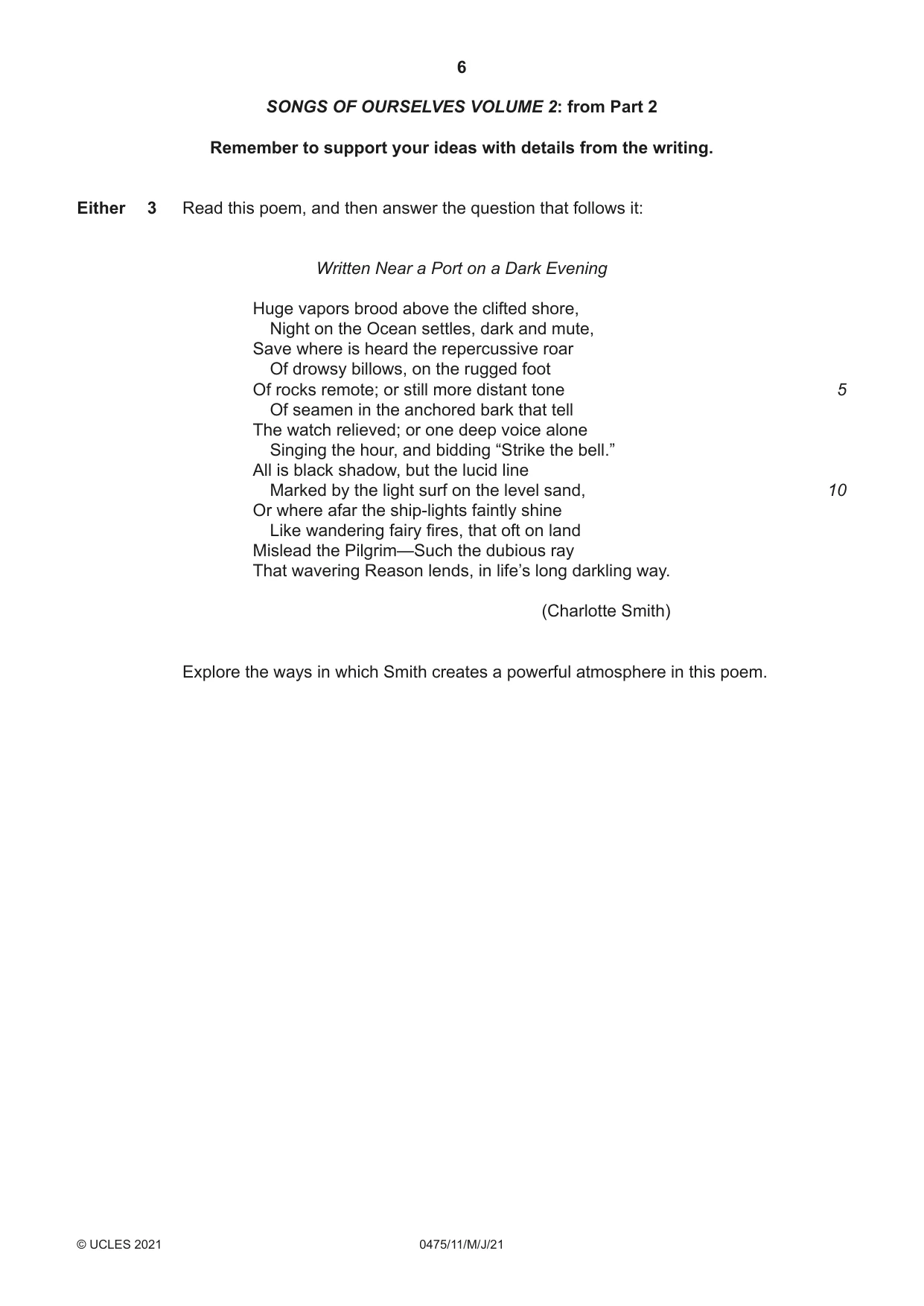
6 0475/11/M/J/21 © UCLES 2021 SONGS OF OURSELVES VOLUME 2: from Part 2 Remember to support your ideas with details from the writing. Either 3 Read this poem, and then answer the question that follows it: Written Near a Port on a Dark Evening Huge vapors brood above the clifted shore, Night on the Ocean settles, dark and mute, Save where is heard the repercussive roar Of drowsy billows, on the rugged foot Of rocks remote; or still more distant tone Of seamen in the anchored bark that tell The watch relieved; or one deep voice alone Singing the hour, and bidding “Strike the bell.” All is black shadow, but the lucid line Marked by the light surf on the level sand, Or where afar the ship-lights faintly shine Like wandering fairy fires, that oft on land Mislead the Pilgrim—Such the dubious ray That wavering Reason lends, in life’s long darkling way. (Charlotte Smith) Explore the ways in which Smith creates a powerful atmosphere in this poem. 5 10
Question paper, page 7
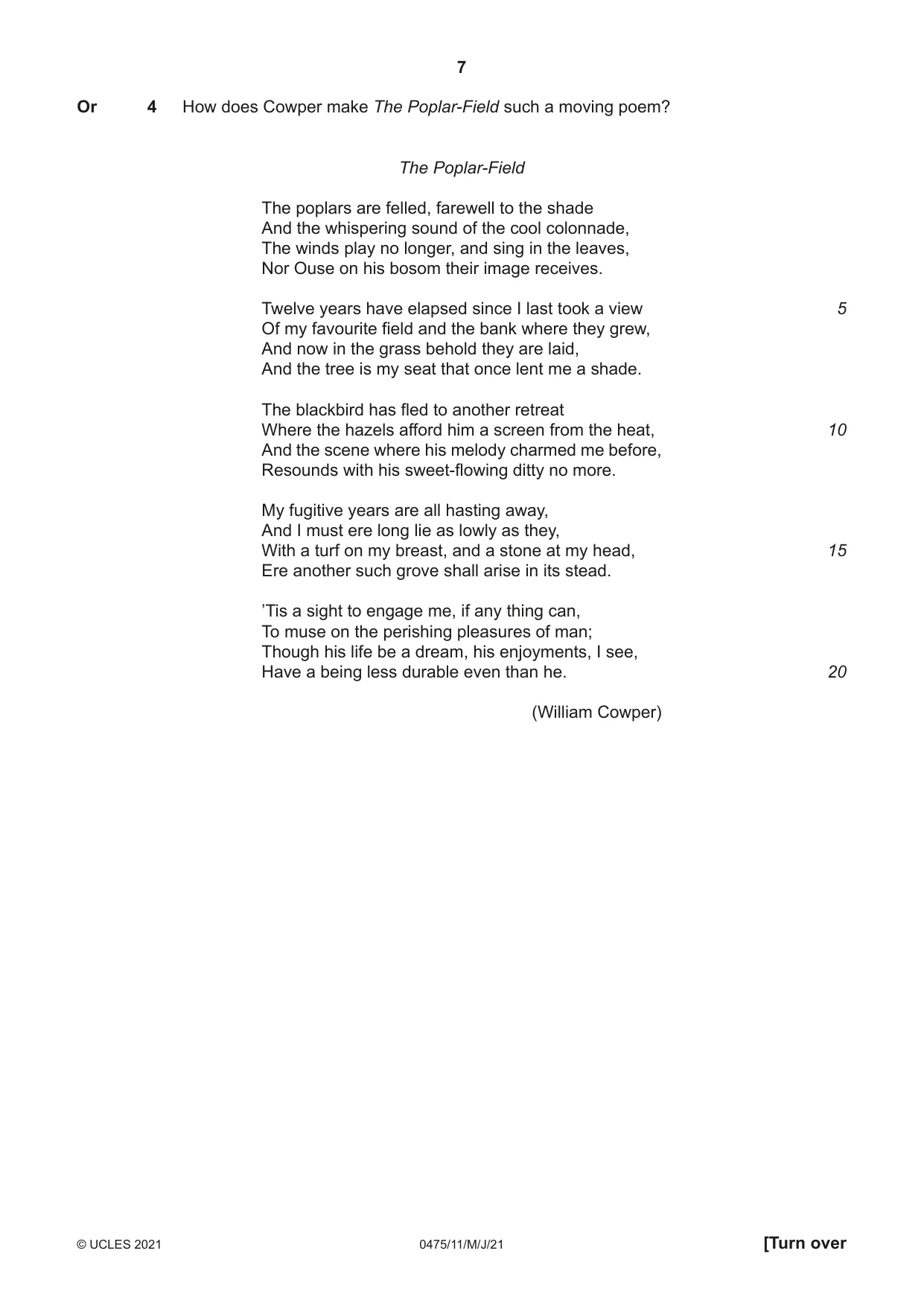
7 0475/11/M/J/21 © UCLES 2021 [Turn over Or 4 How does Cowper make The Poplar-Field such a moving poem? The Poplar-Field The poplars are felled, farewell to the shade And the whispering sound of the cool colonnade, The winds play no longer, and sing in the leaves, Nor Ouse on his bosom their image receives. Twelve years have elapsed since I last took a view Of my favourite field and the bank where they grew, And now in the grass behold they are laid, And the tree is my seat that once lent me a shade. The blackbird has fled to another retreat Where the hazels afford him a screen from the heat, And the scene where his melody charmed me before, Resounds with his sweet-flowing ditty no more. My fugitive years are all hasting away, And I must ere long lie as lowly as they, With a turf on my breast, and a stone at my head, Ere another such grove shall arise in its stead. ’Tis a sight to engage me, if any thing can, To muse on the perishing pleasures of man; Though his life be a dream, his enjoyments, I see, Have a being less durable even than he. (William Cowper) 5 10 15 20
Question paper, page 8
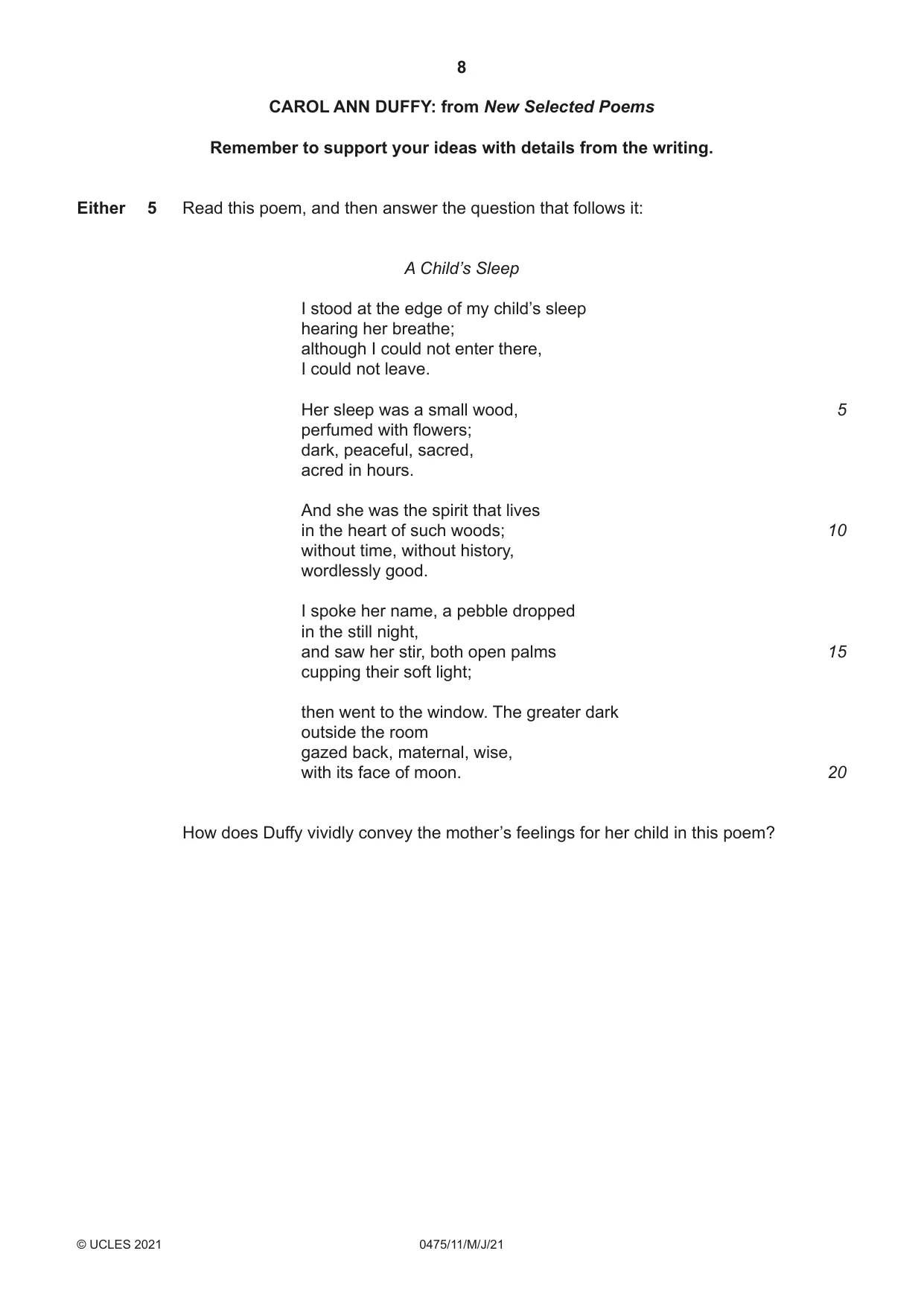
8 0475/11/M/J/21 © UCLES 2021 CAROL ANN DUFFY: from New Selected Poems Remember to support your ideas with details from the writing. Either 5 Read this poem, and then answer the question that follows it: A Child’s Sleep I stood at the edge of my child’s sleep hearing her breathe; although I could not enter there, I could not leave. Her sleep was a small wood, perfumed with flowers; dark, peaceful, sacred, acred in hours. And she was the spirit that lives in the heart of such woods; without time, without history, wordlessly good. I spoke her name, a pebble dropped in the still night, and saw her stir, both open palms cupping their soft light; then went to the window. The greater dark outside the room gazed back, maternal, wise, with its face of moon. How does Duffy vividly convey the mother’s feelings for her child in this poem? 5 10 15 20
Question paper, page 9
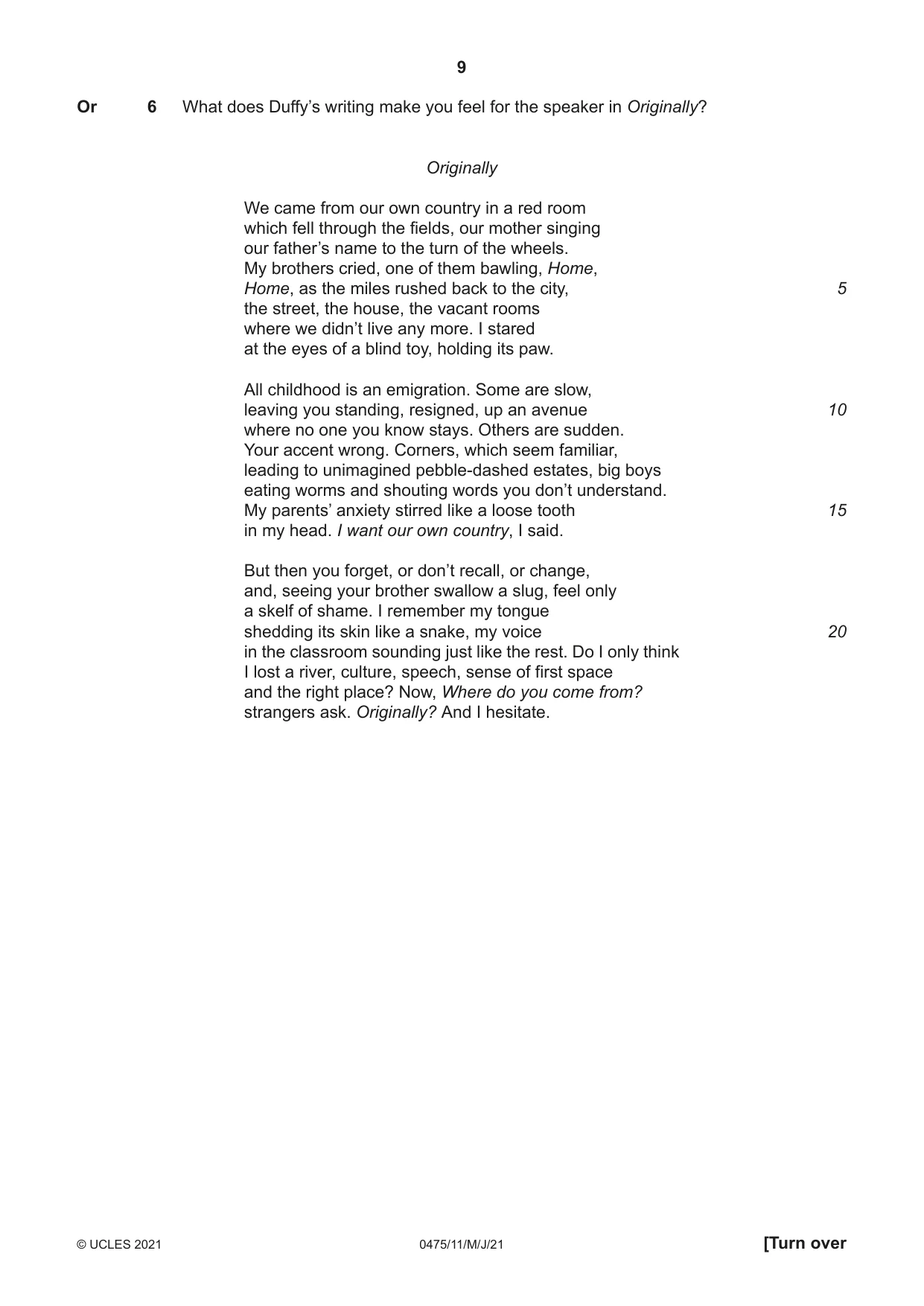
9 0475/11/M/J/21 © UCLES 2021 [Turn over Or 6 What does Duffy’s writing make you feel for the speaker in Originally? Originally We came from our own country in a red room which fell through the fields, our mother singing our father’s name to the turn of the wheels. My brothers cried, one of them bawling, Home, Home, as the miles rushed back to the city, the street, the house, the vacant rooms where we didn’t live any more. I stared at the eyes of a blind toy, holding its paw. All childhood is an emigration. Some are slow, leaving you standing, resigned, up an avenue where no one you know stays. Others are sudden. Your accent wrong. Corners, which seem familiar, leading to unimagined pebble-dashed estates, big boys eating worms and shouting words you don’t understand. My parents’ anxiety stirred like a loose tooth in my head. I want our own country, I said. But then you forget, or don’t recall, or change, and, seeing your brother swallow a slug, feel only a skelf of shame. I remember my tongue shedding its skin like a snake, my voice in the classroom sounding just like the rest. Do I only think I lost a river, culture, speech, sense of first space and the right place? Now, Where do you come from? strangers ask. Originally? And I hesitate. 5 10 15 20
Question paper, page 10
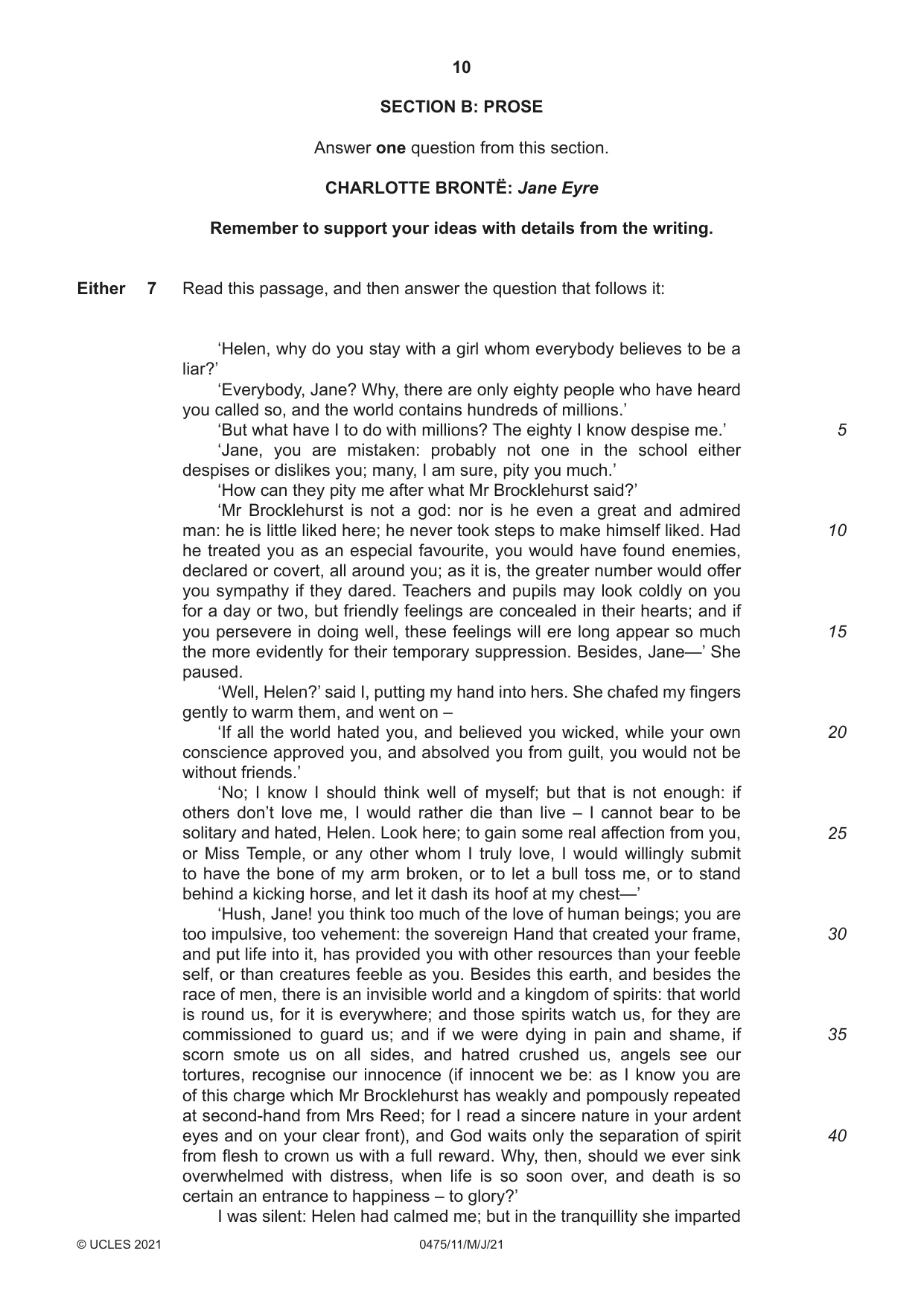
10 0475/11/M/J/21 © UCLES 2021 SECTION B: PROSE Answer one question from this section. CHARLOTTE BRONTË: Jane Eyre Remember to support your ideas with details from the writing. Either 7 Read this passage, and then answer the question that follows it: ‘Helen, why do you stay with a girl whom everybody believes to be a liar?’ ‘Everybody, Jane? Why, there are only eighty people who have heard you called so, and the world contains hundreds of millions.’ ‘But what have I to do with millions? The eighty I know despise me.’ ‘Jane, you are mistaken: probably not one in the school either despises or dislikes you; many, I am sure, pity you much.’ ‘How can they pity me after what Mr Brocklehurst said?’ ‘Mr Brocklehurst is not a god: nor is he even a great and admired man: he is little liked here; he never took steps to make himself liked. Had he treated you as an especial favourite, you would have found enemies, declared or covert, all around you; as it is, the greater number would offer you sympathy if they dared. Teachers and pupils may look coldly on you for a day or two, but friendly feelings are concealed in their hearts; and if you persevere in doing well, these feelings will ere long appear so much the more evidently for their temporary suppression. Besides, Jane—’ She paused. ‘Well, Helen?’ said I, putting my hand into hers. She chafed my fingers gently to warm them, and went on – ‘If all the world hated you, and believed you wicked, while your own conscience approved you, and absolved you from guilt, you would not be without friends.’ ‘No; I know I should think well of myself; but that is not enough: if others don’t love me, I would rather die than live – I cannot bear to be solitary and hated, Helen. Look here; to gain some real affection from you, or Miss Temple, or any other whom I truly love, I would willingly submit to have the bone of my arm broken, or to let a bull toss me, or to stand behind a kicking horse, and let it dash its hoof at my chest—’ ‘Hush, Jane! you think too much of the love of human beings; you are too impulsive, too vehement: the sovereign Hand that created your frame, and put life into it, has provided you with other resources than your feeble self, or than creatures feeble as you. Besides this earth, and besides the race of men, there is an invisible world and a kingdom of spirits: that world is round us, for it is everywhere; and those spirits watch us, for they are commissioned to guard us; and if we were dying in pain and shame, if scorn smote us on all sides, and hatred crushed us, angels see our tortures, recognise our innocence (if innocent we be: as I know you are of this charge which Mr Brocklehurst has weakly and pompously repeated at second-hand from Mrs Reed; for I read a sincere nature in your ardent eyes and on your clear front), and God waits only the separation of spirit from flesh to crown us with a full reward. Why, then, should we ever sink overwhelmed with distress, when life is so soon over, and death is so certain an entrance to happiness – to glory?’ I was silent: Helen had calmed me; but in the tranquillity she imparted 5 10 15 20 25 30 35 40
Question paper, page 11
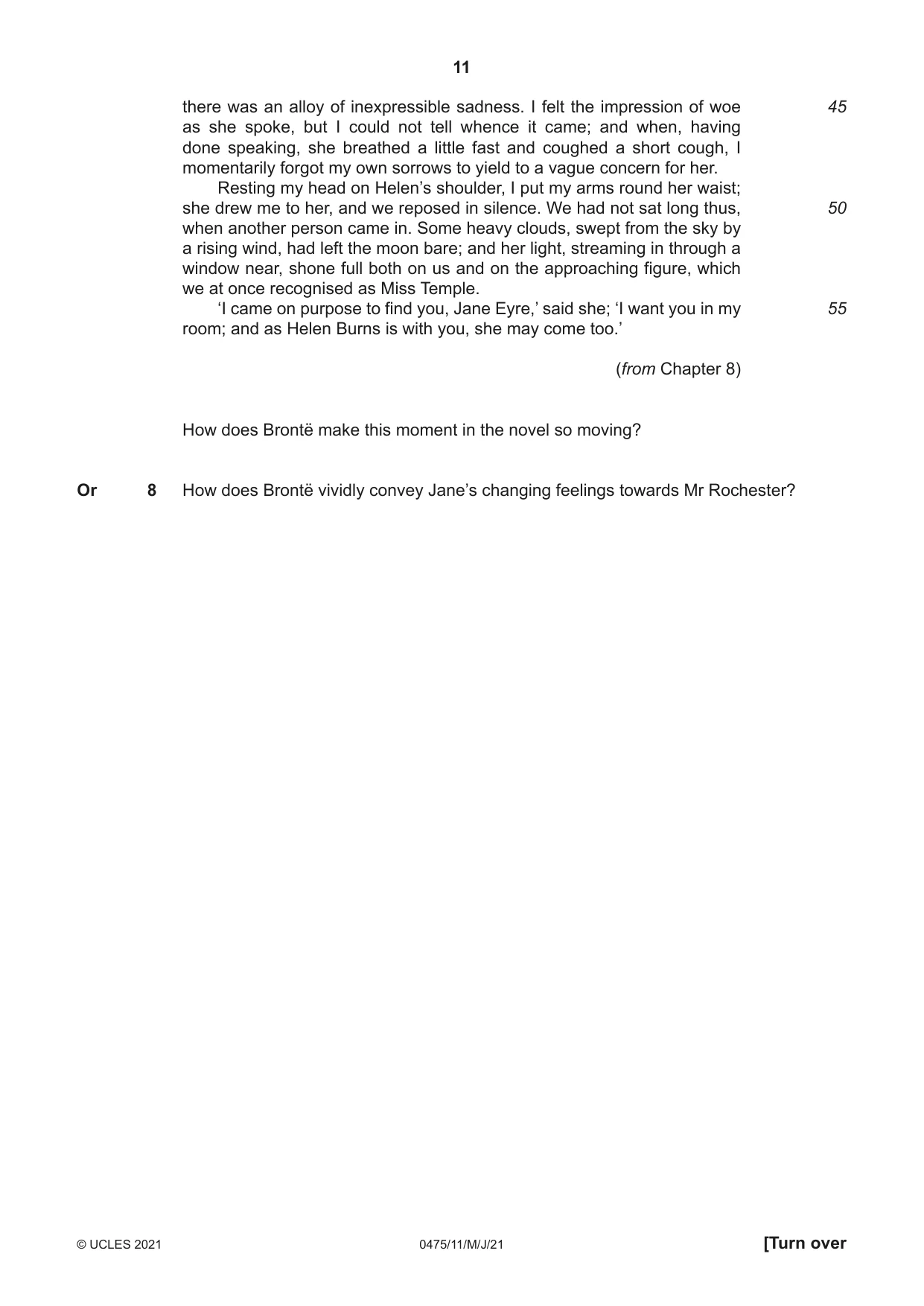
11 0475/11/M/J/21 © UCLES 2021 [Turn over there was an alloy of inexpressible sadness. I felt the impression of woe as she spoke, but I could not tell whence it came; and when, having done speaking, she breathed a little fast and coughed a short cough, I momentarily forgot my own sorrows to yield to a vague concern for her. Resting my head on Helen’s shoulder, I put my arms round her waist; she drew me to her, and we reposed in silence. We had not sat long thus, when another person came in. Some heavy clouds, swept from the sky by a rising wind, had left the moon bare; and her light, streaming in through a window near, shone full both on us and on the approaching figure, which we at once recognised as Miss Temple. ‘I came on purpose to find you, Jane Eyre,’ said she; ‘I want you in my room; and as Helen Burns is with you, she may come too.’ (from Chapter 8) How does Brontë make this moment in the novel so moving? Or 8 How does Brontë vividly convey Jane’s changing feelings towards Mr Rochester? 45 50 55
Question paper, page 12
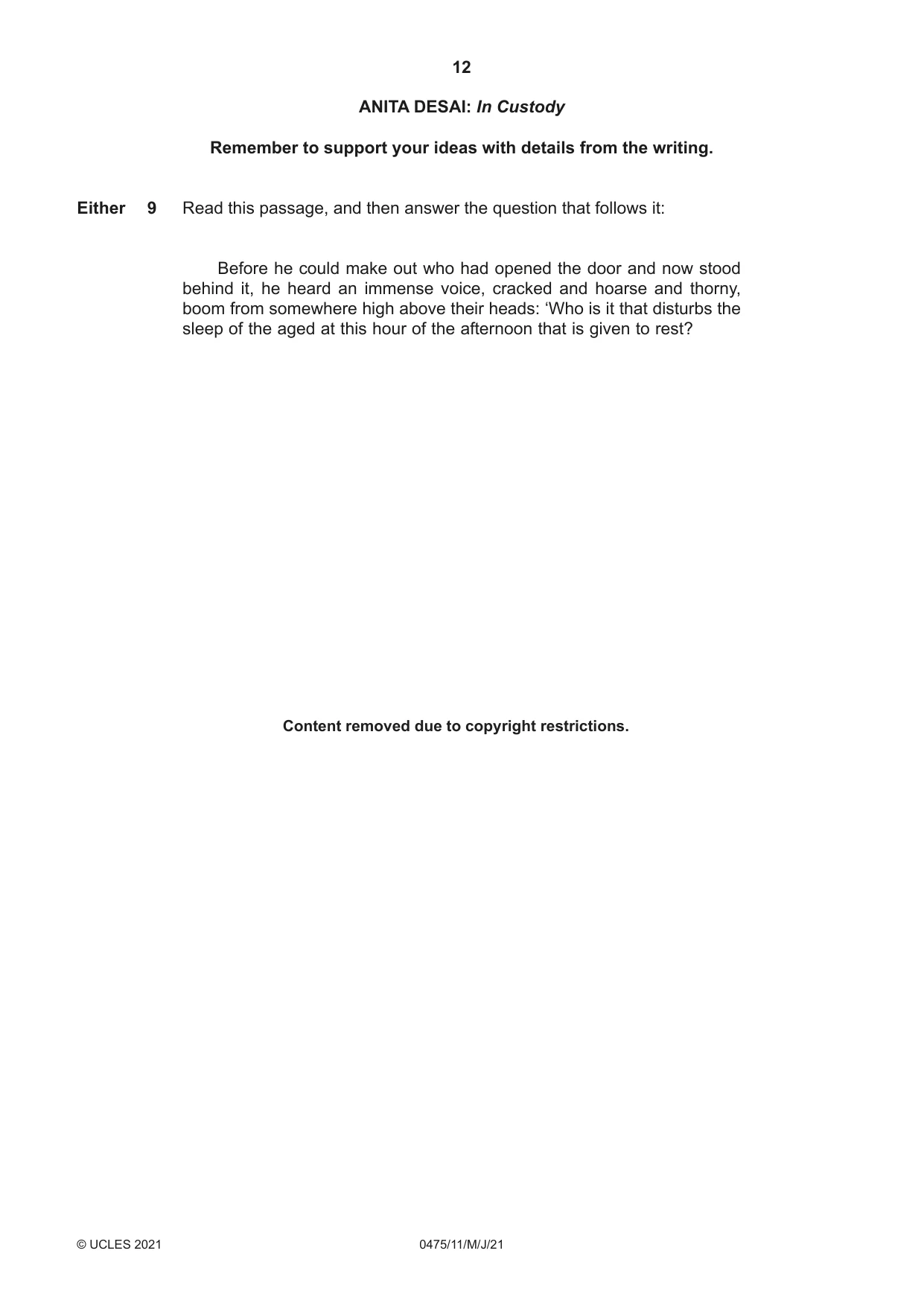
12 0475/11/M/J/21 © UCLES 2021 ANITA DESAI: In Custody Remember to support your ideas with details from the writing. Either 9 Read this passage, and then answer the question that follows it: Before he could make out who had opened the door and now stood behind it, he heard an immense voice, cracked and hoarse and thorny, boom from somewhere high above their heads: ‘Who is it that disturbs the sleep of the aged at this hour of the afternoon that is given to rest? Content removed due to copyright restrictions.
Question paper, page 13
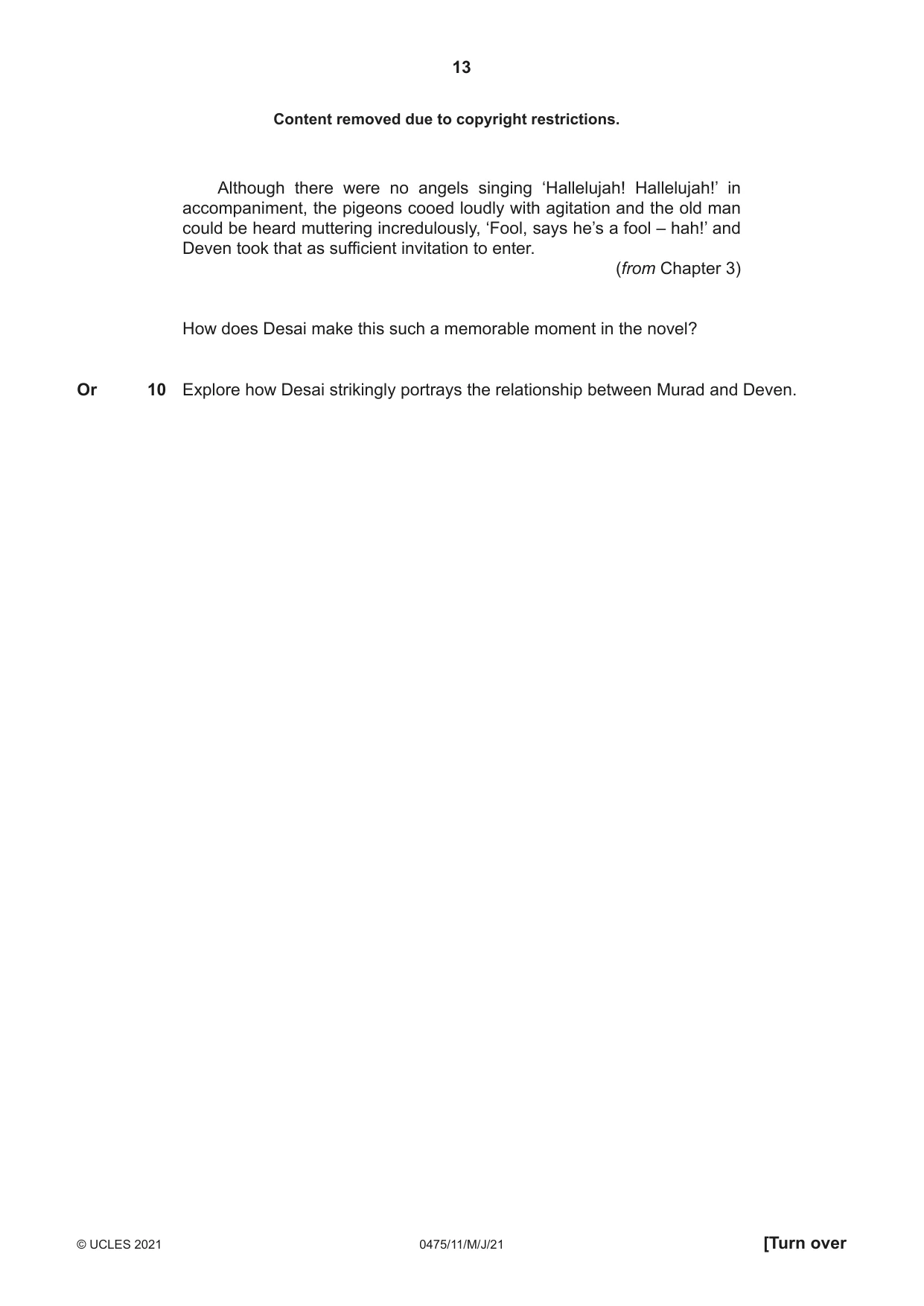
13 0475/11/M/J/21 © UCLES 2021 [Turn over Although there were no angels singing ‘Hallelujah! Hallelujah!’ in accompaniment, the pigeons cooed loudly with agitation and the old man could be heard muttering incredulously, ‘Fool, says he’s a fool – hah!’ and Deven took that as sufficient invitation to enter. (from Chapter 3) How does Desai make this such a memorable moment in the novel? Or 10 Explore how Desai strikingly portrays the relationship between Murad and Deven. Content removed due to copyright restrictions.
Question paper, page 14
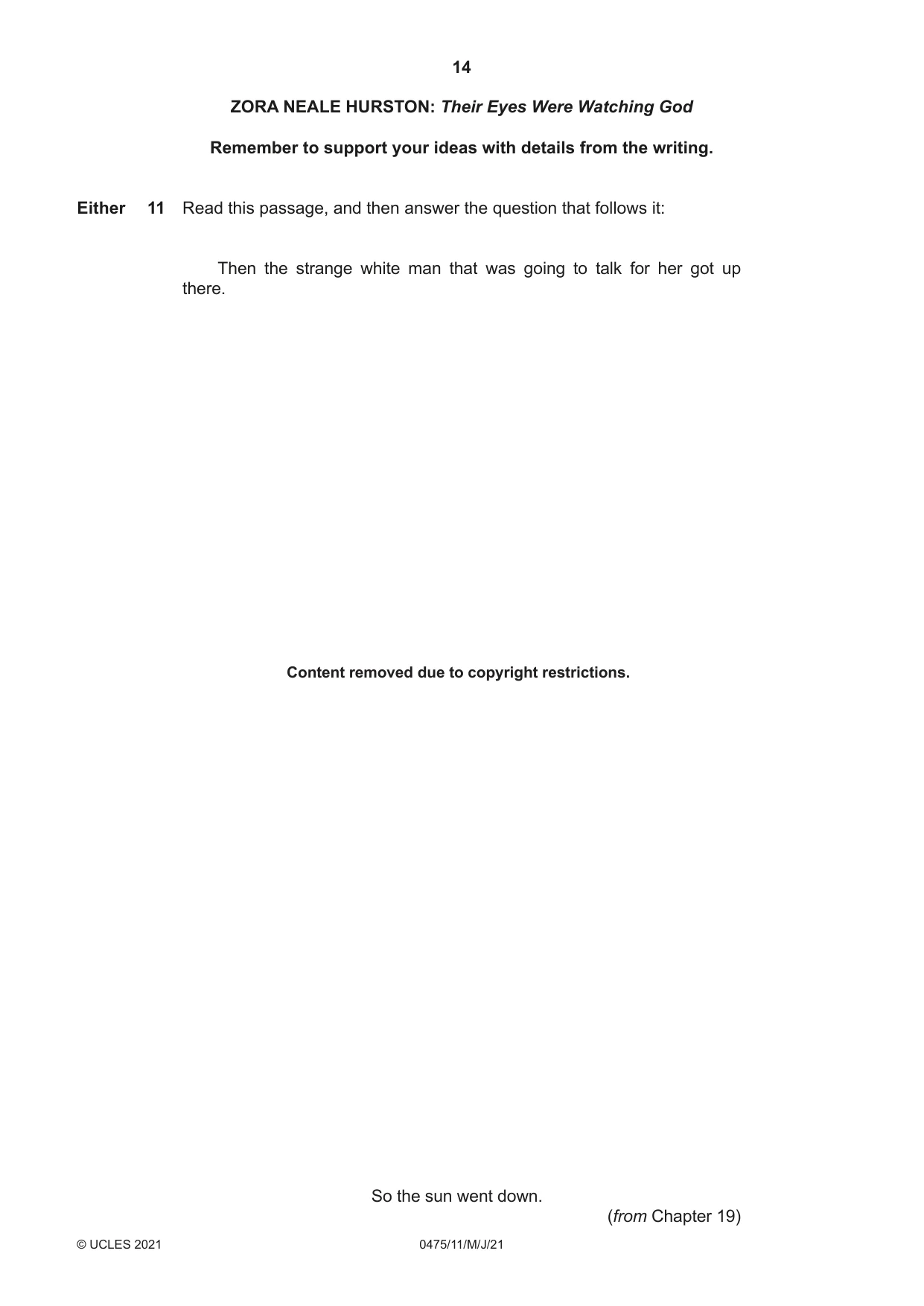
14 0475/11/M/J/21 © UCLES 2021 ZORA NEALE HURSTON: Their Eyes Were Watching God Remember to support your ideas with details from the writing. Either 11 Read this passage, and then answer the question that follows it: Then the strange white man that was going to talk for her got up there. So the sun went down. (from Chapter 19) Content removed due to copyright restrictions.
Question paper, page 15
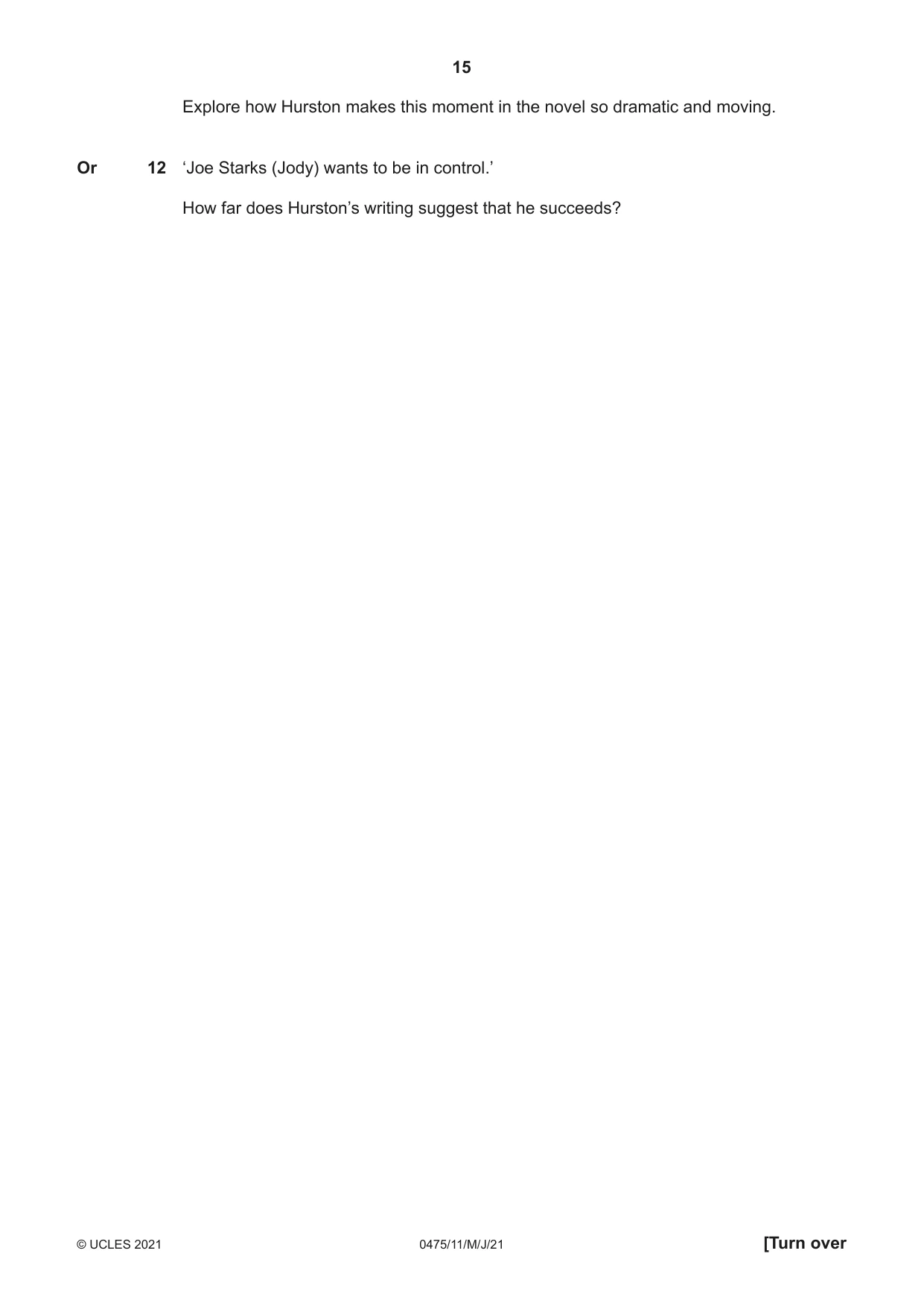
15 0475/11/M/J/21 © UCLES 2021 [Turn over Explore how Hurston makes this moment in the novel so dramatic and moving. Or 12 ‘Joe Starks (Jody) wants to be in control.’ How far does Hurston’s writing suggest that he succeeds?
Question paper, page 16
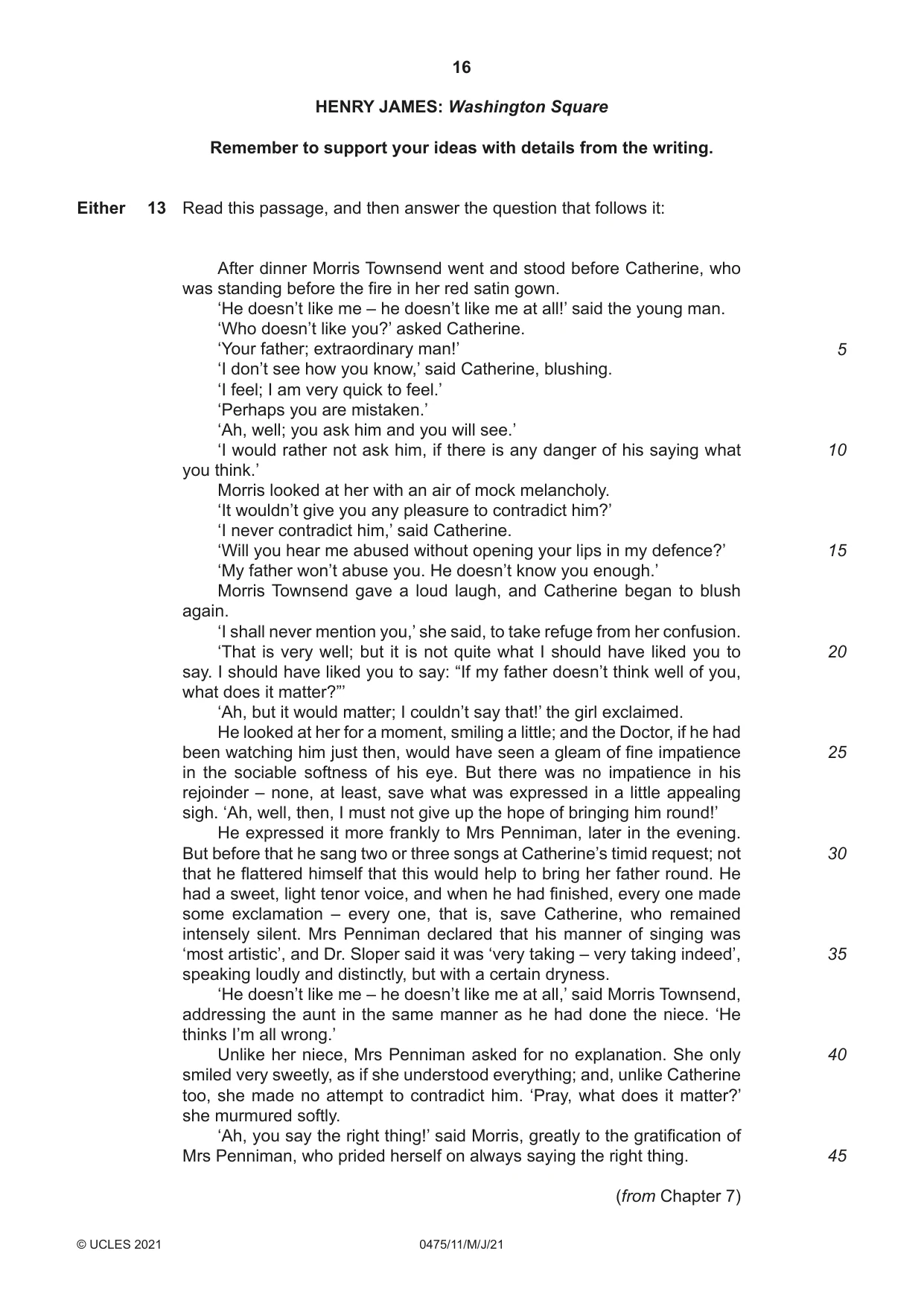
16 0475/11/M/J/21 © UCLES 2021 HENRY JAMES: Washington Square Remember to support your ideas with details from the writing. Either 13 Read this passage, and then answer the question that follows it: After dinner Morris Townsend went and stood before Catherine, who was standing before the fire in her red satin gown. ‘He doesn’t like me – he doesn’t like me at all!’ said the young man. ‘Who doesn’t like you?’ asked Catherine. ‘Your father; extraordinary man!’ ‘I don’t see how you know,’ said Catherine, blushing. ‘I feel; I am very quick to feel.’ ‘Perhaps you are mistaken.’ ‘Ah, well; you ask him and you will see.’ ‘I would rather not ask him, if there is any danger of his saying what you think.’ Morris looked at her with an air of mock melancholy. ‘It wouldn’t give you any pleasure to contradict him?’ ‘I never contradict him,’ said Catherine. ‘Will you hear me abused without opening your lips in my defence?’ ‘My father won’t abuse you. He doesn’t know you enough.’ Morris Townsend gave a loud laugh, and Catherine began to blush again. ‘I shall never mention you,’ she said, to take refuge from her confusion. ‘That is very well; but it is not quite what I should have liked you to say. I should have liked you to say: “If my father doesn’t think well of you, what does it matter?”’ ‘Ah, but it would matter; I couldn’t say that!’ the girl exclaimed. He looked at her for a moment, smiling a little; and the Doctor, if he had been watching him just then, would have seen a gleam of fine impatience in the sociable softness of his eye. But there was no impatience in his rejoinder – none, at least, save what was expressed in a little appealing sigh. ‘Ah, well, then, I must not give up the hope of bringing him round!’ He expressed it more frankly to Mrs Penniman, later in the evening. But before that he sang two or three songs at Catherine’s timid request; not that he flattered himself that this would help to bring her father round. He had a sweet, light tenor voice, and when he had finished, every one made some exclamation – every one, that is, save Catherine, who remained intensely silent. Mrs Penniman declared that his manner of singing was ‘most artistic’, and Dr. Sloper said it was ‘very taking – very taking indeed’, speaking loudly and distinctly, but with a certain dryness. ‘He doesn’t like me – he doesn’t like me at all,’ said Morris Townsend, addressing the aunt in the same manner as he had done the niece. ‘He thinks I’m all wrong.’ Unlike her niece, Mrs Penniman asked for no explanation. She only smiled very sweetly, as if she understood everything; and, unlike Catherine too, she made no attempt to contradict him. ‘Pray, what does it matter?’ she murmured softly. ‘Ah, you say the right thing!’ said Morris, greatly to the gratification of Mrs Penniman, who prided herself on always saying the right thing. (from Chapter 7) 5 10 15 20 25 30 35 40 45
Question paper, page 17
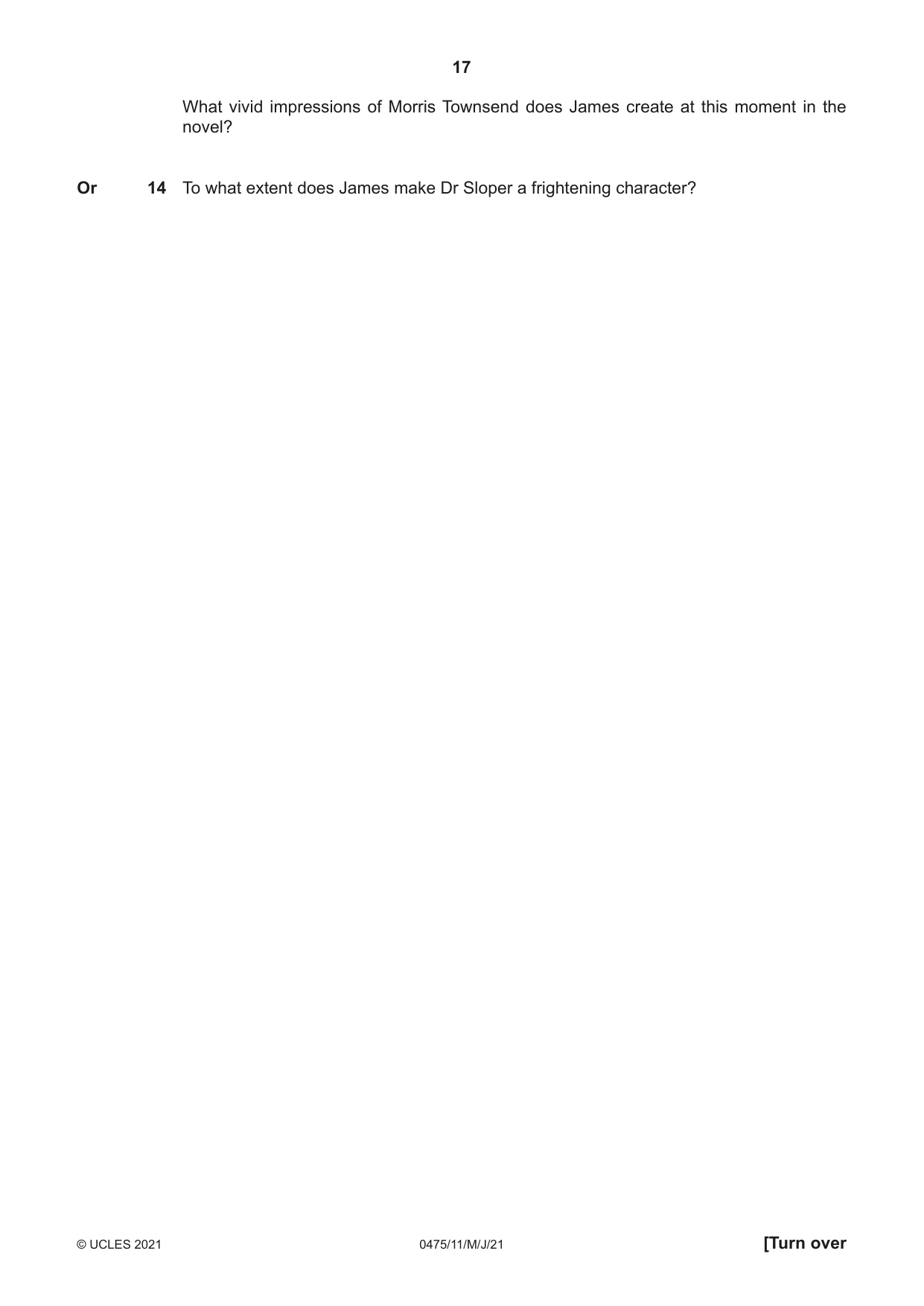
17 0475/11/M/J/21 © UCLES 2021 [Turn over What vivid impressions of Morris Townsend does James create at this moment in the novel? Or 14 To what extent does James make Dr Sloper a frightening character?
Question paper, page 18
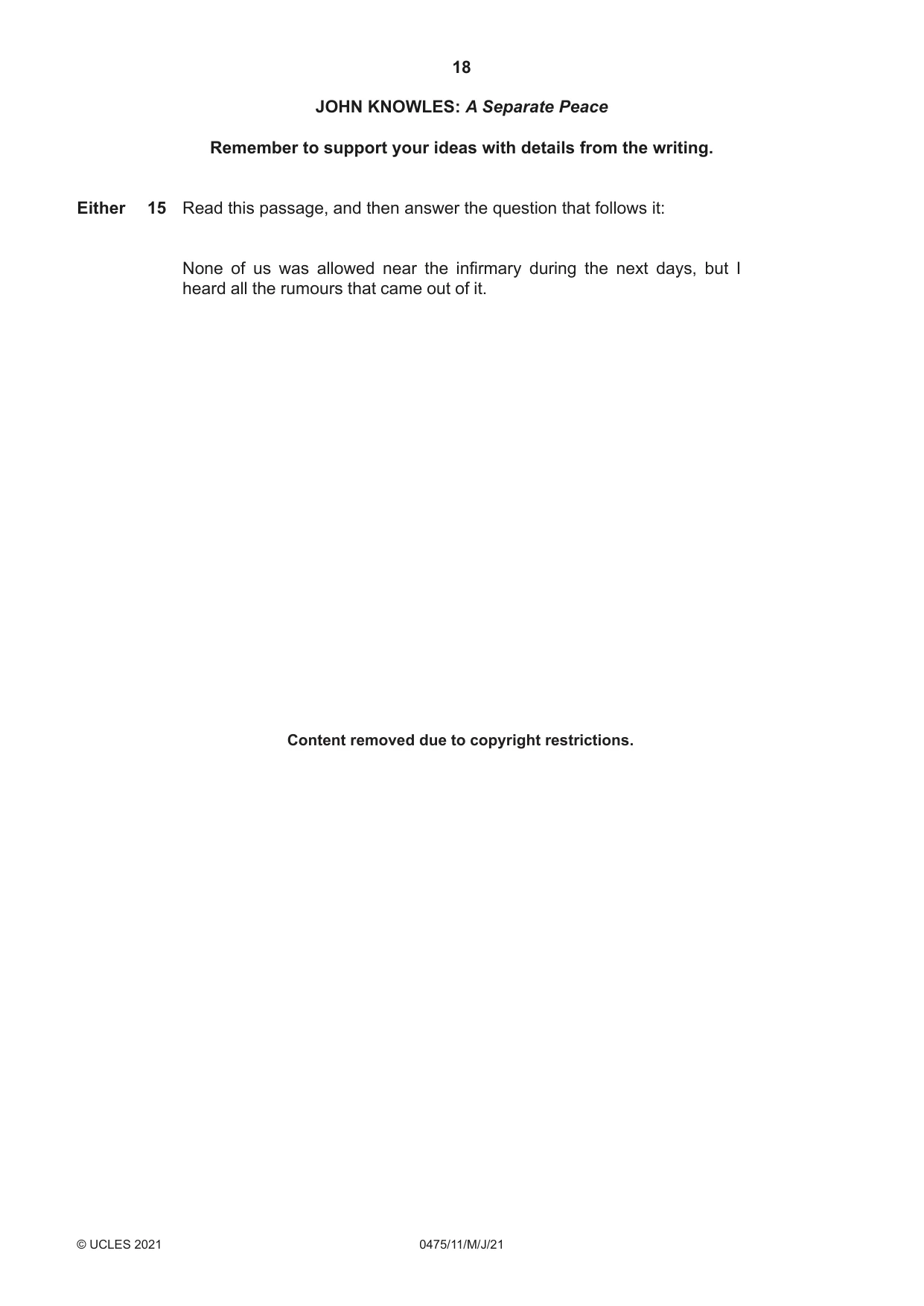
18 0475/11/M/J/21 © UCLES 2021 JOHN KNOWLES: A Separate Peace Remember to support your ideas with details from the writing. Either 15 Read this passage, and then answer the question that follows it: None of us was allowed near the infirmary during the next days, but I heard all the rumours that came out of it. Content removed due to copyright restrictions.
Question paper, page 19
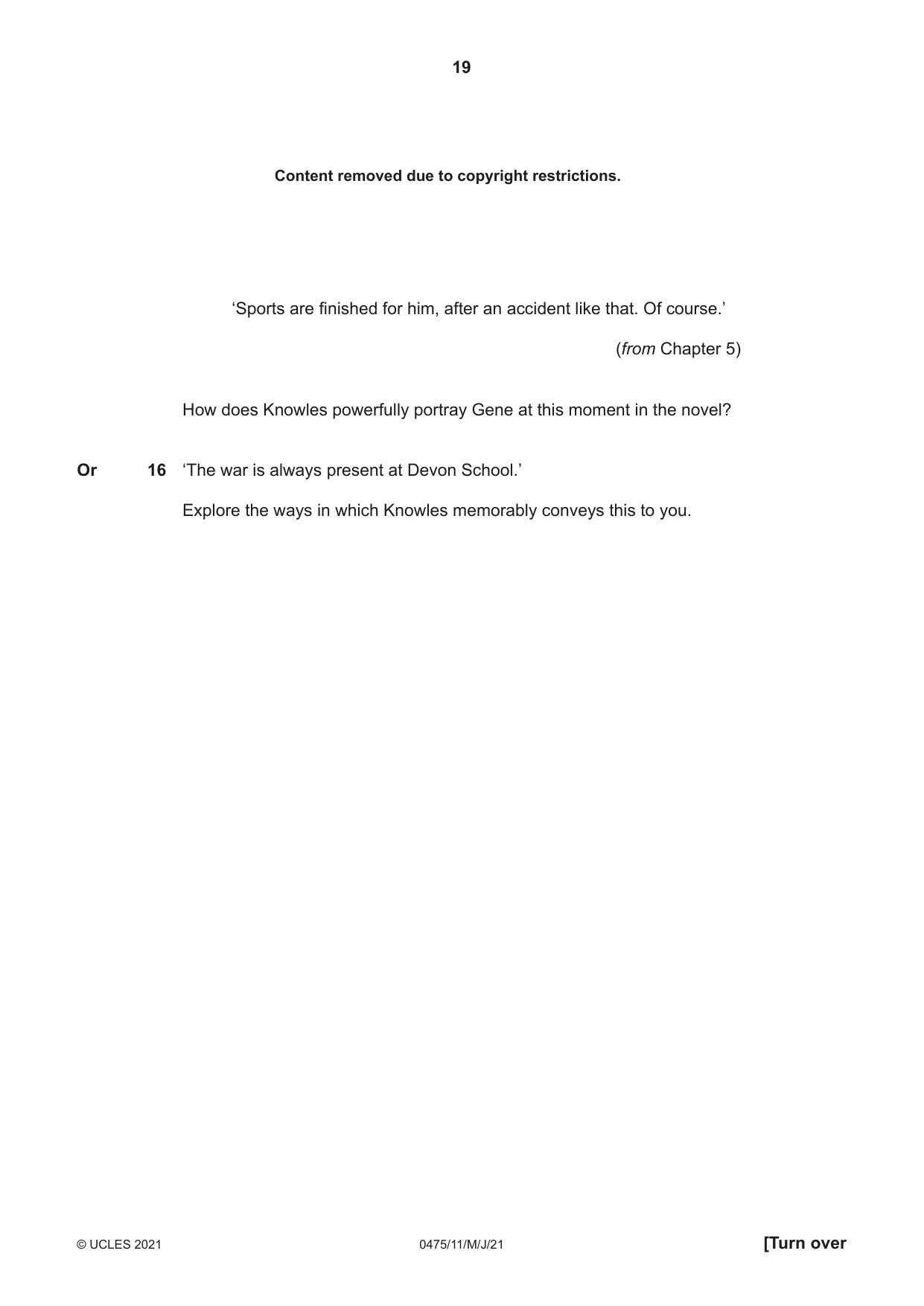
19 0475/11/M/J/21 © UCLES 2021 [Turn over ‘Sports are finished for him, after an accident like that. Of course.’ (from Chapter 5) How does Knowles powerfully portray Gene at this moment in the novel? Or 16 ‘The war is always present at Devon School.’ Explore the ways in which Knowles memorably conveys this to you. Content removed due to copyright restrictions.
Question paper, page 20
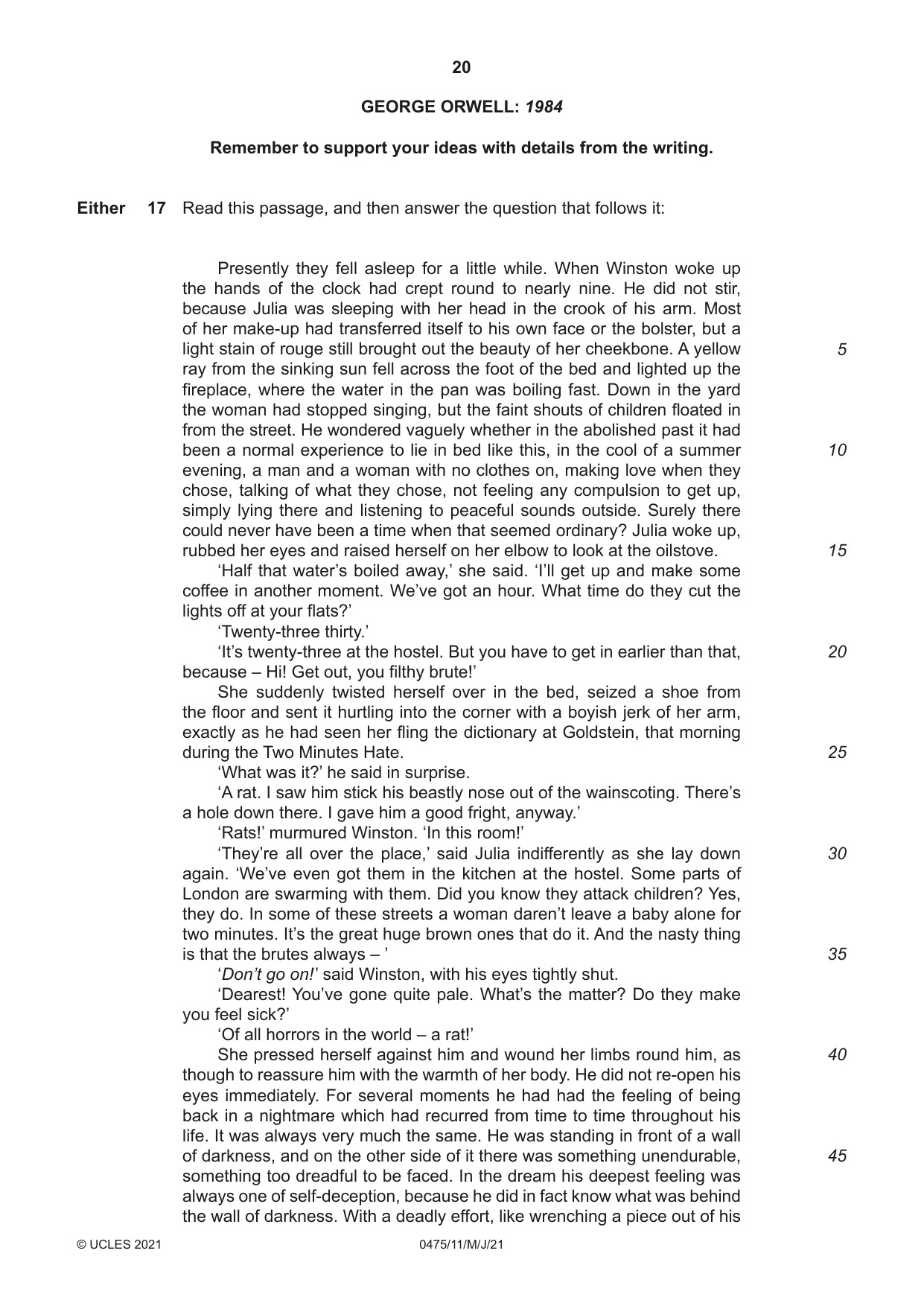
20 0475/11/M/J/21 © UCLES 2021 GEORGE ORWELL: 1984 Remember to support your ideas with details from the writing. Either 17 Read this passage, and then answer the question that follows it: Presently they fell asleep for a little while. When Winston woke up the hands of the clock had crept round to nearly nine. He did not stir, because Julia was sleeping with her head in the crook of his arm. Most of her make-up had transferred itself to his own face or the bolster, but a light stain of rouge still brought out the beauty of her cheekbone. A yellow ray from the sinking sun fell across the foot of the bed and lighted up the fireplace, where the water in the pan was boiling fast. Down in the yard the woman had stopped singing, but the faint shouts of children floated in from the street. He wondered vaguely whether in the abolished past it had been a normal experience to lie in bed like this, in the cool of a summer evening, a man and a woman with no clothes on, making love when they chose, talking of what they chose, not feeling any compulsion to get up, simply lying there and listening to peaceful sounds outside. Surely there could never have been a time when that seemed ordinary? Julia woke up, rubbed her eyes and raised herself on her elbow to look at the oilstove. ‘Half that water’s boiled away,’ she said. ‘I’ll get up and make some coffee in another moment. We’ve got an hour. What time do they cut the lights off at your flats?’ ‘Twenty-three thirty.’ ‘It’s twenty-three at the hostel. But you have to get in earlier than that, because – Hi! Get out, you filthy brute!’ She suddenly twisted herself over in the bed, seized a shoe from the floor and sent it hurtling into the corner with a boyish jerk of her arm, exactly as he had seen her fling the dictionary at Goldstein, that morning during the Two Minutes Hate. ‘What was it?’ he said in surprise. ‘A rat. I saw him stick his beastly nose out of the wainscoting. There’s a hole down there. I gave him a good fright, anyway.’ ‘Rats!’ murmured Winston. ‘In this room!’ ‘They’re all over the place,’ said Julia indifferently as she lay down again. ‘We’ve even got them in the kitchen at the hostel. Some parts of London are swarming with them. Did you know they attack children? Yes, they do. In some of these streets a woman daren’t leave a baby alone for two minutes. It’s the great huge brown ones that do it. And the nasty thing is that the brutes always – ’ ‘Don’t go on! ’ said Winston, with his eyes tightly shut. ‘Dearest! You’ve gone quite pale. What’s the matter? Do they make you feel sick?’ ‘Of all horrors in the world – a rat!’ She pressed herself against him and wound her limbs round him, as though to reassure him with the warmth of her body. He did not re-open his eyes immediately. For several moments he had had the feeling of being back in a nightmare which had recurred from time to time throughout his life. It was always very much the same. He was standing in front of a wall of darkness, and on the other side of it there was something unendurable, something too dreadful to be faced. In the dream his deepest feeling was always one of self-deception, because he did in fact know what was behind the wall of darkness. With a deadly effort, like wrenching a piece out of his 5 10 15 20 25 30 35 40 45
Question paper, page 21
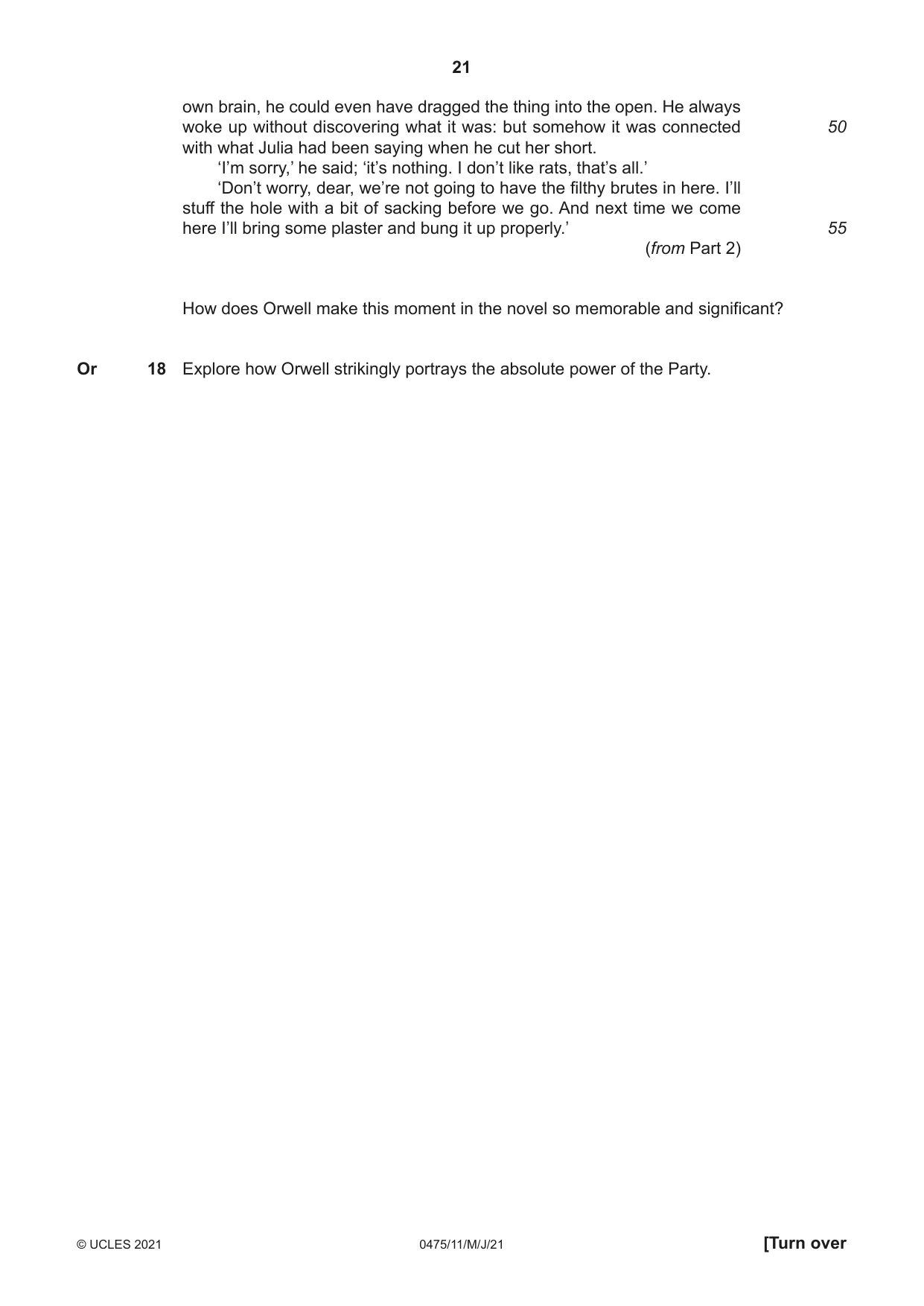
21 0475/11/M/J/21 © UCLES 2021 [Turn over own brain, he could even have dragged the thing into the open. He always woke up without discovering what it was: but somehow it was connected with what Julia had been saying when he cut her short. ‘I’m sorry,’ he said; ‘it’s nothing. I don’t like rats, that’s all.’ ‘Don’t worry, dear, we’re not going to have the filthy brutes in here. I’ll stuff the hole with a bit of sacking before we go. And next time we come here I’ll bring some plaster and bung it up properly.’ (from Part 2) How does Orwell make this moment in the novel so memorable and significant? Or 18 Explore how Orwell strikingly portrays the absolute power of the Party. 50 55
Question paper, page 22
22 0475/11/M/J/21 © UCLES 2021 ALAN PATON: Cry, the Beloved Country Remember to support your ideas with details from the writing. Either 19 Read this passage, and then answer the question that follows it: Yes, it was true what Msimangu had said. Content removed due to copyright restrictions.
Question paper, page 23
23 0475/11/M/J/21 © UCLES 2021 [Turn over The tribe was broken, and would be mended no more. (from Book 1 Chapter 13) How does Paton powerfully convey Stephen’s thoughts and feelings at this moment in the novel? Or 20 Explore two moments in the novel where Paton’s writing makes you feel particularly angry about the treatment of black people. Content removed due to copyright restrictions.
Question paper, page 24
24 0475/11/M/J/21 © UCLES 2021 from Stories of Ourselves Remember to support your ideas with details from the writing. Either 21 Read this passage from On Her Knees (by Tim Winton), and then answer the question that follows it: It was a lonely apartment. Content removed due to copyright restrictions.
Question paper, page 25
25 0475/11/M/J/21 © UCLES 2021 And then could it be possible that her failure to report a theft to the cops was an act of kindness towards my mother, an act of mercy toward me? What striking impressions of the apartment and its owner does Winton create for you here? Or 22 How does the writer make you feel sympathy for one of the following characters? • the prisoner in The Lemon Orchard (by Alex La Guma) • the old man in Journey (by Patricia Grace) • Miss McCabe in The Stoat (by John McGahern) Content removed due to copyright restrictions.
Question paper, page 26
26 0475/11/M/J/21 © UCLES 2021 BLANK PAGE
Question paper, page 27
27 0475/11/M/J/21 © UCLES 2021 BLANK PAGE
Question paper, page 28
28 0475/11/M/J/21 © UCLES 2021 Permission to reproduce items where third-party owned material protected by copyright is included has been sought and cleared where possible. Every reasonable effort has been made by the publisher (UCLES) to trace copyright holders, but if any items requiring clearance have unwittingly been included, the publisher will be pleased to make amends at the earliest possible opportunity. To avoid the issue of disclosure of answer-related information to candidates, all copyright acknowledgements are reproduced online in the Cambridge Assessment International Education Copyright Acknowledgements Booklet. This is produced for each series of examinations and is freely available to download at www.cambridgeinternational.org after the live examination series. Cambridge Assessment International Education is part of the Cambridge Assessment Group. Cambridge Assessment is the brand name of the University of Cambridge Local Examinations Syndicate (UCLES), which itself is a department of the University of Cambridge. BLANK PAGE
Mark scheme, page 1
This document consists of 4 printed pages. © UCLES 2021 [Turn over Cambridge IGCSE™ LITERATURE IN ENGLISH 0475/11 Paper 1 Poetry and Prose 11 May/June 2021 MARK SCHEME Maximum Mark: 50 Published This mark scheme is published as an aid to teachers and candidates, to indicate the requirements of the examination. It shows the basis on which Examiners were instructed to award marks. It does not indicate the details of the discussions that took place at an Examiners’ meeting before marking began, which would have considered the acceptability of alternative answers. Mark schemes should be read in conjunction with the question paper and the Principal Examiner Report for Teachers. Cambridge International will not enter into discussions about these mark schemes. Cambridge International is publishing the mark schemes for the May/June 2021 series for most Cambridge IGCSE™, Cambridge International A and AS Level components and some Cambridge O Level components.
Mark scheme, page 2
0475/11 Cambridge IGCSE – Mark Scheme PUBLISHED May/June 2021 © UCLES 2021 Page 2 of 4 Generic Marking Principles These general marking principles must be applied by all examiners when marking candidate answers. They should be applied alongside the specific content of the mark scheme or generic level descriptors for a question. Each question paper and mark scheme will also comply with these marking principles. GENERIC MARKING PRINCIPLE 1: Marks must be awarded in line with: • the specific content of the mark scheme or the generic level descriptors for the question • the specific skills defined in the mark scheme or in the generic level descriptors for the question • the standard of response required by a candidate as exemplified by the standardisation scripts. GENERIC MARKING PRINCIPLE 2: Marks awarded are always whole marks (not half marks, or other fractions). GENERIC MARKING PRINCIPLE 3: Marks must be awarded positively: • marks are awarded for correct/valid answers, as defined in the mark scheme. However, credit is given for valid answers which go beyond the scope of the syllabus and mark scheme, referring to your Team Leader as appropriate • marks are awarded when candidates clearly demonstrate what they know and can do • marks are not deducted for errors • marks are not deducted for omissions • answers should only be judged on the quality of spelling, punctuation and grammar when these features are specifically assessed by the question as indicated by the mark scheme. The meaning, however, should be unambiguous. GENERIC MARKING PRINCIPLE 4: Rules must be applied consistently, e.g. in situations where candidates have not followed instructions or in the application of generic level descriptors. GENERIC MARKING PRINCIPLE 5: Marks should be awarded using the full range of marks defined in the mark scheme for the question (however; the use of the full mark range may be limited according to the quality of the candidate responses seen). GENERIC MARKING PRINCIPLE 6: Marks awarded are based solely on the requirements as defined in the mark scheme. Marks should not be awarded with grade thresholds or grade descriptors in mind.
Mark scheme, page 3
0475/11 Cambridge IGCSE – Mark Scheme PUBLISHED May/June 2021 © UCLES 2021 Page 3 of 4 English & Media subject specific general marking principles (To be read in conjunction with the Generic Marking Principles (and requiring further guidance on how to place marks within levels)) Components using level descriptors: • We use level descriptors as a guide to broad understanding of the qualities normally expected of, or typical of, work in a level. • Level descriptors are a means of general guidance, and should not be interpreted as hurdle statements. • Where indicative content notes are supplied for a question, these are not a prescription of required content, and must not be treated as such. Alternative correct points and unexpected answers in candidates’ scripts must be given marks that fairly reflect the knowledge and skills demonstrated. • While we may have legitimate expectations as to the ground most answers may occupy, we must at all times be prepared to meet candidates on their chosen ground, provided it is relevant ground (e.g. clearly related to and derived from a relevant passage/text and meeting the mark scheme requirements for the question). Components using point-based marking: Point marking is often used to reward knowledge, understanding and application of skills. We give credit where the candidate’s answer shows relevant knowledge, understanding and application of skills in answering the question. We do not give credit where the answer shows confusion. From this it follows that we: a DO credit answers which are worded differently from the mark scheme if they clearly convey the same meaning (unless the mark scheme requires a specific term). b DO credit alternative answers/examples which are not written in the mark scheme if they are correct. c DO credit answers where candidates give more than one correct answer in one prompt/numbered/scaffolded space where extended writing is required rather than list-type answers. For example, questions that require n reasons (e.g. State two reasons…). d DO NOT credit answers simply for using a ‘key term’ unless that is all that is required. (Check for evidence it is understood and not used wrongly.). e DO NOT credit answers which are obviously self-contradicting or trying to cover all possibilities. f DO NOT give further credit for what is effectively repetition of a correct point already credited unless the language itself is being tested. This applies equally to ‘mirror statements’ (i.e. polluted/not polluted). g DO NOT require spellings to be correct, unless this is part of the test. However spellings of syllabus terms must allow for clear and unambiguous separation from other syllabus terms with which they may be confused (e.g. Corrasion/Corrosion).
Mark scheme, page 4
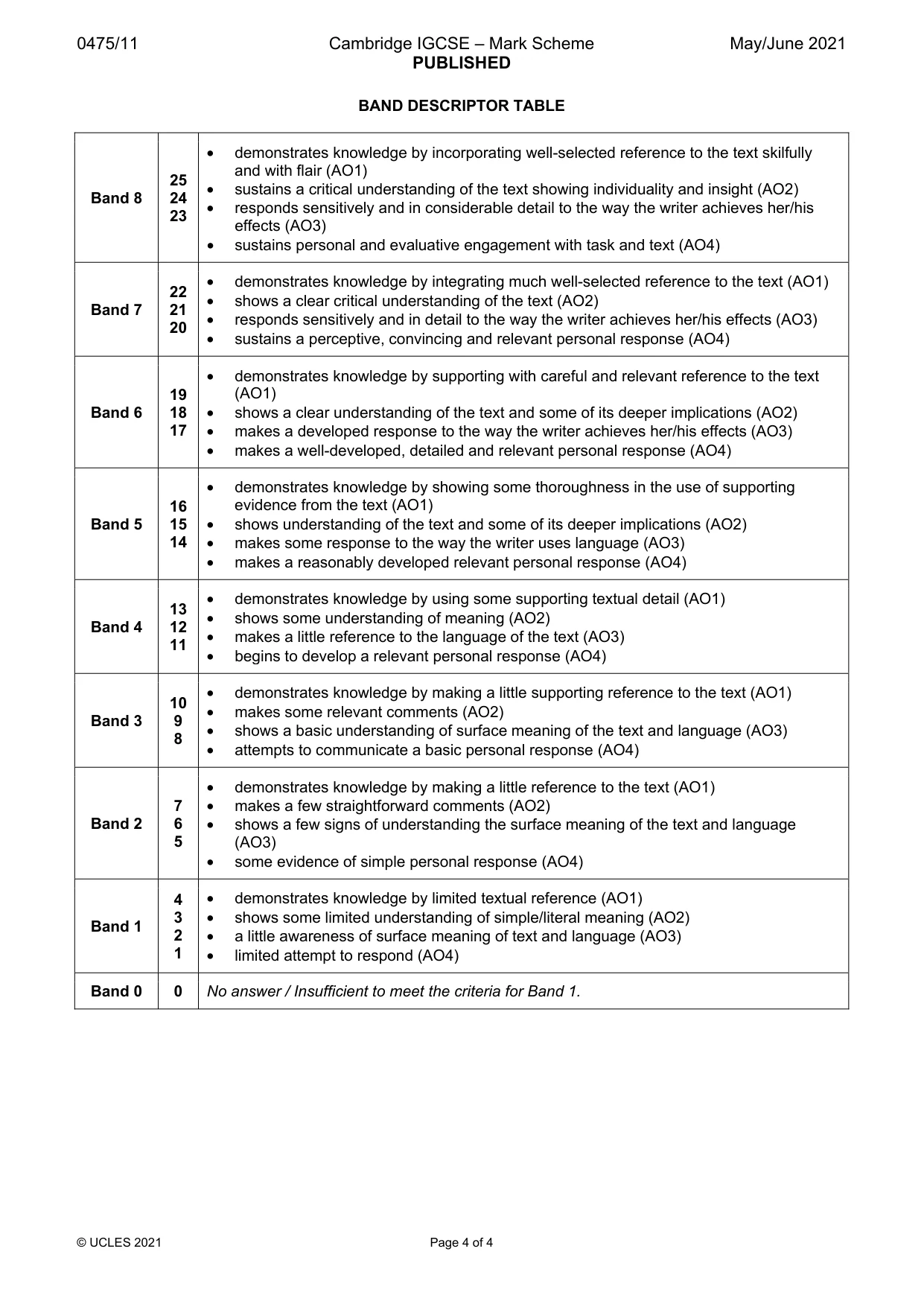
0475/11 Cambridge IGCSE – Mark Scheme PUBLISHED May/June 2021 © UCLES 2021 Page 4 of 4 BAND DESCRIPTOR TABLE Band 8 25 24 23 • demonstrates knowledge by incorporating well-selected reference to the text skilfully and with flair (AO1) • sustains a critical understanding of the text showing individuality and insight (AO2) • responds sensitively and in considerable detail to the way the writer achieves her/his effects (AO3) • sustains personal and evaluative engagement with task and text (AO4) Band 7 22 21 20 • demonstrates knowledge by integrating much well-selected reference to the text (AO1) • shows a clear critical understanding of the text (AO2) • responds sensitively and in detail to the way the writer achieves her/his effects (AO3) • sustains a perceptive, convincing and relevant personal response (AO4) Band 6 19 18 17 • demonstrates knowledge by supporting with careful and relevant reference to the text (AO1) • shows a clear understanding of the text and some of its deeper implications (AO2) • makes a developed response to the way the writer achieves her/his effects (AO3) • makes a well-developed, detailed and relevant personal response (AO4) Band 5 16 15 14 • demonstrates knowledge by showing some thoroughness in the use of supporting evidence from the text (AO1) • shows understanding of the text and some of its deeper implications (AO2) • makes some response to the way the writer uses language (AO3) • makes a reasonably developed relevant personal response (AO4) Band 4 13 12 11 • demonstrates knowledge by using some supporting textual detail (AO1) • shows some understanding of meaning (AO2) • makes a little reference to the language of the text (AO3) • begins to develop a relevant personal response (AO4) Band 3 10 9 8 • demonstrates knowledge by making a little supporting reference to the text (AO1) • makes some relevant comments (AO2) • shows a basic understanding of surface meaning of the text and language (AO3) • attempts to communicate a basic personal response (AO4) Band 2 7 6 5 • demonstrates knowledge by making a little reference to the text (AO1) • makes a few straightforward comments (AO2) • shows a few signs of understanding the surface meaning of the text and language (AO3) • some evidence of simple personal response (AO4) Band 1 4 3 2 1 • demonstrates knowledge by limited textual reference (AO1) • shows some limited understanding of simple/literal meaning (AO2) • a little awareness of surface meaning of text and language (AO3) • limited attempt to respond (AO4) Band 0 0 No answer / Insufficient to meet the criteria for Band 1.
What you needed in this session
Cambridge’s own grade thresholds for 2021 May/June, Paper 1 · Variant 1. A higher threshold means an easier paper — the bar moves with how the cohort did.