Cambridge IGCSE English - Literature 0486 — 2019 Oct/Nov Paper 4 · Variant 1
0486/41/O/N/19 · 25 marks · ≈28 min
The question paper and its mark scheme, free to read here and free to download. This is Cambridge’s own paper, exactly as it was sat.
Question paper8 pages



Mark scheme4 pages
Answers below. Sit the paper first if you are practising.
Paper as text
Question paper, page 1
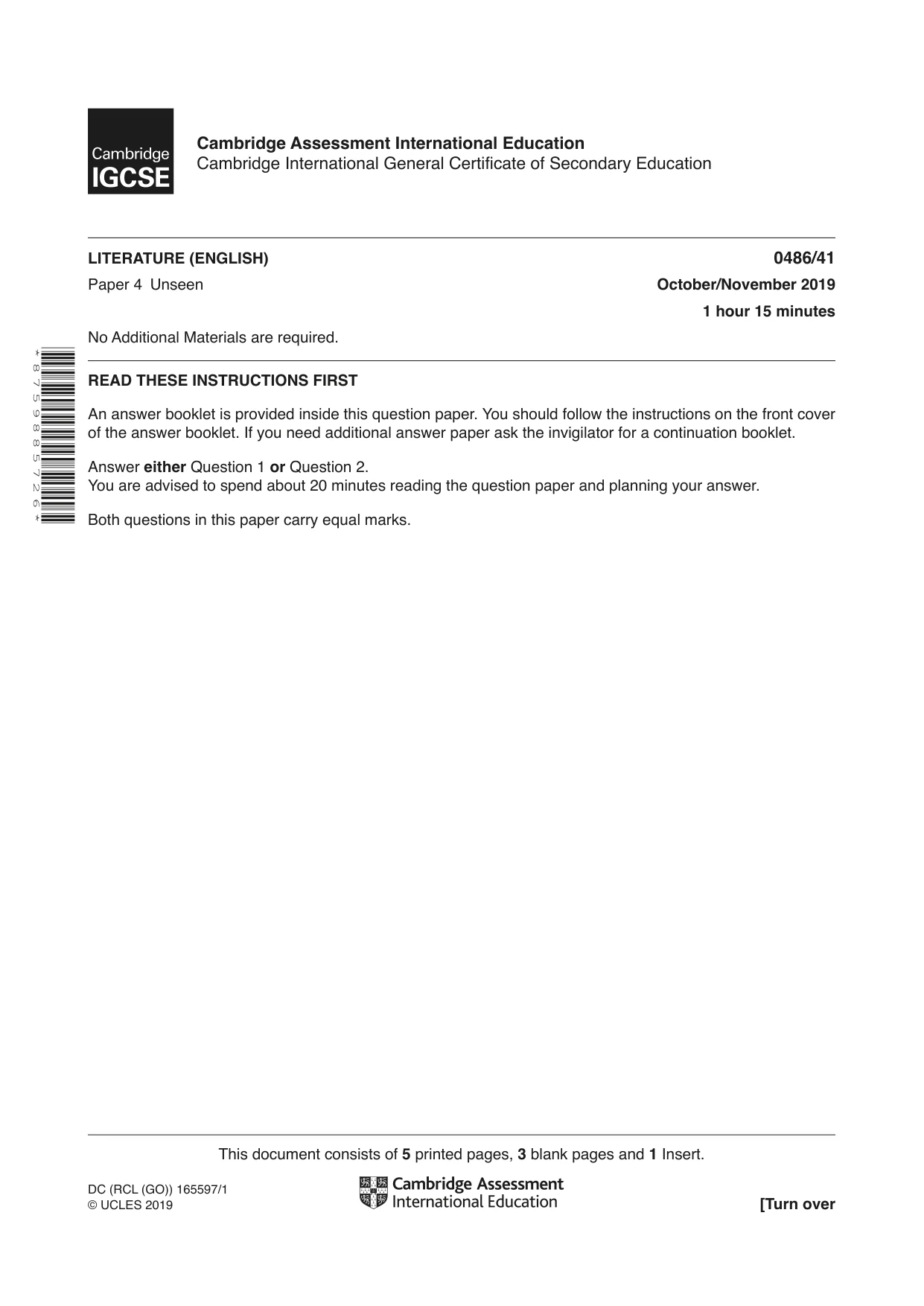
This document consists of 5 printed pages, 3 blank pages and 1 Insert. DC (RCL (GO)) 165597/1 © UCLES 2019 [Turn over Cambridge Assessment International Education Cambridge International General Certificate of Secondary Education * 8 7 5 9 8 8 5 7 2 6 * LITERATURE (ENGLISH) 0486/41 Paper 4 Unseen October/November 2019 1 hour 15 minutes No Additional Materials are required. READ THESE INSTRUCTIONS FIRST An answer booklet is provided inside this question paper. You should follow the instructions on the front cover of the answer booklet. If you need additional answer paper ask the invigilator for a continuation booklet. Answer either Question 1 or Question 2. You are advised to spend about 20 minutes reading the question paper and planning your answer. Both questions in this paper carry equal marks.
Question paper, page 2
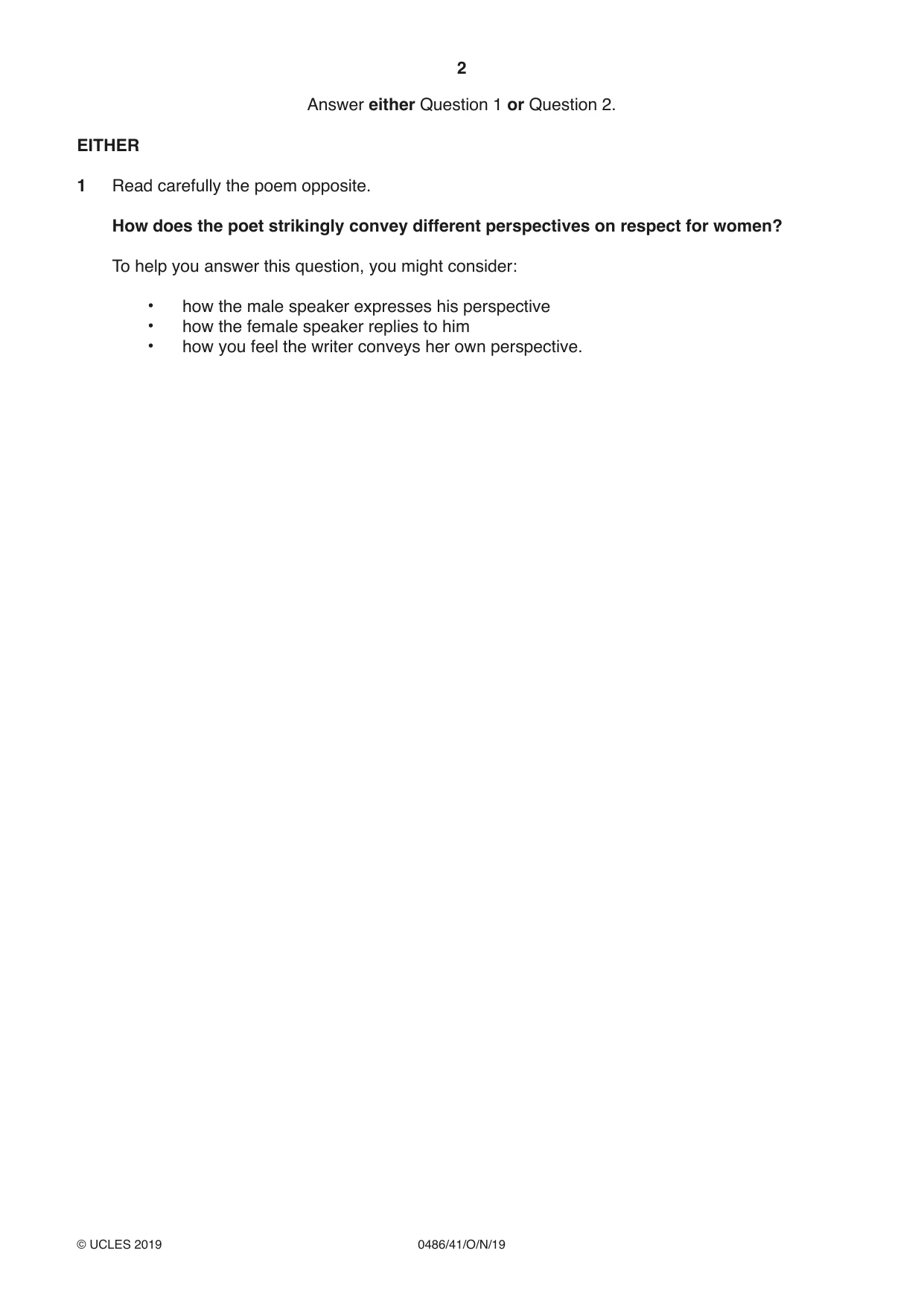
2 0486/41/O/N/19 © UCLES 2019 Answer either Question 1 or Question 2. EITHER 1 Read carefully the poem opposite. How does the poet strikingly convey different perspectives on respect for women? To help you answer this question, you might consider: • how the male speaker expresses his perspective • how the female speaker replies to him • how you feel the writer conveys her own perspective.
Question paper, page 3
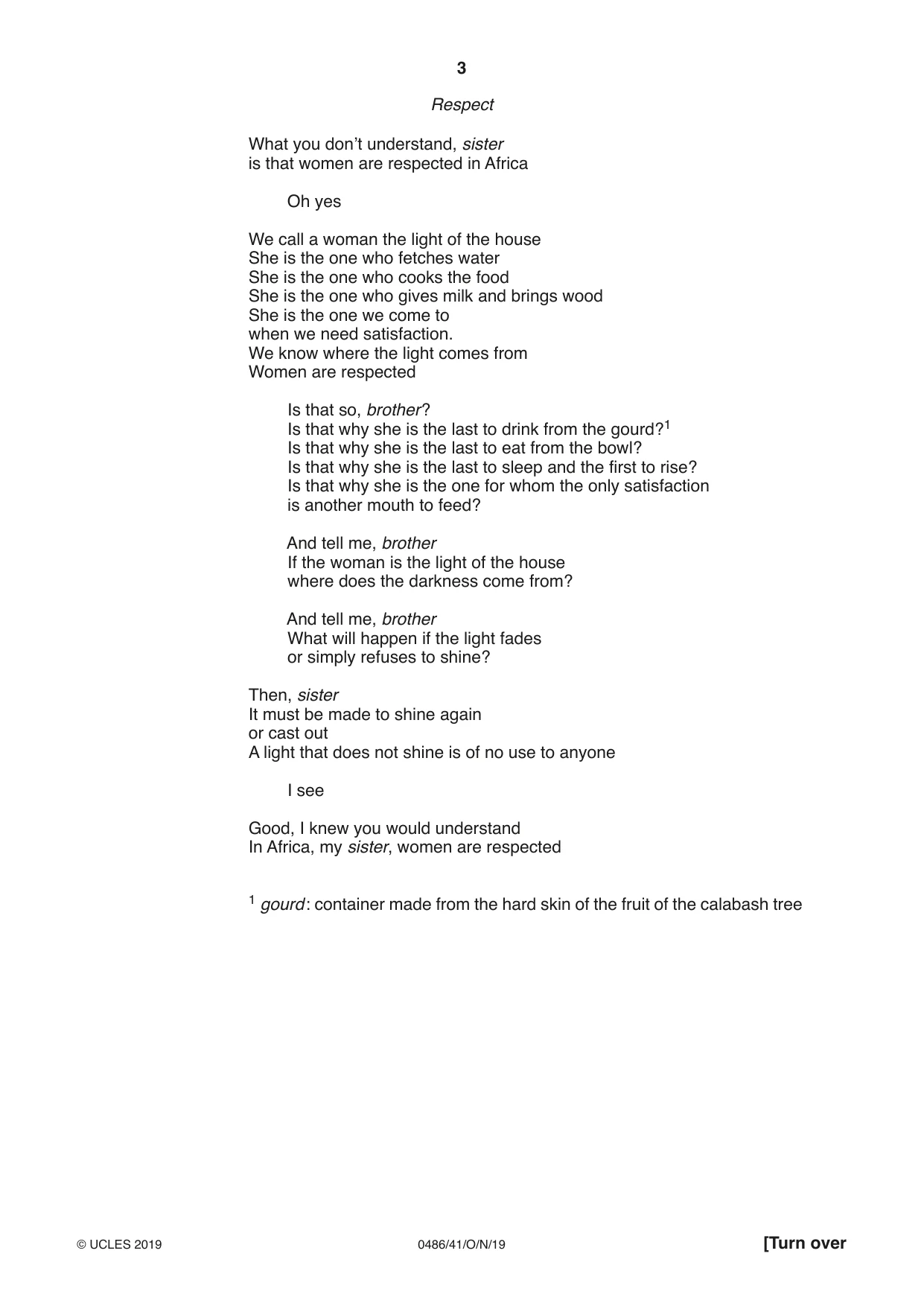
3 0486/41/O/N/19 © UCLES 2019 [Turn over Respect What you don’t understand, sister is that women are respected in Africa Oh yes We call a woman the light of the house She is the one who fetches water She is the one who cooks the food She is the one who gives milk and brings wood She is the one we come to when we need satisfaction. We know where the light comes from Women are respected Is that so, brother? Is that why she is the last to drink from the gourd?1 Is that why she is the last to eat from the bowl? Is that why she is the last to sleep and the first to rise? Is that why she is the one for whom the only satisfaction is another mouth to feed? And tell me, brother If the woman is the light of the house where does the darkness come from? And tell me, brother What will happen if the light fades or simply refuses to shine? Then, sister It must be made to shine again or cast out A light that does not shine is of no use to anyone I see Good, I knew you would understand In Africa, my sister, women are respected 1 gourd: container made from the hard skin of the fruit of the calabash tree
Question paper, page 4
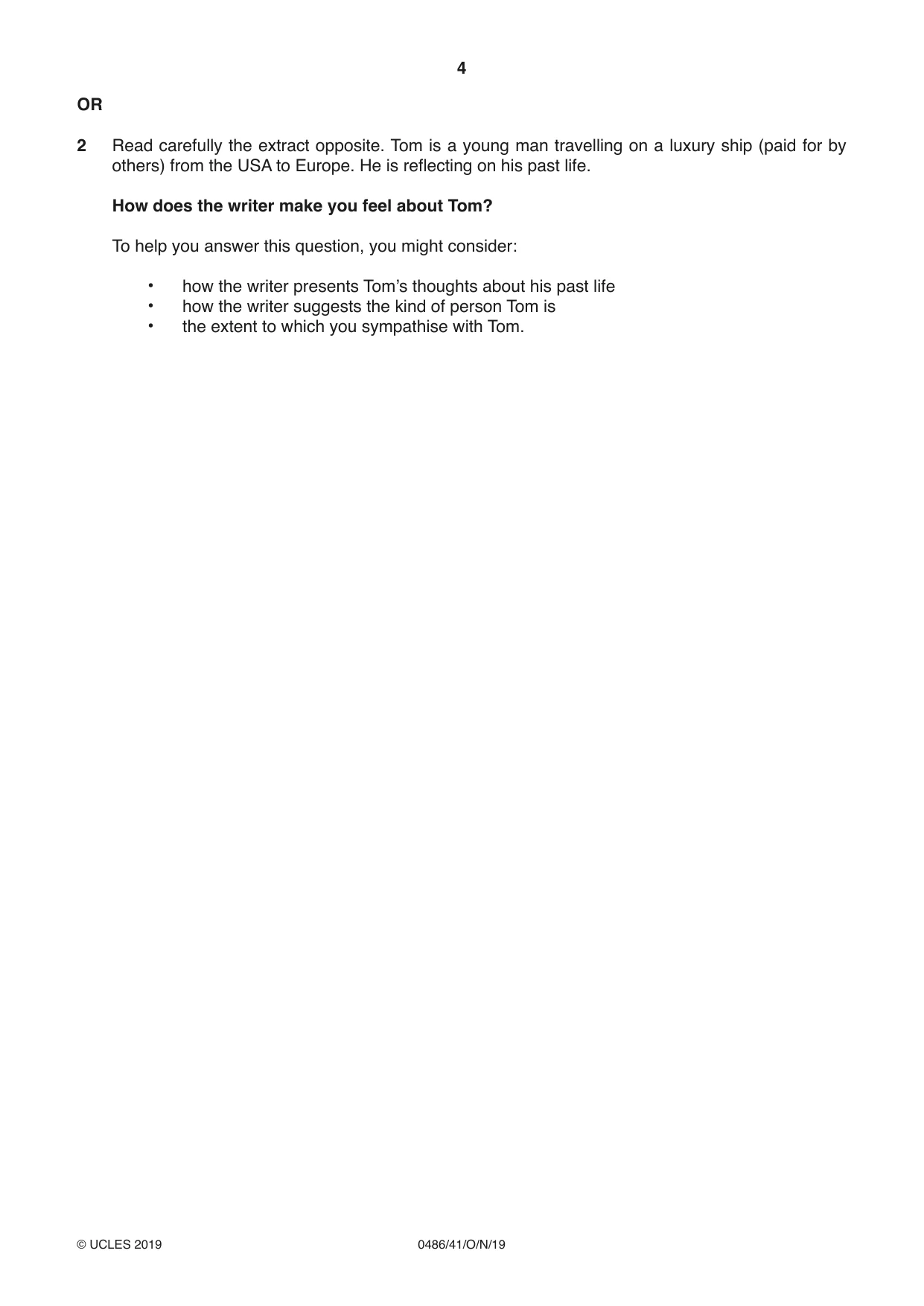
4 0486/41/O/N/19 © UCLES 2019 OR 2 Read carefully the extract opposite. Tom is a young man travelling on a luxury ship (paid for by others) from the USA to Europe. He is reflecting on his past life. How does the writer make you feel about Tom? To help you answer this question, you might consider: • how the writer presents Tom’s thoughts about his past life • how the writer suggests the kind of person Tom is • the extent to which you sympathise with Tom.
Question paper, page 5
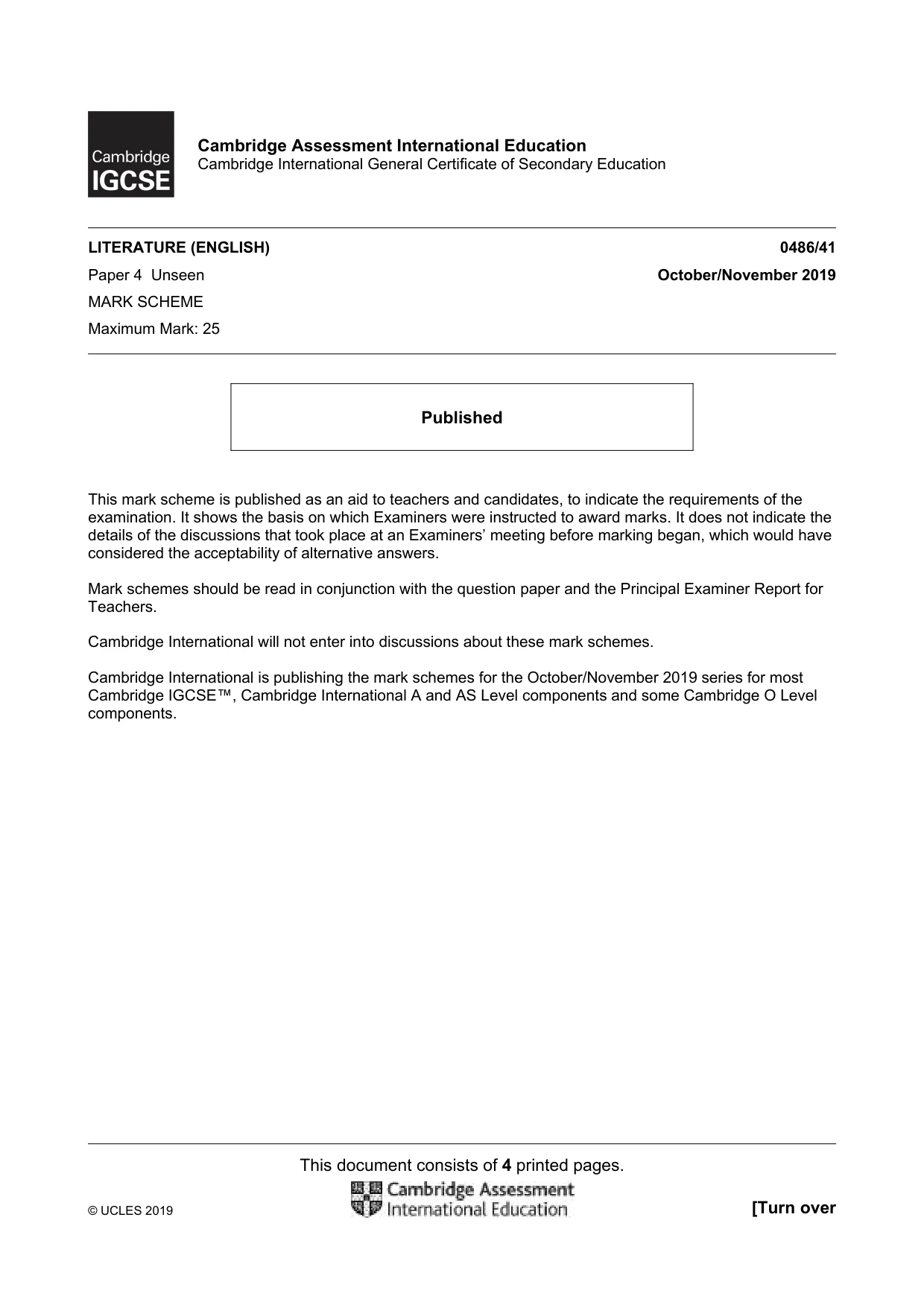
5 0486/41/O/N/19 © UCLES 2019 Lying in his deck-chair, fortified morally by the luxurious surroundings and inwardly by the abundance of well-prepared food, he tried to take an objective look at his past life. The last four years had been for the most part a waste, there was no denying that. A series of haphazard jobs, long perilous intervals with no job at all and consequent demoralization because of having no money, and then taking up with stupid, silly people in order not to be lonely, or because they could offer him something for a while, as Marc Priminger had. It was not a record to be proud of, considering he had come to New York with such high aspirations. He had wanted to be an actor, though at twenty he had not had the faintest idea of the difficulties, the necessary training, or even the necessary talent. He had thought he had the necessary talent and that all he would have to do was show a producer a few of his original one-man skits1 but his first three rebuffs2 had killed all his courage and his hope. He had had no reserve of money, so he had taken the job on the banana boat, which at least had removed him from New York. He had been afraid that Aunt Dottie had called the police to look for him in New York, though he hadn’t done anything wrong in Boston, just run off to make his own way in the world as millions of young men had done before him. His main mistake had been that he had never stuck to anything, he thought, like the accounting job in the department store that might have worked into something, if he had not been so completely discouraged by the slowness of department-store promotions. Well, he blamed Aunt Dottie to some extent for his lack of perseverance, never giving him credit when he was younger for anything he had stuck to – like his paper route when he was thirteen. He had won a silver medal from the newspaper for ‘Courtesy, Service, and Reliability’. It was like looking back at another person to remember himself then, a skinny, snivelling wretch with an eternal cold in the nose, who had still managed to win a medal for courtesy, service, and reliability. Aunt Dottie had hated him when he had a cold; she used to take her handkerchief and nearly wrench his nose off, wiping it. Tom writhed in his deck-chair as he thought of it, but he writhed elegantly, adjusting the crease of his trousers. He remembered the vows he had made, even at the age of eight, to run away from Aunt Dottie, the violent scenes he had imagined – Aunt Dottie trying to hold him in the house, and he hitting her with his fists, flinging her to the ground and throttling her, and finally tearing the big brooch off her dress and stabbing her a million times in the throat with it. He had run away at seventeen and had been brought back, and he had done it again at twenty and succeeded. And it was astounding and pitiful how naïve he had been, how little he had known about the way the world worked, as if he had spent so much of his time hating Aunt Dottie and scheming how to escape her, that he had not had enough time to learn and grow. 1 skits: comic sketches or routines 2 rebuffs: rejections
Question paper, page 6
6 0486/41/O/N/19 © UCLES 2019 BLANK PAGE
Question paper, page 7
7 0486/41/O/N/19 © UCLES 2019 BLANK PAGE
Question paper, page 8
8 0486/41/O/N/19 © UCLES 2019 BLANK PAGE Permission to reproduce items where third-party owned material protected by copyright is included has been sought and cleared where possible. Every reasonable effort has been made by the publisher (UCLES) to trace copyright holders, but if any items requiring clearance have unwittingly been included, the publisher will be pleased to make amends at the earliest possible opportunity. To avoid the issue of disclosure of answer-related information to candidates, all copyright acknowledgements are reproduced online in the Cambridge Assessment International Education Copyright Acknowledgements Booklet. This is produced for each series of examinations and is freely available to download at www.cambridgeinternational.org after the live examination series. Cambridge Assessment International Education is part of the Cambridge Assessment Group. Cambridge Assessment is the brand name of the University of Cambridge Local Examinations Syndicate (UCLES), which itself is a department of the University of Cambridge.
Mark scheme, page 1
This document consists of 4 printed pages. © UCLES 2019 [Turn over Cambridge Assessment International Education Cambridge International General Certificate of Secondary Education LITERATURE (ENGLISH) 0486/41 Paper 4 Unseen October/November 2019 MARK SCHEME Maximum Mark: 25 Published This mark scheme is published as an aid to teachers and candidates, to indicate the requirements of the examination. It shows the basis on which Examiners were instructed to award marks. It does not indicate the details of the discussions that took place at an Examiners’ meeting before marking began, which would have considered the acceptability of alternative answers. Mark schemes should be read in conjunction with the question paper and the Principal Examiner Report for Teachers. Cambridge International will not enter into discussions about these mark schemes. Cambridge International is publishing the mark schemes for the October/November 2019 series for most Cambridge IGCSE™, Cambridge International A and AS Level components and some Cambridge O Level components.
Mark scheme, page 2
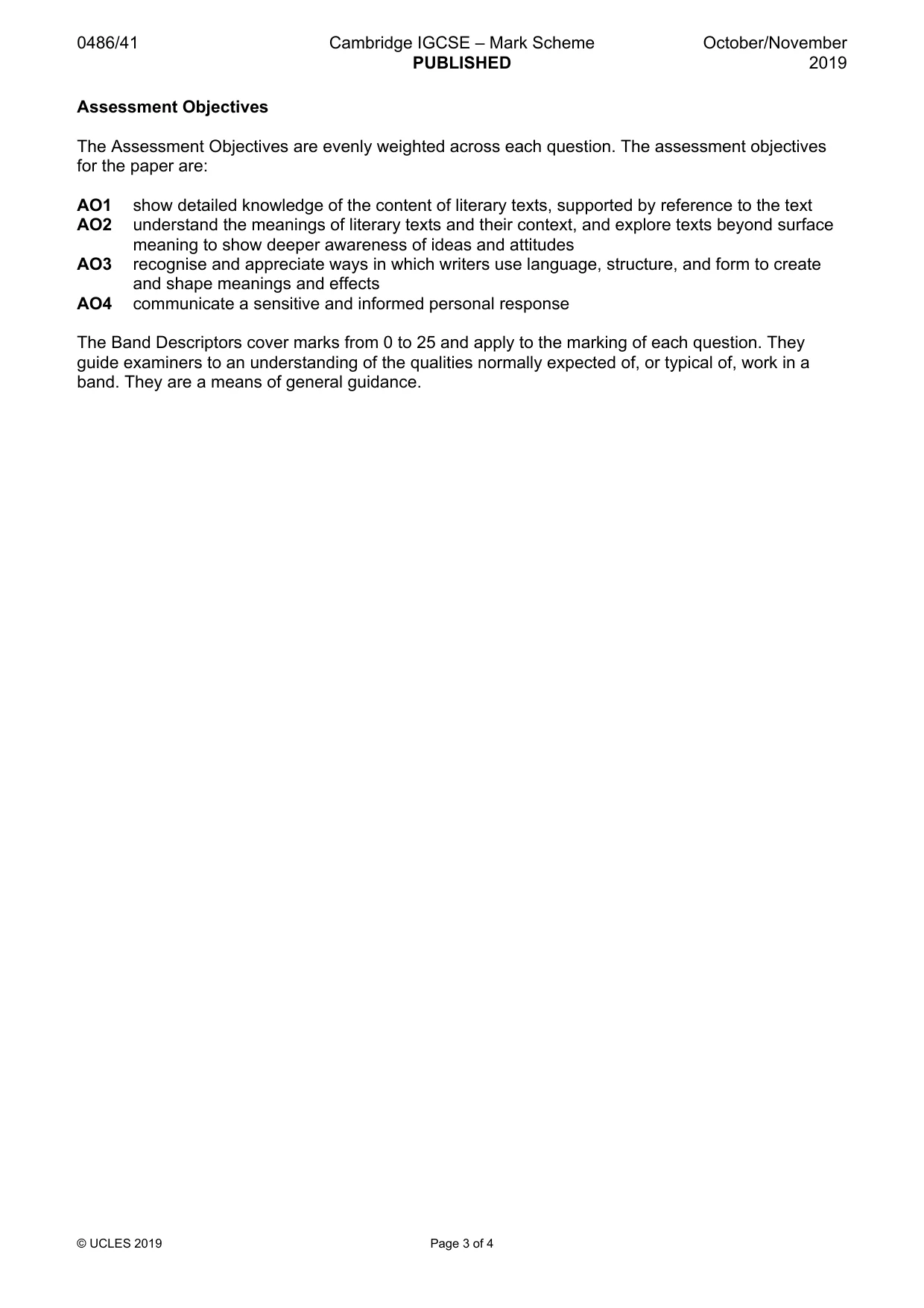
0486/41 Cambridge IGCSE – Mark Scheme PUBLISHED October/November 2019 © UCLES 2019 Page 2 of 4 Generic Marking Principles These general marking principles must be applied by all examiners when marking candidate answers. They should be applied alongside the specific content of the mark scheme or generic level descriptors for a question. Each question paper and mark scheme will also comply with these marking principles. GENERIC MARKING PRINCIPLE 1: Marks must be awarded in line with: • the specific content of the mark scheme or the generic level descriptors for the question • the specific skills defined in the mark scheme or in the generic level descriptors for the question • the standard of response required by a candidate as exemplified by the standardisation scripts. GENERIC MARKING PRINCIPLE 2: Marks awarded are always whole marks (not half marks, or other fractions). GENERIC MARKING PRINCIPLE 3: Marks must be awarded positively: • marks are awarded for correct/valid answers, as defined in the mark scheme. However, credit is given for valid answers which go beyond the scope of the syllabus and mark scheme, referring to your Team Leader as appropriate • marks are awarded when candidates clearly demonstrate what they know and can do • marks are not deducted for errors • marks are not deducted for omissions • answers should only be judged on the quality of spelling, punctuation and grammar when these features are specifically assessed by the question as indicated by the mark scheme. The meaning, however, should be unambiguous. GENERIC MARKING PRINCIPLE 4: Rules must be applied consistently e.g. in situations where candidates have not followed instructions or in the application of generic level descriptors. GENERIC MARKING PRINCIPLE 5: Marks should be awarded using the full range of marks defined in the mark scheme for the question (however; the use of the full mark range may be limited according to the quality of the candidate responses seen). GENERIC MARKING PRINCIPLE 6: Marks awarded are based solely on the requirements as defined in the mark scheme. Marks should not be awarded with grade thresholds or grade descriptors in mind.
Mark scheme, page 3
0486/41 Cambridge IGCSE – Mark Scheme PUBLISHED October/November 2019 © UCLES 2019 Page 3 of 4 Assessment Objectives The Assessment Objectives are evenly weighted across each question. The assessment objectives for the paper are: AO1 show detailed knowledge of the content of literary texts, supported by reference to the text AO2 understand the meanings of literary texts and their context, and explore texts beyond surface meaning to show deeper awareness of ideas and attitudes AO3 recognise and appreciate ways in which writers use language, structure, and form to create and shape meanings and effects AO4 communicate a sensitive and informed personal response The Band Descriptors cover marks from 0 to 25 and apply to the marking of each question. They guide examiners to an understanding of the qualities normally expected of, or typical of, work in a band. They are a means of general guidance.
Mark scheme, page 4
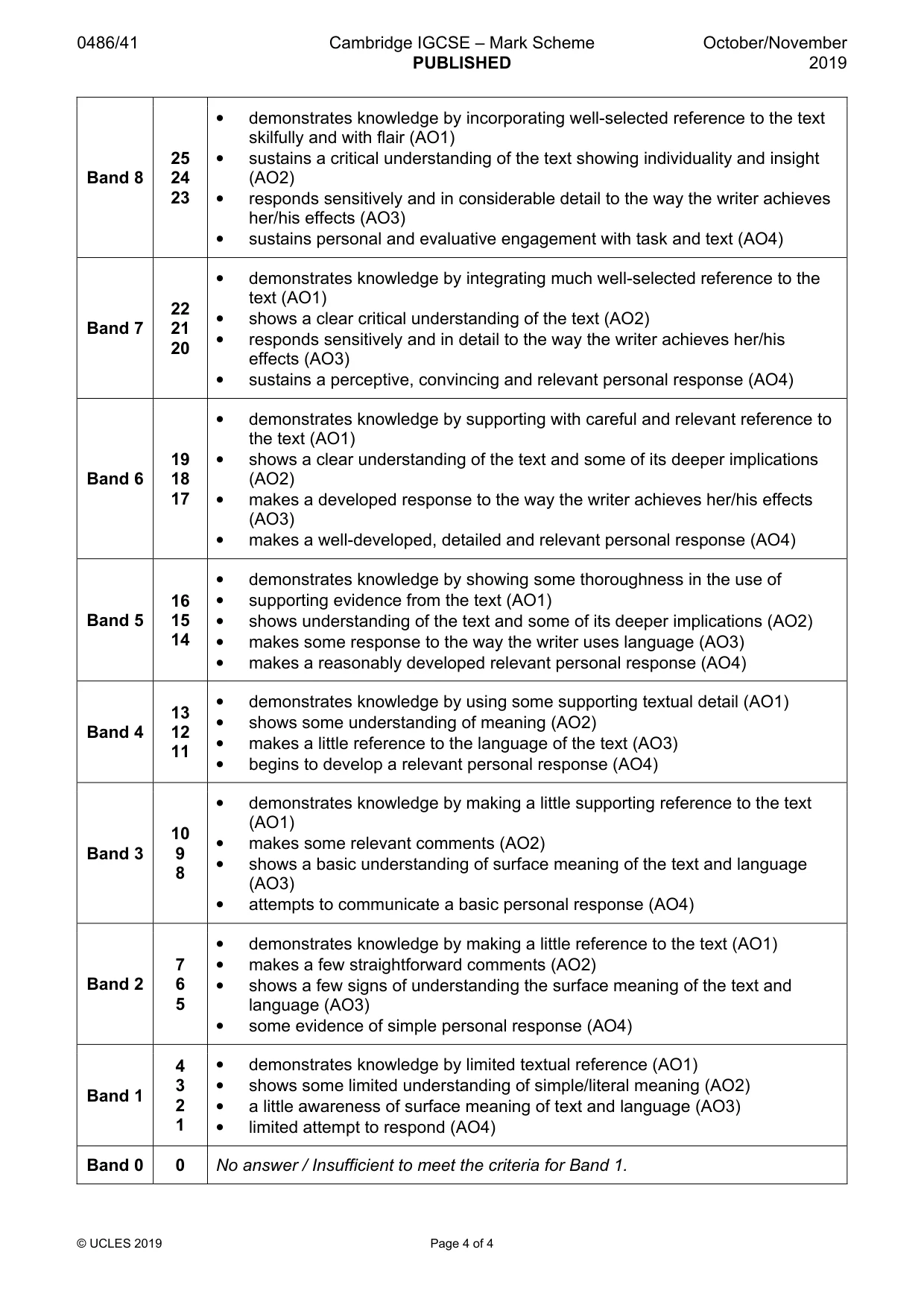
0486/41 Cambridge IGCSE – Mark Scheme PUBLISHED October/November 2019 © UCLES 2019 Page 4 of 4 Band 8 25 24 23 • demonstrates knowledge by incorporating well-selected reference to the text skilfully and with flair (AO1) • sustains a critical understanding of the text showing individuality and insight (AO2) • responds sensitively and in considerable detail to the way the writer achieves her/his effects (AO3) • sustains personal and evaluative engagement with task and text (AO4) Band 7 22 21 20 • demonstrates knowledge by integrating much well-selected reference to the text (AO1) • shows a clear critical understanding of the text (AO2) • responds sensitively and in detail to the way the writer achieves her/his effects (AO3) • sustains a perceptive, convincing and relevant personal response (AO4) Band 6 19 18 17 • demonstrates knowledge by supporting with careful and relevant reference to the text (AO1) • shows a clear understanding of the text and some of its deeper implications (AO2) • makes a developed response to the way the writer achieves her/his effects (AO3) • makes a well-developed, detailed and relevant personal response (AO4) Band 5 16 15 14 • demonstrates knowledge by showing some thoroughness in the use of • supporting evidence from the text (AO1) • shows understanding of the text and some of its deeper implications (AO2) • makes some response to the way the writer uses language (AO3) • makes a reasonably developed relevant personal response (AO4) Band 4 13 12 11 • demonstrates knowledge by using some supporting textual detail (AO1) • shows some understanding of meaning (AO2) • makes a little reference to the language of the text (AO3) • begins to develop a relevant personal response (AO4) Band 3 10 9 8 • demonstrates knowledge by making a little supporting reference to the text (AO1) • makes some relevant comments (AO2) • shows a basic understanding of surface meaning of the text and language (AO3) • attempts to communicate a basic personal response (AO4) Band 2 7 6 5 • demonstrates knowledge by making a little reference to the text (AO1) • makes a few straightforward comments (AO2) • shows a few signs of understanding the surface meaning of the text and language (AO3) • some evidence of simple personal response (AO4) Band 1 4 3 2 1 • demonstrates knowledge by limited textual reference (AO1) • shows some limited understanding of simple/literal meaning (AO2) • a little awareness of surface meaning of text and language (AO3) • limited attempt to respond (AO4) Band 0 0 No answer / Insufficient to meet the criteria for Band 1.
What you needed in this session
Cambridge’s own grade thresholds for 2019 Oct/Nov, Paper 4 · Variant 1. A higher threshold means an easier paper — the bar moves with how the cohort did.