Cambridge IGCSE English - Literature 0486 — 2016 May/June Paper 4 · Variant 1
0486/41/M/J/16 · 25 marks · ≈28 min
The question paper and its mark scheme, free to read here and free to download. This is Cambridge’s own paper, exactly as it was sat.
Question paper8 pages


Mark scheme3 pages
Answers below. Sit the paper first if you are practising.
Paper as text
Question paper, page 1
This document consists of 5 printed pages, 3 blank pages and 1 insert. DC (RCL (KM)) 115910/2 © UCLES 2016 [Turn over Cambridge International Examinations Cambridge International General Certificate of Secondary Education * 1 8 8 5 4 2 9 9 4 1 * LITERATURE (ENGLISH) 0486/41 Paper 4 Unseen May/June 2016 1 hour 15 minutes No Additional Materials are required. READ THESE INSTRUCTIONS FIRST An answer booklet is provided inside this question paper. You should follow the instructions on the front cover of the answer booklet. If you need additional answer paper ask the invigilator for a continuation booklet. Answer either Question 1 or Question 2. You are advised to spend about 20 minutes reading the question paper and planning your answer. Both questions in this paper carry equal marks. The syllabus is approved for use in England, Wales and Northern Ireland as a Cambridge International Level 1/Level 2 Certificate.
Question paper, page 2
2 0486/41/M/J/16 © UCLES 2016 Answer either Question 1 or Question 2. EITHER 1 Read carefully the poem opposite. A man, his wife and baby are driving to a new house in the west of England. On the way they stop in a small town to buy a cooking pan. How does the poet’s writing make this experience so striking? To help you answer this question, you might consider: • the way the poet describes the family’s arrival in the town • his descriptions of the man and woman on the pavement • the effect of the poem’s ending.
Question paper, page 3
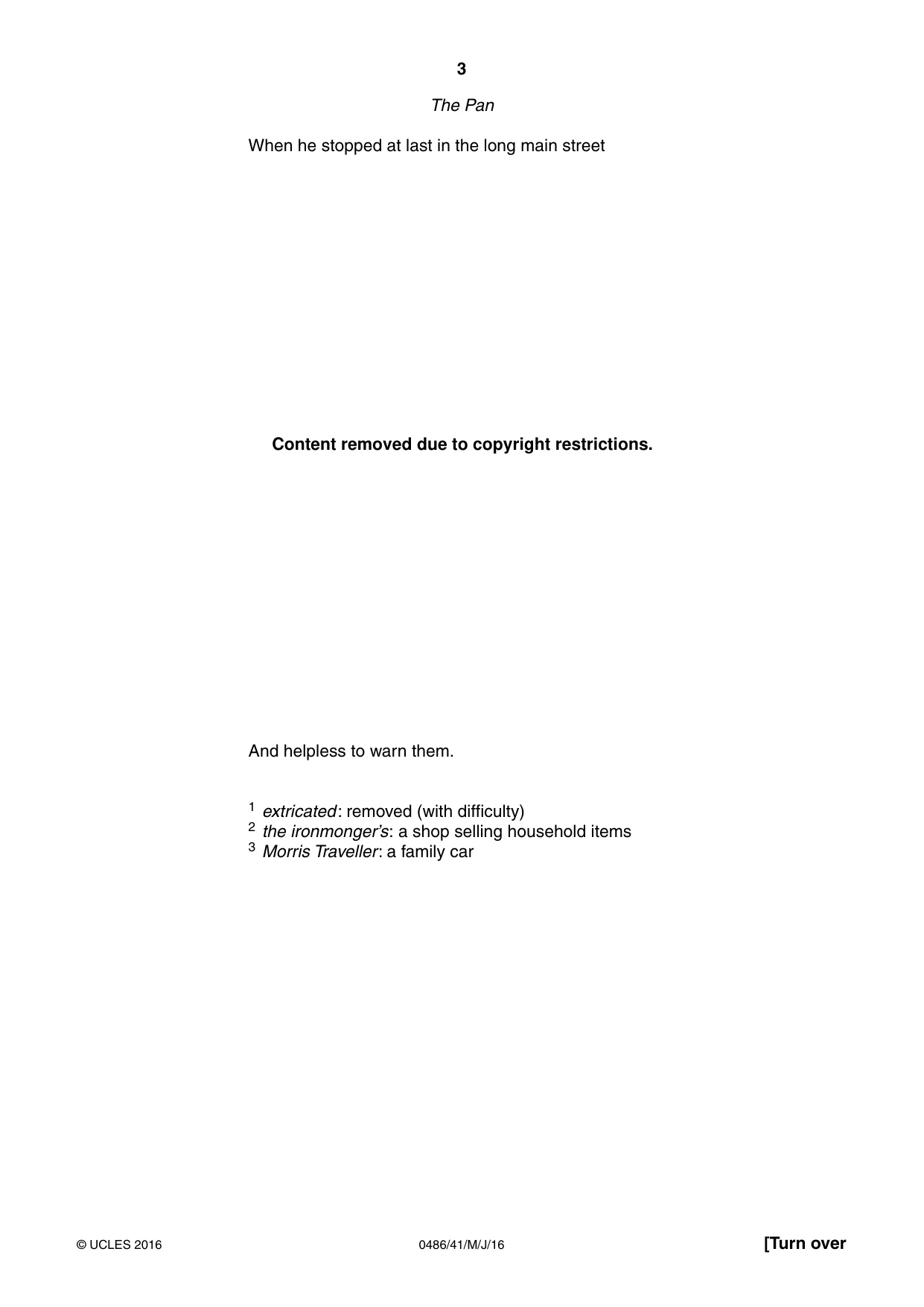
3 0486/41/M/J/16 © UCLES 2016 [Turn over The Pan When he stopped at last in the long main street And helpless to warn them. 1 extricated : removed (with difficulty) 2 the ironmonger’s : a shop selling household items 3 Morris Traveller : a family car Content removed due to copyright restrictions.
Question paper, page 4
4 0486/41/M/J/16 © UCLES 2016 OR 2 Read carefully the extract from a short story opposite. The two girls, Penny and Primrose, who have not met before, are being evacuated to the countryside on a steam train. This is to escape the bombing of their city during a war. How does the writer vividly convey to you the experiences of the girls? To help you answer this question, you might consider: • how the writer conveys the girls’ feelings through their conversations • how she describes their impressions of the train and the journey • how she develops tension and a sense of unease in the passage as a whole.
Question paper, page 5
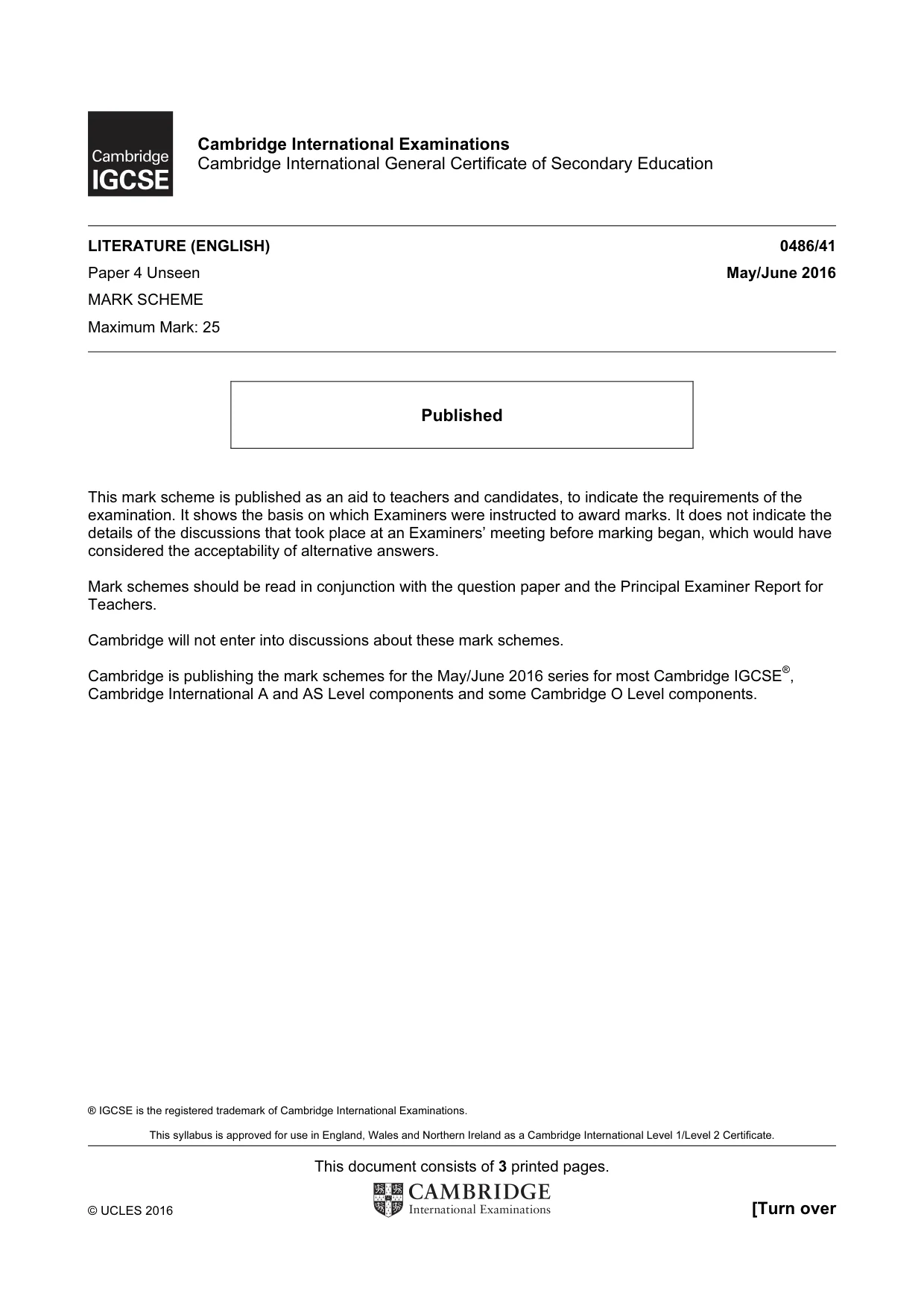
5 0486/41/M/J/16 © UCLES 2016 The girls discussed on the train whether it was a sort of holiday or a sort of punishment, or a bit of both. Penny had read a book about Boy Scouts, but the children on the train did not appear to be Brownies or Wolf Cubs,1 only a mongrel battalion of the lost. Both little girls had the idea that these were all perhaps not very good children, possibly being sent away for that reason. They were pleased to be able to define each other as ‘nice’. They would stick together, they agreed. Try to sit together, and things. The train crawled sluggishly further and further away from the city and their homes. It was not a clean train – the upholstery of their carriage had the dank smell of unwashed trousers, and the gusts of hot steam rolling backwards past their windows were full of specks of flimsy ash, and sharp grit, and occasional fiery sparks that pricked face and fingers like hot needles if you opened the window. It was very noisy too, whenever it picked up a little speed. The engine gave great bellowing sighs, and the invisible wheels underneath clicked rhythmically and monotonously, tap-tap- tap-CRASH, tap-tap-tap-CRASH. The window-panes were both grimy and misted up. The train stopped frequently, and when it stopped, they used their gloves to wipe rounds, through which they peered out at flooded fields, furrowed hillsides and tiny stations, whose names were carefully blacked out, whose platforms were empty of life. The children did not know that the namelessness was meant to baffle or delude an invading army. They felt – they did not think it out, but somewhere inside them the idea sprouted – that the erasure was because of them, because they were not meant to know where they were going or, like Hansel and Gretel,2 to find the way back. They did not speak to each other of this anxiety, but began the kind of conversation children have about things they really disliked, things that upset, or disgusted, or frightened them. Semolina pudding with its grainy texture, mushy peas, fat on roast meat. Listening to the stairs and the window-sashes creaking in the dark or the wind. Having your head held roughly back over the basin to have your hair washed, with cold water running down inside your liberty bodice.3 Gangs in playgrounds. They felt the pressure of all the other alien children in all the other carriages as a potential gang. They shared another square of chocolate, and licked their fingers, and looked out at a great white goose flapping its wings beside an inky pond. The sky grew dark grey and in the end the train halted. The children got out, and lined up in a crocodile,4 and were led to a mud-coloured bus. Penny and Primrose managed to get a seat together, although it was over the wheel, and both of them began to feel sick as the bus bumped along snaking country lanes, under whipping branches, dark leaves on dark wooden arms on a dark sky, with torn strips of thin cloud streaming across a full moon, visible occasionally between them. 1 Brownies or Wolf Cubs : organisations for young children 2 Hansel and Gretel : lost children from a fairy tale 3 liberty bodice : vest 4 lined up in a crocodile : lined up in pairs
Question paper, page 6
6 0486/41/M/J/16 © UCLES 2016 BLANK PAGE
Question paper, page 7
7 0486/41/M/J/16 © UCLES 2016 BLANK PAGE
Question paper, page 8
8 0486/41/M/J/16 © UCLES 2016 BLANK PAGE Permission to reproduce items where third-party owned material protected by copyright is included has been sought and cleared where possible. Every reasonable effort has been made by the publisher (UCLES) to trace copyright holders, but if any items requiring clearance have unwittingly been included, the publisher will be pleased to make amends at the earliest possible opportunity. To avoid the issue of disclosure of answer-related information to candidates, all copyright acknowledgements are reproduced online in the Cambridge International Examinations Copyright Acknowledgements Booklet. This is produced for each series of examinations and is freely available to download at www.cie.org.uk after the live examination series. Cambridge International Examinations is part of the Cambridge Assessment Group. Cambridge Assessment is the brand name of University of Cambridge Local Examinations Syndicate (UCLES), which is itself a department of the University of Cambridge.
Mark scheme, page 1
® IGCSE is the registered trademark of Cambridge International Examinations. This syllabus is approved for use in England, Wales and Northern Ireland as a Cambridge International Level 1/Level 2 Certificate. This document consists of 3 printed pages. © UCLES 2016 [Turn over Cambridge International Examinations Cambridge International General Certificate of Secondary Education LITERATURE (ENGLISH) 0486/41 Paper 4 Unseen May/June 2016 MARK SCHEME Maximum Mark: 25 Published This mark scheme is published as an aid to teachers and candidates, to indicate the requirements of the examination. It shows the basis on which Examiners were instructed to award marks. It does not indicate the details of the discussions that took place at an Examiners’ meeting before marking began, which would have considered the acceptability of alternative answers. Mark schemes should be read in conjunction with the question paper and the Principal Examiner Report for Teachers. Cambridge will not enter into discussions about these mark schemes. Cambridge is publishing the mark schemes for the May/June 2016 series for most Cambridge IGCSE®, Cambridge International A and AS Level components and some Cambridge O Level components.
Mark scheme, page 2
Page 2 Mark Scheme Syllabus Paper Cambridge IGCSE – May/June 2016 0486 41 © Cambridge International Examinations 2016 The Assessment Objectives for this paper are: AO1 show detailed knowledge of the content of literary texts AO2 understand the meanings of literary texts and their context, and explore texts beyond surface meaning to show deeper awareness of ideas and attitudes AO3 recognise and appreciate ways in which writers use language, structure, and form to create and shape meanings and effects AO4 communicate a sensitive and informed personal response The General Descriptors guide examiners to an understanding of the qualities normally expected of, or typical of, work in a band. They are a means of general guidance, and must not be interpreted as hurdle statements.
Mark scheme, page 3
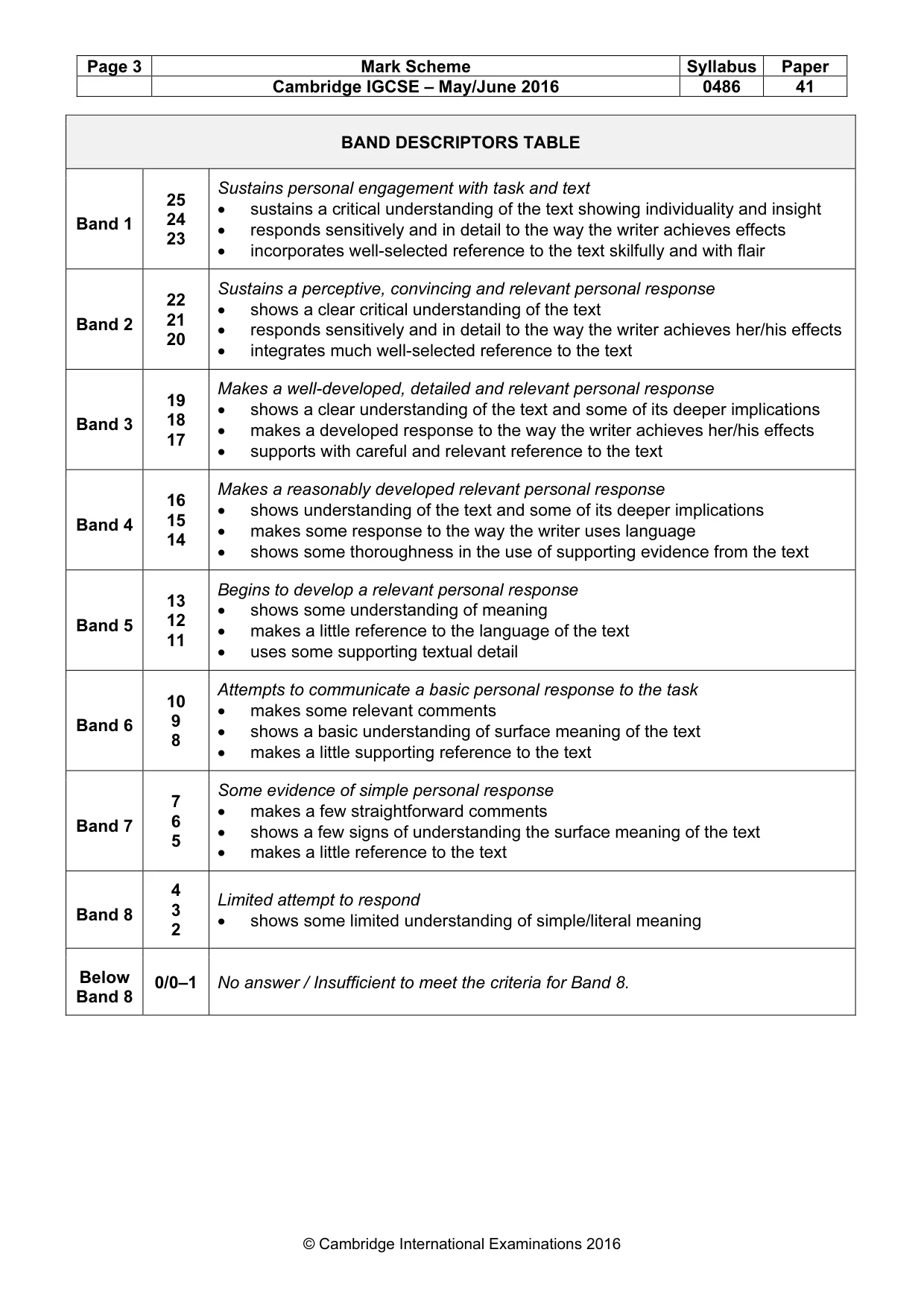
Page 3 Mark Scheme Syllabus Paper Cambridge IGCSE – May/June 2016 0486 41 © Cambridge International Examinations 2016 BAND DESCRIPTORS TABLE Band 1 25 24 23 Sustains personal engagement with task and text • sustains a critical understanding of the text showing individuality and insight • responds sensitively and in detail to the way the writer achieves effects • incorporates well-selected reference to the text skilfully and with flair Band 2 22 21 20 Sustains a perceptive, convincing and relevant personal response • shows a clear critical understanding of the text • responds sensitively and in detail to the way the writer achieves her/his effects • integrates much well-selected reference to the text Band 3 19 18 17 Makes a well-developed, detailed and relevant personal response • shows a clear understanding of the text and some of its deeper implications • makes a developed response to the way the writer achieves her/his effects • supports with careful and relevant reference to the text Band 4 16 15 14 Makes a reasonably developed relevant personal response • shows understanding of the text and some of its deeper implications • makes some response to the way the writer uses language • shows some thoroughness in the use of supporting evidence from the text Band 5 13 12 11 Begins to develop a relevant personal response • shows some understanding of meaning • makes a little reference to the language of the text • uses some supporting textual detail Band 6 10 9 8 Attempts to communicate a basic personal response to the task • makes some relevant comments • shows a basic understanding of surface meaning of the text • makes a little supporting reference to the text Band 7 7 6 5 Some evidence of simple personal response • makes a few straightforward comments • shows a few signs of understanding the surface meaning of the text • makes a little reference to the text Band 8 4 3 2 Limited attempt to respond • shows some limited understanding of simple/literal meaning Below Band 8 0/0–1 No answer / Insufficient to meet the criteria for Band 8.
What you needed in this session
Cambridge’s own grade thresholds for 2016 May/June, Paper 4 · Variant 1. A higher threshold means an easier paper — the bar moves with how the cohort did.