Cambridge IGCSE English - Literature 0486 — 2010 Oct/Nov Paper 4 · Variant 3
0486/43/O/N/10 · 75 marks · ≈84 min
The question paper and its mark scheme, free to read here and free to download. This is Cambridge’s own paper, exactly as it was sat.
Question paper32 pages





Mark scheme17 pages
Answers below. Sit the paper first if you are practising.
Paper as text
Question paper, page 1
This document consists of 30 printed pages and 2 blank pages. DC (SM) 23533/2 © UCLES 2010 [Turn over UNIVERSITY OF CAMBRIDGE INTERNATIONAL EXAMINATIONS International General Certificate of Secondary Education READ THESE INSTRUCTIONS FIRST If you have been given an Answer Booklet, follow the instructions on the front cover of the Booklet. Write your Centre number, candidate number and name on all the work you hand in. Write in dark blue or black pen. Do not use staples, paper clips, highlighters, glue or correction fluid. Answer three questions. Answer one question from each section. Each of your answers must be on a different text. Answer at least one passage-based question (marked *) and at least one essay/empathic question. At the end of the examination, fasten all your work securely together. All questions in this paper carry equal marks. LITERATURE (ENGLISH) 0486/43 Paper 4 October/November 2010 2 hours 15 minutes Additional Materials: Answer Booklet/Paper * 1 6 4 9 3 7 5 3 5 7 * www.XtremePapers.com
Question paper, page 2
2 0486/43/O/N/10 © UCLES 2010 BLANK PAGE
Question paper, page 3
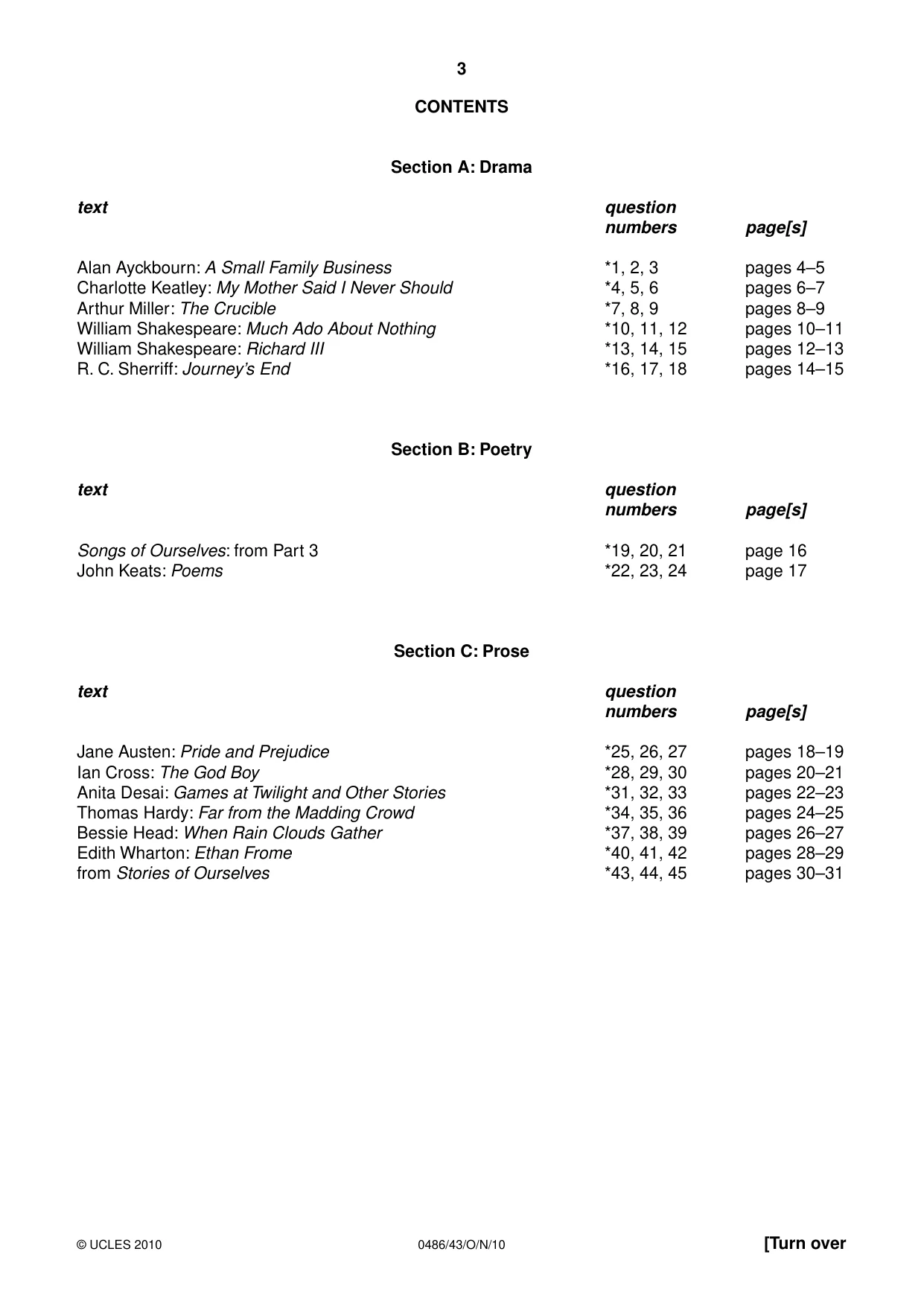
3 0486/43/O/N/10 © UCLES 2010 [Turn over CONTENTS Section A: Drama text question numbers page[s] Alan Ayckbourn: A Small Family Business *1, 2, 3 pages 4–5 Charlotte Keatley: My Mother Said I Never Should *4, 5, 6 pages 6–7 Arthur Miller: The Crucible *7, 8, 9 pages 8–9 William Shakespeare: Much Ado About Nothing *10, 11, 12 pages 10–11 William Shakespeare: Richard III *13, 14, 15 pages 12–13 R. C. Sherriff: Journey’s End *16, 17, 18 pages 14–15 Section B: Poetry text question numbers page[s] Songs of Ourselves: from Part 3 *19, 20, 21 page 16 John Keats: Poems *22, 23, 24 page 17 Section C: Prose text question numbers page[s] Jane Austen: Pride and Prejudice *25, 26, 27 pages 18–19 Ian Cross: The God Boy *28, 29, 30 pages 20–21 Anita Desai: Games at Twilight and Other Stories *31, 32, 33 pages 22–23 Thomas Hardy: Far from the Madding Crowd *34, 35, 36 pages 24–25 Bessie Head: When Rain Clouds Gather *37, 38, 39 pages 26–27 Edith Wharton: Ethan Frome *40, 41, 42 pages 28–29 from Stories of Ourselves *43, 44, 45 pages 30–31
Question paper, page 4
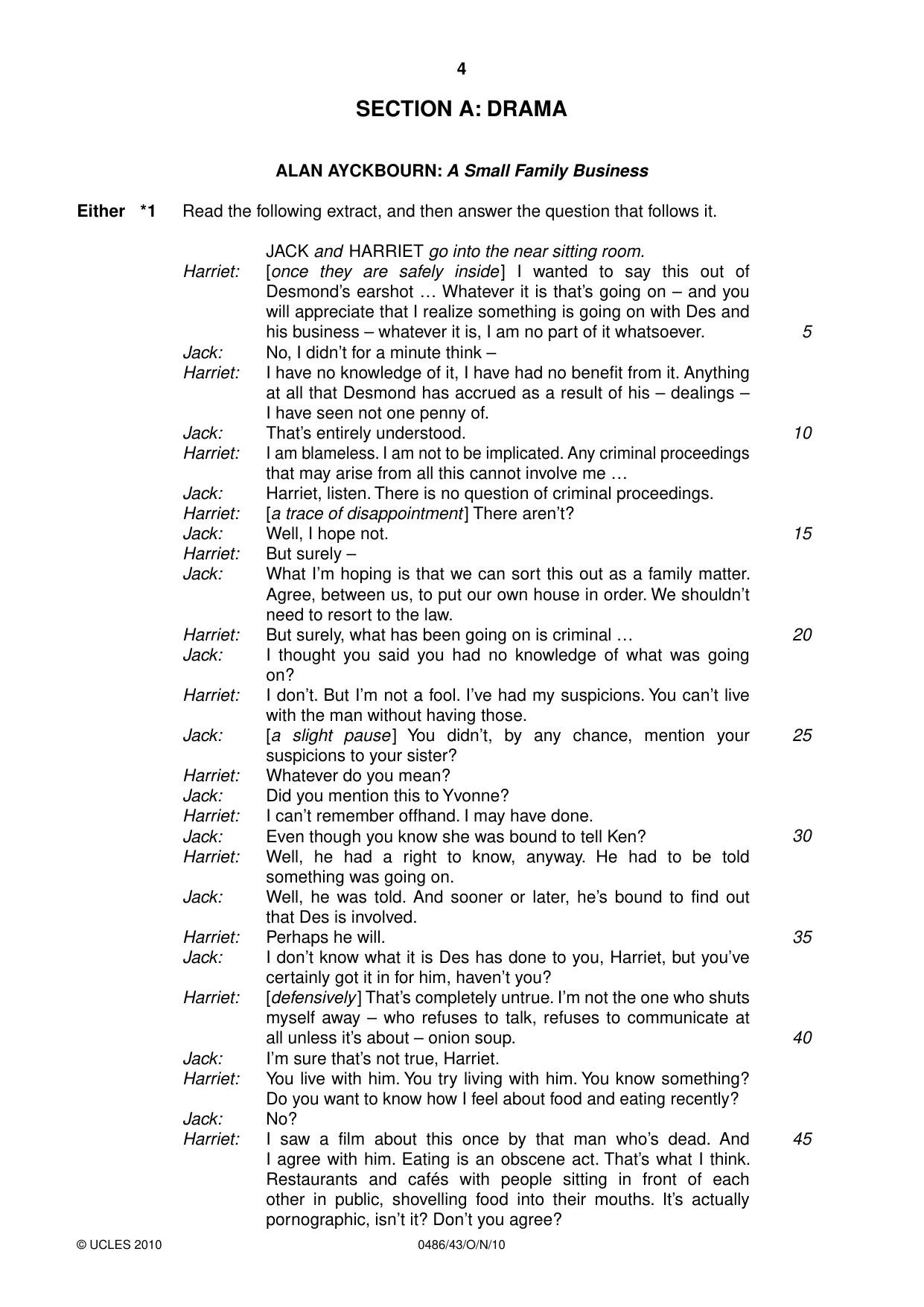
4 0486/43/O/N/10 © UCLES 2010 SECTION A: DRAMA ALAN AYCKBOURN: A Small Family Business Either * 1 Read the following extract, and then answer the question that follows it. JACK and HARRIET go into the near sitting room. Harriet: [once they are safely inside ] I wanted to say this out of Desmond’s earshot … Whatever it is that’s going on – and you will appreciate that I realize something is going on with Des and his business – whatever it is, I am no part of it whatsoever. Jack: No, I didn’t for a minute think – Harriet: I have no knowledge of it, I have had no benefit from it. Anything at all that Desmond has accrued as a result of his – dealings – I have seen not one penny of. Jack: That’s entirely understood. Harriet: I am blameless. I am not to be implicated. Any criminal proceedings that may arise from all this cannot involve me … Jack: Harriet, listen. There is no question of criminal proceedings. Harriet: [a trace of disappointment ] There aren’t? Jack: Well, I hope not. Harriet: But surely – Jack: What I’m hoping is that we can sort this out as a family matter. Agree, between us, to put our own house in order. We shouldn’t need to resort to the law. Harriet: But surely, what has been going on is criminal … Jack: I thought you said you had no knowledge of what was going on? Harriet: I don’t. But I’m not a fool. I’ve had my suspicions. You can’t live with the man without having those. Jack: [a slight pause ] You didn’t, by any chance, mention your suspicions to your sister? Harriet: Whatever do you mean? Jack: Did you mention this to Yvonne? Harriet: I can’t remember offhand. I may have done. Jack: Even though you know she was bound to tell Ken? Harriet: Well, he had a right to know, anyway. He had to be told something was going on. Jack: Well, he was told. And sooner or later, he’s bound to find out that Des is involved. Harriet: Perhaps he will. Jack: I don’t know what it is Des has done to you, Harriet, but you’ve certainly got it in for him, haven’t you? Harriet: [defensively ] That’s completely untrue. I’m not the one who shuts myself away – who refuses to talk, refuses to communicate at all unless it’s about – onion soup. Jack: I’m sure that’s not true, Harriet. Harriet: You live with him. You try living with him. You know something? Do you want to know how I feel about food and eating recently? Jack: No? Harriet: I saw a film about this once by that man who’s dead. And I agree with him. Eating is an obscene act. That’s what I think. Restaurants and cafés with people sitting in front of each other in public, shovelling food into their mouths. It’s actually pornographic, isn’t it? Don’t you agree? 5 10 15 20 25 30 35 40 45
Question paper, page 5
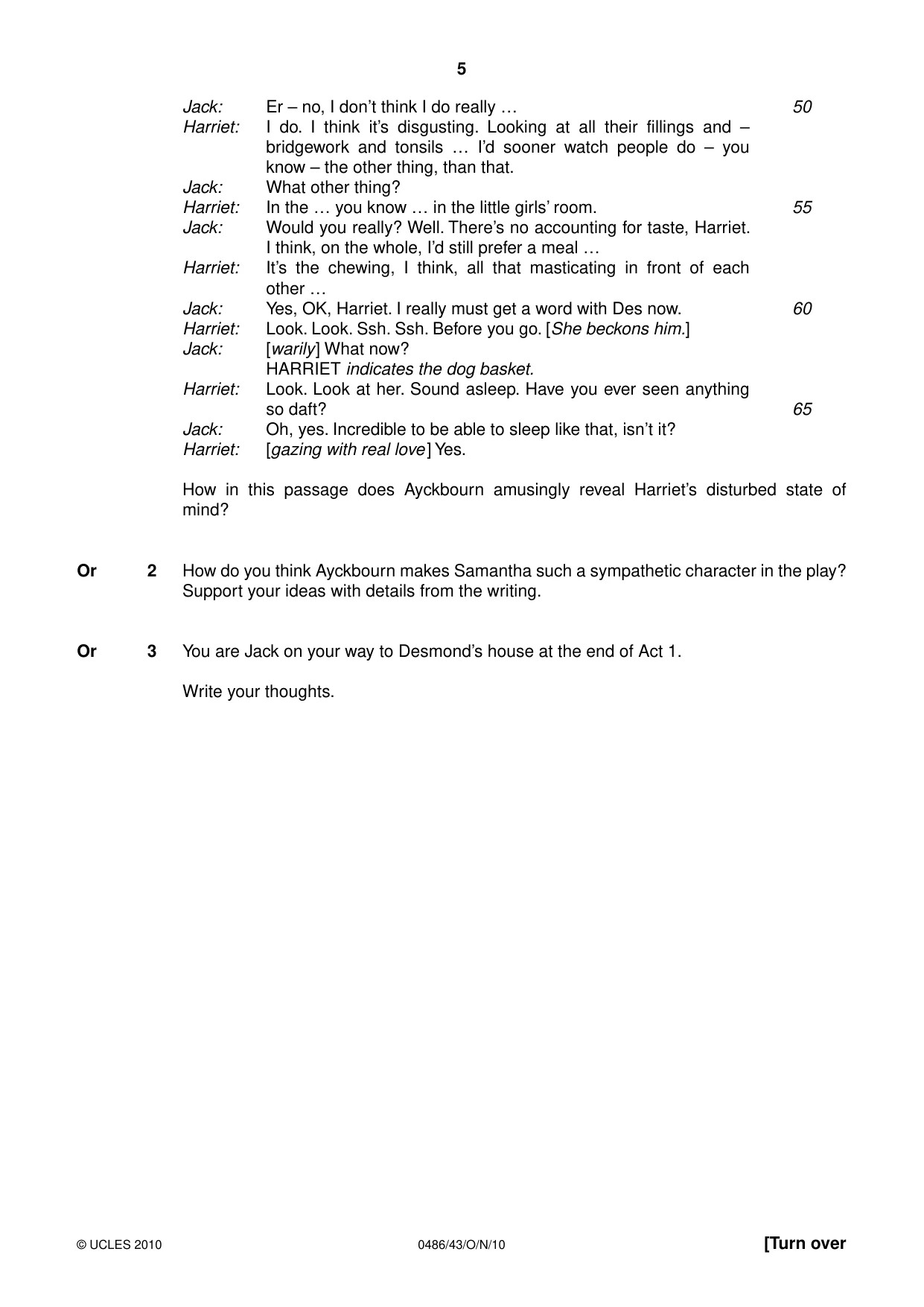
5 0486/43/O/N/10 © UCLES 2010 Jack: Er – no, I don’t think I do really … Harriet: I do. I think it’s disgusting. Looking at all their fillings and – bridgework and tonsils … I’d sooner watch people do – you know – the other thing, than that. Jack: What other thing? Harriet: In the … you know … in the little girls’ room. Jack: Would you really? Well. There’s no accounting for taste, Harriet. I think, on the whole, I’d still prefer a meal … Harriet: It’s the chewing, I think, all that masticating in front of each other … Jack: Yes, OK, Harriet. I really must get a word with Des now. Harriet: Look. Look. Ssh. Ssh. Before you go. [She beckons him.] Jack: [warily ] What now? HARRIET indicates the dog basket. Harriet: Look. Look at her. Sound asleep. Have you ever seen anything so daft? Jack: Oh, yes. Incredible to be able to sleep like that, isn’t it? Harriet: [gazing with real love ] Yes. How in this passage does Ayckbourn amusingly reveal Harriet’s disturbed state of mind? Or 2 How do you think Ayckbourn makes Samantha such a sympathetic character in the play? Support your ideas with details from the writing. Or 3 You are Jack on your way to Desmond’s house at the end of Act 1. Write your thoughts. 50 55 60 65 [Turn over
Question paper, page 6
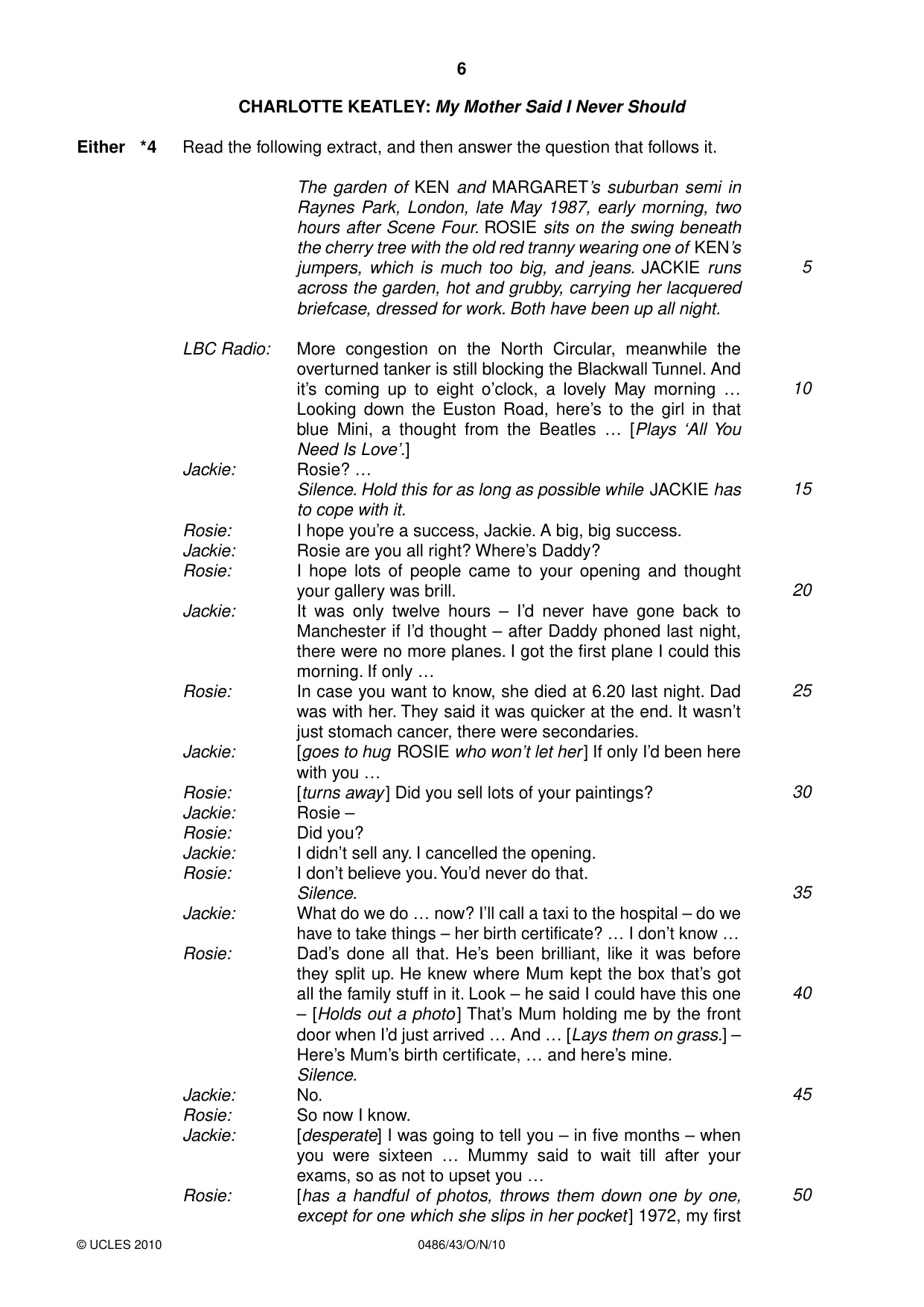
6 0486/43/O/N/10 © UCLES 2010 CHARLOTTE KEATLEY: My Mother Said I Never Should Either * 4 Read the following extract, and then answer the question that follows it. The garden of KEN and MARGARET’s suburban semi in Raynes Park, London, late May 1987, early morning, two hours after Scene Four. ROSIE sits on the swing beneath the cherry tree with the old red tranny wearing one of KEN’s jumpers, which is much too big, and jeans. JACKIE runs across the garden, hot and grubby, carrying her lacquered briefcase, dressed for work. Both have been up all night. LBC Radio: More congestion on the North Circular, meanwhile the overturned tanker is still blocking the Blackwall Tunnel. And it’s coming up to eight o’clock, a lovely May morning … Looking down the Euston Road, here’s to the girl in that blue Mini, a thought from the Beatles … [Plays ‘All You Need Is Love’.] Jackie: Rosie? … Silence. Hold this for as long as possible while JACKIE has to cope with it. Rosie: I hope you’re a success, Jackie. A big, big success. Jackie: Rosie are you all right? Where’s Daddy? Rosie: I hope lots of people came to your opening and thought your gallery was brill. Jackie: It was only twelve hours – I’d never have gone back to Manchester if I’d thought – after Daddy phoned last night, there were no more planes. I got the first plane I could this morning. If only … Rosie: In case you want to know, she died at 6.20 last night. Dad was with her. They said it was quicker at the end. It wasn’t just stomach cancer, there were secondaries. Jackie: [goes to hug ROSIE who won’t let her ] If only I’d been here with you … Rosie: [turns away ] Did you sell lots of your paintings? Jackie: Rosie – Rosie: Did you? Jackie: I didn’t sell any. I cancelled the opening. Rosie: I don’t believe you. You’d never do that. Silence. Jackie: What do we do … now? I’ll call a taxi to the hospital – do we have to take things – her birth certificate? … I don’t know … Rosie: Dad’s done all that. He’s been brilliant, like it was before they split up. He knew where Mum kept the box that’s got all the family stuff in it. Look – he said I could have this one – [Holds out a photo ] That’s Mum holding me by the front door when I’d just arrived … And … [Lays them on grass.] – Here’s Mum’s birth certificate, … and here’s mine. Silence. Jackie: No. Rosie: So now I know. Jackie: [desperate] I was going to tell you – in five months – when you were sixteen … Mummy said to wait till after your exams, so as not to upset you … Rosie: [has a handful of photos, throws them down one by one, except for one which she slips in her pocket ] 1972, my first 5 10 15 20 25 30 35 40 45 50
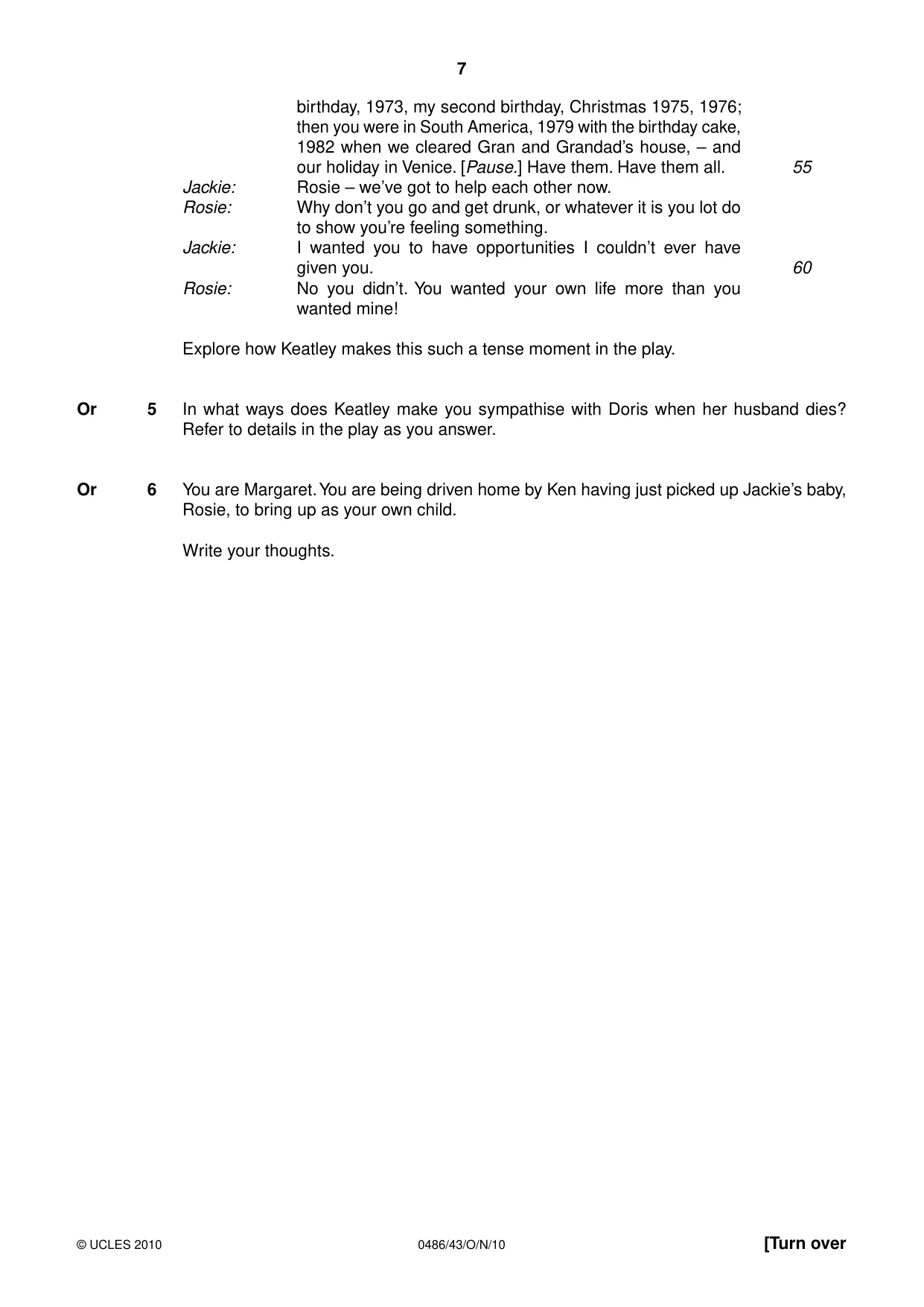
Question paper, page 7
7 0486/43/O/N/10 © UCLES 2010 [Turn over birthday, 1973, my second birthday, Christmas 1975, 1976; then you were in South America, 1979 with the birthday cake, 1982 when we cleared Gran and Grandad’s house, – and our holiday in Venice. [Pause.] Have them. Have them all. Jackie: Rosie – we’ve got to help each other now. Rosie: Why don’t you go and get drunk, or whatever it is you lot do to show you’re feeling something. Jackie: I wanted you to have opportunities I couldn’t ever have given you. Rosie: No you didn’t. You wanted your own life more than you wanted mine! Explore how Keatley makes this such a tense moment in the play. Or 5 In what ways does Keatley make you sympathise with Doris when her husband dies? Refer to details in the play as you answer. Or 6 You are Margaret. You are being driven home by Ken having just picked up Jackie’s baby, Rosie, to bring up as your own child. Write your thoughts. 55 60
Question paper, page 8
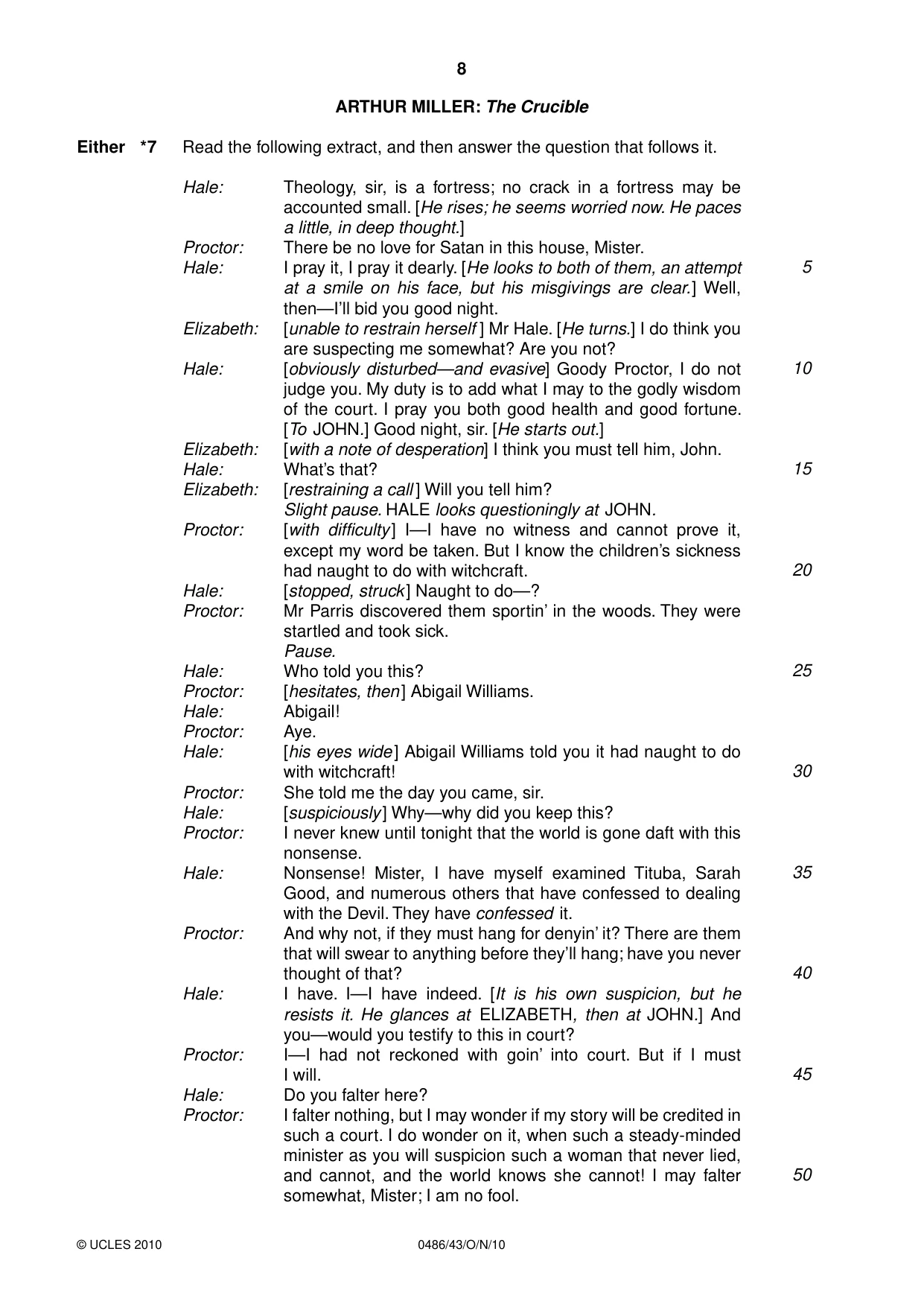
8 0486/43/O/N/10 ARTHUR MILLER: The Crucible Either * 7 Read the following extract, and then answer the question that follows it. Hale: Theology, sir, is a fortress; no crack in a fortress may be accounted small. [He rises; he seems worried now. He paces a little, in deep thought.] Proctor: There be no love for Satan in this house, Mister. Hale: I pray it, I pray it dearly. [He looks to both of them, an attempt at a smile on his face, but his misgivings are clear. ] Well, then—I’ll bid you good night. Elizabeth: [unable to restrain herself ] Mr Hale. [He turns.] I do think you are suspecting me somewhat? Are you not? Hale: [obviously disturbed—and evasive] Goody Proctor, I do not judge you. My duty is to add what I may to the godly wisdom of the court. I pray you both good health and good fortune. [To JOHN.] Good night, sir. [He starts out.] Elizabeth: [with a note of desperation] I think you must tell him, John. Hale: What’s that? Elizabeth: [restraining a call ] Will you tell him? Slight pause. HALE looks questioningly at JOHN. Proctor: [with difficulty ] I—I have no witness and cannot prove it, except my word be taken. But I know the children’s sickness had naught to do with witchcraft. Hale: [stopped, struck ] Naught to do—? Proctor: Mr Parris discovered them sportin’ in the woods. They were startled and took sick. Pause. Hale: Who told you this? Proctor: [hesitates, then ] Abigail Williams. Hale: Abigail! Proctor: Aye. Hale: [his eyes wide ] Abigail Williams told you it had naught to do with witchcraft! Proctor: She told me the day you came, sir. Hale: [suspiciously ] Why—why did you keep this? Proctor: I never knew until tonight that the world is gone daft with this nonsense. Hale: Nonsense! Mister, I have myself examined Tituba, Sarah Good, and numerous others that have confessed to dealing with the Devil. They have confessed it. Proctor: And why not, if they must hang for denyin’ it? There are them that will swear to anything before they’ll hang; have you never thought of that? Hale: I have. I—I have indeed. [It is his own suspicion, but he resists it. He glances at ELIZABETH, then at JOHN.] And you—would you testify to this in court? Proctor: I—I had not reckoned with goin’ into court. But if I must I will. Hale: Do you falter here? Proctor: I falter nothing, but I may wonder if my story will be credited in such a court. I do wonder on it, when such a steady-minded minister as you will suspicion such a woman that never lied, and cannot, and the world knows she cannot! I may falter somewhat, Mister; I am no fool. © UCLES 2010 5 10 15 20 25 30 35 40 45 50
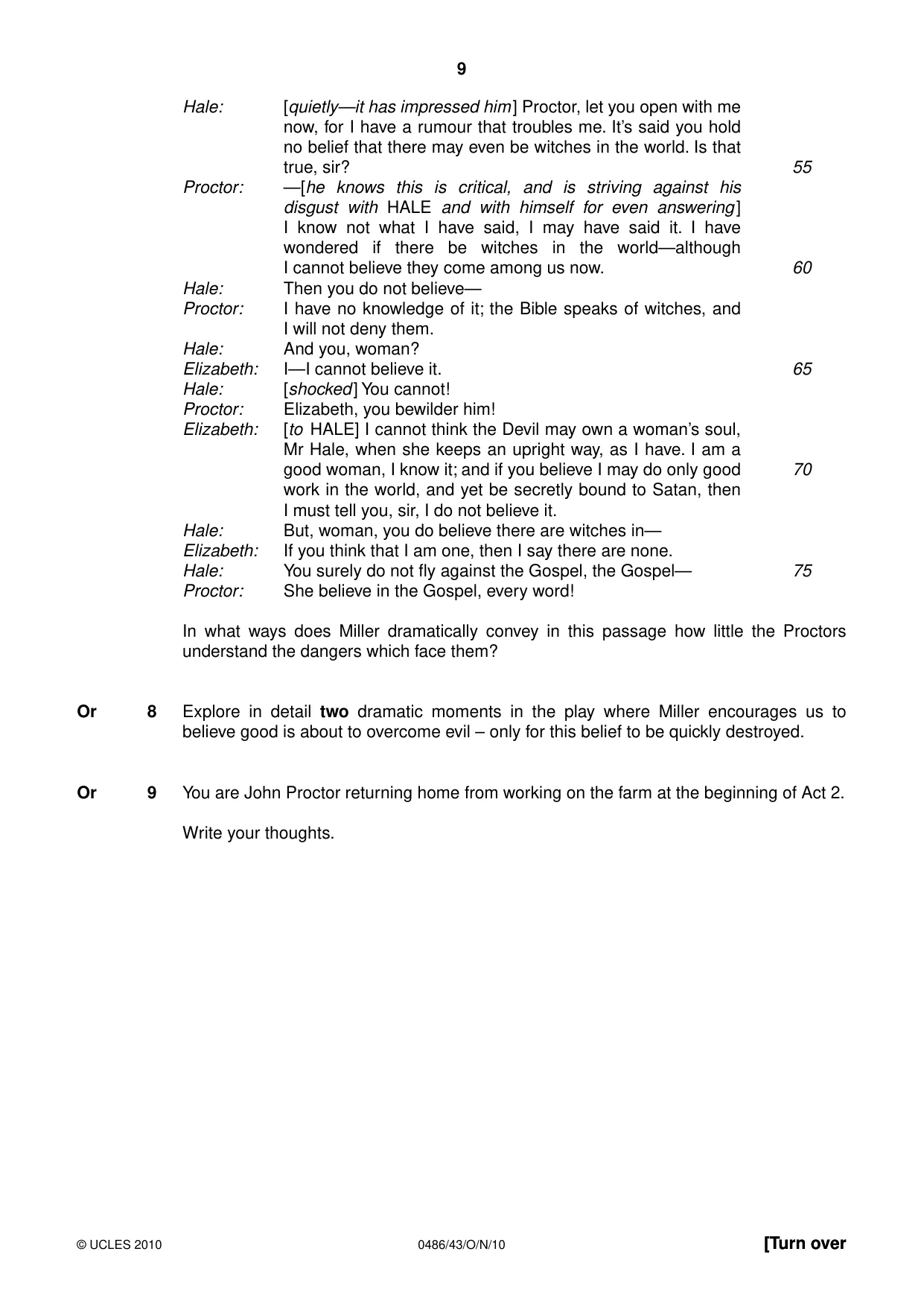
Question paper, page 9
9 0486/43/O/N/10 © UCLES 2010 [Turn over Hale: [quietly—it has impressed him ] Proctor, let you open with me now, for I have a rumour that troubles me. It’s said you hold no belief that there may even be witches in the world. Is that true, sir? Proctor: —[he knows this is critical, and is striving against his disgust with HALE and with himself for even answering ] I know not what I have said, I may have said it. I have wondered if there be witches in the world—although I cannot believe they come among us now. Hale: Then you do not believe— Proctor: I have no knowledge of it; the Bible speaks of witches, and I will not deny them. Hale: And you, woman? Elizabeth: I—I cannot believe it. Hale: [shocked ] You cannot! Proctor: Elizabeth, you bewilder him! Elizabeth: [to HALE] I cannot think the Devil may own a woman’s soul, Mr Hale, when she keeps an upright way, as I have. I am a good woman, I know it; and if you believe I may do only good work in the world, and yet be secretly bound to Satan, then I must tell you, sir, I do not believe it. Hale: But, woman, you do believe there are witches in— Elizabeth: If you think that I am one, then I say there are none. Hale: You surely do not fly against the Gospel, the Gospel— Proctor: She believe in the Gospel, every word! In what ways does Miller dramatically convey in this passage how little the Proctors understand the dangers which face them? Or 8 Explore in detail two dramatic moments in the play where Miller encourages us to believe good is about to overcome evil – only for this belief to be quickly destroyed. Or 9 You are John Proctor returning home from working on the farm at the beginning of Act 2. Write your thoughts. [Turn over 55 60 65 70 75
Question paper, page 10
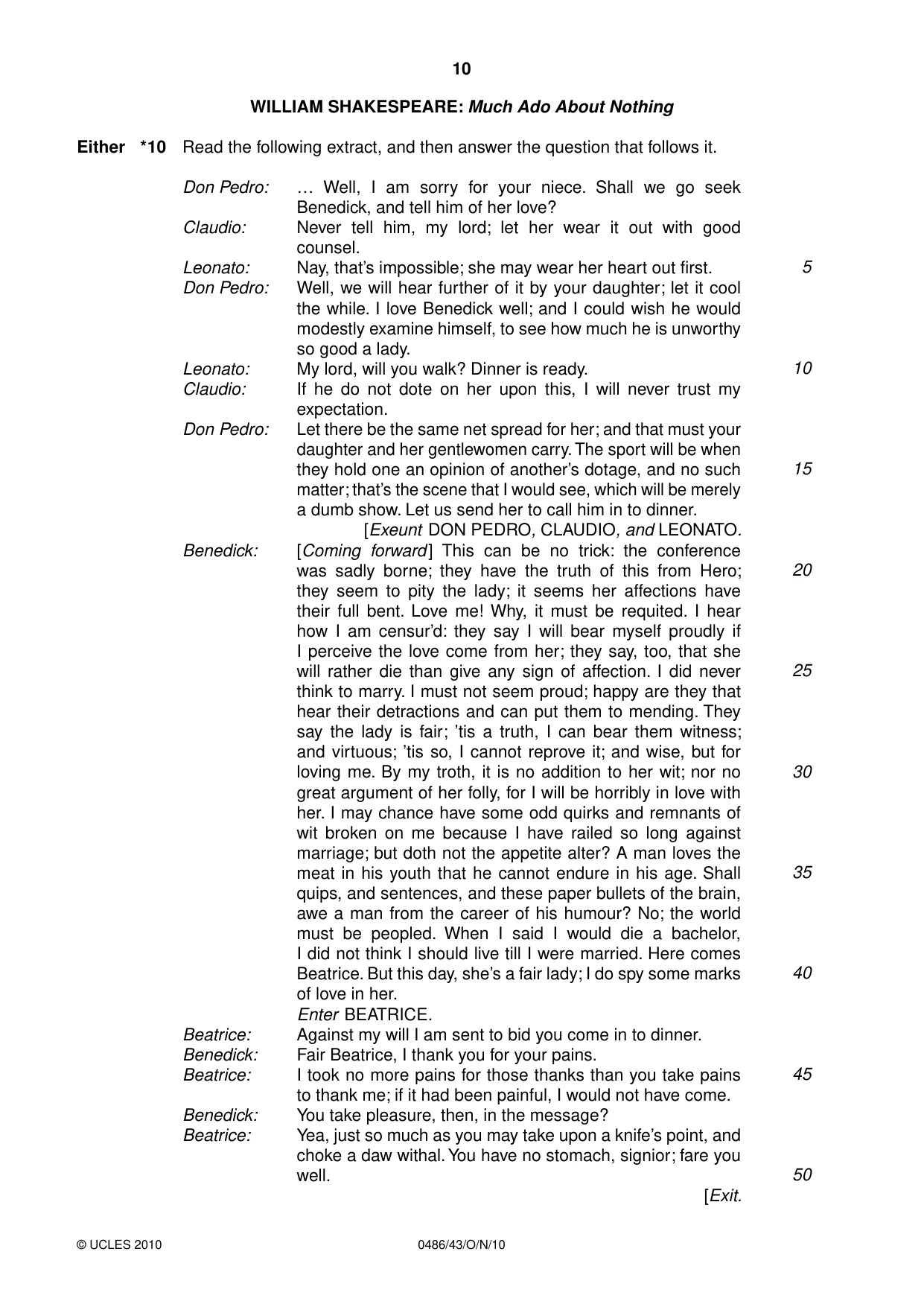
10 0486/43/O/N/10 WILLIAM SHAKESPEARE: Much Ado About Nothing Either * 10 Read the following extract, and then answer the question that follows it. Don Pedro: … Well, I am sorry for your niece. Shall we go seek Benedick, and tell him of her love? Claudio: Never tell him, my lord; let her wear it out with good counsel. Leonato: Nay, that’s impossible; she may wear her heart out first. Don Pedro: Well, we will hear further of it by your daughter; let it cool the while. I love Benedick well; and I could wish he would modestly examine himself, to see how much he is unworthy so good a lady. Leonato: My lord, will you walk? Dinner is ready. Claudio: If he do not dote on her upon this, I will never trust my expectation. Don Pedro: Let there be the same net spread for her; and that must your daughter and her gentlewomen carry. The sport will be when they hold one an opinion of another’s dotage, and no such matter; that’s the scene that I would see, which will be merely a dumb show. Let us send her to call him in to dinner. [Exeunt DON PEDRO, CLAUDIO, and LEONATO. Benedick: [Coming forward ] This can be no trick: the conference was sadly borne; they have the truth of this from Hero; they seem to pity the lady; it seems her affections have their full bent. Love me! Why, it must be requited. I hear how I am censur’d: they say I will bear myself proudly if I perceive the love come from her; they say, too, that she will rather die than give any sign of affection. I did never think to marry. I must not seem proud; happy are they that hear their detractions and can put them to mending. They say the lady is fair; ’tis a truth, I can bear them witness; and virtuous; ’tis so, I cannot reprove it; and wise, but for loving me. By my troth, it is no addition to her wit; nor no great argument of her folly, for I will be horribly in love with her. I may chance have some odd quirks and remnants of wit broken on me because I have railed so long against marriage; but doth not the appetite alter? A man loves the meat in his youth that he cannot endure in his age. Shall quips, and sentences, and these paper bullets of the brain, awe a man from the career of his humour? No; the world must be peopled. When I said I would die a bachelor, I did not think I should live till I were married. Here comes Beatrice. But this day, she’s a fair lady; I do spy some marks of love in her. Enter BEATRICE. Beatrice: Against my will I am sent to bid you come in to dinner. Benedick: Fair Beatrice, I thank you for your pains. Beatrice: I took no more pains for those thanks than you take pains to thank me; if it had been painful, I would not have come. Benedick: You take pleasure, then, in the message? Beatrice: Yea, just so much as you may take upon a knife’s point, and choke a daw withal. You have no stomach, signior; fare you well. [Exit. 5 10 15 20 25 30 35 40 45 50 © UCLES 2010
Question paper, page 11
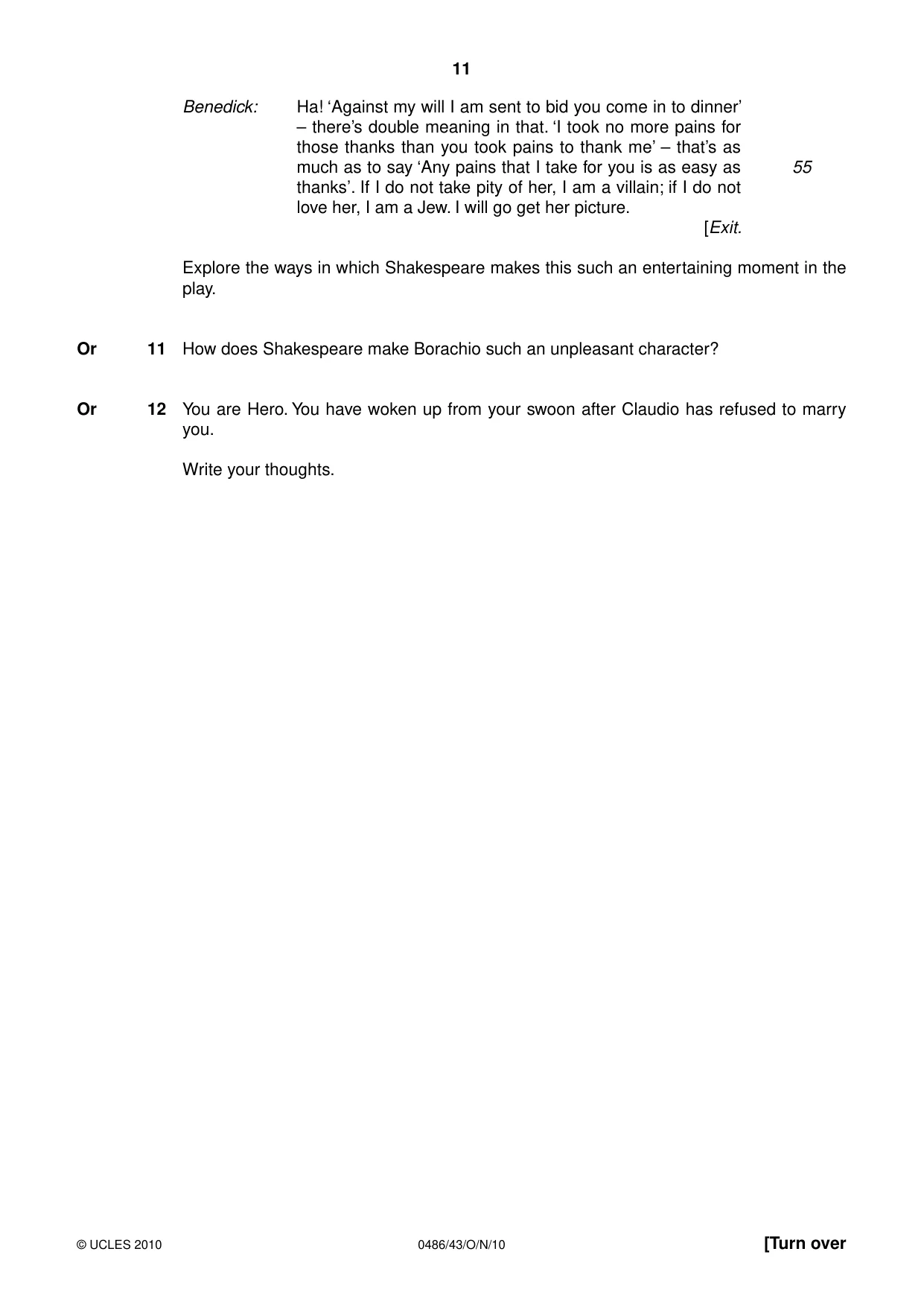
11 0486/43/O/N/10 Benedick: Ha! ‘Against my will I am sent to bid you come in to dinner’ – there’s double meaning in that. ‘I took no more pains for those thanks than you took pains to thank me’ – that’s as much as to say ‘Any pains that I take for you is as easy as thanks’. If I do not take pity of her, I am a villain; if I do not love her, I am a Jew. I will go get her picture. [Exit. Explore the ways in which Shakespeare makes this such an entertaining moment in the play. Or 11 How does Shakespeare make Borachio such an unpleasant character? Or 12 You are Hero. You have woken up from your swoon after Claudio has refused to marry you. Write your thoughts. 55 © UCLES 2010 [Turn over
Question paper, page 12
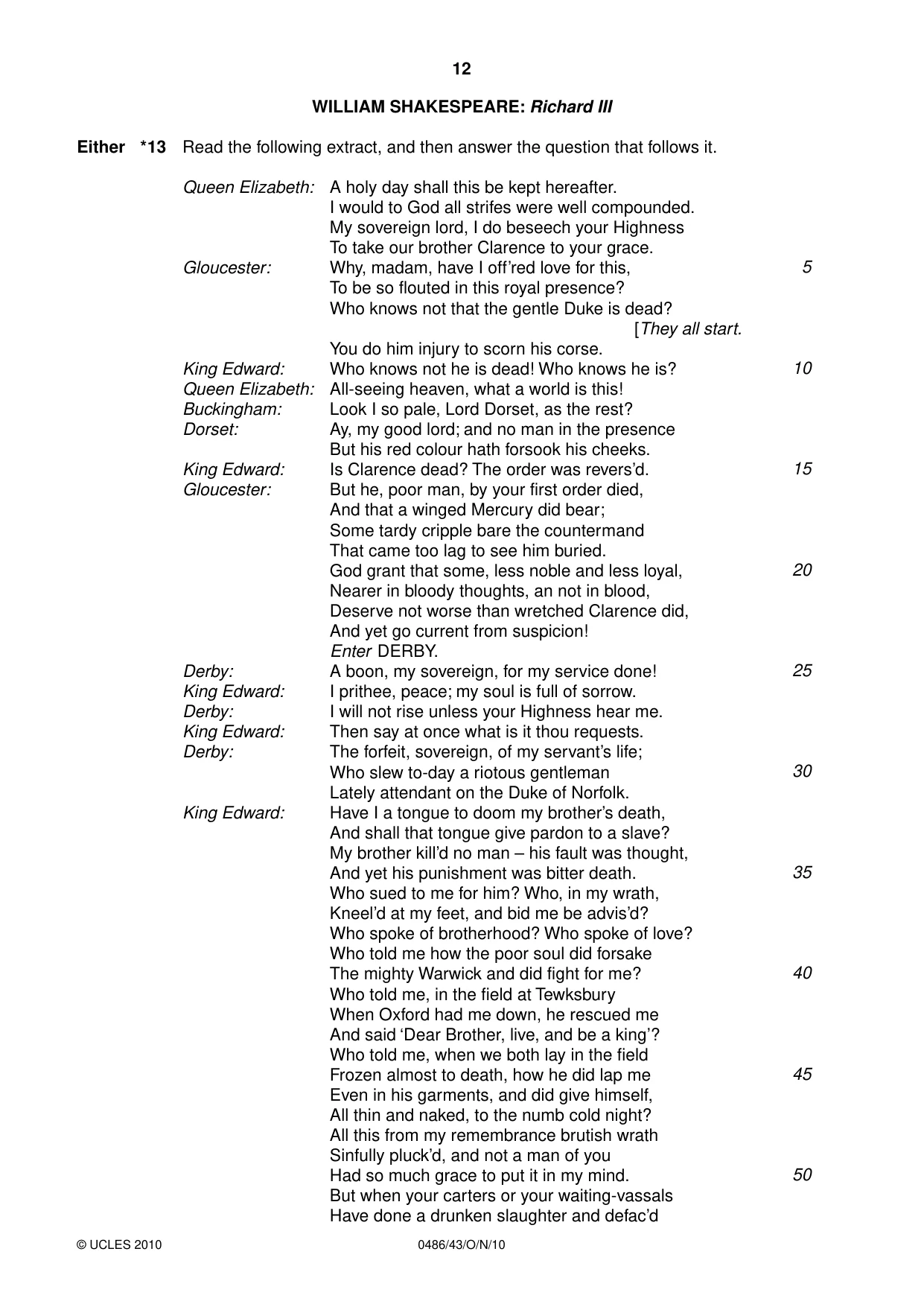
12 0486/43/O/N/10 WILLIAM SHAKESPEARE: Richard III Either * 13 Read the following extract, and then answer the question that follows it. Queen Elizabeth: A holy day shall this be kept hereafter. I would to God all strifes were well compounded. My sovereign lord, I do beseech your Highness To take our brother Clarence to your grace. Gloucester: Why, madam, have I off’red love for this, To be so flouted in this royal presence? Who knows not that the gentle Duke is dead? [They all start. You do him injury to scorn his corse. King Edward: Who knows not he is dead! Who knows he is? Queen Elizabeth: All-seeing heaven, what a world is this! Buckingham: Look I so pale, Lord Dorset, as the rest? Dorset: Ay, my good lord; and no man in the presence But his red colour hath forsook his cheeks. King Edward: Is Clarence dead? The order was revers’d. Gloucester: But he, poor man, by your first order died, And that a winged Mercury did bear; Some tardy cripple bare the countermand That came too lag to see him buried. God grant that some, less noble and less loyal, Nearer in bloody thoughts, an not in blood, Deserve not worse than wretched Clarence did, And yet go current from suspicion! Enter DERBY. Derby: A boon, my sovereign, for my service done! King Edward: I prithee, peace; my soul is full of sorrow. Derby: I will not rise unless your Highness hear me. King Edward: Then say at once what is it thou requests. Derby: The forfeit, sovereign, of my servant’s life; Who slew to-day a riotous gentleman Lately attendant on the Duke of Norfolk. King Edward: Have I a tongue to doom my brother’s death, And shall that tongue give pardon to a slave? My brother kill’d no man – his fault was thought, And yet his punishment was bitter death. Who sued to me for him? Who, in my wrath, Kneel’d at my feet, and bid me be advis’d? Who spoke of brotherhood? Who spoke of love? Who told me how the poor soul did forsake The mighty Warwick and did fight for me? Who told me, in the field at Tewksbury When Oxford had me down, he rescued me And said ‘Dear Brother, live, and be a king’? Who told me, when we both lay in the field Frozen almost to death, how he did lap me Even in his garments, and did give himself, All thin and naked, to the numb cold night? All this from my remembrance brutish wrath Sinfully pluck’d, and not a man of you Had so much grace to put it in my mind. But when your carters or your waiting-vassals Have done a drunken slaughter and defac’d © UCLES 2010 5 10 15 20 25 30 35 40 45 50
Question paper, page 13
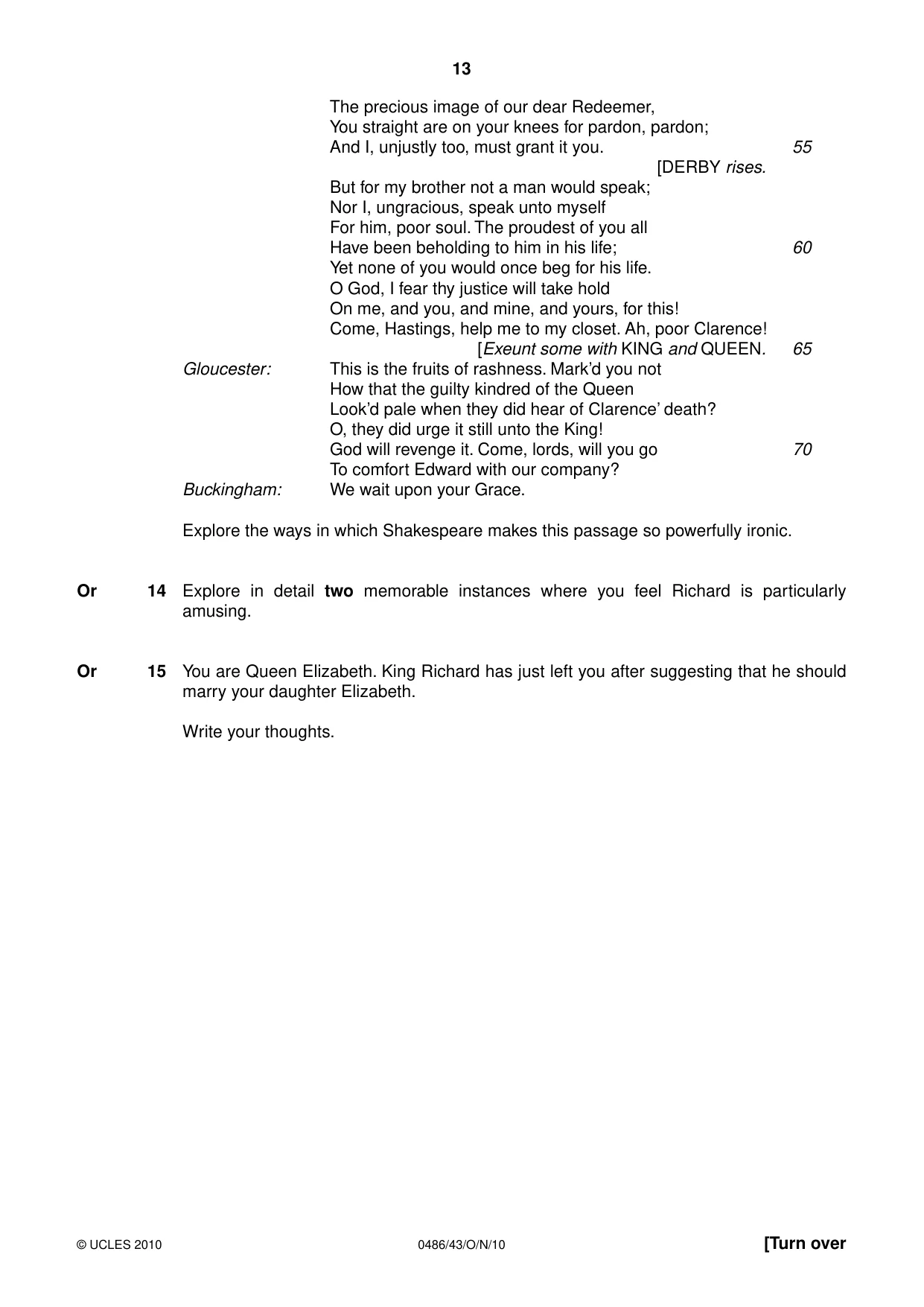
13 0486/43/O/N/10 © UCLES 2010 [Turn over The precious image of our dear Redeemer, You straight are on your knees for pardon, pardon; And I, unjustly too, must grant it you. [DERBY rises. But for my brother not a man would speak; Nor I, ungracious, speak unto myself For him, poor soul. The proudest of you all Have been beholding to him in his life; Yet none of you would once beg for his life. O God, I fear thy justice will take hold On me, and you, and mine, and yours, for this! Come, Hastings, help me to my closet. Ah, poor Clarence! [Exeunt some with KING and QUEEN. Gloucester: This is the fruits of rashness. Mark’d you not How that the guilty kindred of the Queen Look’d pale when they did hear of Clarence’ death? O, they did urge it still unto the King! God will revenge it. Come, lords, will you go To comfort Edward with our company? Buckingham: We wait upon your Grace. Explore the ways in which Shakespeare makes this passage so powerfully ironic. Or 14 Explore in detail two memorable instances where you feel Richard is particularly amusing. Or 15 You are Queen Elizabeth. King Richard has just left you after suggesting that he should marry your daughter Elizabeth. Write your thoughts. 55 60 65 70
Question paper, page 14
14 0486/43/O/N/10 © UCLES 2010 R.C. SHERRIFF: Journey’s End Either * 16 Read the following extract, and then answer the question that follows it. Stanhope: [looking up quickly at OSBORNE and laughing] Yes, I’m his hero. Osborne: It’s quite natural. Stanhope: You think so? Osborne: Small boys at school generally have their heroes. Stanhope: Yes. Small boys at school do. Osborne: Often it goes on as long as — Stanhope: — as long as the hero’s a hero. Osborne: It often goes on all through life. Stanhope: I wonder. How many battalions are there in France? Osborne: Why? Stanhope: We’ll say fifty divisions. That’s a hundred and fifty brigades — four hundred and fifty battalions. That’s one thousand eight hundred companies. [He looks up at OSBORNE from his calculations on the magazine cover.] There are one thousand eight hundred companies in France, Uncle. Raleigh might have been sent to any one of those, and, my God! he comes to mine. Osborne: You ought to be glad. He’s a good-looking youngster. I like him. Stanhope: I knew you’d like him. Personality, isn’t it? [He takes a worn leather case from his breast pocket and hands a small photograph to OSBORNE.] I’ve never shown you that, have I? Osborne: [looking at the photograph ] No. [Pause.] Raleigh’s sister, isn’t it? Stanhope: How did you know? Osborne: There’s a strong likeness. Stanhope: I suppose there is. Osborne: [intent on the picture ] She’s an awfully nice-looking girl. Stanhope: A photo doesn’t show much, really. Just a face. Osborne: She looks awfully nice. There is silence. STANHOPE lights a cigarette. OSBORNE hands the photo back. You’re a lucky chap. Stanhope: [ putting the photo back into his case ] I don’t know why I keep it, really. Osborne: Why? Isn’t she — I thought — Stanhope: What did you think? Osborne: Well, I thought that perhaps she was waiting for you. Stanhope: Yes. She is waiting for me — and she doesn’t know. She thinks I’m a wonderful chap — commanding a company. [He turns to OSBORNE and points up the steps into the line.] She doesn’t know that if I went up those steps into the front line — without being doped with whisky — I’d go mad with fright. There is a pause. OSBORNE stirs himself to speak. Osborne: Look here, old man. I’ve meant to say it, for a long time, but it sounds damned impudence. You’ve done longer out here than any man in the battalion. It’s time you went away for a rest. It’s due to you. 5 10 15 20 25 30 35 40 45 50
Question paper, page 15
15 0486/43/O/N/10 © UCLES 2010 [Turn over Stanhope: You suggest that I go sick, like that little worm in there — neuralgia in the eye? [He laughs and takes a drink.] Osborne: No. Not that. The colonel would have sent you down long ago, only — Stanhope: Only — what? Osborne: Only he can’t spare you. Stanhope: [laughing ] Oh, rot! Osborne: He told me. Stanhope: He thinks I’m in such a state I want a rest, is that it? Osborne: No. He thinks it’s due to you. Stanhope: It’s all right, Uncle. I’ll stick it out now. It may not be much longer now. I’ve had my share of luck — more than my share. There’s not a man left who was here when I came. But it’s rather damnable for that boy — of all the boys in the world — to have come to me. I might at least have been spared that. Explore the ways in which Sherriff in this passage movingly conveys the pressures facing Stanhope. Or 17 What do you think the character of Trotter contributes to the power of the play? Support your ideas with details from Sherriff’s writing. Or 18 You are Hibbert towards the end of the play. You are leaving the dugout with Mason. Write your thoughts. 55 60 65
Question paper, page 16
16 0486/43/O/N/10 © UCLES 2010 SECTION B: POETRY SONGS OF OURSELVES: from Part 3 Either * 19 Read the following poem, and then answer the question that follows it. The Flower-Fed Buffaloes The flower-fed buffaloes of the spring In the days of long ago, Ranged where the locomotives sing And the prairie flowers lie low:– The tossing, blooming, perfumed grass 5 Is swept away by the wheat, Wheels and wheels and wheels spin by In the spring that still is sweet. But the flower-fed buffaloes of the spring Left us, long ago. 10 They gore no more, they bellow no more, They trundle around the hills no more:– With the Blackfeet, lying low, With the Pawnees, lying low, Lying low. 15 (by Vachel Lindsay ) What are your feelings as you read this poem? Support your ideas by reference to the words of the poem. Or 20 How does the poet powerfully convey the sorrow of human life in either Dover Beach (by Matthew Arnold) or Sonnet 29 (by Edna St Vincent Millay)? Support your ideas with details from the poem. Or 21 Some poems tell a story. Explore one poem from this selection which you feel does this, showing how you think the poet makes the story compelling. (Do not use the The Flower-Fed Buffaloes in answering this question.)
Question paper, page 17
17 0486/43/O/N/10 © UCLES 2010 [Turn over JOHN KEATS: Poems Either * 22 Read the last three stanzas from Ode to a Nightingale, and then answer the question that follows. Darkling I listen; and, for many a time I have been half in love with easeful Death, Call’d him soft names in many a mused rhyme, To take into the air my quiet breath; Now more than ever seems it rich to die, 5 To cease upon the midnight with no pain, While thou art pouring forth thy soul abroad In such an ecstasy! Still wouldst thou sing, and I have ears in vain – To thy high requiem become a sod. 10 Thou wast not born for death, immortal Bird! No hungry generations tread thee down; The voice I hear this passing night was heard In ancient days by emperor and clown: Perhaps the self-same song that found a path 15 Through the sad heart of Ruth, when, sick for home, She stood in tears amid the alien corn; The same that oft-times hath Charm’d magic casements, opening on the foam Of perilous seas, in faery lands forlorn. 20 Forlorn! the very word is like a bell To toll me back from thee to my sole self! Adieu! the fancy cannot cheat so well As she is fam’d to do, deceiving elf. Adieu! adieu! thy plaintive anthem fades 25 Past the near meadows, over the still stream, Up the hill-side; and now ’tis buried deep In the next valley-glades: Was it a vision, or a waking dream? Fled is that music: – Do I wake or sleep? 30 Explore the ways in which Keats presents his thoughts and feelings in these three stanzas. Or 23 In what ways does Keats appeal to your imagination in Ode on a Grecian Urn ? Refer in detail to the poem as you answer. Or 24 In what ways does Keats create an exciting atmosphere in The Eve of St Agnes ? Refer in detail to the poem in your answer.
Question paper, page 18
18 0486/43/O/N/10 © UCLES 2010 SECTION C: PROSE JANE AUSTEN: Pride and Prejudice Either * 25 Read the following extract, and then answer the question that follows it. ‘Tell me once for all, are you engaged to him?’ Though Elizabeth would not, for the mere purpose of obliging Lady Catherine, have answered this question; she could not but say, after a moment’s deliberation, ‘I am not.’ Lady Catherine seemed pleased. ‘And will you promise me, never to enter into such an engagement?’ ‘I will make no promise of the kind.’ ‘Miss Bennet I am shocked and astonished. I expected to find a more reasonable young woman. But do not deceive yourself into a belief that I will ever recede. I shall not go away, till you have given me the assurance I require.’ ‘And I certainly never shall give it. I am not to be intimidated into anything so wholly unreasonable. Your ladyship wants Mr Darcy to marry your daughter; but would my giving you the wished-for promise, make their marriage at all more probable? Supposing him to be attached to me, would my refusing to accept his hand, make him wish to bestow it on his cousin? Allow me to say, Lady Catherine, that the arguments with which you have supported this extraordinary application, have been as frivolous as the application was ill-judged. You have widely mistaken my character, if you think I can be worked on by such persuasions as these. How far your nephew might approve of your interference in his affairs, I cannot tell; but you have certainly no right to concern yourself in mine. I must beg, therefore, to be importuned no farther on the subject.’ ‘Not so hasty, if you please. I have by no means done. To all the objections I have already urged, I have still another to add. I am no stranger to the particulars of your youngest sister’s infamous elopement. I know it all; that the young man’s marrying her, was a patched-up business, at the expense of your father and uncles. And is such a girl to be my nephew’s sister? Is her husband, is the son of his late father’s steward, to be his brother? Heaven and earth! – of what are you thinking? Are the shades of Pemberley to be thus polluted?’ ‘You can now have nothing farther to say,’ she resentfully answered. ‘You have insulted me, in every possible method. I must beg to return to the house.’ And she rose as she spoke. Lady Catherine rose also, and they turned back. Her ladyship was highly incensed. ‘You have no regard, then, for the honour and credit of my nephew! Unfeeling, selfish girl! Do you not consider that a connection with you, must disgrace him in the eyes of everybody?’ ‘Lady Catherine, I have nothing farther to say. You know my sentiments.’ ‘You are then resolved to have him?’ ‘I have said no such thing. I am only resolved to act in that manner, which will, in my own opinion, constitute my happiness, without reference to you, or to any person so wholly unconnected with me.’ ‘It is well. You refuse, then, to oblige me. You refuse to obey the claims of duty, honour and gratitude. You are determined to ruin him in the opinion of all his friends, and make him the contempt of the world.’ 5 10 15 20 25 30 35 40 45
Question paper, page 19
19 0486/43/O/N/10 © UCLES 2010 [Turn over ‘Neither duty, nor honour, nor gratitude,’ replied Elizabeth, ‘have any possible claim on me, in the present instance. No principle of either, would be violated by my marriage with Mr Darcy. And with regard to the resentment of his family, or the indignation of the world, if the former were excited by his marrying me, it would not give me one moment’s concern – and the world in general would have too much sense to join in the scorn.’ ‘And this is your real opinion! This is your final resolve! Very well. I shall now know how to act. Do not imagine, Miss Bennet, that your ambition will ever be gratified. I came to try you. I hoped to find you reasonable; but depend upon it I will carry my point.’ What do you think makes this moment so ironic and so very satisfying in its effect? Support your ideas with details from Austen’s writing. Or 26 Is Mrs Bennet simply an absurd character to be laughed at? Support your ideas with details from Austen’s writing. Or 27 You are Darcy. You have just left Longbourn after becoming engaged to Elizabeth. Write your thoughts. 50 55
Question paper, page 20
20 0486/43/O/N/10 © UCLES 2010 IAN CROSS: The God Boy Either * 28 Read the following extract, and then answer the question that follows it. After I closed the door I really wanted to go on down the passage to the bathroom. I wanted to, yet I didn’t. I had to listen. It was funny with me. I couldn’t help listening to what my mother and father were saying to each other, even though it did me no good. This time I knew what they would say, and I knew what would happen to me, and still I listened. I moved a little up from the door into the middle of the passage and stretched both my arms out till my fingers were touching the wallpaper on each side. I was a queer fish, I suppose, but that was the way I was. That wallpaper, touching it like that, was one of my protection tricks. I still like wallpaper, if you want to know, wallpaper with those whirling designs as a pattern. I heard my mother say, ‘You drunken pig,’ to my father. ‘You go about with the boy while you are sodden with drink.’ ‘For God’s sake shut up,’ he said. ‘You ought to be ashamed of yourself.’ ‘Dish up the food and keep your nagging tongue in your head.’ A lot of talk like that I can just about repeat word for word. I have a very good memory, there is no doubt about that. When I heard those words it happened to me again. This must have been the fourth or fifth time I had to use my protection tricks. As I heard them talking like that I could see how mother would be looking because I had seen her that way often with my father. She would be all hot and warm, and she’d stare at him in a way that would frighten me, and she always had a fist up alongside her head. Even though I was out in the passage I could feel her so much it was almost as though she was pressed up right next to me. I pushed my fingers till my nails dug into the wallpaper, and, as I said, it happened to me again. The air just went cold, as it did those times before, and started sticking to my skin, on my arms and legs and face, everywhere. I had seen a marble statue in a museum, a well-built man doubled over throwing something, and the feeling reminded me of him. It was as if I was starting to be made of marble. And my heart started banging away so much it shook me. I knew what to do and I managed to get to the bathroom, though I could hardly move my legs. I said, ‘Hail Mary, full of grace, the Lord is with you, blessed art thou amongst women and blessed is the fruit of thy womb, Jesus,’ and turned on the hot-water tap over the bath, and shoved my hands under. The hot water cleaned away the marble feeling wherever it touched and there was only the ordinary skin there. Then I said, ‘Holy Mary, Mother of God, pray for us sinners, now and at the hour of our death, amen,’ and dipped the flannel in the hot water and rubbed it all over me. I got wet and messed up, yet it worked. The last protection trick of mine was to sing, ‘Jingle-bells, jingle-bells, jingle all the way, oh what fun, it is to ride in a one-horse open sleigh’. I had other songs, ‘Hail Queen of the Sea’, which the nuns taught us at school, ‘It’s a Long Way to Tipperary’, which my father taught me, and, naturally, the national anthem. I only had to sing one song at these times. It didn’t make any difference which one. In what ways does Cross here vividly convey Jimmy’s stress and unhappiness? 5 10 15 20 25 30 35 40 45
Question paper, page 21
21 0486/43/O/N/10 © UCLES 2010 [Turn over Or 29 What do you think the character of Molly contributes to the power of the novel? Support your ideas with details from Cross’s writing. Or 30 You are Mrs Sullivan after you have watched Jimmy leave on his new bicycle. You are in the house recovering from your fall. Write your thoughts.
Question paper, page 22
22 0486/43/O/N/10 © UCLES 2010 ANITA DESAI: Games at Twilight and Other Stories Either * 31 Read the following extract from Scholar and Gypsy, and then answer the question that follows it. Her first day in Bombay wilted her. If she stepped out of the air-conditioned hotel room, she drooped, her head hung, her eyes glazed, she felt faint. Once she was back in it, she fell across her bed as though she had been struck by calamity, was extinguished, and could barely bring herself to believe that she had, after all, survived. Sweating, it seemed to her that life, energy, hope were all seeping out of her, flowing down a drain, gurgling ironically. ‘But you knew it would be hot,’ David said, not being able to help a sense of disappointment in her. He had bought himself crisp bush-shirts of madras cotton and open Kolhapur sandals. He was drinking more than was his habit, it was true, but it did not seem to redden and coarsen him as it did her. He looked so right, so fitting on the Bombay streets, striding over the coconut shells and betel-stained papers and the fish scales and lepers’ stumps. ‘You could hardly come to India and expect it to be cool, Pat.’ ‘Hot, yes,’ she moaned, ‘but not – not killing. Not so like death. I feel half-dead, David, sometimes quite dead.’ ‘Shall we go and have a gin-and-lime in the bar?’ She tried that since it seemed to do him so much good. But the bar in the hotel was so crowded, the people there were so large and vital and forceful in their brilliant clothes and with their metallic voices and their eyes that flashed over her like barbers’ shears, cutting and exposing, that she felt crushed rather than revived. David attracted people like a magnet – with his charm, his nonchalance, his grace, he did it so well, so smoothly, his qualities worked more efficiently than any visiting card system – and they started going to parties. It began to seem to her that this was the chief occupation of people in Bombay – going to parties. She was always on the point of collapse when she arrived at one: the taxi invariably stank, the driver’s hair dripped oil, and then the sights and scenes they passed on the streets, the congestion and racket of the varied traffic, the virulent cinema posters, the blazing colours of women’s clothing, the profusion of toys and decorations of coloured paper and tinsel, the radios and loudspeakers never tuned to less than top volume, and amongst them flower sellers, pilgrims, dancing monkeys and performing bears … that there should be such poverty, such disease, such filth, and that out of it boiled so much vitality, such irrepressible life, seemed to her unnatural and sinister – it was as if chaos and evil triumphed over reason and order. Then the parties they went to were all very large ones. The guests all wore brilliant clothes and jewellery, and their eyes and teeth flashed with such primitive lust as they eyed her slim, white-sheathed blonde self, that the sensation of being caught up and crushed, crowded in and choked sent her into corners where their knees pushed into her, their hands slid over her back, their voices bored into her, so that when she got back to the hotel, on David’s arm, she was more like a corpse than an American globe-trotter. Folding her arms about her, she muttered at the window, ‘I never expected them to be so primitive. I thought it would all be modern, up-to-date. Not this – this wild jungle stuff.’ He was pouring himself a night-cap, and splashed it in genuine surprise. ‘What do you mean? We’ve only been seeing the modern and up-to-date. These people would be at home at any New York cocktail party—’ 5 10 15 20 25 30 35 40 45 50
Question paper, page 23
23 0486/43/O/N/10 © UCLES 2010 [Turn over ‘No,’ she burst out, hugging herself tightly. ‘No, they would not. They haven’t the polish, the smoothness, the softness. David, they’re not civilized. They’re still a primitive people. When I see their eyes I see how primitive they are. When they touch me, I feel frightened – I feel I’m in danger.’ What does Desai make you feel about this couple on their arrival in India? Support your ideas with details from the writing. Or 32 In The Accompanist do you think Desai suggests that Bhaiyya is right to have devoted his life to the Ustad? Support your ideas with details from the writing. Or 33 You are the artist in Sale. You are awaiting the arrival of the potential buyers of your paintings. Write your thoughts. 55
Question paper, page 24
24 0486/43/O/N/10 © UCLES 2010 THOMAS HARDY: Far from the Madding Crowd Either * 34 Read the following extract, and then answer the question that follows it. Gabriel looked her long in the face, but the firelight being faint there was not much to be seen. ‘Bathsheba,’ he said, tenderly and in surprise, and coming closer: ‘If I only knew one thing – whether you would allow me to love you and win you, and marry you after all – If I only knew that!’ ‘But you never will know,’ she murmured. ‘Why?’ ‘Because you never ask.’ ‘Oh – Oh!’ said Gabriel, with a low laugh of joyousness. ‘My own dear—’ ‘You ought not to have sent me that harsh letter this morning,’ she interrupted. ‘It shows you didn’t care a bit about me, and were ready to desert me like all the rest of them! It was very cruel of you, considering I was the first sweetheart that you ever had, and you were the first I ever had; and I shall not forget it!’ ‘Now, Bathsheba, was ever anybody so provoking?’ he said, laughing. ‘You know it was purely that I, as an unmarried man, carrying on a business for you as a very taking young woman, had a proper hard part to play – more particular that people knew I had a sort of feeling for ’ee; and I fancied, from the way we were mentioned together, that it might injure your good name. Nobody knows the heat and fret I have been caused by it.’ ‘And was that all?’ ‘All.’ ‘O, how glad I am I came!’ she exclaimed, thankfully, as she rose from her seat. ‘I have thought so much more of you since I fancied you did not want even to see me again. But I must be going now, or I shall be missed. Why, Gabriel,’ she said, with a slight laugh, as they went to the door, ‘it seems exactly as if I had come courting you – how dreadful!’ ‘And quite right, too,’ said Oak. ‘I’ve danced at your skittish heels, my beautiful Bathsheba, for many a long mile, and many a long day; and it is hard to begrudge me this one visit.’ He accompanied her up the hill, explaining to her the details of his forthcoming tenure of the other farm. They spoke very little of their mutual feelings; pretty phrases and warm expressions being probably unnecessary between such tried friends. Theirs was that substantial affection which arises (if any arises at all) when the two who are thrown together begin first by knowing the rougher sides of each other’s character, and not the best till further on, the romance growing up in the interstices of a mass of hard prosaic reality. This good-fellowship – camaraderie – usually occurring through similarity of pursuits, is unfortunately seldom superadded to love between the sexes, because men and women associate, not in their labours, but in their pleasures merely. Where, however, happy circumstance permits its development, the compounded feeling proves itself to be the only love which is strong as death – that love which many waters cannot quench, nor the floods drown, beside which the passion usually called by the name is evanescent as steam. Explore the ways in which Hardy conveys the feelings of Gabriel and Bathsheba in this extract. 5 10 15 20 25 30 35 40
Question paper, page 25
25 0486/43/O/N/10 © UCLES 2010 [Turn over Or 35 Explore in detail one episode in the novel which in your view Hardy makes very dramatic. (Do not use the passage printed for Question 34 in answering this question.) Or 36 You are Sergeant Troy, immediately following your first encounter with Bathsheba. Write your thoughts.
Question paper, page 26
26 0486/43/O/N/10 © UCLES 2010 BESSIE HEAD: When Rain Clouds Gather Either * 37 Read the following extract, and then answer the question that follows it. ‘I like it here,’ he said. ‘I’m running away from England. You know what England’s like? It’s full of nice, orderly queues, and everybody lines up in these queues for a place and position in the world. I let all that go hang and hopped out.’ He paused and looked at Makhaya with a friendly glance. ‘What exactly are you running away from?’ ‘It’s not so much what I’m running away from,’ Makhaya said. ‘It’s what I’m trying to run into. I want a wife and children.’ Gilbert looked half-surprised and half-amused at this unexpected reply. Makhaya laughed. ‘I want some part of myself to go on when I die,’ he said. ‘And since I found myself so near death over the past two years, I thought it best to find a wife before I found anything else.’ ‘Are you that simple?’ Gilbert asked, and laughed too. ‘Yes,’ Makhaya said. ‘I don’t know if the same applies to me,’ Gilbert said, suddenly thoughtful. ‘Ninety per cent of the time I don’t want a woman. Then also there’s that ten per cent when I’m lonely, but I don’t know of any woman who’d go for the ten per cent.’ ‘She would,’ Makhaya said. ‘But provided she had a life of her own too.’ Gilbert looked at him with an almost childlike innocence. ‘You seem to be quite an expert.’ Makhaya averted his face in discomfort. He could not explain that experiences went hand in hand with a depth of bitterness and resentment because he did not fully understand the root cause of an attraction that had made women pursue him; that if love was basically a warm fire in you, you attracted all the cold people who consumed your fire with savage greed leaving you deprived and desolate. The robbery he recognized but not the cause. ‘I have sisters,’ Makhaya said at last. ‘Also, there have been women and women in my life, I suppose because I searched for them.’ They were silent for a while, eating. Then Gilbert said quietly: ‘Would you say, from what you’ve seen of her today, that Dinorego’s daughter was one of those women who had a life of her own?’ Makhaya did not reply immediately. He thought of the small black inward-gazing eyes and the pretty air of preoccupied self-absorption. He’d have liked a woman like that. She might have so easily become a part of his inner harmony and peace he was striving for. But an instinct warned him to push the dream away from him. Three years was a long time and he was a stranger to it all. ‘Yes,’ he said, slowly. ‘I’d say she’s that kind of woman.’ Gilbert’s eyes lit up with laughter. ‘She’s hard to get,’ he said. ‘She makes all these little rules and you can’t budge her from them. When I first came here I asked her to marry me and she said, “I can’t marry you, Gilbert, because I’m not an educated woman. You won’t be happy with an uneducated woman.” So I said, “All right, get educated then.” Now I’m sorry I ever said it because I’ve been teaching her English in exchange for lessons in Tswana. All I’ve got out of it is an inferiority complex over my inability to grasp Tswana.’ This odd little confession warmed Makhaya’s heart to the man. There might have been so many things that could have stood up as a barrier between a possible friendship, like Makhaya’s background and his distrust and dislike of white people. Instead, he found himself confronted by a big man who allowed himself to be bullied by a small woman. They sat in companionable silence for a while. 5 10 15 20 25 30 35 40 45 50
Question paper, page 27
27 0486/43/O/N/10 © UCLES 2010 [Turn over How does Head suggest that this meeting between Gilbert and Makhaya will be so significant? Or 38 Explore the ways in which Head creates vivid pictures of village life in any two moments in the novel. Or 39 You are Chief Sekoto. You have just heard about your brother Matenge’s suicide. Write your thoughts.
Question paper, page 28
28 0486/43/O/N/10 © UCLES 2010 EDITH WHARTON: Ethan Frome Either * 40 Read the following extract, and then answer the question that follows it. Zeena always came back laden with expensive remedies, and her last visit to Springfield had been commemorated by her paying twenty dollars for an electric battery of which she had never been able to learn the use. But for the moment his sense of relief was so great as to preclude all other feelings. He had now no doubt that Zeena had spoken the truth in saying, the night before, that she had sat up because she felt “too mean” to sleep: her abrupt resolve to seek medical advice showed that, as usual, she was wholly absorbed in her health. As if expecting a protest, she continued plaintively: “If you’re too busy with the hauling I presume you can let Jotham Powell drive me over with the sorrel in time to ketch the train at the Flats.” Her husband hardly heard what she was saying. During the winter months there was no stage between Starkfield and Bettsbridge, and the trains which stopped at Corbury Flats were slow and infrequent. A rapid calculation showed Ethan that Zeena could not be back at the farm before the following evening. … “If I’d supposed you’d ’a’ made any objection to Jotham Powell’s driving me over——” she began again, as though his silence had implied refusal. On the brink of departure she was always seized with a flux of words. “All I know is,” she continued, “I can’t go on the way I am much longer. The pains are clear away down to my ankles now, or I’d ’a’ walked in to Starkfield on my own feet, sooner’n put you out, and asked Michael Eady to let me ride over on his wagon to the Flats, when he sends to meet the train that brings his groceries. I’d ’a’ had two hours to wait in the station, but I’d sooner ’a’ done it, even with this cold, than to have you say———” “Of course Jotham’ll drive you over,” Ethan roused himself to answer. He became suddenly conscious that he was looking at Mattie while Zeena talked to him, and with an effort he turned his eyes to his wife. She sat opposite the window, and the pale light reflected from the banks of snow made her face look more than usually drawn and bloodless, sharpened the three parallel creases between ear and cheek, and drew querulous lines from her thin nose to the corners of her mouth. Though she was but seven years her husband’s senior, and he was only twenty-eight, she was already an old woman. Ethan tried to say something befitting the occasion, but there was only one thought in his mind: the fact that, for the first time since Mattie had come to live with them, Zeena was to be away for a night. He wondered if the girl were thinking of it too. … He knew that Zeena must be wondering why he did not offer to drive her to the Flats and let Jotham Powell take the lumber to Starkfield, and at first he could not think of a pretext for not doing so; then he said: “I’d take you over myself, only I’ve got to collect the cash for the lumber.” As soon as the words were spoken he regretted them, not only because they were untrue—there being no prospect of his receiving cash payment from Hale—but also because he knew from experience the imprudence of letting Zeena think he was in funds on the eve of one of her therapeutic excursions. At the moment, however, his one desire was to avoid the long drive with her behind the ancient sorrel who never went out of a walk. Zeena made no reply: she did not seem to hear what he had said. She had already pushed her plate aside, and was measuring out a draught from a large bottle at her elbow. 5 10 15 20 25 30 35 40 45 50
Question paper, page 29
29 0486/43/O/N/10 © UCLES 2010 [Turn over “It ain’t done me a speck of good, but I guess I might as well use it up,” she remarked; adding, as she pushed the empty bottle toward Mattie: “If you can get the taste out it’ll do for pickles.” In what ways in this passage does Wharton vividly convey the state of Zeena and Ethan’s marriage? Or 41 A destroyer of a marriage A sad victim of circumstances and events Which of these descriptions is closer to your view of Mattie? Support your ideas with details from Wharton’s writing. Or 42 You are the narrator at the end of the novel. You are on your way back to Mrs Hales’s house after spending the night with the Fromes. Write your thoughts.
Question paper, page 30
30 0486/43/O/N/10 © UCLES 2010 from Stories of Ourselves Either * 43 Read the following extract from Meteor (by John Wyndham), and then answer the question that follows it. ‘Just think how wonderful it might be if we really could do that! Think of all the people who are sick to death of secret weapons, and wars, and cruelties setting out one day in a huge ship for a clean, new planet where we could start again. We’d be able to leave behind all the things that make this poor old world get boggier and boggier. All we’d want is a place where people could live, and work, and build, and be happy. If we could only start again somewhere else, what a lovely, lovely world we might’—She stopped suddenly at the sound of a frenzied yapping outside. She jumped up as it changed to a long-drawn howl. ‘That’s Mitty!’ she said. ‘What on earth?—’ The two men followed her out of the house. ‘Mitty! Mitty!’ she called, but there was no sign of the dog, nor sound from it now. They made round to the left, where the sound had seemed to come from. Sally was the first to see the white patch lying in the grass beside the outhouse wall. She ran towards it, calling; but the patch did not move. ‘Oh, poor Mitty!’ she said. ‘I believe she’s dead!’ She went down on her knees beside the dog’s limp body. ‘She is !’ she said. ‘I wonder what—’ She broke off abruptly, and stood up. ‘Oh, something stung me! Oh, it hurts !’ She clutched at her leg, tears of anguish suddenly coming into her eyes. ‘What on earth?—’ began her father, looking down at the dog. ‘What are all those things – ants?’ Graham bent down to look. ‘No, they’re not ants. I don’t know what they are.’ He picked one of the little creatures up and put it on the palm of his hand to look at it more closely. ‘Never seen anything like that before,’ he said. Mr Fontain beside him, peered at it, too. It was a queer-looking little thing, under a quarter of an inch long. Its body seemed to be an almost perfect hemisphere with the flat side below and the round top surface coloured pink, and as shiny as a ladybird’s wing-cases. It was insect-like, except that it stood on only four short legs. There was no clearly defined head; just two eyes set in the edge of the shiny dome. As they watched, it reared up on two of its legs, showing a pale, flat underside, with a mouth set just below the eyes. In its forelegs it seemed to be holding a bit of grass or thin wire. Graham felt a sudden, searing pain in his hand. ‘Hell’s bells!’ he said, shaking it off. ‘The little brute certainly can sting. I don’t know what they are, but they’re nasty things to have around. Got a spray handy?’ ‘There’s one in the scullery,’ Mr Fontain told him. He turned his attention to his daughter. ‘Better?’ he inquired. ‘Hurts like hell,’ Sally said, between her teeth. ‘Just hang on a minute till we’ve dealt with this, then we’ll have a look at it,’ he told her. Graham hurried back with the spray in his hand. He cast around and discovered several hundreds of the little pink objects crawling towards the wall of the outhouse. He pumped a cloud of insecticide over them and watched while they slowed, waved feeble legs, and then lay still. He sprayed the locality a little more, to make sure. 5 10 15 20 25 30 35 40 45 50
Question paper, page 31
31 0486/43/O/N/10 © UCLES 2010 ‘That ought to fix ’em,’ he said. ‘Nasty, vicious little brutes. Never seen anything quite like them – I wonder what on earth they were?’ What makes this passage such an effective ending to the story? Support your answer by close reference to the writing. Or 44 Explore two moments, each from a different story, in which you think the writers are particularly effective in building up suspense. Or 45 You are Willadean at the end of The Taste of Watermelon by Borden Deal. Write your thoughts.
Question paper, page 32
32 0486/43/O/N/10 © UCLES 2010 BLANK PAGE Copyright Acknowledgements: Question 1 © Alan Ayckbourn; A Small Family Business ; Casarotto Ramsay & Associates Ltd. Question 4 © Charlotte Keatley; My Mother Said I Never Should ; Methuen. Question 7 © The Wylie Agency; Arthur Miller; The Crucible. Question 16 © R. C. Sherriff; Journey’s End ; Penguin. Question 28 © Ian Cross; The God Boy ; Penguin New Zealand. Question 31 © Anita Desai; Games at Twilight ; Vintage. Question 37 © Bessie Head; When Rain Clouds Gather ; Heinemann, Windmill series. Permission to reproduce items where third-party owned material protected by copyright is included has been sought and cleared where possible. Every reasonable effort has been made by the publisher (UCLES) to trace copyright holders, but if any items requiring clearance have unwittingly been included, the publisher will be pleased to make amends at the earliest possible opportunity. University of Cambridge International Examinations is part of the Cambridge Assessment Group. Cambridge Assessment is the brand name of University of Cambridge Local Examinations Syndicate (UCLES), which is itself a department of the University of Cambridge.
Mark scheme, page 1
UNIVERSITY OF CAMBRIDGE INTERNATIONAL EXAMINATIONS International General Certificate of Secondary Education MARK SCHEME for the October/November 2010 question paper for the guidance of teachers 0486 LITERATURE (ENGLISH) 0486/43 Paper 4 (Closed Books), maximum raw mark 75 This mark scheme is published as an aid to teachers and candidates, to indicate the requirements of the examination. It shows the basis on which Examiners were instructed to award marks. It does not indicate the details of the discussions that took place at an Examiners’ meeting before marking began, which would have considered the acceptability of alternative answers. Mark schemes must be read in conjunction with the question papers and the report on the examination. • CIE will not enter into discussions or correspondence in connection with these mark schemes. CIE is publishing the mark schemes for the October/November 2010 question papers for most IGCSE, GCE Advanced Level and Advanced Subsidiary Level syllabuses and some Ordinary Level syllabuses. www.XtremePapers.com
Mark scheme, page 2
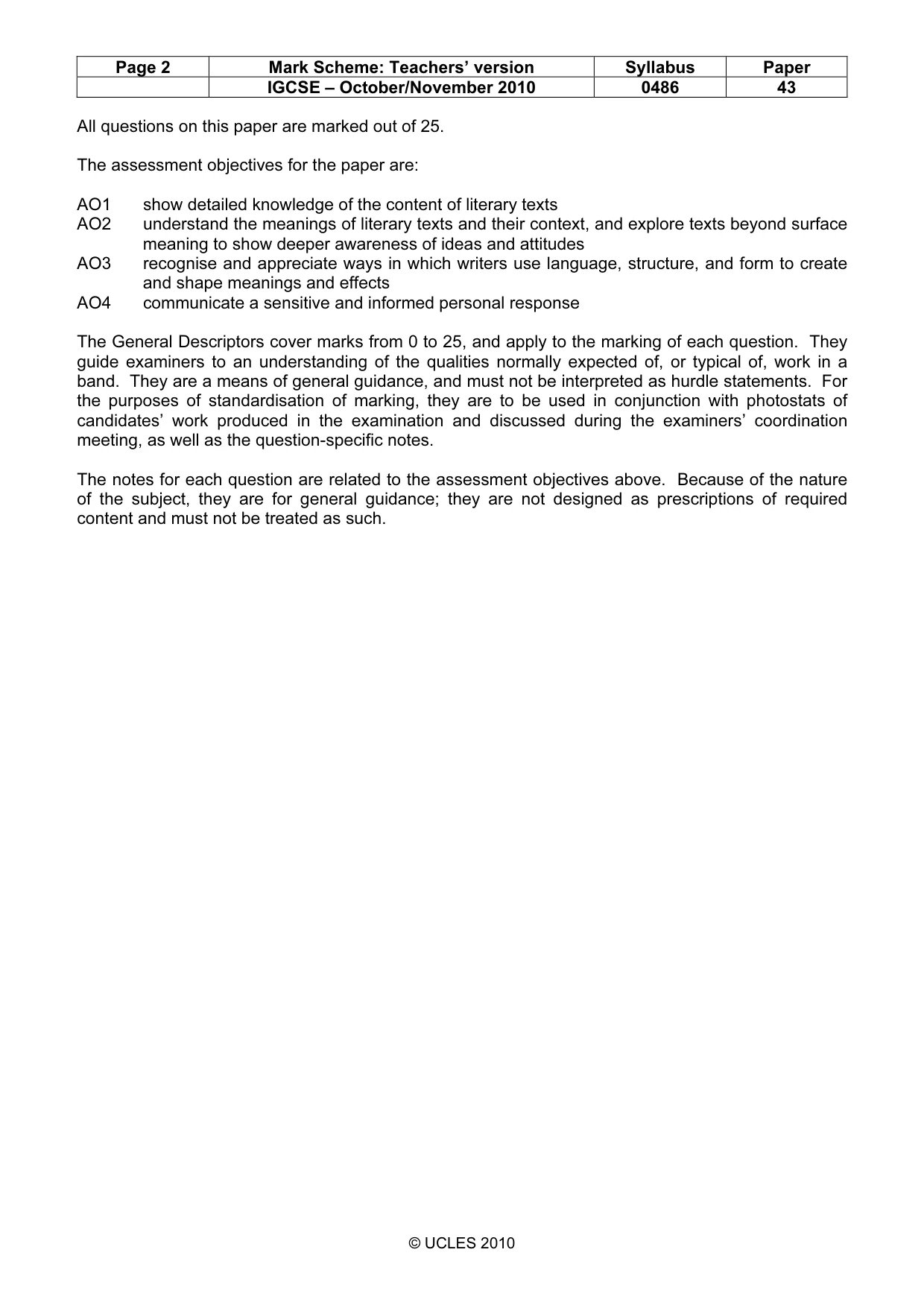
Page 2 Mark Scheme: Teachers’ version Syllabus Paper IGCSE – October/November 2010 0486 43 © UCLES 2010 All questions on this paper are marked out of 25. The assessment objectives for the paper are: AO1 show detailed knowledge of the content of literary texts AO2 understand the meanings of literary texts and their context, and explore texts beyond surface meaning to show deeper awareness of ideas and attitudes AO3 recognise and appreciate ways in which writers use language, structure, and form to create and shape meanings and effects AO4 communicate a sensitive and informed personal response The General Descriptors cover marks from 0 to 25, and apply to the marking of each question. They guide examiners to an understanding of the qualities normally expected of, or typical of, work in a band. They are a means of general guidance, and must not be interpreted as hurdle statements. For the purposes of standardisation of marking, they are to be used in conjunction with photostats of candidates’ work produced in the examination and discussed during the examiners’ coordination meeting, as well as the question-specific notes. The notes for each question are related to the assessment objectives above. Because of the nature of the subject, they are for general guidance; they are not designed as prescriptions of required content and must not be treated as such.
Mark scheme, page 3
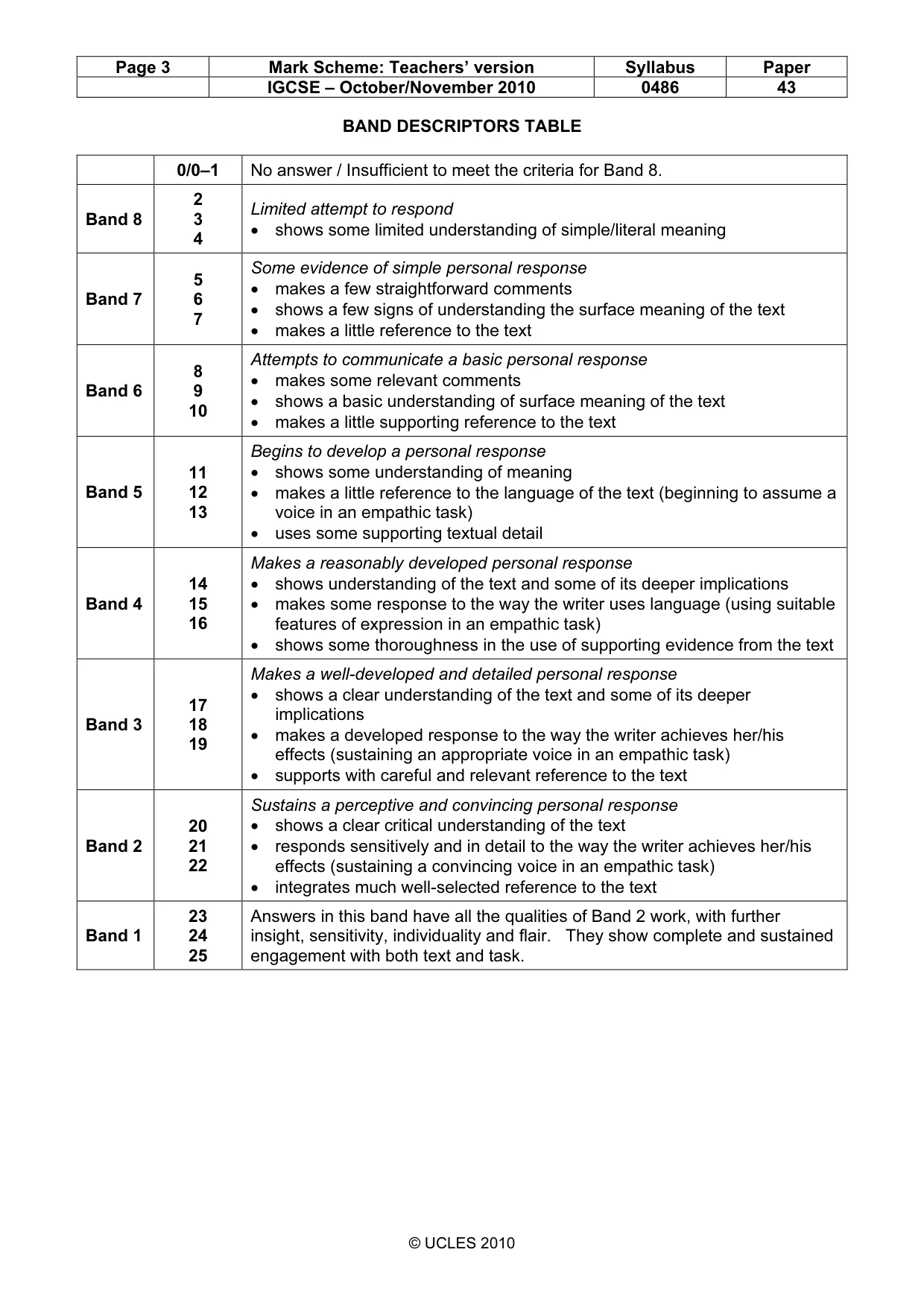
Page 3 Mark Scheme: Teachers’ version Syllabus Paper IGCSE – October/November 2010 0486 43 © UCLES 2010 BAND DESCRIPTORS TABLE 0/0–1 No answer / Insufficient to meet the criteria for Band 8. Band 8 2 3 4 Limited attempt to respond • shows some limited understanding of simple/literal meaning Band 7 5 6 7 Some evidence of simple personal response • makes a few straightforward comments • shows a few signs of understanding the surface meaning of the text • makes a little reference to the text Band 6 8 9 10 Attempts to communicate a basic personal response • makes some relevant comments • shows a basic understanding of surface meaning of the text • makes a little supporting reference to the text Band 5 11 12 13 Begins to develop a personal response • shows some understanding of meaning • makes a little reference to the language of the text (beginning to assume a voice in an empathic task) • uses some supporting textual detail Band 4 14 15 16 Makes a reasonably developed personal response • shows understanding of the text and some of its deeper implications • makes some response to the way the writer uses language (using suitable features of expression in an empathic task) • shows some thoroughness in the use of supporting evidence from the text Band 3 17 18 19 Makes a well-developed and detailed personal response • shows a clear understanding of the text and some of its deeper implications • makes a developed response to the way the writer achieves her/his effects (sustaining an appropriate voice in an empathic task) • supports with careful and relevant reference to the text Band 2 20 21 22 Sustains a perceptive and convincing personal response • shows a clear critical understanding of the text • responds sensitively and in detail to the way the writer achieves her/his effects (sustaining a convincing voice in an empathic task) • integrates much well-selected reference to the text Band 1 23 24 25 Answers in this band have all the qualities of Band 2 work, with further insight, sensitivity, individuality and flair. They show complete and sustained engagement with both text and task.
Mark scheme, page 4
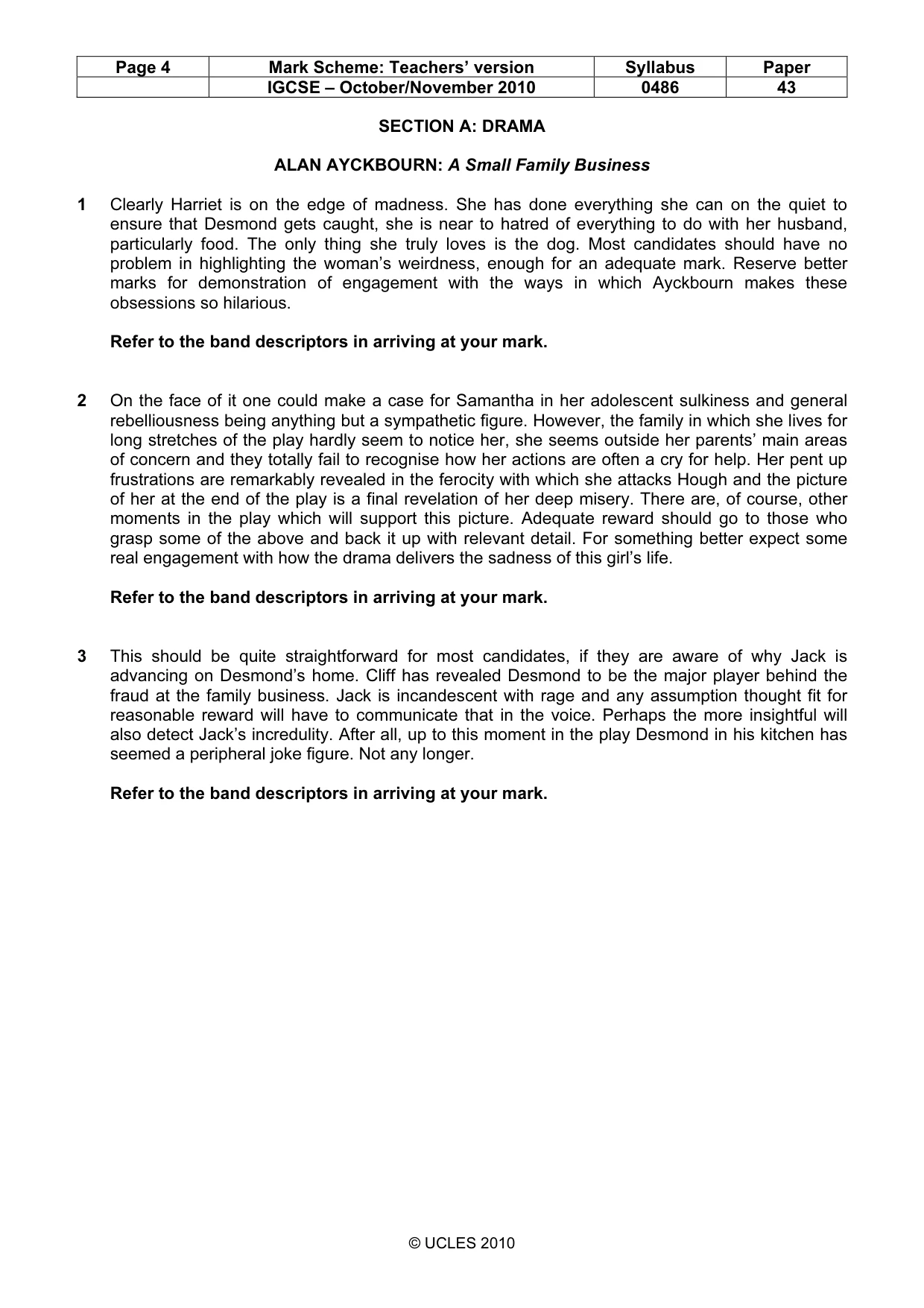
Page 4 Mark Scheme: Teachers’ version Syllabus Paper IGCSE – October/November 2010 0486 43 © UCLES 2010 SECTION A: DRAMA ALAN AYCKBOURN: A Small Family Business 1 Clearly Harriet is on the edge of madness. She has done everything she can on the quiet to ensure that Desmond gets caught, she is near to hatred of everything to do with her husband, particularly food. The only thing she truly loves is the dog. Most candidates should have no problem in highlighting the woman’s weirdness, enough for an adequate mark. Reserve better marks for demonstration of engagement with the ways in which Ayckbourn makes these obsessions so hilarious. Refer to the band descriptors in arriving at your mark. 2 On the face of it one could make a case for Samantha in her adolescent sulkiness and general rebelliousness being anything but a sympathetic figure. However, the family in which she lives for long stretches of the play hardly seem to notice her, she seems outside her parents’ main areas of concern and they totally fail to recognise how her actions are often a cry for help. Her pent up frustrations are remarkably revealed in the ferocity with which she attacks Hough and the picture of her at the end of the play is a final revelation of her deep misery. There are, of course, other moments in the play which will support this picture. Adequate reward should go to those who grasp some of the above and back it up with relevant detail. For something better expect some real engagement with how the drama delivers the sadness of this girl’s life. Refer to the band descriptors in arriving at your mark. 3 This should be quite straightforward for most candidates, if they are aware of why Jack is advancing on Desmond’s home. Cliff has revealed Desmond to be the major player behind the fraud at the family business. Jack is incandescent with rage and any assumption thought fit for reasonable reward will have to communicate that in the voice. Perhaps the more insightful will also detect Jack’s incredulity. After all, up to this moment in the play Desmond in his kitchen has seemed a peripheral joke figure. Not any longer. Refer to the band descriptors in arriving at your mark.
Mark scheme, page 5
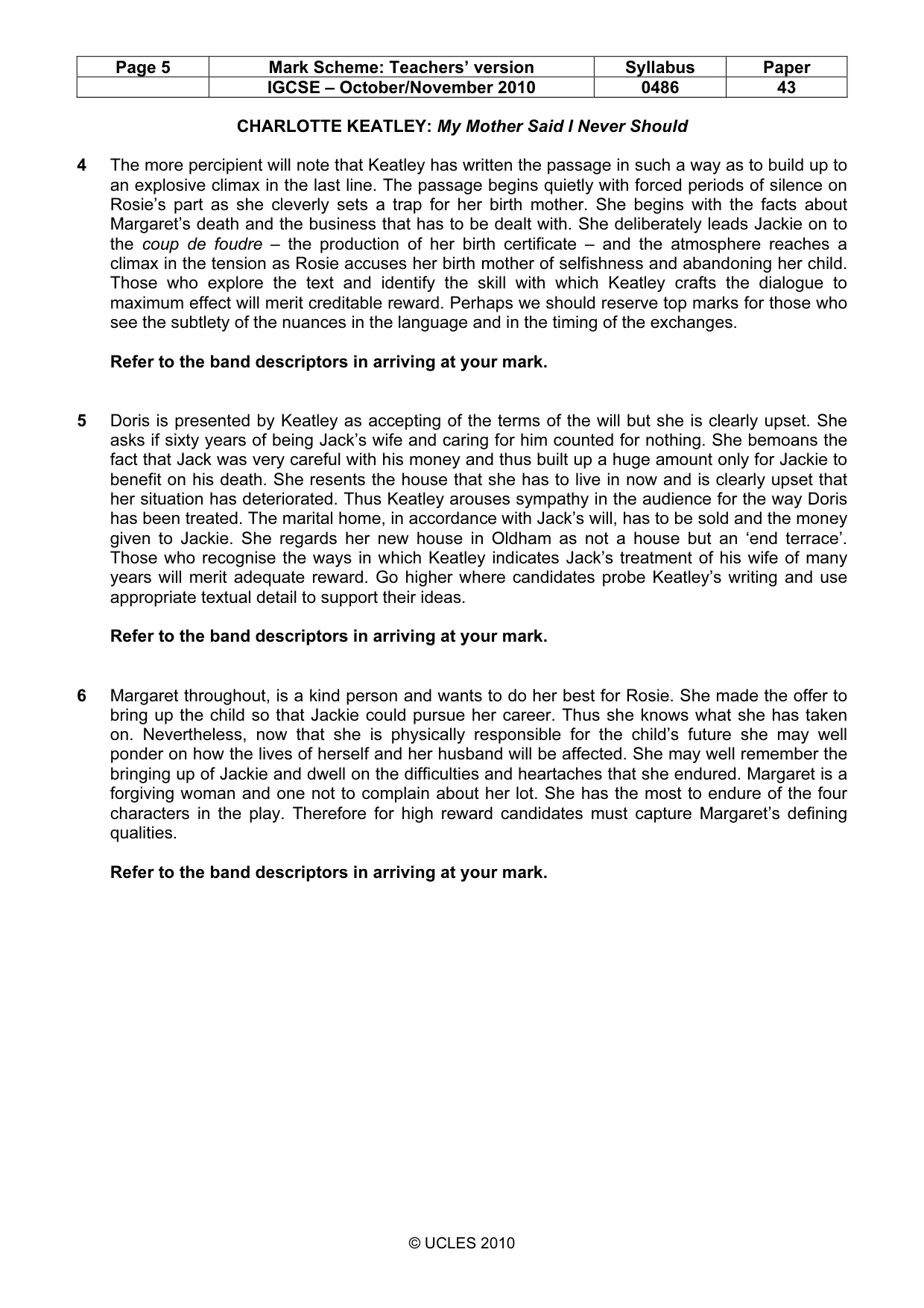
Page 5 Mark Scheme: Teachers’ version Syllabus Paper IGCSE – October/November 2010 0486 43 © UCLES 2010 CHARLOTTE KEATLEY: My Mother Said I Never Should 4 The more percipient will note that Keatley has written the passage in such a way as to build up to an explosive climax in the last line. The passage begins quietly with forced periods of silence on Rosie’s part as she cleverly sets a trap for her birth mother. She begins with the facts about Margaret’s death and the business that has to be dealt with. She deliberately leads Jackie on to the coup de foudre – the production of her birth certificate – and the atmosphere reaches a climax in the tension as Rosie accuses her birth mother of selfishness and abandoning her child. Those who explore the text and identify the skill with which Keatley crafts the dialogue to maximum effect will merit creditable reward. Perhaps we should reserve top marks for those who see the subtlety of the nuances in the language and in the timing of the exchanges. Refer to the band descriptors in arriving at your mark. 5 Doris is presented by Keatley as accepting of the terms of the will but she is clearly upset. She asks if sixty years of being Jack’s wife and caring for him counted for nothing. She bemoans the fact that Jack was very careful with his money and thus built up a huge amount only for Jackie to benefit on his death. She resents the house that she has to live in now and is clearly upset that her situation has deteriorated. Thus Keatley arouses sympathy in the audience for the way Doris has been treated. The marital home, in accordance with Jack’s will, has to be sold and the money given to Jackie. She regards her new house in Oldham as not a house but an ‘end terrace’. Those who recognise the ways in which Keatley indicates Jack’s treatment of his wife of many years will merit adequate reward. Go higher where candidates probe Keatley’s writing and use appropriate textual detail to support their ideas. Refer to the band descriptors in arriving at your mark. 6 Margaret throughout, is a kind person and wants to do her best for Rosie. She made the offer to bring up the child so that Jackie could pursue her career. Thus she knows what she has taken on. Nevertheless, now that she is physically responsible for the child’s future she may well ponder on how the lives of herself and her husband will be affected. She may well remember the bringing up of Jackie and dwell on the difficulties and heartaches that she endured. Margaret is a forgiving woman and one not to complain about her lot. She has the most to endure of the four characters in the play. Therefore for high reward candidates must capture Margaret’s defining qualities. Refer to the band descriptors in arriving at your mark.
Mark scheme, page 6
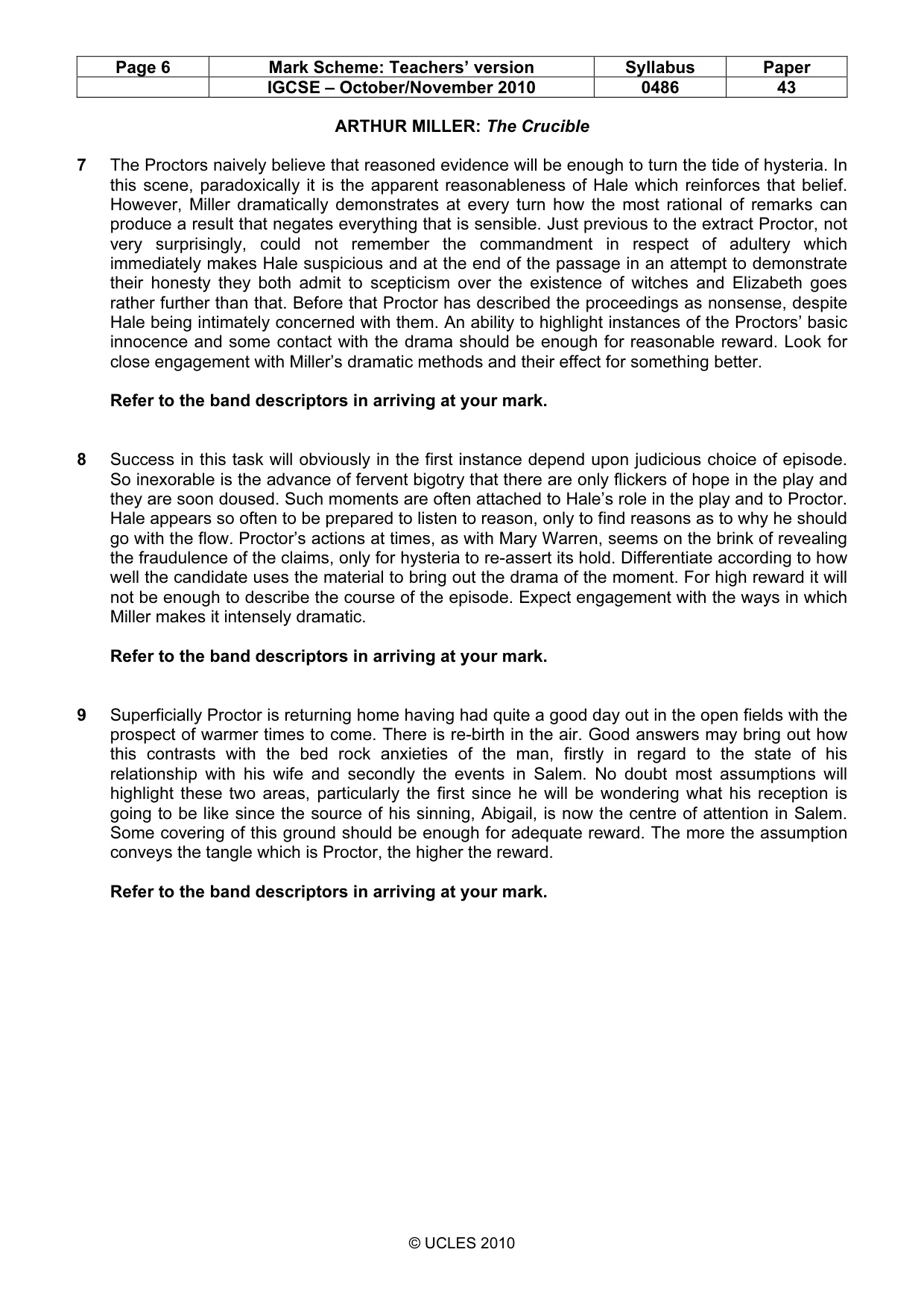
Page 6 Mark Scheme: Teachers’ version Syllabus Paper IGCSE – October/November 2010 0486 43 © UCLES 2010 ARTHUR MILLER: The Crucible 7 The Proctors naively believe that reasoned evidence will be enough to turn the tide of hysteria. In this scene, paradoxically it is the apparent reasonableness of Hale which reinforces that belief. However, Miller dramatically demonstrates at every turn how the most rational of remarks can produce a result that negates everything that is sensible. Just previous to the extract Proctor, not very surprisingly, could not remember the commandment in respect of adultery which immediately makes Hale suspicious and at the end of the passage in an attempt to demonstrate their honesty they both admit to scepticism over the existence of witches and Elizabeth goes rather further than that. Before that Proctor has described the proceedings as nonsense, despite Hale being intimately concerned with them. An ability to highlight instances of the Proctors’ basic innocence and some contact with the drama should be enough for reasonable reward. Look for close engagement with Miller’s dramatic methods and their effect for something better. Refer to the band descriptors in arriving at your mark. 8 Success in this task will obviously in the first instance depend upon judicious choice of episode. So inexorable is the advance of fervent bigotry that there are only flickers of hope in the play and they are soon doused. Such moments are often attached to Hale’s role in the play and to Proctor. Hale appears so often to be prepared to listen to reason, only to find reasons as to why he should go with the flow. Proctor’s actions at times, as with Mary Warren, seems on the brink of revealing the fraudulence of the claims, only for hysteria to re-assert its hold. Differentiate according to how well the candidate uses the material to bring out the drama of the moment. For high reward it will not be enough to describe the course of the episode. Expect engagement with the ways in which Miller makes it intensely dramatic. Refer to the band descriptors in arriving at your mark. 9 Superficially Proctor is returning home having had quite a good day out in the open fields with the prospect of warmer times to come. There is re-birth in the air. Good answers may bring out how this contrasts with the bed rock anxieties of the man, firstly in regard to the state of his relationship with his wife and secondly the events in Salem. No doubt most assumptions will highlight these two areas, particularly the first since he will be wondering what his reception is going to be like since the source of his sinning, Abigail, is now the centre of attention in Salem. Some covering of this ground should be enough for adequate reward. The more the assumption conveys the tangle which is Proctor, the higher the reward. Refer to the band descriptors in arriving at your mark.
Mark scheme, page 7
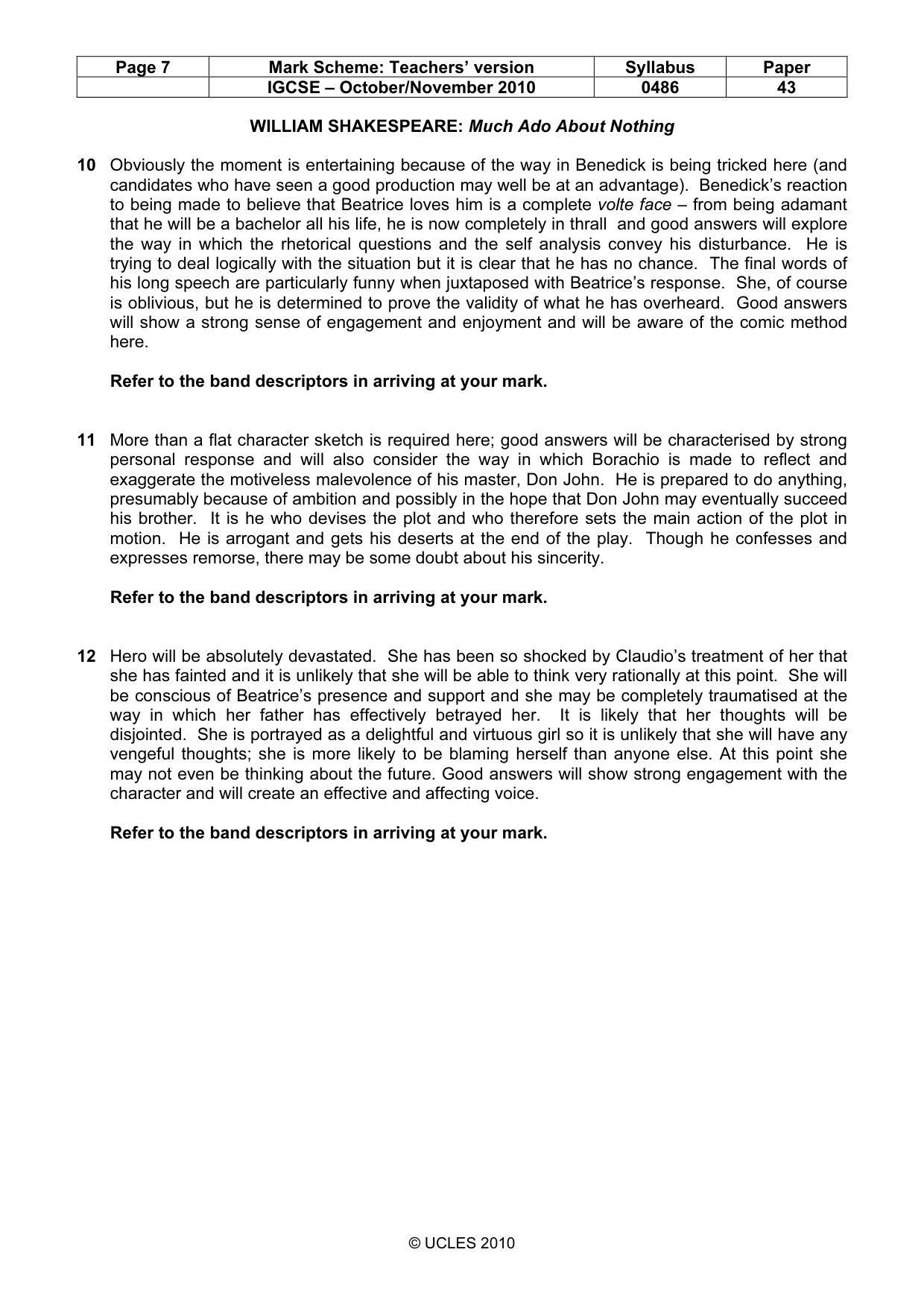
Page 7 Mark Scheme: Teachers’ version Syllabus Paper IGCSE – October/November 2010 0486 43 © UCLES 2010 WILLIAM SHAKESPEARE: Much Ado About Nothing 10 Obviously the moment is entertaining because of the way in Benedick is being tricked here (and candidates who have seen a good production may well be at an advantage). Benedick’s reaction to being made to believe that Beatrice loves him is a complete volte face – from being adamant that he will be a bachelor all his life, he is now completely in thrall and good answers will explore the way in which the rhetorical questions and the self analysis convey his disturbance. He is trying to deal logically with the situation but it is clear that he has no chance. The final words of his long speech are particularly funny when juxtaposed with Beatrice’s response. She, of course is oblivious, but he is determined to prove the validity of what he has overheard. Good answers will show a strong sense of engagement and enjoyment and will be aware of the comic method here. Refer to the band descriptors in arriving at your mark. 11 More than a flat character sketch is required here; good answers will be characterised by strong personal response and will also consider the way in which Borachio is made to reflect and exaggerate the motiveless malevolence of his master, Don John. He is prepared to do anything, presumably because of ambition and possibly in the hope that Don John may eventually succeed his brother. It is he who devises the plot and who therefore sets the main action of the plot in motion. He is arrogant and gets his deserts at the end of the play. Though he confesses and expresses remorse, there may be some doubt about his sincerity. Refer to the band descriptors in arriving at your mark. 12 Hero will be absolutely devastated. She has been so shocked by Claudio’s treatment of her that she has fainted and it is unlikely that she will be able to think very rationally at this point. She will be conscious of Beatrice’s presence and support and she may be completely traumatised at the way in which her father has effectively betrayed her. It is likely that her thoughts will be disjointed. She is portrayed as a delightful and virtuous girl so it is unlikely that she will have any vengeful thoughts; she is more likely to be blaming herself than anyone else. At this point she may not even be thinking about the future. Good answers will show strong engagement with the character and will create an effective and affecting voice. Refer to the band descriptors in arriving at your mark.
Mark scheme, page 8
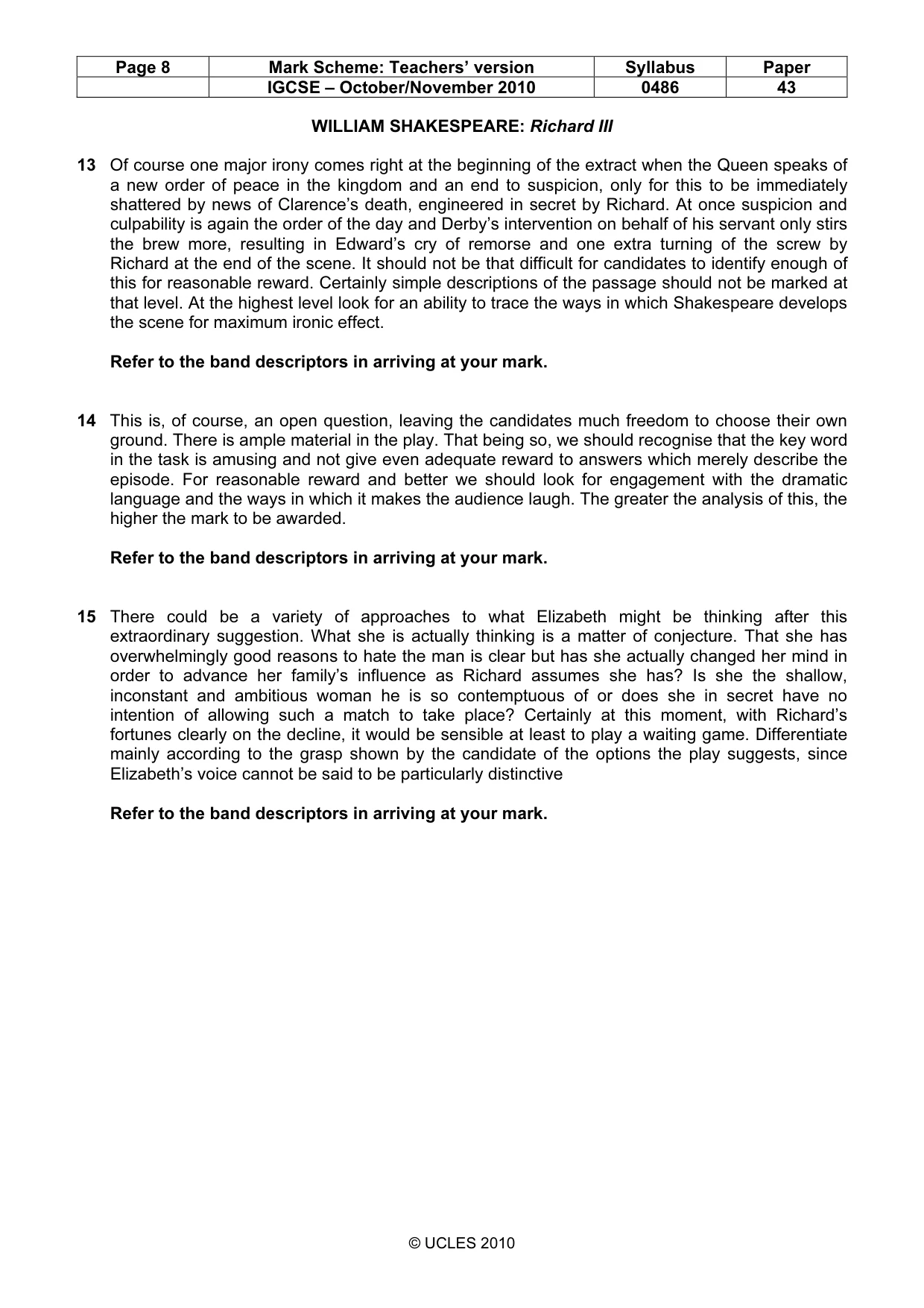
Page 8 Mark Scheme: Teachers’ version Syllabus Paper IGCSE – October/November 2010 0486 43 © UCLES 2010 WILLIAM SHAKESPEARE: Richard III 13 Of course one major irony comes right at the beginning of the extract when the Queen speaks of a new order of peace in the kingdom and an end to suspicion, only for this to be immediately shattered by news of Clarence’s death, engineered in secret by Richard. At once suspicion and culpability is again the order of the day and Derby’s intervention on behalf of his servant only stirs the brew more, resulting in Edward’s cry of remorse and one extra turning of the screw by Richard at the end of the scene. It should not be that difficult for candidates to identify enough of this for reasonable reward. Certainly simple descriptions of the passage should not be marked at that level. At the highest level look for an ability to trace the ways in which Shakespeare develops the scene for maximum ironic effect. Refer to the band descriptors in arriving at your mark. 14 This is, of course, an open question, leaving the candidates much freedom to choose their own ground. There is ample material in the play. That being so, we should recognise that the key word in the task is amusing and not give even adequate reward to answers which merely describe the episode. For reasonable reward and better we should look for engagement with the dramatic language and the ways in which it makes the audience laugh. The greater the analysis of this, the higher the mark to be awarded. Refer to the band descriptors in arriving at your mark. 15 There could be a variety of approaches to what Elizabeth might be thinking after this extraordinary suggestion. What she is actually thinking is a matter of conjecture. That she has overwhelmingly good reasons to hate the man is clear but has she actually changed her mind in order to advance her family’s influence as Richard assumes she has? Is she the shallow, inconstant and ambitious woman he is so contemptuous of or does she in secret have no intention of allowing such a match to take place? Certainly at this moment, with Richard’s fortunes clearly on the decline, it would be sensible at least to play a waiting game. Differentiate mainly according to the grasp shown by the candidate of the options the play suggests, since Elizabeth’s voice cannot be said to be particularly distinctive Refer to the band descriptors in arriving at your mark.
Mark scheme, page 9
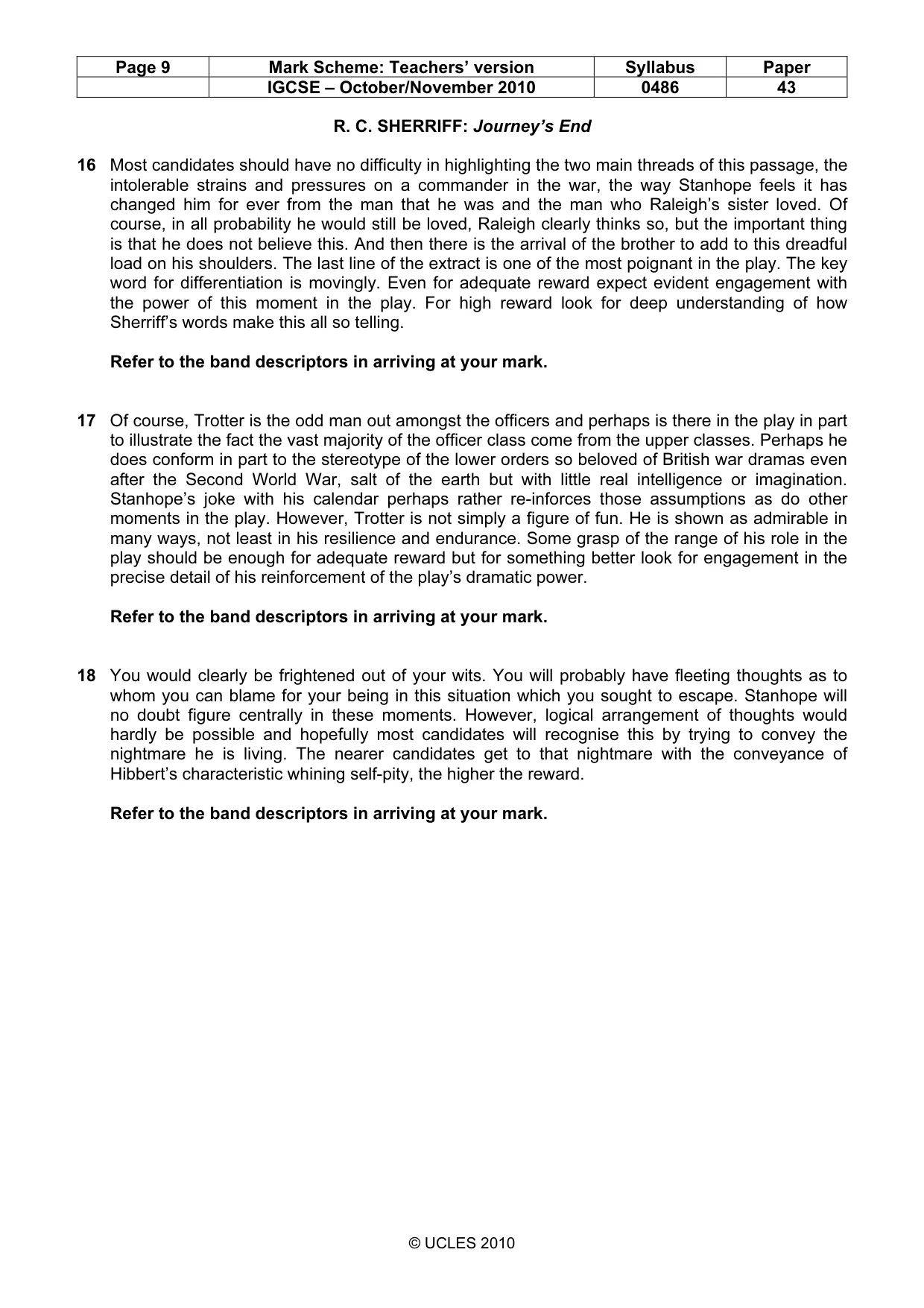
Page 9 Mark Scheme: Teachers’ version Syllabus Paper IGCSE – October/November 2010 0486 43 © UCLES 2010 R. C. SHERRIFF: Journey’s End 16 Most candidates should have no difficulty in highlighting the two main threads of this passage, the intolerable strains and pressures on a commander in the war, the way Stanhope feels it has changed him for ever from the man that he was and the man who Raleigh’s sister loved. Of course, in all probability he would still be loved, Raleigh clearly thinks so, but the important thing is that he does not believe this. And then there is the arrival of the brother to add to this dreadful load on his shoulders. The last line of the extract is one of the most poignant in the play. The key word for differentiation is movingly. Even for adequate reward expect evident engagement with the power of this moment in the play. For high reward look for deep understanding of how Sherriff’s words make this all so telling. Refer to the band descriptors in arriving at your mark. 17 Of course, Trotter is the odd man out amongst the officers and perhaps is there in the play in part to illustrate the fact the vast majority of the officer class come from the upper classes. Perhaps he does conform in part to the stereotype of the lower orders so beloved of British war dramas even after the Second World War, salt of the earth but with little real intelligence or imagination. Stanhope’s joke with his calendar perhaps rather re-inforces those assumptions as do other moments in the play. However, Trotter is not simply a figure of fun. He is shown as admirable in many ways, not least in his resilience and endurance. Some grasp of the range of his role in the play should be enough for adequate reward but for something better look for engagement in the precise detail of his reinforcement of the play’s dramatic power. Refer to the band descriptors in arriving at your mark. 18 You would clearly be frightened out of your wits. You will probably have fleeting thoughts as to whom you can blame for your being in this situation which you sought to escape. Stanhope will no doubt figure centrally in these moments. However, logical arrangement of thoughts would hardly be possible and hopefully most candidates will recognise this by trying to convey the nightmare he is living. The nearer candidates get to that nightmare with the conveyance of Hibbert’s characteristic whining self-pity, the higher the reward. Refer to the band descriptors in arriving at your mark.
Mark scheme, page 10
Page 10 Mark Scheme: Teachers’ version Syllabus Paper IGCSE – October/November 2010 0486 43 © UCLES 2010 SECTION B: POETRY 19–24 Poetry is literary language at its most intense. A poem in a short space creates a multiplicity of resonances and hence possible meanings. We must expect that candidates will offer a very wide variety of responses and interpretations and as examiners must at all times keep a totally open mind when assessing work on a poem. In the exercise of our judgment, we shall, of course, read work which shows manifestly little or no understanding of a poem and we will mark that accordingly. However, it should also be a regular experience to find answers which offer valid perspectives new to the examiner and which, just as manifestly, deserve to be given high reward. We will differentiate first of all according to how directly the candidates answer the question. Where questions prescribe the poems from which the candidates should choose this is to ensure that the candidate is writing on a poem appropriate to the question. It is also designed to send a strong signal to candidates that they are taking a large risk going into the examination with only one or two poems which they are determined to fit to a question. The problem can be that some will choose a question because the poem they wish to write about appears in the list rather than because they can answer the question. We must be very careful not to give much reward for answers which manifestly are not addressing the question, even if they show a convincing grasp of the poem. Do not over-reward such run throughs and do not forget that all the tasks demand that the candidate engage with the poem through a specific route; they are never simple invitations to write about a poem. We should think very hard before putting such work in Band 3. Beyond focus on the question, we will also assess according to how well candidates convince us that they have engaged with the pleasure and excitement of good poetry. This means in effect that we do NOT give high reward to any explanation of "meaning" which shows little response to the words and how they create meaning. In all of the questions there is an explicit requirement to make a response to the words and it will be difficult for any work which fails to engage in this way to progress beyond Band 3. In addition, examiners should be careful not to over-reward comment which is able to isolate vivid features of a poem’s language but which is unable to probe the reasons for their vividness. For instance, the noting of rhyme, sound and movement, the listing of significant words and figures of speech is only a very small first step to insightful personal response. Work given high reward should show the ability of the candidate to analyse how such features of a poem’s language achieve their effect. Refer to the band descriptors in arriving at your mark.
Mark scheme, page 11
Page 11 Mark Scheme: Teachers’ version Syllabus Paper IGCSE – October/November 2010 0486 43 © UCLES 2010 SECTION C: PROSE JANE AUSTEN: Pride and Prejudice 25 This is the moment in the novel when the loathsome Lady Catherine receives her comeuppance and hopefully most candidates will see that it is her own hand which ironically delivers the blow. First of all she delivers the news that Darcy seems still to be attached to Elizabeth and secondly she can have hardly have been more mistaken to think that with that news and in that situation Elizabeth will succumb to such bullying. For adequate reward candidates must grasp the essence of the situation and be able to support their points with some detail. Better candidates should be able show how Austen’s writing makes the episode so delicious in its effect. Refer to the band descriptors in arriving at your mark. 26 This is a deliberately challenging format to discourage the character sketch and any answer which ignores it should not receive much reward. We should, of course, allow an argument with support which suggests that there is little about the woman which is not absurd but hopefully most will see that in that society and in her situation her priorities to marry off her daughters are not absurd. The ways in which she goes about it may be and she clearly considers that there is little of importance beyond the wealth of the proposed match for her daughters but her nerves have a real cause, particularly given that Mr Bennet shows little concern for such practicalities. As usual, we shall differentiate according to how widely the candidates range across the novel and the degree of engagement they show with Austen’s writing. Refer to the band descriptors in arriving at your mark. 27 Under the surface Darcy is a passionate man, nowhere more so than in his attachment to Elizabeth so, whilst the language may still be comparatively restrained, the sentiments certainly will not be. The relief and joy will be excessive. Never before has he been in so little control of himself, never before has he opened himself to such possible humiliation, going back for a second potential whipping from Elizabeth’s tongue. He will be triumphant to have found that his feelings are reciprocated this time but he may also be chastened enough to ponder what might have been the consequences of his and Elizabeth’s pride. Much of this material should not be very difficult for most candidates to grasp but it will be trickier to catch the right balance in the voice, romantic but not too romantic. Any who do should get high reward. Refer to the band descriptors in arriving at your mark.
Mark scheme, page 12
Page 12 Mark Scheme: Teachers’ version Syllabus Paper IGCSE – October/November 2010 0486 43 © UCLES 2010 IAN CROSS: The God Boy 28 Hopefully most candidates will be able to make the link between Jimmy’s ‘protection tricks’ and the sense that they convey of a small boy at the end of his tether for whom such moments are part of his everyday life. It is made clear how often these things happen and how he has had much time to refine his defences. Some understanding of his actions with support should be enough for reasonable reward but for higher reward look for personal engagement and responses to the detail of the writing. The insightful, for instance, may see how the closer to the absurd that many of these ‘tricks’, are, the more poignant in their effect they become. Refer to the band descriptors in arriving at your mark. 29 Since the perception in the novel is Jimmy’s and therefore limited, it is necessarily and intriguingly difficult to piece together the lives of those close to him. Therefore, part of the dynamics and tension of the novel for the reader is to try to piece together these lives as the novel progresses. Molly is central to this since she is of Jimmy’s generation but, because she is older, understands things he does not. Perhaps some of the most dramatic moments concern her and the revelations of her misery, most notably the attempt to form a suicide pact with her brother. Generally it is most poignant how she continues to the end of the novel to provide both a support and a bridge to his mother for Jimmy. In the end she proves a survivor, just as Jimmy will be, one guesses. Some sense of her character and her role should receive adequate reward but hopefully the better candidates will communicate something of her impact on the novel and its structure. Refer to the band descriptors in arriving at your mark. 30 Mrs Sullivan will be in turmoil. Her husband has yet again gone behind her back in order to try to re-direct Jimmy’s affection away from her towards himself. She will probably feel that she failed to keep her anger under wraps and that Jimmy, despite her attempt to share his joy at the present, will have grasped that the bicycle represents yet another betrayal. She will hate being seen grovelling on the ground. Not least, in all likelihood it is a body blow for the family finances and it is she who has to struggle to keep things afloat. A grasp of the situation and some communication of her emotions should be enough for reasonable reward but for something better we should expect a voice full of anger and despair. Refer to the band descriptors in arriving at your mark.
Mark scheme, page 13
Page 13 Mark Scheme: Teachers’ version Syllabus Paper IGCSE – October/November 2010 0486 43 © UCLES 2010 ANITA DESAI: Games at Twilight and Other Stories 31 In this opening there is much satire of the attitudes of visiting Westerners, that much should be obvious to most candidates. This is particularly so in regard to Pat, and many answers will probably centre on her. She is shown as being disposed to regard the Indian sub-continent as if she is Tarzan’s Jane on her first foray into the jungle. No doubt there will be much comment on the detail of her remarks and postures. That should prove enough for adequate reward. The better ones may well note that it is somehow typical of her shallow personality that she should later embrace another western habit, of ‘discovering’ in the East the Meaning of Life. However, it may be that the better candidates will also see that David is presented as not much better. His dress and behaviour perhaps suggest he relishes what he sees as his role of an observer of an alien culture and its social behaviour. Refer to the band descriptors in arriving at your mark. 32 This is a wide open question since Desai deliberately seems to offer alternative propositions. Do we take Bhaiyya’s final assertions as a real epiphany or as a desperate man’s attempt to conceal from himself for ever the dreadful mistake he has made? Part of either argument rests on how one feels Ustad is depicted in the story and how much credence one gives to the friends’ opinions. This requires delicate weighing of the tone of the writing and, whilst we shall accept for reasonable reward answers which make an argument and show knowledge of the detail of the story, for higher reward there will need to be supporting detail from the writing for an argument to be really persuasive. Refer to the band descriptors in arriving at your mark. 33 The opening of the story vividly portrays your state of mind. You have obviously been unwilling to show your work, your wife says this is your chance, obviously an intimation that financial and personal issues have forced you into this. But your anxiety, not to say terror, is obvious in the way you are chain smoking and by the way you put off answering the hammering on the door. Something of your situation with a reasonably nervous voice should be enough for adequate reward. Those who really communicate the man’s deep apprehensions and possibly his knowledge that he will be unable to communicate his artistic vision to the philistine world should go higher. Refer to the band descriptors in arriving at your mark.
Mark scheme, page 14
Page 14 Mark Scheme: Teachers’ version Syllabus Paper IGCSE – October/November 2010 0486 43 © UCLES 2010 THOMAS HARDY: Far from the Madding Crowd 34 Hardy here makes the atmosphere relaxed and playful between two people who have known each other a long time and have recognised each other’s appealing qualities through having endured and shared much heartache and anguish. He presents both as comfortable and easy with each other and finally ready to come together in ‘the only love that is strong as death’. Those who explore the writing with appropriate references and see the relaxed way in which Hardy presents the couple should be well rewarded. Refer to the band descriptors in arriving at your mark. 35 There are several clear examples from which candidates may select their episode: All Saints and All Souls and the confusion caused; Fanny’s struggle to reach the workhouse; the return of Fanny’s body; the opening of her coffin; the shooting of Troy; the vanishing of Troy as he swims out to sea; the return of Troy; the end of Boldwood. Candidates may well choose others. Provided they show the ways in which Hardy creates the ‘dramatic’ we should not be discriminating as to the episode chosen. Differentiate according to how convinced we are as to the fulfilment of the specific requirements of the question. Textual knowledge and appreciation of the writing will be a sine qua non for high reward. Refer to the band descriptors in arriving at your mark. 36 Troy was clearly fascinated by Bathsheba; he recognised her spirit and her beauty. No doubt both would figure in his ruminations following the exciting incident which literally joined the two together. Troy is confident in his own charm and masculine attraction and would surely think of his prospects in getting to know and then conquer such a rich and beautiful woman. He wins his quarry through flattery and charm. These qualities should be evident in candidates’ responses as they will surely have Troy preparing his campaign to win Bathsheba after the bizarre yoking in the darkness of the evening. We should therefore be convinced that candidates have captured the seductive attractions of Troy before we reward highly. Refer to the band descriptors in arriving at your mark.
Mark scheme, page 15
Page 15 Mark Scheme: Teachers’ version Syllabus Paper IGCSE – October/November 2010 0486 43 © UCLES 2010 BESSIE HEAD: When Rain Clouds Gather 37 The passage follows an initial introduction by Dinorego and by his explanation to Makhaya of What Gilbert stands for, so Makhaya’s interest in Gilbert is already established. Their conversation is easy and quite comfortable from the first moment – Makhaya who is something of a mystery in the initial stages of the novel – opens up immediately to Gilbert, who is also very honest about his motives for being in Botswana. There might be a potential conflict over Maria since Makhaya admits his interest in her to himself, but the fact that he is not prepared to compete with Gilbert shows that there is a genuine liking and that the friendship will be a strong one. Candidates may well go on to explore some of the ways in which the friendship develops though their focus must be on the passage in the first instance. Refer to the band descriptors in arriving at your mark. 38 This is a very open question and candidates are free to choose any suitable moments. Their interpretations of what constitutes a moment will vary and we should be flexible in what we allow, but quality and sharpness of focus on the writing will be the discriminators. We are not looking for long passages of paraphrase or narrative. Refer to the band descriptors in arriving at your mark. 39 Sekoto is portrayed as being much more adaptable and easy-going than his brother Matenge. There is no indication that there is any love lost between the two brothers and Sekoto may well be experiencing some mixed feelings though a brother’s suicide can never be an easy event to adjust to. He will be reflecting on the events leading up to the death and possibly speculating on what this means for the village. As ever, good answers will create a reasonably convincing voice. Refer to the band descriptors in arriving at your mark.
Mark scheme, page 16
Page 16 Mark Scheme: Teachers’ version Syllabus Paper IGCSE – October/November 2010 0486 43 © UCLES 2010 EDITH WHARTON: Ethan Frome 40 There is much here that suggests the gulf between them. Hopefully, most candidates will note the number of times when the one is not listening to the other. Ethan cannot wait to get his wife out of the house for the night and Zeena is consumed with her own ailments. On top of that there is the telling picture which Wharton draws of Zeena as a woman old before her time and, of course, there is the young, attractive Mattie whose presence hovers constantly in the house as a contrast. A grasp of the essence of the above with some supporting detail should be enough for reasonable reward. Engagement with how Wharton’s writing vividly fixes the awfulness of this relationship will be necessary for something better. Refer to the band descriptors in arriving at your mark. 41 Though it is often the case in this kind of task, here we should not expect the higher reward to go only to those who offer a balanced view of the alternatives. In all probability most will be surprised by the first proposition. There are not many moments in the novel where Mattie is pro-active and most of the initial passionate feelings are those of Ethan. It is much easier to see Mattie as a poor young woman completely dependent on others. However, at times, perhaps, Wharton shows her as very able to use her circumstances to her advantage and she is certainly no innocent. The way she flirts with Eady shows that. Therefore, whilst we may not expect for high reward an argument which delves into this area, the likelihood is that only the more insightful will penetrate to it. Refer to the band descriptors in arriving at your mark. 42 What you have seen brings everything into focus and no doubt you will find it both surprising and shocking. The ‘sin’ of Ethan’s and Mattie’s feelings for one another is now truly being paid for. The attractive and girlish personality of Mattie has become a querulous woman reduced to a near vegetable. It is Zeena who now thrives and holds all the keys to power. She has returned to the role which she has always relished, looking after the sick. The ironies of this are unlikely to be lost on the narrator. The more these emerge, the more the candidates show the narrator’s awareness of the horrors of this ménage à trois, the higher the reward. Refer to the band descriptors in arriving at your mark.
Mark scheme, page 17
Page 17 Mark Scheme: Teachers’ version Syllabus Paper IGCSE – October/November 2010 0486 43 © UCLES 2010 Stories of Ourselves 43 The first sentence is ironic in that this in a way is what the Onns were trying to achieve, though their new world turned out to be more hostile and bewildering than they had expected. Ironically too, the Onns meet their end at the hands of very benign characters who have no idea of what they are doing or what the insect-like creatures are but who have shown nothing but interest in the discovery of the Globe. We at last get a description of the Onns; we have no doubt built up a fairly clear impression as the story has proceeded and it probably will not be much of a surprise, but we have built up a certain sympathy for them by now and the manner of their demise seems inappropriate and out of scale, despite their destruction of the dog. The final sentence is rather tragic; the Onns are not ‘Nasty, vicious little brutes’ but have more in common with humans than anyone realises. Good answers may go on to evaluate the points being made through the story. Refer to the band descriptors in arriving at your mark. 44 This is a free-for-all and we should allow some latitude in the interpretation of ‘moments’. Answers will be discriminated by appropriateness of choice and by the depth and detail with which they explore the language. The focus is on response to suspense and atmosphere so unpointed narratives will not go very far towards meeting the demands of the question. Refer to the band descriptors in arriving at your mark. 45 Willadean will be reflecting on what has happened to the watermelon, on her father and his obsession and the reason for it and on the boy who was responsible for the watermelon’s destruction and who has now been forgiven and given permission to ‘sit on the porch’ with her. She may be looking forward but it is likely that most answers will focus on what has happened and the meaning of it for Willadean and her parents. Good answers will, of course, create a convincing voice. Refer to the band descriptors in arriving at your mark.
What you needed in this session
Cambridge’s own grade thresholds for 2010 Oct/Nov, Paper 4 · Variant 3. A higher threshold means an easier paper — the bar moves with how the cohort did.