Cambridge IGCSE English - Literature 0486 — 2010 Oct/Nov Paper 4 · Variant 2
0486/42/O/N/10 · 75 marks · ≈84 min
The question paper and its mark scheme, free to read here and free to download. This is Cambridge’s own paper, exactly as it was sat.
Question paper32 pages





Mark scheme17 pages
Answers below. Sit the paper first if you are practising.
Paper as text
Question paper, page 1
This document consists of 30 printed pages and 2 blank pages. DC (SM) 35646/1 R © UCLES 2010 [Turn over UNIVERSITY OF CAMBRIDGE INTERNATIONAL EXAMINATIONS International General Certificate of Secondary Education READ THESE INSTRUCTIONS FIRST If you have been given an Answer Booklet, follow the instructions on the front cover of the Booklet. Write your Centre number, candidate number and name on all the work you hand in. Write in dark blue or black pen. Do not use staples, paper clips, highlighters, glue or correction fluid. Answer three questions: one question from Section A, one question from Section B, and one question from Section C. Answer at least one passage-based question (marked *) and at least one essay/empathic question. At the end of the examination, fasten all your work securely together. All questions in this paper carry equal marks. LITERATURE (ENGLISH) 0486/42 Paper 4 October/November 2010 2 hours 15 minutes Additional Materials: Answer Booklet/Paper * 3 1 8 2 2 1 9 0 9 2 * www.XtremePapers.com
Question paper, page 2
2 0486/42/O/N/10 © UCLES 2010 BLANK PAGE
Question paper, page 3
3 0486/42/O/N/10 © UCLES 2010 [Turn over CONTENTS Section A: Drama text question numbers page [s] Alan Ayckbourn: A Small Family Business *1, 2, 3 pages 4–5 Charlotte Keatley: My Mother Said I Never Should *4, 5, 6 pages 6–7 Arthur Miller: The Crucible *7, 8, 9 pages 8–9 William Shakespeare: Much Ado About Nothing *10, 11,12 pages 10–11 William Shakespeare: Richard III *13, 14, 15 pages 12–13 R. C. Sherriff: Journey’s End *16, 17, 18 pages 14–15 Section B: Poetry text question numbers page [s] Songs of Ourselves: from Part 3 *19, 20, 21 page 16 John Keats: Poems *22, 23, 24 page 17 Section C: Prose text question numbers page [s] Jane Austen: Pride and Prejudice *25, 26, 27 pages 18–19 Ian Cross: The God Boy *28, 29, 30 pages 20–21 Anita Desai: Games at Twilight and Other Stories *31, 32, 33 pages 22–23 Thomas Hardy: Far from the Madding Crowd *34, 35, 36 pages 24–25 Bessie Head: When Rain Clouds Gather *37, 38, 39 pages 26–27 Edith Wharton: Ethan Frome *40, 41, 42 pages 28–29 from Stories Of Ourselves *43, 44, 45 pages 30–31
Question paper, page 4
4 0486/42/O/N/10 © UCLES 2010 SECTION A: DRAMA ALAN AYCKBOURN: A Small Family Business Either * 1 Read this extract, and then answer the question that follows it. Jack goes out of the front door, slamming it behind him. Cliff stands a little bemused in the hall, Anita comes out of the far bedroom. She now has her nightdress on. Anita: What’s going on? Cliff: I’m afraid I had to tell him. About Des – Anita: Yes, I thought you might. Where’s he gone? Cliff: You know how Jack can … I think he’s on his way round to Des’s … Anita: You’d better phone Des. Warn him Jack’s coming. Cliff: Right. Anita: And then phone round everyone else. We’ll have to have a meeting. Cliff: Tonight? Anita: As soon as we can. I’ll get dressed. Cliff goes to the sitting room phone and starts to dial. Anita enters the near bedroom and goes to the cupboard to select herself something to wear. Giorgio’s startled face appears as she ruffles through her dresses. Anita (startled): Oh, hallo, lover, I’d forgotten all about you. (selecting a dress) Later. I’ll be back soon. Presto. Presto. Giorgio (kissing her hand, eagerly): Presto! Presto! Anita (more interested in deciding what to wear with the dress): Yes … She absent-mindedly closes the cupboard door on him and moves off to the far bedroom. A telephone bell rings as Cliff is connected and the lights come up on the kitchen. Desmond comes in through the back door. He has been to empty the rubbish-bin. He is in his shirt-sleeves and is wearing his cook’s apron. He answers the kitchen phone. Desmond: Hallo. Desmond Ayres speaking. Cliff: Des? It’s Cliff. I’m just phoning to warn you. He’s on his way. Desmond: What? Who’s on his way? Cliff: Who the hell do you think? Before he can speak further, a massive hammering is heard on the front door, together with Jack’s angry voice. From the dining room, the yapping of a small dog. Jack (from outside the front door): Desmond! Open this door! Desmond! Desmond: What on earth’s that? Cliff (fearing he is disconnected): Hallo … hallo … Harriet’s head appears through the hatchway. Harriet (alarmed): Desmond, there’s someone at the front door. (to the dog behind her) Quietly, Peggy, quietly. 5 10 15 20 25 30 35 40
Question paper, page 5
5 0486/42/O/N/10 © UCLES 2010 [Turn over Desmond (petulantly): Well, you’ll have to let them in, Harriet. Let them in. I’m on the telephone. Harriet: I don’t know who it is. Oh. (Disappears back through the hatch.) Peggy, stop that. Jack continues to hammer on the door, shouting occasionally. The dog continues to yap. Desmond returns to the phone. Desmond: Hallo. Sorry, Cliff, someone was at the door. What were you saying? Harriet comes out of the dining room, gently pushing the dog back with her foot and closing the door. She prepares to open the front door. Cliff: It’s Jack. He knows everything. He knows about you. Desmond: Jack does? Cliff: It’s probably him at your door … Desmond: Oh my God. (dropping the phone) Harriet! Don’t open the – Harriet has opened the hall door. Jack stands in the doorway like an avenging angel. Jack (with a terrible roar): Desmond! Harriet cringes, Desmond steels himself, Cliff listens alarmed and the dog yaps on as: Blackout. What do you think makes this such a dramatic and amusing end to the Act? Support your views with details from Ayckbourn’s writing. Or 2 What aspects of human behaviour do you think Ayckbourn most powerfully ridicules in this play? Support your ideas with details from the play. Or 3 You are Benedict Hough. You are approaching Jack’s house with your information about the corruption in his firm. Write your thoughts. 45 50 55 60
Question paper, page 6
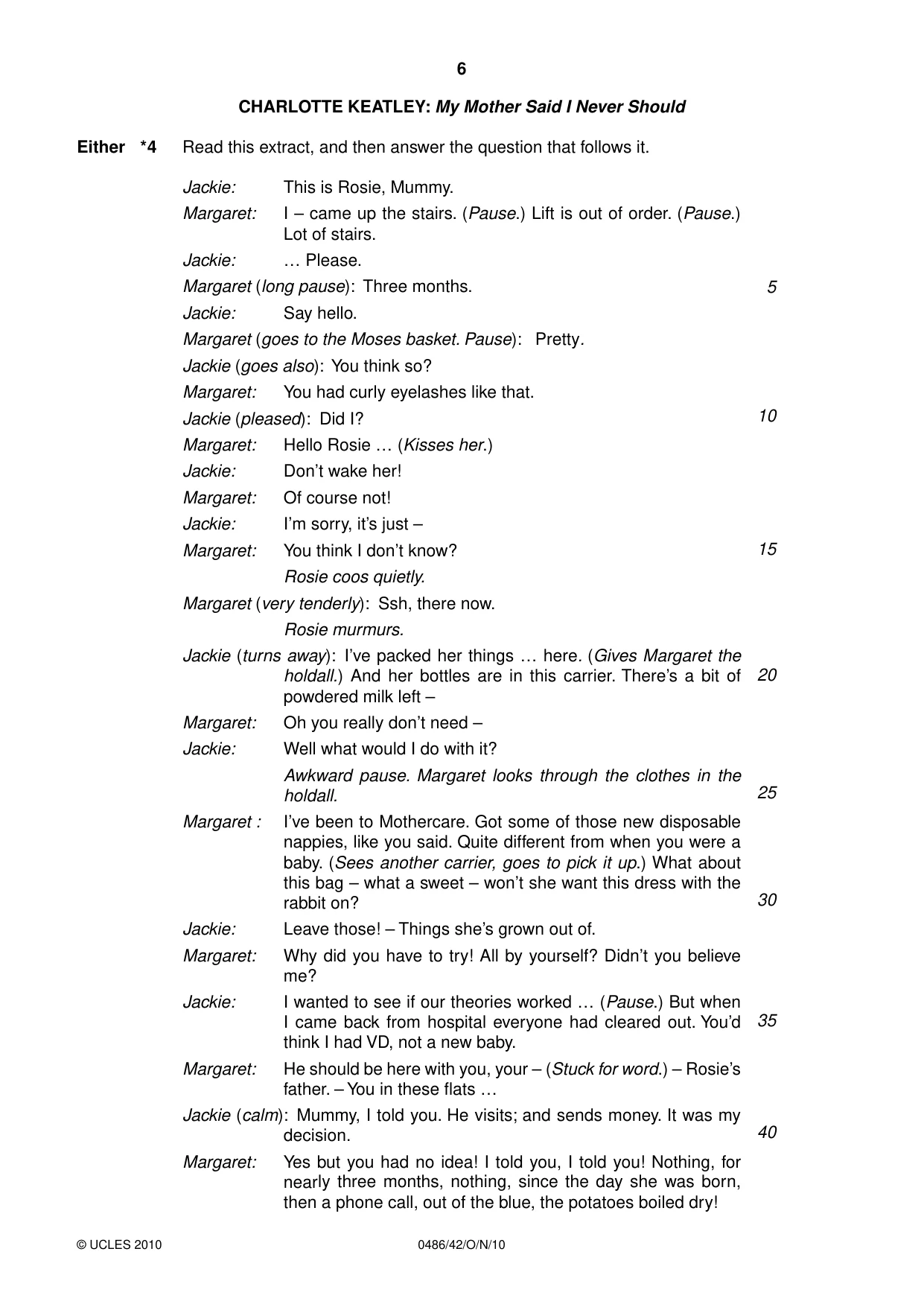
6 0486/42/O/N/10 © UCLES 2010 CHARLOTTE KEATLEY: My Mother Said I Never Should Either * 4 Read this extract, and then answer the question that follows it. Jackie: This is Rosie, Mummy. Margaret: I – came up the stairs. (Pause.) Lift is out of order. (Pause.) Lot of stairs. Jackie: … Please. Margaret (long pause): Three months. Jackie: Say hello. Margaret (goes to the Moses basket. Pause): Pretty. Jackie (goes also): You think so? Margaret: You had curly eyelashes like that. Jackie (pleased): Did I? Margaret: Hello Rosie … (Kisses her.) Jackie: Don’t wake her! Margaret: Of course not! Jackie: I’m sorry, it’s just – Margaret: You think I don’t know? Rosie coos quietly. Margaret (very tenderly): Ssh, there now. Rosie murmurs. Jackie (turns away): I’ve packed her things … here. (Gives Margaret the holdall.) And her bottles are in this carrier. There’s a bit of powdered milk left – Margaret: Oh you really don’t need – Jackie: Well what would I do with it? Awkward pause. Margaret looks through the clothes in the holdall. Margaret : I’ve been to Mothercare. Got some of those new disposable nappies, like you said. Quite different from when you were a baby. (Sees another carrier, goes to pick it up.) What about this bag – what a sweet – won’t she want this dress with the rabbit on? Jackie: Leave those! – Things she’s grown out of. Margaret: Why did you have to try! All by yourself? Didn’t you believe me? Jackie: I wanted to see if our theories worked … (Pause.) But when I came back from hospital everyone had cleared out. You’d think I had VD, not a new baby. Margaret: He should be here with you, your – (Stuck for word.) – Rosie’s father. – You in these flats … Jackie (calm): Mummy, I told you. He visits; and sends money. It was my decision. Margaret: Yes but you had no idea! I told you, I told you! Nothing, for nearly three months, nothing, since the day she was born, then a phone call, out of the blue, the potatoes boiled dry! 5 10 15 20 25 30 35 40
Question paper, page 7
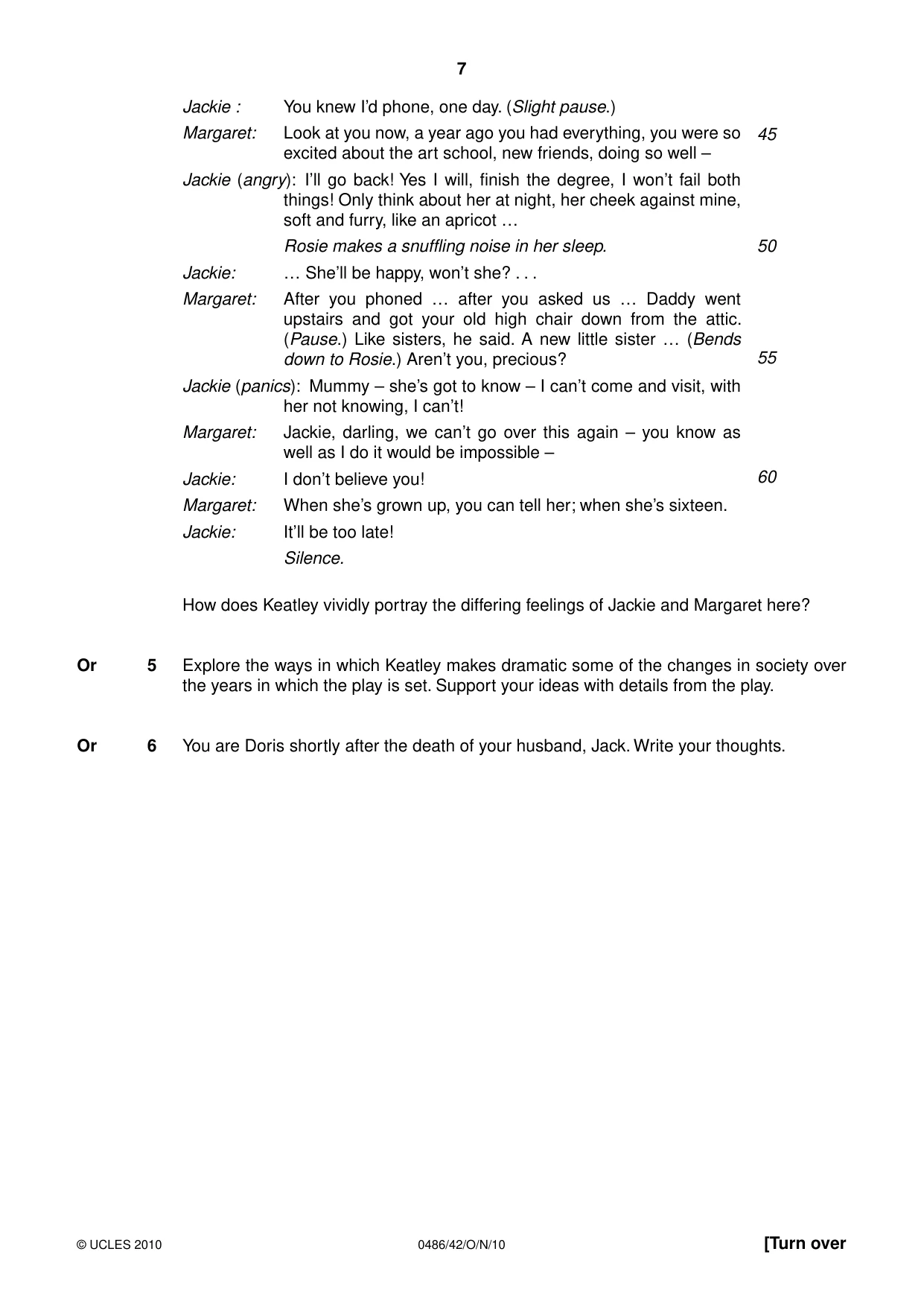
7 0486/42/O/N/10 © UCLES 2010 [Turn over Jackie : You knew I’d phone, one day. (Slight pause.) Margaret: Look at you now, a year ago you had everything, you were so excited about the art school, new friends, doing so well – Jackie (angry): I’ll go back! Yes I will, finish the degree, I won’t fail both things! Only think about her at night, her cheek against mine, soft and furry, like an apricot … Rosie makes a snuffling noise in her sleep. Jackie: … She’ll be happy, won’t she? . . . Margaret: After you phoned … after you asked us … Daddy went upstairs and got your old high chair down from the attic. (Pause.) Like sisters, he said. A new little sister … (Bends down to Rosie.) Aren’t you, precious? Jackie (panics): Mummy – she’s got to know – I can’t come and visit, with her not knowing, I can’t! Margaret: Jackie, darling, we can’t go over this again – you know as well as I do it would be impossible – Jackie: I don’t believe you! Margaret: When she’s grown up, you can tell her; when she’s sixteen. Jackie: It’ll be too late! Silence. How does Keatley vividly portray the differing feelings of Jackie and Margaret here? Or 5 Explore the ways in which Keatley makes dramatic some of the changes in society over the years in which the play is set. Support your ideas with details from the play. Or 6 You are Doris shortly after the death of your husband, Jack. Write your thoughts. 45 50 55 60
Question paper, page 8
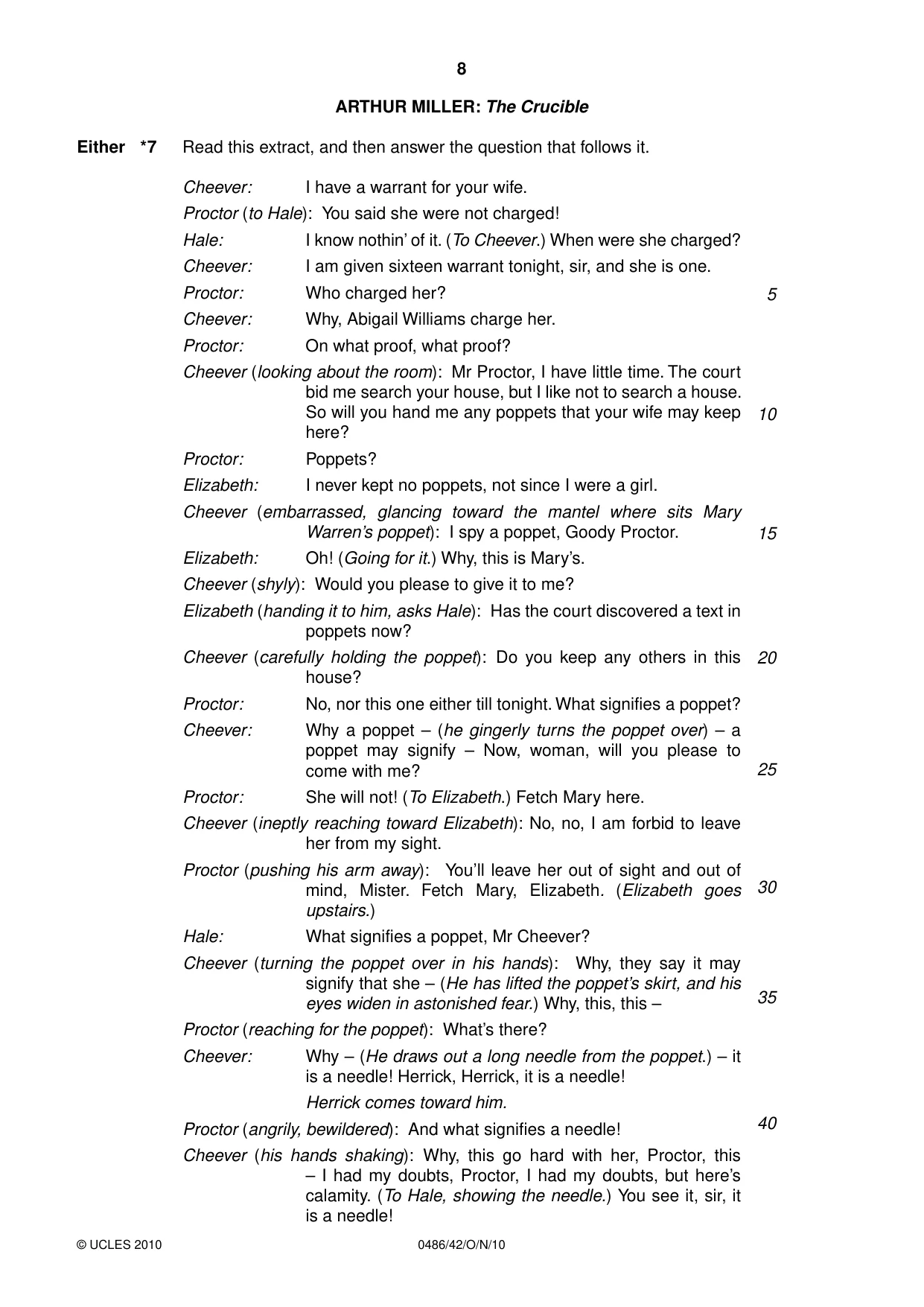
8 0486/42/O/N/10 © UCLES 2010 ARTHUR MILLER: The Crucible Either * 7 Read this extract, and then answer the question that follows it. Cheever: I have a warrant for your wife. Proctor (to Hale): You said she were not charged! Hale: I know nothin’ of it. (To Cheever.) When were she charged? Cheever: I am given sixteen warrant tonight, sir, and she is one. Proctor: Who charged her? Cheever: Why, Abigail Williams charge her. Proctor: On what proof, what proof? Cheever (looking about the room): Mr Proctor, I have little time. The court bid me search your house, but I like not to search a house. So will you hand me any poppets that your wife may keep here? Proctor: Poppets? Elizabeth: I never kept no poppets, not since I were a girl. Cheever (embarrassed, glancing toward the mantel where sits Mary Warren’s poppet): I spy a poppet, Goody Proctor. Elizabeth: Oh! (Going for it.) Why, this is Mary’s. Cheever (shyly): Would you please to give it to me? Elizabeth (handing it to him, asks Hale): Has the court discovered a text in poppets now? Cheever (carefully holding the poppet): Do you keep any others in this house? Proctor: No, nor this one either till tonight. What signifies a poppet? Cheever: Why a poppet – (he gingerly turns the poppet over) – a poppet may signify – Now, woman, will you please to come with me? Proctor: She will not! (To Elizabeth.) Fetch Mary here. Cheever (ineptly reaching toward Elizabeth): No, no, I am forbid to leave her from my sight. Proctor (pushing his arm away): You’ll leave her out of sight and out of mind, Mister. Fetch Mary, Elizabeth. (Elizabeth goes upstairs.) Hale: What signifies a poppet, Mr Cheever? Cheever (turning the poppet over in his hands): Why, they say it may signify that she – (He has lifted the poppet’s skirt, and his eyes widen in astonished fear.) Why, this, this – Proctor (reaching for the poppet): What’s there? Cheever: Why – (He draws out a long needle from the poppet.) – it is a needle! Herrick, Herrick, it is a needle! Herrick comes toward him. Proctor (angrily, bewildered): And what signifies a needle! Cheever (his hands shaking): Why, this go hard with her, Proctor, this – I had my doubts, Proctor, I had my doubts, but here’s calamity. (To Hale, showing the needle.) You see it, sir, it is a needle! 5 10 15 20 25 30 35 40
Question paper, page 9
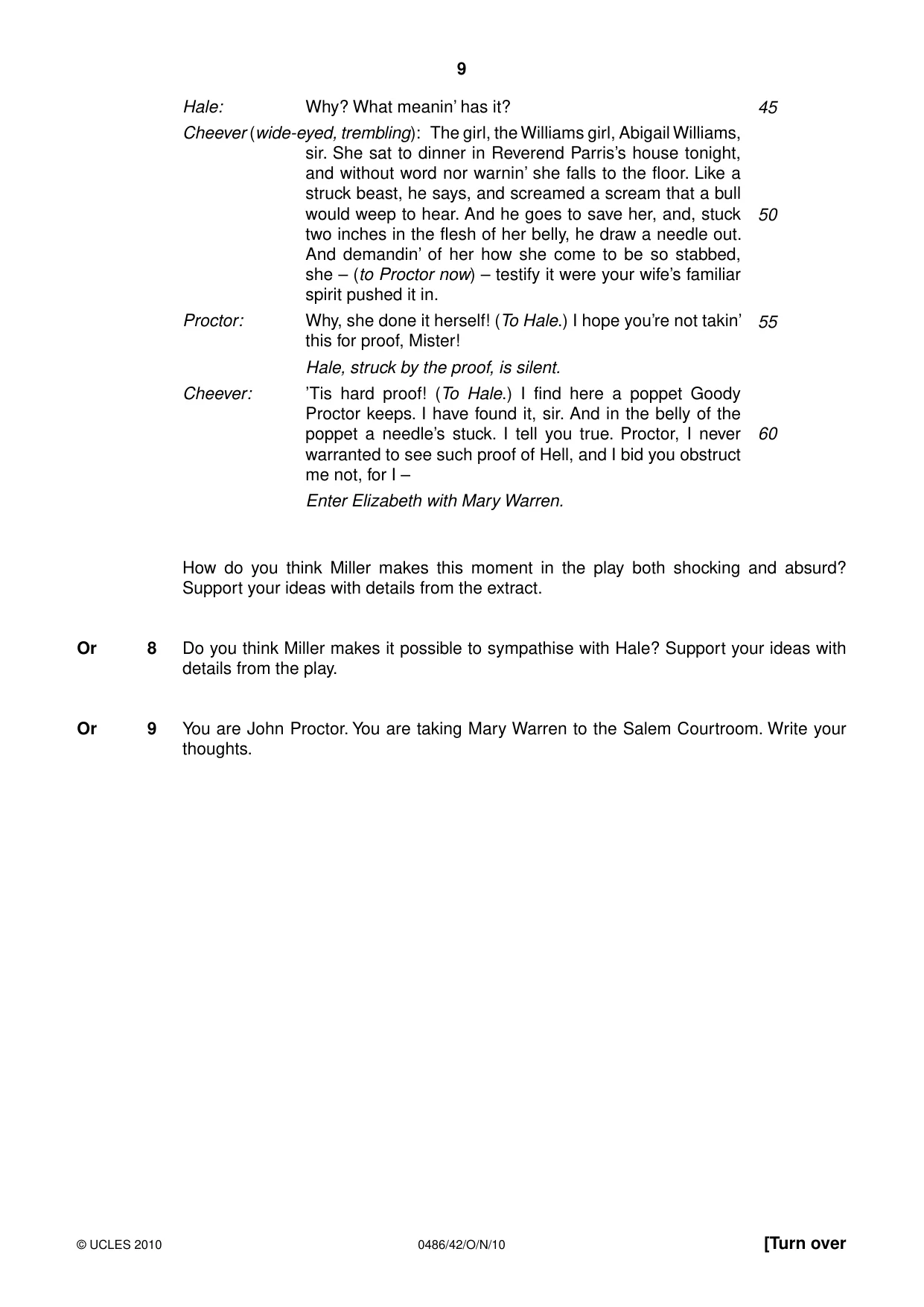
9 0486/42/O/N/10 © UCLES 2010 [Turn over Hale: Why? What meanin’ has it? Cheever (wide-eyed, trembling): The girl, the Williams girl, Abigail Williams, sir. She sat to dinner in Reverend Parris’s house tonight, and without word nor warnin’ she falls to the floor. Like a struck beast, he says, and screamed a scream that a bull would weep to hear. And he goes to save her, and, stuck two inches in the flesh of her belly, he draw a needle out. And demandin’ of her how she come to be so stabbed, she – (to Proctor now) – testify it were your wife’s familiar spirit pushed it in. Proctor: Why, she done it herself! (To Hale.) I hope you’re not takin’ this for proof, Mister! Hale, struck by the proof, is silent. Cheever: ’Tis hard proof! (To Hale.) I find here a poppet Goody Proctor keeps. I have found it, sir. And in the belly of the poppet a needle’s stuck. I tell you true. Proctor, I never warranted to see such proof of Hell, and I bid you obstruct me not, for I – Enter Elizabeth with Mary Warren. How do you think Miller makes this moment in the play both shocking and absurd? Support your ideas with details from the extract. Or 8 Do you think Miller makes it possible to sympathise with Hale? Support your ideas with details from the play. Or 9 You are John Proctor. You are taking Mary Warren to the Salem Courtroom. Write your thoughts. 45 50 55 60
Question paper, page 10
10 0486/42/O/N/10 WILLIAM SHAKESPEARE: Much Ado About Nothing Either * 10 Read this extract, and then answer the question that follows it. Leonato: Come, Friar Francis, be brief; only to the plain form of marriage, and you shall recount their particular duties afterwards. Friar: You come hither, my lord, to marry this lady? Claudio: No. Leonato: To be married to her, friar! You come to marry her. Friar: Lady, you come hither to be married to this count? Hero: I do. Friar: If either of you know any inward impediment why you should not be conjoined, I charge you, on your souls, to utter it. Claudio: Know you any, Hero? Hero: None, my lord. Friar: Know you any, Count? Leonato: I dare make his answer, None. Claudio: O, what men dare do! What men may do! What men daily do, not knowing what they do! Benedick: How now! Interjections? Why, then, some be of laughing, as, ah, ha, he! Claudio: Stand thee by, friar. Father, by your leave: Will you with free and unconstrained soul Give me this maid, your daughter? Leonato: As freely, son, as God did give her me. Claudio: And what have I to give you back whose worth May counterpoise this rich and precious gift? Don Pedro: Nothing, unless you render her again. Claudio: Sweet Prince, you learn me noble thankfulness. There, Leonato, take her back again; Give not this rotten orange to your friend; She’s but the sign and semblance of her honour. Behold how like a maid she blushes here. O, what authority and show of truth Can cunning sin cover itself withal! Comes not that blood as modest evidence To witness simple virtue? Would you not swear, All you that see her, that she were a maid By these exterior shows? But she is none: She knows the heat of a luxurious bed; Her blush is guiltiness, not modesty. Leonato: What do you mean, my lord? Claudio: Not to be married, Not to knit my soul to an approved wanton. Leonato: Dear, my lord, if you, in your own proof, Have vanquish’d the resistance of her youth, And made defeat of her virginity – 5 10 15 20 25 30 35 40 © UCLES 20010
Question paper, page 11
11 0486/42/O/N/10 Claudio: I know what you would say. If I have known her, You will say she did embrace me as a husband, And so extenuate the ’forehand sin. No, Leonato, I never tempted her with word too large But, as a brother to his sister, show’d Bashful sincerity and comely love. Hero: And seem’d I ever otherwise to you? Claudio: Out on thee! Seeming! I will write against it. You seem to me as Dian in her orb, As chaste as is the bud ere it be blown; But you are more intemperate in your blood Than Venus, or those pamp’red animals That rage in savage sensuality. Hero: Is my lord well, that he doth speak so wide? Leonato: Sweet Prince, why speak not you? Don Pedro: What should I speak? I stand dishonour’d that have gone about To link my dear friend to a common stale. Leonato: Are these things spoken, or do I but dream? Don John: Sir, they are spoken, and these things are true. Benedick: This looks not like a nuptial. How does Shakespeare make this such a dramatic moment in the play? Or 11 How does Shakespeare make the relationship between Beatrice and Hero so memorable a part of the play? Support your answer with details from the play. Or 12 You are Don Pedro. You have just discovered that your half-brother, Don John, is responsible for Hero’s disgrace. Write your thoughts. 45 50 55 60 65 © UCLES 2010 [Turn over
Question paper, page 12
12 0486/42/O/N/10 © UCLES 2010 WILLIAM SHAKESPEARE: Richard III Either * 13 Read this extract, and then answer the question that follows it. Gloucester: I cannot blame her; by God’s holy Mother, She hath had too much wrong; and I repent My part thereof that I have done to her. Queen Elizabeth: I never did her any to my knowledge. Gloucester: Yet you have all the vantage of her wrong. I was too hot to do somebody good That is too cold in thinking of it now. Marry, as for Clarence, he is well repaid; He is frank’d up to fatting for his pains; God pardon them that are the cause thereof! Rivers: A virtuous and a Christian-like conclusion, To pray for them that have done scathe to us! Gloucester: So do I ever – [Aside] being well advis’d; For had I curs’d now, I had curs’d myself. Enter Catesby. Catesby: Madam, his Majesty doth call for you, And for your Grace, and you, my gracious lords. Queen Elizabeth: Catesby, I come. Lords, will you go with me? Rivers: We wait upon your Grace. [Exeunt all but Gloucester. Gloucester: I do the wrong, and first begin to brawl. The secret mischiefs that I set abroach I lay unto the grievous charge of others. Clarence, who I indeed have cast in darkness, I do beweep to many simple gulls; Namely, to Derby, Hastings, Buckingham; And tell them ’tis the Queen and her allies That stir the King against the Duke my brother. Now they believe it, and withal whet me To be reveng’d on Rivers, Dorset, Grey; But then I sigh and, with a piece of Scripture, Tell them that God bids us do good for evil. And thus I clothe my naked villainy With odd old ends stol’n forth of holy writ, And seem a saint when most I play the devil. Enter two Murderers. But, soft, here come my executioners. How now, my hardy stout resolved mates! Are you now going to dispatch this thing? 1 Murderer: We are, my lord, and come to have the warrant, That we may be admitted where he is. Gloucester: Well thought upon; I have it here about me. [Gives the warrant.] When you have done, repair to Crosby Place. But, sirs, be sudden in the execution, Withal obdurate, do not hear him plead; For Clarence is well-spoken, and perhaps May move your hearts to pity, if you mark him. 5 10 15 20 25 30 35 40 45
Question paper, page 13
13 0486/42/O/N/10 © UCLES 2010 [Turn over 1 Murderer: Tut, tut, my lord, we will not stand to prate; Talkers are no good doers. Be assur’d We go to use our hands and not our tongues. Gloucester: Your eyes drop millstones when fools’ eyes fall tears. I like you, lads; about your business straight; Go go, dispatch. 1 Murderer: We will, my noble lord. How do you think Shakespeare makes Richard such an entertaining and dramatic figure here? Support your ideas with details from the extract. Or 14 How do you think Shakespeare makes Richard’s climb to the throne so dramatically compelling? Support your ideas with details from the play. Or 15 You are Lord Hastings. You are on your way with Buckingham to the Tower for the meeting of the Council. Write your thoughts. 50 55
Question paper, page 14
14 0486/42/O/N/10 © UCLES 2010 R.C. SHERRIFF: Journey’s End Either * 16 Read this extract, and then answer the question that follows it. Trotter: You keen on gardening? Osborne: Yes. A bit. I made a rockery when I was home on leave. I used to cycle out to the woods and get primroses and things like that, and try and get ’em to grow in my garden. Trotter: I don’t suppose they would! Osborne: They would if you pressed a bit of moss round them – Trotter: – to make ’em feel at ’ome, eh? (He laughs.) Osborne: They’ll be coming out again soon if they’ve got this sun at home. Trotter: I reckon they will. I remember one morning last spring – we was coming out of the salient. Just when it was getting light in the morning – it was at the time when the Boche was sending over a lot of that gas that smells like pear- drops, you know? Osborne: I know. Phosgene. Trotter: That’s it. We were scared to hell of it. All of a sudden we smelt that funny sweet smell, and a fellow shouted ‘Gas!’ – and we put on our masks; and then I spotted what it was. Osborne: What was it? Trotter: Why, a blinkin’ may-tree! All out in bloom, growing beside the path! We did feel a lot of silly poops – putting on gas masks because of a damn may-tree! (He stretches himself and tries to button his tunic.) Lord! I must get my fat down. (He gets up.) Well, I better go and relieve Stanhope. He’ll curse like hell if I don’t. I bet he’s got a red-hot liver this morning. Osborne: I relieve you at eleven. Trotter: That’s right. I don’t like this time of day in the line. The old Boche ’as just ’ad ’is breakfast, and sends over a few whizz-bangs and rifle grenades to show ’e ain’t forgotten us. Still, I’d rather ’ave a bang or two than this damn quiet. (He puts on his helmet and gas mask satchel and goes up the steps.) Cheero! Osborne: Cheero! Raleigh: Cheero! Osborne (to Raleigh): I expect Stanhope’ll let you go on duty alone now. Raleigh: Will he? About what time? Osborne: Well, after me, I expect. From about two till four. Raleigh: I see. (There is a pause. Then Osborne looks at Raleigh and laughs.) Osborne: What do you think about it all? Raleigh: Oh, all right, thanks. (He laughs.) I feel I’ve been here ages. 5 10 15 20 25 30 35 40
Question paper, page 15
15 0486/42/O/N/10 © UCLES 2010 [Turn over Osborne (filling his pipe): I expect you do. The time passes, though. Raleigh: Are we here for six days? Osborne: Yes. Seems a long time, doesn’t it? Raleigh (laughing shortly): It does rather. I can’t imagine – the end of six days here – Osborne: Anyhow, we’ve done twelve hours already. It’s fine when you are relieved and go down the line to billets, and have a good hot bath, and sit and read under trees. Raleigh: Good Lord, I feel I haven’t seen a tree for ages – not a real tree, with leaves and branches – and yet I’ve only been here twelve hours. Osborne: How did you feel – in the front line? Raleigh: Oh, all right. It seemed so frightfully quiet and uncanny – everybody creeping about and talking in low voices. I suppose you’ve got to talk quietly when you’re so near the German front line – only about seventy yards, isn’t it? Osborne: Yes. About the breadth of a Rugger field. Raleigh: It’s funny to think of it like that. Osborne: I always measure distances like that out here. Keeps them in proportion. Explore how Sherriff vividly conveys in this very ordinary conversation the pressures under which the three men are living. Or 17 What do you think makes Osborne such a dramatic character in the play? Support your ideas with details from the play. Or 18 You are Raleigh. You are on your way to the front line to join Stanhope’s Company. Write your thoughts. 45 50 55 60
Question paper, page 16
16 0486/42/O/N/10 © UCLES 2010 SECTION B: POETRY SONGS OF OURSELVES: from Part 3 Either * 19 Read this poem, and then answer the question that follows it. Sonnet 29 Pity me not because the light of day At close of day no longer walks the sky; Pity me not for beauties passed away From field to thicket as the year goes by; Pity me not the waning of the moon, 5 Nor that the ebbing tide goes out to sea, Nor that a man’s desire is hushed so soon, And you no longer look with love on me. This have I known always: Love is no more Than the wide blossom which the wind assails, 10 Than the great tide that treads the shifting shore, Strewing fresh wreckage gathered in the gales: Pity me that the heart is slow to learn When the swift mind beholds at every turn. (by Edna St Vincent Millay) What do you think makes this sonnet so sad? Support your ideas with details from the poet’s words. Or 20 In either Marrysong (by Dennis Scott) or First Love (by John Clare) explore how the poet’s words vividly portray being in love. Or 21 Sounds of words can contribute powerfully to a poem’s effect and meaning. Explore some examples of this from at least two poems that you have studied from this section of Songs of Ourselves.
Question paper, page 17
17 0486/42/O/N/10 © UCLES 2010 [Turn over JOHN KEATS: Poems Either * 22 Read these last six stanzas from La Belle Dame Sans Merci, and then answer the question that follows them. She found me roots of relish sweet And honey wild and manna dew, And sure in language strange she said I love thee true – She took me to her elfin grot 5 And there she wept and sigh’d full sore, And there I shut her wild wild eyes With kisses four. And there she lulled me asleep And there I dream’d Ah Woe betide! 10 The latest dream I ever dreamt On the cold hill side. I saw pale kings and Princes too, Pale warriors, death pale were they all; They cried ‘La belle dame sans merci 15 Thee hath in thrall.’ I saw their starv’d lips in the gloam With horrid warning gaped wide, And I awoke and found me here On the cold hill’s side. 20 And this is why I sojourn here Alone and palely loitering; Though the sedge is wither’d from the Lake And no birds sing. Explore the ways in which Keats emphasises the knight’s feelings of hopelessness here. Or 23 What do you find memorable about the ways in which Keats portrays the figures on the Grecian Urn? Support your ideas with details from Ode on a Grecian Urn. Or 24 Explore how Keats vividly conveys his thoughts and feelings in Ode on Indolence. Refer closely to the poem to support your ideas.
Question paper, page 18
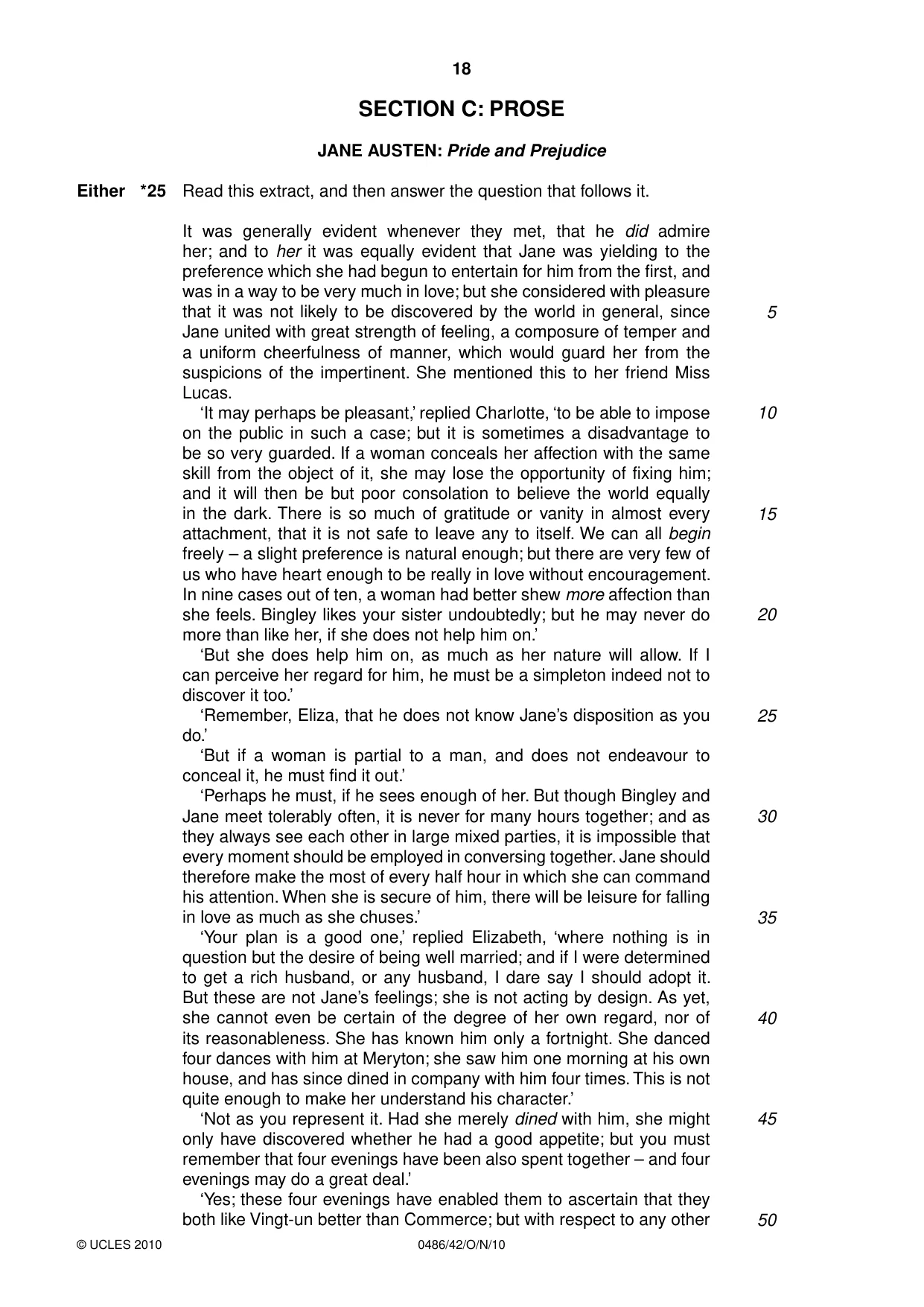
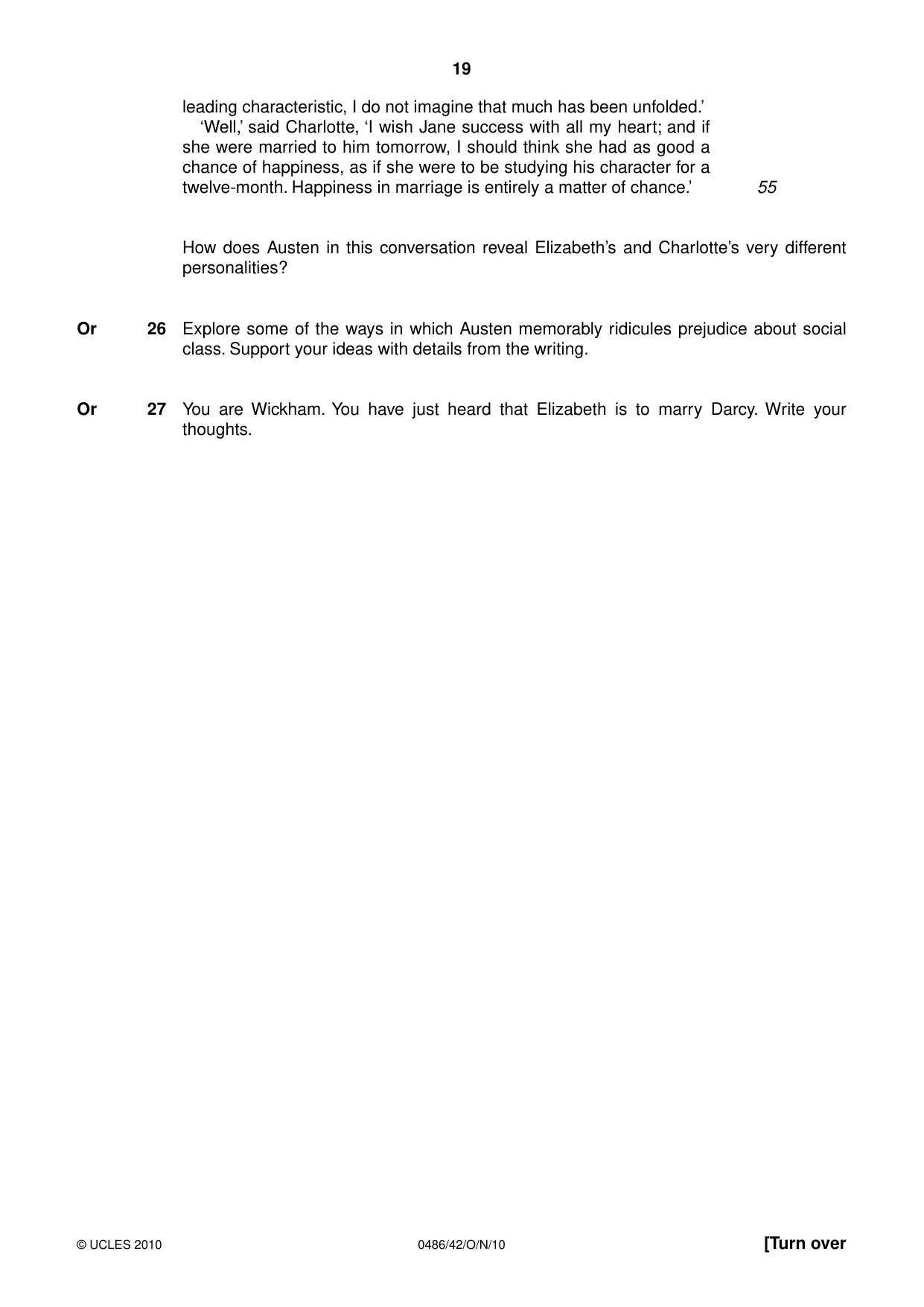
18 0486/42/O/N/10 © UCLES 2010 SECTION C: PROSE JANE AUSTEN: Pride and Prejudice Either * 25 Read this extract, and then answer the question that follows it. It was generally evident whenever they met, that he did admire her; and to her it was equally evident that Jane was yielding to the preference which she had begun to entertain for him from the first, and was in a way to be very much in love; but she considered with pleasure that it was not likely to be discovered by the world in general, since Jane united with great strength of feeling, a composure of temper and a uniform cheerfulness of manner, which would guard her from the suspicions of the impertinent. She mentioned this to her friend Miss Lucas. ‘It may perhaps be pleasant,’ replied Charlotte, ‘to be able to impose on the public in such a case; but it is sometimes a disadvantage to be so very guarded. If a woman conceals her affection with the same skill from the object of it, she may lose the opportunity of fixing him; and it will then be but poor consolation to believe the world equally in the dark. There is so much of gratitude or vanity in almost every attachment, that it is not safe to leave any to itself. We can all begin freely – a slight preference is natural enough; but there are very few of us who have heart enough to be really in love without encouragement. In nine cases out of ten, a woman had better shew more affection than she feels. Bingley likes your sister undoubtedly; but he may never do more than like her, if she does not help him on.’ ‘But she does help him on, as much as her nature will allow. If I can perceive her regard for him, he must be a simpleton indeed not to discover it too.’ ‘Remember, Eliza, that he does not know Jane’s disposition as you do.’ ‘But if a woman is partial to a man, and does not endeavour to conceal it, he must find it out.’ ‘Perhaps he must, if he sees enough of her. But though Bingley and Jane meet tolerably often, it is never for many hours together; and as they always see each other in large mixed parties, it is impossible that every moment should be employed in conversing together. Jane should therefore make the most of every half hour in which she can command his attention. When she is secure of him, there will be leisure for falling in love as much as she chuses.’ ‘Your plan is a good one,’ replied Elizabeth, ‘where nothing is in question but the desire of being well married; and if I were determined to get a rich husband, or any husband, I dare say I should adopt it. But these are not Jane’s feelings; she is not acting by design. As yet, she cannot even be certain of the degree of her own regard, nor of its reasonableness. She has known him only a fortnight. She danced four dances with him at Meryton; she saw him one morning at his own house, and has since dined in company with him four times. This is not quite enough to make her understand his character.’ ‘Not as you represent it. Had she merely dined with him, she might only have discovered whether he had a good appetite; but you must remember that four evenings have been also spent together – and four evenings may do a great deal.’ ‘Yes; these four evenings have enabled them to ascertain that they both like Vingt-un better than Commerce; but with respect to any other 5 10 15 20 25 30 35 40 45 50
Question paper, page 19
19 0486/42/O/N/10 © UCLES 2010 [Turn over leading characteristic, I do not imagine that much has been unfolded.’ ‘Well,’ said Charlotte, ‘I wish Jane success with all my heart; and if she were married to him tomorrow, I should think she had as good a chance of happiness, as if she were to be studying his character for a twelve-month. Happiness in marriage is entirely a matter of chance.’ How does Austen in this conversation reveal Elizabeth’s and Charlotte’s very different personalities? Or 26 Explore some of the ways in which Austen memorably ridicules prejudice about social class. Support your ideas with details from the writing. Or 27 You are Wickham. You have just heard that Elizabeth is to marry Darcy. Write your thoughts. 55
Question paper, page 20
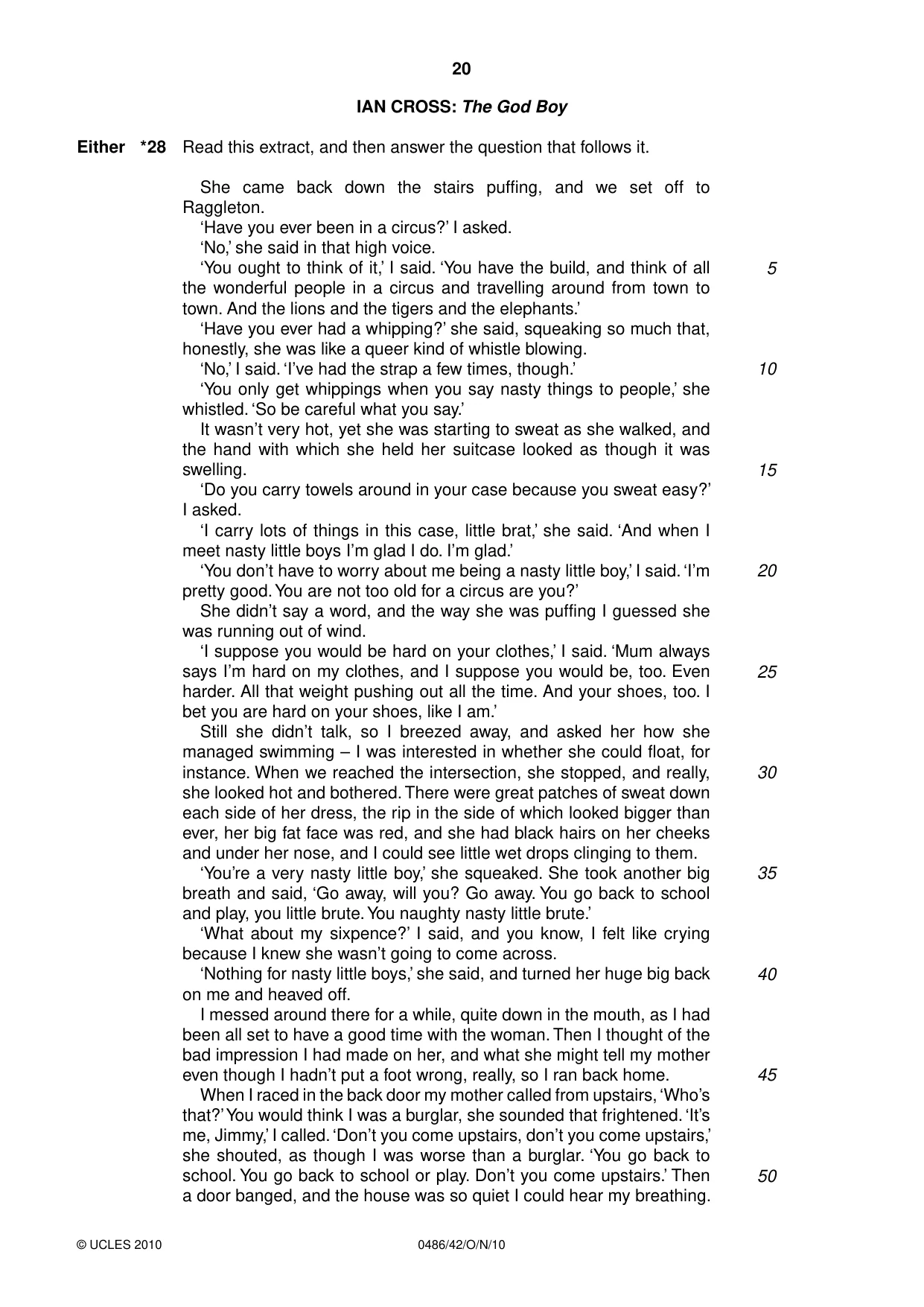
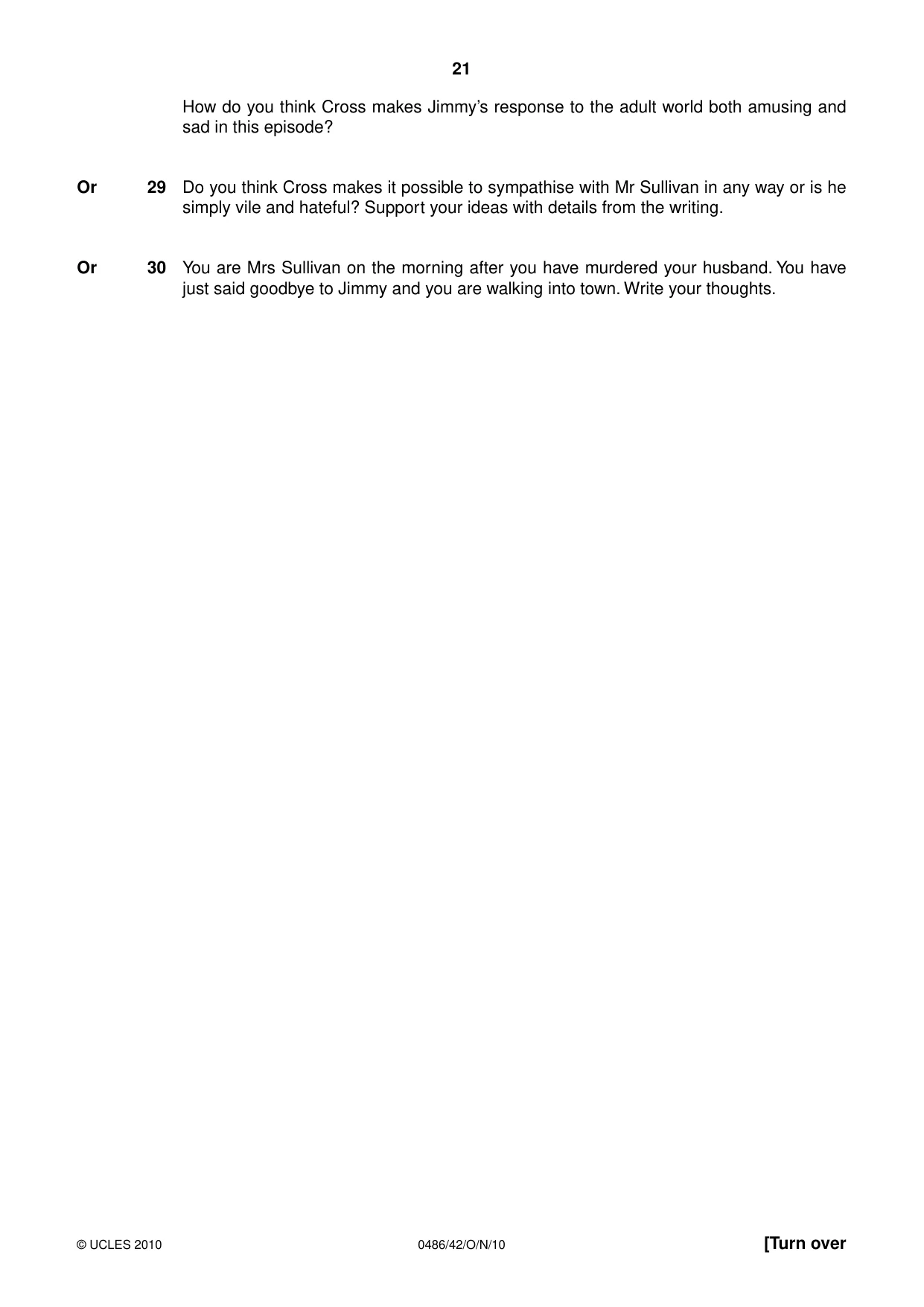
20 0486/42/O/N/10 © UCLES 2010 IAN CROSS: The God Boy Either * 28 Read this extract, and then answer the question that follows it. She came back down the stairs puffing, and we set off to Raggleton. ‘Have you ever been in a circus?’ I asked. ‘No,’ she said in that high voice. ‘You ought to think of it,’ I said. ‘You have the build, and think of all the wonderful people in a circus and travelling around from town to town. And the lions and the tigers and the elephants.’ ‘Have you ever had a whipping?’ she said, squeaking so much that, honestly, she was like a queer kind of whistle blowing. ‘No,’ I said. ‘I’ve had the strap a few times, though.’ ‘You only get whippings when you say nasty things to people,’ she whistled. ‘So be careful what you say.’ It wasn’t very hot, yet she was starting to sweat as she walked, and the hand with which she held her suitcase looked as though it was swelling. ‘Do you carry towels around in your case because you sweat easy?’ I asked. ‘I carry lots of things in this case, little brat,’ she said. ‘And when I meet nasty little boys I’m glad I do. I’m glad.’ ‘You don’t have to worry about me being a nasty little boy,’ I said. ‘I’m pretty good. You are not too old for a circus are you?’ She didn’t say a word, and the way she was puffing I guessed she was running out of wind. ‘I suppose you would be hard on your clothes,’ I said. ‘Mum always says I’m hard on my clothes, and I suppose you would be, too. Even harder. All that weight pushing out all the time. And your shoes, too. I bet you are hard on your shoes, like I am.’ Still she didn’t talk, so I breezed away, and asked her how she managed swimming – I was interested in whether she could float, for instance. When we reached the intersection, she stopped, and really, she looked hot and bothered. There were great patches of sweat down each side of her dress, the rip in the side of which looked bigger than ever, her big fat face was red, and she had black hairs on her cheeks and under her nose, and I could see little wet drops clinging to them. ‘You’re a very nasty little boy,’ she squeaked. She took another big breath and said, ‘Go away, will you? Go away. You go back to school and play, you little brute. You naughty nasty little brute.’ ‘What about my sixpence?’ I said, and you know, I felt like crying because I knew she wasn’t going to come across. ‘Nothing for nasty little boys,’ she said, and turned her huge big back on me and heaved off. I messed around there for a while, quite down in the mouth, as I had been all set to have a good time with the woman. Then I thought of the bad impression I had made on her, and what she might tell my mother even though I hadn’t put a foot wrong, really, so I ran back home. When I raced in the back door my mother called from upstairs, ‘Who’s that?’ You would think I was a burglar, she sounded that frightened. ‘It’s me, Jimmy,’ I called. ‘Don’t you come upstairs, don’t you come upstairs,’ she shouted, as though I was worse than a burglar. ‘You go back to school. You go back to school or play. Don’t you come upstairs.’ Then a door banged, and the house was so quiet I could hear my breathing. 5 10 15 20 25 30 35 40 45 50
Question paper, page 21
21 0486/42/O/N/10 © UCLES 2010 [Turn over How do you think Cross makes Jimmy’s response to the adult world both amusing and sad in this episode? Or 29 Do you think Cross makes it possible to sympathise with Mr Sullivan in any way or is he simply vile and hateful? Support your ideas with details from the writing. Or 30 You are Mrs Sullivan on the morning after you have murdered your husband. You have just said goodbye to Jimmy and you are walking into town. Write your thoughts.
Question paper, page 22
22 0486/42/O/N/10 © UCLES 2010 ANITA DESAI: Games at Twilight and Other Stories Either * 31 Read this extract from A Devoted Son, and then answer the question that follows it. He developed so many complaints and fell ill so frequently and with such mysterious diseases that even his son could no longer make out when it was something of significance and when it was merely a peevish whim. He sat huddled on his string bed most of the day and developed an exasperating habit of stretching out suddenly and lying absolutely still, allowing the whole family to fly around him in a flap, wailing and weeping, and then suddenly sitting up, stiff and gaunt, and spitting out a big gob of betel juice as if to mock their behaviour. He did this once too often: there had been a big party in the house, a birthday party for the youngest son, and the celebrations had to be suddenly hushed, covered up and hustled out of the way when the daughter-in-law discovered, or thought she discovered, that the old man, stretched out from end to end of his string bed, had lost his pulse; the party broke up, dissolved, even turned into a band of mourners, when the old man sat up and the distraught daughter-in-law received a gob of red spittle right on the hem of her new organza sari. After that no one much cared if he sat up cross-legged on his bed, hawking and spitting, or lay down flat and turned grey as a corpse. Except, of course, for that pearl amongst pearls, his son Rakesh. It was Rakesh who brought him his morning tea, not in one of the china cups from which the rest of the family drank, but in the old man’s favourite brass tumbler, and sat at the edge of his bed, comfortable and relaxed with the string of his pyjamas dangling out from under his fine lawn night-shirt, and discussed or, rather, read out the morning news to his father. It made no difference to him that his father made no response apart from spitting. It was Rakesh, too, who, on returning from the clinic in the evening, persuaded the old man to come out of his room, as bare and desolate as a cell, and take the evening air out in the garden, beautifully arranging the pillows and bolsters on the divan in the corner of the open veranda. On summer nights he saw to it that the servants carried out the old man’s bed onto the lawn and himself helped his father down the steps and onto the bed, soothing him and settling him down for a night under the stars. All this was very gratifying for the old man. What was not so gratifying was that he even undertook to supervise his father’s diet. One day when the father was really sick, having ordered his daughter-in-law to make him a dish of soojie halwa and eaten it with a saucerful of cream, Rakesh marched into the room, not with his usual respectful step but with the confident and rather contemptuous stride of the famous doctor, and declared, ‘No more halwa for you, Papa. We must be sensible, at your age. If you must have something sweet, Veena will cook you a little kheer, that’s light, just a little rice and milk. But nothing fried, nothing rich. We can’t have this happening again.’ The old man who had been lying stretched out on his bed, weak and feeble after a day’s illness, gave a start at the very sound, the tone of these words. He opened his eyes – rather, they fell open with shock – and he stared at his son with disbelief that darkened quickly to reproach. A son who actually refused his father the food he craved? No, it was unheard of, it was incredible. But Rakesh had turned his back to him and was cleaning up the litter of bottles and packets on the medicine shelf and did not notice while Veena slipped silently out of the room with a little smirk that only the old man saw, and hated. 5 10 15 20 25 30 35 40 45 50
Question paper, page 23
23 0486/42/O/N/10 © UCLES 2010 [Turn over To what extent does Desai make you sympathise with the old man here? Support your views with details from the writing. Or 32 What for you are the features of life in India which Desai brings most vividly and memorably to life in these short stories? Support your views with details from Desai’s writing in at least two stories. Or 33 You are Sheila in Surface Textures. You are on your way home to your parents. Write your thoughts.
Question paper, page 24
24 0486/42/O/N/10 © UCLES 2010 THOMAS HARDY: Far from the Madding Crowd Either * 34 Read this extract, and then answer the question that follows it. ‘O no!’ the girl replied. She seemed to prefer a less tragic probability; to have saved a man from death involved talk that should harmonize with the dignity of such a deed – and she shunned it. ‘I believe you saved my life, Miss – I don’t know your name. I know your aunt’s, but not yours.’ ‘I would just as soon not tell it – rather not. There is no reason either why I should, as you probably will never have much to do with me.’ ‘Still I should like to know.’ ‘You can inquire at my aunt’s – she will tell you.’ ‘My name is Gabriel Oak.’ ‘And mine isn’t. You seem fond of yours in speaking it so decisively, Gabriel Oak.’ ‘You see, it is the only one I shall ever have, and I must make the most of it.’ ‘I always think mine sounds odd and disagreeable.’ ‘I should think you might soon get a new one.’ ‘Mercy! – how many opinions you keep about you concerning other people, Gabriel Oak.’ ‘Well, Miss – excuse the words – I thought you would like them. But I can’t match you, I know, in mapping out my mind upon my tongue. I never was very clever in my inside. But I thank you. Come, give me your hand!’ She hesitated, somewhat disconcerted at Oak’s old-fashioned earnest conclusion to a dialogue lightly carried on. ‘Very well,’ she said, and gave him her hand, compressing her lips to a demure impassivity. He held it but an instant, and in his fear of being too demonstrative, swerved to the opposite extreme, touching her fingers with the lightness of a small-hearted person. ‘I am sorry,’ he said the instant after. ‘What for?’ ‘Letting your hand go so quick.’ ‘You may have it again if you like; there it is.’ She gave him her hand again. Oak held it longer this time – indeed, curiously long. ‘How soft it is – being winter time, too – not chapped or rough, or anything!’ he said. ‘There – that’s long enough,’ said she, though without pulling it away. ‘But I suppose you are thinking you would like to kiss it? You may if you want to.’ ‘I wasn’t thinking of any such thing,’ said Gabriel simply; ‘but I will –’ ‘That you won’t!’ She snatched back her hand. Gabriel felt himself guilty of another want of tact. ‘Now find out my name,’ she said teasingly; and withdrew. How does Hardy vividly convey the developing attraction between Gabriel and Bathsheba here? 5 10 15 20 25 30 35 40
Question paper, page 25
25 0486/42/O/N/10 © UCLES 2010 [Turn over Or 35 Attractive and exciting Selfish and cruel Which of these two descriptions is nearer to your view of Sergeant Troy? Support your ideas with details from the novel. Or 36 You are Boldwood on receiving the Valentine card from Bathsheba. Write your thoughts.
Question paper, page 26
26 0486/42/O/N/10 © UCLES 2010 BESSIE HEAD: When Rain Clouds Gather Either * 37 Read this extract, and then answer the question that follows it. Makhaya sat down opposite her and pulled the Tswana version of the Bible towards him as she poured the tea. He scarcely glanced at the words. ‘Are you religious, Mama?’ he asked lightly. Mma-Millipede looked at him with an alert glance. ‘If you mean, am I good, I can right away say no, no, no,’ she said. ‘Goodness is impossible to achieve. I am searching for a faith, without which I cannot live.’ Makhaya kept quiet because he did not immediately grasp the meaning of this. ‘What is faith, Mama?’ he asked curiously. ‘It is an understanding of life,’ she said gently. He looked at her for a moment and then placed one long black arm on the table and pulled up the sweater sleeve which was the same pitch black colouring as the skin on his arm. ‘Do you mean this too?’ he asked, quietly. ‘Do you know who I am? I am Makhaya, the Black Dog, and as such I am tossed about by life. Life is only torture and torment to me and not something I care to understand.’ He might have said it was much more than torture and torment, that it was an abysmal betrayal, a howling inferno where every gesture of love and respect was repaid with the vicious, snapping jaws of the inmates of this inferno until you were forced to build a thick wall of silence between yourself and the snapping jaws. But he would throttle himself to death behind this wall because love was really a warm outflowing stream which could not be dammed up. The familiar pained expression crept over his face as he looked at the old woman. And the old woman knew this. ‘What is a Black Dog?’ she asked abruptly. Makhaya laughed his bitter, sarcastic laugh. ‘He is a sensation,’ he said. ‘He awakens only thrills in the rest of mankind. He is a child they scold in a shrill voice because they think he will never grow up. They don’t want him to, either, because they’ve grown too used to his circus and his antics, and they liked the way he sat on the chair and shivered in fear while they lashed out with the whip. If Black Dog becomes human they won’t have anyone to entertain them any more. Yet all the while they shrieked with laughter over his head, he slowly became a mad dog. Instead of becoming human, he has only become a mad dog, and this makes them laugh louder then ever.’ Mma-Millipede looked down. The quietly spoken words carried in them a violent torrent of hatred, and she was swept out of her depth, uncertain if there was anything in her own life with which to counter this hatred. The pitch black arm still lay across the table, like a question mark, and she was pitch black too, but she had lived all her life inside this black skin with a quiet and unruffled dignity. ‘You are not a Black Dog, my own sweetheart,’ she said in despair. ‘I have never seen such a handsome man as you in my life before. You must not be fooled by those who think they are laughing. I don’t know these people but my search for a faith has taught me that life is a fire in which each burns until it is time to close the shop.’ She looked up at Makhaya and he stared back at her aloofly. With that aloof stare he was trying to force something out of the old woman as he began to feel the real hard depth at the centre of her life. Mma- 5 10 15 20 25 30 35 40 45 50
Question paper, page 27
27 0486/42/O/N/10 © UCLES 2010 [Turn over Millipede wavered. She had wanted to chat with him about little things; how he liked his work and whether he wanted a woman. But now all her feelers had to concentrate themselves on this frightening depth of hatred he had revealed in himself. He smiled suddenly, quite clearly observing the uncertainty on her face. How does Head make this conversation between Makhaya and Mma-Millipede such a powerful and significant moment in the novel? Or 38 What vivid impressions of women’s lives in Golema Mmidi does Head create for you in the novel? Support your answer by close reference. Or 39 You are George Appleby-Smith. You have just been informed of the suicide of Chief Matenge. Write your thoughts. 55
Question paper, page 28
28 0486/42/O/N/10 © UCLES 2010 EDITH WHARTON: Ethan Frome Either * 40 Read this extract, and then answer the question that follows it. As he reached the door he met Zeena coming back into the room, her lips twitching with anger, a flush of excitement on her sallow face. The shawl had slipped from her shoulders and was dragging at her down-trodden heels, and in her hands she carried the fragments of the red glass pickle-dish. ‘I’d like to know who done this,’ she said, looking sternly from Ethan to Mattie. There was no answer, and she continued in a trembling voice: ‘I went to get those powders I’d put away in father’s old spectacle-case, top of the china-closet, where I keep the things I set store by, so’s folks shan’t meddle with them –’ Her voice broke, and two small tears hung on her lashless lids and ran slowly down her cheeks. ‘It takes the step-ladder to get at the top shelf, and I put Aunt Philura Maple’s pickle-dish up there o’ purpose when we was married, and it’s never been down since, ’cept for the spring cleaning, and then I always lifted it with my own hands, so’s ’t shouldn’t get broke.’ She laid the fragments reverently on the table. ‘I want to know who done this,’ she quavered. At the challenge Ethan turned back into the room and faced her. ‘I can tell you, then. The cat done it.’ ‘The cat ?’ ‘That’s what I said.’ She looked at him hard, and then turned her eyes to Mattie, who was carrying the dish-pan to the table. ‘I’d like to know how the cat got into my china-closet,’ she said. ‘Chasin’ mice, I guess,’ Ethan rejoined. ‘There was a mouse round the kitchen all last evening.’ Zeena continued to look from one to the other; then she emitted her small strange laugh. ‘I knew the cat was a smart cat,’ she said in a high voice, ‘but I didn’t know he was smart enough to pick up the pieces of my pickle-dish and lay ’em edge to edge on the very shelf he knocked ’em off of.’ Mattie suddenly drew her arms out of the steaming water. ‘It wasn’t Ethan’s fault, Zeena! The cat did break the dish; but I got it down from the china-closet, and I’m the one to blame for its getting broken.’ Zeena stood beside the ruin of her treasure, stiffening into a stony image of resentment, ‘You got down my pickle-dish – what for?’ A bright flush flew to Mattie’s cheeks. ‘I wanted to make the supper- table pretty,’ she said. ‘You wanted to make the supper-table pretty; and you waited till my back was turned, and took the thing I set most store by of anything I’ve got, and wouldn’t never use it, not even when the minister come to dinner, or Aunt Martha Pierce come over from Bettsbridge –’ Zeena paused with a gasp, as if terrified by her own evocation of the sacrilege. ‘You’re a bad girl, Mattie Silver, and I always known it. It’s the way your father begun, and I was warned of it when I took you, and I tried to keep my things where you couldn’t get at ’em – and now you’ve took from me the one I cared for most of all –’ She broke off in a short spasm of sobs that passed and left her more than ever like a shape of stone. ‘If I’d ’a’ listened to folks, you’d ’a’ gone before now, and this wouldn’t ’a’ happened,’ she said; and gathering up the bits of broken glass she went out of the room as if she carried a dead body … 5 10 15 20 25 30 35 40 45 50
Question paper, page 29
29 0486/42/O/N/10 © UCLES 2010 [Turn over What does Wharton make you feel about Zeena here? Support your views with details from the writing. Or 41 How does Wharton make Ethan Frome such a compelling character? Support your ideas with details from the writing. Or 42 You are Mattie. You are walking home from the dance after you have escaped Denis Eady’s attentions and before Ethan catches up with you. Write your thoughts.
Question paper, page 30
30 0486/42/O/N/10 © UCLES 2010 from STORIES OF OURSELVES Either * 43 Read this extract from The Signalman, and then answer the question that follows it. ‘I have made up my mind, sir,’ he began, bending forward as soon as we were seated, and speaking in a tone but a little above a whisper, ‘that you shall not have to ask me twice what troubles me. I took you for someone else yesterday evening. That troubles me.’ ‘That mistake?’ ‘No. That someone else.’ ‘Who is it?’ ‘I don’t know.’ ‘Like me?’ ‘I don’t know. I never saw the face. The left arm is across the face, and the right arm is waved – violently waved. This way.’ I followed his action with my eyes, and it was the action of an arm gesticulating, with the utmost passion and vehemence, ‘For God’s sake, clear the way!’ ‘One moonlight night,’ said the man, ‘I was sitting here, when I heard a voice cry, “Halloa! Below there!” I started up, looked from that door, and saw this someone else standing by the red light near the tunnel, waving as I just now showed you. The voice seemed hoarse with shouting, and it cried, “Look out! Look out!” And then again, “Halloa! Below there! Look out!” I caught up my lamp, turned it on red, and ran towards the figure, calling, “What’s wrong? What has happened? Where?” It stood just outside the blackness of the tunnel. I advanced so close upon it that I wondered at its keeping the sleeve across its eyes. I ran right up at it, and had my hand stretched out to pull the sleeve away when it was gone.’ ‘Into the tunnel?’ said I. ‘No. I ran on into the tunnel, five hundred yards. I stopped, and held my lamp above my head, and saw the figures of the measured distance, and saw the wet stains stealing down the walls and trickling through the arch. I ran out again faster than I had run in (for I had a mortal abhorrence of the place upon me), and I looked all round the red light with my own red light, and I went up the iron ladder to the gallery atop of it, and I came down again, and ran back here. I telegraphed both ways. “An alarm has been given. Is anything wrong?” The answer came back, both ways, “All well.” ’ Resisting the slow touch of a frozen finger tracing out my spine, I showed him how that this figure must be a deception of his sense of sight; and how that figures, originating in disease of the delicate nerves that minister to the functions of the eye, were known to have often troubled patients, some of whom had become conscious of the nature of their affliction, and had even proved it by experiments upon themselves. ‘As to an imaginary cry,’ said I, ‘do but listen for a moment to the wind in this unnatural valley while we speak so low, and to the wild harp it makes of the telegraph wires.’ That was all very well, he returned, after we had sat listening for a while, and he ought to know something of the wind and the wires – he who so often passed long winter nights there, alone and watching. But he would beg to remark that he had not finished. I asked his pardon, and he slowly added these words, touching my arm: ‘Within six hours after the Appearance, the memorable accident on this line happened, and within ten hours the dead and wounded were 5 10 15 20 25 30 35 40 45 50
Question paper, page 31
31 0486/42/O/N/10 © UCLES 2010 brought along through the tunnel over the spot where the figure had stood.’ A disagreeable shudder crept over me, but I did my best against it. It was not to be denied, I rejoined, that this was a remarkable coincidence, calculated deeply to impress his mind. But it was unquestionable that remarkable coincidences did continually occur, and they must be taken into account in dealing with such a subject. Though to be sure I must admit, I added (for I thought I saw that he was going to bring the objection to bear upon me), men of common sense did not allow much for coincidences in making the ordinary calculations of life. He again begged to remark that he had not finished. I again begged his pardon for being betrayed into interruptions. ‘This,’ he said, again laying his hand upon my arm, and glancing over his shoulder with hollow eyes, ‘was just a year ago. Six or seven months passed, and I had recovered from the surprise and shock, when one morning, as the day was breaking, I, standing at the door, looked towards the red light, and saw the spectre again.’ He stopped, with a fixed look at me. ‘Did it cry out?’ ‘No. It was silent.’ ‘Did it wave its arm?’ ‘No. It leaned against the shaft of the light with both hands before the face. Like this.’ Once more I followed his actions with my eyes. It was an action of mourning. I have seen such an attitude on stone figures on tombs. How does Dickens build up a sense of mystery in this extract? Or 44 How do you think the writers make the endings of two of the following stories so effective? How It Happened (by Arthur Conan Doyle) Meteor (by John Wyndham) On Her Knees (by Tim Winton) Or 45 You are Mala in The Third and Final Continent (by Jhumpa Lahiri). You have just arrived in Boston and your husband has taken you to your new home. Write your thoughts. 55 60 65 70 75
Question paper, page 32
32 0486/42/O/N/10 © UCLES 2010 BLANK PAGE Copyright Acknowledgements: Question 1 © Alan Ayckbourn; A Small Family Business; Casarotto Ramsey & Associates Ltd. Question 4 © Charlotte Keatley; My Mother Said I Never Should; Methuen. Question 7 © The Wylie Agency; Arthur Miller; The Crucible. Question 16 © R C Sherriff; Journey’s End; Penguin. Question 28 © Ian Cross; The God Boy; Penguin New Zealand. Question 31 © Anita Desai; Games at Twilight; Vintage. Question 37 © Bessie Head; When Rain Clouds Gather; Heinemann, Windmill Series. Permission to reproduce items where third-party owned material protected by copyright is included has been sought and cleared where possible. Every reasonable effort has been made by the publisher (UCLES) to trace copyright holders, but if any items requiring clearance have unwittingly been included, the publisher will be pleased to make amends at the earliest possible opportunity. University of Cambridge International Examinations is part of the Cambridge Assessment Group. Cambridge Assessment is the brand name of University of Cambridge Local Examinations Syndicate (UCLES), which is itself a department of the University of Cambridge.
Mark scheme, page 1
UNIVERSITY OF CAMBRIDGE INTERNATIONAL EXAMINATIONS International General Certificate of Secondary Education MARK SCHEME for the October/November 2010 question paper for the guidance of teachers 0486 LITERATURE (ENGLISH) 0486/42 Paper 4 (Closed Books), maximum raw mark 75 This mark scheme is published as an aid to teachers and candidates, to indicate the requirements of the examination. It shows the basis on which Examiners were instructed to award marks. It does not indicate the details of the discussions that took place at an Examiners’ meeting before marking began, which would have considered the acceptability of alternative answers. Mark schemes must be read in conjunction with the question papers and the report on the examination. • CIE will not enter into discussions or correspondence in connection with these mark schemes. CIE is publishing the mark schemes for the October/November 2010 question papers for most IGCSE, GCE Advanced Level and Advanced Subsidiary Level syllabuses and some Ordinary Level syllabuses. www.XtremePapers.com
Mark scheme, page 2
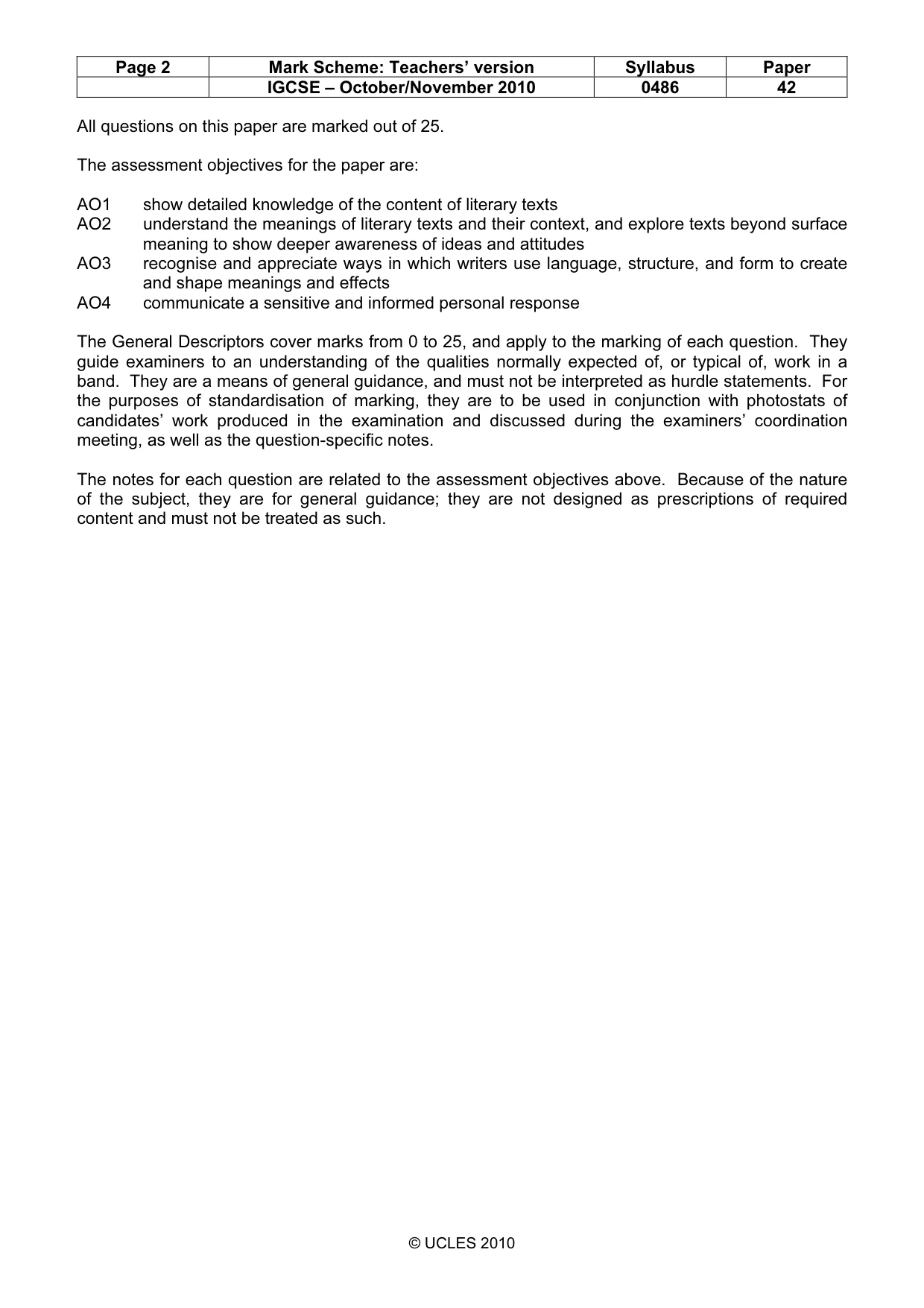
Page 2 Mark Scheme: Teachers’ version Syllabus Paper IGCSE – October/November 2010 0486 42 © UCLES 2010 All questions on this paper are marked out of 25. The assessment objectives for the paper are: AO1 show detailed knowledge of the content of literary texts AO2 understand the meanings of literary texts and their context, and explore texts beyond surface meaning to show deeper awareness of ideas and attitudes AO3 recognise and appreciate ways in which writers use language, structure, and form to create and shape meanings and effects AO4 communicate a sensitive and informed personal response The General Descriptors cover marks from 0 to 25, and apply to the marking of each question. They guide examiners to an understanding of the qualities normally expected of, or typical of, work in a band. They are a means of general guidance, and must not be interpreted as hurdle statements. For the purposes of standardisation of marking, they are to be used in conjunction with photostats of candidates’ work produced in the examination and discussed during the examiners’ coordination meeting, as well as the question-specific notes. The notes for each question are related to the assessment objectives above. Because of the nature of the subject, they are for general guidance; they are not designed as prescriptions of required content and must not be treated as such.
Mark scheme, page 3
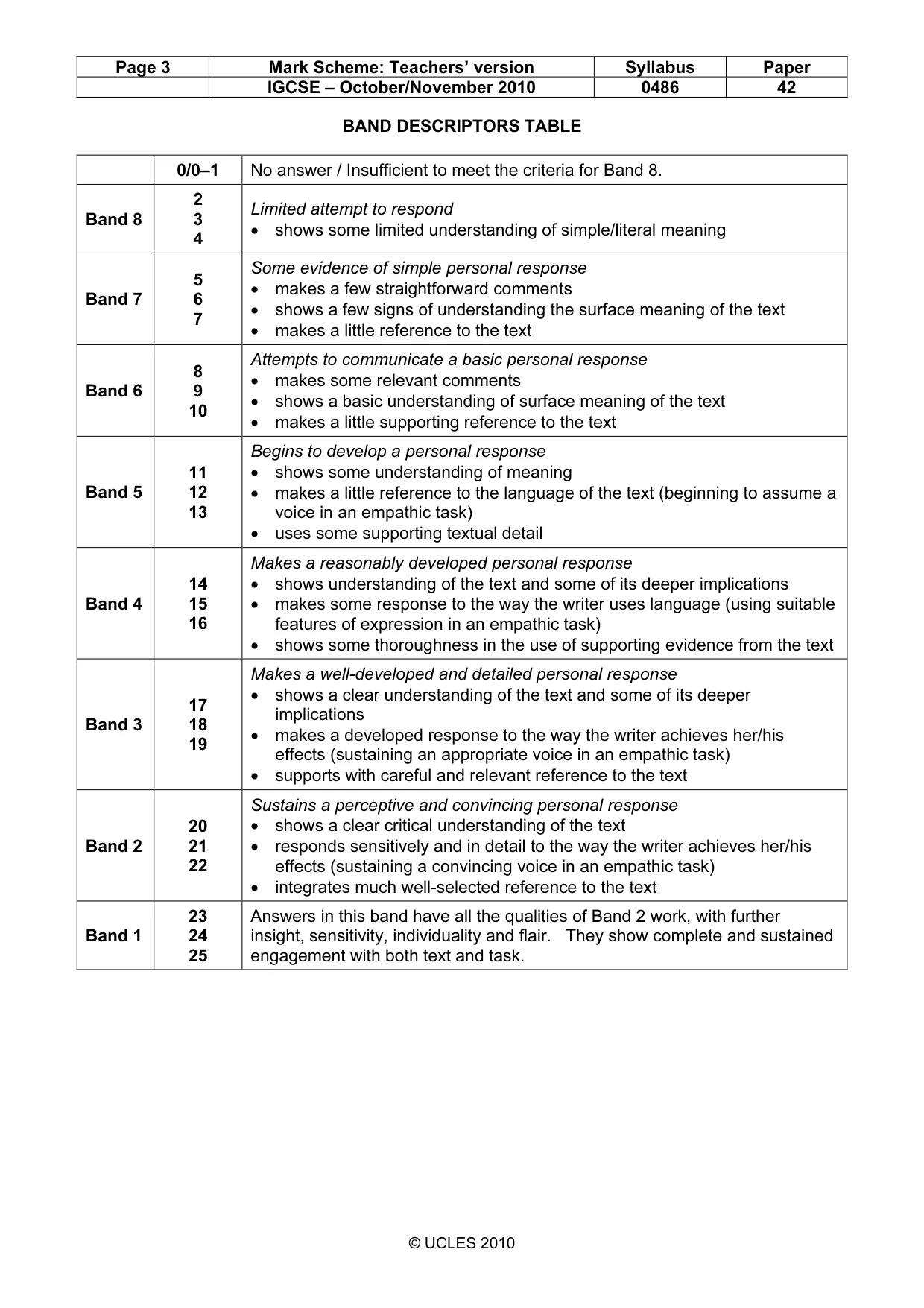
Page 3 Mark Scheme: Teachers’ version Syllabus Paper IGCSE – October/November 2010 0486 42 © UCLES 2010 BAND DESCRIPTORS TABLE 0/0–1 No answer / Insufficient to meet the criteria for Band 8. Band 8 2 3 4 Limited attempt to respond • shows some limited understanding of simple/literal meaning Band 7 5 6 7 Some evidence of simple personal response • makes a few straightforward comments • shows a few signs of understanding the surface meaning of the text • makes a little reference to the text Band 6 8 9 10 Attempts to communicate a basic personal response • makes some relevant comments • shows a basic understanding of surface meaning of the text • makes a little supporting reference to the text Band 5 11 12 13 Begins to develop a personal response • shows some understanding of meaning • makes a little reference to the language of the text (beginning to assume a voice in an empathic task) • uses some supporting textual detail Band 4 14 15 16 Makes a reasonably developed personal response • shows understanding of the text and some of its deeper implications • makes some response to the way the writer uses language (using suitable features of expression in an empathic task) • shows some thoroughness in the use of supporting evidence from the text Band 3 17 18 19 Makes a well-developed and detailed personal response • shows a clear understanding of the text and some of its deeper implications • makes a developed response to the way the writer achieves her/his effects (sustaining an appropriate voice in an empathic task) • supports with careful and relevant reference to the text Band 2 20 21 22 Sustains a perceptive and convincing personal response • shows a clear critical understanding of the text • responds sensitively and in detail to the way the writer achieves her/his effects (sustaining a convincing voice in an empathic task) • integrates much well-selected reference to the text Band 1 23 24 25 Answers in this band have all the qualities of Band 2 work, with further insight, sensitivity, individuality and flair. They show complete and sustained engagement with both text and task.
Mark scheme, page 4
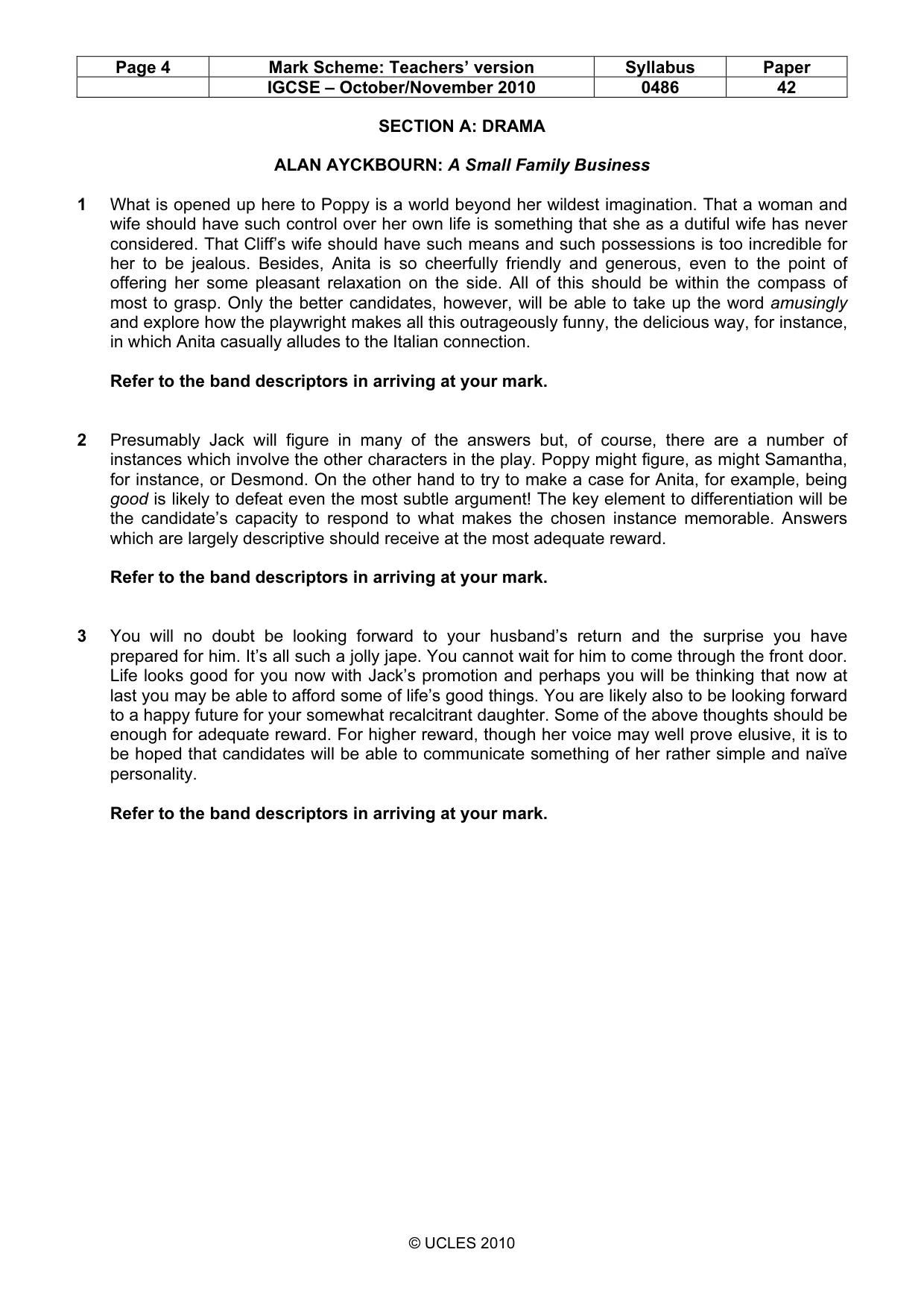
Page 4 Mark Scheme: Teachers’ version Syllabus Paper IGCSE – October/November 2010 0486 42 © UCLES 2010 SECTION A: DRAMA ALAN AYCKBOURN: A Small Family Business 1 What is opened up here to Poppy is a world beyond her wildest imagination. That a woman and wife should have such control over her own life is something that she as a dutiful wife has never considered. That Cliff’s wife should have such means and such possessions is too incredible for her to be jealous. Besides, Anita is so cheerfully friendly and generous, even to the point of offering her some pleasant relaxation on the side. All of this should be within the compass of most to grasp. Only the better candidates, however, will be able to take up the word amusingly and explore how the playwright makes all this outrageously funny, the delicious way, for instance, in which Anita casually alludes to the Italian connection. Refer to the band descriptors in arriving at your mark. 2 Presumably Jack will figure in many of the answers but, of course, there are a number of instances which involve the other characters in the play. Poppy might figure, as might Samantha, for instance, or Desmond. On the other hand to try to make a case for Anita, for example, being good is likely to defeat even the most subtle argument! The key element to differentiation will be the candidate’s capacity to respond to what makes the chosen instance memorable. Answers which are largely descriptive should receive at the most adequate reward. Refer to the band descriptors in arriving at your mark. 3 You will no doubt be looking forward to your husband’s return and the surprise you have prepared for him. It’s all such a jolly jape. You cannot wait for him to come through the front door. Life looks good for you now with Jack’s promotion and perhaps you will be thinking that now at last you may be able to afford some of life’s good things. You are likely also to be looking forward to a happy future for your somewhat recalcitrant daughter. Some of the above thoughts should be enough for adequate reward. For higher reward, though her voice may well prove elusive, it is to be hoped that candidates will be able to communicate something of her rather simple and naïve personality. Refer to the band descriptors in arriving at your mark.
Mark scheme, page 5
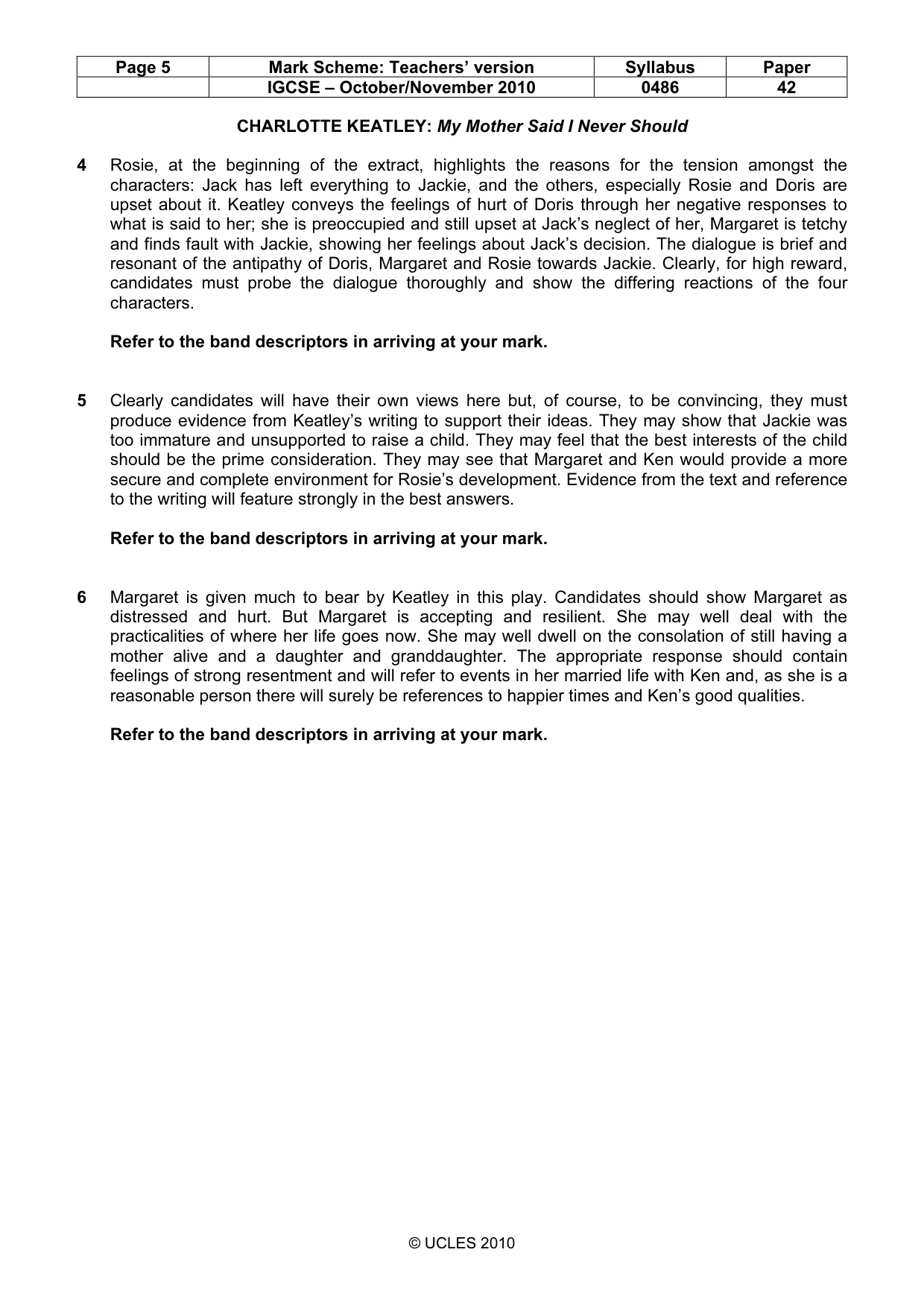
Page 5 Mark Scheme: Teachers’ version Syllabus Paper IGCSE – October/November 2010 0486 42 © UCLES 2010 CHARLOTTE KEATLEY: My Mother Said I Never Should 4 Rosie, at the beginning of the extract, highlights the reasons for the tension amongst the characters: Jack has left everything to Jackie, and the others, especially Rosie and Doris are upset about it. Keatley conveys the feelings of hurt of Doris through her negative responses to what is said to her; she is preoccupied and still upset at Jack’s neglect of her, Margaret is tetchy and finds fault with Jackie, showing her feelings about Jack’s decision. The dialogue is brief and resonant of the antipathy of Doris, Margaret and Rosie towards Jackie. Clearly, for high reward, candidates must probe the dialogue thoroughly and show the differing reactions of the four characters. Refer to the band descriptors in arriving at your mark. 5 Clearly candidates will have their own views here but, of course, to be convincing, they must produce evidence from Keatley’s writing to support their ideas. They may show that Jackie was too immature and unsupported to raise a child. They may feel that the best interests of the child should be the prime consideration. They may see that Margaret and Ken would provide a more secure and complete environment for Rosie’s development. Evidence from the text and reference to the writing will feature strongly in the best answers. Refer to the band descriptors in arriving at your mark. 6 Margaret is given much to bear by Keatley in this play. Candidates should show Margaret as distressed and hurt. But Margaret is accepting and resilient. She may well deal with the practicalities of where her life goes now. She may well dwell on the consolation of still having a mother alive and a daughter and granddaughter. The appropriate response should contain feelings of strong resentment and will refer to events in her married life with Ken and, as she is a reasonable person there will surely be references to happier times and Ken’s good qualities. Refer to the band descriptors in arriving at your mark.
Mark scheme, page 6
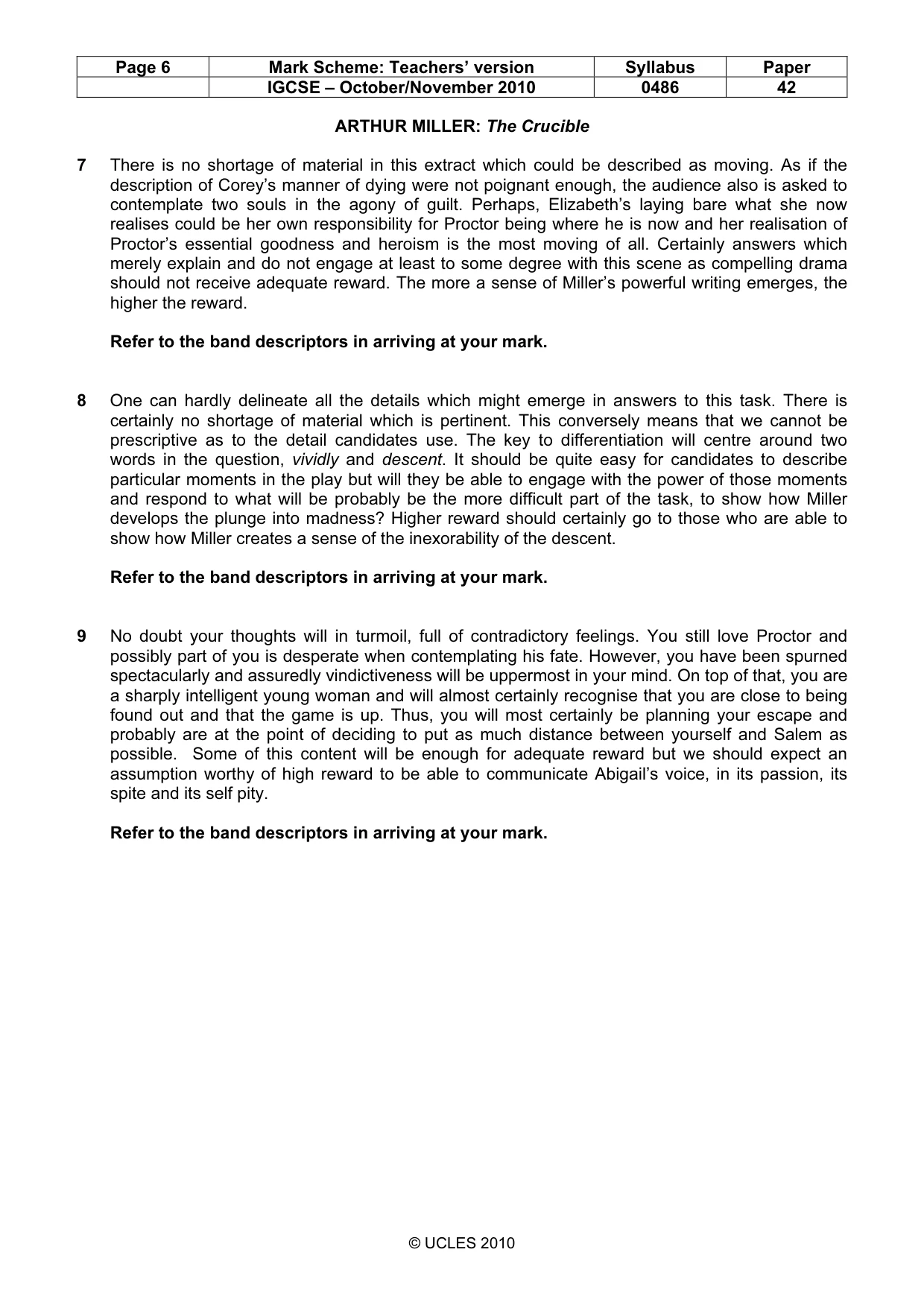
Page 6 Mark Scheme: Teachers’ version Syllabus Paper IGCSE – October/November 2010 0486 42 © UCLES 2010 ARTHUR MILLER: The Crucible 7 There is no shortage of material in this extract which could be described as moving. As if the description of Corey’s manner of dying were not poignant enough, the audience also is asked to contemplate two souls in the agony of guilt. Perhaps, Elizabeth’s laying bare what she now realises could be her own responsibility for Proctor being where he is now and her realisation of Proctor’s essential goodness and heroism is the most moving of all. Certainly answers which merely explain and do not engage at least to some degree with this scene as compelling drama should not receive adequate reward. The more a sense of Miller’s powerful writing emerges, the higher the reward. Refer to the band descriptors in arriving at your mark. 8 One can hardly delineate all the details which might emerge in answers to this task. There is certainly no shortage of material which is pertinent. This conversely means that we cannot be prescriptive as to the detail candidates use. The key to differentiation will centre around two words in the question, vividly and descent. It should be quite easy for candidates to describe particular moments in the play but will they be able to engage with the power of those moments and respond to what will be probably be the more difficult part of the task, to show how Miller develops the plunge into madness? Higher reward should certainly go to those who are able to show how Miller creates a sense of the inexorability of the descent. Refer to the band descriptors in arriving at your mark. 9 No doubt your thoughts will in turmoil, full of contradictory feelings. You still love Proctor and possibly part of you is desperate when contemplating his fate. However, you have been spurned spectacularly and assuredly vindictiveness will be uppermost in your mind. On top of that, you are a sharply intelligent young woman and will almost certainly recognise that you are close to being found out and that the game is up. Thus, you will most certainly be planning your escape and probably are at the point of deciding to put as much distance between yourself and Salem as possible. Some of this content will be enough for adequate reward but we should expect an assumption worthy of high reward to be able to communicate Abigail’s voice, in its passion, its spite and its self pity. Refer to the band descriptors in arriving at your mark.
Mark scheme, page 7
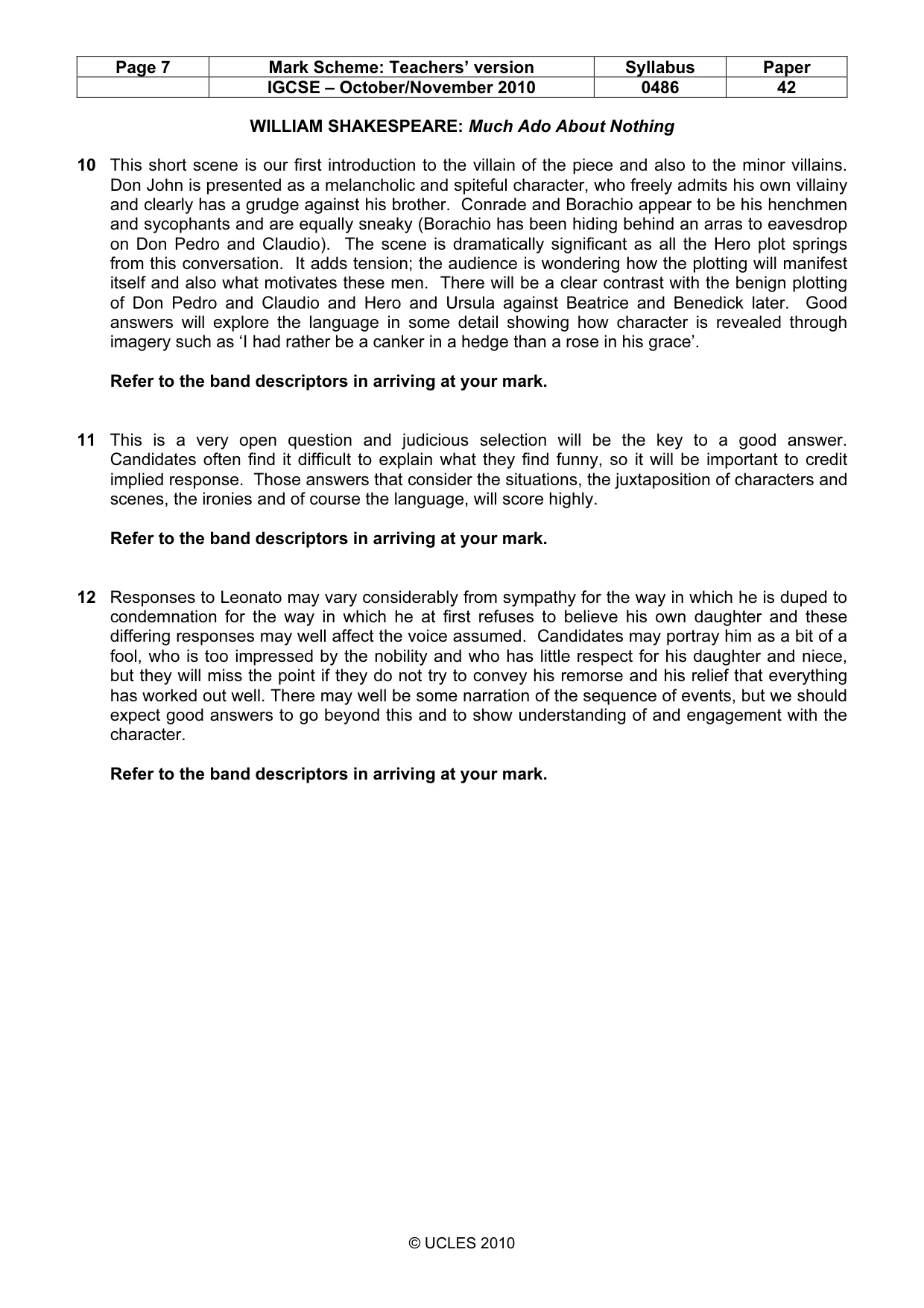
Page 7 Mark Scheme: Teachers’ version Syllabus Paper IGCSE – October/November 2010 0486 42 © UCLES 2010 WILLIAM SHAKESPEARE: Much Ado About Nothing 10 This short scene is our first introduction to the villain of the piece and also to the minor villains. Don John is presented as a melancholic and spiteful character, who freely admits his own villainy and clearly has a grudge against his brother. Conrade and Borachio appear to be his henchmen and sycophants and are equally sneaky (Borachio has been hiding behind an arras to eavesdrop on Don Pedro and Claudio). The scene is dramatically significant as all the Hero plot springs from this conversation. It adds tension; the audience is wondering how the plotting will manifest itself and also what motivates these men. There will be a clear contrast with the benign plotting of Don Pedro and Claudio and Hero and Ursula against Beatrice and Benedick later. Good answers will explore the language in some detail showing how character is revealed through imagery such as ‘I had rather be a canker in a hedge than a rose in his grace’. Refer to the band descriptors in arriving at your mark. 11 This is a very open question and judicious selection will be the key to a good answer. Candidates often find it difficult to explain what they find funny, so it will be important to credit implied response. Those answers that consider the situations, the juxtaposition of characters and scenes, the ironies and of course the language, will score highly. Refer to the band descriptors in arriving at your mark. 12 Responses to Leonato may vary considerably from sympathy for the way in which he is duped to condemnation for the way in which he at first refuses to believe his own daughter and these differing responses may well affect the voice assumed. Candidates may portray him as a bit of a fool, who is too impressed by the nobility and who has little respect for his daughter and niece, but they will miss the point if they do not try to convey his remorse and his relief that everything has worked out well. There may well be some narration of the sequence of events, but we should expect good answers to go beyond this and to show understanding of and engagement with the character. Refer to the band descriptors in arriving at your mark.
Mark scheme, page 8
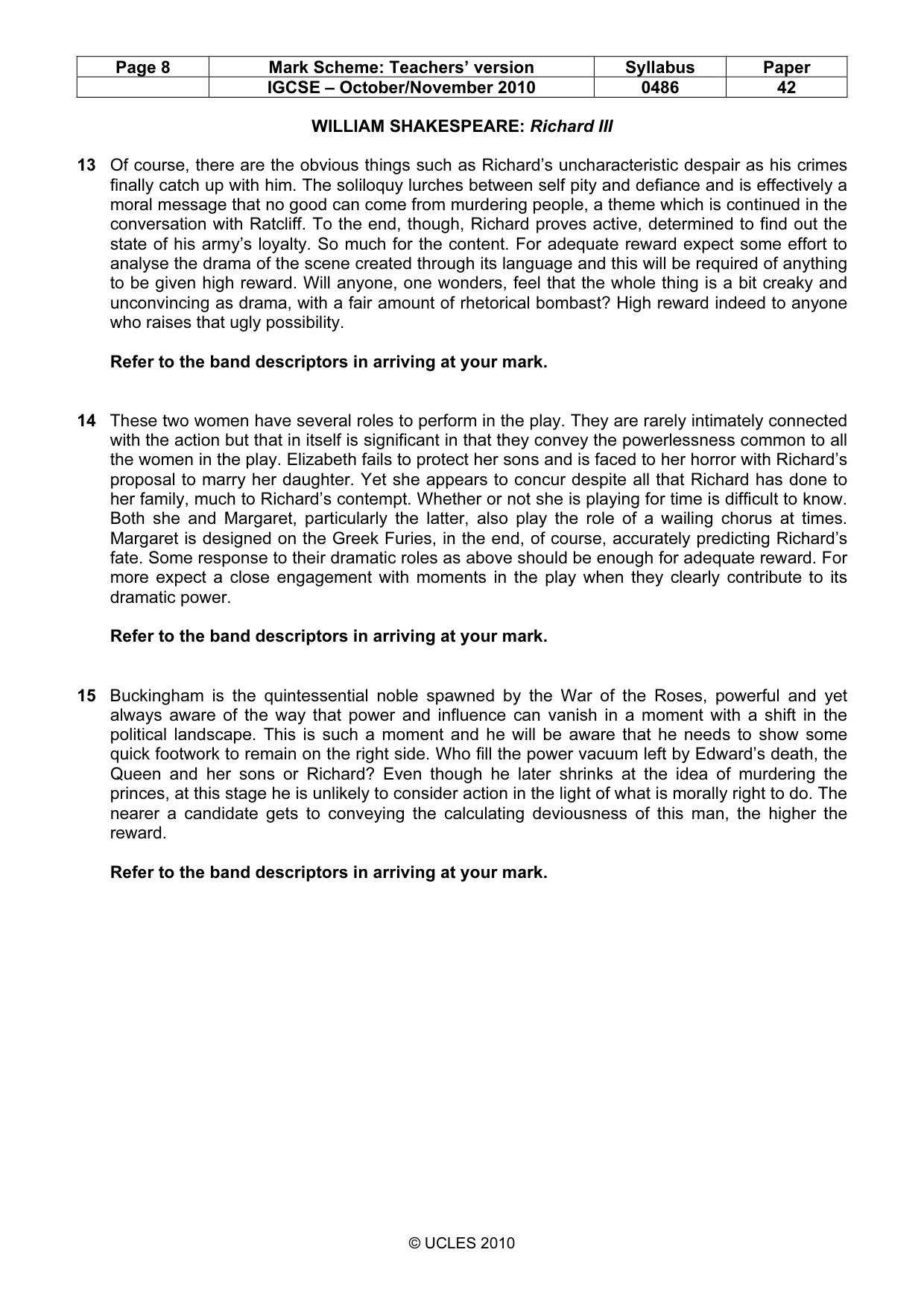
Page 8 Mark Scheme: Teachers’ version Syllabus Paper IGCSE – October/November 2010 0486 42 © UCLES 2010 WILLIAM SHAKESPEARE: Richard III 13 Of course, there are the obvious things such as Richard’s uncharacteristic despair as his crimes finally catch up with him. The soliloquy lurches between self pity and defiance and is effectively a moral message that no good can come from murdering people, a theme which is continued in the conversation with Ratcliff. To the end, though, Richard proves active, determined to find out the state of his army’s loyalty. So much for the content. For adequate reward expect some effort to analyse the drama of the scene created through its language and this will be required of anything to be given high reward. Will anyone, one wonders, feel that the whole thing is a bit creaky and unconvincing as drama, with a fair amount of rhetorical bombast? High reward indeed to anyone who raises that ugly possibility. Refer to the band descriptors in arriving at your mark. 14 These two women have several roles to perform in the play. They are rarely intimately connected with the action but that in itself is significant in that they convey the powerlessness common to all the women in the play. Elizabeth fails to protect her sons and is faced to her horror with Richard’s proposal to marry her daughter. Yet she appears to concur despite all that Richard has done to her family, much to Richard’s contempt. Whether or not she is playing for time is difficult to know. Both she and Margaret, particularly the latter, also play the role of a wailing chorus at times. Margaret is designed on the Greek Furies, in the end, of course, accurately predicting Richard’s fate. Some response to their dramatic roles as above should be enough for adequate reward. For more expect a close engagement with moments in the play when they clearly contribute to its dramatic power. Refer to the band descriptors in arriving at your mark. 15 Buckingham is the quintessential noble spawned by the War of the Roses, powerful and yet always aware of the way that power and influence can vanish in a moment with a shift in the political landscape. This is such a moment and he will be aware that he needs to show some quick footwork to remain on the right side. Who fill the power vacuum left by Edward’s death, the Queen and her sons or Richard? Even though he later shrinks at the idea of murdering the princes, at this stage he is unlikely to consider action in the light of what is morally right to do. The nearer a candidate gets to conveying the calculating deviousness of this man, the higher the reward. Refer to the band descriptors in arriving at your mark.
Mark scheme, page 9
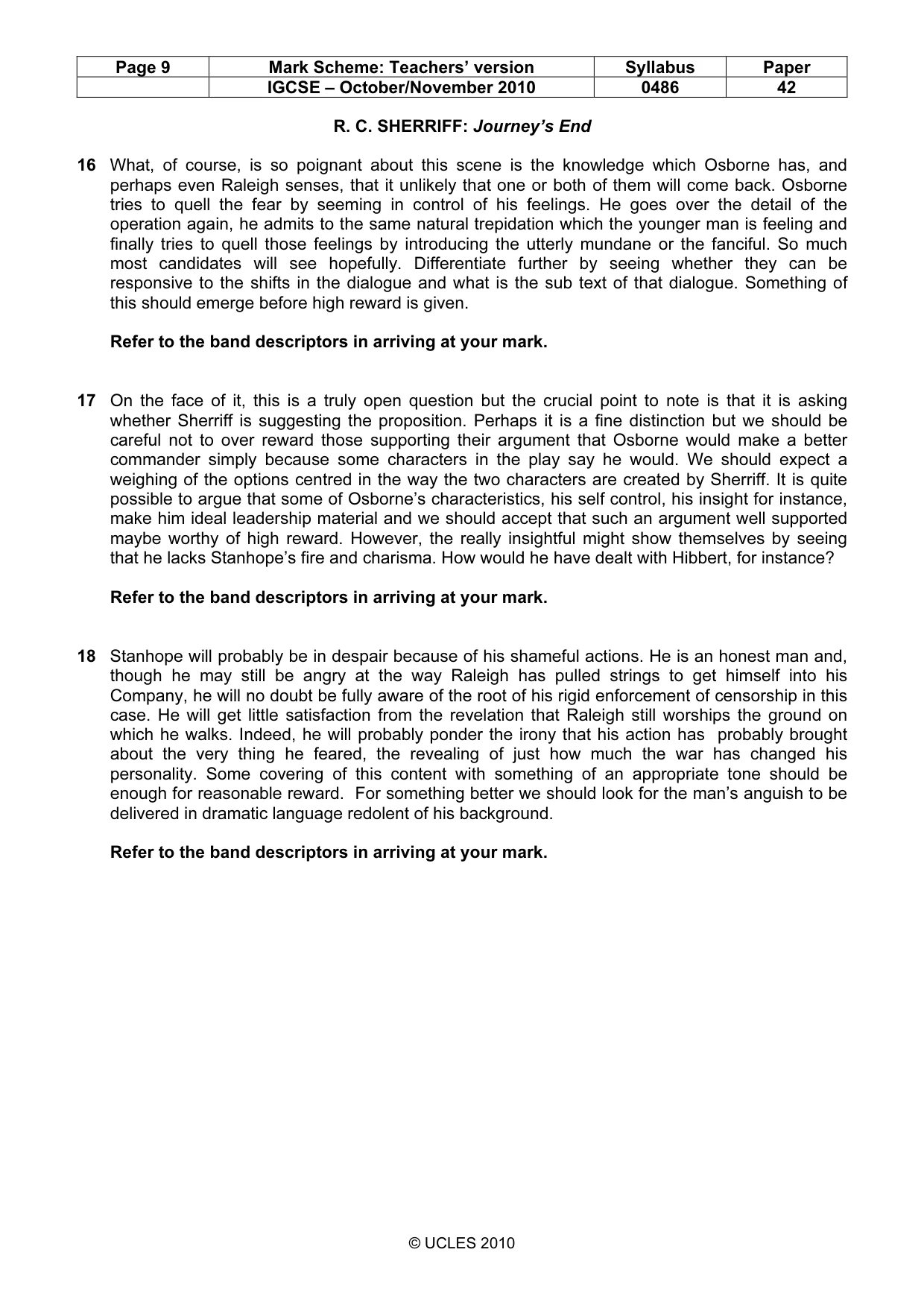
Page 9 Mark Scheme: Teachers’ version Syllabus Paper IGCSE – October/November 2010 0486 42 © UCLES 2010 R. C. SHERRIFF: Journey’s End 16 What, of course, is so poignant about this scene is the knowledge which Osborne has, and perhaps even Raleigh senses, that it unlikely that one or both of them will come back. Osborne tries to quell the fear by seeming in control of his feelings. He goes over the detail of the operation again, he admits to the same natural trepidation which the younger man is feeling and finally tries to quell those feelings by introducing the utterly mundane or the fanciful. So much most candidates will see hopefully. Differentiate further by seeing whether they can be responsive to the shifts in the dialogue and what is the sub text of that dialogue. Something of this should emerge before high reward is given. Refer to the band descriptors in arriving at your mark. 17 On the face of it, this is a truly open question but the crucial point to note is that it is asking whether Sherriff is suggesting the proposition. Perhaps it is a fine distinction but we should be careful not to over reward those supporting their argument that Osborne would make a better commander simply because some characters in the play say he would. We should expect a weighing of the options centred in the way the two characters are created by Sherriff. It is quite possible to argue that some of Osborne’s characteristics, his self control, his insight for instance, make him ideal leadership material and we should accept that such an argument well supported maybe worthy of high reward. However, the really insightful might show themselves by seeing that he lacks Stanhope’s fire and charisma. How would he have dealt with Hibbert, for instance? Refer to the band descriptors in arriving at your mark. 18 Stanhope will probably be in despair because of his shameful actions. He is an honest man and, though he may still be angry at the way Raleigh has pulled strings to get himself into his Company, he will no doubt be fully aware of the root of his rigid enforcement of censorship in this case. He will get little satisfaction from the revelation that Raleigh still worships the ground on which he walks. Indeed, he will probably ponder the irony that his action has probably brought about the very thing he feared, the revealing of just how much the war has changed his personality. Some covering of this content with something of an appropriate tone should be enough for reasonable reward. For something better we should look for the man’s anguish to be delivered in dramatic language redolent of his background. Refer to the band descriptors in arriving at your mark.
Mark scheme, page 10
Page 10 Mark Scheme: Teachers’ version Syllabus Paper IGCSE – October/November 2010 0486 42 © UCLES 2010 SECTION B: POETRY 19–24 Poetry is literary language at its most intense. A poem in a short space creates a multiplicity of resonances and hence possible meanings. We must expect that candidates will offer a very wide variety of responses and interpretations and as examiners must at all times keep a totally open mind when assessing work on a poem. In the exercise of our judgment, we shall, of course, read work which shows manifestly little or no understanding of a poem and we will mark that accordingly. However, it should also be a regular experience to find answers which offer valid perspectives new to the examiner and which, just as manifestly, deserve to be given high reward. We will differentiate first of all according to how directly the candidates answer the question. Where questions prescribe the poems from which the candidates should choose this is to ensure that the candidate is writing on a poem appropriate to the question. It is also designed to send a strong signal to candidates that they are taking a large risk going into the examination with only one or two poems which they are determined to fit to a question. The problem can be that some will choose a question because the poem they wish to write about appears in the list rather than because they can answer the question. We must be very careful not to give much reward for answers which manifestly are not addressing the question, even if they show a convincing grasp of the poem. Do not over-reward such run throughs and do not forget that all the tasks demand that the candidate engage with the poem through a specific route; they are never simple invitations to write about a poem. We should think very hard before putting such work in Band 3. Beyond focus on the question, we will also assess according to how well candidates convince us that they have engaged with the pleasure and excitement of good poetry. This means in effect that we do NOT give high reward to any explanation of "meaning" which shows little response to the words and how they create meaning. In all of the questions there is an explicit requirement to make a response to the words and it will be difficult for any work which fails to engage in this way to progress beyond Band 3. In addition, examiners should be careful not to over-reward comment which is able to isolate vivid features of a poem’s language but which is unable to probe the reasons for their vividness. For instance, the noting of rhyme, sound and movement, the listing of significant words and figures of speech is only a very small first step to insightful personal response. Work given high reward should show the ability of the candidate to analyse how such features of a poem’s language achieve their effect. Refer to the band descriptors in arriving at your mark.
Mark scheme, page 11
Page 11 Mark Scheme: Teachers’ version Syllabus Paper IGCSE – October/November 2010 0486 42 © UCLES 2010 SECTION C: PROSE JANE AUSTEN: Pride and Prejudice 25 There is much material here that memorably establishes Mrs Bennet’s ineffable stupidity and limited vision. This contrasts so effectively with Mr Bennet’s intelligent resignation to the superficial nonsense that forms such a large part of any conversation he has had with his wife over the years. It should not be difficult for candidates for adequate reward to point to instances of this and to make sensible comment on their choices. For higher reward look for real engagement with the hilarity of the extract, the husband’s dry wit juxtaposed with the witless voice of the wife. Refer to the band descriptors in arriving at your mark. 26 Clearly choice of appropriate moments will play a part in the quality of the responses. There are a legion of possibilities in the novel since all the characters show a considerable capacity for misunderstanding each other. Therefore, there is no need to be charitable to answers which flounder through making a doubtful choice. No doubt the numerous misapprehensions of Elizabeth vs. Darcy and vice versa will figure prominently. Look for detailed knowledge of the situation but even at the level of adequate reward also some argument as to how Austen makes it memorable. The latter will become more important in the higher mark bands. Refer to the band descriptors in arriving at your mark. 27 Lydia has had what she thinks to be a triumph, the first of the sisters to carry off a husband. No doubt she will still be basking in her mother’s fêting of her and suitably annoyed at what she sees to be Elizabeth’s jealousy and her father’s coolness. Perhaps she will not have noticed either since her silly egocentric nature hardly gives her great perception. However, given what she says, it may be that the reality of her life is now beginning to dawn on her, dispatched to the north of England as a parvenu wife married to a notorious adventurer. She may not speak of it in quite this way but the most insightful assumptions may suggest her feeling the cold North Easterlies of Newcastle already. Probably the main source of differentiation will arise from the voice. Good candidates should have little difficulty in creating something so distinctive. Refer to the band descriptors in arriving at your mark.
Mark scheme, page 12
Page 12 Mark Scheme: Teachers’ version Syllabus Paper IGCSE – October/November 2010 0486 42 © UCLES 2010 IAN CROSS: The God Boy 28 The mother is seeing her son for probably the last time and her anguish is conveyed in all her actions and in what she says. What makes it worse, and a point which possibly should be grasped in any adequate answer, is that Jimmy does not understand what is going on and thinks that he is the guilty one who is being taken away. The detached professional comments of the woman don’t ease the situation one jot. This is such a poignant moment in the novel that perhaps we should expect some signs of personal engagement with the detail of the writing before we give any adequate reward. The more evidence there is of that, the higher we should go. Refer to the band descriptors in arriving at your mark. 29 This is a straightforward task which does, though, demand the choosing of appropriate moments in the novel if the candidate is not to struggle. What is also demanded even for adequate reward is an attempt to explore what in the writing makes it so funny. Answers which do no more than describe should not reach that level. The more the candidate relishes the humour by a detailed analysis of the writing, the higher the mark. Also, do not make a distinction between those who offer two rather than three moments. The instances of humour vary enormously in length. Some of them are extended episodes, others short moments, hence the flexibility of the task. Refer to the band descriptors in arriving at your mark. 30 It is likely that Molly will have seen something terrible coming. Certainly her attempt to drown herself and her brother point to her seeing all too clearly the domestic tragedy which is her parents’ marriage. What she suffered as a result of it is never made explicit but she has fled home. Though we cannot be sure of this, one assumes that she would probably hardly mourn her father but what she would feel for her poor mother and her brother would be something else. That she still feels deep attachment to them is clear from her actions later but at this moment she will probably be wondering whether she can cope. Hopefully the better candidates will declare themselves by making this a really dramatic monologue of a desperate young woman in shock. Refer to the band descriptors in arriving at your mark.
Mark scheme, page 13
Page 13 Mark Scheme: Teachers’ version Syllabus Paper IGCSE – October/November 2010 0486 42 © UCLES 2010 ANITA DESAI: Games at Twilight and Other Stories 31 It is really hardly necessary to itemise what is relevant to the task here. Virtually everything in the end of the story vividly conveys the way childhood can bring sudden humiliation, often delivered by other older children. The key word in the task is vividly. Answers which simply describe and narrate pertinent material should not receive even adequate reward. There must be some response to the language before we get there. Answers which make that central to the answer should receive something better. Refer to the band descriptors in arriving at your mark. 32 This is a deliberately challenging proposition which we should expect the candidate to take up if we are going to give even adequate reward. We should not be giving much reward to any answer which simply describes Rakesh’s actions. On the face of it, these actions can suggest that he is a devoted son to an increasingly cantankerous father. We should expect at least some noting of those external features of the story. However, of course Desai only occasionally endorses that as the reality. Mostly it is quite different and what one sees is a control freak who enjoys the power he loftily assumes over his father. The way that she makes that control truly disturbing and so redolent of the medical profession’s assumption of always knowing best will hopefully be the stuff of the best answers, rather than simple description. The more such involvement is in evidence, the higher the reward. Refer to the band descriptors in arriving at your mark. 33 Otima has had an exhausting, irritating and at times very anxious day and night with her invalid husband and as she recalls that she will now no doubt breathe a sigh of relief that the move onto the roof has been apparently so effective. She is energetic with a capacity for enjoyment and may well pine for a less shackled existence. However, she does still have affection for her husband and she seems to be essentially a calm woman, philosophical about her lot. Any assumption which covers some of these possibilities should receive adequate reward. Avoid over-rewarding those which assign to her the role of a drama queen and give good credit to those which catch some of the resignation in her voice. Refer to the band descriptors in arriving at your mark.
Mark scheme, page 14
Page 14 Mark Scheme: Teachers’ version Syllabus Paper IGCSE – October/November 2010 0486 42 © UCLES 2010 THOMAS HARDY: Far from the Madding Crowd 34 The opening paragraph of the extract is dramatic: Troy clutches Bathsheba and she gives out a low scream. In contrast, the ‘low scream’ is followed by the ‘sudden deafening report’ of Boldwood’s gun thus heightening the drama of the situation. Hardy’s writing here is measured and deliberate as he goes on to describe Boldwood’s failed attempt to shoot himself, his kissing of Bathsheba’s hand and his hurried departure to find ‘another way’. All the ingredients of a tense and breathtaking episode are here clearly in the words. Probing of the language resulting in tangible evidence of the melodramatic atmosphere created will merit high reward. Focus on the writing and the way Hardy uses words will be crucial for recognition of high quality work. Refer to the band descriptors in arriving at your mark. 35 The second of the two phrases is surely the more appropriate. Perhaps initially there are suggestions that Gabriel is ready to trust too much and is over-awed by Bathsheba’s beauty and character, but as the novel progresses, Gabriel shows his strength as he deals with difficult situations and setbacks. He remains strong and is willing to help others. He is sensitive to the feelings of others, for example, when he erases ‘and child’ from Fanny’s coffin to save causing Bathsheba distress. He is loyal and trustworthy. He gains the confidence of others for example Boldwood and Bathsheba. Thus there is much material for candidates to explore. The highest reward should be awarded to those who show they can discriminate and who support their views with firm evidence from the text. Refer to the band descriptors in arriving at your mark. 36 Fanny will be in a very distressed state at this juncture and candidates should show her thus. She will no doubt have thoughts on Troy, having met him earlier, perhaps hoping that he will come to her aid. Her prime consideration will be to reach her destination and hoped-for sanctuary. The dog will be in her thoughts, as Fanny acknowledges when she eventually reaches the door of the Union-house. Her gratitude will surely be evident. She will think of her unborn child, hoping that it will survive, perhaps, and lead some sort of better life. This will surely be a challenge to candidates and the best may well impress with their capturing of the moment and should be rewarded accordingly. Refer to the band descriptors in arriving at your mark.
Mark scheme, page 15
Page 15 Mark Scheme: Teachers’ version Syllabus Paper IGCSE – October/November 2010 0486 42 © UCLES 2010 BESSIE HEAD: When Rain Clouds Gather 37 What candidates find enjoyable will perhaps differ, but a close reading of the passage should yield responses to the way in which both characters are trying not to appear too interested in each other, though there is very clearly an attraction (Paulina introduces herself in a haughty and perhaps dismissive manner but ‘does not move away’. Makhaya pretends to a liking for goat meat though he loathes it and the discussion of goats is clearly a smokescreen. Head takes us inside the thoughts of the two protagonists and shows the contradictions between what they say and what they actually think. The onlookers also add comedy to the scene (‘the riveted glances of ten pairs of keen, thrilled, eyes’) as they are so clearly expecting something to happen, and in fact they become involved in the courtship. Candidates are not required to refer outside the extract though they should not be penalised if they go on to mention the way in which the relationship develops. Refer to the band descriptors in arriving at your mark. 38 The changes centre on the devolution of power from Chief Matenge. The people are ready for change and ideas for change are brought by Gilbert Balfour whose objective is to raise the people out of poverty. Candidates may see that the advent of outsiders such as Gilbert and Makhaya give the community the incentive to try new things, such as the growing of tobacco. The villagers are also disillusioned with Matenge’s autocratic way of dealing with local affairs. He is not able to adapt like his brother and he becomes ever more entrenched in his ideas when Sekoto supports Gilbert and the growth of cooperatives and effectively ruins Matenge’s cattle- speculating business. There is bound to be conflict at some stage and this is to some extent fuelled by the suffering caused by the prolonged drought. Matenge is forced out – and to suicide – and the village becomes more democratic and more likely to take on the idea of irrigation farming. This is only one way of approaching the question and we should credit any ideas/arguments that are supported with relevant detail. Refer to the band descriptors in arriving at your mark. 39 Dinorego will no doubt be delighted that Gilbert has come to this decision. He is presented as hospitable and outward looking – he welcomes both Gilbert and Makhaya into the village and shows himself open to changes that they might bring (‘Her father never seemed to be able to step out of his own village without bringing back a stranger’). Maria is his only daughter and he seems very proud of the way she also embraces change, for example he speaks of how she begins cooking the goat meat with curry powder and soon all the women in the village are doing the same. He will no doubt be reflecting on the characters of the couple and may comment on how the advent of Makhaya has spurred Gilbert into action. The relationship between Gilbert and Maria has clearly been going on for some time as he has been teaching her English and they obviously get on well. Good answers will capture some of the rather philosophical tone which we associate with Dinorego and also some of his concerns for the future. Refer to the band descriptors in arriving at your mark.
Mark scheme, page 16
Page 16 Mark Scheme: Teachers’ version Syllabus Paper IGCSE – October/November 2010 0486 42 © UCLES 2010 EDITH WHARTON: Ethan Frome 40 First of all there is the striking description of the winter storm which envelops the two men, culminating in the Frome's decision to offer a night’s shelter to the narrator. Already we know how extraordinary an event this is and Wharton leads the reader on not only to the square of light in the distance but possibly to an answer to an intriguing mystery. Of course, that answer is simply dangled in front of us and then put under wraps for the present. In this task, it should be relatively easy to describe the drama of several moments in the extract and that should be enough for adequate reward if there is some evidence of response to the detail of the language. However, for higher reward, we should perhaps expect some grasp of the ways in which Wharton is working, perhaps at the highest level even some understanding of the place of this passage in the novel’s structure. Refer to the band descriptors in arriving at your mark. 41 Initially the quality of the response is likely to be affected by the aptness of the choice a candidate makes, though clearly in this cheerful novel there is more than enough promising material. Ethan, Zeena and Mattie all see their hopes disintegrate in many ways. However, our main means of differentiation will probably arise from the degrees to which candidates explore the way Wharton’s writing makes all this memorable. We shall expect some engagement with language before we think of giving adequate reward. That which is simply descriptive should not be over rewarded and at the highest level we should expect close engagement with the words and their power. Refer to the band descriptors in arriving at your mark. 42 Ethan will be dismayed that he is condemned to carry on his life of misery. The hopelessness of his love for Mattie and hers for him no doubt formed his impulse to end it all, hopefully for both of them, at the moment of exhilaration as the sled sped downhill. And now they are both shattered not only in spirit but in body as well. You may wonder what Zeena’s attitude will be and whether you will recover enough to continue farming. Something of this material and a sense of his grim situation should ensure an adequate reward but for something better we should look for the candidate to capture his desperation and yet also perhaps his resignation to his fate. He may well guess what the future holds. Refer to the band descriptors in arriving at your mark.
Mark scheme, page 17
Page 17 Mark Scheme: Teachers’ version Syllabus Paper IGCSE – October/November 2010 0486 42 © UCLES 2010 Stories of Ourselves 43 At first the juxtaposition of the content of the letters with the lack of a detailed reaction from the boy makes the feeling of the letters almost unbearably poignant, especially with the symbolic reference to the sun falling in the sky and shining directly on to the pages he is reading. There is the horrible irony that John, the writer of the letters, is lost to the Aunt by joining the Church rather than by being killed in the war. There is a terrible sense of loss in the letters and of the way in which this young man has been traumatised by the horror and carnage of the war. Then there is the dramatic discovery by the Aunt and the violent way in which she reacts to the reading of the letters destroys what might have been a good relationship between her and her nephew. The writing vividly conveys the boy’s panic at being discovered, the way in which he tries to conceal what he has been doing and his shock and guilt at her reaction. There may be comment on the effect of the boy being unnamed. Good answers will find plenty in the passage to convey full and sensitive responses, but answers may be enhanced by being informed by knowledge of the rest of the story. Refer to the band descriptors in arriving at your mark. 44 The Onns serve first and foremost as a contrast with humans. They are scientifically advanced. They are courageous in being prepared to leave their own world, which is dying, and find a new place to settle. They are peaceful in intention though they are able to strike back if attacked. Their view of life on earth is distorted and at times humorous, as is the way in which they are viewed by the humans. The lack of ability of the two races to communicate is quite salutary, however, and Wyndham may be making a political comment. There will be various responses and success will depend on the detail and quality of the supporting reference. Refer to the band descriptors in arriving at your mark. 45 Mother is portrayed as a stoical and pragmatic person though she will be very angry at being accused in this way. She will not be succumbing to self-pity; it is not in her nature, but she may be developing a plan. She will no doubt be concerned for her reputation, however, and for the effect on her son. Good answers will capture some of the ‘tartness’ and directness of her tone. Refer to the band descriptors in arriving at your mark.
What you needed in this session
Cambridge’s own grade thresholds for 2010 Oct/Nov, Paper 4 · Variant 2. A higher threshold means an easier paper — the bar moves with how the cohort did.