Questions as text
Q1 · Calculate Vietnam’s GDP per head in 2017 0987/21 May/June 2020
1 (a) Calculate Vietnam’s GDP per head in 2017. [1] (b) Identify two rewards to factors of production. [2] (c) Explain what happened to Vietnam’s foreign exchange rate between 2010 and 2017. [2] (d) Explain two benefits an economy may gain from having a young labour force. [4] (e) Analyse why Vietnam’s budget deficit may decline in the future. [4] (f) Analyse the relationship between government spending on education and the percentage of the labour force employed in the tertiary sector. [5] (g) Discuss whether or not an increase in competition is likely to benefit Vietnamese consumers. [6] (h) Discuss whether or not the increase in borrowing is likely to have caused inflation in Vietnam in 2017. [6]
30 marks
Mark scheme: Question Answer Marks 1(a) Calculate Vietnam’s GDP per head in 2017. 1 $6900 (1). 1(b) Identify two rewards to factors of production. 2 Wages (1) profits (1). 1(c) Explain what happened to Vietnam’s foreign exchange rate between 2 2010 and 2017. Logical explanation which might include: It fell/depreciated (1) more dong had to be given to buy one dollar (1). 1(d) Explain two benefits an economy may gain from having a young 4 labour force. Logical explanation which might include: May be more flexible (1) switch from doing different tasks (1). May be more mobile (1) able to switch from one job to another or from one place to another place (1). May be more up to date with advances in technology (1) more productive/able to use advanced technology (1). 1(e) Analyse why Vietnam’s budget deficit may decline in the future. 4 Coherent analysis which might include: High economic growth will raise incomes/wages rising (1) higher profits (1) more revenue from direct taxes (1) higher incomes is likely to result in more spending (1) more revenue from indirect taxes (1). Tax rates may be increased (1) reducing the gap between tax revenue and government spending (1). Deregulation / privatisation may increase profits (1) resulting in higher revenue from direct taxes /corporation tax (1). 1(f) Analyse the relationship between government spending on education 5 and the percentage of the labour force employed in the tertiary sector. Coherent analysis which might include: Generally the countries with the highest % spending on education have the highest percentage employed in the tertiary sector and vice versa (1) up to two examples e.g. Norway has the highest % spending and the highest % employed in the tertiary sector, Bangladesh has the lowest % spending and the lowest % employed in the tertiary sector (2) the main exception is Vietnam – second highest % spending but lowest % employed in the tertiary sector (1) there may be a time lag in this case (1). It is the expected relationship as some tertiary jobs require high skills (1) countries that can afford to devote a high percentage of resources to education may have achieved a relatively high level of development (1) a higher percent spent will create jobs in education (1). 1(g) Discuss whether or not an increase in competition is likely to benefit 6 Vietnamese consumers. Apply this example to all questions with the command word DISCUSS (1g, 1h, 2d, 3d, 4d and 5d) Each point may be credited only once, on either side of an argument, but separate development as to how/why the outcome may differ is rewarded. Generic example mark Tax revenue may decrease… 1 ...because of reason e.g. incomes may be lower. 1 Tax revenue may increase because incomes may be higher i.e. 0 reverse of a previous argument. Tax revenue may increase because of a different reason i.e. not the reverse of a previous argument e.g. government spending on 1 subsidies may stimulate the economy more than spending on education. Award up to 4 marks for logical reasons why it might, which may include: • prices may be reduced to attract more consumers (1) making them more affordable to consumers (1) • choice will be increased in terms of sellers (1) and possibly in terms of a greater range of products (1) • quality may rise (1) with pressure being put on producers to produce good products to attract consumers (1) • producers may respond more fully to changes in consumer demand (1) Award up to 4 marks for logical reasons why it might not, which may include: • firms may be smaller (1), less able to take advantage of economies of scale (1), so prices may be higher (1) • firms may have less profit (1) and so spend less improving the quality of the product (1) • some firms may be MNCs (1), less concerned about causing external costs (1) 1(h) Discuss whether or not the increase in borrowing is likely to have 6 caused inflation in Vietnam in 2017. Award up to 4 marks for logical reasons why it might, which may include: • higher consumer demand (1) and investment (1) will increase total (aggregate) demand (1) • higher total demand may cause demand-pull inflation/cause producers to raise prices (1) • government spending may rise, further adding to total (aggregate) demand (1) • the economy has very low unemployment/full employment (1) making it difficult for supply to respond to higher demand (1) • tax rates may rise (1) which may increase costs of production (1) causing cost-push inflation (1) Award up to 4 marks for logical reasons why it might not, which may include: • higher investment may reduce costs of production (1) lowering cost- push inflation (1) • higher consumer spending may enable firms to grow (1) and take greater advantage of economies of scale (1) • increased education (1) may raise labour productivity (1), reduce costs of production (1) and lower cost-push inflation (1) • privatised firms may be more efficient (1) • more competition may reduce price rises (1)
This question in 0987/21 May/June 2020
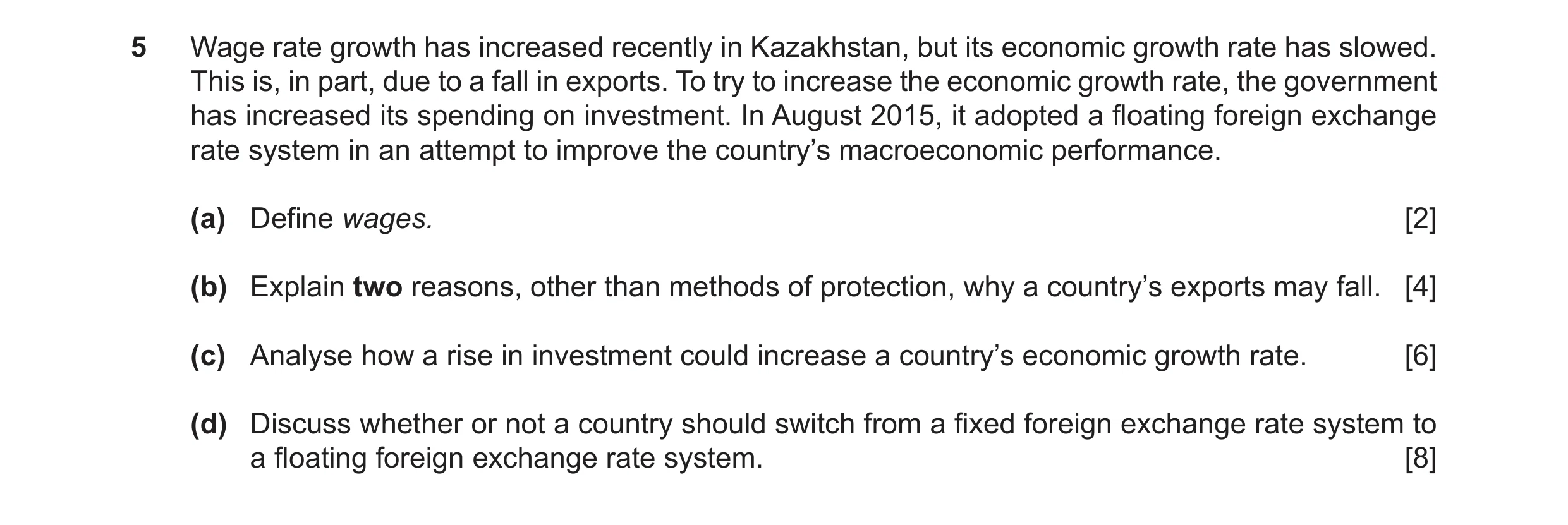
Q2 · Wage rate growth has increased recently in Kazakhstan, but its economic growth rate has… 0987/22 Oct/Nov 2020
5 Wage rate growth has increased recently in Kazakhstan, but its economic growth rate has slowed. This is, in part, due to a fall in exports. To try to increase the economic growth rate, the government has increased its spending on investment. In August 2015, it adopted a floating foreign exchange rate system in an attempt to improve the country’s macroeconomic performance. (a) Define wages. [2] (b) Explain two reasons, other than methods of protection, why a country’s exports may fall. [4] (c) Analyse how a rise in investment could increase a country’s economic growth rate. [6] (d) Discuss whether or not a country should switch from a fixed foreign exchange rate system to a floating foreign exchange rate system. [8]
20 marks
Mark scheme: 5(a) Define wages. A payment/reward (1) to labour/workers (1). 2 5(b) Explain two reasons, other than methods of protection, why a country’s exports may fall. Logical explanation which might include: Lower incomes abroad (1) reduce the ability of foreigners to buy the country’s exports / lower demand (1). Rise in the foreign exchange rate (1) will make exports more expensive (1). Quality may fall (1) e.g. educational standards may have declined (1). Price may rise (1) due to inflation/higher costs of production/lower productivity/making exports less competitive (1). Domestic demand may rise (1) products may be switched from the export to the home market (1). Lower output (1) reduce the ability of firms to export as many goods and services / result of fewer resources (1). 4 One mark for each of two reasons identified and one mark for each of two explanations. Question Answer Marks Guidance 5(c) Analyse how a rise in investment could increase a country’s economic growth rate. Coherent analysis which might include: More investment will increase total (aggregate) demand (1) there will be more capital goods (1) these may be more efficient / embody advanced technology (1) productive capacity will increase / productivity rise (1) costs of production may fall (1) prices may fall (1) quality may rise (1) more products may be demanded by domestic consumers (1) foreign buyers / more exports (1) output may increase (1). Higher investment may increase employment (1) raise income (1). Investment in human capital/education/healthcare (1) can raise productivity (1). 6 Question Answer Marks Guidance 5(d) Discuss whether or not a country should switch from a fixed foreign exchange rate system to a floating foreign exchange rate system. In assessing each answer, use the table opposite. Why it should: • the government will not have to devote time and attention to maintaining the exchange rate and so may use policy measures to e.g. reduce inflation • fewer foreign exchange reserves would have to be kept to maintain the exchange rate. These could be used to stimulate economic activity • exchange rate may be lower which may increase economic growth, lower unemployment and improve the current account position. Why it should not: • a lower exchange rate may cause inflation • fluctuations in the exchange rate may create uncertainty. This may discourage investment and reduce economic growth • may discourage MNCs from setting up in the country • a higher exchange rate could reduce economic growth, employment and harm the current account position. 8 Level Descriptors Mark 3 A reasoned discussion which accurately examines both sides of the economic argument, making use of economic information and clear and logical analysis to evaluate economic issues and situations. One side of the argument may have more depth than the other, but overall both sides of the argument are considered and developed. There is thoughtful evaluation of economic concepts, terminology, information and/or data appropriate to the question. The discussion may also point out the possible uncertainties of alternative decisions and outcomes. 6–8 2 A reasoned discussion which makes use of economic information and clear analysis to evaluate economic issues and situations. The answer may lack some depth and development or may be one-sided. There is relevant use of economic concepts, terminology, information and data appropriate to the question. 3–5 1 There is a simple attempt at using economic definitions and terminology. Some reference may be made to economic theory, with occasional understanding. 1–2 0 A mark of zero should be awarded for no creditable content. 0 Question Answer Marks Guidance 5(d) Example of L3 answer: A floating exchange rate changes with changes in demand and supply. A country should switch from a fixed foreign exchange rate system to a floating exchange rate system as there will be no need to keep foreign reserves so it can spend foreign reserves on something else. A country can easily change monetary policy changing interest rate without being worried. It can concentrate on other aims and not the exchange rate. Floating exchange rate automatically adjust current account of the balance of payments as increase in demand for exports will increase exchange rate reducing demand on exports. A country should not switch from fixed foreign exchange rate system to floating exchange rate as speculation could say that the value of local currency will decrease so people will sell it causing value to decrease as it will have lower demand. The uncertainty about export and import prices may discourage MNCs. Principal Examiner comment: Strong on one side and reasonable on the other.
This question in 0987/22 Oct/Nov 2020
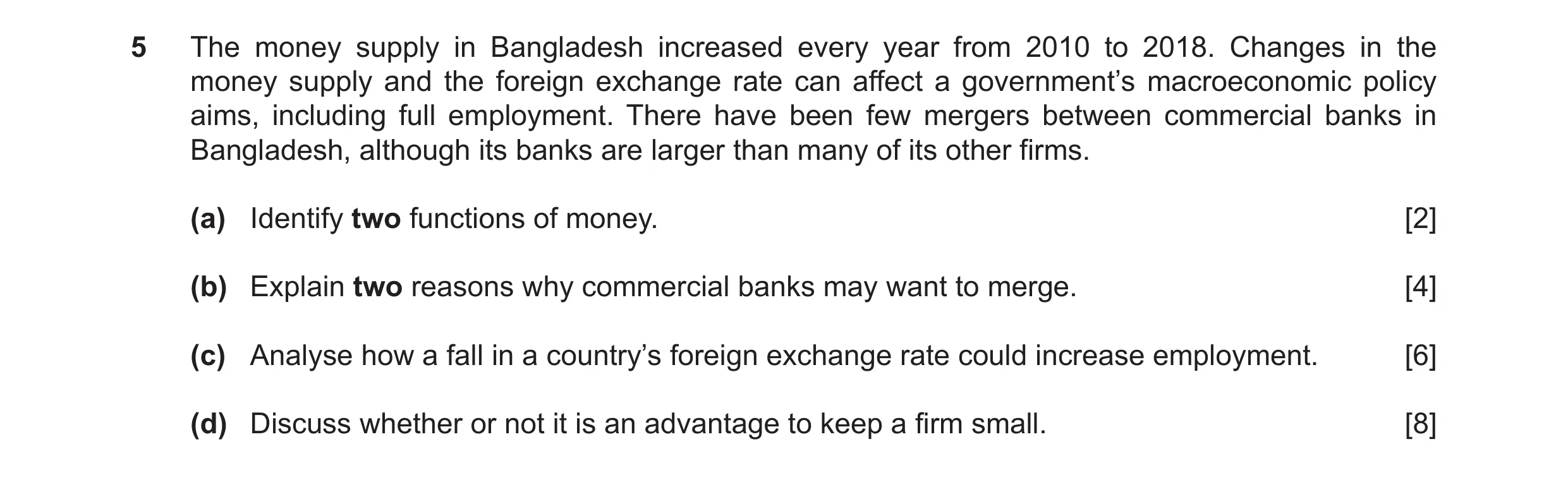
Q3 · The money supply in Bangladesh increased every year from 2010 to 2018 0987/22 May/June 2021
5 The money supply in Bangladesh increased every year from 2010 to 2018. Changes in the money supply and the foreign exchange rate can affect a government’s macroeconomic policy aims, including full employment. There have been few mergers between commercial banks in Bangladesh, although its banks are larger than many of its other firms. (a) Identify two functions of money. [2] (b) Explain two reasons why commercial banks may want to merge. [4] (c) Analyse how a fall in a country’s foreign exchange rate could increase employment. [6] (d) Discuss whether or not it is an advantage to keep a firm small. [8]
20 marks
Mark scheme: 5(a) Identify two functions of money. Two from: Medium of exchange, store of value, standard of deferred payments, unit of account / measure of value. 2 Note: a description of the function gets the mark e.g. money can be used to buy and sell products, may be used to trade. Nothing for characteristics of money, 5(b) Explain two reasons why commercial banks may want to merge. Logical explanation which might include: Greater market power/share (1) eliminating a competitor / providing a greater range of services (1). More opportunity to take advantage of economies of scale (1) lower costs of production / higher profit / example e.g. share ATMs (1). May enable the merged bank to operate in more than one country / become a multinational company (1) access to new market (1). Become better known (1) large banks may be more likely to have a brand image (1). May enable rationalisation (1) eliminate duplication / rase efficiency (1). Survival (1) may have been loss making / at risk of going out of business (1). 4 One mark each for each of two reasons identified and one mark each for each of two explanations. Nothing for increase revenue. Question Answer Marks Guidance 5(c) Analyse how a fall in a country’s foreign exchange rate could increase employment. Coherent analysis which might include: A fall in a country’s foreign exchange rate will lower the price of exports (1) raise the price of imports (1) make domestically produced products more price competitive (1) reduce demand for imports (1) increase demand for exports (1) increase total demand (1) raise firms’ revenue and/or profits (1) encourage firms to increase output (1) take on more workers (1). 6 Question Answer Marks Guidance 5(d) Discuss whether or not it is an advantage to keep a firm small. In assessing each answer, use the table opposite. Why it might: • flexible, less people to consult, more in touch with consumers • may be able to provide more personal attention • may receive government subsidies • may be able to concentrate on a niche market • may have good labour relations • may avoid diseconomies of scale Why it might not: • may not be able to take advantage of economies of scale • may be driven out of business by larger competitors • may be difficult to raise finance • risk of being taken over by a larger firm • may have difficulty recruiting highly skilled workers • may not have the resources to survive a fall in demand 8 Accept an answer based on the advantages that large firms have over small firms. Level Description Marks 3 A reasoned discussion which accurately examines both sides of the economic argument, making use of economic information and clear and logical analysis to evaluate economic issues and situations. One side of the argument may have more depth than the other, but overall both sides of the argument are considered and developed. There is thoughtful evaluation of economic concepts, terminology, information and/or data appropriate to the question. The discussion may also point out the possible uncertainties of alternative decisions and outcomes. 6–8 2 A reasoned discussion which makes use of economic information and clear analysis to evaluate economic issues and situations. The answer may lack some depth and development may be one-sided. There is relevant use of economic concepts, terminology, information and data appropriate to the question. 3–5 1 There is a simple attempt at using economic definitions and terminology. Some reference may be made to economic theory, with occasional understanding. 1–2 0 A mark of zero should be awarded for no creditable content. 0
This question in 0987/22 May/June 2021
Q4 · In Tunisia, resource allocation decisions are made by both the public sector and private… 0987/22 Oct/Nov 2021
4 In Tunisia, resource allocation decisions are made by both the public sector and private sector. Tunisia’s GDP increased from 2014 to 2018 but its households saved less. Income levels can be affected by changes in trade union activity and the foreign exchange rate. From 2014 to 2018, Tunisia experienced a number of strikes organised by its largest trade union, the Tunisian General Labour Union. There was also a significant fall in its foreign exchange rate. (a) Identify two of the three resource allocation decisions. [2] (b) Explain two reasons why households may save less even though their income has increased. [4] (c) Analyse how a trade union may benefit its members. [6] (d) Discuss whether or not a fall in its foreign exchange rate will improve a country’s macroeconomic performance. [8]
20 marks
Mark scheme: 4(a) Identify two of the three resource allocation decisions. Two from: • what to produce • how to produce • who to produce for 2 Question Answer Marks Guidance 4(b) Explain two reasons why households may save less even though their income has increased. Logical explanation which might include: Fall in the rate of interest (1) which would reduce the return from saving / spend/borrow rather than save (1). Inflation (1) spend more now before prices rise further / may reduce the real rate of interest (1). Increase in confidence about the future (1) less motive to save for hard times / less concerned will experience unemployment or fall in income (1). Fall in range, number or reliability of financial institutions (1) which would reduce the safe places to save (1). Greater consumption opportunities / spend more / higher living standards (1) with the introduction of new products / lower prices / may be able to afford private education / healthcare (1). Increase in taxes (1) reducing disposable income (1). Rise in family size (1) increasing household expenses (1). Rise in debt (1) may reduce ability of households to e.g. to put money into a savings account (1). Change in social attitudes (1) due to e.g. change in age of households (1). 4 One mark each for each of two reasons identified and one mark each for each of two explanations. Question Answer Marks Guidance 4(c) Analyse how a trade union may benefit its members. Coherent analysis which might include: A trade union may negotiate with employers (1) to raise wages (1) improve working conditions (1) example (1) increase fringe benefits (1) example (1) through collective bargaining (1) and sometimes industrial action / strikes (1). A trade union may settle disputes between the employer and the workers (1) e.g. over changes in working practices (1) protect workers’ rights (1). A trade union may seek to protect the employment of its members (1) in some cases negotiate favourable redundancy terms (1). A trade union may negotiate / put pressure on the government (1) to e.g. raise a national minimum wage or reduce the retirement age (1). In some countries, trade unions provide benefits and services to members (1) e.g. training services (1). 6 Question Answer Marks Guidance 4(d) Discuss whether or not a fall in its foreign exchange rate will improve a country’s macroeconomic performance. In assessing each answer, use the table opposite. Why it might: • export prices will fall and import prices will rise • demand for exports may rise and demand for imports may fall • domestic output will increase, economic growth may rise • more workers may be employed, reducing unemployment • a deficit on the current account of the balance of payments may be reduced or a surplus increased • may encourage foreign investment if it is thought assets can be bought more cheaply. Why it might not: • rise in price of imported capital goods and raw materials may increase costs of production, causing cost-push inflation • higher total (aggregate) demand may cause demand-pull inflation, especially if the economy is working close to full capacity • demand for exports and imports may be price inelastic, causing export revenue to fall and import expenditure to rise – in such a case may benefit more from a rise in the exchange rate • trade restrictions imposed by other countries may prevent the country from exporting more products • may discourage foreign investment due to a lack of confidence in the country’s future economic prospects. 8 Level Description Marks 3 A reasoned discussion which accurately examines both sides of the economic argument, making use of economic information and clear and logical analysis to evaluate economic issues and situations. One side of the argument may have more depth than the other, but overall, both sides of the argument are considered and developed. There is thoughtful evaluation of economic concepts, terminology, information and/or data appropriate to the question. The discussion may also point out the possible uncertainties of alternative decisions and outcomes. 6–8 2 A reasoned discussion which makes use of economic information and clear analysis to evaluate economic issues and situations. The answer may lack some depth and development may be one-sided. There is relevant use of economic concepts, terminology, information and data appropriate to the question. 3–5 1 There is a simple attempt at u sing economic definitions and terminology. Some reference may be made to economic theory, with occasional understanding. 1–2 Question Answer Marks Guidance 4(d) Level Description Marks 0 A mark of zero should be awarded for no creditable content. 0
This question in 0987/22 Oct/Nov 2021
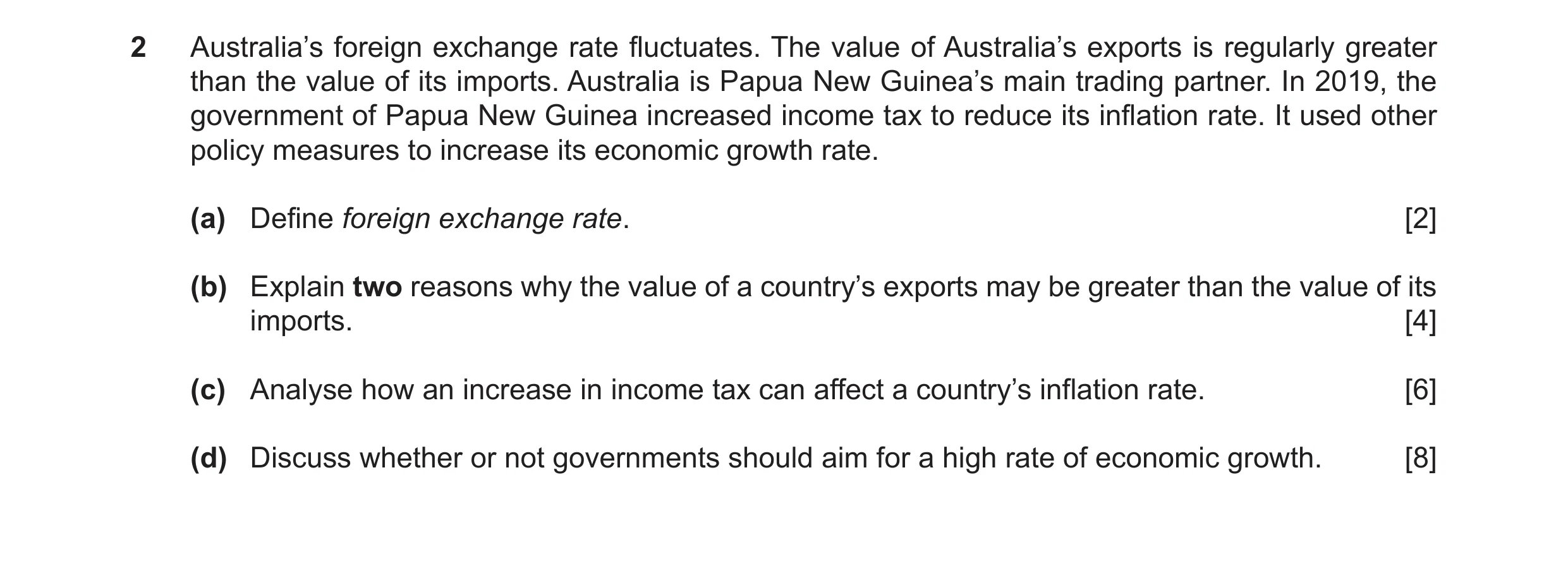
Q5 · Australia’s foreign exchange rate fluctuates 0987/21 May/June 2022
2 Australia’s foreign exchange rate fluctuates. The value of Australia’s exports is regularly greater than the value of its imports. Australia is Papua New Guinea’s main trading partner. In 2019, the government of Papua New Guinea increased income tax to reduce its inflation rate. It used other policy measures to increase its economic growth rate. (a) Define foreign exchange rate. [2] (b) Explain two reasons why the value of a country’s exports may be greater than the value of its imports. [4] (c) Analyse how an increase in income tax can affect a country’s inflation rate. [6] (d) Discuss whether or not governments should aim for a high rate of economic growth. [8]
20 marks
Mark scheme: 2(a) Define foreign exchange rate. The price / value of a currency (1) in terms of another currency / currencies (1). 2 2(b) Explain two reasons why the value of a country’s exports may be greater than the value of its imports. Logical explanation which might include: Price of exports may be lower than price of other countries’ products (1) due to e.g., devaluation / depreciation / weaker currency / higher productivity / lower inflation (1). Quality of exports may be higher than the quality of other countries’ products (1) due to e.g., more investment / better education / specialisation (1). Incomes abroad may have increased (1) enabling foreigners to buy more of the country’s products (1). Protective measures (1) restrict imports / subsidise domestic firms or exports (1). May have high value exports e.g., oil (1) with high (global) demand (1). Recession / low demand at home (1) results in fewer imports / encourages firms to export (1). 4 One mark for each of two reasons identified and one mark for each explanation. Question Answer Marks Guidance 2(c) Analyse how an increase in income tax can affect a country’s inflation rate. One mark for a simple explanation that an increase in income tax can reduce the rate of inflation Coherent analysis which might include: An increase in income tax will reduce disposable income / purchasing power (1) this may reduce consumer spending (1) lower total demand (1) this may encourage firms to reduce prices / reduce price rises (1) lower demand-pull inflation (1). Increase in income tax may encourage workers to press for wage rises (1) increase costs of production (1) cause cost-push inflation (1). Income tax revenue can be used to provide e.g., subsidies to certain goods and services (1) reducing prices (1). 6 Question Answer Marks Guidance 2(d) Discuss whether or not governments should aim for a high rate of economic growth. In assessing each answer, use the table opposite. Why it should: economic growth can raise incomes higher incomes can raise living standards economic growth can reduce unemployment economic growth can increase tax revenue allowing the government to spend more on e.g., education. Why it should not: may deplete non-renewable resources which can reduce future growth may result in pollution may put other demands on workers who may have to work long hours may lead to a deficit on current account of the balance of payment may result in greater inequality risk of inflation 8 Level Description Marks 3 A reasoned discussion which accurately examines both sides of the economic argument, making use of economic information and clear and logical analysis to evaluate economic issues and situations. One side of the argument may have more depth than the other, but overall, both sides of the argument are considered and developed. There is thoughtful evaluation of economic concepts, terminology, information and / or data appropriate to the question. The discussion may also point out the possible uncertainties of alternative decisions and outcomes. 68 2 A reasoned discussion which makes use of economic information and clear analysis to evaluate economic issues and situations. The answer may lack some depth and development may be one- sided. There is relevant use of economic concepts, terminology, information and data appropriate to the question. 35 Question Answer Marks Guidance 2(d) Level Description Marks 1 There is a simple attempt at using economic definitions and terminology. Some reference may be made to economic theory, with occasional understanding. 12 0 A mark of zero should be awarded for no creditable content. 0
This question in 0987/21 May/June 2022
Q6 · The South Korean government thinks that Japan is dumping steel 0987/22 May/June 2022
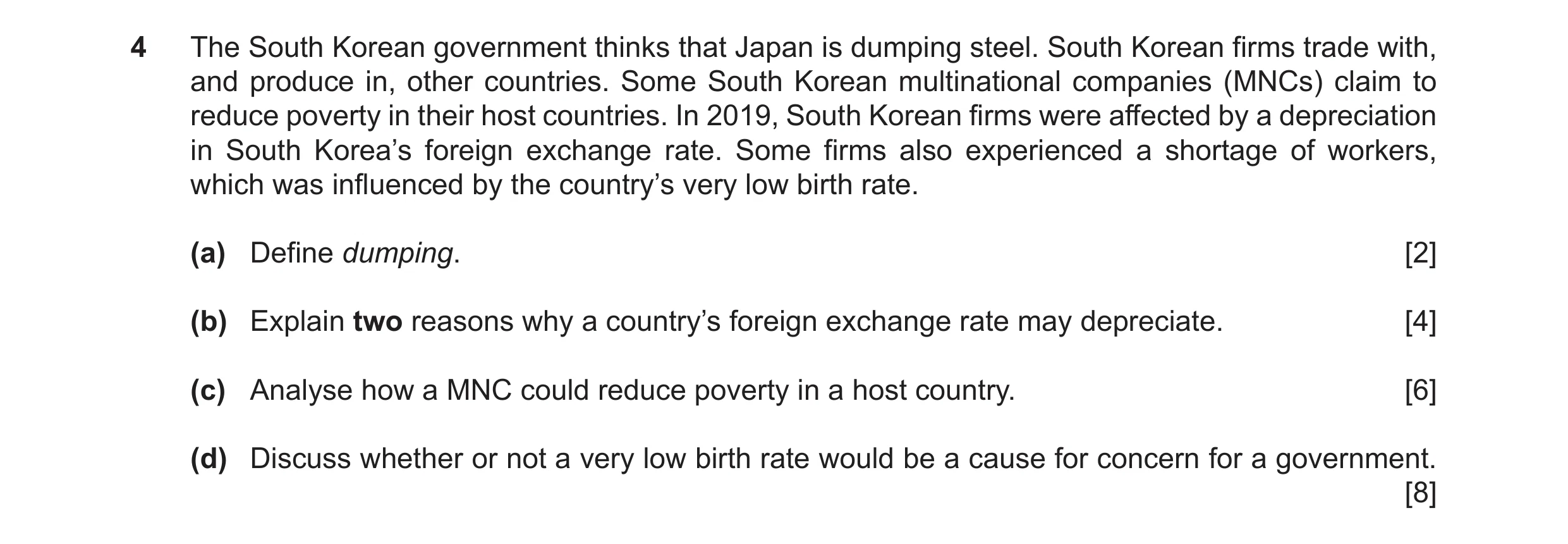
4 The South Korean government thinks that Japan is dumping steel. South Korean firms trade with, and produce in, other countries. Some South Korean multinational companies (MNCs) claim to reduce poverty in their host countries. In 2019, South Korean firms were affected by a depreciation in South Korea’s foreign exchange rate. Some firms also experienced a shortage of workers, which was influenced by the country’s very low birth rate. (a) Define dumping. [2] (b) Explain two reasons why a country’s foreign exchange rate may depreciate. [4] (c) Analyse how a MNC could reduce poverty in a host country. [6] (d) Discuss whether or not a very low birth rate would be a cause for concern for a government. [8]
20 marks
Mark scheme: 4(a) Define dumping. The sale of a product at less than cost price (1) in a foreign country (1) to gain a larger market share (1) to get rid of surplus stock / to prevent price falling on the domestic market (1). 2 Accept the sale of a product at a low price. 4(b) Explain two reasons why a country’s foreign exchange rate may depreciate. Logical explanation which might include: Inflation / fall in productivity (1) may make domestic products less internationally competitive / reducing net exports / reducing exports / increasing imports (1). Income at home may rise (1) increasing demand for imports / diverting products from the home market (1). Incomes abroad may have fallen (1) reducing demand for exports (1). The rate of interest may have fallen (1) discouraging an inflow of funds from other countries / encouraging an outflow of funds to other countries (1). There may be speculation that the currency will fall in value (1) selling the currency before it falls in value (1) Inward foreign direct investment may fall / outward fdi may increase (1) due to changes in economic activity (1). A central bank/government may sell the currency (1) to increase exports / reduce imports / improve the balance of payments (1). Increase in supply of currency (could be shown by a diagram) (1). Decrease in demand for the currency (could be shown on a diagram) (1). 4 One mark for each of two reasons identified and one mark for each explanation. A common response may be an increase in the supply of the currency (1) to buy more imports (1); A decrease in demand for the currency (1) if less exports are sold (1). Total = 4. Question Answer Marks Guidance 4(c) Analyse how a MNC could reduce poverty in a host country. Coherent analysis which might include: A MNC could increase employment / create job opportunities (1) some of the unemployed could gain jobs / unemployment could fall (1). It may pay higher wages / incomes may rise (1) increasing workers’ ability to buy products / buy basic necessities (1). It may provide accommodation (1) and healthcare for workers (1). It may provide infrastructure (1) making e.g. transport/energy more affordable (1). It may provide training / invest in education (1) enabling people to earn higher wages in the long run (1). It may sell products at a cheaper price (1) enabling more goods and services to be purchased (1). It may pay taxes to the government / tax revenue may rise (1) enabling the government to spend on measures to reduce poverty (1). 6 Question Answer Marks Guidance 4(d) Discuss whether or not a very low birth rate would be a cause for concern for a government. In assessing each answer, use the table opposite. Why it might: may create an ageing population may reduce size of the labour force in the future may increase dependency ratio may reduce tax revenue may take population below the optimum level. Why it might not: may maintain the size of the labour force in the short run as parents do not have to leave the labour force may reduce overcrowding may reduce pollution may reduce depletion of non-renewable resources. 8 Level Description Marks 3 A reasoned discussion which accurately examines both sides of the economic argument, making use of economic information and clear and logical analysis to evaluate economic issues and situations. One side of the argument may have more depth than the other, but overall, both sides of the argument are considered and developed. There is thoughtful evaluation of economic concepts, terminology, information and/or data appropriate to the question. The discussion may also point out the possible uncertainties of alternative decisions and outcomes. 68 Question Answer Marks Guidance 4(d) 2 A reasoned discussion which makes use of economic information and clear analysis to evaluate economic issues and situations. The answer may lack some depth and development may be one-sided. There is relevant use of economic concepts, terminology, information and data appropriate to the question. 35 1 There is a simple attempt at using economic definitions and terminology. Some reference may be made to economic theory, with occasional understanding. 12 0 A mark of zero should be awarded for no creditable content. 0
This question in 0987/22 May/June 2022
Q7 · Calculate how many dollars 6400 Nigerian naira would have bought in 2019 0987/22 Oct/Nov 2022
1 (a) Calculate how many dollars 6400 Nigerian naira would have bought in 2019. [1] (b) Identify two ways a bank could increase demand for its services. [2] (c) State why a merger between two commercial banks is a horizontal merger. [2] (d) Explain two reasons why a large US commercial bank may charge a high price for its services. [4] (e) Analyse how an increase in unemployment may affect the Nigerian government’s budget. [4] (f) Analyse the relationship between countries’ average years of schooling and birth rates. [5] (g) Discuss whether or not a subsidy, given to farmers by the Nigerian government, would reduce the deficit on the current account of its balance of payments. [6] (h) Discuss whether or not the US government should impose a minimum price on chocolate. [6]
30 marks
Mark scheme: Question Answer Marks Guidance 1(a) Calculate how many dollars 6400 Nigerian naira would 1 have bought in 2019. 16 (1). 1(b) Identify two ways a bank could increase demand for its 2 services. Open more branches (1) carry out an advertising campaign (1) improve online / mobile banking (1). 1(c) State why a merger between two commercial banks is a 2 horizontal merger. Same stage of production / both in the tertiary (service) sector / same sector (1) same industry / same product / same service (1) can increase market share (1). 1(d) Explain two reasons why a large US commercial bank 4 One mark for each of two reasons identified and one mark may charge a high price for its services. for each explanation. Logical explanation which might include: High spending on opening new branches / advertising campaigns / developing online banking (1) need to get back costs / make a profit / may experience diseconomies of scale (1). May offer high quality services (1) have high demand / customers willing to pay a high price (1). High degree of monopoly / market power / control 32% of market (1) customers may have brand loyalty / reluctant to switch banks / lack of substitutes / inelastic demand / can charge high prices to earn high profits/raise total revenue / be a price maker (1). High incomes in the US (1) many customers have the ability to pay a high price (1). Employ skilled / well educated workers (1) so may pay high wages / may have high costs of production (1). 1(e) Analyse how an increase in unemployment may affect 4 the Nigerian government’s budget. Coherent analysis which might include: Likely to increase a deficit / reduce a surplus / may result in a budget deficit (1). Tax revenue likely to fall / budget likely to fall (1) due to lower incomes (1) less income tax revenue (1) lower profits (1) less corporation tax revenue (1) lower spending (1) less indirect tax revenue (1) government may cut taxes to reduce unemployment (1). Government spending likely to rise (1) more spending on e.g. benefits / subsidies to the poor / law and order/ healthcare (1) may be more spending on measures to reduce unemployment / expansionary fiscal policy (1) may spend less on other areas e.g. education (1). 1(f) Analyse the relationship between countries’ average 5 No marks for just stating what the figures are e.g. Germany years of schooling and birth rates. has 15 years of schooling and a birth rate of approximately 8. US has 14 years of schooling and a birth rate of Coherent analysis which might include: approximately 12. Argentina has 11 years of schooling and Overview a birth rate of approximately 16 etc. Generally, an inverse relationship / the more years of schooling, the lower the birth rate / the fewer years of schooling, the higher the birth rate (1). Supporting evidence Up to 2 marks maximum for two pieces of relevant supporting evidence e.g.: • Germany has the highest years of schooling and lowest birth rate (1) • Chad has lowest years of schooling and highest birth rate (1) • US has more years of schooling than Argentina and so a lower birth rate (1) • the three countries with three highest years of schooling have the three lowest birth rates (1). Exception Nigeria / Eritrea (1) Nigeria has more years of schooling than Eritrea but a higher birth rate (1). Comments More years of schooling is likely to cause people to form partnerships / have children later / focus on careers / increase awareness of contraception/family planning / increase health / reduce size of families (1) increase cost of raising children / having more children may reduce the ability of families to keep their children in education for many years / exception may be result of other influences e.g. differences in fertility rates / differences in social attitudes (1). 1(g) Discuss whether or not a subsidy, given to farmers by 6 Apply this example to all questions with the command the Nigerian government, would reduce the deficit on word DISCUSS the current account of its balance of payments. (1g, 1h, 2d, 3d, 4d and 5d) Award up to 4 marks for logical reasons why it might, which Each point may be credited only once, on either side of an may include: argument, but separate development as to how/why the It should raise supply / increase output (1) equivalent to outcome may differ is rewarded. lower cost (1) lower price (1) increasing international competitiveness (1). Generic example mark There may be more funds available to invest (1) raise quality (1) increase exports / reduce imports (1). Tax revenue may decrease… 1 Award up to 4 marks for logical reasons why it might not, ...because of reason e.g. incomes may be 1 which may include: lower. It may increase inefficiency (1) as firms rely on the subsidy (1) may not pass on the benefit of the subsidy to consumers Tax revenue may increase because incomes 0 (1). may be higher i.e. reverse of a previous Nigeria may have a high inflation rate (1) which may offset argument. the cost advantage of the subsidy (1). There may an increase in incomes at home (1) which may Tax revenue may increase because of a 1 increase imports / divert exports to the home market (1). different reason i.e. not the reverse of a There may be a recession abroad / decrease in incomes of previous argument e.g. government spending trading partners (1) which reduces exports (1). on subsidies may stimulate the economy more Lower export prices will not raise export revenue if demand than spending on education. is inelastic (1). The exchange rate may rise (1) increasing export prices / lowering import prices (1). Farmers may import e.g. more machinery (1). There may be adverse weather conditions / disease (1) which reduces quality / quality may remain poor (1). There may be import restrictions / increase in import restrictions imposed by other countries (1). 1(h) Discuss whether or not the US government should 6 A minimum price diagram without explanation can get a impose a minimum price on chocolate. maximum of 2 marks. These marks may be the equivalent of a combination of two of higher price, demand extending, Award up to 4 marks for logical reasons why it should, supply extending or a surplus being created. which may include: It will raise price (1) reduce demand / demand contracts / quantity demand falls / consumption falls. (1) reduce obesity (1). Social cost of eating chocolate may exceed social benefit (1) due to external costs (1) example e.g. cost on health service / may reduce need for government spending on healthcare (1) overconsumption of chocolate (1) move market closer to where social benefit equals social cost (1) increase welfare (1). May raise health of the population / eating chocolate may be unhealthy (1) raise labour productivity (1). There may be information failure (1) some chocolate is a demerit good (1). Award up to 4 marks for logical reasons why it should not, which may include: Poor may not be able to afford chocolate (1) regressive measure (1). Not everyone overweight / some may consume chocolate in quantities that are not harmful (1) may cause demand to switch to other high sugar products / discriminate against other high sugar products (1). It will encourage supply to extend (1) a surplus may develop (1). There may be an illegal market in chocolate (1). There may be a cost to the government (1) it may have to pay to monitor that the price is being charged (1) lower tax revenue from chocolate (1) may be an increase in unemployment (1). 1(h) Demand may be inelastic (1) resulting in a relatively small fall in demand / chocolate may be addictive (1). It depends on how high the minimum price is (1) may have no effect if set below the market equilibrium (1).
This question in 0987/22 Oct/Nov 2022
Q8 · Many people from the Philippines work in another country, often in industries that… 0987/21 May/June 2023
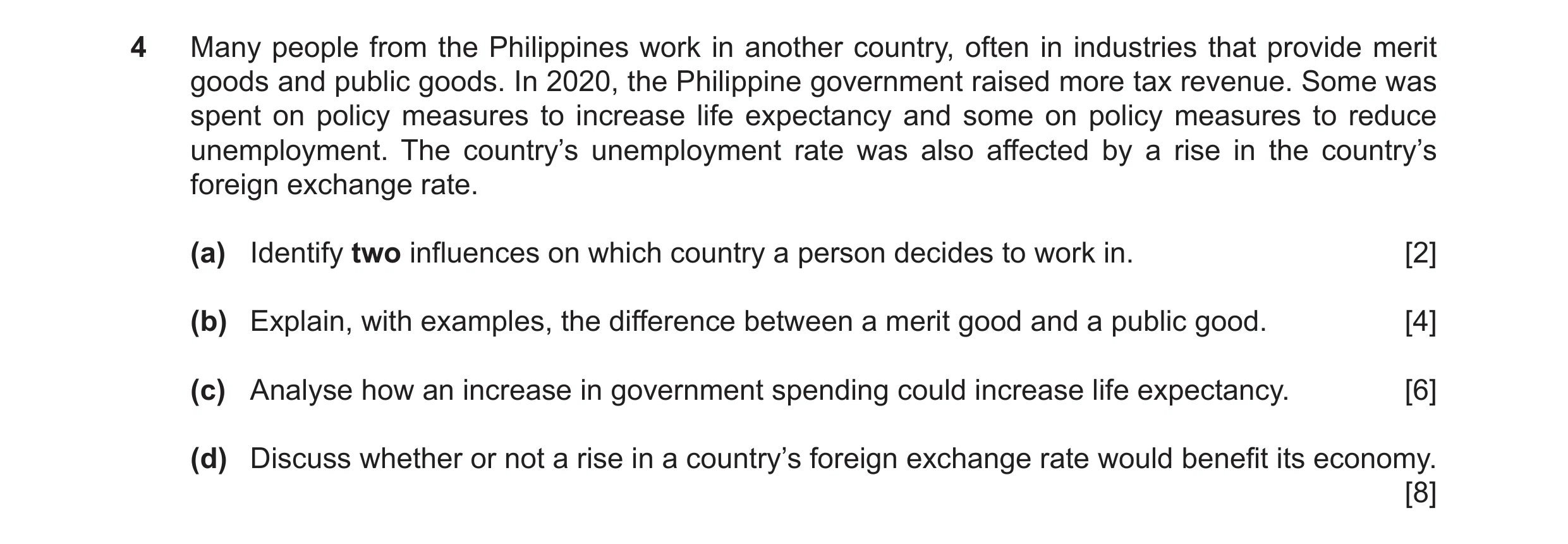
4 Many people from the Philippines work in another country, often in industries that provide merit goods and public goods. In 2020, the Philippine government raised more tax revenue. Some was spent on policy measures to increase life expectancy and some on policy measures to reduce unemployment. The country’s unemployment rate was also affected by a rise in the country’s foreign exchange rate. (a) Identify two influences on which country a person decides to work in. [2] (b) Explain, with examples, the difference between a merit good and a public good. [4] (c) Analyse how an increase in government spending could increase life expectancy. [6] (d) Discuss whether or not a rise in a country’s foreign exchange rate would benefit its economy. [8]
20 marks
Mark scheme: 4(a) Identify two influences on which country a person decides to work in. Two from: wages / GDP per head working conditions job opportunities / job security qualifications required family ties language spoken immigration restrictions personal safety/ freedom from persecution living standards / cost of living better welfare / healthcare / education provision 2 If more than two influences are given, consider the first three. 4(b) Explain, with examples, the difference between a merit good and a public good. Logical explanation which might include: A merit good e.g. education / fruit (1) is beneficial / is under- consumed / people unaware of benefits / so underproduced without government intervention / government encourage consumption (1). A public good e.g. defence / streetlighting / police / sea defences / roads (1) would not be produced by the private sector / needs to be financed by the government/ non-rival/ non-excludable (1). 4 One mark each for each of two differences identified and one mark each for each of two examples Question Answer Marks Guidance 4(c) Analyse how an increase in government spending could increase life expectancy. Coherent analysis which might include increased government spending on: Healthcare (1) could raise quality / accessibility of healthcare (1). Education (1) may result in people leading healthier lives (1) more exercise (1) better nutrition (1). Benefits (1) may increase access to basic necessities / reduce poverty (1). Green energy (1) may reduce pollution (1). Infrastructure (1) could reduce traffic accidents (1) reduce traffic congestion (1) reduce stress (1). Police (1) reduces deaths through crime (1). Increased government spending (in total) (1) may increase employment / raise income / raise standards of living (1). 6 MAX of three marks for just identifying areas of government spending MAX of three marks for analysis of any single area of spending. One item analysed well MAX 4 marks. Question Answer Marks Guidance 4(d) Discuss whether or not a rise in a country’s foreign exchange rate would benefit its economy. In assessing each answer, use the table opposite. Why it might: reduce price of imports this could lower inflation as raw material costs may fall and more competitive pressure for firms to keep price rises low enables a country to buy more imports for any given quantity of exports could reduce a current account surplus which may enable more products to be consumed. Why it might not: increase the price of exports this could reduce exports and export revenue economic growth could fall unemployment could rise could increase a current account deficit. 8 Level Description Marks 3 A reasoned discussion which accurately examines both sides of the economic argument, making use of economic information and clear and logical analysis to evaluate economic issues and situations. One side of the argument may have more depth than the other, but overall, both sides of the argument are considered and developed. There is thoughtful evaluation of economic concepts, terminology, information and/or data appropriate to the question. The discussion may also point out the possible uncertainties of alternative decisions and outcomes. 6–8 2 A reasoned discussion which makes use of economic information and clear analysis to evaluate economic issues and situations. The answer may lack some depth and development may be one-sided. There is relevant use of economic concepts, terminology, information and data appropriate to the question. 3–5 1 There is a simple attempt at using economic definitions and terminology. Some reference may be made to economic theory, with occasional understanding. 1–2 0 A mark of zero should be awarded for no creditable content. 0
This question in 0987/21 May/June 2023
Q9 · In 2020, Australia had a high national minimum wage (NMW) 0987/22 May/June 2023
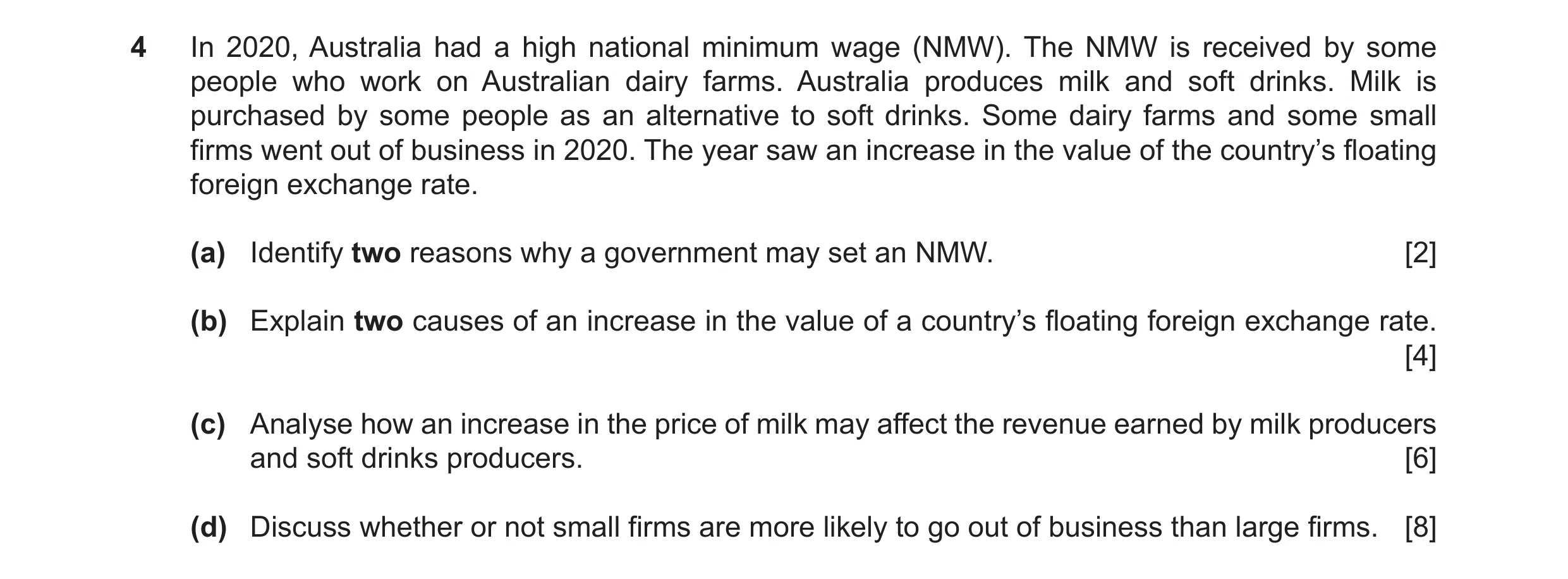
4 In 2020, Australia had a high national minimum wage (NMW). The NMW is received by some people who work on Australian dairy farms. Australia produces milk and soft drinks. Milk is purchased by some people as an alternative to soft drinks. Some dairy farms and some small firms went out of business in 2020. The year saw an increase in the value of the country’s floating foreign exchange rate. (a) Identify two reasons why a government may set an NMW. [2] (b) Explain two causes of an increase in the value of a country’s floating foreign exchange rate. [4] (c) Analyse how an increase in the price of milk may affect the revenue earned by milk producers and soft drinks producers. [6] (d) Discuss whether or not small firms are more likely to go out of business than large firms. [8]
20 marks
Mark scheme: 4(a) Identify two reasons why a government may set an NMW. Two from: to raise wages to reduce poverty / raise living standards reduce income inequality to correct market failure / ensure fair wages / prevent exploitation of workers to encourage job seeking / reduce unemployment reduce emigration 2 If more than two reasons given, consider the first three. 4(b) Explain two causes of an increase in the value of a country’s floating foreign exchange rate. Logical explanation which might include: Increase in demand for the currency (1) rise in exports / exports exceeding imports / current account surplus (1) due to higher incomes abroad (1) lower inflation / deflation / lower prices for exports (1) better quality (1). Increase in foreign investment in the country (1). Higher rate of interest (1) attracts hot money flows (1). Speculation (1) that the currency will rise in value (1). Decrease in supply of the currency (1) fall in imports / fall in current account deficit (1) fall in incomes at home (1) lower inflation / higher prices of imports / fall in quality of imports (1). The country’s firms reducing investment in other countries (1) Lower rate of interest in other countries (1) reduce hot money going out of the country (1). Speculation (1) that other currencies will fall in value (1). 4 Causes may be linked here in different ways. Also allow explanation of two causes of an increase in demand for the currency or two causes of a decrease in supply of the currency. Credit higher demand mark only once and lower supply mark only once. Question Answer Marks Guidance 4(c) Analyse how an increase in the price of milk may affect the revenue earned by milk producers and soft drinks producers. Coherent analysis which might include: Demand for milk is likely to fall / contraction in demand (1) The effect on the revenue of milk producers will depend on price elasticity of demand (1) if demand is elastic, revenue will fall (1) as demand will fall by a greater percentage than the rise in price (1) if demand is inelastic, or demand is constant, revenue will increase (1) as demand will fall by a smaller percentage than the rise in price (1). Demand for soft drinks is likely to increase (1) the revenue of soft drinks producers is likely to rise (1) as soft drinks are a substitute / alternative to milk (1). 6 Question Answer Marks Guidance 4(d) Discuss whether or not small firms are more likely to go out of business than large firms. In assessing each answer, use the table opposite. Why they might: may have high average costs less able to take advantage of economies of scale may be less likely to get a loan from commercial banks may have less retained profits may be new, testing out whether there is demand, inexperienced entrepreneurs Why they might not: less likely to experience diseconomies of scale may receive financial assistance from the government may have customer loyalty may be more flexible may be a monopoly in a niche / specialist market. 8 Level Description Marks 3 A reasoned discussion which accurately examines both sides of the economic argument, making use of economic information and clear and logical analysis to evaluate economic issues and situations. One side of the argument may have more depth than the other, but overall, both sides of the argument are considered and developed. There is thoughtful evaluation of economic concepts, terminology, information and/or data appropriate to the question. The discussion may also point out the possible uncertainties of alternative decisions and outcomes. 6–8 2 A reasoned discussion which makes use of economic information and clear analysis to evaluate economic issues and situations. The answer may lack some depth and development may be one-sided. There is relevant use of economic concepts, terminology, information and data appropriate to the question. 3–5 1 There is a simple attempt at using economic definitions and terminology. Some reference may be made to economic theory, with occasional understanding. 1–2 0 A mark of zero should be awarded for no creditable content. 0
This question in 0987/22 May/June 2023
Q10 · Calculate Tunisia’s balance on the current account of its balance of payments 0987/22 May/June 2024
1 (a) Calculate Tunisia’s balance on the current account of its balance of payments. [1] (b) Identify two qualities of a good tax that the Tunisian government aimed to achieve. [2] (c) Explain one reason why the Tunisian government regulates the price of flour and milk. [2] (d) Explain two ways the Tunisian government tried to reduce frictional unemployment. [4] (e) Analyse the relationship between the change in Tunisia’s average wage and inflation rate. [4] (f) Analyse, using a demand and supply diagram, how an increase in wage costs would affect the market for shoes. [5] (g) Discuss whether or not the Tunisian government should continue to subsidise electricity production. [6] (h) Discuss whether or not a rise in the value of the Tunisian dinar would benefit the Tunisian economy. [6]
30 marks
Mark scheme: 1(a) Calculate Tunisia’s balance on the current account of its balance of payments. –$2.4bn 1 Accept –2.4bn. Also accept –6.8 or –6.9 billion TND. 1(b) Identify two qualities of a good tax that the Tunisian government aimed to achieve. Efficiency / efficient / the tax should improve market performance / reduce market failure (1). Economical / economy / the tax should raise more in revenue than it costs to collect it (1). 2 If more than 2 qualities are given, consider the first 3. 1(c) Explain one reason why the Tunisian government regulates the price of flour and milk. Reduce poverty (1) flour and milk are basic necessities / essential products / people may be able to buy enough basic necessities / make them affordable / keep price relatively low (1). Or Prevent monopoly firms exploiting their market power (1) stop the firms raising price to a high level (1). 2 One mark for a reason identified and one mark for an explanation. Question Answer Marks Guidance 1(d) Explain two ways the Tunisian government tried to reduce frictional unemployment. Logical explanation which might include: Increased the labour market information available to workers and employers (1) so workers would be more aware of job vacancies / skills and qualifications required / employers more aware of those seeking jobs / may enable workers to move more quickly/easily between jobs / reduce search time / increase mobility of workers (1). Did not raise unemployment benefit (in line with inflation) (1) so, the purchasing power of unemployment benefit would fall / increase the incentive to work (1). 4 One mark for each of two ways identified and one mark for each of two explanations. If more than 2 ways are given, consider the first 3. Question Answer Marks Guidance 1(e) Analyse the relationship between the change in Tunisia’s average wage and the inflation rate. Relationship (up to 2 marks) Direct relationship / positive relationship (1) as change in the average wage increases so does the inflation rate / if change in average wage / rise in average wage falls so does the inflation rate / both fall and rose together / same trend (1). Evidence (up to 3 marks) 2016 – 2017 / 2018 both the average wage / change in average wage and inflation rate rose (1). Between 2014 – 2018, the average wage rose more rapidly than the inflation rate (1) real wages would have increased between 2014 – 2018 (1). Between 2018 – 2020 / in 2019 – 2020, the inflation rate was higher than the rise in the average wage (1) real wages would have fallen (1). Between 2014 – 2015/2016 / 2018 – 2019/2020 both the change in average wage and inflation rate fell (1). 2018 had the highest rise in the average wage and the highest inflation (1). 2016 had the lowest increase in the inflation rate but not the lowest increase in the average wage / 2020 had the lowest increase in the average wage but not the lowest inflation rate (1). Over the whole period the inflation rate rose while the increase in the average wage fell (1). Explanation (up to 2 marks) A rise in the average wage may increase costs of production / cause cost push inflation / a higher inflation rate will encourage workers to press for a wage rise (1). A rise in the average wage may increase disposable income / consumer expenditure / total demand / cause demand-pull inflation (1). 4 Responses do not have to be in the format suggested but they should address the expected/normal relationship, offer supporting evidence of that, highlight any exceptions to that, and analyse the overall data. Note: average wage did not fall. Question Answer Marks Guidance 1(f) Analyse, using a demand and supply diagram, how an increase in wage costs would affect the market for shoes. Coherent analysis which might include: D&S diagram: Axes correctly labelled – price and quantity or p and q (1). Original demand and supply curves correctly labelled (1). New supply curve shifted to the left (1). Equilibriums – shown by lines P1 and Q1 and P2 and Q2 or equilibrium points marked as E1 and E2 (1). Written analysis: An increase in wage costs would increase costs of production which may raise price (1). 5 Note: higher price needs to be linked to higher costs of production/higher costs/higher wage costs. Question Answer Marks Guidance 1(g) Discuss whether or not the Tunisian government should continue to subsidise electricity production. Award up to 4 marks for logical reasons why it might, which may include: reduce costs of producing electricity (1) increase supply of electricity (1) lower price of electricity (1) make electricity more affordable / reduce poverty (1) lower costs of firms that use electricity (1) which may encourage them to expand / attract MNCs / increase output / increase GDP / cause economic growth (1) increase employment / lower unemployment (1) reduce inflation / firms lower prices (1) make Tunisia’s products more internationally competitive / increase exports / lower imports / improve the current account balance (1) may reduce pollution / external costs (1) if subsidising green sources of energy (1). Award up to 4 marks for logical reasons why it might not, which may include: electricity firms may rely on the subsidy (1) may not keep costs low / become inefficient (1) may not pass on the subsidy in the form of lower price (1) opportunity cost (1) government could spend money on e.g. healthcare (1) may result in a budget deficit / increase in taxes (1) may cause pollution / external costs (1) if e.g. coal powered / deplete non-renewable resources (1). 6 Apply this example to all questions with the command word DISCUSS (1g, 1h, 2d, 3d, 4d and 5d) Each point may be credited only once, on either side of an argument, but separate development as to how/why the outcome may differ is rewarded. Generic example Mark Tax revenue may decrease… 1 ...because of reason e.g. incomes may be lower. 1 Tax revenue may increase because incomes may be higher i.e. reverse of a previous argument. 0 Tax revenue may increase because of a different reason i.e. not the reverse of a previous argument e.g. government spending on subsidies may stimulate the economy more than spending on education. 1 Question Answer Marks Guidance 1(h) Discuss whether or not a rise in the value of the Tunisian dinar would benefit the Tunisian economy. Award up to 4 marks for logical reasons why it might, which may include: may reduce inflation (1) imports would be cheaper (1) enable households to buy more imports / higher purchasing power (1) more choice (1) may lower price of some raw materials and/or capital goods (1) increase competitive pressure on domestic firms (1) lower costs of production (1) lower total (aggregate) demand (1) which may reduce demand-pull inflation (1) may be taken as an indicator of a strong economy / increase confidence (1) encourage investment / attract MNCs (1) if demand for exports is price inelastic, export revenue may rise (1). Award up to 4 marks for logical reasons why it might not, which may include: higher export prices / may reduce exports / export revenue (1) lower price of imports (1) may increase imports / import expenditure (1) reduce international competitiveness (1) increase the deficit / reduce surplus on the current account of Tunisia’s balance of payments (1) lower net exports may reduce GDP / economic growth (1) which may increase unemployment / reduce employment (1) may discourage MNCs / investment (1) because of higher cost of setting up in the country (1). 6 Note: lower total demand may be credited on either side but only once. Note: the generic advice above in terms of MNCs. One mark for attract or discourage MNCs. Another mark could be gained by explaining why they may be attracted and another mark for explaining why they may be discouraged.
This question in 0987/22 May/June 2024
Q11 · The central bank of Madagascar intervenes in the country’s foreign exchange market 0987/22 Oct/Nov 2024
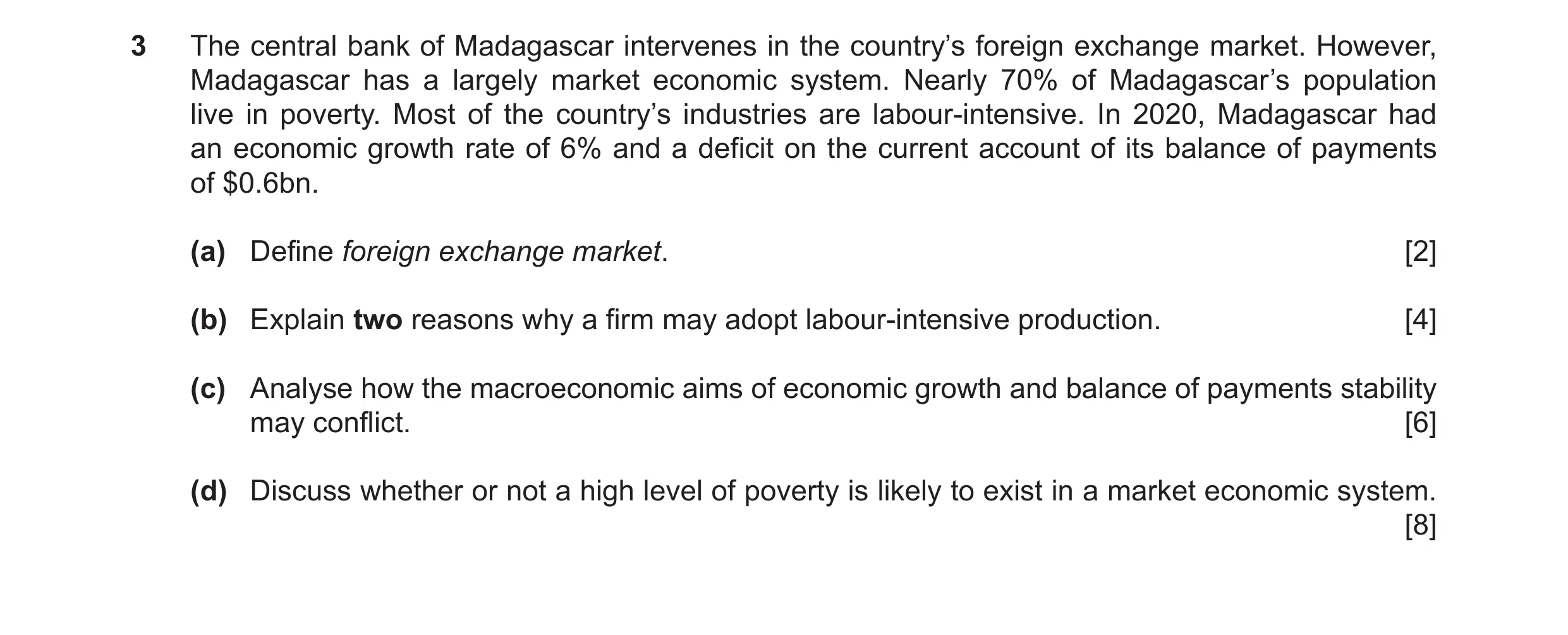
3 The central bank of Madagascar intervenes in the country’s foreign exchange market. However, Madagascar has a largely market economic system. Nearly 70% of Madagascar’s population live in poverty. Most of the country’s industries are labour-intensive. In 2020, Madagascar had an economic growth rate of 6% and a deficit on the current account of its balance of payments of $0.6bn. (a) Define foreign exchange market. [2] (b) Explain two reasons why a firm may adopt labour-intensive production. [4] (c) Analyse how the macroeconomic aims of economic growth and balance of payments stability may conflict. [6] (d) Discuss whether or not a high level of poverty is likely to exist in a market economic system. [8]
20 marks
Mark scheme: 3(a) Define foreign exchange market. 2 An arrangement / place (1) where different countries’ currencies are bought/demanded (1) and sold/supplied (1) one currency is exchanged for another currency (1). 3(b) Explain two reasons why a firm may adopt labour- 4 One mark each for each of two reasons identified and one intensive production. mark for each of two explanations. Logical explanation which might include: • Labour may be low in price / wages may be low (1) which might make labour cheaper than capital / there may be a high supply of labour (1). • Labour may be very productive / efficient (1) which can make employment profitable / result in low costs of production (1). • The government may subsidise the employment of workers (1) to reduce unemployment (1). • The firm may provide personal services (1) with individual attention (1). • Labour may be more creative / adaptable / provide feedback (1) produce high quality products / improve methods of production (1) • Labour may be unskilled / low level of education (1) unable to use high-tech capital equipment (1). 3(c) Analyse how the macroeconomic aims of economic 6 growth and balance of payments stability may conflict. Coherent analysis which might include: Economic growth may increase employment (1) increase wages / incomes / purchasing power (1) this may increase imports (1). Higher consumer spending (1) may encourage firms to switch products to the domestic market (1) reduce exports (1) increase / cause a current account deficit (1). To produce more goods and services, firms may import more raw materials (1) capital goods (1). Economic growth may result in inflation (1) which would make domestic products less price competitive (1). Economic growth may deplete resources (1) increase need for imports (1). Economic growth may be export-led (1) may be achieved by restricting imports (1) result in a current account surplus (1). Migrant workers may send more money home (1). Export-led growth may increase the exchange rate (1) which may increase imports / reduce exports (1). 3(d) Discuss whether or not a high level of poverty is likely 8 Level Description Marks to exist in a market economic system. 3 A reasoned discussion which 6–8 In assessing each answer, use the table opposite. accurately examines both sides of the economic argument, making use of Why it might: economic information and clear and • may be unemployment logical analysis to evaluate economic • lack of welfare benefits issues and situations. One side of the argument may have more depth than • likely to be income inequality the other, but overall both sides of the • merit goods including healthcare and education may be argument are considered and under-consumed and so underproduced developed. There is thoughtful • monopolies may develop resulting in higher prices. evaluation of economic concepts, terminology, information and/or data Why it might not: appropriate to the question. The • competition / profit motive may result in low prices discussion may also point out the • efficiency is encouraged which can result in high wages possible uncertainties of alternative and high employment decisions and outcomes. • greater response to changes in consumer demand, may increase economic growth 2 A reasoned discussion which makes 3–5 • countries with efficient private sector firms may have use of economic information and clear relative poverty but low absolute poverty. analysis to evaluate economic issues and situations. The answer may lack some depth and development may be one-sided. There is relevant use of economic concepts, terminology, information and data appropriate to the question. 1 There is a simple attempt at using 1–2 economic definitions and terminology. Some reference may be made to economic theory, with occasional understanding. 0 A mark of zero should be awarded for 0 no creditable content.
This question in 0987/22 Oct/Nov 2024
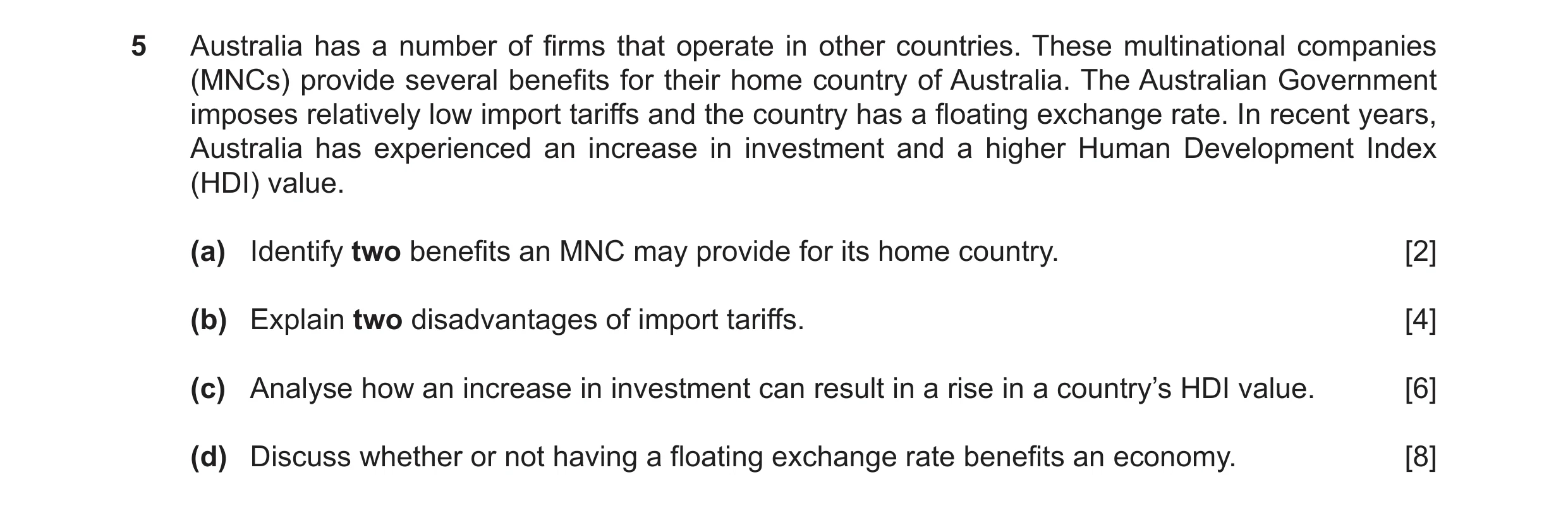
Q12 · Australia has a number of firms that operate in other countries 0987/21 May/June 2025
5 Australia has a number of firms that operate in other countries. These multinational companies (MNCs) provide several benefits for their home country of Australia. The Australian Government imposes relatively low import tariffs and the country has a floating exchange rate. In recent years, Australia has experienced an increase in investment and a higher Human Development Index (HDI) value. (a) Identify two benefits an MNC may provide for its home country. [2] (b) Explain two disadvantages of import tariffs. [4] (c) Analyse how an increase in investment can result in a rise in a country’s HDI value. [6] (d) Discuss whether or not having a floating exchange rate benefits an economy. [8]
20 marks
Mark scheme: 5(a) Identify two benefits an MNC may provide for its home 2 If more than two benefits given, consider the first three. country. Identify means that the benefit does not have to be Two from: explained. • profits • (increased) exports • raw materials • job opportunity / wages for workers • raise country’s income 5(b) Explain two disadvantages of import tariffs. 4 One mark each for each of two disadvantages identified and one mark each for each of two explanations. Logical explanation which might include: If more than two disadvantages given, consider the first • Reduce (free) trade (1) lower competition (1) . three. • Risk of retaliation (1) resulting in trade war / unemployment (1). Only allow one mark for reference to lower competition. • Raise price of imports (1) which may raise price of domestically produced goods (because of the lack of competition) (1) . • Raise the price of imported raw materials / capital goods (1) cause cost-push inflation (1) . • Reduce quality (1) due to lower competition (1) • Protected industries / infant industries / declining industries may become inefficient (1) if become reliant on tariff (protection) (1). • Reduce output / consumption / less quality / less choice (1) lower living standards (1). • Reduce ability of countries to specialise (1) less efficient use of resources / loss of potential economies of scale (1). 5(c) Analyse how an increase in investment can result in a 6 rise in a country’s HDI value. Coherent analysis which might include: • Investment can increase GDP / GNI (1) employment (1) which may increase GDP/ GNI per head (1) higher GDP/ GNI may raise tax revenue (1) enabling the government to spend more on education and healthcare (1). • Higher personal income / wages (1) enabling families to afford sending children to school (1) pay for private healthcare (1). • An increase in investment in healthcare facilities (1) can increase life expectancy (1). • An increase in investment in education (1) will increase mean / expected and expected years of schooling (1) increase skills/productivity (1) which may increase GDP per head (1) raise awareness about nutrition (1) increase life expectancy (1). • An increase in investment may introduce more advanced technology (1) which can make work less physically demanding (1) improving health / life expectancy (1). 5(d) Discuss whether or not having a floating exchange rate 8 Level Description Marks benefits an economy. 3 A reasoned discussion which accurately 6–8 In assessing each answer, use the table opposite. examines both sides of the economic argument, making use of economic Why it might: information and clear and logical • may eliminate a current account imbalance analysis to evaluate economic issues • if there is a current account deficit, exchange rate may and situations. One side of the fall making exports fall in price and imports rise in price argument may have more depth than • no need to keep reserves of foreign exchange the other, but overall both sided of the • no need to change interest rates to influence the argument are considered and exchange rate developed. There is thoughtful • enable government to concentrate on other aims as evaluation of economic concepts, does not have to keep the exchange rate fixed. terminology, information and/or data appropriate to the question. The Why it might not: discussion may also point out the • may make it difficult for firms to plan, not knowing how possible uncertainties of alternative much they will have to pay for imports and earn from decisions and outcomes. exports • may create uncertainty 2 A reasoned discussion which makes 3–5 • discourage investment use of economic information and clear • speculation can cause (significant) destabilising analysis to evaluate economic issues changes in the exchange rate. and situations. The answer may lack some depth and development may be one-sided. There is relevant use of economic concepts, terminology, information and data appropriate to the question. 5(d) 8 Level Description Marks 1 There is a simple attempt at using 1–2 economic definitions and terminology. Some reference may be made to economic theory, with occasional understanding. 0 A mark of zero should be awarded for 0 no creditable content. Note: reward candidates if they refer to the impact of appreciation and depreciation of the currency in their answers.
This question in 0987/21 May/June 2025
![Question 1: (a) Calculate Vietnam’s GDP per head in 2017. [1] (b) Identify two rewards to factors of production. [2] (c) Explain what happened to Vietn…](https://img.pastlit.com/crops/25a30bfd-437a-4114-9add-fd1b8fde8310/q1.webp)
 1 / 4
1 / 4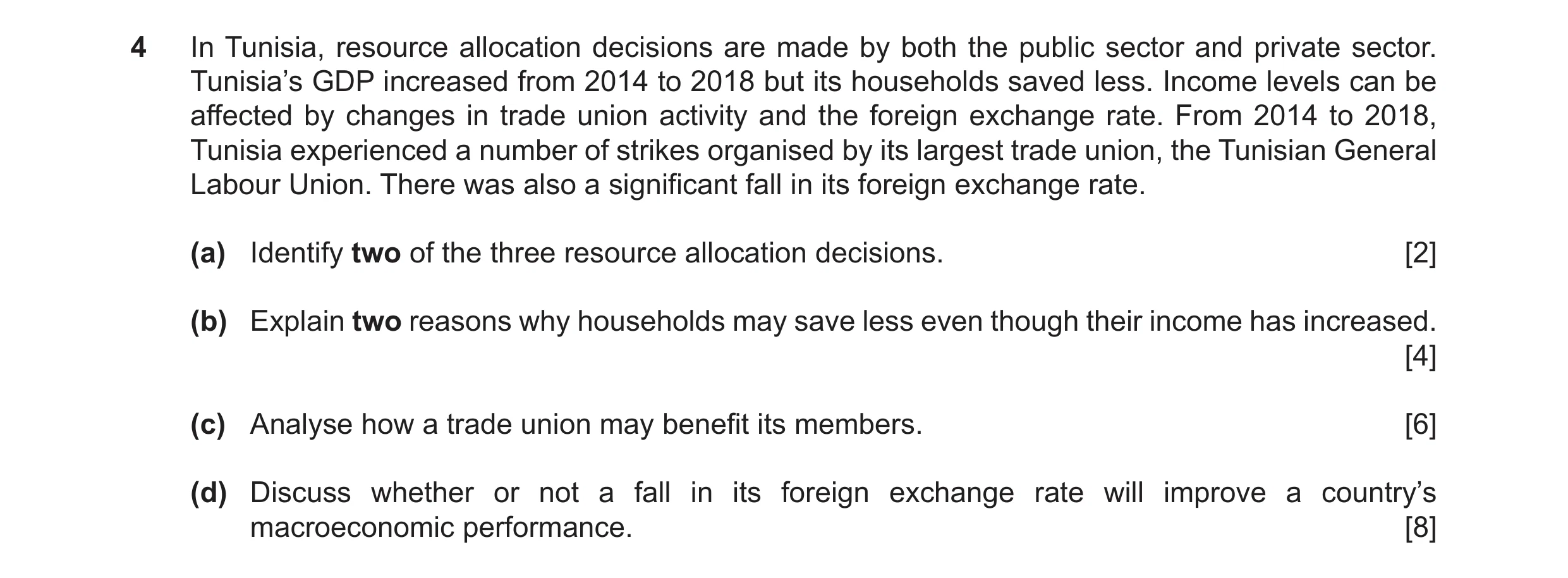
 2 / 4
2 / 4![Question 7: (a) Calculate how many dollars 6400 Nigerian naira would have bought in 2019. [1] (b) Identify two ways a bank could increase demand for it…](https://img.pastlit.com/crops/a5614d74-144c-4d2f-bdd5-0e16b74f222b/q1.webp)
 3 / 4
3 / 4![Question 10: (a) Calculate Tunisia’s balance on the current account of its balance of payments. [1] (b) Identify two qualities of a good tax that the Tu…](https://img.pastlit.com/crops/6fa8ae75-ac72-44b1-baba-36d439e5f159/q1.webp)
 4 / 4
4 / 4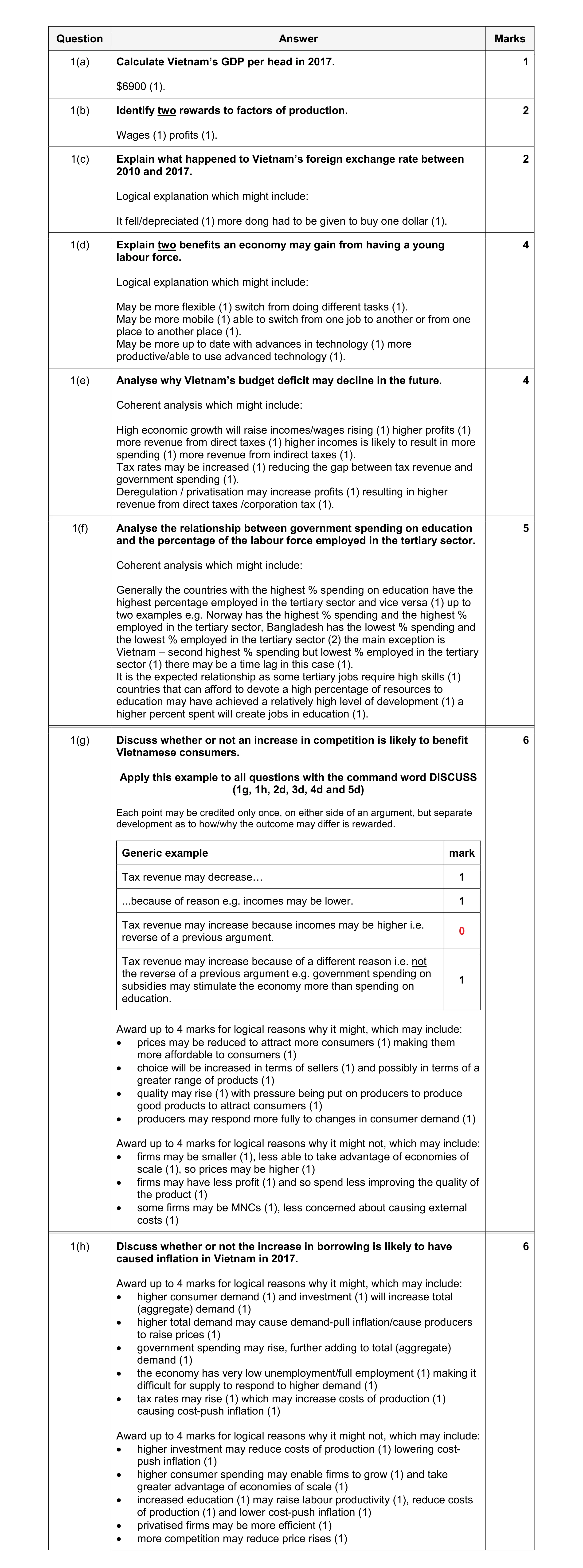 30
30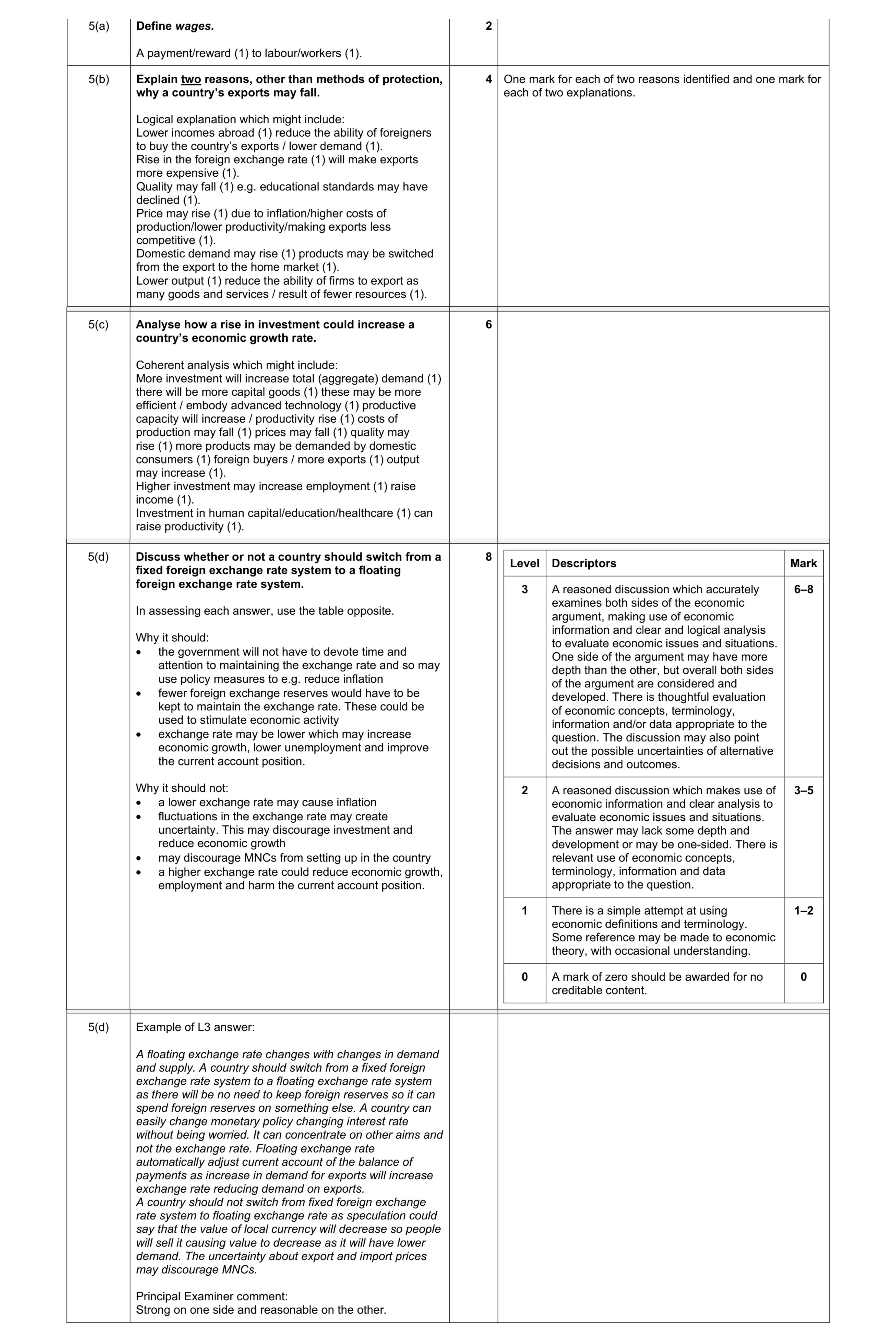 20
20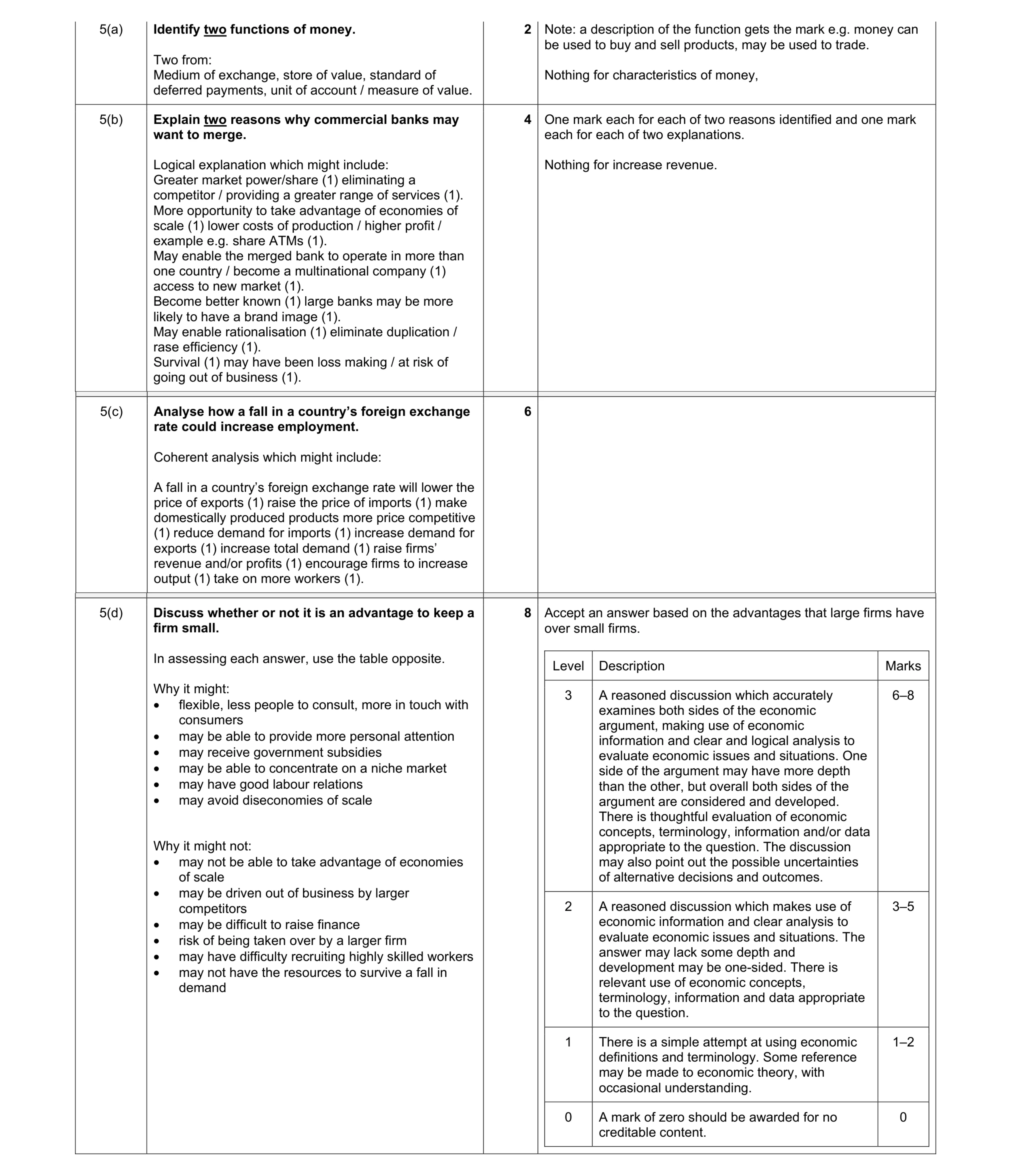 20
20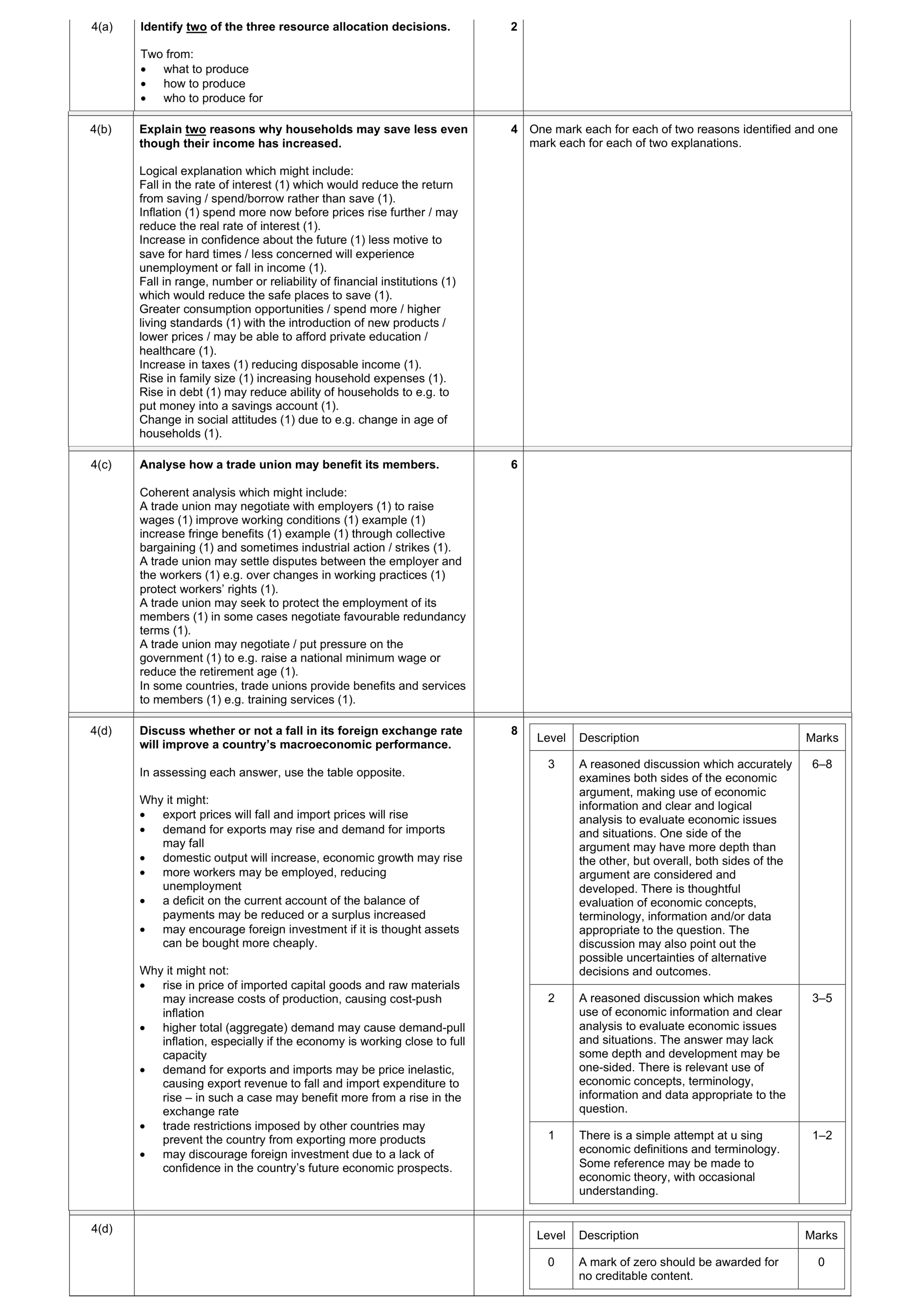 20
20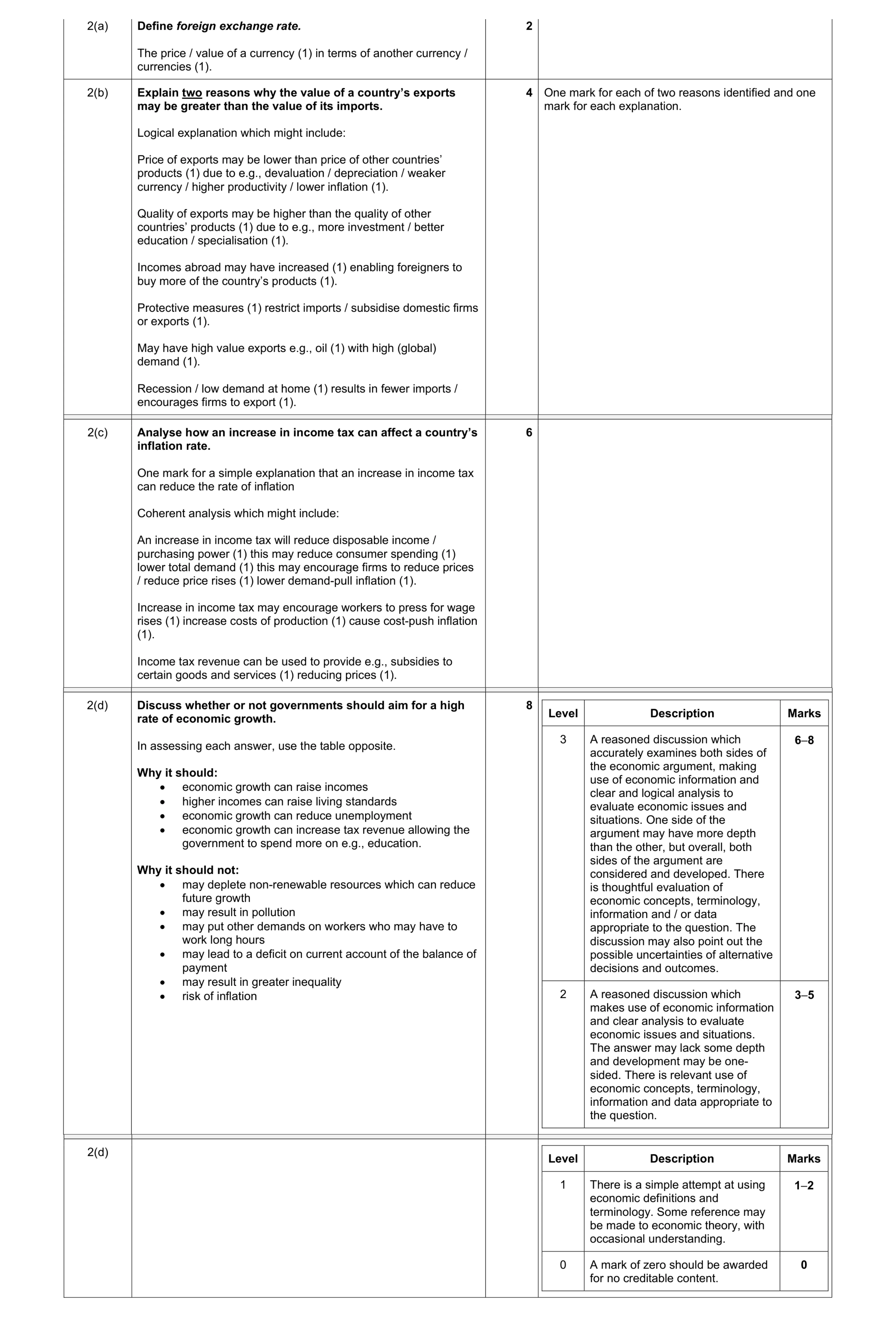 20
20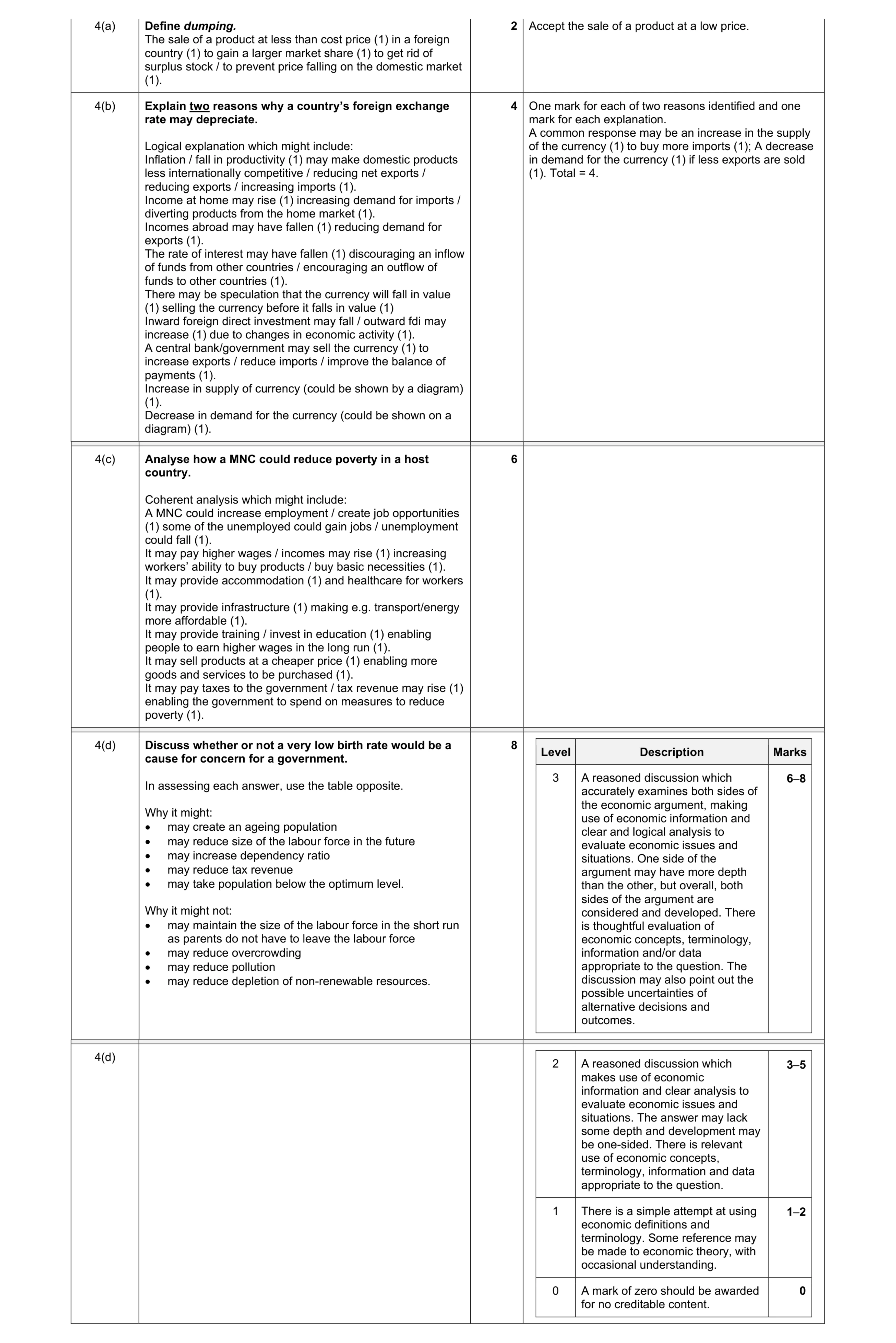 20
20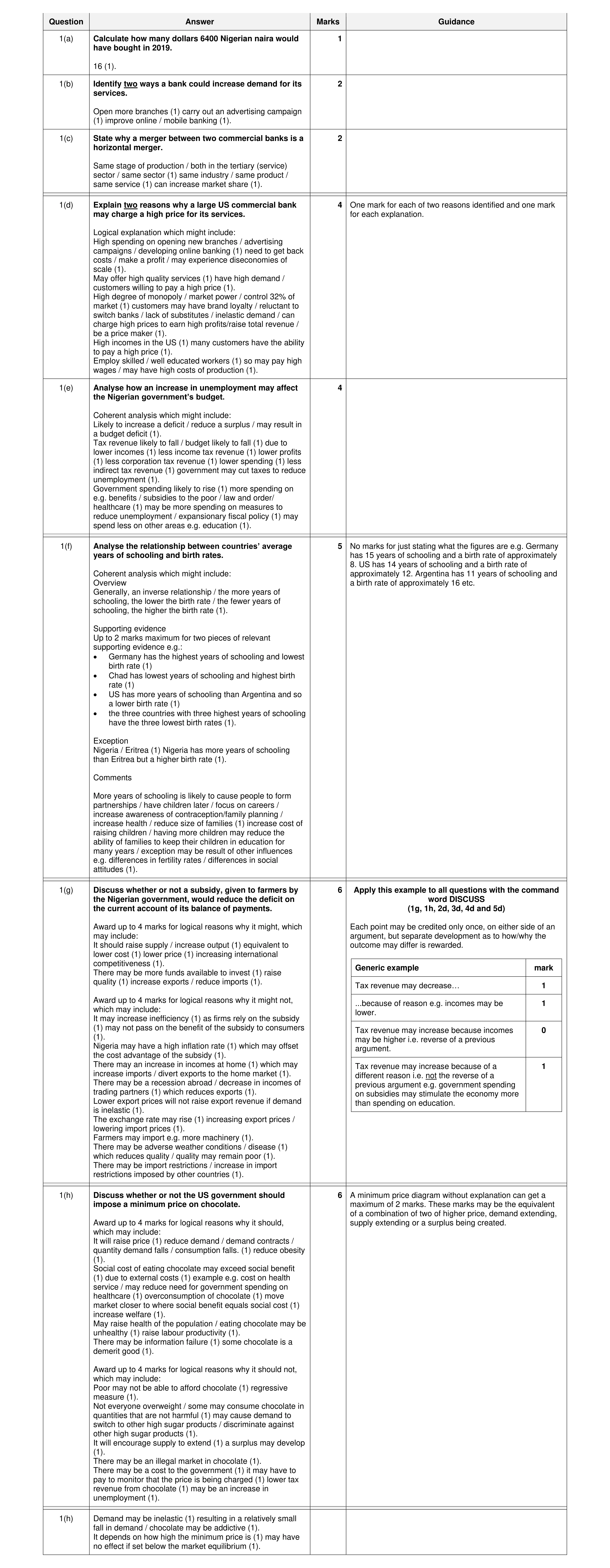 30
30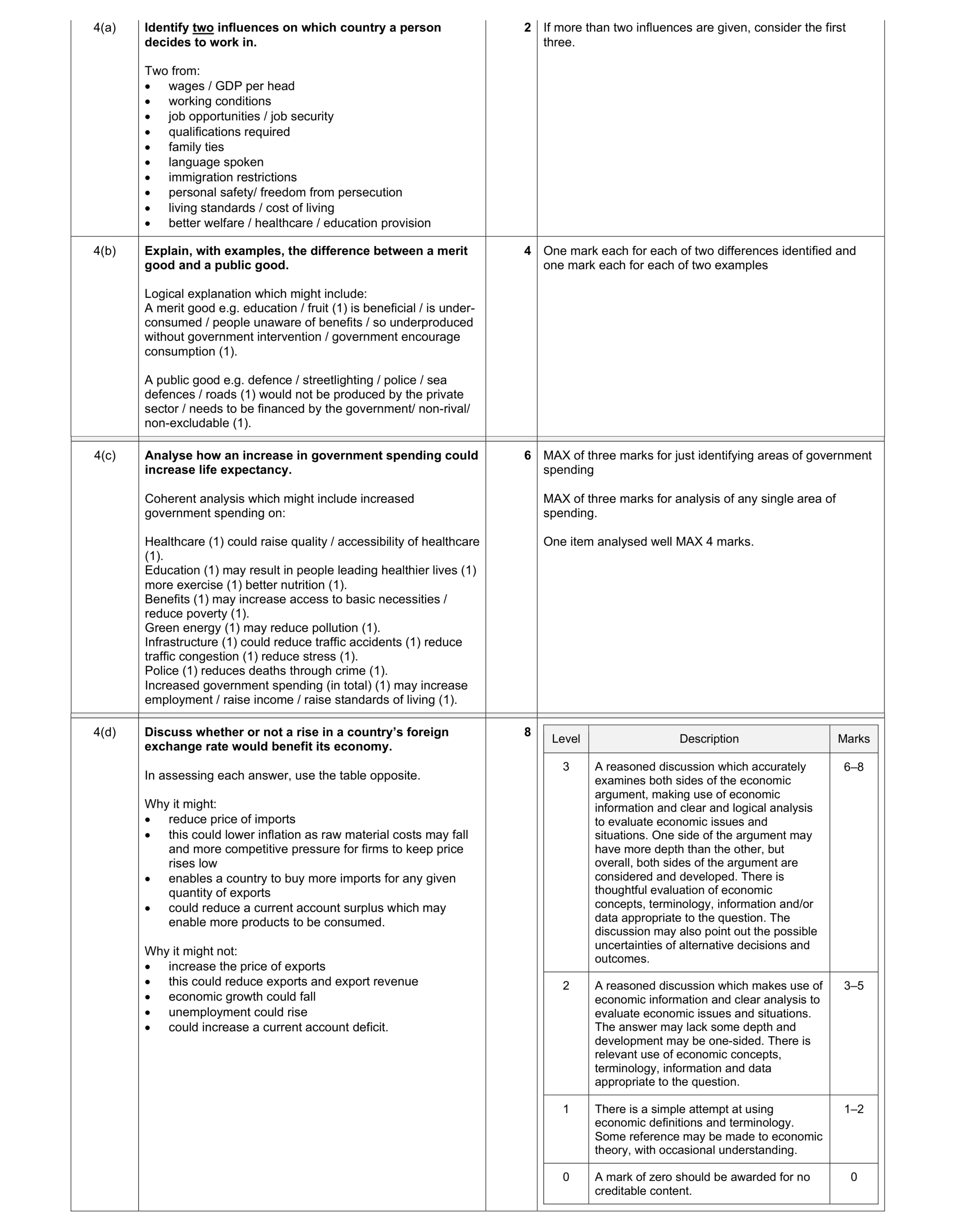 20
20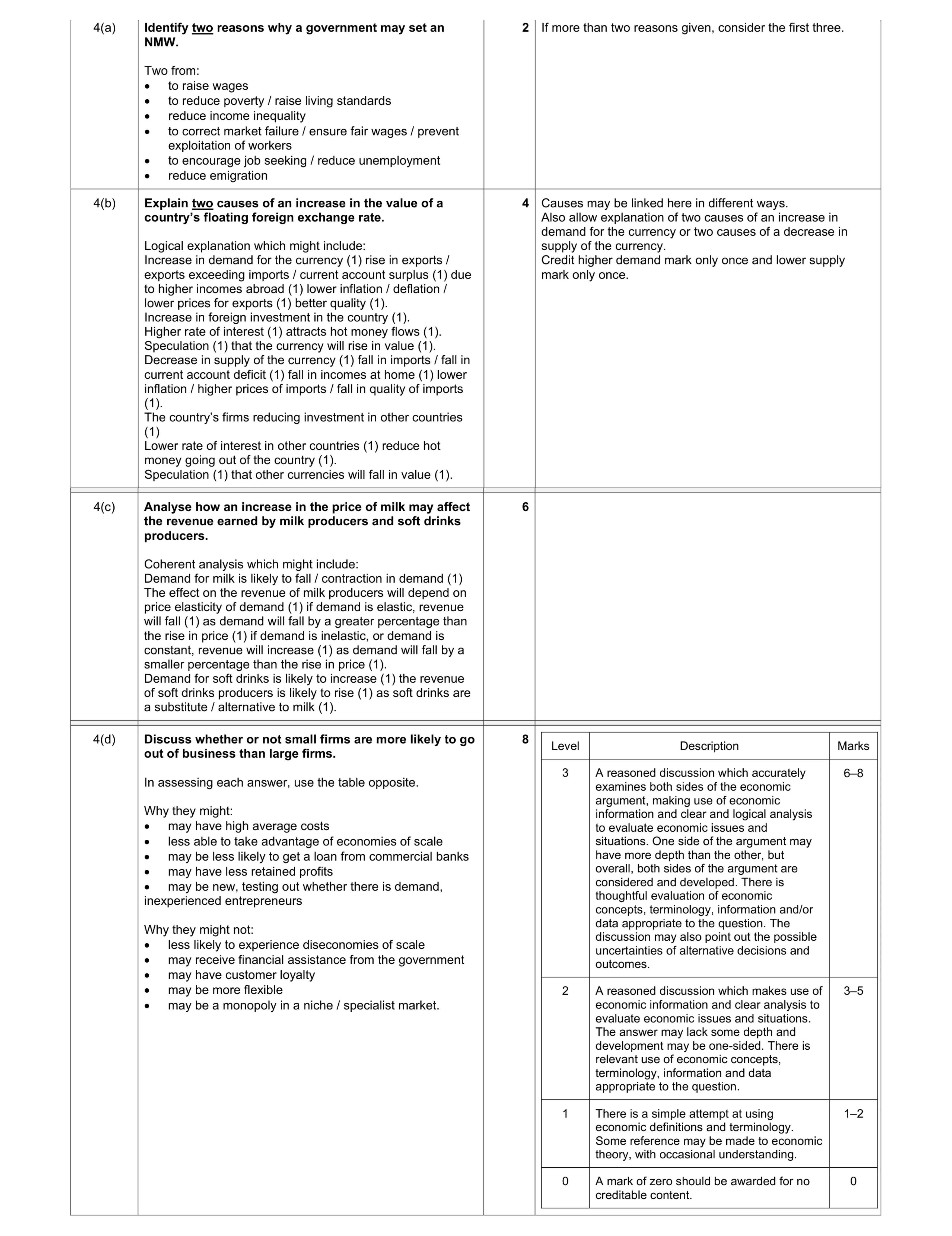 20
20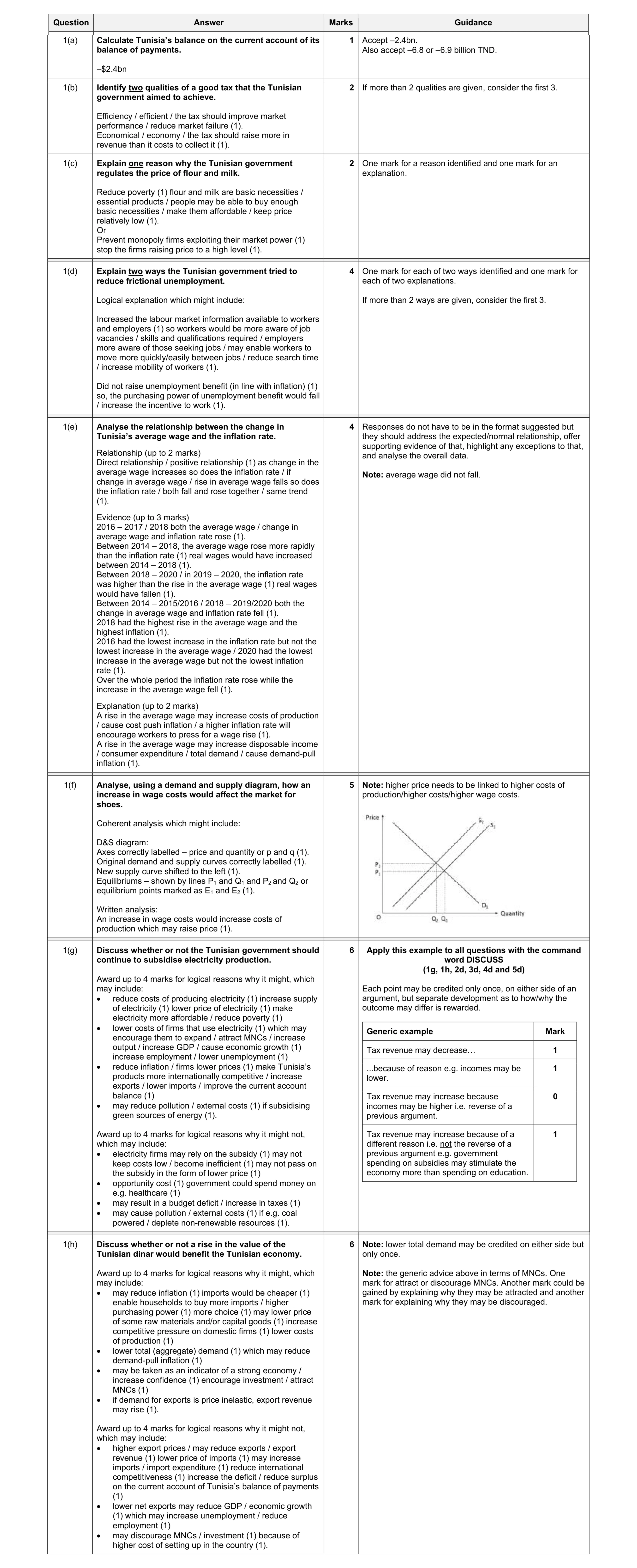 30
30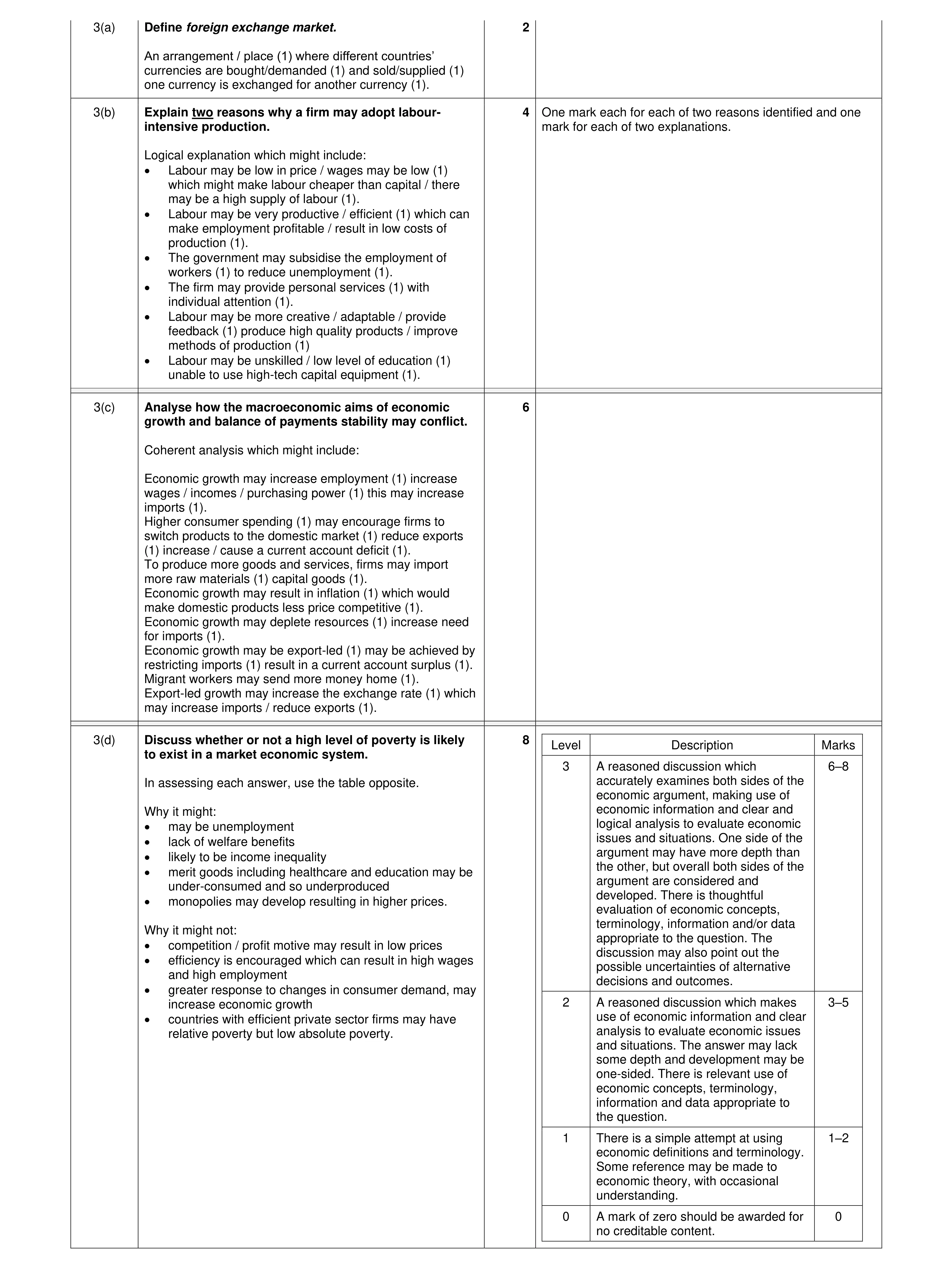 20
20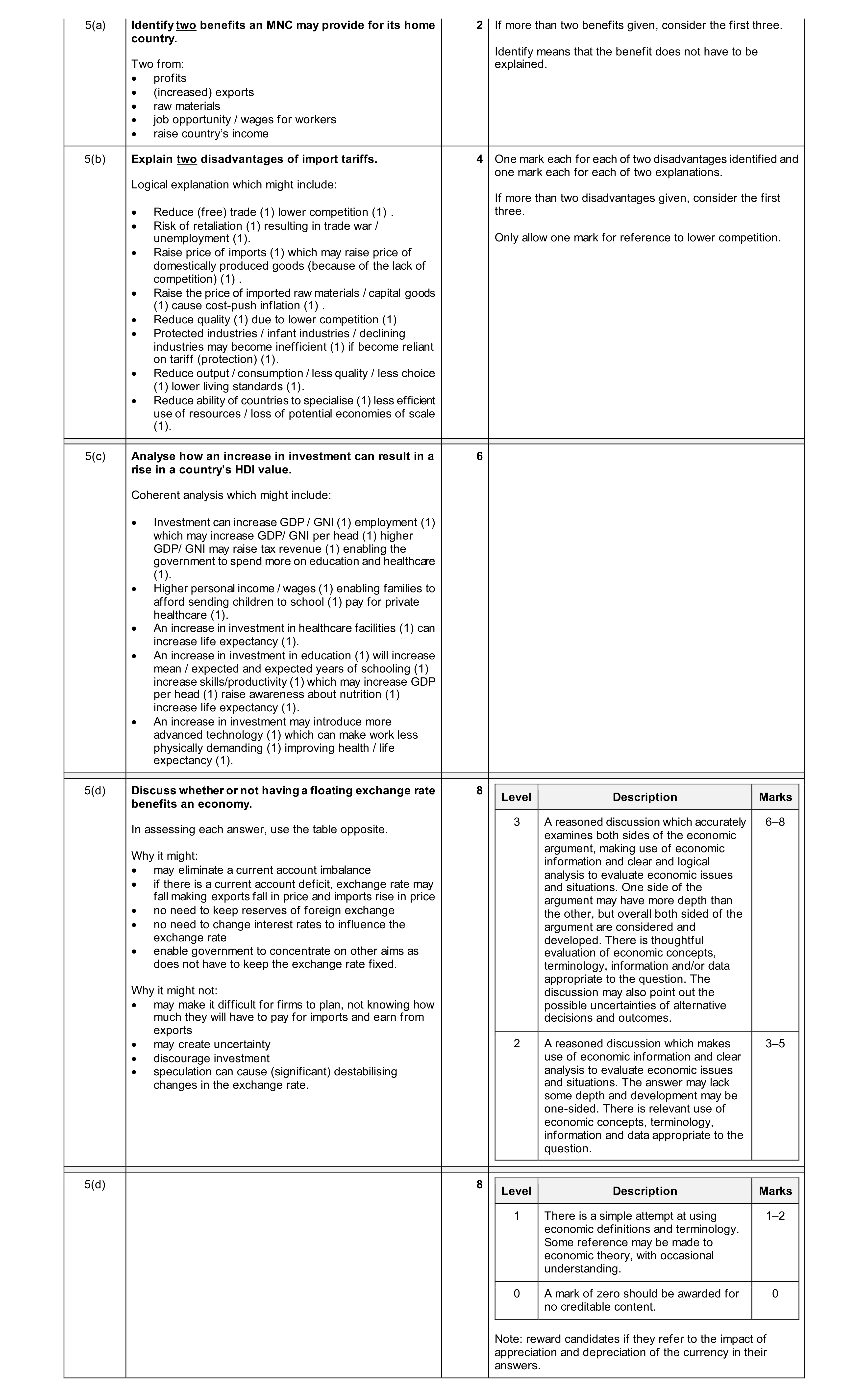 20
20