Cambridge IGCSE Economics (9-1) 0987 — 2024 Oct/Nov Paper 2 · Variant 2
0987/22/O/N/24 · 5 questions · 90 marks · ≈101 min
The question paper and its mark scheme, free to read here and free to download. This is Cambridge’s own paper, exactly as it was sat.
Question paper8 pages





Mark scheme25 pages
Answers below. Sit the paper first if you are practising.





Questions as text
Q1 · Calculate the percentage of the Jordanian labour force employed in the secondary sector
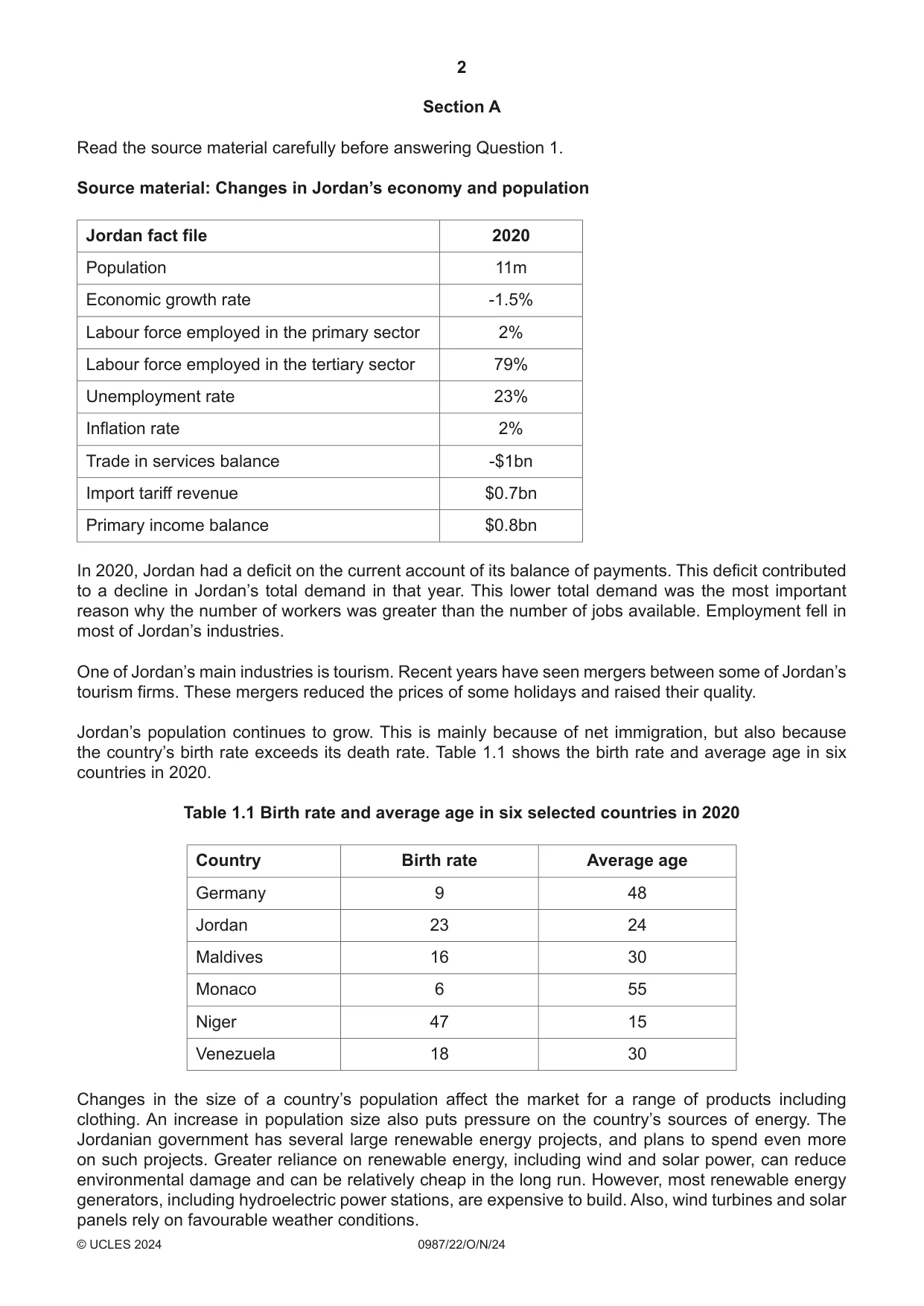
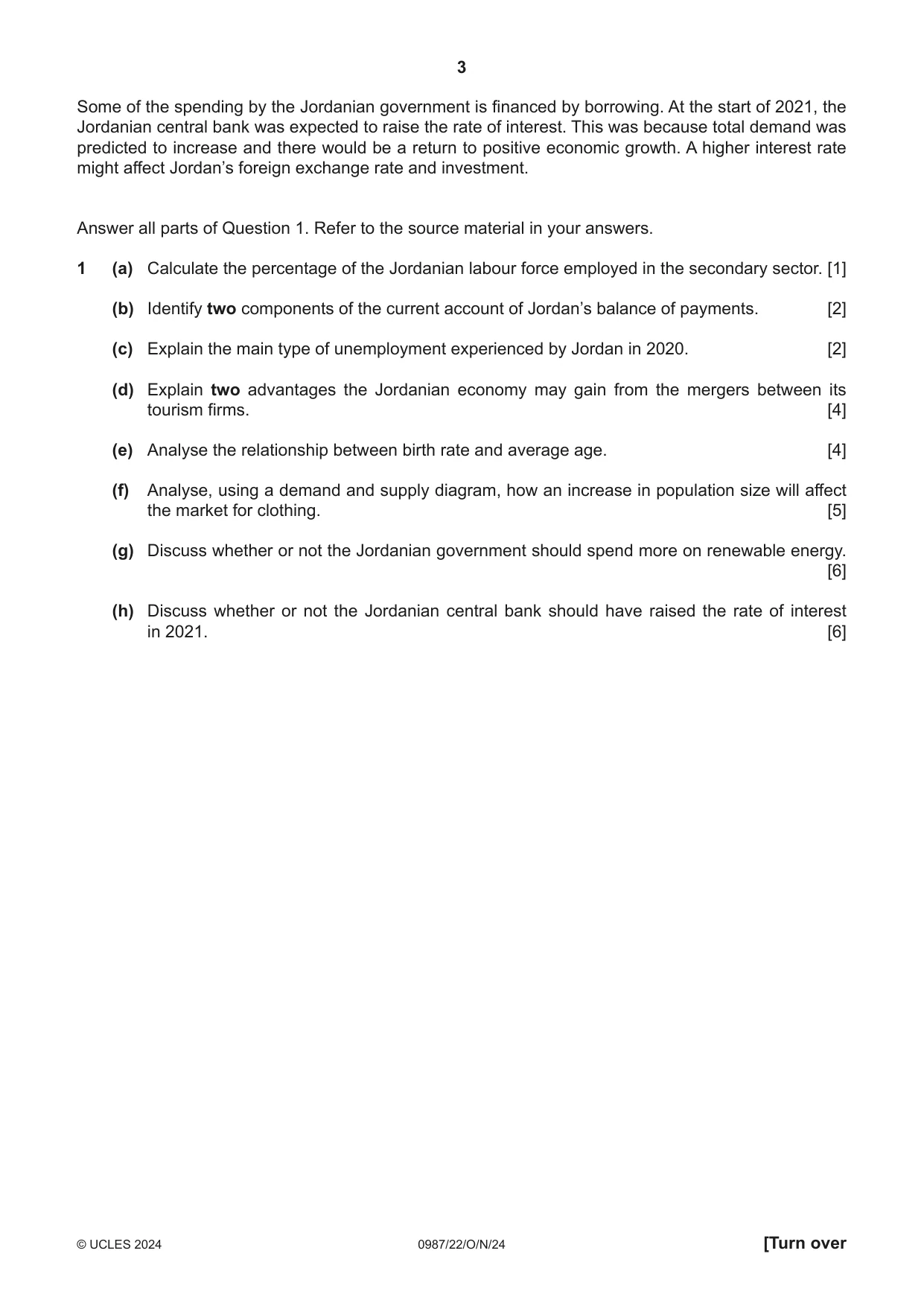
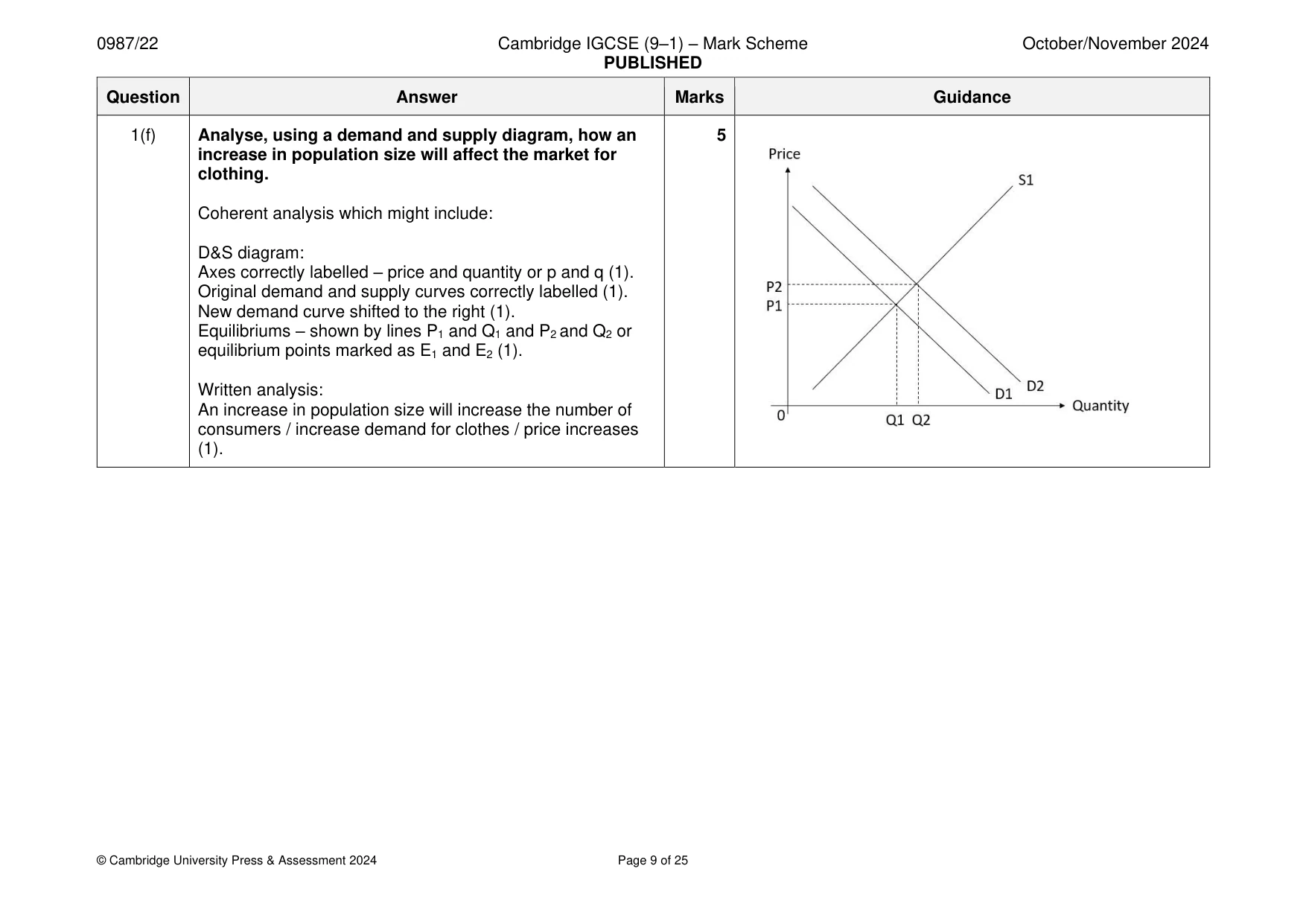
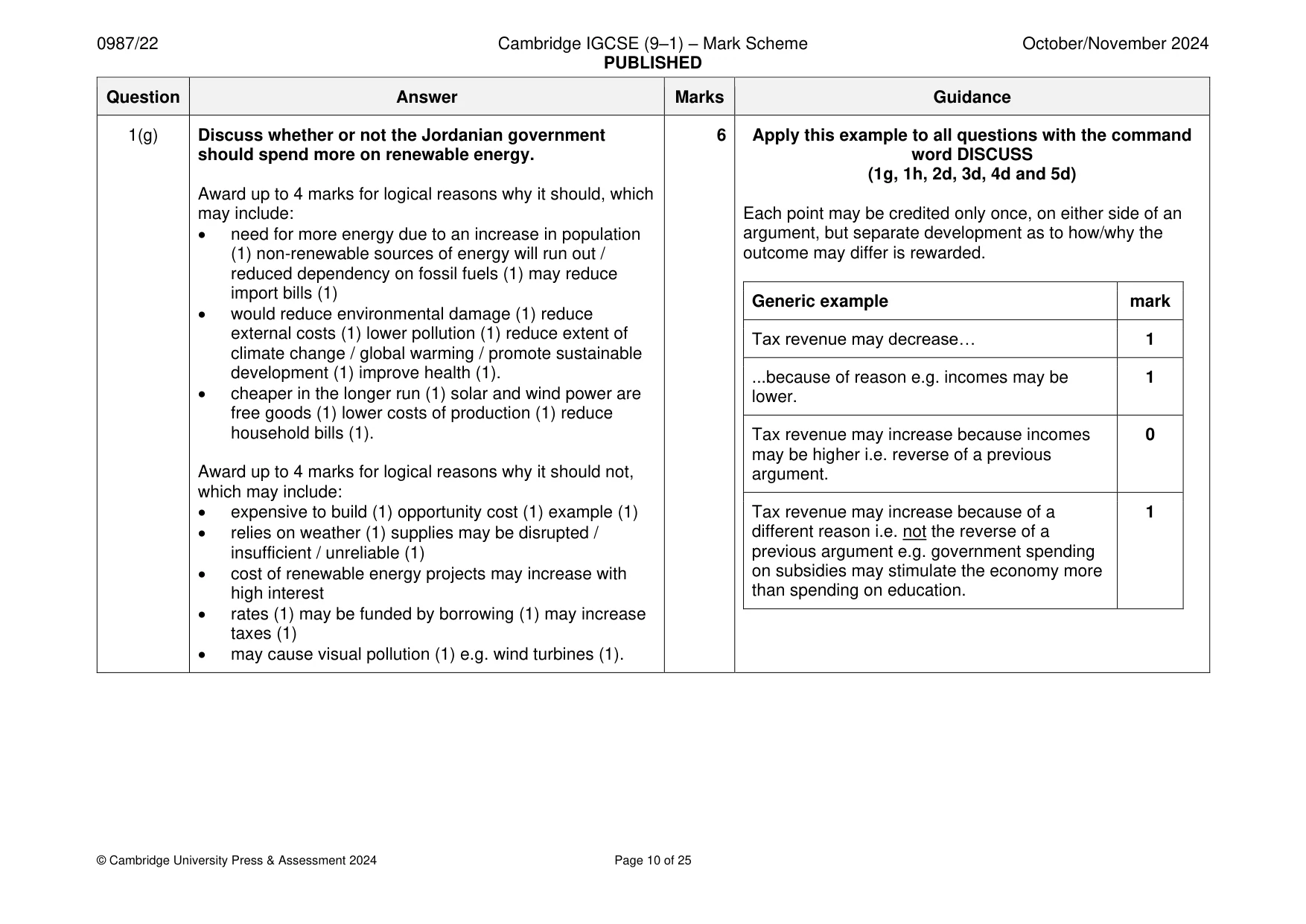
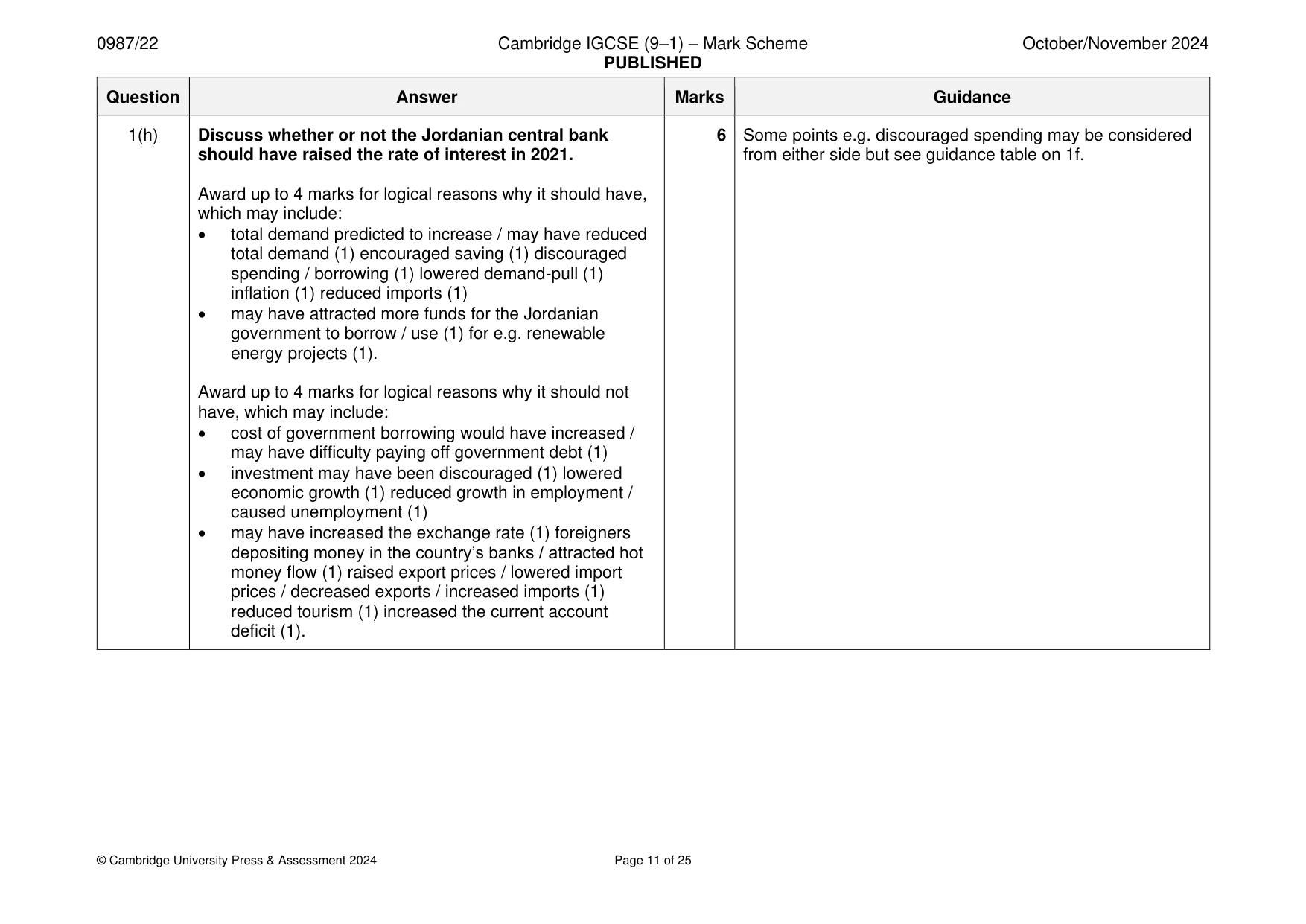
1 (a) Calculate the percentage of the Jordanian labour force employed in the secondary sector. [1] (b) Identify two components of the current account of Jordan’s balance of payments. [2] (c) Explain the main type of unemployment experienced by Jordan in 2020. [2] (d) Explain two advantages the Jordanian economy may gain from the mergers between its tourism firms. [4] (e) Analyse the relationship between birth rate and average age. [4] (f) Analyse, using a demand and supply diagram, how an increase in population size will affect the market for clothing. [5] (g) Discuss whether or not the Jordanian government should spend more on renewable energy. [6] (h) Discuss whether or not the Jordanian central bank should have raised the rate of interest in 2021. [6]
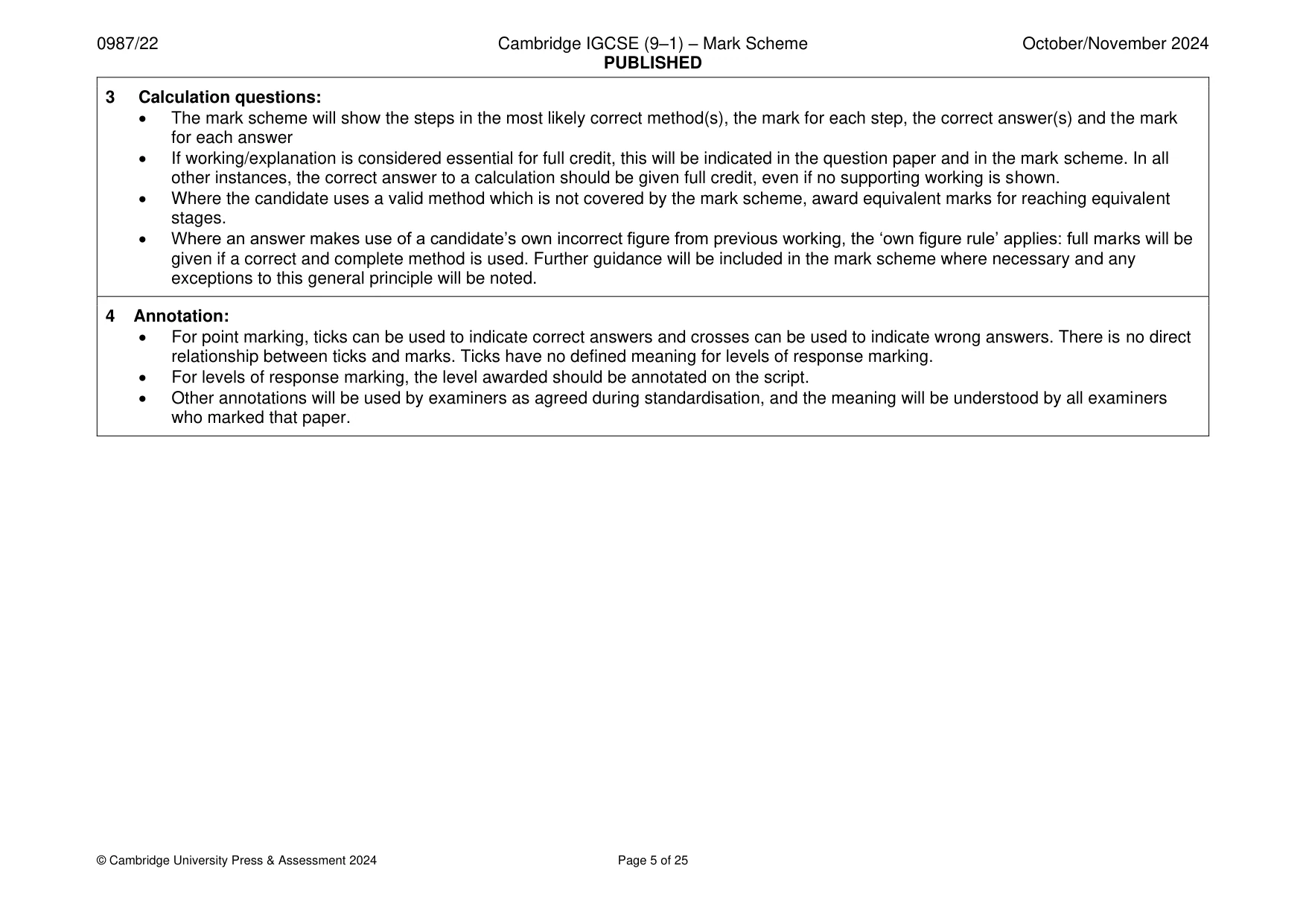
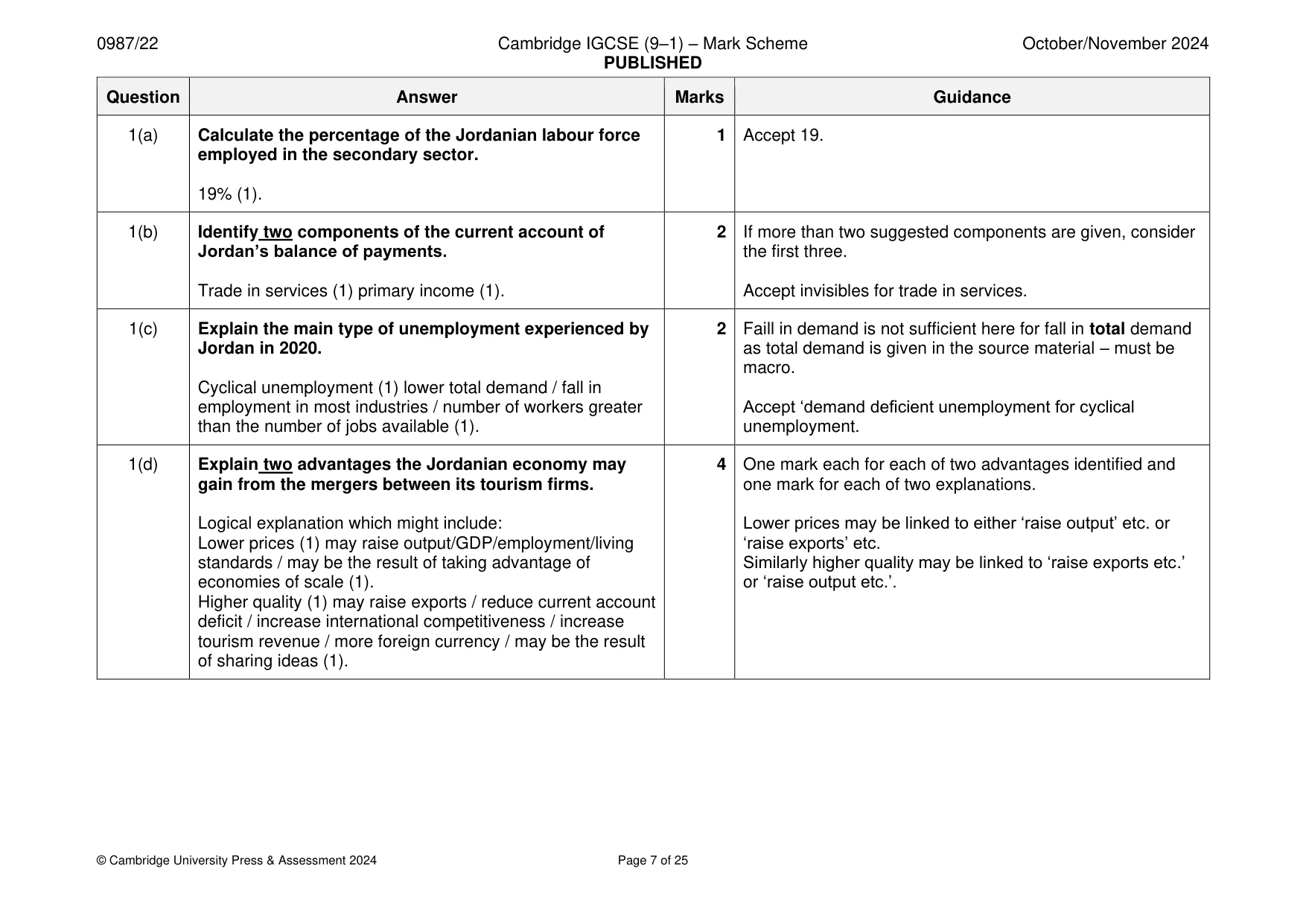
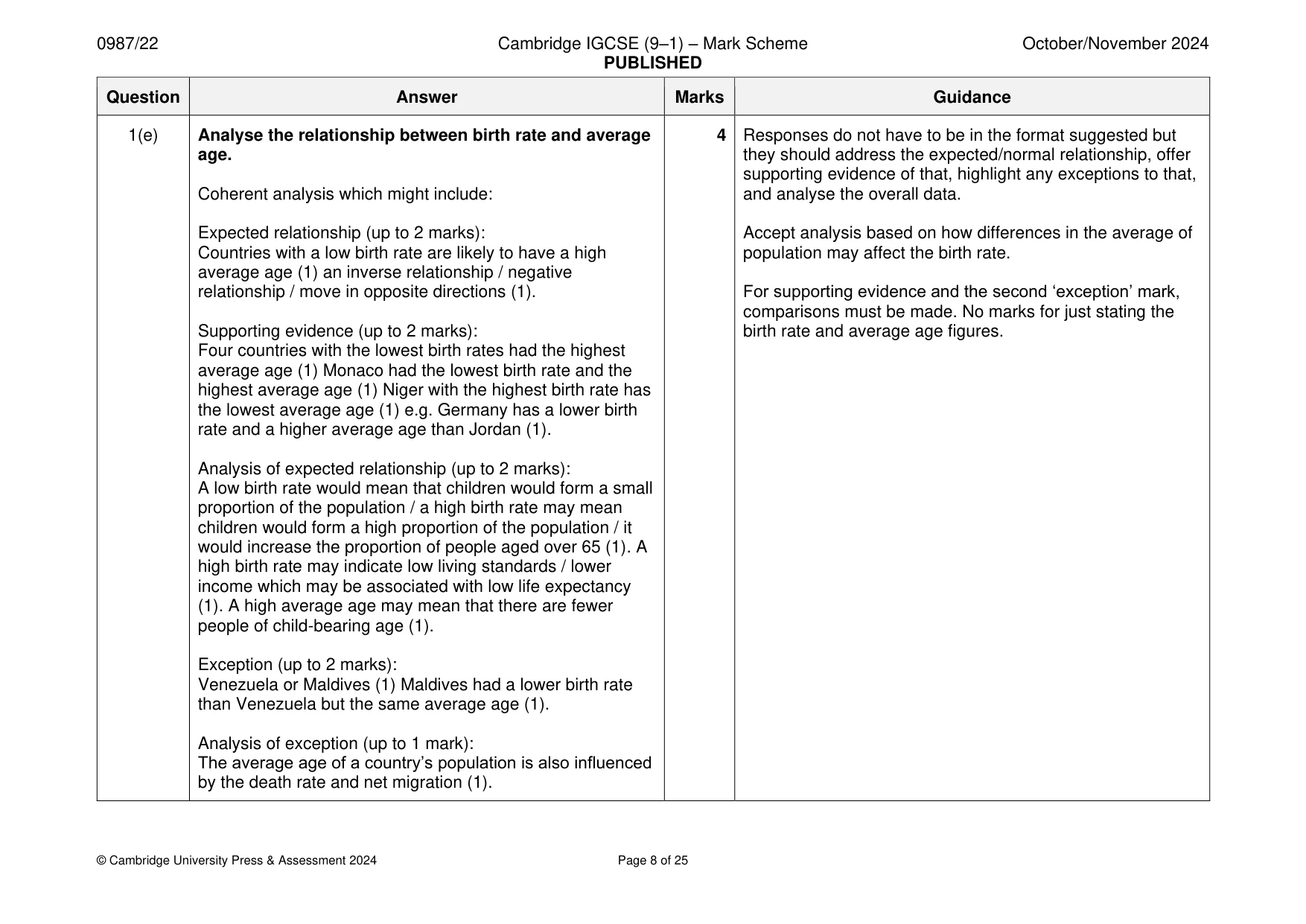
Mark scheme: Question Answer Marks Guidance 1(a) Calculate the percentage of the Jordanian labour force 1 Accept 19. employed in the secondary sector. 19% (1). 1(b) Identify two components of the current account of 2 If more than two suggested components are given, consider Jordan’s balance of payments. the first three. Trade in services (1) primary income (1). Accept invisibles for trade in services. 1(c) Explain the main type of unemployment experienced by 2 Faill in demand is not sufficient here for fall in total demand Jordan in 2020. as total demand is given in the source material – must be macro. Cyclical unemployment (1) lower total demand / fall in employment in most industries / number of workers greater Accept ‘demand deficient unemployment for cyclical than the number of jobs available (1). unemployment. 1(d) Explain two advantages the Jordanian economy may 4 One mark each for each of two advantages identified and gain from the mergers between its tourism firms. one mark for each of two explanations. Logical explanation which might include: Lower prices may be linked to either ‘raise output’ etc. or Lower prices (1) may raise output/GDP/employment/living ‘raise exports’ etc. standards / may be the result of taking advantage of Similarly higher quality may be linked to ‘raise exports etc.’ economies of scale (1). or ‘raise output etc.’. Higher quality (1) may raise exports / reduce current account deficit / increase international competitiveness / increase tourism revenue / more foreign currency / may be the result of sharing ideas (1). 1(e) Analyse the relationship between birth rate and average 4 Responses do not have to be in the format suggested but age. they should address the expected/normal relationship, offer supporting evidence of that, highlight any exceptions to that, Coherent analysis which might include: and analyse the overall data. Expected relationship (up to 2 marks): Accept analysis based on how differences in the average of Countries with a low birth rate are likely to have a high population may affect the birth rate. average age (1) an inverse relationship / negative relationship / move in opposite directions (1). For supporting evidence and the second ‘exception’ mark, comparisons must be made. No marks for just stating the Supporting evidence (up to 2 marks): birth rate and average age figures. Four countries with the lowest birth rates had the highest average age (1) Monaco had the lowest birth rate and the highest average age (1) Niger with the highest birth rate has the lowest average age (1) e.g. Germany has a lower birth rate and a higher average age than Jordan (1). Analysis of expected relationship (up to 2 marks): A low birth rate would mean that children would form a small proportion of the population / a high birth rate may mean children would form a high proportion of the population / it would increase the proportion of people aged over 65 (1). A high birth rate may indicate low living standards / lower income which may be associated with low life expectancy (1). A high average age may mean that there are fewer people of child-bearing age (1). Exception (up to 2 marks): Venezuela or Maldives (1) Maldives had a lower birth rate than Venezuela but the same average age (1). Analysis of exception (up to 1 mark): The average age of a country’s population is also influenced by the death rate and net migration (1). 1(f) Analyse, using a demand and supply diagram, how an 5 increase in population size will affect the market for clothing. Coherent analysis which might include: D&S diagram: Axes correctly labelled – price and quantity or p and q (1). Original demand and supply curves correctly labelled (1). New demand curve shifted to the right (1). Equilibriums – shown by lines P1 and Q1 and P2 and Q2 or equilibrium points marked as E1 and E2 (1). Written analysis: An increase in population size will increase the number of consumers / increase demand for clothes / price increases (1). 1(g) Discuss whether or not the Jordanian government 6 Apply this example to all questions with the command should spend more on renewable energy. word DISCUSS (1g, 1h, 2d, 3d, 4d and 5d) Award up to 4 marks for logical reasons why it should, which may include: Each point may be credited only once, on either side of an • need for more energy due to an increase in population argument, but separate development as to how/why the (1) non-renewable sources of energy will run out / outcome may differ is rewarded. reduced dependency on fossil fuels (1) may reduce import bills (1) Generic example mark • would reduce environmental damage (1) reduce external costs (1) lower pollution (1) reduce extent of Tax revenue may decrease… 1 climate change / global warming / promote sustainable development (1) improve health (1). ...because of reason e.g. incomes may be 1 • cheaper in the longer run (1) solar and wind power are lower. free goods (1) lower costs of production (1) reduce household bills (1). Tax revenue may increase because incomes 0 may be higher i.e. reverse of a previous Award up to 4 marks for logical reasons why it should not, argument. which may include: • expensive to build (1) opportunity cost (1) example (1) Tax revenue may increase because of a 1 • relies on weather (1) supplies may be disrupted / different reason i.e. not the reverse of a insufficient / unreliable (1) previous argument e.g. government spending • cost of renewable energy projects may increase with on subsidies may stimulate the economy more high interest than spending on education. • rates (1) may be funded by borrowing (1) may increase taxes (1) • may cause visual pollution (1) e.g. wind turbines (1). 1(h) Discuss whether or not the Jordanian central bank 6 Some points e.g. discouraged spending may be considered should have raised the rate of interest in 2021. from either side but see guidance table on 1f. Award up to 4 marks for logical reasons why it should have, which may include: • total demand predicted to increase / may have reduced total demand (1) encouraged saving (1) discouraged spending / borrowing (1) lowered demand-pull (1) inflation (1) reduced imports (1) • may have attracted more funds for the Jordanian government to borrow / use (1) for e.g. renewable energy projects (1). Award up to 4 marks for logical reasons why it should not have, which may include: • cost of government borrowing would have increased / may have difficulty paying off government debt (1) • investment may have been discouraged (1) lowered economic growth (1) reduced growth in employment / caused unemployment (1) • may have increased the exchange rate (1) foreigners depositing money in the country’s banks / attracted hot money flow (1) raised export prices / lowered import prices / decreased exports / increased imports (1) reduced tourism (1) increased the current account deficit (1).
Q2 · In 2021, the production point on the UK’s production possibility curve (PPC) changed
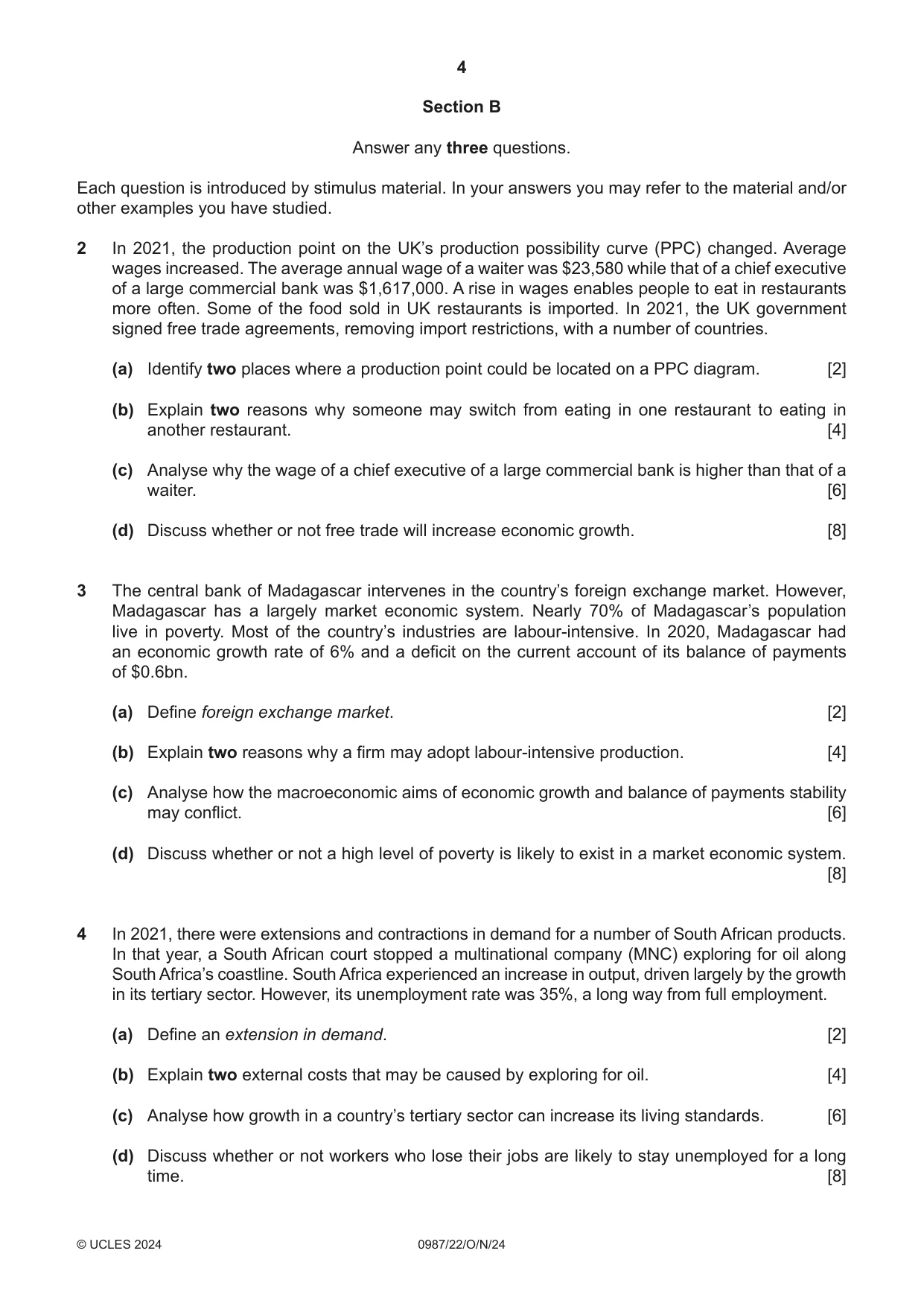
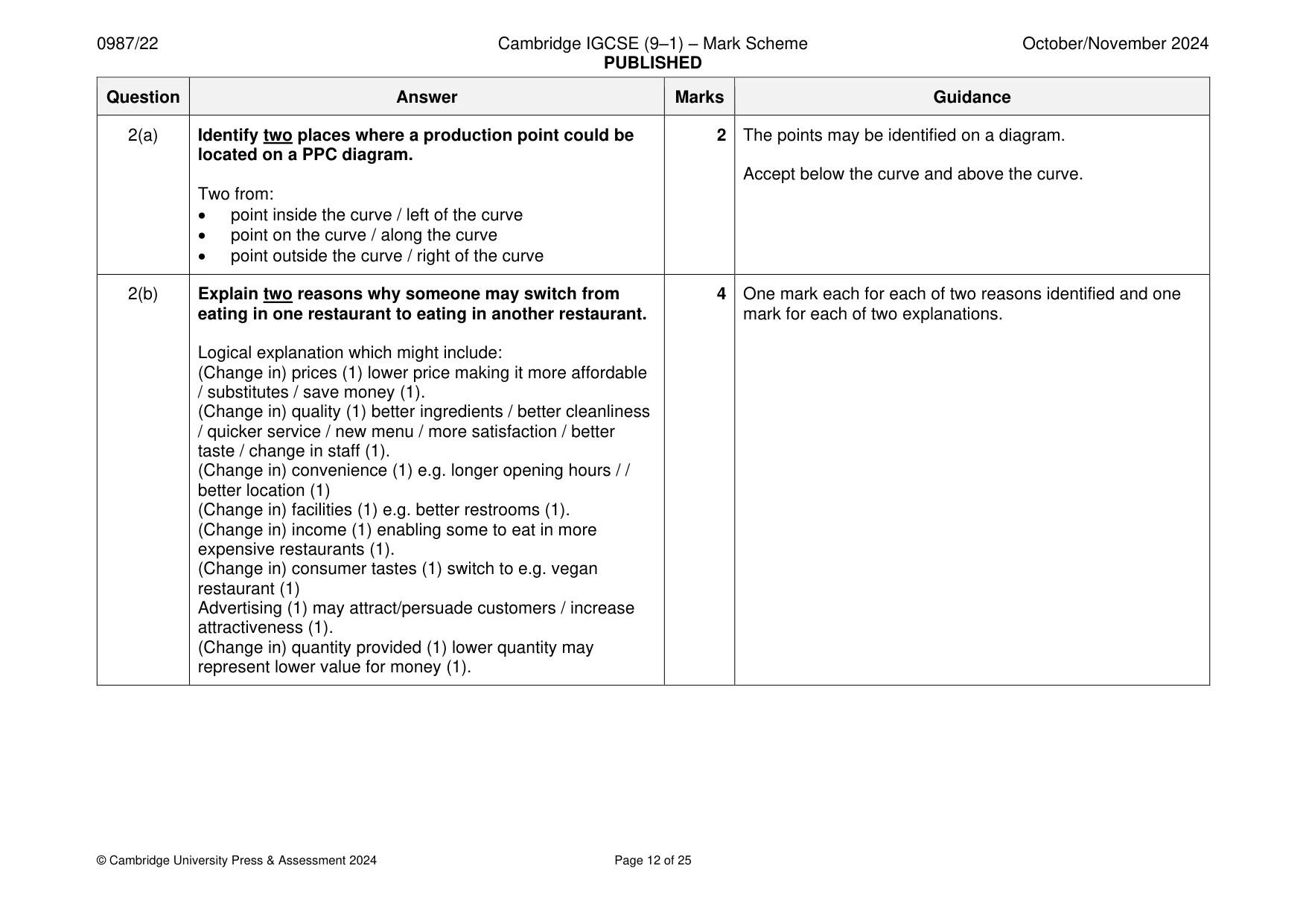
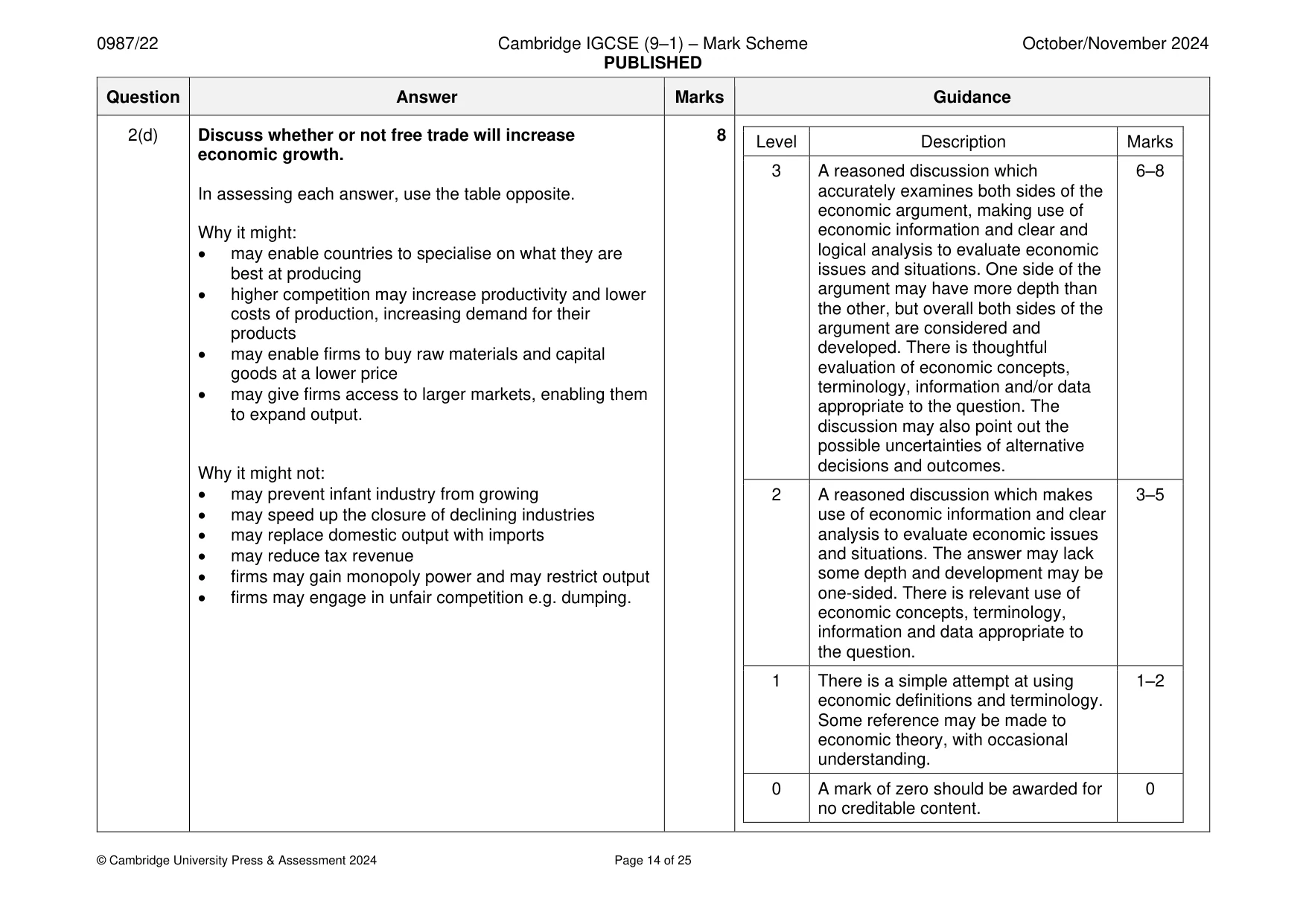
2 In 2021, the production point on the UK’s production possibility curve (PPC) changed. Average wages increased. The average annual wage of a waiter was $23,580 while that of a chief executive of a large commercial bank was $1,617,000. A rise in wages enables people to eat in restaurants more often. Some of the food sold in UK restaurants is imported. In 2021, the UK government signed free trade agreements, removing import restrictions, with a number of countries. (a) Identify two places where a production point could be located on a PPC diagram. [2] (b) Explain two reasons why someone may switch from eating in one restaurant to eating in another restaurant. [4] (c) Analyse why the wage of a chief executive of a large commercial bank is higher than that of a waiter. [6] (d) Discuss whether or not free trade will increase economic growth. [8]
Mark scheme: 2(a) Identify two places where a production point could be 2 The points may be identified on a diagram. located on a PPC diagram. Accept below the curve and above the curve. Two from: • point inside the curve / left of the curve • point on the curve / along the curve • point outside the curve / right of the curve 2(b) Explain two reasons why someone may switch from 4 One mark each for each of two reasons identified and one eating in one restaurant to eating in another restaurant. mark for each of two explanations. Logical explanation which might include: (Change in) prices (1) lower price making it more affordable / substitutes / save money (1). (Change in) quality (1) better ingredients / better cleanliness / quicker service / new menu / more satisfaction / better taste / change in staff (1). (Change in) convenience (1) e.g. longer opening hours / / better location (1) (Change in) facilities (1) e.g. better restrooms (1). (Change in) income (1) enabling some to eat in more expensive restaurants (1). (Change in) consumer tastes (1) switch to e.g. vegan restaurant (1) Advertising (1) may attract/persuade customers / increase attractiveness (1). (Change in) quantity provided (1) lower quantity may represent lower value for money (1). 2(c) Analyse why the wage of a chief executive of a large 6 Note: may also be answered from the point of view why the commercial bank is higher than that of a waiter. wage of a waiter may be lower than that of a chief executive. Coherent analysis which might include: No marks here for banks may be more profitable than restaurants as e.g. a cleaner in a bank may have a lower Chief executive may be more qualified / more educated (1) wage than a waiter. received more training (1) more skilled / talented (1) more productive (1) more experienced (1) higher level of responsibility / higher level of stress / more demanding job (1) in shorter supply / harder to replace (1) more inelastic supply (1). Chief executive may be in higher demand (1) more inelastic demand (1). Chief executive may have stronger bargaining power (1) may be more likely to be in a trade union / professional body (1). May be less likely to be in a group that is discriminated against (1) e.g. migrant workers (1). Chief executive may work longer hours (1). 2(d) Discuss whether or not free trade will increase 8 Level Description Marks economic growth. 3 A reasoned discussion which 6–8 In assessing each answer, use the table opposite. accurately examines both sides of the economic argument, making use of Why it might: economic information and clear and • may enable countries to specialise on what they are logical analysis to evaluate economic best at producing issues and situations. One side of the • higher competition may increase productivity and lower argument may have more depth than the other, but overall both sides of the costs of production, increasing demand for their argument are considered and products developed. There is thoughtful • may enable firms to buy raw materials and capital evaluation of economic concepts, goods at a lower price terminology, information and/or data • may give firms access to larger markets, enabling them appropriate to the question. The to expand output. discussion may also point out the possible uncertainties of alternative decisions and outcomes. Why it might not: • may prevent infant industry from growing 2 A reasoned discussion which makes 3–5 • may speed up the closure of declining industries use of economic information and clear • may replace domestic output with imports analysis to evaluate economic issues • may reduce tax revenue and situations. The answer may lack • firms may gain monopoly power and may restrict output some depth and development may be • firms may engage in unfair competition e.g. dumping. one-sided. There is relevant use of economic concepts, terminology, information and data appropriate to the question. 1 There is a simple attempt at using 1–2 economic definitions and terminology. Some reference may be made to economic theory, with occasional understanding. 0 A mark of zero should be awarded for 0 no creditable content.
Q3 · The central bank of Madagascar intervenes in the country’s foreign exchange market
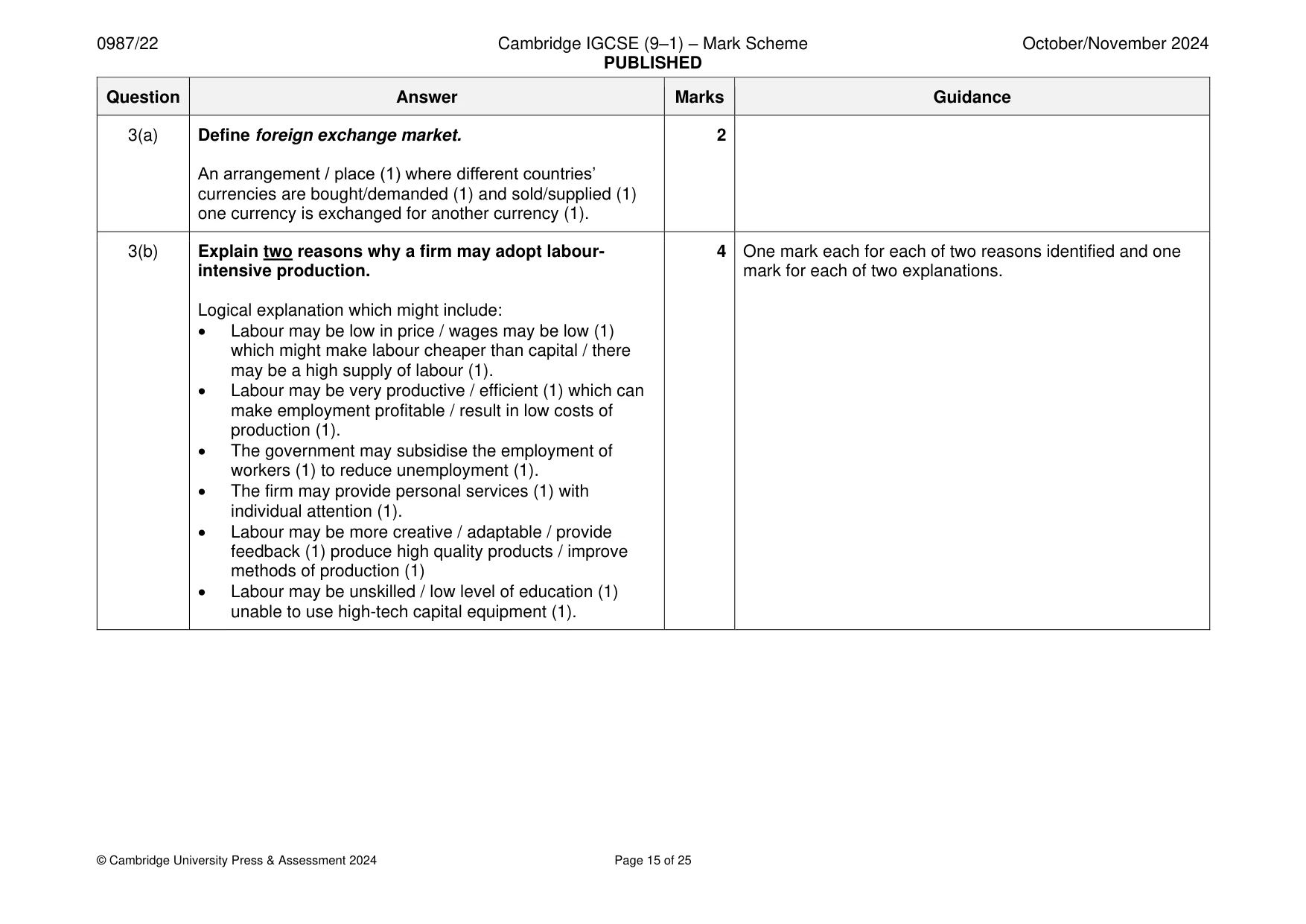
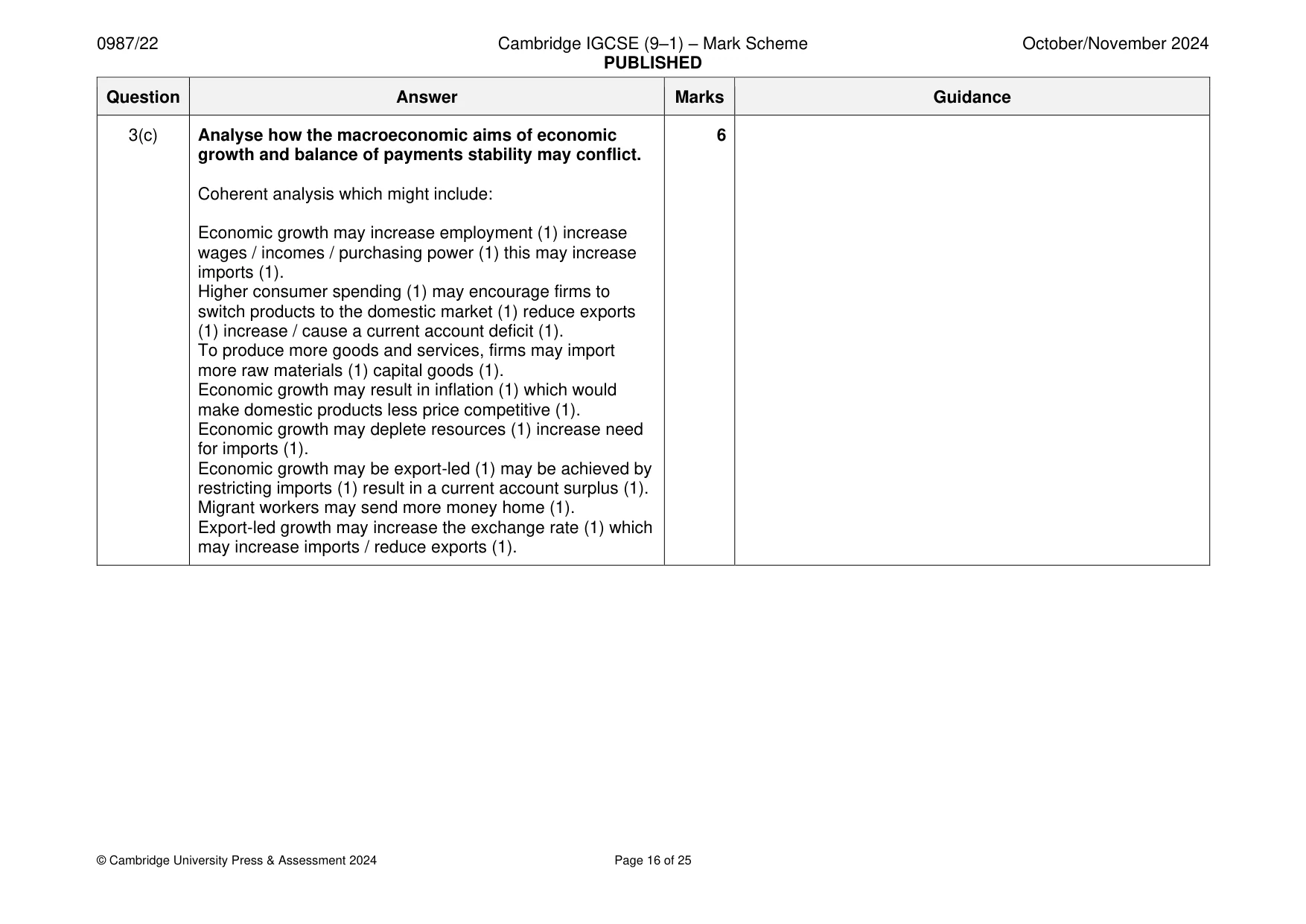
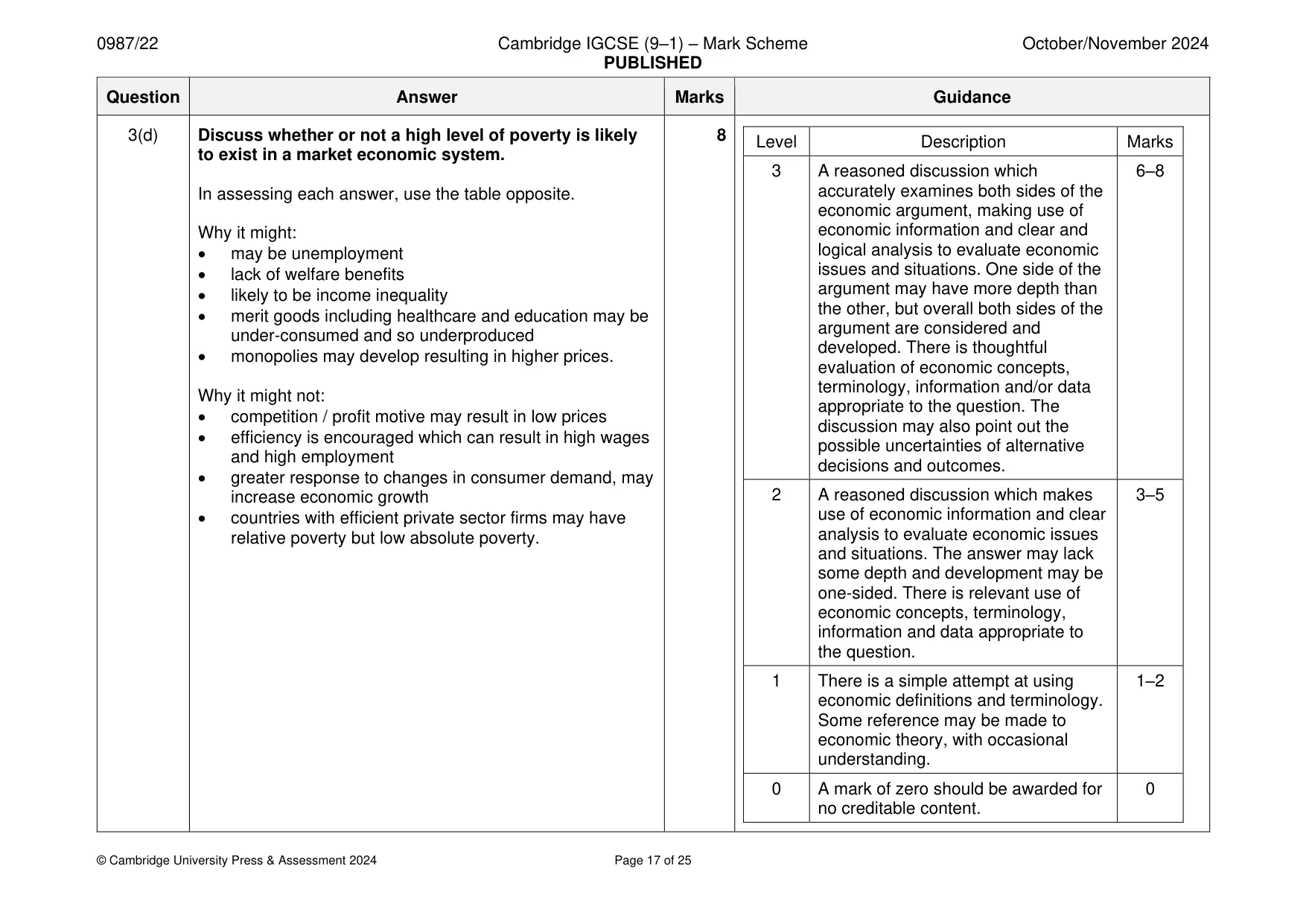
3 The central bank of Madagascar intervenes in the country’s foreign exchange market. However, Madagascar has a largely market economic system. Nearly 70% of Madagascar’s population live in poverty. Most of the country’s industries are labour-intensive. In 2020, Madagascar had an economic growth rate of 6% and a deficit on the current account of its balance of payments of $0.6bn. (a) Define foreign exchange market. [2] (b) Explain two reasons why a firm may adopt labour-intensive production. [4] (c) Analyse how the macroeconomic aims of economic growth and balance of payments stability may conflict. [6] (d) Discuss whether or not a high level of poverty is likely to exist in a market economic system. [8]
Mark scheme: 3(a) Define foreign exchange market. 2 An arrangement / place (1) where different countries’ currencies are bought/demanded (1) and sold/supplied (1) one currency is exchanged for another currency (1). 3(b) Explain two reasons why a firm may adopt labour- 4 One mark each for each of two reasons identified and one intensive production. mark for each of two explanations. Logical explanation which might include: • Labour may be low in price / wages may be low (1) which might make labour cheaper than capital / there may be a high supply of labour (1). • Labour may be very productive / efficient (1) which can make employment profitable / result in low costs of production (1). • The government may subsidise the employment of workers (1) to reduce unemployment (1). • The firm may provide personal services (1) with individual attention (1). • Labour may be more creative / adaptable / provide feedback (1) produce high quality products / improve methods of production (1) • Labour may be unskilled / low level of education (1) unable to use high-tech capital equipment (1). 3(c) Analyse how the macroeconomic aims of economic 6 growth and balance of payments stability may conflict. Coherent analysis which might include: Economic growth may increase employment (1) increase wages / incomes / purchasing power (1) this may increase imports (1). Higher consumer spending (1) may encourage firms to switch products to the domestic market (1) reduce exports (1) increase / cause a current account deficit (1). To produce more goods and services, firms may import more raw materials (1) capital goods (1). Economic growth may result in inflation (1) which would make domestic products less price competitive (1). Economic growth may deplete resources (1) increase need for imports (1). Economic growth may be export-led (1) may be achieved by restricting imports (1) result in a current account surplus (1). Migrant workers may send more money home (1). Export-led growth may increase the exchange rate (1) which may increase imports / reduce exports (1). 3(d) Discuss whether or not a high level of poverty is likely 8 Level Description Marks to exist in a market economic system. 3 A reasoned discussion which 6–8 In assessing each answer, use the table opposite. accurately examines both sides of the economic argument, making use of Why it might: economic information and clear and • may be unemployment logical analysis to evaluate economic • lack of welfare benefits issues and situations. One side of the argument may have more depth than • likely to be income inequality the other, but overall both sides of the • merit goods including healthcare and education may be argument are considered and under-consumed and so underproduced developed. There is thoughtful • monopolies may develop resulting in higher prices. evaluation of economic concepts, terminology, information and/or data Why it might not: appropriate to the question. The • competition / profit motive may result in low prices discussion may also point out the • efficiency is encouraged which can result in high wages possible uncertainties of alternative and high employment decisions and outcomes. • greater response to changes in consumer demand, may increase economic growth 2 A reasoned discussion which makes 3–5 • countries with efficient private sector firms may have use of economic information and clear relative poverty but low absolute poverty. analysis to evaluate economic issues and situations. The answer may lack some depth and development may be one-sided. There is relevant use of economic concepts, terminology, information and data appropriate to the question. 1 There is a simple attempt at using 1–2 economic definitions and terminology. Some reference may be made to economic theory, with occasional understanding. 0 A mark of zero should be awarded for 0 no creditable content.
Q4 · In 2021, there were extensions and contractions in demand for a number of South African…
4 In 2021, there were extensions and contractions in demand for a number of South African products. In that year, a South African court stopped a multinational company (MNC) exploring for oil along South Africa’s coastline. South Africa experienced an increase in output, driven largely by the growth in its tertiary sector. However, its unemployment rate was 35%, a long way from full employment. (a) Define an extension in demand. [2] (b) Explain two external costs that may be caused by exploring for oil. [4] (c) Analyse how growth in a country’s tertiary sector can increase its living standards. [6] (d) Discuss whether or not workers who lose their jobs are likely to stay unemployed for a long time. [8]
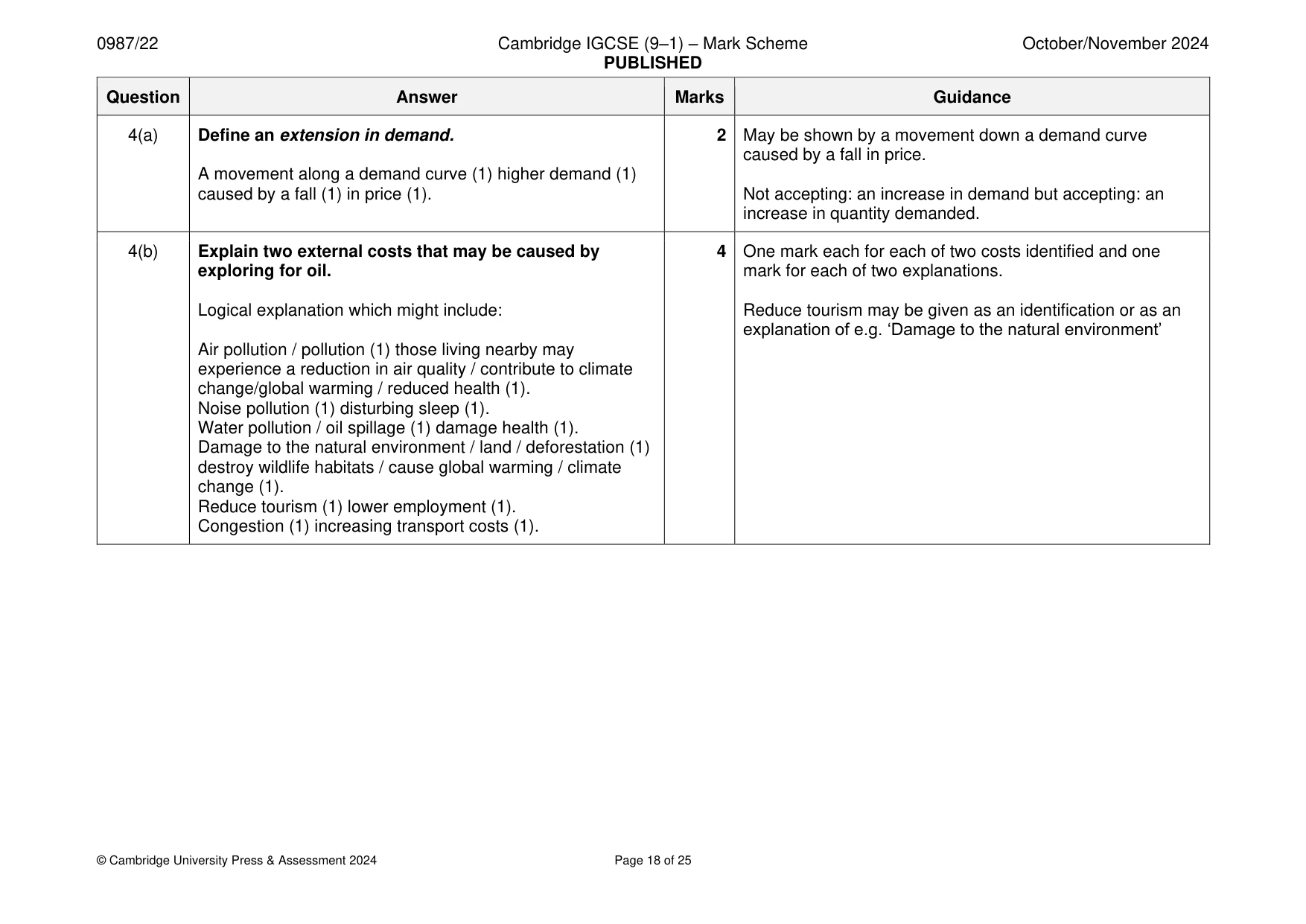
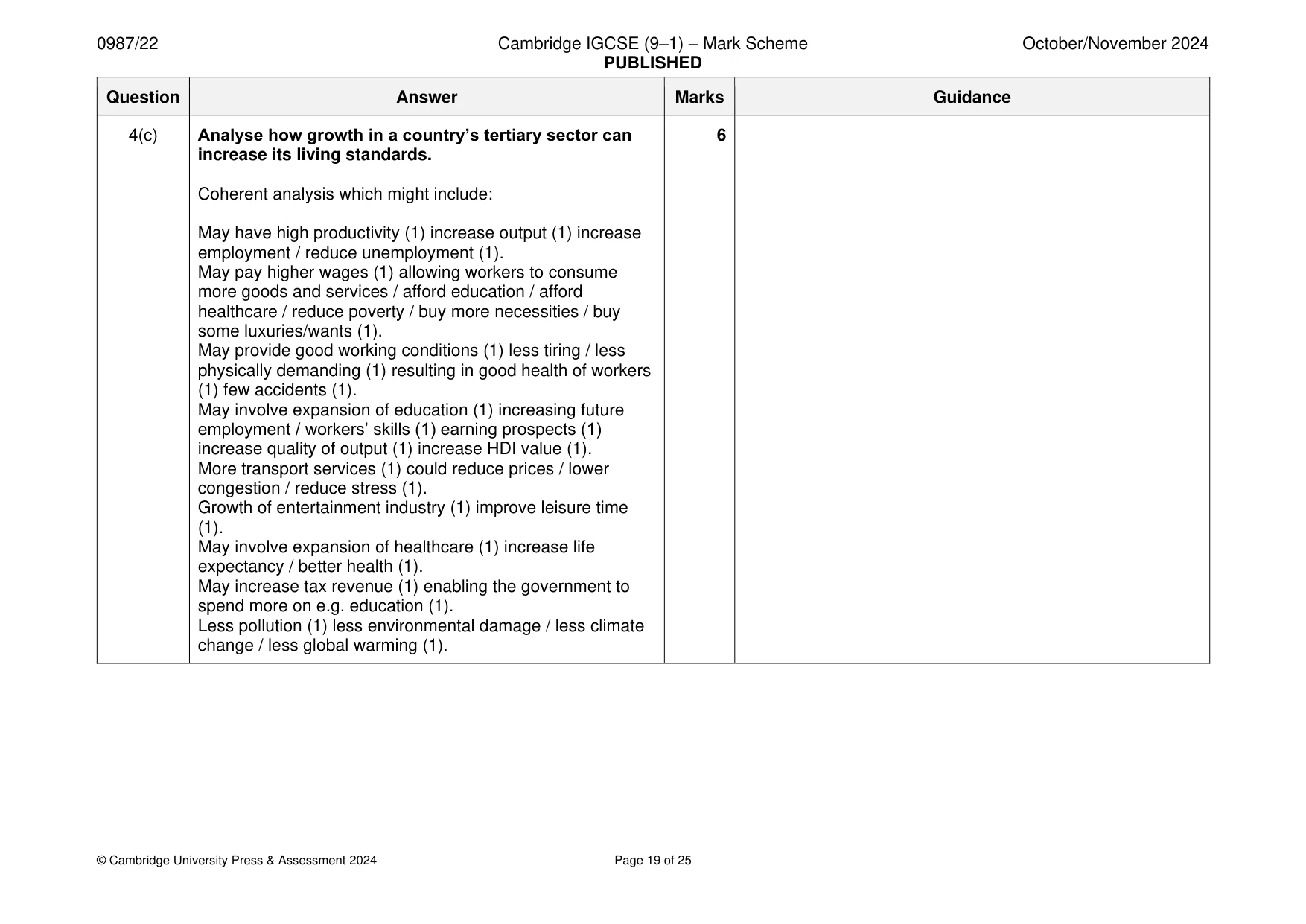
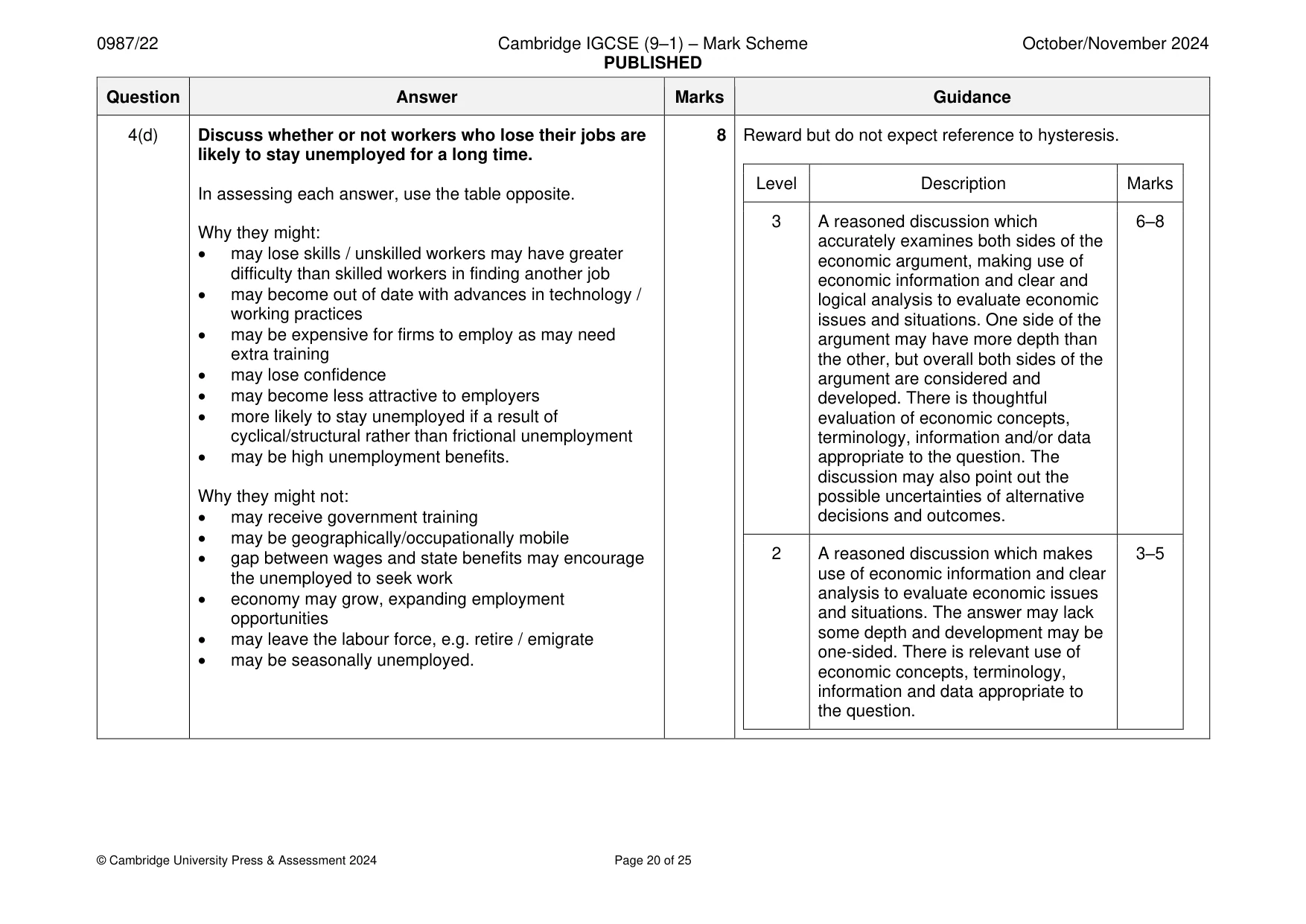
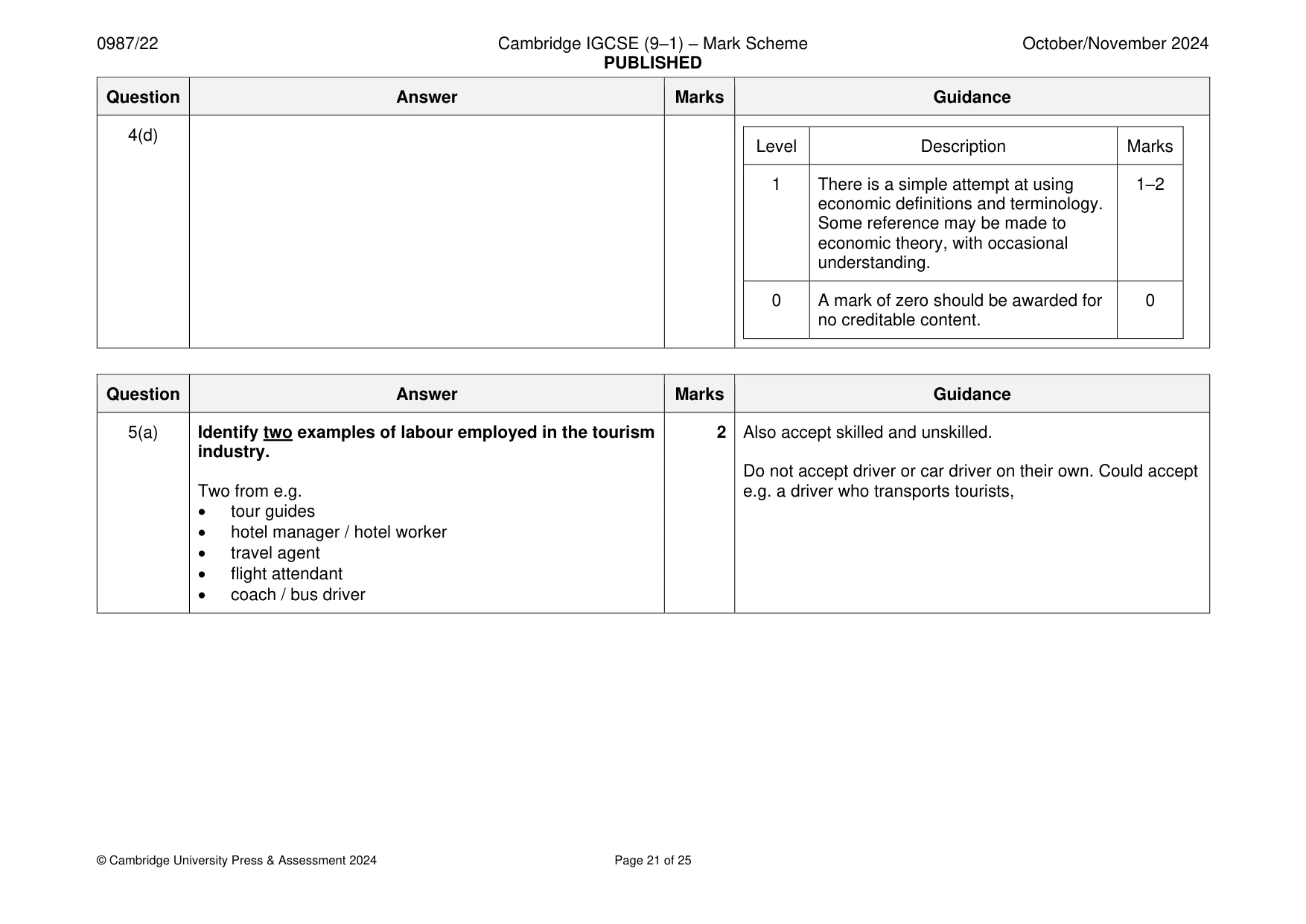
Mark scheme: 4(a) Define an extension in demand. 2 May be shown by a movement down a demand curve caused by a fall in price. A movement along a demand curve (1) higher demand (1) caused by a fall (1) in price (1). Not accepting: an increase in demand but accepting: an increase in quantity demanded. 4(b) Explain two external costs that may be caused by 4 One mark each for each of two costs identified and one exploring for oil. mark for each of two explanations. Logical explanation which might include: Reduce tourism may be given as an identification or as an explanation of e.g. ‘Damage to the natural environment’ Air pollution / pollution (1) those living nearby may experience a reduction in air quality / contribute to climate change/global warming / reduced health (1). Noise pollution (1) disturbing sleep (1). Water pollution / oil spillage (1) damage health (1). Damage to the natural environment / land / deforestation (1) destroy wildlife habitats / cause global warming / climate change (1). Reduce tourism (1) lower employment (1). Congestion (1) increasing transport costs (1). 4(c) Analyse how growth in a country’s tertiary sector can 6 increase its living standards. Coherent analysis which might include: May have high productivity (1) increase output (1) increase employment / reduce unemployment (1). May pay higher wages (1) allowing workers to consume more goods and services / afford education / afford healthcare / reduce poverty / buy more necessities / buy some luxuries/wants (1). May provide good working conditions (1) less tiring / less physically demanding (1) resulting in good health of workers (1) few accidents (1). May involve expansion of education (1) increasing future employment / workers’ skills (1) earning prospects (1) increase quality of output (1) increase HDI value (1). More transport services (1) could reduce prices / lower congestion / reduce stress (1). Growth of entertainment industry (1) improve leisure time (1). May involve expansion of healthcare (1) increase life expectancy / better health (1). May increase tax revenue (1) enabling the government to spend more on e.g. education (1). Less pollution (1) less environmental damage / less climate change / less global warming (1). 4(d) Discuss whether or not workers who lose their jobs are 8 Reward but do not expect reference to hysteresis. likely to stay unemployed for a long time. Level Description Marks In assessing each answer, use the table opposite. 3 A reasoned discussion which 6–8 Why they might: accurately examines both sides of the • may lose skills / unskilled workers may have greater economic argument, making use of difficulty than skilled workers in finding another job economic information and clear and • may become out of date with advances in technology / logical analysis to evaluate economic working practices issues and situations. One side of the • may be expensive for firms to employ as may need argument may have more depth than extra training the other, but overall both sides of the • may lose confidence argument are considered and • may become less attractive to employers developed. There is thoughtful • more likely to stay unemployed if a result of evaluation of economic concepts, cyclical/structural rather than frictional unemployment terminology, information and/or data • may be high unemployment benefits. appropriate to the question. The discussion may also point out the Why they might not: possible uncertainties of alternative • may receive government training decisions and outcomes. • may be geographically/occupationally mobile • gap between wages and state benefits may encourage 2 A reasoned discussion which makes 3–5 the unemployed to seek work use of economic information and clear • economy may grow, expanding employment analysis to evaluate economic issues and situations. The answer may lack opportunities some depth and development may be • may leave the labour force, e.g. retire / emigrate one-sided. There is relevant use of • may be seasonally unemployed. economic concepts, terminology, information and data appropriate to the question. 4(d) Level Description Marks 1 There is a simple attempt at using 1–2 economic definitions and terminology. Some reference may be made to economic theory, with occasional understanding. 0 A mark of zero should be awarded for 0 no creditable content.
Q5 · The Peruvian government is under pressure from its industries to improve the country’s…
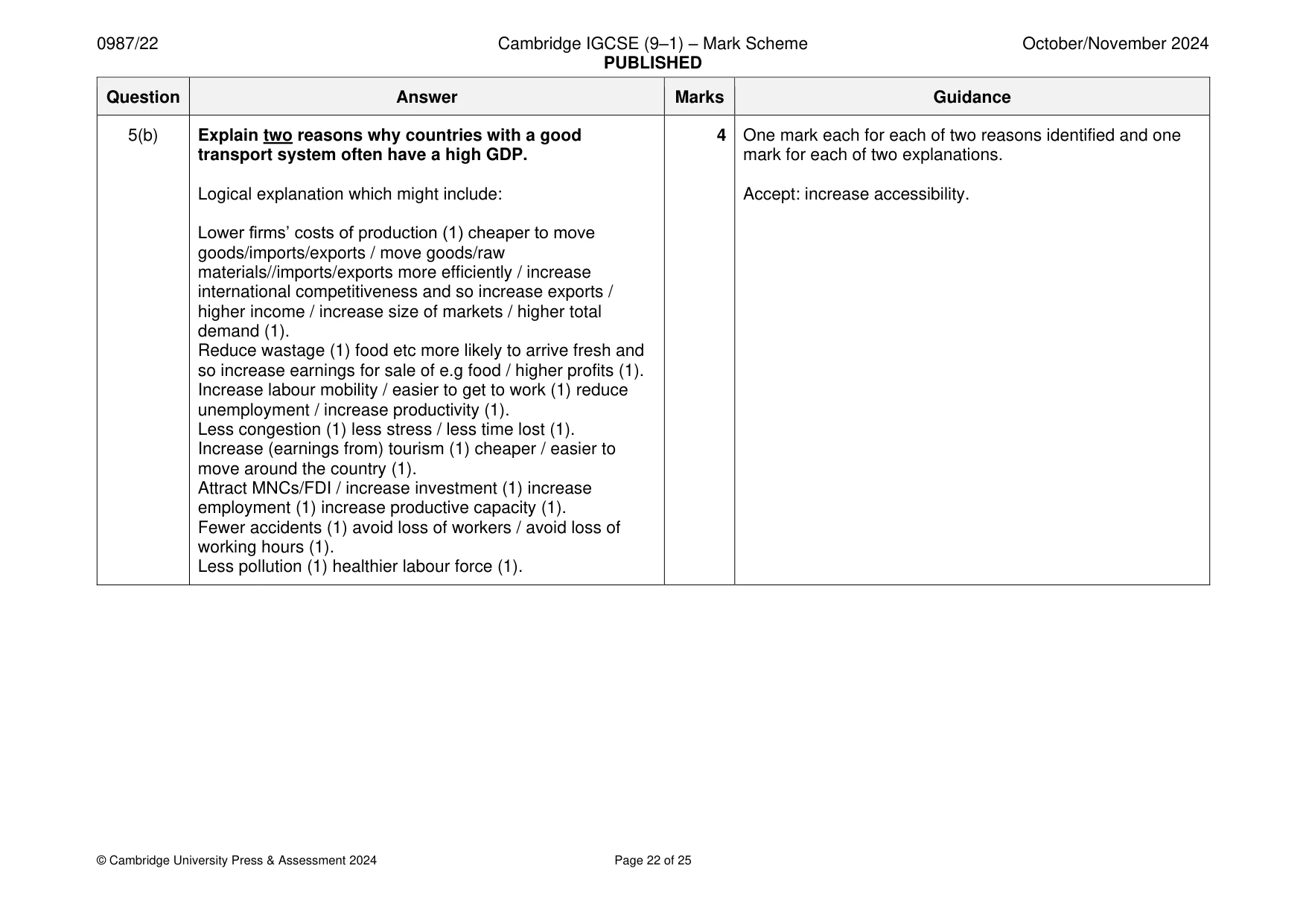
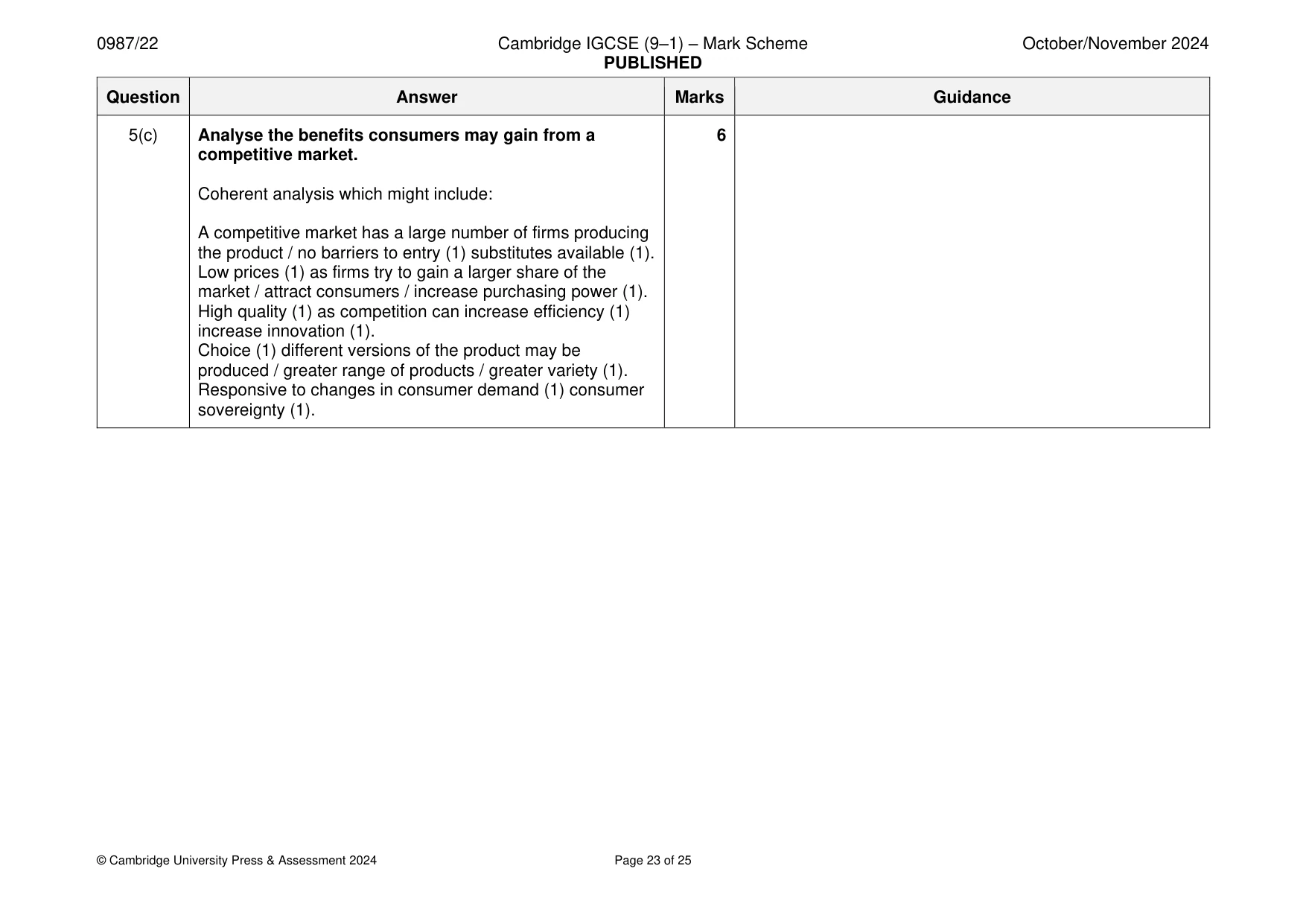
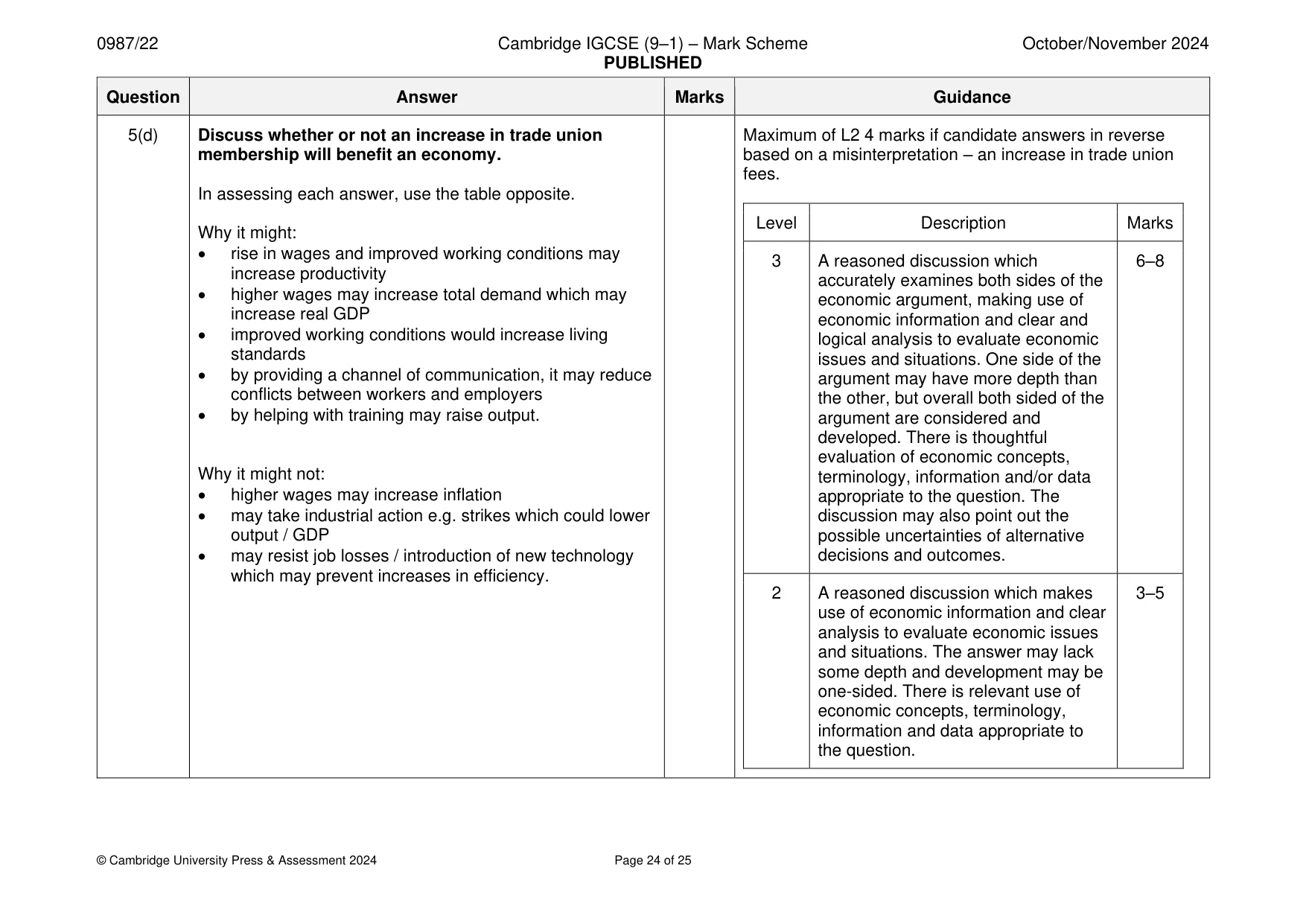
5 The Peruvian government is under pressure from its industries to improve the country’s transport system. Peru’s third largest industry is tourism. There are many firms in the Peruvian tourism industry. Another major industry in Peru is fruit farming. In recent years, trade union membership in the Peruvian fruit-farming industry has increased. (a) Identify two examples of labour employed in the tourism industry. [2] (b) Explain two reasons why countries with a good transport system often have a high GDP. [4] (c) Analyse the benefits consumers may gain from a competitive market. [6] (d) Discuss whether or not an increase in trade union membership will benefit an economy. [8]
Mark scheme: 5(a) Identify two examples of labour employed in the tourism 2 Also accept skilled and unskilled. industry. Do not accept driver or car driver on their own. Could accept Two from e.g. e.g. a driver who transports tourists, • tour guides • hotel manager / hotel worker • travel agent • flight attendant • coach / bus driver 5(b) Explain two reasons why countries with a good 4 One mark each for each of two reasons identified and one transport system often have a high GDP. mark for each of two explanations. Logical explanation which might include: Accept: increase accessibility. Lower firms’ costs of production (1) cheaper to move goods/imports/exports / move goods/raw materials//imports/exports more efficiently / increase international competitiveness and so increase exports / higher income / increase size of markets / higher total demand (1). Reduce wastage (1) food etc more likely to arrive fresh and so increase earnings for sale of e.g food / higher profits (1). Increase labour mobility / easier to get to work (1) reduce unemployment / increase productivity (1). Less congestion (1) less stress / less time lost (1). Increase (earnings from) tourism (1) cheaper / easier to move around the country (1). Attract MNCs/FDI / increase investment (1) increase employment (1) increase productive capacity (1). Fewer accidents (1) avoid loss of workers / avoid loss of working hours (1). Less pollution (1) healthier labour force (1). 5(c) Analyse the benefits consumers may gain from a 6 competitive market. Coherent analysis which might include: A competitive market has a large number of firms producing the product / no barriers to entry (1) substitutes available (1). Low prices (1) as firms try to gain a larger share of the market / attract consumers / increase purchasing power (1). High quality (1) as competition can increase efficiency (1) increase innovation (1). Choice (1) different versions of the product may be produced / greater range of products / greater variety (1). Responsive to changes in consumer demand (1) consumer sovereignty (1). 5(d) Discuss whether or not an increase in trade union Maximum of L2 4 marks if candidate answers in reverse membership will benefit an economy. based on a misinterpretation – an increase in trade union fees. In assessing each answer, use the table opposite. Level Description Marks Why it might: • rise in wages and improved working conditions may 3 A reasoned discussion which 6–8 increase productivity accurately examines both sides of the • higher wages may increase total demand which may economic argument, making use of increase real GDP economic information and clear and • improved working conditions would increase living logical analysis to evaluate economic standards issues and situations. One side of the • by providing a channel of communication, it may reduce argument may have more depth than conflicts between workers and employers the other, but overall both sided of the • by helping with training may raise output. argument are considered and developed. There is thoughtful evaluation of economic concepts, Why it might not: terminology, information and/or data • higher wages may increase inflation appropriate to the question. The • may take industrial action e.g. strikes which could lower discussion may also point out the output / GDP possible uncertainties of alternative • may resist job losses / introduction of new technology decisions and outcomes. which may prevent increases in efficiency. 2 A reasoned discussion which makes 3–5 use of economic information and clear analysis to evaluate economic issues and situations. The answer may lack some depth and development may be one-sided. There is relevant use of economic concepts, terminology, information and data appropriate to the question. 5(d) Level Description Marks 1 There is a simple attempt at using 1–2 economic definitions and terminology. Some reference may be made to economic theory, with occasional understanding. 0 A mark of zero should be awarded for 0 no creditable content.
What was in this paper
The subtopics covered by these 5 questions, and how many questions each got. Open one in a new tab to see every Cambridge question on it.
What you needed in this session
Cambridge’s own grade thresholds for 2024 Oct/Nov, Paper 2 · Variant 2. A higher threshold means an easier paper — the bar moves with how the cohort did.