Cambridge IGCSE Economics (9-1) 0987 — 2022 May/June Paper 2 · Variant 2
0987/22/M/J/22 · 5 questions · 90 marks · ≈101 min
The question paper and its mark scheme, free to read here and free to download. This is Cambridge’s own paper, exactly as it was sat.
Question paper8 pages
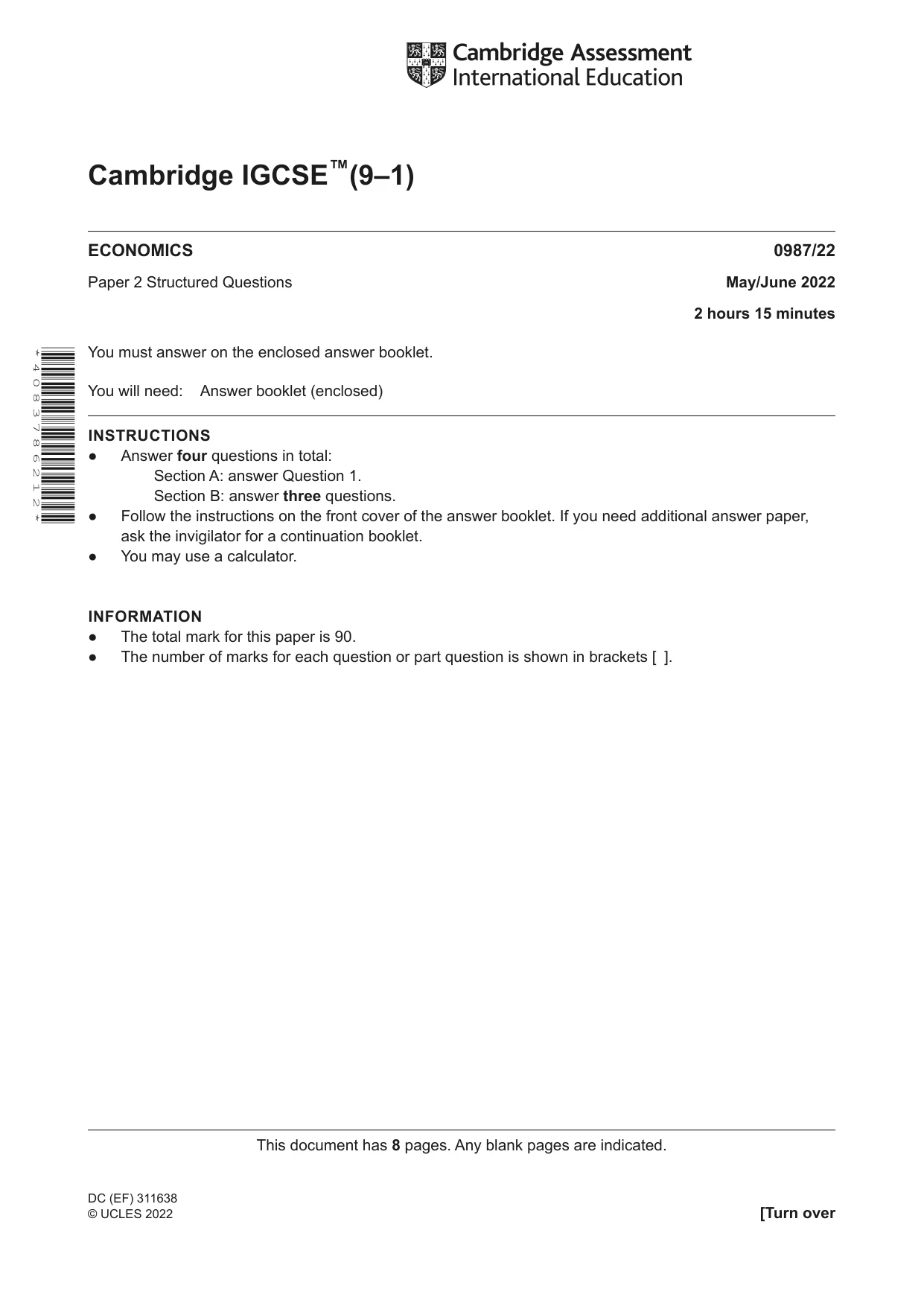
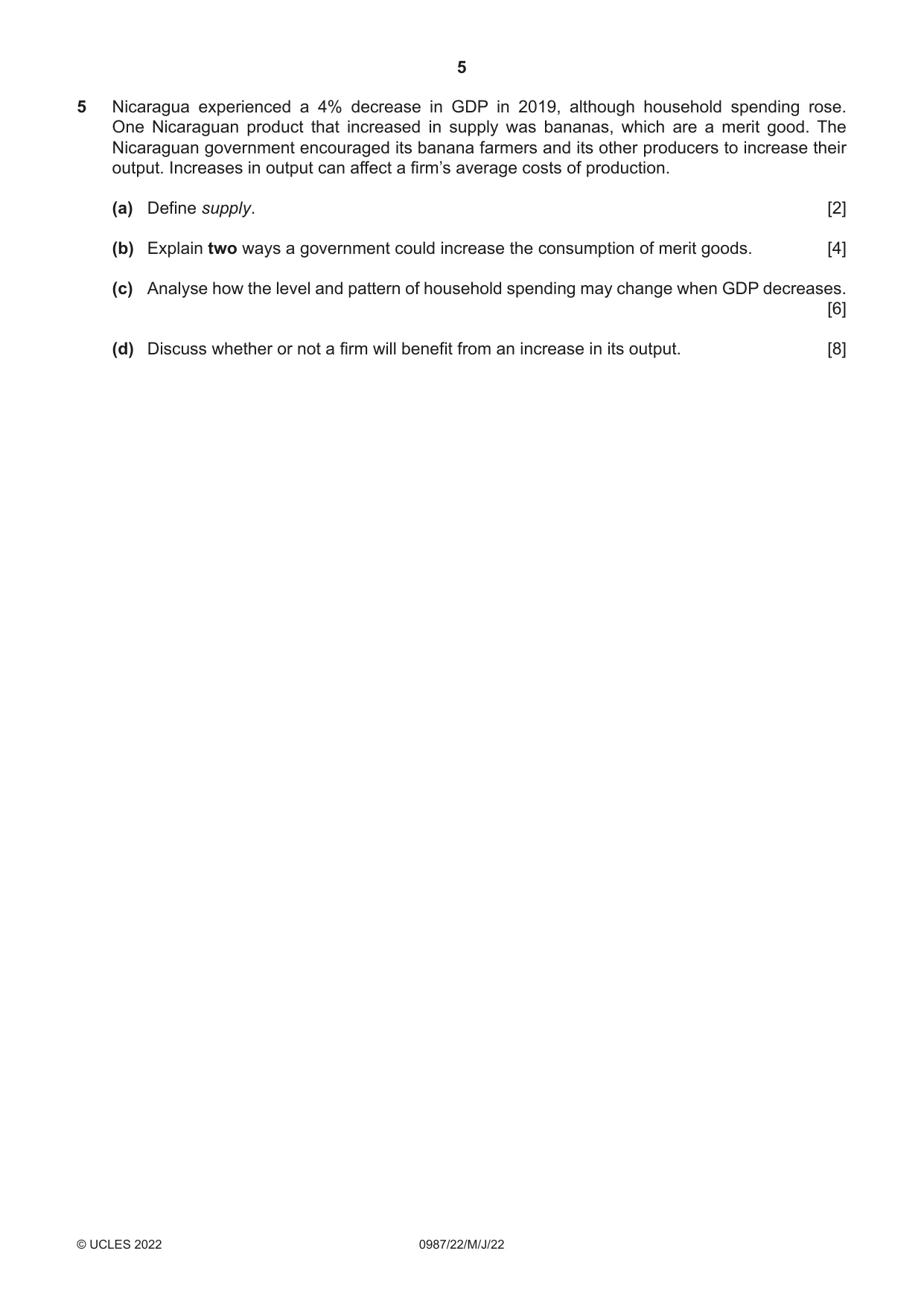



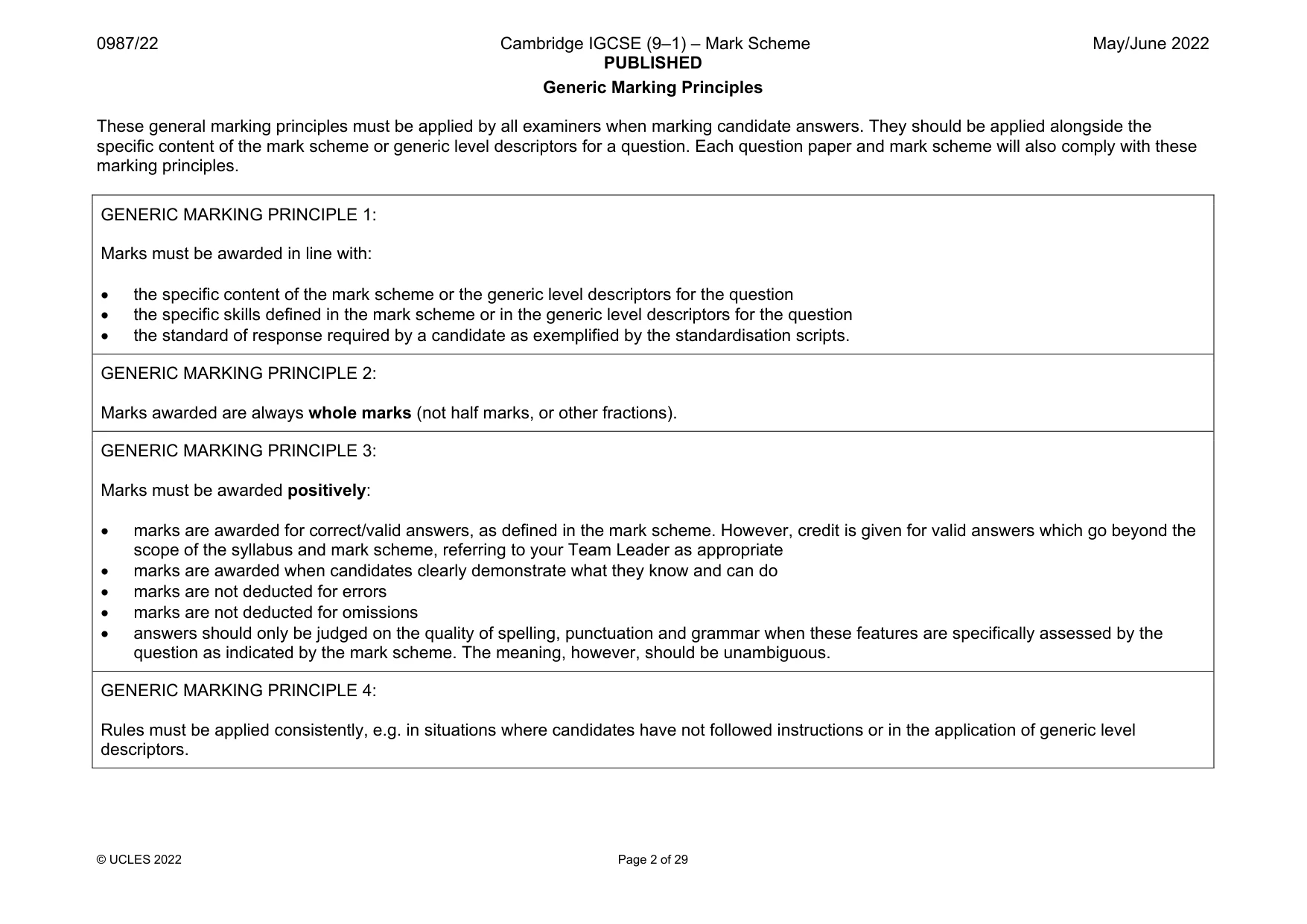
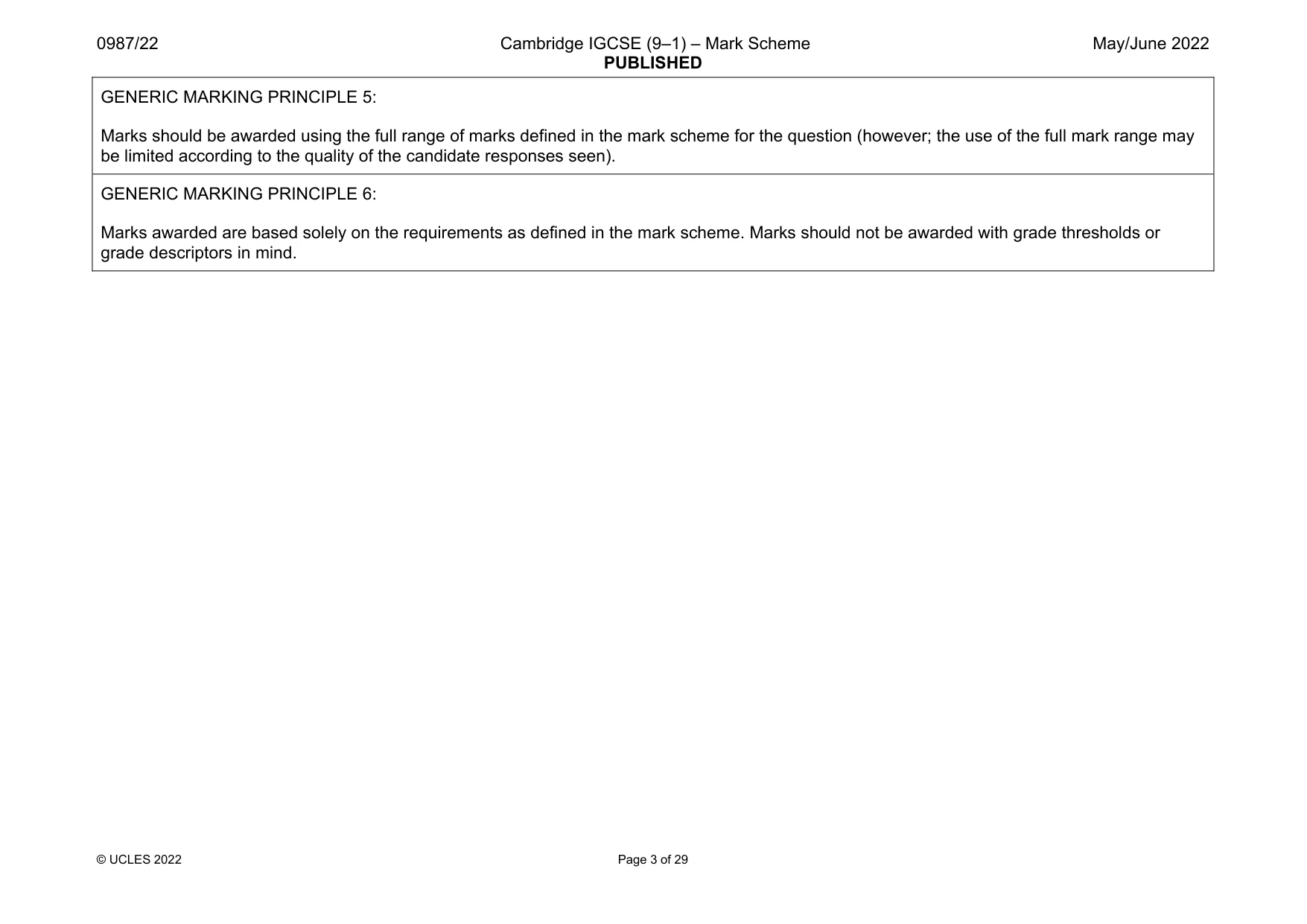
Mark scheme29 pages
Answers below. Sit the paper first if you are practising.
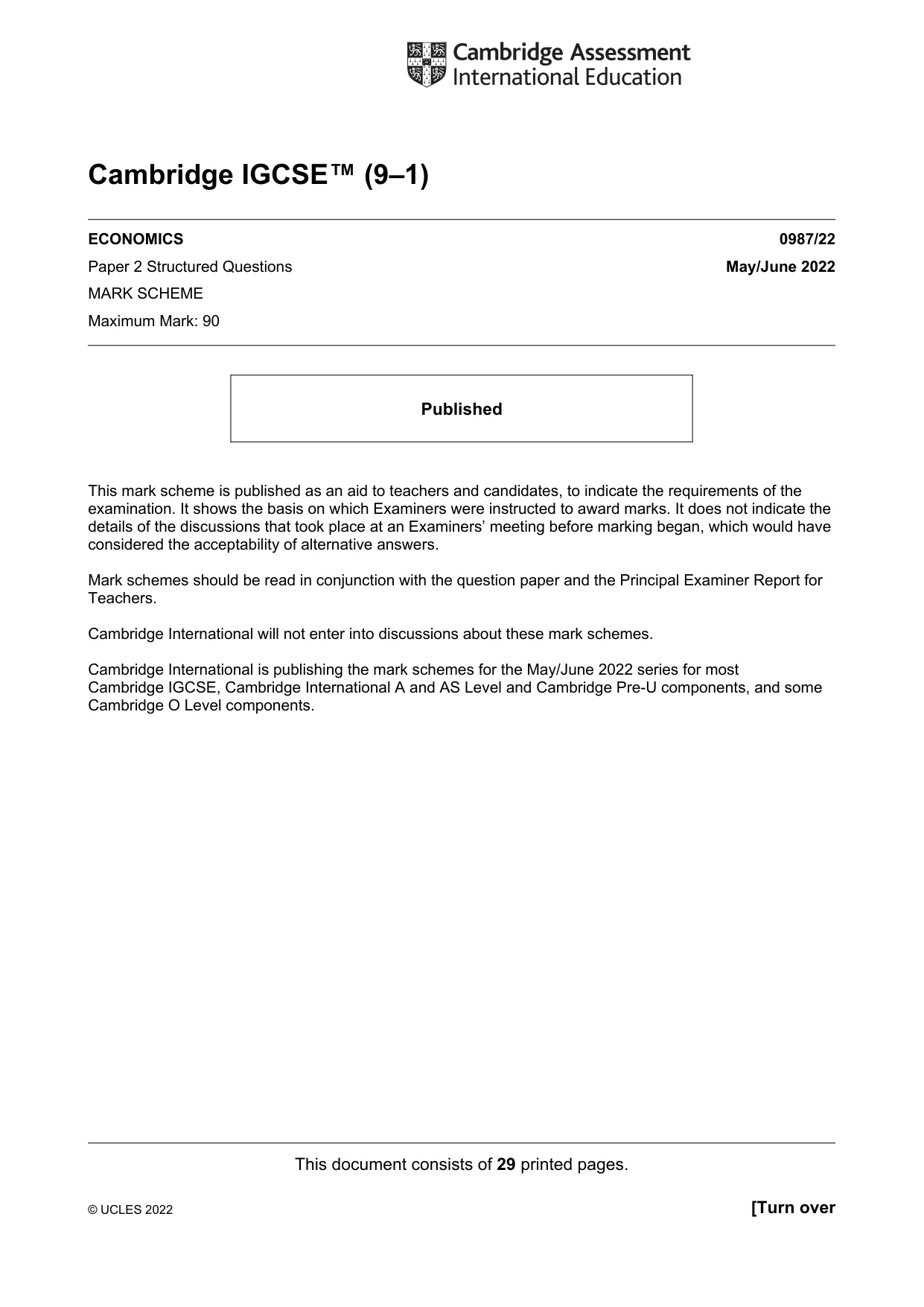
Questions as text
Q1 · Calculate Bhutan’s GDP in 2018
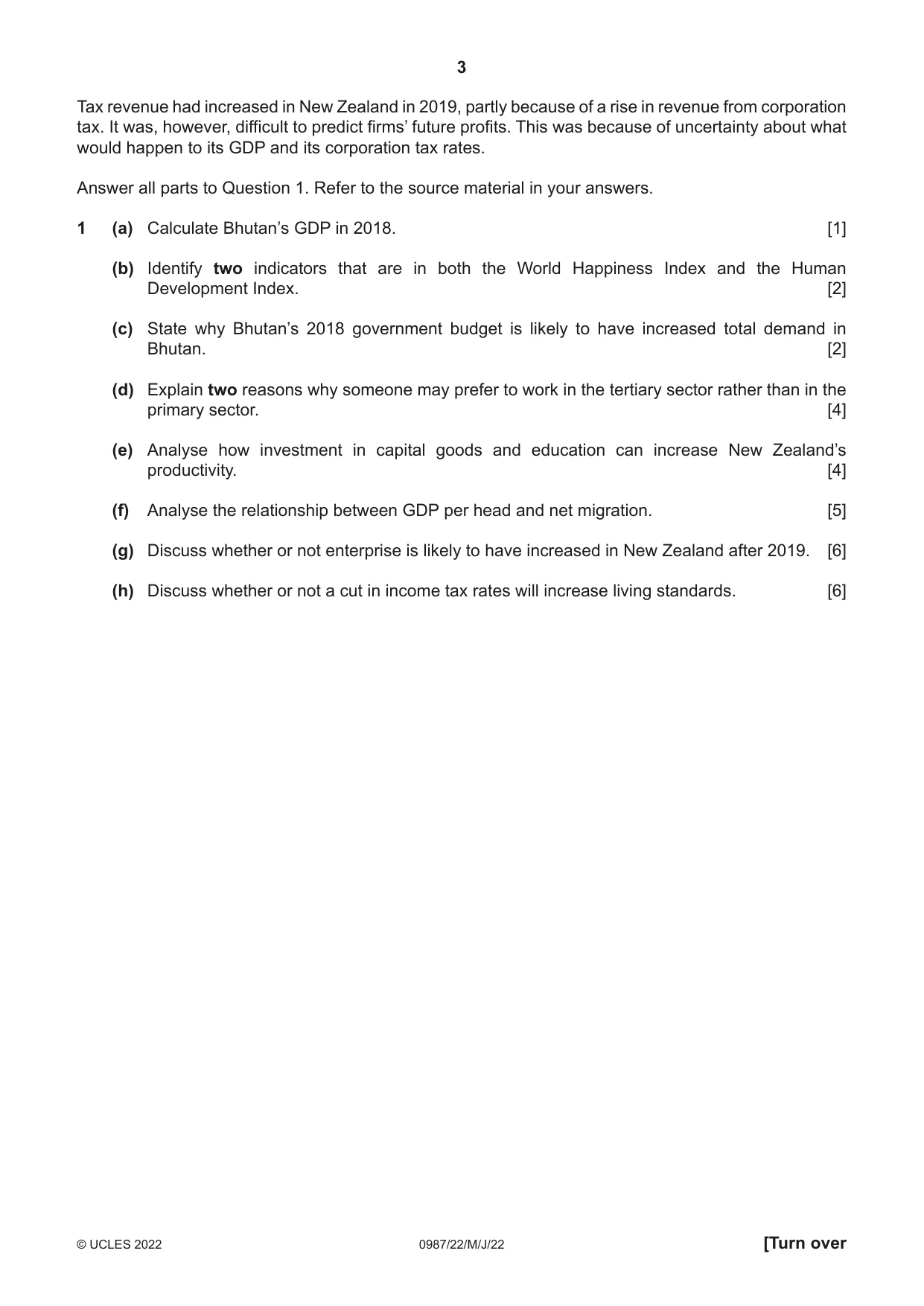
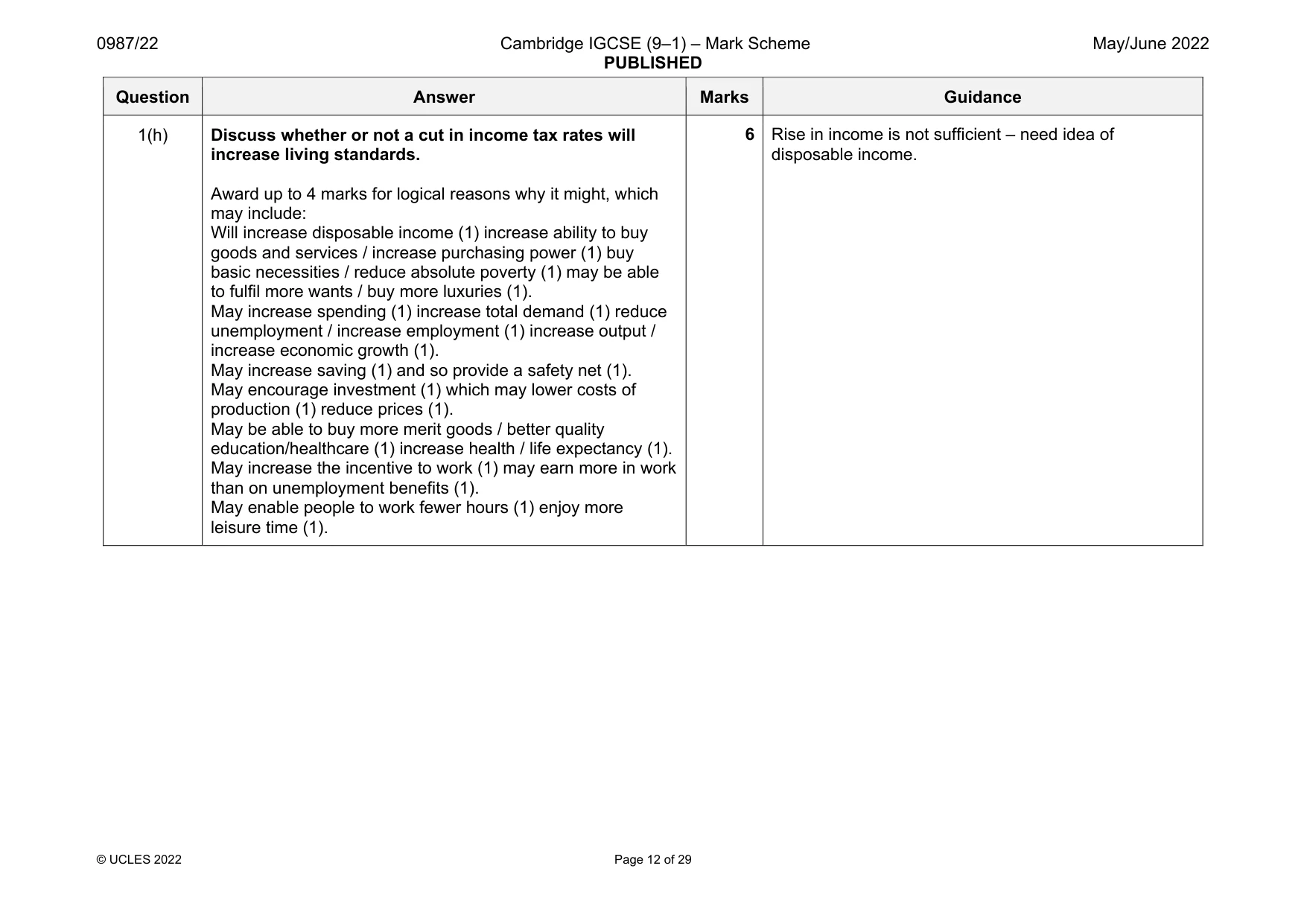
1 (a) Calculate Bhutan’s GDP in 2018. [1] (b) Identify two indicators that are in both the World Happiness Index and the Human Development Index. [2] (c) State why Bhutan’s 2018 government budget is likely to have increased total demand in Bhutan. [2] (d) Explain two reasons why someone may prefer to work in the tertiary sector rather than in the primary sector. [4] (e) Analyse how investment in capital goods and education can increase New Zealand’s productivity. [4] (f) Analyse the relationship between GDP per head and net migration. [5] (g) Discuss whether or not enterprise is likely to have increased in New Zealand after 2019. [6] (h) Discuss whether or not a cut in income tax rates will increase living standards. [6]
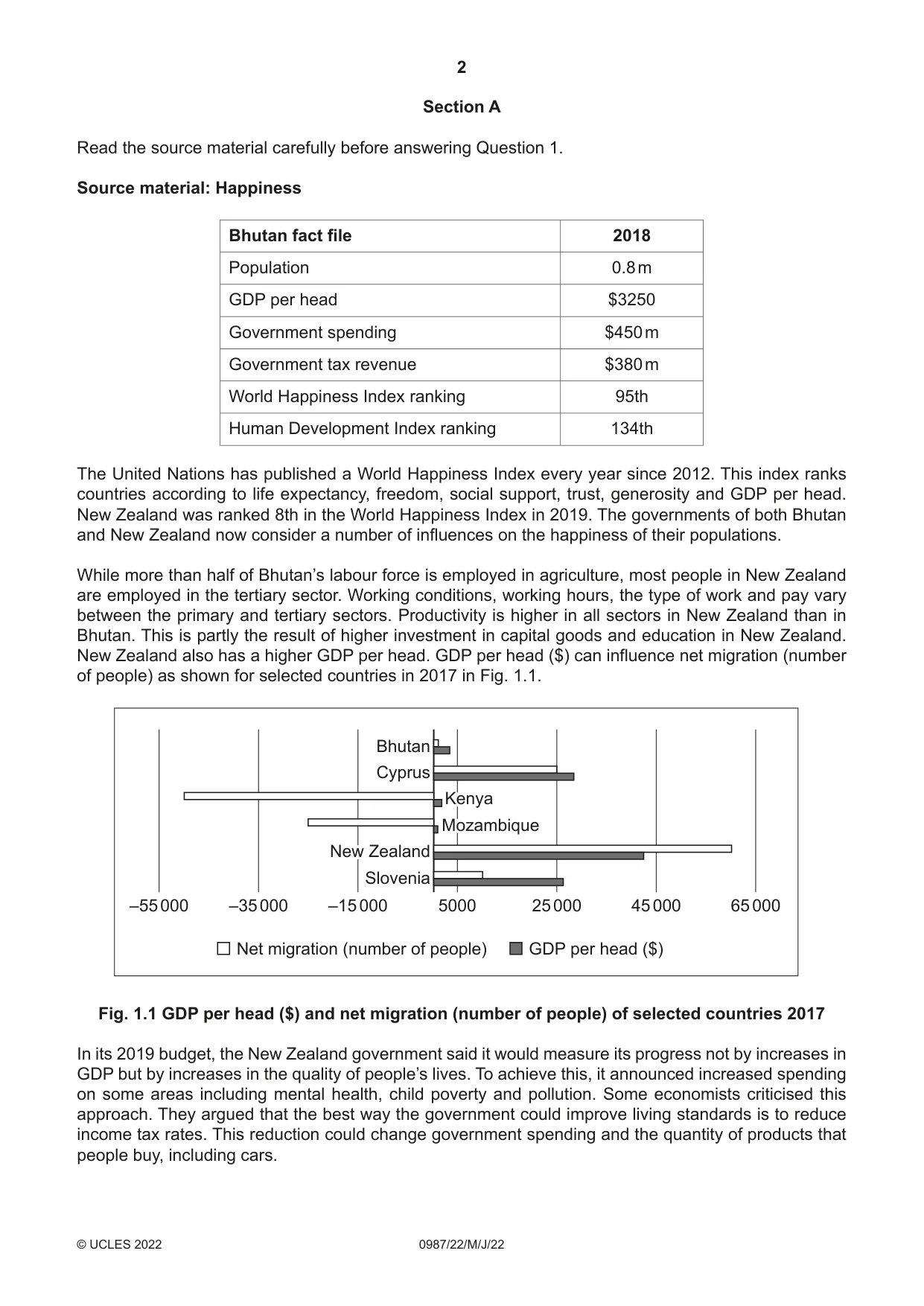
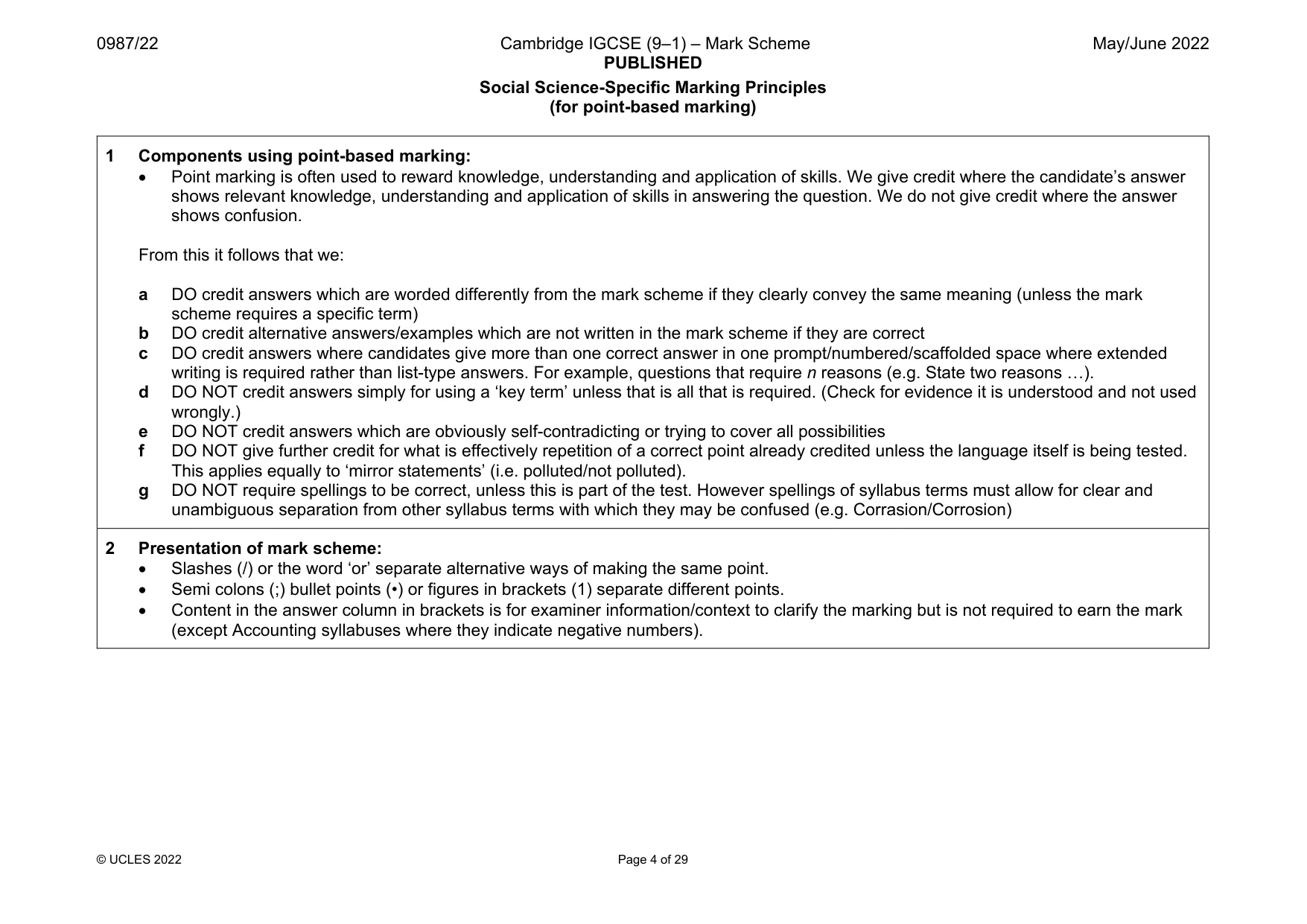
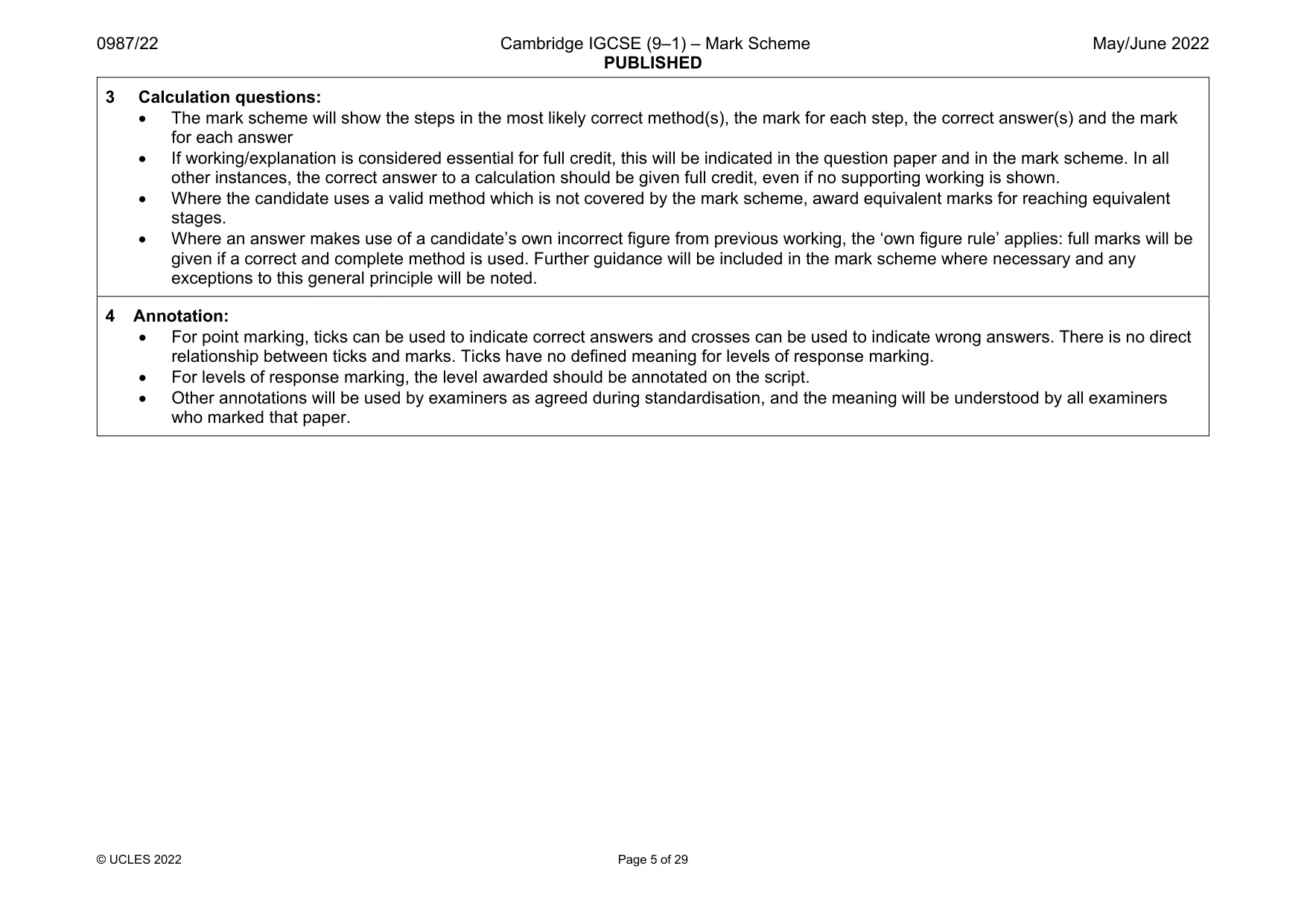
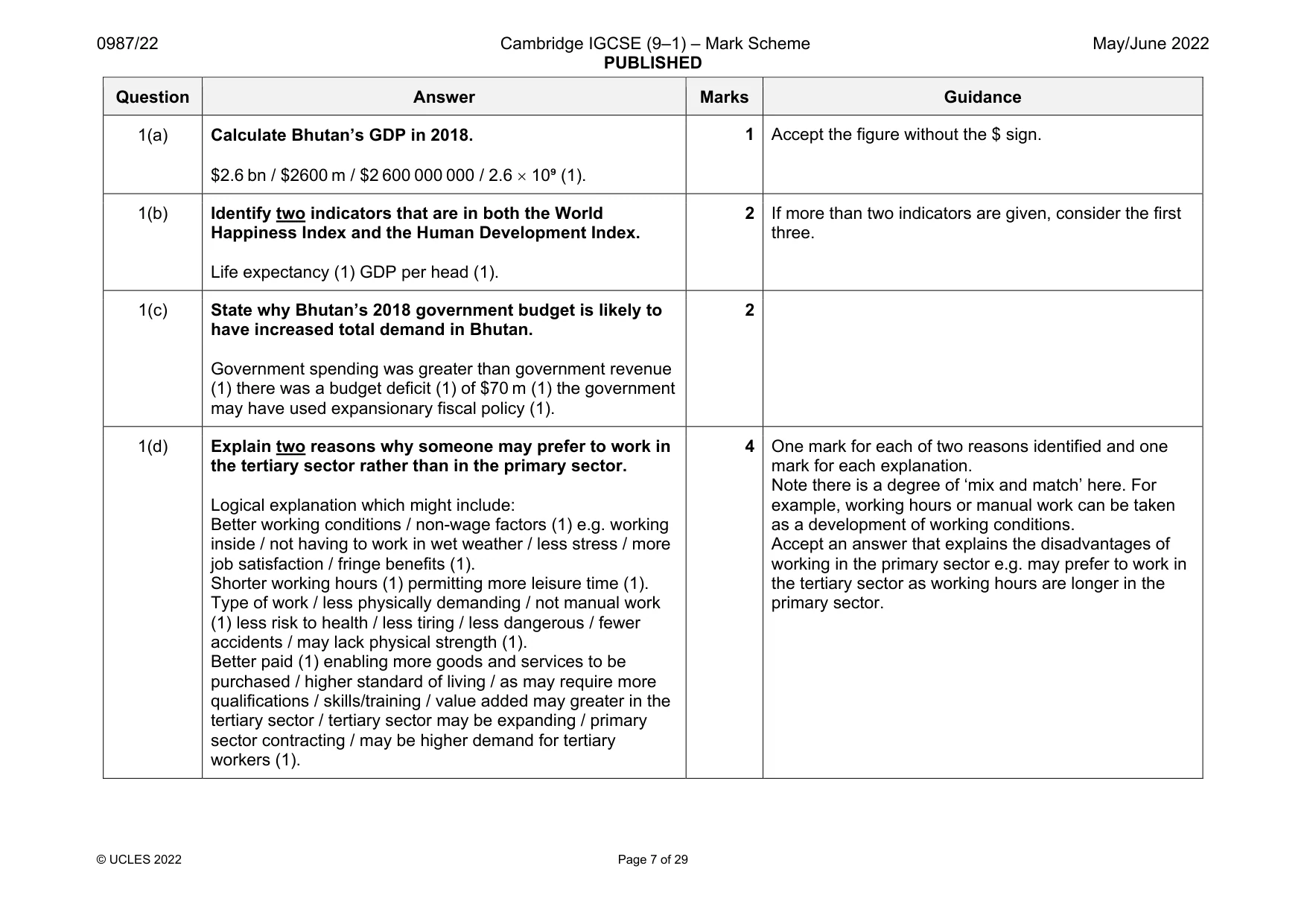
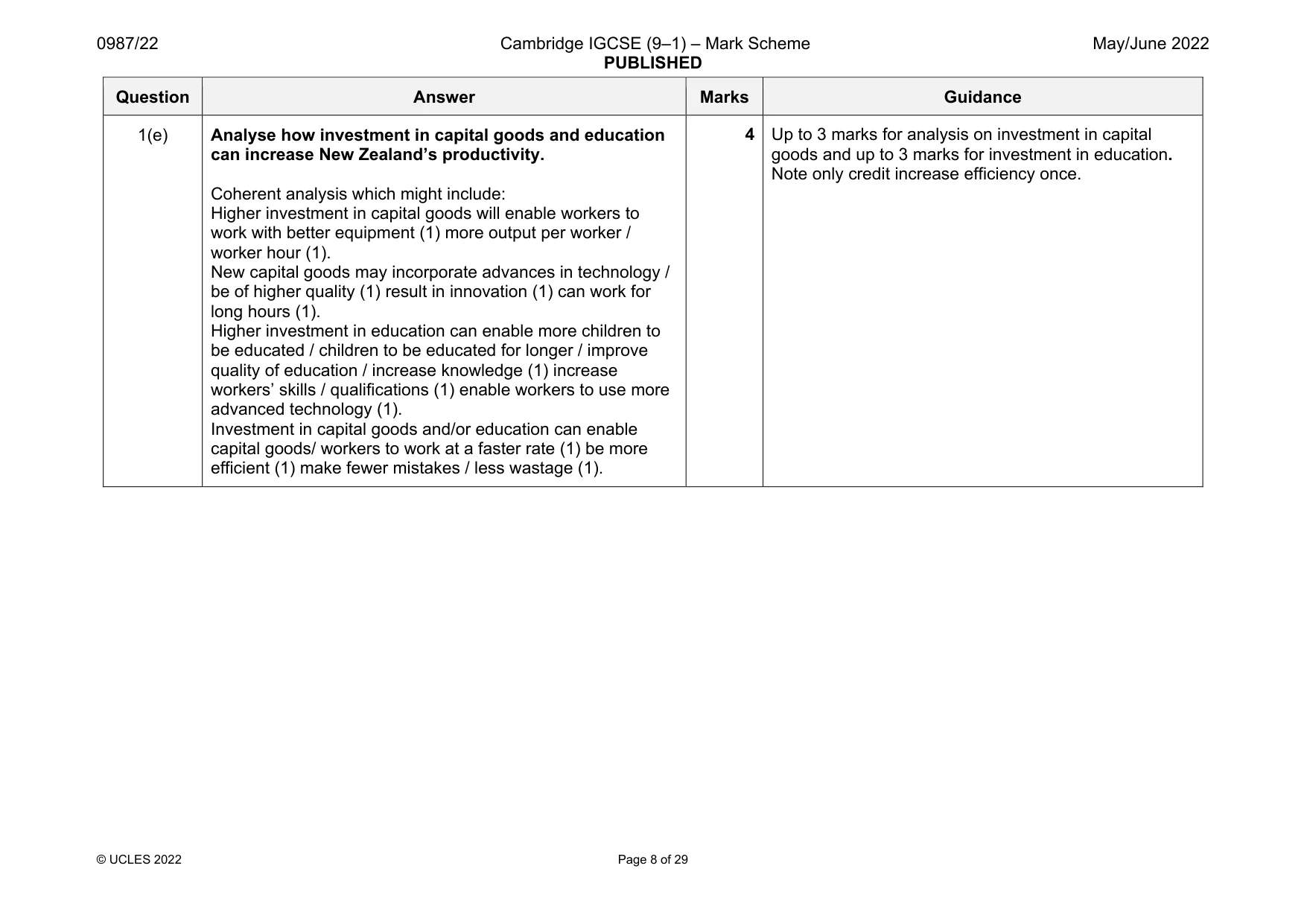
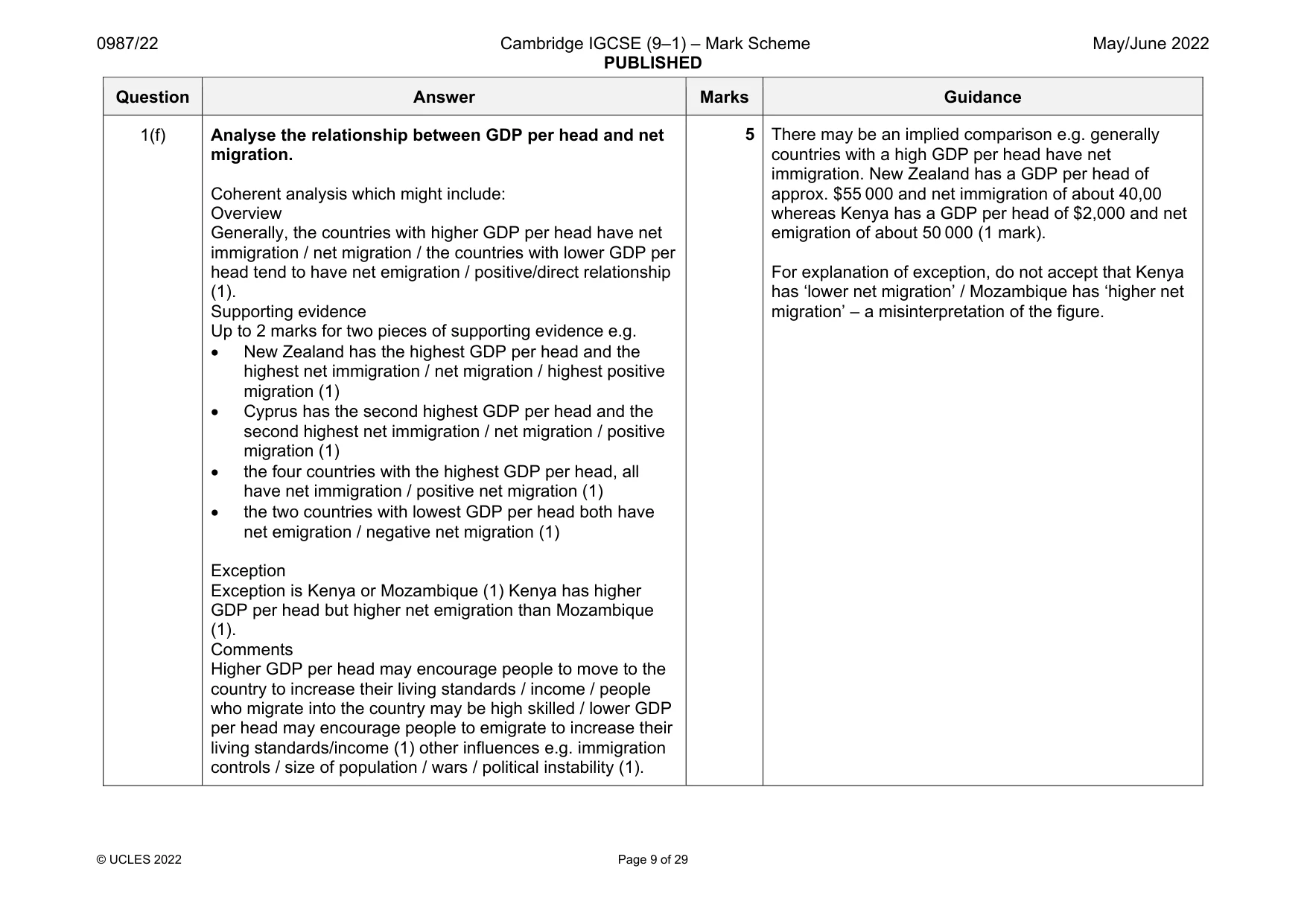
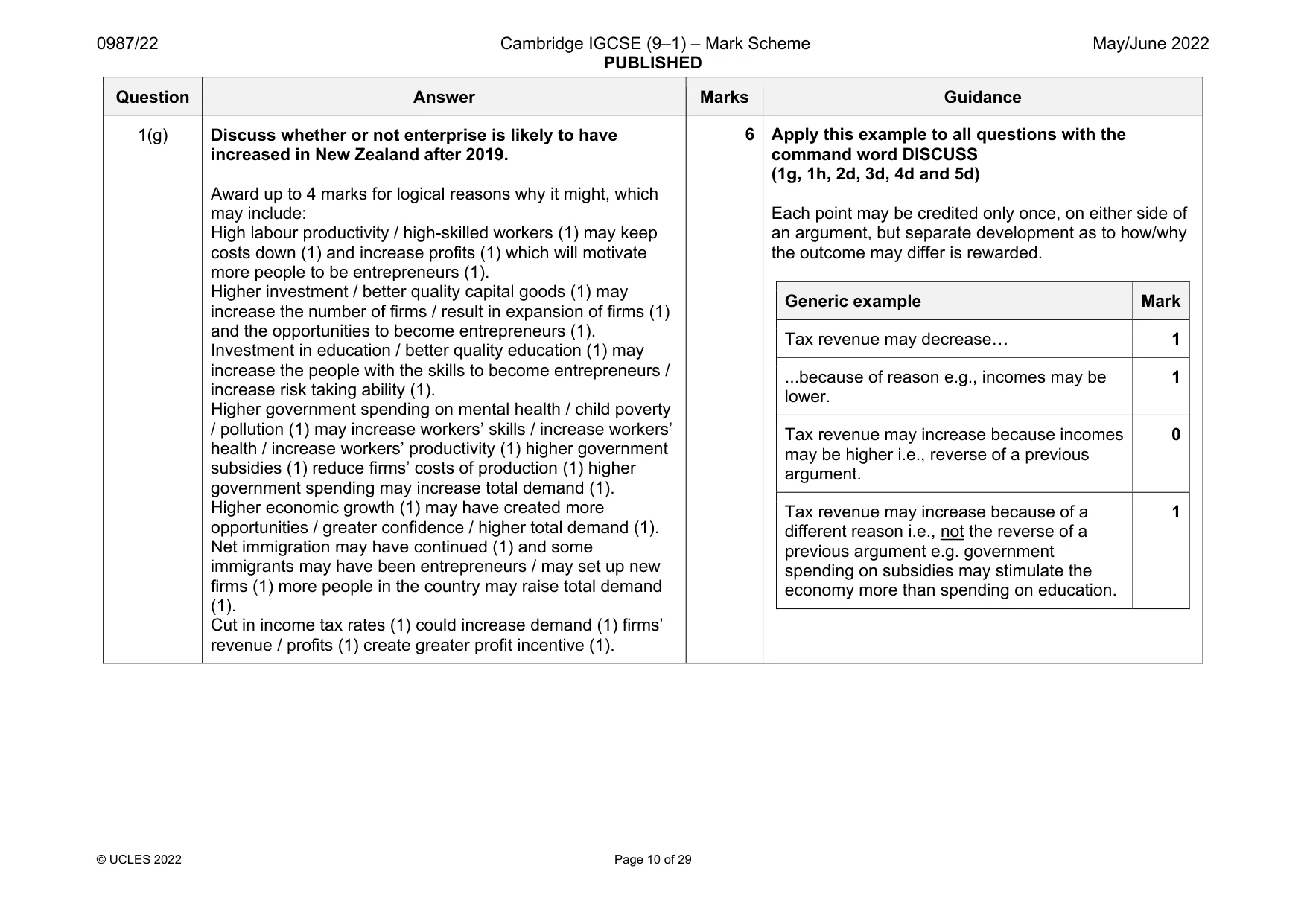
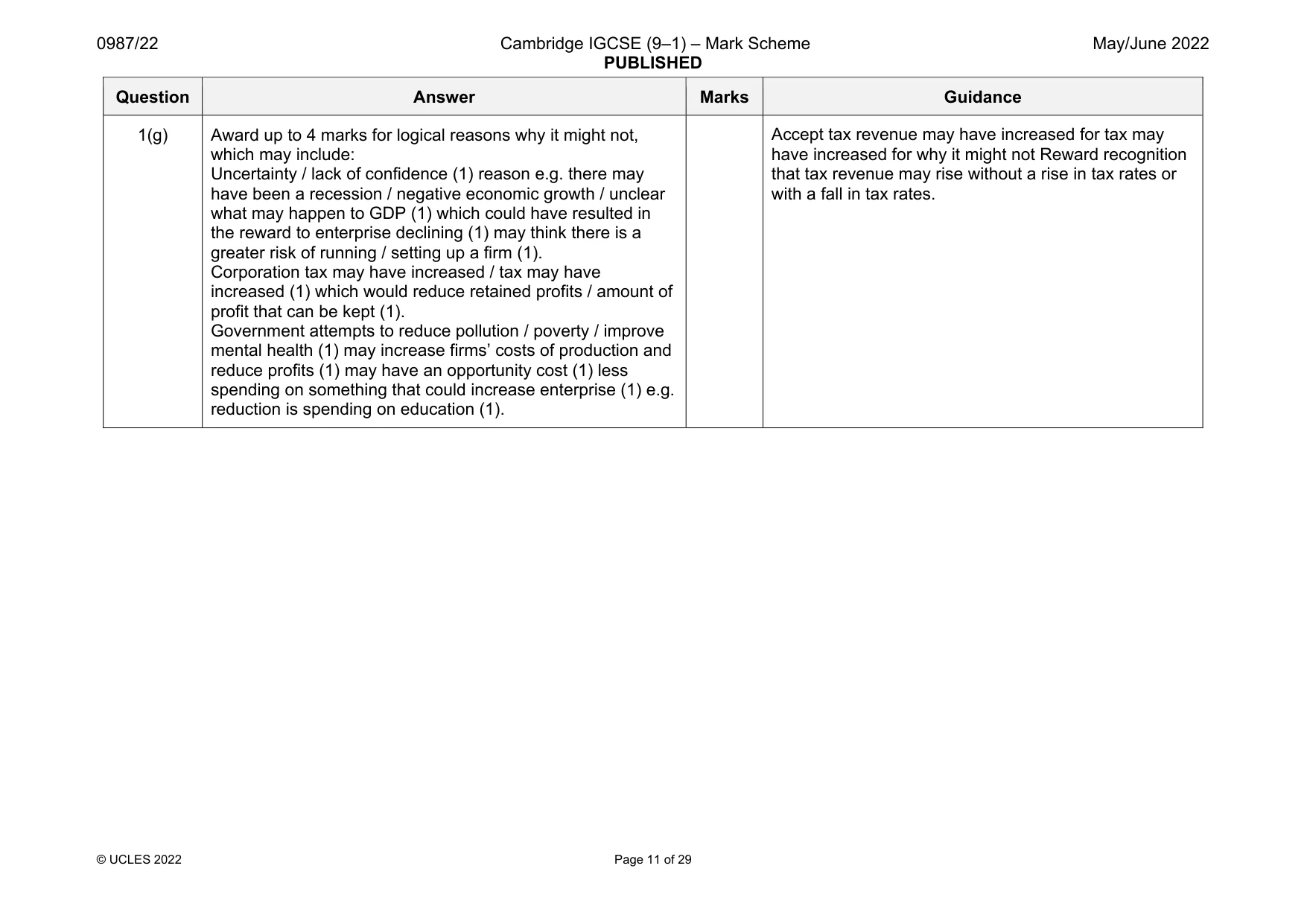
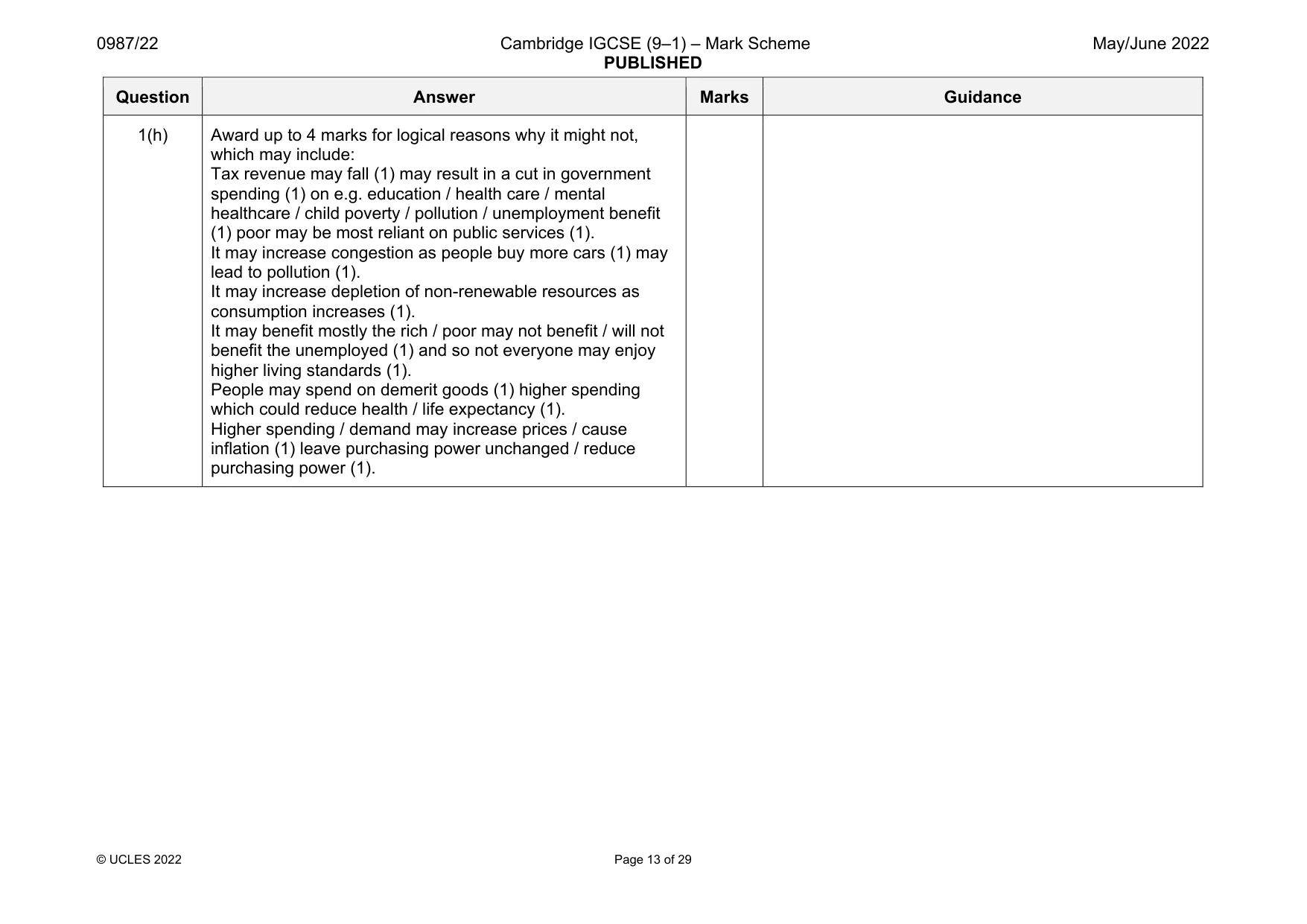
Mark scheme: 1(a) Calculate Bhutan’s GDP in 2018. $2.6 bn / $2600 m / $2 600 000 000 / 2.6 10⁹ (1). 1(b) Identify two indicators that are in both the World Happiness Index and the Human Development Index. Life expectancy (1) GDP per head (1). 2 If more than two indicators are given, consider the first three. 1(c) State why Bhutan’s 2018 government budget is likely to have increased total demand in Bhutan. Government spending was greater than government revenue (1) there was a budget deficit (1) of $70 m (1) the government may have used expansionary fiscal policy (1). 2 1(d) Explain two reasons why someone may prefer to work in the tertiary sector rather than in the primary sector. Logical explanation which might include: Better working conditions / non-wage factors (1) e.g. working inside / not having to work in wet weather / less stress / more job satisfaction / fringe benefits (1). Shorter working hours (1) permitting more leisure time (1). Type of work / less physically demanding / not manual work (1) less risk to health / less tiring / less dangerous / fewer accidents / may lack physical strength (1). Better paid (1) enabling more goods and services to be purchased / higher standard of living / as may require more qualifications / skills/training / value added may greater in the tertiary sector / tertiary sector may be expanding / primary sector contracting / may be higher demand for tertiary workers (1). 4 One mark for each of two reasons identified and one mark for each explanation. Note there is a degree of ‘mix and match’ here. For example, working hours or manual work can be taken as a development of working conditions. Accept an answer that explains the disadvantages of working in the primary sector e.g. may prefer to work in the tertiary sector as working hours are longer in the primary sector. Question Answer Marks Guidance 1(e) Analyse how investment in capital goods and education can increase New Zealand’s productivity. Coherent analysis which might include: Higher investment in capital goods will enable workers to work with better equipment (1) more output per worker / worker hour (1). New capital goods may incorporate advances in technology / be of higher quality (1) result in innovation (1) can work for long hours (1). Higher investment in education can enable more children to be educated / children to be educated for longer / improve quality of education / increase knowledge (1) increase workers’ skills / qualifications (1) enable workers to use more advanced technology (1). Investment in capital goods and/or education can enable capital goods/ workers to work at a faster rate (1) be more efficient (1) make fewer mistakes / less wastage (1). 4 Up to 3 marks for analysis on investment in capital goods and up to 3 marks for investment in education. Note only credit increase efficiency once. Question Answer Marks Guidance 1(f) Analyse the relationship between GDP per head and net migration. Coherent analysis which might include: Overview Generally, the countries with higher GDP per head have net immigration / net migration / the countries with lower GDP per head tend to have net emigration / positive/direct relationship (1). Supporting evidence Up to 2 marks for two pieces of supporting evidence e.g. New Zealand has the highest GDP per head and the highest net immigration / net migration / highest positive migration (1) Cyprus has the second highest GDP per head and the second highest net immigration / net migration / positive migration (1) the four countries with the highest GDP per head, all have net immigration / positive net migration (1) the two countries with lowest GDP per head both have net emigration / negative net migration (1) Exception Exception is Kenya or Mozambique (1) Kenya has higher GDP per head but higher net emigration than Mozambique (1). Comments Higher GDP per head may encourage people to move to the country to increase their living standards / income / people who migrate into the country may be high skilled / lower GDP per head may encourage people to emigrate to increase their living standards/income (1) other influences e.g. immigration controls / size of population / wars / political instability (1). 5 There may be an implied comparison e.g. generally countries with a high GDP per head have net immigration. New Zealand has a GDP per head of approx. $55 000 and net immigration of about 40,00 whereas Kenya has a GDP per head of $2,000 and net emigration of about 50 000 (1 mark). For explanation of exception, do not accept that Kenya has ‘lower net migration’ / Mozambique has ‘higher net migration’ – a misinterpretation of the figure. Question Answer Marks Guidance 1(g) Discuss whether or not enterprise is likely to have increased in New Zealand after 2019. Award up to 4 marks for logical reasons why it might, which may include: High labour productivity / high-skilled workers (1) may keep costs down (1) and increase profits (1) which will motivate more people to be entrepreneurs (1). Higher investment / better quality capital goods (1) may increase the number of firms / result in expansion of firms (1) and the opportunities to become entrepreneurs (1). Investment in education / better quality education (1) may increase the people with the skills to become entrepreneurs / increase risk taking ability (1). Higher government spending on mental health / child poverty / pollution (1) may increase workers’ skills / increase workers’ health / increase workers’ productivity (1) higher government subsidies (1) reduce firms’ costs of production (1) higher government spending may increase total demand (1). Higher economic growth (1) may have created more opportunities / greater confidence / higher total demand (1). Net immigration may have continued (1) and some immigrants may have been entrepreneurs / may set up new firms (1) more people in the country may raise total demand (1). Cut in income tax rates (1) could increase demand (1) firms’ revenue / profits (1) create greater profit incentive (1). 6 Apply this example to all questions with the command word DISCUSS (1g, 1h, 2d, 3d, 4d and 5d) Each point may be credited only once, on either side of an argument, but separate development as to how/why the outcome may differ is rewarded. Generic example Mark Tax revenue may decrease… 1 ...because of reason e.g., incomes may be lower. 1 Tax revenue may increase because incomes may be higher i.e., reverse of a previous argument. 0 Tax revenue may increase because of a different reason i.e., not the reverse of a previous argument e.g. government spending on subsidies may stimulate the economy more than spending on education. 1 Question Answer Marks Guidance 1(g) Award up to 4 marks for logical reasons why it might not, which may include: Uncertainty / lack of confidence (1) reason e.g. there may have been a recession / negative economic growth / unclear what may happen to GDP (1) which could have resulted in the reward to enterprise declining (1) may think there is a greater risk of running / setting up a firm (1). Corporation tax may have increased / tax may have increased (1) which would reduce retained profits / amount of profit that can be kept (1). Government attempts to reduce pollution / poverty / improve mental health (1) may increase firms’ costs of production and reduce profits (1) may have an opportunity cost (1) less spending on something that could increase enterprise (1) e.g. reduction is spending on education (1). Accept tax revenue may have increased for tax may have increased for why it might not Reward recognition that tax revenue may rise without a rise in tax rates or with a fall in tax rates. Question Answer Marks Guidance 1(h) Discuss whether or not a cut in income tax rates will increase living standards. Award up to 4 marks for logical reasons why it might, which may include: Will increase disposable income (1) increase ability to buy goods and services / increase purchasing power (1) buy basic necessities / reduce absolute poverty (1) may be able to fulfil more wants / buy more luxuries (1). May increase spending (1) increase total demand (1) reduce unemployment / increase employment (1) increase output / increase economic growth (1). May increase saving (1) and so provide a safety net (1). May encourage investment (1) which may lower costs of production (1) reduce prices (1). May be able to buy more merit goods / better quality education/healthcare (1) increase health / life expectancy (1). May increase the incentive to work (1) may earn more in work than on unemployment benefits (1). May enable people to work fewer hours (1) enjoy more leisure time (1). 6 Rise in income is not sufficient – need idea of disposable income. Question Answer Marks Guidance 1(h) Award up to 4 marks for logical reasons why it might not, which may include: Tax revenue may fall (1) may result in a cut in government spending (1) on e.g. education / health care / mental healthcare / child poverty / pollution / unemployment benefit (1) poor may be most reliant on public services (1). It may increase congestion as people buy more cars (1) may lead to pollution (1). It may increase depletion of non-renewable resources as consumption increases (1). It may benefit mostly the rich / poor may not benefit / will not benefit the unemployed (1) and so not everyone may enjoy higher living standards (1). People may spend on demerit goods (1) higher spending which could reduce health / life expectancy (1). Higher spending / demand may increase prices / cause inflation (1) leave purchasing power unchanged / reduce purchasing power (1).
Q2 · There was a significant increase in the money supply in Angola in 2019
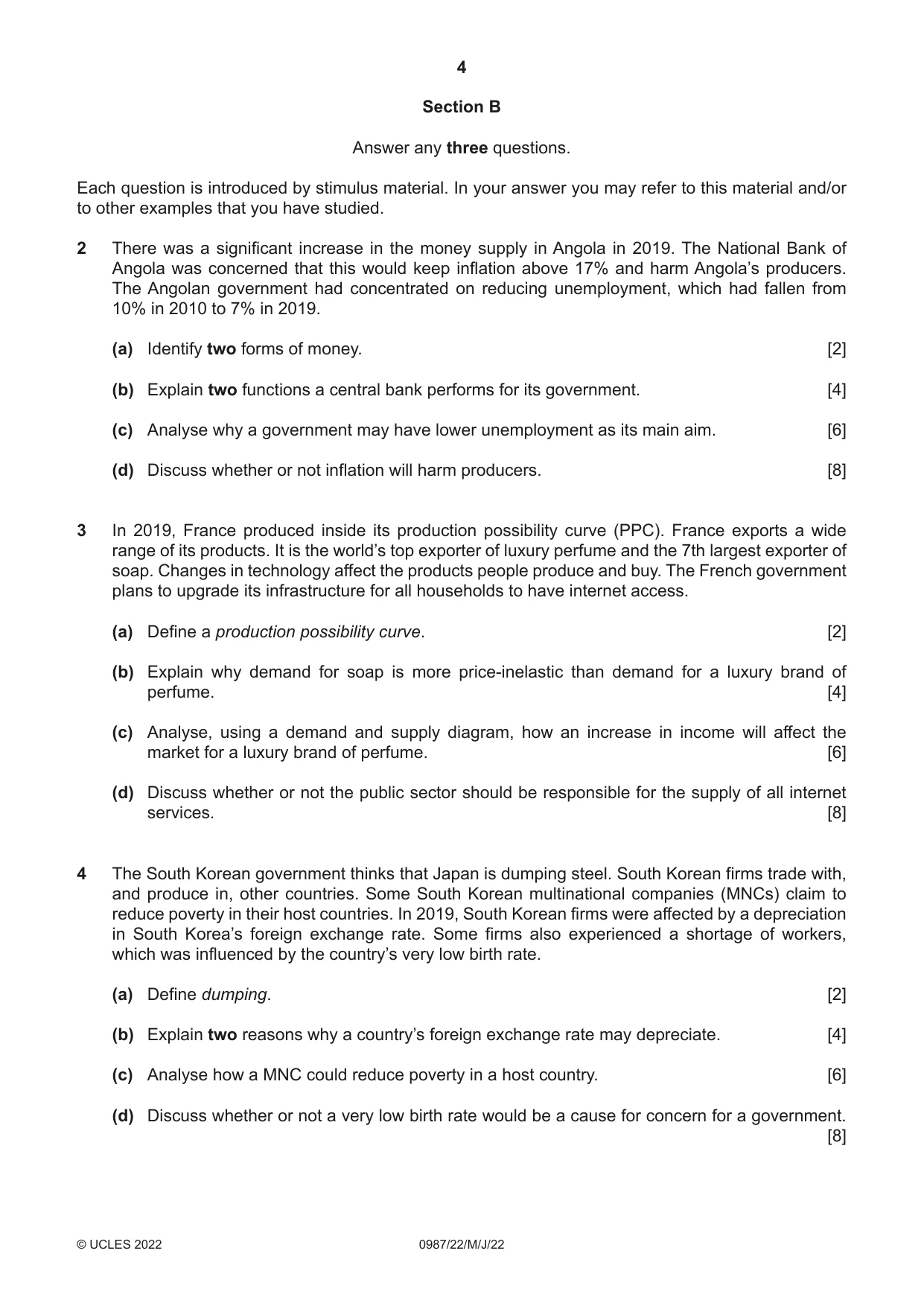
2 There was a significant increase in the money supply in Angola in 2019. The National Bank of Angola was concerned that this would keep inflation above 17% and harm Angola’s producers. The Angolan government had concentrated on reducing unemployment, which had fallen from 10% in 2010 to 7% in 2019. (a) Identify two forms of money. [2] (b) Explain two functions a central bank performs for its government. [4] (c) Analyse why a government may have lower unemployment as its main aim. [6] (d) Discuss whether or not inflation will harm producers. [8]
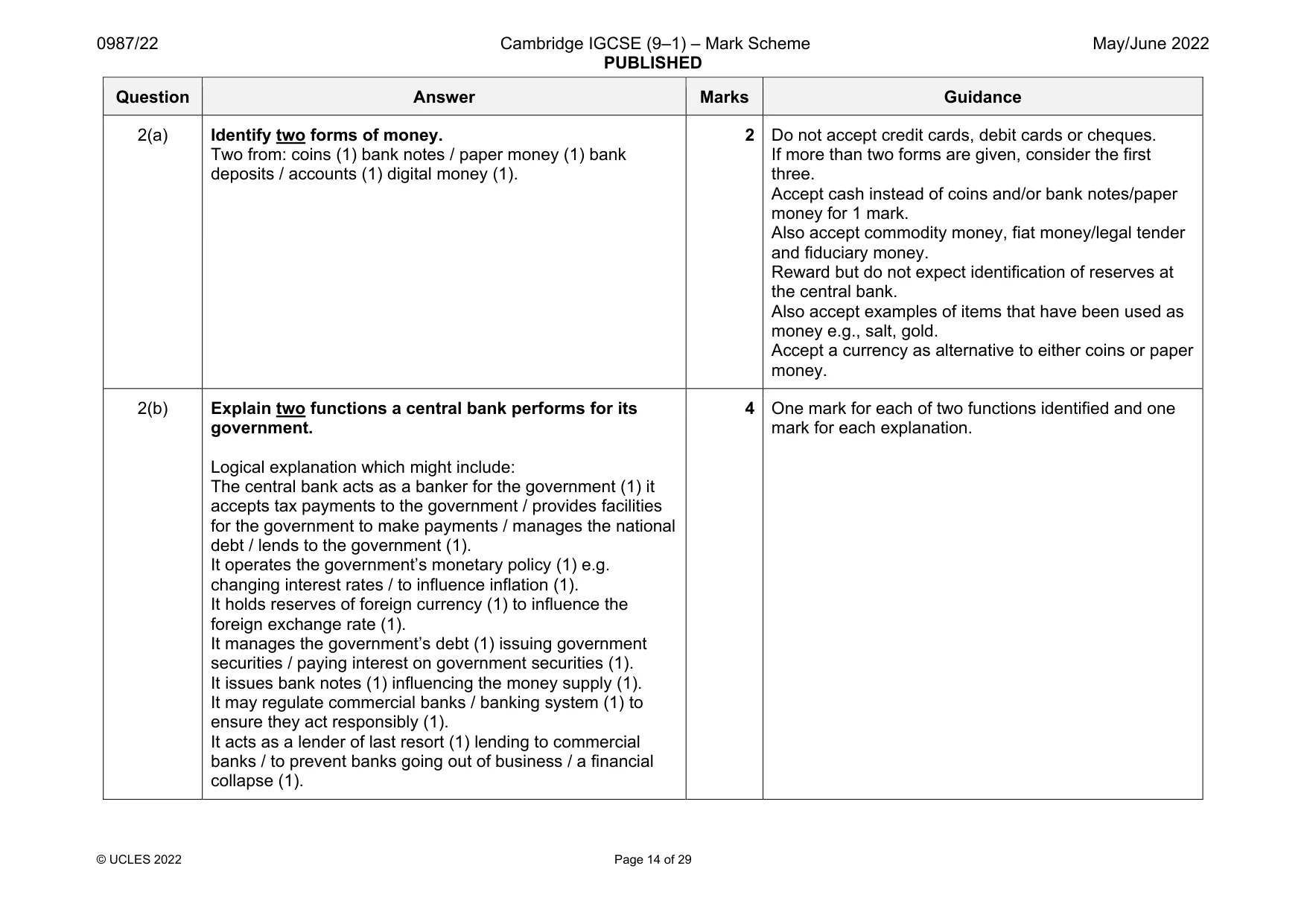
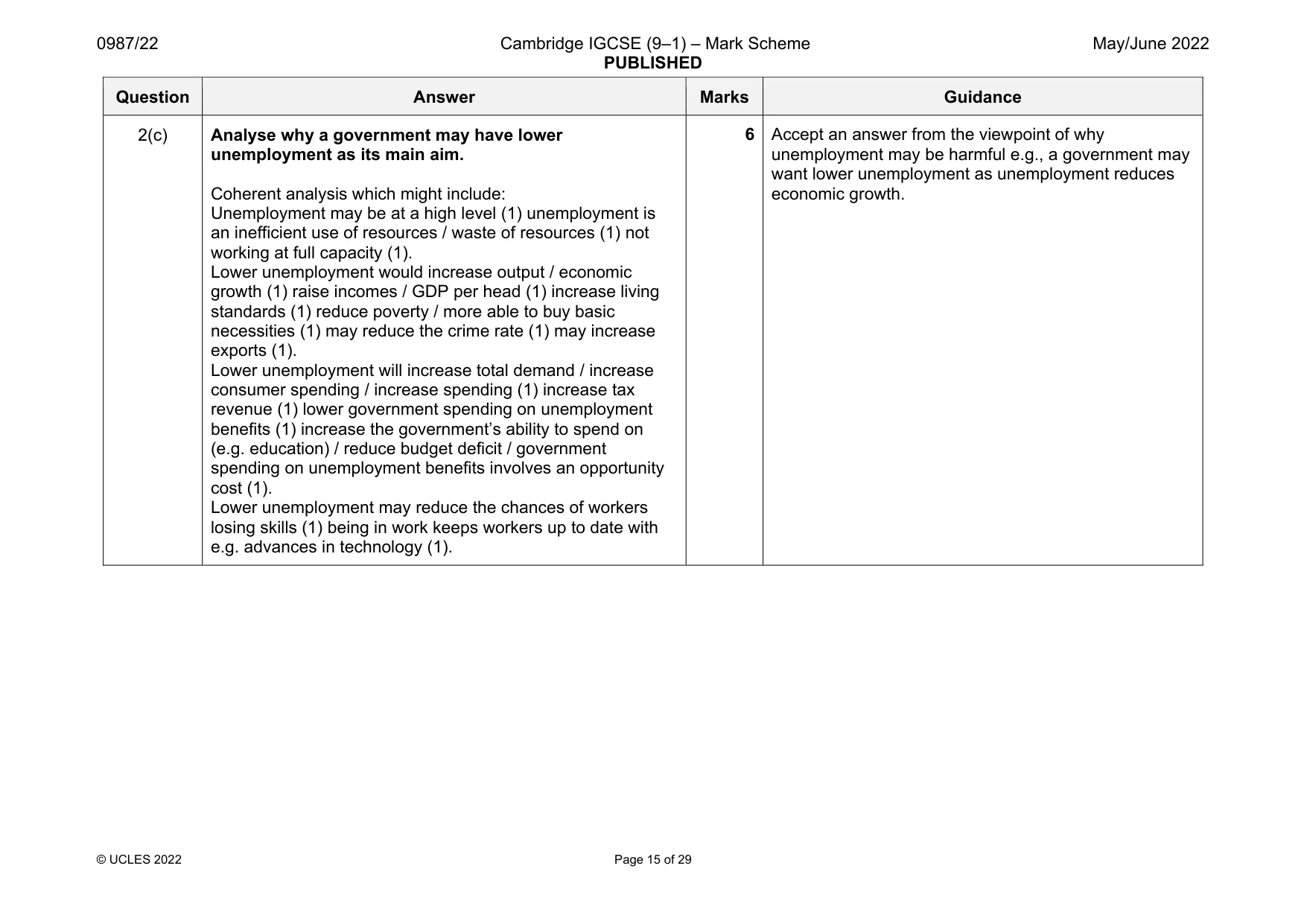
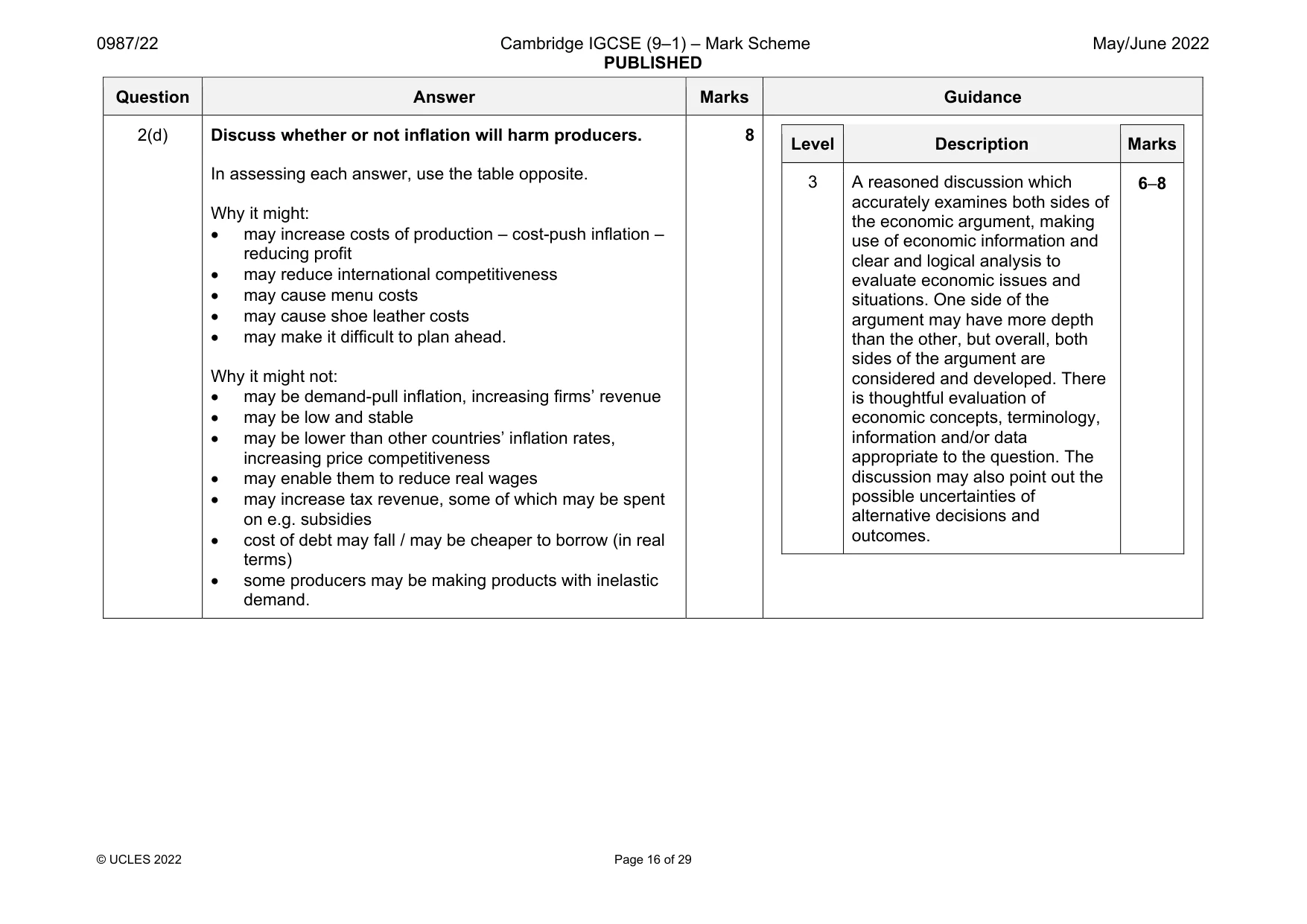
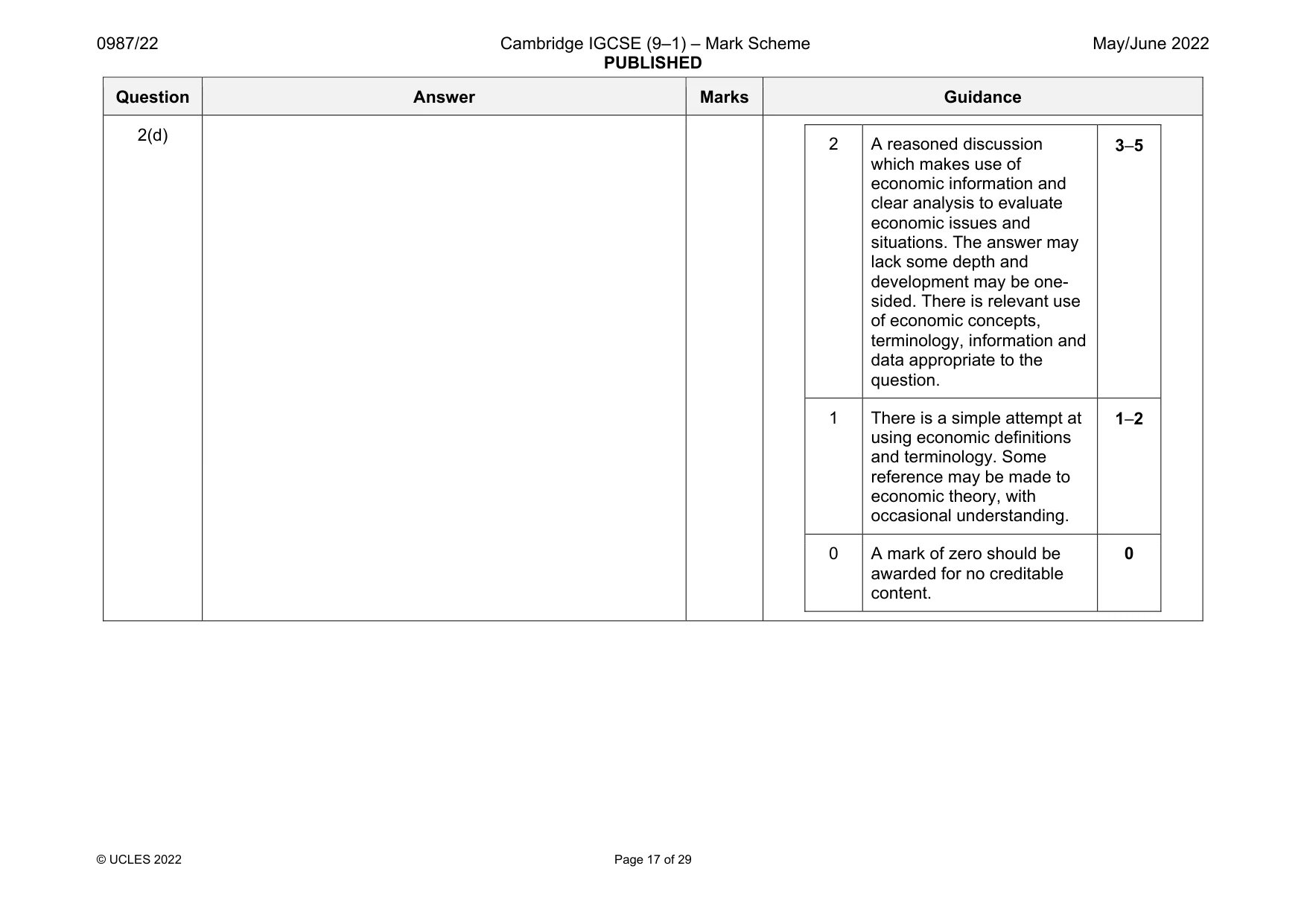
Mark scheme: 2(a) Identify two forms of money. Two from: coins (1) bank notes / paper money (1) bank deposits / accounts (1) digital money (1). 2 Do not accept credit cards, debit cards or cheques. If more than two forms are given, consider the first three. Accept cash instead of coins and/or bank notes/paper money for 1 mark. Also accept commodity money, fiat money/legal tender and fiduciary money. Reward but do not expect identification of reserves at the central bank. Also accept examples of items that have been used as money e.g., salt, gold. Accept a currency as alternative to either coins or paper money. 2(b) Explain two functions a central bank performs for its government. Logical explanation which might include: The central bank acts as a banker for the government (1) it accepts tax payments to the government / provides facilities for the government to make payments / manages the national debt / lends to the government (1). It operates the government’s monetary policy (1) e.g. changing interest rates / to influence inflation (1). It holds reserves of foreign currency (1) to influence the foreign exchange rate (1). It manages the government’s debt (1) issuing government securities / paying interest on government securities (1). It issues bank notes (1) influencing the money supply (1). It may regulate commercial banks / banking system (1) to ensure they act responsibly (1). It acts as a lender of last resort (1) lending to commercial banks / to prevent banks going out of business / a financial collapse (1). 4 One mark for each of two functions identified and one mark for each explanation. Question Answer Marks Guidance 2(c) Analyse why a government may have lower unemployment as its main aim. Coherent analysis which might include: Unemployment may be at a high level (1) unemployment is an inefficient use of resources / waste of resources (1) not working at full capacity (1). Lower unemployment would increase output / economic growth (1) raise incomes / GDP per head (1) increase living standards (1) reduce poverty / more able to buy basic necessities (1) may reduce the crime rate (1) may increase exports (1). Lower unemployment will increase total demand / increase consumer spending / increase spending (1) increase tax revenue (1) lower government spending on unemployment benefits (1) increase the government’s ability to spend on (e.g. education) / reduce budget deficit / government spending on unemployment benefits involves an opportunity cost (1). Lower unemployment may reduce the chances of workers losing skills (1) being in work keeps workers up to date with e.g. advances in technology (1). 6 Accept an answer from the viewpoint of why unemployment may be harmful e.g., a government may want lower unemployment as unemployment reduces economic growth. Question Answer Marks Guidance 2(d) Discuss whether or not inflation will harm producers. In assessing each answer, use the table opposite. Why it might: may increase costs of production – cost-push inflation – reducing profit may reduce international competitiveness may cause menu costs may cause shoe leather costs may make it difficult to plan ahead. Why it might not: may be demand-pull inflation, increasing firms’ revenue may be low and stable may be lower than other countries’ inflation rates, increasing price competitiveness may enable them to reduce real wages may increase tax revenue, some of which may be spent on e.g. subsidies cost of debt may fall / may be cheaper to borrow (in real terms) some producers may be making products with inelastic demand. 8 Level Description Marks 3 A reasoned discussion which accurately examines both sides of the economic argument, making use of economic information and clear and logical analysis to evaluate economic issues and situations. One side of the argument may have more depth than the other, but overall, both sides of the argument are considered and developed. There is thoughtful evaluation of economic concepts, terminology, information and/or data appropriate to the question. The discussion may also point out the possible uncertainties of alternative decisions and outcomes. 68 Question Answer Marks Guidance 2(d) 2 A reasoned discussion which makes use of economic information and clear analysis to evaluate economic issues and situations. The answer may lack some depth and development may be one- sided. There is relevant use of economic concepts, terminology, information and data appropriate to the question. 35 1 There is a simple attempt at using economic definitions and terminology. Some reference may be made to economic theory, with occasional understanding. 12 0 A mark of zero should be awarded for no creditable content. 0
Q3 · In 2019, France produced inside its production possibility curve (PPC)
3 In 2019, France produced inside its production possibility curve (PPC). France exports a wide range of its products. It is the world’s top exporter of luxury perfume and the 7th largest exporter of soap. Changes in technology affect the products people produce and buy. The French government plans to upgrade its infrastructure for all households to have internet access. (a) Define a production possibility curve. [2] (b) Explain why demand for soap is more price-inelastic than demand for a luxury brand of perfume. [4] (c) Analyse, using a demand and supply diagram, how an increase in income will affect the market for a luxury brand of perfume. [6] (d) Discuss whether or not the public sector should be responsible for the supply of all internet services. [8]
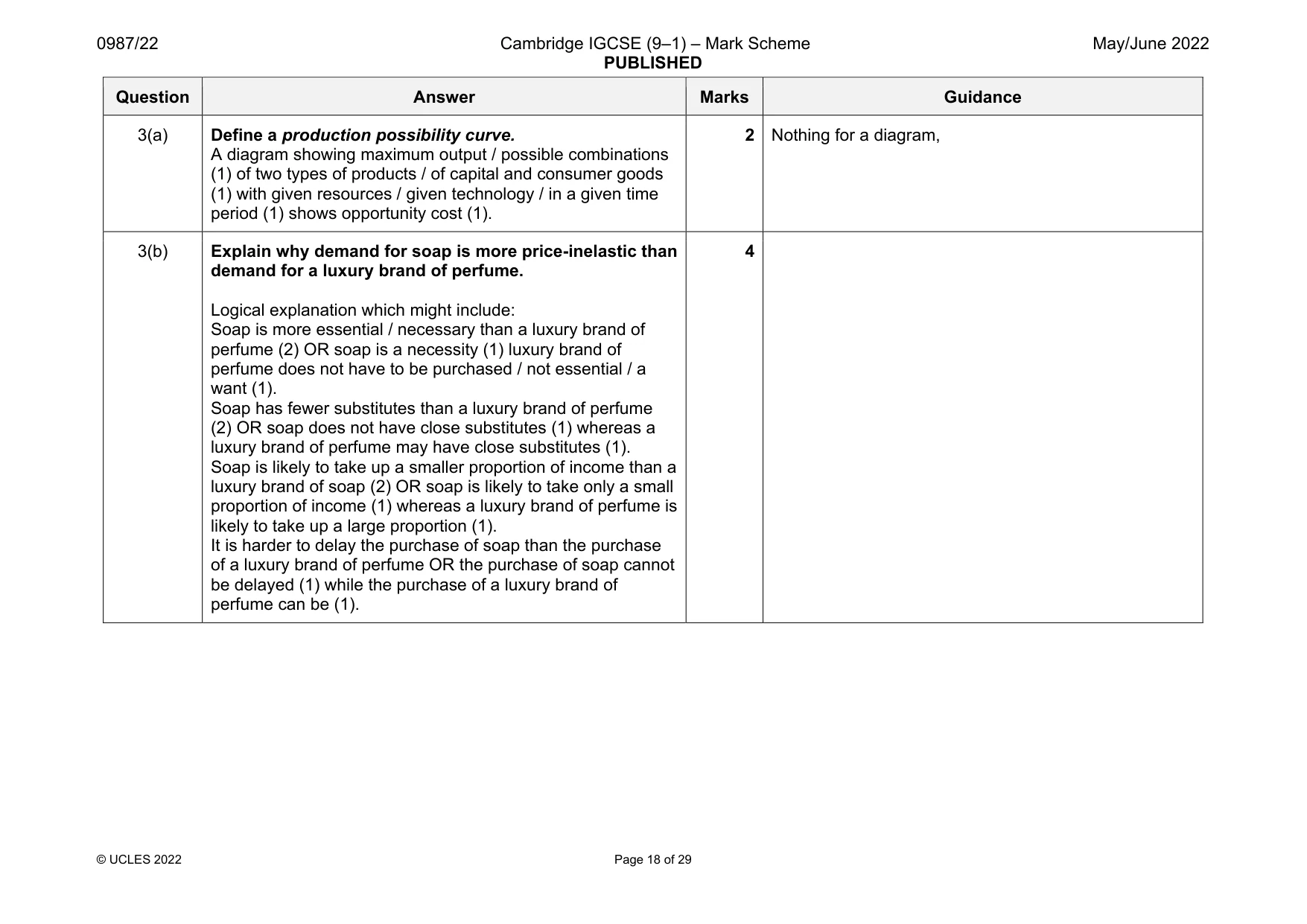
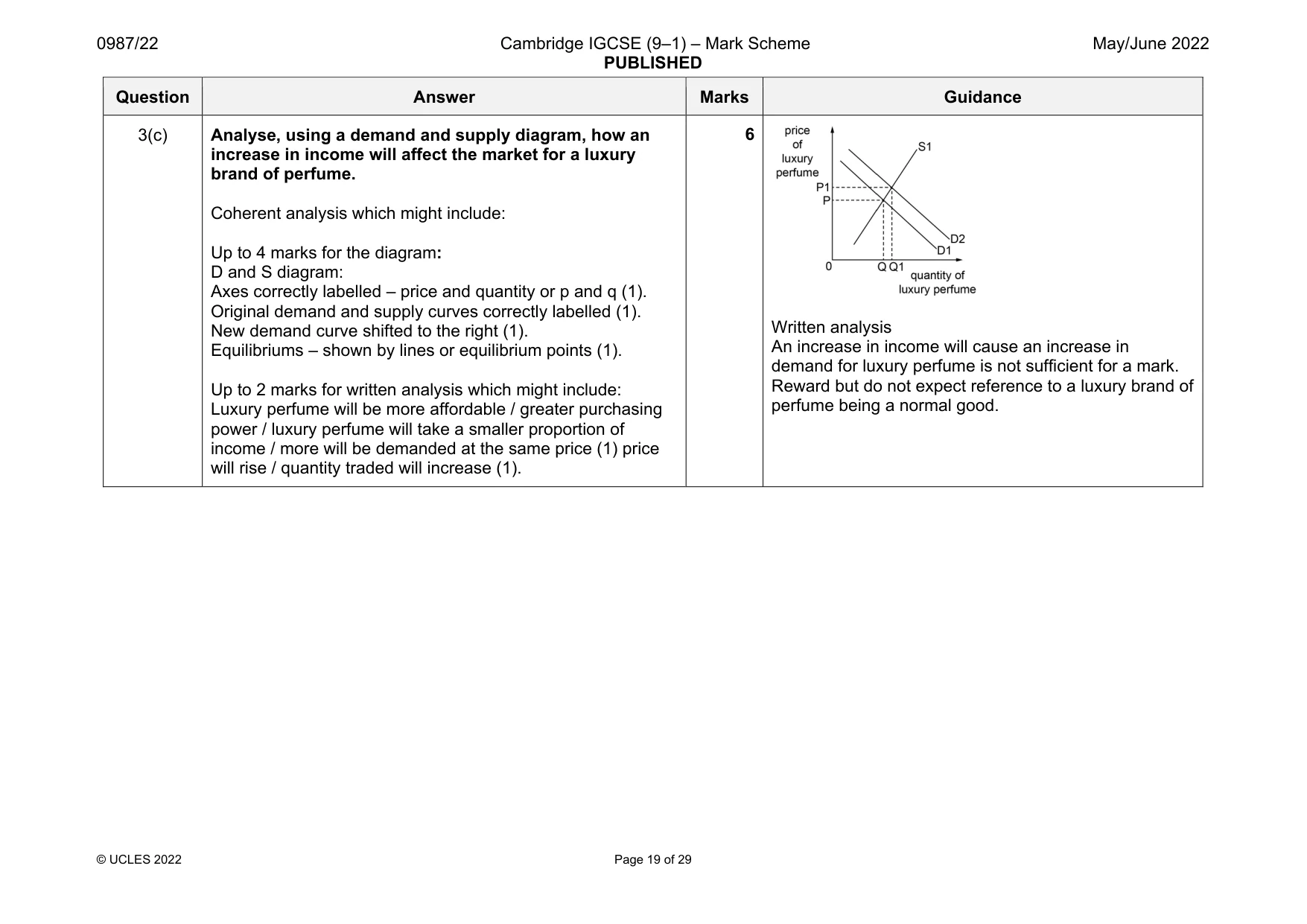
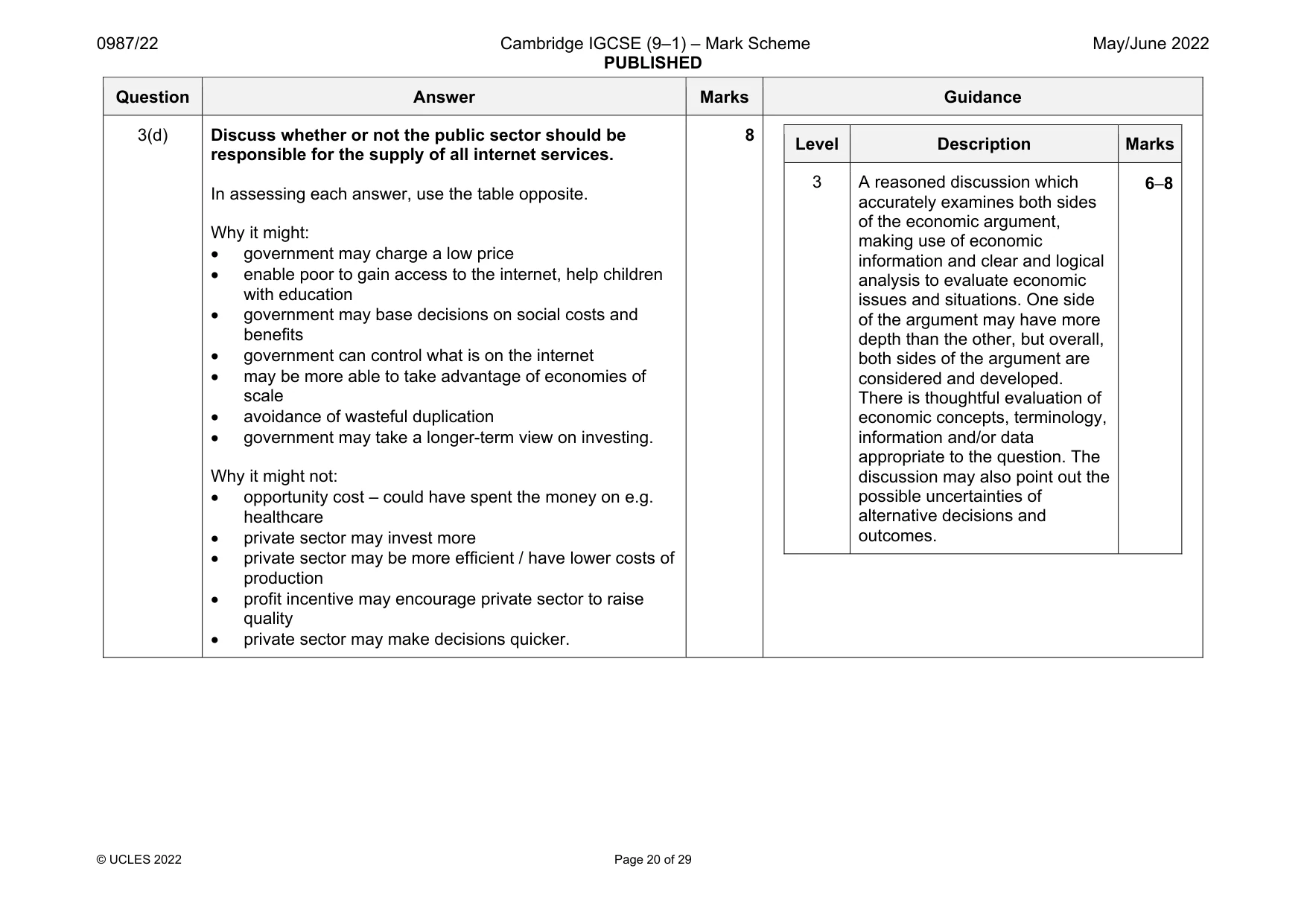
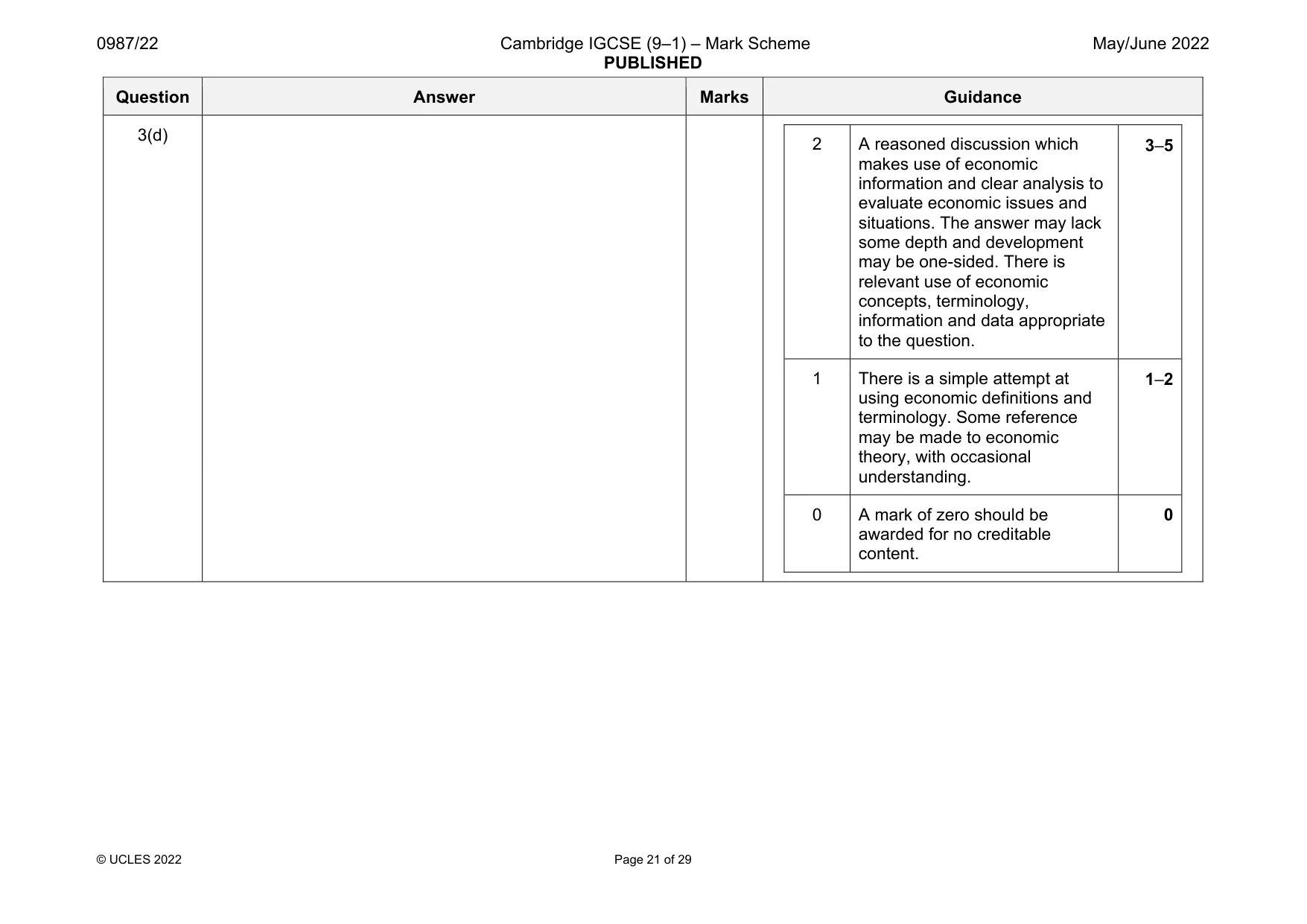
Mark scheme: 3(a) Define a production possibility curve. A diagram showing maximum output / possible combinations (1) of two types of products / of capital and consumer goods (1) with given resources / given technology / in a given time period (1) shows opportunity cost (1). 2 Nothing for a diagram, 3(b) Explain why demand for soap is more price-inelastic than demand for a luxury brand of perfume. Logical explanation which might include: Soap is more essential / necessary than a luxury brand of perfume (2) OR soap is a necessity (1) luxury brand of perfume does not have to be purchased / not essential / a want (1). Soap has fewer substitutes than a luxury brand of perfume (2) OR soap does not have close substitutes (1) whereas a luxury brand of perfume may have close substitutes (1). Soap is likely to take up a smaller proportion of income than a luxury brand of soap (2) OR soap is likely to take only a small proportion of income (1) whereas a luxury brand of perfume is likely to take up a large proportion (1). It is harder to delay the purchase of soap than the purchase of a luxury brand of perfume OR the purchase of soap cannot be delayed (1) while the purchase of a luxury brand of perfume can be (1). 4 Question Answer Marks Guidance 3(c) Analyse, using a demand and supply diagram, how an increase in income will affect the market for a luxury brand of perfume. Coherent analysis which might include: Up to 4 marks for the diagram: D and S diagram: Axes correctly labelled – price and quantity or p and q (1). Original demand and supply curves correctly labelled (1). New demand curve shifted to the right (1). Equilibriums – shown by lines or equilibrium points (1). Up to 2 marks for written analysis which might include: Luxury perfume will be more affordable / greater purchasing power / luxury perfume will take a smaller proportion of income / more will be demanded at the same price (1) price will rise / quantity traded will increase (1). 6 Written analysis An increase in income will cause an increase in demand for luxury perfume is not sufficient for a mark. Reward but do not expect reference to a luxury brand of perfume being a normal good. Question Answer Marks Guidance 3(d) Discuss whether or not the public sector should be responsible for the supply of all internet services. In assessing each answer, use the table opposite. Why it might: government may charge a low price enable poor to gain access to the internet, help children with education government may base decisions on social costs and benefits government can control what is on the internet may be more able to take advantage of economies of scale avoidance of wasteful duplication government may take a longer-term view on investing. Why it might not: opportunity cost – could have spent the money on e.g. healthcare private sector may invest more private sector may be more efficient / have lower costs of production profit incentive may encourage private sector to raise quality private sector may make decisions quicker. 8 Level Description Marks 3 A reasoned discussion which accurately examines both sides of the economic argument, making use of economic information and clear and logical analysis to evaluate economic issues and situations. One side of the argument may have more depth than the other, but overall, both sides of the argument are considered and developed. There is thoughtful evaluation of economic concepts, terminology, information and/or data appropriate to the question. The discussion may also point out the possible uncertainties of alternative decisions and outcomes. 68 Question Answer Marks Guidance 3(d) 2 A reasoned discussion which makes use of economic information and clear analysis to evaluate economic issues and situations. The answer may lack some depth and development may be one-sided. There is relevant use of economic concepts, terminology, information and data appropriate to the question. 35 1 There is a simple attempt at using economic definitions and terminology. Some reference may be made to economic theory, with occasional understanding. 12 0 A mark of zero should be awarded for no creditable content. 0
Q4 · The South Korean government thinks that Japan is dumping steel
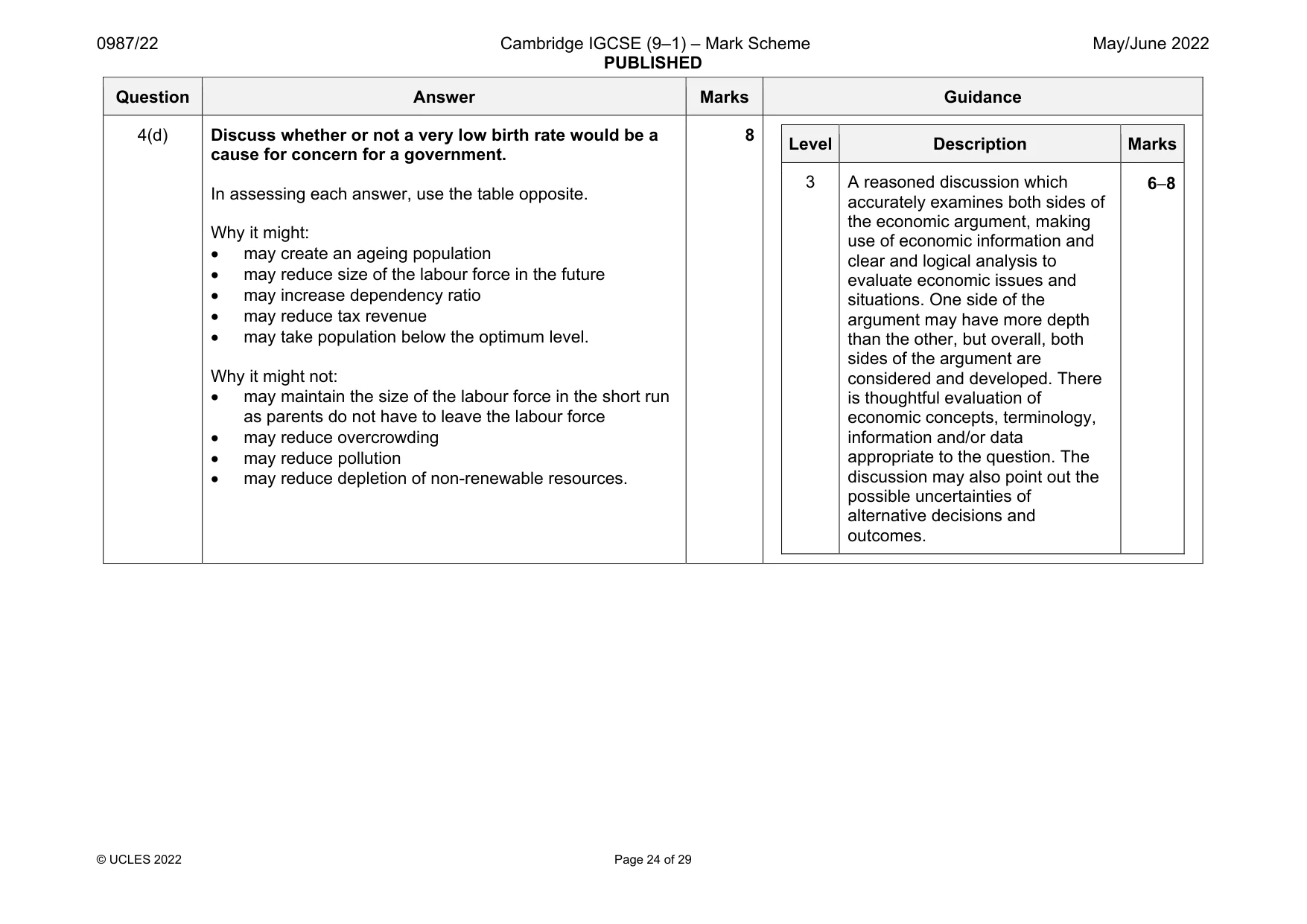
4 The South Korean government thinks that Japan is dumping steel. South Korean firms trade with, and produce in, other countries. Some South Korean multinational companies (MNCs) claim to reduce poverty in their host countries. In 2019, South Korean firms were affected by a depreciation in South Korea’s foreign exchange rate. Some firms also experienced a shortage of workers, which was influenced by the country’s very low birth rate. (a) Define dumping. [2] (b) Explain two reasons why a country’s foreign exchange rate may depreciate. [4] (c) Analyse how a MNC could reduce poverty in a host country. [6] (d) Discuss whether or not a very low birth rate would be a cause for concern for a government. [8]
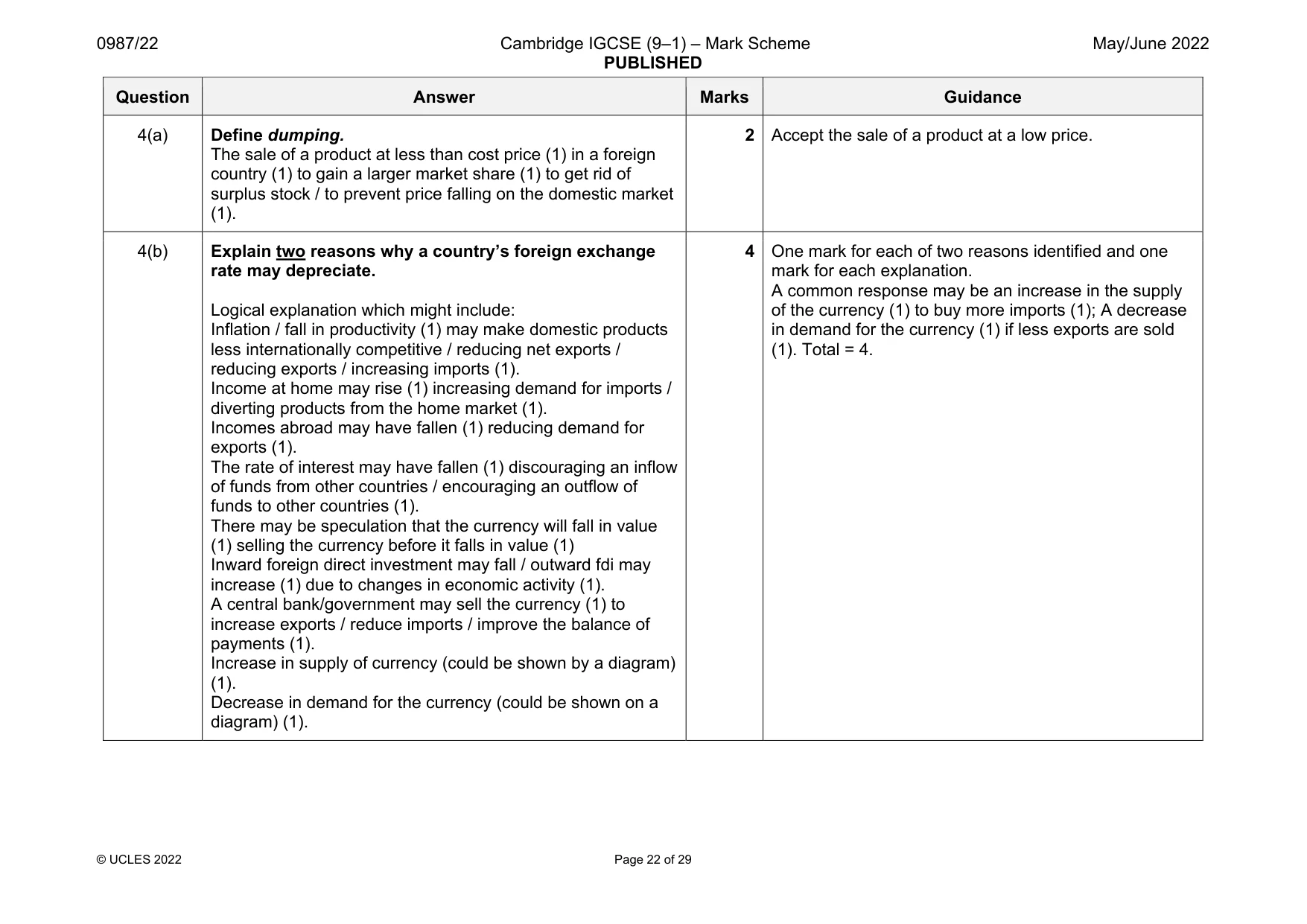
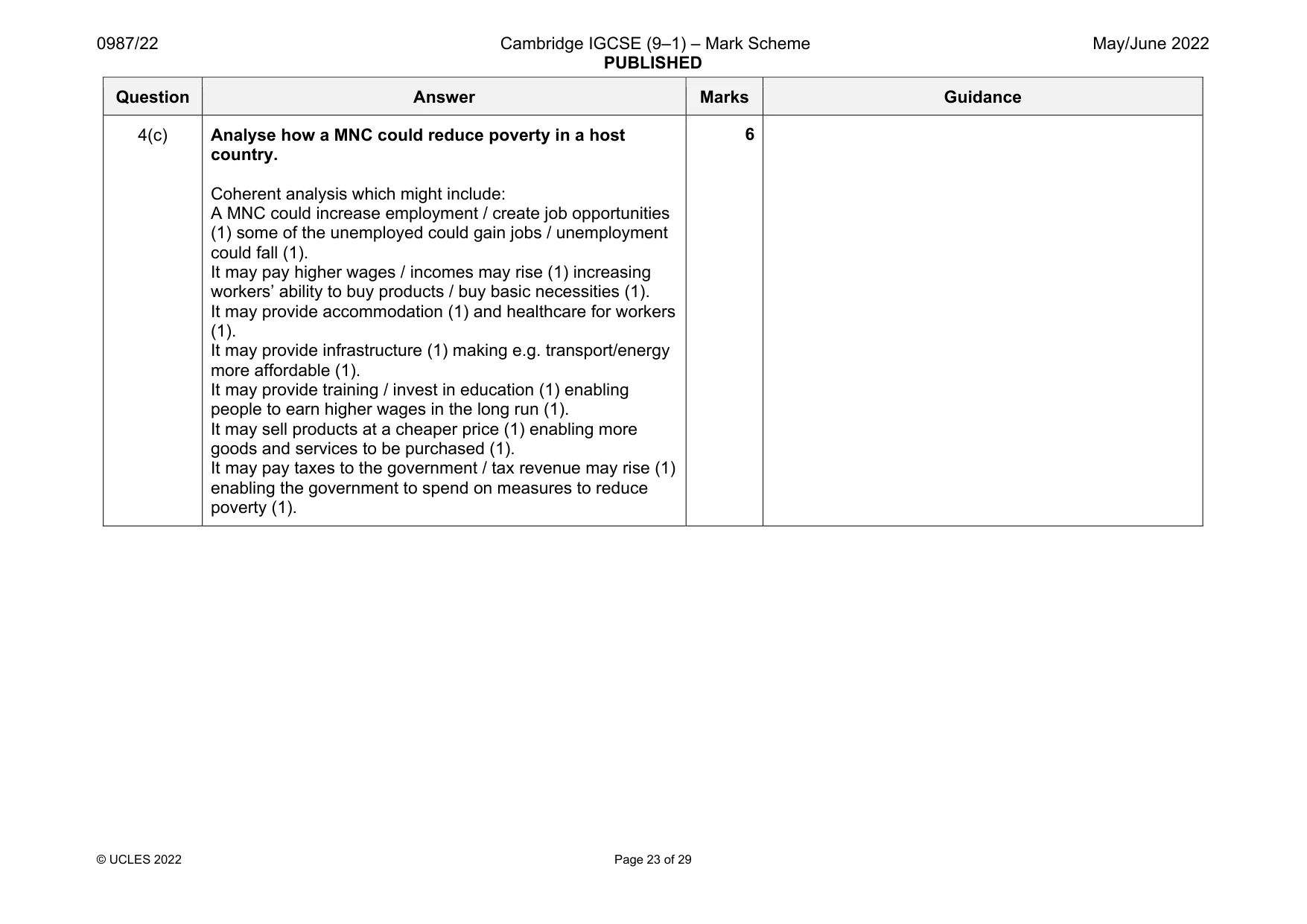
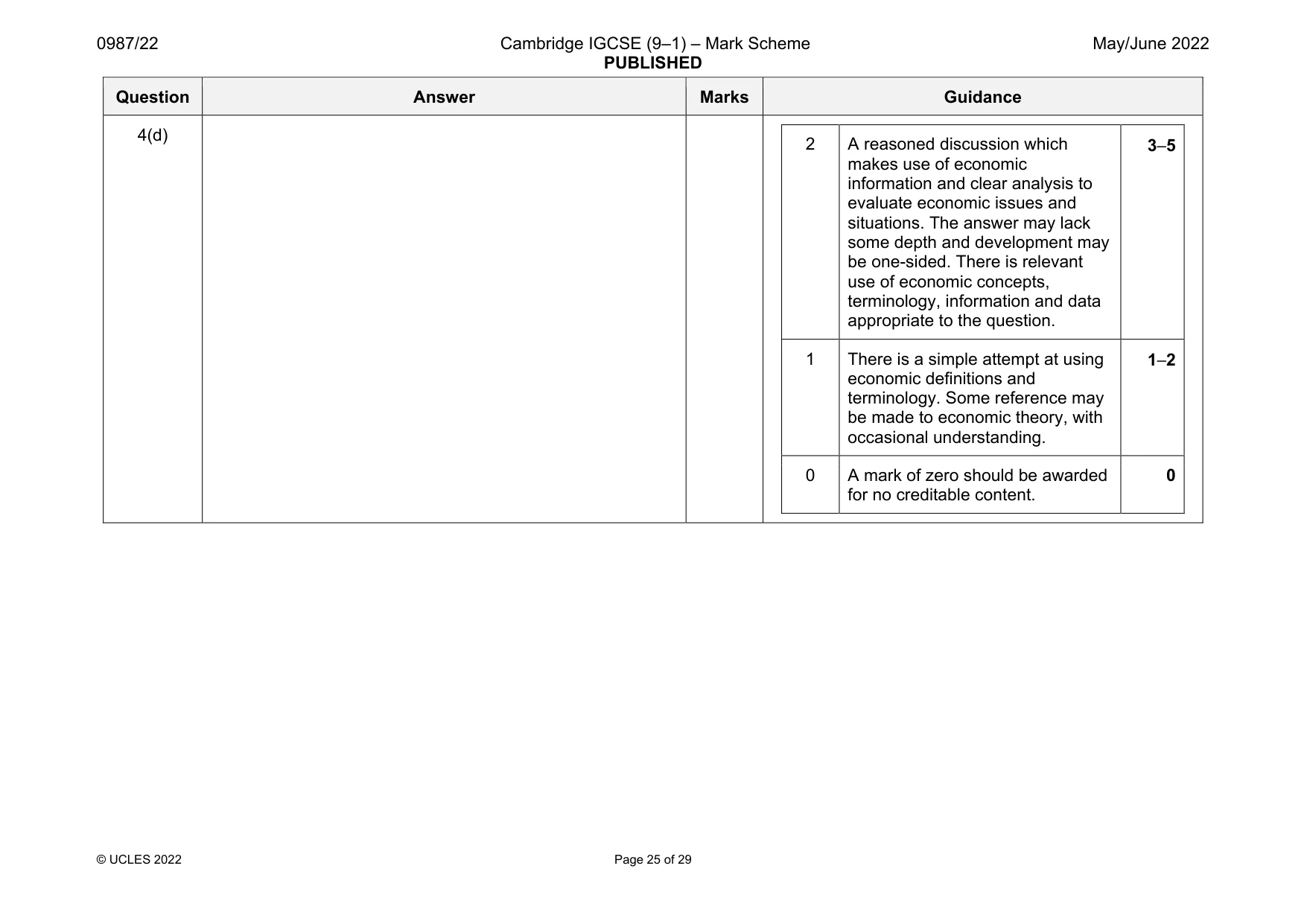
Mark scheme: 4(a) Define dumping. The sale of a product at less than cost price (1) in a foreign country (1) to gain a larger market share (1) to get rid of surplus stock / to prevent price falling on the domestic market (1). 2 Accept the sale of a product at a low price. 4(b) Explain two reasons why a country’s foreign exchange rate may depreciate. Logical explanation which might include: Inflation / fall in productivity (1) may make domestic products less internationally competitive / reducing net exports / reducing exports / increasing imports (1). Income at home may rise (1) increasing demand for imports / diverting products from the home market (1). Incomes abroad may have fallen (1) reducing demand for exports (1). The rate of interest may have fallen (1) discouraging an inflow of funds from other countries / encouraging an outflow of funds to other countries (1). There may be speculation that the currency will fall in value (1) selling the currency before it falls in value (1) Inward foreign direct investment may fall / outward fdi may increase (1) due to changes in economic activity (1). A central bank/government may sell the currency (1) to increase exports / reduce imports / improve the balance of payments (1). Increase in supply of currency (could be shown by a diagram) (1). Decrease in demand for the currency (could be shown on a diagram) (1). 4 One mark for each of two reasons identified and one mark for each explanation. A common response may be an increase in the supply of the currency (1) to buy more imports (1); A decrease in demand for the currency (1) if less exports are sold (1). Total = 4. Question Answer Marks Guidance 4(c) Analyse how a MNC could reduce poverty in a host country. Coherent analysis which might include: A MNC could increase employment / create job opportunities (1) some of the unemployed could gain jobs / unemployment could fall (1). It may pay higher wages / incomes may rise (1) increasing workers’ ability to buy products / buy basic necessities (1). It may provide accommodation (1) and healthcare for workers (1). It may provide infrastructure (1) making e.g. transport/energy more affordable (1). It may provide training / invest in education (1) enabling people to earn higher wages in the long run (1). It may sell products at a cheaper price (1) enabling more goods and services to be purchased (1). It may pay taxes to the government / tax revenue may rise (1) enabling the government to spend on measures to reduce poverty (1). 6 Question Answer Marks Guidance 4(d) Discuss whether or not a very low birth rate would be a cause for concern for a government. In assessing each answer, use the table opposite. Why it might: may create an ageing population may reduce size of the labour force in the future may increase dependency ratio may reduce tax revenue may take population below the optimum level. Why it might not: may maintain the size of the labour force in the short run as parents do not have to leave the labour force may reduce overcrowding may reduce pollution may reduce depletion of non-renewable resources. 8 Level Description Marks 3 A reasoned discussion which accurately examines both sides of the economic argument, making use of economic information and clear and logical analysis to evaluate economic issues and situations. One side of the argument may have more depth than the other, but overall, both sides of the argument are considered and developed. There is thoughtful evaluation of economic concepts, terminology, information and/or data appropriate to the question. The discussion may also point out the possible uncertainties of alternative decisions and outcomes. 68 Question Answer Marks Guidance 4(d) 2 A reasoned discussion which makes use of economic information and clear analysis to evaluate economic issues and situations. The answer may lack some depth and development may be one-sided. There is relevant use of economic concepts, terminology, information and data appropriate to the question. 35 1 There is a simple attempt at using economic definitions and terminology. Some reference may be made to economic theory, with occasional understanding. 12 0 A mark of zero should be awarded for no creditable content. 0
Q5 · Nicaragua experienced a 4% decrease in GDP in 2019, although household spending rose
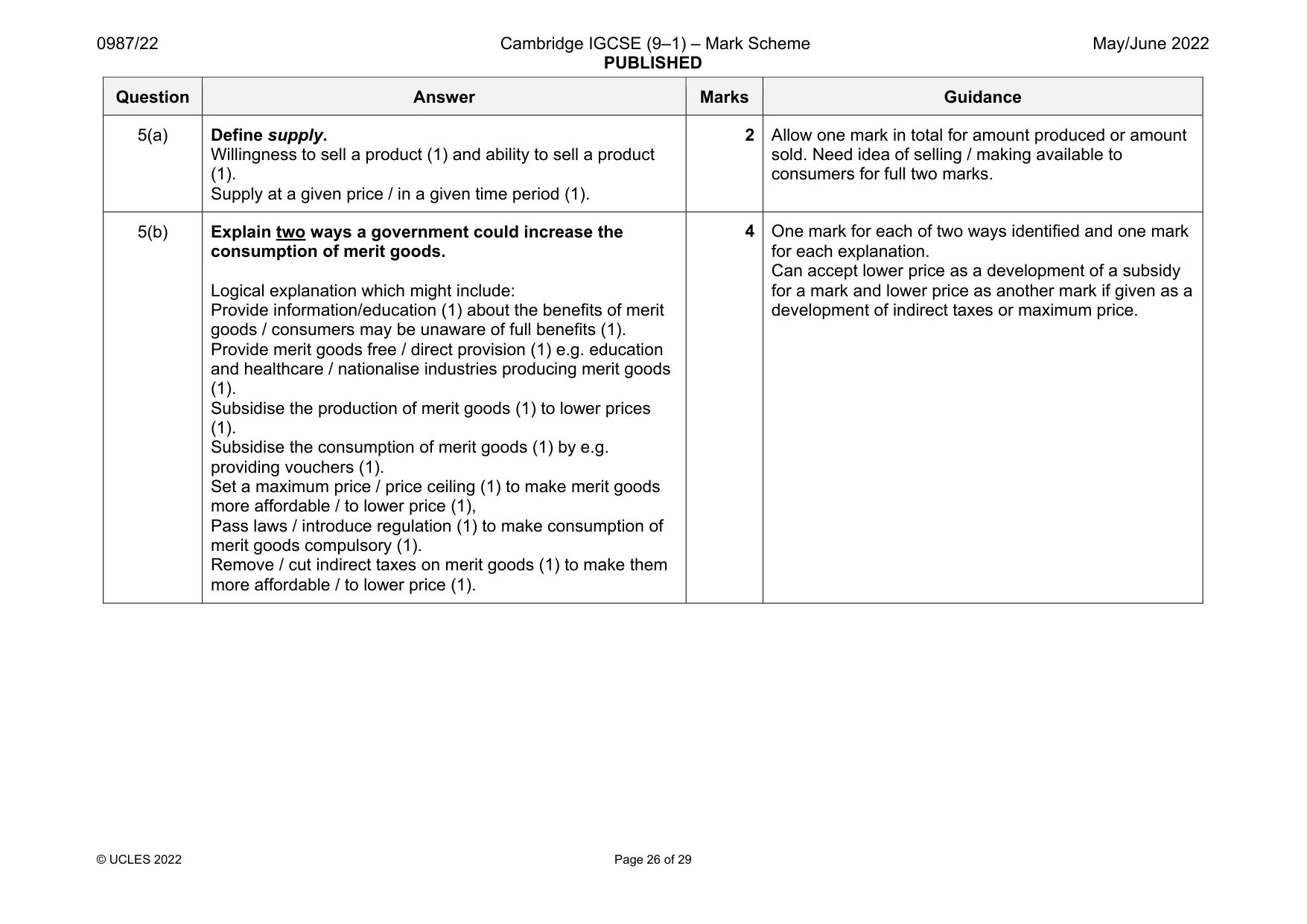
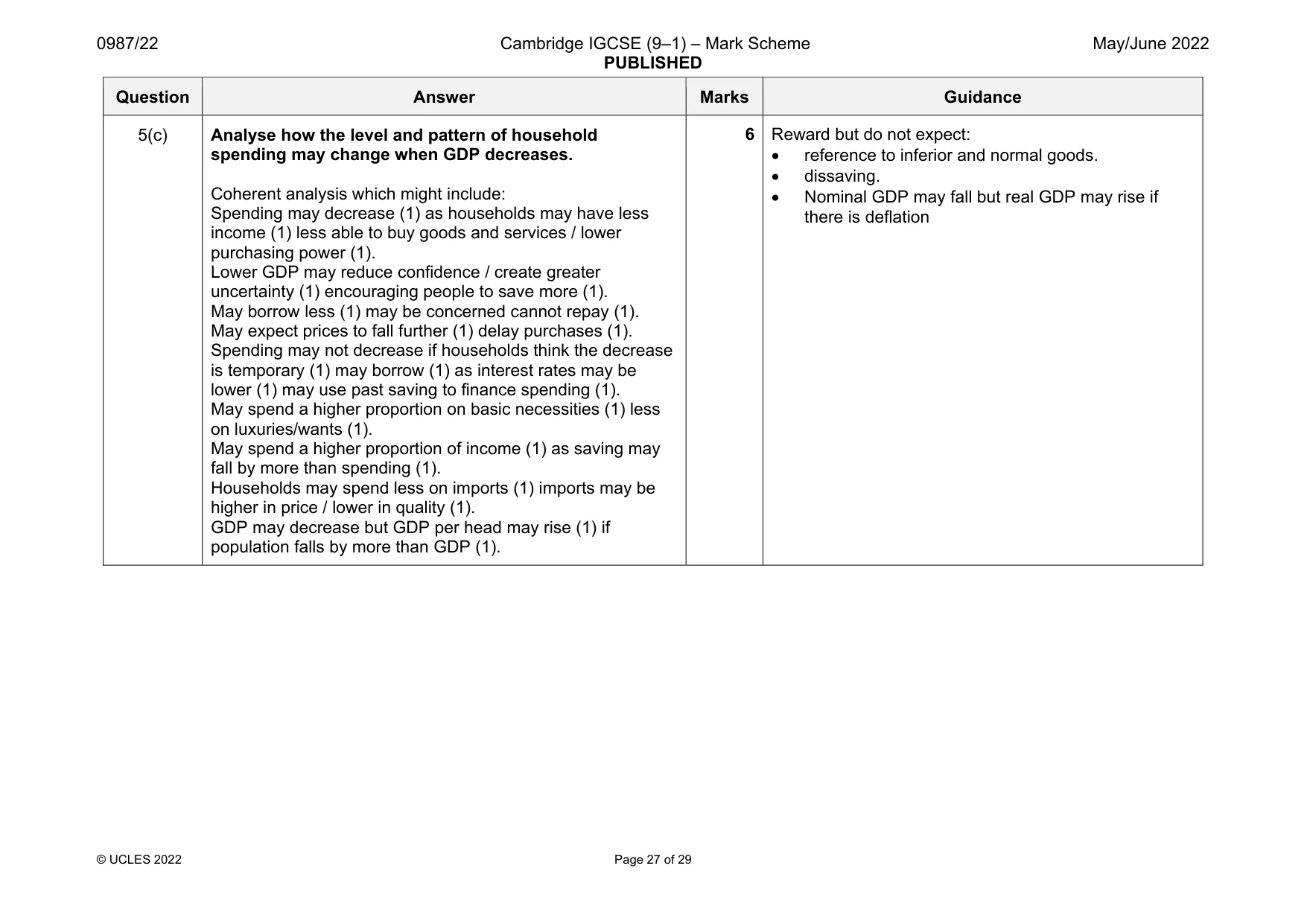
5 Nicaragua experienced a 4% decrease in GDP in 2019, although household spending rose. One Nicaraguan product that increased in supply was bananas, which are a merit good. The Nicaraguan government encouraged its banana farmers and its other producers to increase their output. Increases in output can affect a firm’s average costs of production. (a) Define supply. [2] (b) Explain two ways a government could increase the consumption of merit goods. [4] (c) Analyse how the level and pattern of household spending may change when GDP decreases. [6] (d) Discuss whether or not a firm will benefit from an increase in its output. [8]
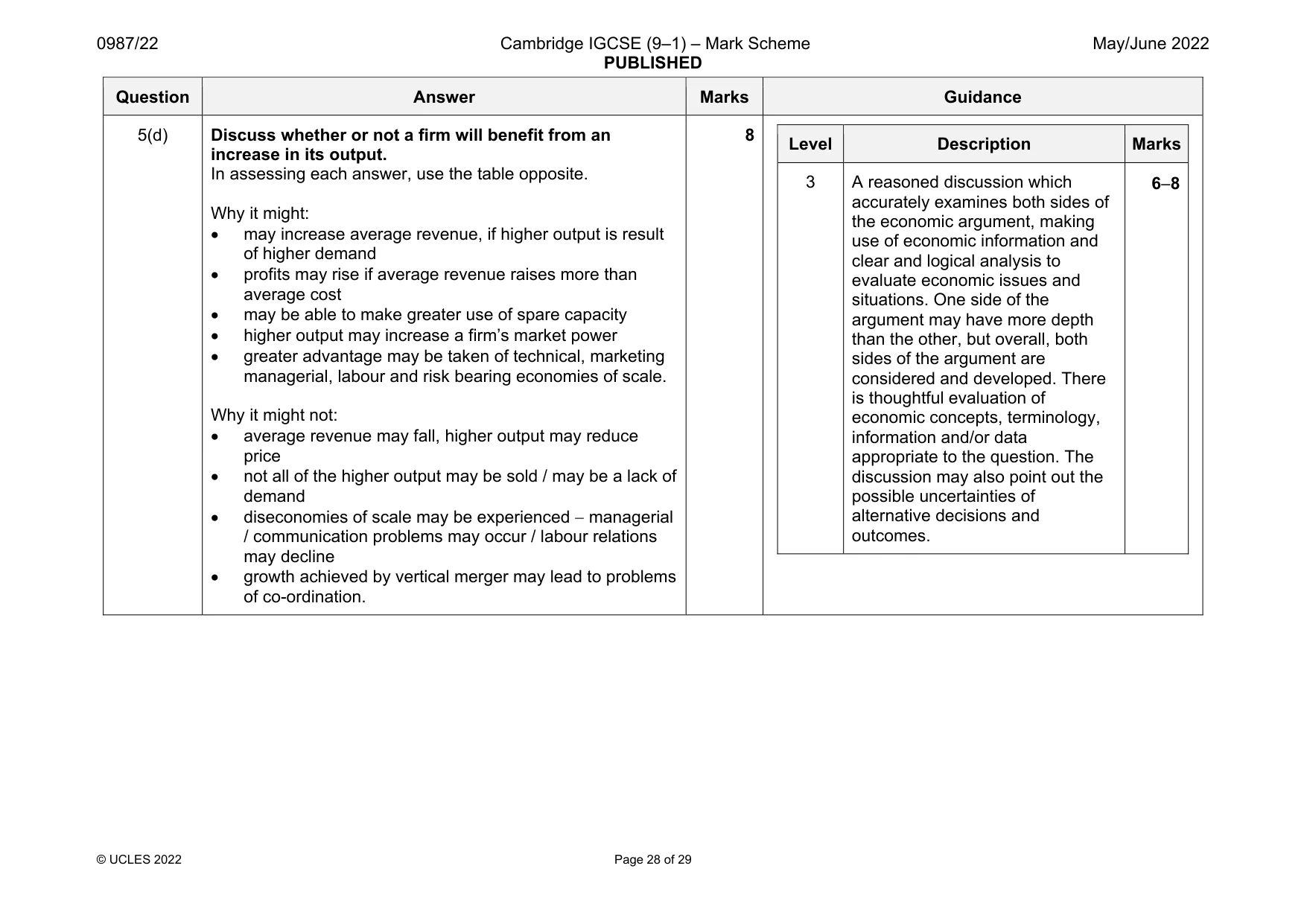
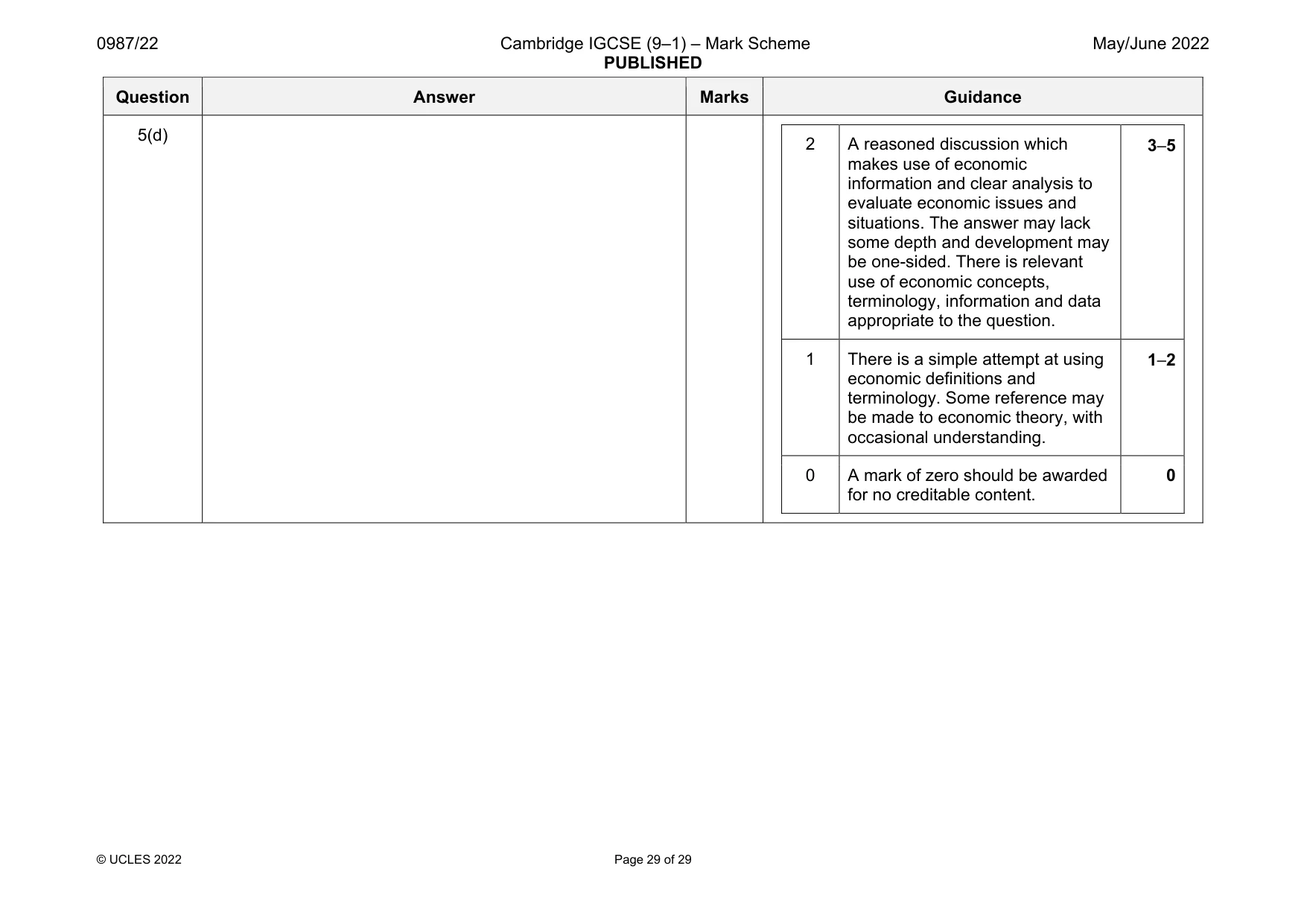
Mark scheme: 5(a) Define supply. Willingness to sell a product (1) and ability to sell a product (1). Supply at a given price / in a given time period (1). 2 Allow one mark in total for amount produced or amount sold. Need idea of selling / making available to consumers for full two marks. 5(b) Explain two ways a government could increase the consumption of merit goods. Logical explanation which might include: Provide information/education (1) about the benefits of merit goods / consumers may be unaware of full benefits (1). Provide merit goods free / direct provision (1) e.g. education and healthcare / nationalise industries producing merit goods (1). Subsidise the production of merit goods (1) to lower prices (1). Subsidise the consumption of merit goods (1) by e.g. providing vouchers (1). Set a maximum price / price ceiling (1) to make merit goods more affordable / to lower price (1), Pass laws / introduce regulation (1) to make consumption of merit goods compulsory (1). Remove / cut indirect taxes on merit goods (1) to make them more affordable / to lower price (1). 4 One mark for each of two ways identified and one mark for each explanation. Can accept lower price as a development of a subsidy for a mark and lower price as another mark if given as a development of indirect taxes or maximum price. Question Answer Marks Guidance 5(c) Analyse how the level and pattern of household spending may change when GDP decreases. Coherent analysis which might include: Spending may decrease (1) as households may have less income (1) less able to buy goods and services / lower purchasing power (1). Lower GDP may reduce confidence / create greater uncertainty (1) encouraging people to save more (1). May borrow less (1) may be concerned cannot repay (1). May expect prices to fall further (1) delay purchases (1). Spending may not decrease if households think the decrease is temporary (1) may borrow (1) as interest rates may be lower (1) may use past saving to finance spending (1). May spend a higher proportion on basic necessities (1) less on luxuries/wants (1). May spend a higher proportion of income (1) as saving may fall by more than spending (1). Households may spend less on imports (1) imports may be higher in price / lower in quality (1). GDP may decrease but GDP per head may rise (1) if population falls by more than GDP (1). 6 Reward but do not expect: reference to inferior and normal goods. dissaving. Nominal GDP may fall but real GDP may rise if there is deflation Question Answer Marks Guidance 5(d) Discuss whether or not a firm will benefit from an increase in its output. In assessing each answer, use the table opposite. Why it might: may increase average revenue, if higher output is result of higher demand profits may rise if average revenue raises more than average cost may be able to make greater use of spare capacity higher output may increase a firm’s market power greater advantage may be taken of technical, marketing managerial, labour and risk bearing economies of scale. Why it might not: average revenue may fall, higher output may reduce price not all of the higher output may be sold / may be a lack of demand diseconomies of scale may be experienced managerial / communication problems may occur / labour relations may decline growth achieved by vertical merger may lead to problems of co-ordination. 8 Level Description Marks 3 A reasoned discussion which accurately examines both sides of the economic argument, making use of economic information and clear and logical analysis to evaluate economic issues and situations. One side of the argument may have more depth than the other, but overall, both sides of the argument are considered and developed. There is thoughtful evaluation of economic concepts, terminology, information and/or data appropriate to the question. The discussion may also point out the possible uncertainties of alternative decisions and outcomes. 68 Question Answer Marks Guidance 5(d) 2 A reasoned discussion which makes use of economic information and clear analysis to evaluate economic issues and situations. The answer may lack some depth and development may be one-sided. There is relevant use of economic concepts, terminology, information and data appropriate to the question. 35 1 There is a simple attempt at using economic definitions and terminology. Some reference may be made to economic theory, with occasional understanding. 12 0 A mark of zero should be awarded for no creditable content. 0
What was in this paper
The subtopics covered by these 5 questions, and how many questions each got. Open one in a new tab to see every Cambridge question on it.
What you needed in this session
Cambridge’s own grade thresholds for 2022 May/June, Paper 2 · Variant 2. A higher threshold means an easier paper — the bar moves with how the cohort did.