Cambridge IGCSE Economics (9-1) 0987 — 2021 May/June Paper 2 · Variant 2
0987/22/M/J/21 · 5 questions · 90 marks · ≈101 min
The question paper and its mark scheme, free to read here and free to download. This is Cambridge’s own paper, exactly as it was sat.
Question paper8 pages




Mark scheme23 pages
Answers below. Sit the paper first if you are practising.
Questions as text
Q1 · Calculate Chile’s agricultural output in 2017
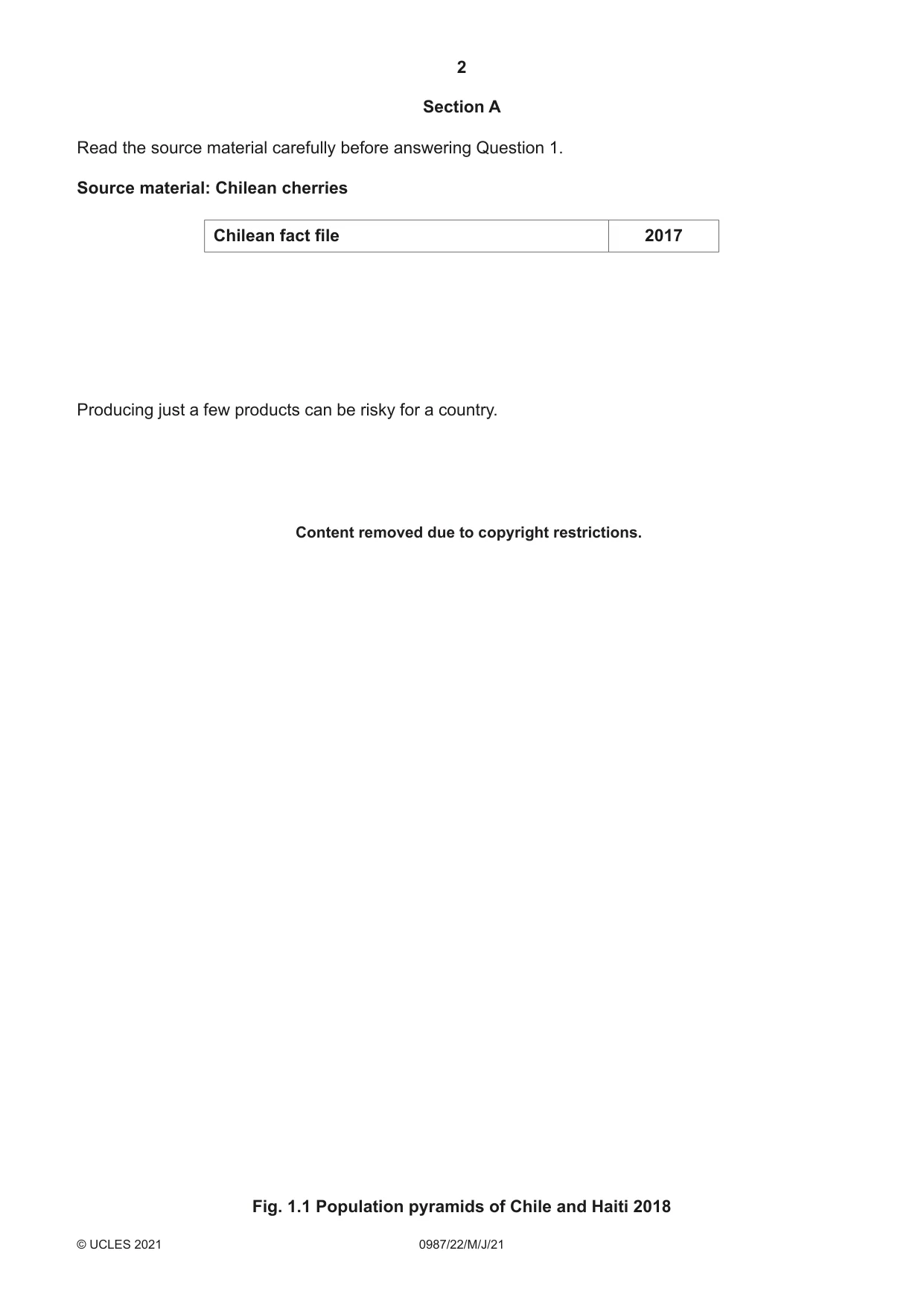
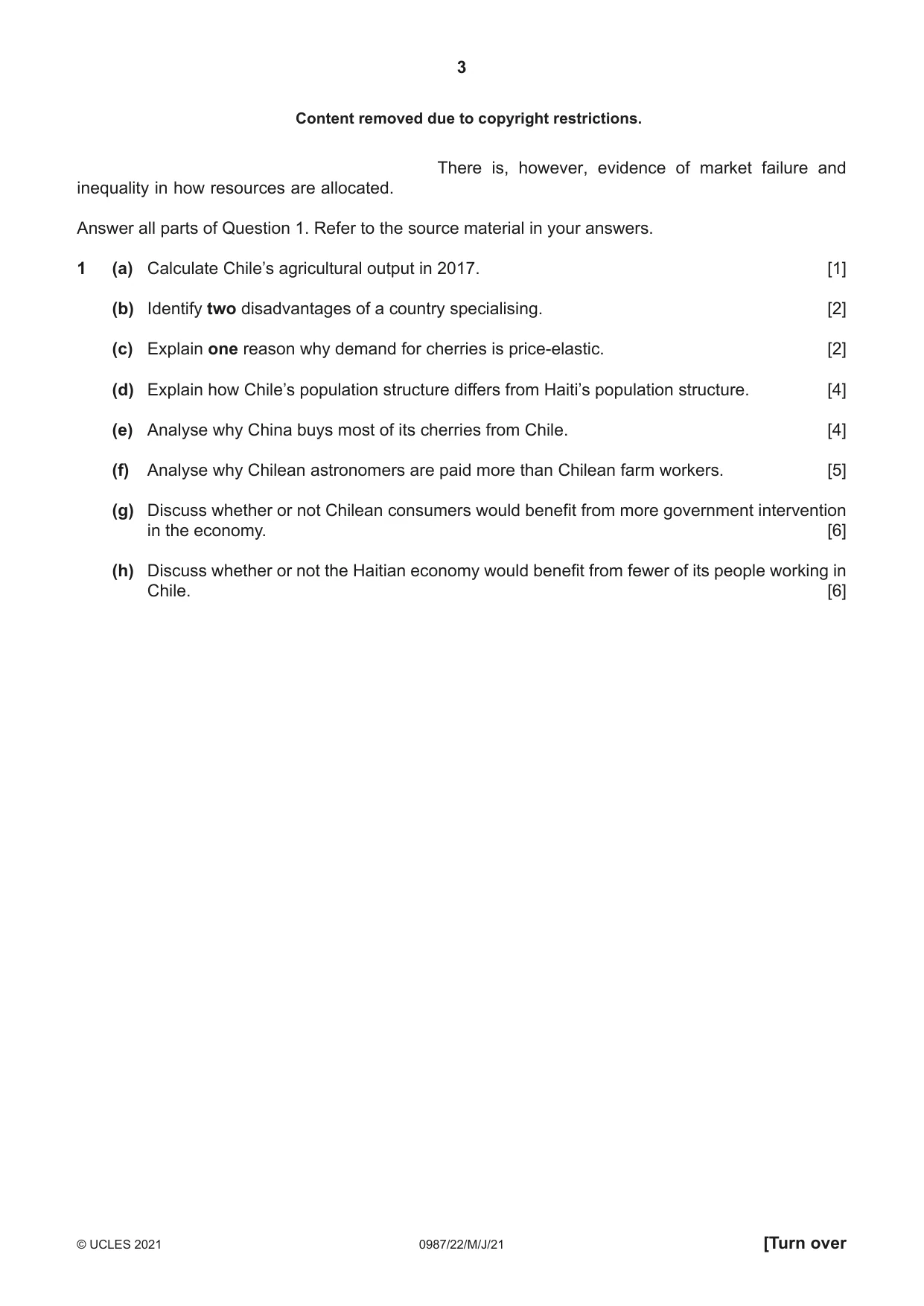
1 (a) Calculate Chile’s agricultural output in 2017. [1] (b) Identify two disadvantages of a country specialising. [2] (c) Explain one reason why demand for cherries is price-elastic. [2] (d) Explain how Chile’s population structure differs from Haiti’s population structure. [4] (e) Analyse why China buys most of its cherries from Chile. [4] (f) Analyse why Chilean astronomers are paid more than Chilean farm workers. [5] (g) Discuss whether or not Chilean consumers would benefit from more government intervention in the economy. [6] (h) Discuss whether or not the Haitian economy would benefit from fewer of its people working in Chile. [6]
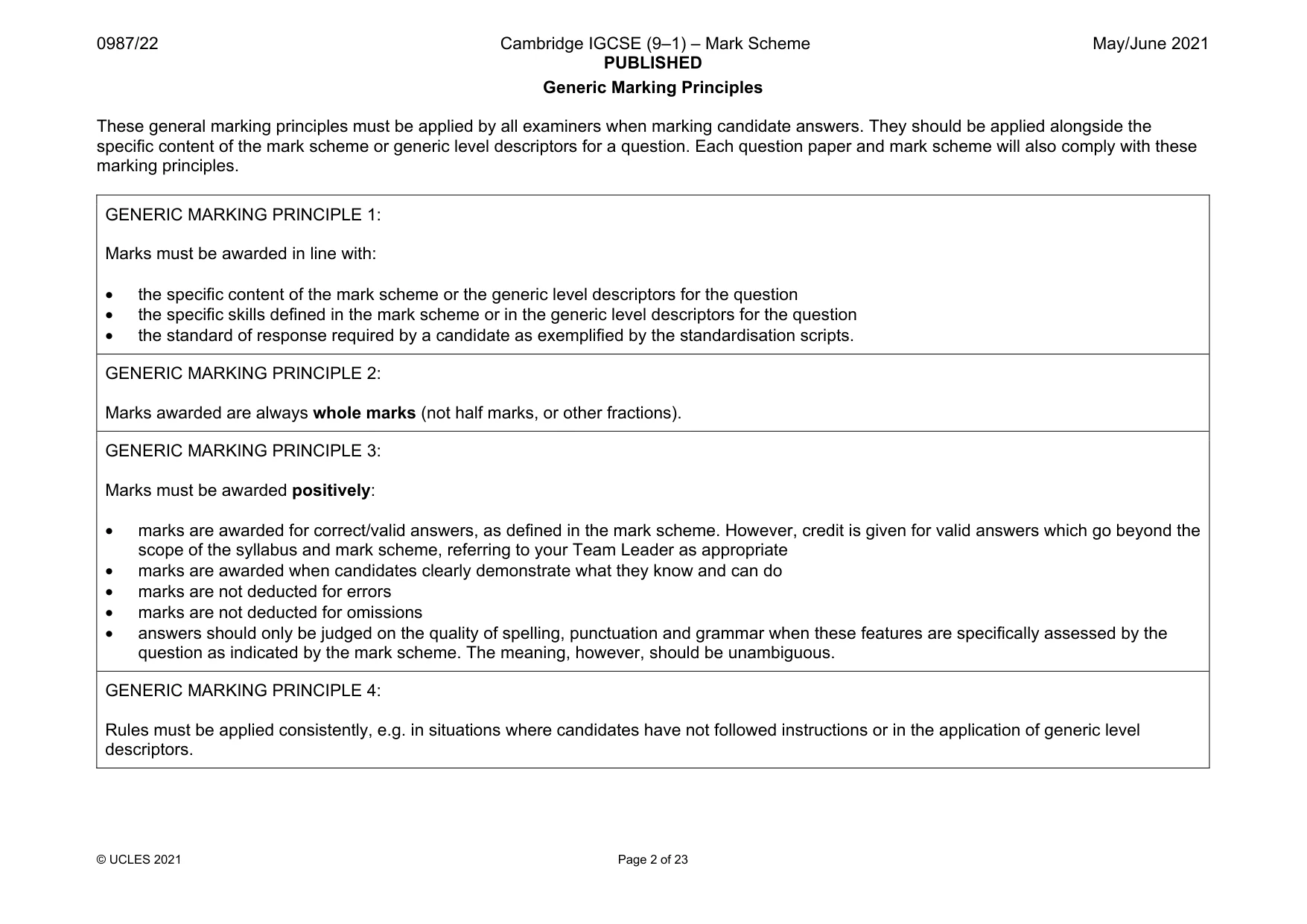
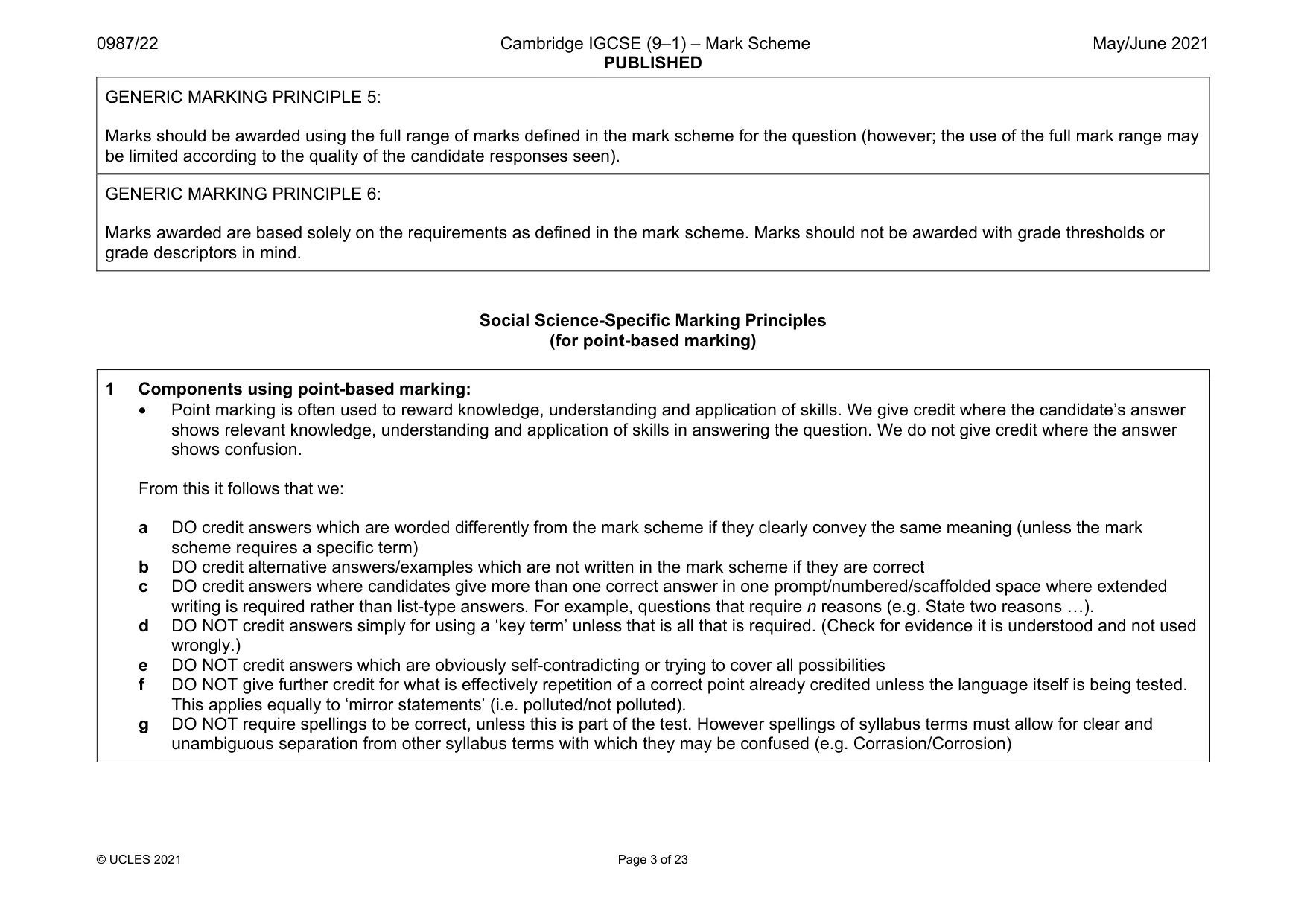
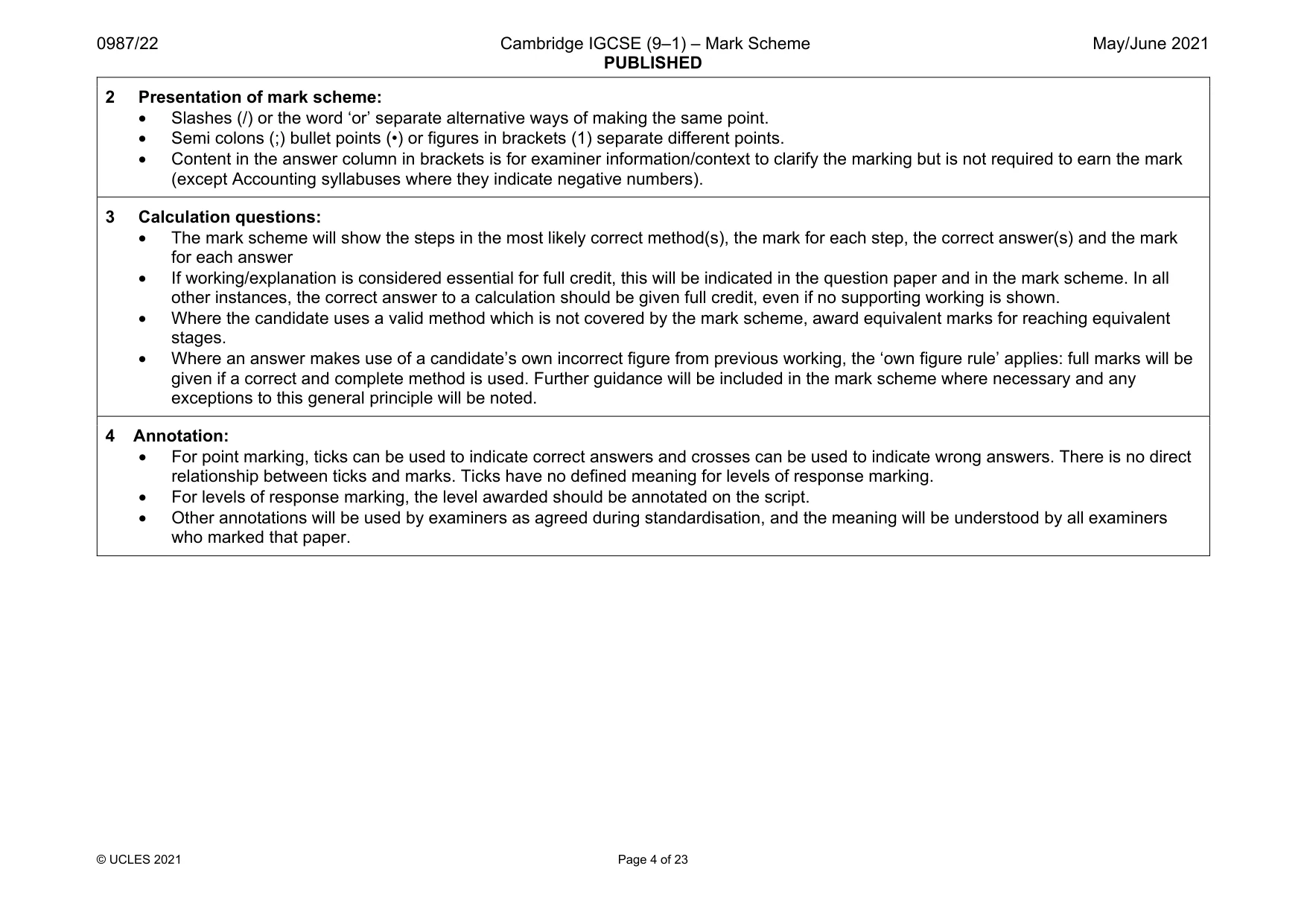
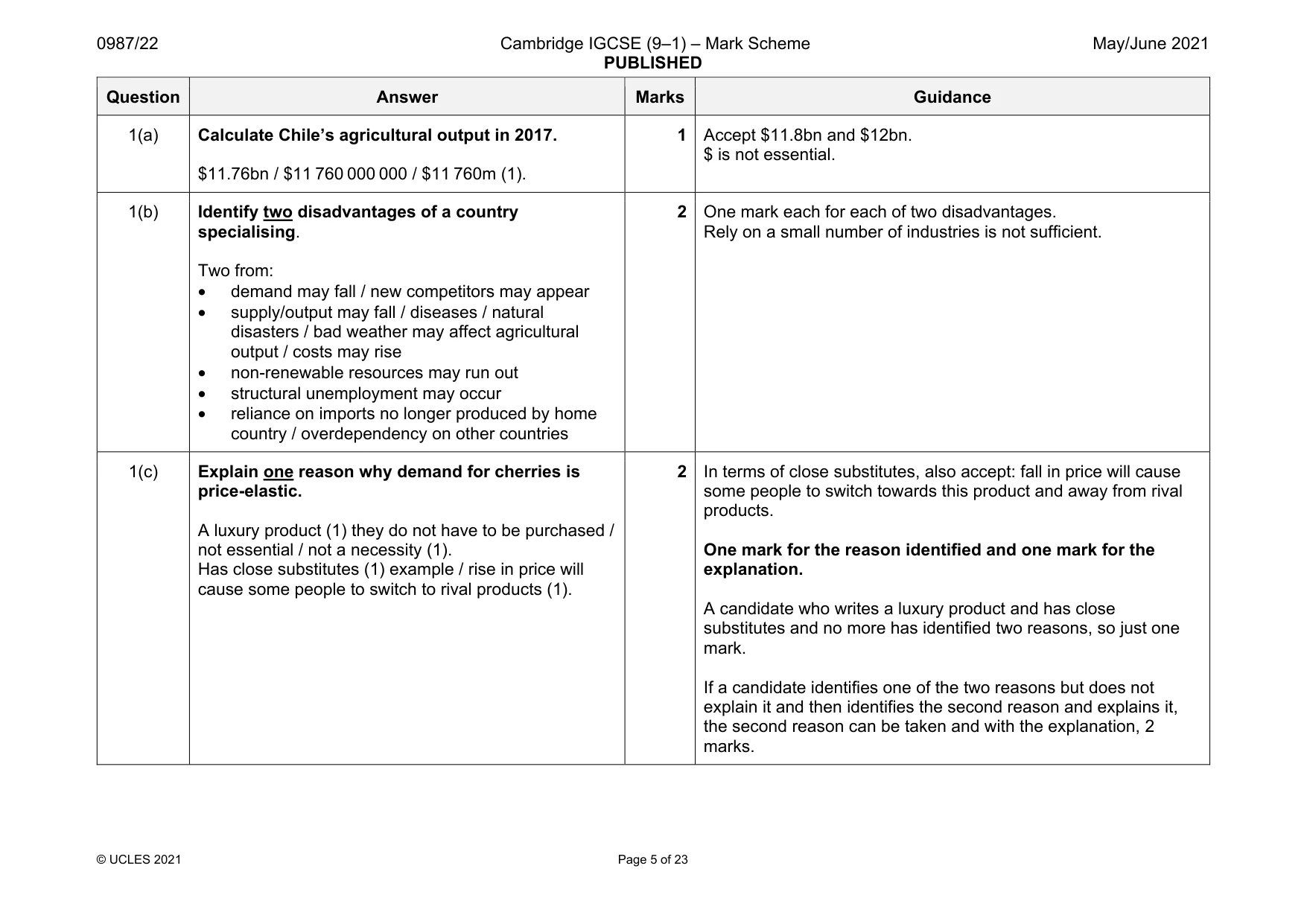
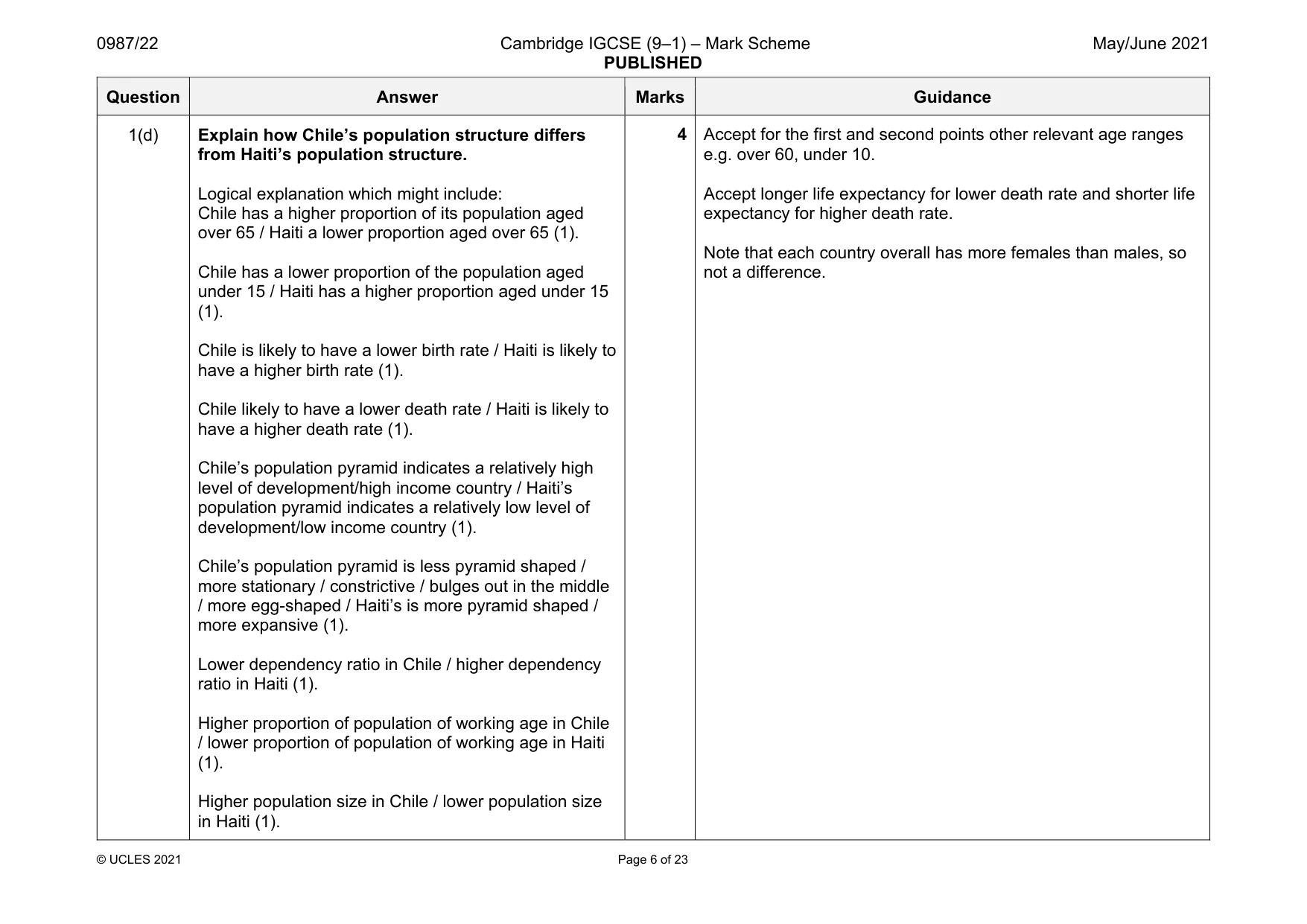
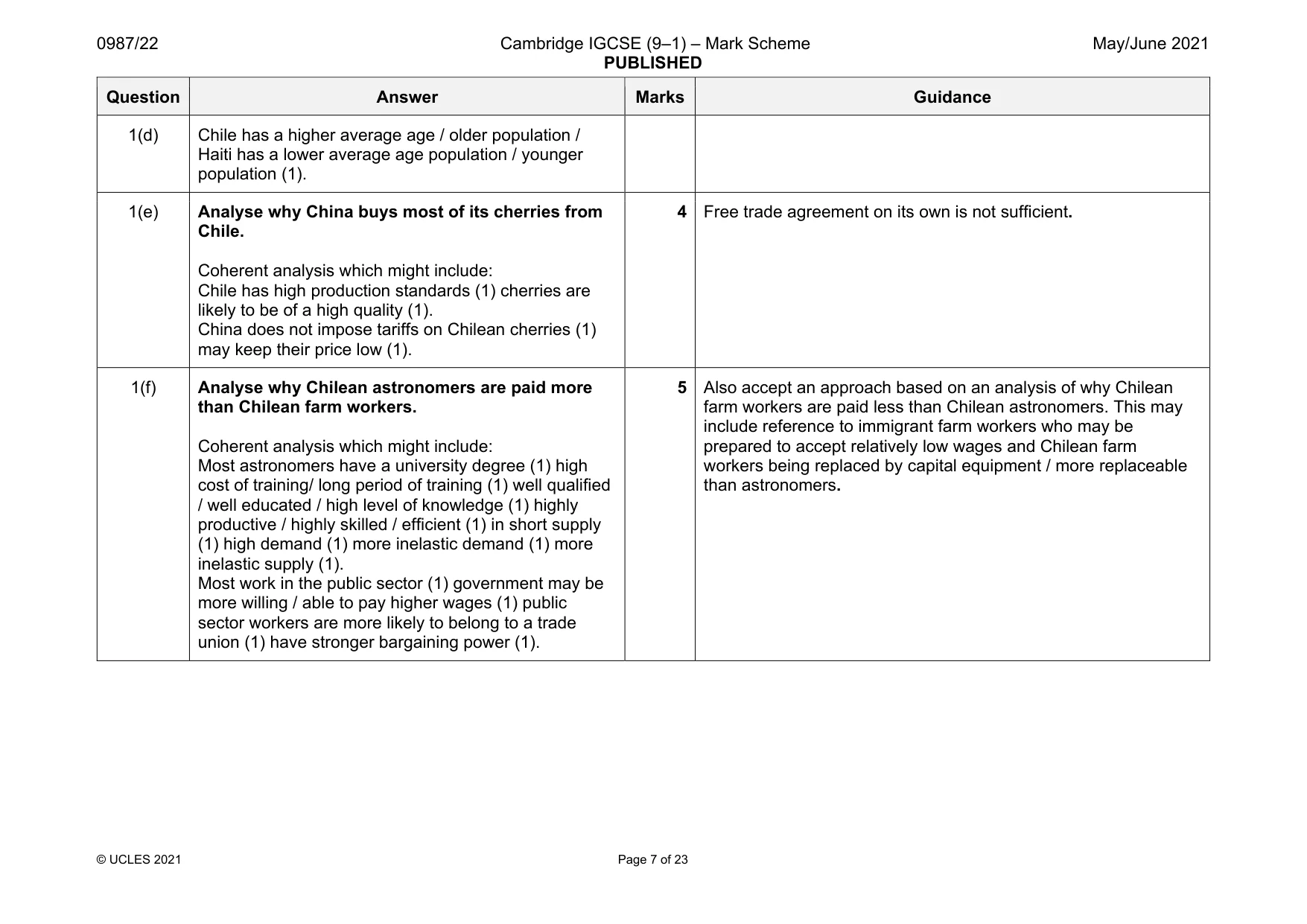
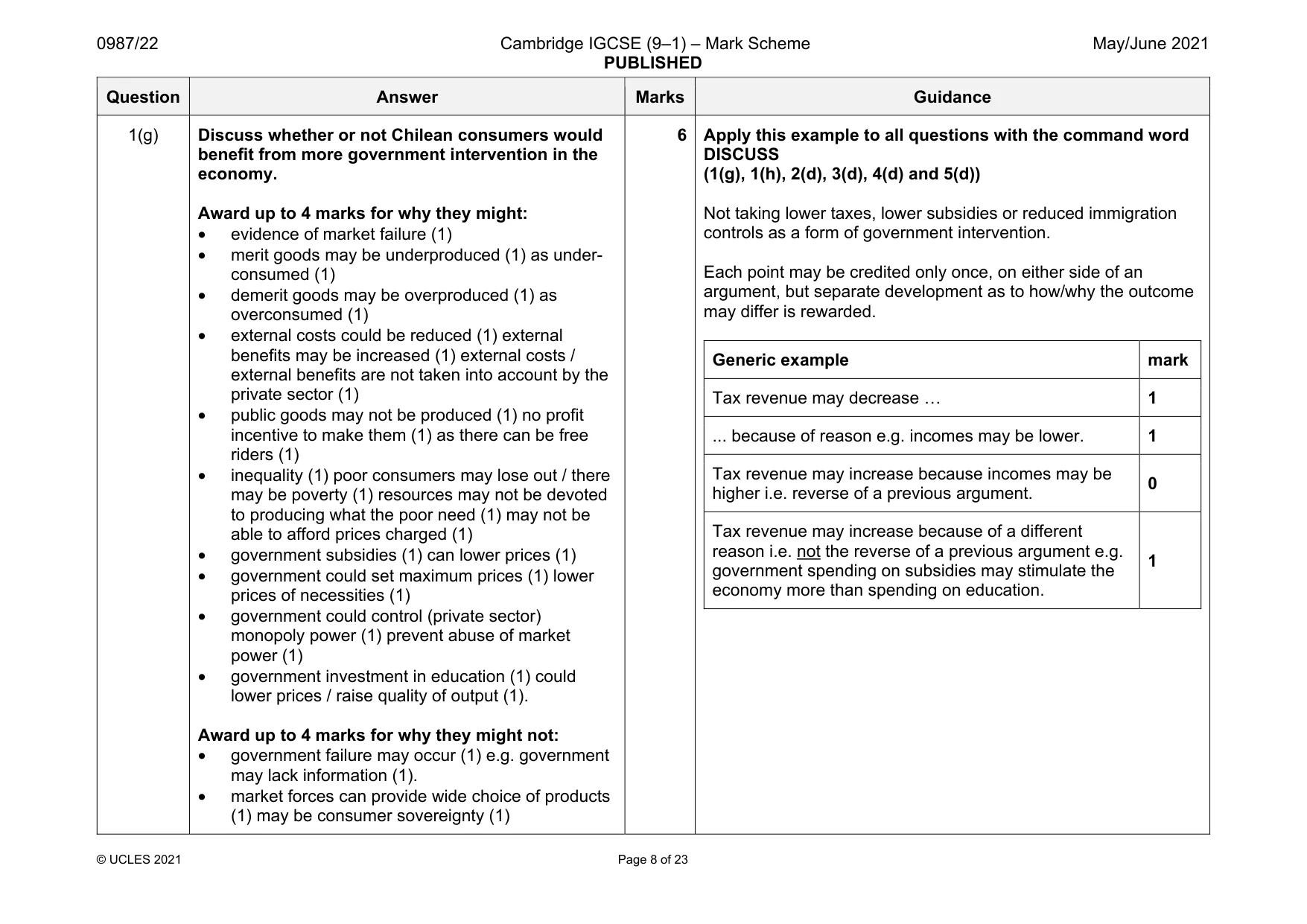
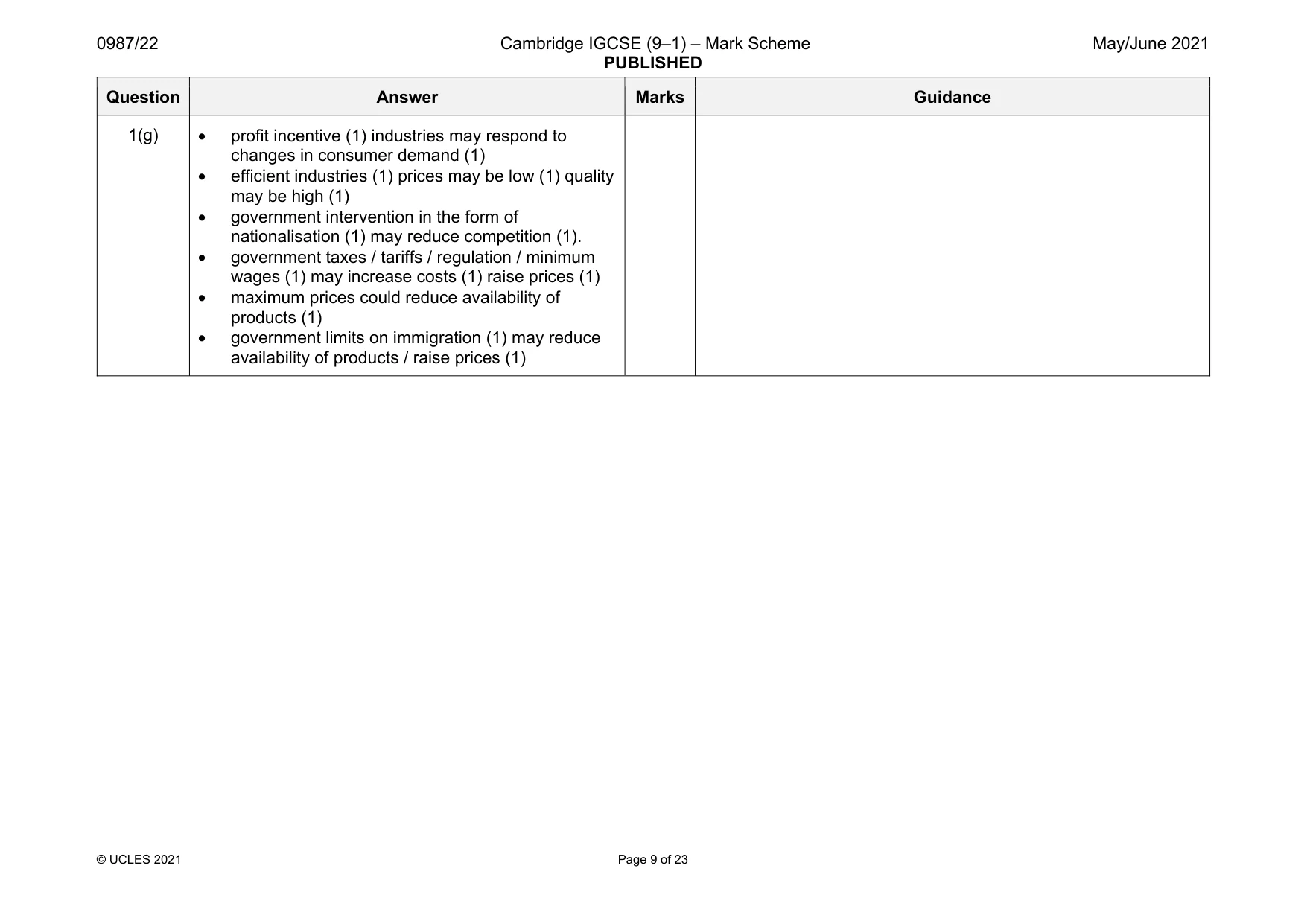
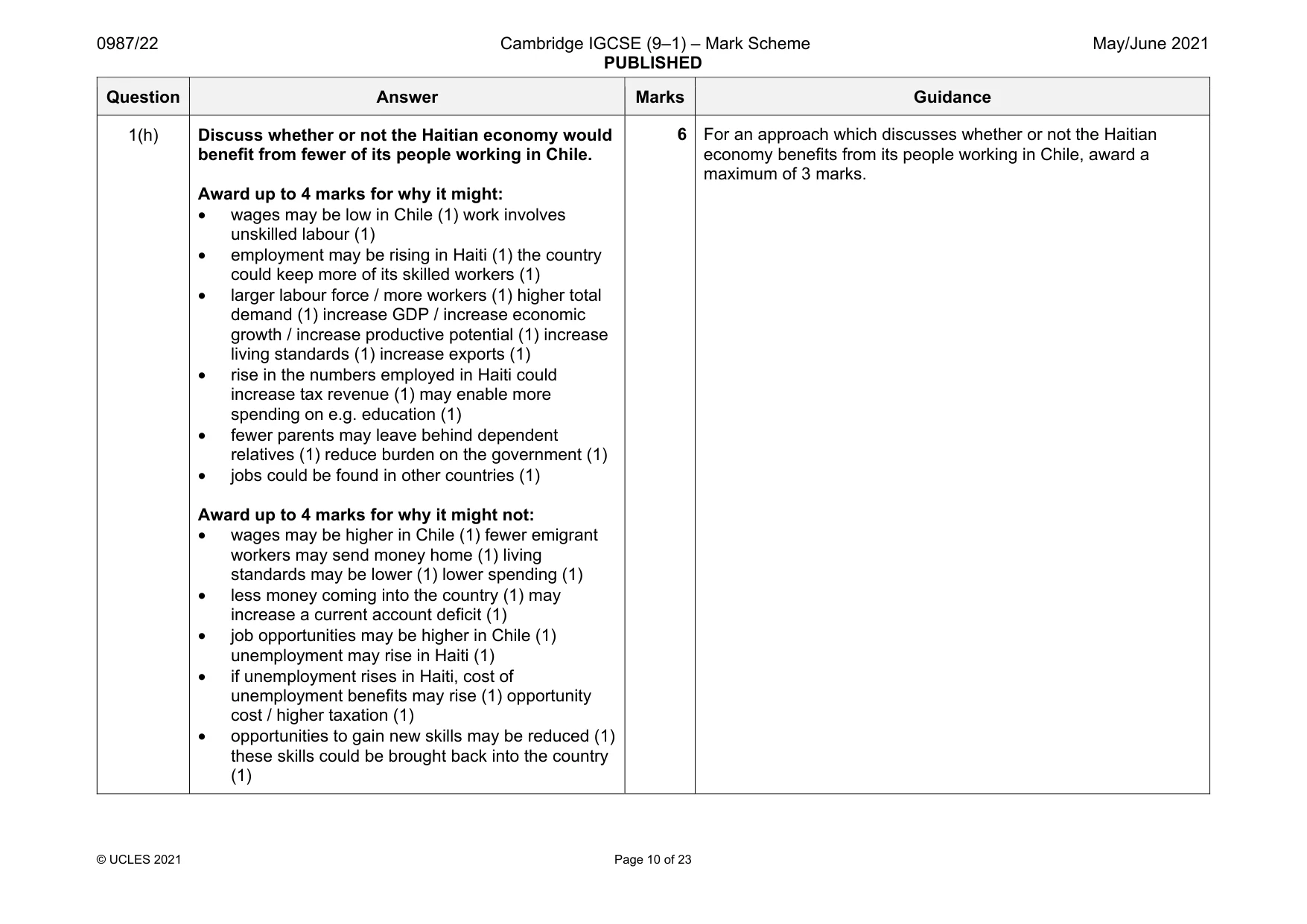
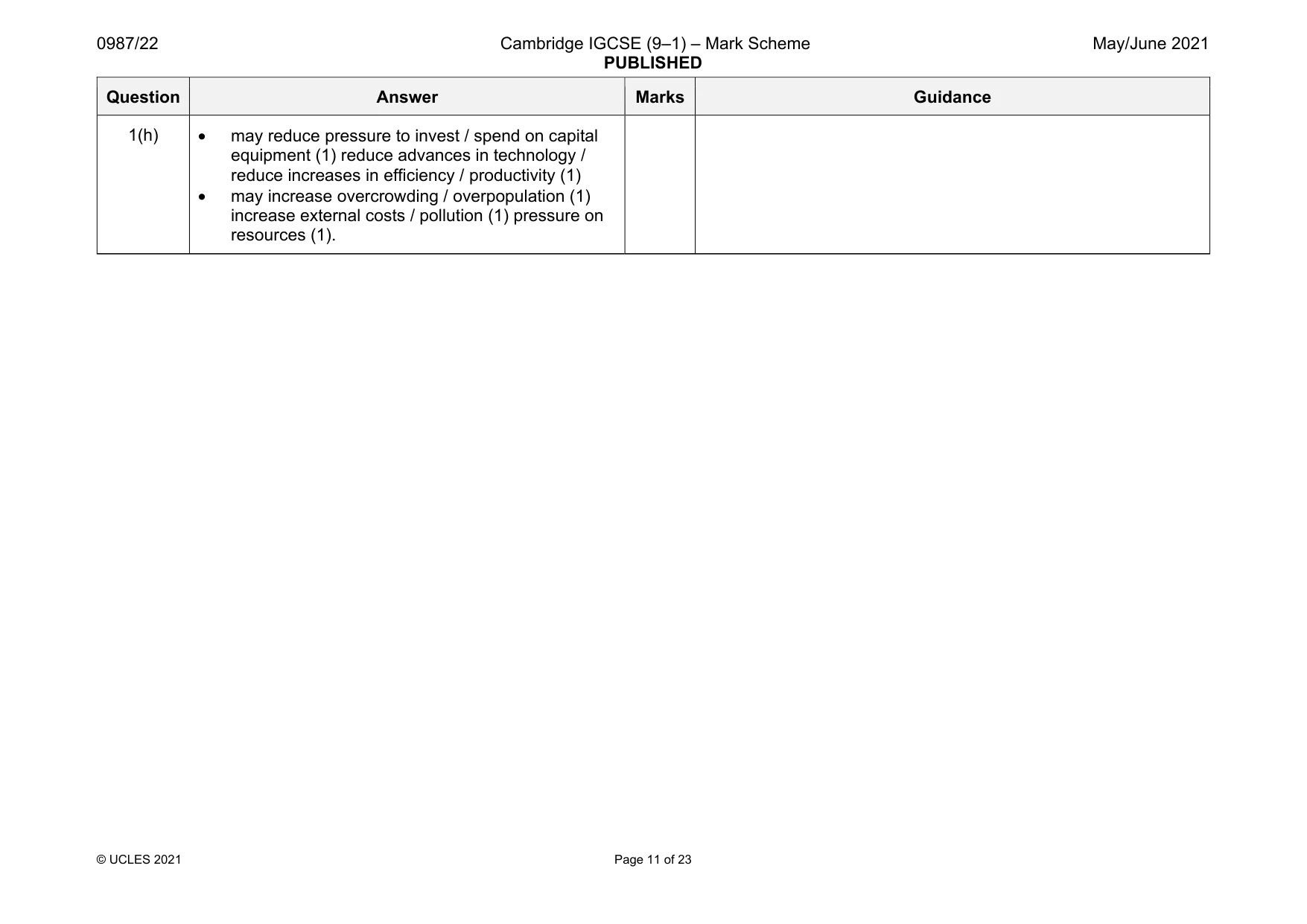
Mark scheme: 1(a) Calculate Chile’s agricultural output in 2017. $11.76bn / $11 760 000 000 / $11 760m (1). 1 Accept $11.8bn and $12bn. $ is not essential. 1(b) Identify two disadvantages of a country specialising. Two from: • demand may fall / new competitors may appear • supply/output may fall / diseases / natural disasters / bad weather may affect agricultural output / costs may rise • non-renewable resources may run out • structural unemployment may occur • reliance on imports no longer produced by home country / overdependency on other countries 2 One mark each for each of two disadvantages. Rely on a small number of industries is not sufficient. 1(c) Explain one reason why demand for cherries is price-elastic. A luxury product (1) they do not have to be purchased / not essential / not a necessity (1). Has close substitutes (1) example / rise in price will cause some people to switch to rival products (1). 2 In terms of close substitutes, also accept: fall in price will cause some people to switch towards this product and away from rival products. One mark for the reason identified and one mark for the explanation. A candidate who writes a luxury product and has close substitutes and no more has identified two reasons, so just one mark. If a candidate identifies one of the two reasons but does not explain it and then identifies the second reason and explains it, the second reason can be taken and with the explanation, 2 marks. Question Answer Marks Guidance 1(d) Explain how Chile’s population structure differs from Haiti’s population structure. Logical explanation which might include: Chile has a higher proportion of its population aged over 65 / Haiti a lower proportion aged over 65 (1). Chile has a lower proportion of the population aged under 15 / Haiti has a higher proportion aged under 15 (1). Chile is likely to have a lower birth rate / Haiti is likely to have a higher birth rate (1). Chile likely to have a lower death rate / Haiti is likely to have a higher death rate (1). Chile’s population pyramid indicates a relatively high level of development/high income country / Haiti’s population pyramid indicates a relatively low level of development/low income country (1). Chile’s population pyramid is less pyramid shaped / more stationary / constrictive / bulges out in the middle / more egg-shaped / Haiti’s is more pyramid shaped / more expansive (1). Lower dependency ratio in Chile / higher dependency ratio in Haiti (1). Higher proportion of population of working age in Chile / lower proportion of population of working age in Haiti (1). Higher population size in Chile / lower population size in Haiti (1). 4 Accept for the first and second points other relevant age ranges e.g. over 60, under 10. Accept longer life expectancy for lower death rate and shorter life expectancy for higher death rate. Note that each country overall has more females than males, so not a difference. Question Answer Marks Guidance 1(d) Chile has a higher average age / older population / Haiti has a lower average age population / younger population (1). 1(e) Analyse why China buys most of its cherries from Chile. Coherent analysis which might include: Chile has high production standards (1) cherries are likely to be of a high quality (1). China does not impose tariffs on Chilean cherries (1) may keep their price low (1). 4 Free trade agreement on its own is not sufficient. 1(f) Analyse why Chilean astronomers are paid more than Chilean farm workers. Coherent analysis which might include: Most astronomers have a university degree (1) high cost of training/ long period of training (1) well qualified / well educated / high level of knowledge (1) highly productive / highly skilled / efficient (1) in short supply (1) high demand (1) more inelastic demand (1) more inelastic supply (1). Most work in the public sector (1) government may be more willing / able to pay higher wages (1) public sector workers are more likely to belong to a trade union (1) have stronger bargaining power (1). 5 Also accept an approach based on an analysis of why Chilean farm workers are paid less than Chilean astronomers. This may include reference to immigrant farm workers who may be prepared to accept relatively low wages and Chilean farm workers being replaced by capital equipment / more replaceable than astronomers. Question Answer Marks Guidance 1(g) Discuss whether or not Chilean consumers would benefit from more government intervention in the economy. Award up to 4 marks for why they might: • evidence of market failure (1) • merit goods may be underproduced (1) as under- consumed (1) • demerit goods may be overproduced (1) as overconsumed (1) • external costs could be reduced (1) external benefits may be increased (1) external costs / external benefits are not taken into account by the private sector (1) • public goods may not be produced (1) no profit incentive to make them (1) as there can be free riders (1) • inequality (1) poor consumers may lose out / there may be poverty (1) resources may not be devoted to producing what the poor need (1) may not be able to afford prices charged (1) • government subsidies (1) can lower prices (1) • government could set maximum prices (1) lower prices of necessities (1) • government could control (private sector) monopoly power (1) prevent abuse of market power (1) • government investment in education (1) could lower prices / raise quality of output (1). Award up to 4 marks for why they might not: • government failure may occur (1) e.g. government may lack information (1). • market forces can provide wide choice of products (1) may be consumer sovereignty (1) 6 Apply this example to all questions with the command word DISCUSS (1(g), 1(h), 2(d), 3(d), 4(d) and 5(d)) Not taking lower taxes, lower subsidies or reduced immigration controls as a form of government intervention. Each point may be credited only once, on either side of an argument, but separate development as to how/why the outcome may differ is rewarded. Generic example mark Tax revenue may decrease … 1 ... because of reason e.g. incomes may be lower. 1 Tax revenue may increase because incomes may be higher i.e. reverse of a previous argument. 0 Tax revenue may increase because of a different reason i.e. not the reverse of a previous argument e.g. government spending on subsidies may stimulate the economy more than spending on education. 1 Question Answer Marks Guidance 1(g) • profit incentive (1) industries may respond to changes in consumer demand (1) • efficient industries (1) prices may be low (1) quality may be high (1) • government intervention in the form of nationalisation (1) may reduce competition (1). • government taxes / tariffs / regulation / minimum wages (1) may increase costs (1) raise prices (1) • maximum prices could reduce availability of products (1) • government limits on immigration (1) may reduce availability of products / raise prices (1) Question Answer Marks Guidance 1(h) Discuss whether or not the Haitian economy would benefit from fewer of its people working in Chile. Award up to 4 marks for why it might: • wages may be low in Chile (1) work involves unskilled labour (1) • employment may be rising in Haiti (1) the country could keep more of its skilled workers (1) • larger labour force / more workers (1) higher total demand (1) increase GDP / increase economic growth / increase productive potential (1) increase living standards (1) increase exports (1) • rise in the numbers employed in Haiti could increase tax revenue (1) may enable more spending on e.g. education (1) • fewer parents may leave behind dependent relatives (1) reduce burden on the government (1) • jobs could be found in other countries (1) Award up to 4 marks for why it might not: • wages may be higher in Chile (1) fewer emigrant workers may send money home (1) living standards may be lower (1) lower spending (1) • less money coming into the country (1) may increase a current account deficit (1) • job opportunities may be higher in Chile (1) unemployment may rise in Haiti (1) • if unemployment rises in Haiti, cost of unemployment benefits may rise (1) opportunity cost / higher taxation (1) • opportunities to gain new skills may be reduced (1) these skills could be brought back into the country (1) 6 For an approach which discusses whether or not the Haitian economy benefits from its people working in Chile, award a maximum of 3 marks. Question Answer Marks Guidance 1(h) • may reduce pressure to invest / spend on capital equipment (1) reduce advances in technology / reduce increases in efficiency / productivity (1) • may increase overcrowding / overpopulation (1) increase external costs / pollution (1) pressure on resources (1).
Q2 · Nearly one million people in Cairo, the capital city of Egypt, live in crowded, unhealthy…
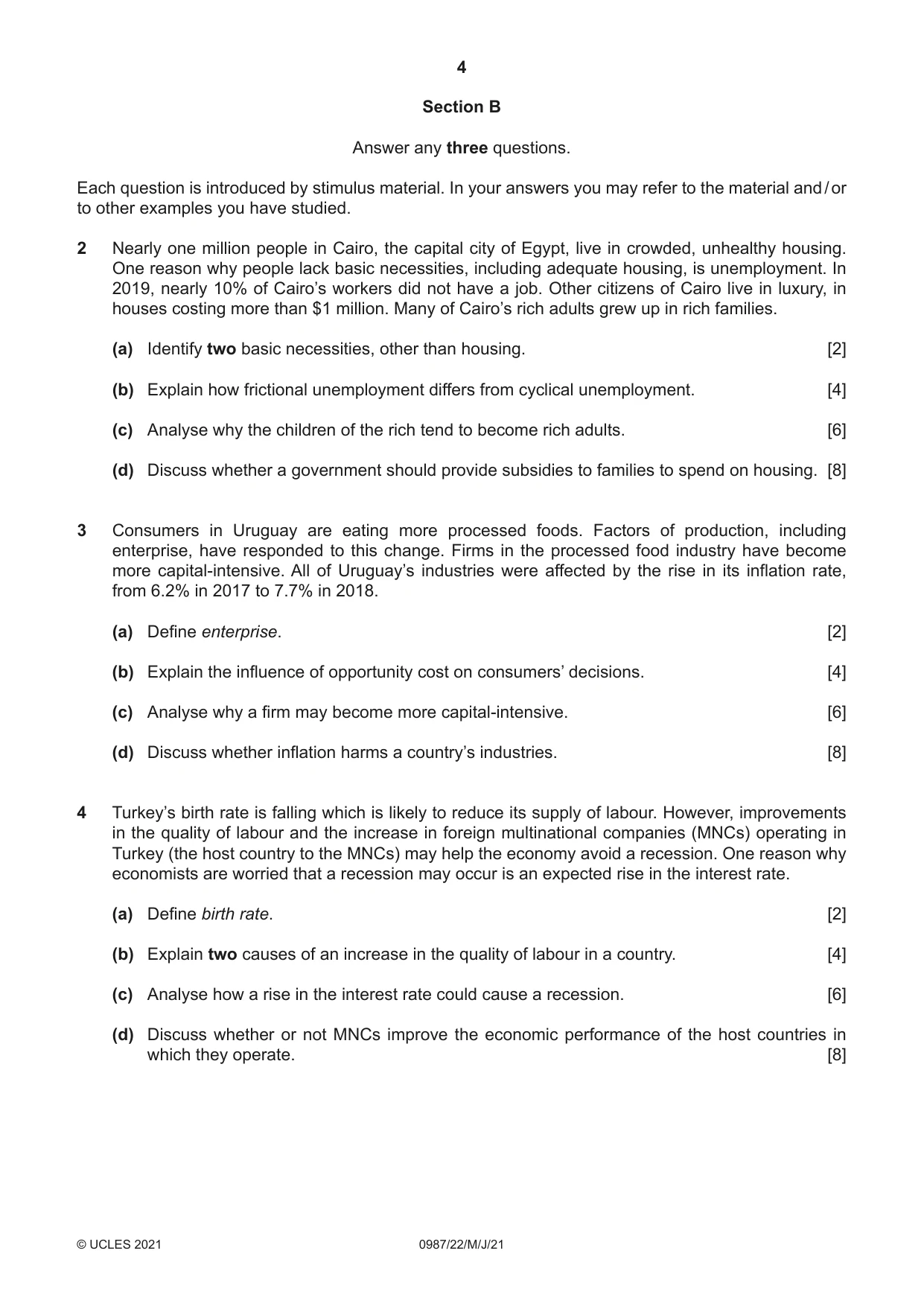
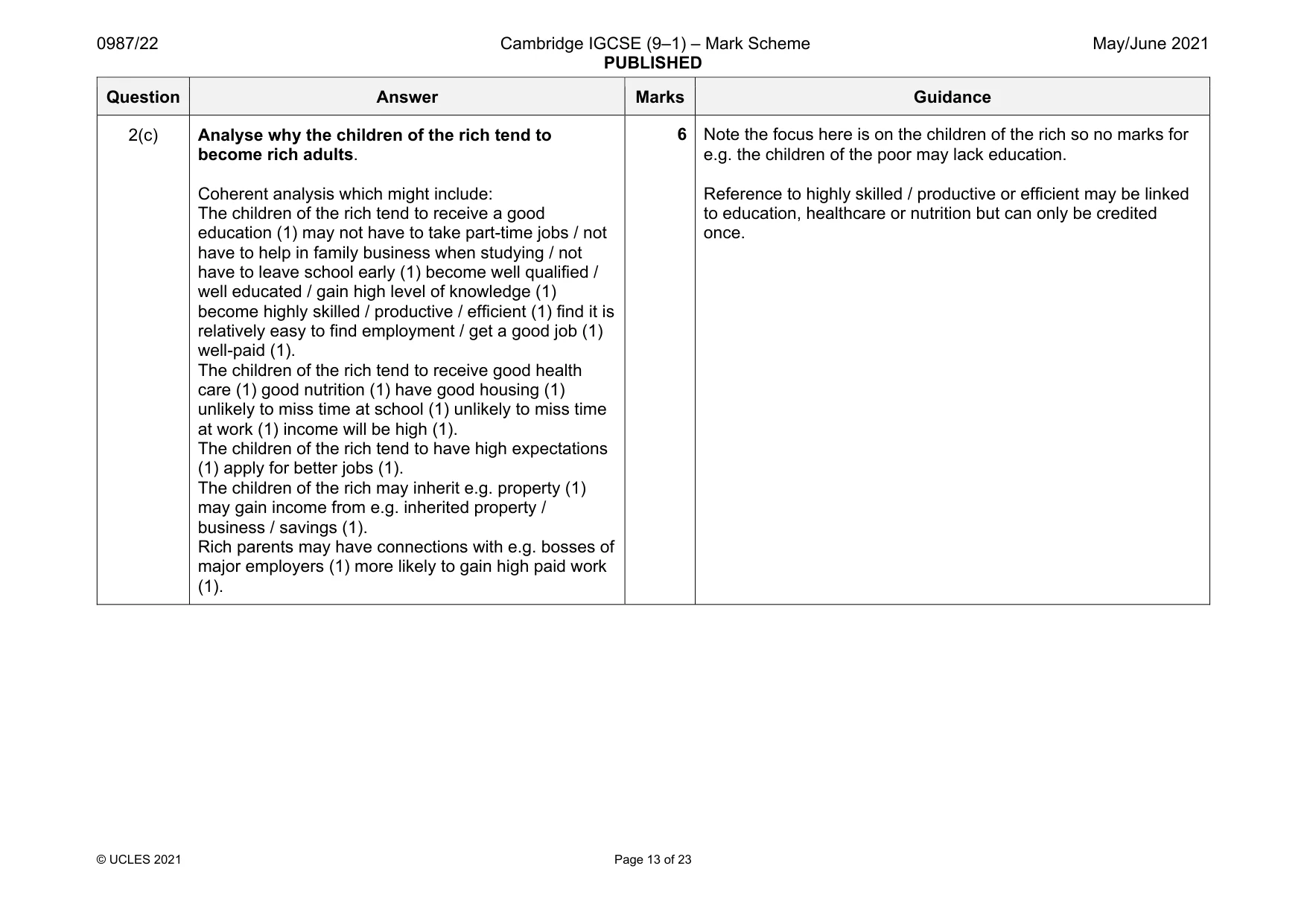
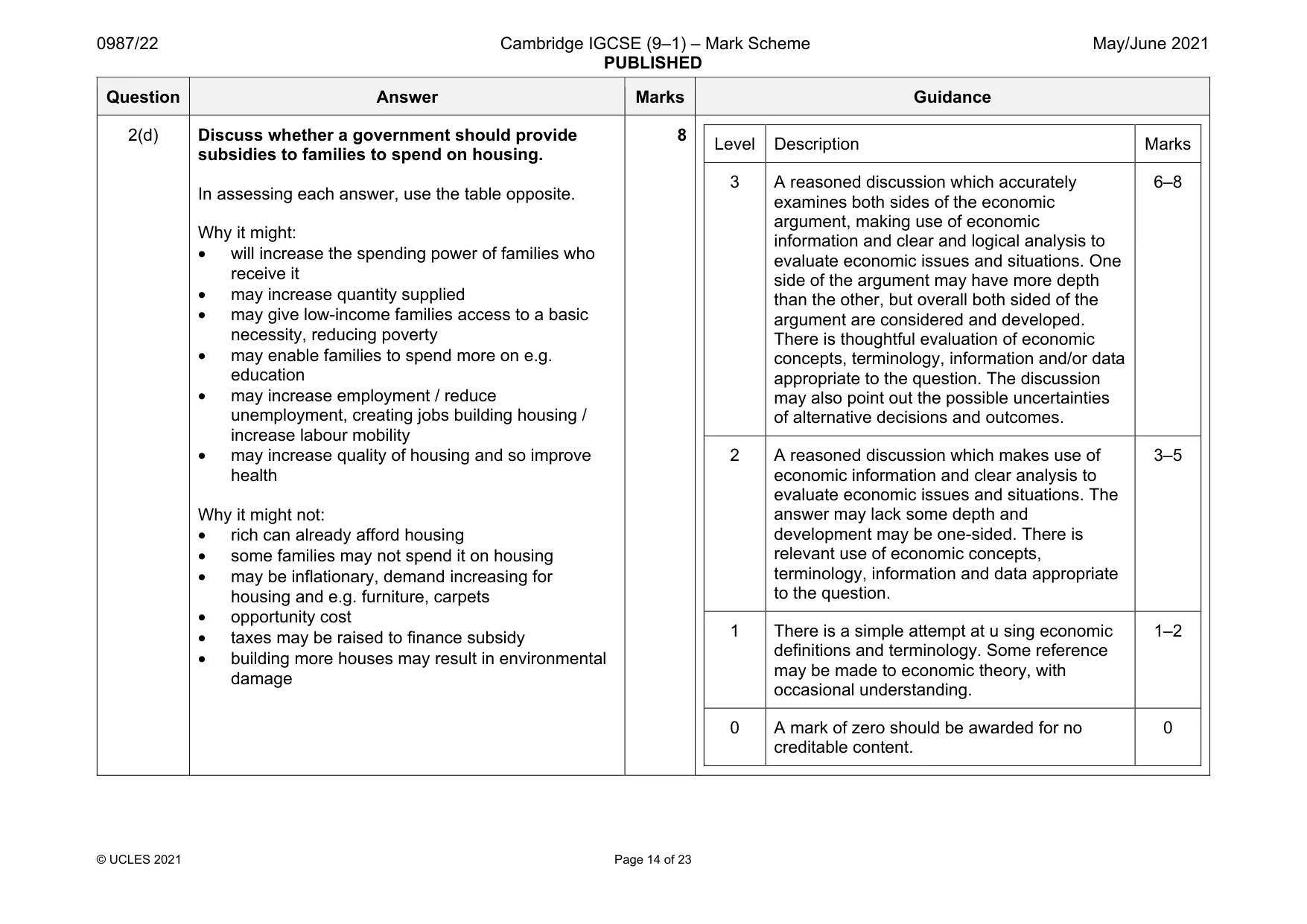
2 Nearly one million people in Cairo, the capital city of Egypt, live in crowded, unhealthy housing. One reason why people lack basic necessities, including adequate housing, is unemployment. In 2019, nearly 10% of Cairo’s workers did not have a job. Other citizens of Cairo live in luxury, in houses costing more than $1 million. Many of Cairo’s rich adults grew up in rich families. (a) Identify two basic necessities, other than housing. [2] (b) Explain how frictional unemployment differs from cyclical unemployment. [4] (c) Analyse why the children of the rich tend to become rich adults. [6] (d) Discuss whether a government should provide subsidies to families to spend on housing. [8]
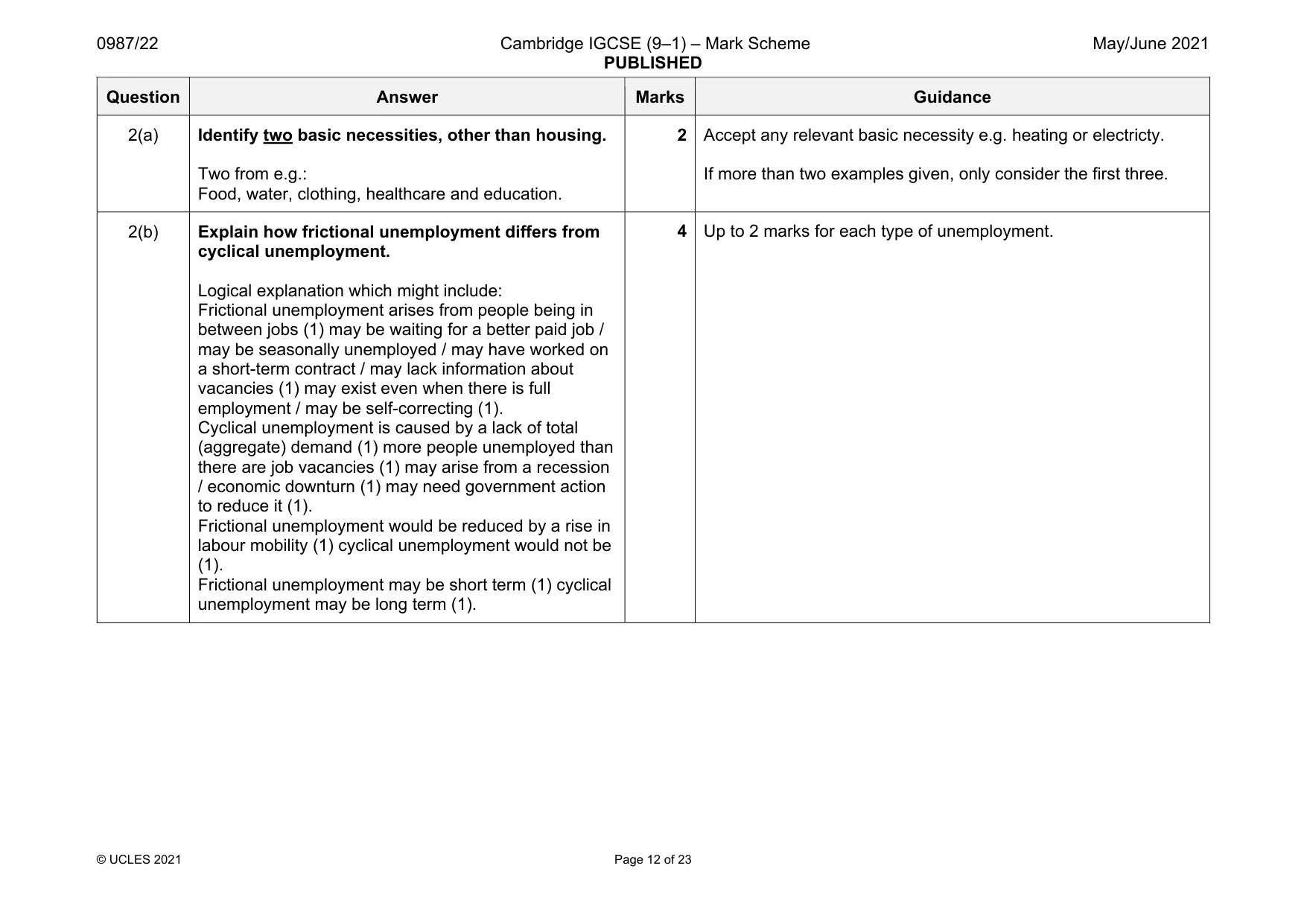
Mark scheme: 2(a) Identify two basic necessities, other than housing. Two from e.g.: Food, water, clothing, healthcare and education. 2 Accept any relevant basic necessity e.g. heating or electricty. If more than two examples given, only consider the first three. 2(b) Explain how frictional unemployment differs from cyclical unemployment. Logical explanation which might include: Frictional unemployment arises from people being in between jobs (1) may be waiting for a better paid job / may be seasonally unemployed / may have worked on a short-term contract / may lack information about vacancies (1) may exist even when there is full employment / may be self-correcting (1). Cyclical unemployment is caused by a lack of total (aggregate) demand (1) more people unemployed than there are job vacancies (1) may arise from a recession / economic downturn (1) may need government action to reduce it (1). Frictional unemployment would be reduced by a rise in labour mobility (1) cyclical unemployment would not be (1). Frictional unemployment may be short term (1) cyclical unemployment may be long term (1). 4 Up to 2 marks for each type of unemployment. Question Answer Marks Guidance 2(c) Analyse why the children of the rich tend to become rich adults. Coherent analysis which might include: The children of the rich tend to receive a good education (1) may not have to take part-time jobs / not have to help in family business when studying / not have to leave school early (1) become well qualified / well educated / gain high level of knowledge (1) become highly skilled / productive / efficient (1) find it is relatively easy to find employment / get a good job (1) well-paid (1). The children of the rich tend to receive good health care (1) good nutrition (1) have good housing (1) unlikely to miss time at school (1) unlikely to miss time at work (1) income will be high (1). The children of the rich tend to have high expectations (1) apply for better jobs (1). The children of the rich may inherit e.g. property (1) may gain income from e.g. inherited property / business / savings (1). Rich parents may have connections with e.g. bosses of major employers (1) more likely to gain high paid work (1). 6 Note the focus here is on the children of the rich so no marks for e.g. the children of the poor may lack education. Reference to highly skilled / productive or efficient may be linked to education, healthcare or nutrition but can only be credited once. Question Answer Marks Guidance 2(d) Discuss whether a government should provide subsidies to families to spend on housing. In assessing each answer, use the table opposite. Why it might: • will increase the spending power of families who receive it • may increase quantity supplied • may give low-income families access to a basic necessity, reducing poverty • may enable families to spend more on e.g. education • may increase employment / reduce unemployment, creating jobs building housing / increase labour mobility • may increase quality of housing and so improve health Why it might not: • rich can already afford housing • some families may not spend it on housing • may be inflationary, demand increasing for housing and e.g. furniture, carpets • opportunity cost • taxes may be raised to finance subsidy • building more houses may result in environmental damage 8 Level Description Marks 3 A reasoned discussion which accurately examines both sides of the economic argument, making use of economic information and clear and logical analysis to evaluate economic issues and situations. One side of the argument may have more depth than the other, but overall both sided of the argument are considered and developed. There is thoughtful evaluation of economic concepts, terminology, information and/or data appropriate to the question. The discussion may also point out the possible uncertainties of alternative decisions and outcomes. 6–8 2 A reasoned discussion which makes use of economic information and clear analysis to evaluate economic issues and situations. The answer may lack some depth and development may be one-sided. There is relevant use of economic concepts, terminology, information and data appropriate to the question. 3–5 1 There is a simple attempt at u sing economic definitions and terminology. Some reference may be made to economic theory, with occasional understanding. 1–2 0 A mark of zero should be awarded for no creditable content. 0
Q3 · Consumers in Uruguay are eating more processed foods
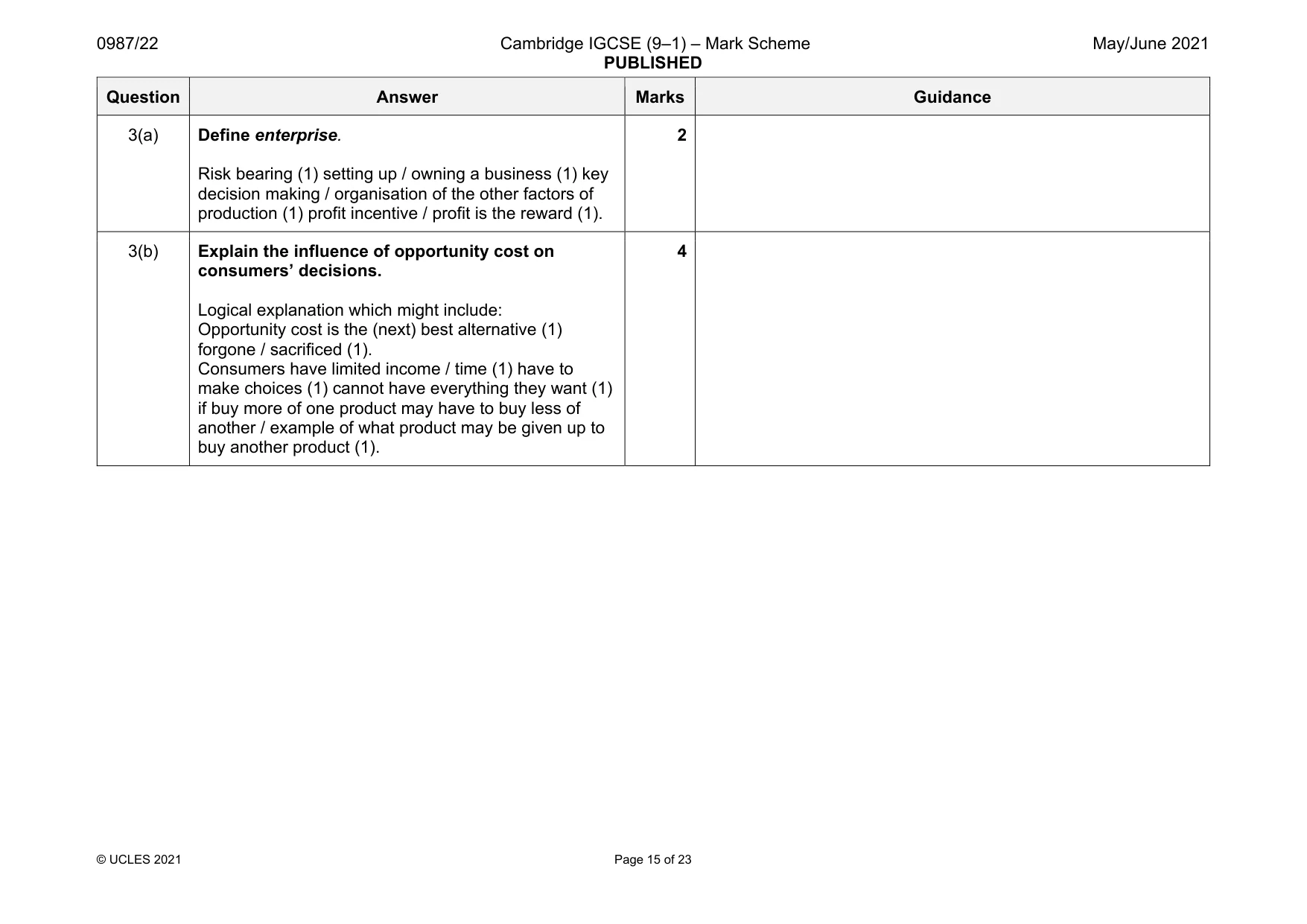
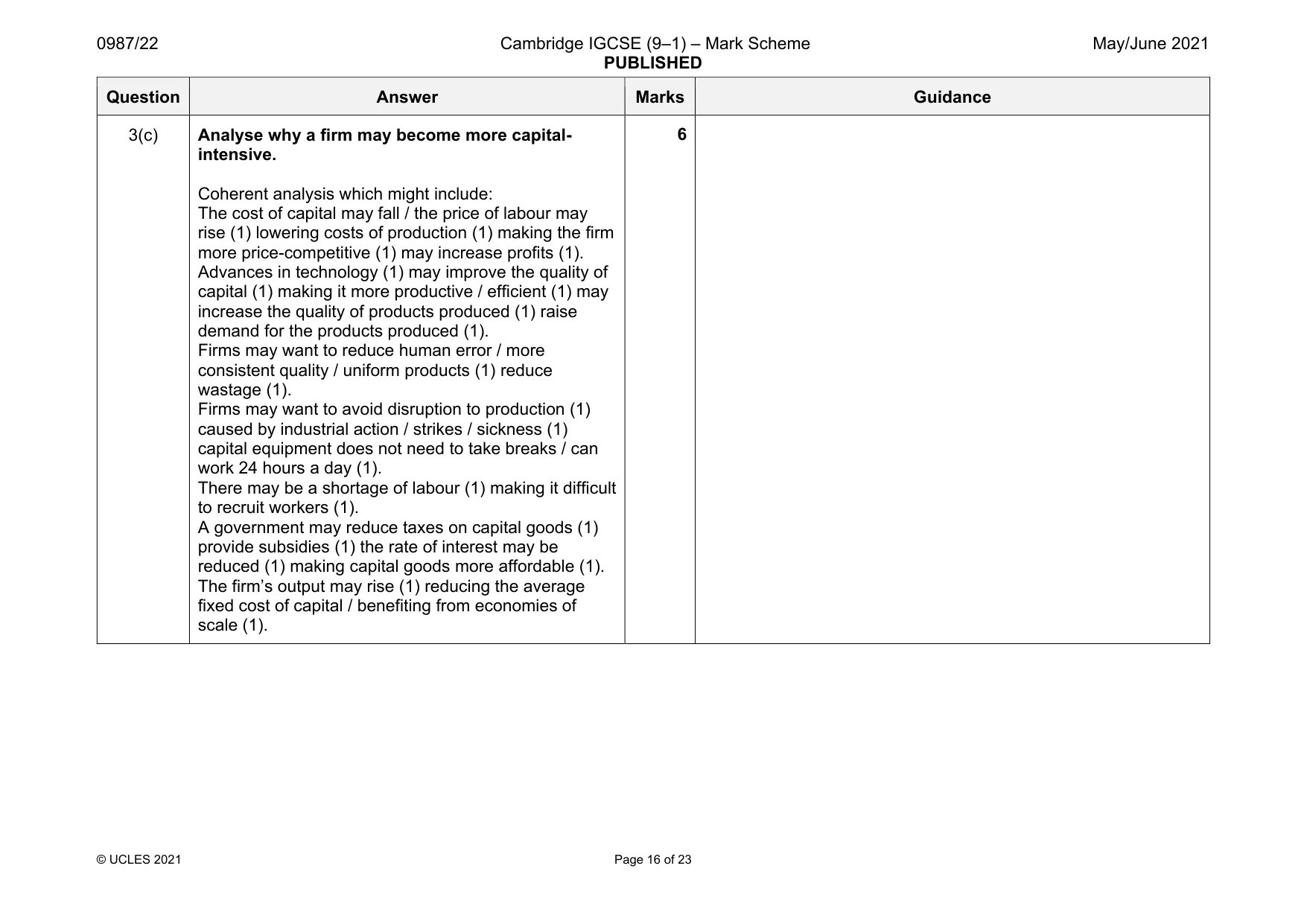
3 Consumers in Uruguay are eating more processed foods. Factors of production, including enterprise, have responded to this change. Firms in the processed food industry have become more capital-intensive. All of Uruguay’s industries were affected by the rise in its inflation rate, from 6.2% in 2017 to 7.7% in 2018. (a) Define enterprise. [2] (b) Explain the influence of opportunity cost on consumers’ decisions. [4] (c) Analyse why a firm may become more capital-intensive. [6] (d) Discuss whether inflation harms a country’s industries. [8]
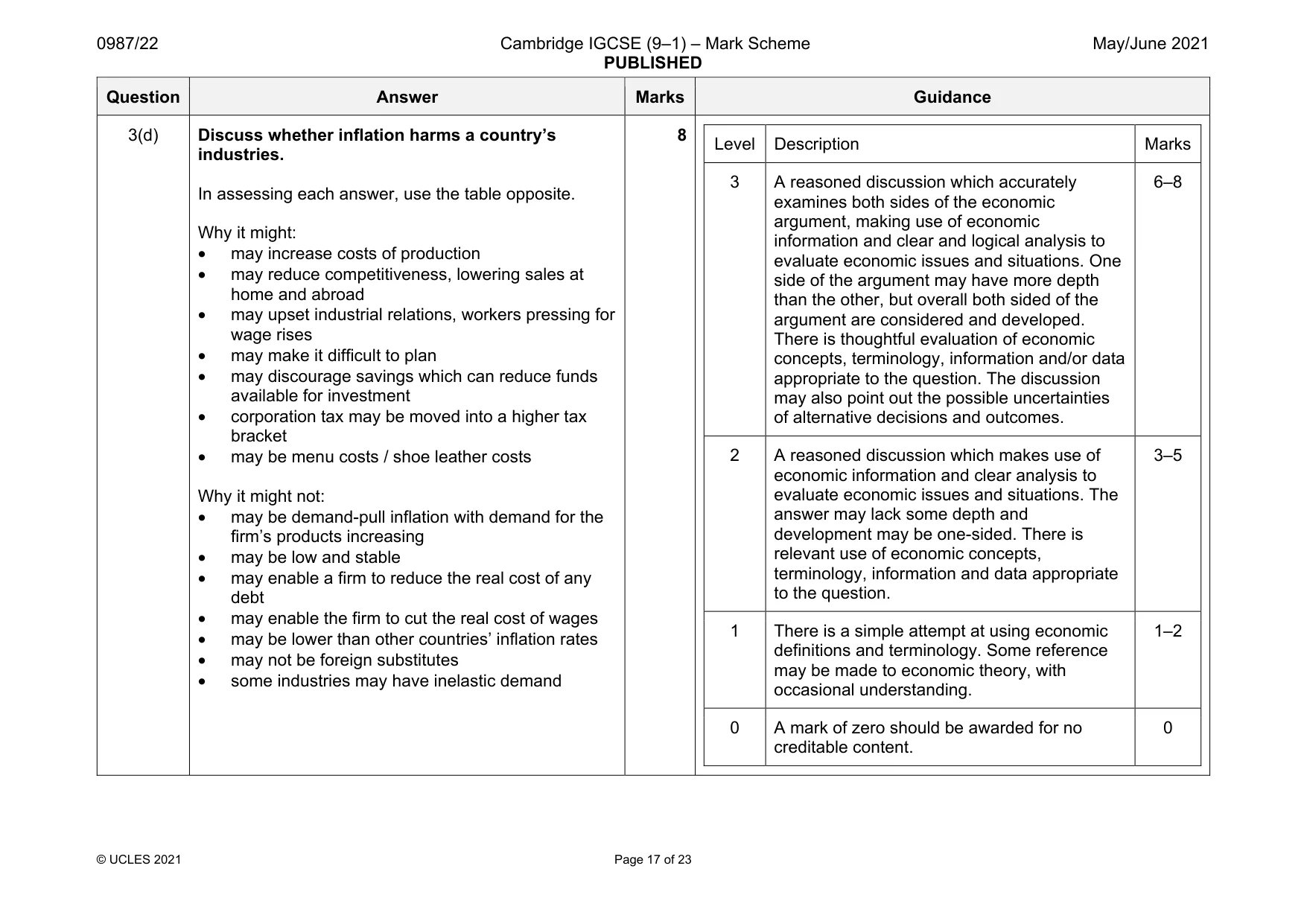
Mark scheme: 3(a) Define enterprise. Risk bearing (1) setting up / owning a business (1) key decision making / organisation of the other factors of production (1) profit incentive / profit is the reward (1). 2 3(b) Explain the influence of opportunity cost on consumers’ decisions. Logical explanation which might include: Opportunity cost is the (next) best alternative (1) forgone / sacrificed (1). Consumers have limited income / time (1) have to make choices (1) cannot have everything they want (1) if buy more of one product may have to buy less of another / example of what product may be given up to buy another product (1). 4 Question Answer Marks Guidance 3(c) Analyse why a firm may become more capital- intensive. Coherent analysis which might include: The cost of capital may fall / the price of labour may rise (1) lowering costs of production (1) making the firm more price-competitive (1) may increase profits (1). Advances in technology (1) may improve the quality of capital (1) making it more productive / efficient (1) may increase the quality of products produced (1) raise demand for the products produced (1). Firms may want to reduce human error / more consistent quality / uniform products (1) reduce wastage (1). Firms may want to avoid disruption to production (1) caused by industrial action / strikes / sickness (1) capital equipment does not need to take breaks / can work 24 hours a day (1). There may be a shortage of labour (1) making it difficult to recruit workers (1). A government may reduce taxes on capital goods (1) provide subsidies (1) the rate of interest may be reduced (1) making capital goods more affordable (1). The firm’s output may rise (1) reducing the average fixed cost of capital / benefiting from economies of scale (1). 6 Question Answer Marks Guidance 3(d) Discuss whether inflation harms a country’s industries. In assessing each answer, use the table opposite. Why it might: • may increase costs of production • may reduce competitiveness, lowering sales at home and abroad • may upset industrial relations, workers pressing for wage rises • may make it difficult to plan • may discourage savings which can reduce funds available for investment • corporation tax may be moved into a higher tax bracket • may be menu costs / shoe leather costs Why it might not: • may be demand-pull inflation with demand for the firm’s products increasing • may be low and stable • may enable a firm to reduce the real cost of any debt • may enable the firm to cut the real cost of wages • may be lower than other countries’ inflation rates • may not be foreign substitutes • some industries may have inelastic demand 8 Level Description Marks 3 A reasoned discussion which accurately examines both sides of the economic argument, making use of economic information and clear and logical analysis to evaluate economic issues and situations. One side of the argument may have more depth than the other, but overall both sided of the argument are considered and developed. There is thoughtful evaluation of economic concepts, terminology, information and/or data appropriate to the question. The discussion may also point out the possible uncertainties of alternative decisions and outcomes. 6–8 2 A reasoned discussion which makes use of economic information and clear analysis to evaluate economic issues and situations. The answer may lack some depth and development may be one-sided. There is relevant use of economic concepts, terminology, information and data appropriate to the question. 3–5 1 There is a simple attempt at using economic definitions and terminology. Some reference may be made to economic theory, with occasional understanding. 1–2 0 A mark of zero should be awarded for no creditable content. 0
Q4 · Turkey’s birth rate is falling which is likely to reduce its supply of labour
4 Turkey’s birth rate is falling which is likely to reduce its supply of labour. However, improvements in the quality of labour and the increase in foreign multinational companies (MNCs) operating in Turkey (the host country to the MNCs) may help the economy avoid a recession. One reason why economists are worried that a recession may occur is an expected rise in the interest rate. (a) Define birth rate. [2] (b) Explain two causes of an increase in the quality of labour in a country. [4] (c) Analyse how a rise in the interest rate could cause a recession. [6] (d) Discuss whether or not MNCs improve the economic performance of the host countries in which they operate. [8]
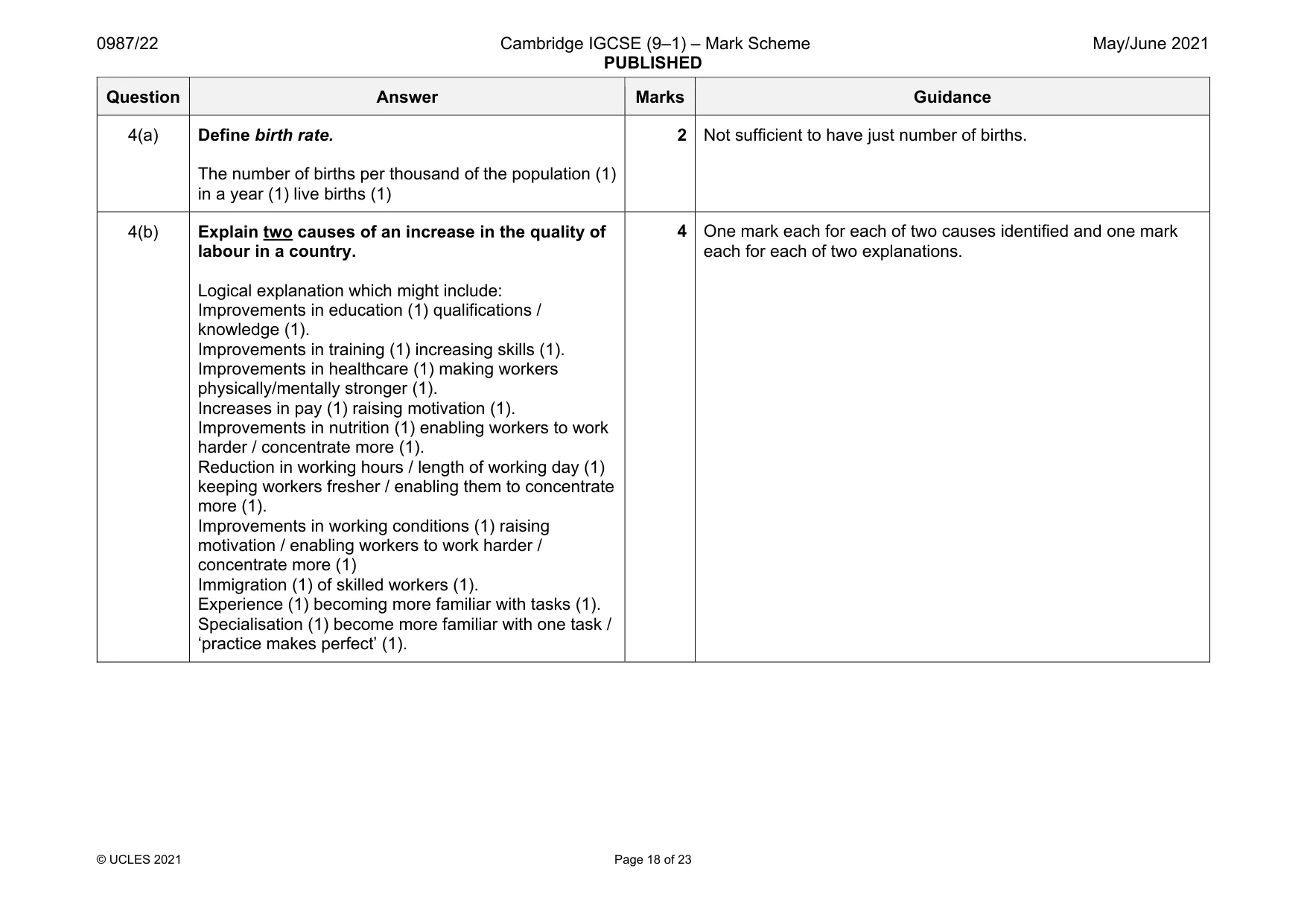
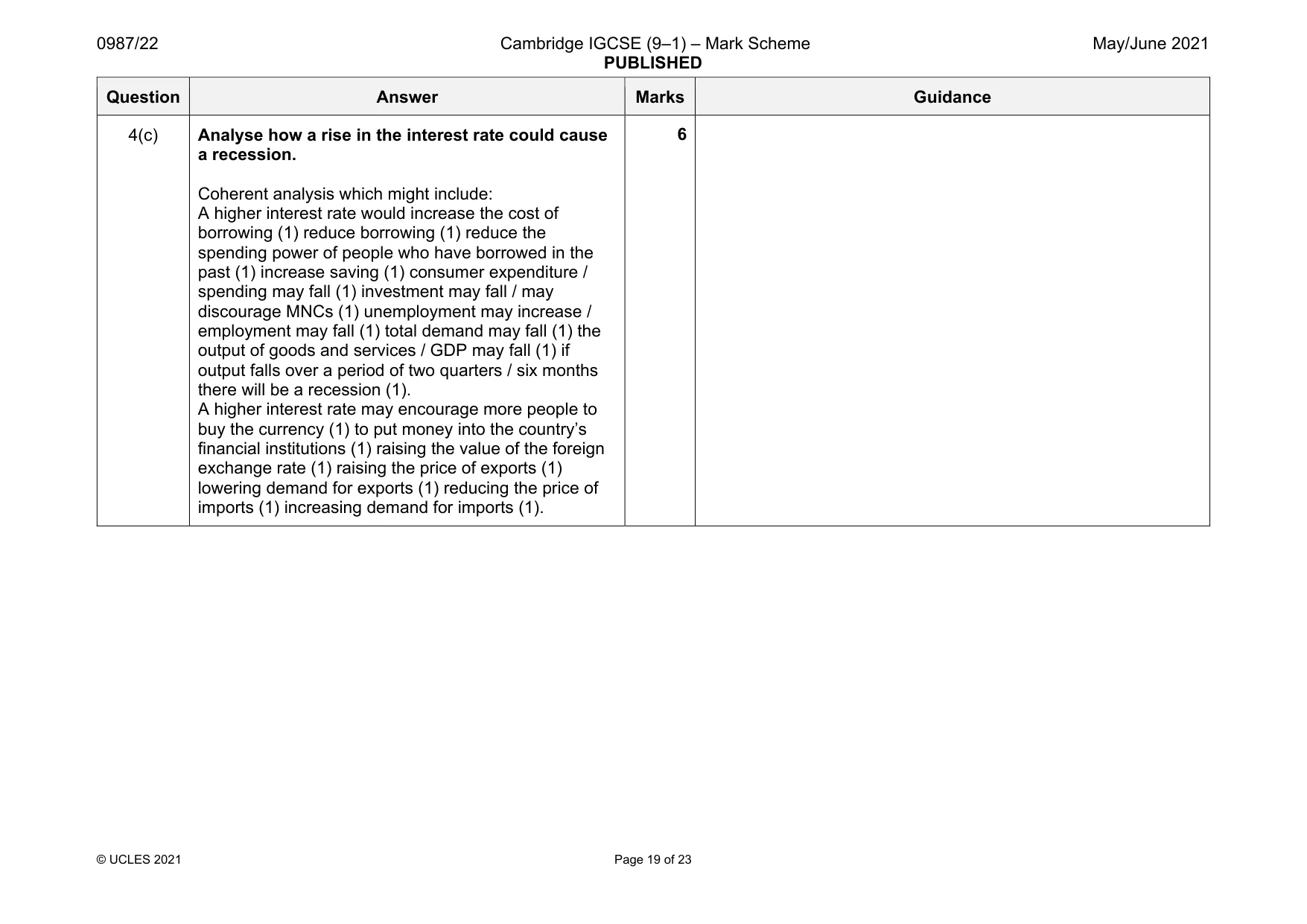
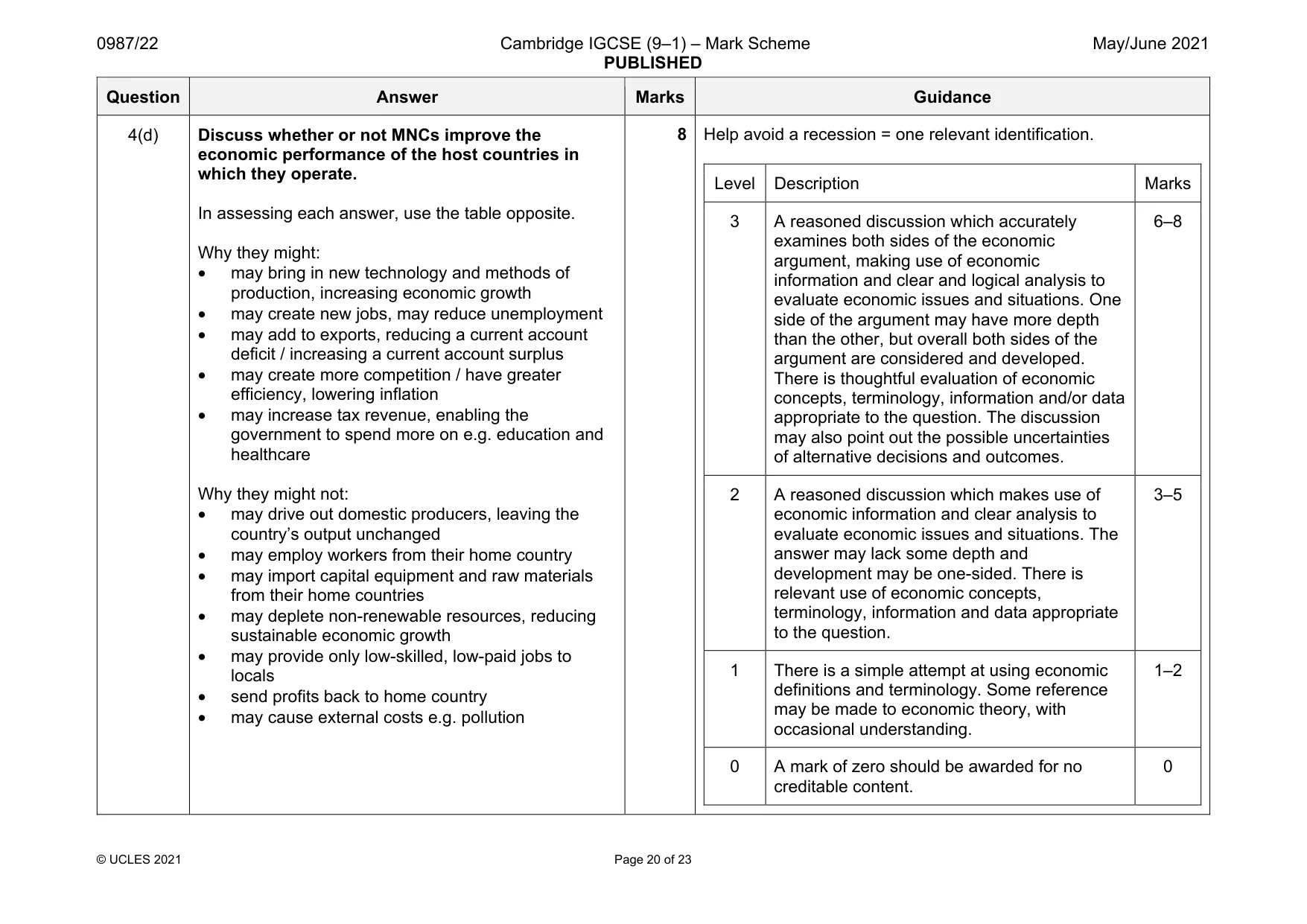
Mark scheme: 4(a) Define birth rate. The number of births per thousand of the population (1) in a year (1) live births (1) 2 Not sufficient to have just number of births. 4(b) Explain two causes of an increase in the quality of labour in a country. Logical explanation which might include: Improvements in education (1) qualifications / knowledge (1). Improvements in training (1) increasing skills (1). Improvements in healthcare (1) making workers physically/mentally stronger (1). Increases in pay (1) raising motivation (1). Improvements in nutrition (1) enabling workers to work harder / concentrate more (1). Reduction in working hours / length of working day (1) keeping workers fresher / enabling them to concentrate more (1). Improvements in working conditions (1) raising motivation / enabling workers to work harder / concentrate more (1) Immigration (1) of skilled workers (1). Experience (1) becoming more familiar with tasks (1). Specialisation (1) become more familiar with one task / ‘practice makes perfect’ (1). 4 One mark each for each of two causes identified and one mark each for each of two explanations. Question Answer Marks Guidance 4(c) Analyse how a rise in the interest rate could cause a recession. Coherent analysis which might include: A higher interest rate would increase the cost of borrowing (1) reduce borrowing (1) reduce the spending power of people who have borrowed in the past (1) increase saving (1) consumer expenditure / spending may fall (1) investment may fall / may discourage MNCs (1) unemployment may increase / employment may fall (1) total demand may fall (1) the output of goods and services / GDP may fall (1) if output falls over a period of two quarters / six months there will be a recession (1). A higher interest rate may encourage more people to buy the currency (1) to put money into the country’s financial institutions (1) raising the value of the foreign exchange rate (1) raising the price of exports (1) lowering demand for exports (1) reducing the price of imports (1) increasing demand for imports (1). 6 Question Answer Marks Guidance 4(d) Discuss whether or not MNCs improve the economic performance of the host countries in which they operate. In assessing each answer, use the table opposite. Why they might: • may bring in new technology and methods of production, increasing economic growth • may create new jobs, may reduce unemployment • may add to exports, reducing a current account deficit / increasing a current account surplus • may create more competition / have greater efficiency, lowering inflation • may increase tax revenue, enabling the government to spend more on e.g. education and healthcare Why they might not: • may drive out domestic producers, leaving the country’s output unchanged • may employ workers from their home country • may import capital equipment and raw materials from their home countries • may deplete non-renewable resources, reducing sustainable economic growth • may provide only low-skilled, low-paid jobs to locals • send profits back to home country • may cause external costs e.g. pollution 8 Help avoid a recession = one relevant identification. Level Description Marks 3 A reasoned discussion which accurately examines both sides of the economic argument, making use of economic information and clear and logical analysis to evaluate economic issues and situations. One side of the argument may have more depth than the other, but overall both sides of the argument are considered and developed. There is thoughtful evaluation of economic concepts, terminology, information and/or data appropriate to the question. The discussion may also point out the possible uncertainties of alternative decisions and outcomes. 6–8 2 A reasoned discussion which makes use of economic information and clear analysis to evaluate economic issues and situations. The answer may lack some depth and development may be one-sided. There is relevant use of economic concepts, terminology, information and data appropriate to the question. 3–5 1 There is a simple attempt at using economic definitions and terminology. Some reference may be made to economic theory, with occasional understanding. 1–2 0 A mark of zero should be awarded for no creditable content. 0
Q5 · The money supply in Bangladesh increased every year from 2010 to 2018
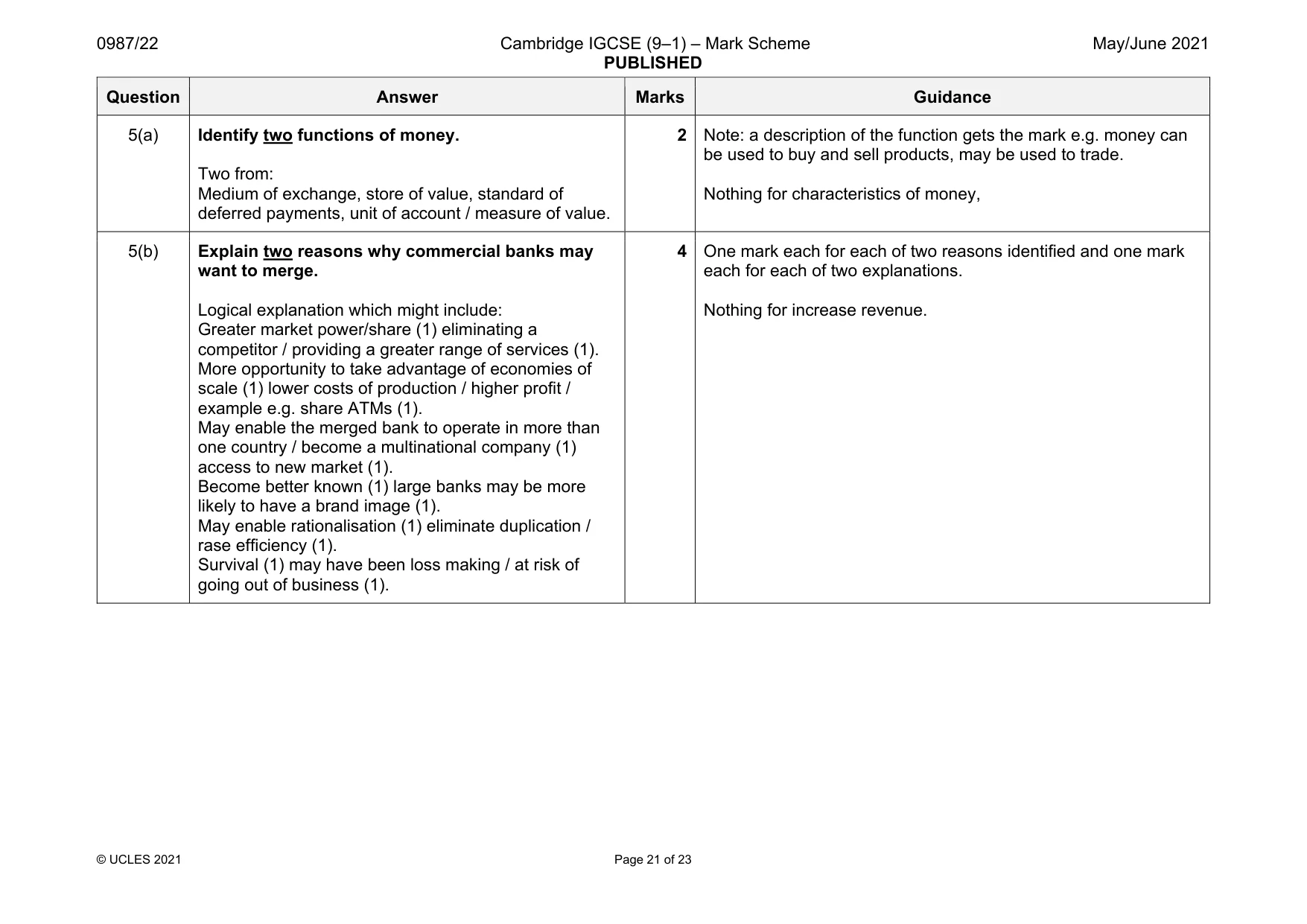
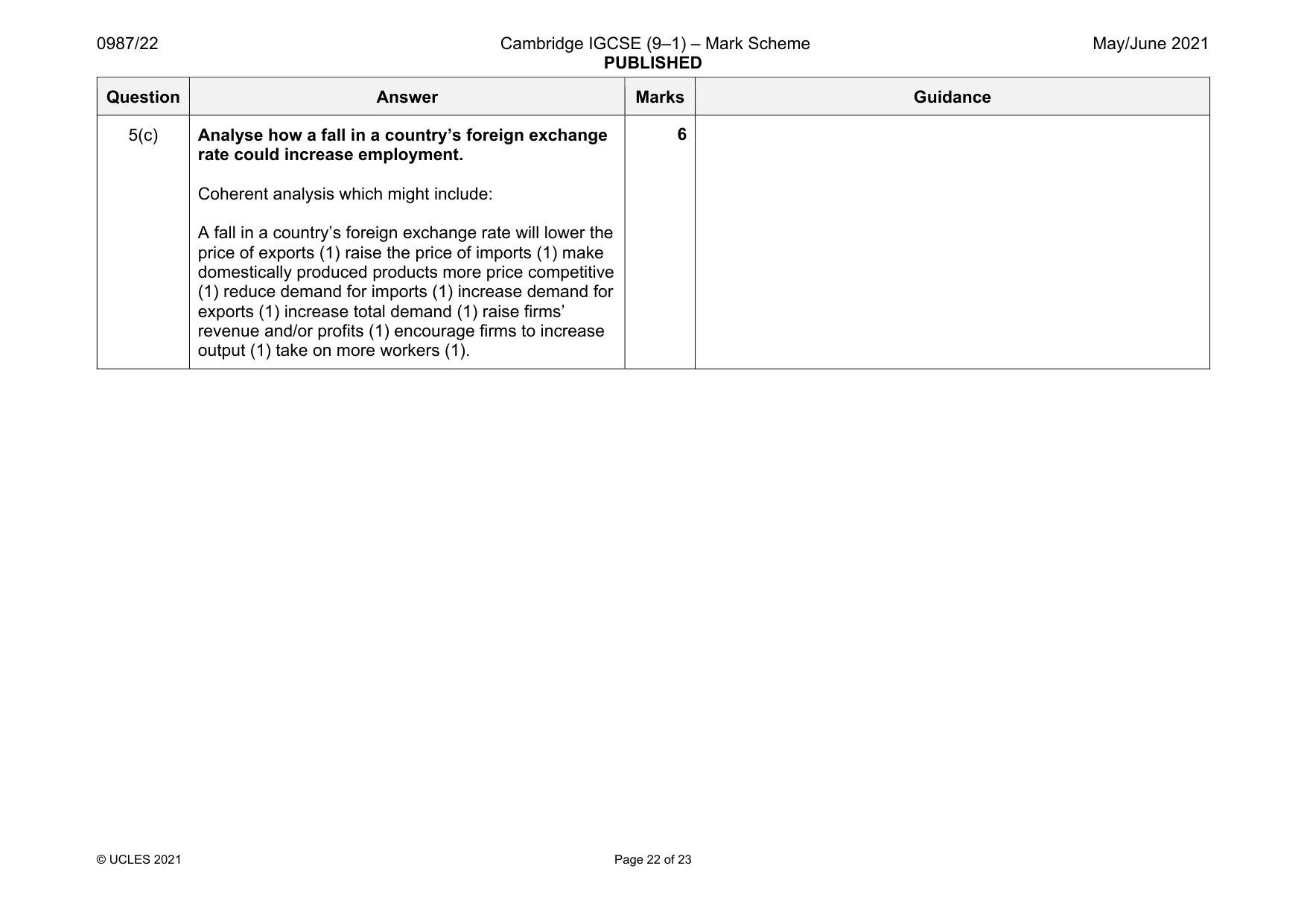
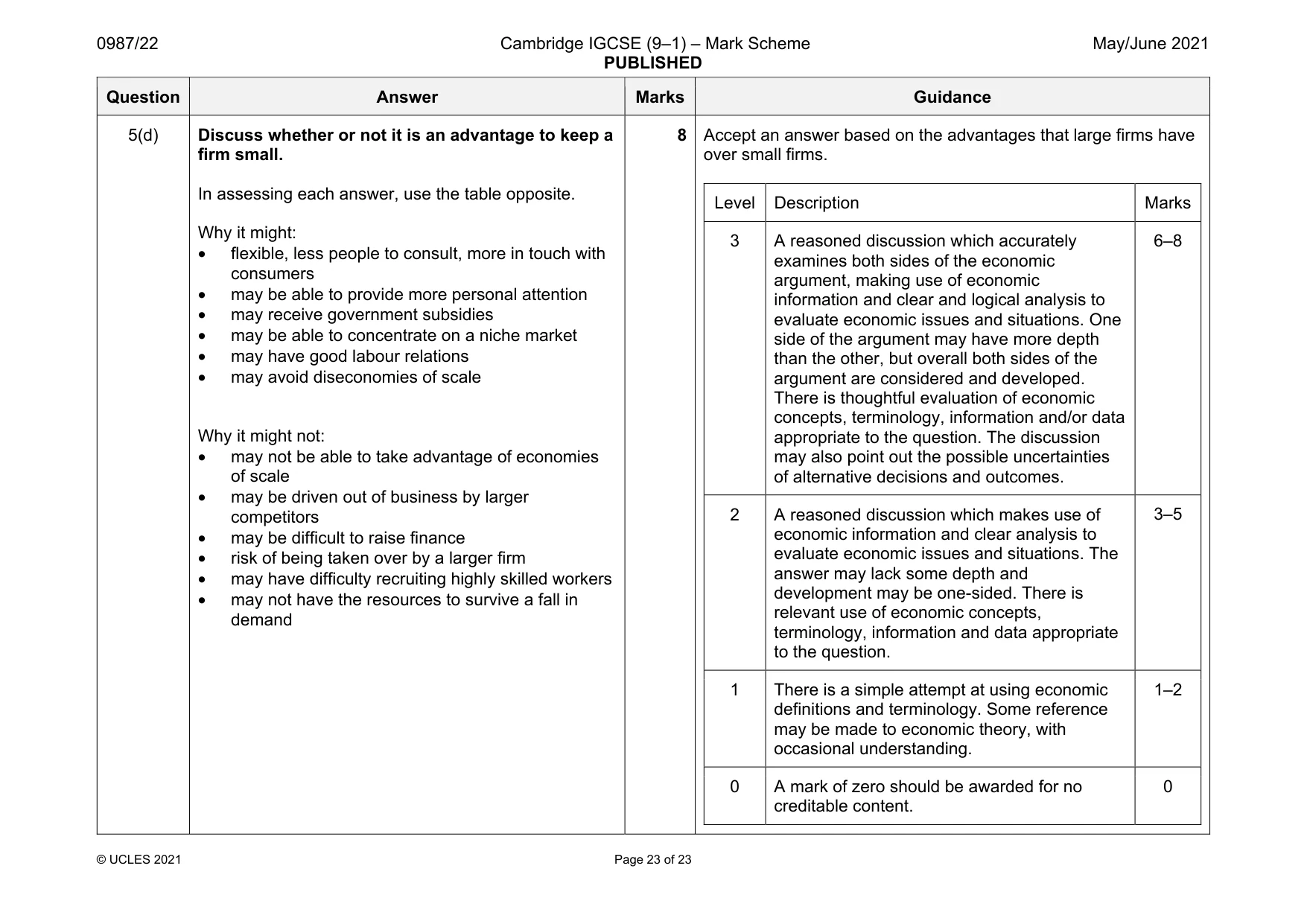
5 The money supply in Bangladesh increased every year from 2010 to 2018. Changes in the money supply and the foreign exchange rate can affect a government’s macroeconomic policy aims, including full employment. There have been few mergers between commercial banks in Bangladesh, although its banks are larger than many of its other firms. (a) Identify two functions of money. [2] (b) Explain two reasons why commercial banks may want to merge. [4] (c) Analyse how a fall in a country’s foreign exchange rate could increase employment. [6] (d) Discuss whether or not it is an advantage to keep a firm small. [8]
Mark scheme: 5(a) Identify two functions of money. Two from: Medium of exchange, store of value, standard of deferred payments, unit of account / measure of value. 2 Note: a description of the function gets the mark e.g. money can be used to buy and sell products, may be used to trade. Nothing for characteristics of money, 5(b) Explain two reasons why commercial banks may want to merge. Logical explanation which might include: Greater market power/share (1) eliminating a competitor / providing a greater range of services (1). More opportunity to take advantage of economies of scale (1) lower costs of production / higher profit / example e.g. share ATMs (1). May enable the merged bank to operate in more than one country / become a multinational company (1) access to new market (1). Become better known (1) large banks may be more likely to have a brand image (1). May enable rationalisation (1) eliminate duplication / rase efficiency (1). Survival (1) may have been loss making / at risk of going out of business (1). 4 One mark each for each of two reasons identified and one mark each for each of two explanations. Nothing for increase revenue. Question Answer Marks Guidance 5(c) Analyse how a fall in a country’s foreign exchange rate could increase employment. Coherent analysis which might include: A fall in a country’s foreign exchange rate will lower the price of exports (1) raise the price of imports (1) make domestically produced products more price competitive (1) reduce demand for imports (1) increase demand for exports (1) increase total demand (1) raise firms’ revenue and/or profits (1) encourage firms to increase output (1) take on more workers (1). 6 Question Answer Marks Guidance 5(d) Discuss whether or not it is an advantage to keep a firm small. In assessing each answer, use the table opposite. Why it might: • flexible, less people to consult, more in touch with consumers • may be able to provide more personal attention • may receive government subsidies • may be able to concentrate on a niche market • may have good labour relations • may avoid diseconomies of scale Why it might not: • may not be able to take advantage of economies of scale • may be driven out of business by larger competitors • may be difficult to raise finance • risk of being taken over by a larger firm • may have difficulty recruiting highly skilled workers • may not have the resources to survive a fall in demand 8 Accept an answer based on the advantages that large firms have over small firms. Level Description Marks 3 A reasoned discussion which accurately examines both sides of the economic argument, making use of economic information and clear and logical analysis to evaluate economic issues and situations. One side of the argument may have more depth than the other, but overall both sides of the argument are considered and developed. There is thoughtful evaluation of economic concepts, terminology, information and/or data appropriate to the question. The discussion may also point out the possible uncertainties of alternative decisions and outcomes. 6–8 2 A reasoned discussion which makes use of economic information and clear analysis to evaluate economic issues and situations. The answer may lack some depth and development may be one-sided. There is relevant use of economic concepts, terminology, information and data appropriate to the question. 3–5 1 There is a simple attempt at using economic definitions and terminology. Some reference may be made to economic theory, with occasional understanding. 1–2 0 A mark of zero should be awarded for no creditable content. 0
What was in this paper
The subtopics covered by these 5 questions, and how many questions each got. Open one in a new tab to see every Cambridge question on it.
What you needed in this session
Cambridge’s own grade thresholds for 2021 May/June, Paper 2 · Variant 2. A higher threshold means an easier paper — the bar moves with how the cohort did.