Cambridge IGCSE Economics (9-1) 0987 — 2021 Oct/Nov Paper 2 · Variant 2
0987/22/O/N/21 · 4 questions · 90 marks · ≈101 min
The question paper and its mark scheme, free to read here and free to download. This is Cambridge’s own paper, exactly as it was sat.
Question paper8 pages
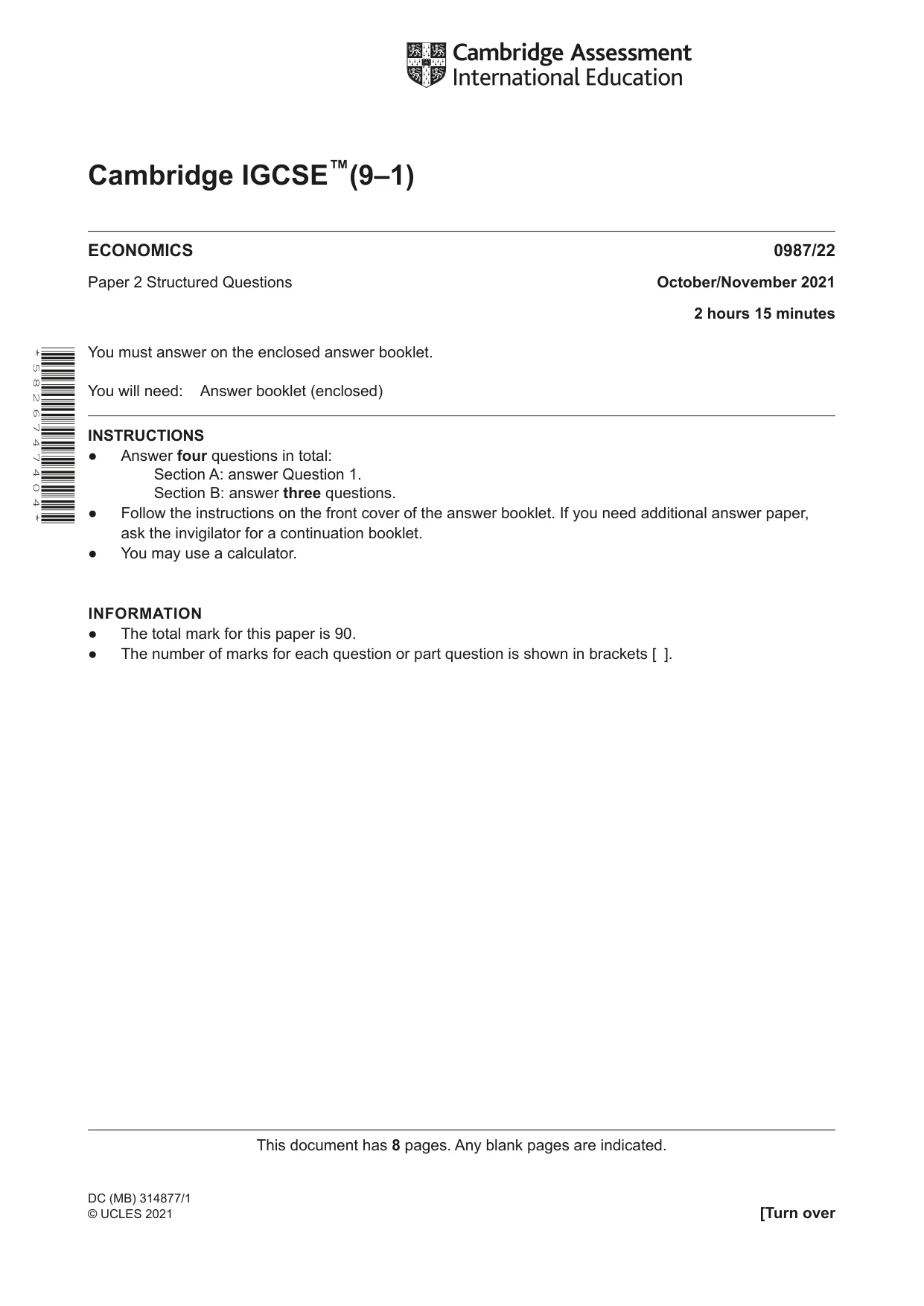
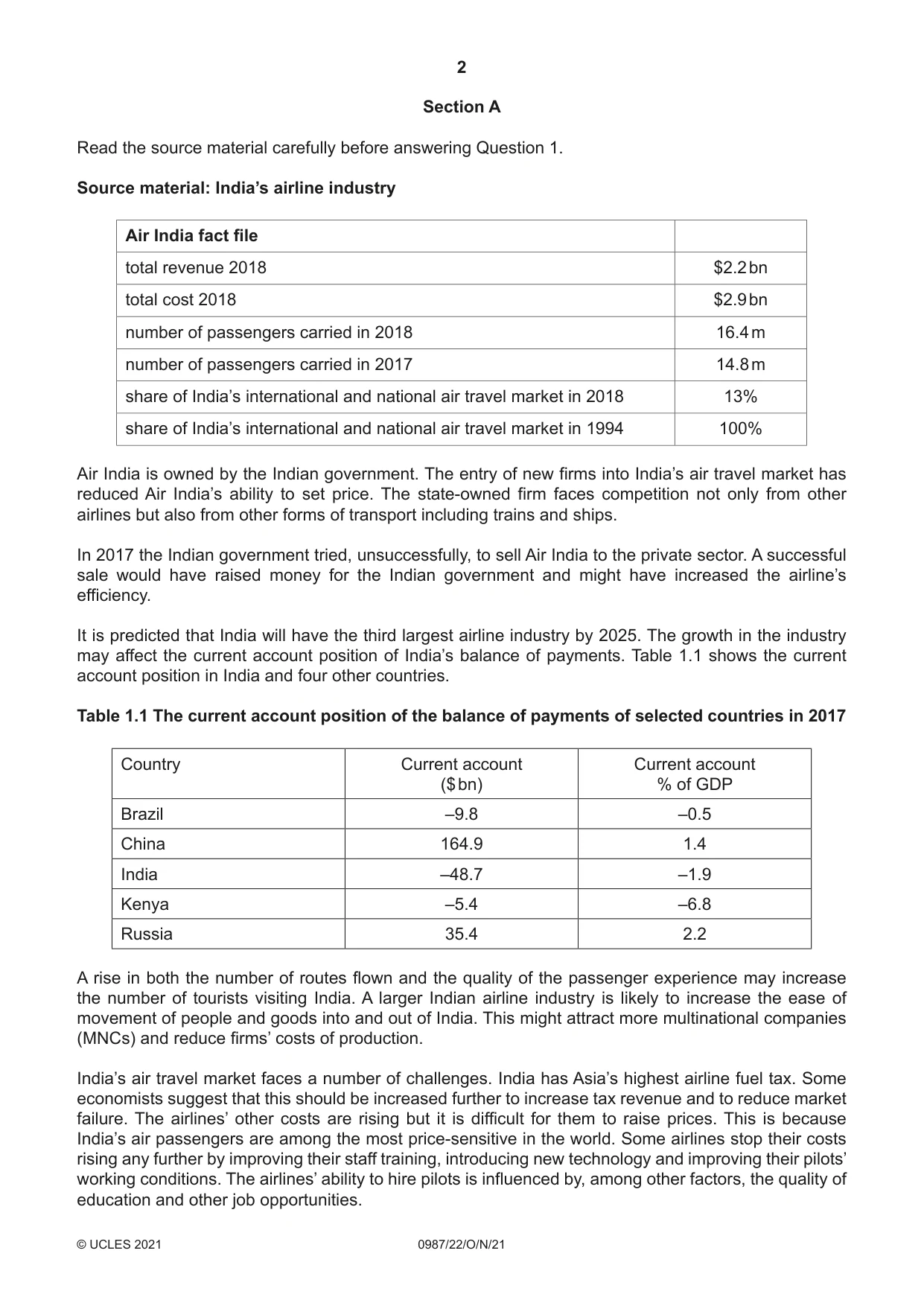
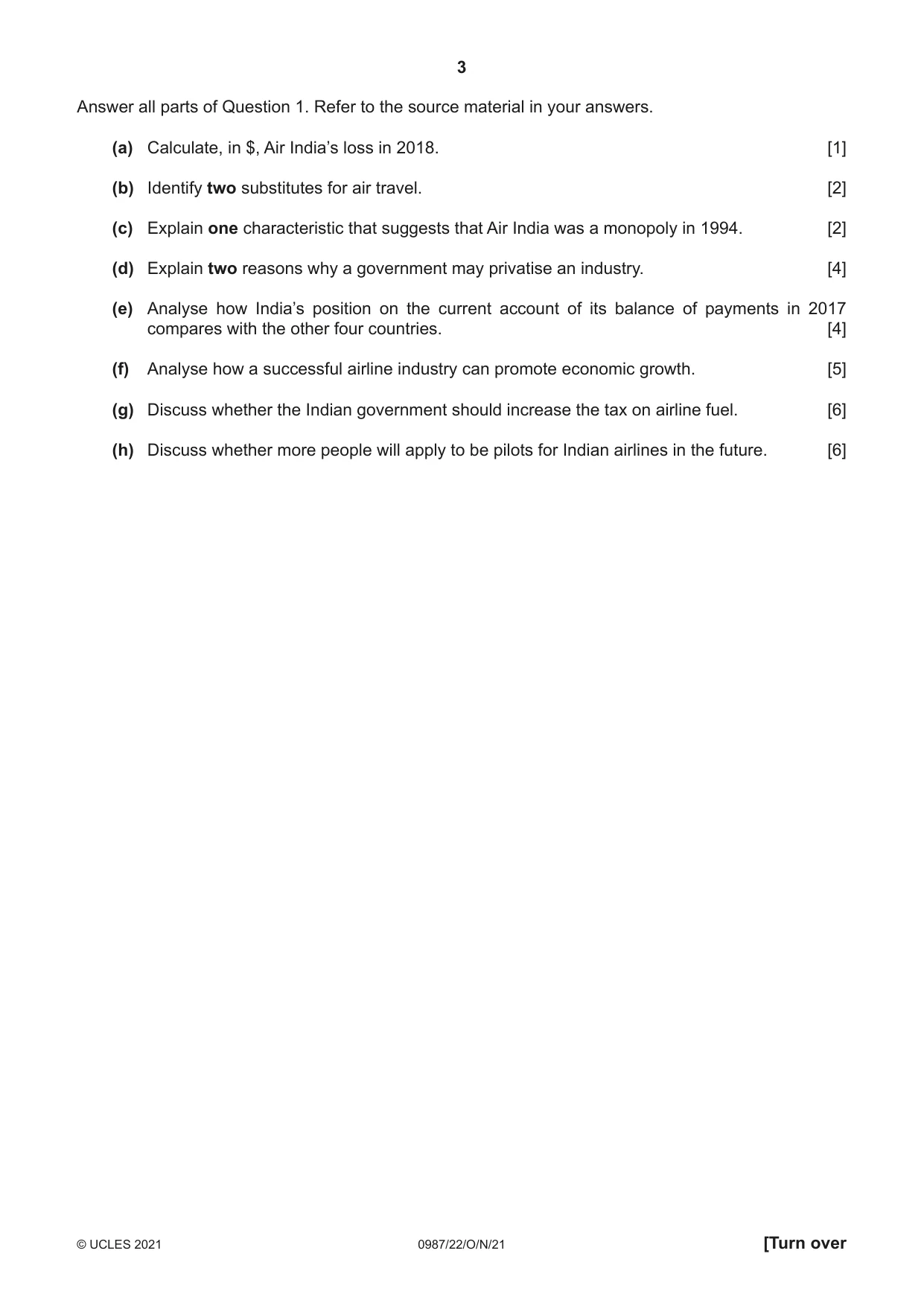
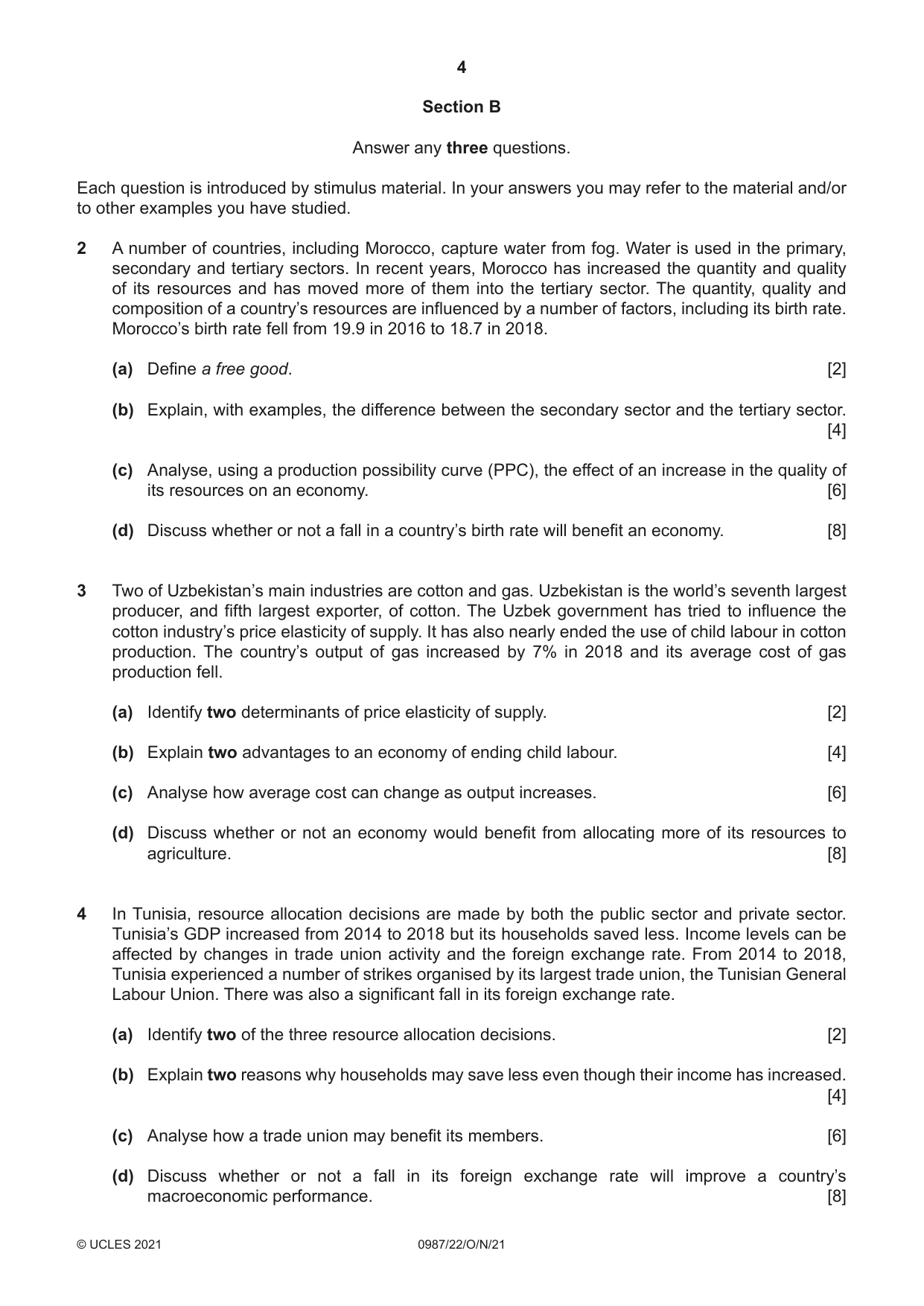




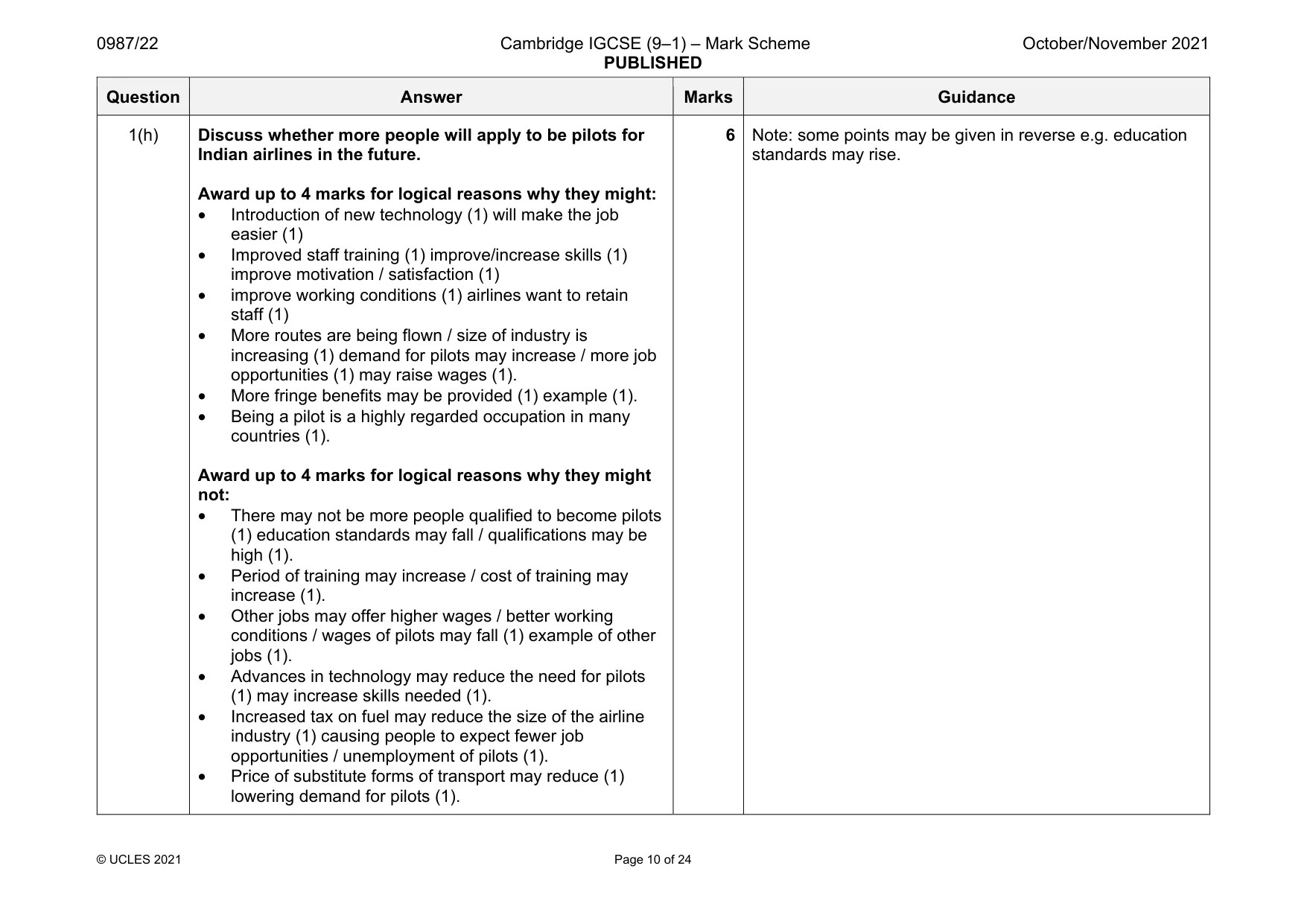
Mark scheme24 pages
Answers below. Sit the paper first if you are practising.


Questions as text
Q2 · A number of countries, including Morocco, capture water from fog
2 A number of countries, including Morocco, capture water from fog. Water is used in the primary, secondary and tertiary sectors. In recent years, Morocco has increased the quantity and quality of its resources and has moved more of them into the tertiary sector. The quantity, quality and composition of a country’s resources are influenced by a number of factors, including its birth rate. Morocco’s birth rate fell from 19.9 in 2016 to 18.7 in 2018. (a) Define a free good. [2] (b) Explain, with examples, the difference between the secondary sector and the tertiary sector. [4] (c) Analyse, using a production possibility curve (PPC), the effect of an increase in the quality of its resources on an economy. [6] (d) Discuss whether or not a fall in a country’s birth rate will benefit an economy. [8]
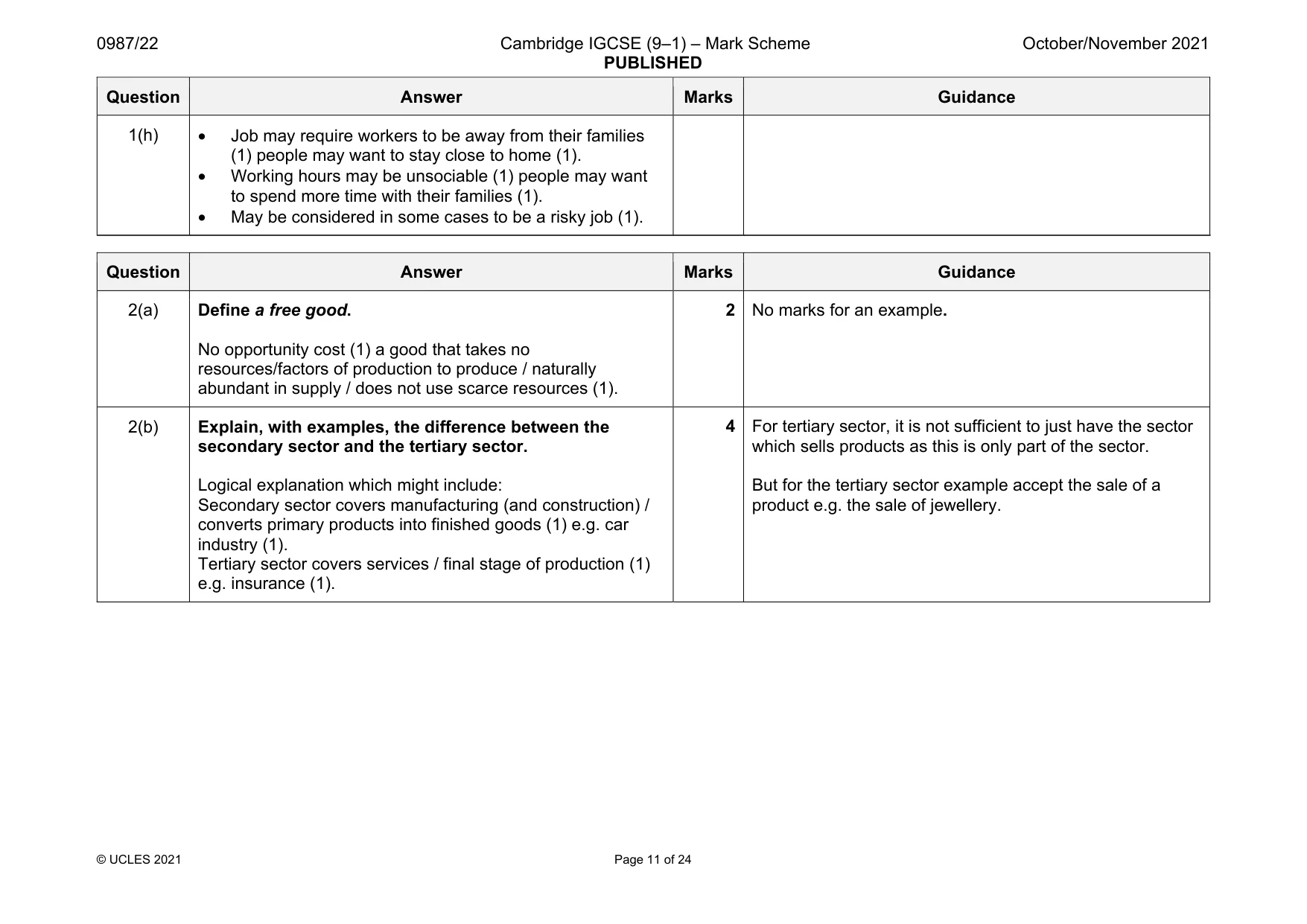
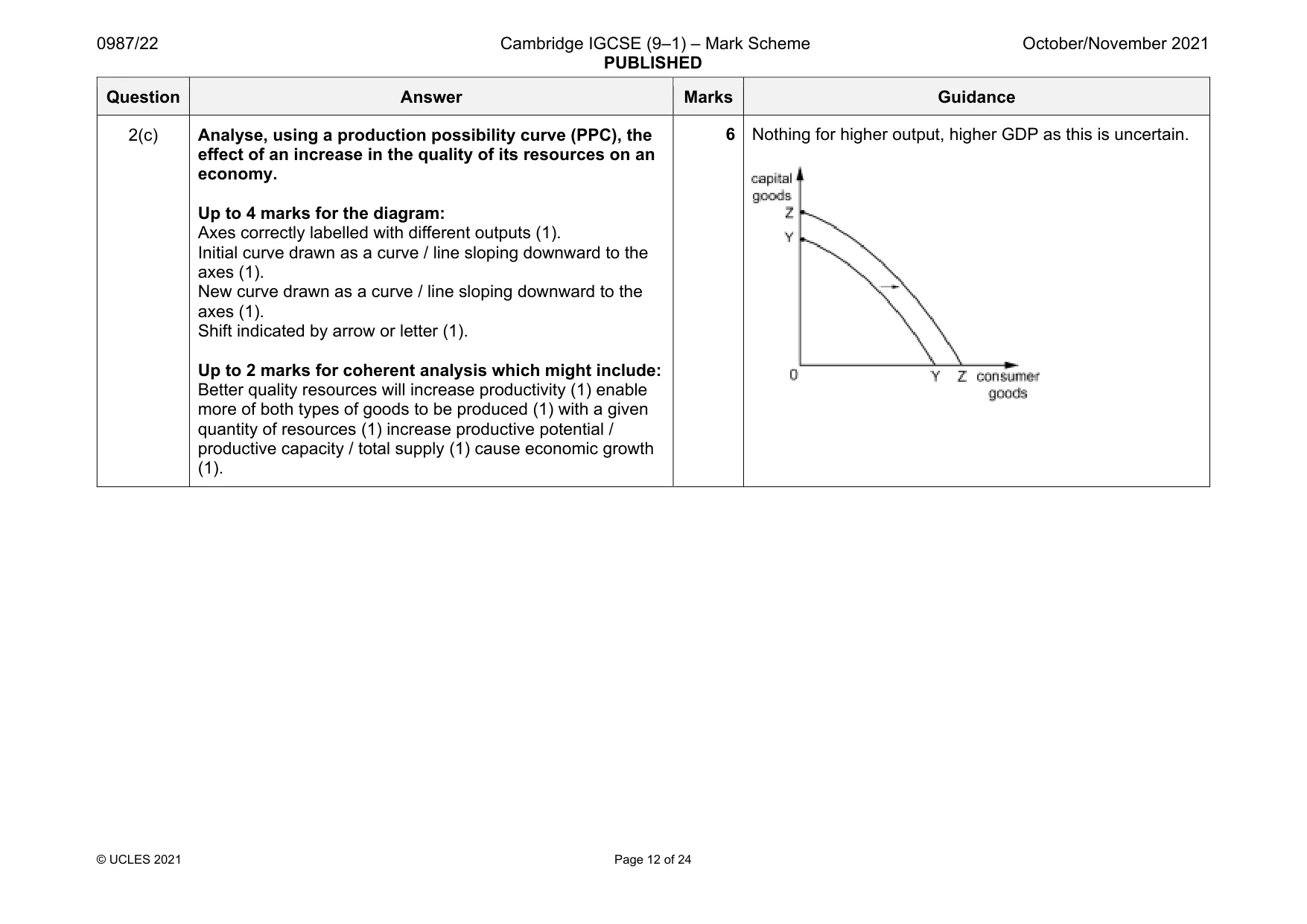
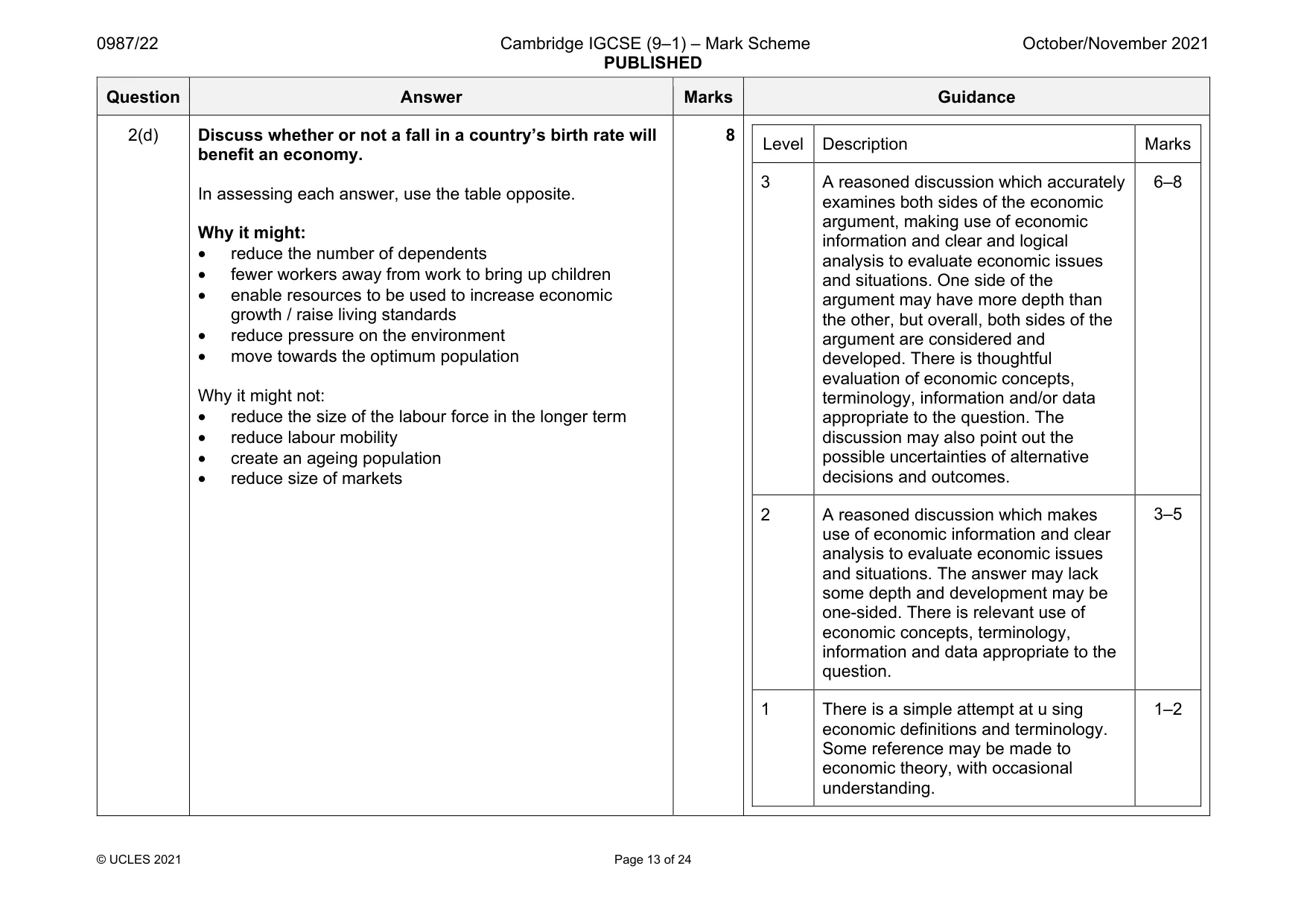
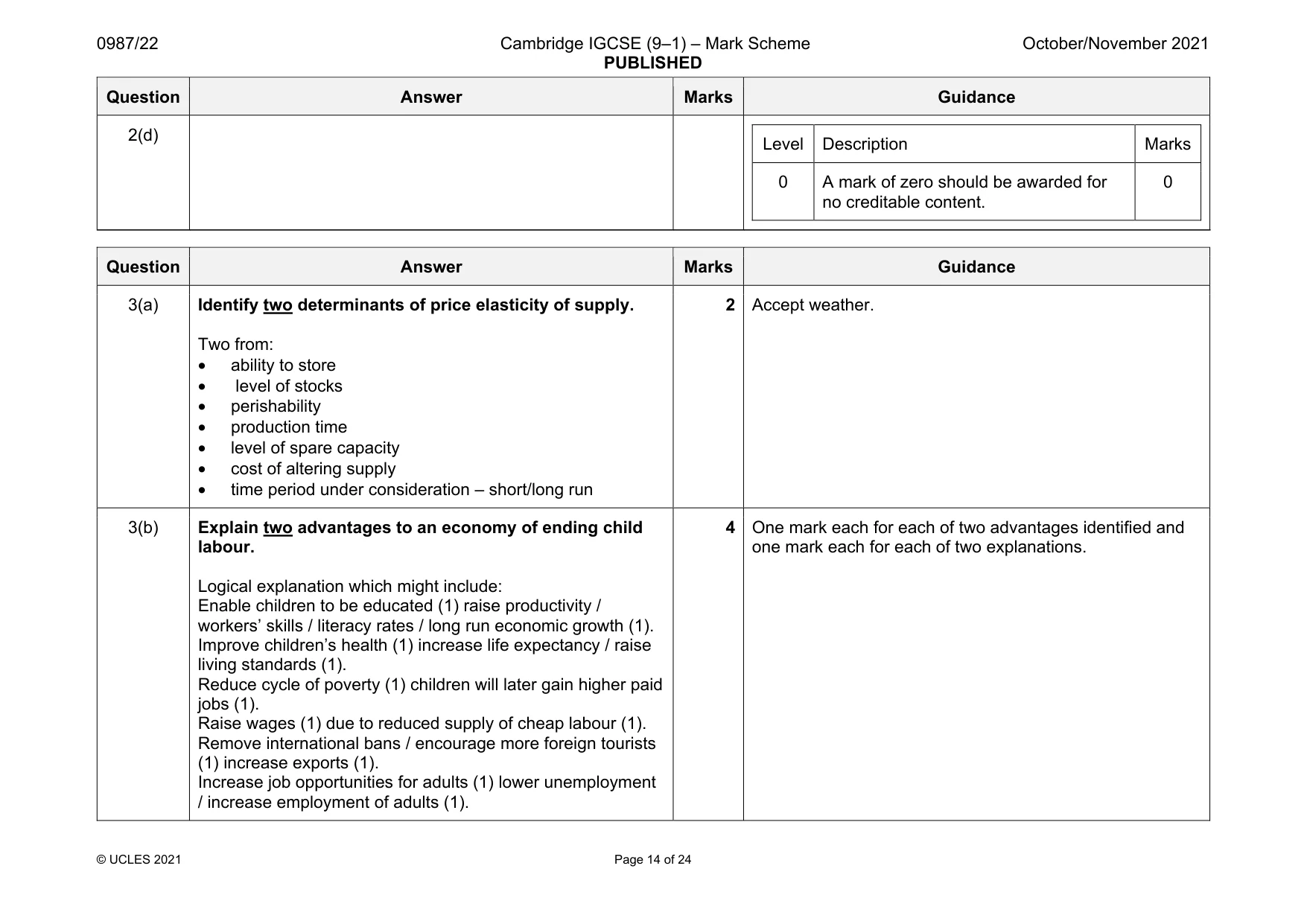
Mark scheme: 2(a) Define a free good. No opportunity cost (1) a good that takes no resources/factors of production to produce / naturally abundant in supply / does not use scarce resources (1). 2(b) Explain, with examples, the difference between the secondary sector and the tertiary sector. Logical explanation which might include: Secondary sector covers manufacturing (and construction) / converts primary products into finished goods (1) e.g. car industry (1). Tertiary sector covers services / final stage of production (1) e.g. insurance (1). 4 For tertiary sector, it is not sufficient to just have the sector which sells products as this is only part of the sector. But for the tertiary sector example accept the sale of a product e.g. the sale of jewellery. Question Answer Marks Guidance 2(c) Analyse, using a production possibility curve (PPC), the effect of an increase in the quality of its resources on an economy. Up to 4 marks for the diagram: Axes correctly labelled with different outputs (1). Initial curve drawn as a curve / line sloping downward to the axes (1). New curve drawn as a curve / line sloping downward to the axes (1). Shift indicated by arrow or letter (1). Up to 2 marks for coherent analysis which might include: Better quality resources will increase productivity (1) enable more of both types of goods to be produced (1) with a given quantity of resources (1) increase productive potential / productive capacity / total supply (1) cause economic growth (1). 6 Nothing for higher output, higher GDP as this is uncertain. Question Answer Marks Guidance 2(d) Discuss whether or not a fall in a country’s birth rate will benefit an economy. In assessing each answer, use the table opposite. Why it might: • reduce the number of dependents • fewer workers away from work to bring up children • enable resources to be used to increase economic growth / raise living standards • reduce pressure on the environment • move towards the optimum population Why it might not: • reduce the size of the labour force in the longer term • reduce labour mobility • create an ageing population • reduce size of markets 8 Level Description Marks 3 A reasoned discussion which accurately examines both sides of the economic argument, making use of economic information and clear and logical analysis to evaluate economic issues and situations. One side of the argument may have more depth than the other, but overall, both sides of the argument are considered and developed. There is thoughtful evaluation of economic concepts, terminology, information and/or data appropriate to the question. The discussion may also point out the possible uncertainties of alternative decisions and outcomes. 6–8 2 A reasoned discussion which makes use of economic information and clear analysis to evaluate economic issues and situations. The answer may lack some depth and development may be one-sided. There is relevant use of economic concepts, terminology, information and data appropriate to the question. 3–5 1 There is a simple attempt at u sing economic definitions and terminology. Some reference may be made to economic theory, with occasional understanding. 1–2 Question Answer Marks Guidance 2(d) Level Description Marks 0 A mark of zero should be awarded for no creditable content. 0
Q3 · Two of Uzbekistan’s main industries are cotton and gas
3 Two of Uzbekistan’s main industries are cotton and gas. Uzbekistan is the world’s seventh largest producer, and fifth largest exporter, of cotton. The Uzbek government has tried to influence the cotton industry’s price elasticity of supply. It has also nearly ended the use of child labour in cotton production. The country’s output of gas increased by 7% in 2018 and its average cost of gas production fell. (a) Identify two determinants of price elasticity of supply. [2] (b) Explain two advantages to an economy of ending child labour. [4] (c) Analyse how average cost can change as output increases. [6] (d) Discuss whether or not an economy would benefit from allocating more of its resources to agriculture. [8]
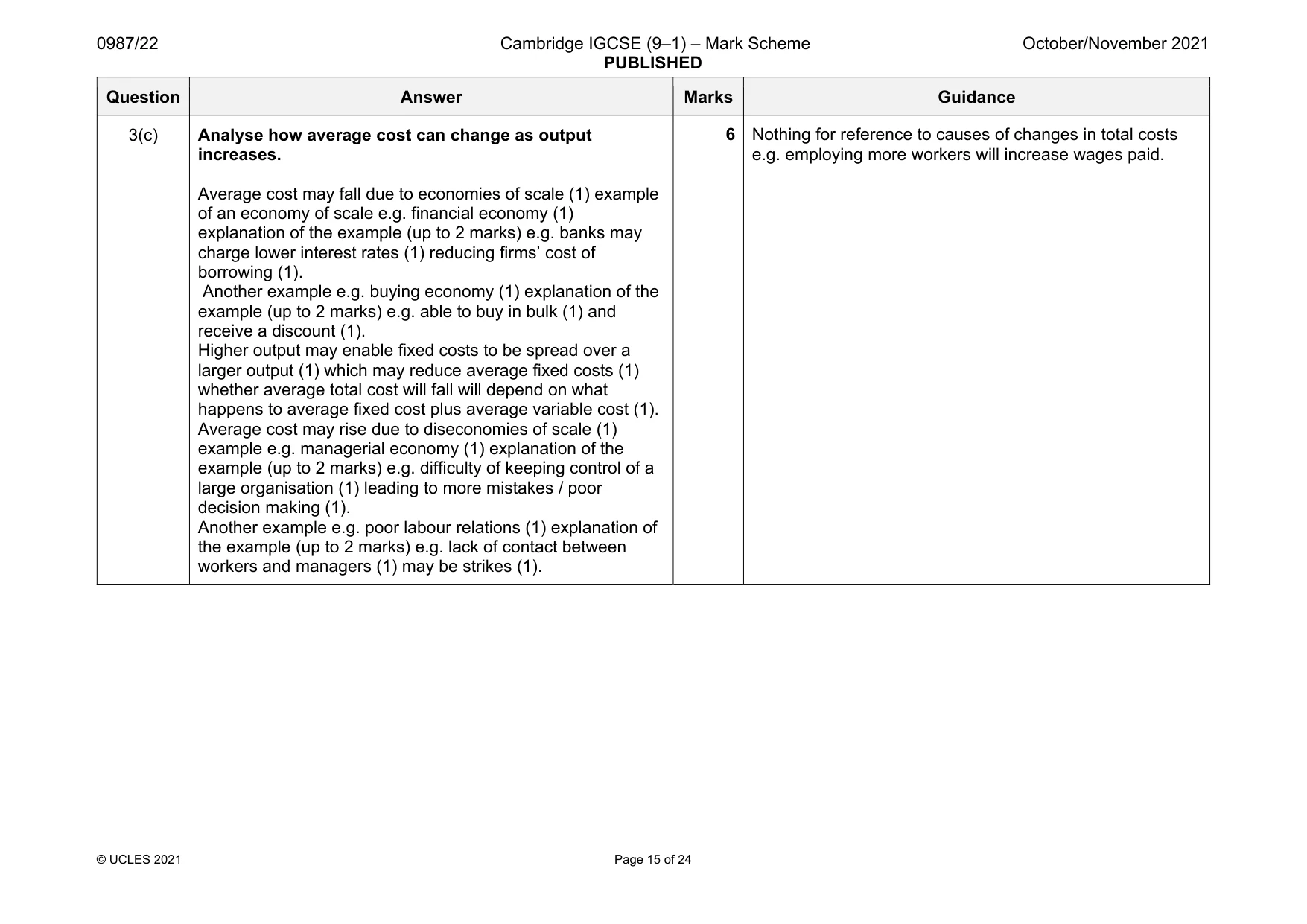
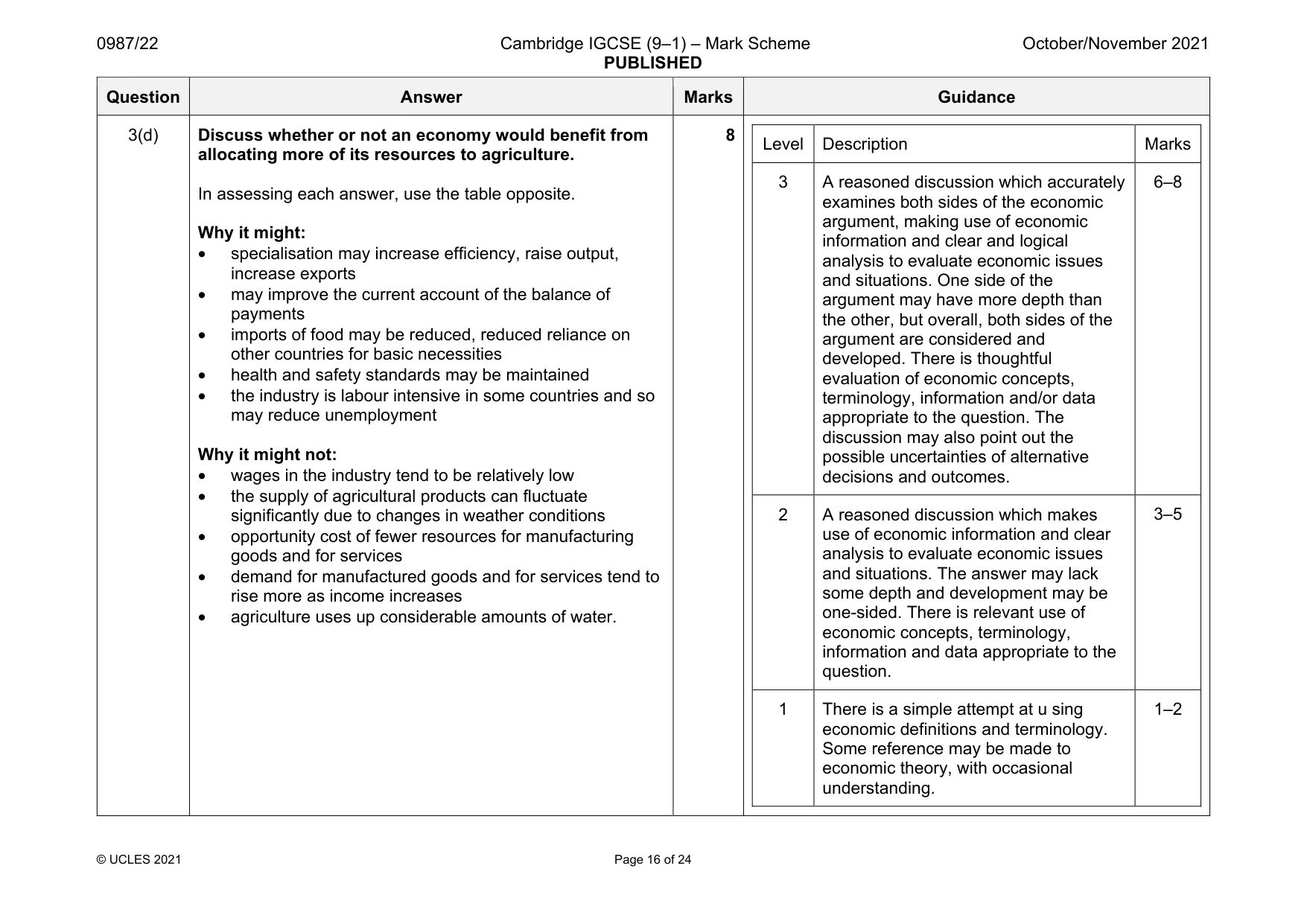
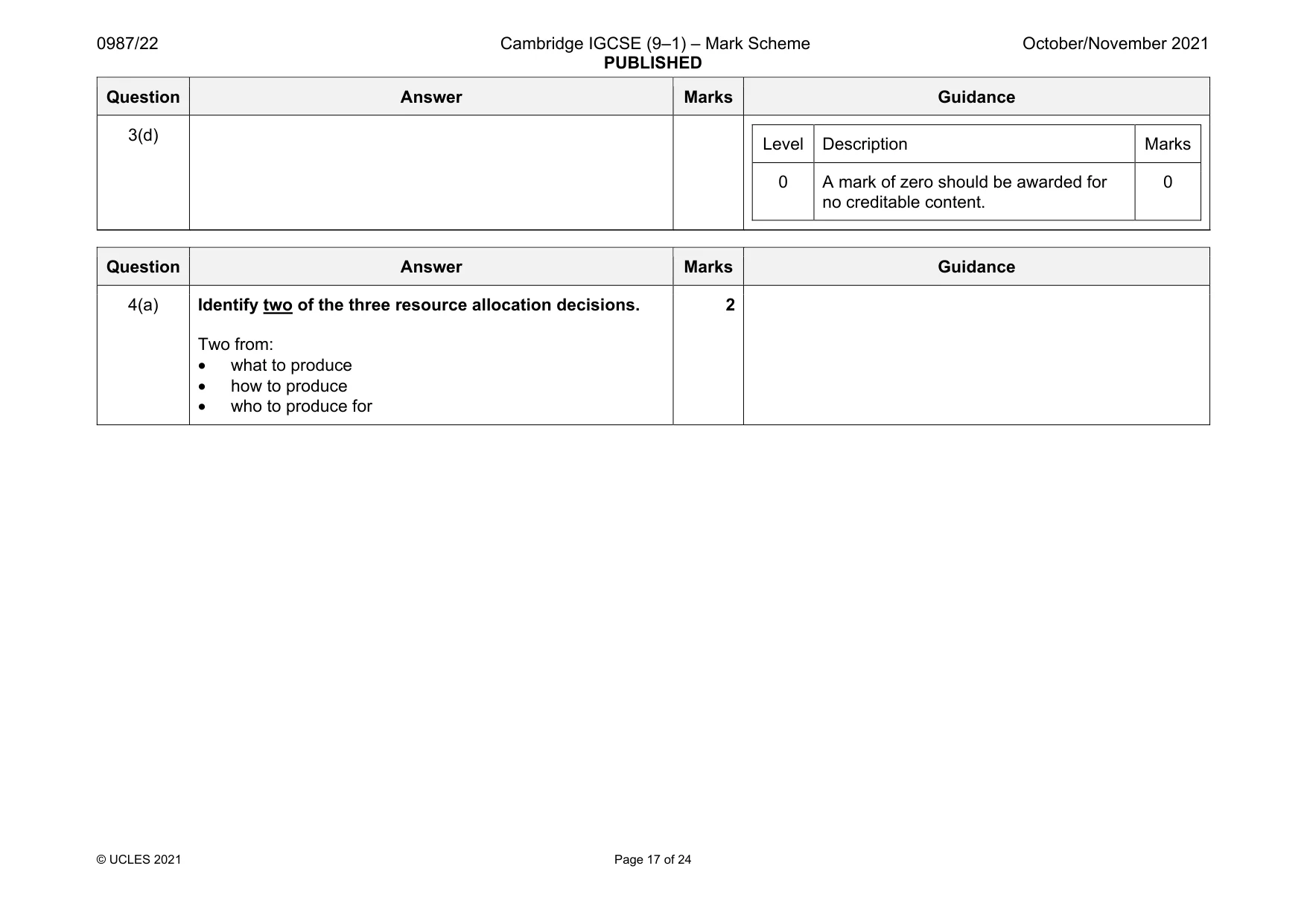
Mark scheme: 3(a) Identify two determinants of price elasticity of supply. Two from: • ability to store • level of stocks • perishability • production time • level of spare capacity • cost of altering supply • time period under consideration – short/long run 2 Accept weather. 3(b) Explain two advantages to an economy of ending child labour. Logical explanation which might include: Enable children to be educated (1) raise productivity / workers’ skills / literacy rates / long run economic growth (1). Improve children’s health (1) increase life expectancy / raise living standards (1). Reduce cycle of poverty (1) children will later gain higher paid jobs (1). Raise wages (1) due to reduced supply of cheap labour (1). Remove international bans / encourage more foreign tourists (1) increase exports (1). Increase job opportunities for adults (1) lower unemployment / increase employment of adults (1). 4 One mark each for each of two advantages identified and one mark each for each of two explanations. Question Answer Marks Guidance 3(c) Analyse how average cost can change as output increases. Average cost may fall due to economies of scale (1) example of an economy of scale e.g. financial economy (1) explanation of the example (up to 2 marks) e.g. banks may charge lower interest rates (1) reducing firms’ cost of borrowing (1). Another example e.g. buying economy (1) explanation of the example (up to 2 marks) e.g. able to buy in bulk (1) and receive a discount (1). Higher output may enable fixed costs to be spread over a larger output (1) which may reduce average fixed costs (1) whether average total cost will fall will depend on what happens to average fixed cost plus average variable cost (1). Average cost may rise due to diseconomies of scale (1) example e.g. managerial economy (1) explanation of the example (up to 2 marks) e.g. difficulty of keeping control of a large organisation (1) leading to more mistakes / poor decision making (1). Another example e.g. poor labour relations (1) explanation of the example (up to 2 marks) e.g. lack of contact between workers and managers (1) may be strikes (1). 6 Nothing for reference to causes of changes in total costs e.g. employing more workers will increase wages paid. Question Answer Marks Guidance 3(d) Discuss whether or not an economy would benefit from allocating more of its resources to agriculture. In assessing each answer, use the table opposite. Why it might: • specialisation may increase efficiency, raise output, increase exports • may improve the current account of the balance of payments • imports of food may be reduced, reduced reliance on other countries for basic necessities • health and safety standards may be maintained • the industry is labour intensive in some countries and so may reduce unemployment Why it might not: • wages in the industry tend to be relatively low • the supply of agricultural products can fluctuate significantly due to changes in weather conditions • opportunity cost of fewer resources for manufacturing goods and for services • demand for manufactured goods and for services tend to rise more as income increases • agriculture uses up considerable amounts of water. 8 Level Description Marks 3 A reasoned discussion which accurately examines both sides of the economic argument, making use of economic information and clear and logical analysis to evaluate economic issues and situations. One side of the argument may have more depth than the other, but overall, both sides of the argument are considered and developed. There is thoughtful evaluation of economic concepts, terminology, information and/or data appropriate to the question. The discussion may also point out the possible uncertainties of alternative decisions and outcomes. 6–8 2 A reasoned discussion which makes use of economic information and clear analysis to evaluate economic issues and situations. The answer may lack some depth and development may be one-sided. There is relevant use of economic concepts, terminology, information and data appropriate to the question. 3–5 1 There is a simple attempt at u sing economic definitions and terminology. Some reference may be made to economic theory, with occasional understanding. 1–2 Question Answer Marks Guidance 3(d) Level Description Marks 0 A mark of zero should be awarded for no creditable content. 0
Q4 · In Tunisia, resource allocation decisions are made by both the public sector and private…
4 In Tunisia, resource allocation decisions are made by both the public sector and private sector. Tunisia’s GDP increased from 2014 to 2018 but its households saved less. Income levels can be affected by changes in trade union activity and the foreign exchange rate. From 2014 to 2018, Tunisia experienced a number of strikes organised by its largest trade union, the Tunisian General Labour Union. There was also a significant fall in its foreign exchange rate. (a) Identify two of the three resource allocation decisions. [2] (b) Explain two reasons why households may save less even though their income has increased. [4] (c) Analyse how a trade union may benefit its members. [6] (d) Discuss whether or not a fall in its foreign exchange rate will improve a country’s macroeconomic performance. [8]
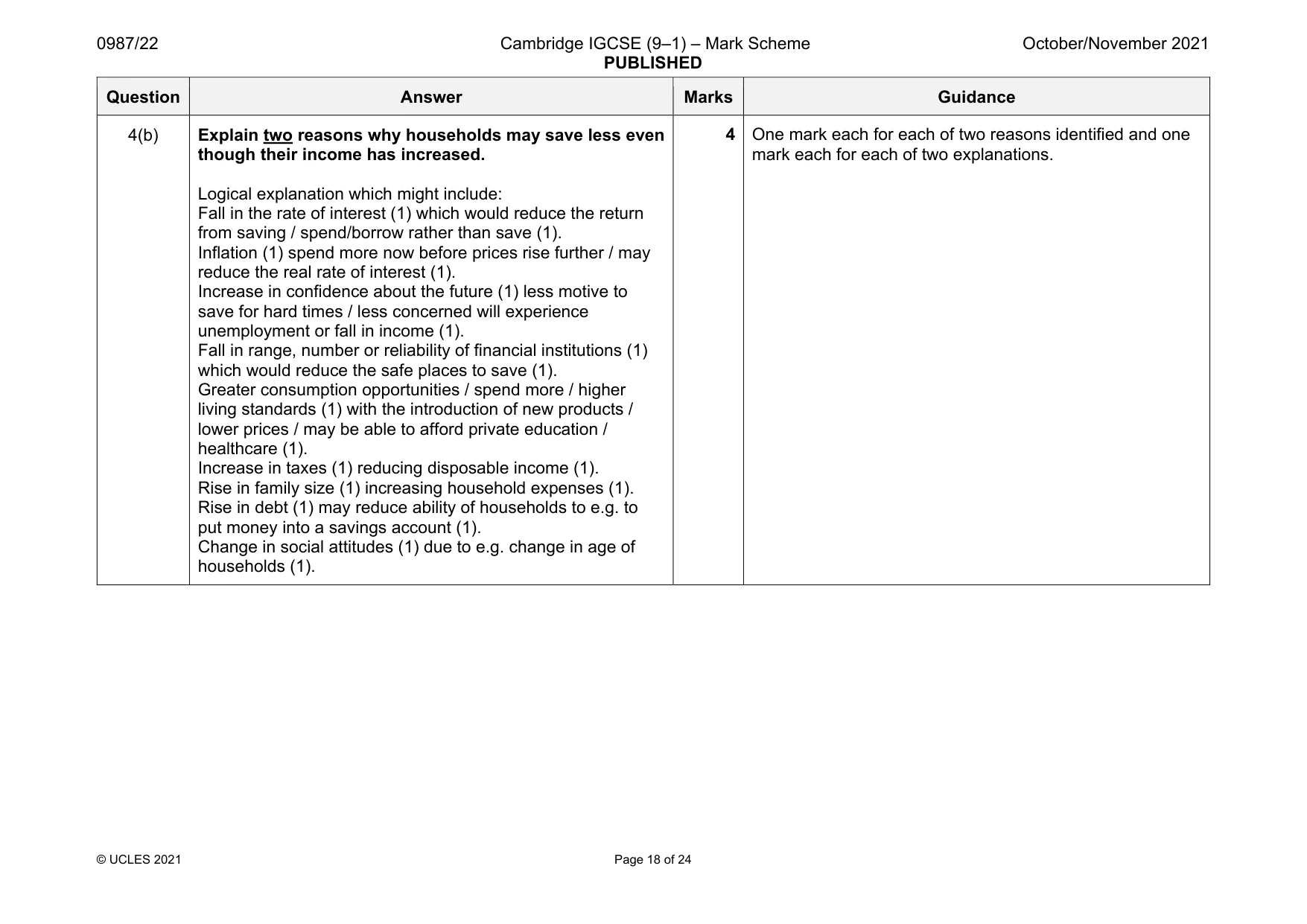
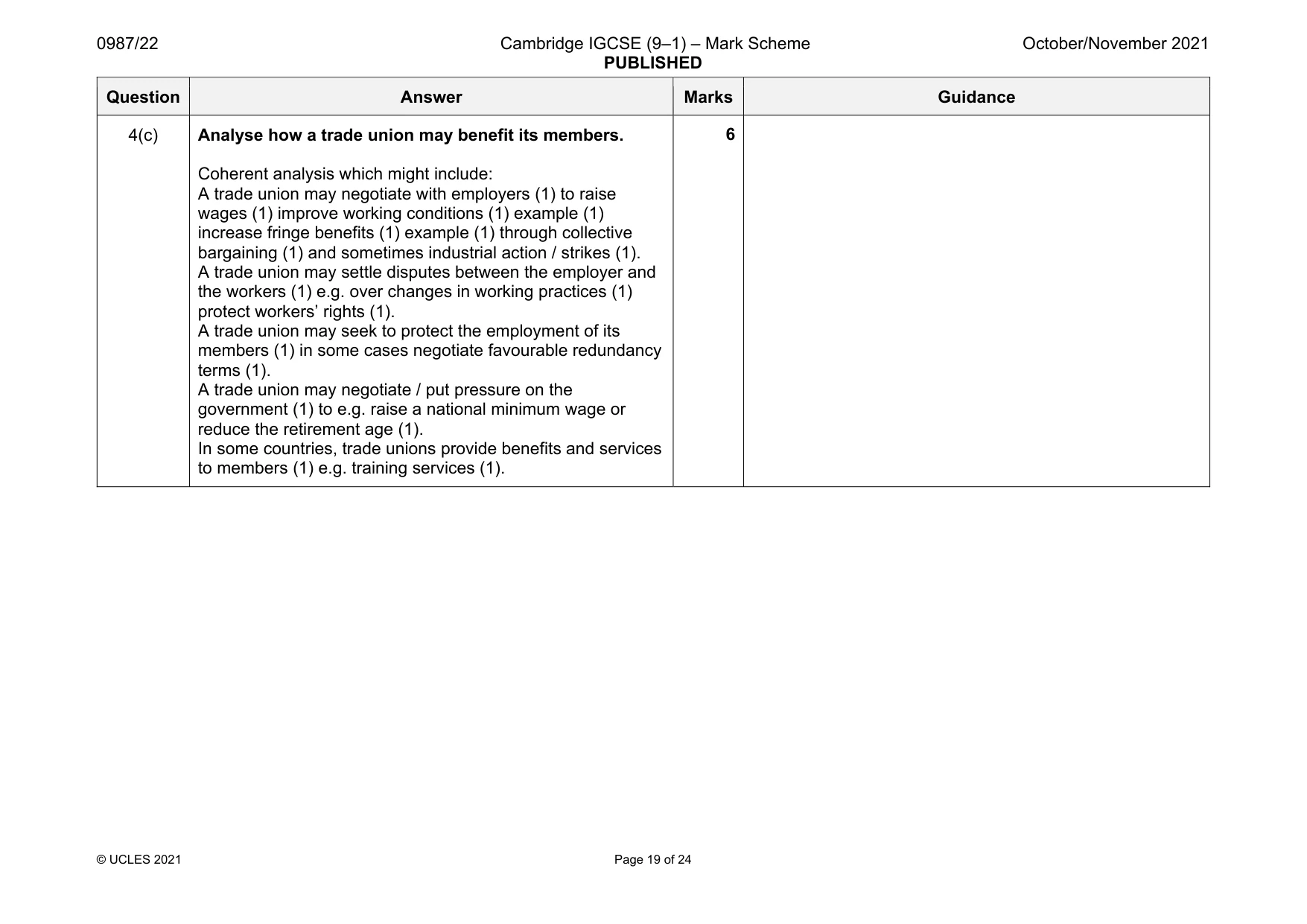
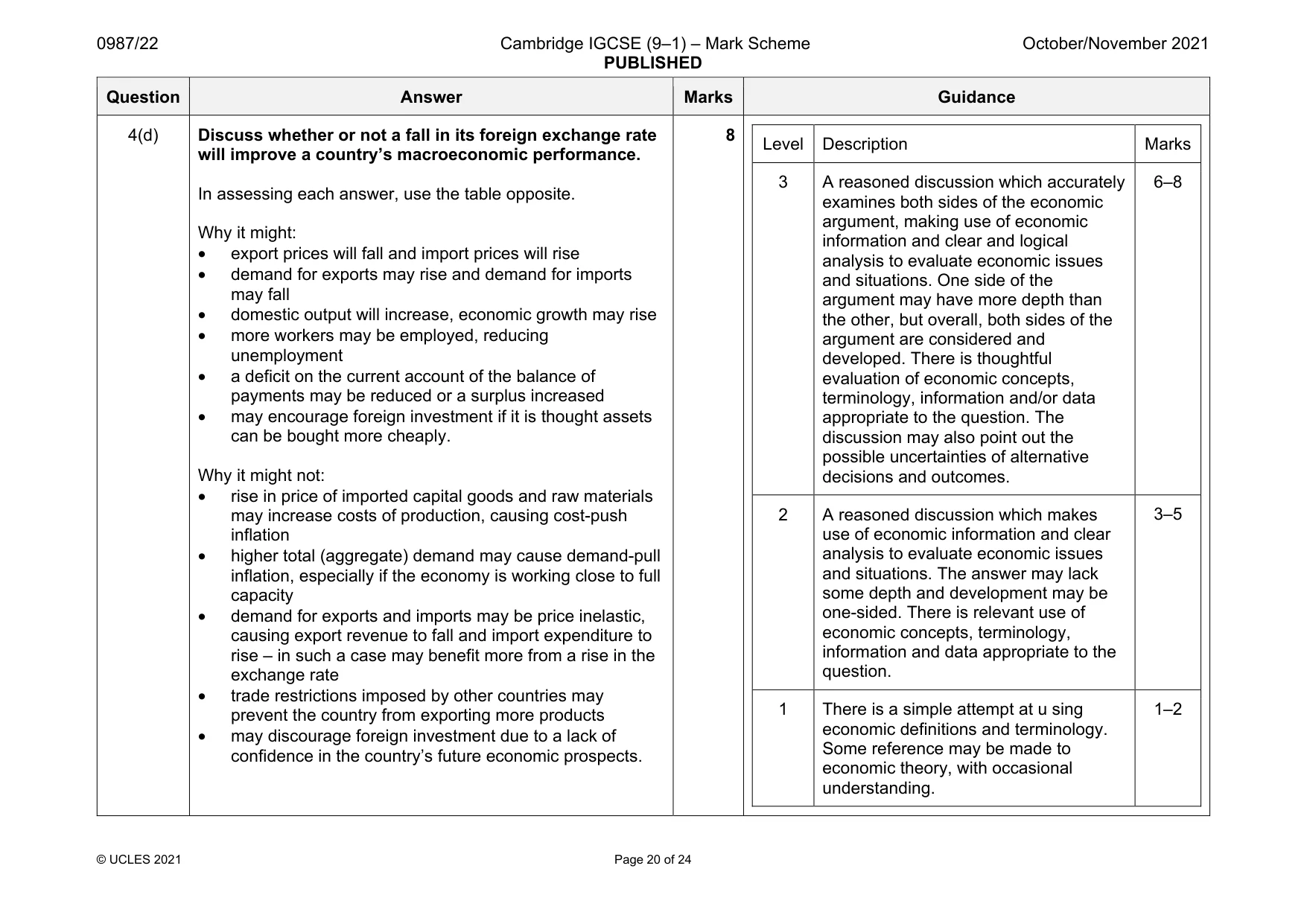
Mark scheme: 4(a) Identify two of the three resource allocation decisions. Two from: • what to produce • how to produce • who to produce for 2 Question Answer Marks Guidance 4(b) Explain two reasons why households may save less even though their income has increased. Logical explanation which might include: Fall in the rate of interest (1) which would reduce the return from saving / spend/borrow rather than save (1). Inflation (1) spend more now before prices rise further / may reduce the real rate of interest (1). Increase in confidence about the future (1) less motive to save for hard times / less concerned will experience unemployment or fall in income (1). Fall in range, number or reliability of financial institutions (1) which would reduce the safe places to save (1). Greater consumption opportunities / spend more / higher living standards (1) with the introduction of new products / lower prices / may be able to afford private education / healthcare (1). Increase in taxes (1) reducing disposable income (1). Rise in family size (1) increasing household expenses (1). Rise in debt (1) may reduce ability of households to e.g. to put money into a savings account (1). Change in social attitudes (1) due to e.g. change in age of households (1). 4 One mark each for each of two reasons identified and one mark each for each of two explanations. Question Answer Marks Guidance 4(c) Analyse how a trade union may benefit its members. Coherent analysis which might include: A trade union may negotiate with employers (1) to raise wages (1) improve working conditions (1) example (1) increase fringe benefits (1) example (1) through collective bargaining (1) and sometimes industrial action / strikes (1). A trade union may settle disputes between the employer and the workers (1) e.g. over changes in working practices (1) protect workers’ rights (1). A trade union may seek to protect the employment of its members (1) in some cases negotiate favourable redundancy terms (1). A trade union may negotiate / put pressure on the government (1) to e.g. raise a national minimum wage or reduce the retirement age (1). In some countries, trade unions provide benefits and services to members (1) e.g. training services (1). 6 Question Answer Marks Guidance 4(d) Discuss whether or not a fall in its foreign exchange rate will improve a country’s macroeconomic performance. In assessing each answer, use the table opposite. Why it might: • export prices will fall and import prices will rise • demand for exports may rise and demand for imports may fall • domestic output will increase, economic growth may rise • more workers may be employed, reducing unemployment • a deficit on the current account of the balance of payments may be reduced or a surplus increased • may encourage foreign investment if it is thought assets can be bought more cheaply. Why it might not: • rise in price of imported capital goods and raw materials may increase costs of production, causing cost-push inflation • higher total (aggregate) demand may cause demand-pull inflation, especially if the economy is working close to full capacity • demand for exports and imports may be price inelastic, causing export revenue to fall and import expenditure to rise – in such a case may benefit more from a rise in the exchange rate • trade restrictions imposed by other countries may prevent the country from exporting more products • may discourage foreign investment due to a lack of confidence in the country’s future economic prospects. 8 Level Description Marks 3 A reasoned discussion which accurately examines both sides of the economic argument, making use of economic information and clear and logical analysis to evaluate economic issues and situations. One side of the argument may have more depth than the other, but overall, both sides of the argument are considered and developed. There is thoughtful evaluation of economic concepts, terminology, information and/or data appropriate to the question. The discussion may also point out the possible uncertainties of alternative decisions and outcomes. 6–8 2 A reasoned discussion which makes use of economic information and clear analysis to evaluate economic issues and situations. The answer may lack some depth and development may be one-sided. There is relevant use of economic concepts, terminology, information and data appropriate to the question. 3–5 1 There is a simple attempt at u sing economic definitions and terminology. Some reference may be made to economic theory, with occasional understanding. 1–2 Question Answer Marks Guidance 4(d) Level Description Marks 0 A mark of zero should be awarded for no creditable content. 0
Q5 · The US operates a mainly market economic system
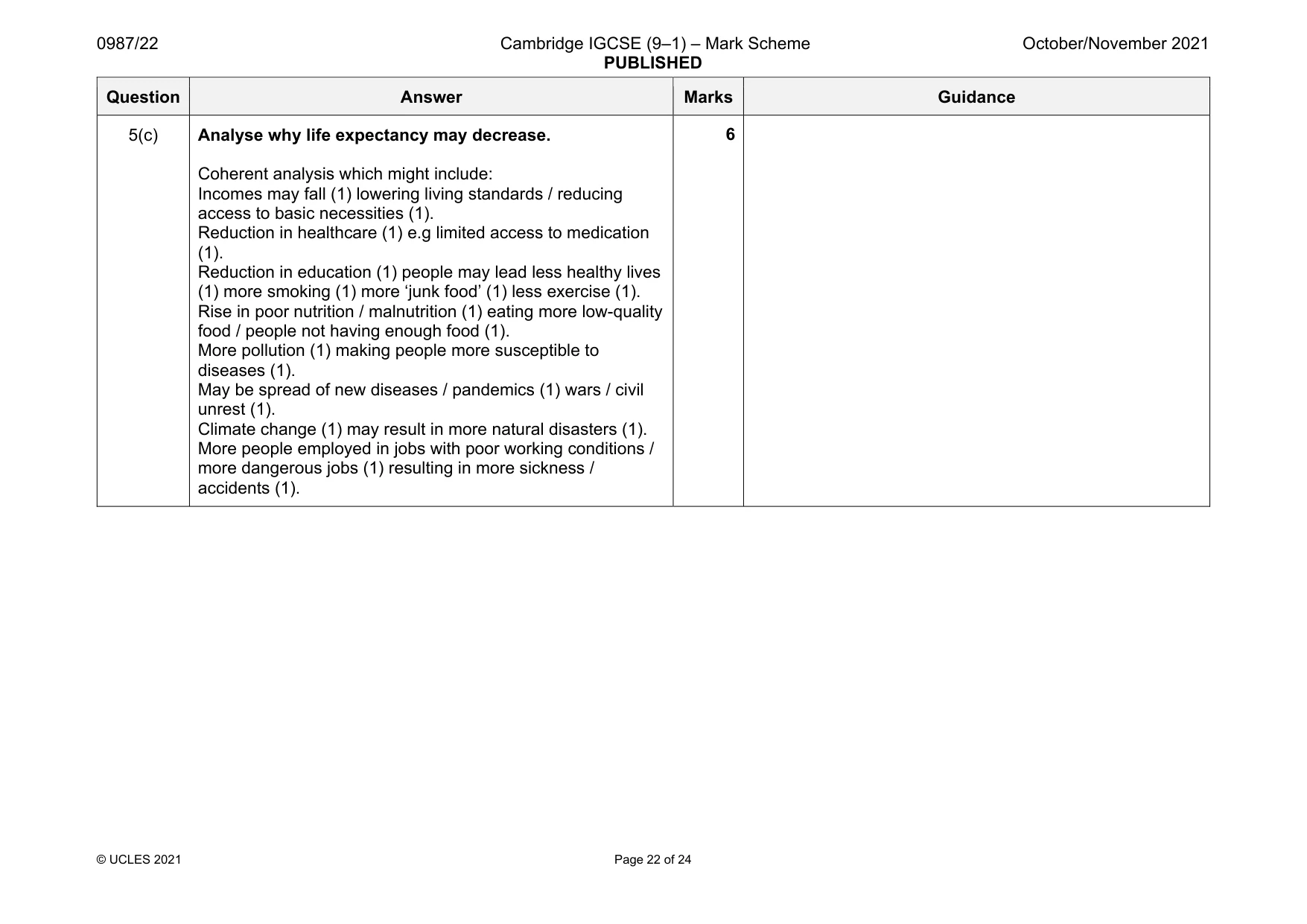
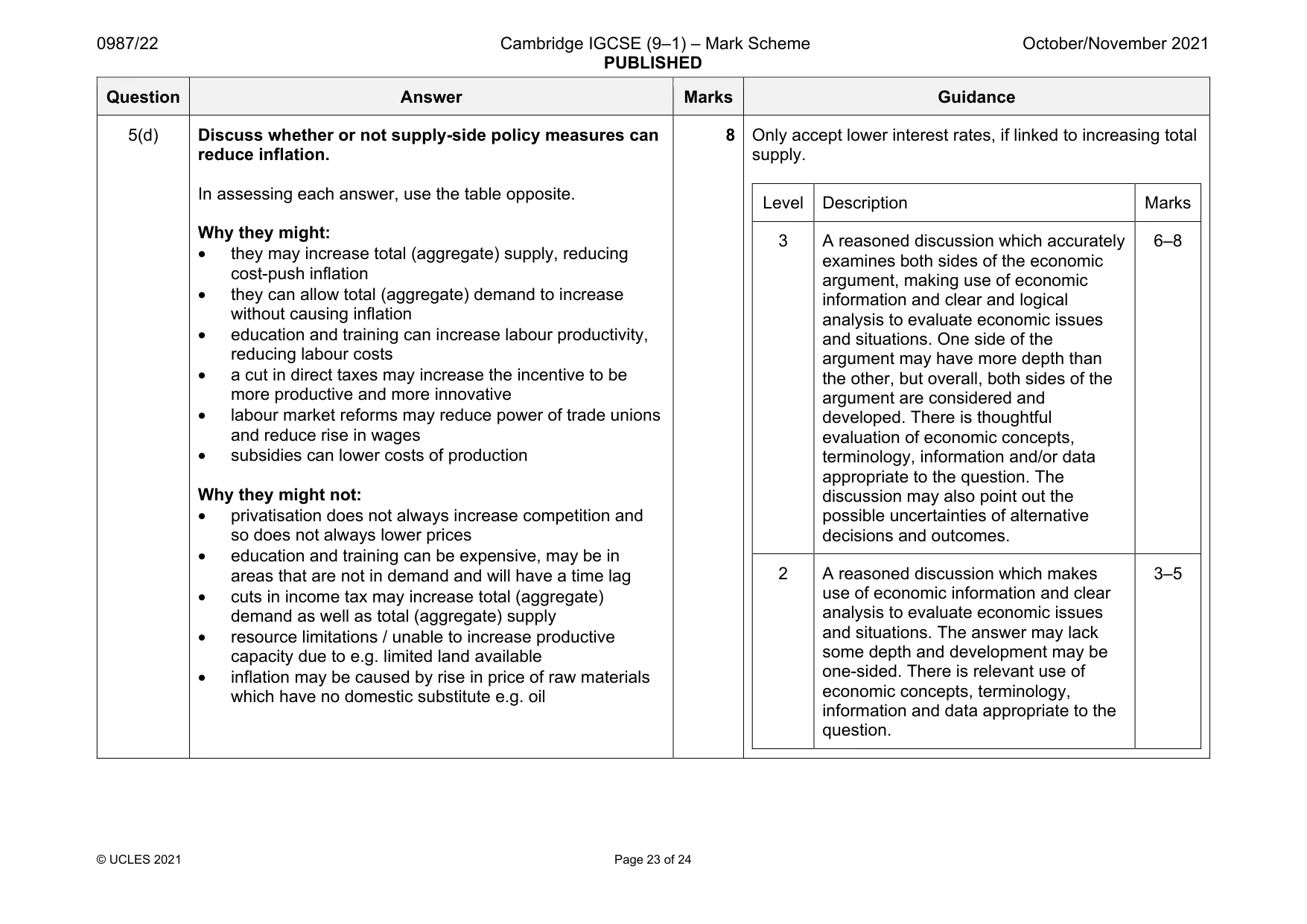
5 The US operates a mainly market economic system. Life expectancy in the US fell in 2017, for the third year in a row. Although the US has a high GDP per head, it also has a high level of income inequality. The poor benefited from the US’s low and stable inflation rate. The government’s supply-side policy measures were partly responsible for reducing inflationary pressure. (a) Identify two ways a government could reduce income inequality. [2] (b) Explain two advantages of a market economic system. [4] (c) Analyse why life expectancy may decrease. [6] (d) Discuss whether or not supply-side policy measures can reduce inflation. [8]
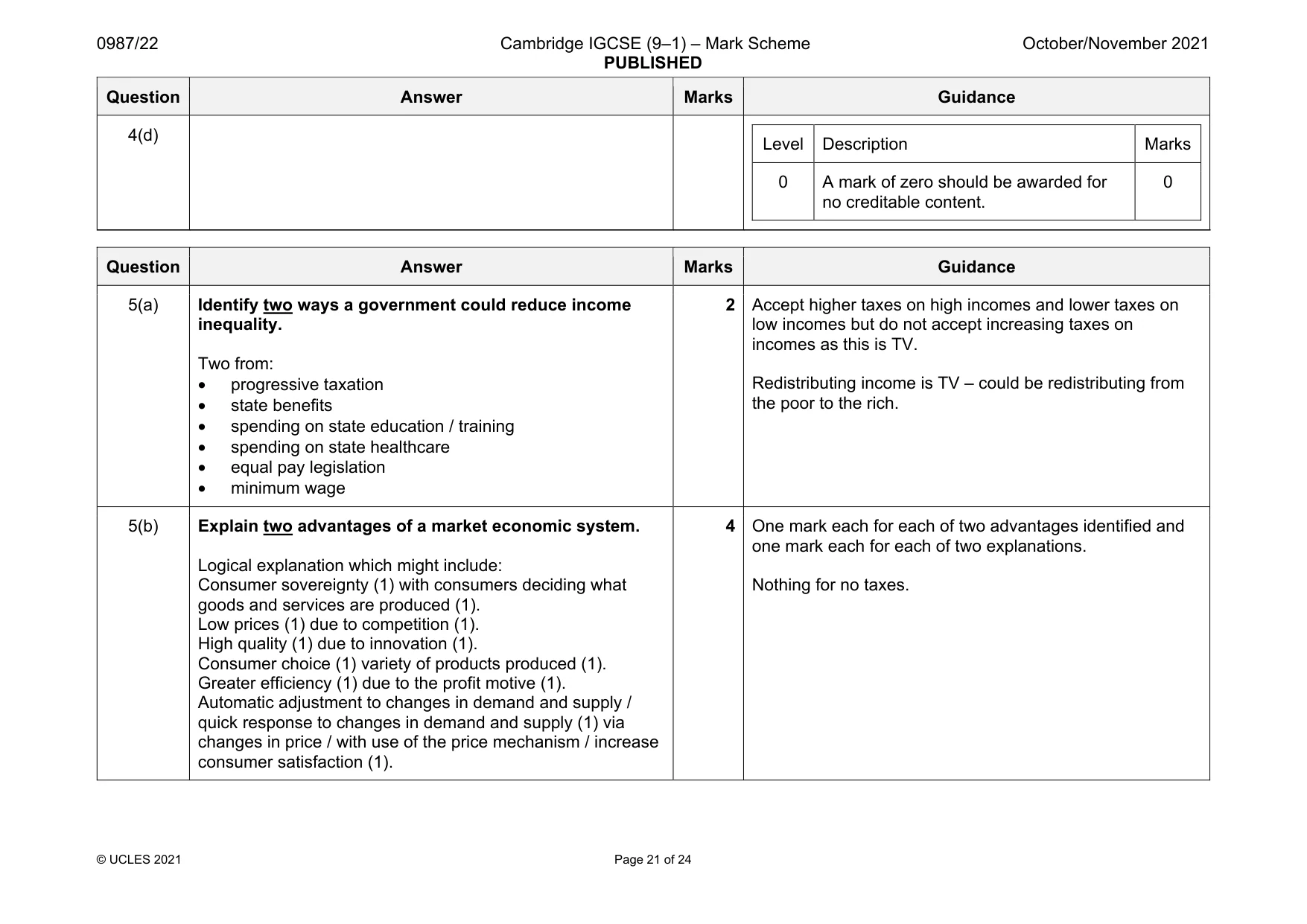
Mark scheme: 5(a) Identify two ways a government could reduce income inequality. Two from: • progressive taxation • state benefits • spending on state education / training • spending on state healthcare • equal pay legislation • minimum wage 2 Accept higher taxes on high incomes and lower taxes on low incomes but do not accept increasing taxes on incomes as this is TV. Redistributing income is TV – could be redistributing from the poor to the rich. 5(b) Explain two advantages of a market economic system. Logical explanation which might include: Consumer sovereignty (1) with consumers deciding what goods and services are produced (1). Low prices (1) due to competition (1). High quality (1) due to innovation (1). Consumer choice (1) variety of products produced (1). Greater efficiency (1) due to the profit motive (1). Automatic adjustment to changes in demand and supply / quick response to changes in demand and supply (1) via changes in price / with use of the price mechanism / increase consumer satisfaction (1). 4 One mark each for each of two advantages identified and one mark each for each of two explanations. Nothing for no taxes. Question Answer Marks Guidance 5(c) Analyse why life expectancy may decrease. Coherent analysis which might include: Incomes may fall (1) lowering living standards / reducing access to basic necessities (1). Reduction in healthcare (1) e.g limited access to medication (1). Reduction in education (1) people may lead less healthy lives (1) more smoking (1) more ‘junk food’ (1) less exercise (1). Rise in poor nutrition / malnutrition (1) eating more low-quality food / people not having enough food (1). More pollution (1) making people more susceptible to diseases (1). May be spread of new diseases / pandemics (1) wars / civil unrest (1). Climate change (1) may result in more natural disasters (1). More people employed in jobs with poor working conditions / more dangerous jobs (1) resulting in more sickness / accidents (1). 6 Question Answer Marks Guidance 5(d) Discuss whether or not supply-side policy measures can reduce inflation. In assessing each answer, use the table opposite. Why they might: • they may increase total (aggregate) supply, reducing cost-push inflation • they can allow total (aggregate) demand to increase without causing inflation • education and training can increase labour productivity, reducing labour costs • a cut in direct taxes may increase the incentive to be more productive and more innovative • labour market reforms may reduce power of trade unions and reduce rise in wages • subsidies can lower costs of production Why they might not: • privatisation does not always increase competition and so does not always lower prices • education and training can be expensive, may be in areas that are not in demand and will have a time lag • cuts in income tax may increase total (aggregate) demand as well as total (aggregate) supply • resource limitations / unable to increase productive capacity due to e.g. limited land available • inflation may be caused by rise in price of raw materials which have no domestic substitute e.g. oil 8 Only accept lower interest rates, if linked to increasing total supply. Level Description Marks 3 A reasoned discussion which accurately examines both sides of the economic argument, making use of economic information and clear and logical analysis to evaluate economic issues and situations. One side of the argument may have more depth than the other, but overall, both sides of the argument are considered and developed. There is thoughtful evaluation of economic concepts, terminology, information and/or data appropriate to the question. The discussion may also point out the possible uncertainties of alternative decisions and outcomes. 6–8 2 A reasoned discussion which makes use of economic information and clear analysis to evaluate economic issues and situations. The answer may lack some depth and development may be one-sided. There is relevant use of economic concepts, terminology, information and data appropriate to the question. 3–5 Question Answer Marks Guidance 5(d) Level Description Marks 1 There is a simple attempt at using economic definitions and terminology. Some reference may be made to economic theory, with occasional understanding. 1–2 0 A mark of zero should be awarded for no creditable content. 0
What was in this paper
The subtopics covered by these 4 questions, and how many questions each got. Open one in a new tab to see every Cambridge question on it.
What you needed in this session
Cambridge’s own grade thresholds for 2021 Oct/Nov, Paper 2 · Variant 2. A higher threshold means an easier paper — the bar moves with how the cohort did.