Cambridge IGCSE Economics (9-1) 0987 — 2020 Oct/Nov Paper 2 · Variant 2
0987/22/O/N/20 · 5 questions · 90 marks · ≈101 min
The question paper and its mark scheme, free to read here and free to download. This is Cambridge’s own paper, exactly as it was sat.
Question paper8 pages



Mark scheme23 pages
Answers below. Sit the paper first if you are practising.
Questions as text
Q1 · Calculate the percentage of total world output of palm oil produced by Indonesia in 2017
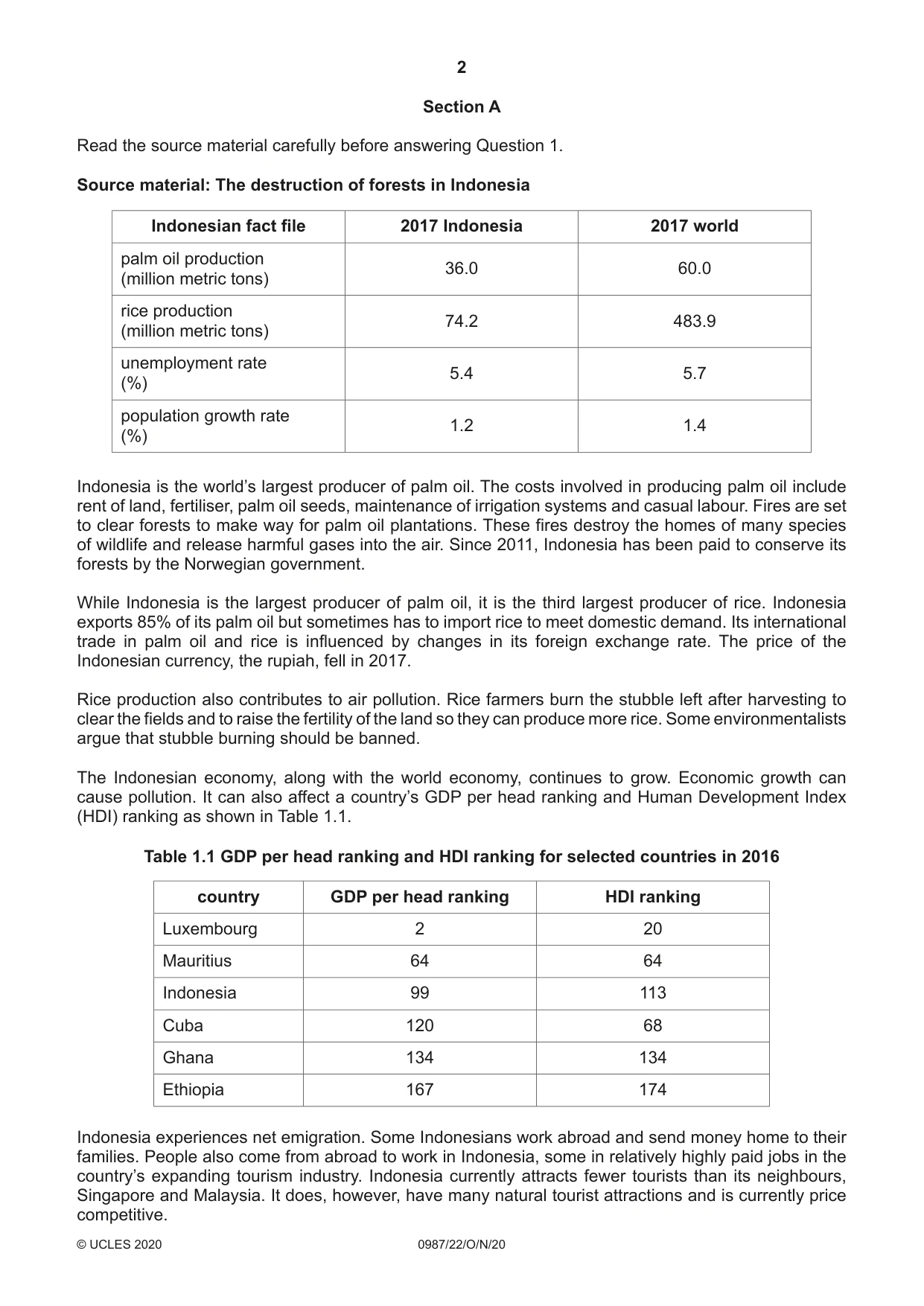
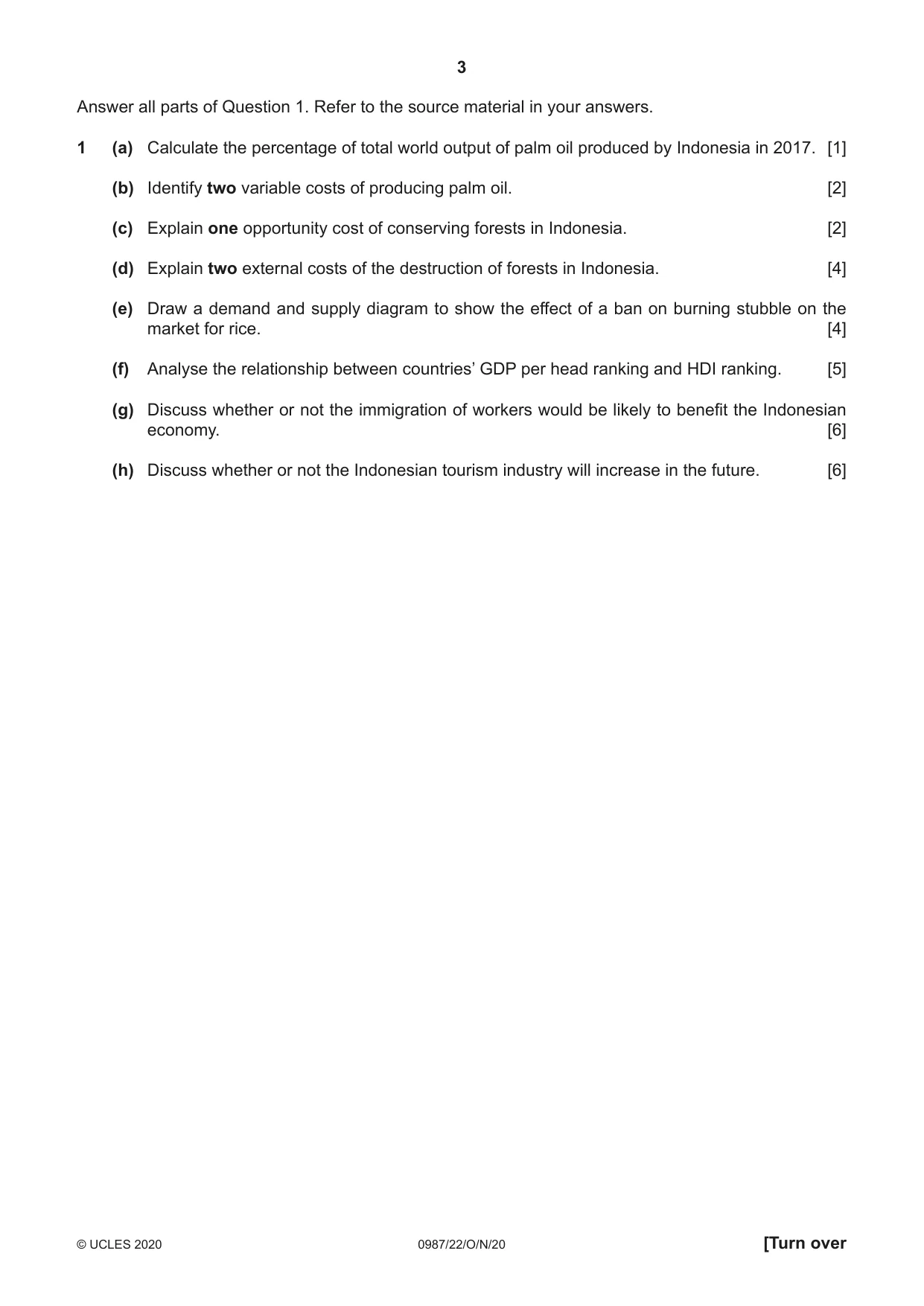
1 (a) Calculate the percentage of total world output of palm oil produced by Indonesia in 2017. [1] (b) Identify two variable costs of producing palm oil. [2] (c) Explain one opportunity cost of conserving forests in Indonesia. [2] (d) Explain two external costs of the destruction of forests in Indonesia. [4] (e) Draw a demand and supply diagram to show the effect of a ban on burning stubble on the market for rice. [4] (f) Analyse the relationship between countries’ GDP per head ranking and HDI ranking. [5] (g) Discuss whether or not the immigration of workers would be likely to benefit the Indonesian economy. [6] (h) Discuss whether or not the Indonesian tourism industry will increase in the future. [6]
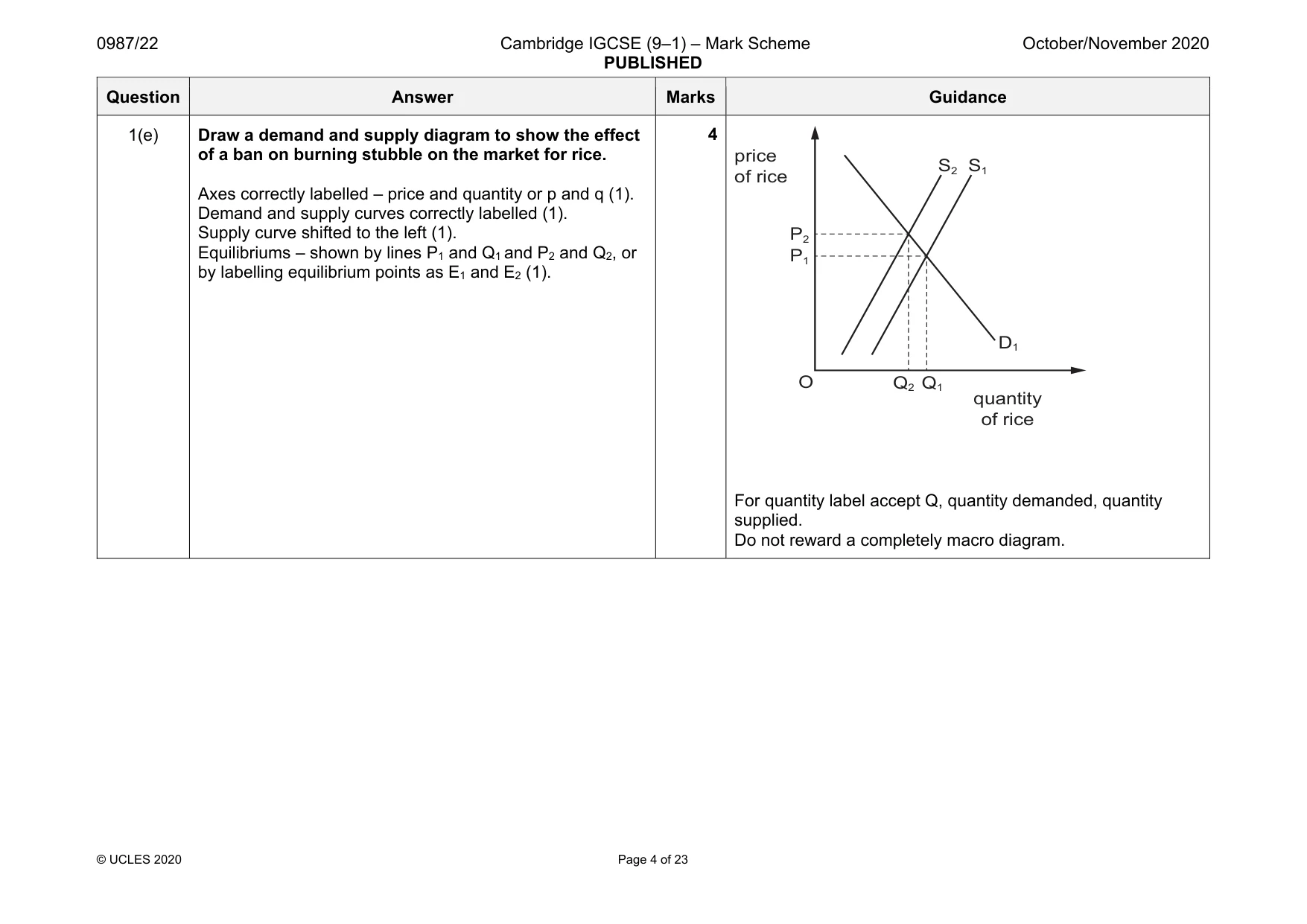
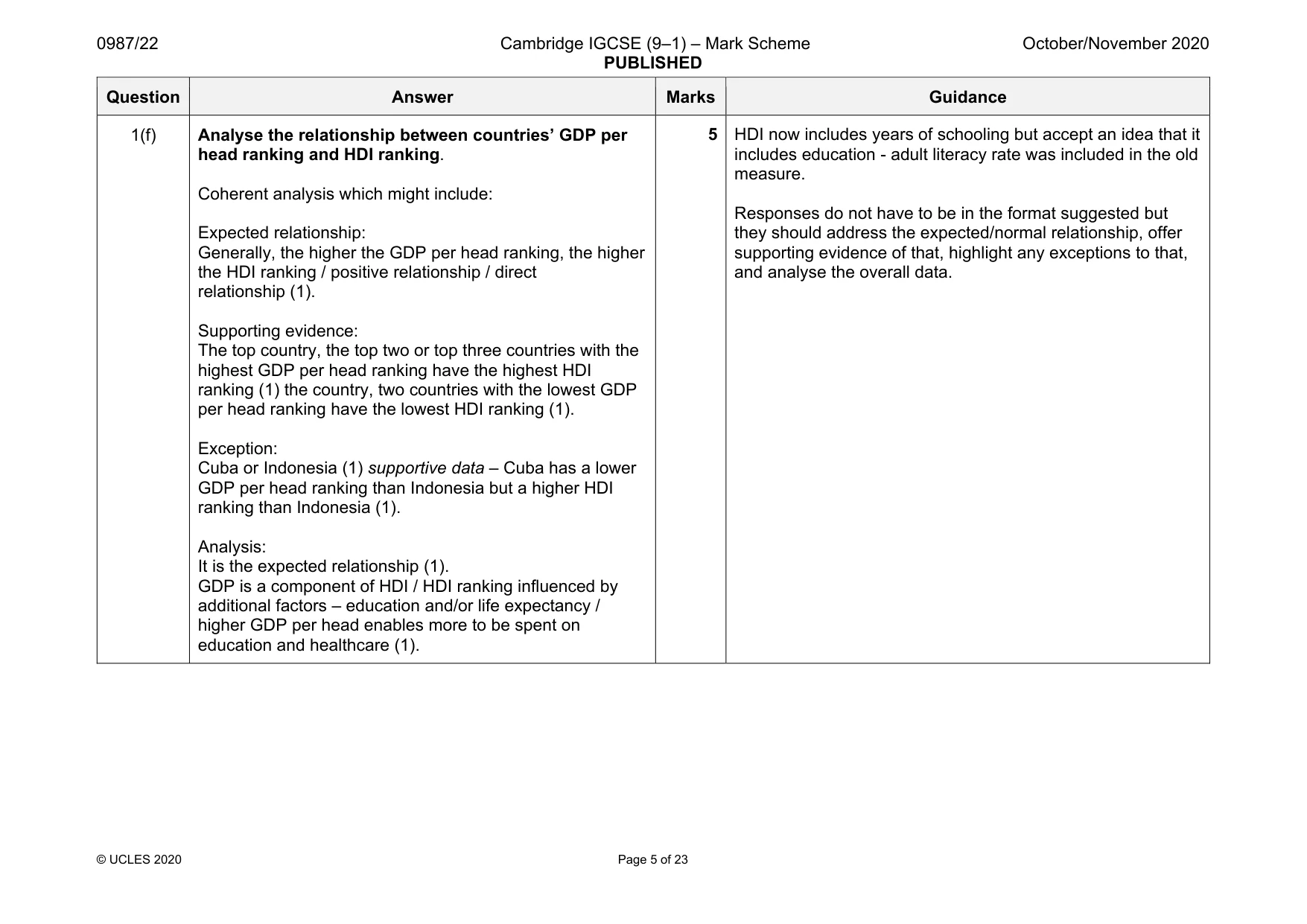
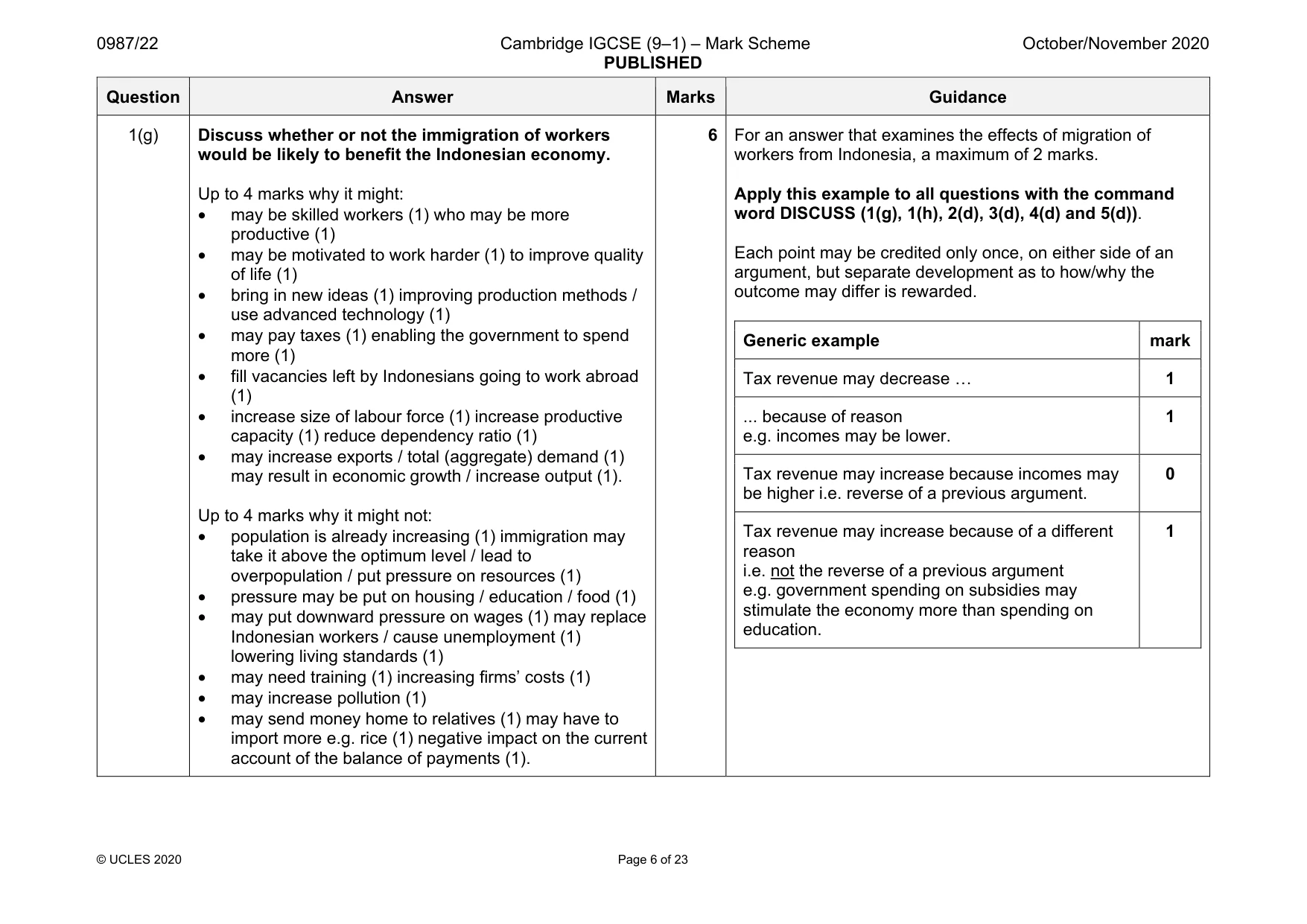
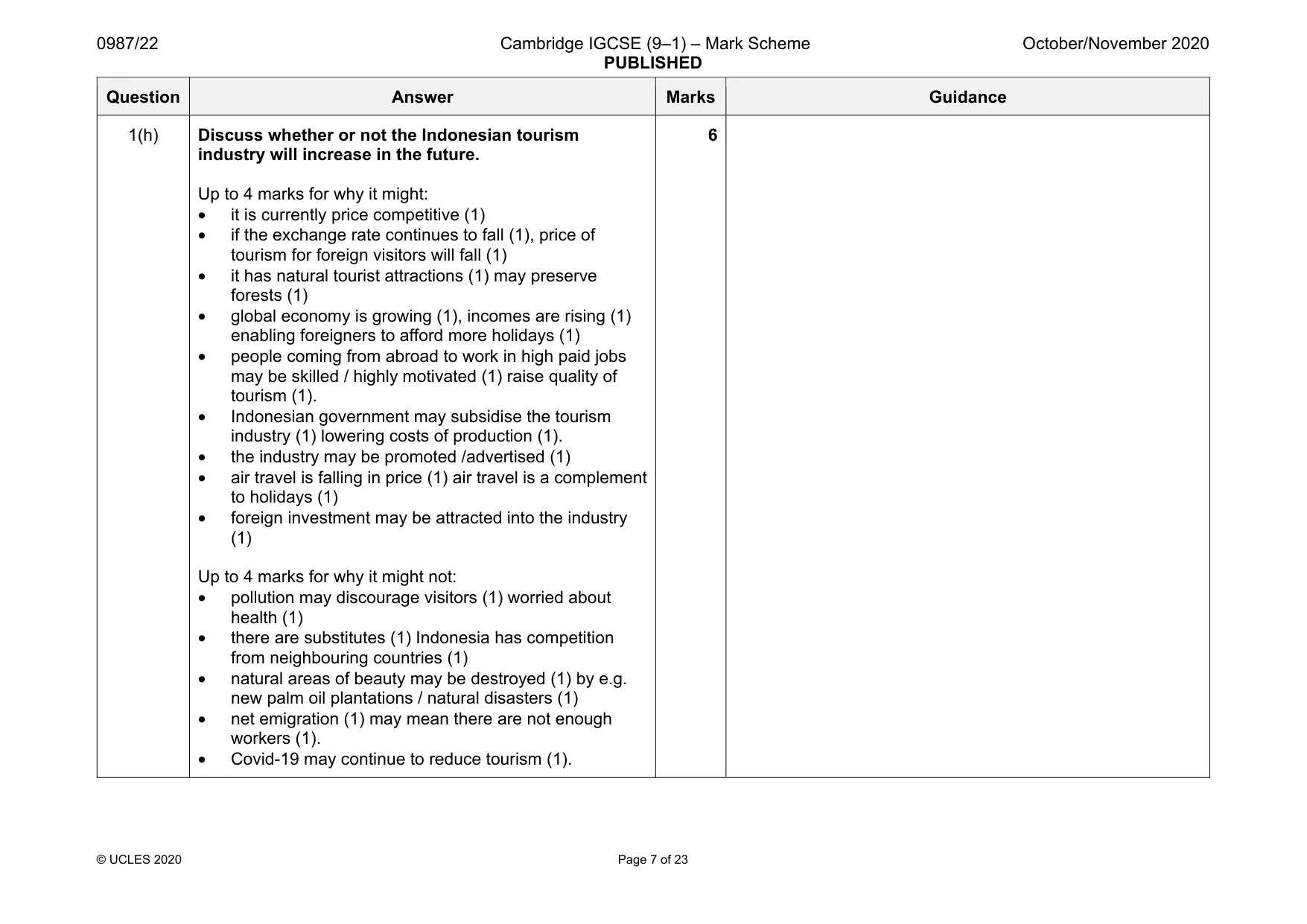
Mark scheme: 1(a) Calculate the percentage of total world output of palm oil produced by Indonesia in 2017. 60% (1). 1 Accept 60. 1(b) Identify two variable costs of producing palm oil. • fertilisers • palm oil seeds • casual labour 2 If more than two are given, consider the first two only. Accept ‘labour’, ‘workers’ or ‘wages’ for ‘casual labour’. 1(c) Explain one opportunity cost of conserving forests in Indonesia. Logical explanation which might include: Palm oil not produced / rice not produced / tourism lost as a result of building fewer hotels / lost opportunity to Norwegian government to spend on e.g. education (1) (next) best alternative forgone (1). 2 1(d) Explain two external costs of the destruction of forests in Indonesia. Logical explanation which might include: Loss of wildlife habitats (1) extinction of species / harmful effect on animals not involved in the economic decision (1). Harmful gases/air pollution/pollution (1) unpleasant atmosphere for local residents / illnesses / global warming (1). 4 One mark for each of two costs identified and one mark for each of two explanations. Question Answer Marks Guidance 1(e) Draw a demand and supply diagram to show the effect of a ban on burning stubble on the market for rice. Axes correctly labelled – price and quantity or p and q (1). Demand and supply curves correctly labelled (1). Supply curve shifted to the left (1). Equilibriums – shown by lines P1 and Q1 and P2 and Q2, or by labelling equilibrium points as E1 and E2 (1). 4 For quantity label accept Q, quantity demanded, quantity supplied. Do not reward a completely macro diagram. O S2 P2 Q2 Q1 P1 S1 D1 price of rice quantity of rice Question Answer Marks Guidance 1(f) Analyse the relationship between countries’ GDP per head ranking and HDI ranking. Coherent analysis which might include: Expected relationship: Generally, the higher the GDP per head ranking, the higher the HDI ranking / positive relationship / direct relationship (1). Supporting evidence: The top country, the top two or top three countries with the highest GDP per head ranking have the highest HDI ranking (1) the country, two countries with the lowest GDP per head ranking have the lowest HDI ranking (1). Exception: Cuba or Indonesia (1) supportive data – Cuba has a lower GDP per head ranking than Indonesia but a higher HDI ranking than Indonesia (1). Analysis: It is the expected relationship (1). GDP is a component of HDI / HDI ranking influenced by additional factors – education and/or life expectancy / higher GDP per head enables more to be spent on education and healthcare (1). 5 HDI now includes years of schooling but accept an idea that it includes education - adult literacy rate was included in the old measure. Responses do not have to be in the format suggested but they should address the expected/normal relationship, offer supporting evidence of that, highlight any exceptions to that, and analyse the overall data. Question Answer Marks Guidance 1(g) Discuss whether or not the immigration of workers would be likely to benefit the Indonesian economy. Up to 4 marks why it might: • may be skilled workers (1) who may be more productive (1) • may be motivated to work harder (1) to improve quality of life (1) • bring in new ideas (1) improving production methods / use advanced technology (1) • may pay taxes (1) enabling the government to spend more (1) • fill vacancies left by Indonesians going to work abroad (1) • increase size of labour force (1) increase productive capacity (1) reduce dependency ratio (1) • may increase exports / total (aggregate) demand (1) may result in economic growth / increase output (1). Up to 4 marks why it might not: • population is already increasing (1) immigration may take it above the optimum level / lead to overpopulation / put pressure on resources (1) • pressure may be put on housing / education / food (1) • may put downward pressure on wages (1) may replace Indonesian workers / cause unemployment (1) lowering living standards (1) • may need training (1) increasing firms’ costs (1) • may increase pollution (1) • may send money home to relatives (1) may have to import more e.g. rice (1) negative impact on the current account of the balance of payments (1). 6 For an answer that examines the effects of migration of workers from Indonesia, a maximum of 2 marks. Apply this example to all questions with the command word DISCUSS (1(g), 1(h), 2(d), 3(d), 4(d) and 5(d)). Each point may be credited only once, on either side of an argument, but separate development as to how/why the outcome may differ is rewarded. Generic example mark Tax revenue may decrease … 1 ... because of reason e.g. incomes may be lower. 1 Tax revenue may increase because incomes may be higher i.e. reverse of a previous argument. 0 Tax revenue may increase because of a different reason i.e. not the reverse of a previous argument e.g. government spending on subsidies may stimulate the economy more than spending on education. 1 Question Answer Marks Guidance 1(h) Discuss whether or not the Indonesian tourism industry will increase in the future. Up to 4 marks for why it might: • it is currently price competitive (1) • if the exchange rate continues to fall (1), price of tourism for foreign visitors will fall (1) • it has natural tourist attractions (1) may preserve forests (1) • global economy is growing (1), incomes are rising (1) enabling foreigners to afford more holidays (1) • people coming from abroad to work in high paid jobs may be skilled / highly motivated (1) raise quality of tourism (1). • Indonesian government may subsidise the tourism industry (1) lowering costs of production (1). • the industry may be promoted /advertised (1) • air travel is falling in price (1) air travel is a complement to holidays (1) • foreign investment may be attracted into the industry (1) Up to 4 marks for why it might not: • pollution may discourage visitors (1) worried about health (1) • there are substitutes (1) Indonesia has competition from neighbouring countries (1) • natural areas of beauty may be destroyed (1) by e.g. new palm oil plantations / natural disasters (1) • net emigration (1) may mean there are not enough workers (1). • Covid-19 may continue to reduce tourism (1). 6
Q2 · Mexico has a history of trade deficits
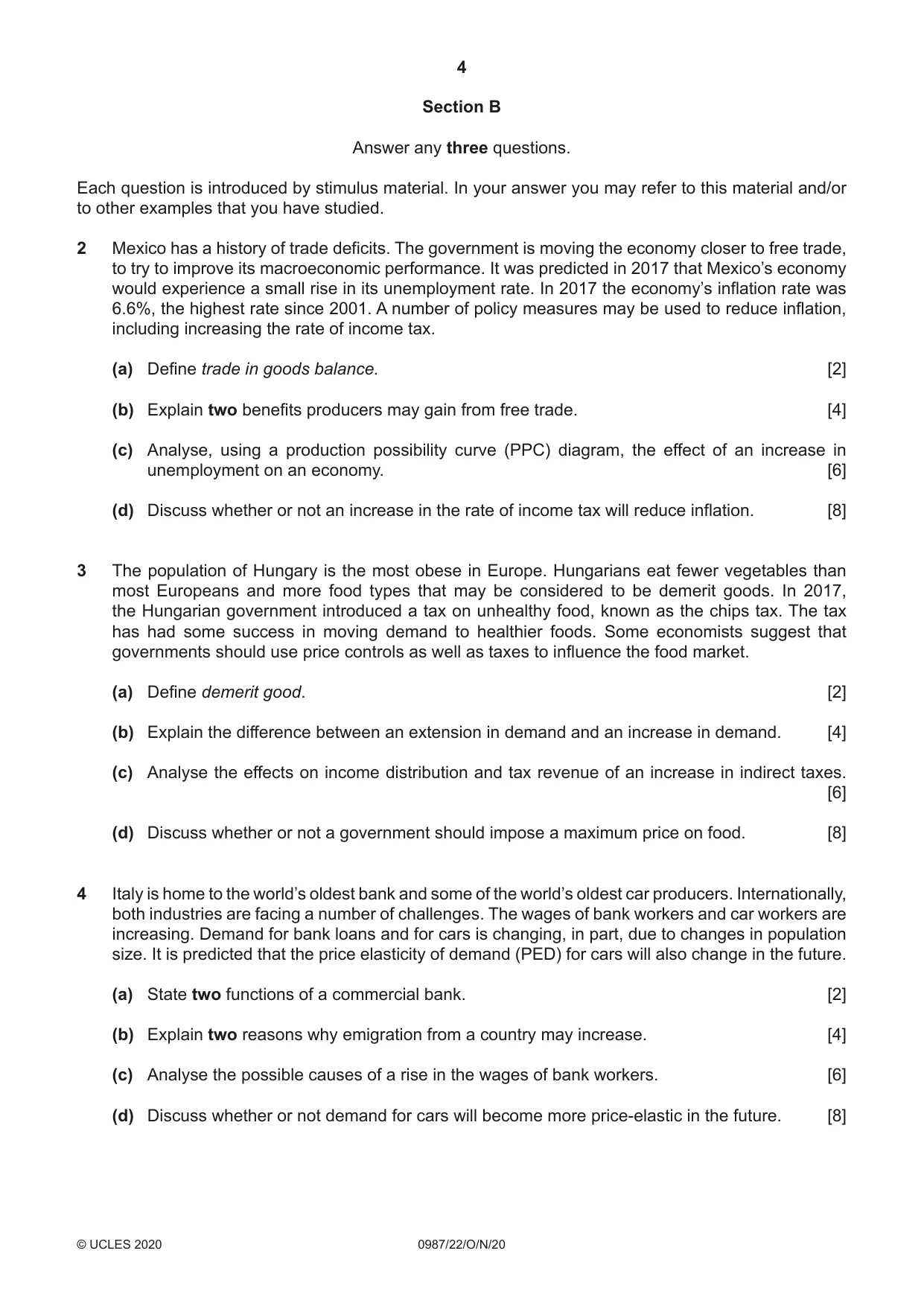
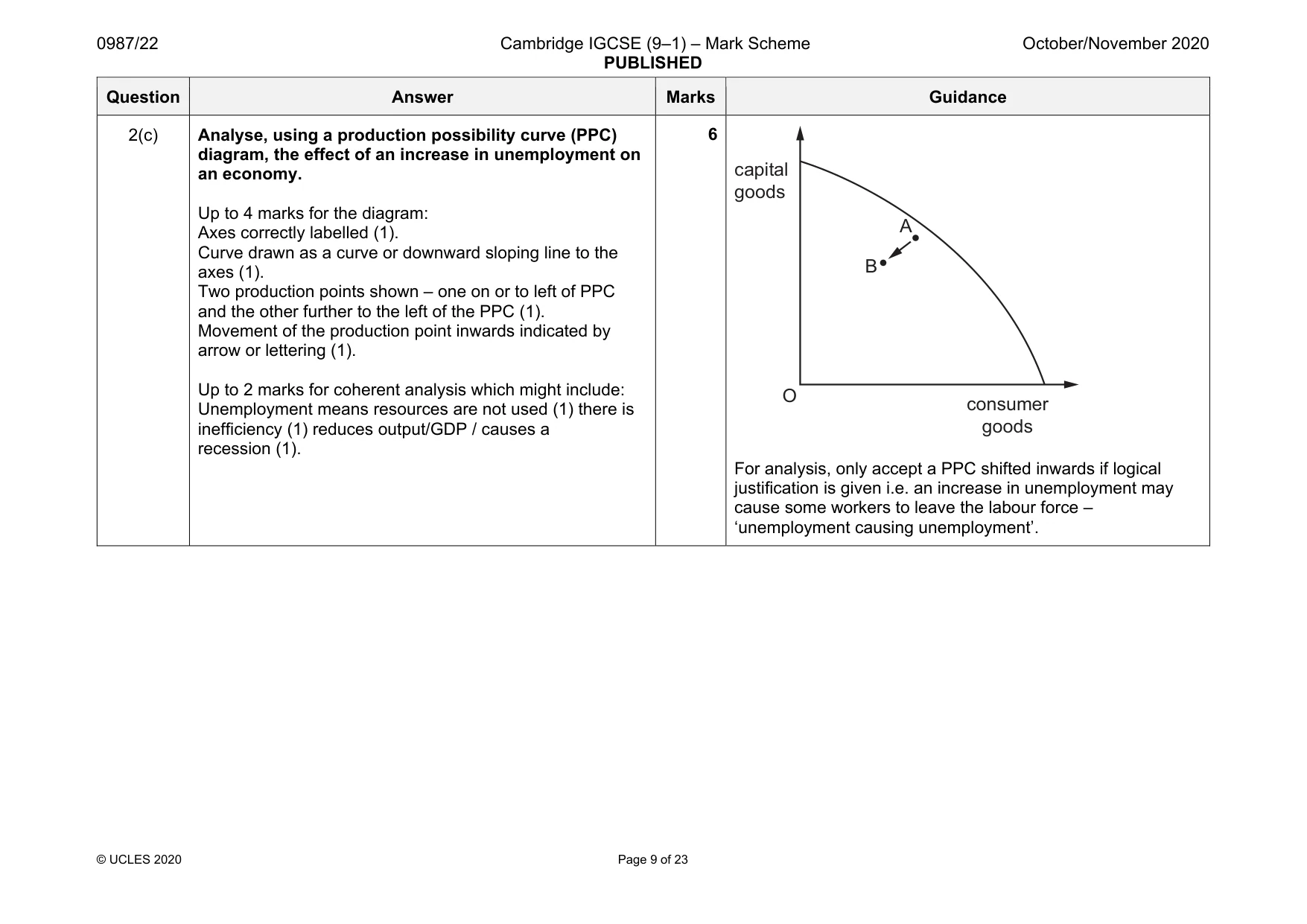
2 Mexico has a history of trade deficits. The government is moving the economy closer to free trade, to try to improve its macroeconomic performance. It was predicted in 2017 that Mexico’s economy would experience a small rise in its unemployment rate. In 2017 the economy’s inflation rate was 6.6%, the highest rate since 2001. A number of policy measures may be used to reduce inflation, including increasing the rate of income tax. (a) Define trade in goods balance. [2] (b) Explain two benefits producers may gain from free trade. [4] (c) Analyse, using a production possibility curve (PPC) diagram, the effect of an increase in unemployment on an economy. [6] (d) Discuss whether or not an increase in the rate of income tax will reduce inflation. [8]
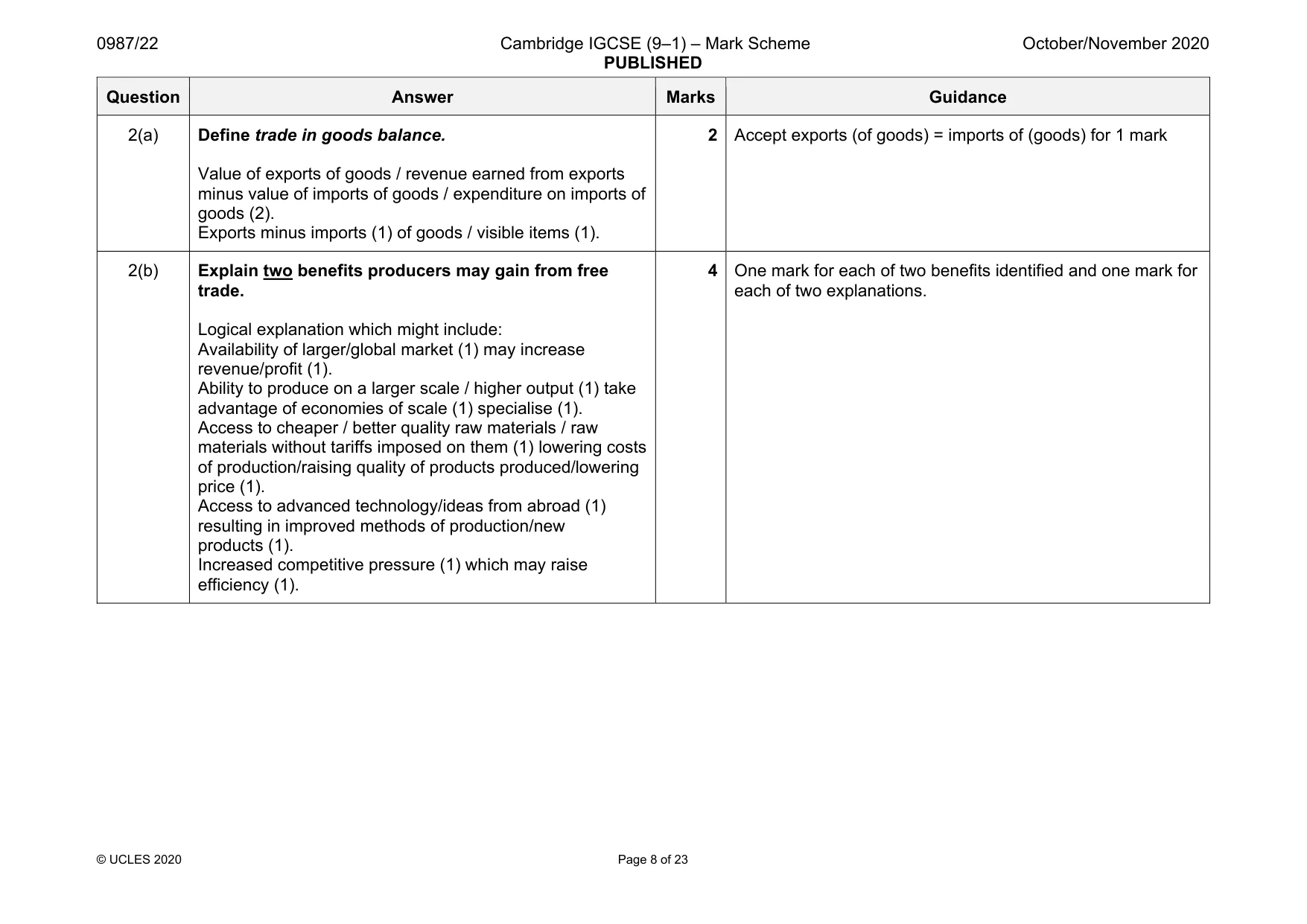
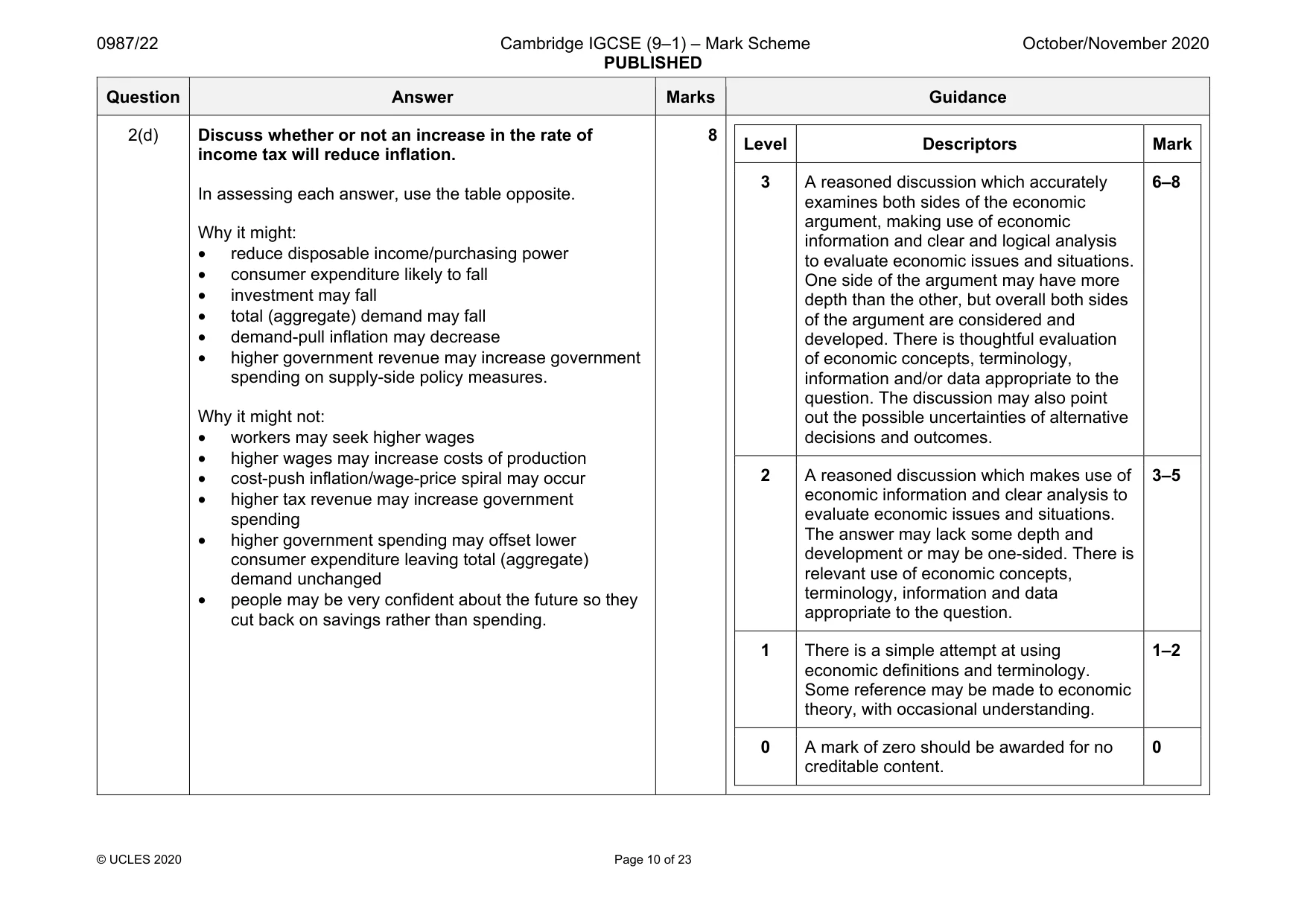
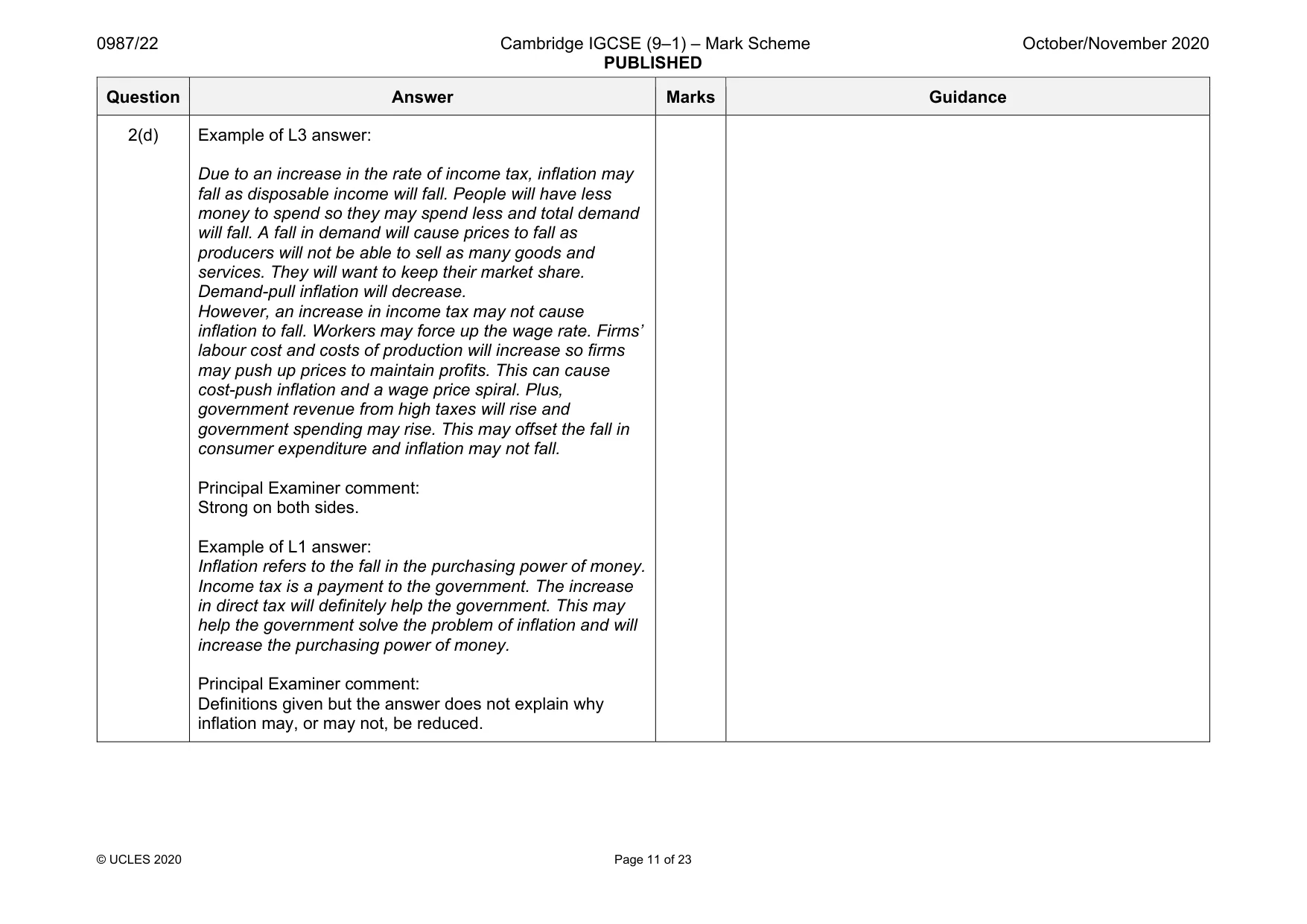
Mark scheme: 2(a) Define trade in goods balance. Value of exports of goods / revenue earned from exports minus value of imports of goods / expenditure on imports of goods (2). Exports minus imports (1) of goods / visible items (1). 2 Accept exports (of goods) = imports of (goods) for 1 mark 2(b) Explain two benefits producers may gain from free trade. Logical explanation which might include: Availability of larger/global market (1) may increase revenue/profit (1). Ability to produce on a larger scale / higher output (1) take advantage of economies of scale (1) specialise (1). Access to cheaper / better quality raw materials / raw materials without tariffs imposed on them (1) lowering costs of production/raising quality of products produced/lowering price (1). Access to advanced technology/ideas from abroad (1) resulting in improved methods of production/new products (1). Increased competitive pressure (1) which may raise efficiency (1). 4 One mark for each of two benefits identified and one mark for each of two explanations. Question Answer Marks Guidance 2(c) Analyse, using a production possibility curve (PPC) diagram, the effect of an increase in unemployment on an economy. Up to 4 marks for the diagram: Axes correctly labelled (1). Curve drawn as a curve or downward sloping line to the axes (1). Two production points shown – one on or to left of PPC and the other further to the left of the PPC (1). Movement of the production point inwards indicated by arrow or lettering (1). Up to 2 marks for coherent analysis which might include: Unemployment means resources are not used (1) there is inefficiency (1) reduces output/GDP / causes a recession (1). 6 For analysis, only accept a PPC shifted inwards if logical justification is given i.e. an increase in unemployment may cause some workers to leave the labour force – ‘unemployment causing unemployment’. capital goods O consumer goods A B Question Answer Marks Guidance 2(d) Discuss whether or not an increase in the rate of income tax will reduce inflation. In assessing each answer, use the table opposite. Why it might: • reduce disposable income/purchasing power • consumer expenditure likely to fall • investment may fall • total (aggregate) demand may fall • demand-pull inflation may decrease • higher government revenue may increase government spending on supply-side policy measures. Why it might not: • workers may seek higher wages • higher wages may increase costs of production • cost-push inflation/wage-price spiral may occur • higher tax revenue may increase government spending • higher government spending may offset lower consumer expenditure leaving total (aggregate) demand unchanged • people may be very confident about the future so they cut back on savings rather than spending. 8 Level Descriptors Mark 3 A reasoned discussion which accurately examines both sides of the economic argument, making use of economic information and clear and logical analysis to evaluate economic issues and situations. One side of the argument may have more depth than the other, but overall both sides of the argument are considered and developed. There is thoughtful evaluation of economic concepts, terminology, information and/or data appropriate to the question. The discussion may also point out the possible uncertainties of alternative decisions and outcomes. 6–8 2 A reasoned discussion which makes use of economic information and clear analysis to evaluate economic issues and situations. The answer may lack some depth and development or may be one-sided. There is relevant use of economic concepts, terminology, information and data appropriate to the question. 3–5 1 There is a simple attempt at using economic definitions and terminology. Some reference may be made to economic theory, with occasional understanding. 1–2 0 A mark of zero should be awarded for no creditable content. 0 Question Answer Marks Guidance 2(d) Example of L3 answer: Due to an increase in the rate of income tax, inflation may fall as disposable income will fall. People will have less money to spend so they may spend less and total demand will fall. A fall in demand will cause prices to fall as producers will not be able to sell as many goods and services. They will want to keep their market share. Demand-pull inflation will decrease. However, an increase in income tax may not cause inflation to fall. Workers may force up the wage rate. Firms’ labour cost and costs of production will increase so firms may push up prices to maintain profits. This can cause cost-push inflation and a wage price spiral. Plus, government revenue from high taxes will rise and government spending may rise. This may offset the fall in consumer expenditure and inflation may not fall. Principal Examiner comment: Strong on both sides. Example of L1 answer: Inflation refers to the fall in the purchasing power of money. Income tax is a payment to the government. The increase in direct tax will definitely help the government. This may help the government solve the problem of inflation and will increase the purchasing power of money. Principal Examiner comment: Definitions given but the answer does not explain why inflation may, or may not, be reduced.
Q3 · The population of Hungary is the most obese in Europe
3 The population of Hungary is the most obese in Europe. Hungarians eat fewer vegetables than most Europeans and more food types that may be considered to be demerit goods. In 2017, the Hungarian government introduced a tax on unhealthy food, known as the chips tax. The tax has had some success in moving demand to healthier foods. Some economists suggest that governments should use price controls as well as taxes to influence the food market. (a) Define demerit good. [2] (b) Explain the difference between an extension in demand and an increase in demand. [4] (c) Analyse the effects on income distribution and tax revenue of an increase in indirect taxes. [6] (d) Discuss whether or not a government should impose a maximum price on food. [8]
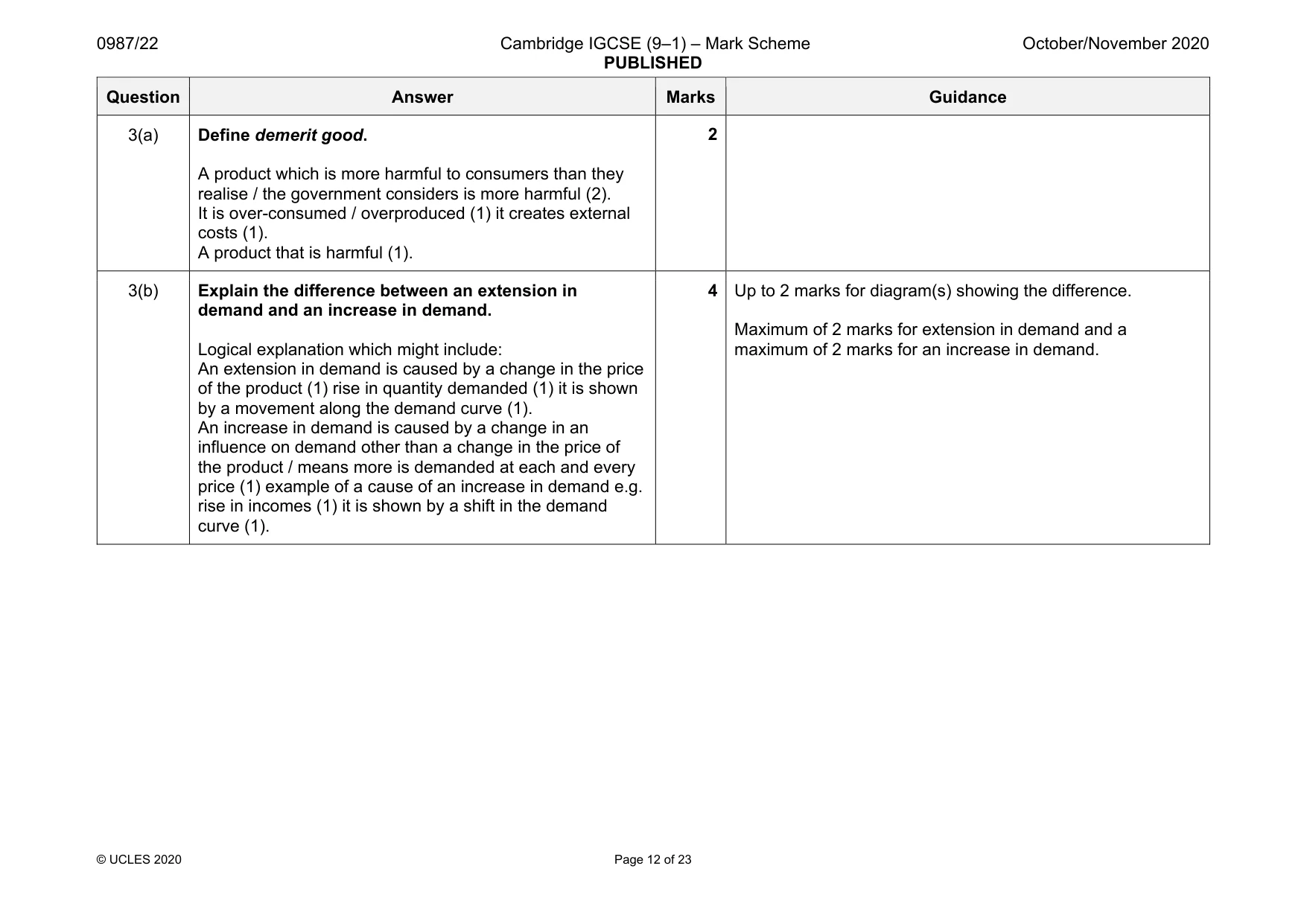
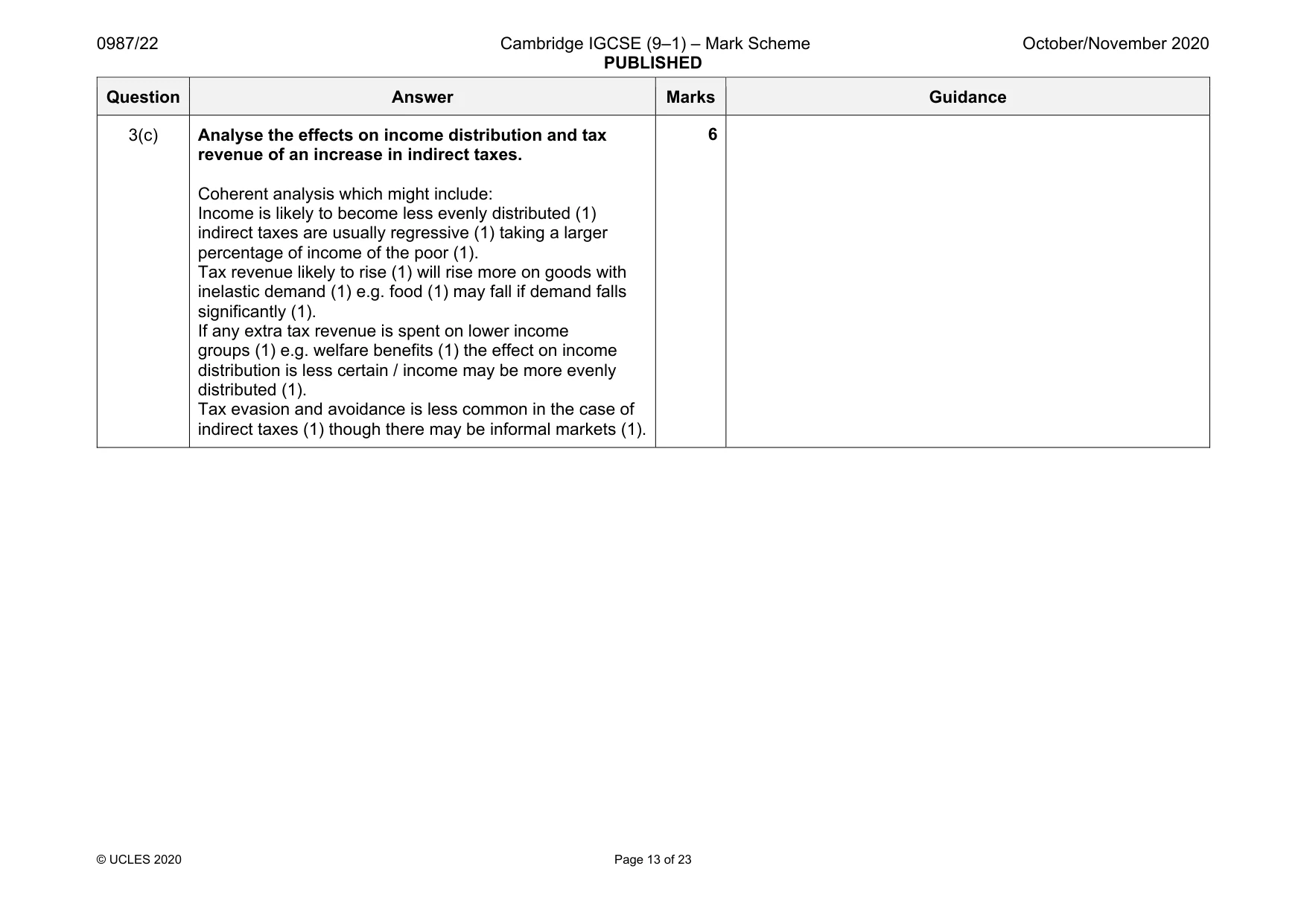
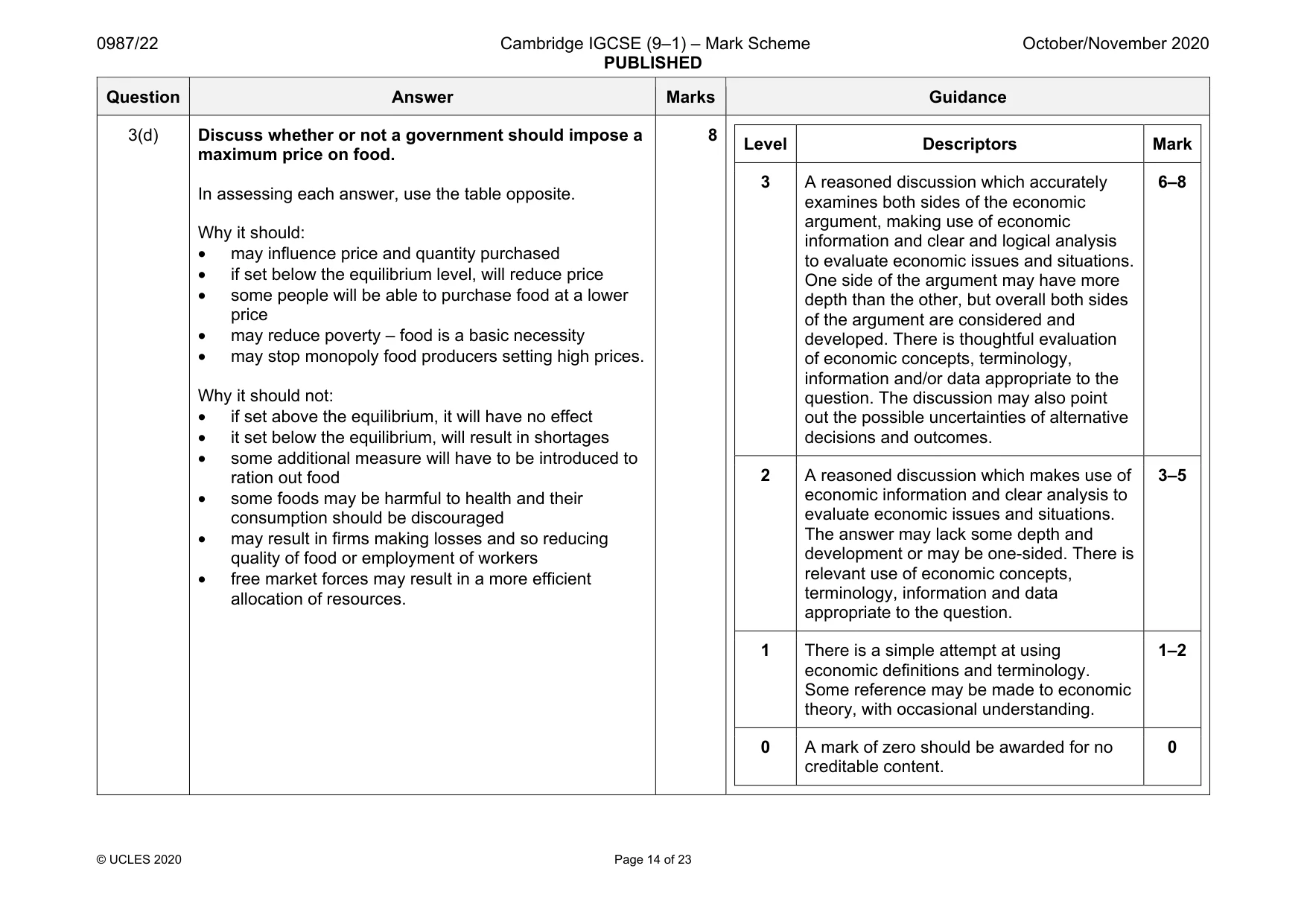
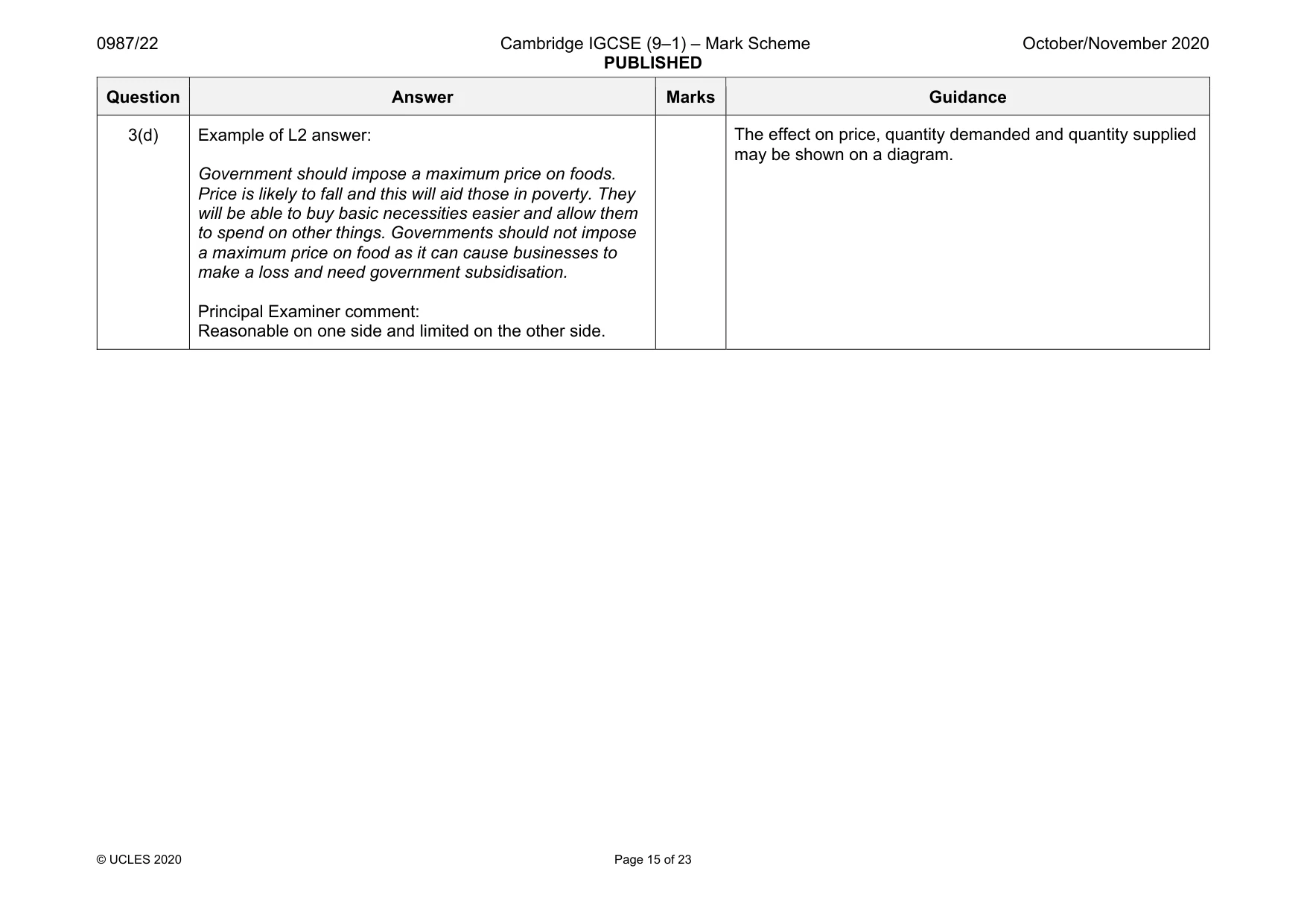
Mark scheme: 3(a) Define demerit good. A product which is more harmful to consumers than they realise / the government considers is more harmful (2). It is over-consumed / overproduced (1) it creates external costs (1). A product that is harmful (1). 3(b) Explain the difference between an extension in demand and an increase in demand. Logical explanation which might include: An extension in demand is caused by a change in the price of the product (1) rise in quantity demanded (1) it is shown by a movement along the demand curve (1). An increase in demand is caused by a change in an influence on demand other than a change in the price of the product / means more is demanded at each and every price (1) example of a cause of an increase in demand e.g. rise in incomes (1) it is shown by a shift in the demand curve (1). 4 Up to 2 marks for diagram(s) showing the difference. Maximum of 2 marks for extension in demand and a maximum of 2 marks for an increase in demand. Question Answer Marks Guidance 3(c) Analyse the effects on income distribution and tax revenue of an increase in indirect taxes. Coherent analysis which might include: Income is likely to become less evenly distributed (1) indirect taxes are usually regressive (1) taking a larger percentage of income of the poor (1). Tax revenue likely to rise (1) will rise more on goods with inelastic demand (1) e.g. food (1) may fall if demand falls significantly (1). If any extra tax revenue is spent on lower income groups (1) e.g. welfare benefits (1) the effect on income distribution is less certain / income may be more evenly distributed (1). Tax evasion and avoidance is less common in the case of indirect taxes (1) though there may be informal markets (1). 6 Question Answer Marks Guidance 3(d) Discuss whether or not a government should impose a maximum price on food. In assessing each answer, use the table opposite. Why it should: • may influence price and quantity purchased • if set below the equilibrium level, will reduce price • some people will be able to purchase food at a lower price • may reduce poverty – food is a basic necessity • may stop monopoly food producers setting high prices. Why it should not: • if set above the equilibrium, it will have no effect • it set below the equilibrium, will result in shortages • some additional measure will have to be introduced to ration out food • some foods may be harmful to health and their consumption should be discouraged • may result in firms making losses and so reducing quality of food or employment of workers • free market forces may result in a more efficient allocation of resources. 8 Level Descriptors Mark 3 A reasoned discussion which accurately examines both sides of the economic argument, making use of economic information and clear and logical analysis to evaluate economic issues and situations. One side of the argument may have more depth than the other, but overall both sides of the argument are considered and developed. There is thoughtful evaluation of economic concepts, terminology, information and/or data appropriate to the question. The discussion may also point out the possible uncertainties of alternative decisions and outcomes. 6–8 2 A reasoned discussion which makes use of economic information and clear analysis to evaluate economic issues and situations. The answer may lack some depth and development or may be one-sided. There is relevant use of economic concepts, terminology, information and data appropriate to the question. 3–5 1 There is a simple attempt at using economic definitions and terminology. Some reference may be made to economic theory, with occasional understanding. 1–2 0 A mark of zero should be awarded for no creditable content. 0 Question Answer Marks Guidance 3(d) Example of L2 answer: Government should impose a maximum price on foods. Price is likely to fall and this will aid those in poverty. They will be able to buy basic necessities easier and allow them to spend on other things. Governments should not impose a maximum price on food as it can cause businesses to make a loss and need government subsidisation. Principal Examiner comment: Reasonable on one side and limited on the other side. The effect on price, quantity demanded and quantity supplied may be shown on a diagram.
Q4 · Italy is home to the world’s oldest bank and some of the world’s oldest car producers
4 Italy is home to the world’s oldest bank and some of the world’s oldest car producers. Internationally, both industries are facing a number of challenges. The wages of bank workers and car workers are increasing. Demand for bank loans and for cars is changing, in part, due to changes in population size. It is predicted that the price elasticity of demand (PED) for cars will also change in the future. (a) State two functions of a commercial bank. [2] (b) Explain two reasons why emigration from a country may increase. [4] (c) Analyse the possible causes of a rise in the wages of bank workers. [6] (d) Discuss whether or not demand for cars will become more price-elastic in the future. [8]
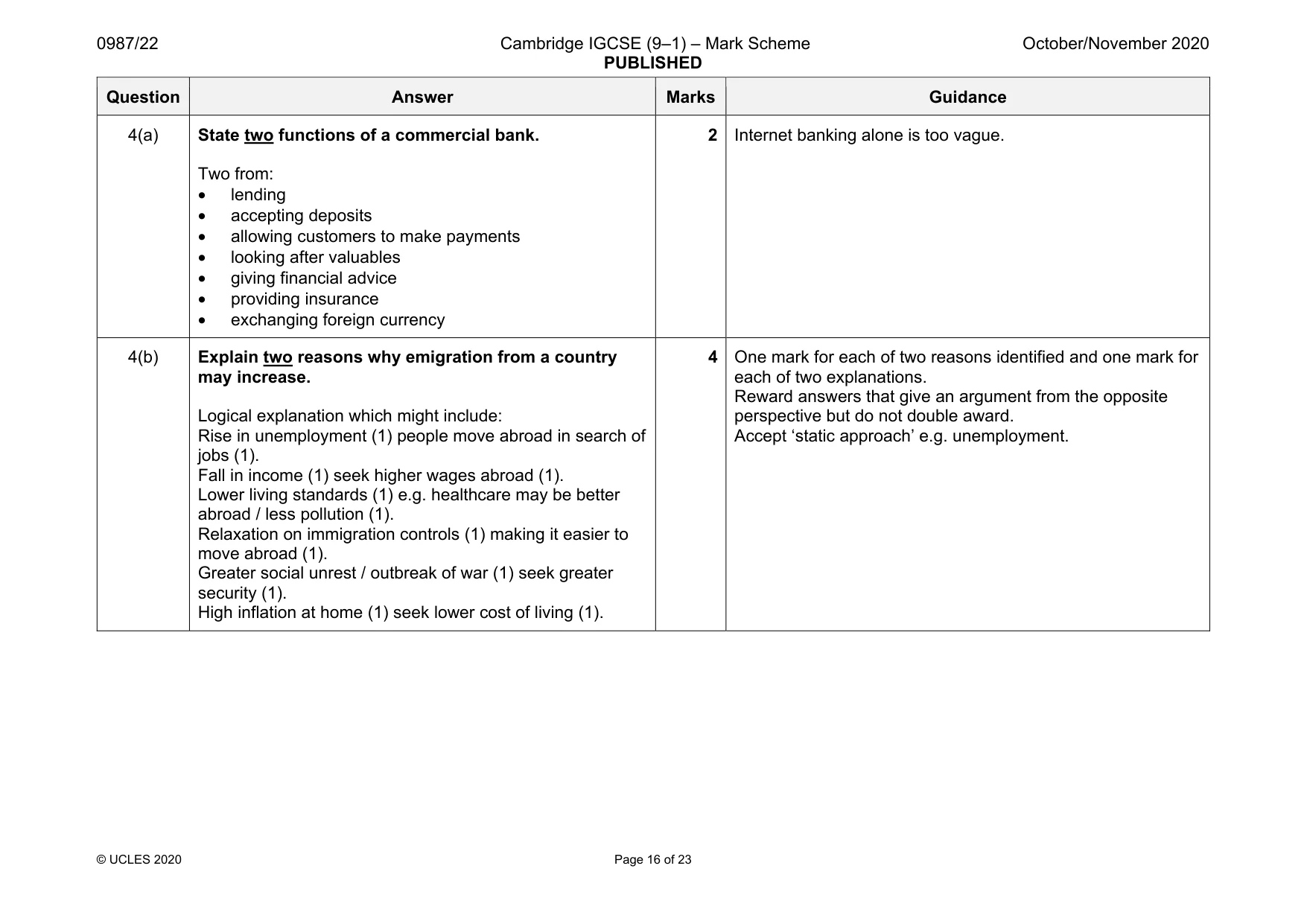
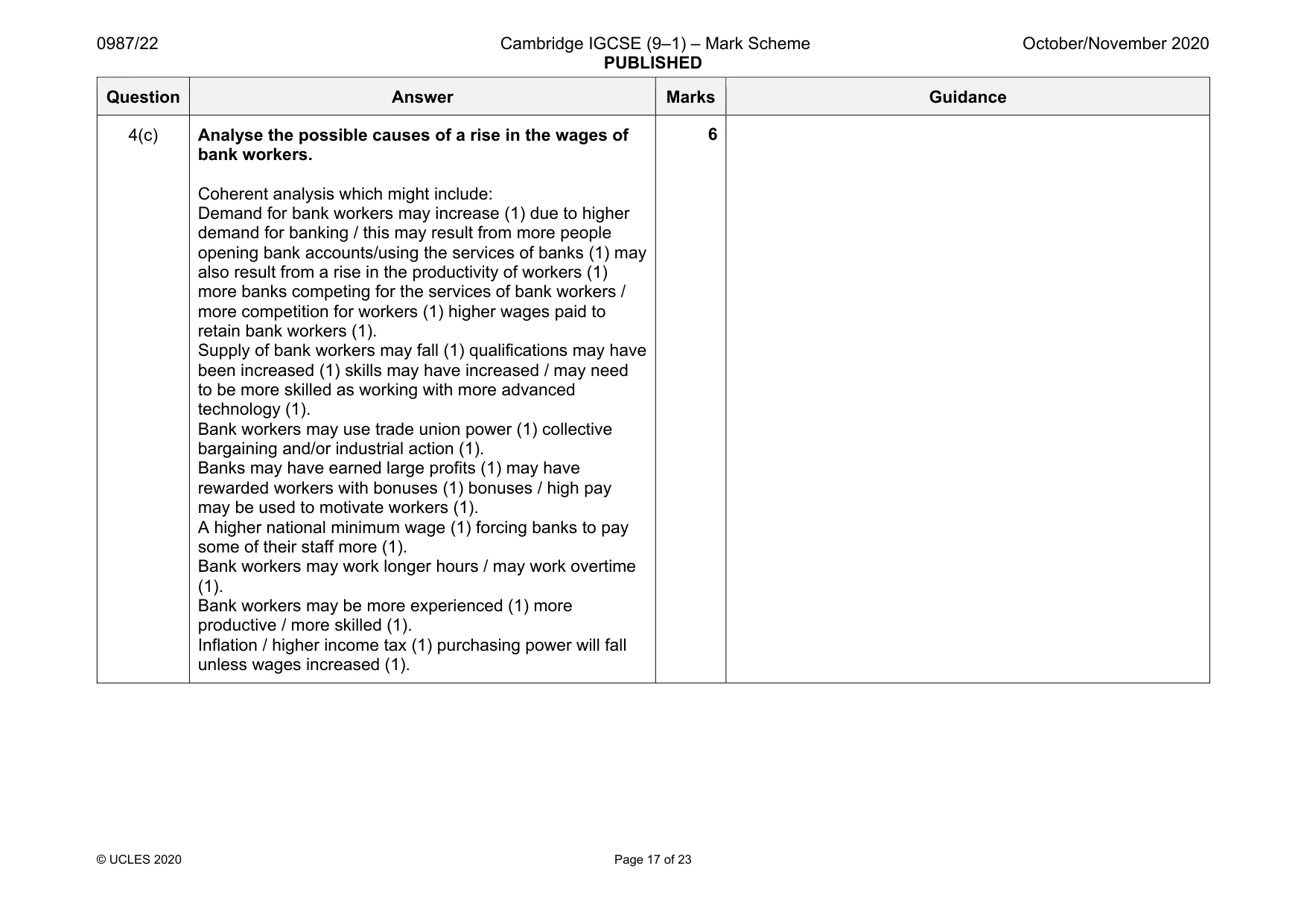
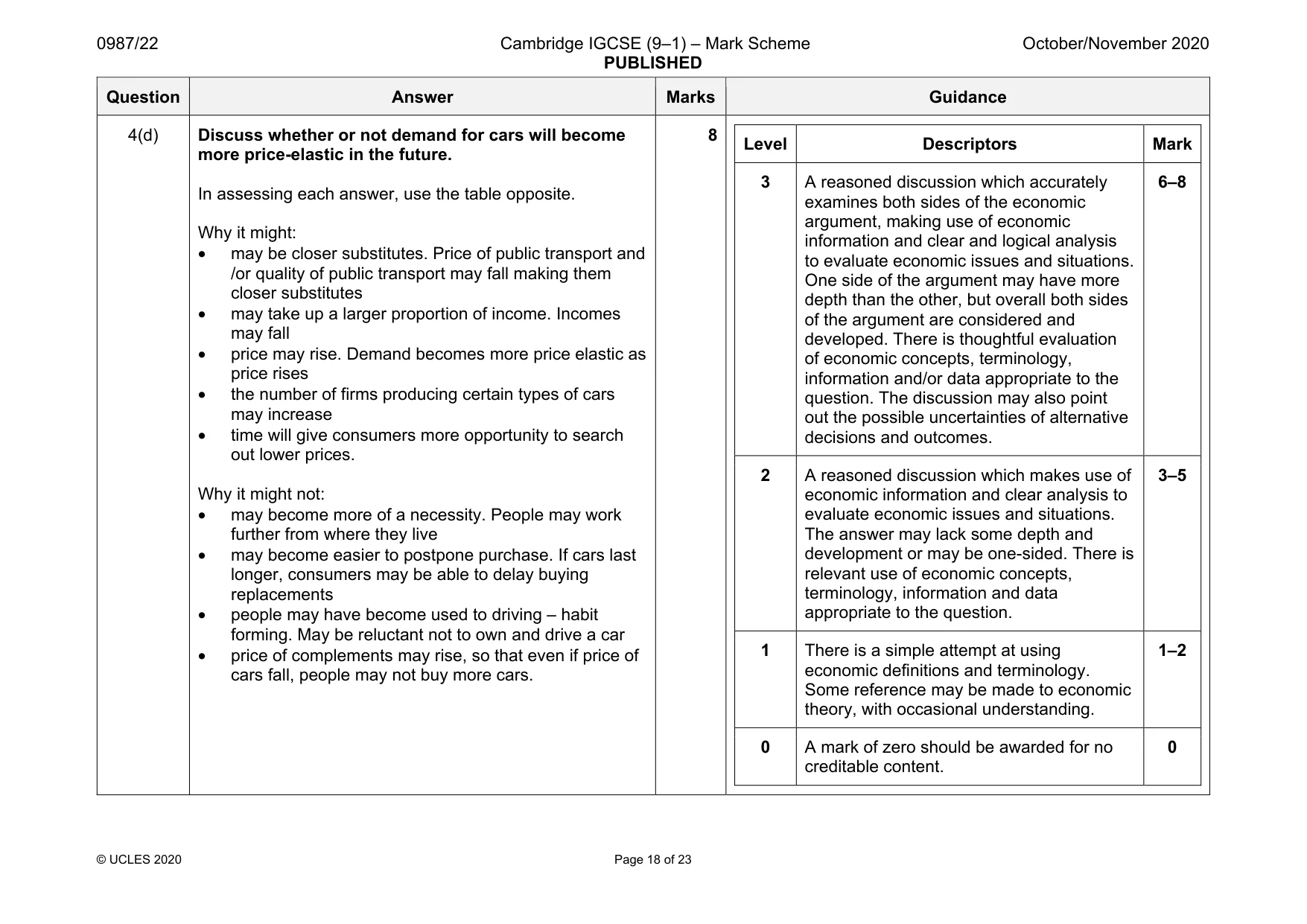
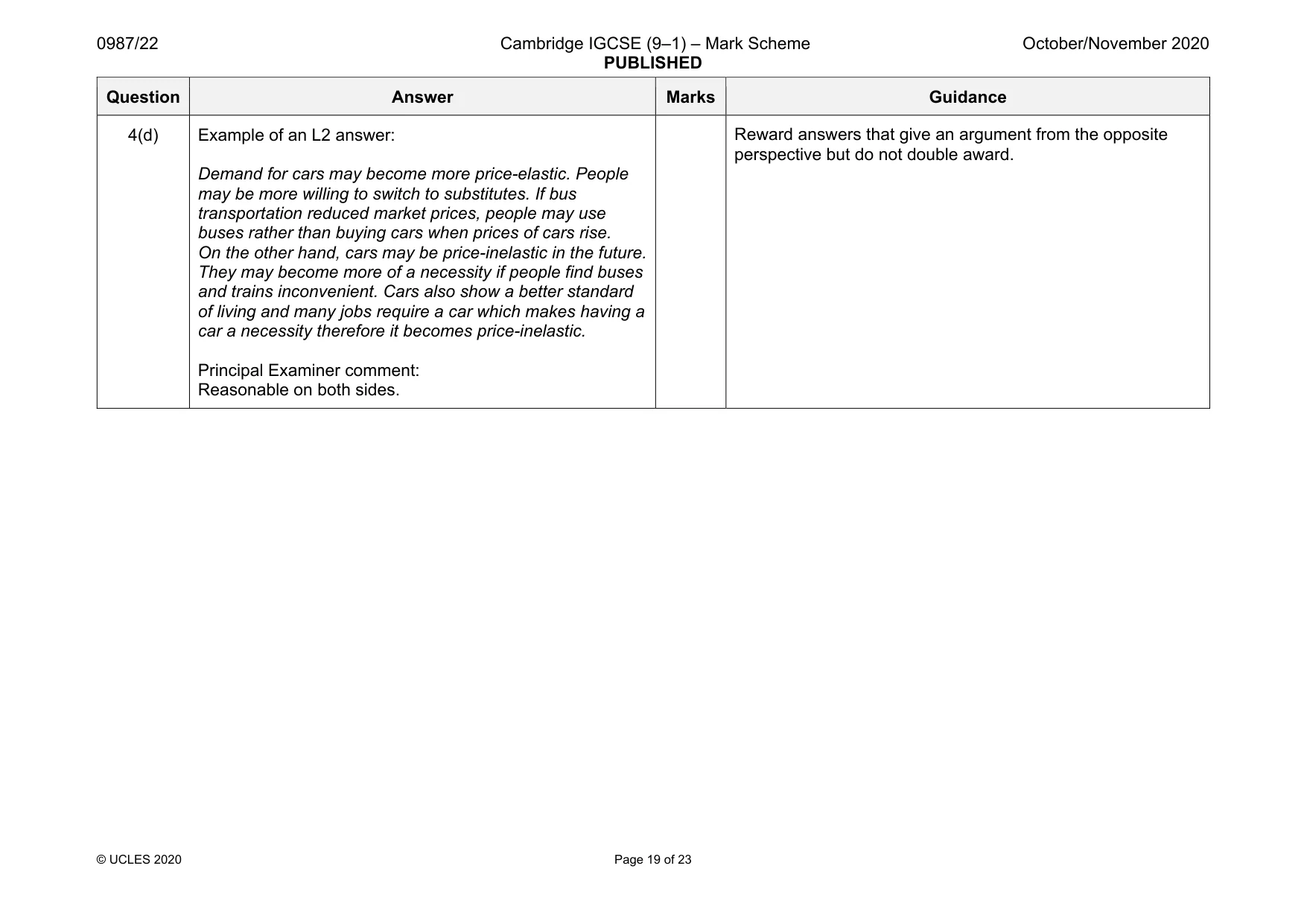
Mark scheme: 4(a) State two functions of a commercial bank. Two from: • lending • accepting deposits • allowing customers to make payments • looking after valuables • giving financial advice • providing insurance • exchanging foreign currency 2 Internet banking alone is too vague. 4(b) Explain two reasons why emigration from a country may increase. Logical explanation which might include: Rise in unemployment (1) people move abroad in search of jobs (1). Fall in income (1) seek higher wages abroad (1). Lower living standards (1) e.g. healthcare may be better abroad / less pollution (1). Relaxation on immigration controls (1) making it easier to move abroad (1). Greater social unrest / outbreak of war (1) seek greater security (1). High inflation at home (1) seek lower cost of living (1). 4 One mark for each of two reasons identified and one mark for each of two explanations. Reward answers that give an argument from the opposite perspective but do not double award. Accept ‘static approach’ e.g. unemployment. Question Answer Marks Guidance 4(c) Analyse the possible causes of a rise in the wages of bank workers. Coherent analysis which might include: Demand for bank workers may increase (1) due to higher demand for banking / this may result from more people opening bank accounts/using the services of banks (1) may also result from a rise in the productivity of workers (1) more banks competing for the services of bank workers / more competition for workers (1) higher wages paid to retain bank workers (1). Supply of bank workers may fall (1) qualifications may have been increased (1) skills may have increased / may need to be more skilled as working with more advanced technology (1). Bank workers may use trade union power (1) collective bargaining and/or industrial action (1). Banks may have earned large profits (1) may have rewarded workers with bonuses (1) bonuses / high pay may be used to motivate workers (1). A higher national minimum wage (1) forcing banks to pay some of their staff more (1). Bank workers may work longer hours / may work overtime (1). Bank workers may be more experienced (1) more productive / more skilled (1). Inflation / higher income tax (1) purchasing power will fall unless wages increased (1). 6 Question Answer Marks Guidance 4(d) Discuss whether or not demand for cars will become more price-elastic in the future. In assessing each answer, use the table opposite. Why it might: • may be closer substitutes. Price of public transport and /or quality of public transport may fall making them closer substitutes • may take up a larger proportion of income. Incomes may fall • price may rise. Demand becomes more price elastic as price rises • the number of firms producing certain types of cars may increase • time will give consumers more opportunity to search out lower prices. Why it might not: • may become more of a necessity. People may work further from where they live • may become easier to postpone purchase. If cars last longer, consumers may be able to delay buying replacements • people may have become used to driving – habit forming. May be reluctant not to own and drive a car • price of complements may rise, so that even if price of cars fall, people may not buy more cars. 8 Level Descriptors Mark 3 A reasoned discussion which accurately examines both sides of the economic argument, making use of economic information and clear and logical analysis to evaluate economic issues and situations. One side of the argument may have more depth than the other, but overall both sides of the argument are considered and developed. There is thoughtful evaluation of economic concepts, terminology, information and/or data appropriate to the question. The discussion may also point out the possible uncertainties of alternative decisions and outcomes. 6–8 2 A reasoned discussion which makes use of economic information and clear analysis to evaluate economic issues and situations. The answer may lack some depth and development or may be one-sided. There is relevant use of economic concepts, terminology, information and data appropriate to the question. 3–5 1 There is a simple attempt at using economic definitions and terminology. Some reference may be made to economic theory, with occasional understanding. 1–2 0 A mark of zero should be awarded for no creditable content. 0 Question Answer Marks Guidance 4(d) Example of an L2 answer: Demand for cars may become more price-elastic. People may be more willing to switch to substitutes. If bus transportation reduced market prices, people may use buses rather than buying cars when prices of cars rise. On the other hand, cars may be price-inelastic in the future. They may become more of a necessity if people find buses and trains inconvenient. Cars also show a better standard of living and many jobs require a car which makes having a car a necessity therefore it becomes price-inelastic. Principal Examiner comment: Reasonable on both sides. Reward answers that give an argument from the opposite perspective but do not double award.
Q5 · Wage rate growth has increased recently in Kazakhstan, but its economic growth rate has…
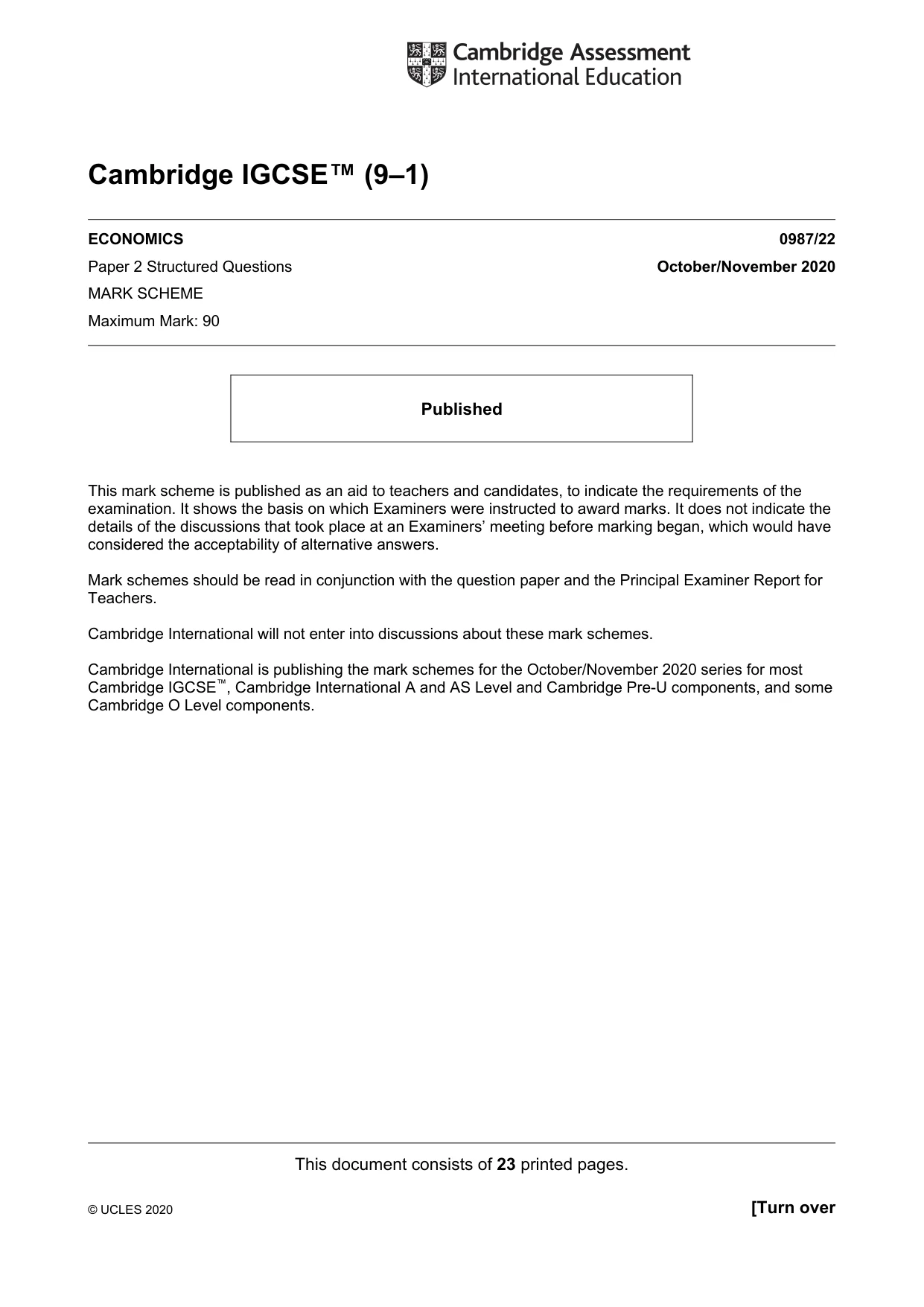
5 Wage rate growth has increased recently in Kazakhstan, but its economic growth rate has slowed. This is, in part, due to a fall in exports. To try to increase the economic growth rate, the government has increased its spending on investment. In August 2015, it adopted a floating foreign exchange rate system in an attempt to improve the country’s macroeconomic performance. (a) Define wages. [2] (b) Explain two reasons, other than methods of protection, why a country’s exports may fall. [4] (c) Analyse how a rise in investment could increase a country’s economic growth rate. [6] (d) Discuss whether or not a country should switch from a fixed foreign exchange rate system to a floating foreign exchange rate system. [8]
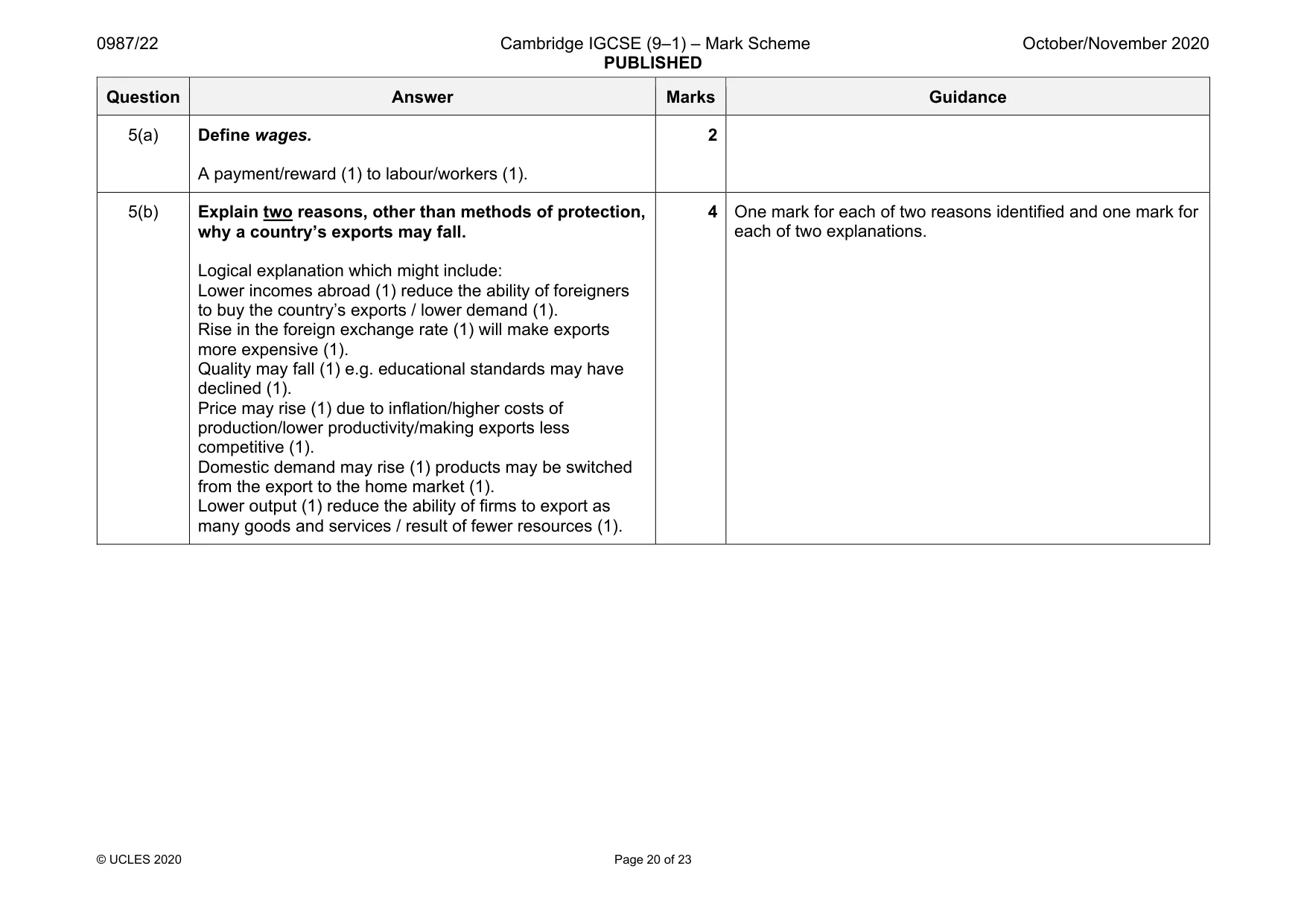
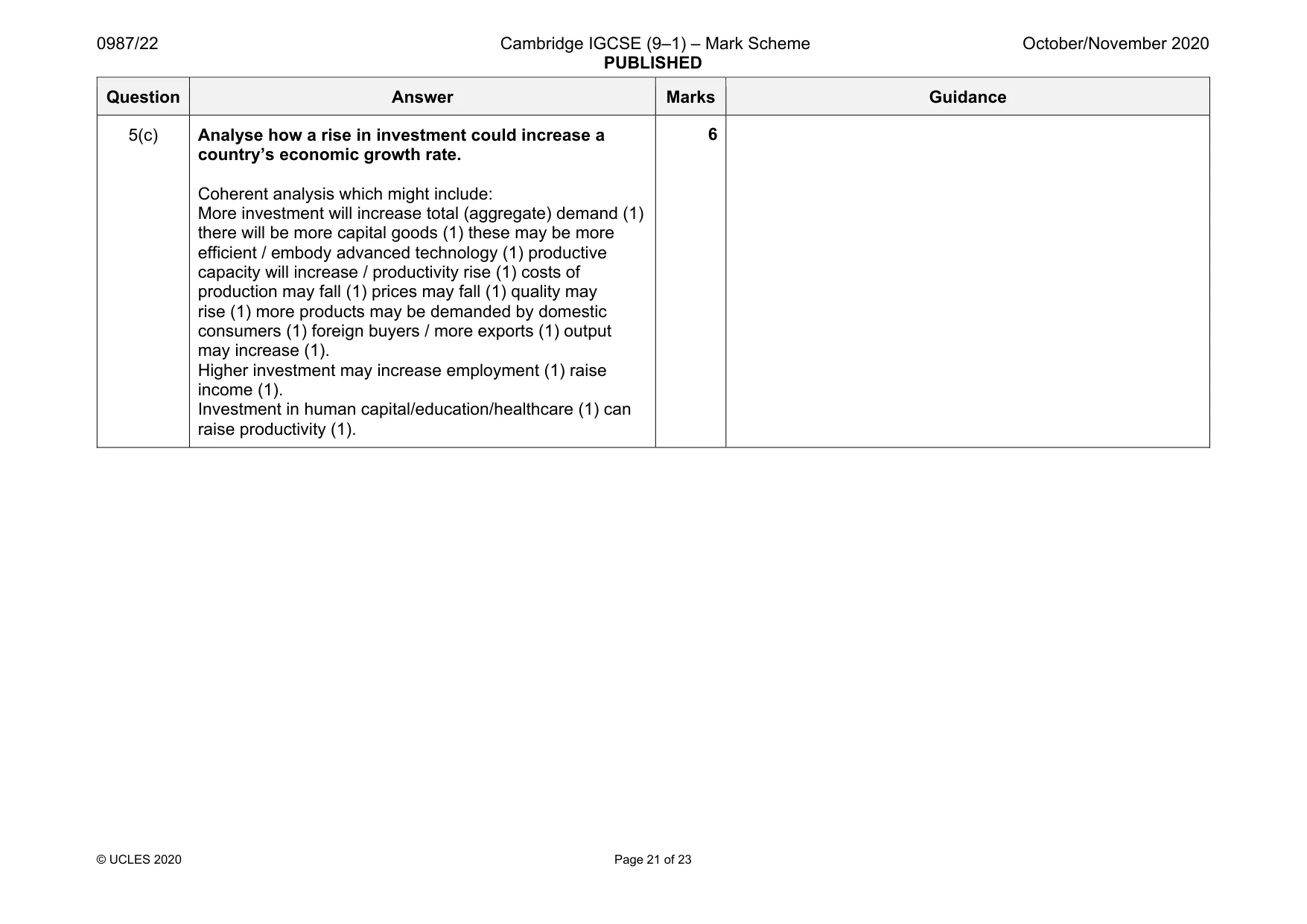
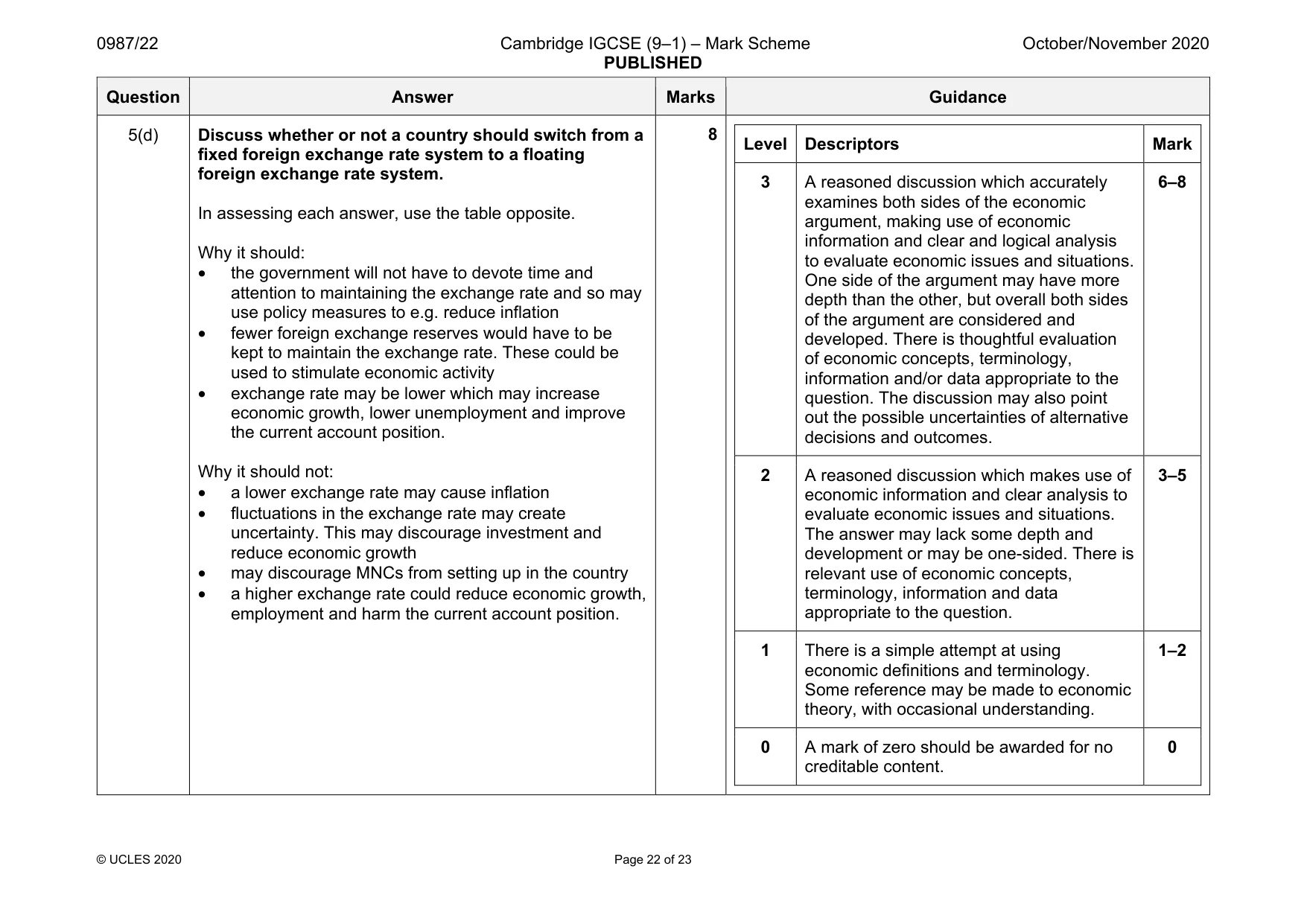
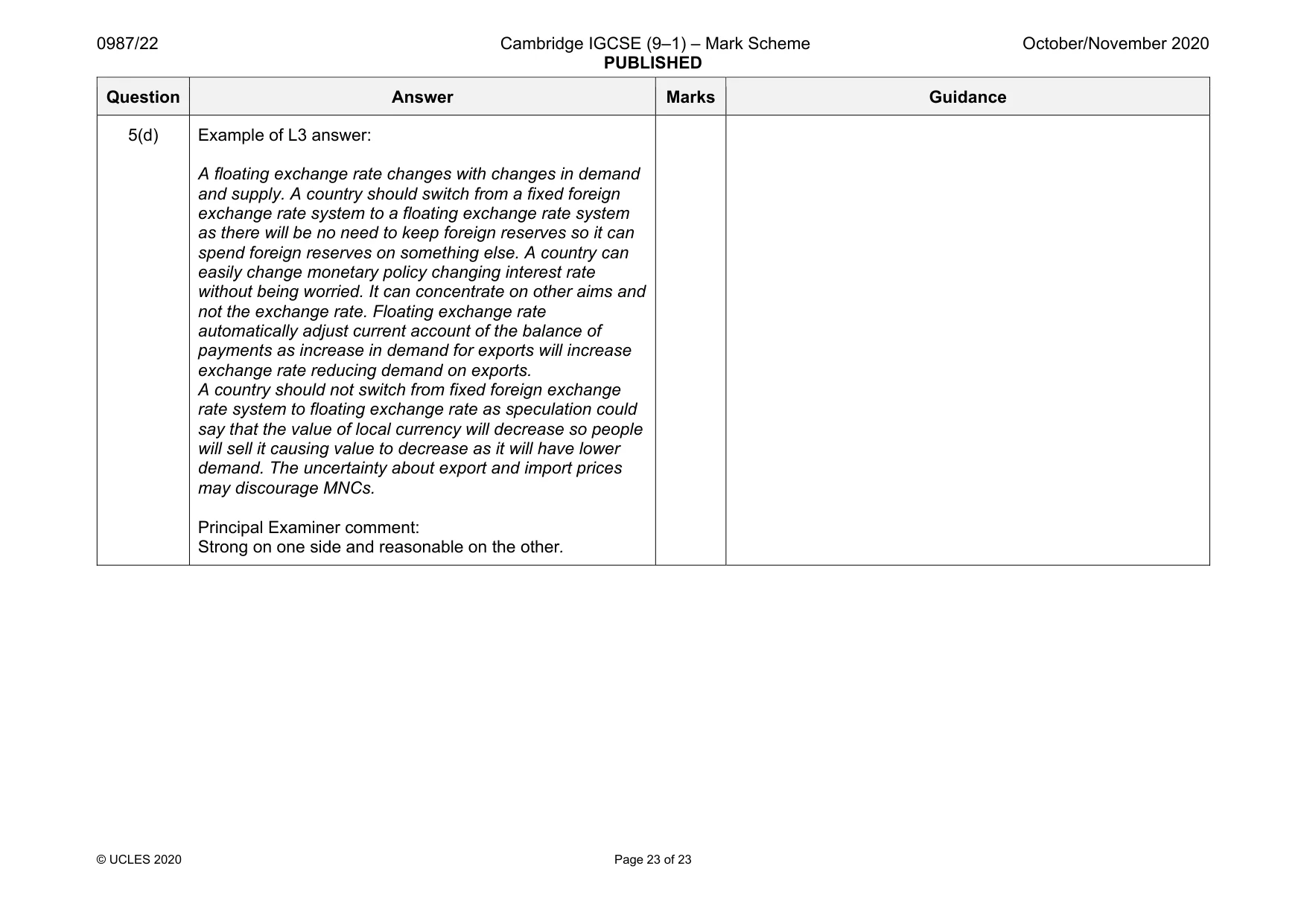
Mark scheme: 5(a) Define wages. A payment/reward (1) to labour/workers (1). 2 5(b) Explain two reasons, other than methods of protection, why a country’s exports may fall. Logical explanation which might include: Lower incomes abroad (1) reduce the ability of foreigners to buy the country’s exports / lower demand (1). Rise in the foreign exchange rate (1) will make exports more expensive (1). Quality may fall (1) e.g. educational standards may have declined (1). Price may rise (1) due to inflation/higher costs of production/lower productivity/making exports less competitive (1). Domestic demand may rise (1) products may be switched from the export to the home market (1). Lower output (1) reduce the ability of firms to export as many goods and services / result of fewer resources (1). 4 One mark for each of two reasons identified and one mark for each of two explanations. Question Answer Marks Guidance 5(c) Analyse how a rise in investment could increase a country’s economic growth rate. Coherent analysis which might include: More investment will increase total (aggregate) demand (1) there will be more capital goods (1) these may be more efficient / embody advanced technology (1) productive capacity will increase / productivity rise (1) costs of production may fall (1) prices may fall (1) quality may rise (1) more products may be demanded by domestic consumers (1) foreign buyers / more exports (1) output may increase (1). Higher investment may increase employment (1) raise income (1). Investment in human capital/education/healthcare (1) can raise productivity (1). 6 Question Answer Marks Guidance 5(d) Discuss whether or not a country should switch from a fixed foreign exchange rate system to a floating foreign exchange rate system. In assessing each answer, use the table opposite. Why it should: • the government will not have to devote time and attention to maintaining the exchange rate and so may use policy measures to e.g. reduce inflation • fewer foreign exchange reserves would have to be kept to maintain the exchange rate. These could be used to stimulate economic activity • exchange rate may be lower which may increase economic growth, lower unemployment and improve the current account position. Why it should not: • a lower exchange rate may cause inflation • fluctuations in the exchange rate may create uncertainty. This may discourage investment and reduce economic growth • may discourage MNCs from setting up in the country • a higher exchange rate could reduce economic growth, employment and harm the current account position. 8 Level Descriptors Mark 3 A reasoned discussion which accurately examines both sides of the economic argument, making use of economic information and clear and logical analysis to evaluate economic issues and situations. One side of the argument may have more depth than the other, but overall both sides of the argument are considered and developed. There is thoughtful evaluation of economic concepts, terminology, information and/or data appropriate to the question. The discussion may also point out the possible uncertainties of alternative decisions and outcomes. 6–8 2 A reasoned discussion which makes use of economic information and clear analysis to evaluate economic issues and situations. The answer may lack some depth and development or may be one-sided. There is relevant use of economic concepts, terminology, information and data appropriate to the question. 3–5 1 There is a simple attempt at using economic definitions and terminology. Some reference may be made to economic theory, with occasional understanding. 1–2 0 A mark of zero should be awarded for no creditable content. 0 Question Answer Marks Guidance 5(d) Example of L3 answer: A floating exchange rate changes with changes in demand and supply. A country should switch from a fixed foreign exchange rate system to a floating exchange rate system as there will be no need to keep foreign reserves so it can spend foreign reserves on something else. A country can easily change monetary policy changing interest rate without being worried. It can concentrate on other aims and not the exchange rate. Floating exchange rate automatically adjust current account of the balance of payments as increase in demand for exports will increase exchange rate reducing demand on exports. A country should not switch from fixed foreign exchange rate system to floating exchange rate as speculation could say that the value of local currency will decrease so people will sell it causing value to decrease as it will have lower demand. The uncertainty about export and import prices may discourage MNCs. Principal Examiner comment: Strong on one side and reasonable on the other.
What was in this paper
The subtopics covered by these 5 questions, and how many questions each got. Open one in a new tab to see every Cambridge question on it.
What you needed in this session
Cambridge’s own grade thresholds for 2020 Oct/Nov, Paper 2 · Variant 2. A higher threshold means an easier paper — the bar moves with how the cohort did.