Cambridge IGCSE Economics (9-1) 0987 — 2023 May/June Paper 2 · Variant 1
0987/21/M/J/23 · 5 questions · 90 marks · ≈101 min
The question paper and its mark scheme, free to read here and free to download. This is Cambridge’s own paper, exactly as it was sat.
Question paper8 pages



Mark scheme22 pages
Answers below. Sit the paper first if you are practising.
Questions as text
Q1 · Calculate Australia’s unemployment rate in 2021
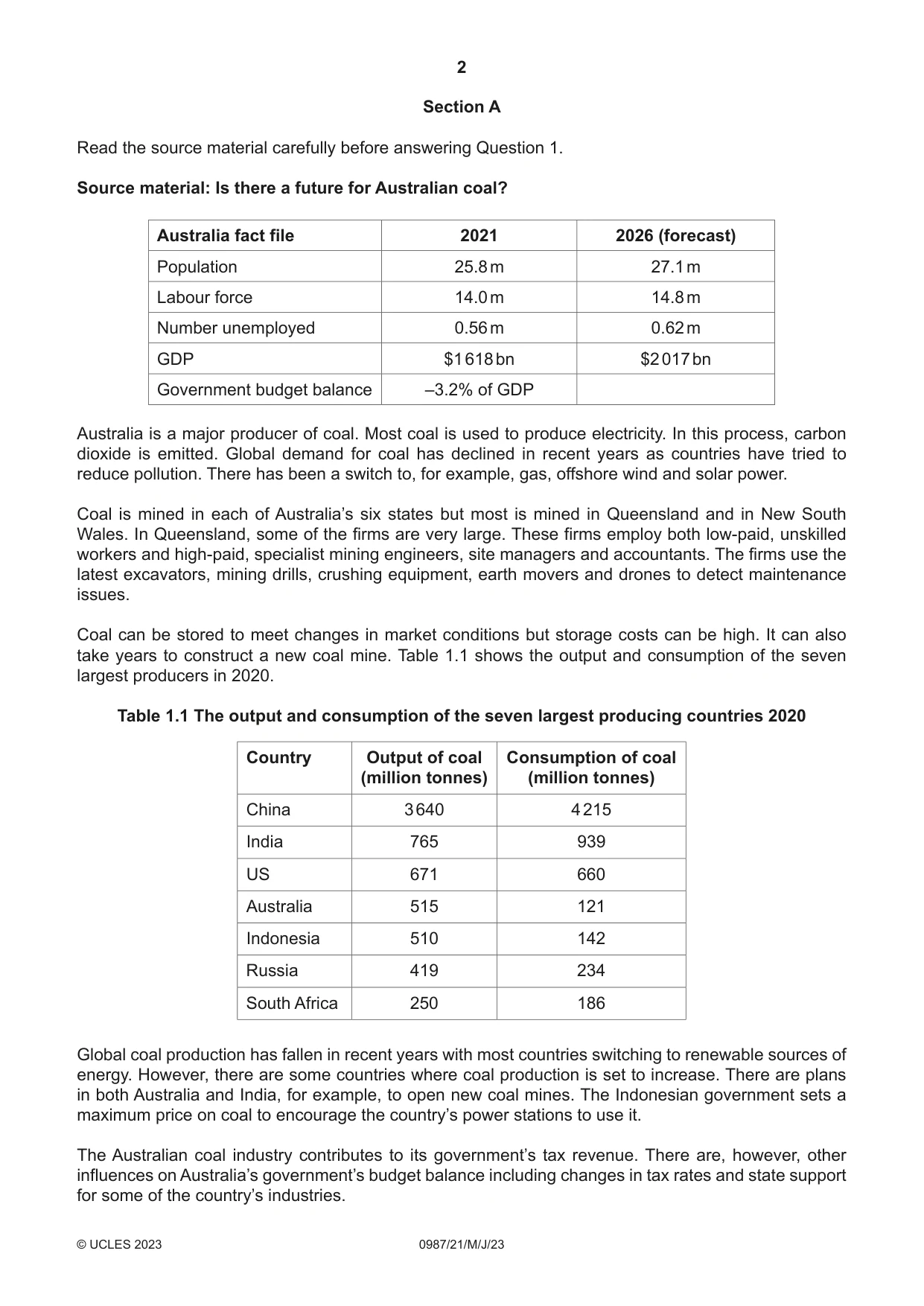
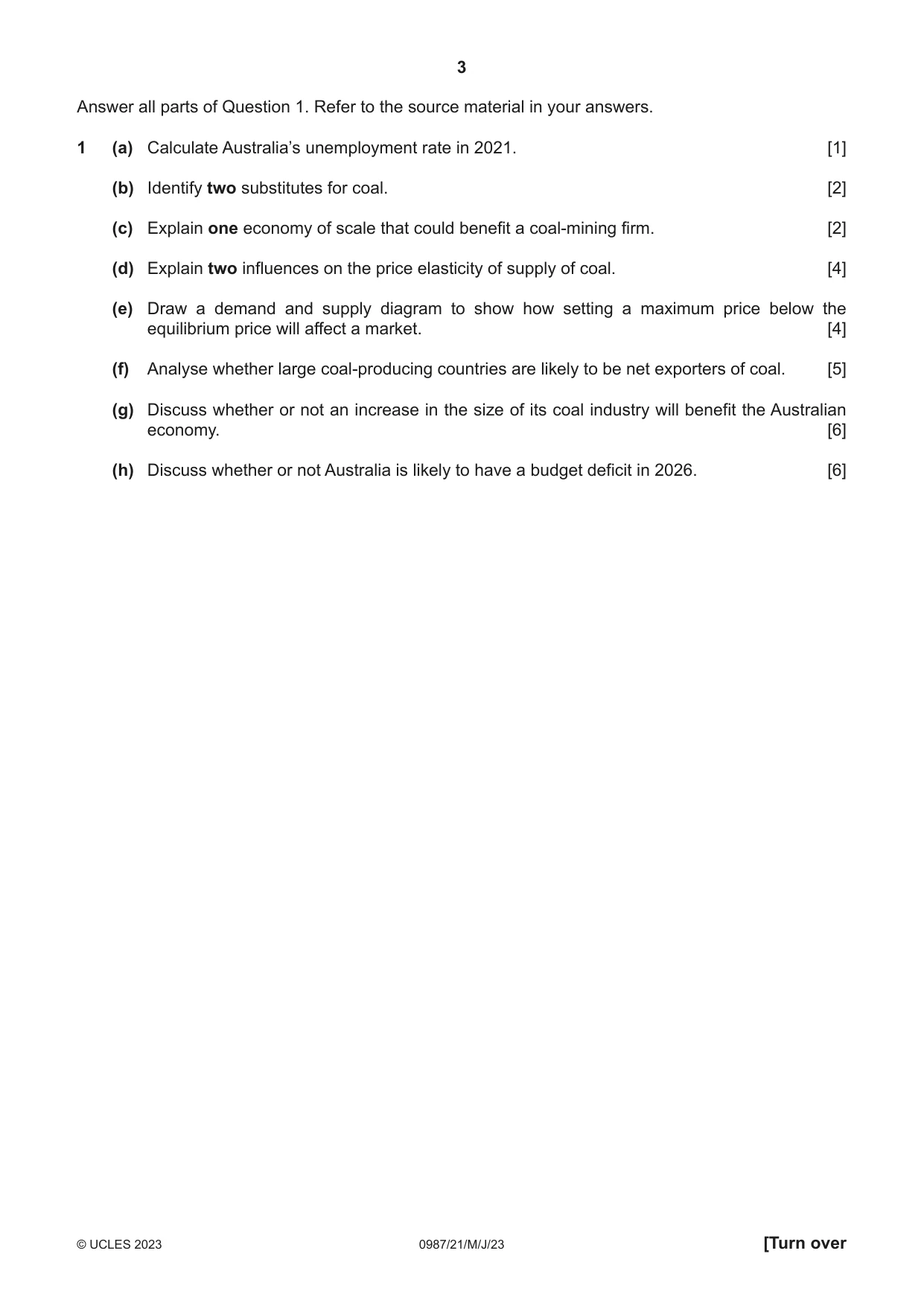
1 (a) Calculate Australia’s unemployment rate in 2021. [1] (b) Identify two substitutes for coal. [2] (c) Explain one economy of scale that could benefit a coal-mining firm. [2] (d) Explain two influences on the price elasticity of supply of coal. [4] (e) Draw a demand and supply diagram to show how setting a maximum price below the equilibrium price will affect a market. [4] (f) Analyse whether large coal-producing countries are likely to be net exporters of coal. [5] (g) Discuss whether or not an increase in the size of its coal industry will benefit the Australian economy. [6] (h) Discuss whether or not Australia is likely to have a budget deficit in 2026. [6]
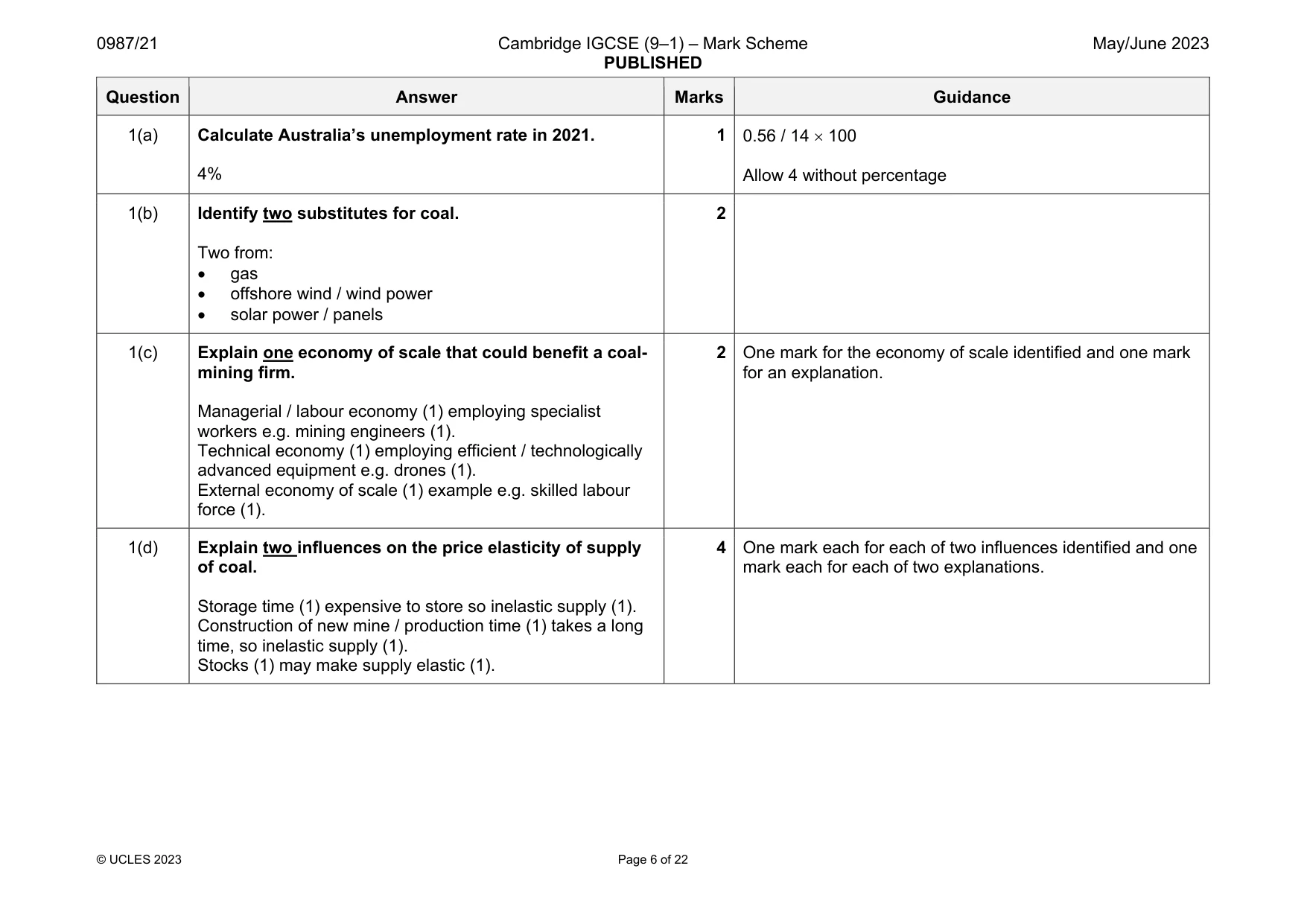
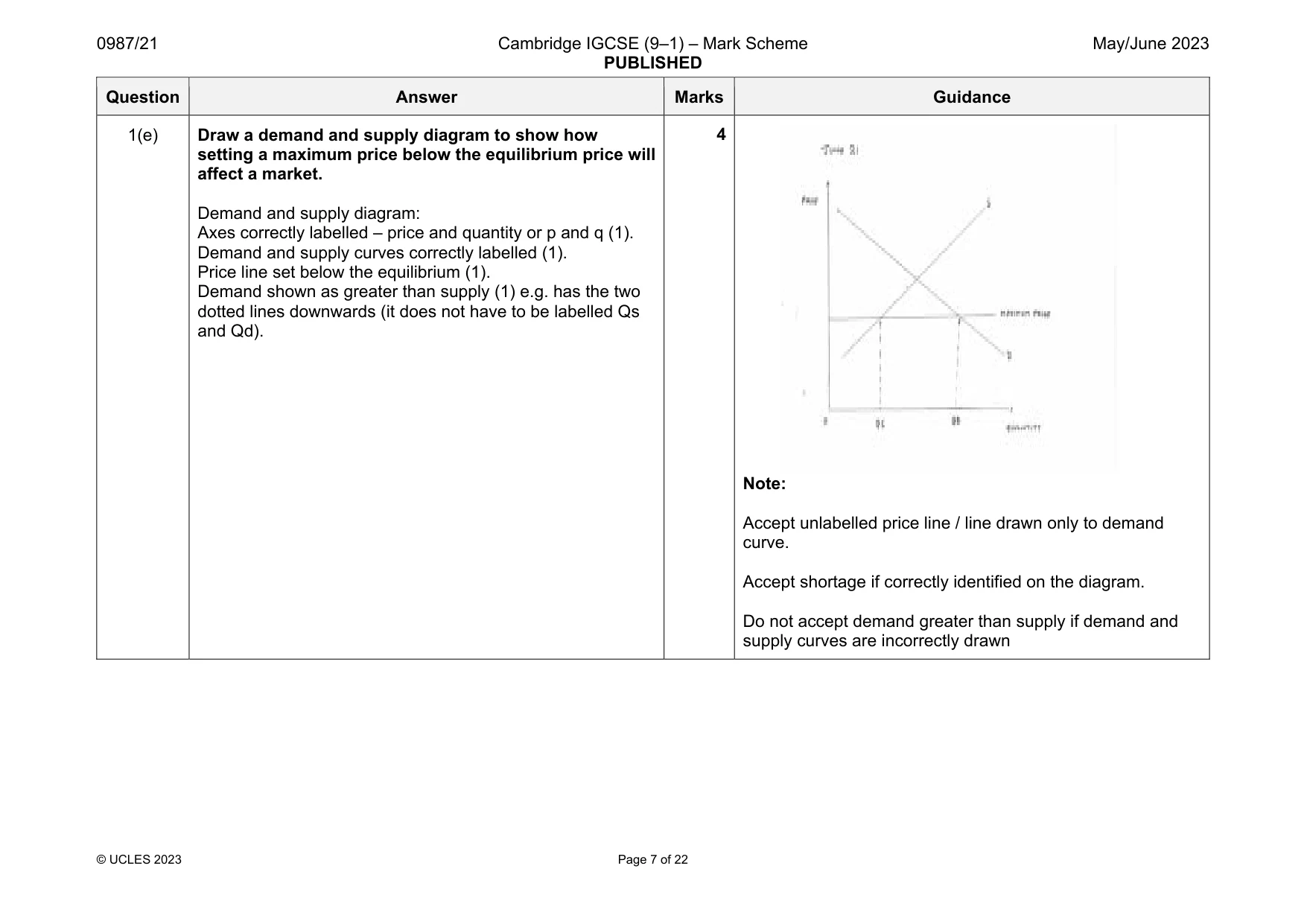
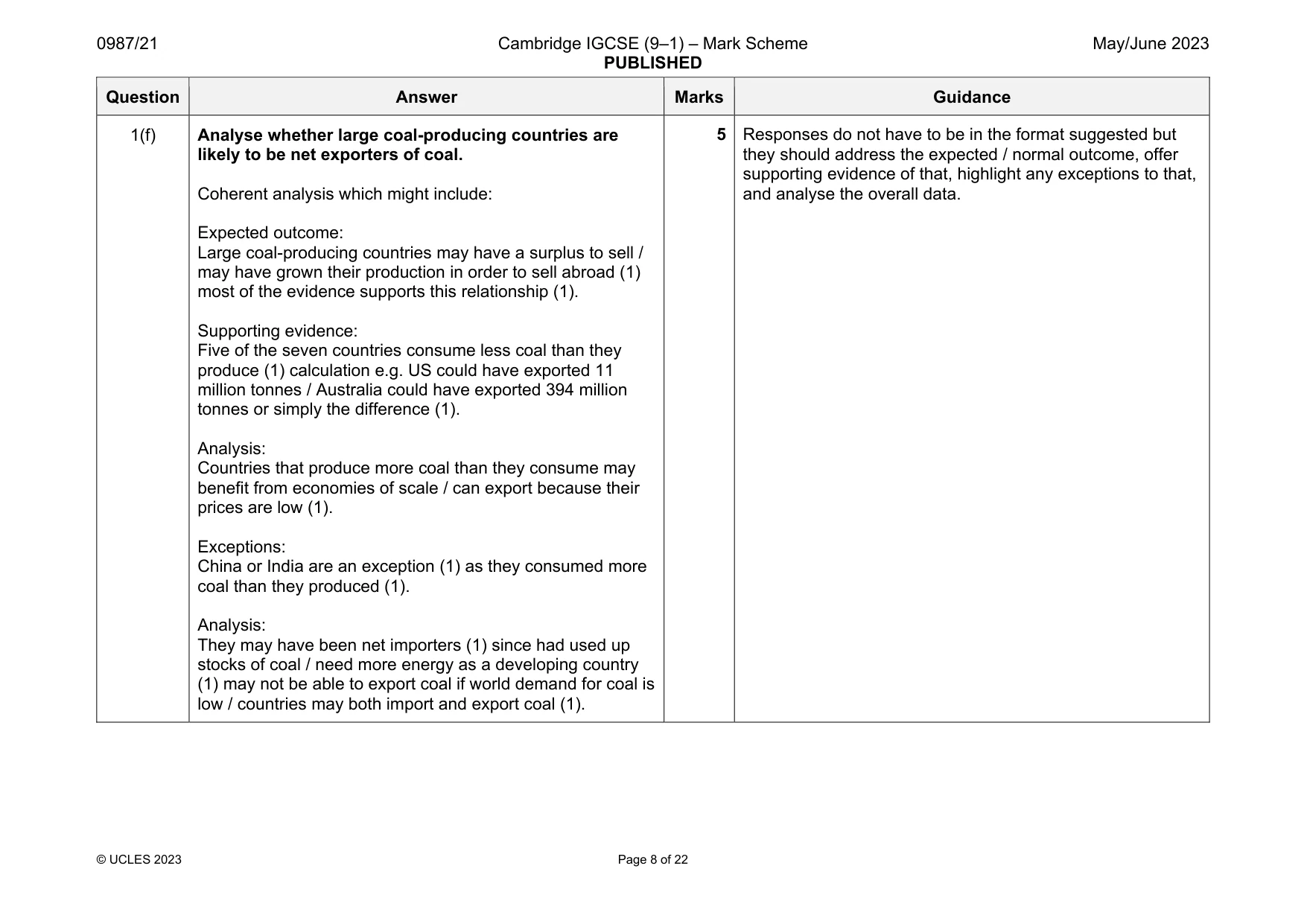
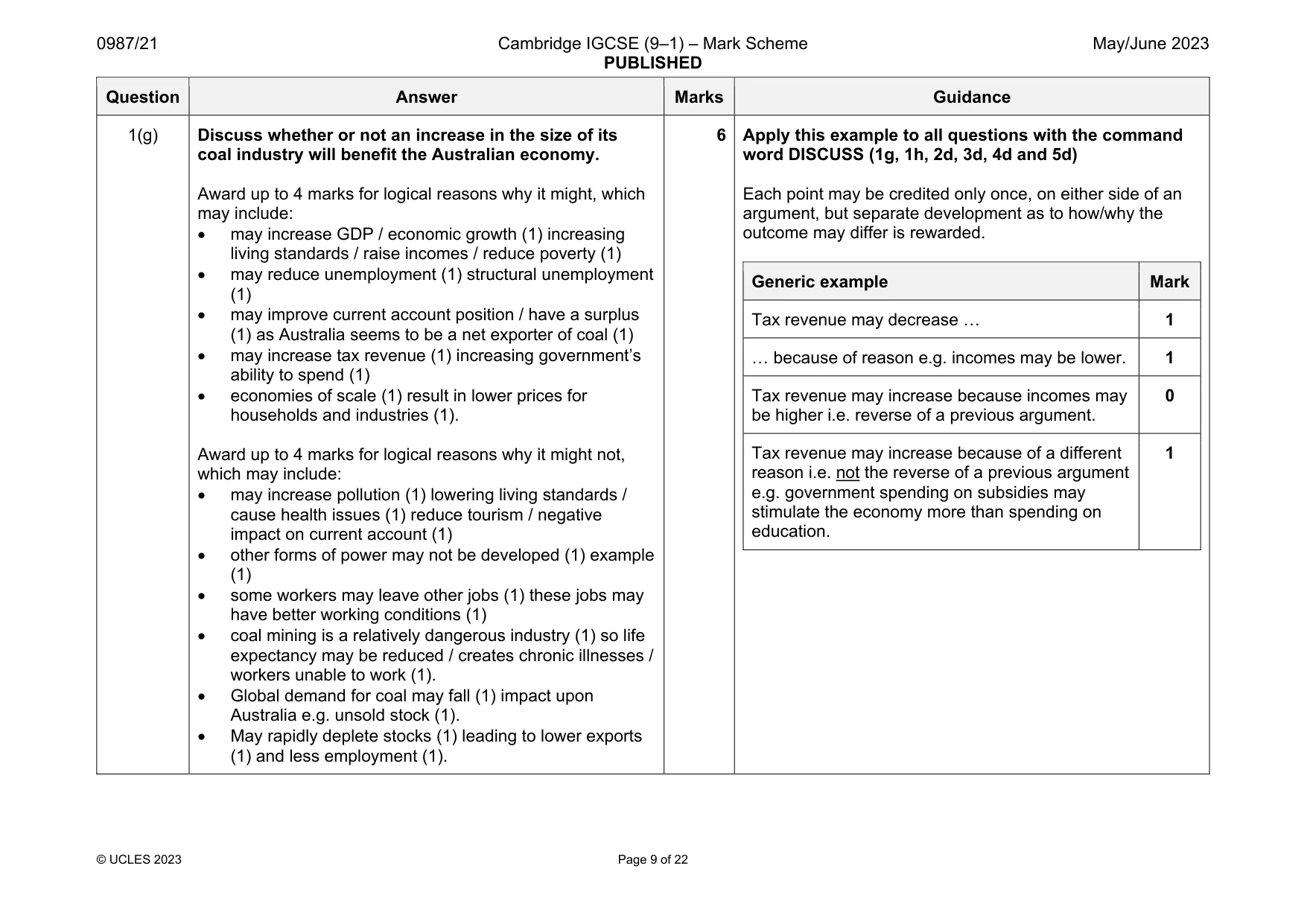
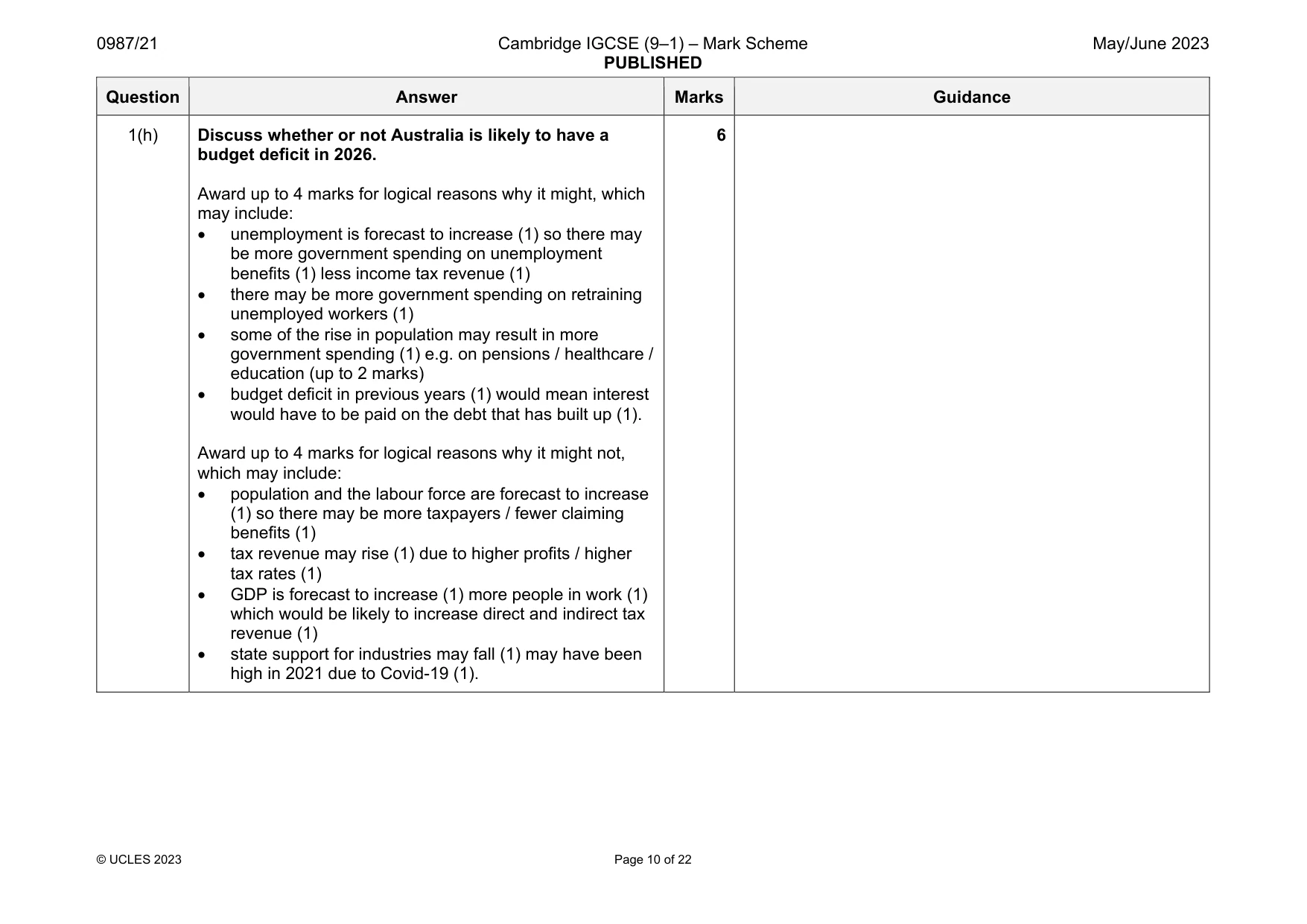
Mark scheme: 1(a) Calculate Australia’s unemployment rate in 2021. 4% Allow 4 without percentage 1(b) Identify two substitutes for coal. Two from: gas offshore wind / wind power solar power / panels 2 1(c) Explain one economy of scale that could benefit a coal- mining firm. Managerial / labour economy (1) employing specialist workers e.g. mining engineers (1). Technical economy (1) employing efficient / technologically advanced equipment e.g. drones (1). External economy of scale (1) example e.g. skilled labour force (1). 2 One mark for the economy of scale identified and one mark for an explanation. 1(d) Explain two influences on the price elasticity of supply of coal. Storage time (1) expensive to store so inelastic supply (1). Construction of new mine / production time (1) takes a long time, so inelastic supply (1). Stocks (1) may make supply elastic (1). 4 One mark each for each of two influences identified and one mark each for each of two explanations. Question Answer Marks Guidance 1(e) Draw a demand and supply diagram to show how setting a maximum price below the equilibrium price will affect a market. Demand and supply diagram: Axes correctly labelled – price and quantity or p and q (1). Demand and supply curves correctly labelled (1). Price line set below the equilibrium (1). Demand shown as greater than supply (1) e.g. has the two dotted lines downwards (it does not have to be labelled Qs and Qd). 4 Note: Accept unlabelled price line / line drawn only to demand curve. Accept shortage if correctly identified on the diagram. Do not accept demand greater than supply if demand and supply curves are incorrectly drawn Question Answer Marks Guidance 1(f) Analyse whether large coal-producing countries are likely to be net exporters of coal. Coherent analysis which might include: Expected outcome: Large coal-producing countries may have a surplus to sell / may have grown their production in order to sell abroad (1) most of the evidence supports this relationship (1). Supporting evidence: Five of the seven countries consume less coal than they produce (1) calculation e.g. US could have exported 11 million tonnes / Australia could have exported 394 million tonnes or simply the difference (1). Analysis: Countries that produce more coal than they consume may benefit from economies of scale / can export because their prices are low (1). Exceptions: China or India are an exception (1) as they consumed more coal than they produced (1). Analysis: They may have been net importers (1) since had used up stocks of coal / need more energy as a developing country (1) may not be able to export coal if world demand for coal is low / countries may both import and export coal (1). 5 Responses do not have to be in the format suggested but they should address the expected / normal outcome, offer supporting evidence of that, highlight any exceptions to that, and analyse the overall data. Question Answer Marks Guidance 1(g) Discuss whether or not an increase in the size of its coal industry will benefit the Australian economy. Award up to 4 marks for logical reasons why it might, which may include: may increase GDP / economic growth (1) increasing living standards / raise incomes / reduce poverty (1) may reduce unemployment (1) structural unemployment (1) may improve current account position / have a surplus (1) as Australia seems to be a net exporter of coal (1) may increase tax revenue (1) increasing government’s ability to spend (1) economies of scale (1) result in lower prices for households and industries (1). Award up to 4 marks for logical reasons why it might not, which may include: may increase pollution (1) lowering living standards / cause health issues (1) reduce tourism / negative impact on current account (1) other forms of power may not be developed (1) example (1) some workers may leave other jobs (1) these jobs may have better working conditions (1) coal mining is a relatively dangerous industry (1) so life expectancy may be reduced / creates chronic illnesses / workers unable to work (1). Global demand for coal may fall (1) impact upon Australia e.g. unsold stock (1). May rapidly deplete stocks (1) leading to lower exports (1) and less employment (1). 6 Apply this example to all questions with the command word DISCUSS (1g, 1h, 2d, 3d, 4d and 5d) Each point may be credited only once, on either side of an argument, but separate development as to how/why the outcome may differ is rewarded. Generic example Mark Tax revenue may decrease … 1 … because of reason e.g. incomes may be lower. 1 Tax revenue may increase because incomes may be higher i.e. reverse of a previous argument. 0 Tax revenue may increase because of a different reason i.e. not the reverse of a previous argument e.g. government spending on subsidies may stimulate the economy more than spending on education. 1 Question Answer Marks Guidance 1(h) Discuss whether or not Australia is likely to have a budget deficit in 2026. Award up to 4 marks for logical reasons why it might, which may include: unemployment is forecast to increase (1) so there may be more government spending on unemployment benefits (1) less income tax revenue (1) there may be more government spending on retraining unemployed workers (1) some of the rise in population may result in more government spending (1) e.g. on pensions / healthcare / education (up to 2 marks) budget deficit in previous years (1) would mean interest would have to be paid on the debt that has built up (1). Award up to 4 marks for logical reasons why it might not, which may include: population and the labour force are forecast to increase (1) so there may be more taxpayers / fewer claiming benefits (1) tax revenue may rise (1) due to higher profits / higher tax rates (1) GDP is forecast to increase (1) more people in work (1) which would be likely to increase direct and indirect tax revenue (1) state support for industries may fall (1) may have been high in 2021 due to Covid-19 (1). 6
Q2 · Living standards, including education, have improved for most people in South Africa in…
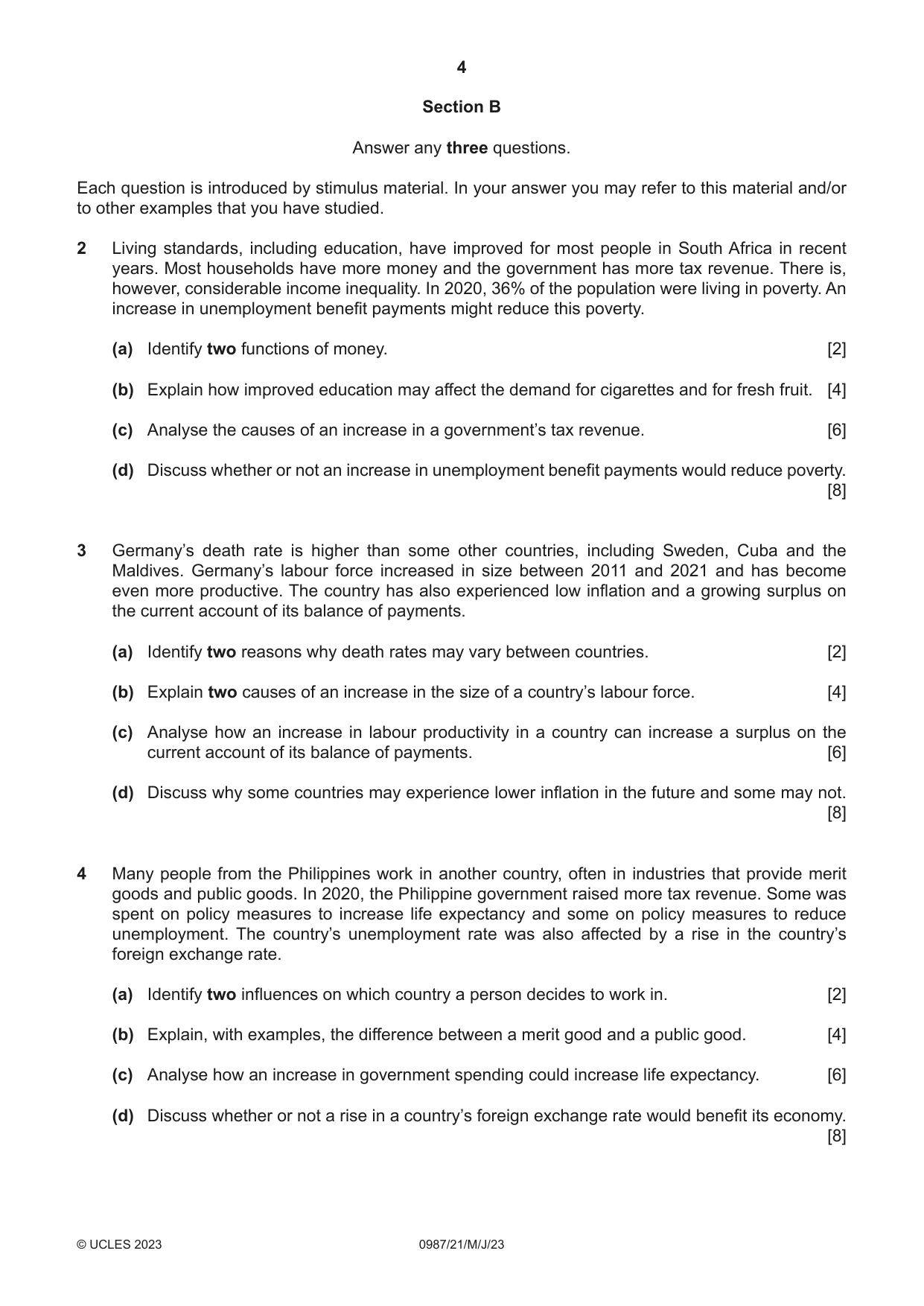
2 Living standards, including education, have improved for most people in South Africa in recent years. Most households have more money and the government has more tax revenue. There is, however, considerable income inequality. In 2020, 36% of the population were living in poverty. An increase in unemployment benefit payments might reduce this poverty. (a) Identify two functions of money. [2] (b) Explain how improved education may affect the demand for cigarettes and for fresh fruit. [4] (c) Analyse the causes of an increase in a government’s tax revenue. [6] (d) Discuss whether or not an increase in unemployment benefit payments would reduce poverty. [8]
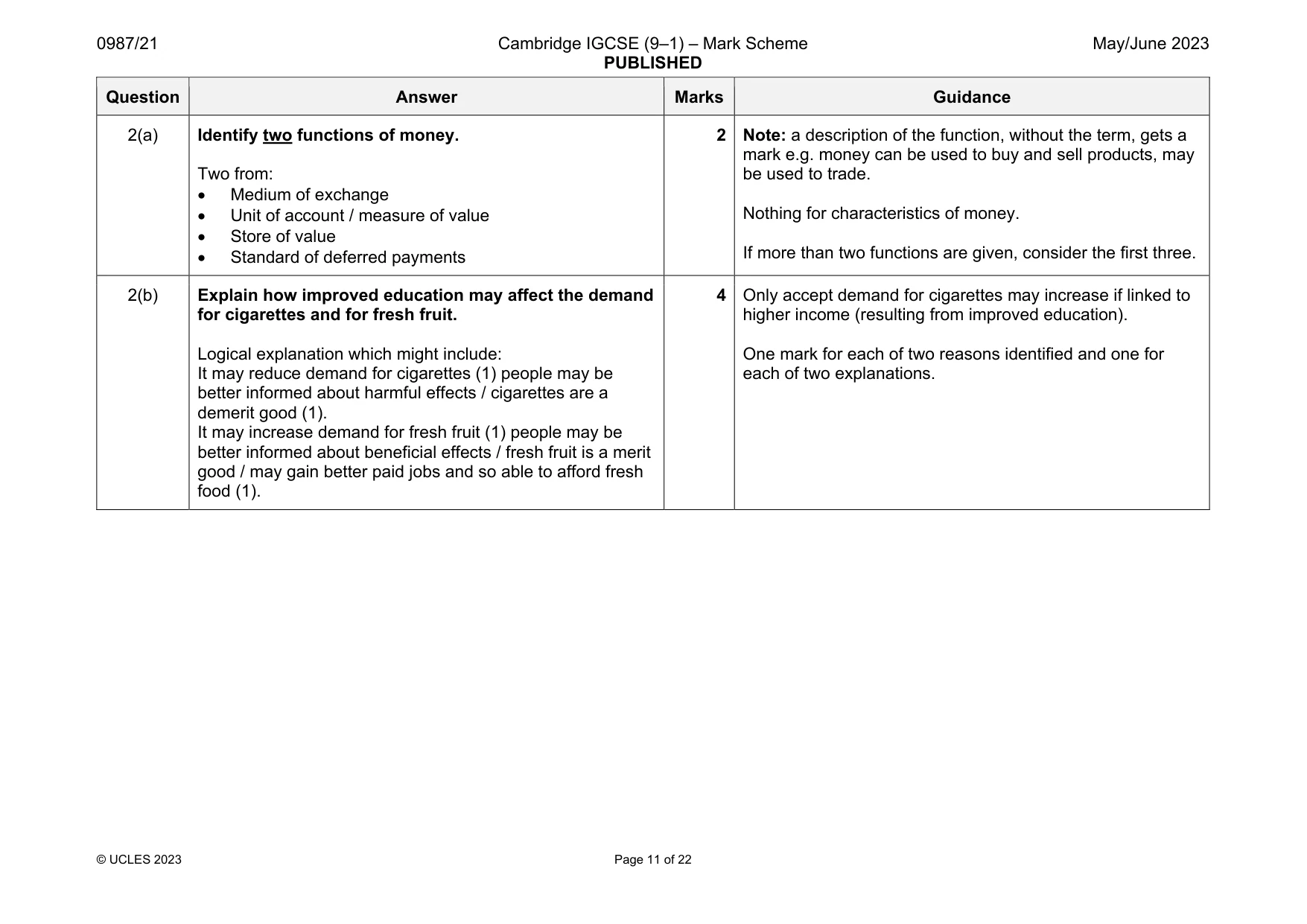
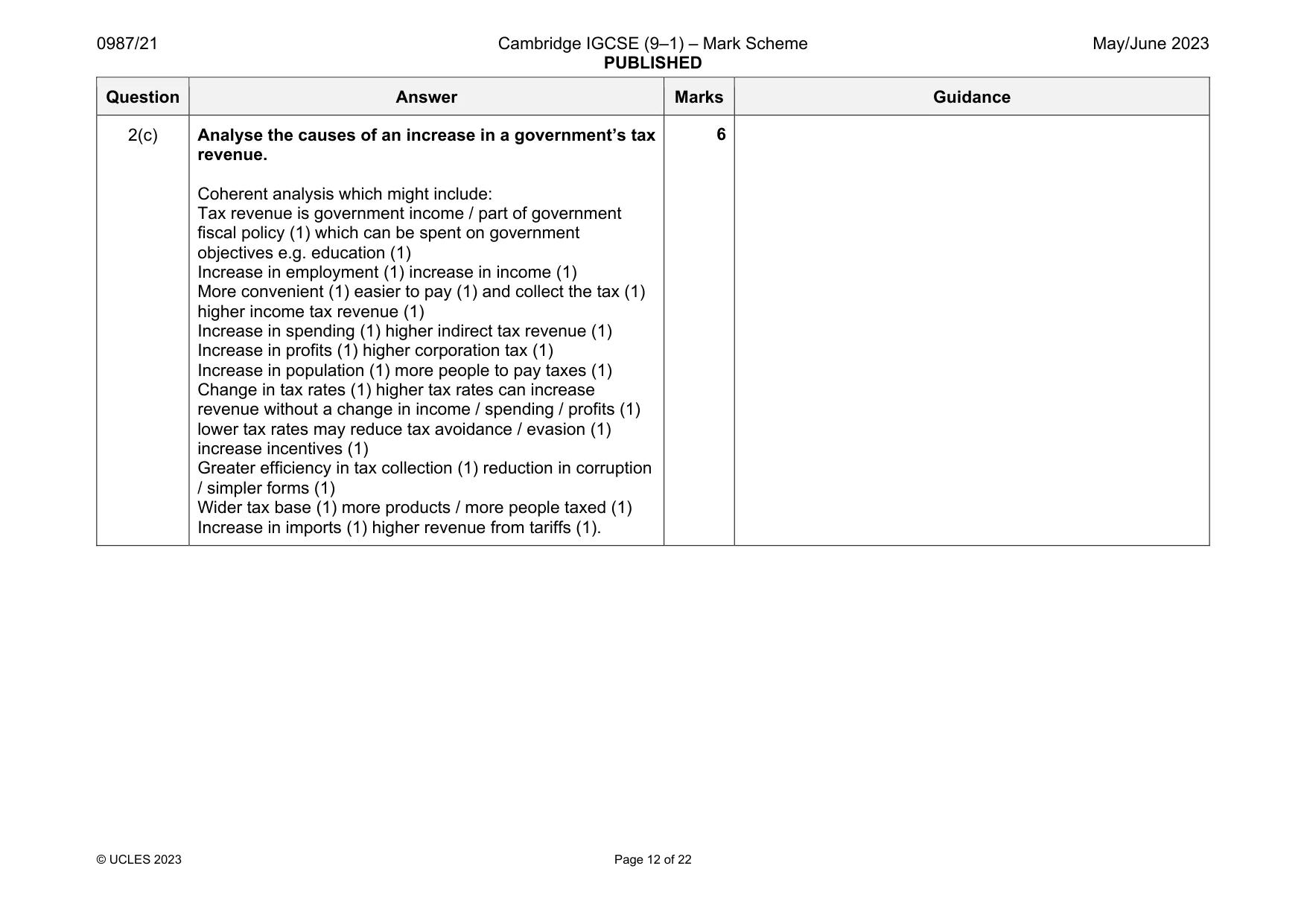
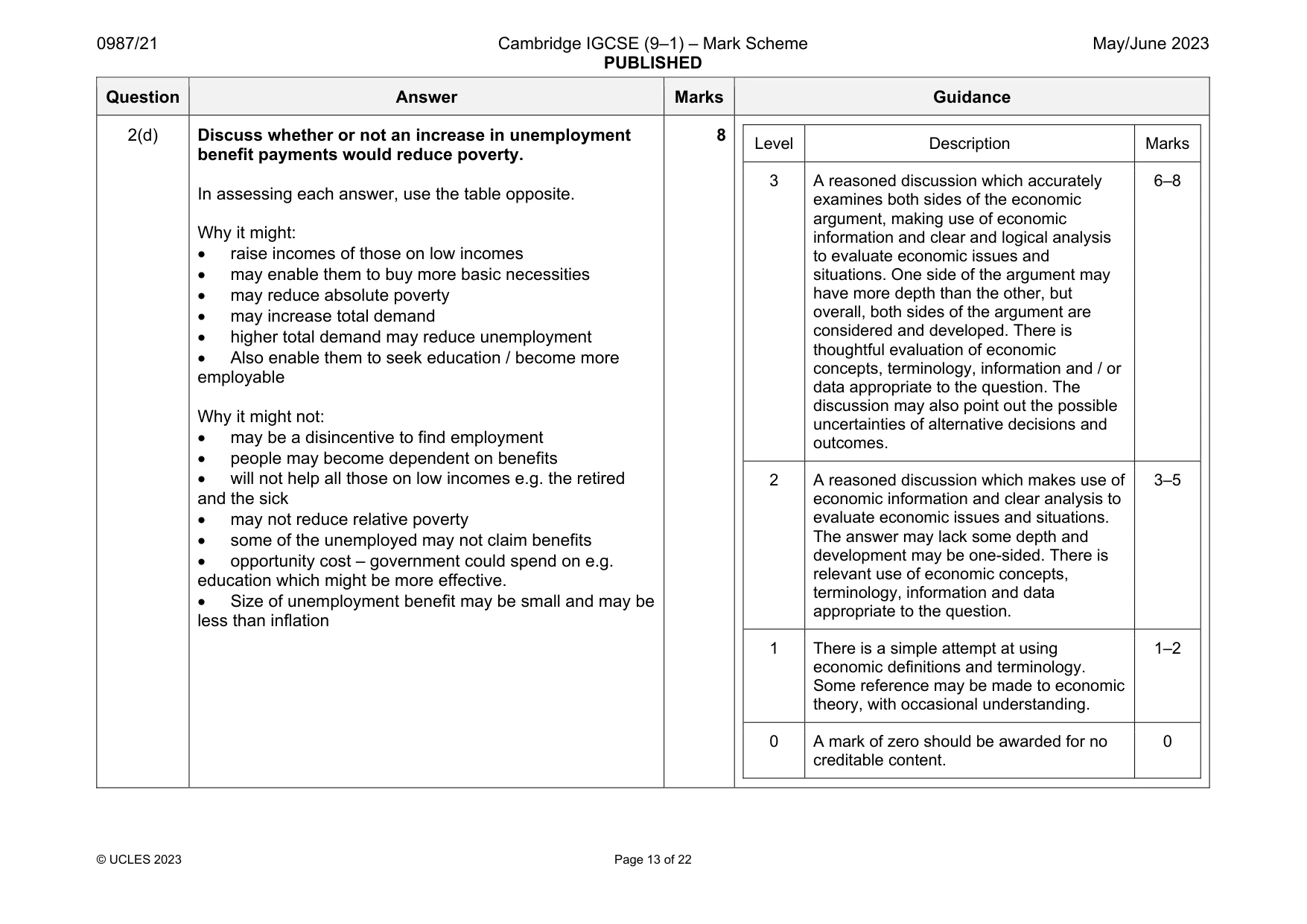
Mark scheme: 2(a) Identify two functions of money. Two from: Medium of exchange Unit of account / measure of value Store of value Standard of deferred payments 2 Note: a description of the function, without the term, gets a mark e.g. money can be used to buy and sell products, may be used to trade. Nothing for characteristics of money. If more than two functions are given, consider the first three. 2(b) Explain how improved education may affect the demand for cigarettes and for fresh fruit. Logical explanation which might include: It may reduce demand for cigarettes (1) people may be better informed about harmful effects / cigarettes are a demerit good (1). It may increase demand for fresh fruit (1) people may be better informed about beneficial effects / fresh fruit is a merit good / may gain better paid jobs and so able to afford fresh food (1). 4 Only accept demand for cigarettes may increase if linked to higher income (resulting from improved education). One mark for each of two reasons identified and one for each of two explanations. Question Answer Marks Guidance 2(c) Analyse the causes of an increase in a government’s tax revenue. Coherent analysis which might include: Tax revenue is government income / part of government fiscal policy (1) which can be spent on government objectives e.g. education (1) Increase in employment (1) increase in income (1) More convenient (1) easier to pay (1) and collect the tax (1) higher income tax revenue (1) Increase in spending (1) higher indirect tax revenue (1) Increase in profits (1) higher corporation tax (1) Increase in population (1) more people to pay taxes (1) Change in tax rates (1) higher tax rates can increase revenue without a change in income / spending / profits (1) lower tax rates may reduce tax avoidance / evasion (1) increase incentives (1) Greater efficiency in tax collection (1) reduction in corruption / simpler forms (1) Wider tax base (1) more products / more people taxed (1) Increase in imports (1) higher revenue from tariffs (1). 6 Question Answer Marks Guidance 2(d) Discuss whether or not an increase in unemployment benefit payments would reduce poverty. In assessing each answer, use the table opposite. Why it might: raise incomes of those on low incomes may enable them to buy more basic necessities may reduce absolute poverty may increase total demand higher total demand may reduce unemployment Also enable them to seek education / become more employable Why it might not: may be a disincentive to find employment people may become dependent on benefits will not help all those on low incomes e.g. the retired and the sick may not reduce relative poverty some of the unemployed may not claim benefits opportunity cost – government could spend on e.g. education which might be more effective. Size of unemployment benefit may be small and may be less than inflation 8 Level Description Marks 3 A reasoned discussion which accurately examines both sides of the economic argument, making use of economic information and clear and logical analysis to evaluate economic issues and situations. One side of the argument may have more depth than the other, but overall, both sides of the argument are considered and developed. There is thoughtful evaluation of economic concepts, terminology, information and / or data appropriate to the question. The discussion may also point out the possible uncertainties of alternative decisions and outcomes. 6–8 2 A reasoned discussion which makes use of economic information and clear analysis to evaluate economic issues and situations. The answer may lack some depth and development may be one-sided. There is relevant use of economic concepts, terminology, information and data appropriate to the question. 3–5 1 There is a simple attempt at using economic definitions and terminology. Some reference may be made to economic theory, with occasional understanding. 1–2 0 A mark of zero should be awarded for no creditable content. 0
Q3 · Germany’s death rate is higher than some other countries, including Sweden, Cuba and the…
3 Germany’s death rate is higher than some other countries, including Sweden, Cuba and the Maldives. Germany’s labour force increased in size between 2011 and 2021 and has become even more productive. The country has also experienced low inflation and a growing surplus on the current account of its balance of payments. (a) Identify two reasons why death rates may vary between countries. [2] (b) Explain two causes of an increase in the size of a country’s labour force. [4] (c) Analyse how an increase in labour productivity in a country can increase a surplus on the current account of its balance of payments. [6] (d) Discuss why some countries may experience lower inflation in the future and some may not. [8]
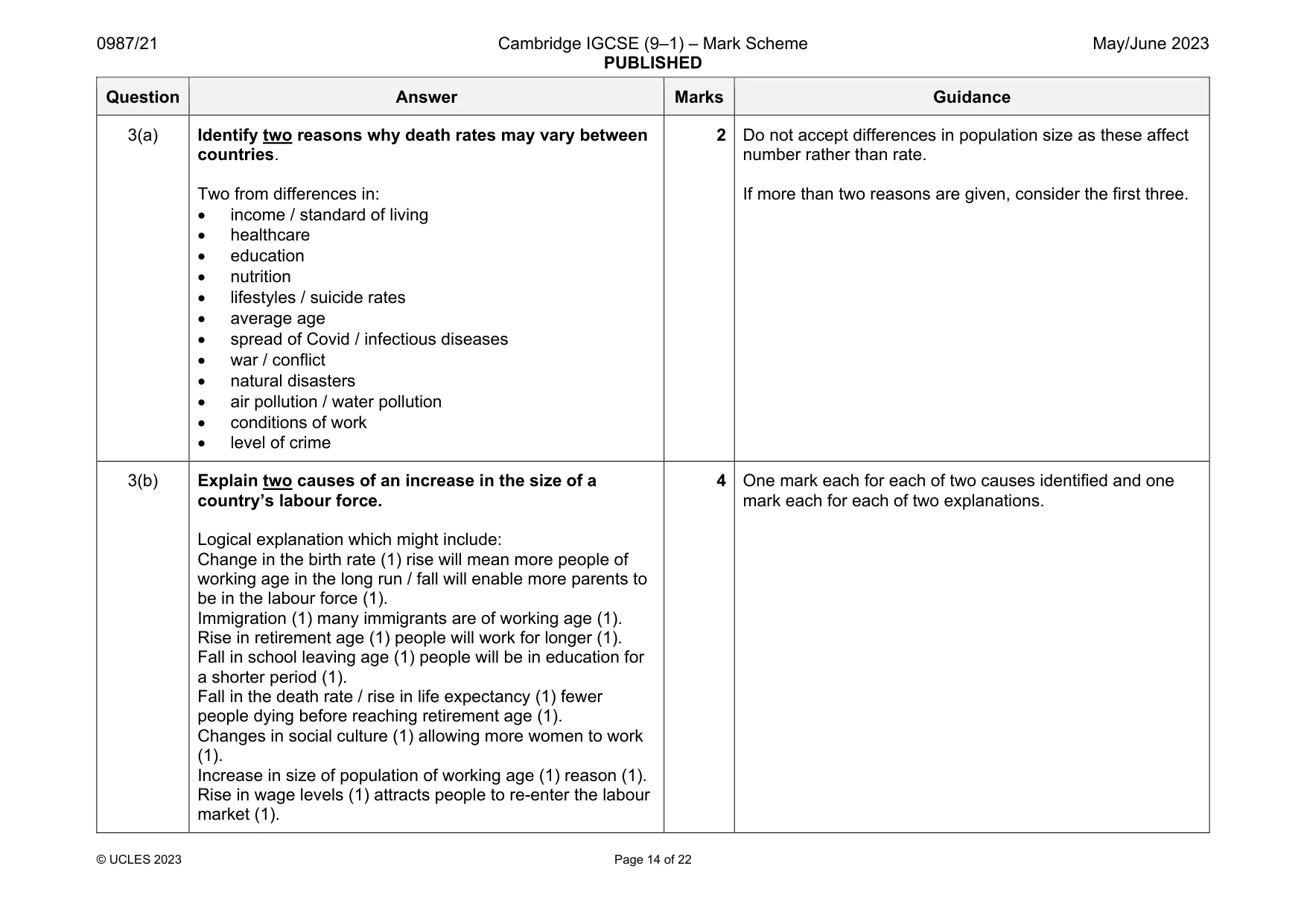
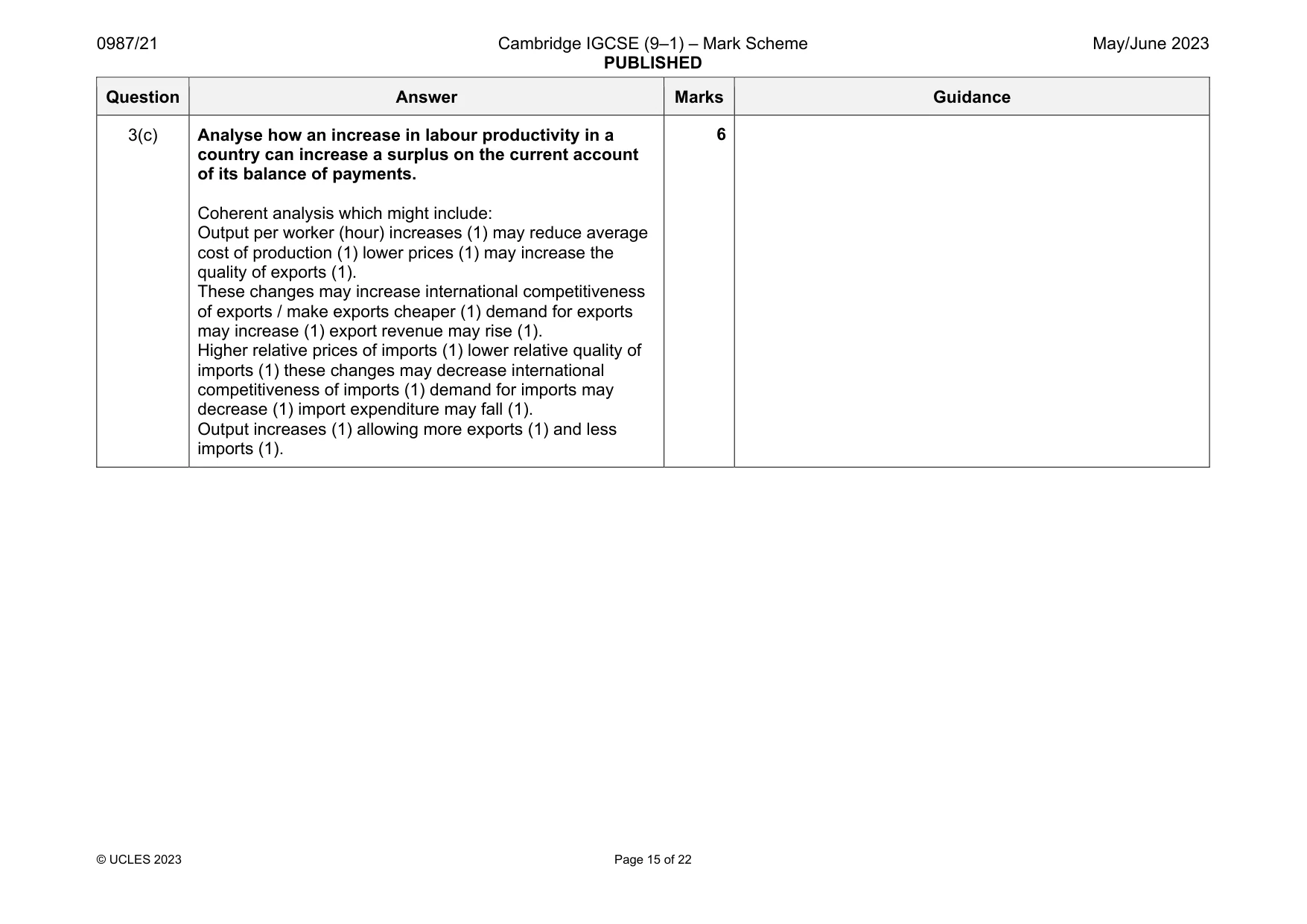
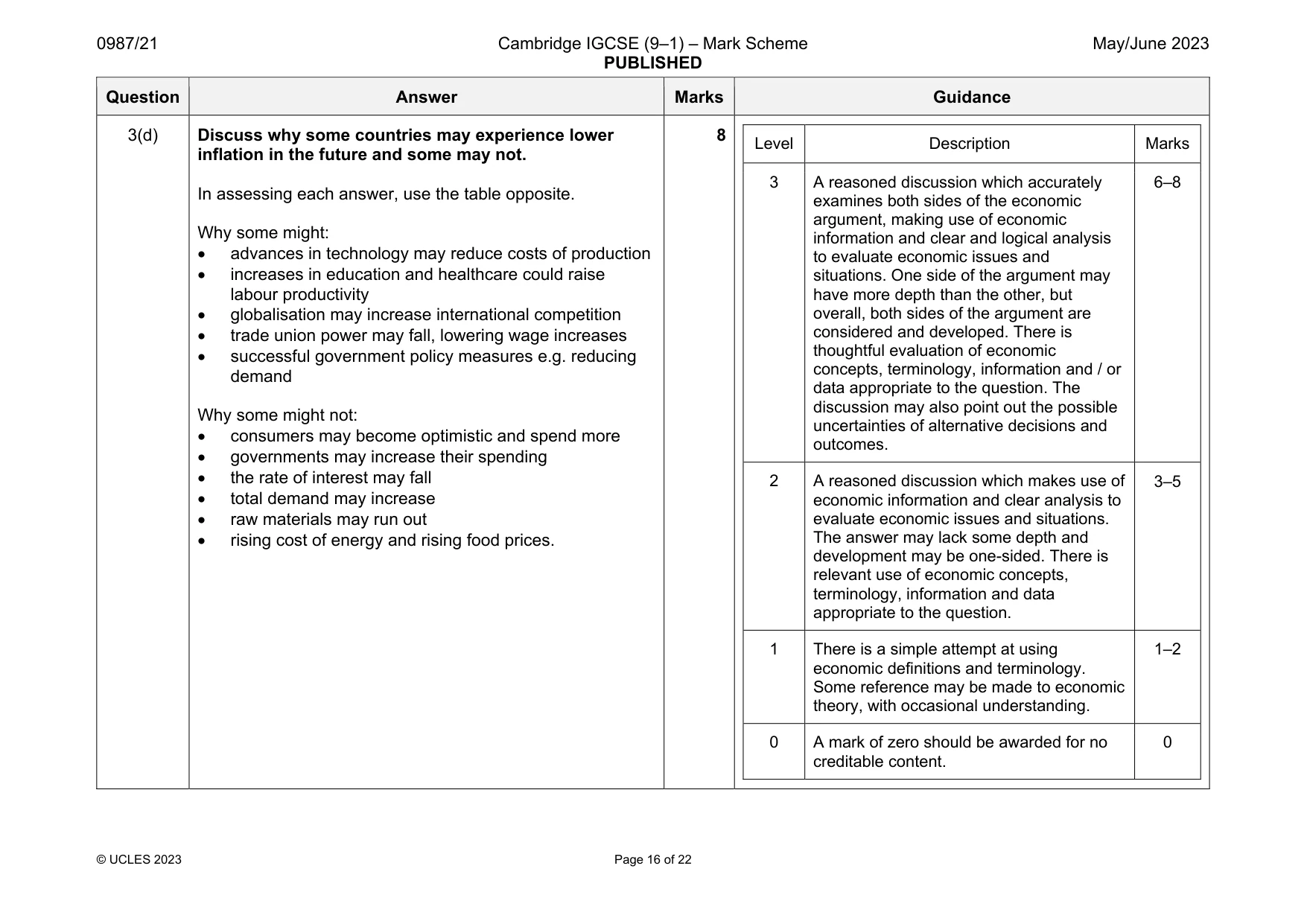
Mark scheme: 3(a) Identify two reasons why death rates may vary between countries. Two from differences in: income / standard of living healthcare education nutrition lifestyles / suicide rates average age spread of Covid / infectious diseases war / conflict natural disasters air pollution / water pollution conditions of work level of crime 2 Do not accept differences in population size as these affect number rather than rate. If more than two reasons are given, consider the first three. 3(b) Explain two causes of an increase in the size of a country’s labour force. Logical explanation which might include: Change in the birth rate (1) rise will mean more people of working age in the long run / fall will enable more parents to be in the labour force (1). Immigration (1) many immigrants are of working age (1). Rise in retirement age (1) people will work for longer (1). Fall in school leaving age (1) people will be in education for a shorter period (1). Fall in the death rate / rise in life expectancy (1) fewer people dying before reaching retirement age (1). Changes in social culture (1) allowing more women to work (1). Increase in size of population of working age (1) reason (1). Rise in wage levels (1) attracts people to re-enter the labour market (1). 4 One mark each for each of two causes identified and one mark each for each of two explanations. Question Answer Marks Guidance 3(c) Analyse how an increase in labour productivity in a country can increase a surplus on the current account of its balance of payments. Coherent analysis which might include: Output per worker (hour) increases (1) may reduce average cost of production (1) lower prices (1) may increase the quality of exports (1). These changes may increase international competitiveness of exports / make exports cheaper (1) demand for exports may increase (1) export revenue may rise (1). Higher relative prices of imports (1) lower relative quality of imports (1) these changes may decrease international competitiveness of imports (1) demand for imports may decrease (1) import expenditure may fall (1). Output increases (1) allowing more exports (1) and less imports (1). 6 Question Answer Marks Guidance 3(d) Discuss why some countries may experience lower inflation in the future and some may not. In assessing each answer, use the table opposite. Why some might: advances in technology may reduce costs of production increases in education and healthcare could raise labour productivity globalisation may increase international competition trade union power may fall, lowering wage increases successful government policy measures e.g. reducing demand Why some might not: consumers may become optimistic and spend more governments may increase their spending the rate of interest may fall total demand may increase raw materials may run out rising cost of energy and rising food prices. 8 Level Description Marks 3 A reasoned discussion which accurately examines both sides of the economic argument, making use of economic information and clear and logical analysis to evaluate economic issues and situations. One side of the argument may have more depth than the other, but overall, both sides of the argument are considered and developed. There is thoughtful evaluation of economic concepts, terminology, information and / or data appropriate to the question. The discussion may also point out the possible uncertainties of alternative decisions and outcomes. 6–8 2 A reasoned discussion which makes use of economic information and clear analysis to evaluate economic issues and situations. The answer may lack some depth and development may be one-sided. There is relevant use of economic concepts, terminology, information and data appropriate to the question. 3–5 1 There is a simple attempt at using economic definitions and terminology. Some reference may be made to economic theory, with occasional understanding. 1–2 0 A mark of zero should be awarded for no creditable content. 0
Q4 · Many people from the Philippines work in another country, often in industries that…
4 Many people from the Philippines work in another country, often in industries that provide merit goods and public goods. In 2020, the Philippine government raised more tax revenue. Some was spent on policy measures to increase life expectancy and some on policy measures to reduce unemployment. The country’s unemployment rate was also affected by a rise in the country’s foreign exchange rate. (a) Identify two influences on which country a person decides to work in. [2] (b) Explain, with examples, the difference between a merit good and a public good. [4] (c) Analyse how an increase in government spending could increase life expectancy. [6] (d) Discuss whether or not a rise in a country’s foreign exchange rate would benefit its economy. [8]
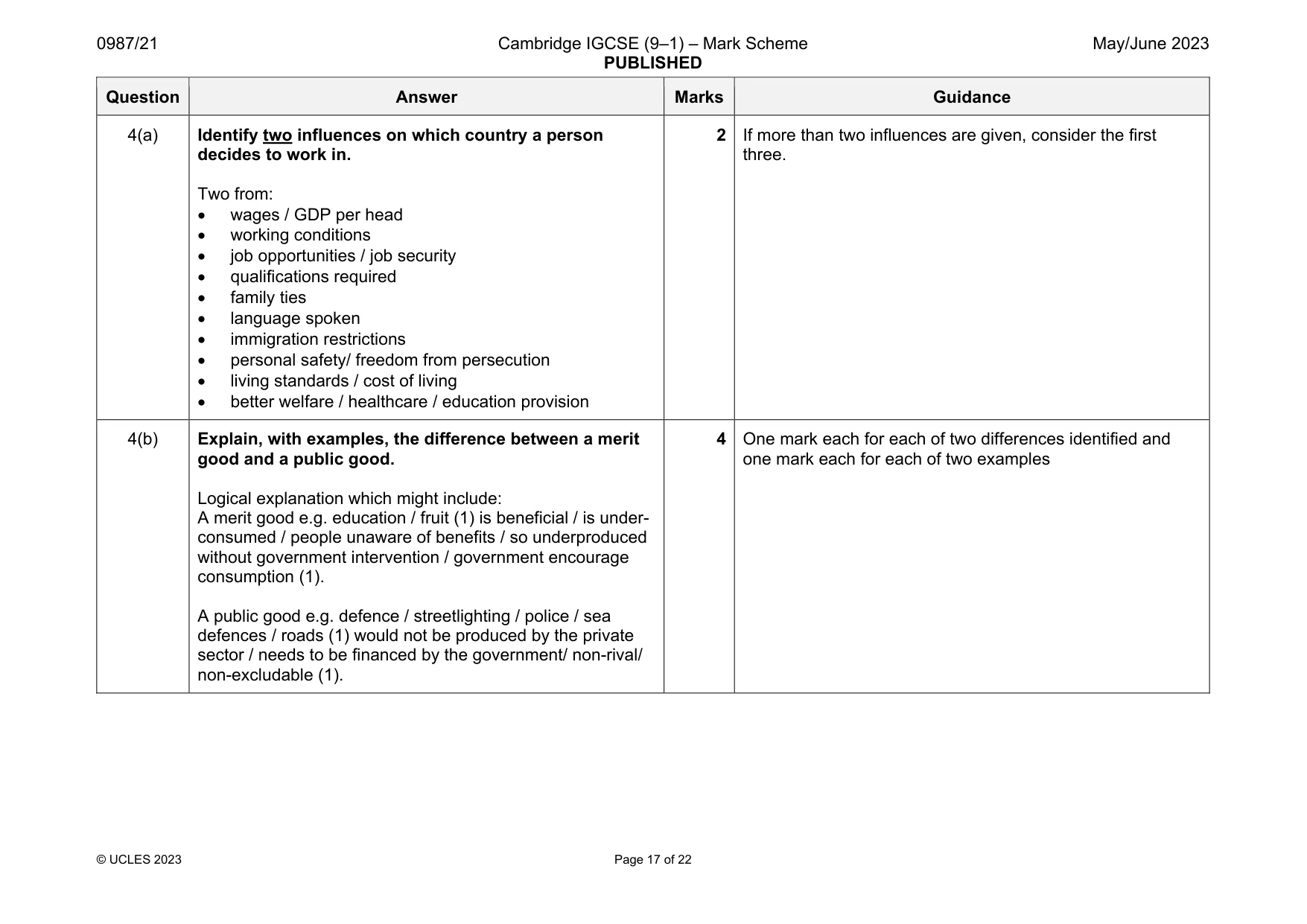
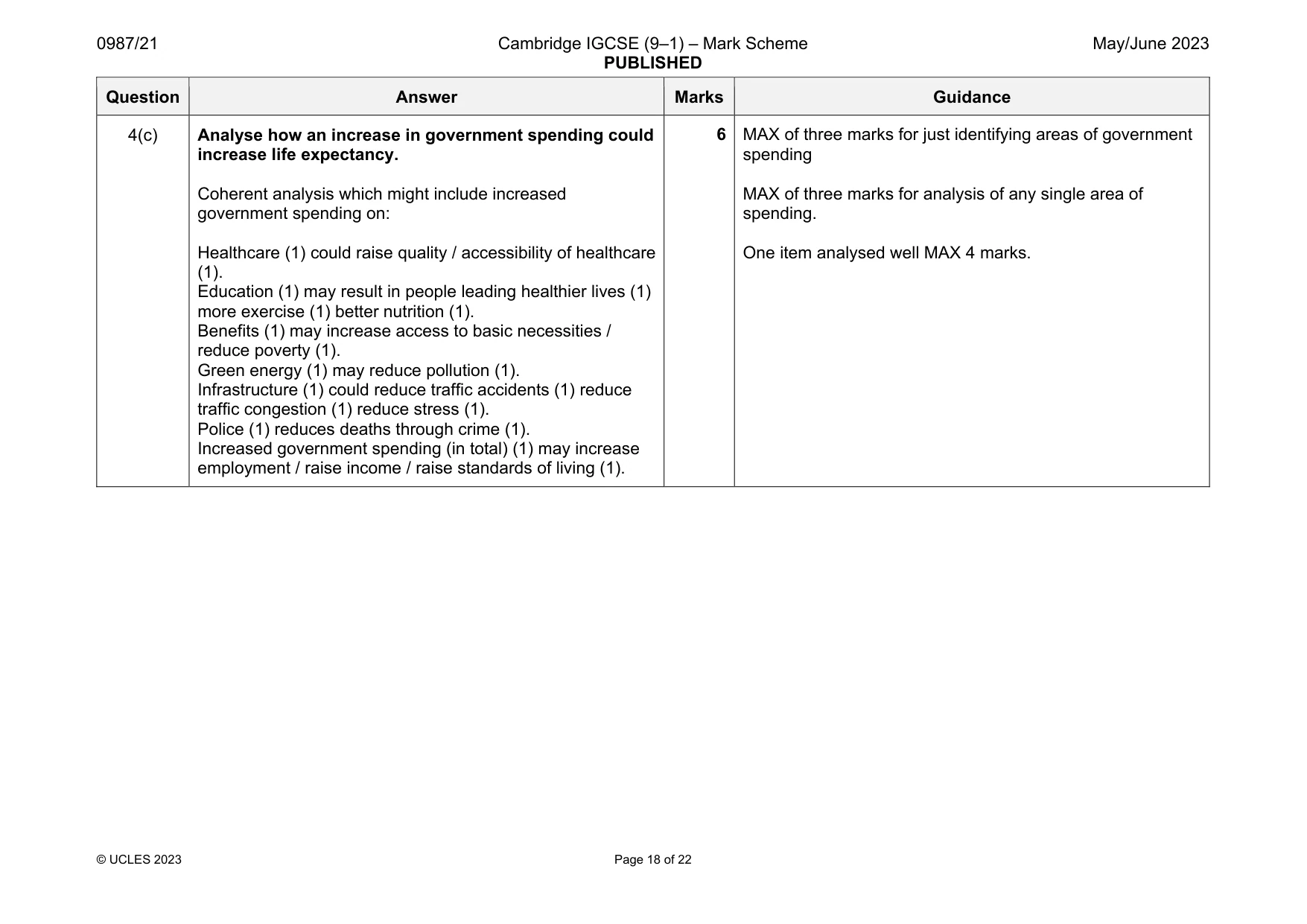
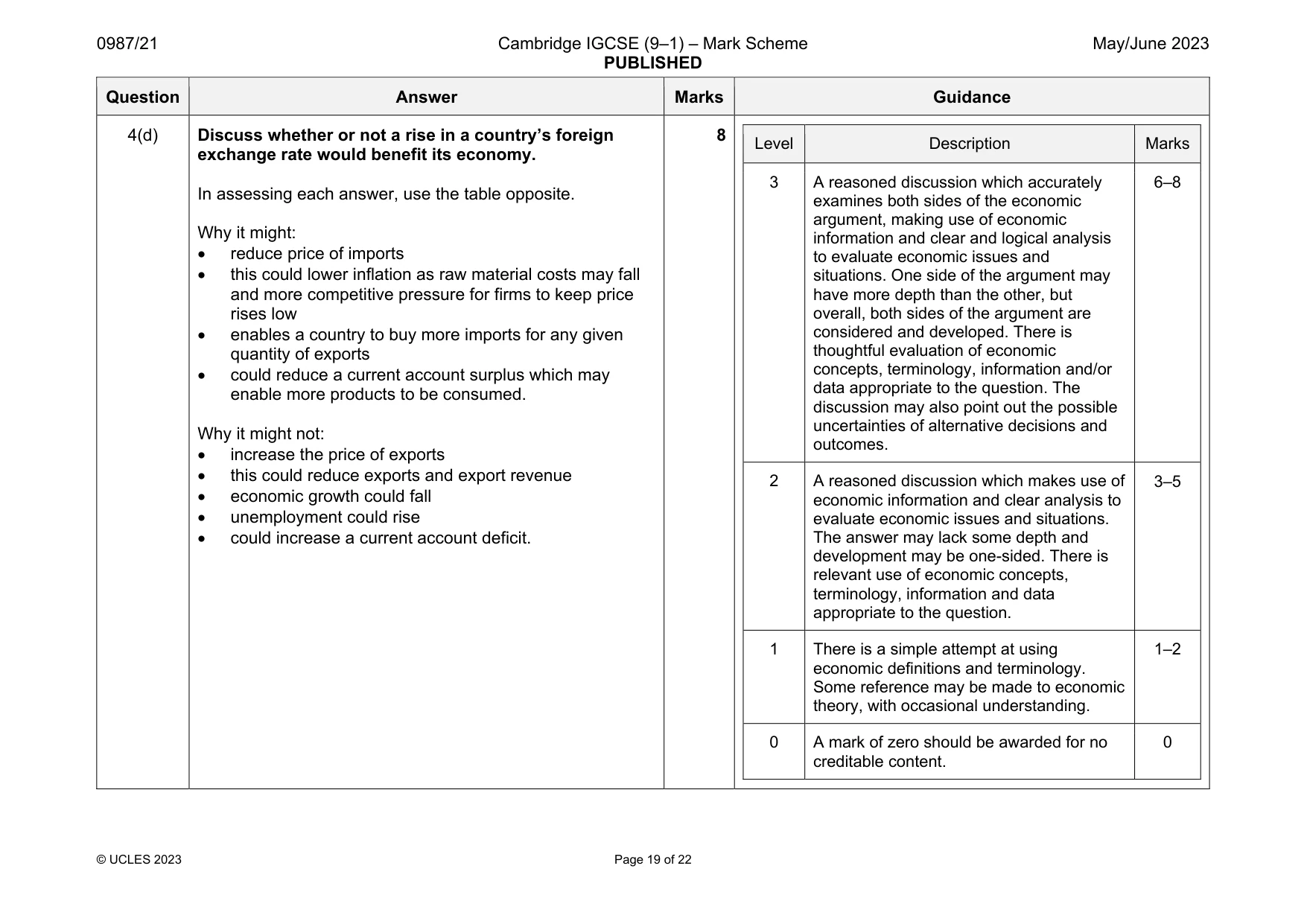
Mark scheme: 4(a) Identify two influences on which country a person decides to work in. Two from: wages / GDP per head working conditions job opportunities / job security qualifications required family ties language spoken immigration restrictions personal safety/ freedom from persecution living standards / cost of living better welfare / healthcare / education provision 2 If more than two influences are given, consider the first three. 4(b) Explain, with examples, the difference between a merit good and a public good. Logical explanation which might include: A merit good e.g. education / fruit (1) is beneficial / is under- consumed / people unaware of benefits / so underproduced without government intervention / government encourage consumption (1). A public good e.g. defence / streetlighting / police / sea defences / roads (1) would not be produced by the private sector / needs to be financed by the government/ non-rival/ non-excludable (1). 4 One mark each for each of two differences identified and one mark each for each of two examples Question Answer Marks Guidance 4(c) Analyse how an increase in government spending could increase life expectancy. Coherent analysis which might include increased government spending on: Healthcare (1) could raise quality / accessibility of healthcare (1). Education (1) may result in people leading healthier lives (1) more exercise (1) better nutrition (1). Benefits (1) may increase access to basic necessities / reduce poverty (1). Green energy (1) may reduce pollution (1). Infrastructure (1) could reduce traffic accidents (1) reduce traffic congestion (1) reduce stress (1). Police (1) reduces deaths through crime (1). Increased government spending (in total) (1) may increase employment / raise income / raise standards of living (1). 6 MAX of three marks for just identifying areas of government spending MAX of three marks for analysis of any single area of spending. One item analysed well MAX 4 marks. Question Answer Marks Guidance 4(d) Discuss whether or not a rise in a country’s foreign exchange rate would benefit its economy. In assessing each answer, use the table opposite. Why it might: reduce price of imports this could lower inflation as raw material costs may fall and more competitive pressure for firms to keep price rises low enables a country to buy more imports for any given quantity of exports could reduce a current account surplus which may enable more products to be consumed. Why it might not: increase the price of exports this could reduce exports and export revenue economic growth could fall unemployment could rise could increase a current account deficit. 8 Level Description Marks 3 A reasoned discussion which accurately examines both sides of the economic argument, making use of economic information and clear and logical analysis to evaluate economic issues and situations. One side of the argument may have more depth than the other, but overall, both sides of the argument are considered and developed. There is thoughtful evaluation of economic concepts, terminology, information and/or data appropriate to the question. The discussion may also point out the possible uncertainties of alternative decisions and outcomes. 6–8 2 A reasoned discussion which makes use of economic information and clear analysis to evaluate economic issues and situations. The answer may lack some depth and development may be one-sided. There is relevant use of economic concepts, terminology, information and data appropriate to the question. 3–5 1 There is a simple attempt at using economic definitions and terminology. Some reference may be made to economic theory, with occasional understanding. 1–2 0 A mark of zero should be awarded for no creditable content. 0
Q5 · In Greece, rich households spend more than the average household
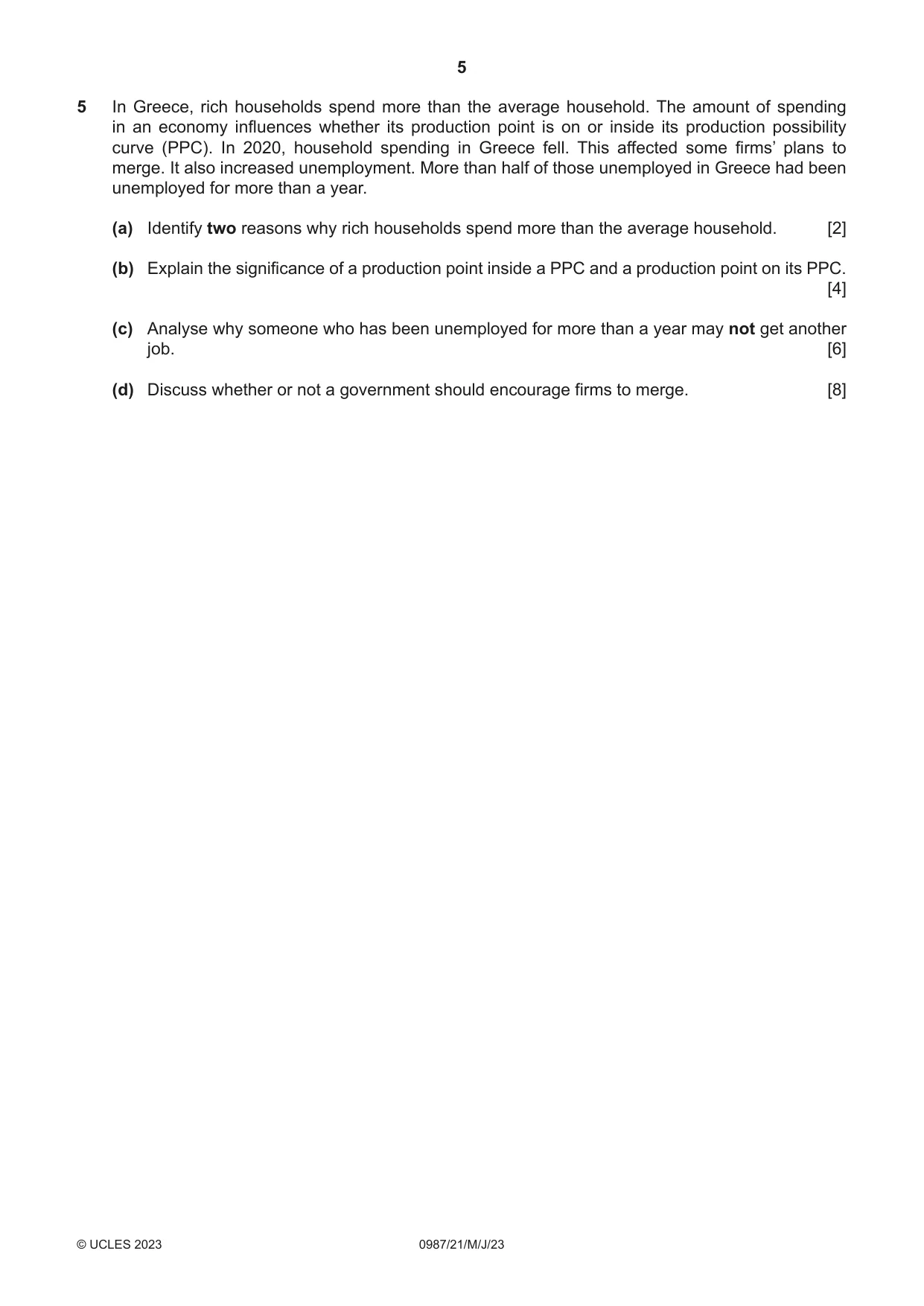
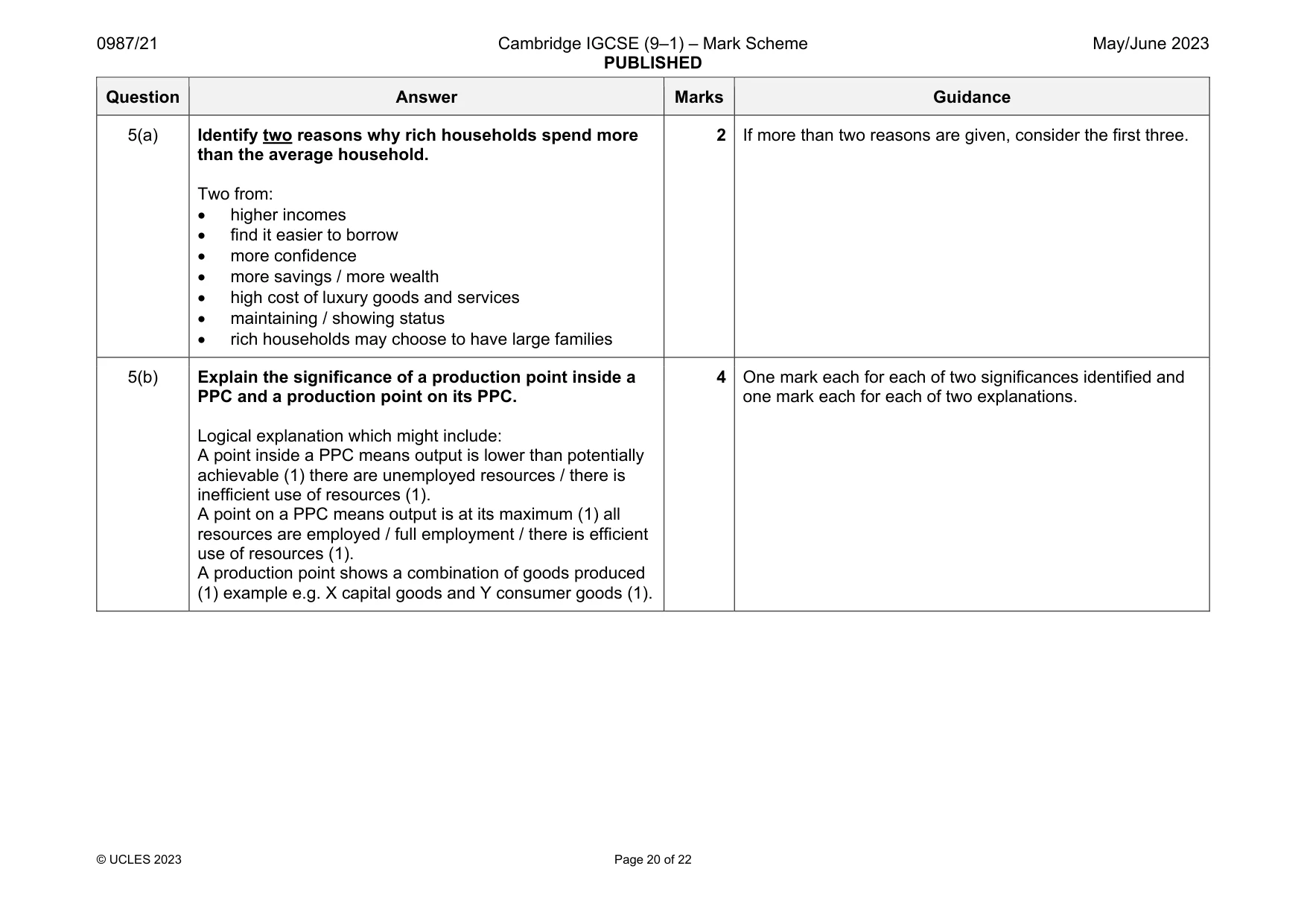
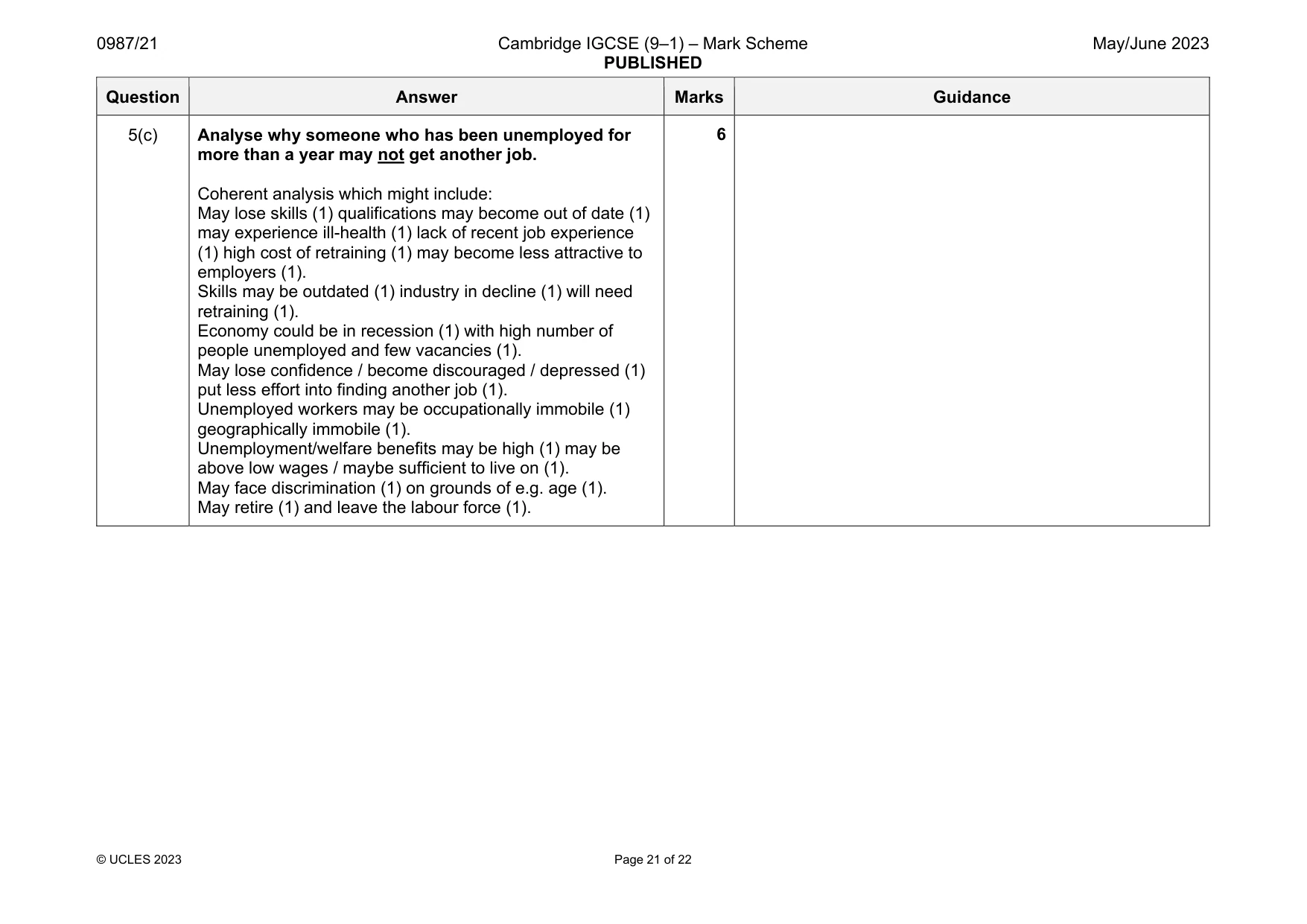
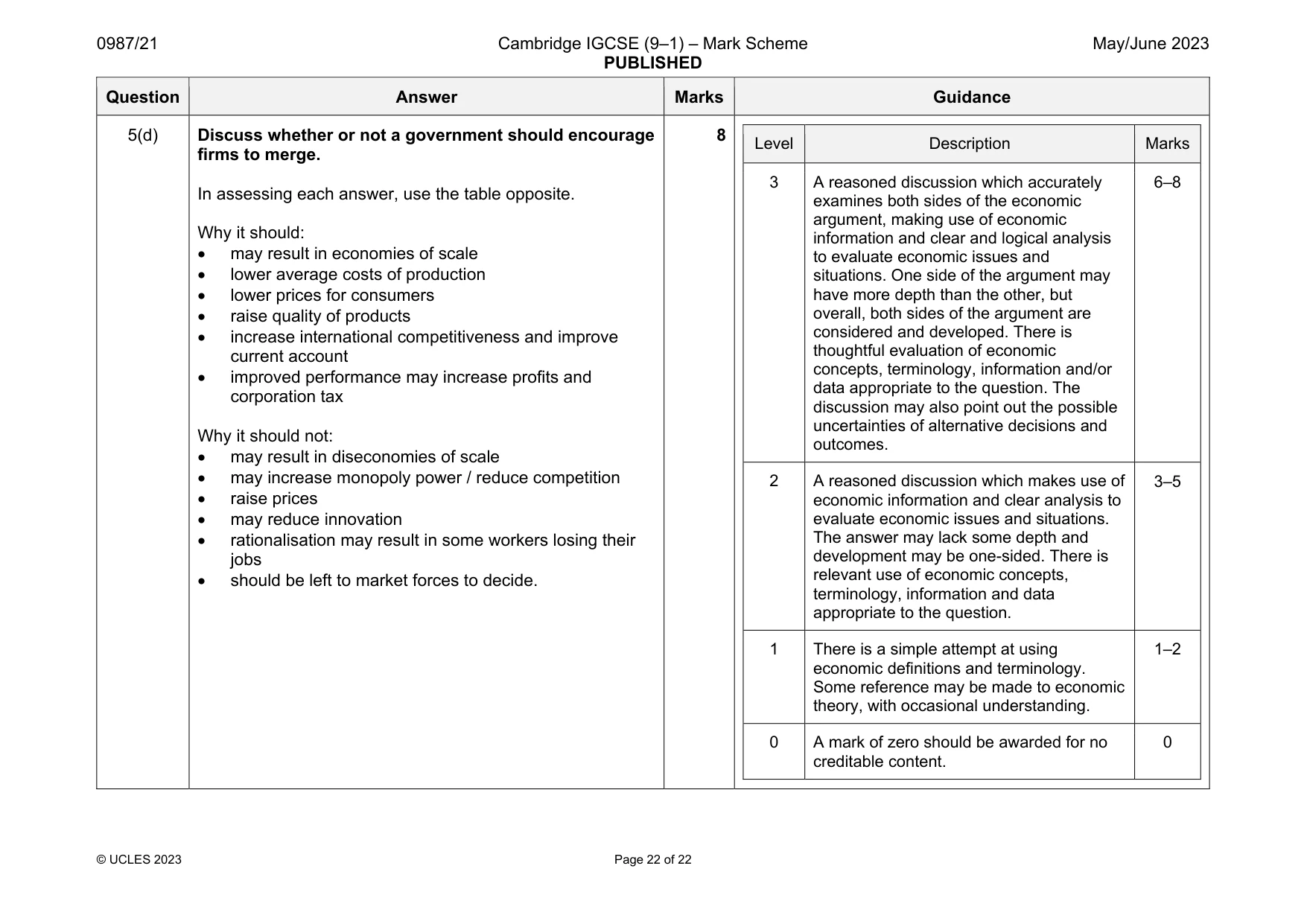
5 In Greece, rich households spend more than the average household. The amount of spending in an economy influences whether its production point is on or inside its production possibility curve (PPC). In 2020, household spending in Greece fell. This affected some firms’ plans to merge. It also increased unemployment. More than half of those unemployed in Greece had been unemployed for more than a year. (a) Identify two reasons why rich households spend more than the average household. [2] (b) Explain the significance of a production point inside a PPC and a production point on its PPC. [4] (c) Analyse why someone who has been unemployed for more than a year may not get another job. [6] (d) Discuss whether or not a government should encourage firms to merge. [8]
Mark scheme: 5(a) Identify two reasons why rich households spend more than the average household. Two from: higher incomes find it easier to borrow more confidence more savings / more wealth high cost of luxury goods and services maintaining / showing status rich households may choose to have large families 2 If more than two reasons are given, consider the first three. 5(b) Explain the significance of a production point inside a PPC and a production point on its PPC. Logical explanation which might include: A point inside a PPC means output is lower than potentially achievable (1) there are unemployed resources / there is inefficient use of resources (1). A point on a PPC means output is at its maximum (1) all resources are employed / full employment / there is efficient use of resources (1). A production point shows a combination of goods produced (1) example e.g. X capital goods and Y consumer goods (1). 4 One mark each for each of two significances identified and one mark each for each of two explanations. Question Answer Marks Guidance 5(c) Analyse why someone who has been unemployed for more than a year may not get another job. Coherent analysis which might include: May lose skills (1) qualifications may become out of date (1) may experience ill-health (1) lack of recent job experience (1) high cost of retraining (1) may become less attractive to employers (1). Skills may be outdated (1) industry in decline (1) will need retraining (1). Economy could be in recession (1) with high number of people unemployed and few vacancies (1). May lose confidence / become discouraged / depressed (1) put less effort into finding another job (1). Unemployed workers may be occupationally immobile (1) geographically immobile (1). Unemployment/welfare benefits may be high (1) may be above low wages / maybe sufficient to live on (1). May face discrimination (1) on grounds of e.g. age (1). May retire (1) and leave the labour force (1). 6 Question Answer Marks Guidance 5(d) Discuss whether or not a government should encourage firms to merge. In assessing each answer, use the table opposite. Why it should: may result in economies of scale lower average costs of production lower prices for consumers raise quality of products increase international competitiveness and improve current account improved performance may increase profits and corporation tax Why it should not: may result in diseconomies of scale may increase monopoly power / reduce competition raise prices may reduce innovation rationalisation may result in some workers losing their jobs should be left to market forces to decide. 8 Level Description Marks 3 A reasoned discussion which accurately examines both sides of the economic argument, making use of economic information and clear and logical analysis to evaluate economic issues and situations. One side of the argument may have more depth than the other, but overall, both sides of the argument are considered and developed. There is thoughtful evaluation of economic concepts, terminology, information and/or data appropriate to the question. The discussion may also point out the possible uncertainties of alternative decisions and outcomes. 6–8 2 A reasoned discussion which makes use of economic information and clear analysis to evaluate economic issues and situations. The answer may lack some depth and development may be one-sided. There is relevant use of economic concepts, terminology, information and data appropriate to the question. 3–5 1 There is a simple attempt at using economic definitions and terminology. Some reference may be made to economic theory, with occasional understanding. 1–2 0 A mark of zero should be awarded for no creditable content. 0
What was in this paper
The subtopics covered by these 5 questions, and how many questions each got. Open one in a new tab to see every Cambridge question on it.
What you needed in this session
Cambridge’s own grade thresholds for 2023 May/June, Paper 2 · Variant 1. A higher threshold means an easier paper — the bar moves with how the cohort did.