Questions as text
Q1 · Which changes usually result when a country develops and is able to provide free… 0987/11 May/June 2020
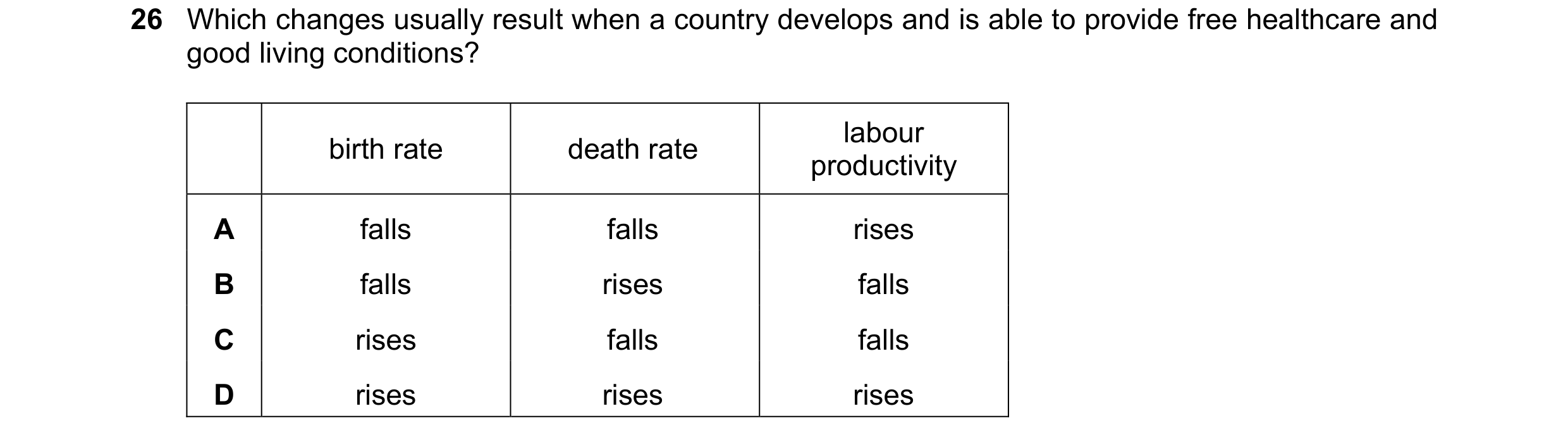
26 Which changes usually result when a country develops and is able to provide free healthcare and good living conditions? labour birth rate death rate productivity A falls falls rises B falls rises falls C rises falls falls D rises rises rises
1 marks
Answer: A
This question in 0987/11 May/June 2020
Q2 · Which changes usually result when a country develops and is able to provide free… 0987/12 May/June 2020
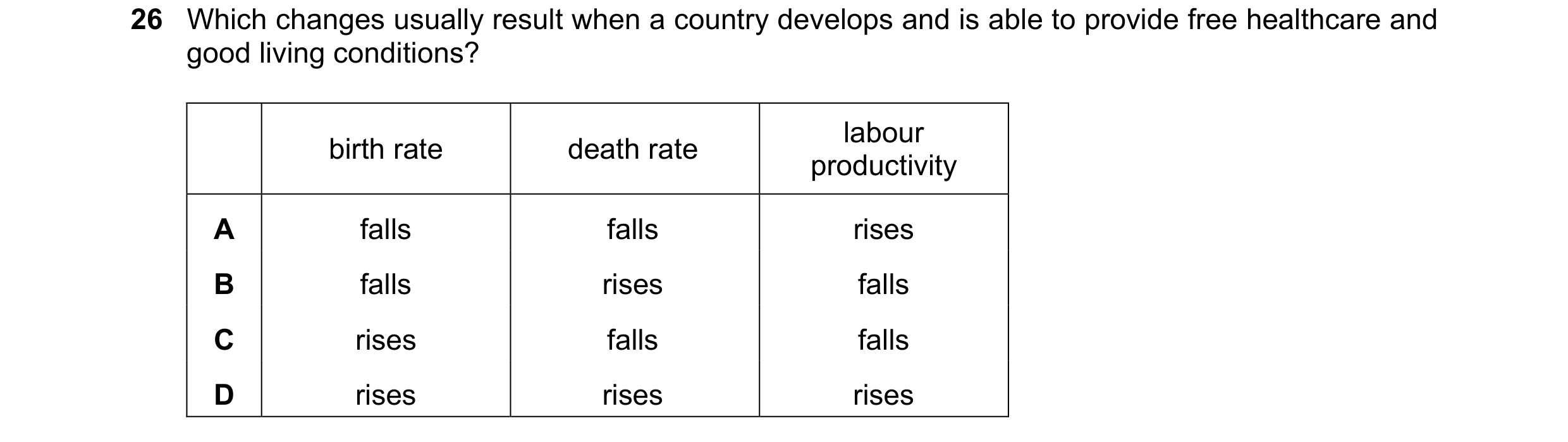
26 Which changes usually result when a country develops and is able to provide free healthcare and good living conditions? labour birth rate death rate productivity A falls falls rises B falls rises falls C rises falls falls D rises rises rises
1 marks
Answer: A
This question in 0987/12 May/June 2020
Q3 · What causes the birth rate to fall in a country? 0987/12 Oct/Nov 2020
27 What causes the birth rate to fall in a country? A Fewer women work. B Infant mortality rates rise. C Medical supplies and healthcare improve. D The optimum population increases.
1 marks
Answer: C
This question in 0987/12 Oct/Nov 2020
Q4 · The diagrams show birth rate (BR) and death rate (DR) in three countries, X, Y and Z, in… 0987/11 May/June 2021
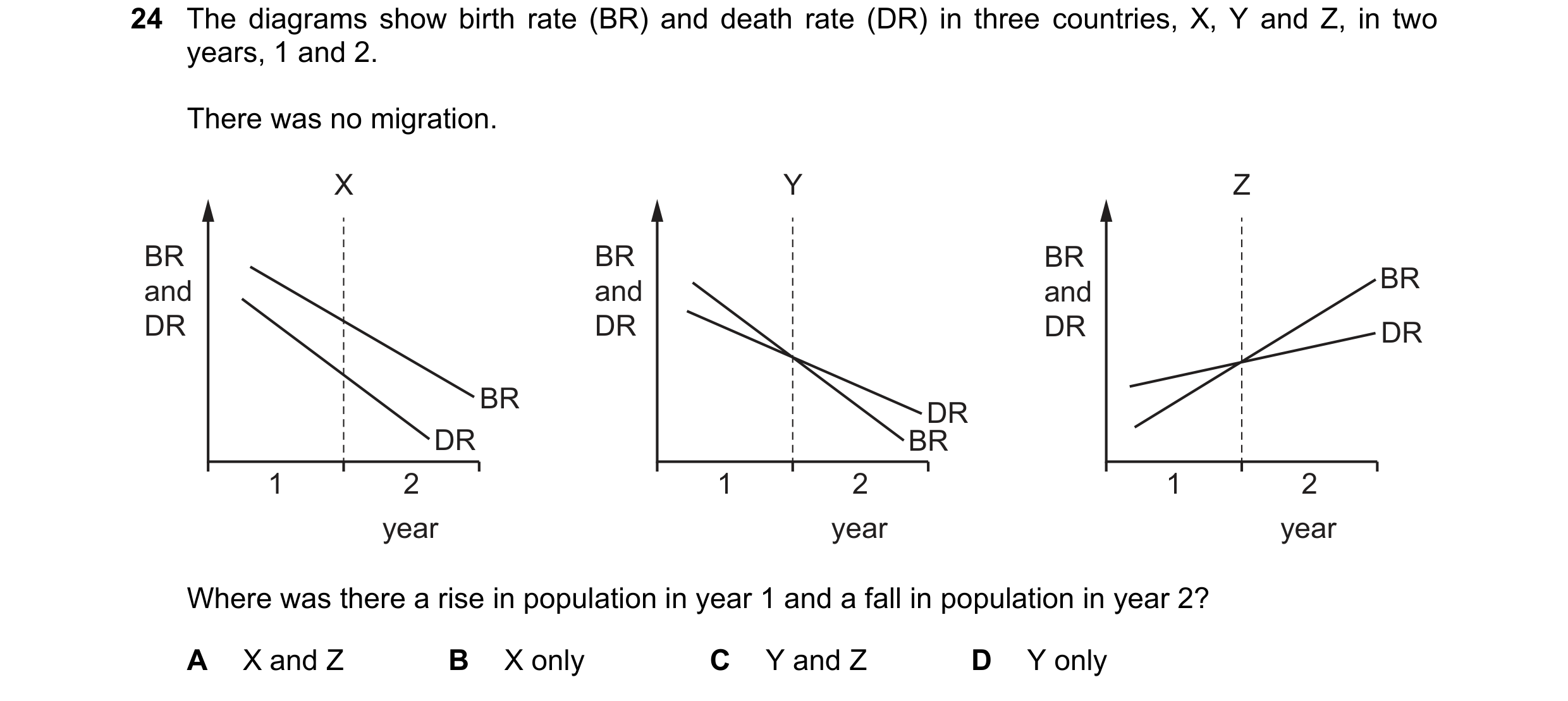
24 The diagrams show birth rate (BR) and death rate (DR) in three countries, X, Y and Z, in two years, 1 and 2. There was no migration. X Y Z BR BR BR and and BR and DR DR DR DR BR DR DR BR 1 2 1 2 1 2 year year year Where was there a rise in population in year 1 and a fall in population in year 2? A X and Z B X only C Y and Z D Y only
1 marks
Answer: D
This question in 0987/11 May/June 2021
Q5 · The diagrams show birth rate (BR) and death rate (DR) in three countries, X, Y and Z, in… 0987/12 May/June 2021
24 The diagrams show birth rate (BR) and death rate (DR) in three countries, X, Y and Z, in two years, 1 and 2. There was no migration. X Y Z BR BR BR and and BR and DR DR DR DR BR DR DR BR 1 2 1 2 1 2 year year year Where was there a rise in population in year 1 and a fall in population in year 2? A X and Z B X only C Y and Z D Y only
1 marks
Answer: D
This question in 0987/12 May/June 2021
Q6 · What is the effect on an economy of net emigration of people aged 20–40? 0987/12 Oct/Nov 2021
25 What is the effect on an economy of net emigration of people aged 20–40? A a more mobile labour force B an ageing population C higher government tax revenue D rising house prices
1 marks
Answer: B
This question in 0987/12 Oct/Nov 2021
Q7 · What is likely to cause an immediate decrease in the size of the labour force? 0987/11 May/June 2022
30 What is likely to cause an immediate decrease in the size of the labour force? A a fall in the average size of families B a fall in the birth rate C a reduction in the age of retirement D an increase in net immigration
1 marks
Answer: C
This question in 0987/11 May/June 2022
Q8 · Other things being equal, what will cause a population both to increase and to age? 0987/11 May/June 2023
25 Other things being equal, what will cause a population both to increase and to age? A a fall in the birth rate B a fall in the death rate C a rise in both the birth rate and the death rate D a rise in the death rate and a fall in the birth rate
1 marks
Answer: B
This question in 0987/11 May/June 2023
Q9 · The economy of country X is always on its production possibility curve (PPC) 0987/12 Oct/Nov 2023
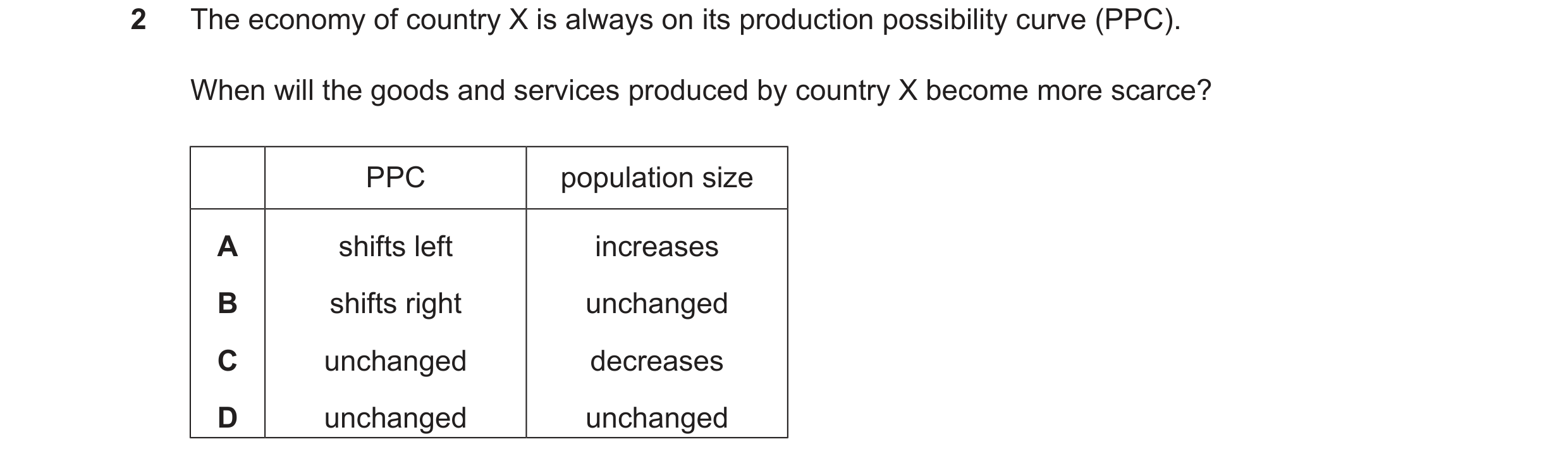
2 The economy of country X is always on its production possibility curve (PPC). When will the goods and services produced by country X become more scarce? PPC population size A shifts left increases B shifts right unchanged C unchanged decreases D unchanged unchanged
1 marks
Answer: A
This question in 0987/12 Oct/Nov 2023
Q10 · What is the most likely consequence of an ageing population for a high-income economy? 0987/12 Oct/Nov 2023
25 What is the most likely consequence of an ageing population for a high-income economy? A There will be a fall in the dependency ratio. B There will be a fall in the level of immigration. C There will be an increase in geographic mobility. D There will be an increase in spending on healthcare.
1 marks
Answer: D
This question in 0987/12 Oct/Nov 2023
Q11 · Which change is most likely to cause faster economic growth in the short run? 0987/12 May/June 2024
21 Which change is most likely to cause faster economic growth in the short run? A an increase in net emigration B an increase in the birth rate C an increase in the death rate D an increase in the retirement age
1 marks
Answer: D
This question in 0987/12 May/June 2024
Q12 · A rise in which factor would cause an increase in the population growth rate of a country? 0987/12 May/June 2024
26 A rise in which factor would cause an increase in the population growth rate of a country? A birth rate B death rate C infant mortality rate D net emigration
1 marks
Answer: A
This question in 0987/12 May/June 2024
Q13 · The table contains details on birth rate, death rate and net migration for several… 0987/12 Oct/Nov 2024
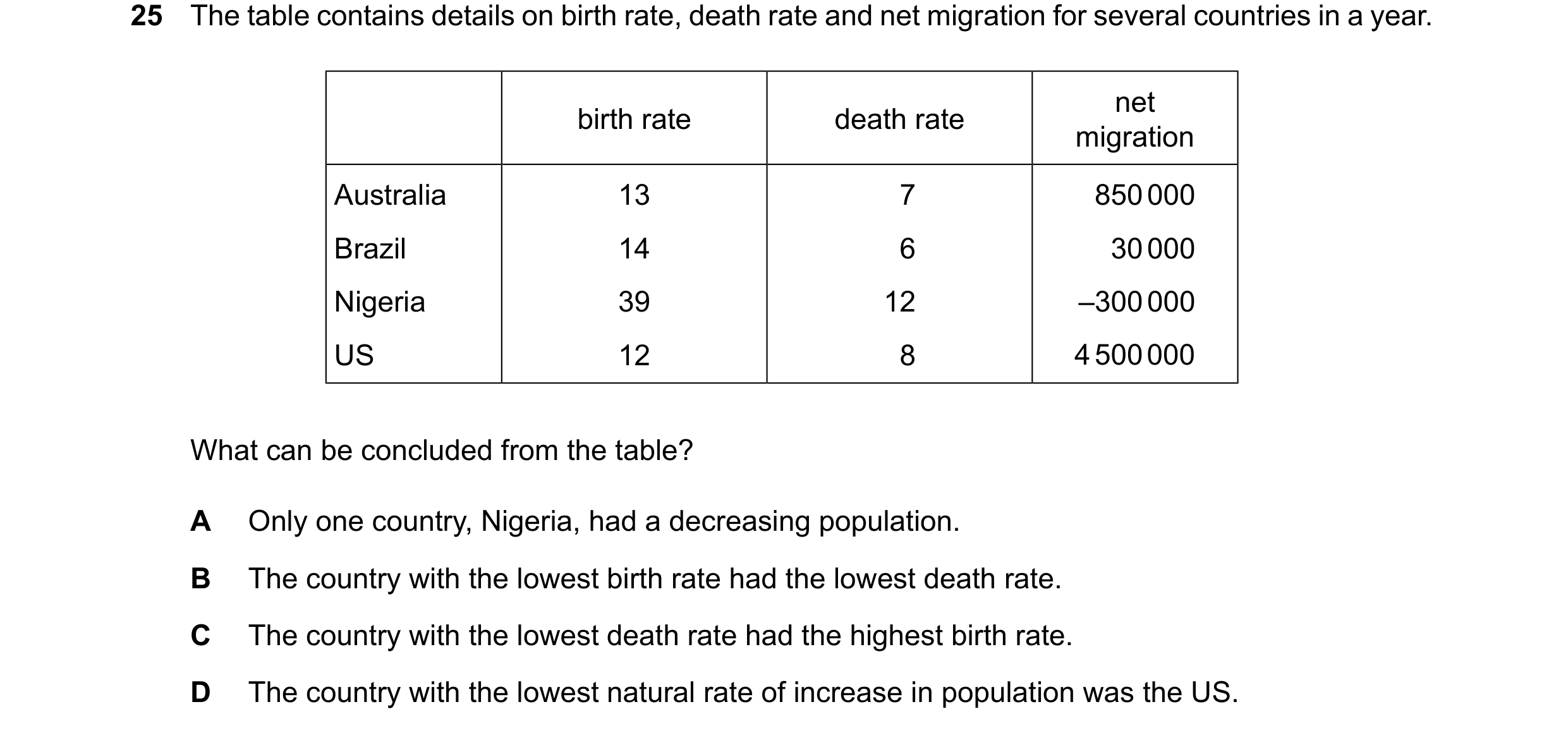
25 The table contains details on birth rate, death rate and net migration for several countries in a year. net birth rate death rate migration Australia 13 7 850 000 Brazil 14 6 30 000 Nigeria 39 12 –300 000 US 12 8 4 500 000 What can be concluded from the table? A Only one country, Nigeria, had a decreasing population. B The country with the lowest birth rate had the lowest death rate. C The country with the lowest death rate had the highest birth rate. D The country with the lowest natural rate of increase in population was the US.
1 marks
Answer: D
This question in 0987/12 Oct/Nov 2024
Q14 · Which combination of statistics is used to calculate the natural population growth of a… 0987/11 May/June 2025
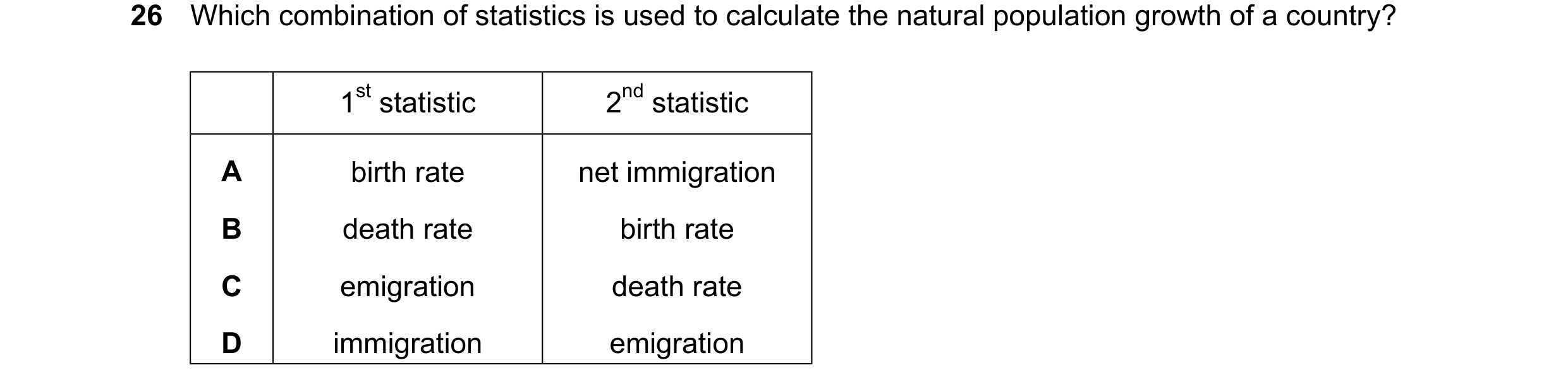
26 Which combination of statistics is used to calculate the natural population growth of a country? 1st statistic 2nd statistic A birth rate net immigration B death rate birth rate C emigration death rate D immigration emigration
1 marks
Answer: B
This question in 0987/11 May/June 2025
Q15 · Japan’s population has an increasing proportion of elderly people 0987/12 May/June 2025
26 Japan’s population has an increasing proportion of elderly people. What is the likely impact of this on the Japanese economy? A increased government budget deficit B increased rate of economic growth C increased rate of emigration D increased use of labour-intensive methods of production
1 marks
Answer: A
This question in 0987/12 May/June 2025
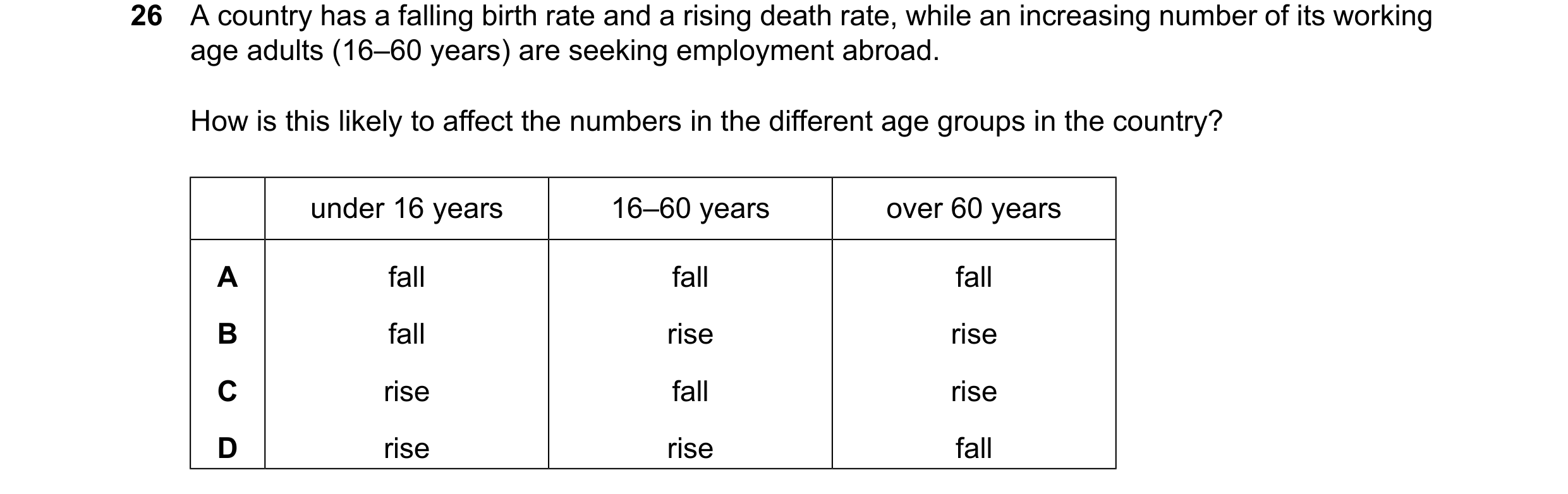
Q16 · A country has a falling birth rate and a rising death rate, while an increasing number of… 0987/12 Oct/Nov 2025
26 A country has a falling birth rate and a rising death rate, while an increasing number of its working age adults (16–60 years) are seeking employment abroad. How is this likely to affect the numbers in the different age groups in the country? under 16 years 16–60 years over 60 years A fall fall fall B fall rise rise C rise fall rise D rise rise fall
1 marks
Answer: A
This question in 0987/12 Oct/Nov 2025

 1 / 4
1 / 4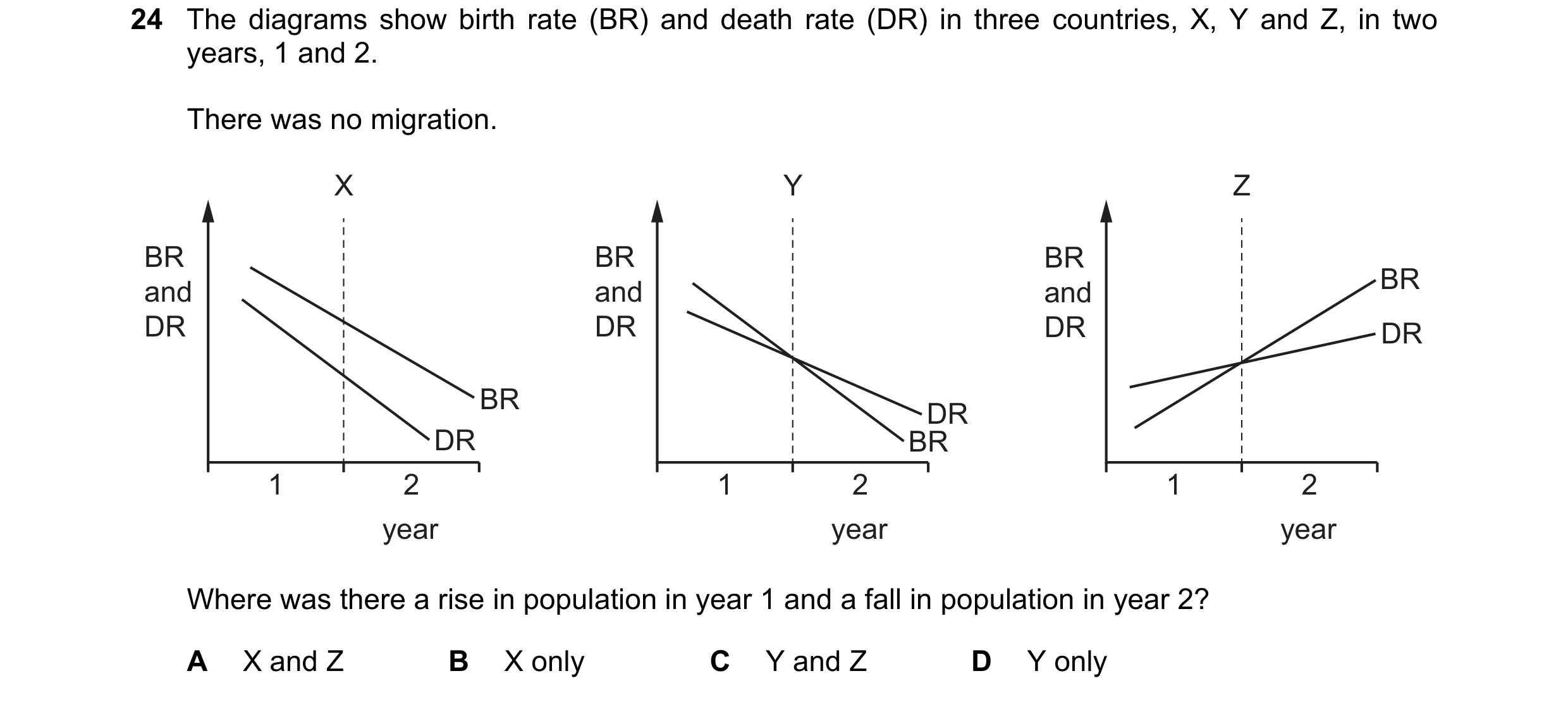



 2 / 4
2 / 4


 3 / 4
3 / 4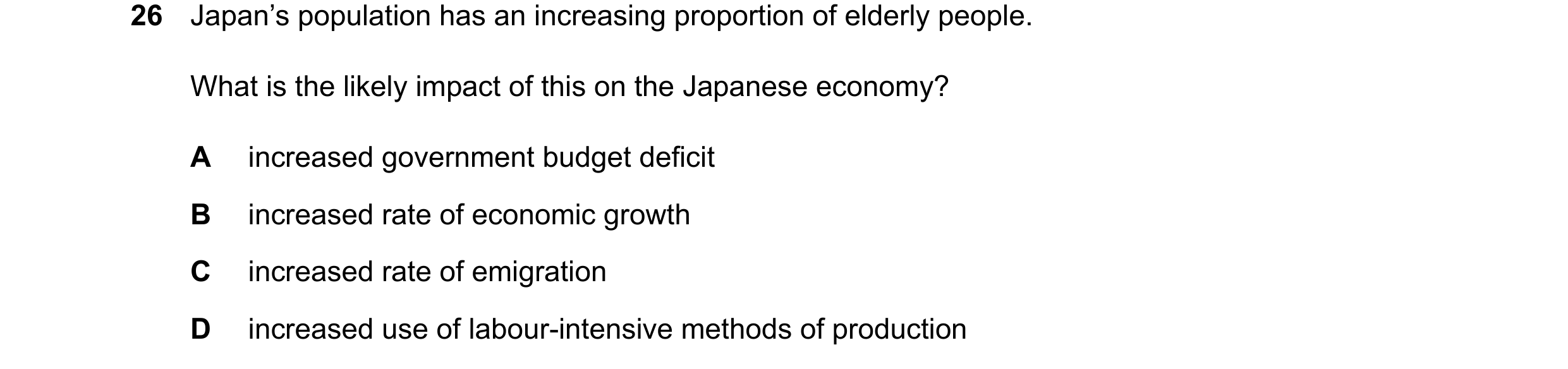
 4 / 4
4 / 4