Questions as text
Q1 · What would not be required in the construction of an index of consumer prices? 0987/11 May/June 2020
22 What would not be required in the construction of an index of consumer prices? A the selection of a base year B the selection of a representative range of items C the calculation of average wage levels D the weighting of each item in the index
1 marks
Answer: C
This question in 0987/11 May/June 2020
Q2 · The table gives information about three economic indicators in four countries 0987/11 May/June 2020
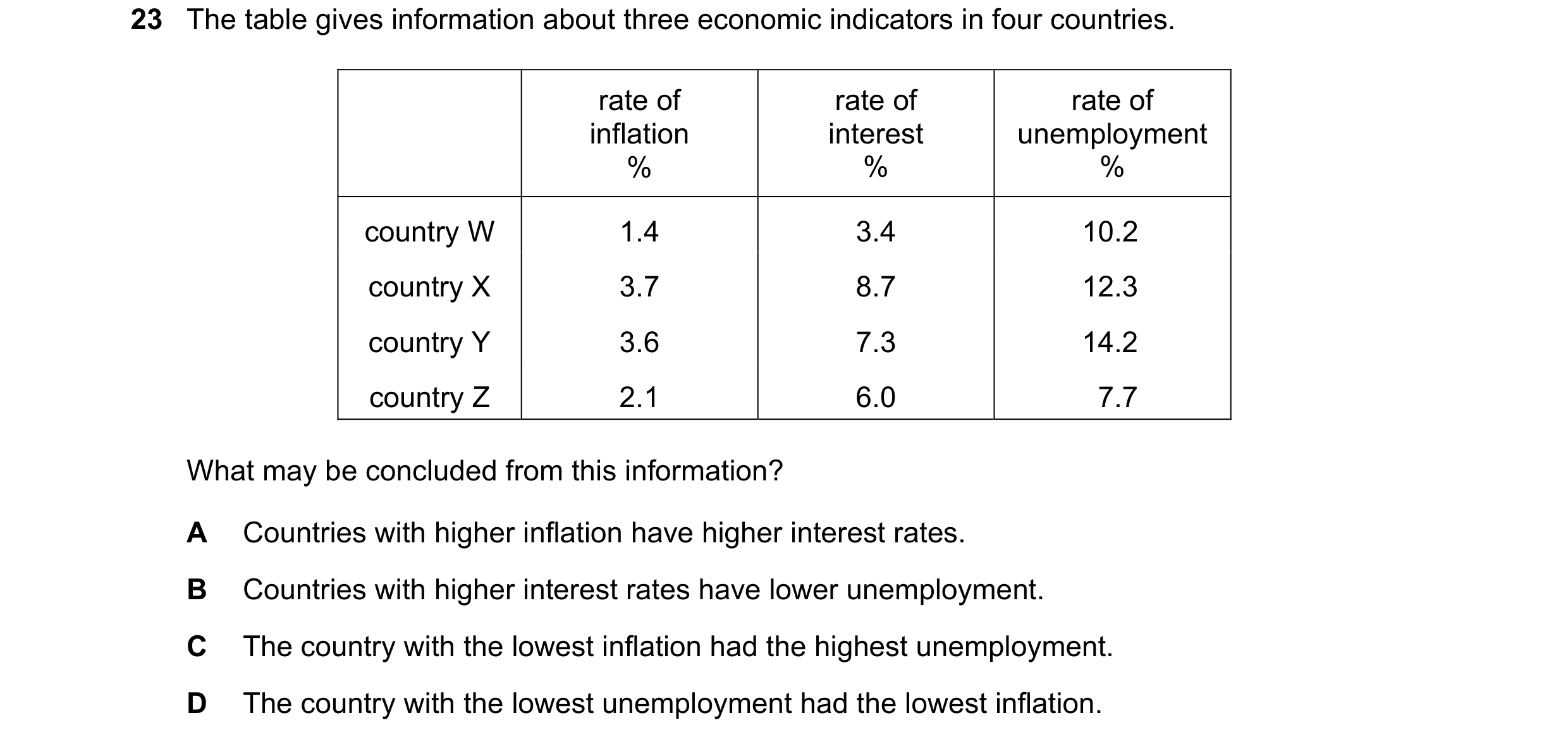
23 The table gives information about three economic indicators in four countries. rate of rate of rate of inflation interest unemployment % % % country W 1.4 3.4 10.2 country X 3.7 8.7 12.3 country Y 3.6 7.3 14.2 country Z 2.1 6.0 7.7 What may be concluded from this information? A Countries with higher inflation have higher interest rates. B Countries with higher interest rates have lower unemployment. C The country with the lowest inflation had the highest unemployment. D The country with the lowest unemployment had the lowest inflation.
1 marks
Answer: A
This question in 0987/11 May/June 2020
Q3 · What would not be required in the construction of an index of consumer prices? 0987/12 May/June 2020
22 What would not be required in the construction of an index of consumer prices? A the selection of a base year B the selection of a representative range of items C the calculation of average wage levels D the weighting of each item in the index
1 marks
Answer: C
This question in 0987/12 May/June 2020
Q4 · Some goods take a greater percentage of a typical household’s total spending than others 0987/12 Oct/Nov 2020
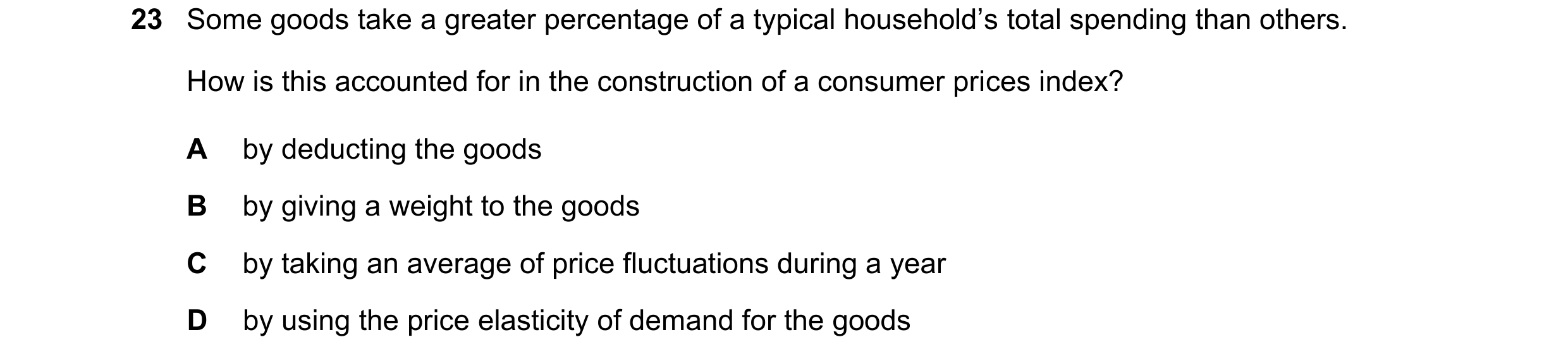
23 Some goods take a greater percentage of a typical household’s total spending than others. How is this accounted for in the construction of a consumer prices index? A by deducting the goods B by giving a weight to the goods C by taking an average of price fluctuations during a year D by using the price elasticity of demand for the goods
1 marks
Answer: B
This question in 0987/12 Oct/Nov 2020
Q5 · An economy has a high rate of inflation 0987/11 May/June 2021
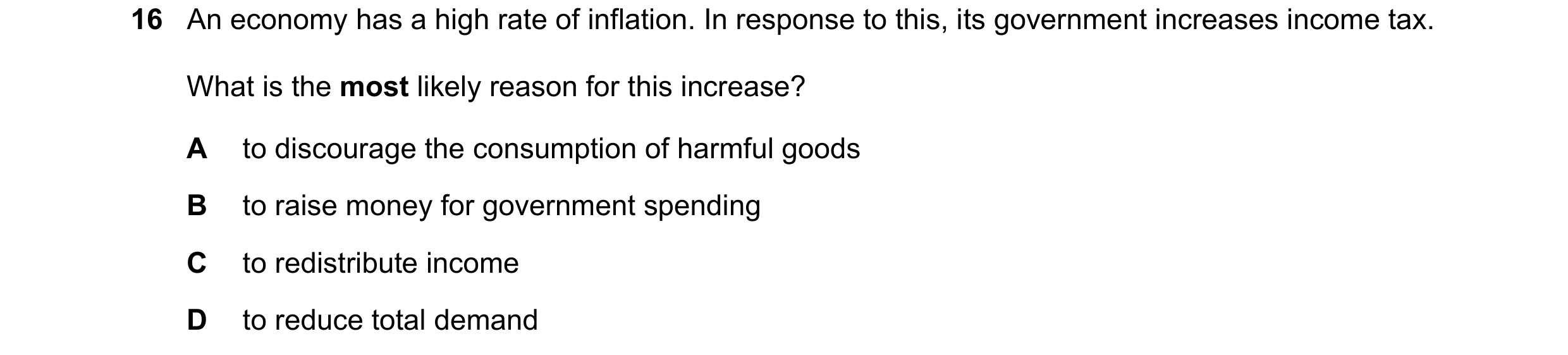
16 An economy has a high rate of inflation. In response to this, its government increases income tax. What is the most likely reason for this increase? A to discourage the consumption of harmful goods B to raise money for government spending C to redistribute income D to reduce total demand
1 marks
Answer: D
This question in 0987/11 May/June 2021
Q6 · Interest rates are sometimes raised to control inflation 0987/11 May/June 2021
17 Interest rates are sometimes raised to control inflation. Why might this policy be effective? A Consumers may save more. B Government spending may increase. C Investment may be encouraged. D The exchange rate may fall.
1 marks
Answer: A
This question in 0987/11 May/June 2021
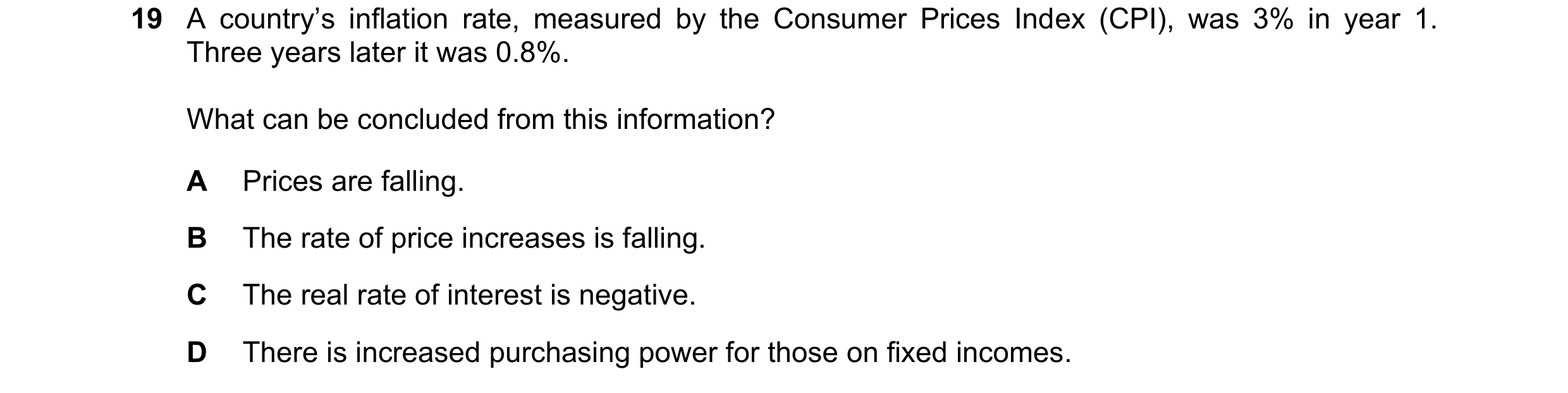
Q7 · A country’s inflation rate, measured by the Consumer Prices Index (CPI), was 3% in year 1 0987/11 May/June 2021
19 A country’s inflation rate, measured by the Consumer Prices Index (CPI), was 3% in year 1. Three years later it was 0.8%. What can be concluded from this information? A Prices are falling. B The rate of price increases is falling. C The real rate of interest is negative. D There is increased purchasing power for those on fixed incomes.
1 marks
Answer: B
This question in 0987/11 May/June 2021
Q8 · What will deflation most likely lead to? 0987/11 May/June 2021
20 What will deflation most likely lead to? A a fall in the real value of debts B an increase in the exchange rate C an increase in the rate of interest D an increase in the real purchasing power of money
1 marks
Answer: D
This question in 0987/11 May/June 2021
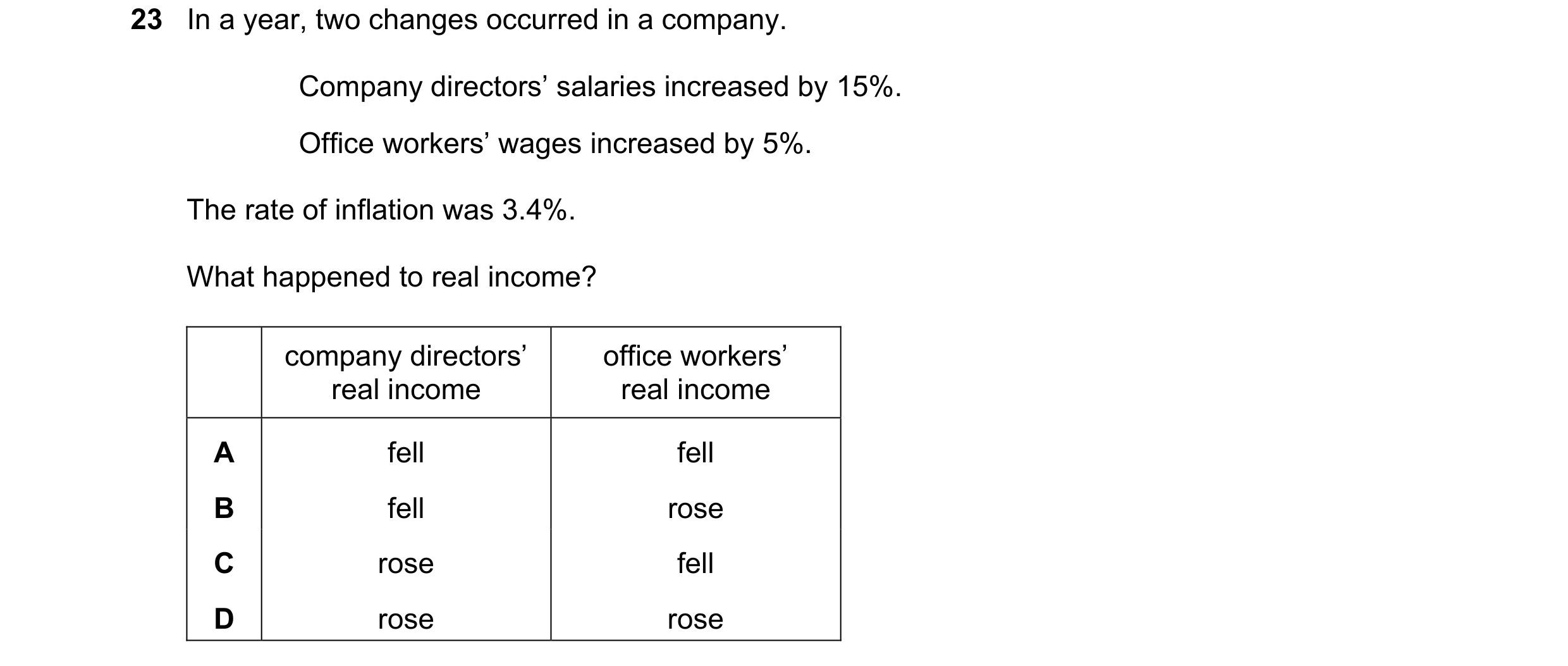
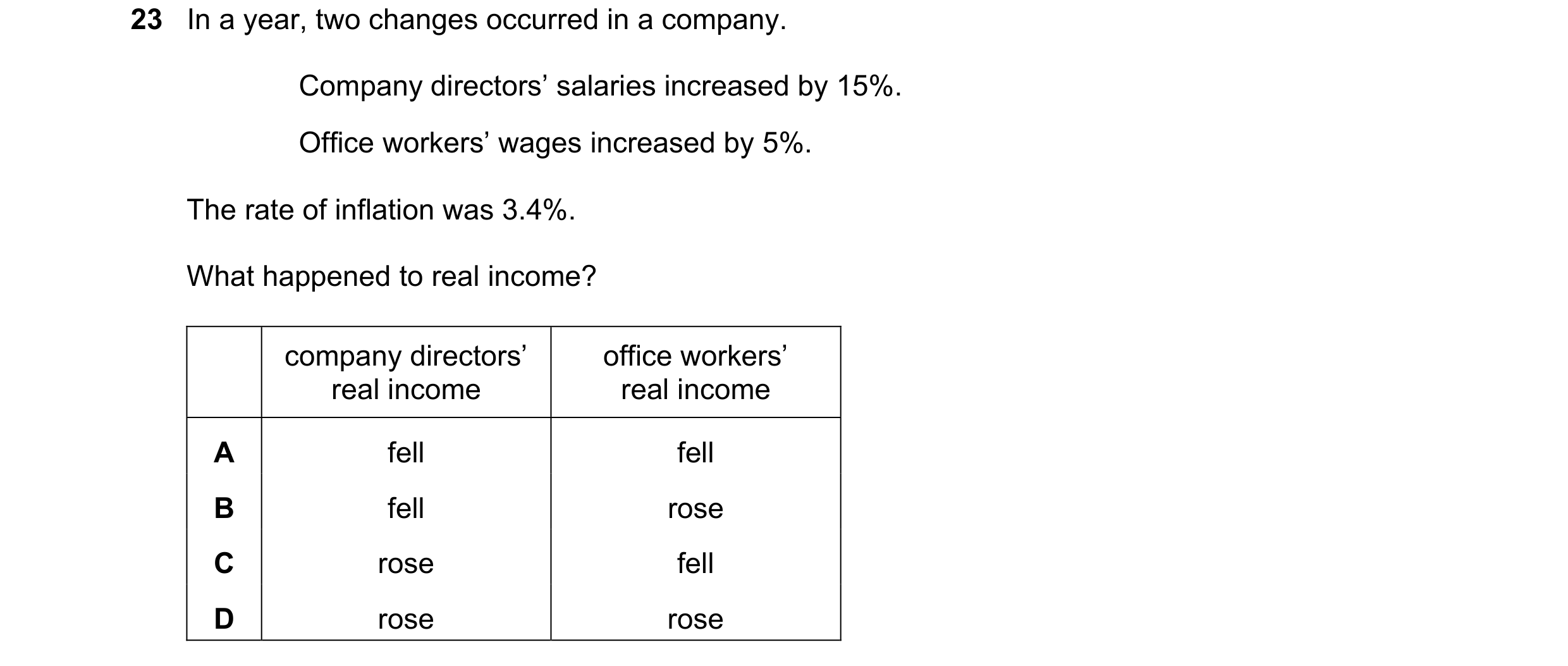
Q9 · In a year, two changes occurred in a company 0987/11 May/June 2021
23 In a year, two changes occurred in a company. Company directors’ salaries increased by 15%. Office workers’ wages increased by 5%. The rate of inflation was 3.4%. What happened to real income? company directors’ office workers’ real income real income A fell fell B fell rose C rose fell D rose rose
1 marks
Answer: D
This question in 0987/11 May/June 2021
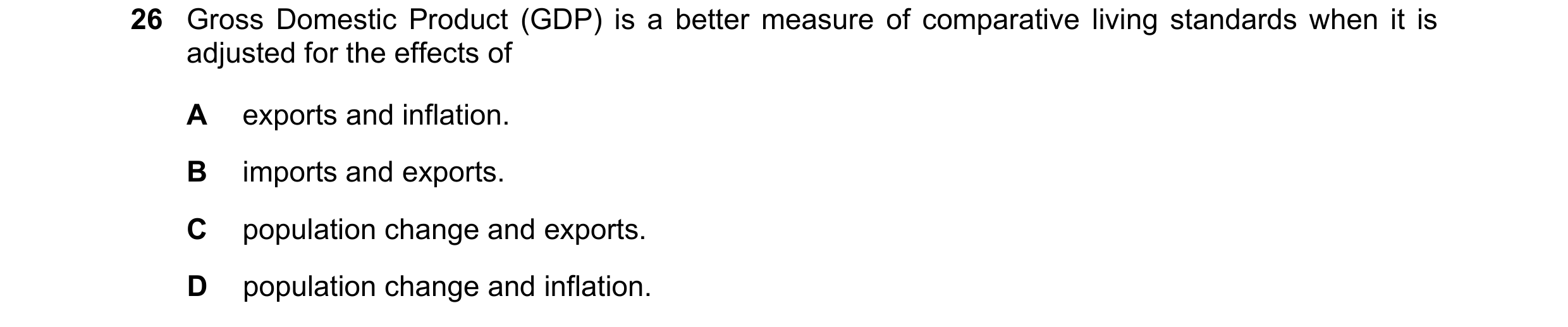
Q10 · Gross Domestic Product (GDP) is a better measure of comparative living standards when it… 0987/11 May/June 2021
26 Gross Domestic Product (GDP) is a better measure of comparative living standards when it is adjusted for the effects of A exports and inflation. B imports and exports. C population change and exports. D population change and inflation.
1 marks
Answer: D
This question in 0987/11 May/June 2021
Q11 · The table shows changes in the Consumer Prices Index (CPI) from the base year, 1, and for… 0987/12 May/June 2021
19 The table shows changes in the Consumer Prices Index (CPI) from the base year, 1, and for the next three years. year 1 2 3 4 CPI 100 101.1 101.8 102.1 Which statement is correct? A Consumer prices were highest in year 3. B The rate of inflation was 2.1% in year 4. C The rate of inflation was highest in year 2. D The rate of inflation was lowest in year 1.
1 marks
Answer: C
This question in 0987/12 May/June 2021
Q12 · What is likely to happen when a country is experiencing deflation? 0987/12 May/June 2021
20 What is likely to happen when a country is experiencing deflation? A Consumers delay spending. B Governments raise interest rates. C The level of imports increases. D The real value of money falls.
1 marks
Answer: A
This question in 0987/12 May/June 2021
Q13 · In a year, two changes occurred in a company 0987/12 May/June 2021
23 In a year, two changes occurred in a company. Company directors’ salaries increased by 15%. Office workers’ wages increased by 5%. The rate of inflation was 3.4%. What happened to real income? company directors’ office workers’ real income real income A fell fell B fell rose C rose fell D rose rose
1 marks
Answer: D
This question in 0987/12 May/June 2021
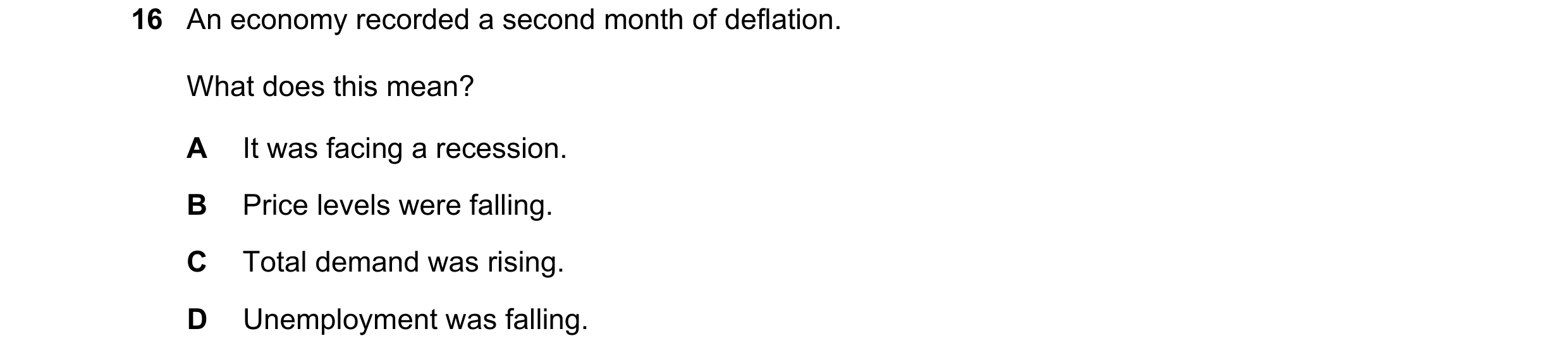
Q14 · An economy recorded a second month of deflation 0987/12 Oct/Nov 2021
16 An economy recorded a second month of deflation. What does this mean? A It was facing a recession. B Price levels were falling. C Total demand was rising. D Unemployment was falling.
1 marks
Answer: B
This question in 0987/12 Oct/Nov 2021
Q15 · What is a cause of demand-pull inflation? 0987/12 Oct/Nov 2021
17 What is a cause of demand-pull inflation? A a surplus of skilled labour B higher government expenditure C higher tax rates D lower net exports
1 marks
Answer: B
This question in 0987/12 Oct/Nov 2021
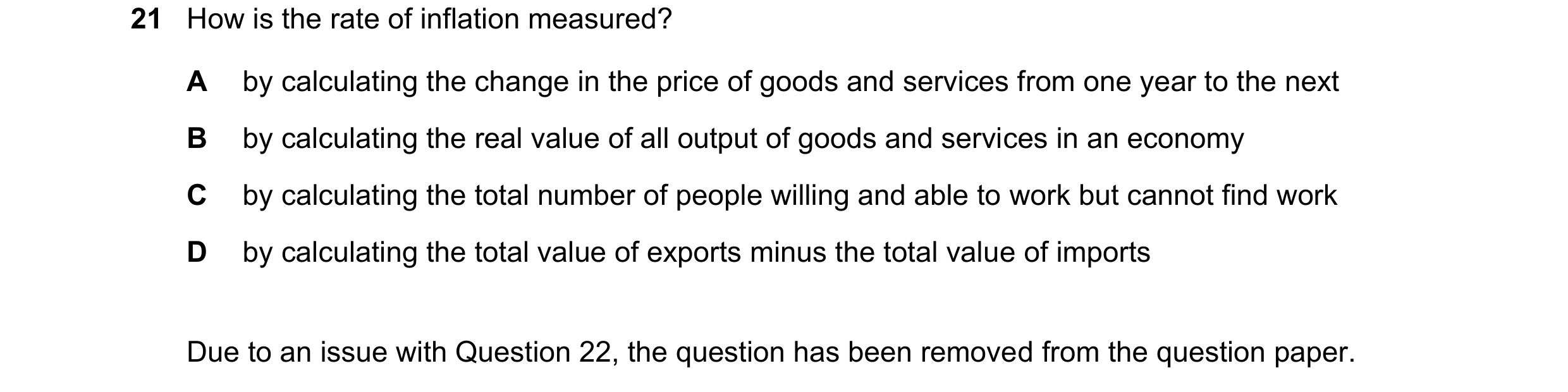
Q16 · How is the rate of inflation measured? 0987/12 Oct/Nov 2021
21 How is the rate of inflation measured? A by calculating the change in the price of goods and services from one year to the next B by calculating the real value of all output of goods and services in an economy C by calculating the total number of people willing and able to work but cannot find work D by calculating the total value of exports minus the total value of imports Due to an issue with Question 22, the question has been removed from the question paper.
1 marks
Answer: A
This question in 0987/12 Oct/Nov 2021
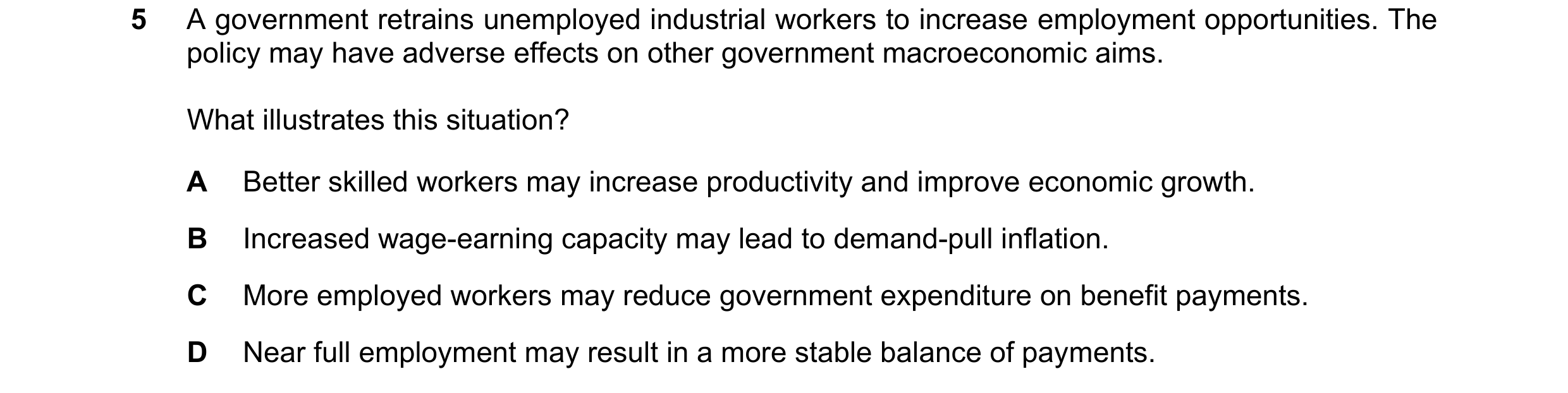
Q17 · A government retrains unemployed industrial workers to increase employment opportunities 0987/11 May/June 2022
5 A government retrains unemployed industrial workers to increase employment opportunities. The policy may have adverse effects on other government macroeconomic aims. What illustrates this situation? A Better skilled workers may increase productivity and improve economic growth. B Increased wage-earning capacity may lead to demand-pull inflation. C More employed workers may reduce government expenditure on benefit payments. D Near full employment may result in a more stable balance of payments.
1 marks
Answer: B
This question in 0987/11 May/June 2022
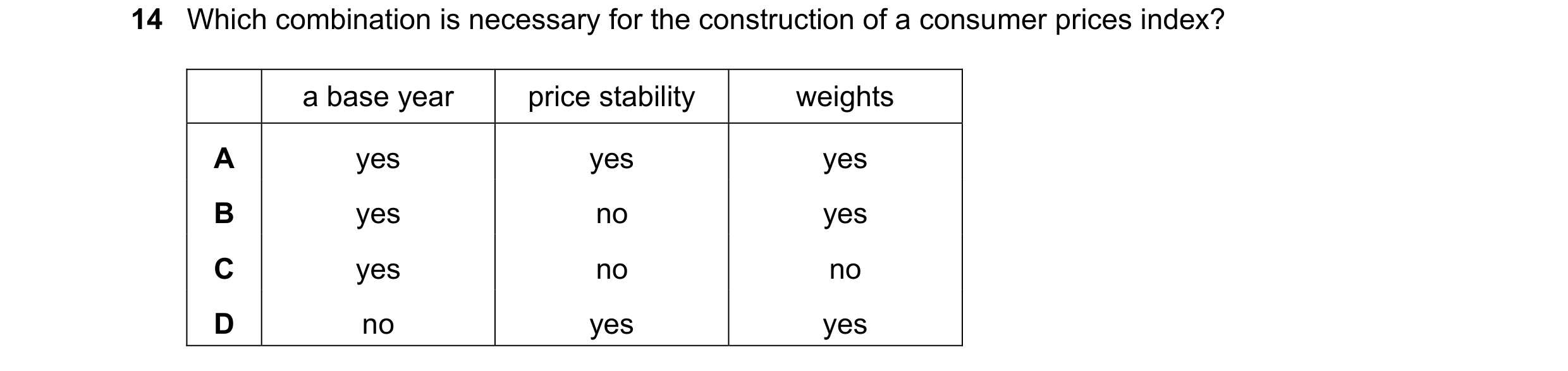
Q18 · Which combination is necessary for the construction of a consumer prices index? 0987/11 May/June 2022
14 Which combination is necessary for the construction of a consumer prices index? a base year price stability weights A yes yes yes B yes no yes C yes no no D no yes yes
1 marks
Answer: B
This question in 0987/11 May/June 2022
Q19 · Which topic is not included in microeconomics? 0987/11 May/June 2022
29 Which topic is not included in microeconomics? A consumer demand B economies of scale C forms of competition D inflation
1 marks
Answer: D
This question in 0987/11 May/June 2022
Q20 · A country wishes to reduce the level of inflation 0987/12 May/June 2022
22 A country wishes to reduce the level of inflation. Which combination of policy measures will be most successful? policy measure 1 policy measure 2 A decrease exchange rates increase interest rates B decrease interest rates increase exchange rates C increase government spending decrease interest rates D increase interest rates decrease government spending
1 marks
Answer: D
This question in 0987/12 May/June 2022
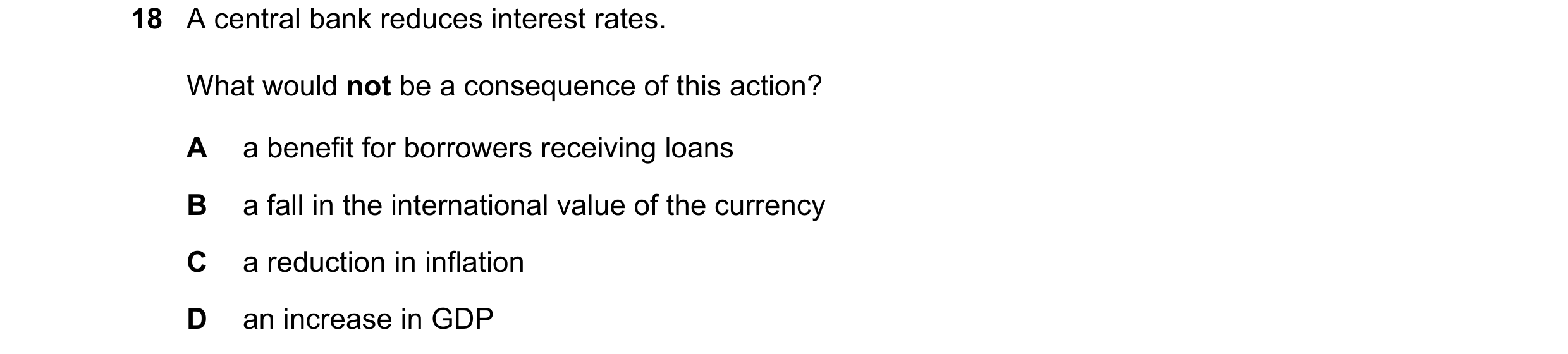
Q21 · A central bank reduces interest rates 0987/12 Oct/Nov 2022
18 A central bank reduces interest rates. What would not be a consequence of this action? A a benefit for borrowers receiving loans B a fall in the international value of the currency C a reduction in inflation D an increase in GDP
1 marks
Answer: C
This question in 0987/12 Oct/Nov 2022
Q22 · What is most likely to cause inflation? 0987/12 Oct/Nov 2022
22 What is most likely to cause inflation? A a reduction in exports B a reduction in government spending C an increase in the rate of interest D an increase in trade union power
1 marks
Answer: D
This question in 0987/12 Oct/Nov 2022
Q23 · What would be least likely to act as a store of value during a period of rapid inflation? 0987/11 May/June 2023
11 What would be least likely to act as a store of value during a period of rapid inflation? A cash B gold C property D shares
1 marks
Answer: A
This question in 0987/11 May/June 2023
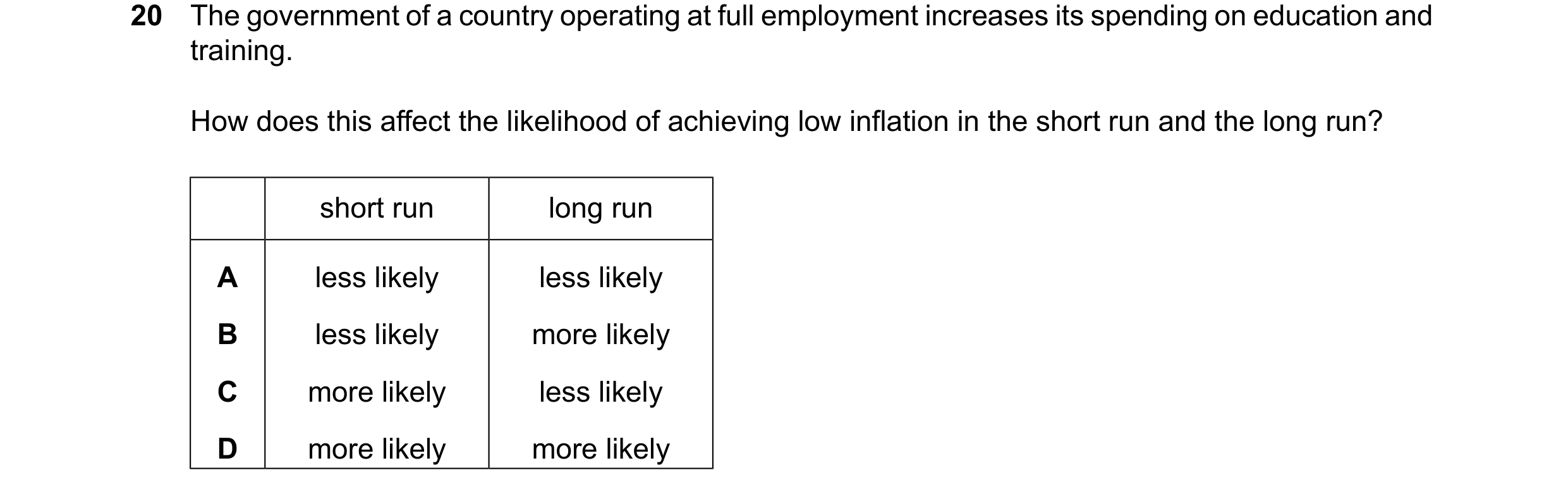
Q24 · The government of a country operating at full employment increases its spending on… 0987/11 May/June 2023
20 The government of a country operating at full employment increases its spending on education and training. How does this affect the likelihood of achieving low inflation in the short run and the long run? short run long run A less likely less likely B less likely more likely C more likely less likely D more likely more likely
1 marks
Answer: B
This question in 0987/11 May/June 2023
Q25 · Which citizens are most likely to benefit in a period of rapid inflation? 0987/11 May/June 2023
23 Which citizens are most likely to benefit in a period of rapid inflation? A citizens who are receiving fixed state benefits B citizens who earn fixed incomes C citizens who have lent money at a fixed rate of interest D citizens who have borrowed money at a fixed rate of interest
1 marks
Answer: D
This question in 0987/11 May/June 2023
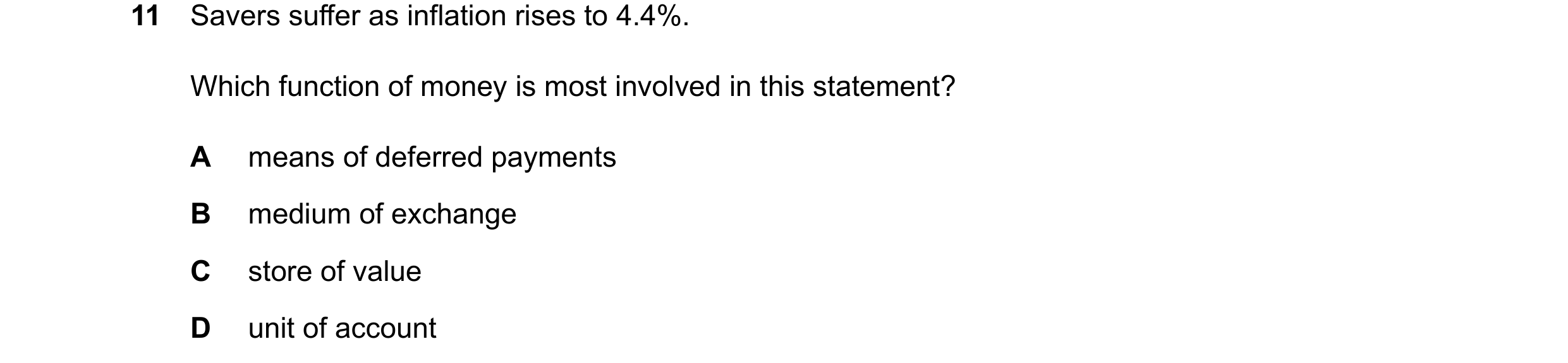
Q26 · Savers suffer as inflation rises to 4.4% 0987/12 May/June 2023
11 Savers suffer as inflation rises to 4.4%. Which function of money is most involved in this statement? A means of deferred payments B medium of exchange C store of value D unit of account
1 marks
Answer: C
This question in 0987/12 May/June 2023
Q27 · Which people are most likely to gain at a time of inflation? 0987/12 May/June 2023
19 Which people are most likely to gain at a time of inflation? A companies who sell abroad B foreign tourists visiting the country C those living on their savings D those who are repaying borrowed money
1 marks
Answer: D
This question in 0987/12 May/June 2023
Q28 · What must have happened in a country when it experienced an annual rate of inflation of… 0987/12 Oct/Nov 2023
23 What must have happened in a country when it experienced an annual rate of inflation of 100%? A The money supply doubled. B The price level halved. C The purchasing power of money halved. D The real value of money doubled.
1 marks
Answer: C
This question in 0987/12 Oct/Nov 2023
Q29 · Which item is least likely to be included in the Consumer Prices Index (CPI)? 0987/12 May/June 2024
23 Which item is least likely to be included in the Consumer Prices Index (CPI)? A domestic cooking oil B homemade clothes C milk D personal mobile phones
1 marks
Answer: B
This question in 0987/12 May/June 2024
Q30 · A Consumer Prices Index (CPI) consists of four items 0987/11 May/June 2025
24 A Consumer Prices Index (CPI) consists of four items. The table shows the percentage price change for each item over a period of a year and the weight of each item. Which price change will affect the level of the CPI most? % price change item weight over 1 year A food +5 0.30 B housing +6 0.20 C recreation +3 0.40 D transport +4 0.10
1 marks
Answer: A
This question in 0987/11 May/June 2025
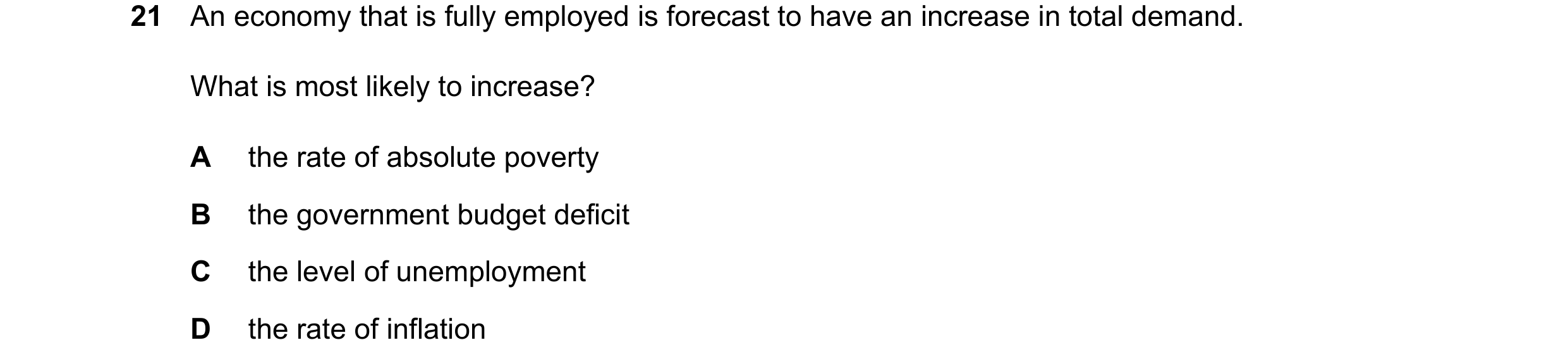
Q31 · An economy that is fully employed is forecast to have an increase in total demand 0987/12 May/June 2025
21 An economy that is fully employed is forecast to have an increase in total demand. What is most likely to increase? A the rate of absolute poverty B the government budget deficit C the level of unemployment D the rate of inflation
1 marks
Answer: D
This question in 0987/12 May/June 2025
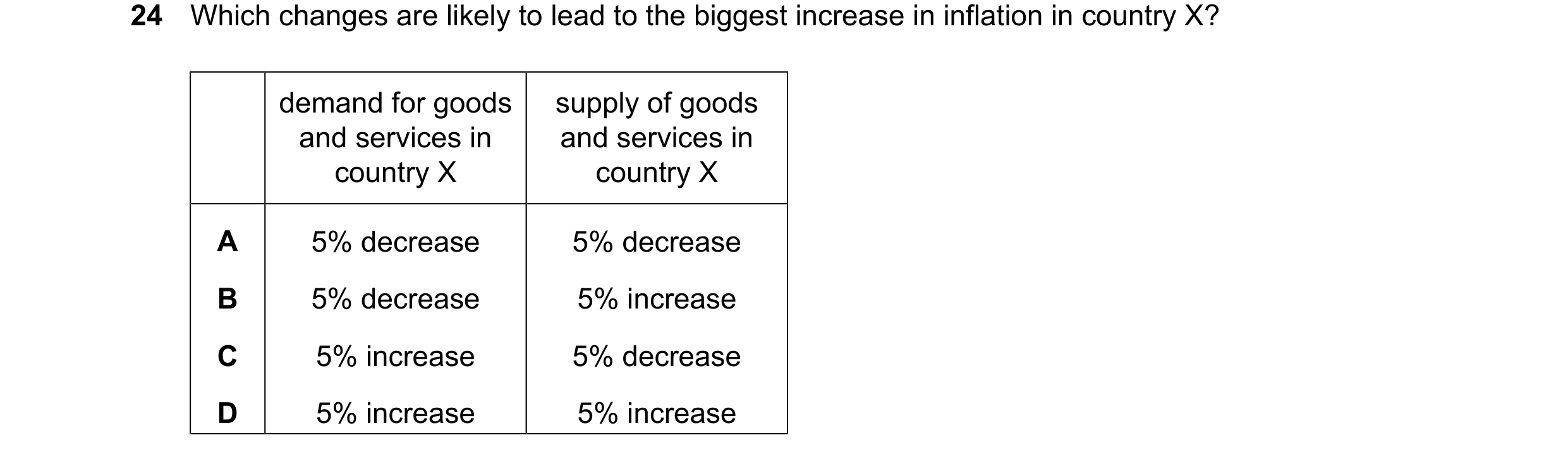
Q32 · Which changes are likely to lead to the biggest increase in inflation in country X? 0987/12 May/June 2025
24 Which changes are likely to lead to the biggest increase in inflation in country X? demand for goods supply of goods and services in and services in country X country X A 5% decrease 5% decrease B 5% decrease 5% increase C 5% increase 5% decrease D 5% increase 5% increase
1 marks
Answer: C
This question in 0987/12 May/June 2025
Q33 · The graph shows changes in the average price level 0987/12 Oct/Nov 2025
24 The graph shows changes in the average price level. 5 price 4 change (%) 3 2 1 0 1 2 3 4 5 6 –1 year –2 –3 When did the country experience deflation? A year 2 to year 5 B year 2 to year 3 C year 2 to year 4 D year 4 to year 5
1 marks
Answer: D
This question in 0987/12 Oct/Nov 2025


 1 / 8
1 / 8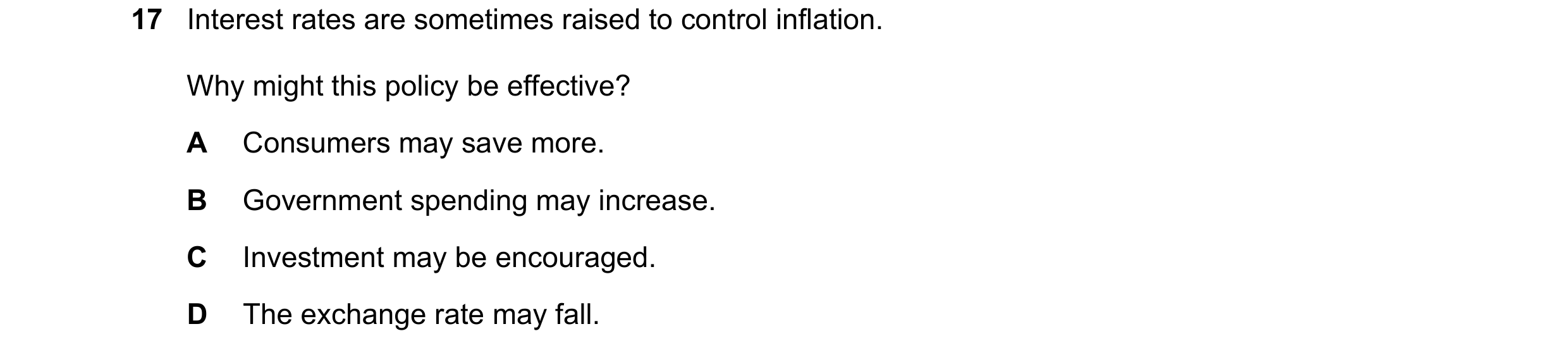

 2 / 8
2 / 8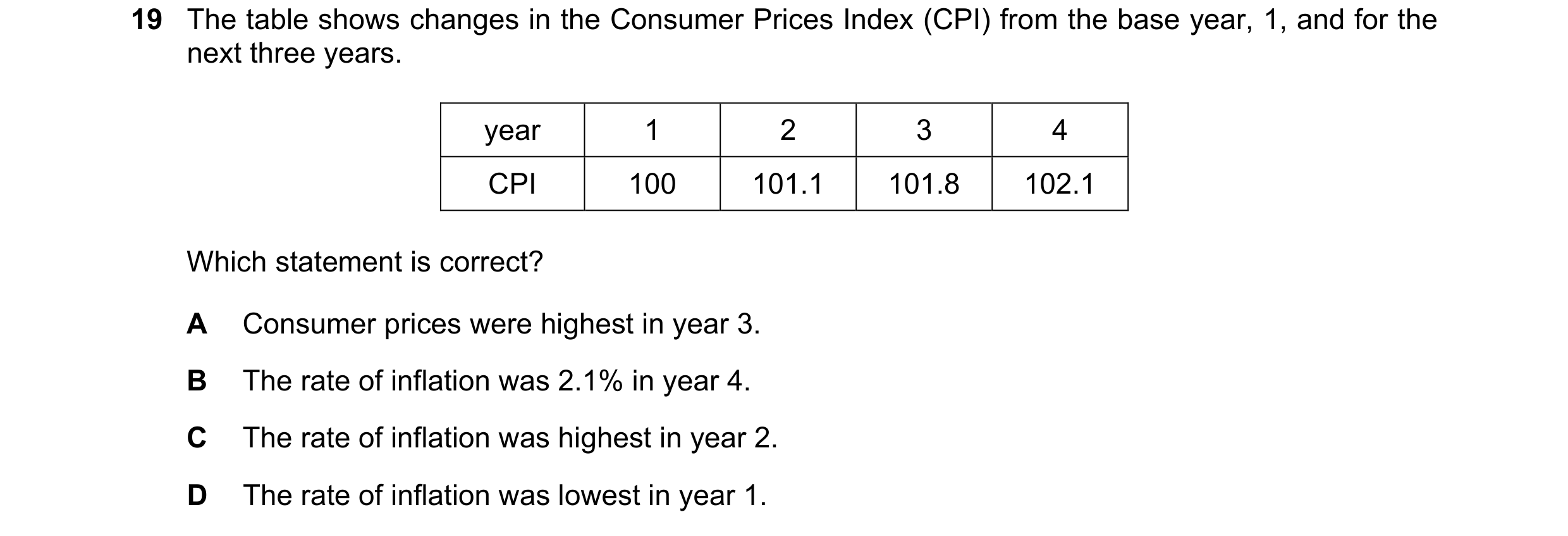

 3 / 8
3 / 8
 4 / 8
4 / 8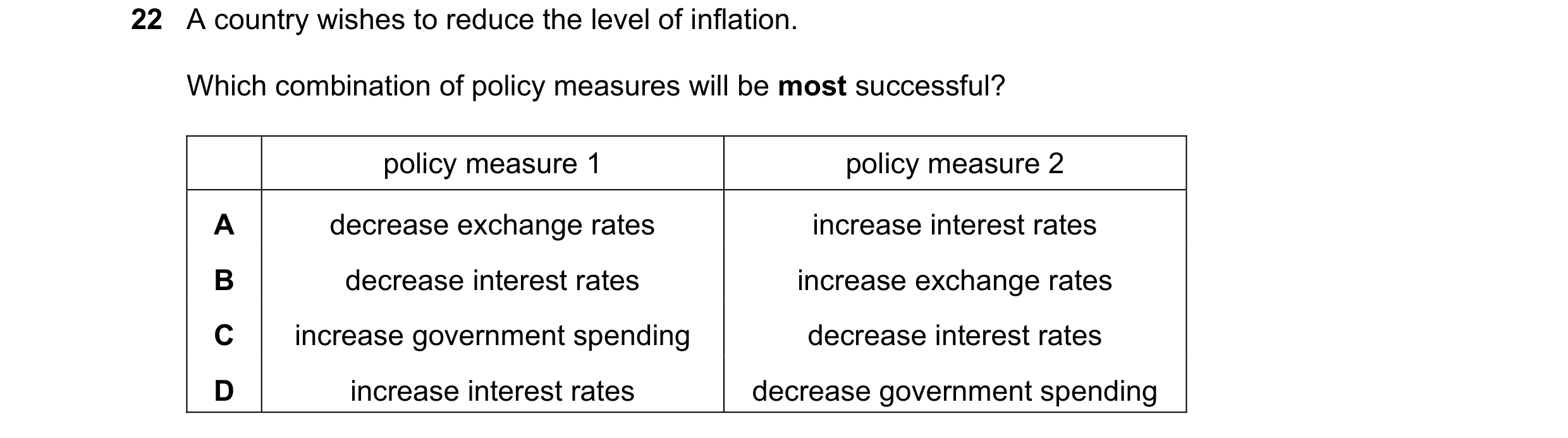


 5 / 8
5 / 8


 6 / 8
6 / 8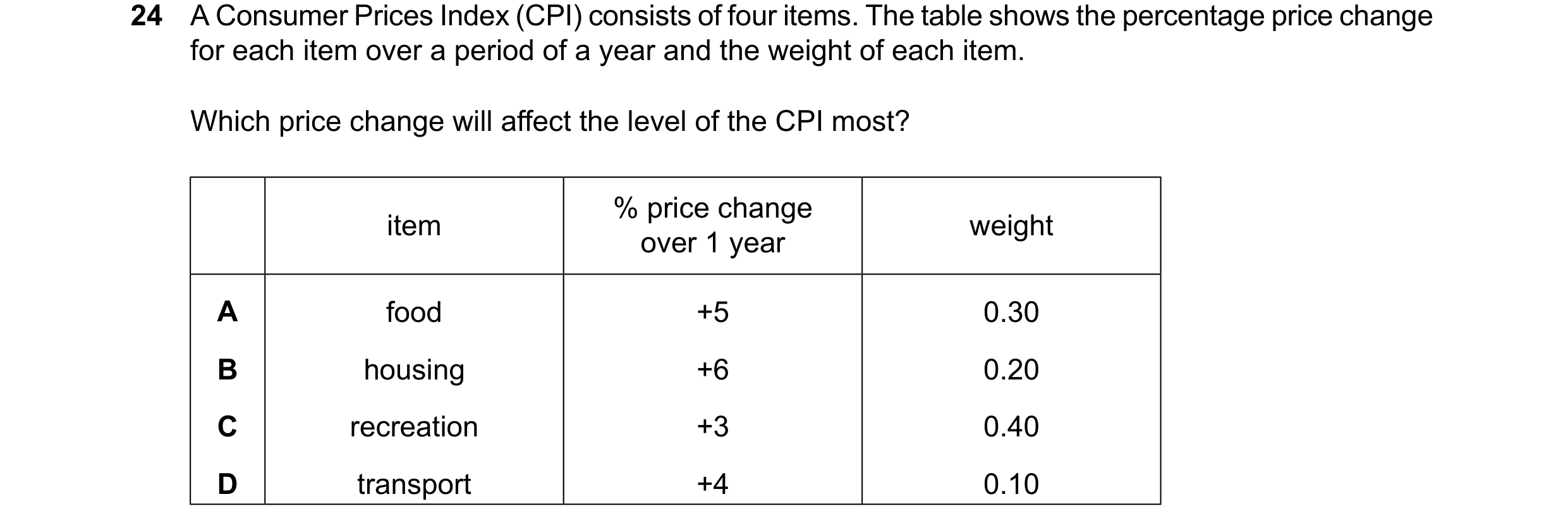
 7 / 8
7 / 8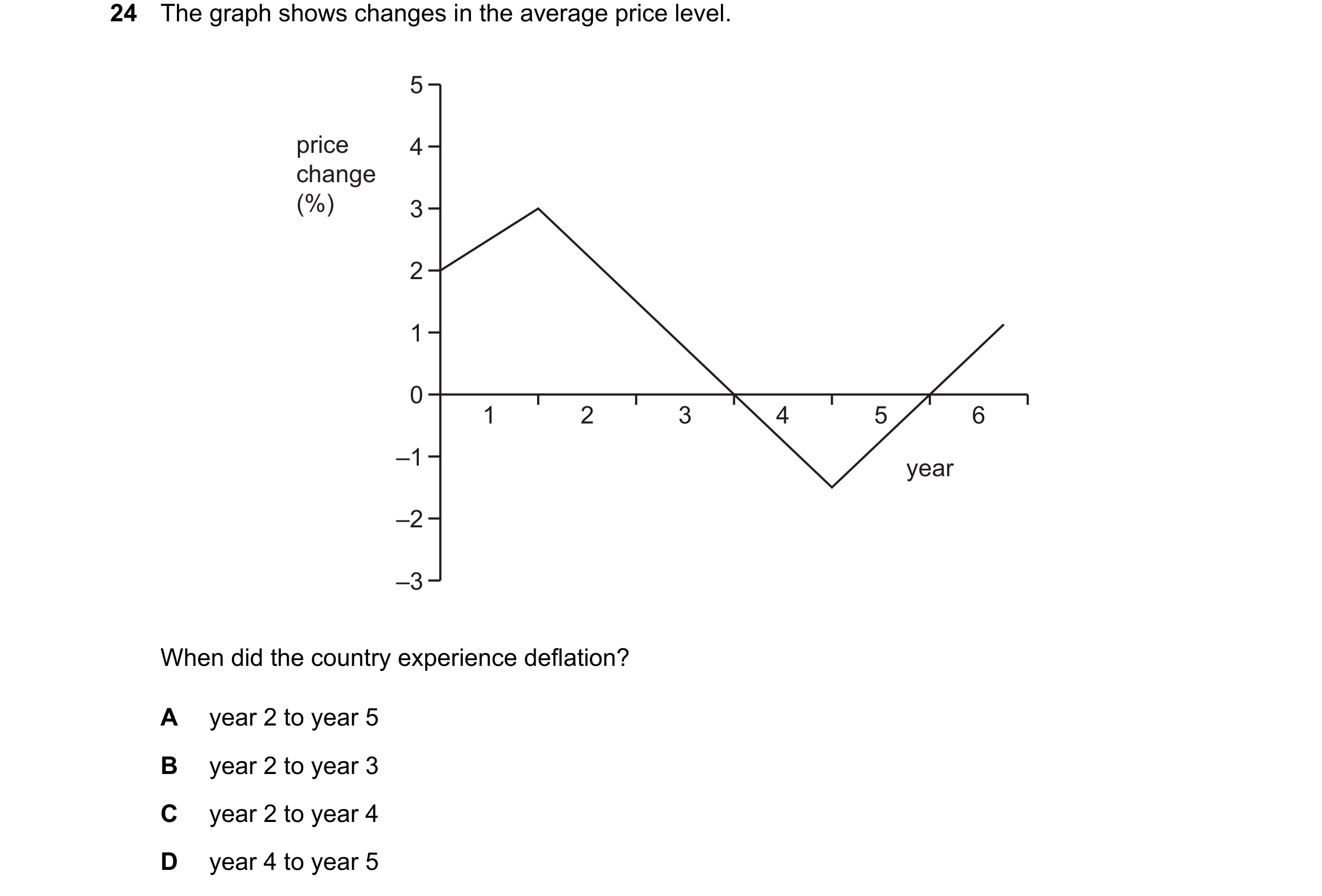 8 / 8
8 / 8