Questions as text
Q1 · How is a government most likely to prevent the growth of monopolies? 0987/11 May/June 2020
15 How is a government most likely to prevent the growth of monopolies? A by encouraging mergers in the private sector B by establishing nationalised industries C by promoting the benefits of economies of scale D by reducing barriers to entry into an industry
1 marks
Answer: D
This question in 0987/11 May/June 2020
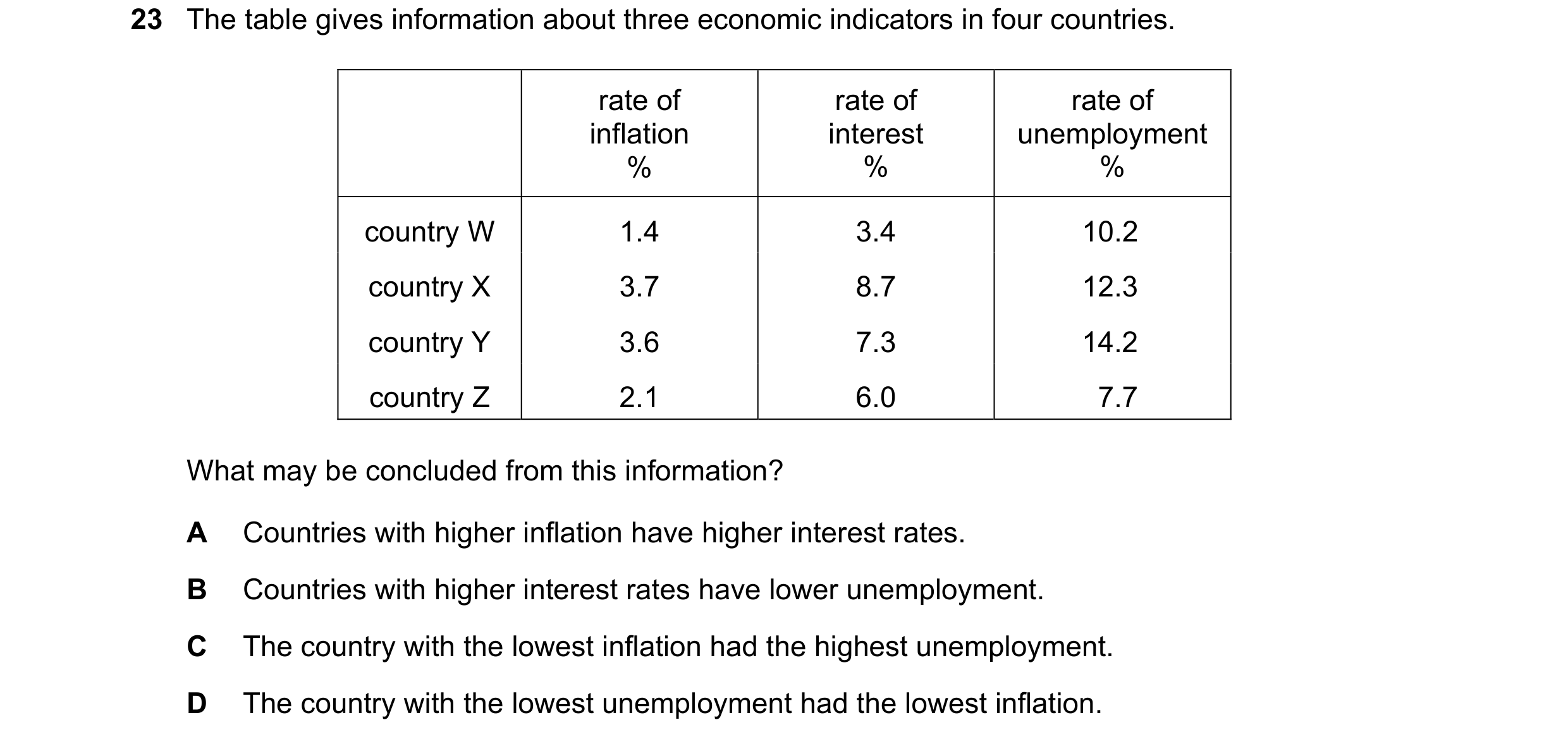
Q2 · The table gives information about three economic indicators in four countries 0987/12 May/June 2020
23 The table gives information about three economic indicators in four countries. rate of rate of rate of inflation interest unemployment % % % country W 1.4 3.4 10.2 country X 3.7 8.7 12.3 country Y 3.6 7.3 14.2 country Z 2.1 6.0 7.7 What may be concluded from this information? A Countries with higher inflation have higher interest rates. B Countries with higher interest rates have lower unemployment. C The country with the lowest inflation had the highest unemployment. D The country with the lowest unemployment had the lowest inflation.
1 marks
Answer: A
This question in 0987/12 May/June 2020
Q3 · What is an example of a macroeconomic aim? 0987/12 Oct/Nov 2020
4 What is an example of a macroeconomic aim? A to create and maintain full employment B to improve efficiency in the manufacturing sector of the economy C to provide consumers with greater information when buying goods and services D to encourage greater occupational mobility of labour
1 marks
Answer: A
This question in 0987/12 Oct/Nov 2020
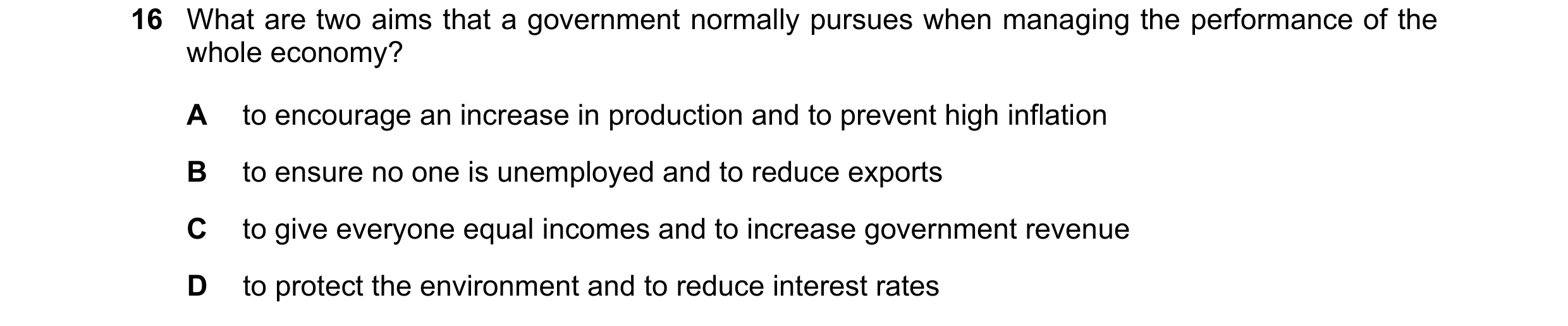
Q4 · What are two aims that a government normally pursues when managing the performance of the… 0987/12 Oct/Nov 2020
16 What are two aims that a government normally pursues when managing the performance of the whole economy? A to encourage an increase in production and to prevent high inflation B to ensure no one is unemployed and to reduce exports C to give everyone equal incomes and to increase government revenue D to protect the environment and to reduce interest rates
1 marks
Answer: A
This question in 0987/12 Oct/Nov 2020
Q5 · What is most likely to be the responsibility of a central government? 0987/12 Oct/Nov 2020
17 What is most likely to be the responsibility of a central government? A the provision of immigration officials at an airport B the provision of security cameras in a shopping centre C the provision of security staff at a bank D the provision of ticket inspectors on a train
1 marks
Answer: A
This question in 0987/12 Oct/Nov 2020
Q6 · The government wants to reduce the consumption of cigarettes 0987/12 Oct/Nov 2020
19 The government wants to reduce the consumption of cigarettes. Which policy would be most likely to do this? A increasing a subsidy on cigarettes B increasing income tax C increasing interest rates D increasing the indirect tax on cigarettes
1 marks
Answer: D
This question in 0987/12 Oct/Nov 2020
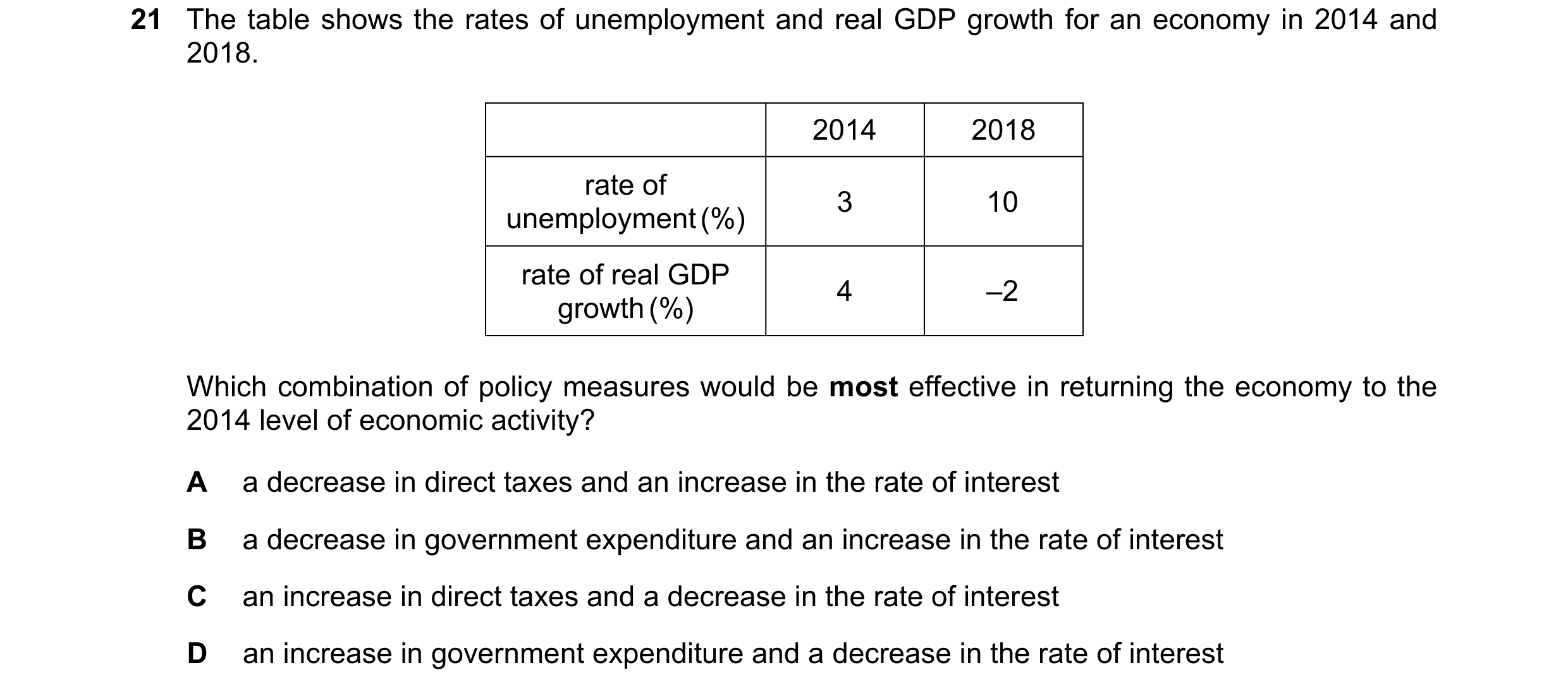
Q7 · The table shows the rates of unemployment and real GDP growth for an economy in 2014 and… 0987/12 Oct/Nov 2020
21 The table shows the rates of unemployment and real GDP growth for an economy in 2014 and 2018. 2014 2018 rate of 3 10 unemployment (%) rate of real GDP 4 –2 growth (%) Which combination of policy measures would be most effective in returning the economy to the 2014 level of economic activity? A a decrease in direct taxes and an increase in the rate of interest B a decrease in government expenditure and an increase in the rate of interest C an increase in direct taxes and a decrease in the rate of interest D an increase in government expenditure and a decrease in the rate of interest
1 marks
Answer: D
This question in 0987/12 Oct/Nov 2020
Q8 · Which problem will be reduced by a government subsidy to a firm? 0987/12 May/June 2021
6 Which problem will be reduced by a government subsidy to a firm? A absence of a public good B abuse of monopoly power C overconsumption of a demerit good D underconsumption of a merit good
1 marks
Answer: D
This question in 0987/12 May/June 2021
Q9 · What is a macroeconomic aim of a government? 0987/12 Oct/Nov 2021
6 What is a macroeconomic aim of a government? A balance of payments stability B deflation C income inequality D unemployment
1 marks
Answer: A
This question in 0987/12 Oct/Nov 2021
Q10 · The diagram shows the imposition of a subsidy on a product supplied by a firm 0987/12 Oct/Nov 2021
12 The diagram shows the imposition of a subsidy on a product supplied by a firm. S1 price S2 G H F J E K D O L M quantity Which area represents the total revenue of the firm including the subsidy? A EGHK B OEKM C OFJL D OGHM
1 marks
Answer: D
This question in 0987/12 Oct/Nov 2021
Q11 · A government uses different supply-side policy measures to improve economic performance 0987/11 May/June 2022
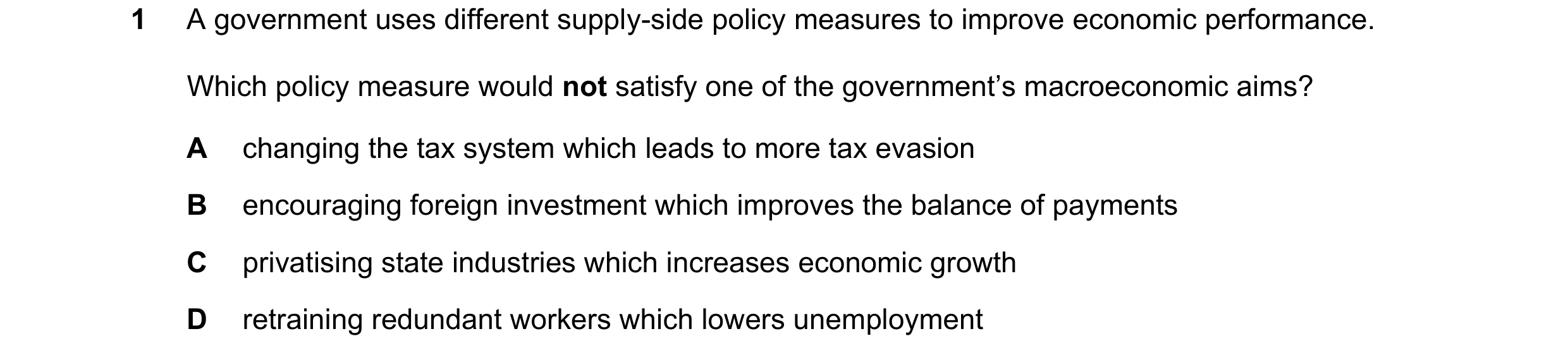
1 A government uses different supply-side policy measures to improve economic performance. Which policy measure would not satisfy one of the government’s macroeconomic aims? A changing the tax system which leads to more tax evasion B encouraging foreign investment which improves the balance of payments C privatising state industries which increases economic growth D retraining redundant workers which lowers unemployment
1 marks
Answer: A
This question in 0987/11 May/June 2022
Q12 · Which relationship would be studied by an economist specialising in macroeconomics? 0987/12 May/June 2022
4 Which relationship would be studied by an economist specialising in macroeconomics? A the relationship between the inflation rate and the unemployment rate B the relationship between the output of a firm and its costs of production C the relationship between the price of a product and the quantity demanded by a consumer D the relationship between the wage rate of workers and demand for labour in an occupation
1 marks
Answer: A
This question in 0987/12 May/June 2022
Q13 · Which economic activity would be classified as macroeconomics? 0987/11 May/June 2023
4 Which economic activity would be classified as macroeconomics? A households spend less on holidays abroad B income tax is increased by the government C wages rise for construction workers D world coffee price rises due to poor weather
1 marks
Answer: B
This question in 0987/11 May/June 2023
Q14 · A government decides to reduce air pollution in city centres by giving financial… 0987/11 May/June 2023
10 A government decides to reduce air pollution in city centres by giving financial assistance to bus companies, reducing their costs of production and prices for passengers. Which type of policy measure is this? A a maximum price B a minimum price C a subsidy D regulation
1 marks
Answer: C
This question in 0987/11 May/June 2023
Q15 · What is an example of a government macroeconomic aim? 0987/11 May/June 2023
17 What is an example of a government macroeconomic aim? A a minimum of 10 years of schooling B a sales tax of 10% on consumer goods C a target rate of 2% inflation D increasing pay for nurses
1 marks
Answer: C
This question in 0987/11 May/June 2023
Q16 · A government has introduced a tax on a necessity 0987/11 May/June 2023
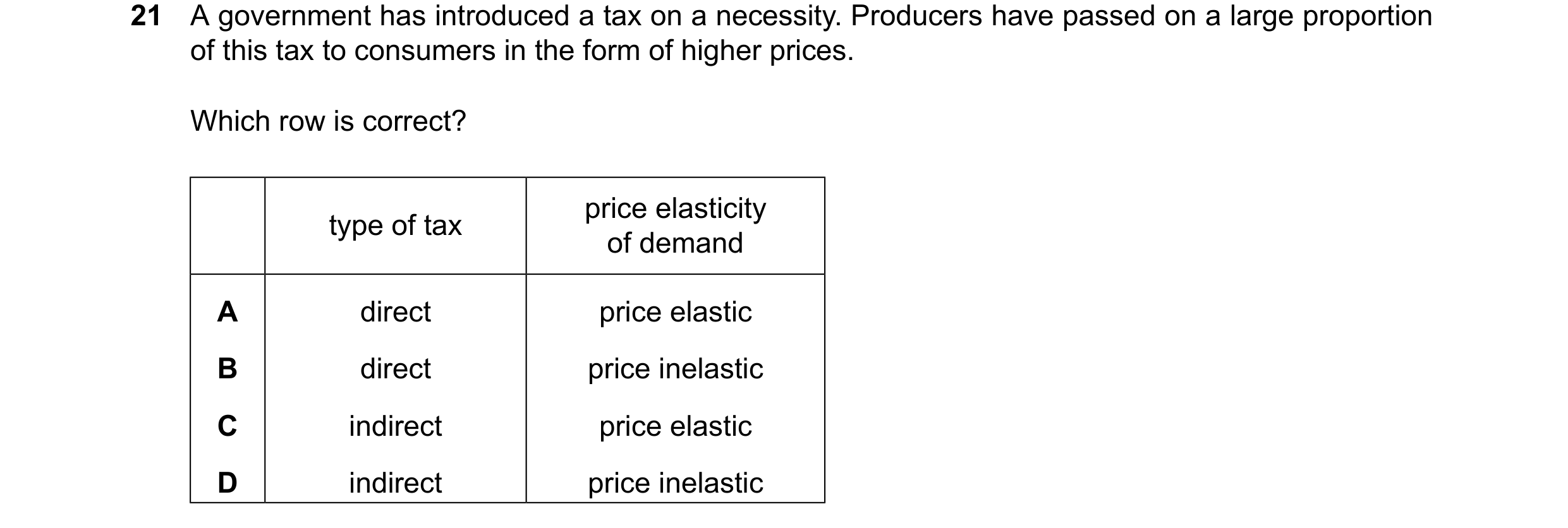
21 A government has introduced a tax on a necessity. Producers have passed on a large proportion of this tax to consumers in the form of higher prices. Which row is correct? price elasticity type of tax of demand A direct price elastic B direct price inelastic C indirect price elastic D indirect price inelastic
1 marks
Answer: D
This question in 0987/11 May/June 2023
Q17 · Imposing a maximum price for a good is an example of which type of government policy? 0987/12 May/June 2023
10 Imposing a maximum price for a good is an example of which type of government policy? A fiscal B monetary C regulation D supply-side
1 marks
Answer: C
This question in 0987/12 May/June 2023
Q18 · What is the most likely reason to increase government subsidies? 0987/12 May/June 2023
18 What is the most likely reason to increase government subsidies? A to decrease consumption of a merit good B to increase consumption of a merit good C to decrease consumption of a demerit good D to increase consumption of a demerit good
1 marks
Answer: B
This question in 0987/12 May/June 2023
Q19 · What is an example of government macroeconomic policy? 0987/12 Oct/Nov 2023
17 What is an example of government macroeconomic policy? A increasing the money supply B preventing price rises in the food industry C removing a monopoly’s barriers to entry D setting a maximum price for wheat
1 marks
Answer: A
This question in 0987/12 Oct/Nov 2023
Q20 · What is not a macroeconomic topic? 0987/12 May/June 2024
4 What is not a macroeconomic topic? A the growth in Chinese Gross Domestic Product B the level of Consumer Prices Index inflation in the UK C the level of unemployment in Spain D the total output of the German car industry
1 marks
Answer: D
This question in 0987/12 May/June 2024
Q21 · Which government measure is most likely to cause a fall both in price and in quantity… 0987/12 May/June 2024
9 Which government measure is most likely to cause a fall both in price and in quantity traded? A indirect tax B maximum price C minimum price D subsidy
1 marks
Answer: B
This question in 0987/12 May/June 2024
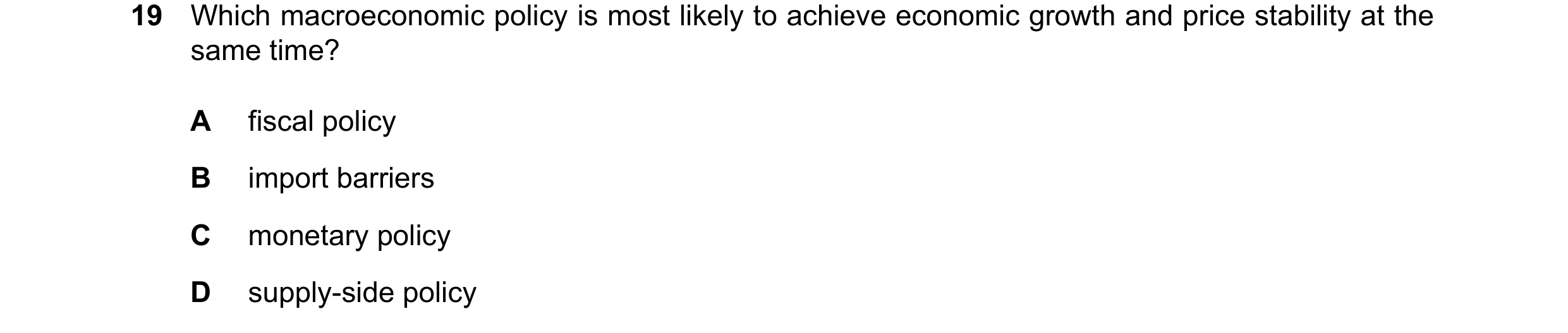
Q22 · Which macroeconomic policy is most likely to achieve economic growth and price stability… 0987/12 Oct/Nov 2024
19 Which macroeconomic policy is most likely to achieve economic growth and price stability at the same time? A fiscal policy B import barriers C monetary policy D supply-side policy
1 marks
Answer: D
This question in 0987/12 Oct/Nov 2024
Q23 · The diagram shows demand and supply curves for a product at its equilibrium price P 0987/11 May/June 2025
6 The diagram shows demand and supply curves for a product at its equilibrium price P. S1 S price S2 P D2 D D1 O Q quantity How would the introduction of a subsidy be shown? A Demand would shift to D1. B Demand would shift to D2. C Supply would shift to S1. D Supply would shift to S2.
1 marks
Answer: D
This question in 0987/11 May/June 2025
Q24 · What is a macroeconomic aim of a government? 0987/11 May/June 2025
17 What is a macroeconomic aim of a government? A high external costs B high sales tax C low unemployment D low wages
1 marks
Answer: C
This question in 0987/11 May/June 2025
Q25 · What is a principle of taxation? 0987/11 May/June 2025
18 What is a principle of taxation? A equality between social cost and social benefit B fairness between taxpayers C profit maximisation by firms D tax revenue maximisation
1 marks
Answer: B
This question in 0987/11 May/June 2025
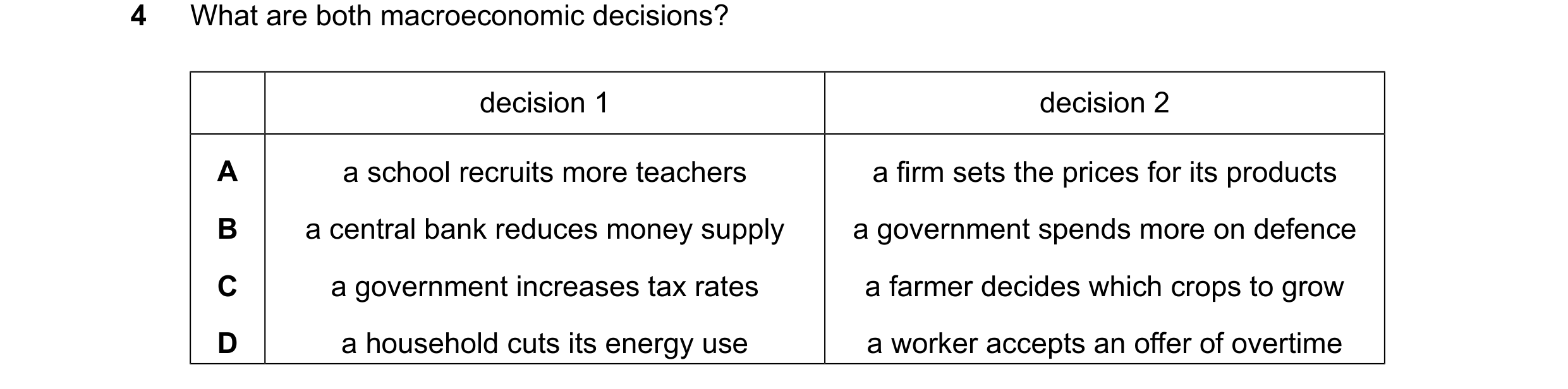
Q26 · What are both macroeconomic decisions? 0987/12 May/June 2025
4 What are both macroeconomic decisions? decision 1 decision 2 A a school recruits more teachers a firm sets the prices for its products B a central bank reduces money supply a government spends more on defence C a government increases tax rates a farmer decides which crops to grow D a household cuts its energy use a worker accepts an offer of overtime
1 marks
Answer: B
This question in 0987/12 May/June 2025
Q27 · A government imposes tariffs on imported goods 0987/12 Oct/Nov 2025
17 A government imposes tariffs on imported goods. What is not a likely reason for this? A to boost domestic output B to influence the country’s balance of payments C to protect domestic employment D to reduce the exports from the country
1 marks
Answer: D
This question in 0987/12 Oct/Nov 2025


 1 / 7
1 / 7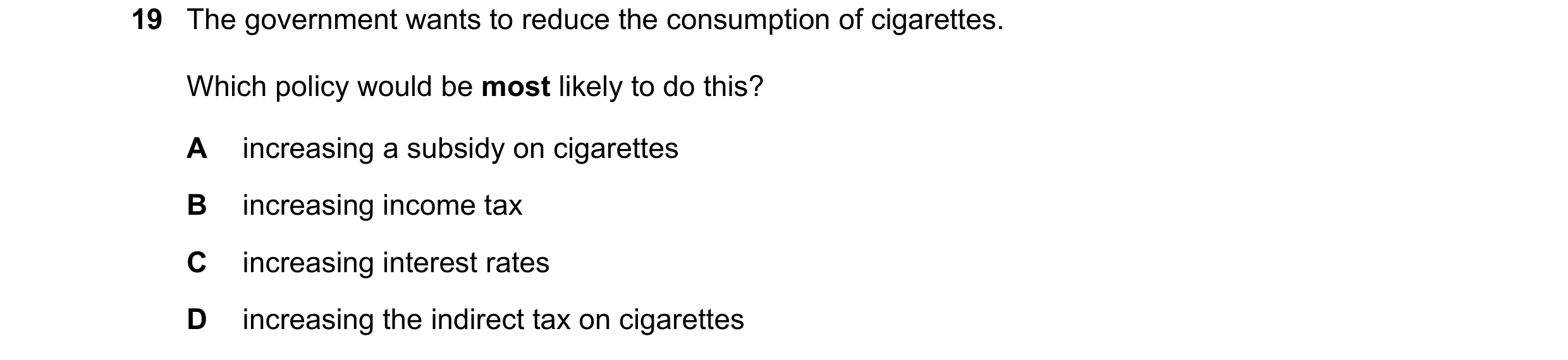

 2 / 7
2 / 7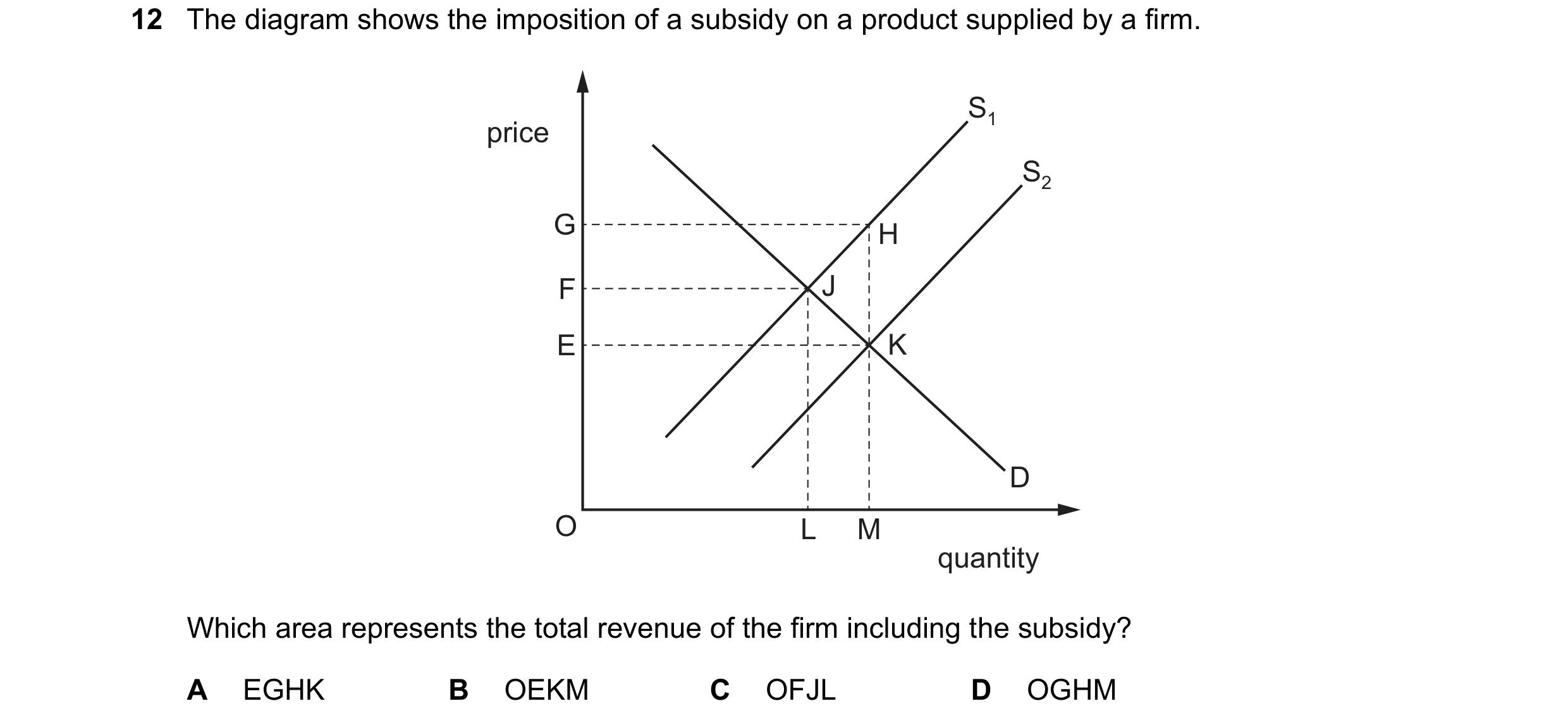

 3 / 7
3 / 7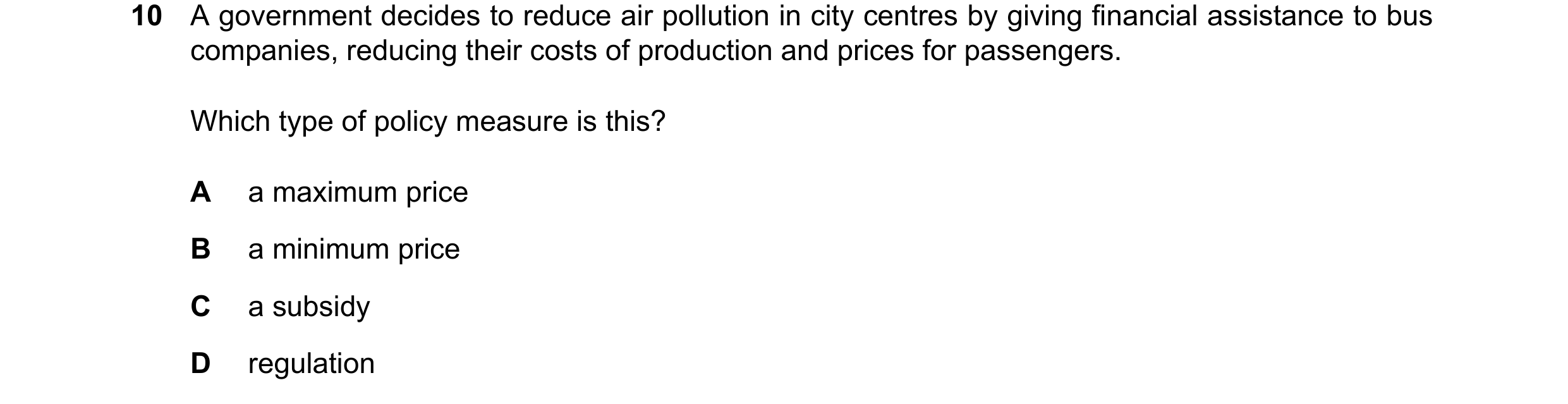


 4 / 7
4 / 7


 5 / 7
5 / 7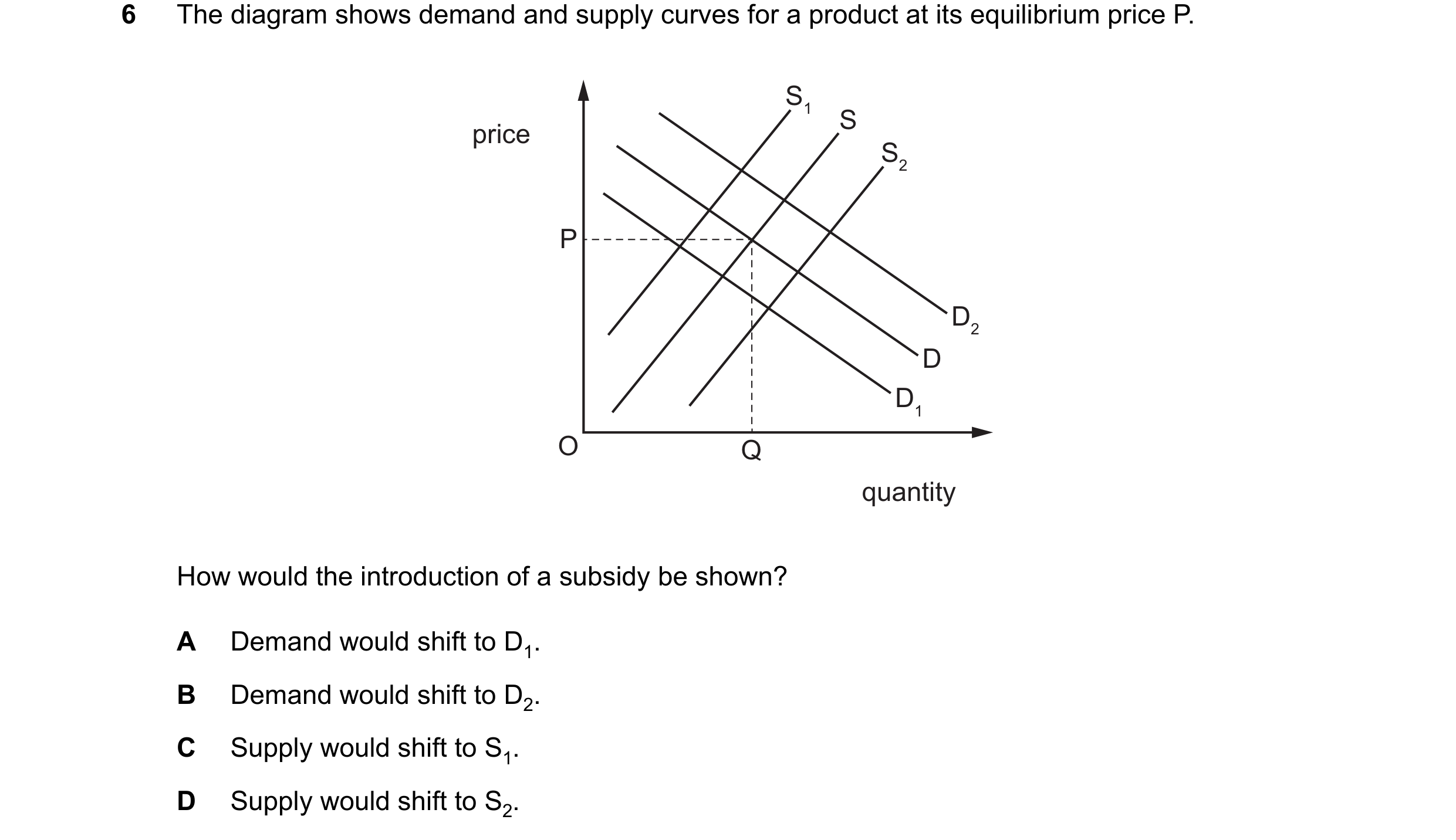


 6 / 7
6 / 7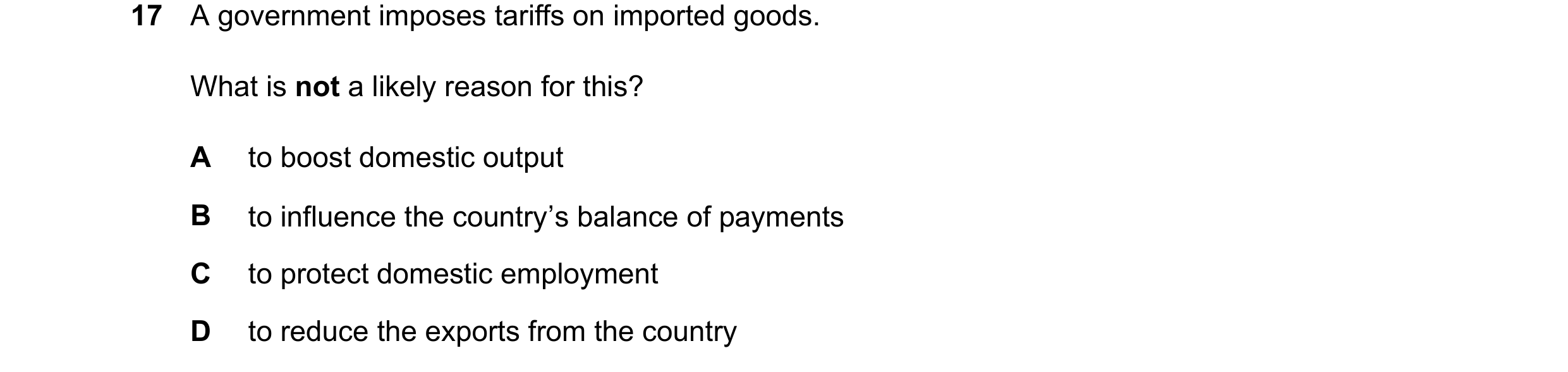 7 / 7
7 / 7