Cambridge IGCSE Economics 0455 — 2025 Oct/Nov Paper 2 · Variant 1
0455/21/O/N/25 · 5 questions · 90 marks · ≈101 min
The question paper and its mark scheme, free to read here and free to download. This is Cambridge’s own paper, exactly as it was sat.
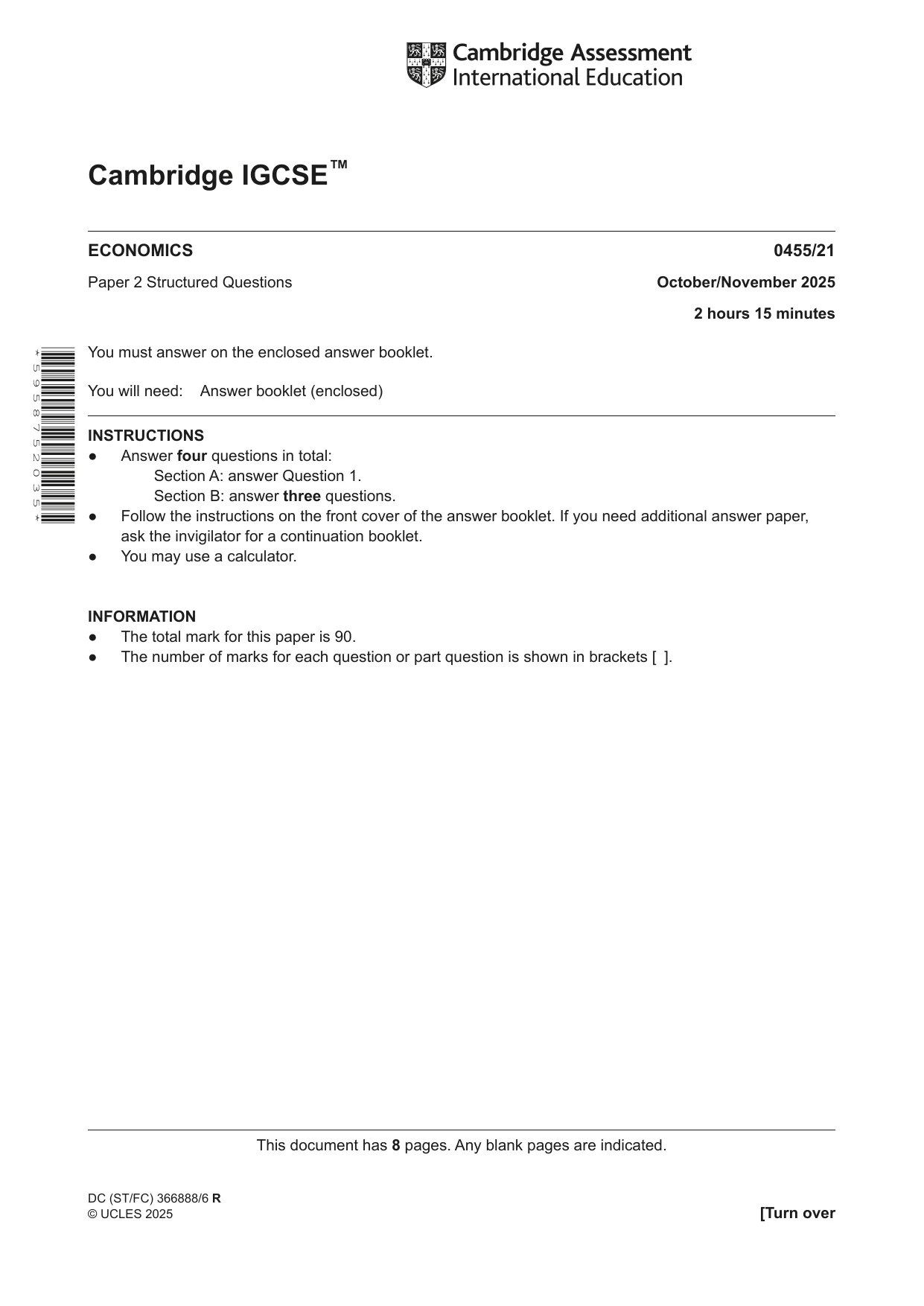
Question paper8 pages



Mark scheme29 pages
Answers below. Sit the paper first if you are practising.

Questions as text
Q1 · Calculate the total financial sector contribution (in $) to Switzerland’s GDP
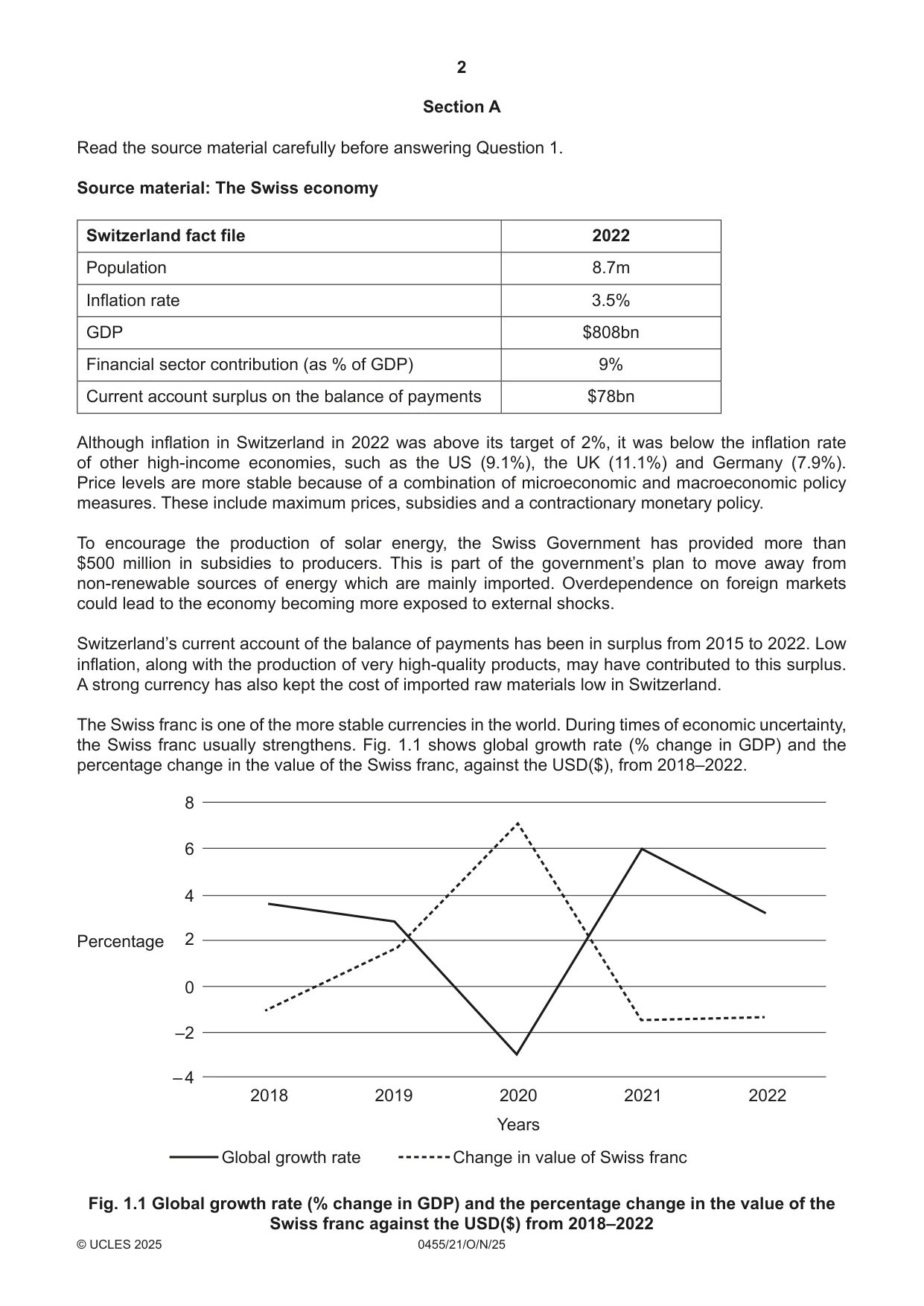
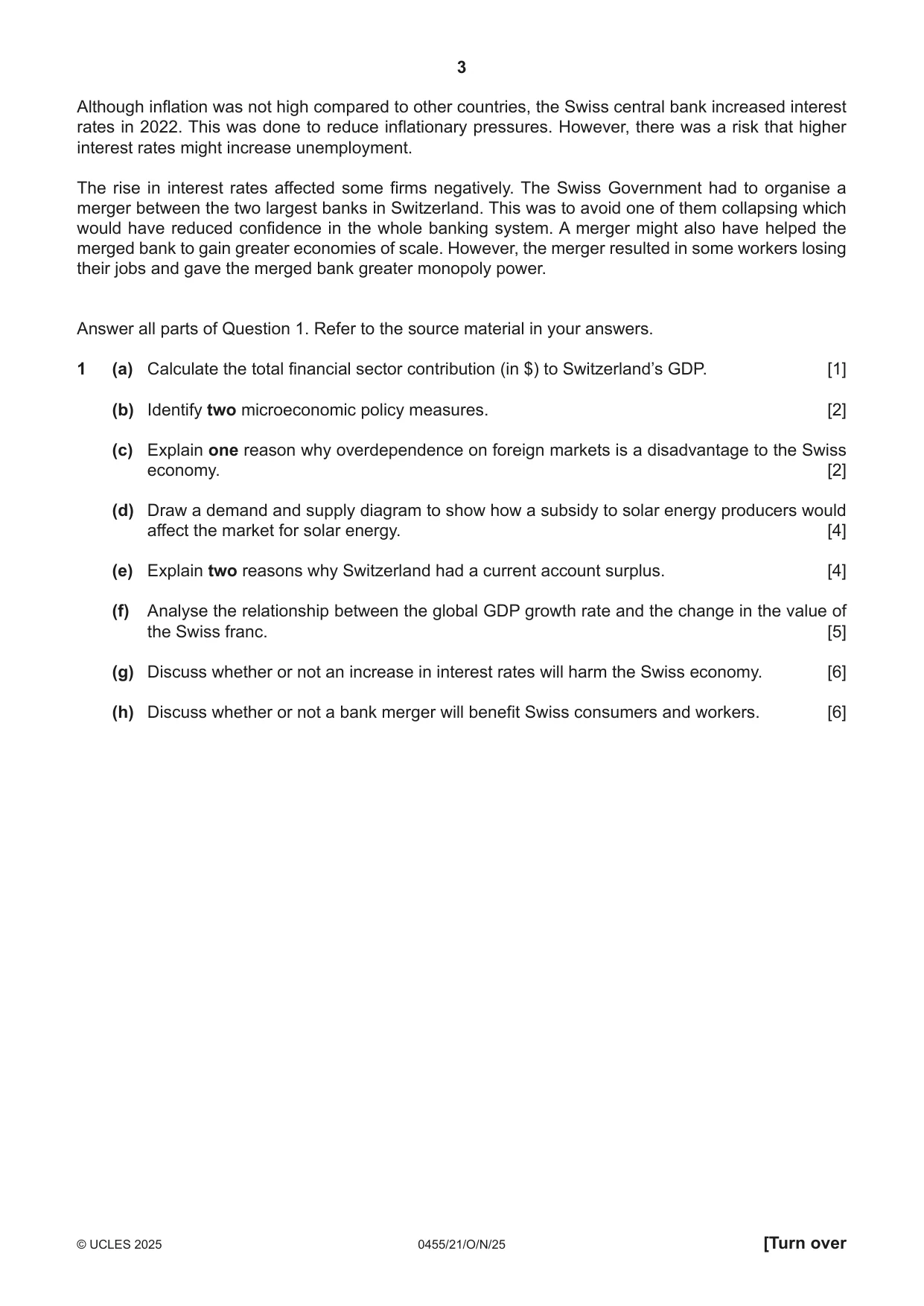
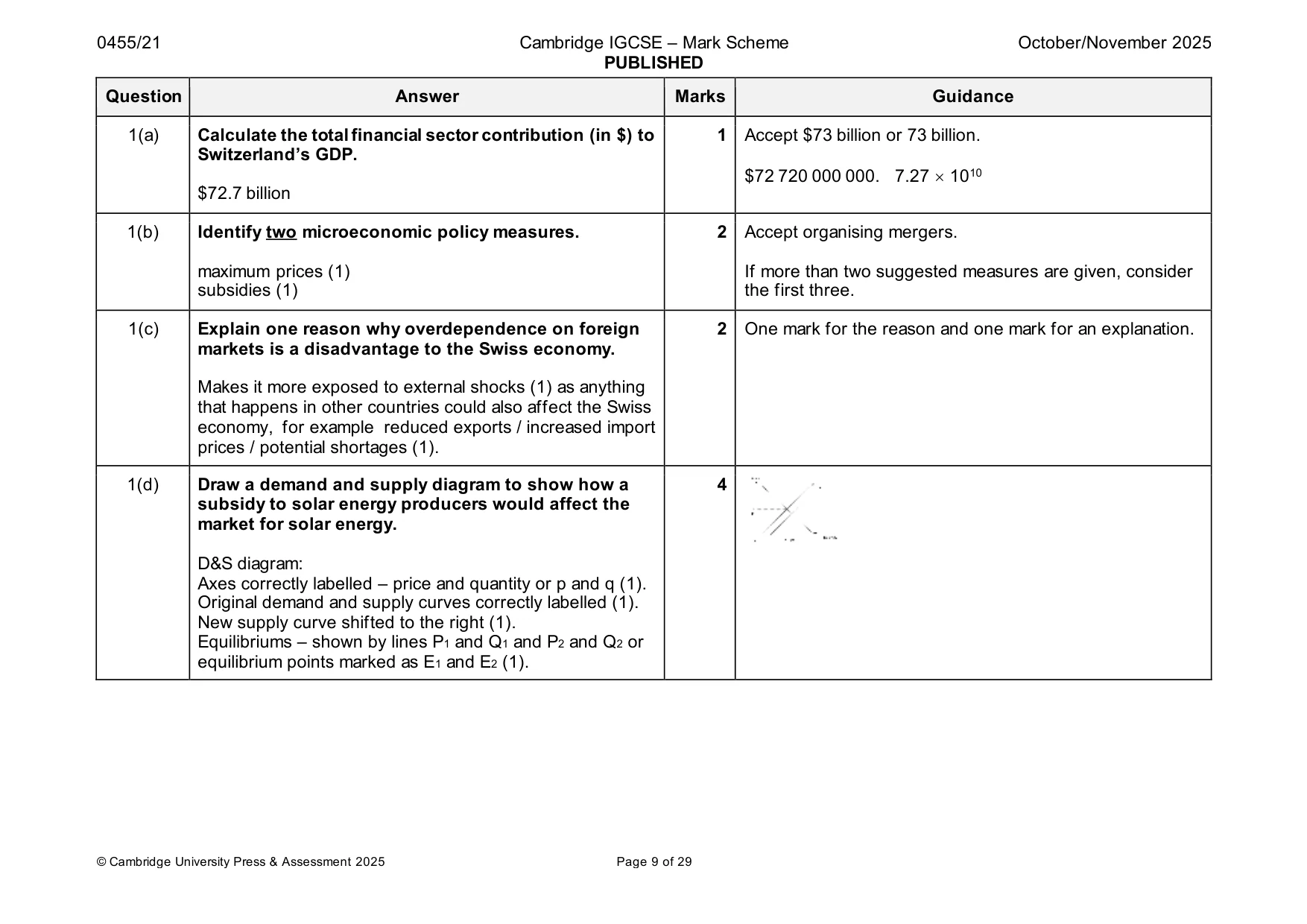
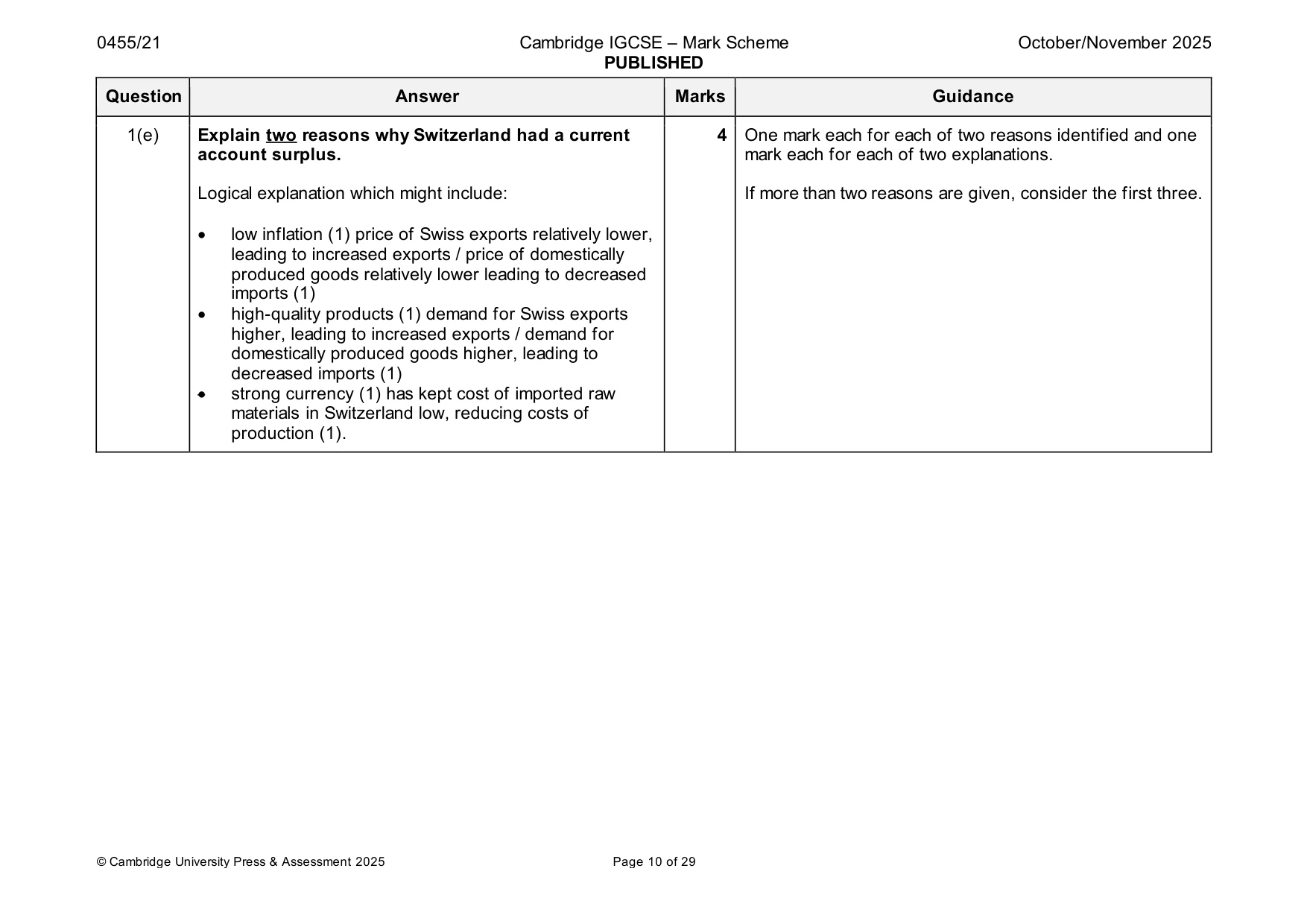
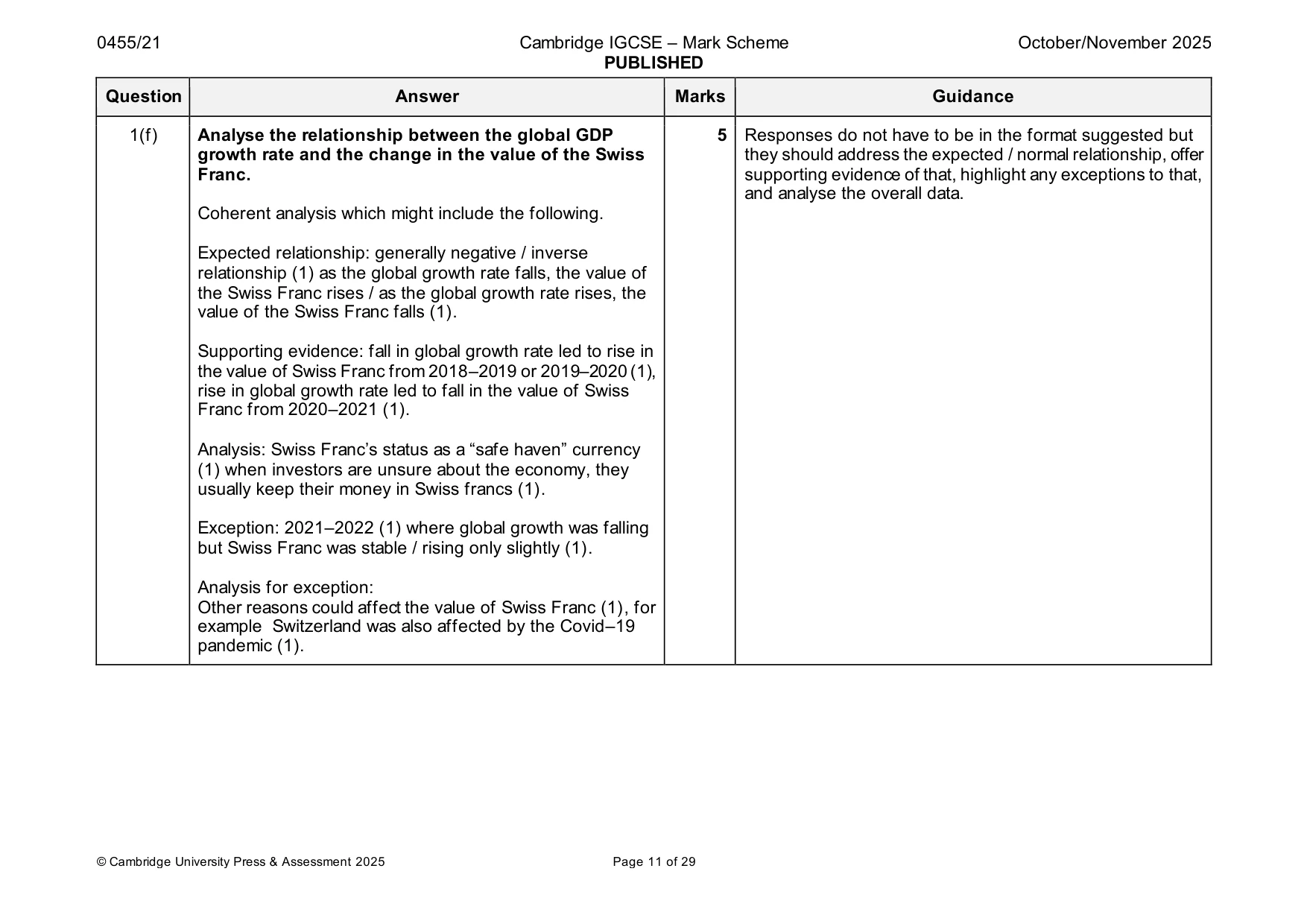
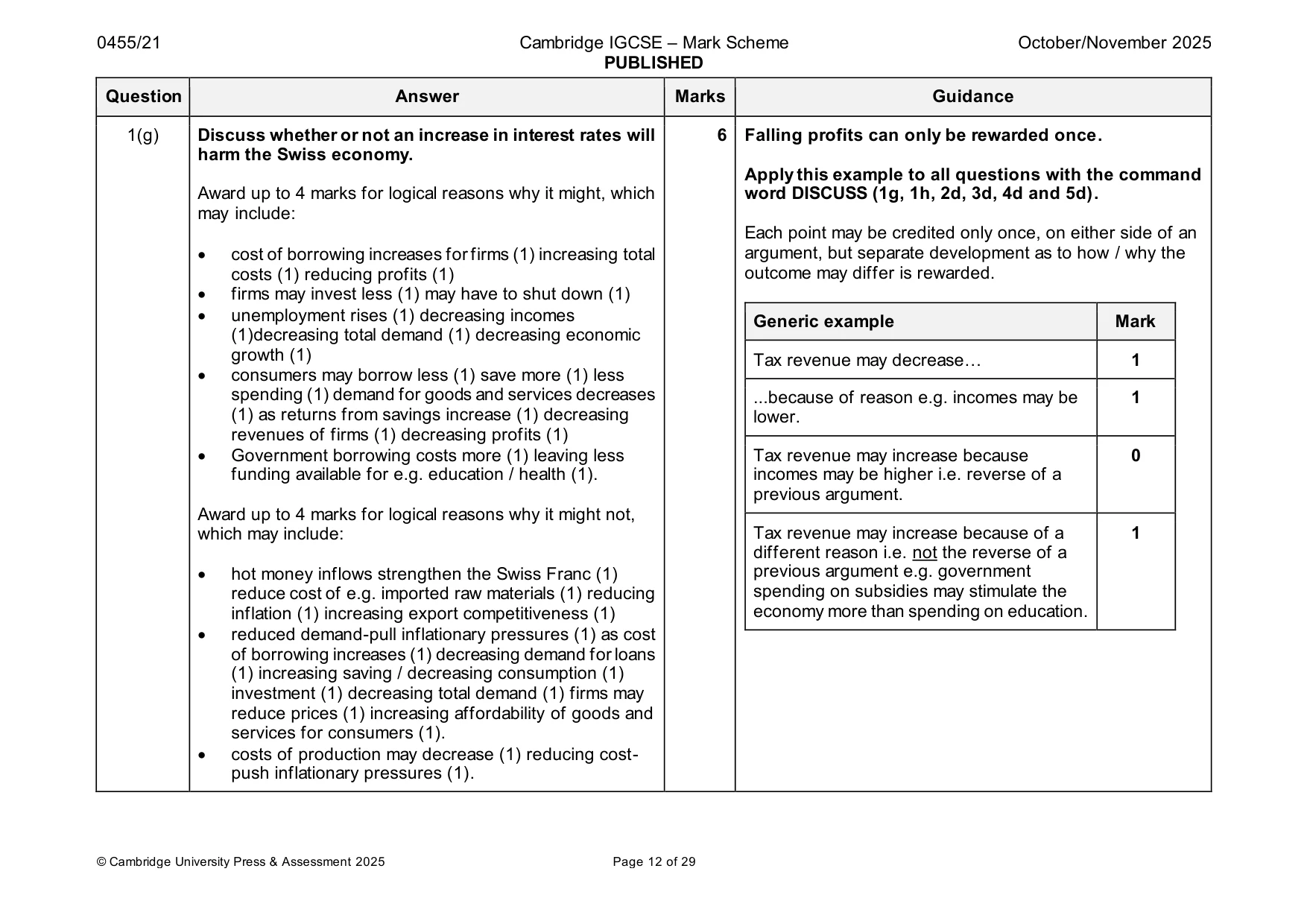
1 (a) Calculate the total financial sector contribution (in $) to Switzerland’s GDP. [1] (b) Identify two microeconomic policy measures. [2] (c) Explain one reason why overdependence on foreign markets is a disadvantage to the Swiss economy. [2] (d) Draw a demand and supply diagram to show how a subsidy to solar energy producers would affect the market for solar energy. [4] (e) Explain two reasons why Switzerland had a current account surplus. [4] (f) Analyse the relationship between the global GDP growth rate and the change in the value of the Swiss franc. [5] (g) Discuss whether or not an increase in interest rates will harm the Swiss economy. [6] (h) Discuss whether or not a bank merger will benefit Swiss consumers and workers. [6]
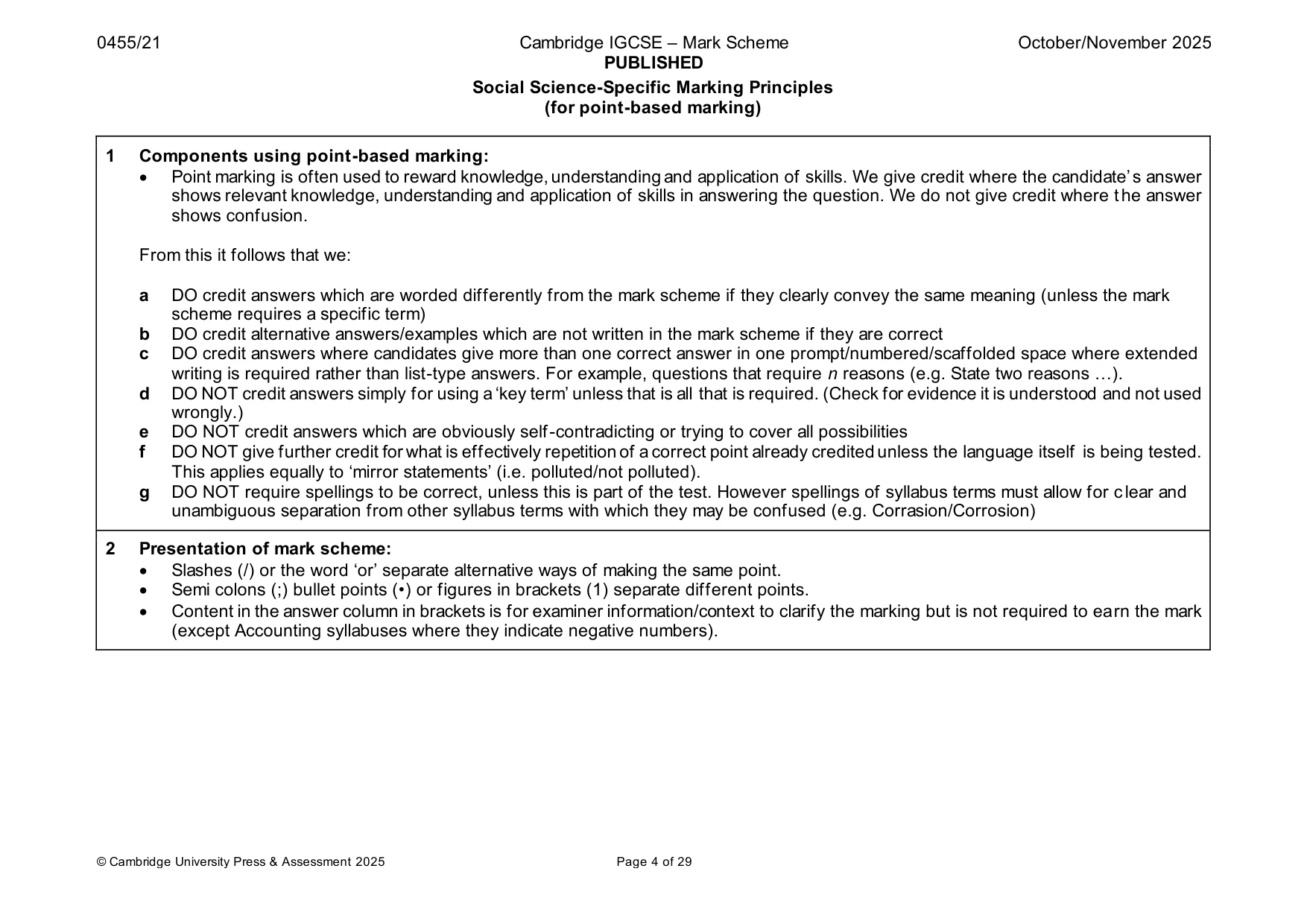
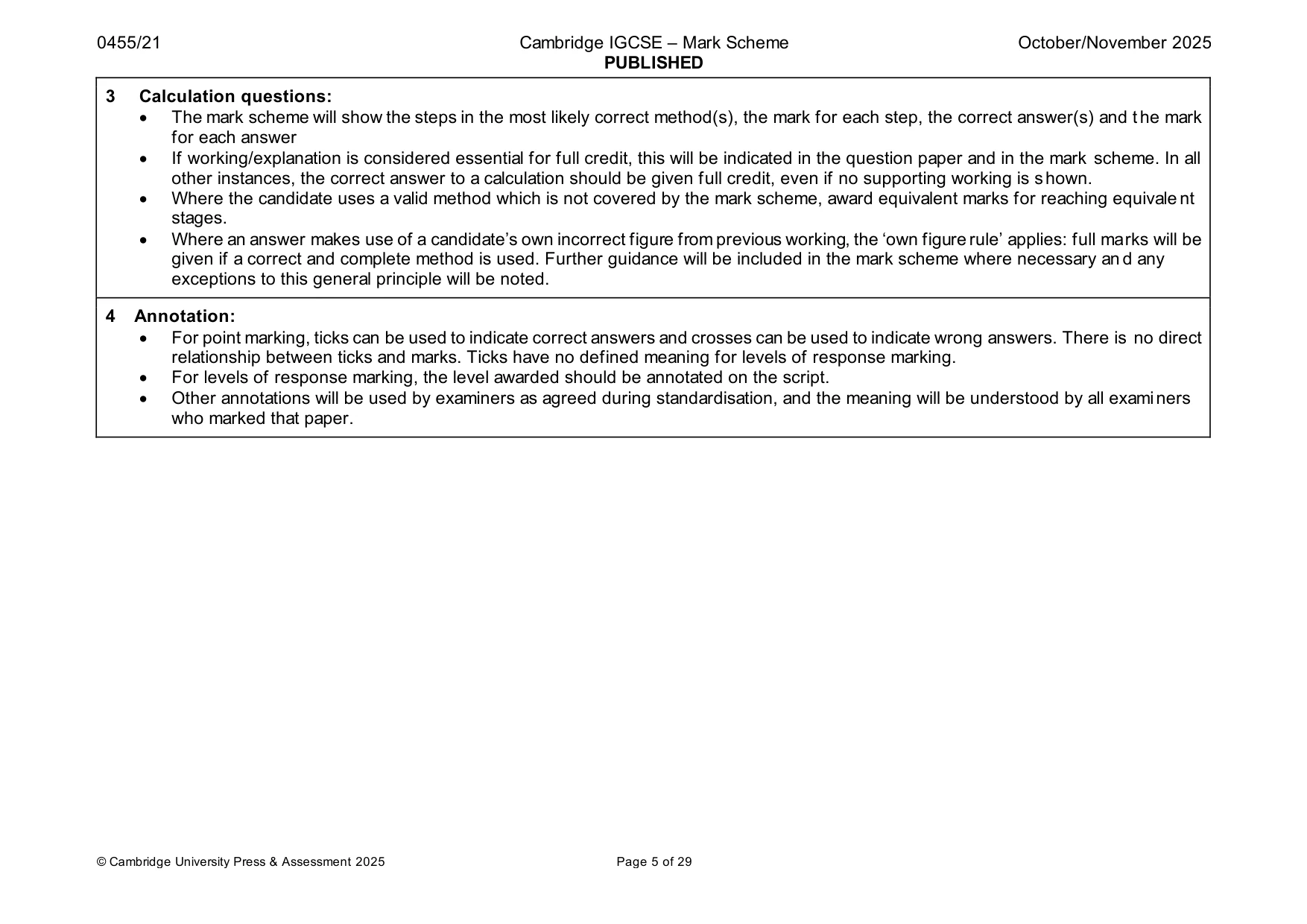
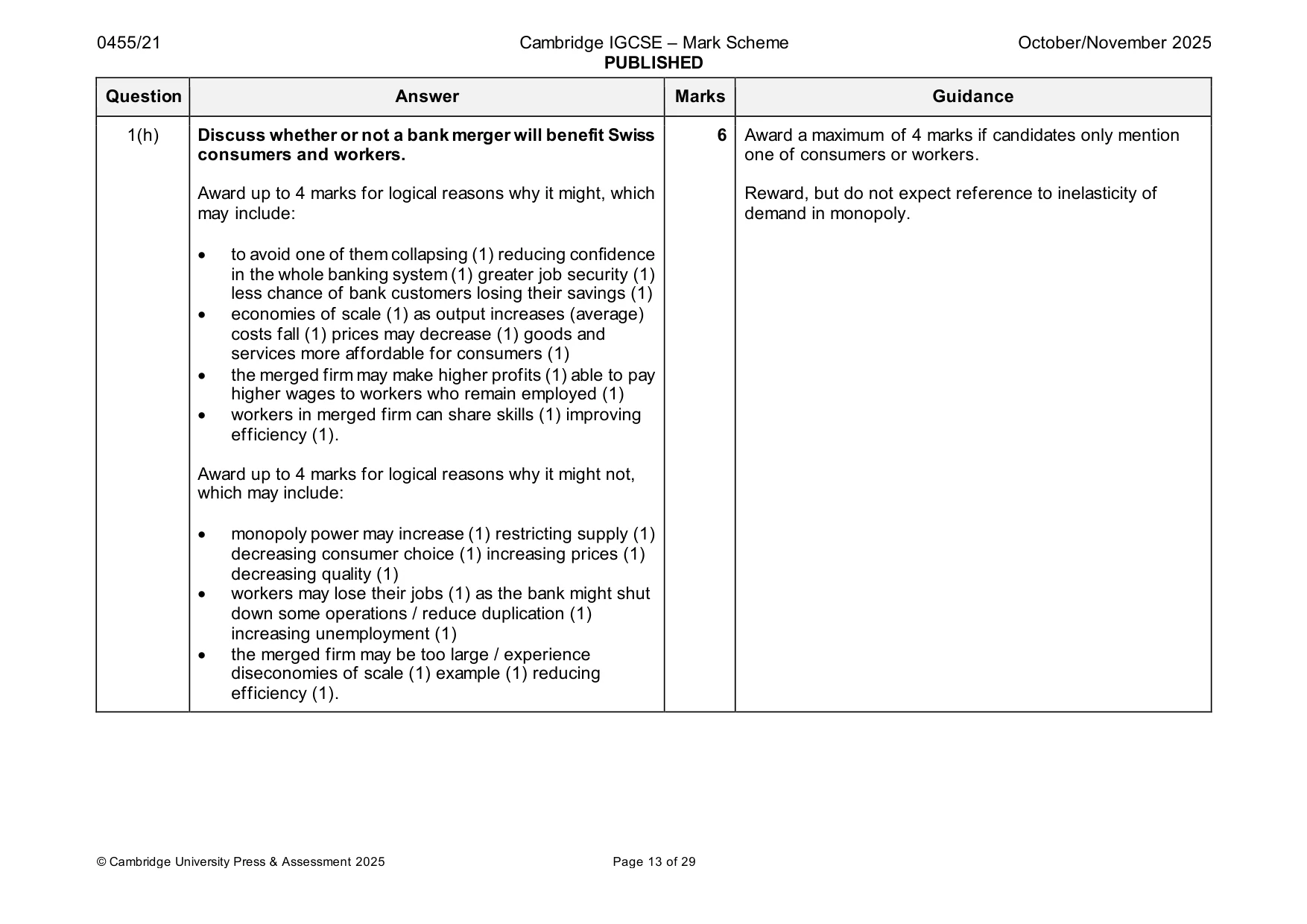
Mark scheme: Question Answer Marks Guidance 1(a) Calculate the total financial sector contribution (in $) to 1 Accept $73 billion or 73 billion. Switzerland’s GDP. $72 720 000 000. 7.27 1010 $72.7 billion 1(b) Identify two microeconomic policy measures. 2 Accept organising mergers. maximum prices (1) If more than two suggested measures are given, consider subsidies (1) the first three. 1(c) Explain one reason why overdependence on foreign 2 One mark for the reason and one mark for an explanation. markets is a disadvantage to the Swiss economy. Makes it more exposed to external shocks (1) as anything that happens in other countries could also affect the Swiss economy, for example reduced exports / increased import prices / potential shortages (1). 1(d) Draw a demand and supply diagram to show how a 4 subsidy to solar energy producers would affect the market for solar energy. D&S diagram: Axes correctly labelled – price and quantity or p and q (1). Original demand and supply curves correctly labelled (1). New supply curve shifted to the right (1). Equilibriums – shown by lines P1 and Q1 and P2 and Q2 or equilibrium points marked as E1 and E2 (1). 1(e) Explain two reasons why Switzerland had a current 4 One mark each for each of two reasons identified and one account surplus. mark each for each of two explanations. Logical explanation which might include: If more than two reasons are given, consider the first three. • low inflation (1) price of Swiss exports relatively lower, leading to increased exports / price of domestically produced goods relatively lower leading to decreased imports (1) • high-quality products (1) demand for Swiss exports higher, leading to increased exports / demand for domestically produced goods higher, leading to decreased imports (1) • strong currency (1) has kept cost of imported raw materials in Switzerland low, reducing costs of production (1). 1(f) Analyse the relationship between the global GDP 5 Responses do not have to be in the format suggested but growth rate and the change in the value of the Swiss they should address the expected / normal relationship, offer Franc. supporting evidence of that, highlight any exceptions to that, and analyse the overall data. Coherent analysis which might include the following. Expected relationship: generally negative / inverse relationship (1) as the global growth rate falls, the value of the Swiss Franc rises / as the global growth rate rises, the value of the Swiss Franc falls (1). Supporting evidence: fall in global growth rate led to rise in the value of Swiss Franc from 2018–2019 or 2019–2020 (1), rise in global growth rate led to fall in the value of Swiss Franc from 2020–2021 (1). Analysis: Swiss Franc’s status as a “safe haven” currency (1) when investors are unsure about the economy, they usually keep their money in Swiss francs (1). Exception: 2021–2022 (1) where global growth was falling but Swiss Franc was stable / rising only slightly (1). Analysis for exception: Other reasons could affect the value of Swiss Franc (1), for example Switzerland was also affected by the Covid–19 pandemic (1). 1(g) Discuss whether or not an increase in interest rates will 6 Falling profits can only be rewarded once. harm the Swiss economy. Apply this example to all questions with the command Award up to 4 marks for logical reasons why it might, which word DISCUSS (1g, 1h, 2d, 3d, 4d and 5d). may include: Each point may be credited only once, on either side of an • cost of borrowing increases for firms (1) increasing total argument, but separate development as to how / why the costs (1) reducing profits (1) outcome may differ is rewarded. • firms may invest less (1) may have to shut down (1) • unemployment rises (1) decreasing incomes Generic example Mark (1)decreasing total demand (1) decreasing economic growth (1) Tax revenue may decrease… 1 • consumers may borrow less (1) save more (1) less spending (1) demand for goods and services decreases ...because of reason e.g. incomes may be 1 (1) as returns from savings increase (1) decreasing lower. revenues of firms (1) decreasing profits (1) • Government borrowing costs more (1) leaving less Tax revenue may increase because 0 funding available for e.g. education / health (1). incomes may be higher i.e. reverse of a previous argument. Award up to 4 marks for logical reasons why it might not, which may include: Tax revenue may increase because of a 1 different reason i.e. not the reverse of a • hot money inflows strengthen the Swiss Franc (1) previous argument e.g. government reduce cost of e.g. imported raw materials (1) reducing spending on subsidies may stimulate the inflation (1) increasing export competitiveness (1) economy more than spending on education. • reduced demand-pull inflationary pressures (1) as cost of borrowing increases (1) decreasing demand for loans (1) increasing saving / decreasing consumption (1) investment (1) decreasing total demand (1) firms may reduce prices (1) increasing affordability of goods and services for consumers (1). • costs of production may decrease (1) reducing cost- push inflationary pressures (1). 1(h) Discuss whether or not a bank merger will benefit Swiss 6 Award a maximum of 4 marks if candidates only mention consumers and workers. one of consumers or workers. Award up to 4 marks for logical reasons why it might, which Reward, but do not expect reference to inelasticity of may include: demand in monopoly. • to avoid one of them collapsing (1) reducing confidence in the whole banking system (1) greater job security (1) less chance of bank customers losing their savings (1) • economies of scale (1) as output increases (average) costs fall (1) prices may decrease (1) goods and services more affordable for consumers (1) • the merged firm may make higher profits (1) able to pay higher wages to workers who remain employed (1) • workers in merged firm can share skills (1) improving efficiency (1). Award up to 4 marks for logical reasons why it might not, which may include: • monopoly power may increase (1) restricting supply (1) decreasing consumer choice (1) increasing prices (1) decreasing quality (1) • workers may lose their jobs (1) as the bank might shut down some operations / reduce duplication (1) increasing unemployment (1) • the merged firm may be too large / experience diseconomies of scale (1) example (1) reducing efficiency (1).
Q2 · In the first half of 2022, Guyana’s GDP grew by 36.4%
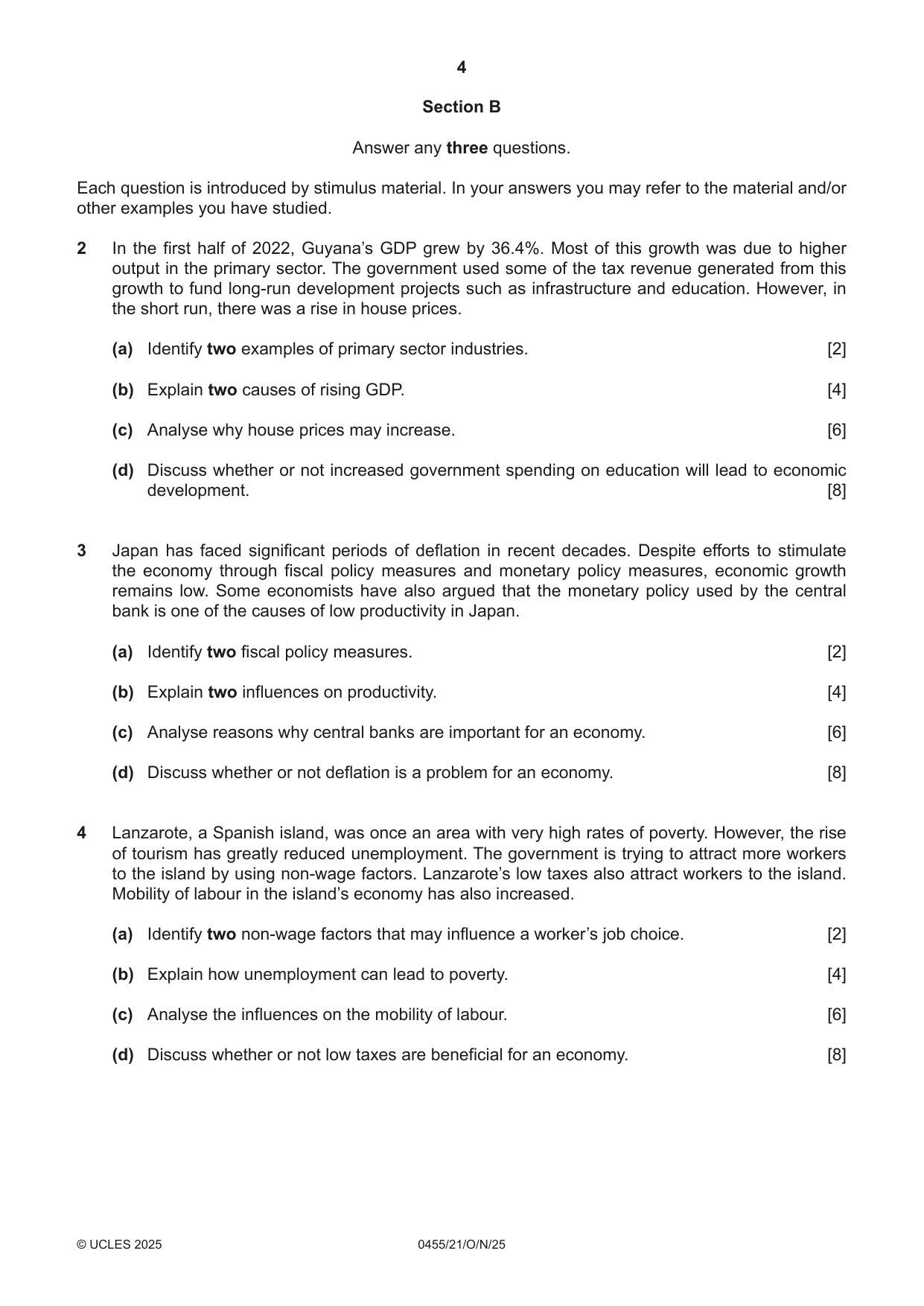
2 In the first half of 2022, Guyana’s GDP grew by 36.4%. Most of this growth was due to higher output in the primary sector. The government used some of the tax revenue generated from this growth to fund long‑run development projects such as infrastructure and education. However, in the short run, there was a rise in house prices. (a) Identify two examples of primary sector industries. [2] (b) Explain two causes of rising GDP. [4] (c) Analyse why house prices may increase. [6] (d) Discuss whether or not increased government spending on education will lead to economic development. [8]
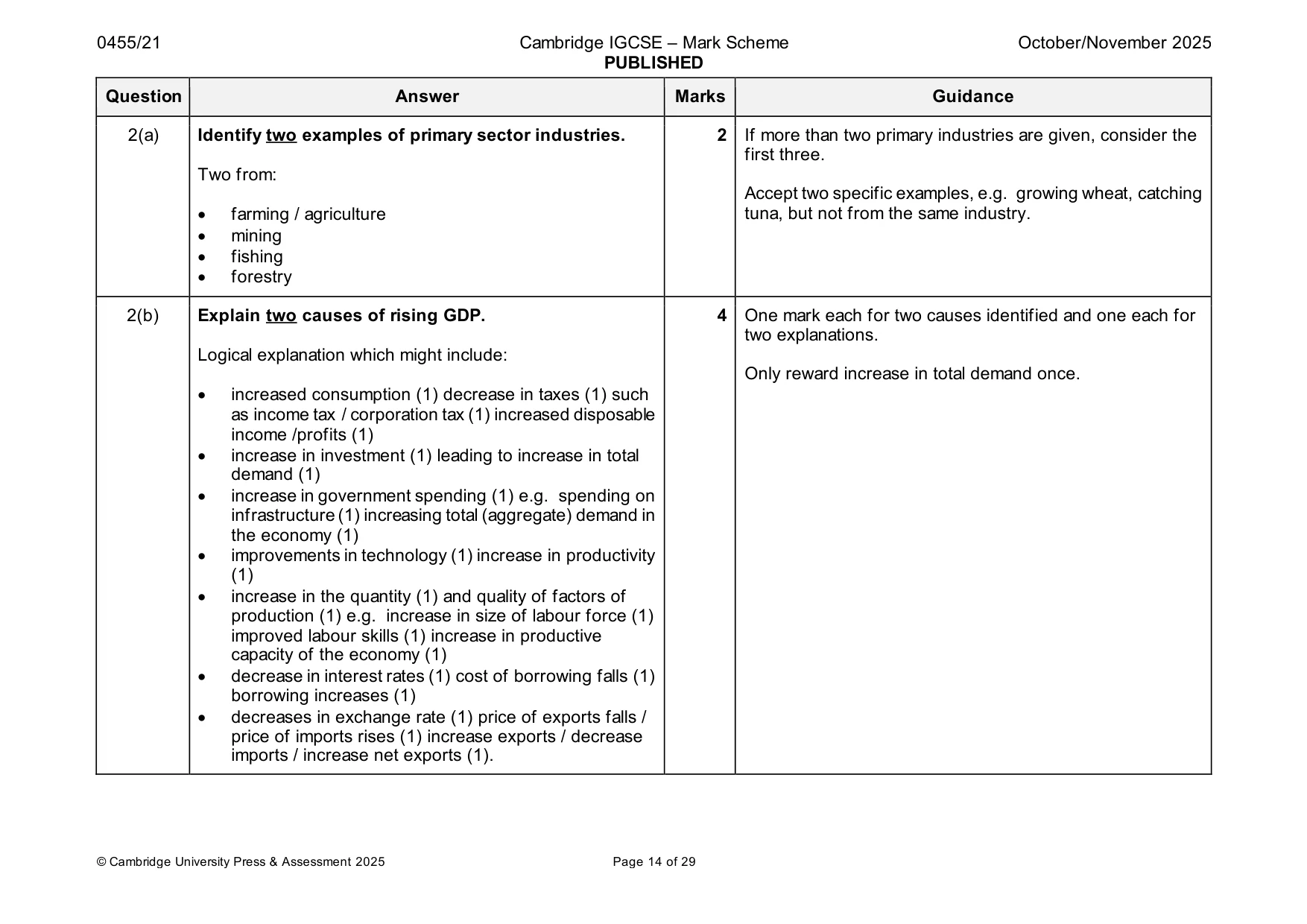
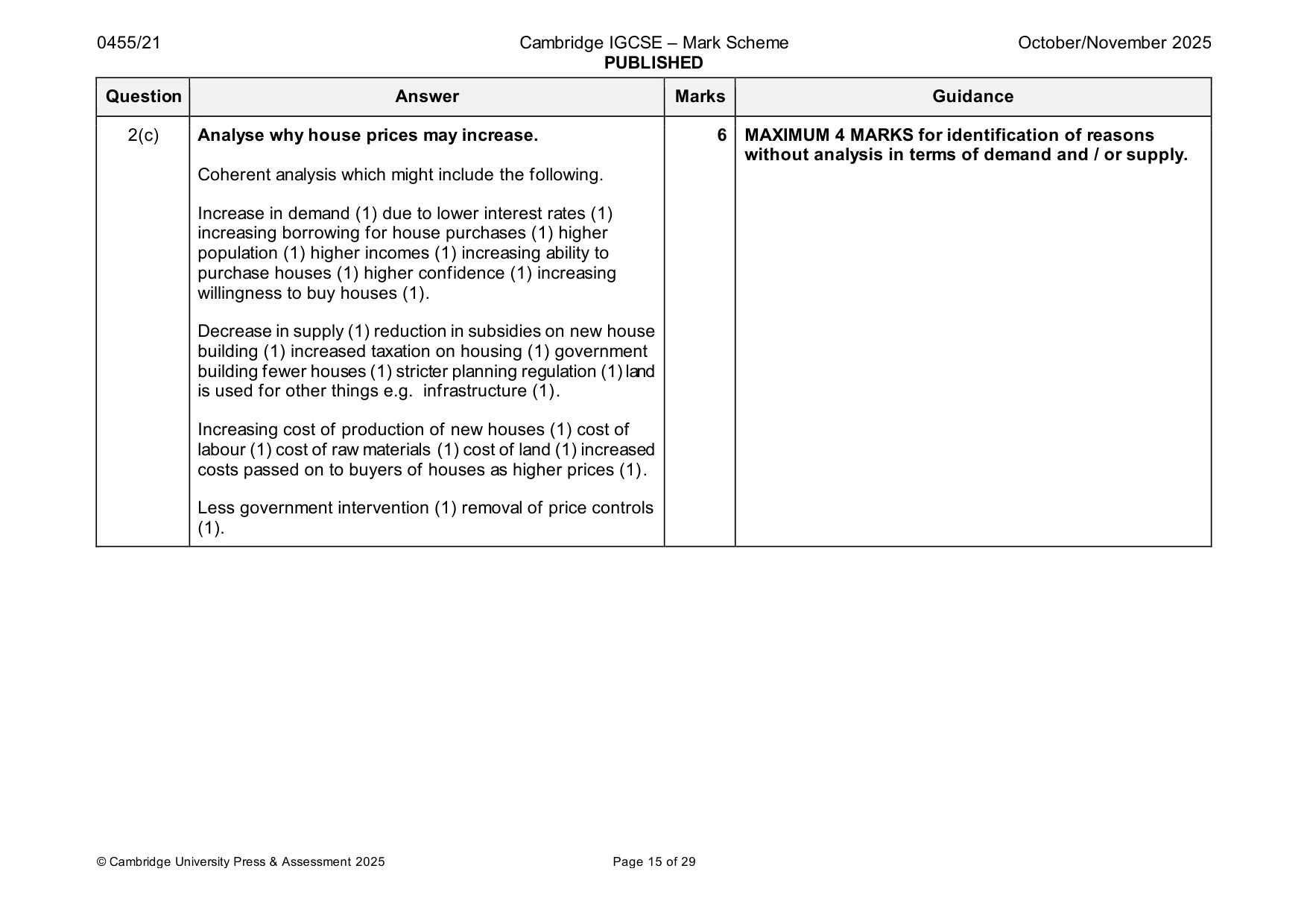
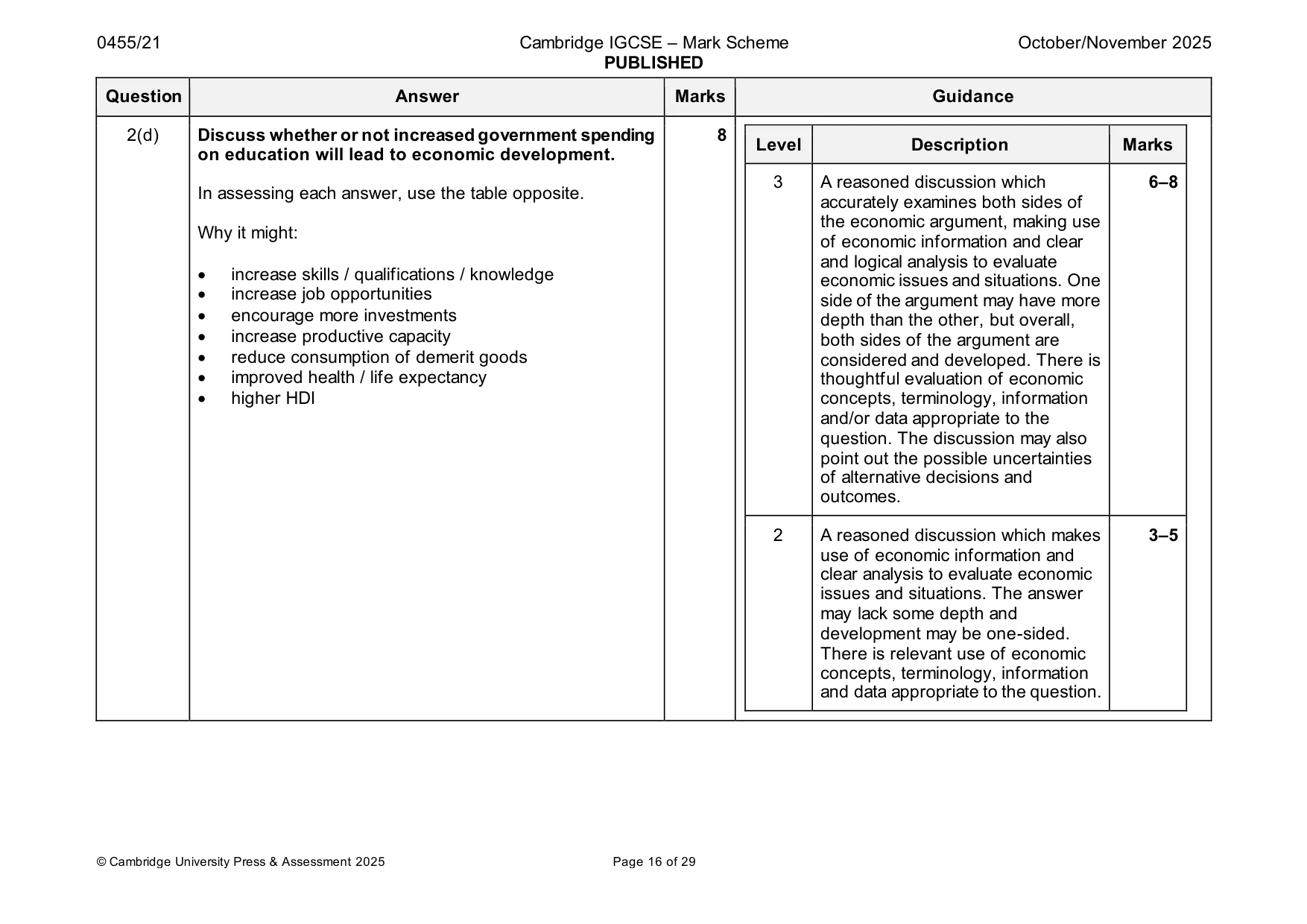
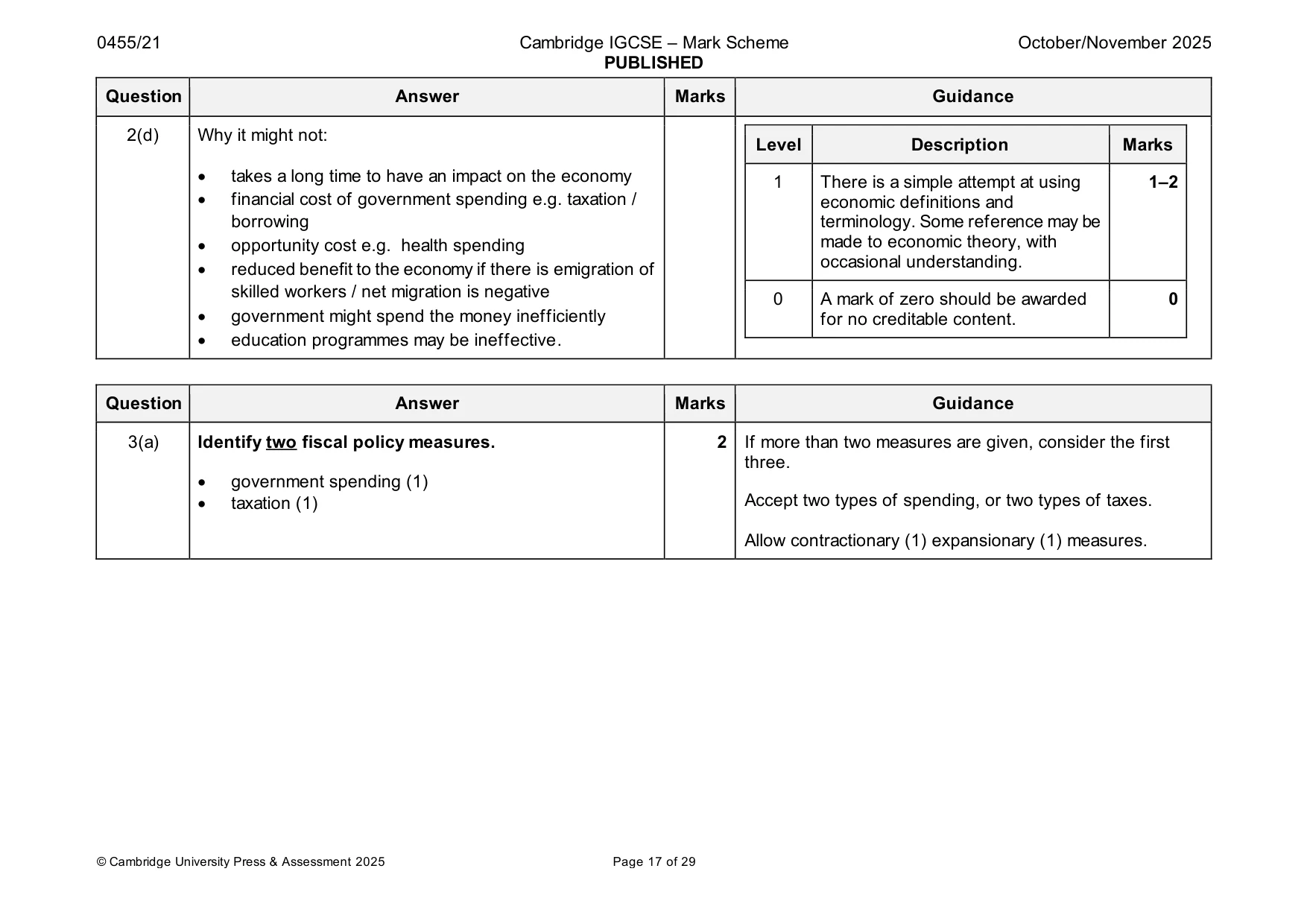
Mark scheme: 2(a) Identify two examples of primary sector industries. 2 If more than two primary industries are given, consider the first three. Two from: Accept two specific examples, e.g. growing wheat, catching • farming / agriculture tuna, but not from the same industry. • mining • fishing • forestry 2(b) Explain two causes of rising GDP. 4 One mark each for two causes identified and one each for two explanations. Logical explanation which might include: Only reward increase in total demand once. • increased consumption (1) decrease in taxes (1) such as income tax / corporation tax (1) increased disposable income /profits (1) • increase in investment (1) leading to increase in total demand (1) • increase in government spending (1) e.g. spending on infrastructure (1) increasing total (aggregate) demand in the economy (1) • improvements in technology (1) increase in productivity (1) • increase in the quantity (1) and quality of factors of production (1) e.g. increase in size of labour force (1) improved labour skills (1) increase in productive capacity of the economy (1) • decrease in interest rates (1) cost of borrowing falls (1) borrowing increases (1) • decreases in exchange rate (1) price of exports falls / price of imports rises (1) increase exports / decrease imports / increase net exports (1). 2(c) Analyse why house prices may increase. 6 MAXIMUM 4 MARKS for identification of reasons without analysis in terms of demand and / or supply. Coherent analysis which might include the following. Increase in demand (1) due to lower interest rates (1) increasing borrowing for house purchases (1) higher population (1) higher incomes (1) increasing ability to purchase houses (1) higher confidence (1) increasing willingness to buy houses (1). Decrease in supply (1) reduction in subsidies on new house building (1) increased taxation on housing (1) government building fewer houses (1) stricter planning regulation (1) land is used for other things e.g. infrastructure (1). Increasing cost of production of new houses (1) cost of labour (1) cost of raw materials (1) cost of land (1) increased costs passed on to buyers of houses as higher prices (1). Less government intervention (1) removal of price controls (1). 2(d) Discuss whether or not increased government spending 8 Level Description Marks on education will lead to economic development. 3 A reasoned discussion which 6–8 In assessing each answer, use the table opposite. accurately examines both sides of the economic argument, making use Why it might: of economic information and clear and logical analysis to evaluate • increase skills / qualifications / knowledge economic issues and situations. One • increase job opportunities side of the argument may have more • encourage more investments depth than the other, but overall, • increase productive capacity both sides of the argument are • reduce consumption of demerit goods considered and developed. There is • improved health / life expectancy thoughtful evaluation of economic • higher HDI concepts, terminology, information and/or data appropriate to the question. The discussion may also point out the possible uncertainties of alternative decisions and outcomes. 2 A reasoned discussion which makes 3–5 use of economic information and clear analysis to evaluate economic issues and situations. The answer may lack some depth and development may be one-sided. There is relevant use of economic concepts, terminology, information and data appropriate to the question. 2(d) Why it might not: Level Description Marks • takes a long time to have an impact on the economy 1 There is a simple attempt at using 1–2 • financial cost of government spending e.g. taxation / economic definitions and borrowing terminology. Some reference may be • opportunity cost e.g. health spending made to economic theory, with occasional understanding. • reduced benefit to the economy if there is emigration of skilled workers / net migration is negative 0 A mark of zero should be awarded 0 • government might spend the money inefficiently for no creditable content. • education programmes may be ineffective.
Q3 · Japan has faced significant periods of deflation in recent decades
3 Japan has faced significant periods of deflation in recent decades. Despite efforts to stimulate the economy through fiscal policy measures and monetary policy measures, economic growth remains low. Some economists have also argued that the monetary policy used by the central bank is one of the causes of low productivity in Japan. (a) Identify two fiscal policy measures. [2] (b) Explain two influences on productivity. [4] (c) Analyse reasons why central banks are important for an economy. [6] (d) Discuss whether or not deflation is a problem for an economy. [8]
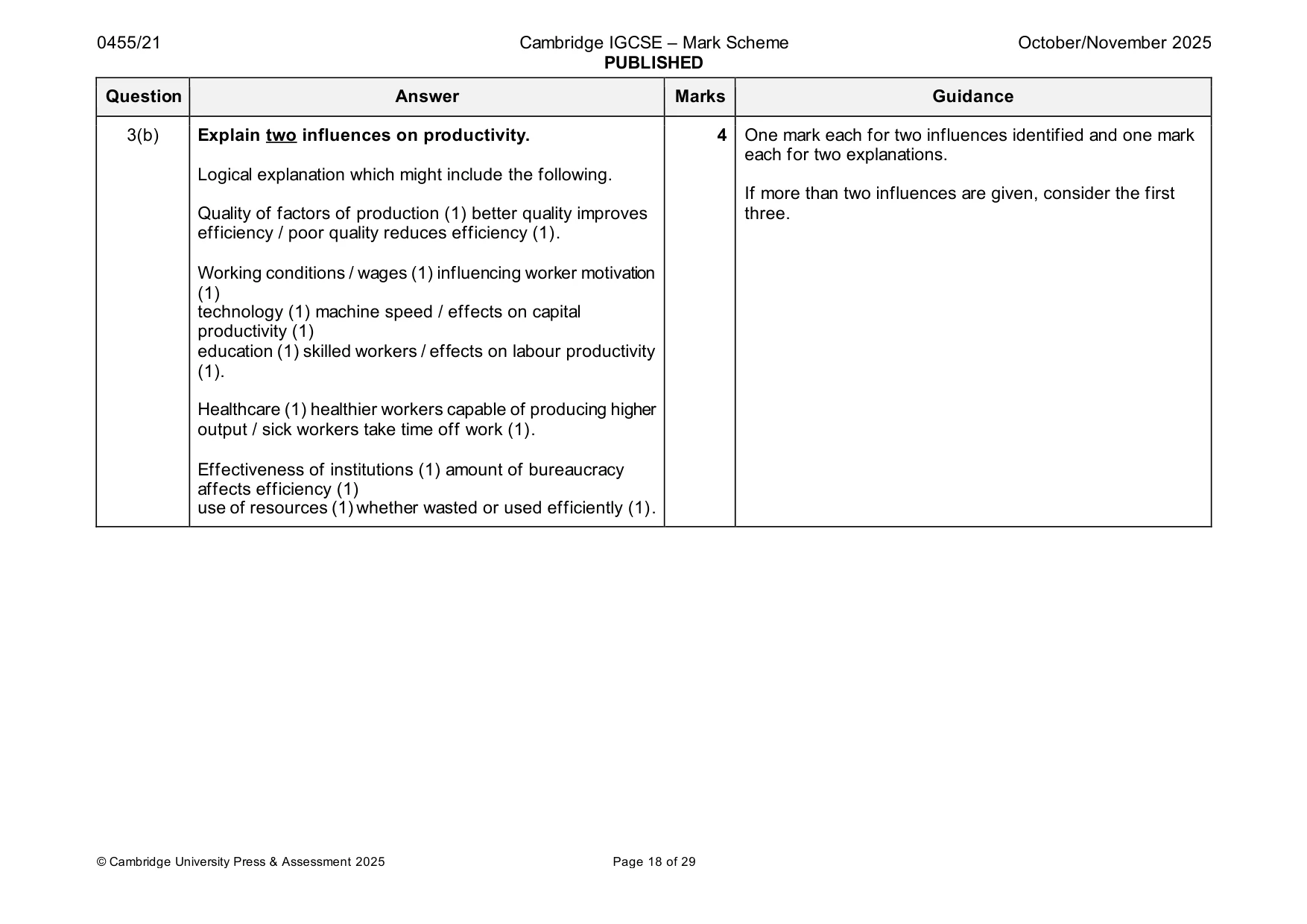
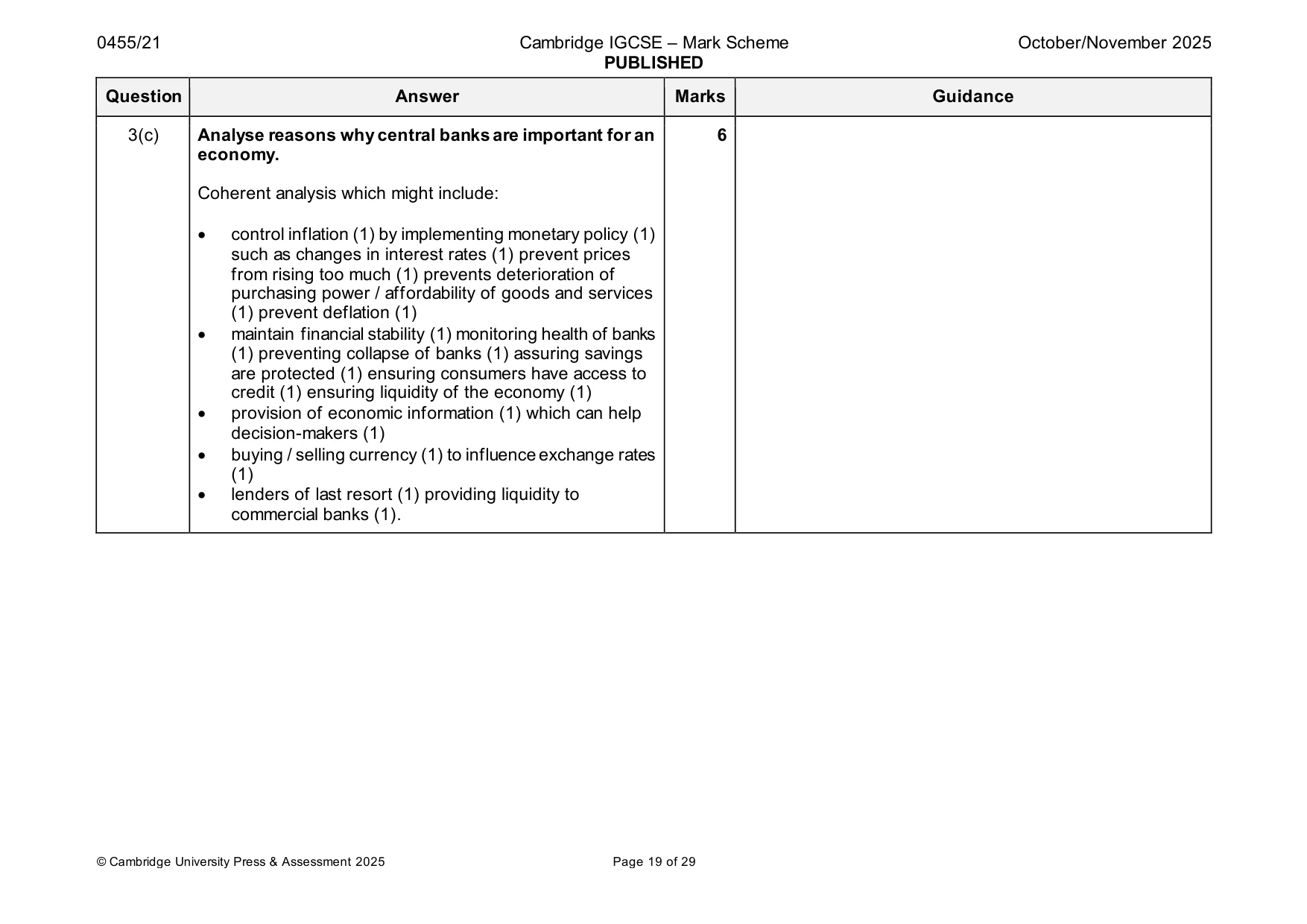
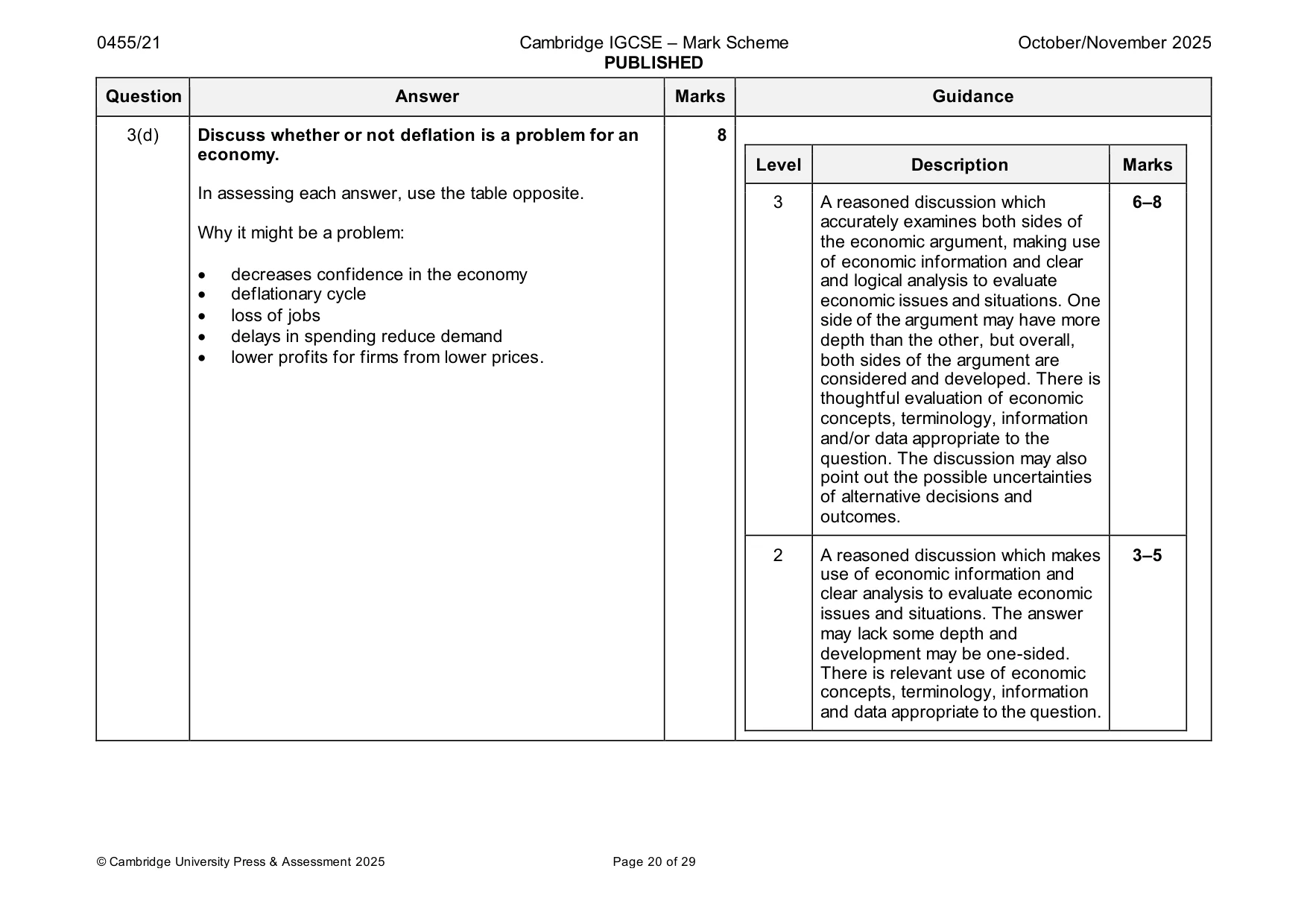
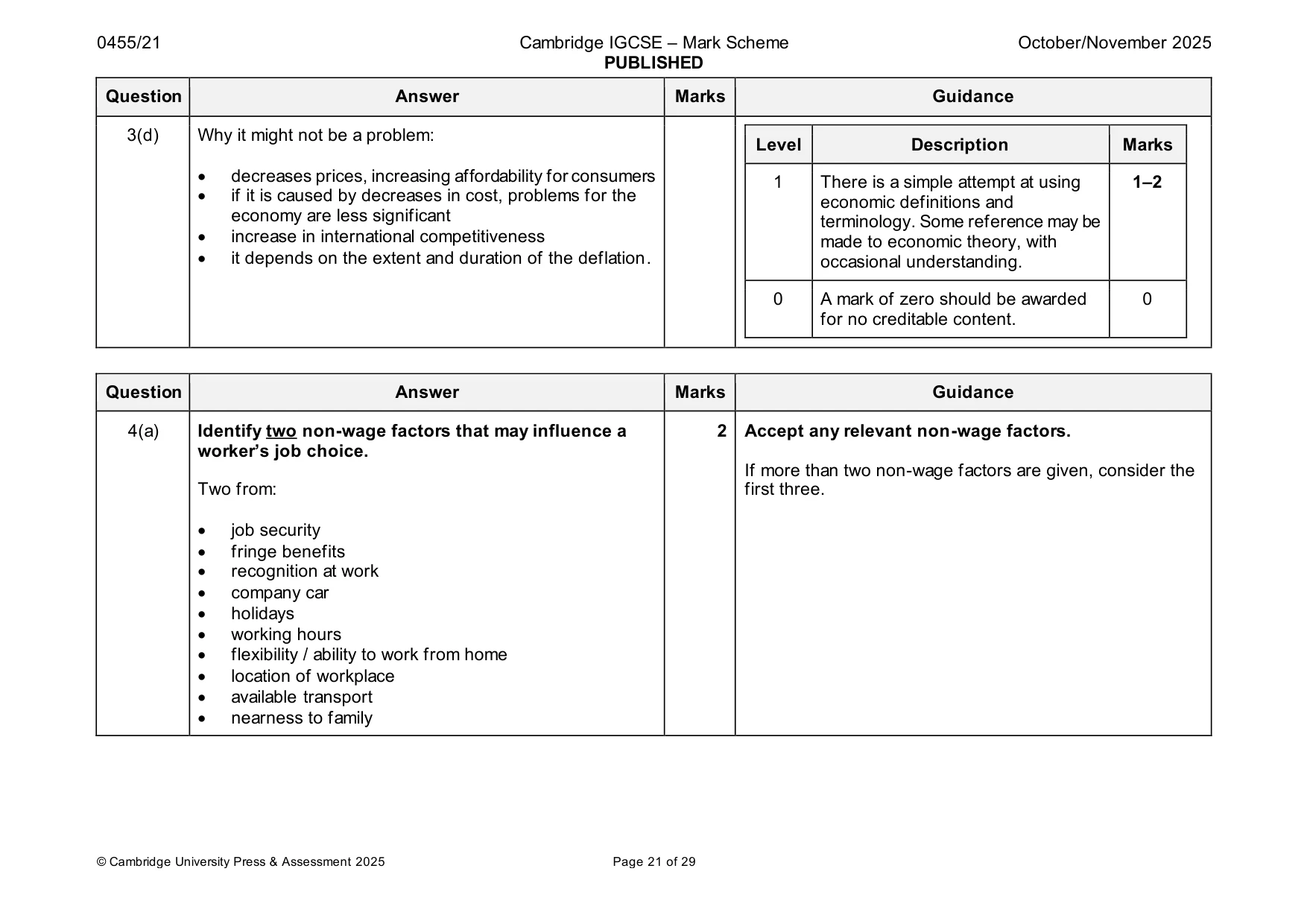
Mark scheme: 3(a) Identify two fiscal policy measures. 2 If more than two measures are given, consider the first three. • government spending (1) • taxation (1) Accept two types of spending, or two types of taxes. Allow contractionary (1) expansionary (1) measures. 3(b) Explain two influences on productivity. 4 One mark each for two influences identified and one mark each for two explanations. Logical explanation which might include the following. If more than two influences are given, consider the first Quality of factors of production (1) better quality improves three. efficiency / poor quality reduces efficiency (1). Working conditions / wages (1) influencing worker motivation (1) technology (1) machine speed / effects on capital productivity (1) education (1) skilled workers / effects on labour productivity (1). Healthcare (1) healthier workers capable of producing higher output / sick workers take time off work (1). Effectiveness of institutions (1) amount of bureaucracy affects efficiency (1) use of resources (1) whether wasted or used efficiently (1). 3(c) Analyse reasons why central banks are important for an 6 economy. Coherent analysis which might include: • control inflation (1) by implementing monetary policy (1) such as changes in interest rates (1) prevent prices from rising too much (1) prevents deterioration of purchasing power / affordability of goods and services (1) prevent deflation (1) • maintain financial stability (1) monitoring health of banks (1) preventing collapse of banks (1) assuring savings are protected (1) ensuring consumers have access to credit (1) ensuring liquidity of the economy (1) • provision of economic information (1) which can help decision-makers (1) • buying / selling currency (1) to influence exchange rates (1) • lenders of last resort (1) providing liquidity to commercial banks (1). 3(d) Discuss whether or not deflation is a problem for an 8 economy. Level Description Marks In assessing each answer, use the table opposite. 3 A reasoned discussion which 6–8 accurately examines both sides of Why it might be a problem: the economic argument, making use of economic information and clear • decreases confidence in the economy and logical analysis to evaluate • deflationary cycle economic issues and situations. One • loss of jobs side of the argument may have more • delays in spending reduce demand depth than the other, but overall, • lower profits for firms from lower prices. both sides of the argument are considered and developed. There is thoughtful evaluation of economic concepts, terminology, information and/or data appropriate to the question. The discussion may also point out the possible uncertainties of alternative decisions and outcomes. 2 A reasoned discussion which makes 3–5 use of economic information and clear analysis to evaluate economic issues and situations. The answer may lack some depth and development may be one-sided. There is relevant use of economic concepts, terminology, information and data appropriate to the question. 3(d) Why it might not be a problem: Level Description Marks • decreases prices, increasing affordability for consumers 1 There is a simple attempt at using 1–2 • if it is caused by decreases in cost, problems for the economic definitions and economy are less significant terminology. Some reference may be • increase in international competitiveness made to economic theory, with • it depends on the extent and duration of the deflation. occasional understanding. 0 A mark of zero should be awarded 0 for no creditable content.
Q4 · Lanzarote, a Spanish island, was once an area with very high rates of poverty
4 Lanzarote, a Spanish island, was once an area with very high rates of poverty. However, the rise of tourism has greatly reduced unemployment. The government is trying to attract more workers to the island by using non‑wage factors. Lanzarote’s low taxes also attract workers to the island. Mobility of labour in the island’s economy has also increased. (a) Identify two non‑wage factors that may influence a worker’s job choice. [2] (b) Explain how unemployment can lead to poverty. [4] (c) Analyse the influences on the mobility of labour. [6] (d) Discuss whether or not low taxes are beneficial for an economy. [8]
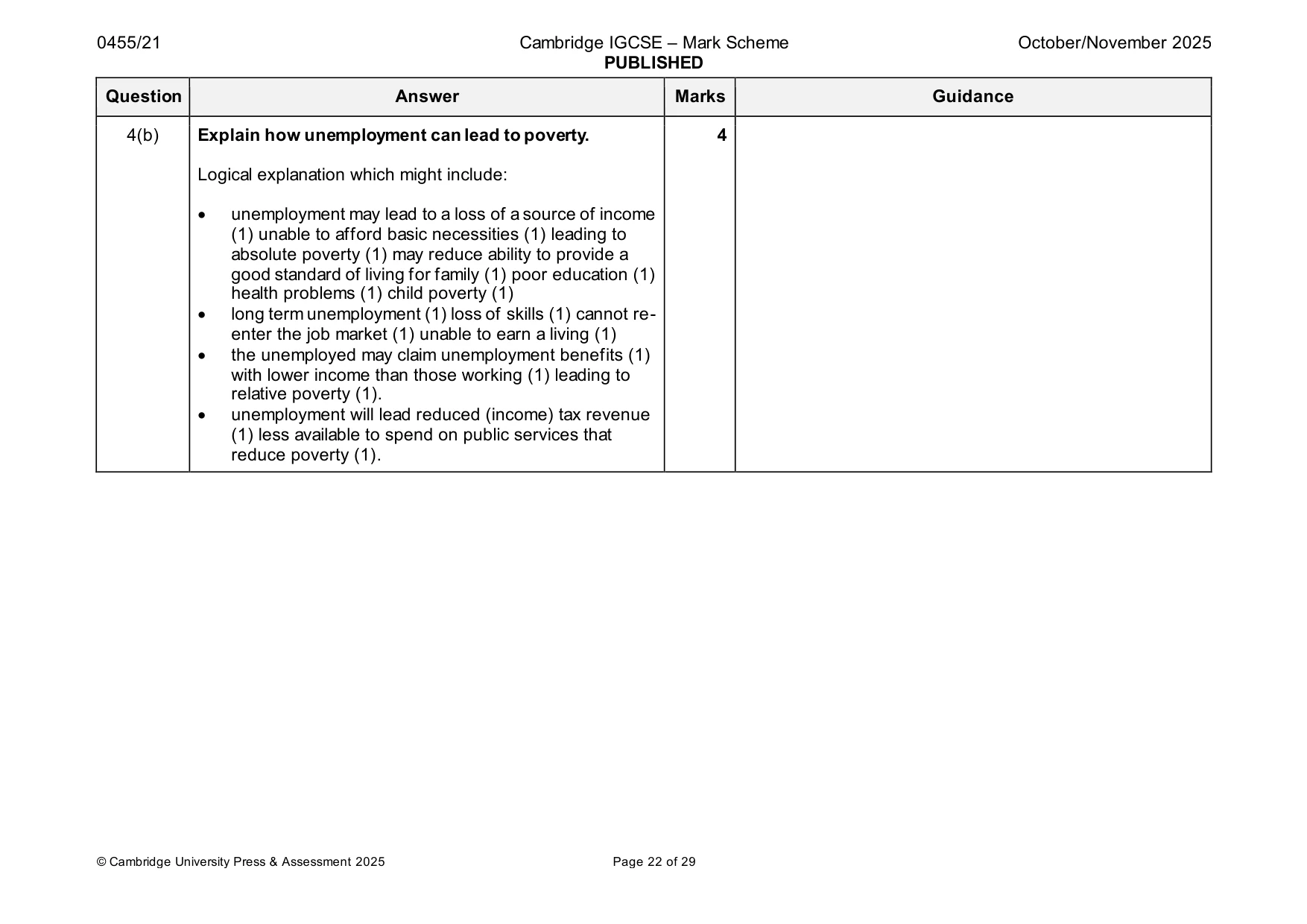
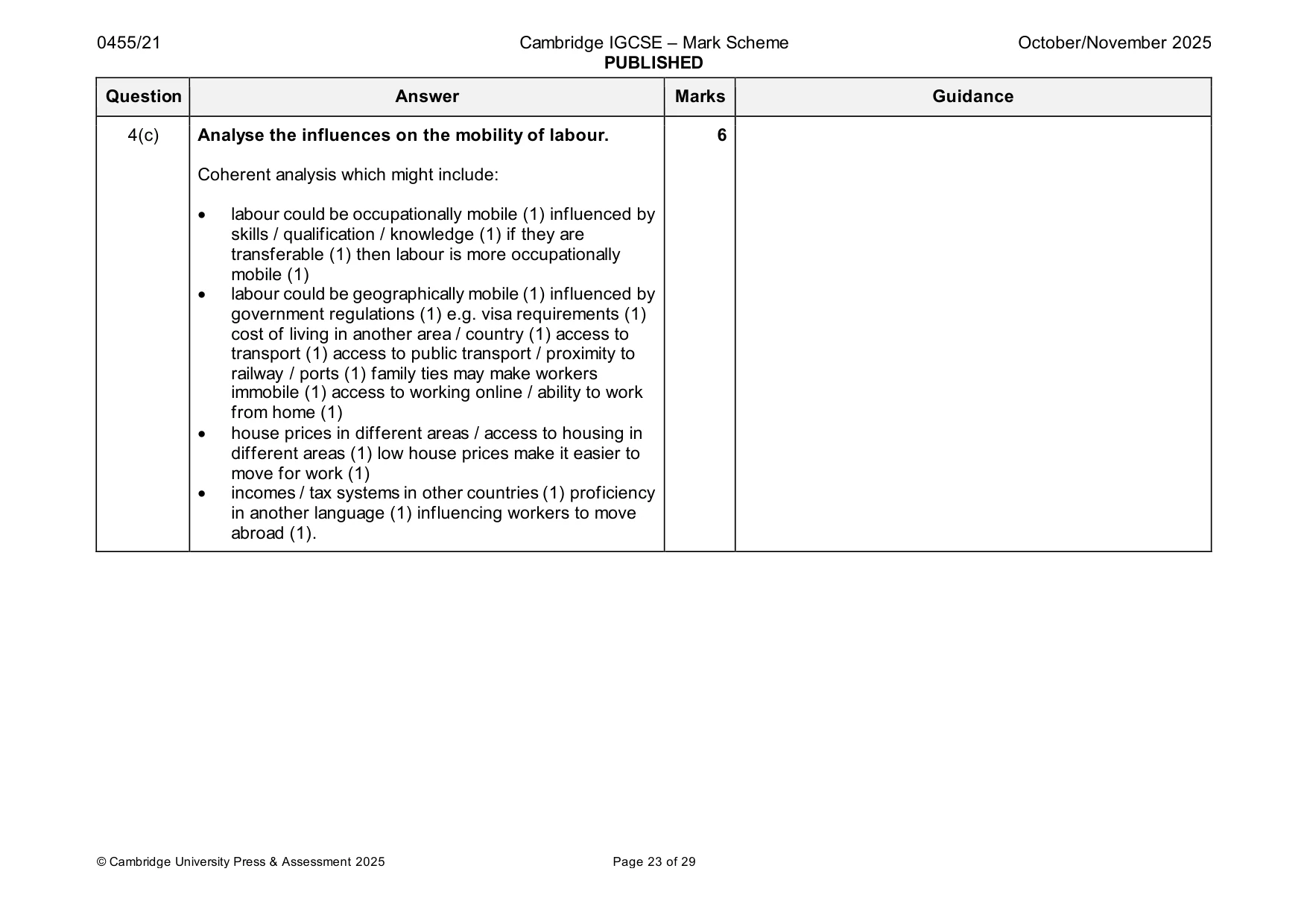
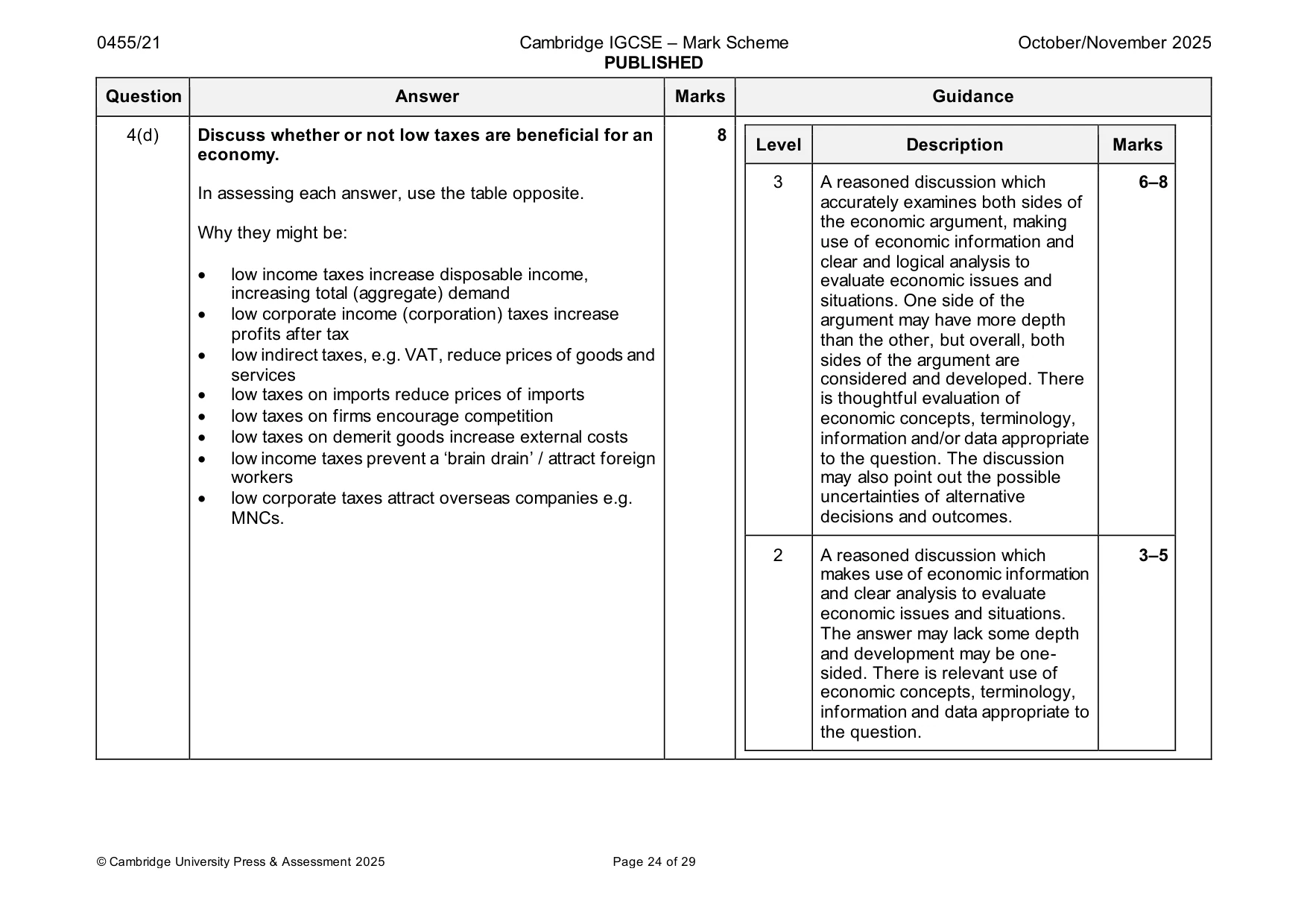
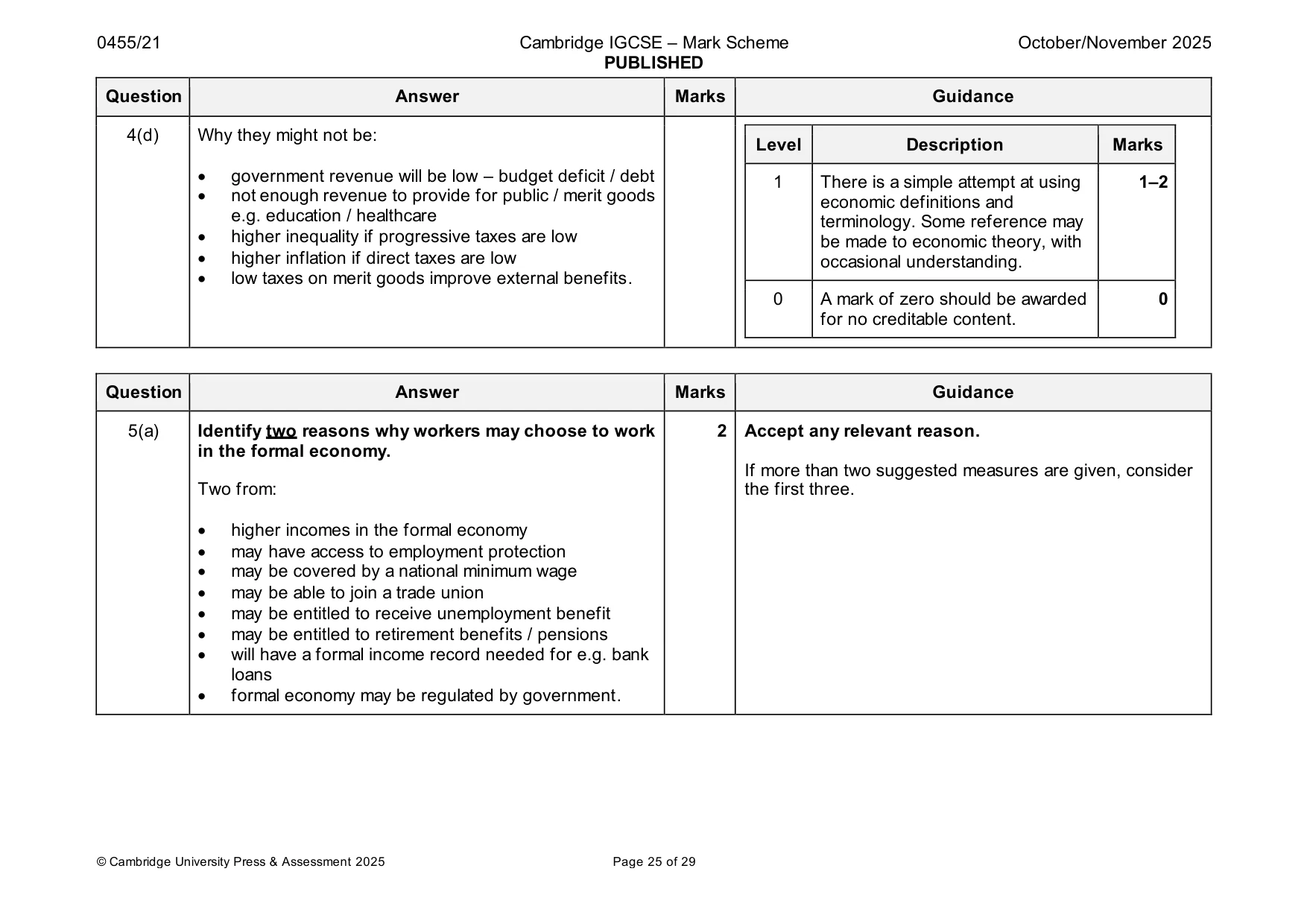
Mark scheme: 4(a) Identify two non-wage factors that may influence a 2 Accept any relevant non-wage factors. worker’s job choice. If more than two non-wage factors are given, consider the Two from: first three. • job security • fringe benefits • recognition at work • company car • holidays • working hours • flexibility / ability to work from home • location of workplace • available transport • nearness to family 4(b) Explain how unemployment can lead to poverty. 4 Logical explanation which might include: • unemployment may lead to a loss of a source of income (1) unable to afford basic necessities (1) leading to absolute poverty (1) may reduce ability to provide a good standard of living for family (1) poor education (1) health problems (1) child poverty (1) • long term unemployment (1) loss of skills (1) cannot re- enter the job market (1) unable to earn a living (1) • the unemployed may claim unemployment benefits (1) with lower income than those working (1) leading to relative poverty (1). • unemployment will lead reduced (income) tax revenue (1) less available to spend on public services that reduce poverty (1). 4(c) Analyse the influences on the mobility of labour. 6 Coherent analysis which might include: • labour could be occupationally mobile (1) influenced by skills / qualification / knowledge (1) if they are transferable (1) then labour is more occupationally mobile (1) • labour could be geographically mobile (1) influenced by government regulations (1) e.g. visa requirements (1) cost of living in another area / country (1) access to transport (1) access to public transport / proximity to railway / ports (1) family ties may make workers immobile (1) access to working online / ability to work from home (1) • house prices in different areas / access to housing in different areas (1) low house prices make it easier to move for work (1) • incomes / tax systems in other countries (1) proficiency in another language (1) influencing workers to move abroad (1). 4(d) Discuss whether or not low taxes are beneficial for an 8 Level Description Marks economy. 3 A reasoned discussion which 6–8 In assessing each answer, use the table opposite. accurately examines both sides of the economic argument, making Why they might be: use of economic information and clear and logical analysis to • low income taxes increase disposable income, evaluate economic issues and increasing total (aggregate) demand situations. One side of the • low corporate income (corporation) taxes increase argument may have more depth profits after tax than the other, but overall, both • low indirect taxes, e.g. VAT, reduce prices of goods and sides of the argument are services considered and developed. There • low taxes on imports reduce prices of imports is thoughtful evaluation of • low taxes on firms encourage competition economic concepts, terminology, • low taxes on demerit goods increase external costs information and/or data appropriate • low income taxes prevent a ‘brain drain’ / attract foreign to the question. The discussion workers may also point out the possible • low corporate taxes attract overseas companies e.g. uncertainties of alternative MNCs. decisions and outcomes. 2 A reasoned discussion which 3–5 makes use of economic information and clear analysis to evaluate economic issues and situations. The answer may lack some depth and development may be one- sided. There is relevant use of economic concepts, terminology, information and data appropriate to the question. 4(d) Why they might not be: Level Description Marks • government revenue will be low – budget deficit / debt 1 There is a simple attempt at using 1–2 • not enough revenue to provide for public / merit goods economic definitions and e.g. education / healthcare terminology. Some reference may • higher inequality if progressive taxes are low be made to economic theory, with • higher inflation if direct taxes are low occasional understanding. • low taxes on merit goods improve external benefits. 0 A mark of zero should be awarded 0 for no creditable content.
Q5 · Street vendors mostly operate outside of the formal economy to avoid government regulation
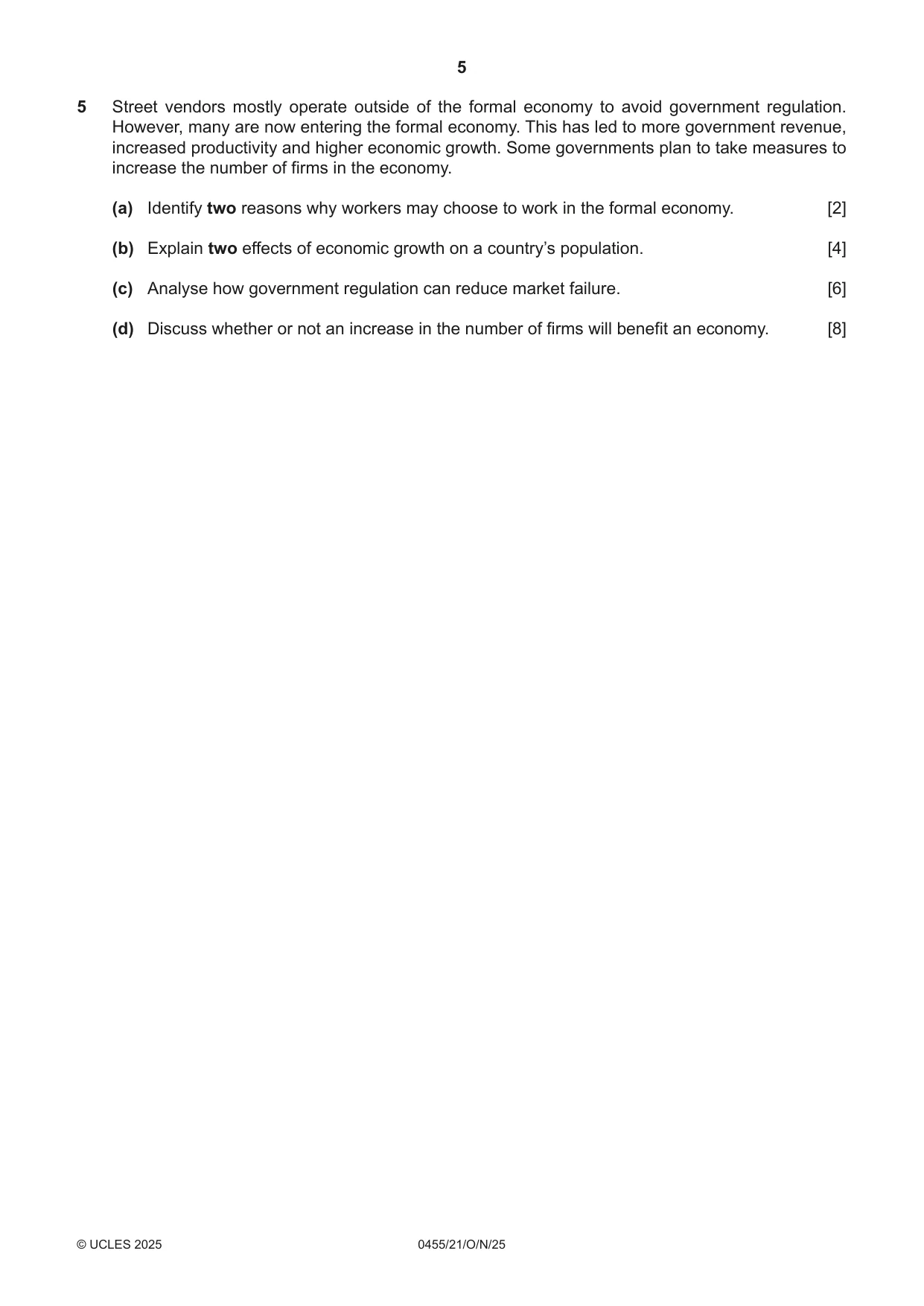
5 Street vendors mostly operate outside of the formal economy to avoid government regulation. However, many are now entering the formal economy. This has led to more government revenue, increased productivity and higher economic growth. Some governments plan to take measures to increase the number of firms in the economy. (a) Identify two reasons why workers may choose to work in the formal economy. [2] (b) Explain two effects of economic growth on a country’s population. [4] (c) Analyse how government regulation can reduce market failure. [6] (d) Discuss whether or not an increase in the number of firms will benefit an economy. [8]
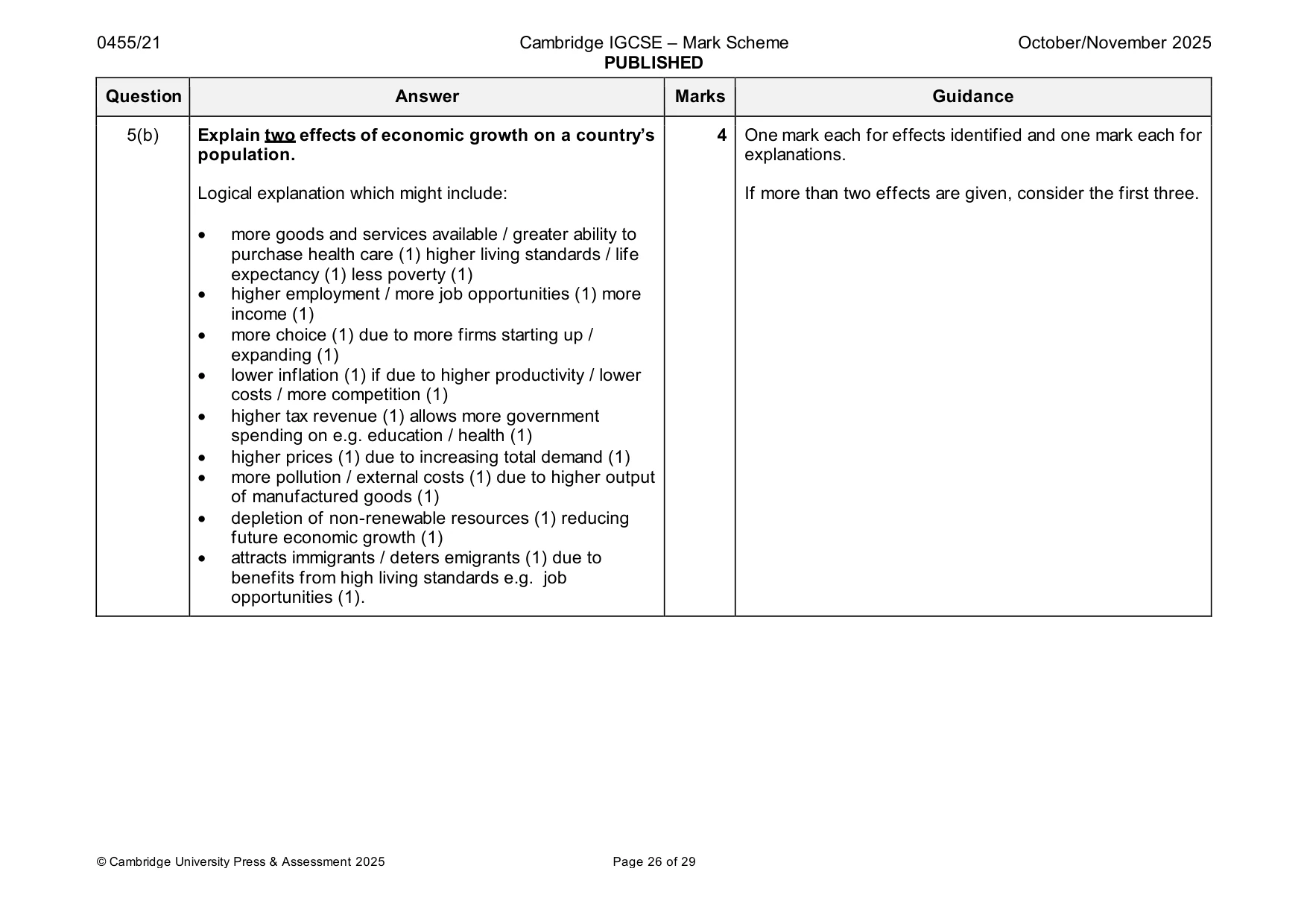
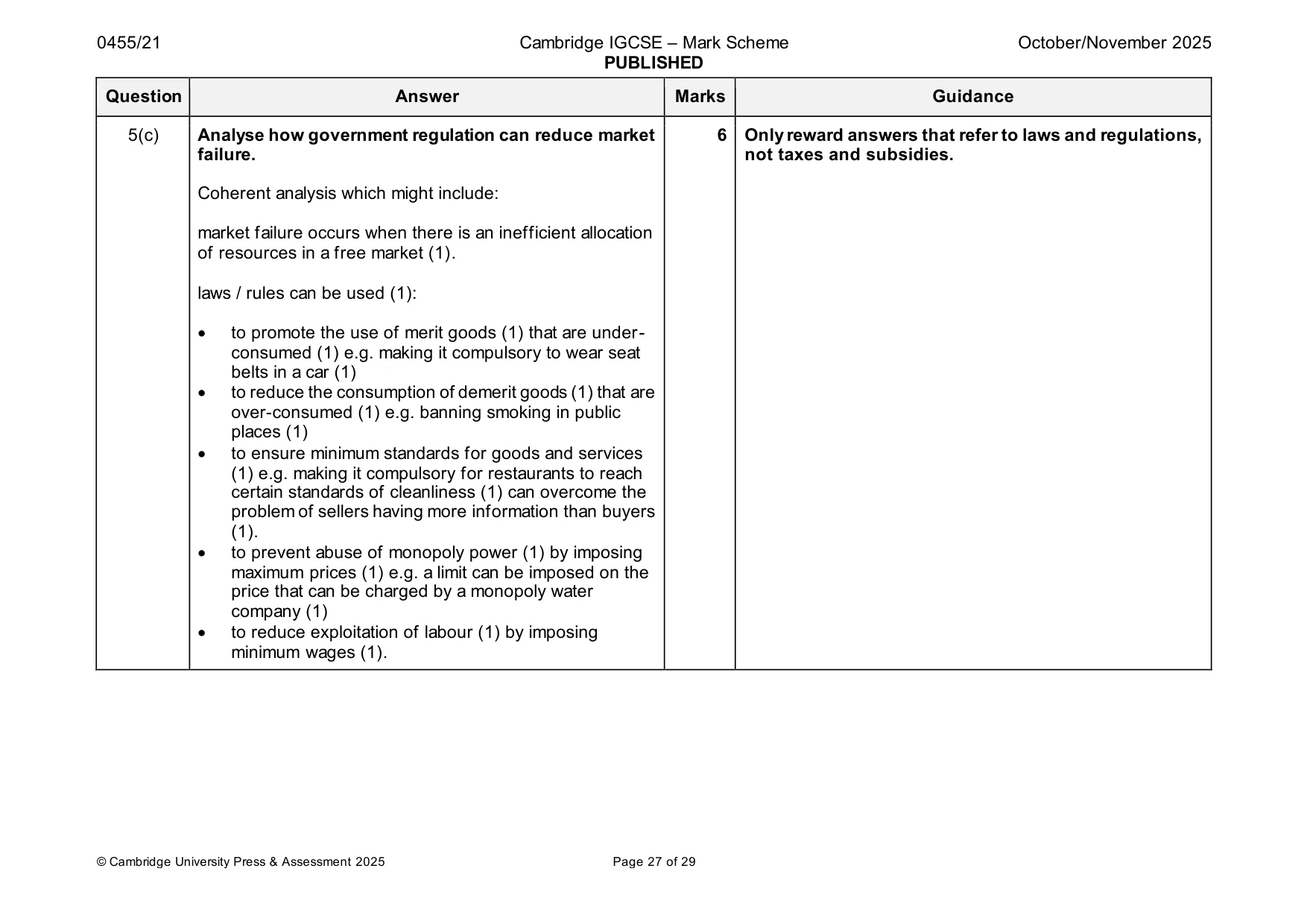
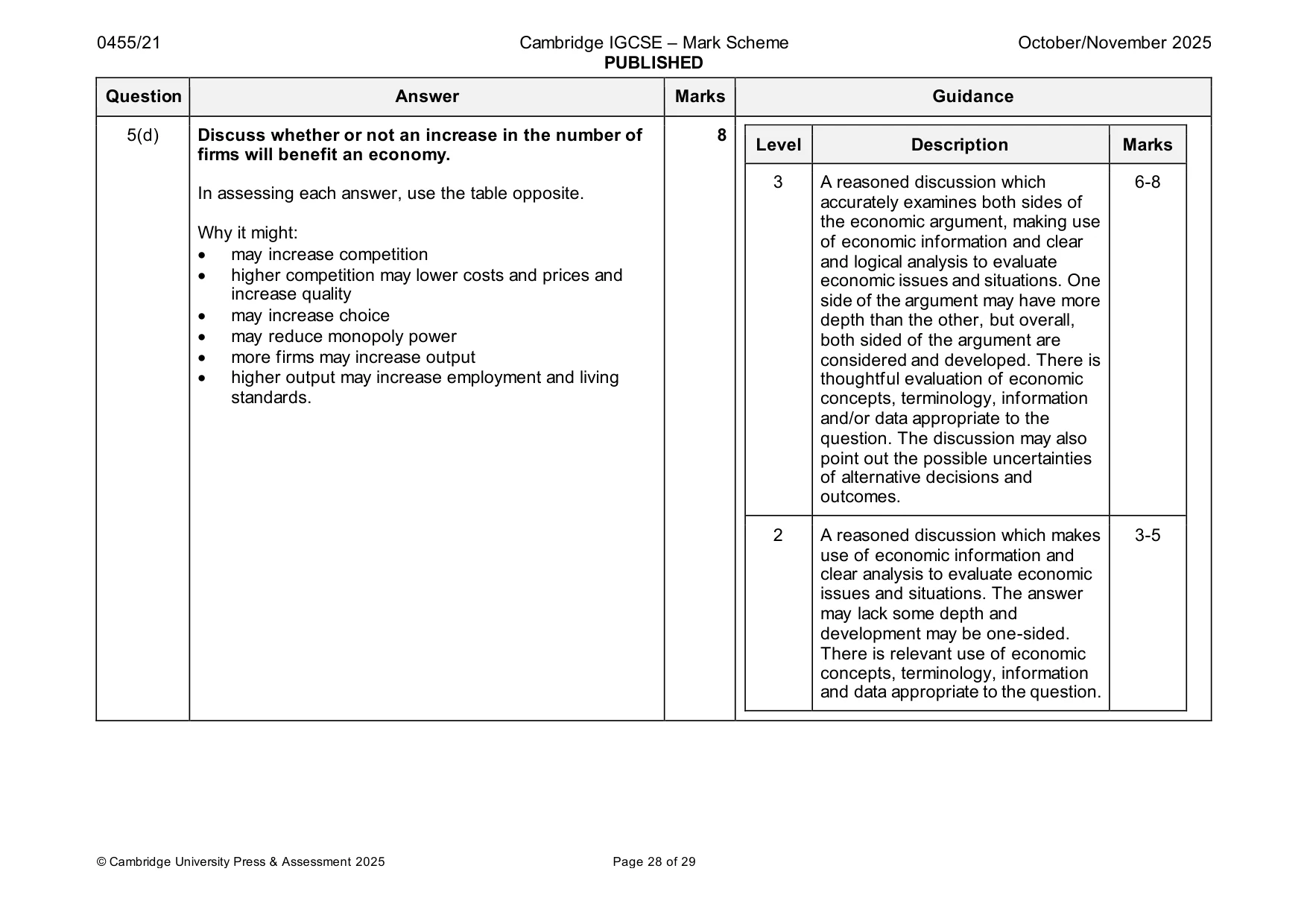
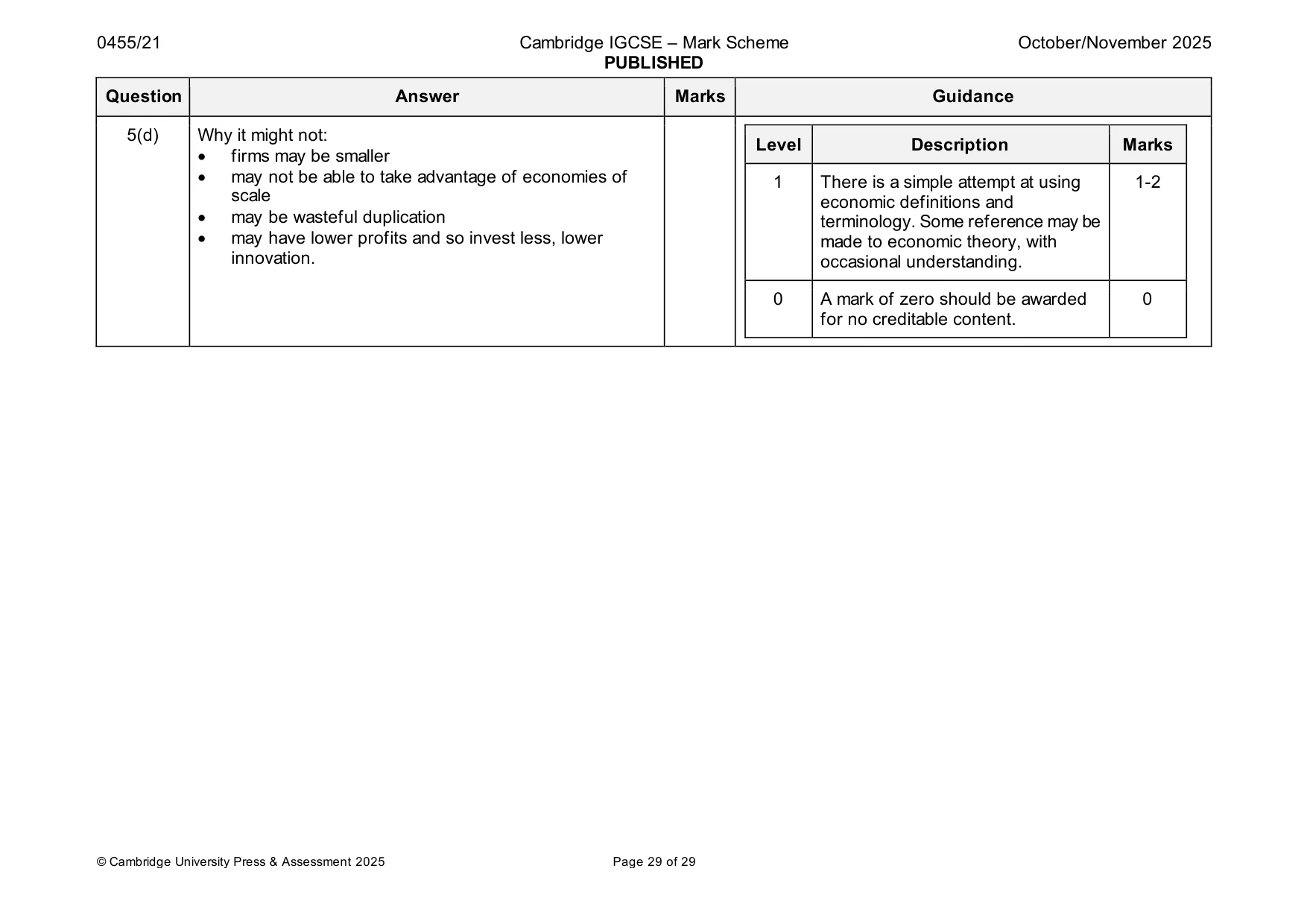
Mark scheme: 5(a) Identify two reasons why workers may choose to work 2 Accept any relevant reason. in the formal economy. If more than two suggested measures are given, consider Two from: the first three. • higher incomes in the formal economy • may have access to employment protection • may be covered by a national minimum wage • may be able to join a trade union • may be entitled to receive unemployment benefit • may be entitled to retirement benefits / pensions • will have a formal income record needed for e.g. bank loans • formal economy may be regulated by government. 5(b) Explain two effects of economic growth on a country’s 4 One mark each for effects identified and one mark each for population. explanations. Logical explanation which might include: If more than two effects are given, consider the first three. • more goods and services available / greater ability to purchase health care (1) higher living standards / life expectancy (1) less poverty (1) • higher employment / more job opportunities (1) more income (1) • more choice (1) due to more firms starting up / expanding (1) • lower inflation (1) if due to higher productivity / lower costs / more competition (1) • higher tax revenue (1) allows more government spending on e.g. education / health (1) • higher prices (1) due to increasing total demand (1) • more pollution / external costs (1) due to higher output of manufactured goods (1) • depletion of non-renewable resources (1) reducing future economic growth (1) • attracts immigrants / deters emigrants (1) due to benefits from high living standards e.g. job opportunities (1). 5(c) Analyse how government regulation can reduce market 6 Only reward answers that refer to laws and regulations, failure. not taxes and subsidies. Coherent analysis which might include: market failure occurs when there is an inefficient allocation of resources in a free market (1). laws / rules can be used (1): • to promote the use of merit goods (1) that are under- consumed (1) e.g. making it compulsory to wear seat belts in a car (1) • to reduce the consumption of demerit goods (1) that are over-consumed (1) e.g. banning smoking in public places (1) • to ensure minimum standards for goods and services (1) e.g. making it compulsory for restaurants to reach certain standards of cleanliness (1) can overcome the problem of sellers having more information than buyers (1). • to prevent abuse of monopoly power (1) by imposing maximum prices (1) e.g. a limit can be imposed on the price that can be charged by a monopoly water company (1) • to reduce exploitation of labour (1) by imposing minimum wages (1). 5(d) Discuss whether or not an increase in the number of 8 Level Description Marks firms will benefit an economy. 3 A reasoned discussion which 6-8 In assessing each answer, use the table opposite. accurately examines both sides of the economic argument, making use Why it might: of economic information and clear • may increase competition and logical analysis to evaluate • higher competition may lower costs and prices and economic issues and situations. One increase quality side of the argument may have more • may increase choice depth than the other, but overall, • may reduce monopoly power both sided of the argument are • more firms may increase output considered and developed. There is • higher output may increase employment and living thoughtful evaluation of economic standards. concepts, terminology, information and/or data appropriate to the question. The discussion may also point out the possible uncertainties of alternative decisions and outcomes. 2 A reasoned discussion which makes 3-5 use of economic information and clear analysis to evaluate economic issues and situations. The answer may lack some depth and development may be one-sided. There is relevant use of economic concepts, terminology, information and data appropriate to the question. 5(d) Why it might not: Level Description Marks • firms may be smaller • may not be able to take advantage of economies of 1 There is a simple attempt at using 1-2 scale economic definitions and • may be wasteful duplication terminology. Some reference may be • may have lower profits and so invest less, lower made to economic theory, with innovation. occasional understanding. 0 A mark of zero should be awarded 0 for no creditable content.
What was in this paper
The subtopics covered by these 5 questions, and how many questions each got. Open one in a new tab to see every Cambridge question on it.
What you needed in this session
Cambridge’s own grade thresholds for 2025 Oct/Nov, Paper 2 · Variant 1. A higher threshold means an easier paper — the bar moves with how the cohort did.